


Originally approached with a quilting mystery that began in 1846, a summer CoLab pulled a group of Retrievers together to examine the evidence. The detective pack expanded their search into robust research and, along the way, discovered how the communal process of sewing storytelling quilts lets these works of art transcend time.
Those in the quilting community know that the charm pack is a pre-cut bundle of fabric squares that can be used to create the patchwork for the top layer of a quilt. This story begins with a team that can be considered a sort of Charm Pack: expert quilters Mimi Dietrich, Monique Crabb, and Christa Gilliam, and researchers Sarah Fouts, Kat Gill, Ben Kayes, and Alyssa Thomas.
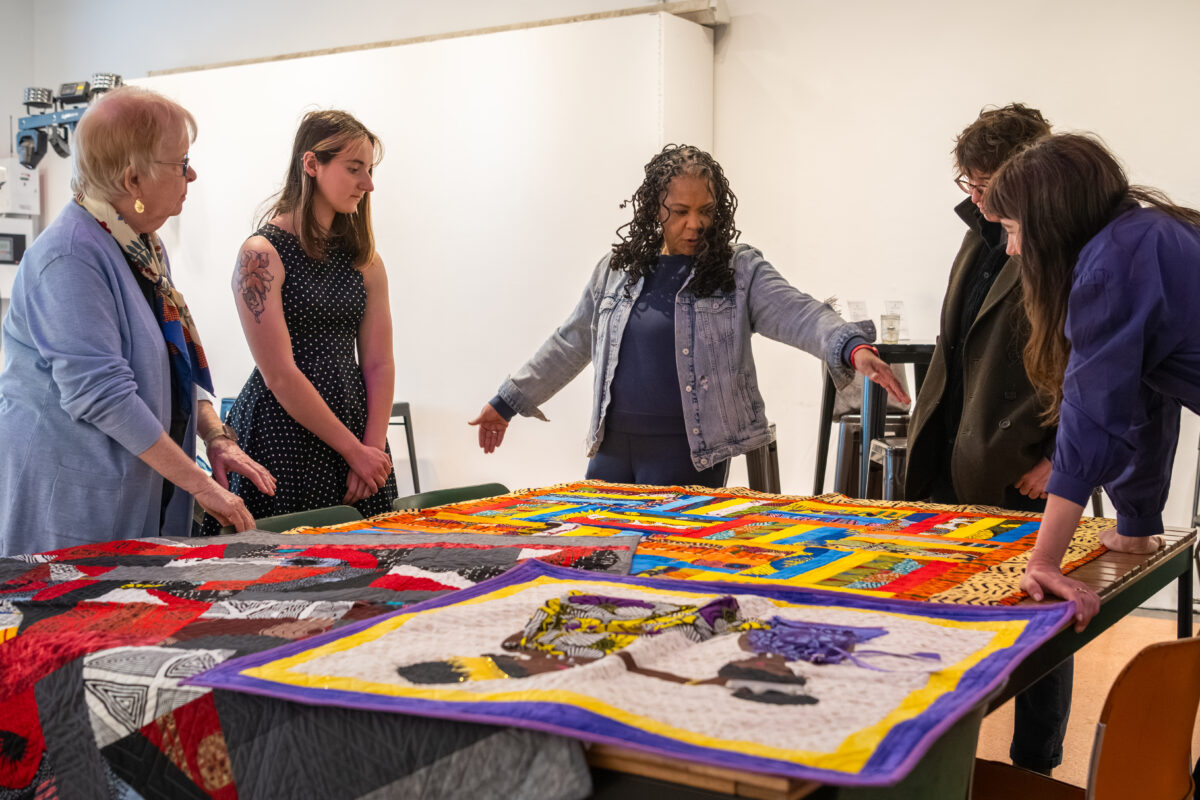
The pack first came together to solve a mystery for art collector Henry Stansbury, who bought a quilt at an auction 35 years ago with the words “Elizabeth Stansbury 1846” stitched into it. Last year, Stansbury showed this quilt to Dietrich, along with a second one he bought, stitched with the names Elizabeth and Mary Stansbury. Dietrich ’70, American studies, a member of UMBC’s Founding Four, has written 17 quilting books and has been an active part of the Baltimore quilting community since the 1980s. One look at the quilts and Dietrich could identify the type of fabric, the stitches used, and the style of quilt—a Baltimore Album Quilt. But these details didn’t give any clues about the Stansburys.


The pair turned to Sarah Fouts, associate professor of American studies and co-director of UMBC’s Orser Center for Public Humanities, for help. Fouts saw this as a great opportunity for a summer CoLab—where students and faculty conduct humanities research with a community partner and create public-facing projects. Enter the Storytelling through Baltimore Album Quilts 2025 CoLab.
Are the Stansbury quilts lost family heirlooms? Who are Elizabeth and Mary Stansbury? Are these two quilts telling the story of unrelated families with only the buyer to tie them together? The quick answer is no. “We never doubted they were related,” says Fouts. “There were just too many Elizabeths and Mary Stansburys that we couldn’t link it to a direct family line.” The longer, more complex answer is that all the threads led to a basement full of treasures and $10,000.
The sandwich
A quilt has three layers: the quilt top, the batting or insulating layer, and the backing or the bottom layer of fabric, formally known as the quilt sandwich. These pieces create the whole, and Fouts needed to find all the pieces of the sandwich, so she sent out a call for student interns to join the quilt-mystery-turned-humanities-research CoLab. Then she gathered a team of quilting experts: Dietrich, Crabb, M.F.A. ’22, and Gilliam, an associate professor of social work at Morgan State University who uses African-print fabrics to create quilts about her lived experience.
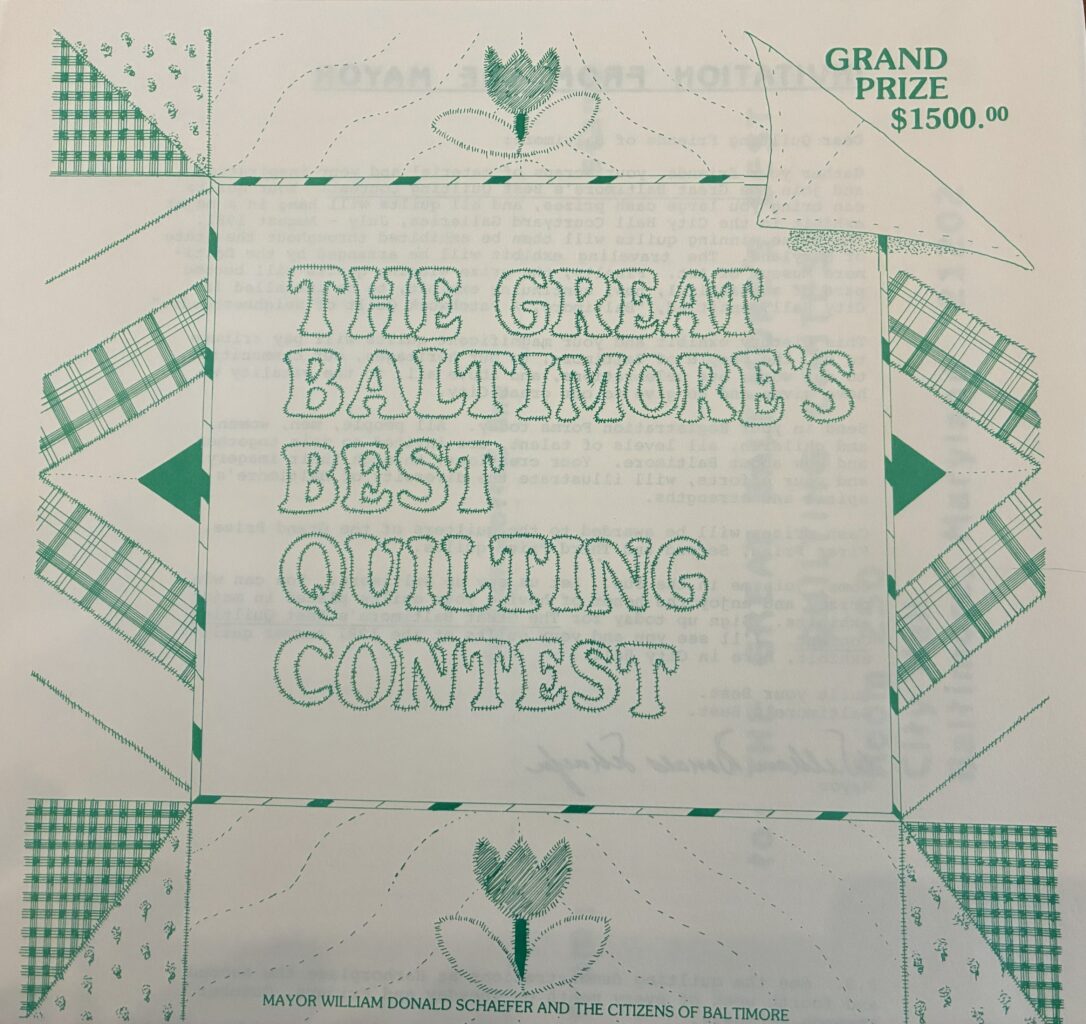
The first to join was Crabb, a Mexican American artist, who began quilting in 2014 and uses plant dyes, photography, thrift fabrics, and various quilting techniques to create quilts that reflect personal histories and feminism. As an adjunct professor at MICA, Crabb teaches 16 fiber-related processes in her Intro to Fiber class. But before the project even began, it took a turn. Crabb liked the idea, but encouraged Fouts and Deitrich to go to the basement of City Hall. Crabb knew that if they thought the Stansbury quilt was a find, the bowels of City Hall would dazzle them. She was right. Hanging in front of them was not one, but several different types of quilts from the Great Baltimore’s Best Quilting Contest of 1981, and they realized one of the participants was standing among them.
The inaugural citywide quilt competition, which Dietrich entered, celebrated Baltimore’s transportation, architecture, industry, people, and plants and animals. “I was surprised to see that the quilts were in the basement,” says Dietrich. Hers is stored at the Maryland Center for Culture and History (MCHC). “I entered the contest because I’ve always lived in Baltimore County.”

This treasure added multiple layers to the Charm Pack’s work. Now, it wasn’t about one quilt story, but many. Quilts made by residents from across Baltimore who, in 1981, chose to bring forth their vision of Baltimore through needle and thread. Who were these craftspeople? What was the history of the contest? And why did the Great Baltimore’s Best Quilting Contest have to live in the past?
“It’s good to learn something else from what you’re trying to find out,” said Dietrich, and with that, students across the College of Arts, Humanities, and Social Sciences took up the mantle of citizen investigators. Gill, an American studies and English senior; Kayes, a theatre design and production junior; and Thomas ’25, Asian studies, made the cut. They analyzed historical records, photographs, and documents from the Library of Congress, Maryland State Archives, Maryland Historical Society, and the Maryland Quilt Heritage Project, and quickly solved the first mystery. No records tied Henry Stansbury directly to the quilts. However, the trail did connect the deep red that bordered the quilt and was used throughout the blocks, as well as the indigo used to color bluebirds in mid-flight to Maryland and beyond.
“Wonderful natural dyes have dyed the fabric on this quilt. The red throughout is made from turkey red… matter root that is grown here in America,” said Gill, in a video the lab co-produced with the Baltimore Heritage organization. “We also have this wonderful indigo blue that is very vibrant on the bird, which is from the indigo plant and is also made here in America, but is also imported from Latin and South America as well.”
The quilts the students researched were examples of how one person’s quilt tells more than one story. From the thread and needle chosen to the types of dyes on a cloth, each piece can stand as its own narrative, but once stitched together, a more complex one can emerge. “Quilts became powerful analytical tools, allowing students to interrogate intersections of class, race, gender, and globalization and demonstrating how even the most familiar objects are embedded in complex and often unequal systems,” says Fouts.
The blocks
Blocks are individual units of fabric sewn together with other identical or different blocks to form the main pattern of a quilt top. With the Stansbury mystery partially solved, everyone turned their efforts to studying the technical, communal, and historic aspects of Baltimore Album Quilts, which were named after a book where each page commemorated a friendship, like the adjacent blocks of a quilt.
To learn from the masters behind the craft, Dietrich introduced the students to 20 Baltimore quilt-makers. Kayes interviewed Crabb about the natural dyes and contemporary quilting practices. Thomas interviewed Gilliam about embellishments and Black quilting traditions in Baltimore. Gilliam is a fiber artist and member of the African American Quilters of Baltimore, and a former Maryland Folklife Apprentice of Vera Hall, a prominent Maryland African American master quilter.


With nearly a decade of experience in quilt making, Gilliam once created a quilt titled “She Who Wears A Crown,” to help her students understand the 2019 Crown Act that protects against discrimination based on race-based hairstyles by extending statutory protection to hair texture and protective styles such as braids, locs, twists, and knots in the workplace and public schools.
“What excites me most about my work is the ability to work in community and meet so many young people who are interested in learning about the history of quilting,” says Gilliam. “Quilting allows us to learn and teach the stories that connect us to the past.”
The binding
When all the measuring, cutting, dying, and stitching have told the story, the quilter binds it together by sewing a strip of fabric around the edges to cover the raw edges of the quilt sandwich. It acts as a protective border to prevent fraying and provides a polished look.
After four weeks and 130 hours of research, the CoLab, in partnership with Baltimore Heritage, co-produced five oral histories on Dietrich, Crabb, Gilliam, Stansbury, and Catherine Rogers Arthur, vice president of collections and chief curator of MCHC.
But there was still one more loose thread. Crabb didn’t think the Baltimore Album Quilt story should have ended in 1981. The 1981 competition was hosted by Baltimore City Hall, with a grand prize of $1,500. In 2025, Fouts reached out to City Hall for support to resurrect the competition. The positive response was not only immediate but backed with a $10,000 prize for the contest. Maryland State Art Council had already committed $7,000 to operations.
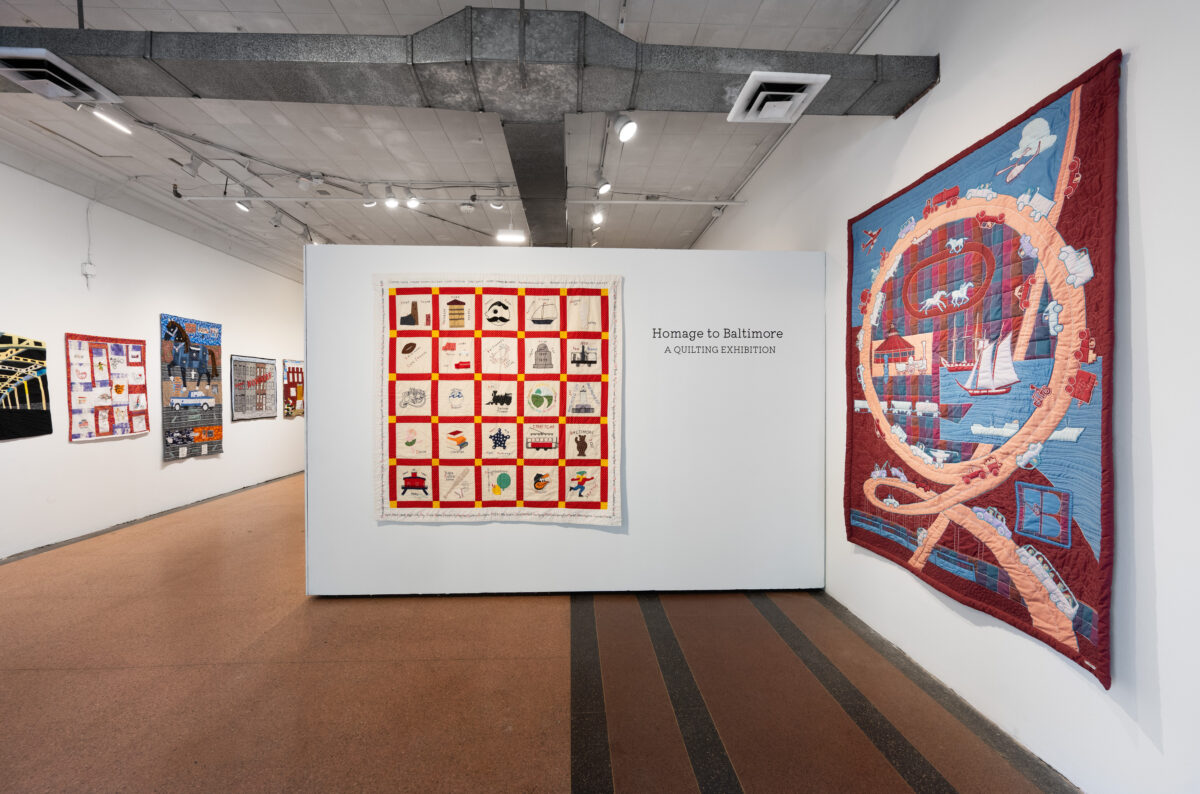
With the support of Baltimore City’s Mayor’s Office of Arts, Culture, and Entertainment and Maryland State Art Council’s Maryland Folklife Network, the CoLab has renewed the competition, titled “Homage to Baltimore Quilting Competition.” By April 1, 2026, 52 people submitted quilts. After Gilliam, Crabb, and Dietrich judged the final round of quilts, a $5,000 grand prize was presented at the opening exhibition on June 6, 2026, at Current Space.
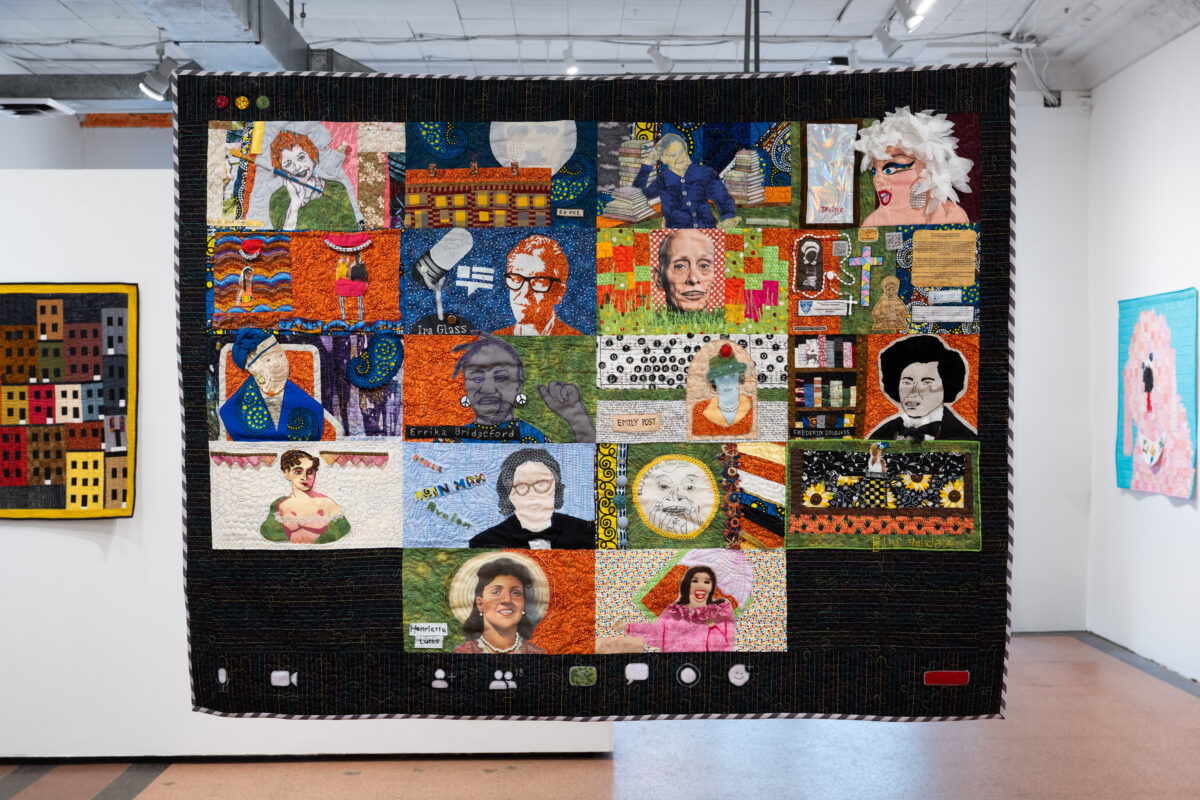
The winning quilt does it all: each of the 18 blocks of the hand- and machine-stitched quilt tells the story of Baltimore’s history using a lens from the present. Created by Piecing with Purpose Quilt Collective, “Baltimore Citizens, from Past to Present, on a Zoom Call” unites the city’s legendary movers and shakers in conversation with each other.

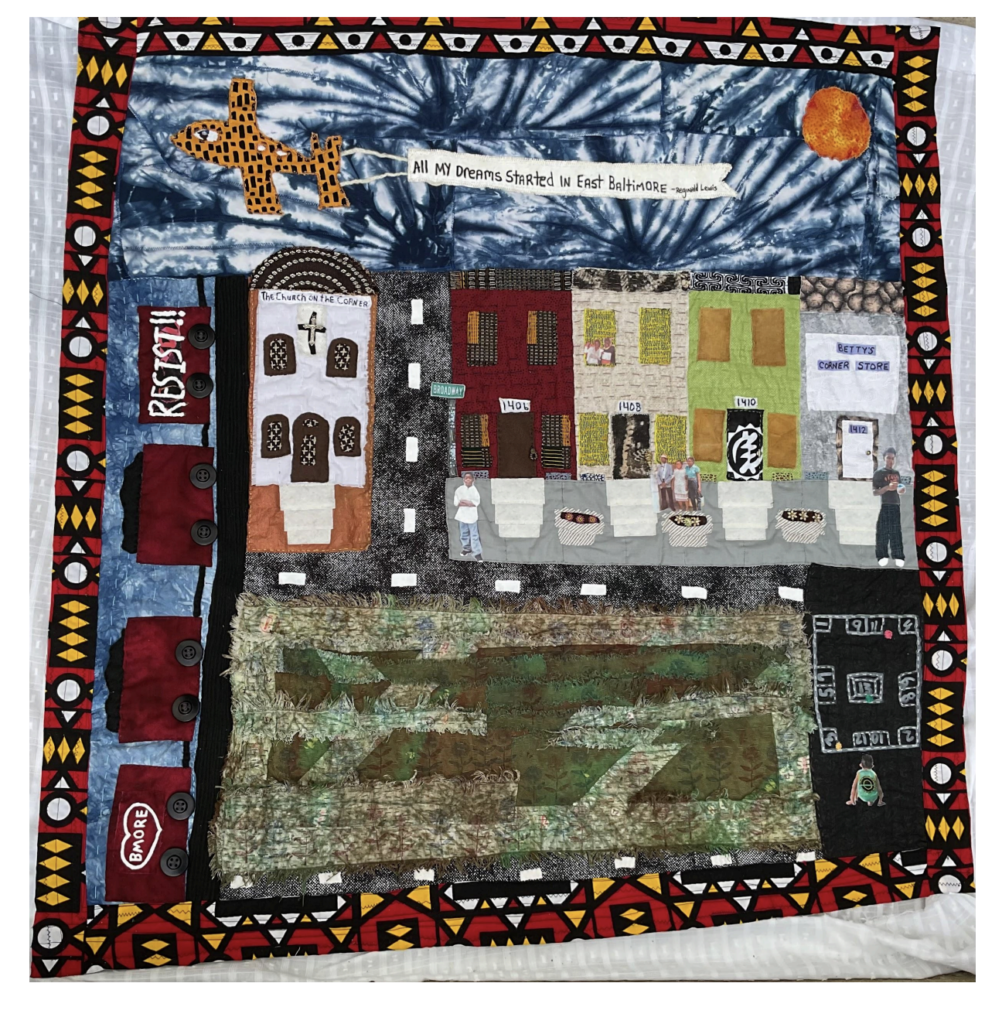
Two of the 1981 quilts were also on display at the Current Space exhibition, along with a zine by Abby Wheatley, a junior graphic design major, illustrating the history of the 1981 competition. “It’ll be exciting to see the continuity of themes over the 45 years of the competition,” Fouts says, “and, through the historical side, we can bring to life some of the co-lab’s archival work.” The top three winning quilts in the competition will be displayed in public schools. The Mayor’s Office has committed to continuing the competition in the future.
What began as a 19th-century quilting mystery evolved into a colorful and accessible competition—celebrating a wide range of voices and inviting people to wrap themselves up in Baltimore.
“I was fascinated with the CoLab experience and how the students shared their progress,” says Dietrich. “I love seeing how UMBC has grown. It’s amazing to see it through the eyes of someone who was here when it opened. There are so many different choices for engaged learning.”