

Anyone passing by Room 208 of the Sondheim Building this spring might have thought the class was a Latin American music appreciation course. Projected on the screen was a video of the Mexican band Los Ángeles Azules (“The Blue Angels”), featuring Natalia Lafourcade singing “Nunca Es Suficiente” (“It’s Never Enough”).
In Silvia Escanilla Huerta’s history classroom, music is not background noise but a historical text carrying centuries of migration, colonialism, resistance, and cultural exchange. “Nunca Es Suficiente” is a modern Mexican interpretation of Colombian cumbia, a 200-year-old genre of music created with African, Indigenous, and European acoustic instruments. Escanilla Huerta uses material culture—songs, videos, poems, documentaries, art, and student-created work—to awaken students’ senses and engage their interest in the complex history of Latin America.
Escanilla Huerta has found that using material culture helps students connect abstract historical ideas with concrete experiences, inviting students to think critically about how these practices evolved and impact the world today. She guides students as they analyze and compare primary and secondary sources from the past and the present to critique what is missing from historical records. Critical research analysis skills she honed while she was conducting archival research in Spain, Argentina, Bolivia, and Peru on the role indigenous peoples played in the process of independence in what today are Peru and Bolivia.
“I try to entertain and make it fun, not just for them but for me too, because I’ve worked with this material for decades. I want it to come alive for them as it did for me,” says Escanilla Huerta, the first tenure-track faculty member and the first Latina in UMBC’s history department to teach Latin American history. “I dance, I speak in Spanish, and translate Spanish-language texts for the class. We watch videos, listen to music, and connect this media to specific points in history,” Escanilla explains while the students continue to listen to the song, “like today’s topic, the Guatemalan and Cuban revolutions in post-WWII Latin America.”
The art of revolution
As the song “Nunca Es Suficiente” came to an end, Escanilla Huerta lowered the volume and projected “Gloriosa Victoria,” a painting by Mexican muralist Diego Rivera depicting the coup of 1954 as a segue into the Guatemalan revolution of 1944 to 1954 against Jorge Ubico’s dictatorship. The students scan the mural in anticipation of their next point of analysis.
“What do you see?” asks Escanilla Huerta. Students describe the crowded painting filled with Guatemalan and U.S. politicians, military and business leaders, in a tense negotiation while a bishop blesses them. “On the top right-hand corner, I can’t tell whether it’s people at a window with bars or jail,” says one student. Escanilla Huerta confirms that it’s a jail and then draws their attention to specific elements like a man holding a bomb with the face of the U.S. President Eisenhower, surrounded by people who were murdered during the coup.
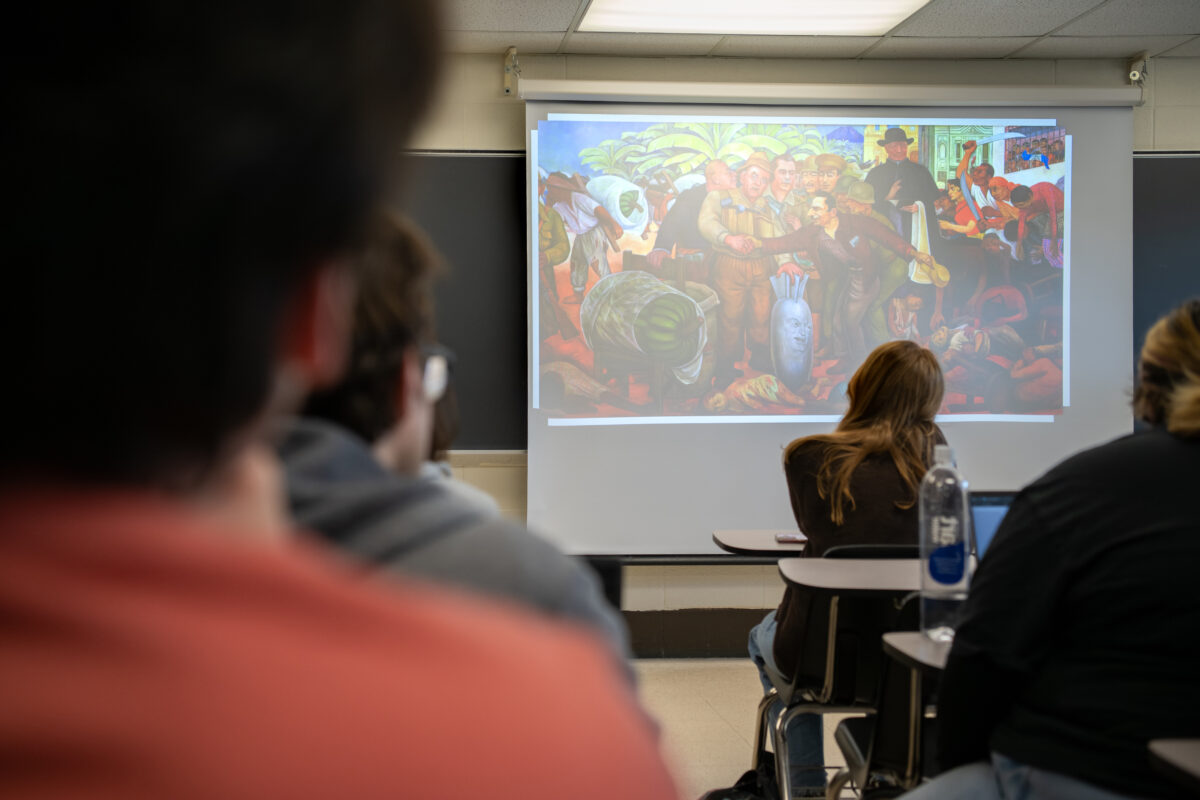
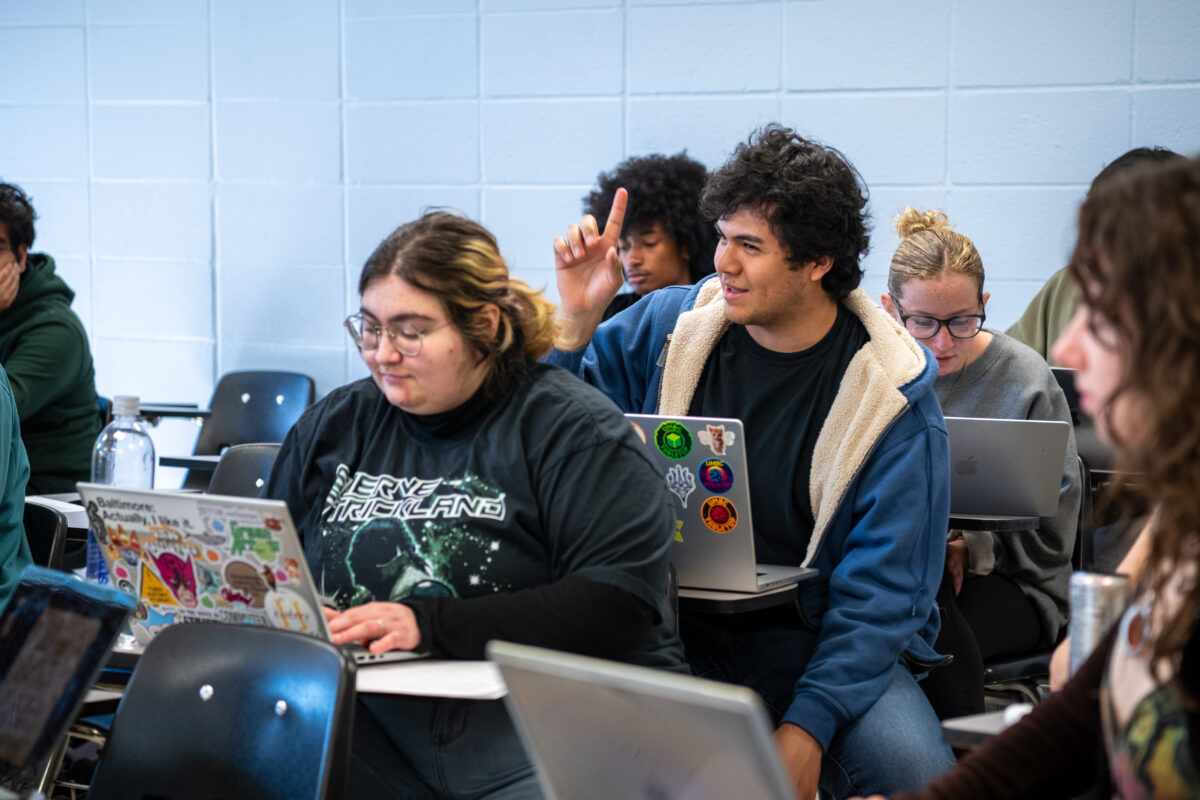
To further contextualize what Rivera was reacting to, she explains the political tensions of the time. “The revolution succeeded, bringing an elected democratic government for 10 years,” said Escanilla Huerta. “Until opposition from other political parties and U.S.-based corporate interests led the U.S. Central Intelligence Agency (CIA) to topple the government in 1954.” Back and forth, Escanilla Huerta and the students unpack the mural scene, connecting each scene to their readings and to today’s geopolitical wars.
She also urges students to think beyond identifying the iconic representations of abuses of power and to critique the artists themselves, their motives, and their lives. “The painting is a clear denunciation of corruption, but the artist himself has a complex history that, while he defends the people, he is also sexist and abusive. History is complex, and we need to consider all aspects.”
So you want a revolution
Shifting from fine art to pop art, Escanilla Huerta displays a poster of a man’s face wearing a black beret marked with a gold star and military fatigues, set against a vivid red backdrop. “Does anyone know who this is?” Some students nodded, but few knew the history behind the image.
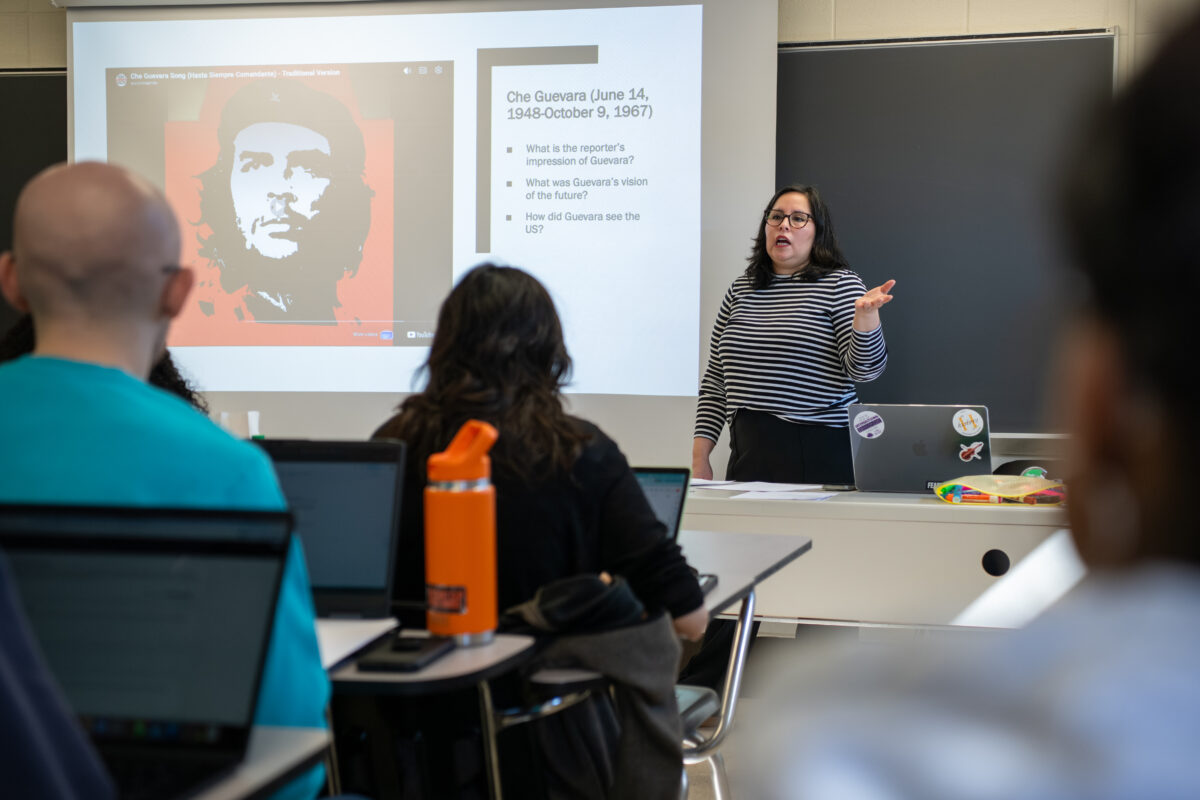
“Like many revered historical figures, Ernesto Guevara de la Serna, better known as Ché, is loved by people all over the world, but he is also controversial,” explains Escanilla Huerta. Nearly 60 years after his CIA-assisted execution, Guevara’s likeness remains one of the most recognizable symbols of Latin American revolution, reproduced on T-shirts, hats, and posters worldwide.
Students look at their own t-shirts as Escanilla Huerta encourages the class to connect two points: How merchandising is used to make personal political statements and how popular culture can keep the memory of a movement or a person long after they’re gone through merchandising, literature, and music. “Ché was a Marxist revolutionary who believed armed revolution was the only path to liberation from oppressive local governments and U.S. interventionism,” she says, clicking through historic black-and-white photos of Ché in Cuba.
“He developed his political ideology while he was a medical student during a motorcycle trip across Latin America where he witnessed the oppression of Indigenous and rural communities,” says Escanilla Huerta, emphasizing how college students can create change in a variety of ways while passing out copies of poems, songs, political cartoons, and a 1959 television interview, for students to read, compare, and discuss in groups.
Expanding on the idea of revolution, Escanilla Huerta introduces “Revolution” by the Beatles, released in 1968, 10 months after Ché was executed. “If you haven’t heard of the Beatles before, I’m very glad I’m the one introducing them to you,” she says, smiling and nodding to the beat. “I want you to listen to the lyrics, and then we can contrast Ché’s idea of revolution with the Beatles’ idea of revolution.” The song opens with the lines: You say you want a revolution / Well, you know / We all want to change the world. Hands quickly shoot up as students begin connecting Ché’s call for armed resistance with the Beatles’ more skeptical view of revolution and whether radical change truly transforms who holds power.
What are you willing to fight for
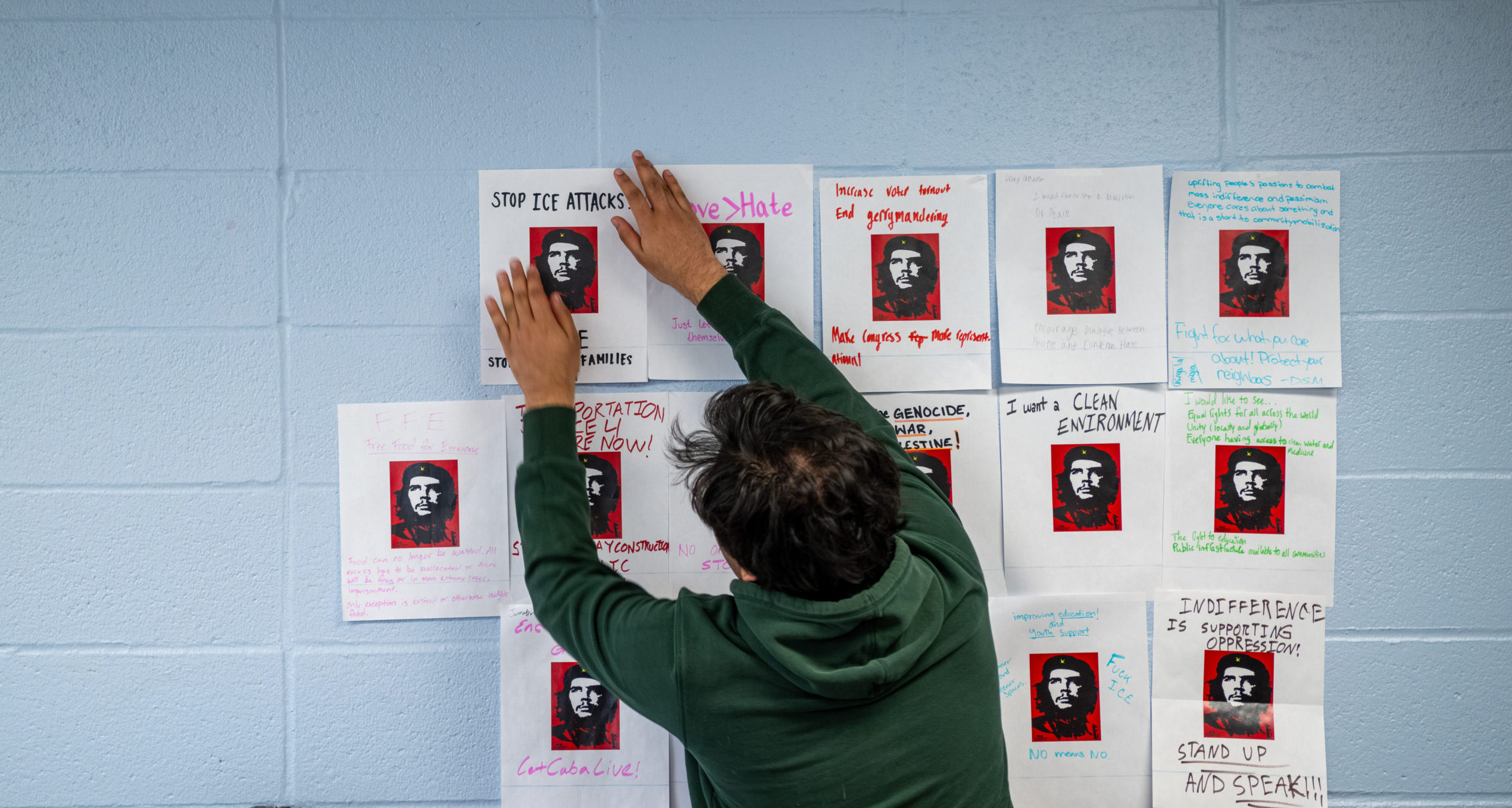
She ends the discussion by asking students to place themselves as active agents in history. “Now, what do you think it takes to become a revolutionary? What do you care about that you would like to change?” asks Escanilla Huerta as she passes out sheets featuring Guevara’s iconic red-and-black image. Faces lower, pencils race across the page, and within minutes, students tape their responses to the back wall for the class to see. Together, they move to the opposite side of the classroom to take in the full wall of ideas.

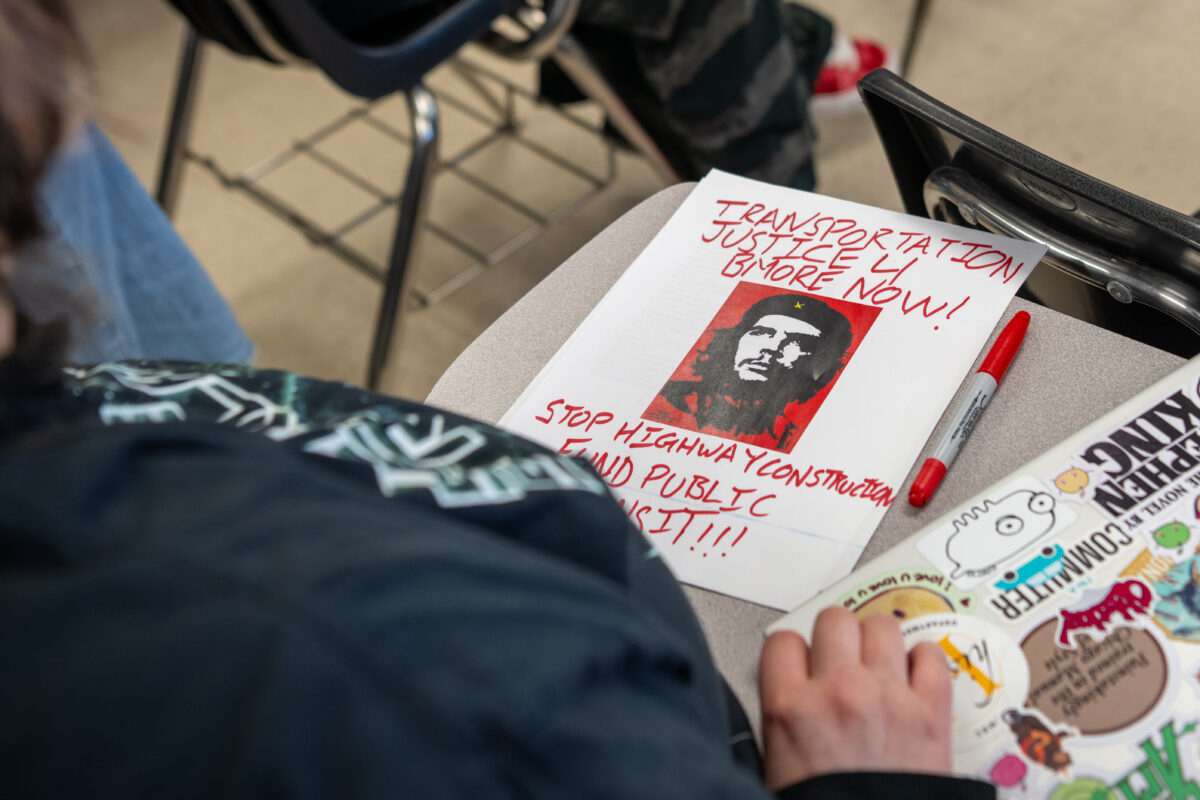
“Who wants to share what they want to change in the world? What is worth fighting for?” asks Escanilla Huerta. One student’s hand flies up: “I want independence for Wales,” they say, explaining how Wales is a country conquered by England that remains under British rule. Another wants an end to the war between Israel and Palestine and the corporations profiting from it. Others bring the discussion closer to home, raising concerns about transportation equity in Baltimore, where public transit remains inaccessible in many areas. Standing at the front of the classroom and looking at their collective wall of ideas, students begin to recognize that history is shaped by people who choose to follow ideals—for better or worse, depending on who is telling the story.
We’re still here
“I don’t want the class to become a long list of injustices that have happened on Latin American soil,” says Escanilla Huerta, who was born and raised in Argentina. Just like she uses material culture of decades past, she also brings the present into the classroom to show that Latin American history doesn’t end with massacres—it’s so much more. “Despite all that pain, we have always carried joy, pride, and a fighting spirit. That’s why we also analyze examples of joy like Bad Bunny.”
The Puerto Rican singer-songwriter’s 2026 Super Bowl LX halftime performance was the kind of stadium-scale material culture Escanilla Huerta would love to bring into the classroom. Across the stadium floor were vivid representations of Puerto Rican history: workers in sugar cane fields, people trading gold, and the Puerto Rican independence flag flying high, connecting a painful colonial past with a joyful present through a lively house party scene celebrating Puerto Rican dance traditions, vendors selling local treats, and the flags of every Latin American country flanking both sides of the field.
While it may not be the Super Bowl, this spring in room 208 Sondheim, Escanilla Huerta similarly brought modern Latin American history and contemporary culture into the classroom to remind students, as Bad Bunny said in the final line of his Super Bowl performance, “Seguimos aquí!/We’re still here!”