All posts by: Jenny O'Grady


Our People, Our Land, Our Images: AOK Library Gallery Through March 18

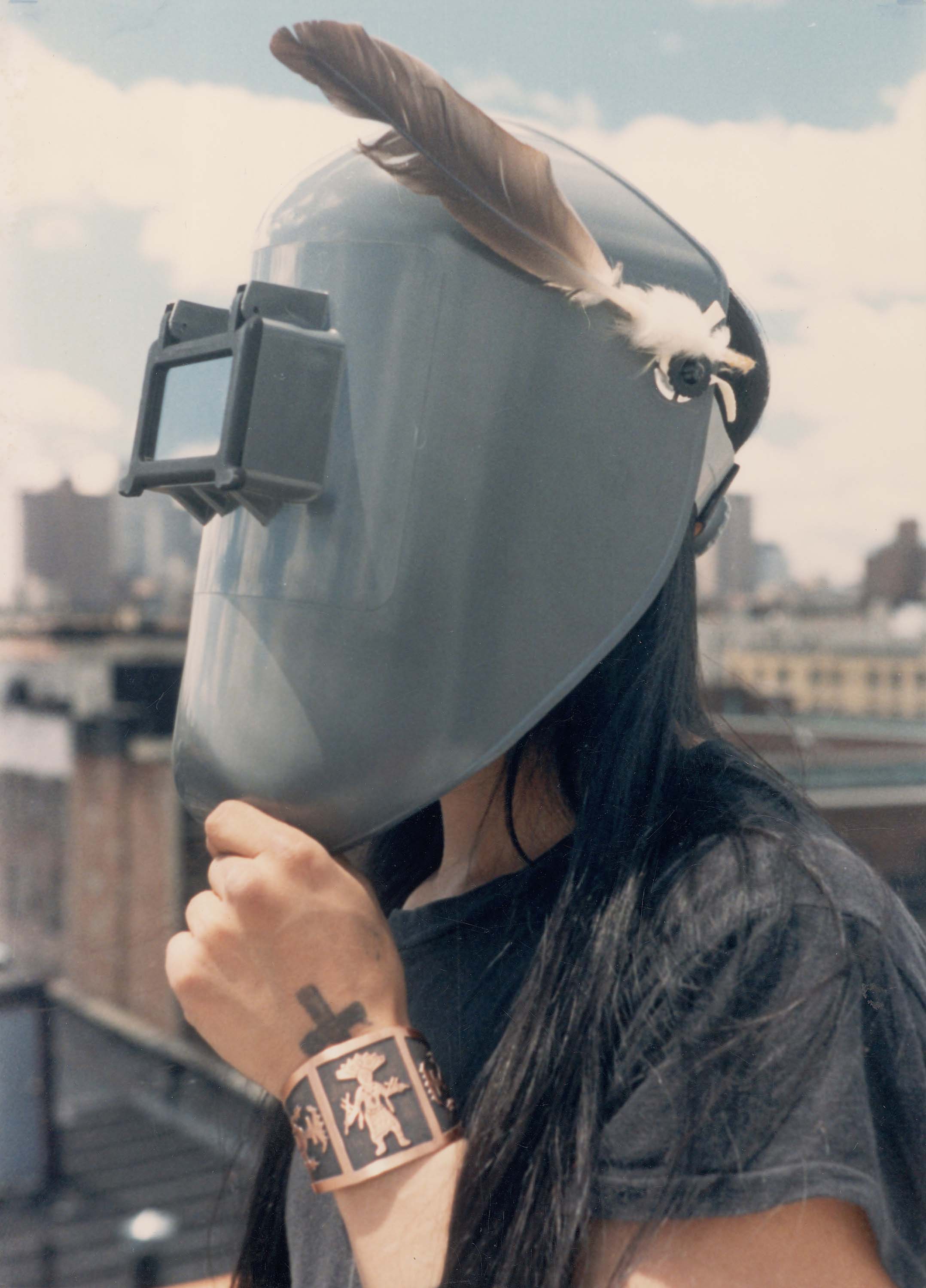
Above image: Erica Lord, Athabaskan/Inupiaq (b. 1978), Untitled (I Tan to Look More Native) from the series Tanning Project, 2006, Inkjet C-print.


Opportunities to view indigenous peoples through the eyes of indigenous photographers are rare and recent. Through March 18, UMBC’s Albin O. Kuhn Library Gallery presents Our People, Our Land, Our Images, a landmark exhibition bringing together 26 indigenous photographers from throughout the United States, Canada, Peru, and New Zealand.

Distinctive in its historical reach, the exhibition includes newly discovered 19th-century trailblazers, members of the next generation of emerging photographers, and well established contemporary practitioners varying in style, from straightforward documentary accounts to aesthetically altered images combining overlays and collage. The variety found in the exhibition conveys the plurality of the indigenous voices and their concerns. The photographs are united, however, in how they convey their makers’ connections to the land, community, and traditions.

Learn more about this exhibit and others happening at UMBC at artscalendar.umbc.edu.
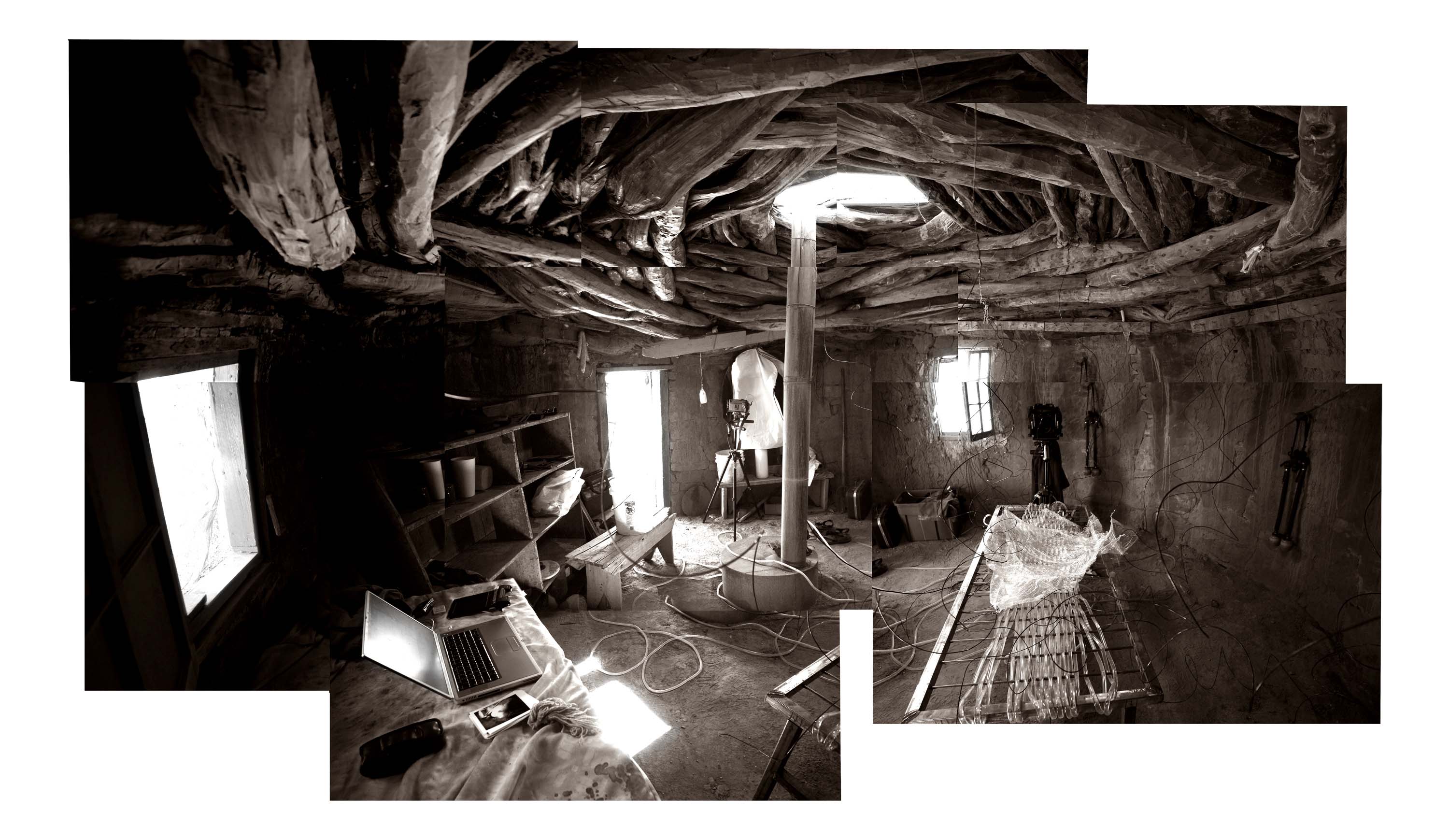
Will Wilson, Dine (B. 1969), Auto Immune Response #4, 2005, inkjet print


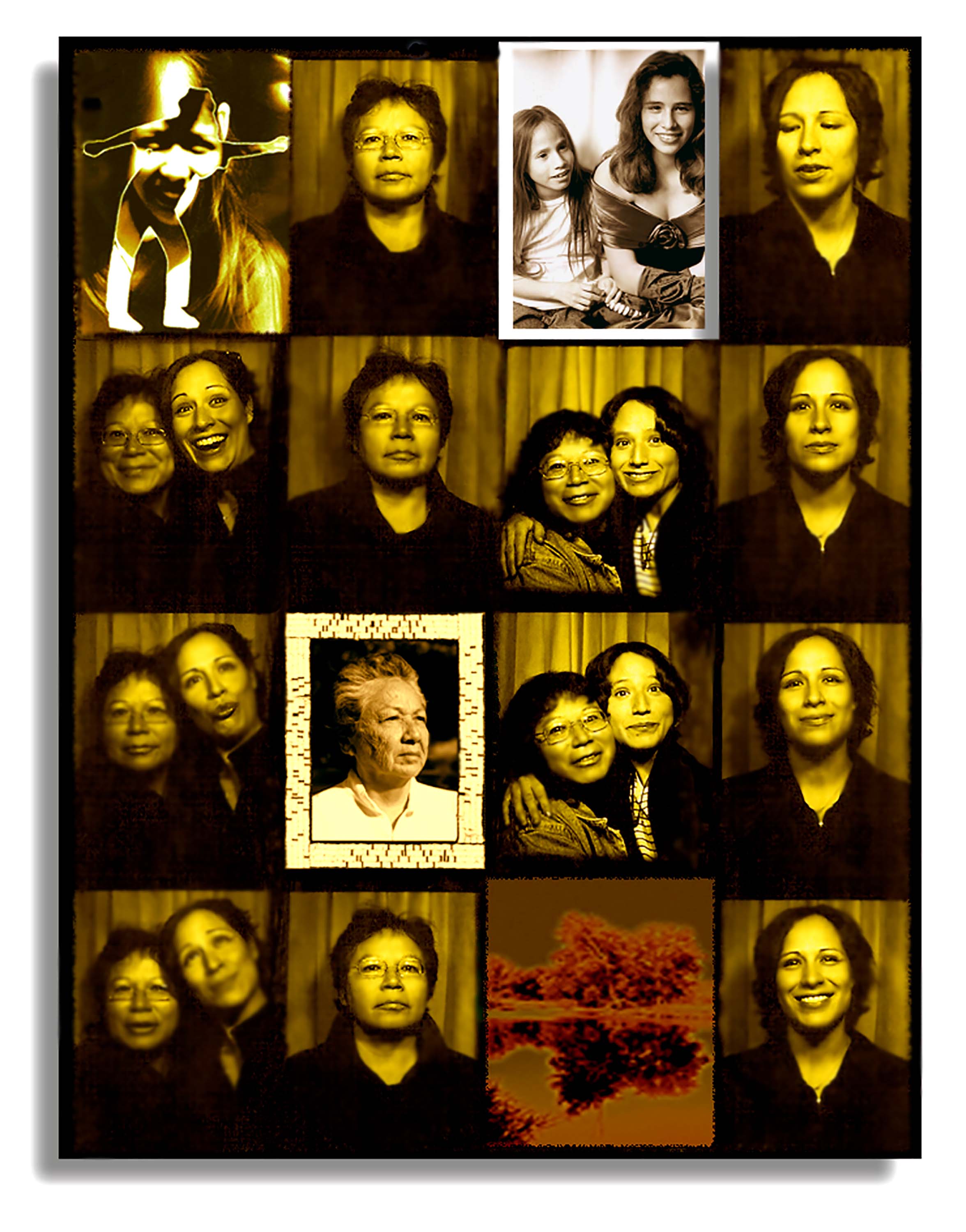
Shelley Niro, Mohawk (b. 1954), GIRLS, 2006, digital print


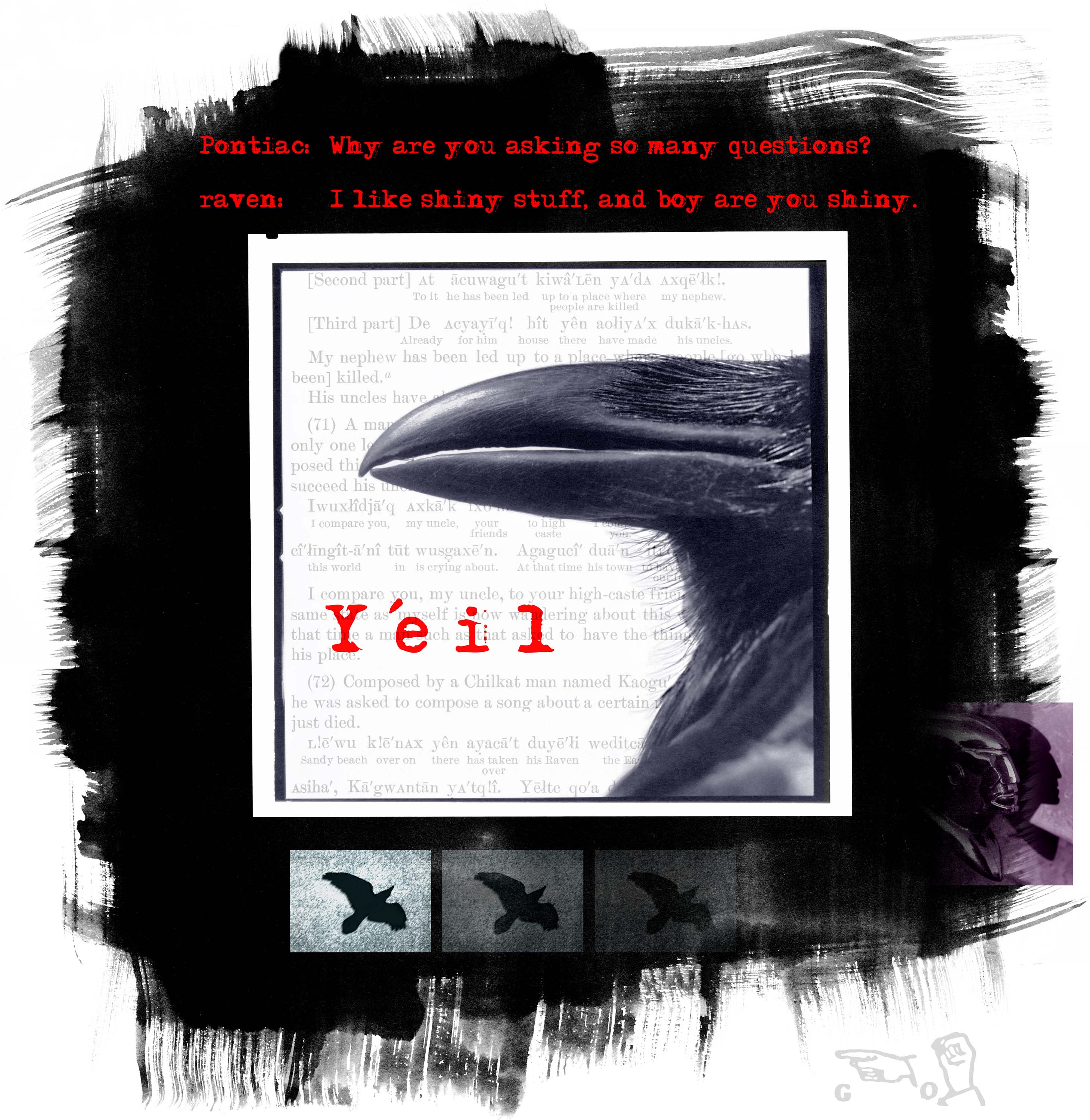
Larry McNeil, Tlingit (b. 1955), Yéil, 2006, digital print


Lee Marmon, Laguna Pueblo (b. 1925), Laguna Eagle Dancers, 1962, black-and-white print


Shan Goshorn, Cherokee (b. 1957), Pawnee Woman in Field from the series Earth Renewal, c. 2002, hand-tinted, double-exposed, black-and-white photograph


Peña Bonita, Apache/Seminole (b. 1948), Skywalker, 2006, color print


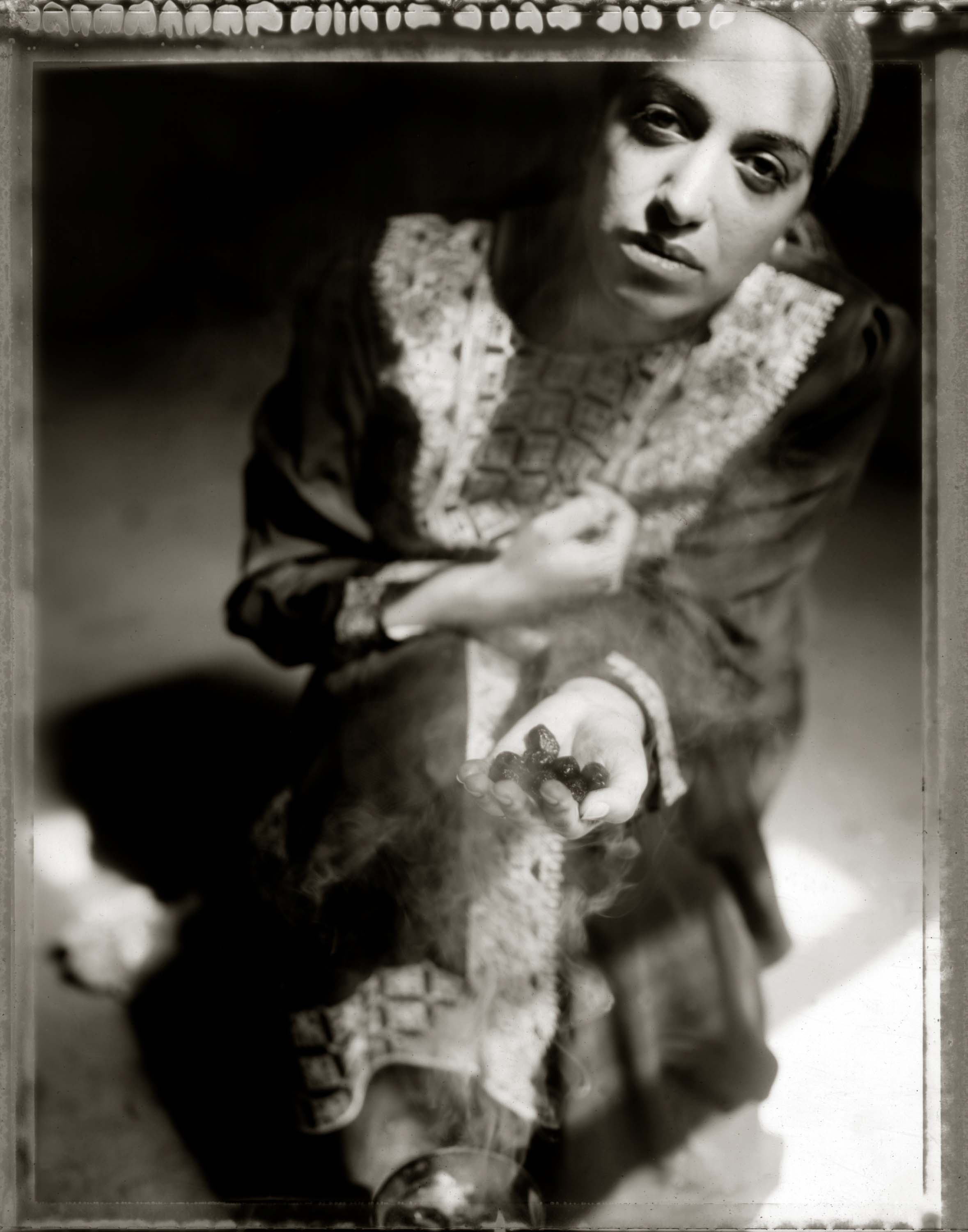
Sama Alshaibi, Iraqi/Palestinian (b. 1973), Olives from Gaza: The Bitter Dream, 2004, digital print


Erica Lord, Athabaskan/Inupiaq (b. 1978), Untitled (I Tan to Look More Native) from the series Tanning Project, 2006, inkjet c-print

A Whole New (DI) Ballgame — Bobby Mills ’91

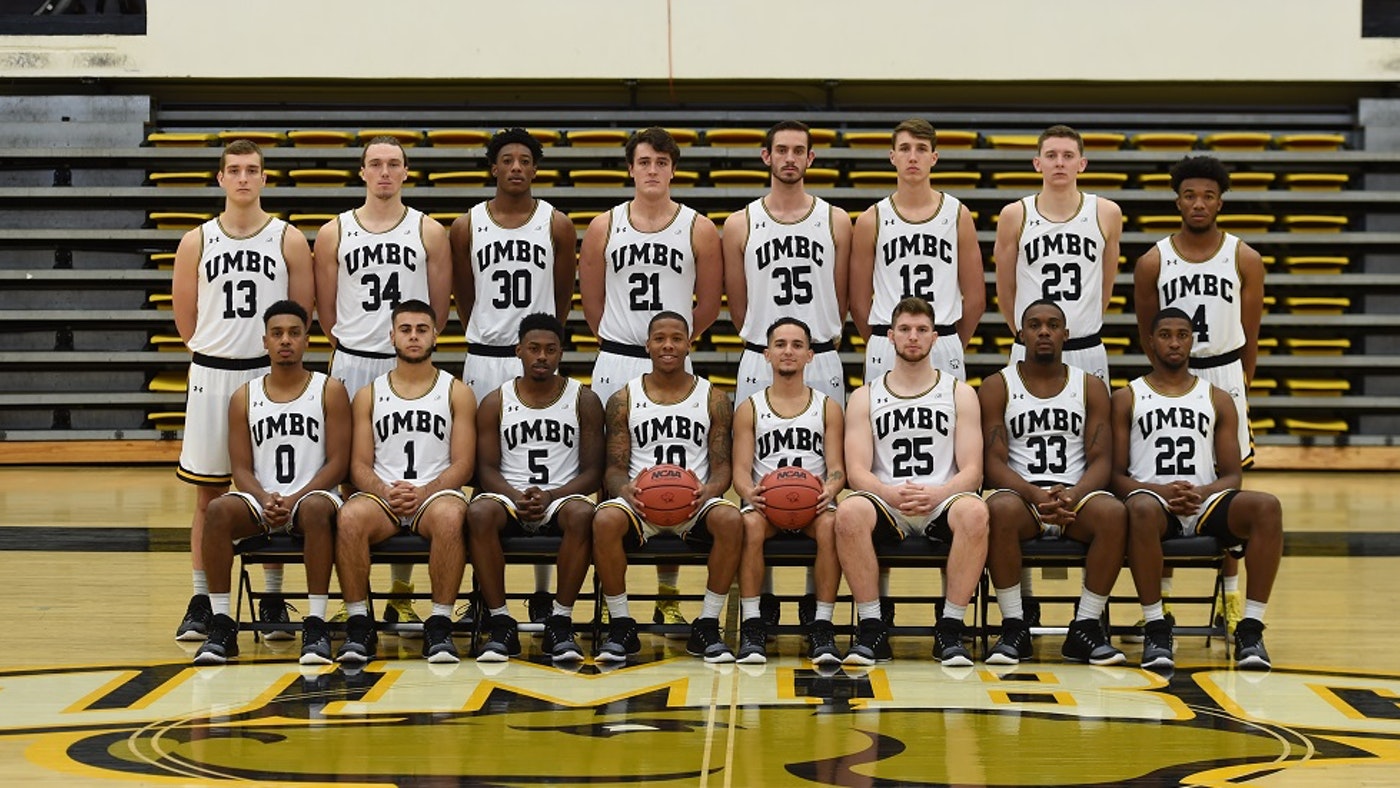
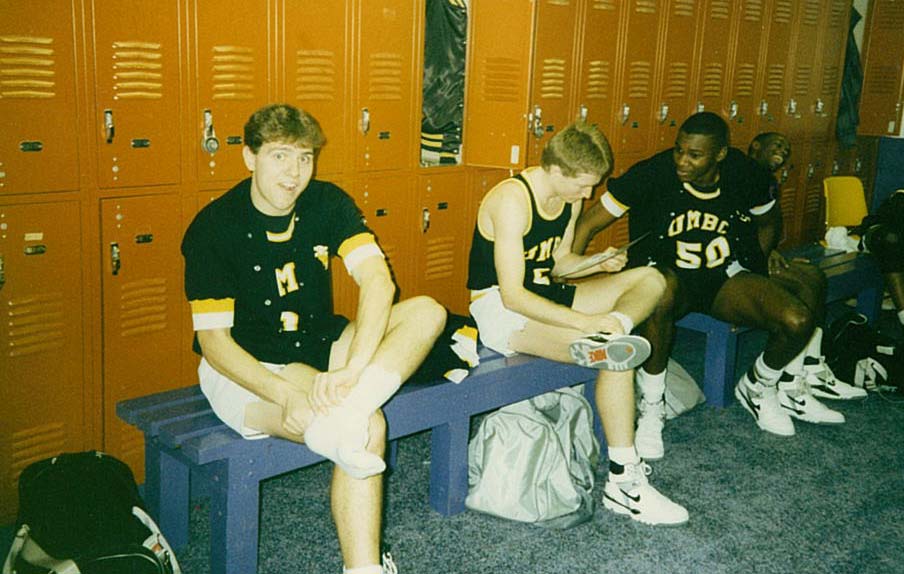
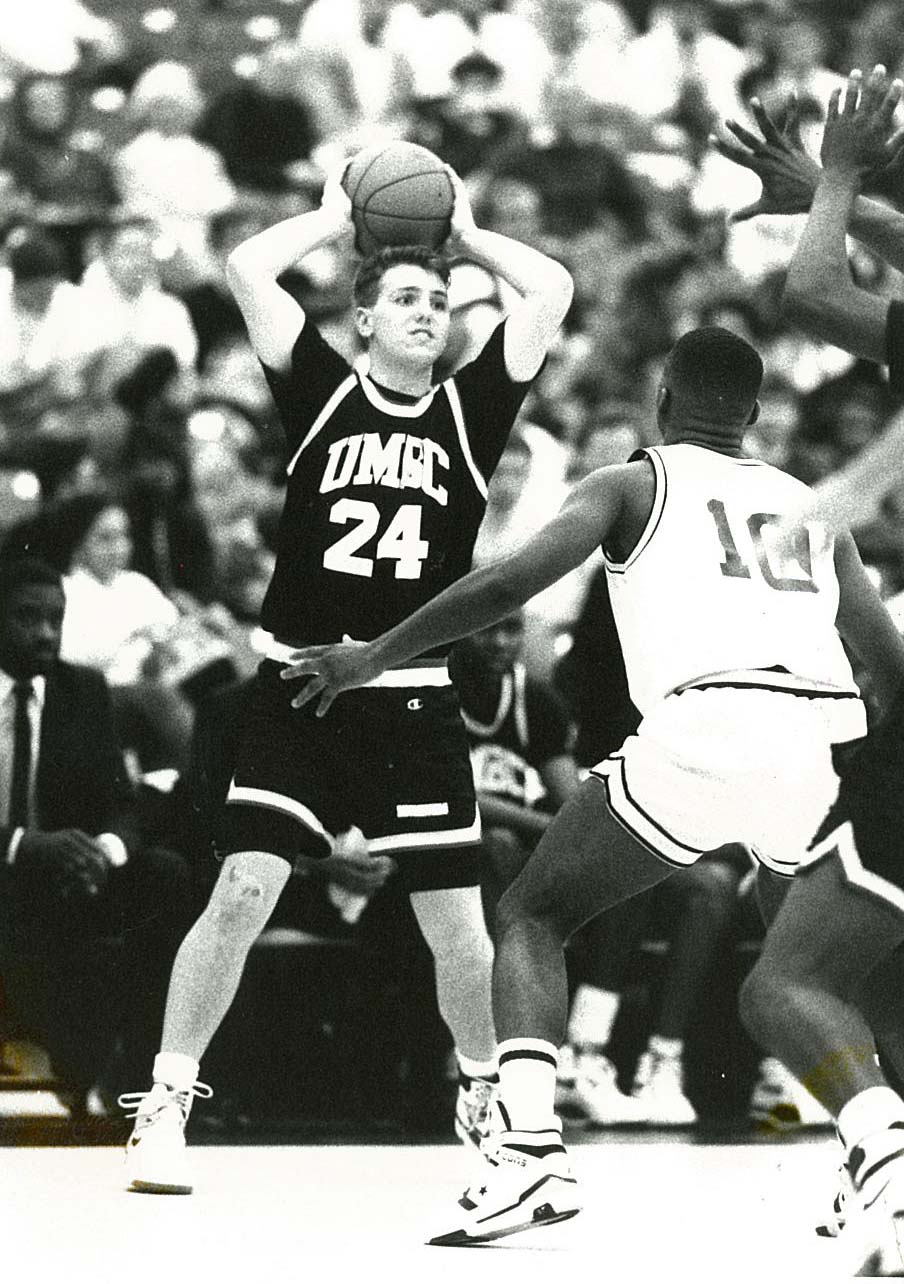
Bobby Mills ’91, economics, played a prominent role in building the foundation of UMBC’s Division I men’s basketball program. While there have been ups and downs over the past 30-plus years, including four conferences switches and six head coaches, the first teams and their “founding fathers” hold a special place in Retriever Athletics’ history. Mills’ UMBC journey contained challenges, but he credits his families – the one based in Pittsburgh and his Retriever family in Baltimore – for putting him on the path to achieving more than he could ever have imagined back in 1986. And, he’s never been more optimistic about the present and future of his beloved Retriever program.

– Steve Levy ’85, Associate AD, Athletic Communications

“It’s a Whole New Ballgame”

This was the slogan that former athletics director Rick Hartzell chose to use as he piloted the UMBC Athletics’ program into the NCAA Division I era in the fall of 1986. For a university with only 20 years under its belt, the words seemed apt.

Within the new structure, a great number of UMBC teams were expected to fare reasonably well in the early stages of the Division I experience, but the men’s basketball program was not among them. After some great fortune, marked by back-to-back NCAA Division II appearances in 1978 and 1979, a loss of scholarships helped sink the program into poor condition just a few years later. In fact, the Retrievers won only five games (5-23) in their final D-II campaign and a daunting D-I independent schedule in their initial campaign had those inside and outside the UMBC Fieldhouse wondering if new head coach Jeff Bzdelik would win a contest in 1986-87.

But Bzdelik, using his resources as a former Northwestern assistant, gathered several Division I-ready players shortly after arriving in Baltimore. Junior college transfers Reggie Truitt ’89 and Jeff Reynolds ’89, DeMatha High School product Duane Faust, and Towson Catholic’s Gamel Spencer ’90 teamed up with dedicated holdovers and two other recruits with whom Bzdelik had forged bonds on the recruiting trail at his former Big Ten school: Larry Simmons ’90 and Bobby Mills ’91.

That group shocked the skeptics and won 12 games (12-16) in the first season. The following year, the addition of Reynold’s brother Kenny propelled the team to a 13-win season (Jeff missed the year due to injury). When the Reynolds brothers finally got on the court together in 1988-89, the Retrievers posted a mark of 17-11 and captured the Battle of Baltimore Tournament under first-year head coach Earl Hawkins.

Mills had visited Northwestern and also had offers from George Mason, St. Peter’s and St. Francis University of Pennsylvania. But he ultimately decided  to take a chance and come to Baltimore to play for Coach Bzdelik. “It gave me the opportunity to play right away,” said Mills, who also promised his parents he would find a school with an engineering program. “It came down to the right situation for me, coming in with the new guys and building something up from the ground.”

It didn’t take long for Mills to get acclimated. “It was a commuter school back then. You became close with everybody on campus. I liked (former UMBC President) Dr. (Michael) Hooker; it was great meeting him on my first visit and hearing his vision of where the school was going. And it was only four hours for my parents to come see me play.”

Mills also credits Gym I (UMBC’s original playing facility, located on the grounds that The Commons has occupied since 2002) as creating part of the culture of that close-knit group. It acted as a private practice facility for the team in those days where “gym rats” like Mills, Simmons, and others, could shoot and play long after the sun went down or came up.

But the bonds that Mills forged went well beyond his teammates and the administration. He roomed with senior lacrosse players Craig Parks ’88, Ricky Fried ’88 and UMBC Hall of Famer Ray Ignacio ’87 in his sophomore year and, despite moving in with Simmons as a junior, he still had great friendships with UMBC’s other athletes on the lacrosse, baseball, and soccer teams.  

On the court, Simmons had been recruited to play the point guard position and Mills the off-guard slot. But circumstances dictated a role reversal after their third game as freshmen and, Simmons, an Indiana native, would go on to score the most points (1,805) in school history, a mark that stands more than a quarter-century later.

Mills’ numbers were not nearly as gaudy.  He struggled with injuries throughout his tenure, missing the entire 1987-88 campaign with mysterious concussion-like symptoms from a charge sustained in the Coppin State game at the end of his freshman year. (Years later, after re-connecting with UMBC sports medicine guru Cindy Kubiet, he learned he suffered from a spinal concussion, a yet-to-be-discovered condition at the time.)

But Mills persevered through it all, provided some memorable moments at point guard, and learned life lessons from the adversity. “My sophomore year was a tough year because no one knew what was going on. But we had such a tight-knit family, from the coaching staff to Cindy’s staff, I really appreciated the care that I was given.”

It didn’t hurt that his parents, Glenn and Rose Mills, made it to Baltimore from Brackenridge, Pa. for nearly every home game and traveled extensively during Bobby’s tenure. To this day, Glenn has fond memories of pick-up games with the athletic administrative staff on numerous occasions.

And being an NCAA Division I independent, despite its limited chances to make the “Big Dance” in March, didn’t faze Mills or his teammates at the time. “You were playing Division I basketball. It was about loving what you were doing with the teammates you were doing it with,” said Mills.

His fourth year he managed to stay healthy and start all 28 games in 1989-90, averaging 6.6 points per game. He also dished out a team-best 135 assists, including one to Simmons that resulted in a game-winning, buzzer-beating shot at home versus George Washington.

Academically, Mills flourished. He changed his major from engineering to economics (his parents forgave him) and became a College Sports Information Directors of America (CoSIDA) Academic All-American candidate. Upon graduating he earned a fellowship for an 18-month MBA program at the University of Pittsburgh, then went to work at PNC Bank  and advanced quickly within the company in northeast Pennsylvania and the New Jersey regions.

During his tenure in the Scranton-Wilkes-Barre area, he met his future wife, Maureen, and the couple married in 1997. For several years, he shuttled between New Jersey during the week and Pennsylvania on the weekends before joining his wife in her family’s petroleum oil distribution business in 2000 when their first daughter was born. In 2004, Mills and his wife bought the business, grew it for eight years throughout the Mid-Atlantic, and then sold it to PetroChoice, a Greenbriar company. For the next three years, Mills served as PetroChoice’s Chief Strategic Officer.  

Mills is currently “semi-retired,” although he bought into the New York Yankees’ Triple A International League affiliate, the Scranton/Wilkes-Barre (SWB) RailRiders, and has served as the day-to-day partner for the past three years. The RailRiders won the Triple A National Championship in 2016 and have won the International League North title the past three seasons.

Additionally, Mills started the SWB Pinstripe Foundation for the SWB Railriders. He serves as its president, raising money for underprivileged and underserved children in Northeast Pennsylvania and additionally raises money for cancer research with Stand Up for Cancer.  

The couple has three girls –  Morgan 17, Maggie, 14, and Brooke, 8 –  who all play basketball. Barring conflicts, Bobby never misses a game, having coached the girls through their amateur careers.

Mills said he was thrilled when Ryan Odom was hired as the new head coach of his alma mater in the spring of 2016. He knew Odom’s father, Dave, from his days working as a counselor at Five Star Basketball Camp where the elder Odom served as the head coach for a number of years.

“Ryan reached out to me the day he got the job through Coach Bzdelik,” said Mills.  “He’s a great person, easy to relate to and is a fabulous coach.  He is somebody I would have loved to play for.”

Mills has also built relationships with director of athletics Tim Hall and head women’s basketball coach Phil Stern and is thrilled that the programs will be moving across the street to a great basketball facility in the UMBC Event Center.

“UMBC has a bright future,” he said. “There are great people there; the key is keeping in touch with the former athletes and letting them know the great things the university is doing.”

Cyber Ninja on Capitol Hill – Diana Parr ’85

What happens when you send a Department of Defense (DoD) cybersecurity expert to Capitol Hill for a year? Starting in January 2017, I had the opportunity to serve as a Brookings Legis Congressional Senior Fellow where Executive Branch employees work on the Hill to learn the legislative process. Little did I know that in addition to putting my technical expertise to work, I’d also learn civics lessons far beyond anything I could ever read about in a textbook.

Armed with my resume containing my UMBC undergraduate degree in Information Systems Management, graduate degree from National Defense University, NSA and UMBC Cybersecurity job credentials, I set off to find an assignment with a member of the House of Representatives or Senate. I explored the historic halls of the Senate and the House, dropped off resumes with starry-eyed interns, and crossed paths with red-hatted Trump Inauguration attendees picking up tickets at their Representative’s offices. It was a cold January day when I was walking the halls of the Rayburn building interviewing with Legislative Directors for fellowship jobs, when I found myself in a ladies room with several inauguration attendees from Georgia. They were lovely in their red hats with big feathers and “Make America Great Again” scarves. Noticing my business attire did not quite fit the standard Trump Inauguration attendee’s dress code, one of them asked me in her sweet, southern accent about my work. When I told her that I was nervously interviewing for a job with Congress, she said, “Honey, I will pray for you to get a good job.”

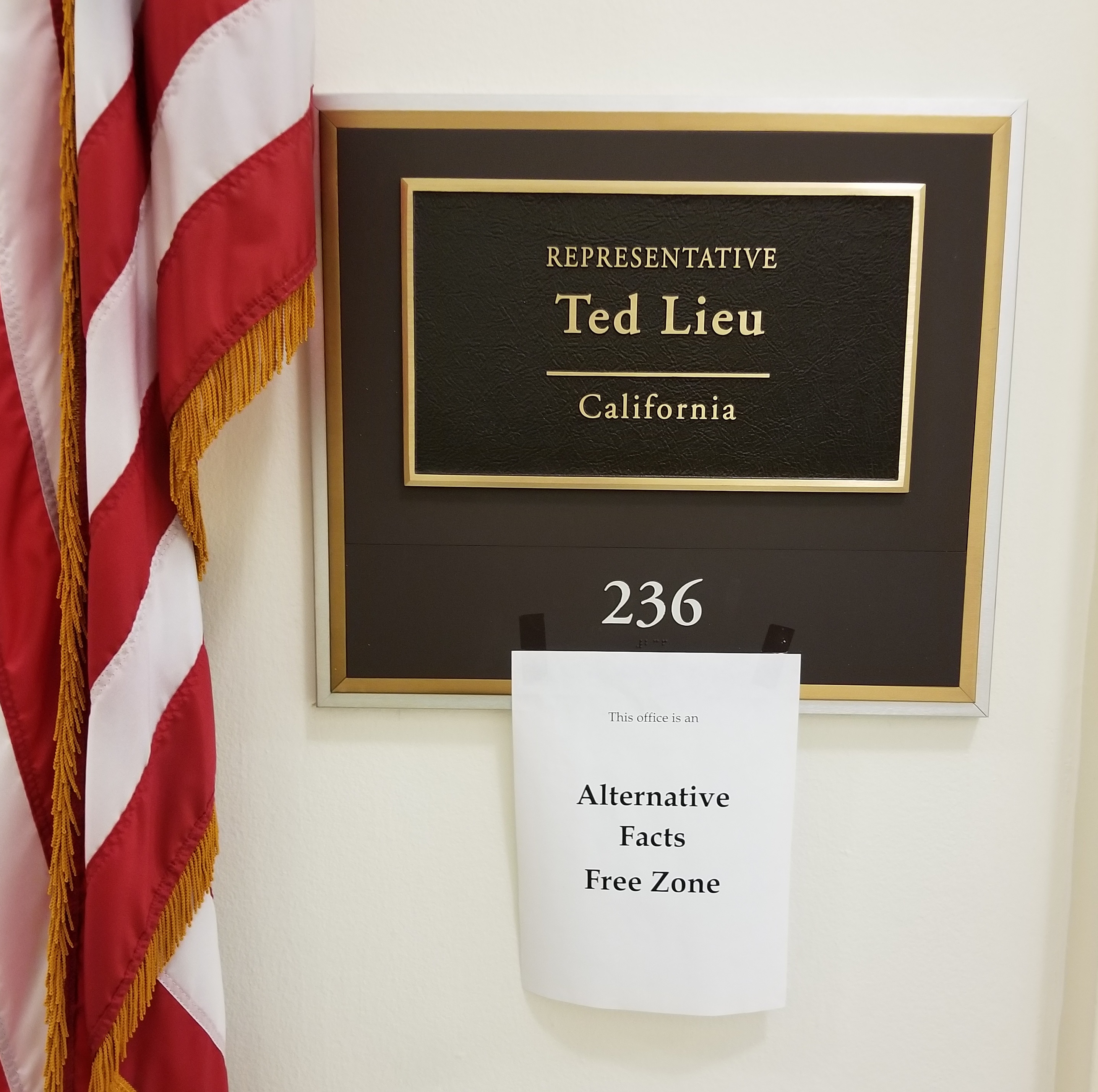
I guess the prayers worked because after two weeks of interviews, I landed at an exciting office with a progressive Congressman from California – Representative Ted Lieu. Congressman Lieu was heavily focused on cybersecurity and was glad to have someone help write legislation to address the many cyber vulnerabilities we were facing in the world. But the year took an interesting turn for Congressman Lieu when the new Trump administration immediately started discussing crowd sizes at the Inauguration, drastic immigration reforms, and claims about access to “alternative facts.” The Congressman quickly became known as the member with an “alternative facts free zone” and took to Twitter to express his progressive views and dissatisfaction with the new administration.

But there was plenty of serious work to be done. I attended every hearing I could find on cybersecurity including those about election hacking. As a lifelong technology guru, I would never have imagined that Twitter and Facebook would become the vehicles of information warfare?

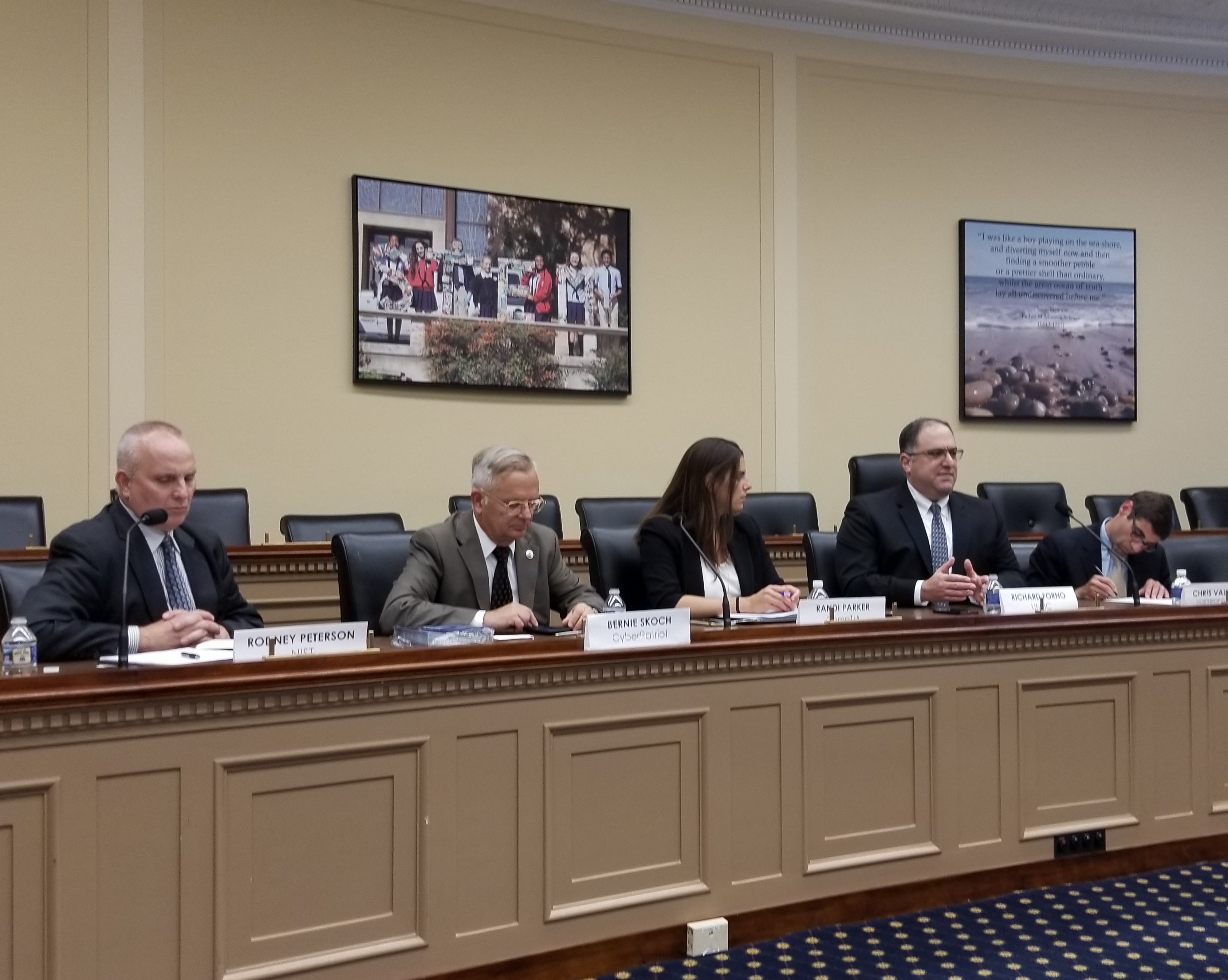
I began attending Cybersecurity Caucus meetings and was asked to use my UMBC connection to find a leader in academia to speak at a hearing on cybersecurity education. I reached out to Dr. Richard Forno, Director of UMBC’s Cybersecurity Graduate Program, who was selected to be one of the featured speakers for the Caucus event.

I had the opportunity to draft bills to increase scholarship money for Cybersecurity education, re-train industrial workers in cybersecurity specialties, create a certification program for Internet-of-Things devices, and build special cybersecurity labs at schools in economically-distressed regions as part of an American progressive infrastructure Bill. I especially enjoyed researching cybersecurity issues for domestic and international elections.

Dr. Richard Forno seated second from right at Cybersecurity Caucus Event on Education, July 2017.

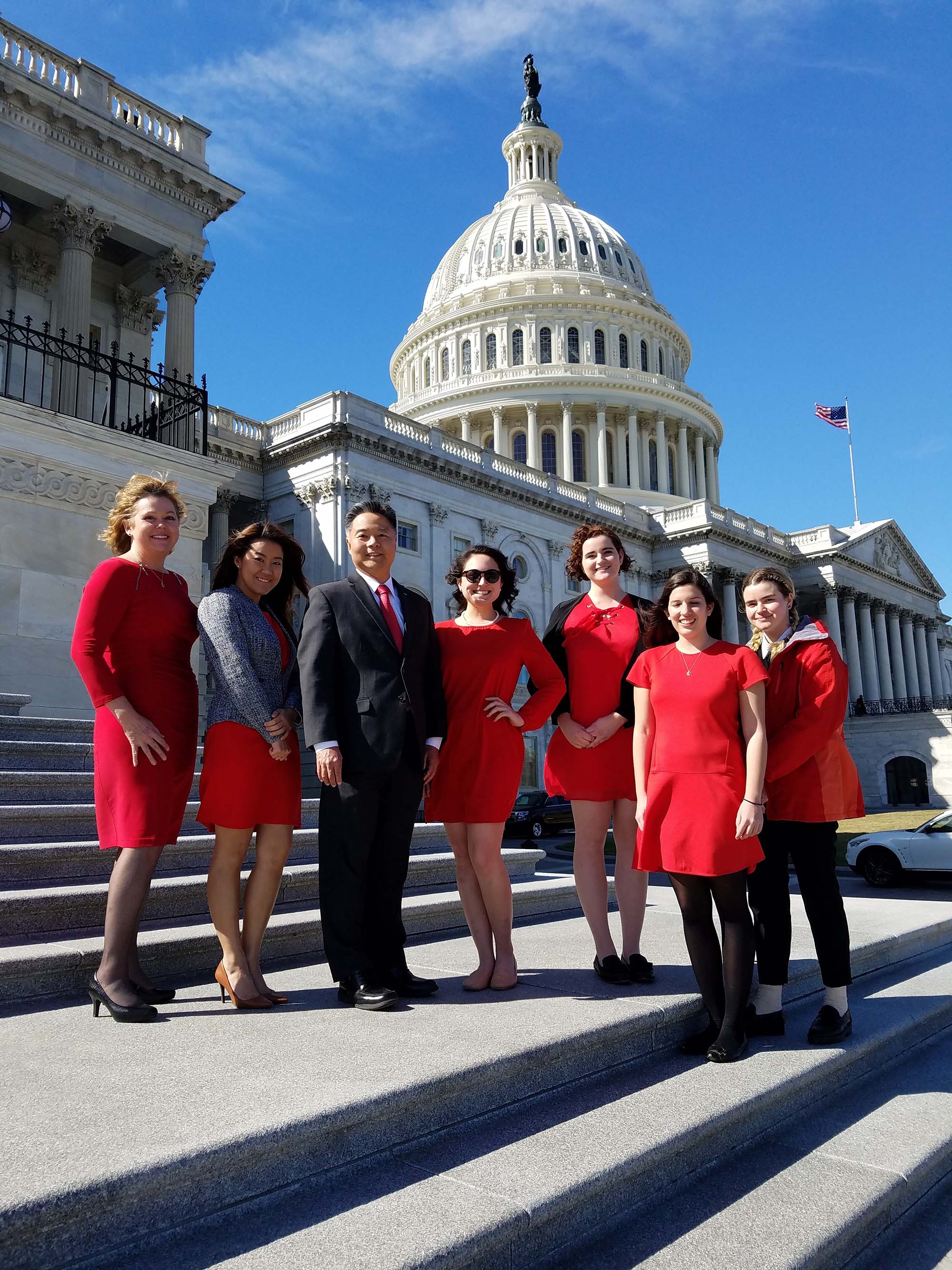
Working for a Congressman from California, with Hollywood as part of his district, gave me the opportunity to occasionally rub elbows with celebrities. The ladies in our office became celebrities on International Women’s Day when we got our picture taken with the Congressman for The Washington Post. That red dress will forever remind me of my year on the Hill (I’m the one at far left).

Working on the Hill during 2017 was an experience of a lifetime. This was the year of massive health protesters working tirelessly to save their health care coverage provided under the Affordable Care Act. I saw children and citizens with extreme disabilities riding through Congressional halls in their motorized wheelchairs. I was humbled by their focus and drive and learned the importance of advocacy.

My year on the Hill taught me civics lessons that you read about in textbooks, but never truly appreciate until you live them. The meaning of laws and Constitutional establishment of the many pillars of government providing checks and balances became crystal clear to me during 2017. I also saw the power and importance of a free press for maintaining an open and transparent government. As I return to my home agency, I have many wonderful lessons and memories to make me proud to be an American living in a free democracy.

To answer my original question of what happens when you send a Department of Defense cybersecurity expert to Capitol Hill – you get a slew of Cybersecurity legislation and collaboration between Executive Branch, Legislative Branch, academia, for profit and the non-profit community. You get the value of new progressive ideas that generated new legislation for future generations to come. And you get a Cyber Ninja – me! – who developed a whole new appreciation of the patriotism and passion of American people, from every state in this great nation, and their passion for issues requiring policy changes to better their lives.

=====================

The opinions expressed are those of the affiliate and do not reflect those of NSA/CSS.

Diana Parr ’85, information systems management, was a Brookings 2017 Legis Congressional Senior Fellow. She is currently employed at NSA as a Cybersecurity Leader and is also an Adjunct Instructor at the University of Maryland Baltimore County (UMBC) in their Cybersecurity graduate program.  


Returning Women Graduates Offer Advice

This post originally appeared on the Women’s Center blog.

* * * * *

On the eve of UMBC’s undergraduate commencement, we are thinking of all the graduating seniors out there who finally made it the finish line. Congrats!

We’re especially proud of the graduating students we work with through the Returning Women Students Scholars + Affiliates Program and want to shout your success from the rooftops! Since the Women’s Center is located on the ground floor of The Commons, though, we’ll exchange the rooftop for our blog.

The Women’s Center is proud to support the Returning Women Students Scholars + Affiliates Program for UMBC students 25 years and older seeking their first undergraduate degree. These students are called “returning” because they often have various circumstances that have kept them from the traditional college path and they are now “returning” to college to pursue their degree. Student scholars in this program not only receive scholarships to help financial supplement their tuition, but also benefit from tailored support and programming from Women’s Center staff through individualized meetings, programs, and events that meet the specific needs of older students on campus. Each year we have between 20-25 scholars and affiliates participate in this unique program. Returning women students (or you may have also heard the term “adult learner” or “non-traditional”) not receiving a scholarship are still welcomed (and highly encouraged) to participate in our events that are open to any adult learner at UMBC. Students can also participate in our program more fully as an affiliate. For more information, visit our website.

But, enough shameless plugging, onto celebrating our graduates!

We reached out to each student graduating tomorrow and asked them to write a short paragraph about what they were involved in at UMBC, what’s next for them after UMBC, and some sage advice for other adult learners. Here’s what they had to say!

IMG_5925

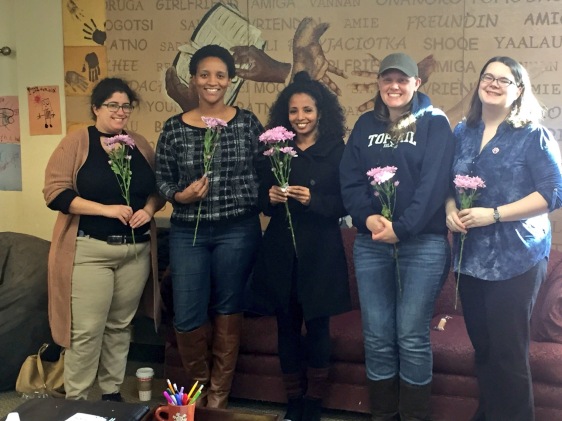
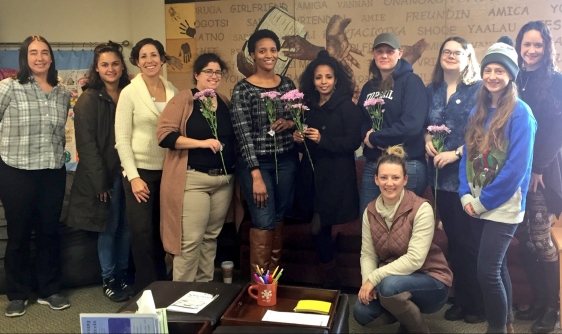
Returning Women Student Scholars + Affiliates at the end of the year graduation celebration and pinning. This has become a special tradition of our program where each scholar + affiliate receives a purple paw print pin they can wear at graduation to represent their membership in the Returning Women Student Scholars + Affiliates program.


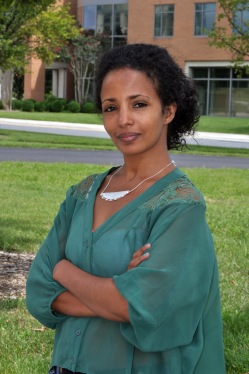
wc17_228Meriam Bahta
Despite the fact I only had an eighth grade level of education when I moved to the U.S., with hard work I put in and ambition I carried with me, I earned my certificate in just one year while working 30 hours a week to support myself. I subsequently enrolled in Montgomery Community College for two years. In the fall 2015, I transferred to UMBC with a GPA of 3.80. I am now graduating with a Bachelor’s degree in Biochemistry and Molecular Biology with a minor in physics. Last summer, I participated in a summer internship program at the National Cancer Institute of the NIH and I had an amazing experience. Since I extremely enjoy my lab courses, I always thought that I would be good at research and my experiences at the NIH has truly showed me that research is where I thrive, and I would love to engage in research during my gap year before I enroll in medical school by the fall of 2019. As a returning woman student, I consider my unfortunate circumstances and struggles as the driving forces behind all my achievements. If it wasn’t for all the responsibilities, which includes caring and supporting my mother and four younger siblings, I juggled while going to school full time, I would not be the strong person I am today.

My sage advice is this: The Women’s Center is a great place to connect with other returning women students and to get inspired by their stories. I highly recommend taking advantage of the different events.


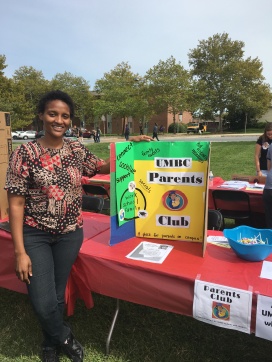
Parents Club - Fall 2017Janiqua Dunn
My name is Janiqua and I transferred here to UMBC in Fall of 2015. I’m graduating with my B.A. in Psychology and a minor in Sociology. During what now seems like such a short time here, I got involved in a ton of things! My largest and most long-term commitment was co-founding and serving on the executive board of the Parents Club, which we started in Spring 2016. I started off as the Secretary and I am now the Vice President. We started the Parents Club to provide a space and support system for UMBC students who also have children, and so far it has been a success! It’s been such a great feeling to be a part of that! Outside of that, I have served as a Student Ambassador, Research Lab Assistant, Writing Fellow (for the Psych department), and I’ve taken on a number of internships, both on and off campus. This all in addition to raising my 5- and 6-year-old sons! Plans for after graduation are to land a full-time job and begin my Masters within the next year or two.

My sage advice is this: If you’re a student parent, join the Parent’s Club! You can find out more about this student organization at their myUMBC group.


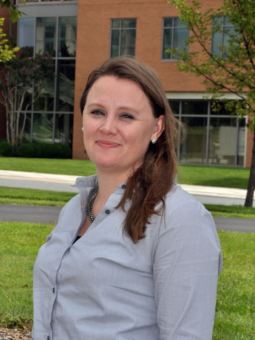
emmaEmma Matthews
My name is Emma Matthews. I’m a Richard & Roselyn Neville Scholarship recipient. In the last 4 years at UMBC I have been a McNair Scholar and a member of the Honors College. I have developed and presented research in psychology regarding stress and oppression in college students with Dr. Shawn Bediako’s lab, and I interned at the Special Victim’s Unit at the Carroll County State’s Attorney’s Office. I have been accepted into the University of Baltimore for their Master’s of Science in Criminal Justice and Trauma Informed Certificate Programs and am awaiting news on acceptance, stipends and assistance-ships from two other graduate schools. I intend to focus on victim services and domestic violence issues.

My sage advice is this: It’s not easy being a first generation, non-traditional student, but I think that every student at UMBC faces their own unique challenges. Gratitude and humility will help you take inventory of what you have and what you need, and carry you through each new obstacle.


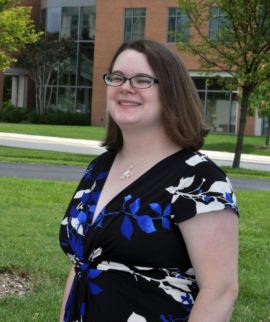
LTLindsey Titus
Lindsey Titus transferred from CCBC (Essex) to UMBC in the fall of 2015. I have been involved with Tau Sigma, a national honor society for transfer students, and was president of the UMBC chapter last year. I also held positions in the Sociology department, such as a peer mentor and grader. For the past two semesters, I was a part of the Accelerated Graduate Program in Applied Sociology, taking two graduate classes along with my undergrad coursework. Last spring, I was accepted into Phi Beta Kappa, one of the oldest honor societies. I am graduating summa cum laude with a double-major in Sociology and Anthropology with a minor in Management of Aging Services. I am excited to continue my journey at UMBC in the spring, working on my Master’s in Applied Sociology.

My sage advice is this: Don’t be afraid to ask questions and ask for assistance if you need it. I have found that my professors can be understanding to plights occurring outside of their classrooms. Whether I spoke to them after class or during a visit to their offices, I usually felt better about having my feet solidly on the ground for my education. I guess that’s why I’m sticking to these professors for grad school! Also, Jess and the Women Center are the best. It was always a treat to visit the Center, even if I didn’t get to visit very often. It was the one place on campus that felt like a warm and welcome hug when you opened their door. And we can always use an extra hug sometimes!

Big congrats to Sungeun Oller and Lily Glushakow-Smith who are also members of the  Returning Women Students Scholars + Affiliates Program graduating this December!

So while these students will no longer to “returning” to campus as undergrad students after tomorrow, we welcome you back as alumnae! In addition to celebrating these students, we hope hearing their stories will provide encouragement to other students still working towards their degree. You can do it!

IMG_5926

At the Returning Women Students End of Year Celebration and Graduation Pinning!


Look out for our full list of Returning Women Students events later in January. We host events each month. Additionally, Returning Women Student Scholarship applications will be available beginning in early January! 

Students Feel the #GivingDay Spirit on Campus

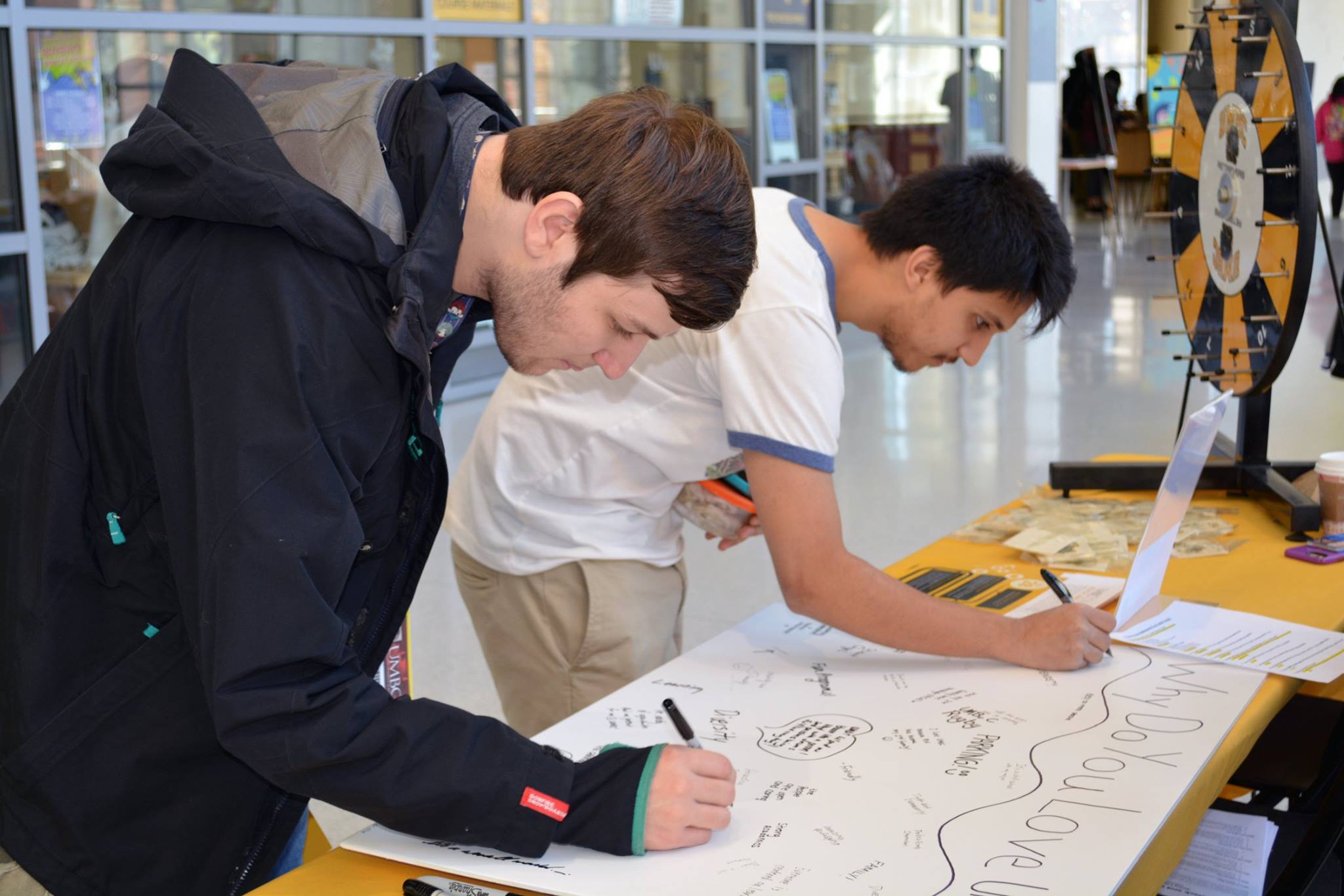
Members of UMBC’s Student Alumni Association (SAA) hit Main Street in the Commons Tuesday to share their love of philanthropy with the passing campus community. Thanks to every Retriever, near and far, who supported UMBC on this day of giving.

“Giving Tuesday really makes you think about the people who have helped you at this point whether it is at home, in school, at work, etc. It really makes you appreciate what others do for you and what actions you can take to pay that service forward to others,” said SAA member Karndeep Singh, a senior biochemistry and molecular biology major.

“Here at UMBC, we have a strong community built on providing service to others. Even though we are a young university, we have great support from our alumni who devote a lot of time and effort to supporting the current student body by offering scholarships, internship opportunities, and career opportunities!”

Did you miss #GivingTuesday? It’s never too late to support the great things happening here at UMBC.

Studying circadian rhythms in plants and their pathogens might lead to precision medicine for people

Hua Lu, Associate Professor of Biological Sciences, UMBC, and Linda Wiratan, B.S. Student of Biochemistry and Molecular Biology, UMBC
Above photo: CC BY-ND

At dusk, the leaves of the tamarind tree close, waiting for another dawn. Androsthenes, a ship captain serving under Alexander the Great, made the first written account of these leaf movements in the fourth century B.C.

It took centuries longer to discover that he was describing the effects of the circadian clock. This internal time-sensing mechanism allows many living organisms to keep track of time and coordinate their behaviors along 24-hour cycles. It follows the regular day/night and seasonal cycles of Earth’s daily rotation. Circadian research has advanced so far that the 2017 Nobel Prize in physiology or medicine was awarded for the groundbreaking work that elucidated the molecular basis underlying circadian rhythms.

Biologists like us are studying the circadian clocks in plants for insights into how they affect the health and well-being of all life on Earth. As researchers continue to untangle more about how these clocks work – including how they influence interactions between hosts and their invading pathogens and pests – new forms of specially timed precision medicine could be on the horizon.

Our hidden pacemaker

Organisms from all three domains of life possess an amazing diversity of circadian rhythms. Seemingly simple Cyanobacteria alternate photosynthetic activity between day and night. The fungus Neurospora crassa produces spores every morning just before dawn. Migratory monarch butterflies use a delicate sun compass in their annual migration. Almost every aspect of human activity is influenced by the circadian clock – you can easily see this in yourself if you fly across time zones or engage in shift work.

The driving force behind circadian rhythms is what scientists call the circadian clock’s central oscillator, an elaborate network of genes that turn each other’s activity on and off. Together, they form complex feedback loops that accurately calibrate time.

Although individual clock genes are not always the same across domains of life, the feedback mechanism of the central oscillator is. This mechanism acts as a switch to synchronize an organism’s daily activities with day and night fluctuations and other environmental changes. Such amazing balancing acts reflect organisms’ abilities to anticipate changing environment throughout the day.

Precise timekeeping and health

A well-calibrated circadian clock is critical for growth and fitness, which is why misalignment of the circadian clock with environmental cues causes diverse and far-reaching health issues. Some human diseases, including diabetes, obesity, cardiovascular disease and some psychiatric disorders such as depression and bipolar disorder, are likely linked to circadian clocks being out of sync with the environment.

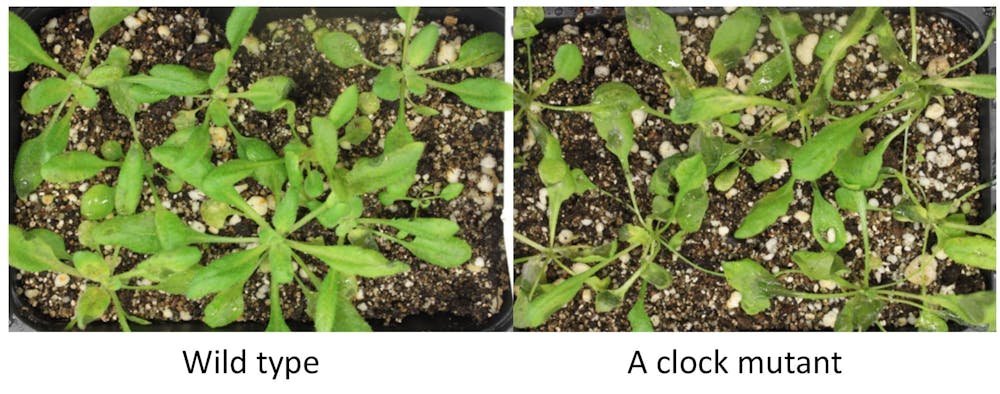
After infection by a fungus, plants with a mutant circadian clock (right) showed much more damage than the normal plants (left).
Hua Lu, CC BY-ND

Increasing evidence also links the circadian clock to plant health. In particular, plant scientists have shown that a properly tuned circadian clock is important for plant disease resistance to arrays of pathogens and pests. Although plants do not produce antibodies or use specialized immune cells to ward off invaders, some aspects of their immune system are similar to ours. Because of how easy it is to grow and genetically manipulate them, some plants, like Arabidopsis, serve as ideal systems to investigate how the circadian clock influences the outcome of diseases in plants once infected.

Plant-pathogen interactions around the clock

Plants, being immobile, must strategically allocate their limited energy and resources when faced with pathogens and pests. They have the sophisticated ability to time their defense, which allows them to anticipate likely attacks before they occur and modulate defense responses to real attackers.

Stomata are little pores on the plant’s surface that can open and close.
Valentina Moraru/Shutterstock.com

The forefront of plant defense is on the surface. Physical features like trichomes, little hairs that stick out, protectively cover a plant, and wax coatings deter invaders from clinging onto the surface. The plant surface also has numerous mouth-like pores called stomata. Normally, stomata rhythmically open in the day and close at night, a process regulated by the circadian clock in anticipation of light and humidity changes. While this process is important for photosynthesis and water exchange, opening stomata can be used by some pathogens as portals to access nutrients and space inside the plant tissue and closing stomata restrict pathogen invasion.

Beyond frontline physical barriers, plants have evolved complex surveillance systems to detect pathogens and pests as intruders. When cell surface receptors recognize a pathogen, the plant immediately closes its stomata at the invasion site. Dysfunctional circadian clocks impair stomatal closure, resulting in more severe disease.

Further pathogen recognition sends alert signals deep into the plant tissue, activating an arsenal of defense responses, including reprogramming of gene expression, production of antimicrobial compounds and enhancement of defense signaling. Even in the absence of pathogens, many of these responses show low but rhythmic changes that are influenced by the circadian clock. When a real attack arrives, the plants’ daily rehearsal of their defense systems ensures a strong and concerted timely defense. Plants with misaligned clocks succumb to the attack.

One excellent example of a plant timing its defense comes from Xinnian Dong’s group at Duke University. Hyaloperonospora arabidopsidis is a pathogen that disseminates its virulent spores in the morning and causes disease in Arabidopsis plants. Dong’s group elegantly showed that Arabidopsis anticipates this attack by expressing a set of defense genes at dawn that gives resistance against the pathogen. When the researchers disrupted the Arabidopsis circadian clock, it abolished this morning defense and made the plant more susceptible.

Plants also rely on timely defense to fight off insects. For instance, cabbage loopers have peak feeding activity before dusk. Beautiful work by Janet Braam’s group at Rice University showed that Arabidopsis produces the defense signaling hormone jasmonic acid with a peak at noon in anticipation of this attack. When the insects actually strike, the circadian clock boosts this noon defense, producing more jasmonic acid to inhibit insect feeding.

Do clocks dance in pairs?

As seen from these examples, pathogens and pests have their own circadian clocks and use them to determine the best time to be active. How does this ability affect their invasions of hosts? So far, researchers aren’t sure whether pathogen and pest clocks are coordinated to that of the host. If they are, their how in sync they are could determine the outcome of their interactions.

Current evidence indicates that some eukaryotic microbes, such as Hyaloperonospora arabidopsidis and Botrytis cinerea, are able to manipulate the Arabidopsis circadian clock. Even prokaryotic pathogens, like Pseudomonas syringae, in spite of lacking a canonical central oscillator, can interfere with plant clocks in various ways.

In humans and mice, some populations of gut microbiota oscillate daily, depending on the host circadian clock. Interestingly, gut microbiota are capable of reprogramning the host clock. How does this transkingdom communication occur? How can it influence the outcome of host and microbe interactions? Research in this area represents a fascinating and unexplored level of host-invader dynamics.

Well-timed actions in plants – like the tamarind tree’s closing leaves noticed by Androsthenes millennia ago – could eventually help us design more precise medicines.
oraphan_nan/Shutterstock.com

The clock as healer and helper

The ability to integrate time cues with development and responses to environmental assaults is an evolutionary adaptation. Plants have taught biologists much about circadian rhythms and their role in modulating everything from development to defense.

Clock research has opened an opportunity to apply this knowledge to other systems, including humans. How can we modify the daily cycling of certain defense features to enhance immunity without causing developmental stress? What times of day are we most susceptible to certain pathogens? What are the most invasive times of day for various pathogens and pests?

Answers to questions like these will help unravel host-pathogen/pest interactions, not just in plants but also in people. Ultimately, this knowledge could contribute to the design of precision medicines that are tailored to boost timely defense in individual people to fight against various pathogens and pests. In addition, our understanding of plant disease resistance will aid agricultural control of pathogens and pests, mitigating the global challenge of crop loss.

The ConversationOngoing research continues to reveal how the influence of circadian rhythms extends as boundlessly as the sun’s rays.

Hua Lu, Associate Professor of Biological Sciences, University of Maryland, Baltimore County and Linda Wiratan, B.S. Student of Biochemistry and Molecular Biology, University of Maryland, Baltimore County

This article was originally published on The Conversation. Read the original article.

Chapter of Young Alumni members share time and talents

UMBC’s Chapter of Young Alumni made a difference in our community this month, volunteering at two locations — and having a blast doing so together.

Above: On November 16, CYA members visited the Baltimore Community ToolBank, where they collectively put in more than 20 hours of labor doing fun tasks such as painting tools, sorting and pairing gloves, and much more!

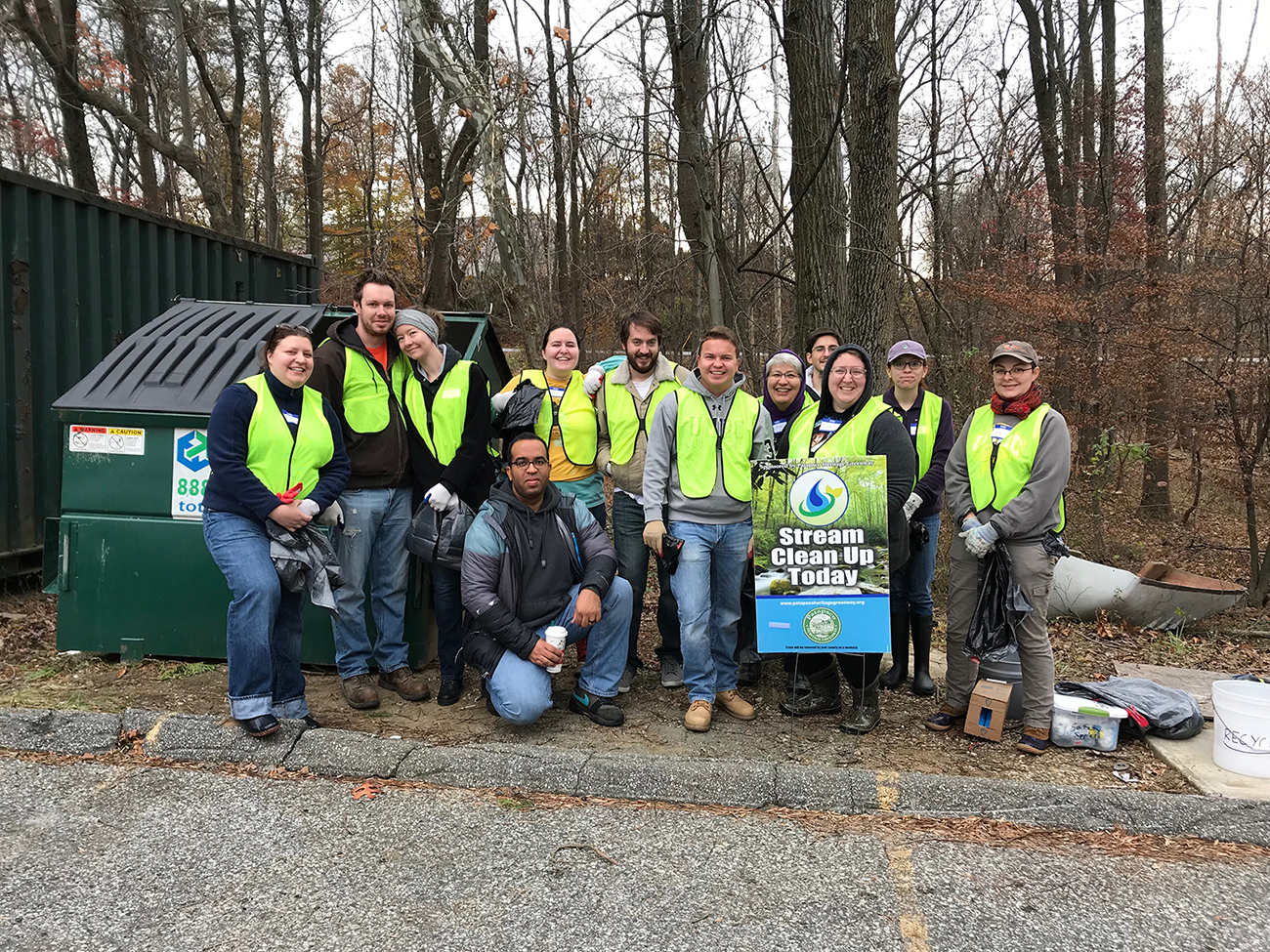
Later that week, CYA members traveled to the Patapsco Heritage Greenway to clean up streams near UMBC. Lots and lots of trash and treasures later, folks make a big dent in their stream cleanup efforts.

Interested in joining a future volunteer effort? Contact the Office of Alumni Relations at alum@umbc.edu or learn about opportunities online.

A Peek Behind the Curtains: Twelfth Night at UMBC

For most of us, a trip to the theatre means relaxing in a plush auditorium chair for a couple of hours while performers share their finely honed skills for our amusement. We laugh, we cry, and we clap wildly as the stars bow before the falling curtain.

But, what do we miss when we forget about what happens backstage? For the upcoming production of William Shakespeare’s comedy Twelfth Night, directed by Eve Muson, (running Nov. 9 – 19) students and theatre faculty worked diligently for weeks to design and build sets, sew costumes, install lighting and sound plots, and develop characters that will transport their audiences to Christmas in 19th century Russia.

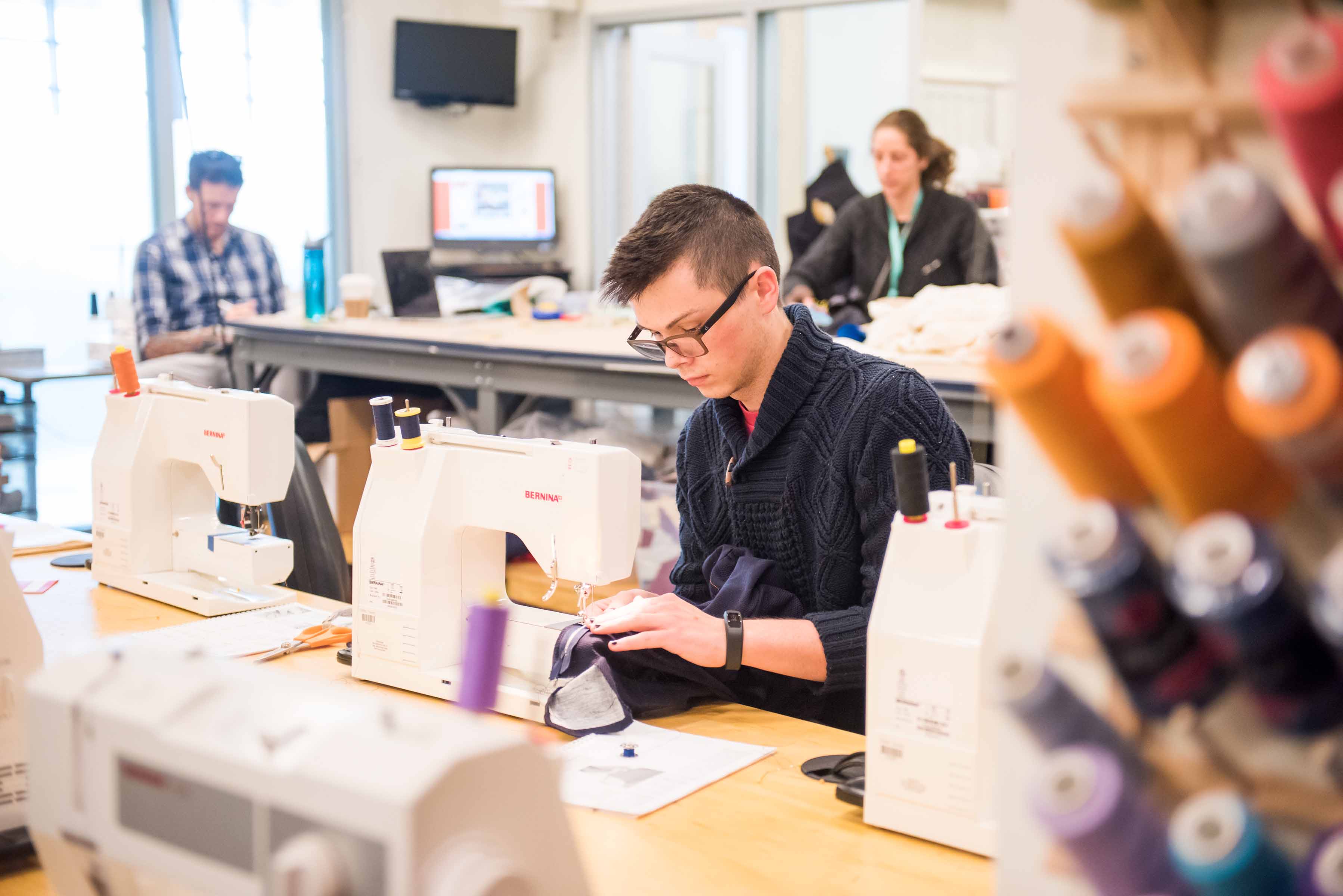
UMBC theatre students experience a bit of every piece of it behind the scenes in the Performing Arts and Humanities Building, no matter what their area of focus. Actors build props. Stage managers work on lighting. Everyone uses a sewing machine at some point. For a production as lovingly detailed as Twelfth Night, there’s simply no such thing as a small part. 

 – Jenny O’Grady

Photos by Marlayna Demond ’11 except where noted.

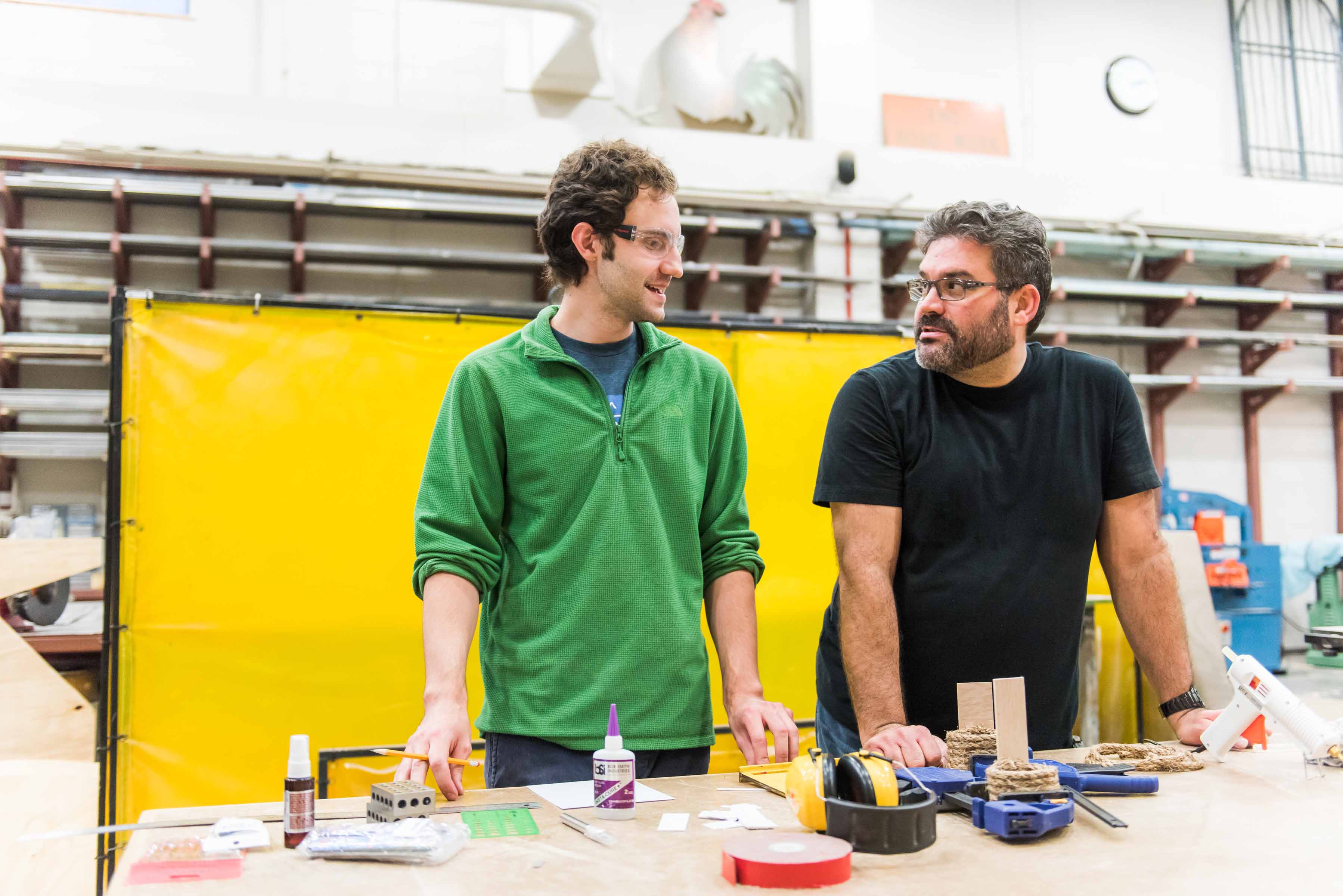
Student props master Andrew Morgan (L) discusses his plans for constructing a cross for a priest’s costume with theatre faculty member Gregg Schraven ’97, theatre. Morgan works closely with other members of the crew to figure out who needs what, and how it will be used on stage.

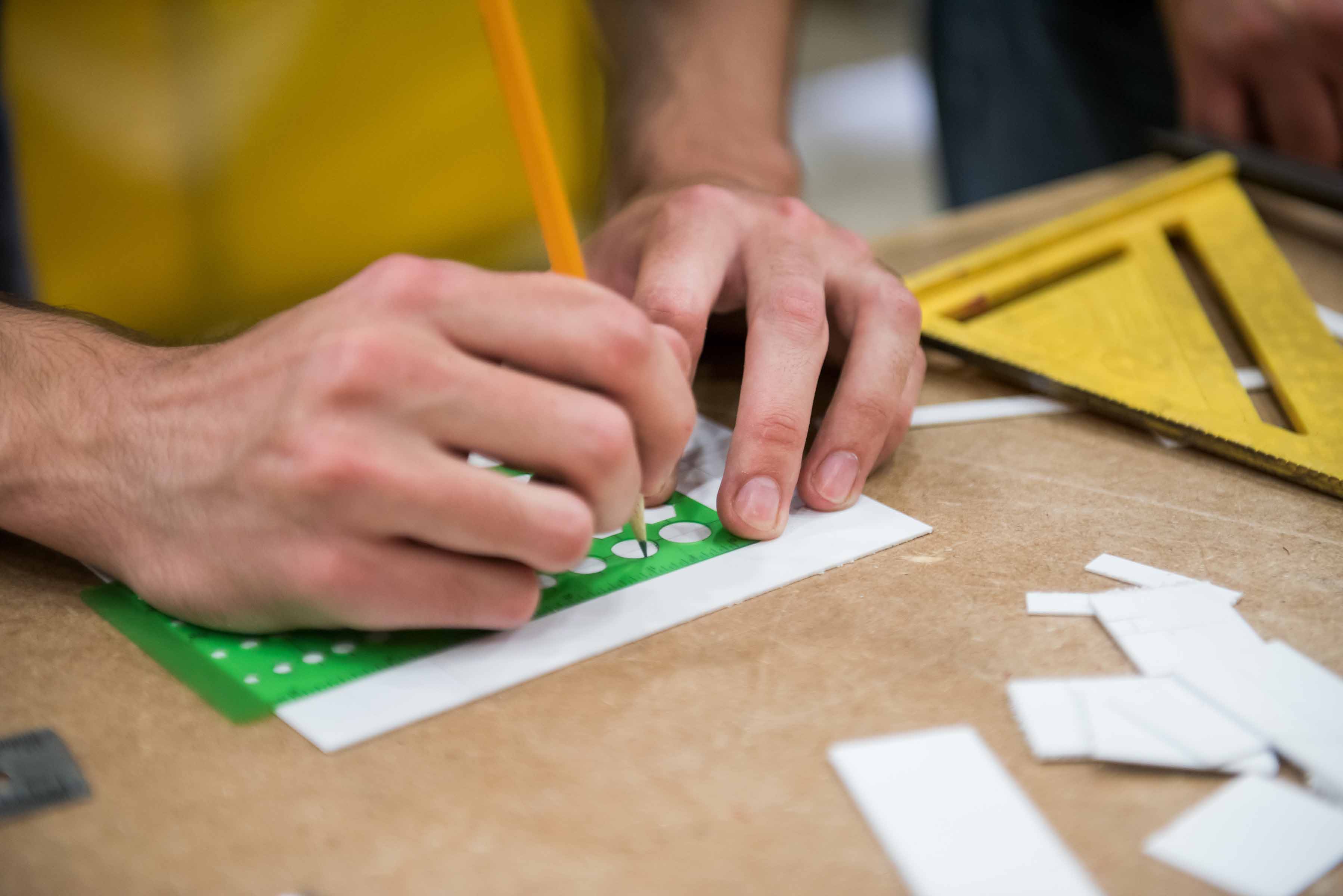
A close-up of the prop master’s work.

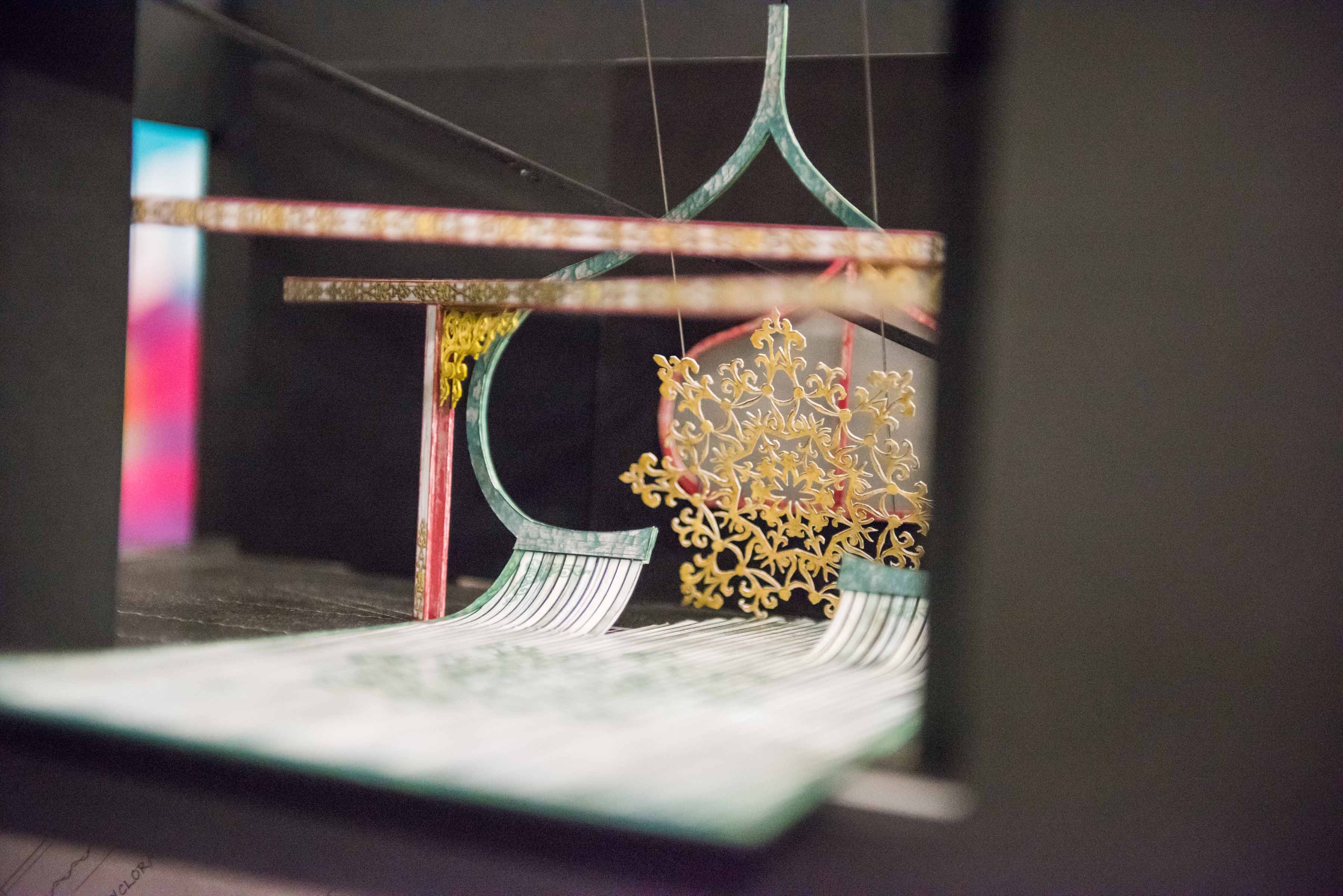
Students and faculty work to create a stage set based on this small model built by set designer and theatre faculty member Nate Sinnott.

Student Jaimie Greene pulls large stencils created with a computer numerical control (CNC) router, from a dolly to help decorate Twelfth Night’s winter-themed set.

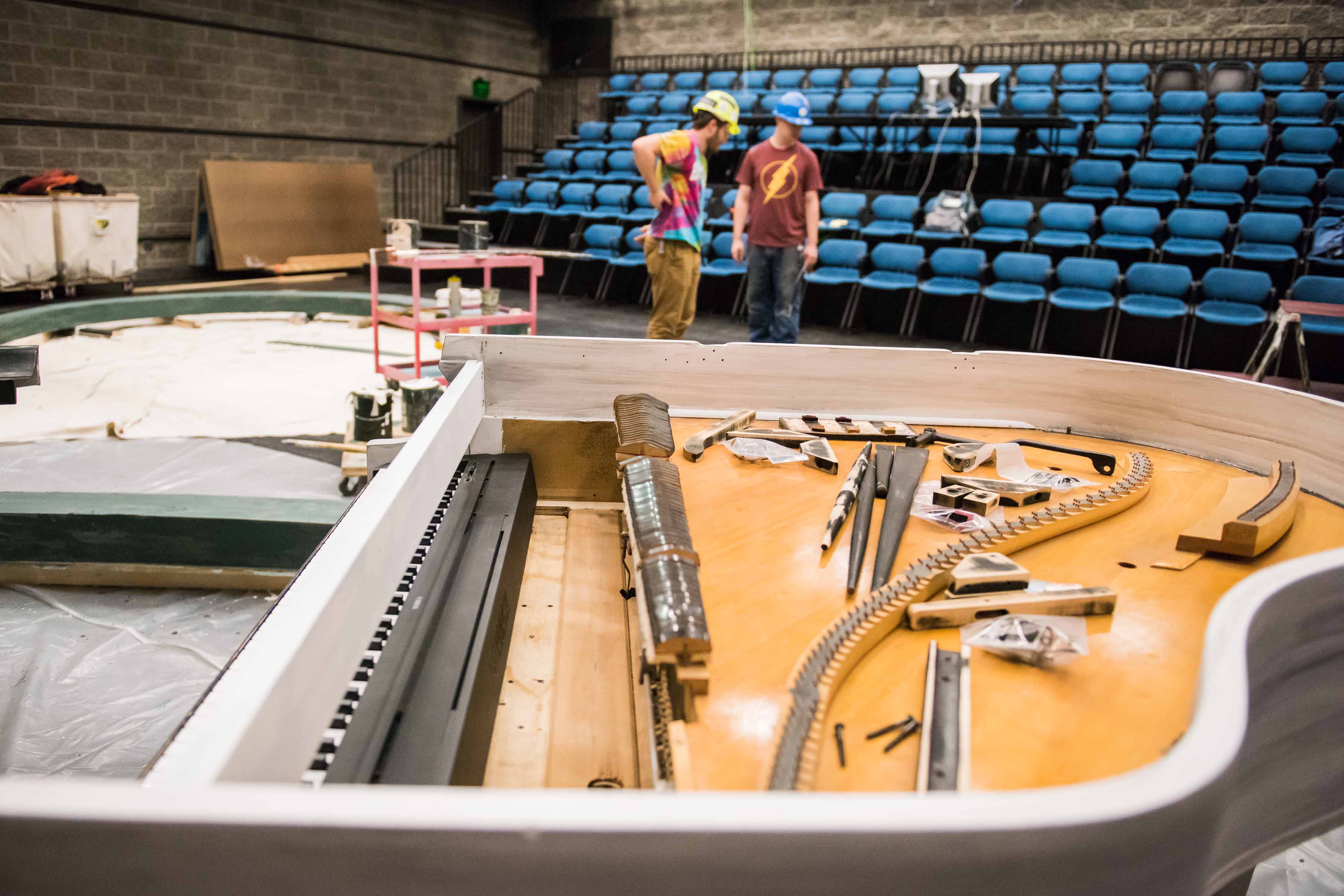
Student builders discuss one of the most complicated props constructed for Twelfth Night – a baby grand piano that has been gutted to make room for a digital piano so it can be played on stage through the house sound system.


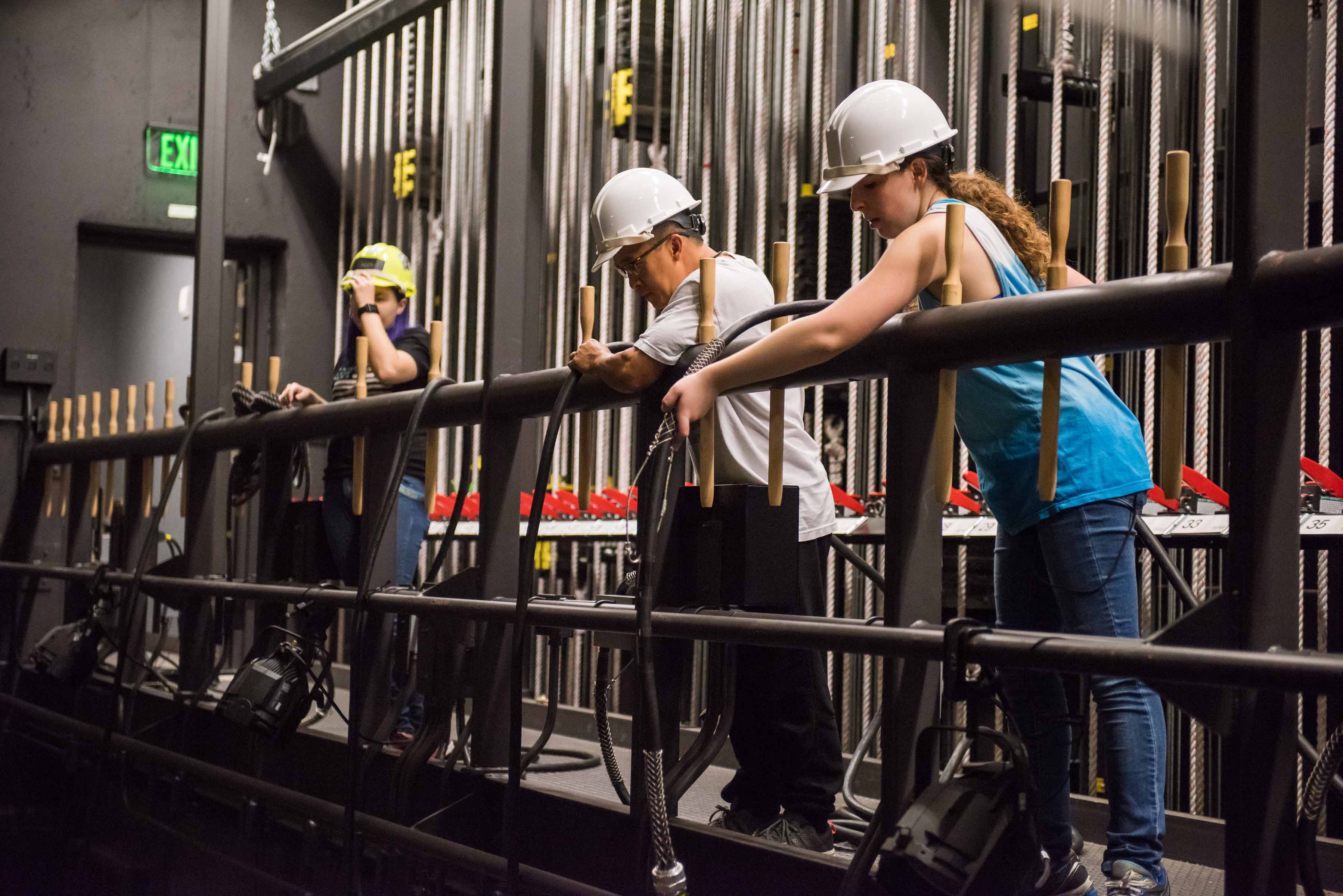
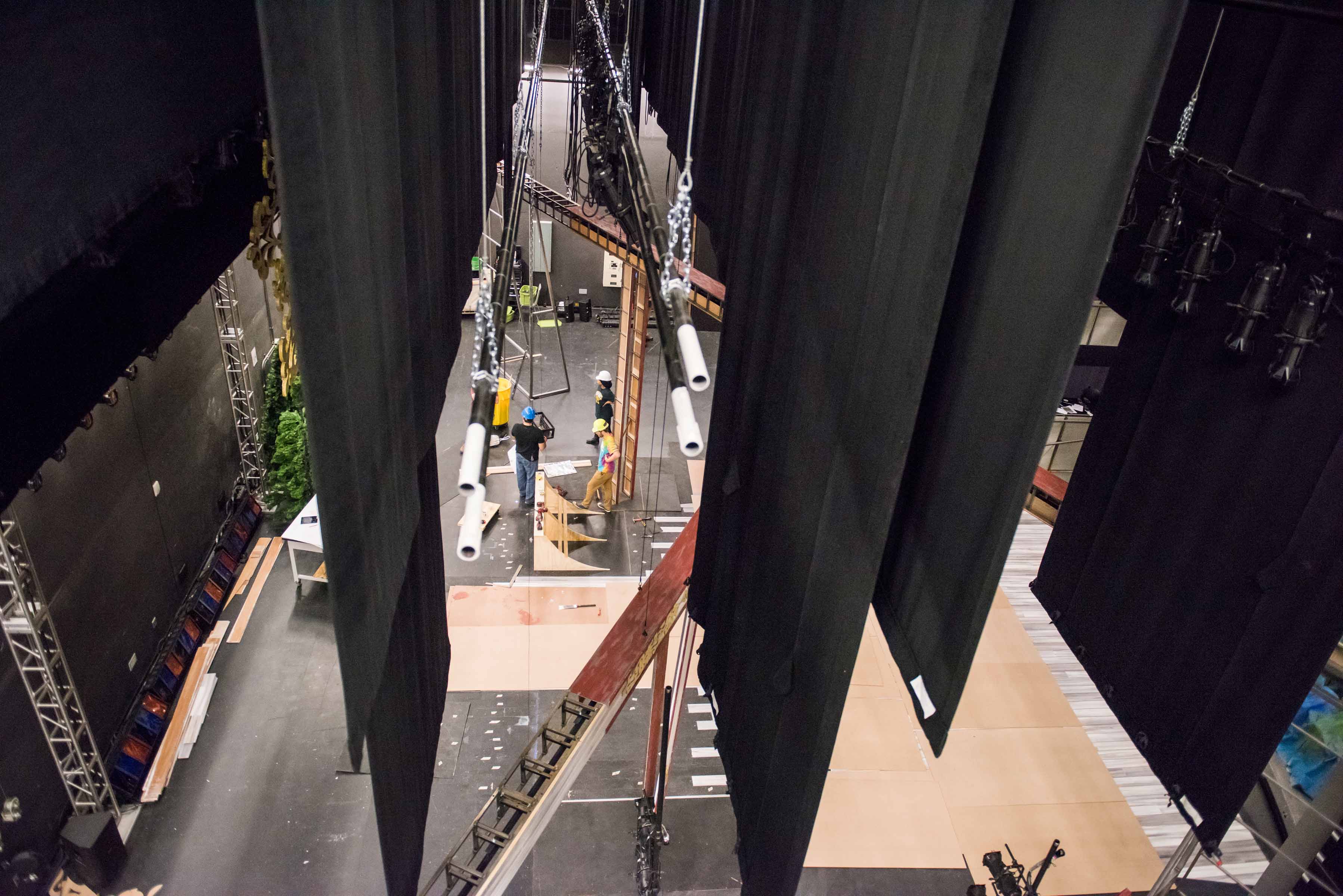
Far above the Proscenium Theatre’s stage, students install a lighting plot to match the festive nature of this comedic script.


You can’t beat the view of stage from the catwalk, 32 feet
from the ground. It’s not for the faint of heart!


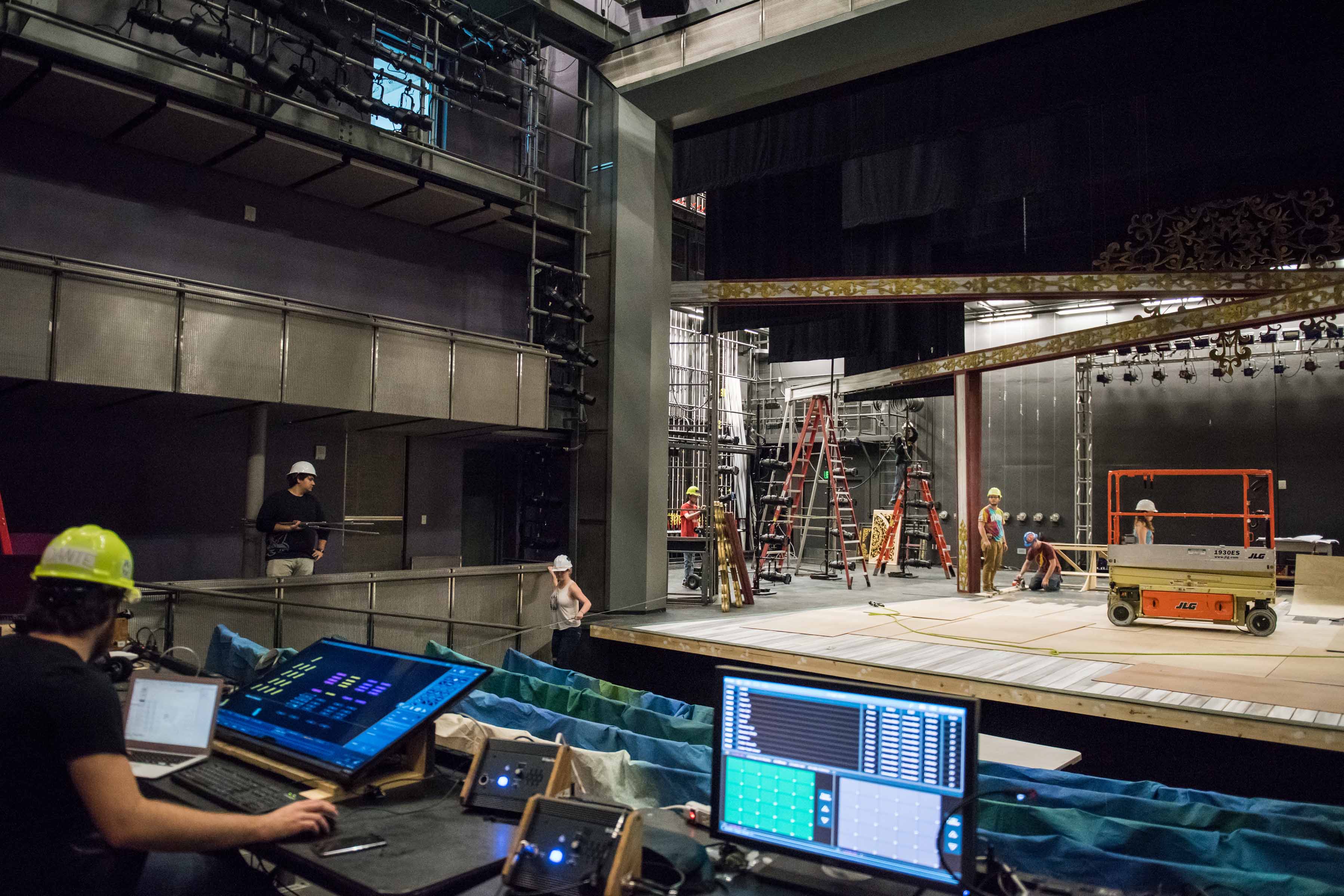
From beyond the work being done on set, assistant light designer Dante Fields prepares
 the lighting console for tech.


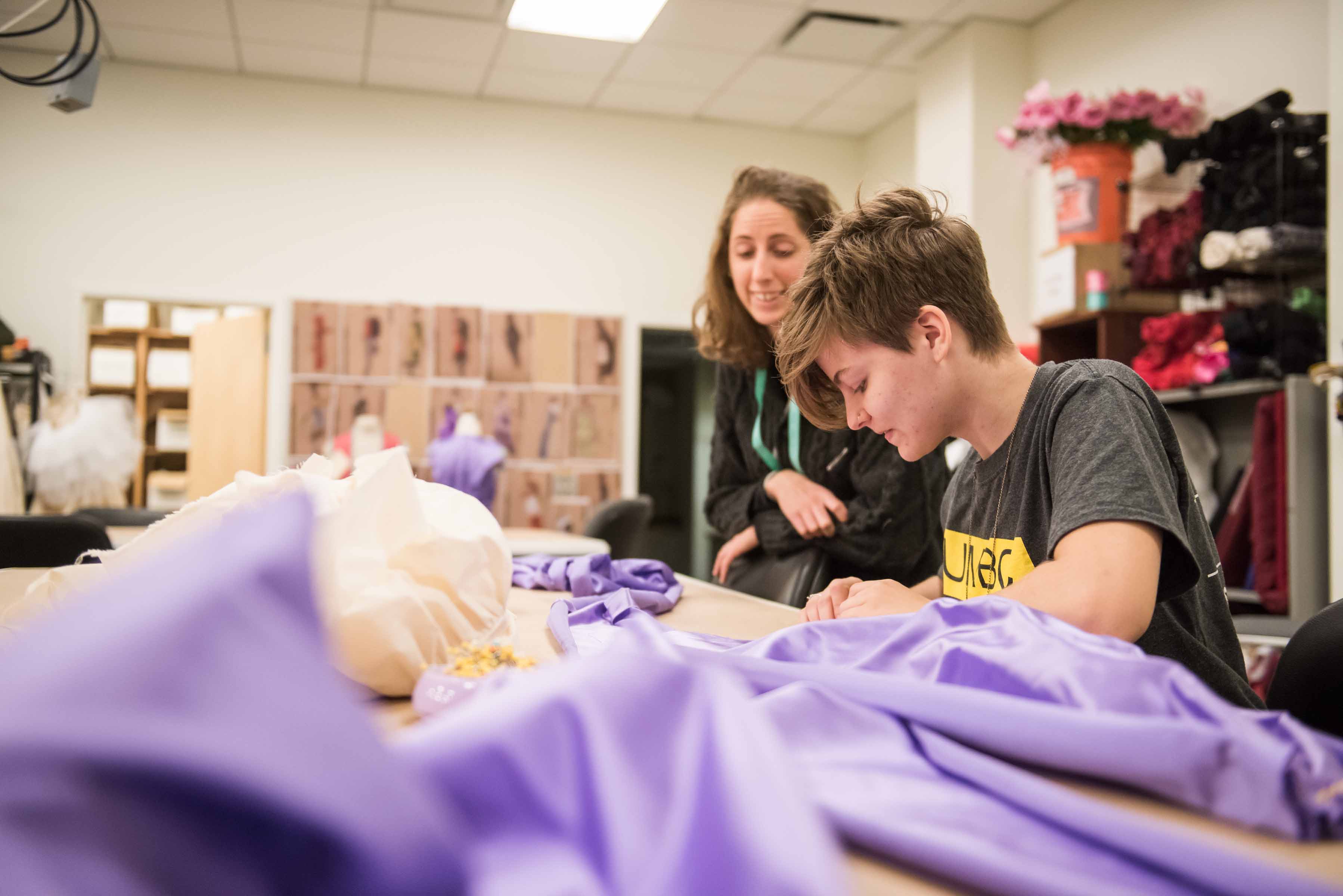
Students also learn how to design and sew costumes for the performers, both by hand and with the aid of sewing machines.


The costume shop offers tools and notions of every type and color. You never know what you’re going to need for a show at UMBC!

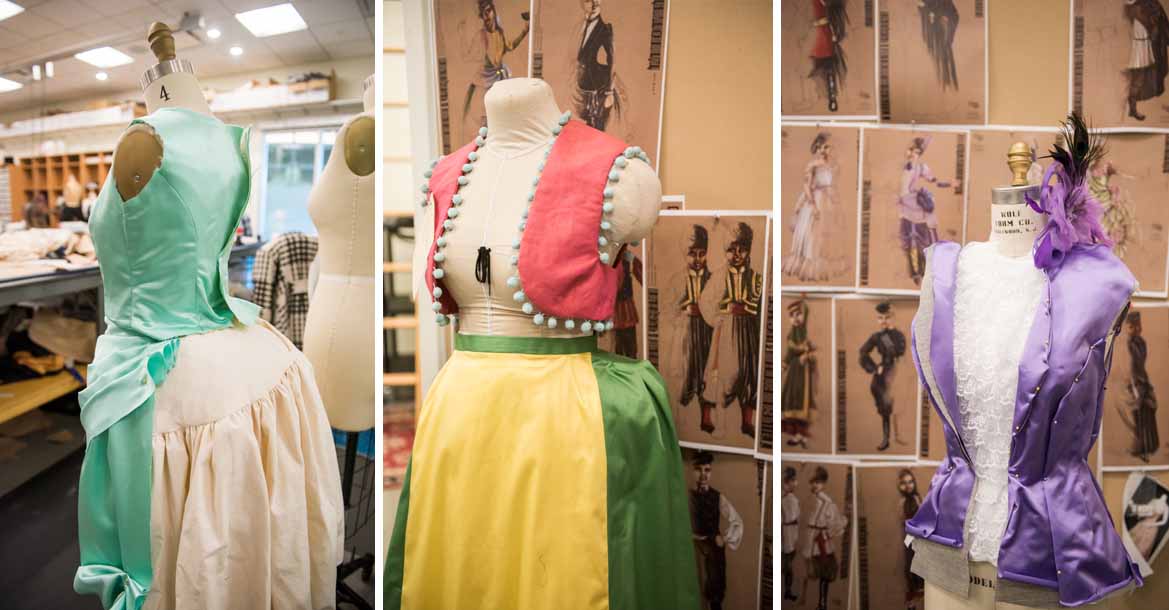
This colorful, riotous production of Twelfth Night requires costumes of the same level, including these dresses, designed by faculty member Eric Abele and produced by students in the costume shop. You can see some of Abele’s other sketches behind the dresses on the wall.

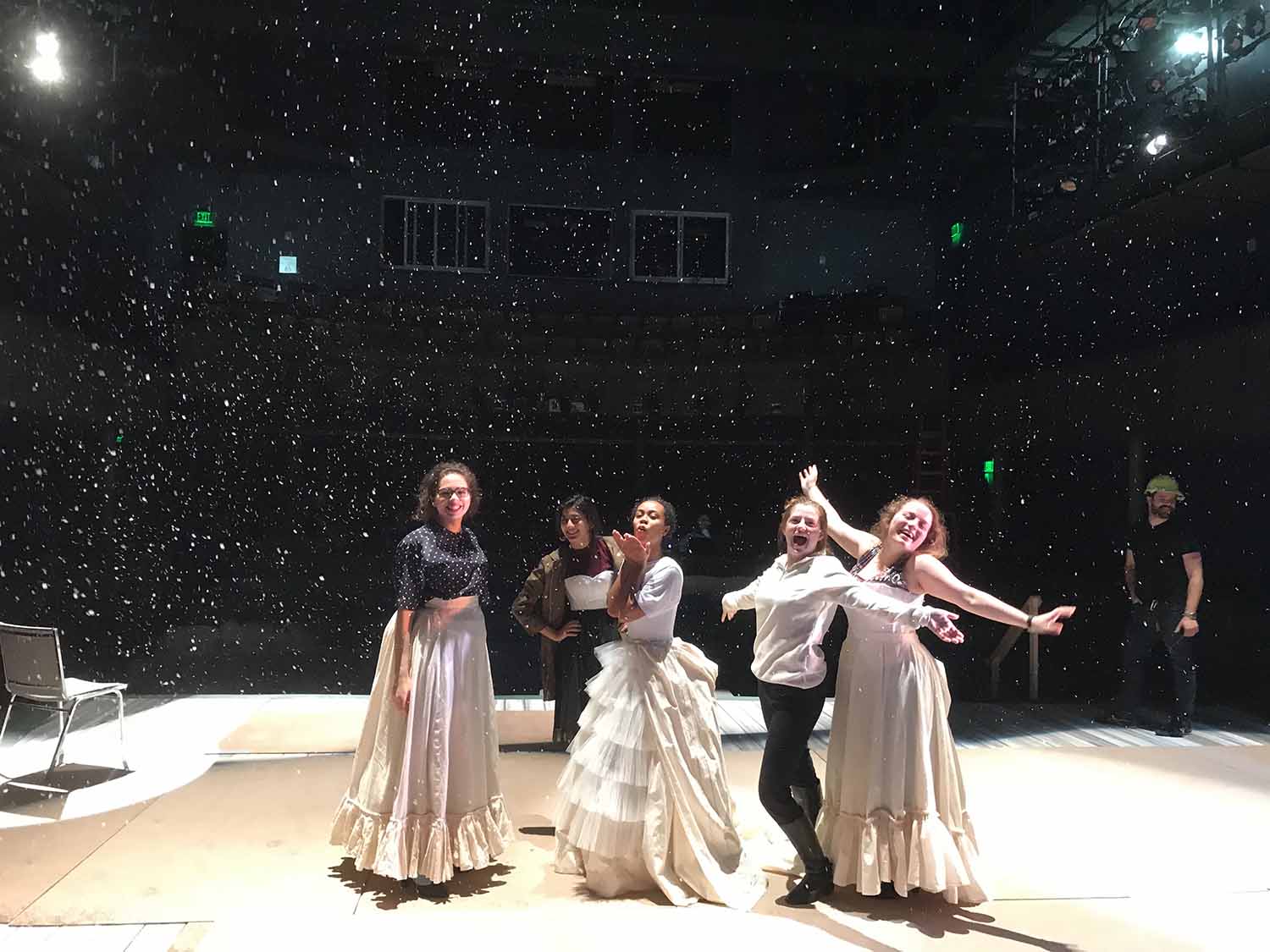
Members of the cast of Twelfth Night practice amid a test of an indoor “snow” shower. Break a leg, everyone!  Photo by Greggory Schraven ’97.

* * * * *

The UMBC Department of Theatre presents Twelfth Night by William Shakespeare, directed by Eve Muson, November 9 – 19, in the Proscenium Theatre of UMBC’s Performing Arts and Humanities Building. For more information and to purchase tickets, visit UMBC Theatre online.

Men’s Soccer Q&A: Forty Years (and Counting) of Celebrations

By Steve Levy ’85, Associate Athletic Director, Athletic Communications
Above photo: The Retrievers celebrate their Homecoming win over Albany (3-1). Photo by Gail Burton.

The UMBC men’s soccer program has a lot to be proud of these days. With a Homecoming win over Albany, the number 16 nationally ranked team has packed Retriever Soccer Park with record-breaking crowds. And with their last regular season home game tonight versus Delaware, they have showed their “Grit & Glory” on field and off all season long.

But the truth is, the program has had much to celebrate throughout its history.

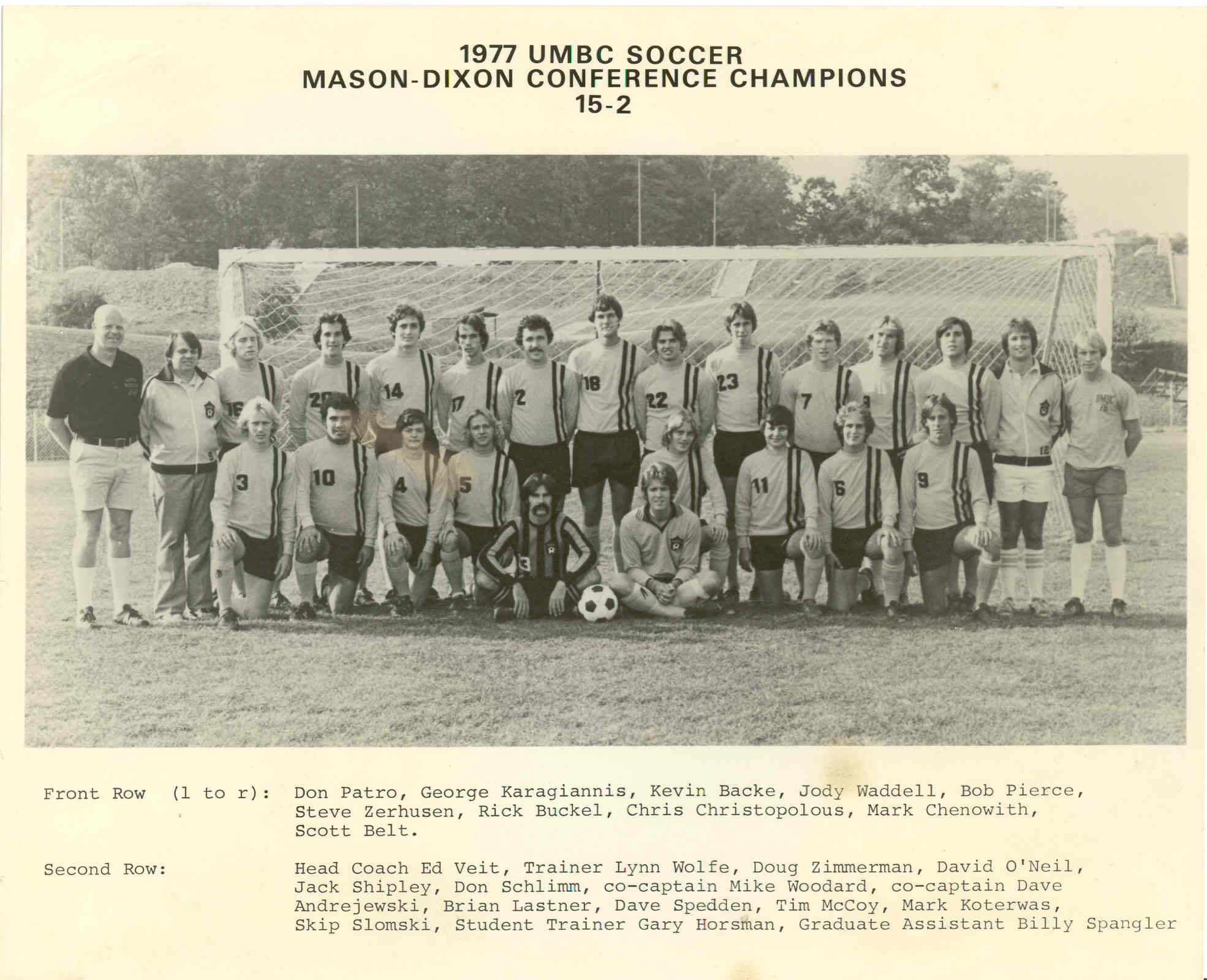
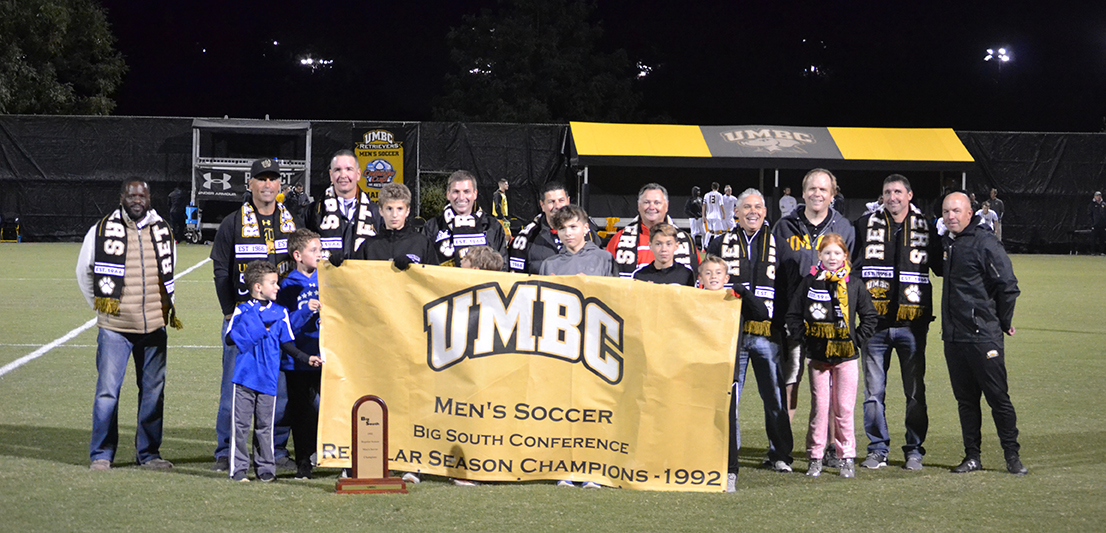
The year 2017 happens to mark two very special anniversaries for Retriever soccer. On September 23, the program welcomed back members of the 1977 team to celebrate their 40th anniversary; one week later, representatives of the 1992 squad reunited to honor their 25th anniversary.

The 1977 team was the first team UMBC intercollegiate squad to win a conference title, taking home the Mason-Dixon Conference and, subsequently, receiving a berth in the NCAA Tournament. Under head coach Ed Veit, the Retrievers went 15-2-0, led by high scoring forward Ray Ford ’91 and future professional goalkeeper Steve Zerhusen ’78.

The 1992 team debuted in the Big South Conference and won the league’s regular season title. With Pete Caringi at the helm, the Retrievers won six of seven league matches and finished 12-9-0 overall. Bobby Wagner ’95, a defender, doubled as a remarkable scorer, as he completed a brilliant career with 31 goals the following year.

Zerhusen and Wagner, both UMBC Athletics Hall of Fame members, discussed their days at UMBC and the present day state of the program.

* * * * *

Q: What drew you to UMBC when you were being recruited?

SZ: Mr. (Head Coach Ed) Veit was the draw.  He was very convincing and he did camps with my high school coach Bill Karpovich.  I was also recruited by Loyola, which was closer to home and actually turned down a full scholarship there to come to UMBC.  My high school coach convinced me UMBC was up and coming and I would fit in perfectly.  Obviously, he was right.

BW: Truthfully, it was the opportunity to play Division I soccer for Coach (John) Ellinger. He was good friends with my club coach at the time, who had been the (current) UMBC goalie coach, Sam DeBone.
Q: Give our readers an idea of what it was like to be a student-athlete at UMBC in your time.

SZ: Being an athlete at UMBC was exciting.  The campus was growing, the stadium was just being built, the locker rooms were coming, it was an exciting time. We had grown from three practice fields above the current turf stadium and lockers in the (UMBC) Fieldhouse to the beautiful grass field in the stadium and new field house (stadium locker room complex.

It was cool to be recognized.  Most importantly, we were always in the campus newspaper, as well as The Baltimore Sun and News-American.  Big articles were in the paper touting the weekend’s games, and always a big article in the Sunday paper recapping.  The Mason-Dixon Conference is what made this so special.  All local teams played each other, and there was a tournament. It was awesome…  every game was a battle.

BW: Every time we get together as a group, the same stories seem to surface. The practice field was so bad you had to play the “UMBC bounce,” in other words, hope your guess was right and the ball did not bounce over or roll under your foot. The stadium at the time was grass, [and] had a crown so steep that looking at players on the other side of the field you could only see them from the knees up.

Seniors sometimes driving the 15-passenger vans to games, players doing homework with flashlights in the back of the van…all of those stories get more exaggerated as we are comparing them to what the team has access to today. Besides interacting with our own team, all of the UMBC athletes knew each other, we saw each other and coaches at the RAC, we saw each other playing other sports during the intramural season, we saw each other off-campus at various events – we were our own fraternity.

Q: Talk about what you recall from your first encounters with Coach Pete Caringi

SZ: I didn’t know Pete prior to my time at UMBC.  I knew of him in the soccer community, and while at UMBC really got to know him socially through friends at his family’s bar (Tommy’s Lounge) and played against him and the powerful Casa Bianca soccer club as I was playing for a rival, Italia Pompei.  We had many battles both in college and at Patterson Park on Sundays.

One thing always stood out about Pete: he was passionate and quietly confident. He was never loud, only with his play.  He was a tactician back then, always being in the right place at the right time, that knack of knowing where to be.  We became friends, and became closer while playing professionally for our respective clubs.  When I returned home after three years of professional ball, I still loved the game and played for Casa Bianca.  Our friendship and mutual respect grew as Pete invited me to coach with him for three years at Essex Community College (now CCBC-Essex).  Pete’s offensive genius was on display way back then.  My defensive tendencies and our lack of egos made us a good match.  I have always admired the way he connects with his players.  He is certainly a players’ coach.

BW: I was a sophomore when Coach Caringi came to UMBC. He had a reputation for success and I was looking forward to what he could bring to the team and the university. Years later, I had heard that he talked to Coach Ellinger about me and he was trying to figure out what Ellinger was thinking when he recruited me…apparently I didn’t make a very good first impression. We ended up 42-16-1 over the three years he coached me and my individual success came from his coaching and pushing me to never quit. I share that philosophy today with my kids and the kids that I coach.

Q: What was special about the championship team that you competed on at UMBC?

SZ: The people were what made the team special.  We all came from such diverse backgrounds.  We all loved the game, were good players, but not ‘blue chip’ so to speak, so we all had that little edge.  Mr. Veit was a master at making individuals into a team.  We had good teams, very competitive, great defensively; however, the most important ingredient came in the name of Ray Ford.  He was the straw that transformed us from competitive to dangerous.  He was unassuming, and fit right in, but was very talented.  (Ray) made everyone better.  With this addition, Mr. Veit convinced us no one could beat us, and he was close.

BW: The success of those teams are what we talk about today. Specific games against Towson, Coastal Carolina and UNC Asheville – all of the jokes about what we did or didn’t do. In the end, the regular season championships were always nice, but personally l still feel responsible for not getting Coach Caringi to the NCAA’s. We had such talent and teamwork and togetherness….it was a missed opportunity. Back then, we had to win the conference to get in; we were not getting an at-large bid.
Q: What did it mean to you as an alum when the program made the run to the College Cup in 2014?

SZ: I was just so very proud.  I have always been proud of my team’s accomplishments while at UMBC and honestly feel we helped set the foundation.  Pete, as I said previously, had an awesome offensive mind, and his players love him.  I wasn’t surprised.  Again, it was a perfect combination.  I remember going to a few of the road games…wish and thought at the time it would be more often.

BW: It was the best feeling because the school, team, and Coach Caringi finally got the recognition they had worked so hard for. Everyone started posting pictures of their old teams, the stories were told again and the fact that we played for UMBC, all of the sudden we were big-time DI players and all because that team was in the spotlight of the College Cup.

Q: Given the turnouts for the special nights that UMBC has hosted this fall, it seems like those teams were very close-knit and many relationships forged then are still thriving today. True?

SZ: Yes!  Our guys were extremely close.  Many still stay in touch today.  We all have each other’s e-mails and do stay in touch.  I am very close with several of my teammates; once together, it is as if we never left.  This last reunion we missed Tim McCoy. He is in Iowa, and family business kept him away.  He was so disappointed.  When you ask the guys, “magical,” “special,” and other such adjectives are heard.  It was a unique time, and quite honestly, right in the middle of the golden years of Maryland soccer.

BW:  Probably ninety percent of the teammates we had continued playing in the amateur leagues, have for 25 years, and now see each other on the soccer field as coaches to our kids.

Q: In your wildest dreams, could you have foreseen crowds like UMBC soccer has attracted this season? What does that say about the state of soccer in the DMV?

SZ: Yes, I could see this, as I have been part of the Baltimore soccer history. Maryland Major League games had the fields ringed with fans and supporters.  UB, in its hay-day always had a packed house; the ‘wall’ was all very intimidating.  Crowds at Loyola College also were packed at the old field in 1976.  It was awesome. Seeing what UMBC is doing today vs. Maryland is just another telltale sign of the state and growth of Maryland Soccer.  I cannot tell you how proud I am to be a part of UMBC’s rich soccer history.

BW: UMBC is the new mid-major to soccer as Butler is to March Madness – teams don’t want to play us at home. You see Maryland hadn’t played UMBC until 2011, 18 years after they came to UMBC and we beat them during my senior year, 3-1. So far this season, UMBC is 2-1-1 against top-20 ranked teams. UMBC is made up of the players that are like Coach Caringi – hard working, never quit and have a chip on our shoulder for anyone doubting our ability and overlooking our team.

Back to School: The First Weeks

We attend school for different reasons — or, more likely, a combination of reasons. When we go “back to school” later, those reasons often multiply or change.

This fall, I did the latter. After years of considering it, I finally decided to sign up as a non-degree-seeking student at UMBC. My goal: to take Introduction to Korean. My reasons: Many. (More on that later.)

Now, a few weeks into it, I am proud of what I’ve learned. Here’s the gist so far:

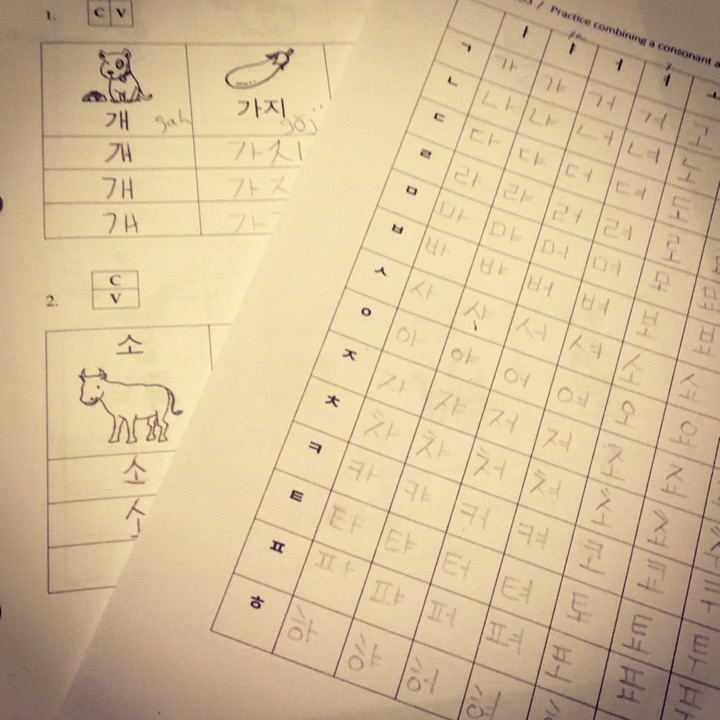
  • I have learned an entirely new alphabet, with new shapes and sounds unlike my own. (There are multiple marks for the “kuh” sound! I love it!)
  • I have readjusted my expectations for how much work I’ll need to do to keep up. (News alert: it’s waaaay more than I thought.)
  • I have gained a huge respect for my fellow classmates. (UMBC students are smart, kind, and friendly…who’da thunk?)
  • I have an entirely new-found respect for working students. (Honestly, how do you do it? No, really.)

My first weeks in class were devoted to learning Hangul, an objectively beautiful alphabet. Not since my original stint in college have I forced myself to memorize new sounds and concepts in such a way…and this was just the beginning! Thankfully, my teacher is funny, kind, and perceptive. As I mentioned in my Letter From the Editor in the fall issue, she told us from the start this wouldn’t be easy, but that we would all learn from the mistakes we made along the way. How can you not love that?

With the alphabet firmly in my brain, I am now able to pronounce words by sight, and even use a dictionary. And we’re moving into learning simple conversation. Which brings me to that original question of WHY we go back to school in the first place.

I have always been wild about school. Growing up on a remote farm, I craved the community of my classroom. In college, and later grad school, I loved meeting people from different parts of the world, with different ideas from mine, and honing the skills that would help me land my first job at a community newspaper.

Today, I go to school to find those same wonderful things — but there’s one much more personal reason. I go because my sons are Korean-born, and I want to help them learn the beginnings of the language. When we go visit Seoul together, I want to be able to find my way around the city a bit, and use the dictionary properly, and be able to say more than a simple “hello” and “thank you.” (Though, those get you pretty darned far.)

To be able to do that here, at UMBC, a place I love so dearly, is simply priceless. Stay tuned as a wander through the rest of the semester…

— Jenny O’Grady
Editor, UMBC Magazine

Wow Moments

Who inspired YOU most as a student at UMBC? We asked, and you answered! #UMBCwow

“Ilsa Lottes pulled me into Sociology, and Leslie Morgan convinced me to pursue a Ph.D. Both women were amazing mentors! So many great professors…a lot of fun was had in Rudy Storch’s Latin classes and I find myself still referring back to Jay Freyman’s word roots class.”

— Connie Krach Pierson ’90, economics, M.A. ’92, sociology

“Professor Schaller. He not only pushed me harder than any other professor, but he intensified my interest in politics and government. I still can’t believe he gave a quiz on my 21st birthday though. I’m pretty sure I aced it.”

– Sarah Candell Clifford ’10, political science

“Marjorie Herman, inspired me to go into the music profession. I ended up as a board certified music therapist. She was Margy Kleiman then in the early ’70s. This was before UMBC even had a music major. I majored in psych but took a lot of music courses …”

– Elizabeth Gardiner Myers ’75, psychology

“Dr. Jodi Kelber was such an important part of my UMBC life. I learned so much about evaluating life through critical lenses from her, but I learned just as much about leading an authentic and ethical life. I wouldn’t be the person I am today without her generous guidance and loving spirit.”

– Sarah Pevner ’08, English

“Almost every professor has been an inspiration… Narrowing it down to just one? Improbable. I was an Ancient Studies major, and it was the department as a whole which inspired me to push harder in my studies.”

– Deirdre Lohrmann ’16, ancient studies

“Sally Shivnan who taught me how to really tell a story with the written word in any medium. Christopher Corbett who taught generations of journalists the importance of chasing a story with a moral compass in hand, whom I think of whenever I read a really great piece of investigative journalism. Jason Loviglio who honed the lens through which his students view popular culture and politics and media, and whose course should be a requirement for every freshman. Christoph Irmscher who was my mentor and who taught me by example how to build consensus among peers which is a skill I rely on daily in my corporate career. I wouldn’t trade the UMBC professors I had for anything, not for admission to any other university in the world. I loved every minute in their classrooms and have such a deep-abiding nostalgia for my entire learning experience at UMBC.”

– Brett McKenzie Wood ’04, English

“Dr. Lumpkin who taught Thermodynamics around 94 or so. Sadly she passed after giving birth to her daughter. She truly exemplified a professor that cared about her students learning the material and having understanding. Dr. Lumpkin solidified my understanding of it taking a village sometimes to be successful. Because of her not giving up on me or allowing me to give up on myself and studying Chem. E., I make it a point to put the same into others that cross my path.”

– Gwen Blackwell ’97, chemical engineering

“Jason Rhodes. He was only an adjunct but he changed my way of thinking back in 2011 and I still remember what a great experience his class was. He taught me that for anything to change, it takes time, energy, and effort. I’m forever grateful for how he opened up my perspective on the outside world.”

– Jerrica Stanley ’14, psychology

“I loved my boss, Frank Tyminski, when I worked in Chem Prep. He was smart, dedicated to his students, and knew how to give us tough love. I used to go back to visit every few months when I was in grad school and could call him up any time I had a chemistry question. Frank was definitely one of the biggest influences in my college career.”

– Aimee Iannacci ’05, biological sciences and psychology

“Dr. Stephen Freeland was one of the professors who played an important role in my undergrad journey. He taught us how to bring disciplines together to maximize the results and taught us so much about effective skills and behaviors! No need to say the astrobiology class he taught was a great experience and the energy and effort he put toward teaching us was honorable.”

– Melorin Shahri ’17, biological sciences

“Dr. Osman Güler introduced me to operations research. He’s tough but fair, and always wants to make sure you truly get the concepts. When I was applying to grad schools, he pushed me beyond what I thought I was capable of, as he did with his courses.”

–  Emily Conley ’14, mathematics

“Ed Orser took over when Joel Jons left the American Studies Dept. to go to the U of New Mexico. Joel Jones recruited me into American Studies and Ed Orser took the reins and opened my mind to the concept of intellectual synthesis, taking disparate parts of society and beginning t understand the interplay of various disciplines on the realities of the world.”

– Jerry Kerr ’71, American studies

“Dr. JoAnn Argersinger. She was my advisor and helped to guide me through my years as a history major. She was a fascinating lecturer and I still use things she taught me as I teach my students!”

– Sheila Reed Magin ’88, history

“It is a tie for me.

  • Dr. John Starr who was my fraternity (Lambda Chi Alpha) academic advisor and guided me to pursue IFSM when I had little to no understanding of what the future could be in IT.
  • Dr. Scott Rickard who asked me, an undergrad, to register for a joint undergrad/grad school class (Policy Science 615) on Leadership. He stoked the fire inside of me to go onto graduate school.

Thanks UMBC #UMBCwow”

– Bill Glover ’90, information systems

“Dr. Andrea Kalfoglou taught me in the HAPP/SOCY Qualitative Research Methods course in 2009. It was life changing and showed me research comes in many forms. Thanks to UMBC, I use what I learned in my BA and MA programs in my job as a healthcare market researcher every single day. :)”

– Mary Faith James ’10, health administration and policy, M.A. ’12, sociology

“Dr. Michelle Stefano in American Studies. When I first signed up for her class, I just wanted to fulfill a requirement. I had no interest in the subject whatsoever, but she had so much passion that she made me care about and love the work we did in class. It ended up being one my favorite classes, and I ended up taking another class with her. She has so much passion that she can make anyone care about her topic. She is clearly in it for all the right reasons and she taught me that as long as you do what you love, you’ll be alright.”

– Hesham Hassanein ’16, political science

“Jim Thomas. Enough said.”

– Jen Joanna (Muston) ’04, American studies


Picture Perfect

Patrick Rife ’10, visual arts

As an undergraduate student of art history at UMBC, Patrick Rife ’10, visual arts, paid homage to obsolescent technology by building a sculpture out of 9,000 vinyl records. Today, as the co-founder of Baltimore-based Pixilated, Rife spends his days figuring out the key to staying on the cutting edge of a technology that calls to another throwback technology – photo booths.

If you’ve been to a major party in Baltimore in the last few years, you’ve probably seen the heavy rotation of guests posing in front of one of Pixilated’s trademark photo boxes. But Rife’s team has moved far beyond where it started in 2012, with a team of three. The Pixilated of today consists of 36 full and part-time employees with 24 booths working family and sporting events, festivals, conferences and corporate meetings in Baltimore, Washington, DC, and Philadelphia, as well as installing permanent, wall-mounted kiosks in businesses.

In short, Pixilated has left its mom-and-pop one-photo-booth rivals in the dust.

Rife and his partner, Nicolas China, started Pixilated after Rife was inspired by a watching wedding guests jumping in front of a professional photographer and acting crazy. This was Rife’s first exposure to the concept of an “open air” photo booth and occurred before the proliferation of digital photography. Years later, he remarked on it to a friend who’d had a similar experience and they realized the business potential given the digital technology then available.

Within a year after graduating from UMBC, Rife went from a low-wage job transporting high-end art pieces around the country to starting Pixilated. With his first child on the way, Rife, who is also a musician, said he viewed Pixilated as a small side business that “would buy me a little more time to make my next record.”

While there was a nascent photo booth industry at the time, Pixilated planned to improve on existing models.

“The original concept of Pixilated was to do something … that was a little more sculptural and with a sexier silhouette, instead of a traditional booth and to take higher quality photos, produce really high quality prints, and make an experience of it,” Rife explains. To heighten the experience element, they added themed props and green screens, and more recently, “GIF booths,” with stop motion photography that allow customers to take home a short animation of their memories.

After about two years serving weddings and other private functions, Rife was ready to take it to a higher level – bigger events such as trade shows, expos and state fairs. Since then, Pixilated has successfully marketed their services to large corporations, setting up photo booths for Under Armour at the Chicago Marathon, and traveling with Sony Records and Pandora, among others. They’ve also become incredibly savvy at marketing and brand engagement.

Pixilated photo booth customers become stars, posing with or wearing company logos and brandishing products, then posting the slick, ad-like images of themselves on social media. The client company’s exposure and recognition multiplies. Pixilated’s logo also appears in every shot. Everyone wins.

Next up, Rife foresees the business becoming more “nimble” with the proprietary software they’re launching, using the cloud for file sharing and social media integration.

“The industry has been going pretty heavily for four years now…but when it comes to bigger companies doing brand engagement, there aren’t a ton in the Baltimore market,” Rife reflects. “At the moment it’s still a little bit of an arms race to see who can build the exceptional technology and combine that with business development.”

— Cait James ’01