We use cookies for analytics and, unless you opt out, advertising.
You can opt out of advertising at any time.UMBC uses essential cookies to run this site. With your permission we would also use analytics cookies (to understand how the site is used) and advertising cookies (to measure and target our ads on other platforms). Nothing else loads unless you accept. You can change your choice any time from Cookie Settings in the footer.Privacy Policy
EssentialRequired for the site to work (login, security, your cookie choice). Always on.
Maryland Governor Wes Moore has appointed Yaakov “Jake” Weissmann ’06, social work and psychology, as acting secretary of the Maryland Department of Budget and Management (DBM). Weissmann, UMBC’s vice president of government relations and community affairs since December 2023, joins an impressive group of UMBC alums serving in state and federal leadership roles.
In a statement on the governor’s website, Moore called Weissmann “an experienced public servant and one of the most effective policy minds in our state. His deep understanding of the Maryland budget, developed over years in both the legislative branch and in local government, makes him uniquely qualified to lead DBM.”
Weissmann, a proud UMBC alumnus, called the move “exciting, but bittersweet.” Coming into his role at UMBC from an already full career of public service, he helped spread the word of UMBC’s impact among legislators and across the state, and nurtured relationships with the communities surrounding UMBC. He was among President Valerie Sheares Ashby’s first executive hires.
“It has been an enormous gift to work with Jake and to benefit from his counsel as we have built and strengthened relationships with elected officials and government agencies at the local, state, and federal levels,” Sheares Ashby said in a message to campus. “He has positioned us not only to be well-known among our public officials, but also to be well-supported; he believes deeply in UMBC’s distinctive value and conveys that value to others in ways that resonate meaningfully and build lasting connections.”
Weissmann called Sheares Ashby “a singular leader” who believes deeply in the people and mission of UMBC.
“UMBC really is a special place,” he said. “And part of what makes this position work so well is that President Sheares Ashby has a true understanding that our communities matter…and of the importance of making sure UMBC’s goals align with the goals of the state.”
After graduating from UMBC, Weissmann went on to earn his master’s in social work from the University of Maryland, Baltimore, as well as his juris doctor from the University of Baltimore. He served for two years as the assistant chief administrative officer in Montgomery County, where he helped steer the county’s economic development strategy and was responsible for several county departments. Prior to that, he spent 14 years with the Maryland General Assembly, including two years working in the House of Delegates, and 12 years with the Office of the Senate President. During his time in the Senate, Weissmann served in many roles, including as chief of staff for Senate President Bill Ferguson and former Senate President Thomas V. Mike Miller, Jr. He has also served on the state Board of Elections for the last two years.
Weissmann joins an impressive list of UMBC alumni who occupy prime positions in state and federal government, including Adrienne Jones ’76, psychology, the first Black woman to serve as speaker of the Maryland House of Delegates, Congressman Johnny Olszewski, Ph.D. ’17, public policy, and many others.
Looking ahead to the new role, Weissmann said he was excited about the “incredible opportunity to serve,” and shared a quote from the late United States Representative Elijah Cummings to capture their shared philosophy on the work: “Public service is the rent we pay for our space on this earth.”
The other morning at breakfast, I told my son I could draw an infinite line on two sides of a single piece of paper. He, of course, scoffed. So, I found a scrap sheet, made a half twist of the paper, added a crucial piece of tape, and proceeded to blow his mind with his very first Möbius strip.
Now, am I equipped to explain why a Möbius strip works the way it works? I am not. But, did I open the door to a “whoa!” moment—and the possibility of him finding it out for himself? Absolutely.
Every day at UMBC, you’ll find plenty of “whoa” moments—occasions of curiosity and delight that challenge minds and broaden perspective—across the disciplines. And best of all, these moments can happen to anyone, anywhere, because we’re all about opening doors here.
One great example is quantum, a timely topic—and “the future of Maryland,” as our governor puts it. We have amazing alums harnessing this information to build secure communications and ultra-precise sensing, but they—like all of us—started out as curious students. They just needed to show up and have their minds blown!
An eye-opening moment at Artscape brought our cover-story subject Nema Robinson to UMBC in a roundabout way—now, she is poised to be the full-circle door-opener to a new generation of music students. And what could be more whoa-inducing than being able to build whatever you might dream up in a campus makerspace or to collectively flex your imagination with friends through long-term gaming communities?
I recently celebrated a pretty major milestone at UMBC—my 20-year work anniversary. And in that time, I have experienced a bunch of personal “whoa” moments, many of which I have had the honor of sharing right here. So many Retrievers have opened my eyes—and now, as my work at UMBC evolves, it’s my turn to open a door of my own.
I am happy to share that starting with this fall’s issue, managing editor Randianne Leyshon ’09 will be taking on the mantle of editor of UMBC Magazine. She is smart, kind, and curious, and I am so happy for her—and for all of you, who will benefit from her excellent editorial leadership going forward.
Thank you for sharing so much of yourselves with me over the years, dear Retrievers. I look forward to seeing you around campus!
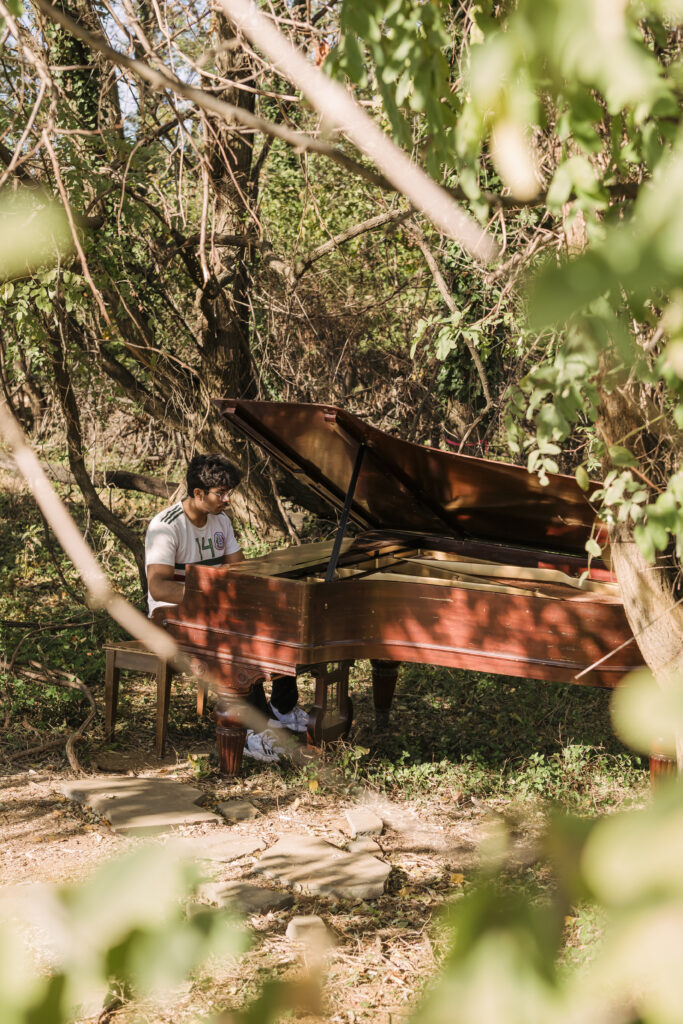
On a sunny October afternoon, a faint melody emerges from a stand of trees just beyond the Fine Arts Building and within hearing distance of the Performing Arts and Humanities Building. We leave the paved pathway and follow our ears up the hill to find first-year music education student Luke Heichlinger leaning into the keys of a lone piano, playing what turns out to be “Ein Heldenleben” (“A Hero’s Life”) by Richard Strauss.
Erik Bhattacharyya is one of many UMBC students who have discovered and enjoyed the Piano Garden. Here, the biochemistry
and molecular biology and biological sciences junior is playing a piece by Ludovico Einaudi called “Nuvole Bianche.”
“I always look for a practice room with a window, but sometimes I can’t get one,” he says, explaining that he and his friend, Hannah, originally joked that the piano in the woods might be a hallucination. Thankfully, it wasn’t—so they came back the next day prepared with sheet music.
Installed just days before, “Piano Garden” is the latest “performance” of New Zealand-born composer Annea Lockwood’s ever-growing outdoor series of “Piano Transplants” compositions in which, since 1969, defunct pianos are burned, submerged in water, or—as is the case at UMBC— left to be taken over by trees and plant life. In the days and weeks following the installation at UMBC, the unofficial path to the piano became well-worn as students like Heichlinger brought their best tunes, additional instruments, and voices, and performed—very often—just for themselves.
Lockwood, later, visited campus as part of the annual Livewire music festival and listened while Linehan Artist Scholar and piano performance major Ida Dierker improvised in the woods for all to enjoy.
“UMBC has all these beautiful outdoor spaces,” says Linda Dusman, Livewire director, professor, and longtime Lockwood fan. “Stumbling upon a piano in the woods…kind of wakes you up to the experience of your environment. And also helps you remember what a piano does: that music can wake you up to the moment, even if you’re not directly hearing it.”
On the day we found Heichlinger, we learn he purposefully chose a romantic era composition that might fit in well with his surroundings. The dappled shadows flitted across the keyboard as he played.
“This is a really nice setting,” he said. “Nature and music go together so well, and this is the perfect example of that.”
In an email to the campus community, UMBC President Valerie Sheares Ashby has announced that Paul A. Meggett will join the university as general counsel, and that Yaakov “Jake” Weissmann ’06 will assume the role of vice president for government relations and community affairs. The letter follows in full:
Dear UMBC Community,
With great pleasure, I write to share the news of two key appointments in UMBC’s senior leadership team. Both are highly specialized roles, and in the two individuals who will fill them, UMBC will have the very best people to lead these areas into the future.
Following a national search supported by Major, Lindsey & Africa, a leading global legal executive search firm, I have appointed Paul A. Meggett as our next general counsel, the university’s chief legal officer. Paul, who has served since 2018 as general counsel at Appalachian State University in Boone, North Carolina, has deep and broad experience in all aspects of higher education law and in leading such work at public institutions, including top-tier research universities and healthcare systems.
At Appalachian, Paul successfully launched a Division of Institutional Integrity comprising enterprise-wide legal, risk, and compliance functions, helping to drive institutional excellence and a comprehensive approach in those areas. Because that institution owns and operates a regulated electric utility, his experience also extended into the utility regulatory field.
Paul’s career has spanned legal counsel in academic and healthcare systems, as well as faculty and administration roles in higher education. He spent more than a decade at the University of North Carolina at Chapel Hill, serving from 1999 to 2011 concurrently as assistant university counsel and as associate general counsel for UNC Health, an integrated healthcare system of 11 hospitals and more than 33,000 employees. Prior to his time at Appalachian, Paul served on the faculty and briefly as interim dean of the Charlotte School of Law in Charlotte, North Carolina, and he served from 2004 to 2009 as an adjunct professor of law at UNC School of Law.
Paul earned his bachelor’s degree from North Carolina State University and his law degree from UNC School of Law. After graduating from law school, he clerked for Chief Justice Burley B. Mitchell Jr. of the North Carolina Supreme Court. In 2023, Paul was awarded the John B. McMillan Distinguished Service Award from the North Carolina State Bar.
I am delighted that Paul has accepted our offer to join the UMBC community. I also am grateful to the team in our general counsel’s office, including John Burke, who has taken on a great volume and scope of work since joining the office in 2023. I know John and the team join all of us in welcoming Paul, who will begin at UMBC on September 16.
For another very specialized role, the best candidate was already in our midst. Yaakov “Jake” Weissmann ’06 has been serving for nearly a year as associate vice president for government relations and community affairs. He will now assume the role of vice president, and I am thrilled that UMBC will continue to benefit from his leadership, his deep knowledge of local and state politics, and his love for UMBC.
Jake majored in social work and psychology at UMBC, and it was here that he became passionate about a life in public service and community engagement. Before returning to UMBC as associate vice president in 2023, he served for two years as the assistant chief administrative officer in Montgomery County and spent 14 years with the Maryland General Assembly, including two years working in the House of Delegates and 12 years in the Office of the Senate President. During his time in the state Senate, he served in many roles, including as chief of staff for two Senate presidents.
Jake earned a master’s degree in social work from the University of Maryland, Baltimore, and a law degree from the University of Baltimore. In 2023, Governor Wes Moore appointed him to the State Board of Elections. Anyone who has had the opportunity to work with Jake—and that is a great many of you, I am sure—undoubtedly have come to know how knowledgeable and talented he is, how infectious his energy is, and how his deep relationships throughout Maryland and his belief in UMBC’s mission and vision are helping to advance our goals every day.
With these two appointments, we are making great strides. Our senior leadership team is growing even stronger, and UMBC’s future is brighter than ever.
UMBC has entered into a partnership that will allow employees of Amazon to attend UMBC and expand their skills for free.
Since partnering with the Career Choice program in September, 10 local Amazon employees have been awarded a total of $38,300 toward their courses of study at UMBC, said Dale Bittinger, M.P.P. ’16, assistant vice provost for strategic undergraduate engagement, partnerships, and pathways at UMBC. The program has also made it easier for students who are working part-time at Amazon to stay enrolled at UMBC.
“As a U.S. News and World Report Best Value institution, UMBC remains committed to keeping college affordable,” said Yvette Mozie-Ross ’88, vice provost for enrollment management and planning. “Strategic partnerships with employers, like Amazon, that support and promote education and degree attainment, is one important way we deliver on this commitment.”
Admissions staff who recently attended their first Amazon Career Fair found a great deal of enthusiasm for the UMBC connection from Amazon employees who have been requesting this both for themselves and for their children, said Bittinger.
Afreeka Chambers, a senior majoring in biological sciences who also works full time as a fulfillment associate at Amazon, explained that the program has made her educational journey more accessible and fulfilling. She hopes to attend dental school after she graduates from UMBC.
“Thanks to Amazon’s Career Choice program and their partnership with UMBC, I’ve been able to pursue my degree with greater ease,” she said. “Being part of the Career Choice program has not only relieved financial burdens but also reinforced my commitment to personal and professional growth, aligning perfectly with Amazon’s dedication to empowering its employees to reach their full potential.”
Joining a new community can be tough sometimes, especially post-pandemic. And with new Retrievers coming from every background imaginable, it’s important to make sure everyone feels welcome when they get here.
That’s where “Your Story Belongs Here” comes in. Now in its second year, this video storytelling collaboration between Initiatives for Identity, Inclusion, and Belonging (i3b) and the Department of Theatre brings students together to learn how to share—and celebrate—their own stories of belonging.
“I think it’s pretty common to enter college and be worried that you’re not going to find your people. It’s very different from high school,” said Adam Bayoumi, a public health major, who spoke about the worries he faced about keeping up with school after his father passed away. “I personally thought the transition would kind of knock me out…and it wasn’t easy, and it wasn’t quick, but I did find my people eventually.”
Guiding students’ steps
The resulting film, which was shown at Welcome Week to incoming students, showcases the experiences of 10 students from a variety of backgrounds. Some explore identity or overcoming imposter syndrome. Others speak from the perspectives of adult learners reentering college or international students settling into a new culture. Some felt comfortable in front of a camera while others had to overcome that fear over time. Thankfully, in this second iteration of the project, students took advantage of a four-week workshop-style internship to perfect their performances with help from their cohort and guidance from faculty and staff co-creators.
Members of the Your Story Belongs Here group gather before the Welcome Week event. Photo courtesy of Eve Muson.
“We got to have much, much more time with students this year to develop their storylines and infuse some social justice education around identity…storytelling and monologuing, all that good stuff,” said Ciara Christian, acting director of i3b, and a co-founder of the project. “We also had a really cool opportunity to take students to see some live theatre performances…there was a storytelling event in Washington, D.C., that we took the students to, to help inspire them, and it was a beautiful process.”
Project co-founder Eve Muson, associate professor of theatre, called the workshop experiences “magical.” She also brought in alumna Kiirstn Pagan ’11 to film and edit the work. “Because we had more time, the stories were more complex and students were really talking honestly about the identity that they bring with them when they come to UMBC—their doubts, their fears, their trepidations, all of that,” said Muson. “And then there’s the moment when they discover themselves at UMBC. So, that’s the shape of every story.”
Finding your “second family”
When Jaya Marshall, a transfer student focusing on cinematic arts, first arrived at UMBC, she, too, worried she wouldn’t fit in, that she might be the lone theatre person in a sea of STEM students—something she realizes now was a misperception. But seeing the inaugural “Your Story Belongs Here” video at her own Welcome Week in 2022 helped change her mind—and also inspired her to take part in the project the following summer.
“When I saw that video I was like, oh, thank you,” said Marshall, who quickly found several clubs to join after arriving at UMBC. “Thank God, I am not the only one. I hope people who are arts and humanities will see that and be like, okay, I’m not alone.”
Public health major Mashaal Awan chose to share her story of going to UMBC’s STRiVE leadership retreat, which she says had “a huge impact on me in terms of realizing my values” and also helped her make friends she now considers her “second family.” In her video, Awan recalled the first evening of STRiVE, walking outside with friends beneath a beautiful night sky.
“I remember feeling a sense of freedom I had been craving my whole life with these people I instantly felt such a strong connection with,” she recalled in the video.
Bayoumi hopes that the vulnerability students show through their storytelling helps incoming students feel more comfortable and welcome at UMBC.
“Fast forward to the end of the school year, and I had done stuff that I never thought I would have achieved in college,” he said. “So to me at 17 years old, I would just like to say, ‘Hang in there. Life dealt you some hard cards, and it’s going to be okay.’”
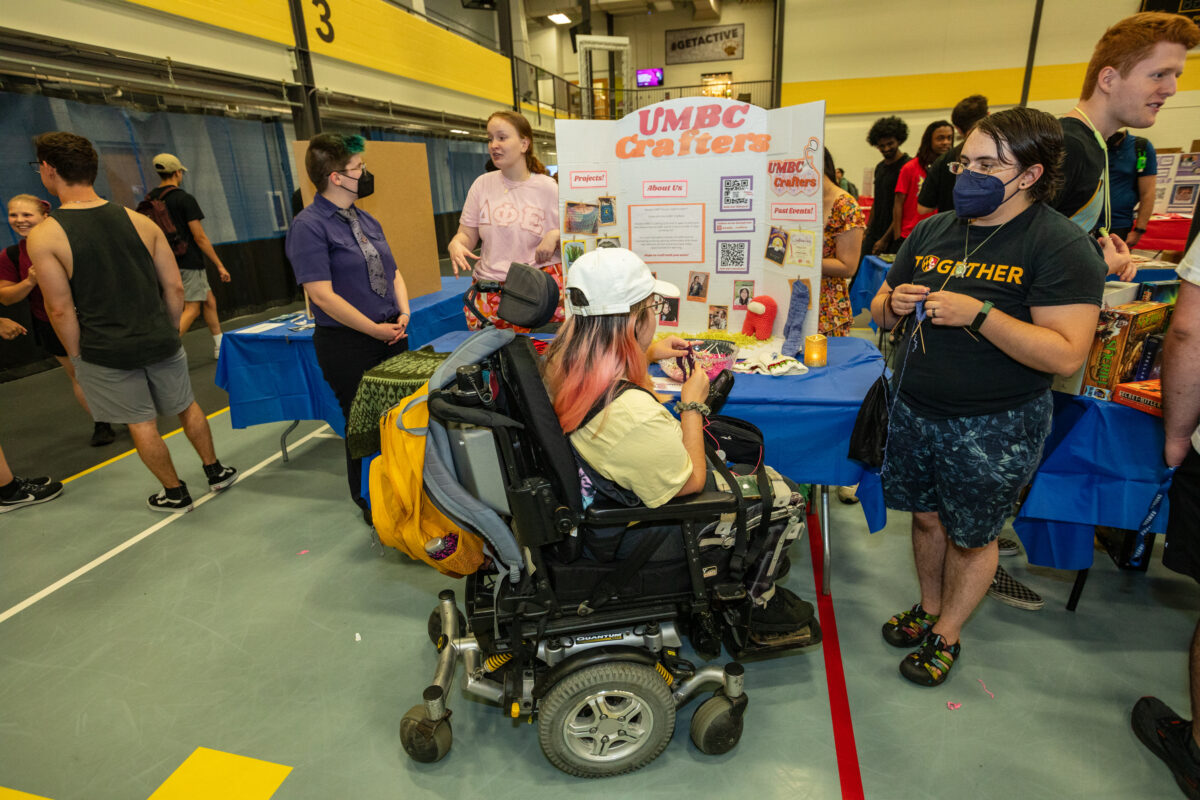
As waves of students swarmed the Retriever Activity Center last week, senior Micah Polsky of the UMBC Crafting Club quietly stood knitting a pale blue merino wool sock with three tiny needles. Behind Polsky, on a presentation board the UMBC Crafters made to lure prospective new club members, was pinned the mate to the sock in progress.
“Knitting is a lot of trial and error and a surprising amount of math…but it can be very relaxing or very stimulating depending on the kinds of projects you make,” says Polsky, an environmental science major. Together with club president Emily Bolt (a senior chemical engineering major and avid embroiderer), they talked yarns and technique with students shopping for new clubs and organizations to join at this year’s Involvement Fest.
Beyond a meet and greet, and far beyond posters and tchotchke giveaways, iFest is a key moment for students looking to meet new people and try something new. An estimated 2,000 students attended this year’s event, according to Tori Ciorra, assistant director for student organizations. With more than 200 UMBC clubs representing everything from career pathways to religion, to service, recreation, sports, and more—not to mention an open door for students to create new orgs of their own—there is something for everyone to enjoy.
“Involvement Fest is an exciting opportunity for new and returning students to join a student organization and find a community where they can foster new relationships and experiences. Each organization is incredibly unique and creates a wonderful opportunity for students to get involved outside of the classroom,” said Ciorra, who was pleased to see the crowds of interested students.
“I am always in awe of the organizations that our students have created, and watching the creative ways they market their organization. Hearing leaders talk about the number of sign-ups they received and their excitement for the year is extremely rewarding and sets a wonderful tone for the rest of the year.”
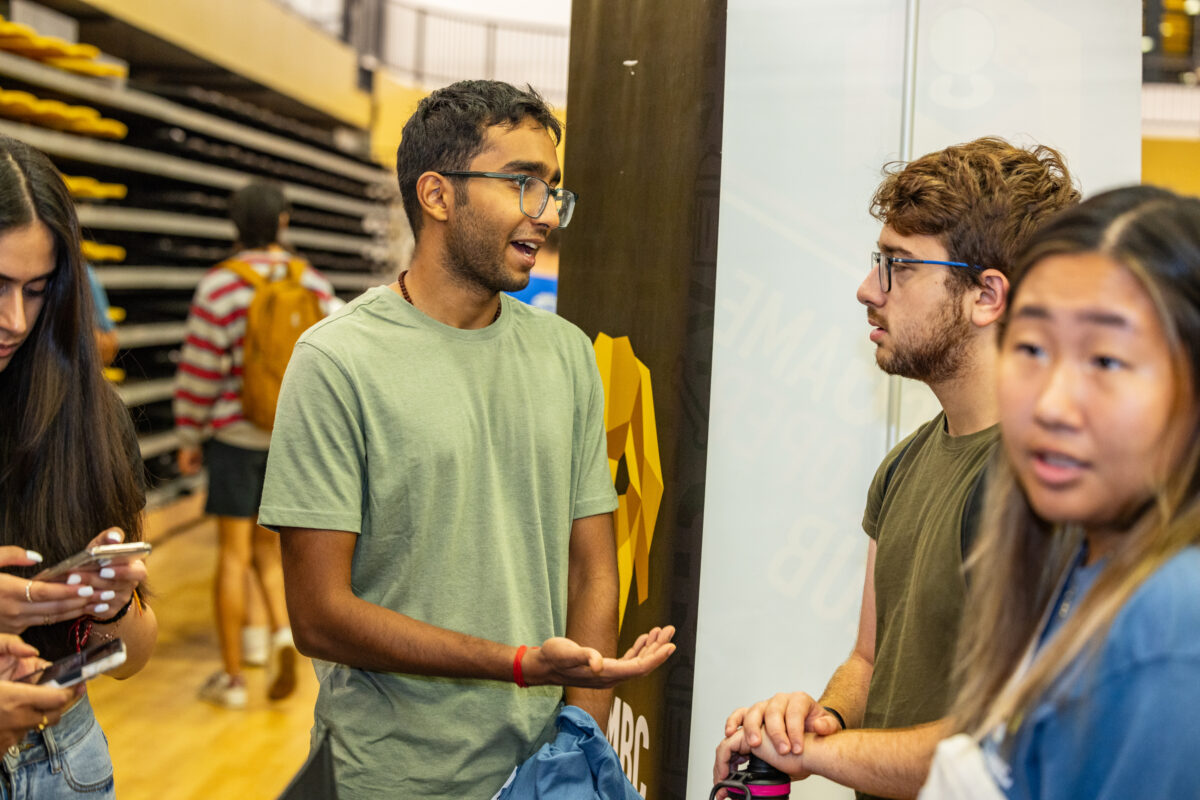
Pranav Vedasendur Senthiluel, a junior computer science student, at left, has been attending Hack UMBC events for the last two years, but signed up to join the club at this year’s iFest, “because I actually like hacking. I do a lot of software development and it’s a good opportunity to meet people and actually develop something.” Also pictured: Ahmad Sayad, center, and Claire Kim.
A smorgasbord of choices
Surveying one of two huge rooms of club displays, first-year computer science student Emma Popoko flipped through the event program to pinpoint tables she especially wanted to visit.
“Film club could be interesting. And I’m definitely interested in the African Student Association because I’m African…and possibly the National Society of Black Engineers,” she said. Her added motivation to be there? “So I don’t just stay in my dorm all day. I can interact with people and get a feel for the place and feel like I’m part of the community and not just here for classes.”
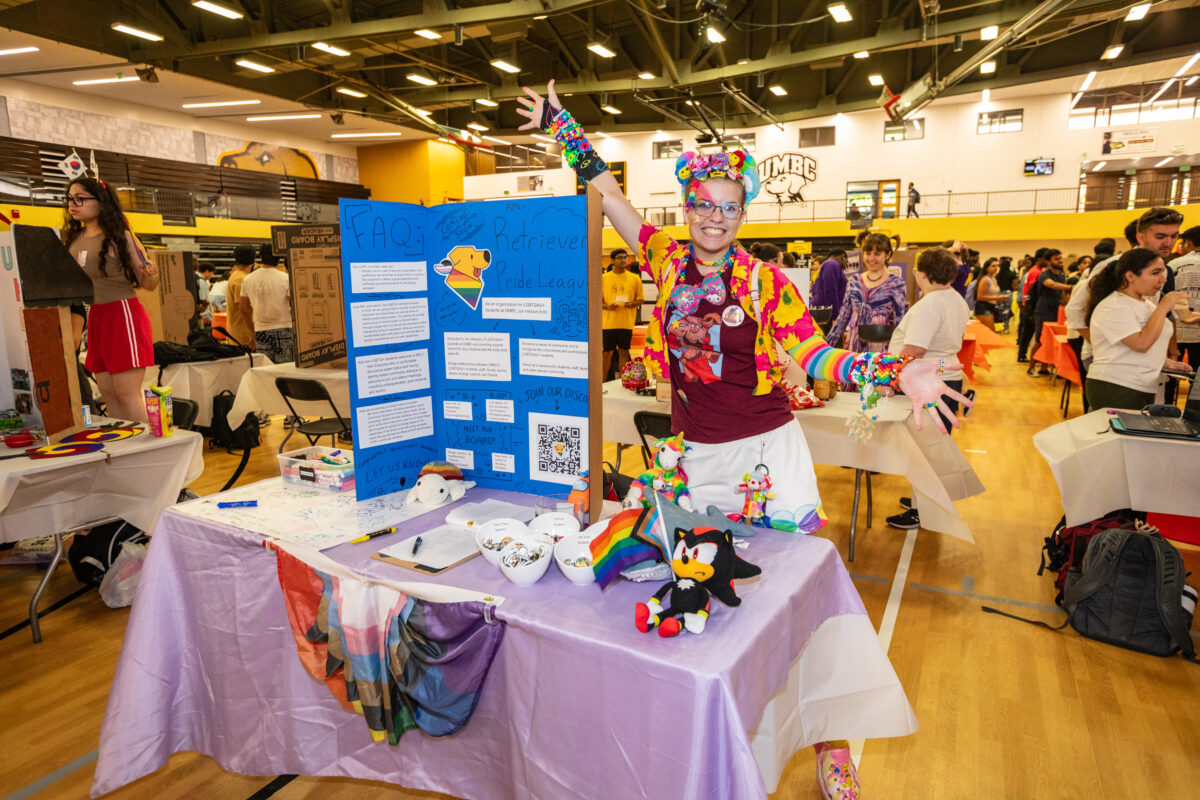
Annie Fowler, a senior history major and education minor, spent iFest sharing information with students about the Retriever Pride League. Fowler, a transfer student, helped re-name the group recently to be more inclusive. “I love the idea that I can change the world, so being able to have a tangible change on something like a university…it does mean a lot to me,” said Fowler.
Sophomore Ayan Chaudry, a biology major, joined a couple of clubs in his first year at UMBC, but came to iFest specifically looking for something new—possibly a pre-med fraternity. Taking part in student organizations—especially as a commuter student—made his first year feel “less lonely.”
“I know some people like to just go home and back and forth to school, but I feel like if you stay on campus a bit longer…there’s more to it than just studying,” he said.
Abby Parke, a senior psychology major, center, visited the UMBC Crafters display, wondering about a green sweater Micah Parke spent a month knitting. “What did you use? It’s so soft!” Parke raved.
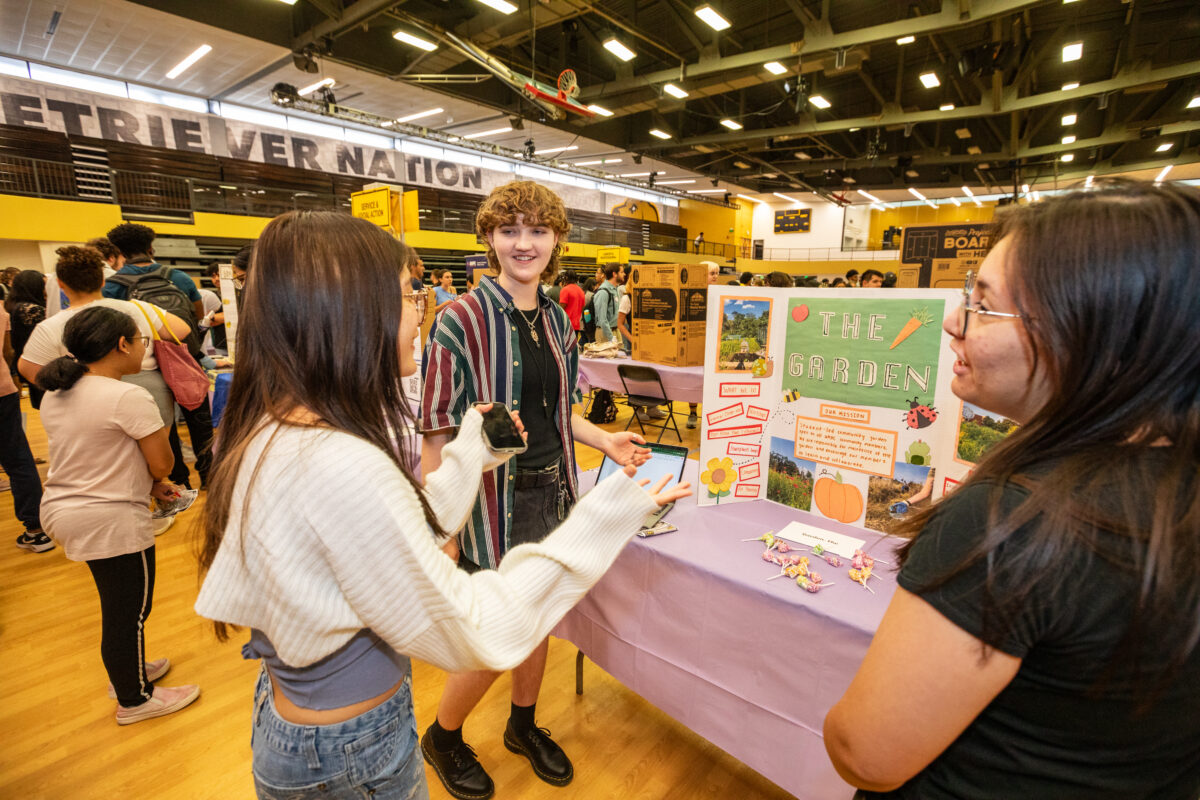
As folks passed the table for The Garden, a physical gardening space on campus that also grows food for Retriever Essentials and other partners, club president and senior biology/psychology major Eli Gooding handed out lollipops and made a solid case for why getting one’s hands dirty—while growing veggies, that is—is such a great form of self-care.
“For me, gardening is really therapeutic and it’s how I relieve stress,” said Gooding. “It’s really good to have a hobby.”
Eli Gooding and Angela Sanchez, president and vice president of The Garden, handed out lollipops and shared their love of growing vegetables. “We’ve had a lot of interest today,” said Gooding. “A lot of new students came in who aren’t familiar with where the garden’s located. They don’t even know we have a garden…so I was really excited to tell them, ‘Hey, we have this amazing place on campus!’’’
What if you could ask yourself a big question and then use your intuition to follow it wherever it led for as long as it took? It would take a certain kind of guts, right? But, with a willingness to get lost on a tangent, to joyfully put themselves in positions of not knowing, truly creative thinkers can find new ways of translating the world around them.
Enter the following: A dancer who makes beautiful movement from fish research. An information systems professor who turns poetry into wine. A data visualizer who draws connections while splattering paint. A mapper and sculptor of hip hop facts. A harnesser of color and language and culture.
This is the sort of magic that can happen when you’re open to interpretation.
On a molecular level, the push and pull of an ecosystem may feel too infinitesimal for humans to experience visually. A researcher can track the data in a spreadsheet as a series of characters and marks or explain it with the structure of a scientific article. Microscopes may capture stills or video of tiny worlds, but what about the emotional landscape of life in motion?
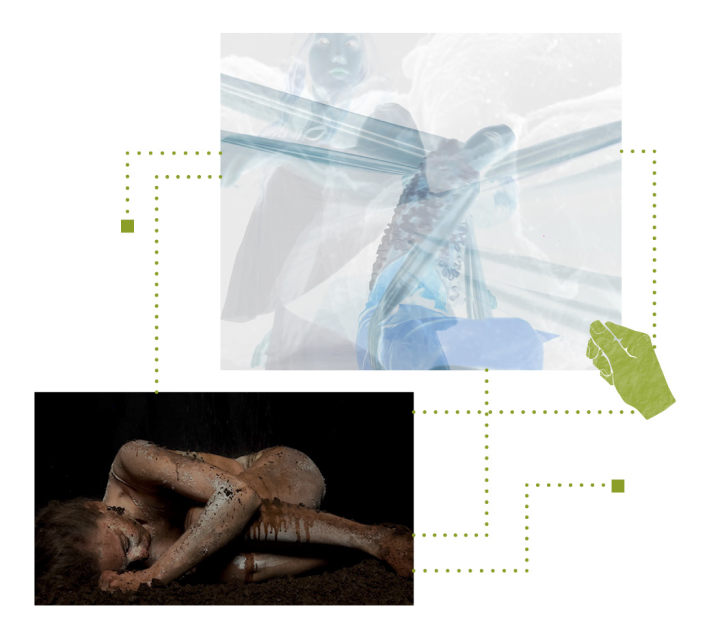
“I really am fascinated with the small things we cannot see that are so important,” says Ann Sofie Clemmensen, assistant professor of dance, who spent a year in residence at the Institute of Marine & Environmental Technology (IMET) next to Baltimore’s Inner Harbor working with scientists who study a variety of topics adjacent to aquaculture, environment, and sustainability.
Clemmensen began her residency by diving deeply into the research of the IMET scientists around her—learning about everything from rainbow trout viruses to the ecological wear and tear of red tides. As she built relationships with researchers, she found herself drawn into the details of their studies—and wondering how she might translate what she learned into something that might encourage viewers to learn more about their world.
“There’s a sort of unpacking of the language of that field. Because movement, while it’s not a spoken language, it is language,” she explains, ever the eager translator. “We have to understand the concept we are trying to embody in order for the physical embodiment to carry the meaning.”
Working with student dancers, Clemmensen choreographed and filmed a series of movements and scenes meant to depict biological processes she learned about from her IMET counterparts. In one, students in masks represent the generic differences of virulent and avirulent strains of the VHSV rainbow trout virus. In another, dancer Michaela Emmerich ’24 (covered in clay powder) rolls in the dirt to show the effect of argonite in reducing levels of phosphorus in farming run-off.
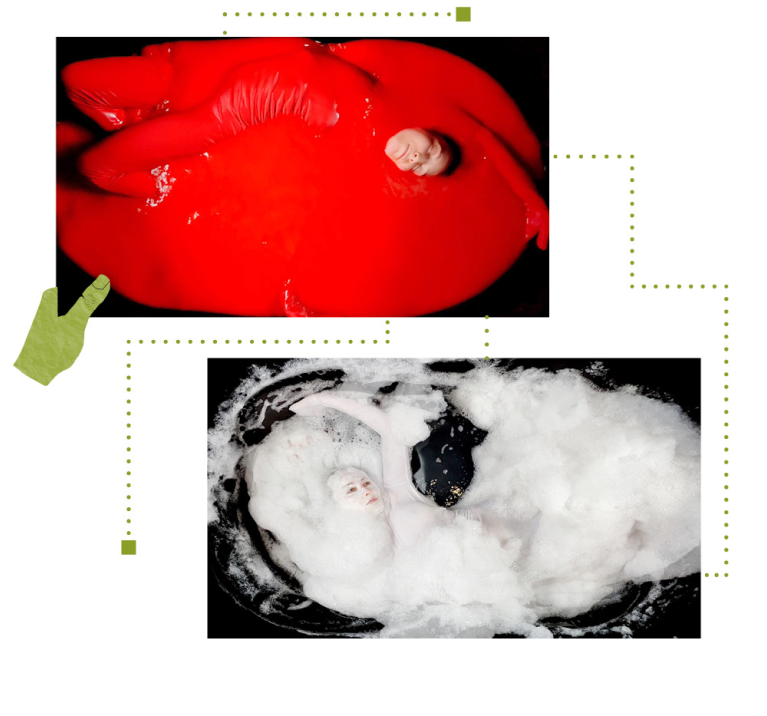
While Clemmensen’s scenes of red tides, green biomass, and white, milky foams are objectively beautiful, don’t be fooled. Nature isn’t pretty, Clemmensen says. But taking a good close look can help us all understand our environment a bit better.
“For many doing art, dance, and data-driven research, it’s like looking at an abstract painting. If you don’t have a little key that can unveil or reveal some of those secrets, then it’s just chaos.”
Assistant professor Ann Sofie Clemmensen worked with researchers at IMET to create a series of videos depicting microscopic processes like red tides and battling dinoflagellates. Photos courtesy of Clemmensen.
A poem crosses time and space, building in meaning as it travels from person to person, from generation to generation. With each new reader, it becomes something new and specific—but also potentially loses something of itself along the way.
As a trained computer scientist, Foad Hamidi, assistant professor of information systems, is fascinated by the practical challenge of being able to retrieve information lost when data is duplicated—an inevitable fact of digital life. As a lifelong lover of Sufi poetry from his home country of Iran, he also can’t help but wonder how to preserve the heart of these precious words, even as circumstances—generations, distance, cultural leanings—might dilute or change them.
“There’s always some information loss” in data duplication, he explains. “However, a very interesting theorem in information theory also says that if you have a lot of replicas of the same code…you can recover the original message in the presence of errors that was in all these codes.”
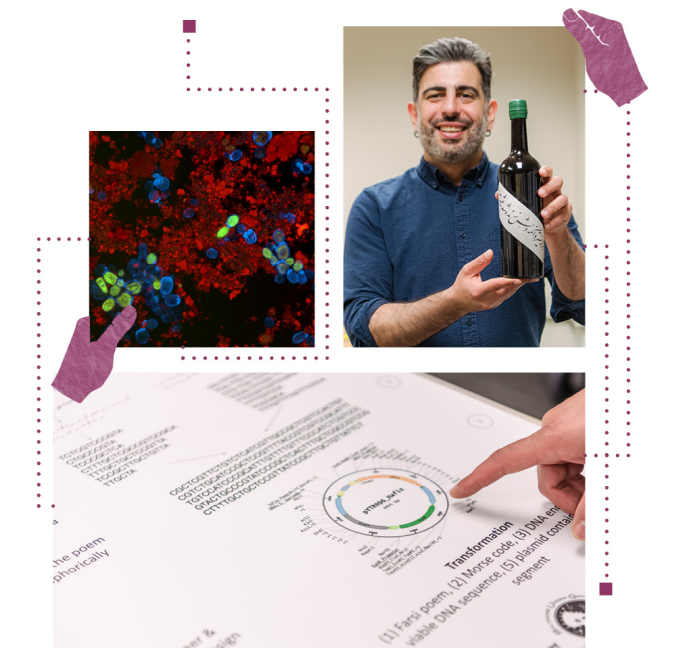
Information systems Professor Foad Hamidi has
translated a favorite childhood poem into DNA code,
wine, and more. Top image (magnified photo of yeast
cells with the modified DNA Hamidi made)
courtesy of Tagide deCarvalho.
Years ago, Hamidi learned about a song that was encoded by Japanese musician Etsuko Yakushimaru using living bacteria as a sort of language, “and it really made me think of the possibilities of information and culture and data and encoding.” And so, at the start of the pandemic, he began exploring ways of translating the poetry of Hafiz, a 14th-century Persian poet, into new, living forms and of sharing the experience with others.
Hamidi’s bio-art-inspired creative inquiry led him first to interpret the poetry as code—DNA, to be precise—culled from the words themselves. He then created a “poetry-infused transgenic wine” using yeast modified with the DNA encoding of the poem. Craving community, he took the idea to other researchers in music, biology, imaging, and beyond to joyfully build further iterations of the chain. These efforts led to an Imaging Research Center (IRC) Faculty Research Fellowship (with Linda Dusman, professor of music), and today, he continues to explore new translations of the coded poem through music, cellular imagery, and even a cluster of mushrooms growing in Hamidi’s office.
With each new link in Hamidi’s poetic chain, the information is replicated and the “data” is one step closer to being saved through this fascinating theorem. In doing so, Hamidi also is able to bring together curious new friends who might not have had reason to collaborate otherwise.
Although Hamidi’s “translations” may seem outside the box, the practice of making a poem one’s own “has a long history,” he explains. “These poems are the DNA of my culture…so our architecture, our music, our visual arts, our cultural traditions, are very much impacted by poetry.”
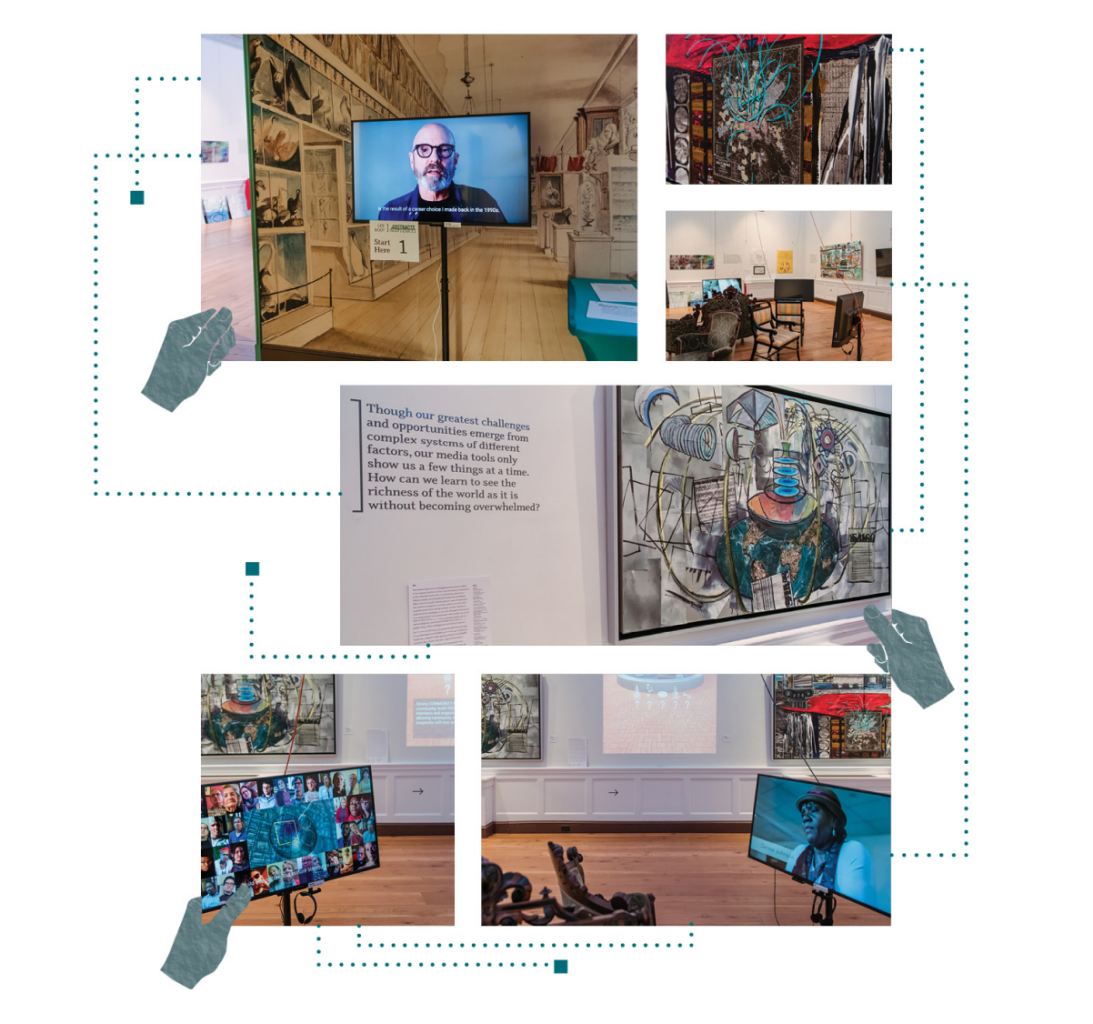
In a far corner hangs an enormous painting of a brain, with bright blue lines, red arrows, and clips of phrases suggesting ideas in motion. In every direction above it, threads of red and blue crisscross the room anchoring one artwork to the next—a system of knit synapses representing not only 25 years of research but the artistic process that fuels it.
“What I try to do, above and beyond anything else, is show as transparently as possible what that process looks like,” says Lee Boot, director of UMBC’s Imaging Research Center (IRC), whose retrospective exhibit “Abstracts & Artifacts” showed at Baltimore’s Peale Museum earlier this spring.
For Boot, that means a room filled with numbers, images—some animated, many bursting with color—and the connective tissue of the personal paintings he created to process information and experiences related to the various subjects of his research.
“The work is immersive. I paint my brain out as a meditative, reflective process. And then that gets honed, and reshaped, and…out of that automatically comes new perspectives and new ways of framing problems.”
In his exhibit “Abstracts & Artifacts,” Lee Boot asks
viewers to consider new ways of solving problems.
“Almost like dreaming, making art with a question
in mind reveals meaning through metaphor. How
is it that metaphors seem to be both specific and
ambiguous—both personal and universal—at once?”
Boot lives to solve problems, and believes deeply in the power of combining artists’ ways of thinking with other disciplines to ask questions and find solutions in new ways. Over the years, the IRC has brought together multidisciplinary teams of artists, scientists, and social scientists from state and local agencies, foundations, and other organizations who are open to tackling everything from substance misuse to educational achievement gaps to the epidemiology of pandemics.
And while technology runs much of what the IRC builds, nothing is quite so essential to the heart of the work as one’s own intuition, says Boot. As a classically-trained painter, that means returning to the canvas and allowing his brush to take him in new directions—not to create something beautiful, per se, but to open himself to ideas accessible only through such a personal process.
With each stroke of the brush, and each new color, he pulls from the deepest reaches of experience, community, and understanding, creating a road map for what’s next.
“I’m not trying to make something pretty,” he says. “I am trying to understand how a set of issues sits in being, in my psyche, on the landscape of the world as I understand it. I’m trying to see what I cannot see.”
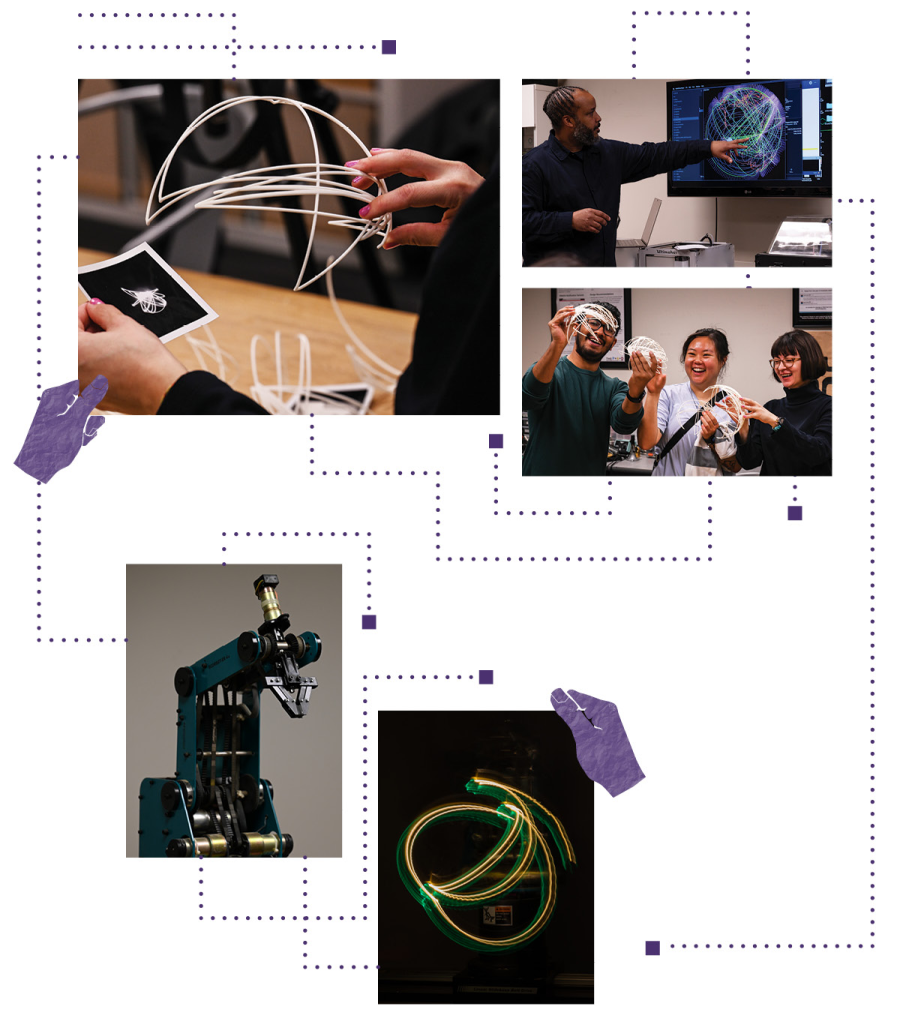
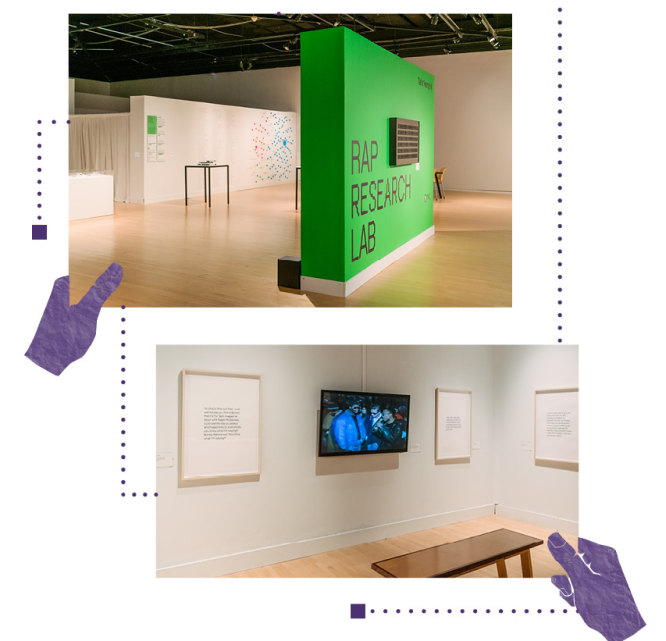
On the table sit three football-sized forms of light plastic. Each has been sculpted in a 3D printer using zigzag motions specifically programmed to mimic the map lit up behind them showing an orange globe splashed with green arcs. Dots on the screen represent locations mentioned in thousands of hip-hop and rap lyrics, as big as the oft-mentioned city of Atlanta and as hyperlocal as the intersection in front of a neighborhood convenience store.
A student gingerly picks up a gold-colored sculpture, and asks, “Is this Kendrick Lamar?” Tahir Hemphill, a faculty fellow, music aficionado, and self-described “creative technologist who works with art,” nods as a collective “oooh” makes its way around the room.
“It’s data sculpture, literally. It’s making things as real as possible,” says Hemphill, whose ever-evolving body of work, The Rap Research Lab, made its home at UMBC’s Center for Art, Design, and Visual Culture this spring. “This is what it feels like to touch a rapper’s rhymes.”
Located at the intersection of hip-hop and data visualization, and built as an interactive teaching space, the lab features the “Mapper’s Delight” tool that, using augmented and virtual reality, cross-references locations from thousands of rap song lyrics along with a variety of other art pieces that speak to Hemphill’s goal of finding “relationships and shapes in the data.”
Over the course of the semester, UMBC students helped Hemphill delve further into the data while middle schoolers from around the state visited the teaching lab with their classes to try their own hands at research using Hemphill’s lyrics database.
On this particular day, Hemphill demonstrates yet another incorporation of the geographic lyric data. In collaboration, Foad Hamidi helped Hemphill program a robotic arm, and by inserting a LED pen into the robot hand and filming movements at a long exposure, he’s able to make “light pen drawings” of the data, à la Pablo Picasso.
With the lights dimmed and the robot arm making ethereal data shapes before their eyes, Hemphill tinkers with his projected spreadsheet in real time. There are just so many threads to follow and infinite stories hidden within.
“My job is to draw them out—pun intended,” he laughs.
Tahir Hemphill, a faculty fellow, music aficionado, and
self-described “creative technologist who works with
art,” uses data visualization tools to reveal new levels
within hip-hop.
Read how artist Hadieh Shafie, M.F.A. ’04, channels the power of language and her childhood experiences in Iran into intricate and colorful pieces of art.
The biotech industry—or technology-based business that harnesses the power of biology—is booming in Maryland. And with more than 3,000 biotech companies currently operating in the state (with more on the way) and an economic impact estimated at around 17 billion dollars, according to the Maryland Chamber of Commerce, there’s never been a greater demand for highly-skilled workers to fill specialized roles as researchers, biomedical engineers, and technicians.
With its presence expanding beyond the home campus in Catonsville at The Universities at Shady Grove campus in Montgomery County, a hotspot for biotech growth, and its commitment to inclusive excellence, UMBC is uniquely positioned to prepare students for fulfilling jobs in this industry, both at entry and advanced levels.
We sat down with William R. LaCourse, dean of UMBC’s College of Natural and Mathematical Sciences, and Annica Wayman ’99, mechanical engineering, associate dean for Shady Grove Affairs in the College of Natural and Mathematical Sciences, to hear more about what makes UMBC’s programs distinctive, and why it’s so important to make this type of education and training accessible to as many types of students as possible.
UMBC Magazine: Dr. Wayman, you came back to UMBC in 2018 after a career in the biotech industry, at least in part because of UMBC’s emerging work in the translational life sciences. Can you tell us about what drew you here?
Dr. Wayman: When I saw the Translational Life Science Technology (TLST) degree program that UMBC was launching at the Shady Grove site in Rockville, it got me really excited. Because for me, this space of translational science, biotech, and the ability to have a high-impact career where you can help people with their healthcare challenges, is really exciting. The other exciting piece was the interdisciplinary nature of the curriculum—how many types of work can be brought together in new ways—and so it really spoke to those things that I’ve always been interested in. Being able to train students for careers in this space is exciting to me, and I have enjoyed being a part of this community so far.
Dean LaCourse: And speaking of a community, Maryland has such a growing and vibrant biotechnology industry, and it really is all about responding to this great need in the workforce for biotechnology. It’s a tremendous opportunity for students to be trained for really good-paying jobs in the applied sciences. This is something where you can roll your sleeves up and get working.
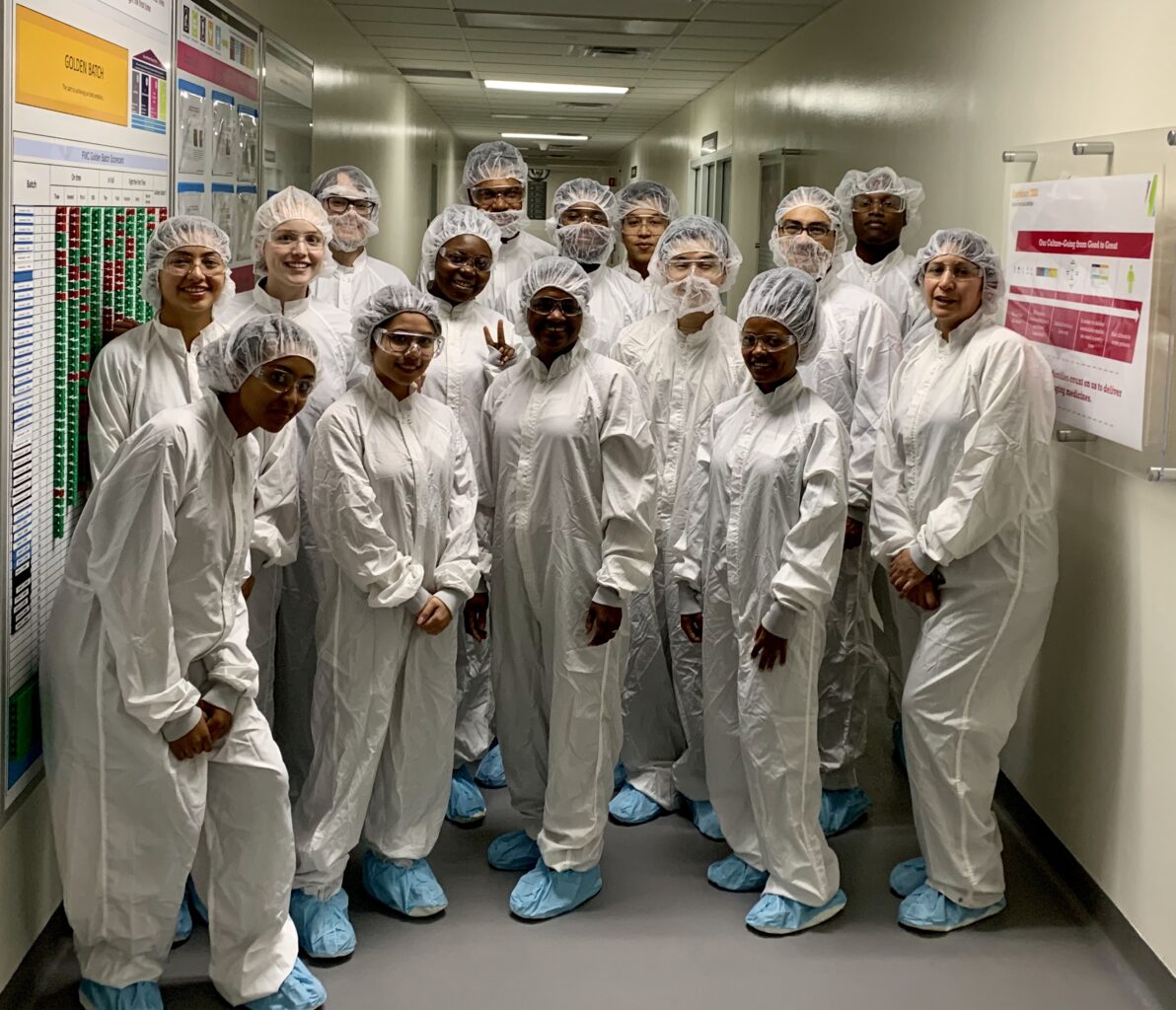
Students in UMBC’s TLST program share a moment together during a class trip to biotech company AstraZeneca. Photo courtesy of the TLST program.
UMBC Magazine: So, what does the journey look like for a student interested in this sort of work?
Dr. Wayman: The idea is to train students for critical jobs that are needed in the biotechnology industry primarily in the private sector at companies like AstraZeneca, Catalent or Kite Pharma. About 70 percent of our students in the TLST bachelor of science degree program come to us after getting their associate’s degree from Montgomery College. We’re seeing a big workforce gap in a number of areas, including cell and gene therapy. So we have this program that increases the pipeline but also trains students in an interdisciplinary way. Students are not just getting the biology, biochemistry, and chemistry. They get bioinformatics, but they also get engineering classes, so biochemical engineering and biomanufacturing. We have a lot of faculty members who are from the industry teaching these courses on a part-time basis, and a lot of guest lecturers from companies who can share what, for example, bioprocess design really looks like in the field and how highly regulated the environment is. And so students really get the skills that they need to hit the ground running in the industry. It really is exciting to see students get all of this out of one degree.
Dean LaCourse: We’re also thinking a lot about the continuum of education. So we have the undergraduate TLST program and then, after students get some work experience and want to build into more of a managerial or technical leadership track, they can come and do the professional master’s in biotechnology to get those leadership and technical skills. I love how UMBC is thinking about this continuum of education where people can come on and off as they see fit, for certain skills or knowledge that they need to gain and move their careers forward.
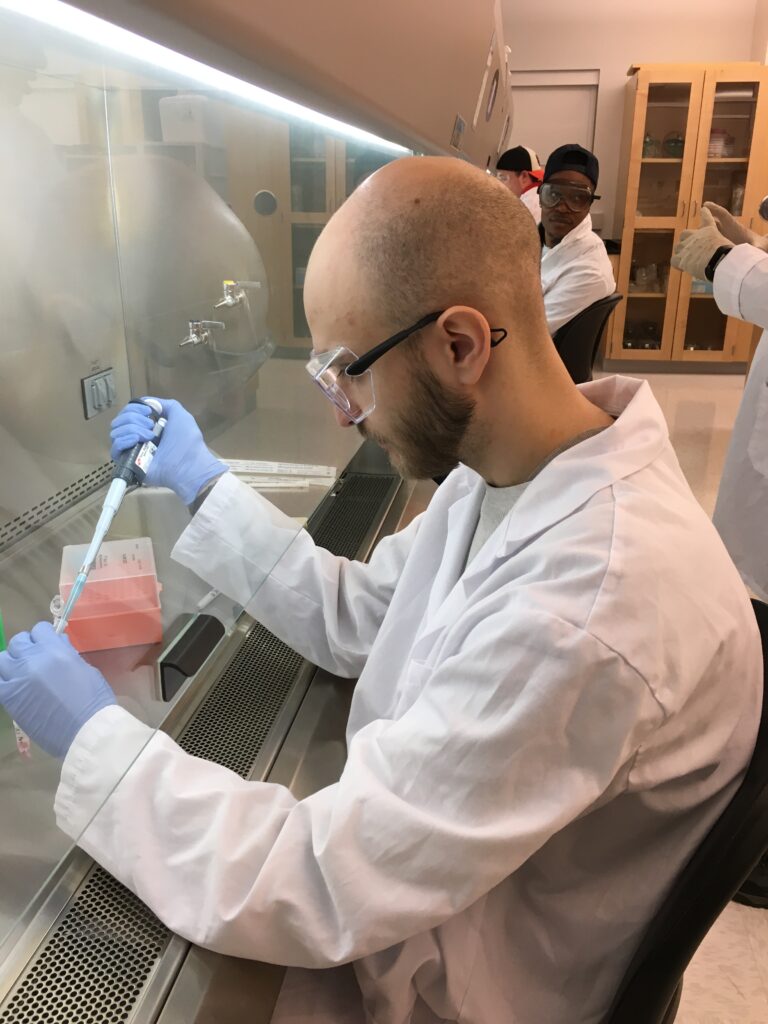
A TLST student in a lab class. Photo courtesy of the TLST program.
UMBC Magazine: Why is it so important to you to make this education accessible to students of all backgrounds? And why is it so important for the industry itself?
Dr. Wayman: These are well-paying jobs with high earning potential where you can leverage your scientific interest and skill to have enormous societal impact. Our TLST and MPS Biotech students are contributing to life-saving solutions. Some students may think that being a doctor or nurse is the only pathway if they are good in science, but these biotech jobs are other possibilities where you’re enabling thousands of doctors and nurses in helping patients – and impacting even more lives. And it’s important that those who work on these life-saving solutions come from diverse backgrounds to bring unique perspectives that reflect the diverse populations being served.
Dean LaCourse: That’s why we create our education systems for everyone. You’re admitted to UMBC, so we owe you the best education possible. No matter what path you took to get here, what disadvantages you have. And that’s why we emphasize professional advising, mentorship, applied learning experiences, compassion, and fairness. Inclusive excellence is what we’re all about.
Artificial intelligence, or AI, is all over the news these days. For those who aren’t working in this sphere, it might feel mysterious or even like a science fiction film. However, for researchers at UMBC, AI is just another tool in a growing collection of instruments that can make life better for their fellow human beings. AI-driven thinking opens up possibilities for improvements and problem solving in health care, the environment, civil engineering, and beyond. It can make previously unthinkable amounts of data easy to analyze. But work of this magnitude also calls for an ethical approach, both in how it’s taught and applied.
We sat down with Keith J Bowman, dean of UMBC’s College of Engineering and Information Technology (COEIT), and Vandana Janeja, professor and chair, Information Systems, to talk about why taking a humanistic route to research and teaching AI is such an important way of making a positive difference in our community and the world, and why UMBC is the perfect place for students with an interest in this emerging field.
UMBC Magazine: With UMBC’s “public research for public good” approach in mind, what are a few examples of creative ways our researchers are breaking boundaries with AI?
If we can curate good data, there’s lots of good stuff we can do with AI. One NSF funded project example at UMBC was done by Dr. Nirmalya Roy in the Information Systems (IS) department, who combines sensor data with social media. The sensors read the water levels, and the water levels are shared with the community over tweets, tweets on flood severity can be quantified/measured and confirmed by water level sensors as well, so this is a very good example of how you can actually make an impact in the community right where you are. It actually impacted our neighborhood.
And then there are other things like studying deep fakes. That’s an NSF funded project that’s happening in my lab along with Dr. Christine Mallinson in the Center for Social Science Scholarship (CS3). We are trying to understand how to better educate our students in understanding deep fakes. On the one side, these audio files are created as fakes through AI, but then we are also trying to work with our colleagues to see how we can improve the detection and discernment of it, either through training the students or making algorithms aware of the human side of things—introducing humanistic aspects to AI.
There are ways by which we can train our algorithms to be really, really precise in tasks that may be difficult for humans to see, but then we also have to be careful how to balance it with well-curated, well-trained data.
Keith Bowman: Often people think about AI only in relation to computing topics. But Tyler Josephson in chemical engineering at UMBC is working on trying to develop and use machine learning (where a machine learns to imitate human intelligence) and artificial intelligence tools in order to assess complex properties of some materials. These computational tools can be applied to chemical reactions, phase changes, statistical variability, or even human factors involved in chemical processing and materials manufacturing. They can also be used to foster improvements in theoretical understanding. The artificial intelligence can work through all of the cases and all of the examples that may be there.
Almost every engineering field has people working on how to apply AI and AI tools to work on things that have been challenges for many years, or trying to find faster ways to come to a resolution or a solution in areas as varied as the x-ray or ultrasound imaging used in human healthcare or the health of aging bridges and buildings.
There’s health monitoring that is useful for infrastructure for public safety, for instance. Radiography and ultrasound can be used to look for flaws or potential failures in bridges buildings or even aircraft components. But then human beings end up interpreting the images. Increasingly, we are able to collect massive amounts of information and artificial intelligence tools can help with quantifying information used in predicting outcomes. For instances with a high degree of complexity, having computational tools assist in the analysis can enhance the quality of the result. And also any place as a real backup to where humans might drop the ball in some cases.
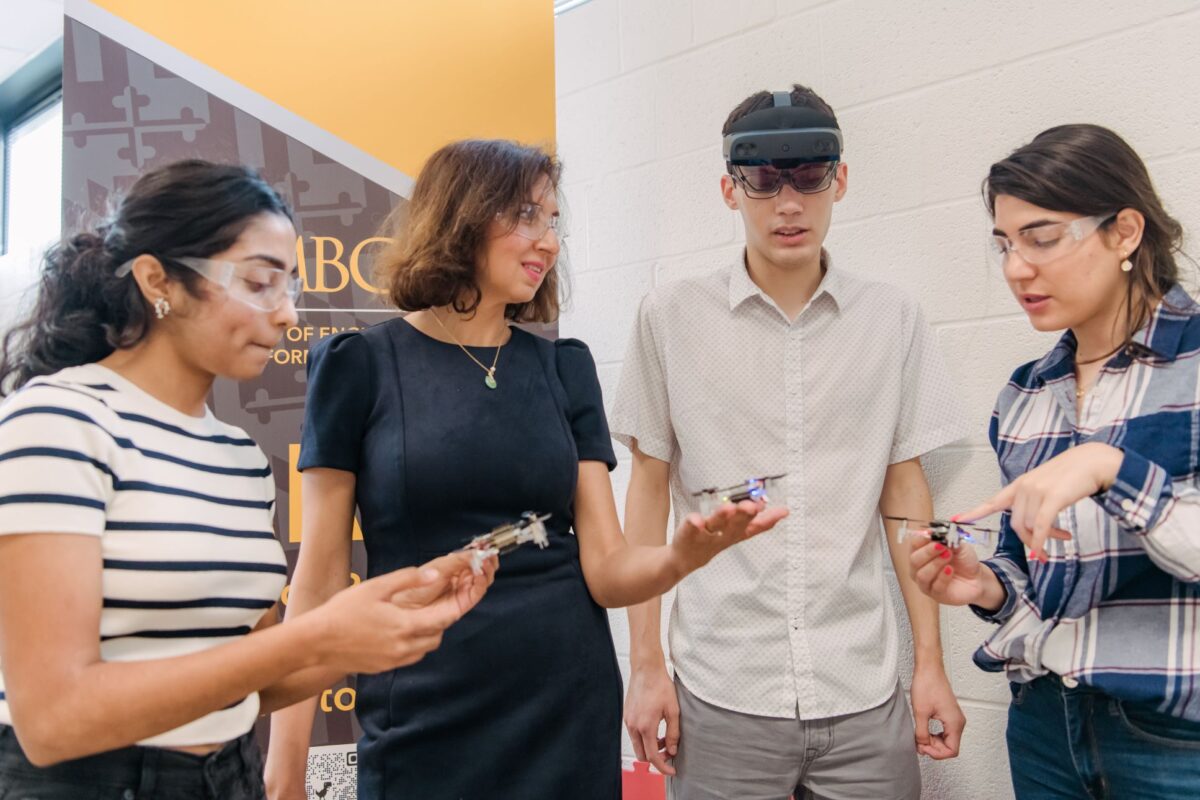
Associate Professor Tinoosh Mohsenin (second from the left) and students display small drones. (Marlayna Demond ’11/UMBC) Read the full story on UMBC News.
UMBC Magazine: It’s amazing to think about just how broad the use of AI could be.
Vandana Janeja: I want to emphasize one of the things that Keith said, and I think that’s really the crux of it where AI can be helpful, is literally the massive amounts of data we have, the terms of scalability and complexity we are talking about, that we literally cannot compute at the current capacity of our minds. And you’re talking about decision making that a human has to make. But now if you augment it with AI, it does so much better.
And another NSFfunded project I should mention, iHarp—which focuses on climate data in polar regions—where there’s so many different systems and subsystems, just to put all of that data together and make these complex connections, even thousands of scientists may not be able to do it. But if you start making those connections across even some of those subsystems, it advances the science by leaps, tens of years. So that’s the kind of impact that AI can have. Now the trick is, can we make those connections well? Can we train and have well curated data? Because all data is not good data.
UMBC Magazine: That’s a great segue into the human piece of all this. Can you talk to us about why UMBC takes such a humanistic approach to AI?
Vandana Janeja: You can look at it from multiple perspectives. And we are also impacting our students on how they are thinking. It’s very important to see who’s at the center of the AI application. You can ask, who are we impacting? Who are we working with? And who’s helping us create these connections? And then finally, are we able to produce algorithms that don’t harm individuals? So the positive impact, making sure it’s in ethical bounds, and then also making sure who we are working with. In all of the project examples we mentioned, there is a community impact. If you go onto the IS department research website you see that almost every project has a community partner. And then most importantly, it’s hard, but you really have to work with different disciplines.
UMBC Magazine: So for a student who’s interested in this kind of work, what would you give them in terms of advice?
Keith Bowman: To me, the thing that we need more of is students from other disciplines who do coursework in some of these related topics. That includes completing certificates and minors. A lot of COEIT students will do a second major or do a minor in other places on campus, and I think that’s fine. But I also think you need more students from other areas who can and are willing to do the reverse and establish some technical backgrounds. We need a broader range of people, including those from arts, humanities, social sciences, and life sciences, who also have enough of the technical background to even ask better questions regarding AI.
Vandana Janeja: People will come at data from different angles. I had a student talk about social justice in one of my classes, about the data and use of data, how it is empowering or disempowering people. And I encourage this.
At the end of the day, I say to my students: keep asking questions. Can you connect what you are doing to the big picture? You want to use your own inner compass as a guide, think how are you contributing? Not everything has to be this big life-shattering thing, but at the same time, are you chipping away at it? Are you contributing to society as such? The UMBC education and the ecosystem we have at UMBC really empowers students to do that.
President Valerie Sheares Ashby is a people person. You can see her eyes light up while she talks with folks.
On her very first day as president of UMBC, Sheares Ashby made it clear that she wants to be available to students. Right off the bat, in true professor form, she set up weekly student office hours to do just that.
As you might expect, her office hours are already very popular, so we decided to reflect her friendly open-door philosophy in this regular president’s column. Sheares Ashby is also engaging in a listening tour to hear from faculty, staff, students, alumni, and partners across campus and beyond in the coming month. We look forward to sharing highlights from the tour in future issues.
(Marlayna Demond ’11/UMBC)
UMBC Magazine:How would you describe your first few months at UMBC, and what has it been like getting to know this community?
President Sheares Ashby: These first few months have been energizing, inspiring, and joyful. The more people I meet, and the more I start to make connections, the more I love this place. You can love something from a distance because of its values. But when you meet the people, and they embody those values, your love grows even deeper. It has been especially rewarding to engage with students, see who they already are, and imagine what they will become as a result of their experiences at UMBC.
And then, what is most inspiring for me is that it’s becoming more clear every day what the possibilities are for what we can do together going forward.
UMBC Magazine:That’s a terrific segue! What would you like alumni to know about your thoughts on UMBC’s future and how you hope they will be involved?
President Sheares Ashby: Well, right now, as you know, I’m holding listening sessions with members of the community, and I want as many alumni as possible to participate. As we do this, I know that I will discover even more about our collective purpose and the possibilities for UMBC. I have said to alumni that I don’t know what I’m going to ask them to do yet, but when I feel like I’ve got something that’s worthy of their time and effort and the difference that they can make, I will bring it to them. And there will be something that I need our alums to do, for sure, because they are such an important part of UMBC’s future.
I had the opportunity recently to meet with the executive committee of the Alumni Board of Directors and then, of course, many, many more alumni during Homecoming. As they introduced themselves, they talked about what they are doing and what they loved most about their UMBC education. It was wonderful because I could hear how they are living out the values of the institution wherever their careers and lives have taken them.
I heard people talk about civic engagement and social justice and the things that we believe deep in our core. They’re out there in the world exemplifying what UMBC is, in business, professions, public service, and the arts, and that is just incredible. The more people see our alumni doing this, the more we will continue to attract excellent students, and UMBC will only grow stronger.
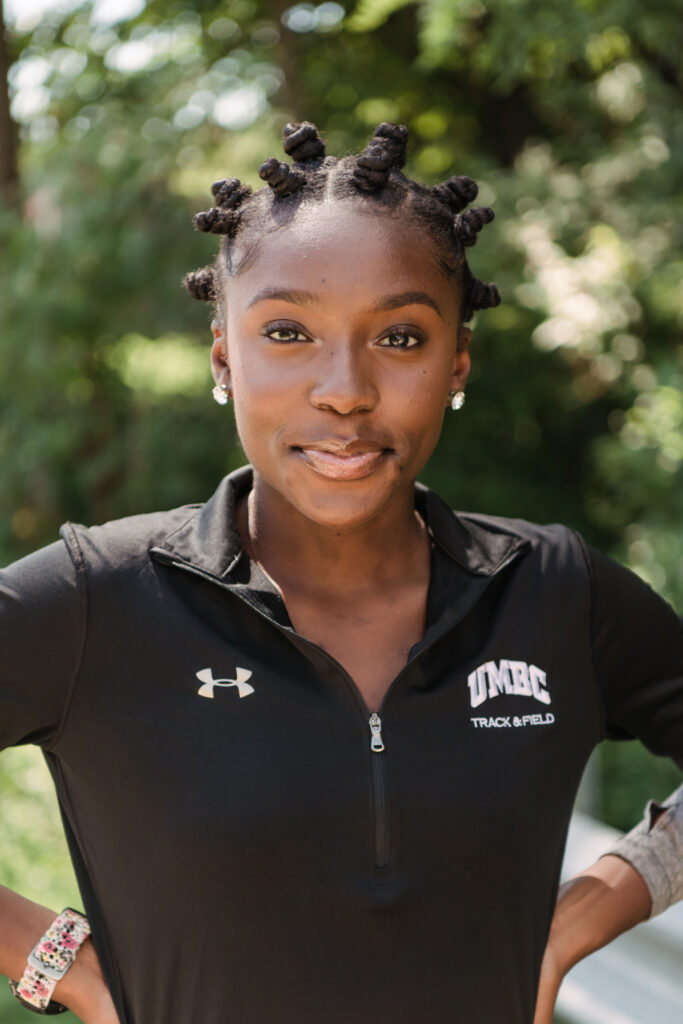
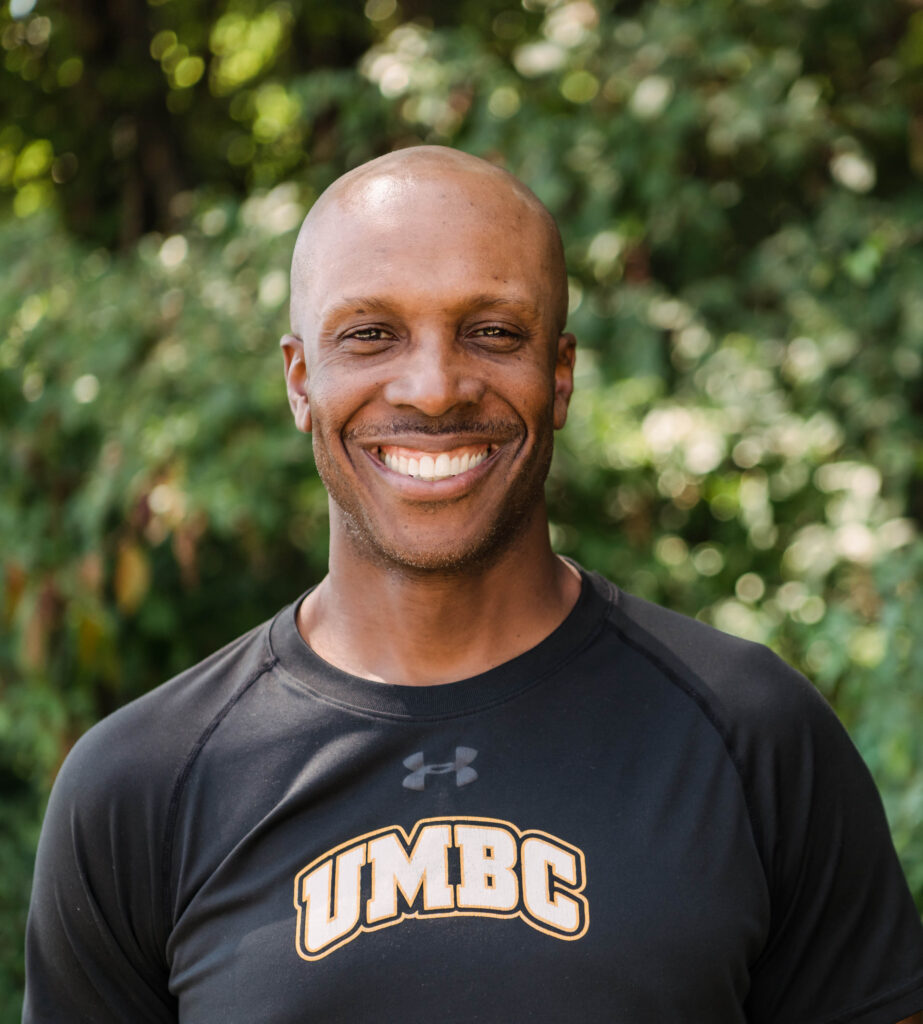
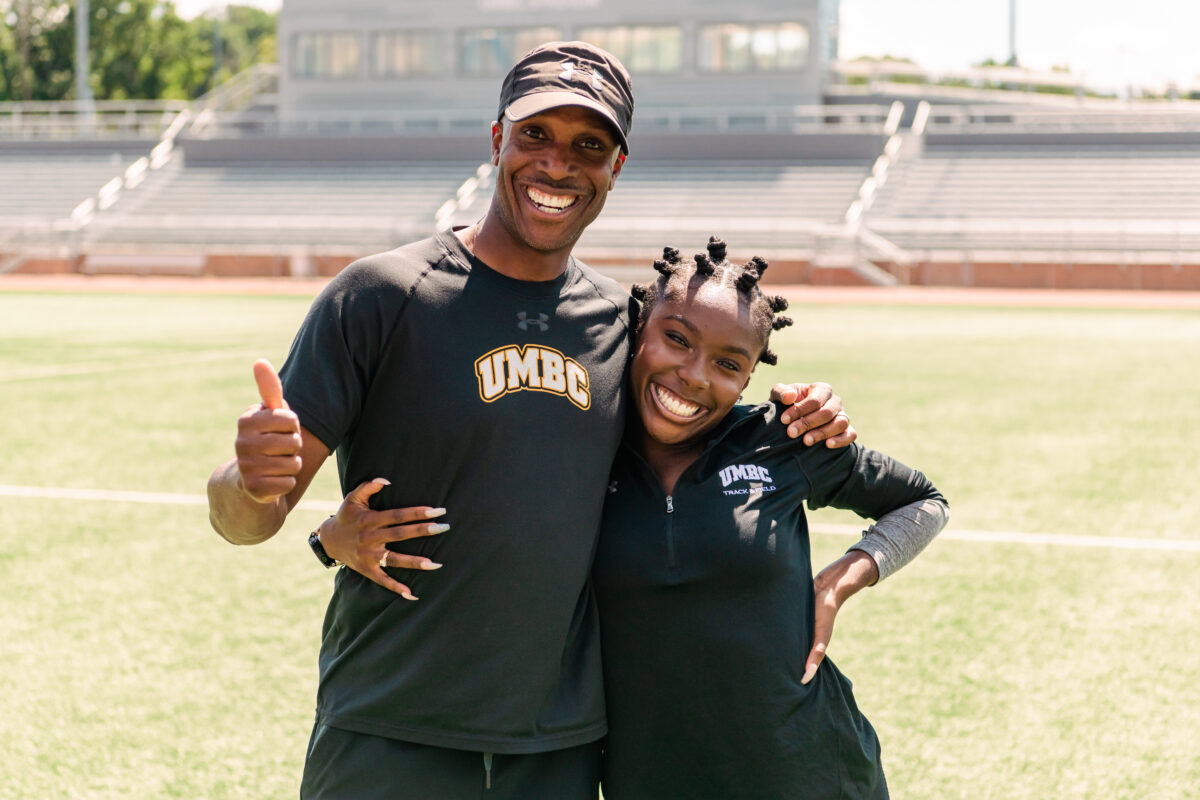
The only things faster than David and Caitlyn Bobb themselves, perhaps, are the zingers they toss at one another.
As Caitlyn, a rookie running star now in her sophomore year, describes what it’s like to have a father as head coach of track and field at UMBC, her dad dryly turns it into a bit.
“My dad has many sides to him, okay?” Caitlyn laughs as Coach Bobb literally acts out everything she’s saying while seated beside her.
“There’s the coach side, where he’s stern, and he’s got the stopwatch in his hand, arms crossed, hat on, and ‘GO!’…And then there’s the dad side, who comes to practice all excited, and says ‘Woo, I’m hyped, let’s go!’”
It’s not surprising that Caitlyn is poised for another amazing season. She’s a very hard worker, of course, and also the product of phenomenal athlete parents. Her mom, Dawnnette, represented Bermuda in the 1992 Olympics in the 100-meter dash, and Coach Bobb ’97, information systems, still holds six separate records for indoor and outdoor events at UMBC.
“My mom, she was like, ‘Okay, I saw that coming.’ I’m pretty sure my dad did, too. It’s in my genes. I didn’t have a choice,” Caitlyn says.
Caitlyn wowed the competition in her rookie season, earning several “most outstanding” titles at the America East Championships and placing 17th in the 400-meter dash at the NCAA Championships with a school record-breaking time of 51.84 seconds. And as she continues to learn from her dad and other coaches—like paying attention to the way she pumps her arms, for instance—she’s on course to make improvements each season.
“We’re doing what we’ve been doing for years—the only difference is we’re now doing it at UMBC,” says Coach Bobb. “Hearing my experiences and her mom’s experiences helps her prepare for situations she’s going to encounter herself.”
Although bubbly off the track, Caitlyn is extremely serious in her training—pushing thoughts out of her head in order to focus on breathing above all else. She often runs and studies with her friend Ibra Khairat, a sophomore biological sciences major.
“I would describe Caitlyn and Coach’s relationship as one that’s balanced just right,” he says. “Although she is the coach’s daughter, Coach Bobb gives her room to grow as an athlete and doesn’t give any type of special treatment, which is why it works so well. They are both able to balance that father/daughter and coach/athlete dynamic.”
Coach Bobb is big on building relationships and trust and making sure his runners feel supported, both as athletes and students, he says. As father and daughter gently rib each other, it’s clear the one-upping is grounded in love.
Coach Bobb and his daughter Caitlyn on the track. (Marlayna Demond ’11/UMBC)
“I know what it takes to be successful in this sport, so I just sit back and look at the execution of her race. Is she doing what she’s been trained to do?” Beyond that, he says, it’s about seizing the moment and improving wherever you can. “As a parent, I’m just making sure that I’m supportive. Track and field is only going to be X years of her life. I’m always going to be her dad.”
It’s true: Nobody runs track forever. Caitlyn is studying biological sciences with a minor in entrepreneurship and innovation with hopes of someday being a biology teacher—and possibly a coach herself.
She has a great model right next to her, even if she doesn’t always get his Karate Kid training jokes. (Don’t worry, they can watch it together later.)
“He cares about his students’ well-being, and he makes it a warm, welcoming environment. He cares a lot,” she says, getting serious for a moment. “Good job, Dad.”