We use cookies for analytics and, unless you opt out, advertising.
You can opt out of advertising at any time.UMBC uses essential cookies to run this site. With your permission we would also use analytics cookies (to understand how the site is used) and advertising cookies (to measure and target our ads on other platforms). Nothing else loads unless you accept. You can change your choice any time from Cookie Settings in the footer.Privacy Policy
EssentialRequired for the site to work (login, security, your cookie choice). Always on.
Degree: B.S., Information Systems Hometown: Beltsville, MD and Georgetown, Guyana Post-grad plans: Ph.D. in Computer Science, Emory University
When Shaniah Reece came to UMBC as a first-generation college student from Guyana, she already had a passion for technology, but she was worried about finding the right path and uncertain how to navigate the college experience. Tapping into a support network in the UMBC community, she skillfully navigated her doubts while excelling in academics, research, and community leadership.
A CWIT scholar, Reece has served in numerous leadership roles on the CWIT student council. She has also served as a lead resident assistant in on-campus housing and volunteered with organizations such as Retriever Essentials, which tackles food insecurity in the UMBC community, and Building Steps, which partners with Baltimore schools to equip promising students with the tools to pursue STEM careers.
As Reece discovered a passion and aptitude for research, the McNair Scholars program and numerous mentors helped her navigate a successful path to graduate school. She enjoyed the opportunity to work with James Foulds, assistant professor of information systems, on improving the fairness of artificial intelligence systems and recently described to TV viewers how biases from the human world find their way into AI, with harmful effects.
Having found a career path that fits her values, Reece is more than prepared for the journey ahead.
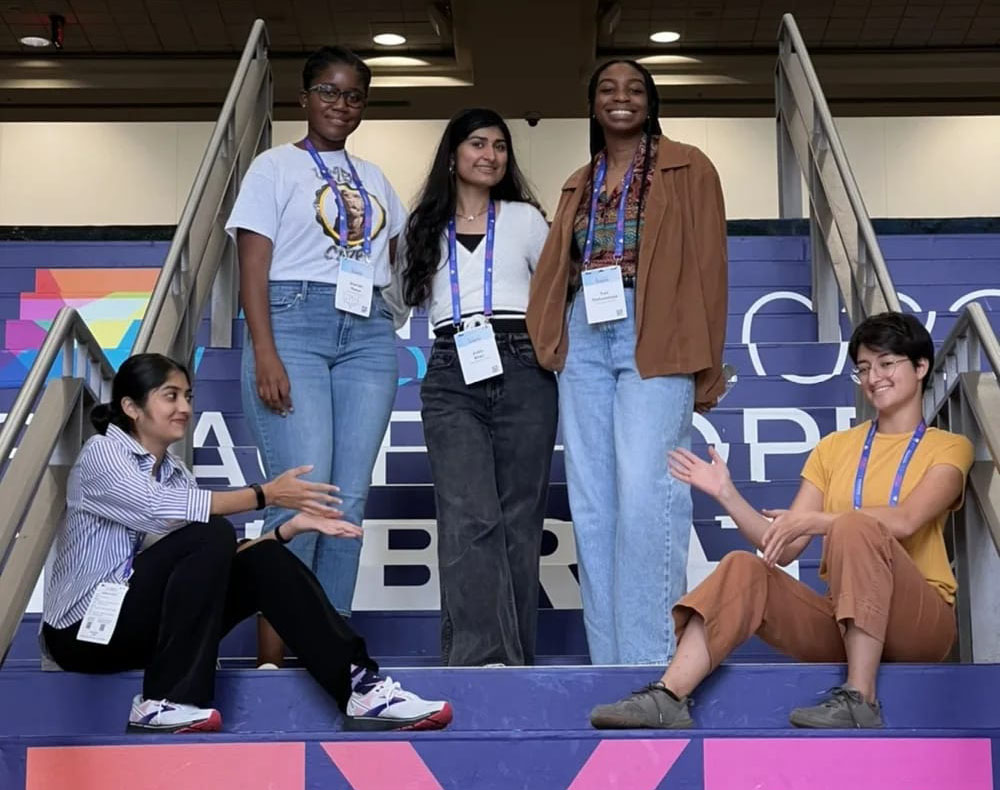
Reece and other CWIT scholars and students at the Grace Hopper Conference in Florida 2022. (Image courtesy of Shaniah Reece.)
Has there been a mentor or fellow student who influenced your time at UMBC?
“Dr. Maria Sanchez has been a mentor who has had a significant impact on my growth. Despite the numerous times I’ve experienced self-doubt, she consistently provided me with the support and encouragement I needed to realize my potential. As someone who shares a similar background, Dr. Sanchez has been a source of inspiration and motivation for me to overcome any challenges that come my way.”
What has been the best part of your UMBC experience?
“Without a doubt, the most rewarding aspect of my time at UMBC has been the sense of community I have experienced here. Since my freshman year I have been consistently surrounded by a diverse and supportive group of individuals who were committed to helping me achieve my goals. UMBC has been more than just an institution for higher learning to me. It has been a place where I have been able to thrive and show the world a version of me that I am proud of.”
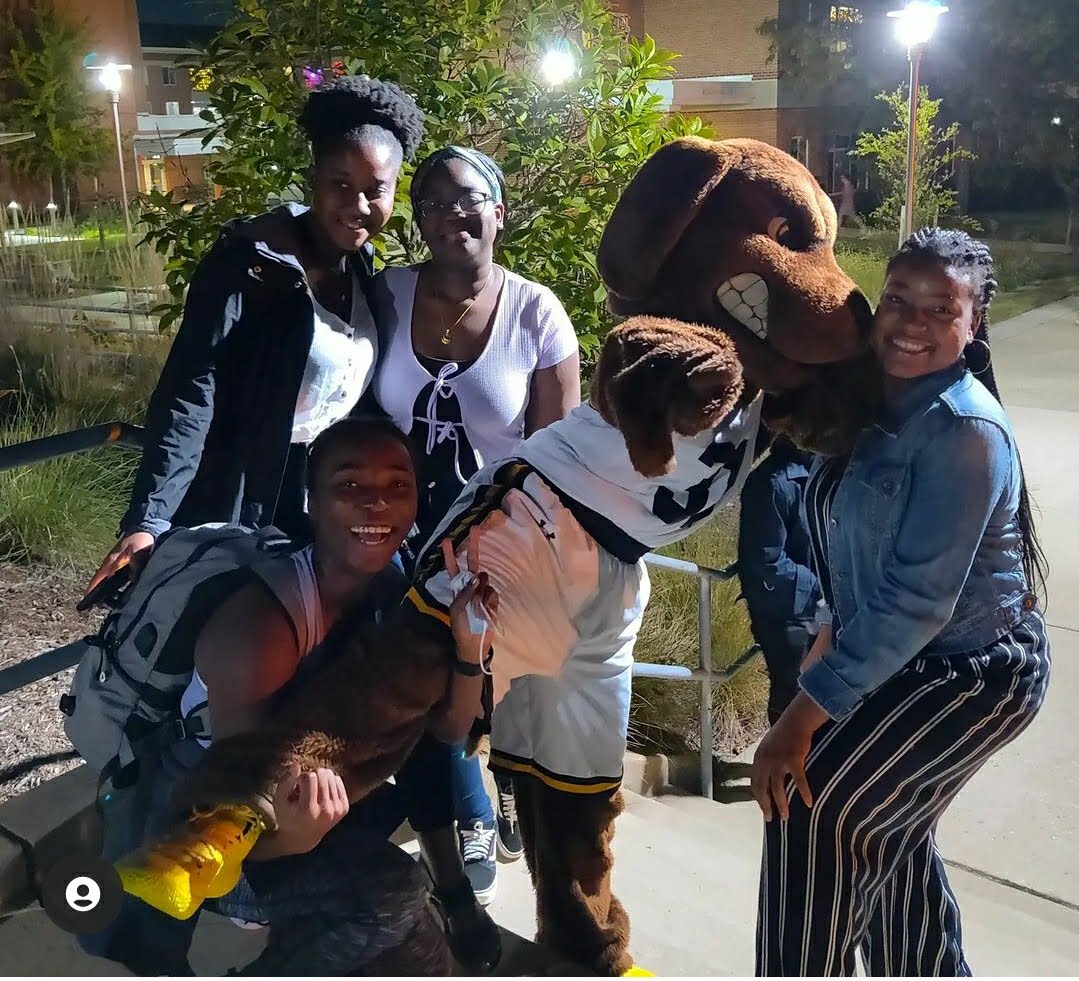
Reece and fellow students pose with mascot True Grit at the UMBC Bonfire in 2022. (Image courtesy of Shaniah Reece.)
On a Friday afternoon in late February, two students hoisted a pair of oversized scissors and cut the ribbon for the space housing one of UMBC’s newest tutoring programs: the Computing Success Center. The Center is designed to provide peer-to-peer support to students from any major, taking any course, who have computing questions.
“The Computing Success Center started as just a few tables in the library,” says Amanda Knapp, who leads UMBC’s broader Academic Success Center. Since the Computing Success Center tutoring program launched in 2020, it has seen skyrocketing demand.
“We are so happy for our students to now have a dedicated space for computing support, as a result of successful collaborations and valued partnerships from across the university,” says Knapp, associate vice provost and assistant dean for Undergraduate Academic Affairs. “We are thrilled to introduce new tutoring options to the growing portfolio of academic support offerings available to all undergraduate students.”
The growing demand for Computing Success Center services reflects in part increased demand for computing education. Over the past ten years, the number of UMBC students pursuing a computing-related bachelor’s degree in the College of Engineering and Information Technology (COEIT) has increased by more than 60%. During that same time, the number of computing degrees awarded to women and students from racial and ethnic groups traditionally underrepresented in computing fields increased at an even higher rate.
The Computing Success Center is one of many UMBC initiatives that is boosting the success of diverse students in high-demand computing fields.
“At both the undergraduate and graduate level, applications for our programs from a broad diversity of students are incredibly strong,” says Keith Bowman, the dean of COEIT. “New students have shared that more senior students’ positive views of our programs inspired them to pursue computing degrees, which we find very gratifying.”
Careful course design
When Annamaria Palmiero came to UMBC as a freshman in 2021, she had never programmed before. Still, she was curious about the subject, and a good friend encouraged her to try it out. So, she enrolled in a class—called Computational Design and Thinking, or COMP101—designed with students like her in mind.
The course, which debuted in 2012 and has become increasingly popular, assumes no prior experience with computing. It provides students with a broad overview of the field, builds their technical and professional skills, and gives them opportunities to work on group projects. Since 2019, it has also focused on ethical considerations in computing, a component of the course that was designed and implemented under the leadership of UMBC’s Engineering and Computing Education Program.
“Many students say the course helps them feel less intimidated by coding. It also helps them decide which computing program is best for them,” says Mark Berczynski, a lecturer who has been teaching the course since 2019. UMBC offers a broad range of computing pathways, such as majors and minors in computer science and information systems and majors in business technology administration and computer engineering.
The course has been shown to increase the likelihood that students, especially women, will stay in a computing major. For Palmiero, the experience in the course convinced her to pursue a computer science degree in addition to her already planned statistics degree. She has also become a teaching fellow for the course.
“COMP101 provided a safe space for me to launch into programming, without the overwhelmingly fast-paced nature of other introductory computing courses. I’m unsure if I would have ever become a computer science major, let alone tried programming, if it wasn’t for the course,” Palmiero says.
Other students who have taken COMP101 agree. Drew Barlow took the course in 2019 because he hadn’t taken the precalculus math classes required for a typical first computer science course. He is now pursuing a Ph.D. in computer science at UMBC. “I can definitely attribute my love for this subject in many ways to my experience in COMP101,” he said.
The ethos behind the design of COMP101—to break down barriers to success in computing for students from a variety of backgrounds—also pervades other curriculum decisions in COEIT, from adding courses to help transfer students with backgrounds in different coding languages, to forging pathways for students who wish to transfer between computing degree programs.
Easy access to support
Carefully designed computing courses start students on the road to success, while services such as the Computing Success Center help students deepen their knowledge as they progress in their studies. The center offers drop-in tutoring, including both course-specific resources and general guidance in programming languages. All of the course-specific tutors are supporting students in classes they have taken themselves.
The Computing Success Center responds to expanding demand for this kind of support. In fall 2022, the Center logged nearly 1,500 student visits, a more than ten-fold increase from when it launched in fall 2020.
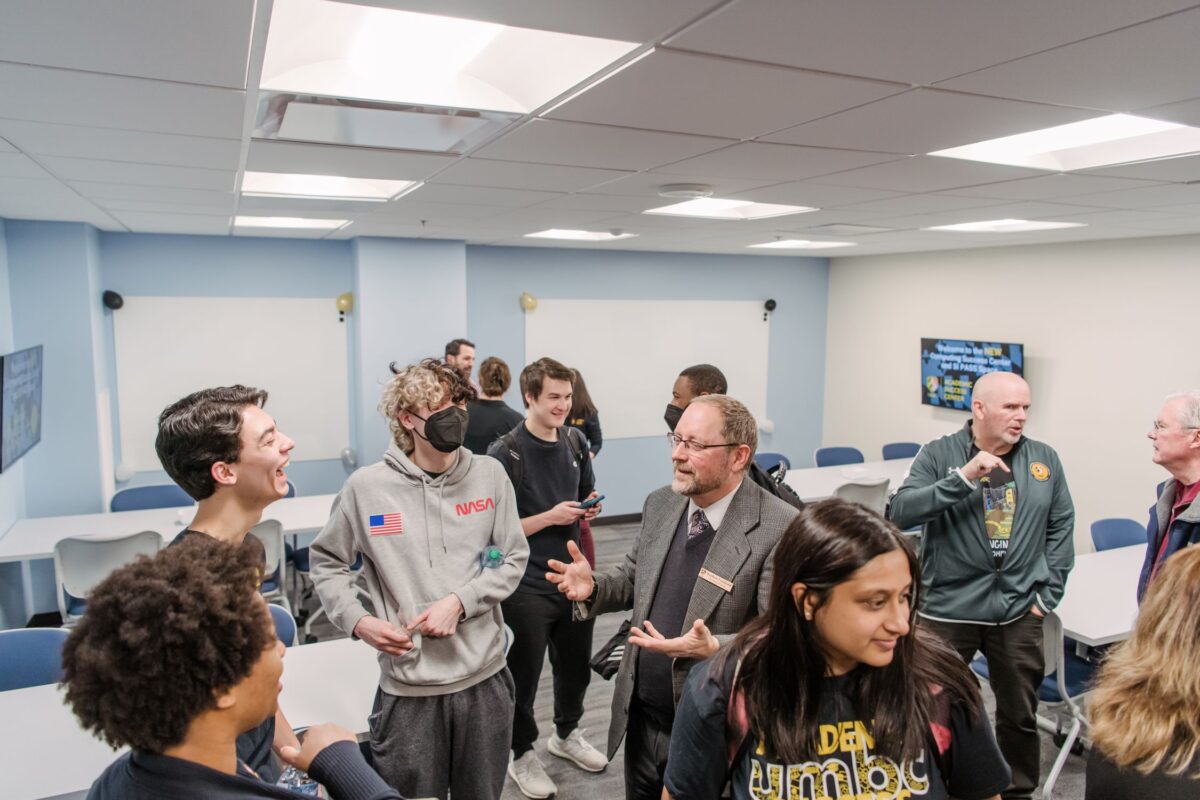
Students, faculty and staff gather to celebrate the opening of the new tutoring space on campus. (Marlayna Demond ’11/UMBC)
Ariana Pray, a sophomore computer science major, says the tutoring at the Center goes beyond helping her complete assignments, offering conceptual guidance that has made her a more efficient coder. She appreciates the wide range of tutoring times available and the opportunity to learn from her peers in person.
“I definitely recommend going to the Computing Success Center,” she says. “You’ll come away with a better understanding of the material and will be better prepared when it comes time for exams.”
Students can also access mentoring in study skills and time management, personalized assistance from academic advocates, and other support through the broader Academic Success Center. Meanwhile, departments that offer computing degrees have worked to foster a culture where students make it a habit to access additional learning resources early and often.
Opportunities to connect and explore
While supporting academic success is a priority for computing programs, that goes far beyond coursework. UMBC faculty and staff mentor students as they seek to discover their passions and find pathways to meaningful careers.
Shaniah Reece is a senior information systems major and Center for Women in Technology Scholar who credits the culture of UMBC for helping her discover how to connect a technical career to her values and passions.
“I care about social justice and equity,” she says. “I’ve realized I can apply technical tools to study and address these issues.”
Reece says her classwork and her mentors helped her think outside the box and identify career options that were truly meaningful to her. She shares, “My whole experience at UMBC, not just in research but throughout my time here, helped me discover who I am.”
Deepa Madan, an assistant professor of mechanical engineering at UMBC, has received a prestigious National Science Foundation (NSF) CAREER award for research on materials that could improve wearable medical devices, reduce energy waste, and power sensors to monitor everything from the safety of infrastructure to the paths pollutants travel.
The roughly $500,000 grant, given over five years, will further Madan’s research on materials called thermoelectrics, which can turn a temperature difference into electricity, or vice versa.
“It’s a fantastic feeling to be recognized with this award, but I know that it is just the beginning,” says Madan. “The coming years will be an opportunity not only to meet the research goals, but also to contribute to public outreach and to give diverse students opportunities to connect to the research.”
“CAREER awards are one of the most significant awards at NSF for researchers,” says Erin Lavik, professor of chemical, biochemical, and environmental engineering. As associate dean for research and faculty development in the College of Engineering and Information Technology (COEIT), she helped COEIT researchers hone their NSF CAREER award applications to access more support and visibility for their high-impact work.
“Dr. Madan is absolutely brilliant, and I was so excited to hear that she got this award,” Lavik says. “It will allow her to build out her research and educational program in a way that aligns beautifully with where the next generation of materials needs to move to address environmental and sustainability concerns.”
Heat into electricity
Heat is all around us. It radiates from sweaty skin, pours out of hot car engines, and seeps out of sunbaked sidewalks at night. Thermoelectric materials tap into this ubiquitous form of energy, turning temperature differences into electrical current. (The materials can also run in reverse, using electricity to heat or cool.)
Thermoelectric materials can already be found in niche applications—such as chilling wine and powering spacecraft—but their more widespread adoption has been held back by their limited efficiency and rigid nature.
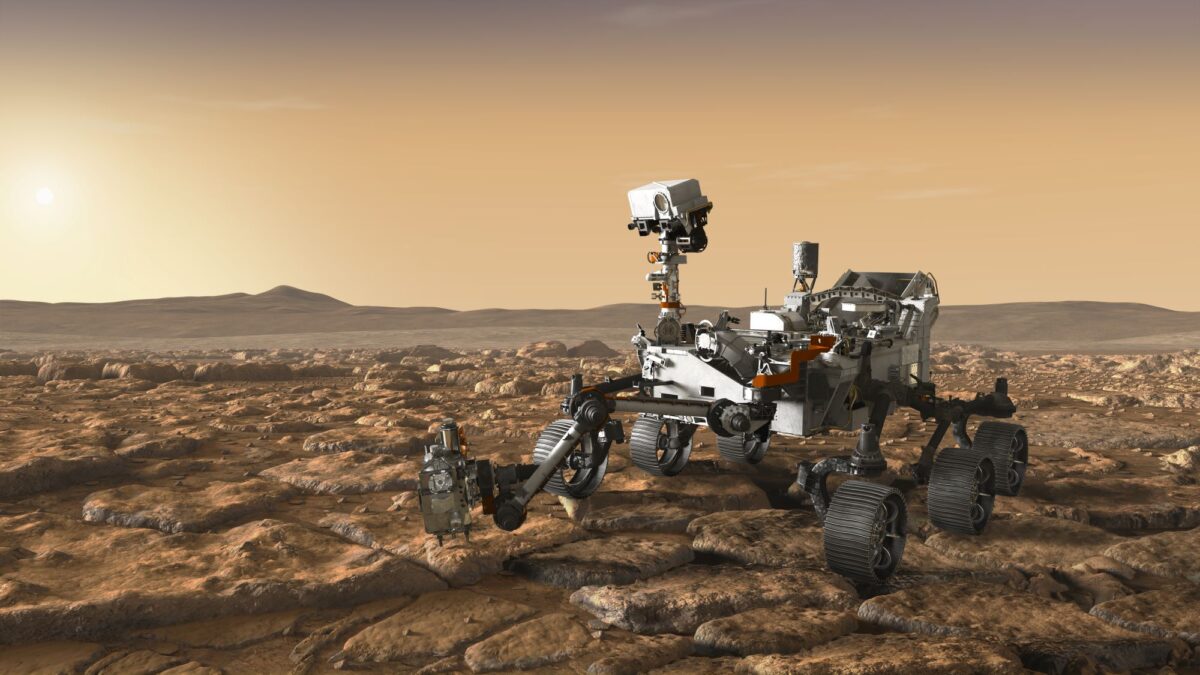
The Perseverance Rover, sent by NASA to Mars in 2020, uses a thermoelectric system to convert heat from a radioactive material into electricity. (Image credit: NASA/JPL-Caltech)
Madan’s research tackles both these challenges. She mixes grains of thermoelectric material with a pliable glue-like substance called a binder. The resulting composite material can be twisted and bent, making it more versatile. It’s also more affordable.
Adding the binder normally makes a thermoelectric material less efficient. In addition, when making a composite, researchers have historically baked the material at extremely high temperatures to harden the binder, which takes a lot of energy.
Madan is striving to keep her process efficient, low-energy, and environmentally friendly. At the same time, she is answering fundamental questions about the relationship between structure, process, and properties of her materials. That knowledge will help illuminate the best path toward further improving the materials’ properties.
Furthering fundamental science
Generally, when materials conduct electricity well, they also conduct heat well (think of the feel of a metal bench in winter). However, thermoelectrics require the opposite—they work best when they conduct electricity well, but conduct heat poorly. That way they can maintain the temperature difference that drives the electrons.
Madan’s research group aims to make materials optimized with high electrical conductivity and low thermal conductivity by studying the underlying science.
To start, they mix a small amount of a binder made from the shells of crustaceans with grains of a thermoelectric material called bismuth antimony telluride. Some of the thermoelectric grains are about the size of pollen grains, while others are thousands of times smaller. They form the mixture into the desired shape using a 3D printer, and then squeeze it together while applying gentle heat.
The researchers then study how each step affects the microscopic structure of the material and, consequently, its properties.
So far, they have found that the relatively large grains squeezed together provide a path for electrons to travel through the material, boosting its electrical conductivity. Meanwhile the super tiny grains and small defects where the grains meet the binder disrupt the waves of molecular vibrations that transport heat, keeping the thermal conductivity low.
Powering outreach
Ultimately, Madan hopes her thermoelectrics will power environmentally friendly devices of the future, but also drive students to become interested in the world of materials science. As part of her project, she will create a new class on flexible electronics and recruit high school and community college student researchers to work in her lab, in addition to her current UMBC students. She will also create an outreach kit for middle and high school students to make their own thermoelectrically-powered devices.
Deepa Madan talks with a student in her lab. The student is working on a related project on flexible batteries. (Marlayna Demond ’11/UMBC)
“I’m very passionate about education and outreach and UMBC gives us immense opportunities to connect with diverse populations,” says Madan. “I’m hoping with this award I can involve more students, especially women, who will get passionate about changing the world through STEM.”
Over the past week, UMBC faculty and students have given primetime TV news watchers in Baltimore a glimpse of the frontiers of artificial intelligence (AI) research. WJZ, Baltimore’s CBS News affiliate, aired the AI series in six segments, four of which featured UMBC researchers.
Harnessing data to predict sea level rise
The Wednesday evening spot featured Vandana Janeja, chair of information systems (IS). She described how she and other researchers aim to harness artificial intelligence and new data analysis techniques to better predict how climate-driven changes at Earth’s poles, such as melting glaciers, could impact the rest of the world. Janeja directs iHARP, an NSF-funded institute based at UMBC that brings together data scientists and polar experts from across academia, industry, and the government to tackle a defining challenge of our times.
Connecting robots and AI
The Thursday evening segment featured UMBC faculty and students showcasing their work connecting AI and robots for applications such as disaster response and battlefield readiness. IS professors Aryya Gangopadhyay and Nirmalya Roy and computer science and electrical engineering (CSEE) associate professor Tinoosh Mohsenin from the Center for Real-time Distributed Sensing and Autonomy joined computer science students Kevin Rippy ’24, Warren Funk ’24, Hong Nguyen ’25, and Ben Polyakov ’23, computer engineering Ph.D. students Arnab Mazumder and Mozhgan Navardi, and information systems Ph.D. students Indrajeet Ghosh and Neil Kpamegan to explain the technology.
They demonstrated devices such as miniature drones and a robot that could be controlled from afar with hand motions. The researchers are working to develop the brains of such systems so that they can intelligently work with other robots and with human beings.
Explaining ChatGPT
On Friday, Anupam Joshi, professor of CSEE and director of the UMBC Center for Cybersecurity helped viewers grasp an AI invention now making headlines: ChatGPT. The sophisticated chatbot can write text ranging from computer code to essays on the American Revolution, but Joshi explained how it does make errors and should be used carefully.
Identifying harmful biases in AI
Finally, echoing the theme of responsible and cautious AI use, James Foulds, an assistant professor of IS, and Shaniah Reece, a senior majoring in IS, described to TV viewers how biases from the human world can find their way into AI systems, with harmful effects. They are working to identify such biases where they appear, improving the fairness of AI systems.
Christopher Slaughter ’23, M31 computer engineering, has won a Gates Cambridge Scholarship to pursue graduate work at the University of Cambridge in the United Kingdom next fall. Slaughter is the fifth student from UMBC to be recognized with the prestigious award, established by the University of Cambridge in 2000 with a donation from the Bill and Melinda Gates Foundation.
Gates Cambridge Scholars are selected from around the world for their academic talents and commitment to improving the lives of others. Each year around 25 of the 80 total awards are offered to students from the United States.
Slaughter will pursue a Ph.D. in electrical engineering at the University of Cambridge, which is the world’s third oldest surviving university, founded in 1209. His career goals are to develop novel biomedical technologies that meet the healthcare needs of under-resourced communities.
“We are so proud of Chris,” says UMBC President Valerie Sheares Ashby. “He exemplifies UMBC’s values and the Gates Cambridge vision of preparing leaders who demonstrate not only academic excellence, but also a deep commitment to improving the lives of others. Congratulations to Chris, and my thanks and appreciation to those among the UMBC community who have served as influential teachers, mentors, and supporters for Chris throughout his educational journey.”
Research as a way to change the world
Slaughter grew up in a “STEM family,” but he didn’t initially envision a future in research. His perspective changed, however, after he traveled to Germany and Ghana to visit family during his high school years.
While traveling, Slaughter noticed how different communities had inequitable access to healthcare, and he started to think about the disparities that also existed back home in the United States. New biomedical technologies, he realized, might help underserved communities get better care.
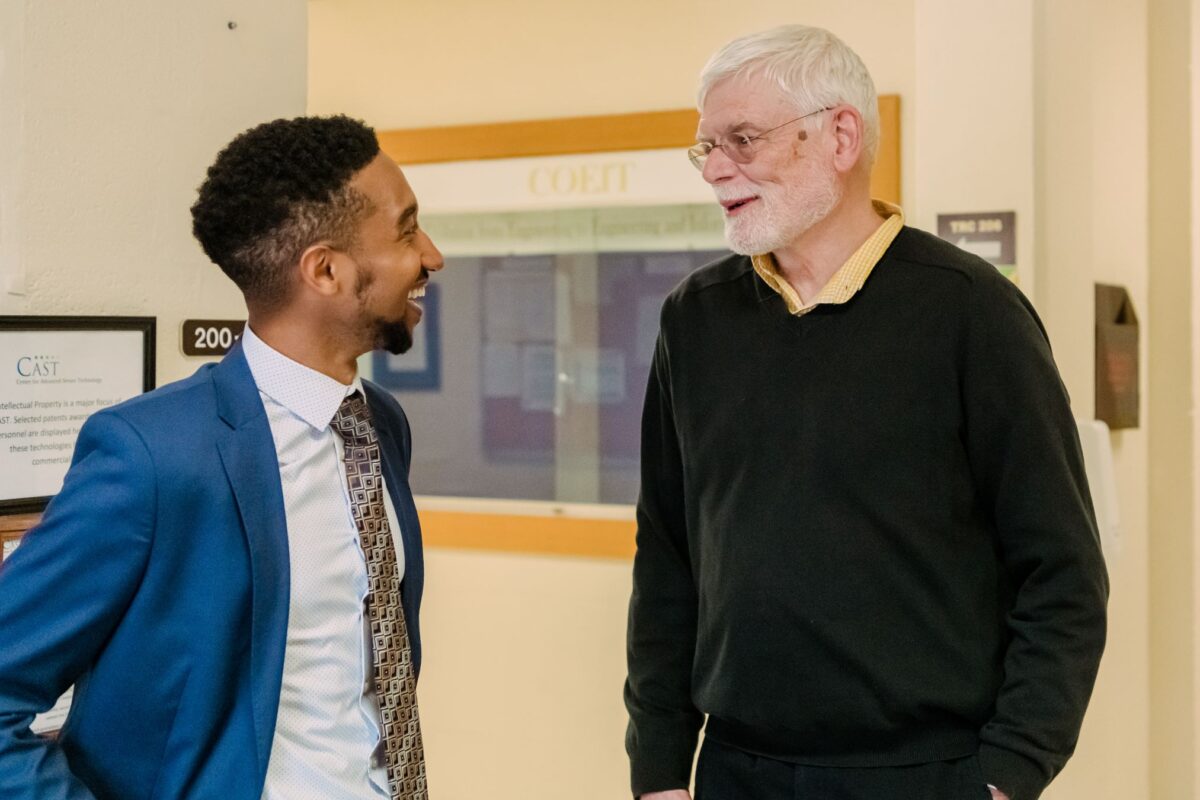
Guided by a passion for improving people’s lives, Slaughter began his first of many biomedical research projects. At UMBC’s Bioelectronics Laboratory, he worked on technology to help patients who are insensitive to pain avoid burns. Most recently, he has been working at UMBC’s Center for Advanced Sensor Technology (CAST) in the lab of Govind Rao, professor of chemical and biochemical engineering.
Slaughter is helping develop technology that can sense glucose levels through the skin. This could lead to a device that continuously monitors glucose for people with diseases such as diabetes without painful finger pricks or repeated blood draws. He has presented the work at leading scientific conferences, including the IEEE/EMB Healthcare Innovations Point of Care Technologies conference as the sole undergraduate oral presenter.
The glucose monitor that Chris Slaughter is helping develop. (Marlayna Demond ’11/UMBC)
“What strikes you immediately about Chris is his sheer enthusiasm, curiosity, and positivity,” Rao says. “He is always eager to be in the lab.”
“Chris’ intense energy and his genuine interest in the topic made him the best mentee you can ask for,” says Hasib Hasan, an electrical engineering Ph.D. student in the department of computer science and electrical engineering who is mentoring Slaughter on the glucose monitor project. “I have no doubt about his ability to become a successful researcher. The Gates Cambridge Scholarship will support him as he pursues work that will improve lives.”
The value of mentorship
Throughout his time at UMBC, Slaughter found mentors to help him grow and learn. He was part of the Meyerhoff Scholars Program, a nationally recognized effort to foster diversity in science, technology, engineering, and mathematics by supporting students who intend to pursue advanced degrees in these fields. He has also been inspired and supported by scholars throughout the UMBC community, such as Rao; Freeman Hrabowski, president emeritus; and Charles LaBerge, professor of the practice in computer science and electrical engineering.
“Mentorship has been so important for me,” Slaughter says. “I knew that in order to succeed, I needed to be in a community that could push me to be my best, hold me accountable, and support me at the same time. To accomplish what I wanted to accomplish—getting a Ph.D. in a scientific field—there was no place better for me to start than UMBC.”
Chris Slaughter (right) is working in the lab of Govind Rao (left). (Marlayna Demond ’11/UMBC)Hasib Hasan (left) and Chris Slaughter (right) in the lab where they are working on a glucose monitoring device. (Marlayna Demond ’11/UMBC)
Slaughter’s application for the Gates Cambridge Scholarship was supported by UMBC’s Office of Prestigious Scholarships, which was established six years ago with the ambition to focus on three major international scholarships as well as others in the U.S., says April Householder, director of undergraduate research and prestigious scholarships at UMBC.
“With Chris’s win, I am happy to say that we have now achieved the trifecta—UMBC alumni simultaneously supported by all three major U.K. scholarships,” she says. The alumni are Rhodes Scholars Naomi Mburu and Sam Patterson at the University of Oxford, Marshall Scholar Joshua Slaughter at the University of Edinburgh, and now Gates Scholar Christopher Slaughter, heading tothe University of Cambridge.
Paying it forward
Having benefited from a culture of mentoring and support at UMBC, Slaughter embraces opportunities to become a mentor and leader himself.
“I think the way we honor the people who invest so much in us is by turning around and doing the same thing for somebody else,” Slaughter says. “Regardless of what I do, I want to make sure I am giving back.”
Chris Slaughter (left) talks with mentor Charles LaBerge (right). (Marlayna Demond ’11/UMBC)April Householder (right) helped guide Slaughter (left) through the Gates Cambridge process. (Marlayna Demond ’11/UMBC)
Reflecting on his time as a Retriever, Slaughter says he wants to spread the culture of support he encountered at UMBC wherever he goes next. “I think that the great thing about UMBC is we all work together,” he reflects. “I hope throughout my career to make more communities like that because ultimately, I think that’s how we solve the problems that we face today.”
Householder echoes that sentiment. “Chris’s experiences in the Meyerhoff Scholars Program, a national model for STEM student success, have prepared him to be a leader and to lift up others. UMBC has provided a culture of support and mentoring similar to what he will experience as part of a Gates cohort,” she says. “I can’t wait to see how being a Gates Cambridge Scholar will not only help him grow, but how he will transform Cambridge as an institution.”
The U.S. News rankings, released today, evaluate programs based on qualities such as strong faculty credentials, a good reputation among peer institutions, and the opportunity for students to use diverse online learning tools and engage with their instructors and classmates.
Michael Brown, graduate program director for UMBC’s online information system master’s program, says its wide range of electives, as well as free textbooks and course material, distinguish it from similar programs at other institutions.
The program offers a foundations course for people who do not have degrees or experience in technology fields, as well as four career-specific tracks that allow students to specialize in high-demand areas such as artificial intelligence and cybersecurity. The large number of available electives allows students to further customize their learning, Brown says.
Career opportunities
Graduates of UMBC’s online master’s program in information systems regularly land jobs as cybersecurity specialists, data analysts, systems administrators, and more.
Simbiat Odeshina, a master’s degree student in information systems, is currently enrolled in the program while also working as an associate software tester at Wabtec. “I really enjoy the flexibility with the program. Since I work full-time, I really like being able to attend class after work,” she says. Since beginning the program, she shares, “I am thinking about ways to improve how I approach certain things at my job.”
This ranking follows UMBC’s recognition as #9 in the nation for undergraduate teaching and #10 in the nation for innovation in the 2022–23 U.S. News and World Report Best Colleges undergraduate rankings released last September.
On a recent Tuesday in December, UMBC’s Carlos Romero-Talamás escorted a TV crew from Baltimore into one of his labs. The reporters were there to talk about a just announced fusion power milestone achieved at Lawrence Livermore National Laboratory in California, but they quickly became interested in Romero-Talamás’s own experiments too. He is questing after the same fusion milestone using equipment that’s much simpler and cheaper.
Bringing the energy of the stars to Earth
Fusion is the atomic engine that powers stars. Inside the cores of these celestial infernos, fast-moving hydrogen atoms, stripped of their electrons, ricochet around. Occasionally they collide in such ways that they transform into helium atoms. When that happens, a lot of energy is released.
The enormous power of the sun comes from fusion reactions that turn hydrogen into helium. (NASA/SDO)
For decades, humanity has dreamed of harnessing fusion power on Earth to make safe, clean, and near limitless energy. But thorny physics and engineering challenges made the goal elusive, with scientists coming to joke that “fusion power is 30 years away—and always will be.”
Yet now, a growing excitement is displacing some of the skepticism. Governments are directing more money toward fusion research and private investors such as Bill Gates and Jeff Bezos are collectively pitching in billions of dollars. Some companies are promising commercial fusion power in 10 years.
Romero-Talamás’s own work has benefited from the renewed attention. In 2020, he was awarded a $4 million grant from the U.S. Department of Energy to explore a promising alternative to traditional fusion power approaches. Rather than blast hydrogen atoms with lasers (the approach used at Lawrence Livermore) or squeeze them into a donut-shaped ring using enormous magnets (the approach epitomized by the multi-billion-dollar, nearly 100-foot-tall ITER fusion reactor under construction in France), Romero-Talamás and his team plan to confine their hydrogen atoms in a supersonic whirlwind shaped by a novel arrangement of magnets and an electrically conducting central rod.
If the concept works, it could lead to a commercial fusion reactor relatively quickly, Romero-Talamás says, because it uses equipment that is smaller, cheaper, and simpler to operate than the equipment required by other approaches.
A simpler fusion reactor
Romero-Talamás’ team, which includes collaborators from the University of Maryland, College Park, has already built a test machine in a lab on the College Park campus. While the machine does not have the capacity to operate as an energy-generating reactor, initial experiments on it show the hydrogen atoms are being trapped in the whirlwind as hoped. If experiments continue to go well, the team will soon begin work on a bigger, next-generation machine. That machine could be fitted to produce more power than it takes to run, a key milestone on the road to commercial fusion power.
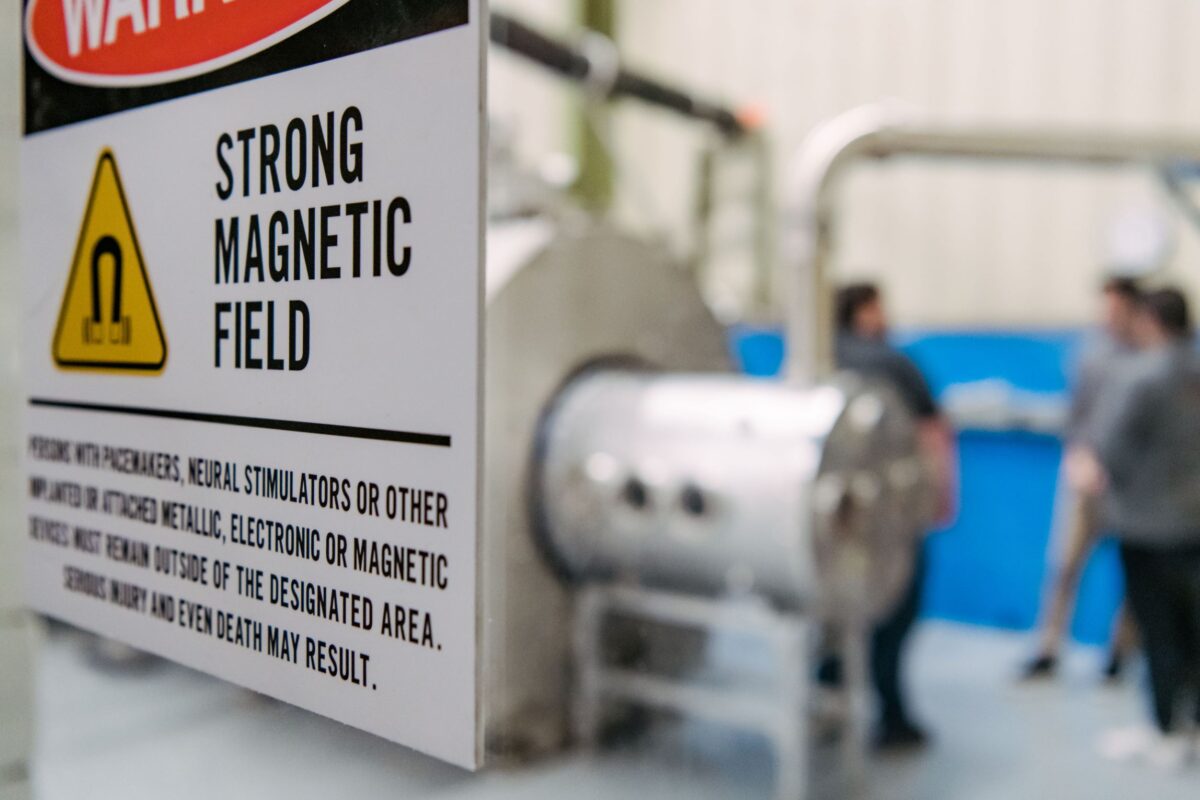
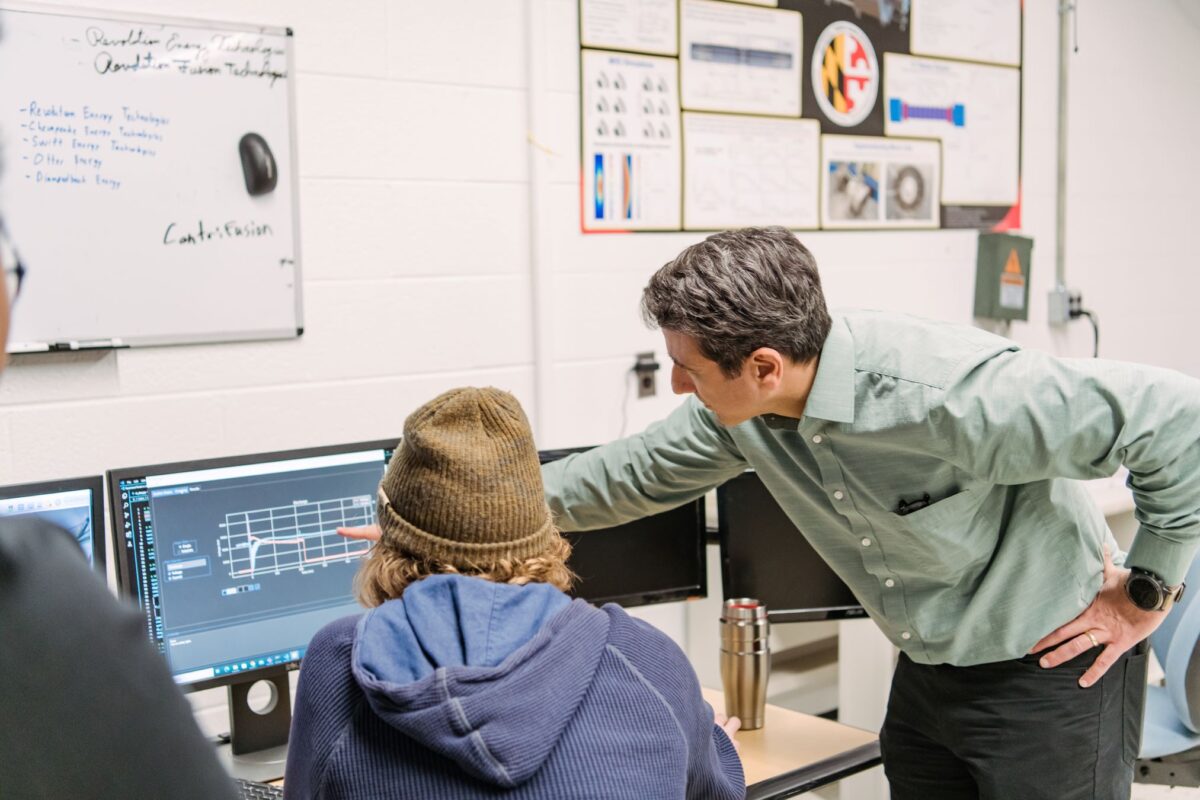
Strong magnets help control the hydrogen atoms inside the test machine. (Marlayna Demond ’11/UMBC)Carlos Romero-Talamás and UMBC graduate student Nathan Eschbach look at diagnostic data. (Marlayna Demond ’11/UMBC)
We sat down to chat with Romero-Talamás about the wonder of fusion and the excitement of scientists who feel they may be on the cusp of world-changing innovations. The following interview has been edited for brevity.
Conversation with Carlos Romero-Talamás
UMBC News: It feels like fusion is having a moment. Do you agree?
Romero-Talamás: The announcement from Lawrence Livermore gained a lot of attention, but fusion has actually been having a moment, so to speak, for the last few years. And the reason these years have been different is because the private sector got interested. The amount of money they bring is changing the equation. I’ve told people our concept will take tens of millions of dollars for the next machine—which is not a reactor, but a reactor-sized experiment—and they don’t even flinch. They are people who are used to handling that kind of money.
UMBC News: What are some of the challenges that remain?
Romero-Talamás: There are still big questions. Some are about the physics—how the particles behave. Some are engineering—how are you actually going to build something that can operate day in and day out. We also need people, not just graduate students, but also technicians who know the technology.
Some of these fusion companies and concepts are probably going to fail. And hopefully, that won’t spook the investors, because the success of one will be beneficial to everyone.
UMBC News: How did you get interested in fusion?
Romero-Talamás: When I was an undergraduate, there was a fusion experiment where for a brief amount of time they produced about 60% of the energy they put in. I had never heard of fusion until then—that’s when I learned about it. I thought, “Okay, by the time I’m a scientist, they are going to have fusion reactors.” Of course, that didn’t happen.
But in graduate school, I learned about fusion energy more from the fundamental physics side, and I thought it was fascinating. I actually got funding as a student to go to Lawrence Livermore, and I did a lot of my research there.
UMBC News: What excites you about this research?
Romero-Talamás: We all need energy, and many metrics even measure a country’s economic strength by the amount of energy it produces and consumes. Fusion is considered the “holy grail” of energy. It could provide virtually unlimited energy for millions of years. It is clean and carbon free. I think finally it is getting the attention it deserves.
And, of course, the students are the heart of the work. They believe they can change the world.
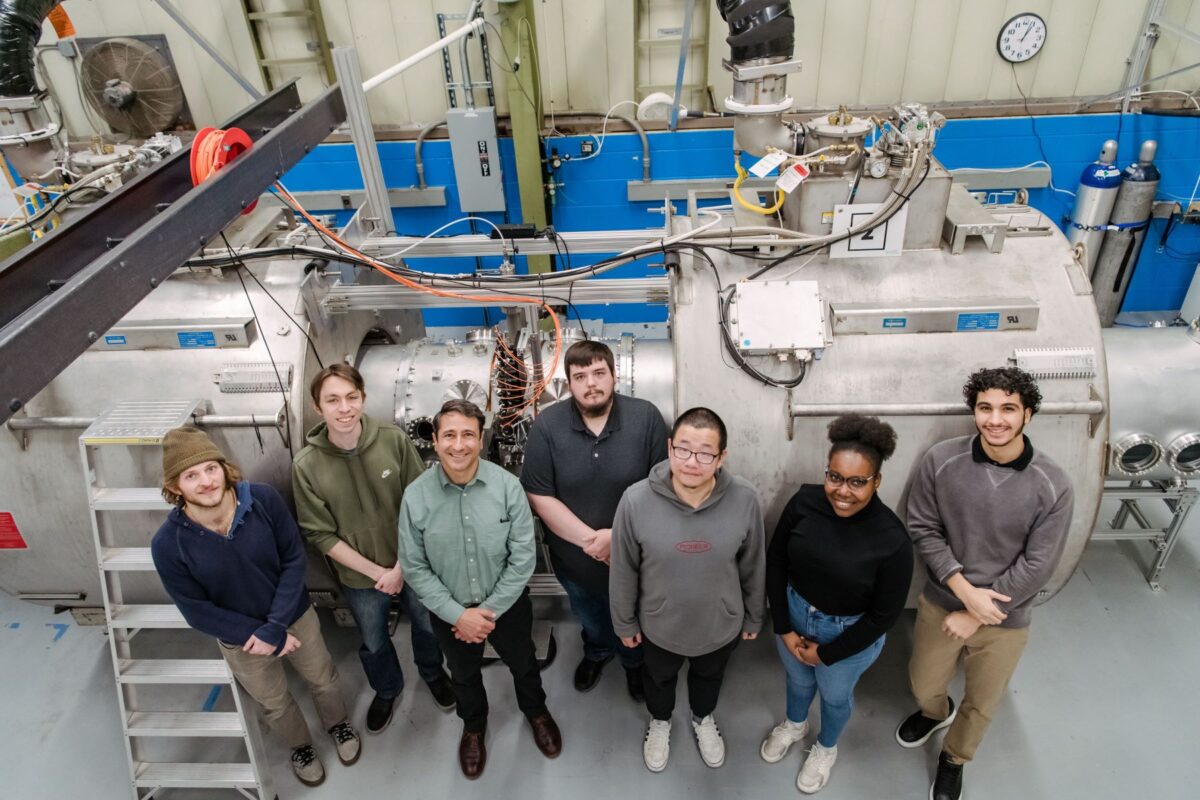
Carlos Romero-Talamás in front of the test machine with students and colleagues from UMBC and UMD who are working on the project. From left to right: Nathan Eschbach, Ryan Schneider, Carlos Romero-Talamás, Zachary Short, Quan Gan, Autumn Bartholomew, and Mohamed Nasser. (Marlayna Demond ’11/UMBC)
It’s official: The Baltimore Sun has again named UMBC one of the “Top Workplaces” in the Baltimore region, for the eighth time since 2013. UMBC is featured on the Sun’s list of top large employers—organizations with 400 employees or more—and is the only college or university honored this year.
The “Top Workplaces” designation reflects the results of an independent and confidential employee survey conducted in the summer. The Sun announced the news online on December 8 and highlighted all of the region’s top workplaces in a special section of the paper on December 11.
“What a great honor for us to be recognized by the Baltimore Sun!” says Lynne Adams, UMBC’s chief human resources officer.
“The faculty and staff at UMBC are the best of the best, and we will continue to ensure that we are doing everything possible to make this an appealing and exciting work environment,” she shares. “Each day as we focus on supporting our students’ success, we also recognize that we need to focus on our team members’ successes and well-being. I am excited to work alongside my fellow community members to make sure we do that.”
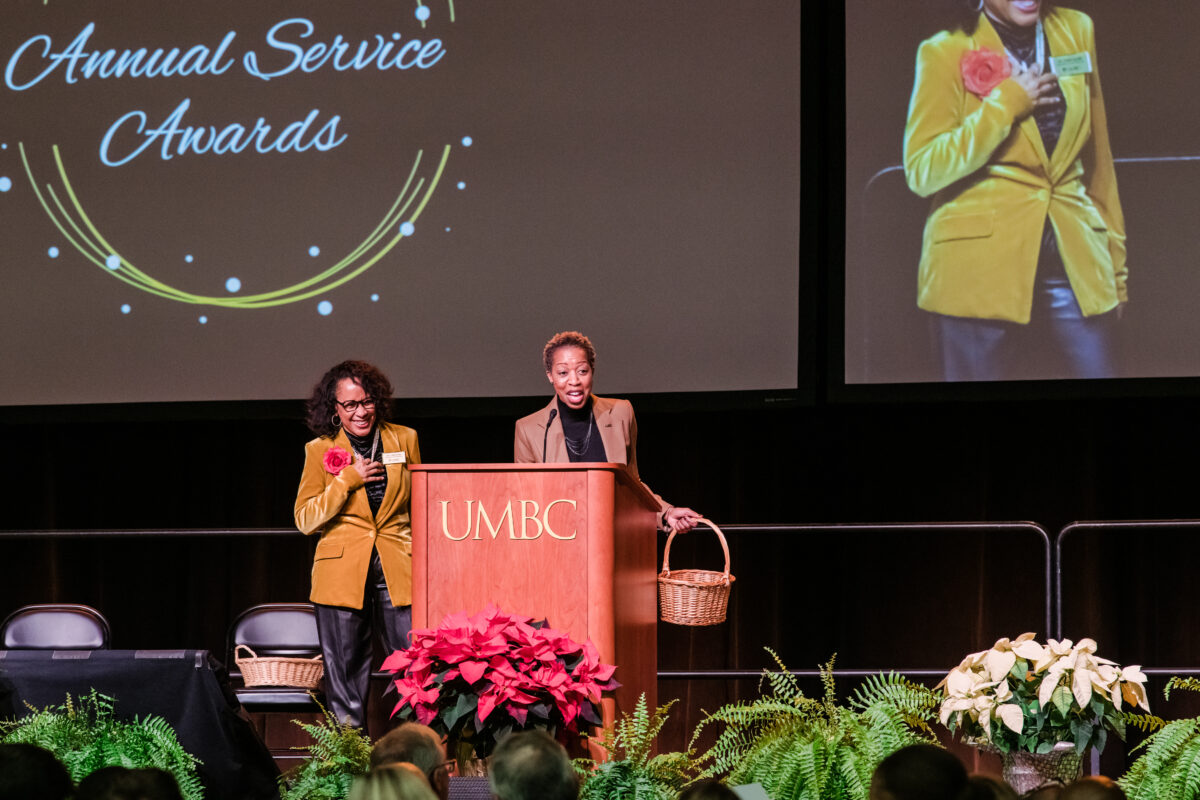
Chief Human Resources Officer Lynne Adams (left) and President Valerie Sheares Ashby (right) celebrate UMBC employees at the 2022 Staff Service Awards ceremony. (Marlayna Demond ’11/UMBC)
Shared values, meaningful work
The survey measures aspects of workplace culture such as shared values, effective management, and a sense of meaningful work. It also measures employees’ perspectives on compensation, including pay and benefits. The organizations and companies that earn top marks compared to similarly sized institutions earn the designation of “Top Workplaces.”
Earlier this year UMBC was also recognized as one of the Chronicle of Higher Education’s “Great Colleges to Work For.” It was UMBC’s 13th year on the list and the 11th year the university was also highlighted as an “honor roll” university—a distinction for institutions that score high marks in several categories. In fact, UMBC was the only R1 university in the nation recognized in every “Great Colleges to Work For” category this year.