We use cookies for analytics and, unless you opt out, advertising.
You can opt out of advertising at any time.UMBC uses essential cookies to run this site. With your permission we would also use analytics cookies (to understand how the site is used) and advertising cookies (to measure and target our ads on other platforms). Nothing else loads unless you accept. You can change your choice any time from Cookie Settings in the footer.Privacy Policy
EssentialRequired for the site to work (login, security, your cookie choice). Always on.
Richard Forno, assistant director of UMBC’s Center for Cybersecurity and a principal lecturer in the department of computer science and electrical engineering, has been appointed an honorary international professor in the School of Science and Engineering at the Universidad Autónoma del Estado de Hidalgo (UAEH), one of Mexico’s oldest universities.
Forno joins a select group of academics who have been named honorary international professors at UAEH. The recipients, some of whom have received some of the highest honors in their fields, are chosen for their overall academic and professional contributions.
The investiture ceremony coincided with the university’s two-week-long international book fair, held in late August and organized this year around the theme of cybersecurity. Over two days, Forno delivered five talks, met students and faculty, and spoke with university leaders about areas of possible collaboration between UMBC and UAEH.
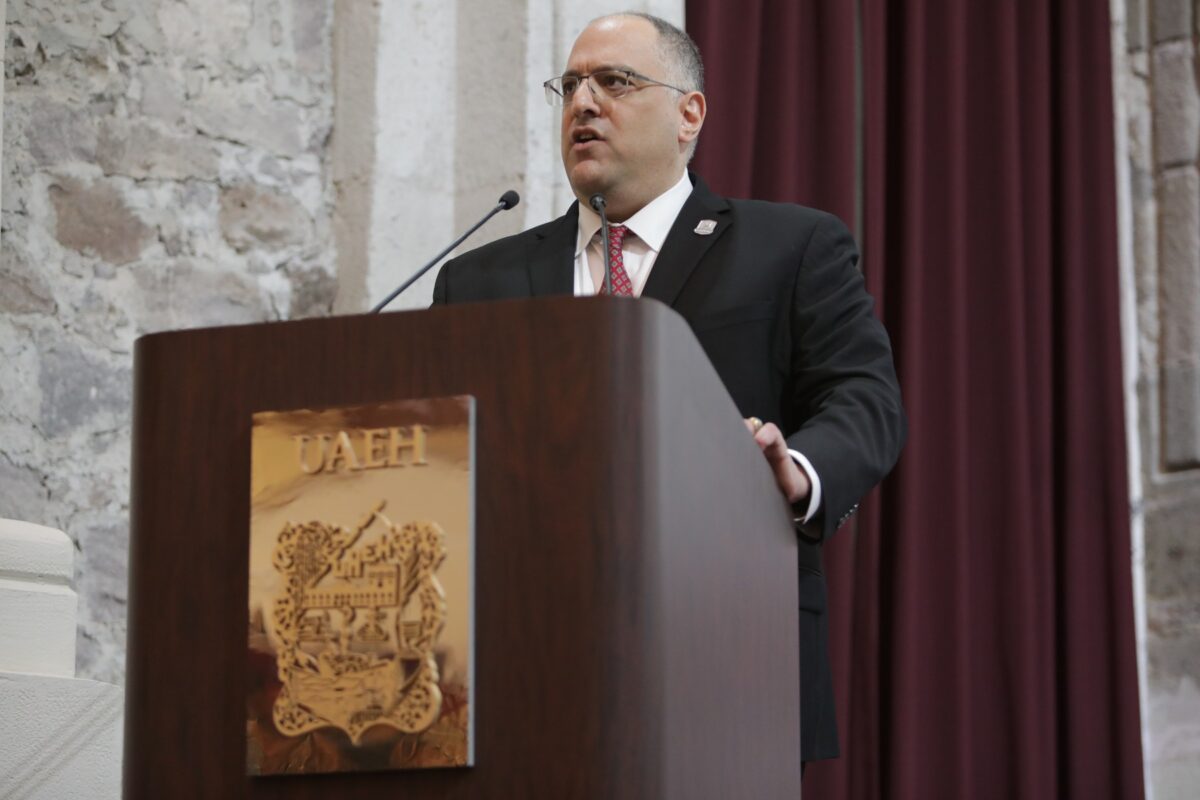
Richard Forno delivers a lecture on cybersecurity. (Photo courtesy of UAEH)
Countries around the world share the challenge of maintaining cybersecurity in an interconnected and ever-evolving digital landscape. In his main lecture, Forno emphasized the importance of education and interdisciplinary collaboration to combat cybersecurity threats.
Forno says the formal investiture ceremony, held in one of Hidalgo’s oldest structures, was a particularly meaningful event for him. “It was a humbling personal experience and certainly a professional honor that I will not soon forget,” he says.
Today, a plethora of technologies, from image recognition tools to chatbots, are powered by machine learning. A key component to the technique’s success is data—and lots of it. For doctors and hospitals who hope to use machine learning to improve healthcare, that need for copious data presents a problem: medical data is protected by privacy laws and often exists in incomplete or diverse forms—from doctor’s notes to medical scans—that make it difficult for machine learning models to use it effectively.
“Using data better to aid medical decisions is a grand challenge of the 21st century,” says Sanjay Purushotham, an assistant professor in information systems at UMBC. “We need innovations in existing techniques to take full advantage of artificial intelligence in healthcare.”
Together with his students, Purushotham is tackling that challenge. He recently received a prestigious NSF CAREER award to support his team’s efforts to develop new ways to train health-focused machine learning models.
Purushotham has been contributing his expertise in computer science to collaborations with doctors and hospitals for almost ten years. The NSF CAREER award will help Purushotham further that research in a new direction, and ultimately, his team hopes their work will improve medical treatments and reduce costs, benefiting patients around the world.
The need for data-driven healthcare
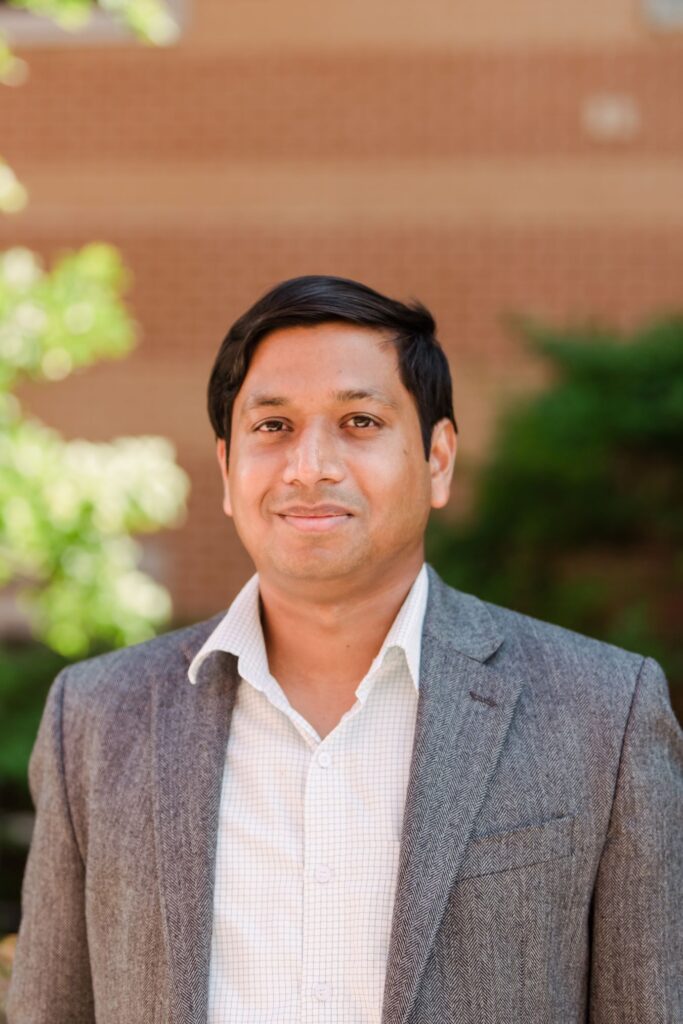
Sanjay Purushotham (Marlayna Demond ’11/UMBC)
When you visit the doctor, you may be asked about your general health, your family medical history, and your current symptoms. The doctor may order a series of tests and scans. All of this data could yield valuable insights into your health and the best course of medical treatment.
Bringing the data together in ways that make it accessible and illuminating is an ongoing challenge in health care. Synthesizing and presenting health information in new ways could improve individual medical care. Computer systems could ensure busy doctors see the most relevant information at the right time, aiding their decision making. It could also prove valuable for addressing public health challenges, such as the spread of infectious diseases.
“During the COVID pandemic, the health community realized the importance of having access to good data,” says Purushotham. Better data could help public officials make better decisions about when to take precautions, such as closing schools. It could also help individuals better understand the risks when choosing to partake in activities like attending large social gatherings or traveling.
Over the next five years, the award will support Purushotham and his students as they investigate ways to advance a technique called federated learning, which could allow hospitals and doctors to jointly build and evaluate a machine learning model without sharing sensitive medical data.
A new way to collaborate
Most machine learning models are trained centrally, on vast quantities of data that are often scrapped from the internet. However, a lot of data exists that cannot be sent to a central processing facility, for cost or privacy reasons. The term ‘federated learning’ was coined in 2016 to describe a decentralized machine learning technique that could train on data that never leaves users’ mobile phones. Instead, individual devices would take turns downloading the model, training it on their own data, and then sending the updated model parameters back to a central location.
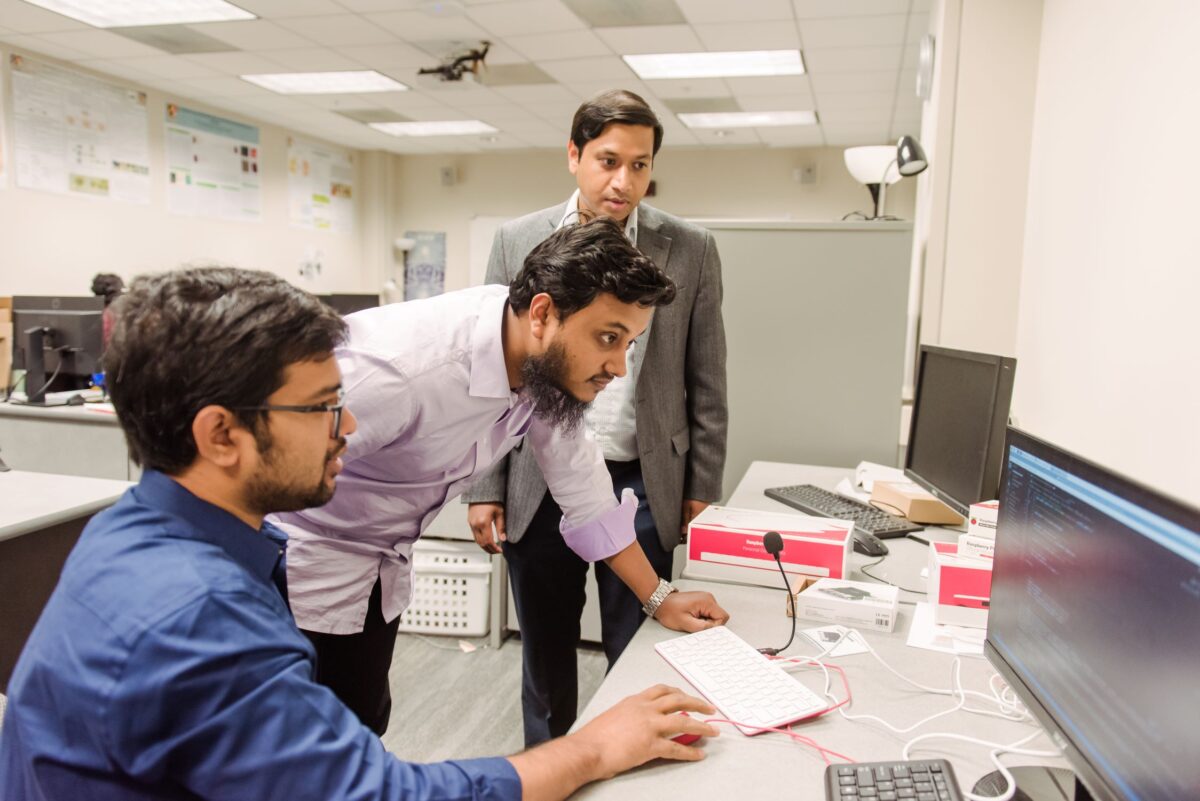
Students Sultan Ahmed (left) and Zahid Hassan Tushar (center) work in the lab with Sanjay Purushotham (right). (Marlayna Demond ’11/UMBC)
The general approach could be beneficial in many industries, from finance to manufacturing. In health care, federated learning has clear appeal because privacy laws strictly limit how health data can be shared.
For example, federated learning could allow hospitals to train a joint model on their medical data, such as CT scans, without sharing the scans with each other. The jointly trained model might reveal new ways to detect disease.
Yet, many hurdles remain to successfully deploying the technique, including the non-uniformity and limited nature of some patient data, the varying computational resources available to different medical practitioners, and the threat of bad actors seeking access to private information.
Advancing federated learning
In the coming years, Purushotham and his team will pursue three main avenues of research to address the obstacles of deploying federated learning in healthcare. The project will develop new algorithms, methodologies, and software to make data-driven federated learning for healthcare more robust and trustworthy.
The first focus of the team will be to develop new ways to handle the diversity of health data. The team will then study potential methods of attacks on the federated learning systems, and develop defenses against such attacks. The researchers will also investigate ways that the system can “un-learn” in situations where users request the influence of their data be removed from the model. In all cases, the researchers will focus on developing fair and interpretable algorithms. Finally, the researchers will study ways to generate synthetic health data, which can be used to augment or replace real data to improve the AI models.
The scope of the work is ambitious, but Purushotham is confident in his team.
“I have great students and collaborators,” he says. “I’m really excited to make federated learning in healthcare work.”
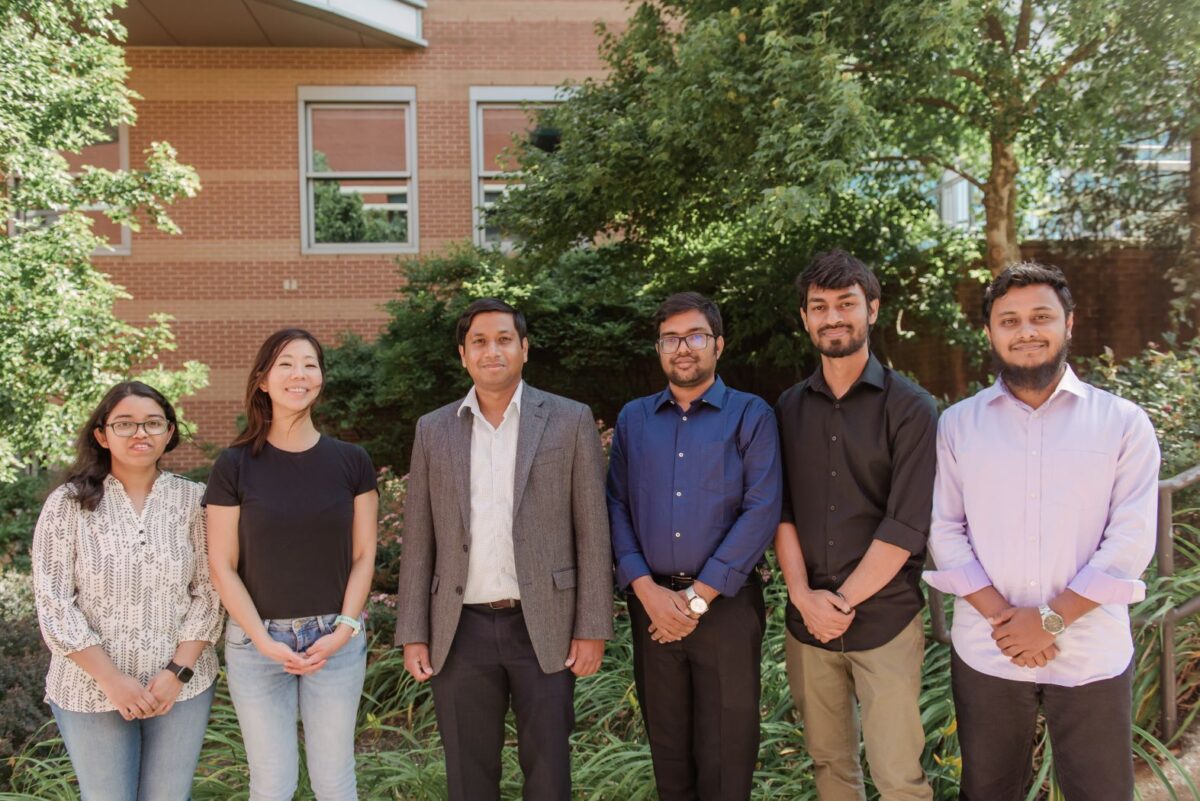
Sanjay Purushotham (third from left) with members of his research team (from left to right): Shaswati Shah, Catherine Ordun, Sultan Ahmed, Md Mahmudur Rahman, and Zahid Hassan Tushar. (Marlayna Demond ’11/UMBC)
When the Wright brothers first launched their famous plane off the tall sand dunes near Kitty Hawk, North Carolina, it flew slower than a person can run. Now, military fighter jets routinely rip through the air at supersonic speeds of 1,000 miles per hour or more. Uncrewed experimental aircraft have even gone hypersonic, traveling more than five times faster than the speed of sound.
Flying at such breakneck speeds presents an array of engineering challenges, from the stresses on the materials to the struggle to control the aircraft.
“When flying above the speed of sound, the operating environment can degrade extremely quickly and there is very little time to react,” says Ankit Goel, an assistant professor of mechanical engineering at UMBC. “If a correcting control signal is not applied quickly enough, catastrophic failure is almost always guaranteed.”
On left, the Wright Flyer on display at the Smithsonian Air and Space Museum in Washington, D.C. (Smithsonian Institution). On the right, an F-22 Raptor (U.S. Air Force photo by 2nd Lt. Samuel Eckholm.)
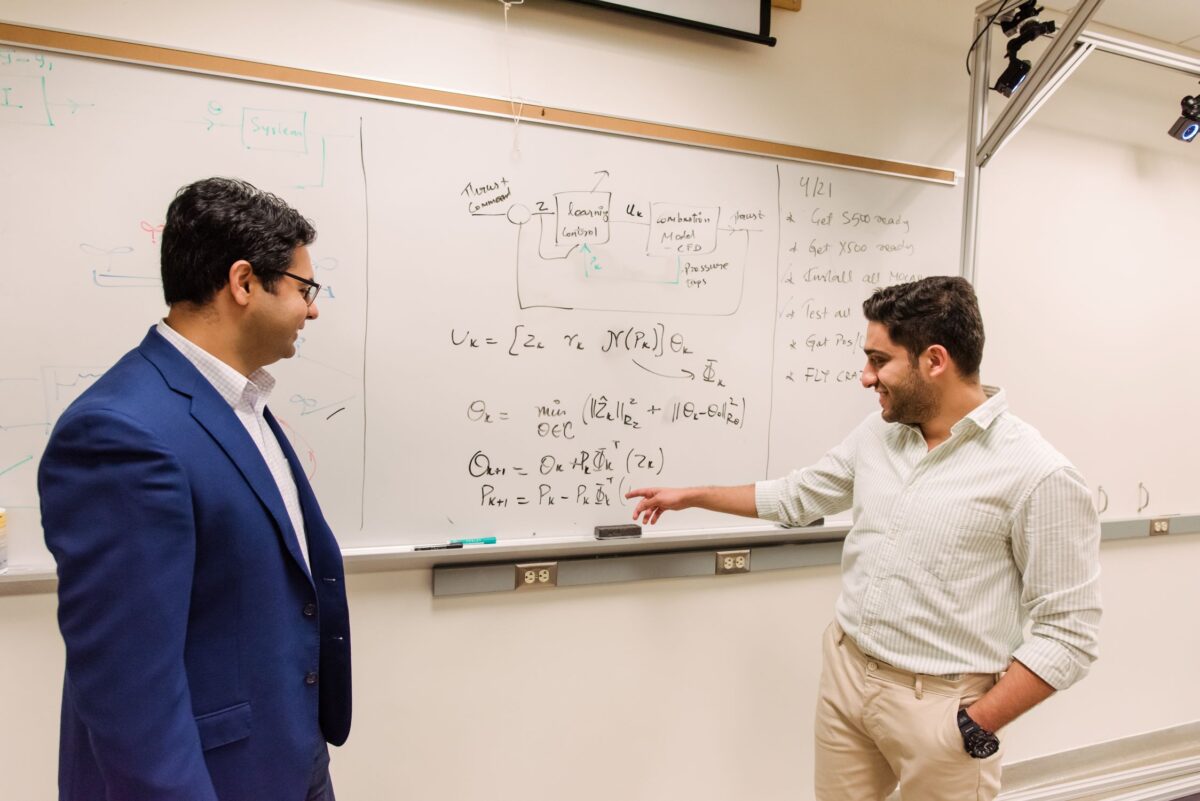
Goel has been investigating better ways to control aircraft flying at hypersonic speeds, by primarily focusing on the vehicle’s engine. He recently received more than $850,000 in funding from the Office of Naval Research to further the investigations. Over the next three years he will partner with Kyle Hanquist at the University of Arizona and researchers from the Naval Air Warfare Center (NAWC) to develop improved engine control strategies and assess their performance in ground experiments conducted at the NAWC facility at China Lake, California.
Powering superfast flight
The first airplane to break the sound barrier—the Bell X-1 piloted by Chuck Yeager in 1947—was dropped from the bomb bay of a Boeing B-29 and fired rocket engines to accelerate to its top speed.
Chuck Yeager in front of the X-1. (U.S. Air Force)
Rockets are incredibly powerful, but they also guzzle fuel. A more efficient alternative for fast flight is an air-breathing engine called a ramjet. Ramjets, which work best above the speed of sound, exploit the fast forward motion of the plane to effectively “ram” air into the engine and compress it. Squeezing the air heats it up, and the hot air then spontaneously ignites the fuel. As the burning mixture is channeled out the back of the engine, it pushes the aircraft forward.
Ramjets can burn either liquid or solid fuel. In the solid fuel version, which Goel and his collaborators are concentrating on in this latest project, sand-like grains of solid fuel are pressed together and embedded in the sides of the engine. This eliminates the need for pumps and other equipment to inject liquid fuel. It also means the fuel can more easily be transported and stored.
A solid fuel ramjet engine’s design is simple, but its operation is finicky. Structural vibrations, changes in airflow, and too much or too little heat can all cause the engine to stop working suddenly. Sometimes the engine will “buzz” in a rapid series of undesirable starts and stops, a state known as “engine unstart.”
“More reliable control of the engine could enable faster flight, longer range, and better maneuverability,” says Goel. To get that better control, Goel and his collaborators must grapple with the complex and chaotic environment inside the engine.
A tricky controls problem
Imagine a car driving along a hilly road. If the driver wants to maintain a constant speed, they must press the gas pedal harder going up the hills. If the car has cruise control, a computer can do the work of the driver. This is an example of a relatively simple control problem.
Ankit Goel (Marlayna Demond ’11/UMBC)
The inside of a solid fuel ramjet engine presents an example of a not-so-simple control problem.
A number of factors make the problem especially difficult. For starters, conditions inside the engine are constantly and rapidly changing. As the solid fuel burns away, the shape of the combustion zone inside the engine changes, which changes the airflow, which affects the rate of burning. Conditions shift dramatically in less than one-thousandth of a second. The system is also very sensitive to slight perturbations. A small change in flow conditions upstream can lead to big changes downstream.
It’s nearly impossible to completely understand and model what is going on.
In the face of such complexity, Goel is turning to a control technique that’s relatively novel in aerospace applications: machine learning. The beauty of machine learning is that it can solve problems without needing a conceptual understanding of them. The downside is that most machine learning requires enormous datasets and large amounts of computational power to work, two resources that aerospace applications typically lack. However, Goel and his collaborators have found a potential solution.
Real-time learning for aerospace
The researchers are experimenting with a technique that can learn, quite literally, on the fly, rather than being trained ahead of time. This distinguishes the technique from typical machine learning. While the ramjet is operating, the learning algorithms will continually re-evaluate the relationship between two simple factors—a measure of the air that’s being let into the engine and the thrust that the engine is generating—and use that relationship to drive the generated thrust to a desired value. By implementing a learning-based control scheme, the technique can control the output of the engine while ignoring the complexity of what’s actually happening inside.
The researchers plan to test their model first on computer simulations of a ramjet engine, and then on the real thing.
The ultimate goal is to embed the learning controller in a system that would take pressure sensor measurements from an engine in flight and use them to rapidly adjust the airflow into the engine—perhaps making thousands of small changes a second—to control the thrust. This would mean that flight operators could count on getting the requested thrust from the engine, even if flight conditions are changing.
Goel says the proposed learning technique could also be used on systems far removed from superfast aircraft. “The key insights into what makes the technique work in highly unmodeled and uncertain systems will allow us to generalize it to a large body of interesting dynamic problems,” he says. The team is already thinking about applying it to other types of aircraft, such as vehicles that use flapping wings or that take off and land vertically.
Ankit Goel (left) and Parham Oveissi (right) are working to develop better control techniques for ramjet engines. (Marlayna Demond ’11/UMBC)
Parham Oveissi, a Ph.D student in mechanical engineering at UMBC who will be involved in the research, says he is motivated by a deep interest in developing control techniques for aircraft, an interest he has nurtured since childhood, when his parents gave him a toy quadcopter. “This early encounter ignited an enduring curiosity within me, driving me to unravel the mysteries of flight and explore methods of controlling these machines,” he says.
The research project will be an exciting opportunity to develop his knowledge and skills. “I’m excited to collaborate with professionals, gain valuable research experience, and see the impact of my contributions,” he says.
The success of the project will hinge on the joint efforts of researchers with a variety of skill sets, from a variety of institutions.
“This work requires an interdisciplinary team,” says Kyle Hanquist, an assistant professor in the Department of Aerospace and Mechanical Engineering at the University of Arizona who will contribute his expertise in reactive flow modeling to the project. “We are working together to tackle a difficult problem that none of us could tackle on our own.”
The AI apocalypse is coming. Or it isn’t. Depending on what you read, you might get confused.
One thing is certain: Humans are fired up about smart machines. Much of the attention has focused on ChatGPT, an “artificial intelligence language model designed to generate human-like responses to natural language prompts” (in its own words).
ChatGPT gets coy if you ask whether its existence should be cause for human concern. “It’s important to recognize that I am a tool and not inherently good or bad. It’s how people choose to use me that can have positive or negative consequences,” it says.
Many researchers, however, are not so noncommittal. They see inherent flaws in the machine learning technology that forms the foundation of tools such as ChatGPT, and they would like to make it better.
While ChatGPT advises that “it’s always a good idea to double-check any important information I provide,” some UMBC researchers are working to build better safeguards into the AI systems themselves—AI the public can trust.
On March 22 of this year, a group including prominent artificial intelligence researchers and tech entrepreneurs released an open letter calling for a six-month pause on the training of powerful AI systems.
“AI systems with human-competitive intelligence can pose profound risks to society and humanity,” the letter argued. “Powerful AI systems should be developed only once we are confident that their effects will be positive and their risks will be manageable.”
The letter signers, including two UMBC faculty, expressed alarm at an AI arms race unleashed with the November 2022 public debut of ChatGPT, a celebrity chatbot that answers almost any question or prompt with humanlike ease. In a mere two months, the bot attracted 100 million users, and big tech companies began sprinting to deploy similar technology in their products.
Yet a general unease is accompanying this latest rush for AI gold.
ChatGPT can dazzle users with its eloquent prose (and poetry!), but it sometimes delivers complete falsehoods. People fret that such technology will eliminate jobs and empower scammers and dictators. And beneath it all, many researchers worry that we do not fully understand—nor can we reliably control—how creations such as ChatGPT work.
“At the core of many powerful AI systems today are what are called ‘blackbox’ models,” says Manas Gaur, an assistant professor in the Department of Computer Science and Electrical Engineering (CSEE) at UMBC. The models percolate data through layers of calculations so dense and complex that researchers struggle to track what’s happening inside. The models may excel at certain tasks—like writing sentences in ChatGPT’s case—but they cannot explain why they make the decisions they do. Sometimes they do perplexing, and erratic, things.
“Some people see ChatGPT and similar technology as a progressive tool while others fear it is dangerous,” says Nancy Tyagi, a master’s student in computer science at UMBC who is also working as a researcher in Gaur’s lab. “In my opinion, such tools are inherently risky and need further analysis. If these models are to be used in sensitive areas such as mental health or defense systems, then more work is required to make them safe, controllable, and trustworthy.”
Tyagi is working on a project to build an AI mental health assistant capable of initiating safe and appropriate conversations based on clinical guidelines in mental health. Her project is one of many that Gaur and other AI researchers at UMBC are launching with the aim of ensuring AI tools are accurate, transparent, and safe.
To better understand these researchers’ quest for trustworthy AI, it helps to take a step back and consider how the latest AI trend fits into the big picture.
A Brief History of Thinking Machines
When the field of artificial intelligence launched in the 1950s, computers were feeble compared to the muscular monsters that power systems such as ChatGPT today. Yet researchers were intrigued by the possibility of teaching them to think like humans. What followed was a roller coaster of booms and busts.
“The history of AI has been marked by periods of hype, followed by some level of disillusionment,” says Tim Finin, CSEE professor and a researcher at UMBC who has been studying AI problems for more than 50 years.
Driving the ups and downs were three interrelated factors: the power (and limits) of the hardware that formed computers’ brains, the data available to train those brains, and the “thinking strategies” AI researchers devised.
In the beginning, researchers taught machines to play games, learn language, and solve mathematical puzzles using a variety of “thinking” approaches. Yet the field hit a wall in the 1970s: Computers couldn’t store enough information or process it fast enough to tackle real-world problems. This was the first “AI winter,” when funding dried up and the topic faded from public view.
The birth of the microprocessor at the end of the decade revitalized AI research. Riding the shoots of this new life, a certain approach to machine thinking rose to prominence—that of the expert system. These AI programs were based on pre-programmed knowledge and logic meant to mirror the reasoning of human experts. Perhaps the most famous expert system was IBM’s Deep Blue, which beat the Russian chess champion Garry Kasparov in a chess match in 1997.
Expert systems could shine when solving narrowly defined problems (such as winning a game of chess), but they were brittle, says Finin. The systems struggled to adapt to fuzzy and fluid real-world situations, and it was cumbersome to program all the rules that an expert might use to evaluate a problem.
As the limits of expert systems became clear in the 1990s, AI felt the chill of a second winter.
It was another advance in computing hardware that thawed the field again after the turn of the 21st century. The graphic processing units developed to enhance video games supercharged computers’ speed and power at low cost. This, coupled with a flood of free data from the internet, propelled a new type of AI to the forefront: machine learning.
With loads of computing power and heaps of examples to learn from, researchers found surprising success getting computers to teach themselves how to think. The computers start with a question, perform some calculations, and guess the answer. They then compare it to the actual answer. If they are wrong, (which they usually are at first), they fiddle with the calculations and try again. After running billions of calculations, such systems can become quite proficient at tasks such as identifying images of cats and predicting the next word in a sentence.
THE SEASONS OF AI
The growth of the modern field of AI has been marked by a series of rapid spurts, followed by more dormant periods. People often liken these ups and downs to the seasons. During AI summers, public attention shines hot on the field. Yet the bountiful fruit of the season has often grown from seeds of ideas planted during quiet AI winters.
Summer 1: Expert systems
AI programs based on knowledge and logic flourished in the 1980s. Examples include systems that can identify unknown chemicals, diagnose diseases, and play chess. The systems are safe and explainable, but fail to adapt to fluid and complex situations.
Summer 2: Machine learning
Starting in the early 2010s, the potent combination of supercharged computing and heaps of free internet data powered AI’s second summer: the golden era of machine learning—an era that we are arguably still in. AI systems started to recognize images, transcribe and translate language, and create text and art almost like humans do. These systems have surprised even their own creators with their range of abilities, but they are hard to understand, reason with, and control.
Into the future: Hybrid AI
It’s not yet clear when or if the second AI summer will turn to fall. But researchers are already planting the seeds for future advances. Combining the fruits of past summers, researchers hope to make future AI systems that are adaptable and safe, self-taught and able to explain their decisions.
FUN FACT:
UMBC’s first Ph.D. graduate in computer science, Sanjeev Bhushan Ahuja, earned his degree when expert systems dominated AI. His dissertation, published in 1985 and titled “An Artificial Intelligence Environment for the Analysis and Classification of Errors in Discrete Sequential Processes,” advances techniques popular during this time.
This approach to machine learning is called a neural network, so named because it was originally inspired by the way neurons in the brain work. Neural networks lie at the heart of most famous AI applications today, including image classification tools, voice recognition, and text and image generators.
The power (and limits) of machine learning
When many of the new machine learning systems debuted, their powers seemed almost miraculous. But soon enough, drawbacks emerged. The machines require enormous data sets (and enormous amounts of energy) to learn. They will adopt biases from their training data and sometimes from their interactions with humans. A chatbot named Tay was quickly scuppered after its 2016 release, when users pushed it into spewing racist and sexist ideas.
Machine learning systems can also fail spectacularly in individual instances (even if they get answers correct most of the time). For example, a driver was killed in 2016 when the autopilot in a Tesla car failed to recognize the side of a white trailer truck against a bright sky.
The blackbox nature of state-of-the-art machine learning means the systems are unable to explain or justify their conclusions, giving users—and even their own creators—little insight into their thinking. For the most part, the systems struggle to build consistent worldviews or reason logically.
The weaknesses of learning models also leave them susceptible to malicious manipulation. Adversaries might “poison” the data used to train the models or exploit the model’s opaqueness to hide an attack.
“It is time we fall back from trusting these models,” says Gaur, whose personal push to make AI systems more explainable, robust, and safe is part of a growing international movement.
Another UMBC researcher joining the push is Houbing Song, a professor in the Department of Information Systems at UMBC. Song says that transportation, defense, medicine, and the law are some areas where explainable and safe AI systems are needed the most.
As researchers tackle the challenge of making current AI systems better, they are often returning to ideas from an earlier era of AI.
Hybrid systems to merge logic and learning
If the AI systems of the 1980s married the AI systems of the 2010s, their baby might be the type of system Gaur, Song, and others are working to develop.
These systems look to deliver the learning capabilities of neural networks alongside the safeguards of knowledge and rule-based systems.
In the field of mental health, Gaur points out that current chatbot systems are not well suited to answering patients’ questions since they can give unsafe or off-the-wall responses.
“Guaranteeing these systems’ safety calls for more than just improving their overall performance” he says. “We must also make sure the systems are prevented from giving risky answers.”
Working with Karen Chen, an assistant professor from the Department of Information Systems, Gaur has written a paper highlighting the properties that AI-powered virtual mental health assistants should exhibit to be considered safe and effective.
Creating “AI Scientists” at UMBC
New scientific discoveries often lay the groundwork for significant advances in human well being. Think of medical treatments that spring from a better understanding of the human body or labor-saving devices we fashion using our knowledge of material properties.
Tyler Josephson, an assistant professor in the Department of Chemical, Biochemical, and Environmental Engineering, hopes to turbocharge science’s discovery engine, with a little help from AI.
Josephson has started a new project to translate chemical theories into a machine-readable mathematical language. Once the computers have access to the foundations of science, Josephson believes they could be tasked with logically manipulating that information to reveal new discoveries.
You might wonder if Josephson has any worries about creating his own AI-powered replacement. But he doesn’t think AI scientists will displace the human kind.
“I think scientists have so many different problems to solve. And if we solve them faster with AI, they just open up brand new questions for us to go after next,” Josephson said in an interview about his work with the Canadian radio program Quirks & Quarks.
Together with his students, he is also working to create such systems. Using an approach called knowledge-infused learning, the researchers are looking to anchor their AI systems in clinically approved guidelines. They are also pushing their systems to reveal their thinking so that the approaches can be checked by mental health experts. Sometimes the results reveal that even when a system arrives at a correct conclusion, the information it used to reach that conclusion may be irrelevant to a human doctor’s thinking.
Song has also been coaxing AI learning models to open up. In a recent paper, he and his co-authors developed a tool to identify attacks on an image-recognition program by figuring out which parts of its neural network are most susceptible to manipulation.
In the fall of 2023, he will be teaching a new graduate-level course on a broad category of hybrid AI called neurosymbolic AI. UMBC will be only the second university in the world to offer such a course, he says.
Song arrived at UMBC in January on the heels of winning major honors for his research in computing and engineering and is looking forward to turning more of his attention to this emerging frontier in AI research. He says he eventually hopes to build a world-class AI research institute at his new academic home, focused on delivering learning machines that can be confidently used when safety is a top priority.
“I recognize the need for trustworthy AI,” Song says. “I believe that this field of research is where I can make unique contributions and take on responsibilities for my professional communities and my home institution.”
Technology to benefit society
The initial goal of AI, as defined by a group of researchers credited with launching the field at a 1956 workshop, was to “make machines use language, form abstractions and concepts, solve [the] kinds of problems now reserved for humans, and improve themselves.” But if the aim is human-like thinking, it naturally raises the question: How do humans think?
In a bestselling book titled “Thinking, Fast and Slow,” world-renowned psychologist Daniel Kahneman posits that humans have two thinking systems: a fast one and a slow one. The fast one is the thinking that comes to mind almost without effort, and we use this thinking most of the time. Yet it is prone to errors. The deliberative slow thinking system catches mistakes and enables breakthroughs in understanding.
Finin compares machine learning models to the fast-thinking system while knowledge and logic-based systems are more like the slow-thinking system. To make today’s faddish, fast-thinking models more competent, researchers such as Gaur, Song, and their students are extending them with slow-thinking capabilities.
We may still be decades away from AI systems approaching the full range of human intelligence. There are many ethical questions to grapple with before we reach a Hollywood-esque future of self-flying cars and android coworkers. Yet the decades of AI research up to this point have already transformed the world. AI concepts underpin the ways we search the web, shop online, and otherwise interact with the digital world.
AI has enormous potential to improve human lives, but we must proceed wisely. UMBC researchers are at the frontiers of AI research, pushing the limits of knowledge and theory, and striving to make the technology better for the benefit of society.
Training Your Robot Assistants
If you hope the AI revolution will bestow humanity with machine “Jeeves” capable of meeting your every need, Cynthia Matuszek has some bad news. “I’m always being asked: ‘When will we have robot butlers?’ I have to say—not any time soon,” says Matuszek, an associate professor in the Department of Computer Science and Electrical Engineering.
Matuszek researches how to build robots that understand human commands in complex and chaotic natural environments. She has successfully trained a robot hand that can respond to written prompts such as “Grab the apple.” She is also exploring how to teach robots to understand spoken language and to learn new concepts, such as how to dice a vegetable, if a human shows them how.
Part of what motivates Matuszek’s work is the huge unmet demand for caregivers to assist people as they age. Robots might fill the gap. Matuszek says we likely won’t have “Jack of all trades” helpers, but robots could specialize in certain tasks, such as preparing food or folding laundry.
Another part of what motivates Matuszek is the thrill of being the first person to discover how to do something new. “It’s really just so much fun,” she says.
Every day, radio signals from GPS satellites help millions of people figure out what time it is and where they are. Yet the system is vulnerable to disruptions and attacks. Sometimes users are unable to access critical information. Other times, adversaries may try to fool users into thinking they are somewhere they aren’t.
For this reason, researchers at UMBC are working to develop alternative timing and navigation technologies. The university recently received almost $2 million in initial funding from the Department of Defense (DOD) to further this important research. UMBC will collaborate with the Army Research Laboratory (ARL) in Adelphi, Maryland, and other members of a national consortium, managed by the National Center for Manufacturing Sciences (NCMS). UMBC will conduct fundamental research to develop the knowledge base that is needed to design, test, and build clocks and communication protocols that could deliver critical information in the event of a disruption to GPS service.
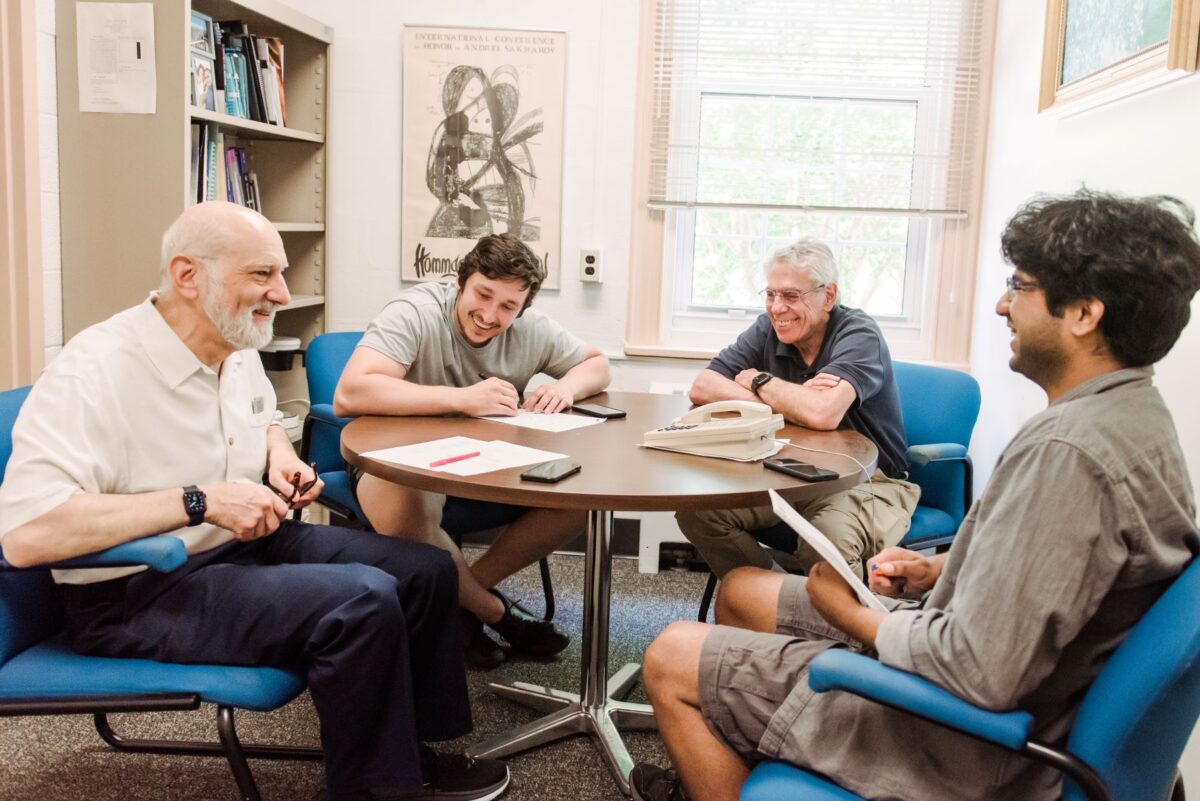
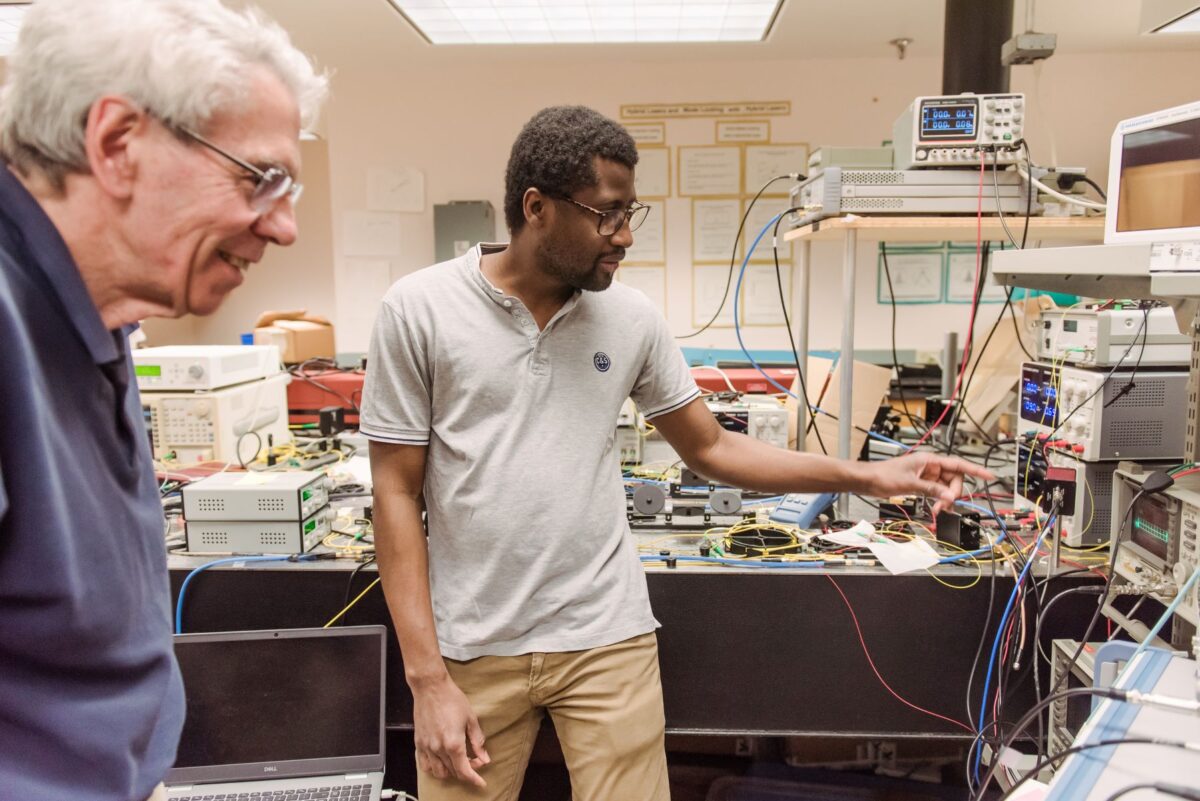
From left to right, Professor Curtis Menyuk, graduate student Logan Courtright, Professor Gary Carter and graduate student Pradyoth Shandilya discuss research plans. (Marlayna Demond ’11/UMBC)
The work will be carried out within the newly launched Center for Navigation, Timing and Frequency Research (Centaνr) at UMBC, led by Curtis Menyuk, professor of computer science and electrical engineering. Centaνr is the second significant research partnership with the ARL that UMBC has launched in recent years. It joins the Center for Real-time Distributed Sensing and Autonomy (CARDS), which opened in 2021 and aims to develop smart robots that can better navigate difficult terrain and coordinate their actions with other robots and humans.
Harnessing the power of light
Centaνr is part of a wider, 10-member consortium that brings together partners from the government, academia, and industry to advance photonic technologies that harness light to process and send information. The partners seek to develop solutions that utilize light in environments where radio frequency solutions do not work. These solutions will be chip-based—taking advantage of modern advances in integrating optical and electronic technology on a single semiconductor chip—in order to achieve low size, weight, power and cost.
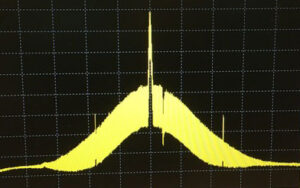
To analyze photonic systems, the team will gather and study data such as this optical spectrum of an optical pulse called a soliton. (Image courtesy of Alioune Niang.)
The UMBC team will lead research on the design and manufacture of photonic technology for positioning, navigation, and timing, which is one of the three main research thrusts for the consortium.
To meet high performance requirements, the photonic elements must be manufactured with extreme precision. UMBC will partner with Worcester Polytechnic Institute and AIM Photonics, one of the U.S. Department of Defense Manufacturing Innovation Institutes, as well as the Army Research Laboratory to design these devices.
Researchers at UMBC will also work to help develop a system that uses light waves to transfer a time signal between two devices, through the open air.
The UMBC team includes several computer science and electrical engineering faculty: Professor Gary Carter, Professor Fow-Sen Choa, Associate Professor Tinoosh Mohsenin and Assistant Professor Ergun Simsek.
High-tech equipment meets motivated students
To further Centaνr’s research aims, UMBC will build a new, high-tech laboratory where photonic components can be tested and characterized. The university will also serve its educational mission by recruiting and training diverse students in the concepts of timing and navigation technology and photonics.
Gary Carter and Research Associate Alioune Niang look at equipment used to study photonic components. The equipment will move to a new lab space soon. (Marlayna Demond ’11/UMBC)
In collaboration with consortium partners, UMBC will develop new course materials and internship programs, and will recruit students from groups underrepresented in this field to participate in these research and learning opportunities.
“There is a real need for good educational material in these areas and I’m excited by the opportunity to build and distribute it,” says Menyuk. He is also excited to build a new experimental facility and partner with other institutions to make U.S.-manufactured high-end photonic components more widely available.
Menyuk says the consortium partners are already discussing additional years of funding. He is also thinking long-term and planning ways that Centaνr can continue to be a source of frontier photonics research for years to come.
Performers of the music piece “Corporel,” by the French-Slovenian composer Vinko Globokar, must use their own body as a percussion instrument. They beat, scratch, smack, and tap themselves. They chatter their teeth, snore, and cluck their tongue. The composition’s “patterns of sound and gesture” are arresting, “keeping us transfixed even as we flinch,” the L.A. Philharmonic website says in its description of the piece.
To Brandon Gouin ’23, music performance, learning the work was a highlight of his time at UMBC. “This work is a discovery of self and musical potential that resonates deeply within me,” he says. He performed the piece at his senior recital this year, when members of the music community at UMBC were celebrating the opportunity to once again gather in practice spaces and concert halls after the isolation of COVID-19.
Gouin credits his teachers and mentors, especiallyTom Goldstein, associate professor of music,andPatrick Crossland, affiliate artist, with helping him reach that moment on stage—as well as with helping him find his path as an artist.
Gouin’s experience is reflective of the experience of many members of the class of 2023. Although each individual has unique talents, passions, and goals, they are brought together by a feeling of gratitude to the UMBC community for helping them find their way. Faculty, staff and fellow students helped them open their minds to new possibilities, and mentored them on their journey to discovering a career path that fits.
Challenging preconceptions
When Gouin arrived at UMBC, he thought performance jobs for percussionists were mostly limited to professional orchestras—a highly competitive and difficult career path for any musician to pursue. However, as he dove into the local music scene, his eyes were opened to other possibilities.
“I began to see opportunities as a contemporary performer by attending the Livewire festival of New Music that UMBC holds every year and watching many performances of music I had never heard of before,” he says. He also attended local experimental music shows at the Red Room in Baltimore and the Rhizome in D.C.
“Audiences at these shows are very engaged, and that is exciting to me as a performer,” he says.
Brandon Gouin performing Vinko Globokar’s 1985 work “Corporel.” (Image courtesy of Brandon Gouin)
Mentors illuminate new possibilities
Gouin’s professors introduced him to new styles of music and showed him the vibrancy of the contemporary music world. Tom Goldstein directs the UMBC Percussion Ensemble of which Gouin was a member. Goldstein says he often programs works by lesser-known composers, and sometimes pieces by UMBC faculty and student composers.
“I think if the students perform a piece composed by someone they know, they may start to think ‘Hey, I could do something like that, too,’” he says.
Gouin appreciated the exposure to a variety of music and says he has adopted the inclusive mindset of his music professors as he pursues career opportunities after graduation. “My teachers aren’t only in love with one or the other kind of music but commit themselves fully to working with all kinds of music,” he reflects. “I think that kind of mindset is healthier and has more longevity for an artist’s life.”
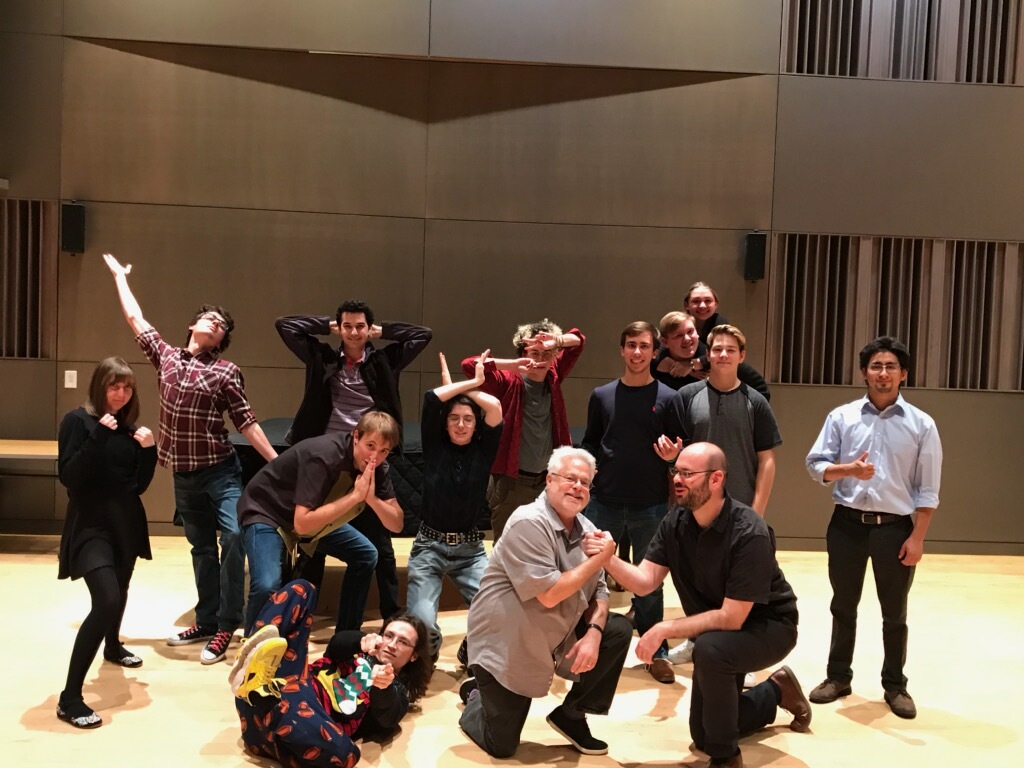
Members of the UMBC Percussion Ensemble and the Salisbury University Percussion Ensemble. Every year the two groups perform a joint concert. (Image courtesy of Brandon Gouin)
Other Class of 2023 graduates say they encountered similar opportunities for growth and expression at UMBC. Shaniah Reece ’23, information systems, discovered a love of research and a way to connect her technical skills to her passion for social justice.Hala Algrain, M.P.S. ’23, health information technology, reconnected with a love of teaching, and switched her career plans from industry to academia.Elijah Mugabe ’23, chemistry, threw himself into lab work and a quest to investigate unanswered scientific questions. AndConnor McPherson’23, history, found a way to connect his interest in the humanities with a career in the Navy.
Community builds confidence
In addition to finding their path at UMBC, these students also found communities that encouraged them to excel on their academic and personal journeys. They found student groups, faculty mentors, peer advisors, and scholars’ programs that pushed them to succeed and provided the support they needed.
“Undoubtedly, the most enriching part of my time at UMBC has been the remarkable sense of community I have experienced here,” Reece says “It has provided me with opportunities for personal growth, enabling me to evolve holistically. As I reflect upon my experiences, I feel confident and prepared to take on any obstacles that may lie ahead.”
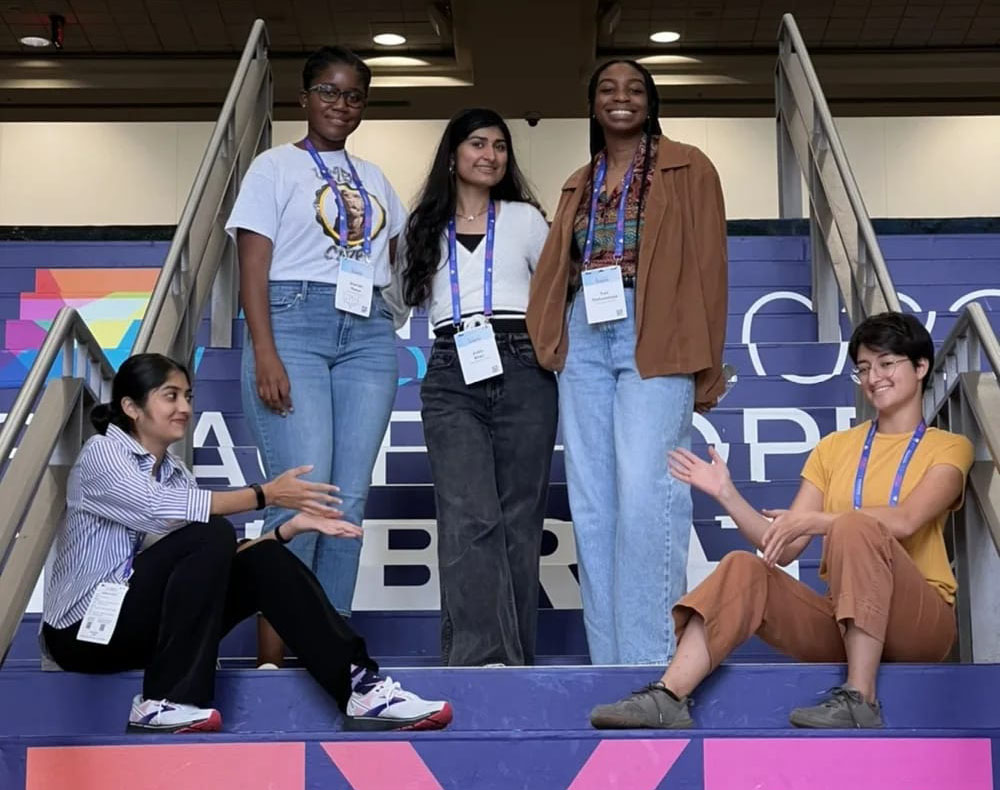
Reece (second from left, UMBC shirt) and other CWIT scholars and students at the Grace Hopper Conference in Florida 2022. (Courtesy of Shaniah Reece.)
Algrain agrees that the culture of UMBC and the level of support were the best parts of her experience at UMBC.
For Gouin, the chance to connect with mentors who were dedicated performers, as well as enthusiastic teachers, was life changing. He even joined a percussion quartet with fellow and former students that they named “Hi Tom,” in honor of Tom Goldstein.
Goldstein shares that for him the honor goes in the opposite direction.
“I love working with the students—it’s a fantastic part of my life,” he says. “It’s an honor and a privilege to get to know them.”
Tyler Josephson’s lab sits off a main corridor in the department of chemical, biochemical and environmental engineering at UMBC. Open the door, though, and you’ll see nary a beaker, chemical closet, or lab coat. Inside, a few computers sit on tables. You might see equations scrawled on the white board or a few students poring over lines of code.
Using this modest setup, Josephson has launched an ambitious project to equip computers to make scientific discoveries—starting in the realm of chemistry. This March he won a prestigious NSF CAREER award to advance the project.
The goal of the work is ultimately to speed up the process of science, which should in turn give humanity new knowledge and tools to face down big challenges such as climate change and environmental degradation.
As Josephson and his students dive into the work, they are bringing together techniques from across mathematics, computer science, and chemical engineering. Their first step is to translate chemical theories into a rigorous mathematical language that a computer can understand.
Math as the language of science
In 1623, the Italian natural philosopher Galileo Galilei wrote an essay in which he described nature as a book written in “the language of mathematics.” Many scientists since have puzzled over the mysterious power of math to describe physical phenomena.
Josephson and his students are tapping into this power. They are using a tool developed by researchers at Microsoft called the Lean theorem prover. Lean is both a computer language and a program for checking each step of a rigorous mathematical proof.
“Formal proofs, which are verified by a computer, differ from the informal, handwritten versions often used by scientists,” says Josephson. Informal proofs are easier to write, but they usually skip logical steps, assuming a human reader will have the knowledge and skill to follow along. This means that errors can creep in undetected.
On the other hand, if a proof has been written and checked in Lean, it is guaranteed to be correct as long as the stated assumptions are true.
A community of Lean programmers
Lean has a dedicated community of volunteer developers who have built a large library of mathematical proofs, each of which can then serve as a building block for more complicated proofs. They aim to digitize mathematics, starting with the entirety of the undergraduate math curriculum, which will lay the foundation for formal proofs in advanced modern mathematics.
Josephson plans to build a similar library with formally correct derivations in science and engineering, starting with chemical concepts such as the thermodynamic behavior of gases and of molecules sticking and unsticking from surfaces.
He and his students describe their approach in a first paper on the subject, and are in the process of submitting it to journals.
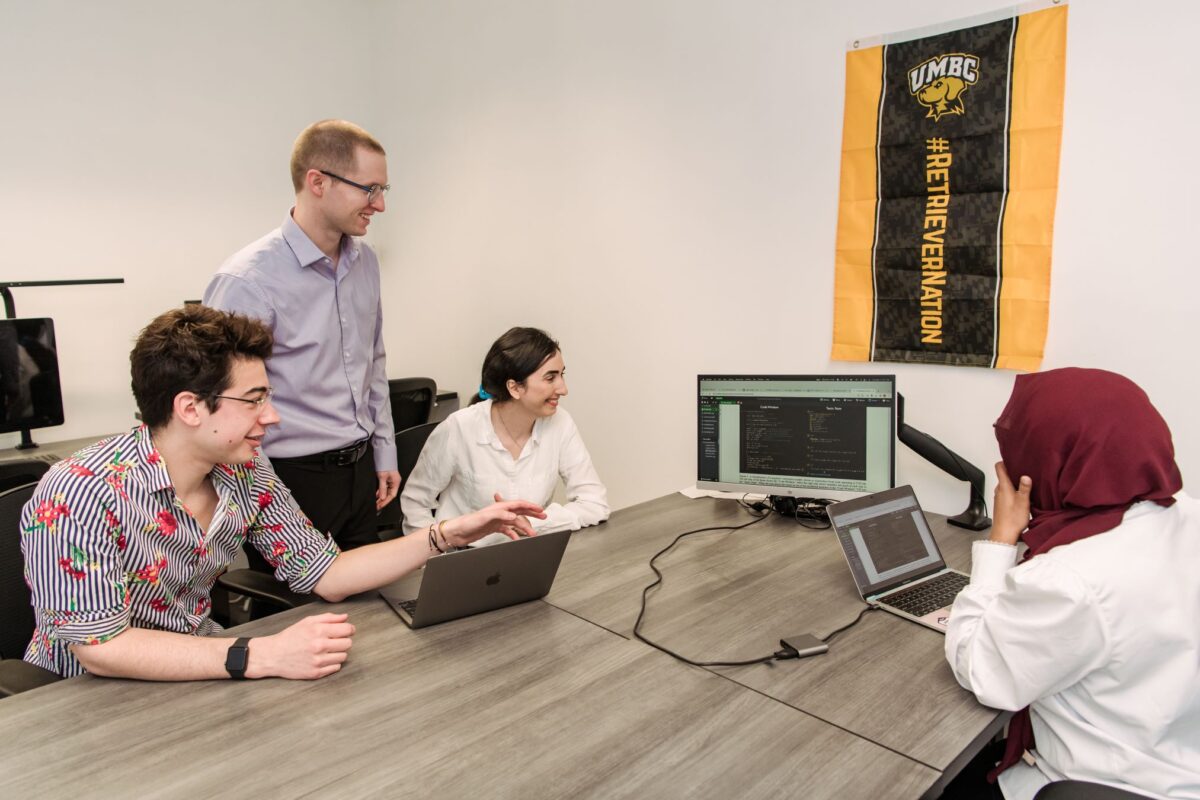
Tyler Josephson (standing) and students Max Bobbin (left), Parivash Feyzishendi (center), and Samiha Sharlin (right) in the lab. (Marlayna Demond ’11/UMBC)
The power of the work will multiply as more of the foundations of science are translated into Lean, so a large part of the team’s work will also be to recruit, inspire, and train fellow proof creators. They will hold workshops to showcase Lean for scientists and engineers, and they plan to create fun and educational games that will teach Lean-programming skills to newcomers.
“I’m really excited to share this tool with students and the scientific community,” Josephson says.
Building better scientific computing tools
Josephson’s goal to formally verify scientific theories isn’t just an intellectual exercise—it’s a means of building better tools for better science. One such tool he plans to create with NSF CAREER award support is Lean-based computer software that can simulate the behavior of molecules under a range of conditions.
Scientists often use such software to test theories as an alternative to physical experiments. It can be easier to run simulations of reactions on a computer, for example, than to mix real chemicals again and again, and some molecular phenomena may happen so fast, or under such extreme conditions, that current experimental tools cannot capture them.
However, bugs can mar the performance of the software. For example, starting in 2011, a hidden coding error fueled a seven-year “war over supercooled water,” in which two scientific groups disagreed about what happens to ultrapure water when it is cooled significantly below the freezing point of normal water, and then suddenly crystallizes.
Code written in Lean is unique from that written in the programming languages commonly used in scientific computing, since it can be provably free of such math errors, Josephson says.
As more scientists and engineers learn to write code and proofs in Lean, others will be able to write bug-free software for applications as diverse as weather forecasting, drug discovery, and predicting material performance.
“AI scientists” who reason on their own
Ultimately, Josephson hopes to use a Lean-based library of scientific knowledge to train computers as fellow scientists. For example, large language models, such as the recently popularized ChatGPT, might be trained on a library of scientific proofs and gain the ability to “autocomplete” proofs on their own, translate informal proofs from the literature into formal ones, and even discover entirely new scientific theories, which could then be checked for correctness by Lean.
A tool like this might revolutionize science. In Galileo’s time, a single person could master large portions of human scientific knowledge, but now scientists usually go to school for decades to become experts in a tiny subfield, Josephson says.
AI scientists capable of digesting a database of thousands of scientific proofs in multiple disciplines might draw connections across them to reveal new discoveries. “Such a tool could lead to an AI-powered Renaissance in interdisciplinary scientific discovery,” says Josephson.
While such lofty goals remain in the future, Josephson and his students are energized by the possibilities. As they embark on an exciting scientific journey, they are thrilled to bring as many people as possible along on the ride.
Degree: B.A., History; Minor in Naval Science Hometown: Bel Air, MD Post-grad plans: Surface Warfare Officer (Intel option), stationed in Yokosuka, Japan
As a student in the Naval Reserve Officer Training Corps (NROTC), Connor McPherson understands the implications of relationships—both friendly and hostile—between the United States and other countries. As a history major, he brings a historical perspective to how those complex relationships evolved.
He focused his studies on post-Cold War developments in Europe and East Asia, while also taking classes in Korean. His favorite class was a course on the U.S. intelligence community’s origins, operations, and management. Taught by Mary Laurents, Ph.D. ‘18, language, literacy, and culture, adjunct associate professor, the course gave him a historically-rooted understanding of the intelligence community he will ultimately join after graduation.
McPherson’s choice of a history major was unusual for the NROTC program. “He speaks very eloquently about his passion for history and the value of his degree,” says Denise Meringolo, associate professor of history. McPherson says his studies have given him a better understanding of the culture and past of the regions of the world where he will work as a Navy officer.
After graduation, McPherson will sail to Yokosuka, Japan, where he will serve as a surface warfare officer (intel option). He was awarded the fourth choice in the nation for his after-graduation Naval appointment, a recognition of his achievements.
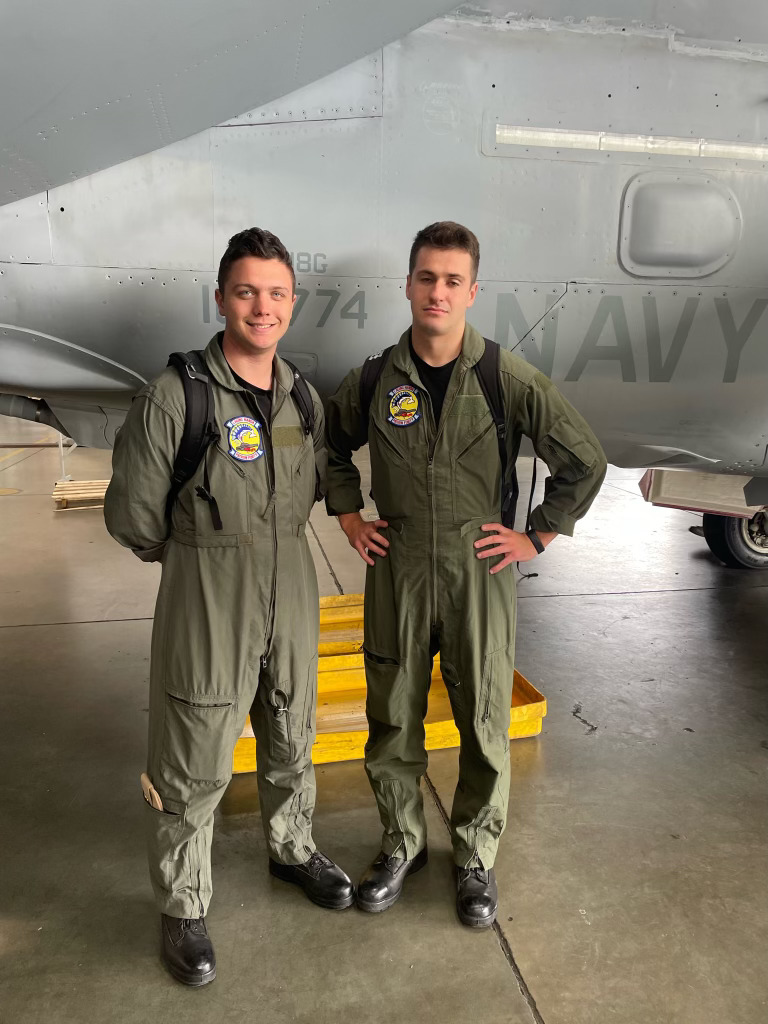
Connor McPherson (left) and a a midshipman from Embry–Riddle Aeronautical University (right) during summer training at Naval Air Station Whidbey Island. (Image courtesy of Connor McPherson.)
Has there been a mentor or fellow student who influenced your time at UMBC?
“Prof. Van Wyck has been an inspiration to me because of the way he teaches his history classes. He truly cares about his students and gives feedback that helps their continued growth. It is that type of mentality that I hope to adopt and apply to the sailors I will lead in the near future.”
What has been the best part of your UMBC experience?
“Finding a sense of community and like-minded people as part of UMBC’s NROTC program has been an important aspect of my college experience. All the members of this organization are bound to one another through a commitment to serve our nation. NROTC members value the principles of honor, courage, and commitment, which in turn results in a group of highly motivated students who always strive for academic excellence. ”
Degree: MPS, Health IT; Graduate Certificate in Data Science Hometown: Riyadh, Saudi Arabia Post-grad plans: Ph.D. in information systems, UMBC
Supportive faculty and staff mentors helped Hala Algrain find her way on what she describes as a long journey to a career that fits her values.
While pursuing a master’s degree in health information technology, Algrain honed her interests and reconnected with a love of research and teaching. She currently works as a research assistant in the Health Data Lab of Ian Stockwell, associate professor of information systems. She felt an immediate connection to the work, which aligns with her goal of creating intelligent human-centered health systems that address patient needs. Her experience in the lab prompted her to change career plans. Instead of entering industry, she will pursue a Ph.D. in information systems at UMBC.
Algrain also accessed professional development services and found faculty who guided her to classes that fit her interests and opened new opportunities. “Shout out to the Office of International Students and Scholars,” she says. “They really do have your back.”
Hala Algrain and her sister at the Y Turkey Trot Charity 5K in Baltimore. (Image courtesy of Hala Algrain.)
What activity, experience, or co-curricular at UMBC was particularly important to you?
“I’ve valued working as a teaching assistant and a research assistant. Connecting with students as a teaching assistant rekindled my love for academia. I enjoyed being able to facilitate another student’s learning experience.”
Is there a particular academic achievement you’re most proud of?
“I’m proud of persevering through a lot of professional dead ends and continuously seeking a higher standard for the level of impact of health systems. It’s incredibly reassuring and exciting to find mentors at UMBC who have the same values of conducting research with real-world impact.”
UMBC President Valerie Sheares Ashby, USGS Northeast Region Director Michael Tupper, and then-director of the EPA’s Chesapeake Bay Program Kandis Boyd, now senior advisor to regional administrator for EPA Region 3, ceremonially signed a memorandum of understanding that outlines areas where the three partners plan to collaborate. One of their main objectives is to create a seamless career pipeline for students in environmental science, engineering, and related fields.
UMBC faculty and students have worked with USGS and EPA scientists to develop new methods to analyze environmental data, clean up polluted ecosystems, and understand the economic benefits of healthy air and water.
The trio aim to build off these successes, and in particular will focus on recruiting and training diverse students to further environmental research and stewardship.
Kick-starting environmental science careers
“I’m a living, breathing example of what a partnership like this can do,” says Kandis Boyd, who was the first person of color to direct the EPA’s Chesapeake Bay Program. She notes that her career in the federal government was kickstarted with an internship while she was a college student.
President Sheares Ashby echoed the enthusiasm. “I am thrilled to be here, having heard the values embodied by our partners,” she says. “Our students can change the world.”
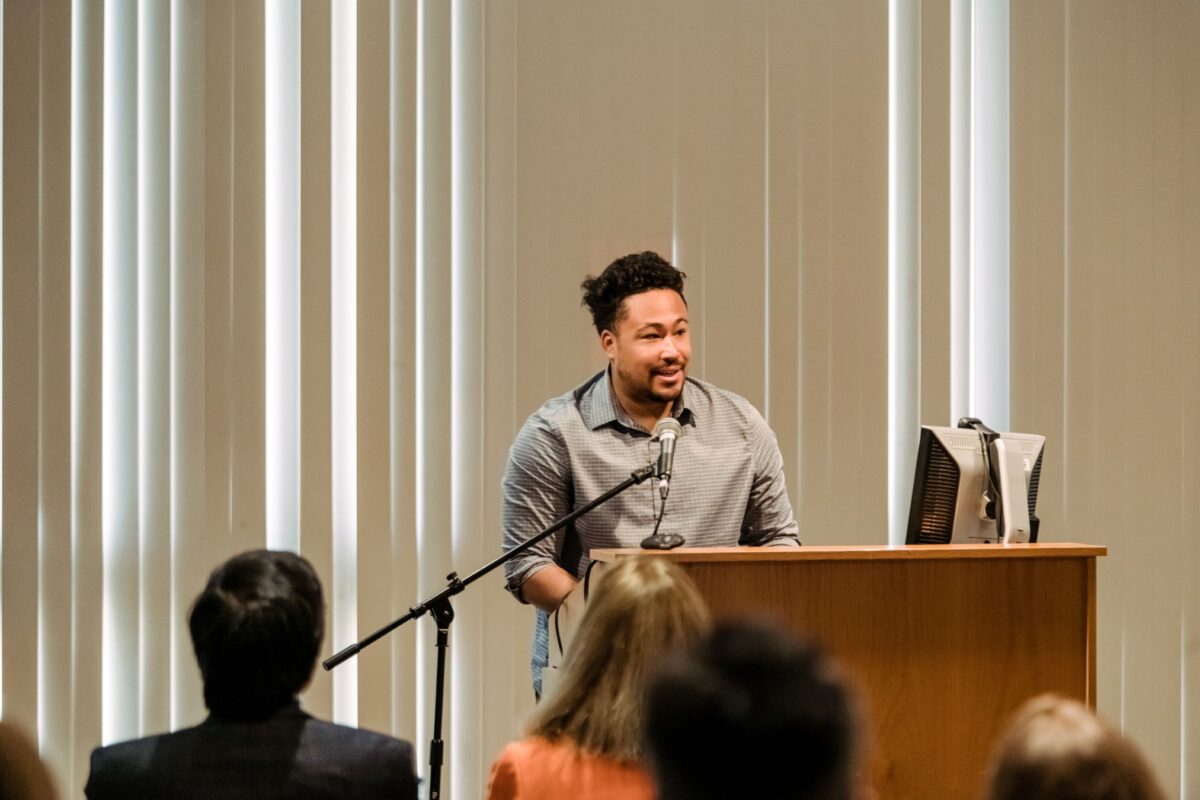
Graduate student Christopher Blume spoke at the signing ceremony. (Marlayna Demond ’11/UMBC)
In remarks he gave during the signing ceremony, Blume thanked his mentors and fellow students for the invaluable support he has received while pursuing a career in environmental science. He also expressed how grateful he was for the chance to work and connect with the communities throughout Baltimore who are impacted by and invested in the work he does.
“If there is one thing I’ve learned from my time in this program, it’s that diversity and representation of that diversity truly matter,” he says.
Degree: B.A., Music Performance Hometown: Laurel, MD Post-grad plans: Teaching and performing in Baltimore and D.C.
Brandon Gouin arrived at UMBC with a love for percussion music, but unsure of his future direction as an artist. He was also not very engaged in the contemporary music world, but his experience with musicians such as Tom Goldstein, associate professor of music,and Patrick Crossland, affiliate artist, completely changed that.
Gouin played in several ensembles at UMBC, including the percussion ensemble, new music ensemble, and improvisation ensemble. He credits the improvisation ensemble, directed by Crossland, with shaping his artistry and musical growth. In the class, which he took five times, he fine-tuned his musical ear and experimented with music as a vehicle for ever-shifting self-expression.
Crossland says Gouin developed and nurtured a passion for adventurous and experimental music during his time in the ensemble. “His enthusiasm is palpable and infectious, inspiring others to take the plunge along with him,” Crossland says. “He has been working with young school groups, introducing students to new ways of making and thinking about music. He is truly an ambassador for contemporary music.”
Brandon Gouin performing Vinko Globokar’s 1985 work “Corporel.” (Image courtesy of Brandon Gouin)
Is there a particular academic achievement you’re most proud of?
“Performing Vinko Globokar’s 1985 work “Corporel” at my senior recital is a highlight of my UMBC experience. This piece is a solo for the human body. The performer is shirtless and seated on the stage. They beat, scratch, smack, and tap various parts of their own body. This work is a discovery of self and musical potential that resonates deeply within me.”
Has there been a mentor who influenced your time at UMBC?
“Dr. Patrick Crossland, who directed the improvisation ensemble and the new music ensemble, has influenced my experience. He thinks about music in incredibly detailed and focused ways. His knowledge and technical ability of the trombone and contemporary music are unmatched. I am grateful to have learned from him.”
Amongst the beakers, test tubes, and chemicals in a laboratory prep room of the Meyerhoff Chemistry Building Elijah Mugabe found friends, and a calling. A Meyerhoff Scholar, Mugabe worked as a lab assistant his sophomore year and enjoyed the behind-the-scenes view of research that it offered. The next year, he joined the lab of Songon An, associate professor of chemistry and biochemistry, embarking on research into how metabolic enzymes organize themselves in cells, and how disease affects that organization. The experience opened his eyes to the range of unanswered questions scientists are exploring.
Mugabe’s academic achievements have been recognized with the Faculty Award for Excellence in Chemistry from the department of chemistry and biochemistry, among other honors. Away from the lab, Mugabe formed connections with the broader UMBC community. He volunteered with Retriever Essentials, an organization committed to tackling food insecurity. “It was a gratifying and enjoyable experience seeing the group’s impact and having a better understanding of our community,” he says.
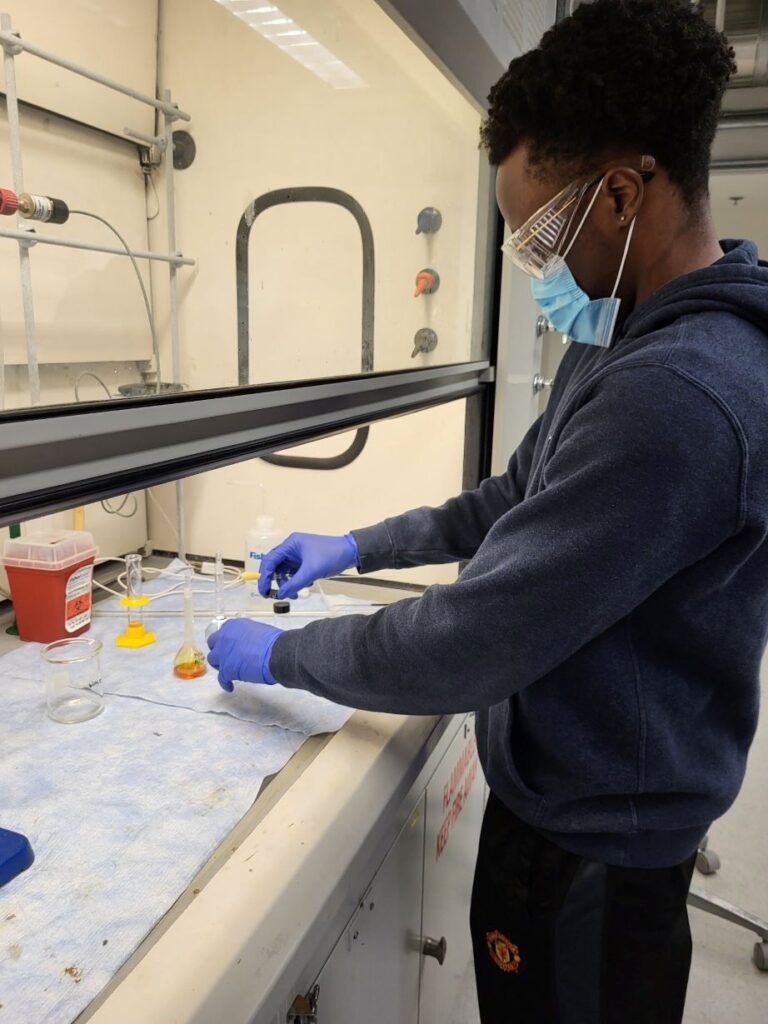
Mugabe works in the lab on a project for one of his chemistry classes. (Image courtesy of Elijah Mugabe.)
Has there been a mentor or fellow student who influenced your time at UMBC?
“Karis Barnett graduated from here a few years ago, and she was a chemistry major like me and my personal peer advisor. She helped me a lot when it came to picking classes, helping me with assignments, and just being a good person to talk to when I wanted an ear from someone. She made my time at UMBC smoother than it would’ve been without her, and I am still in contact with her to this day. ”
What has been the best part of your UMBC experience?
“The best part of my UMBC experience would have to be being a part of the Meyerhoff Scholars Program, specifically in cohort M31. Knowing people who are working towards similar goals pushed me to be better academically, and as a person.”