We use cookies for analytics and, unless you opt out, advertising.
You can opt out of advertising at any time.UMBC uses essential cookies to run this site. With your permission we would also use analytics cookies (to understand how the site is used) and advertising cookies (to measure and target our ads on other platforms). Nothing else loads unless you accept. You can change your choice any time from Cookie Settings in the footer.Privacy Policy
EssentialRequired for the site to work (login, security, your cookie choice). Always on.
On the last Saturday in September, the basketball courts in the RAC were filled with teams of a different sort than usual. Hundreds of students from UMBC and other universities huddled around computer screens, talking and typing. The occasion was the 12th annual hackUMBC, a 24-hour competition where students collaborate to create technical solutions to problems that matter to them.
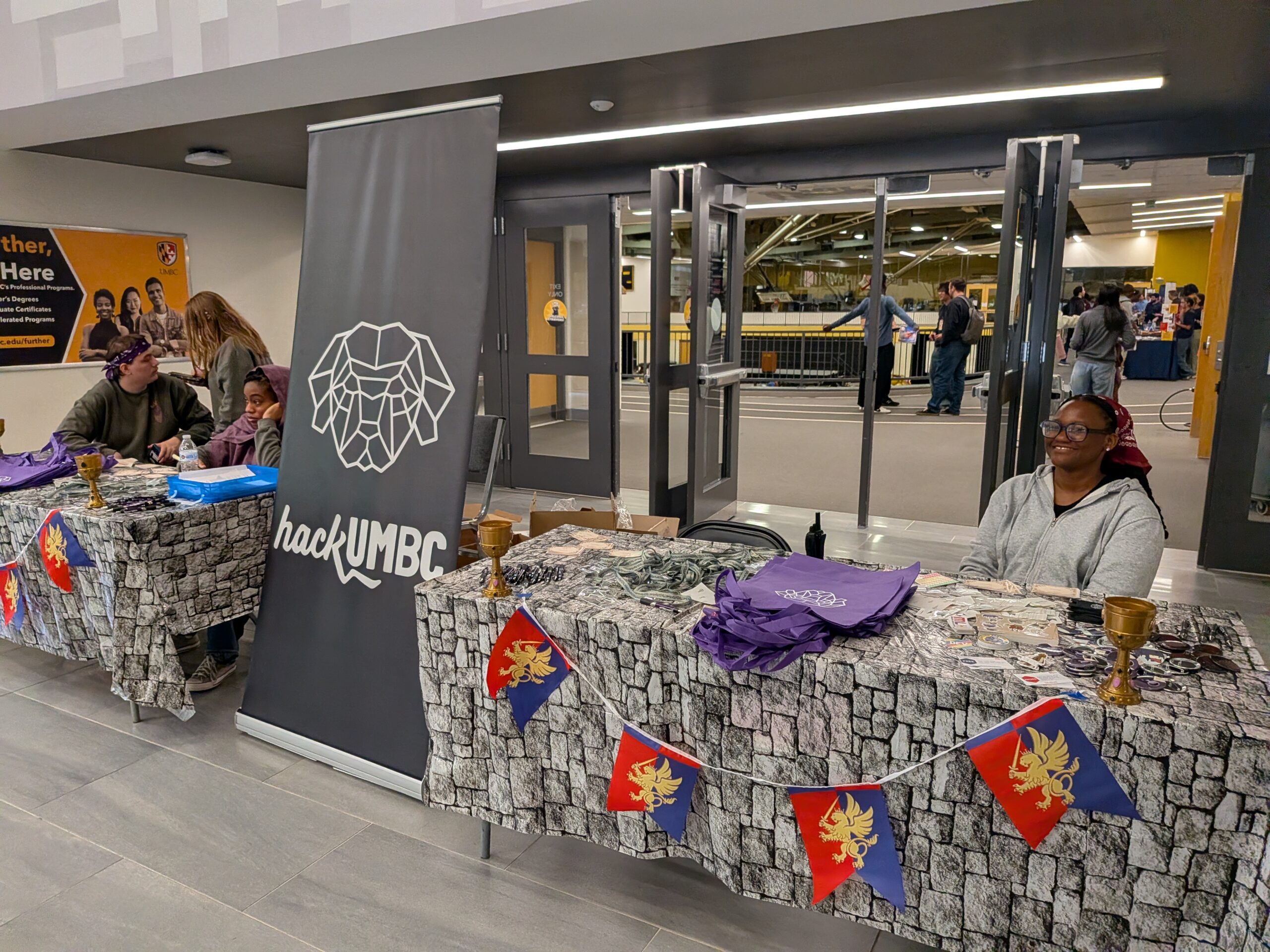
The hackUMBC registration booth welcomes students to the RAC. (UMBC)
For Sarah Tran, a senior computer science major, it was her third time attending hackUMBC. “It’s cool to see how much it has grown and improved,” she says. Tran had formed a team with fellow junior computer science major Rebecca Ko, junior computer science major Javier Ramirez, and first-year master’s student in computer science Andrew Wenstrand. They were working on an app to help trick-or-treaters and homeowners see which houses are participating and what candy is on offer.
This year marked the first time hackUMBC was held in the RAC. There was plenty of space for students to spread out and for the student organizers and sponsors to host networking events, workshops, stress-busting games, and other activities. Companies such as T. Rowe Price, Nightwing, Johns Hopkins University Applied Physics Laboratory, and Realm One were on-site, giving participants the opportunity to learn about jobs and internships and showcase their skills to representatives.
The hackathon tracks, which offered specific themes, problem areas, or categories that guided participants in focusing their projects, were all run by fellow UMBC student organizations this year, says Bella Goltser, the president of hackUMBC and a senior computer science major. “We really focused on inter-club collaboration,” she says, with clubs such as CyberDawgs, the Game Developers Club, and the Pre-Med Society all pitching in.
Right to left: Rebecca Ko, Sarah Tran, Javier Ramirez, and Andrew Wenstrand work on their project together. (Jaime Loza/commonvision)
In a fast-changing computer science landscape, hackathons may matter more than ever, Goltser says: “They are great for learning new technologies, building skills outside of the classroom, and understanding how to use AI in the tech realm.”
Frank Lopez, a junior computer science major and first-time hackUMBC participant, says his team, including Erin Yuson, a sophomore computer engineering student, her friend Dominic Sizemore, a student in electrical engineering at University of Maryland, College Park, and Hanna Wu, a first year biochemistry and molecular biology major, ultimately turned to Google’s AI framework MediaPipe for their project to “break down” dance videos into small learnable steps.
Left to right: Team members Dominic Sizemore, Erin Yuson, and Frank Lopez at hackUMBC. (UMBC)
“As a dancer myself, I’m very excited about our program and can confidently say that there will be more to come with this app in the future,” Lopez says. Overall, he says his whole team was impressed with the hackUMBC experience. “As first time hackers, there was definitely space for some anxiety, but we really felt welcomed. We made use of the opportunity to network and see other cool projects, and for me that was the most memorable and fun part of the event.”
A new initiative, which the organizers hope to expand, matched students from Baltimore City Community College with UMBC researchers. This summer the teams worked on projects advancing biodegradable plastics and harnessing AI to bring Baltimore’s hidden stories to light.
When Talisha Clinton, a student in Baltimore City Community College (BCCC)’s computer information systems program, first met Rebecca Williams, an assistant professor in the Department of Computer Science and Electrical Engineering at UMBC, she says she felt an instant connection.
“From the very beginning, there was the feeling of finding a kindred spirit,” Clinton says. Williams agrees. “When I met Talisha, I was so glad we had found each other.” The two were paired as part of a new initiative launched by the College of Engineering and Information Technology (COEIT) at UMBC to support BCCC students for a summer of research with COEIT faculty.
Clinton and Williams worked together on a project that aims to use AI to add community perspectives to historic redlining maps of Baltimore City that classed certain neighborhoods as “high risk” and led banks, insurance companies, and other businesses to refuse loans, mortgages, or other services to people who lived there.
Talisha Clinton talks about her research at the summer poster session. (UMBC)
Kyah Young, another participant in the summer program, worked with David Garcia, assistant professor in the Department of Chemical, Biochemical, and Environmental Engineering, on work to improve the process of using ingredients from seaweed to make bioplastics in the lab.
Both Clinton and Young say the program expanded their horizons, introduced them to new ideas and career paths, and connected them with important support groups.
“This summer pushed me out of my comfort zone, helped me meet new labmates and friends, and just showed me another dimension of what I am capable of working on,” Young says.
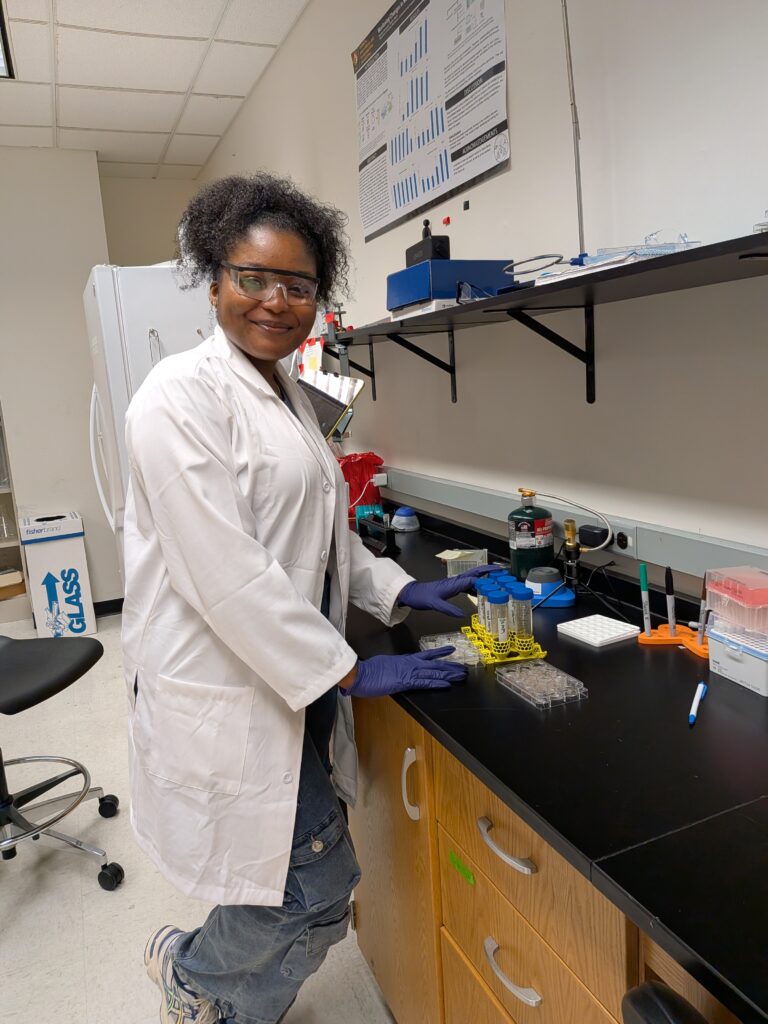
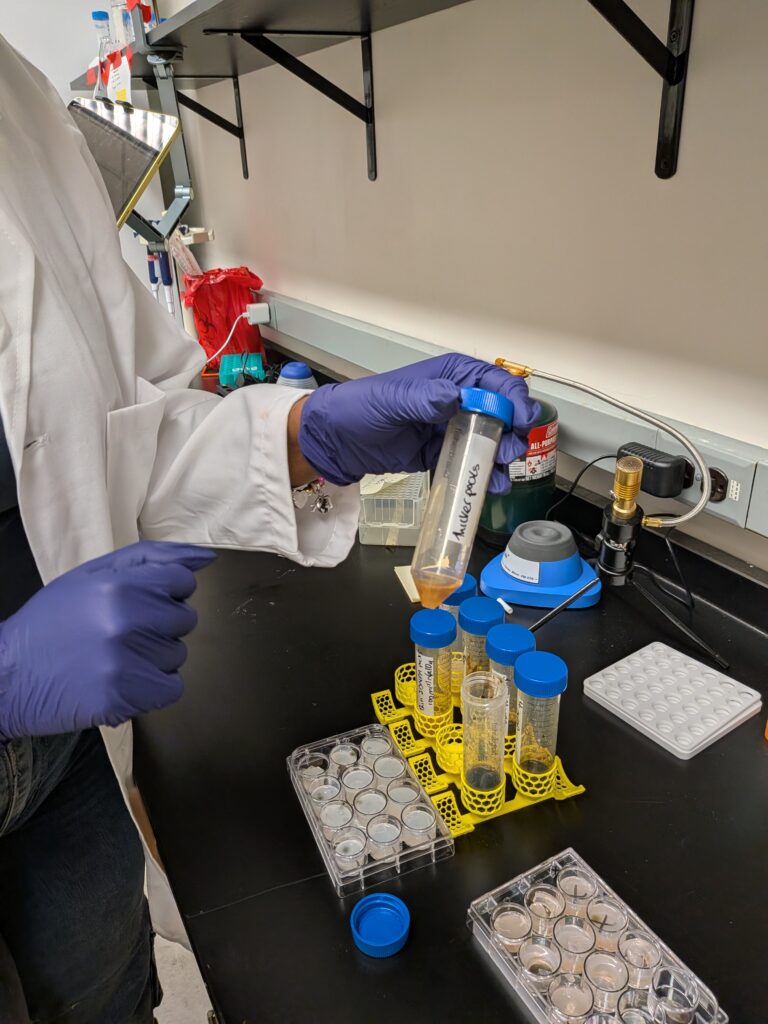
Young shows the vials of bioplastic she is making in the lab. (UMBC)
AI-assisted countermapping and better bioplastics
The program connecting the BCCC students to COEIT was conceived and led by Jorge Almodovar, associate professor in the Department of Chemical, Biochemical, and Environmental Engineering, who had run a similar program when he was at the University of Arkansas.
COEIT worked with partners in BCCC to recruit students, who were then matched with a faculty researcher based on the students’ interests. Each student received a $3,000 stipend from the COEIT dean’s office for their summer work.
Clinton says she came into the program hoping to “dip my toe into something different, go to a new campus, and learn from some new individuals.” She became instantly intrigued when she heard about Williams’s idea for a project looking to make alternative, community-focused maps of Baltimore, a practice called countermapping.
Clinton spent a large portion of the summer visiting neighborhoods around Baltimore, interviewing people and taking pictures—information that could supplement historical redlining details and demographic and socioeconomic datasets on new maps. She is now thinking about the best ways to use technology to synthesize and display the information and how she might share the interactive platform with others, such as students, teachers, and community members.
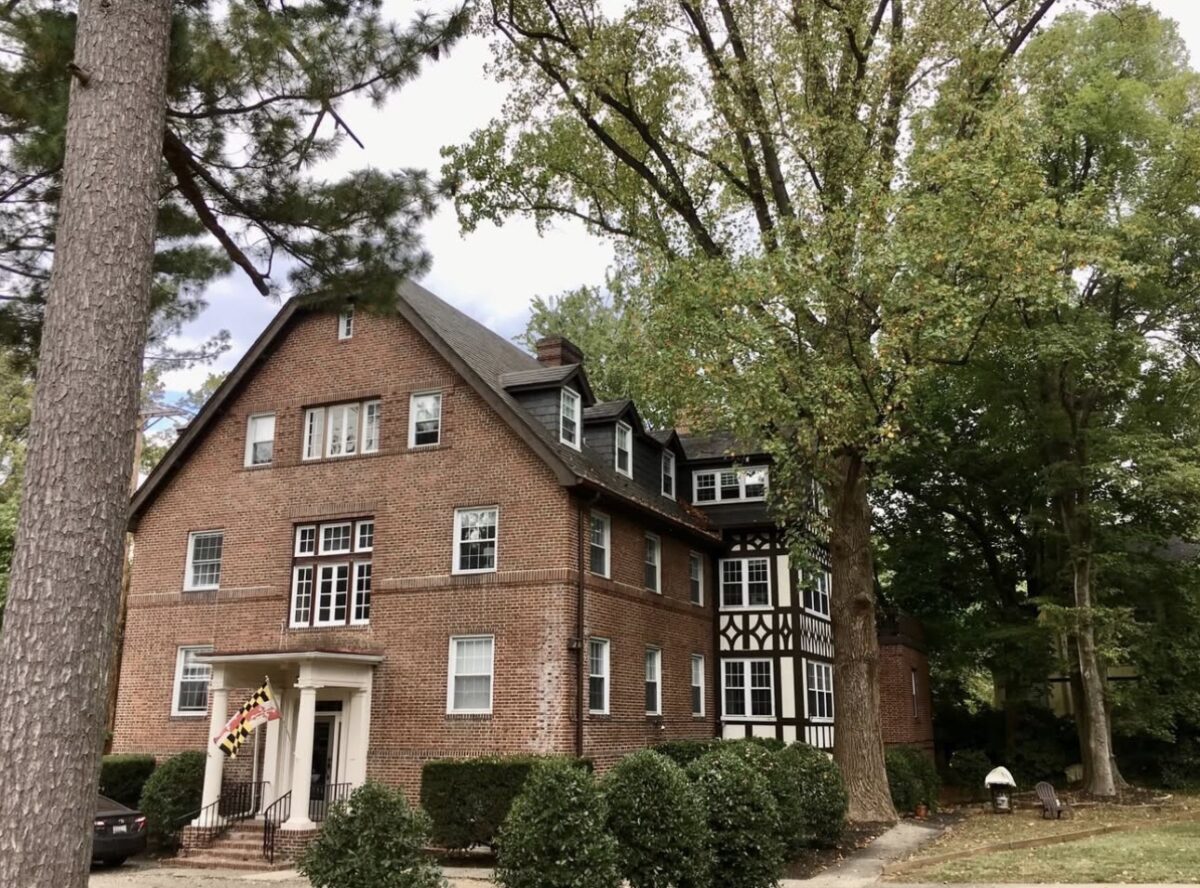
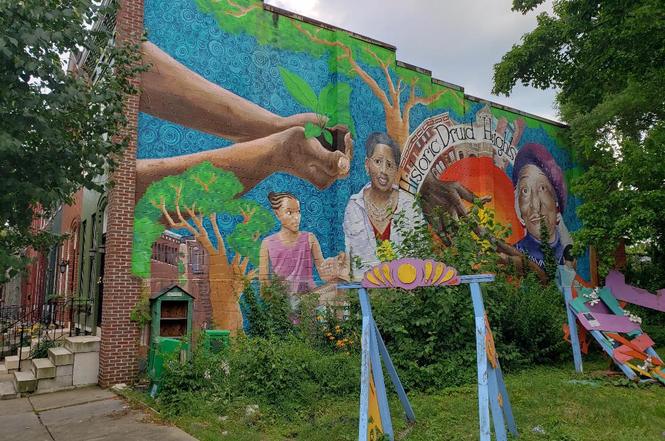
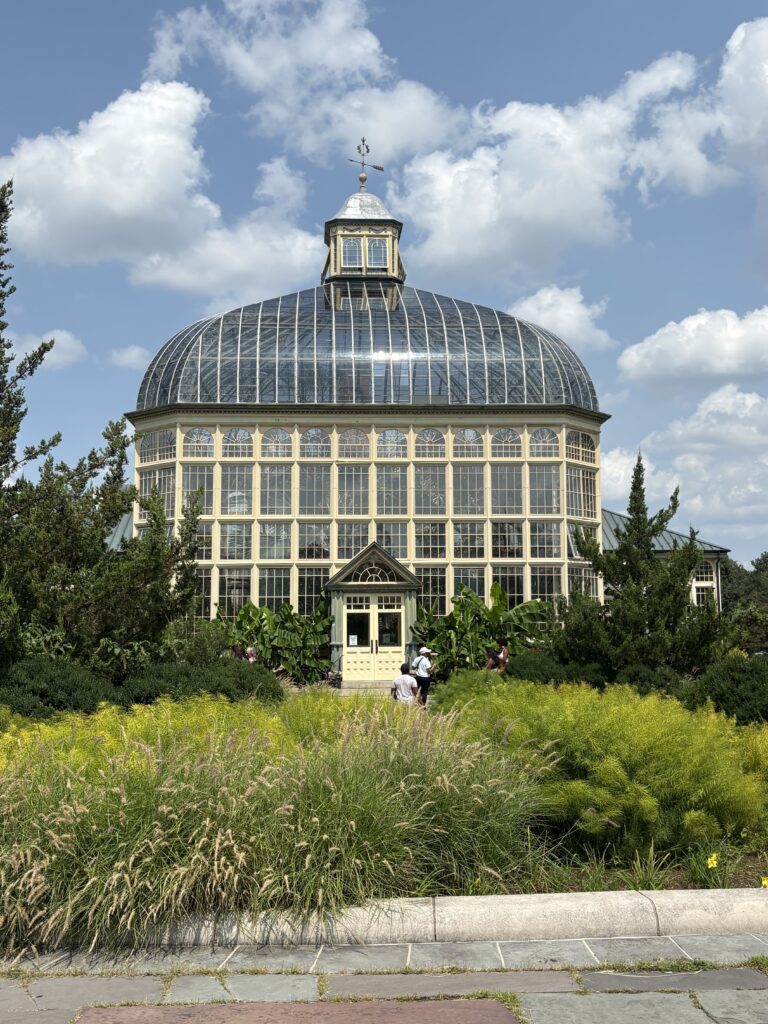
Clinton took photos around Baltimore neighborhoods, including a house in Roland Park (left), a mural in Druid Heights (center), and the Howard Peters Rawlings Conservatory and Botanic Gardens in Druid Hill Park (right). (Photos courtesy of Clinton)
Clinton says one of the most memorable parts of the experience was when she was taking pictures one day and was approached by an older gentleman, who asked what she was doing. She explained the project and its goal of showcasing resident-centered stories from Baltimore communities. Clinton says she did not know what kind of reaction to expect, but the gentleman’s one-word reply meant a lot to her: “Finally,” he said.
Young also found a lot of meaning from her project—working to standardize the production of bioplastics in the lab so that future research could more effectively evaluate new methods of improving the plastics’ material properties, such as flexibility and strength. She says the early stage of the research was appealing: “It was like a clean slate, and I could imagine it growing in so many ways.”
Bioplastics, made from renewable organic materials such as plants or microbes, are more sustainable than petroleum-based plastics, and many are more biodegradable. Young, who plans to eventually go to medical school, says she could envision one day people making bandages from bioplastics and incorporating clinical treatments such as antibiotics to help to heal wounds without contributing to plastic pollution.
The broad benefits of research collaboration
The BCCC-COEIT summer program overlapped with the existing COEIT Student Summer Project (CSSP) awards program, which supports UMBC student researchers. Clinton and Young joined the CSSP students in professional development programming, including weekly check-in meetings, and workshops on writing an abstract, creating a poster, and exploring student entrepreneurship. Both Clinton and Young presented posters at the university-wide Summer Undergraduate Research Fest in early August and at the end of summer COEIT poster session later that month.
“From the students’ perspective, a program like this is an opportunity to be exposed to research, learn what it’s about and decide if it’s right for you,” says Almodovar. “And from UMBC’s perspective, we can build connections with local community colleges and directly engage students with the opportunities we have to offer.”
COEIT student researchers met with President Valerie Sheares Ashby during the summer. (Photo courtesy of Chloe Evered)
Almodovar hopes to expand the program to more students from more community colleges next year and together with Williams has submitted a proposal for funding from the National Science Foundation for this purpose.
The professors involved have already seen how such programs can alter the trajectory of individual lives. Almodovar says one of the community college students he worked with when he was at the University of Arkansas, Melanie Nelson, is now at UMBC pursuing a Ph.D. in biology, while continuing research with him.
Garcia notes that he got his own start as a science researcher while still an undergraduate, through a program offered at the University of Wisconsin. “These types of programs are a great way to facilitate new projects and bring in new students, so I’m pretty big on them,” he says.
This year’s participants in the BCCC-COEIT program have certainly seemed to catch the research bug. This fall, Young transferred to UMBC as a biology major and is continuing to work on bioplastics in Garcia’s lab.
Clinton is finishing her associate’s degree at BCCC, while considering her next steps.
“I’ve applied to multiple programs and I’m evaluating my options. But I’m really thinking it’s going to be UMBC—for a bachelor’s, a master’s, and maybe even a Ph.D.” she says.
Akshay Java, M.S. ’03, Ph.D. ’08, computer science, is a seasoned technology leader whose career spans key roles across the tech industry, including research at Microsoft, co-founding a successful start-up, and leading critical user protection efforts at Google. In his roles at Google across Egregious Harms Protections and Responsibility AI Engineering, he works daily on the front lines of digital safety, addressing both the serious risks and the transformative potential of modern computing technology.
“Technology by itself is not necessarily good or bad, what matters is how we choose to use it,” Java says. “But AI is moving so quickly now—community and technical leaders need to be engaged, making sure the good use cases can be advanced rapidly while preventing the bad from happening.”
It was in this spirit that Java made a generous donation to UMBC to launch the Computing for Social Good Award, to be given annually to one or more students in the College of Engineering and Information Technology (COEIT) who have conducted substantial research with the goal of harnessing technology to make positive social change. The awards are funded by an endowment, which is open to contributions from the community. In May of this year, two students—Rishav Gupta, a Ph.D. student in computer science, and ASM Mobarak Hossain, M.S. ’26, information systems—received the inaugural awards for their work in affordable health monitoring and wheelchair accessibility, respectively.
“We are tremendously grateful to Akshay Java for establishing the Computing for Social Good Award in COEIT,” says Dean Jeanne van Briesen. “His commitment to supporting research that combines technical excellence with meaningful societal impact reflects values that are central to our college. This award celebrates the creativity and dedication of our student researchers and reinforces our belief that engineering and computing can be powerful forces for positive change.”
Monitoring cardiovascular health and improving wheelchair accessibility
Both recipients of the 2026 awards talked about how meaningful it was to them to apply their technical expertise to work that aims to improve people’s lives.
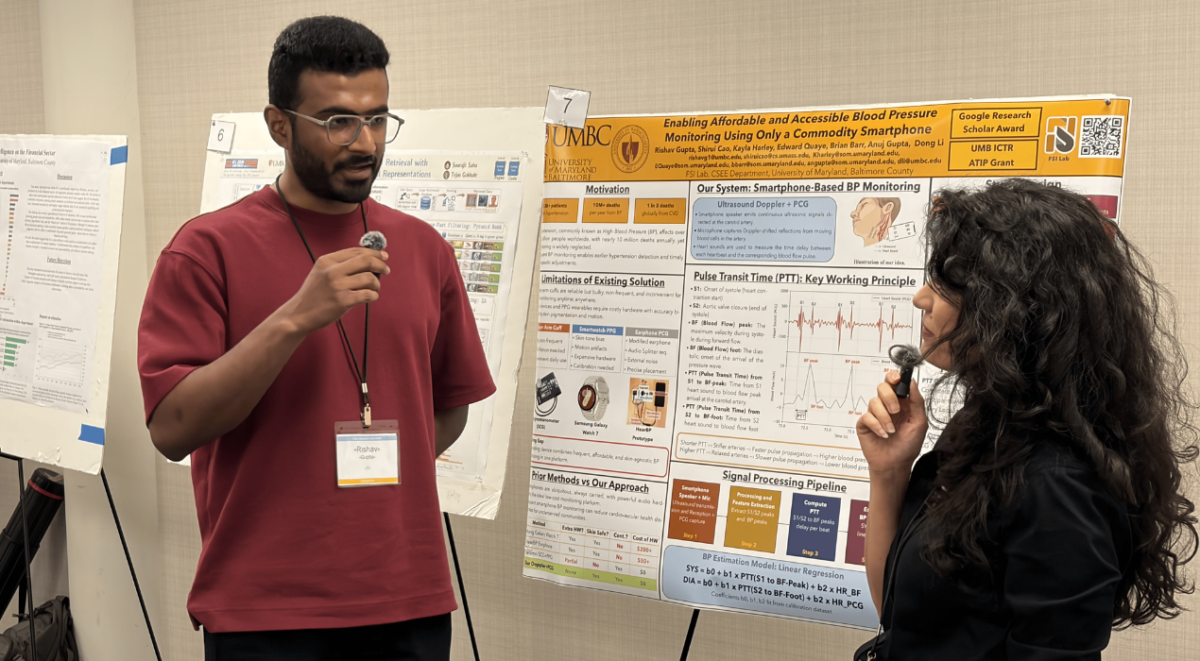
Gupta is working in the lab of his advisor Dong Li on tools to make blood pressure monitoring affordable and accessible using only a commodity smartphone. Hossain worked on a project with advisor Md Osman Gani to develop MyPath, a Google Maps–style app that uses AI, remote sensing measurements, and crowd-sourced data to guide wheelchair users to accessible routes.
Ph.D. student Rishav Gupta presents at UMBC COEIT Research Day 2026 in front of his poster, “Enabling Affordable and Accessible Blood Pressure Monitoring Using Only a Commodity Smartphone.” (Photo courtesy of Gupta)
“Receiving the COEIT Computing for Social Good Award felt meaningful in a way I didn’t expect,” Gupta says. “I came to UMBC from a career in industry because I wanted my work to matter beyond a product. Being recognized for the research’s social impact felt like confirmation that I’d chosen the right path.”
“Developing MyPath required countless hours of hard work, continuous refinement, and a deep commitment to addressing a meaningful community need,” Hossain says. “Seeing that work recognized by COEIT was incredibly exciting and humbling—it gave me a strong sense of pride in what we’ve built and renewed enthusiasm for creating tools that deliver genuine social value.”
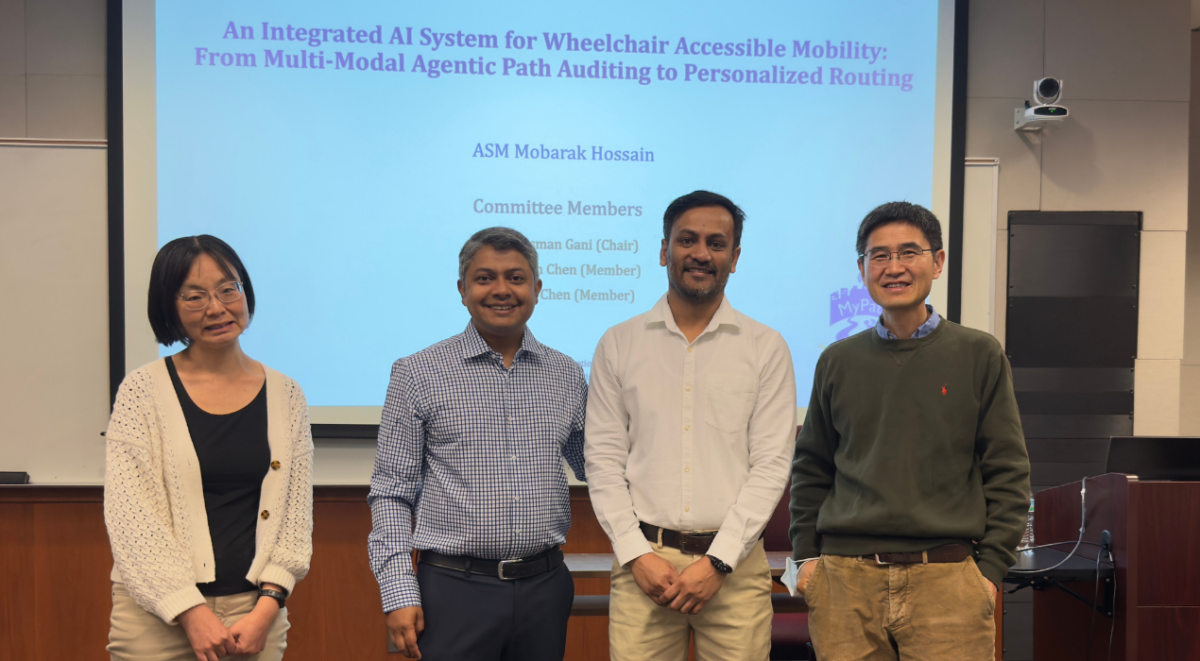
Hossain after his master’s thesis defense at UMBC. From left to right: Karen Chen, Md Osman Gani, Hossain, and Zhiuyan Chen. (Photo courtesy of Hossain)
Seeing the students and the work they are doing has been the most meaningful part of the award process, Java says. “I’m so proud of the students for what they’ve achieved. And I hope this award inspires more students to apply their skills in this space of social good.”
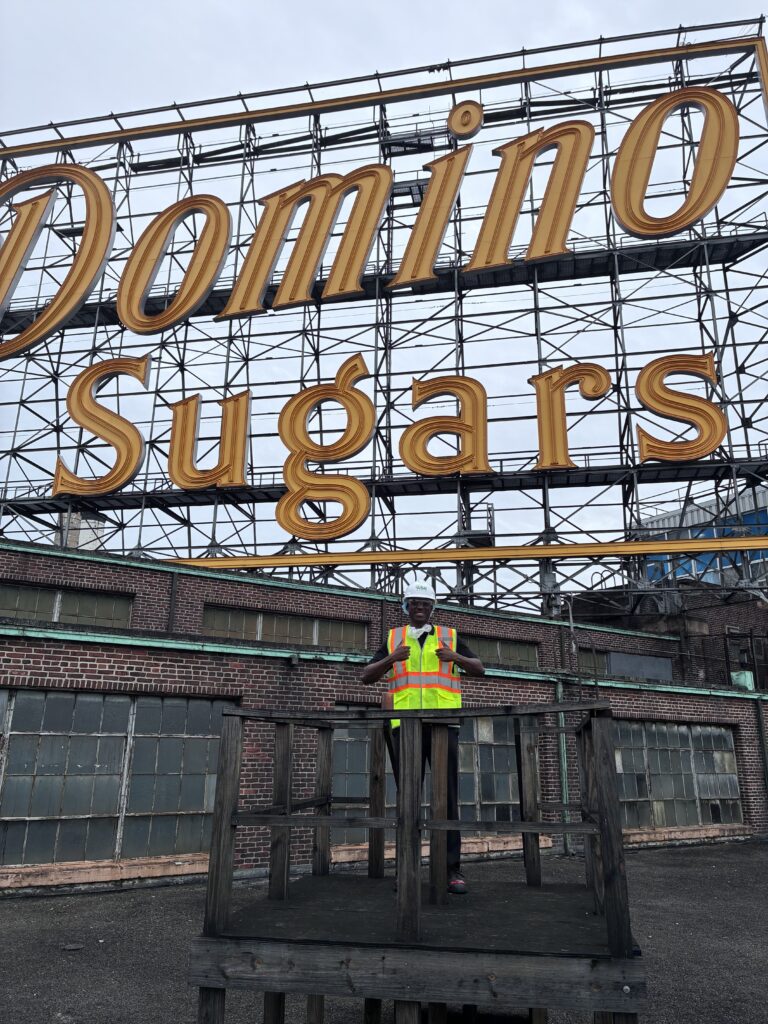
Pelumi Enilolobo outside the Domino factory. (Photo courtesy of Enilolobo)
On a typical day this summer, you may have started the morning stirring sugar into your coffee. After checking the weather forecast or making a few calls on your cell phone, you may have then logged into secure networks to access work data or conduct financial transactions.
And this summer, four UMBC students learned how they could contribute to the complex choreography that lies behind such seemingly simple actions in the modern world.
Pelumi Enilolobo, a rising senior in mechanical engineering, worked at the historic Domino Sugar facility in Baltimore, optimizing packaging operations; Yash Diggikar, a Ph.D. student in computer science, worked for NASA Goddard in Greenbelt on AI-assisted weather and earth-system modeling; Kaleem Butt, a rising senior in computer engineering, worked at Catonsville-based company RF Safety Laboratory, LLC, helping to test if the radio frequency emissions for new wireless consumer devices stay within safe limits; and Joycelyn Chow, a rising junior in computer engineering, worked for the Johns Hopkins Applied Physics Laboratory (APL) in Laurel, Maryland, on cybersecurity research.
Building and strengthening connections
The companies and organizations that employed these four Retrievers are all part of the vibrant economic ecosystem in Maryland. UMBC has built relationships with many of these local employers and facilitates student connections.
Butt first learned about RF Safety Laboratory, which has offices at the bwtech@UMBC Research and Technology Park, through a LinkedIn post. He later connected with the CEO of the company at a UMBC Career Fair. “At first, they were looking for people who could work during the school year. I couldn’t do that, but we stayed in touch and I later found out about the summer opportunity and applied,” he says.
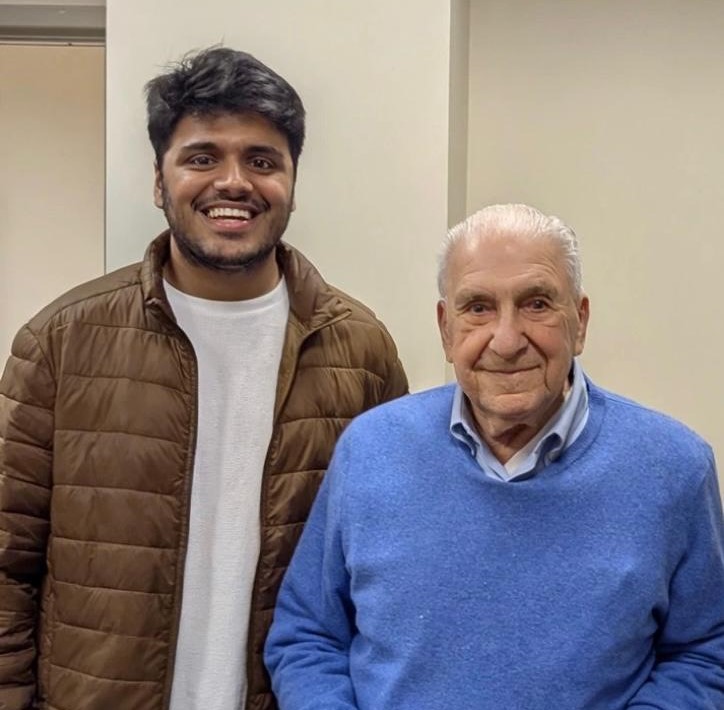
Enilolobo found out about career opportunities at Domino Sugar during a Career Center-sponsored event that brought company representatives to the UMBC campus. And Diggikar connected to the NASA project through his advisor, UMBC research professor Milt Halem, a retired NASA employee who maintains strong connections to the agency.
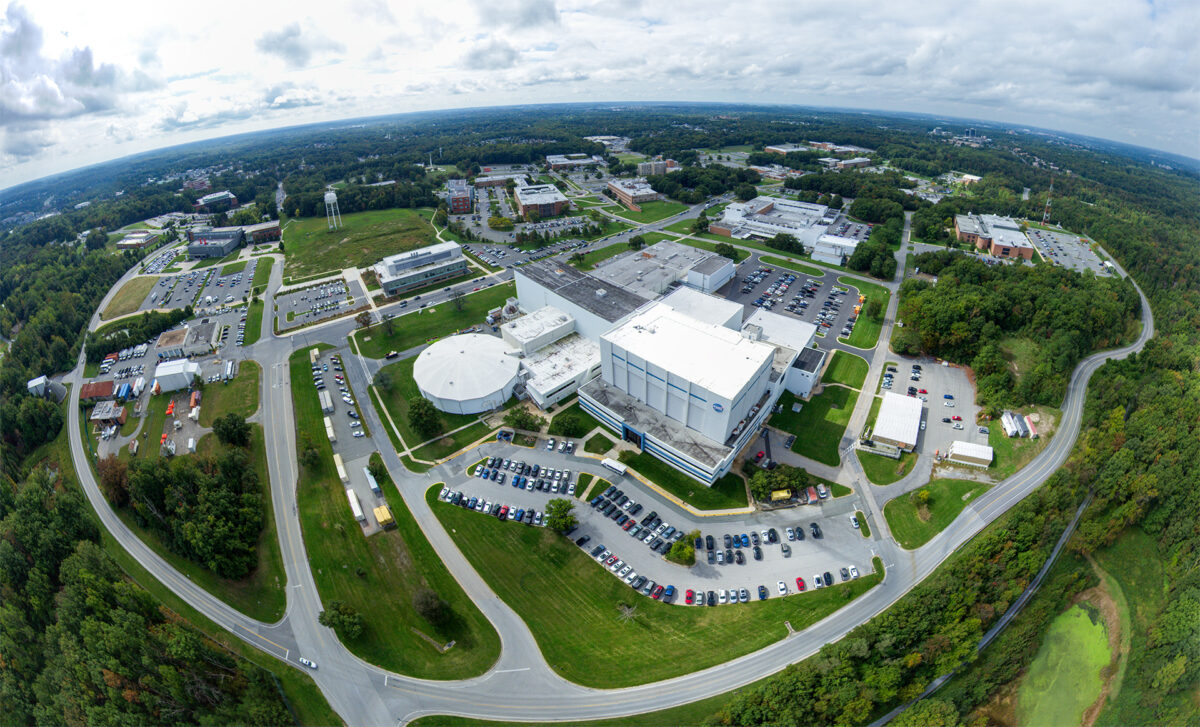
Yash Diggikar (left) with UMBC advisor and retired NASA employee Milt Halem. (Photo courtesy of Diggikar). On right, the NASA Goddard campus. (NASA/Francis Reddy)
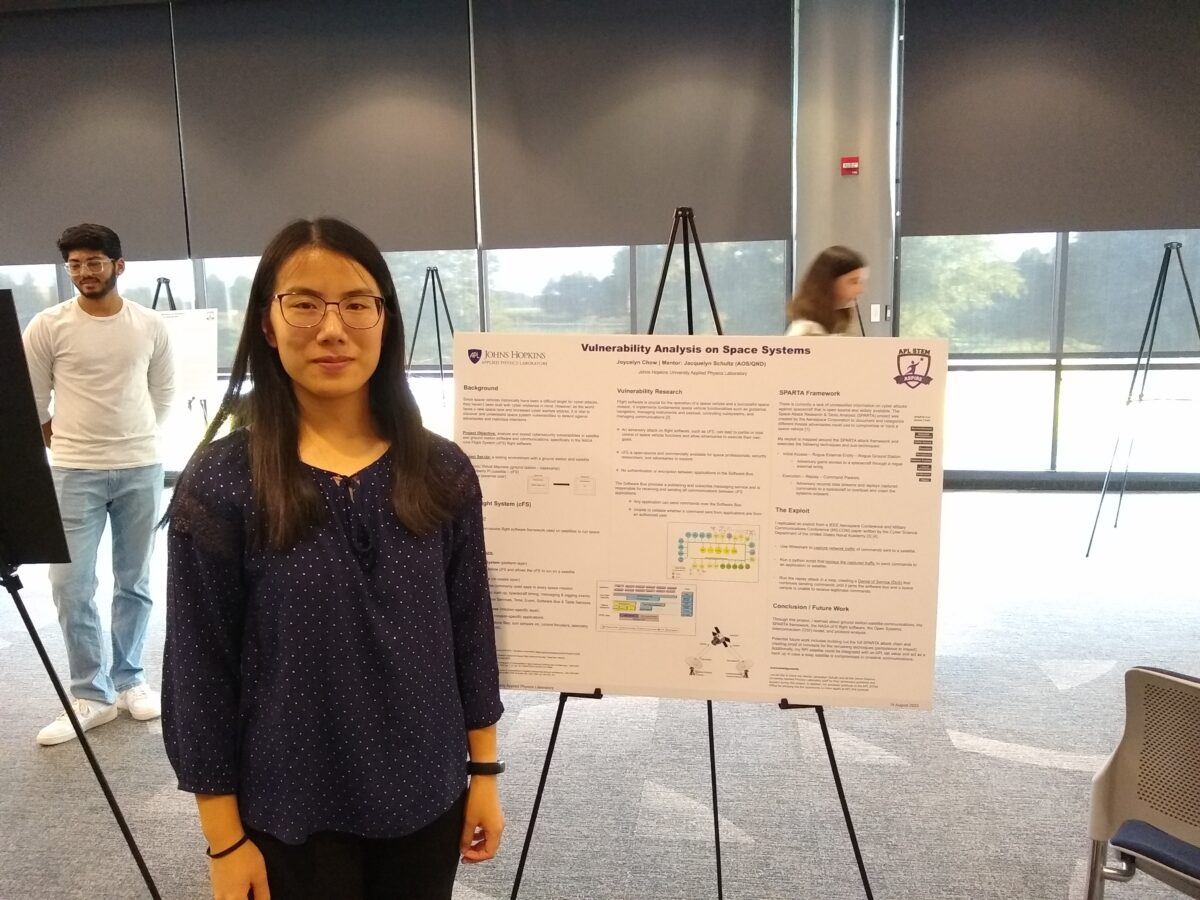
While Chow was already familiar with APL from her years attending their ASPIRE high school internship program, she connected with colleagues and mentors at the lab who also attended UMBC. “One of my mentors, Jackie Schultz [’20, information systems], was in the same scholars program—Cyber Scholars—that I’m in right now at UMBC,” Chow says.
A summer of insights
For all four students, the summer offered the chance to contribute, connect, develop their skills, and discover insights that will shape their future careers.
Chow says she really values the strong team culture at APL and could easily see herself working at the lab full time after graduation. “The lab works on so many interesting problems, such as addressing the cybersecurity risks for satellites and other technology that wasn’t necessarily built with these concerns in mind,” she says.
Joycelyn Chow stands with a poster about her summer internship work in 2023 at the ASPIRE Showcase (left) and with fellows APL interns in summer 2025 (right). Fellow Retriever Anugrah Zachary is on the far right. (Photos courtesy of Chow)
Diggikar says his summer work at NASA has clarified the direction of his Ph.D. research, which will look into how machine learning can speed up predictions of the Earth’s weather systems. “I have started to actually see a path, and how people can start a research project and end up at the end goal,” he says.
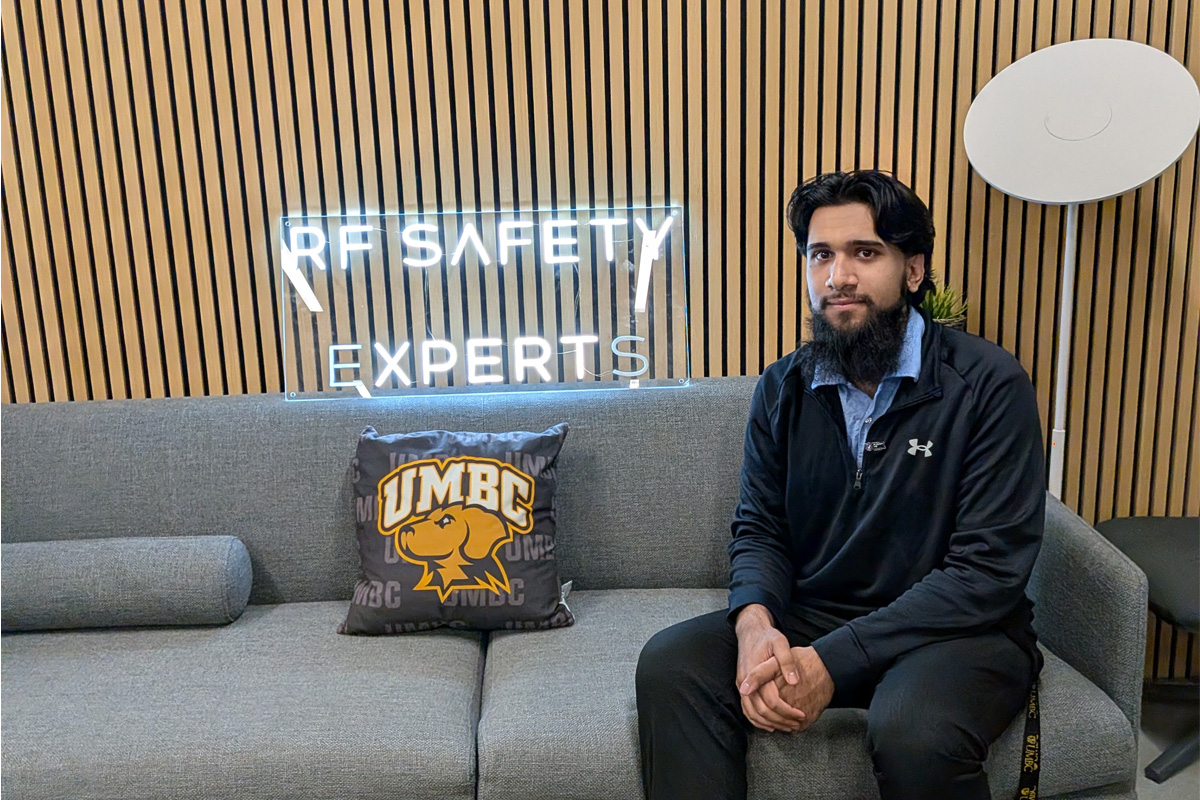
Kaleem Butt in the RF Safety Lab common room. (UMBC)
Enilolobo says he realized the sweet spot of taking ownership of his work and proactively reaching out to colleagues and mentors at Domino. “At work, you pretty much have to go find people who can help you,” he says. “You have to be assertive, and get your stuff done. I feel like that’s a very good way for somebody to grow, and it’s helped me a lot so far.”
Both Enilolobo and Butt remarked on how much they enjoyed the hands-on nature of their summer work. Enilolobo says he spent about 60 percent of his time on the factory floor, observing how machines pack sugar into 50-lb bags. In the bwtech office, Butt worked in a testing lab filled with electrical equipment and fellow engineers. “If I ever had a question, they would immediately jump up and help me,” he says.
And sometimes an insight came from an unexpected place. Butt says he hadn’t thought much about company size when considering jobs. But when he had to take time off for ACL surgery during the summer, all his office mates threw him a surprise party, with plenty of cake and well wishes. The moment really stuck in his mind. “Working for a small company, it feels like family,” Butt says. “It’s been amazing.”
David Mountain, Ph.D. ’17, computer engineering, can’t tell you much about his job. It still sounds exciting. As a researcher at the National Security Agency (NSA)—sometimes jokingly called the “No Such Agency” because of its top secret signal intelligence and cybersecurity work—Mountain worked to develop groundbreaking computing technology over a career spanning more than four decades.
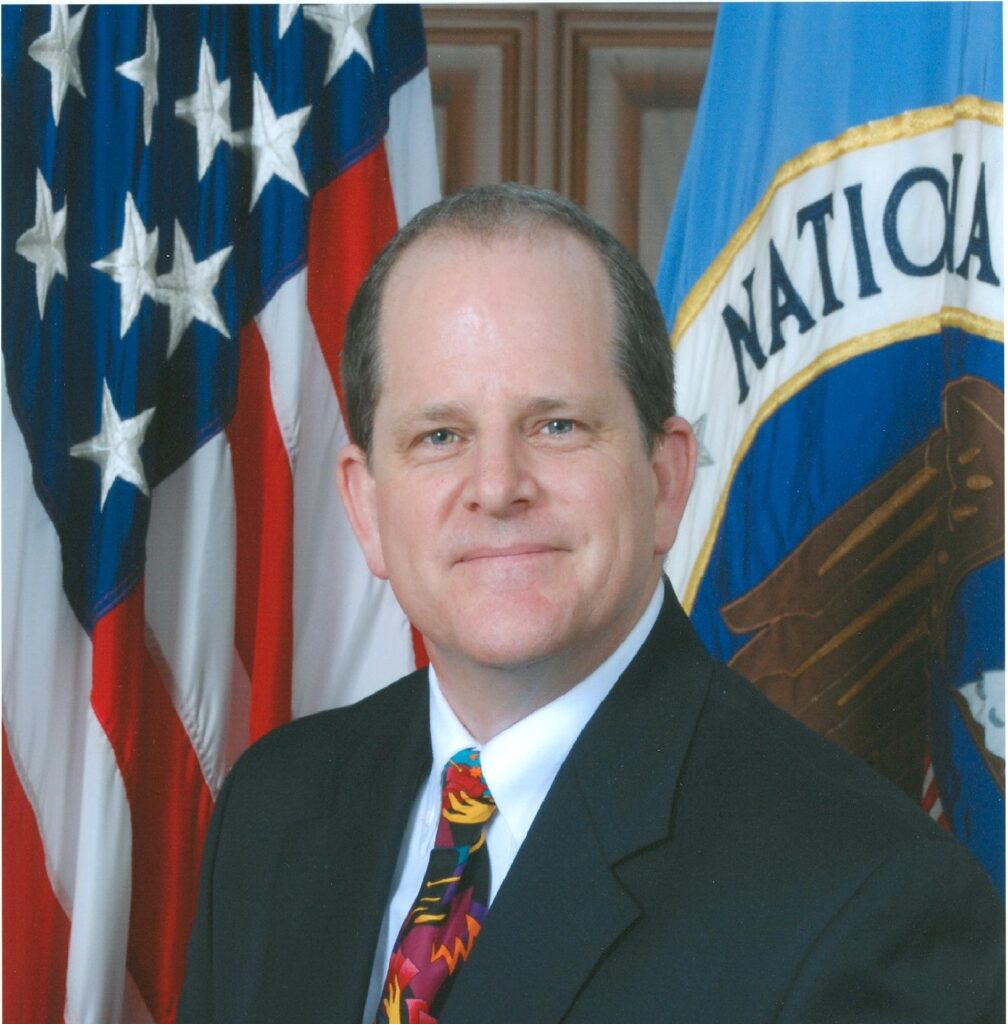
David Mountain worked his entire career for the U.S. National Security Agency. (Photo courtesy of Mountain)
“The most fun projects started with an operational organization [within NSA] asking us, ‘Can you do this [perhaps wild-sounding] thing?’ and ended with them telling us they fielded the devices we built and they are working great,” he says.
Pop culture often portrays the NSA as a shadowy spy agency. From Mountain’s perspective, his job was not the thrilling escapades of James Bond, but had a certain resemblance to the high-tech wizardry of Q, who supplies Bond with his cool gadgets. Mountain’s colleagues were curious people who loved tackling hard science, math, and engineering problems. Add to that the mission of protecting U.S. national security and it equaled a fulfilling work environment.
Looking back, Mountain splits his career into two approximately 15-year blocks, the first spent “doing really hardcore technical stuff,” from which he earned numerous patents, and the second half coordinating the work of technical teams and mentoring the next generation of researchers. Along the way, he also spent multiple years taking advantage of NSA internship and development programs.
Now (mostly) retired, Mountain says the best part of his job was the opportunity to constantly explore new topics and take on new challenges.
“The government was really good about education and developing people, and I took full advantage of that,” Mountain says. “I got paid to learn new things, and that was great.”
Imagining a new type of computer hardware
It was the love of learning that brought Mountain late in his career to UMBC as a Ph.D. student. He had already made use of NSA programs to earn his master’s degree in electrical engineering from the University of Maryland, College Park, and to take research sabbaticals. After enrolling as a UMBC student in 2014, Mountain worked with his advisor Anupam Joshi, a computer science and electrical engineering professor and now the university’s chief A.I. officer, on a Ph.D. dissertation exploring a concept called neuromorphic computing.
In neuromorphic computing, researchers take inspiration from the human brain to reimagine traditional computing hardware. While traditional computers perform data processing and memory operations in physically separate units, neuromorphic systems merge the functions at artificial “synapses.” Neuromorphic systems also generally trigger calculations when they receive an input signal, rather than performing operations at regular, clock-based intervals. These changes improve computers’ energy efficiency and adaptability when applied to most AI tasks today, such as image and speech recognition.
For his Ph.D., Mountain analyzed a new type of electrical circuit building block, called a memristor, that shows promise in neuromorphic computing. Mountain explored how arrays of memristors divided into small chunks, or “tiles,” could be flexibly combined to handle a variety of tasks, including recognizing hand-written digits and detecting malware. The conclusion, Mountain says, was that with additional hardware improvements it should be possible to build a general purpose neuromorphic computer—similar to our general purpose personal computers of today—that could handle a wide variety of tasks with both high performance and energy efficiency.
Mountain was drawn to UMBC for his Ph.D. in part because of its close proximity to where he worked in the Advanced Computing Systems group of the NSA’s Laboratory for Physical Sciences, located at the bwtech@UMBC Research and Technology Park. The Laboratory for Physical Sciences is a partnership that the government runs with industry and university partners to advance research in communication, sensing, and computer technologies. Prior to beginning his Ph.D. work, Mountain had developed many positive relationships with UMBC faculty and students, including collaborating with Matthias Gobbert, a professor of mathematics and statistics at UMBC, on several high-performance computing research projects for undergraduate students, funded by the National Science Foundation.
During his Ph.D. research, Mountain took numerous UMBC graduate courses, and credits computer science and electrical engineering professor Fow-Sen Choa and associate professor Ryan Robucci with providing valuable guidance and support that shaped his research.
“I was a non-traditional student and everyone supported me in that,” Mountain says.
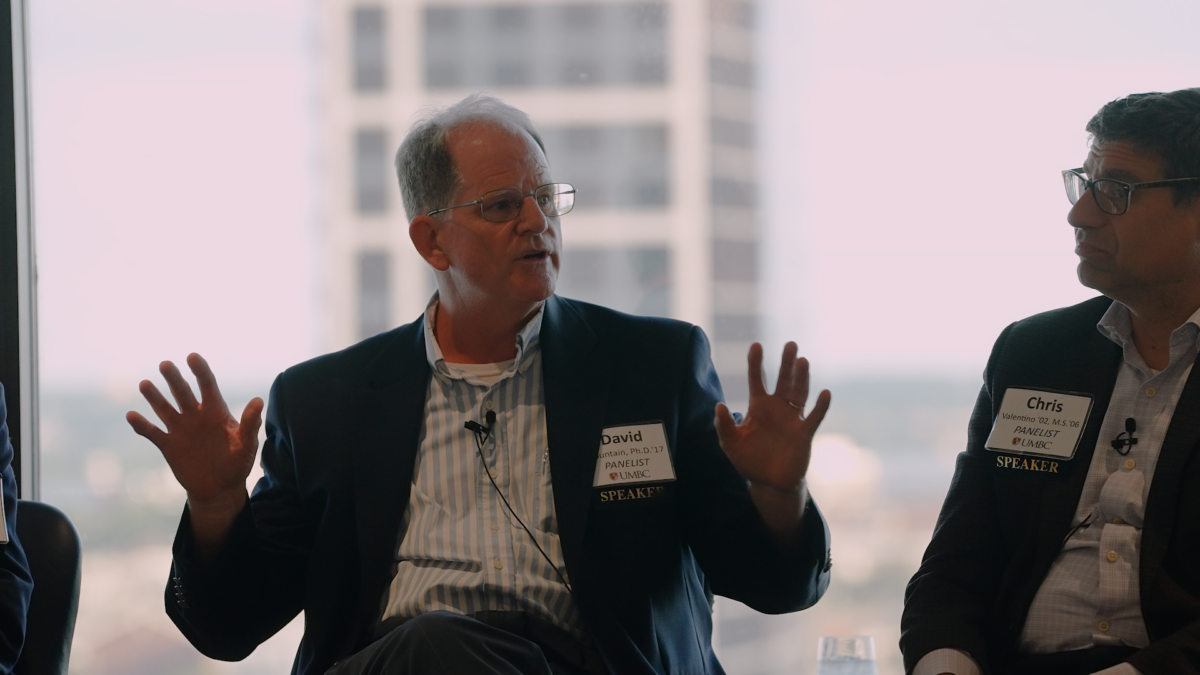
David Mountain (left) speaks at the Hilltop Society’s event “Artificial Intelligence: Making Our Lives Healthier, Safer, and More Efficient,” held at the The Center Club in Baltimore. (Elijah Davis, M.F.A. ’21/UMBC)
“David is super smart and well respected,” Joshi says. Joshi’s own Ph.D. thesis explored how computers might learn like biological brains, specifically examining how a type of machine learning approach called neural networks could be organized in a similar way to the early stages of human’s visual processing system. “With David, the research came full circle,” Joshi says. “I looked at how biology could be emulated in software. David was looking at how to create the hardware.”
Staying connected and giving back
Mountain lives in the southwest Baltimore neighborhood of Ten Hills, a 10-minute drive from the UMBC campus. Since graduating with his Ph.D., he has served on the advisory board for the Department of Computer Science and Electrical Engineering, networked with students at various career-focused events, and developed and taught a graduate level quantum computing course, designed to help build the quantum workforce by providing computer scientists and engineers with an accessible introduction to core quantum computing concepts.
On May 28, Mountain served as an expert panelist at an event organized by the Hilltop Society exploring how AI can create a healthier, safer, and more efficient future. He was joined by Jennifer Sleeman, Ph.D. ’17, computer science, a senior AI research scientist at The Johns Hopkins Applied Physics Laboratory, and Chris Valentino ’02, M.S. ’06, information systems, the vice president of cyber and information solutions at Northrop Grumman.
Enjoying semi-retirement with his wife, Diane, with whom he raised four children, Mountain now regularly travels, visits the theatre and museums, and takes the occasional consulting gig. “My wife and I joke that we have become wise asses on the hill,” he says. He’s happy to dispense opinions on the future of computing and AI, the prospects of data centers in space, and more. Just don’t ask him too much about what he did for a living.
This summer, four UMBC students are getting hands-on experience contributing to efforts to rebuild the Francis Scott Key Bridge over the Patapsco River, which collapsed in March 2024 after a cargo ship collided with one of its supports. This is the second year in a row that the Maryland Transportation Authority has partnered with the Maryland Higher Education Commission to run the program.
Last year, three out of nine students in the program hailed from UMBC. This year, four out of the 10 interns are Retrievers. Mechanical engineering students Bilal Faizullah and Katelyn Prasad and geography and environmental systems students James Keller and Megan (Em) Schumacher ’26 will get the opportunity to learn about topics such as project management, environmental analysis, construction oversight, and community outreach. They will also get the chance to be a part of an iconic infrastructure project for Maryland, an experience that last year’s student interns found particularly meaningful.
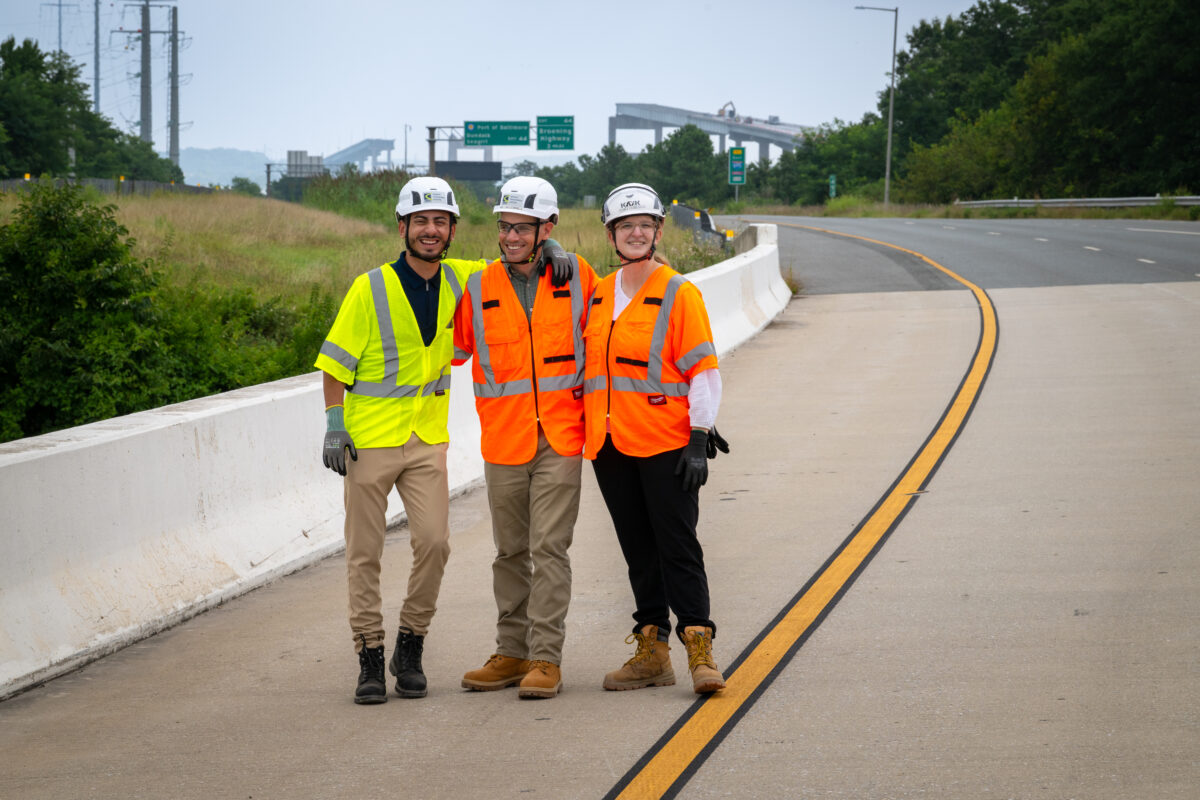
From left to right, Cristian Mena, William McConnell, and Emily DiMarzio pose for a photo near the site of the collapsed Key Bridge. The three worked on the bridge rebuilding project as interns with the Maryland Transportation Authority in summer 2025. (Brad Ziegler/UMBC)
“The Key Bridge Internship Program represents the very best of career-connected learning by giving students the opportunity to contribute to a project that will have a lasting impact on Maryland,” says Christine Routzahn, director of UMBC’s Career Center. “We’re incredibly proud that four UMBC students were selected for this prestigious program. Their selection reflects not only their talent and dedication, but also the strength of the partnerships that make opportunities like this possible. We are grateful to the Maryland Transportation Authority, Maryland Higher Education Commission, and its partners for investing in our students and in the state’s future workforce.”
As the spring semester wound down at UMBC, a group of dedicated students was gearing up for their latest adventure. The week before finals, 12 students from the Society of Automotive Engineering’s (SAE’s) Baja racing team traveled almost 3,000 miles to Washougal, Washington, just across the border from Oregon, to compete with their custom-built, single-seat, off-road vehicle in a grueling set of challenges over four days.
Baja SAE draws more than 100 college teams from around the world, who spend a whole year designing, building, and racing their cars. The competitions, which happen three times a year, present a series of tests, from static events such as safety inspections and budgeting and sales presentations, to dynamic events that test the vehicles’ acceleration, traction, maneuverability, and suspension. To cap it all off, cars then compete in a grueling, four-hour endurance race, taking as many laps as possible around a punishing track that often includes steep, dirt hills, mud pits, high-speed straights, hairpin turns, and rocky, rutted, obstacles-strewn sections. Vehicles regularly flip over. On-the-spot repairs are a must.
The UMBC car, driven by Daniel Hessler, competing at the 2026 Baja SAE Oregon endurance event (left) and hill climb event (right). (Photos by Hasan Aslam)
“I’ll remember endurance day the most, same as every competition,” says Matt Crum, a sophomore majoring in financial economics, who traveled with the team to Washington and played a key role in the design presentation. In endurance, the UMBC car completed 40 laps, earning an 11th-place spot out of 76 teams. Considering all events, UMBC finished 12th overall, and took first place in the cost event.
From June 11 – 14 the team took the car to the second competition of the year, held in Palmyra, New York, and finished 11th overall, again taking first place in the cost event. The final competition of the year will be held September 24—27 in Nashport, Ohio.
“We hold our own against much bigger, better-funded schools,” says Shawn Pourifarsi, a junior computer engineering major and co-vice president of the club. “I’m proud of that.”
Drivers hit the track on Faculty and Staff Drive Day 2025. (Video by Elijah Davis, M.F.A. ’21)
Getting their hands dirty
Students on the Baja racing team, which this year includes around 20 team members pursuing a variety of majors, gain valuable experience with a wide range of engineering and business tasks. They work on design refinements using specialized software, get their hands dirty in the shop, and hone skills such as teamwork, budgeting, sales pitching, and working with suppliers.
Team members Matt Crum (left, changing a tire), Daniel Hessler, and Oscar Coreas Otero (right) work on the car in the machine shop. (Brad Ziegler/UMBC)
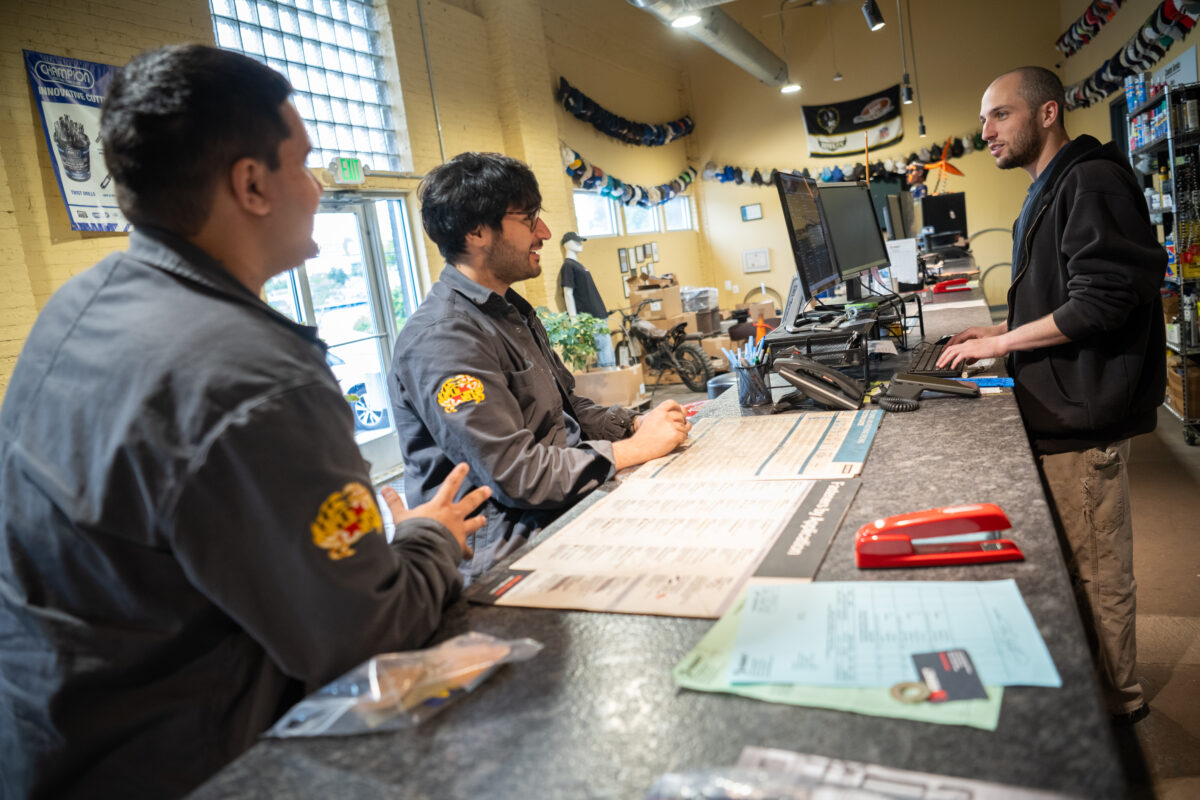
The team connects with numerous local businesses, many of whom offer support by donating parts and providing expert advice. One local sponsor, Robnet, a Baltimore-based supplier of bolts and screws, has supported the team for more than 20 years.
“We love UMBC racing,” says Eric Edelstein, head of sales at Robnet, as he helped students get an important bolt before they headed across the country for the first race of the season.
Racing club members put in varying hours, depending on their responsibilities and their availability. Collectively, they spend more than 1,000 hours each year working on the car. For the students who become deeply involved in the team, the experience is deeply rewarding.
William Busch (left) and Shawn Pourifarsi (center) speak with Eric Edelstein, head of sales at Robnet. (Brad Ziegler/UMBC)
William Busch, a senior majoring in information technology, was one of the drivers of the car at the Washington/Oregon event. He says entering the competition site on the first morning of the event was especially memorable. “It was the second time I had been to the event site with our team, once in 2023 as a freshman and again now as a senior. So it felt like a real full circle moment,” he says.
“I joined the Baja team because I really liked cars,” says Crum. “I stayed because the culture is undeniably the best. I learn things every day that I wouldn’t be able to learn anywhere else.”
Club president Aiden Dement, a senior majoring in mechanical engineering, offers an even simpler reason for staying involved: ”It gets me out of my dorm room,” he says. Several thousand miles of road-tripping later, you could conclude the experience is certainly living up to that goal.
The team visited Badlands National Park in South Dakota on their road trip west, stopping to photograph the car against the backdrop of the park’s distinct geological formations. (Photo by Hasan Aslam)
AI is poised to reshape nearly every sector of the economy in the coming years and UMBC is adapting its curricular offerings in a variety of ways. One specific change: The university is launching a new master’s degree program to prepare students to lead the AI transformation. The new M.S. in AI program, designed for students with some computing background, offers a focused, rigorous pathway into AI research, development, and deployment.
“Within the state of Maryland and our region, there are a number of national labs and industries that are really focused on AI. This program is responding to workforce demands and really preparing students for the world of AI,” says Dmitri Perkins, a professor and director of graduate programs in the Department of Computer Science and Electrical Engineering at UMBC.
UMBC’s Division of Research and Creative Achievement recently announced the recipients of the 2027 Strategic Awards for Research Transitions (START) and the 2026 Summer Research Faculty Fellowship (SURFF) awards, two of the university’s primary, internal funding opportunities that support faculty-led research and creative work.
The latest awards cover diverse projects, including exploring the genetic origins of a neurologic disorder in Siberian huskies, securing smartphones against voice scams, building novel animated sculpture, and exploring the legacy of Argentine-born American cellist Ennio Bolognini.
In total for fiscal year 2027, 12 faculty members and researchers across UMBC’s three colleges and the university’s research centers were awarded up to $25,000 in START funding to advance their research and creative projects. The awards help recipients build research momentum early in their careers and hone their research pitches to pursue external funding. They can also help faculty pivot to new fields of inquiry later in their careers.
For summer 2026, 21 faculty members received a SURFF award, which supports non-tenured, tenure-track faculty members in pursuing research and creative achievement projects during the summer. Recipients are awarded $8,000 in funding.
“Each year when we review applications, we find we have so many faculty who are being very creative and really pushing the edge of what’s known in their various disciplines,” says Don Engel, associate vice president for strategic research initiatives at UMBC, who coordinates the faculty committee that reviews prospective awards. “The proposals really illustrate the breadth of achievement that goes on across the university.”
Magnets often attract curious minds. Einstein told of his profound sense of hidden order after witnessing the invisible forces of the Earth’s magnetic field guide the needle of a compass. For Ethan Bowers, it was the wonder of learning Maxwell’s laws—equations developed by 19th-century Scottish physicist James Clerk Maxwell that unite magnetism, electricity, and light—that really pulled him in.
Now a Ph.D. student in mechanical engineering, Bowers is building a massive, one-of-a-kind research magnet. It weighs more than 2,300 pounds and will be capable of generating a magnetic field of 7 tesla (roughly 140,000 times stronger than the Earth’s magnetic field and more than twice as strong as the field in most MRI machines).
Making the magnet has been the labor of multiple researchers over more than a decade, led by mechanical engineering associate professor Carlos Romero Talamás, who plans to use the magnet to conduct experiments on plasma, the superheated soup of particles found in stars, lighting, and the Aurora Borealis, and which makes up more than 99 percent of the visible universe.
An initial magnet design and analysis was completed by Evan Bates, M.S. ’15, Ph.D. ’18, mechanical engineering. In 2023, Bowers, who had returned as a student to UMBC following a stint in industry, joined the project. He redesigned key aspects of the magnet and began the meticulous work of assembling and testing it. In the coming months, Bowers plans to run the magnet up to full strength. Then the real fun begins: Unleashing the new tool to help answer the questions curious minds dream up.
Tools of the trade
Mechanical and electrical know-how
Perseverance
Heavy-lifting equipment (custom designed)
A serious power source and some chilled water (things are going to get hot)
Step 1: Brush up on your magnet basics
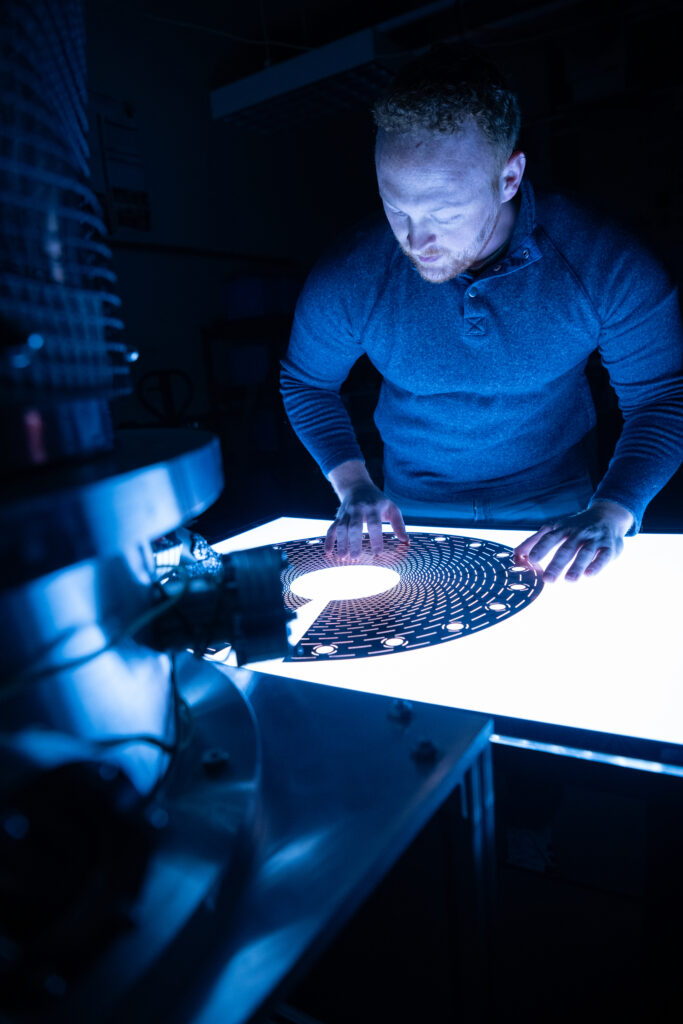
Bowers illuminates a Bitter disk with a backlight. (Brad Ziegler/UMBC)
Say “magnet,” and many people think first of the objects affixing their kids’ artwork to the fridge. Refrigerator magnets are an example of permanent magnets: materials in which the electrons permanently align in a way that generates a magnetic field. Permanent magnets can get quite strong—such as the rare earth neodymium magnets used in some maglev trains—but they top out at about 2 tesla.
To get an even stronger magnet, engineers can turn to a phenomenon that’s captured in the Maxwell equations that captivated Bowers: Electricity and magnetism are intrinsically linked.
Electrons flowing through a wire generate a magnetic field. Coil the wire and you can create a field similar in shape to a permanent bar magnet, with distinct north and south poles. This is the electromagnet. Higher current and more coils make a stronger magnet. However, high current also risks melting your magnet into a puddle and mangling it with the enormous pressure from the magnetic field pushing on the moving electrons (called Lorentz forces).
Superconducting electromagnets, which use material with the almost magical property of showing virtually zero electrical resistance when cooled with liquid helium, can eliminate the melting risk, but are expensive and finicky to operate, and have other limitations.
Another (more old-school) solution is called the Bitter electromagnet, invented in the 1930s by American physicist Francis Bitter. In place of coiled wires, circular metal disks separated with insulating spacers create a helical path that concentrates the current. The disks are shot through with holes for circulating water to whisk away heat and the structural design counteracts the mechanical stresses. “We chose a Bitter magnet because it offered the right combination of features for the tasks we wanted to perform,” Bowers says.
Step 2: Design, test, refine, repeat
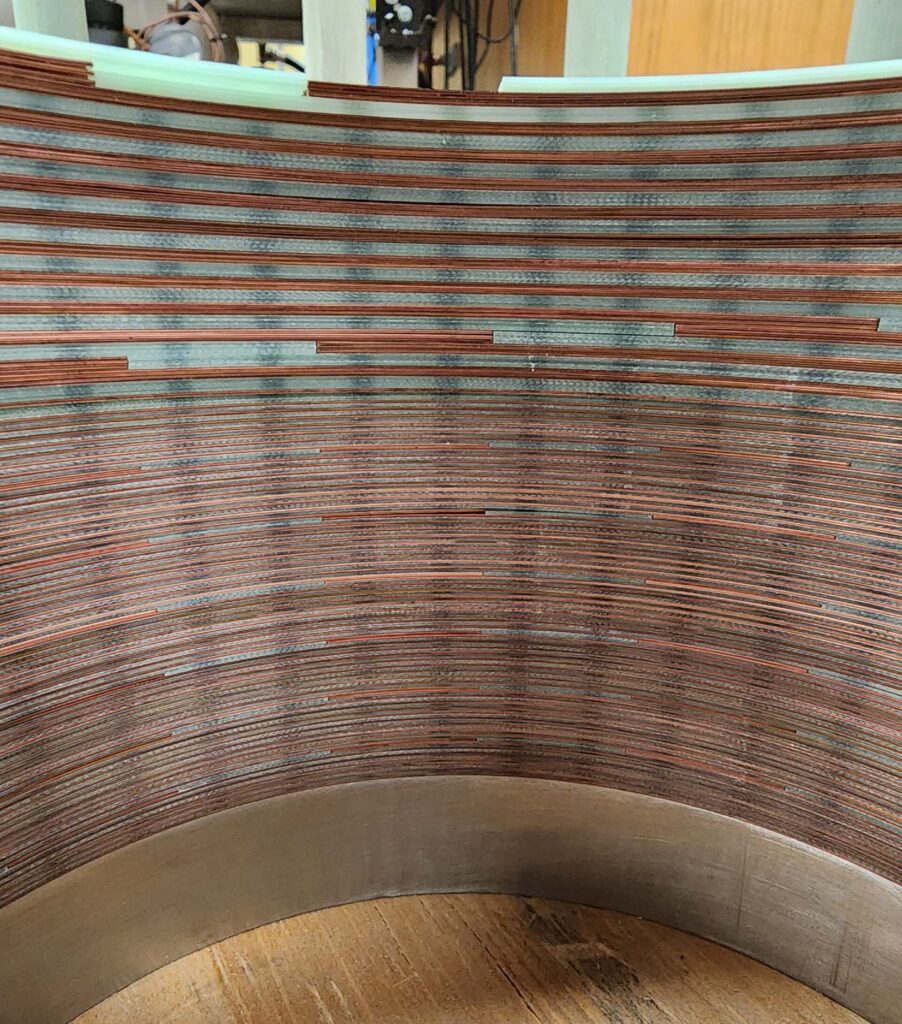
The turn density for the magnet is higher at the ends than at the middle. (Photo courtesy of Bowers)
The UMBC team’s initial vision was to create a 10-tesla Bitter magnet, with space in the center for a relatively large vacuum chamber to hold plasma. The magnet could generate either a steady or pulsed magnetic field, depending on the needs of the experiment. Bates analyzed the disk shape, stacking methods, cooling hole geometry, heat transfer, mechanical stress, and electrical properties of the magnet to optimize the design. He validated it by constructing and testing a 1-tesla prototype.
In 2023, the team decided to change the desired magnetic field profile, making it slightly higher on the ends of the magnet than in the middle, so that charged particles would be pushed toward the center. They didn’t want to redesign the Bitter disks, so they had to lower the maximum field strength to 7 tesla. They also had to vary the coil density, making tighter turns at the ends to get the stronger field.
Bowers analyzed the new field profile and worked out a clever trick of adding a tapered insulating disk to seamlessly transition between the areas of tighter and looser turns. He also performed a structural analysis of the whole assembly.
Step 3: Pallets, cranes, and painstaking planning
The final design called for 439 copper Bitter disks, four insulating transition disks, and 434 regular insulating disks housed inside a pressure vessel. Outside companies manufactured the disks, but Bowers personally inspected every single one, removing any with defects, and cleaning the copper ones with isopropyl alcohol. He built a custom pallet to hold the cylindrical assembly in place in the lab, and started stacking.
The process took about a month, and near the end “I was so sick of the monotony,” Bowers says. To push it across the finish line, he worked straight through the weekend, stacking the last disk on a Sunday afternoon in February. “It happened to be my friend’s birthday so I celebrated that completion and their birthday together,” he says.
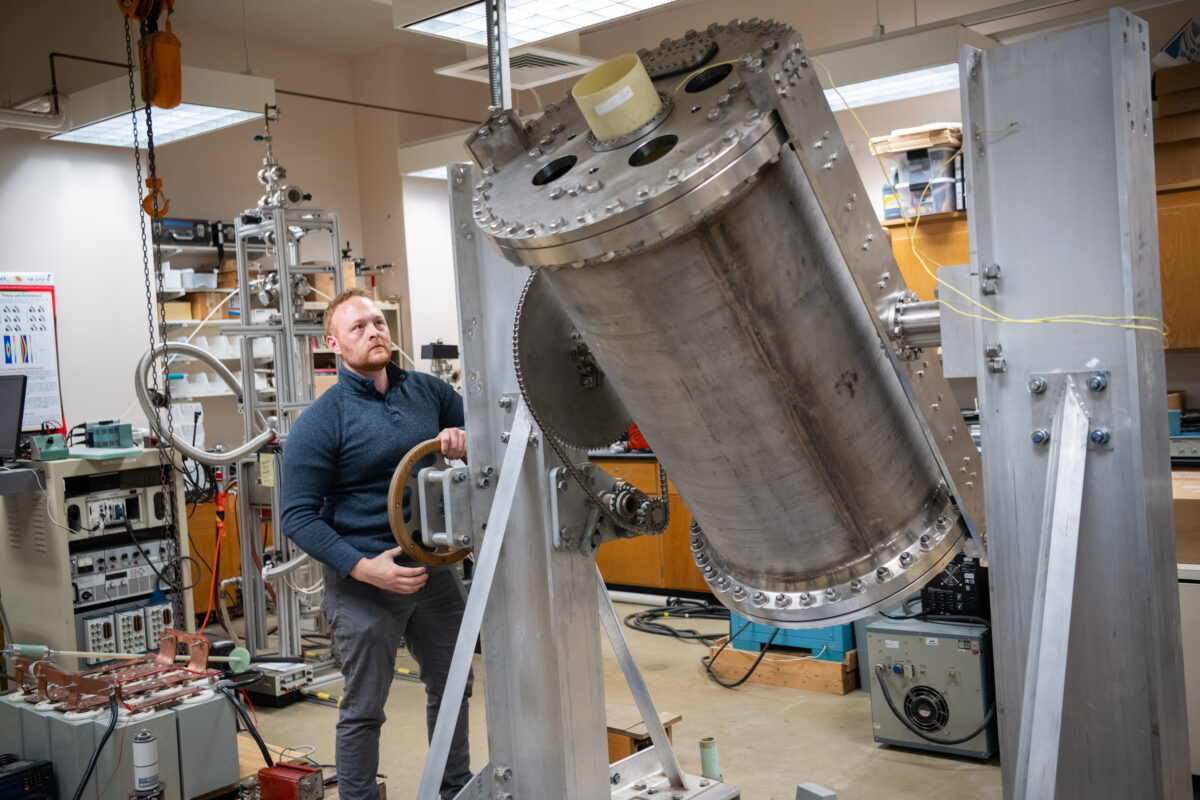
Next up was moving the approximately 2-foot-high stack of disks to a movable swing set, created by a UMBC mechanical engineering capstone team to serve as a mobile and rotatable platform for the magnet. Bowers built a custom crane fixture to lift the assembly onto the platform and spent weeks planning every step of the move. “It was the last major place the structure could fail before we power the magnet,” he says. After one stressful day, Bowers says he was elated when it all went according to plan. “I felt genuinely grateful for all I had been given the chance to work on, and grateful that God had given me the ability to succeed.”
Bowers shows how the magnet core can be rotated. (Brad Ziegler/UMBC)
Step 4: Test some more
With the core of the magnet assembled, Bowers has also begun the detailed process of testing its electrical properties, using a host of measurement equipment.
At first, he is powering the magnet with lower currents, but eventually he will send 15,000 amps through the disks, about half the current that flows in an average lightning bolt. The voltage will be about five times the voltage in a wall socket.
Safety is of paramount concern to the team when working with such high power. When the magnet is operating at full strength, the energy in two cubic feet of the magnetic field alone will be more than the energy of a small SUV zooming by at 60 miles per hour.
Bowers is working on a set of detailed instructions to address all conceivable operating, maintenance, and failure scenarios. “We’re safe. We do all our due diligence,” he says.
Step 5: Serve up some science
Once the magnet is fully up and running, the science experiments can start. Bowers and Romero Talamás have a few ideas for initial experiments, including investigating how a high magnetic field affects when a gas will suddenly switch from being an insulator to a conductor, allowing current to arc through it. They are also interested in how the magnet might be used to separate different forms of hydrogen—particularly two forms that may form the fuel for future fusion reactors to supply clean and near limitless energy.
Stars—nature’s original fusion reactors—show how plasma and magnetic fields can interact in spectacular fashion. In this image of our sun, taken in July 2012, million-degree plasma in the sun’s atmosphere began to cool and fall to the surface. Because the plasma is charged, it condensed along twisted magnetic field lines close to the surface and formed giant streaming arcs, some as tall as five Earths stacked high. (NASA Solar Dynamics Observatory)
Bowers grew up in rural Hagerstown, Maryland, a kid who enjoyed exploring everything from the rocks on the side of a path to the electrical motors his grandfather would wind. Research has offered him the chance to constantly challenge himself. After graduation, he’ll move on to new questions at the scientific frontiers, perhaps working at a fusion energy start-up or a national lab. But the 7T Bitter magnet will remain at UMBC, a gift to curious students who come after him.
Hailey Turney, M.A. ’21, first came to UMBC as a student pursuing an academic passion in the text, technologies, and literature program. She connected right away with faculty and other community members. Now, as an undergraduate academic advisor in the College of Engineering and Information Technology and an instructor teaching introductory English and university orientation classes, she helps current UMBC connect and find their own path, too.
Hailey shares what she loves about UMBC and her advising job. Take it away, Hailey!
Q: Tell us about yourself.
A: I am a COEIT academic advisor. I mostly work with mechanical engineering students now. I also teach a section of ENGL 100 each semester and UNIV 101 in the fall semesters. I love being able to help students and engage in my community, so advising and teaching feels like a great way to reach students on different levels.
When I was an undergrad, I did not have the best advising experience, so being able to make a difference as an advisor now feels like an interesting, but great, twist of fate. I also like to play Volo soccer in Baltimore and do Dog’s Day Out at BARCS outside of work!
Q: Who are some of the people at UMBC who have most supported you?
A: My amazing boss Emily Abrams-Stephens is spectacular. She supports me and my fellow advisors every day. She is always advocating for us and showing us how much she cares everyday. Working with her, I never doubt that I am valued here. She always listens to our ideas and is a fantastic (and popular) morning chat partner.
I had a previous job that weighed on me every minute of the day—even outside of work. I missed the activities I loved to do because of it. At UMBC, I have a trusting team—my boss and my fellow advisors—that supports me. If I am ever away, I know my students will be taken care of by my colleagues. The trust I have in my team is something I will never be able to replace. The most remarkable thing about UMBC is the people.
Q: What’s the one thing you’d want someone who hasn’t joined the UMBC community to know about the support you find here?
A: There will always be someone in your corner. I did my master’s here and it was the first time I immediately felt seen in my academic career. When I came to work here, I immediately felt wanted and supported. There are so many resources available to the UMBC community and there is always someone there to help you find them. As an advisor, it is now my job and honor to help students find those resources and their own supporting community.
Hailey Turney (center) laughs with Assistant Director of Transfer Success Initiatives Krista Wallace at the 2024 COEIT Celebration. (Photo courtesy of Turney)
Q: What part of your job do you enjoy the most and why?
A: I love interacting with students and helping them find their way. Being that person that they can turn to when they don’t know where to go is the most important part of our job. We want students to succeed and feel secure in their place here at UMBC.
Q: What brought you to UMBC in the first place?
A: I came to UMBC because I wanted to expand my knowledge on a topic I was passionate about. The faculty in the English department had so many interesting areas of study that I knew I would be well-supported in finding my own. After meeting with some faculty members for a graduate assistantship, I felt hopeful that this would be an interactive community. The faculty responded to my emails right away, were interested in what I had to say, and were encouraging from the beginning. I came for the academics and stayed for the community. This continued as I found a job here at UMBC as well—I was hesitant to leave.
Q: What would you tell someone who is considering a career at UMBC?
A: You will find a great community here. You will also find ways to continue to improve and learn no matter where you end up.
* * * * *
UMBC’s greatest strength is its people. When people meet Retrievers and hear about the passion they bring, the relationships they create, the ways they support each other, and the commitment they have to inclusive excellence, they truly get a sense of our community. That’s what “Meet a Retriever” is all about.
Simone Kruse had a circuitous route to UMBC. She studied fashion design in her native country, Germany, and later, came to the U.S. as an au pair and began studying at Howard Community College. The community at UMBC and her ideal degree program—business technology administration with a minor in entrepreneurship and innovation and an honors college certificate—prompted her to transfer.
“Simone has exhibited an amazing drive for success and community,” says Kendyl Walker, assistant director of recruitment and assessment in the Honors College, who got to know Kruse through the Honors College community. At UMBC, Kruse found the resources and people to meet her goals.
Q: How did you decide to come to UMBC?
A: I first learned about UMBC just by driving by. I loved that it was a large campus but still small compared to the University of Maryland, College Park. Then just walking around on campus—even before I was a student, I saw there were so many people outside enjoying the weather, or talking and studying together in The Commons. I could see that there was such a great, diverse community and I definitely wanted to be part of that. So when I learned that UMBC had a program that fit what I was studying, which is business technology administration, it was a very easy decision for me to apply and to accept my offer to go to UMBC.
Q: What have been some of the best parts of your experience here?
A: The best parts are definitely the connections. People truly want to help you. What I heard from friends at other colleges is that they go to their lectures and then that’s it. But at UMBC, you can truly make a connection and learn from the professors, not just in the classroom but also outside of the classroom.
Kruse (right) speaks during this spring’s Tri-Alpha induction ceremony. Kruse is the vice president of the UMBC chapter of this honor society for first-generation college students. Cenia Sims (left) is the president. (Photo courtesy of Kruse)
Q: Are there particular instructors who you have made a special connection with?
A: Prof. B (engineering and computing education assistant teaching professor Mark Berczynski, M.S. ’17, information systems) is definitely one of them. Also, Kendyl Walker and Dr. Julie Oakes (assistant director of curriculum and retention in the Honor College). All three were just great instructors. They always wanted to support their students and make sure they felt comfortable in their classrooms. It’s not just that they were teaching us their subject, they wanted us to experience their subjects while allowing us to share our thoughts and experiences in a safe setting as well.
Q: Is there anything that surprised you at UMBC?
A: I was surprised by some of the amazing classes offered through the Honors College. They would never have fit into my major in any obvious way, but I loved them because they kept my mind open to other subjects. I took a class on how disasters have shaped societies, and another about Hello Kitty and kawaii culture. I just love talking about that class because there’s so much history and so much pop culture behind a little kitty character.
Q: What are your plans for after graduation?
A: I’m hoping to work for Turner Construction, as a field engineer in the DMV area. Once my visa is approved, it would be part of an optional practical training (OPT) program. As a field engineer, I would work on the job sites, coordinating subcontractors and ensuring that construction follows the design while staying on schedule and within budget.
This role aligns well with my business technology degree, especially because I completed a project management course where we worked on a project with a construction company. That experience solidified my decision to pursue a career in the construction industry. I’m especially fascinated by how different teams can come together to build something from the ground up.
Q: What are you hoping to get out of this opportunity?
A: I think it’s learning a new skill. I’m a very hands-on person. I really like being in the field, understanding what the managers are talking about, and then seeing something new come to life. Because of my project management class with Prof. Kahl (information systems assistant teaching professor Margaret Kahl), I’ve become really excited about focusing more on construction and gaining hands-on experience. I’m especially interested in applying and deepening what we learned through our semester project in a real-world setting.
Q: What do you think will be some of your strongest memories from UMBC?
Kruse tackles a rope course during a Commuter Connections event in 2024. (Photo courtesy of Kruse)
A: My strongest memory is just the community. UMBC is so big on community—you can see it everywhere. I have friends from so many different kinds of classes, when we see each other we always say “hi,” and check in with each other.
I took a Java class in my first semester and I was terrified of that class because I’d never done any programming before. I’m an introvert, so I usually hesitate to talk to other people, but I knew I might need some help. So I asked a classmate if I could sit next to him because he looked like he knew what he was doing. To this day, we still talk almost every week and I still call him sometimes when I need help.
Everyone here is very friendly. People are interested in each other and always very supportive. College life is not just about preparing for a career, it’s also for you to learn something about yourself. UMBC really helps with that, and you can always get as much help as you need.