All posts by: Catherine Meyers


Strange Dance Partners

Fossil records suggest that between four and six million years ago, the hominin ancestors of modern humans first stood up and walked on two legs—thus freeing their hands. Those hands went on to craft humanity’s story arc: cradling babies, carrying food, fashioning and wielding weapons, carving the woodblocks used to print the first paper books, running over the keys of a piano in a Rachmaninoff concerto, and even planting a flag on the surface of the moon. 

“Hands are incredibly important to humans,” says Ramana Vinjamuri, an associate professor of computer science and electrical engineering whose work has focused on understanding how the brain controls complex hand movements. 

Vinjamuri personally witnessed the debilitating impact of loss of hand movement when his mother suffered a stroke in 2014. “The very hand that taught me how to draw, how to write—I saw that hand irrevocably paralyzed. It was really hard for the family.”

The experience motivated Vinjamuri to work on technologies that could help people regain lost motor functions or serve as robotic replacements for injured body parts. As part of the research, the team began searching for and cataloging the building blocks of hand motions.  Further inspiration struck when Vinjamuri attended a scientific conference on the brain, hosted by the Indian Institute of Technology Mandi in the serene foothills of the Himalayas. While brainstorming ideas for a session of the conference focused on ways that ancient Indian traditions might be applied to modern problems, Vinjamuri conceived a novel approach to deriving these building blocks—from the structured hand gestures of Indian classical dance.

Ramana Vinjamuri in the Vinjamuri lab, stand with a Unitree bipedal robot produced by Invento Robotics, a company founded by UMBC alumnus Balaji Viswanathan, M.S. ’06, Ph.D. ’23, computer science
Mitra was programmed to make letters of the American Sign Language alphabet by combining the mudras-derived alphabets of movement, in this case making the letter E.

Take a moment to consider your hands. Including the wrist, each hand has 27 joints. Some of those joints, such as the carpometacarpal joint at the base of the thumb, can move in multiple ways, such as rotating, bending, and moving toward or away from the center of the palm. The full hand encompasses billions of possible unique combinations of movements. 

“To study something as complex as the hand is fascinating,” says Parthan Olikkal, a longtime member of Vinjamuri’s lab who is currently working toward his Ph.D in computer science and is deeply involved in recent research efforts.

To get a grip on the complexities, the team has turned to a concept called kinematic synergies. First extensively explored in the mid-20th century by Russian physiologist Nikolai Bernstein, synergies are essentially building blocks of movement in which the brain simultaneously coordinates multiple joint movements to simplify complex motions.

The concept can be used to deconstruct a dazzling diversity of movements into a limited number of fundamental units, similar to how the hundreds of thousands of different words in the English language can be broken down into only 26 letters.  

Vinjamuri and his students have been on a quest to discover the “alphabets” of human hand movements we’ve collectively learned through hundreds of dropped sippy cups, hours of handwriting practice, and the like. The hope is that the knowledge could then be used as a “hack”—to more effectively train ourselves and our robotic assistants in the future. 

Ashwathi Menon, co-caption of the Adaa Indian fusion dance team, stopped by the lab for a photo shoot in October. Here she appears on the computer screen as the team demonstrates how to use a simple camera and software system to recognize hand movements.
A small statue representing the Hindu god Shiva in the form of Nataraja, the cosmic dancer. Ramana Vinjamuri keeps the statue in his office. (Photo courtesy of Vinjamuri)

As part of their latest research on alphabets of hand movements, Vinjamuri and his students analyzed a dataset of 30 natural hand grasps. The movements are used for picking up objects ranging in size from large water bottles to tiny beads. The researchers found six synergies, akin to an alphabet of six letters, that when combined could account for nearly 99 percent of the variations in movements represented in the full dataset. 

The first two synergies alone—specifically a movement in which all five fingers wrap around an object and a movement in which the index finger and thumb pinch together—could account for more than 90 percent of the variations. Learning (or relearning) those two movements would be essential to training a hand to pick up objects, the researchers say.

However, the team also says that studying natural grasps has limitations.

“Natural grasp is unique to the motor learning history of an individual,” says Olikkal. “So the way I do something might be completely different from another person.” The grasps also represented limited functionality, containing only a small subset of ways 
that a person might use their hands. 

In search of richer alphabets of movement, the researchers turned to dance, specifically an Indian classical dance form called Bharatanatyam, which originated in the southern Indian state of Tamil Nadu. The term Bharatanatyam is often explained as a mnemonic blend of words combining the concepts of emotion, melody, rhythm, and dance. The holistic art form employs a variety of hand gestures, called mudras, to drive the storytelling at its heart.

“Bharatanatyam is an intricate, linear, and structured dance form with a lot of precision,” says Ashwathi Menon, a UMBC junior majoring in bioinformatics and computational biology who is co-captain of the university’s Adaa Indian fusion dance team and who has been performing classical Indian dances since she was four years old. “Hand gestures are part of the storytelling. They are very precise. They can be used to point, to represent an animal, to represent praying—those are just some examples.”

“We noticed dancers tend to age super gracefully: They remain flexible and agile because they have been training,” says Vinjamuri. “That was a huge inspiration for us when we started looking for richer alphabets of movement. With dance, we are looking not just at healthy movement but super healthy. And so the question became, could we find a ‘superhuman’ alphabet from the dance gestures?” 

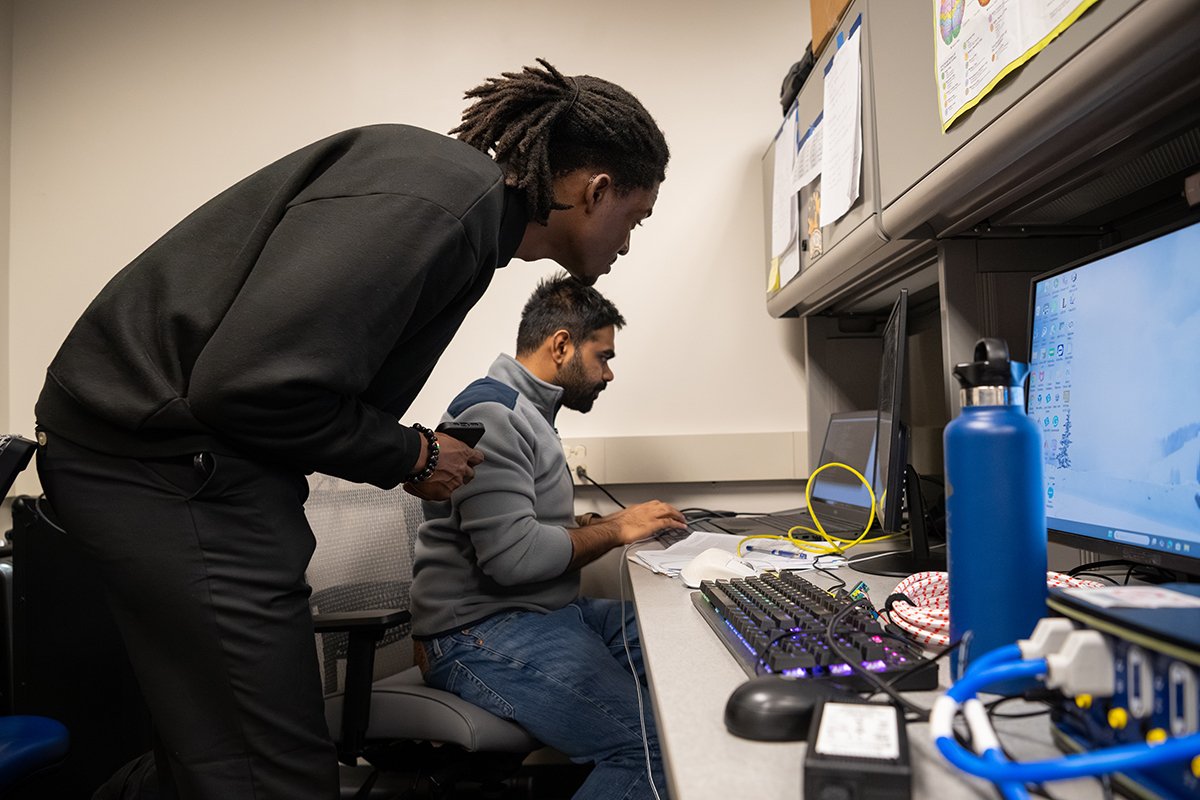
Parthan Olikkal, above, at the computer, brought the concept of capturing hand movements using cameras into the lab, a key step toward making cost-effective technologies.
Chris Dollo (left), a senior computer science major and undergraduate researcher in the Vinjamuri lab, and Parthan Olikkal (right) work at the computer. Olikkal brought the concept of capturing hand movements using cameras into the lab, a key step toward making cost-effective technologies.
Ashwathi Menon demonstrates mudras, which are copied by an Inspire robotic hand. From top to bottom the mudras are: Ardhachandra, meaning “half moon;” Chandrakala, meaning “crescent moon;” and Tripataka, meaning “three parts of the flag.” The mudras can demonstrate various elements of a story, including weapons, trees, flowers, or concepts such as balance, unity, and beauty.

Using the same techniques they had deployed to deconstruct the 30 natural hand grasps, the research team also analyzed 30 single-hand mudras. They found six synergies that could account for around 94 percent of the mudras’ variations.

Crucially, the team then tested how well the six natural grasp-derived synergies could combine to construct unrelated hand motions—in this case 15 letters of the American Sign Language alphabet—compared to the mudras-derived synergies. The mudras synergies significantly outperformed the natural hand grasp synergies on that task. 

“When we started this type of research more than 15 years ago, we wondered: Can we find a golden alphabet that can be used to reconstruct anything?” says Vinjamuri. “Now I highly doubt that there is such a thing. But the mudras-derived alphabet is definitely better than the natural grasp alphabet because there is more dexterity and more flexibility.”

Ultimately, Vinjamuri envisions coming up with libraries of task-specific alphabets that can be deployed depending on the needs, be it completing everyday household chores such as cooking or folding laundry, or something more complicated and precise, such as playing an instrument. 

Apart from advancing understanding of the fundamental roots of movement, the team has made great strides developing cost-effective and pragmatic methods of testing and implementing their ideas. When Vinjamuri first started the work, his team relied on motion-capture systems that required specialized gloves and other equipment. Now, the team uses a simple camera and software system to recognize, record, and analyze movements.

“Parthan brought the concept of capturing hand movements using cameras into the lab and really developed it,” Vinjamuri said. It’s an important contribution to ultimately making cost-effective technologies that people could use in their homes, he says, such as a virtual system to coach people through physical therapy sessions. 

The team is also successfully developing techniques to “teach” robotic hands the alphabets of movements and how to combine them to make new hand gestures. The approach marks a departure from standard techniques of teaching robots to mimic hand gestures, and toward a method rooted in our understanding of how the human body and brain work.

Ashwathi Menon, left, demonstrates the Katakamukha mudra while a robotic hand mimics her gesture. The mudra is often used to represent actions like plucking flowers, holding a necklace, and pulling a bowstring.

“It’s called biomimetic learning,” says Vinjamuri. “We want to watch how a human body moves, how a hand moves and works, and we want to derive those principles and apply them to machines.”

The researchers are testing the techniques on a stand-alone robotic hand and a humanoid robot, each of which operates in a different way and requires a unique approach to translating the mathematical representations of synergies into physical movements.

“Once I learned about synergies, I became so curious to see if we could use them to make a robotic hand respond and perform the same way as a human hand,” says Olikkal. “Adding my own work to the research efforts and seeing the results has been gratifying.”

These moments of satisfaction in finding solutions to knotty problems will continue to propel the team’s voyage of discovery. They may even take a moment to celebrate their successes—perhaps with a fitting high-five. 

page divider graphic with indian inspired design
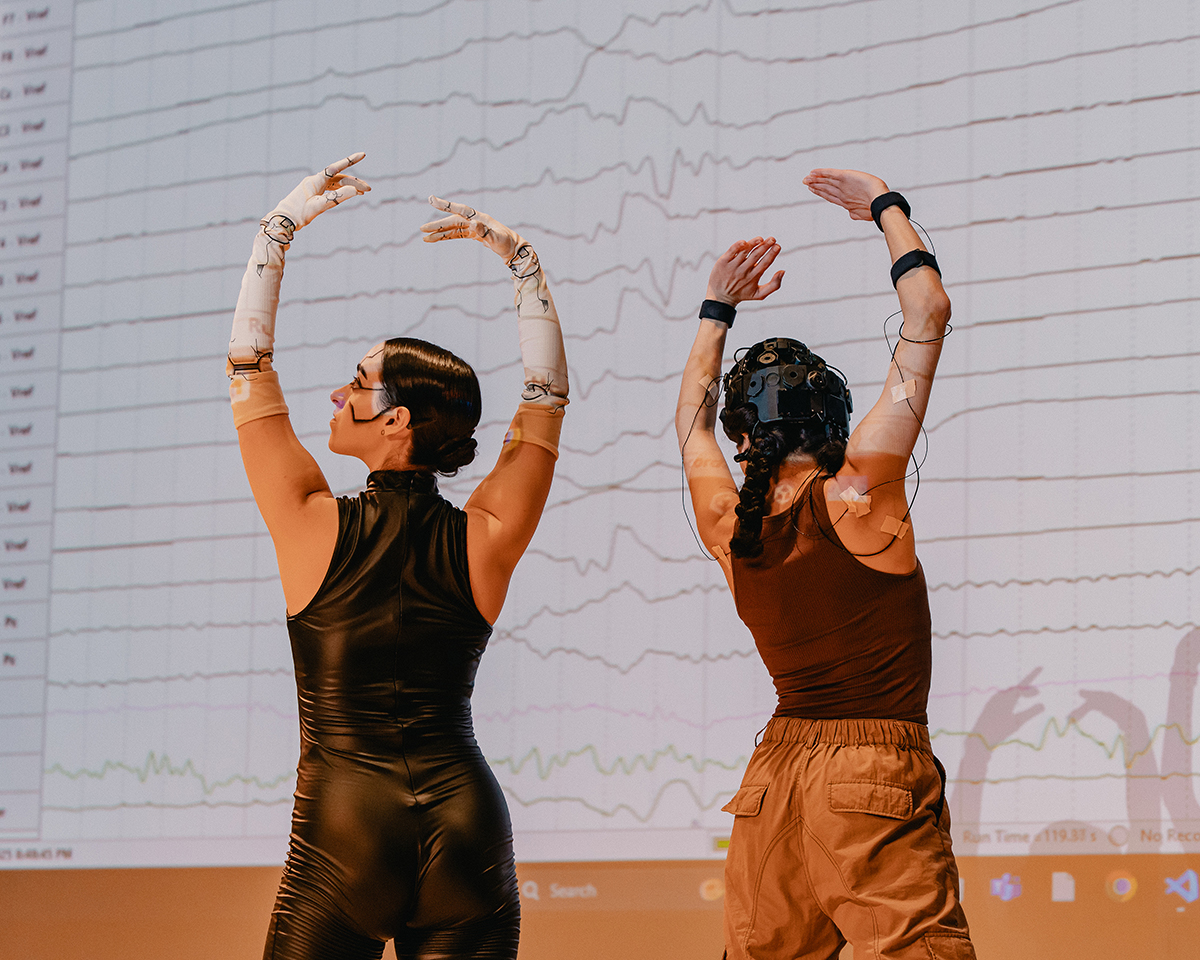
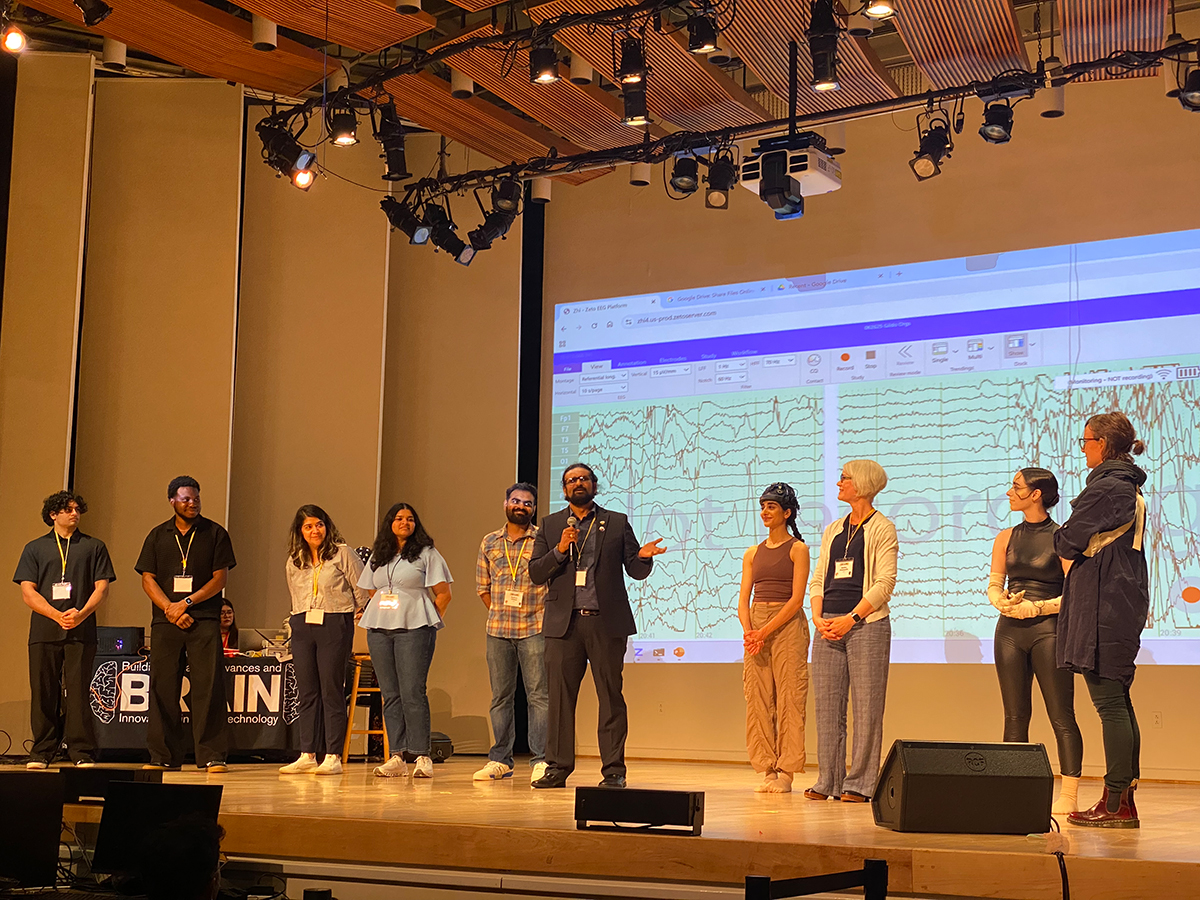
Dancers Sarah McHale '24 and Juju Ayoub '25 perform during the AccelNet meeting. The dance was a demonstration of a collaborative research project by UMBC faculty Ramana Vinjamuri, Andrea Kleinsmith, and Ann Sofie Clemmensen exploring stress reducing technology.
UMBC students and professors who worked on the project gather on the stage after the dance performance. From left to right are Viraj Janeja, Oritsejolomisan Mebaghanje, Golnaz Moharrer, Sruthi Sundharram, Parthan Olikkal, Ramana Vinjamuri, Juju Ayoub, Andrea Kleinsmith, Sarah McHale, and Anne Clemmensen.

Photo Credit: Niloufar Sarmast
page divider graphic with indian inspired design

Chemical engineering professor Tyler Josephson chosen as Simons Foundation Pivot Fellow

Tyler Josephson, an assistant professor in the Department of Chemical, Biochemical, and Environmental Engineering, was selected as a 2025 Pivot Fellow by the Simons Foundation. The fellowships support top researchers as they pivot to making contributions to a new discipline.

At UMBC, Josephson leads the AI & Theory-Oriented Molecular Science Lab, which develops computational methods to simulate the behavior of molecules and, potentially, to automate the discovery of new scientific theories. His current research includes National Science Foundation-funded projects to digitize chemical theories using a programming language developed by researchers at Microsoft called the Lean theorem prover and a DARPA-funded project to develop AI tools that can check the feasibility of scientific claims.

During his Pivot fellowship, Josephson will join the research group of Jeremy Avigad, a professor of philosophy, computer science, and mathematics at Carnegie Mellon University in Pittsburgh, where he’ll study advanced topics at the intersection of formal mathematics and computer science. He plans to formalize statistical thermodynamics derivations in Lean, develop computational workflows for auto-formalizing science using AI, and build molecular simulation software integrated with formal proofs of mathematical correctness.

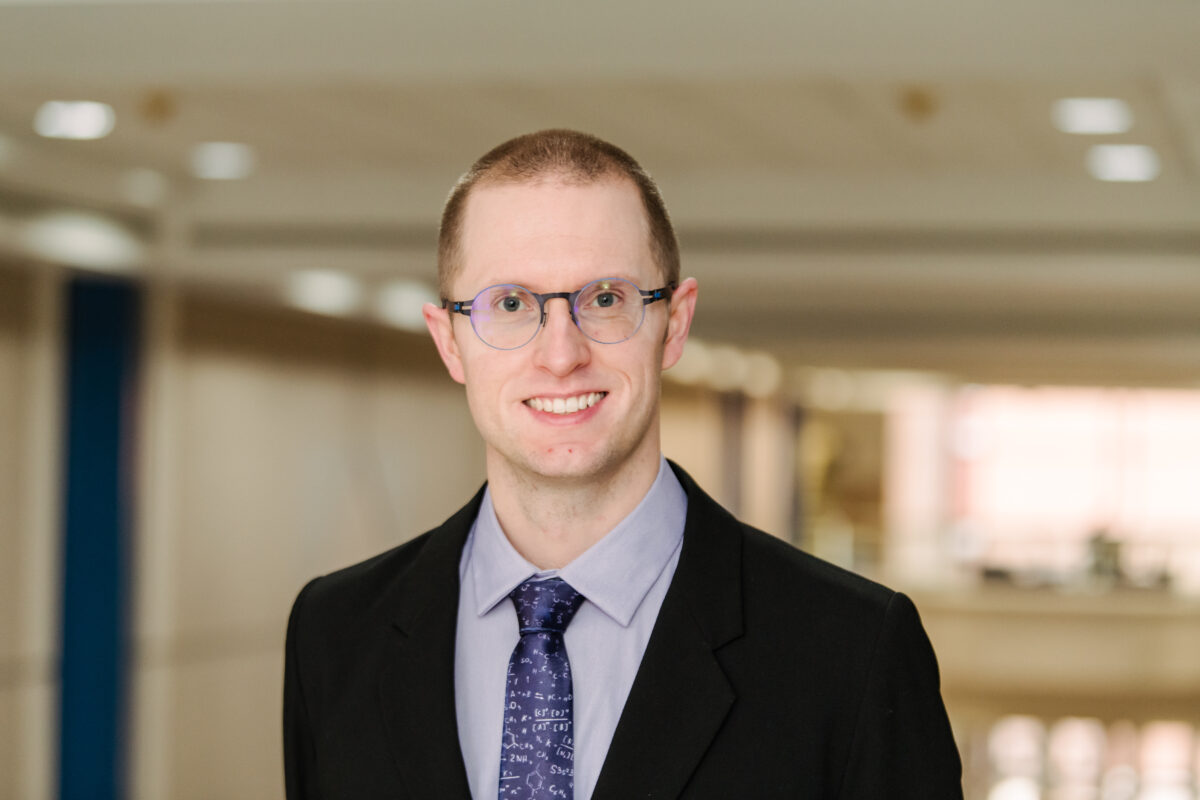
Man in suit smiles at camera.
Tyler Josephson (Marlayna Demond ’11/UMBC)

The skills, knowledge, and connections Josephson develops will strengthen his ongoing work with his UMBC students and colleagues.

“As an engineer, I didn’t formally study these topics in school. I’m really excited by the opportunity to dive deeper and learn new things,” he says.

UMBC sophomore wins first place at NSBE fall regional conference technical research exhibition

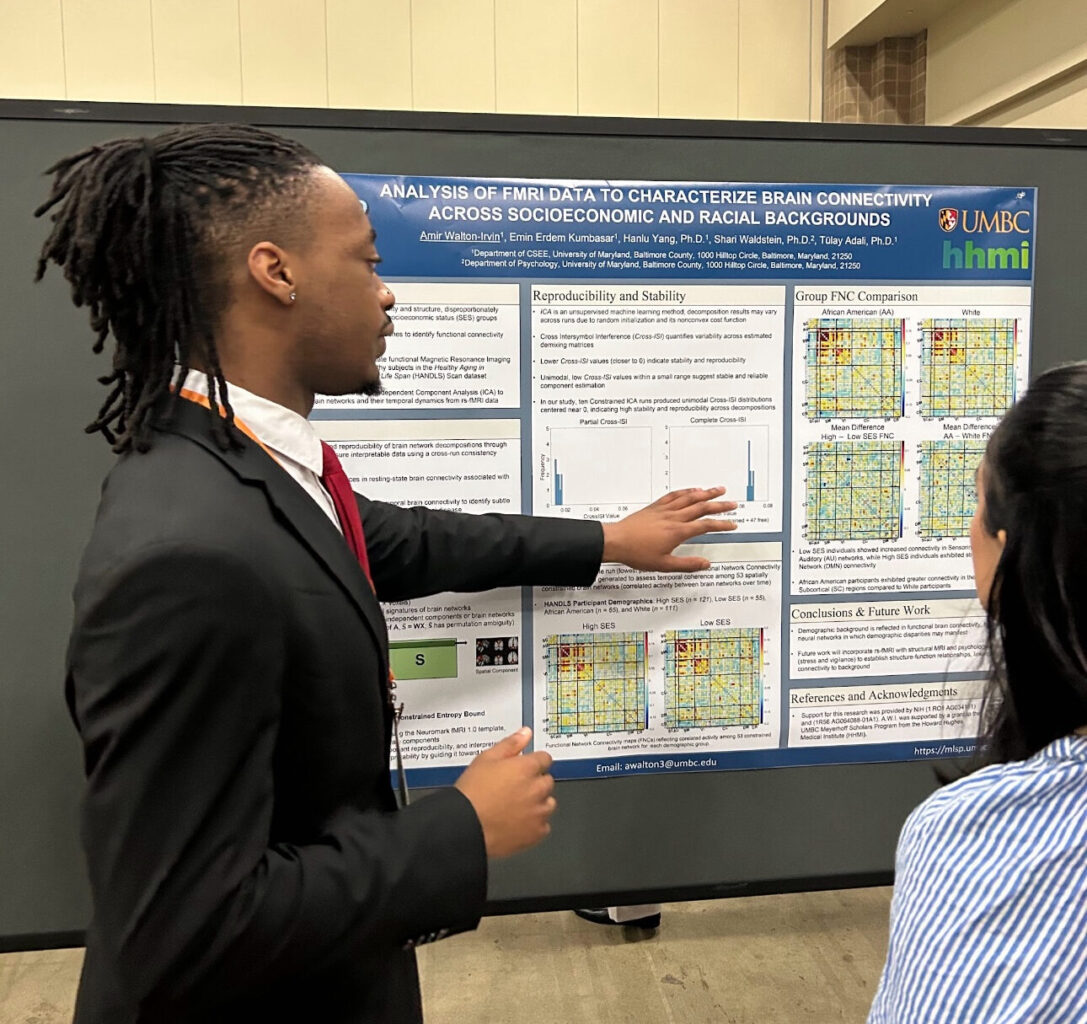
Members of UMBC’s chapter of the National Society of Black Engineers (NSBE) traveled to Raleigh, North Carolina, for their annual regional conference this November, where multiple members presented their work in the Technical Research Exhibition. Sophomore computer engineering student Amir Walton-Irvin, a Meyerhoff Program Scholar and Howard Hughes Medical Institute (HHMI) Scholar, earned first place for his research presentation.

Walton-Irvin investigates brain connectivity and health disparities in the Machine Learning for Signal Processing Lab of computer science and electrical engineering professor Tülay Adali. He uses statistical signal processing techniques to identify subclinical biomarkers that may predict neurological diseases such as stroke and dementia. 

Student in suit stands next to scientific poster.
Amir Walton-Irvin stands next to his scientific poster. (Image courtesy of Kayla MaGruder)

At the conference, Walton-Irvin gave a 5-minute technical talk about his research, followed by questions from the competition judges and audience.

“Presenting research is a huge part of engineering and science that makes it accessible,” says senior mechanical engineering student Kayla Magruder, vice president of the UMBC NSBE chapter, who also gave a talk at the conference.

“I’m extremely grateful for every opportunity to share my work, and being recognized for it is an incredible feeling,” shares Walton-Irvin. “Moments like this motivate me to keep pushing research that can improve people’s lives, and I’m excited for what the future holds.”

Other UMBC students who attended the conference include mechanical engineering senior Caly Ferguson, mechanical engineering sophomore Nathan Bolima, computer science and financial economics junior Glen Larbie-Mansah, and computer engineering junior Jessica Slaughter.

UMBC’s NSBE chapter supports members with conference preparations and also offers activities such as mentoring, networking, leadership development, and community outreach.

Off-road thrills—faculty and staff try out the SAE Baja cars on Drive Day

In a sparsely wooded expanse just off Hilltop Circle, engines rev and dirt flies. Drivers whoop as they steer through trees, clear rocks, traverse ditches, and accelerate down steep hills. You might expect UMBC Police would be handing out tickets for such shenanigans—but this is officially sanctioned fun. It’s all part of the annual Faculty and Staff Drive Day, hosted by UMBC’s Society of Automotive Engineers (SAE) Baja racing team on Halloween this year.

On the grass, an array of single-seat, off-road vehicles sit parked, showcasing the skills of the UMBC team, whose 20 or so student members pull together to design, build, and race a new car each year. On Drive Day, adventurous UMBC community members and industry sponsors are invited to feel the thrill of hopping behind the wheel. 

Drivers hit the track on Faculty and Staff Drive Day 2025. (Video by Elijah Davis, M.F.A. ’21)

The club takes safety seriously. Drivers don a neck restraint, helmet, goggles, and gloves. They are buckled in with a 5-point harness and slip their hands through wrist restraints that will keep their arms inside the vehicle at all times. If things get really hairy, there’s a kill switch that shuts off the engine. 

Plenty of team volunteers are on hand to calm nerves, free stuck vehicles, and fill empty gas tanks. When a suspension arm on one of the cars gets bent in a run-in with a tree, the team grabs tools, lifts up the vehicle, and swaps in a new arm. 

UMBC Racing team members huddle over the suspension arm on one of the cars, working to replace it.
UMBC Racing team members, including William Busch (left) and Shawn Pourifarsi (center) replace a suspension arm on one of the cars. (Brad Ziegler/UMBC)

“I want two things: for people to be safe and for them to have fun,” says Shawn Pourifarsi, a junior computer engineering major and co-vice president of the club. 

For two Residential Life staffers who stopped by for the first time, the event was a great success on both counts. “It was terrifyingly fun,” says Marnea Shamblen, an administrative assistant. “What a rush,” agrees her colleague Grace Collins, the residential education and leadership coordinator, still savoring the adrenaline kick. “I give it a 10 out of 10.”

Simple wood makes advanced sensors

Picture the most advanced technology and certain qualities probably spring to mind: maybe metallic and sleek, with glowing lights and big digital screens. 

The researchers at the Center for Advanced Sensor Technology (CAST) at UMBC, however, have a different adjective they aim for when designing tech: dirt cheap.

For these scientists and engineers, inexpensive doesn’t mean low-quality—it means challenging traditional ways of thinking to produce affordable and reliable products that meet vital needs. Toward this end, a CAST research team recently debuted a new environmental sensor made out of simple balsa wood sheets—the kind you could buy at a craft store for a few dollars. The wood was cut and assembled to make a central well to hold samples and channels for the electrochemical components of the sensor to be inserted. The researchers coated the wood to make it waterproof and stuck it together with wood glue. 

Inexpensive and sustainable

Diagram of the wood sensor
A schematic shows the layers of the wood sensor, with openings for the three electrodes and a microwell. (Image courtesy of Kadolkar)

Choosing wood served two purposes: making the sensor low-cost and also environmentally friendly. 

“Sustainability was very important to us,” says Revati Kadolkar, a Ph.D. student in chemical engineering who is working on the project. Kadolkar is advised by professors Govind Rao, who directs CAST, and Douglas Frey in the department of chemical, biochemical, and environmental engineering (CBEE). “Using wood instead of plastic for the structural skeleton of the sensor was a key step toward that sustainability,” she says.

In collaboration with another UMBC team from the Center for Urban Environmental Research and Education led by CBEE professor Claire Welty, the CAST team tested the sensor in the field by measuring nitrate levels in streams in the Gwynns Falls watershed near Baltimore. Nitrate is a pollutant, often linked to agricultural activities, that can cause gut cancer, birth defects and a condition called methemoglobinemia, also known as the blue baby syndrome. Its concentration in tap water in the U.S. is regulated by the Safe Drinking Water Act. The accuracy of the sensor’s readings was on par with traditional equipment that cost hundreds of times more money, the researchers say. 

Testing in the lab, the team also found the sensor worked well across a range of conditions, including wide variations in temperature and pH levels, and continued to operate well for more than a year. 

A more comprehensive view of the world

Driving down the cost of technology should drive up its impact. Cheaper sensors could be deployed in higher numbers, yielding a more comprehensive view of the world and spotting potential problems earlier. 

Revati holds the wood sensor during field tests.
Kadolkar shows a sensor the team tested in the field by measuring nitrate levels in Baltimore-area streams. (Photo courtesy of Kadolkar)

“Let’s say you want to map the whole Chesapeake Bay and know every hour if there is contamination and how it is traveling down the bay,” says Venkatesh Srinivasan, a research associate professor at CAST who also worked on the project. “You can get these details more easily if you have lower-cost sensors.”

Spreading the benefits of science and technology to resource-limited communities has been a driving force behind CAST research for decades. The team has also developed low-cost infant incubators and a suitcase-sized device to make medicine on-demand

For now, the sensor operates by analyzing droplets of water added to its central well. Going forward, the team would like to create a sensor that could be submerged in the water and report continuous measurements.  

They are already working with the Maryland company NanoForge Systems to commercialize the new nitrate sensor. 

“Translating science into innovative products that can help people is what really excites me about this work,” Kadolkar says.

Michael Hunt ’06, Ph.D. ’25, Outstanding Staff award winner, lifts up students and builds community

When Shaniah Reece ’23, information systems, now a Ph.D. student in computer science at Emory University, was navigating her academic journey at UMBC, there were times she felt like giving up. One evening, around 10 p.m. at night, she was exhausted and considering not submitting an important application. But then Michael Hunt, director of the McNair Scholars Program, with which she was affiliated, gave her a call.

“He said, ‘There are two hours left, and I haven’t seen any indication that you’ve submitted it,’” Reece relates. “I could hear his family and the TV in the background—he was off the clock, at home—but he still made that call. That moment was so impactful because he thought about me, believed in me, and pushed me in a moment when I was too weak to push myself.”

It’s just one example of the many times that Hunt ’06, applied mathematics, Ph.D. ’25, language, literacy, and culture, has shown up for students in just the ways they need. Since 2019, Hunt has directed the federally funded UMBC McNair program with a goal of empowering students from underrepresented segments of society to earn research-based doctoral degrees. Not only does he support the 30 students who enter the full program each year—he’s worked hard to extend opportunities to affiliated students, through a program now called the Retriever Graduate Preparation Network, and to spread the supportive culture of the McNair program across the university as a whole. 

On October 29, Hunt’s contributions will be recognized when he receives the 2025 Outstanding Staff award from UMBC’s Alumni Association Board of Directors. 

Showing up for students

Michael Hunt and McNair affiliated students and staff near a banner that reads "AERA 2023 Annual Meeting"
From l-r: McNair Scholar Nogaye Khady Wade, McNair coordinator Antoinette Newsome, McNair Scholar Noor Huma and Michael Hunt at the American Educational Research Association annual meeting in 2023. (Photo courtesy of Hunt)

What makes Hunt such an effective mentor? For one thing, he asks students what they need and makes their voices and experiences a central part of his relationship with them. He strives to support them holistically, including emotional, cultural, and academic support. He wants the mentor-mentee relationship to be reciprocal, to honor the value of the mentee’s contributions, and to extend into a wider network of community support. 

The approach, called holistic critical mentoring, has been central to the McNair Scholar’s Program under Hunt’s leadership. Hunt even wrote his Ph.D. dissertation on the subject and his interviews of former McNair scholars showed how much they valued the mentoring philosophy.

“I am one of the many UMBC students whose trajectory was forever changed by Dr. Hunt’s mentorship,” says Ting Huang ’21, psychology, the program coordinator for UMBC McNair Scholars Program and a former scholar herself. “I didn’t know my path until I stumbled onto McNair as an undergraduate. Through the program, I conducted research virtually for the first time during the height of the COVID-19 pandemic. Despite the remote nature of those years, I had never felt more connected to a community. That sense of belonging was cultivated by Dr. Hunt and his team, showing how intentional leadership can overcome even the most isolating circumstances.”

Building community

Hunt says the experience of reaching out to current and former McNair program participants to request their help supplying information for his dissertation research was ultimately very gratifying. He wondered how many would respond, given their busy schedules, but a large number were eager to engage.

“I was genuinely surprised, I didn’t expect that number of responses. But then my mentor pointed out: That’s what happens when you build relationships,” Hunt says.

Michael Hunt with his family at the
Michael Hunt with his family at the Black and Latine/x Celebration and Awards in spring 2025. (Brad Zeigler/UMBC)

Hunt says the continued support of program alumni makes him feel like he is making a difference. He’s happy that former participants, some as far away as California, regularly offer to serve as volunteer mentors for current students.

This summer, Hunt had the opportunity to sit in on the dissertation defense of one of the first students to go through the McNair Scholars Program under his watch.

“It’s wonderful to see these alums thriving,” Hunt says. “We are building community. And while we stood on the shoulders of giants, we’re making sure to also be the shoulders that others can stand on next.”


Mark your calendars for the 2025 Alumni Awards on Wednesday, October 29, at 6 p.m., and consider joining the UMBC community at the Chesapeake Employers Insurance Arena to celebrate Michael Hunt and the many remarkable individuals receiving awards. The event will be livestreamed for those unable to join in person. You can learn more at alumni.umbc.edu/alumniawards.

Mark Benesch catalyzes UMBC’s partnership with drug maker AstraZeneca

Mark Benesch and other AstraZeneca recruiters talk with students inside a crowded arena at the UMBC Career Fair.
Mark Benesch and other AstraZeneca recruiters talk with students at the UMBC Career Fair in September. (Photo courtesy of Miriam Friedman)

On a recent Wednesday in September, thousands of people filled the arena of the Retriever Activity Center for the UMBC 2025 Fall Career and Internship Fair. At the booth for pharmaceutical giant AstraZeneca, Mark Benesch ’08, chemical engineering, eagerly engaged with students, some of whom waited in a line 30-odd people long at times for their chance to ask questions and exchange contact information. 

Benesch has regularly brought his enthusiasm and energy to UMBC career fairs, first as a recruiter for ExxonMobil, where he worked immediately after graduating, and later for the Columbia, Maryland-based chemical company W.R. Grace. But it was after starting at AstraZeneca as the senior director of the capital projects portfolio for the Americas region in January 2023 that Benesch spotted the opportunity to take his connections with the university to the next level. 

AstraZeneca employs thousands of people across the state of Maryland, including at a large scientific campus in Gaithersburg, a center in Frederick that manufactures a diverse class of drugs called biologics, and a newly opened facility in Rockville that will manufacture immunotherapy drugs to treat cancer. The company has announced plans to invest $50 billion in America by 2030 for medicines manufacturing and research and development. 

From the hundreds of UMBC alumni at AstraZeneca, Benesch has recruited and inspired a team of eight dedicated to forging stronger links to their alma mater. They, together with partners in AstraZeneca’s Early Career Programs, have built a strong alumni-driven network linking UMBC students with opportunities at the company. 

“Mark is always thinking about innovative ways to connect,” says Christine Routzahn, the director of the Career Center at UMBC who has worked with Benesch to expand the UMBC-AstraZeneca partnership. “He’s very passionate about UMBC and ensuring our students are successful.”

Benesch’s efforts will be recognized when he receives the 2025 Distinguished Service Alumni Award this October. 

A growing partnership 

The work of the AstraZeneca-UMBC recruiting team has gone far beyond career fairs. Under Benesch’s stewardship, AstraZeneca played a key role at the UMBC-hosted 2024 Mid-Atlantic Student Conference for the American Institute of Chemical Engineers. The company sponsored the event and Pran Patel, the vice president of global engineering and real estate at AstraZeneca, served as a keynote speaker. Benesch met monthly with student organizers of the conference, helped lead a popular conference workshop, and mobilized other AstraZeneca employees to volunteer.

“From a five-minute conversation at the career fair, Mark took the initiative to follow up and create real collaboration opportunities,” says An Dang ’24, a student organizer who led the fundraising efforts for the conference.

Benesch and his team have also worked with UMBC to launch new collaborations such as dedicated on-campus information sessions and recruiting events, alumni happy hours, and tours and networking at the AstraZeneca Gaithersburg campus.

Students in hard hats and reflective vests pose for a photo at the construction site for a new AstraZeneca plant in Maryland.
“UMBC On the Road” took students on a tour of the AstraZeneca facility under construction in Rockville in fall 2024. (Photo courtesy of Benesch)

The efforts have paid off, as the number of UMBC students applying to summer internships at AstraZeneca has increased by 31 percent in the past year, and the number of students accepting internships has grown from one in summer 2024 to seven in 2025.

On the research side, Benesch attended the College of Engineering and Information Technology’s recent Research Day and is facilitating discussions of ways AstraZeneca may partner with UMBC faculty on joint projects. 

“Mark’s ongoing dedication to serving his alma mater has been nothing short of extraordinary,” says Mariajosé Castellanos, a teaching professor in the Department of Chemical, Biochemical, and Environmental Engineering who first met Benesch in her thermodynamics class in 2006. “As a faculty member who has been in the department for 20 years and served as the AIChE UMBC Chapter advisor for the past nine, I can confidently say that I have never seen this level of consistent engagement and support from any other undergraduate alumnus.”

Building community and empowering individuals 

large group photo in front of a red wall, behind a long rectangular table with red chairs
A mixer for UMBC alumni employees and interns at AstraZeneca. (Photo courtesy of Miriam Friedman)

Benesch, who was the first from his family to go to college, credits his UMBC education with empowering him to realize his own potential. 

“At UMBC, I was exposed to so much, and from that I gained confidence. Technical confidence, yes, but also the confidence to navigate the diversity of the world and the opportunities that come from that,” he says. “So I’m inspired to help today’s students receive that same kind of support, and even more so.” 

“Mark is so animated when he’s connecting with people. He listens well and he really brings out the best in students,” says Miriam Friedman, assistant director of alumni professional networks.

On his part, Benesch says the students give him energy. “They are curious and smart and I see their enormous potential,” he says. “To give them opportunities to realize it for themselves is really gratifying.”

Abi Postus, a junior in chemical engineering who interned this summer on Benesch’s AstraZeneca team, says she was impressed by his efforts to connect her to resources and make sure she got the most out of the experience. 

“I remember one piece of advice he told me,” she says, “which was: ‘Don’t be afraid to take up space.’ I found that very helpful because this was my first internship and it was kind of daunting. That made me feel more confident.”


Mark your calendars for the 2025 Alumni Awards on Wednesday, October 29, at 6 p.m., and consider joining the UMBC community at the Chesapeake Employers Insurance Arena to celebrate Mark Benesch and the many remarkable individuals receiving awards. The event will be livestreamed for those unable to join in person. You can learn more at alumni.umbc.edu/alumniawards.

hackUMBC draws hundreds to campus for a weekend of snack-fueled, tech-inspired problem solving

On a late September weekend, hundreds of people converged on the UMBC Catonsville campus for the 11th annual hackUMBC, a 24-hour competition where teams of students create creative solutions to problems that matter to them. Under a tight deadline that fosters camaraderie and quick thinking, teams tackle a range of challenges, some proposed by industry sponsors and others that are personally meaningful to students. 

people surround a table that is stocked with energy drinks and snacks
hackUMBC participants visit the snacks and drinks table. (Photo by Angel Pham)

“What makes hackUMBC great is the display of growth, innovation, and teamwork,” says Isabella Goltser, the president of hackUMBC and a junior computer science major who has been part of hackUMBC since her first year on campus. “Participants from across different universities and high schools come together for 24 hours to create amazing projects, connect with each other, and really grow as individuals over the course of a weekend.”

The competition itself has also grown over the years, from under 100 participants in the first year to 600 participants this year, including increasing numbers of high school students who get to witness and participate in the vibrant UMBC community. This year, the organizers added more opportunities for students to network and learn new skills through activities such as workshops and guest panels of tech industry professionals, Goltser says.

The event culminated with the judging expo in the afternoon of the second day, where teams presented their projects and competed for prizes. Teams were recognized for the best overall “hacks,” as well as in specific categories, such as best games, best AI/machine learning hack, best health/environment hack, and more.  

Groups of people sit and stand around tables in a large, open ballroom for hackUMBC judging.
hackUMBC teams gather in the UC Ballroom for the judging part of the competition. (Photo by Angel Pham)

“Seeing everyone present their projects and the proud look on their faces makes it worth spending so much time organizing,” Goltser says.

Twenty-seven UMBC students worked together for the past 10 months to pull off the event. The students divided themselves into teams that dealt with specific tasks such as securing sponsorships, marketing, designing the website and more. The student organizing team was also supported by faculty and staff throughout the College of Engineering and Information Technology (COEIT) and the university as a whole. Renique Kersh, vice president for student affairs, and Marc Olano, associate dean for academic programs and learning in COEIT served as keynote speakers at the event. 

“This hackathon would not have been possible without teamwork and I want to thank everyone involved,” Goltser says.

U.S. News affirms UMBC’s status as a leading public university with strong student support, especially for veterans

U.S. News & World Report Best Colleges rankings mark UMBC as tied for #127 among national universities, up 17 places from 2025, and tied for #63 on the list of top public schools, up 11 places. The rankings are based on a large variety of factors such as graduation rates, faculty resources, and academic reputation. 

UMBC was also tied for #86 in top colleges for veterans, evidence that the university’s initiatives to support veteran students’ success are paying off. 

“We are excited to see UMBC’s upward trajectory recognized in these rankings,” says Yvette Mozie-Ross ’88, vice provost for enrollment management and planning. “These gains reflect our strong commitment to student success, access, and innovation—hallmarks of a UMBC education that continue to set us apart nationally.”

Veteran services an example of strong student support 

Two years ago, Dennis Walker, Jr., was hired as the assistant director for adult learners and veteran student success.

UMBC being recognized by U.S. News for its efforts in serving veteran and military-affiliated students is more than just an institutional achievement, he says, but a celebration of the positive impact that new veteran-focused initiatives are having on campus. 

“With the support of UMBC leadership, I take great pride in knowing that our collective commitment is helping to ensure that these students feel supported, valued, and equipped to succeed during such a pivotal stage of their personal, academic, and professional journeys,”  says Walker.

Groups of UMBC students and staff pose for photo. Some wear "UMBC supports our veterans" shirts and some wear Baltimore Ravens jerseys.
Students and staff gather for the UMBC Veterans Day Out event, featuring a trip to a Baltimore Raven’s football game. (Photo courtesy of Dennis Walker, Jr.)

UMBC strives to provide holistic support to veteran and military-affiliated students, Walker says. This includes help navigating their educational benefits, access to mental health resources, professional development such as resume workshops and connections to on-campus job opportunities, and dedicated events, spaces, and student organizations that offer a sense of community. 

As part of these efforts, UMBC opened a Veterans Lounge in fall 2024, where veteran students can relax and connect with each other. Each year, UMBC also hosts Veterans Week, a tradition that honors the service and contributions of veteran students and staff with a variety of fun and educational events. 

“Supporting our veteran population is not only a responsibility, but also a privilege,” Walker says. “Our veteran and military-affiliated student population bring unique perspectives, experiences, and strengths to our campus community. Their dedication, resilience, and leadership not only enrich the university as a whole, but also inspire us to continually enhance the ways in which we support them.”

Read more about UMBC’s national rankings recognition

Meet Dean van Briesen: COEIT’s new leader shares her love of teaching and discovery

Chance and faith: These two forces have shaped the trajectory of Jeanne van Briesen’s life (while also inspiring the names for her two Russian Blue cats). It was by chance that she went down the research path after unexpectedly losing her first job—teaching high school science. Faith later gave her the courage to begin an academic career at an institution (Carnegie Mellon University) that felt like the right fit, even when her Ph.D. in civil engineering could have led to the industrial job she originally planned to take. And chance and faith worked together to bring van Briesen to UMBC, where she took the position of Dean of the College of Engineering and Information Technology (COEIT) this summer. 

“I first visited UMBC about 15 years ago to give an invited talk, and I really enjoyed the visit,” she says. “The energy on campus, from the students to the faculty and staff, was exciting. I felt like, ‘I should be watching this place.’” 

So when the COEIT deanship opened at a time when van Briesen was ready to make her next career move, she once again felt two familiar forces guiding her. “I do feel like there was a little bit of chance involved in this move—the position opening up just as I was leaving the National Science Foundation and my youngest child was finishing his college journey. A little bit of chance and a little bit of faith brought me here. And, I’m loving it. It feels like home.”

As the campus welcomes new and returning students and faculty for the fall semester, van Briesen shares what she loves about higher ed and how excited she is to start the new school year.

Q: How did you decide on a career in academia? 

A: I started my career as a high school chemistry and physics teacher. I thought that was the most fun anybody could have. But after a year, I was laid off because the teacher I had been hired to replace decided unexpectedly to return. So I went to graduate school to get my master’s degree, and I fell in love with research. I loved doing research so much that I stayed to do my Ph.D. When I finished that, I was like, ‘Well, what job can I do where I can do both research and teaching?’ And that’s why I became a professor—because I could do both of the things I loved. And every day I get to engage with students and faculty about teaching and research, I know I made the right choice.

Q: Could you tell us more about your research?

A: My research focuses on water systems, both natural systems, like rivers and lakes and streams, and engineered systems, like drinking water and wastewater systems. I look at how reactions—whether biological, chemical, or geological—affect the transport and transformation of synthetic chemicals in these systems.

I also did a fair amount of work looking at microbial species: bacteria that we either don’t like because they make us sick, or bacteria that we do like because they can transform synthetic chemicals and clean up our environment. Over time, the work in my group changed the way we understand how interactions in natural systems affect interactions in engineered systems. For example, we would look at what’s changing in the river and then how those changes make it more difficult to treat the drinking water for people. 

Q: Which of your research findings do you feel has had the most impact so far?

Landscape photo shows multiple bridges spanning a river in downtown Pittsburgh.
The Monongahela River, photographed as it runs through Pittsburgh. Van Briesen and her colleagues have studied the river to assess the risks associated with bromide in the water. (Ronjamin; CC BY-SA 2.5)

A: Some research I was doing in southwestern Pennsylvania was related to the development of hydraulic fracturing for shale gas development in the region. There was a lot of discussion about whether shale gas development was using too much water or whether it was producing too much wastewater. And in a lot of ways, the answer was no, it wasn’t that different from other industries that used water and produced wastewater. Engineers have been managing those things for a long time to protect the environment while enabling energy production for people. 

But one thing that was different was that wastewater from gas development was being discharged into the environment with minimal treatment. The wastewater didn’t have many negative effects on the river. But in the drinking water plant, bromide from the wastewater interacted with naturally-occurring organic matter and the chlorine used to disinfect the water to produce brominated disinfection by-products. These chemicals are carcinogenic and teratogenic, and this can lead to negative health impacts when people use the treated water for drinking and bathing. 

The shale gas industry didn’t know that was going to happen, and the drinking water industry wasn’t expecting that outcome either. My research team’s systems-level work—looking at the whole river, including wastewater discharges and drinking water withdrawals—really changed the understanding that the region had about those impacts. It led to the Pennsylvania Department of Environmental Protection working with the industry to stop those discharges.

So that was the work I did where I could look back and say, ‘I had an impact in my own community, for people in my hometown. My work saved lives.’

Q: What attracted you most to the COEIT deanship?

A: When I first visited UMBC, I was so impressed. The students were clearly engaged in their learning. The faculty were really committed to teaching and research, and that combination of research and teaching in higher ed is so important to me. And, the vision—to redefine excellence through an inclusive culture—that really resonated with me. 

The deanship was particularly attractive because of the opportunity to expand my impact. A lot of what faculty do is enable the success of students, and I love that role. And as a dean, you enable the success of everyone in the college—faculty, staff, students, and alumni. And so a dean role really takes that faculty role of enabling the success of others to the next level. 

Taking on any new role is a leap of faith. And, the chance to lead at UMBC felt worth it. 

Q: What have been your strongest impressions since arriving as dean?

A: The thing that’s struck me the most is that everyone’s really committed to the mission of UMBC. When people here talk about inclusive excellence, it’s not a catch phrase, it’s who we are fundamentally at the core of the institution. 

And the other thing is that everyone works really hard. Everyone’s invested in student success, and they’re always generating new ideas for how we can help students be successful. That’s very exciting.

Q: What do you love most about being an engineer? 

A: I like solving real problems for real people. I mean, I can get lost in the theoretical world, and I love deepening our fundamental understanding, but I always want to tie my research to some real problem, because that’s what engineering is. You don’t hear this often, but engineering and information technology are helping professions. 

The other thing I like about being an engineer is that I always feel like we’re needed. The world will always have increasingly complex and interconnected technical problems that have to be solved if we want people to flourish on the planet. The roles for engineers, computer scientists, and information technologists in different industries are always changing, and there are always more problems to solve. 

Q: And what do you love most about working in higher ed? 

A: Oh, the students, for sure. Every fall, you return to campus, and you get to meet new students. They’re excited to be here, and they bring energy and new ideas every year. They remind me how much I love learning because they love learning. They remind me why I became a teacher. Students arrive with wonderful potential, they grow while they’re here, and they go out into the world and do amazing things. UMBC exists to nurture that potential, help our students grow and learn, and to proudly look on as they change the world. 

A student in front of his research poster talks with dean Jeanne van Briesen a woman in glasses and a jacket.
Dean van Briesen talks with computer engineering student Jake Whitt at a COEIT summer research poster session in August. (Brad Ziegler/UMBC)

Q: What are you most looking forward to in the coming year? 

A: Learning! I would probably give that answer every year because I am happiest when I’m learning. In this particular year, I’ve come to a new place and have a new job, so there will be even more learning fun. I’m going to be meeting students, staff, faculty, and alumni, not just from COEIT, but from everywhere at UMBC, and throughout Maryland and beyond. All of these meetings will help me understand who we are and what we aspire to be. That will help me fulfill my goal to enable success in my college, the university, and our communities. 

I am really excited to be here. Since arriving, I’ve learned so much from everyone I’ve met, and I’m looking forward to much more of that during this year.


Learn more about the College of Engineering and Information Technology.

These Retrievers have a role to play in rebuilding Baltimore’s Francis Scott Key Bridge

Construction equipment sits atop a pile of debris at the end of a road.
Workers demolish parts of the old Key Bridge in preparation for building a new one. (Brad Ziegler/UMBC)

In the early morning of March 26, 2024, the massive cargo ship Dali lost power as it left the Port of Baltimore. The ship collided with one of the supports holding up the Francis Scott Key Bridge over the Patapsco River and the bridge collapsed, killing six construction workers and severely disrupting the flow of people and goods around Baltimore. In the immediate aftermath of the tragedy, officials began the process of planning for a new bridge, and now UMBC students are getting an up-close look at the massive project.

A year and half later, three Retrievers visited the bridge site, observing as workers demolished parts of the remaining structures in preparation for building a new bridge. Emily DiMarzio, a rising junior studying environmental science and geography, and Cristian Mena and William McConnell, both rising seniors studying mechanical engineering, were all selected to join The Key Bridge Rebuild Internship Program this summer. While their trip to the bridge this August was partly photo-op, it also represented their experiences throughout the summer, which included regular trips to the bridge and surrounding sites to learn about the ongoing work there.

The Key Bridge internship program launched this year as a partnership between the Maryland Transportation Authority (MDTA) and the Maryland Higher Education Commission (MHEC). This summer nine students from four Maryland universities, including Retrievers DiMarzio, Mena, and McConnell, got hands-on experience in project management, environmental analysis, construction oversight, and community outreach.

“It hurt when the bridge went down,” says McConnell, who grew up in Baltimore and now lives with his wife and three kids in Catonsville. “You could practically see it from our neighborhood, and now see that it is missing. So when the opportunity came along to apply for this internship, I jumped on it.” 

Bridge building boot camp

At the start of the internship, the students were divided into teams based on their interests. McConnell and Mena were on the structural and geotechnical team, which worked to review, analyze, and visualize data that was collected earlier in the year while boring into the layers of sediment where the structural supports for the new bridge will go. DiMarzio was on the environmental compliance team that performed reviews of permitting documents and requirements and observed how the requirements are met during construction.

A large part of the process was coming up to speed fast on the bridge-building process.

“I’ve learned so much—I feel like a bridge expert after this summer,” laughs Mena. 

McConnell noted that all the interns on the structural and geotechnical team came from mechanical engineering backgrounds. “It was nice for us to be exposed to and learn a lot about the civil engineering field,” he says. 

The interns went on regular trips outside the office to see the bridge-building process in action. They visited the Chesapeake Bay Bridge, which was being redecked, and visited the Key Bridge site multiple times.

Three students in hard hats and reflective vests talk amongst themselves. Bridge supports show in the background.
From left to right, McConnell, DiMarzio, and Mena talk near the Key Bridge. (Brad Ziegler/UMBC)

They also visited the Turner-Fairbank Highway Research Center in McLean, Virginia, where they saw how researchers were testing a 3D model of the new bridge to better understand how the force of waves will affect the sand around the bridge’s supports. 

“I thought that was super cool,” says Mena. “That was one of my favorite project sites.”

“The UMBC students are great to work with,” says Jason Stolicny, the deputy director of project development at MDTA who served as their supervisor this summer. “They show a genuine interest in learning and gaining exposure to new things.” 

Community outreach

As part of the internship, DiMarzio, Mena, and McConnell also worked together to develop a hands-on workshop for students at Cherry Hill Middle School in Baltimore as part of the UMBC Summer Math Program through the George and Betsy Sherman Center. They prepared a presentation on different bridge types and the workers who come together to build and maintain them. They also worked with students to design and build model bridges. The workshop was part of a summer enrichment program that UMBC runs in partnership with Baltimore City Public Schools. The interns’ workshop fit into a curriculum about bridges that Malaysia McGinnis ’21, geography and environmental science, and M.A. ’24, secondary education and teaching, a teacher at Cherry Hill and Sherman Scholar, had designed for the summer program.

The interns agree it was rewarding to make connections with kids in the Baltimore community.

Two young adults sit at a table across from two kids. Together they look at model bridges. A screen in the background reads "Types of Bridges."
Cristian Mena (left) works with students from Cherry Hill Middle School in Baltimore on a model bridge building activity. (Photo courtesy of Sara Krauss)

“There was one kid that stood out to me because during the whole presentation, he looked like he was asleep and so he kind of reminded me of myself,” says Mena. “So after the presentation I partnered up with him in the activity. He was super bright and answered all the questions I asked him. Hopefully, I inspired him to see his career choices and to continue learning and growing.”

MDTA plans to continue the Key Bridge internship program until the bridge has been rebuilt, which is currently anticipated to be in fall 2028. 

“It was an honor to be part of the first group of interns,” says McConnell. “I hope we helped set the stage for future interns to have really great experiences too.”

Mena contemplates what it will feel like to see the new bridge spanning the river: “That’s going to be quite a sight. I think it’ll be pretty meaningful because even though I contributed in a very small way, it’ll stand in our community as something bigger than ourselves and a symbol of what we can do when we put our minds together.”

Computer science students snag tech internships in UMBC’s backyard

Intern in business casual attire stands in front of T. Rowe Price building
Gabriel Farmer outside the T. Rowe Price headquarters in Baltimore. (Brad Ziegler/UMBC)

When students think of working in technology, they may dream of moving to Silicon Valley and landing jobs at companies such as Google or Meta. But the traditional tech giants aren’t the only employers offering careers to computer science grads.

“When I first started applying for summer internships, I was like, ‘Let me apply to Google. Let me apply to Apple. Let me apply to Uber,’” says Wonder Akpabio, a rising junior in computer science. But she also took a look at companies outside the stereotypical tech world—and found an internship that felt just right in UMBC’s own backyard. This summer Akpabio worked as a global technology intern at the Baltimore-headquartered investment management firm T. Rowe Price.

Akpabio was one of four UMBC students who interned at the company this summer. She worked on testing and updating software the company uses to report the daily value of a type of investment instrument called an exchange-traded fund. Gabriel Farmer, another rising junior computer science major who interned at T. Rowe Price this summer, worked on a team supporting the internal email and text message communications software at the company.

“Once we leave, they’ll continue to use and build on what we did, so it’s definitely been fulfilling,” Farmer says. 

A company with Baltimore roots

T. Rowe Price was founded in 1937 in Baltimore and in the subsequent decades grew to include clients, staff, and locations throughout the U.S. and the world. In 2025, the company moved its global headquarters into newly built office space in Harbor Point in downtown Baltimore. They also operate a 72-acre suburban campus in Owings Mill, Maryland.

“T. Rowe Price has strong connections with UMBC and Maryland,” says Farmer. He appreciated the large network of Retriever alumni working there and the outreach the company did with the school, for example sending recruiters to HackUMBC

In the spring, T. Rowe Price hosted an online program, called “Launching Your Legacy,” designed to introduce undergraduate students to career paths within T. Rowe Price, and the asset management industry in general. Farmer applied for and attended the two evening sessions. “I was able to meet people who worked there, and it gave me a better idea of the company. Since I participated in the program, they offered a lot of help throughout the summer internship application process.”

Akpabio also made a personal connection to the company when she met a recruiter at the UMBC Career Fair who guided her through the interview process.  

Once arriving for their summer jobs, Akpabio and Farmer were each assigned two mentors within the company and given many opportunities to network with other interns and with more senior colleagues. 

“Anytime you ask a question, people are ready to help,” Farmer says. “It’s been a very good experience, and T. Rowe Price is definitely a place I could see myself continuing to work at.”

On left, Wonder Akpabio and Bintu Jalloh at the T. Rowe Price intern orientation. On right, a group of interns attends an Orioles baseball game together. (l-r): Bintu Jalloh, Roselyn Ojo, Sarah Floyd, Wonder Akpabio, Aracely Saenz, and Kate Martinez Palmero. (Photos courtesy of Akpabio)

Learning on the job

Both Farmer and Akpabio say they learned valuable lessons during the internship. 

“The main thing I took away was the value of allowing yourself to make mistakes,” says Akpabio. “At the beginning, I was afraid I might break something, so I quickly asked for guidance. Now, I try to rule out possible problems myself first. I find I retain information better when I let myself struggle a bit longer.”

Farmer says his most important take-away from the internship is the importance of networking. “Many people I met had experienced a point in their career where they felt lost. And it was the people they made the effort to build a connection with who helped them out of it.”

Farmer and Akpabio are still exploring career possibilities. Akpabio says she could see herself eventually transitioning to the business or trading side of a company like T. Rowe Price. 

“There is a lot of uncertainty in the tech world right now,” Farmer says. “Looking beyond the big tech firms and trying the T. Rowe Price internship was a great experience.”