We use cookies for analytics and, unless you opt out, advertising.
You can opt out of advertising at any time.UMBC uses essential cookies to run this site. With your permission we would also use analytics cookies (to understand how the site is used) and advertising cookies (to measure and target our ads on other platforms). Nothing else loads unless you accept. You can change your choice any time from Cookie Settings in the footer.Privacy Policy
EssentialRequired for the site to work (login, security, your cookie choice). Always on.
Diane Alonso, a teaching professor and director of UMBC’s psychology program at the Universities at Shady Grove, has been named one of two senior fellows for generative AI pedagogy at the William E. Kirwan Center for Academic Innovation. The center was established in 2013 by the University System of Maryland (USM) Board of Regents and aims to be a focal point for advancing academic innovation both within Maryland and across higher education nationally.
Alonso will work alongside the other senior fellow—Tracy Tomlinson of the University of Maryland, College Park—and Jennifer Potter, the associate director at the Kirwan Center, to lead the development of the Kirwan Center’s generative AI programming in the 2025 – 2026 academic year. This includes the development of a curriculum to train and collaborate with select faculty from across the USM system in best practices for classroom use of generative AI, a type of AI that can create new content, including text, images, audio, and video, in response to prompts. These faculty will then convey the lessons from the sessions to their respective campus colleagues in spring 2026.
Bringing generative AI into the classroom
Diane Alonso (Marlayna Demond ’11/UMBC)
Alonso has actively experimented with the integration of AI in her psychology courses over the past two years, sharing her insights with colleagues across the USM system. For example, she has asked students to compare their own handwritten ideas with ChatGPT-generated output on a similar topic and to evaluate the differences. Students learn about effective AI prompting and about ethical considerations such as biases and hallucinations. “We always follow these hands-on activities with debriefs and open discussions, and I make a point to model transparent and responsible AI usage,” Alonso says.
This year Alonso also worked with Neha Raikar, chemical, biochemical, and environmental engineering, to bring together a small group of UMBC faculty to engage in a year-long exploration of how to enhance teaching with AI. Participants shared ideas for using AI in the classroom, such as brainstorming discussion topics, generating podcasts from textbooks, and crafting and revising syllabi. They also shared concerns about the technology.
Alonso says she has been interested in technology’s role in education for decades. As early as the mid-1980s, she dabbled with basic AI programs and during her graduate education in the ’90s, she focused on how technology could transform the classroom. As a post-graduate, she worked in industry as a usability specialist, deepening her understanding of how people interact with complex systems.
“This role feels like the culmination of a lifetime fascination with technology, psychology, and education,” Alonso says. “I feel that things have now come full-circle.”
How can we make the world a better place? It’s a question that Nathaniel Glover ’25, chemical engineering, Jacob Lombardo ‘25, mechanical engineering, and August Phelps ’25, mechanical engineering, have spent a lot of time thinking about. And each has concluded that advancing science is a powerful way to advance humanity.
The three promising researchers were each recently recognized and rewarded by the National Science Foundation’s Graduate Research Fellowship Program (GRFP), which provides financial support to U.S. graduate students who have shown the potential to be high-achieving scientists and engineers.
“The NSF GRFP award is a very prestigious and competitive award,” says Deepa Madan, associate professor in the Department of Mechanical Engineering, who has worked with both Glover and Lombardo on research projects in her lab. So far this year the program has awarded 1,000 fellowships across the U.S., about half of the typical number, making the process even more competitive. This fall, Glover, Lombardo, and Phelps will all head to Johns Hopkins University in Baltimore to begin their graduate education and research.
The thrill of research
Glover, Lombardo, and Phelps knew early in their college careers that they wanted to become researchers. The three are part of the Meyerhoff Scholars Program at UMBC, which is at the forefront of efforts to increase diversity among future leaders in science, technology, engineering, and mathematics by supporting students who intend to pursue a Ph.D. or combined M.D./Ph.D. in these fields. Throughout their time at UMBC, they engaged in a variety of research projects with different faculty mentors.
Nathaniel Glover stands next to the research poster he presented at the end of his internship at Argonne National Laboratory in summer 2024. (Photo courtesy of Glover)
“I really enjoy the quest to answer unanswered questions,” Glover says, explaining what attracts him to research. Most recently, he worked in Madan’s lab on a project to develop rechargeable, safe, and flexible zinc alkaline batteries, which could revolutionize how consumers power devices such as wearable health monitors.
Lombardo has also worked in Madan’s lab, studying materials that can convert wasted heat into electricity, while Phelps recently worked with mechanical engineering assistant professor Ankit Goel to develop methods for improving control over the flight trajectory of multicopters. Multicopters, which use multiple rotors for lift and maneuvering, are inherently unstable and underactuated, meaning the craft is limited in the ways it can move and must actively stabilize itself at all times. The researchers developed a method to guide the aircraft along a desired trajectory as precisely as possible despite variations in operating conditions and physical properties of the multicopter.
The problems the students and their mentors study—such as how to power and control machines—transcend any particular application, and the solutions the researchers develop could have profound effects on a variety of technologies.
For example, in graduate school, Phelps will join a lab that develops control systems for medical robots. There, he will study electrocauterization, a medical procedure that uses heat generated by an electric current to perform tasks such as removing harmful tissue and controlling bleeding during surgery. Phelps said the speed of the process needs to be carefully controlled to avoid excess damage to healthy tissue, and the lab he is joining is working on ways to automate this control. He notes that both his father and girlfriend have undergone medical procedures with long recovery times. Making the process better is personal to him.
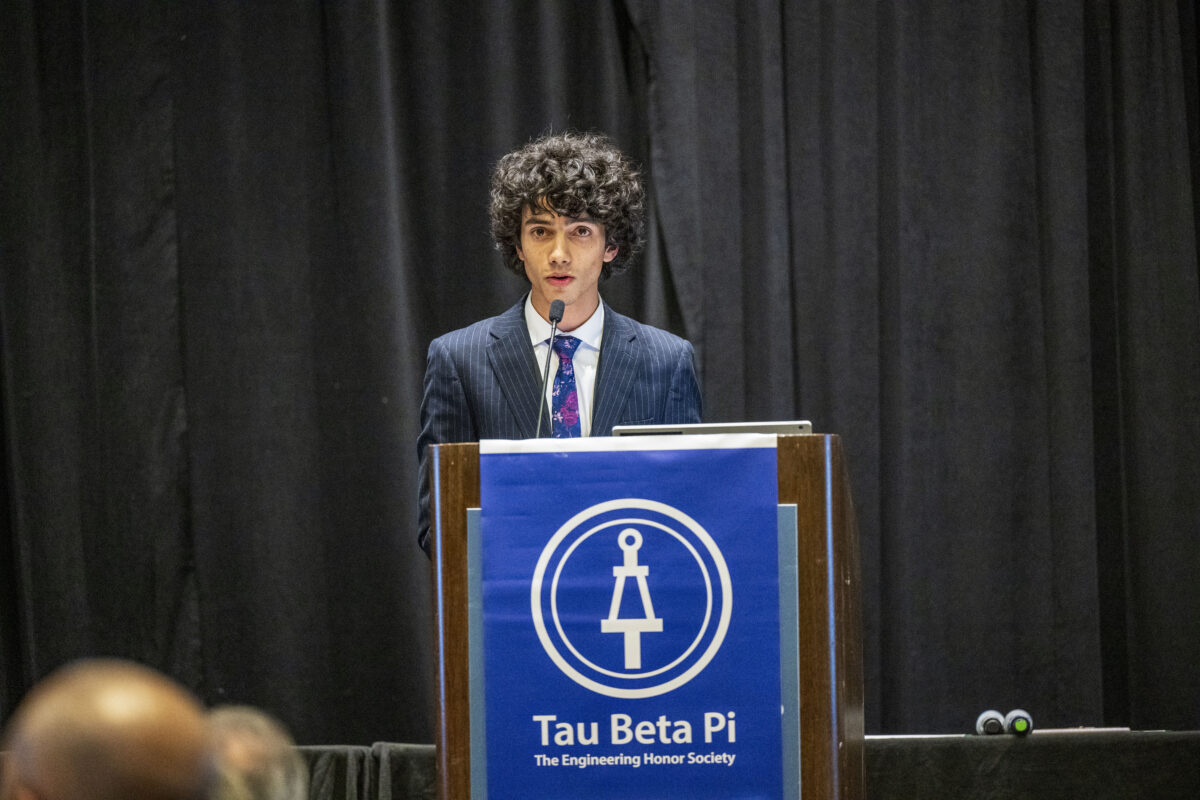
August Phelps speaks at the 2023 Tau Beta Pi National Convention in Atlanta, Georgia, as UMBC’s chapter delegate to the engineering honor society. (Photo by Kiffer Creveling)
Glover and Lombardo agree that what keeps them going, even through late-night problem solving and failed prototypes, is the desire to improve the way things get done. “I love how engineering research takes fundamental science principles and applies it to making a difference in the world,” says Lombardo.
“My real passion is figuring out how to progress as a species,” echoes Glover. “Science is one of our most powerful tools for that.”
A launch pad for big dreams
Jacob Lombardo (left) and labmates Jiyuan Huang and Srushti Kulkarni attend the 2024 Consumer Electronics Showcase, as part of the Southwest I-Corp program. The program guides engineers to engage with stakeholders outside the lab to better understand market needs and consumer requirements. (Photo courtesy of Lombardo)
These Retrievers say UMBC offered the tools and the mentorship to progress toward their biggest ambitions.
“So many people took their time to sit with me, to push me forward,” says Lombardo. “I had the opportunity to go to scientific conferences, engage in world-class research, and find a community that embraced me.”
Lombardo notes that with support from programs such as the National Institute of Health’s Undergraduate Research Training Initiative for Student Enhancement (U-RISE) program and the Southwest Regional National Science Foundation Innovation Corps (I-Corps) program, he was able to network with researchers outside of his discipline, as well as with industry experts who understand the consumer market. The interactions honed his career goals and reinforced his passion for translating fundamental science principles into practical and impactful engineering, he says.
Glover, Lombardo and Phelps agree being awarded NSF GRFP fellowships is both a validation of the work they have done so far and an obligation to make a positive difference with research going forward. “It does make me feel that what we do is seen and appreciated,” Glover says. “I have this feeling that I will be able to have the impact that I am hoping to have on the world, which is inspiring and humbling.”
Phelps says he is excited to take the next steps: “I’m looking forward to exploring new topics, pushing the boundaries, and creating new things.”
From June 5 – 8, UMBC hosted leading scientific researchers for a series of meetings on the science of the brain—often said to be the least understood organ in the human body. The proceedings began with a meeting of the industry advisory board for the Building Reliable Advances and Innovations in Neurotechnology (BRAIN) Center, of which UMBC is a site. Ramana Vinjamuri, associate professor of computer science and electrical engineering, directs UMBC’s participation in the center and played a key role in organizing the meeting, which brought industry, government, and academic researchers together to discuss the latest advancements in developing safe, effective and affordable personalized neurotechnologies to diagnose, restore or enhance brain and nervous system functions. Immediately following, the Movement, Music, and Brain Health National Science Foundation (NSF) AccelNet Meeting showcased how tools such as AI, mobile brain-body imaging and brain-computer interfaces could advance investigations into how music and dance promote cognitive function and well-being.
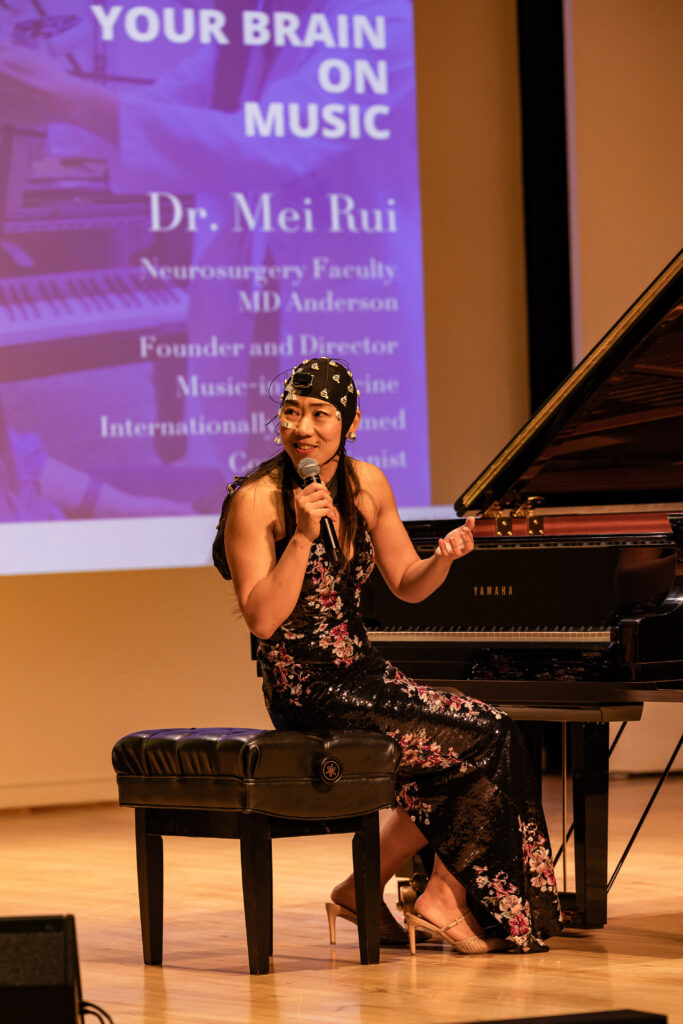
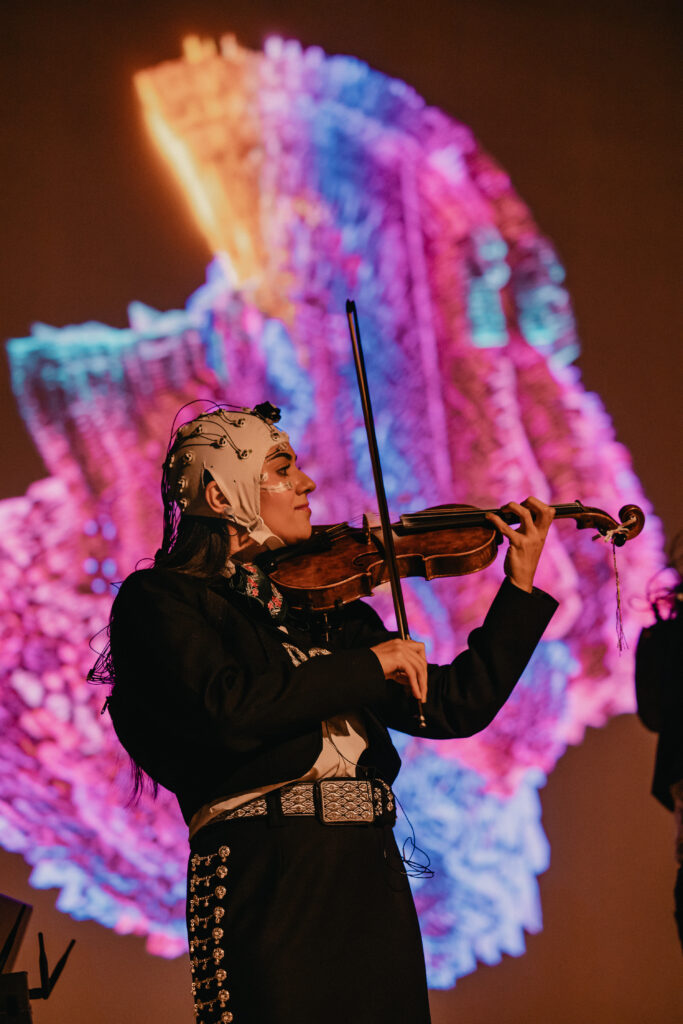
On the Friday evening of June 6, visually compelling performances in the UMBC Fine Arts Recital Hall merged science and art. Musicians and dancers wearing sensors to monitor their brain waves and vital signs such as heartbeat treated the audience to performances of flamenco dancing, mariachi music, interpretive dance, and classical piano. A UMBC team presented the imagined interactions of a human and a humanoid robot—exploring how the two could move together and expressing the emotions that might arise from the interaction. The team comprised faculty members Vinjamuri; Andrea Kleinsmith, information systems, and Ann Sofie Clemmensen, dance; computer science and human-centered computing students Parthan Olikkal, Oritsejolomisan Mebaghanje, Viraj Janeja, Sruthi Sundharram, and Golnaz Moharrer; and UMBC graduates Sarah McHale ’24, dance, and Juju Ayoub ’25, dance.
June 6 art-science research performances, from left to right: Dr. Mei Rui on the piano, interdisciplinary artist Gabriela Estrada performs a one-woman dance “No more Carmens!” and a member of the group Mariachi Sana Sana plays the violin. Below, UMBC graduates Juju Ayoub ’25, dance, and Sarah McHale ’24, dance, get ready to perform a demo of a VR dance experience, while computer science Ph.D. student Parthan Olikkal sets up equipment. (Photos by Kiirstn Pagan ’11)
Fostering collaboration to accelerate innovation
UMBC joined the BRAIN Center in 2024. As an Industry–University Cooperative Research Center (IUCRC), it brings academic researchers across multiple institutions together with industry partners to conduct research of interest to those partners. Vinjamuri’s lab has partnered with industry and other research centers on projects such as detecting deception in brain waves, developing new tools for managing and treating substance abuse, and reducing stress through interaction with robots and virtual tools.
This was the first time that the BRAIN Center meeting was held in conjunction with an AccelNet meeting, part of the NSF’s efforts to tackle grand research challenges through coordinated international efforts. This meeting focused on better understanding how music and movement are linked to brain health.
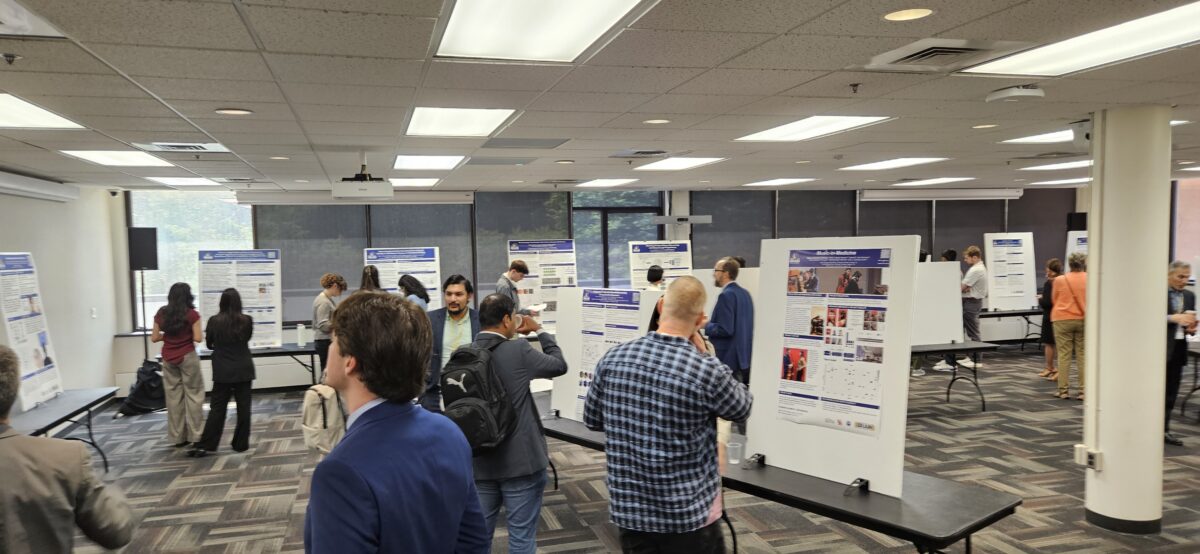
Attendees of the BRAIN Center IAB meeting pose for a group photo (left) and mingle at a poster session. (Photos by Catherine Meyers and Ramana Vinjamuri)
The twin meetings were an extra draw, and brought in close to 300 attendees, says Vinjamuri, including program directors from the NSF and FDA.
“We brought some of the world’s top researchers to UMBC, where we could showcase our labs and discuss opportunities to collaborate,” he says. “There was lots of shared interest and fruitful discussions.”
The conferences were an interdisciplinary affair, with experts in fields such as computer science, mechanical engineering, dance, music and the arts all mingling.
“These event would not be possible without the support and participation of UMBC leadership, the BRAIN Center, and fellow site directors,” said Vinjamuri. “So many people, from across UMBC and our collaborating institutions, in the U.S. and around the world, came together to make the events a success and I am deeply grateful to them all.”
“For a conference like this, I get to wear both of my hats, advocating for both research and creative achievement,” said Karl Steiner, UMBC’s vice president for research and creative achievement, in opening remarks. “We entered these partnerships to improve human life. It’s truly a privilege and a motivation to focus on that joint mission.”
These events were sponsored by the NSF IUCRC Program, the BRAIN Center, UMBC College of Engineering and Information Technology, and bwtech.
In her day job as a vice president at the advanced technology company Booz Allen Hamilton, Catherine Ordun, Ph.D. ’23, information systems, leads teams of engineers working on far-out AI tech. In the evenings, she crafts a different type of futuristic world, putting the finishing touches on a sci-fi trilogy featuring two alien brothers at odds with each other over a plan to invade Earth, which she hopes to publish in early 2026.
Ordun started writing the books in 2022, as a break from her intense computer science Ph.D. research work, which she completed in 2023 under the direction of UMBC assistant professor Sanjay Purushotham. Although fiction writing and coding seem to call for different skill sets, the two pursuits share some defining features, from the mental challenge of connecting ideas to the satisfaction that comes from completing a herculean task. In both, Ordun embraces the thrill of creating—whether an imaginary world where characters grapple with technologically infused questions of identity and purpose, to the seemingly sci-fi, yet very real, AI tools that will shape our own tomorrows.
Tools of the trade
A thirst for knowledge
A pen and paper (when you need old fashioned tools)
Computer (when you need digital assistance)
Vision and discipline
Lots of coffee
Step 1: Hit the books
Ordun voraciously consumes knowledge and ideas. Although she earned her bachelor’s degree in biology, not computer science, she became deeply interested in machine learning around 2015, while working as a data scientist for Booz Allen Hamilton. “I became fascinated by the idea, just like really, really obsessed,” she says. “And for five years, I taught myself.”
Ordun’s favorite book from this time was Deep Learning, by Google AI researcher François Chollet. “It is like dogeared to the max. I went through every page and I typed out every line. I learned so much, from natural language processing to computer vision.”
When Ordun decided she needed a brief break from technical research, she kept right on reading—though she turned to sci-fi books, from the cyberpunk novels of William Gibson to the technically elaborate works of Neal Stephenson. “At the time, I was also very interested in simulation theory, this kind of Matrix-like idea that we could be living in a computer simulation.
And I thought, ‘You know what, I’m going to write my own sci-fi book, so I can explore this idea.’”
Step 2: Get your hands dirty
Ordun works in her home office. (Image courtesy of Ordun)
Once you have some background knowledge, it’s time to dive in. Ordun wrote the first draft of her novel (which she eventually split into three parts and named the Morfyk Trilogy) in under three months. “It was a horrible, horrible first draft. And it was huge, like 600 pages long,” she says. She revised it multiple times herself, and then hired a professional editor.
Ordun says working on the books has become a nightly ritual. “Every night, even if I’m dead tired, I tell myself to just put five words down, it’s better than zero.”
In her AI-work, Ordun tackles problems on a similarly compressed timeline. “One team I lead is called AI rapid prototyping, and we basically crank out prototypes for exquisitely hard AI problems in about four weeks.”
Ordun isn’t committed to any one way of transforming ideas from her brain into a tangible object. Sometimes she reaches for pen and paper, other times she is coding and typing on a digital screen. What unites the efforts is the desire to build, be it novel AI-tools for a client or a different universe she can escape to when the work day is over.
Step 3: Tackle the hard problems
Book authors and scientific researchers share the challenge of birthing something entirely new. When searching for the fertile ground that could yield unique knowledge, tools, or stories, it helps to lean into profound, hard problems.
Ordun says the most rewarding part of her Ph.D. work was tackling a long-standing challenge in computer science—how to match up differently sized images of the same object, and finding a new way for computers to train themselves to do it.
She says her book writing also took a more fulfilling turn when she started to reflect on her own traumas and anxieties and the big themes of purpose and identity. She explored morality, the nature of reality, and her characters’ fluctuating sense of themselves. “I found I was pouring a lot of my own self into this book, so it became much more than “What if we live in a simulation?”
Ordun discusses machine learning with her Ph.D. advisor Sanjay Purushotham (seated center) and other members of his research group at UMBC. (Marlayna Demond ’11/UMBC)
Step 4: Assemble your team
The work of creating new worlds is monumental, so it helps to have a solid cast of characters supporting you. Ordun praises the engineers she leads at Booz Allen, who she says are tackling some of the toughest technology challenges out there and pioneering innovative solutions.
In the writing sphere, she credits editors and volunteer readers for helping her hone her “horrible first draft” into polished prose.
More recently, Ordun has turned to teaching, in a sense educating future collaborators. She joined UMBC as an adjunct assistant professor in summer of 2024, and she regularly engages with aspiring young computer scientists on TikTok, answering questions and commiserating about coding problems.
“I learn by imagining having to teach a concept to someone else,” says Ordun. “So now I’m actually teaching and it’s something I really enjoy doing.”
Step 5: Celebrate your successes
Ordun with the family dog. (Image courtesy of Ordun)
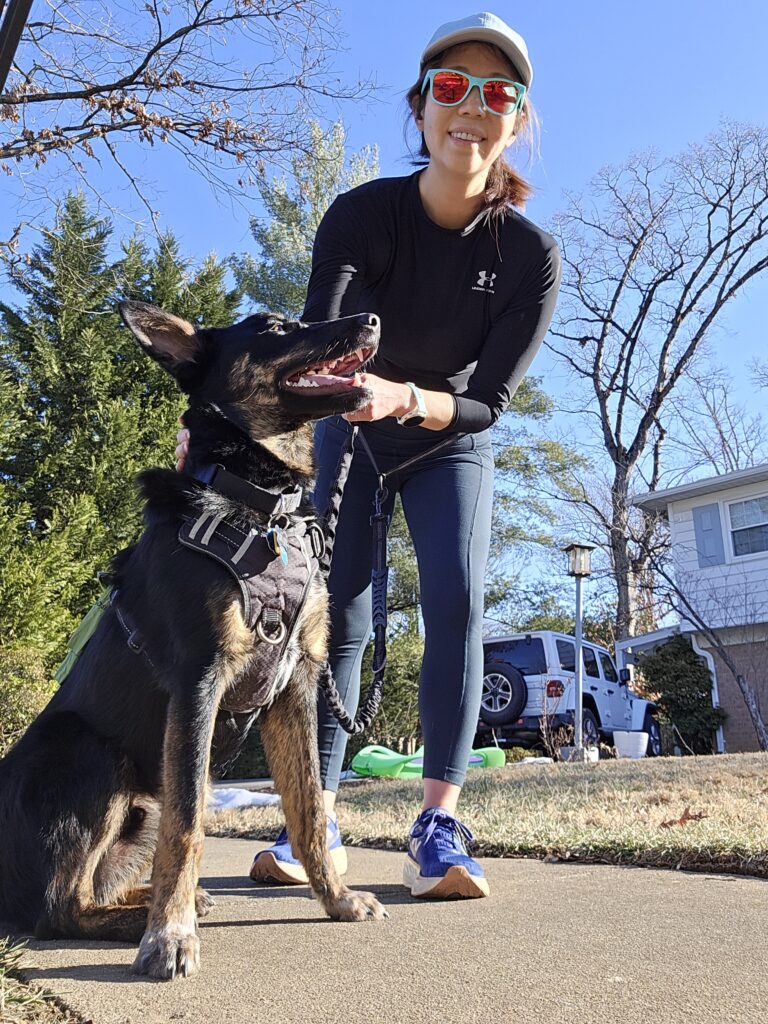
Ordun isn’t shy about admitting setbacks. She talks about her strings of rejected papers, the coffee-fueled problem solving sessions that turned into pure error finding missions, and the red ink-filled drafts that her book editors send her. Sometimes to release stress, she needed to lace up her shoes, grab the dog, and just go for a run.
Obstacles are a natural part of any pursuit where you push into the unknown. And so, when you do have success, it’s important to take a moment and take it in. “The moment I finished my book, I was out on my deck, it was 10 p.m. at night. I don’t want to sound melodramatic, but I almost cried,” Ordun says. “I felt I had created something totally new, a new universe. It was a similar feeling of pride to passing my Ph.D. dissertation defense.”
On a pleasant Saturday in early May, nearly 30 teams gathered in Baltimore to pedal elaborate all-terrain sculptures 15 miles through a course featuring pavement, water, sand, and mud. The 25th year of the Kinetic Sculpture Race, organized by the American Visionary Art Museum, brought out Baltimore residents to cheer on the wacky sculptures, such as a kilt-wearing platypus and a BLT sandwich, and their human pedalers. This year UMBC, which has regularly gathered a team to compete in the race, partnered with The IMAGE Center of Maryland, a non-profit organization dedicated to “new thinking about disability,” to build and race a sculpture named IMAGE Man. The larger-than-life teal superhero sits in a wheelchair and wears an orange cape—The IMAGE Center’s branded colors. With football in hand, he flies over some of Baltimore’s iconic buildings, such as the Bromo Seltzer Arts Tower and the Baltimore World Trade Center.
IMAGE Man successfully navigated the hazardous terrain of the race—including a floating lap around a dock in the Baltimore Harbor—and was also recognized with a best art award, a category that, according to the race organizers “includes consideration of color, costumes, two and three dimensional ‘artistic designs,’ kinetic motion, humor, theatrical appeal, and mass crowd- and media glory-seeking.” The team also won second place in the overall standings.
Mechanical engineer Jasmine Pearcy, a volunteer with a program from The IMAGE Center called Volunteers for Medical Engineering, paints part of the sculpture. (Image courtesy of the VME Collection)
It took many months, and hundreds of volunteer hours, to bring the kinetic sculpture to life from foam, wood and paint and mount it on a recycled quadricycle in a workspace at the 900 Walker Ave building on the UMBC campus. Volunteers from UMBC pitched in alongside partners from Volunteers for Medical Engineering (VME) Program Services, a part of The IMAGE Center that provides innovative custom devices to empower people with disabilities to live life more fully.
UMBC student Dulcey Comeau breaks out the power tools. (Image courtesy of the VME collection)
The partnership between The IMAGE Center and UMBC on the Kinetic Sculpture Race was a spinoff of a long-term collaboration, says Angela Tyler, the director of VME. In that partnership, UMBC engineering students collaborate with VME to design and build the custom devices. Many graduating students return to volunteer on other VME projects. This year, four UMBC mechanical engineering students participated in a project to design and build a fishing rod holder and casting device for a disabled client. All four also volunteered their time on the kinetic sculpture project.
Alex Brunkhorst was one of those students. He participated in the race as a member of the pit crew, pedaling alongside the sculpture and offering technical (and emotional) support as needed. “The race was a lot of fun and challenged all of us physically, mentally, and mechanically,” he says. “We did run into some difficulty with our kinetic sculpture’s braking system, but with some quick thinking and a little luck, the pit crew was able to rig something together and keep IMAGE Man in the race.”
Tyler says the collaboration for this year’s race was a win-win. “We’d like to thank UMBC for providing the space, thanks to UMBC faculty Steve McAlpine and Dr. Jamie Gurganus for help leading the volunteer team, and many thanks to all the volunteers! It was a natural fit, and a great partnership.”
Gurganus, who has nurtured the partnership with VME for many years, says the expansion of the collaboration to the Kinetic Sculpture Race this year made the race-day experience much more than just a fun and wacky day. “The race became a moving stage to amplify VME’s mission, and their presence was unforgettable,” she says. “It became a celebration of purpose, empathy, and community.”
A dynamic research ecosystem was on display in a series of events showcasing existing projects and encouraging new collaborations across the College of Engineering and Information Technology (COEIT) this spring.
On April 11, the second annual COEIT Research Day brought together more than 180 students and faculty from COEIT’s four academic departments, as well as outside speakers and visitors. Attendance increased by around 20 percent from last year’s inaugural Research Day.
More than 100 researchers presented either talks or posters at the meeting, and several students won awards for their posters and were recognized at the COEIT Awards and Celebration event on May 4.
“A major success of this year’s Research Day was the presence of visitors and speakers from industry, nonprofits, and government,” says Vandana Janeja, the associate dean for research in COEIT. “The event gave these guests an opportunity to visit UMBC and to engage in the vibrant research happening within COEIT, making connections with our research community that we hope to see grow into long-lasting partnerships.”
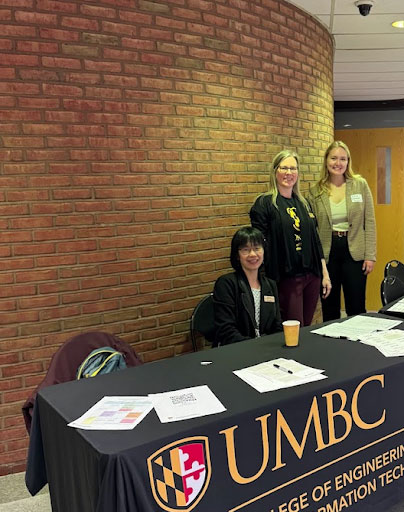
COEIT dean’s office staff Emily Tien, Amy Heckhaus, and Chloe Evered at COEIT Research Day. (Image courtesy of Vandana Janeja)
The college also launched a new call for COEIT Interdisciplinary Proposals. Last year, COEIT funded 11 projects from teams made up of researchers from two or more academic departments. The teams presented their results at this year’s event, on topics ranging from cybersecurity in manufacturing to thermally stable energy-harvesting materials.
On May 2, the Department of Computer Science and Electrical Engineering also hosted its annual research day, bringing together faculty, staff, and students to highlight the department’s latest advancements in research, from robotics to AI weather forecasting.
Li’s research aims to develop a reliable method to monitor blood pressure with a smartphone. High blood pressure, or hypertension, affects more than 1.3 billion people globally, and while conventional devices to monitor blood pressure are accurate, they are bulky and impractical in everyday life, Li says. As an affordable and accessible alternative, Li is testing if a smartphone, outfitted with ultrasound sensors to measure blood flow and using the built-in microphone to record heart sounds, could deliver reliable readings. Li’s partnership with UMB will allow the team to conduct clinical trials, with both healthy individuals and those with hypertension, to rigorously evaluate the system’s accuracy and effectiveness.
In a separate project, Kalpakis and his colleagues are developing a new approach to help trauma physicians make better-informed treatment decisions quickly. The team is working on a machine-learning framework that can help ER doctors predict medical outcomes, such as which patients will experience severe complications from trauma such as hemorrhaging, and what their blood transfusion needs may be. Unlike other machine learning models, the new approach can update over time and deliver measures of uncertainty, helping clinicians place more trust in the model’s guidance.
“These projects highlight how interdisciplinary collaboration between UMBC and the University of Maryland School of Medicine can drive innovations in medical care and improve public health,” Li says. “I’m excited and proud to take this work forward.”
Toward the end of 2018, Chhaya Kulkarni, Ph.D. ’25, information sciences, was working as an IT analyst in India and contemplating pursuing higher education. Her mom, who had earned her own master’s degree in the ’80s, praised the mind-expanding potential of graduate work, and her cousin, who had already forged a path to UMBC, showcased the value of a Retriever education. In 2019, Kulkarni arrived on campus and began a fulfilling journey that will culminate as she dons her academic robes and is formally “hooded” at the graduate commencement ceremony on May 21. In the fall, she will be joining Towson University as an assistant professor in the Department of Computer and Information Sciences, where she will continue her research in Earth observation science and data analysis.
Q: What were your first impressions of UMBC?
A: When I came to UMBC, I was initially just going to get my master’s. I enjoyed learning and interacting with the professors—it was a completely new world for me. Here the emphasis is on: What have you understood? What’s your take on a subject? And I really felt that I belonged. So I started thinking, “What if I do a Ph.D.?” The thought had always scared me and I had read somewhere that the thing that scares you, that’s the thing that’s going to change your life.
Q: What were some of the biggest challenges you faced?
A: Throughout my life, I had instances where I would start something and then, once the thrill was gone, I just gave it up. So getting the Ph.D. was in a way a test of my ability to pursue something which is intellectually challenging, but you know, it can get tedious after a while. Also, I had a baby in 2023, and afterwards it was very challenging for me to understand how to prioritize and balance work and life tasks.
Kulkarni talks about her research at the IEEE International Geoscience and Remote Sensing Symposium in 2023. (Image courtesy of Kulkarni)
Q: How did you meet those challenges?
A: My advisor, Dr. Vandana Janeja, has had a profound impact on my time at UMBC, and I’ve looked to her as a role model. What stood out to me from the very beginning was her ability to think several steps ahead—she has a visionary approach to research and leadership that always kept me inspired. And she inspires me to not get bogged down by hurdles in life. I remember I once spoke to her about a problem and she listened to me very patiently and then she asked me, “Okay, so what are you going to do about it?” And I realized what she was telling me was that I have the ability to fix problems.
Also, sometimes when I was overwhelmed by a task that seemed really complex and daunting, I’d talk to my mom. And she would tell me: “Why don’t you just start doing something? And you know, you’ll figure it out eventually.”
So those two things that Dr. Janeja and my mom told me—getting started and then determination to see it through—have left a profound impact on me.
Q: Are there qualities of your professors at UMBC that you’d like to emulate as you begin your own journey as a professor?
A: Yes, absolutely. When I was a teaching assistant, my supervisor was Dr. Jennifer Carter. I was struck by the care and thought she put into her teaching. She continuously refined her assignments and delivery to challenge students meaningfully. And she was so patient listening to students’ concerns. Her dedication and innovative teaching style made me reflect on how I want to teach—engaging, evolving, and impactful.
And then Dr. Janeja again. I learned so much from how she manages her time and balances multiple roles with grace, whether as a mentor, researcher, leader, or collaborator. She is incredibly strong technically and deeply organized, and yet she carries all of that with remarkable humility. Working with her shaped not just how I approached research but also how I strive to show up professionally—with clarity, purpose, and compassion.
Kulkarni (second from left) at her Ph.D candidacy ceremony with her advisor Dr. Vandana Janeja (far left), fellow Ph.D. candidate Sahara Ali (third from left) and President Valerie Sheares Ashby.
Q: How would you describe your research to the public?
Kalkarni (far right) with fellow students Emam Hossain (left) and Atefeh Jebeli at the Texas Advanced Computing Center at the University of Texas at Austin.
A: Well, first off, one of the best parts of my UMBC experience has been the chance to explore so many different topics across data science and computing—often outside my original comfort zone.
My dissertation focused on the glaciers in Greenland. We used a new type of data analysis technique to visualize vulnerable regions where the most amount of melt is happening. And the idea is that scientists can then concentrate on these regions, to better understand why they are melting faster than other regions, or to try to slow the melting. As the glaciers melts, it contributes significantly to sea level rise.
During my time at UMBC, I also received the NASA GESTAR II Fellowship, which gave me the opportunity to work with Dr. Nikki Privé, a scientist at NASA, on high-resolution digital twin simulations, which is where they make a virtual replica of the entire Earth’s atmosphere. In this case, we were using it to understand satellite data better. It was a valuable experience that connected my research to real-world applications.
I feel the most rewarding part of my research is seeing how it can be used by other people to advance science and our understanding of the world.
Q: What are some of your most memorable moments from your time at UMBC?
A: I was part of the National Science Foundation-funded research institute called iHARP, which works to integrate data science and polar science to better understand the polar regions of the Earth. There were a lot of other Ph.D. students there, and I met so many of my friends there. It was nice to meet in the hallways, ask about each others’ research, and joke around. We made many happy memories.
One of the most meaningful experiences was teaching Ethical Issues in Information Systems. While I built on existing course materials, facilitating the class helped me grow as an educator and engage students in important conversations about technology and responsibility.
Q: How do you feel about staying in Maryland after you graduate?
A: When I was applying for jobs, in the back of my mind I did always have the hope that I wouldn’t have to leave Maryland. So when I got the offer from Towson, I was thrilled. Maryland feels like home. I love the greenery around here, and I love going on hikes. In the summer I go a lot to Patapsco Valley State Park. And I love taking my son to the National Aquarium in Baltimore. That’s another place I proudly endorse.
Janerra Allen, Ph.D. ’25, electrical engineering, studies electrical signals in the brain, looking for patterns that might help doctors diagnose or treat mental disorders such as schizophrenia. As a first-generation college student she forged her own path, mastering complex subjects so that she could reach the pinnacle of higher education—producing new knowledge.
Although she encountered challenges along the way, she never gave up, and she always found time to support her fellow students facing their own challenges. During her time at UMBC, she served as a graduate senator for the College of Engineering and Information Technology, secretary of the Graduate Student Association, and president of the Black Graduate Student Organization. “Janerra works tirelessly to create inclusive, supportive spaces for students,” says Jennifer Artis, the senior director of student belonging at UMBC. “Her ability to balance these leadership roles with her demanding Ph.D. research speaks volumes about her dedication, time management, and unwavering passion for service.”
Q: How did you get interested in science and technology?
A: When I was a child, I was interested in putting things together—“engineer” wasn’t in my vocabulary yet, so I think the word I used then was inventor. I wanted to be an inventor. I remember once trying to make a telescope out of a magnifying glass and an old paper towel roll.
When I was in middle school, I read a magazine article about Denis Mukwege, a doctor from the Democratic Republic of Congo who helped treat victims of sexual violence. Reading about the impact of his work made me realize I wanted to do healthcare related work too.
Q: How did you find your way to UMBC?
Allen poses on the Golden Gate Bridge in San Francisco, where she completed a 3-month internship at Genentech, Inc. in 2023. (Image courtesy of Allen)
A: I went to the Benjamin Banneker Academy for Community Development in Brooklyn, New York, for high school, and then to the University of Wisconsin Madison for undergrad. I got my degree in material science engineering. It was at Wisconsin that I decided to focus on studying the brain, and I worked in a neuroimaging lab, imaging the brains of people who had suffered a stroke. The idea was to improve rehabilitation by stimulating the correct parts of the brain.
After graduating, and working in a lab for a year, I moved back to the East Coast and worked for a telehealth company, troubleshooting medical devices. But I knew I wanted to pursue graduate school. Someone I knew from Wisconsin actually suggested UMBC as a place to apply. She said it was a small, supportive school. UMBC is the only graduate school I applied to. I thought, “If it’s meant to be, I’m gonna end up here.”
Q: Who at UMBC has had the biggest impact on your time here?
A: So many people have profoundly influenced my time at UMBC. If I had to pick just one, I’d have to say Ms. Justine Johnson, mainly because she’s known me from the very beginning. She’s the associate director of the Graduate Research Training Initiative for Student Enhancement, and before I even arrived, she worked tirelessly with me for months to resolve funding concerns. We had so many phone calls and emails back and forth before I even came. And she really advocated for me in ways that reassured me I was worthy of continuing my graduate pursuits.
Q: What motivates you to get involved with student organizations?
A: When I was in Wisconsin I joined the National Society of Black Engineers (NSBE) and the Society of Women Engineers. At NSBE, I went from being a member to eventually being the president for two years, which I was very, very proud of.
When I first arrived at UMBC, I focused first on my school work and research. But then I started to get more involved. In 2022, I went to the Ebony Ball, which is a yearly celebration held by the Black Graduate Student Organization (BGSO), and the president at the time encouraged me to become part of the executive board.
I know it’s sometimes hard to get grad students to be truly involved because we have so much going on, and we’re at more of an adult stage where we have our separate lives. But in the end, I decided to step up.
BGSO holds a special place in my journey because it fosters community, provides academic and professional resources, and creates a supportive space for Black graduate students. As president for the past two years, I have learned valuable lessons about leadership, resilience, and the importance of appreciating the process.
Q: What are your plans for after graduation?
A: I’ll be working as a post-doc at the Johns Hopkins Applied Physics Lab in their health and human machine systems group. I’ll have to propose my own project, and I’m thinking about how to analyze conditions that affect war veterans’ brains.
I love research, and I love that it can look very different depending on where you are. In the future, I can imagine working as a research director or as a professor. I love people and love mentoring them.
Q: How does your family feel about you graduating with a Ph.D?
A: Funny enough, some of them are just like “Wow, finally!” But they’re definitely proud. My grandma likes to brag, saying “My granddaughter is doing all these things; she’s going to be a doctor.” It’s been nice to have opportunities when my family visited and got to see what graduate student life is like, because that’s something they are not really familiar with.
Overall, they’re grateful that I got to see this process through. They had to live through my complaints and my worries and thinking that it was not meant to be. But with their support, they got to see me come through on the other side.
Allen (far left) celebrates with UMBC colleagues as President Valerie Sheares Ashby accepts her 2022 Technologist of the Year award at the Women of Color STEM DTX Conference. (Image courtesy of Allen)
Q: How are you going to celebrate?
A: I’ll graduate this summer and my start date for my post-doc is July 14. My birthday is also coming up, so whatever I do, it’ll probably be a combination of relaxation and something else. I want to do something big to celebrate, maybe travel, but I don’t know yet. Right now I’m focused on crossing the finish line.
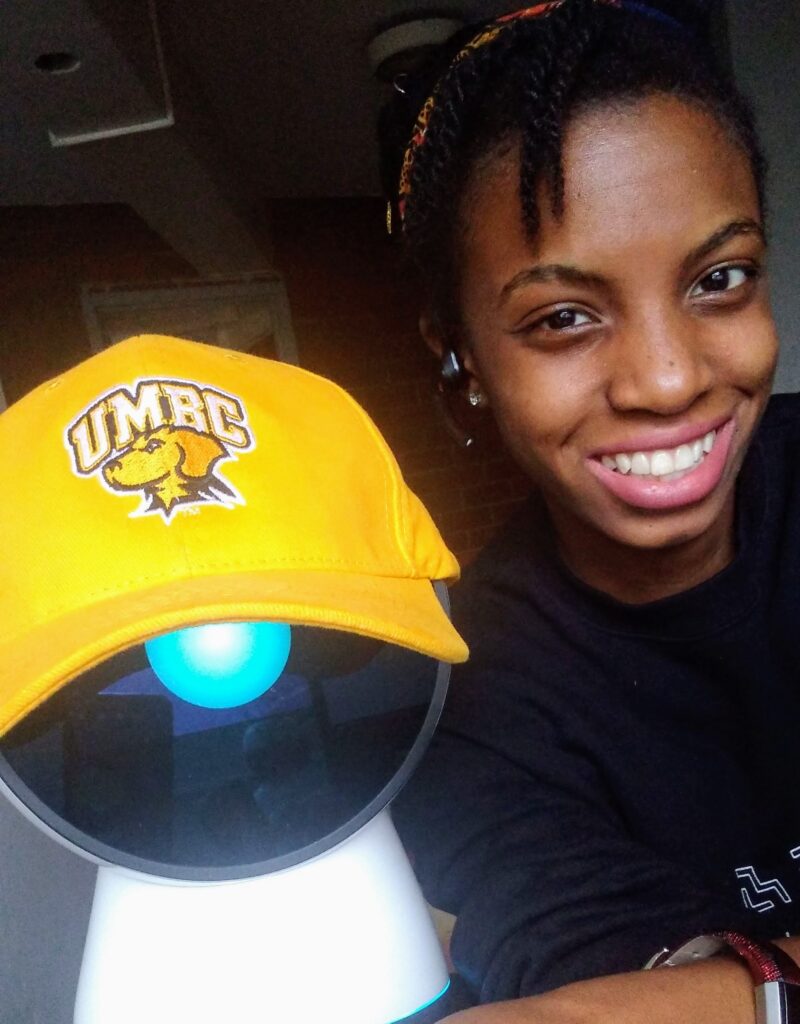
Williams and a Jibo robot show some UMBC pride. (Photo courtesy of Williams)
As a senior in high school in Prince George’s County, Maryland, Randi Williams ’16, computer engineering, was almost certain she was going to MIT for undergrad. Since middle school she’d had the understanding that MIT was the school “for people who want to build things,” and by spring of senior year she had already been admitted under early action. But fate had other plans.
Her mother had learned about UMBC’s Meyerhoff Scholars Program from a 60 Minutes segment that aired right around when Williams was applying to colleges. The nationally renowned Meyerhoff Scholars Program, founded in 1988, works to increase diversity among future leaders in science, technology, engineering, and mathematics by supporting students who intend to pursue a Ph.D. or combined M.D./Ph.D. in these fields.
Williams applied to the program and it was during an on-campus event for top Meyerhoff applicants that her mind began to change. She was impressed with the support and camaraderie the program offered. In the end, Williams opted to become a Retriever—and never looked back.
“If I hadn’t gone to UMBC, I don’t think I would have developed the leadership skills I did,” says Williams, who is returning to campus on April 16 as the keynote speaker for Undergraduate Research and Creative Achievement Day. “My mentors always encouraged me to speak up. I really benefited from that.”
Lifting others up along the way
At UMBC, Williams embraced myriad opportunities to learn and grow. She excelled in her classes, conducted research in the Mobile, Pervasive, and Sensor System Lab of Professor Nilanjan Banerjee, and was involved in the Meyerhoff Scholars, Honors College, and Center for Women in Technology communities.
“Randi’s work was noticeably excellent,” says Charles LaBerge, Ph.D. ’03, electrical engineering, a professor of the practice in the Department of Computer Science and Electrical Engineering who taught Williams in six different courses, from Intro to Engineering to her senior capstone, in which she and her team worked on underwater vision for a robotic sub. “Randi is always upbeat and friendly. Her capstone peers regarded her as a great teammate.”
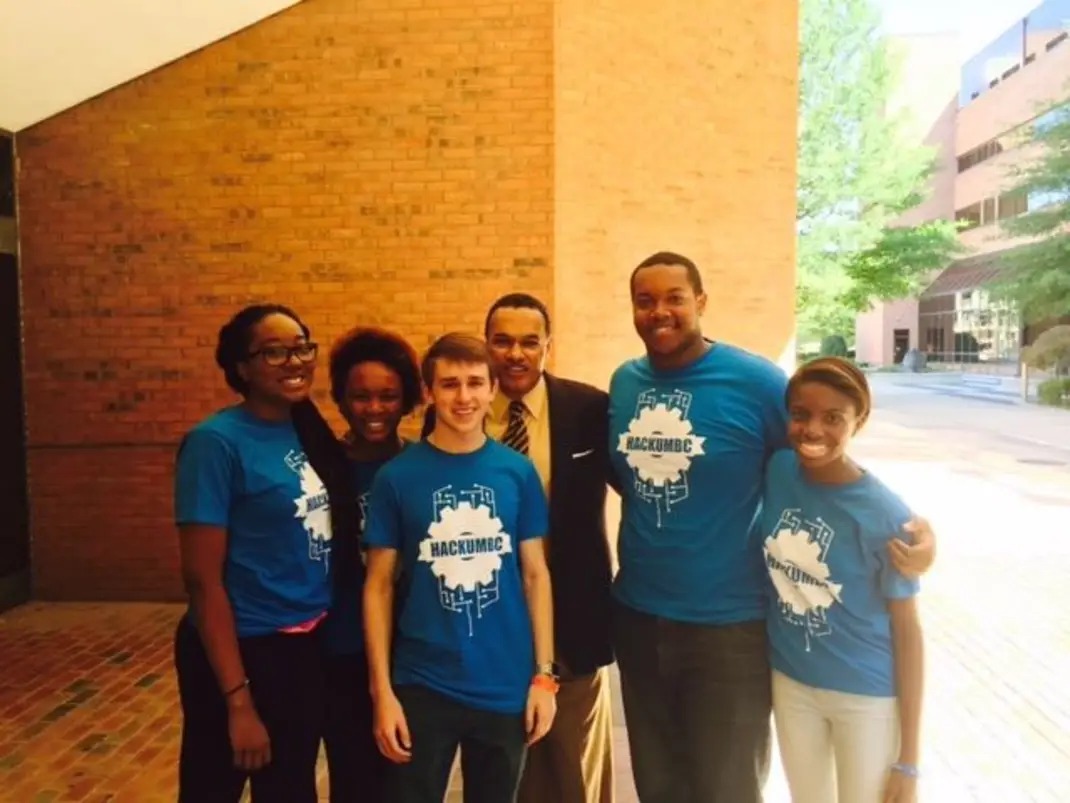
In her sophomore year, Williams co-founded the hackUMBC student group with fellow Meyerhoff Scholar Perry Ogwuche ’14, computer science and mathematics, and organized the university’s first hackathon, a 24-hour competition where teams of students create innovative solutions to problems that matter to them. Using that experience, she also ran hackathons for youth in Baltimore, centered around issues of community safety and interactions with police.
Randi Williams, far right, and other hackUMBC attendees pose for a photo with then UMBC President Freeman Hrabowski. (Photo courtesy of Williams)
Williams always wanted the people around her to succeed, and worked hard to lift everyone up, says her UMBC roommate of four years, Amreen Chadha ’16, financial economics: “I saw Randi pull all-nighters just to help her peers with studying and assignments that she had already completed.”
Throughout her time at UMBC, Williams stayed true to her passions and ideals, Chadha says. “Randi was always herself in the absolute best way: She was honest, thoughtful, caring, and all around great. If I had something on my mind, I was never afraid to be open with her. She balanced her school work and social life so well that it drove others around her to find the same balance.”
To MIT and beyond
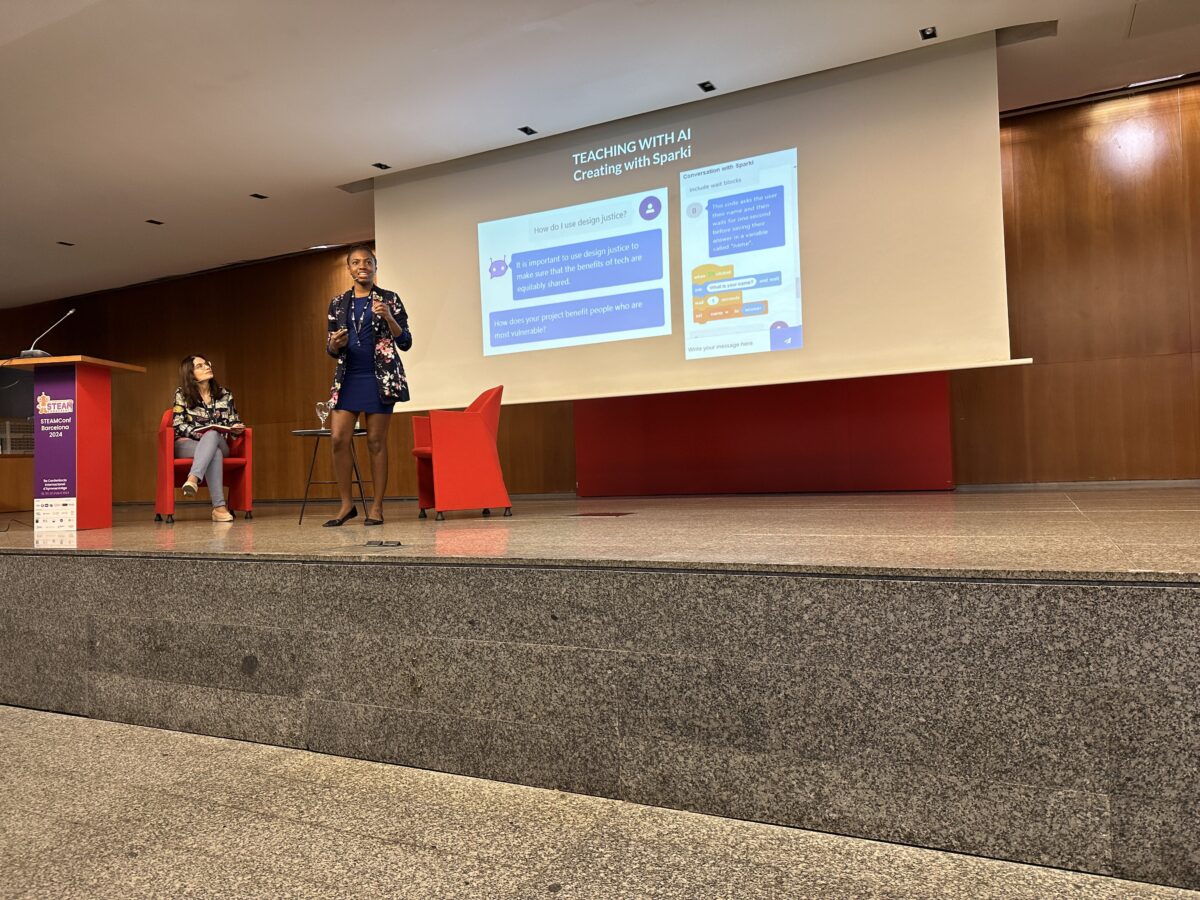
After graduating summa cum laude, Williams did at last say “yes” to MIT, where she joined the Personal Robots Group at MIT’s Media Lab. She earned a master’s in media arts in sciences in 2018 and a Ph.D. in the same field in 2024. Williams studied how young children understand and interact with AI, and worked on tools and teaching methods to enable young learners to undertake their own AI-based projects. She developed robots, called PopBots, that can teach AI concepts to preschoolers through social interaction, and also developed a middle school AI and ethics curriculum used by thousands of teachers around the world called “How to Train Your Robot.”
Williams tells the story of one young student she met who wanted to become a doctor and was not, at first, particularly interested in AI. But through a project in Williams’ class the student developed an AI tool to translate when a doctor and patient don’t speak the same language. “This student was inspired by her own situation of translating for her mother in doctors’ offices, and she imagined an AI companion that could do the same,” Williams says.
Williams says the anecdote illustrates how she would like young people to see AI—as a tool to empower themselves and address the problems they see around them.
Williams speaks about teaching with AI during STEAMConf Barcelona 2024, a conference about technology education. (Image courtesy of Williams)
Making AI accessible for all
In the summer of 2026, Williams will head to Carnegie Mellon University in Pittsburgh to become an assistant professor in the Human-Computer Interaction Institute.
“Running my own research lab has been my dream for years,” Williams says.
Before beginning that next chapter, she is working as a research lead at Day of AI, a nonprofit organization spun out of MIT, with the mission of preparing K-12 students of all backgrounds and abilities to be successful, responsible, and engaged in an increasingly AI-powered society. The mission fits with Williams’ passion of making technology education accessible to everyone.
“AI is like a big wave approaching us. We can either put our heads in the sand and pretend it’s not coming, or we can ride the wave,” she says. “I want everyone riding the wave.”
Although pop culture often portrays AI as an adversary of humans, Williams prefers to focus on the collaborative potential.
“I tell my students, this is what AI can create—And I’ll make a small circle with my hands; this is what humans can create, and I’ll make a bigger circle; And, putting my arms out wide—this is what we can create together.”
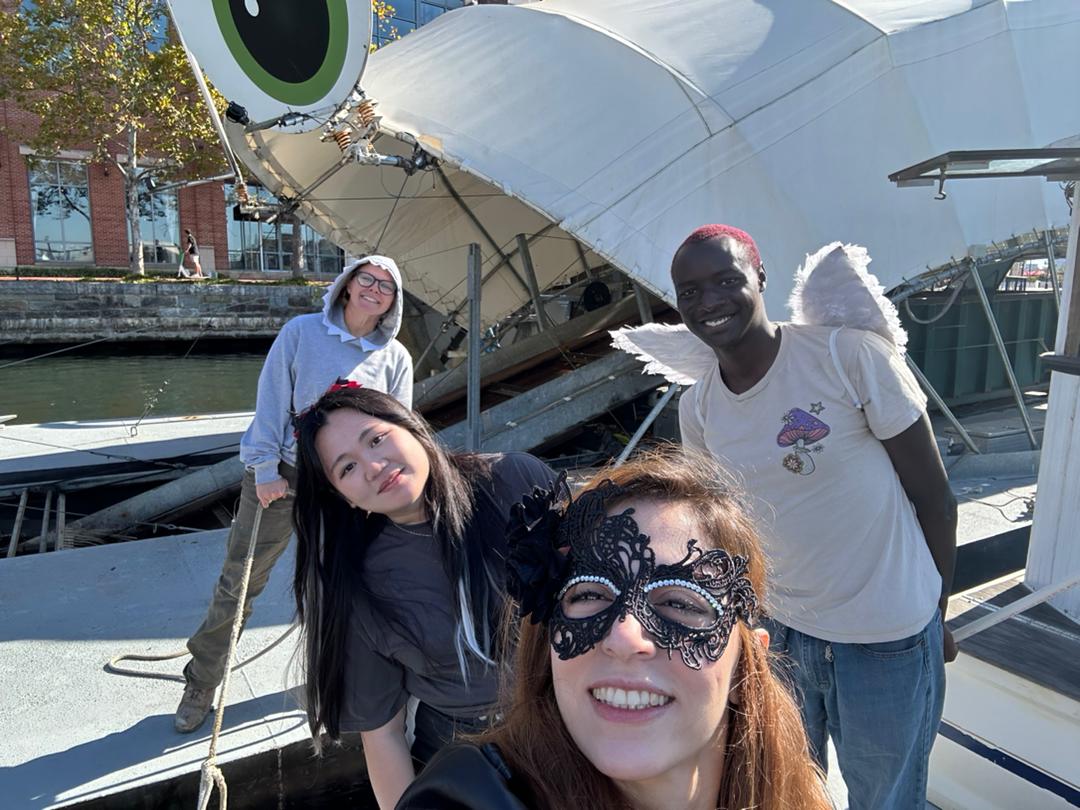
On a sunny and unseasonably warm Halloween this past fall, a group of costumed UMBC students strolled the banks of the Inner Harbor in Baltimore. The costumes were in good fun, but the spirit driving them to the city that day was more scientific than spectral: They were there to check on samplers they had installed around the harbor to measure the concentrations of certain chemicals called per- and polyfluoroalkyl substances, or PFAS, in the water.
On Halloween, from right to left, Alvin Bett, an undergraduate student working in Blaney’s lab, Hamidi, Siao, and Leigh Auth, a boat captain with the Waterfront Partnership of Baltimore who helped the group access the trash wheels to install their PFAS sensors. (Image courtesy of Siao)
PFAS are used in a diverse range of products, including cleaning products, clothing, and fire-fighting foam, and have earned the nickname “forever chemicals” because of the way they persist in the environment. There are growing concerns about the health effects of the chemicals, and in recent years there have been efforts to eliminate PFAS from some consumer products and regulate their concentration in drinking water.
The UMBC students’ work to measure PFAS in Baltimore Harbor is one of the first projects aiming to get an understanding of how much of the chemicals are found in the waters around Baltimore and where they might be coming from. Margaret Siao, a master’s student in chemical engineering, took a lead role in the work as part of the ICARE program, which links researchers and Baltimore community members on environmental projects around the city.
Donya Hamidi, an environmental engineering Ph.D. student, also took part in the project, which served as a test case for a larger project she is working on, seeking to expand the utility of innovative passive samplers to measure PFAS in any water source.
“I’ve lived in Baltimore most of my life,” says Siao. “The harbor is a big part of the city, although many people don’t go out on the water. And that’s one of the reasons I wanted to look at the water quality.”
PFAS are everywhere
There are thousands of different PFAS chemicals. Because of their widespread use and resistance to degradation, they are found throughout the country in the water, soil, air, and food, and in the blood of humans and animals.
Exposure to some forms of PFAS has been linked to a range of health problems, including decreased fertility in women, developmental effects in children, reduced immune function, and increased risk of cancer and obesity.
“The PFAS issue just gets more and more complicated by the day,” says Lee Blaney, the environmental engineering professor who leads the lab where Siao and Hamidi work. He notes the EPA recently released an initial risk assessment for certain PFAS found in biosolids, which are a byproduct of wastewater treatment and are sometimes applied to agricultural land as fertilizer. “It’s a big, far-reaching issue.”
Partnering with the community
Blaney is an expert on PFAS, and as concerns about the prevalence and potential health effects of the chemicals have grown, his lab has been a leading partner with Baltimore community members who advocate for and are responsible for the quality of the water.
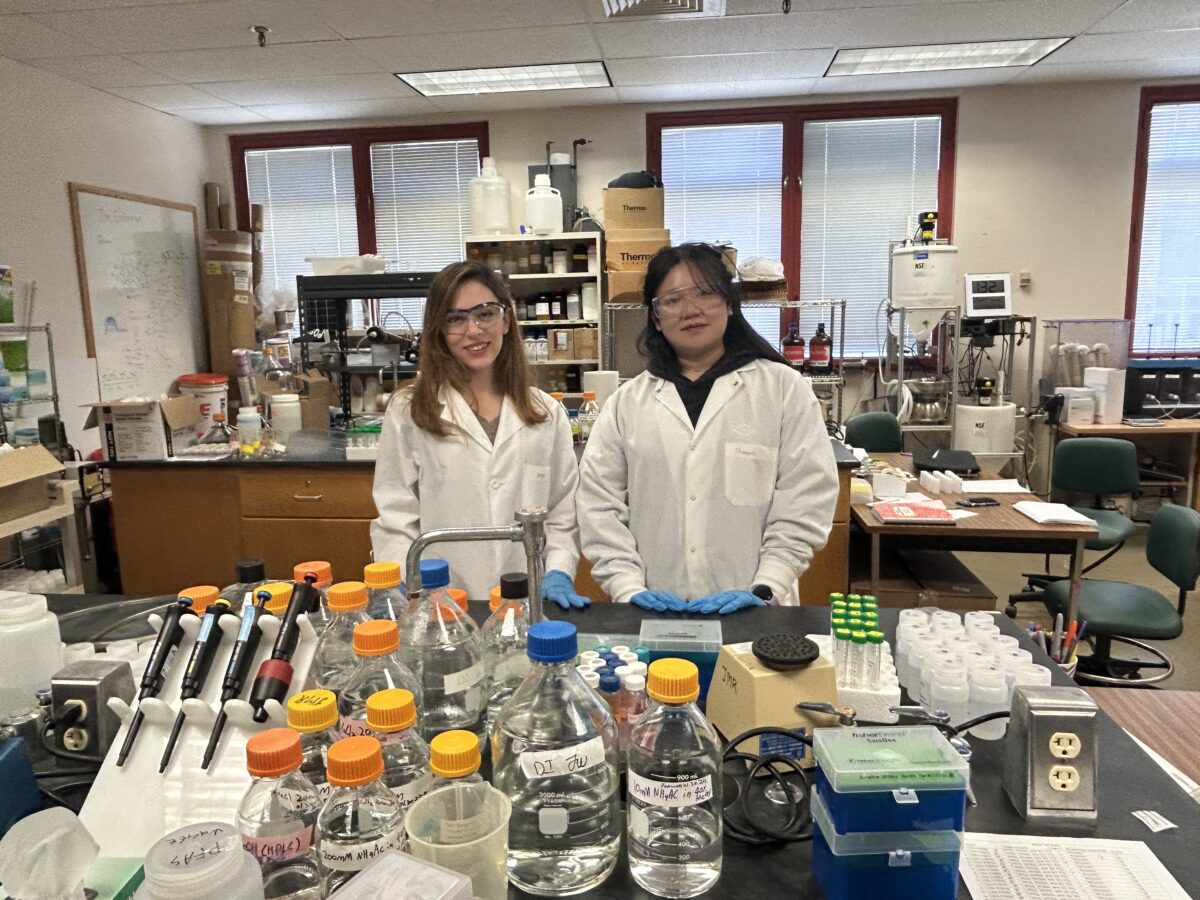
Hamidi (left) and Siao in the lab where they analyze samples for PFAS concentrations. (Image courtesy of Hamidi)
Siao’s ICARE project was a partnership with the United States Geological Survey Maryland-Delaware-D.C. Water Science Center and Blue Water Baltimore, a non-profit organization with the mission to restore the quality of Baltimore’s rivers, streams, and harbor. Blue Water Baltimore shared their knowledge of the harbor and area waterways and their connections with the community, while lab members shared their expertise and will share their PFAS data once it has been analyzed.
“PFAS is a hot topic, so Margaret’s project is really good timing,” says Barbara Johnson, who was Siao’s mentor at Blue Water Baltimore. “I think her data will be very useful for us in helping the public understand what PFAS are, for example just understanding how many different kinds there are. Margaret has taught me so much about PFAS.”
As part of the field work, Siao and Hamidi also sampled water at the outlet of the Patapsco Wastewater Treatment Plant in Baltimore. That partnership arose when Mohammed Almafrachi, who works as an engineer for the Baltimore City Department of Public Works, became interested in the PFAS issue and sought out a local expert.
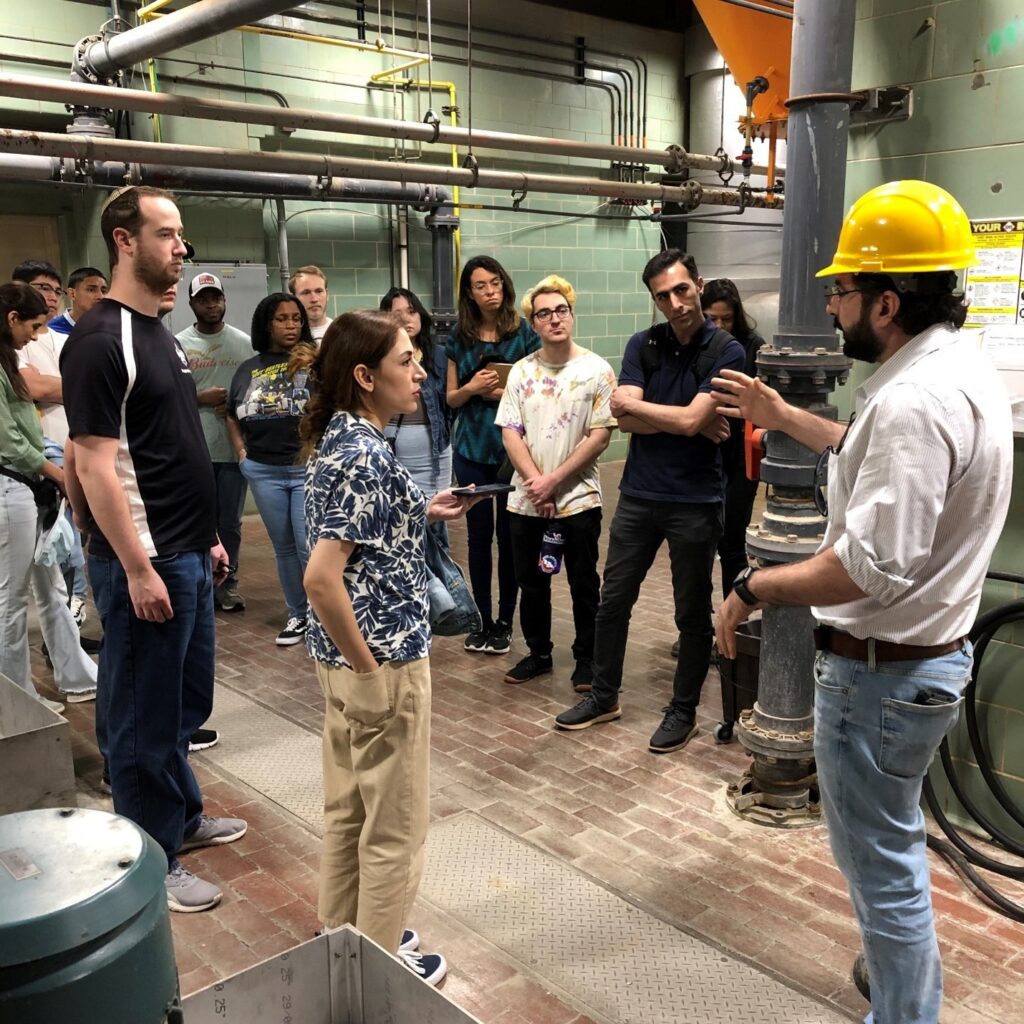
“Last year, I found Dr. Blaney’s name on the internet. I drove to the campus, found his office, and he was there. I introduced myself as an engineer at the city of Baltimore, and we sat down and started talking,” Almafrachi says. From that conversation grew not only the collaboration to measure PFAS at the wastewater treatment plant, but also a tour of Baltimore’s largest drinking water treatment plant that Almafrachi gave students in Blaney’s class on environmental physicochemical processes last spring. Almafrachi said he was happy to provide students with a window on a real-world workplace where their skills might one day be applied.
“If you have not gone to the field, then you are not yet a full engineer,” says Almafrachi. “We can talk about theories and textbooks endlessly, but the field is where you really test your skills.”
The value of field work
Almafrachi (right) led a tour of the Ashburton Filtration Plant, Baltimore’s largest drinking water treatment plant, for students in Blaney’s environmental physicochemical processes class. (Photo courtesy of Blaney)
Siao and Hamidi agree with Almafrachi about the value of field work. They installed their PFAS samplers at three of the four trash wheels around Baltimore Harbor—personified contraptions named Mr. Trash Wheel, Professor Trash Wheel, and Gwynnda the Good Wheel of the West that collect floating trash and keep it from dirtying the harbor. To get to the trash wheels, they took a flat-bottomed wooden boat, “more like a floating platform with a little cabin,” Siao says.
“Almost every time we collected a sampler, we saw something new or unexpected, for example algae growing on the sampler, and we had to figure out what was going on at that particular site,” says Hamidi. The team’s work and the measurements they collected and are currently analyzing will serve as a foundation for future studies about PFAS in the local environment.
Both Hamidi and Siao say they valued the teamwork of their trips, and the chance to meet people in the community impacted by their research.
“If you are stuck in a lab all day, it’s easy to forget why you’re doing research,” says Siao. “This project gave me a chance to interact with people outside of academia, to learn about what’s important to them, and to learn how to communicate about science with them, which is a really important skill.”
A multidisciplinary team of UMBC researchers was recently awarded $3.8 million from the Defense Advanced Research Projects Agency (DARPA) to develop new computational methods for assessing the feasibility of scientific claims. The project is motivated by the speed and volume of new developments in science and the need for tools to help evaluate the soundness of new claims.
“Some scientific claims are peer reviewed by independent experts, but others, such as from company press releases, or papers posted to pre-prints sites, are not,” says Frank Ferraro, an associate professor of computer science and lead researcher on the award. And even when science is peer-reviewed, there can still be errors, Ferraro notes. For example, recent research highlighting the danger of flame retardant chemicals leaching from black plastic into food was widely reported on, before it was discovered that an error in the paper led to a significant overstating of the exposure risk.
An AI science assistant
The idea of an AI assistant specifically designed to tackle complex research questions has been catching on recently. OpenAI, the creators of ChatGPT, recently debuted their “DeepResearch” tool, which the company says can use reasoning to synthesize large amounts of online information and complete multi-step research tasks.
Ferraro says the tool he and his colleagues hope to develop should stand-out from other approaches by employing a strongly iterative process, necessary to really take apart and analyze claims. The tool will break down a scientific claim into constituent sub-claims, and apply a wide range of evidence and reasoning approaches to assess the feasibility of each one.
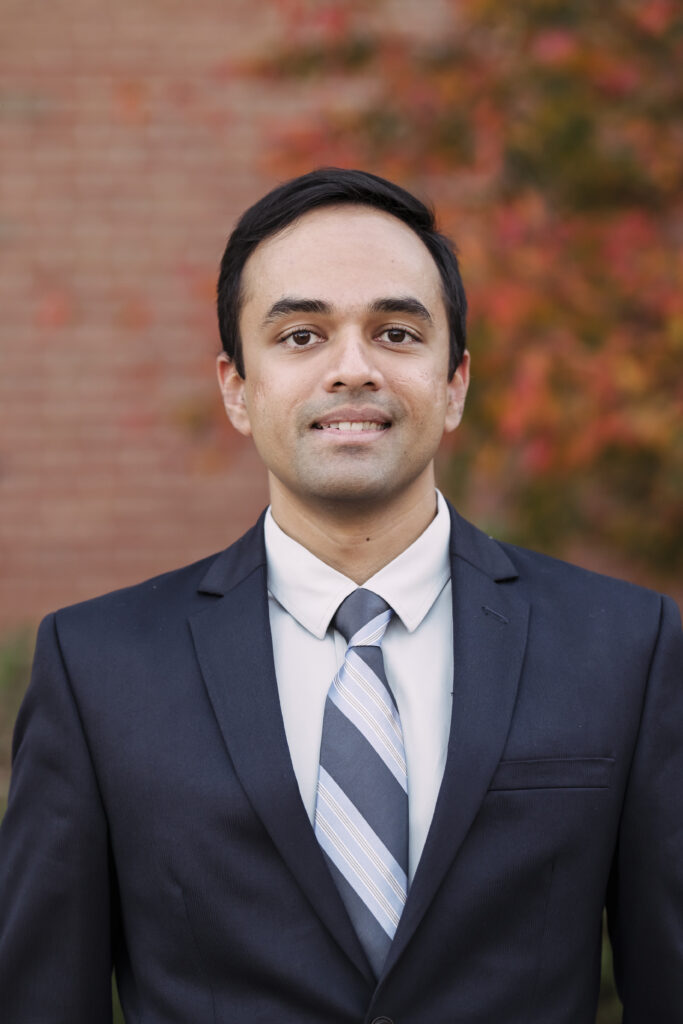
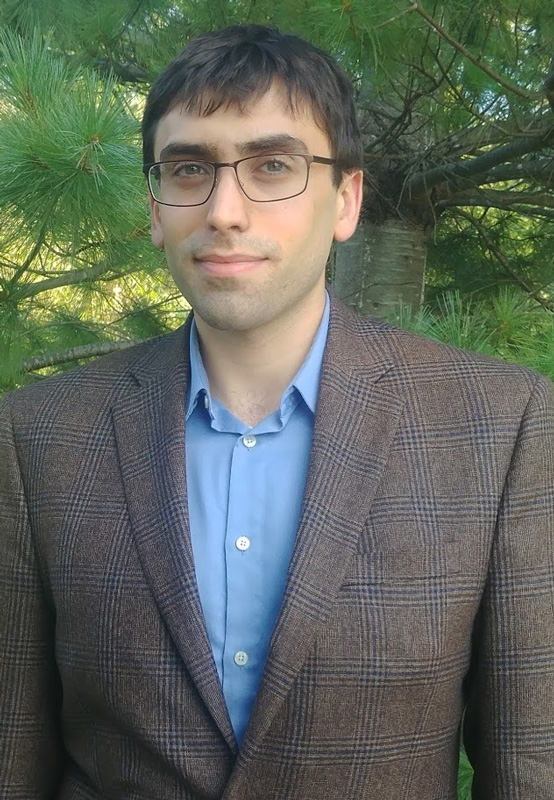
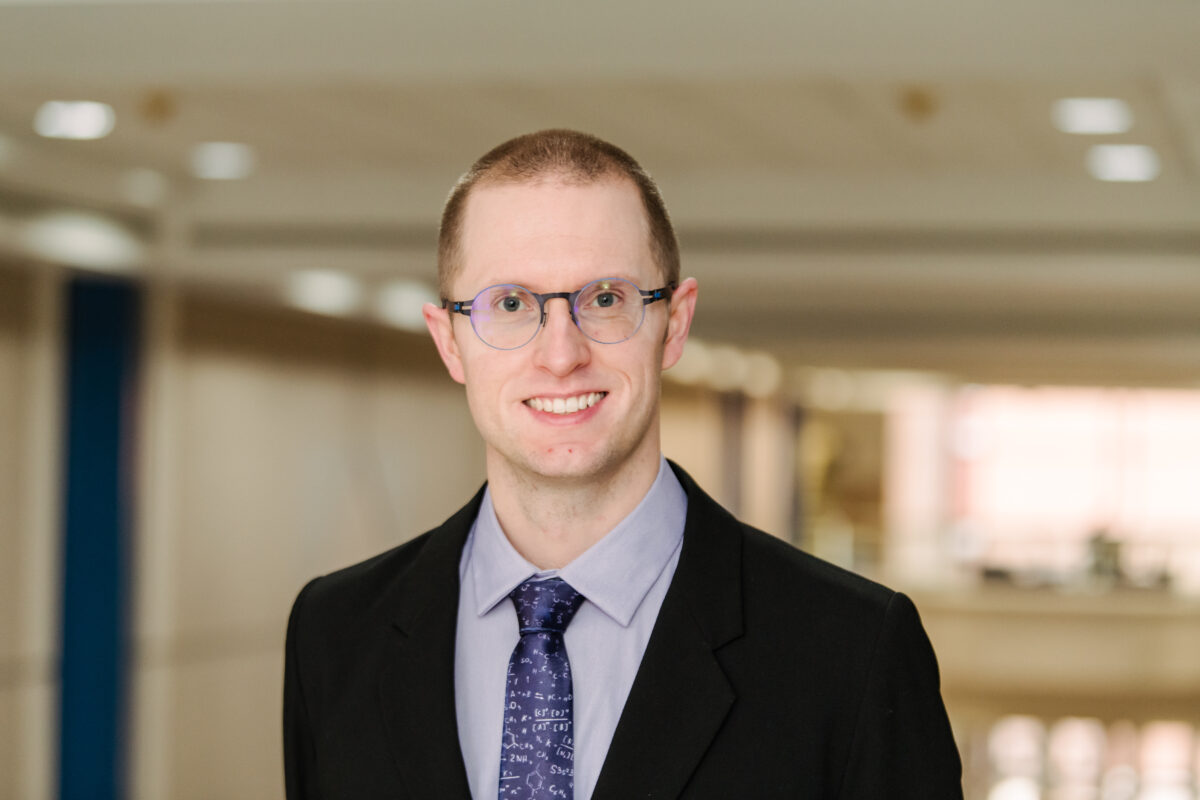
Tejas Gokhale (Marlayna Demond ’11/UMBC) Frank Ferraro (Image courtesy of Ferraro)Tyler Josephson (Marlayna Demond ’11/UMBC)
The team, which includes UMBC faculty Tejas Gokhale, computer science and electrical engineering, and Tyler Josephson, chemical, biochemical, and environmental engineering, as well as colleagues from Stony Brook University, the University of Texas at Austin, and the University of Cambridge, will develop and test the tool on three leading areas of scientific research: materials science, AI, and quantum computing.
“It’s a little meta that the AI will be analyzing AI,” Ferraro says. More than 20 UMBC undergrads, grad students, and post-docs will take part in the project. “They’ll get opportunities to network with peers on a highly relevant topic,” Ferraro says. “They’ll be helping guide the national conversation on these issues.”