On Sunday, August 30, after more than a decade of development, the Nancy Grace Roman Space Telescope successfully launched from the Kennedy Space Center in Florida. The telescope, with a field of view 100 times larger than the Hubble Space Telescope, is expected to provide an unprecedented amount of observational data that will help unravel lingering mysteries, such as the role dark energy plays in the universe’s accelerating expansion.
UMBC’s Rebekah Hounsell, an associate research scientist with the Center for Space Sciences and Technology, began working on the mission in 2015 at the University of Illinois. She has continued to work on it at multiple institutions since then, including at NASA Goddard Space Flight Center since 2020. She is co-PI and project manager of the Roman Supernova Cosmology Project Infrastructure Team (PIT), tasked with determining the best way for the telescope to collect data about cosmic phenomena called type Ia supernovae. The group is also developing tools that will turn the telescope’s data into information that scientists expect to refine—and potentially upend—our understanding of the universe. In this Q&A, Hounsell shares more about her work and why it excites her.
The day before the telescope’s launch, the rocket that would carry the Nancy Grace Roman Space Telescope into space was in position on the launchpad. (Photo by Rebecca Hounsell)
Q: What is your role with the Nancy Grace Roman Telescope?
A: For the last 11 years, I’ve focused on optimizing the survey design for the High Latitude Time Domain Survey, so we can get the best sample ever of type Ia supernovae. We hope those data will give us a better understanding of dark energy, which is a hot topic right now. Also, in 2024 I became co-lead and project manager of the Roman Supernova Cosmology PIT, an international group of more than 60 supernova scientists. We’re building the tools that will take researchers from pixels to detailed cosmology analysis of type Ia supernovae. These tools give the community a strong starting place from which to run their favorite cosmology modeling tools on the data and answer their own questions.
Q: How did it feel to see something you’ve worked on for so long finally go up in space?
A: It was amazing—and also anxiety-inducing. This has been my career for over a decade, and I’m expecting it to be my career for a decade more. On launch day I was sitting in the viewing area with friends and colleagues trying to stay calm, telling myself, “It’s going to be fine. It’s going to be fine.” As we got close, one of them looked at me and said, “I think I’m going to throw up,” which was exactly how I felt. Then it launched, and seeing it go up was so fast, precise, and beautiful. Seeing the rockets come back down was also amazing. Having something you’ve poured so much time into actually going up, and knowing it’s doing the work we planned, feels really special. It’s nice to know I’ve had an impact on it.
Q: What is a type Ia supernova, and why are they important to study?
Hounsell captured this photo, of the rocket that would carry the Roman Space Telescope, from the Banana Creek viewing area at sunrise on launch day. (Photo by Rebekah Hounsell)
A: A type Ia supernova happens when a carbon-oxygen white dwarf—the dense leftover core of a star like our Sun—exceeds about 1.4 solar masses and completely destroys itself in a thermonuclear explosion. That critical mass can be reached as one star gradually pulls material off a companion star or when two white dwarfs merge. Because the explosion is triggered at a pretty consistent mass, the light released is remarkably similar from one event to the next, so astronomers call them “standardizable candles.” Because you know how bright they should intrinsically be, you can use the observed brightness, in addition to corrections to its color and light curve shape, to calculate how far away the supernova is.
In the late 1990s, samples of these objects showed that distant supernovae were fainter than expected—evidence that the expansion of the universe is accelerating, which led to the idea of dark energy. Today’s best studies use around 1,500 to 2,000 type Ia supernovae. We always thought dark energy was constant, but recent results suggest it may be evolving, and we need far more data to settle the question. Roman will find tens of thousands of type Ia supernovae, including many much farther away and in larger numbers than previously identified. With that larger sample we should be able to refine our understanding of dark energy—or discover completely new physics.
Q: Now that the telescope has launched, what are the next steps in your work?
A: Right now Roman is undergoing commissioning, where we make sure everything is working as it should with the telescope. The first images should be released to the public early next year, and all of the data will be public right away. My main focus continues to be running the infrastructure team with my colleagues so we can produce high-quality products that enable the community to do research in the years ahead, and then also using those products to do the science myself. I actually just recently received a $1.2 million grant for work using data from the telescope.
Q: What are you most looking forward to once data starts coming back from Roman?
A: I’m excited to see what the wider community does with it. The data is public as soon as it’s ready—for researchers, students, citizen scientists, anyone. I’m really excited about the possibility that a 10-year-old version of me, or a student somewhere, will look at the images, spot something weird, reach out, and end up making a real discovery. This mission is for everybody. There are already plans for citizen-science projects, building on what was done with earlier surveys like NASA’s TESS mission, and platforms like the Roman Research Nexus, operated by the Space Telescope Science Institute in Baltimore, will make the data accessible for all. Communication is going to be key so people know how to get involved.
Q: What got you into astronomy originally, and why does it still excite you?
A: I got into astronomy around age 10. I grew up in rural England, surrounded by rapeseed fields and very dark skies. As a really little kid I thought someone had put black sugar paper [British for construction paper] across the sky and poked holes in it to make the stars. My dad explained that they were giant balls of gas like the Sun, and I was fascinated. That led to learning the constellations, and I just kept going from there.
“We can imagine that this complicated array of moving things which constitutes ‘the world’ is something like a great chess game being played by the gods, and we are observers of the game. We do not know what the rules of the game are; all we are allowed to do is to watch the playing. Of course, if we watch long enough, we may eventually catch on to a few of the rules. The rules of the game are what we mean by fundamental physics.”
At university I studied classical novae, which turned out to be a natural gateway into type Ia supernovae. What still excites me is that we’re essentially watching the universe and trying to figure out its rules. We observe, make hypotheses, and then more data either supports or overturns them. Roman is going to give us a much more powerful view than we’ve had before.
I sometimes worry, though, that future generations may not get to experience that same sense of wonder I did as a kid. I think we have an ethical responsibility to think carefully about light pollution and cleaning up space debris so that future generations can look up and feel that same sense of wonder that got so many of us started.
Large-scale oyster reef restoration in the Chesapeake Bay is successfully creating three-dimensional habitats that support larger, more diverse fish communities, according to new research from scientists at UMBC, the Smithsonian Environmental Research Center, and the National Oceanic and Atmospheric Administration (NOAA). The study, published in Ecosphere, provides compelling evidence that restoration efforts are shifting underwater ecosystems from communities dominated by small, transient schooling fish to those supporting larger, resident species.
The research focused on Harris Creek, on Maryland’s Eastern Shore, one of the world’s largest oyster restoration projects, covering approximately 1.4 square kilometers. By combining underwater video with high-resolution imaging sonar, the team evaluated reef habitat and “nekton”—free-swimming animals like fish and turtles—six to 10 years after restoration was completed.
“Oyster restoration is important for lots of different stakeholders in Chesapeake Bay, so we wanted to know precisely how it influences reef habitat and the fish and crabs that use that habitat,” says Allison Tracy, the study’s lead author and assistant professor of marine biotechnology with UMBC at the Institute of Marine and Environmental Technology. “Large-scale oyster reef restoration in Chesapeake Bay has been a success,” Tracy adds, “and our study adds new and important metrics of success for one of the most high-profile sites in the project.”
Completing the picture
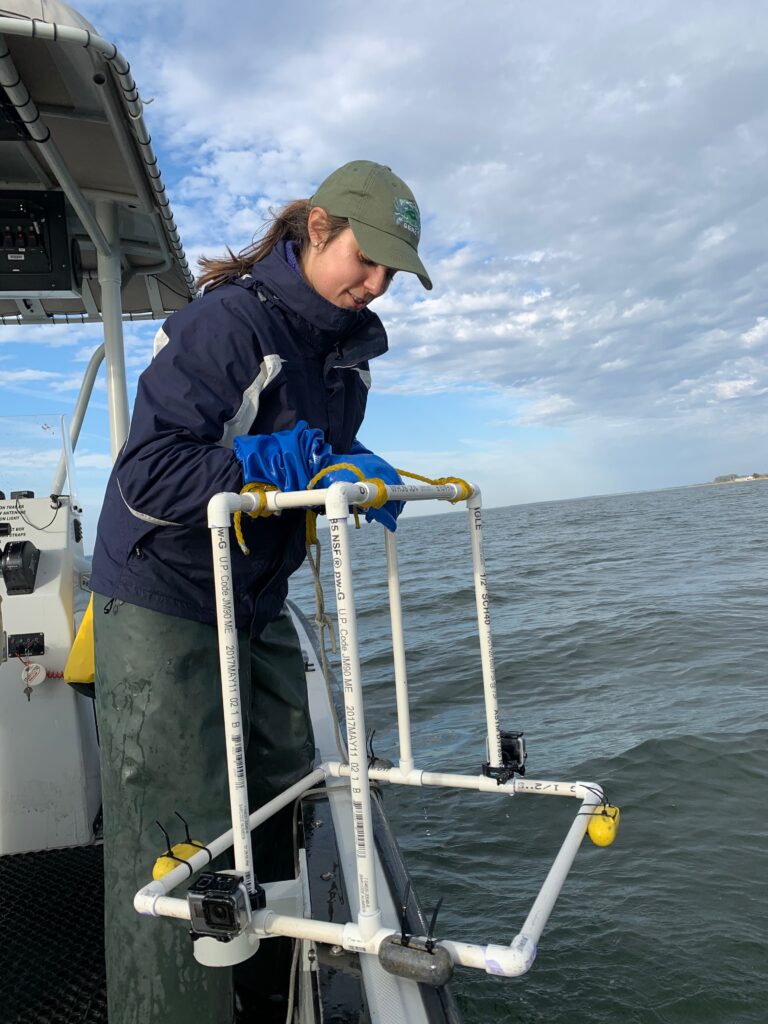
Allison Tracy lowers one of the underwater cameras into the Chesapeake Bay. (Courtesy of Matthew Ogburn)
The findings reveal that the restoration method matters. Reefs restored using a stone substrate plus juvenile oysters attached to adult oyster shells (called “spat-on-shell”) exhibited the highest habitat scores, showing greater vertical relief and structural complexity than reefs restored with spat-on-shell alone or reefs that had been continuously harvested. Restored reefs supported fewer total fish but significantly larger individual fish, with the highest abundance of fish exceeding 30 centimeters in length found on reefs restored with stone.
“The remote monitoring tools in this study make it unique,” Tracy explains. “We combined a simple but effective GoPro-based method for studying reef habitat with an elegant, high-tech survey of animals using sonar. We looked at reef-associated animals through many different lenses to get a complete picture of the community of finfish, crabs, and rays.”
The sonar data revealed a fundamental shift in how animals use these habitats. While harvested reefs and unrestored areas were dominated by small, schooling fish moving quickly through the water column, restored reefs supported more species that live and feed near the bottom. This suggests that the complex three-dimensional structure created by restored oyster reefs provides refuge and foraging opportunities for larger, commercially and ecologically valuable species.
“One of the key takeaways is that large fish in particular are taking notice of restored oyster reefs,” Tracy notes. “Harris Creek is one of the most valuable case studies of oyster restoration in the world. It was a great opportunity to study how animals use these reefs.”
Reef restoration efforts pay off
The timing of the study proved crucial to understanding restoration success. By surveying reefs at least seven years post-restoration, the researchers could assess long-term outcomes rather than immediate responses. The results indicate that Harris Creek’s restored reefs are self-sustaining, maintaining high oyster cover and structural complexity years after construction.
“This project was a powerful combination of scientists from different institutions and career stages,” Tracy adds. “We used the team’s mix of expertise to carry out a unique and important study.”
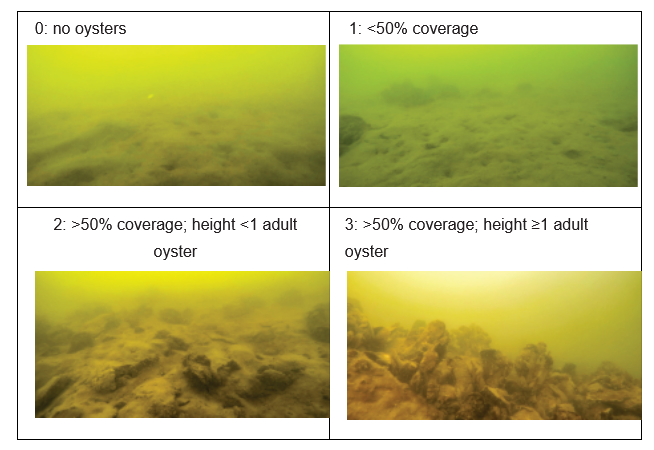
Figure 2c from the new paper shows the scale the researchers used to classify the oyster reef habitat sites in their study.
The research connects to broader efforts to restore Chesapeake Bay’s oyster populations, which are at only three percent of historic levels due to overharvesting, disease, and environmental stressors. The study aligns with recent findings from NOAA and other collaborators, including current study co-author Jay Lazar, on large-scale oyster restoration success across the Bay system.
“Official monitoring of the large-scale restoration efforts only takes place three and six years after restoration, but studying these reefs in the long term is needed to ensure that they continue to support oyster populations and provide habitat for other animals,” says Matthew Ogburn, senior author on the new paper and a senior scientist at the Smithsonian Environmental Research Center. “This study shows that underwater video can help fill this need.”
The study’s innovative approach—merging accessible video technology with sophisticated sonar imaging—offers a template for monitoring subtidal reefs in murky estuaries where traditional sampling methods face limitations. As restoration efforts expand globally, these remote sensing tools could help managers assess habitat quality and ecosystem services more efficiently and cost-effectively.
By studying reef habitat years after restoration, “we expected to be able to see how the efforts paid off—and they did pay off,” Tracy says. The findings suggest that investing in structural complexity—particularly through substrate enhancement with stone and protecting restored reefs from harvest—can accelerate the return of valuable fish communities and support the long-term health of the Chesapeake Bay.
Corrie Francis Parks, professor of visual arts, is an inventor of animation techniques whose short films have been screened at major festivals around the world. Her numerous awards and honors now include a major addition: This past summer, she was elected to the Academy of Motion Picture Arts and Sciences, known especially for the annual Academy Awards.
Parks has been creating animation since her teenage years. She designed her own major in animation at Dartmouth College and subsequently received her M.F.A. in animation and digital arts from University of Southern California. At UMBC, she encourages animation students to expand their understanding of the art of movement.
Her book Fluid Frames: Experimental Animation with Sand, Clay, Paint and Pixels explores the tactile nature of moving malleable materials directly under the camera, bringing together traditional and digital workflow through interviews with contemporary animators and workshop-style exercises.
Below, Parks shares what it means to become a member of the Academy, talks about her artwork, and chats about teaching and the Baltimore arts scene.
Q: What does it mean to be recognized by the Academy at this point in your career?
A: As an independent filmmaker it is an incredible honor to be invited to the Academy. My work explores experimental production methods and non-narrative structures, so to have this sort of research recognized alongside large-budget commercial productions is really encouraging, both for me personally and for the field. In recent years the Academy has been diligent and intentional about diversifying its membership in all aspects to better represent the art of cinema and including more artists who make experimental and independent films is part of that initiative.
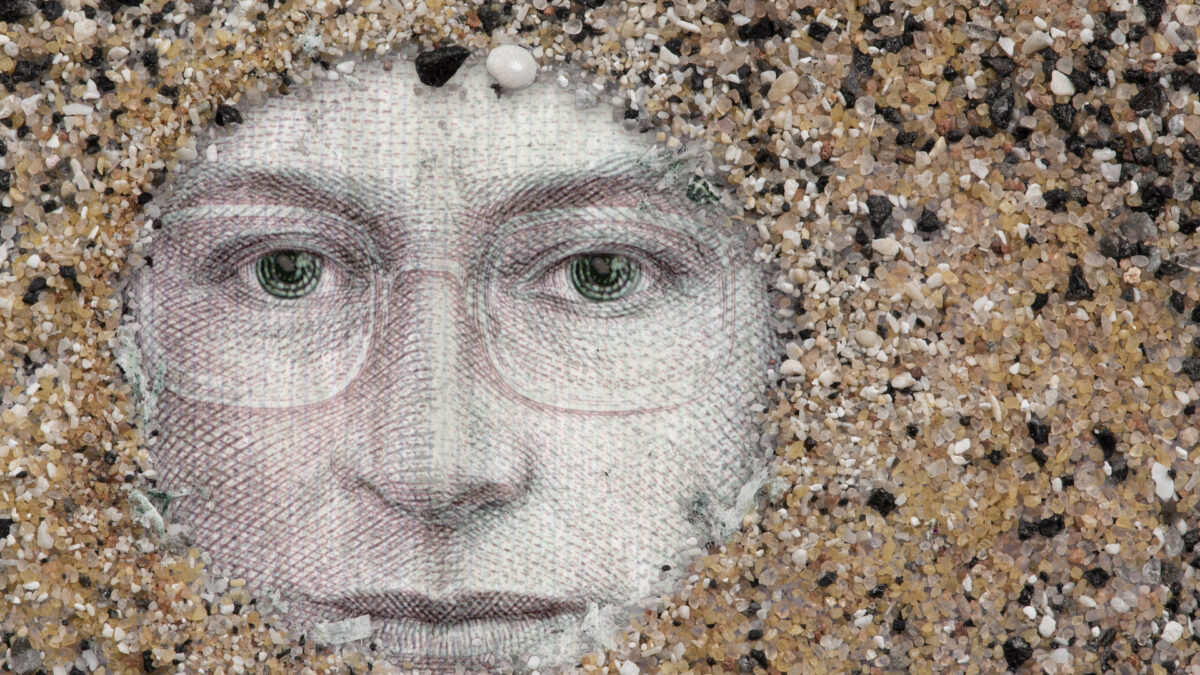
A still frame from Parks’s 2019 film Foreign Exchange. (Courtesy of Parks.)
Q: As a visual artist, was stop motion animation your first love? What inspired or excited you about it?
A: I actually first fell in love with hand-drawn animation and originally wanted to work on Disney and Pixar films. I studied character animation and how to break down movement to make anything—drawings, puppets, objects—come alive. In the process of making films, I discovered I really liked inventing new ways to use materials and find a unique “look” for my films. There’s a problem-solving and engineering aspect to stop-motion since I am working in physical space and with dimensional materials. I find those limitations help shape the animation and help me make decisions.
Q: How would you describe your work to someone unfamiliar with it, and where would you suggest they begin?
A: I would say I am an animation artist who makes both short films and projection-based installations. I began working with sand as my primary material in 2002 and continue to find new ways to use it, especially combining shooting stop motion with digital post-production. This means each project has its own style, so a good place to start is with one of my early films, A Tangled Tale, and then to see how I approach the material differently in later films like Foreign Exchange or some of my installations. Seeing installation and projection mapping works are harder because they exist in a physical space for a limited time, but would give a viewer a different understanding of how animation can work in a non-linear setting. Most of my films and other work are documented on my website.
Q: The stop-motion animation in Foreign Exchange requires tiny, intricate movements of grains of sand, while similarly in SKRFF you cut through layers of paint. What are the most significant challenges for you as you create?
A: Animation does take great patience but it is also always moving forward, so for me quickly going from one frame to the next is much more engaging than spending hours on a single painting or drawing! As I have become more interested in applying animation principles to new materials, like a graffiti wall in SKRFF or tiny grains of sand in Foreign Exchange, I have found my work becomes less narrative, so the challenge for me is to determine an underlying structure. Often that comes from the music or sound design, as it did in both these films.
There are technical challenges as well—having the right camera lens, lighting, and computer power to make the work efficient. I’m lucky to be able to work with my husband, Thom Parks, who is the technical director on most of my projects and he really keeps the studio running very smoothly!
In the studio, Parks manipulates grains of sand as she creates an animation. (Courtesy of Parks.)
Q: Sound is clearly an important component of your work. How do you select and work with a sound artist?
A: The collaborations have happened naturally and oftentimes are shaping the project from the very beginning. In Foreign Exchange, the driving musical track is a piece by Baltimore composer Alexandra Gardner. Alex and I met many years ago at the MacDowell colony and eventually both ended up in Baltimore. We had wanted to collaborate for some time so when I was exploring micro-sand animation, she gave me some of her music to play around with. Eventually we settled on Tourmaline and Alex re-worked her composition to fit the length and structural arc I was aiming for. The sound effects and mixing were all done by Matt Davies at Studio Unknown, a fantastic sound design studio in Catonsville.
For SKRFF, since the film was shot in Vienna, Austria, we asked Sandro Nicolussi, a sound artist we had met at another residency earlier that year. My collaborator on the film, Daniel Nuderscher, had worked with Sandro previously and we both felt his sound aesthetic would really fit the footage we were creating on the graffiti wall. As I was editing the footage, I would send pieces to Sandro, and he would send segments of sound back and we went back and forth letting the film develop in an organic way.
A still frame from SKRFF, created in 2024. (Courtesy of Parks.)
Q: What do you love about teaching, and what’s it like in your classroom?
A: I do love teaching, especially challenging students to expand their artistic process and try new techniques. My classroom involves a lot of student-to-student conversation, with a bit of guidance from me—because I think learning how to articulate and analyze your own work and that of your peers is essential to the artistic process. The most impactful teachers in my life were the ones that interacted with me as artist-to-artist, and showed me films or gave me assignments that were somewhat uncomfortable. That’s how we all grow beyond the limits we impose on ourselves.
Q: Can you tell us about UMBC’s connections to the Baltimore arts community?
A: I think a great asset to our students is how engaged our arts faculty and staff are with what’s going on in Baltimore. We are always showing or performing work somewhere nearby, so students can see what it’s like to be a practicing artist in a community. I love that some of our students have taken over the first floor hallway in the Fine Arts Building and are making it an exhibition space for their own work.
Q: Your work with sand has lots of quirky playfulness to it—things that would make people smile. Do you think about that as you’re creating new work?
A: I make work that makes me delighted and that I find interesting to watch! Animation is always a bit magical, because it’s breathing life into something that shouldn’t be alive. I guess if it works for me it works for other people too!
Q: What’s next for you? Can you share anything about works in progress?
A: I have a new film in the works, based on writings and discoveries made by early microscopists, Antonie van Leeuwenhoek and Robert Hooke. I’m animating grains of sand as though they were microscopic organisms inhabiting their own cosmic worlds, waiting to be discovered and explored.
Parks works on an animation in the studio. (Courtesy of Parks.)
As fall 2026’s first full week of classes wrap up, Retrievers across campus—newly minted and returning—are finding their place. In addition to learning to navigate to the right classroom, they are bringing their unique strengths and voices to this ever evolving community.
This year’s incoming class of over 2,000 Retrievers boasts a median GPA of 4.0. Among them is Rodney Oglesby, an aspiring musician and a Gates Scholar. Oglesby was one of 750 students awarded this high honor among a pool of over 61,000 applicants nationwide.
“We are thrilled to welcome another impressive entering undergraduate class, with a 15 percent increase in enrollment from Baltimore City, and, overall, students representing 42 countries,” says Dale Bittinger, M.P.P. ’16, assistant vice provost for strategic undergraduate engagement, partnerships, and pathways. “They are academically talented and engaged and we look forward to all they have to offer to our campus community.”
Joining Oglesby is Saad Bin Waqas, a new student who traveled nearly 7,000 miles from his home in Pakistan to address the UMBC community at this year’s Fall Opening Meeting. At just 16, this Sondheim Scholar and geography and environmental studies major is looking forward to planting some roots after growing up in a military family.
“After moving from place to place for much of my life, I am really excited to have a new place I can call home,” shared Waqas.
A place to flourish
Junior Sabirah Burt is joining UMBC as a transfer student from Howard Community College. Her aspirations to ultimately become a physician’s assistant are shaped by her own experience grappling with a medical condition. If you had asked Burt a few months ago to describe herself, she’d say “ticking time bomb.” In June 2025, she was rushed to the hospital for an agonizing headache. Medical professionals eventually discovered she had an active brain bleed and underwent emergency surgery.
“I believe graduating with a public health degree from here will allow me to flourish when continuing my education and applying to graduate school in the future,” she said. “After going through my tough experiences last year, it’s made me even more passionate to pursue medicine, now more than ever before, and help those lying in hospitals wondering if it will be their last day.”
Strengthening connections—early
Some new Retrievers got a jump start to the year and arrived on campus over the summer to dive into work-integrated learning (WIL)—an educational approach that prepares students for a rewarding career after college by pairing what they are learning in the classroom with hands-on, authentic work experiences. In July, more than 100 incoming first-year and transfer students spent a night on campus, connected with an instructor and teaching assistant, and spent a day participating in service on site at five different community partner locations.
WIL students will participate in service with the same sites throughout their full first year at UMBC, deepening engagement and strengthening connection to their peers and faculty as well as to the campus and community.
“I believe a program like this is an excellent cohort building model. I was able to have individual conversations with all of them, learning what they cared about going into their unique UMBC journeys,” says Emily Passera, the senior program coordinator for community-engaged learning through The Shriver Center at UMBC, who led a group of students to Patterson Park in east Baltimore and will teach the same students in a first-year experience course called UNIV 101.
A community for all
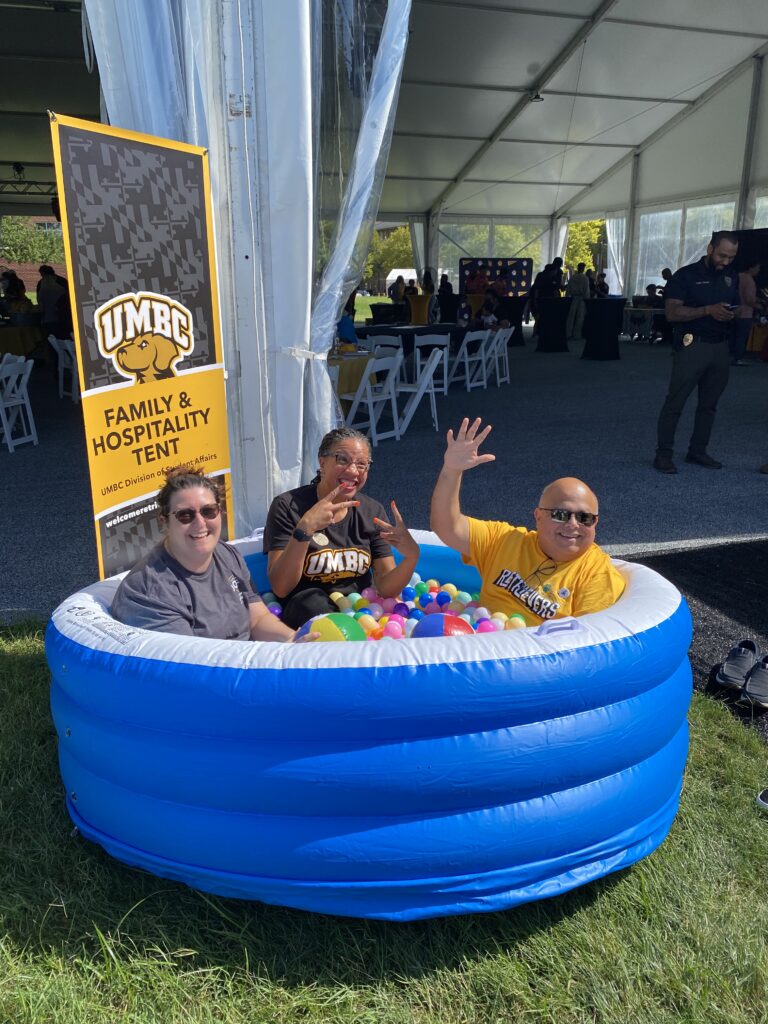
Diaz hangs out with Renique Kersh, vice president for student affairs (center), and Wendy Low, coordinator in the Division of Institutional Equity, in the hospitality tent’s ball pit. (Photo courtesy of Kait McCaffrey)
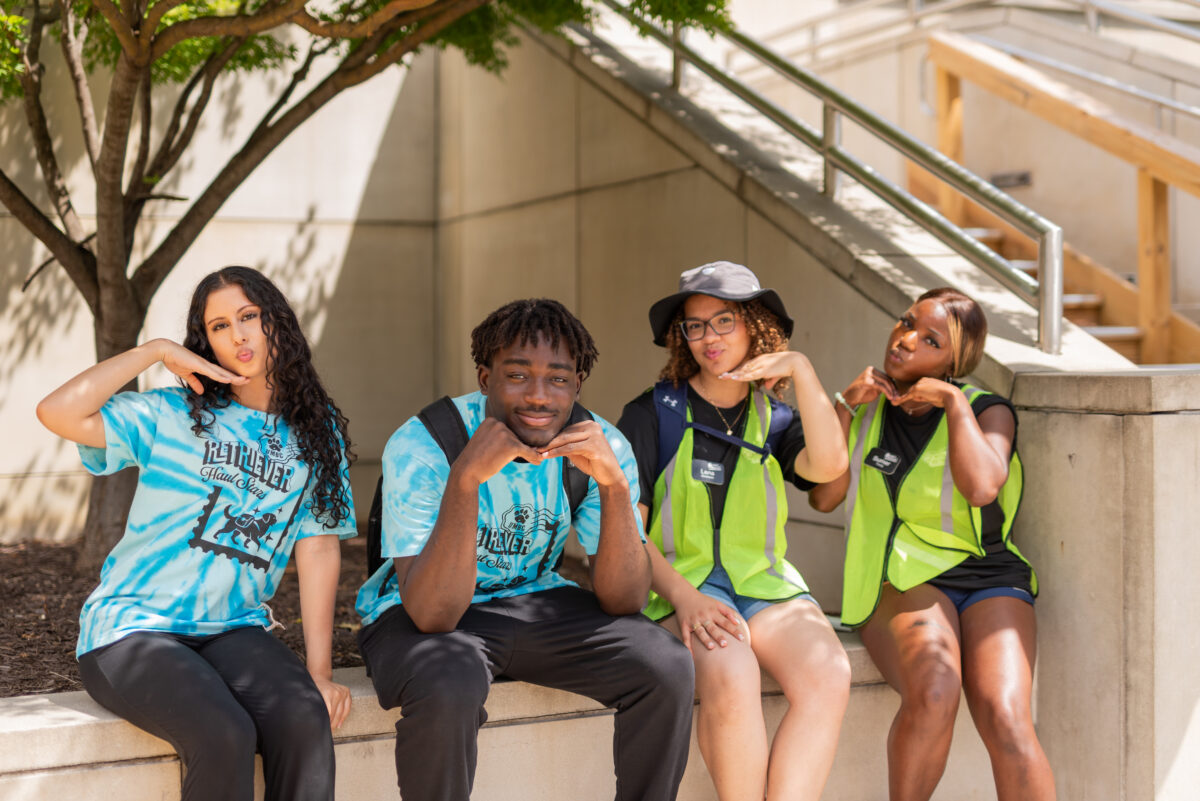
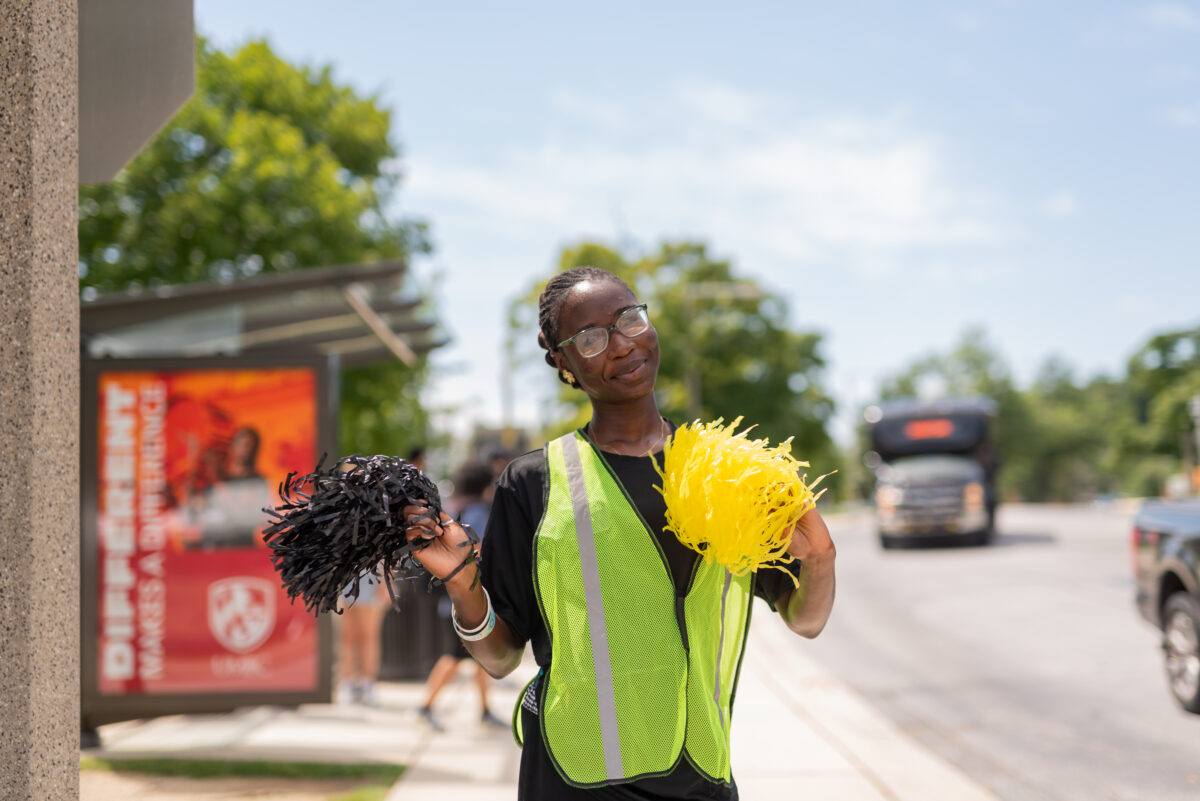
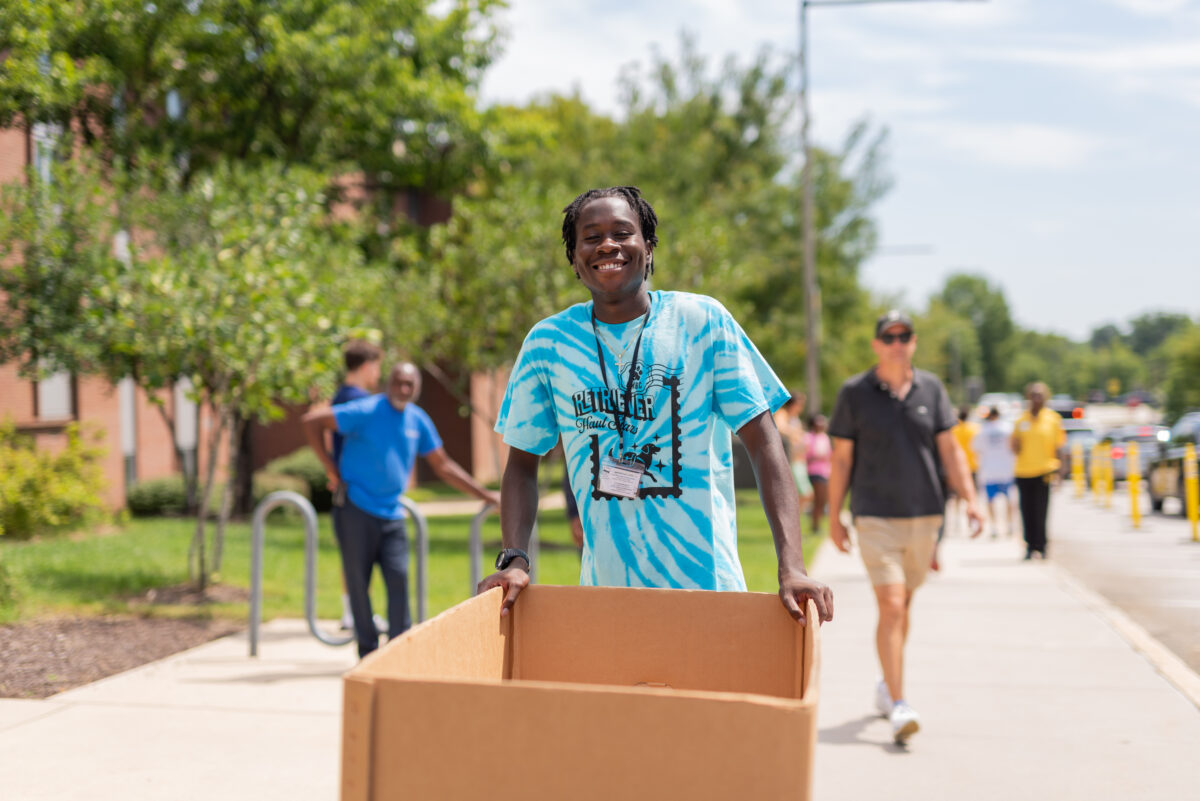
With a full lineup of events, this year’s Welcome, Retrievers efforts ensured that students started to find their place from the minute they stepped onto campus. Student volunteers (“Haul Stars”) were on hand to keep things moving as they helped new students with their belongings and offered directions.
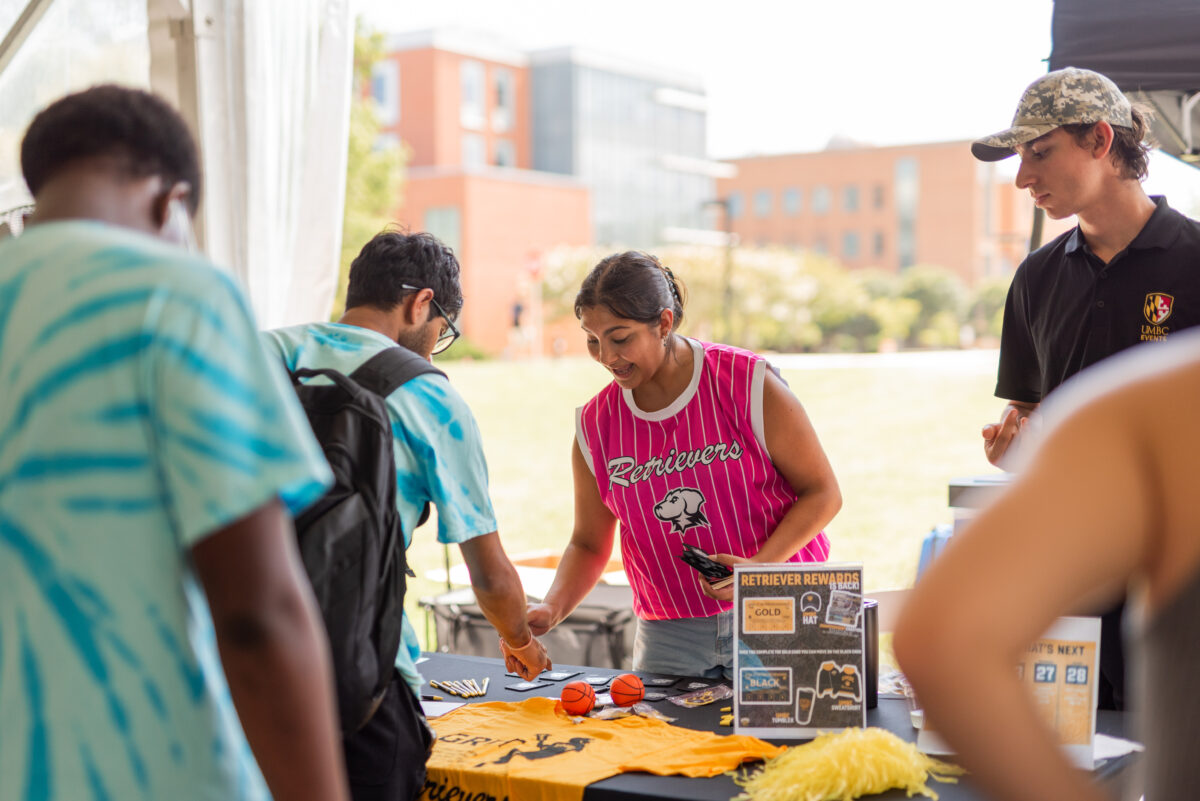
Students weren’t the only ones getting in on the fun. Retriever Fest gave families the opportunity to meet with campus partners and learn more about everything UMBC has to offer—while enjoying refreshments and picking up some swag. Jake Diaz, inaugural assistant vice president and dean of students in the Division of Student Affairs, had a ball welcoming new students.
Throughout the weekend, students continued to enjoy Retriever 101 events, like First Night, an Student Events-Board-sponsored takeover of The Commons with inflatables, prizes, games, and plenty of other activities that cemented the first night as one students will remember for years to come.
Events like the Taste of UMBC, Your Story Belongs Here, and the annual New Retriever Photo bonded students and filled their camera rolls. The first weekend concluded with Convocation, the official opening of the fall semester. President Valerie Sheares Ashby addressed the new students, reassuring them that UMBC is where they’re meant to be.
“…I want to make sure you hear this from me: You belong here. You have come to an institution that wants you here and believes that you can be successful here, even if you are not yet completely sure of that yourself.”
Eight UMBC students are spending part of their summer meeting business leaders, visiting Maryland companies, and getting a closer look at careers that connect the state to the rest of the world.
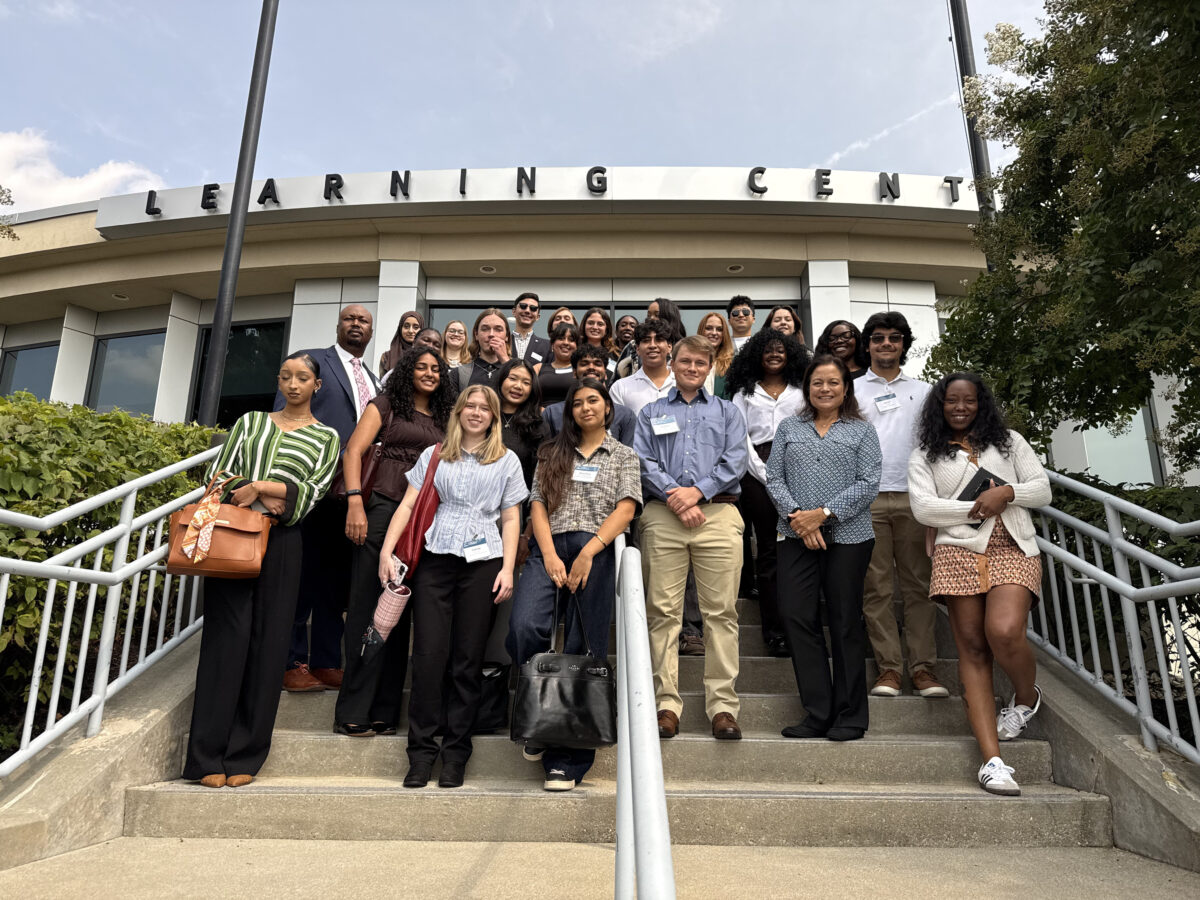
They were selected for the World Trade Center Institute’s (WTCI) 2026 Albrecht Fellowship, a two-week professional development program hosted in Baltimore City and focused on international business and global affairs. This year, the UMBC group set a record.
Daniel Khoshkepazi, senior manager of fellowships at the World Trade Center Institute, called the eight students “a record for a single university from any given cohort in the past.” WTCI typically limits participation to five or six students from one institution, he says. But UMBC students ranked so highly during what he described as the program’s most competitive application cycle to date that “their exceptional performance earned them a place in the cohort.”
For the students participating, the two weeks are a chance to test assumptions about their careers, see what they have studied at UMBC in practice, and, in some cases, discover work they had never considered.
Trying something different
Headshot courtesy of Matthew O’Donnell
Matthew O’Donnell applied for the fellowship the day after hearing WTCI CEO Eddie Resende speak at UMBC. O’Donnell, a senior global studies major and political science minor, had been thinking about how he spent his first few years of college and wanted to push himself to try something different. Resende’s description of the fellowship and its focus on global trade and business caught his attention.
“I began to realize I need to step out of my comfort zone more,” O’Donnell says. “I felt that I spent my first semesters too close to the norm, and I wanted to try a new experience to see how it would go.”
Gouri Gupta, a junior, initially had a different reaction when she heard about the opportunity. A global studies and political science double major on the pre-law track, Gupta initially brushed off the fellowship. Marketing, global supply chains, logistics, and other business-oriented topics did not seem particularly relevant to her plans to pursue human rights law or federal law enforcement.
Eventually, that became part of the appeal. Gupta decided there could be value in pursuing an experience that did not neatly match the future she had planned for herself. A few hours before the application closed, she started filling it out. She hit submit just seconds before midnight.
The experience introduced Gupta to industries she had rarely considered. Through site visits, she got a closer look at the systems behind everyday products, from olive oil and power saws to athletic wear. She also began connecting concepts from the classroom with areas such as supply chain management and logistics. For Gupta, the fellowship helped clear up some of the “fuzziness” surrounding careers and industries she had previously known primarily as a consumer.
Seeing coursework in action
That sense of discovery is showing up in the classroom connections students are making, too.
During a fellowship panel on global business and supply chains, O’Donnell found himself fascinated by a field he had known little about. He stayed after the session to talk with several panelists about their work. As he explores new fields through the fellowship, he is also seeing connections to topics he has discussed in his global studies courses at UMBC, including global trade, artificial intelligence, international boundaries, and negotiation.
Bibi Qudsia Tolwak, a senior global studies major and public humanities minor, has studied national and international organizations in her UMBC courses. Through the fellowship, she had the chance to visit organizations and businesses and talk directly with professionals about their work.
Originally from Afghanistan, Tolwak is interested in global affairs, humanitarian work, refugee issues, and advocacy. But one of the things that has stood out to her during the fellowship has less to do with any particular industry.
The professionals the students heard from have taken very different routes to their current roles. Some started as interns. Some applied multiple times before an opportunity came through. Others changed directions or faced challenges such as building careers while speaking English as a second language.
Bibi Qudsia Tolwak speaks at a WTCI group meeting. (Photo courtesy of Tolwak)
“It reminded me that careers do not always happen all at once,” Tolwak says. “Sometimes you just have to say yes to an opportunity and keep moving forward.”
The message resonated with Gupta, too. During a visit to McCormick’s plant and global headquarters in Hunt Valley, Maryland, a panelist shared a message about how the steps toward one career goal may not be the same ones that lead to the next. Gupta says it put into words one of the biggest lessons she is taking from the fellowship: Growth requires being willing to learn and adapt.
Eight Retrievers, one cohort
The size of UMBC’s group has added another dimension to the experience. “It has been great meeting other Retrievers from different majors and backgrounds and learning from their experiences,” Tolwak says. “It also makes me proud to see so many UMBC students represented in the fellowship.”
O’Donnell appreciates that the students bring different interests and strengths to the group. “One thing I love is that nobody feels like they’re overshadowing one another,” he says. “We each have our interests and strengths, and no matter if it’s a group setting or an individual one, we always contribute in a way that aids both ourselves and the group.”
Their paths to the fellowship began months earlier. In April, UMBC’s Global Studies Program hosted Global Career Conversations with Resende, an event focused on international careers. Felipe Filomeno, director of the Global Studies Program, and Christine Routzahn, director of the Career Center, worked together to promote the fellowship and encourage students to apply.
After the UMBC students were selected, the university worked to make sure cost would not prevent any of them from participating. The Division of Student Affairs provided support through a combination of the Career Center’s intern and service funds and divisional resources, allowing all eight students to participate.
Making room for what comes next
As the fellowship continues, the students are not necessarily finding one answer about what comes next. Instead, they are becoming more comfortable with the possibility that their careers may take unexpected turns.
O’Donnell is interested in international relations and more recently, community engagement and local government as well. The fellowship has given him more possibilities to consider rather than one definitive answer.
The WTCI interns gather at another site visit. (Photo courtesy of Tolwak).
“The Albrecht Fellowship has certainly given me more to think on, and that’s really what I wanted from this opportunity,” he says.
Tolwak is also still exploring where her interests will lead after UMBC. “I have learned that successful careers are not always straightforward,” Tolwak says. “You do not have to have everything figured out at the beginning; you just have to be willing to learn, keep trying, and say yes to opportunities that can help you grow.”
Gupta is considering law school and careers in human rights or federal law enforcement. The fellowship is also changing how she thinks about entering spaces where she may be younger or less experienced than the people around her.
“If there is one important lesson that the fellowship taught me, it’s that we—as students and professionals—can own our space,” Gupta says.
She hopes to carry that confidence into a field where she wants to make a difference: Gupta specifically wants to increase the representation of South Asian women in federal law enforcement. “I want to change that, and the Albrecht Fellowship has solidified the notion that I can change it.”
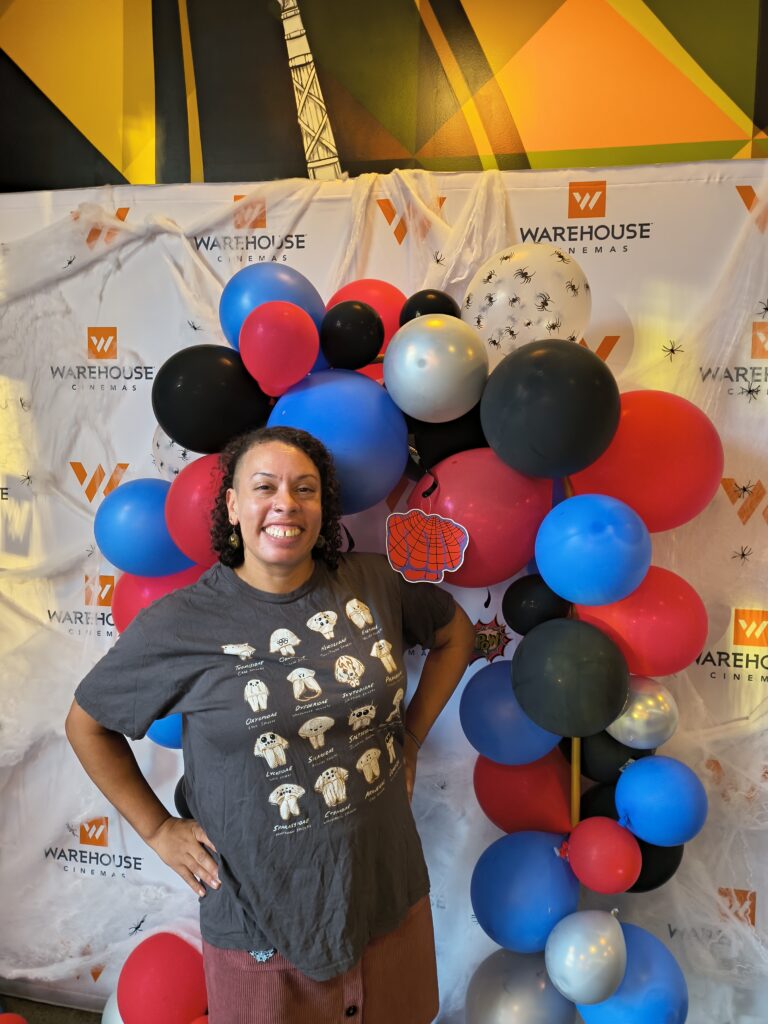
The first Spider-Man movie with Tom Holland as Peter Parker, “Homecoming,” was released almost a decade ago in 2017. Mercedes Burns, associate professor of biological sciences and Spider-Man fan, has been studying arachnids for double that. This summer’s blockbuster, “Spider-Man: Brand New Day,” shows Peter Parker slowly becoming an actual spider as the result of hormonal imbalances triggered by extreme stress, trauma, and long-term social isolation. He produces organic webbing, his eyes turn pitch-black, his “Spidey senses” are enhanced, and biological web slingers develop in his wrists for close-quarters combat. Burns, who wore her spider taxonomy t-shirt to the movie, will tell us if these upgrades have any scientific merit.
Q: What was your first reaction to the movie, particularly from a scientific perspective?
A: I enjoyed the movie, though I preferred 2021’s “Spider-Man: No Way Home.” I thought the new movie was a little uneven scientifically. Some things were extremely technical and accurate, while other things were vague. I did some research on the vague hormone discussion, to try to understand why that aspect was much less specific than some of the other science in the movie.
Mercedes Burns wore her spider taxonomy t-shirt to the new Spider-Man movie. (Courtesy of Burns)
There was a piece in the trailer where Bruce Banner, the Hulk—portrayed as a physics professor at the fictional Empire State University—explains the life cycle of the spider that did not make it into the movie. So there was no clear reason for why the changes were happening. It made it seem as though Spider-Man was becoming more spidery simply because he was getting really upset or sad.
Q: Was there anything scientifically inaccurate about Bruce Banner’s explanation of Spider-Man’s DNA changes?
A: There was an extremely complicated discussion of how short non-coding RNAs were being used to limit the Hulk’s and Spider-Man’s powers by binding proteins involved in their abilities. This therapy is based on RNA interference, which was discovered in the late 1990s. It is only very recently that any short-interfering RNA (siRNA) drugs have been FDA-approved, though, such as for certain forms of hemophilia—so this is very recent technology. Overall, I was impressed by how much detail they put into how the DNA limiter worked.
There was one important mistake, though. Professor Banner talked about needing to destroy mRNA before it is transcribed, when the correct terminology is translation. DNA is transcribed into mRNA, and mRNA is then translated into proteins. If they were talking about destroying mRNA before it is used to make a protein, they should have said translated, not transcribed.
Q: What about the explanation about the surge in arachnid hormones?
A: The hormone description was extremely vague compared to the RNA discussion. One arachnid hormone that we know something about is a steroid called ecdysone, which triggers molting and increased body size. Ecdysone opposes the action of juvenile hormone, which has been studied extensively in insects, because it can be used in biological control to prevent insects from maturing.
We know what spiders look like when they are under stress and that some species are very resilient to stress. But we do not know as much about how spiders physiologically deal with stress or whether stress might impact hormone levels, which may be why that aspect of the movie was so vague.
Q: Are these hormones what makes Parker’s new webs stronger?
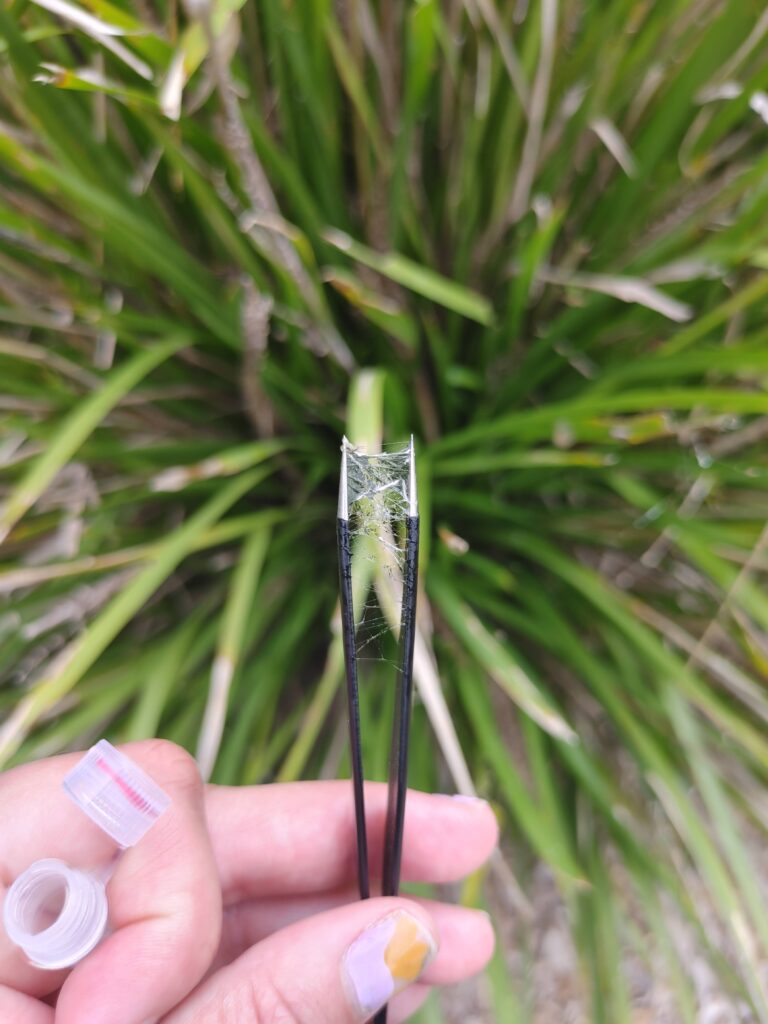
Mercedes Burns collects silk from a Saint Andrew’s cross spider in Australia. (Photo by Mercedes Burns)
A: Probably not. Spider-Man producing silk from his wrists is weird from a biological perspective. It would make more sense if the silk came from his feet, because spinnerets in spiders develop somewhat like a leg, but humans really do not have an equivalent to the spinnerets.
I know a lot about silks, because one of my research projects is focused on sticky proteins that arthropods, including spiders, produce to capture prey. The proteins that spiders make to produce their webs are a unique class of proteins called spidroins.
Spidroins are made up of proteins that form chains. Spiders make these building blocks, which have to align with each other as they are extruded through the spinnerets. The spinnerets contain many little glands where spiders can press out the particular protein that the silk glands produce.
Hypothetically, if you were trying to control the translation of silk proteins in a spider, one way you could do that would be with siRNAs, which could bind to the mRNA and keep the protein from being made—although this would be extremely difficult to do in practice.
Q: Why would it be so difficult to replicate Spider-Man’s web?
A: The silk Spider-Man produces from his wrists is a really sticky, stretchy mass that is also strong. He uses it to stick to surfaces, swing, wrap enemies so that they are restrained without being harmed, and perform other functions. It would be difficult to replicate this material because of how many functions it has.
In reality, spiders make many kinds of silk: some make more than 10 types. Each type has a particular job, such as for wrapping eggs or producing a covering around the eggs. The silks that are probably most important to Spider-Man are flagelliform silk and aggregate spidroin. Flagelliform silk is really stretchy. In a spider web, it forms the capture spiral, the circular part of an orb-weaver’s web. Aggregate spidroin is the sticky part of the capture spiral.
Q: What was scientifically accurate about the explanation Ned Leeds, Spider-Man’s best friend, gave of the mechanical web shooters?
A: Ned asks Spider-Man what material is in Spider-Man’s web shooters. Ned suggests that if it is a synthetic biomaterial, it is probably a liquid polymer inside the web shooters that becomes a fiber. He also suggests that the shearing forces from pressing the material out of the web shooter cause the liquid to become a polymer.
That was spot on.
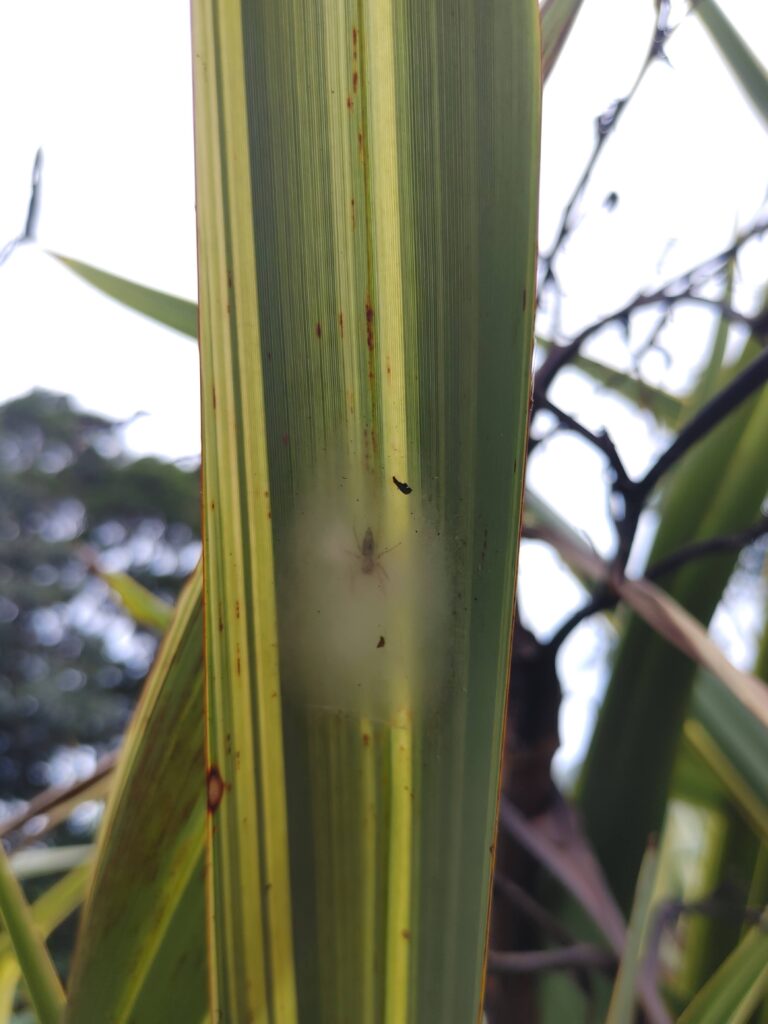
Spiders use their silk for many purposes. Left: A nursery web spider in its silk hideaway. Right: A fishing spider carries a silk-wrapped egg sac. (Photos by Mercedes Burns)
Inside the glands, the building blocks for spider silk exist as a liquid called dope. The glands’ pH becomes more acidic, which triggers the protein building blocks to start lining up. The dope is also physically pressed through spigots within the spinnerets, and the mechanical force gets the protein into the appropriate conformation. What comes out is a fiber made of blocks of protein.
The web shooters work in a way that could provide the necessary mechanical force to allow a liquid to become a fiber. Ned’s reasoning about a liquid becoming a polymer and then becoming a fiber was remarkably similar to how these biomaterials are described in the scientific literature.
The mystery is the actual material. They know it would be some sort of molecule that polymerizes—that has units that join together as they leave the device. The specific molecule used by Spider-Man remains fictional and proprietary to the story.
Q: How do Spider-Man’s web shooters relate to the way he uses his powers?
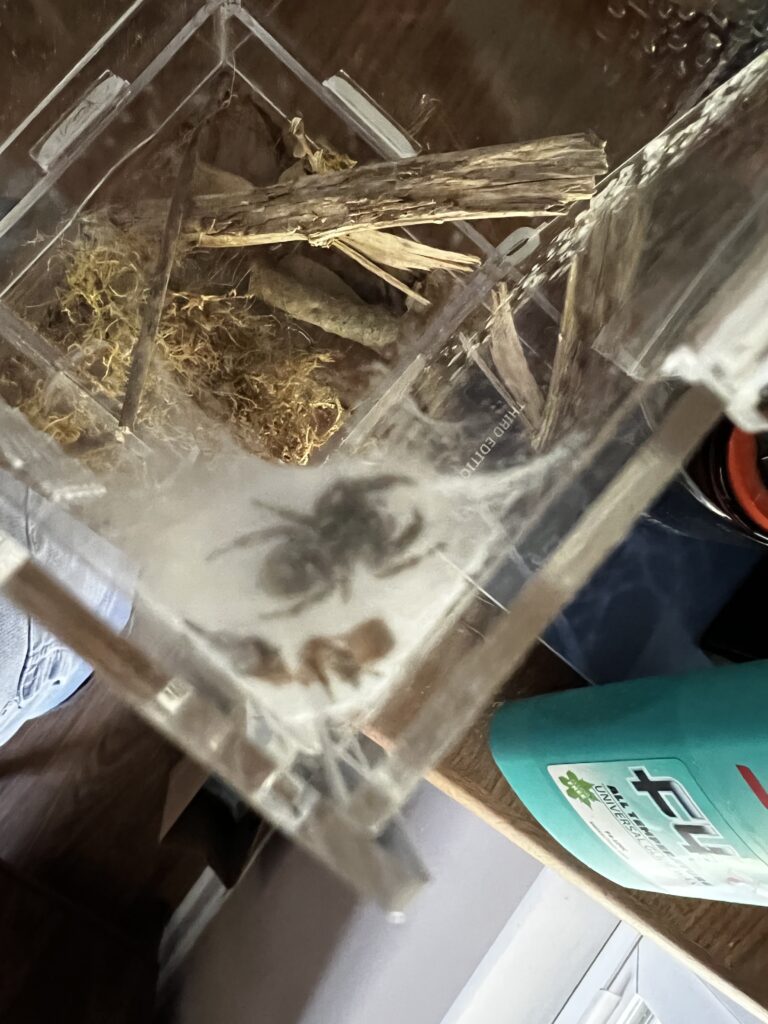
This jumping spider has spun itself a silk hammock in preparation for molting. (Photo by Ryan Bacon, Ph.D. ’26)
A: I am impressed with how Spider-Man learns his own body and his unique way of using his powers in this iteration. His web shooters allow him to work with the police to apprehend criminals without killing them. He can hold people up, restrain them, and throw things in their path. The ingenuity of his use of silk is really cool, because he is using it for good. Spiders are also an example of animals creating structures for good. They live in our houses and feed on pests that we do not like, so they are providing a service for us. In Spider-Man’s case, a human is using similar abilities to protect others.
Q: Is there anything real about the scene where Spider-Man wakes up in a spider cocoon, particularly his black eyes?
A: Yes, there are spiders that produce silk cocoons, such as jumping spiders. When they are getting ready to molt and grow larger, they will often create a little sling or hammock for themselves and surround themselves with silk for protection.
The black eyes, however, are probably a visual effect intended to make Spider-Man look more spider-like. Most spiders probably have poor vision. Their eyes do not have a pupil that focuses in the same way human eyes do.
Q: The trailer hints that Spider-Man is going through the life cycle of a spider. Does this mean Spider-Man will die?
A: I hope not, because for Peter Parker it would be a very short life. There is a lot of variation among spiders. The order of arachnids that includes spiders is vast, with roughly 70,000 species. Some are very long-lived, especially compared to other arthropods like insects and crustaceans. For species that live a long time, such as tarantulas and trapdoor spiders, females typically live longer than males, sometimes up to 30 years.
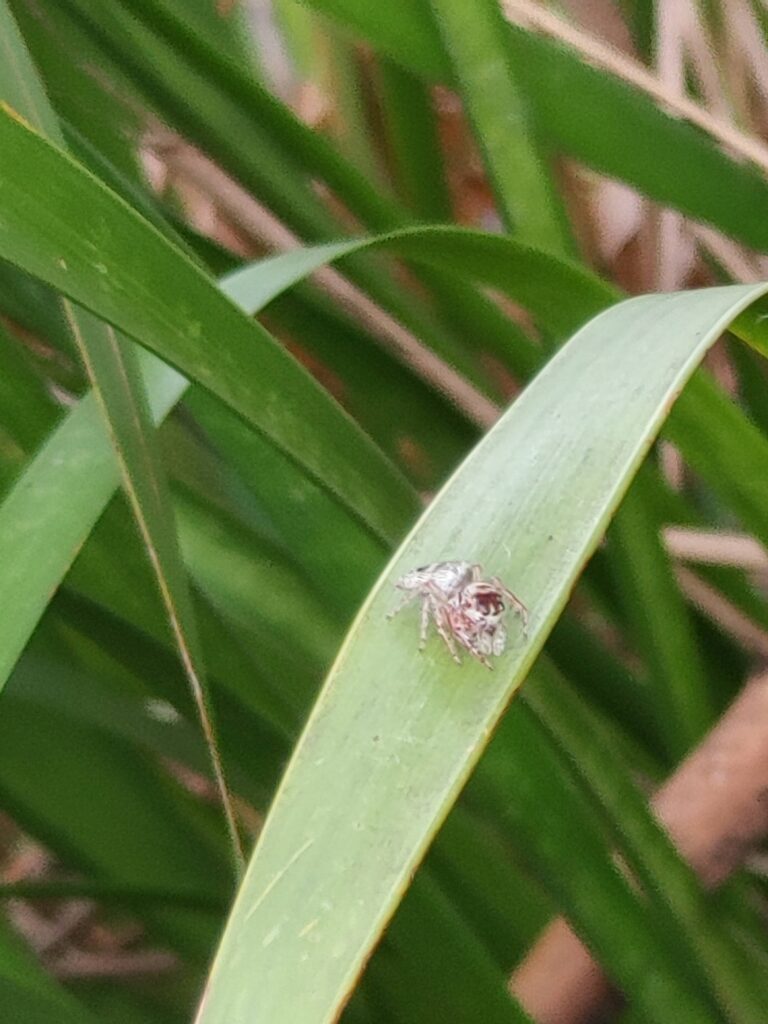
Jumping spiders like this one lay out a “dragline” of silk as they move about, to catch themselves in case of an unexpected fall. (Photo by Mercedes Burns)
Peter Parker is male, however, and many male spiders have incredibly short lives. In many species, males do not survive a mating encounter. A female may eat a male if she is not reproductively mature or if she is hungry. To the degree that a spider’s life cycle involves periods of seclusion, molting, and getting larger, though, there is some similarity.
Q: Is Spider-Man a jumping spider?
A: Spider-Man seems like a combination of different spiders. The art and emblems on his suit would suggest an orb weaver. Spider-Man does have characteristics that are similar to those of a jumping spider, such as cocooning in response to stress. However, jumping spiders always produce a dragline when they are moving through the environment so they can survive a sudden fall, and Spider-Man fires webs to keep himself from falling. So, Spider-Man’s overall appearance may be more like a garden spider, but some of his capabilities better match a jumping spider.
Q: Why did you like “Spider-Man: No Way Home” better?
A: There was more interaction between Peter and his friends. I really enjoy Zendaya’s version of MJ, Spider-Man’s girlfriend. I also really like Ned as a supporting character. They are extremely intelligent in their own right and are curious about things. I like the depiction of three scientifically curious young people working together.
Some of the other Marvel superheroes have AI, magic, or something else that provides them with insight. Spider-Man has his friends. I like this version of Spider-Man because he gets advice from other superheroes here and there, but he is also figuring things out himself and getting some help from his friends. I think it is cool to have your high school friends as your superhero support group.
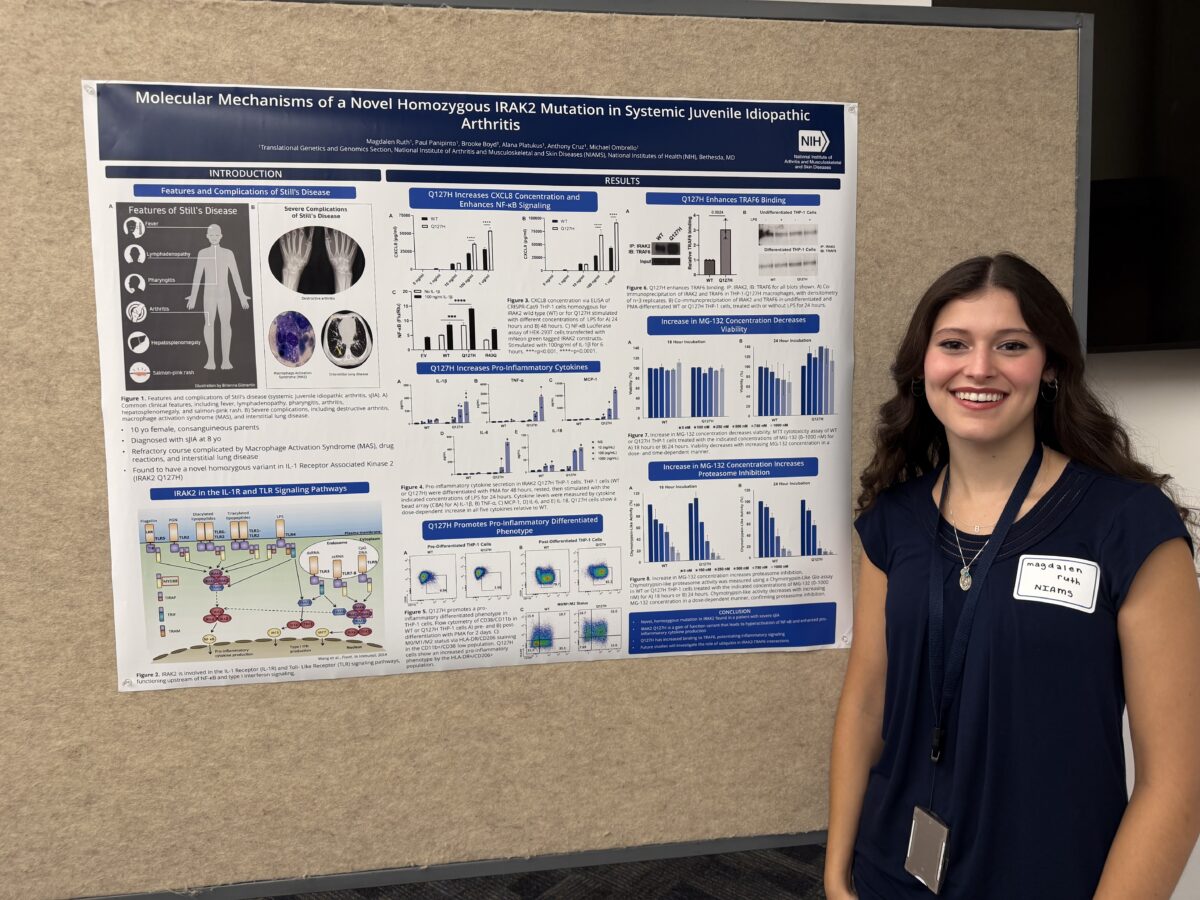
Every morning this summer, junior biological sciences major Magdalen Ruth made her way to the National Institutes of Health in Bethesda—a dense hub of biomedical research. There, at the National Institute of Arthritis and Musculoskeletal and Skin Diseases, she helped investigate a genetic mutation in a patient with a rare form of juvenile arthritis known as Still’s disease, connecting her UMBC training to work that could improve patients’ lives. She is one of four CNMS students whose recent internships at Maryland-based companies and agencies show how local opportunities are helping Retrievers build skills, find mentors, and advance discoveries that matter here and beyond.
At the conclusion of her NIH internship, Magdalen Ruth presented her summer research on the role of a particular genetic mutation in a rare form of juvenile arthritis. (Courtesy of Ruth)
“I feel like I’m doing really important work,” Ruth, a Meyerhoff and U-RISE scholar, says. “Getting to know the patient’s diagnosis and being able to see that what I’m working on is affecting an actual person in real time has been awesome.” The internship has confirmed her interest in pursuing a career in pharmacology. It’s also stretched her communication skills. While familiar with presenting her work to colleagues in Deepak Koirala’s lab group at UMBC, communicating her research to a mix of researchers and clinicians—who don’t all share the same jargon and expertise—taught her the nuance of communicating with technical and non-technical audiences.
The Meyerhoff community helped make the opportunity possible. “I would not be in the place I am without Meyerhoff,” she notes. On campus, Ruth balances research and leadership as vice president of the STEM Ph.D. Society, a student-run organization designed to help students connect with scholarships, internships, graduate schools, and more. She also takes dance classes, is pursuing a music minor, and volunteers at her family’s Catholic parish—nurturing connections that ground her amid rigorous academic work.
Protecting lives, growing a career
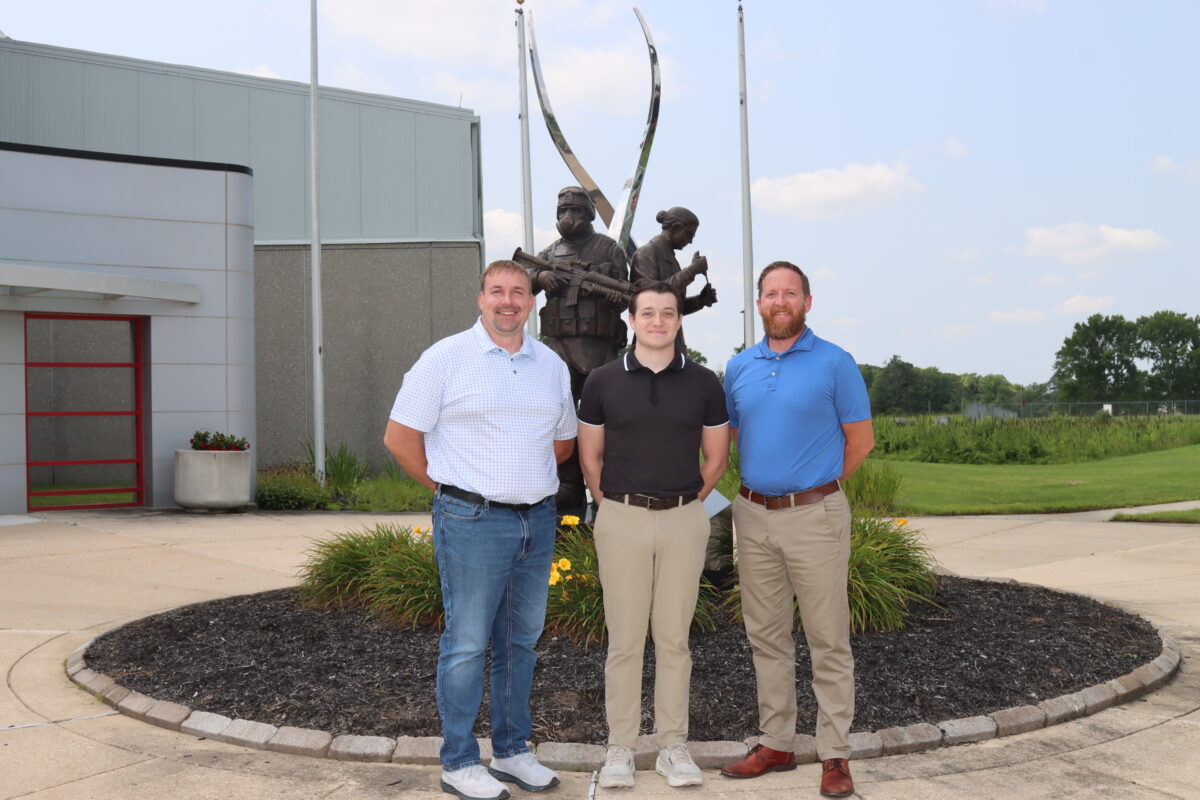
Mark Harrison, a senior biological sciences major who started in chemical engineering, is in his third summer at Aberdeen Proving Ground (APG), a U.S. Army installation in Aberdeen, Maryland. His work involves designing and testing gas masks, bridging his early engineering training and his understanding of physiology. “I’m able to bring an understanding of what a warfighter may be experiencing in their body while wearing a gas mask in a way that others at APG may not,” Harrison says.
His mentors at APG, Jon Sampson ’03, mechanical engineering, and Edward Parshley ’06, chemical engineering, value the perspective Harrison brings and have supported his growth. “They made it clear that they want to reach back and offer opportunities to those coming behind them,” he says. They are making good on that commitment: Harrison will stay on board at APG this fall, and the plan is to transition him into a full-time position after he graduates in December. “They were always asking me what I wanted to learn and then giving me related opportunities,” Harrison says. “I could ask anyone how something worked, and they’d take the time to explain it to me. I’m so grateful for the way they’ve invested in me.”
UMBC alumni Jonathan Sampson (right) and Ed Parshley (left) have mentored Mark Harrison (center) over the last two-plus years as he completed three internships at Aberdeen Proving Ground. (Courtesy of Harrison)
Interning in a fast-paced, interdisciplinary environment has also changed how Harrison operates in the classroom. “I learned how to learn at APG,” he says. “Now I don’t have to spend as much time studying, because when I leave class I already have a good understanding of the material. I’m connecting the dots so much better than before.” For Harrison, the work has taken on personal meaning, as well. “I’m fighting right now to try to protect American lives—that’s why I’m here.”
Translating discovery into treatment
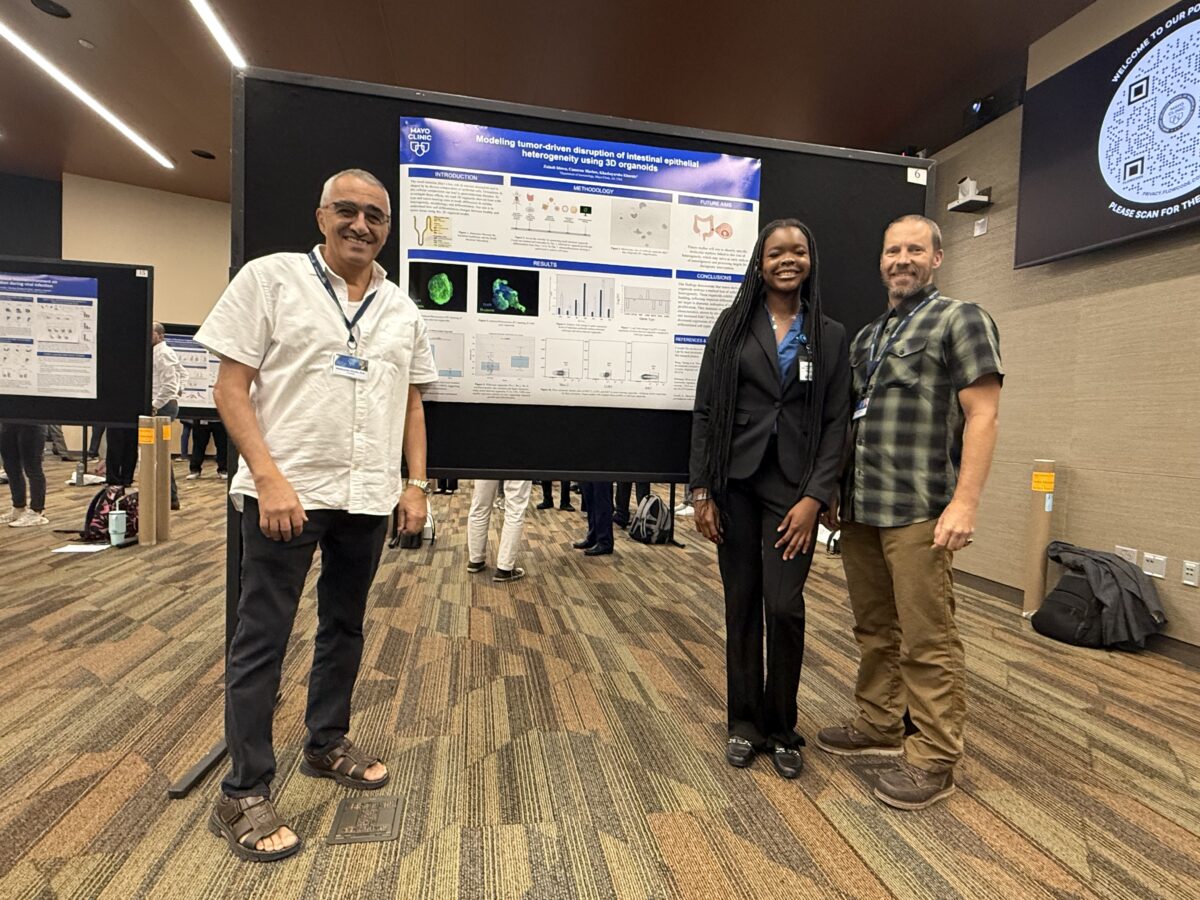
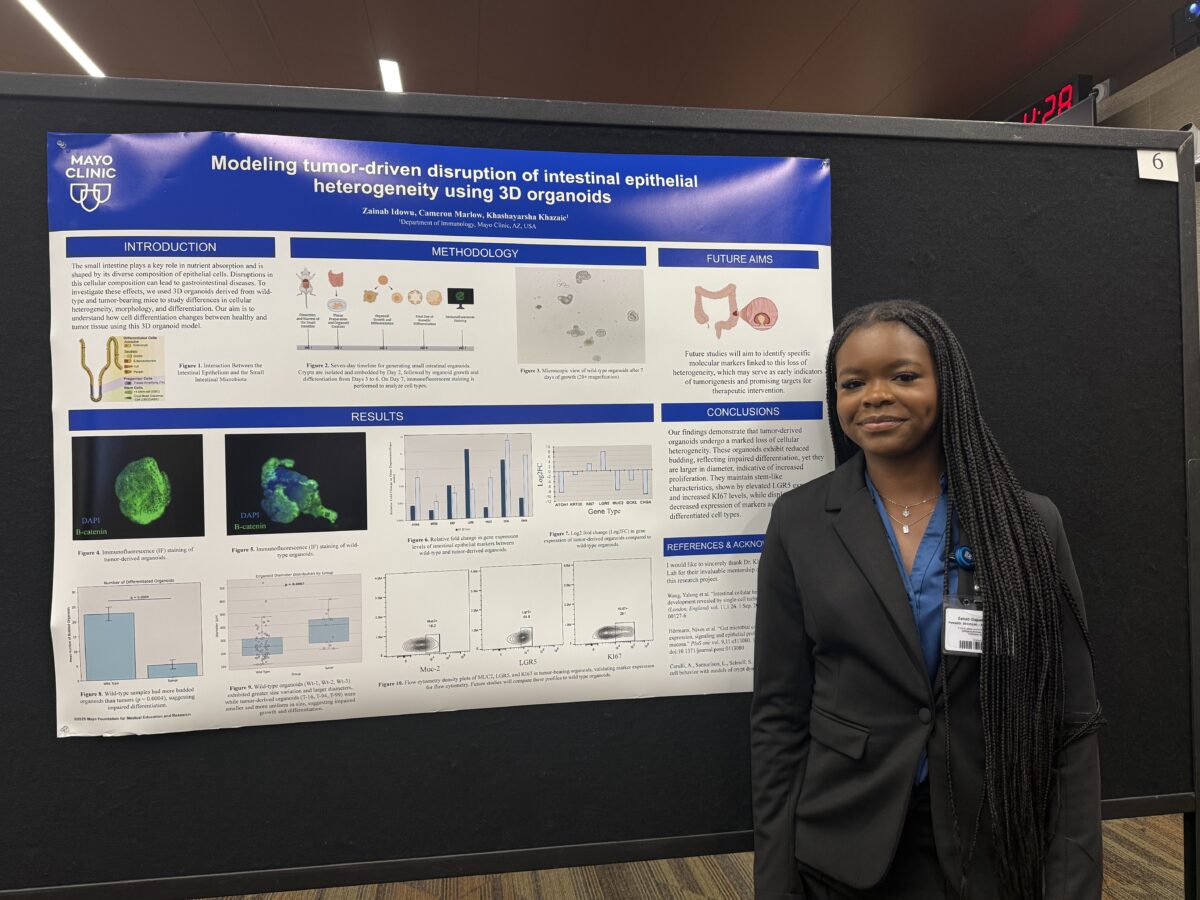
Zainab Idowu, a senior biochemistry and molecular biology major and a Meyerhoff Scholar, interned at pharmaceutical giant AstraZeneca in Gaithersburg, Maryland, joining a robust group of Retrievers who’ve grown their skills there. Her project involved testing flow cytometers, which count and characterize individual cells and are used in manufacturing cell therapy treatments. Her goal was to determine the instrument and protocols that would be simplest and most effective for manufacturing teams to implement. The experience shifted Idowu’s focus toward translational medicine and reinforced her plans for an M.D./Ph.D. after UMBC. But the people around her made the biggest impression.
Zainab Idowu presented a research poster at the conclusion of a previous internship at the Mayo Clinic. She was supported by two mentors at the Mayo Clinic, Khashayarsha Khazaie (far left) and Cameron Marlow. (Courtesy of Idowu)
“I love everyone on my team,” Idowu says. “My managers, Ashley Ruddy and Jen Fox, were really insightful—giving me advice on what I want to do post-grad and what I should do my senior year to make sure I’m well-positioned for after graduation.” And when she had questions, the collaborative atmosphere showed her how scientists work together. “They were able to give recommendations and point me to scientific literature to help me along,” she says.
Opportunities through Meyerhoff gave her the chance to connect with AstraZeneca staff, which helped her secure the internship. “I was able to talk to them about my passions for research,” she says. Roles with UMBC’s chapters of the Society of Women Engineers, the international professional medical fraternity Phi Delta Epsilon, the National Society of Black Engineers, and the African Students Association have also enriched her UMBC experience. These organizations, she says, offered “a place to be ourselves, find new friends, and really build a home here at UMBC.”
The benefit of seeing both sides
Saeed Damadi (left) and his wife Sepideh Hematian at her graduation from UMBC’s master’s program in data science.
Saeed Damadi recently defended his Ph.D. thesis in applied mathematics after beginning in electrical engineering. This summer at the FDA, he developed a mathematical model for how illicit drugs taken during pregnancy transfer to the developing baby through the placenta—increasing important understanding in a situation where human testing would be profoundly unethical.
While the math was familiar, Damadi welcomed the new challenge of jumping into biology. “I learned so many things, and I am still learning,” he says. Yet he found that his interest in how to describe randomness mathematically, which led him to complete a master’s in statistics on the way to his Ph.D., was highly relevant to studying the quirks of the human body. Looking ahead, he wants to continue work at the interface of biology and mathematics.
“Hopefully in the future I can make a contribution by bridging fields,” Damadi says, “because you can computationally simulate millions of parameters and patients at once, which makes the rate of iteration and discovery much faster.” The work Damadi and colleagues do with simulations can help effectively target limited resources for expensive and lengthy clinical studies, he explains.
Damadi and his wife, Sepideh Hematian, M.S. ’23, data science, and a former data scientist at the Maryland Department of Human Services, are planning to build their lives in California. They are both thriving, but “sometimes I get emotional thinking about UMBC,” Damadi says, “because after I arrived nine years ago from Iran, it became like a home to me and my wife.”
Saeed Damadi (center) with his wife Sepideh Hematian (third from right), Ph.D. advisor Jinglai Shen (third from left), and the rest of his thesis committee and other members of the UMBC math faculty at his Ph.D. defense. (Courtesy of Damadi)
Damadi has given back through his teaching. As an engineer, “I just learned how to use the mathematical tools without understanding what was going on behind the scenes,” he says. Whereas, in math, “you learn the origins of all the theorems and how they work, but not necessarily how to apply them. I feel super lucky to get to see both sides.” So, in undergraduate calculus and linear algebra courses, “I just wanted to explain to my students, ‘Why do you need these equations? Why are they important?’ and give them a feeling of gratitude.”
Gratitude threads through all four of these journeys—for mentors who reach back, for teams that invest in their members, for communities that feel like home, and for the chance to do work that matters. As Magdalen Ruth at NIH puts it, “I’ve just found myself in a great spot with UMBC. I feel really blessed to have had all the opportunities I’ve had. Being able to do these internships has seriously been great.”
Pelumi Enilolobo outside the Domino factory. (Photo courtesy of Enilolobo)
On a typical day this summer, you may have started the morning stirring sugar into your coffee. After checking the weather forecast or making a few calls on your cell phone, you may have then logged into secure networks to access work data or conduct financial transactions.
And this summer, four UMBC students learned how they could contribute to the complex choreography that lies behind such seemingly simple actions in the modern world.
Pelumi Enilolobo, a rising senior in mechanical engineering, worked at the historic Domino Sugar facility in Baltimore, optimizing packaging operations; Yash Diggikar, a Ph.D. student in computer science, worked for NASA Goddard in Greenbelt on AI-assisted weather and earth-system modeling; Kaleem Butt, a rising senior in computer engineering, worked at Catonsville-based company RF Safety Laboratory, LLC, helping to test if the radio frequency emissions for new wireless consumer devices stay within safe limits; and Joycelyn Chow, a rising junior in computer engineering, worked for the Johns Hopkins Applied Physics Laboratory (APL) in Laurel, Maryland, on cybersecurity research.
Building and strengthening connections
The companies and organizations that employed these four Retrievers are all part of the vibrant economic ecosystem in Maryland. UMBC has built relationships with many of these local employers and facilitates student connections.
Butt first learned about RF Safety Laboratory, which has offices at the bwtech@UMBC Research and Technology Park, through a LinkedIn post. He later connected with the CEO of the company at a UMBC Career Fair. “At first, they were looking for people who could work during the school year. I couldn’t do that, but we stayed in touch and I later found out about the summer opportunity and applied,” he says.
Enilolobo found out about career opportunities at Domino Sugar during a Career Center-sponsored event that brought company representatives to the UMBC campus. And Diggikar connected to the NASA project through his advisor, UMBC research professor Milt Halem, a retired NASA employee who maintains strong connections to the agency.
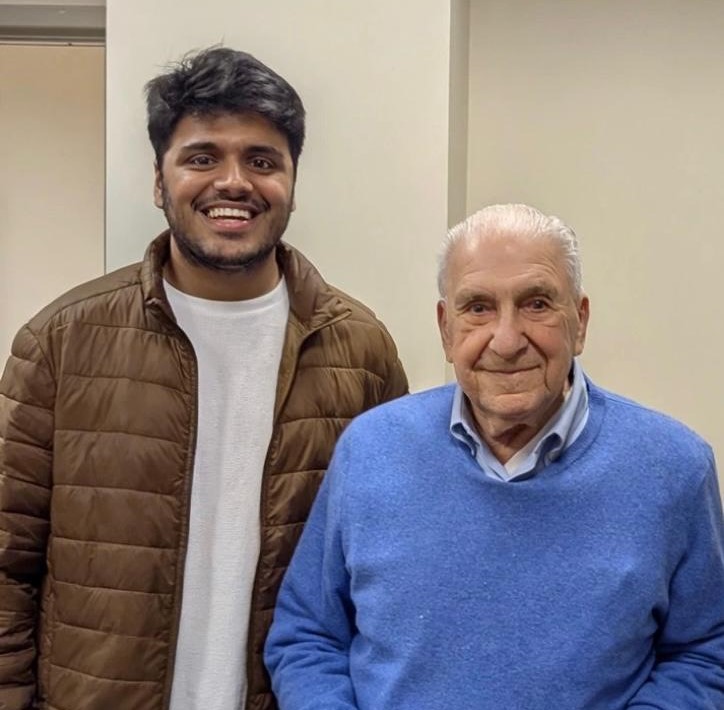
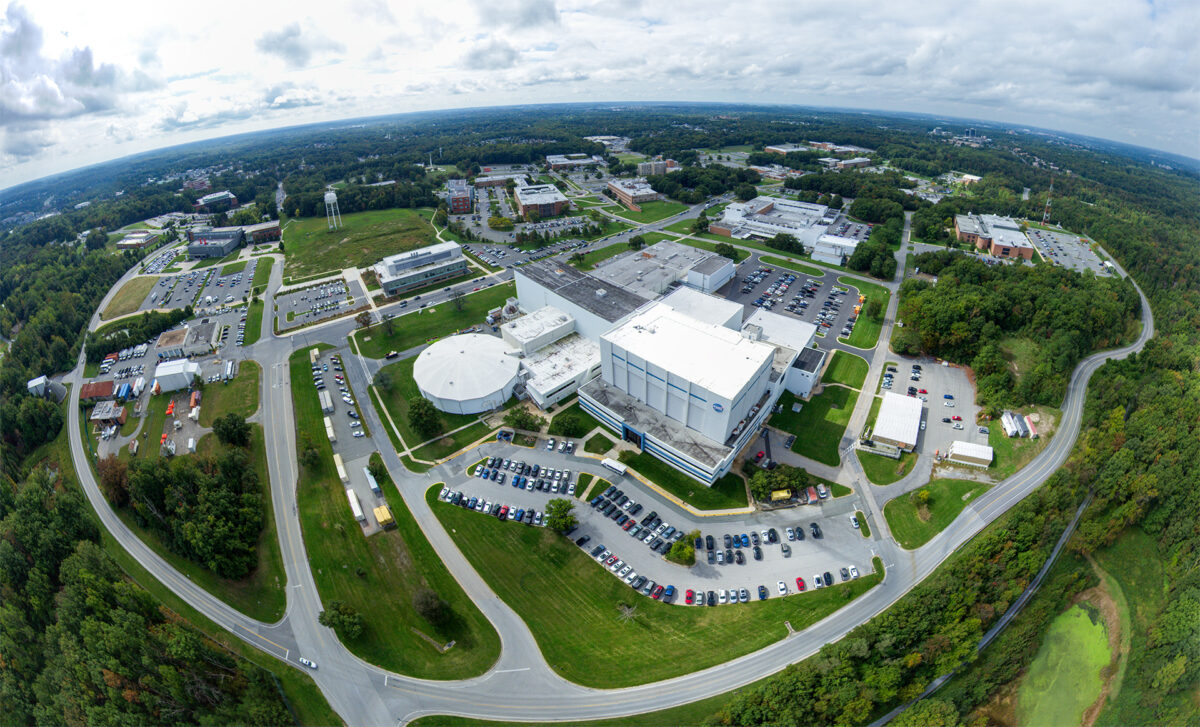
Yash Diggikar (left) with UMBC advisor and retired NASA employee Milt Halem. (Photo courtesy of Diggikar). On right, the NASA Goddard campus. (NASA/Francis Reddy)
While Chow was already familiar with APL from her years attending their ASPIRE high school internship program, she connected with colleagues and mentors at the lab who also attended UMBC. “One of my mentors, Jackie Schultz [’20, information systems], was in the same scholars program—Cyber Scholars—that I’m in right now at UMBC,” Chow says.
A summer of insights
For all four students, the summer offered the chance to contribute, connect, develop their skills, and discover insights that will shape their future careers.
Chow says she really values the strong team culture at APL and could easily see herself working at the lab full time after graduation. “The lab works on so many interesting problems, such as addressing the cybersecurity risks for satellites and other technology that wasn’t necessarily built with these concerns in mind,” she says.
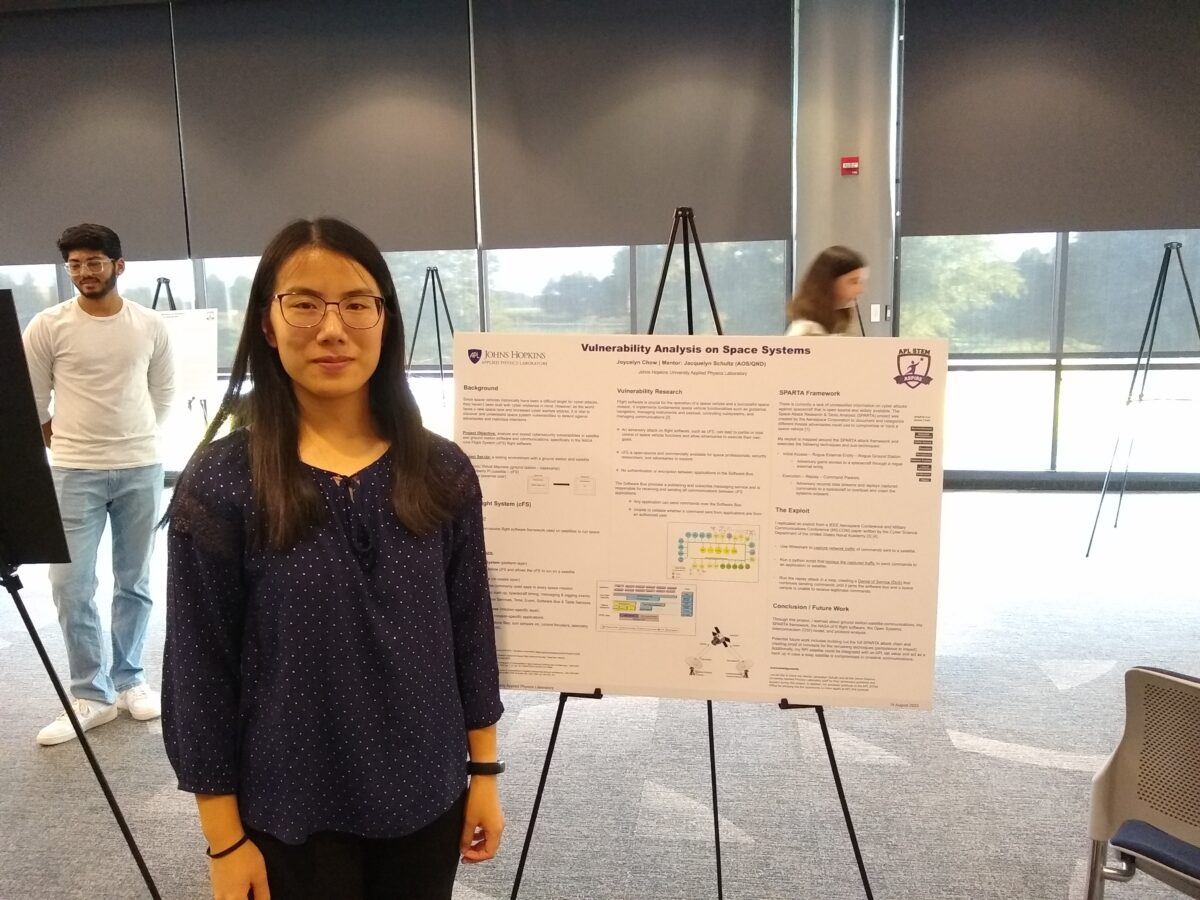
Joycelyn Chow stands with a poster about her summer internship work in 2023 at the ASPIRE Showcase (left) and with fellows APL interns in summer 2025 (right). Fellow Retriever Anugrah Zachary is on the far right. (Photos courtesy of Chow)
Diggikar says his summer work at NASA has clarified the direction of his Ph.D. research, which will look into how machine learning can speed up predictions of the Earth’s weather systems. “I have started to actually see a path, and how people can start a research project and end up at the end goal,” he says.
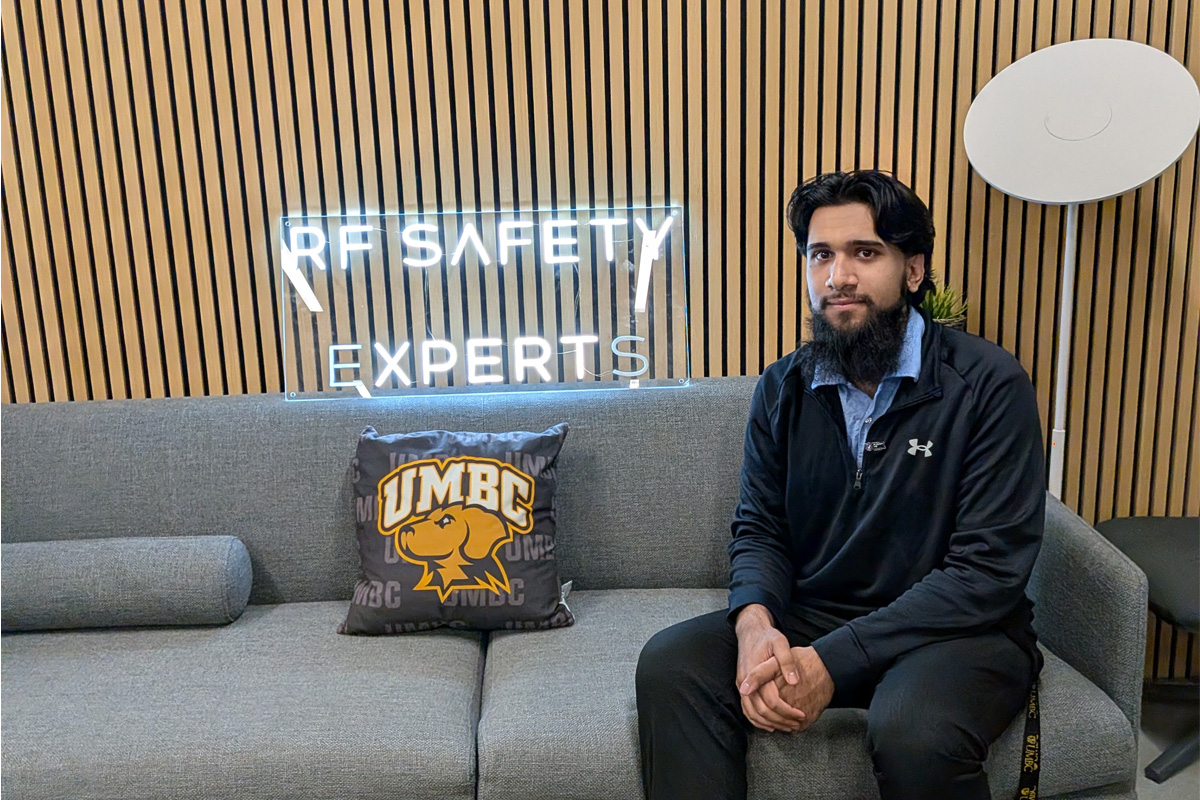
Kaleem Butt in the RF Safety Lab common room. (UMBC)
Enilolobo says he realized the sweet spot of taking ownership of his work and proactively reaching out to colleagues and mentors at Domino. “At work, you pretty much have to go find people who can help you,” he says. “You have to be assertive, and get your stuff done. I feel like that’s a very good way for somebody to grow, and it’s helped me a lot so far.”
Both Enilolobo and Butt remarked on how much they enjoyed the hands-on nature of their summer work. Enilolobo says he spent about 60 percent of his time on the factory floor, observing how machines pack sugar into 50-lb bags. In the bwtech office, Butt worked in a testing lab filled with electrical equipment and fellow engineers. “If I ever had a question, they would immediately jump up and help me,” he says.
And sometimes an insight came from an unexpected place. Butt says he hadn’t thought much about company size when considering jobs. But when he had to take time off for ACL surgery during the summer, all his office mates threw him a surprise party, with plenty of cake and well wishes. The moment really stuck in his mind. “Working for a small company, it feels like family,” Butt says. “It’s been amazing.”
Deep in UMBC’s climate-controlled Special Collections are 750,000 prints, negatives, and transparencies from The Baltimore Sun dating from the 1930s through the 1980s.
Before faculty and students can use the collection, archivists must create finding aids. These inventory documents describe a collection—its origins, number of pieces, types of materials, their quality, dates, number of archival boxes, box measurements, and more. It’s a road map guiding users through each piece of a collection.
Reese Finnigan, studying the history of the Soviet Union and learning Russian, developed these archival skills working on The Baltimore Sun collection during her first year in the Master of Arts in Public History program. This year, when looking for summer internship opportunities, Finnigan was excited to find that the United States Holocaust Memorial Museum Shapell Family Collections, Conservation and Research Center in Bowie, Maryland—a museum she had tried to secure a curatorial or research internship with for years—was seeking an intern with her exact skill set.
“In retrospect, this is the first year that I’ve had the skills and resume needed for this level of archival work,” says Finnigan, grateful that Maryland is home to such a prestigious research center with the largest concentration of Holocaust-related records in the United States, and to learn from archival experts with decades of experience. “The opportunities UMBC has given me to learn Russian, historical research, and archival skills dovetailed very nicely with the center’s Archival Affairs Division internship, which required knowledge of Eastern European history and languages.”
Needle in the digital stack
The finding aids for the Eastern European collection that Finnigan is working on do not always directly correspond to what is in the archive. Some materials are in the wrong order or are missing finding aids. Other times, some things aren’t listed in the original file but are actually in it. Finnigan also has to translate the words on the document, which could be a translation of the original language, depending on where the document was recovered from. It could be Russian, a Slavic language, or any language using the Cyrillic alphabet, which is used for various languages across Eastern Europe, the former Soviet Union, and the Soviet Republics of Central Asia.
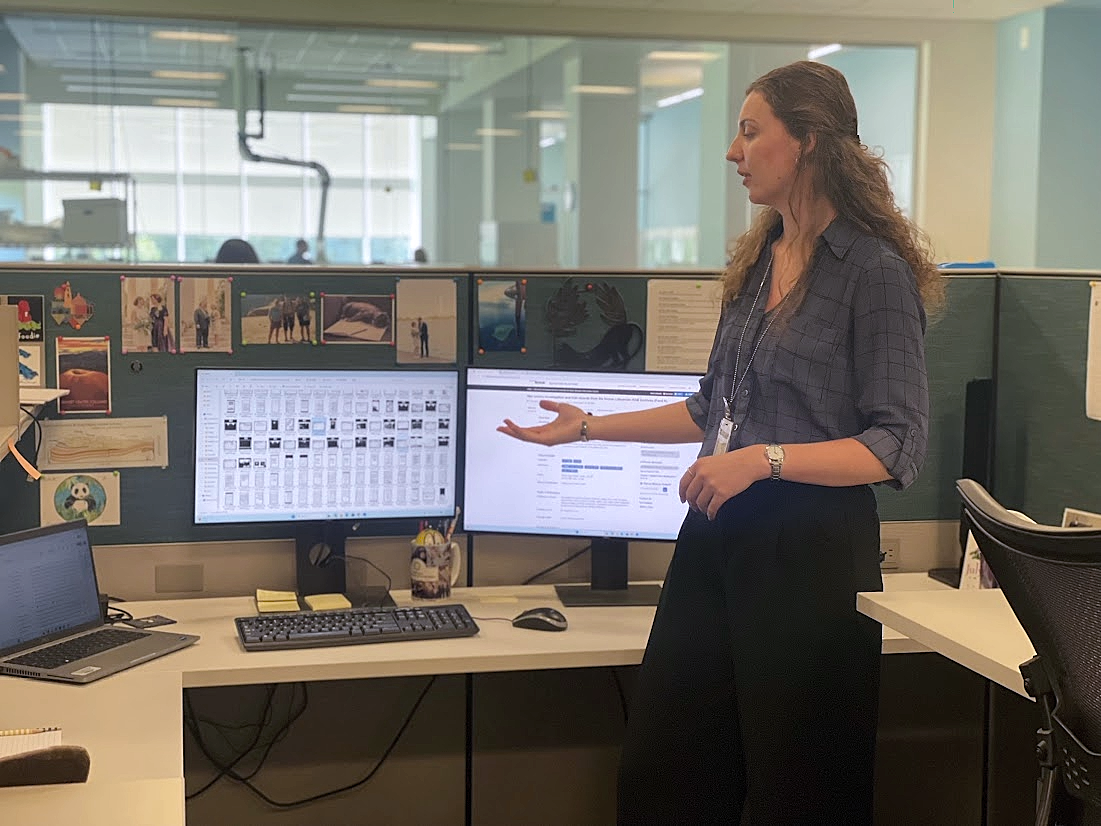
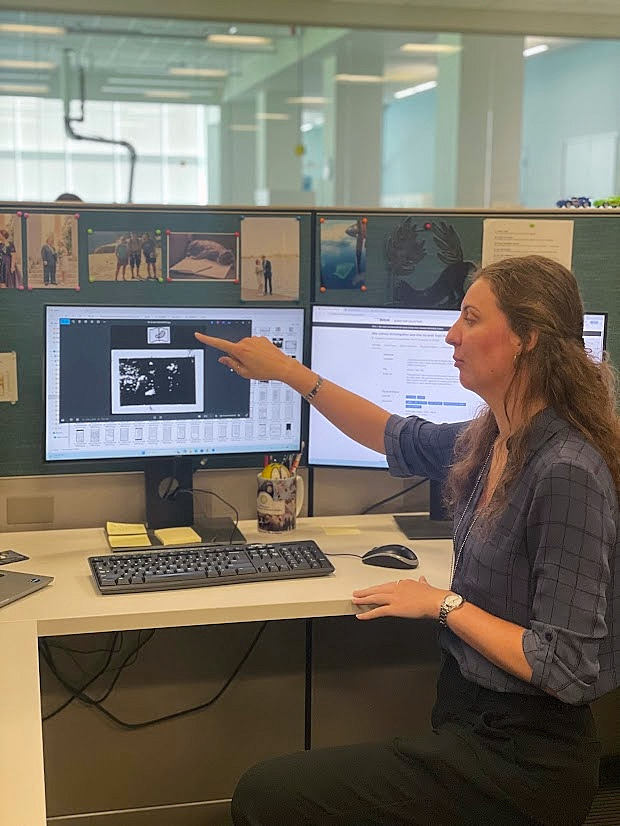
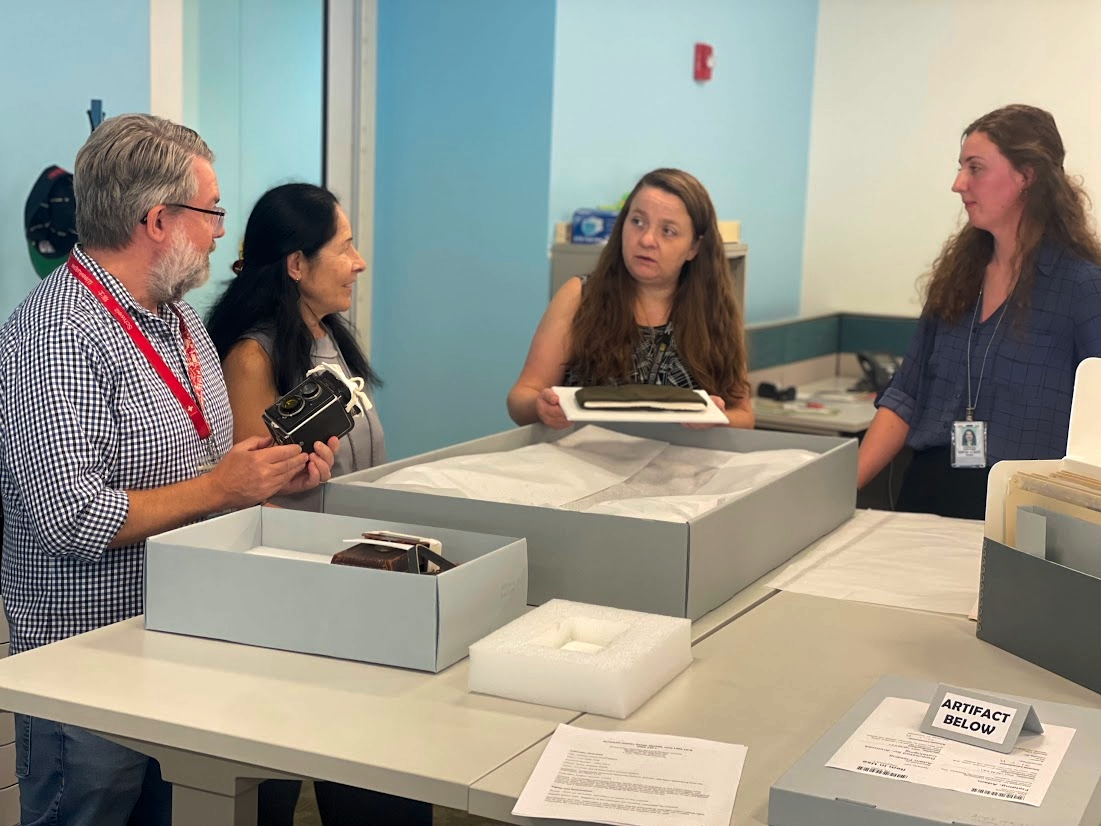
Finnigan showing the documents and photographs she is creating finding aids for.
She spends hours cross-checking inventories, documents, photos, descriptions, and creating new spreadsheets that reflect the latest information. She then hands it off to another archivist to double-check her work. It’s a cycle of verification and refinement to align the finding aids with the accurate collections. The maze of finding aids is the result of different archival processes carried out across borders, countries, and decades. “The researcher should be able to come in and find something quickly without ever having to think too much about it. The easier they can find things, the better,” says Finnigan.
A note from the past
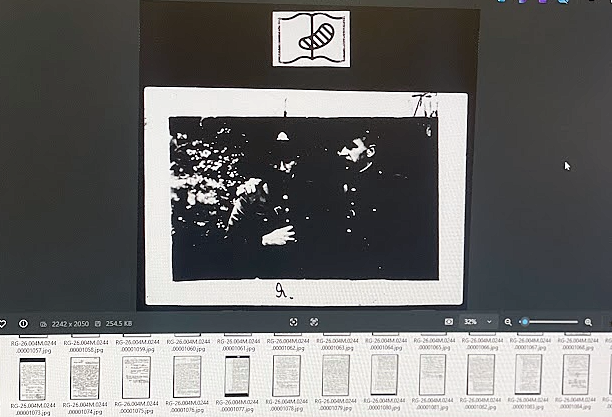
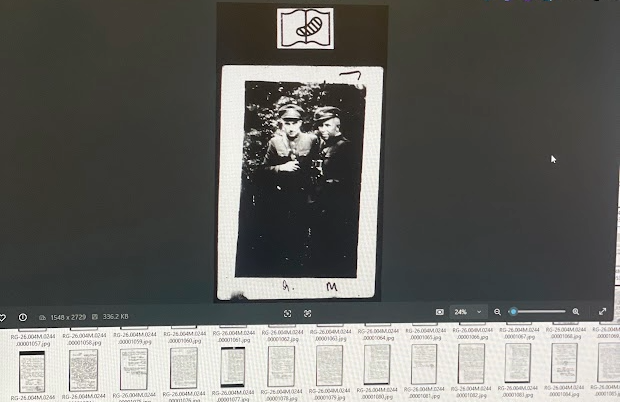
Some mysteries are beyond languages and locations, stumping even a team of experts and bringing them together to do serious detective work. That’s exactly what happened when Finnigan noticed a small symbol on some original photos in a Lithuanian KGB (national security and intelligence agency) collection placed by the original archives. She asked archivists Julie Schweitzer, her boss, and Alla Dvorkin, her direct supervisor, but they hadn’t seen it before either. The mystery quickly spread throughout the building, ensuing a string of emails with experts weighing in, hoping to reveal the meaning of what looked like a small bean. They found that the symbol was a mark used in some European archival systems to note the poor quality of the writing or the photography.
Finnigan showing the mysterious mark she came across in a set of photographs.
“People often imagine archival work as simply preserving historical materials. In reality, a surprising amount of the job involves acting as part historian, part detective, part translator, and occasionally part conspiracy theorist—until someone finds the answer,” Finnigan posted on LinkedIn. “It’s a reminder that expertise is often collective. No single person knew the answer. The solution emerged through conversations, institutional knowledge, and a network of colleagues willing to chase down an obscure question simply because it mattered.”
To preserve and share
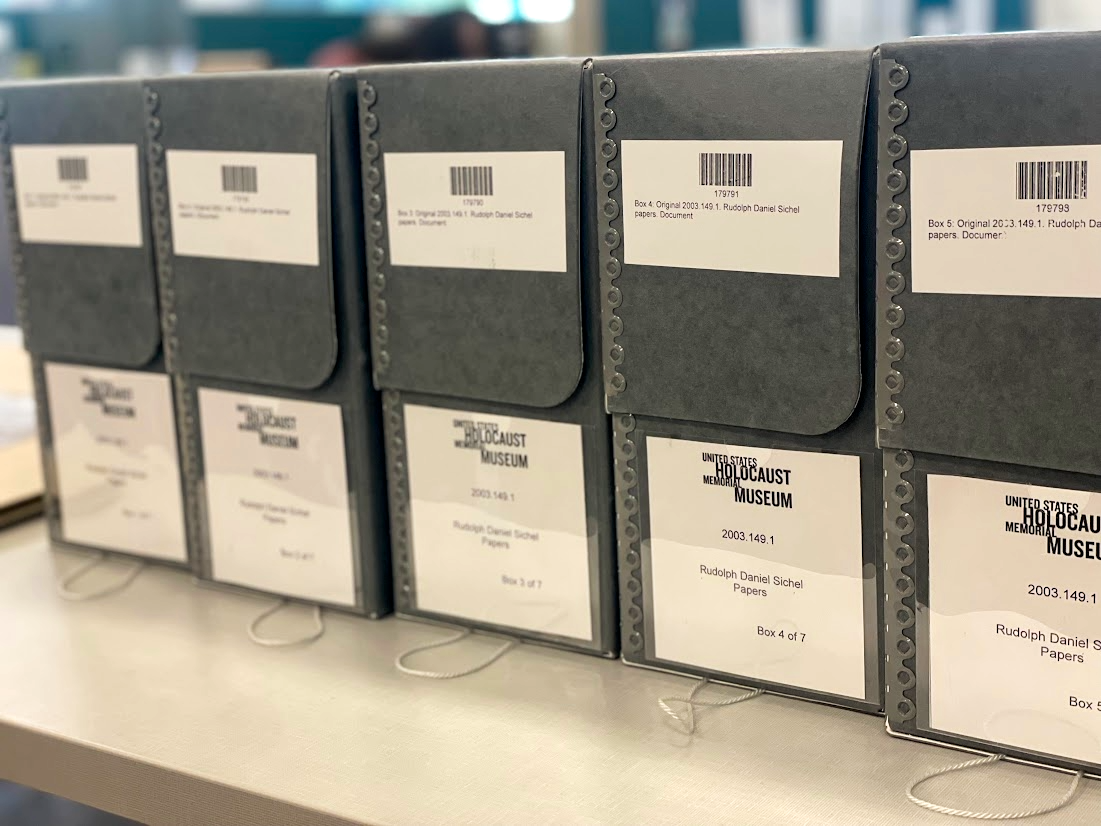
In the last few weeks of her internship, Finnigan received additional training from Adam Fielding, a processing archivist who works primarily with personal papers. Fielding, who has been at the center for 11 years, began by showing Finnigan the Rudolph Daniel Sichel papers, an example of what a finished collection can look like once the personal papers have been digitized and preserved in archival boxes.
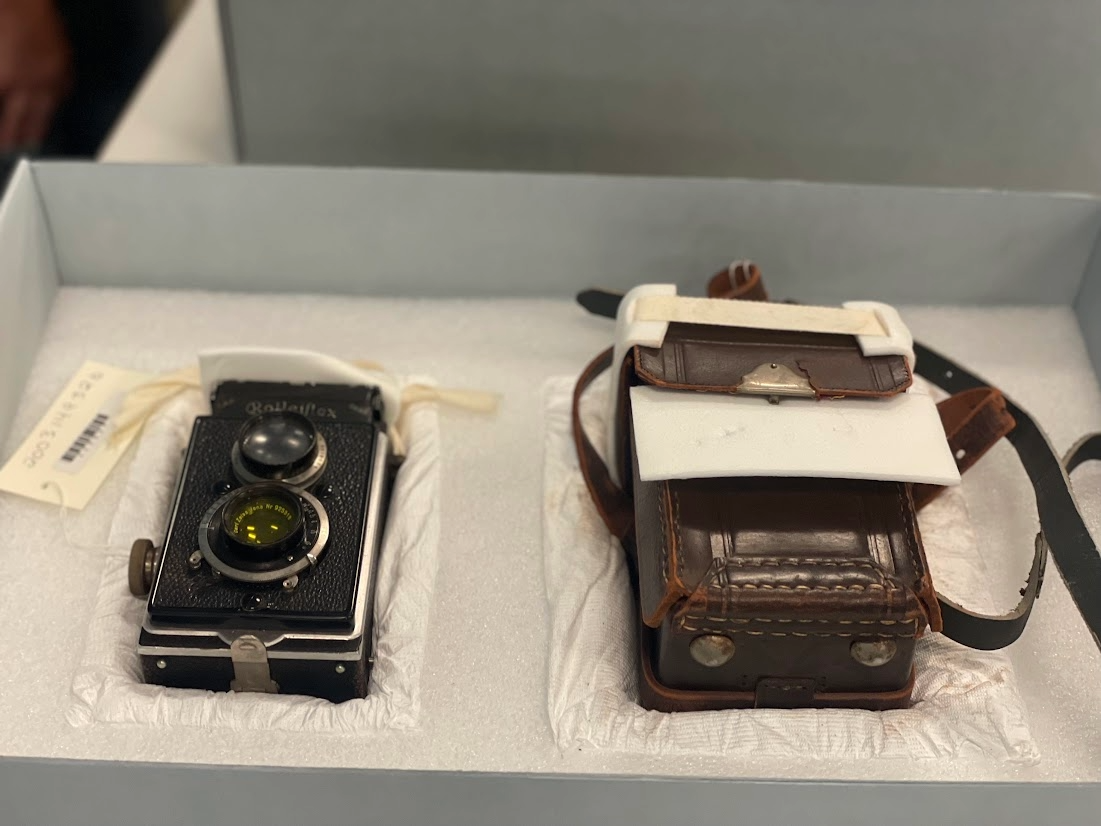
(Top) Finnigan with Fielding, Dvorkin, and Schweitzer (center), reviewing Rudolph Daniel Sichel‘s military uniform and personal camera. (Bottom) The Sichel collection archival boxes and Sichel’s camera and camera case.
The Sichel papers, donated by Rudolph’s children, consist of seven boxes with documents dating from 1903 to 1978, many of which connect Sichel to Maryland. Sichel was a “Ritchie Boy,” one of thousands of Jewish refugees who immigrated to the U.S., enlisted in the army, and trained at the Military Intelligence Training Center at Camp Ritchie near Cascade, Maryland, a little over an hour north of UMBC.
The additonal training gave Finnigan the techniques to work with non-digital items that require special care, like the folder Fielding tasked her with, full of primarily prewar family photographs related to the Kugelman family from Bedzin, Poland, dating between 1930 – 1942.
While putting these skills to use was exciting, the greater reward was seeing the impact of the team’s work. Finnigan’s interest in archival work is not only about preserving history but also making archives accessible to the public, which are two of the center’s priorities.
“There is no point in preserving all of this history if the public can’t access it. We want to preserve the history and make it easily accessible, whether through exhibitions, digital archives, or physical collections. Good archival work should essentially be invisible,” says Finnigan. This includes special handling and storage methods, like cold storage (35°F to 50°F) and cool storage (55°F to 65°F) to dramatically slow chemical decay, stop pest activity, and extend the lifespan of sensitive artifact and media collections.
“The collections at the Shapell Center are evidence of atrocities, of war crimes, of survival,” says Finnigan. “If the items are damaged, they can’t be replaced, and then that piece of history is lost.”
Learn more about internship opportunities at the United States Holocaust Memorial Museum’s archives.
This summer, six rising juniors from UMBC are among the 176 undergraduates nationwide selected for the inaugural cohort of the Howard Hughes Medical Institute’s (HHMI) Cech Fellows program. Named for Nobel laureate Thomas R. Cech, the nine-week research experience pairs promising students with HHMI scientists at top institutions across the country. For these Retrievers, the fellowship is more than a prestigious opportunity: It’s a culmination of support, community, and hands-on experiences at UMBC that have opened doors.
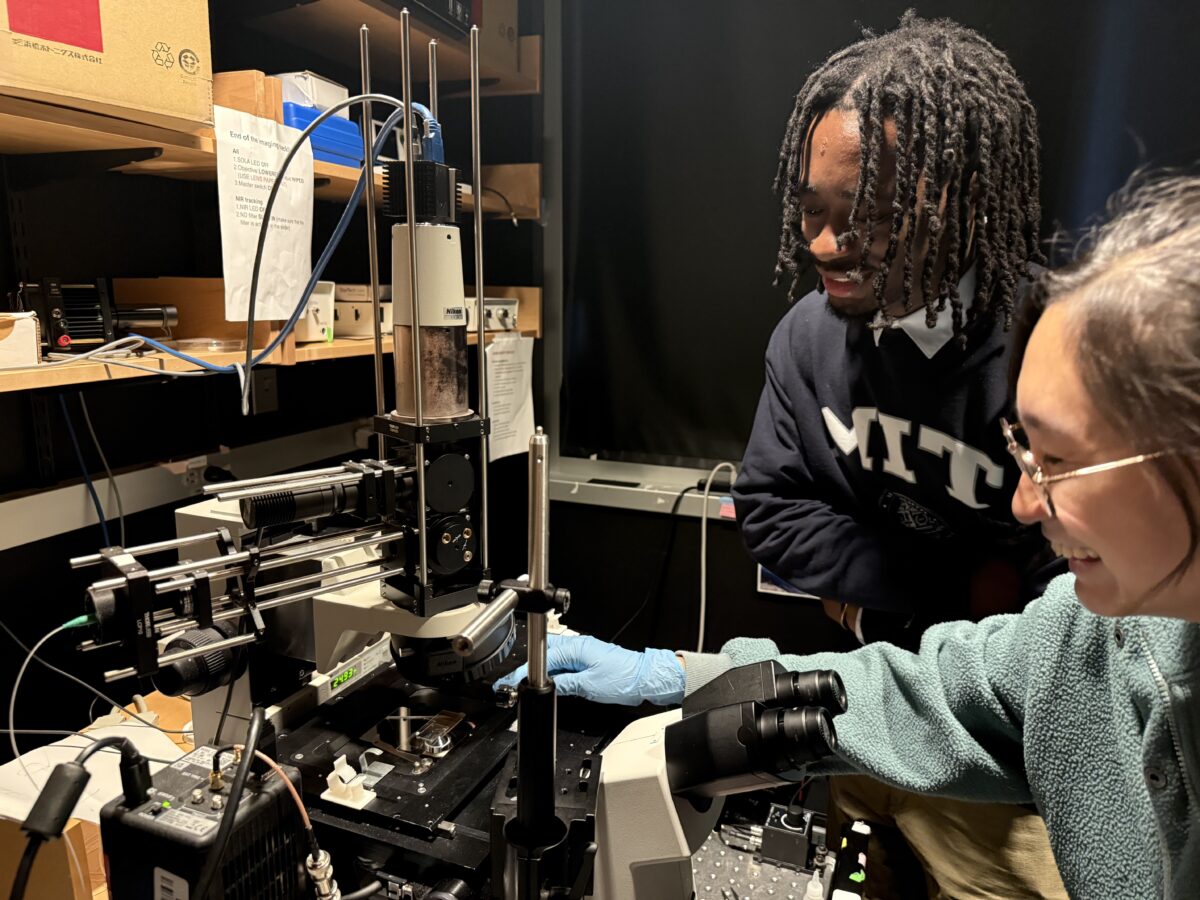
Amir Walton-Irvin, a computer engineering major and an Undergraduate Research Training Initiative for Student Enhancement (U-RISE), HHMI, Meyerhoff, and Goldwater Scholar, is spending his summer at MIT as a Cech Fellow and an MIT Summer Research Program in Biology intern. As a member of Steven Flavell’s research group, he’s developing deep learning methods to analyze brain imaging data from C. elegans—a microscopic roundworm with just 302 neurons used as a model organism in research. The work builds directly on Walton-Irvin’s research at UMBC with Tulay Adali, professor of computer science and electrical engineering, where he uses fMRI to investigate how environmental factors affect the brains of neurologically healthy adults. “This jump allows me to explore how contextual and physiological factors reshape the functional organization of the nervous system,” he explains.
Amir Walton-Irvin (left), and a Ph.D. student in the Flavell Laboratory perform confocal microscopy. (Courtesy of Walton-Irvin)
Walton-Irvin’s path to Flavell’s lab started with the Quantitative Methods Workshop (QMW) at MIT, a seven-day professional development program that the Meyerhoff Scholars Program nominated him for. There, group lunches with faculty and sessions on machine learning in neuroscience, protein folding, and genomic sequencing sparked lasting connections. In particular, a lunch with Flavell led to ongoing conversations that aligned with the Cech opportunity, which is now creating fresh networking opportunities. Walton-Irvin’s leadership roles in the National Society of Black Engineers and UMBC’s chapter of the Institute of Electrical and Electronics Engineers have created further opportunities for networking with peers and mentors.
Shared ambition supports success
Aryan Srivastava is pursuing virology research in the Harrison Lab at Harvard. (Courtesy of Srivastava)
Aryan Srivastava, a dual degree student in biochemistry and molecular biology and bioinformatics and computational biology, is diving into structural virology in Stephen C. Harrison’s lab at Harvard. As president of both the Honors College Council and the Bioinformatics and Computational Biology Association, and a Meyerhoff, HHMI, and U-RISE scholar, Srivastava has built a strong scientific identity at UMBC: In his first year, he began conducting research with Michael Summers, HHMI Investigator and professor of chemistry and biochemistry.
A talk Harrison gave at an HHMI Science Meeting inspired Srivastava; financial support from his scholars programs had made his attendance possible. That encounter combined with his ongoing structural HIV research in the Summers Lab positioned him to pursue the Cech Fellowship. With Harrison, he will further explore the complex ways viruses enter cells that Harrison discussed at the meeting.
“Meeting peers who share your ambitions is one of the most important things an undergraduate can do,” Srivastava says. He also participated in the QMW at MIT, and roles in student organizations have connected him with program directors at federal grantmaking agencies, graduate students, and even Nobel laureates. Those relationships continue to pay dividends in Boston, where he’s reconnected with UMBC alumni like Arjun Kanjarpane ’24, biochemistry and molecular biology, a Ph.D. student at Harvard.
From participation to leadership
Silvi Shah, a Meyerhoff Scholar studying biochemistry and molecular biology, is in Elizabeth Engle’s lab at Boston Children’s Hospital, affiliated with Harvard Medical School and the Broad Institute. Shah’s neuroscience research with Weihong Lin at UMBC, where she is examining the effects of e-cigarette vapor on the olfactory system and behavior in mice, sparked her interest in deepening her mechanistic understanding of the brain by focusing on biomarkers for neurodevelopmental disorders.
Silvi Shah is conducting neuroscience research with Elizabeth Engle at the Harvard Medical School. (Courtesy of Shah)
Being a member of the Meyerhoff, HHMI, and U-RISE scholars programs, and taking on leadership roles in Meyerhoff and the Phi Delta Epsilon Medical Fraternity, built Shah’s confidence and supplied community and mentorship. She connected with Harvard neuroscientist Beth Stevens at an HHMI Science Meeting, who introduced her to the Engle Lab. Award-winning presentations at the Annual Biomedical Research Conference for Minoritized Students (ABRCMS) and interactions with Nobel laureates, renowned faculty, graduate program directors, and alumni have broadened her perspective, she says.
In Boston, she’s reconnecting with scientists from the HHMI meeting and tapping into the Meyerhoff alumni network. “I am developing advanced research techniques and approaches that I would not have otherwise had the opportunity to learn at this stage of my education. These experiences have strengthened my commitment to an M.D./Ph.D. and a career in pediatric neuroscience research,” she shares.
Meanwhile, Nina-Simone Hunter, a biological sciences major, Meyerhoff, HHMI, and U-RISE Scholar, is at Cornell University in Liz Johnson’s lab. The group’s integration of microbiology, biochemistry, genomics, and molecular biology perfectly matches her interests and future Ph.D. plans, she says.
Preparation for the national stage
Nahom Getachew, a biochemistry and molecular biology major, Meyerhoff and HHMI Scholar, and Ethiopian immigrant, initially doubted research was for him, but opportunities at UMBC changed that, he says. Getachew attended an HHMI Science Meeting and ABRCMS with support from the Meyerhoff program. Squire Booker, a University of Pennsylvania biochemist and HHMI Investigator, spoke at both events, and Getachew asked follow-up questions about his work and the opportunity to contribute—which is now being realized through the Cech Fellows program.
Nina-Simone Hunter is integrating microbiology, biochemistry, genomics, and molecular biology in Liz Johnson’s lab at Cornell. (Courtesy of Hunter)
“Networking is one of the most important skills for finding summer research opportunities,” Getachew notes. In addition to Booker, he connected with a Cech program coordinator at ABRCMS. Getachew prepared for national conferences by practicing communicating his work under Marcin Ptsazek, associate professor of chemistry and biochemistry, at UMBC’s Summer Undergraduate Research Fest and Undergraduate Research and Creative Achievement Day.
Now in the Booker Lab, he’s mastering new techniques in a drug discovery project, presenting results at the Cech Fellows Research Symposium at HHMI’s Janelia Research Campus, and connecting with peers who share similar goals, including fellow UMBC Cech Fellow Djina Awungnjia, a biological sciences major and McNair Scholar. All six UMBC fellows will present at the culminating symposium at HHMI Janelia, further expanding their national network.
As these Cech Fellows advance ambitious projects—from neural imaging analysis and virus structures to drug discovery and neurodevelopment—they carry forward skills, relationships, and confidence cultivated at UMBC through scholars programs, faculty mentorship, student organizations, and more.
Getachew says that the experience has reinforced his pursuit of an M.D./Ph.D. in translational clinical research: “This program has shown me what I am capable of.”
UMBC’s 2026 – 2027 recipients of the prestigious Fulbright U.S. Student Program are joining the ranks of UMBC’s distinguished Fulbright alumni, who have made UMBC a three-time Fulbright Top Producing Institution, a recognition from the U.S. Department of State’s Bureau of Educational and Cultural Affairs.
More than 2,000 Fulbright U.S. Students—recent college graduates, graduate students, and early career professionals—pursue graduate study, conduct research, or teach English in schools abroad each year, earning placements in Africa, Asia and the Pacific, the Middle East, Latin America, and Europe. This year’s Fulbright Retrievers are launching the international phase of their research. From Baltimore to the Dominican Republic, India, and Mexico, these students are working with and for local communities to support local approaches to ongoing challenges.
The art of collaboration
During her senior year, Marelen AcevedoSoto ’26, visual arts, wowed Retrievers at UMBC’s 2025 Undergraduate Research and Creative Achievement Day with an experiential painting that combined projection, animation, and live performance. Now, she is packing up these skills and taking them to Santo Domingo, Dominican Republic, where she was born. Acevedo Soto earned her associate’s degree from Chavón School of Design. She is returning to work with the students to create a large-scale mural titled “Multidimensional Mural: Augmented Reality for Environmental Change” in Santo Domingo’s Zona Colonial (Colonial Zone), a UNESCO World Heritage site. Using QR codes, passersby will access animations and hear community voices describing how pollution affects daily life. The project will close with a Spanish and English multimedia performance combining projected animations, environmental data, and Dominican music.
Acevedo Soto (on the right) with artists from The Music and Me Foundation and at URCAD 2025. (Images courtesy of Acevedo)
“Many of my strongest ideas came from learning across different fields at UMBC,” says Acevedo Soto. “Music theory helped me think about rhythm and emotion. Storytelling taught me how to create meaningful experiences. Psychology helped me better understand how people think and engage with art. Environmental science deepened my understanding of water and the importance of its conservation, and data analysis gave me the tools to measure the impact of my project.”
Researchers’ responsibility
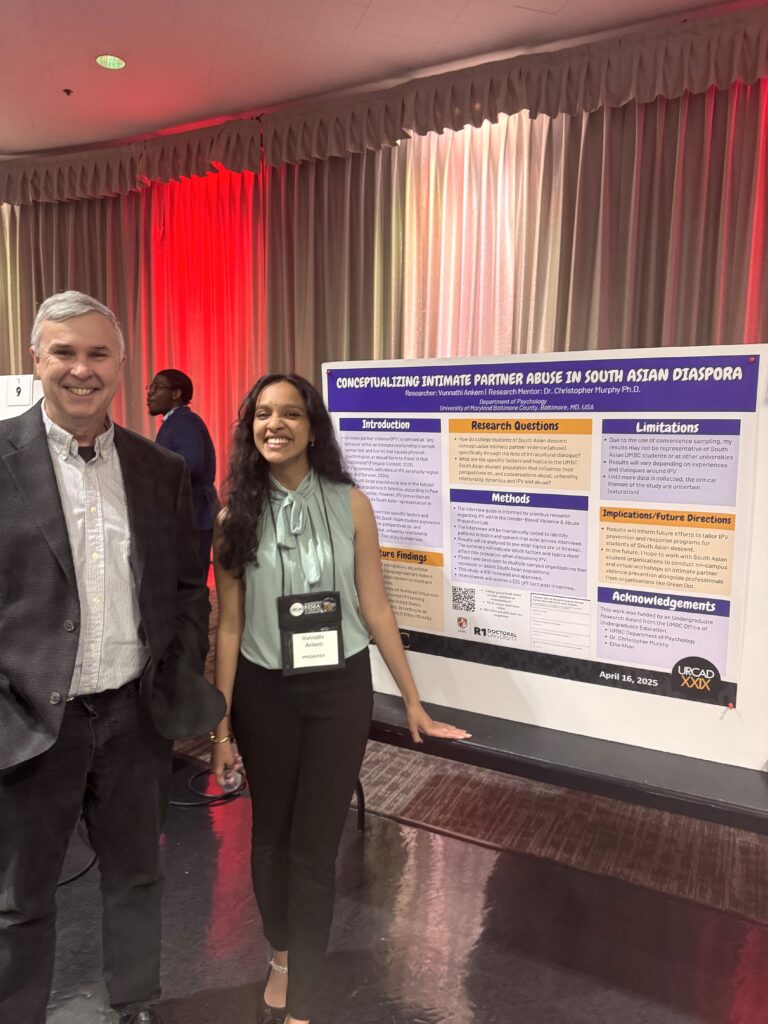
Vunnathi Ankem ’26, psychology, has had a passion for India for years, specifically how cultural exchange in India was shaped by hundreds of years of discourse, colonization, and history. While researching intimate partner violence (IPV) for her honors thesis, Vunnathi Ankem ’26, psychology, became interested in how South Asian students developed their understandings of IPV. Unexpectedly, most of the students she interviewed were from Telugu-speaking regions, such as Hyderabad in southern India. Intrigued, Ankem is now headed to the Psychology Center at the University of Hyderabad to continue her research. “Psychology, as we know it in the Western world, is only one approach to understanding the mind and the body,” says Ankem. “As psychology students, it is our responsibility to explore worlds and lenses beyond the Eurocentric ones.”
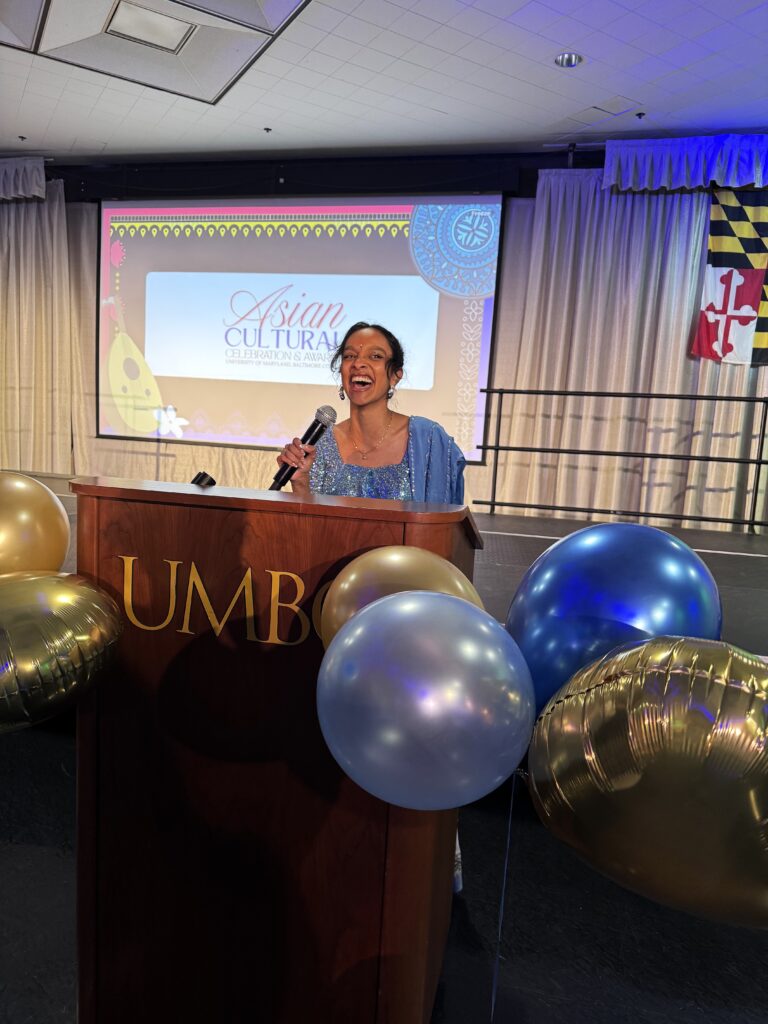
(l-r) Ankem at the 2026 Asian Cultural Celebration and Awards ceremony. Ankem with mentor Christopher Murphy, professor of psychology. (Images courtesy of Ankem)
She will study how systems, class, community, and culture shape experiences of IPV in India and inform more culturally responsive prevention strategies. Ankem will then develop community-based and community-led IPV prevention workshops. “The Fulbright program is giving me the opportunity I have always dreamed about,” says Ankem. “I can’t wait to learn from professionals and clinicians, alongside ancient culture practitioners and experts in India. It will be the experience of a lifetime!”
Humanistic climate futures
After studying climate change and migration on a study abroad trip to Oaxaca, Mexico, Bryan Castro-Velez ’26, geography and environmental studies, knew he was on the right research path—studying humanistic approaches to equitable agroecological systems and land in Indigenous Latin American communities. He says learning directly from indigenous leaders about their farming practices and response to climate change inspired him to apply for the Fulbright García-Robles award for graduate and doctoral research in Mexico. Castro-Velez’s graduate work will focus on agroecology, natural resource management, and rural development in Chiapas, Mexico.
Bryan Castro-Velez at the 2025 Association of American Geographers annual conference in Detroit. (Image courtesy of Castro-Velez)
“I look forward to continuing down this path, encouraging others to do the same, and furthering my education outside the walls of academia,” says Castro-Velez. “My experiences during and outside of UMBC have proven to me that community-based learning systems are fundamental to just climate solutions and humanistic futures.”
As the U.S. Fulbright Program celebrates its 80th anniversary this year, UMBC’s Fulbright program is celebrating by expanding support through the Office of Prestigious Scholarships (OPS) under the leadership of April Householder ’95, director of OPS: “I am looking forward to building on UMBC’s strong legacy as a top producer of Fulbright students,” says Householder, “and expanding student support throughout the processes of exploring, applying, and transitioning abroad.”
This summer, four UMBC students are getting hands-on experience contributing to efforts to rebuild the Francis Scott Key Bridge over the Patapsco River, which collapsed in March 2024 after a cargo ship collided with one of its supports. This is the second year in a row that the Maryland Transportation Authority has partnered with the Maryland Higher Education Commission to run the program.
Last year, three out of nine students in the program hailed from UMBC. This year, four out of the 10 interns are Retrievers. Mechanical engineering students Bilal Faizullah and Katelyn Prasad and geography and environmental systems students James Keller and Megan (Em) Schumacher ’26 will get the opportunity to learn about topics such as project management, environmental analysis, construction oversight, and community outreach. They will also get the chance to be a part of an iconic infrastructure project for Maryland, an experience that last year’s student interns found particularly meaningful.
From left to right, Cristian Mena, William McConnell, and Emily DiMarzio pose for a photo near the site of the collapsed Key Bridge. The three worked on the bridge rebuilding project as interns with the Maryland Transportation Authority in summer 2025. (Brad Ziegler/UMBC)
“The Key Bridge Internship Program represents the very best of career-connected learning by giving students the opportunity to contribute to a project that will have a lasting impact on Maryland,” says Christine Routzahn, director of UMBC’s Career Center. “We’re incredibly proud that four UMBC students were selected for this prestigious program. Their selection reflects not only their talent and dedication, but also the strength of the partnerships that make opportunities like this possible. We are grateful to the Maryland Transportation Authority, Maryland Higher Education Commission, and its partners for investing in our students and in the state’s future workforce.”
HIV continues to pose a major global health challenge, with about 1.3 million new infections reported annually worldwide in recent years. One of the most important HIV prevention strategies is pre-exposure prophylaxis, or PrEP. Healthy individuals at risk of HIV take a daily pill containing two antiretroviral drugs—tenofovir (TFV) and emtricitabine (FTC)—to block the virus before it can take hold.
These drugs only become protective after they are modified inside cells, specifically by adding a phosphate group in a step called “phosphorylation.” This activation turns them into their working forms. However, people’s responses to the drugs vary widely, sometimes leading to reduced protection.
Herana Kamal Seneviratne, assistant professor of chemistry and biochemistry, has received a two-year grant from the National Institute of Allergy and Infectious Diseases (NIAID) to explore how two key HIV prevention drugs work inside the body—specifically in colon tissue, where HIV transmission risk is especially high. The project seeks to explain why these drugs protect some people better than others and could help make prevention tools more reliable.
“One of the reasons for PrEP failure is the huge variability observed among individuals,” Seneviratne explains. This variability is concerning, because someone might partake in riskier behavior based on a belief that they are safer than they actually are.
Seneviratne’s work focuses on the colon, because unprotected anal sex carries an 18-fold higher risk of HIV transmission than vaginal sex. Oral PrEP spreads through the bloodstream, but the amount of active drug that reaches colon tissue is not well studied, and could be one of the reasons for variable drug responses. Understanding what happens in these tissues is therefore crucial for improving PrEP, Seneviratne says, particularly for men who have sex with men.
Mapping cellular machinery
Previous work, including from Seneviratne’sgroup, has shown that certain enzymes are involved in activating and deactivating PrEP drugs in the blood by adding and removing phosphate groups. Certain kinases add a phosphate group, and certain nucleotidases remove it. However, the activity of these enzymes in colon tissue is unknown.
“What matters is the drug metabolite concentrations in specific sites like in colon. That’s the point that we’re trying to make,” Seneviratne says.
To address that knowledge gap, Seneviratne’s team will grow human colon cells in the lab and use genetic tools to modify the expression of these kinases and nucleotidases one at a time. Then they will measure how those changes affect the drugs’ phosphorylation status. The project will take an innovative approach using mass spectrometry imaging, a technique that lets researchers see where molecules are located and active inside tissues.
“Our group is trying to contribute to overall improved HIV prevention,” Seneviratnes says. To that end, “understanding the metabolism of these two drugs in colon tissue is important.”
In conjunction with the lab’s work with human cells, Seneviratne’s team will examine mouse colon tissue to map these enzymes’ presence and activity across different cell types and tissue regions. The project will combine traditional techniques—specifically enzyme histochemistry and mass spectrometry—in novel ways. The dual approach will allow the team to observe enzymatic activity directly in its natural tissue environment rather than in a test tube, Seneviratne explains.
Pharmacology & Translational Science featured a study by Seneviratne’s group about the effect of HIV drugs on the brain on its cover in 2024.
The NIAID grant type supporting the work, an R21, supports innovative high-risk, high-reward ideas that push scientific boundaries. Work is already underway on this approximately $440,000, two-year award. Graduate students Korin Murray and Nimalee Jayasekera and research fellow Christian Oh will take leading roles. Jayasekera will focus on the cell and molecular biology aspects, Murray will work on advanced imaging and tissue analysis, and Oh will support both students. There will be opportunities for undergraduates as well. Overall, the project expands the group’s focus on the negative side effects of drugs that treat HIV (including a study led by chemistry Ph.D. student Nav Raj Phulara on the brain) into the effectiveness of HIV prevention drugs.
From the bench to better PrEP
By revealing how these enzymes control drug activation and deactivation in specific parts of the colon, the project aims to provide knowledge that could lead to better dosing strategies, improved formulations, or other ways to make PrEP more effective. “The data that we generate from this work, we can leverage to optimize the therapeutic efficacy of the HIV PrEP drugs,” Seneviratne said. “These two drugs set the foundation for HIV prevention.”
Seneviratne’s interest in this area grew from his postdoctoral training at Johns Hopkins University, where he worked closely with clinicians to identify pressing real-world problems, leading him to ask, “How can I use my bioanalytical chemistry expertise to address those questions?” His chemistry expertise, combined with early publications on these enzymes, provided the foundation for the proposal.
This kind of fundamental research strengthens public health tools like PrEP, helping more people stay protected against HIV. The findings could eventually support more personalized or reliable prevention approaches across diverse populations.
In 2022, when Pam Offutt ’82, computer science, visited campus 40 years after graduating, she was taken aback by two things: how much the university had changed and how much it had stayed the same.
“While I can still see the bones of what we knew, it is almost unrecognizable,” says Pam, who loved seeing the new buildings and how much the campus had physically grown since she and her husband, Jay Offutt ’82, computer science, graduated. However, Pam was shocked to see that the percentage of women majoring in computer science had not changed much since 1982.
“We were part of the first graduating class in computer science at UMBC. It was brand new,” says Pam. “Back then, 18 percent of the computer science population was women. When I came back to campus and looked it up, the percentage was around 20 percent. And that just doesn’t sit right after 40 years.”
Determined to be part of the solution, Pam and Jay established the Pam and Jay Offutt Graduate Student Endowment in May 2026 with a transformational $1,040,000 gift. This significant investment will expand the Center for Women in Technology (CWIT) model at the graduate level, helping CWIT Scholars pursue advanced degrees at UMBC—a primary driver for moving into senior management and executive leadership roles after graduation.
While Pam’s personal experience has centered on gender equity, the Offutt endowment is designed to support any CWIT Scholar as they pursue graduate education in computing or technology, reflecting CWIT’s broader mission of inclusive excellence.
“We are tremendously grateful for Pam and Jay’s vision, which supports our commitment to inclusive excellence,” says Jeanne van Briesen, dean of the College of Engineering and Information Technology. “The endowment will help strengthen the pipeline of talent prepared for leadership in computing and technology careers.”
UMBC’s CWIT program is committed to developing community members who are prepared and empowered to be change agents in creating technology workplaces that are diverse, equitable, and inclusive. The program encourages the participation and success of all students, especially those from underrepresented groups, with a nurturing and challenging community, transformative leadership experiences, and professional development opportunities.
CWIT Scholars, Cyber Scholars, and affiliates before UMBC’s spring 2026 Commencement ceremony. (Cindy Greenwood, M.P.S. ’21/UMBC)
“The CWIT office is buzzing with happy plans for recruiting and supporting the first cohort of Offutt Scholars this fall,” says Carolyn Seaman, director of CWIT. “We are grateful for this opportunity to support so many more of our students in taking the next step toward being the tech leaders we know they can be.”
Going beyond the gift
Pam and Jay knew the problem they wanted to solve, but they took time to discuss the issue with Seaman, van Briesen, and Kim Robinson, director of major gifts in the Office of Institutional Advancement, to come up with a plan that felt like it could make a difference.
“
“Maybe some people find value in giving money for the sake of giving money, but if it’s not going to solve a problem, what’s the point?”
Pam Offutt ’82
computer science
Simply funding scholarships wasn’t enough. Pam and Jay realized that in order to truly make a difference, they needed to find a way to support students throughout their academic journey. To the Offutts, the solution was simple—mentoring and leadership development.
Offutt Scholars will receive a financial award for two years to defray school expenses, participate in leadership development, mentor undergraduate CWIT Scholars, and be mentored by more senior alumni with similar professional interests. The endowment will also support staff and programming for Offutt Scholars through the CWIT Program. This investment extends beyond financial support to build a connected community across undergraduate students, graduate students, and professional mentors.
“What stands out to me about Pam and Jay’s vision is that they are not just investing in financial support for students—they are investing in a model that builds community, mentorship, and leadership that will shape how our students persist, succeed, and lead,” says van Briesen. “They asked us to think beyond access and to focus on what it takes for students to grow into leaders in the computing field.”
CWIT Scholars alumni, UMBC alumni, and industry partners come together for Fall Career Networking, a signature CWIT event. Many featured alumni also mentor in CWIT’s industry mentor program. (Jess Myers/UMBC)
Pam believes deeply in mentorship. She served on the UMBC Alumni Association Board of Directors from 1998 to 2004, and, most recently, served as a CWIT industry mentor.
“What makes this gift so meaningful is the journey behind it,” says Robinson, who assisted in cultivating the relationship with the Offutts throughout their engagement with UMBC. “Pam has been engaged with UMBC in so many ways—through the Alumni Association Board, as a CWIT industry mentor, at career fairs—and that connection is exactly what led her and Jay to see this gap and want to help close it.”
For Pam and Jay, it comes back to the experiences they had as undergraduate students at UMBC and how their careers unfolded after graduation.
Computer science pioneers
Pam and Jay both started UMBC as math majors—computer science was not yet an option—and met in Calculus 101. Boy meets girl. Boy and girl both become teaching assistants. Boy and girl form a close bond by terrorizing professors.
“As TAs, Jay and I both had keys to the same office and we used to torture the same professors that were right across the hall from us, flipping bottle caps and stuff into their room while they were teaching,” says Pam. “So, that got the door slammed on us at least a couple of times.”
It’s the classic UMBC love story.
One semester before Pam and Jay were set to graduate, UMBC launched the B.S. in computer science. Knowing what it could mean for their job prospects and earning potential, both switched majors.
“I took a couple of extra classes and finished the B.S.,” says Pam.
Left: Pam and Jay after their 1982 UMBC graduation. Right: The Offutts today. (Photos courtesy Pam and Jay Offutt)
After UMBC, Pam and Jay went on to Loyola University and earned master’s degrees.
In 1988, Jay founded Offutt Associates, which later folded into Interface and Control Systems, Inc. (ICS). Serving public and private sectors, ICS provided end-to-end autonomous command and control software for satellites, operational centers, testing setups, and digital business systems. Notably, ICS technology was integrated into major aerospace and defense initiatives, including NASA’s Constellation project and the Department of Defense’s TAC-SAT tactical satellite program. Jay and his partners sold ICS to SRA International in 2008, and Jay retired a few years later.
Meanwhile, Pam took on management and leadership roles in various companies, including COO at Edaptive Systems, LLC (acquired by ManTech) and CEO at MDMeta. In 2009, Pam and fellow UMBC alumnus John duClos ’90, information systems, founded Bellese Technologies, which engineers large-scale, human-centered digital products and data solutions that improve the quality, equity, and efficiency of public health systems. As CEO, Pam made a concerted effort to hire and promote women—successfully building a workforce that was 25 to 30 percent female. It was a stark contrast to the male-dominated workspaces she had experienced throughout her career, though still not the parity she envisioned. The problem, however, was not in the motivation, but in the small pool of potential female hires.
“You can’t find women to hire because women aren’t going into tech,” says Pam. “So it’s a difficult thing.”
Pam sold the company in 2022, and now serves on its Board of Directors. Around the same time, she had that inspirational visit to UMBC where she realized that she and Jay could be part of the solution, leading to the establishment of the Pam and Jay Offutt Graduate Student Endowment.
As the spring semester wound down at UMBC, a group of dedicated students was gearing up for their latest adventure. The week before finals, 12 students from the Society of Automotive Engineering’s (SAE’s) Baja racing team traveled almost 3,000 miles to Washougal, Washington, just across the border from Oregon, to compete with their custom-built, single-seat, off-road vehicle in a grueling set of challenges over four days.
Baja SAE draws more than 100 college teams from around the world, who spend a whole year designing, building, and racing their cars. The competitions, which happen three times a year, present a series of tests, from static events such as safety inspections and budgeting and sales presentations, to dynamic events that test the vehicles’ acceleration, traction, maneuverability, and suspension. To cap it all off, cars then compete in a grueling, four-hour endurance race, taking as many laps as possible around a punishing track that often includes steep, dirt hills, mud pits, high-speed straights, hairpin turns, and rocky, rutted, obstacles-strewn sections. Vehicles regularly flip over. On-the-spot repairs are a must.
The UMBC car, driven by Daniel Hessler, competing at the 2026 Baja SAE Oregon endurance event (left) and hill climb event (right). (Photos by Hasan Aslam)
“I’ll remember endurance day the most, same as every competition,” says Matt Crum, a sophomore majoring in financial economics, who traveled with the team to Washington and played a key role in the design presentation. In endurance, the UMBC car completed 40 laps, earning an 11th-place spot out of 76 teams. Considering all events, UMBC finished 12th overall, and took first place in the cost event.
From June 11 – 14 the team took the car to the second competition of the year, held in Palmyra, New York, and finished 11th overall, again taking first place in the cost event. The final competition of the year will be held September 24—27 in Nashport, Ohio.
“We hold our own against much bigger, better-funded schools,” says Shawn Pourifarsi, a junior computer engineering major and co-vice president of the club. “I’m proud of that.”
Drivers hit the track on Faculty and Staff Drive Day 2025. (Video by Elijah Davis, M.F.A. ’21)
Getting their hands dirty
Students on the Baja racing team, which this year includes around 20 team members pursuing a variety of majors, gain valuable experience with a wide range of engineering and business tasks. They work on design refinements using specialized software, get their hands dirty in the shop, and hone skills such as teamwork, budgeting, sales pitching, and working with suppliers.
Team members Matt Crum (left, changing a tire), Daniel Hessler, and Oscar Coreas Otero (right) work on the car in the machine shop. (Brad Ziegler/UMBC)
The team connects with numerous local businesses, many of whom offer support by donating parts and providing expert advice. One local sponsor, Robnet, a Baltimore-based supplier of bolts and screws, has supported the team for more than 20 years.
“We love UMBC racing,” says Eric Edelstein, head of sales at Robnet, as he helped students get an important bolt before they headed across the country for the first race of the season.
Racing club members put in varying hours, depending on their responsibilities and their availability. Collectively, they spend more than 1,000 hours each year working on the car. For the students who become deeply involved in the team, the experience is deeply rewarding.
William Busch (left) and Shawn Pourifarsi (center) speak with Eric Edelstein, head of sales at Robnet. (Brad Ziegler/UMBC)
William Busch, a senior majoring in information technology, was one of the drivers of the car at the Washington/Oregon event. He says entering the competition site on the first morning of the event was especially memorable. “It was the second time I had been to the event site with our team, once in 2023 as a freshman and again now as a senior. So it felt like a real full circle moment,” he says.
“I joined the Baja team because I really liked cars,” says Crum. “I stayed because the culture is undeniably the best. I learn things every day that I wouldn’t be able to learn anywhere else.”
Club president Aiden Dement, a senior majoring in mechanical engineering, offers an even simpler reason for staying involved: ”It gets me out of my dorm room,” he says. Several thousand miles of road-tripping later, you could conclude the experience is certainly living up to that goal.
The team visited Badlands National Park in South Dakota on their road trip west, stopping to photograph the car against the backdrop of the park’s distinct geological formations. (Photo by Hasan Aslam)
Anyone passing by Room 208 of the Sondheim Building this spring might have thought the class was a Latin American music appreciation course. Projected on the screen was a video of the Mexican band Los Ángeles Azules (“The Blue Angels”), featuring Natalia Lafourcade singing “Nunca Es Suficiente” (“It’s Never Enough”).
In Silvia Escanilla Huerta’s history classroom, music is not background noise but a historical text carrying centuries of migration, colonialism, resistance, and cultural exchange. “Nunca Es Suficiente” is a modern Mexican interpretation of Colombian cumbia, a 200-year-old genre of music created with African, Indigenous, and European acoustic instruments. Escanilla Huerta uses material culture—songs, videos, poems, documentaries, art, and student-created work—to awaken students’ senses and engage their interest in the complex history of Latin America.
Escanilla Huerta has found that using material culture helps students connect abstract historical ideas with concrete experiences, inviting students to think critically about how these practices evolved and impact the world today. She guides students as they analyze and compare primary and secondary sources from the past and the present to critique what is missing from historical records. Critical research analysis skills she honed while she was conducting archival research in Spain, Argentina, Bolivia, and Peru on the role indigenous peoples played in the process of independence in what today are Peru and Bolivia.
“I try to entertain and make it fun, not just for them but for me too, because I’ve worked with this material for decades. I want it to come alive for them as it did for me,” says Escanilla Huerta, the first tenure-track faculty member and the first Latina in UMBC’s history department to teach Latin American history. “I dance, I speak in Spanish, and translate Spanish-language texts for the class. We watch videos, listen to music, and connect this media to specific points in history,” Escanilla explains while the students continue to listen to the song, “like today’s topic, the Guatemalan and Cuban revolutions in post-WWII Latin America.”
The art of revolution
As the song “Nunca Es Suficiente” came to an end, Escanilla Huerta lowered the volume and projected “Gloriosa Victoria,” a painting by Mexican muralist Diego Rivera depicting the coup of 1954 as a segue into the Guatemalan revolution of 1944 to 1954 against Jorge Ubico’s dictatorship. The students scan the mural in anticipation of their next point of analysis.
“What do you see?” asks Escanilla Huerta. Students describe the crowded painting filled with Guatemalan and U.S. politicians, military and business leaders, in a tense negotiation while a bishop blesses them. “On the top right-hand corner, I can’t tell whether it’s people at a window with bars or jail,” says one student. Escanilla Huerta confirms that it’s a jail and then draws their attention to specific elements like a man holding a bomb with the face of the U.S. President Eisenhower, surrounded by people who were murdered during the coup.
To further contextualize what Rivera was reacting to, she explains the political tensions of the time. “The revolution succeeded, bringing an elected democratic government for 10 years,” said Escanilla Huerta. “Until opposition from other political parties and U.S.-based corporate interests led the U.S. Central Intelligence Agency (CIA) to topple the government in 1954.” Back and forth, Escanilla Huerta and the students unpack the mural scene, connecting each scene to their readings and to today’s geopolitical wars.
She also urges students to think beyond identifying the iconic representations of abuses of power and to critique the artists themselves, their motives, and their lives. “The painting is a clear denunciation of corruption, but the artist himself has a complex history that, while he defends the people, he is also sexist and abusive. History is complex, and we need to consider all aspects.”
So you want a revolution
Shifting from fine art to pop art, Escanilla Huerta displays a poster of a man’s face wearing a black beret marked with a gold star and military fatigues, set against a vivid red backdrop. “Does anyone know who this is?” Some students nodded, but few knew the history behind the image.
Escanilla Huerta discusses the life of Ché Guevara.
“Like many revered historical figures, Ernesto Guevara de la Serna, better known as Ché, is loved by people all over the world, but he is also controversial,” explains Escanilla Huerta. Nearly 60 years after his CIA-assisted execution, Guevara’s likeness remains one of the most recognizable symbols of Latin American revolution, reproduced on T-shirts, hats, and posters worldwide.
Students look at their own t-shirts as Escanilla Huerta encourages the class to connect two points: How merchandising is used to make personal political statements and how popular culture can keep the memory of a movement or a person long after they’re gone through merchandising, literature, and music. “Ché was a Marxist revolutionary who believed armed revolution was the only path to liberation from oppressive local governments and U.S. interventionism,” she says, clicking through historic black-and-white photos of Ché in Cuba.
“He developed his political ideology while he was a medical student during a motorcycle trip across Latin America where he witnessed the oppression of Indigenous and rural communities,” says Escanilla Huerta, emphasizing how college students can create change in a variety of ways while passing out copies of poems, songs, political cartoons, and a 1959 television interview, for students to read, compare, and discuss in groups.
Expanding on the idea of revolution, Escanilla Huerta introduces “Revolution” by the Beatles, released in 1968, 10 months after Ché was executed. “If you haven’t heard of the Beatles before, I’m very glad I’m the one introducing them to you,” she says, smiling and nodding to the beat. “I want you to listen to the lyrics, and then we can contrast Ché’s idea of revolution with the Beatles’ idea of revolution.” The song opens with the lines: You say you want a revolution / Well, you know / We all want to change the world. Hands quickly shoot up as students begin connecting Ché’s call for armed resistance with the Beatles’ more skeptical view of revolution and whether radical change truly transforms who holds power.
What are you willing to fight for
She ends the discussion by asking students to place themselves as active agents in history. “Now, what do you think it takes to become a revolutionary? What do you care about that you would like to change?” asks Escanilla Huerta as she passes out sheets featuring Guevara’s iconic red-and-black image. Faces lower, pencils race across the page, and within minutes, students tape their responses to the back wall for the class to see. Together, they move to the opposite side of the classroom to take in the full wall of ideas.
Students review a poem about Ché Guevara and write their ideas for social change.
“Who wants to share what they want to change in the world? What is worth fighting for?” asks Escanilla Huerta. One student’s hand flies up: “I want independence for Wales,” they say, explaining how Wales is a country conquered by England that remains under British rule. Another wants an end to the war between Israel and Palestine and the corporations profiting from it. Others bring the discussion closer to home, raising concerns about transportation equity in Baltimore, where public transit remains inaccessible in many areas. Standing at the front of the classroom and looking at their collective wall of ideas, students begin to recognize that history is shaped by people who choose to follow ideals—for better or worse, depending on who is telling the story.
We’re still here
“I don’t want the class to become a long list of injustices that have happened on Latin American soil,” says Escanilla Huerta, who was born and raised in Argentina. Just like she uses material culture of decades past, she also brings the present into the classroom to show that Latin American history doesn’t end with massacres—it’s so much more. “Despite all that pain, we have always carried joy, pride, and a fighting spirit. That’s why we also analyze examples of joy like Bad Bunny.”
The Puerto Rican singer-songwriter’s 2026 Super Bowl LX halftime performance was the kind of stadium-scale material culture Escanilla Huerta would love to bring into the classroom. Across the stadium floor were vivid representations of Puerto Rican history: workers in sugar cane fields, people trading gold, and the Puerto Rican independence flag flying high, connecting a painful colonial past with a joyful present through a lively house party scene celebrating Puerto Rican dance traditions, vendors selling local treats, and the flags of every Latin American country flanking both sides of the field.
While it may not be the Super Bowl, this spring in room 208 Sondheim, Escanilla Huerta similarly brought modern Latin American history and contemporary culture into the classroom to remind students, as Bad Bunny said in the final line of his Super Bowl performance, “Seguimos aquí!/We’re still here!”
Alfred Boakye first began thinking deeply about the care and well-being of elders and their families while caring for his centenarian grandmother, Margaret Nyarko, in his home city of Tema, on the Atlantic coast of South East Ghana. She was in charge of her essential self-care routine—bathing, dressing, eating, toileting, transferring from sitting to standing, and continence—and more complex daily tasks necessary for independent living: medication management, meal preparation, transportation, and shopping. But even with her mobility, his grandmother lacked a social network.
Acting as both a devoted grandchild and a caretaker, Boakye experienced firsthand the complexities of aging. He learned to respect his grandmother’s independence while finding ways to support her where she needed help. Boakye, now a UMBC gerontology Ph.D. student in the social, cultural, and behavioral track, notes that his grandmother’s children didn’t live with her, and her grandchildren didn’t understand her aging process. As her friends and siblings passed away, her social circle shrank. “I asked her what motivated her to stay at church for hours, and she says the church supports her, brings her communion, visits her, and brings her Christmas gifts.”
After earning a bachelor’s degree in English and a master’s degree in human resources at the University of Ghana, Boakye wanted to broaden his understanding of aging and caregiving. In 2021, he moved to the United States to pursue a master’s degree in gerontology at Georgia State University (GSU), where he met his mentor and master’s thesis chair, Jennifer Craft Morgan, professor and director of the GSU Gerontology Institute.
Boakye at his GSU master’s graduation. (l-r): Antonius Skipper, assistant professor of gerontology at GSU and Boakye’s master’s thesis committee member; Reverend Kwaku Owusu-Boachie, Boakye’s uncle; Boakye; and Craft Morgan. (Image courtesy of Boakye)
In 2023, the year his grandmother passed away and the year he completed his master’s at GSU, Boakye published his first aging-related article, “Does the Church Care? Assessment of Social Support Strategies on the Health and Wellbeing of Older Adults within the Tema Metropolitan Assembly-Ghana” in the African Journal of Ageing Studies.
Craft Morgan fostered Boakye’s interest in gerontology and encouraged him to continue his work at the doctoral level, leading him to UMBC’s gerontology doctoral program, which is an interdisciplinary program in collaboration with the University of Baltimore. “Professor Craft Morgan has held my hand from the day I started my master’s program and continues to do so today,” says Boakye. “I always feel privileged that I have her in my corner.”
Stigma of male caregivers
Boakye’s studies are also informed by his experience being the primary caregiver to his father. Before moving to the U.S., Boakye did the grocery shopping, cooking, and laundry for Stephen, his 76‑year‑old father. He became aware of the multiple obligations children have when caretaking for themselves, their families, and their parents, as well as the isolation that can happen, especially if you are a male caregiver.
At the time, Boakye saw himself as being a “helpful child,” a term associated with a Ghanaian proverb that states, “If they take care of you to grow your teeth, you take care of them to lose theirs.” The proverb is more than words—it is a way of life in Ghana, which reinforced Boakye’s caregiving role and emphasized what it takes to be a helpful child—one built on responsibility and reciprocity. But it’s easier said than done. “I had to juggle my ‘identity’ as a male caregiver in a historically patriarchal society with my caring masculinity,” says Boakye. “Caregiving is predominantly perceived as ‘women’s work’ in Ghana, and men who take on these roles are often stigmatized and labeled ‘Kojo besia,’ which translates to ‘man woman’. To avoid such labeling, I was hesitant to ask for help, despite the toll caregiving took on my physical and psychological well‑being.”
Boakye presents his research on male caregiving to GSA leadership during their visit to UMBC in spring 2026. (Bradley Ziegler/UMBC)
Boakye presented his research and personal experience to the leadership of the Gerontological Society of America (GSA) during their visit to UMBC this spring. Thanks to the UMB Provost’s Global Scholar Program, Boakye will be traveling to Ghana this summer to engage with male caregivers—to listen to their caregiving experiences, explore what these experiences mean to them, and co‑create resources to support them. He will use this research to finish his master’s thesis in applied sociology—Boakye’s third master’s degree.
Meeting Japan’s centenarians
In 2024, Boakye joined the Global Healthy Aging in Japan study abroad program, organized by Taka Yamashita, professor of sociology, anthropology, and public health and co-director of the gerontology doctoral program. The two-week program leads students through research, community centers, and historic sites in Kanagawa Prefecture, near Tokyo. Japan is known for its cutting-edge research and policy that supports the active lives of the world’s largest aging population and the highest number of centenarians. The students visited multigenerational living communities and centers that merge theoretical research with real-world practice and outcomes.
Boakye (second row, fifth from the left) at a senior center in Kanagawa Prefecture, Japan. (Image courtesy of TakaYamishita, professor of gerontology and sociology, second row, first on the right)
Boakye was not expecting that at a time when he was missing his grandmother the most, Kanagawa would make him feel like he was home in Tema. It wasn’t only that both Japan and Ghana operate on a similar collective familial care system focused on intergenerational living and inclusion, notes Boakye. It’s also the physical environment. “The buildings are close together, and people put chairs in front of their homes to talk,” says Boakye. “Older adults greet passersby, and people stop to have a conversation with them. They will tell you they are out for a little sun.”
A highlight of the trip for all the students was meeting a supercentenarian. The 110-year-old woman welcomed them and kissed each of them on the cheek. “All the students say that they were blessed to have this welcome and that she could still talk to us,” says Boakye. “It was really emotional for me. I just kept thinking of my grandmother.”
Boakye was also impressed by the Kanagawa ME-BYO approach to aging, which encourages monitoring vital signs using biomedical technologies. ME-BYO focuses on preventing and minimizing illness progression through programs that promote healthy behaviors such as a balanced diet, exercise, and social activities. “My experience in Japan has been one of the best things that has happened in my personal and academic life and in my career,” says Boakye, who wants to find a way to incorporate ME-BYO into his current and future caregiving research and practice. “This trip has equipped me with the cultural competence, literacy, sensitivity, communication, problem-solving, and critical thinking skills needed to have a real-world impact in the field of gerontology.”
Looking Ahead
With five years of longevity research, Boakye now understands that his grandmother’s experience is common for many older adults in Ghana. He discovered in the 2021 Population and Housing Census of Ghana that adults 65 years of age and older make up 4.3 percent of Ghana’s population. However, he explains, the need for person-centred and geriatric care services has not kept up with the demand.
“I feel like I am now clearly connecting the dots between my experiences in Ghana, what I saw in Japan, and what I have learned in class. I am passionate about encouraging more men to engage and support the people they love, but also seek help when they need it,” says Boakye. He plans to finish his doctoral program in fall 2027.
“It has been a pleasure to watch Alfred’s research grow during his time at UMBC,” says Nancy Kusmaul, professor at UMBC’s School of Social Work, his dissertation chair, who Boakye works with as a research assistant. “He is committed to raising the voices of paid and unpaid caregivers who provide vital services to older adults and people with disabilities in the US and abroad. I am confident that he will continue to make significant contributions to the field.”
He knows there is a long road ahead, but he is confident that he is on the right path. “I want to build culturally relevant and gender‑sensitive resources that support male caregivers, not only to improve their health and well‑being but also to amplify their voices when it matters most.” His grandmother, Margaret, continues to inspire Boakye’s work on how caregiving shapes the experiences of both the carer and the care recipient.
Each plant, whether a small wild buttercup or a massive oak tree, starts out as seed—packed with potential to grow well beyond its original size. By this logic, The Garden’s new Little Seed Library—co-sponsored by Retriever Essentials and the Office of Sustainability and installed by Facilities Management—is seeded with infinite potential.
Based on the now-familiar concept of Little Free Libraries that spread access to the love of reading, the Little Seed Library, down the sidewalk from UMBC Police, is set up for people to donate seeds (perhaps harvested from the adjacent garden) and those who want to put their green thumb to the test can take what they need to get started.
Laila Kaira takes a look at what’s available in the Little Seed Library.
The idea stemmed from conversations Michael Berardi, assistant director of Retriever Essentials, was having with folks on campus about tangible ways to grow interest in the community garden while wanting to grow awareness of where our food actually comes from. “We want to help campus engage with our food in a more deep and meaningful way,” says Berardi ’19, M.P.S. ’25, who was also a co-founder of the campus-adjacent coffee shop, OCA Mocha.
Andrew Eisenhardt ’21 was one of the people talking to Berardi. He remembers: “We were hiking in the woods of Patapsco State Park brainstorming some ideas for Retriever Essentials. I had recently seen a YouTube video where a community put up seed libraries and people could go to get new seeds and donate their excess. I figured it could be cool to have something like that at UMBC.” Eisenhardt, who already graduated with a double major in geography and environmental systems and media and communication studies and is currently pursuing another bachelor’s in computer engineering, started working in The Garden during his first time at UMBC when he needed a break from doing homework and wanted to see what opportunities were on-campus to get outside and work with nature. “The Little Seed Library serves as a great starting point for community members to participate in and learn about this work,” he says. “Just get a seed, throw it in some soil and see what happens! Worst case scenario, your seed never germinates. Either way you’ll learn something about plants and you might even make some friends along the way who are trying to grow a better future.”
Jessica Graziano, who has been tending a plot in The Garden for several years, only foresees fruitful outcomes for the Little Seed Library. Eventually, in addition to seeds and instructions for planting, Graziano would like to see folks donate gardening tools and horticultural resources. Graziano, the current president of The Garden club, says her favorite thing to grow is perennials. “My current favorite is False Indigo, which I’ve had growing in my plot at The Garden for about two and a half years,” she shares. Recently recognized with a UMBC Community Impact award at SGA’s 2025 – 2026 CelebratingOrgs event, The Garden is lush with promise.
Nicole Wolf, UMBC’s sustainability coordinator, says that the Office of Sustainability has some nutrient rich ideas coming up in connection with the other organizations that help support The Garden. But in the meantime, “access to free seeds and gardening space removes the barrier of not knowing where to start, or even having to leave campus if they choose to use the community plots,” says Wolf. “We will continue to foster this culture by hosting regular ‘seed save collection’ events on our campus to keep the library stocked while teaching attendees about native plants and how to harvest ethically as we go.”
Beryl Fuamazeh ’26, biology, and a minor in health, wellness, and aging, is on her way to Howard University College of Medicine. After connecting with Nancy Kusmaul, professor of social work, Beryl found her research interests piqued by learning more about healthcare and aging care. While at UMBC, Beryl worked as a nursing assistant at a retirement community and volunteered for an organization that supports people with disabilities and older adults. After presenting her research at UMBC’s Undergraduate Research and Creative Achievement Day, she received the Erickson School of Aging Studies Award for Excellence in Undergraduate Research.
Beryl transferred to UMBC from the Community College of Baltimore County through the Degrees to Succeed program, and says that the support and funding she’s received from UMBC has made her education affordable and given her time to focus on her passion: healthcare and aging. Outside of school and work, she loves watching Korean dramas.
Q: Tell us about someone in the UMBC community who has inspired you.
A: Dr. Nancy Kusmaul is my research mentor, and she has been instrumental in my undergraduate research journey. The work she does to support the aging community has deeply inspired me. I have also been greatly influenced by Professor Mary Carter, an English professor here, who taught me how to better express myself through writing—a skill that was invaluable during my medical school application process. The support and guidance both faculty members have given me have truly shaped my experience at UMBC.
Q: Tell us about what you love about your academic program.
A: I’ve really enjoyed being part of the Erickson School of Aging Studies through my minor in health, wellness, and aging. Many of the classes I’ve taken have been meaningful because I can directly apply what I learn to my work as a nursing assistant in a retirement community. My biology major has also given me a strong foundation as I prepare to matriculate into medical school.
Q: What’s one thing you’d want someone to know about the support you find here?
A: Because it’s a smaller university, I’ve been able to build meaningful one-on-one relationships with professors, which has been incredibly valuable. I’ve also loved being surrounded by students who are passionate, driven, and genuinely supportive of one another, especially within the sciences. UMBC is a very supportive community.
Q: What brought you to UMBC in the first place?
A: I wanted to further my education while building meaningful relationships along the way. As someone pursuing the pre-med path, I knew it was important to be surrounded by supportive, like-minded people, and UMBC provided that for me, especially as a transfer student from the Community College of Baltimore County.
I was also drawn to the smaller campus environment, which made it easier to adapt and connect with professors and peers. Through my community college’s Degrees to Succeed partnership program, I was introduced to UMBC and the opportunities it offered, including research experiences, mentorship, and a strong academic community.
Right: Fuamazeh next to her poster at URCAD 2025.
Q: Tell us about the people who are helping you grow at UMBC.
A: Dr. Nancy Kusmaul has been incredibly instrumental in helping me grow at UMBC. She helped me kickstart my undergraduate research journey, which initially felt very daunting. All it took was reaching out to her by email, and she was immediately supportive and responsive. She took time out of her busy schedule to help me develop an individualized research study focused on aging, a topic that has become deeply meaningful to me and the communities it impacts.
Q: How have you connected with the community?
A: I have been involved in community programs, like volunteering with the Trusted Ride Program at Ascension Saint Agnes Hospital, which supports older adults and individuals with disabilities by helping them get to medical appointments safely. Experiences like this have allowed me to stay connected to the community while pursuing my interests in healthcare and aging.
Q: What would you tell others who are in your shoes about UMBC?
A: I transferred to UMBC from the Community College of Baltimore County, and through scholarships and financial support, including merit-based awards, UMBC helped ease the financial burden of pursuing higher education, which allowed me to focus more on my academics and future goals. I also felt well supported as a transfer student through the Degrees to Succeed program, even before officially transferring to UMBC. The transition felt smooth, and I always felt like there were people willing to help guide me along the way.
UMBC’s greatest strength is its people. When people meet Retrievers and hear about the passion they bring, the relationships they create, the ways they support each other, and the commitment they have to inclusive excellence, they truly get a sense of our community. That’s what “Meet a Retriever” is all about.
Originally approached with a quilting mystery that began in 1846, a summer CoLab pulled a group of Retrievers together to examine the evidence. The detective pack expanded their search into robust research and, along the way, discovered how the communal process of sewing storytelling quilts lets these works of art transcend time.
Those in the quilting community know that the charm pack is a pre-cut bundle of fabric squares that can be used to create the patchwork for the top layer of a quilt. This story begins with a team that can be considered a sort of Charm Pack: expert quilters Mimi Dietrich, Monique Crabb, and Christa Gilliam, and researchers Sarah Fouts, Kat Gill, Ben Kayes, and Alyssa Thomas.
Gilliam (center) discusses the measurements of different quilts. Left to right: Dietrich, Gill, Fouts, and Crabb.
The pack first came together to solve a mystery for art collector Henry Stansbury, who bought a quilt at an auction 35 years ago with the words “Elizabeth Stansbury 1846” stitched into it. Last year, Stansbury showed this quilt to Dietrich, along with a second one he bought, stitched with the names Elizabeth and Mary Stansbury. Dietrich ’70, American studies, a member of UMBC’s Founding Four, has written 17 quilting books and has been an active part of the Baltimore quilting community since the 1980s. One look at the quilts and Dietrich could identify the type of fabric, the stitches used, and the style of quilt—a Baltimore Album Quilt. But these details didn’t give any clues about the Stansburys.
Looking closely at the Stansbury Baltimore Album Quilt.
The pair turned to Sarah Fouts, associate professor of American studies and co-director of UMBC’s Orser Center for Public Humanities, for help. Fouts saw this as a great opportunity for a summer CoLab—where students and faculty conduct humanities research with a community partner and create public-facing projects. Enter the Storytelling through Baltimore Album Quilts 2025 CoLab.
Are the Stansbury quilts lost family heirlooms? Who are Elizabeth and Mary Stansbury? Are these two quilts telling the story of unrelated families with only the buyer to tie them together? The quick answer is no. “We never doubted they were related,” says Fouts. “There were just too many Elizabeths and Mary Stansburys that we couldn’t link it to a direct family line.” The longer, more complex answer is that all the threads led to a basement full of treasures and $10,000.
The sandwich
A quilt has three layers: the quilt top, the batting or insulating layer, and the backing or the bottom layer of fabric, formally known as the quilt sandwich. These pieces create the whole, and Fouts needed to find all the pieces of the sandwich, so she sent out a call for student interns to join the quilt-mystery-turned-humanities-research CoLab. Then she gathered a team of quilting experts: Dietrich, Crabb, M.F.A. ’22, and Gilliam, an associate professor of social work at Morgan State University who uses African-print fabrics to create quilts about her lived experience.
The original brochure for quilt makers in 1981. (Image courtesy of Dietrich)
The first to join was Crabb, a Mexican American artist, who began quilting in 2014 and uses plant dyes, photography, thrift fabrics, and various quilting techniques to create quilts that reflect personal histories and feminism. As an adjunct professor at MICA, Crabb teaches 16 fiber-related processes in her Intro to Fiber class. But before the project even began, it took a turn. Crabb liked the idea, but encouraged Fouts and Deitrich to go to the basement of City Hall. Crabb knew that if they thought the Stansbury quilt was a find, the bowels of City Hall would dazzle them. She was right. Hanging in front of them was not one, but several different types of quilts from the Great Baltimore’s Best Quilting Contest of 1981, and they realized one of the participants was standing among them.
The inaugural citywide quilt competition, which Dietrich entered, celebrated Baltimore’s transportation, architecture, industry, people, and plants and animals. “I was surprised to see that the quilts were in the basement,” says Dietrich. Hers is stored at the Maryland Center for Culture and History (MCHC). “I entered the contest because I’ve always lived in Baltimore County.”
Dietrich’s entry for the Great Baltimore’s Best Quilting Contest of 1981. (Image courtesy of the Maryland Center for History and Culture)
This treasure added multiple layers to the Charm Pack’s work. Now, it wasn’t about one quilt story, but many. Quilts made by residents from across Baltimore who, in 1981, chose to bring forth their vision of Baltimore through needle and thread. Who were these craftspeople? What was the history of the contest? And why did the Great Baltimore’s Best Quilting Contest have to live in the past?
“It’s good to learn something else from what you’re trying to find out,” said Dietrich, and with that, students across the College of Arts, Humanities, and Social Sciences took up the mantle of citizen investigators. Gill, an American studies and English senior; Kayes, a theatre design and production junior; and Thomas ’25, Asian studies, made the cut. They analyzed historical records, photographs, and documents from the Library of Congress, Maryland State Archives, Maryland Historical Society, and the Maryland Quilt Heritage Project, and quickly solved the first mystery. No records tied Henry Stansbury directly to the quilts. However, the trail did connect the deep red that bordered the quilt and was used throughout the blocks, as well as the indigo used to color bluebirds in mid-flight to Maryland and beyond.
“Wonderful natural dyes have dyed the fabric on this quilt. The red throughout is made from turkey red… matter root that is grown here in America,” said Gill, in a video the lab co-produced with the Baltimore Heritage organization. “We also have this wonderful indigo blue that is very vibrant on the bird, which is from the indigo plant and is also made here in America, but is also imported from Latin and South America as well.”
The quilts the students researched were examples of how one person’s quilt tells more than one story. From the thread and needle chosen to the types of dyes on a cloth, each piece can stand as its own narrative, but once stitched together, a more complex one can emerge. “Quilts became powerful analytical tools, allowing students to interrogate intersections of class, race, gender, and globalization and demonstrating how even the most familiar objects are embedded in complex and often unequal systems,” says Fouts.
The blocks
Blocks are individual units of fabric sewn together with other identical or different blocks to form the main pattern of a quilt top. With the Stansbury mystery partially solved, everyone turned their efforts to studying the technical, communal, and historic aspects of Baltimore Album Quilts, which were named after a book where each page commemorated a friendship, like the adjacent blocks of a quilt.
To learn from the masters behind the craft, Dietrich introduced the students to 20 Baltimore quilt-makers. Kayes interviewed Crabb about the natural dyes and contemporary quilting practices. Thomas interviewed Gilliam about embellishments and Black quilting traditions in Baltimore. Gilliam is a fiber artist and member of the African American Quilters of Baltimore, and a former Maryland Folklife Apprentice of Vera Hall, a prominent Maryland African American master quilter.
Gilliam with the “Golden Time of Day” quilt she quilted, left, and “She Who Wears the Crown,” applique, machine quilted, by Gilliam, right.
With nearly a decade of experience in quilt making, Gilliam once created a quilt titled “She Who Wears A Crown,” to help her students understand the 2019 Crown Act that protects against discrimination based on race-based hairstyles by extending statutory protection to hair texture and protective styles such as braids, locs, twists, and knots in the workplace and public schools.
“What excites me most about my work is the ability to work in community and meet so many young people who are interested in learning about the history of quilting,” says Gilliam. “Quilting allows us to learn and teach the stories that connect us to the past.”
The binding
When all the measuring, cutting, dying, and stitching have told the story, the quilter binds it together by sewing a strip of fabric around the edges to cover the raw edges of the quilt sandwich. It acts as a protective border to prevent fraying and provides a polished look.
After four weeks and 130 hours of research, the CoLab, in partnership with Baltimore Heritage, co-produced five oral histories on Dietrich, Crabb, Gilliam, Stansbury, and Catherine Rogers Arthur, vice president of collections and chief curator of MCHC.
But there was still one more loose thread. Crabb didn’t think the Baltimore Album Quilt story should have ended in 1981. The 1981 competition was hosted by Baltimore City Hall, with a grand prize of $1,500. In 2025, Fouts reached out to City Hall for support to resurrect the competition. The positive response was not only immediate but backed with a $10,000 prize for the contest. Maryland State Art Council had already committed $7,000 to operations.
With the support of Baltimore City’s Mayor’s Office of Arts, Culture, and Entertainment and Maryland State Art Council’s Maryland Folklife Network, the CoLab has renewed the competition, titled “Homage to Baltimore Quilting Competition.” By April 1, 2026, 52 people submitted quilts. After Gilliam, Crabb, and Dietrich judged the final round of quilts, a $5,000 grand prize was presented at the opening exhibition on June 6, 2026, at Current Space.
“Homage to Baltimore Quilting Competition” exhibit at Current Space on June 6, 2026. (Image by Vivian Marie Doering)
The winning quilt does it all: each of the 18 blocks of the hand- and machine-stitched quilt tells the story of Baltimore’s history using a lens from the present. Created by Piecing with Purpose Quilt Collective, “Baltimore Citizens, from Past to Present, on a Zoom Call” unites the city’s legendary movers and shakers in conversation with each other.
First place: “Baltimore Citizens, from Past to Present, on a Zoom Call,” by Piecing with Purpose Quilt Collective. (Image by Vivian Marie Doering) Left to right: Second place, “The Doorway of a Rowhome at Dawn’s Early Light,” by Sharon Coffman. Third place, “All My Dreams Started in East Baltimore,” by Kianga Jinaki. (Images courtesy of Fouts)
Two of the 1981 quilts were also on display at the Current Space exhibition, along with a zine by Abby Wheatley, a junior graphic design major, illustrating the history of the 1981 competition. “It’ll be exciting to see the continuity of themes over the 45 years of the competition,” Fouts says, “and, through the historical side, we can bring to life some of the co-lab’s archival work.” The top three winning quilts in the competition will be displayed in public schools. The Mayor’s Office has committed to continuing the competition in the future.
What began as a 19th-century quilting mystery evolved into a colorful and accessible competition—celebrating a wide range of voices and inviting people to wrap themselves up in Baltimore.
“I was fascinated with the CoLab experience and how the students shared their progress,” says Dietrich. “I love seeing how UMBC has grown. It’s amazing to see it through the eyes of someone who was here when it opened. There are so many different choices for engaged learning.”
Magnets often attract curious minds. Einstein told of his profound sense of hidden order after witnessing the invisible forces of the Earth’s magnetic field guide the needle of a compass. For Ethan Bowers, it was the wonder of learning Maxwell’s laws—equations developed by 19th-century Scottish physicist James Clerk Maxwell that unite magnetism, electricity, and light—that really pulled him in.
Now a Ph.D. student in mechanical engineering, Bowers is building a massive, one-of-a-kind research magnet. It weighs more than 2,300 pounds and will be capable of generating a magnetic field of 7 tesla (roughly 140,000 times stronger than the Earth’s magnetic field and more than twice as strong as the field in most MRI machines).
Making the magnet has been the labor of multiple researchers over more than a decade, led by mechanical engineering associate professor Carlos Romero Talamás, who plans to use the magnet to conduct experiments on plasma, the superheated soup of particles found in stars, lighting, and the Aurora Borealis, and which makes up more than 99 percent of the visible universe.
An initial magnet design and analysis was completed by Evan Bates, M.S. ’15, Ph.D. ’18, mechanical engineering. In 2023, Bowers, who had returned as a student to UMBC following a stint in industry, joined the project. He redesigned key aspects of the magnet and began the meticulous work of assembling and testing it. In the coming months, Bowers plans to run the magnet up to full strength. Then the real fun begins: Unleashing the new tool to help answer the questions curious minds dream up.
Tools of the trade
Mechanical and electrical know-how
Perseverance
Heavy-lifting equipment (custom designed)
A serious power source and some chilled water (things are going to get hot)
Step 1: Brush up on your magnet basics
Bowers illuminates a Bitter disk with a backlight. (Brad Ziegler/UMBC)
Say “magnet,” and many people think first of the objects affixing their kids’ artwork to the fridge. Refrigerator magnets are an example of permanent magnets: materials in which the electrons permanently align in a way that generates a magnetic field. Permanent magnets can get quite strong—such as the rare earth neodymium magnets used in some maglev trains—but they top out at about 2 tesla.
To get an even stronger magnet, engineers can turn to a phenomenon that’s captured in the Maxwell equations that captivated Bowers: Electricity and magnetism are intrinsically linked.
Electrons flowing through a wire generate a magnetic field. Coil the wire and you can create a field similar in shape to a permanent bar magnet, with distinct north and south poles. This is the electromagnet. Higher current and more coils make a stronger magnet. However, high current also risks melting your magnet into a puddle and mangling it with the enormous pressure from the magnetic field pushing on the moving electrons (called Lorentz forces).
Superconducting electromagnets, which use material with the almost magical property of showing virtually zero electrical resistance when cooled with liquid helium, can eliminate the melting risk, but are expensive and finicky to operate, and have other limitations.
Another (more old-school) solution is called the Bitter electromagnet, invented in the 1930s by American physicist Francis Bitter. In place of coiled wires, circular metal disks separated with insulating spacers create a helical path that concentrates the current. The disks are shot through with holes for circulating water to whisk away heat and the structural design counteracts the mechanical stresses. “We chose a Bitter magnet because it offered the right combination of features for the tasks we wanted to perform,” Bowers says.
Step 2: Design, test, refine, repeat
The turn density for the magnet is higher at the ends than at the middle. (Photo courtesy of Bowers)
The UMBC team’s initial vision was to create a 10-tesla Bitter magnet, with space in the center for a relatively large vacuum chamber to hold plasma. The magnet could generate either a steady or pulsed magnetic field, depending on the needs of the experiment. Bates analyzed the disk shape, stacking methods, cooling hole geometry, heat transfer, mechanical stress, and electrical properties of the magnet to optimize the design. He validated it by constructing and testing a 1-tesla prototype.
In 2023, the team decided to change the desired magnetic field profile, making it slightly higher on the ends of the magnet than in the middle, so that charged particles would be pushed toward the center. They didn’t want to redesign the Bitter disks, so they had to lower the maximum field strength to 7 tesla. They also had to vary the coil density, making tighter turns at the ends to get the stronger field.
Bowers analyzed the new field profile and worked out a clever trick of adding a tapered insulating disk to seamlessly transition between the areas of tighter and looser turns. He also performed a structural analysis of the whole assembly.
Step 3: Pallets, cranes, and painstaking planning
The final design called for 439 copper Bitter disks, four insulating transition disks, and 434 regular insulating disks housed inside a pressure vessel. Outside companies manufactured the disks, but Bowers personally inspected every single one, removing any with defects, and cleaning the copper ones with isopropyl alcohol. He built a custom pallet to hold the cylindrical assembly in place in the lab, and started stacking.
The process took about a month, and near the end “I was so sick of the monotony,” Bowers says. To push it across the finish line, he worked straight through the weekend, stacking the last disk on a Sunday afternoon in February. “It happened to be my friend’s birthday so I celebrated that completion and their birthday together,” he says.
Next up was moving the approximately 2-foot-high stack of disks to a movable swing set, created by a UMBC mechanical engineering capstone team to serve as a mobile and rotatable platform for the magnet. Bowers built a custom crane fixture to lift the assembly onto the platform and spent weeks planning every step of the move. “It was the last major place the structure could fail before we power the magnet,” he says. After one stressful day, Bowers says he was elated when it all went according to plan. “I felt genuinely grateful for all I had been given the chance to work on, and grateful that God had given me the ability to succeed.”
Bowers shows how the magnet core can be rotated. (Brad Ziegler/UMBC)
Step 4: Test some more
With the core of the magnet assembled, Bowers has also begun the detailed process of testing its electrical properties, using a host of measurement equipment.
At first, he is powering the magnet with lower currents, but eventually he will send 15,000 amps through the disks, about half the current that flows in an average lightning bolt. The voltage will be about five times the voltage in a wall socket.
Safety is of paramount concern to the team when working with such high power. When the magnet is operating at full strength, the energy in two cubic feet of the magnetic field alone will be more than the energy of a small SUV zooming by at 60 miles per hour.
Bowers is working on a set of detailed instructions to address all conceivable operating, maintenance, and failure scenarios. “We’re safe. We do all our due diligence,” he says.
Step 5: Serve up some science
Once the magnet is fully up and running, the science experiments can start. Bowers and Romero Talamás have a few ideas for initial experiments, including investigating how a high magnetic field affects when a gas will suddenly switch from being an insulator to a conductor, allowing current to arc through it. They are also interested in how the magnet might be used to separate different forms of hydrogen—particularly two forms that may form the fuel for future fusion reactors to supply clean and near limitless energy.
Stars—nature’s original fusion reactors—show how plasma and magnetic fields can interact in spectacular fashion. In this image of our sun, taken in July 2012, million-degree plasma in the sun’s atmosphere began to cool and fall to the surface. Because the plasma is charged, it condensed along twisted magnetic field lines close to the surface and formed giant streaming arcs, some as tall as five Earths stacked high. (NASA Solar Dynamics Observatory)
Bowers grew up in rural Hagerstown, Maryland, a kid who enjoyed exploring everything from the rocks on the side of a path to the electrical motors his grandfather would wind. Research has offered him the chance to constantly challenge himself. After graduation, he’ll move on to new questions at the scientific frontiers, perhaps working at a fusion energy start-up or a national lab. But the 7T Bitter magnet will remain at UMBC, a gift to curious students who come after him.
At UMBC, entrepreneurship transcends a traditional business education: It empowers scientists, artists, and technologists to transform their expertise into real-world impact. Through business accelerators, ambassador programs, interdisciplinary courses, and other innovation pathways, the university offers many avenues for ideas to flourish.
Kushani Mendis and her labmates have developed novel nanomaterials that could transform biomedical technology. She wants to translate their discoveries into a business opportunity, but initially, wasn’t sure what steps to take. So, early in her chemistry Ph.D. with Zeev Rosenzweig, professor of chemistry and biochemistry, Mendis told him that she wanted to become an entrepreneur—and he jumped at the chance to creatively support her with internal and external resources.
UMBC has no formal business school. Yet it may be one of the best places in the country to learn entrepreneurial thinking—precisely because the best ideas so often come from those with technical expertise rather than MBAs. Also, many UMBC entrepreneurs are motivated by a desire to drive positive social change rather than profit, which is supported by courses on “socialpreneurship.” Overall, the university’s model rests on a simple but powerful dual thesis: 1) Disciplinary excellence paired with an entrepreneurial mindset produces graduates who create real-world impact, and 2) entrepreneurship is for everyone.
Employers repeatedly say they need graduates who excel in communication, creative problem-solving, collaboration, and constructive conflict navigation. Traits like resilience and empathy are in high demand—after all, finding effective solutions often requires understanding problems from another’s perspective. UMBC’s courses and programs deliberately train these skills, which can enhance the success of entrepreneurs—and every UMBC graduate.
From left to right, Kevin Fulmer, director of the The Alex. Brown Center for Entrepreneurship and Innovation at UMBC, and students Charles Nerad, Abhinav Patel, Aidan Fleischer, and Velma Funebe at the 2026 Maryland Student Venture Showcase in Baltimore. (Photo courtesy of Kevin Fulmer)
The results speak for themselves. Students are winning state and national funding, launching ventures, gaining versatile life skills, and contributing to Maryland’s innovation economy. This spring, two UMBC student teams—iBraid and StrikeSense—each received $50,000 Pava LePere Innovation Awards. Others have advanced through the university’s Summer Launchpad accelerator and secured funding totaling more than $300,000 in the past three years.
An entrepreneurial environment
The roots of UMBC’s entrepreneurship emphasis trace back to 2000, with the founding of the Alex. Brown Center for Entrepreneurship and Innovation. Initially led by Vivian Armour and supported by Constellation Energy Group and the Bearman Foundation, the center took off in 2006 the Kauffman Foundation awarded funds to a small cohort of universities including UMBC, as well as Brown, Carnegie Mellon, Arizona State, and Purdue, to further their entrepreneurship efforts. Armour invited Gib Mason ’95, economics, a serial entrepreneur who had been guest lecturing at UMBC, to help steward UMBC’s $2 million Kauffman award.
“Kauffman’s research had shown that it wasn’t the business school students bringing entrepreneurial ideas to the marketplace,” Mason recalls. “It was the engineers and the tech guys and gals.” The foundation’s premise was that exposing disciplinary experts to entrepreneurial environments could help them develop and commercialize new ideas, he explains.
That initiative led to the creation of UMBC’s minor in Entrepreneurship and Innovation. The 18-credit program combines two core entrepreneurship courses with 12 credits from designated courses across UMBC’s three colleges, where faculty have infused entrepreneurial principles into existing major curricula. Today, more than 70 courses in biology, public health, information systems, art, and engineering count toward the minor, making it broadly accessible.
Gib Mason (standing) leads entrepreneurship programming at the UMBC Training Centers. (Marlayna Demond ’11/UMBC)
The center turned 25 this academic year. Kevin Fulmer, its first full-time director and a lifelong entrepreneur, has spent the past five years expanding its reach and visibility. “Before there were any full-time staff, awareness of the center was fairly minimal,” he says. Under his leadership, Introduction to Entrepreneurship—which fills up quickly every semester—was approved as a General Education Program course. The center also launched a student ambassador program, and now six students promote events, support programming, and serve as peer mentors. Faculty can apply for funding to embed entrepreneurial thinking in their courses, and designated faculty fellows from each college are designing discipline-specific tracks within the minor. “We’re trying to make it as accessible for as many students as possible,” Fulmer explains.
A separate master’s in Entrepreneurship, Innovation, and Leadership—developed by Mason and offered through UMBC’s Division of Professional Studies—has served working professionals since 2019 and draws on the same philosophy of practical application. Meanwhile, the center’s summer Launchpad accelerator has supported more than 20 student ventures since 2022; participants receive an $8,000 stipend to dedicate 10-weeks to full-time customer discovery and problem validation. iBraid and StrikeSense, the Maryland award winners, emerged from the accelerator’s pipeline. Additional opportunities include the fall Idea and Innovation Challenge (with a popular social-impact category) and the spring Cangialosi Business Innovation Competition for more developed concepts.
All of this exists without a traditional business school. Instead, UMBC has built an ecosystem that meets students where they are—inside their technical and creative majors—and provides the tools to translate discovery into impact. “Entrepreneurship is for everyone,” the Alex. Brown Center’s website proclaims, regardless of major or career aspirations.
Not-so-risky business
Entrepreneurship at UMBC emphasizes mindset over venture creation alone. “It’s really just about solving problems and using an entrepreneurial mindset to do that,” Fulmer stresses.
Studies suggest that only 30 to 50 percent of graduates nationally are employed in roles directly related to their specific field of study, Fulmer notes. “You may have all the technical skills in the world, but not get these life skills from your major,” he adds. UMBC’s approach prepares students for diverse careers—launching startups, innovating inside a corporation, teaching, or pursuing research—by developing empathy and resilience and building creative problem-solving and communication skills.
Mason challenges the stereotype that entrepreneurs are reckless risk takers. “Most entrepreneurs are constantly making informed decisions to mitigate risks,” he says. He draws from childhood summers working on his grandfather’s Kansas farm, where he earned money from “his” acres of wheat—until one year a tornado destroyed the crop. The experience taught him that “there’s a lot that you can control and a lot that you can’t.” True entrepreneurs, he says, take calculated risks and then work diligently to reduce them.
Many UMBC students are drawn to “socialpreneurship”—ventures that solve societal problems rather than chase profit. “Students today seem especially geared toward trying to do things for social impact,” Mason says. The center’s social-impact track in competitions reflects this, and courses like Creative Problem Solving and The Socialpreneur have led to tangible outcomes, such as OCA Mocha, a coffee shop connecting UMBC with the Baltimore community.
Braiding the future
Velma Funebe, a public health major, embodies this orientation. Her venture, iBraid, uses augmented reality to help users part and braid their own hair—transforming protective styling that can become a multi-day ordeal into a more manageable process. Inspired by braiding her own hair since age 11 and running a professional braiding business since ninth grade, Funebe validated demand via TikTok and conversations. “I realized it was a major problem because so many people struggled with it,” she says. “I couldn’t find any solutions out there.”
As an Entrepreneurship Ambassador, she now supports programming and events like 1 Million Cups, another Kauffman Foundation initiative where entrepreneurs pitch ideas and get feedback. The Baltimore edition meets at OCA Mocha twice monthly. “The scariest part is when the idea is not just in your brain, but other people hear it,” Funebe says. “But I think it’s a great space to get feedback and say, ‘Okay, I can live through an application rejection.’”
Funebe’s faith helps anchor her while she balances classes, leadership in the Public Health Council of Majors, weekend braiding appointments, and venture development. iBraid has gained strong traction: a second-place finish in UMBC’s Idea and Innovation Challenge, the Pava LaPere Innovation Award, a waitlist approaching 4,000, and more than 10,000 TikTok followers. Beta testing is underway, supported in part by two UMBC data science graduate fellows through the Maryland New Venture program at bwtech@UMBC, a business incubator adjacent to campus. iBraid’s momentum continued to build at Maryland New Venture Pitch Night ’26, where Funebe took third place and received the Audience Choice Visionary Award.
“The Alex. Brown Center has played an essential role in helping me to grow my confidence,” she says. To others considering giving entrepreneurship a try, she says, “Don’t be afraid to fail—at least you get a result out of failing, and can learn a lot from it.”
Striking while it’s hot
Abhinav Patel, Charles Nerad, and Aidan Fleischer, co-founders of StrikeSense, channeled frustration with their Taekwondo training into innovation. In competition, expensive electronic wearables detect hits and record scores, but most athletes lack access to that equipment in practice. “I had the idea for a sparring vest with a health bar like something from a video game,” Nerad says.
The team developed an affordable sensor attachment that turns any existing sparring vest into a smart vest capable of detecting and scoring hits, with a gamified “health bar” interface. After placing second in the 2025 Cangialosi Business Innovation Competition, they joined the summer Launchpad program.
“All of the support we have gotten from UMBC has been instrumental, and we wouldn’t be where we are today without it.” Patel notes. Mentors like Donald Miner ’06, Ph.D. 2010, computer science; and Chris Ewing, an “entrepreneur in residence” at bwtech@UMBC, and especially Fulmer provided guidance: “Without him, we would not have had the encouragement to continue, the accountability to work hard, and the guidance to grow,” Nerad adds.
They are now refining software and preparing a pilot program with local dojos. “There is no better time to take a chance on an idea than right now,” Nerad advises. “You are surrounded by thousands of brilliant minds at UMBC, and have access to dedicated mentors who genuinely want you to succeed.”
And Kushani Mendis is now thriving at the intersection of research and entrepreneurship. She’s participated in the Center for Sustainable Nanotechnology, represented UMBC in the regional 3-Minute Thesis competition, and completed training at Brookhaven National Lab through UMBC’s Chemistry and Biology Interface program. To younger scientists, she says: “Being a scientist does not have to mean being confined in a lab. You are a human who has a lot of potential that you can give out to the community.”
Kushani Mendis presented her research at the 2026 Society for Biomaterials Annual Meeting. (Courtesy of Mendis)
As Fulmer puts it, “We’ve always been really great at UMBC at training students’ analytical, left-brain development—but our entrepreneurship programs are promoting right-brain skills as well, which are just as important.”
Extending the ecosystem
Faculty, alumni, and the broader community benefit, too. bwtech@UMBC offers state-of-the-art labs and work spaces, educational programming, mentorship, and industry connections. Many alumni and community members have built businesses there that contribute jobs and innovative products and services to the regional economy.
In addition, the Entrepreneurial Skills Training program for faculty in the College of Natural and Mathematical Sciences helps principal investigators apply strategic, startup-style thinking to manage their multi-million-dollar research labs. “They’re running a business, whether they like it or not,” says Mason, who originally designed the program that’s now run by Fulmer. “They’re hiring people, buying resources, creating stuff.”
Finally, the new Entrepreneurial Learning Lab (ELL) pairs faculty with trained students to evaluate research for commercialization potential—without requiring faculty to become full-time CEOs. The inaugural cohort drew strong interest: 23 faculty applied for 10 spots alongside 54 student applications. “We’re not trying to change what faculty do in terms of research and teaching,” Fulmer explains, “but while they’re doing that, think about potential impact.”
This diverse array of entry points—from minors and master’s programs to accelerators, competitions, and faculty-student collaborations—deliberately creates an inclusive entrepreneurial ecosystem. Ideas from any discipline or career stage have room to grow.
The bigger picture
UMBC’s entrepreneurial ecosystem does more than launch student ventures; it strengthens Maryland’s innovation economy, particularly in biotech, health tech, and advanced materials. The university’s strengths in these areas—coupled with proximity to federal labs and funding—creates what Fulmer calls a “target-rich environment.” Many Launchpad teams naturally transition into bwtech@UMBC’s incubation programs, forming a clear pathway from classroom concept to scalable company.
bwtech@UMBC, located adjacent to main campus, supports Maryland entrepreneurs at every stage of business growth. (Marlayna Demond ’11/UMBC)
Today, Mendis’s schedule is packed with interviews of biomedical technology researchers in government, academia, and industry. Her probing questions are helping determine whether her lab’s novel nanomaterials have commercial potential. Rosenzweig’s encouragement and programs like the National Science Foundation Innovation Corps (I-Corps), which trains scientists to translate research into societal impact, have been key. She is thriving, balancing independent laboratory research, teaching and mentoring undergraduates, and her entrepreneurial work; she even occasionally finds time to engage her artistic side.
Whether or not students like Mendis ultimately launch businesses, at UMBC, they gain versatile skills—problem-solving, communication, empathy, and resilience—that will serve them across diverse careers. Here, entrepreneurial thinking is not an elective add-on but foundational preparation for an unpredictable world.
“UMBC’s model—technical excellence plus mindset training—prepares graduates to innovate anywhere,” Fulmer says, “making the university a powerful driver of Maryland’s future.”
It was around five o’clock on a Wednesday in May, and Michelle Jabès Corpora ’03, English and theatre, was on her sofa watching her favorite British murder mystery on TV. It had been a long shot to think her newest book, His Face Is the Sun, would hit the New York Times (NYT) bestsellers list, and since she hadn’t heard anything and it was getting late, she figured it wasn’t meant to be.
Buzz! Buzz! Buzz! Suddenly, she looked down at her phone to see a FaceTime call from five different numbers—most of which she didn’t recognize. She quickly answered and saw her agent, editor, assistant editor, and publicists in the group of smiling faces before hearing the four words every author dreams of hearing: “You’re on the list!”
“I just started crying,” recalls Corpora. “I couldn’t believe it.”
His Face Is the Sun stayed on the NYT Bestsellers Young Adult Hardcover list for five weeks, which the author says was “absolutely unbelievable.”
Where it all began
Corpora’s journey to becoming a NYTbestselling author was not a straight line—far from it. Corpora initially came to UMBC as a Linehan Artist Scholar to study theatre. Because she’d always been passionate about writing and literature, however, she added English as a second major to supplement her studies.
“Learning about drama helped significantly with my approach to character, plot, and pacing,” says Corpora. After UMBC, Corpora earned a master’s degree in Children’s Literature from Hollins University. Then, a few more twists and turns. Among other jobs, Corpora worked as a wedding singer, as a technician in a veterinarian’s office, and volunteered at a wildlife rehabilitation center before taking a big career leap and moving to New York City to try and get a job in children’s publishing.
Pictured left: Corpora as ‘Cleo’ AKA Fraulein Kost in a 2001 UMBC Theatre production of Cabaret.
New York state of mind
One catch: Corpora didn’t have a full-time job lined up. All she had were two unpaid summer internships at children’s publishing houses.
“It was a real gamble,” says Corpora, “but I feel like my entire career has been a series of gambles, and they always seem to work out well.”
Corpora landed an editorial assistant position at Greenwillow Books, an imprint of HarperCollins Children’s Books, where she had the opportunity to work on books by legendary authors like Kevin Henkes and Sid Fleischman, among many others. Then came her own children and another career pivot. With the birth of her daughter, Corpora moved into book packaging services.
“Book packaging is an interesting, mostly unknown side of the publishing industry where groups of writers work as a team to create concepts for series fiction,” says Corpora. “The transition was challenging because you really have to let go of ownership over your ideas, and you have to be creative in a collaborative way, which doesn’t come naturally to most people at first.”
Despite the learning curve, Corpora admits that her work as a concept creator really helped her grow as a writer, as she was coming up with ideas, developing them, and also editing manuscripts. “It made me into a jack of all trades,” she says.
From ghostwriting to ghosts
In 2015, Corpora got her first publishing opportunity after winning an audition to be a ghostwriter for a long-running middle-grade mystery series, eventually writing five books in the series. It wasn’t until 2021, however, that Corpora would see her name on one of her creations. Her next four books, all bearing the name Michelle Jabes Corpora on the cover, were what are known as work-for-hire projects.
“These are usually projects that you audition for,” explains Corpora. “It’s not ghostwriting because your name goes on the books, but usually the publisher has a concept for a book or series they want on their list, and they hire a writer to develop and write that project for them.”
This was the process for her two middle-grade historical fiction novels, The Fog of Warand The Dust Bowl, as well as her young adult horror duology, Holly Horror, which was created in partnership with the owners of the classic character, Holly Hobbie.
“
“Because of my job, I’d become a kind of chameleon,” says Corpora. “I was happy to write whatever book the client wanted. But it also taught me to identify the essence of every story. What makes it good? What makes it human? What’s the heart of this story?”
Michelle Jabès Corpora '03
English
Each step in Corpora’s journey built her foundation as a writer. But at that point, her agent knew she was ready for more.
“She’d seen me grow through all of this, was basically like, ‘It’s time for you to stop auditioning and ghostwriting and start writing your story—something that’s meaningful to you and that’s yours,’” recalls Corpora.
Finding her story
In 2023, Corpora took her next big gamble: creating not only her own original series, but writing something she’d never tried her hand at before. Epic fantasy.
“It felt like a big leap of faith at the time. I still had two young daughters, a part-time job, and a very busy life,” says Corpora, “and I was planning to put a lot of hours into a project that might never sell. But once the idea was born, I knew there was no going back.”
TheThrone of Khetara series, born from that fateful conversation with her editor, is an Ancient Egyptian-inspired trilogy about a kingdom in turmoil, a forgotten oracle, and four unlikely heroes: a princess, a priestess, a rebel, and a thief.
“My parents and three of my grandparents were immigrants born in Egypt,” says Corpora. “So I grew up hearing stories about Egypt, and became fascinated by Ancient Egyptian history from a very young age.”
Corpora describes the series as “Ancient Egyptian Game of Thrones for young adults,” and is told from the perspectives of the four main characters.
“That seemed to really resonate strongly with people,” says Corpora, who wanted to showcase the different perspectives in ancient Egypt, including the non-royal population who were most affected by war and conquest.
The trilogy was picked up by Sourcebooks Fire and is currently being published in nine territories so far, including the UK, Italy, France, Germany, Spain, Brazil, Hungary, and Greece. It has also won numerous distinctions, including being on the list of YALSA Top Ten Best Fiction for Young Adults in 2026.
“It’s been a long and winding road to get here,” says Corpora. “But I’ll always remember UMBC as a place that allows people to find their way in the world, even if your journey might take you off the beaten path.”
Pictured right: Corpora, a New York Times bestseller, at a book signing event at The Strand Book Store in New York City.