All posts by: Magazine Editor


Office Hours 

Each week during her student-facing office hours, UMBC President Valerie Sheares Ashby meets with students to chat about their lives and experiences at UMBC. Today, she’s speaking with Okechukwu Tabugbo ’25, computer engineering, president of UMBC’s Black Men’s Society, a group that provides mentorship, skills training, and community to students while trying to eliminate negative narratives and stigma around what it means to be a Black man in America.

Okechukwu Tabugbo: I found out about UMBC’s Black Men’s Society when I was in my first year. I knew Marvin Onwukwe, the club secretary at the time. He was always walking around campus smiling, and I would ask him, “Why are you smiling so much, Marvin?” He would say, “It’s because I have my life together. I have everything going for me. So what reason do I have to frown?” I would say, “Why do you have everything going for you?” He said, “Because I’m on top of my work. I can help you out, too. You should come to Black Men’s Society so that we can all be on top of our work.”

President Sheares Ashby: Oh, that is so good.

Tabugbo: But, in all honesty, I did not go to the first one. Then Amery Thompson…the current advisor, told me that I should come out, and I have to be honest, I did not go at that time either. [Laughs.] Then, finally, our current vice president, Israel Funmilayo…invited me, and he said, “It’s about financial literacy…I just need you to come out.” I looked at my bank account, and I said, “Okay.” 

After getting there, I sat down. Amery was giving the introduction on financial literacy and telling us everything that we need to know. It honestly just made me feel at home and appreciated, the fact that someone took the time out of their day to teach me something that I constantly left on the back burner. I took that for what the club is.

I take it especially as a safe space for Black men on campus—to make them feel appreciated, to give them the time they need to grow in a world that rushes them so often. I appreciate the overall aspect of giving Black people on campus a space for professional development that they may not have had before and giving us a space to talk about issues surrounding the community. The Society allows everyone, despite their views, to be understood and to have time to understand others.

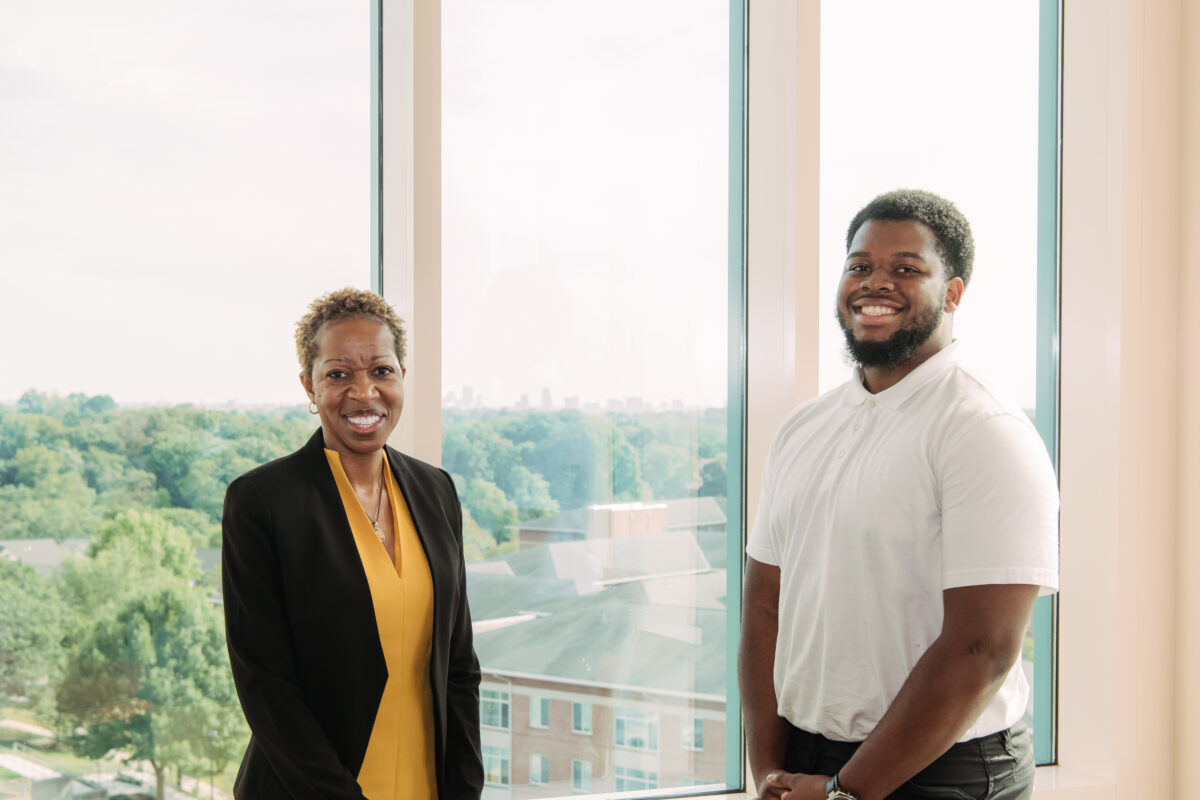
a woman and a man pose together in front of floor to ceiling windows
Sheares Ashby and Tabugbo pose on the 7th floor of the library. (Marlayna Demond ’11/UMBC)

Sheares Ashby: That is amazing. And what is so interesting to me is the mentorship of the more senior students to the younger students because I see it all the time. I see the senior students saying, “Hey, come on over here. This is where we are. This is what we’re doing. This is how we can support you.” They’re really living out the mentorship in ways that are so important. And it is so wonderful to see the younger students come in and then become those mentors to other people. I can see that growth even in a year.

Tabugbo: Exactly. And on that note of mentorship, that’s why we wanted to start moving toward outreach programs, especially to local high schools and middle schools. This effort is spearheaded by our secretary, Daniel Bajulaiye. If we can get to these students early and make them know that they’re appreciated, make them know that they can be heard, that will be important in fostering a good relationship, especially as they come into UMBC. Just letting people know that you’re there for them is so important because a lot of people, especially on this campus, don’t know their potential.

Sheares Ashby: I one hundred percent agree. One of the things I’m really excited about for UMBC is the work that we continue to do in Baltimore. We’re right here, and we know that there are a lot of Black men, young men, in Baltimore who would benefit. I don’t think too many Black men in Baltimore walk around feeling appreciated.

If we can get to these students early and make them know that they’re appreciated, make them know that they can be heard, that will be important in fostering a good relationship, especially as they come into UMBC.

Okechukwu Tabugbo '25

Tabugbo: Even when I did get the role [as president of Black Men’s Society], I still had imposter syndrome. I didn’t truly feel I belonged until actually stepping into the shoes and having to take over. Talking to my brother all summer, the amount of encouragement he had to give me to say just, “You can do this. You are here for a reason.” Hearing it from Amery, hearing it from Israel, it took a lot to be able to have the confidence to come and do this again and again every day.

Sheares Ashby: Mentorship has always been important. Sometimes it just takes somebody to look at you and tell you, “I see you, and I think you’re pretty special,” or, “I see this gift or talent that you have,” and it can change somebody’s life just like that. I don’t know anybody who doesn’t need encouragement.

The long shot—4-time Olympian Cleopatra Borel ’02 inducted to Athletics Hall of Fame

Cleopatra Borel had no athletic aspirations when she arrived in Baltimore from Trinidad and Tobago in 1997. She enrolled at what was then Coppin State College on the advice of her high school math teacher, a Coppin alum. Powerfully built and an eager learner, Borel quickly developed in the throwing events and broke Coppin’s shot put record early in her tenure there.

After the Eagles’ coach left the program, UMBC offered Borel an athletic scholarship and she made the move to Hilltop Circle.

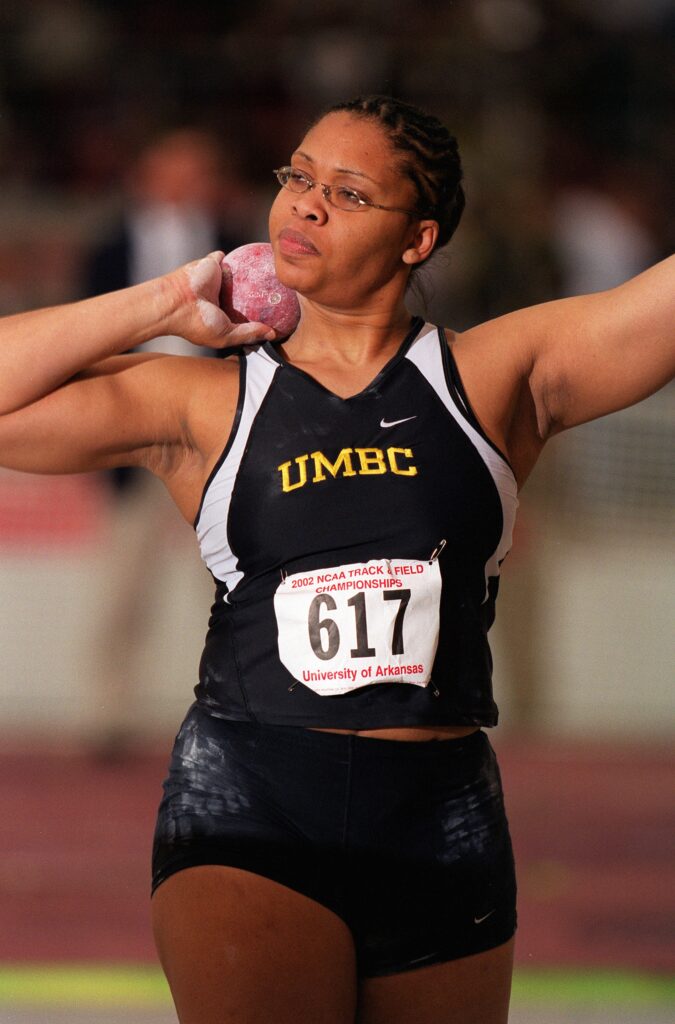
a woman throws a shot put wearing a UMBC bib
Borel at a competition when she was a student. Photo courtesy of Borel.

Borel ’02, interdisciplinary studies, flourished both academically and athletically at UMBC. She earned All-America honors (top eight) in the shot put both indoors and outdoors in the 2000 – 01 season. However, she would have only one more crack at the NCAAs, with one year of indoor track and field eligibility remaining. 

On March 9, 2002, Cleo, as she was known at UMBC, took to the shot put circle at the University of Arkansas. On her next-to-last throw, she uncorked a personal best of 17.50 meters (57’5”), putting her in first place. When the last shot had landed, the black-and-gold clad Retriever had outdistanced the field and captured UMBC’s first Division I national title. 

In her first year of eligibility (2006 – 07), the UMBC Athletic Hall of Fame Committee tabbed Borel for induction. However, some events on her calendar kept getting in the way of her returning to campus—namely the 2004, 2008, 2012, and 2016 Olympics. At 37 years old, she produced her best finish, placing seventh at the 2016 Rio Games. Her final Olympic moment occurred as she served as Trinidad and Tobago’s flag bearer at the closing ceremonies.

Borel returned to the United States in January 2022 to coach the throwers at the University of Texas Rio Grande Valley. And, in October 2023, she finally made the journey back to Hilltop Circle to be inducted into the UMBC Athletics Hall of Fame. 

We asked Borel to reflect on her incredible journey.

Q: You arrived at UMBC under unusual circumstances and remain the only Retriever to win an individual NCAA Championship. Reflecting on your time here, what did it mean for you to be a Retriever and how did your UMBC experience assist you in all of your endeavors?

Borel: I walked away from a very good situation at Coppin State College, not knowing how things would evolve at UMBC. However, I have to say, taking a chance on UMBC is still among the top three best decisions I have made thus far. My UMBC student-athlete experience prepared me for life as an Olympic athlete, essentially taking on the world. 

I believe I was prepared to navigate life on the professional track and field circuit because of [UMBC Athletics Director] Dr. Charles Brown’s sports management class and because my event Coach Brian King and track and field Head Coach David Bobb ’97 taught me to work hard, be confident, and play to my strengths. 

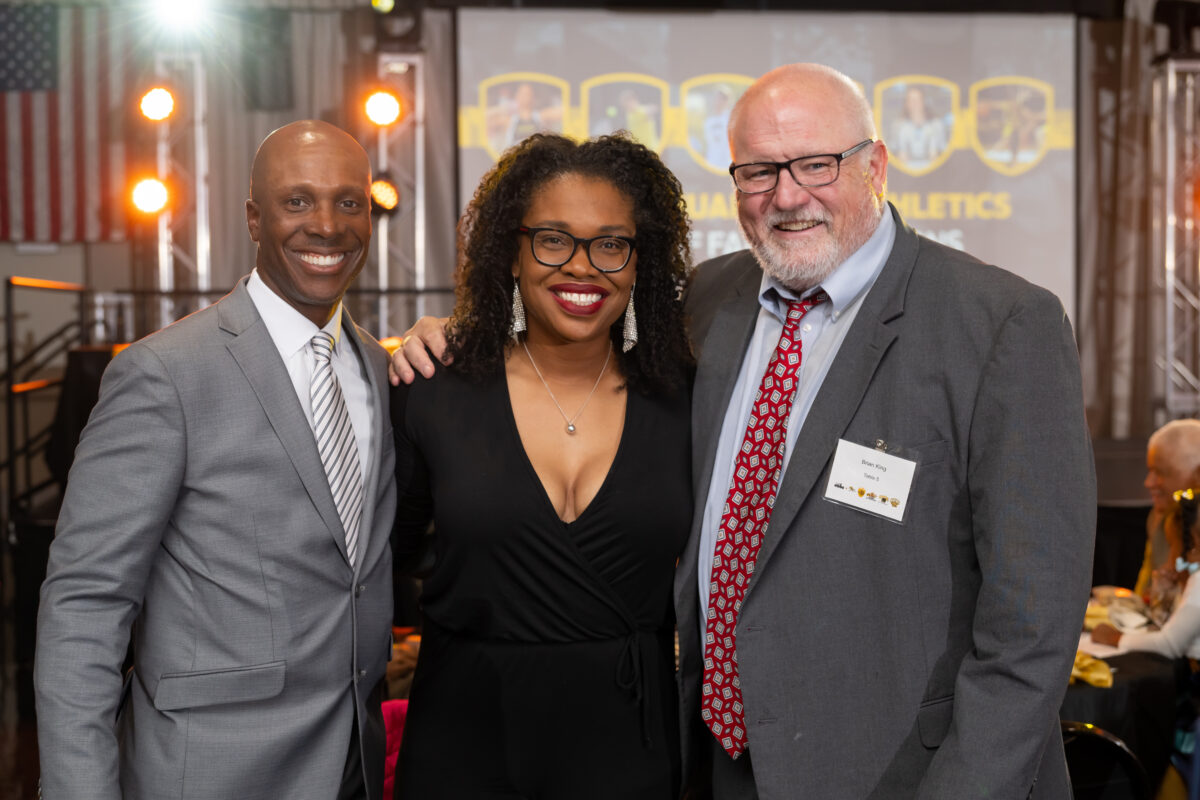
two men stand on either side of a woman at a formal event, UMBC's 2023 athletics hall of fame
Left to right, David Bobb ’97, Borel, and Brian King. Photo by Max Franz for UMBC.

UMBC’s academic accomplishments, artistic expressions, community outreach initiatives, and of course athletic triumphs reflect the unwavering commitment we all share in making our school a truly exceptional place—a special place where a young person can take a chance and, through hard work and dedication, rise to the top of their field.

Q: What did it mean for you to represent Trinidad and Tobago in international competitions, including four Olympic Games?

Borel: Trinidad and Tobago is a small, developing nation in the Caribbean with a population of less than 1.4 million individuals on two islands. As a result, I felt like one of a few sporting ambassadors representing my country. I am proud to have been responsible for the playing of my national anthem at stadiums across the globe.

UMBC’s academic accomplishments, artistic expressions, community outreach initiatives, and of course athletic triumphs reflect the unwavering commitment we all share in making our school a truly exceptional place.

Cleopatra Borel '02

Q: What prompted you to develop the Cleopatra Borel Foundation and what is its mission?

Borel: The mission of the Cleopatra Borel Foundation is to facilitate the development of youth through sport and education. We believe this can be accomplished at the grassroots level in Trinidad and Tobago by assisting with coaches’ education, gear, and equipment distribution.

Q: Anything else you would like to share with the UMBC community?

Borel: It was indeed an honor to represent you at the NCAAs and on a global level. I am a proud Retriever, excited to see how UMBC will continue to positively influence Maryland and the world.

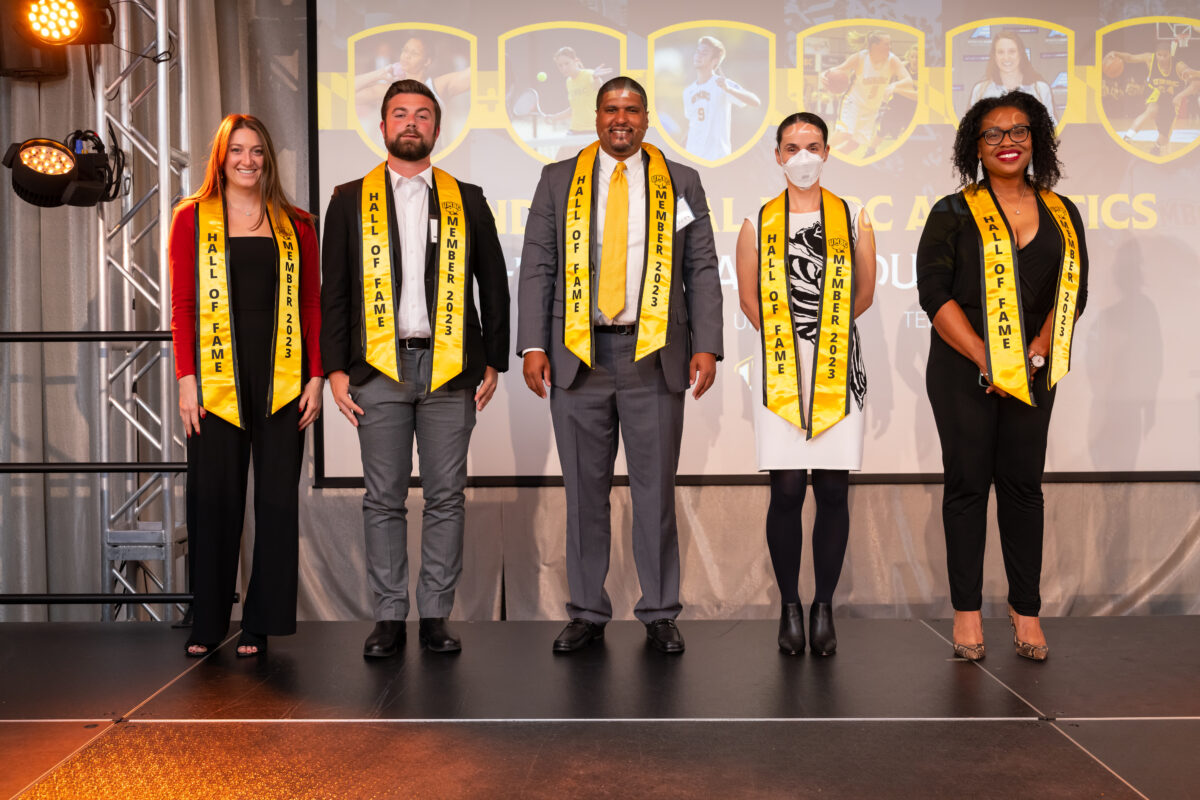
Five people stand on stage with sashes that say Hall of Fame Member 2023
The 2023 Hall of Fame inductees included (left to right) Emily Escobedo, ’17, women’s swimming and diving; Pete Caringi III, ’15, men’s soccer; Brian Hodges, ’07, men’s basketball; Cornelia Carapcea, ’09, tennis and Cleopatra Borel, ’02 , track and field. Carlee Cassidy Dewey ’10, women’s basketball, could not attend for personal reasons and will be formally inducted in 2024. Photo by Max Franz for UMBC.

By Steve Levy ’85

Is time travel even possible? An astrophysicist explains the science behind the science fiction

Written by Adi Foord, assistant professor of physics, UMBC

Curious Kids is a series for children of all ages. If you have a question you’d like an expert to answer, send it to CuriousKidsUS@theconversation.com.


Will it ever be possible for time travel to occur? – Alana C., age 12, Queens, New York


Have you ever dreamed of traveling through time, like characters do in science fiction movies? For centuries, the concept of time travel has captivated people’s imaginations. Time travel is the concept of moving between different points in time, just like you move between different places. In movies, you might have seen characters using special machines, magical devices or even hopping into a futuristic car to travel backward or forward in time.

But is this just a fun idea for movies, or could it really happen?

The question of whether time is reversible remains one of the biggest unresolved questions in science. If the universe follows the laws of thermodynamics, it may not be possible. The second law of thermodynamics states that things in the universe can either remain the same or become more disordered over time.

It’s a bit like saying you can’t unscramble eggs once they’ve been cooked. According to this law, the universe can never go back exactly to how it was before. Time can only go forward, like a one-way street.

Time is relative

However, physicist Albert Einstein’s theory of special relativity suggests that time passes at different rates for different people. Someone speeding along on a spaceship moving close to the speed of light – 671 million miles per hour! – will experience time slower than a person on Earth.

People have yet to build spaceships that can move at speeds anywhere near as fast as light, but astronauts who visit the International Space Station orbit around the Earth at speeds close to 17,500 mph. Astronaut Scott Kelly has spent 520 days at the International Space Station, and as a result has aged a little more slowly than his twin brother – and fellow astronaut – Mark Kelly. Scott used to be 6 minutes younger than his twin brother. Now, because Scott was traveling so much faster than Mark and for so many days, he is 6 minutes and 5 milliseconds younger.

Time isn’t the same everywhere.

Some scientists are exploring other ideas that could theoretically allow time travel. One concept involves wormholes, or hypothetical tunnels in space that could create shortcuts for journeys across the universe. If someone could build a wormhole and then figure out a way to move one end at close to the speed of light – like the hypothetical spaceship mentioned above – the moving end would age more slowly than the stationary end. Someone who entered the moving end and exited the wormhole through the stationary end would come out in their past.

However, wormholes remain theoretical: Scientists have yet to spot one. It also looks like it would be incredibly challenging to send humans through a wormhole space tunnel.

Paradoxes and failed dinner parties

There are also paradoxes associated with time travel. The famous “grandfather paradox” is a hypothetical problem that could arise if someone traveled back in time and accidentally prevented their grandparents from meeting. This would create a paradox where you were never born, which raises the question: How could you have traveled back in time in the first place? It’s a mind-boggling puzzle that adds to the mystery of time travel.

Famously, physicist Stephen Hawking tested the possibility of time travel by throwing a dinner party where invitations noting the date, time and coordinates were not sent out until after it had happened. His hope was that his invitation would be read by someone living in the future, who had capabilities to travel back in time. But no one showed up.

As he pointed out: “The best evidence we have that time travel is not possible, and never will be, is that we have not been invaded by hordes of tourists from the future.”

Telescopes are time machines

Interestingly, astrophysicists armed with powerful telescopes possess a unique form of time travel. As they peer into the vast expanse of the cosmos, they gaze into the past universe. Light from all galaxies and stars takes time to travel, and these beams of light carry information from the distant past. When astrophysicists observe a star or a galaxy through a telescope, they are not seeing it as it is in the present, but as it existed when the light began its journey to Earth millions to billions of years ago. https://www.youtube.com/embed/QeRtcJi3V38?wmode=transparent&start=0 Telescopes are a kind of time machine – they let you peer into the past.

NASA’s newest space telescope, the James Webb Space Telescope, is peering at galaxies that were formed at the very beginning of the Big Bang, about 13.7 billion years ago.

While we aren’t likely to have time machines like the ones in movies anytime soon, scientists are actively researching and exploring new ideas. But for now, we’ll have to enjoy the idea of time travel in our favorite books, movies and dreams.


This article is republished from The Conversation under a Creative Commons license. Read the original article and see more than 250 UMBC articles available in The Conversation.

Meet a Retriever—Brian Souders, Ph.D., globetrotter and study abroad champion

Currently, Brian Souders is the associate director for global learning in the Center for Global Engagement at UMBC. But Brian, who came to UMBC in 2000 to be the university’s inaugural study abroad coordinator, has worn a number of hats in his 20+ years as a Retriever. He’s a two time alum (Ph.D. ’09, language, literacy, and culture, M.A. ’19, TESOL), and after years of helping faculty and students achieve their overseas learning and research goals, Brian recently took part in his own Fulbright exchange program. Take it away, Brian!

Q: What’s one essential thing you’d want another Retriever to know about you?

A: I have been a global soul since my first international experience as a high-school exchange student in Finland several decades ago. That initial experience led me to a career in international exchange that has lasted more than two decades at UMBC. My UMBC path also led to doctoral work in the language, literacy, and culture program, as well as a master’s degree in our TESOL program.

Q: Tell us about what you love about where you work.

A: I work in UMBC’s Center for Global Engagement (CGE), and our mission is to support international opportunities for both our incoming degree-seeking students, our English-language learners, and our outbound study abroad students. Having been at the CGE for what I call a non-insignificant amount of time has allowed me to see just how much we have grown and changed to support the global learning aspirations of our UMBC community. 

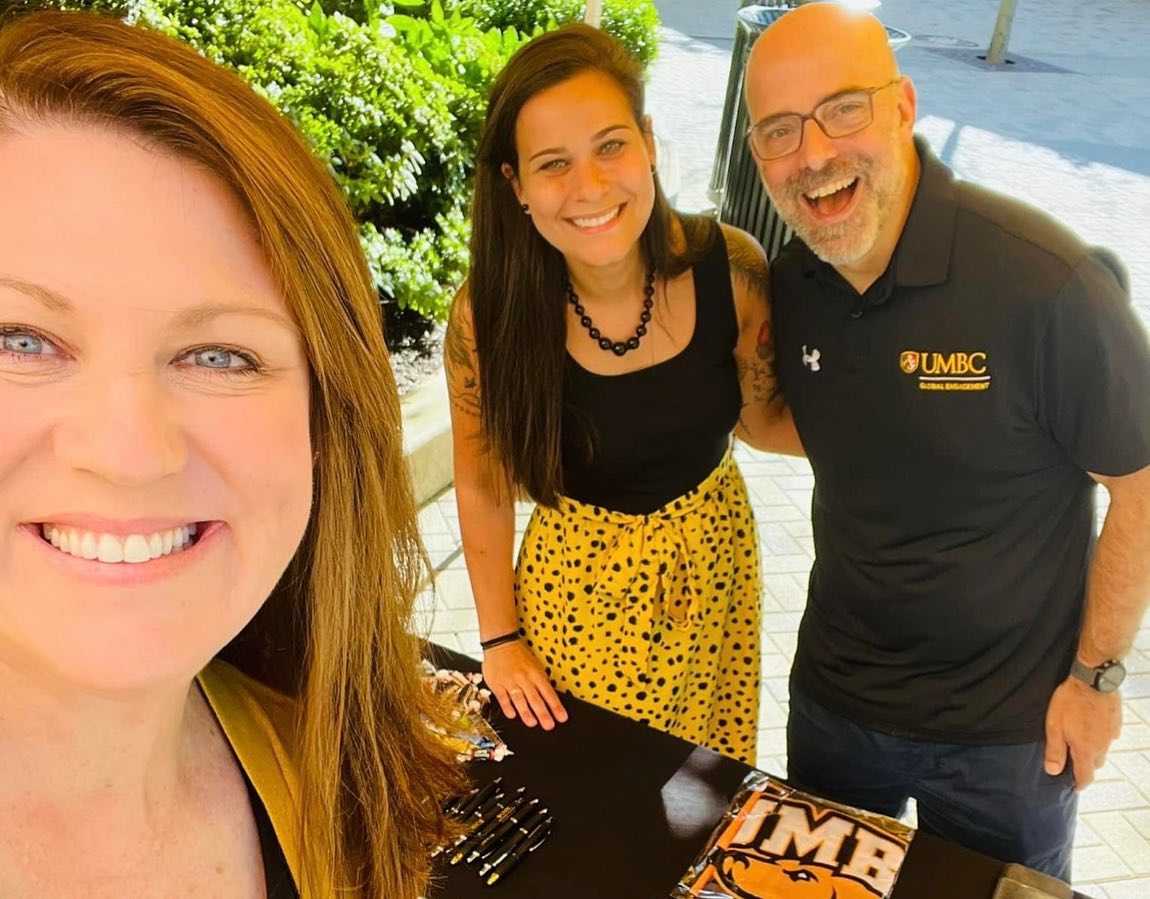
three people dressed in black and gold smile at the camera
On the first day of classes in August 2022, Souders staffs a Welcome Week table with colleagues Amanda Knapp (left) and Laila Shishineh (middle).

Q: What brought you to UMBC in the first place? Tell us about your primary WHY, and how it led you to UMBC.

A: I came to UMBC because I was offered the opportunity to build a structure for UMBC students to study abroad. I had worked as a study abroad advisor at a Big 10 university for several years, but I wanted to take those skills and apply them elsewhere. In 2000, I saw a job advertisement to serve as the inaugural study abroad coordinator at UMBC in what was then called the International Education Services Office. I interviewed for and got the job. I moved to Maryland, and I have not looked back since!

I work with the UMBC community to put their dreams into words.

Brian Souders, Ph.D. '09, M.A. '19

Q: Tell us about the people who are helping you grow at UMBC, and why their HOW made such a difference to you.

A: There are too many people to name! It was an honor to work with Arlene Wergin, the director of the International Education Services Office until her retirement in 2016. She was a constant source of professional and personal support during the initial years of my time at UMBC.

David Di Maria, our associate vice provost for international education, led me to dream big, when I transitioned away from education abroad administration to a role focused solely on my current work of fellowships advising with a focus on the Fulbright U.S. Student Program. Katie Heird, UMBC’s inaugural director of study abroad and global learning, has been a partner in global collaboration for 15 years—and it was with her encouragement that I applied for my own Fulbright, which I received this year.

Q: What did you learn from your own Fulbright experience, and what did you bring back from that to offer to UMBC students and faculty?

A: Probably the biggest lesson I took from the seminar is that the German-American educational relation is a strong one—in spite of the differences in our educational systems. There are aspects of the higher education landscape that make for some challenges in semester-length exchanges, but there is an incredible enthusiasm among our German university colleagues and partners to host American students and scholars. I can happily tell our faculty and staff that Germany’s institutions of higher education are beyond enthusiastic and welcoming to American faculty and students to come learn more about what their country has to offer. 

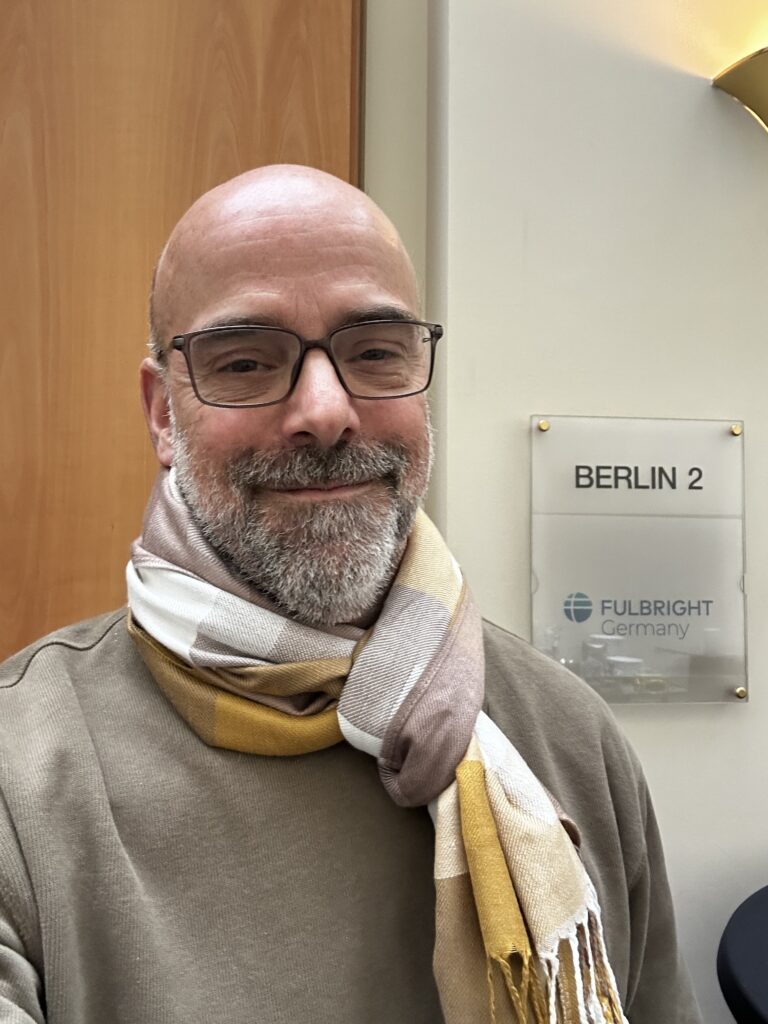
a man in a yellow and grey scarf smiles in front of a sign that says Fulbright, a study abroad exchange program
A selfie at the Fulbright International Education Administrators Seminar in Germany, October 2023.

Q: What do you love most about your job?

A: I get to fulfill dreams. I work with both talented students and our amazing faculty and staff to find funding opportunities to go global. In my job, I work with the UMBC community to put their dreams into words. Working with the Fulbright Program—the largest educational exchange program sponsored by the U.S. Department of State—allows me the chance to help build future leaders in global affairs. Who wouldn’t want to be a part of that?

* * * * *

UMBC’s greatest strength is its people. When people meet Retrievers and hear about the passion they bring, the relationships they create, the ways they support each other, and the commitment they have to inclusive excellence, they truly get a sense of our community. That’s what “Meet a Retriever” is all about.

Learn more about how UMBC can help you achieve your goals.

Meet a Retriever—Army veteran Tim Besse, M.A. ’17, management of aging services

Meet Tim Besse, M.A. ’17, management of aging services, a veteran of the United States Army who now works as an advocate for veterans with neurological injuries or diseases. As a student in the Erickson School, Tim made connections with a fellow student that sticks with him to this day. Thanks for sharing your story, Tim!

Q: What’s one essential thing you’d want another Retriever to know about you?

A: As far back as I can remember, I aspired to go to college and pursue a career that was dependent upon my college education. I enlisted in the U.S. Army (USA) at age 18 to take advantage of the GI Bill for education. During my 1973 – 1980 USA years, I completed the first three years of a University of Maryland Global Campus baccalaureate degree. In 1981, I completed my degree that was focused on social sciences, and I started a Department of Defense civilian career that ended in my 2016 retirement.

I was active in my community during my career, working with older adults, people with disabilities, and refugee families. In September 2016, two weeks into retirement, I entered the Erickson School at UMBC to earn my M.A. in the management of aging services. Today I am an affiliate of the U.S. Department of Veterans Affairs, wherein I advocate for veterans who are neurologically injured or who suffer from neurologic diseases.

Q: What’s the one thing you’d want someone who hasn’t joined the UMBC community to know about the support you found here?

A: That support will be a gift to themselves for a lifetime.

Q: Tell us about someone in the community who has inspired you or supported you, and how they did it.

A: I have many who supported me on my journey through the Erickson School. The person who stands out is my classmate Cynthia Garner [’16, M.A. ’17, management of aging studies]. The classmate closest to my age was 10 years younger than me. The classmate furthest from my age, Cynthia, was 40 years younger than I am. We were kindred souls, out to prove something to ourselves as well as to others! We were committed to each other not to let the other one fail. Cynthia once said to me: “Because I am young, people don’t think I know anything!” I responded to her, “Because I am old, people don’t think I know anything either!”

Regardless of the difficulty of the assignment, and regardless of the tight timeline, working with Cynthia, I knew we would pull through it! Cynthia was not only very bright, but she was ethical, unafraid to work hard to be successful, always gracious, and shared her talents to help others succeed too! On the day we graduated, I said to myself, “If there are just a few more like Cynthia, the world will be okay!”

My insight into myself allows me to understand the constraints age has placed on these veterans. My insight enables me to recognize their right and their need for self-determination and explain to well-meaning family members why it is vital for their veterans to guide their lives.

Tim Besse, M.A. '17

Q: What did you love most about your program of study at UMBC?

A: The Erickson curriculum strives to enable its students to understand the needs of older adults and to be able to bring resources to meet those needs. For many of my classmates, the course content was abstract; it pertained to others and not yet to themselves. The course content was personal to me because I am an older adult. Many scenarios are used as examples, such as aging parents, changes in physical stamina, and cognitive changes. Also, traits that may improve with age include resilience and crystallized intelligence (wisdom) are current life events.

The curriculum enabled students to grasp the difficulties encountered by older adults and potential solutions for those difficulties. For those students who are older adults, the course content was as much about them as it was about an entire aging cohort. Every day, I work with older adult veterans and their families. My insight into myself allows me to understand the constraints age has placed on these veterans. My insight enables me to recognize their right and their need for self-determination and explain to well-meaning family members why it is vital for their veterans to guide their lives.

Q: What brought you to UMBC?

A: I came to UMBC because it offered the education I needed to work with older adults at my desired level of expertise. I stay engaged with UMBC and the Erickson School for the aid it provides me to improve my job skills.

Q: Where are you working now, and what do you like about it most?

A: I am a national service officer in the U.S. Department of Veterans Affairs. Our veteran population is aging. The average age for a veteran is 68. The average age for a Vietnam-era veteran is 72. Besides being older adults, these men and women have an extra layer on top of being an older adult. Veterans are more likely to contract Amyotrophic Lateral Sclerosis (ALS) and Multiple Sclerosis.

PTSD is more prevalent amongst veterans, especially combatant veterans. Veterans are more likely to fall than non-veterans. And then there is loneliness. It is gratifying to work with these older adults with their special needs. At my age my credo is if it’s not fun, I’m doing it! I anticipate I am not going anywhere.

* * * * *

UMBC’s greatest strength is its people. When people meet Retrievers and hear about the passion they bring, the relationships they create, the ways they support each other, and the commitment they have to inclusive excellence, they truly get a sense of our community. That’s what “Meet a Retriever” is all about.

Learn more about how UMBC can help you achieve your goals.

Meet a Retriever—Aysia Miller ’24, volleyball player and biology major

Meet Aysia Miller, a senior on the America East championship women’s volleyball team at UMBC. Originally from Mililani, Hawaii, Aysia is majoring in biology and minoring in bioinformatics. As a student-athlete and scholarship recipient, Aysia says she’s found a community at UMBC that lets her dive deep into the STEM fields that interest her while supporting her on and off the volleyball court.

Q: What’s the one thing you’d want someone who hasn’t joined the UMBC community to know about the support you find here? 

A: UMBC has people that can fit you perfectly. There will always be someone that you can relate to and build bonds with. I love that I have people around me who support me and are willing to help me no matter how small or big the task.

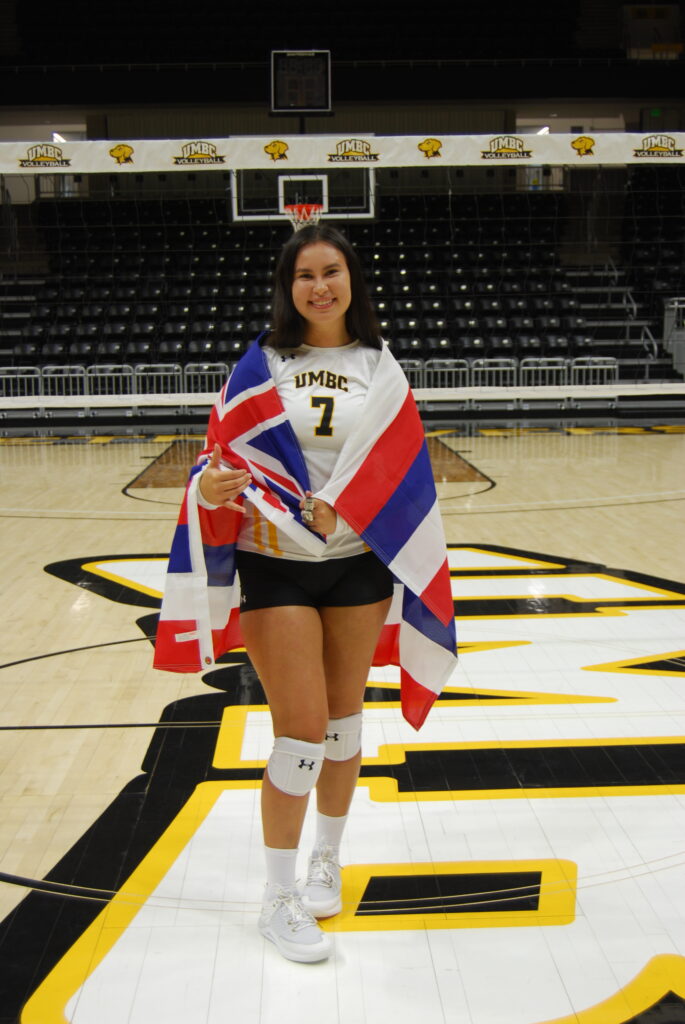
a volleyball player stands wrapped in the Hawaiian flag
Miller stands wrapped in the Hawaiian flag. “I want to represent the islands to the best of my ability.”

Q: Tell us about what you love about the volleyball program at UMBC.

A: UMBC volleyball is such a special program to be a part of. I love that we all come from different cultures and backgrounds but we are able to be a collective unit. We accept challenges together and strive to become better.

Q: Can you tell us more about the Maui Wildfire Awareness Night being held by UMBC Volleyball this week and what it means to you to have this sort of community support?

A: As many people may know, deadly wildfires greatly impacted the community of Lahaina, Maui leading to one of the greatest natural disasters in modern U.S. history. Although I wasn’t directly affected, I mourn and ache for my home. Hawaii is more than beautiful beaches and palm trees. The people are what make the culture so rich. Being able to bring a part of my home to UMBC is so important to me. This has been my new home for the past four years and I want to be able to inform people of everything that is going on in the islands. With our match on November 11th, we are hosting a Maui Wildfire Awareness Night. This disaster is affecting thousands of people and doing a small thing like raising awareness allows me to feel like I’m making an impact. I have to thank the people at UMBC for making this night possible. Having people that care about where I come from is amazing. I wouldn’t be able to do something like this anywhere else. I’m eternally grateful for this opportunity and I hope I am able to help those in need.

I love that I have people around me that support me and are willing to help me no matter how small or big the task.

Aysia Miller '24, biology

Q: What brought you to UMBC in the first place? Tell us about your primary WHY, and how it led you to UMBC.

A: Being from Hawaii, I would have never expected to end up on the East Coast, let alone Maryland. But I chose UMBC because of three things. One of the major factors of my choice was the volleyball program. I found that every aspect about the athletics program was what I was looking for. All of the people involved with athletics were so friendly and helpful. 

As I was introduced to the school, I loved that it is a medium sized school close to Baltimore and Washington, D.C. It would allow for great opportunities to make connections. I also really valued the elite STEM programs. I prided myself in finding a school where I could get a good education and play volleyball at the same time. With this in mind, I came on a visit to see UMBC, and I knew it was home. 

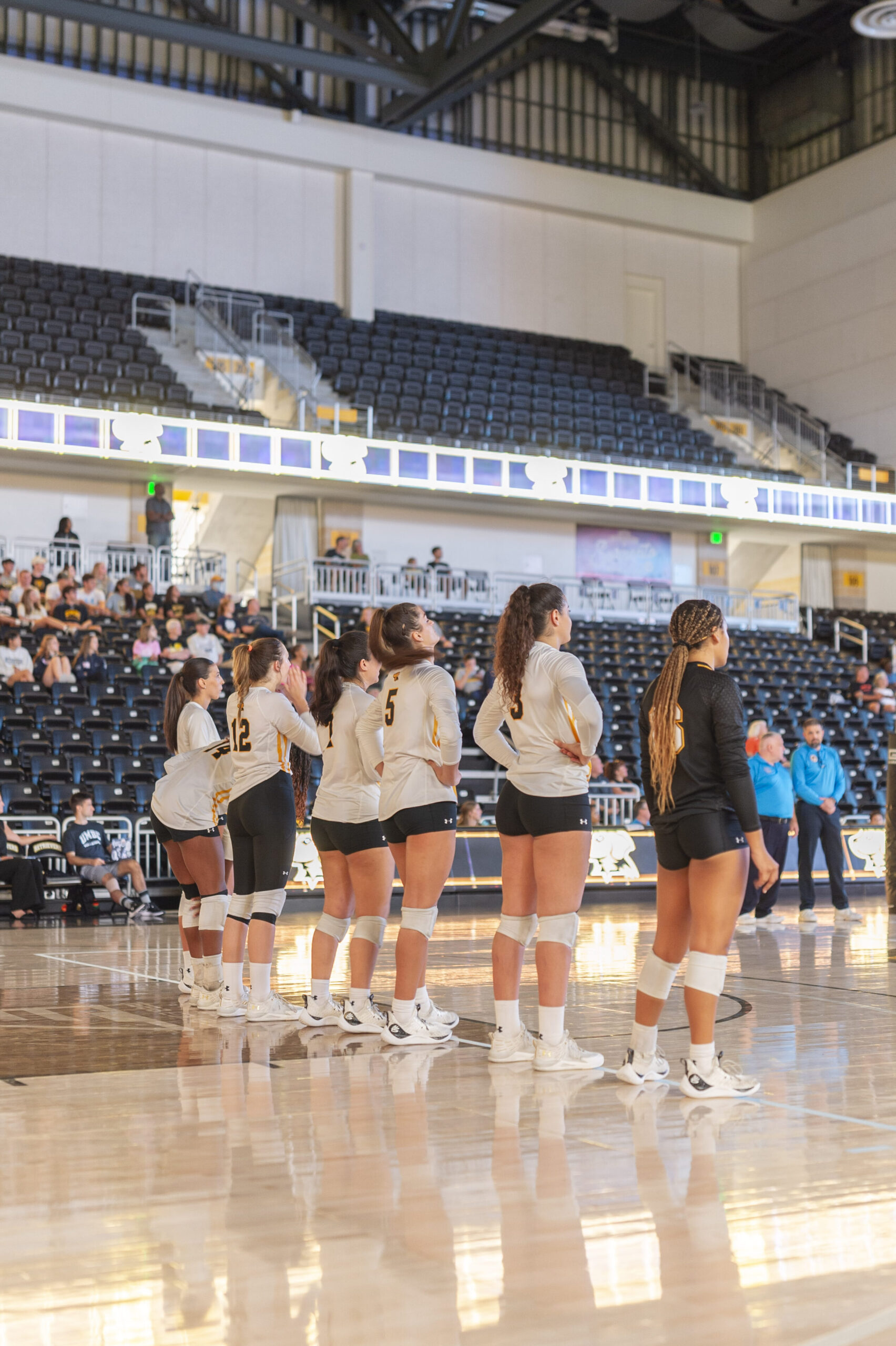
volleyball players stand together on the court

Q: You’re a scholarship recipient. How has that changed things for you at UMBC?

A:  I have two scholarships, academic (Dean’s Fellow) and athletic aid. Obviously, I am eternally grateful to have the opportunity to pursue higher eduction at a fraction of the cost. I honestly don’t think I would have ended up at UMBC if it wasn’t for the aid I am receiving. This place has become a second home and it will always leave an impact on me. When I was younger, I always knew I didn’t want to attend school at home, but finding UMBC was something I never expected. However, this small decision led to even greater impacts. I’ve been able to shape myself into the person I am today because of my experiences at UMBC. I pride myself on my academics, as well, and to have that pay off from high school truly made all my hard work worth it. Being from out of state, it is even more difficult to find an affordable eduction, but my journey has all been worth it. I am getting an amazing education and playing volleyball at a high level like I’ve always dreamed. 

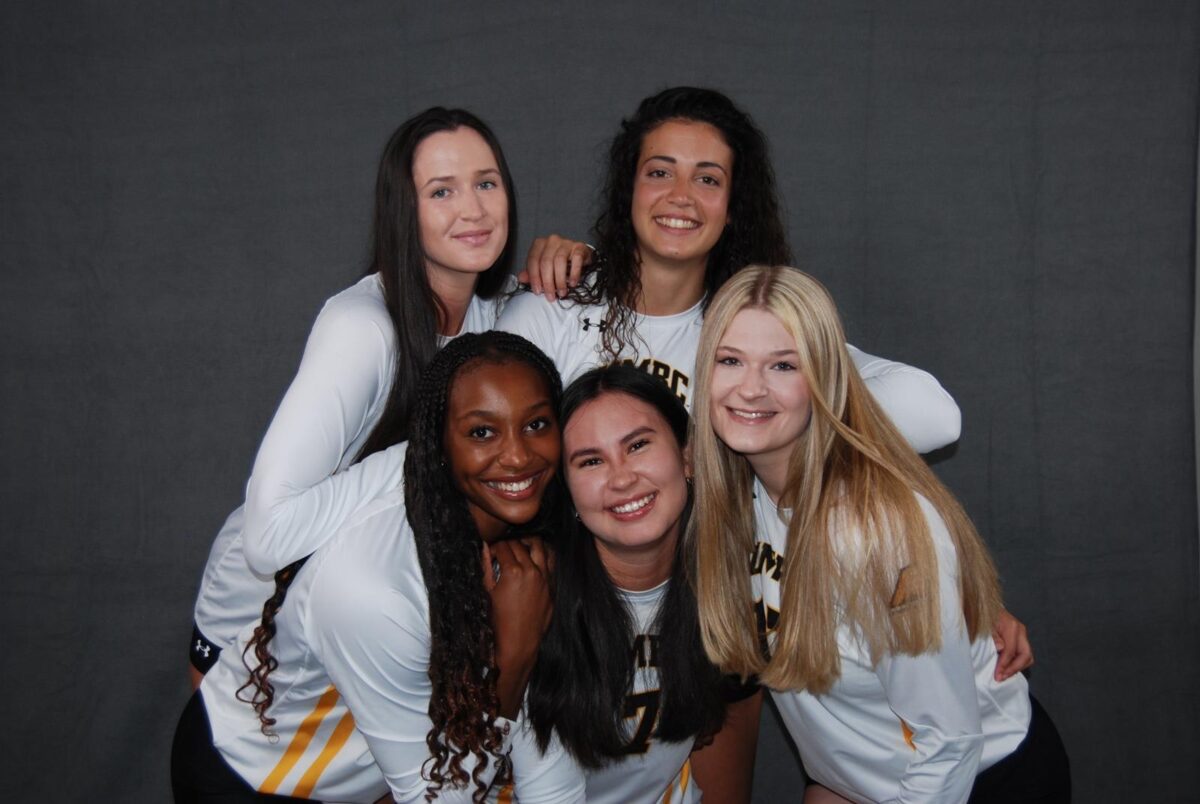
members of the volleyball team pose together
A shared moment with teammates Weronika Wrzesinska (top left), Michela De Marzi (top right), Kamani Conteh (bottom left), Miller, and Emily Ferketic (bottom right). Photos courtesy of Miller.

Q: What advice would you give to a student athlete considering coming to UMBC, and why?

A: To those considering UMBC, this place not only excels in education, the people are what make this place great. It’s easy to feel overwhelmed as a student athlete and finding people that support you is important. Every single person in the athletic department is dedicated to making our student athlete experience amazing. I can go down the list and about everyone in the department has shown that they not only care about my team but me as an individual as well. Over time, building these relationships with people have made my experience at UMBC incredible. I am so fortunate to play the sport I love with people that have my back.

* * * * *

UMBC’s greatest strength is its people. When people meet Retrievers and hear about the passion they bring, the relationships they create, the ways they support each other, and the commitment they have to inclusive excellence, they truly get a sense of our community. That’s what “Meet a Retriever” is all about.

Learn more about how UMBC can help you achieve your goals.

Meet a Retriever —Diane Tichnell ’70, political science, Founding Four alum

Meet Diane Tichnell ’70, a political science graduate of UMBC’s very first class of Retrievers! As a member of UMBC’s “Founding Four” group of alums from the university’s first four graduating years, Diane has stayed involved with her alma mater, participating as an editor of This Belongs To Us, a collection of Founding Four stories, and establishing the Tichnell Aging Gracefully Graduate Scholarship to support students in the Erickson School of Aging Studies. Take it away, Diane!

Q: What’s one essential thing you’d want another Retriever to know about you?

A: I have been a loyal Retriever since that first day on campus, September 19, 1966, and have tried my best throughout the development of my family life, career, and alumni activities to maintain that Retriever spirit!

Q: What would you want someone who hasn’t joined the UMBC community to know about the support you found here?

A: Frankly, once you are a member of the UMBC community, you are a member of a solid family! You are always welcome on campus. Faculty, staff, and even the students take time to chat with an alum!

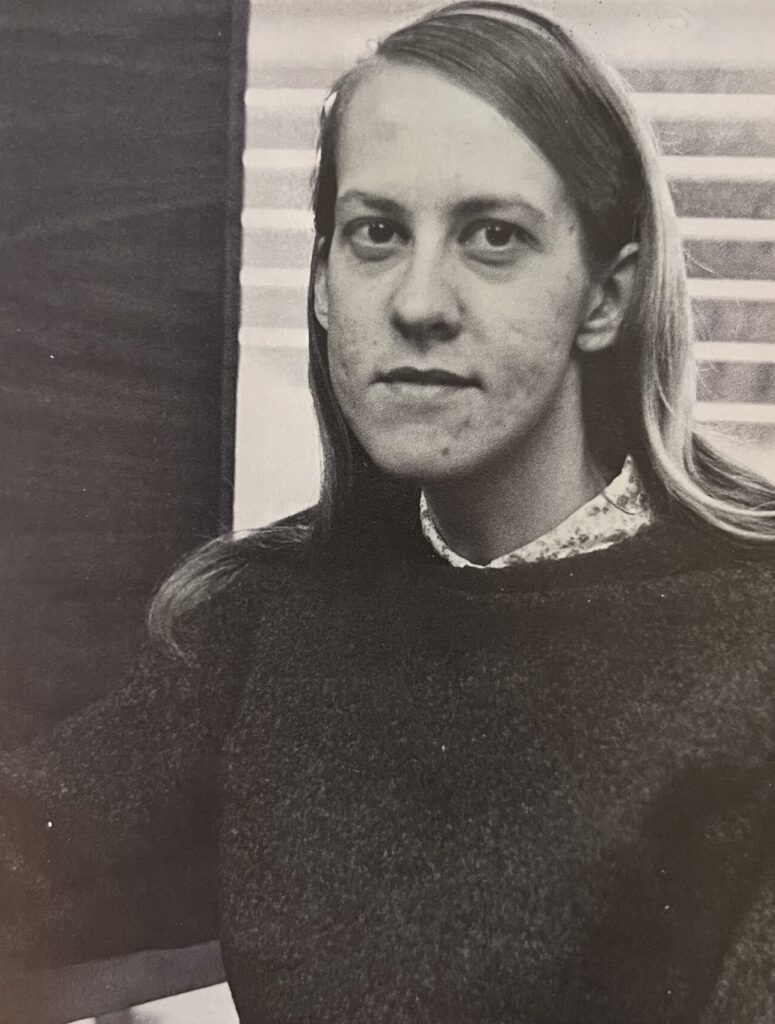
Black and white photo of a woman with straight hair
Diane Tichnell from the 1970 Skipjack, UMBC’s yearbook.

Q: Tell us about someone in the community who has inspired you or supported you, and how they did it.

A: Mimi Haw Dietrich ’70 has encouraged me through her continuous involvement and support of UMBC to maintain contact with our Retriever roots consistently. Together with two other alums we feel we have helped to preserve some of our Founding Four history by editing a collection of stories by Retrievers on campus those first four years and publishing the collection this year.

UMBC was just what I needed to equip me for my life and its effects are with me even today.

Diane Tichnell '70, political science

Q: Tell us what you love about being involved as an alum.

A: The UMBC Alumni Association reaches out frequently to keep alumni engaged in and aware of all the great things happening within the thriving, growing UMBC community. We stay connected no matter where we are in the world. The connection is lifelong and beyond! The association can help an individual stay engaged through a number of legacy giving opportunities which can actually extend long after life ends!

Q: What brought you to UMBC in the first place? Tell us about your primary WHY, and how it led you to UMBC.

A: My “why” in 1966 was a desire to receive a solid education for my future in a way that was affordable to me. My parents had many compelling financial obligations then and could only provide me with a limited amount of financial support for higher education. UMBC was in close proximity to my home, was a choice of many of my friends, and offered an exciting opportunity to be a kind of pioneer at a brand new university in Maryland.

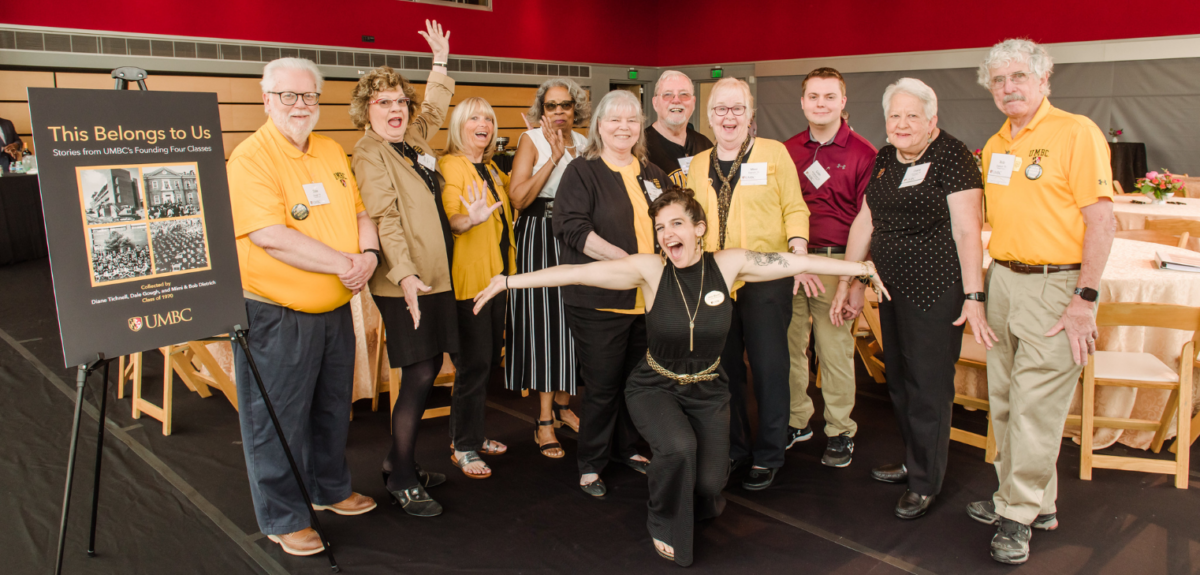
Members of UMBC's class founding four classes celebrate the launch of their book
Members of UMBC’s founding classes celebrate the launch of This Belongs to Us. Pictured to the right of Tichnell, in red, is her grandson Colin McFarland ’22, who helped out with book design. From left to right: Dale Gough ‘70, Donna Heckler ‘70, Louie Lyall ‘70, Gail Williams Rouse ’70, Louise Izat ‘70, Royce Bradshaw ‘70, Mimi Dietrich ‘70, McFarland, Tichnell, Bob Dietrich ‘70, and staff member Jess Wyatt in foreground.

Q: Since you’ve been a part of the UMBC community, how have you found support of your WHY?

A: The creative and competent faculty and staff at UMBC in 1966 made me totally comfortable with my decision and made me excited about the career in journalism which I had dreamed of. I had planned to possibly transfer to College Park to complete the journalism major, but I totally fell in love with the unique UMBC environment and changed my major to political science, which was still an awesome preparation for a journalism career. My political science professors as well as the incredible visiting personalities of those first four years prepared me with an open mind and solid principles on which to base my future. Professors in every area of my studies played an integral part in shaping my ability to think, plan, envision, and experience what I needed to do to follow my dreams. UMBC was just what I needed to equip me for my life and its effects are with me even today.

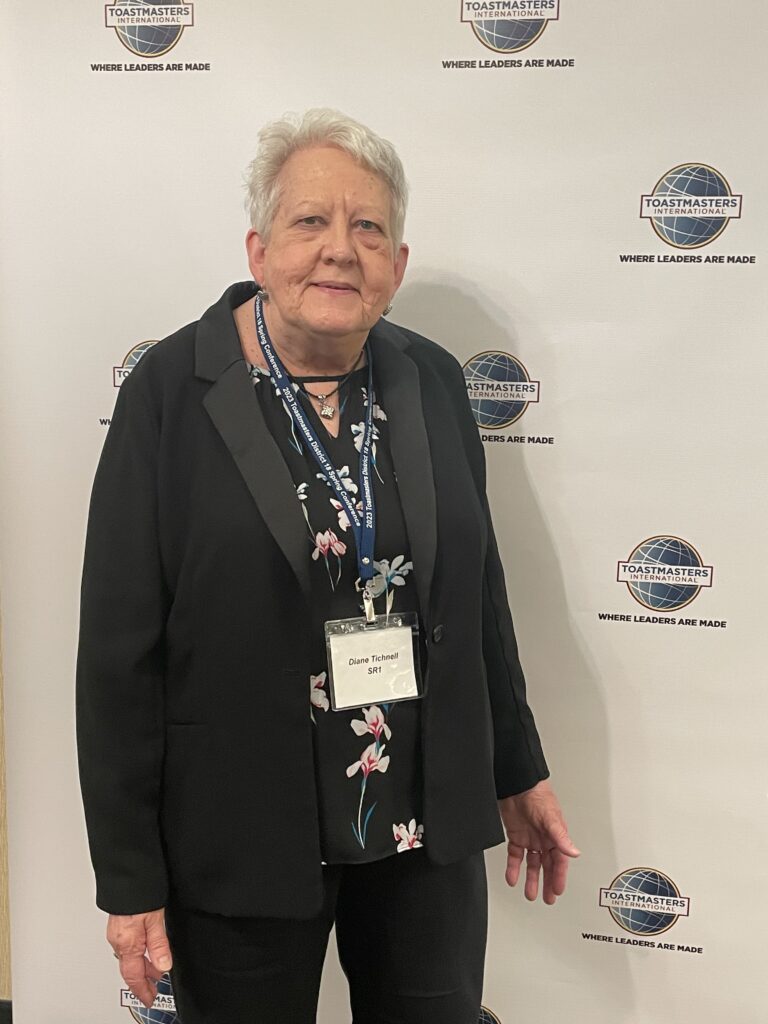
A woman in a black suit poses for the camera
One of Tichnell’s passions since 1988 has been participating in Toastmasters International speaking group. Here she is at a recent District 18 conference. Photo courtesy of Tichnell.

Q: As an alum, what’s your favorite part of Retriever Nation?

A: Seeing the great growth and the direction that UMBC is heading make me so happy to be a part of Retriever Nation! We had no idea in 1966 that this campus would become the amazing, accomplished place it is! What a thrill it is to experience it as it continues to thrive and become much more than just a college campus! It is having a significant impact on the entire area surrounding it and beyond!

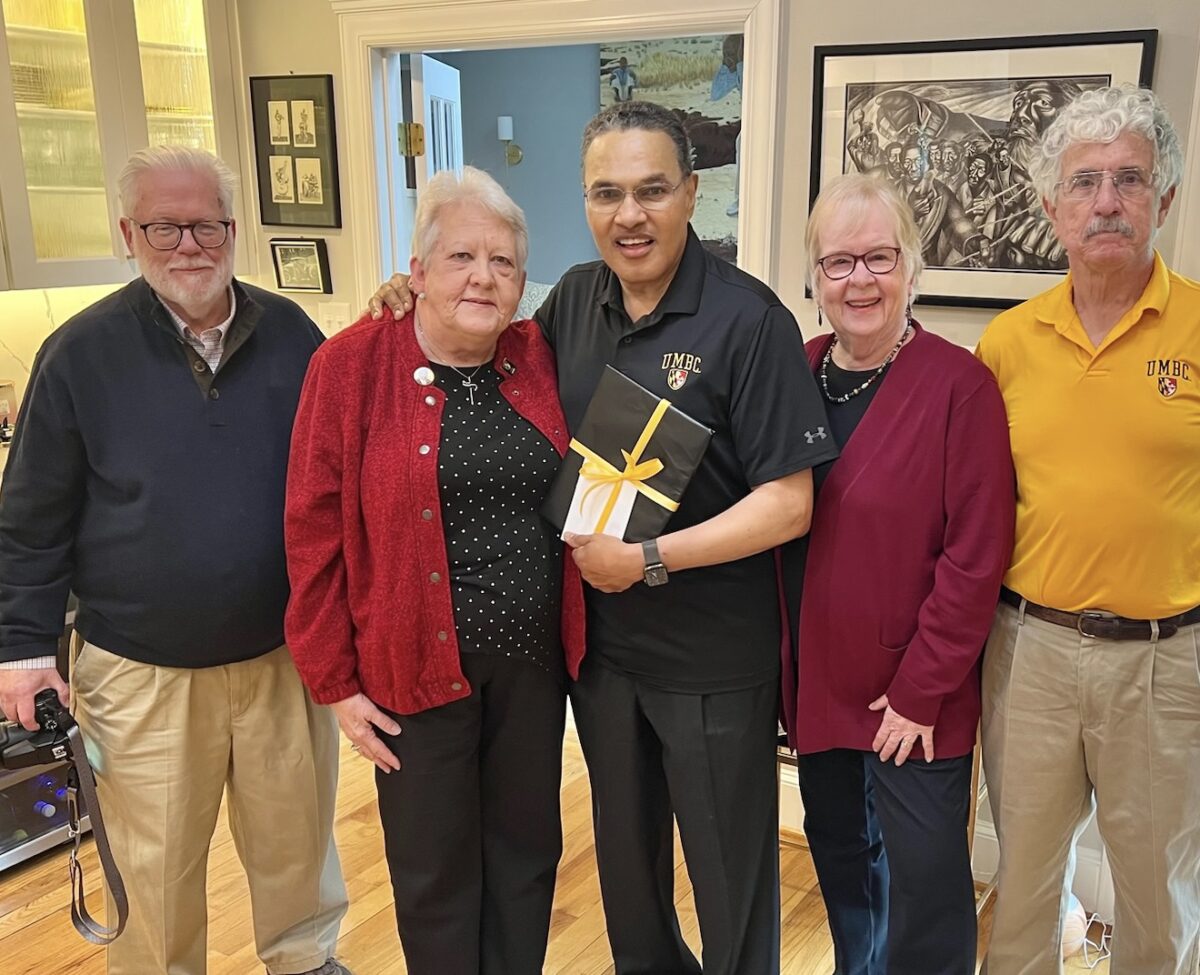
A group of alums stand with university president holding a gift
Presenting former UMBC president Freeman Hrabowski with his copy of This Belongs to Us in May 2023. From left, Dale Gough ’70, Tichnell, Hrabowski, Mimi Dietrich, and Bob Dietrich ’70.

Q: You recently established the Tichnell Aging Gracefully Graduate Scholarship to help students in the Erickson School of Aging. Tell us about what that means to you.

A: The Erickson School of Aging Studies intrigued me from the moment of its conception! It is not just a program designed to teach students how to administer senior communities! It goes way beyond that by insisting that students examine every facet of the aging process! Looking at the psychology of aging, as well as the physical, social, and economic realities of that time of life equips the students with a total understanding and appreciation of the process. I recently began the process of endowing a scholarship for graduate students in the Erickson School of Aging Studies. I made the gift from my IRA as a part of my required minimum distribution. It was easy to do and I am so excited to announce the Tichnell Aging Gracefully Graduate Scholarship!

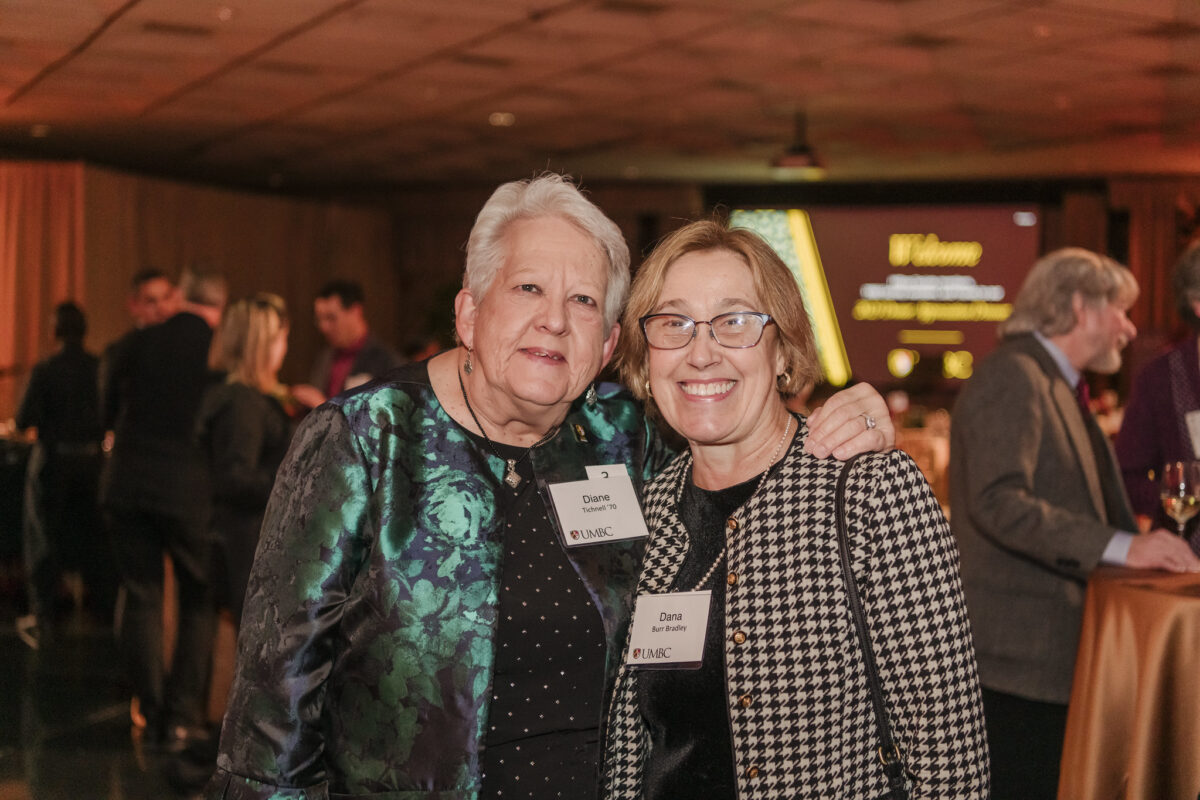
Diane Tichnell and Erickson School Dean Dana Burr Bradley embrace.
Tichnell and the Dean of the Erickson School of Aging Studies, Dana Burr Bradley, Ph.D., FGSA, FAGHE, at the 2023 UMBC donor appreciation dinner.

Partnering with UMBC is really just an extension of being here all those years ago. It makes me feel that I have never left the campus I walked onto that first day. Its growth and current compelling state have never left me behind! I love being a part of it still!

* * * * *

UMBC’s greatest strength is its people. When people meet Retrievers and hear about the passion they bring, the relationships they create, the ways they support each other, and the commitment they have to inclusive excellence, they truly get a sense of our community. That’s what “Meet a Retriever” is all about.

Learn more about how UMBC can help you achieve your goals.

Vampire viruses prey on other viruses to replicate themselves − and may hold the key to new antiviral therapies

Written by Ivan Erill, professor of biological sciences, UMBC

Have you ever wondered whether the virus that gave you a nasty cold can catch one itself? It may comfort you to know that, yes, viruses can actually get sick. Even better, as karmic justice would have it, the culprits turn out to be other viruses.

Viruses can get sick in the sense that their normal function is impaired. When a virus enters a cell, it can either go dormant or start replicating right away. When replicating, the virus essentially commandeers the molecular factory of the cell to make lots of copies of itself, then breaks out of the cell to set the new copies free.

Sometimes a virus enters a cell only to find that its new temporary dwelling is already home to another dormant virus. Surprise, surprise. What follows is a battle for control of the cell that can be won by either party.

But sometimes a virus will enter a cell to find a particularly nasty shock: a viral tenant waiting specifically to prey on the incoming virus.

I am a bioinformatician, and my laboratory studies the evolution of viruses. We frequently run into “viruses of viruses,” but we recently discovered something new: a virus that latches onto the neck of another virus.

A world of satellites

Biologists have known of the existence of viruses that prey on other viruses – referred to as viral “satellites” – for decades. In 1973, researchers studying bacteriophage P2, a virus that infects the gut bacterium Escherichia coli, found that this infection sometimes led to two different types of viruses emerging from the cell: phage P2 and phage P4.

Bacteriophage P4 is a temperate virus, meaning it can integrate into the chromosome of its host cell and lie dormant. When P2 infects a cell already harboring P4, the latent P4 quickly wakes up and uses the genetic instructions of P2 to make hundreds of its own small viral particles. The unsuspecting P2 is lucky to replicate a few times, if at all. In this case, biologists refer to P2 as a “helper” virus, because the satellite P4 needs P2’s genetic material to replicate and spread.

Bacteriophages are viruses that infect bacteria.

Subsequent research has shown that most bacterial species have a diverse set of satellite-helper systems, like that of P4-P2. But viral satellites are not limited to bacteria. Shortly after the largest known virus, mimivirus, was discovered in 2003, scientists also found its satellite, which they named Sputnik. Plant viral satellites that lurk in plant cells waiting for other viruses are also widespread and can have important effects on crops.

Viral arms race

Although researchers have found satellite-helper viral systems in pretty much every domain of life, their importance to biology remains underappreciated. Most obviously, viral satellites have a direct impact on their “helper” viruses, typically maiming them but sometimes making them more efficient killers. Yet that is probably the least of their contributions to biology.

Satellites and their helpers are also engaged in an endless evolutionary arms race. Satellites evolve new ways to exploit helpers and helpers evolve countermeasures to block them. Because both sides are viruses, the results of this internecine war necessarily include something of interest to people: antivirals.

Recent work indicates that many antiviral systems thought to have evolved in bacteria, like the CRISPR-Cas9 molecular scissors used in gene editing, may have originated in phages and their satellites. Somewhat ironically, with their high turnover and mutation rates, helper viruses and their satellites turn out to be evolutionary hot spots for antiviral weaponry. Trying to outsmart each other, satellite and helper viruses have come up with an unparalleled array of antiviral systems for researchers to exploit.

MindFlayer and MiniFlayer

Viral satellites have the potential to transform how researchers understand antiviral strategies, but there is still a lot to learn about them. In our recent work, my collaborators and I describe a satellite bacteriophage completely unlike previously known satellites, one that has evolved a unique, spooky lifestyle.

Undergraduate phage hunters at the University of Maryland, Baltimore County isolated a satellite phage called MiniFlayer from the soil bacterium Streptomyces scabiei. MiniFlayer was found in close association with a helper virus called bacteriophage MindFlayer that infects the Streptomyces bacterium. But further research revealed that MiniFlayer was no ordinary satellite.

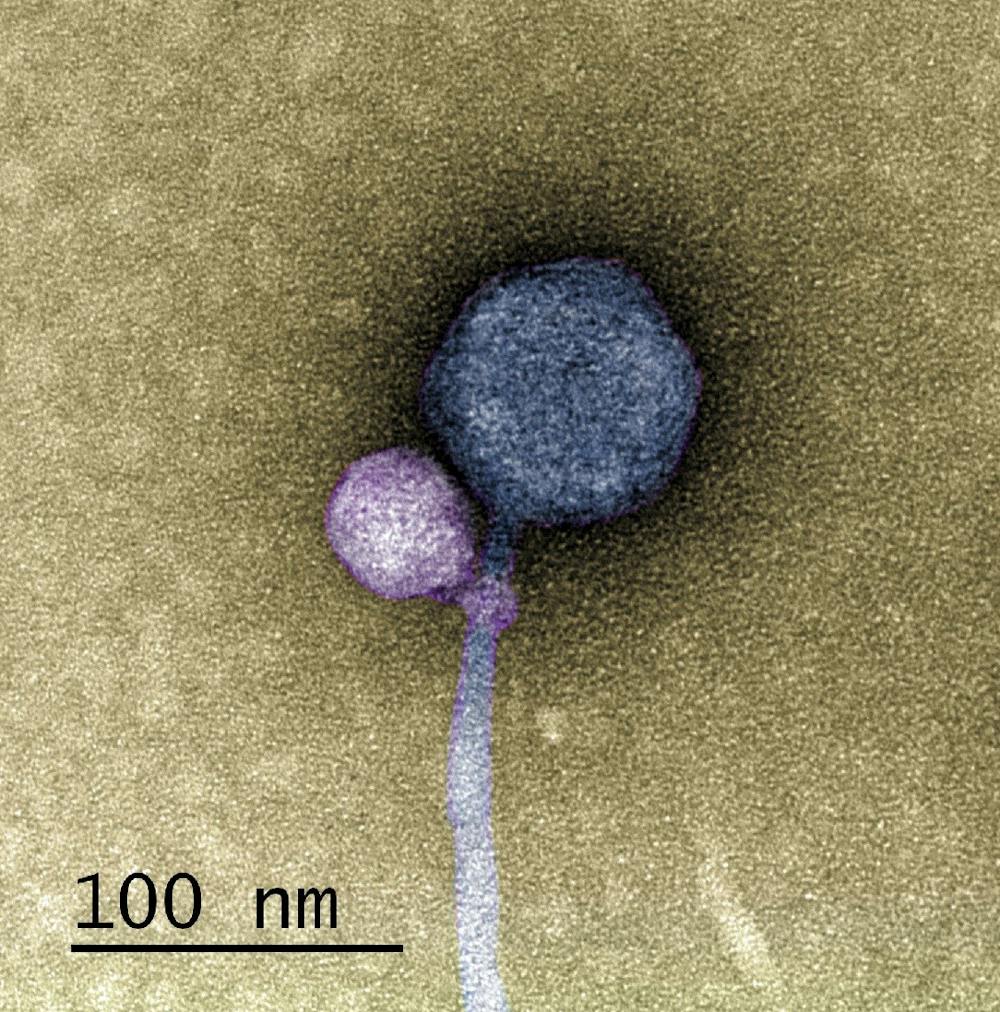
Microscopy image of a small round virus colored violet attached to the base of a larger round virus colored gray with a long tail
This image shows Streptomyces satellite phage MiniFlayer (purple) attached to the neck of its helper virus, Streptomyces phage MindFlayer (gray). Tagide deCarvalho, CC BY-SA

MiniFlayer is the first satellite phage known to have lost its ability to lie dormant. Not being able to lie in wait for your helper to enter the cell poses an important challenge to a satellite phage. If you need another virus to replicate, how do you guarantee that it makes it into the cell around the same time you do?

MiniFlayer addressed this challenge with evolutionary aplomb and horror-movie creativity. Instead of lying in wait, MiniFlayer has gone on the offensive. Borrowing from both “Dracula” and “Alien,” this satellite phage evolved a short appendage that allows it to latch onto its helper’s neck like a vampire. Together, the unwary helper and its passenger travel in search of a new host, where the viral drama will unfold again. We don’t yet know how MiniFlayer subdues its helper, or whether MindFlayer has evolved countermeasures.

If the recent pandemic has taught us anything, it is that our supply of antivirals is rather limited. Research on the complex, intertwined and at times predatory nature of viruses and their satellites, like the ability of MiniFlayer to attach to its helper’s neck, has the potential to open new avenues for antiviral therapy.

This article is republished from The Conversation under a Creative Commons license. Read the original article and see more than 250 UMBC articles available in The Conversation.

Higher education can be elusive for asylum-seekers and immigrants

Written by Kerri Evans, assistant professor of social work, UMBC; Ishara Casellas Connors, Texas A&M University, and Lisa Unangst, SUNY Empire State College

Pursuing higher education is often a pathway to higher income and overall better well-being. College graduates are less likely to rely on public benefits. Therefore, it’s beneficial for education leaders and policymakers to help newcomers – including asylum-seekers and refugees – to access higher education in the U.S., whether it be community college, taking advanced English courses, obtaining a certificate through training programs or going to a four-year university.

Despite these clear benefits, we have found that higher education can often be an elusive goal for people who’ve fled their homeland in search of a better life in the U.S.

We all study policy and education issues that affect refugees. Over the past year and a half, the three of us – Kerri Evans, Ishara Casellas Connors and Lisa Unangst – teamed up to learn more about higher education pathways for refugees, asylum-seekers, recent Afghan parolees and people with temporary protected status, in the Maryland, Virginia and Washington, D.C. area.

We partnered with Lutheran Social Services of the National Capital Area, one of the largest refugee resettlement agencies on the East Coast. We as researchers established a community advisory board of local refugees and other immigrants to guide the research process.

While our findings have implications for all refugees and asylum-seekers, we see our findings as particularly relevant for the nearly 77,000 Afghans who entered the U.S. with temporary immigration statuses from 2021 to 2023. Most arrived with parole status, which allows temporary stay and work in the U.S. for only two years. After that, renewals are needed. Parole status confers no option for lawful permanent resident status, unlike what happens when people fleeing their homeland arrive with official refugee status.

Enrolling in college can be difficult for this population because of the uncertainty of their immigrant status and future in the U.S.

Obstacles to higher learning

To identify the barriers to higher education for refugees in the Maryland, Virginia and Washington, D.C., area, our research team interviewed 82 immigrants, all of whom were over 18 at time of arrival in the U.S., and two-thirds of whom were from Afghanistan and arrived since 2021.

We also interviewed 22 people who work for the Lutheran resettlement agency, the majority of whom were refugees or other immigrants who were resettled through the program in prior years. In reviewing the findings with the research team, the community advisory board implemented an additional survey to enhance our research by using both qualitative and quantitative data. Forty-three people – ages 22-55 – who would like to attend college in the U.S. chose to answer the survey, and 37 of them were from Afghanistan.

Through our research, we identified three main barriers for adult asylum-seekers and other immigrants who wanted to go to college or get advanced degrees.

1. Getting their degrees recognized

The process of getting degrees recognized is lengthy, difficult and involves a fee for immigrants.

More than half of participants experienced a barrier with either certifying the degrees they already earned back home or with curriculum requirements that differed from those of their home country. For instance, U.S. colleges may not accept high school and college degrees from other countries. Or participants may not meet all of the requirements for internships or to take specific courses in the U.S.

A female resettlement staff member who is from Afghanistan explained that the problem is having documents from their home country, such as diplomas and work credentials, evaluated here in the U.S.

“For example … let’s say, they have their bachelor’s degree or master’s degree in Afghanistan,” the resettlement staff member said. “But when they arrive in here, somehow, (the degrees are) lost,” she continued, explaining that immigrants often choose to attend college all over again and get the degree in the U.S.

2. Insufficient guidance

Half of the Afghan migrants we interviewed indicated they would like more help applying to college and graduate school programs than they’re getting.

Without guidance, many said they had lost precious time trying to navigate the higher education system. Some said they wanted more help with writing college application essays. Two-thirds of the Afghans wanted a personal connection with university alums or professors who could guide them through the college application process and be a mentor during their time in college.

3. Financial

Young African American and Asian college students work together at a library. asylum-seeker
Guidance helps migrants find educational opportunities.
 silverkblack/iStock via Getty Images

Newly resettled refugees and others who were forced to flee their country struggle to pay their bills as they restart their lives in the U.S. Often they are relegated to low-wage jobs.

Nearly three-quarters of the 43 migrants said they couldn’t afford college tuition for themselves. About two-thirds indicated they would need information about scholarships and other financial resources in order to reconsider applying for college – information that is not always easily available for those who aren’t graduating from high schools in the U.S.

“I have to pay for rent. I have to pay for a car. I have to pay for oil. I have to pay for everything,” said one male from Afghanistan, reflecting on the fact that there is no money left for tuition payments. “Whatever I’m earning is a zero.”

Another male from Afghanistan observed: “We do have families. We have to support them, and at the same time, education fees are so high here.”

A group of students studying together in the library.
Refugees often have trouble affording tuition at U.S. colleges and universities. AnnaStills/iStock via Getty Images

To overcome these barriers, our research team and community advisory board members recommend the following strategies:

• Identify scholarships for which immigrants and refugees would be eligible and share them with those who are interested.

• Educate resettlement staff on the nuances of legal status for in-state tuition so they can help asylum-seekers and refugees to determine if they are eligible.

• Create webinars and videos that include an overview of U.S. higher education and the financial aid rules for immigrants and refugees.

Recruit mentors to help asylum-seekers and refugees apply to college.

This article is republished from The Conversation under a Creative Commons license. Read the original article and see more than 250 UMBC articles available in The Conversation.

A love letter to Homecoming

When you think about UMBC’s Homecoming, you undoubtedly conjure images of carnival rides, black and gold decorations, and the beloved Puppy Parade. But what Homecoming is really about, for us, is the people. We asked social media intern Allison John ‘24, psychology, to share what it was like to walk a mile (or more accurately, many, many miles) in her shoes during this year’s Homecoming. 

We always hope the skies will be blue and the sun will be shining for UMBC’s Homecoming, but that unfortunately wasn’t the case this year. Luckily, that did not stop students, alumni, family, and friends from taking part in all the festivities that Homecoming brings! This year I was lucky to not only partake as a student, but also as a board member of UMBC’s Student Events Board (seb), and as an intern for University Communications and Marketing (UCM). Being involved in all these roles meant I got to see Homecoming through a different lens. 

As a student, I loved going to the carnival with all my friends on Homecoming preview night. We enjoyed all the different rides, played carnival games, and took in the moments knowing that college goes by so quickly and if we don’t cherish it while we’re here, it’ll be gone before we notice. 

Nighttime shot of carnival ride with swings lit up vibrantly against a night sky
Homecoming preview night is a great time to get a sneak peek of what the weekend will bring! (Photo by Max Franz for UMBC)

Helping co-create Homecoming

As a board member of (seb), I loved getting involved with activities that I may not have participated in otherwise. I got the chance to interact with all the amazing vendors we had, ranging from the petting zoo and food trucks, to the balloon and caricature artists. This role allowed me to create amazing memories for so many people and to play a part in the magic that happens on campus during Homecoming. I even got the chance to ride around campus on golf carts, placing the huge Homecoming stickers on the sidewalk that always amazed me when I was a first-year student.

Children painting pumpkins indoors at a long table.
Families had a great time decorating pumpkins and making them their own! (Photo by Erika Nizborski for UMBC)

By far, my favorite role of all was the role I played as a UCM intern. I had the opportunity to capture memories throughout Homecoming weekend by taking pictures at the Puppy Parade and seeing all the festive dogs that got to partake in such a fun tradition. I also had the opportunity to explore the Alumni and Friends Tent and meet so many alumni and witness them reconnecting with old friends and talking about how much has changed since they graduated. 

A Chesapeake Bay Retriever mascot kneels down to pet a chocolate lab while it licks him, wearing a UMBC Homecoming shirt
True Grit and Chip feeling all the love (for each other) at Homecoming Hype. Photo by Marlayna Demond ’11 for UMBC)

Being a senior now, I got emotional throughout Homecoming weekend. I know that although I can always come back for Homecoming, this was the last time I had the chance to make an impact on the UMBC community as a student and help create the special memories that Homecoming is all about. Homecoming is truly a culmination of so many different events including the annual bonfire, Athletics games, the 5k run, Puppy Parade, carnival, food trucks, pumpkin painting, the Alumni and Friends Tent, and so much more. 

As I took the time to reflect on Homecoming, I came to realize that, at its core, Homecoming is about one thing—you. It’s about your story and how UMBC has played a part in that story. Homecoming is so special because it brings so many people together in one place to reconnect, and whether it’s been one year since you graduated or 30, there are still so many memories to be made at Homecoming. 

Woman in a black shirt wearing a face mask painting the face of a young child with paints and paper towels visible
Face painting fun during Homecoming 2023. Photo by Erika Nizborski for UMBC.

During my time talking to alumni, our conversations would always lead to me learning more about how college played a role in who they are now. Some told me about lessons that they learned while attending UMBC, and I even learned about one alum who met her fiancé here. It’s these lessons and memories that make us who we are. Homecoming is what reminds us every year how special these moments are and why we should take a break from the chaos of life and enjoy the people that surround us. Homecoming 2023 was one to remember because it’s a reminder that even the weather can’t put a damper on the importance and strength of a community, our UMBC community.

By Allison John ’24, psychology

Embarking on ‘Happily Ever After’ 

By Roni Rosenthal

For those who grew up—or still are—spellbound by movies like Beauty and the Beast, Toy Story, and The Lion King, you are part of what some historians dub the “Disney Generation.” Your childhood joins forces with a collective nostalgia that weaves Disney’s enchanting tales into our very own identities. In a country with many competing cultural icons, Disney—for better or worse—remains a singular unifying brand for anyone who spent their childhood in the U.S.

Smithsonian museum specialist and curator Bethanee Bemis ’09, history and anthropology, M.A. ’11, history, is an expert in weaving narratives with identity and a storyteller at heart. Her work shines best when married to her earliest passion—Disney.

Where the magic all started

a female in a brown seater holds a copy of a book called Disney Theme Parks and America's National Narratives
Bethanee Bemis holds up a copy of her book “Disney Theme Parks and America’s National Narratives.”

In her newly published book Disney Theme Parks and America’s National Narratives: Mirror, Mirror for Us All, Bemis shares her journey with Disney. She was brought home from the hospital to a Disney-themed nursery, went to Disney World at age two, and around that age, watched The Little Mermaid for the first time, marking her enchantment. Bemis acknowledges her mother’s infatuation with Disney World in the 1970s as the catalyst for her own passion and appreciation of the imaginary world. 

This profound connection with Disney would eventually shape Bemis’ academic and then career path. During a recent installation of a Smithsonian exhibition on American democracy, Bemis recalls, “The central inquiry revolved around who holds the authority to narrate America’s tales. Must our collective narrative be uniform for national unity? Can such unity even exist? That’s when it hit me—Disney! Disney is the narrator of American stories.”

As the curator of the exhibit “Mirror, Mirror: Reflections of America in Disney Parks” at the National Museum of American History, Bemis explores Disney’s impact on American culture and reminds us of the significance of cultural artifacts like movies, dolls, and historical items. These artifacts can inspire conversations, challenge assumptions, and even drive change.

“A great way to launch”

Bemis used her time at UMBC to fuse her early fascination with storytelling and her dedication to exploring the intricate threads of history.

Reflecting on her UMBC days, she remembers the transformative role of Seth Messinger, then an associate professor of sociology and anthropology at UMBC. “Initially, I wasn’t sure what I wanted to do. Dr. Messinger, my undergraduate advisor, believed in me,” says Bemis. “He was convinced that I could achieve success with a little extra effort. He pushed me to go outside my comfort zone and grow, which I appreciated….Well, later on, not in the moment.” 

A man in a white polo shirt puts his arm around a woman in a grad cap and gown holding yellow flowers
Bemis at graduation with her now husband, Benjamin D’Alessio ’10, M.S. ’11.

On campus, Bemis felt that she could unfold her wings and explore her interests. “I really appreciated how the community at UMBC was a safe space to experiment and think about the person I wanted to be when I finished college,” says Bemis, who met her husband Benjamin D’Alessio ’10, M.S. ’11, chemical engineering, when they were both grad students on campus. “It’s a lifetime community if you want it to be,” she smiles. “It’s not just a school.” Though only seven years old, her daughter already talks about being a Retriever someday. 

With mentors like Messinger, Denise Meringolo, associate professor of history, and Amy Froide, professor and chair of history, Bemis found herself propelled beyond her comfort zone, guided to embrace challenges and expand her horizons. The influence of these educators was not confined to her university years; it stretched into the present day, with continued support and advice shaping her path.

Messinger, who has kept in touch with Bemis after they both moved on from UMBC, says Bemis has made him so proud. “In addition to taking my classes, she served as a research assistant for me. She’s very detail oriented and organized, as well as warm and kind as a person. I’ve loved watching her family and career flourish.”

Bemis’s journey through academia led her to a pivotal connection with the Smithsonian’s National Museum of American History. What began as an internship at the Smithsonian’s National Museum of American History grew into a career mission to uncover stories hidden within the museum’s vast collections. Over the years, she moved from intern to curator, specializing in political history and weaving narratives that resonate with the pulse of the nation.

In fact, she says, “I think that the key to finding success in my chosen field was internships and taking advantage of all the opportunities that UMBC provided as a student. Finding a job is often about who you know, and UMBC offers a safe space to grow your network. It is a great way to launch.”

Keep telling stories and making space

A woman in a Mickey Mouse shirt stands in front of a Disney castel
Bemis visited Disneyland, Paris, when she studied abroad.

In an era when entertainment is not just about escapism but also about challenging norms, forming identities, and prompting thought-provoking conversations, the Barbie movie emerges as a recent and unifying testament to the evolving storytelling landscape. 

Although Barbie isn’t a Disney creation, Bemis says, “I think that our pop culture has always held the story of us. It isn’t just about entertainment; it’s a reflection of societal values, norms, and aspirations.”

Bemis is proud of her achievements but reminds us that “there’s so much more that needs to be done.” She plans to continue working in the public history field and to tell untold and uninvestigated stories, especially stories that are underrepresented in the public history field.

“We must keep telling the stories and make space in the museum for people to tell their own stories,” says Bemis. “I hope that whatever I do will contribute to that somehow.”

Retriever Essentials student team is runner-up in a nationwide competition to address world hunger

Retriever Essentials, represented by student volunteers Nhi Nguyen ’25, biochemistry and bioinformatics, and Ben Bhattarai ’23, biology and psychology, is a second place finalist in the 2023 Wilbur Ellis Innovation Award. Announced at the end of September, the honorable mention award—given to only four schools—recognizes the student teams with the most innovative strategies for providing food for a growing world population.

A photo collage of three students
From left to right: Ben Bhattarai, Nhi Nguyen, and Ariel Barbosa.

Nguyen and Bhattarai’s proposal aimed to address the water scarcity in agriculture which affects the ability to feed a growing world population sustainably. Their project proposed the use of halophytic (salt-tolerant) algae to desalinate saltwater in order to increase freshwater availability to enhance agricultural yields and to create highly nutritious food products. Nguyen and Bhattarai believe their project also may help resolve some of the impacts of global warming on food production and transportation, including the growth of algae; limited fossil fuels; and ocean acidification due to high carbon dioxide. Both hope to continue their research into ways to eliminate food insecurity.

The $5,000 award for second place will be used to help buy food for the Retriever Essentials pantry, and help kickstart research on the algae, says Ariel Barbosa, program coordinator and a master’s student in community leadership.

The students’ work was a collaborative endeavor during the spring 2023 semester, with input from UMBC faculty in the sciences and public health: Lauren Clay, associate professor and chair, emergency health services; Erle Ellis, professor, geography and environmental systems; Andrea Kalfoglou, associate professor, sociology, anthropology, and public health; and Stephen Miller, associate professor, biological sciences. 

Students in face masks stand stocking shelves in a pantry
Student staff work to stock the shelves in Retriever Essentials. (Marlayna Demond ’11/UMBC)

“We worked so hard on this proposal,” says Nguyen. “The contest was a chance to share my knowledge and creativity…to go out of our own bubbles and be confident with whatever we have to offer to help the community.” 

“Retriever Essentials is one of the most welcoming, friendly, hospitable places at UMBC, where I profoundly enlarge my connection to students, staff, and faculty,” Nguyen adds. “I feel thankful for being a part of UMBC, where I am surrounded by many brilliant and cool people, who always offer me not only academic help but also emotional support. Thus, I would recommend to UMBC students one thing: ASK.”

Bhattarai shares, “It is an exciting feeling to know that our project is being recognized for its potential in revolutionizing agriculture and in solving food insecurity. This experience also motivates us to continue our research in innovative ways. Volunteering with Retriever Essentials has been a great learning experience, to see the impact of food insecurity on campus and how a motivated teamwork and collaboration can make a difference in the community.”

students work in a garden bed
Ariel Barbosa, left, helps get a Retriever Essentials garden plot cleared for the growing season. (Marlayna Demond ’11/UMBC)

 “I am so proud of our students and their commitment to Retriever Essentials—and to global food insecurity and injustice,” says Barbosa. “This award could not have come at a better time, as we see increased numbers of students and inflation increases the cost of food. Hundreds of students visit Retriever Essentials spaces each week, and we are often low in food.” 

Lacking a steady source of nutritious meals can affect students’ physical and mental health, grades, and ability to engage in campus life. Barbosa adds, “As more members of our community in need learn about us, we need increased financial support as well as donations of food and supplies. It is because of our university community and leadership that we have come this far to support so many students.”
Retriever Essentials is a faculty, staff, and student partnership to tackle food insecurity in our UMBC community. Learn how to make a financial donation or via the Amazon wish list, as well as volunteer opportunities.

-Eleanor Lewis, communications manager, Student Affairs