We use cookies for analytics and, unless you opt out, advertising.
You can opt out of advertising at any time.UMBC uses essential cookies to run this site. With your permission we would also use analytics cookies (to understand how the site is used) and advertising cookies (to measure and target our ads on other platforms). Nothing else loads unless you accept. You can change your choice any time from Cookie Settings in the footer.Privacy Policy
EssentialRequired for the site to work (login, security, your cookie choice). Always on.
When you think about UMBC’s Homecoming, you undoubtedly conjure images of carnival rides, black and gold decorations, and the beloved Puppy Parade. But what Homecoming is really about, for us, is the people. We asked social media intern Allison John ‘24, psychology, to share what it was like to walk a mile (or more accurately, many, many miles) in her shoes during this year’s Homecoming.
We always hope the skies will be blue and the sun will be shining for UMBC’s Homecoming, but that unfortunately wasn’t the case this year. Luckily, that did not stop students, alumni, family, and friends from taking part in all the festivities that Homecoming brings! This year I was lucky to not only partake as a student, but also as a board member of UMBC’s Student Events Board (seb), and as an intern for University Communications and Marketing (UCM). Being involved in all these roles meant I got to see Homecoming through a different lens.
As a student, I loved going to the carnival with all my friends on Homecoming preview night. We enjoyed all the different rides, played carnival games, and took in the moments knowing that college goes by so quickly and if we don’t cherish it while we’re here, it’ll be gone before we notice.
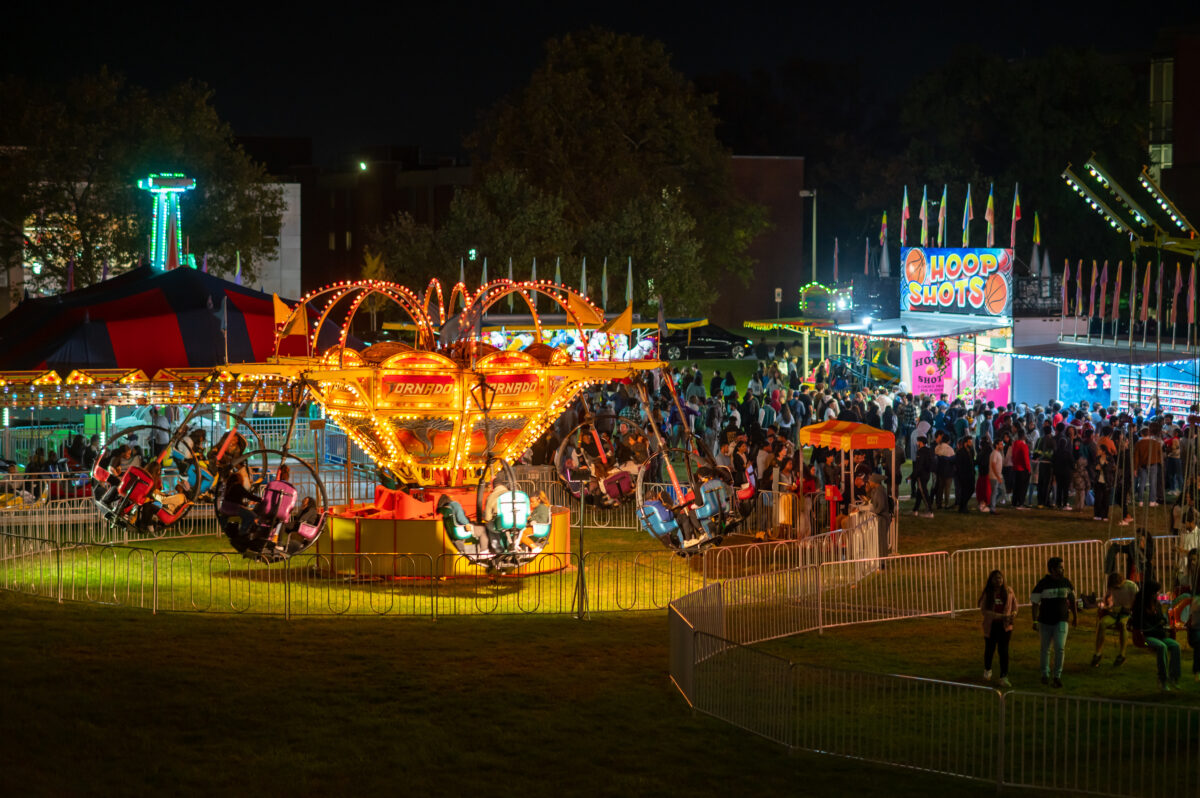
Homecoming preview night is a great time to get a sneak peek of what the weekend will bring! (Photo by Max Franz for UMBC)
Helping co-create Homecoming
As a board member of (seb), I loved getting involved with activities that I may not have participated in otherwise. I got the chance to interact with all the amazing vendors we had, ranging from the petting zoo and food trucks, to the balloon and caricature artists. This role allowed me to create amazing memories for so many people and to play a part in the magic that happens on campus during Homecoming. I even got the chance to ride around campus on golf carts, placing the huge Homecoming stickers on the sidewalk that always amazed me when I was a first-year student.
Families had a great time decorating pumpkins and making them their own! (Photo by Erika Nizborski for UMBC)
By far, my favorite role of all was the role I played as a UCM intern. I had the opportunity to capture memories throughout Homecoming weekend by taking pictures at the Puppy Parade and seeing all the festive dogs that got to partake in such a fun tradition. I also had the opportunity to explore the Alumni and Friends Tent and meet so many alumni and witness them reconnecting with old friends and talking about how much has changed since they graduated.
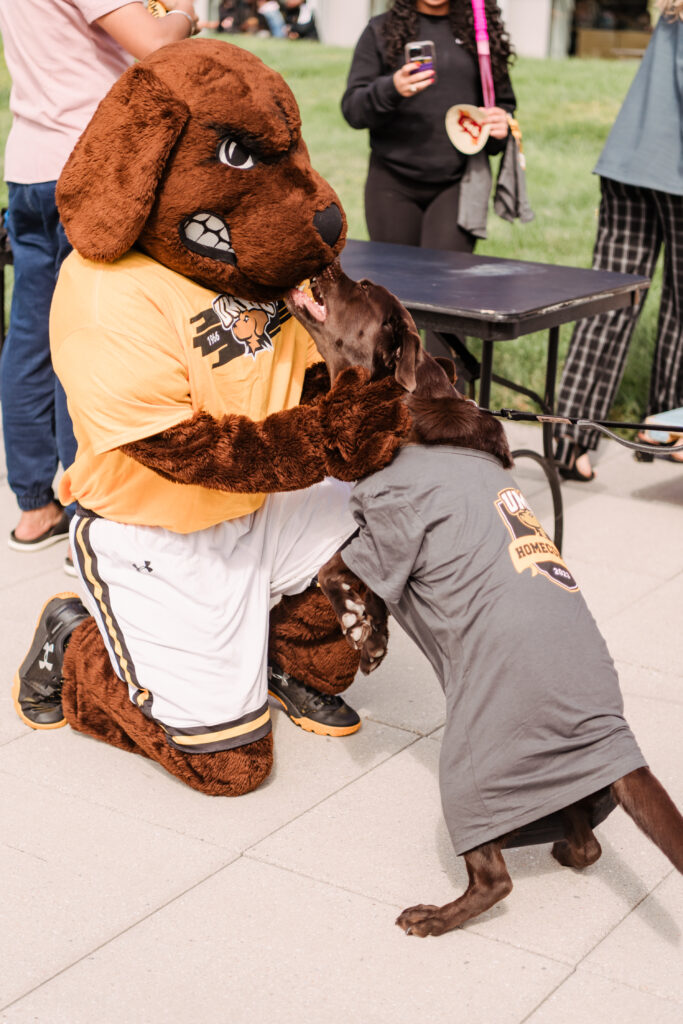
True Grit and Chip feeling all the love (for each other) at Homecoming Hype. Photo by Marlayna Demond ’11 for UMBC)
Being a senior now, I got emotional throughout Homecoming weekend. I know that although I can always come back for Homecoming, this was the last time I had the chance to make an impact on the UMBC community as a student and help create the special memories that Homecoming is all about. Homecoming is truly a culmination of so many different events including the annual bonfire, Athletics games, the 5k run, Puppy Parade, carnival, food trucks, pumpkin painting, the Alumni and Friends Tent, and so much more.
As I took the time to reflect on Homecoming, I came to realize that, at its core, Homecoming is about one thing—you. It’s about your story and how UMBC has played a part in that story. Homecoming is so special because it brings so many people together in one place to reconnect, and whether it’s been one year since you graduated or 30, there are still so many memories to be made at Homecoming.
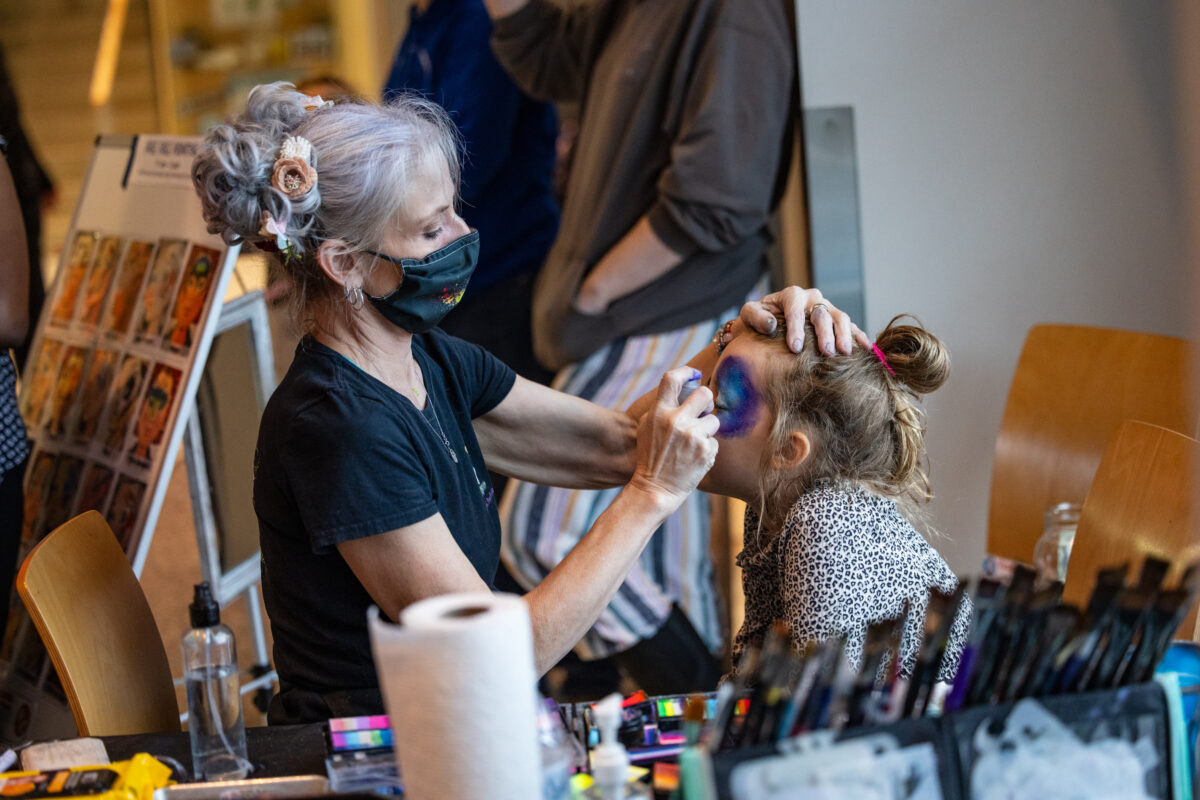
Face painting fun during Homecoming 2023. Photo by Erika Nizborski for UMBC.
During my time talking to alumni, our conversations would always lead to me learning more about how college played a role in who they are now. Some told me about lessons that they learned while attending UMBC, and I even learned about one alum who met her fiancé here. It’s these lessons and memories that make us who we are. Homecoming is what reminds us every year how special these moments are and why we should take a break from the chaos of life and enjoy the people that surround us. Homecoming 2023 was one to remember because it’s a reminder that even the weather can’t put a damper on the importance and strength of a community, our UMBC community.
For those who grew up—or still are—spellbound by movies like Beauty and the Beast, Toy Story, and The Lion King, you are part of what some historians dub the “Disney Generation.” Your childhood joins forces with a collective nostalgia that weaves Disney’s enchanting tales into our very own identities. In a country with many competing cultural icons, Disney—for better or worse—remains a singular unifying brand for anyone who spent their childhood in the U.S.
Smithsonian museum specialist and curator Bethanee Bemis ’09, history and anthropology, M.A. ’11, history, is an expert in weaving narratives with identity and a storyteller at heart. Her work shines best when married to her earliest passion—Disney.
Where the magic all started
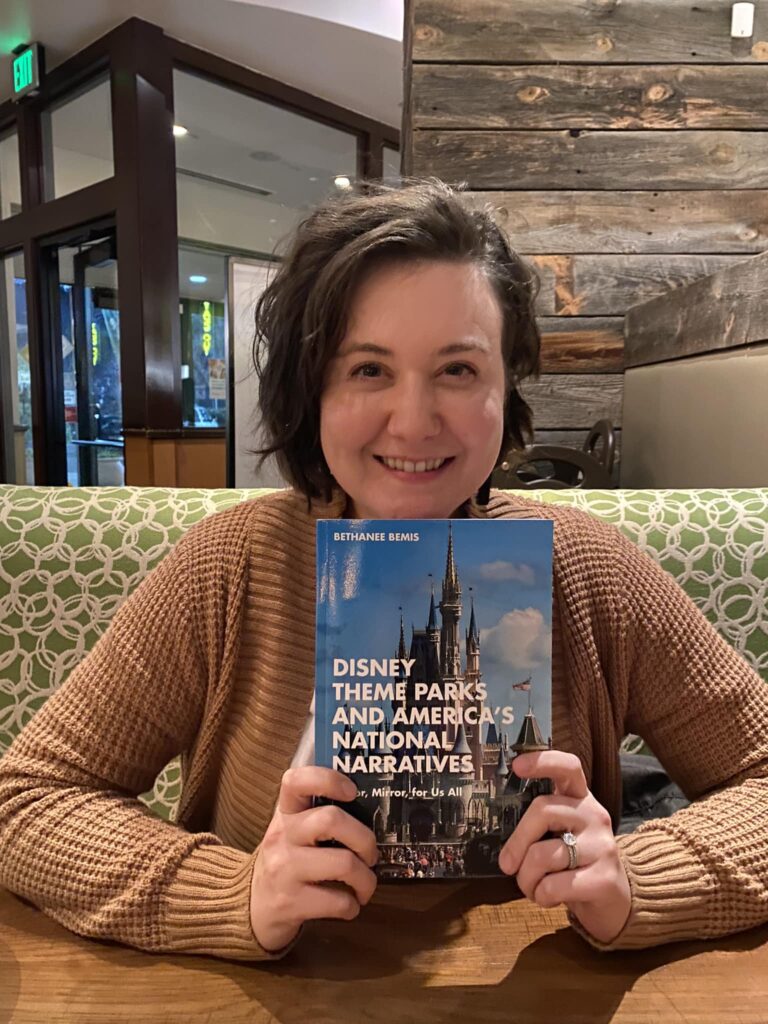
Bethanee Bemis holds up a copy of her book “Disney Theme Parks and America’s National Narratives.”
In her newly published book Disney Theme Parks and America’s National Narratives: Mirror, Mirror for Us All, Bemis shares her journey with Disney. She was brought home from the hospital to a Disney-themed nursery, went to Disney World at age two, and around that age, watched The Little Mermaid for the first time, marking her enchantment. Bemis acknowledges her mother’s infatuation with Disney World in the 1970s as the catalyst for her own passion and appreciation of the imaginary world.
This profound connection with Disney would eventually shape Bemis’ academic and then career path. During a recent installation of a Smithsonian exhibition on American democracy, Bemis recalls, “The central inquiry revolved around who holds the authority to narrate America’s tales. Must our collective narrative be uniform for national unity? Can such unity even exist? That’s when it hit me—Disney! Disney is the narrator of American stories.”
As the curator of the exhibit “Mirror, Mirror: Reflections of America in Disney Parks” at the National Museum of American History, Bemis explores Disney’s impact on American culture and reminds us of the significance of cultural artifacts like movies, dolls, and historical items. These artifacts can inspire conversations, challenge assumptions, and even drive change.
“A great way to launch”
Bemis used her time at UMBC to fuse her early fascination with storytelling and her dedication to exploring the intricate threads of history.
Reflecting on her UMBC days, she remembers the transformative role of Seth Messinger, then an associate professor of sociology and anthropology at UMBC. “Initially, I wasn’t sure what I wanted to do. Dr. Messinger, my undergraduate advisor, believed in me,” says Bemis. “He was convinced that I could achieve success with a little extra effort. He pushed me to go outside my comfort zone and grow, which I appreciated….Well, later on, not in the moment.”
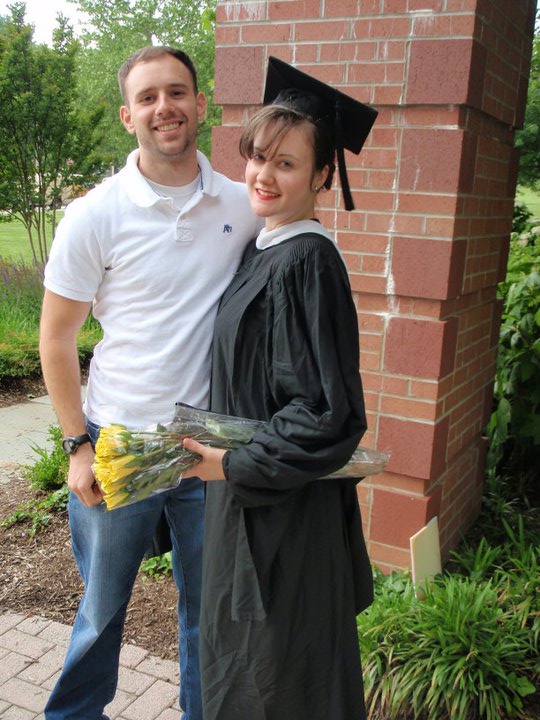
Bemis at graduation with her now husband, Benjamin D’Alessio ’10, M.S. ’11.
On campus, Bemis felt that she could unfold her wings and explore her interests. “I really appreciated how the community at UMBC was a safe space to experiment and think about the person I wanted to be when I finished college,” says Bemis, who met her husband Benjamin D’Alessio ’10, M.S. ’11, chemical engineering, when they were both grad students on campus. “It’s a lifetime community if you want it to be,” she smiles. “It’s not just a school.” Though only seven years old, her daughter already talks about being a Retriever someday.
With mentors like Messinger, Denise Meringolo, associate professor of history, and Amy Froide, professor and chair of history, Bemis found herself propelled beyond her comfort zone, guided to embrace challenges and expand her horizons. The influence of these educators was not confined to her university years; it stretched into the present day, with continued support and advice shaping her path.
Messinger, who has kept in touch with Bemis after they both moved on from UMBC, says Bemis has made him so proud. “In addition to taking my classes, she served as a research assistant for me. She’s very detail oriented and organized, as well as warm and kind as a person. I’ve loved watching her family and career flourish.”
Bemis’s journey through academia led her to a pivotal connection with the Smithsonian’s National Museum of American History. What began as an internship at the Smithsonian’s National Museum of American History grew into a career mission to uncover stories hidden within the museum’s vast collections. Over the years, she moved from intern to curator, specializing in political history and weaving narratives that resonate with the pulse of the nation.
In fact, she says, “I think that the key to finding success in my chosen field was internships and taking advantage of all the opportunities that UMBC provided as a student. Finding a job is often about who you know, and UMBC offers a safe space to grow your network. It is a great way to launch.”
Keep telling stories and making space
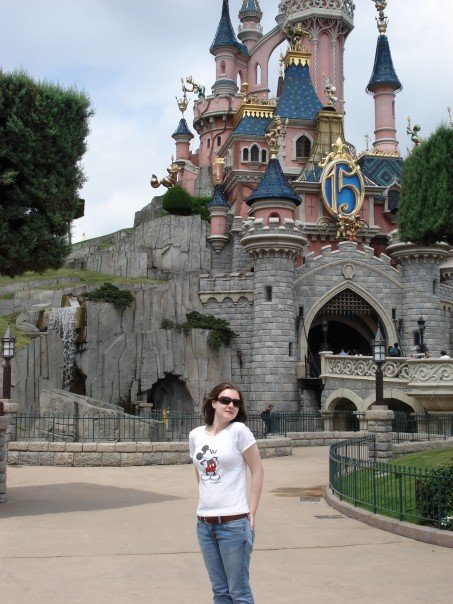
Bemis visited Disneyland, Paris, when she studied abroad.
In an era when entertainment is not just about escapism but also about challenging norms, forming identities, and prompting thought-provoking conversations, the Barbie movie emerges as a recent and unifying testament to the evolving storytelling landscape.
Although Barbie isn’t a Disney creation, Bemis says, “I think that our pop culture has always held the story of us. It isn’t just about entertainment; it’s a reflection of societal values, norms, and aspirations.”
Bemis is proud of her achievements but reminds us that “there’s so much more that needs to be done.” She plans to continue working in the public history field and to tell untold and uninvestigated stories, especially stories that are underrepresented in the public history field.
“We must keep telling the stories and make space in the museum for people to tell their own stories,” says Bemis. “I hope that whatever I do will contribute to that somehow.”
Retriever Essentials, represented by student volunteers Nhi Nguyen ’25, biochemistry and bioinformatics, and Ben Bhattarai ’23, biology and psychology, is a second place finalist in the 2023 Wilbur Ellis Innovation Award. Announced at the end of September, the honorable mention award—given to only four schools—recognizes the student teams with the most innovative strategies for providing food for a growing world population.
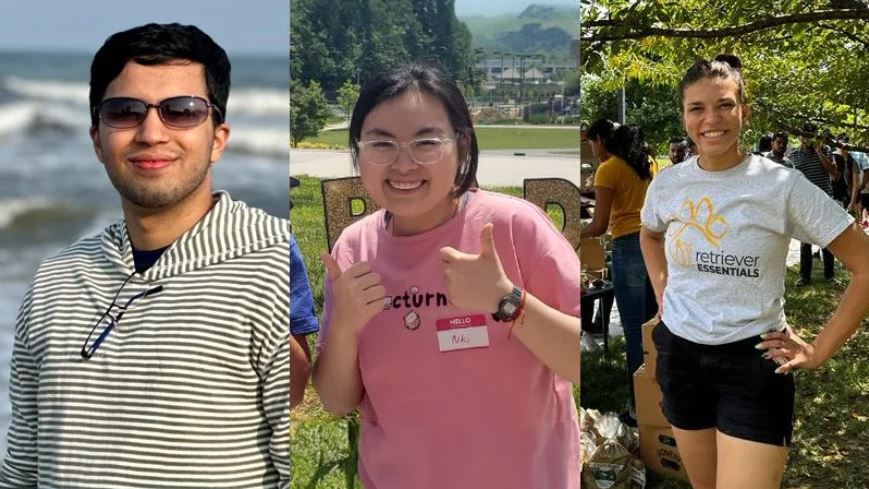
From left to right: Ben Bhattarai, Nhi Nguyen, and Ariel Barbosa.
Nguyen and Bhattarai’s proposal aimed to address the water scarcity in agriculture which affects the ability to feed a growing world population sustainably. Their project proposed the use of halophytic (salt-tolerant) algae to desalinate saltwater in order to increase freshwater availability to enhance agricultural yields and to create highly nutritious food products. Nguyen and Bhattarai believe their project also may help resolve some of the impacts of global warming on food production and transportation, including the growth of algae; limited fossil fuels; and ocean acidification due to high carbon dioxide. Both hope to continue their research into ways to eliminate food insecurity.
The $5,000 award for second place will be used to help buy food for the Retriever Essentials pantry, and help kickstart research on the algae, says Ariel Barbosa, program coordinator and a master’s student in community leadership.
The students’ work was a collaborative endeavor during the spring 2023 semester, with input from UMBC faculty in the sciences and public health: Lauren Clay, associate professor and chair, emergency health services; Erle Ellis, professor, geography and environmental systems; Andrea Kalfoglou, associate professor, sociology, anthropology, and public health; and Stephen Miller, associate professor, biological sciences.
Student staff work to stock the shelves in Retriever Essentials. (Marlayna Demond ’11/UMBC)
“We worked so hard on this proposal,” says Nguyen. “The contest was a chance to share my knowledge and creativity…to go out of our own bubbles and be confident with whatever we have to offer to help the community.”
“Retriever Essentials is one of the most welcoming, friendly, hospitable places at UMBC, where I profoundly enlarge my connection to students, staff, and faculty,” Nguyen adds. “I feel thankful for being a part of UMBC, where I am surrounded by many brilliant and cool people, who always offer me not only academic help but also emotional support. Thus, I would recommend to UMBC students one thing: ASK.”
Bhattarai shares, “It is an exciting feeling to know that our project is being recognized for its potential in revolutionizing agriculture and in solving food insecurity. This experience also motivates us to continue our research in innovative ways. Volunteering with Retriever Essentials has been a great learning experience, to see the impact of food insecurity on campus and how a motivated teamwork and collaboration can make a difference in the community.”
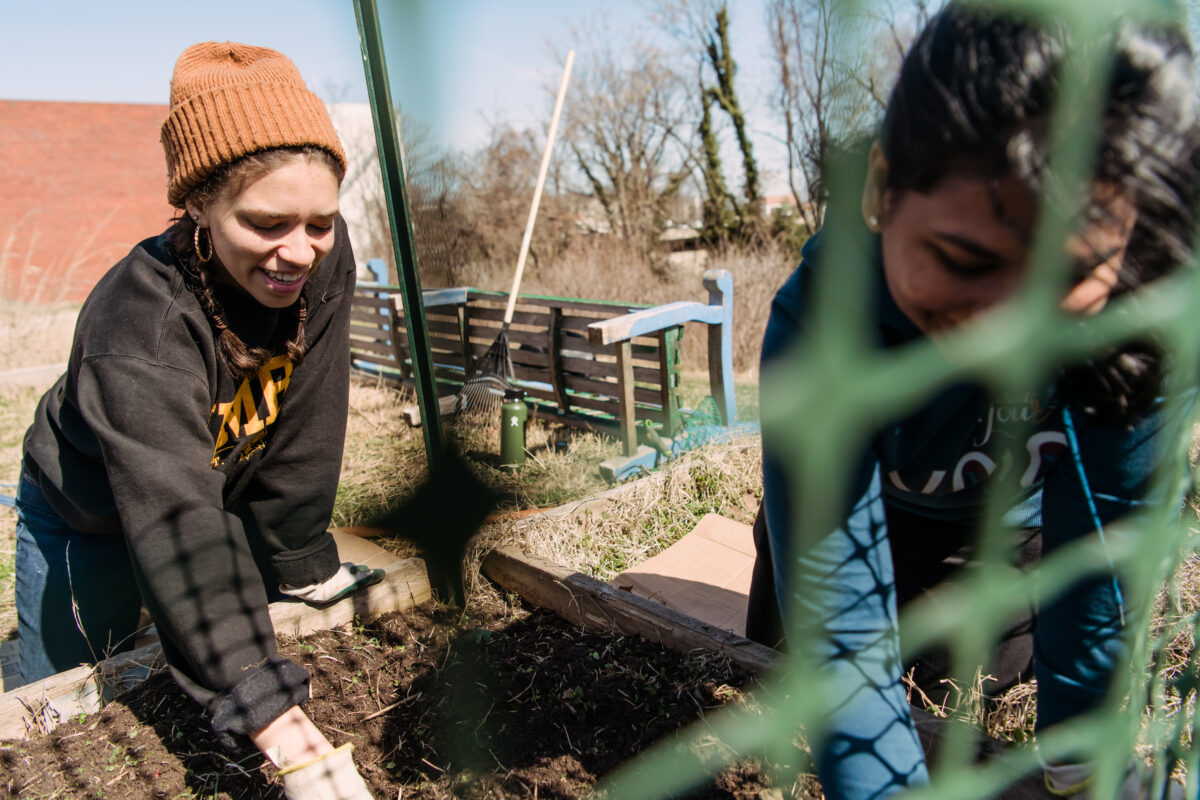
Ariel Barbosa, left, helps get a Retriever Essentials garden plot cleared for the growing season. (Marlayna Demond ’11/UMBC)
“I am so proud of our students and their commitment to Retriever Essentials—and to global food insecurity and injustice,” says Barbosa. “This award could not have come at a better time, as we see increased numbers of students and inflation increases the cost of food. Hundreds of students visit Retriever Essentials spaces each week, and we are often low in food.”
Lacking a steady source of nutritious meals can affect students’ physical and mental health, grades, and ability to engage in campus life. Barbosa adds, “As more members of our community in need learn about us, we need increased financial support as well as donations of food and supplies. It is because of our university community and leadership that we have come this far to support so many students.” Retriever Essentials is a faculty, staff, and student partnership to tackle food insecurity in our UMBC community. Learn how to make a financial donation or via the Amazon wish list, as well as volunteer opportunities.
Meet Noah Cruz, a senior pursuing B.S. degrees in both psychology and biological sciences on the pre-med/Ph.D. track. As a first generation student and a member of multiple scholars programs, Noah takes part in student organizations and undergraduate research while also following his passions of advocating for underrepresented students in STEM (science, technology, engineering, and mathematics) fields. We can’t wait to see where Noah goes from here, and we’re excited to share his story.
Q: Tell us about yourself. What would you want another Retriever to know about you?
A: I am a senior concurrently pursuing dual bachelor of science degrees in psychology and biological sciences, complemented by minors in chemistry and photography on the Pre-M.D./Ph.D. track. I take pride in being a first-generation Salvadoran American student, and I am a strong advocate for underrepresented students in STEM. I am from Rockville, Maryland, and went to Northwood High School where I earned my associates degree and high school diploma concurrently.
I am also one out of 200,000 patients with a rare blood disorder called idiopathic thrombocytopenic purpura. Idiopathic means “of unknown cause.” This highlights the importance of bridging the gap within the immunological field of research, and drives me toward pursuing a career in the biomedical sciences!
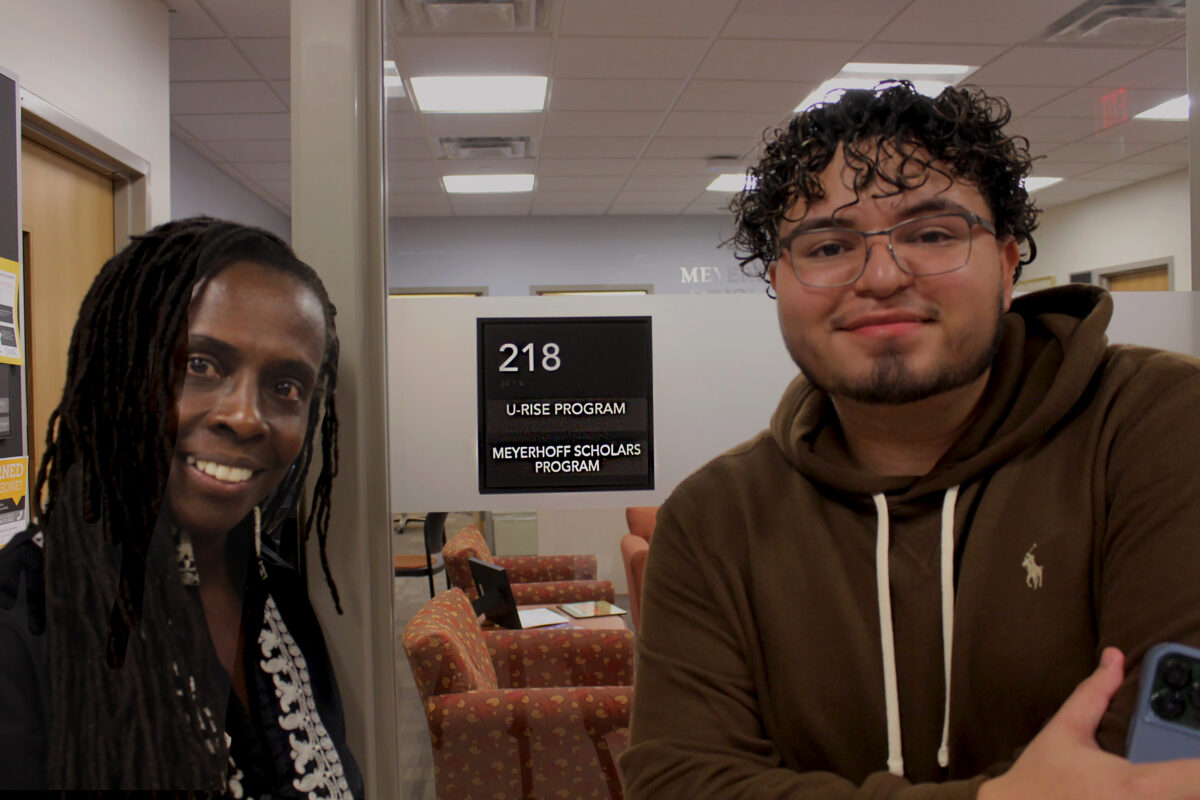
Noah Cruz (right) with Jacqueline King, associate director of the U-RISE Program (left), in front of the Meyerhoff and U-RISE Scholars Program Office. Photo courtesy of Cruz.
Q: Tell us about someone in the community who has inspired you or supported you, and how they did it.
A: There are numerous individuals who come to mind, and I am truly grateful for their unwavering support throughout my academic journey. Among them, Dr. Jacqueline King stands out as a cornerstone of support in my experience at UMBC. She has not only served as my advisor but has also been my steadfast advocate and personal cheerleader for all my accomplishments. Her inspiration has propelled me forward on the challenging path of higher education.
Another significant supporter of my aspirations is Dr. Charles Bieberich. His unwavering support, mentorship, and profound knowledge of the scientific field have been instrumental in motivating me to pursue my M.D./Ph.D. journey. I also extend my heartfelt thanks to Dr. Diana Hamilton. She not only supervises my principles of chemistry teaching assistantship but also provides unwavering support for all my academic pursuits.
Additionally, I must express my gratitude to Dr. Sarah Leupen for her invaluable support in my academic endeavors. Each of these individuals saw potential in me that I often failed to recognize within myself. As a first-generation student navigating the complexities of higher education, their investment in my education—offering support, mentorship, and words of encouragement—has made an indelible impact on my journey. I cannot express my appreciation enough for their contributions to my academic success.
Q: What do you love most about your academic program or an organization you’re involved in?
A: UMBC’s psychology and biology departments have played a pivotal role in shaping my academic journey, and I couldn’t be more appreciative of the invaluable resources and experiences they have provided me. One of the aspects I truly love about this academic program is the seamless integration of interdisciplinary approaches within the psychology and biology departments. One of the standout features of this program is how it effectively connects the dots between neuroscience, behavioral pathology, genetics, and biology.
“
As a first-generation student navigating the complexities of higher education, their investment in my education—offering support, mentorship, and words of encouragement—has made an indelible impact on my journey.
Noah Cruz '24
This holistic approach has not only broadened my horizons but has also allowed me to harness the power of knowledge across these fields to enhance my own research. Whether it’s understanding the intricacies of brain function or delving into the biological underpinnings of behavior, UMBC’s program has provided me with a well-rounded education that I can leverage in my academic pursuits.
Currently, I am fortunate to be involved in neuroscience clinical research at the University of Maryland School of Medicine. The foundation laid by UMBC’s program has been instrumental in my ability to contribute effectively to this research. The skills, knowledge, and interdisciplinary perspective I gained from my time in UMBC’s psychology and biology departments have proven to be a significant advantage in my work at the School of Medicine.
Q: Since you’ve been a part of the UMBC community, how have you found support of your WHY?
A: During my time at UMBC, Peter DeCrescenzo played an indispensable role in jumpstarting my academic and career journey. As a newcomer to the university and a Louis Stokes Alliance for Minority Participation (LSAMP) Scholar, I was initially unaware of the vast opportunities and resources available to me in the field of biomedical research and academia. Peter’s guidance and support proved to be transformative in several ways. Firstly, he provided me with invaluable guidance on crafting a compelling resume—a crucial tool in presenting myself as a competitive candidate for various academic and research endeavors.
Cruz states that much of his success could be attributed to his strong support system among his close friends, including (L-R): Arian Nyandjo’24, Noah Cruz’24, Zainab Bharmal’24, and Chioma Iheacho’24 (not pictured). Photo courtesy of Cruz.
Additionally, Peter equipped me with the skills necessary to create engaging and informative poster presentations, an asset that would prove indispensable in showcasing my research projects. He also encouraged me to explore and apply to other scholars’ programs, ultimately leading to my acceptance into the U-RISE Program, a significant milestone in my academic journey.
Overall, Peter’s unwavering support and mentorship initiated a pathway to academic excellence that I had never imagined. His guidance not only imparted practical skills but also instilled in me the confidence to pursue my academic goals. Peter DeCrescenzo’s dedication to my growth at UMBC made a profound difference in my academic journey and played a pivotal role in shaping my career in biomedical research and academia.
Q: What clubs, teams, or organizations are you a part of? What do you love about them and why?
A: I am an active member of two significant organizations at UMBC, and each role holds special meaning for me. Firstly, as the Meyerhoff Scholars lead peer advisor, I have the incredible opportunity to serve as a mentor and guide to incoming first-year and sophomore students, assisting them as they embark on their college journey. What I truly cherish about this role is the chance to share my own experiences and knowledge with these students, offering them valuable insights and personal support to succeed academically and personally.
One of the most rewarding aspects of being a lead peer advisor is assisting students with their applications for scholarships, internships, and research positions. I am deeply passionate about helping students navigate the intricate and competitive application procedures, ensuring that underrepresented minority students are consistently represented in science-related settings.
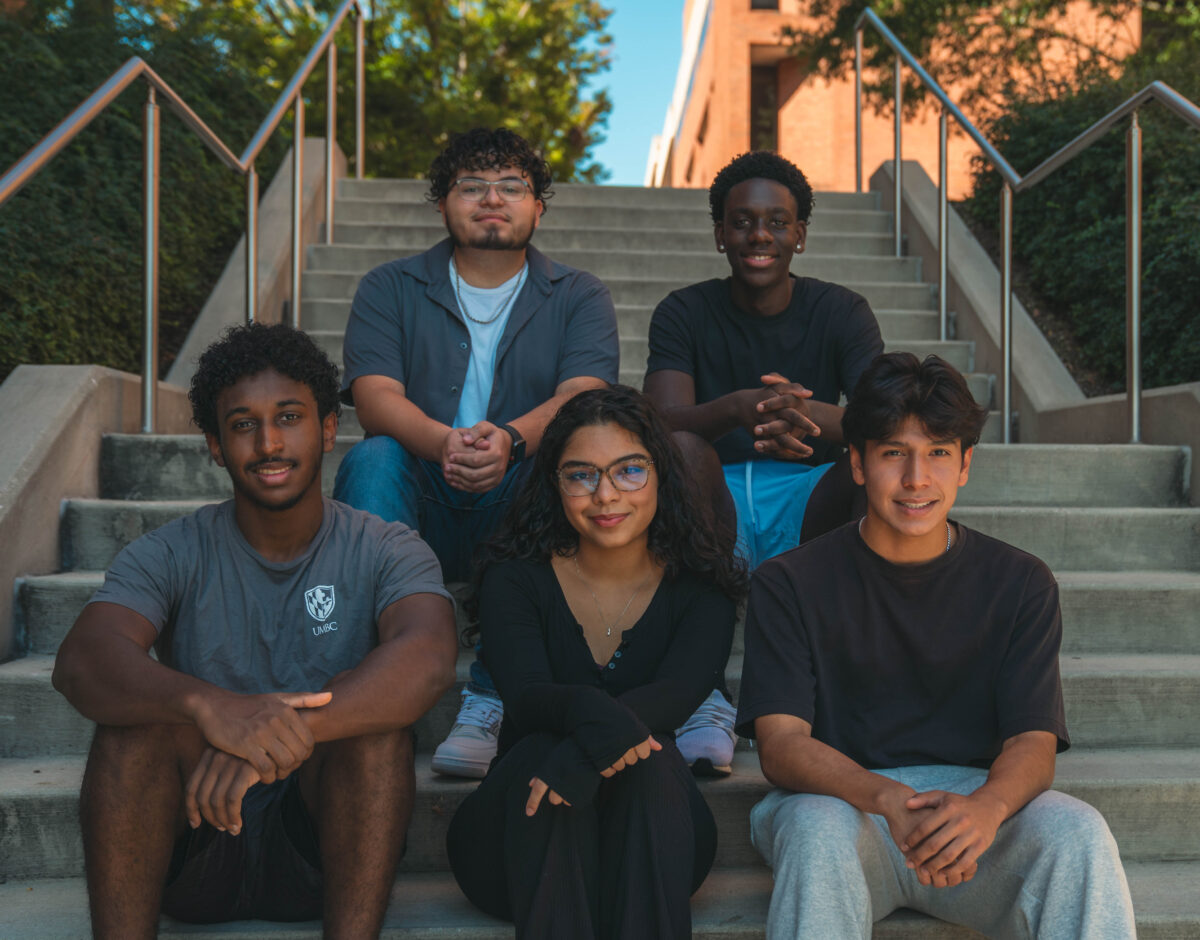
Cruz with his advisees, including students from the Meyerhoff, U-RISE, LSAMP, and McNair Scholars programs. Bottom (L-R): Emmanuel Mekasha ’25, Lesley Hernandez ’25, Christian Verastegui ’25. Top (L-R): Noah Cruz ’24, Maxwell Amoh-Mayes ’26. (Photo courtesy of Julianna Falconer’24)
Secondly, my role as vice president of the Society of Advancing Chicanos/Hispanics & Native Americans in Science (SACNAS) holds a special place in my heart. SACNAS is dedicated to promoting diversity and inclusion in STEM fields, and as VP, I play a pivotal role in building a supportive community for underrepresented students. Organizing events, creating networking opportunities, and collaborating with like-minded individuals to advance our mission is both fulfilling and impactful. It’s inspiring to see students from diverse backgrounds come together to pursue their passions in science while breaking down barriers and stereotypes.
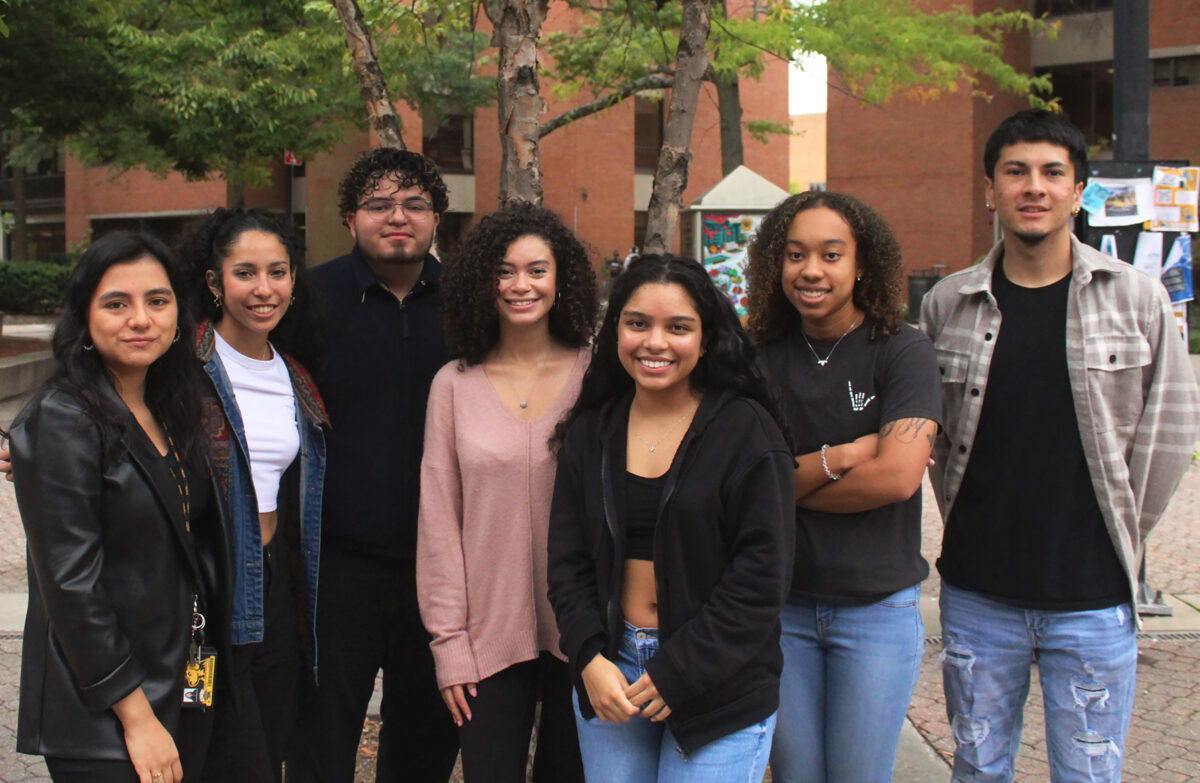
UMBC’s Society of Advancing Chicanos/Hispanics and Native Americans in Science (SACNAS) E-board, from left to right: Isabella Salguero Cespedes (Hispanic/Latino Student Council Representative), Isabella Lopez (Event Coordinator), Noah Cruz (Vice-President), Tatiana Perez (President), Lesley Hernandez (Treasurer), Viviana Smart (Secretary), Eduardo Ramirez (Social Media & Promotion Chair). Photo courtesy of Cruz.
Q: As a first-generation college student, what would you tell others who are in your shoes about UMBC?
A: Navigating the world of secondary education, especially as the first in my family to graduate high school and attend college, was undoubtedly an intimidating and overwhelming experience. One piece of advice I would offer to others in my shoes about UMBC is the critical importance of building a solid support system. Throughout my college journey, I found that my advisors and supporters played a pivotal role in my success.
These mentors believed in me from day one, providing guidance, encouragement, and a sense of belonging on campus. Having a support system is like having a lifeline when facing the myriad challenges that college life can present. They can offer valuable insights into academic decisions, personal development, and even career choices. Advisors and mentors can help you navigate the complexities of course selection, major choices, and extracurricular activities, ensuring that you make informed decisions that align with your goals.
* * * * *
UMBC’s greatest strength is its people. When people meet Retrievers and hear about the passion they bring, the relationships they create, the ways they support each other, and the commitment they have to inclusive excellence, they truly get a sense of our community. That’s what “Meet a Retriever” is all about.
Meet Ting Huang ’21, psychology, program coordinator for the McNair Scholars Program in the Office of Academic Opportunity Programs where she was previously a scholar. Ting is now in a position where she gets to support the UMBC community the same way, she says, it supported her. Let’s see what she has to share!
Q: What’s one essential thing you’d want another Retriever to know about you?
A: I’m a UMBC McNair alum and my undergraduate field of study was psychology. I’m currently the interim program coordinator for UMBC McNair, and it has been a very meaningful, full circle moment for me to come back and serve students in the same boat as myself just two years ago.
Q: What’s the one thing you’d want someone to know about the support you find at UMBC?
A: Don’t hesitate to reach out. It can be daunting to try to find community, particularly on a campus where you may not know which communities are safe or supportive of you. But UMBC has many wonderful scholarly programs and clubs that celebrate different parts of each person’s identities. Community is just a step away from you.
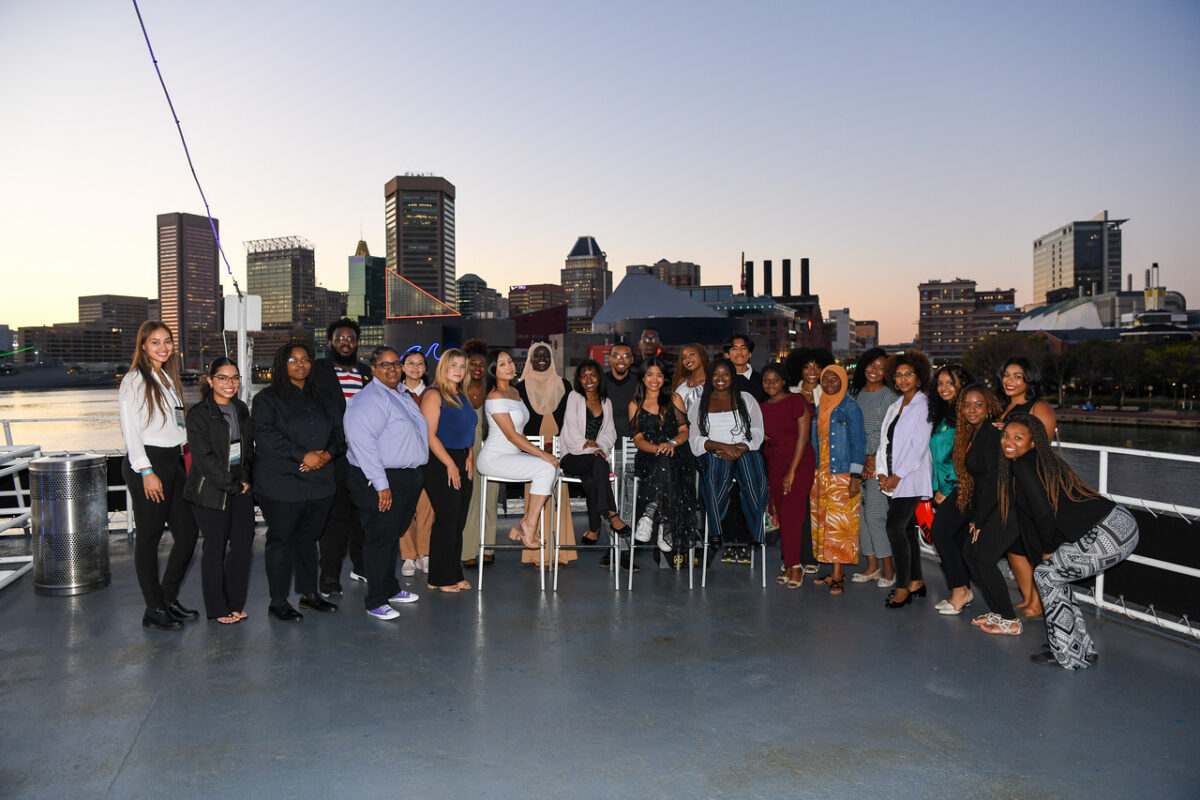
The 2023 UMBC McNair Research Conference group photo at Inner Harbor City Cruise in September 2023. Included in the photo are all current McNair Scholars, two members of our UMBC LSAMP family, and administrative staff for McNair and the Office of Academic Opportunity Programs. Photo courtesy of Huang.
Q: Tell us about someone in the community who has inspired you or supported you, and how they did it.
A: So many people in the UMBC community have inspired and supported me, but especially my mentors at UMBC-Shady Grove and my McNair family. Each person I’ve encountered has dedicated their time to academic excellence and uplifting the voices of those who are traditionally unheard (first-gen, low-income, underrepresented individuals). Their advocacy and passion inspires me to pursue intersectional research and do my best to support my scholars. I love the sense of community that we’ve cultivated in McNair. Although I was away for two years, I was quickly welcomed back into the family when I took on my new role. Even though I am the program coordinator, I feel that my students inspire me to strive for excellence through the amazing things they do.
“
“It has been a very meaningful, full circle moment for me to come back and serve students in the same boat as myself just two years ago.”
Ting Huang '21
Q: What brought you to UMBC in the first place?
A: I came to UMBC because of the strong sense of community I had experienced second-hand before beginning my undergraduate career here. I had heard from my cousin (UMBC alum Rose Li ’16, M.P.S. ’21) and visiting faculty about the freedom that UMBC students have in exploring their passions and undergraduate research, and decided that an undergraduate career here would be most beneficial for me. As a staff member, the McNair connections I made pulled me back to UMBC after earning my master’s. I was excited to come back to a community that supported me even though I was at another institution.
Q: What part of your job do you enjoy the most and why?
A: Talking to scholars! It’s truly inspiring to listen to my scholars’ aspirations as they will be the future leaders of the world. It’s exciting to hear about the changes that the students want to make so that those from similar backgrounds to ours can receive ample support before entering higher ed.
* * * * *
UMBC’s greatest strength is its people. When people meet Retrievers and hear about the passion they bring, the relationships they create, the ways they support each other, and the commitment they have to inclusive excellence, they truly get a sense of our community. That’s what “Meet a Retriever” is all about.
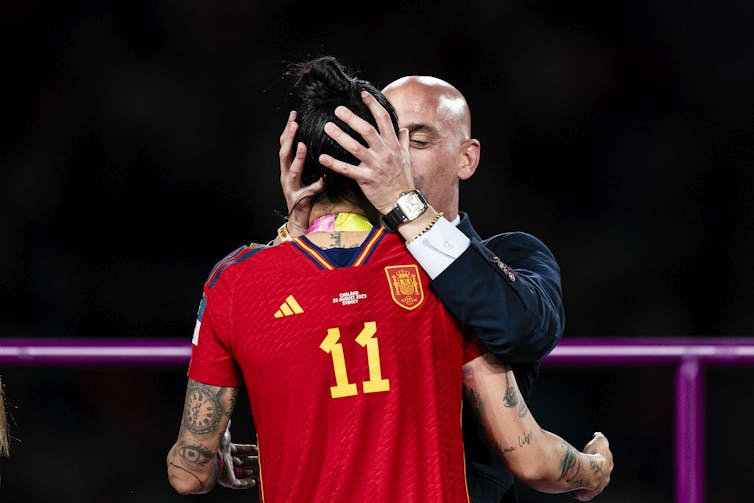
Luis Rubiales, the now ex-president of the Spanish Football Federation (RFEF) and former vice-president of the Union of European Football Associations (UEFA), was forced to resign fromthose leadership positions as a result of the forced kiss on Aug. 20, 2023, which took place in front of a packed stadium in Australia and a global audience. He is also under investigation by prosecutors in Spain for sexual assault and coercion.
Throughout the high-stakes and painful drama – which dominated Spanish media for weeks on end – there were jokes. The Rubiales kiss became fodder for internet memes, skits by comedians on Spanish TV, as well as many cartoons in national and international newspapers.
This appears to be the basis of much of the laughter in the Rubiales case. His outlandish, unexpected and unwanted gestures – not only the kiss, but also grabbing his crotch while cheering the Spanish women on to their first World Cup win – certainly came across as incongruous.
The former UEFA vice president wasn’t the only person to be lampooned. His mother – with her stranger-than-fiction hunger strike demanding his exoneration – also opened herself up to ridicule. Rubiales’ many supporters at the RFEF couldn’t escape the farce-fest either. Even those who eventually turned on him were ridiculed, with one editorial cartoon portraying them as rats abandoning Rubiales’ sinking Titanic ship.
But some of the jokes called attention to bigger issues. Rubiales’ sexism on display at a major sporting event did not reflect well on the country’s international reputation, especially at a time when it is bidding to co-host the 2030 Men’s World Cup. A humorist from the national newspaper El Mundo proposed that a crotch-grabbing Rubiales be adopted as the next World Cup official mascot.
A sexist laughingstock
Such use of comedy takes a page from the book “A Comedian and an Activist Walk Into a Bar,” in which authors Caty Borum Chattoo and Lauren Feldman discuss how humor can be used as a means to unify, guide public discourse, and inspire action.
It would be too much to claim that the jokes cracked during the fallout of Rubiales’ behavior led to his eventual resignation on Sept. 10. But the humor in this case helped amplify public debate and inspired action to confront structural sexism in Spain and beyond.
An example of how it did this can be seen in a parody reenactment of Rubiales’ kiss posted on the social media accounts of a self-fashioned amateur writer who goes by the online name @LolaLaMonyos.
In the sketch, two women impersonate Rubiales and Hermoso and stage the kiss, as recounted by Rubiales in his public appearance before the RFEF’s general assembly. At the Aug. 25 gathering, he did not resign as some had expected. Instead, he defended his “peck” as consensual and positioned himself against both “false feminism” and gender inclusive language.
“When Jenni first showed up, she lifted me up from the ground. She grabbed me by the hips, by the legs, I don’t remember well. … She lifted me up from the ground – and we almost fell down.
“Then the peck happened during all of this celebration, with her patting me on the side a few times and then excusing herself with one more hand on the side and going off laughing,” he added.
Those words, set over the spoof reenactment, highlight just how nonsensical Rubiales’ imaginative interpretation is. Furthermore, the mismatch of his male voice and the two female bodies in the video points at the pervasive silencing of women and sexist double standards. Since being posted on X, the platform formally known as Twitter, the sketch has been viewed almost 650,000 times.
Taking a somewhat different comedic approach, the popular Spanish satirical TV program “El Intermedio” recast the events in the style of a wildlife documentary. With the title “This turned out so ‘cute’” – a play on the Spanish word “mono,” which can mean “monkey” or “cute” – the skit uses a collage of monkey clips accompanied by an authoritative male voice-over. https://www.youtube.com/embed/xEwNAyxiiRY?wmode=transparent&start=0
Funny though it is, there are also serious points being made. The writers of the sketch place the audience in a position of evolved superiority to Rubiales – reveling in the idiocy of the mockumentary’s subject.
What’s more, the piece suggests that Rubiales’ worldview and values are archaic and represent a step back in the fight for gender equality.
We would also argue that the video invites the audience to question patriarchal structures as being synonymous with the advancement of civilization. To us, the message implied is that society needs to redefine such assumptions. A world in which we can excuse harassment, sexual abuse, coercion or discrimination is incompatible with an aspiring civilized society.
None of these humorous responses to the scandal diminish the seriousness of the Rubiales incident, nor the debate they sparked. Rather, they have helped frame the way in which discussions have played out in Spain.
For Rubiales, #itsover
There is no doubt that the recriminations against Rubiales mark a tipping point in Spain’s reckoning with abuses of power related to sexual assault and broader gender inequality. For good reason, the hashtag #seacabó – translating to #itsover – has continued to trend since the scandal, after the term was directed at Rubiales by Spanish soccer star Alexia Putellas. Putellas, a two-time winner of the prestigious Ballon d’Or Féminin and Best FIFA Women’s Player, affirmed in December 2021: “True victory will be when there is 100% equal opportunity for boys and girls in sports and in the world.”
The implications of the Rubiales tragicomedy have been sweeping and are still developing. It has allowed Spain, and inspired others, to confront discriminatory practices within and beyond the soccer field.
But is it also a laughing matter? We argue yes – because a sense of humor allows us to make sense of incongruities, confront them as a group, and advance toward social change.
Below is an edited excerpt from the book club discussion between Maggie Villiger, senior science editor for The Conversation US and Suri.
Watch the full book club meeting and leave your own question in the comments at the bottom of this article.
What is the Big Bang of numbers and where do you go from there in the book?
I think the story for me started way back when I was an undergraduate in Bombay. My algebra professor told us this very famous saying by Leopold Kronecker, the famous mathematician, that God gave us the integers and all the rest is the work of human beings. What he meant was that once you have the whole numbers – 1, 2, 3, 4 – which are somehow coming from heaven, then you can build up the rest of mathematics from it.
And then he went on and said, Hey, I can actually do better. I don’t need God. I can actually, as a mathematician, create the numbers out of nothing. And he showed us this marvelous, almost magic trick, where you start with something called the empty set and then you start building the numbers.
It was the closest I’ve been to a religious experience, almost like the walls just dissolved and suddenly there were numbers everywhere.
Once I started writing my novels, I was meeting a lot of people who were artists and writers. And they would always say, you know, we used to love math when we were in school, but afterward we never had a chance to really pursue it. And can you tell us something about your mathematics?
So, I started building a kind of talk, which started with this big bang, as I call it, building the numbers out of nothing. I finally decided I should write a math book, and it would be aimed at a wide audience.
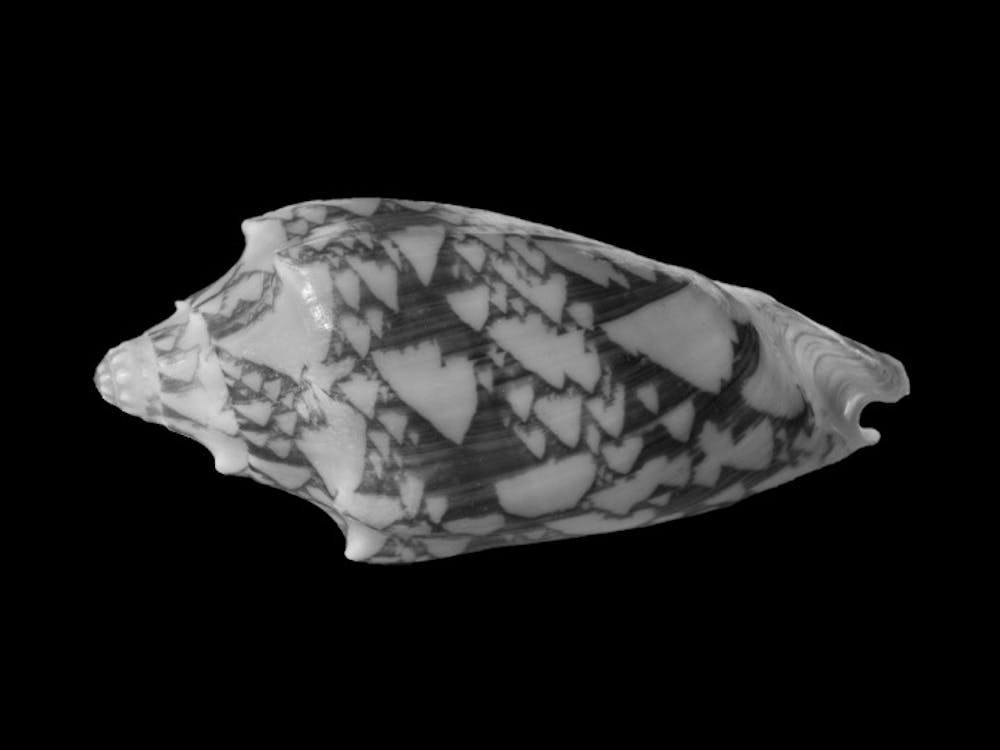
Patterns in nature, like the triangles on this shell, can be explained by simple mathematical rules. Larry Cole
And I said, well, can you go further? You can create the numbers, but can you actually start building everything, including the whole universe from that? So that was a way to try to lay out mathematics almost as a story where one thing follows from the other and everything is embedded in one narrative.
Who were you imagining to be your readers as you were writing the book?
There’s just so much joy to be had out of mathematics, so many things that you don’t really see in normal courses where the emphasis is always on doing the calculations, finding the right answer. So this book is written for people who want to really engage with mathematics on the level of ideas rather than get into computations and calculations.
After you set off your Big Bang of numbers, you dig in to some of life’s big questions. What do you see as math’s role in grappling with those big thoughts, like where the universe came from, why we even exist and so on?
Once you start talking about the Big Bang, what comes into your mind is creation. There is a doctrine called creatio ex nihilo, which is basically creating everything out of nothing.
That’s a cornerstone of many religions where God creates the universe out of nothing. It’s also in some sense being explored by physicists, where you have some sort of singularity and from that, everything emerges in the Big Bang.
So my thought was, both these areas, religion and physics, are in the public’s imagination much more than mathematics is. Is there a way to posit math as the creative force of everything?
Physicist Eugene Wigner, who was a Nobel laureate, talked about the “unreasonable effectiveness” of mathematics at describing everything in our physical universe. It’s so good at modeling physics and what have you. Could it be that math is really the true driving force of the universe? Rather than us just inventing it and using it to describe the universe, could the universe really be describing mathematics? Then the universe is just a physical manifestation, an approximation, if you will, of those mathematical ideas. It’s a completely different view of math.
There’s an ongoing debate over whether math is something that people invented or whether it’s something that exists independently of us. In the book, you say that perhaps the deepest insight that math can offer us is that it’s both of those things.
So the glib answer to your question whether math’s invented or discovered is that you have to create a new word. Instead of discovered or invented it’s “disvented.”
What I mean by that is simply that there are some questions we really can’t get to any kind of logical or supportable answer. One is the question of our own existence – people might believe one thing or the other, but it always comes down to: Is there some real purpose to our lives, or is our creation just something that happened randomly – you know, molecules getting together?
Now if we invent mathematics, then we’re inventing it for a purpose. If it just generates by itself, starting with emptiness, building around numbers in some strange realm that we don’t know about, then it’s just wafting around, purposeless.
Math has that duality that can’t be resolved. So it’s a metaphor, telling us, hey, you can’t decide for math, and you’ll never be able to decide for yourself about your own existence.
Can you tell us a bit about your previous books, the Indian novels?
The first one was called “The Death of Vishnu.” I went back to visit my parents in Mumbai in around 1995, and this man Vishnu, who used to live in our building and do errands, was dying on our steps. I started writing this as a short story.
It started going into a more philosophical realm when a writing teacher said, you know, Vishnu is also the name of the caretaker of the universe in Hindu mythology. So if you name somebody Vishnu, you need to somehow explore that. So that’s what opened up this whole new world for me.
The second book was “The Age of Shiva.” That one’s the journey of a woman right after India’s independence in 1947. She’s making her way in a very male-dominated world, and she’s not perfect.
Then the third one, I decided, OK, I need to put in some science and math characters. So “The City of Devi” actually has both a physicist and a statistician. Again it’s in Mumbai, set in the future with the threat of a nuclear war with Pakistan and a love triangle unfolding in front of that.
It’s kind of interesting. I thought that I was done with this mythical “where do we come from?” kind of philosophy that I had in the three books, but apparently not, because now “The Big Bang of Numbers” looks at it from a mathematical perspective.
One of the most intense discussions taking place among university faculty is whether to permit students to use artificial intelligence in the classroom. To gain perspective on the matter, The Conversation reached out to four scholars for their take on AI as a learning tool and the reasons why they will or won’t be making it a part of their classes.
Nicholas Tampio, professor of political science: Learn to think for yourself
As a professor, I believe the purpose of a college class is to teach students to think: to read scholarship, ask questions, formulate a thesis, collect and analyze data, draft an essay, take feedback from the instructor and other students, and write a final draft.
One problem with ChatGPT is that it allows students to produce a decent paper without thinking or writing for themselves.
In my American political thought class, I assign speeches by Martin Luther King Jr. and Malcolm X and ask students to compose an essay on what King and X might say about a current American political debate, such as the Supreme Court’s recent decision on affirmative action.
Students could get fine grades if they used ChatGPT to “write” their papers. But they will have missed a chance to enter a dialogue with two profound thinkers about a topic that could reshape American higher education and society.
The point of learning to write is not simply intellectual self-discovery. My students go on to careers in journalism, law, science, academia and business. Their employers often ask them to research and write about a topic.
Few employers will likely hire someone to use large language models that rely on an algorithm scraping databases filled with errors and biases. Already, a lawyer has gotten in trouble for using ChatGPT to craft a motion filled with fabricated cases. Employees succeed when they can research a topic and write intelligently about it.
Artificial intelligence is a tool that defeats a purpose of a college education – to learn how to think, and write, for oneself.
Patricia A. Young, professor of education: ChatGPT doesn’t promote advanced thinking
College students who are operating from a convenience or entitlement mentality – one in which they think, “I am entitled to use whatever technology is available to me” – will naturally gravitate toward using ChatGPT with or without their professor’s permission. Using ChatGPT and submitting a course assignment as your own creation is called AI-assisted plagiarism.
The proliferation of free AI means students won’t have to think much while writing – just engage in a high level of copy and paste. We used to call that plagiarism. With AI-assisted plagiarism, this brings in the potential for a new era of academic misconduct.
Some professors allow the use of ChatGPT as long as students cite ChatGPT as the source. As a researcher who specializes in the use of technology in education, I believe this practice needs to be thought through. Does this mean that ChatGPT would need to cite its sources, so that students could cite ChatGPT as a type of secondary source according to APA style, a standard academic style of citing papers? What Pandora’s box are we opening? Some users report that ChatGPT never reveals its sources anyway.
The concern will come when students take higher-level courses or land a job and lack the literacy skills to perform on an exceptional level. We will have created a generation of functionally illiterate adults who lack the capacity to engage in advanced thinking – like critiquing, comparing or contrasting information.
Yes, students can and should use smart tools, but we need to hypothesize and measure the costs to human ingenuity and the future of the human race.
Asim Ali, instructor of information systems management: AI is another teacher
I teach information systems management, and in the spring of 2023, I had students use ChatGPT for an essay assignment and then record a video podcast discussing how AI will impact their careers. This semester I am being more intentional by providing guidance on the possibilities and limitations of AI tools for each assignment. For example, students learn that using generative AI on a self-reflection assignment may not help, but using AI to analyze a case study is potentially a great way to find insights they may have overlooked. This emulates their future jobs in which they may use AI tools to enhance the quality of their work product.
My experience with adapting to AI for my own course inspired me to create a resource for all my colleagues. As executive director of the Biggio Center for the Enhancement of Teaching and Learning, I oversee the instructional design and educational development teams at Auburn University. We created a self-paced, online course called Teaching With AI.
Now there are over 600 faculty at Auburn and hundreds of faculty at almost 35 institutions engaging with the content and each other through discussion boards and practical exercises.
I receive messages from faculty sharing ways they are changing their assignments or discussing AI with their students. Some see AI as a threat to humans, but discussing AI with my students and with colleagues across the country has actually helped me develop human connections.
Shital Thekdi, associate professor of analytics & operations: What can you do that AI can’t?
This semester, I will ask students in my Statistics for Business and Economics course to discuss the question, “What is your value beyond the AI tools?” I want them to reframe the conversation beyond one of academic integrity and instead as a challenge. I believe students must recognize that the jobs they imagine will exist for them could be eliminated because of these new technologies. So the pressure is on students to understand not only how to use these tools but also how to be better than the tools.
I hope my students will consider ethical reasoning and the role of human connections. While AI can be trained to make value-based decisions, individuals and groups have their own values that can differ considerably from those used by AI. And AI tools do not have the capacity to form human connections and experiences.
Students will remain vital contributors to business and society as AI tools develop. I believe it’s our responsibility as educators to prepare our students for a rapidly evolving cultural and technological landscape.
If you have curly hair, you know that every day is a new adventure. What will my hair do today? Why does it curl better on some days than others? And even those without naturally curly hair might notice their hair curling – or, let’s be honest, frizzing – a bit on humid summer days.
As a person with curly hair, I’m always looking for the best way to care for and understand my hair. As a chemist, I’m interested in the science behind how my hair behaves at the molecular level. There are different hair types, from straight to curly, and they behave differently depending on their structure. But what hairs are made up of at the molecular level is the same.
Hair structure
Hair begins growing under the skin’s surface, but it’s what happens after it pokes through the skin that determines whether you have a good hair day or a bad one.
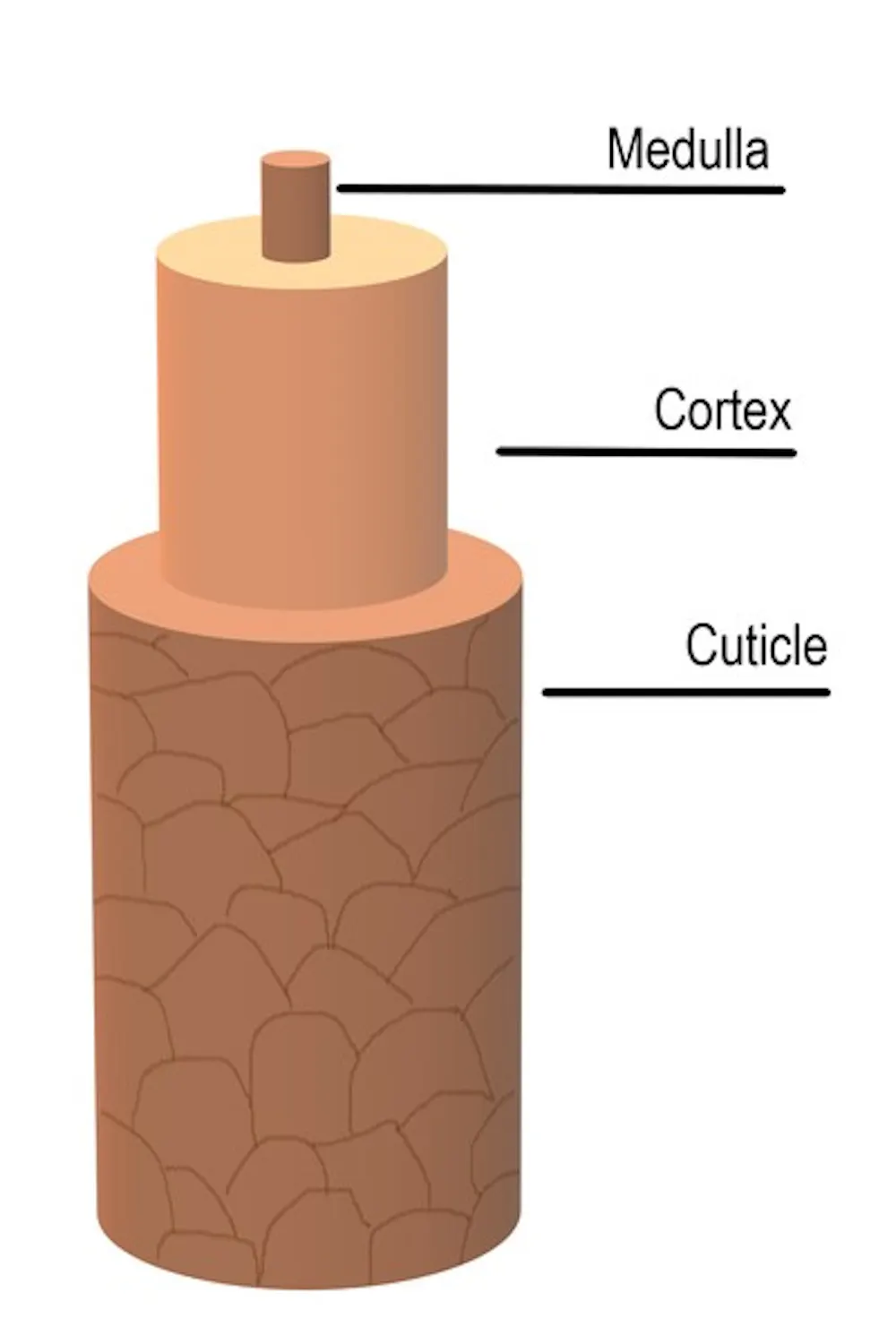
Each hair can have three layers – the medulla, the cortex and the cuticle. You can think of each hair like a tiny tree trunk.
The innermost, or core layer, is the medulla. This layer holds moisture, much like the pith in the center of a tree trunk. This layer is also very fragile, but only thick or coarse hairs contain this part – so those with thin or blond hair typically don’t have the medulla layer in their hairs.
Next is the cortex, which makes up most of a hair and is analogous to the wood of a tree. The cortex is made up of spring-shaped protein molecules that lie in parallel rows in a cylindrical bundle. The exact shape of that bundle is determined by the hair follicle, which is a pore on the skin from where the hair grows.
How the hair grows out of the follicle influences the distribution of its proteins. So a straight follicle produces straight hair and a curved follicle produces curly hair. The less evenly distributed the squiggly proteins are, the curlier the hair. Your genetic code also plays a role in the shape of the cortex and, therefore, the shape and thickness of your hair.
Lastly, the outermost layer of a hair is called the cuticle. The cuticle is like the bark of a tree – and it even looks like bark under a microscope.
It’s the cuticle’s job to protect the cortex, but the cuticle is very easily damaged. Imagine lifting or removing the bark from a tree. Doing so would leave the wood inside susceptible to moisture loss, exposure to the environment and damage.
The same is true for each hair. When the cuticle is damaged from brushing, chemicals, wind or heat, the proteins of the cortex have a much more difficult time lying smoothly together. This means they can lose moisture, gain moisture, fray like a rope – this causes split ends – and even break. All these factors can influence how your hair looks at any given moment.
Hair in the summer
So what does all of this have to do with humidity? Well, hair proteins contain many permanent chemical bonds. Only chemical treatments like perms or straightening can change these bonds. But there’s another natural phenomenon that keeps the protein molecules in the cortex in line – something called hydrogen bonding.
The long, stringy protein molecules in the cortex contain tiny positive and negative charges throughout their structure. Because opposite charges attract each other, entire rows of proteins can be attracted to each other like tiny, weak magnets.
Heating or wetting your hair breaks the magnetlike attraction between these rows of proteins. So, heat and water can rearrange the proteins in your hair by breaking the hydrogen bonds that keep their structure together.
How hydrogen bonds form.
Water is one of the best molecules at hydrogen bonding. So when a molecule of water has the opportunity to hydrogen bond with something, it will.
In your hair, water can form hydrogen bonds between the rows of proteins in your hair’s cortex. It is the extent to which this happens that determines your hair’s fate.
When just a little water enters the hair, like it might in lower humidity conditions or when the cuticle is healthy and able to keep too much water out of the cortex, your hair may curl. When humidity is high, or the cuticle is damaged, more water enters the hair. Too much water can swell and crack the cuticle, making hair look frizzy.
Many people consider high humidity to be the problem behind frizzy hair, but styling your hair under high humidity and then entering a less humid environment can also be an issue. Water molecules leaving the hair’s cortex can also lead to a change in hair behavior.
Treating summer hair
A damaged cuticle layer leaves the cortex more susceptible to water molecules creeping in or out and wreaking havoc on your hair. Anytime water molecules travel in or out, your hair’s structure suffers and your hairstyle may be ruined. When the cuticle is healthy, it can protect the cortex, making your hair less susceptible to changes in the weather or environment. The bottom line is that a healthy hair cuticle helps keep proper moisture in the cortex.
Heat from styling tools is the most common culprit behind damaged cuticles, but chemical treatments, brushing, sun and wind can also cause damage. Avoiding these activities can help, but some things, such as exposure to the sun, can’t be avoided.
You can also take care of your scalp – a clean, healthy scalp leads to healthy hair cuticles. Using moisturizing products on your hair can help maintain cuticle health as well. Oils and moisturizing treatments can even restore damaged cuticles. The good news is that by understanding your hair and treating it well, you can help prevent the undesired effects of humidity
Meet Anna Jones, a first-generation psychology major on the pre-med track at UMBC. What started as a “nudge” by one of her professors wound up leading Anna to becoming a peer tutor with UMBC’s SI (supplemental instruction) PASS (peer-assisted study sessions) program—an experience that has changed her life and defined her experience as a Retriever. We can’t wait to hear all about it!
Q: What brought you to UMBC in the first place?
A: Hello! I am a psychology B.S. major with a minor in biological sciences on the pre-med track. I transferred to UMBC after my first year of college and fell in love with what UMBC had to offer. I came from a very small honors college and wanted to be a part of a more diverse, larger, student body. At UMBC, I quickly learned that I was surrounded by goal-oriented, like-minded, and well-rounded students, and I was met by supportive professors who connected me to my higher self through opportunity and encouragement.
Q: What’s the one thing you’d want someone to know about the support you found here?
A: Academic support is within arms-length here. Resources are offered tailored to anyone’s needs as a student and it is not challenging to access.
Q: Tell us about someone in the community who has inspired you or supported you, and how they did it.
A: I’ve been inspired by a countless number of individuals here on campus. The highlighted person(s) would be my physics professor Dr. Lili Cui, my SI PASS supervisor Deborah Webb, the ASC (Academic Success Center) director Dr. Delana Gregg (Ph.D. ’19, language, literacy, and culture), and simply all of my peers in the SI PASS organization for the past three semesters. Dr. Lili was the professor I worked alongside as I supported her course through being an SI Pass leader. Dr. Lili has uplifted me by giving me honest academic advice and suggesting opportunities to further my leadership skills. She saw the leadership in me before I recognized it within myself.
Deb Webb and Dr. Gregg supported me extensively by being present through all of my success as an SI PASS leader. Deb Webb has provided me with skill building tasks and granted me access to resources that have been helpful to both my personal and academic self and career. Through her coordination of SI PASS, she has supported me through mentorship, organization, and communication. Dr. Gregg also supported me through words of encouragement and helping me become a part of a network that made it possible for me to help other students and faculty beyond our campus.
Jones, second from right, stands next to Delana Gregg, third from right, and other members of the SI PASS team.
Q: Tell us about what you love about being a peer mentor and SI PASS tutor.
A: I wanted to give back to my community but didn’t know how, so I became an SI PASS leader and mentor. Through these roles, I was able to achieve my wish to not only give back, but connect with many elements this campus had to offer. I admire UMBC’s priority of peer education and wanted to extend that principle to others through my role as a student.
SI PASS is a free support resource for traditionally difficult courses which tend to be STEM or language related. SI PASS leaders are responsible for hosting regularly-scheduled study sessions throughout the week to help facilitate active learning among students enrolled in their designated course. We engage students in various learning strategies to support students in knowing what to learn and how to learn it.
As an SI PASS mentor, I serve as a role model to assigned new leaders, provide guidance on specific administrative and SI PASS skills such as completing planning sheets and logging data, offer support (motivational/emotional), and assist new leaders with setting goals and identifying resources.
What I love about being an SI PASS leader and mentor is the ability to give back to my community at such a large school. It helps me connect with my peers and professors in ways that I never imagined possible. I feel like a thread, sewing different bits of the campus together. I am grateful for the new skills I’ve developed through my experience and the meaningful connections I’ve made and have helped other students make during my time here.
Q: Since you’ve been a part of the UMBC community, how have you found support of your WHY?
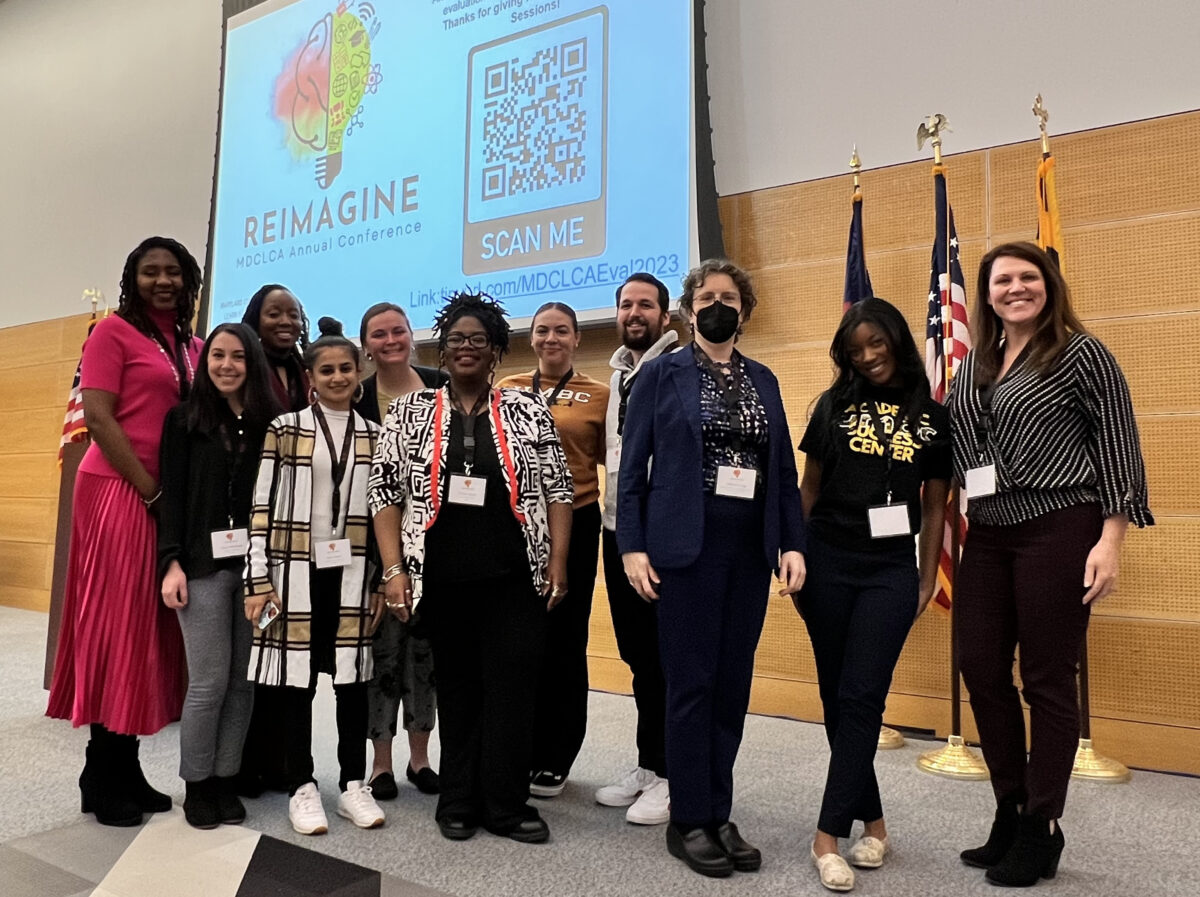
A: I was suggested to be an SI PASS Leader by my former physics professor Dr. Lili Cui. This referral started as a nudge in the right direction but later turned into a life-changing experience for me. Becoming a part of this organization led to me presenting at my very first conference for the MDCLCA (Maryland College Learning Center Association) organization, which then led me to becoming a student representative. My professor, my supervisor, and my peer educators all aid equally in my evolution as a student. They have all done nothing but encourage me to be my best self, providing challenges for me to overcome and grow through.
“
What I love about being an SI PASS leader and mentor is the ability to give back to my community at such a large school…. I feel like a thread, sewing different bits of the campus together.
Anna Jones, peer tutor
Q: What would you tell other transfer students about what it’s like becoming a part of the UMBC community?
A: Being a transfer student as such a large university (compared to my previous school) can be very intimidating. It may require some elbow grease to build up the courage to become more involved on campus but you will come to find that the inclusivity of this community eases the tension. Becoming involved is easier than you may think and there’s countless options of helpful resources to point you in the right direction.
* * * * *
UMBC’s greatest strength is its people. When people meet Retrievers and hear about the passion they bring, the relationships they create, the ways they support each other, and the commitment they have to inclusive excellence, they truly get a sense of our community. That’s what “Meet a Retriever” is all about.
Meet Ken Baron, Assistant Vice Provost for Academic Advising and Student Success in the Office of Academic and Pre-Professional Advising at UMBC. As a first-generation student himself, Ken truly appreciates the importance of student support at every level, and finds joy in bringing that philosophy to his work every day through advising at UMBC. Take it away, Ken!
Q: What is your favorite part of your job?
A: Meeting with students and parents. Even though much of my work includes administrative duties, I am still very much involved with direct daily contact with undergraduate students, their families, and supporters. I manage a caseload of exploratory students every semester and field student referrals from faculty, fellow administrators, and staff throughout the university. Continuing to work directly with students enables me to remain current and knowledgeable about how students experience their academic opportunities here at UMBC and navigate their academic planning through our technologies and policies. As a first-generation transfer student, I can relate very closely to the kinds of concerns, questions, and expectations our students have concerning academic advising. The opportunity to connect with a student through active listening and loads of genuine empathy helps foster meaningful, uplifting, inspiring relationships from orientation all the way through to post-graduate opportunities!
Q: What are the best pieces of advising advice you most often give to students just starting out at UMBC?
A: Number one, it’s really important to take a moment to review ALL the majors, minors, and certificates we offer here at UMBC. Even if you think you know what you want to do, you might be surprised by many of the unique programs we offer, like Management of Aging Services (so strategic for anyone interested in any health professions career) or our minors in Entrepreneurship, Computing, or Management that can help boost the marketability of any major.
Next, I suggest that every new student (first-year or transfer) meet with professional staff in our Career Center, Shriver Center, Education Abroad Office, and Office for Undergraduate Research and Prestigious Scholarships. These campus centers and offices offer students resources, opportunities, and guidance on exploring their career ideas, engaging in community service, securing internships and part-time jobs, conducting research, and pursuing educational opportunities abroad.
And finally, the sooner students connect with the passionate staff who work in these offices and centers, the more excited they will become about their upcoming experience here at UMBC. And they will become more confident in their academic planning process – knowing that whatever their major, they can find creative ways to apply what they learned in real-world capacities. Ultimately, employers hire, and graduate schools and professional schools accept dynamic candidates who have built “overall” educational and experiential learning portfolios that illustrate how they can add diversity and value to their organizations and institutions. New students should be aware of this notion early in their academic journey so that they pursue majors they love and become marketable and competitive over time.
“
For me, UMBC has provided more than just a job; it has offered a rewarding and intellectually stimulating way of life.
Ken Baron
Q: Tell us about your primary “why,” and how it led you to UMBC.
A: I came to UMBC because it allowed me to use all the skills and knowledge I have accrued throughout my career. During the interview, I was “sizing up” all the advising needs and constituencies I could serve if I took an advising leadership position here. I am delighted to share that I have found ample opportunities to work with students interested in pursuing the health professions and law (an area of expertise fostered in my years at Emory University and the University of Tennessee, Knoxville), and I love that I get to work with student-athletes, international students, students interested in study abroad, and students pursuing prestigious scholarships. I also use my professional counseling certifications in counseling and career counseling daily with students, staff, and other colleagues on campus. I genuinely feel a sense of “career actualization” after 17 years here that I am not sure I would have found elsewhere.
Ken Baron and Paula Ashby at Ashby’s retirement party on campus. Photo courtesy of Baron.
Q: Tell us about someone in our community who inspired or supported you, and how they did it.
A: During my two-day interview here at UMBC in 2006, I met Paula Ashby ’76 and was immediately struck by her authenticity, kindness, and fiery passion for health professions advising. As a former director of health professions advising at Emory University, I instantly connected with Paula over the common travails and triumphs of advising pre-med students. During my interview, she asked informed and probing questions about my experience with health professions advising, which impressed me greatly as a candidate. Knowing that Paula would be on my staff significantly influenced my decision to accept a great offer from UMBC to become the director of academic advising at that time.
For the next decade, it was an honor and a delight to work alongside Paula in a variety of meaningful and memorable capacities, including summer and winter orientation leadership, helping exploratory students find their academic paths, and of course, a tremendous focus and dedication toward students in the health professions – especially those interested in allied health. Paula’s retirement celebration in 2016 filled every inch of the Skylight Room with adoring fans – including [former UMBC president Freeman] Hrabowski, with whom she worked during her time as a graduate and professional school coordinator for the Meyerhoff Scholars Program earlier in her career. Students and colleagues alike were drawn to Paula based on her genuine, caring nature. She loved helping people – every hour, every day, every week, every month, every year. Sadly, Paula passed in 2017, yet for 36 years, she brandished that love of helping people – which became her legacy and hallmark as an academic advising pioneer at UMBC. Paula still inspires me, and our office is honored to help steward and administer the Paula O. Ashby Scholarship, along with her family and the Office for Institutional Advancement.
Q: Are you involved in any organizations that you particularly enjoy?
A: I have recently loved my UMBC/University Innovation Alliance (UIA) team member role. UMBC’s partnership with UIA has been inspiring and invigorating. Working closely with my UMBC team members and forward-thinking colleagues from outstanding institutions across the country provides a dynamic forum for sharing best practices and common challenges that many institutions face in terms of improving graduation rates, retention, time to degree, and increasing the number and diversity of college graduates, particularly low-income students, first-generation students, and students of color in the United States.
I am also grateful for the opportunity I have been offered for the last decade to serve as a Meyerhoff Coach during their Summer Bridge Program. I meet with cohort representatives early in their initial onboarding to work on their collective “vision statement.” This highly interactive exercise is always enlightening and rewarding regarding the rich discussions, creative ideas, and exploration of values our work together reveals. I always leave these sessions with a renewed sense of possibilities for the future which these incredible students are already starting to act upon so early in their academic journeys here at UMBC. I love challenging them to think about the skills and aptitudes they will need to foster as future leaders (perhaps in STEM fields and research areas that haven’t yet been discovered).
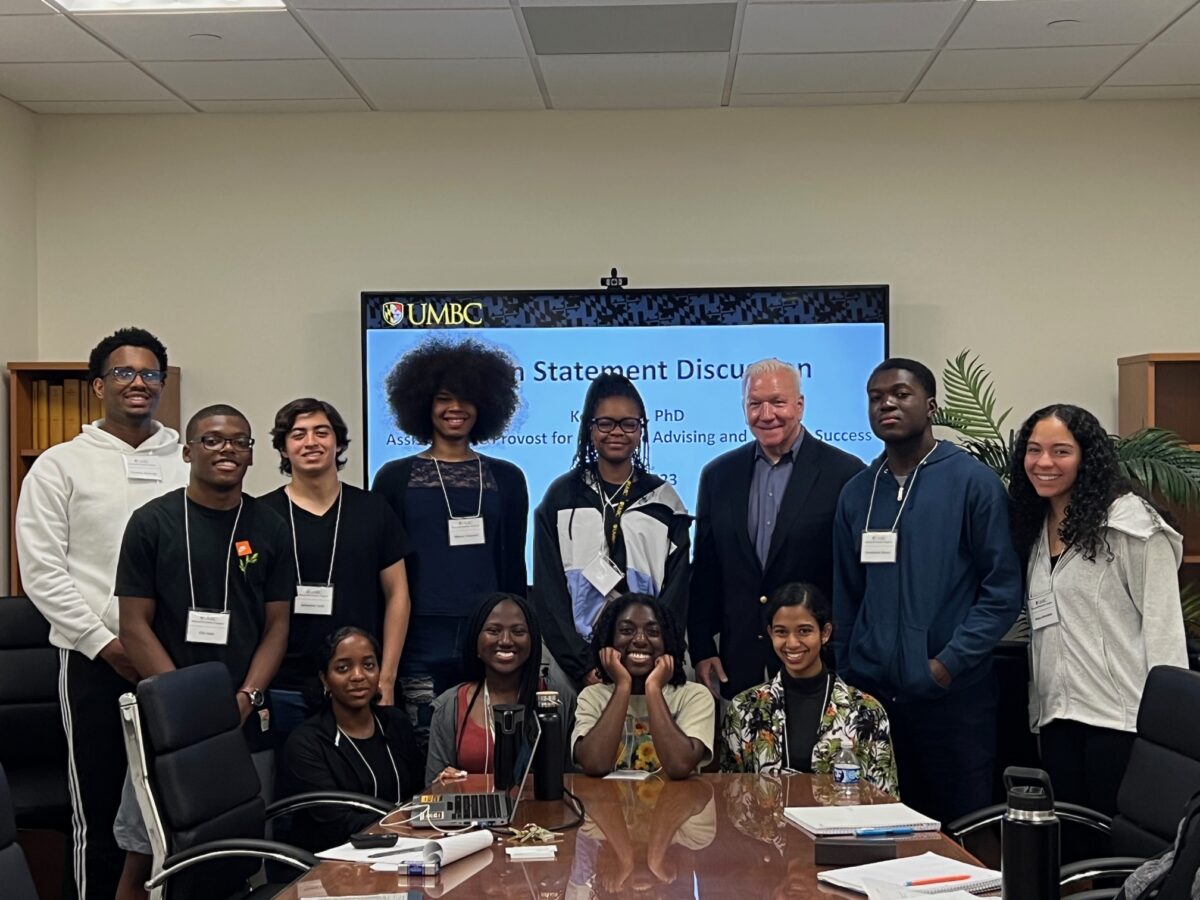
Baron, back row, shares a moment with new Meyerhoff Scholars during the 2023 Summer Bridge program. Photo courtesy of Baron.
Q: What would you tell someone who is considering a career at UMBC?
A: Please come and be ready to enjoy a career and a community of caring, diverse students and colleagues that will captivate your imagination and heart. Prepare to work hard, listen, engage, participate, and enjoy all we offer. For me, UMBC has provided more than just a job; it has offered a rewarding and intellectually stimulating way of life. I love attending our athletic events (about to purchase season tickets for Women’s Volleyball), theatre, music concerts, lectures, and other varied campus events. I am proud to have my family and friends join me for those, and I am so pleased that my partner, Ann Kellogg, Ph.D. ’20, public policy, decided to further her education here. She now teaches graduate students in the Public Policy program and involves herself in the campus community in ways we could not have imagined when we moved here from Chicago in 2006.
* * * * *
UMBC’s greatest strength is its people. When people meet Retrievers and hear about the passion they bring, the relationships they create, the ways they support each other, and the commitment they have to inclusive excellence, they truly get a sense of our community. That’s what “Meet a Retriever” is all about.
At the University of Maryland, Baltimore County’s Special Collections, where I am head curator, we’ve recently completed a major digitization and rehousing project of our collection of over 5,400 photographs made by Lewis Wickes Hine in the early 20th century.
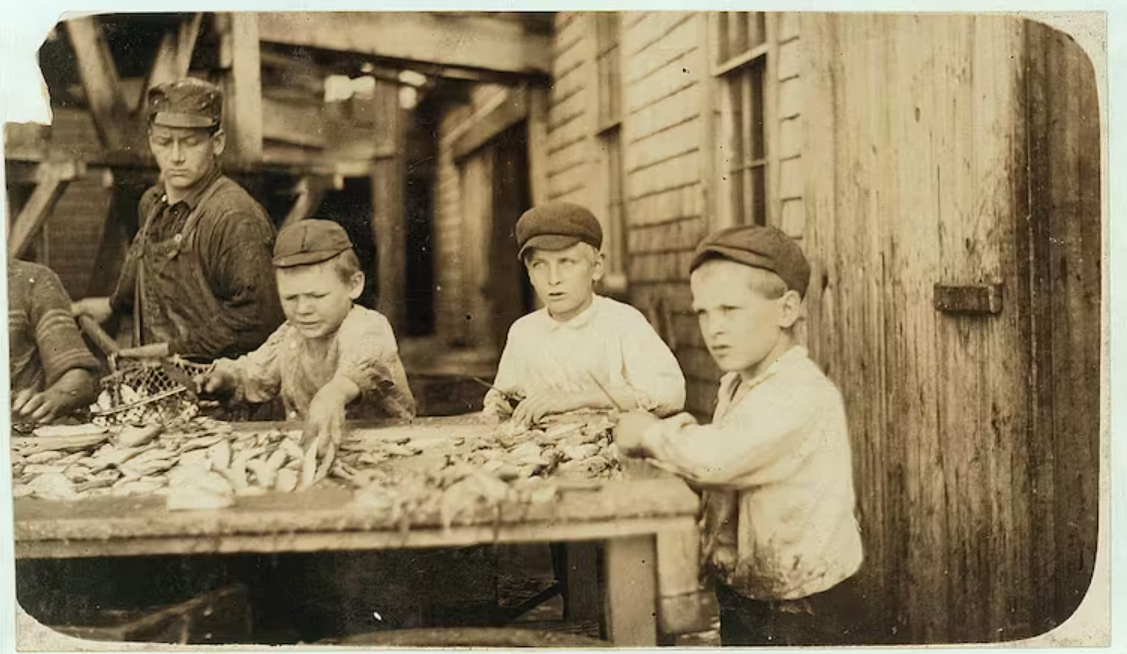
Traveling the country with his camera, Hine captured the often oppressive working conditions of thousands of children – some as young as 3 years old.
As I’ve worked with this collection over the past two years, the social and political implications of Hine’s photographs have been very much on my mind. The patina of these black-and-white photographs suggests a bygone era – an embarrassing past that many Americans might imagine they’ve left behind.
A sociologist by training, Hine began making photographs in 1903 while working as a teacher at the progressive Ethical Culture School in New York City.
Between 1903 and 1908, he and his students photographed migrants at Ellis Island. Hine believed that the future of the U.S. rested in its identity as an immigrant nation – a position that contrasted with escalating xenophobic fears.
Based on this work, the National Child Labor Committee, which advocated for child labor laws, hired Hine to document the living and working conditions of American children.
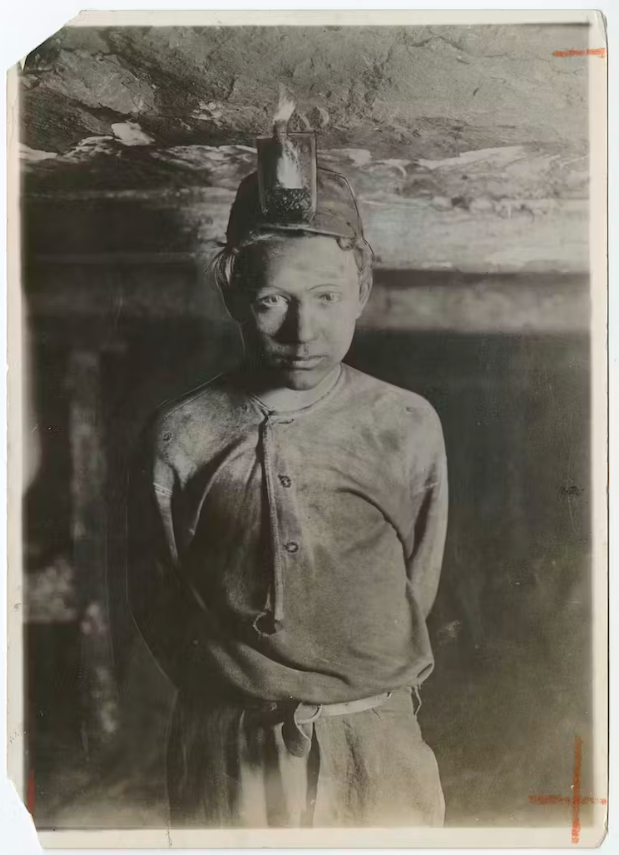
Lewis Wickes Hine, ‘Trapper Boy, Turkey Knob Mine, MacDonald, West Virginia, 1908.’ Gelatin silver print. 5 x 7 in. The Photography Collections, University of Maryland, Baltimore County (P148), CC BY-SA
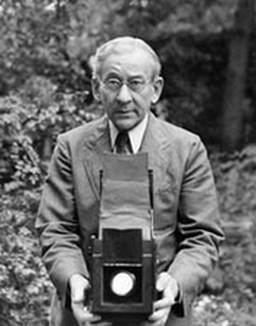
In his work for the National Child Labor Committee, Hine journeyed to farms and mills in the industrializing South and the streets and factories of the Northeast. He used a Graflex camera with 5-by-7-inch glass plate negatives and employed flash powder for nighttime and interior shots, hauling upward of 50 pounds of equipment on his slight frame.
To gain entry into factories and other facilities, Hine sometimes disguised himself as a Bible, postcard or insurance salesman. Other times he’d wait outside to catch workers arriving for or departing from their shifts.
Along with photographic records, Hine collected his subjects’ personal stories, including their ages and ethnicities. He documented their working lives, such as their typical hours and any injuries or ailments they incurred as a result of their labor.
Hine, who considered himself “an investigator with a camera,” used this information to create what he termed “photo stories” – combinations of images and text that could be used on posters, in public lectures and in published reports to help the organization advance its mission.
Hine’s muckraking photographs exemplify the genre of documentary photography, which relies upon the perceived truthfulness of photography to make a case for social change.
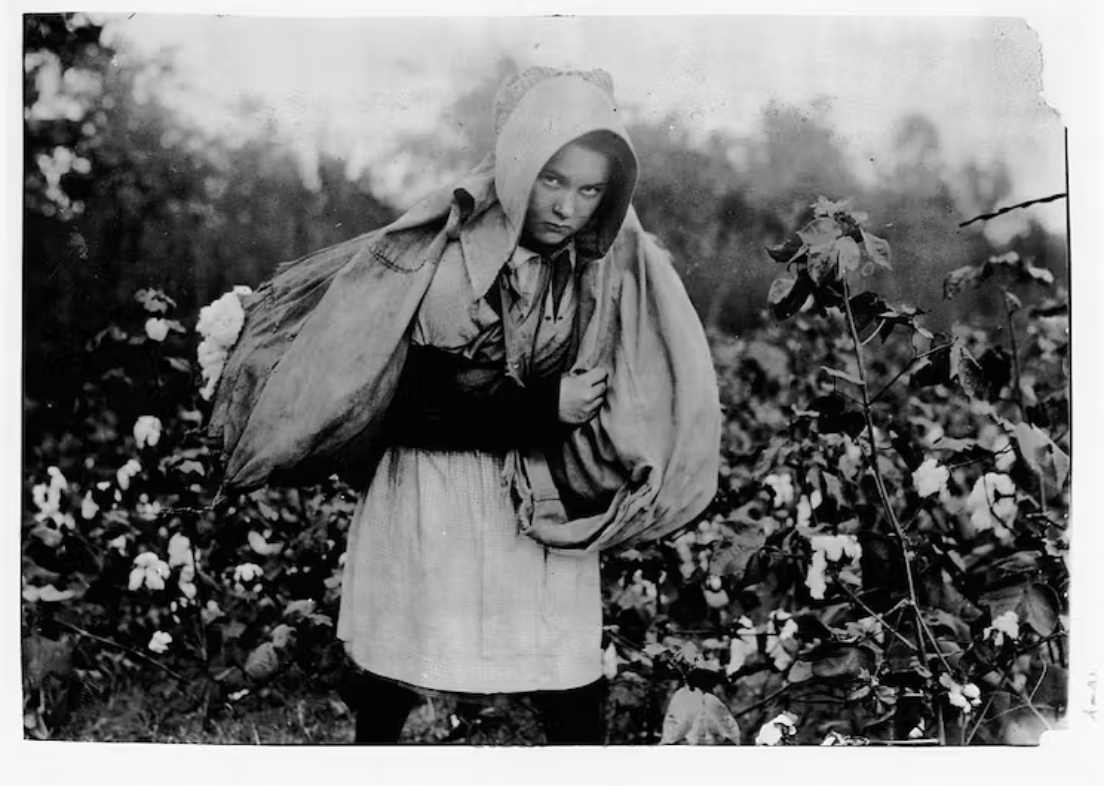
The camera serves as an eyewitness to a societal ill, a problem that needs a solution. Hine portrayed his subjects in a direct manner, typically frontally and looking straight into the camera, against the backdrop of the very factories, farmland or cities where they worked.
By capturing details of his sitters’ bare feet, tattered clothes, soiled faces and hands, and diminutive stature against hulking industrial equipment, Hine made a direct statement about the poor conditions and precarity of these children’s lives.
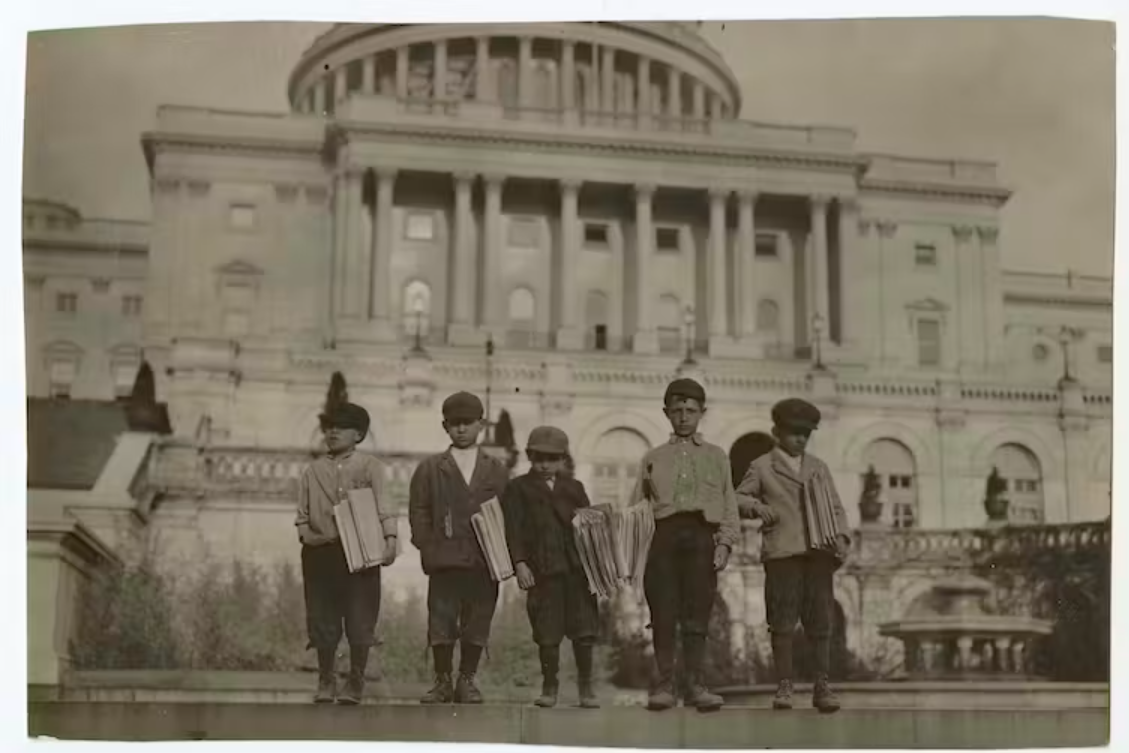
Lewis Wickes Hine, ‘Group of newsies selling on Capitol steps, April 11, 1912.’ The Photography Collections, University of Maryland, Baltimore County (P2904), CC BY-SA
Hine’s photographs made a successful case for child labor reform.
Notably, the National Child Labor Committee’s efforts resulted in Congress establishing the Children’s Bureau in 1912 and passing the Keating-Owen Act in 1916, which limited working hours for children and prohibited the interstate sale of goods produced by child labor.
Although the Supreme Court later ruled it and a subsequent Child Labor Tax Law of 1919 unconstitutional, momentum for enshrining protections for child workers had been created. In 1938, Congress passed the Fair Labor Standards Act, which established restrictions and protections on employing children.
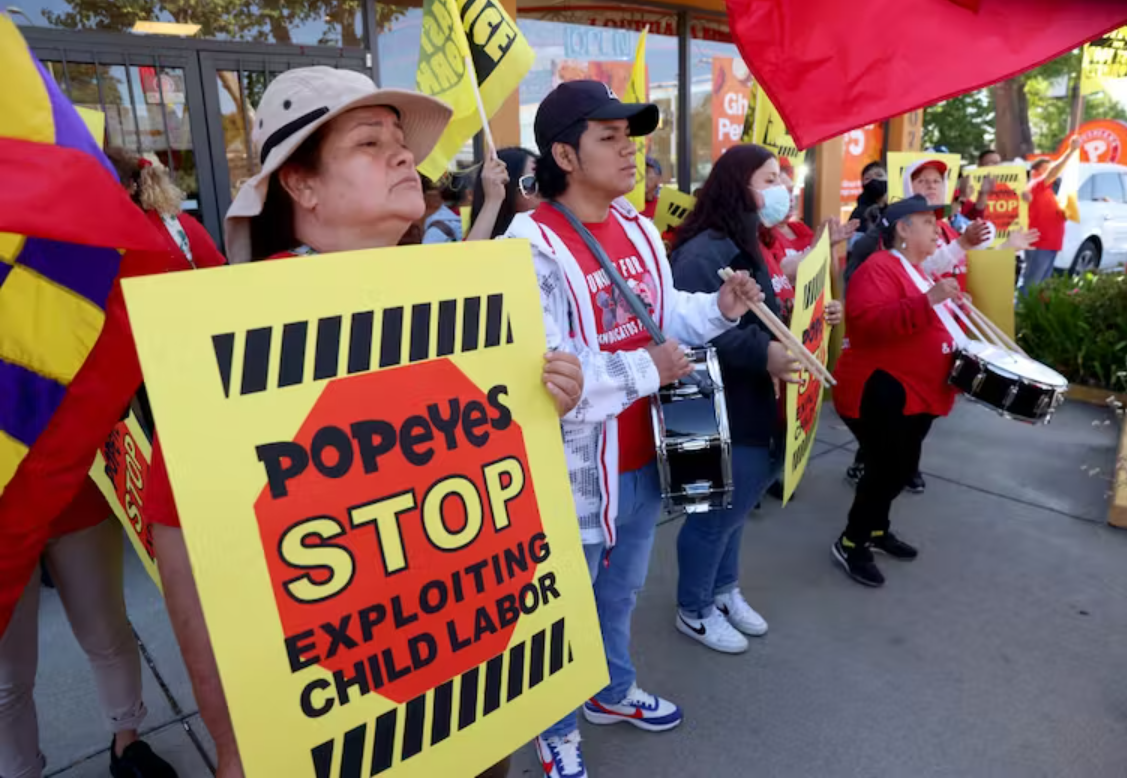
The National Child Labor Committee’s project also included advocacy for the enforcement of existing child labor regulations, a regulatory problem reemerging today as the Department of Labor – the agency tasked with enforcing labor laws – comes under fire for failing to protect child workers.
A recent surge of unaccompanied minors, primarily from Central America, has brought new attention to America’s old problem of child labor and has threatened the very laws Hine and the National Child Labor Committee worked to enact.
Some estimates suggest that one-third of migrants under 18 are working illegally, whether it’s laboring more hours than current laws permit, or working without the proper authorizations. Many of them perform hazardous jobs similar to those of Hine’s subjects: handling dangerous equipment and being exposed to noxious chemicals in factories, slaughterhouses and industrial farms.
While the content of Hine’s photographs remains pertinent to today’s child labor crisis, a key distinction between the subject of Hine’s photographs and working children today is race.
Hine focused his camera almost exclusively on white children who arrived in the country during waves of immigration from Europe during the late-19th and early-20th centuries. As art historian Natalie Zelt argues, Hine’s pictorial treatment of Black children – either ignored or forced to the margins of his images – implied to viewers that the face of childhood in America was, by default, white.
The perceived racial hierarchies of Hine’s era reverberate into the present, where underage migrants of color live and work at the margins of society.
Contemporary reports of child labor violations offer few images to accompany their texts, graphs and statistics. There are legitimate reasons for this. By not including identifying personal information or portraits, news outlets protect a vulnerable population. Ethical guidelines frown upon revealing private details of the lives of children interviewed. And, as Hine’s experience demonstrates, it can be difficult to infiltrate the sites of these labor violations, since they are typically kept secure.
Digital cameras and smartphones offer a workaround. Beginning in 2015, the International Labor Organization urged child laborers in Myanmar to become “young activists” and use their own images and words to create “photo stories” – echoing Hine’s use of the term – that the organization could then disseminate.
Photographs of child labor in foreign countries are far more common than those made in the U.S., which leaves the impression that child labor is someone else’s problem, not ours. Perhaps it’s too hard for Americans to look at this domestic issue square in the eyes.
A similar effect is at work when viewing Hine’s photographs today. While they were originally valued for their immediacy, they can seem to belong to a distant past.
But if Hine’s photographic archive of child laborers is evidence of the power of photography to sway public opinion, does the lack of images in today’s reporting – even if nobly intended – create a disconnect?
Is the public capable of understanding the harmful consequences of lack of labor enforcement when the faces of the people affected are missing from the picture?