We use cookies for analytics and, unless you opt out, advertising.
You can opt out of advertising at any time.UMBC uses essential cookies to run this site. With your permission we would also use analytics cookies (to understand how the site is used) and advertising cookies (to measure and target our ads on other platforms). Nothing else loads unless you accept. You can change your choice any time from Cookie Settings in the footer.Privacy Policy
EssentialRequired for the site to work (login, security, your cookie choice). Always on.
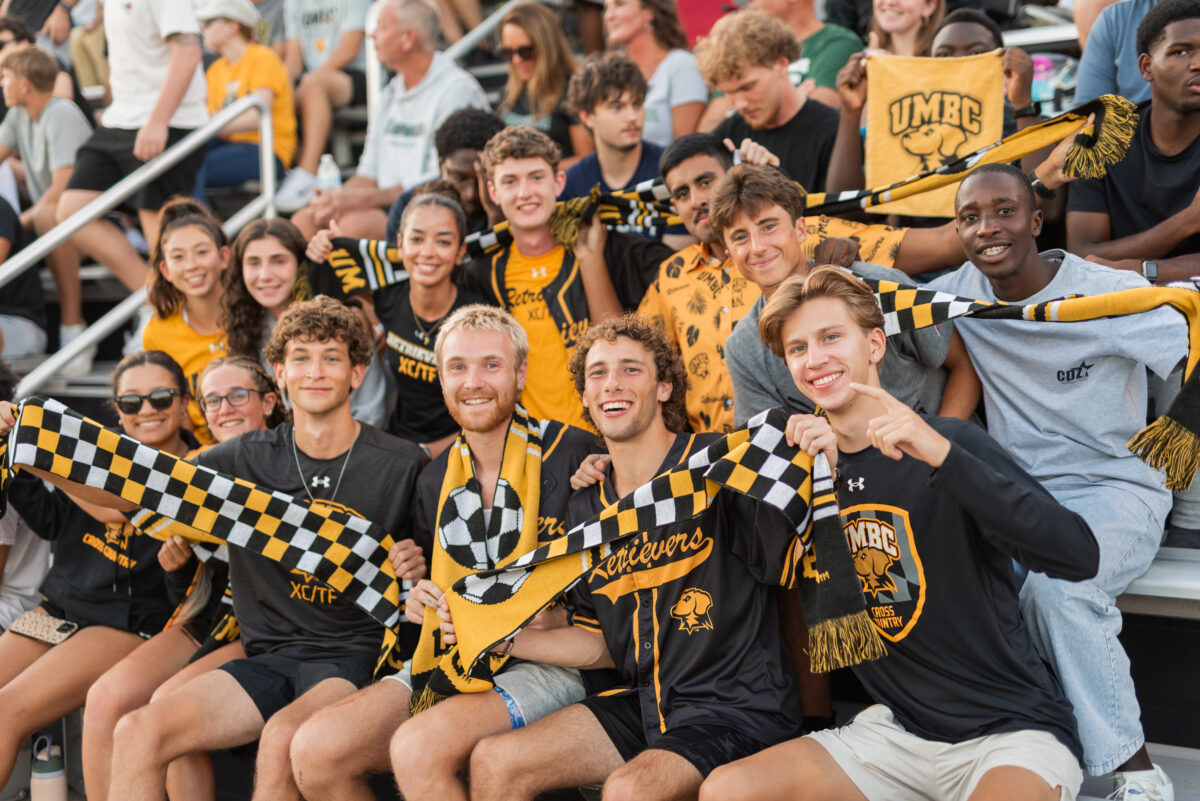
As fall 2026’s first full week of classes wrap up, Retrievers across campus—newly minted and returning—are finding their place. In addition to learning to navigate to the right classroom, they are bringing their unique strengths and voices to this ever evolving community.
This year’s incoming class of over 2,000 Retrievers boasts a median GPA of 4.0. Among them is Rodney Oglesby, an aspiring musician and a Gates Scholar. Oglesby was one of 750 students awarded this high honor among a pool of over 61,000 applicants nationwide.
“We are thrilled to welcome another impressive entering undergraduate class, with a 15 percent increase in enrollment from Baltimore City, and, overall, students representing 42 countries,” says Dale Bittinger, M.P.P. ’16, assistant vice provost for strategic undergraduate engagement, partnerships, and pathways. “They are academically talented and engaged and we look forward to all they have to offer to our campus community.”
Joining Oglesby is Saad Bin Waqas, a new student who traveled nearly 7,000 miles from his home in Pakistan to address the UMBC community at this year’s Fall Opening Meeting. At just 16, this Sondheim Scholar and geography and environmental studies major is looking forward to planting some roots after growing up in a military family.
“After moving from place to place for much of my life, I am really excited to have a new place I can call home,” shared Waqas.
A place to flourish
Junior Sabirah Burt is joining UMBC as a transfer student from Howard Community College. Her aspirations to ultimately become a physician’s assistant are shaped by her own experience grappling with a medical condition. If you had asked Burt a few months ago to describe herself, she’d say “ticking time bomb.” In June 2025, she was rushed to the hospital for an agonizing headache. Medical professionals eventually discovered she had an active brain bleed and underwent emergency surgery.
“I believe graduating with a public health degree from here will allow me to flourish when continuing my education and applying to graduate school in the future,” she said. “After going through my tough experiences last year, it’s made me even more passionate to pursue medicine, now more than ever before, and help those lying in hospitals wondering if it will be their last day.”
Strengthening connections—early
Some new Retrievers got a jump start to the year and arrived on campus over the summer to dive into work-integrated learning (WIL)—an educational approach that prepares students for a rewarding career after college by pairing what they are learning in the classroom with hands-on, authentic work experiences. In July, more than 100 incoming first-year and transfer students spent a night on campus, connected with an instructor and teaching assistant, and spent a day participating in service on site at five different community partner locations.
WIL students will participate in service with the same sites throughout their full first year at UMBC, deepening engagement and strengthening connection to their peers and faculty as well as to the campus and community.
“I believe a program like this is an excellent cohort building model. I was able to have individual conversations with all of them, learning what they cared about going into their unique UMBC journeys,” says Emily Passera, the senior program coordinator for community-engaged learning through The Shriver Center at UMBC, who led a group of students to Patterson Park in east Baltimore and will teach the same students in a first-year experience course called UNIV 101.
A community for all
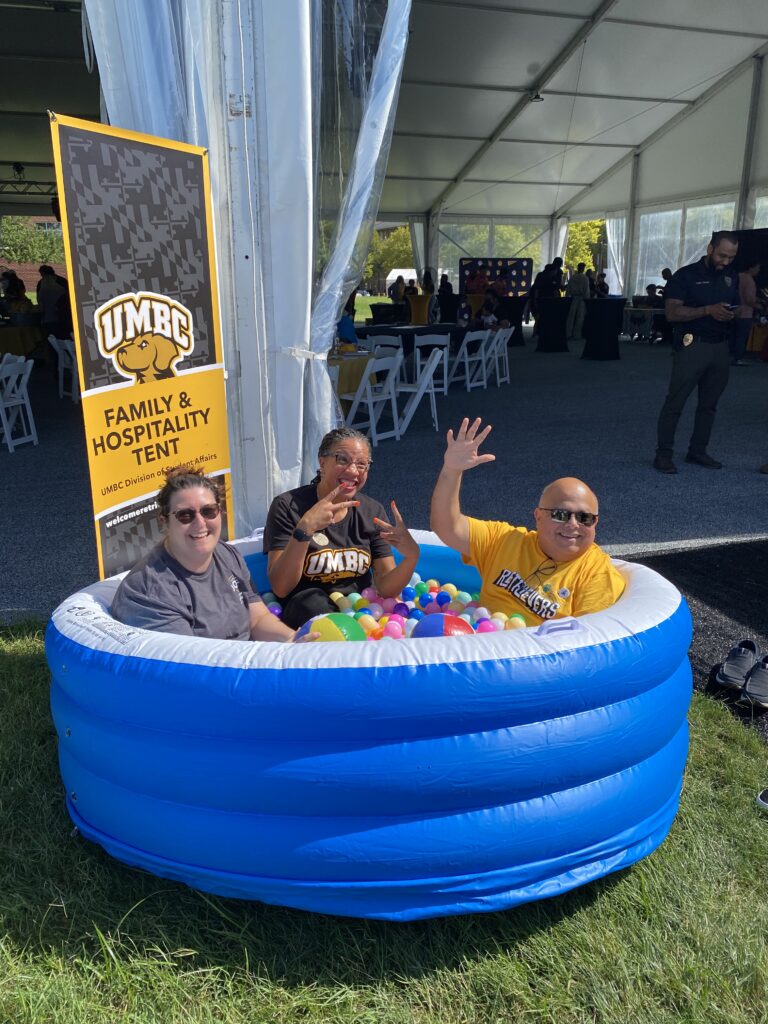
Diaz hangs out with Renique Kersh, vice president for student affairs (center), and Wendy Low, coordinator in the Division of Institutional Equity, in the hospitality tent’s ball pit. (Photo courtesy of Kait McCaffrey)
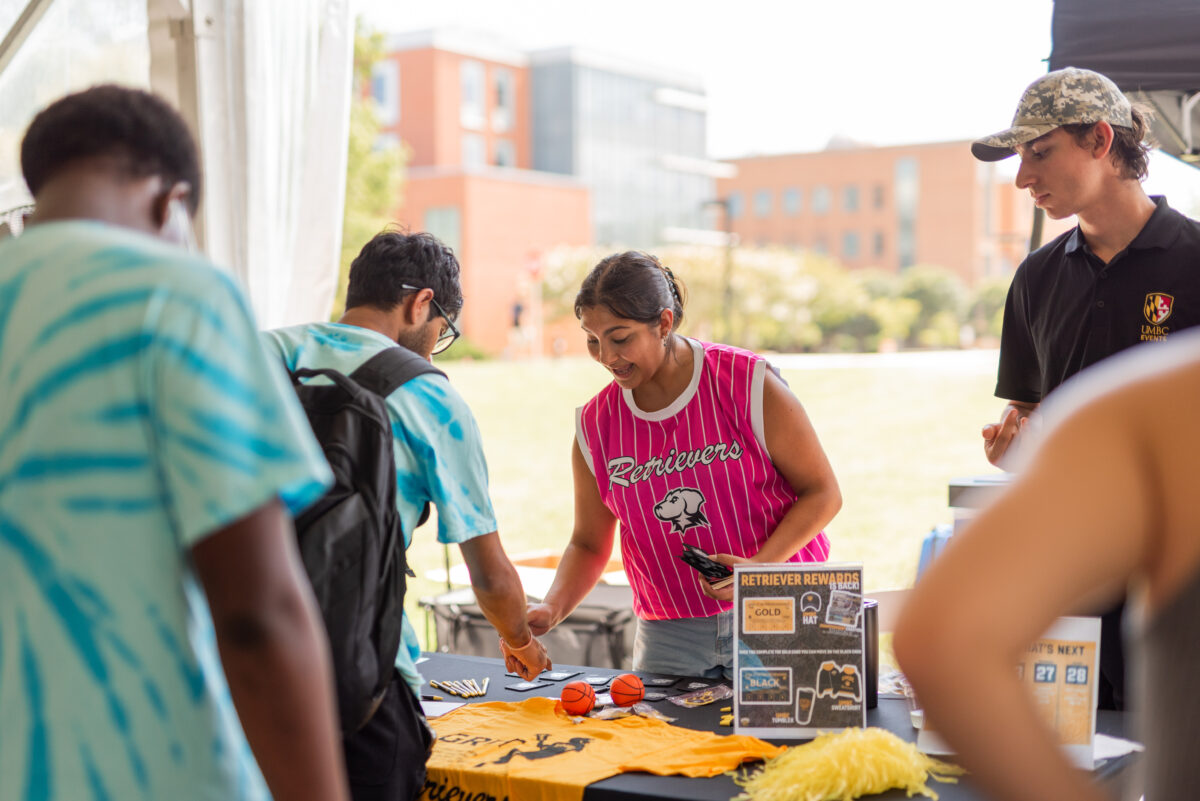
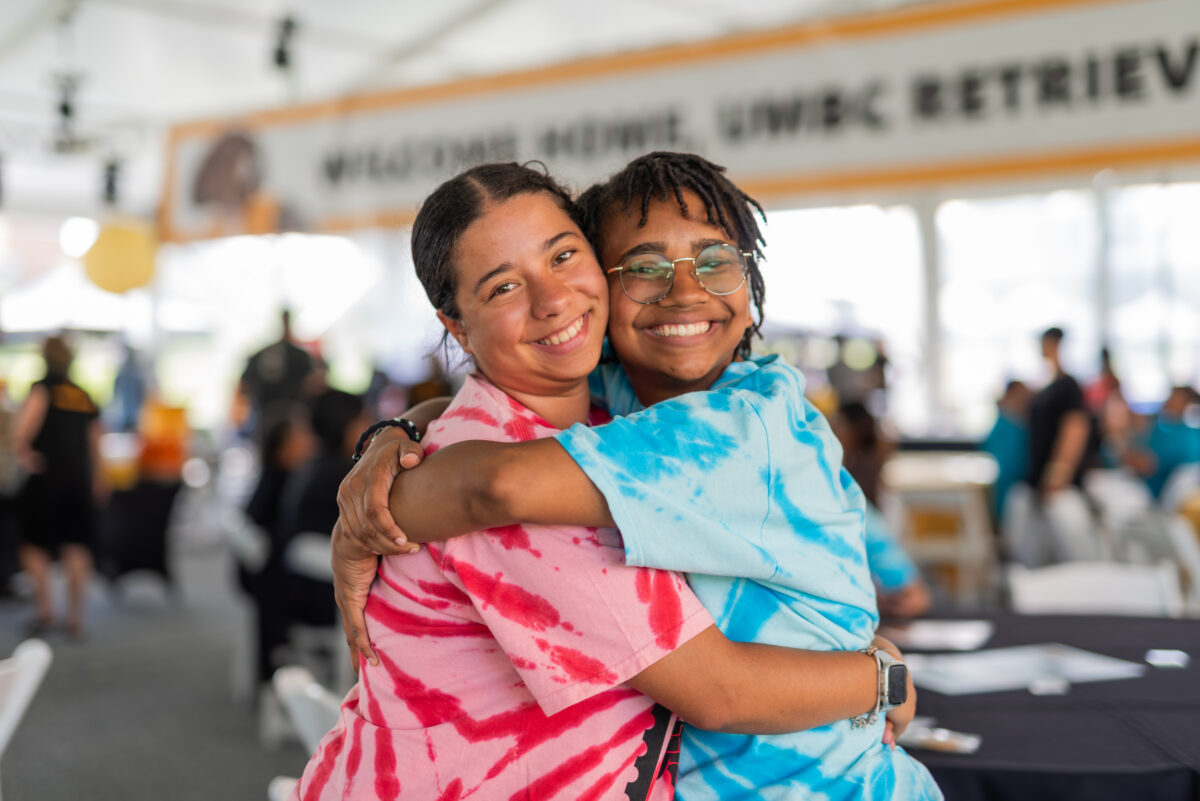
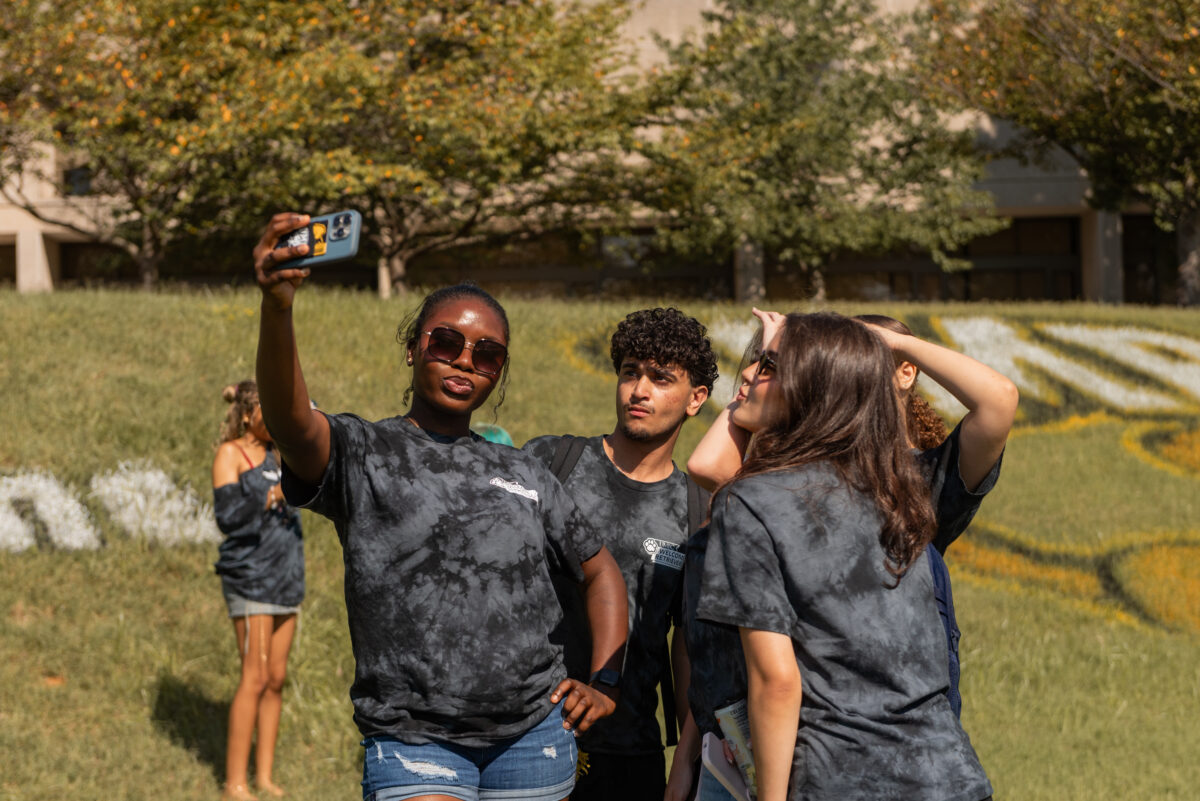
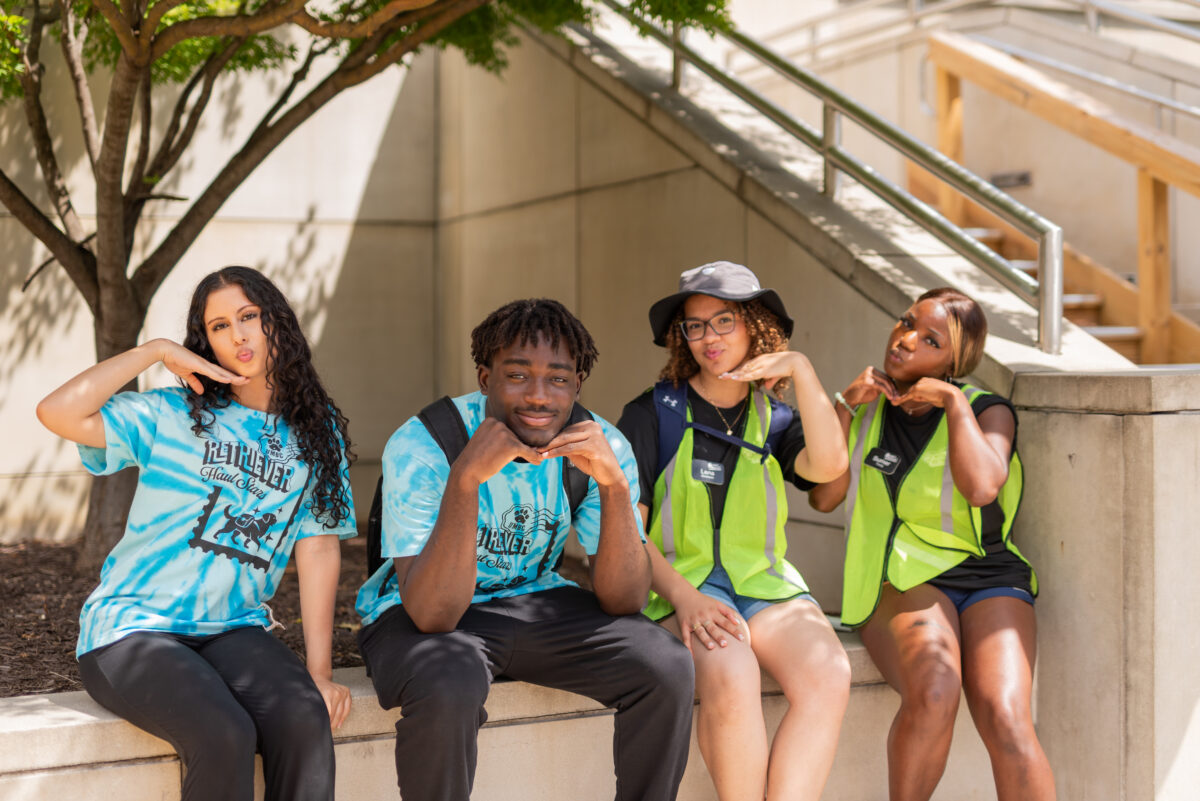
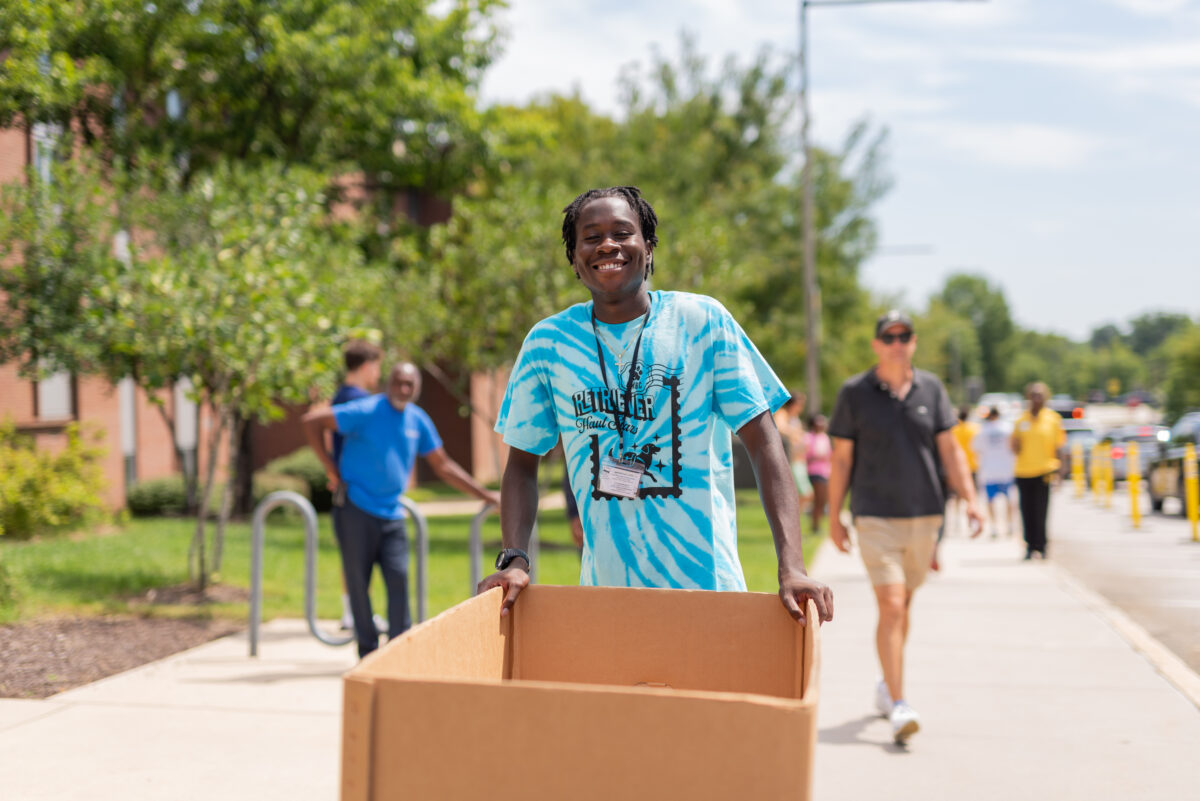
With a full lineup of events, this year’s Welcome, Retrievers efforts ensured that students started to find their place from the minute they stepped onto campus. Student volunteers (“Haul Stars”) were on hand to keep things moving as they helped new students with their belongings and offered directions.
Students weren’t the only ones getting in on the fun. Retriever Fest gave families the opportunity to meet with campus partners and learn more about everything UMBC has to offer—while enjoying refreshments and picking up some swag. Jake Diaz, inaugural assistant vice president and dean of students in the Division of Student Affairs, had a ball welcoming new students.
Throughout the weekend, students continued to enjoy Retriever 101 events, like First Night, an Student Events-Board-sponsored takeover of The Commons with inflatables, prizes, games, and plenty of other activities that cemented the first night as one students will remember for years to come.
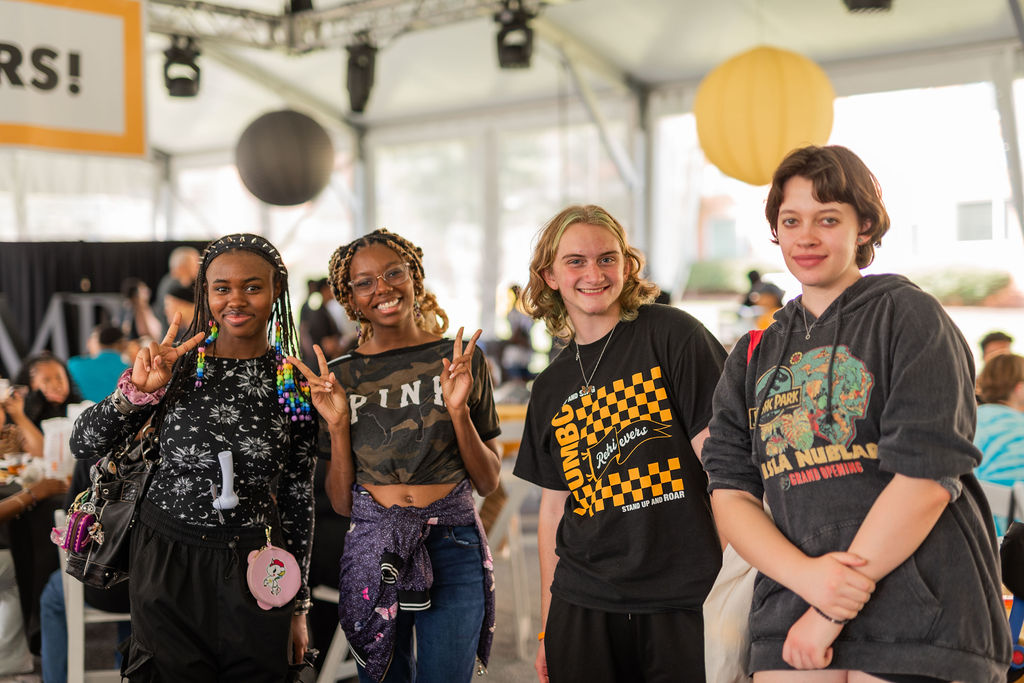
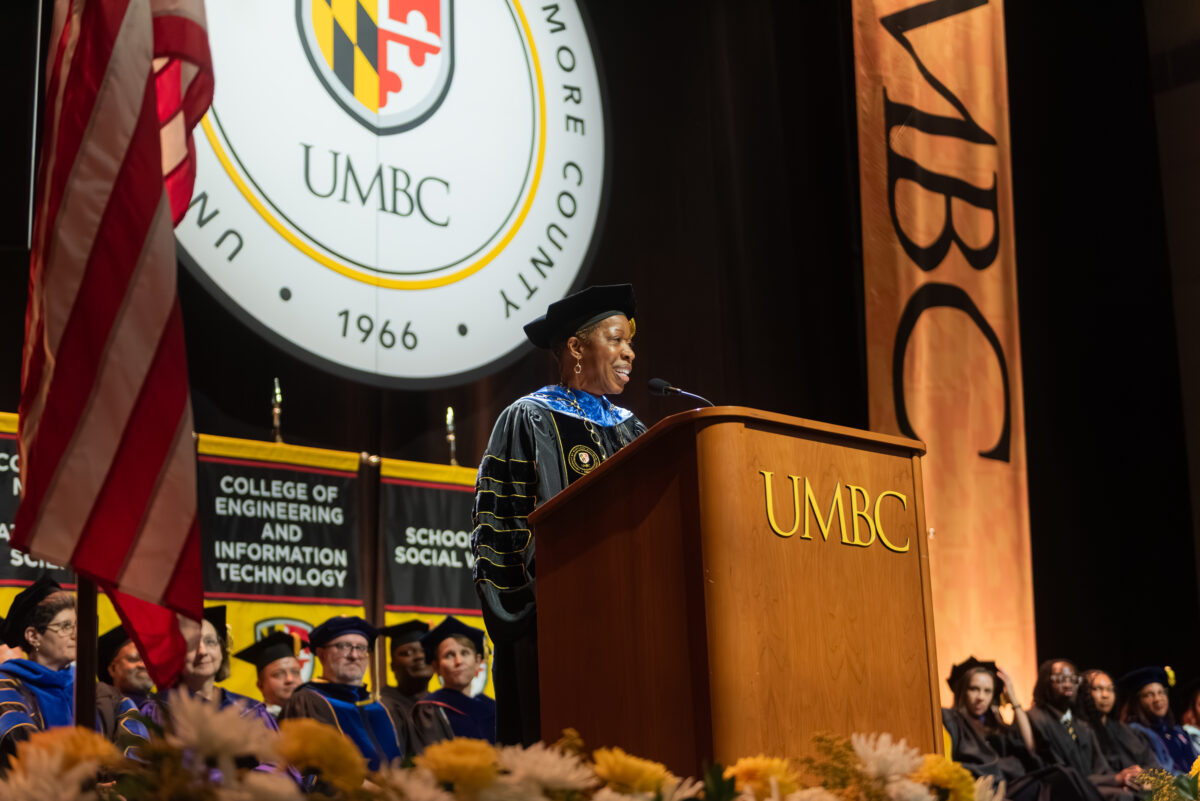
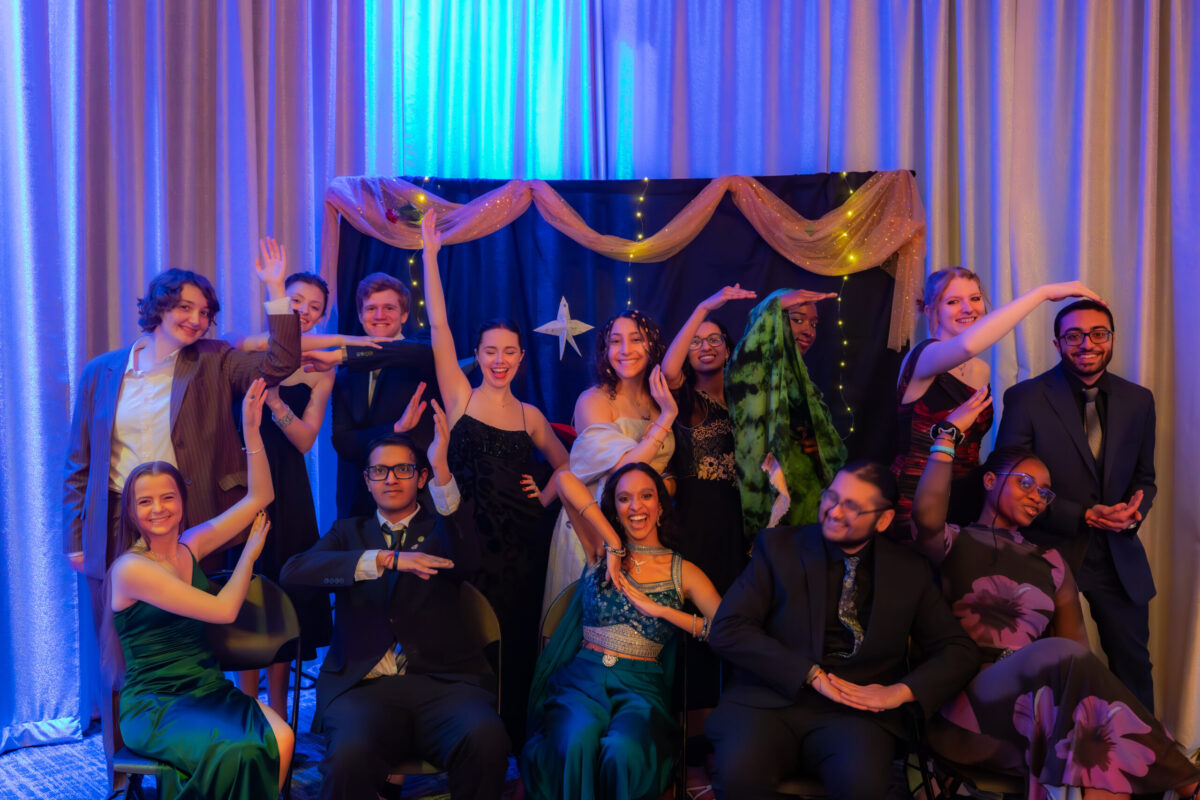
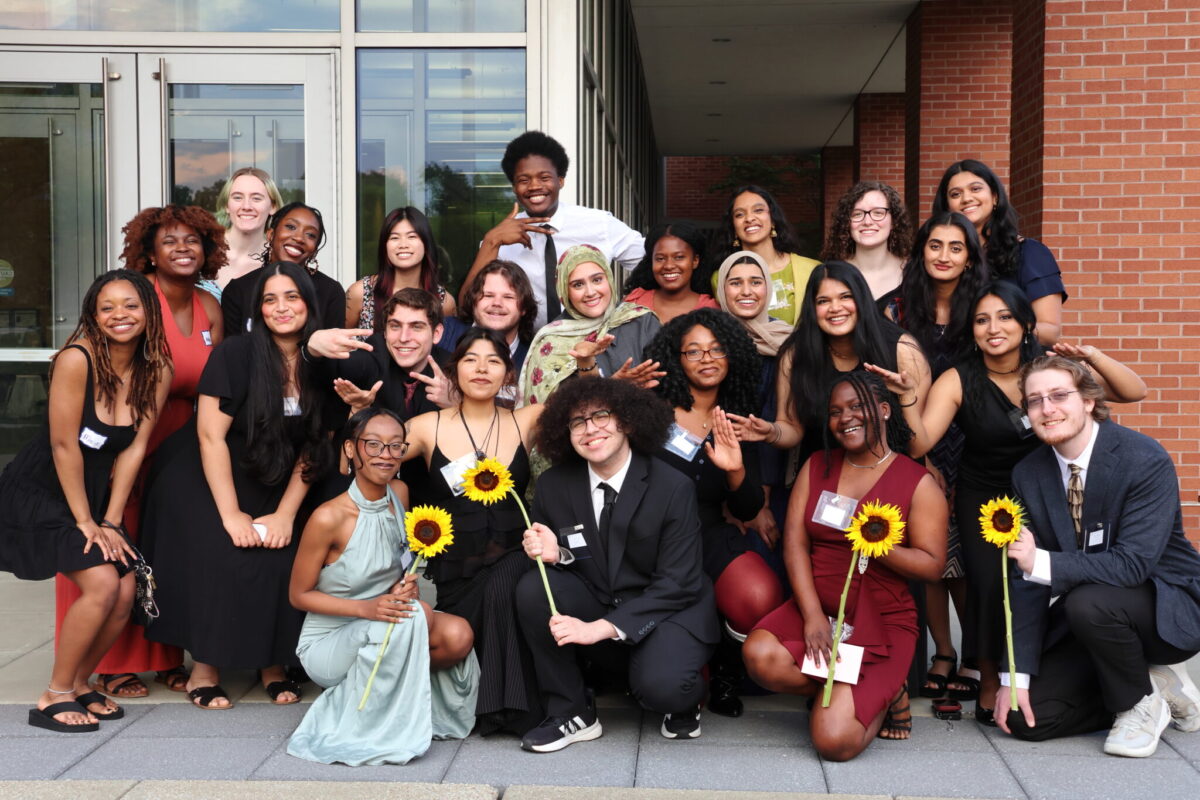
Events like the Taste of UMBC, Your Story Belongs Here, and the annual New Retriever Photo bonded students and filled their camera rolls. The first weekend concluded with Convocation, the official opening of the fall semester. President Valerie Sheares Ashby addressed the new students, reassuring them that UMBC is where they’re meant to be.
“…I want to make sure you hear this from me: You belong here. You have come to an institution that wants you here and believes that you can be successful here, even if you are not yet completely sure of that yourself.”
One of the newest friendly faces recently spotted on campus is Jacob “Jake” Diaz, inaugural assistant vice president and dean of students in the Division of Student Affairs. Jake joined the UMBC community in May, bringing more than two decades of experience advancing student success, community well-being, and inclusive campus environments at public and private universities across the country. Diaz earned a Bachelor of Arts in English literature from the University of California, Santa Barbara, and both his Master of Education and Doctor of Education degrees from the University of Vermont. He is committed to developing a culture of care at UMBC, where students are part of a community filled with resources to help them thrive. He’s also excited to do this work with campus partners. How does he practice self care? What does he love about barbecuing? Read on!
Q: What is the dean of students’ role and what does it encompass?
A: As the dean of students I get to be a part of a team of educators who help students connect the dots of their experience at UMBC. Ultimately, my wish for every student is that they experience all that UMBC offers because it is quite a special place. My office is here to ensure students have the resources to feel supported, included, and empowered throughout their journey here.
Q: What do you love most about working with students?
A: I love to meet them as they begin their academic pursuits and to witness their growth into the human beings they are intended to be.
Q: What has excited you the most so far about being at UMBC?
Diaz hangs out with Renique Kersh, vice president for student affairs (center), and Wendy Low, coordinator in the Division of Institutional Equity, in the Welcome, Retrievers! hospitality tent’s ball pit.
A: I love that UMBC strives to center students each day. It makes me happy to work alongside colleagues who have a deep passion for supporting students. They inspire me to be better each day.
Q: What are your plans to connect and support undergraduate and graduate students and the campus?
A: My initial goals are to raise awareness about what the dean of students’ portfolio of services and programs is and to ensure that students know we are here for them.
Q: What is the importance of campus partnerships in your work?
A: I often think about how any shred of success I have in my role is dependent upon being in a high quality relationship with my colleagues. A dean of students cannot carry out their work in isolation so I would say that campus partnerships is number one for me.
Q: How do we support students in challenging times?
A: Being with a student when they are experiencing life’s challenges is a sacred moment. It is up to us to accompany them, provide resources such as our Retriever CARE team, and be really open to listening to their needs so that we can provide the right type of support to help them stay on track academically and socially. As dean of students, I am proud to connect UMBC students with comprehensive support services designed to promote holistic well-being. Whether in mental health support and basic needs to academic accommodations and inclusive community spaces, our campus offers a robust network of resources dedicated to helping every student thrive.
Q: As a leader, how important is self care to you and how do you practice it?
A: Self care is a topic I would love to talk with students about. It is a daily aspiration for me. My family is a source of support and I love to laugh, watch movies, walk outside and try new things. I plan to take a class to learn how to play pool! I am curious to know what students do for their own self-care.
Q: What do you like to do outside of work?
A: In my life outside of work I love fishing and BBQing. It’s fun to create new flavors of food on the grill. It’s also a relaxing process. Spending time with my daughter and wife is especially restorative for me.
Meet Kyle Clelan, a double alumnus who earned his B.S. in financial economics in 2008 and his M.A. in economic policy analysis in 2009. Today, he serves as a private investments manager with The Johnson Group, building on a successful career with stints at the U.S. Commodity Futures Trading Commission and T. Rowe Price. Kyle is also a Retriever Loyal donor, having given back to UMBC for the past eight years. Take it away, Kyle!
Q: What brought you to UMBC?
A: I was primarily drawn to UMBC because of its academically-centered reputation coming out of high school. I wanted to go to school, study, and work hard so that I could get to my career as soon as possible. Then I found myself surrounded by similarly-minded people and started making some lifelong friendships—many of whom were in my wedding. Meeting so many great people with a vast array of life experiences and backgrounds enhanced my time at UMBC immensely and helped me to slow down and enjoy the journey.
Left: Clelan when he first started at UMBC and lived in Chesapeake Hall. Right: Clelan and his first-year roommate, Matt Basch ’08, M.S. ’09, who became a lifelong friend.
Q: What did you love about the economics programs at UMBC?
A: The economic policy analysis program in particular introduced me to econometric and data science concepts and how they can apply to investment management and policy decision-making. I have used foundational knowledge I learned in that coursework over and over throughout my career. From how to build a model using Stata or SAS, for example, to learning how to organize data and look for anomalies that can help inform better risk management, the courses taught me how to think better analytically and holistically.
Q: Who in the community inspired you or supported you?
A: Doug Lamdin in the Department of Economics was my M.A. advisor, and I also did work with him during my time as an undergraduate. He helped me connect the dots between academia and practice by pushing me to do research with real-world market data. He also introduced me to several professional mentors and helped me find my initial internship at T. Rowe Price, where I spent the first 12 years of my professional career. That experience has been instrumental to where I am today.
Without Dr. Lamdin’s guidance and support, I likely would have never found that pivotal opportunity. And the knowledge I acquired and various investment and technical courses continue to come in handy in roles I have had and have now.
Q: What’s one thing you’d want someone to know about the support you find at UMBC?
A: I came to UMBC expecting a healthy balance of academic rigor and the opportunity to develop lasting relationships and connections. I was not disappointed. UMBC offers a myriad of opportunities to perform meaningful research. Undergraduate Research and Creative Achievement Day, also known as URCAD, is one example that was very rewarding for me to publish my first paper. There are real pipelines that I personally benefitted from to get my career going, which showed me opportunities that wouldn’t have been possible without UMBC. It’s all about being proactive and seeking them out because the resources are there.
“
The UMBC community really engages with alumni and cares how they are doing after graduation.
Kyle Clelan ’08, M.A. ’09
financial economics
Q: Tell us about your current job. What do you like most about it?
A: For the past five years, I was a risk analyst within the Risk Surveillance Branch at the U.S. Commodity Futures Trading Commission (CFTC). I enjoyed performing broad derivatives market oversight work where we published reports on a regular basis to help better inform the public and help markets better manage systemic risks.
For the last year, I have relocated to being nearer to family in South Carolina and am working as a private investments manager for a family office and set of operating companies. In this role, I am applying the investment and risk management knowledge acquired from UMBC and my career, and I am enjoying being part of investment and capital allocation decisions that directly affect investment outcomes that benefit the company and also the local community.
Q: What drives you to support UMBC?
A: Without financial support from aid and scholarships, I likely would not have been able to attend college at all. So, giving back in whatever way I can now is important to me and my family because it could be just the little bit extra that makes all of the difference for someone to make something really special happen.
* * * * *
UMBC’s greatest strength is its people. When people meet Retrievers and hear about the passion they bring, the relationships they create, the ways they support each other, and the commitment they have to inclusive excellence, they truly get a sense of our community. That’s what “Meet a Retriever” is all about.
Annie Byrd ’04, emergency health services, M.P.S. ’23, community leadership, began her staff career at UMBC as an executive administrative assistant and she is now the Career Center’s assistant director for employer relations. She attributes her growth as a leader to UMBC’s supportive environment that encouraged members to make an impact in their communities. Annie says that the community leadership program helped her connect the dots between her undergraduate degree in emergency health services, her experience as a doula—a trained professional who provides emotional, physical, and informational support during pregnancy, birth, and the postpartum period—and her passion for maternal health equity and social justice. She then integrated these values into systems-level change, co-founding the Doula Alliance of Maryland.
Q: What’s one essential thing you’d want another Retriever to know about you?
A: I’ve been part of the UMBC community for over 20 years—as an undergraduate, graduate student, and a staff member. I love building connections, supporting students, and finding creative solutions that help people succeed.
Q: Tell us about someone in the UMBC community who has inspired you.
Byrd, second from left, in May 2026 with the student staff she supervises. “This is why I do what I do—students!”
A: Yvette Mozie-Ross [’88, currently vice provost for enrollment management and planning] saw potential in me before I saw it in myself. As my first supervisor at UMBC, she encouraged me to continue my education and pursue new opportunities. Her mentorship helped shape my journey from executive administrative assistant to assistant director.
Q: Tell us about what you love about your academic program or an organization you’re involved in at UMBC.
Q: What’s the one thing you’d want someone who hasn’t joined the UMBC community to know about the support you find here?
A: What makes UMBC special is that everyone belongs here. It’s an inclusive community that values curiosity, encourages ambitious ideas, and provides the support to help you grow personally, academically, and professionally.
Q: What part of your job do you enjoy the most and why?
A: Student interactions are what I enjoy most. I love helping students discover opportunities, build confidence, and recognize the skills they already have. It’s rewarding to know that even one conversation can have a lasting impact on their career journey.
Q: What brought you to UMBC?
Byrd at the May 2023 graduation ceremony for her M.P.S. in Community Leadership.
A: I came to UMBC as an undergraduate and a student-athlete, and I’ve come back as a staff member because I experienced firsthand how transformative this community can be. UMBC has shaped my life. I met my husband, built lifelong friendships, and found a career where I can help students create their own UMBC stories.
Q: At UMBC, how have you found support for birth work advocacy?
A: The community leadership program faculty and staff helped me turn my passion for birth work into systems-level change. Research shows that doula support is associated with better maternal health outcomes, yet many families—particularly those who have been historically marginalized—face significant barriers to accessing this care. Seeing both the impact of doulas and the inequities in access inspired me to co-found the Doula Alliance of Maryland to expand access and advance maternal health equity. Also, my Career Center colleagues have continued to support that mission, reminding me that UMBC values both professional growth and community impact.
Q: What would you tell someone who is considering a career at UMBC?
A: UMBC is a place where your ideas and potential are valued. It provides opportunities to grow your career while connecting your work to a larger purpose. My own journey from student to staff member shows how UMBC supports people who want to make a difference.
Meet Keisha Hale, M.A.’20, applied sociology. Keisha is an educator, researcher, and author. In 2025, she published We Weather the Storm: A Poetry Memoir of Survival and Healing, inspired by her experiences surviving Hurricane Katrina and navigating foster care. Her work centers on resilience, education, and giving voice to stories that are often overlooked. Whether she’s teaching fourth grade math, analyzing data, or writing poetry, Keisha is passionate about using storytelling and research to create understanding, inspire change, and help others feel seen. Take it away, Keisha!
Q: What initially brought you to UMBC?
A: I came to UMBC because I wanted to better understand the social systems that shape people’s lives and to gain the skills to create meaningful change. After experiencing Hurricane Katrina, navigating foster care, and witnessing firsthand how policies and institutions can impact individuals and families, I knew I wanted to study society in a way that combined research with real world application. UMBC’s applied sociology program stood out because it emphasized using data, research, and critical thinking to address complex social issues.
“
I wanted more than a degree. I wanted an education that would prepare me to serve my community, inform policy, and make a lasting impact.
Keisha Hale, M.A. ’20
Q: Can you tell us what you loved most about the applied sociology program?
A: What I loved most about UMBC’s applied sociology program was its emphasis on using research to solve real world problems. The program challenged me to think critically, analyze data, and understand the social systems that shape people’s lives. It encouraged me to move beyond theory and consider how research can inform policy, improve communities, and create meaningful change.
Q: Can you talk about your experience as a first generation student?
A: As a first generation graduate student, there were moments when I questioned whether I truly belonged. Like many students, I experienced imposter syndrome and wondered if I was capable enough to succeed. What I learned at UMBC is that belonging is not determined by where you come from, but by your willingness to learn, grow, and persevere.
I would encourage other first generation students to not let self doubt convince them they are less deserving of the opportunities they’ve earned. Ask questions, seek out mentors, build relationships, and take advantage of the support systems UMBC has to offer. There are people here who genuinely want to see you succeed.
Looking back, I realize that believing in myself was just as important as earning good grades. UMBC gave me the confidence to trust my abilities, find my voice, and pursue opportunities that have shaped my career as a researcher, educator, and author. I hope other students give themselves permission to do the same.
Q: Were you a part of any clubs or organizations at UMBC?
A: During my time at UMBC, I was an active member of Alpha Kappa Delta, the International Sociology Honor Society, and the Sociology Graduate Student Association. Both organizations gave me opportunities to connect with classmates who shared my passion for research, social justice, and community engagement.
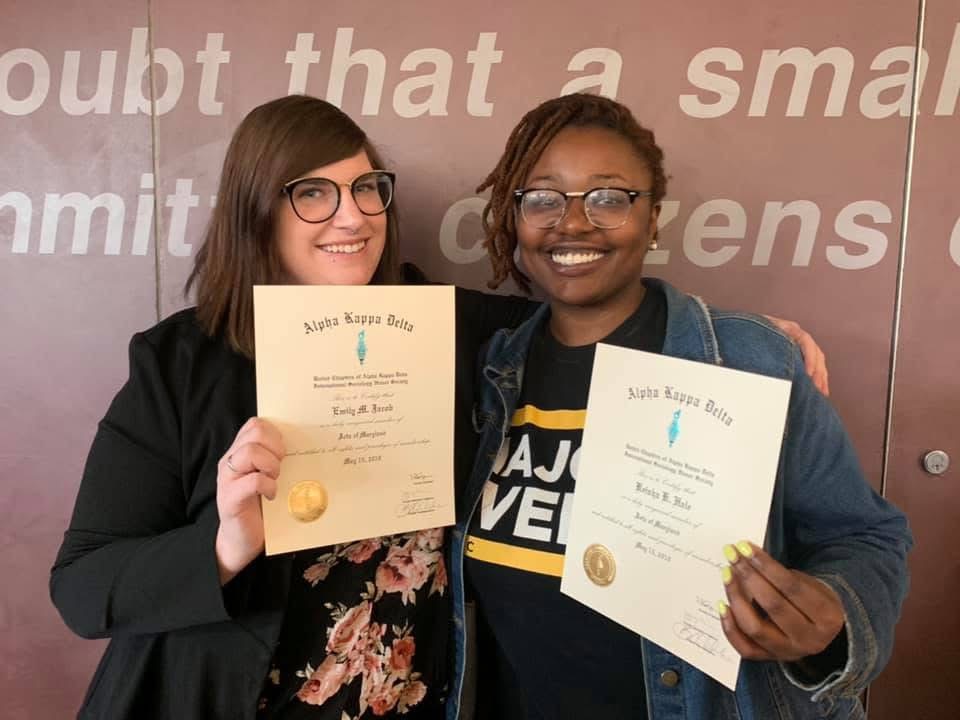
Hale (right) during Alpha Kappa Delta induction. (Photo courtesy Hale)Hale (left) at the Sociology Graduate Student Organization table during UMBC Career Month. (Photo courtesy Hale)
What I appreciated most was the opportunity to learn from one another beyond the classroom. Through these organizations, I built friendships, expanded my professional network, and engaged in meaningful conversations about research, policy, and the role sociology plays in addressing real world challenges. Those experiences strengthened my sense of belonging at UMBC and reinforced my commitment to using research and education to make a positive impact in my community.
Q: Where did you find support while at UMBC?
A: One of the things I valued most about my time at UMBC was the sense of community I found there. While there was not just one person who inspired me, the relationships I built as a graduate assistant had a lasting impact. Working alongside fellow graduate students, faculty, and staff allowed me to develop meaningful connections with people who became mentors, collaborators, and an important part of my support system.
One of those relationships was with my fellow graduate student, Samantha Fries ’18, M.A. ’25. We supported one another throughout our time at UMBC, encouraging each other academically and personally. That friendship has continued long after graduation, and I was honored to stand beside her as a member of her wedding party.
“
Some of the most meaningful parts of the UMBC experience are the lifelong relationships you build along the way.
Keisha Hale, M.A. ’20
Building a trusted, supportive community, whether through biological family or the family we create through friends, mentors, and colleagues, has always been essential to my success. UMBC reinforced that belief by surrounding me with people who invested in my growth both personally and professionally. Their encouragement gave me the confidence to pursue my goals, and those relationships continue to influence the way I approach my work as an educator, researcher, and author.
Q: Since you’ve been a part of the UMBC community, how have you found support for your dreams?
A: UMBC helped turn my aspirations into opportunities by surrounding me with people who believed in my potential and invested in my growth. As a graduate assistant, I gained hands-on experience while building meaningful relationships with faculty, staff, and fellow graduate students who encouraged me to challenge myself and pursue new opportunities.
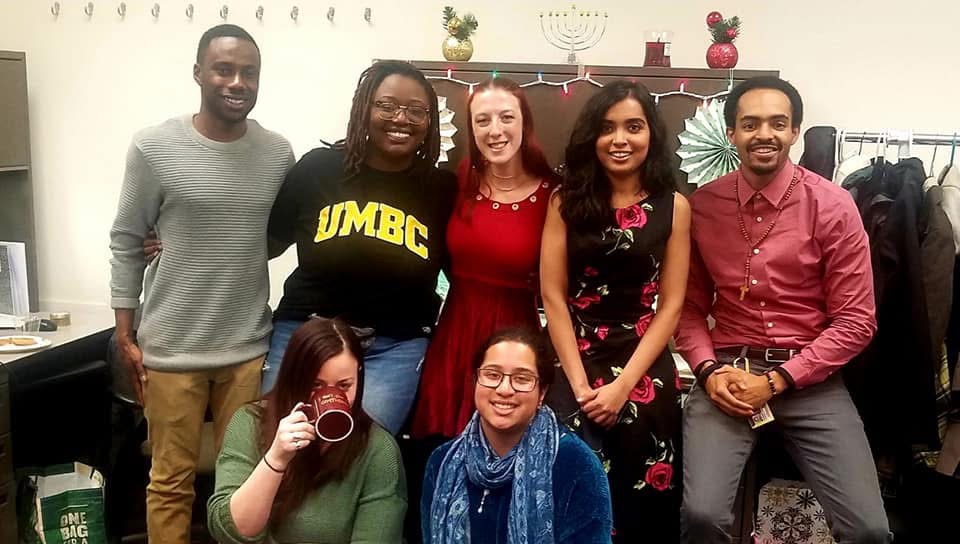
Hale (back row, second from left) and other applied sociology graduate students at a holiday party. (Photo courtesy Hale)
The knowledge and practical experience I gained through the applied sociology program prepared me for a career in research, beginning with my role at Westat, where I supported large scale federally funded studies. Just as importantly, the confidence and encouragement I received at UMBC inspired me to continue growing beyond research. Today, I am an educator, researcher, and author, and I carry the lessons, mentorship, and sense of community I found at UMBC into everything I do.
What has made the biggest difference is knowing that UMBC did not just prepare me academically. It gave me a network of people who continue to encourage, support, and celebrate one another long after graduation. That lasting community is one of the greatest gifts UMBC has given me.
Q: What is a piece of advice you would give a current UMBC student?
A: You never have to navigate your journey alone. UMBC is a place where people genuinely invest in one another’s success. Whether it is faculty who challenge and encourage you, classmates who become lifelong friends, or mentors who help you see your potential, there is a strong sense that everyone wants to see you succeed.
* * * * *
UMBC’s greatest strength is its people. When people meet Retrievers and hear about the passion they bring, the relationships they create, the ways they support each other, and the commitment they have to inclusive excellence, they truly get a sense of our community. That’s what “Meet a Retriever” is all about.
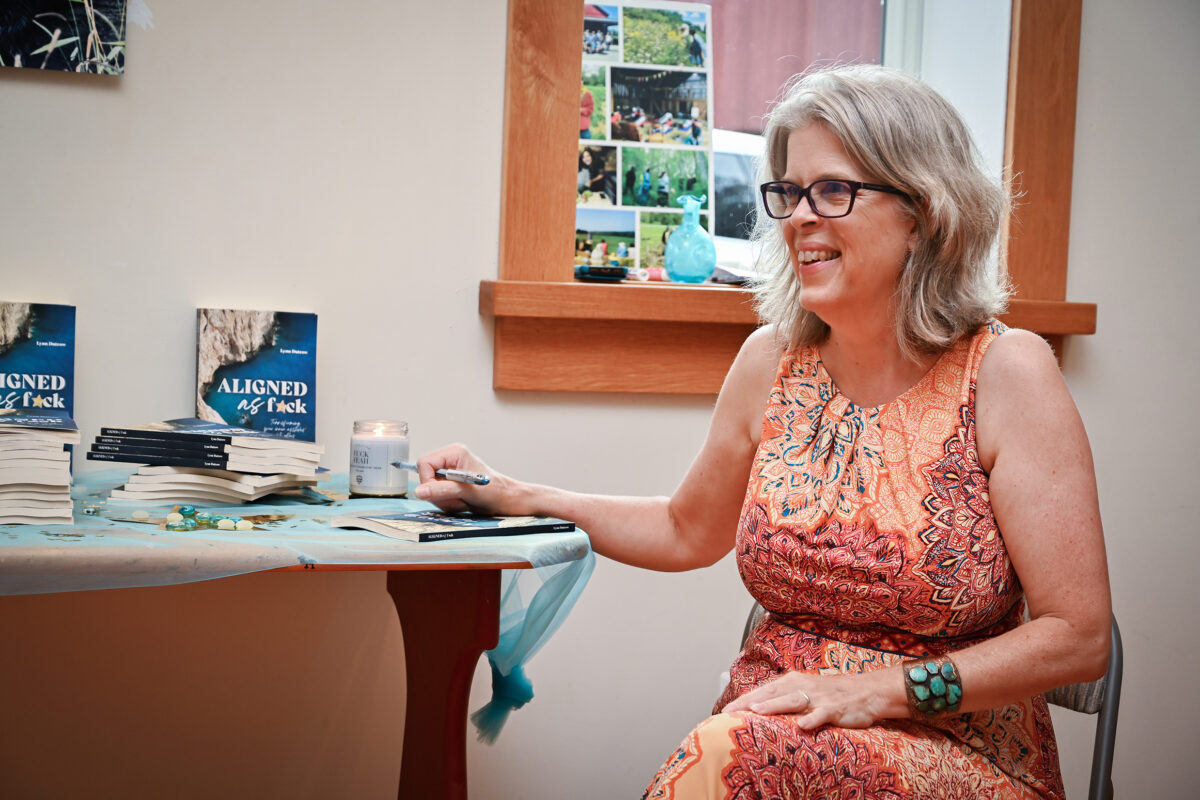
Meet Lynn Dutrow. Lynn graduated from UMBC in 1989 with a B.A. in psychology and a certificate in early childhood education. Since then, she has worn many hats, including counselor, coach, and speaker. In 2022, she added another hat—author—when she published her first book, Aligned As F*ck: Transforming Your Inner Assholes (Like Anxiety) into Allies. Much of her work focuses on anxiety, overwhelm, and creating lives that feel more aligned and less exhausting. Lynn is deeply curious about humans and firmly believes humor belongs in serious conversations. Take it away, Lynn!
Q: What brought you to UMBC?
A: I chose UMBC because it felt like the best of both worlds—it was close enough to home that I could get back when I wanted to, but far enough away that I could have the full experience of living on campus and becoming independent.
I actually didn’t know what I wanted to study. My parents wanted me to study business, but after my first psychology class, I was hooked!
Back then there were three dorms and two sets of apartments, only one of which even had kitchens! Living on campus was an education in itself. Some of my most memorable lessons about human behavior came not from textbooks, but from sharing living space with a variety of colorful personalities. In hindsight, my roommates may have unknowingly contributed to my professional training.
Pictured right: Dutrow on stage at her UMBC graduation.
What I remember most and appreciate, even 40 years later, are the approachable and supportive professors and the opportunities to gain hands-on experience through practicums and internships. Those experiences helped me connect what I was learning in the classroom to real people and real situations, something that has remained important throughout my career.
Looking back, I can see how those experiences laid the foundation for work that has taken many forms over the years: from education and school psychology to counseling, coaching, speaking, and writing. While the specific roles have changed, the common thread has always been a fascination with people and a desire to help them better understand themselves and navigate life’s challenges.
If you had told me in 1989 that my psychology degree would eventually lead me to become a counselor, coach, speaker, and author, I probably wouldn’t have believed you. But the curiosity about people that drew me to psychology in the first place has been the common thread through every chapter of my career.
Q: What do you enjoy most about your current work?
A: Much of my work focuses on helping people navigate anxiety, overwhelm, and the exhausting experience of feeling like they’re constantly fighting with themselves. What I love most is helping people realize they aren’t broken. Watching someone shift from “Why am I like this?” to “Ohhh…this part was trying to help” never gets old.
Q: Can you tell us more about your work as an author?
A: People often ask what motivated me to write my book, Aligned As F*ck: Transforming Your Inner Assholes (Like Anxiety) into Allies, and the honest answer is that I realized I was repeating the same conversations over and over again…with clients, friends, family members, and occasionally random strangers. I wanted to put the information I found myself sharing most often into one place where people could return to it when they needed it.
I also hoped, somewhat naively, that writing the book would mean I could stop repeating myself. It turns out that’s not how humans work. What I discovered instead is that people often need to hear the same ideas many times and in many different ways, and I’m grateful to keep being part of those conversations.
Dutrow at the release party for the author’s first book.
* * * * *
UMBC’s greatest strength is its people. When people meet Retrievers and hear about the passion they bring, the relationships they create, the ways they support each other, and the commitment they have to inclusive excellence, they truly get a sense of our community. That’s what “Meet a Retriever” is all about.
If you want help meeting a big new fitness goal, Manikanta Sirumalla may have the app for you. Manikanta came to UMBC from India as a graduate student pursuing a master’s degree in data science. Since arriving, he’s tapped into the wealth of support for aspiring Retriever entrepreneurs. Several UMBC-affiliated programs and people helped Manikanta as he developed and launched his AI-powered fitness and nutrition app, RepTrack Pro. He tells us what it took to be a student and a solo founder of a brand new venture. Take it away, Manikanta!
Q: Tell us about yourself.
A: I’m Manikanta, an M.S. in data science student at UMBC. I’m also the solo founder of RepTrack Pro, an AI-powered fitness and nutrition iOS app that’s live on the App Store. I’m currently building it out through UMBC’s Launchpad accelerator, and most of my energy these days goes into turning it into a real venture. Three years of iOS development before grad school got me here, but the founder path is what I’m all in on now.
Q: Who are some of the people at UMBC who have most supported you?
A:Masoud Soroush, the director of my graduate program at UMBC, has been a steady source of support throughout my time here. Balancing a demanding course load with building RepTrack Pro full-time hasn’t been easy, and Dr. Soroush has been understanding and encouraging of the path I’m on. Having a program leader who recognizes the value of building something real alongside academic work, and who supports rather than discourages that, has made a meaningful difference in how I’ve been able to pursue both.
Since joining UMBC, the support I’ve found has also gone far beyond the classroom. My growth as a founder has been shaped most by the mentors around me. Chris White, the entrepreneur-in-residence at bwtech [UMBC’s Research and Technology Park], has pushed me to think like a founder rather than just an engineer. Mike Adelstein [’96, biochemistry and molecular biology], with his background in fitness tech, has brought perspective directly relevant to what I’m building with RepTrack Pro.
Beyond individual mentors, the broader community has backed my work in tangible ways. Winning UMBC’s Cangialosi Business Innovation Competition gave RepTrack Pro real funding and validation, and the Launchpad accelerator has given me the structure and accountability a solo founder rarely has access to. What makes the difference isn’t just the resources—it’s that people here take my work seriously and invest in it.
Q: Tell us more about the Launchpad accelerator program.
A: The Launchpad accelerator is the part of my UMBC experience I value most. It’s given me structure and accountability I wouldn’t have on my own—a real framework for validating my business rather than just building features. Working through the business modeling tool Lean Canvas has forced me to question assumptions and to focus on the problems my customers actually have.
What stands out most about the program is the access to experienced mentors and a community that takes early-stage founders seriously. Being a student and a founder at the same time can feel isolating, and Launchpad has been the place where that work gets recognized, challenged, and supported. It’s turned a side project into something I’m pursuing as a genuine venture.
Q: What brought you to UMBC in the first place?
A: I came to UMBC because I wanted to deepen my technical foundation and grow beyond where three years of iOS development had taken me. I’d been building software for others, and I was ready to build something of my own with the data science skills to back it. UMBC’s program offered the rigor I was looking for, but what I didn’t expect was the entrepreneurial support that came with it. What started as a path to a stronger career has turned into the launch point for my own venture.
Q: What would you tell other international students interested in entrepreneurship?
A: As an international student, coming to UMBC meant building a life and a career far from home, often while navigating things such as visas, paperwork, and a new system that domestic students don’t have to think about. What made the difference for me was finding a community that didn’t treat that as a limitation. Through the Launchpad accelerator and the bwtech ecosystem, I’ve been able to build my own venture and be taken seriously as a founder despite being new to the country.
To others in my shoes: Don’t assume the entrepreneurial and professional opportunities here are out of reach because you’re international. UMBC has the people and programs to support you if you’re willing to seek them out. Being an international student shaped my path here, but it never closed doors. If anything, the support I found opened them.
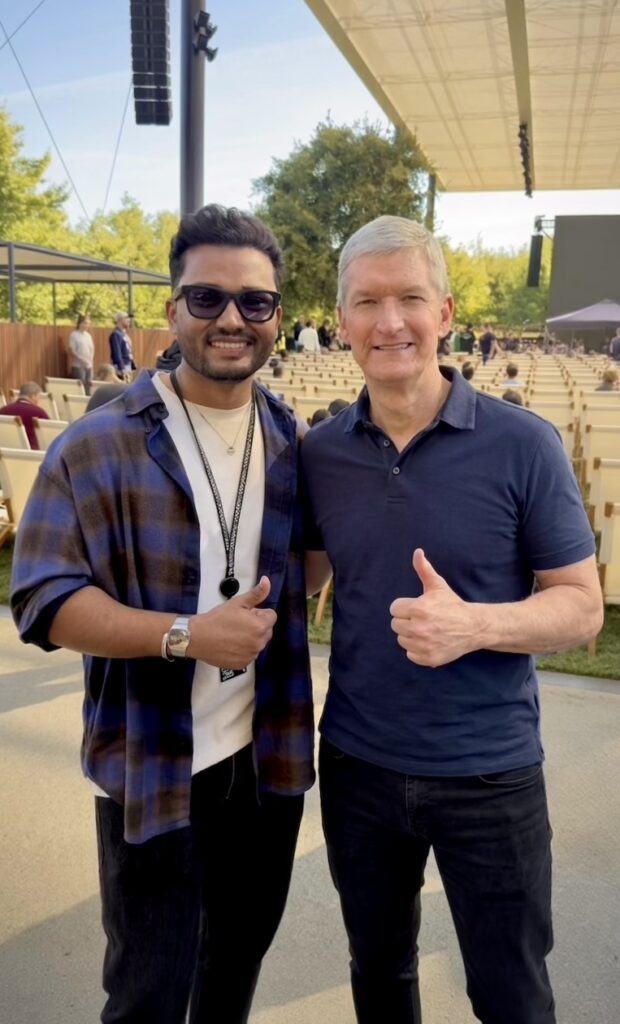
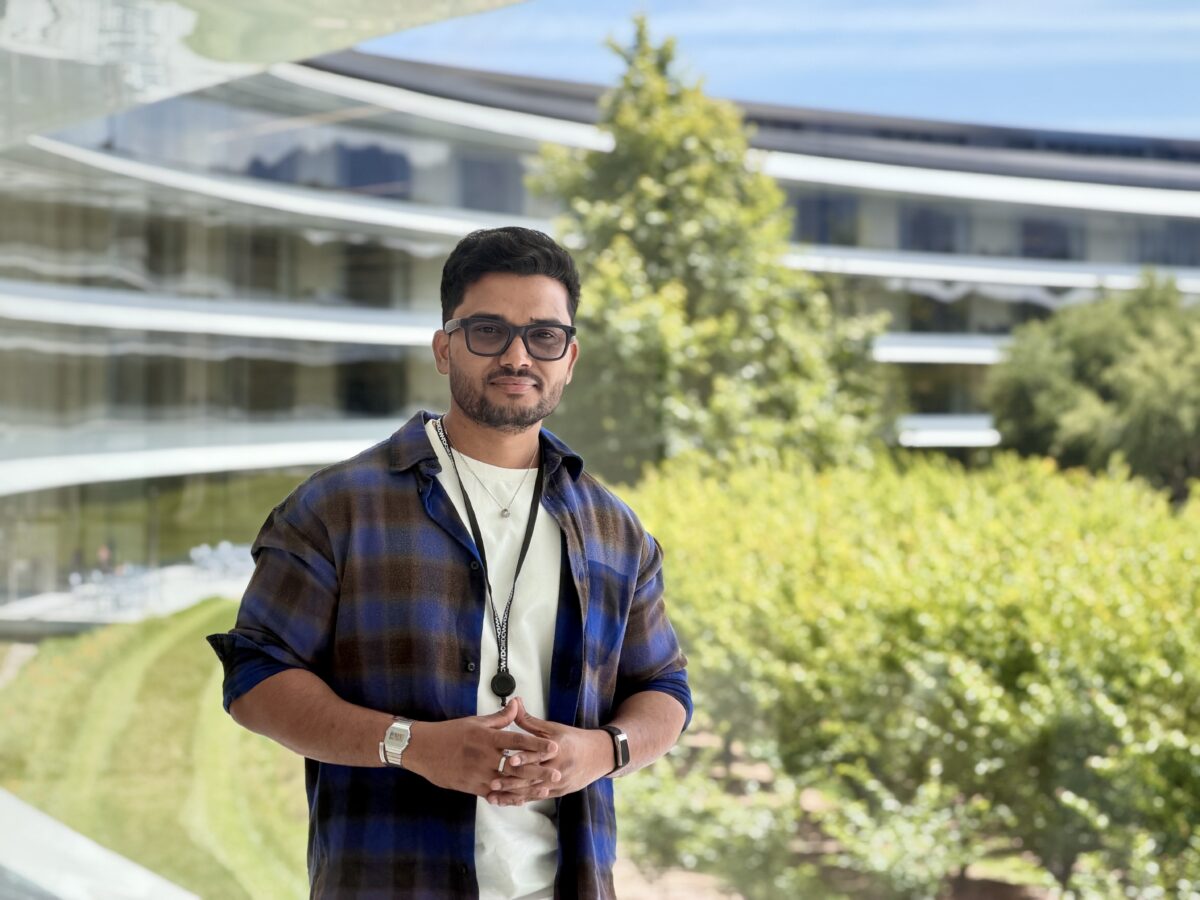
Manikanta Sirumalla at Apple’s Worldwide Developers Conference (left), with Apple CEO Tim Cook (center) and at Apple’s campus in Cupertino, California (right).
Q: What are your plans for after graduation?
A: After I graduate this December, my plan is to take RepTrack Pro full-time. What started as a project at UMBC has become a real venture, and post-graduation is when I commit to it completely growing the user base, launching the Pro tier, and building it into a sustainable business. UMBC’s entrepreneurship ecosystem gave me the foundation to make that leap, and my goal is to turn the momentum I’ve built here into a company that lasts.
Q: How has UMBC helped you get ready for life after graduation?
A: UMBC prepared me for life after graduation in a way I didn’t expect when I enrolled. I came for the technical foundation, but what I’m leaving with is the start of a real company. By the time I graduate, I won’t be starting from zero, I’ll be continuing something UMBC helped me build. That’s the best preparation I could have asked for.
Q: What’s the one thing you’d want someone who hasn’t joined the UMBC community to know about the support you find here?
A: The support here is real and hands-on, not just a brochure promise. As a solo founder, I expected to figure most things out alone. Instead I found mentors who take my work seriously, a competition that backed RepTrack Pro with real funding, and an accelerator that gave me structure and people to lean on. UMBC didn’t just let me build something on the side, it invested in it. That kind of support turns an individual effort into something bigger than what you could do on your own.
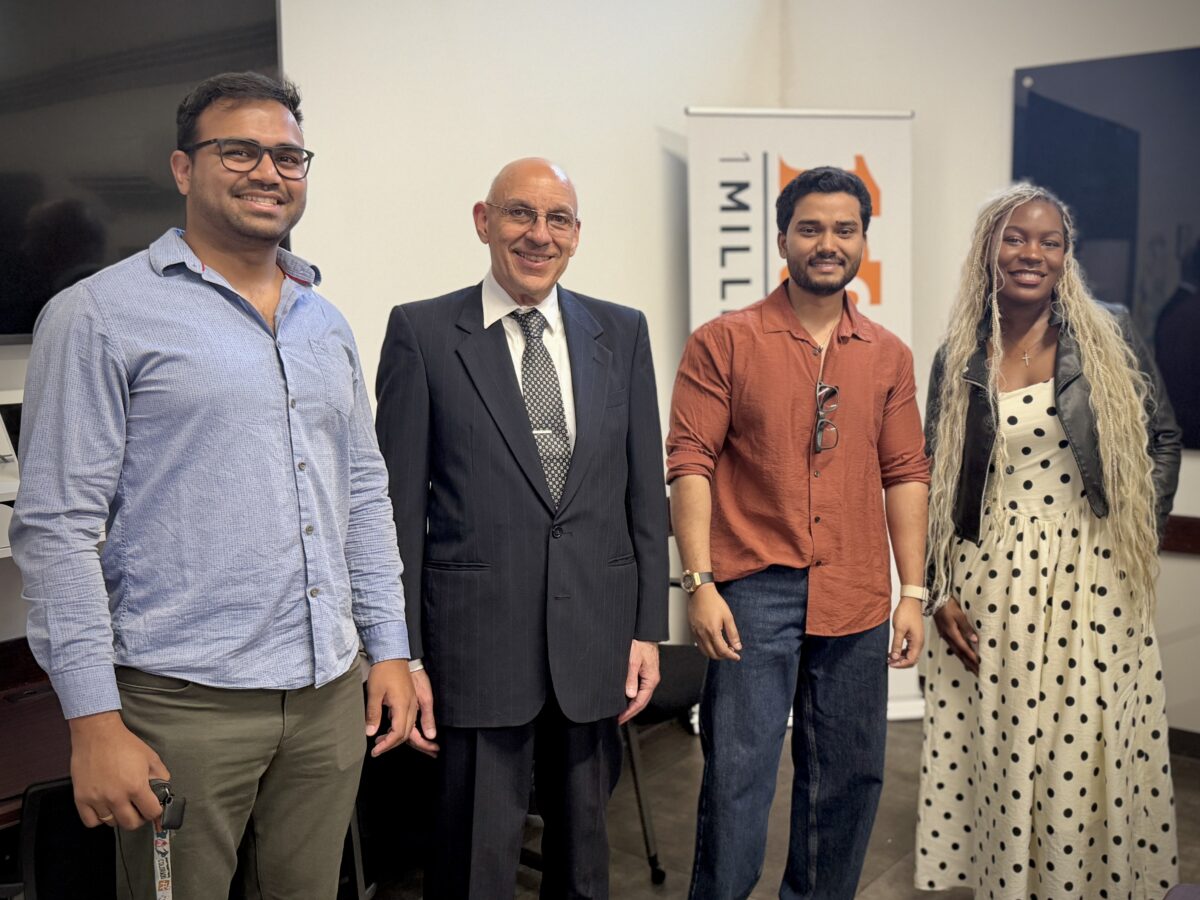
Manikanta Sirumalla (second from right) at a 1 Million Cups Baltimore event, part of a grassroots networking and educational program designed to connect local entrepreneurs with their communities.
* * * * *
UMBC’s greatest strength is its people. When people meet Retrievers and hear about the passion they bring, the relationships they create, the ways they support each other, and the commitment they have to inclusive excellence, they truly get a sense of our community. That’s what “Meet a Retriever” is all about.
If you surveyed UMBC’s Class of 2026 and generated a word cloud, the word “community” would instantly dominate the screen. You might be tempted to dismiss it as a buzzword until you see how many graduating students highlight the communities they found and the communities they made as their defining experience of being a student at UMBC. “I can be myself here and I’m not going to be judged. Community is truly the word to describe UMBC,” says ShawnBearam, Jr., computer science.
Who are the graduates of the Class of 2026?
It’s safe to say they contain multitudes: There’s an engineering management graduate student from India who devoted time to helping Marylanders complete their taxes; an English and political science student who volunteered as an educational and workforce advocate for Baltimore City youth; a mathematician—and Survivor hopeful—teaching game theory and disease modeling to students in Rwanda while also helping them understand the U.S. college admissions process.
What do they have in common? If you meet a Retriever from the Class of 2026, you will walk away from the encounter feeling hopeful for the future. These leaders and educators and entertainers and researchers are making room in the world for each person’s voice to be heard and heeded. We can’t wait to see where they take it from here!
“It’s the people”
If community is the key takeaway from the Class of 2026, where are students finding their niche groups? Vunnathi Ankem, psychology, saw a way to bridge multiple areas together. As a resident assistant, a researcher, and a multifaceted student leader, she has spent her four years both building community and studying its impact on the human experience. From hosting public-service retreats in Baltimore to interviewing members of the South Asian diaspora for her thesis, Ankem’s work bridges the gap between community- centered research and heartfelt advocacy.
Vunnathi Ankem, psychology, looks forward to returning to her classical dancing roots as she heads to India for a nine-month research project through a Fulbright Scholarship.
As a newly awarded Fulbright Scholar to India, Ankem leaves behind a campus made stronger by her leadership and a personal roadmap focused on healing, mentorship, and global research. “When I think about what I’m proud of, it’s not the awards, it’s the people,” says Ankem. “I remember all the people who were there when I needed support—those people meant more to me than any accomplishment. My advice would be to think about what you’ll look back on. It will most likely be community—the people who were there when you weren’t at your best.”
Bearam in computer science was not content to confine himself to one campus community. He puts it plainly: “I found communities where it seemed that everyone was having fun together, and I wanted to be a part of that,” he says. He had roles with the events staff in Athletics, at UMBC’s research and technology park, bwtech@UMBC, and working as a lead
office assistant for the vice president of student affairs. If that wasn’t enough, he also served as a lead resident assistant and a first-year ambassador for the Student Government Association.
“I started to see that I was able to learn so much here,” says Bearam. “I saw people who looked like me in different spaces, and I knew they would be able to understand me, so I wanted to get involved.”
Using the skills he gained in his computer science major, Shawn Bearam, Jr., computer science, will be working as a project analyst for the State of Maryland within the Division of Information and Technology.
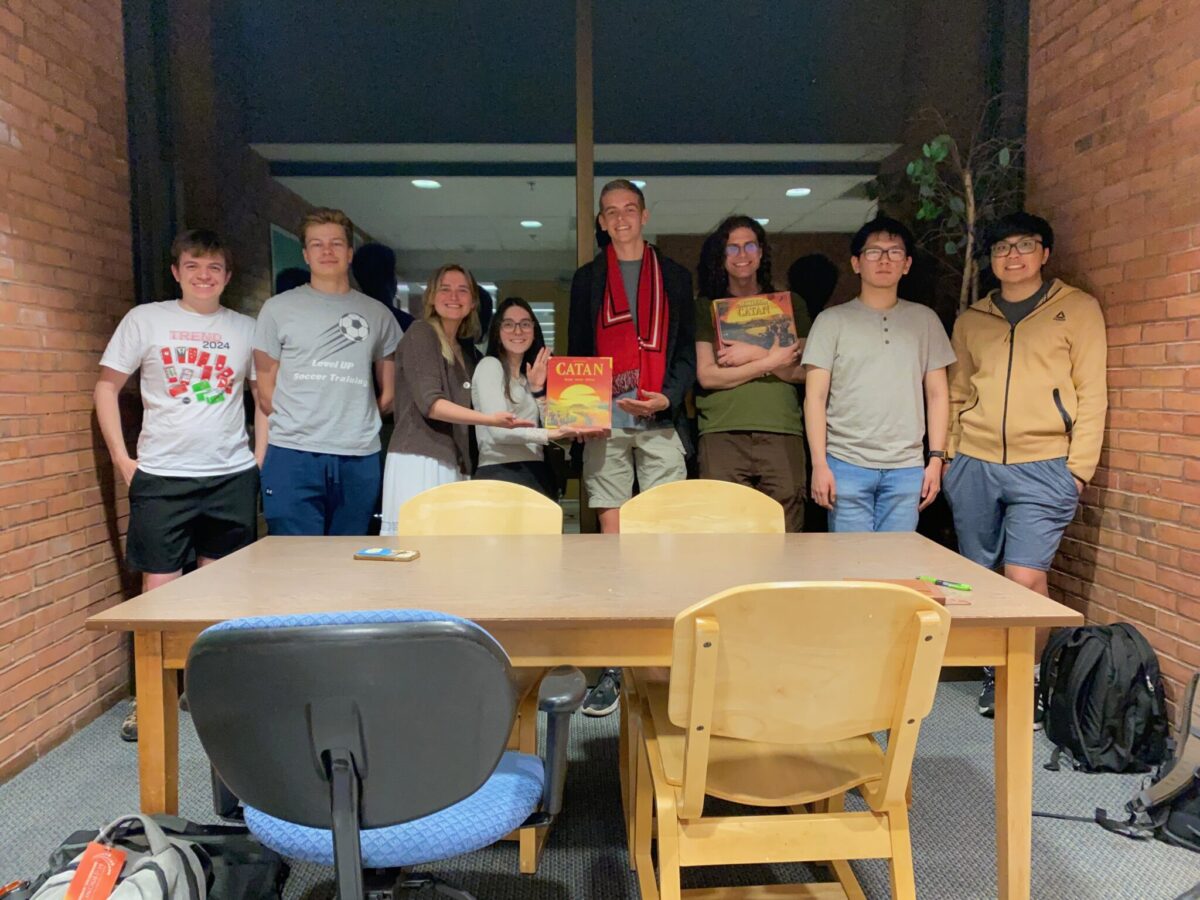
Rileigh Mansfield, mathematics, also made it her goal to build connections across a variety of UMBC communities. As a Meyerhoff Scholar, she served as a peer advisor and conducted research with multiple math professors, “but honestly,” she shares, “some of my most meaningful involvement has been more informal. Last spring, I was having a tough semester when I got invited to join a group from the math lounge to play the board game Catan on Tuesdays. It became a little community and something to look forward to every week—a much-needed step back from school and work. I actually play in competitive Catan tournaments now, and I’m even hosting an official tournament this spring through the math honors society.”
Looking toward sunny California skies, Rileigh Mansfield, mathematics, will start her Ph.D.at Stanford University in geophysics this fall.
“Just see it through”
Often, the defining moment in a student’s successful academic trajectory is a challenge that they can point back to. When Chinonso Ezeobi decided to pack up his life in Nigeria and come to the United States to pursue his Ph.D. in electrical engineering at UMBC, he was thrilled at the prospect of finding a program that would bring him fulfillment. However, financial struggles and the impact of the COVID-19 pandemic quickly threatened Ezeobi’s plans for the future.
“Once I navigated through one challenge, another one came in,” he says. “But at the end of the day, it was worth it. I was able to pull through all of those challenges. I was also able to transition from being an international student to having a green card through self-petition and self-advocacy, so I’m able to graduate without the additional pressure of thinking about my visa status while looking for jobs. My faith and the community at UMBC were essential in navigating through all challenges. The motivation was that I had a community of people who wanted my success, people who I felt would advocate for me even when I’m not in the room.”
Whenever Chinonso Ezeobi, Ph.D., electrical engineering, helps students solve their problems, he says, “I feel that the struggles I have experienced throughout my UMBC journey have given me this capacity to help others.”
Never one to be derailed, Ezeobi found mentors across campus who made it their mission to keep him on the path to his Ph.D. Ezeobi recognized how invaluable their support was and found his own ways to give back to the place and people who gave him so much, including keeping his door open to any students who may need an advocate on their side.
At one point, Maia Turman Cooke, English and political science, was thinking about backing out of her scholar’s program opportunity. In the end, though, she was surprised by how the McNair Scholars Program changed her life. “At the beginning of the application process, it seemed like a lot, and I wanted to quit—I didn’t want to join. The director of the McNair Scholars Program, Dr. Michael Hunt [’06, Ph.D. ’25], called me and said, ‘Just see it through, see it out. If you don’t like it when you get more involved, then you can leave.’”
Maia Turman Cooke, English and political science, will continue to pursue her passions this fall as she embarks on her journey toward a Ph.D. in English at the University of Maryland, College Park.
Turman Cooke processed the expectations of the programs—like pursuing graduate school—while recognizing she had so much to learn about how research worked. “I was so overwhelmed because I thought I had to solve every world problem. But my peers convinced me to stay. Soon, that work became a normal part of my schedule. I had no idea what research was, and now it’s something I’m super passionate about,” says Turman Cooke, who starts her Ph.D. in English at the University of Maryland, College Park this fall.
“A person who needs a path”
Sometimes the way forward is clearly marked, and other times Retrievers forge their own way. Kayla Nemirovsky, mathematics and financial economics, had a love for international travel and a scholarship with the Sondheim Public Affairs Scholars Program but wasn’t sure how those interests combined with her majors.
For once, Kayla Nemirovsky, mathematics and financial economics, won’t be traveling far after graduation. She’ll be staying at UMBC to pursue her master’s in teaching.
Nemirovsky, who is staying at UMBC to pursue her master’s degree in teaching, charted her own route at UMBC as an Education Abroad ambassador, sharing widely with her peers the importance (and accessibility) of studying abroad for any major. Her Sondheim mentors connected her with an internship at the Maryland State Department of Education, and this experience helped her solidify her interest in math education curriculum and policy.
“I’m a person who needs a path,” says Nemirovsky, who has traveled to more than 30 countries and counting. “I realized once I got to college that there’s kind of no more path—I have to make my own. At was really scary to me, so having mentors who can help me make this path…give
me advice and offer suggestions, that was extremely helpful. I really believe you have to choose the people you look up to and kind of aspire to be them.”
Over his two years of graduate study at UMBC, Yash Bhatt, M.S., engineering management, saw his time at UMBC as much bigger than “just earning a degree.” He charted a path to contribute meaningfully to both the university and the greater Baltimore community. As a graduate student, Bhatt arrived at UMBC with an undergraduate degree and professional experience, but he says he was not yet the confident leader he is today.
Building on the experience and relationships he has poured into at UMBC, Yash Bhatt, M.S., engineering management, is exploring career options that will allow him to find impactful work in the United States.
Outside of the classroom, Bhatt dedicated himself to enhancing student life for his classmates. As a member of the Indian Graduate Student Association and the Black and Gold Student Advisory Board, he advocated for international students and contributed to university decision-making. Bhatt also joined two Alternative Spring Break experiences. Starting as a participant and returning as a program leader, Bhatt immersed himself in what he considers a genuine “American student experience,” building local friendships and making connections within local government and community organizations, in addition to the service the participants provided to the community.
“The best part of my UMBC experience has been the people and the sense of community,” says Bhatt. “UMBC has this unique balance—it’s diverse and full of opportunity like a larger university yet still close-knit enough that you truly feel seen and supported.”
Meet Natalie Blank ’08, acting, who started writing novels as a child and continued pursuing her passion for writing while studying dance and theatre at UMBC. To date, the author has published four novels, Rock Bottom Rise (2026), The Mass (2024), The Tangibles (2022), which received the In the Margins Book Award in 2023, and Walking Off Pluto (2014). Natalie primarily writes young adult and women’s fiction, exploring mental health and family relationships. She lives in Maryland with her husband and three children. Take it away, Natalie!
Q: What brought you to UMBC?
A: I came to UMBC as a Linehan Artist Scholar. I remember auditioning for the theatre program with a fairly serious monologue. During the audition, the professors (Xerxes Mehta was my favorite professor) worked with me in a way I had never experienced before. They were able to push me to a level of vulnerability and emotional depth I didn’t know I was capable of as an actress. In that moment, I knew these were professors who understood how to challenge students and help them grow.
Q: How did you grow during your time at UMBC?
A: The Theatre Department had a huge impact on me, both creatively and personally. Through acting, I learned a lot about myself, not just as a performer, but also as a writer. I had the opportunity to portray many incredible characters, and through that process, I realized that storytelling in all its forms (acting in stories, creating stories, and writing stories) was at the core of who I am.
During my time at UMBC, I wrote several plays that were produced and performed. One of those plays eventually became my first novel, Walking Off Pluto, which I self-published in 2014. Since then, I have worked hard to build my writing career and transition into traditional publishing. My current goal is to secure literary representation and publish with a major publishing house.
Blank’s four novels: Walking Off Pluto (2014), The Tangibles (2022), The Mass (2024), and Rock Bottom Rise (2026)
While I only pursued theatre professionally for about two years after college, the lessons I learned have stayed with me and continue to shape my work as a writer. The program encouraged me to explore who I was, challenge my assumptions, and confront some of the fears and weaknesses that were holding me back from reaching my full potential. One of the biggest lessons was learning to take creative risks. In recent years, I’ve become much more willing to take chances and tell the stories I genuinely want to tell, and my readers love it!
Q: Can you tell us about your current job and your work as an author?
A: I’ve always been driven and largely self-taught, figuring out many aspects of my career on my own. After college, I pursued acting professionally, but the pay was inconsistent and often insufficient, so I also worked a day job to support myself. Eventually, I found my way into the school system, and after starting a family, I became a certified teacher. I work part-time as a special education teacher for Montgomery County Public Schools. I miss theatre and dance, but I can’t live without writing. It’s something I’ll pursue for the rest of my life.
Balancing work, writing, and family life is challenging, but I remain committed to my craft. I wake up before my children each morning to write and often return to my manuscript after they’ve gone to bed. I recently published my fourth novel, Rock Bottom Rise, in May 2026.
Blank at the book release party for “Rock Bottom Rise.”
* * * * *
UMBC’s greatest strength is its people. When people meet Retrievers and hear about the passion they bring, the relationships they create, the ways they support each other, and the commitment they have to inclusive excellence, they truly get a sense of our community. That’s what “Meet a Retriever” is all about.
Meet Carlos Carmona ’88, economics. After UMBC, Carlos built a long career in retail and commercial banking before retiring in 2020. Now, Carlos enjoys traveling the world with his wife, Maritza de Jesús, and exploring one of his early passions—storytelling. In 2025, Carlos realized a lifelong dream, becoming a published author with the launch of his debut novel, Unforgivable Sins: A Barrio Story. Take it away, Carlos!
Q: What initially brought you to UMBC?
A: Growing up in Baltimore City in the early ’80s was challenging. The closure of Bethlehem Steel had devastated the city and its economy, and for many young people, the path forward was unclear. The University System of Maryland offered something aspirational at a time when everything around us seemed uncertain.
At UMBC, I was exposed to people from different backgrounds, new ways of thinking, and possibilities beyond Baltimore City’s despair and anxiety. To this very day, I maintain close friendships from those years. In fact, I recently had dinner with Jim Zerr ’89 and his wife. My time at UMBC didn’t just educate me; it gave me lifelong relationships and a broader vision of what my life could eventually become.
Q: What’s the one thing you’d want someone who hasn’t joined the UMBC community to know about the support you find here?
Every journey is different, and I would never presume to define anyone else’s path. What I can share is that UMBC and its professors fostered an environment of openness and understanding. They recognized that academic success rarely follows a single route, and in that understanding, I found the confidence to keep moving forward. They reminded me that what matters most is not how you arrive, but that you keep going.
What has stayed with me most from my time at UMBC is the generosity of my fellow students. People shared their experiences, offered advice, exchanged resources, and opened doors for one another. Friendship and support seemed to appear wherever I turned. Looking back, I realize how fortunate I was to be part of a community that valued collaboration over competition. It is an experience for which I remain deeply grateful.
“
To those who welcomed me, encouraged me, and treated me as a friend, thank you.
Carlos Carmona ’88
economics
When I look back on my life, I do not see absence. I see family, friendship, opportunity, and countless people who helped shape the person I became. In the end, I was never without. If anything, I was blessed with more than I recognized at the time.
Q: Who in the UMBC community has inspired you or supported you?
A: As an undergraduate, Professor Sarah Voight was a guiding light. Though she taught in the Spanish Department and I majored in economics, our shared Puerto Rican heritage gave me something to hold on to, something familiar and relatable in a place that often wasn’t. Her advice and guidance were crucial in helping me continue my studies and ultimately graduate.
Q: Tell us about what you loved about your academic program or an organization you were involved in at UMBC.
A: I loved studying economics, finance, and accounting. I found the subjects as exciting as they were challenging. At the same time, I explored several liberal arts and language courses, which gave me a well-rounded foundation that has served me throughout my life. For many years, I was a financial advisor to Catholic parishes, a role I stepped back from due to serious health issues, though I aspire to return when I’m able.
Q: Can you tell us about your work as an author?
A: I never planned on becoming a writer. I was a banker, a man who lived by numbers, memos, and proposals, not by scenes or plotlines. Stories belonged to other people. At least that is what I believed until life forced me to reconsider what mattered. Cancer did that. Two rounds of chemo. A fight I barely survived. And somewhere in the middle of that darkness, when my world narrowed, something in me shifted. Ideas I had buried decades earlier began to surface. Words I never thought I could write spilled onto the page. It was as if the part of me I had ignored finally demanded to be heard.
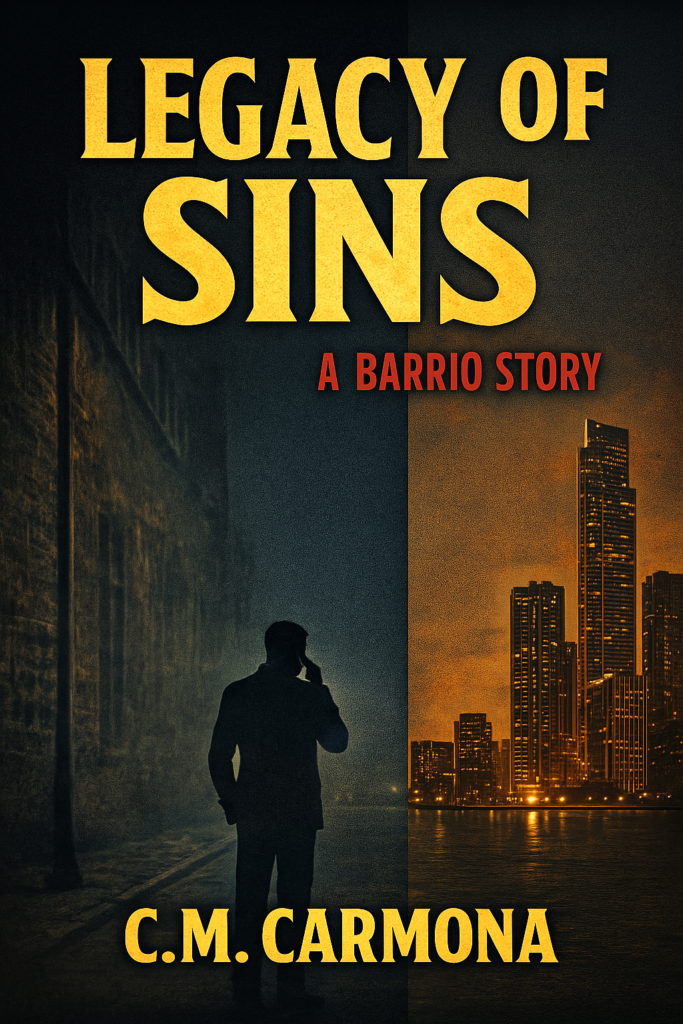
That is how Unforgivable Sins was born, a book that split itself into two stories, A Barrio Story and The Rise of Charlie Green. I self‑published them because no one in the industry was waiting for stories like mine. I knew the audience would be small. I knew the road would be impossibly long. Editors have never shown interest in Latino urban crime fiction, not because the stories lack power, but because the gatekeepers have never known what to do with them. But I also knew these stories were missing from today’s literature. They were missing in 1986 when the idea first came to me at UMBC, and they are still missing in 2026. The absence never changed. I simply reached a point in my life where I refused to let that absence continue.
What I didn’t expect was what came next. The moment I finished those books; a third story consumed me. Legacy of Sins arrived like a storm, pulling both earlier stories forward. Instead of continued editing, marketing, polishing what I had just created, I found myself chasing the next chapter, the next revelation, the next plot twist. Some scenes took forever to finish in all three stories. Not because I lacked the words, but because the memories behind them were too painful. This is all fiction, yes, but parts of it were my life experience. Parts of it still are and will forever be.
Pictured right: The potential book cover for “Legacy of Sins: A Barrio Story” by author Carlos Carmona.
Now the story is almost complete. I’m editing, refining, shaping it the best someone with only their passion can. For no publishing company would. With the lessons learned from the first one, the never‑ending process of self‑publishing. I expect Legacy of Sins to be ready this summer or early fall.
I write because these stories once brought to life refused to let me go. I write because they were missing. I write because survival gave me a second chance, and I refuse to waste it.
* * * * *
UMBC’s greatest strength is its people. When people meet Retrievers and hear about the passion they bring, the relationships they create, the ways they support each other, and the commitment they have to inclusive excellence, they truly get a sense of our community. That’s what “Meet a Retriever” is all about.
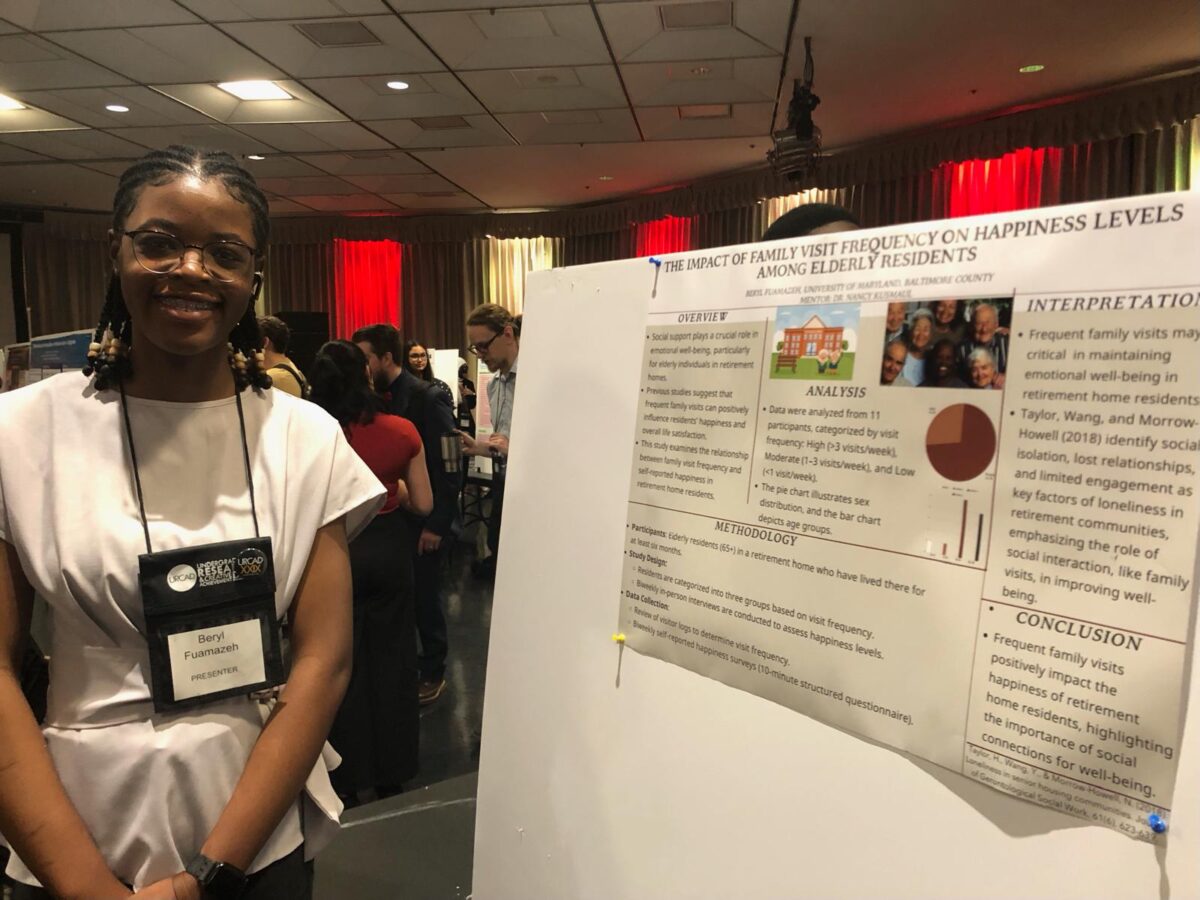
Beryl Fuamazeh ’26, biology, and a minor in health, wellness, and aging, is on her way to Howard University College of Medicine. After connecting with Nancy Kusmaul, professor of social work, Beryl found her research interests piqued by learning more about healthcare and aging care. While at UMBC, Beryl worked as a nursing assistant at a retirement community and volunteered for an organization that supports people with disabilities and older adults. After presenting her research at UMBC’s Undergraduate Research and Creative Achievement Day, she received the Erickson School of Aging Studies Award for Excellence in Undergraduate Research.
Beryl transferred to UMBC from the Community College of Baltimore County through the Degrees to Succeed program, and says that the support and funding she’s received from UMBC has made her education affordable and given her time to focus on her passion: healthcare and aging. Outside of school and work, she loves watching Korean dramas.
Q: Tell us about someone in the UMBC community who has inspired you.
A: Dr. Nancy Kusmaul is my research mentor, and she has been instrumental in my undergraduate research journey. The work she does to support the aging community has deeply inspired me. I have also been greatly influenced by Professor Mary Carter, an English professor here, who taught me how to better express myself through writing—a skill that was invaluable during my medical school application process. The support and guidance both faculty members have given me have truly shaped my experience at UMBC.
Q: Tell us about what you love about your academic program.
A: I’ve really enjoyed being part of the Erickson School of Aging Studies through my minor in health, wellness, and aging. Many of the classes I’ve taken have been meaningful because I can directly apply what I learn to my work as a nursing assistant in a retirement community. My biology major has also given me a strong foundation as I prepare to matriculate into medical school.
Q: What’s one thing you’d want someone to know about the support you find here?
A: Because it’s a smaller university, I’ve been able to build meaningful one-on-one relationships with professors, which has been incredibly valuable. I’ve also loved being surrounded by students who are passionate, driven, and genuinely supportive of one another, especially within the sciences. UMBC is a very supportive community.
Q: What brought you to UMBC in the first place?
A: I wanted to further my education while building meaningful relationships along the way. As someone pursuing the pre-med path, I knew it was important to be surrounded by supportive, like-minded people, and UMBC provided that for me, especially as a transfer student from the Community College of Baltimore County.
I was also drawn to the smaller campus environment, which made it easier to adapt and connect with professors and peers. Through my community college’s Degrees to Succeed partnership program, I was introduced to UMBC and the opportunities it offered, including research experiences, mentorship, and a strong academic community.
Right: Fuamazeh next to her poster at URCAD 2025.
Q: Tell us about the people who are helping you grow at UMBC.
A: Dr. Nancy Kusmaul has been incredibly instrumental in helping me grow at UMBC. She helped me kickstart my undergraduate research journey, which initially felt very daunting. All it took was reaching out to her by email, and she was immediately supportive and responsive. She took time out of her busy schedule to help me develop an individualized research study focused on aging, a topic that has become deeply meaningful to me and the communities it impacts.
Q: How have you connected with the community?
A: I have been involved in community programs, like volunteering with the Trusted Ride Program at Ascension Saint Agnes Hospital, which supports older adults and individuals with disabilities by helping them get to medical appointments safely. Experiences like this have allowed me to stay connected to the community while pursuing my interests in healthcare and aging.
Q: What would you tell others who are in your shoes about UMBC?
A: I transferred to UMBC from the Community College of Baltimore County, and through scholarships and financial support, including merit-based awards, UMBC helped ease the financial burden of pursuing higher education, which allowed me to focus more on my academics and future goals. I also felt well supported as a transfer student through the Degrees to Succeed program, even before officially transferring to UMBC. The transition felt smooth, and I always felt like there were people willing to help guide me along the way.
UMBC’s greatest strength is its people. When people meet Retrievers and hear about the passion they bring, the relationships they create, the ways they support each other, and the commitment they have to inclusive excellence, they truly get a sense of our community. That’s what “Meet a Retriever” is all about.
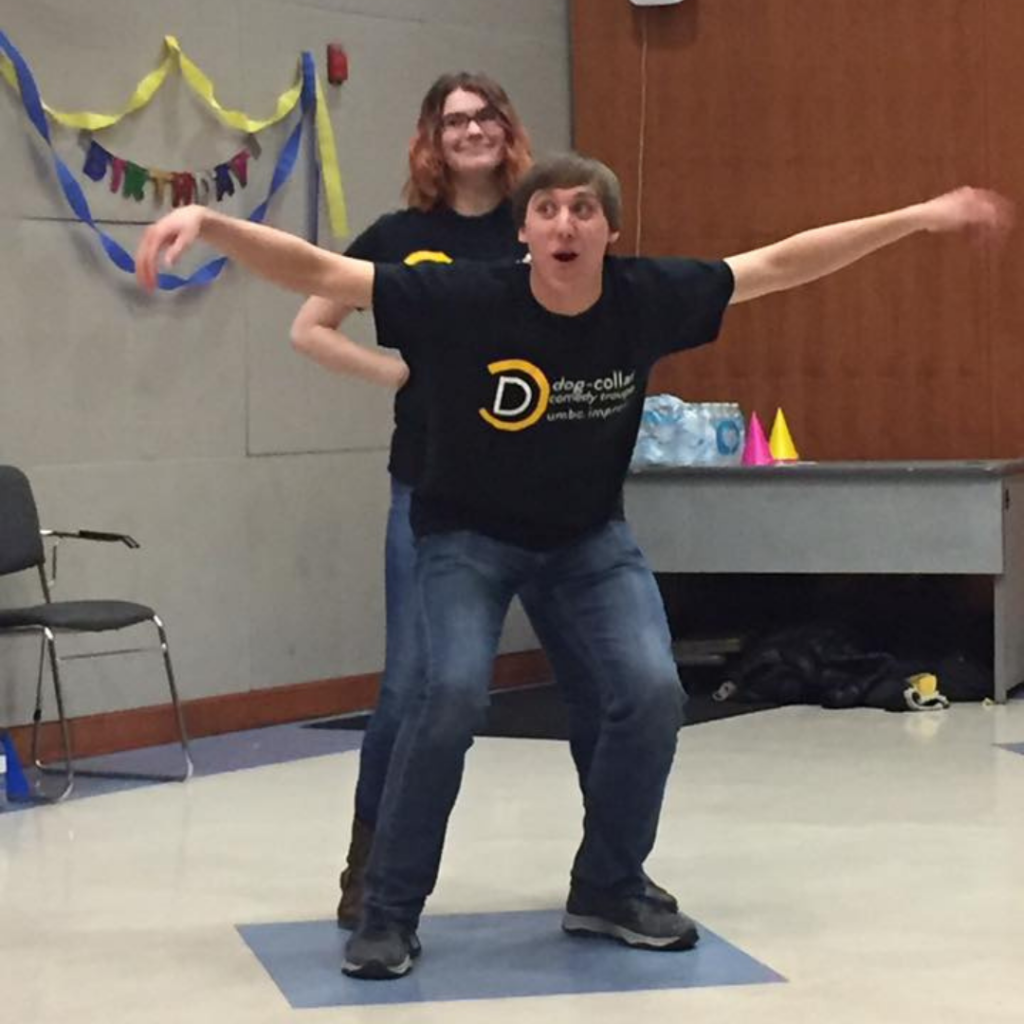
Meet Michael Cook ’20. While at UMBC, Michael majored in information systems with a minor in statistics. Outside of the classroom, he was a member of UMBC’s improv troupe, Dog-Collar Comedy, eventually serving as the group’s president. Today, Michael is a senior business intelligence analyst for Johns Hopkins University. But recently, Michael put his improv skills to good use once again when he turned a Dungeons & Dragons mistake into the idea behind his first book, He Who Speaks Out Of Turn, which the author published in May 2026. Take it away, Michael!
Q: What initially brought you to UMBC?
A: The big drivers for me were cost, convenience, and reputation. Of all the schools I applied to, UMBC gave me the best scholarship (in the sense that I had the least amount of tuition left over to pay myself), so it was the most affordable. In terms of convenience, UMBC was actually a shorter drive from my house than my high school was. This meant I could keep my part-time job and visit home whenever I wanted, which was most weekends, if nothing else than for the free laundry. Finally, I knew UMBC had a great reputation. I knew people, such as my own older brother, who had graduated from the school and gone on to successful jobs right out of college.
“
UMBC is full of opportunities. Take them and try something new!
Michael Cook ’20
information systems
Q: Who in the UMBC community has inspired you or supported you?
A: While at UMBC, I worked in the Admissions Office as a tour guide (now called Grit Guides). One of the most valuable lessons I learned there was to communicate through stories rather than facts. Prospective students typically don’t care about statistics; they’re more interested in hearing things like, “In my second semester, I met my best friend at Salsarita’s.”
So, without realizing it, the Admissions Office trained me to think narratively and to look for the story in everyday events and present it in a way that would engage an audience. While I was never inspired to author a fantasy story specifically, my time in that position helped storytelling become second nature. That mindset probably helped me turn my D&D accident into a story in the first place. Which reminds me, I should shout out the Dungeon Master (DM) for that session: Thanks, Skip!
Q: Tell us about what you love about your academic program or an organization you were involved in at UMBC.
A: Other than the Admissions Office, I was also involved in UMBC’s improv team, Dog-Collar Comedy. We practiced once or twice a week and put on a show each semester, but it never felt like work. It felt like I was just hanging out with friends, which is really what it became over the years. One of the things I love most about the group is how we’ve maintained a strong community, even after graduation. We still keep in touch and get together as we can. In fact, many improv alumni were among the first people to order copies of my book!
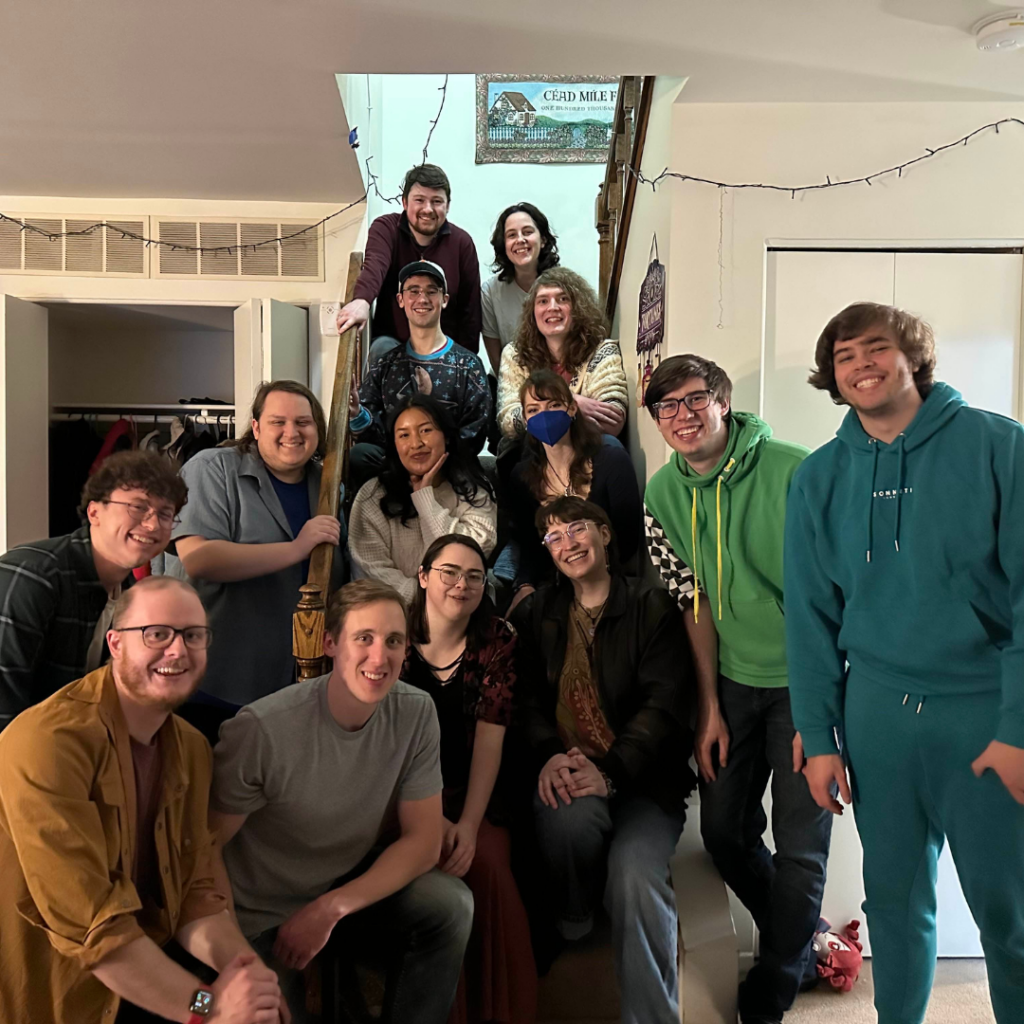
Pictured above: Cook during an improv show when he was a student (left). Cook at a recent Dog-Collar Comedy alumni Christmas party (right).
Q: How did UMBC help prepare you for your next steps after graduation?
A: My coursework directly prepared me for the kind of technical work I do for Johns Hopkins now. The information systems program places a strong emphasis on SQL, which I use daily in my work. Even subjects that don’t directly apply to my current role, such as networking, gave me a broader understanding of how technology systems fit together. Just as important were the professional skills or “soft skills.” UMBC taught me how to manage my time, communicate effectively, and take ownership of my work. In my current position, I’m expected to work independently, balance multiple projects, and speak directly with customers. Because of the habits and skills I honed at UMBC, the transition from student to professional felt natural from the start.
Q: Can you tell us about your journey as an author?
A: He Who Speaks Out Of Turn began with a mistake. During Covid, I had participated in a D&D campaign virtually, where I accidentally created a typical medieval-era wizard character for a futuristic campaign. That sparked the idea of a time-traveling wizard who accidentally strands himself far in the future. Of course, the story morphed to be much more than that, but that is where it began.
In the intervening five years, I worked on the story with no intention to publish; I wrote 500 words here and there as I got spare time. I’ve always enjoyed stories, and when I was younger, I wanted to be an author, so it was a natural hobby for me. I moved multiple times and got married, and the story followed me through these different phases of life and grew as I did. One day last summer (2025), I typed the final word and finished the story. It was one of those moments where I paused and felt like, “Well, now what?” I had an entire story written, so I decided to look into publishing it. I worked with an editor to clean up the story and some friends to design the cover and map. By this spring, five years of writing, revising, and collaboration had transformed that hobby into a published novel.
People have asked me if the characters are based on people I know. The truth is, the core characters are just different aspects of my own personality; some of them are the best of me, some the worst, some who I aspire to be, and some who I never want to be. While I’ve never traveled through time or slain a dragon, I’ve felt the same loss they have, given into the same impulses, and made the same mistakes. I learned a lot about myself while I wrote this story, and I had a lot of fun with it. I hope people enjoy reading it as well.
Pictured right: Author Michael Cook holding a copy of his debut novel, He Who Speaks Out of Turn.
* * * * *
UMBC’s greatest strength is its people. When people meet Retrievers and hear about the passion they bring, the relationships they create, the ways they support each other, and the commitment they have to inclusive excellence, they truly get a sense of our community. That’s what “Meet a Retriever” is all about.