All posts by: Magazine Editor


Faculty Unleash Their Inner Coach

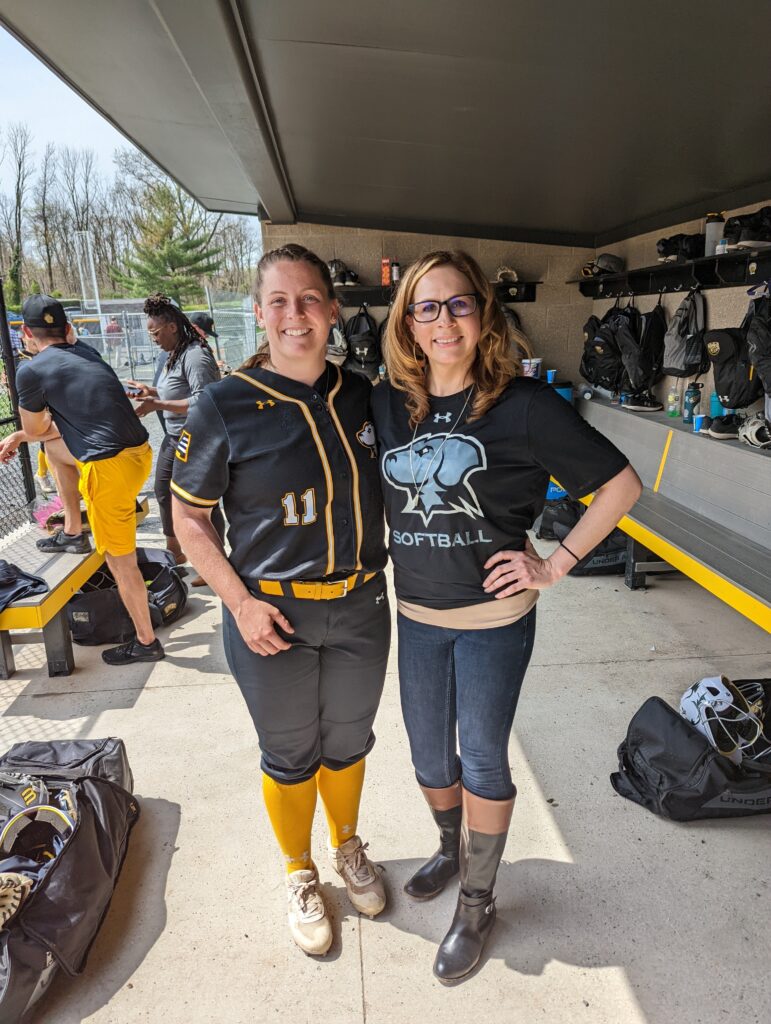
In spring 2022, UMBC softball swept all three tournament games to win their third America East championship. The Retrievers held their opponents scoreless, becoming the first team in conference history to achieve this milestone. And no one cheered louder for their success than Jamie Gurganus, faculty in engineering and computing education and mechanical engineering. Decked out in softball gear (and now with a championship ring necklace gifted from the team engraved with “Prof. G”), Gurganus ’04, M.S. ’11, Ph.D. ’20, mechanical engineering, ended her inaugural semester as honorary faculty coach to the record-breaking team on a high note. (UMBC Softball would go on to nab a fourth consecutive America East championship in 2023.)

But beyond cheering on their successful teams, how do honorary faculty coaches “coach” their teams? Enter Adriana Mason, associate athletic director for academics, who originally envisioned the role of “faculty liaison honorary coaches” lending their expertise to UMBC’s 17 Division 1 teams—maybe not moving magnets around a tactics board and giving game instructions but providing another listening ear and being a loud member of the cheering section.

“The goal is to foster and strengthen the relationships between athletics and academics. Sometimes there can be a disconnect, so we really wanted to try to build that bridge,” explains Mason, who initiated this program alongside Athletic Director Brian Barrio.

Since spring 2022, each UMBC athletic program has had its very own faculty coach. While “coach” may be in the title, squad selection, tactics, and practice plans are still in the hands of professionals. 

A softball player stands in a dugout with an honorary faculty coach
Gurganus with Logan Hawker ’22, catcher on the UMBC Softball team.

When she met the softball team, Gurganus (known as “Prof. G” to many) made it a point to ask each team member. “‘Who are you? Tell me about your major.’ I blocked out time to figure out who every single person was.”

“You have to be the initiator because sometimes they don’t know how to approach you,” says Gurganus. “I came down wearing a softball shirt, and I’m like ‘I’m one of you.’” 

“When we were assigned her, I thought it’d be like the university saying, ‘Hey, professor, you have to be the honorary coach.’ But when she’s coming in so often and actually talking to us, and complimenting us, we can tell she actually wants to be here,” says first-year softball player Mikayla Bryant, chemical engineering.

 It’s not only about the winning moments—Gurganus is no fair weather fan. During a recent tough moment for the team, “she showed up,” shares Bryant. “It wasn’t like she was forced to be there, but she had some words of advice for us and that was really nice. At that moment everyone was like, ‘Wow, she’s really here for us.’”

Coaches have also witnessed the benefits of the initiative. “We have several students who have a close relationship with her and, more as a mentor or a sounding board for different things going on in their own lives,” says UMBC softball Head Coach Chris Kuhlmeyer, who has led the team to four consecutive championships.

Honorary faculty coaches have their own reasons for wanting to participate in the initiative. 

“Honestly, there are research centers that if I wanted to do pure research, I could go do that,” explains Jeff Leips, honorary coach of the UMBC swim and dive team and biological sciences professor. “But when I’m sitting here alone in my office thinking about science, and then I go talk to the team, that’s a great break.”

For Leips, the chance to get out of his office and “doing what I can to promote learning in whatever environment that I can,” is what taking on this role has been all about.

“It definitely changed my thinking about how to facilitate the learning environment for athletic students,” says Gurganus.

Even though the faculty coach initiative is still in its infancy, Leips and Gurganus see the potential for UMBC to continue leading the way in student support. “We can come together to help support these students in a bigger way, and a very non-traditional way, unlike any other university, I think,” says Gurganus.

— Eric Widemann ’21

Meet a Retriever—Hope Weisman ’14, M.A. ’18, transfer student advocate

Meet Hope Weisman ’14, psychology, M.A. ’18, applied sociology, a Transfer Academic Advocate and member of the UMBC community for 10 years and counting. As a transfer to UMBC herself, Hope has found the perfect professional role for herself at UMBC’s Academic Success Center. Thanks for sharing your story, Hope!

Q: Tell us about your primary why, and how it led you to UMBC.

A: I came to UMBC as an undergraduate student because it felt like it was the right fit for me. I was transferring from a local community college and I had never even been to UMBC. I did a campus tour with my mom and I knew from that moment that this was the environment I wanted to be in. UMBC checked all the boxes I wanted in a place of higher education. I wanted an environment that would challenge me academically and provide me with the tools and resources to be successful. As such, I took ownership of my undergraduate career and utilized the many opportunities for me on campus and continued my studies in the Graduate School. Now, as a professional staff member, I can definitely say I made the right decision applying to UMBC all those years ago. My life would be surely different without UMBC! 

Q: How did you transition from transfer student to transfer advocate?

My world at UMBC is transfer related—all day, every day! As an undergraduate, I served as a Transfer Student Network Leader in Off-Campus Student Services (OCSS). I wanted to share my own experiences as a transfer to help other students with their transitions to UMBC. Now, I get to do that in a professional role as the Transfer Academic Advocate in the Academic Success Center.

Q: What part of your job do you enjoy the most and why?

A: As my title is ‘Transfer Academic Advocate,’ it is no surprise that my favorite part of the job is getting to work with our transfer students! I get to work with a population that is so near and dear to my heart to provide them with the resources and support so that they can achieve their goals and dreams, just like I did. I love getting to hear their stories and help them along on their UMBC journey. Getting to see them walk across the stage and have a huge smile on their face brings me so much joy.

Additionally, I enjoy the connections I have made by working with fellow campus partners together to best support our students. I also have to give a shout out to my fantastic team in the Academic Success Center who deeply care about student success AND have fun doing so!

Q: What’s the one thing you’d want someone to know about the UMBC community?

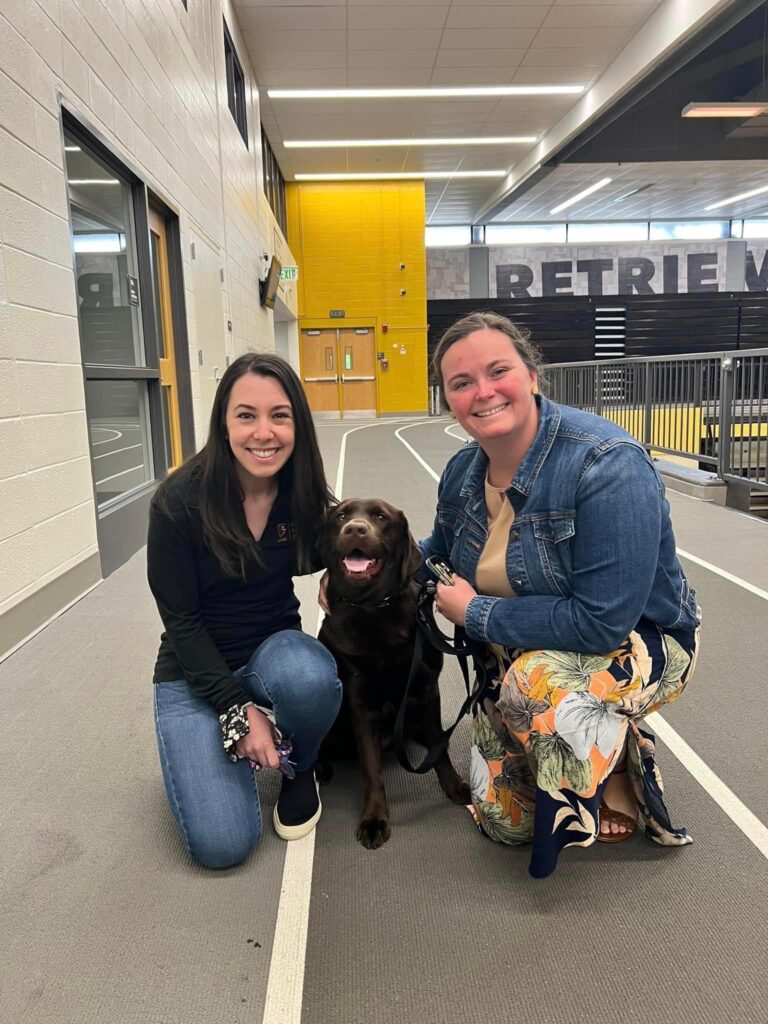
Two women kneel next to a brown dog. Both help transfer students succeed at UMBC.

A: Relationships are everything at UMBC. From my own experience, I have gained some of the most incredible friendships (one of my bridesmaids!) and partnerships. I value relationships and partnerships that foster a supportive and collaborative community to best support our students. 

Relationships are everything at UMBC.

Hope Weisman

I would also like to share that UMBC gives you the opportunity to grow. When I started as a student, I was very shy and introverted. However, I took the steps to come out of my comfort zone and try new things. For example, I signed up for a public speaking course and served as one of the Transfer Student Seminar (TRS) Peer Leaders. I wanted to become more confident and these opportunities have been helpful as I continue in my professional role. 

Q: Tell us about someone in the community who has inspired you, and how they did it.

A: There are many people at UMBC who have inspired and supported me during my time here. Many of my former professors, supervisors, and colleagues have each fostered learning opportunities in order for me to grow and develop as a student and a professional staff member. I’m grateful for each person who has helped me get to where I am today. 

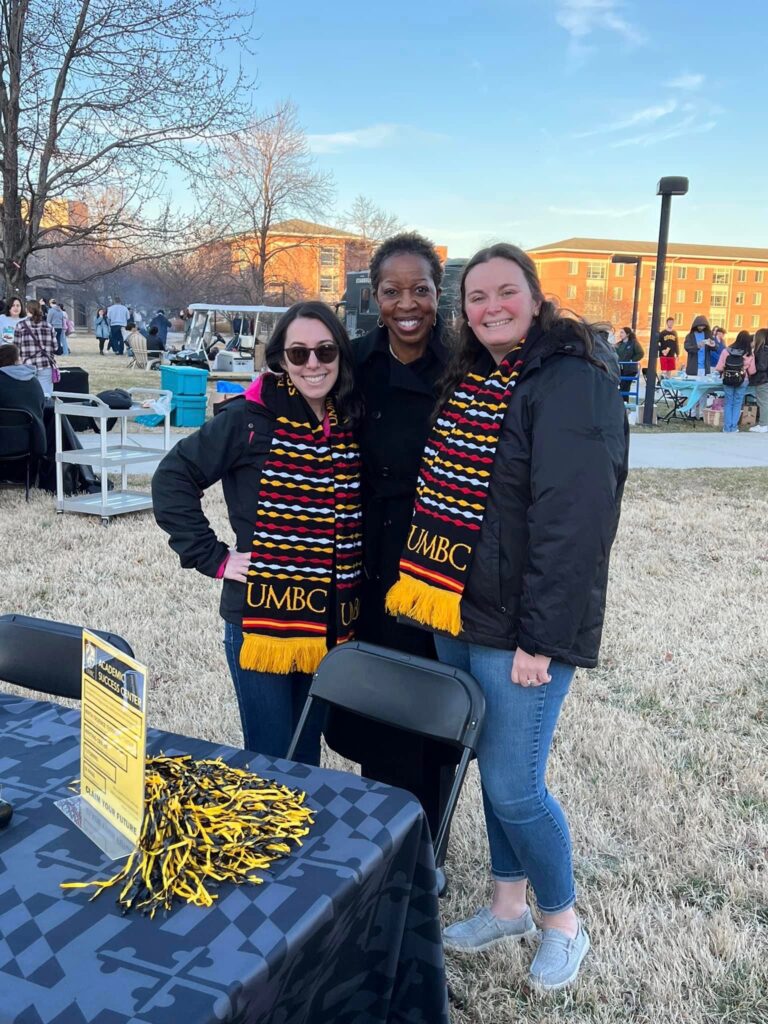
Three women stand shoulder to shoulder on a winter day.
Weisman at an Academic Success Center event with colleague Alison Larsen and UMBC President Valerie Sheares Ashby.

Specifically, I’d like to recognize two UMBC community members who have helped pave the way for me at UMBC. Christine Mair from the Applied Sociology Program advised me as a graduate student. Dr. Mair encouraged me to explore my own academic/educational interests, and always provided unwavering support during my master’s program. Second, Amanda Knapp, associate vice provost and assistant dean, has provided endless guidance and support to me within the Academic Success Center. She has allowed me to grow professionally and has always believed in me. Most notably, Dr. Knapp always creates an environment where I feel supported and always pushes me to succeed. I am truly grateful! 

Q: Are you involved in any campus organizations? Tell us about what you love about them!

A: This past year, I served as a mentee for the Professional Staff Senate. It was a wonderful experience and I enjoyed getting to have a mentor who was a fantastic support. I’m also involved in the Financial Literacy Education Committee which works to provide resources and educational tools for financial wellness—a topic that is of interest and importance to me having worked in the Office of Financial Aid and Scholarships! Additionally, I serve on many different transfer-related committees where we work together to create initiatives that will best support our transfer student population.

Q: What would you tell someone who is considering a career at UMBC?

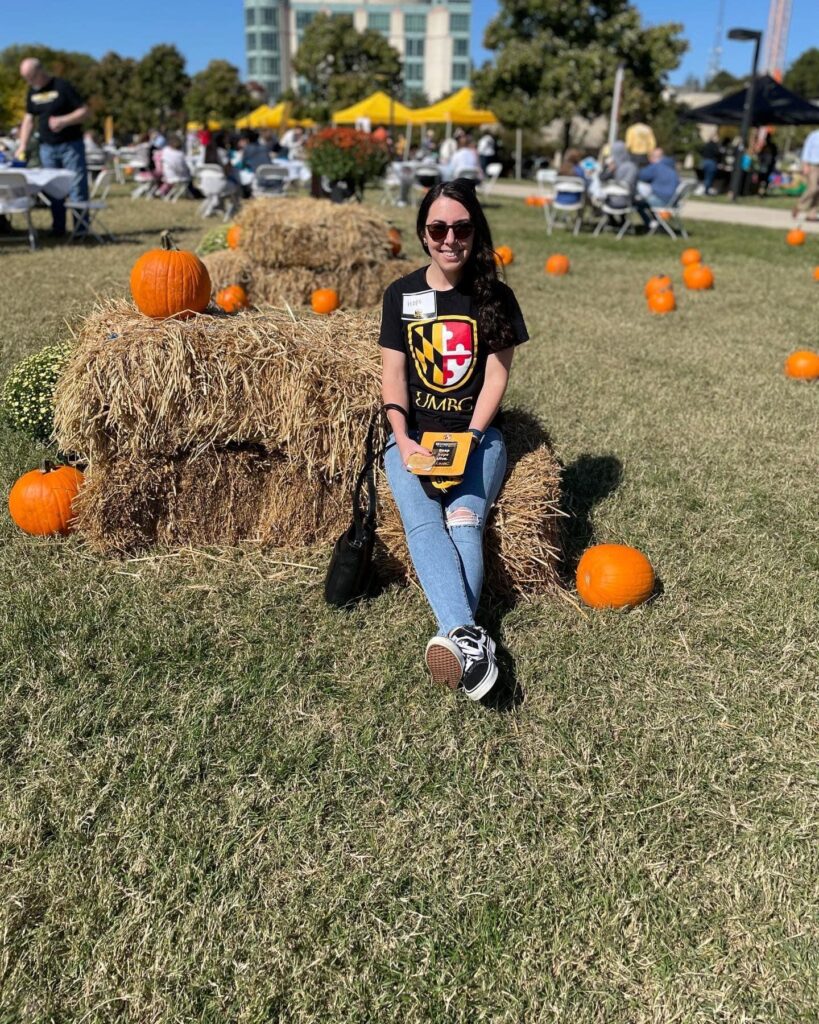
A woman in sunglasses sits on a haybale surrounded by pumpkins.

A: UMBC was a great place for me as a student and continues to be a great place to be as a staff member. I value the relationships and connections I have formed that continue beyond UMBC. I appreciate that every day is a brand new day and I have an opportunity to learn and grow within my role. I have been a part of the UMBC campus for ten years and I’m looking forward to what the future brings us!

*******

UMBC’s greatest strength is its people. When people meet Retrievers and hear about the passion they bring, the relationships they create, the ways they support each other, and the commitment they have to inclusive excellence, they truly get a sense of our community. That’s what “Meet a Retriever” is all about.

Learn more about how UMBC can help you achieve your goals.

Office Hours

Each week, UMBC President Valerie Sheares Ashby invites students to her office hours to chat about their lives and their experiences at UMBC. Today, she’s speaking with Viridiana Colosio-Martinez ’22, modern languages, linguistics, and intercultural communication, and M.A. ’24, intercultural communication, who emigrated from Mexico and is currently working on community-engaged research with immigrant communities in Baltimore’s Highlandtown neighborhood. Read more about Colosio-Martinez’s life and work in Shared Stories, Shared Purpose.

UMBC Magazine: Viridiana, you have such a compelling personal story. When you first met Dr. Sheares Ashby, what was the most important thing you wanted to convey to her about your story and why?

Colosio-Martinez: President Sheares Ashby has been very inspiring to me. Because in my experience as a student and also as a Latino woman in the U.S., through the many institutions I’ve attended…I haven’t seen the presence of women, especially in positions like this. For me, it’s really inspiring and it gives me hope as a woman to know what is possible, because sadly in our society, we’re still dealing with a lot of discrimination and misconceptions.

Having this opportunity is really important. It makes me feel that any student—no matter if you’re Latino, or if you’re African American, or if you are Haitian American, or Asian, or international—can have the opportunity to meet people in power. You can connect and mak bridges and share your needs and experiences.

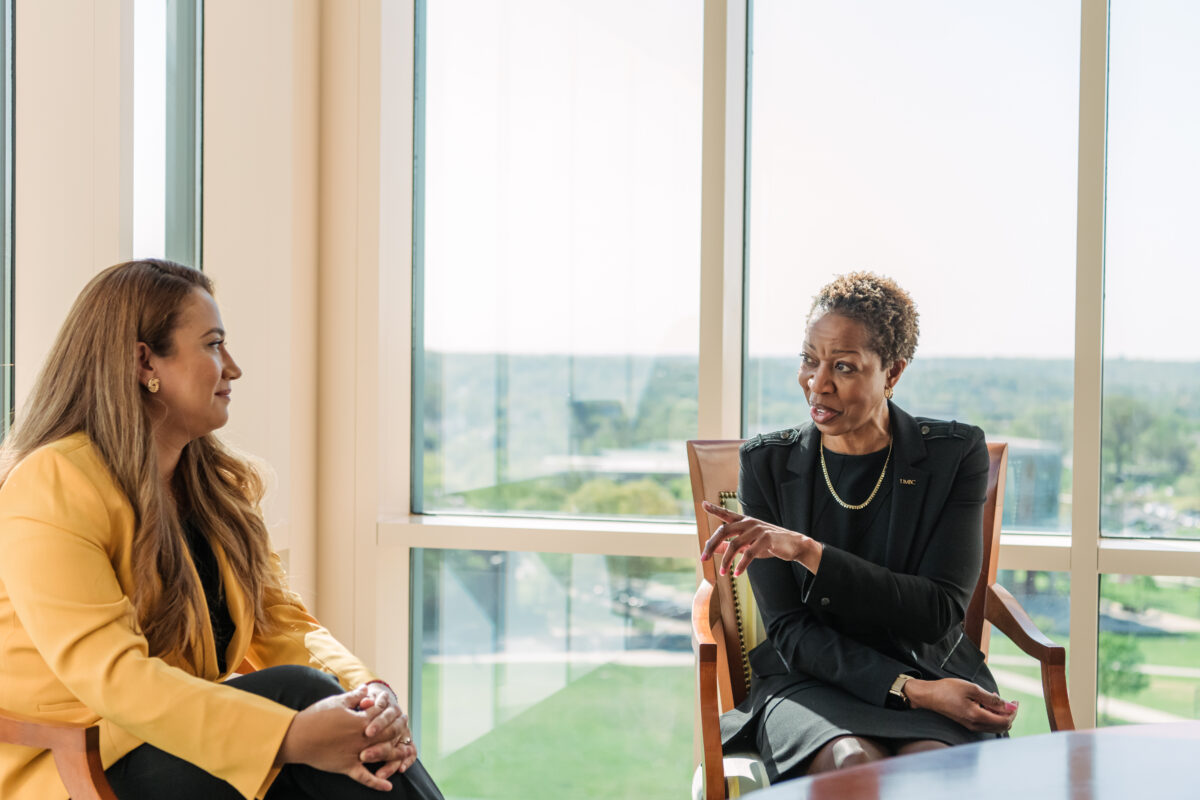
President Sheares Ashby has set aside time weekly to speak with students through her office hours. (Marlayna Demond '11/UMBC)

UMBC Magazine: President Sheares Ashby, you’re meeting with many students in your first months here through your regular office hours and in other ways. How does it impact you as a leader to get to know people on an individual level? 

President Sheares Ashby: I am a teacher at heart…it is in my heart and my mind. I love teaching because it gives me the opportunity to look for greatness in my students and then help them see it for themselves. And so, I love it when a student comes to me and I can get to know who they are, where they come from, and how I can be supportive.

I am sitting here looking at you [Viridiana] thinking, “Okay, who is she going to become? And what is possible for her?” And the fact is, everything is possible. She is going to run and she is going to make a big difference in the world. And now I can ask myself, “How can I support her and help her do that?” That is what my brain is always doing. And so, I love it. I love when students come to me.

Colosio-Martinez: I feel like you’re very approachable. In September, there was a meet-and-greet for the Latino/Hispanic Faculty Association. I was there supporting my professors, and I saw you there talking with every single person. I saw how you wanted to give us space and recognize our community. 

UMBC Magazine: You’re finishing up your master’s degree, Viridiana, and like the president, you’re a teacher. What will you take from UMBC with you after you graduate?

Colosio-Martinez: I would like to become a professor. When I have my office hours with students now, I’m always thinking the same thing: “Who are they? And do they need help with anything?” I want to help others…I would like to continue with my research in the Latinx community, to make space for the wonderful stories of people who are doing good things and all the challenges that our communities experience.

And what will I take with me? I will take all the passion, all the knowledge from my professors and mentors, like my mentor Tania Lizarazo, and all of the skills. I will take the friendships of my classmates…and the wonderful experience of teaching undergrads. I’m taking every single experience and I will remember every single student, and I’m taking all of those things with me to make sure that I use them in the future. 

President Sheares Ashby: You are so inspiring, Viridiana. Thank you for sharing your story!

El Niño is back – that’s good news or bad news, depending on where you live

Written by Bob Leamon, research scientist, Partnership for Heliophysics and Space Environment Research (PHaSER), UMBC

El Niño is officially here, and while it’s still weak right now, federal forecasters expect this global disrupter of worldwide weather patterns to gradually strengthen.

That may sound ominous, but El Niño – Spanish for “the little boy” – is not malevolent, or even automatically bad.

Here’s what forecasters expect, and what it means for the U.S.

What is El Niño?

El Niño is a climate pattern that starts with warm water building up in the tropical Pacific west of South America. This happens every three to seven years or so. It might last a few months or a couple of years.

Normally, the trade winds push warm water away from the coast there, allowing cooler water to surface. But when the trade winds weaken, water near the equator can heat up, and that can have all kinds of effects through what are known as teleconnections. The ocean is so vast – covering approximately one-third of the planet, or about 15 times the size of the U.S. – that those sloshings of warm water have knock-on effects around the globe.

The National Oceanic and Atmospheric Administration explains teleconnections and the impact of El Niño.

That warming at the equator during El Niño leads to the warming of the stratosphere, starting about 6.2 miles (10 kilometers) above the surface. Scientists are still studying how exactly this teleconnection occurs.

At the same time, the lower tropical stratosphere cools.

That combination can shift the upper-level winds known as the jet stream, which blow from west to east. Altering the jet stream can affect all kinds of weather variables, from temperatures to storms and winds that can tear hurricanes apart.

Basically, what happens in the Pacific doesn’t stay in the Pacific.

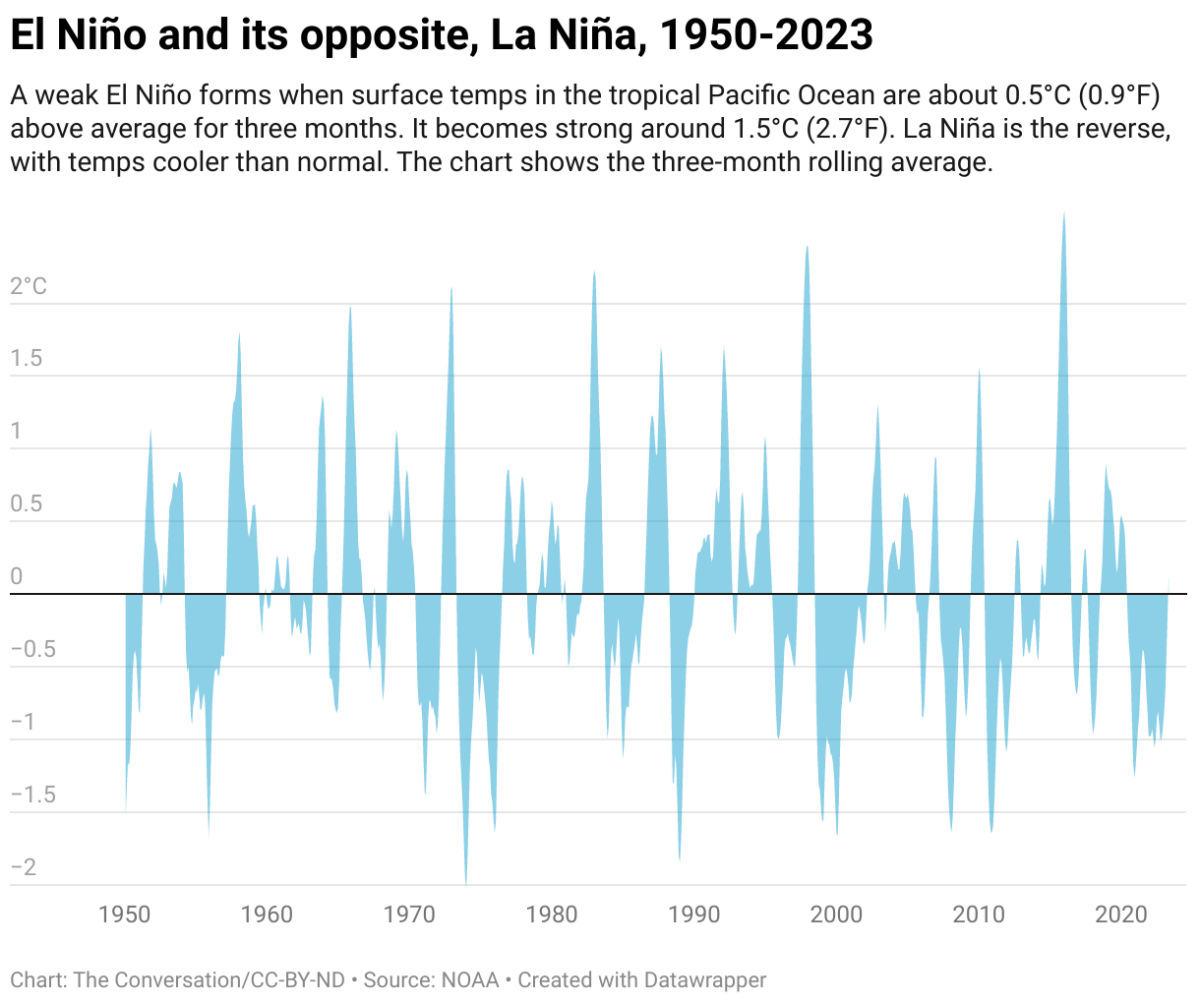
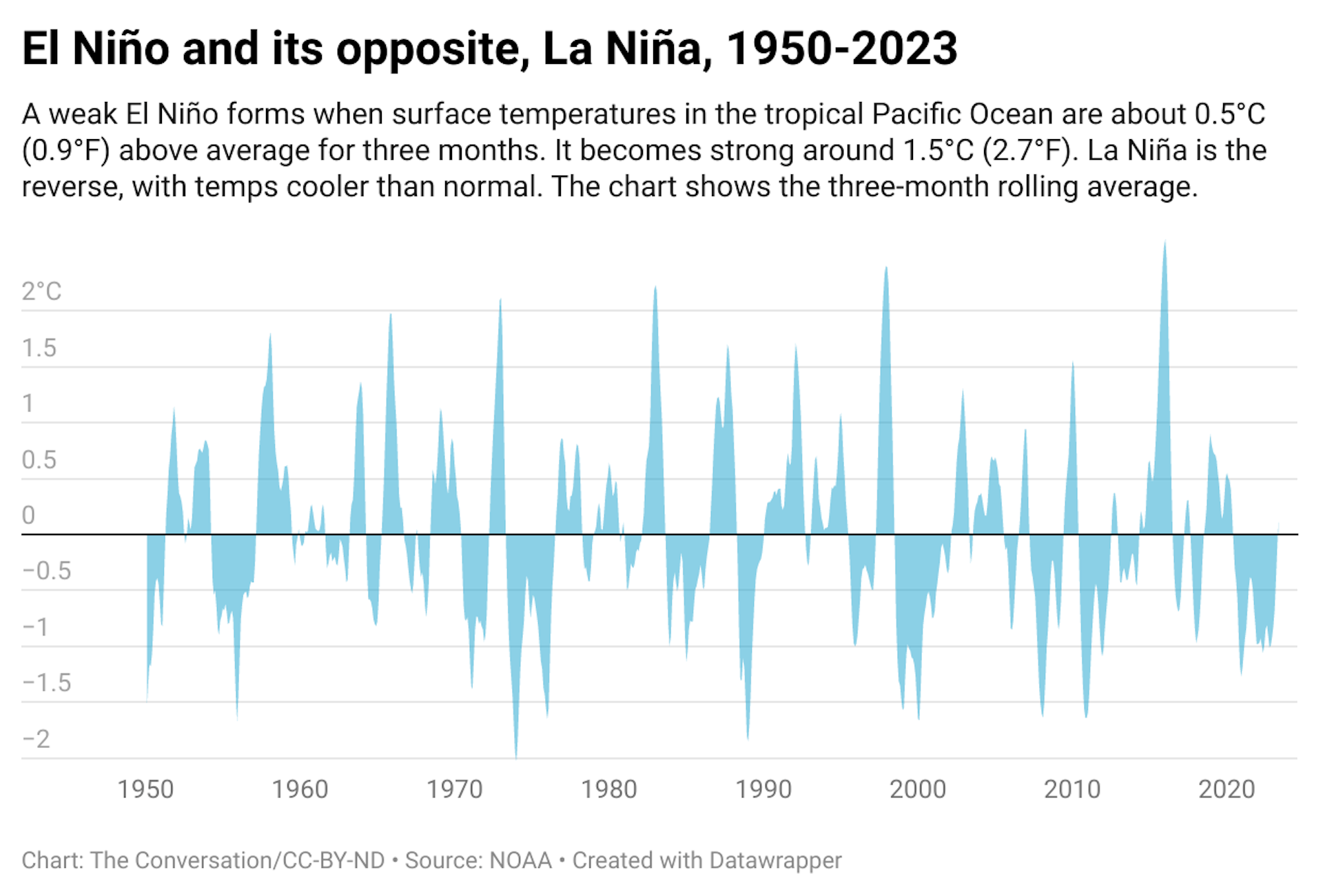
Chart titled "El Nino and its opposite, La Nina, 1950 - 2023." X-axis is years, y-axis is temperature change from 2 to -2 degrees C. Shows noteworthy spikes and dips every few years to coincide with the regular weather patterns.

So, what does all that mean for you and me?

With apologies to Charles Dickens, El Niño tends to create a tale of two regions: the best of times for some, and the worst of times for others.

On average, El Niño years are warmer globally than La Niña years – El Niño’s opposite. Globally, a strong El Niño can boost temperatures by about 0.7 degrees Fahrenheit (0.4 Celsius). But in North America, there is a lot of local variation.

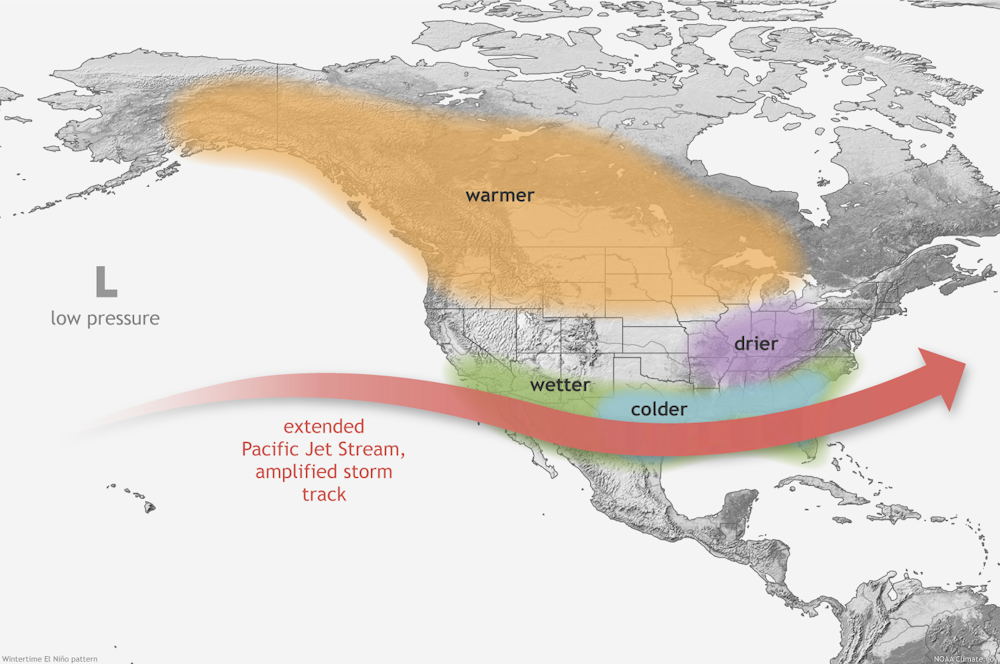
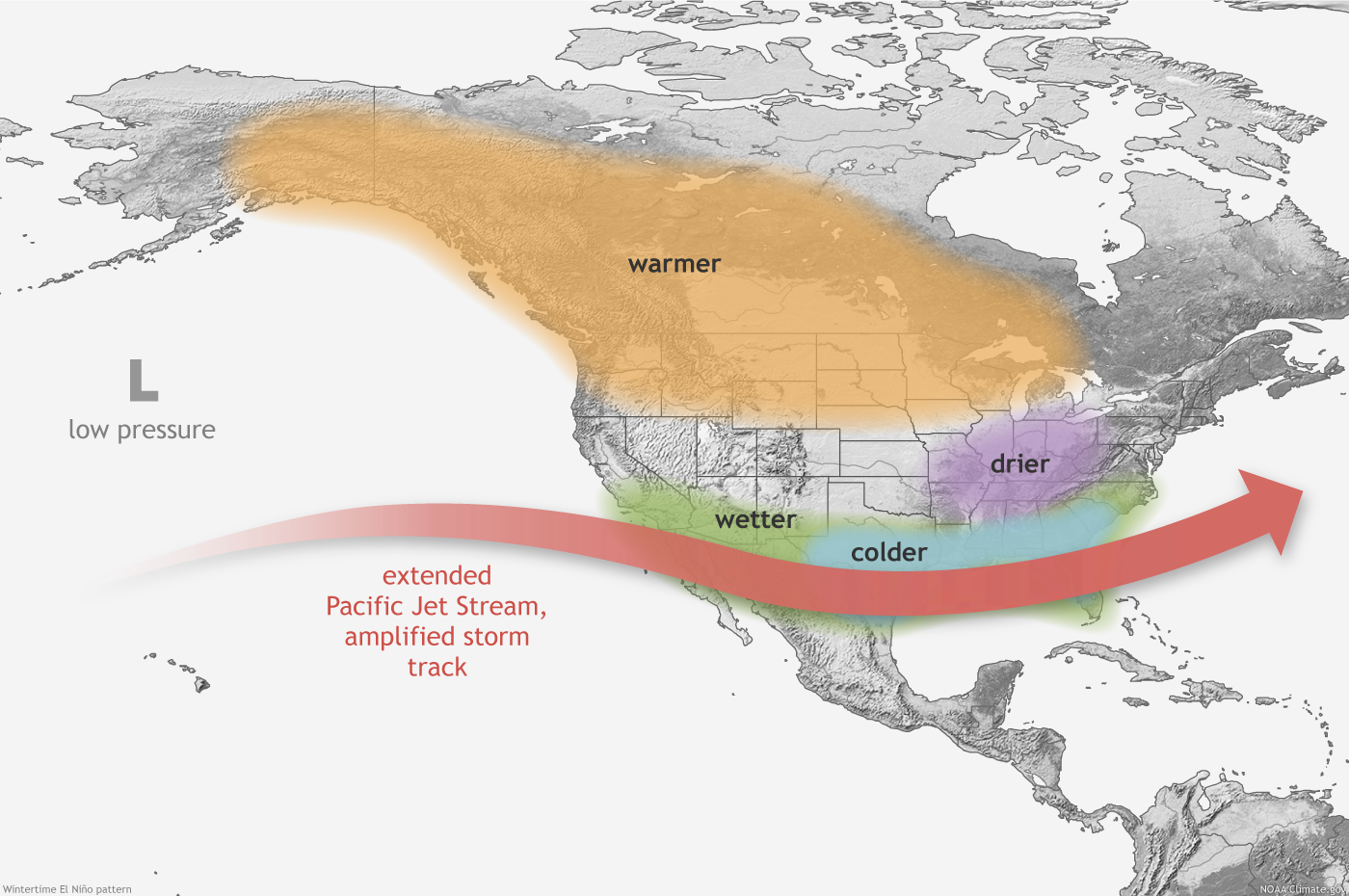
El Niño years tend to be warmer across the northern part of the U.S. and in Canada, and the Pacific Northwest and Ohio Valley are often drier than usual in the winter and fall. The Southwest, on the other hand, tends to be cooler and wetter than average.

El Niño typically shifts the jet stream farther south, so it blows pretty much due west to east over the southern U.S. That shift tends to block moisture from the Gulf of Mexico, reducing the fuel for thunderstorms in the Southeast. La Niña, conversely, is associated with a more wavy and northward-shifted jet stream, which can enhance severe weather activity in the South and Southeast.

A map shows warmer, drier air over the northern U.S. and Canada; wetter conditions across the Southwest and dry in the Southeast. The jet stream shifts southward.
El Niño’s typical effects in winter. (Image courtesy of NOAA)

El Niño also affects hurricanes, but in different ways in the Atlantic and Pacific.

Over the Atlantic, El Niño tends to increase wind shear – the change in wind speed with height in the atmosphere – which can tear apart hurricanes. But El Niño has the opposite effect in the eastern Pacific, where it can mean more storms. The ocean heat can also raise the risk of marine heat waves that can devastate corals and ecosystems fish rely on.

In the middle of the U.S., El Niño is generally associated with warmer and drier conditions that can mildly increase the chances of a bountiful corn crop.

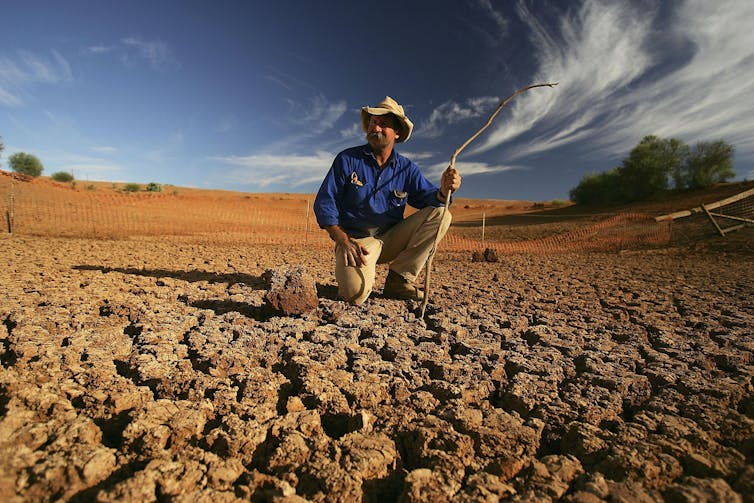
In contrast, El Niño can wreak havoc on crops in Southern Africa and Australia and increase Australia’s fire risk with dangerously dry conditions. Brazil and northern South America also tend to be drier, while parts of Argentina and Chile tend to be wetter.

A stockman stands in the dry bed of a creek on his property in Australia in 2005 during a severe drought that coincided with El Nino.
Australia endured its worst drought in decades in 2005 with the combined effect of increasing temperatures and an El Niño. (Image by Ian Waldie/Getty Images)

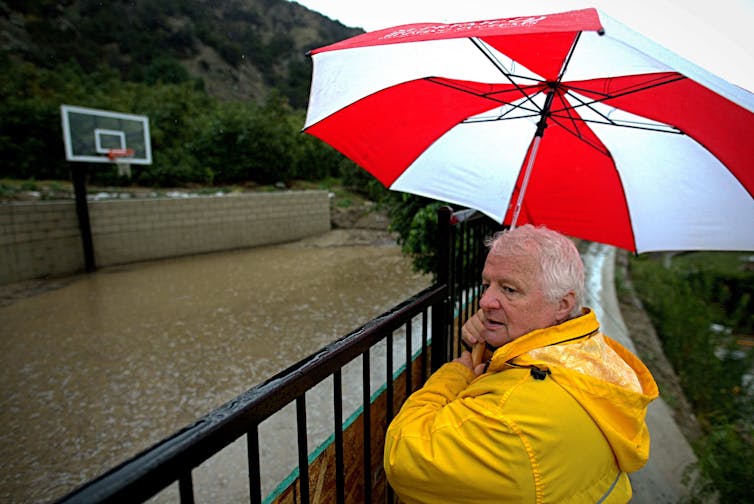
Of course, just because this is normally what happens doesn’t mean it happens every time. Witness California’s record rainfalls from multiple atmospheric rivers at the end of the last La Niña, which normally would mean dry conditions.

Every weather event is somewhat different, so the influence of El Niño is a matter of probability, not certainty. How El Niño and La Niña will be influenced over time by climate change isn’t yet clear.

The forecasts don’t all agree

Is 2023 going to be a record-breaking year? That’s the multibillion-dollar question.

The National Weather Service declares the onset of El Niño when water temperatures are at least 0.9 F (0.5 C) above normal for a three-month period in what’s known as the Niño3.4 region. That’s a large imaginary rectangle south of Hawaii along the equator.

An animation shows satellite images of how temperatures headed up in the equatorial pacific, with a warm streak developing and intensifying west of South America.
Watching El Niño develop in the tropical Pacific, January to June 2023. The box shows the Niño3.4 region. (Animation by NOAA at Climate.gov)

For a strong El Niño, the Niño3.4 region needs to warm by 2.7 F (1.5 C) for three months. It’s not clear as of right now whether this El Niño will meet that threshold this year.

The National Oceanic and Atmospheric Administration’s first El Niño advisory of the year, released on June 8, sees an 84% chance of El Niño being greater than moderate by winter and a 56% chance that it will be strong.

Those forecasts can change, though, and different forecasting methods offer different forecasts of the magnitude.

“Dynamical” models, similar to the models used for typical weather forecasts, have projected a very strong El Niño, whereas “static” or statistical models are far less optimistic. Personally, I’m a statistical modeler, and my own model doesn’t suggest a strong El Niño in 2023. Rather, my model – like other static models – predicts that 2023 will fizzle out, and after a couple of quiet, or neutral, years, we will see a strong El Niño in 2026. I did get the recent unusual “triple dip” La Niña right, but I’m willing to be proved wrong by observations, as any good scientist should be.

A man in a raincoat stands under a big umbrella watching his backyard fill with rainwater in California in 2023. California saw record rain from atmospheric rivers in early 2023.
El Niño often means winter rain for California. While it’s needed, it’s sometimes too much. (Image by Watchara Phomicinda/MediaNews Group/The Press-Enterprise via Getty Images)

But no computer model of any flavor has had experience with the globally super-high ocean temperatures that are occurring right now. The Atlantic is unusually warm, and that could offset some of the usual forces that come with El Niño.

This article is republished from The Conversation under a Creative Commons license. Read the original article and see more than 250 UMBC articles available in The Conversation.

US, Chinese warships’ near miss in Taiwan Strait hints at ongoing troubled diplomatic waters, despite chatter about talks

Written by Meredith Oyen, associate professor of history and Asian studies, UMBC.

An encounter in which a Chinese naval ship cut across the path of a U.S. destroyer in the Taiwan Strait on June 3, 2023, has both Beijing and Washington pointing fingers at each other.

It was the second near miss in the space of just a few weeks; in late May a Chinese plane crossed in front of an American surveillance aircraft above the South China Sea.

Meredith Oyen, an expert on China-U.S. relations at the University of Maryland, Baltimore County, helps explain the context of the recent encounters and how they fit within growing tensions between the two countries.

What do we know about the Taiwan Strait incident?

It came as the U.S. and Canada were conducting a joint transit of the Taiwan Strait – a body of water that separates the island of Taiwan from mainland China. Washington does these transits fairly regularly, but not usually with another country.

As the American destroyer USS Chung-Hoon and Canadian frigate HMCS Montreal traveled up the channel, a Chinese warship passed and veered across the U.S. vessel’s path at a pretty close range, according to U.S. Indo-Pacific Command. As a result, the USS Chung-Hoon had to reduce its speed to avoid a collision.

The U.S. has characterized the incident as an “unsafe” maneuver on behalf of the Chinese and protested that it took place in international waters.

The perspective from Beijing is that the U.S. and Canada were “deliberately provoking risk” by sailing a warship through Chinese waters.

Who is right? Did it take place in international or Chinese waters?

The United Nations Convention on the Law of the Sea stipulates that a country’s “territorial waters” extend 12 nautical miles off its coast – anything above or on the sea in that zone is considered part of the country’s territory. After that, there is a further 12-mile “contiguous zone,” over which a coastal state has rights to prevent infringement of the country’s “customs, fiscal, immigration or sanitary” laws, according to the UN treaty.

An aerial shot of the Taiwan Strait showing blue waters and two green land masses
The Taiwan Strait. Gallo Images/Orbital Horizon/Copernicus Sentinel Data

Complicating matters, Beijing – a signatory to the Convention on the Law of the Sea, unlike the U.S. – claims the island of Taiwan as part of China. Under the U.N. convention’s stipulations, this would also mean Beijing can claim the 12 miles of territorial waters off Taiwan’s coast, as well as a 12-mile contiguous zone.

But even at its narrowest point, the Taiwan Strait is around 86 miles wide. So even accepting Beijing’s territorial claim, there would, under U.N. law, be a channel that falls outside its territory.

Nonetheless, Beijing claims sovereignty of the entirety of the waters between Taiwan and China under its exclusive economic zone.

Despite not signing the U.N. Convention on the Law of the Sea, the U.S. abides by the 12-mile standard and views a large chunk of the strait as international waters.

How common are these ‘near misses’?

The United States has regularly sailed vessels through the Taiwan Strait for decades. At times of tension – notably during the Korean War and Taiwan Straits crises of 1954-55, 1958 and 1962 – the U.S. has deployed destroyers in the channel as a deliberate show of military strength and support for Taiwan.

This continued after the U.S. normalized relations with China in 1978 until today, with few incidents that caused the level of tit-for-tat recriminations such as in the latest case. But there have been “near misses” in the sky, noticeably the recent airplane-to-airplane encounter that preceded this incident.

What we have increasingly seen, though, is Chinese officials protest these Taiwan Strait transits by the U.S. And the number of protests by China has increased in recent years, as tension over Taiwan has increased.

How does this incident fit growing maritime tension in the region?

The past few years have seen a deterioration in U.S.-China relations. There have been no direct, high-level military talks between the two countries since 2019. Meanwhile, relations have further soured on other topics, such as the ongoing trade war, the issue of Taiwan and allegations relating to the spread of COVID-19.

At times of better relations between Beijing and Washington, military transits such as the one in the Taiwan Strait might have gone largely unremarked upon. But amid such tensions, any incident is elevated to the level of uniquely bad provocation.

The broader context is that the U.S. regularly holds military drills and “freedom of navigation” operations in the South China Sea. These activities are used by the U.S. Department of Defense to demonstrate that the U.S. has a right to sail in waters it views as international, even if they are claimed by nation states.

The concern is that with tensions as they are – and with no official direct line of dialogue – a near miss during such a drill, or, worse still, an actual collision, could escalate beyond control, leading to military conflict.

Any significance over why this happened now?

The near miss came at a curious time – while top diplomats and defense chiefs from both the U.S. and China were attending the Shangri-La Dialogue in Singapore.

At that security summit, U.S. Defense Secretary Lloyd Austin shook the hand of his Chinese counterpart, Li Shangfu. But they didn’t hold a side meeting – as some observers had hoped.

Austin also underscored the importance of the Taiwan Strait to Washington: “The whole world has a stake in maintaining peace and stability in the Taiwan Strait. The security of commercial shipping lanes and global supply chains depends on it. And so does freedom of navigation worldwide. Make no mistake: conflict in the Taiwan Strait would be devastating.”

Washington has suggested that it wants to resume official talks with Beijing. Incidents such as that in the Taiwan Strait underscore the potential need for such discussions, if only to avoid encounters escalating into something more serious.


This article is republished from The Conversation under a Creative Commons license. Read the original article and see more than 250 UMBC articles available in The Conversation.

All Rise for Alumni Mock Trial Coaches

When Natalie Murray ’22, biological sciences, Thomas Azari ’22, political science, and Lauren Wotring ’22, political science, graduated last spring, they didn’t expect to be returning to UMBC so soon. These recent alums—all members of the 2021 National Mock Trial Championship team—were making inroads in the next stages of their careers, but didn’t hesitate to pick up the phone when the UMBC Mock Trial team called.

Together they took on the leadership of UMBC’s B team, guiding the group—composed mostly of first-year students—to the Opening Round Championship Series (ORCS) in March 2023 and saw B team co-captain Fadil Adeite ’26, media and communication studies, and Anna Kim ’26, biochemistry and psychology, win all-National attorney awards. 

Coming back to pay it forward

Natalie Murray was the first to rejoin the UMBC Mock Trial team as a coach. She was hesitant initially. A full-time veterinary assistant position at the Elkridge Animal Hospital meant long days, so long she sometimes showed up to practice in her scrubs after a 12-hour shift.

When Murray agreed to coach, she envisioned having a minor position, yet she ended the season as the B team’s head coach. “Once I started working with them, and I saw how driven and incredible they were, I could not help but throw myself way more into it than I had planned,” said Murray.

The students were aware of the coaches’ investment. “To see the three coaches come back after leaving and dedicate so much time and effort—and gas money—to the team was inspiring, and it really motivated us as competitors to give even more,” said co-captain Adeite.

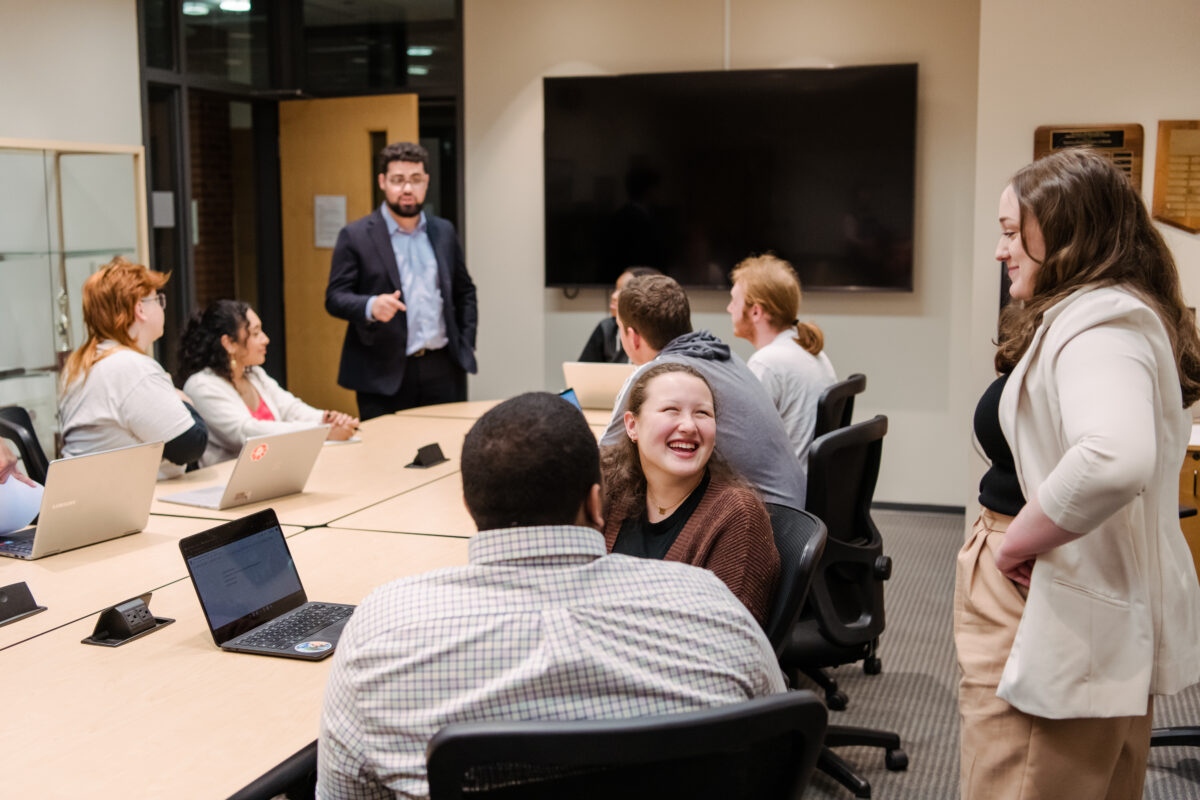
a group of students sit around a conference table, looking up as alumni speak to them
Standing, Azari, left, and Wotring, right, speak with members of the UMBC Mock Trial team. (Marlayna Demond ’11/UMBC)

The team became a source of joy for Murray, brightening her stressful days and making the logistics of coordinating coaching worth it. It helped that she could rely on former teammates to share the load.

Thomas Azari navigated his job in the U.S. Department of State’s Department of Human Rights and Labor, studying for the LSAT, and applying to law school while coaching. Lauren Wotring also made time to coach the B team while working at a D.C. law firm as an intellectual property legal assistant and prepping for law school.

Wotring said the students made the whole experience so special. “I realized how much the students meant to me and how amazing they are and how willing they were to learn,” said Wotring, who realized she wants to keep coaching next year.

Alumni coaching legacy

The Mock Trial team has always had dedicated coaches. The B team trio cites current head coach Ben Garmoe ’13, political science, and assistant coach Whitney Wilder as some coaches who made their mock trial experience.

Azari knew he had to return as a coach after the impact his coaches had on him and his Nationals-winning team.“If not for Ben, we wouldn’t have had any of the success we have now,” he said. “I kind of learned from that and was like, ‘Ben is doing all this work. I have to too.’”

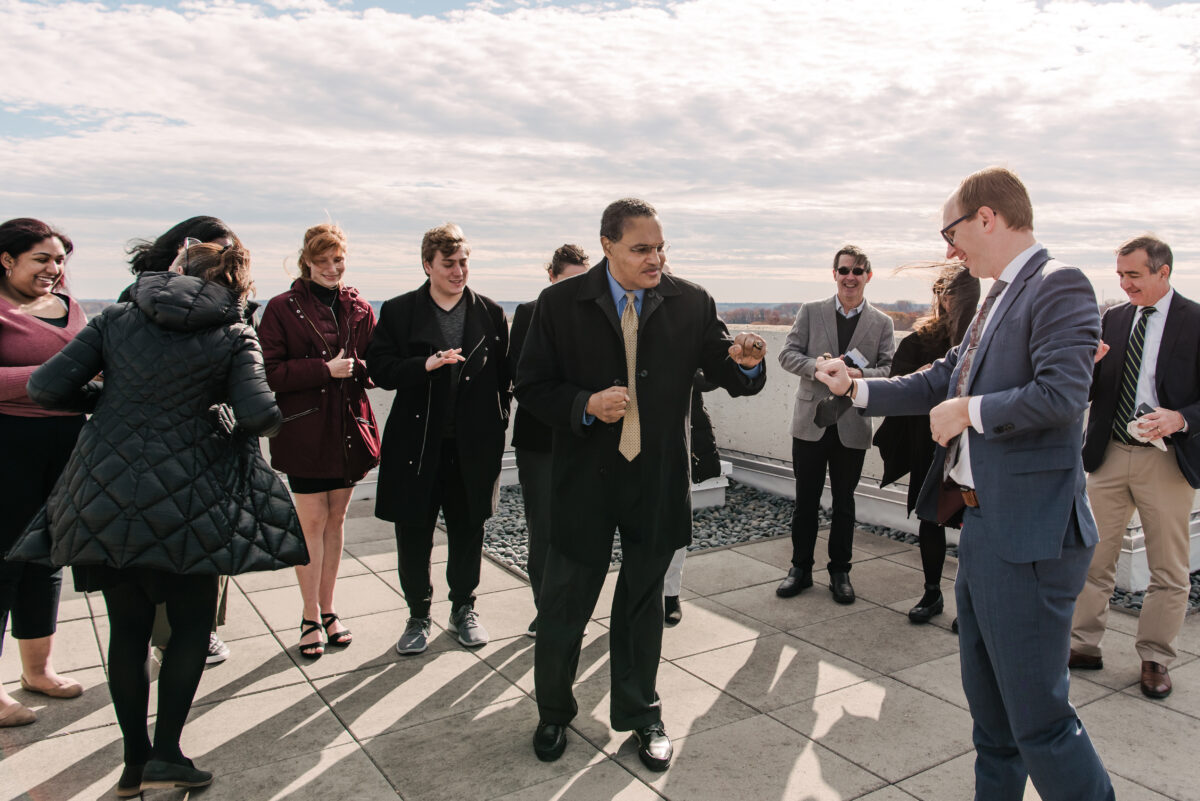
Standing outside, a group gathers to look at their mock trial championship rings
Garmoe, right, and then-President Freeman Hrabowski show each other their 2021 National Mock Trial Championship rings with members of the UMBC Mock Trial team. (Marlayna Demond ’11/UMBC)

Murray, Azari, and Wotring’s investment in the students took many forms. Wotring spoke to many about the dangers of perfectionism. Murray ensured they were having fun while being competitive. Azari lent out ties and showed them how to stay positive even after a loss. All three drove students to competitions, helped pay for food, and were always a text away.

The students couldn’t have been more thankful. At the end of the season, the alumni coaches received cards from the team with notes from each student. Kim emailed each of them, telling them how they impacted her.

“They taught us how to be better competitors, how to work better as a team, how to get places on time, but mostly how to be confident and proud of ourselves,” said Kim.

“Whenever anyone felt down about themselves, their performance, or not understanding, they were right there to lift us up, guide us, and make us all feel heard,” said B team co-captain Alysha Carter ’26, political science.

Champion volunteers

The trio’s willingness to turn around so quickly after graduation and invest their time in the next generation of UMBC Mock Trial competitors means a lot to Garmoe. “Thomas, Natalie, and Lauren are all national champions and highly decorated competitors,” said Garmoe. “But even more importantly, they are wonderful people and stellar role models for our young students.”

Murray sees a direct correlation between her coaching experience now and the support she received as a Mock Trial participant. Her fond memories of the organization, said Murray, are rooted in the genuine care she felt from her coaches and teammates. “To be part of that equation, and thinking that maybe one day down the line some of these students will do the same thing, they’ll graduate and they’ll want to coach, has been a really fun thought to have.”

By Morgan Casey ’22

Broadcasting Retriever Success

Eli Eisenberg came into the world of Retriever sports not as a recruited athlete or a walk-on but from a completely different angle—broadcasting. Capturing the energy of the fans, the maneuvers on the court or field, and the cheers and camaraderie of UMBC Athletics hooked Eisenberg early on.

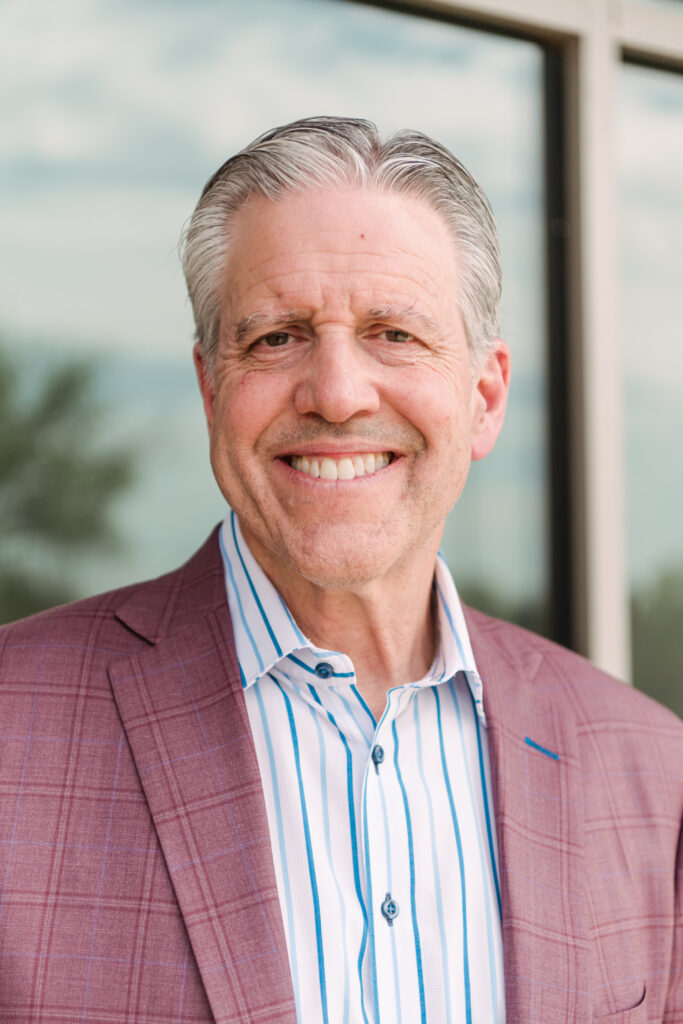
Headshot of Eli Eisenberg
Headshot of Eli Eisenberg by Marlayna Demond ’11/UMBC.

When Eisenberg enrolled at UMBC in the 1980s, he used his interdisciplinary studies (INDS) major to develop a curriculum that primarily focused on broadcasting, American culture, and business and economics. To this day, he credits UMBC for his success and it’s something he’s been adamant about returning tenfold to the Retriever community.

“I knew at a young age that I wanted to be a television producer and director,” says Eisenberg ’86, INDS, who is now the CEO of VPC, an award-winning, full-service boutique production and broadcasting agency. VPC provided production services for UMBC Commencements as early as 1996 and was instrumental in the university’s momentous 50th anniversary celebration in 2016.

Through VPC, Eisenberg has created a successful working model where real-world training and education intersect. In 2016, America East signed a deal with ESPN to have conference basketball games on ESPN+.

And in the past seven broadcast seasons, VPC has partnered with UMBC—training more than 100 Retriever interns along the way—to put UMBC Athletics on television. Alumni from the program have gone on to work for the Baltimore Ravens, Baltimore Orioles, Philadelphia Eagles, CBS Sports, and many other freelance video and sports productions.

“Although the university doesn’t have a broadcasting major,” says Eisenberg, “through our ESPN initiative, students are trained to televise sporting events and are placed on the path to broadcasting careers.” 

In 2022 Eisenberg sought to address another perennial need among student-athletes—he and his wife Patricia M. Vitale made a gift to support students’ mental health amid the pressures of navigating academic and athletic performances.

“We want to ensure that we always have a safety net and strong system in place for our athletes,” says Brian Barrio, UMBC’s director of Athletics. “Which is why Eli’s endowment is so generous and so important.”

The intersection of sports and mental health

While sports and journalism are at the heart of Eisenberg’s endowment, the real root of his generosity is his desire to see mental health be nurtured and prioritized for students, particularly athletes.

When the pandemic hit, the sports world experienced a great shift in how games were played and consumed by the audience (or lack thereof), and that extended to college sports. VPC began to experience firsthand the challenges of athletes playing in front of empty seats; it not only changed the dynamic of how athletes performed, but it also affected physical—and mental—endurance. 

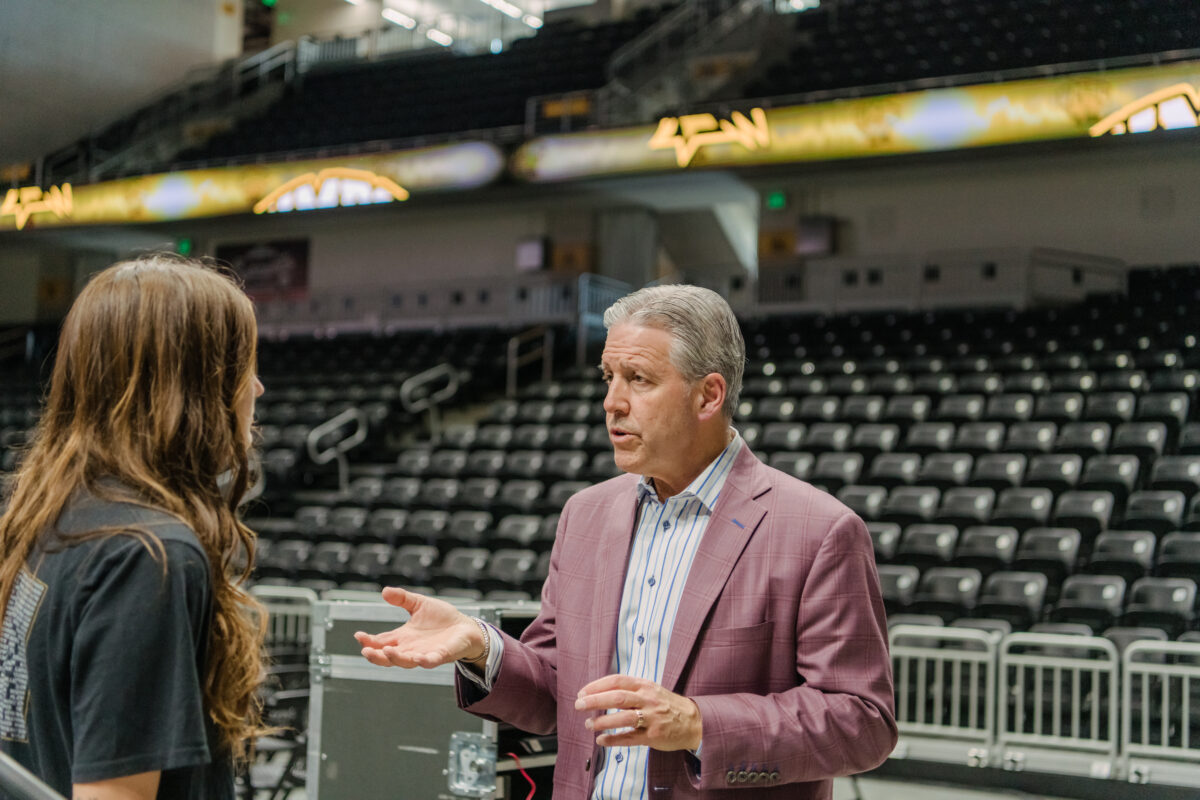
A man in a suit talks to a female athlete in an arena
Top: Eisenberg chats with volleyball player Emily Genau ’26 in the CEI Arena about her entrepreneurial goals. (Marlayna Demond ’11/UMBC)

“It’s difficult enough for students to balance their athletic career with their academic one both pre- and post-pandemic. It’s very rigorous,” says Eisenberg. “It’s that much easier to become unmotivated when adding the challenge of playing in an empty arena or stadium after long bus trips.”

To expand on the other ways he supports UMBC students, Eisenberg established the Retriever Athletic Wellness Endowment, dedicated to supporting UMBC’s Division I athletes. The anticipated initiatives include nutrition, mental health programming, and sports medicine, among others.

Students reap the benefits

Austin Hood, a media and communication studies senior, who has interned with VPC since last semester, says the experience has provided him with mentors “who want to see me learn and step into different roles like hand-on camera work, replay, audio, director, technical director, utility, and much more.”

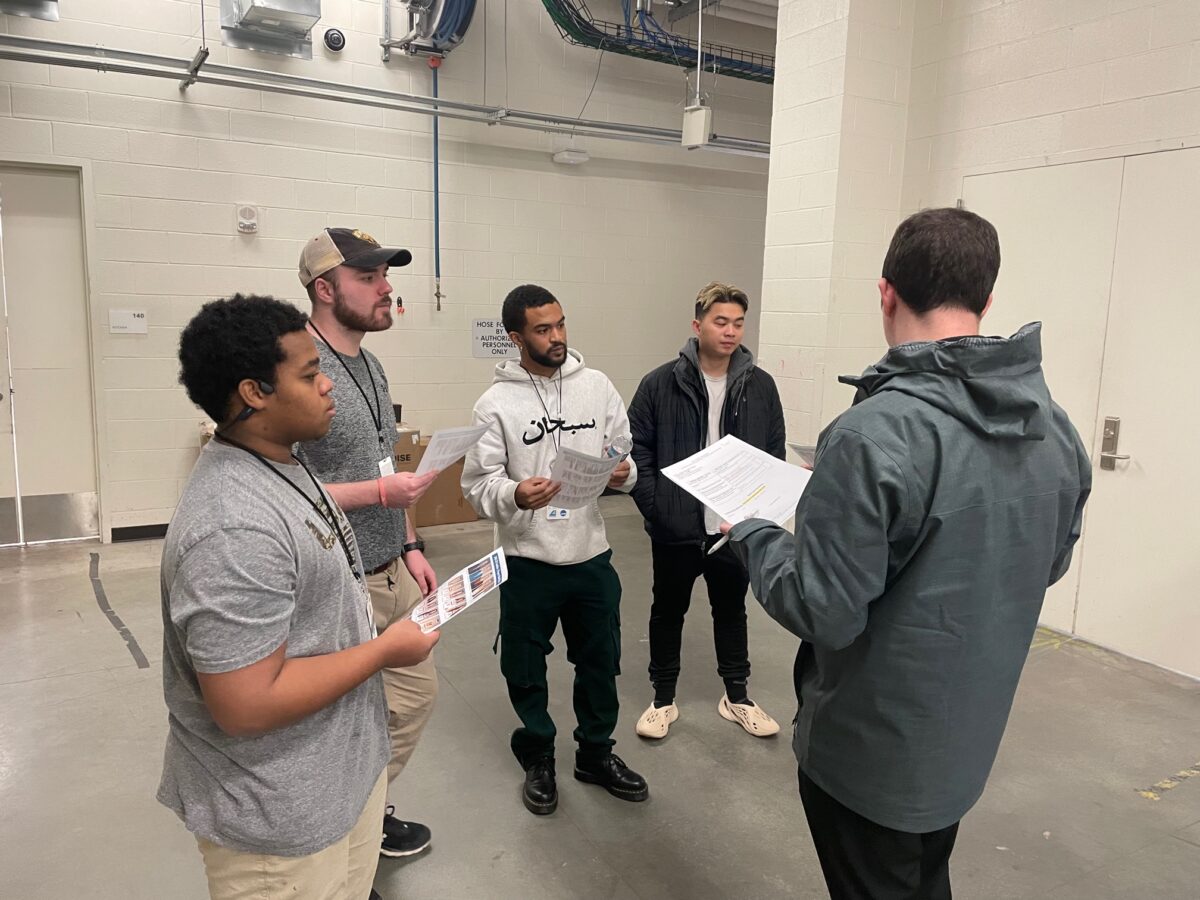
a group of students gather in a hallway to go over instructions
VPC interns, including Austin Hood, center in the white sweatshirt, gather in the production corridor to go over their tasks. Photo courtesy of Eisenberg.

The internship has been invaluable, says Hood. “Eli has been transparent about what it took for him to get where he is. Working alongside him and others has shown me just how much work goes into what you see when you turn on a live sporting event. These experiences, to say the least, have me feeling eager and confident to take on a position anywhere in the production/broadcasting industry.”

The America East Conference, which UMBC is a part of, together with its ESPN partnership, is required to broadcast 300 or more events annually. On average, a conference school broadcasts 30 to 40 games annually and the number is expected to increase to 50—so, having students trained and available to help has been and will continue to be crucial.

“Since the onset of both broadcasting relationships—the conference and UMBC, as well as UMBC with VPC—the Retriever broadcasts have set the bar in production value, execution, and storytelling,” says Eisenberg.

A significant impact

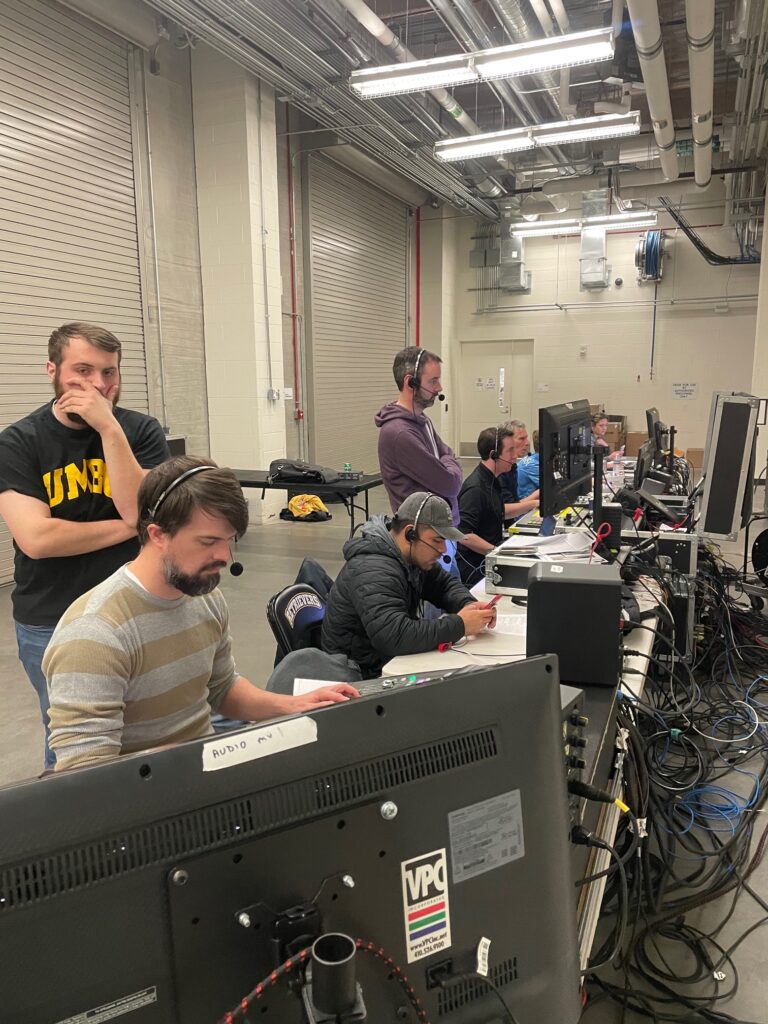
Students work in the production corridor on broadcasting tasks
VPC interns work in the production corridor. Photo courtesy of Eisenberg.

Much like how Eisenberg developed his own hybrid curriculum as a UMBC student, he hopes that the school uses the money to establish whatever programs the student-athletes would need, ranging from nutrition to mental health services.

As a result of their gift, the Chesapeake Employers Insurance Arena backstage production corridor and loading dock will be named in recognition and honor of Eisenberg and his wife. The significance of the space is not lost on him.

“It’s where VPC trains students to be in sports broadcast,” he says with a smile.

By Nikoletta Gjoni ’09

Lessons from ‘Star Trek: Picard’ – a cybersecurity expert explains how a sci-fi series illuminates today’s threats

Written by Richard Forno, principal lecturer in computer science and electrical engineering, UMBC

Editor’s note: This article contains plot spoilers.

Society’s understanding of technology and cybersecurity often is based on simple stereotypes and sensational portrayals in the entertainment media. I’ve written about how certain scenarios are entertaining but misleading. Think of black-clad teenage hackers prowling megacities challenging corporate villains. Or think of counterintelligence specialists repositioning a satellite from the back of a surveillance van via a phone call.

But sometimes Hollywood gets it right by depicting reality in ways that both entertain and educate. And that’s important, because whether it’s a large company, government or your personal information, we all share many of the same cybersecurity threats and vulnerabilities. As a former cybersecurity industry practitioner and current cybersecurity researcher, I believe the final season of “Star Trek: Picard” is the latest example of entertainment media providing useful lessons about cybersecurity and the nature of the modern world.

So how does “Star Trek: Picard” relate to cybersecurity?

The nature of the threat

The show’s protagonist is Jean-Luc Picard, a retired Starfleet admiral who commanded the starship Enterprise-D in a previous series. Starfleet is the military wing of the United Federation of Planets, of which Earth is a member. In Season 3, the final season, Picard’s ultimate enemy, the Borg, returns to try conquering humanity again. The Borg is a cybernetic collective of half-human, half-machine “drones” led by a cyborg queen.

The Borg has partnered with other villains and worked for over a decade to deploy hidden agents able to compromise the DNA data contained in the software underpinning the transporter – a teleportation device used regularly by Starfleet personnel. Over many years, a certain subgroup of Starfleet personnel had their DNA altered by using the transporter.

Thus, in launching their final attack, the Borg is able to instantly activate thousands of “drones” to do its bidding in the form of altered, compromised Starfleet personnel. As Geordi La Forge, the Enterprise-D’s engineer, notes, “They’ve been assimilating the entire fleet this whole time, without anyone ever knowing it.”

Instead of malicious software taking over computers, the plot involves malicious genetic code taking over humans.

The Borg’s prolonged, stealthy infiltration of the federation is indicative of how today’s most effective cyberattackers work. While it’s relatively easy to detect when hackers attempt to breach a system from the outside, experts worry about the effects of an enemy infiltrating critical systems from within. Attackers can put malicious code in software during manufacturing or in software updates, both of which are avenues of attack that do not arouse suspicion until the compromised systems are activated or targeted.

This underscores the importance of ensuring the security and integrity of digital supply chains from product development at the vendor through product deployment at client sites to ensure no silent “drones,” such as malware, are waiting to be activated by an adversary.

Equally important, “Star Trek: Picard” presents the very real and insidious nature of the insider threat faced by today’s organizations. While not infected with a cybernetic virus, recently arrested Massachusetts Air National Guard airman Jack Teixeira shows the damage that can occur when a trusted employee has malicious intent or becomes co-opted and inflicts significant damage on an employer.

In some cases, these compromised or malicious individuals can remain undiscovered for years. And some global adversaries of the U.S., such as China and Russia, are known for taking a long-term perspective when it comes to planning and conducting espionage activities – or cyberattacks.

Humans remain the weakest link

“Synchronistic technology that allows every ship in Starfleet to operate as one. An impenetrable armada. Unity and defense. The ultimate safeguard.”

With these words, humanity’s military defenders activated a feature that linked every Starfleet vessel together under one unified automated command system. While intended to serve as an emergency capability, this system – called Fleet Formation – was quickly hijacked by the Borg as part of its attack on Earth. In essence, Starfleet created a Borg-like defense system that the Borg itself used to attack the federation.

Here, the most well-intentioned plans for security were thwarted by enemies who used humanity’s own technologies against them. In the real world, capabilities such as on-demand real-time software updates, ChatGPT and centrally administered systems sound enticing and offer conveniences, cost savings or new capabilities. However, the lesson here is that organizations should not put them into widespread use without carefully considering as many of the potential risks or vulnerabilities as practical.

But even then, technology alone can’t protect humans from ourselves – after all, it’s people who develop, design, select, administer and use technology, which means human flaws are present in these systems, too. Such failings frequently lead to a stream of high-profile cybersecurity incidents.

Resiliency is not futile

To counter the Borg’s final assault on Earth, Picard’s crew borrows its old starship, Enterprise-D, from a fleet museum. The rationale is that its ship is the only major combat vessel not connected to the Borg collective via Starfleet’s compromised Fleet Formation protocol and therefore is able to operate independently during the crisis. As La Forge notes, “Something older, analog. Offline from the others.”

When a network has been compromised, it’s important to be able to use systems that aren’t connected to the network.

From a cybersecurity perspective, ensuring the availability of information resources is one of the industry’s guiding principles. Here, the Enterprise-D represents defenders in response to a cyber incident using assets that are outside of an adversary’s reach. Perhaps more important, the vessel symbolizes the need to think carefully before embracing a completely networked computing environment or relying on any single company or provider of services and connectivity for daily operations.

From natural disasters to cyberattack, what’s your plan if your IT environment becomes corrupted or inaccessible? Can your organization stay operational and still provide necessary services? For critical public messaging, do governments and corporations have their own uncorruptible Enterprise-D capabilities to fall back on, such as the fediverse, the decentralized microblogging platform that is immune to the impulsive manipulations of Twitter’s ownership?

Prepare for the unknown

The “Star Trek” universe explores the unknown in both the universe and contemporary society. How the crews deal with these experiences relies on their training, the appreciation of broad perspectives and ability to devise innovative solutions to the crisis of the week. Often, such solutions are derived from characters’ interests in music, painting, archaeology, history, sports and other nontechnical areas of study, recreation or expertise.

Similarly, as modern digital defenders, to successfully confront our own cyber unknowns we need a broad appreciation of things beyond just cybersecurity and technology. It’s one thing to understand at a technical level how a cyberattack occurs and how to respond. But it’s another thing to understand the broader, perhaps more systemic, nuanced, organizational or international factors that may be causes or solutions, too.

Lessons from literature, history, psychology, philosophy, law, management and other nontechnical disciplines can inform how organizations plan for and respond to cybersecurity challenges of all types. Balancing solid technical knowledge with foundations in the liberal arts and humanities allows people to adapt comfortably to constantly evolving technologies and shifting threats.

Dystopic metaphors in fiction often reflect current social concerns, and the “Star Trek” universe is no different. Although rooted in a science fiction fantasy, “Star Trek: Picard” provides some accurate, practical and understandable cybersecurity reminders for today.

Season 3, in particular, offers viewers both entertainment and education – indeed, the best of both worlds.


This article is republished from The Conversation under a Creative Commons license. Read the original article and see more than 250 UMBC articles available in The Conversation.

Black mothers trapped in unsafe neighborhoods signal the stressful health toll of gun violence in the U.S.

Written by Loren Henderson, associate professor of public policy, UMBC and Ruby Mendenhall, associate professor in sociology, African American studies, urban and regional planning, and social work, University of Illinois at Urbana-Champaign.

Black mothers are the canaries in the coal mine when it comes to the mental and physical harms of stress from living with gun violence in America.

In the U.S., Black people are likelier than white people to reside in impoverished, racially segregated communities with high levels of gun violence. Research has suggested that living in violent and unsafe environments can result in continuous traumatic stress, a constant form of PTSD. Researchers have also linked experiences of violence and poverty to an increased risk of chronic disease such as cancer and cardiovascular, respiratory and neurodegenerative diseases.

We are Black women and public policy and sociology professors who study health inequities and sustainable policy solutions. Our research has found that Black mothers who feel trapped in neighborhoods they perceived as unsafe because of high levels of community violence are more likely to report elevated PTSD and depression symptoms, as well as elevated stress hormone levels.

The trauma of gun violence and systemic racism isn’t simply a Black mother’s story – it’s an American story.

Health effects of feeling trapped

Our research team sought to understand how stress from structural violence affects the body, specifically the immune system. We talked to 68 low-income single Black mothers living on the South Side of Chicago about how they deal with gun violence in their communities and how it affects their health.

We asked these Black mothers to complete surveys that measured depression and PTSD symptoms. We also asked them to provide blood samples to examine the effects of stress at the cellular level, measuring the activity of genes that code for the receptors for the stress hormone cortisol. Looking at cortisol receptors offers a more cumulative measure of cortisol levels over time.

We found that about 65% of the mothers wanted to move out of their neighborhoods but could not afford to do so. These mothers felt trapped in areas with high levels of gun violence that fostered a sense of not feeling safe for adults and children. One mother in our study, whom we will call Ellan, described her neighborhood as dangerous and wanted to leave as soon as she could. “I’m very terrified of my kids going out to the park, playing in front of the house,” she said. “And I’m afraid that a car might come past shootin’ and one of my kids get hurt.”

Mother cradling child against chest
Jose Luis Pelaez/The Image Bank via Getty Images

Another mother in our study, whom we will call Skylar, felt she couldn’t escape to a safer community. “I don’t really want to raise my kids there, but I don’t have a choice. You know, cause it’s what I can afford. But it’s real violent.”

Mothers who felt trapped reported more symptoms of PTSD, like disturbing memories and dreams and reliving stressful experiences, than mothers who did not feel trapped. They also reported more depressive symptoms, such as feeling down and hopeless, taking little pleasure in doing things and having trouble sleeping.

Mothers unable to afford the move to safer neighborhoods had lower levels of glucocorticoid receptors. Having fewer glucocorticoid receptors helped protect their bodies from being overwhelmed by high cortisol levels caused by stress. Nevertheless, high cortisol levels from chronic stress are linked to a number of negative mental and physical health outcomes.

Environment determines health

Where someone lives, learns, works, plays and worships can determine their health and has the power to make them sick and cause premature death.

Researchers have estimated that around 83,570 Black people die prematurely each year in the U.S. because of health disparities, using 2002 data. Some scholars have previously described this as equivalent to a plane full of Black passengers falling out the sky every day every year.

It is important to note that it is not the racial makeup of where a person lives that shapes the significant disparities they face, but exposure to violence, poverty and lack of resources as a result of structural racism. Redlining, environmental contamination, food deserts and gun violence are a part of the racial capitalism, or exploitation of marginalized communities, that affect the health of Black women. https://www.youtube.com/embed/9WIv2oO2Vxs?wmode=transparent&start=0 Black people face systemic economic and health disparities in the U.S.

What we are learning about the constant threats to the safety of Black mothers and their families also applies to the general American public.

The rate of mass shootings is increasing. Firearm fatalities are a leading cause of death among children ages 1 to 19 in the U.S. Gun violence has harmed people while they are watching a parade, shopping at a store, worshipping, attending school and other ordinary events.

Increasing access to wellness

Understanding the complexity of the exposome – the word researchers use for environmental factors like gun violence that affect an individual’s health and well-being – can help extend the years of healthy life of groups who typically experience premature death. Building this knowledge requires input from people of color and others who have traditionally been pushed to the margins of society.

We are currently creating a “wellness store” that places wellness tools and health knowledge at the fingertips of individuals, especially for those experiencing interlocking traumas such as racism, sexism, classism, incarceration, racial segregation and rural geographic isolation. These tools, co-created with community health workers and citizen scientists, range from phone apps to public policy designed to get stress “out from under the skin.” Our goal is to work with clinics, hospitals and community organizations to provide accessible tools to prevent illness.

Black communities are filled with resilient and vulnerable individuals who deserve urgent policy solutions that lead to societal change. We believe that more investment in disease prevention and health equity can help the U.S. use the knowledge, technology and finances that it already has to help people access its most precious resource: a healthy life and the ability to pursue wellness.


This article is republished from The Conversation under a Creative Commons license. Read the original article and see more than 250 UMBC articles available in The Conversation.

How do Candida auris and other fungi develop drug resistance? A microbiologist explains

Written by Jeffrey Gardner, associate professor of biological sciences, UMBC

One of the scariest things you can be told when at a doctor’s office is “You have an antimicrobial-resistant infection.” That means the bacteria or fungus making you sick can’t be easily killed with common antibiotics or antifungals, making treatment more challenging. You might have to take a combination of drugs for weeks to overcome the infection, which could result in more severe side effects.

Unfortunately, this diagnosis is becoming more common around the world.

The yeast Candida auris has recently emerged as a potentially dangerous fungal infection for hospital patients and nursing home residents. First discovered in the late 2000s, Candida auris has very quickly become a major health challenge due to its ease of spread and ability to resist common antifungal drugs.

How did this fungus become so strong, and what can researchers and physicians do to combat it?

I am a microbiologist researching new ways to kill fungi. Candida auris and other fungi use three common cellular tricks to overcome treatments. Luckily, exciting new research hints at ways we can still fight this fungus.

Drug-resistant Candida auris infections are on the rise in the U.S. and around the world.

Targeting the sensitive parts of fungal cells

Fungal cells contain a structure called a cell wall that helps maintain their shape and protects them from the environment. Fungal cell walls are constructed in part from several different types of polysaccharides, which are long strings of sugar molecules linked together.

Two polysaccharides found in almost all fungal cell walls are chitin and beta-glucan. The fungal cell wall is an attractive target for drugs because human cells do not have a cell wall, so drugs that block chitin and beta-glucan production will have fewer side effects.

Some of the most common drugs used to treat fungal infections are called echinocandins. These drugs stop fungal cells from making beta-glucan, which significantly weakens their cell wall. This means the fungal cell can’t maintain its shape well. While the fungus is struggling to grow or is breaking apart, your immune system has a much better chance of fighting off the infection.

How fungi become drug resistant

Unfortunately, some strains of Candida auris are resistant to echinocandin treatment. But how does the fungus actually do it? For decades, scientists have been studying how fungi overcome drugs designed to weaken or kill them. In the case of echinocandins, Candida auris commonly uses three tricks to beat these treatments: hide, build and change.

The first trick is to hide in a complex mixture of sugars, proteins, DNA and cells called a biofilm. Made with irregular 3D structures, biofilms have lots of places for cells to hide. Drugs aren’t good at penetrating biofilms, so they can’t access and kill cells deep inside. Biofilms are especially problematic when they grow on medical equipment like ventilators or catheters. Once free of a biofilm, cells that have gained the ability to resist the drugs a patient was taking become more dangerous.

Microscopy image of two types of Candida attaching to each other
This image shows Candida albicans (red) producing branching filaments that allow it to attach to Candida glabrata (green), forming biofilms. Both of these species can cause infections in people. Edgerton Lab, State University of New York at Buffalo/Flickr, CC BY-NC

The second trick fungi use to evade treatment is to build cell walls differently. Fungal cells treated with echinocandins can’t make beta-glucan. So instead, they start to make more chitin, another important polysaccharide in the fungal cell wall. Echinocandins are unable to stop chitin production, so the fungus is still able to build a strong cell wall and avoid being killed. While there are some drugs that can stop chitin production, none are currently approved for use in people.

The third trick fungi rely on is to change the shape of the beta-glucan production enzyme so echinocandins cannot block it. These mutations allow beta-glucan production to continue even in the presence of the drug. It is not surprising that Candida uses this trick to resist antifungal drugs since it is very effective at keeping the cells alive.

New tactics to fight fungi

What can be done to treat echinocandin-resistant fungal infections? Thankfully, scientists and physicians are researching new ways to kill Candida auris and similar fungi.

The first approach is to find new drugs. For example, there are two drugs in development, rezafungin and ibrexafungerp, that appear to be able to stop beta-glucan production even in fungi resistant to echinocandins.

Microscopy image of budding yeast cells
This microscopy image shows budding yeast cells. toeytoey2530/iStock via Getty Images Plus

A complementary approach my research group is exploring is whether a class of enzymes called glycoside hydrolases might also be able to combat drug-resistant fungi. Some of these enzymes actively destroy the fungal cell wall, breaking apart both beta-glucan and chitin at the same time, which could potentially help prevent fungi from surviving on medical equipment or on hospital surfaces.

My lab’s work on discovering enzymes that strongly degrade fungal cell walls is part of a new strategy to combat antifungal resistance that uses a combination of approaches to kill fungi. But the end goal of this research is the same: having a physician tell you, “You’ve got a fungal infection, but we have a good treatment for it now.”


This article is republished from The Conversation under a Creative Commons license. Read the original article and see more than 250 UMBC articles available in The Conversation.

Meet a Retriever — Rev. Bob Hall ’74, philosophy

Meet Rev. Bob Hall ’74, philosophy, president of the Christian Council of Delmarva and a planned gift donor to UMBC. Through his work, Rev. Hall is able to combine the strengths of traditional churches to address needs in his community — and he says he got the grounding he needed for this work as a student at UMBC. We can’t wait to hear about who inspired him most. Take it away, Bob!

Q: What’s one essential thing you’d want the Retriever community to know about you?

A: I am a clergyperson who has worked in the faith-based non-profit sector for most of his career. I got a great liberal arts education at UMBC that created in me a love of learning and applying learning to participation in the community. My major was philosophy and its role as a parent to other disciplines led me to keep my interests varied.

Q: What’s the one thing you’d want someone who hasn’t joined the UMBC community to know about the support you find here?

A: I found the commitment to student success to be a foundational part of the UMBC culture, something that will not change. The faculty and administrators were accessible and engaged.

Q: Tell us about someone in the community who has inspired you or supported you, and how they did it.

A: I was inspired by several of my teachers, including Dr. John Titchener and Dr. Thomas Benson in philosophy, and Dr. Walter Sherwin, in ancient studies. They helped me to see my studies in these (very much related) areas as the beginnings of lifelong learning. I also am grateful to Dr. E. Richard Watts in physical education, who encouraged me to be a more active, well-rounded person.

Speaking of Dr. Watts, a friend and I asked him if we could have a fencing team at UMBC.  Both of us had fenced in high school but wanted to try our skills at the college level.  To our surprise, Dr. Watts agreed and the athletic department soon fielded a fencing team.  We played a pretty rigorous schedule, including Duke, College Park, Johns Hopkins, and the Naval Academy.  We were not great, but it was a fantastic experience.  I think that my Dad was more excited about my UMBC letter in fencing than he was my academic achievements.  

My studies at UMBC helped me to see my church work within the context of the culture and to understand the role of the church as an agent of both cultural preservation and cultural change.

Rev. Bob Hall '74, philosophy

Q: Tell us about what you loved most about your academic program.

A: I attended seminary right after I graduated from UMBC. While most of the other seminarians had attended private, church-related undergraduate schools, I sincerely felt that I was better prepared for graduate study than most of them. My studies at UMBC helped me to see my church work within the context of the culture and to understand the role of the church as an agent of both cultural preservation and cultural change.

Q: What brought you to UMBC in the first place?

A: I did not experience a call into the Christian ministry until after high school. So I came to UMBC (as opposed to College Park) because it was smaller and I felt that it would be a better place to learn subjects such as philosophy, psychology and sociology. At the same time, I wanted to attend a public university because I wanted to have opportunities to build a program that would support future studies.

At UMBC I had the opportunity to take the courses that would lead to my degree and to take courses in related fields that would be useful in seminary.  Friends from high school who had gone to other schools, especially private colleges or universities, seemed to have much less flexibility in picking their courses.  I really enjoyed that at UMBC and I have continued to be interested in subject matter beyond my major. 

I was right in choosing UMBC because of the size of the classes and the accessibility of the faculty. The classes were never easy, but the encouragement of the instructional personnel and others, including peers, gave to me a lot of learning that I still value.

Six people stand in a row in a nice room.
Rev. Hall (far right) shares a moment with other members of UMBC’s 1966 Society. From L-R: Bob ’70 and Mimi Dietrich ’70, Marilyn Demorest, Todd Carton ’77, JoAnne Sabas ’77.

Q: Tell us about why you choose to continue to engage with UMBC as an alumnus and a planned gift donor.

A: I appreciate being engaged with the university community, especially the 1966 Society. I consider myself a Retriever for life. I am aware of how much UMBC is respected in the community, both in Maryland and beyond, and I want to help to sustain that. I also want to keep the humanities a strong part of the broader university.

* * * * *

UMBC’s greatest strength is its people. When people meet Retrievers and hear about the passion they bring, the relationships they create, the ways they support each other, and the commitment they have to inclusive excellence, they truly get a sense of our community. That’s what “Meet a Retriever” is all about.

Learn more about how UMBC can help you achieve your goals.
Make a planned gift to support UMBC’s mission today!

Meet a Retriever—Rachel Brubaker, M.A. ’00, faculty funding connector

Meet Rachel Brubaker, M.A. ’00, historical studies, assistant director for grants and program development at the Dresher Center for the Humanities. Brubaker, a self-proclaimed humanities nerd, has worked in different positions at UMBC for 22 years, but her current seat in the Dresher Center allows her to combine her UMBC degree with her passion for public humanities and education to collaborate with faculty members on research proposals and help connect them to prestigious funding opportunities. Take it away, Rachel!

Q: What’s one essential thing you’d want another Retriever to know about you?

Headshot of Rachel Brubaker, assistant director for grants and program development at the Dresher Center for the Humanities
Rachel Brubaker, M.A. ’00 (Marlayna Demond ’11/UMBC)

A: I have been assistant director for grants and program development in the Dresher Center for the Humanities for nearly 10 years. In that capacity, I assist faculty in the arts and humanities get prestigious grants and fellowships. It’s a joy to learn about their research projects and help bring them to fruition. 

Before that I worked for 12 years in the history department on “Teaching American History” professional development grants with eight area school districts. I received my master’s degree in historical studies from UMBC in 2000 and prior to that directed the National History Day Program for middle- and high-school students.

In a different life, I was a graphic designer and education communications professional, but that’s old news. I am a proud history/public history/humanities nerd, and I love working with our faculty!

Q: Tell us what you love about your place of work.

Four people stand and grin for a photo, a woman holds an award in her hands
In 2019, Brubaker received the University System of Maryland Board of Regents’ Staff Award for exceptional contribution to the institution. Photo courtesy of Brubaker.

A: The Dresher Center is an interdisciplinary intellectual community in the truest sense. Our programs and grants support and promote faculty and graduate student research in the humanities at UMBC. We run a number of fellowship programs for faculty at all stages of their careers, and provide a temporary home for visiting and internal fellows to research, write, and think about the humanities in conversation with each other. 

Our multi-year Inclusion Imperative program, funded by the Mellon Foundation, challenged us to put the tools of the humanities to use to further equity, inclusion, and social justice. With that charge, we have expanded our support for the public humanities at UMBC and formed a regional diversity teaching network of humanities scholars at area institutions who are doing similar work.

Q: What part of your job do you enjoy the most and why?

A: Collaborating with faculty on their research proposals. This often begins in learning about them and their works in progress. Finding the right support for them to write books, create digital projects, and collaborate with community scholars and partners is supremely gratifying!

Think about UMBC not as an office, but as a community of like-minded people who value and produce knowledge and look to make a difference.

Rachel Brubaker, M.A. '00

Q: Tell us about your primary WHY, and how it led you to UMBC.

A: I came to UMBC because I was transitioning from one career to another, and UMBC became the place to do it. I began as a freelance designer in OIA, then entered the M.A. program in historical studies. After finishing the program, I came back to help run grant programs in the Center for History Education in the history department. That led to my present position in the Dresher Center.

A woman staffing a table chats with a visitor, and a banner that says Inclusion Imperative is behind her
Brubaker presented at the RetriEVER Empowered event in May 2022. (Marlayna Demond ’11/UMBC)

Q: Tell us about the people who have helped you at UMBC, and why their HOW made such a difference to you.

A: There are many people who have made a difference…too many to list, but I have truly appreciated the caliber of support and kindness from colleagues, who have challenged me and helped me grow in my career. I have become a better writer and thinker with their help.

Two woman stand attentive with a black board behind them
An activity that came out of the Inclusion Imperative are Humanities Teaching Labs (HTLabs). In 2018, a popular HTLab for faculty and students was the “Transcribe-a-thon,” commemorating the 200th anniversary of Frederick Douglass’s birth. Participants transcribed a portion of the Freedmen’s Bureau Papers for the Smithsonian Transcription Center and the National Museum of African American History and Culture. The national event was organized by the Colored Conventions program. Photo courtesy of Brubaker.

Q: Tell us about someone in the community who has inspired you or supported you, and how they did it.

A: Kriste Lindenmeyer was professor of history and chair of the department at UMBC for a number of years (now retired). Kris was a true force of nature. She inspired me with her dedication to the department, students, faculty and to her scholarship.

Q: What would you tell someone who is considering a career at UMBC?

A: Think about UMBC not as an office, but as a community of like-minded people who value and produce knowledge and look to make a difference. As a long-time staff member and former student, I have had the pleasure of seeing the campus evolve to become a place that is inclusive, creative, and original!

* * * * *

UMBC’s greatest strength is its people. When people meet Retrievers and hear about the passion they bring, the relationships they create, the ways they support each other, and the commitment they have to inclusive excellence, they truly get a sense of our community. That’s what “Meet a Retriever” is all about.

Learn more about how UMBC can help you achieve your goals.