All posts by: Magazine Editor


Robots are everywhere – improving how they communicate with people could advance human-robot collaboration

Written by Ramana Vinjamuri, assistant professor of computer science and electrical engineering, UMBC

Robots are machines that can sense the environment and use that information to perform an action. You can find them nearly everywhere in industrialized societies today. There are household robots that vacuum floors and warehouse robots that pack and ship goods. Lab robots test hundreds of clinical samples a day. Education robots support teachers by acting as one-on-one tutors, assistants and discussion facilitators. And medical robotics composed of prosthetic limbs can enable someone to grasp and pick up objects with their thoughts.

Figuring out how humans and robots can collaborate to effectively carry out tasks together is a rapidly growing area of interest to the scientists and engineers that design robots as well as the people who will use them. For successful collaboration between humans and robots, communication is key.

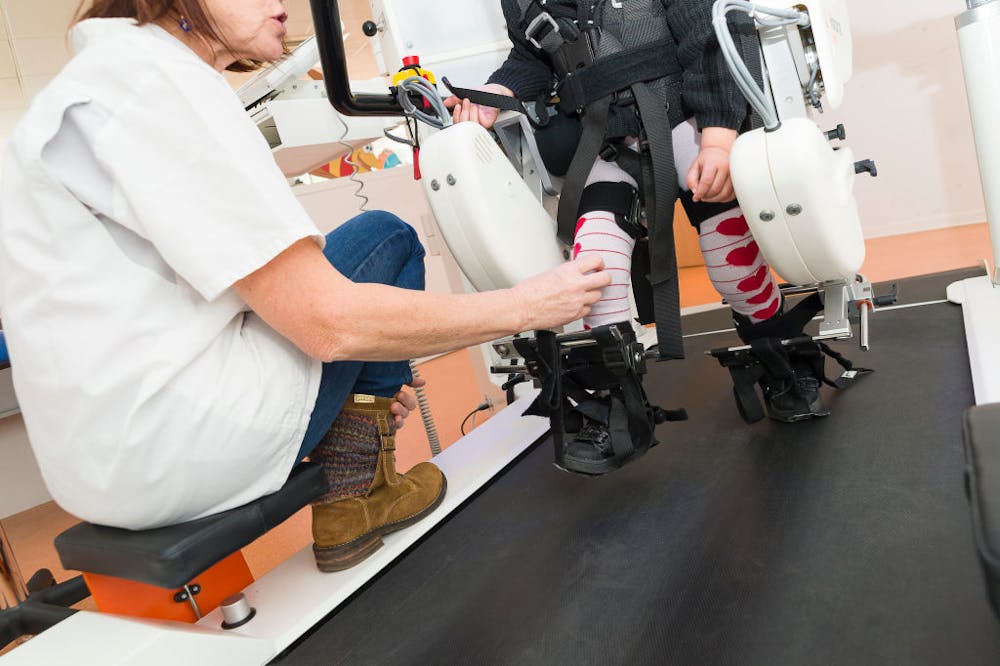
Physical therapist monitoring young patient walking on treadmill with robotic assistance
Robotics can help patients recover physical function in rehabilitation. BSIP/Universal Images Group via Getty Images

How people communicate with robots

Robots were originally designed to undertake repetitive and mundane tasks and operate exclusively in robot-only zones like factories. Robots have since advanced to work collaboratively with people with new ways to communicate with each other.

Cooperative control is one way to transmit information and messages between a robot and a person. It involves combining human abilities and decision making with robot speed, accuracy and strength to accomplish a task.

For example, robots in the agriculture industry can help farmers monitor and harvest crops. A human can control a semi-autonomous vineyard sprayer through a user interface, as opposed to manually spraying their crops or broadly spraying the entire field and risking pesticide overuse.

Robots can also support patients in physical therapy. Patients who had a stroke or spinal cord injury can use robots to practice hand grasping and assisted walking during rehabilitation.

Another form of communication, emotional intelligence perception, involves developing robots that adapt their behaviors based on social interactions with humans. In this approach, the robot detects a person’s emotions when collaborating on a task, assesses their satisfaction, then modifies and improves its execution based on this feedback.

For example, if the robot detects that a physical therapy patient is dissatisfied with a specific rehabilitation activity, it could direct the patient to an alternate activity. Facial expression and body gesture recognition ability are important design considerations for this approach. Recent advances in machine learning can help robots decipher emotional body language and better interact with and perceive humans.

Robots in rehab

Questions like how to make robotic limbs feel more natural and capable of more complex functions like typing and playing musical instruments have yet to be answered.

I am an electrical engineer who studies how the brain controls and communicates with other parts of the body, and my lab investigates in particular how the brain and hand coordinate signals between each other. Our goal is to design technologies like prosthetic and wearable robotic exoskeleton devices that could help improve function for individuals with stroke, spinal cord and traumatic brain injuries.

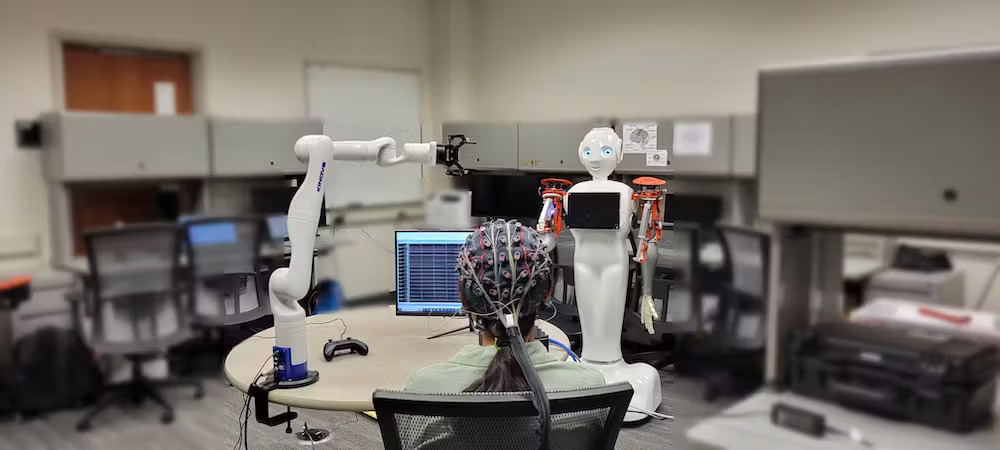
One approach is through brain-computer interfaces, which use brain signals to communicate between robots and humans. By accessing an individual’s brain signals and providing targeted feedback, this technology can potentially improve recovery time in stroke rehabilitation. Brain-computer interfaces may also help restore some communication abilities and physical manipulation of the environment for patients with motor neuron disorders.

A robotic hand and a humanoid robot in a room filled with computers. A person wears a cap with electronic sensors and sits facing away from the camera.
Brain-computer interfaces could allow people to control robotic arms by thought alone. Ramana Kumar Vinjamuri, CC BY-ND

The future of human-robot interaction

Effective integration of robots into human life requires balancing responsibility between people and robots, and designating clear roles for both in different environments.

As robots are increasingly working hand in hand with people, the ethical questions and challenges they pose cannot be ignored. Concerns surrounding privacy, bias and discrimination, security risks and robot morality need to be seriously investigated in order to create a more comfortable, safer and trustworthy world with robots for everyone. Scientists and engineers studying the “dark side” of human-robot interaction are developing guidelines to identify and prevent negative outcomes.

Human-robot interaction has the potential to affect every aspect of daily life. It is the collective responsibility of both the designers and the users to create a human-robot ecosystem that is safe and satisfactory for all.


This article is republished from The Conversation under a Creative Commons license. Read the original article and see more than 250 UMBC articles available in The Conversation.

Innies, outies and omphalophobia: 7 navel-gazing questions about belly buttons answered

Written by Sarah Leupen, senior lecturer of biological sciences, UMBC

Everyone has one, but you might not know much about it. Here biologist Sarah Leupen, who teaches human and comparative animal physiology, explains the ins and outs of belly buttons.

1. Why do I even have a belly button?

Your belly button, or navel – clinically, your umbilicus – is the permanent scar left from where your umbilical cord connected your circulatory system, when you were a fetus, to the placenta. Fetuses don’t breathe, eat or eliminate waste, so the placenta provides an exchange site for the mother to deliver oxygen and nutrients from her bloodstream to the fetus, as well as collecting its wastes to eliminate from her body.

closeup of umbilical cord stump on infant
Once the umbilical cord is cut, the stump dries up and falls off, revealing the baby’s navel. Wacharaphong/iStock via Getty Images Plus

After the baby is born, the physician or other attendant cuts the cord and clamps off the stub, which then dries and falls off after about a week, leaving the point of connection – your belly button – remaining.

If the cord is not cut, as has been the practice in some times and places and as is becoming trendy again in others, it will close off after an hour or so, then naturally detach a few days after birth. Some health care practitioners are concerned that this “lotus birth” could be an infection risk, since the umbilical cord remains attached to the placenta, which is dead tissue once out of the mother’s body.

2. If it’s a scar, why doesn’t it disappear over time?

If you injure just the outer layers of your skin, as in a cut or burn, the scar will soon completely disappear, especially in young people. And newborns are very young people. But unlike in those situations, the umbilicus involves more tissue layers — not just the skin but the connective tissue underneath – so it makes sense it doesn’t just blend in with the rest of your abdominal wall once it’s healed.

What about some pretty complicated surgeries that don’t leave scars? Doctors perform many operations in ways that deliberately avoid scarring, which is not nature’s way. In fact, one way to minimize scarring for surgeries uses this existing scar – surgeons can take advantage of the navel as an incision site for removing your appendix or gall bladder or for weight-loss surgery.

But if you don’t like the way your umbilical scar looks, plastic surgery to change its appearance, called umbilicoplasty, is possible. People sometimes take this cosmetic option after pregnancy or the removal of a piercing, or just to make an “outie” into an “innie.”

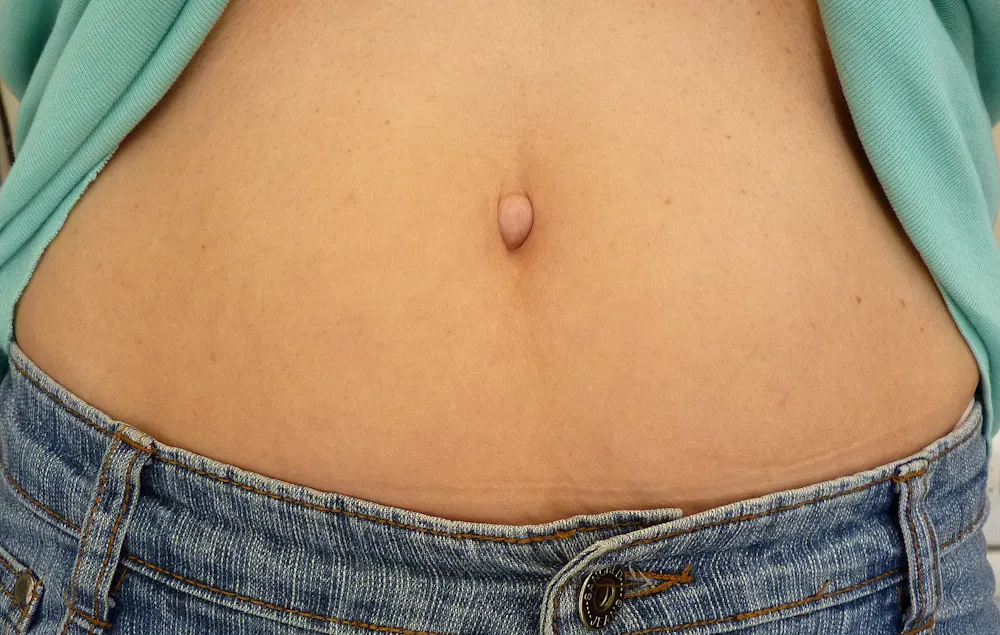
smooth belly with an outie belly button
Outies are much less common than innies. Zeev Barkan/Flickr, CC BY

3. But why do some people have outies, anyway?

The look of your belly button is not related to the location of the clamp or where your doctor cut the cord.

Outies are simply an example of normal human variation, like the way some people have curly hair or dimples. When the tip of the umbilical cord’s remnant pokes out past the skin around it, you have an outie; about 10% of people have these. Any concave navel is called an “innie” and a convex one an “outie.”

Sometimes outies can be caused by an umbilical hernia in the baby or another medical problem, but most of it is just due to what your genes encoded. You might also temporarily have an outie during late pregnancy, when the abdominal pressure from the growing fetus stretches your navel and may push it out.

4. How deep does it go?

You can probably easily probe the depth of your own navel – there are no hidden recesses there. What’s under it is the same as what’s under the skin of the rest of your abdomen: your abdominal muscles, to which the navel is attached by a short umbilical stalk, and the peritoneum, the membrane that lines the abdominal cavity. Under that lie your guts – that is, your intestines and other abdominal organs. If you keep following this imaginary journey back, you’ll get to your spine – the belly button is usually lined up between the third and fourth lumbar vertebrae (L3 and L4).

Learn how to find your pet’s belly button.

5. Do other animals have belly buttons?

Because the navel is a scar from where the umbilical cord connected the fetus to the placenta, all placental mammals have them. That includes all mammals except marsupials (like kangaroos and possums) and monotremes (like platypuses and echidnas).

Your cat or dog or guinea pig does have a belly button, but because it’s a flatter scar than a person’s rather than a concave one, and is covered in fur, you might have missed it.

6. Is there anything besides lint in there?

Like any concave surface, if you have an innie, it probably gathers bits of debris occasionally. Your navel also has a microbial community, just like the rest of your skin. Because it’s pretty protected from soap and abrasion, a more stable and diverse bacterial community lives in your navel than elsewhere on your skin’s surface.

The innovative Belly Button Biodiversity project at North Carolina State University has revealed a lot about these little friends. The researchers found over 2,000 species of bacteria in the first 60 belly buttons they investigated.

It looks like most people have a set of eight common belly button bacteria, but the project is discovering new ones all the time.

7. Why do belly buttons gross out some people?

There hasn’t really been much research into why some people find belly buttons to be repulsive.

It may overlap with omphalophobia, the fear of belly buttons and touching them. There’s no specific treatment beyond the therapy or anti-anxiety medications a doctor might prescribe for any other phobia.

Whatever your feelings about belly buttons, they’re harmless. What’s more, they’re part of your evolutionary legacy as a mammal, the group of animals so invested in their offspring that they invented a way to deliver nutrients and oxygen, the mother’s bread and breath, straight into their developing young. Your navel can be a reminder of that first life-sustaining care you received from another person before you were even born.


This article is republished from The Conversation under a Creative Commons license. Read the original article and see more than 250 UMBC articles available in The Conversation.
Meet a Retriever—Xavier Smith ’23, M31, computer engineering, scholar and mentor

Meet Xavier Smith, a senior computer engineering student who is heading to MIT next year to pursue his dreams of earning a Ph.D. and starting a biotech company. As a part of UMBC’s Meyerhoff Scholars Program, the U-RISE Scholars Program, and a number of other organizations on campus, he truly understands the meaning of community. Take it away, Xavier!

Q: What’s one essential thing you’d want another Retriever to know about you?

A: I am a senior studying computer engineering on the communications track. In fall of 2023, I will be attending the Massachusetts Institute of Technology (MIT), where I will be pursuing my Ph.D. in electrical engineering as a recipient of the MIT Presidential Fellowship supported from the Lemelson Foundation (Lemelson Minority Engineering Fellowship). 

I will be focusing on engineering magnetic nanoparticles for wireless neural stimulation with hopes of developing non-invasive therapeutic treatments for individuals diagnosed with neurodegenerative diseases and psychiatric disorders. My future career goals are to start a biotechnology company that practically implements these therapeutic innovations in a translational manner, and my professional goals are to make biomedical technology more accessible and equitable for individuals from all socioeconomic and ethnic backgrounds.

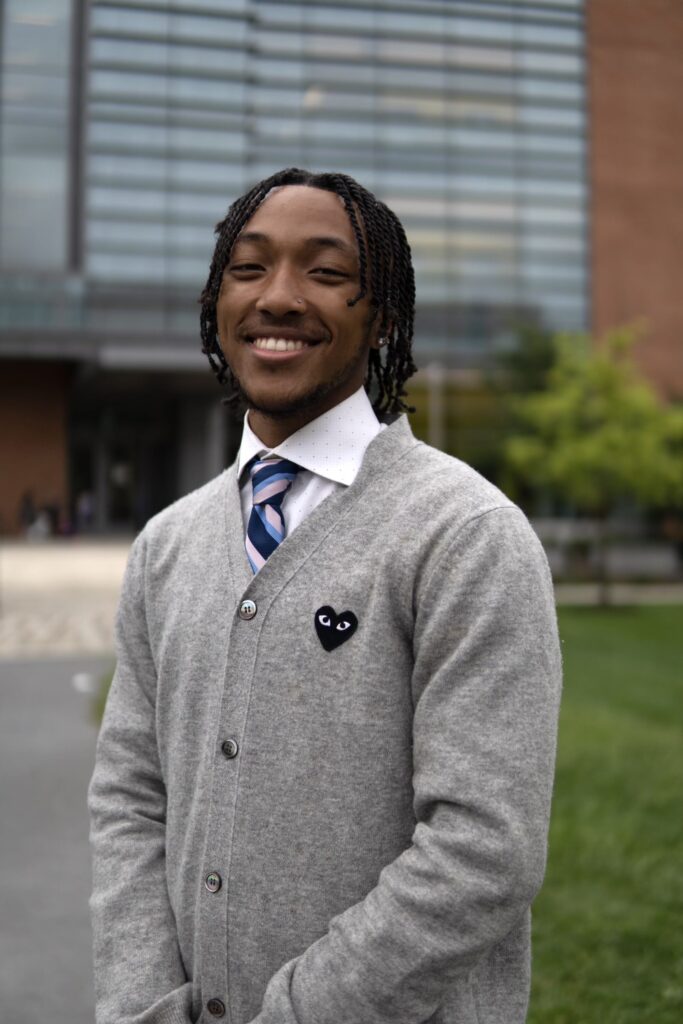
Headshot of a young man in a buttoned up sweater and a tie with a white shirt

Q: What’s the one thing you’d want someone who hasn’t joined the UMBC community to know about the support you find here?

A: UMBC has many niche communities, and although it’s important to find the one that fits you, the university has a way of mixing those communities together in an energetic way that helps spark interesting conversations and life-long connections. Additionally, UMBC is hyper-focused on their students, which allows your voice to be heard on a larger scale.

Q: Tell us about someone in your community who has inspired you or supported you, and how they did it.

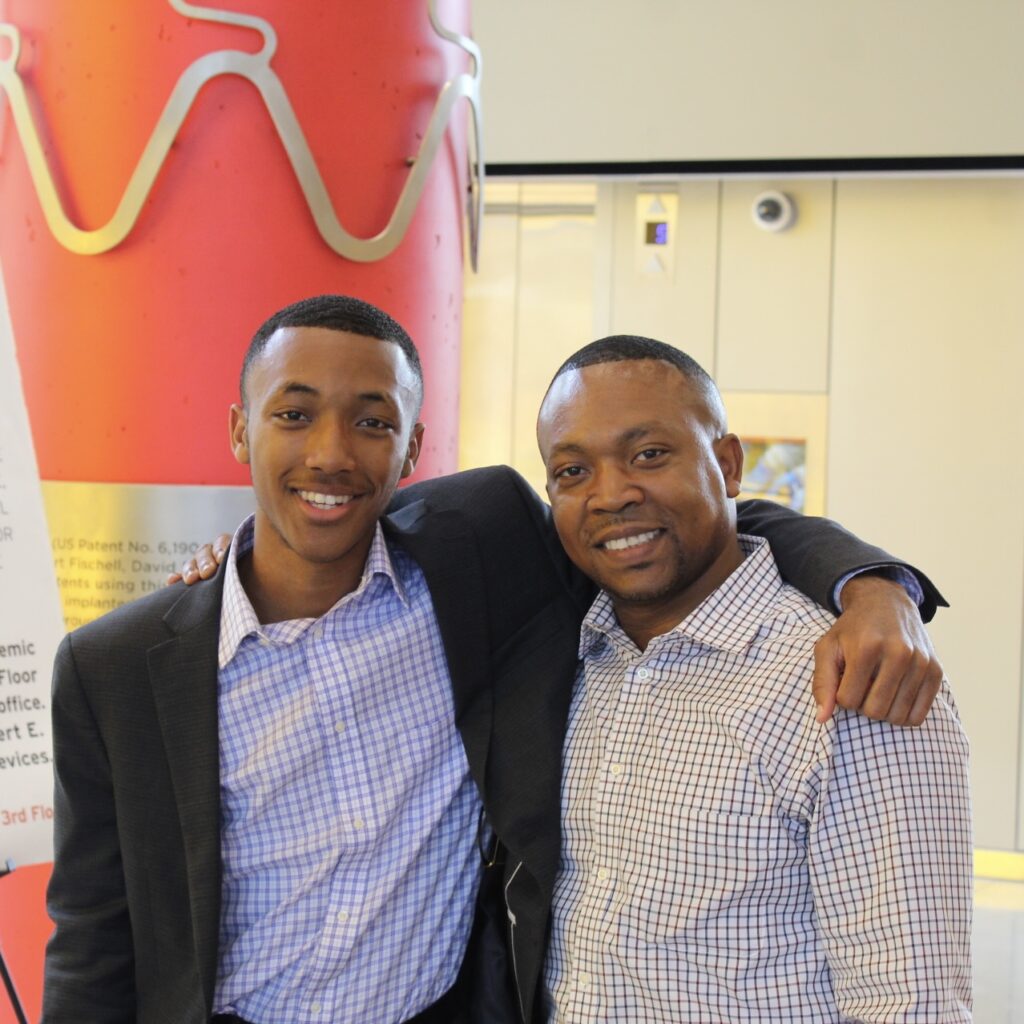
A: My father, Brian Smith, has inspired me as an black engineer and entrepreneur in STEM through the various companies he has owned that are either technologically-based or focus on exposing students to opportunities in science and engineering. His tenacity, optimism, work ethic, positive attitude, adaptability, and collective success of more than 25 years motivates me to push the boundaries of science and technology in my community, and to be just like him.

A father and son stand with their arms around each other.
Xavier Smith (left) with his father, Brian Smith (right) at a research presentation in 2018. Photo courtesy of Smith.

Q: Tell us what you love about your academic program or an organization you’re involved in.

A: What I love about UMBC’s computer engineering program is the overall focus of implementation and practicality of content. The faculty prepare students to tackle real-world problems from a plethora of perspectives not just from STEM. Separately, I am currently president of the Institute of Electronics and Electrical Engineers (IEEE) at UMBC, and I lead this organization with my stellar executive board of friends I made along the way in computer engineering. What I love about this organization is its versatility of impact as we focus on getting students of all majors and backgrounds excited about STEM, and exposed to real-world opportunities and applications of science and technology.

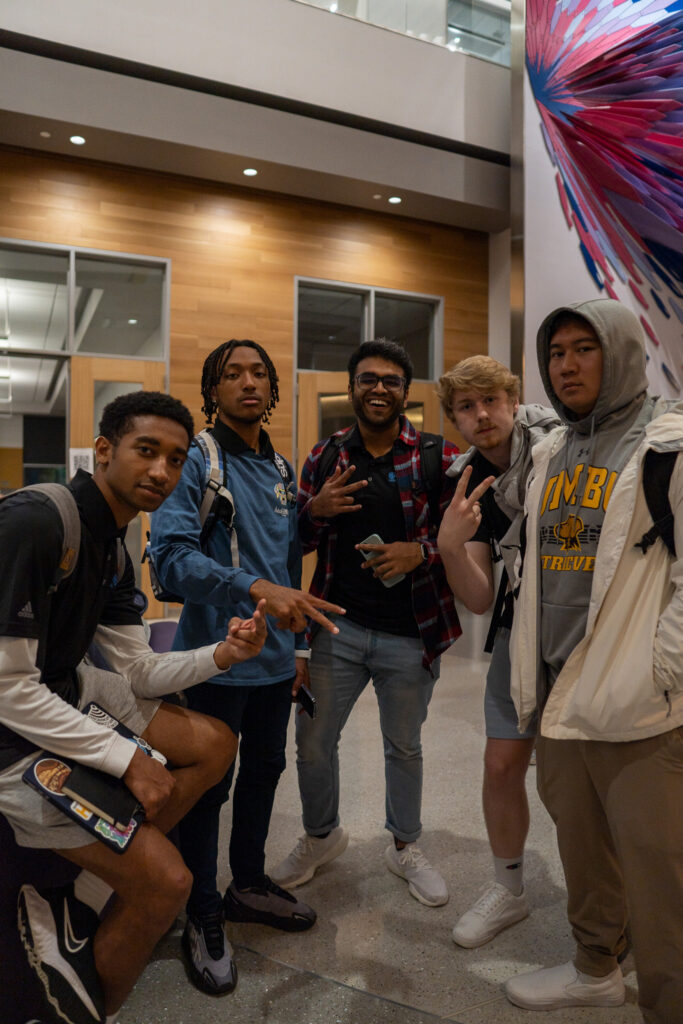
A group of students and scholar mentors pose together
Smith with computer engineering friends and IEEE executive board members running an event at hackUMBC, from left to right: Christopher Slaughter ’23 (vice president), Xavier Smith ’23 (president), Andrew Mathew ’23 (secretary), Caden Ertel ’23 (lab director), and David Nguyen ’23 (public relations chair/historian). (Nkosi Cruickshank, the group’s treasurer, is not pictured). Photo courtesy of Smith.

Q: What brought you to UMBC?

A: I came to UMBC because of the Meyerhoff Scholars Program, which is a Ph.D. pipeline-program focused on preparing historically underrepresented students for higher education in academia and industry. I knew I wanted to earn a Ph.D., but I didn’t know why or in what specific field, and the Meyerhoff Program here at UMBC provided me with resources that helped me figure out the answer to those questions. As I took advantage of these opportunities to set my foundation in research, I joined the U-RISE Program here, which guided me on manifesting my desire to enter the world of biomedical science.

I got involved with organizations here such as the Institute of Electronics and Electrical Engineers (IEEE), the National Society of Black Engineers (NSBE), Black Student Union (BSU), etc. and teaching opportunities as a teaching assistant and learning assistant in the computer engineering department. Overall, before I entered UMBC I had one perspective of what the university had to offer me, however, as I continued to explore, I began to see the multitude of opportunities that UMBC provides that can be encompassed into one word: community.

Not only have I found exactly what field of science I want to pursue and why, I have found my voice in STEM and the confidence to pursue my goals and dreams of making a lasting difference in the world because of the Meyerhoff Scholars and U-RISE Scholars programs.

Xavier Smith '23

Q: What are some of the benefits of your involvement in student activities?

A: I am a student leader in many different contexts: the president of IEEE, a peer advisor in the Meyerhoff Program for incoming computer engineering students, and a research project leader in Dr. Ramana  Vinjamuri’s Brain Computer Interfaces lab. As president of IEEE, I get a chance to break the barriers of the club in terms of our impact, event sizes, and activities with my friends on the executive board. We have focused on creating a makerspace for students of all majors and backgrounds, giving them a physical place to be able to express themselves, explore their creative interests, or simply complete homework with friends.

As a peer advisor for the Meyerhoff Program, I have the opportunity of mentoring other students in the program interested in computer engineering. I serve not only as their go-to person for when they need help, but also as an advocate for them if they need support inside or outside the program.

Lastly, as a research project leader in Dr. Vinjamuri’s lab, I’m mentoring students on projects that focus on improving the lives of patients with physical and mental disparities by engineering novel myoelectric prosthetics, neuroprosthetics, recording devices, and robust decoding systems. I love being able to give direction and inspiration to the next generation of students in science through my efforts, especially to those who originate from historically underrepresented communities.

Q: What’s it like to be part of a scholars community at UMBC?

A: I am part of the Meyerhoff Scholars and U-RISE Scholars programs here at UMBC, and the main thing I enjoy about both programs is the overarching support that they provide me as I’m working toward reaching my academic, career, and professional goals. The resources that they routinely provide me are invaluable: mentoring, contacts, support groups, advising, and most importantly, communication. Not only have I found exactly what field of science I want to pursue and why, I have found my voice in STEM and the confidence to pursue my goals and dreams of making a lasting difference in the world because of both programs.

* * * * *

UMBC’s greatest strength is its people. When people meet Retrievers and hear about the passion they bring, the relationships they create, the ways they support each other, and the commitment they have to inclusive excellence, they truly get a sense of our community. That’s what “Meet a Retriever” is all about.

Learn more about how UMBC can help you achieve your goals.

Declines in math readiness underscore the urgency of math awareness

Written by Manil Suri, professor of mathematics and statistics, UMBC

When President Ronald Reagan proclaimed the first National Math Awareness Week in April 1986, one of the problems he cited was that too few students were devoted to the study of math.

“Despite the increasing importance of mathematics to the progress of our economy and society, enrollment in mathematics programs has been declining at all levels of the American educational system,” Reagan wrote in his proclamation.

Nearly 40 years later, the problem that Reagan lamented during the first National Math Awareness Week – which has since evolved to become “Mathematics and Statistics Awareness Month” – not only remains but has gotten worse.

Whereas 1.63%, or about 16,000, of the nearly 1 million bachelor’s degrees awarded in the U.S. in the 1985-1986 school year went to math majors, in 2020, just 1.4%, or about 27,000, of the 1.9 million bachelor’s degrees were awarded in the field of math – a small but significant decrease in the proportion.

Post-pandemic data suggests the number of students majoring in math in the U.S. is likely to decrease in the future.

A key factor is the dramatic decline in math learning that took place during the lockdown. For instance, whereas 34% of eighth graders were proficient in math in 2019, test data shows the percentage dropped to 26% after the pandemic.

These declines will undoubtedly affect how much math U.S. students can do at the college level. For instance, in 2022, only 31% of graduating high school seniors were ready for college-level math – down from 39% in 2019.

These declines will also affect how many U.S. students are able to take advantage of the growing number of high-paying math occupations, such as data scientists and actuaries. Employment in math occupations is projected to increase by 29% in the period from 2021 to 2031.

About 30,600 math jobs are expected to open up per year from growth and replacement needs. That exceeds the 27,000 or so math graduates being produced each year – and not all math degree holders go into math fields. Shortages will also arise in several other areas, since math is a gateway to many STEM fields.

For all of these reasons and more, as a mathematician who thinks deeply about the importance of math and what it means to our world – and even to our existence as human beings – I believe this year, and probably for the foreseeable future, educators, policymakers and employers need to take Mathematics and Statistics Awareness Month more seriously than ever before.

Struggles with mastery

Subpar math achievement has been endemic in the U.S. for a long time.

Data from the National Assessment of Educational Progress shows that no more than 26% of 12th graders have been rated proficient in math since 2005.

The pandemic disproportionately affected racially and economically disadvantaged groups. During the lockdown, these groups had less access to the internet and quiet studying spaces than their peers. So securing Wi-Fi and places to study are key parts of the battle to improve math learning.

Some people believe math teaching techniques need to be revamped, as they were through the Common Core, a new set of educational standards that stressed alternative ways to solve math problems. Others want a return to more traditional methods. Advocates also argue there is a need for colleges to produce better-prepared teachers.

Other observers believe the problem lies with the “fixed mindset” many students have – where failure leads to the conviction that they can’t do math – and say the solution is to foster a “growth” mindset – by which failure spurs students to try harder.

Although all these factors are relevant, none address what in my opinion is a root cause of math underachievement: our nation’s ambivalent relationship with mathematics.

Low visibility

Many observers worry about how U.S. children fare in international rankings, even though math anxiety makes many adults in the U.S. steer clear of the subject themselves.

Mathematics is not like art or music, which people regularly enjoy all over the country by visiting museums or attending concerts. It’s true that there is a National Museum of Mathematics in New York, and some science centers in the U.S. devote exhibit space to mathematics, but these can be geographically inaccessible for many.

A 2020 study on media portrayals of math found an overall “invisibility of mathematics” in popular culture. Other findings were that math is presented as being irrelevant to the real world and of little interest to most people, while mathematicians are stereotyped to be singular geniuses or socially inept nerds, and white and male.

Math is tough and typically takes much discipline and perseverance to succeed in. It also calls for a cumulative learning approach – you need to master lessons at each level because you’re going to need them later.

While research in neuroscience shows almost everyone’s brain is equipped to take up the challenge, many students balk at putting in the effort when they don’t score well on tests. The myth that math is just about procedures and memorization can make it easier for students to give up. So can negative opinions about math ability conveyed by peers and parents, such as declarations of not being “a math person.”

A positive experience

Here’s the good news. A 2017 Pew poll found that despite the bad rap the subject gets, 58% of U.S. adults enjoyed their school math classes. It’s members of this legion who would make excellent recruits to help promote April’s math awareness. The initial charge is simple: Think of something you liked about math – a topic, a puzzle, a fun fact – and go over it with someone. It could be a child, a student, or just one of the many adults who have left school with a negative view of math.

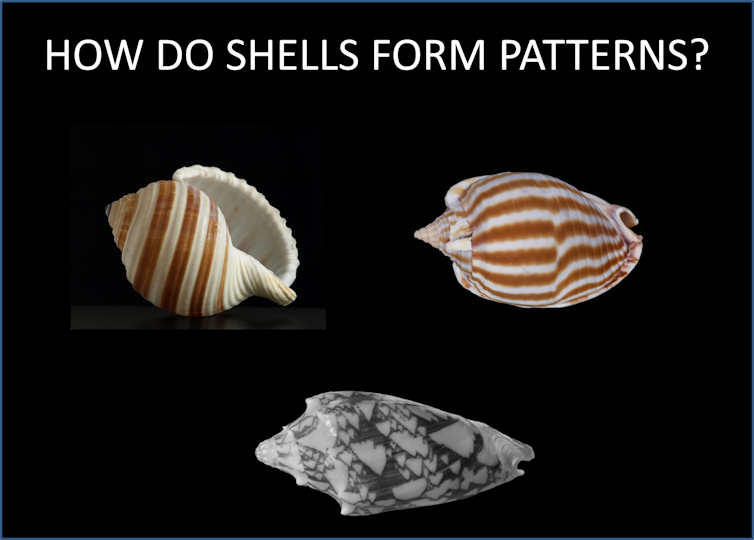
Three seashells are shown under the words "how do shells form patterns?"
Math exercise for shells can be downloaded at https://www.manilsuri.com/assets/shell_patterns.pptx. Manil Suri, Author provided

Can something that sounds so simplistic make a difference? Based on my years of experience as a mathematician, I believe it can – if nothing else, for the person you talk to. The goal is to stimulate curiosity and convey that mathematics is much more about exhilarating ideas that inform our universe than it is about the school homework-type calculations so many dread.

Raising math awareness is a first step toward making sure people possess the basic math skills required not only for employment, but also to understand math-related issues – such as gerrymandering or climate change – well enough to be an informed and participating citizen. However, it’s not something that can be done in one month.

Given the decline in both math scores and the percentage of students studying math, it may take many years before America realizes the stronger relationship with math that President Reagan’s proclamation called for during the first National Math Awareness Week in 1986.


This article is republished from The Conversation under a Creative Commons license. Read the original article and see more than 250 UMBC articles available in The Conversation.
What is the National Cybersecurity Strategy? A cybersecurity expert explains what it is and what the Biden administration has changed

Written by Richard Forno, principal lecturer in computer science and electrical engineering, UMBC

The Biden administration released its first National Cybersecurity Strategy on March 2, 2023. The last version was issued in 2018 during the Trump administration.

As the National Security Strategy does for national defense, the National Cybersecurity Strategy outlines a president’s priorities regarding cybersecurity issues. The document is not a directive. Rather, it describes in general terms what the administration is most concerned about, who its major adversaries are and how it might achieve its goals through legislation or executive action. These types of strategy statements are often aspirational.

As expected, the 2023 Biden National Cybersecurity Strategy reiterates previous recommendations about how to improve American cybersecurity. It calls for improved sharing of information between the government and private sector about cybersecurity threats, vulnerabilities and risks. It prescribes coordinating cybersecurity incident response across the federal government and enhancing regulations. It describes the need to expand the federal cybersecurity workforce. It emphasizes the importance of protecting the country’s critical infrastructure and federal computer systems. And it identifies China, Russia, Iran and North Korea as America’s main adversaries in cyberspace.

However, as a former cybersecurity industry practitioner and current cybersecurity researcher, I think that the 2023 document incorporates some fresh ideas and perspectives that represent a more holistic approach to cybersecurity. At the same time, though, some of what is proposed may not be as helpful as envisioned.

Some of the key provisions in the current National Cybersecurity Strategy relate to the private sector, both in terms of product liability and cybersecurity insurance. It also aims to reduce the cybersecurity burden on individuals and smaller organizations. However, I believe it doesn’t go far enough in fostering information-sharing or addressing the specific tactics and techniques used by attackers.

Acting National Cybersecurity Director Kemba Walden discusses the Biden administration’s National Cybersecurity Strategy.

The end of vendor indemnification?

For decades, the technology industry has operated under what is known as “shrink-wrap” licensing. This refers to the multiple pages of legal text that customers, both large and small, routinely are forced to accept before installing or using computer products, software and services.

While much has been written about these agreements, such licenses generally have one thing in common: They ultimately protect vendors such as Microsoft or Adobe from legal consequences for any damages or costs arising from a customer’s use of their products, even if the vendor is at fault for producing a flawed or insecure product that affects the end user.

In a groundbreaking move, the new cybersecurity strategy says that while no product is totally secure, the administration will work with Congress and the private sector to prevent companies from being shielded from liability claims over the security of their products. These products underpin most of modern society.

Removing that legal shield is likely to encourage companies to make security a priority in their product development cycles and have a greater stake in the reliability of their products beyond the point of sale.

In another noteworthy shift, the strategy observes that end users bear too great a burden for mitigating cybersecurity risks. It states that a collaborative approach to cybersecurity and resiliency “cannot rely on the constant vigilance of our smallest organizations and individual citizens.” It stresses the importance of manufacturers of critical computer systems, as well as companies that operate them, in taking a greater role in improving the security of their products. It also suggests expanded regulation toward that goal may be forthcoming.

Interestingly, the strategy places great emphasis on the threat from ransomware as the most pressing cybercrime facing the U.S. at all levels of government and business. It now calls ransomware a national security threat and not simply a criminal matter.

Backstopping cyber insurance

The new strategy also directs the federal government to consider taking on some responsibility for so-called cybersecurity insurance.

Here, the administration wants to ensure that insurance companies are adequately funded to respond to claims following a significant or catastrophic cybersecurity incident. Since 2020, the market for cybersecurity-related insurance has grown nearly 75%, and organizations of all sizes consider such policies necessary.

This is understandable given how many companies and government agencies are reliant on the internet and corporate networks to conduct daily operations. By protecting, or “backstopping,” cybersecurity insurers, the administration hopes to prevent a major systemic financial crisis for insurers and victims during a cybersecurity incident.

However, cybersecurity insurance should not be treated as a free pass for complacency. Thankfully, insurers now often require policyholders to prove they are following best cybersecurity practices before approving a policy. This helps protect them from issuing policies that are likely to face claims arising from gross negligence by policyholders.

Looking forward

In addition to dealing with present concerns, the strategy also makes a strong case for ensuring the U.S. is prepared for the future. It speaks about fostering technology research that can improve or introduce cybersecurity in such fields as artificial intelligence, critical infrastructure and industrial control systems.

The strategy specifically warns that the U.S. must be prepared for a “post-quantum future” where emerging technologies could render existing cybersecurity controls vulnerable. This includes current encryption systems that could be broken by future quantum computers.

Practical quantum computers, when they arrive, will force a change in how the internet is secured.

Where the strategy falls short

While the National Cybersecurity Strategy calls for continuing to expand information-sharing related to cybersecurity, it pledges to review federal classification policy to see where additional classified access to information is necessary.

The federal government already suffers from overclassification, so if anything, I believe less classification of cybersecurity information is needed to facilitate better information-sharing on this issue. It’s important to reduce administrative and operational obstacles to effective and timely interaction, especially where collaborative relationships are needed between industry, academia and federal and state governments. Excessive classification is one such challenge.

Further, the strategy does not address the use of cyber tactics, techniques and procedures in influence or disinformation campaigns and other actions that might target the U.S. This omission is perhaps intentional because, although cybersecurity and influence operations are often intertwined, reference to countering influence operations could lead to partisan conflicts over freedom of speech and political activity. Ideally, the National Cybersecurity Strategy should be apolitical.

That being said, the 2023 National Cybersecurity Strategy is a balanced document. While in many ways it reiterates recommendations made since the first National Cybersecurity Strategy in 2002, it also provides some innovative ideas that could strengthen U.S. cybersecurity in meaningful ways and help modernize America’s technology industry, both now and into the future.


This article is republished from The Conversation under a Creative Commons license. Read the original article and see more than 250 UMBC articles available in The Conversation.
Calls for a ‘green’ Ramadan revive Islam’s long tradition of sustainability and care for the planet

Written by Noorzehra Zaidi, assistant professor of history, UMBC

For many Muslims breaking fast in mosques around the world this Ramadan, something will be missing: plastics.

The communal experience of iftars – the after-sunset meal that brings people of the faith together during the holy month starting on March 22, 2023 – often necessitates the use of utensils designed for mass events, such as plastic knives and forks, along with bottles of water.

But to encourage Muslims to be more mindful of the impact of Ramadan on the environment, mosques are increasingly dispensing of single-use items, with some banning the use of plastics altogether.

As a historian of Islam, I see this “greening” of Ramadan as entirely in keeping with the traditions of the faith, and in particular the observance of Ramadan.

The month – during which observant Muslims must abstain from even a sip of water or food from sun up to sun down – is a time for members of the faith to focus on purifying themselves as individuals against excess and materialism.

But in recent years, Muslim communities around the world have used the period to rally around themes of social awareness. And this includes understanding the perils of wastefulness and embracing the link between Ramadan and environmental consciousness.

The ban on plastics – a move encouraged by the Muslim Council of Britain as a way for Muslims “to be mindful of [God’s] creation and care for the environment” – is just one example.

People clearing plastic from a beach during Ramadan
Environmental consciousness has gained traction in Muslim communities over recent years. Yasser Chalid via Getty Images.

Many other mosques and centers are discouraging large or extravagant evening meals altogether. The fear is such communal events generate food waste and overconsumption and often rely on nonbiodegradable materials for cutlery, plates and serving platters.

Quranic environmentalism

While the move toward environmental consciousness has gained traction in Muslim communities in recent years, the links between Islam and sustainability can be found in the faith’s foundational texts.

Scholars have long emphasized principles outlined in the Quran that highlight conservation, reverence for living creatures and the diversity of living things as a reminder of God’s creation.

The Quran repeatedly emphasizes the idea of “mizan,” a kind of cosmic and natural balance, and the role of humans as stewards and khalifa, or “viceregents,” on Earth – terms that also carry an environmental interpretation.

Recently, Islamic environmental activists have highlighted the numerous hadith – sayings of the Prophet Muhammad that provide guidance to followers of the faith – that emphasize that Muslims should avoid excess, respect resources and living things, and consume in moderation.

Although present from the outset of the faith, Islam’s ties to environmentalism received major visibility with the works of Iranian philosopher Seyyed Hossein Nasr, and a series of lectures he delivered at the University of Chicago in 1966. The lectures and a subsequent book, “Man and Nature: The Spiritual Crisis in Modern Man,” warned that humans had broken their relationship with nature and thus placed themselves in grave ecological danger.

Nasr blamed modern and Western science for being materialistic, utilitarian and inhuman, claiming it had destroyed traditional views of nature. Nasr argued that Islamic philosophy, metaphysics, scientific tradition, arts and literature emphasize the spiritual significance of nature. But he noted that numerous contemporary factors, such as mass rural-to-urban migration and poor and autocratic leadership, had prevented the Muslim world from realizing and implementing the Islamic view of the natural environment.

Scholars and activists expanded on Nasr’s work through the 1980s and 1990s, among them Fazlun Khalid, one of the world’s leading voices on Islam and environmentalism. In 1994, Khalid founded the Islamic Foundation for Ecology and Environmental Sciences, an organization dedicated to the maintenance of the planet as a healthy habitat for all living beings. Khalid and other Muslim environmentalists suggest that Islam’s nearly 2 billion adherents can participate in the tasks of environmental sustainability and equity not through Western models and ideologies but from within their own traditions.

Partnering with the United Nations Environment Program, Khalid and other leading scholars crafted Al-Mizan, a worldwide project for Muslim leaders interested in Muslims’ religious commitments to nature. “The ethos of Islam is that it integrates belief with a code of conduct which pays heed to the essence of the natural world,” Khalid wrote in “Signs on the Earth: Islam, Modernity, and the Climate Crisis.”

Going beyond an eco-Ramadan

Environmental crises disproportionately affect the world’s poorest populations, and academics have highlighted the particular vulnerabilities of Muslim communities around the world, such as the victims of devastating floods in Pakistan in 2022.

By highlighting Islamic principles, policies and community approaches, academics have shown how Islam can represent a model for environmental stewardship.

This push for environmental consciousness extends beyond Ramadan. In recent years, Muslims have tried to introduce green practices into the shrine cities in Iraq during pilgrimage seasons in Ashura and Arbaeen.

Thousands of people gather in front of a shrine during Ramadan
Pilgrims at the Holy Shrine in Karbala, Iraq. Jasmin Merdan via Getty Images.

This has included awareness campaigns encouraging the 20 million pilgrims who visit Arbaeen annually to reduce the tons of trash they leave every year that clog up Iraq’s waterways. Quoting from Shiite scholarship and drawing on testimonials from community leaders, the Green Pilgrim movement suggests carrying cloth bags and reusable water bottles, turning down plastic cutlery, and hosting eco-friendly stalls along the walk.

Muslim-owned businesses and nonprofits are joining these wider efforts. Melanie Elturk, the founder of the successful hijab brand Haute Hijab, regularly ties together faith, fashion, commerce and environmentalism by highlighting the brand’s focus on sustainability and environmental impact. The Washington, D.C., nonprofit Green Muslims pioneered the first “leftar” – a play on the word “iftar” – using leftovers and reusable containers.

These efforts are but a few of the diverse ways that Muslim communities are addressing environmental impact. The greening of Ramadan fits into a broader conversation about how often communities can tackle climate change within their own frameworks.

But Islamic environmentalism is more than just the dispensing of plastic forks and water bottles – it taps into a worldview ingrained in the faith from the outset, and can continue to guide adherents as they navigate environmentalism, a space where they may otherwise be marginalized.


This article is republished from The Conversation under a Creative Commons license. Read the original article and see more than 250 UMBC articles available in The Conversation.
Meet a Retriever—Karndeep Singh ’18, M26, CYA president

Meet Karndeep Singh ’18, M26, biochemistry and molecular biology, a graduate student at the University of Maryland School of Medicine in the biochemistry and molecular biology Ph.D. program. Singh is conducting his thesis research in Dr. Michael Summers’ laboratory at UMBC. Outside of research, he’s been involved with UMBC’s Chapter of Young Alumni (CYA), serving as the president since summer of 2020. Singh says he’s found his way at UMBC through involvement in research, residential life, and networking with alumni at UMBC.

Q: What’s the one thing you’d want someone who hasn’t joined the UMBC community to know about the support you find here?

A: UMBC will push you to your limits and help you realize that you were meant to break those limits. UMBC will challenge you academically, but you have so much support here as everyone wants you to succeed—it is just a matter of asking for help which can be the hardest first step to take. Do not shy away from asking for help; there is a very high likelihood that others around you need help, too.

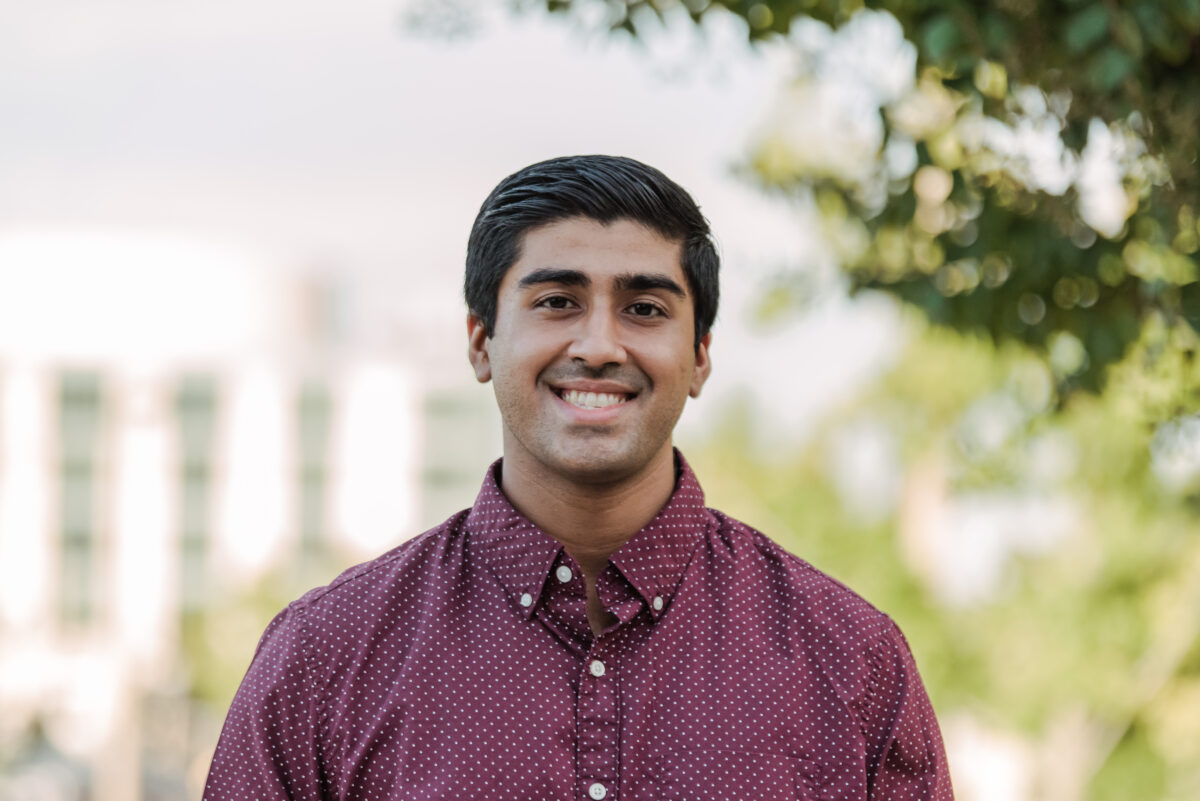
Headshot of Karndeep Singh, alumnus and CYA president
Karndeep Singh ’18, M26 (Marlayna Demond ’11/UMBC)

Q: Tell us about someone in the community who has inspired you or supported you, and how they did it.

A: There has been a village of people at UMBC who have helped me succeed. My advisors in the Meyerhoff Scholars Program guided me as a student by helping me to find research opportunities during my time at UMBC and post-UMBC. Bethany Birago ’99 (emergency health services) taught me and demonstrated all of the professionalism I would need in healthcare and in the workplace.

Last and certainly not least, I met my amazing partner at UMBC—Aishwarya Iyer ’18, M26, biochemistry and molecular biology. She has been one of the hardest workers I have ever seen and continues to inspire me to work harder to have a positive impact at UMBC, in the Baltimore community, and in this world.

UMBC will push you to your limits and help you realize that you were meant to break those limits. UMBC will challenge you academically, but you have so much support here as everyone wants you to succeed.

Karndeep Singh '18, M26

Q: Tell us about what you love about your academic program or an organization you’re involved in.

A: I joined Residential Life as a resident assistant (RA) during my sophomore year and ultimately became lead RA in Potomac Hall during my senior year. Every year, the staff members I worked with acted as a family, especially my staff during my time in Potomac Hall. We would hold Thanksgiving dinners together, compete with the other residential halls during our summer and winter trainings, game nights, movie nights, etc. At every moment, I felt loved by my staff and knew that any of them would support me if I needed anything at all.

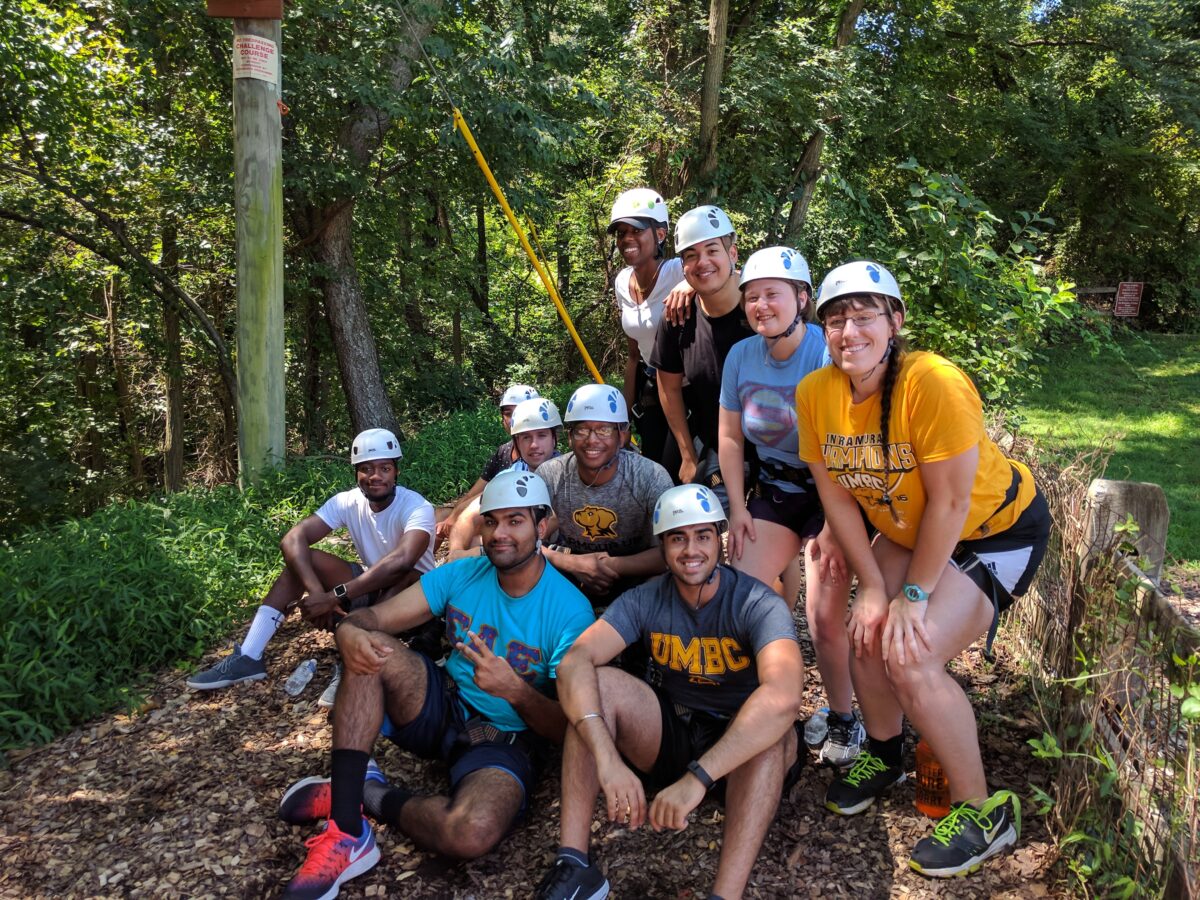
Students in climbing helmets pose in the woods
Singh, seated center, poses with other members of Potomac’s Res Life staff.

Q: Where are you currently in your studies, and what do you enjoy most about what you’re doing now?

A: Currently, I am a 4th year Ph.D. candidate in the biochemistry and molecular biology program at the University of Maryland, School of Medicine. I conduct my thesis research in Dr. Michael Summers’ HHMI laboratory at UMBC where my project is focused on investigating how the HIV-1 RNA genome interacts with cap-dependent translational machinery. One of the greatest parts of my role is having the opportunity to mentor undergraduate students as they conduct undergraduate research in our laboratory. My role as their mentor is not to persuade them to do a career in research but teach them how to conduct good science and carry the skills they learn in the laboratory to their future endeavors.

Q: What brought you to UMBC in the first place? Tell us about your primary WHY, and how it led you to UMBC.

A: I attended Western School of Technology and Environmental Science (Western Tech) where a number of our high school events were held at UMBC. I learned about UMBC’s reputation by speaking to current UMBC students and I knew that this was the school to attend if I ultimately wanted a career in STEM. The school was known for its diversity and its community—values that were instilled into me by attending Western Tech and I knew that UMBC embodied those same values and would uphold them.

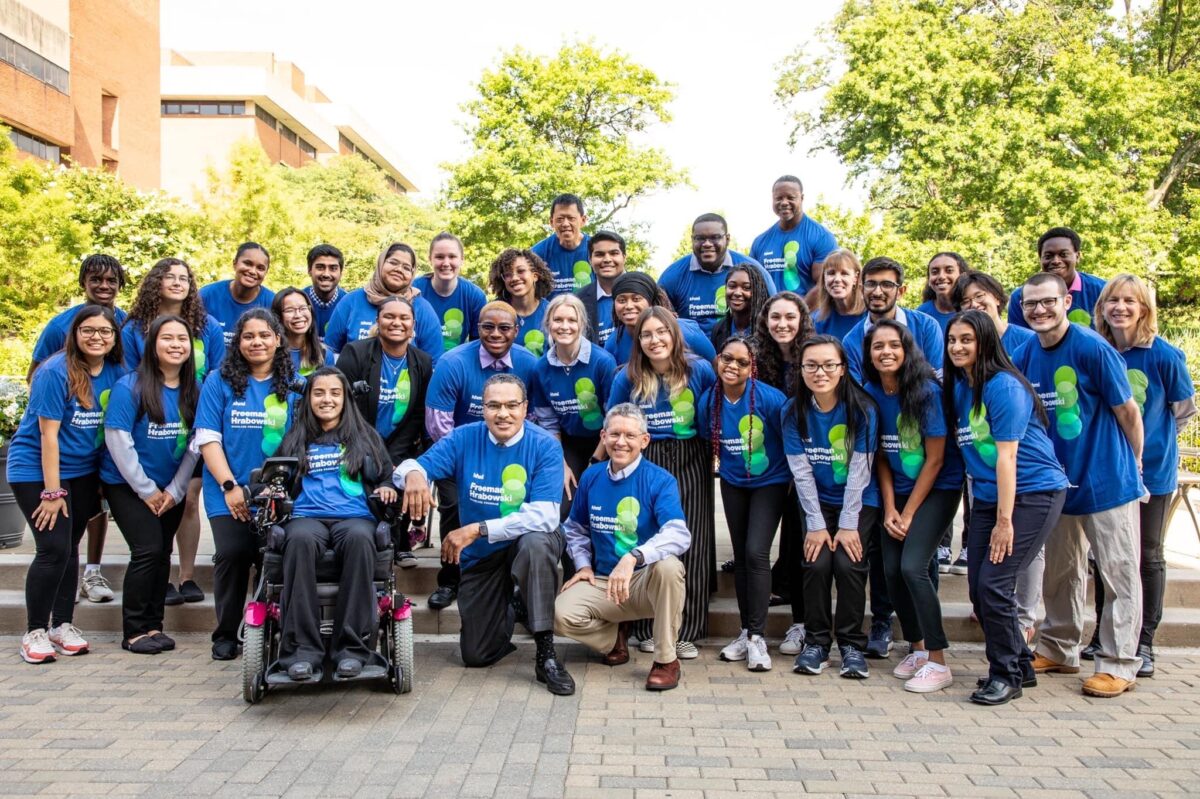
A group of lab members pose together outside, all are wearing the same blue shirt
Dr. Michael Summers’ lab group poses with Dr. Hrabowski. Singh is fourth from left, standing in the back row.

Q: Tell us about the people who helped you grow at UMBC, and why their HOW made such a difference to you.

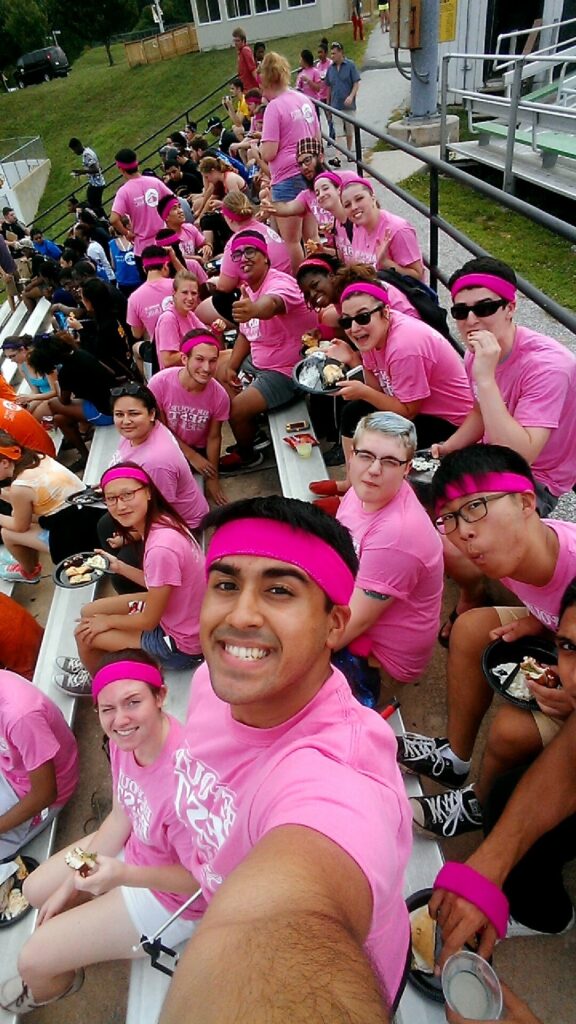
Residential life staff all wearing pink shirts and pink headbands sit on bleachers together
Singh takes a selfie with a group of Res Life staff.

A: During my undergraduate experience, I had a couple of research opportunities, but I did not feel confident to succeed in graduate school. After graduating from UMBC in May 2018, I took a gap year where I joined Dr. Michael Summers’ laboratory as a laboratory technician to supervise and mentor Dr. Joshua Brown’s (Ph.D. ’18, biochemistry) group as he returned to medical school to complete his last two years of his M.D.-Ph.D. program at UMSOM. My partner, Aishwarya Iyer, worked for Dr. Brown and trained me for a few weeks in the laboratory. 

It was a weird feeling to go from a position where I was uncomfortable with research and did not feel confident in my abilities as a researcher to now supervising a group of undergraduate students and high school students that were relying on me to guide them about the research project. All of the members in Dr. Summers’ laboratory taught me how to critically think about experiments, how to decide the next steps about our project, how to present my work to others, and how to feel confident in the research I was conducting. It was this research opportunity that solidified my intent to pursue graduate school and continue my career as a scientist.

Fast forward 4-plus years later, I now have my own group of undergraduate students and laboratory technicians (the largest group in the entire laboratory) who conduct research to advance our project.

Q: What’s your favorite part of being a part of Retriever Nation?

A: I love to attend the alumni events put on by the different alumni organizations. With the work I have done with CYA, I have had the chance to host some of these events and meet so many amazing alumni through happy hour events, trivia nights, and the Alumni Awards. The best part of hosting the events is working with the fantastic Alumni Engagement and Development team—they represent some of the best staff I have ever had the opportunity to work with and when you are planning and hosting events with them, it does not even feel like work.

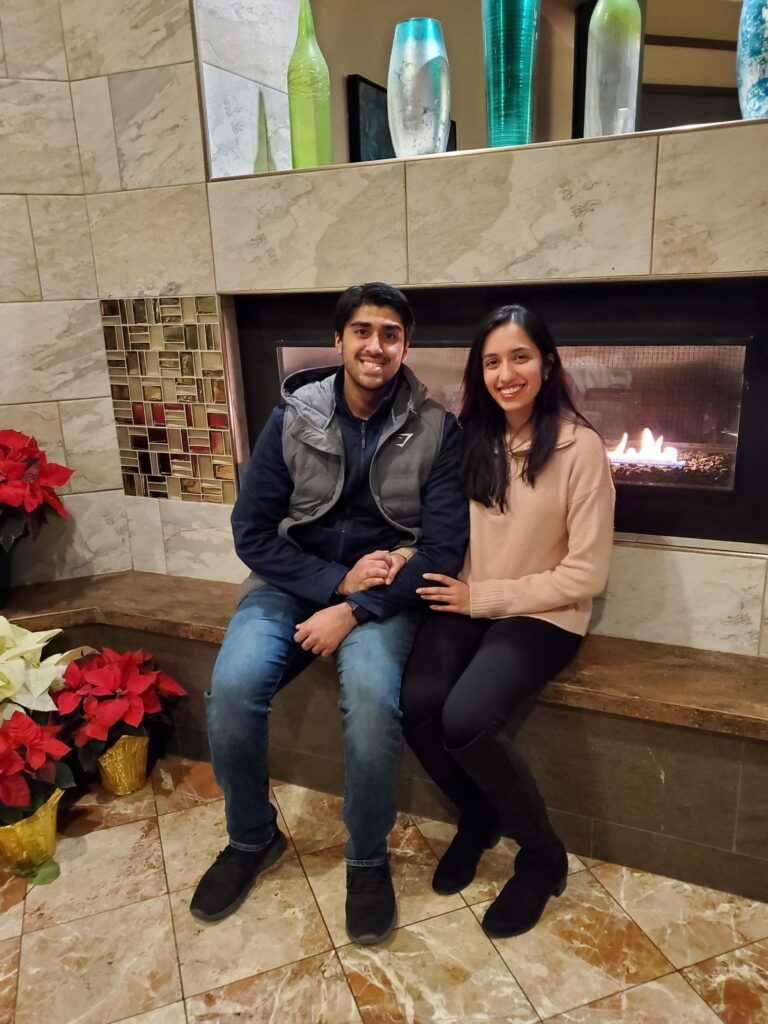
A couple poses in front of a fireplace
Singh poses with his partner Aishwarya Iyer ’18, M26.

Q: If you’re a donor, what drives you to support UMBC?

A: Throughout my undergraduate experience, I had a wide array of positions to help financially support my family while attending school. It is a lot to manage especially as you are trying to participate in different activities like research, extracurricular activities, or just spending some time with your friends or roommates. Whether or not there is a student who is in a similar predicament as I was, I donate to help alleviate some of the financial stress of school.

* * * * *

UMBC’s greatest strength is its people. When people meet Retrievers and hear about the passion they bring, the relationships they create, the ways they support each other, and the commitment they have to inclusive excellence, they truly get a sense of our community. That’s what “Meet a Retriever” is all about.

Learn more about how UMBC can help you achieve your goals.

Meet a Retriever—Anthony Rivera, information systems major and student researcher

Meet Anthony Rivera, a senior information systems (IS) major and a first-generation college student. When he’s not working on research related to improving equity for Medicaid recipients, you can also find him exploring his creative side through photography and a minor in theatre. Take it away, Anthony!

Q: Tell us about how you wound up at UMBC.

A: Hello, my name is Anthony Rivera and I am a senior information systems (IS) major, theatre minor student using he/him pronouns. I study IS because I am fascinated by the way people interact with technology and seeing those trends in human activity. I plan to continue schooling past undergrad to have the fullest understanding possible of the way we use and will continue to use technology. Outside of school my main hobbies are photography, bodybuilding, and musical theatre. Photography is one of my favorite hobbies and I will probably do it for the rest of my life.

Q: What do you love most about your academic program?

A: Something I really enjoy is the collaboration between students. It’s clear we are all here to improve ourselves and to learn. I find that all of my colleagues in class have been willing to help, offer unique insight, and foster a great environment for learning. When we all work together and work hard, each task and goal seems feasible rather than impossible.

Q: Are you a member of any academic groups? What’s it like?

A: I am a member of CWIT (Center for Women in Technology), more specifically the Cyber Scholars Program. I really appreciate CWIT for their guidance, allowing me to discuss what classes I should take, what research I should do, and helping me craft my resume which ultimately led to my first internship at CU Boulder in Colorado, where I did research on gamification principles and their relation to learning performance with music, a experience I will never forget.

If my research … is successful then we will have created a system that allows those who previously would not have received care or who have to wait a very long time for Medicaid to receive it sooner…I think this research is invaluable and a step in the right direction.

Anthony Rivera

Senior information systems student

Q: We like to use a saying at UMBC that we do “public research for public good”…so I’m wondering if you might speak to the ways your current research might fit into this idea? 

A: I wanted to know more about machine learning, and Dr. James Foulds (IS) happened to give a lecture about his work during a CWIT Cyber Practicum, so I reached out to see if I could assist him in his work and learn about the topics he does research about. I was not prepared for such a project that is so focused on equity for all in Medicaid, but it has opened my eyes further to the inequalities people face due to variables and factors outside of their control. Projects like this enable people to get care so that they focus on their lives and those goals are in line with my personal philosophies.

If my research with Dr. Foulds is successful then we will have created a system that allows those who previously would not have received care or who have to wait a very long time for Medicaid to receive it sooner. This allows people to return to their lives, go back to contributing to society, ultimately lifting a burden on those who cannot afford private care.

I think this research is invaluable and a step in the right direction, which I believe is guaranteed care for all. I do not think anyone, regardless of financial background, class, race, gender orientation, or ability, should be denied whatever care they require, especially when we are the richest country in the history of humanity. So I believe projects like this move the needle in terms of what we should and can expect from our government healthcare systems, and I think that we can slowly begin to realize what truly is fair for the people.

Q: When you’re not in class or conducting research, how do you like to spend your free time?

A: I am a member of the Musical Theatre Club, a place where I am allowed to focus on the non-STEM and activate a different part of my brain with a different type of expression and it’s nice having that kind of balance.

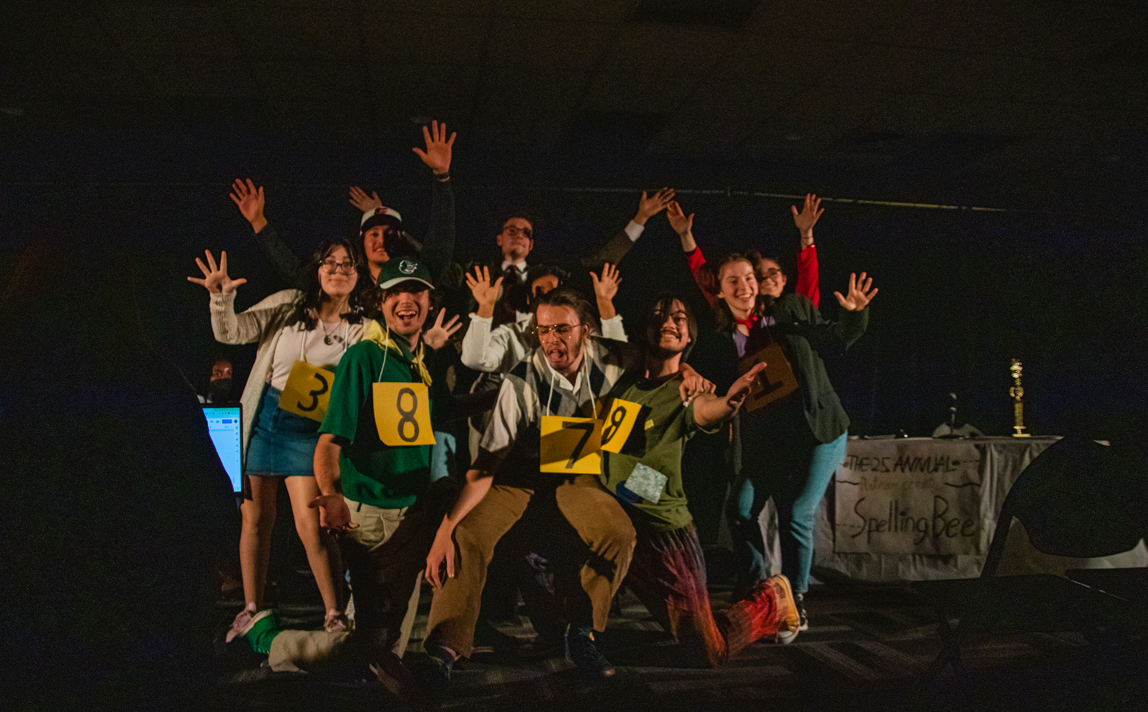
Students perform in a play together at UMBC where student Anthony Rivera studies information systems.
Students from the Musical Theatre Club perform in the 25th Annual Putnam County Spelling Bee in fall 2022. Photo courtesy of Rivera.

Q: Have you found a supportive environment at UMBC?

A: Most of my friends that I still have, since I am a senior, actually came from my freshman year in a computer science. I think being in that shared environment where our mutual interests tended to align sort of fostered an easy relationship between me and the friends I have now. All of them are brilliant in their own unique ways and I have never been around so many diverse people all allowing me to learn and see more about life in general that I had not before.

A scenic view with mountains and trees
Anthony enjoys spending his free time working on his photography. Photo courtesy of Rivera.

Q: As a first-generation college student, what advice would you give to others in similar situations?

A: Keep your head up. As time passes, all you will regret is if you did not work harder, but make sure you find balance.

* * * * * *

UMBC’s greatest strength is its people. When people meet Retrievers and hear about the passion they bring, the relationships they create, the ways they support each other, and the commitment they have to inclusive excellence, they truly get a sense of our community. That’s what “Meet a Retriever” is all about.

Learn more about how UMBC can help you achieve your goals. Donate to the scholarship or program of your choice.

Meet a Retriever—Adeola Ojomo, sociology major and academic peer advocate

Meet Adeola Ojomo, a sophomore sociology major who started working on campus helping other students as an academic peer advocate (APA) after being inspired by another APA who helped her with some excellent advice. Take it away, Adeola!

Q: Tell us about yourself. What’s one essential thing you’d want another Retriever to know about you?

A: My name is Adeola Ojomo and I work at the Academic Success Center as an academic peer advocate. Some activities I enjoy outside of school include Tai Chi and gardening. I’m also a music lover! I can vibe with music from any decade and genre.

Q: What’s the one thing you’d want someone who hasn’t joined the UMBC community to know about the support you find here?

A: The support is plentiful and there are people with different experiences who are relatable. UMBC is a loving community that enables students to strive for alignment with their goals and fulfillment.

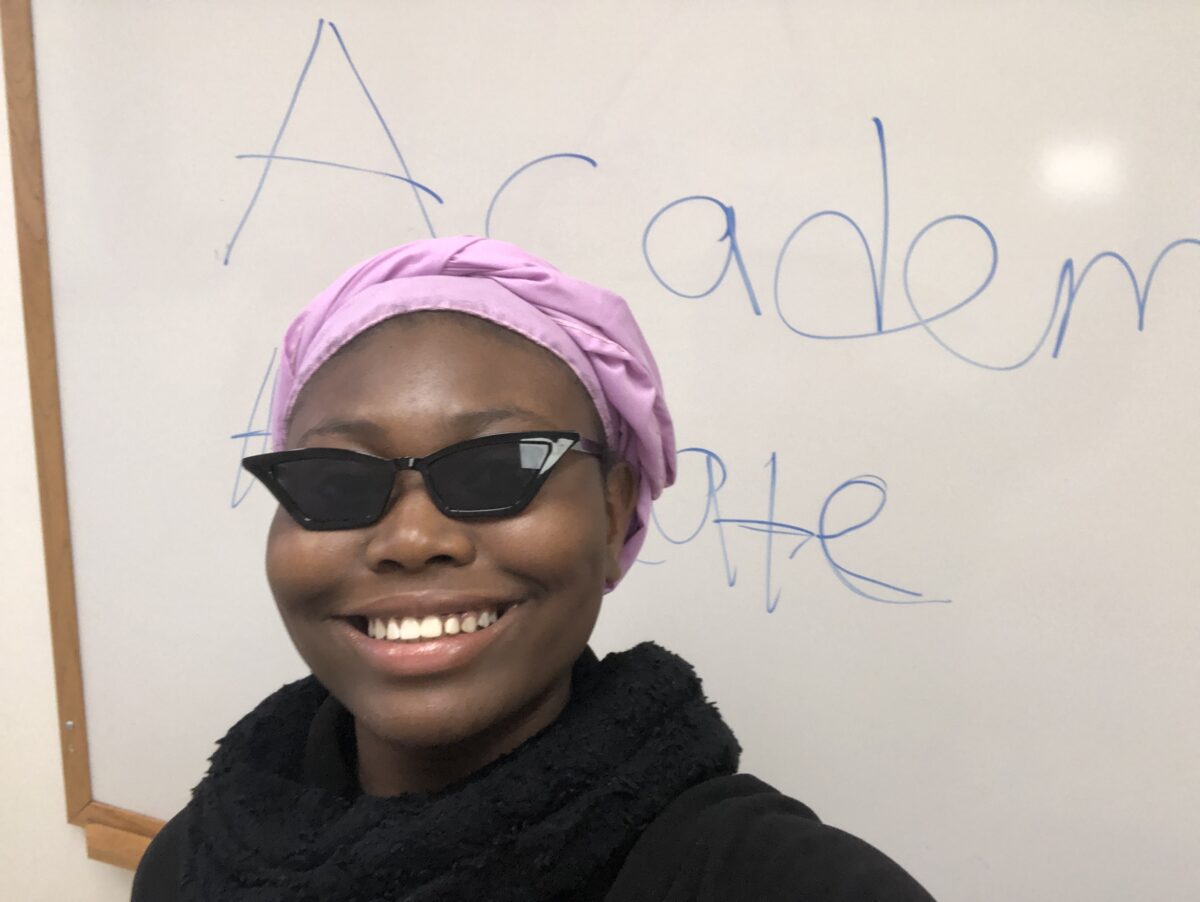
A woman wearing sunglasses smiles at the camera. She is an academic peer advocate.
Her future’s so bright, she has to wear shades. Photo courtesy of Adeola Ojomo.

Q: Tell us about what you love about your academic program or an organization you’re involved in.

A: As an academic peer advocate (APA), I help students navigate campus resources. That involves me assisting students with study skills, time management, motivation, etc. It was a former APA (Rachael Joslow) who piqued my interest in becoming an APA when I spoke with her in the fall of 2021. When I planned to take two winter classes my first year, she recommended I only take one class at that time to avoid burnout and enjoy the learning process. I finished with a 4.0 winter GPA, and I’m so grateful for her advice because I realized that I could take my time with courses. 

I became an APA in fall 2022 and the experience has been amazing so far. Being an APA at the Academic Success Center gives me the confidence and reassurance that UMBC truly cares about academic and career success. The program values the overall well-being of others and has a welcoming atmosphere.

Being an APA at the Academic Success Center gives me the confidence and reassurance that UMBC truly cares about academic and career success. The program values the overall well-being of others and has a welcoming atmosphere.

Adeola Ojomo

Sociology major and Academic Peer Advocate

Q: What clubs, teams, or organizations are you a part of? What do you love about them?

A: I’m involved in meditation at UMBC and the Sociology Society as a general body member. I love the fact the organizations I’m in reflect my personality and bring me out of my comfort zone when it comes to conversing with other people.

Q: How has receiving a scholarship allowed you to embrace your time at UMBC?

A: I’m extremely grateful for the chance to have a scholarship because I can focus on academics and socializing. I would tell people to enjoy the journey and cherish every moment because these years go by fast, and it’s always beneficial to have friends who are willing to experience the highs and lows of college. Balance is attainable.

* * * * *

UMBC’s greatest strength is its people. When people meet Retrievers and hear about the passion they bring, the relationships they create, the ways they support each other, and the commitment they have to inclusive excellence, they truly get a sense of our community. That’s what “Meet a Retriever” is all about.

Learn more about how UMBC can help you achieve your goals. Donate to the scholarship or program of your choice.

Pi gets all the fanfare, but other numbers also deserve their own math holidays

Written by Manil Suri, professor of mathematics and statistics, UMBC

March 14 is celebrated as Pi Day because the date, when written as 3/14, matches the start of the decimal expansion 3.14159… of the most famous mathematical constant.

By itself, pi is simply a number, one among countless others between 3 and 4. What makes it famous is that it’s built into every circle you see – circumference equals pi times diameter – not to mention a range of other, unrelated contexts in nature, from the bell curve distribution to general relativity.

The true reason to celebrate Pi Day is that mathematics, which is a purely abstract subject, turns out to describe our universe so well. My book “The Big Bang of Numbers” explores how remarkably hardwired into our reality math is. Perhaps the most striking evidence comes from mathematical constants: those rare numbers, including pi, that break out of the pack by appearing so frequently – and often, unexpectedly – in natural phenomena and related equations, that mathematicians like me exalt them with special names and symbols.

So, what other mathematical constants are worth celebrating? Here are my proposals to start filling out the rest of the calendar.

The Golden Ratio

For January, I nominate the Golden Ratio, phi. Two quantities are said to be in this ratio if dividing the larger by the smaller quantity gives the same answer as dividing the sum of the two quantities by the larger quantity. Phi equals 1.618…, and since there’s no Jan. 61, we could celebrate it on Jan. 6.

First calculated by Euclid, this ratio was popularized by Italian mathematician Luca Pacioli, who wrote a book in 1509 extravagantly extolling its aesthetic properties. Supposedly, Leonardo da Vinci, who drew 60 drawings for this book, incorporated it into the dimensions of Mona Lisa’s features, a choice some claim is responsible for her beauty.

a rectangle over Mona Lisa's face labels the vertical and horizontal ratio
The vertical and horizontal measures of Mona Lisa’s face fit the Golden Ratio. (Image from ‘The Big Bang of Numbers’)

The first inkling that phi occurs in nature came from another Italian, Fibonacci, while studying how rabbits multiply. A common reproductive assumption was that each pair of rabbits begets another pair every month. Start with a single rabbit pair, and successive populations will then follow the sequence 1, 2, 4, 8, 16, 32, 64, 128, 256 and so on – that is, get multiplied by a monthly “growth ratio” of 2.

What Fibonacci observed, though, was that rabbits spent the first cycle reaching sexual maturity and only began reproducing after that. A single pair now gives the new, slower progression 1, 1, 2, 3, 5, 8, 13, 21, 34… instead. This is the famous sequence named after Fibonacci; notice that each population turns out to be the sum of its two predecessors.

diagram of how many rabbits you'll have month by month
Fibonacci’s rabbits don’t really double their population each generation – their growth ratio actually approaches the 1.618… of phi. (Image from ‘The Big Bang of Numbers’)

How does phi show up amid all these randy rabbits? Well, progressing through the sequence, you see that each number is about 1.6 times the previous one. In fact, this growth ratio keeps getting closer and closer to 1.618…. For instance, 21 equals about 1.615 times 13, and 34 equals about 1.619 times 21. This means the rabbits settle down to reproducing with a growth ratio that is no longer 2, but rather, gets closer and closer to the Golden Ratio.

'petals' on the base of a pine cone spiral outward from the center in 13 lines
The number of spirals in a pine cone is usually a Fibonacci number. (Image from ‘The Big Bang of Numbers’)

Actual rabbits are unlikely to follow this rule precisely. For one, they have the unfortunate tendency to get eaten by predators. But the Fibonacci numbers – like 5, 8, 13 and so on – show up extensively in nature, like in the number of spirals you might see in a typical pine cone. And yes, phi itself makes a few appearances as well, perhaps most notably in the way leaves arrange themselves around a stem to maximize exposure to sunlight.

The constant ‘e’

February offers another blockbuster constant, Euler’s number e, which has the value 2.718…. So mark next Feb. 7 for the shindig.

To understand e, consider “doubling” growth again, but now in terms of the “population” of dollars in your bank account. By some miracle, your money in this example is earning you 100% interest, compounded each year. Each $1 invested becomes $2 at year’s end.

Suppose, however, the interest is compounded semiannually. Then 50% of the interest is credited midyear, giving you $1.50. You get the remaining 50% interest on this $1.50 at the end of the year, which works out to $0.75, giving you $2.25 ($1.50 + $0.75). So your investment gets multiplied by 2.25, rather than 2.

What if a war broke out between banks, each offering to compound the same 100% interest over shorter and more frequent intervals? Would the sky be the limit in terms of your payout? The answer is no. You could raise your growth ratio from 2 to about 2.718 – more precisely, to e – but no higher. Although you get more frequent credits, they have progressively diminishing returns.

(Table by The Conversation, CC-BY-ND. Source: ‘50 Maths Ideas You Really Need to Know’ by Tony Crilly.)

In the late 17th century, the discovery of calculus led to a quantum leap in people’s ability to grapple with the universe. Math could now analyze anything that changed – which extended its domain to most phenomena in nature. The constant e is famous because of its iconic role in calculus: It turns out to be the most natural growth factor to track change. Consequently, it shows up in laws describing many natural processes – from population growth to radioactive decay. The constant e is a big part of calculus – and turns up in all kinds of natural phenomena.

The constant e is a big part of calculus – and turns up in all kinds of natural phenomena.

Next on our calendar of mathematical constants would come pi, of course, for March. My nominee for April is Feigenbaum’s constant delta, which equals 4.669… and measures how quickly growth processes spin off into chaos.

I’ll wait for my first batch to achieve official holiday status before going any further – happy to consider any candidates you want to nominate.


This article is republished from The Conversation under a Creative Commons license. Read the original article and see more than 250 UMBC articles available in The Conversation.
Meet a Retriever—Nate Dissmeyer ’07, alumni leader and recurring donor

Meet Nate Dissmeyer ’07, information systems, a program manager with Galapagos Federal Systems, providing Army IT support at the Aberdeen Proving Ground. Dissmeyer finds fulfillment in helping to develop IT professionals and supporting the Department of Defense community. And UMBC really gave him the skills to succeed in his position, he says. Dissmeyer, who is a recurring donor and a member of the Alumni Association Board of Directors (AABoD), found his way at UMBC through involvement with the Habitat for Humanity chapter and as a member of Triangle Fraternity. 

Q: What’s the one thing you’d want someone who hasn’t joined the UMBC community to know about the support you find here?

A: UMBC is simply a beacon of greatness. We attract some of the best minds, people, staff, leaders, and professors. Support is always present, always available even if you don’t necessarily seek it. There is a sense of if you succeed, we all succeed. Greatness doesn’t always come easy and there are times you’re going to struggle, but with a little grit and help from those around you, you will persevere and succeed.

Q: What brought you to UMBC in the first place?

A: I first came to UMBC for an Odyssey of the Mind competition in middle school. I remember walking around campus and just being amazed with the setting. When it was time to apply to colleges, UMBC was the only one I wanted to attend. It was the perfect size, not too small but not so large that I would be lost in the crowd or just a number on paper. UMBC was rising in the ranks as one of the best schools in the area, and I knew I was going to be challenged in my academic endeavors. Doing well here would help me succeed down the road.

A group of kickballers pose together in front of the AOK Library in bright blue and yellow team shirts. Dissmeyer, second from right, is a recurring donor.
Chapter of Young Alumni gather for the 2015 Student and Alumni Kickball game at Erickson Field. Dissmeyer is second from right.

Q: Tell us about the people who helped you grow at UMBC, and why their HOW made such a difference to you.

A: UMBC provided me much more than a place to get a degree. UMBC surrounded me with amazing people who have continued to influence me. My academic adviser encouraged me to make a degree change when I was struggling my sophomore year. A professor of my project management class who saw something in me to recommend Jim Collins’ Good to Great, which cultivated my management style.

I’ve gotten to see first hand how the money raised for the Alumni Endowment Scholarship helps our current students… Whether a semester’s worth of books, or one less job shift so they can spend more time at home raising their family; being able to help is rewarding.

Nate Dissmeyer '07

Through my involvement with the Habitat for Humanity chapter, I had the opportunity to help several families in West Baltimore and annually in Florida for our Spring Break build trip. I would have never dreamt that my Greek Life family would introduce me to my amazing wife (Sena Dissmeyer ’08, biochemistry and molecular biology), jump start my professional career, and form some of the most meaningful friendships I have. I am forever grateful for the impact, influence, and experiences UMBC has and will continue to give me.

Q: Tell us what you love about your role as an alumni leader.

A: Participating in the alumni organizations has been very special. I’ve thoroughly enjoyed the efforts to recognize amazing alumni and hearing their stories at the Alumni Awards. I would highly recommend current students to attend at least one event. I’ve also been so pleased to help award scholarships to students, whether raising money through the Chapter of Young Alumni or being part of the selection committee on the AABoD. 

Q: What drives you to support UMBC?

A: As a recurring donor, it’s easy to set up my monthly automatic donation, and I’ve gotten to see first hand how the money raised for the Alumni Endowment Scholarship helps our current students from all walks of life continue to achieve their academic success by removing some of the financial stress. Whether a semester’s worth of books, or one less job shift so they can spend more time at home raising their family; being able to help is rewarding. 

Q: Who in the community has inspired you or supported you, and how?

A: Honestly, a huge shoutout to Greg Simmons (M.P.P. ’04, vice president for Institutional Advancement) and his Office of Institutional Advancement team. Since joining the alumni groups, I’ve had the privilege of working with amazing staff and leaders. I never quite understood the depths of their work, but they do so much both visibly and behind the scenes. Now in my tenth year of consecutive giving, their hard work truly inspires me to participate and continue to contribute my skills and abilities for the betterment of UMBC. 

a couple takes a selfie on a sunny day at UMBC's rock garden at the knoll. The Dissmeyers are recurring donors at UMBC.

Q: What’s your favorite part of being a part of Retriever Nation?

A: I love how passionate we are about UMBC and how supportive we are of one another. The strong passion leads to some great connections within the group, and my circle of friends and professional network connections continue to grow.

* * * * *

UMBC’s greatest strength is its people. When people meet Retrievers and hear about the passion they bring, the relationships they create, the ways they support each other, and the commitment they have to inclusive excellence, they truly get a sense of our community. That’s what “Meet a Retriever” is all about.

Learn more about how UMBC can help you achieve your goals. Donate to the scholarship or program of your choice.

Satellite data: The other type of smartphone data you might not know about

Co-written by Alicia Sabatino ’20, M.S. ’24, geography and environmental systems, UMBC.

When you think about location data on your mobile phone, tablet or laptop, what comes to mind? Mailing addresses? Postal codes? These data indicate where you live, where you work, and the places you visit.

When combined with other types of data over time, companies and governments use them to analyze your consumption patterns, occupation, education, health and financial status.

Turning location services off only prevents smartphone apps from receiving location data. Smartphones can still be located by cell towers and wireless networks when location services are switched off.

This was highlighted by German politician Malte Spitz over a decade ago when he sued his cellphone provider, Deutsche Telekom, for any personal data they had about him.

When the case was settled and he eventually received the data, Spitz found 35,000 references to his location. He was able to visually reconstruct his movements over the previous six months, demonstrating the relevance of data protection laws to the public.

But there is more. By using critical code and documentary research methods, we found that raw satellite location measurement data are perpetually created in our devices all the time.

Because satellite data are building blocks used by our phones to determine where we are, they don’t always get turned off — nor are they collected and treated the same way as location data.

Data outputs

Smartphones determine your location in several ways. The first way involves phones triangulating distances between cell towers or Wi-Fi routers.

The second way involves smartphones interacting with navigation satellites. When satellites pass overhead, they transmit signals to smartphones, which allows smartphones to calculate their own location. This process uses a specialized piece of hardware called the Global Navigation Satellite System (GNSS) chipset. Every smartphone has one.

When these GNSS chipsets calculate navigation satellite signals, they output data in two standardized formats (known as protocols or languages): the GNSS raw measurement protocol and the National Marine Electronics Association protocol (NMEA 0183).

A satellite floating above the Earth in space
When satellites pass overhead, they transmit signals to smartphones, which enable smartphones to calculate their own location. (Shutterstock)

GNSS raw measurements include data such as the distance between satellites and cellphones and measurements of the signal itself.

NMEA 0183 contains similar information to GNSS raw measurements, but also includes additional information such as satellite identification numbers, the number of satellites in a constellation, what country owns a satellite, and the position of a satellite.

NMEA 0183 was created and is governed by the NMEA, a not-for-profit lobby group that is also a marine electronics trade organization. The NMEA was formed at the 1957 New York Boat Show when boating equipment manufacturers decided to build stronger relationships within the electronic manufacturing industry.

In the decades since, the NMEA 0183 data standard has improved marine electronics communications and is now found on a wide variety of non-marine communications devices today, including smartphones.

Who has access to these data?

It is difficult to know who has access to data produced by these protocols. Access to NMEA protocols is only available under licence to businesses for a fee.

GNSS raw measurements, on the other hand, are a universal standard and can be read by different devices in the same way without a license. In 2016, Google allowed industries to have open access to it to foster innovation around device tracking accuracy, precision, analytics about how we move in real-time, and predictions about our movements in the future.

While automated processes can quietly harvest location data — like when a French-based company extracted location data from Salaat First, a Muslim prayer app — these data don’t need to be taken directly from smartphones to be exploited.

Data can be modelled, experimented with, or emulated in licensed devices in labs for innovation and algorithmic development.

Satellite-driven raw measurements from our devices were used to power global surveillance networks like STRIKE3, a now defunct European-led initiative that monitored and reported perceived threats to navigation satellites.

Data and citizen rights

Our research raises questions about how rights are protected in the midst of these practices. Citizens have little to no access to the data output from NMEA 0183 and GNSS raw measurements. Because of this, people are unable to negotiate the visibility of their data in these datasets.

The data output from NMEA 0183 and GNSS raw measurements flow unrestricted from every smartphone on the planet. Smartphones have unique identifiers — IMEI numbers — that are known to the tech ecosystem. They can be connected to a user’s personal details.

The flow of NMEA 0183 and GNSS data is invisible to the average person, meaning citizens are unsure of how these data are used, or with whom they are shared. Because of this, it’s impossible for people to challenge how their personal data are used.

A boat through a large body of water with a city skyline visible in the background
A U.S. Coast Guard boat in Biscayne Bay, Fla., in June 2022. The National Marine Electronics Association is working on improving search-and-rescue operations by ensuring radio distress signals sent by marines contain GPS information. (AP Photo/Lynne Sladky)

As interest in the supposed security, entertainment and surveillance value of these protocols continue to grow, these protocols are increasingly susceptible to misuse by third-party developers.

But there is another layer to this: NMEA 0183 and GNSS raw measurements are standards in industries that offer products and services that many of us benefit from. The NMEA has foundations in safe passage at sea, making their data an important part of emergency services operations. GNSS raw measurements are also utilized for safety purposes.

Could solutions restrict the use of these data for life-critical situations only? Is there an oversight body that could assess what impacts industrial usage of these data might have upon smartphone owner rights and liberties? What about an audit led by civil society, who would be appropriately positioned to objectively inspect these issues to determine whether they might harm the public? For example, consider the way the federal privacy commissioner reviews app data activities.

Location data now flows constantly from GNSS chipsets. There is uncertainty about who is using these data, and for what purposes. Until industry and government reassure citizens that personal data are not being exploited and that rights are protected, these remain open questions.


This article is republished from The Conversation under a Creative Commons license. Read the original article and see more than 250 UMBC articles available in The Conversation.