Before the pandemic struck in 2020, the number of U.S. students studying abroad had been pretty much rising steadily each year.
Whereas more than 154,000 students from the U.S. participated in study abroad programs during the 2000-2001 academic year, that number more than doubled – to over 347,000 – during the 2018-2019 academic year. That’s according to the Institute of International Education.
While official study abroad numbers for 2021-2022 are not yet published, there is reason to expect a rebound. A national survey conducted in April 2022 revealed that roughly 90% of colleges and universities were planning to offer some form of study abroad by the summer of that year.
However, as studying abroad makes its comeback, much has changed with how study abroad programs operate. Below are five questions to ask when planning to study abroad in a post-pandemic world.
1. What is the Plan B in case my program gets disrupted?
In 2020, as students were recalled to the U.S. by their home institutions, a key concern was how students could remain on track for their degrees without losing both time and money due to the cancellations – which stemmed from reasons beyond their own control.
An important question for students to ask is how study abroad programs would ensure that they can continue their studies in case of a disruption, whether it’s caused by rare events, such as a pandemic or international conflict, but also more routine matters, such as a national strike.
2. Do I need extra insurance?
Students should not assume that their regular U.S. health insurance will provide the level of coverage needed while abroad. In fact, the cost of a medical evacuation can run as high as US$250,000.
Most study abroad programs offer, and many require, participants to enroll in an affordable international travel insurance policy. In addition to paying for medical expenses, benefits may include coverage for costs associated with trip cancellation, required periods of quarantine, and emergency evacuations. Additionally, the policy may provide non-insurance travel assistance services, such as helping to replace lost or stolen documents. Students should ask about the availability of these policies and know what is covered.
3. What are the host country restrictions?
At the height of the pandemic, countries’ COVID-19 policies ranged from status quo to complete lockdown. In some instances, travelers could be fined or jailed for failing to follow local restrictions. The U.S. Department of State created a web page with information on the COVID-19 restrictions of each country. While most countries have dialed back restrictions, it is still very important to review this information because these policies can affect a student’s ability to travel and participate in certain activities once they are abroad.
4. What are the latest travel risks?
While the Centers for Disease Control and Prevention provides data on traveling in the era of COVID-19, including risk ratings and vaccination recommendations by country, it is also important to understand how the pandemic may have influenced other risks, such as by contributing to political tensions and applying pressure to already fragile health care systems.
Students should review the country-specific information published by the State Department, as well as register for real-time updates from the local U.S. embassy. Additionally, students should inquire about other resources, such as in-country staff available to assist with emergencies, who may be available to support program participants once they are abroad.
5. What scholarships can help cover the cost?
Because study abroad programs were mostly paused for the past few years, the scholarship funds that colleges have dedicated to these programs may have been left largely untouched. Fund balances could be higher now and there may be a possibility to obtain a larger award than in years past. Students should inquire with their college’s study abroad and financial aid offices about scholarship opportunities. Such funding can vary greatly by program duration, location and other factors, so students should be flexible with their plans to receive the maximum award.
Whether or not their college offers generous scholarships for study abroad, students should also consider applying for external funding. The Fund for Education Abroad, an organization committed to increasing the number of underrepresented students studying abroad, maintains a listing of more than 20 dedicated scholarships. Additionally, the State Department compiles information on applying for study abroad programs and scholarships supported by the U.S. government. Some of these programs and scholarships are designed to lead to a federal job. The department also keeps a list of various scholarships from foreign governments.
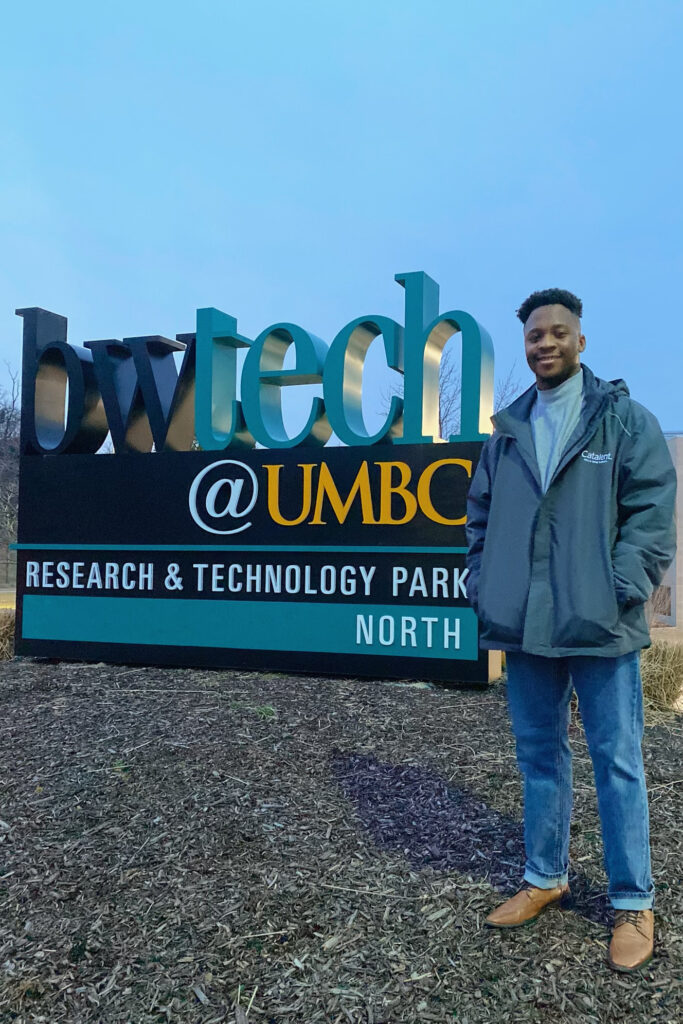
Meet Basil Udo ’22, biochemistry and molecular biology, an entrepreneur and technologist in the third cohort of bwtech@UMBC’s Maryland New Venture Fellowship for Cybersecurity program, where teams work together to create the commercially viable solutions the nation needs to secure physical and virtual infrastructures. Basil walks us through the timeline of creating his business venture as an undergraduate, support from campus leaders to help finesse his vision, his entrepreneurial award, and how he made the most of his UMBC connections to find a job in his area of industry.
Q: How did you get involved with bwtech@UMBC?
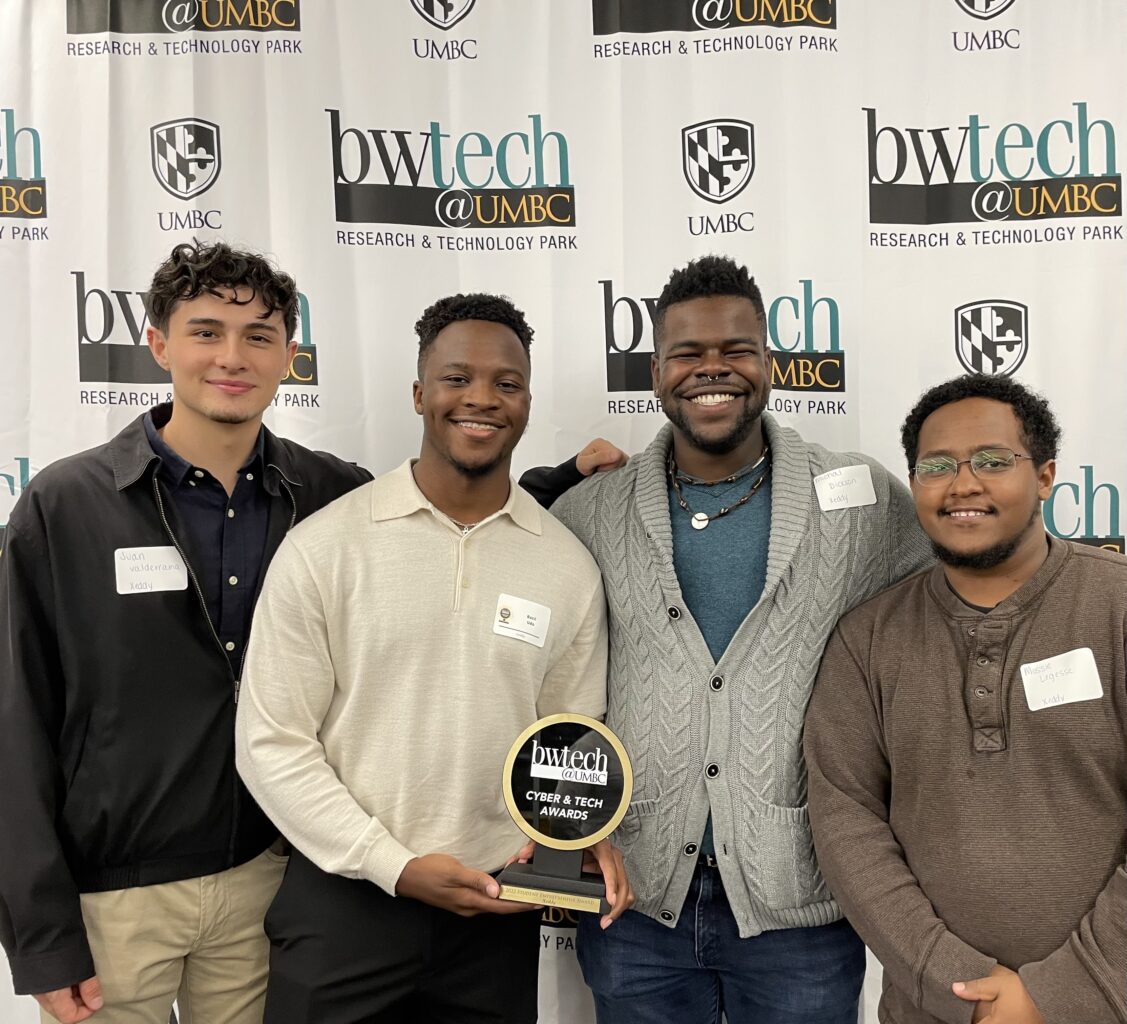
A: In Spring 2022, I gained access to bwtech@UMBC’s CyberHive via the Student Idea Lab for my venture, Xeddy. At Xeddy, we are innovating the punch card experience with digital loyalty programs for restaurants and cafes. What I enjoy most about this work is the potential to impact many lives in a net positive way. In October, I was awarded a 2022 Student Entrepreneur Award at bwtech@UMBC’s Cyber & Tech Awards.
Q: Tell us about your primary WHY, and how it led you to UMBC.
A: I came to UMBC because of a 2018 summer research experience with the Build a Bridge to STEM program. My team conducted research with Jeffrey Gardner, associate professor in biological sciences, where we developed and rendered designs for biomass containment devices and tested their efficiency in measuring the degradation of polysaccharides. Later that summer, my research team and I went on to present our findings at UMBC’s Summer Undergraduate Research Fest. Ultimately, this experience was an inflection point in my feelings of self-efficacy and interest in new information.
Who is someone in the community who has supported you, and how?
A: In 2021, I was actively practicing my elevator pitch around Xeddy and when the opportunity presented itself to share it with an audience, I did. It was the first day of my Introduction to Entrepreneurship class, and this led to me connecting with my professor, Scott Weber, outside of class. He introduced me to more resources on campus, specifically Kevin Fulmer, the director of the Alex. Brown Center for Entrepreneurship, where I received foundational support to materialize my ideas and tighten my pitch.
How have you taken your entrepreneurial skills to the next level?
A: I am a technologist in the third cohort of bwtech@UMBC’s Maryland New Venture Fellowship for Cybersecurity. Every week, we are introduced to new resources and left with actionable steps to take that further our internal company missions. This greatly appreciated added layer of accountability encourages myself and my team to strategically look past our launch.
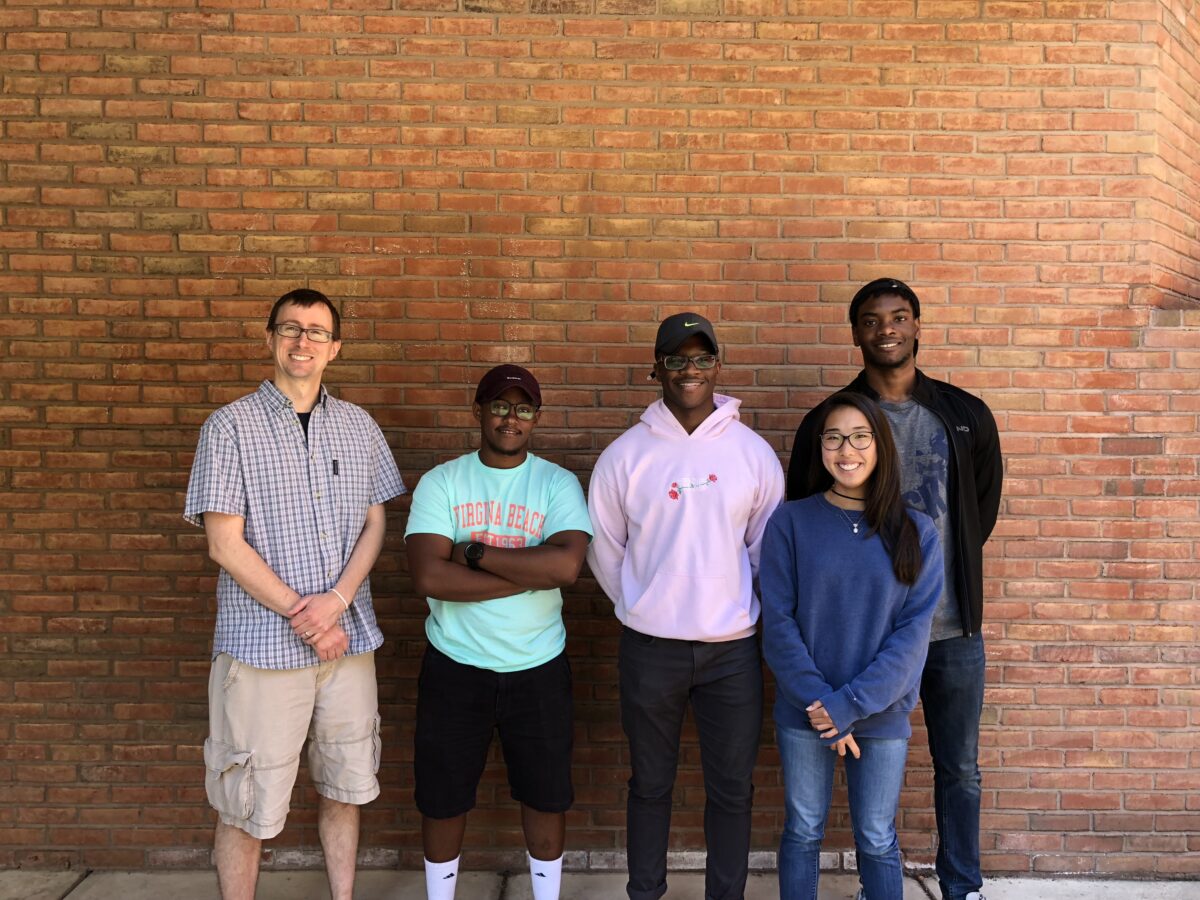
Build A Bridge To STEM Internship Wrap-up, pictured with Jeffrey Gardner, Mussie Legesse, Joseph Forbin, Julia Corns (left to right); August 2018.
Tell us about the people who helped you grow at UMBC, and why their HOW made such a difference to you.
A: In my last semester at UMBC, I virtually met with a science career advisor, Susan Hindle. She helped me rework my résumé and highlight my strongest attributes. A few weeks later, I grabbed lunch with a leader in bwtech’s community, and he suggested that I learn more about a company called Catalent Pharma Solutions.
Another few weeks went by, and I was passing by a Catalent information booth near the bookstore in The Commons. I recall making the conscious decision to return after my class to connect with the team of recruiters. Upon my arrival at the booth, I saw (and met for the first time in person) my career advisor, who then gave me a lovely introduction to the recruiters. In November, I received my offer letter to get started!
“
I enjoy heading over to UMBC’s main campus to get involved with entrepreneurial affairs… Exploring these opportunities from an alumnus perspective has given me an added appreciation for the resources and support that are active and growing in our community.
Basil Udo '22
I am now a manufacturing associate at Catalent. Every day I learn something new and it provides me with a way to support and enrich myself as I pursue my personal endeavors with Xeddy. Additionally, the exposure to corporate systems has introduced a new perspective on logistical efficiency, which makes me better at facilitating direction as a founder.
What’s your favorite part of Retriever Nation?
A: Since I spend a lot of my time at the Research & Technology Park, I enjoy heading over to UMBC’s main campus to get involved with entrepreneurial affairs run by the Alex. Brown Center and volunteer events such as HackUMBC. Exploring these opportunities from an alumnus perspective has given me an added appreciation for the resources and support that are active and growing in our community.
Receiving bwtech@UMBC’s 2022 Student Entrepreneur Award with three members of Xeddy, Juan Valderrama (left), Michal Dickson (immediate right), Mussie Legesse (far right); October 2022.
What’s the one thing you’d want someone who hasn’t joined the UMBC community to know about the support you find here?
A: The entrepreneurial community at UMBC is growing and innovating each year. If you intentionally want to start a venture, UMBC will avidly support you. Starting with resources like the Alex. Brown Center, HackUMBC, and entrepreneurship classes will provide someone unsure of how to start with direction, potential cofounders, and info on the entrepreneurial mindset.
* * * * *
UMBC’s greatest strength is its people. When people meet Retrievers and hear about the passion they bring, the relationships they create, the ways they support each other, and the commitment they have to inclusive excellence, they truly get a sense of our community. That’s what “Meet a Retriever” is all about.
Learn more about how UMBC can help you achieve your goals.
In the cloud forests of South America, amid the constant cacophony of bird and insect noise, a deafening blare pierces through the background from time to time. Belonging to the loudest known bird, the white bellbird, Procnias albus, this sound would be painful to humans listening nearby and capable of causing immediate hearing damage from about a yard away.
I study the hearing ability of animals and the sounds they make to communicate. A great number of calls exist throughout the animal kingdom – and many are used to attract mates or defend territories. Evolution has favored those able to make sounds efficiently. The louder and more focused the energy in the call and the closer in pitch it is to the intended listener’s optimal hearing range, the farther away a potential mate or rival will hear it.
Many large mammals, such as singing whales, roaring lions and rumbling elephants, produce loud low-pitched sounds that travel especially well through most habitats. Because of their petite physical size, small animals are not capable of making these far-reaching low-frequency sounds.
Ultrasonic calls
Human ears are most sensitive to the highest notes on a piano – about 4 kHz – a unit of measurement that is the physical metric for pitch. Anything above 20 kHz is considered ultrasonic – undetectable to human ears. But such sounds are not undetectable to all ears.
Many other small mammals, including other bats, and even some primates such as tiny tarsiers, produce loud ultrasonic sounds humans can’t perceive. In part, these sounds can reach such volumes because their acoustic power is concentrated in a pure tone or single frequency.
Creating speakers
Insects are some of the smallest animals to produce loud sounds, chief among them the cicadas and the orthopterans, which include katydids, grasshoppers and crickets.
In North America, the robust conehead, Neoconocephalus robustus, a type of katydid, regularly surpasses 105 dB SPL. These calls are produced to attract mates and, like many such calls, are competing against a clamor of comparable sounds from similar species.
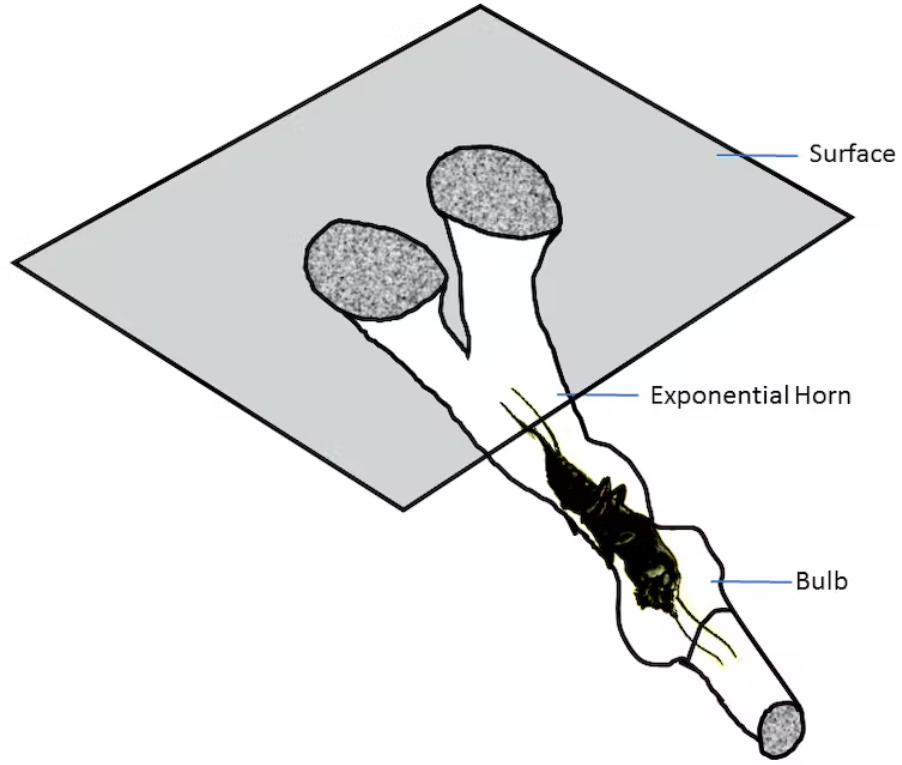
A two-spotted tree cricket, Neoxabea bipunctata, chews a hole just the right size for its fore wings. It then ‘sings’ by poking the wings through the hole and rubbing them together. (Patrick Coin/flickr, CC BY-NC-SA)
Some insects go one step further, amplifying their sounds by building the functional equivalent of audio speakers. Some tree crickets chew holes in leaves, place their vibrating wings in the opening and use the surrounding leaf as a baffle to prevent the loss of sound energy around the edges of their wings.
The official mascot of Puerto Rico is a 1-to-2-inch (2-5-centimeter) frog called the coquí, Eleutherodactylus coqui, whose call is a combination of two pure tones – “ko” and “kee,” from which it gets its name. At 114-120 dB SPL, the frog’s calls are so loud they actually must protect their own hearing when vocalizing, by increasing the air pressure inside their middle ear.
So even if you’re small, it’s not impossible to make yourself heard. You just have to blast all your acoustic energy in a single frequency, and hit the sweet spot of your audience’s hearing.
Chengpeng Chen, Assistant Professor of Chemistry and Biochemistry, UMBC
Bringing a new drug to market costs billions of dollars and can take over a decade. These high monetary and time investments are both strong contributors to today’s skyrocketing health care costs and significant obstacles to delivering new therapies to patients. One big reason behind these barriers is the lab models researchers use to develop drugs in the first place.
Preclinical trials, or studies that test a drug’s efficacy and toxicity before it enters clinical trials in people, are mainly conducted on cell cultures and animals. Both are limited by their poor ability to mimic the conditions of the human body. Cell cultures in a petri dish are unable to replicate every aspect of tissue function, such as how cells interact in the body or the dynamics of living organs. And animals are not humans – even small genetic differences between species can be amplified to major physiological differences.
Fewer than 8% of successful animal studies for cancer therapies make it to human clinical trials. Because animal models often fail to predict drug effects in human clinical trials, these late-stage failures can significantly drive up both costs and patient health risks.
To address this translation problem, researchers have been developing a promising model that can more closely mimic the human body – organ-on-a-chip.
As an analytical chemist, I have been working to develop organ and tissue models that avoid the simplicity of common cell cultures and the discrepancies of animal models. I believe that, with further development, organs-on-chips can help researchers study diseases and test drugs in conditions that are closer to real life.
Organs-on-chips offer an alternative model for early-phase biomedical research.
What are organs-on-chips?
In the late 1990s, researchers figured out a way to layer elastic polymers to control and examine fluids at a microscopic level. This launched the field of microfluidics, which for the biomedical sciences involves the use of devices that can mimic the dynamic flow of fluids in the body, such as blood.
Advances in microfluidics have provided researchers a platform to culture cells that function more closely to how they would in the human body, specifically with organs-on-chips. The “chip” refers to the microfluidic device that encases the cells. They’re commonly made using the same technology as computer chips.
Not only do organs-on-chips mimic blood flow in the body, these platforms have microchambers that allow researchers to integrate multiple types of cells to mimic the diverse range of cell types normally present in an organ. The fluid flow connects these multiple cell types, allowing researchers to study how they interact with each other.
Microfluidics can be used for many applications in biological research.
This technology can overcome the limitations of both static cell cultures and animal studies in several ways. First, the presence of fluid flowing in the model allows it to mimic both what a cell experiences in the body, such as how it receives nutrients and removes wastes, and how a drug will move in the blood and interact with multiple types of cells. The ability to control fluid flow also enables researchers to fine-tune the optimal dosing for a particular drug.
The lung-on-a-chip model, for instance, is able to integrate both the mechanical and physical qualities of a living human lung. It’s able to mimic the dilation and contraction, or inhalation and exhalation, of the lung and simulate the interface between the lung and air. The ability to replicate these qualities allows researchers to better study lung impairment across different factors.
Bringing organs-on-chips to scale
While organ-on-a-chip pushes the boundaries of early-stage pharmaceutical research, the technology has not been widely integrated into drug development pipelines. I believe that a core obstacle for wide adoption of such chips is its high complexity and low practicality.
Current organ-on-a-chip models are difficult for the average scientist to use. Also, because most models are single-use and allow only one input, which limits what researchers can study at a given time, they are both expensive and time- and labor-intensive to implement. The high investments required to use these models might dampen enthusiasm to adopt them. After all, researchers often use the least complex models available for preclinical studies to reduce time and cost.
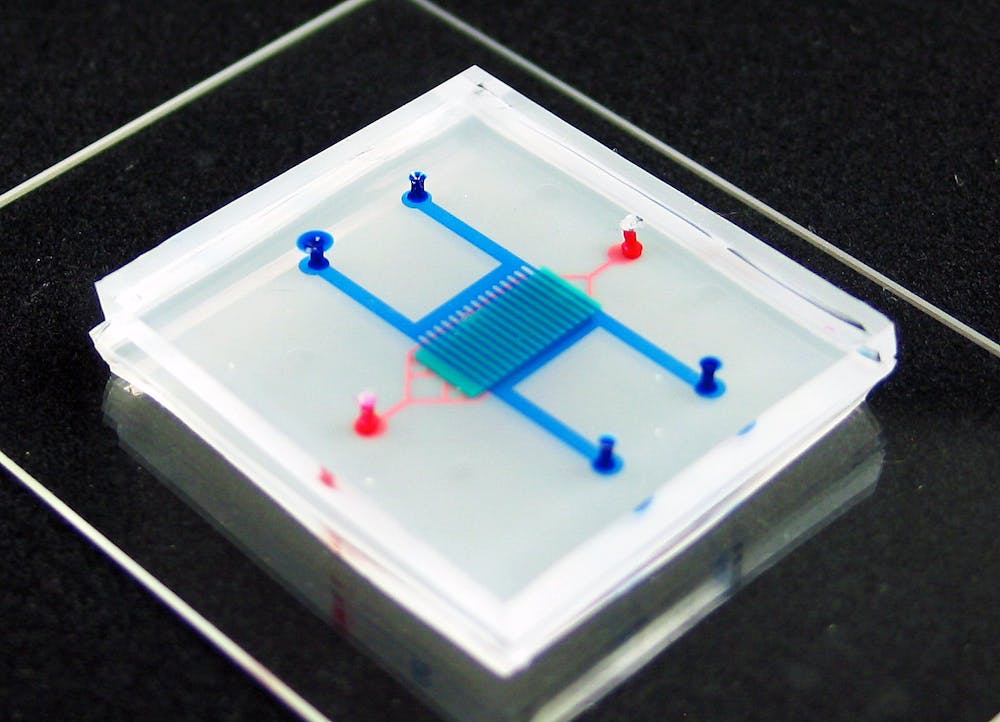
This chip mimics the blood-brain barrier. The blue dye marks where brain cells would go, and the red dye marks the route of blood flow. (Vanderbilt University/Flickr)
Lowering the technical bar to make and use organs-on-chips is critical to allowing the entire research community to take full advantage of their benefits. But this does not necessarily require simplifying the models. My lab, for example, has designed various “plug-and-play” tissue chips that are standardized and modular, allowing researchers to readily assemble premade parts to run their experiments.
The advent of 3D printing has also significantly facilitated the development of organ-on-a-chip, allowing researchers to directly manufacture entire tissue and organ models on chips. 3D printing is ideal for fast prototyping and design-sharing between users and also makes it easy for mass production of standardized materials.
I believe that organs-on-chips hold the potential to enable breakthroughs in drug discovery and allow researchers to better understand how organs function in health and disease. Increasing this technology’s accessibility could help take the model out of development in the lab and let it make its mark on the biomedical industry.
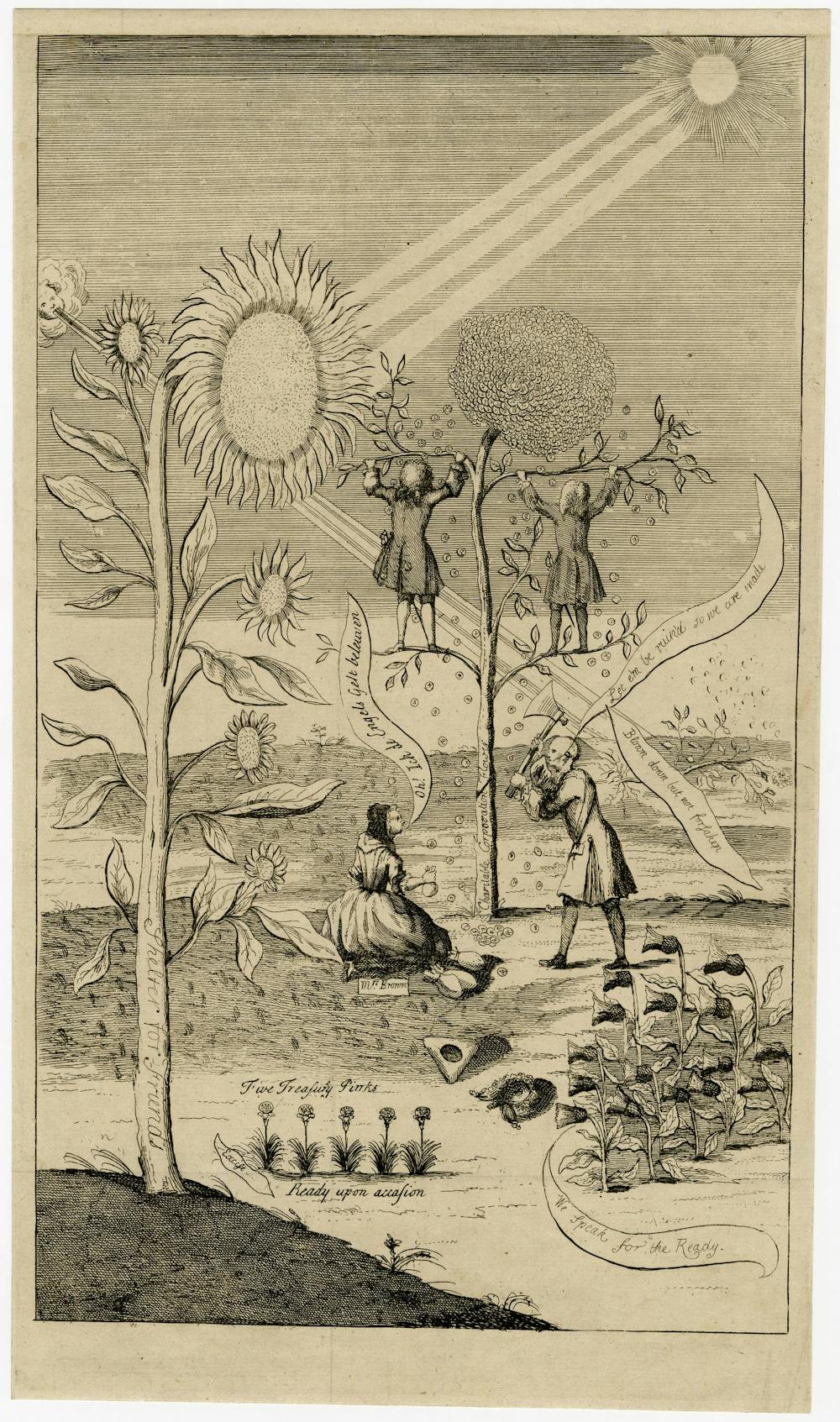
In modern capitalism, it seems as if stories of companies and managers who engage in fraud and swindle their investors occur like the changing of the seasons.
In fact, these scandals can be traced back to the origins of publicly traded companies, when the first stockbrokers bought and sold company shares and government securities in the coffee houses of London’s Exchange Alley during the 1700s.
As a historian of 18th century finance, I am struck by the similarities between what’s known as the Charitable Corporation Scandal and the recent collapse of FTX.
A noble cause
The Charitable Corporation was established in London in 1707 with the noble mission of providing “relief of the industrious poor by assisting them with small sums at legal interest.”
Essentially, it sought to provide low-interest loans to poor tradesmen, shielding them from predatory pawnbrokers who charged as much as 30% interest. The corporation made loans available at the rate of 5% in return for a pledge of property for security.
The Charitable Corporation was modeled on Monti di Pietà, a charitable institution of credit established in Catholic countries during the Renaissance era to combat usury, or high rates of interest.
Unlike the Monti di Pietà, however, the British version – despite its name – wasn’t a nonprofit. Instead, it was a business venture. The enterprise was funded by offering shares to investors who, in return, would make money while doing good. Under its original mission, it was like an 18th century version of today’s socially responsible investing, or “sustainable investment funds.”
Raiding the fund
In 1725, the Charitable Corporation diverted from its original mission when a new board of directors took over.
These men turned the corporation into their own piggy bank, taking money from it to buy shares and prop up their other companies. At the same time, the company’s employees began to engage in fraud: Safety checks ceased, books were kept irregularly and pledges went unrecorded.
Investigators would ultimately find that £400,000 or more in capital was missing – roughly $108 million in today’s U.S. dollars.
In the autumn of 1731, rumors began to circulate about the solvency of the Charitable Corporation. The warehouse keeper at the time, John Thomson, who was in charge of all loans and pledges but also in league with the five fraudulent directors, hid the company’s books and fled the country.
At the shareholders’ quarterly meeting, they found that money, pledges and accounts had all gone missing. At this point, the proprietors of the Charitable Corporation stock appealed to the British Parliament for redress. One-third of those who petitioned were women, a proportion that equaled the percentage of women who held shares in the Charitable Corporation.
Many women were drawn to the corporation because of its public mission in providing small loans to working people. It’s also possible that they had been intentionally targeted for fraud.
The parliamentary investigation led to various charges being leveled against both managers and employees of the Charitable Corporation. Many of them were forced to appear before Parliament and were arrested if they did not. The managers and employees deemed most responsible for the 1732 fraud, such as William Burroughs, had their assets seized and inventoried in order to help pay back the shareholder losses.
Bankruptcy proceedings were started against the banker and broker, George Robinson, and the warehouse keeper, Thomson. Both Sir Robert Sutton and Sir Archibald Grant were expelled as members of the House of Commons, with Grant being prevented from leaving the country and Sutton ultimately prosecuted in several courts.
In the end, the shareholders received a partial government bailout – Parliament authorized a lottery that reimbursed only 40% of what the corporation’s creditors had lost.
The risks of concentrated power
There are several key characteristics that stand out in the collapses of both the Charitable Corporation and FTX. Both companies were offering something new or venturing into a new sector. In the former’s case, it was microloans. In FTX’s case, it was cryptocurrency.
Meanwhile, the management of both ventures was centralized in the hands of just a few people. The Charitable Corporation got into trouble when it reduced its directors from 12 to five and when it consolidated most of its loan business in the hands of one employee – namely, Thomson. FTX’s example is even more extreme, with founder Sam Bankman-Fried calling all the shots.
In both cases, the key fraud was using the assets of one company to prop up another company managed by the same people. For example, in 1732, the corporation’s directors bought stock in the York Buildings Company, in which many of them were also involved. They hoped to juice stock prices. When that didn’t happen, they realized they couldn’t cover what they had taken out of the Charitable Corporation’s funds.
Fast forward nearly 300 years, and a similar story seems to have played out. Bankman-Fried allegedly took money out his customer accounts in FTX to cover his cryptocurrency trading firm, Alameda Research.
News of both frauds also came as a surprise, with little advance warning. Part of this is due to the ways in which managers were well respected and well connected to both politicians and the financial world. Few public figures mistrusted them, and this proved to be a useful screen for deceit.
I would also argue that in both cases the company’s connection to philanthropy lent it another level of cover. The Charitable Corporation’s very name announced its altruism. And even after the scandal subsided, commentators pointed out that the original business of microlending was useful. FTX’s founder Bankman-Fried is an advocate of effective altruism and has argued that it was useful for him and his companies to make lots of money so he could give it away to what he deemed effective causes.
After the Charitable Corporation’s collapse in 1732, Parliament didn’t institute any regulation that would prevent such a fraud from happening again.
A tradition of loose oversight and regulations has been the hallmark of Anglo-American capitalism. If the response to the 2008 financial crash is any indication of what will come in the wake of FTX’s collapse, it’s possible that some bad actors, like Bankman-Fried, will be punished. But any regulation will be undone at the first opportunity – or never put in place to begin with.
On a Tuesday evening in early November, Main Street in The Commons was uncommonly crowded. Hundreds of democratically-minded students eagerly—and perhaps, anxiously—milled around watching the 2022 mid-term election returns. Dilnaz Hasim ’25, economics, found the scene fitting, saying, “Election Night Extravaganza is supposed to be experienced as a community, rather than as a single person, because when you make a vote, you’re making it for the whole community.”
Jointly hosted by the Center for Democracy and Civic Life, the Student Government Association (SGA), and the Graduate Student Association, the campus-based election event has been around since 2004. Students from every political affiliation bonded over a breakfast buffet and made room for bipartisan conversations in multiple breakout spaces. Other rooms had craft tables set up for students to creatively distract themselves while results rolled in.
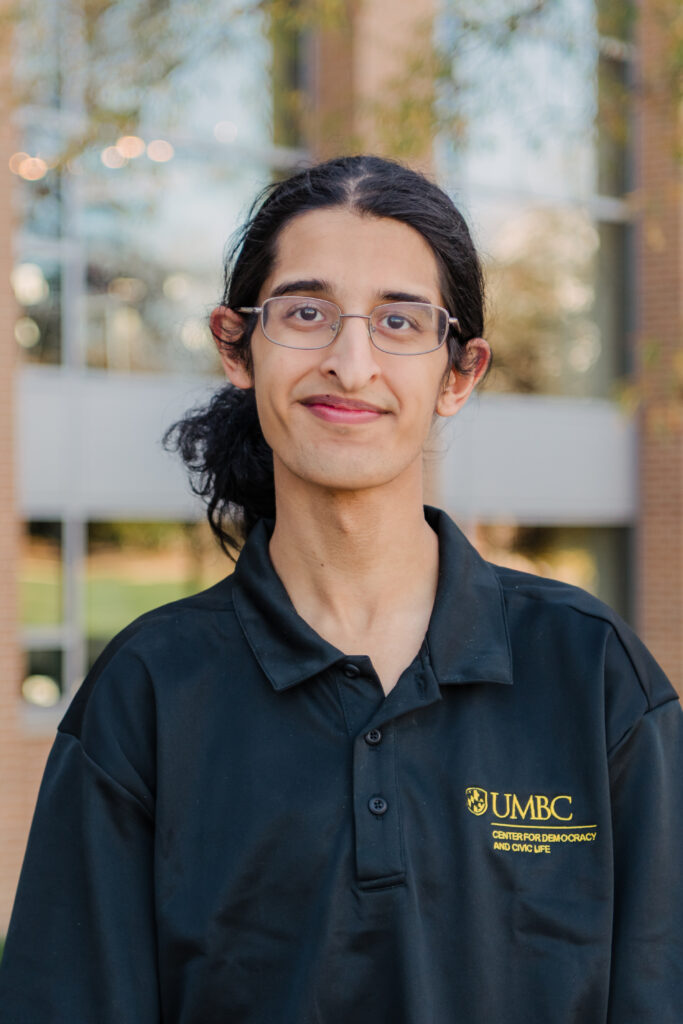
One of Election Night Extravaganza’s student organizers, Musa Jafri. (Marlayna Demond ’11/UMBC)
As exciting as this night is, it’s only one part of efforts put forth throughout the year by the Center for Democracy and Civic Life to engage students in the day-to-day processes of democratic involvement. Leading up to elections, students are encouraged to “cast your whole vote”—an idea from Henry David Thoreau’s essay on civil disobedience—to commit fully to building strong, inclusive, just communities in which everyone can thrive. Following elections, students, staff, and faculty can take part in Together Beyond November discussions to talk about the election outcomes and envision a common future.
In late November 2022, the ALL IN Campus Democracy Challenge released the results of its national student voter pledge competition. UMBC finished at #4 in the nation in the number of students pledging to vote in Election 2022, moving our campus community up from #9 in 2020.
Musa Jafri ’24, political science, SGA’s director of civic engagement, was heartened by the turnout. “Democracy doesn’t end at the voting booth,” said Jafri, who is also co-chair of the University System of Maryland Student Civic Leaders Committee. “There’s so much more we can do as we watch the results and come together as a community. Even after whatever happens, we have fellow Retrievers coming together, watching the results, having food, and playing games.”
Another one of the event organizers, Meghna Chandrasekaran ’25, biology, hosted a social takeover during the night, interviewing her fellow students about their civic engagement. Many mentioned feeling the need to have their voices heard on issues they cared about. To wrap up the evening, Chandrasekaran said, “Election Night Extravaganza is an event to celebrate that we did come out. We had one job as citizens to come out and vote, express our concerns about certain things, and show that we are part of the process.”
To read more about engaging college students in everyday democratic practices, check out an extended Q&A with Musa Jafri, Sunil Dasgupta, professor of political science, and founder and host of the podcast “I Hate Politics,” and David Hoffman, Ph.D. ’13, language, literacy, and culture, the director of UMBC’s Center for Democracy and Civic Life.
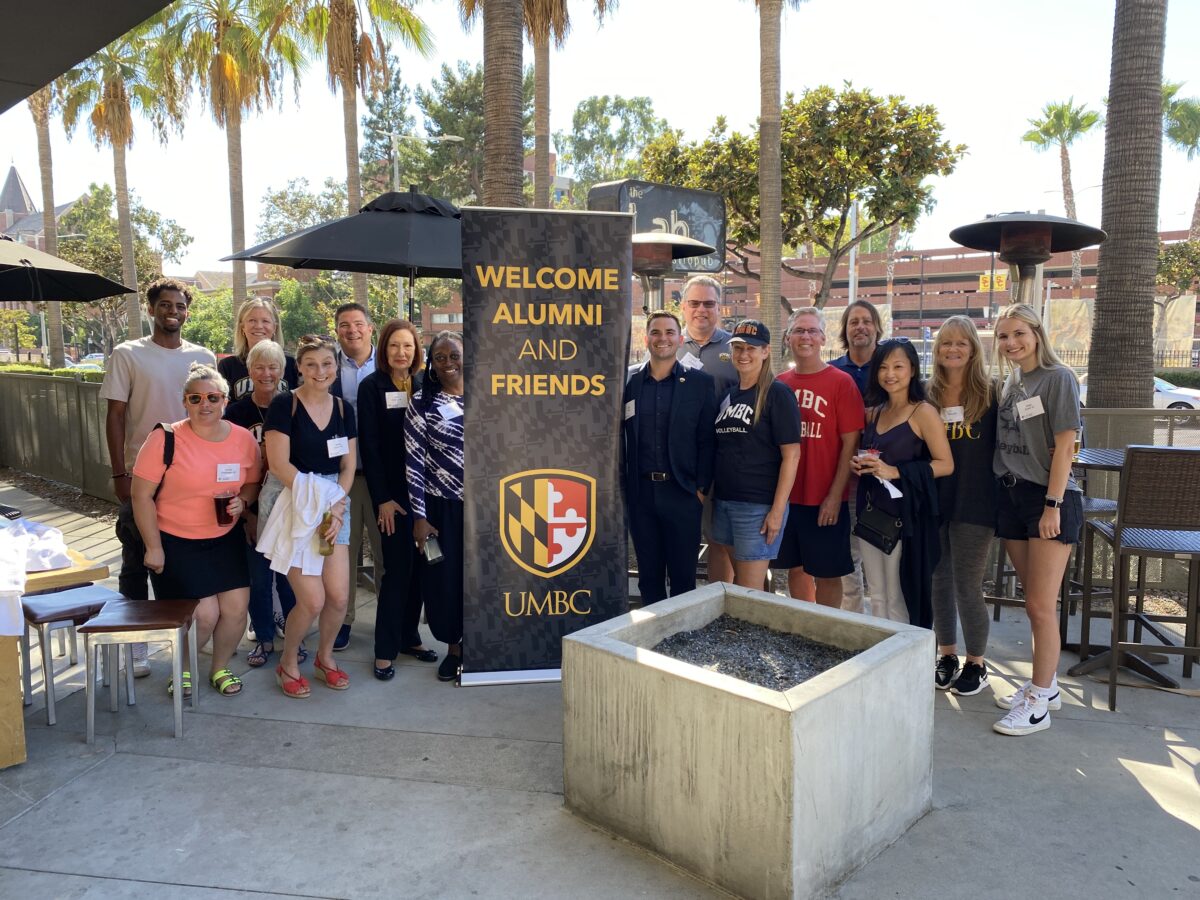
When UMBC’s volleyball team headed to the University of Southern California (USC) for a tournament, Athletics reached out and invited West Coast Retrievers to an LA happy hour before the game. Eager to reconnect with their alma mater and meet other alumni in the area, folks gathered together and new friendships were formed.
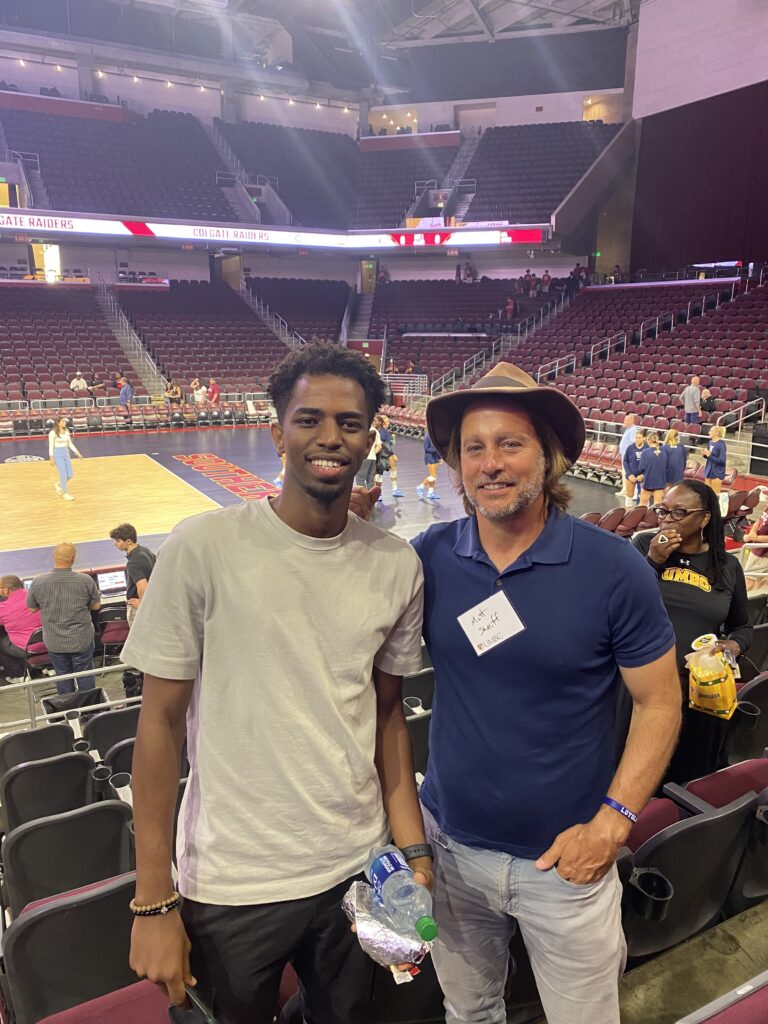
Despite the decades between their UMBC experiences, Matt Sheriff ’00, political science, and Nathenael Dereb ’21, computer science, bonded over a quintessential California connection—surfing. Specifically, Dereb, a recent relocator, wanted to learn how and Sheriff, who’s been on the West Coast for years, had the skills to teach. Since then, the pair has been meeting before work in the mornings catching the waves. They carved out some time to share the experience with UMBC Magazine.
Retrievers gathered for a West Coast happy hour.
UMBC Magazine:We know how you two met—can you tell us how you hit it off?
Sheriff: I attended graduate business school at USC, so when I read about a tournament volleyball game at USC that the UMBC team was invited to attend, I was simply amazed that my undergrad school was coming to USC. At the alumni pre-party, I met Nate Dereb, who, like me, also relocated from Maryland to LA. He was interested in learning to surf, so I’ve been introducing him to the sport when our schedules align. The beauty of living in Los Angeles is we can surf in the morning and be at work by 9 a.m., even earlier if necessary!
UMBC Magazine:What are your best surf tips?
Dereb and Sheriff connected at the USC volleyball tournament.
Sheriff: Take it slow in terms of expectations and remind yourself that the best surfer is the one having the most fun.
UMBC Magazine:How was the change from Maryland to California?
Dereb: Relocating across the country to a city I’ve never been before was an overwhelming experience, but I was fortunate to have my family around me during my relocation. One of the shocking things was finding myself outside only in shorts and a shirt in February! I’m still amazed by that.
UMBC Magazine:What are you up to now?
Sheriff: I’m a senior advisor at Southern California Edison where I lead regulatory economics projects and represent the company before the California Public Utilities Commission as an expert witness. Most of my work is finance-related but the communication and analytical skills I learned at UMBC are immensely helpful.
Dereb: I am working as a software engineer at Adobe within the analytics organization. On the side, I’m still maintaining and adding data for the platform I built during my senior year that assists students and faculty in retrieving data regarding course grades, course evaluations, and professors at UMBC.
UMBC Magazine:What was your experience at UMBC like?
Dereb: My involvement in the Center for Women in Technology organization, as a Cyber Scholar, is an experience I will always cherish. I was also fortunate to win several awards and scholarships, get multiple internship opportunities, become a teaching fellow for Computer Science 202, and do innovative research as part of the Interactive Robotics and Language lab on campus. I am a proud Retriever!
Sheriff: More than anything I feel like I grew into a young adult who was ready for the world.
Meet Sandra Abbott, who has been working in UMBC’s art world for 14 years. Whether it’s through setting up world-class exhibitions or coordinating educational programs, Sandra combines her work as curator of collections and outreach at the Center for Art, Design, and Visual Culture (CADVC) and affiliate faculty in the visual arts department. Sandra thrives in her role of introducing Retrievers and community members to great art.
Q: What part of your job do you enjoy the most and why?
A: I love working with students who are exploring my profession. They keep me on my toes and ask the best questions.
Q: Who is someone in the community who has supported you, and how did they do it?
A: When I needed to research local 3D printers for a special K-12 art project, I reached out to alum Maks Prykhodko, M.F.A. ’21, IMDA. Maks returned my email within 24 hours and offered help, including a personal introduction to those I needed to connect with at the best vendor.
This is only one example of many alumni I’ve reconnected with professionally after UMBC. This community supports you at UMBC and beyond. It’s the best network!
Q: Tell us about what you love about where you work.
A: What I love about the CADVC gallery is the amazing, world-class artwork I pass by every time I come and go from my office.
Q: What brought you to UMBC in the first place?
A: I was drawn to UMBC as a place known for its academic rigor and scholarship. I wanted to develop my career amongst those who took their work as seriously as I took mine.
“
What I love about the CADVC gallery is the amazing, world-class artwork I pass by every time I come and go from my office.
Sandra Abbott
Q:What would you tell someone who is considering a career at UMBC?
There is always someone who can help you when you have a question or a challenge. The network of experts we have access to at UMBC is astounding. They range from those in cybersecurity and STEM to the arts and beyond. I’ve made many connections here, which often continue beyond UMBC.
There is also always something happening—live theater, films, exhibitions, lectures, and performances. Personal growth, wellness, and education are among so many shared values here.
* * * * *
UMBC’s greatest strength is its people. When people meet Retrievers and hear about the passion they bring, the relationships they create, the ways they support each other, and the commitment they have to inclusive excellence, they truly get a sense of our community. That’s what “Meet a Retriever” is all about.
As a visual artist, Monique Crabb, M.F.A. ’22, intermedia and digital arts, draws from her environment quite literally—producing textile-based artworks colored with the rich hues of plants and objects around her. This fall, she spent a month in residency at the Baltimore County Public Library, teaching workshops and engaging with library users as she created new work inspired by her surroundings. These are her reflections from that experience.
Headshot of Monique Crabb.
One of the most calming places to be in is a public library surrounded by people’s research, stories, and history of every place and culture from almost every perspective imaginable. At times, the amount of knowledge at my fingertips can feel daunting knowing I’ll never be able to take it all in. I’m reminded of a scene in the ’80s movie My Stepmother Is an Alien, when the main character Celeste, played by Kim Basinger, travels to earth in a model’s body to conduct research on human life and discovers books. She’s able to retain the books’ information instantly through osmosis, spanning the gamut of human emotions, and is starved for more. This scene has imprinted itself in my mind as a superpower I wish I had.
Growing up in a working class neighborhood to a mom who would every weekend pull open the large rolling door to our garage for the permanently set-up sale of our used things, and a father who worked various jobs and seemingly was never around, I spent most of my time outside of school on the streets, at friends’ homes, or playing in the woods. My parents did not engage much with books, the arts, or academia; I was mostly influenced by pop culture.
As I got older, books came to me at very specific times in my life to change my perspective and help me find my place in the world of things. One of those times was my junior year in high school when my English teacher gave the class a list of authors to pick from for a book report and I selected Kurt Vonnegut, solely on the fact that his name sounded cool and he shared a first name with Kurt Cobain. I then found myself sitting on the floor of my school’s library absorbed by the opening line of Slaughterhouse-Five: “All this happened, more or less.”
The rest of the book was an eye-opening view of one person’s experience in the world during a time so far removed from my own, yet with relatable philosophical ideas with quotes like, “All time is all time. It does not change. It does not lend itself to warnings or explanations. It simply is. Take it moment by moment, and you will find that we are all, as I’ve said before, bugs in amber.” Books allow us to travel through time and place to help us find meaning in our lives, which is a magical experience that visual arts achieves just as profoundly.
Window of a vacant building interacting with a bush near the Hereford Branch of the Baltimore County Public Library.
The Baltimore County Public Library month-long Artist in Residence program was a gift to take part in. Each week I walked through a sea of books and would greet the librarians on my way to their maker space, The Hive. Being there allowed me the time and space to focus on one project.
I also had the opportunity to engage with a community outside of my own through two workshops I gave on eco-printing and dyeing with food waste as well as having the studio space open to visitors while I was working. On my lunch breaks I would browse books and take walks, once visiting the nearest cemetery and other times just taking in the colors and patterns from the intersecting relationship of plants and human-made constructions in the area.
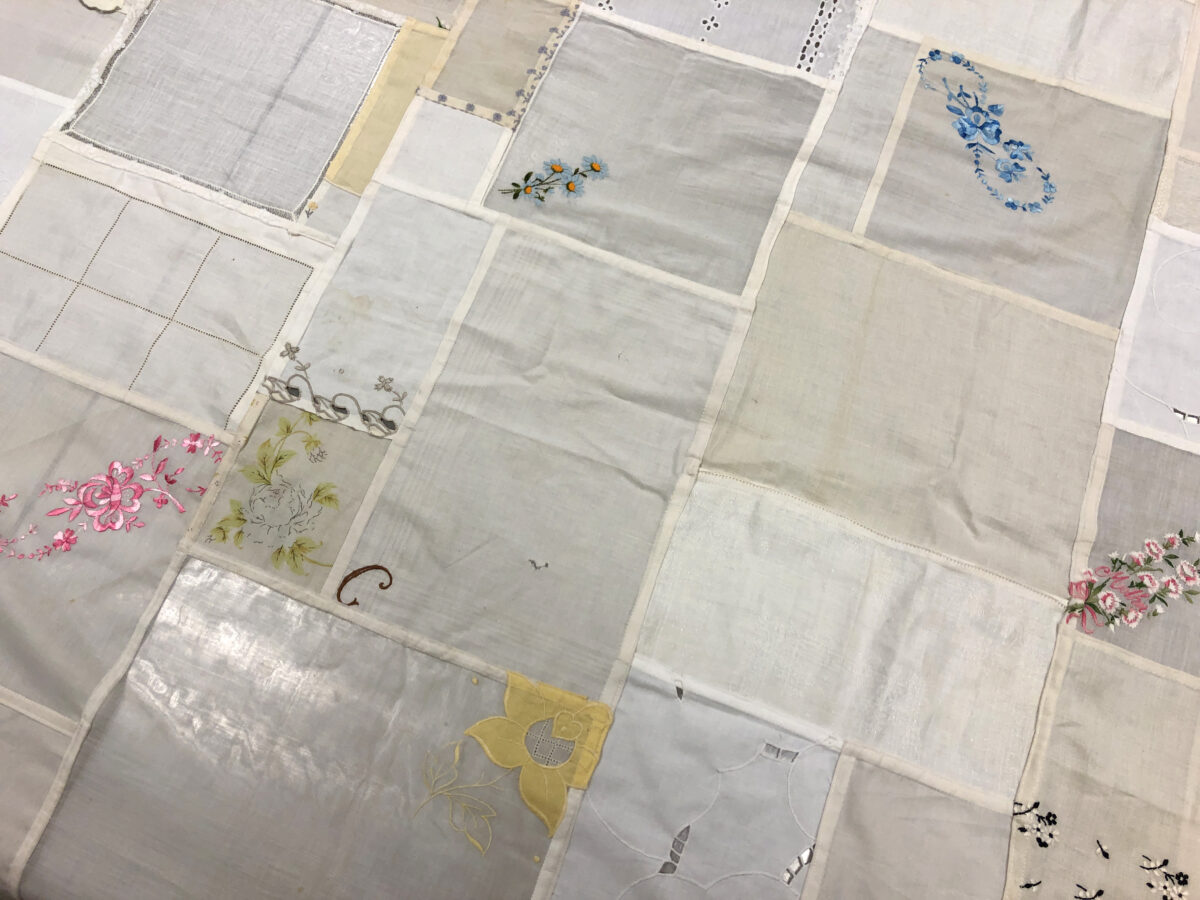
During my time in residency, I started a project using secondhand vintage linens made with open cut and intricately detailed hand and machine embroidery. I either cut up or used the entire napkin, handkerchief, or tablecloth and machine-pieced them together using pojagi, a Korean form of quilting that creates a seam on both sides of the pliable plane. These textile objects, often made by women, were and continue to be so precious that the folds and creases in them become deep from decades of being stored away unused.
I was drawn to bringing these objects out of storage, unfolding, and piecing one to the other to create a frankensteinian curtain that was large and would present as a confrontation in the middle of a room. I hadn’t fully unraveled the idea, but I knew if I put in the work that richer layers of context would reveal themselves.
Pojagi-style piecing of secondhand vintage embroidered napkins. Cyanotype-coated vintage cotton napkin with an image of a toilet brush exposed using the light of the sun.
Toward the end of my residency I had a library visitor come through and we chatted for a while about art, the artist’s process, and the meaning behind what is made. It was during this exchange that I had a lightbulb moment for my project of painting cyanotype directly onto the napkins and exposing stark images of tools used in the domestic world like a toilet brush. Adding this layer of context expanded my exploration of materials from domestic life by bringing attention and exposing the hidden labor behind the undervalued role of homemaker, woman, and caregiver.
It’s essential to my growth as an artist to be in new environments and around new people as well as the opportunity to step back from being so deeply inside of my artwork by engaging with communities outside of my own. Meeting the folks who took my workshops and the ones who came through the studio to ask questions about what I was working on reminded me of the importance of my role as an artist. I believe our stories connect us and often find that the narratives I encounter, whether in person or from books, inform and enrich my practice in ways I could never do alone.
It’s no secret that at UMBC we do things a little differently. As a university, we’re young, agile, and (buzzword that it may be) truly innovative. We can see the success of these traits in our rankings or research-lab results or employee-satisfaction surveys, but those numbers don’t tell the full story of how, when the Retriever community joins efforts to achieve greatness, we arrive there together.
So on the eve of UMBC’s 50th anniversary in 2016, when the institution put forth a goal to raise $150 million— money that goes directly to student scholarships, graduate fellowships, professorial awards, and so much more— we didn’t question if we would succeed, we just wondered how we’d be able to capture the magnitude of the collective campaign when it came to a close.
Now, wrapping up the endeavor with over $189 million, we get to celebrate the stories that made this all possible. This campaign called upon our community’s Grit & Greatness, and Retrievers responded in kind by making big breakthroughs, forging true partnerships, and transforming lives.
Making Big Breakthroughs
The Talent Goes Both Ways
“One of my top priorities is recruiting the best talent who aspire to be great leaders for our company and the nation,” says Jennifer Walsmith, vice president of the Cyber and Information Solutions business unit at Northrop Grumman and executive lead for university relations with UMBC. “Our deep connection with UMBC enables us to recruit and hire the very best. Many of our UMBC graduates have remained at Northrop for decades and play an invaluable leadership role in cybersecurity.”
Walsmith knows something about connection as a Retriever herself, graduating in 1990 with a degree in computer science—something she said was only possible due to 2 a.m. study sessions with classmates and encouraging lunch meet-ups with friends on campus. In her current role, she oversees 2,000 plus employees and is often seen on campus speaking to alumni, faculty, and board members.
“As a nation, we have been enabled by enjoying a technically superior way of life. However, the number of students in the technical fields is getting smaller, especially among women in these majors.” So how do Northrop Grumman and UMBC plan on breaking through that limitation? “I believe it’s vitally important that we all give back,” says Walsmith.
That looks like dozens of UMBC interns each semester who get the chance to work on the toughest problems in space, aeronautics, defense, and cyberspace; an alumni chapter at Northrop Grumman over 600 employees strong who volunteer considerable time at local schools; and millions of dollars spent to benefit students, programs, and research over the last campaign.
Northrop Grumman has a unique relationship with UMBC, but they are not alone in their support of UMBC students and faculty and graduate research. Throughout the Grit & Greatness campaign, 69 percent of commitments came from foundations and companies like T. Rowe Price, Morgan Stanley, Lockheed Martin, and Baltimore Gas and Electric Company.
“We are technical leaders, and I love to see our UMBC students thrive to become future leaders of our company and give back to other students,” says Walsmith. “So when you create the engine where people on each side fuel this relationship, it strengthens everyone.”
— Randianne Leyshon ’09
Breaking Through Education Barriers
In Baltimore City, middle schoolers are making roller coasters out of insulation tubing and tape. High schoolers are dunking basketballs to learn math equations. And not too far away at UMBC, the Sherman STEM Teacher Scholars are prepping to spread even more innovative, inclusive lessons throughout city schools.
The Sherman STEM Teacher Scholars Program, founded in 2006, and other initiatives supporting Retrievers to become culturally responsive and compassionate educators in historically underserved, urban schools, are thanks to the vision of philanthropists Betsy Sherman and her late husband George.
In early 2022, the Sherman Family Foundation donated $21 million to create the Betsy & George Sherman Center, which expands and integrates UMBC’s work in teacher preparation, school partnerships, and applied research focused on early childhood education and improving learning outcomes for Baltimore students. This gift allows educators to implement new teaching methods and find ways to break through learning barriers for their students.
The gift—the largest in UMBC’s history—will transform both UMBC and generations of local students. It also serves as a rallying point for others to join in giving and volunteering at participating schools. To date, says Greg Simmons, M.P.P. ’04, and vice president of Institutional Advancement, “our school partnership work is our most robust community-based philanthropic effort given the scope and range of donors involved.” In addition to the Shermans’ foundational gift, other organizations—like the Richmond Family Foundation and Northop Grumman, just to name two—and many individual donors have supported this endeavor with their own time and resources.
“I see the legacy of the Sherman program as a seed,” says Haleemat Adekoya ’22, political science, a Sherman STEM Teacher Scholar. “It’s been planted and people will continue to water that seed…it will be one of those trees in a folk tale that does not die out because the community and the people who have benefited from its impact see the importance of that tree living beyond generations.”
— Randianne Leyshon ’09
Forging True Partnerships
The Snowball Effect
Sandy Geest ’72, English, knows the power of how a little can go a long way. When she graduated, she immediately started giving to the department that shaped her UMBC experience, “even if it was just 10 or 15 dollars a year,” she says.
Now, 50 years later, Geest and her husband Jay have an endowed scholarship for English majors that has supported 10 students since 2017.
Geest spent most of her career as conference and event planner for James Rouse’s Enterprise Foundation, using her organizational skills to plan ribbon cuttings at the White House and pull together the 1992 U.S. Olympic Gymnastics Trials held in Baltimore. She says it was through the company’s matching shares program that she began to realize the power investments could have—if they could help her savings accrue over time, she wondered how her donations might increase as well.
Geest recounts how her office was located across from the then new Columbia Mall. On lunch breaks, her other coworkers would frequently go shopping. “And I told them, ‘No, you need to be putting your money into this fund because it will grow. When you’re old and gray, you’ll be glad you did that. These shoes will be all worn out by then.’”
Over time, Geest realized the same logic applied to her giving to UMBC. As she got raises and advanced through her career, she upped her giving. “I didn’t do it all at one time, [but] as it grew over the years I gave more and more,” she says, knowing the power for sizable change hinged on an endowment that would be invested by the university and able to sustain its monetary output.
Her scholarship eventually snowballed to support up to four Retrievers a year. Her scholars’ success is the biggest reward, says Geest. At on-campus events, they tell her what a difference her giving made to their UMBC experience—it allowed them to explore career options through internships or it provided a lifeline when they thought they might have to drop out.
“It’s a very good feeling,” says Geest, “to know that you have put a hand back to help somebody behind you.”
— Randianne Leyshon ’09
The Competition Is Strong
Vanessa Mann, head coach for women’s soccer in her fifth season, has the mindset of leaving things better than you found them and uses the competitive spirit inherent in athletics to teach the power of giving back. This philosophy has led to 100 percent participation in UMBC’s annual Black & Gold Rush Giving Day among her student-athletes.
The itch to compete motivates the other teams as well. Women’s lacrosse goalkeeper Isabella Fontana ’24, economics, sees it as the perfect way to get student-athletes engaged. “Not only do I want to support the women’s lacrosse team because everyone loves to support our team,” she says, “but as athletes, we always want to win. So if there’s something on the line, we’re like, ‘Oh, let’s do it.’”
Fontana’s competitive spirit earned her a year-long prime parking spot in front of the Chesapeake Employers Insurance Arena after she won UMBC’s 2022 Giving Day student ambassador challenge. By calling on her enthusiastic network of friends and family, Fontana generated the most donors (104) out of all the ambassadors and brought the lacrosse team’s total to 335, almost double the amount from the previous year. Curious what that looks like by the numbers? It’s the difference between $5,045 in 2020 and a whopping $40,040 in 2022.
The lacrosse team isn’t alone in getting people hyped for giving—in fact, Athletics is responsible for bringing in the most donors and dollars for UMBC’s annual Black & Gold Rush. Even so, they’re always striving to top themselves: in 2020, women’s soccer more than tripled their goal for donors.
Both Fontana and Mann would be the first to remind you that good competition is nothing without cooperation. “So it wasn’t that we were really competing with anyone, like any outside entity,” Mann sums up. “We define competition as competere, which means to strive together. That’s actually the Latin translation. So it’s not me versus you, it’s actually me with you.”
— Levi Lewis ’23
Bridge-Building Alumni
Anwesha Dey came to UMBC from Singapore for a summer research internship. She ended up staying much longer, completing her Ph.D. in biochemistry in 2004. “In many ways, I think of the entire experience being one of the turning points in my life,” says Dey. “The sense of community and belonging and the focus on excellence at UMBC would go on to define my career.”
Now, as director and senior principal scientist of Discovery Oncology at Genentech, a groundbreaking biotechnology company, Dey is dedicated to bringing in UMBC students to her own lab and research community. Early in 2022, that meant inviting her former mentor, Mike Summers, professor of chemistry and biochemistry and the Robert E. Meyerhoff Chair for Excellence in Research and Mentoring, along with then president Freeman Hrabowski to Genentech to discuss the company’s ongoing support of UMBC. “We’re all mutually invested in the same thing,” says Dey. “When we first started this fellowship about five years ago, it was really one step at a time. And so it’s great to see where it is now. The trajectory is really strong.”
Dey is far from alone in bringing her enthusiasm for her alma mater to the workplace, and as more Retrievers go on to work in the upper echelons of the scientific community, they are finding ways to connect their industries to the campus that shaped them.
Bobby Allen ’99, M7, computer science is clear that he has a lot to be thankful for because of UMBC. He met his future wife Frances Allen ’99, M7, computer science, and many of his closest friends as teenagers in the Meyerhoff Program’s Summer Bridge. But aside from his personal connections, as a product manager at Google, it’s Allen’s personal mission to connect UMBC’s proven pipeline of talented Retrievers to his workplace. “At Google, we know we need to have underrepresented populations as managers, champions, executive support, and mentors so that as we hire graduates and interns, they see people who look like them and know what is possible.”
— Randianne Leyshon ’09
Transforming Lives
Rising to the Top
It’s no accident that when visitors arrive on campus from the west entrance, they’re greeted by the radiant reflection on the silver slope of the Performing Arts and Humanities Building (PAHB). This LEED Gold-certified building, which opened in 2014, is a symbol of UMBC’s investment in the performing arts and humanities. But, it’s the students and activities inside the facility that really shine.
Deven Fuller ’23 is a case in point. Double-majoring in dance and math, Fuller is a Linehan Artist Scholar—part of a selective program endowed by Earl and Darielle Linehan that has launched the careers of more than 300 Linehan Artist Scholar alumni in dance, music, theatre, and other creative disciplines.
Fuller is focused on commercial dance—a highly competitive field that’s principally centered in New York and Los Angeles— which would put a career in his chosen field effectively out of reach were it not for the Linehans.
Thanks to the scholarship, Fuller said, he was able to join a New York–based dance training company in his sophomore year, take classes at local studios with accomplished touring commercial dancers, and enjoy other unique opportunities. The fact that the Linehans are “recognizing dance as a serious career…is just such an amazing thing,” Fuller said.
Most recently, with a Linehan Summer Research Award, “I was able to travel and do a certificate program at one of the most prestigious studios in the world for commercial dance. … I was very lucky to have the grant to be able to branch out in that direction.”
Fuller is far from the only student to benefit from philanthropists’ investment in UMBC’s arts-focused students. Todd Carton ’77, interdisciplinary studies, has created the Carton Family Endowed Scholarship to support talented students in the performing arts who come from disadvantaged backgrounds. Along with a gift that helped to fund the PAHB, Carton has included UMBC in his estate plan so that the endowed scholarship can grow and benefit even more arts students far into UMBC’s future.
Fuller hasn’t had the opportunity to meet the Linehans, but if he could, he said, “I would thank them for the opportunities that I’ve been able to have because of them …and let them know how much they are positively affecting the community of artists.”
— Scott Cech
A Family That Gives Together
Professor Bimal Sinha and his family weren’t content to let his 30-plus years of pioneering academic contributions to UMBC be his only professional legacy. Even though neither he nor his sons Jit and Shomo Sinha attended the university, they decided to collectively donate $750,000 to create the Dr. Bimal Sinha Professorship in Statistics at UMBC.
The professorship permanently funds a new statistics faculty position at the university, which seems especially fitting, considering that Sinha founded the statistics department in 1985 and helped transform UMBC into a national leader in statistics education.
But Sinha’s sons remember that beyond his academic accolades, the way their father has always interacted with his mentees is what made the deepest impression— whether meeting international students at the airport or inviting groups of students to their family home for dinner.
Creating community has been a hallmark of Sinha’s career: The professor successfully spearheaded the African International Conference on Statistics, held in a different African country each year since 2014. In 2018, UMBC signed a memorandum of understanding with the University of Limpopo in South Africa to foster collaboration and exchange. A number of graduate students from African countries have also flourished with Sinha’s mentorship.
“Bimal has not only engaged in groundbreaking research for decades but has also produced and championed an impressive number of influential Black statisticians throughout Africa,” noted Freeman Hrabowski, UMBC president emeritus.
In fact, the family’s dedication to continuing Sinha’s legacy has already inspired others: Forty alumni and friends of the university pitched in a combined $150,000, and the Maryland E-Nnovation Initiative Fund committed to a matching grant, bringing the professorship’s total endowment to $1.8 million.
“I feel honored and fortunate to have played a small role in the evolution of this beloved institution,” Sinha said. “Through this gift, I want to ensure that future generations of leading scholars will view UMBC as an attractive home to advance their contributions to the field of statistics.”
— Sarah Hansen, M.S. ’15
Gesture of Gratitude
When Felicia Sanders moved into Susquehanna Hall in the early ’90s as part of the fourth cohort of Meyerhoff Program Scholars, she found herself experiencing a series of firsts. It was her first time living in a mixed-gender dorm; the first time she understood the power of study groups; and she was a member of a scholarship program so new it hadn’t yet graduated its first class of scholars. “I thought I was just making friends, but this setup was really part of an ecosystem, a very effective one that set us up for success.”
The Meyerhoff Scholars Program fosters a collective spirit from day one—when students tackle Summer Bridge together. So when it came time to celebrate the program’s 30th anniversary and thank Robert Meyerhoff, the philanthropist who founded the program with President Emeritus Freeman Hrabowski, the graduates decided to give together, with an initial half-a-million dollar gift.
“When we give collectively, we keep the continuity of the culture that was built by the program,” says Sanders ’96, M4, chemical engineering, and a leadership level giver. “We keep the family bond that was built by the program. It doesn’t become something that is piecemeal or start-stop or becomes intermittent because it is something that was fun for someone one year and then wasn’t supported the following year.”
The word Meyerhoff Scholars most often use to describe themselves is family. Not just a family of 1,300+ alumni who have gone on to use their gifts as industry leaders and academic powerhouses, but including the students who have yet to join their ranks as scholars, the future generation of Meyerhoffs.
Jason Dixon ’02, M10, computer science, and Rhea Brooking-Dixon ’02, M10, biological sciences, whose origin story began in Summer Bridge, give together because “we know that our successes are never truly our own,” they share. “We are confident that our gifts to UMBC and the Meyerhoff Scholars Program will help other young scholars the same way the program has helped us and more.”
“It’s important for the family to be engaged in the program’s continuity,” says Sanders. “Now that Doc [Hrabowski] has moved on to the next chapter of his life, it’s important that the Meyerhoff Program is something we’re still talking about in another 30 years. And that can’t happen if the family doesn’t continue to reinvest.”
Students come to UMBC for many reasons—to find community, to explore a passion, to make change in the world. Once they figure out the “why” that truly drives their interests, the Retriever community is ready to kick in with the “how” to help make those plans a reality. Part of that looks like the traditional classroom experience with a professor, of course—but just as important are the experiential-learning moments that help many students actively connect the knowledge to careers they hope to pursue after graduation.
UMBC students pursue applied learning in huge numbers. Despite the pandemic, nearly 80 percent of our recent graduates engaged in applied learning, including internships, research, co-ops, and service learning during their time at UMBC. An impressive 91 percent of new grads head directly to a job, advanced degree, or both within six months of graduating—and of those, more than half interned or worked for their employer as a student.
“When it comes to impact, there is nothing more valuable than engaging in applied-learning opportunities to help clarify one’s career direction, build professional skills, and increase one’s professional network,” shares Susan Hindle, the Career Center’s assistant director of internships and employment.
For students pursuing experiential learning through internships, campus jobs, research, and community engagement, it’s not just about learning how to do the thing they want to do. It’s about connecting the work to the passions that brought them to UMBC in the first place. These students and alumni working in their chosen fields tell the whole picture—what hands-on learning looks like when it comes full circle.
Essential connections
The desire to help people comes from deep within. But knowing how to do it successfully on a large scale—and understanding the systems and politics that can make the job more or less challenging—takes more than just compassion.
On the morning of the monthly food delivery from the Maryland Food Bank, the brigade of students who keep the Retriever Essentials food pantry running see all sides of the work. Together, they unload and shelve staples like rice, pasta, and huge crates of broccoli for the more than 2,100 visits to the pantry so far this year. At the same time, they connect with community members to understand what might make life better—halal meats, for one; more campus job opportunities, another biggie—and then put their heads together to try to make those changes happen.
Photos by Marlayna Demond ’11/UMBC, design by Jim Lord ’99.
For Ariel Barbosa, a grad student in UMBC’s community leadership program, working in this space is part of a journey that started with her trying to understand her Brazilian father’s immigrant experience better. As she works with Retriever Essentials, she’s learning about the complexities of these experiences in a way that will help her as she carves out a career in service.
“There are so many signs showing me that I’m supposed to be right here, right now. I feel like I’m preparing,” she says. “Right now, I feel like I’m in a confidence-building, skill-building phase where I’m just trying to pick up as many skills as I can to be able to create what I feel I need to create at the right time.”
As a student, Matthew Dolamore ’08, modern languages and linguistics, caught a first glimpse of what would later become a service-based career when he tutored Spanish-speaking clients for an immigration services office in Baltimore. After graduating, he went on to serve with AmeriCorps and the Peace Corps and earned a master’s degree in community planning before pulling all of those skills together into a full-circle career in Baltimore.
Today, Dolamore is program director for the Esperanza Center, a project of Catholic Charities that assists more than 3,000 individuals each year with walk-in immigration services, including healthcare, legal assistance, and education tools. Dolamore serves as a connector between people and solutions, helping people get what they need when they need it and looking for ways to help improve the system.
Matthew Dolamore ’08 at the Esperanza Center. Photos by Marlayna Demond ’11/UMBC, design by Jim Lord ’99.
“Among our managers we have a nurse practitioner, a managing attorney, a licensed social worker, an individual who got their master’s in teaching English from UMBC, and a woman who oversees our one-touch client services desk who’s a former immigrant and just has a really dynamic background. And just those five people alone is symbolic of what I love about my job,” says Dolamore.
“I’m not a medical professional. I’m not a legal professional. I’m not a social worker. I’m something myself of a generalist nonprofit manager at this stage in my career, but I get the opportunity every day to come in and out of these really focused professional engagements and try to help all five of them think of each other as teammates, and that’s the part of my job I really enjoy.”
Lydia Sannella, a Peaceworker and grad student in applied sociology at UMBC, also enjoys the organizational aspect of her job with Retriever Essentials. As she looks ahead to her post-academic career, she’s already thinking about how she can continue to marry her values with her career—knowing that it won’t likely be quite the same as what she’s experiencing at UMBC.
“I find that, whenever we want to do something, there are supportive, knowledgeable experts who want to help,” she says. “There’s just hoards of students who want to be involved and engaged and do any variety of work, from physical lifting to technical projects. And it’s just this canvas for creativity and possibility. It’s very reciprocal. What I’m able to contribute ends up being more significant and then what I get ends up being more significant.”
— Jenny O’Grady
Becoming part of the solution
Students come to higher education for a variety of reasons, and among them, many have the goal of learning to create new things—from innovative water-quality solutions to entire companies. For many students, in fact, learning while doing is an integral part of going to college.
If you ask Premal S. Shah ’98, biochemistry and molecular biology, however, he’ll tell you that there’s a world of difference between learning while doing and learning from doing.
That’s not to say that Shah, who earned a Ph.D. from the California Institute of Technology on his way to founding and leading a string of successful healthcare-related companies, doesn’t believe in academics. But from his vantage point as CEO at MyOme, a genomics firm based in northern California, classroom-based learning is only a part of the puzzle.
Premal S. Shah ’98 interned at National Institutes of Health before founding a genomics firm. Photos by Barak Shrama, design by Jim Lord ’99.
Shah said he’s always had a practical streak, but he found out how much experiential learning can boost classroom learning thanks to a hands-on internship and fellowship at the National Institutes of Health, beginning while he was a student at UMBC.
“When I got to grad school, there were a lot of people who hadn’t really worked in a lab or done stuff,” he said. “I had a huge head start, just because I was able to pick up a pipette and actually use it. I knew what a DNA extraction protocol was. I knew how to use certain machinery.”
It was a vivid object lesson—one Shah has carried forward into his career. “When you start building companies, there’s always that challenge…of analysis paralysis, right?” he said. “There’s a notion of, ‘We could do this or that. Let’s read and learn more or get additional inputs in search of the perfect answer.’ Or we can actually go build something that will benefit people and iterate even faster as we learn more to make it much better.”
That’s the big difference between studying science and, for example, running science-based companies, Shah says: “The hypotheticals are great. The theories are great. But you’ve got to get [things] done.”
Getting things done is Matt Stromberg’s perennial modus operandi. Being a Ph.D. student studying environmental engineering means he is very much both an environmental scientist—someone who studies environmental problems—and an engineer: someone who works to solve those problems. “I always knew I was a passionate environmentalist, but I also knew I liked to build things,” he said.
In fact, Stromberg, who graduated in 2019 from the University of Virginia with bachelor’s degrees in both environmental engineering and environmental science, is a literal embodiment of learning while doing. Working as both a graduate research assistant and a researcher in the jointly run University System of Maryland Institute for Marine and Environmental Technology (IMET), he sometimes finds himself simultaneously running experiments and keeping the experiments running.
Matt Strombergis studying aquaculture at the University System of Maryland Institute for Marine and Environmental Technology. Photos by Marlayna Demond ’11/UMBC, design by Jim Lord ’99.
A few months ago, Stromberg said, the night before an experiment was scheduled to start, a pump failed in IMET’s Aquaculture Research Center, a 1,800-square-meter facility with hundreds of fish tanks.
“It was a large pump, and it needed to be replaced—and it was eight o’clock at night,” Stromberg said. “I had already worked 12 hours that day, [but] I realized that there’s no way this experiment is going to run if I don’t have a pump tomorrow. So…I got the wrenches and I got all the fittings I needed,” and found a way to fix it.
Stromberg’s ability to save that experiment is part and parcel of his approach. One of his main research projects is unclogging a major bottleneck that prevents more farm-raised fish from getting to market: purging them of an unsavory flavor that’s sometimes characteristic of fish that aren’t caught in the wild. As Stromberg put it, “You’re not going to sell the fish if it tastes like dirt.”
That’s a problem not only for aquaculture companies—which have to use lots of water, time, money, and energy to purge the fish of this taste—but also for the planet. That’s because the only alternative to aquaculture is fishing in the wild, which can destroy ecosystems but is still cheaper than aquaculture, due to the expensive purging process.
He’s working with advanced oxidative processes and a technology of his own that would effectively create a shortcut, making it more cost-effective to farm fish and thus helping to protect wild habitat in the process. And Stromberg aims to eventually put his Ph.D. to work in a similarly practical way: His goal is to create a company that performs chemical analysis and remediation of water contaminants.
“I’ve learned a lot from my time here,” he says. “Especially not to over-engineer things!”
— Scott Cech
Community-centered art
Visual art is all around us—in flyers, television commercials, and even clothes. And while many of us may never know the artists creating work behind the scenes, their lives and experiences certainly do shape their work.
For instance, earlier this year, Jennifer White-Johnson ’08, visual arts, designed a collection for Target’s national Latino Heritage Month campaign, including a tumbler with stacked text reading sonando vivamente vividly dreaming and a T-shirt proudly proclaiming piel canela pelo rizado (brown/cinnamon skin curly hair). As a disabled, neurodiverse, Afro-Latina designer from Baltimore, White-Johnson sees her inclusion as an opportunity to highlight and provide a voice to communities that often aren’t heard or represented.
Former Student Events Board member Jennifer White-Johnson ’08 now has designs at Target. Photos by Marlayna Demond ’11/UMBC, design by Jim Lord ’99.
“I am really honored to have been chosen and included in this year’s Target Latino Heritage Month collection and campaign,” says White-Johnson. “Using art and design to celebrate and elevate my cultural stories, the strength, and legacy of my ancestors, felt like something that was meant to be!”
Living with undiagnosed ADHD as a student, White-Johnson often felt like her intensity, excitement, and point of view were unwelcome or just too much. That changed when she transferred to UMBC, where she immediately felt at home. In particular, her time as director of promotions for the Student Events Board [(seb)] gave her her first taste of how graphic design could marry with community-centric work.
Working closely with the Office of Student Life, White-Johnson and other members of (seb) volunteered during an alternative spring-break trip to post-Hurricane Katrina New Orleans. White-Johnson also designed the T-shirts.
“This was in 2007, so we could help offer some sort of relief from Hurricane Katrina,” says White-Johnson. “It was life-changing because I was able to surround myself with other like-minded scholars that were serious about academic life but who also understood that school is about self-discovery.”
Enter Patch Hatley, a sophomore visual arts major with a concentration in animation. Fresh from a session learning how to create stop-motion animation puppets from paper, she is excited to test out some of what she’s learned on the job at commonvision, the student-driven print and design center in The Commons. On any given day, one might find her working on anything from animating cute countdowns for student activities to designing stickers.
“I’m always constantly learning in an environment like commonvision,” she says. “Each new skill helps transition to the next project, and each project creates new and exciting opportunities. You’re always surrounded by a team who are all community-driven, so I always feel like I can ask for help or constructive criticism. commonvision supports, drives, and motivates me to keep reaching for the stars and will always be an important part of how I’ve grown—not just as an artist but as a team player.”
Patch Hatley learns while working on animations at commonvision. Photos by Marlayna Demond ’11/UMBC, design by Jim Lord ’99.
Hatley finds work at commonvision particularly helpful because it stretches her creative muscles and opens up her craft to new programs, tools, and mediums, and also because other creators surround her. After spending a decade in animation and illustration before becoming a Retriever, Hatley loves the opportunity to expand her craft in a place that has fostered the foundation for budding designers for years—and getting to bring her personal perspective into work for clients.
“At the end of the day, you’re drawing for yourself and for the people around you whether you realize it implicitly or not,” says Hatley. At the core of both artists’ practices is community. Both White-Johnson and Hatley recognize that their art doesn’t live in a vacuum but exists as a letter of inspiration, solidarity, and encouragement to their respective communities. Both artists, years apart in their practice, found similar communities to nurture and invest in them.
“Being given the space to bring visibility to themes of cultural intersectionality, specifically the parts of our natural beauty that aren’t always celebrated, our caramel brown, cinnamon skin, and our natural curls,” says White-Johnson. “I hope my work can culturally inspire others to center what they want to see more of.”
— Sharéa Harris
Taking experiential learning to the next level
Developing high-level skills in a highly technical field like computer science is difficult enough. But the ability to both master and successfully teach those skills to others takes the challenge to a whole new level.
Fortunately, Amina Mahmood and Zach Margulies thrive at that level. With their dedication to passing along computer-science knowledge, these Retrievers amply demonstrate that doing while teaching and learning while doing are just different parts of the same equation.
As Mahmood ’21, computer science, tells it, she started learning while doing quite literally. Just weeks into her first year at UMBC, Mahmood found herself working 20 hours a week as a junior malware analyst at Huntress, a cybersecurity firm that was then still in the startup phase at the bwtech@UMBC Research and Technology Park.
“I didn’t really have any experience, but I was pretty ambitious, so I learned everything on the job,” she said.
Mahmood, part of UMBC’s Cyber Scholars Program, quickly learned how to run different types of malware on a virtual machine, dissect the particulars of each, and create mitigation reports. The nascent company’s culture also helped boost her confidence. If she ran into a problem, she said, the people she worked with were glad to bring her up to speed.
Amina Mahmood ’21 at the Johns Hopkins University Applied Physics Lab. Photos courtesy of Johns Hopkins Applied Physics Laboratory, design by Jim Lord ’99.
“It was just like, ‘Oh, you don’t know this—let me teach it to you.’ And then I picked up on it and then I was like, ‘OK—I can do this,’” Mahmood said. Mahmood was quick to apply such on-the-job learning to her academics, even persuading an academic advisor to allow her to add her to his overenrolled, graduate-level software reverse-engineering course at the same time she was enrolled in an undergraduate prerequisite class.
Mahmood not only aced the graduate-level class, she also started using what she had learned to complete the experiential-learning cycle at her new part-time job at Parsons Corp., a technology-focused defense, intelligence, security, and infrastructure engineering firm.
“One of my mentors at Parsons—he really supported me, and he said, ‘You know a lot about reverse engineering. Why don’t you just make a course and teach coworkers?’” That’s exactly what Mahmood did— and now does for new summer interns as a full-time reverse engineer at the Johns Hopkins University Applied Physics Lab.
Recently she found herself completing the circle, coming back to UMBC for the same kind of career fair where she’d found her first job as a first-year student. “But [this time] I didn’t go as a student,” she noted. “I went as an employer.”
Margulies ’14, biological sciences, is completing his own trajectory: Nearly a decade after earning his first bachelor’s degree, he has returned to UMBC to earn a bachelor’s in computer science and a master’s in education, with the goal of teaching computer science to Baltimore high school students when he graduates in 2024.
Margulies started his career pivot before diving back into academics immersing himself in on-the-job data science and programming—including a Maryland Institute for Innovative Computing internship at the Maryland Department of Health after starting in the computer science program. Because of this, he’s able to pursue his studies with a greater sense of perspective.
“I feel like it inspires confidence and it builds your self-esteem, taking what you’ve learned in the class and not even a semester later applying it in a real-world setting,” he said.
Margulies noted that, as a teacher, he’ll also be able to fully address high schoolers’ perennial classroom question: ‘When am I ever going to use this in real life?’
Zach Margulies took part in a Maryland Institute for Innovative Computing internship with the Maryland Department of Health. Photos by Marlayna Demond ’11/UMBC, design by Jim Lord ’99.
“It’s really important for teachers to know what the practical application of [schoolwork] is going to be and what working in a computer science job will look like,” he said.
A case in point, Margulies said, was the work he did as part of a Maryland Department of Health internship last summer, reviewing and finding improvements for data collection, including the creation of a data dashboard.
“Last semester, I took Computer Science 201, and we learned the programming language Python, and I really wanted to start applying that language at the internship,” he said. Because he’d had both practical experience and formal training, Margulies said, he was able to see that he’d have to adapt what he’d learned to suit the task at hand.
“[I had] to figure out a way that I could take Python and apply it to developing the database because that’s not something we necessarily learned in the class,” he said. “I had a lot of fun taking the thing that I learned academically and not just applying it, but also taking it to the next level.”
Ellicott City, founded 250 years ago this year, holds more than its share of history. The lore of the old mill town is dense with pioneers, millers, astronomers, abolitionists, fires, floods, and firsts, including the nation’s first national road and railroad.
Writer Ellen Nibali ’90, English, wanted to tell the history of the town. But how could she condense all those years into something that would both enlighten and entertain? Then she thought of the magic of the musical.
“The underlying thing is that I love stories,” Nibali said. “And I always enjoyed music. Then I realized that a musical was a great medium for storytelling.”
As a girl, Nibali played piano in her family’s chilly basement, finishing up practice when the timer dinged, then making up ditties. But she never imagined herself writing a musical, despite a life of putting pen to paper. After two years of college, Nibali took time off to get married and have children. But she continued writing—novels, children’s books, poems, even a bicentennial history of a Baltimore County community.
In her 30s, Nibali went back to college, attending UMBC. Nibali remembered writing a poem for class, and UMBC senior lecturer Michael Fallon telling her, “You’re on fire.” “That meant a huge amount to me,” Nibali said.
“I loved every second of it, the intellectual stimulation,” she said. This year, she endowed a scholarship for students transferring from community college. “I’m impressed with how UMBC has built its reputation and excellence,” Nibali said. “I’m proud to be an alum and want to give that opportunity to others of modest backgrounds. What UMBC does is transforming on so many levels, and it keeps on giving for generations.”
Back to the town’s roots
After graduation, Nibali wrote the weekly horticulture column in the Baltimore Sun. The column was part of her job at the University of Maryland’s Extension Service, answering hometowner’s garden questions.
She began writing the musical more than 25 years ago, for her son’s school history project. She composed songs for him and his classmates to perform, about the National Road, about the revolutionary tea party in Annapolis, and about the Underground Railroad.
Over the years, she wrote more songs, about the B&O Railroad, then one about astronomer, mathematician, and surveyor Benjamin Banneker.
Over the years, Nibali ended up with 15 songs and took the idea for her musical “On National Road” to EC250, the nonprofit formed to spearhead celebration of Ellicott City’s sestercentennial.
“Being a lover of history and especially Ellicott City history, I was immediately taken with the concept and the songs,” said Ed Lilley, president of EC250 and fondly known as the city’s informal mayor. “The finale song, ‘Sing Me a Memory,’ immediately brought tears to my eyes, reminding me of what a special place Ellicott City is.”
Nibali, right, observes a rehearsal. (Marlayna Demond ’11/UMBC)
The board agreed to put on the show. Nibali wrote a libretto and four new songs at their request, then worked with Wilde Lake High School choir teacher Kevin Crouch, who composed and recorded the songs, from marches, folk, and rock to classical and ragtime.
The thrill of songs come to life
Nibali attends every rehearsal of “On National Road,” which opens at Howard Community College December 8.
“This is my baby,” Nibali said. “I want to watch it be born. It’s just been a fun adventure. The first time I heard them do the songs, each one was thrilling.”
“On National Road” spans, of course, 250 years. It starts with the three Quaker Ellicott brothers who first saw the Patapsco River’s potential as a force to power their mills through the race of the horse and the Tom Thumb train, to more recent history, including when 19-year-old Babe Ruth was married in Ellicott City because it had lax laws about youngsters marrying.
“I wish I could convey even better how revolutionary and earth-shaking and exciting these things are,” Nibali said of the history. “The theme is freedom, about being free to be who you are in the time you are in.”
One Saturday this autumn, Nibali and 50 other audience members gathered at the Museum of Howard County History to watch a preview song, a ragtime tune about Babe Ruth’s marriage at St. Paul Catholic Church, less than a half a mile away.
An actor playing Babe, in a baseball uniform, sang out Nibali’s rhyme of “Ruth” and “uncouth,” and then warbled the song’s final line, “I’m gonna take a swing at, gotta take a swing at, get to take a swing at life,” and Nibali clapped enthusiastically as the last note faded into the rafters.