Meet Maria Bruno ’19, social work, a first-generation college student who transferred to UMBC at The Universities at Shady Grove from Montgomery College. Currently working as a mental health specialist, Maria kept herself busy at UMBC as a peer navigator and the president of the Social Work Club. Thanks for sharing your story, Maria!
Q: What’s one thing you’d like people to know about studying at UMBC at the Universities at Shady Grove?
A: That UMBC truly cares about its students. And that UMBC professors and staff are always supportive.
Q: Why did you decide to study social work?
A: I decided to study social work for a variety of reasons. My passion to help others has been part of me for as long as I can remember. I had a desire to give back to the community. My experiences working with social workers in the past lead me to understand the importance of the social work role. There is much work to do in this field with a variety of areas that can benefit from the social work practice.
I graduated in May of 2022 from University of Maryland, Baltimore with my master’s in social work and plan to further my education next year. Currently, I work with Sheppard Pratt in the School and Community Youth Services Division at Winston Churchill High School as a Mental Health Specialist. I love this position working with adolescents. They are my favorite population to work with and I learn something new every day from them.
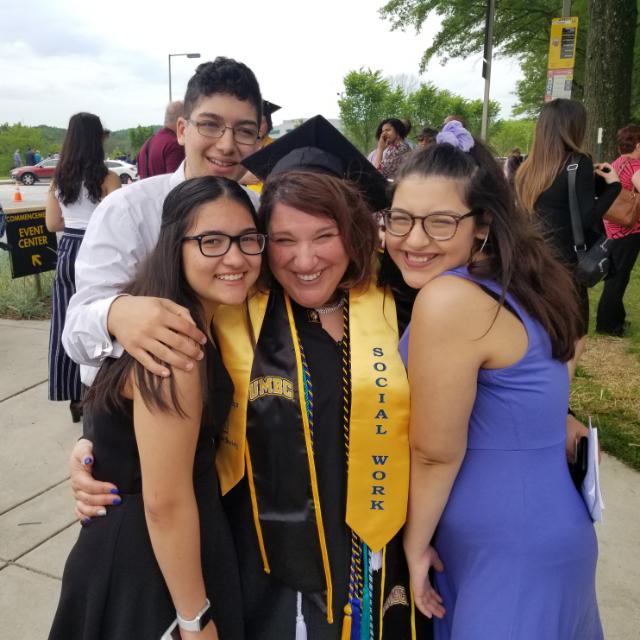
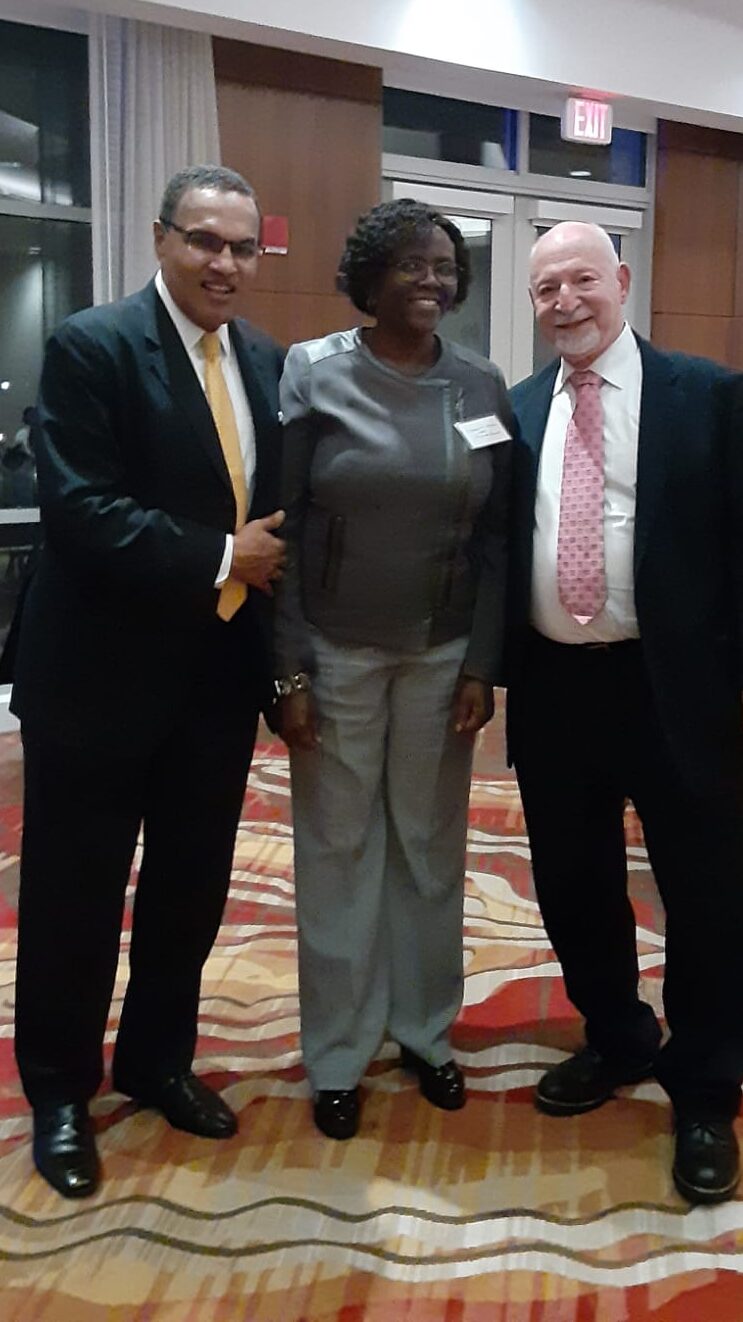
Maria Bruno ’19, social work, center, celebrates her graduation from UMBC with her children, Eugene Chirikov, Julia Chirikov, and Sofia Chirikov. Photo courtesy of Bruno.
“
UMBC professors and staff are always supportive.
Maria Bruno '19, social work
Q: Tell us about someone who has supported you at UMBC.
A:Chelsea Moyer (director of UMBC at the Universities at Shady Grove) has been a mentor and supportive of my journey since day one. And all the professors, including Katie Morris (Ph.D. ’21, language, literacy, and culture) and Chelsea Moyer, have been supportive and helped direct me toward realizing my dreams.
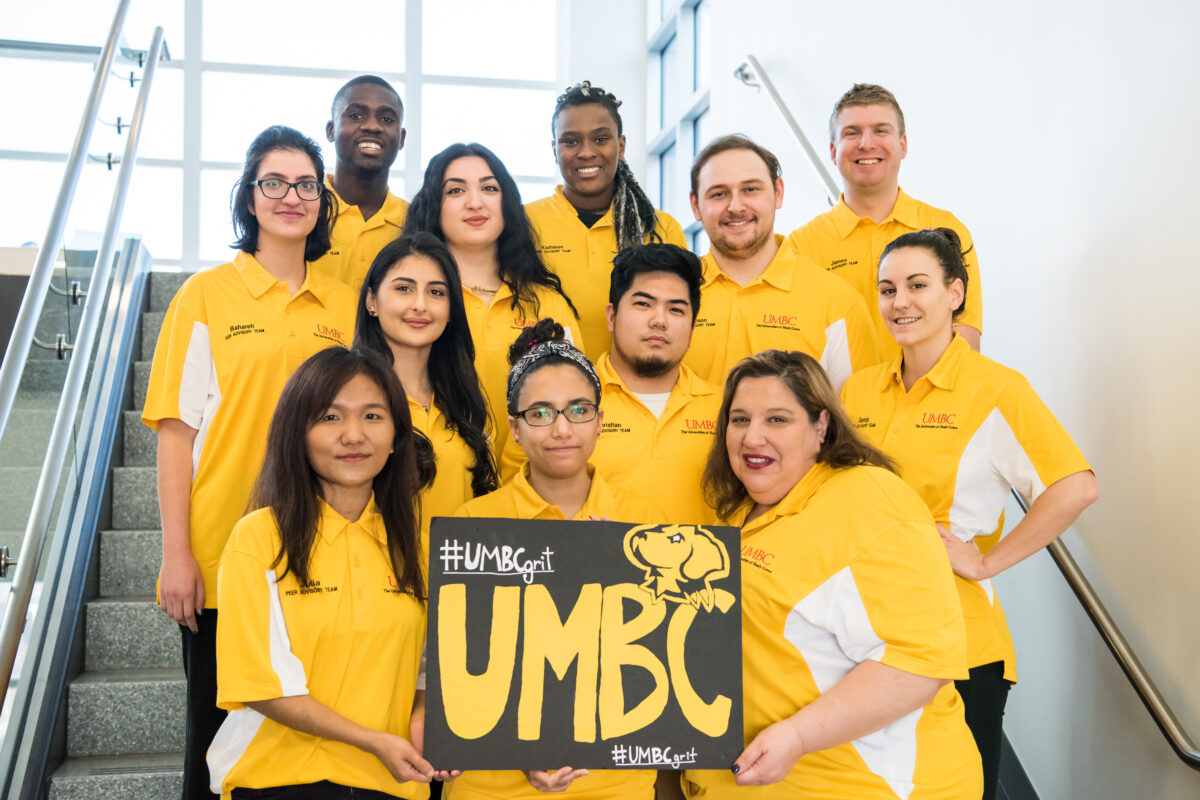
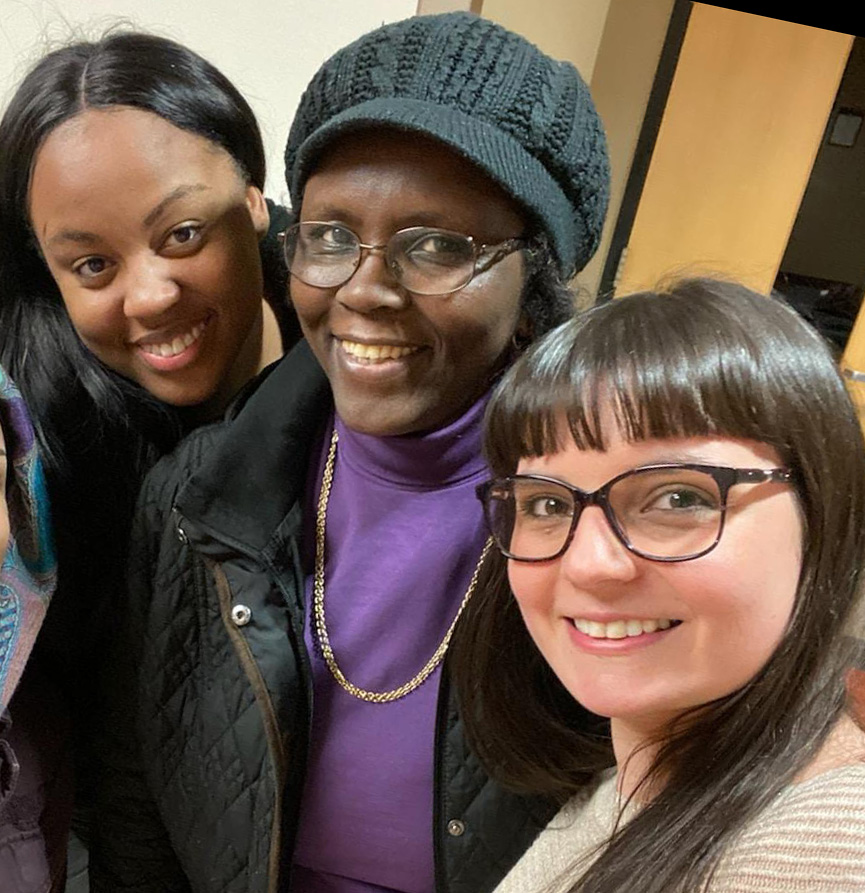
Maria Bruno, bottom right, with other students at Shady Grove. (Marlayna Demond ’11/UMBC)
Q: Can you talk about being a first-generation college student, and the support systems you’ve found at USG?
A: I never knew what the importance of being first-generation was until I was at UMBC. All my life I struggled with school. My first language was Sicilian and my parents were unable to help me with homework. Neither of my parents had higher than a sixth grade education. I wish I had as much support in my younger years of school as I did in higher ed. USG has a wealth of support systems that I utilized. The writing department was one of my biggest support systems. English grammar has been difficult for as long as I can remember and having someone to help support me when it came to writing papers was amazing! It would take hours and hours to explain how fortunate I have been to have attended UMBC at USG! I am so grateful for the best experience of my higher education.
* * * * *
UMBC’s greatest strength is its people. When people meet Retrievers and hear about the passion they bring, the relationships they create, the ways they support each other, and the commitment they have to inclusive excellence, they truly get a sense of our community. That’s what “Meet a Retriever” is all about.
Meet UMBC Retriever Phil Shockley ’04, political science and information systems, M.P.P. ’09. As an undergraduate, he was Student Government Association president and took part in leadership roles on and off campus, as well as interesting internships, and as an alum and donor he continues to engage and give back to his alma mater. He’s made a UMBC education even more accessible to others by endowing a scholarship in honor of his parents. Thanks for sharing your story, Phil!
Q: What’s one thing you’d want people to know about you?
A: I was raised on a family farm and while I did not appreciate the advantage of that gift when I was growing up, I now fully embrace the lessons it taught and wish everyone could experience just one summer working on a farm. I believe their outlook would completely change.
Q: How did you wind up at UMBC?
A: I was unfamiliar with UMBC until my high school guidance counselor encouraged me to consider it. I looked into the university and found myself impressed with its many accomplishments. Since it was not too far from where I lived on the Lower Eastern Shore of Maryland, I signed up for admissions event for prospective students. I had planned to go further away to school. I vividly remember walking on campus for the first time and being welcomed by the Admissions folks. Lori Smith-Watson’85 will always stand out to me (I believe she was either from the Eastern Shore or had a connection to the place where I grew up). Later as I toured around campus, there was discussion about the many new buildings popping up including The Commons, which at that point, was not yet complete. That first encounter was a life changing experience, and I knew then UMBC was meant for me.
UMBC is special to me for countless reasons, but if I had to single out one area, I would say I felt like I was able to come into my own for the first time in my life. People genuinely respected what I had to offer and encouraged me to take on leadership roles all while demonstrating moral character and ethical conduct. There were many experiences that I had, including: working as a student for a department on campus and learning about the importance of alumni and corporate engagement; being elected a senator and then president of the Student Government Association; serving as an ambassador for the Office of Admissions, giving tours and introducing students to the campus; and serving as the student regent for the University System of Maryland my senior year. Nothing happens in a vacuum and the genuine support I felt at every turn cannot be understated.
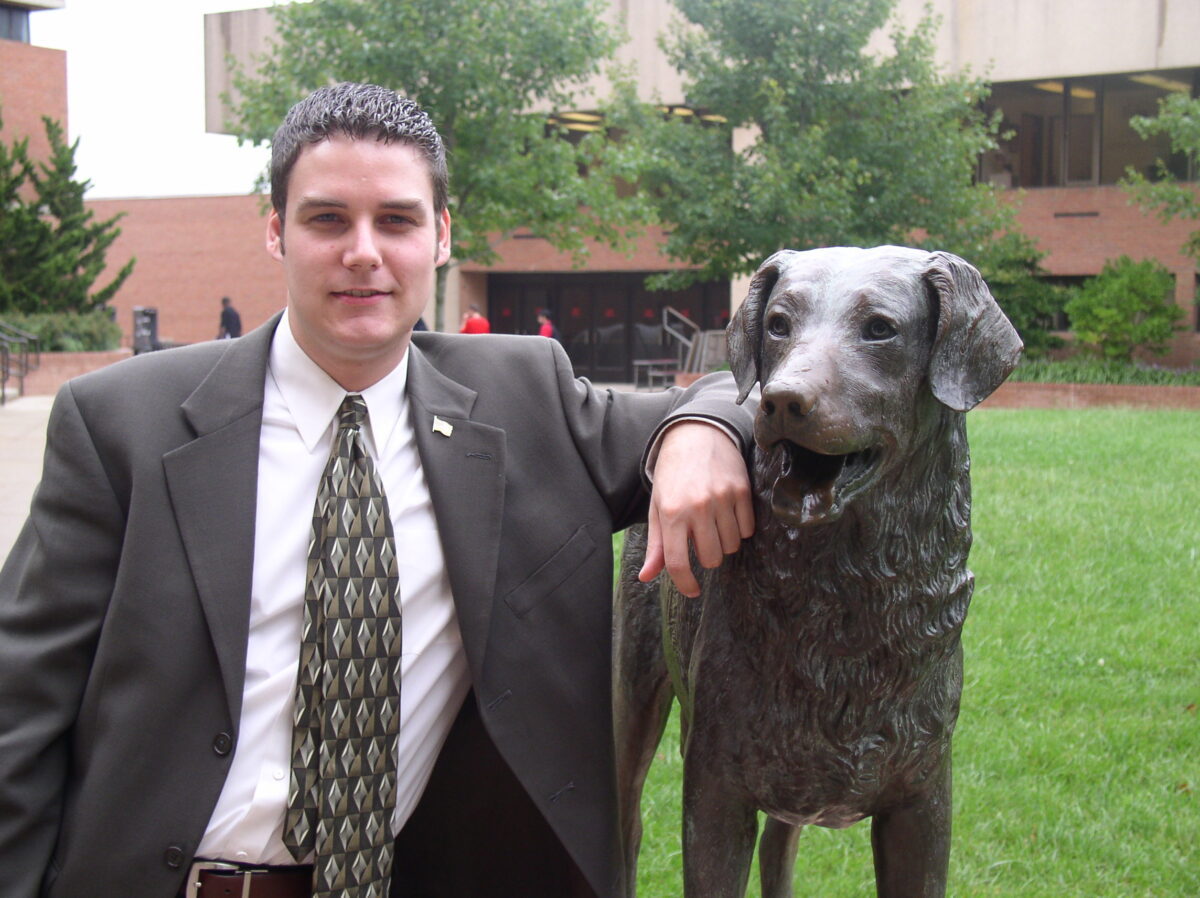
Shockley poses with True Grit in November 2003 after being name student regent. Photo courtesy of Shockley.
Q: What did you love most about your programs of study?
A: My academic programs were varied and each fulfilled me in very different ways. The information systems management program tapped into my love of technology while solidifying the importance of a plan and process—key traits that would serve me well in both my career and my life. The political science program nurtured my interest in politics and government. It showed me how government can truly be a force for good.
Shockley and fellow SGA officer Ada Orie in The Commons, 2003. Photo courtesy of Shockley.
Q: Were there any ways that UMBC particularly helped support you as a student?
A: I was incredibly fortunate that after enrolling at UMBC, I was offered the opportunity to compete against a small group of students for one of two full scholarships through a new gift to the school by the T. Rowe Price Foundation. I never imagined I’d get selected and with it came the opportunity for a summer internship. For a kid raised in rural Maryland on a farm, it was quite an experience. Growing up, I was most certainly not the popular kid. I had poofy hair, big glasses, and braces at a young age. Not to mention, I was laser-focused on my studies and was not blessed with any athletic ability. In high school, I ran each year for student government positions to no avail. UMBC was first place I truly felt like I was given the opportunity to try my leadership skills and mentored by others to grow and develop them.
This growth led to an introduction to John Erickson, founder of Erickson Retirement Communities (now Erickson Senior Living) by former UMBC President Dr. Freeman Hrabowski. Erickson was working on instituting information technology products throughout their healthcare business which was ahead of the time for the industry, and were looking for those majoring in these fields. I never though I’d work for a company whose focus was senior housing and healthcare, but John was charming and persuasive. Dr. Hrabowski spoke very highly of his commitment to UMBC through his many gifts to help build new residence halls on campus. This introduction turned into a career that gave me a deep sense of meaning knowing that I was able to help older adults continue to live a life of significance, as they aged, that was valued up until the very end. John was instrumental in providing support and guidance as I branched out within the company and relocated to several different locations around the country for new opportunities.
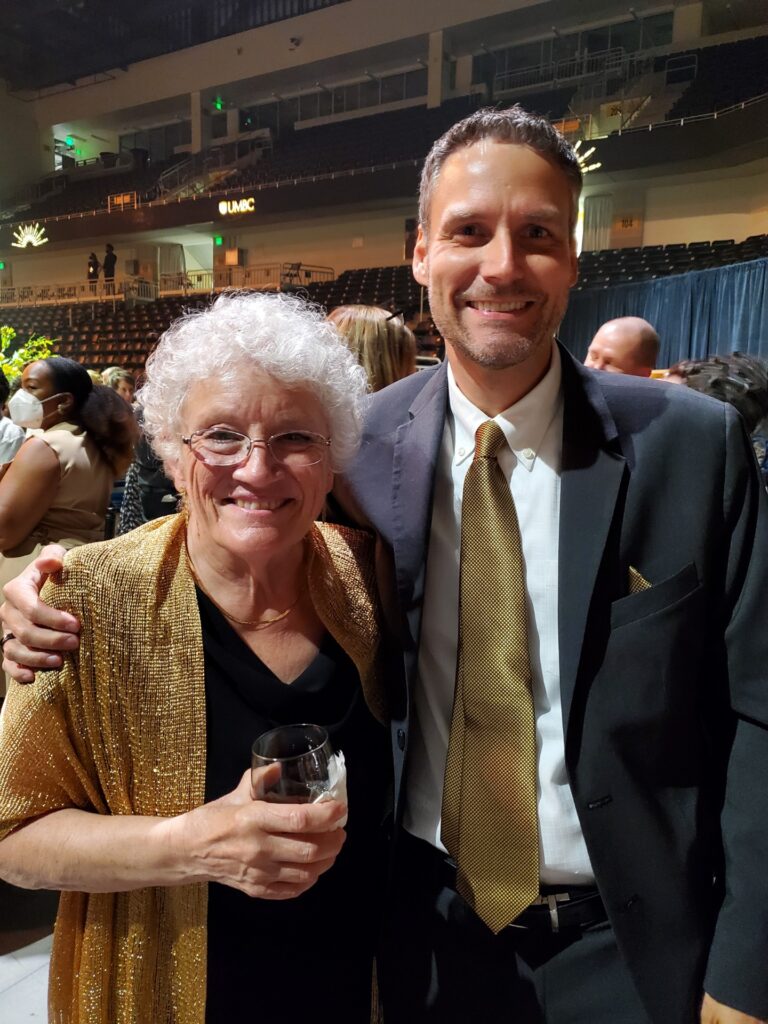
At left, Shockley with retired Vice Provost and Dean of Undergraduate Education Diane Lee. At right, Shockley with President Emeritus Freeman Hrabowski. Photos courtesy of Shockley.
Q: Why did you choose UMBC for your philanthropy?
A: My sister and I were the first to go to college and I wanted others to be able to have that experience, too. We were very fortunate in that the financial cost was not an obstacle to either of us being able to pursue our dreams. I never considered not going to college—that was just the plan from an early age and it was clear that’s what my family was going to make happen if it was what I wanted and I had the aptitude.
UMBC will always have a deeply special place in my heart. From the moment I first stepped onto campus, I remember the incredible feelings of being welcomed to UMBC. There was such excitement and energy and I wanted to be a part of it. As a freshman, I worked in the Office of Institutional Advancement (OIA) for some of the same folks that partner with me today in giving back. The varied experiences I had as a student worker in OIA opened my eyes to the importance of alumni engagement and giving. As my time at UMBC progressed, I found myself very involved in both on and off campus leadership activities that I could never have imaged. One of my proudest moments was being able to serve as the student regent on the University System of Maryland’s (USM) Board of Regents, a Gubernatorial appointment. Being able to make a difference on behalf of all the students that made up the USM was an honor. Through my gifts, I want to provide opportunities for students, particularly from the Lower Eastern Shore of Maryland, to be able to attend UMBC and explore the plethora of opportunities open to them.
I started and continue to support the Shockley Family Scholarship in honor of my parents, David and Sandra Shockley. I intend to start an additional scholarship for my maternal grandparents, Sam and Bertha Rothenstein, in the future.
Q: What’s one thing you’d want folks to know about UMBC?
A: Anyone and everyone is welcome. No matter your background or where you were raised, UMBC will support, nurture, and help you share your gifts with the community as a whole. It is this diversity of individuals, experiences, and talents that make the university such a remarkable place.
* * * * *
UMBC’s greatest strength is its people. When people meet Retrievers and hear about the passion they bring, the relationships they create, the ways they support each other, and the commitment they have to inclusive excellence, they truly get a sense of our community. That’s what “Meet a Retriever” is all about.
India is up. China is down. Very few U.S. students studied abroad during the first year of the pandemic.
Those three points, in a nutshell, represent key findings from recent data released jointly on Nov. 14, 2022, by the U.S. Department of State and the Institute of International Education.
This year’s report shows a 91% decline in the total number of U.S. students who studied abroad during the 2020-2021 academic year. The pandemic also led colleges to develop more online global learning opportunities. In fact, 62% of colleges offered virtual internships with multinational companies, collaborative online coursework with students abroad and other experiences.
While virtual learning cannot replace the immersive experiences of study abroad, it can expand access to other cultures and international perspectives for greater numbers of students. For this reason, technology is likely to continue to serve as a key part of international education programming.
Number of international students grows in the US
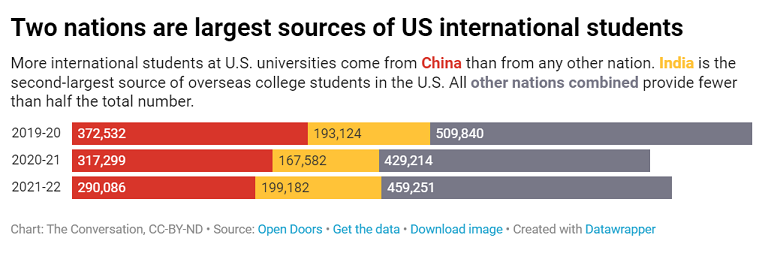
While the COVID-19 pandemic contributed to a 45.6% decline in new international students in 2020, the latest data, covering the 2021-2022 academic year, indicates that the total number of international students in the U.S. – 948,519 – has started to recover. This can be seen in a 3.8% increase over the 914,095 international students in the U.S. in 2020. Still, the number is well below the nearly 1.1 million international students reported in 2018. Much of the recent growth is driven by an increase in the number of new international students – 261,961 – which is up 80% over the 145,528 from 2020 but still 2.14% below the 267,712 from 2019.
Students from China and India comprise more than half – 52% – of all international students. That isn’t anything new, but what is noteworthy is that during the 2021-2022 academic year, Chinese student enrollment fell 9% and the number of Indian students increased by 19% over the prior year. This has big implications for international diversity at U.S. colleges. This is because Chinese students tend to enroll in a range of majors, while most Indian students – 66.4% – study in just a handful of programs: engineering, math and computer science.
Contributing factors include Chinese parents’ concerns for their children’s safety in the U.S., development of China’s own world-class universities and souring relations between the two countries, which has spilled over into the higher education sector. In fact, in 2019, China’s Ministry of Education warned students against studying in the U.S. due to the risk of encountering visa problems.
College and careers draw many out of India
China and India each have around 1.4 billion people, but by 2023 the United Nations predicts that India will overtake China as the world’s most populous country. This continued growth will further strain India’s higher education system, leading to more students pursuing advanced degrees abroad. At the same time, poor job prospects at home are driving many Indian students to pursue academic and career pathways that lead away from India. This is especially true in high-paying, high-growth fields like computers and information technology.
Other contributing factors to the increase from India include a change in tone on the part of the U.S. government. The Biden administration is working to reestablish the U.S. as a welcoming destination for international students by enacting reversals of Trump-era immigration policies. Those policies caused uncertainty and fear among international students. The Biden administration has also prioritized the processing of student visas in India.
Looking forward
The Institute of International Education also released data from a Fall 2022 Snapshot Survey, which includes responses from more than 600 U.S. colleges and universities. The findings point to a 7% increase in new international students enrolled.
While the U.S. Department of State continues to prioritize student visas in India by adding more staff and streamlining the process, Chinese visa approvals are trending lower than in years past, although it’s difficult to pinpoint a single factor as to why. A further decline in Chinese students presents major challenges for the U.S., its colleges and the communities in which they are based. This is because in addition to the US$32 billion that international students collectively contribute to the U.S. economy, the friendships and cultural insights that they develop while studying at local colleges serve to promote U.S. foreign policy in the form of positive relations between the U.S. and other countries.
Richard Forno, principal lecturer in Computer science and Electrical Engineering, UMBC
A warning about the threat of political violence heading into the 2022 midterm elections was issued to state and local law enforcement officials by the U.S. Department of Homeland Security on Oct. 28, 2022.
The bulletin was released the same day that Speaker of the House of Representatives Nancy Pelosi’s husband was hospitalized after a home invasion by a lone right-wing extremist seeking to harm her.
This incident is the latest in an increasing stream of extremist confrontations taking place across the United States in recent years. These incidents have primarily targeted Democrats, including a plot to kidnap Michigan Gov. Gretchen Whitmer in 2020. But threats from both sides of the political spectrum are up significantly.
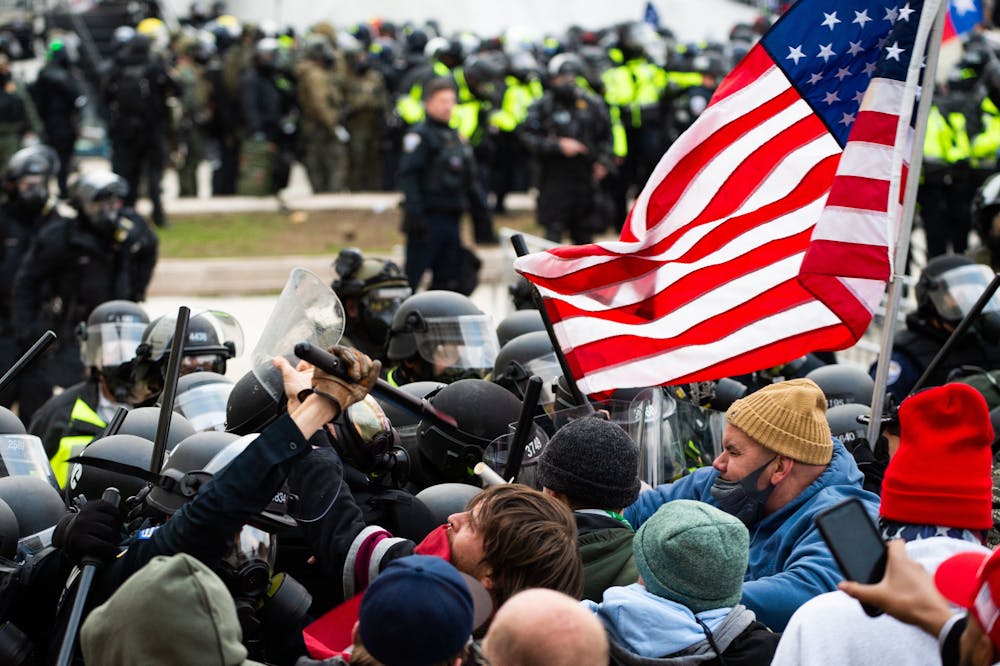
And, of course, there was the Jan. 6, 2021, insurrection at the U.S. Capitol, where supporters of a defeated Republican president, acting on a widespread lie he perpetuated, violently attempted to prevent the certification of electoral votes. According to well-documented public evidence, some rioters planned to find and execute both Speaker Pelosi and Vice President Mike Pence.
Such incidents reflect a disturbing trend that targets the very fabric, foundation and future of U.S. democracy. But what led to this point?
As a researcher taking a critical and apolitical eye toward security issues, I believe the rise in contemporary right-wing political extremism – and violence – began with an outdated focus in national communications policy.
Police take measurements around House Speaker Nancy Pelosi’s San Francisco home after her husband, Paul Pelosi, was assaulted inside the home on Oct. 28, 2022. Tayfun Coskun/Anadolu Agency via Getty Images
Media-induced slow burn
Until the late 1980s, the Federal Communications Commission’s Fairness Doctrine required traditional licensed broadcasters to offer competing viewpoints on controversial public issues. But these rules did not apply to cable or satellite providers. As a result, the rise of cable news channels in the 1990s led to highly partisan programming that helped divide American society in the ensuing decades.
This programming fueled increasing polarization in the public and political arenas. Bipartisanship was abandoned in the 1990s, when the Republican Congress under Speaker Newt Gingrich embraced a “scorched-earth” policy of governing. That meant treating the minority party not as the loyal opposition and respected elected colleagues who had differences over policy, but as enemies.
Internet platforms such as Twitter, Facebook, and 4Chan allowed anyone, anywhere, to create, produce and distribute political commentary and extremist rhetoric that could be amplified by other users and drive the day’s news cycle.
Political pundits and influencers across the spectrum became less concerned about correctly informing the public. Instead, they stoked outrage in the search for money-generating clicks and advertising dollars. And political parties exploited this outrage to satisfy and energize their voting base or funders.
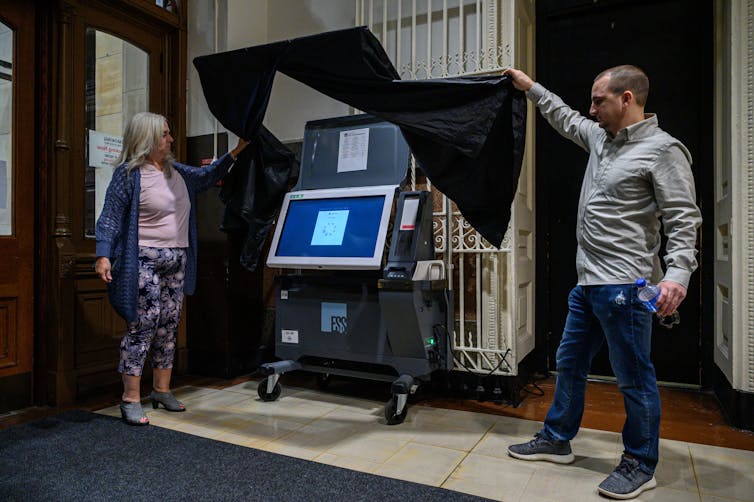
Philadelphia city commissioners display a voting machine in Philadelphia City Hall on Oct. 24, 2022. Ed Jones/AFP via Getty Images
Moderation or censorship?
To combat online extremism, social media companies reluctantly began moderating user posts and sometimes banned prominent users who violated their community standards or terms of service.
In response to what it dubbed “censorship” from Big Tech, the right-wing splintered into numerous niche platforms catering to their conspiracy theories and extremist or violent views such as Truth Social – run by former President Trump – Gab, Parler, Rumble and others.
Compared with Democrats, Republicans have mastered this form of gutter politics. One example: Right-wing political figures have mocked Paul Pelosi for being attacked, spread baseless conspiracy theories about his personal life and used the incident for applause lines at campaign rallies.
Accordingly, today’s voters and politicians end up confronting one another in the public sphere not on matters and substance affecting the future of the country, but on fundamental facts and conspiracy theories, or to address distractions often generated by their respective media ecosystems. This is only exacerbated by a prolonged nationwide decline in media literacy and civics education.
Against this backdrop, federal law enforcement has become more vocal in warning about the dangers of domestic political extremism, including a bulletin issued in February 2022. The Oct. 28 DHS bulletin further underscores this concern.
But it’s hard for law enforcement to effectively address political extremism, because speech protected under the First Amendment is a major consideration. Phrases like “I’m fighting for you!” or “Saving our country!” might seem like typical political bluster to one person. But they could be seen by others as an implied call for intimidation or violent action against political opponents, election officials, volunteer poll workers and even ordinary voters.
How does speech turn into violent action? Security specialists and scholars use the term “stochastic terrorism” to capture how a single, hard-to-locate person might be inspired or influenced toward violence by broader extremist rhetoric, as appears to have been the case with the man who allegedly tried to kill Paul Pelosi with a hammer.
Law enforcement’s problem is made worse by right-wing lawmakers who normalize or actively praise the actions of violent extremists, calling them “patriots” and demanding their prison sentences be overturned or pardoned. This helps obscure the actual reasons for such incidents, often by deflecting them into broader conspiracy theories involving their opponents.
Certainly there are controversial left-leaning politicians, pundits, activists and talking points too.
But few – if any – openly disregard the fabric of American government, scheme to overturn democratic elections by force or plot to assassinate politicians.
By contrast, there are over 300 Republican election deniers running for office this year, including many incumbents – the vast majority of whom endorse political violence such as the Jan. 6 attack either by their actions or their silence.
Hope for the best; prepare for the worst
Tensions are high heading into the 2022 midterms. Politicians are making final arguments, and the online messaging machines are spreading campaign information, fundraising requests – and plenty of disinformation as well.
Americans expect a peaceful transfer of political power after elections, but recent history shows we must prepare for the worst. It’s clear that the modern Republican Party is openly and successfully embracing and exploiting misinformation, outrage and attacks on democracy and the rule of law.
Until Republicans actively disavow their extremist rhetoric and the misinformation contributing to it, I believe the likelihood for political violence in America increases with each passing day.
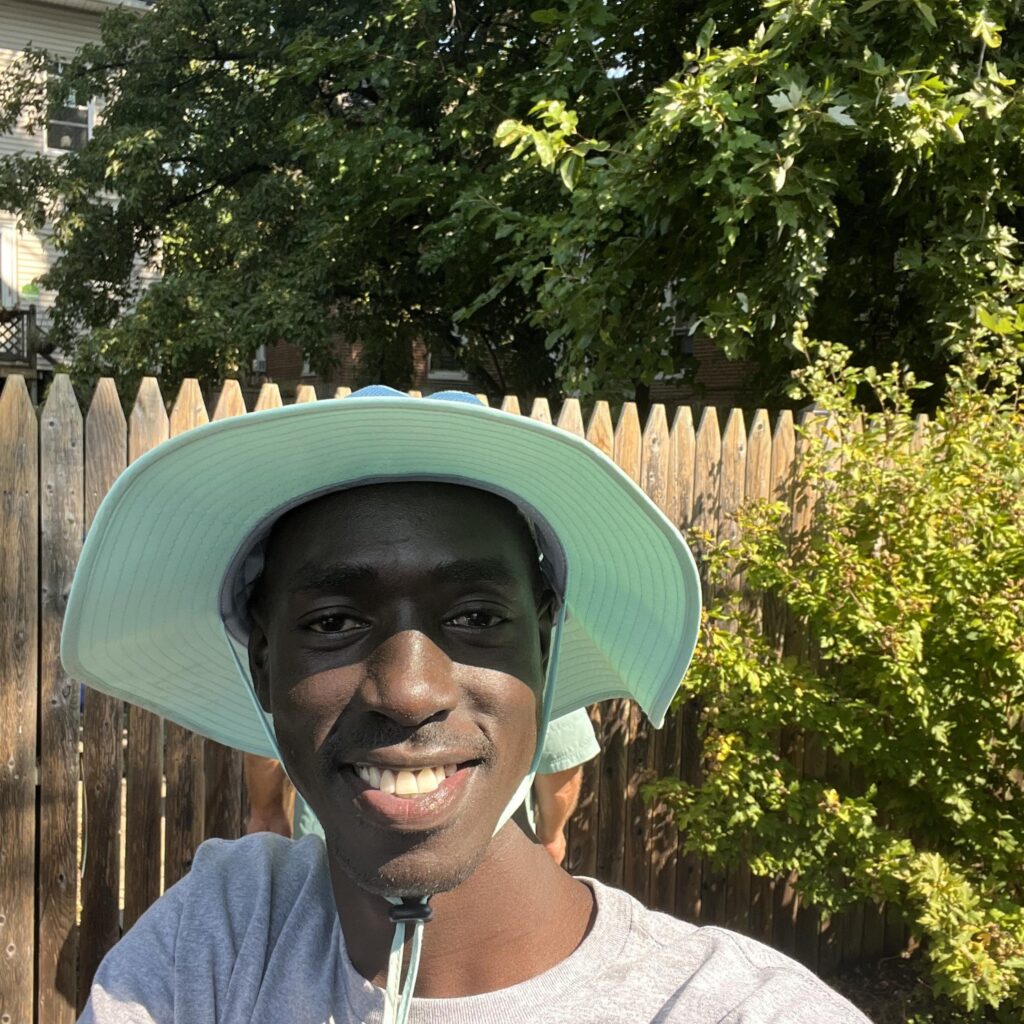
Meet Janerra Allen, M.S. ’22, electrical engineering, who is pursuing a Ph.D. in the same subject to kick off a career in brain imaging research. A first-generation college student from Brooklyn, she is also a student leader, and a Meyerhoff Graduate Fellow. We know you’ll be impressed…take it away, Janerra!
Q: Tell us about yourself. What’s one thing you want folks to know about you?
A: Despite being ambitious and setting clear goals, my journey to the Ph.D. has not been easy. As a first-generation Black female college student from Brooklyn, NY, I immediately experienced imposter syndrome as a materials science and engineering undergrad at the University of Wisconsin-Madison. Though there were times I counted myself out, I am proud to say that I am doing a better job at counting myself in.
Q: What brought you to UMBC in particular?
A: I came to UMBC because I’ve heard great things about its leadership and research and wanted to be a part of the close-knit and well-connected community. I was also aware of some of the UMBC partnerships within the Greater Baltimore and surrounding areas and thought it was the perfect place to not only attend graduate school but kick-start my professional career in brain imaging research.
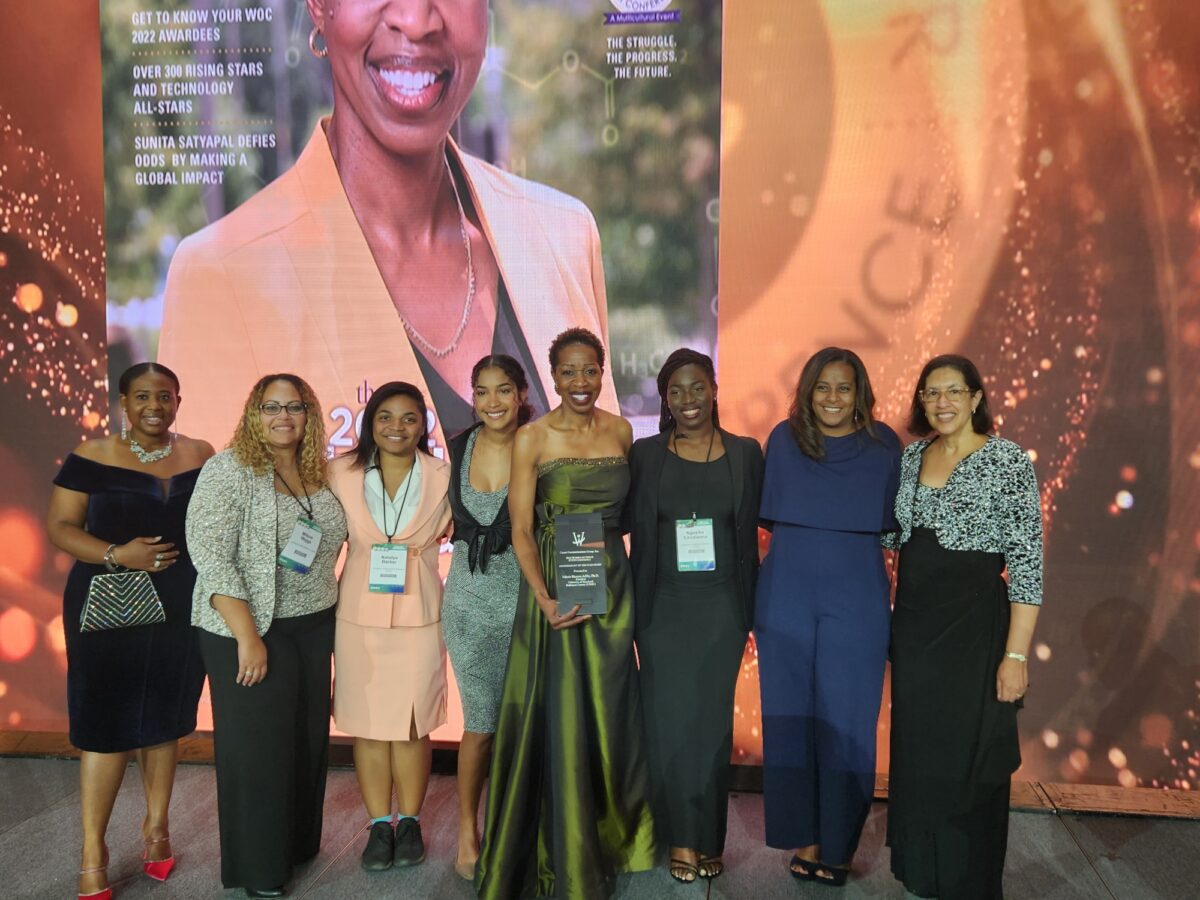
Allen (far left) celebrates with UMBC colleagues as President Valerie Sheares Ashby accepts her recent 2022 Technologist of the Year award at the Women of Color STEM DTX Conference. Image courtesy of Allen.
Q: What’s the one thing you’d want someone who hasn’t joined the UMBC community to know about the support you find here?
A: UMBC is an institution that fosters community and diversity, and students can find support anywhere. When I first arrived, I reached out to several programs, such as NSBE (National Society of Black Engineers), McNair Scholars, and LSAMP due to my undergraduate involvement. Now that I am further in my graduate career, programs such as the Meyerhoff Graduate Fellows, PROMISE, GSA (Graduate Student Association), and BGSO (Black Graduate Student Organization) have been equally supportive.
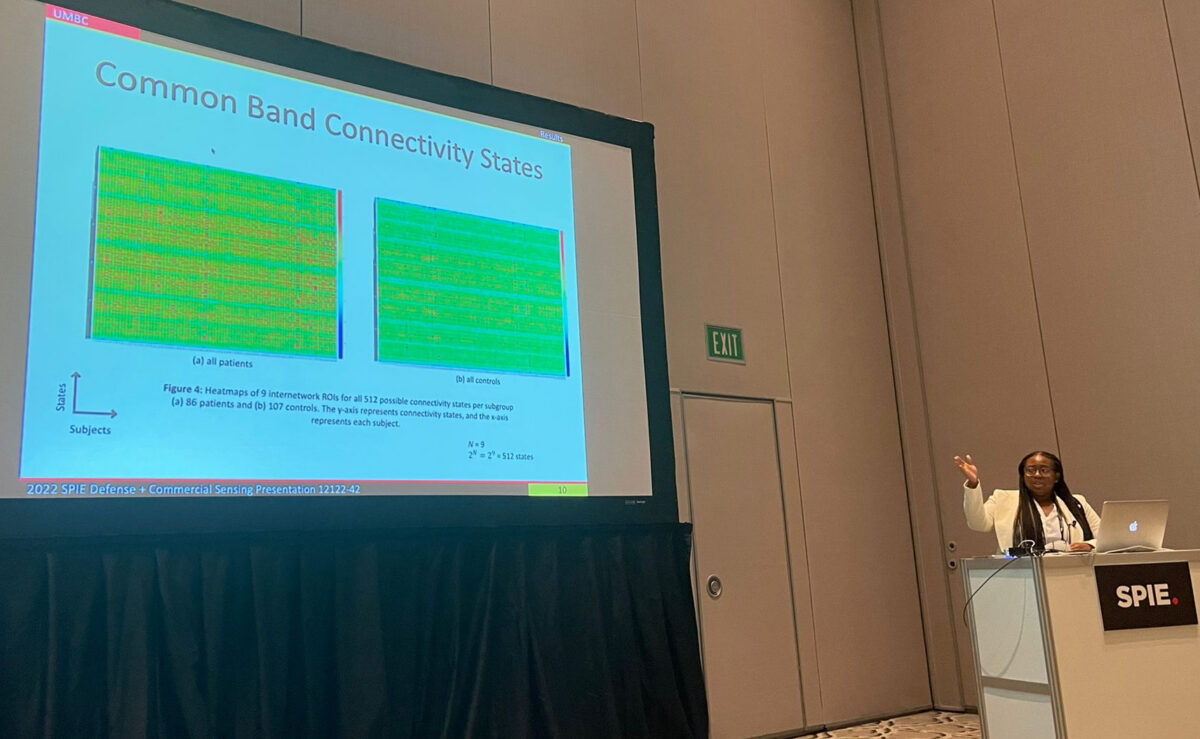
Allen presents her research on electrical engineering at the SPIE conference in Orlando, FL in April 2022. Photo courtesy of Janerra Allen.
Q: Tell us about someone in the community who has inspired you or supported you, and how they did it.
A: My Ph.D. advisor is Dr. Fow-Sen Choa. I joined his lab in the summer of 2020, which was also the summer after my first year. This was a difficult time because we were experiencing a pandemic and the aftermath of George Floyd. I was still learning about my research area and struggling to connect with campus since migrating to virtual spaces. I remember this transition feeling very gradual and am glad to have joined his lab.
Q: What do you love about your academic program?
A: My program is unique because it is only offered as a graduate program. Coming in, I knew that the class sizes would be small and individualized, but I had no idea that some of my peers would be part-time students working full-time. I think this brings a wonderful perspective to the courses, especially because they share their experiences and discuss the application of the work we are learning.
“
I came to UMBC because I’ve heard great things about its leadership and research and wanted to be a part of the close-knit and well-connected community.
Janerra Allen
Ph.D. student in electrical engineering
Q: Since you’ve been a part of the UMBC community, how have you found support from folks you’ve met?
A: There are a lot of people at UMBC committed to seeing me thrive academically and professionally. In addition to my advisor Dr. Choa who has pushed me to be a more independent researcher, I have found support from the Meyerhoff Graduate Fellowship program, namely Ms. Justine Johnson. Ms. Justine has been pivotal in helping me settle into UMBC. I also want to commend the efforts of Dr. Anupam Joshi, Dr. Robin Cresiski, Yarazeth Medina, Sunji Jangha, and Dean Janet Rutledge who have also aided me in my journey.
Q: Are you a student leader? Tell us about it!
A: Yes. I am the President of the Black Graduate Student Organization (BGSO), GSA Senator for the College of Engineering and Information Technology (COEIT), and I serve on the tenure track search committee for the Department of Computer Science and Electrical Engineering.
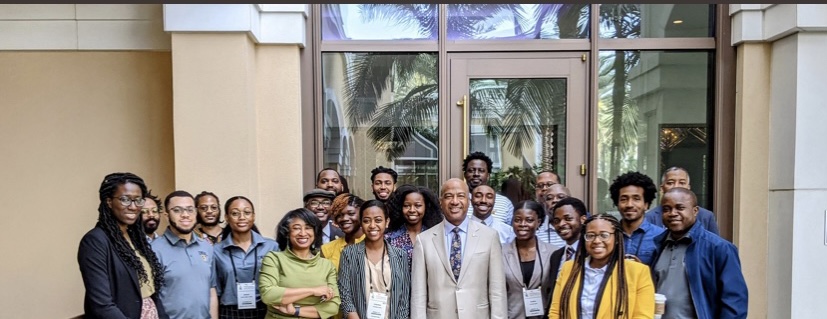
Allen (front right, in yellow) helping to recruit prospective graduate students at the National Society of Black Engineers (NSBE) conference in Anaheim, CA. Image courtesy of Allen.
Q: What would you tell others who are in your shoes about UMBC?
A: Being a first-generation Black female college student and first in my family to pursue a Ph.D. continues to be a challenge. But I refuse to let this hinder me or get in the way of dreams. I encourage any student in my shoes, or in a different pair, to use these qualities to empower you on your journey to success.
* * * * *
UMBC’s greatest strength is its people. When people meet Retrievers and hear about the passion they bring, the relationships they create, the ways they support each other, and the commitment they have to inclusive excellence, they truly get a sense of our community. That’s what “Meet a Retriever” is all about.
Meet Jok Abraham Thon, UMBC’s first Peaceworker Global Fellow and the first Retriever from South Sudan. Thon is pursuing his master’s in entrepreneurship, innovation, and leadership and plans to use these skills to continue to promote educational opportunities for other South Sudanese people.
Q: Tell us about yourself. What are the essential things you’d want another Retriever to know about you?
A: I am the father of four beautiful kids from the world’s youngest country, South Sudan. I left behind my young family in search of knowledge and skills so that when I return, I can play a part in transforming the lives of vulnerable children in my country.
When I was a refugee, it was not easy. We had our classes under trees; we didn’t have toys to play with, but I turned my bitter memories into positive energy to change the cycle of violence in my country by establishing Promised Land Primary and Secondary School with the motto of “Changing Minds from Bullets to Books.”
Let’s be great libraries for our children where they can find great stories of peace, love, and humanity. This message is for the parents and students who are our future leaders and policy makers. This principle will help them change policies that discriminate and instead create policies that embrace inclusion and equality.
Jok Thon, UMBC’s first Peaceworker Global Fellow. Courtesy of Thon.
Q: Tell us about your primary WHY, and how it led you to UMBC.
A: I need to use the leadership and entrepreneurial skills I will get from UMBC to help transform South Sudan into a peaceful and democratic country.
Q: What do you love about your academic program?
A: My first course was Introduction to Community Leadership and my biggest takeaway was what I called a ‘”spiderweb” from placemaking—how public parks are great places to build more inclusive and peaceful communities; they’re great places for communities to come together for entertainment and family outings; they’re great places for communities to build back trust and take away fear and misinformation. In South Sudan there are some cultures that negatively affect women and girls—I want to see how we can use this placemaking idea to create parks that will bring all people together.
In my Developing the Entrepreneurial Mindset class, I am learning skills that will help me to establish a company to sustain my school and help in establishing more schools in the hard to reach villages in South Sudan. We want to provide education to the vulnerable 2.5 million children who are not in school in South Sudan and break the cycle that prohibits many girls from finishing their schooling—about 75 percent of girls don’t finish high school due to early forced marriage and poverty.
“
Let’s be great libraries for our children where they can find great stories of peace, love, and humanity.
Jok Thon
From my classes so far, I came up with two projects—one is Jonglei Multipurpose Memorial Park. It will not only be a park but also provide a great solution to the flooded villages along the River Nile as a way we can beautifully live with water as we fight climate change.
Second, is the Central Nile Paper Company that will produce paper sustainably from local sources of bamboo and papyrus for school workbooks and use the revenue from sales to support the Promised Land School while opening more schools across the country.
Q: Tell us about someone in the community who has inspired you or supported you, and how they did it.
A: My journey to UMBC came as an inspiration from the love I received from Joby Taylor (Ph.D. ’05, language, literacy, and culture) in the Shriver Center, Kenneth Baron in Academic Advising, David Di Maria in the Center for Global Engagement, Gib Mason (’95, economics) in the entrepreneurship, innovation, and leadership program, and Kimberly R. Moffitt, dean of the College of Arts, Humanities, and Social Sciences. This team and many more great faculty as well as staff from International Student and Scholar Services have changed my life.
I want to particularly thank Dr. Joby Taylor and his wife and children for being such a great host family. I am glad to call UMBC my sweet home far away from home.
* * * * *
UMBC’s greatest strength is its people. When people meet Retrievers and hear about the passion they bring, the relationships they create, the ways they support each other, and the commitment they have to inclusive excellence, they truly get a sense of our community. That’s what “Meet a Retriever” is all about.
Meet Evangeline Kirigua ’21, political science, who transferred from Montgomery College and is now working as an intake officer with the Maryland Department of Transportation. Evangeline, who returned to school in her 50s, recently created a scholarship in honor of her parents to give assistance to students studying political science at UMBC at The Universities at Shady Grove. Thanks for sharing your story, Evangeline!
Q: What’s one essential thing you’d want another Retriever to know about you?
A: Procrastination is a dream killer. Don’t do tomorrow what you can do today. As long as there is a minute in your day, use it. Tomorrow is not promised.
Q: What brought you to UMBC at The Universities at Shady Grove and what you love about the political science department, in particular?
A: I came to UMBC because when I was taking a class in International Studies at Montgomery College, the professor spoke highly about UMBC’s Political Science program. Political Science just speaks my language. I am passionate about civic engagement. I do not get it when people tell me that they do not vote: at the same time complaining about things in their community that are going wrong or not done. This led me to start a forum called Diaspora Initiative for Civic Engagement, to encourage voter registration.
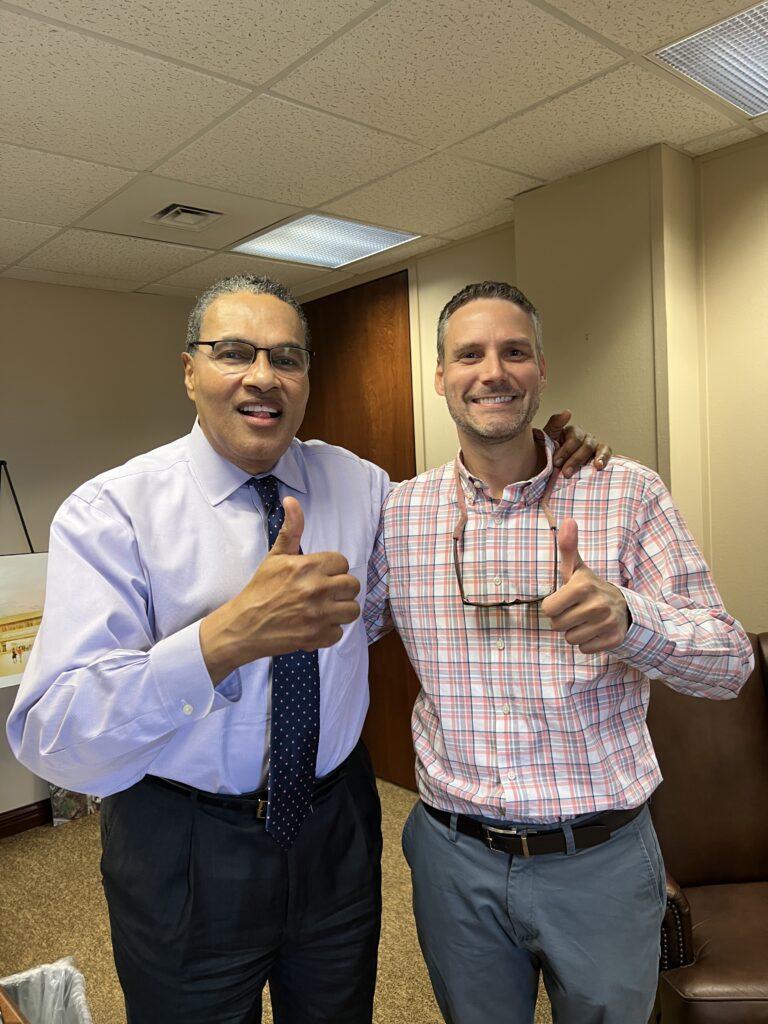
At left: With UMBC President Emeritus Hrabowski and USG Executive Director Emeritus Stewart Edelstein at the 2019 Regents Dinner. Photo courtesy of Kirigua.
Q: Tell us about someone in the community who has inspired you or supported you, and how they did it.
A: My forever guardian angel is Dr. Brigid Starkey, Head of Global Studies. I thoroughly enjoyed her class, American Foreign Policy. Dr. Starkey believed in me and encouraged me to do an independent study. Her support unleashed in me a tenacity that I never knew I had.
At right, Kirigua (center) poses with classmates Ketsia Muteba (left) and Tatiana Mendez after they complete a class project. Photo courtesy of Kirigua.
Q: We understand you’re a donor. What do you support and why?
A: I have founded a scholarship in honor of my parents: the Ernest & Adelina Kirigua Scholarship. It is to benefit minority students pursuing Political Science at UMBC/USG.
Evangeline Kirigua (@UMBC Political Science at USG '21) signing the agreement for the new Ernest & Adelina Kirigua Scholarship. Evangeline returned to school in her 50s and established the scholarship to help students like her succeed at USG. Learn more: https://t.co/S0EF5avVbApic.twitter.com/ZOLTp9hb1c
Q: What’s the one thing you’d want someone who hasn’t joined the UMBC community to know about the support you find here?
A: The Retriever spirit is real. I chose UMBC over other schools that had promised me almost 100 percent free tuition. I have never doubted my decision. Bring your dream: UMBC will help you build it, or help you dream.
Over the course of six decades, Bob Dylan steadily brought together popular music and poetic excellence. Yet the guardians of literary culture have only rarely accepted Dylan’s legitimacy.
I am a professor of early modern literature, with a special interest in the Renaissance. But I am also a longtime Dylan enthusiast and the co-editor of the open-access Dylan Review, the only scholarly journal on Bob Dylan.
After teaching and writing about early modern poetry for 30 years, I couldn’t help but recognize a similarity between the way Dylan composes his songs and the ancient practice known as “imitatio.”
Poetic honey-making
Although the Latin word imitatio would translate to “imitation” in English, it doesn’t mean simply producing a mirror image of something. The term instead describes a practice or a methodology of composing poetry.
The classical author Seneca used bees as a metaphor for writing poetry using imitatio. Just as a bee samples and digests the nectar from a whole field of flowers to produce a new kind of honey – which is part flower and part bee – a poet produces a poem by sampling and digesting the best authors of the past.
Dylan’s imitations follow this pattern: His best work is always part flower, part Dylan.
Consider a song like “A Hard Rain’s A-Gonna Fall.” To write it, Dylan repurposed the familiar Old English ballad “Lord Randal,” retaining the call-and-response framework. In the original, a worried mother asks, “O where ha’ you been, Lord Randal, my son? / And where ha’ you been, my handsome young man?” and her son tells of being poisoned by his true love.
In Dylan’s version, the nominal son responds to the same questions with a brilliant mixture of public and private experiences, conjuring violent images such as a newborn baby surrounded by wolves, black branches dripping blood, the broken tongues of a thousand talkers and pellets poisoning the water. At the end, a young girl hands the speaker – a son in name only – a rainbow, and he promises to know his song well before he’ll stand on the mountain to sing it.
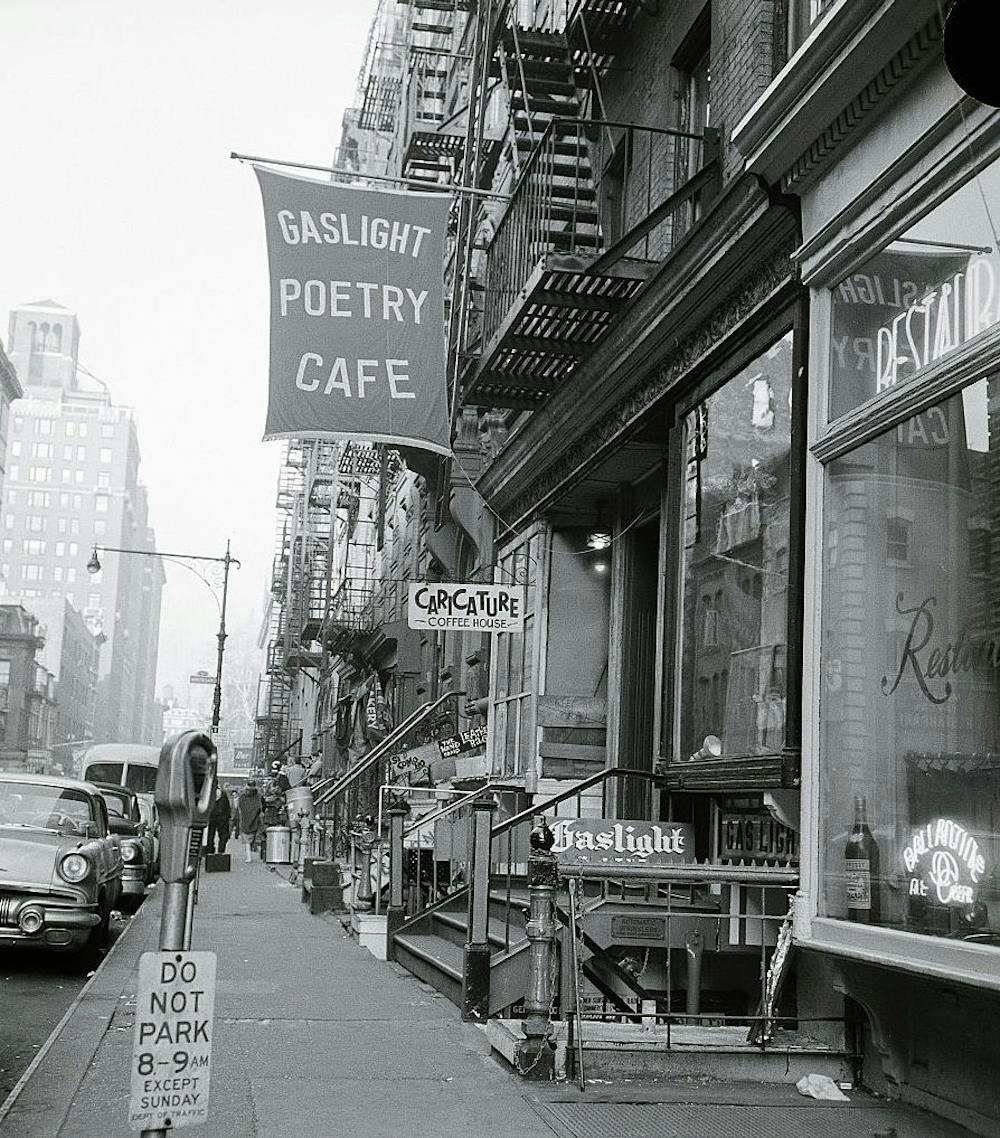
“A Hard Rain’s A-Gonna Fall” resounds with the original Old English ballad, which would have been very familiar to Dylan’s original audiences of Greenwich Village folk singers. He first sang the song in 1962 at the Gaslight Cafe on MacDougal Street, a hangout of folk revival stalwarts. To their ears, Dylan’s indictment of American culture – its racism, militarism and reckless destruction of the environment – would have echoed that poisoning in the earlier poem and added force to the repurposed lyrics.
This charge underestimates Dylan’s complex creative process, which closely resembles that of early modern poets who had a different concept of originality – a concept Dylan intuitively understands. For Renaissance authors, “originality” meant not creating something out of nothing, but going back to what had come before. They literally returned to the “origin.” Writers first searched outside themselves to find models to imitate, and then they transformed what they imitated – that is, what they found, sampled and digested – into something new. Achieving originality depended on the successful imitation and repurposing of an admired author from a much earlier era. They did not imitate each other, or contemporary authors from a different national tradition. Instead, they found their models among authors and works from earlier centuries.
In his book “The Light in Troy,” literary scholar Thomas Greene points to a 1513 letter written by poet Pietro Bembo to Giovanfrancesco Pico della Mirandola.
“Imitation,” Bembo writes, “since it is wholly concerned with a model, must be drawn from the model … the activity of imitating is nothing other than translating the likeness of some other’s style into one’s own writings.” The act of translation was largely stylistic and involved a transformation of the model.
Romantics devise a new definition of originality
However, the Romantics of the late 18th century wished to change, and supersede, that understanding of poetic originality. For them, and the writers who came after them, creative originality meant going inside oneself to find a connection to nature.
As scholar of Romantic literature M.H. Abrams explains in his renowned study “Natural Supernaturalism,” “the poet will proclaim how exquisitely an individual mind … is fitted to the external world, and the external world to the mind, and how the two in union are able to beget a new world.”
Instead of the world wrought by imitating the ancients, the new Romantic theories envisioned the union of nature and the mind as the ideal creative process. Abrams quotes the 18th-century German Romantic Novalis: “The higher philosophy is concerned with the marriage of Nature and Mind.”
The Romantics believed that through this connection of nature and mind, poets would discover something new and produce an original creation. To borrow from past “original” models, rather than producing a supposedly new work or “new world,” could seem like theft, despite the fact, obvious to anyone paging through an anthology, that poets have always responded to one another and to earlier works.
Dylan performed at New York City’s Gaslight Cafe, a popular folk music venue. Bettmann/Getty Images
Unfortunately – as Dylan’s critics too often demonstrate – this bias favoring supposedly “natural” originality over imitation continues to color views of the creative process today.
For six decades now, Dylan has turned that Romantic idea of originality on its head. With his own idiosyncratic method of composing songs and his creative reinvention of the Renaissance practice of imitatio, he has written and performed – yes, imitation functions in performance too – over 600 songs, many of which are the most significant and most significantly original songs of his time.
To me, there is a firm historical and theoretical rationale for what these audiences have long known – and the Nobel Prize committee made official in 2016 – that Bob Dylan is both a modern voice entirely unique and, at the same time, the product of ancient, time-honored ways of practicing and thinking about creativity.
Jessica Berman, Director of the Dresher Center for the Humanities, Professor of English; Gender Women’s & Sexuality Studies; and Language, Literacy and Culture, UMBC.
As the BBC turns 100 we should celebrate its extraordinary history as a public service broadcaster bringing news and other programming to audiences around the globe. In 2020-2021 the BBC announced that its World Service achieved its highest-ever audience, with an average of close to 500 million listeners globally each week. The BBC brings news to audiences in more than 40 languages, with newer additions like Igbo, Pidgin, and Yoruba growing in strength each year.
Older people among us still remember tuning into the BBC World Service radio as a prime source for allied news during the second world war. Its long history of offering reliable information to those in conflict zones or under censorship continues, as shown by its strengthening of programming in Russian and Arabic in recent years. Since its founding in 1932, the BBC’s international output has been crucial to those seeking fair, honest and comprehensive news and cultural broadcasts around the world.
At the same time, as scholar Simon Potter notes, the BBC’s World Service has always been a vehicle for British soft power. In 1932, when the BBC first embarked on its Empire service, founding director John Reith called it:
A unique opportunity to foster bonds of understanding and friendship between the peoples of Britain’s scattered dominions and the mother country, and to bring to Britons overseas the benefits already enjoyed by the British public at home.
Reith had advocated for such a service since the beginning of the BBC, making clear the political and social dimension of its founding mission. Although the BBC is a public-service corporation separate from the British government and has seen its fair share of conflicts with those in power, its mission has been and continues to be informed by British values and interconnected to Britain’s future.
Empire Radio
The rise of Empire Radio in the 1930s and 1940s shows how the BBC navigated the conflicting roles of bringing the benefits of broadcasting to listeners in the British colonies while forging stronger bonds across the empire. Given a mission to educate, inform and entertain, the Empire Service (later World Service) developed programs to reach those in the colonies and dominions and allow them to access British civilisation and its values. As Potter puts it, “the BBC voluntarily participated in the overseas projection of Britishness as part of its public-service remit”.
For example, the Eastern Service gathered many celebrated writers into its ranks, with George Orwell directing the India Section from 1941 to 1943. A photograph shows Orwell with famous writers T.S. Eliot and William Empson and emerging figures from across the empire, including Indian writer Mulk Raj Anand and Jamaican writer Una Marson at work on a literary magazine called “The Voice” for broadcast to India. Peter Kalliney argues that these gatherings at the BBC were crucial for building networks of colonial and metropolitan writers. Orwell certainly hoped that programs like “Through Eastern Eyes” or “We Speak to India” would bring east and west together.
And yet, the programming was often naïve and Anglocentric. For instance, The Voice highlighted T.S. Eliot reading his difficult poem Little Giddings which demanded advanced literacy in English, not attained by many Indians at the time. Many programs relied on listeners to be interested in life in London and the progress of the second world war from the British perspective.
By contrast, my research has shown that All India Radio (AIR), India’s developing public broadcasting network modelled on the BBC, offered a wider range of programming focused on Indian listeners, their concerns and their regional languages and cultures. AIR devoted airtime to Indian music and developed cadres of performers to produce radio plays in Indian languages.
The program listings of The Indian Listener, AIR’s official magazine, in the early 1940s show excerpts from the Mahabharata, Indian classical music, a Hindustani lecture on religion in public life, a feature on the changing role of women and programmes for villagers in Tamil, Telugu, or Bengali. There was news analysis in multiple languages. In other words, AIR was more varied, more in-tune with local languages and interests and resisted the primacy of the BBC’s civilising mission.
Caribbean Voices
BBC radio programming for the Caribbean was never as extensive as it was for India nor did a regional broadcaster emerge in the colonial West Indies. But during the 1940s and 1950s it broadcast the celebrated weekly Caribbean Voices programme, which was founded in 1943 by poet, journalist and editor, Una Marson.
This helped to develop the careers of many of the best writers from the region, including Sam Selvon and Dereck Walcott. Caribbean Voices would champion local writing and language, spoken on air by those from the islands, in a way no other entity had done before.
But, as in India, the BBC’s Caribbean programming was also meant to extend the British connection throughout the region, especially during wartime. It arose from Marson’s “morale-boosting” earlier program West Indies Calling for people from the islands serving the war effort and continued to be part of a constellation of broadcasts for the region meant to knit the islands to each other and to Britain.
While these programmes sometimes acknowledged differences across the islands, they also reflect the British government’s interest in treating the West Indies as a single region in response to unrest as well as the threat of growing US power in the Caribbean. The BBC’s regional approach and its limitations can help us see both the promise and failures of the West Indian Federation, the short-lived political union between various islands in the Caribbean between 1958 and 1962.
These examples point to the complex relationship between the BBC’s Empire Service and British political interests which have implications for today. Never a direct vehicle for government power, the broadcaster nevertheless has participated in advancing “Britishness” around the globe.
As we mark the BBC’s centenary and celebrate the continuing achievements of the World Service, we should remember how British soft power has often guided its history and insist that it is able to operate independently now and into the future.
Meet Sharon Johnson, a dedicated member of the Meyerhoff Scholars Program staff for more than 17 years. Now retired, Sharon has chosen to continue to support UMBC with a planned gift that will focus on the program and students she loves so dearly. Thanks for sharing your story, Sharon…take it away!
Q: What brought you to UMBC in the first place?
A: I was hired as the business manager for the Meyerhoff Scholars Program after previously working at NASA. Many of my colleagues at NASA thought this would be a good fit for me and my skillset, and encouraged me to apply. I was very interested in diversity and the STEM pipeline and wanted to work with gifted and talented students.
Q: What was it like working with the Meyerhoff Program for so long?
A: I loved working with the Meyerhoff students, alumni, parents, faculty, staff, and UMBC colleagues and administrators. Meyerhoff staff members were committed and dedicated as we carried out our duties, and guided and inspired scholars. We worked closely together and I enjoyed our camaraderie. It was wonderful to see the scholars grow and achieve their aspirations. The relationships continued after graduation from UMBC. I was a part of something truly special that was changing the world!I made many friends with whom I am still in contact.
A moment from the Meyerhoff Scholars Program’s 30th anniversary celebration in 2019. Photo by Jim Burger.
Q: Tell us about someone who really made a difference in your life while you were at UMBC.
A: I’d like to mention two people. [President Emeritus] Dr. [Freeman] Hrabowski supported me and the Meyerhoff Scholars program. He co-founded an awesome program that has been replicated across the country, and he inspired me and other donors to financially support UMBC.
And LaMont Toliver, former Program Director and my supervisor, was dedicated to the program. His belief in the model, program, and students inspired me. Working for the program was a life-changing opportunity.
“
I thought back to my undergraduate years and I felt compelled to help provide funding to scholars experiencing financial hardships and to impact future generations of Meyerhoff scholars. My hope is that I will be able to help future scholars achieve their academic goals and dreams.
Sharon Johnson
Retired staff, Meyerhoff Scholars Program
Q: You recently decided to make a planned gift in support of the Meyerhoff Scholars Program. What motivated you to do that?
A: I experienced financial hardships and challenges firsthand during my childhood and in completing my bachelor’s degree. I believe in the Meyerhoff Scholars Program’s vision and mission and am proud of the program’s success. Many scholars had shortfalls between their expenses and aid/scholarships and were seeking other funding sources to close their gaps. Many also faced personal/family circumstances that kept them from graduating on schedule and achieving their academic dreams. I thought back to my undergraduate years and I felt compelled to help provide funding to scholars experiencing financial hardships and to impact future generations of Meyerhoff Scholars. My hope is that I will be able to help future scholars achieve their academic goals and dreams.
* * * * *
UMBC’s greatest strength is its people. When people meet Retrievers and hear about the passion they bring, the relationships they create, the ways they support each other, and the commitment they have to inclusive excellence, they truly get a sense of our community. That’s what “Meet a Retriever” is all about.
Meet Emily Faber, M.S. ’21, atmospheric physics, who is currently pursuing her doctorate in the same at UMBC. Emily is a first-generation college student who is also very involved as a student leader in the College of Natural and Mathematical Sciences. Take it away, Emily!
Q: What brought you to UMBC in the first place?
A: I came to UMBC for the department I am in. I knew I wanted to study Earth Science and I had a physics background so Atmospheric Physics is where I thought I could do the most good in the world. UMBC is also really well connected with the NASA and NOAA centers in the DMV area and I knew that is where I want to work, so it was a perfect match!
Faber poses with UMBC’s statue of Baltimore changemaker Walter Sondheim while celebrating the completion of her master’s degree in atmospheric physics. Photo courtesy of Faber.
Q: What’s the one thing you’d want someone who hasn’t joined the UMBC community to know about the support you find here?
A: It’s here! sometimes it seems hidden but there are people here that I’ve found that would do whatever they could to help me if I needed it. And I’ve seen them pull off some pretty amazing things for other students too! PROMISE, GSA (Graduate Student Association), individual faculty, and the deans are all great and supportive people!
“
“I knew I wanted to study Earth Science and I had a physics background so Atmospheric Physics is where I thought I could do the most good in the world. UMBC is also really well connected with the NASA and NOAA centers in the DMV area and I knew that is where I want to work, so it was a perfect match!”
Emily Faber, M.S. '21, atmospheric physics
Q: Tell us about someone in the community who has inspired you or supported you, and how they did it.
A: I know, cheesy, but my advisor, Dr. Adriana Rocha Lima is a really great supporter of mine. They say you should find a mentor, a sponsor, and a coach, and Dr. Rocha Lima is really great at being all three for me! She explains things when I don’t understand without judgment, connects me with people and conferences in our field, and gives me advice when I need it. Find a great advisor; they are out there!
Faber shares an Instagram selfie from when she planned and hosted the first international Earth Day Symposium with the UMBC atmospheric physics department.
Q: Tell us about what you love about the atmospheric physics program or an organization you’re involved in.
A: I love how my program works with outside researchers and is really committed to Earth science as a whole. We routinely work with people from national lab offices that will hire our students one day and it really makes an impact in the skill sets we as students learn!
Q: What clubs and orgs are you a part of and why?
A: I’m a Graduate Student Association senator and Graduate Student Success Committee (GSSC) co-chair. I also help run the Graduate Gender-minorities in Physics group. In both of these I get to help people through their graduate school experience and help lift the graduate community up! I love seeing students succeed and hate seeing them struggle because they don’t find a resource that they need. These roles help me plug people in when they need help and that is incredibly rewarding for me!
* * * * *
UMBC’s greatest strength is its people. When people meet Retrievers and hear about the passion they bring, the relationships they create, the ways they support each other, and the commitment they have to inclusive excellence, they truly get a sense of our community. That’s what “Meet a Retriever” is all about.
In an interview with CBS’s “60 Minutes” on Sept. 18, 2022, Biden vowed to protect the island in the face of any attack. Pressed if that meant the U.S. getting “involved militarily,” the president replied: “Yes.”
Meredith Oyen, an expert on U.S.-China relations at the University of Maryland, Baltimore County, helps explain the background to Biden’s comments and untangles what should be read into his remarks – and what shouldn’t.
What did Biden say and why was it significant?
In an exchange on “60 Minutes,” Biden was asked directly if the U.S. would “come to Taiwan’s defense” if it were attacked by China. He replied: “Yes, we have a commitment to do that.” He also confirmed that U.S. intervention would be military.
By my count, this is the fourth time Biden as president has suggested that the U.S. will come to Taiwan’s aid militarily if the island is attacked. In 2021 he made similar remarks in an interview with ABC News and then again while taking part in a CNN town hall event. And earlier this year he said something similar while in Japan, marking the first time he has made the assertion while in Asia.
On each occasion he has made such a comment, it has been followed quite quickly by the White House’s walking back the remarks, by issuing statements along the lines of “what the president actually means is …” and stressing that this isn’t a shift away from the official U.S. policy on China or Taiwan.
But I think that with each incident it is harder to prevaricate about Biden’s comments being an accident, or suggest that he in some way misspoke. I think it is clear at this point that Biden’s interpretation of the Taiwan Relations Act – which since 1979 has set out the parameters of U.S. policy on the island – is that it allows for a U.S. military response should China invade. And despite White House claims to the contrary, I believe that does represent a departure from the long-standing policy of “strategic ambiguity” on Taiwan.
What does ‘strategic ambiguity’ mean?
Strategic ambiguity has long been the U.S. policy toward Taiwan – really since the 1950s, but certainly from 1979 onward. While it does not explicitly commit the U.S. to defending Taiwan in every circumstance, it does leave open the option of American defensive support to Taiwan in the event of an unprovoked attack by China.
Map: The Conversation, CC-BY-ND @OpenStreetMap contributors.
Crucially, the U.S. hasn’t really said what it will do – so does this support mean economic aid, supply of weapons or U.S. boots on the ground? China and Taiwan are left guessing if – and to what extent – the U.S. will be involved in any China-Taiwan conflict.
By leaving the answer to that question ambiguous, the U.S. holds a threat over China: Invade Taiwan and find out if you face the U.S. as well.
Traditionally, this has been a useful policy for the U.S., but things have changed since it was first rolled out. It was certainly effective when the U.S. was in a much stronger position militarily compared with China. But it might be less effective as a threat now that China’s military is catching up with the U.S.
Leading voices from U.S. allies in Asia, such as Japan, believe that “strategic clarity” might be a better option now – with the U.S. stating outright that it would defend Taiwan if the island were attacked.
What is the history of US relations with Taiwan?
After the victory of the Chinese Communist Party in 1949, the defeated Republic of China government withdrew to the island of Taiwan, located just 100 miles off the shore of Fujian province. And until the 1970s, the U.S. recognized only this exiled Republic of China on Taiwan as the government of China.
But in 1971, the United Nations shifted recognition to the People’s Republic of China on the mainland. In 1972, President Richard Nixon made a now-famous trip to China to announce a rapprochement and sign the Shanghai Communique, a joint statement from Communist China and the U.S. signaling a commitment to pursue formal diplomatic relations. A critical section of that document stated: “The United States acknowledges that all Chinese on either side of the Taiwan Strait maintain there is but one China and that Taiwan is a part of China. The United States Government does not challenge that position.”
The wording was crucial: The U.S. was not formally committing to a position on whether Taiwan was part of the China nation. Instead, it was acknowledging what the governments of either territory asserted – that there is “one China.”
Where does US commitment of military support for Taiwan come from?
After establishing formal diplomatic relations with China in 1979, the U.S. built an informal relationship with the ROC on Taiwan. In part to push back against President Jimmy Carter’s decision to recognize Communist China, U.S. lawmakers passed the Taiwan Relations Act in 1979. That act outlined a plan to maintain close ties between the U.S. and Taiwan and included provisions for the U.S. to sell military items to help the island maintain its defense – setting the path for the policy of strategic ambiguity.
Beijing has become more aggressive of late in asserting that Taiwan must be “returned to China.” Domestic politics plays a role in this. At times of internal instability in China, Beijing has sounded a more belligerent tone on relations between the two entities separated by the Taiwan Strait. We have seen this over the past year with Beijing sending military aircraft into Taiwan’s Air Defense Zone.
He also didn’t overturn the Taiwan Travel Act passed under the the previous administration of Donald Trump. This legislation allows U.S. officials to visit Taiwan in an official capacity.
Meanwhile, for the second time, Biden in his “60 Minutes” interview indicated a belief that it was up to Taiwan to decide its future, departing slightly from the usual line that the U.S. doesn’t support changes to the status quo. However, Biden has also said he does not support a unilateral declaration of independence from Taiwan.
So there has been a shift to a degree. But the White House is keen not to overstate any change. At heart, there is a desire by the U.S. to not stray from the Shanghai Communique.
So is an invasion of Taiwan likely?
The current rhetoric from the U.S. and response from China do raise the risk of conflict, but I don’t think we are at that point yet. Any invasion across the Taiwan Strait would be militarily complex. It also comes with risks of backlash from the international community. Taiwan would receive support from not only the U.S. – in an unclear capacity, given Biden’s remarks – but also Japan and likely other countries in the region.
Meanwhile, China maintains that it wants to see reintegration through peaceful means. As long as Taiwan doesn’t force the issue and declare independence unilaterally, I think there is tolerance in Beijing to wait it out. And despite some commentary to the contrary, I don’t think the invasion of Ukraine has raised the prospects of a similar move on Taiwan. In fact, given that Russia is now bogged down in a monthslong conflict that has hit its military credibility and economy, the Ukraine invasion may actually serve as a warning to Beijing.