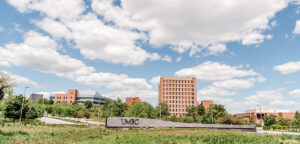


The Best of Baltimore Grant, a UMBC initiative started in fall 2025, is changing how students from Baltimore City imagine college: not as a distant possibility overshadowed by debt, but as a tangible, financially supported path forward, and right in their backyard.
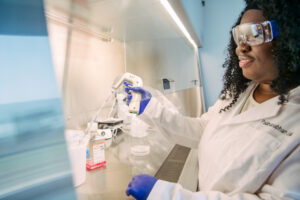
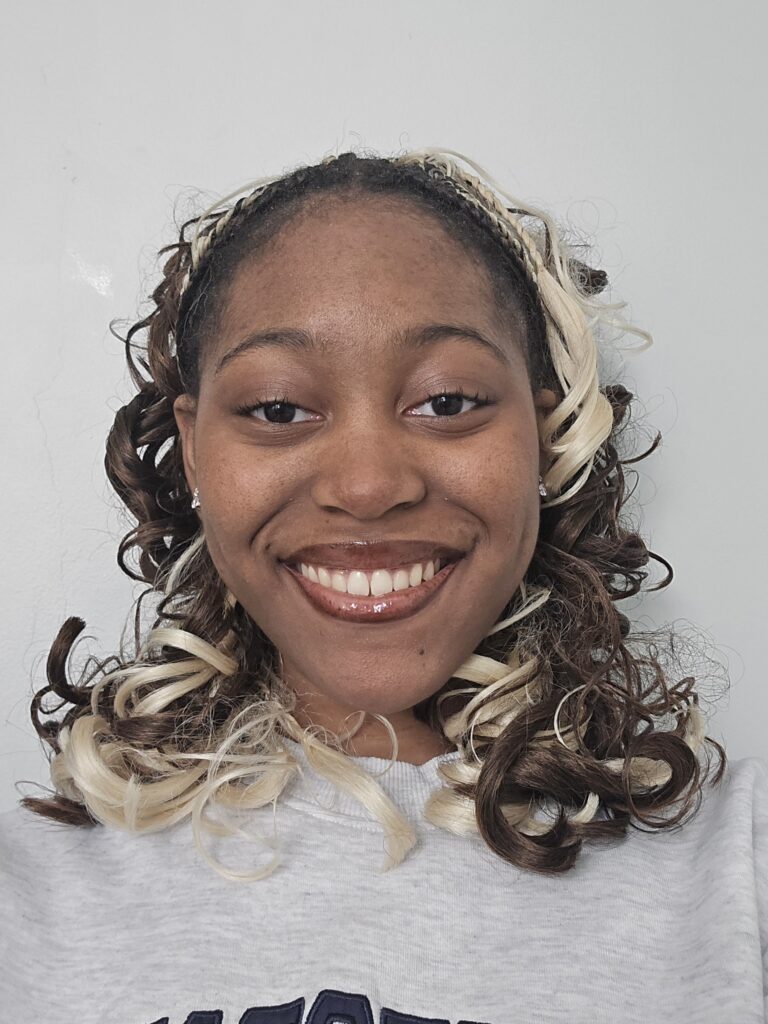
For first-year student Essence Jones, who went to Baltimore City College, a high school in east Baltimore, “that financial freedom really pushed me towards UMBC,” she says, describing the moment she learned the grant would cover what other aid could not—including room and board. A double major in biological sciences and psychology, Jones is already thinking ahead to a future in forensics, drawn by what she calls “the puzzle problem-solving aspect” of analyzing crime scenes. But her present focus is simpler: adjusting, learning, and finding her place and people.
Embracing the ‘B’ in UMBC
The Best of Baltimore grant grew out of President Valerie Sheares Ashby’s desire to see a greater number of Baltimore City high school students become Retrievers. And the grant is just one part of a bigger initiative, says Yvette Mozie-Ross ’88, vice provost for enrollment management and planning: “This year, we have been more intentional with our outreach efforts—partnering with community based organizations such as CollegeBound and College Track to continue to help us get the word out about the many benefits of a UMBC education and specifically how the Best of Baltimore grant can make a UMBC education attainable for all Baltimore City residents.”
The grant is designed to cover remaining billed costs after federal grants, subsidized loans, and other scholarships are applied—closing gaps that often prevent students with demonstrated financial need from enrolling.
Early results suggest momentum. In its first year, the program offered awards to nearly 140 students, with dozens ultimately enrolling and receiving grants ranging from $1,100 to $22,000. Just as importantly, Mozie-Ross notes, the early promise of financial support helped families make confident decisions about college. And the increased outreach methods are paying off—applications from city residents grew by 20 percent for fall 2026.
UMBC, Jones says, meets her at her pace and provides lots of student support. She points to spaces like the Learning Collaboratory, where students gather to work through complex chemistry problems together. “You’re both teaching and learning,” she explains. “That helps solidify the information.”
That sense of shared effort—of not struggling alone—has defined her early college experience. Whether studying with friends from her STEM courses or working quietly on the sixth floor of the library, Jones has found community. Her path to science was shaped before UMBC. At Baltimore City College, she was inspired by teachers who looked like her—women of color leading classrooms in biology and chemistry. “Being able to see them in that space… really helped me enjoy science,” she says. Now, she hopes to carry that sense of belonging forward.
Support fosters success
Deylon Moy Joseph, a mechanical engineering first-year student and another Best of Baltimore awardee, echoes Jones’ observations about support and community at UMBC. Originally from Trinidad and Tobago, he arrived in the United States in 2022 and enrolled at Mergenthaler Vocational-Technical High School—a mile north of Jones’ school. From the start, financial reality shaped his college search. “It was necessary for me to get some type of college funding,” he says. “I didn’t want to be stuck with really heavy student loans.”
At UMBC, he found a layered support system: the prestigious Meyerhoff Scholars Program, and unexpectedly, the Best of Baltimore grant. “We didn’t have to apply, but when we were accepted to UMBC, we received letters saying, ‘Congratulations,’” he recalls. “It was amazing.”
For Moy Joseph, that confidence extends into the classroom. He describes his technical coursework as demanding but manageable—especially with the right support. He credits faculty like Joseph Washington ’97, mechanical engineering, an assistant teaching professor whose open-door approach allows students to work through complex problems in real time. “Having the professor right there to give pointers… it really made retention much easier,” he says.
Outside class, in spaces like the Retriever Learning Center, students gather around whiteboards filled with equations, working through concepts together. “It’s so easy to study with someone,” Moy Joseph says. “And it’s satisfying to help people, too.”
That reciprocity—learning, then teaching—is central to many Retrievers’ experiences. It reflects a broader culture at UMBC, one that merges academic rigor with connection, starting in our very own neighborhood.