We use cookies for analytics and, unless you opt out, advertising.
You can opt out of advertising at any time.UMBC uses essential cookies to run this site. With your permission we would also use analytics cookies (to understand how the site is used) and advertising cookies (to measure and target our ads on other platforms). Nothing else loads unless you accept. You can change your choice any time from Cookie Settings in the footer.Privacy Policy
EssentialRequired for the site to work (login, security, your cookie choice). Always on.
Earlier this summer, a month before the start of fall classes, newly-minted Retrievers were on campus and ready to start working. Part of UMBC’s initiative to scale up work-integrated learning (WIL), more than 100 incoming first-year and transfer students spent a night on campus, connected with an instructor and teaching assistant, and spent a day participating in service on site at five different community partner locations: Art with a Heart, Friends of Patterson Park, Paul’s Place, Filbert Street Garden, and Retriever Essentials. WIL is an educational approach that prepares students for a rewarding career after college by pairing what they are learning in the classroom with hands-on, authentic work experiences.
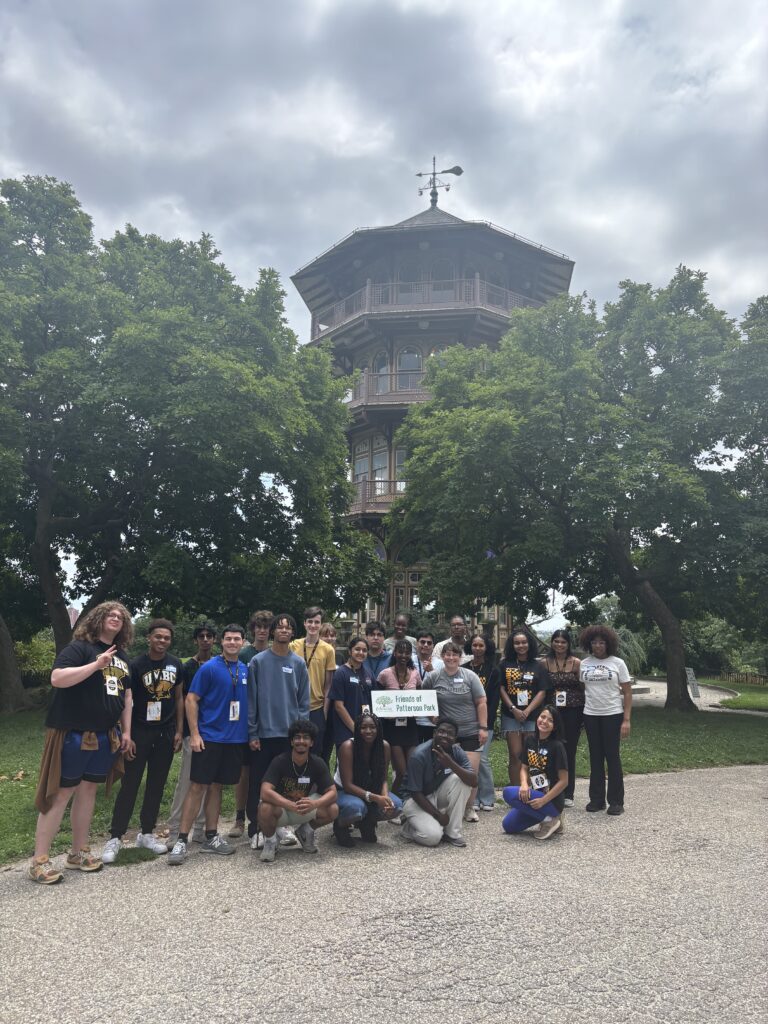
Emily Passera led 21 incoming students along with teaching assistant Nafi Gueye to Patterson Park. Here, they’re gathered in front of the observatory. (Photo courtesy of Passera)
Emily Passera, the senior program coordinator for community-engaged learning through The Shriver Center at UMBC, led a group of students to Patterson Park in east Baltimore. The bus ride to the participation site gave the students a chance to hear an overview of important cultural, historic, and environmental structures in between UMBC and Patterson Park, she says.
Once there, “They jumped into the hard physical work, and they deeply connected with each other,” observed Passera. “Students observed a pathway that was covered with mud and weeds, and shared that cleaning mud with shovels made them connect to the importance of fully accessible pathways for strollers, wheelchairs, and bicycles. The park should be usable for many different functions in many different ways.”
WIL students will participate in service with the same sites throughout their full first year at UMBC, deepening engagement and strengthening connection to their peers and faculty as well as to the campus and community.
“I believe a program like this is an excellent cohort building model. I was able to have individual conversations with all of them, learning what they cared about going into their unique UMBC journeys,” says Passera, who will teach the same students in a first-year experience course called UNIV 101. “These few hours will make my job as the UNIV 101 instructor a little easier, as we now have a shared experience together. We are really looking forward to the music and community events that happen in the park throughout the fall when they return.”
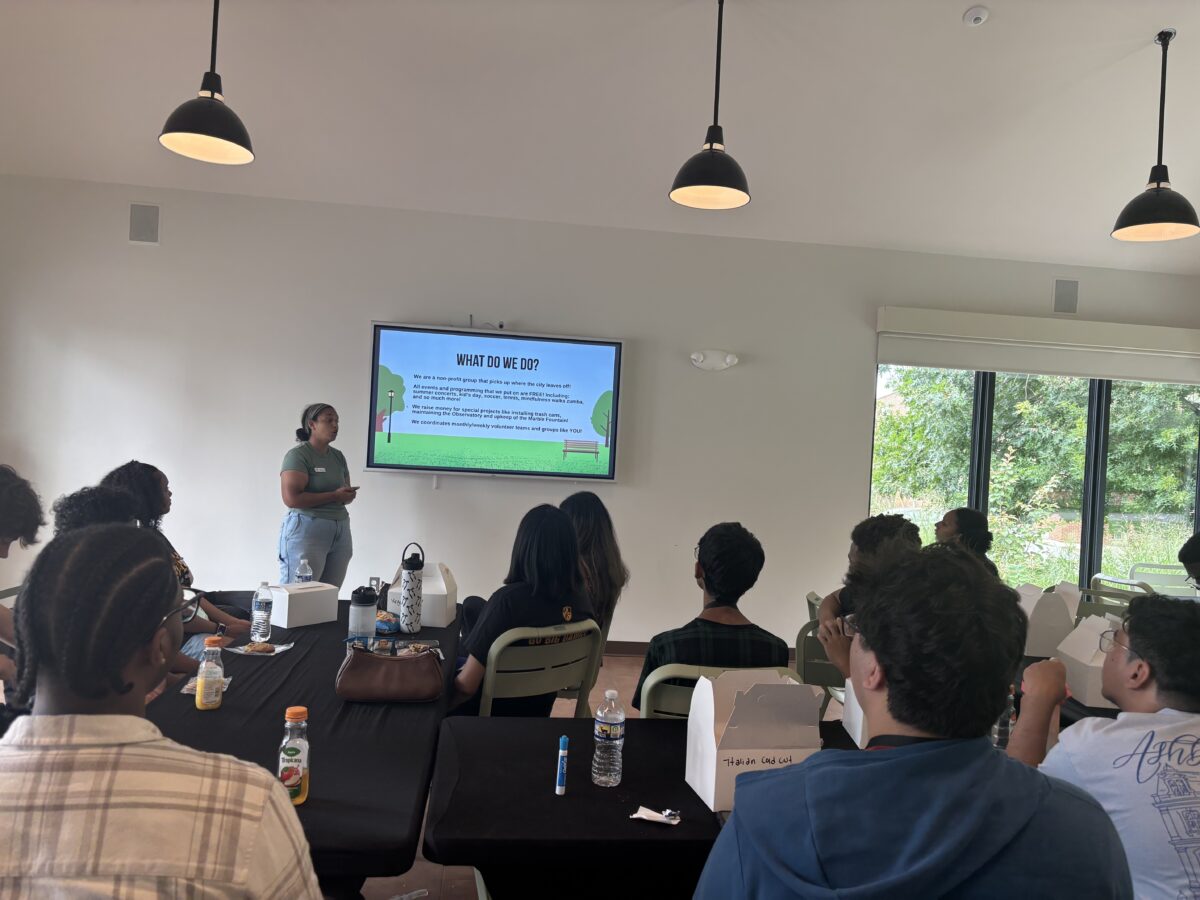
Peaceworker Fellow Katie Nagib with the cohort inside Friends of Patterson Park’s Cedar House, highlighting the importance of their work to the community and the principles of “leave no trace.” (Photo courtesy of Passera)
James DeVita, assistant vice president for academic partnerships and high impact experiences in the Division of Student Affairs, has been responsible for growing UMBC’s WIL opportunities across campus to ensure every student is exposed to the work world throughout their college years.
“WIL experiences are essential learning opportunities for students, not only because they help develop transferable and durable skills that ensure graduates are ready for the workforce, but also because they provide opportunities for real-world application that deepens learning in ways recognizable by external and industry partners,” says DeVita. “These experiences need to be embedded from day one for all of our students.”
The Best of Baltimore Grant, a UMBC initiative started in fall 2025, is changing how students from Baltimore City imagine college: not as a distant possibility overshadowed by debt, but as a tangible, financially supported path forward, and right in their backyard.
For first-year student Essence Jones, who went to Baltimore City College, a high school in east Baltimore, “that financial freedom really pushed me towards UMBC,” she says, describing the moment she learned the grant would cover what other aid could not—including room and board. A double major in biological sciences and psychology, Jones is already thinking ahead to a future in forensics, drawn by what she calls “the puzzle problem-solving aspect” of analyzing crime scenes. But her present focus is simpler: adjusting, learning, and finding her place and people.
Embracing the ‘B’ in UMBC
The Best of Baltimore grant grew out of President Valerie Sheares Ashby’s desire to see a greater number of Baltimore City high school students become Retrievers. And the grant is just one part of a bigger initiative, says Yvette Mozie-Ross ’88, vice provost for enrollment management and planning: “This year, we have been more intentional with our outreach efforts—partnering with community based organizations such as CollegeBound and College Track to continue to help us get the word out about the many benefits of a UMBC education and specifically how the Best of Baltimore grant can make a UMBC education attainable for all Baltimore City residents.”
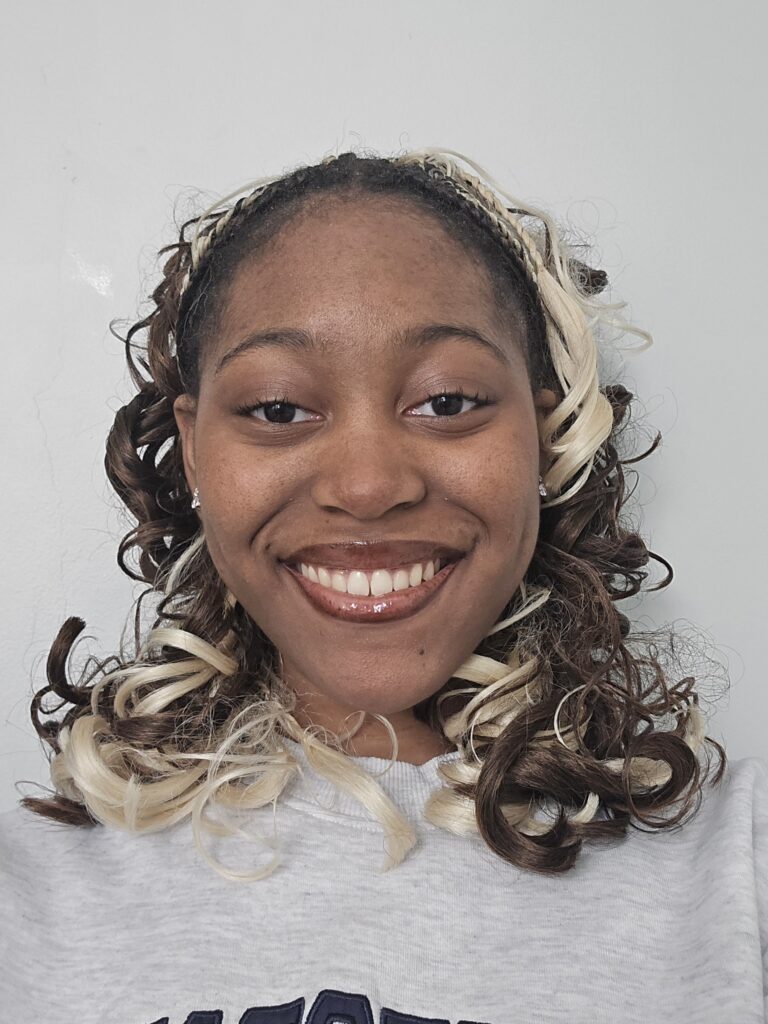
Essence Jones
The grant is designed to cover remaining billed costs after federal grants, subsidized loans, and other scholarships are applied—closing gaps that often prevent students with demonstrated financial need from enrolling.
Early results suggest momentum. In its first year, the program offered awards to nearly 140 students, with dozens ultimately enrolling and receiving grants ranging from $1,100 to $22,000. Just as importantly, Mozie-Ross notes, the early promise of financial support helped families make confident decisions about college. And the increased outreach methods are paying off—applications from city residents grew by 20 percent for fall 2026.
UMBC, Jones says, meets her at her pace and provides lots of student support. She points to spaces like the Learning Collaboratory, where students gather to work through complex chemistry problems together. “You’re both teaching and learning,” she explains. “That helps solidify the information.”
That sense of shared effort—of not struggling alone—has defined her early college experience. Whether studying with friends from her STEM courses or working quietly on the sixth floor of the library, Jones has found community. Her path to science was shaped before UMBC. At Baltimore City College, she was inspired by teachers who looked like her—women of color leading classrooms in biology and chemistry. “Being able to see them in that space… really helped me enjoy science,” she says. Now, she hopes to carry that sense of belonging forward.
Support fosters success
Deylon Moy Joseph, a mechanical engineering first-year student and another Best of Baltimore awardee, echoes Jones’ observations about support and community at UMBC. Originally from Trinidad and Tobago, he arrived in the United States in 2022 and enrolled at Mergenthaler Vocational-Technical High School—a mile north of Jones’ school. From the start, financial reality shaped his college search. “It was necessary for me to get some type of college funding,” he says. “I didn’t want to be stuck with really heavy student loans.”
At UMBC, he found a layered support system: the prestigious Meyerhoff Scholars Program, and unexpectedly, the Best of Baltimore grant. “We didn’t have to apply, but when we were accepted to UMBC, we received letters saying, ‘Congratulations,’” he recalls. “It was amazing.”
For Moy Joseph, that confidence extends into the classroom. He describes his technical coursework as demanding but manageable—especially with the right support. He credits faculty like Joseph Washington ’97, mechanical engineering, an assistant teaching professor whose open-door approach allows students to work through complex problems in real time. “Having the professor right there to give pointers… it really made retention much easier,” he says.
Outside class, in spaces like the Retriever Learning Center, students gather around whiteboards filled with equations, working through concepts together. “It’s so easy to study with someone,” Moy Joseph says. “And it’s satisfying to help people, too.”
That reciprocity—learning, then teaching—is central to many Retrievers’ experiences. It reflects a broader culture at UMBC, one that merges academic rigor with connection, starting in our very own neighborhood.
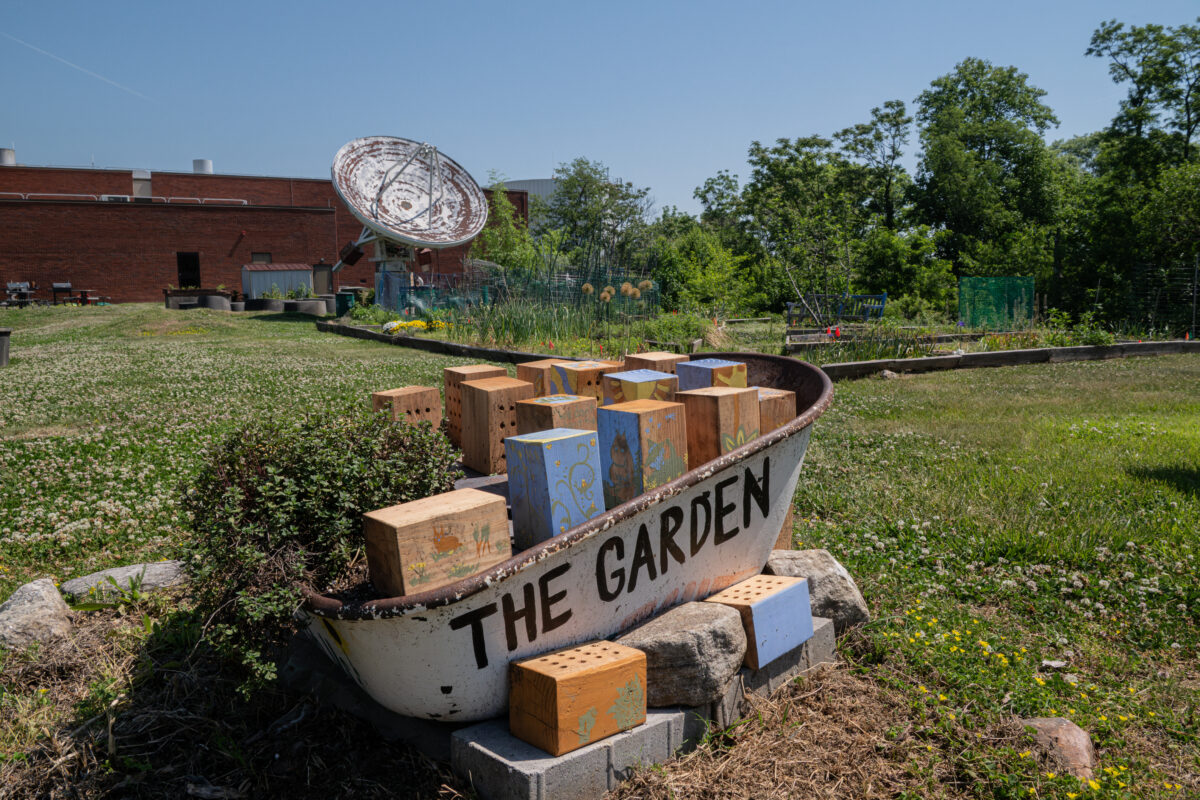
Each plant, whether a small wild buttercup or a massive oak tree, starts out as seed—packed with potential to grow well beyond its original size. By this logic, The Garden’s new Little Seed Library—co-sponsored by Retriever Essentials and the Office of Sustainability and installed by Facilities Management—is seeded with infinite potential.
Based on the now-familiar concept of Little Free Libraries that spread access to the love of reading, the Little Seed Library, down the sidewalk from UMBC Police, is set up for people to donate seeds (perhaps harvested from the adjacent garden) and those who want to put their green thumb to the test can take what they need to get started.
Laila Kaira takes a look at what’s available in the Little Seed Library.
The idea stemmed from conversations Michael Berardi, assistant director of Retriever Essentials, was having with folks on campus about tangible ways to grow interest in the community garden while wanting to grow awareness of where our food actually comes from. “We want to help campus engage with our food in a more deep and meaningful way,” says Berardi ’19, M.P.S. ’25, who was also a co-founder of the campus-adjacent coffee shop, OCA Mocha.
Andrew Eisenhardt ’21 was one of the people talking to Berardi. He remembers: “We were hiking in the woods of Patapsco State Park brainstorming some ideas for Retriever Essentials. I had recently seen a YouTube video where a community put up seed libraries and people could go to get new seeds and donate their excess. I figured it could be cool to have something like that at UMBC.” Eisenhardt, who already graduated with a double major in geography and environmental systems and media and communication studies and is currently pursuing another bachelor’s in computer engineering, started working in The Garden during his first time at UMBC when he needed a break from doing homework and wanted to see what opportunities were on-campus to get outside and work with nature. “The Little Seed Library serves as a great starting point for community members to participate in and learn about this work,” he says. “Just get a seed, throw it in some soil and see what happens! Worst case scenario, your seed never germinates. Either way you’ll learn something about plants and you might even make some friends along the way who are trying to grow a better future.”
Jessica Graziano, who has been tending a plot in The Garden for several years, only foresees fruitful outcomes for the Little Seed Library. Eventually, in addition to seeds and instructions for planting, Graziano would like to see folks donate gardening tools and horticultural resources. Graziano, the current president of The Garden club, says her favorite thing to grow is perennials. “My current favorite is False Indigo, which I’ve had growing in my plot at The Garden for about two and a half years,” she shares. Recently recognized with a UMBC Community Impact award at SGA’s 2025 – 2026 CelebratingOrgs event, The Garden is lush with promise.
Nicole Wolf, UMBC’s sustainability coordinator, says that the Office of Sustainability has some nutrient rich ideas coming up in connection with the other organizations that help support The Garden. But in the meantime, “access to free seeds and gardening space removes the barrier of not knowing where to start, or even having to leave campus if they choose to use the community plots,” says Wolf. “We will continue to foster this culture by hosting regular ‘seed save collection’ events on our campus to keep the library stocked while teaching attendees about native plants and how to harvest ethically as we go.”
Manav Narendra’s story has been shaped by constant motion. A math and computer science double major, who graduated from UMBC this spring, Narendra grew up moving frequently between India and the United States, adapting to new schools, cultures, and environments every few years. Raised by a single mother who was always striving to create a better life for them, Narendra grew accustomed to change—but also to the challenges that come with it.
Coming to UMBC marked a turning point. Narendra sought out a smaller, close-knit academic environment where he could build community, form lasting friendships, and explore what it means to belong somewhere. In this Office Hour, President Valerie Sheares Ashby—who has also been at UMBC for four years—and Narendra reflect on growing rooted to a place and what effect those lasting connections can have.
UMBC Magazine: Manav, tell us about your background and what brought you to UMBC.
Manav Narendra: I’m originally from India, and I’ve spent about half my life there and half in the U.S. Growing up, I moved a lot because my mom would switch jobs for better opportunities. By my senior year of high school, we had just moved to Maryland. I applied to a vast array of colleges, but I ultimately chose UMBC because I wanted a smaller, more personal environment where I wouldn’t feel lost.
And here, I’ve met people in so many different ways—through classes, the Honors College, tutoring, tennis, even the Career Fair. It’s been really meaningful.
Narendra on campus in spring 2026.
President Valerie Sheares Ashby: You wanted a place where you could feel seen—that is powerful. And these smaller communities within UMBC can really shape your experience.
UMBC Magazine: How did moving so often affect your ability to build relationships?
Narendra: It was difficult. I became more introverted over time because you don’t really get the chance to build lasting friendships when you’re always leaving. I just didn’t realize how much I was missing in terms of long-term connections until I got here. Nevertheless, I’m forever grateful to have met so many incredible people from such beautifully different walks of life—they’ve all shaped who I am today.
President Sheares Ashby: I understand that. I am an introvert, too, and I think those kinds of experiences can really shape how you connect with people. It is not always easy to keep starting over. When I moved to Baltimore, I did not know anyone here, but from experience, I knew what I needed to put in place in order to feel like I am grounded and rooted in community. I learned how to do that when I was your age. In college and in graduate school, I started to ask myself: “What is it that I need to feel grounded?” And then I would go get it—I do not wait for it to happen.
UMBC Magazine: How has UMBC shaped your conception of community?
Narendra: I’ve made friendships that have lasted all four years, which still surprises me. I’ll see someone on campus and think, “Wow, I’ve known you for so long.”
President Sheares Ashby: That is such a special realization. I always tell students that those relationships are one of the most important parts of college. You learn so much in the classroom, but those connections—those are what stay with you.
UMBC Magazine: What does “home” mean to you now, after having moved so much?
Narendra: Growing up, home was my mom. Wherever she was, that’s where home was. She was the only constant in my life. I was diagnosed with cancer when I was 13, and my mom and I went through it together. I dealt with the physical pain, but she carried the brunt of the emotional and mental burden. She quit her job to take care of me. I couldn’t have done it without her. Now, I feel like I have another home here. I have a place where I belong, where I feel valued. It’s comforting to be in one place and not have everything constantly changing.
UMBC Magazine: How did that experience influence your future goals?
Narendra: It’s made me want to give back. I’m looking at various roles, ranging from data and actuarial science to software and astrophysics—seeing where I can best utilize my skills to make a difference: something that helps people and advances our collective understanding of the world. I feel like I’ve been given a second chance at life, and I want to use it well.
President Sheares Ashby: Often, our experiences guide us toward that sense of purpose. There is this idea of finding where your talents meet the greatest need—that is where meaningful work happens.
At UMBC, restorative practices have grown from a promising idea into a campus-wide movement—one shaped by dedicated staff and reaching far beyond the university itself.
For Jeff Cullen, UMBC’s director of Student Conduct and Community Standards, this work has been years in the making. Now in his 18th year at the university, Cullen has helped guide the evolution of student conduct from a traditional, punitive model toward something more meaningful: a restorative approach that centers accountability, healing, and community.
“Each student I encounter is unique,” Cullen explains. “I enjoy working with them in a restorative way—offering high levels of support while also demanding high levels of accountability.”
Building a proactive framework
UMBC formally began integrating restorative practices in 2015, after adopting training models inspired by the International Institute for Restorative Practices. What started as an alternative way to resolve disputes has since expanded into a proactive framework for building relationships and fostering authentic communication across campus.
Instead of focusing solely on punishment, restorative practices ask deeper questions. Cullen describes a hypothetical situation: a student returns to their residence hall inebriated, damages a bulletin board, and creates a mess in a shared space. In a traditional system, the outcome might center on sanctions. But a restorative approach broadens the lens.
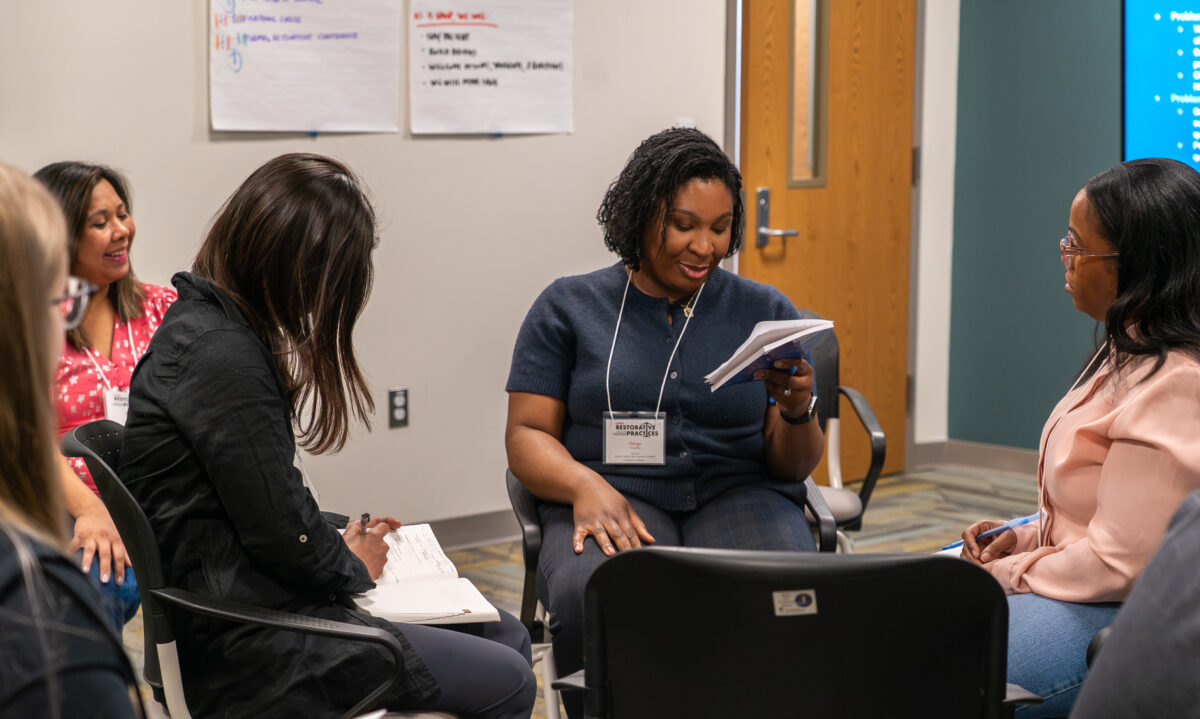
Samantha Kennedy ’25, social work, a graduate assistant for restorative practices in Student Conduct and Community Standards participates in a “fishbowl circle” which can be useful for idea generation and problem solving.
“It’s not just about the student,” Cullen says. “There are custodial staff, residential life staff, and other students who are impacted.”
Through restorative circles, those affected come together—the student, staff members, peers—and engage in guided dialogue. They reflect on what happened, who was harmed, and how to make things right. The result is not only accountability, but also understanding and, often, reintegration into the community.
While the process can feel challenging at first, Cullen notes that participants often leave with a sense of resolution and stronger conflict-resolution skills. Early data and broader research suggest that restorative approaches can reduce repeat offenses, increase satisfaction, and create healthier communities overall.
That impact is not limited to UMBC.
Restorative practices beyond the classroom
Toshiyasu Tsuruhara, an associate professor at Ritsumeikan Asia Pacific University in Japan, traveled across the globe to attend a 2-day restorative practices workshop at UMBC (combining his trip with another training in San Diego). With a background in conflict mediation—including accreditation as a community mediator in the U.K. and experience working with neighbor disputes and in family court—Tsuruhara was already familiar with restorative justice concepts.
But the workshop offered something new.
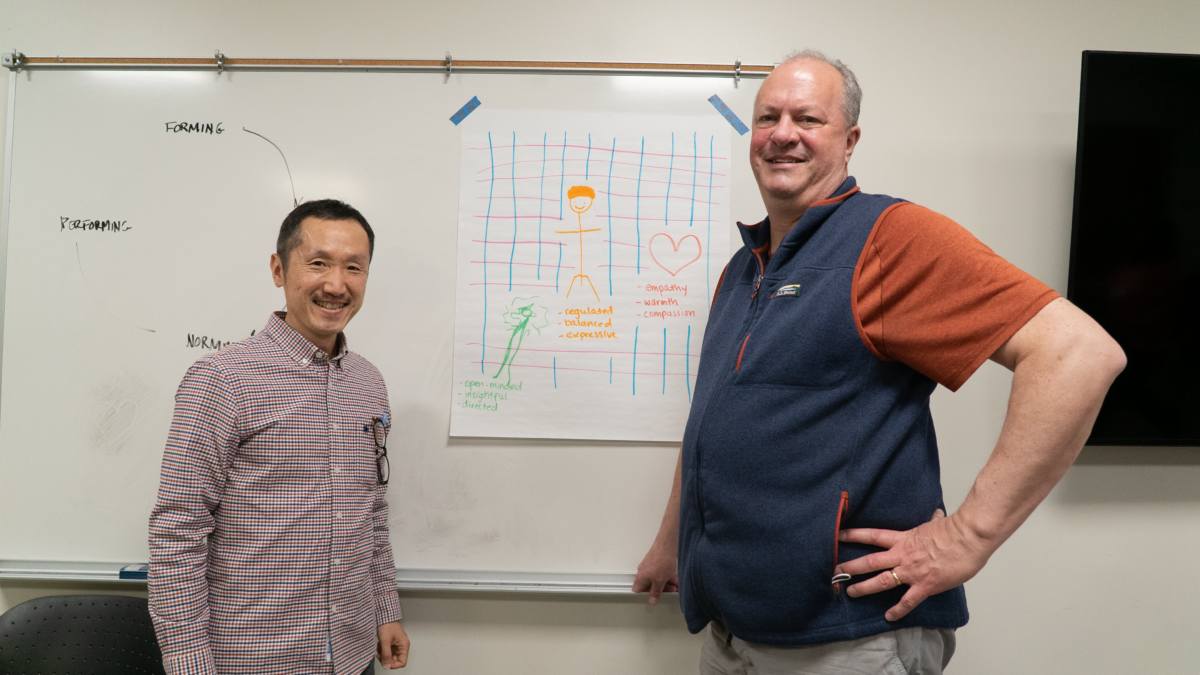
Left: More fishbowl circle work at the 2026 training. Right: Toshiyasu Tsuruhara and Jeff Cullen met during the 2-day training.
“I learned how these tools can be applied in real-life situations,” he explains. “I am interested in restorative practices because they offer tools to repair relationships and bring communities toward peace,” Tsuruhara says. “They are not just for education—they can be applied in work, family, and friendships.”
During his time at UMBC, Tsuruhara engaged closely with students and staff, participating in discussions, collaborative exercises, and even creative activities like short dramatic presentations to explore key concepts. What stood out most was not just the theory, but how actively it was practiced.
For Tsuruhara, the experience also highlighted the value of introducing restorative practices early in students’ lives. He observed how these approaches could help students navigate both academic and social challenges, while also preparing them for professional environments.
“They help maintain peaceful relationships with workmates,” he says. “And if conflict happens, they provide tools to resolve it.”
Inspired by what he learned, Tsuruhara plans to continue to integrate restorative practices into his own teaching. In his “Multicultural Cooperation Workshop,” students from diverse national and cultural backgrounds collaborate on long-term group projects—an environment where conflict can naturally arise. Rather than relying solely on mediation training, he sees restorative practices as a more holistic and educational approach.
One small effort turns into campus-wide movement
Back at UMBC, Cullen reflects on how far the initiative has come. What began over a decade ago as a small effort has grown into a campus-wide movement, with hundreds of students, faculty, and staff trained in restorative methods.
“At UMBC, if you have a good idea, you’re encouraged to implement it,” Cullen says. “We had no idea it would grow like this—but here we are.”
Supported by colleagues in Residential Life and Student Affairs leadership, and shaped through years of collaboration, restorative practices at UMBC continue to evolve—impacting not only the campus community, but also educators and practitioners around the world.
UMBC has been designated as one of only three institutions in Maryland dually recognized with Carnegie R1 status—among the top 5 percent of research universities in the nation—and the Carnegie Community Engagement classification, which recognizes universities who systematically share knowledge and resources with those of the public and private sectors to enrich scholarship, research, and creative activity in order to contribute to the public good. Following an extensive full campus self-study demonstrating increased depth, breadth, and integration of engagement, this week UMBC was classified as a Carnegie Community Engaged Campus for a second six-year period.
“As a public university for the public good, community engagement is at the heart of UMBC’s mission to provide world class education and research that directly supports our students, community, and partners in an inclusive environment,” says Provost Manfred H. M. van Dulmen. “The Carnegie Community Engagement Classification is an acknowledgement of the dedication and excellent work of the UMBC faculty, staff, and students to engage and serve the city of Baltimore and the state of Maryland.”
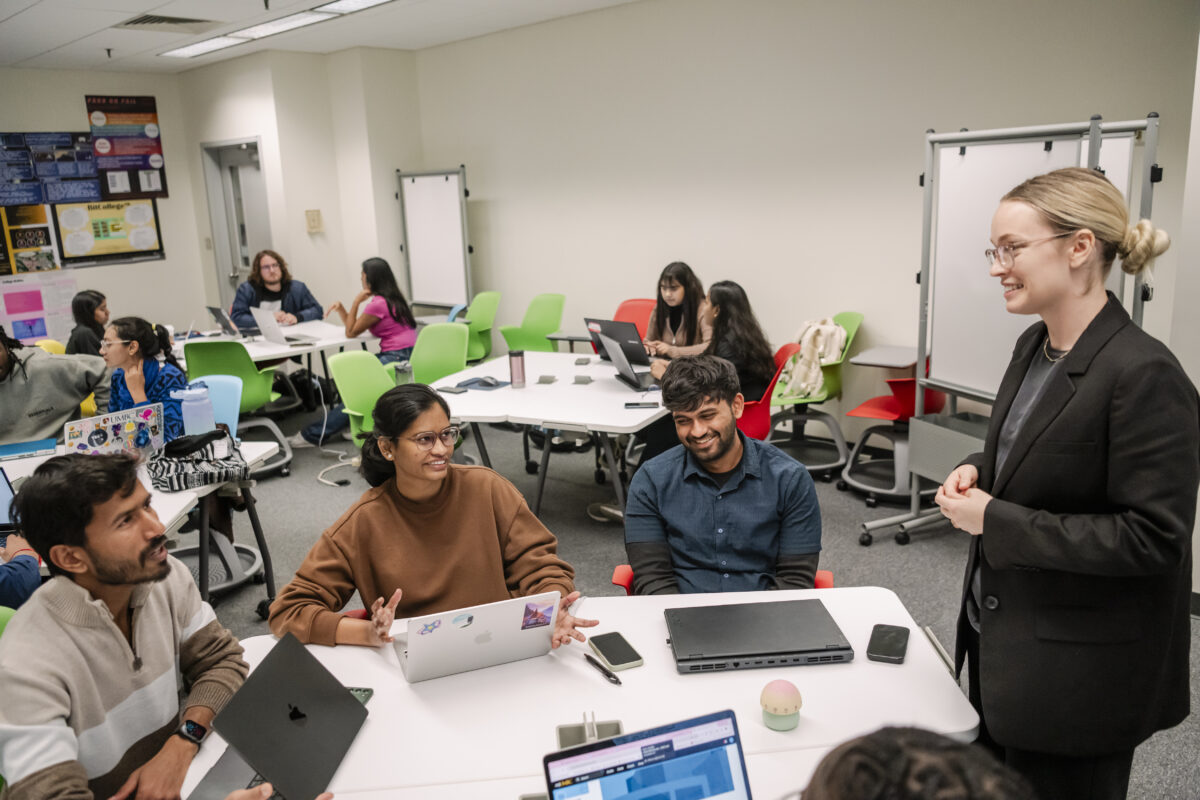
Students engaging in a lively classroom discussion.
Community engagement at UMBC flows from the university’s vision of a culture of inclusive excellence, explains Joby Taylor, Ph.D. ’05, assistant vice provost and co-leader of The Shriver Center for Public Service and Community Engagement. Taylor and Preminda Jacob, associate dean of the College of Arts, Humanities, and Social Sciences, co-chaired the reclassification study with the conviction that: “Community engagement extends our vision and practice of an inclusive culture out into the world beyond our campus through relationships and partnerships focused on mutual collaborations that matter and make a difference…locally, regionally, and globally.”
This community engagement classification re-affirms UMBC as a place where people and relationships are centered. At a time when the impact of higher education is in question, UMBC’s commitment to inclusive excellence as seen through this reclassification offers a powerful counter narrative about the roles of universities in a critically important moment.
“It speaks to how learning and knowledge can be transformational, not just transactional,” says Taylor, noting his belief that higher ed can be oriented toward positive social change, supporting holistic and lifelong learning with civic purposes, as well as professional pathways and economic mobility.
President Valerie Sheares Ashby echoes these sentiments, noting during the self-study that, “At UMBC, we do not just talk about equity and social justice, we make it happen in real, tangible ways that improve people’s everyday lives.”
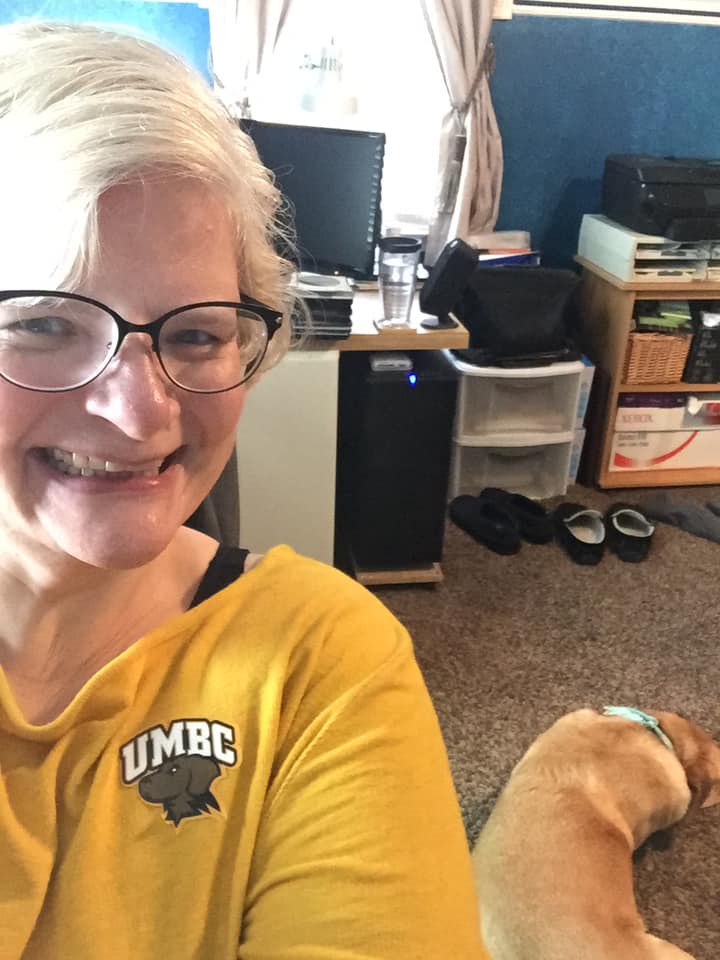
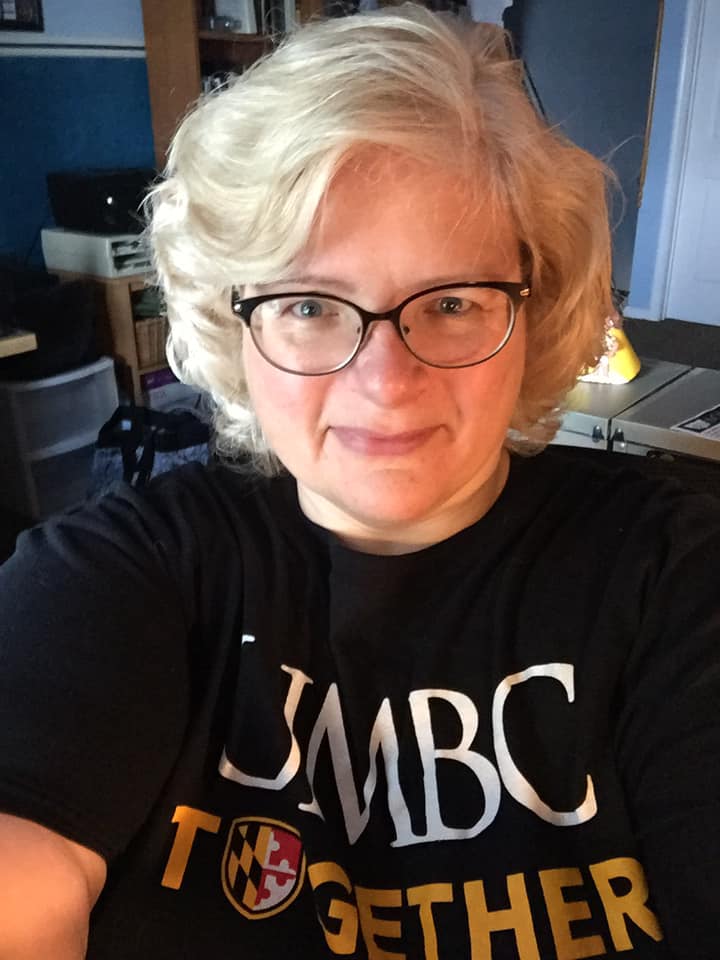
It should come to no surprise that numerary luminary Connie Pierson, AVP in IRADS—UMBC’s primary source for official campus statistics to comply with government reporting requirements and support decision-making—is good at keeping track of things. This Friday, December 19, Pierson ’90, M.A. ’92, celebrated her 300th black and gold Friday.
Originally conceived as a way to stay connected with fellow Retrievers when the world went virtual in March 2020, Pierson is not one to give up on a good streak. “This is part of my personality. I mean—you got to be a little anal retentive to be a data analyst and to have that mindset,” Pierson says.
For this lifelong Retriever (and it should be noted that her full first name is Constance), this means donning one of her numerous pieces of black and gold clothing—often with a hair accessory—and posting to social media, along with a hashtag that keeps a record of her record-long series. Sometimes she’ll bank some pictures to use later, like when she attends a UMBC athletics game.
If you scroll through the 4.5+ years of photos on social media, Pierson’s hair grows (it also grays, as she points out), she wears a hat, a headband, different glasses, she gets licked by her pups, she’s outside or in—there are many different variables, but one stays the same. She’s got a mega-watt grin that makes you smile back. “It’s part of my weekly routine. You got to get dressed—you got to put black and gold on,” she says.
Pierson and her late father, Kenneth Krach, Sr., on week 166 of her streak.
Pierson has a reason to boast her black and gold bonefides—she’s spent 31 non-consecutive years at UMBC as both a student and staff member. After leaving the university to earn her Ph.D. in sociology from the University of Maryland, College Park, and a short stint at the U.S. Census Bureau, Pierson returned to UMBC in 1999 for a job in the Office of Institutional Research, Analysis, and Decision Support where she has been ever since.
Pierson says, personally, her commitment to the streak is a way to keep in touch with the larger UMBC community, especially with her retired colleagues. “I’ve had people tell me, ‘Don’t stop! It’s how I know it’s Friday,’” Pierson laughs. She guesses that she’s only missed six or seven Fridays.
Even when her father passed away, Pierson used a picture of her and him at a Retriever’s game for her regular post in his honor. The digital data decision maker plans to retire in summer 2026, and wants to continue her trend into her next stage of life—as an alumna and retiree—so she will always know when the weekend is about to start.
“You are a valued and important voice.” “UMBC cares and listens.” “The diversity on UMBC’s campus helps to bring out the best in everyone.” Along with an eye-catching color gradient, these words adorn the walls of the Mezzanine Gallery in The Commons. And while the phrases may sound like something President Valerie Sheares Ashby would (and does) say quite often, they are actually part of an Arts+ initiative, student-sourced art installation that asked students: “Inclusive excellence: What does it mean to you?”
Created by students in the spring 2025 class Professional Practices in Graphic Design, the installation transforms the Mezzanine Gallery and nearby breezeway into spaces that reflect UMBC’s welcoming community. Funded by Student Affairs Communications and Marketing, the project included Petra Janka ’25, graphic design and modern languages and linguistics, and a current human-centered computing master’s student. In this Q&A, Janka and President Sheares Ashby talk about student-led inclusive excellence and the ways that UMBC welcomes people into its community.
President Valerie Sheares Ashby: How did your class approach this project?
Petra Janka: Our class was asked to help to reimagine and transform two spaces in The Commons: The Mezzanine Gallery and the entrance near the breezeway. We wanted students to interact with something enjoyable and inspirational. So our design approach focused on creating a multi-perspective experience.
There are three specific views you can take in this installation. From one side, you see this colorful gradient representing the diversity of residential life on campus. From the other angle, you can see the black and gold gradient symbolizing academic life at the university. If you look at it straight on, you can see the quotes included in the installation and the digital signage, which highlights additional answers. We sourced these quotes by surveying students about their connections, their advice, their challenges, their experiences on campus, and so on.
Left: headshot of Petra Janka in front of the colorful gradient perspective; Right: Designed by the same class, “The Roots of Inclusive Excellence” mural takes over the entire wall of the breezeway entrance to The Commons. The flowers of all different colors, shapes, and sizes represent the many backgrounds and stories each UMBC student brings to campus.
Sheares Ashby: This is fantastic. It is a brilliant idea on multiple levels. I talk about inclusive excellence all the time because it is a core value of the institution, but hearing students’ experience lets me know we are doing something right. It also lets me know there is more for us to do, right? These quotes inspire me to keep going—to try to make the place even more inclusive for everyone.
It is one thing for me to say it, but to know that your student peer is saying—”Give everyone a chance”—well, that is far more powerful than if I were using my voice. When I read the quotes on the wall, I think, “Oh, that is different. That is more powerful. That is more meaningful.”
Janka: The motto of our group was: “From the students, for the students.” We wanted everyone who passes by to stop, read, and feel seen, heard, and valued, and I think we achieved that.
Sheares Ashby: This is a unique institution. It is a very different thing to be at an institution that has been around for more than 150 years, and one that has been around for 59. Older institutions are pretty hard to change. Students certainly have an impact everywhere they go, but you are not creating that institution anymore, not fundamentally changing the DNA.
But, here, we are still in a space where we are becoming clear about our values, but we are flexible and humble enough to recognize there is still more input to receive, still more growth to experience, still new ideas to include. We can be better and different, and it is our clarity about our core principle of inclusive excellence that enables us to do that.
Janka: Last spring, when we were scouting out the space, we saw how many people pass through because this is a place to eat, study, and meet friends. We wanted to add something that becomes part of that everyday experience at UMBC. And now the colors draw your eyes to it, and then you read the messages, and you feel connected, and you’re like, “Oh, this is nice. I feel inspired to do better, to give everyone a chance.” I hope it stays up for a long time.
Sheares Ashby: We are clearly better because you are here. This is what students do. Each time a new student joins us, UMBC gets better.
The project, part of UMBC’s Arts+ initiative, was completed and installed by commonvision, UMBC Student Design and Print Center students Shomapti Hussein ‘25 and Thomas Hammond ‘25, under the print and installation guidance of Tori Richner ‘22, general associate: print production, and the supervision of SACM staff. The Commons Facilities and Operations team installed the panels and screen in the Mezzanine Gallery, and were integral partners in this project.
Sarah Darby regularly gets in thousands of steps walking backwards around campus. “I have never felt more burn in my legs. It’s like you’re using muscle groups that you don’t use when you walk forward. I was sore,” says the sophomore political science and psychology major after she got her dream job as a Grit Guide last spring. Generally tours last a little under 90 minutes, and Darby said that her legs adjusted pretty quickly.
Surely in the 1960s, when UMBC only had four academic buildings and no residential life yet, the tours were quicker, or at least shorter, right? Frances Allen Nickolas ’70, American studies, says: “Not really.” According to Nickolas, one of the early tour guides on campus, the tours would usually take over an hour as the interested visitors wanted to see the new school that had sprouted up in Catonsville over the last few years.
The 1969 copy of Skipjack, the university’s year book, featured photos of Fran Allen giving tours to prospective students.
“We would talk about the majors UMBC offered and share perspectives from our own majors,” says Nickolas. “We would tell them about our experiences with the courses of study and the professors. I truly loved it because I got to meet different people all the time, and I just really enjoyed it. Because UMBC was much smaller in those days, later I’d run into some of those visitors again, but as students this time.”
This is something the modern tours have in common, says Darby, a Sondheim Scholar who enjoys giving her tours an in-depth view of her majors and favorite areas on campus (The Commons and the Library). But the thing she values most is getting to know these potential Retrievers. “I have made so many genuine connections with people when I’m out on tour—I enjoy making jokes and making them laugh,” says Darby. “Some people might think it’s ‘just a campus job,’ but I love seeing the high schoolers’ reactions to campus. It’s rewarding in a way that none of my other jobs have been. I really love it.”
UMBC’s values and mission are what unite this community of Retrievers together. When we work in service of our students and our academic mission of inclusive excellence, it’s hard not to feel connected to the work on another level. The ongoing success of those shared efforts has been recognized once again by ModernThink’s Great Colleges to Work For survey.
This is UMBC’s 16th year of recognition, and 14th on the Honor Roll—a distinction that goes to the top 10 four-year colleges recognized the greatest number of times in each enrollment size category.
“It is no accident that UMBC has been recognized as a Great College to Work For for more than 15 years running,” says President Valerie Sheares Ashby. “UMBC staff and faculty are dedicated to one another, to our students, and to our mission. That dedication inspires us to continually improve, to support the growth of others, and to participate in setting the course for our future. I am grateful every single day for this extraordinary community.”
ModernThink surveys current employees, and based on responses, UMBC fell into nine recognition categories, including Mission and Pride; Faculty and Staff Well-Being; Shared Governance; Inclusion, Belonging, and Community; and more.
“Our faculty and staff are the best of the best and work to provide an environment where our students can thrive,” says Lynne Adams, associate vice president and chief human resources officer. “I am so proud of the passion and compassion that our employees continue to show each day. We come together as one with one focus and that is demonstrated in big and small ways throughout campus. It is truly exciting that our university continues to be celebrated as one of the top places to work each year.”
Like most dads, Chris Burk immediately told his 10-year-old daughter that the object she was trying to fish out of Pig Pen Pond was probably trash. Emily was not to be deterred, and Burk said he “had egg on his face” when lo and behold, the piece of trash was actually a ring. A West Point class ring from 101 years ago. And wait, was that a name inscribed?
Santiago G. Guevara’s 1923 West Point class ring. (Photo courtesy of Nick Guevara)
The Burks live a few miles from UMBC and occasionally use it as a place to take a family stroll. When they visited last summer, Burk noticed the water level was a little lower than usual in the body of water formally known as CERA Pond, which sits between the bwtech@UMBC Research and Technology Park and the loop across from Admin Garage. That’s when Emily got a stick to try to snag a shiny tab settled at the bottom of the shallow embankment.
The name on the ring—Santiago G. Guevara—led Burk, who is a land surveyor and well acquainted with historical research, on an internet crusade to 1) reunite the ring with the owner’s descendants and 2) figure out how in tarnation the ring got there in the first place. So far he’s only been able to check off the first item.
Enter Nick Guevara, a U.S. Navy veteran, dedicated family historian, avid blogger, and most importantly, Santiago Guevara’s grandson. Nick also has no clue how the family heirloom ended up in UMBC’s pond. (Although he does have a nephew, Quintin Simmons, who graduated in 2020 with a degree in geography and environmental systems. Simmons, who coincidentally has swum in Pig Pen Pond, didn’t know his great granddad went to West Point, much less had a class ring from 1923. In another twist of coincidence, Simmons works at a company housed in bwtech and can see the pond from his office.)
“I’m so flabbergasted that these things can still happen,” says Nick. “It makes the world feel small in a good way. We need more stories to bring people together.”
Do you have any clues about how Santiago Guevara’s West Point ring ended up in CERA Pond? What’s the best thing you’ve found on campus? Email us at magazine@umbc.edu.
All musicians start out as absolute beginners. Some might progress as self-taught, others might have private music lessons, and many will pick up their first instrument in school. But without a musical pathway—consistent access to physical instruments and dedicated music educators year after year—budding musicians will falter on their journey.
For Nema Robinson, and the thousands of other Baltimore City student musicians who have benefited from extra-curricular, free, equitable music education through programs like the Baltimore Symphony’s OrchKids and Peabody Institute’s Tuned-In program, these communities have opened musical doors to a professional career in music and so much more. Now on track to graduate with a music education degree, Robinson has reached a full circle moment to teach at the programs that set the stage for her own success.
The first violinist plays a long, drawn out A. The other musicians settle their feet against the stage floor and their backs hover near, but don’t quite touch the backs of their chairs. Suddenly, the noise of the orchestra breaks across your ears—briefly discordant and separate—but as the players all search for the same A, the notes weave together into a pleasing buzz of anticipated energy. In tune together, they look expectantly at the conductor.
Robinson instructs students at Tuned-In.
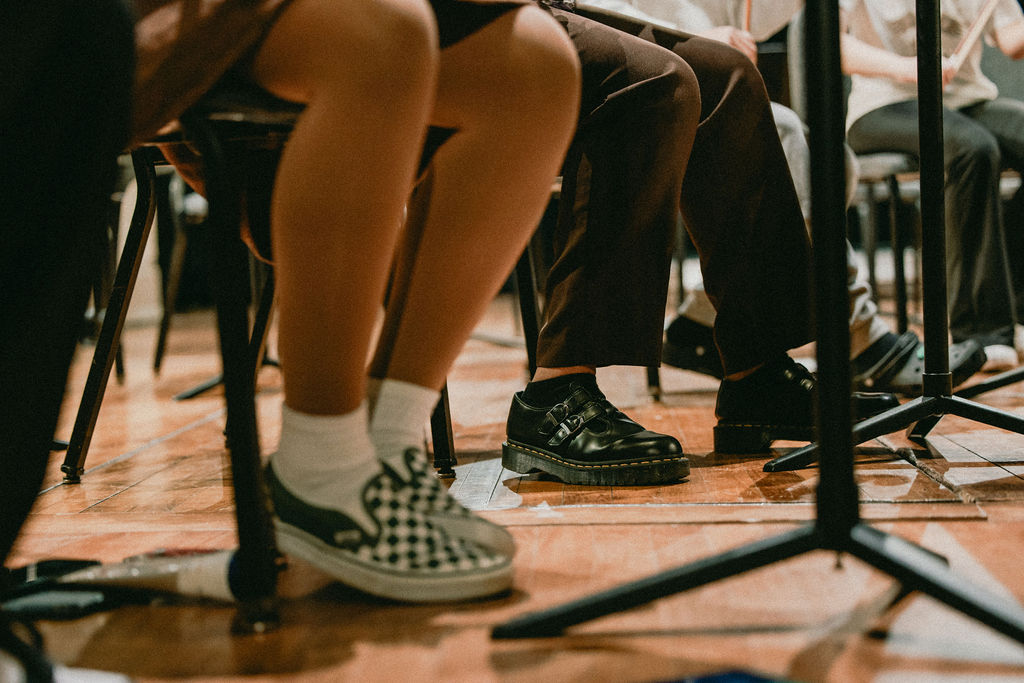
Among the Uggs and Vans and Crocs and Nikes nestled under the music stands are Nema Robinson’s double-buckled black platform Mary Janes. Robinson, a fourth-year music education student and Linehan Artist Scholar, is at one of her teaching gigs that supplement and complement her degree. Today, she’s in Friedberg Hall at the Peabody Institute in Mt. Vernon, Baltimore, as part of Tuned-In, a free musical study and youth development program for Baltimore-area students. The elegant marble relief sculptures that flank either side of the stage and the gentle curve of the stairs leading to the second story seating section are just the background to the real art on the stage: Middle and high schoolers are making music.
In Baltimore City, only 60 percent of public schools have some type of musical component, says Nick Skinner, the vice president and founding team member of BSO OrchKids—which also offers free, community-based, high-quality music instruction and programming in the city. Of that, only 12 percent of city schools have instrument programs, compared to nearly 100 percent in nearby Baltimore, Howard, and Montgomery county schools. “There’s no musical pathway. So if you’re lucky enough to have music in your elementary school, you may not be able to continue that music study sequentially into middle or high school,” says Skinner. “It’s a really patchwork model of how students can progress musically through their education.”
When former BSO conductor Marin Alsop began her tenure in the city, she saw a need to fill this gap, and in 2007 founded BSO OrchKids. As Skinner tells it, Alsop saw that “many of our students here in the city were locked out of these opportunities to have the power of music in their life—to benefit from the inherent value of playing an instrument and the benefits that come from the study and the artistic process of learning an instrument.”
Asked to lead
When Robinson was a kid, she was walking around Artscape with her mom waiting to see her cousin perform on stage. Artscape in Baltimore City is the nation’s largest free outdoor arts festival, famously held on whatever is the hottest weekend in the summer. Robinson recalls getting to the event early and waiting in the unbearable heat. They found a place to sit and wait for her cousin’s opera performance and during that period OrchKids took the stage. “And my mom was like, ‘Oh my God, all these Black musicians playing classical music.’ We immediately got applications, and all of this started from there.”
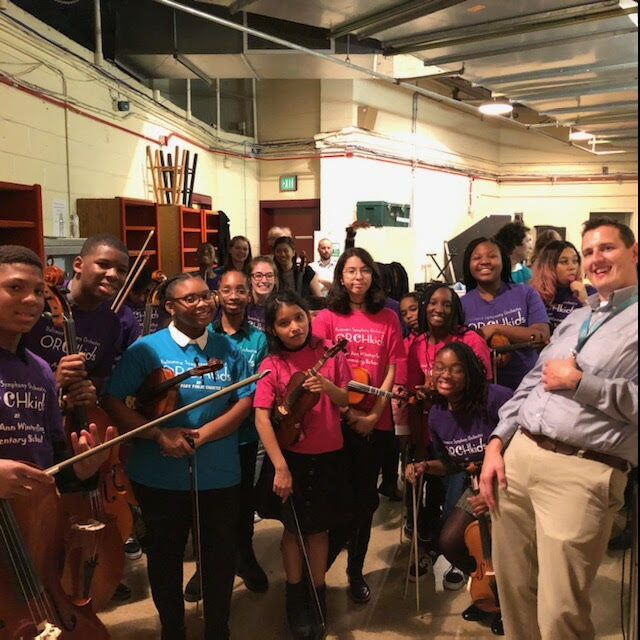
Young Nema Robinson playing the violin and with a group of BSO OrchKids. Robinson is crouching in purple, and fellow UMBC student Rickerra Bassett is standing in front with a teal shirt. Photos courtesy of Robinson.
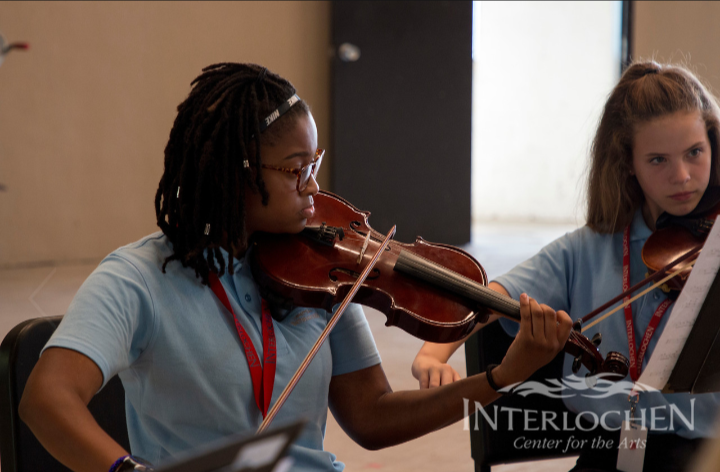
In fourth grade, Robinson joined OrchKids and thought she wanted to play the tuba. Her mom shot that down for practical reasons, like 11-year-old Nema being able to even carry the instrument. “I’m still too small to play the tuba,” says Robinson. Her instrument of (second) choice was the violin, and through the daily after-school sessions at OrchKids and the all-day Saturdays at Tuned-In, along with numerous other musical opportunities she’s taken part in, Robinson has far surpassed the lauded 10,000 hours on her way to becoming an expert.
On stage in the Linehan Concert Hall rehearsing with UMBC’s Chamber Ensemble, Robinson stands in a semi-circle with a dozen other musicians. At this point, she’s been playing for 10 years. As the group launches into a slow baroque minor key waltz, Philip Mann, the conductor and assistant professor of music, stops them short. “Let’s move closer,” he says to the collection of string instrumentalists. With a shuffle of music stands, the ensemble tightens the circle. Black leather Doc Martens now firmly planted beneath her, Robinson leans into the music with her instrument familiarly tucked beneath her chin.
Before UMBC had a chamber orchestra—an intimate group of musicians—Robinson played in UMBC’s Symphony Orchestra, which is open to staff, students, and community members. She was a section leader her first year at UMBC. “I had to make sure I was locked in because this was a really big deal in a university just starting out. I think for me it was definitely nerve wracking, like, ‘Oh, I can’t mess up. But the conductor said, “You’re doing great. Just play.’” As time went on Robinson saw that as a music major and a Linehan Scholar, she was being asked to lead.
“I slowly adapted,” says Robinson, “and then I started to realize that music majors—maybe that’s why we are the section leaders—because we are setting an example for the community members.”
Listen to different nuances
Ann Sofie Clemmensen, director of the Linehan Artist Scholars Program, knows this was intentional. “Across the arts, we do lean on scholars to lead some assignments because they are receiving resources that others are not. In the music department, in dance and theater, and visual arts, we’re identifying leaders and those who can become leaders. And I think that’s what UMBC is very good at.”
Robinson at the Peabody Institute.
This May, the Linehan Artist Scholars Program is celebrating three decades of supporting an arts-focused community at UMBC. Founded with support from Earl and Darielle Linehan, the scholarship supports students with an exceptional interest in the arts. Specifically, the program “acknowledges the importance of artists as leaders. As artists, we understand that a production or an orchestra is a component of many things that have to have some sort of organizational aspect,” says Clemmensen. “You have to listen to the different nuances.”
Robinson has found the scholars community to be uplifting and collaborative. “Insanely great,” to use her exact words. “It’s really cool to see how everyone else is very invested in their art, and it made me realize how it’s all tied together,” Robinson says. When she heard fellow OrchKid and Tuned-In student, Rickerra Bassett, was thinking about UMBC, Robinson immediately connected the young violist to Linehan, where she is now a first-year double major music education and performance scholar.
This is the dream
Rickerra Bassett practices with the UMBC Chamber Ensemble.
Bassett started at BSO OrchKids during kindergarten, practically still a baby, she says. She stayed through her senior year, and like Robinson, has continued to work for the program as a graduate. Despite the camaraderie and the support BSO OrchKids offers, Bassett said it is rare that a student stay in the program for their full K-12 experience. “The main reason why I stuck with it is, well, I enjoyed it. I also realized how high demand violas are—there’s not as much competition for me to participate in orchestras compared with violin, so I feel like I’ve gotten way more opportunities because I play viola.”
“Rickerra and Nema are in so many ways, shape, and form what we always hope OrchKids to be,” says Skinner. “We’re always striving to improve, but looking at their trajectory—that is the dream in a lot of ways.” OrchKids has paved and paid the way for Robinson, Bassett, and many other musicians to attend prestigious music camps in other states, perform on the BSO’s Meyerhoff stage with world-class professional musicians, participate in the YOLA National Festival in Los Angeles, and so many other opportunities in addition to their daily musicianship classes and other education supports. And now they’re at UMBC, learning to mentor the next generation of musicians.
“In so many ways,” Skinner says, “they are the definition of what OrchKids is hoping to achieve.”
Watching other young people discover the joy of sticking with an instrument gave Bassett, who also played with Tuned-In, the idea to double major in music education. “Seeing the younger students get so excited about things that we would probably think of as small was just the sweetest thing,” says Bassett. “I was seeing myself in them since I started that young. And I’m just hoping that they keep going. I want to motivate them to keep going.”
Music as social transformation
It’s not just about the music. Or rather, the music is more than the music classes. “I can’t believe how much the musical development and the social development are connected,” says Daniel Trahey, who co-founded Tuned-In at Peabody in 2007, coincidentally the same year he was a founding team member at OrchKids. “When you see someone like Nema—when she saw what she was able to do—her confidence level just skyrocketed once she started practicing. And this is so key to all of our kids, we need our kids to be thinking about themselves and investing in themselves in order to be better for others. And the thing that’s the most amazing to me is to see someone like Nema start to invest in herself, start to map out time for only themselves to sit down and practice when their other friends are off doing other things.”
Skinner puts it similarly: “When learning an instrument, you’re developing skills that you don’t even really realize that you’re forming—creativity and collaboration, leadership, the responsibility of practicing your instrument or making sure you have your music for a rehearsal. These are skill sets that our students are forming from a very young age that become embedded in them and can then easily be reapplied. There’s a tremendous amount of research that’s been coming out over the past decade about the power of music and how it impacts the brain. There’s almost nothing like playing an instrument when it comes to really enhanced brain function and activity, cognitive development, and executive function capabilities.”
Rickerra Bassett has been playing the viola since kindergarten in programs like OrchKids and Tuned-In. Photos courtesy of Bassett.
For Robinson, the structure and consistency of the programs she played in was key. They gave shape to her education and the expectation of practice and performances, and ultimately shaped her talent and her work ethic that shines through her myriad teaching roles.
Trahey stops mid-sentence to brag on this young professional. “Nema is what, 20 years old? She has the best attendance, the best timeliness. She is the most professional at sending emails. She takes her job so dang seriously, it is inspiring to me. And Nema plays a very important role at Tuned-In because for our high school kids, who are really sick of hearing from me, they’re listening to Nema because Nema’s got real world experience.”
Robinson looks on while Tuned-In student Mi’Onte McGhee asks a question.
Trahey’s hopes—and part of Tuned-In’s goals—is that the program would be fully staffed one day by graduates of the program. Commitment to continuum is how they put it: students become the teachers. “By valuing the community the student comes from, the student will want to come back and work toward creating an even healthier community,” says Trahey.
In the big picture view, the musicianship classes and camps and performances—they’re all leading toward social transformation, but Trahey doesn’t want that to mean that the students leave their communities behind along the way. “I hope for most of the kids, to do what they want to do, and then find a way to also give back to their communities. We’re already seeing this where our students have gone on to get political science degrees or medical degrees, and then they become our largest advocates, and so for many of the communities that we’re working in.”
“We are really looking at how we can use music as a vehicle to open up the world to our students,” says Skinner.
Robinson saw music education in action by watching Brian Kaufman, associate professor of music education, teach at BSO OrchKids. He helped her discover music education as a major and the idea to pursue it at UMBC. “He was just very passionate about it. And you can just see it in the work and the community he created,” she says. “And when I visited, UMBC felt so welcoming.”
From his years of watching her as a student and then as an assistant, Trahey says, “Nema’s always had it, but I think UMBC and the music education program has really helped her get a more global perspective. Before she would concentrate on maybe one kid’s problem or two kids’ problems. And now I’m seeing her be able to really serve the needs and hear the voices of every single child in her ensemble or in the room that she’s working in, and that’s been a huge growth point for her since being at UMBC.”
Not an everyday type of thing
Back in the marbled hall at the Peabody Institute, Robinson is threading through the music stands on stage to offer encouragement and correction to the young people on stage. The lead instructor has stepped away to give the reins to Robinson.
Robinson plays outside the Peabody Institute in front of the Washington Monument in Baltimore, Maryland.
Mi’onte McGhee, a high school violinist who has been playing with Tuned-In for four years, says, “Nema is such a big help to us. She’s really good if you ask her a question about technique—you don’t even have to ask sometimes, she just comes up and says I can help you with that, but she’s really nice about it. She never makes you feel like you can’t play. She’s really kind and knowing that she’s gone through all this before helps me relate to her.”
For Robinson, there’s nothing like the feeling of creating music with people. “It’s like you’re in a different zone, if that makes sense. It’s not necessarily an everyday type of thing, she says. “You definitely have to have a good intention and really put your all toward it. It’s doing something you’re very passionate about and then putting it forward. It doesn’t always make sense, but when you do it, it feels right.”