All posts by: Dinah Winnick


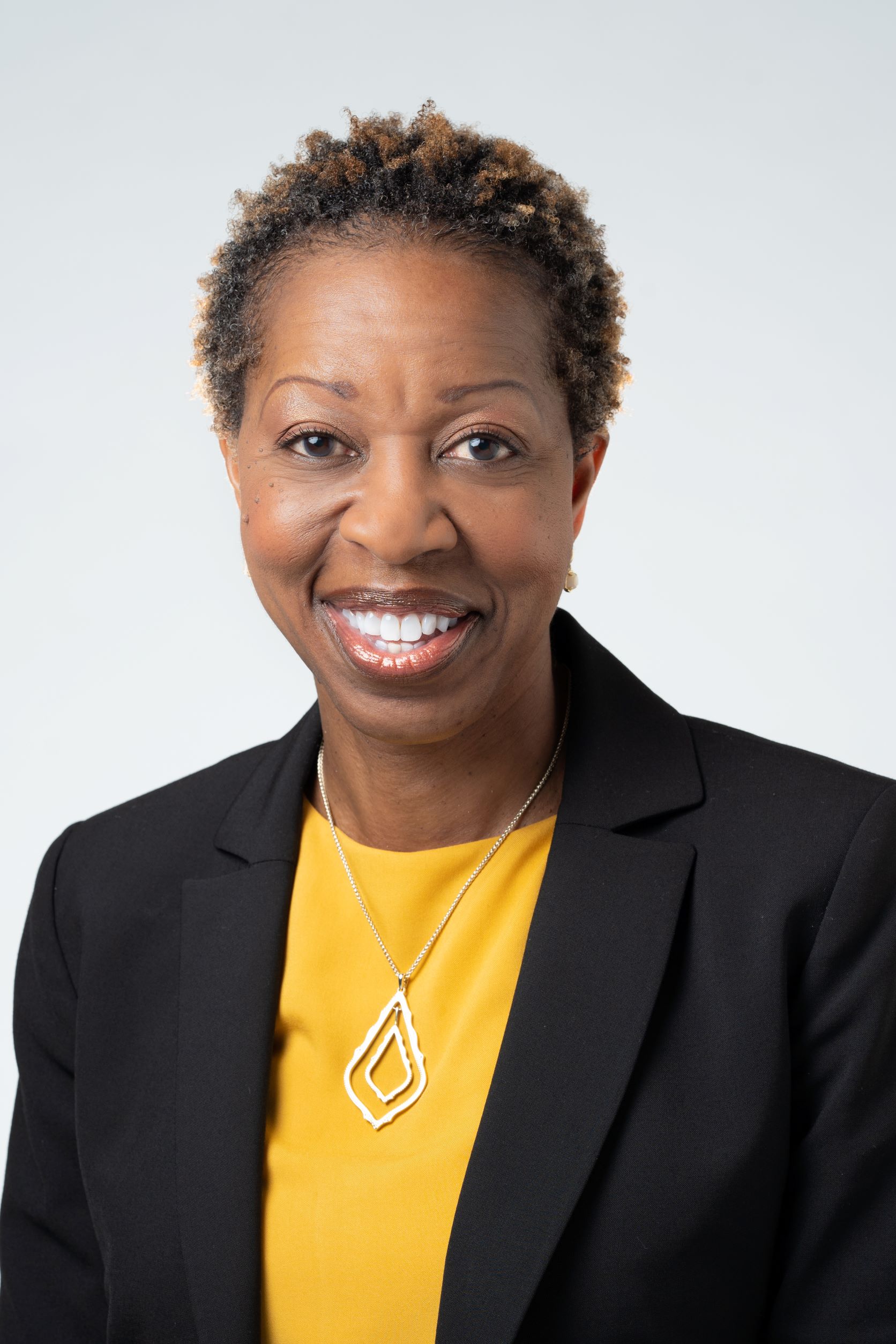
UMBC welcomes Tanyka M. Barber as vice president for institutional equity and chief diversity officer

UMBC President Valerie Sheares Ashby has appointed Tanyka M. Barber as the university’s inaugural vice president for institutional equity and chief diversity officer. She will officially join the UMBC community on Monday, April 17.

“This role is of critical importance and value to UMBC’s long-held vision for inclusive excellence,” says President Sheares Ashby. “We all will benefit from the exceptional depth and breadth of expertise, along with the strength of commitment that Tanyka will bring to the work.”

Sharing what drew her to the role, Barber notes, “I desired a position at an institution that had a genuine commitment to advancing diversity, equity, and inclusion.” 

“Being a Maryland native,” she says, “I was familiar with UMBC and its stellar academic and research reputation, and as I progressed through the hiring process, the genuine commitment to diversity, equity, and inclusion was evident. That is what confirmed for me that this was a place I wanted to be.”

Public health to civil rights

Barber holds a bachelor’s degree from Morgan State University, a master of health sciences degree from the Johns Hopkins University Bloomberg School of Public Health, and a law degree from the University of Baltimore. 

She joins UMBC from TNG, one of the nation’s largest education-focused law and consulting practices, where she served as partner. TNG serves K-12 schools, colleges and universities, and other organizations, and Barber had the opportunity to work with a wide range of educational institutions nationwide.

Prior to her work with TNG, Barber served as director of diversity and EEO/Title IX coordinator at Morgan State University. There she drafted Morgan State’s first comprehensive policy and procedures to address gender- and sex-based harassment and violence. She also developed and implemented a comprehensive Title IX grievance process and prevention policy, and prioritized initiatives seeking to prevent discrimination and harassment and to increase reporting.

In addition to these roles, Barber has worked as the equal employment opportunity officer for Baltimore County Public Schools, assistant general counsel for the Maryland Commission on Civil Rights, and a law clerk for the Maryland Legal Aid Bureau. Prior to earning her law degree, she also held roles in public health with Morgan State University and the NAACP.

“My background is in health education and policy, and I worked in the public health field for seven years prior to attending law school,” Barber explains. “My intention upon starting law school was to gain a firmer foundation in health policy. However, during my second year of law school I began working at the Maryland Commission on Civil Rights and I was hooked. My passion for advancing civil rights and ensuring equitable access grew from there.” 

National and local leadership

Barber frequently writes about Title IX topics, sharing best practices. She also serves in leadership roles, such as on the advisory board for the Association of Title IX Administrators and on the board of directors for Community Law in Action, a Baltimore-based nonprofit focused on helping young people become leaders and advocates for positive community change.

“It is to UMBC’s great advantage that in this inaugural vice presidential role, we will have a leader whose career has been as a practitioner in both the legal compliance space and the diversity, equity, and inclusion space,” says President Sheares Ashby. “We also will have someone whose personal perspective, including as a first-generation college student and a nontraditional law school student, deeply informs her understanding of this work and the communities she serves.”

Of her own experience, Barber says, “As a college student, I stepped onto campus with no frame of reference for college life beyond what was portrayed on television. Since then, my career path has focused on strategizing, implementing, and enacting change.”

Barber shares, “I want to be a partner and a resource to ensure that UMBC students, faculty, and staff have what they need to navigate the UMBC community and achieve success as they define it. I am eager to engage those already doing this work at UMBC and to bring new voices to the table.”
UMBC chemical engineering students win ChemE Jeopardy national championship

UMBC is again a national champion, now in ChemE Jeopardy. A UMBC student team of chemical engineering majors emerged victorious last weekend at the national competition in Phoenix, Arizona, hosted by the American Institute of Chemical Engineers (AIChE), besting fellow finalists University of Iowa and University of Southern California.

This was a long-sought victory for the team, which won second place in both 2020 and 2021, narrowly missing the title. This ascent is particularly remarkable considering that UMBC only began competing in 2019.

The ChemE Jeopardy competition experience

Members of the 2022 national champion team include Catherine Wraback ’23, president of the UMBC chapter of AIChE; Max Bobbin ’23, vice president of the group; Colin Jones ’25; and Pavan Umashankar ’24. Supporting the team are Jeopardy Chair Taylor DeSilva ‘23, chemical engineering, and AIChE chapter advisor Mariajosé Castellanos, undergraduate program director and principal lecturer in chemical biochemical, and environmental engineering (CBEE).

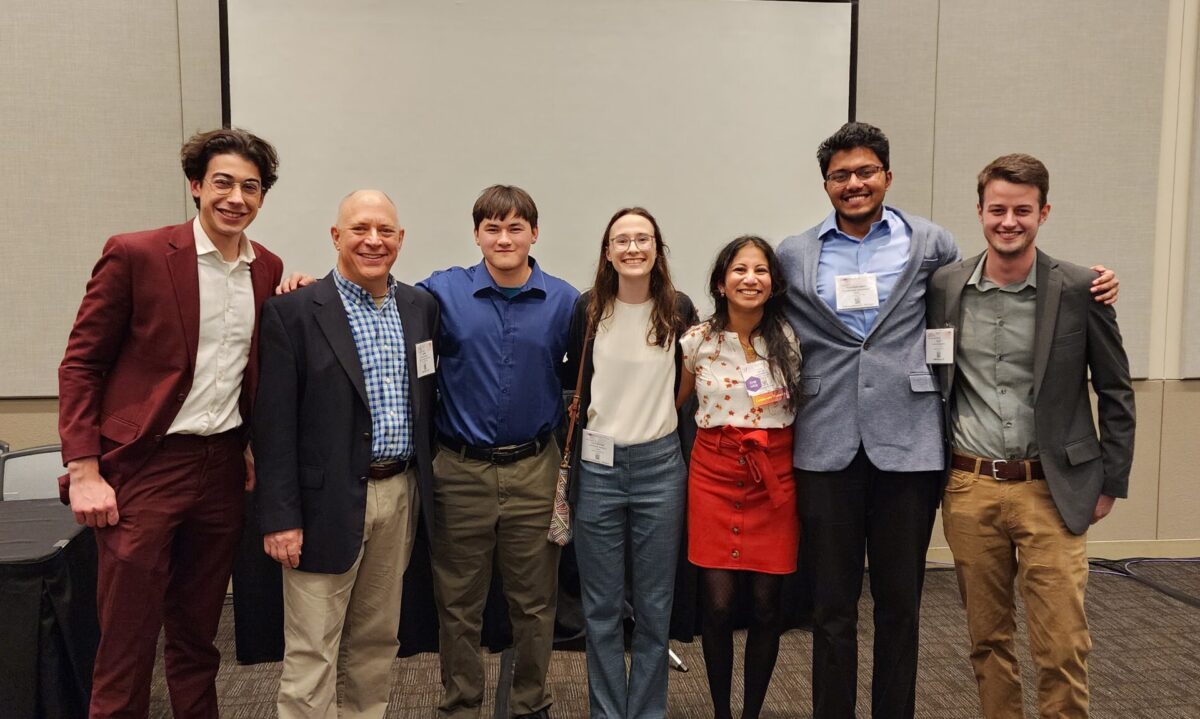
Seven smiling people in professional clothing pose for a portrait in a conference room.
UMBC’s Chemical Engineering Jeopardy National Championship team and supporters (l-r): Max Bobbin, CBEE Professor and Chair Mark Marten, Colin Jones, Catherine Wraback, Lecturer Neha Raikar (team advisor), Pavan Umashankar, and Alex Von Gunten ’20, chemical engineering (prior team member). (Image courtesy of CBEE)

“This was my first time attending the national competition,” says Wraback. “Walking into the room and seeing three tables set-up (one for each team) with all the buzzers and scratch paper and pencil, was an unparalleled feeling.” Wraback explains that each competition board consists of six categories, drawing from core engineering courses (such as thermodynamics and heat and mass transfer), general science and math (such as organic chemistry and linear algebra), and general knowledge.

“You can feel the energy in the room with the other teams and it is contagious,” she says. In particular, she appreciated the support her team had in the packed competition room, from UMBC faculty to students she had met at the conference who came with their classmates to cheer for the team. 

And UMBC students who couldn’t join them in Phoenix were supporting them through well wishes in their Discord server. “It made us feel supported and empowered,” says Wraback. 

Road to the finals

“The students practiced extensively in preparation for the finals,” says team advisor Neha Raikar, lecturer in CBEE. This included not just studying technical content, but also building trust, bonding as a team, and prioritizing communication with each other.

“The team is well-balanced,” Raikar notes. “Members range from second-year students to seniors, representing all three CBEE tracks: traditional, biotechnology and bioengineering, and environmental engineering and sustainability. They play to each other’s strengths.”

Wraback agrees, sharing, “The most challenging part of being on the team has been understanding that it is okay not to know everything. I never want to let any of my team members down, but I also know that we all have our unique strengths, which overall makes us an incredibly strong team.”

That team’s sense of connection came through in the final round of competition. “As the answers were revealed, we found out we were the only team to get the question right so it really came down to the wagers we put,” Wraback recalls. 

“I remember grabbing the hands of my teammates as we waited for the wagers to be revealed,” she says. “In an instant we saw the final scores and that we won by 200 points—such a close game. We all cheered and screamed and were just in absolute shock. It was so exciting, especially since we have been working so hard for this for so long.”

Making a name for themselves

On the path to victory, UMBC at one point bested Virginia Tech with a score of 7,100 to 63. “We compete against top schools at both regional and national levels, which shows the strength of UMBC’s chemical engineering program and our students’ fighting spirit,” says Raikar. “Even though we are a relatively small department, we pose a challenge to bigger schools.” 

That’s in large part thanks to UMBC’s supportive community, says Wraback, who, after graduation, will help develop next-generation flight technology and aerospace systems at GE Aerospace, while also pursuing a master’s degree in materials science and engineering. She notes, “I truly believe that behind every successful person and team there is a community that is lifting them up and supporting them.”

In just a few years of national competition, the team has already made a name for itself. The competition’s organizing committee projected UMBC to be a finalist, and other universities are now reaching out to collaborate.

UMBC Pres. Valerie Sheares Ashby named 2022 Technologist of the Year

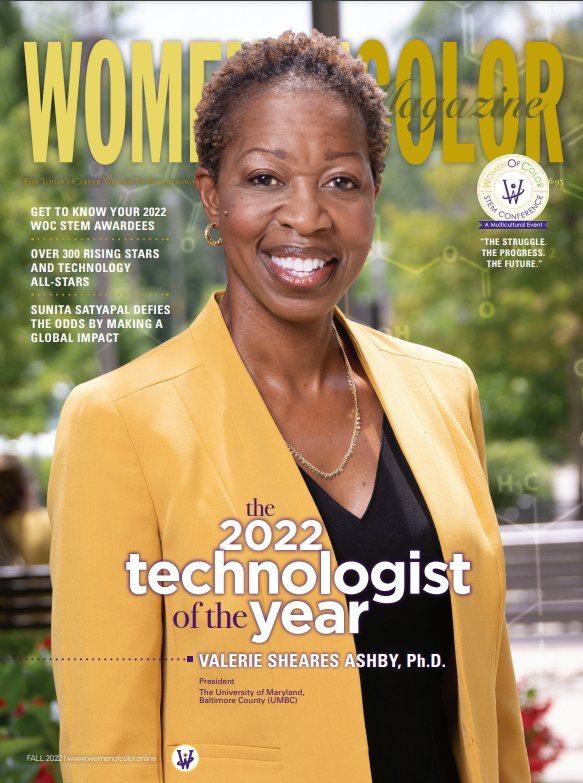
Women of Color Magazine has named UMBC President Valerie Sheares Ashby 2022 Technologist of the Year. Sheares Ashby celebrated the honor surrounded by joyful UMBC students at the Women of Color STEM DTX Conference in Detroit earlier this month. The annual event is designed to connect members of the STEM community at all career stages and to support the continued advancement of diversity in the STEM workforce.

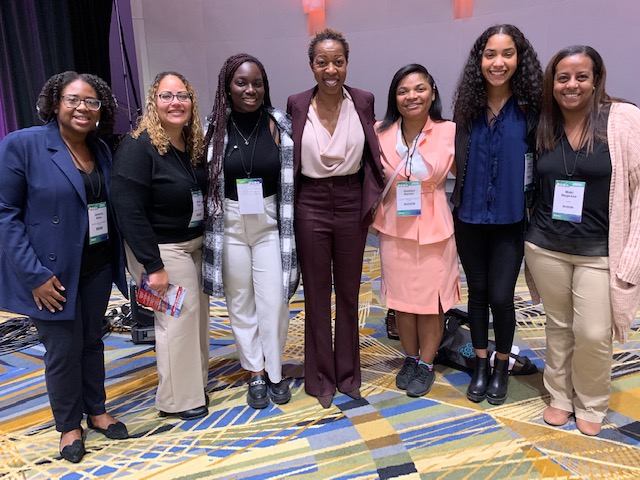
Seven women wearing professional clothing stand together at a conference
Several UMBC attendees at the Women of Color STEM DTX Conference (l-r): Janerra Allen, Meyerhoff Graduate Fellow; Mitsue Wiggs, assistant director of the Meyerhoff Scholars Program; Ngozi Emezienna ’25, M33, biological sciences; President Sheares Ashby; Natolya Barber ’23, M31, computer science; Samara Pyform ’24, M32, environmental science; Maki Negesse, Meyerhoff Graduate Fellow. (Image courtesy of Wiggs/UMBC)

Sheares Ashby’s award is highlighted on the cover of Women of Color Magazine this month in a special feature that explores her life and career. The article begins with her love of math and science while growing up in a small town in North Carolina and details the twists and turns of her college experience at UNC Chapel Hill. She details the joy of her first real chemistry lab experience and the moment she realized, “I made a compound that nobody else had made before.” 
Magazine cover of smiling woman in black dress and yellow blazer. Cover reads "The 2022 Technologist of the Year Valerie Sheares Ashby, Ph.D."
Women of Color Magazine cover featuring Pres. Valerie Sheares Ashby.

Mentorship is central to Sheares Ashby’s approach as an educator and leader, and the article recognizes several mentors who shaped her experience. She recalls Henry Frierson as the first mentor who encouraged her to get a Ph.D. and Joseph DeSimone, her Ph.D. supervisor, as “the person who told me I could be a faculty member. Not just a scientist, but a faculty member.” 

She highlights Holden Thorp, who served as provost and chancellor at UNC Chapel Hill, as the person who helped her transition from faculty to administrator and Freeman Hrabowski, UMBC president emeritus, who predicted that someday she would be a university president.

Vision and values

The feature article also emphasizes the value that Sheares Ashby places on talking openly about the challenges of academia, and how that openness has helped her become an effective teacher, mentor, and scholar.

“I don’t know how many times I’ve given workshops on imposter syndrome, because I had it until I was 40,” she says in the magazine. “If you struggle and use it to help other people who are struggling…that’s your superpower because there’s nothing like authenticity.”

Sheares Ashby often speaks about the connection she feels with UMBC’s vision. Describing her thoughts on UMBC’s future, she shares, “There’s no change of vision needed. The question is, what does that look like in the next decade?”

This university has put a stake in the ground with one of the highest callings, I think, in higher education. It says in the vision that we will redefine excellence in higher education. And they’re going to do it through an inclusive culture, innovative teaching, research across the disciplines, civic engagement, and a focus on social justice and economic prosperity. Who says that and means it? To create a welcoming environment for inquisitive minds from all backgrounds. That is a showstopper to me and why I’m in higher education. For an institution to own that, live in that for 30 years, and achieve what [UMBC has] in this space of excellence through diversity, there is nothing like it in the country.

Portrait of Valerie Sheares Ashby, wearing a gold shirt with a black blazer to represent UMBC.

Valerie Sheares Ashby

UMBC President

Legacy of excellence

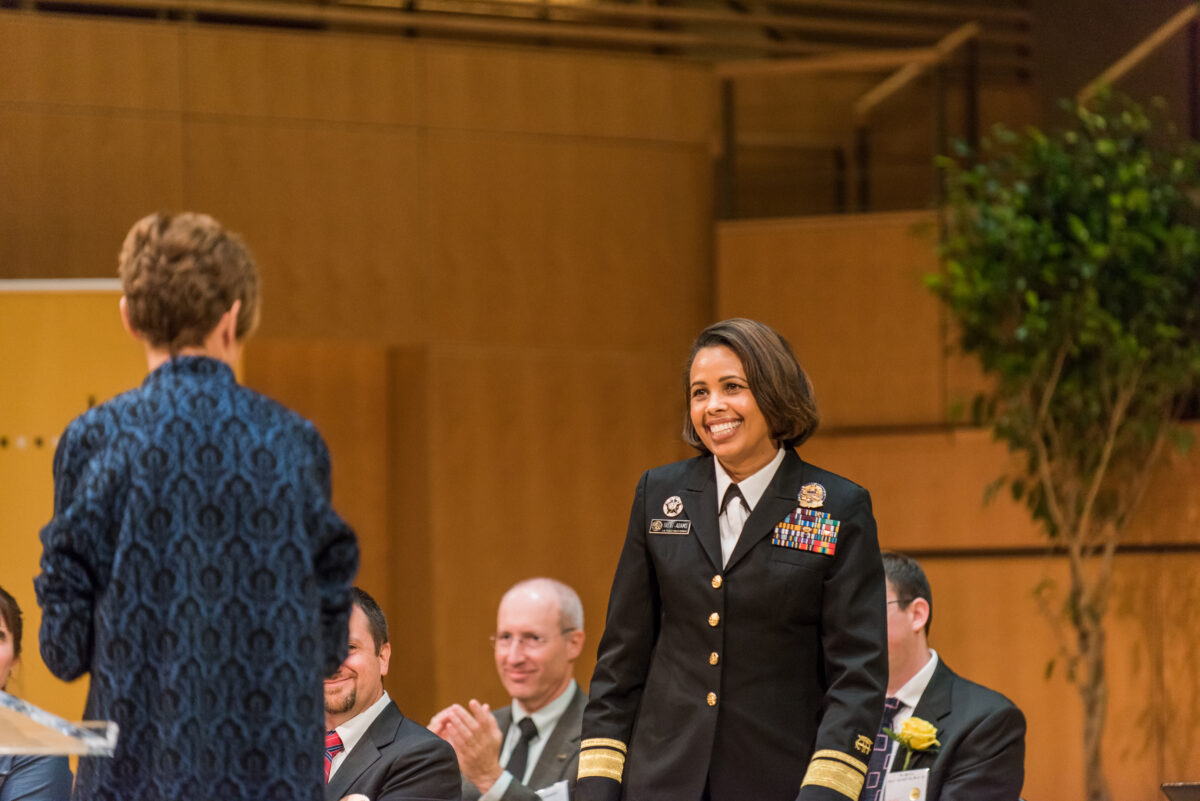
Joining Sheares Ashby as a featured participant at the Women of Color STEM Conference was UMBC alumna retired Rear Admiral Sylvia Trent-Adams, Ph.D. ’06, public policy. 

Woman in high-ranking military attire smiles as she approaches a podium
Sylvia Trent-Adams at UMBC’s 2017 Alumni Awards ceremony. (Marlayna Demond ’11/UMBC)

Trent-Adams previously served as principal deputy assistant secretary for health (2019 – 2020) and deputy surgeon general of the United States (2015 – 2019). She was named UMBC’s Outstanding Alumna in the Social and Behavioral Sciences in 2017 and received the Technologist of the Year Award in 2020. This September, Trent-Adams was named president of the University of North Texas Health Sciences Center at Fort Worth.

UMBC is a 2022 Great College to Work For—the nation’s only R1 university to excel in every category

This week, ModernThink’s Great Colleges to Work For program again recognized UMBC as a top institution nationwide in every measured category, from well-being and shared governance to mission and pride. UMBC is the only R1 university in the nation to achieve this honor, which is based on employee ratings.

“I believe we continue to receive this honor because of our commitment to the development and support of our employees,” says Valerie Thomas, UMBC’s chief human resources officer. “The past two years have been difficult for everyone, but we worked tirelessly together to determine how to best serve our students and how best to make changes in the way we work, focused on continuous improvement.”

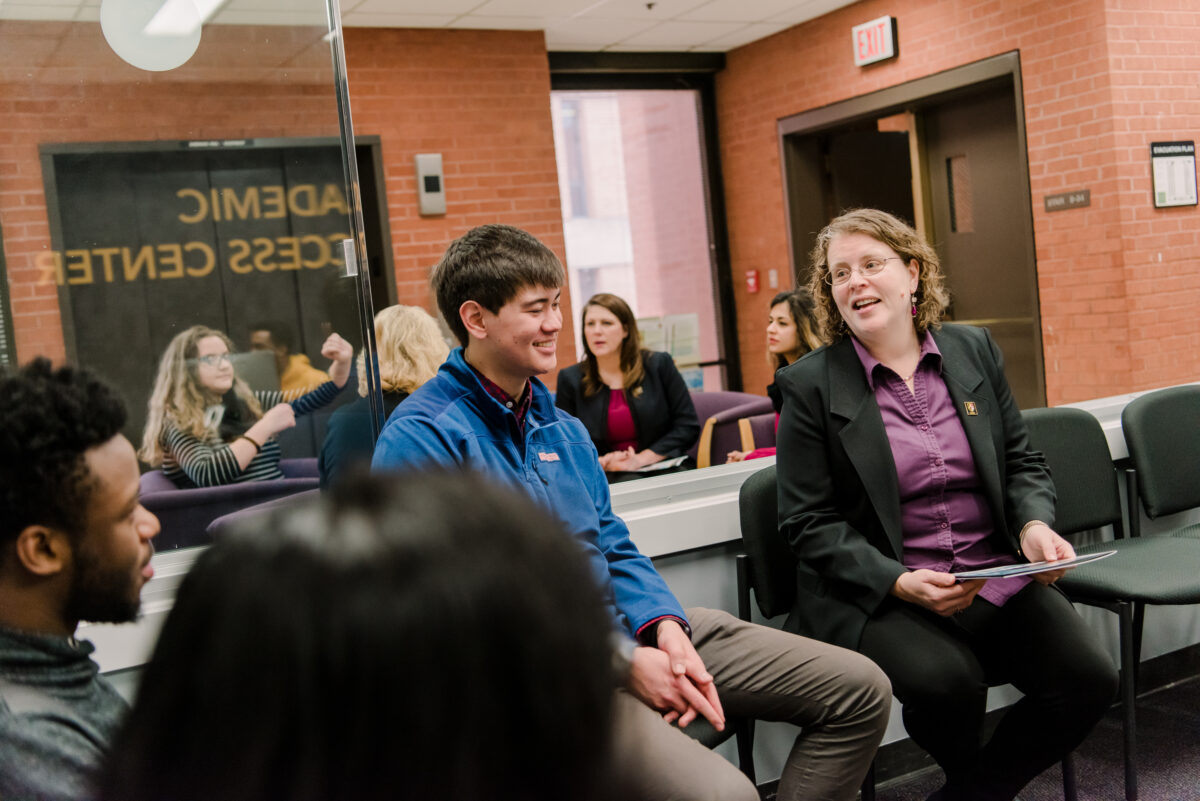
Several people are seated in a room, talking
Staff and students in UMBC’s Academic Success Center, 2019. (Marlayna Demond ’11/UMBC)

Caring community

Published in The Chronicle of Higher Education, the Great Colleges to Work For ratings include 10 categories:

  • Mission & Pride
  • Job Satisfaction & Support
  • Confidence in Senior Leadership
  • Compensation & Benefits
  • Diversity, Inclusion & Belonging
  • Shared Governance
  • Professional Development
  • Faculty Experience
  • Faculty & Staff Well-Being
  • Supervisor/Department Chair Effectiveness

“I am reminded every day of what makes UMBC a great place to work,” says Faculty Senate President Susan McDonough, associate professor of history and vice-chair of the University Steering Committee. 

“I have the privilege to work alongside university leaders and colleagues who care deeply about ideas and their impact on society. I have seen us grow and deepen our commitment to research and discovery as we transformed into an R1 university. And I have watched our students, faculty, and staff face innumerable challenges these past few years and meet them with the compassion, tenacity, and imagination that makes me excited and humbled to be part of this community,” says McDonough. “I look forward to working with Dr. Sheares Ashby, our faculty, and our entire community to keep building an even better UMBC.”

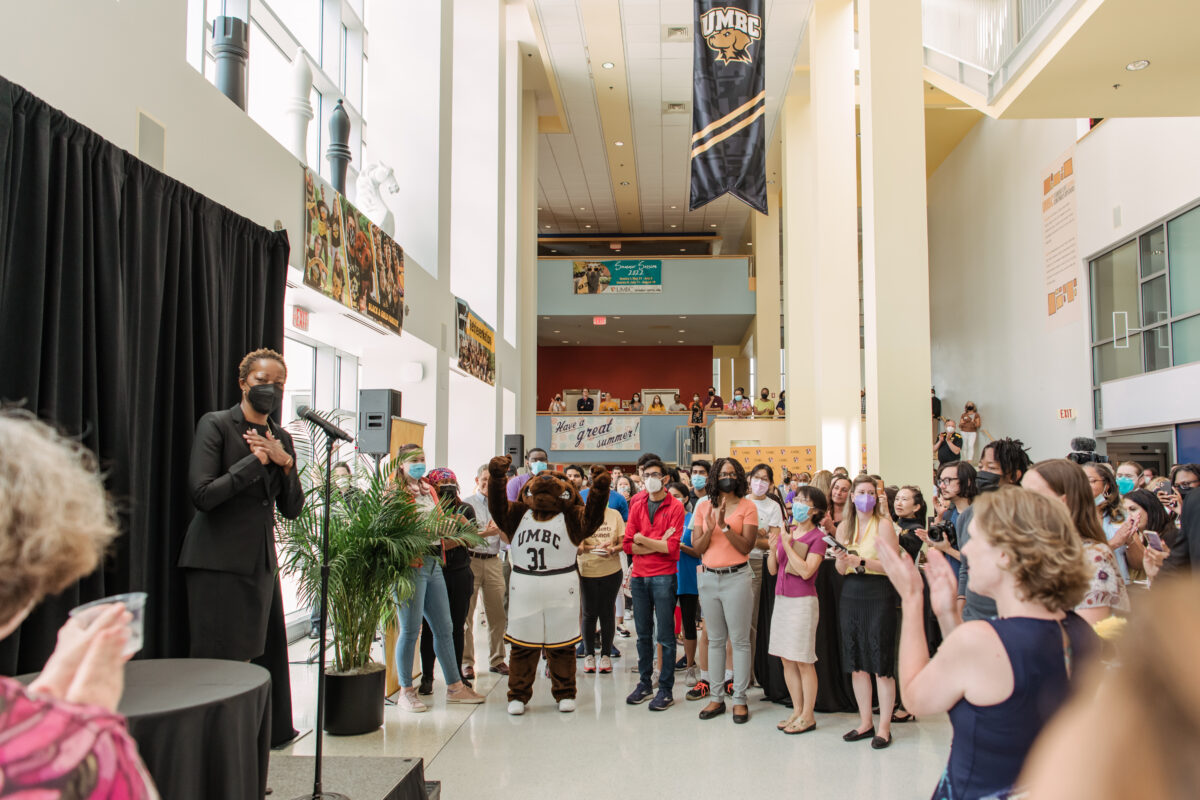
Woman on podium speaks to a smiling crowd.
Valerie Sheares Ashby speaks with faculty, staff, and students on her first day as UMBC president, August 1, 2022. (Marlayna Demond ’11/UMBC)

Leadership and partnership

This theme of excitement for UMBC’s future with President Sheares Ashby, who began her tenure at UMBC in August, is a common thread among UMBC leadership.

“UMBC encourages staff growth and development, while ensuring equity through their focus on inclusion,” says Desiree Stonesifer, president of UMBC’s Non-exempt Staff Senate and executive administrative assistant in financial services, emphasizing a core value long-shared by UMBC and President Sheares Ashby. “As we welcome our new president, we look forward to the new opportunities for growth and experiences while maintaining our strong sense of UMBC family.”

Woman in graduation clothing holds a chocolate Labrador retriever.
Laila Shishineh, director of academic engagement and transition programs and Council of University System Staff past-chair, celebrates earning her Ph.D. on UMBC’s Academic Row with beloved honorary staff member Chip, the campus comfort dog. (Photo by Poulomi Banerjee ’16, M.P.P. ’21)

Jess Wyatt, president of UMBC’s Professional Staff Senate (PSS), chair of the University Steering Committee, and associate director of alumni engagement, notes, “While it’s exciting to see UMBC as a perennial addition to this list, it is even more exciting to see where we will go as we move into a new era of UMBC in partnership with President Sheares Ashby.”

This is UMBC’s 13th year of recognition and 11th year on the Great Colleges Honor Roll.

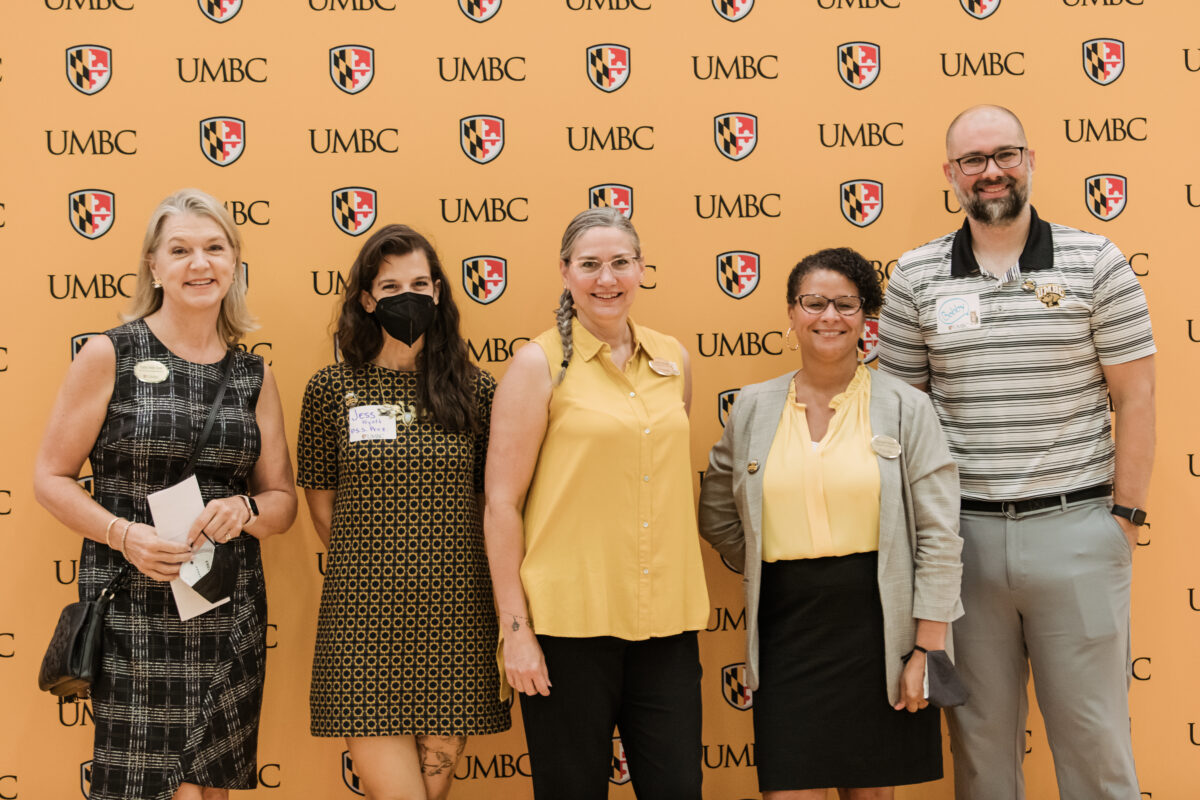
Five adults wearing professional clothing in different black and gold patterns smile in front of a sign reading "UMBC" several times.
Staff from UMBC’s Office of Institutional Advancement at Fall Opening Meeting 2022, including PSS President Jess Wyatt, second from the left (Marlayna Demond ’11/UMBC)

UMBC’s new AAAS Science & Technology Policy Fellows focus on STEM workforce inclusion, youth justice

Erin Lavik, professor of chemical, biochemical, and environmental engineering at UMBC, is an innovator in developing nanoparticles to stop internal bleeding. She’s also hard at work on a very different challenge: building STEM workforce development programs that are more inclusive and equitable.

Lavik and Erika Fountain, assistant professor of psychology, will serve as 2022-23 Science & Technology Policy Fellows (STPF) with the American Association for the Advancement of Science (AAAS), in the prestigious program’s 50th class. 

“AAAS policy fellows have been demonstrating excellence in science policy for the past half-century—defining what it means to be a scientist and engineer in the policymaking realm,” said STPF Director Rashada Alexander. 

The 300 fellows chosen for the 2022-23 class will serve in a range of government offices, working to inform actionable, science-based policies. Lavik will be based in the Advanced Manufacturing Office of the National Institute of Standards and Technology, known as Manufacturing USA. Fountain will be hosted by the American Psychological Association (APA), serving as a Congressional Fellow.

The 2022-23 fellowship class is supported by variety of bodies including the U.S. Government, AAAS, partner societies, and the Gordon and Betty Moore Foundation, with an eye on both the value of this experience for participating fellows and the impact fellows will have throughout their careers.

Inclusive high-tech workforce

“With the CHIPS Act passing, I’ll be focusing on building workforce development programs that are equitable, inclusive, diverse, and accessible,” says Lavik.

“CHIPS” stands for Creating Helpful Incentives to Produce Semiconductors—legislation that will provide nearly $53 billion to support semiconductor production in the U.S., supporting both research and high-tech jobs. The goal of CHIPS, the White House notes, is “to sustain U.S. leadership in the sciences and engineering as the engine for American innovation.” 

Lavik, who is also associate dean for research and faculty development in UMBC’s College of Engineering and Information Technology (COEIT), will play an important role at NIST in shaping the programs that will generate these high-tech jobs, maximizing their benefit. At the same time, she will learn about federal policymaking and implementation first-hand.

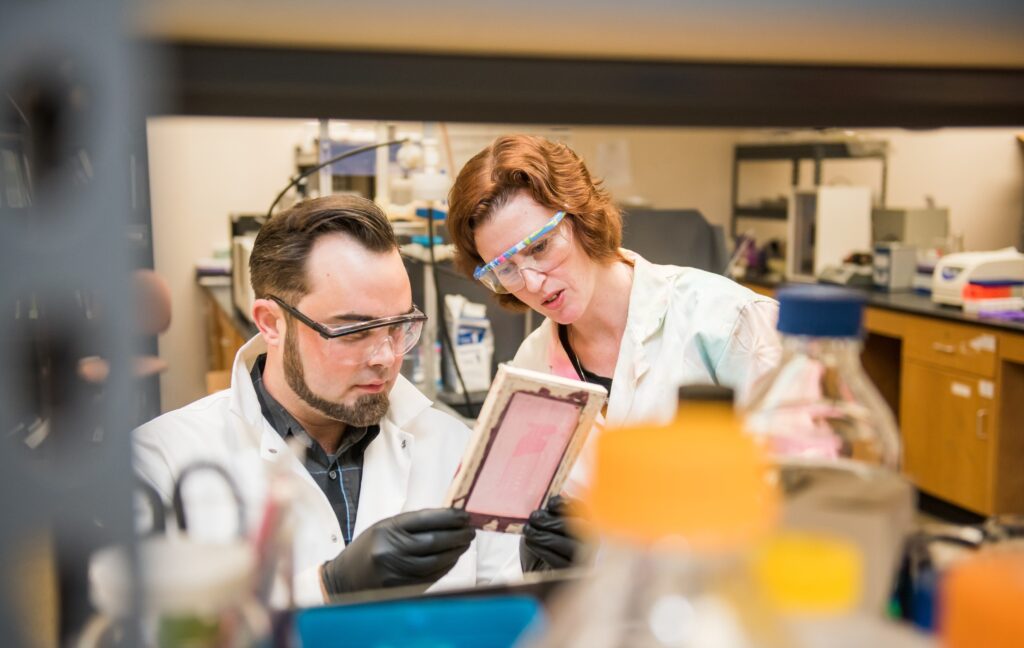
White man with dark beard and white woman with red hair look at a sample in a lab. Both wear lab coats and goggles.
Erin Lavik (right) works in her lab with then-graduate student Adam Day (left) in 2018. Lavik’s lab works to develop new therapies through polymer synthesis and processing, drug delivery, and stem cell biology.

“Dr. Lavik has worked as both a researcher and as an associate dean elevating research and advancing faculty development. This combination has given her a broad insight into product development,” says COEIT Dean Keith J Bowman. “I am certain that expertise will serve her well in supporting advancement of our nation’s manufacturing enterprises. I know from direct experience that Manufacturing USA has changed how we think about and carry out manufacturing, and Dr. Lavik’s strategic and innovative mindset is a great match for this opportunity.”

Research-based youth justice policy

Portrait of smiling woman with shoulder-length brown hair and collared shirt (Science and Technology Policy Fellow Erika Fountain)
Erika Fountain (Image courtesy of Fountain)

Fountain leads UMBC’s interdisciplinary Youth Justice Lab, which focuses on the intersection of adolescent development and the legal system, combining psychology, law, and policy. Her research focuses on how adolescents and their families navigate the justice system, with the goal of developing evidence-based youth justice policy. She and her team explore how youth experience legal decision making, court processes, and working with attorneys.

Fountain’s APA Congressional Fellowship is specifically designed for psychologists seeking unique public policy learning experiences to prepare them for careers connecting with and impacting the federal government. She has already provided scientific testimony to Maryland legislators considering changes to policies involving youth justice—from confidentiality of records to legal protections in youth interrogation—and looks forward to working at the federal level.

“This fellowship gives scientists an opportunity to learn about the policy process and ultimately inform work being done to create and implement policies,” says Fountain. “As someone who has been conducting research on youth justice and justice policy for years, I am thrilled to be able to step into this role and work directly with policy makers to inform policies that benefit youth and their families.”

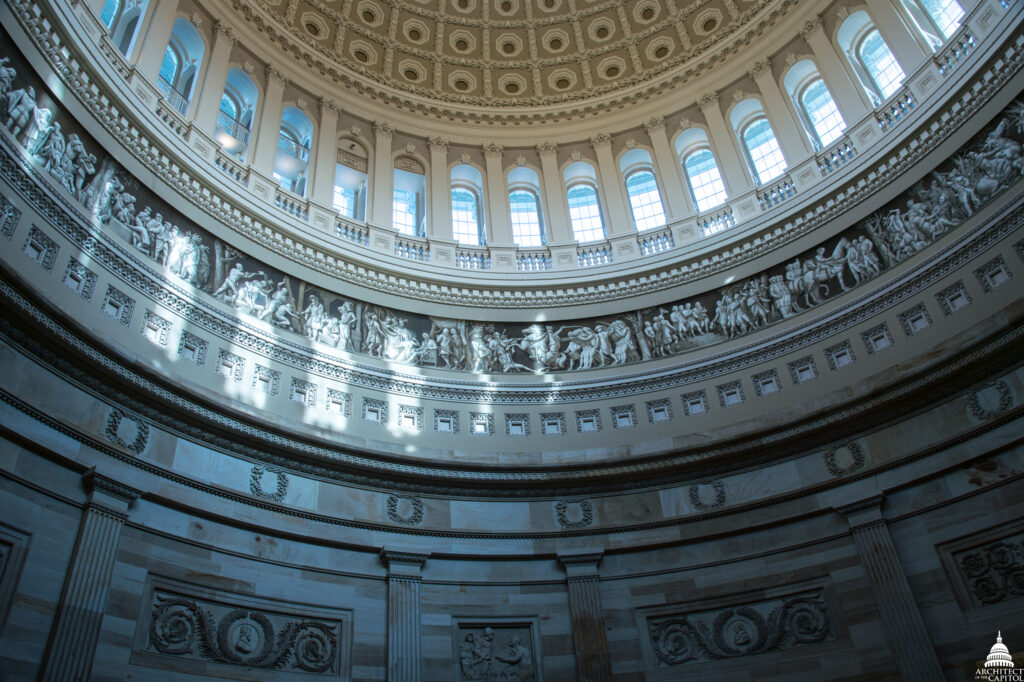
Interior view of the U.S. Capitol Rotuna
U.S. Capitol Rotunda interior. (Image courtesy of the Architect of the Capitol)

“In awarding Dr. Fountain this fellowship, APA and AAAS have recognized the high quality and impact of her scholarship and policy work to date,” says Anne E. Brodsky, professor and chair of psychology. “Through this high-level experience, she’ll gain valuable expertise that will further advance her contributions to our mission: elevating our students and surrounding communities through important and socially relevant applied scholarship.”

UMBC’s Anupam Joshi, cybersecurity innovator, to expand leadership impact as 2022–23 ACE Fellow

Anupam Joshi, a professor focused on both high-impact computing research and expanding access to computer science and cybersecurity education, has been named a 2022–23 American Council on Education (ACE) Fellow.

Joshi is the Oros Family Professor and chair of computer science and electrical engineering at UMBC and director of UMBC’s Center for Cybersecurity. He will spend the coming academic year with University System of Maryland (USM) leaders, shadowing both USM Chancellor Jay A. Perman and Bruce Jarrell, president of the University of Maryland, Baltimore (UMB). 

UMBC has a strong history of leaders participating in the ACE Fellows program, an intensive mentorship program that has prepared faculty, staff, and administrators for senior positions in college and university leadership since it began in 1965. More than 80 percent of the program’s 2,500 past Fellows have gone on to serve as chief executive officers, chief academic officers, other cabinet-level positions, or deans following their fellowship.

“The ACE Fellows program embodies ACE’s goal of enriching the capacity of agile leaders to problem-solve and innovate, and it fuels the expansion of a talented and diverse higher education leadership pipeline,” said ACE President Ted Mitchell. “Fellows continue to excel in prominent leadership roles, and the potential of this new cohort to bring strong leadership to institutions across America greatly excites me.”

Focus on innovating institutions

Following a rigorous application process, ACE selected 46 Fellows this year from colleges and universities across the United States. Throughout the year, these Fellows will observe and work with senior leaders at their host institution, attend decision-making meetings, and focus on issues of interest. They will also conduct projects of pressing concern for their home institutions, with the goal of returning after their fellowship year prepared to guide positive change.

“I am thrilled and honored to be mentored by two stalwarts of higher education in Chancellor Perman and President Jarrell,” Joshi says. “I look forward to learning from these leaders and working together to make a difference for the students in USM universities. I thank President Emeritus Hrabowski, President Sheares Ashby, and Provost Rous at UMBC for nominating me for this opportunity and their support.”

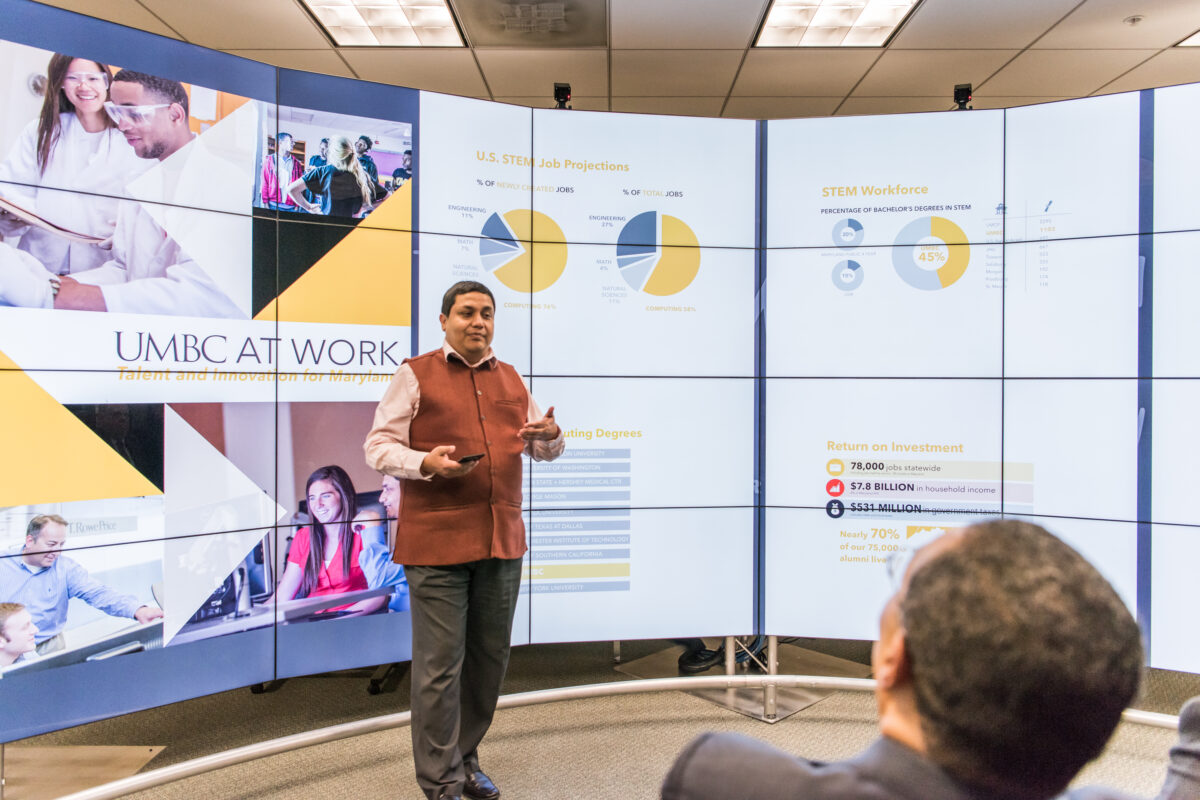
Man in professional attire (Anupam Joshi) presents information that is shown on a very large screen behind him. The screen reads, "UMBC at Work."
Anupam Joshi presents UMBC’s economic impact metrics and workforce data to Maryland state leaders. (Marlayna Demond ’11/UMBC)

Leadership trajectory

Joshi obtained a B.Tech degree from the Indian Institute of Technology (IIT) Delhi in 1989, and a master’s and Ph.D. from Purdue University in 1991 and 1993, respectively. He has published more than 275 technical papers, has been granted nine patents and obtained research support from a variety of federal and industrial sources. In 2014 he was named a Fellow of the Institute of Electrical and Electronics Engineers, or IEEE.

As chair, Joshi leads one of UMBC’s largest departments. There he has overseen a near doubling of student enrollment at the graduate level and a 50% growth rate at the undergraduate level, accompanied by an increase in student body diversity. 

He has worked with partners in the UMBC Office of Institutional Advancement to raise funds supporting research from such industry partners as Northrop Grumman, GE, and Cisco. As a result of these efforts and collaboration with Jack Suess, UMBC’s chief information officer and vice president of information technology, the state recently announced the creation of a Maryland Institute for Innovative Computing at UMBC

Several people in professional attire sit at tables in a room. Focus is on one man who is smiling.
Anupam Joshi celebrates with colleagues at an event for UMBC faculty named fellows of professional societies. (Marlayna Demond ’11/UMBC)

Joshi directs the Center for Cybersecurity, which brings together scholarship and research in cybersecurity from computer science, information systems, social sciences, humanities, public policy, and natural sciences. In this role, he serves on the Maryland Cybersecurity Council

Additionally, Joshi directs UMBC’s Cyber Scholars Program, a joint effort between the Center for Cybersecurity and UMBC’s Center for Women in Technology. This program is focused on supporting a diverse next generation of leaders in cybersecurity and computing.

At the conclusion of the fellowship year, Joshi will return to these leadership roles with new knowledge and skills to expand UMBC’s work in innovative ways, supported by a network of emerging and longstanding university leaders across the nation.


This UMBC News story draws from an USM press release (8/31/2022). Learn more about ACE through stories on UMBC’s prior fellows, such as Tim Nohe, visual arts; Kate Tracy M.A. ‘01, Ph.D. ‘03, psychology; Sarah Shin, education; and Anne Brodsky, psychology, among others. UMBC President Emeritus Freeman Hrabowski currently serves as the inaugural ACE Centennial Fellow.

Chronicle report on “new era” of inclusive administration highlights UMBC leaders

In the newly-released Chronicle of Higher Education report “Diverse Leadership for a New Era,” Valerie Sheares Ashby shares a powerful story of mentorship. Years ago, when Sheares Ashby was a professor of chemistry at University of North Carolina at Chapel Hill, she came to UMBC for the first time to learn about the Meyerhoff Scholars Program. After meeting Sheares Ashby and seeing how others responded to her leadership, even in those early days, UMBC President Freeman A. Hrabowski turned to her and said, “You’re going to be a president.” 

It was the same prediction that Hrabowski’s predecessor, Michael K. Hooker, made to him years before. For Sheares Ashby it will become a reality on August 1 when she begins as UMBC’s next president

Positive impact

Like Hrabowski three decades before her, Sheares Ashby wasn’t sure what to make of the idea at first, but the comment inspired her to think in new ways about a leadership career. She loved teaching and says, to this day, “I am a teacher at heart.” But she also came to see how she could positively affect the lives of more students through university leadership.

As her career progressed, she assembled a team of mentors, including former UNC-Chapel Hill Chancellor Holden Thorp, who is now editor-in-chief of Science. Much of the new Chronicle report focuses on the essential role of mentors in supporting leaders, particularly from underrepresented groups. 

Two adults in black jackets (past and future UMBC leaders) are in a crowd. They are in focus while others are blurred.
Dr. Valerie Sheares Ashby and Dr. Freeman Hrabowski at the RetriEVER Empowered campus event, April 2022.

Advocacy and community

Beyond mentors, President Hrabowski notes in the report, are champions. “A champion will knock down doors for you,” he says. “When people tell you no, the champion will say, ‘We don’t accept no.’ When you want to quit, it takes a champion to say, ‘No, you won’t.’”

Effectively supporting the development of diverse leaders also takes the right community, Hrabowski notes. At UMBC, the diverse faculty members teaching the diverse students are led by a diverse administration, Hrabowski explains. “You put that team together and you see how they approach problems from very different perspectives,” he says, “and it makes for a very rich conversation.”

Woman in black coat shakes hands with another woman while two men look on.
Dr. Valerie Sheares Ashby (center) connects with UMBC faculty, staff, and students at the RetriEVER Empowered event, April 2022.

Through these rich conversations, universities can find the best ways to support their students, carry out high-impact research, and foster the ongoing growth of their community members—all essential elements of their mission.


The full report is available through The Chronicle of Higher Education.

UMBC celebrates transfer of Spring Grove Hospital site to support long-term university growth

Governor Larry Hogan visited UMBC on Wednesday, May 18, for a ceremony marking the transfer of the Spring Grove Hospital Center campus to UMBC to support the university’s long-term development. 

The Skylight Room in The Commons room buzzed with energy as guests arrived, including representatives from UMBC, Maryland and Baltimore County government, and the Catonsville and Arbutus communities. 

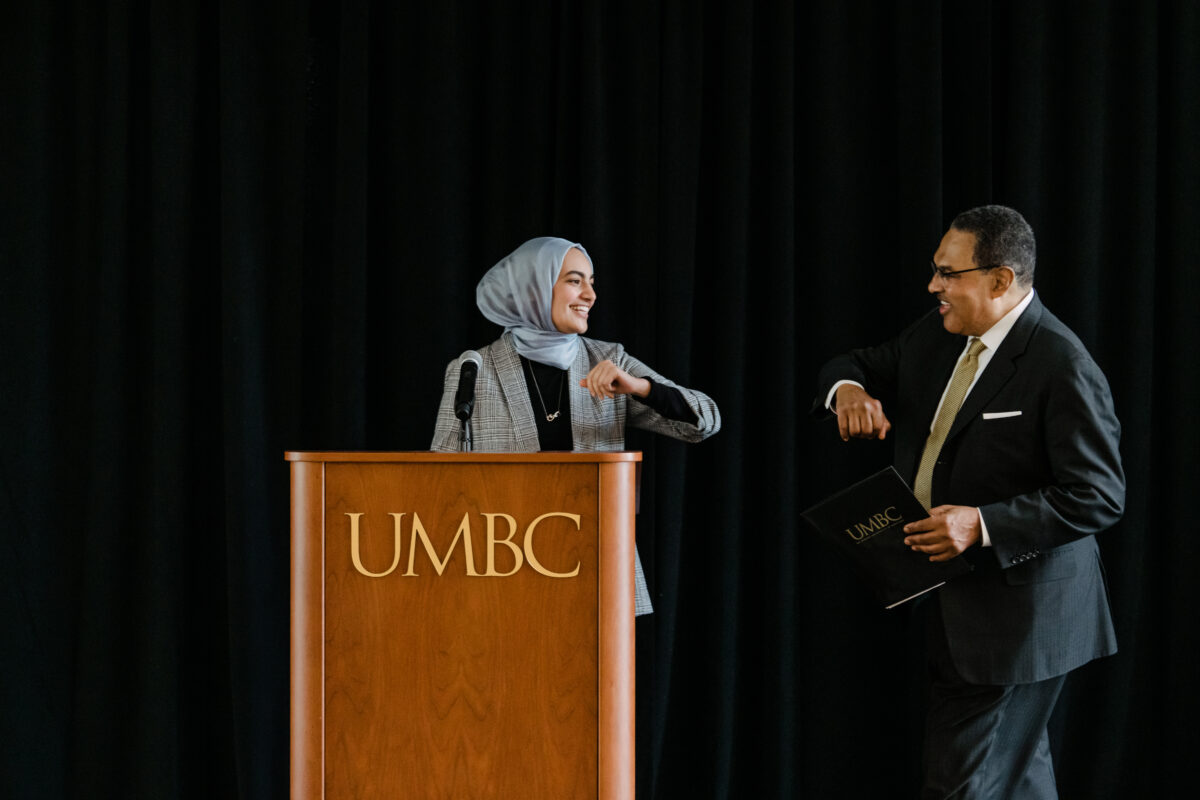
Attention turned to Farah Helal ’24, global studies and political science, newly appointed 2022 University System of Maryland (USM) student regent. Helal took a break from studying for final exams to welcome the group, introducing remarks by Governor Larry Hogan; President Freeman Hrabowski; Maryland House Speaker Adrienne A. Jones ’76, psychology; County Executive John A. Olszewski Jr., Ph.D. ’17, public policy; County Councilman Tom Quirk; and USM Chancellor Jay Perman. 

Young woman in sky blue hijab and sport coat stands behind a podium labeled "UMBC," greeting man in suit
Farah Helal (l) and President Freeman Hrabowski (r) greet each other with a cheerful elbow bump at the Spring Grove Transfer Event, Mary 2022. (Marlayna Demond ’11/UMBC)

Hrabowski called for a round of applause in recognition of UMBC’s community neighbors. He also thanked the governor, Maryland Treasurer Dereck Davis, visiting legislators, and state employees who worked to make this transfer happen. 

“This is about education—it’s about the future of higher education and the future of Maryland,” Hrabowski said. Honoring state leaders for their commitment to elevating the state through this type of partnership, he noted, “When we are talking about investing in education, investing in universities, we are talking about the future of society.”

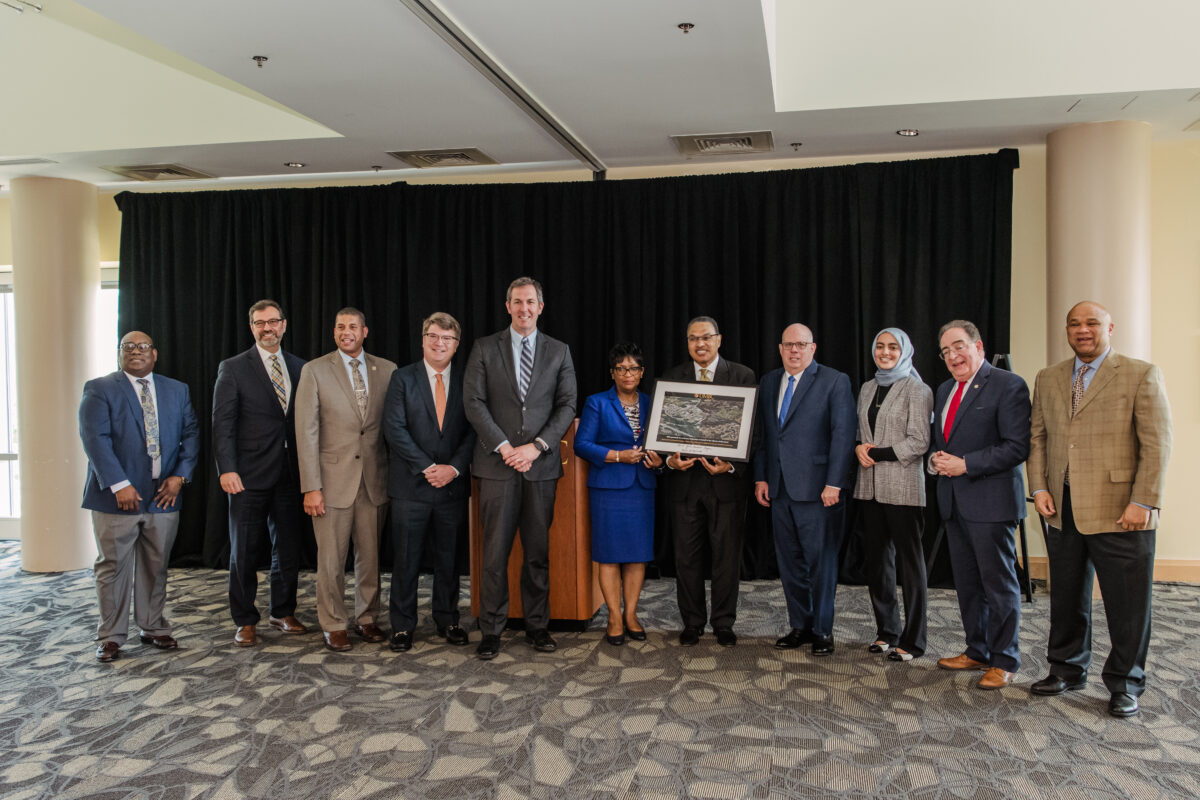
11 people in business attire stand with a framed photograph
Gov. Larry Hogan (fourth from right) with state, local, USM, and UMBC leaders at Spring Grove transfer event, May 2022. (Marlayna Demond ’11/UMBC)

Future footprint

Gov. Hogan stepped up to the lectern and thanked President Hrabowski for his 30 years of UMBC leadership, describing this moment as a testament to his “incredible vision for the future of this esteemed university.” 

Speaking to the value of investing in higher education, he noted, “Maryland is proud to be home to one of the most highly educated workforces in America, and it is due in large part to incredible institutions like UMBC, which has consistently been ranked as one of most innovative universities in the nation and as a leader in global social and economic impact.”

“UMBC is a model for undergraduate education, inclusive talent development, and innovation. I’m very excited that its footprint will now be able to grow even further into the future,” he said. “Now, with the transfer of Spring Grove, together we are ensuring that UMBC will continue to play a meaningful role in advancing education, community development, and economic and workforce development here in Baltimore County and throughout the State of Maryland.”

UMBC does not yet have a specific plan for the site. The campus will engage with the State, the County, community leaders, and other partners during its regular master facilities planning process to envision a future for the Spring Grove property that supports the university’s long-term development and enhances both economic development and quality of life in the Baltimore region and Maryland.

Legacy of thoughtfulness

“Today is an exciting day,” said Speaker Jones. She emphasized this moment as an important beginning. “It is the start of a new opportunity for UMBC, and…community input will be a hallmark of the future of the property.”

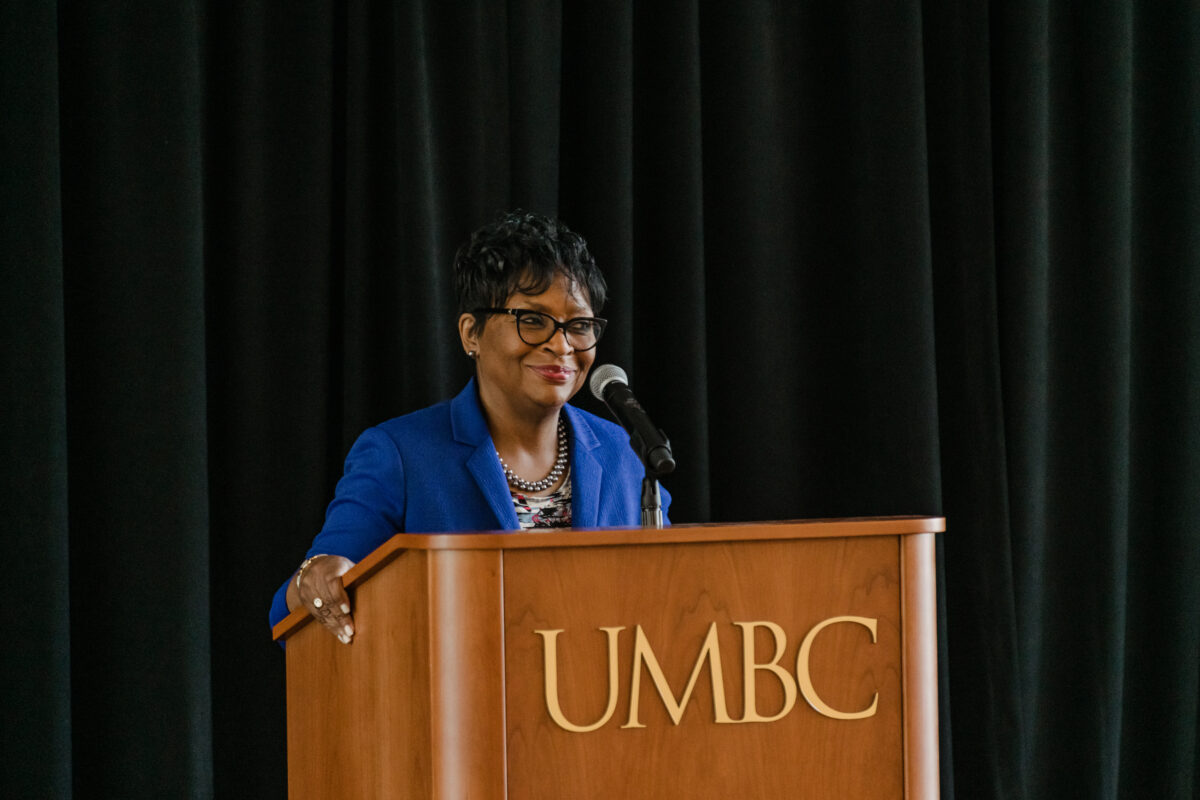
Woman in blue blazer stands behind a podium labeled "UMBC," smiling
Speaker Adrienne Jones at the Spring Grove transfer event, May 2022. (Marlayna Demond ’11/UMBC)

As a fellow alumnus of UMBC, County Executive Olszewski added, “I can’t help but be excited about the future of our students and what this means for our communities…It is also an incredibly exciting time for the community, as we think about meeting the needs and building a robust ecosystem here.”

Reflecting on UMBC as a community partner, he shared, “There is a legacy of intentionality and thoughtfulness and community engagement that permeates this institution and this culture. So I couldn’t be more excited to work with the leaders of UMBC, with Governor Hogan, the Speaker, the Chancellor, and so many others, to really take this vision and make it real in the years ahead.”

Councilman Quirk joined in that excitement for partnering with UMBC, saying, “One thing with certainty is that the community in Arbutus and community in Catonsville strongly support UMBC, its goals, and its mission. It makes a great difference when we have a great community partner.”

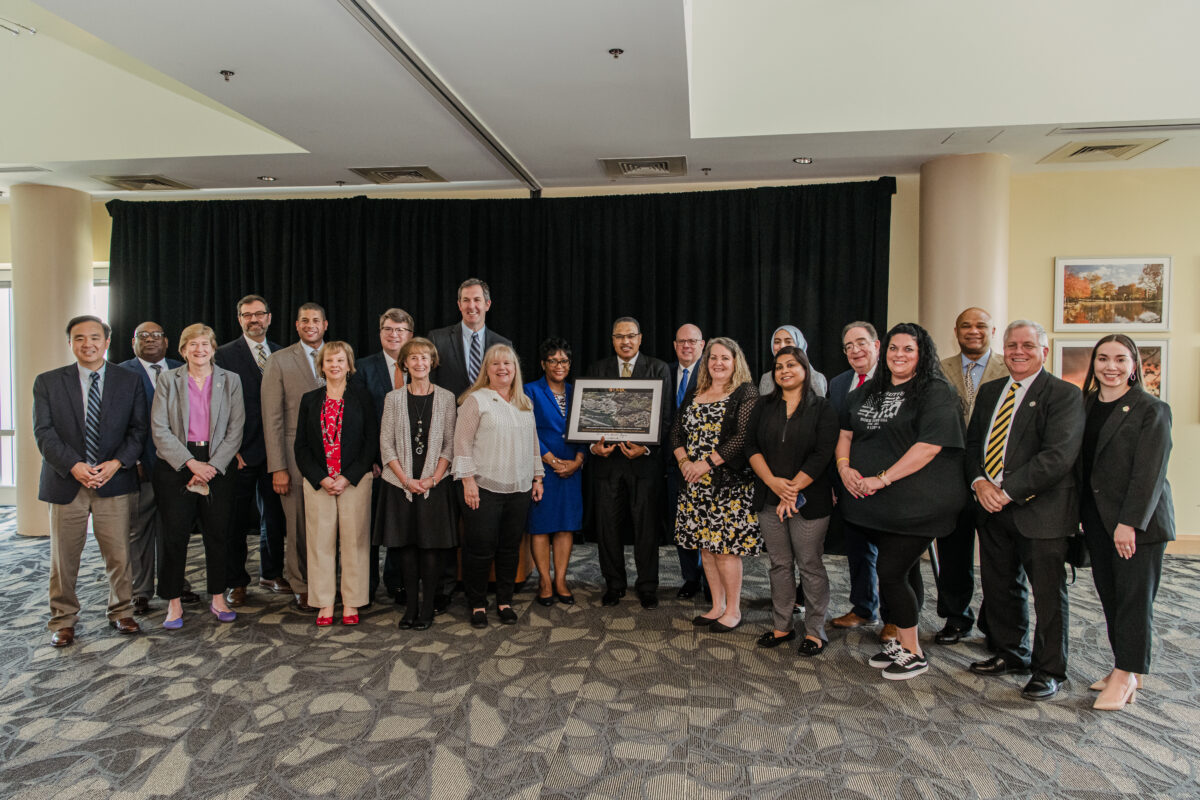
21 adults wearing a mix of professional and everyday clothing stand, with one holding a framed photo.
UMBC Pres. Hrabowski (holding photo) and Gov. Larry Hogan (center, blue tie) with state, local, USM, and UMBC leaders at Spring Grove transfer event, May 2022. (Marlayna Demond ’11/UMBC)

First of many steps

USM Chancellor Perman closed the event by returning to the long-term priorities of the state of Maryland.

“We are lucky to live, learn, and work in a state that values higher education, in a state that has a vision for higher education,” he said. “At the system we serve Maryland together with elected leaders who understand, maybe better than their colleagues anywhere else, what an investment in…public higher education means for a state, for the people of a state, and for the quality of life…we all enjoy, because an investment like this accumulates. It accrues. It comes back to all of us.” 

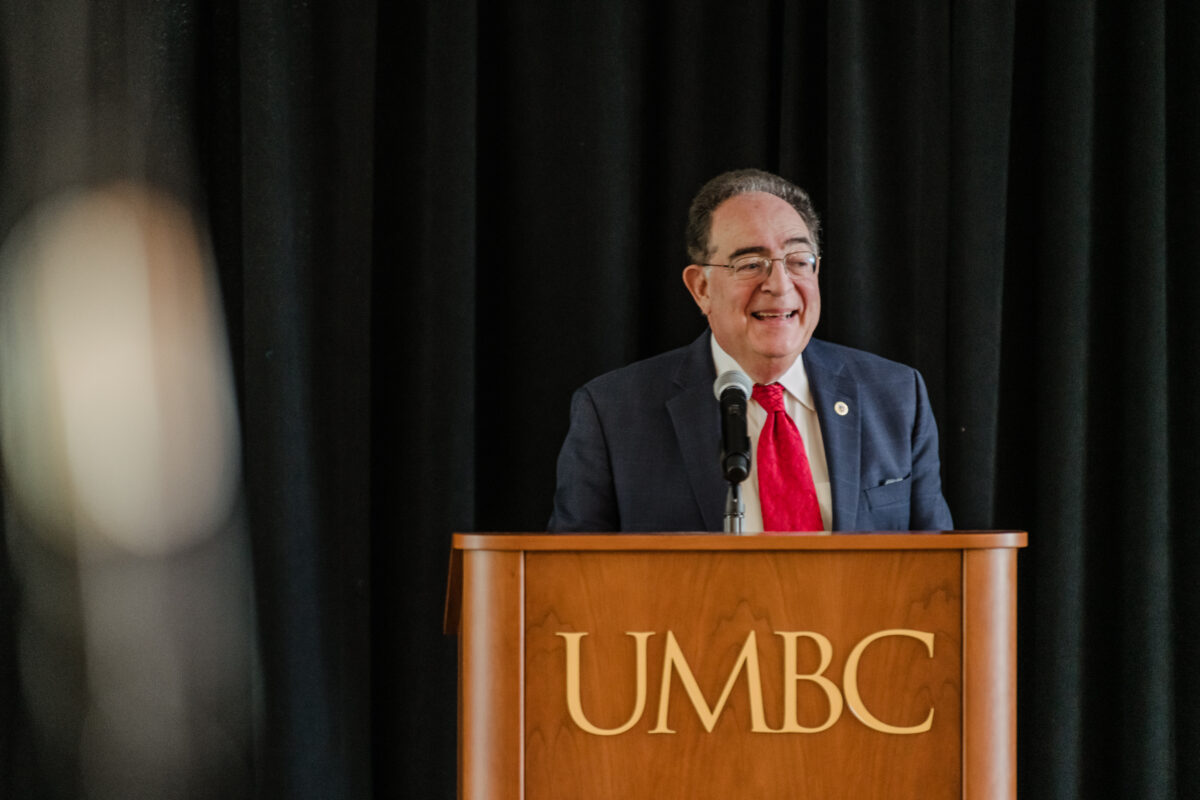
Man in suit and red tie stands behind a podium reading, "UMBC."
USM Chancellor Jay Perman. (Marlayna Demond ’11/UMBC)

“This land expands our capacity—UMBC’s capacity—to serve the public good,” he noted. “That’s why this investment…matters. Because it’s not just an investment in this institution or even its students. It’s truly an investment in every single citizen of this state.” 

“I know that that’s something this university…will never forget, that they are the stewards of land meant to benefit all,” he emphasized. “I’m so proud of what UMBC has accomplished, and I’m prouder still that this is just the beginning.”

Valerie Sheares Ashby named next president of UMBC, arriving from Duke in August 2022

The University System of Maryland (USM) Board of Regents has appointed Valerie Sheares Ashby as the next president of UMBC. She will become UMBC’s sixth chief executive on August 1, 2022, following current UMBC President Freeman A. Hrabowski’s retirement from UMBC. She will be the first woman to serve in this role.

Dr. Valerie Sheares Ashby. Photo by Shaun King, Duke U.

Sheares Ashby will join UMBC from her current position as dean of Duke University’s Trinity College of Arts & Sciences, where she has served since 2015. She received her B.A. and Ph.D degrees in chemistry from the University of North Carolina at Chapel Hill (UNC) and completed postdoctoral research at Universitat Mainz in Germany. She came to Duke from UNC, where she served on the faculty since 2003 and chaired the chemistry department from 2012 to 2015. 

While at UNC, Sheares Ashby served on the university’s Arts & Sciences Foundation Board of Directors and Research Advisory Council, and chaired the College of Arts & Sciences Faculty Diversity Task Force. She also directed UNC’s National Science Foundation (NSF) Alliance for Graduate Education and the Professoriate, working to increase the number of underrepresented students completing doctoral degrees and becoming professors in STEM and social, behavioral, and economic sciences.

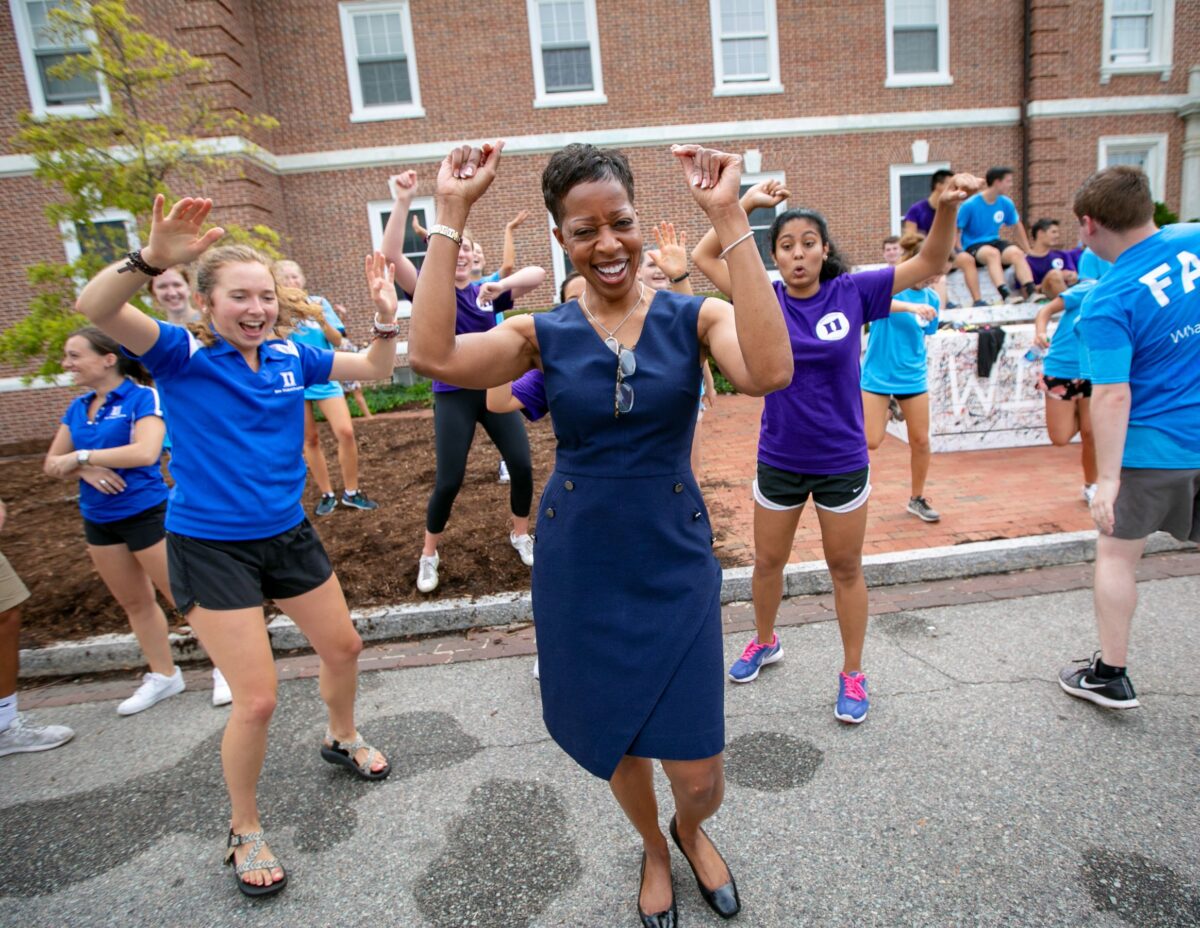
Dr. Valerie Sheares Ashby with students at move-in day. Photo courtesy of Duke University.

“It is an incredible honor to be asked to lead a university that has excelled in so many ways that are essential both nationally and to me personally—particularly in regards to foregrounding inclusive excellence,” Sheares Ashby says.

Selection process

Sheares Ashby was selected as UMBC’s next president through an intensive national search chaired by USM Regent Michelle Gourdine. The USM Board of Regents conducted the search, and a diverse group of UMBC faculty, staff, students, alumni, and community members served on the search committee.

“Dr. Sheares Ashby is clearly the impressive scholar and dynamic leader we need to build on the strong foundation of inclusive excellence at UMBC,” says USM Board Chair Linda R. Gooden. “UMBC is a jewel—nationally and internationally recognized for its innovative teaching and pathbreaking research. All of this success is due to the dedication and hard work of President Hrabowski and his outstanding team. The Board of Regents knows this legacy will be in good hands with Dr. Sheares Ashby.”

“I am grateful to the UMBC presidential search committee, chaired by Regent Michelle Gourdine, for finding such a distinguished leader among so many great candidates,” says Gooden. 

“I’m excited to see how Dr. Sheares Ashby’s vision will shape the next chapter for UMBC,” says USM Chancellor Jay A. Perman. “Without question, she has the experience and the attributes needed to grow UMBC’s academic and research prominence, and she’s steeped in the culture of inclusive excellence that has made the university a national exemplar of access, equity, and achievement. It’s hard to imagine finding a better fit for a school whose future is as bright as UMBC’s.”

Legacy of momentum

President Hrabowski announced his anticipated retirement from UMBC in August 2021. The university has risen to national prominence over his three decades of leadership. In February, the Carnegie Classification of Institutions of Higher Education recognized UMBC as a doctoral university with very high research activity, popularly known as Research 1 (or R1). UMBC is now one of three R1s in Maryland, joining Johns Hopkins University and University of Maryland, College Park.

In January 2020, UMBC received Carnegie Community Engagement Classification in recognition of a deep commitment to strengthening the bonds between campus and community. UMBC also recently joined the University Innovation Alliance, a consortium of public research universities focused on student success. U.S. News consistently ranks UMBC among the nation’s top leading institutions for both innovation and undergraduate teaching. 

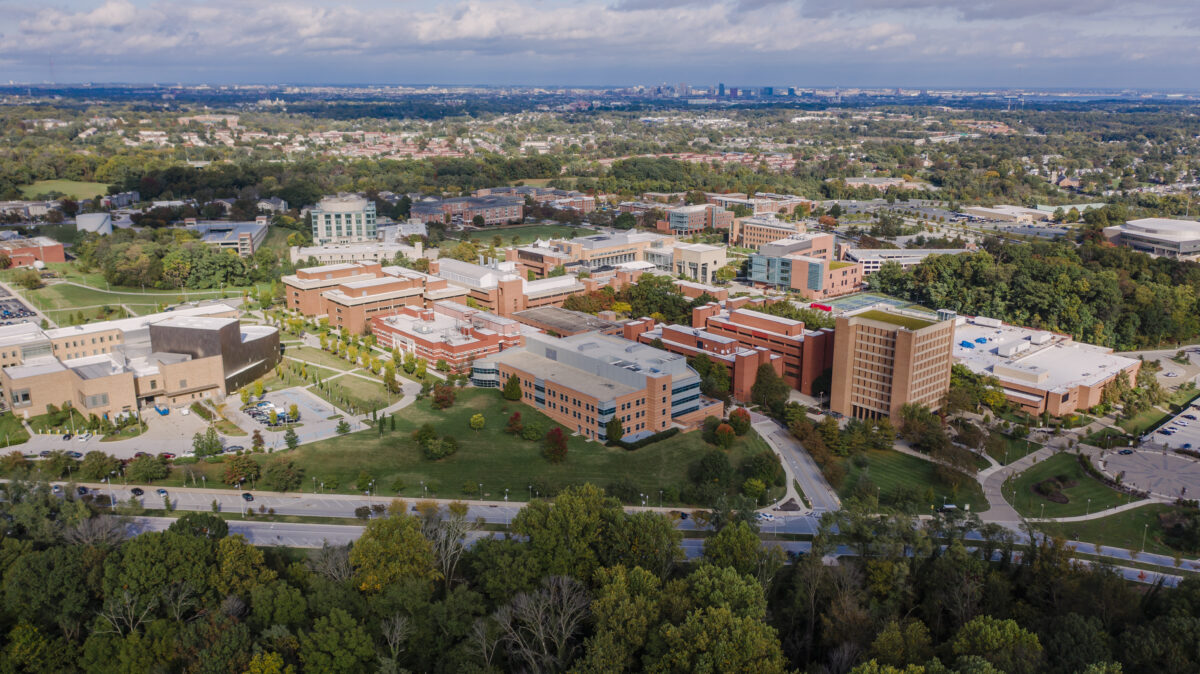
Aerial view of UMBC, with the Baltimore City skyline in the distance.

Together, these honors highlight that at UMBC top-quality education and research go hand-in-hand, and community engagement is essential to both. 

“To follow President Freeman Hrabowski is a distinct privilege, as he has been a role model for so many in higher education over the last 30 years, including myself,” Sheares Ashby says. “His extraordinary leadership and dedication to UMBC ensures that I am arriving at a university that is already performing at a very high level. There is no ceiling on what we can achieve from here.”

Welcoming UMBC’s next president

“My colleagues and I are thrilled to learn of this great news,” says President Hrabowski. “Dr. Sheares Ashby is nationally known as a chemist and as a proven academic leader across the liberal arts and sciences. We are very fortunate to have attracted such a talented visionary executive. She is both brilliant and a wonderful human being.”

Sheares Ashby’s research in synthetic polymer chemistry emphasizes designing and synthesizing materials for biomedical uses. She is the recipient of an NSF Faculty Early Career Development Award, DuPont Young Faculty Award, 3M Young Faculty Award, and numerous other teaching and research awards.

She is also a university leader committed to elevating all disciplines. As dean at Trinity College, she increased the national and global prominence of the humanities and social sciences by investing in faculty- and student-driven strategic areas. And she completed the Duke Forward campaign, exceeding the college’s $435 million fundraising goal by $45 million. This included $200 million raised for financial aid.

Dr. Valerie Sheares Ashby speaks with students. Photo courtesy of Duke University.

Sheares Ashby has shown a deep commitment to supporting students of all backgrounds, elevating public impact research across all fields, prioritizing effective teaching and learning, and creating a welcoming and supportive university community. In these ways, her work closely aligns with UMBC’s values and strategic priorities.

“I have tremendous respect for all the members of the UMBC community,” Sheares Ashby says, “and I am looking forward to working in partnership with the students, faculty, staff, alumni, and friends who are the heart of this institution.”

Featured image: UMBC’s presidential medallion. Photo by Marlayna Demond ’11 for UMBC.

UMBC ascends to the nation’s highest level as a research university

UMBC has officially reached the nation’s highest level of research performance. The Carnegie Classification of Institutions of Higher Education today announced that UMBC has been placed into the category of doctoral universities with very high research activity, popularly known as Research 1 (or R1). UMBC is now ranked as one of only 146 R1 institutions nationally, including 107 public and 39 private universities.

“This is an amazing accomplishment by faculty, staff, and administrative leaders who have built a research culture that nurtures undergraduate and graduate students,” says President Freeman Hrabowski. “This milestone reflects our commitment to excellence across the disciplines, from the humanities to the sciences.”

Carnegie’s research activity index is based on many factors, including productivity in research and creative achievement, graduate education, and research expenditures across a broad range of fields. The university’s classification as an R1 university with comprehensive doctoral programs reflects the strength and diversity of UMBC’s research portfolio.

Reputation for research

UMBC’s research enterprise has grown steadily over the course of decades, ascending to new heights in recent years. Faculty secured more than $200M in new research awards in 2021 alone. 

“This historic moment for our campus is an outcome of long-term strategic priorities and investments in the research and creative achievement community at UMBC—people, facilities, and programs,” says Karl Steiner, vice president for research. “It is essential to recognize that this reflects the work of our entire campus community, including engineering, natural sciences, social sciences, arts, and humanities. UMBC faculty from all fields successfully compete for research funding and national recognition at the highest level.”

Recent examples of high-impact research awards abound.

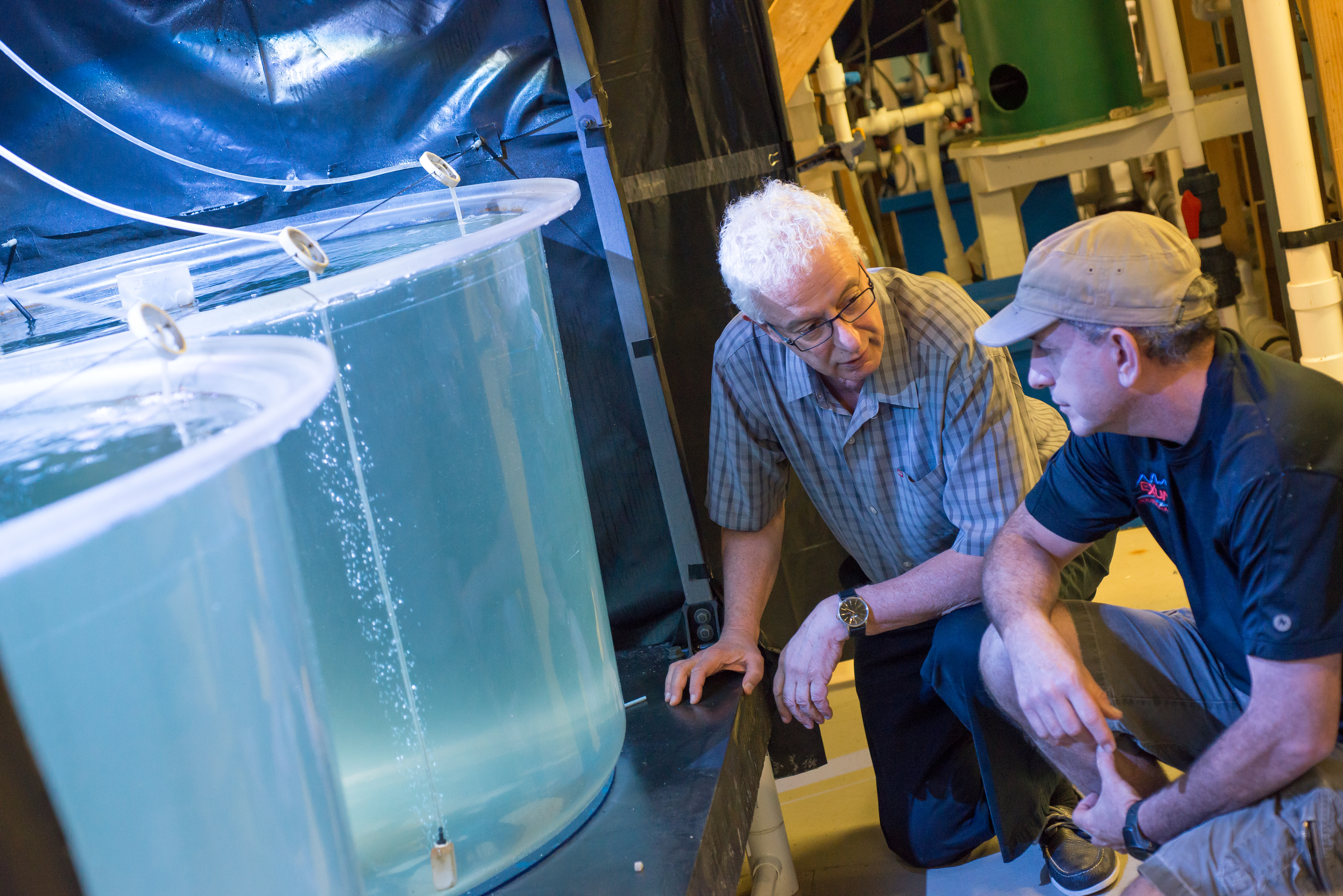
Yonathan Zohar, professor and chair of marine biotechnology, leads a new $10 million award from the U.S. Department of Agriculture to advance large-scale, sustainable land-based aquaculture—raising fish on land. This work has particular resonance at a time of global supply chain issues and sustainability concerns.

Two people kneeling next to fish tanks
Yonathan Zohar (l) and Jorge Gomezjurado (r) at IMET aquaculture research facility in 2016.

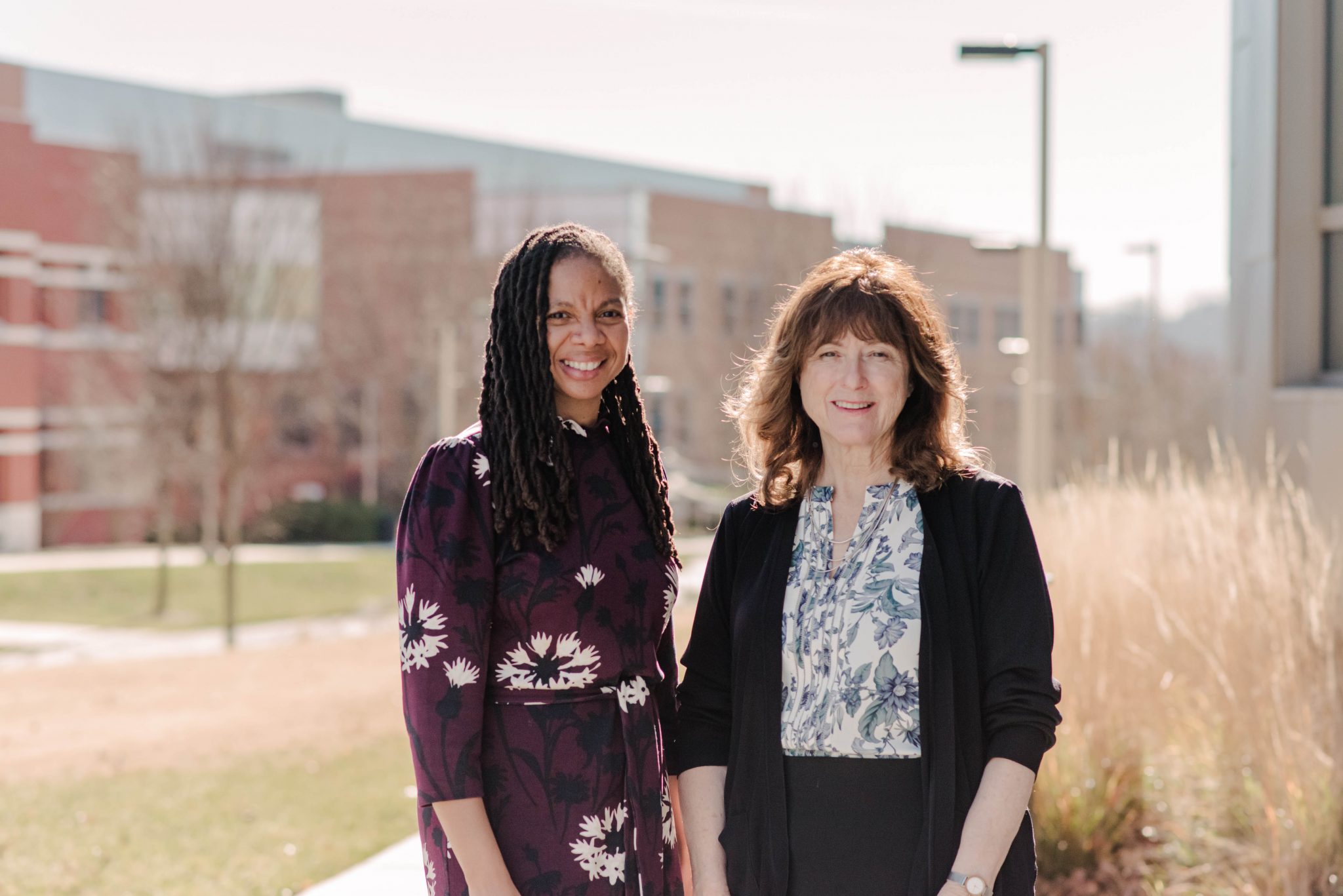
Kimberly Moffitt, interim dean of UMBC’s College of Arts, Humanities, and Social Sciences, is leading a partnership with Morgan State University and the University of Maryland, College Park (UMD) focused on developing a pipeline to higher ed leadership for arts and humanities scholars, particularly faculty from underrepresented groups. Patrice McDermott, vice provost for faculty affairs, is joining Moffitt in leading UMBC’s implementation of the project, supported through $3 million from the Andrew W. Mellon Foundation.

Kimberly Moffitt (l) and Patrice McDermott (r)

UMBC is also partnering with the UMD and the DEVCOM Army Research Lab (ARL) on a $68-million, five-year endeavor, funded by ARL, to strengthen the U.S. Army’s artificial intelligence technology. UMBC’s work on the project is led by Aryya Gangopadhyay, professor of information systems.

Aryya Gangopadhyay

Among UMBC’s many interdisciplinary research initiatives is a new $72 million NASA award, with UMBC leading a national consortium supporting over 120 researchers.

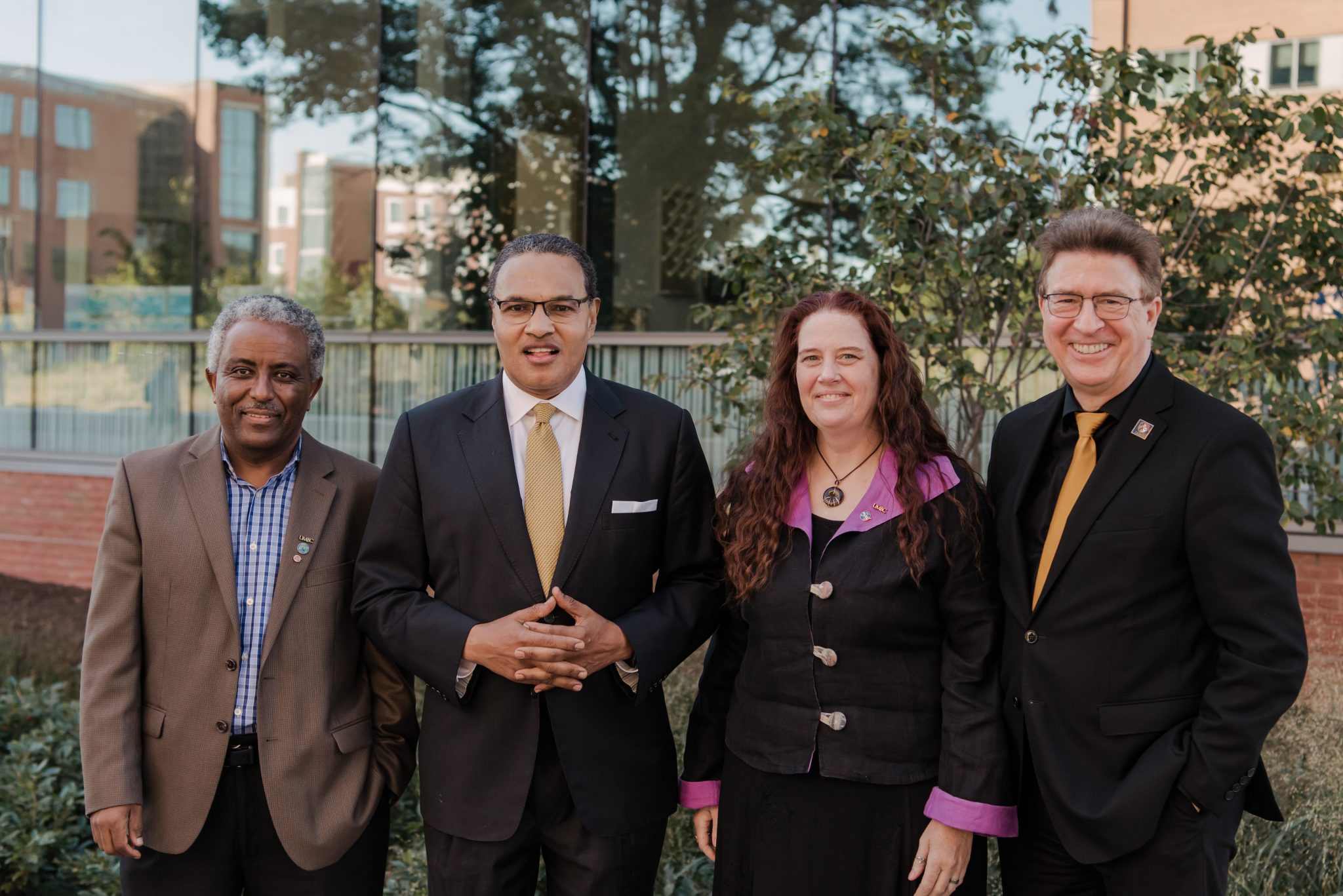
Left to right: Belay Demoz, Freeman Hrabowski, Margo Young, and Karl Steiner.

An expansive mission

This new classification reflects UMBC’s reputation as a leader both in research and education. While these two areas are regarded by some universities as separate or even competing components of their institutional mission, at UMBC they are inextricably linked. Both graduate and undergraduate research contribute to the campus’s overall research endeavor, and UMBC sees the research experience as a critical component of undergraduate and graduate education.

Janet C. Rutledge, vice provost and dean of the Graduate School, firmly believes that intellectual breadth has been key to UMBC’s success. “The strength of our Ph.D. programs across all disciplines contributed both to our R1 classification and our graduate program portfolio being recognized as comprehensive,” she says.

Provost Philip Rous shares that the R1 designation “recognizes our commitment to our shared values, strategic priorities, and our mission as a public research university. This includes advancing research and creative achievement across disciplines and inter-disciplines, community-engaged scholarship, high-quality graduate education, and the authentic engagement of our undergraduate students in advancing knowledge.”

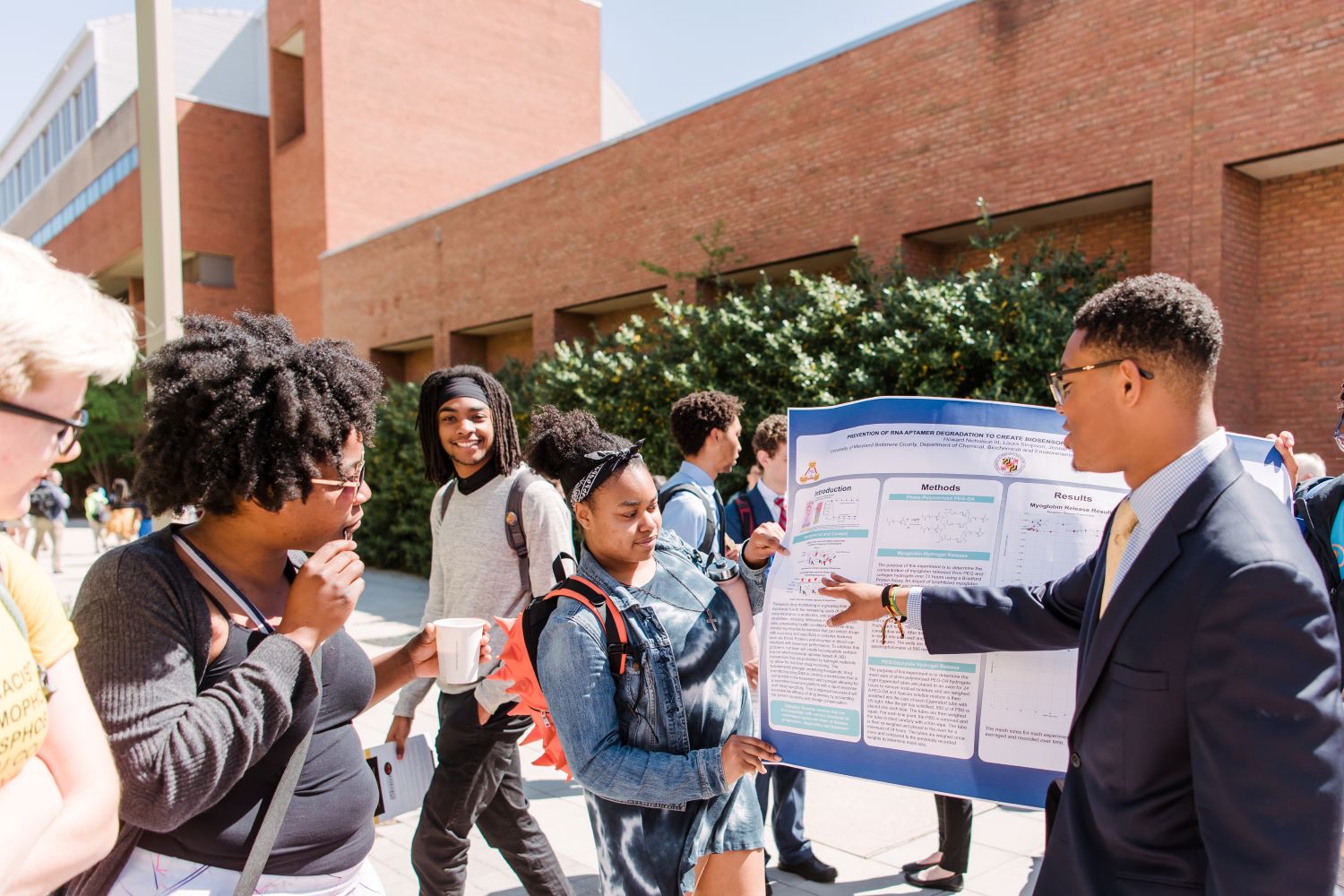
A student in a suit and glasses points to a presentation poster, held by another student, outside of an academic building.
Howard Nicholson ’21, chemical engineering, shares his research on biosensors at UMBC’s 23rd annual Undergraduate Research and Creative Achievement Day (URCAD) in 2019. Students moved outside briefly in response to a fire drill.

Prioritizing students and research impact

This research designation comes on the heels of UMBC’s joining the University Innovation Alliance, a consortium of public research universities focused on student success, and receiving the Carnegie Community Engagement Classification in recognition of a deep commitment to strengthening the bonds between campus and community. UMBC’s U.S. News rankings also recognize the university for national leadership in both innovation and teaching.

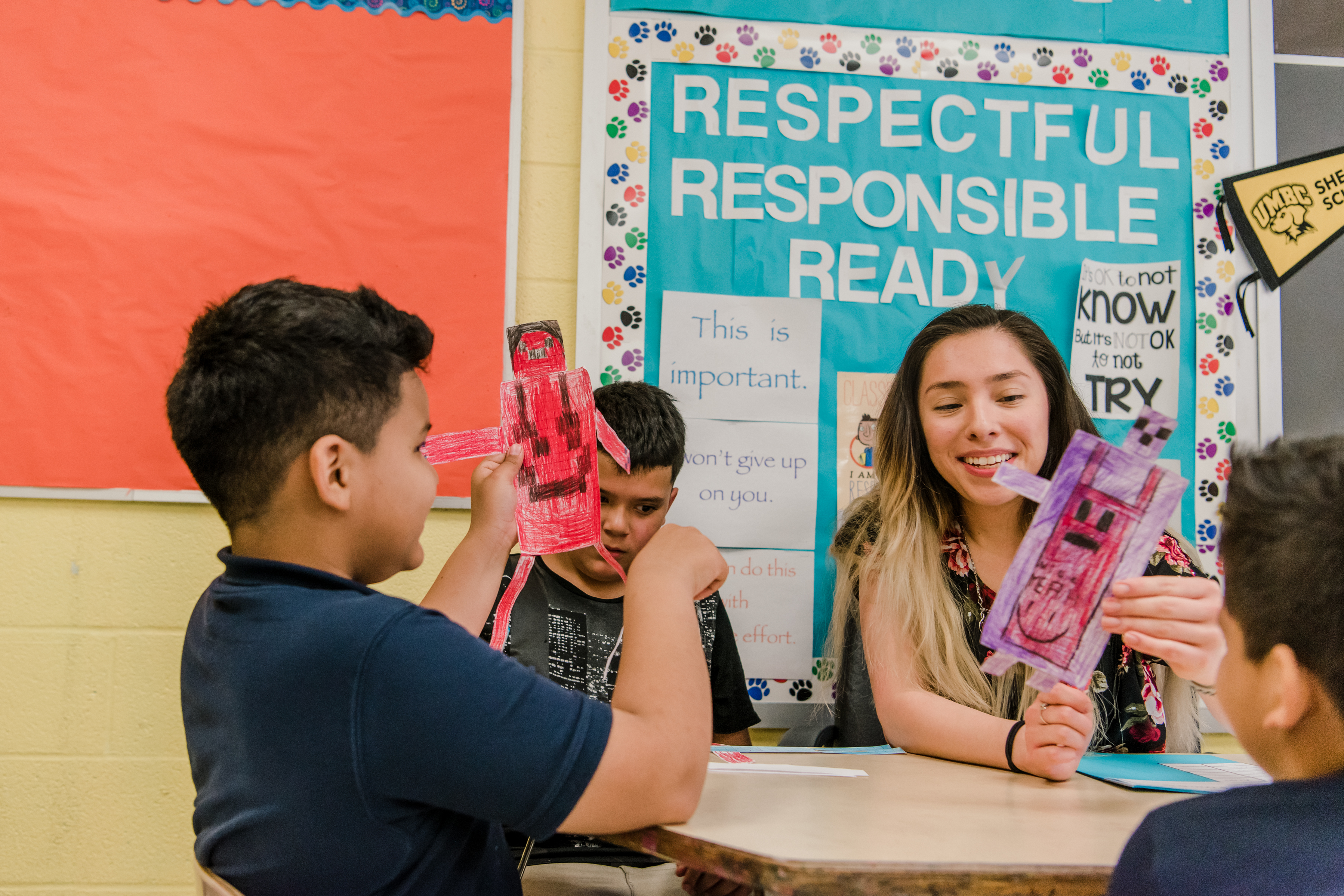
Young woman leads children in a lesson
Vanessa Gonzalez ’19 works on a project with Lakeland Elementary School students, 2019.

Maryland is fortunate also to be home to R1 universities UMD and Johns Hopkins University, as well as the specialized research powerhouse, the University of Maryland, Baltimore. The Carnegie Classification also recognizes both the University of Maryland, Eastern Shore, and Morgan State University as high research activity (R2) institutions. UMBC has established partnerships with each of these universities, as well as numerous others nationwide. 

Shares President Hrabowski, “Now that we have reached this milestone, I encourage our community to pause and savor this moment. I look forward to seeing what UMBC achieves in the next chapter.”

Featured image: Members of the Race and Social Justice CoLab student research group in summer 2018, with Frank Anderson, LLC PhD candidate and then-associate director of the Shriver Center’s Choice Program (center foreground), and Lee Boot, research associate professor and director of the Imaging Research Center (right). All photos by Marlayna Demond ’11 for UMBC.

UMBC to launch prestigious Beckman Scholars Program for aspiring M.D./Ph.D.s

UMBC has received a 2022 Beckman Foundation Award to launch a Beckman Scholars Program for outstanding students interested in graduate study in the biological or chemical sciences. The Arnold and Mabel Beckman Foundation today announced 14 institutions across the U.S. as new recipients of three-year institutional awards, totaling over $2.1 million. At UMBC, the program will support six students who aspire to pursue M.D./Ph.D. degrees, each paired with a mentor.

“The specific aim of the program is to build a strong foundation for the Beckman Scholars to become tomorrow’s well-rounded and accomplished physician scientists,” reads UMBC’s award proposal. Importantly, the program also aims to support students from underrepresented backgrounds in medicine. 

UMBC is in a strong position to pursue this goal, being the #1 institution in the country for graduating Black students who go on to receive M.D./Ph.D. degrees. UMBC is also #1 for Black graduates who go on to complete Ph.D. degrees in the natural sciences and engineering.

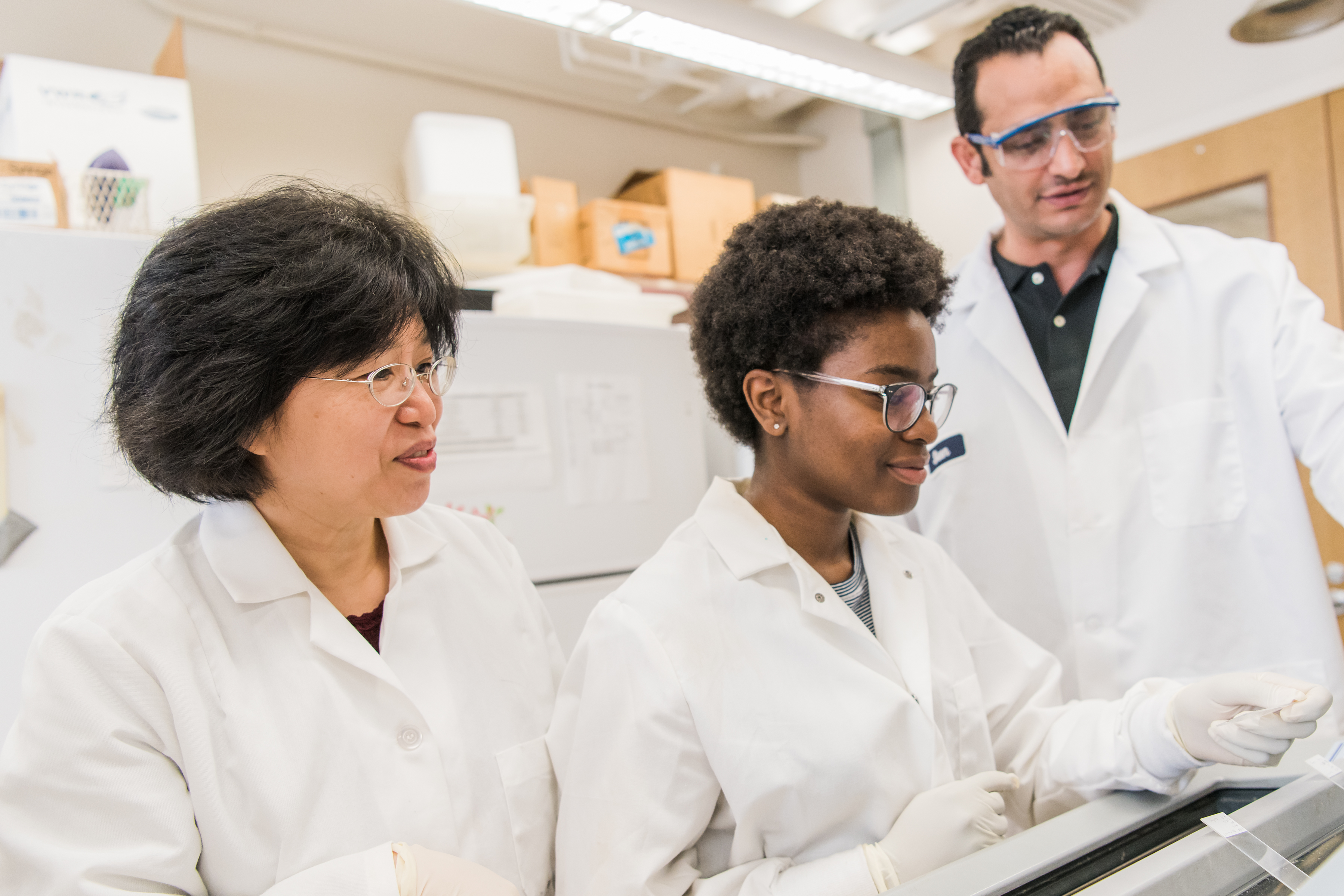
Researchers work in a lab.
Weihong Lin (left); Ashley Majekodunmi ’21 (center), biological sciences, a UMBC STEM BUILD Trainee; and Abdullah Al-Matrouk (right), then a Ph.D. candidate in biological sciences, work in Lin’s neurobiology lab in 2018.

Strong foundation

Each Beckman Scholar will receive significant financial, academic, and research support. They will gain community service and leadership experience and have the opportunity to forge relationships with peers and mentors from UMBC and elsewhere. In this way, the program will prepare the scholars for future careers as physician scientists and ground them in a supportive network that they can rely on for years to come.

“I am delighted that UMBC and the College of Natural and Mathematical Sciences (CNMS) have been selected to receive this prestigious award,” says Provost Philip Rous. “This support from the Beckman Foundation recognizes the fundamental roles that justice, equity, diversity, and inclusion play in the advancement of science and innovation, consistent with UMBC’s shared value of inclusive excellence.”

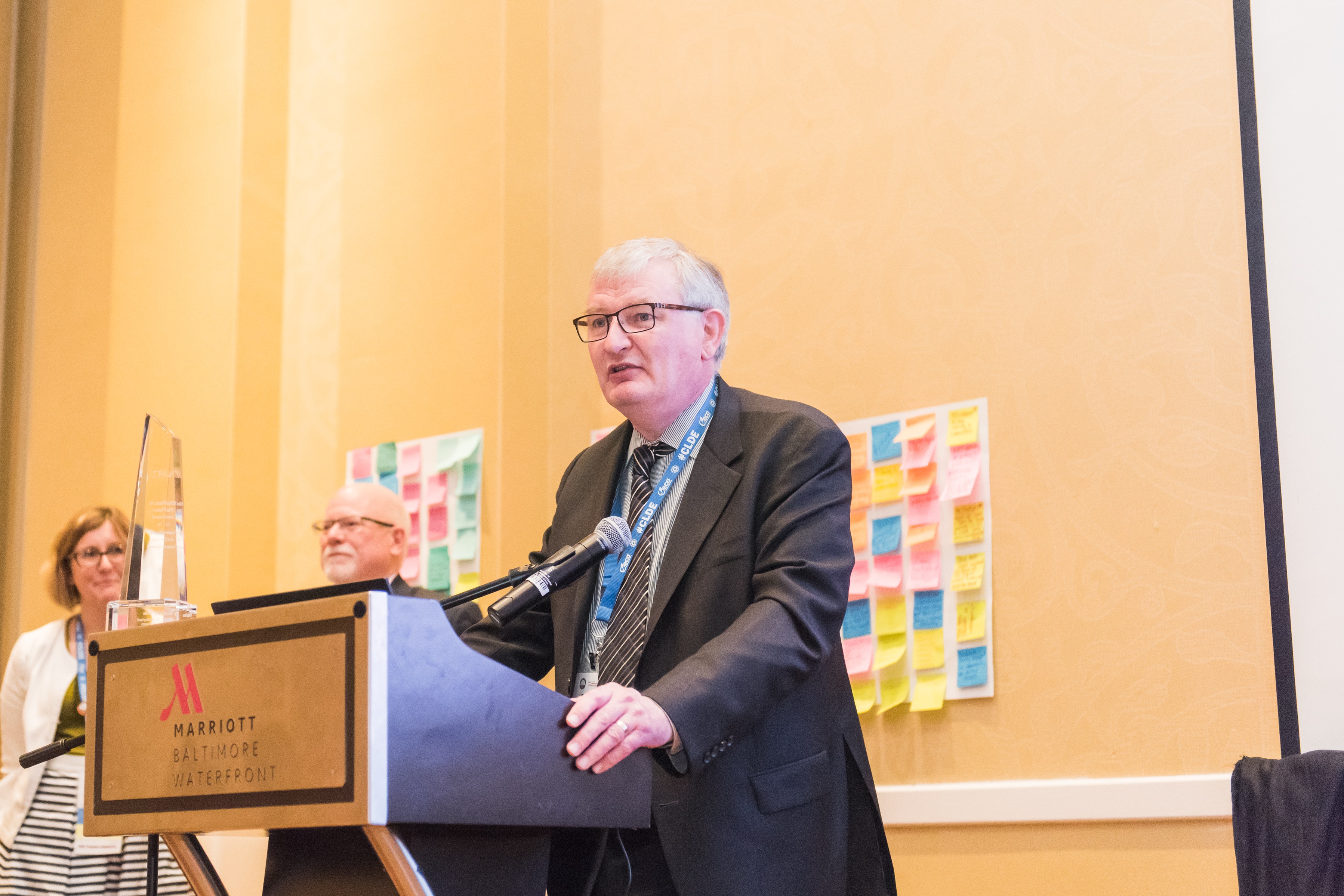
Man in suit stands at podium that holds a glass trophy. Multicolored post-its stick to the wall behind him.
Provost Philip Rous receives an award from the American Democracy Project at the Civic Learning and Democratic Engagement Meeting in Baltimore, 2017.

Research and mentorship

The 15-month Beckman Scholar experience will include one academic year bookended by two summers. Scholars will conduct research with faculty mentors at UMBC full-time in the summer months and part-time during the school year. The goal is for this work to lead to a peer-reviewed publication, a rare and exciting opportunity for undergraduates. 

Mentors will receive financial support as well as training from UMBC’s Faculty Development Center in culturally-responsive mentorship and techniques for fostering self-efficacy and inclusion in emerging researchers.

“Early exposure to research enhances our students’ readiness for post-graduate school and their chosen career paths,” says Bill LaCourse, dean of CNMS, which will house the program. “More importantly, independent research under the mentorship of UMBC’s dedicated faculty can spark a student’s lifelong interest in interdisciplinary learning. In the sciences at UMBC, our motto is, ‘It takes a scientist to train a scientist.’”

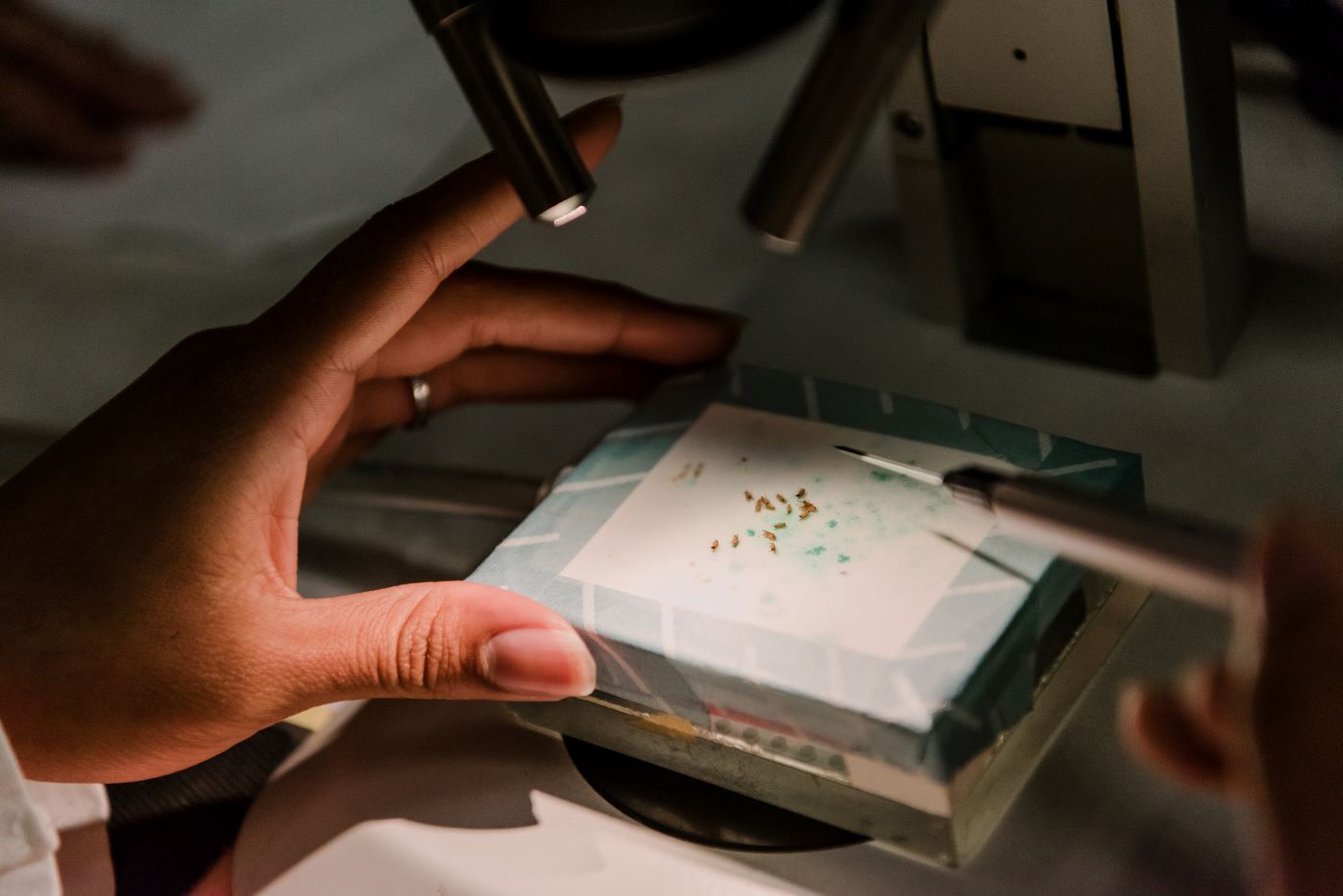
Close-up of a hand holding an instrument to inspect fruit lies in a lab.
A student works with fruit flies in the lab of Jeff Leips, biological sciences, at UMBC, summer 2019.

Entrepreneurship and service

Beckman Scholars will take courses in science communication, research ethics and integrity, and biomedical case studies. They will also complete UMBC’s Entrepreneurial Skills Training for STEM Undergraduates. 

“Entrepreneurship is the ability of an individual to identify a goal, provide the leadership, and mobilize the assets necessary to reach that goal,” UMBC’s proposal says. “Individuals breaking ground in science and technology, by creating innovative solutions to society’s problems, are all entrepreneurs.”

Scholars will also provide community service at local hospitals or clinics, shadow campus leaders, benefit from intensive academic advising, and receive support with the medical school application process. Every aspect is designed to offer experiences and develop skills that will make the scholars competitive candidates for M.D./Ph.D. programs upon graduation. 

Each year, the scholars are invited to attend the Beckman Summer Research Symposium, where they can connect with other fellow scholars from around the country. They will also plan and organize an annual Beckman Scholars Forum at UMBC, featuring speakers of interest to rising physician scientists. 

A student in a suit and glasses points to a presentation poster, held by another student, outside of an academic building.
Howard Nicholson ’21, chemical engineering, shares his research on biosensors at UMBC’s 23rd annual Undergraduate Research and Creative Achievement Day (URCAD) in 2019. Students moved outside briefly in response to a fire drill.

Community connections

Because the number of students in the program is small, the Beckman Scholars will collaborate with other STEM-focused scholars programs at UMBC. This will include the renowned Meyerhoff Scholars and the CNMS Scholars, for women in STEM fields in which they are underrepresented. 

The Beckman Scholars will benefit from the best practices to support student success that UMBC has developed over many years through these programs. Connecting with members of other programs will also help the Beckman Scholars build a strong sense of community. Community support and belonging are known to enhance persistence and success in STEM, especially among students from underrepresented groups.

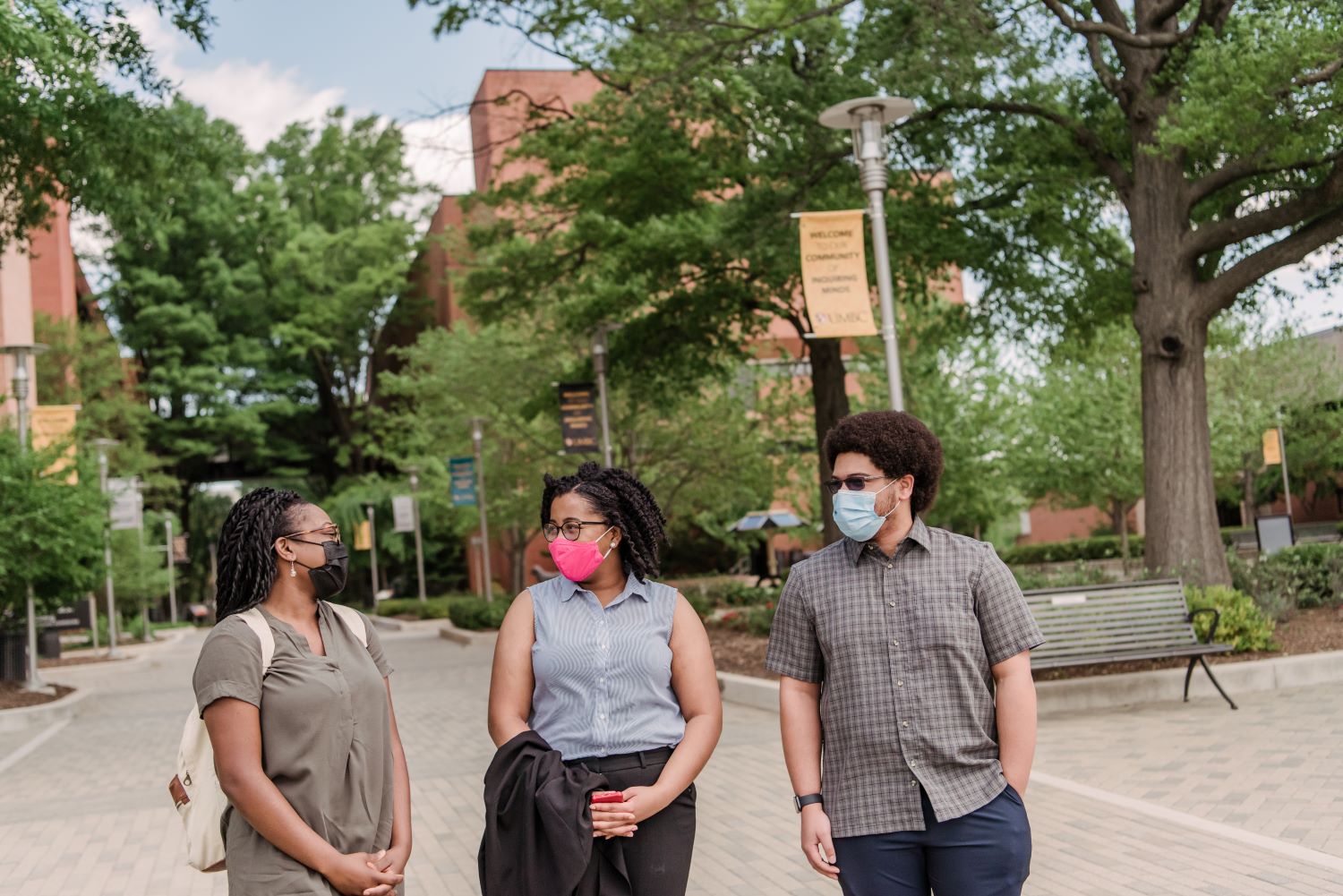
Three students walk down a path at a university campus in spring
Three Meyerhoff Scholars connect at UMBC in spring 2021.

“We are very proud of the impact that programs such as the Meyerhoff Scholars and CNMS Scholars have had on retaining underrepresented students in STEM disciplines,” says Caitlin Kowalewski, assistant director of undergraduate academic initiatives in CNMS. “We look forward to using the lessons we have learned from these programs to provide the Beckman Scholars with a strong foundation to succeed at their goal of pursuing an M.D./Ph.D.”

UMBC also has a long history of using new programs as opportunities to learn how to best support students, and then institutionalize those elements for an even greater benefit over time. For example, inspired by the success of STEM BUILD, an NIH-funded initiative to diversify the biomedical sciences, CNMS launched The Learning Collaboratory, revitalized its STEM Living Learning Community, and expanded courses in ethics and science communication.

In the future, LaCourse says, “The college intends to use the Beckman Scholars program as a model for increasing the number of students applying for M.D./Ph.D. programs.”

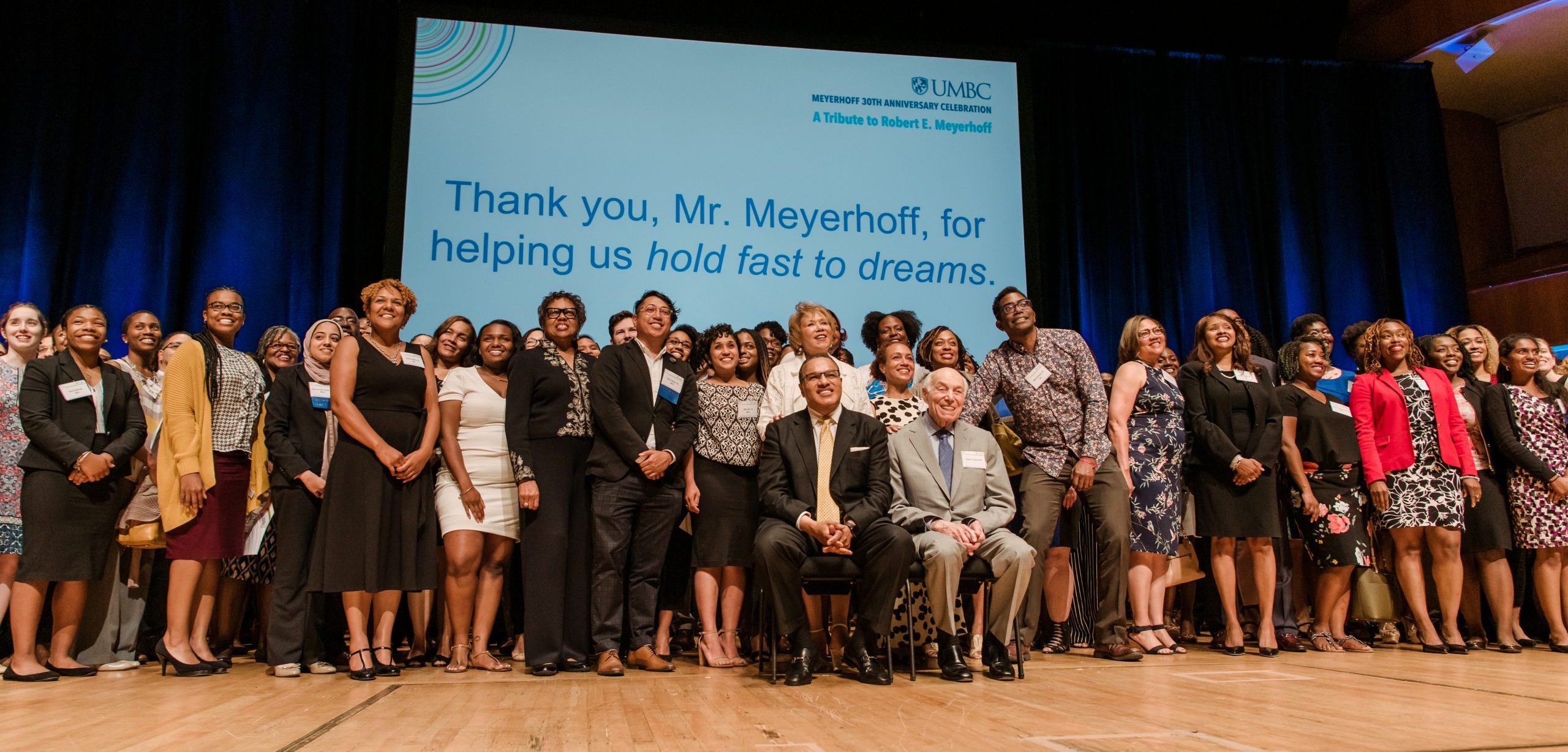
A large group of young adults, largely people of color, poses for a portrait. Two men sit in front of the group. A sign behind them reads,
Meyerhoff Scholars and alumni at the Meyerhoff 30th anniversary celebration, June 2019. President Hrabowski (left) and original program sponsor Robert Meyerhoff (right) seated in front row. More than 800 of UMBC’s Meyerhoff alumni have already earned graduate and professional degrees. Photo by Jim Burger for UMBC.

Springboard to success

To be prepared to pursue an M.D./Ph.D., students must demonstrate a balance of research experience, leadership, community service, clinical experience, and a strong academic record. The Beckman Scholars Program provides ample resources and opportunities to meet all of these requirements and more.

“The Beckman Scholars Program at UMBC will serve as a springboard for students from all backgrounds to launch themselves into successful careers as physician scientists. And as Beckman Scholars, they will be surrounded by a community that enables them to explore, challenge themselves, and, yes, sometimes fail—all while feeling supported,” LaCourse says. 

He notes, “Their peers and mentors will help them grow into confident and creative researchers who will make important contributions to medicine and science in the years to come.”


Featured image: Grace Tugado ’23, chemical engineering, working in the SeeTrue Technology lab on UMBC’s campus in summer 2021. The Maryland Technology Internship Program supported her work and she gained prior research experience through UMBC’s STEM BUILD program. All photos by Marlayna Demond ’11 for UMBC unless otherwise noted.

Hero of the Year: TIME honors UMBC alum Kizzmekia Corbett, COVID-19 vaccine leader

TIME magazine’s famed Person of the Year issue today announced Kizzmekia Corbett as a Hero of the Year for her leadership in developing the COVID-19 vaccine. Corbett ’08, M16, biological sciences and sociology, served as the scientific lead of the Vaccine Research Center’s coronavirus team in the U.S. National Institute of Allergy and Infectious Diseases. There, she developed new mRNA technology used by Moderna’s COVID-19 vaccine and others, playing a pivotal role in the global fight against the virus.

“The scientific process gives us confidence that we can overcome even our most challenging problems,” says Bill LaCourse, dean of the College of Natural and Mathematical Sciences. “As we face the ongoing COVID pandemic, it is important that TIME is honoring the often unseen work of scientists who provide us with hope for the future.”

Corbett is honored alongside three other vaccine scientists, including Barney Graham. Graham serves as deputy director of the Vaccine Research Center and the chief of the Viral Pathogenesis Laboratory. He is known for his commitment to mentoring emerging scientists. Corbett initially worked in his lab during her UMBC years as a Meyerhoff Scholar and NIH Scholar.

In the spirit of the Meyerhoff program, Corbett has carried on that commitment to mentorship by welcoming scientists like Olubukola Abiona ’17, M25, biochemistry and molecular biology, to contribute to her lab’s research.

Addressing health disparities

Motivating Corbett’s work is a deep commitment to health equity, informed by her sociology studies at UMBC. “Vaccines have the potential to be the equalizer of health disparities, especially around infectious diseases,” she recently explained in Nature

“Dr. Corbett and her work exemplify the tremendous value of blending biological sciences and social sciences to solve the world’s problems,” says Kimberly Moffitt, interim dean of the College of Arts, Humanities, and Social Sciences. “Her commitment to public health continues to be fostered by the teachings of sociological theory and the understanding of social inequities. We cannot be more proud of her example and her proven success at mastering the complexities of science with the human experience centered.”

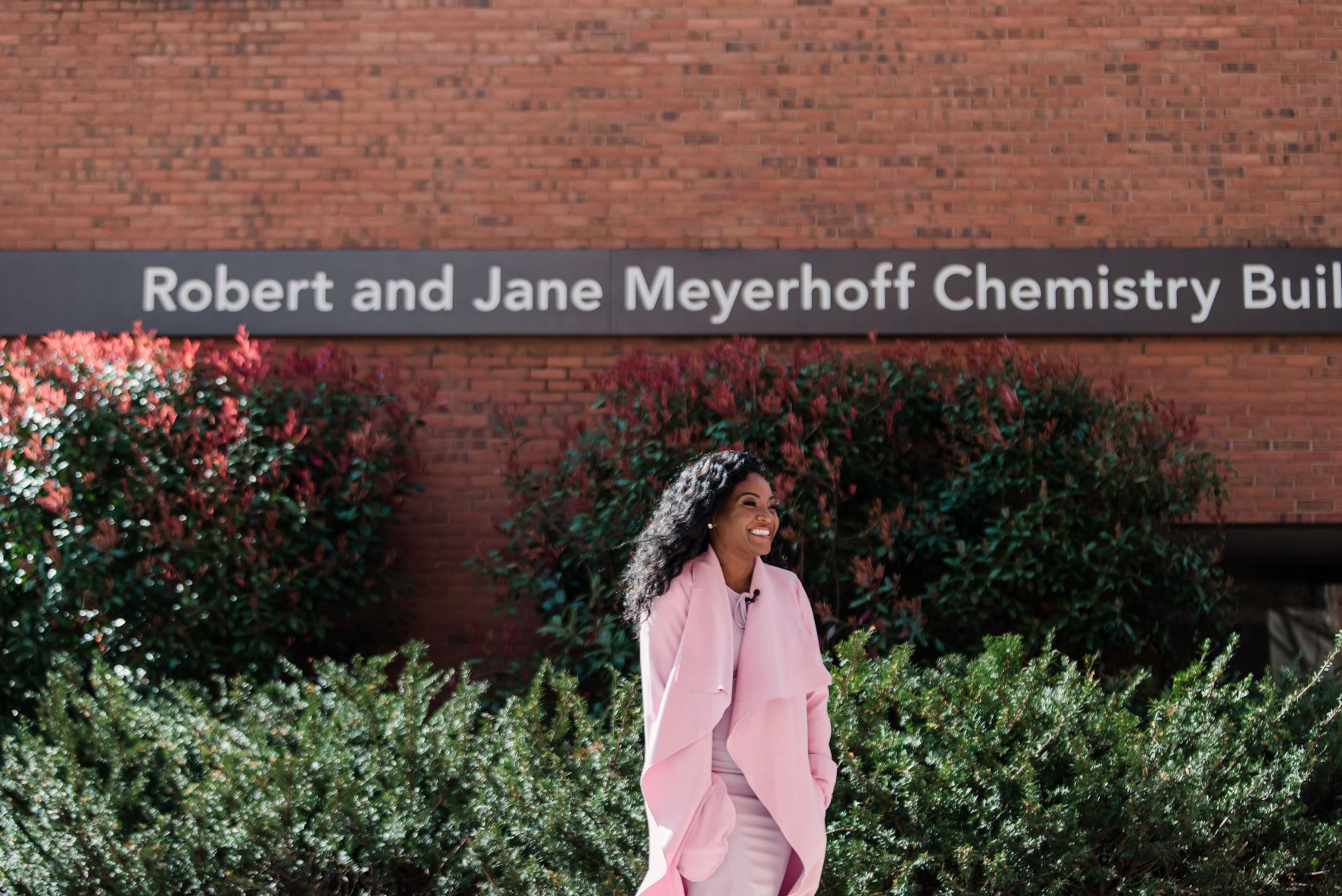
Woman in lilac professional outfit walks through a courtyard. Text behind her reads
Dr. Kizzmekia Corbett at UMBC. Photo by Marlayna Demond ’11 for UMBC.

Since the launch of the COVID-19 vaccine, Corbett has joined the faculty of Harvard’s T.H. Chan School of Public Health, where she will continue vaccine development work. TIME writes that mRNA vaccines don’t just represent an important path out of the current pandemic, “but also a new approach to quelling future ones.” The profile notes, “Already, vaccine makers are testing mRNA-based vaccines against influenza, potentially making them more effective, safer and easier to produce.”

Learn more about Dr. Corbett’s UMBC journey and path to becoming the first Black woman in the world to invent a vaccine in UMBC Magazine. Earlier profiles are available in the Washington Post and Baltimore Sun.

Featured image: Kizzmekia Corbett. Photo by Marlayna Demond ’11 for UMBC.