We use cookies for analytics and, unless you opt out, advertising.
You can opt out of advertising at any time.UMBC uses essential cookies to run this site. With your permission we would also use analytics cookies (to understand how the site is used) and advertising cookies (to measure and target our ads on other platforms). Nothing else loads unless you accept. You can change your choice any time from Cookie Settings in the footer.Privacy Policy
EssentialRequired for the site to work (login, security, your cookie choice). Always on.
Princeton Review features UMBC in the 2022 issue of its popular college guide, The Best 387 Colleges. UMBC’s profile in the guide highlights the university’s academic strengths and supportive community spirit.
This university is a place “where teaching comes first” and where faculty “have a knack for inspiring the students,” share students quoted in the piece. Another notes, “UMBC wants to see every student succeed—they provide you with the tools, people, and resources to make sure you get where you want to go in life.”
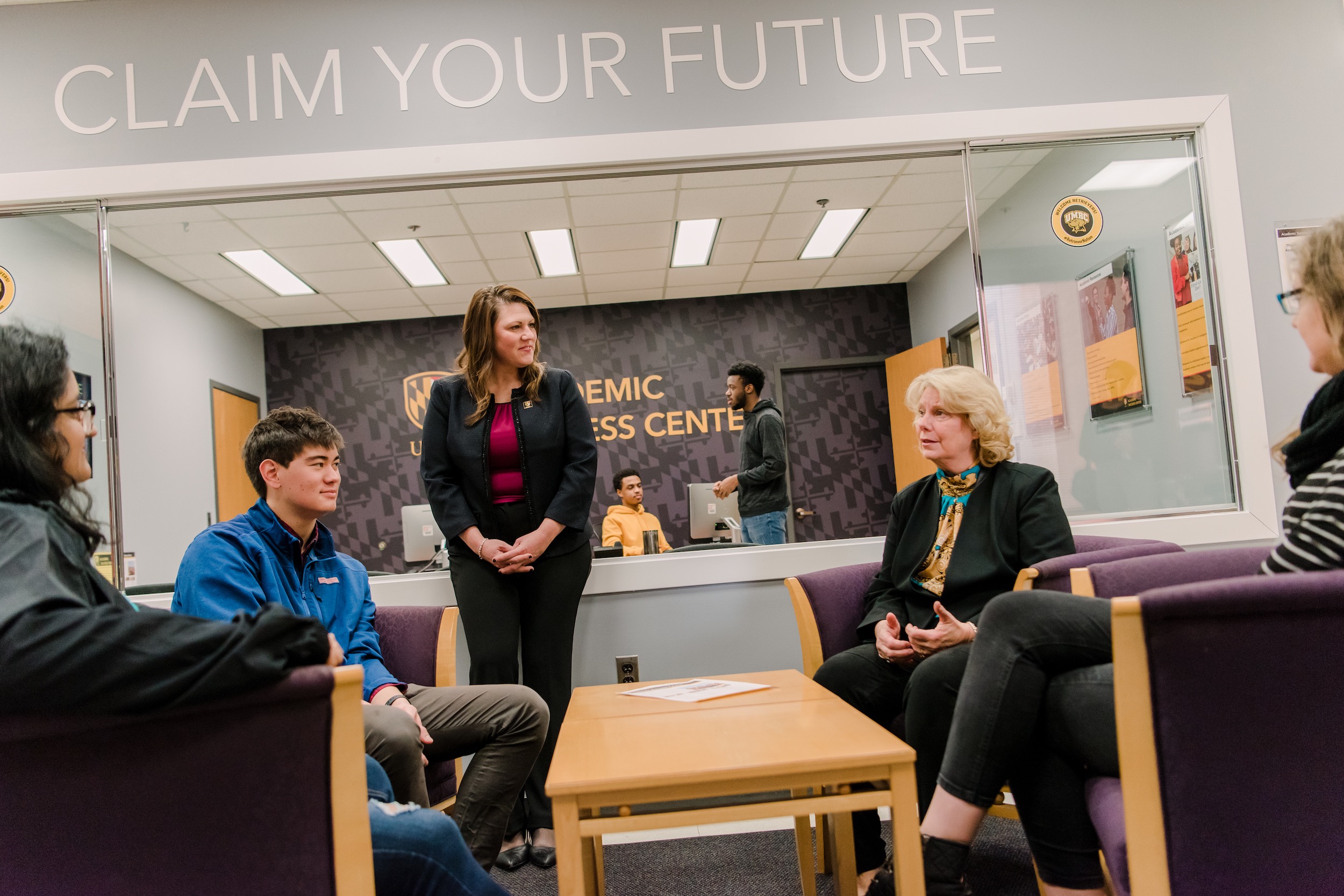
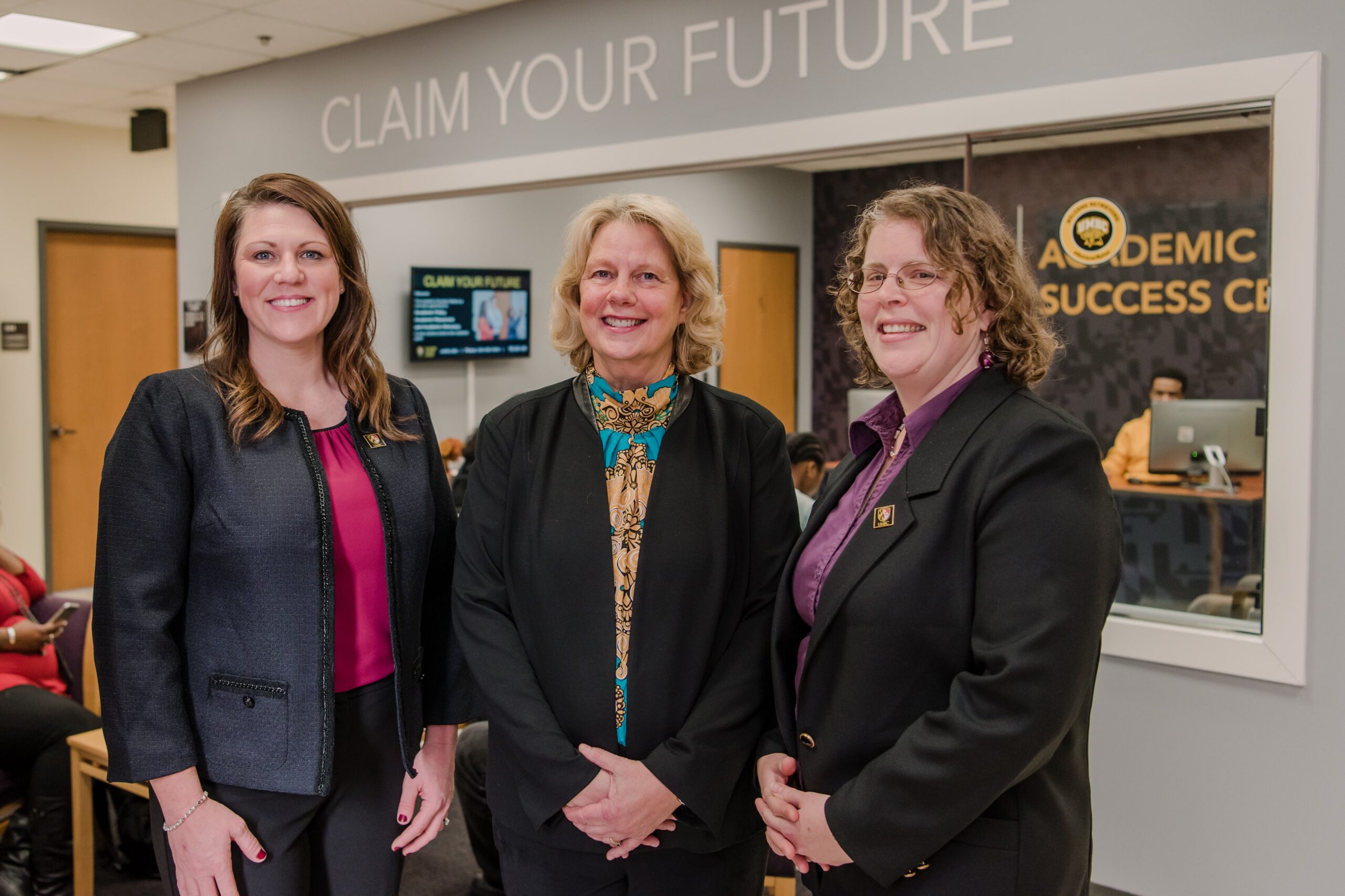
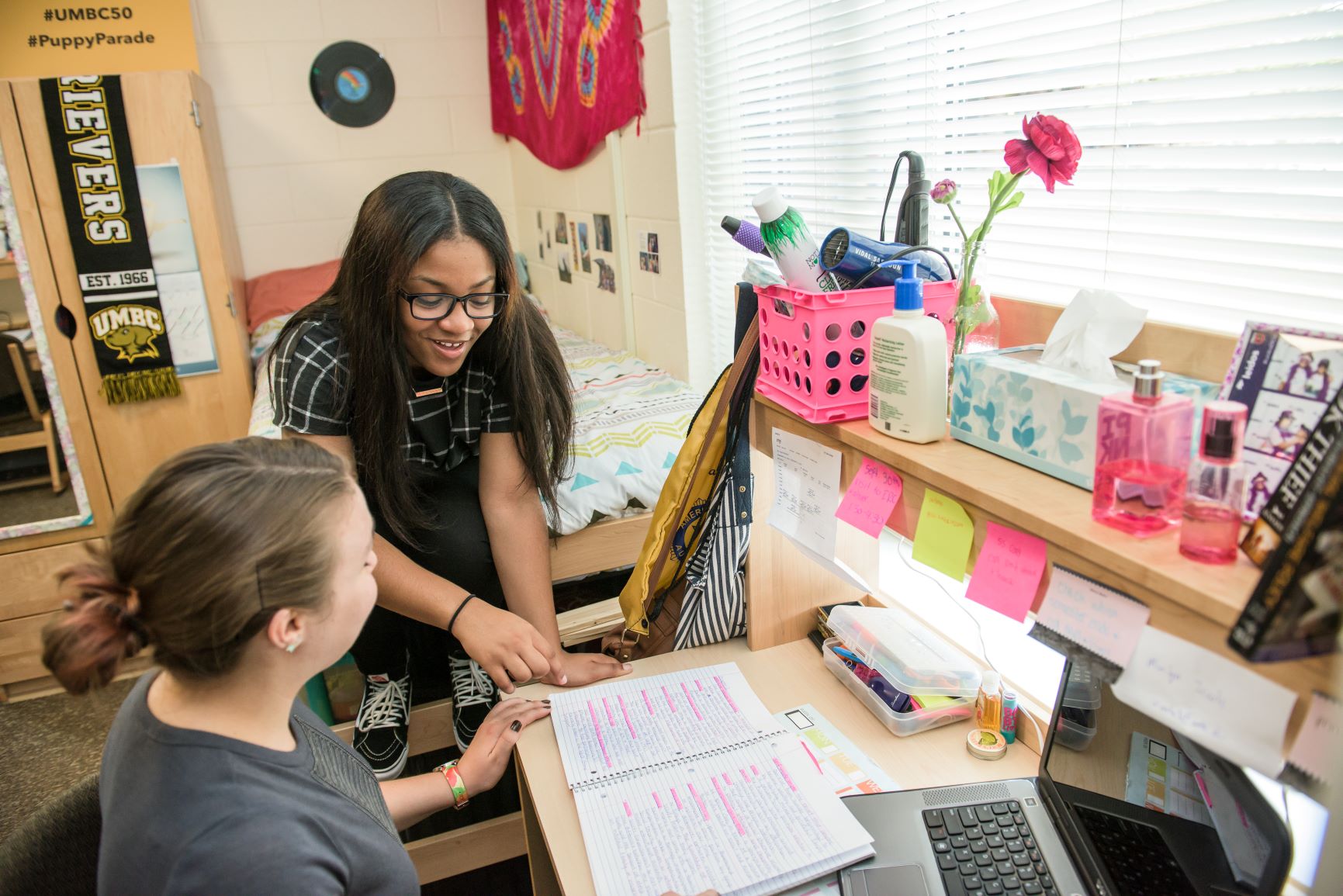
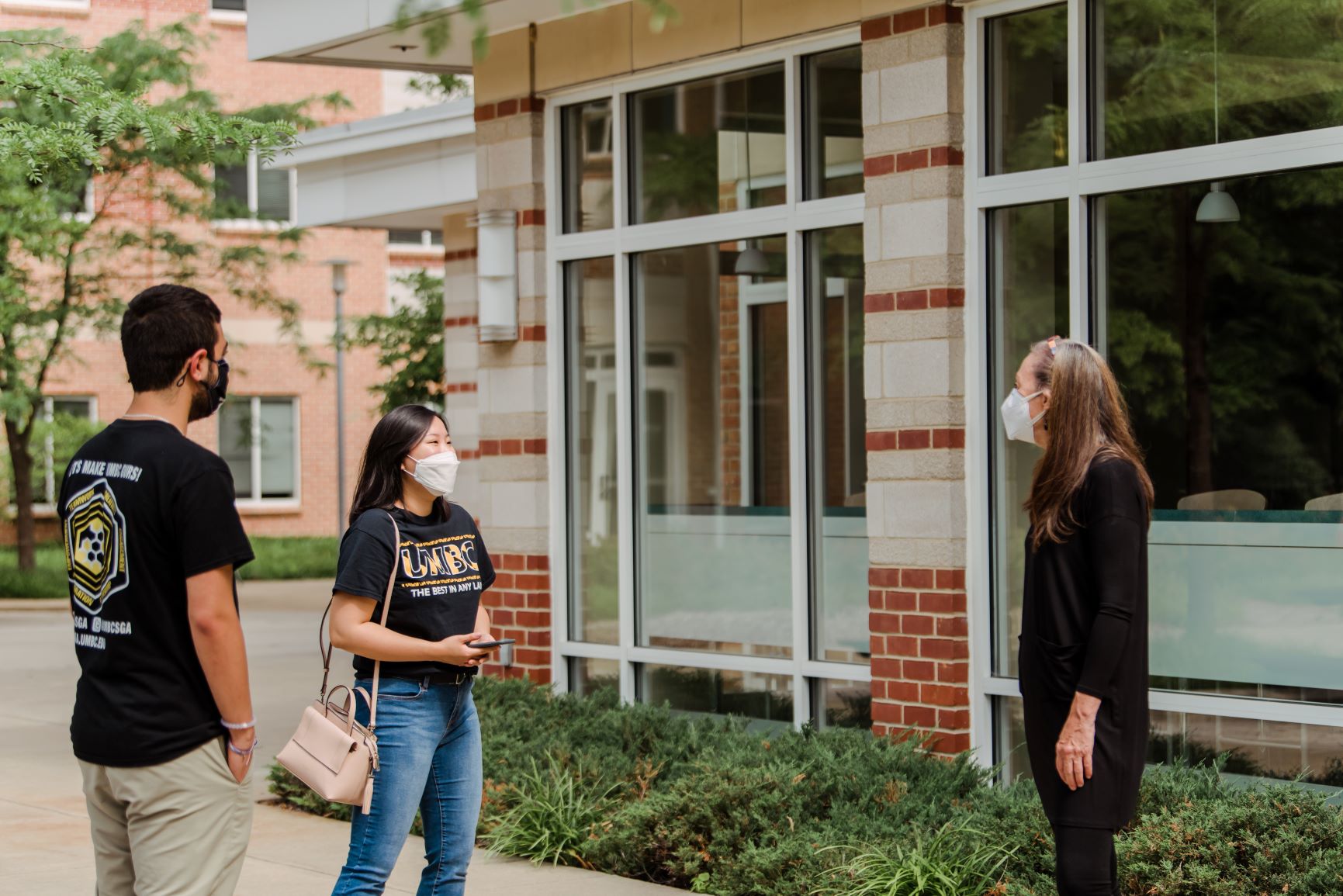
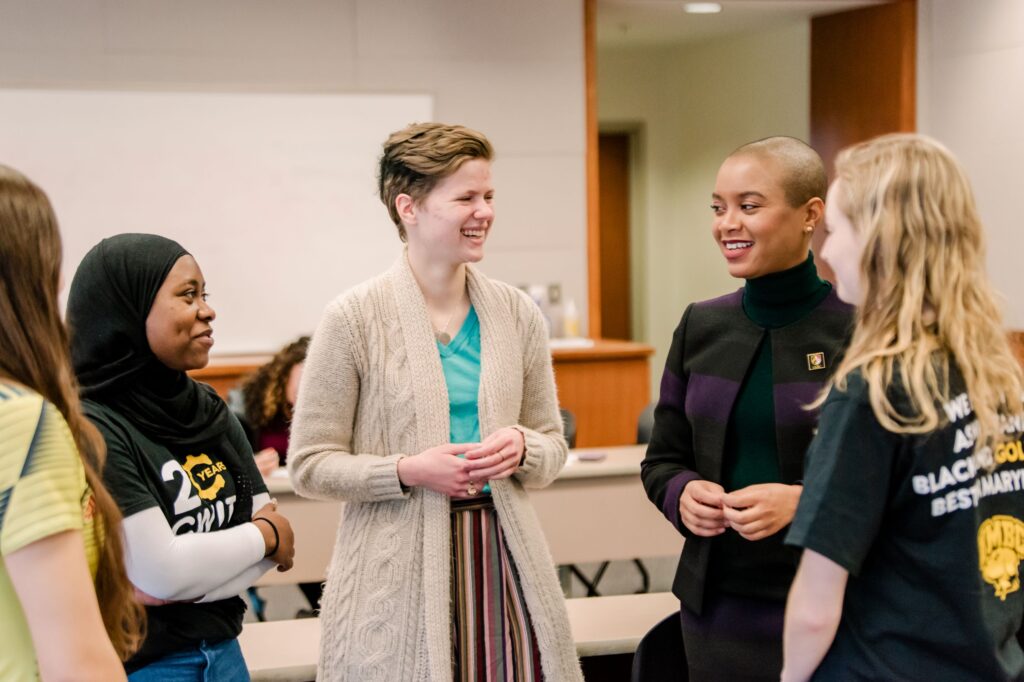
Amanda Knapp (standing) and Katharine Cole (second from right) speak with students in the Academic Success Center, 2019.
Princeton Review highlights UMBC’s range of academic strengths, from the sciences to the performing arts. The publication also spotlights UMBC’s active campus life, student diversity, and very strong career services. It shares an overall sense that the “school is well run” and “students are happy.”
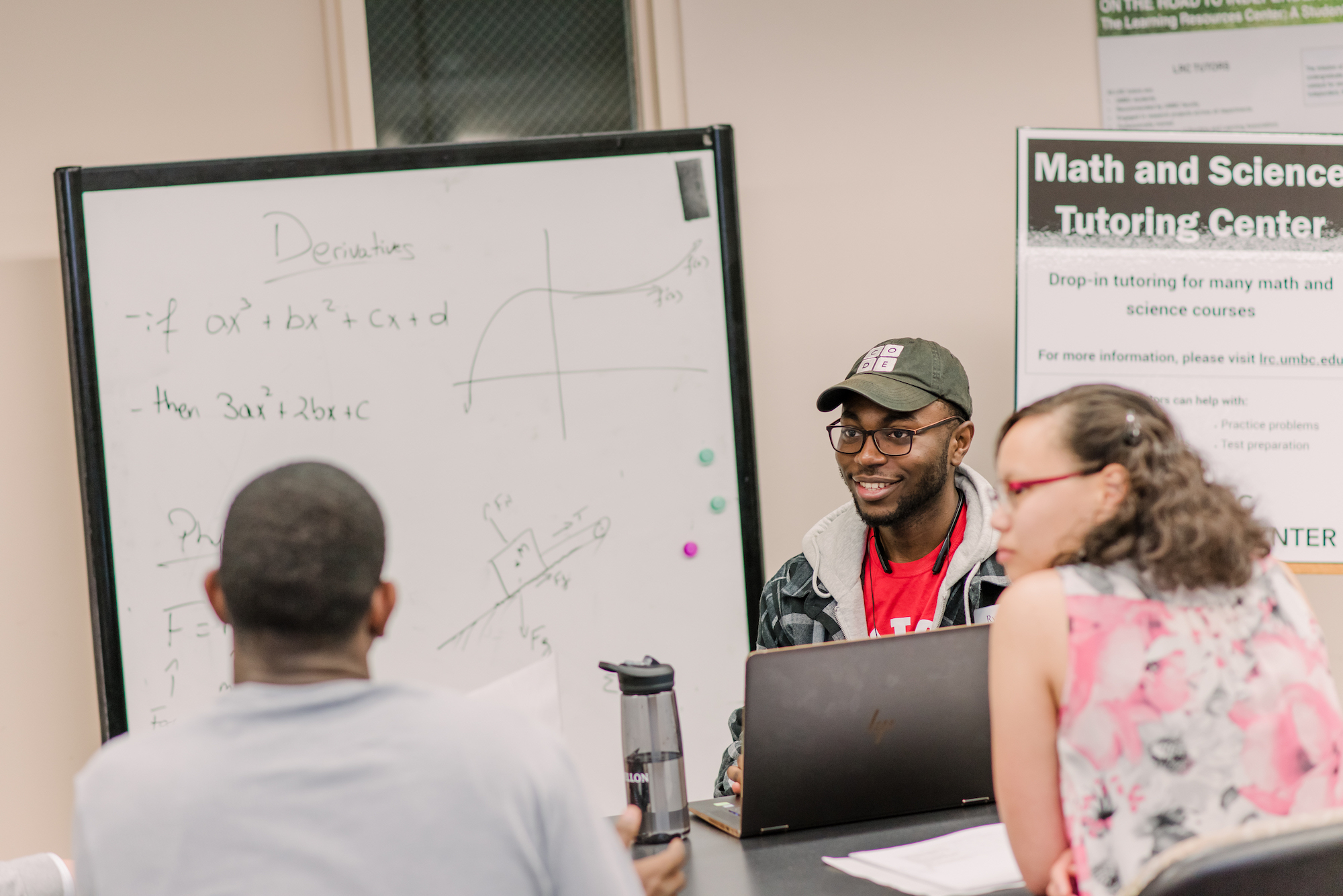
A tutor works with students at UMBC’s Math and Science Tutoring Center, 2019.
The feature notes that most undergrads agree that “the typical student at UMBC is interested in doing well academically.” At the same time, students are highly engaged in extracurriculars, and one emphasizes, “There are a lot of activities held by student organizations.”
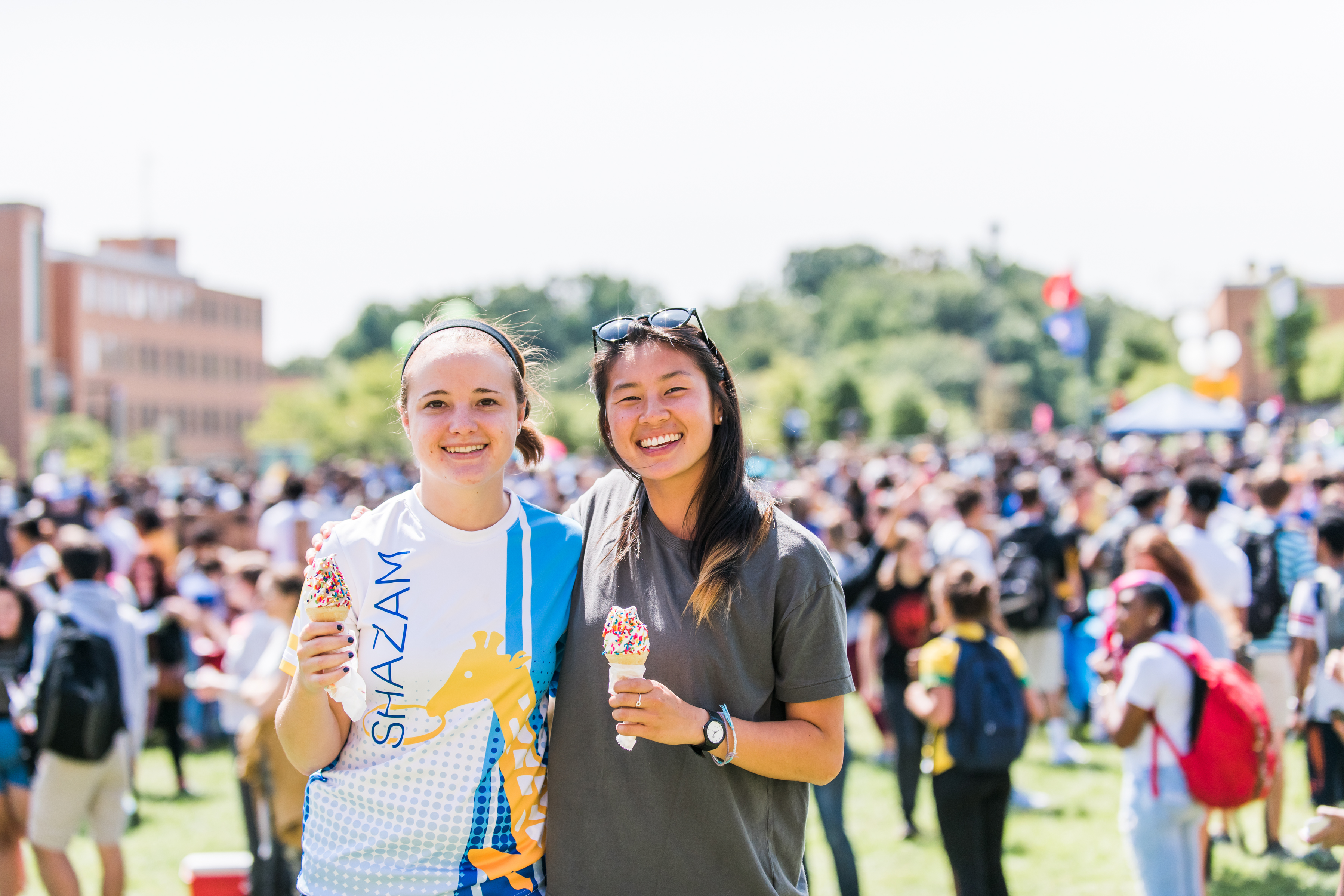
Students enjoy UMBC Involvement Fest 2017, including one wearing a shirt from the Shazam! Women’s Ultimate Frisbee team.
For its 30th edition, Princeton Review surveyed 154,000 students from across the U.S. They also reviewed previous material to assess the consistency of universities’ strengths over time.
A top college for student voting
Washington Monthly has also kicked off the school year by releasing a college guide: America’s Best Colleges for Voting. The list highlights UMBC as one of the nation’s top universities when it comes to the percentage of students registered to vote.
“This recognition is a testament to a UMBC culture that values active engagement in every setting, including on campus, in our neighborhoods, in our workplaces, and in local, state, and national politics,” say David Hoffman, Ph.D. ’13, language, literacy, and culture, and Romy Hübler ’09, modern languages and linguistics, M.A. ’11, intercultural communication, Ph.D. ’15, LLC. They serve as director and assistant director, respectively, of UMBC’s Center for Democracy and Civic Life, launched in 2018.
Hoffman and Hübler note, “At UMBC we ‘cast our whole vote.’ This means we vote, engage in conversations about the issues affecting us, and take responsibility for working collectively to build strong, inclusive, and just communities in which everyone can thrive.”
Critical Social Justice 2017 workshop at UMBC.
The Washington Monthly list reflects 2016 and 2018 data, as student voter turnout from election 2020 won’t be available for a few months. However, UMBC’s early indicators for 2020 student voter turnout are strong.
In November 2020, UMBC placed ninth in the nationwide 2020 ALL IN Campus Democracy Challenge. The competition encourages college students to pledge to vote based on evidence that public pledges increase follow-through. Hearing the news that UMBC was in the top 10 nationwide, President Freeman Hrabowski reflected, “UMBC is a national model for community engagement.”
Promotional materials for the Cast Your Whole Vote project, 2020.
World University Rankings
Times Higher Education just announced its 2022 World University Rankings as well, again including UMBC in this year’s list. UMBC is among the top 800 universities on the global list and #122 of U.S. universities included. The university performed particularly well in the area of research. UMBC’s research enterprise continues to expand in funding (now surpassing $84 million in annual research expenditures) as well as national and global reputation.
The publication is announcing its subject-area rankings gradually throughout the fall. So far, UMBC appears on three subject-area lists: among the world’s top 400 universities in the life sciences, and among the top 500 in psychology and the physical sciences. Times Higher Education will announce additional STEM, arts, and humanities rankings in the coming weeks.
In the Wall Street Journal / Times Higher Education U.S. College Rankings 2022, UMBC ranks among the top 200 U.S. universities for educational outcomes, with strong graduation rates and graduate salaries and low levels of debt after graduation. UMBC ranks among the top 125 in educational environment, with particularly high marks for student and faculty diversity.
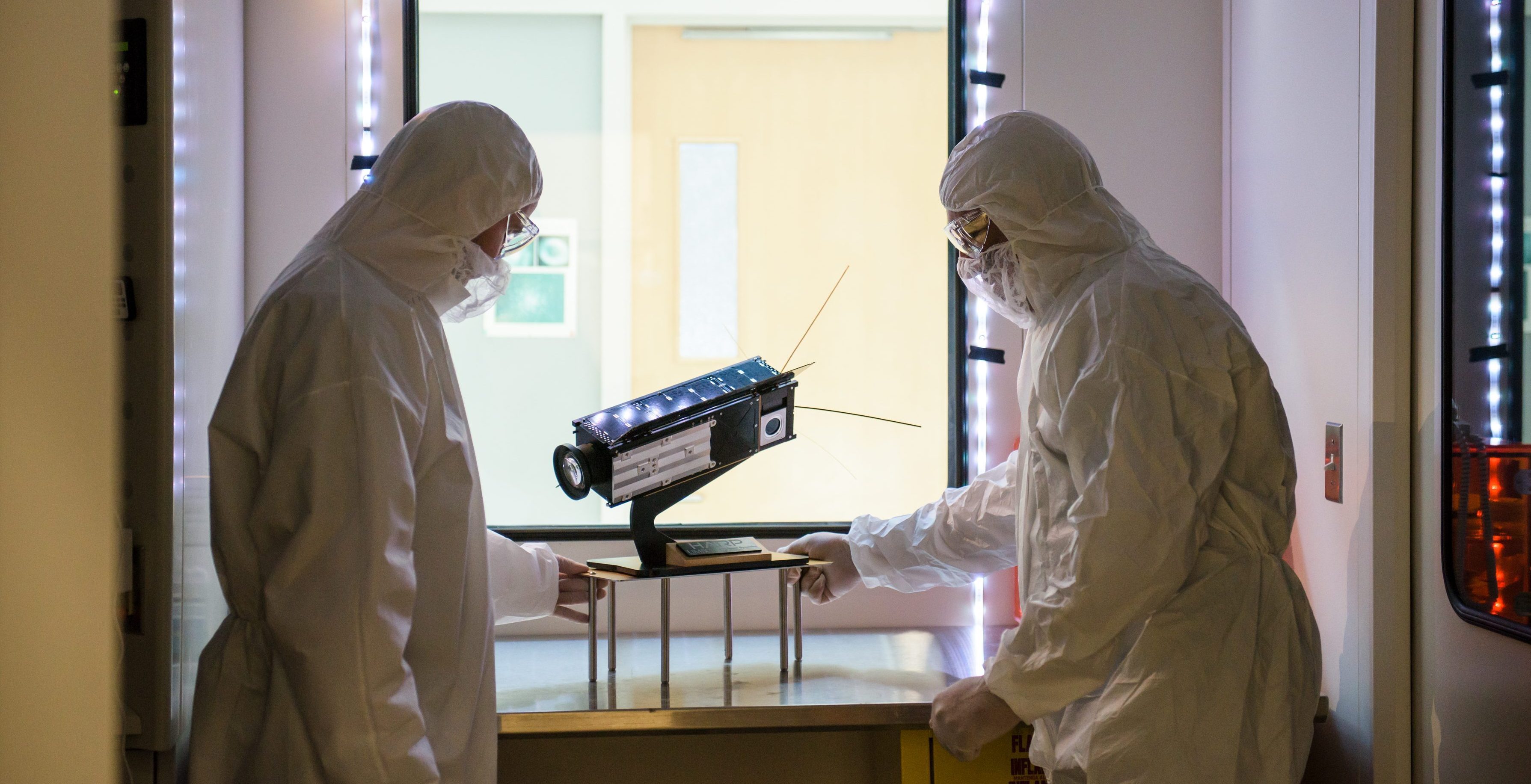
Research team of Vanderlei Martins, professor of physics, with a model of the HARP satellite.
Featured image: First day of classes at UMBC, fall 2021. Photos by Marlayna Demond ’11 for UMBC.
This article was updated on Sept. 21, 2021, to include new Times Higher Education rankings.
After three decades of transformational leadership at UMBC, President Freeman A. Hrabowski, III has announced his plan to retire at the end of the 2021-2022 academic year.
President Hrabowski is nationally celebrated for his results-driven commitment to inclusive excellence, collaborative approach to leadership, and mentorship that pairs high expectations with strong support. Through his time at UMBC, these qualities have become core to the university’s unique culture and community. They have also inspired national and global recognition.
During President Hrabowski’s tenure, UMBC has ascended in the national rankings. U.S. News ranked UMBC the nation’s #1 “Up and Coming” university for six years, 2009-14. In 2015 they transitioned to recognizing the nation’s “most innovative” national universities, featuring UMBC every year since the list launched. For the past decade, U.S. News has also consistently ranked UMBC among the nation’s leading institutions for Best Undergraduate Teaching.
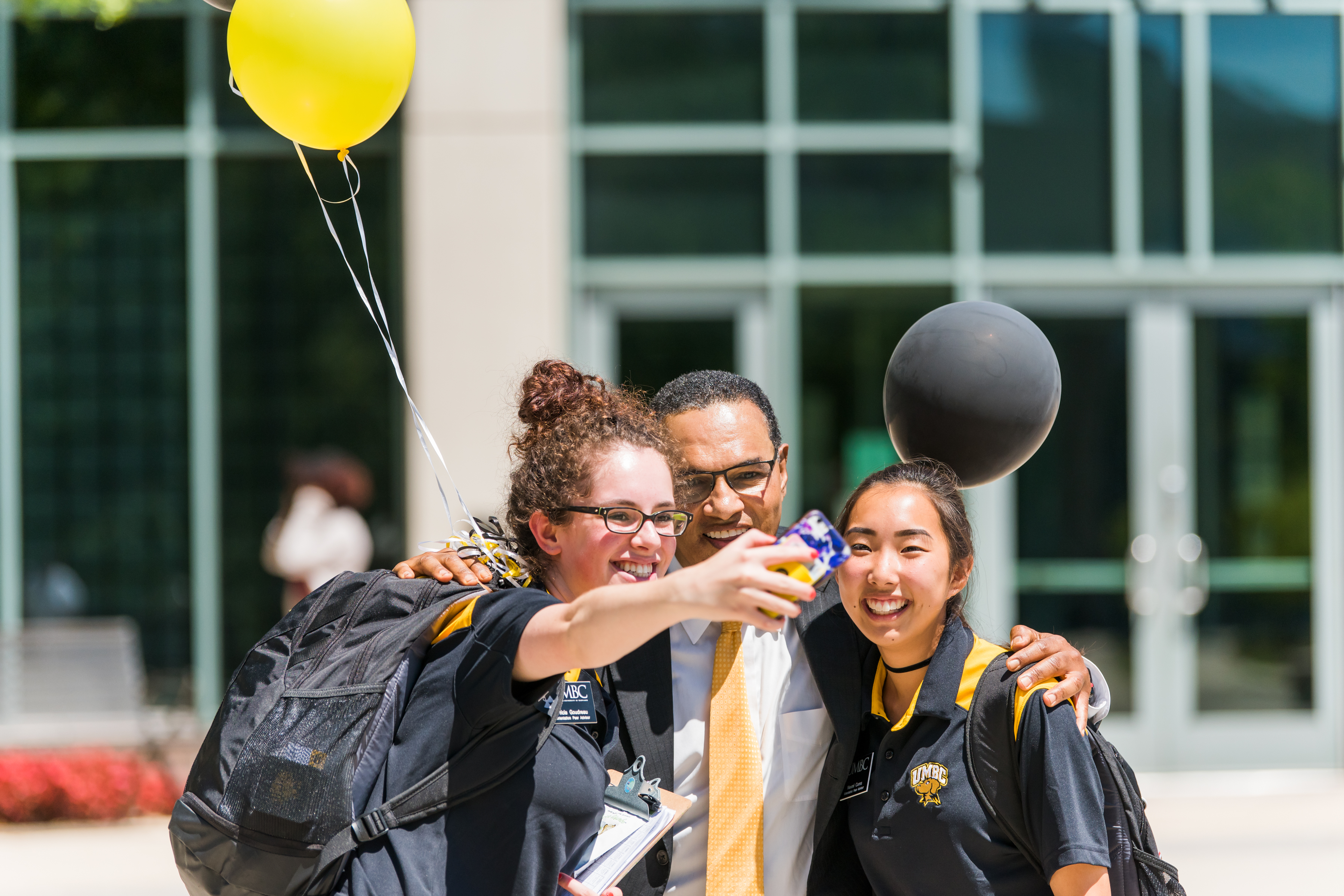
President Freeman Hrabowski with Orientation Peer Advisors, summer 2018.
Visitors to campus often see President Hrabowski walking down Academic Row. He greets students by name, asking about their classes and post-grad plans, listening, and offering encouragement. That personal level of care has become part of UMBC’s DNA. It’s a quality that draws thousands of new students to UMBC each year and inspires UMBC’s national recognition as a model for supporting student success.
Advocating for students
Born in Birmingham, Alabama, in 1950, Hrabowski was a child leader in the Civil Rights Movement. He graduated from Hampton Institute with highest honors in mathematics, and earned his M.A. in mathematics and Ph.D. in higher education administration/statistics from the University of Illinois at Urbana-Champaign.
President Hrabowski came to UMBC as vice provost in 1987, when UMBC was just two decades old, and has served as president since 1992. He is a national leader in science and math education, with an emphasis on the participation and achievement of underrepresented minority students.
Among many high-profile, high-impact leadership roles, President Hrabowski chaired the National Academies’ committee that produced a landmark 2011 report on expanding underrepresented minority participation in STEM. Barack Obama named him to chair the President’s Advisory Commission on Educational Excellence for African Americans in 2012. The following year, his TED talk “Four Pillars of College Success in Science” made waves worldwide, going on to receive more than one million views.
He emphasizes, “collaborative strategies have been at the core of it all.”
Learning from Meyerhoff
At the national level, President Hrabowski is also known for partnering with Robert Meyerhoff to found the Meyerhoff Scholars Program in 1988, to increase the diversity of STEM leaders. Science describes the program as the “gold standard for providing a path into academic research” for students from underrepresented groups.
So far, UMBC has graduated more than 1,400 Meyerhoff Scholars with STEM degrees. More than 800 have already earned graduate or professional degrees. According to NSF data, UMBC is now the nation’s top producer of Black graduates who go on to a Ph.D. in the natural sciences and engineering.
These graduates include alumni like COVID-19 vaccine developer Dr. Kizzmekia Corbett ’08, M16, now an assistant professor of immunology and infectious diseases at Harvard. More than a dozen other institutions have replicated the Meyerhoff program, from Penn State and UNC to UC Berkeley and UCSD (supported by the Chan Zuckerberg Initiative).
Alumna Kizzmekia Corbett in a lab at UMBC.
Supporting scholars
Meyerhoff has also had ripple effects within UMBC. Through the program, UMBC faculty and staff learned about what kinds of support most benefit students: hands-on research experience, intensive (even intrusive) advising and mentorship, and mutual peer support built on a cohort model. These findings have inspired programs like UMBC’s Center for Women in Technology Scholars and STEM BUILD at UMBC, reaching an ever-expanding number of students.
Humanities Scholars attend a seminar with Pres. Hrabowski in the Dresher Center, 2016.
Whether they stay in Maryland or travel the world, UMBC’s 85,000 alumni carry with them a unique approach to co-creating communities. That approach is grounded in mutual respect and support, intellectual curiosity, and achievement through collaboration.
“Excellence is never an accident“
Behind UMBC’s accolades are students persevering every day to achieve their dreams, supported by caring faculty and staff. Over the last decade, UMBC has increased its six-year graduation rate for full-time freshmen from 55.7% to 69.2%. And UMBC has become known for welcoming and supporting transfer students, including a large number of first-generation college students.
First-generation college student Julia del Carmen Aviles-Zavala ’22, psychology, with her parents.
This year, the pioneering University Innovation Alliance selected UMBC as a member. This public research university consortium works to boost student success through sharing and scaling approaches that work.
National stage
At UMBC, Retrievers quickly learn what’s possible in a community that pairs high expectations and robust support, and empowers students to pursue their passions. UMBC is the reigning national mock trial champion, defeating Yale in last year’s finals, and UMBC’s Cyber Dawgs have won national and regional championships. UMBC has won or tied for first place ten times at the Pan-American Intercollegiate Team Chess Championship.
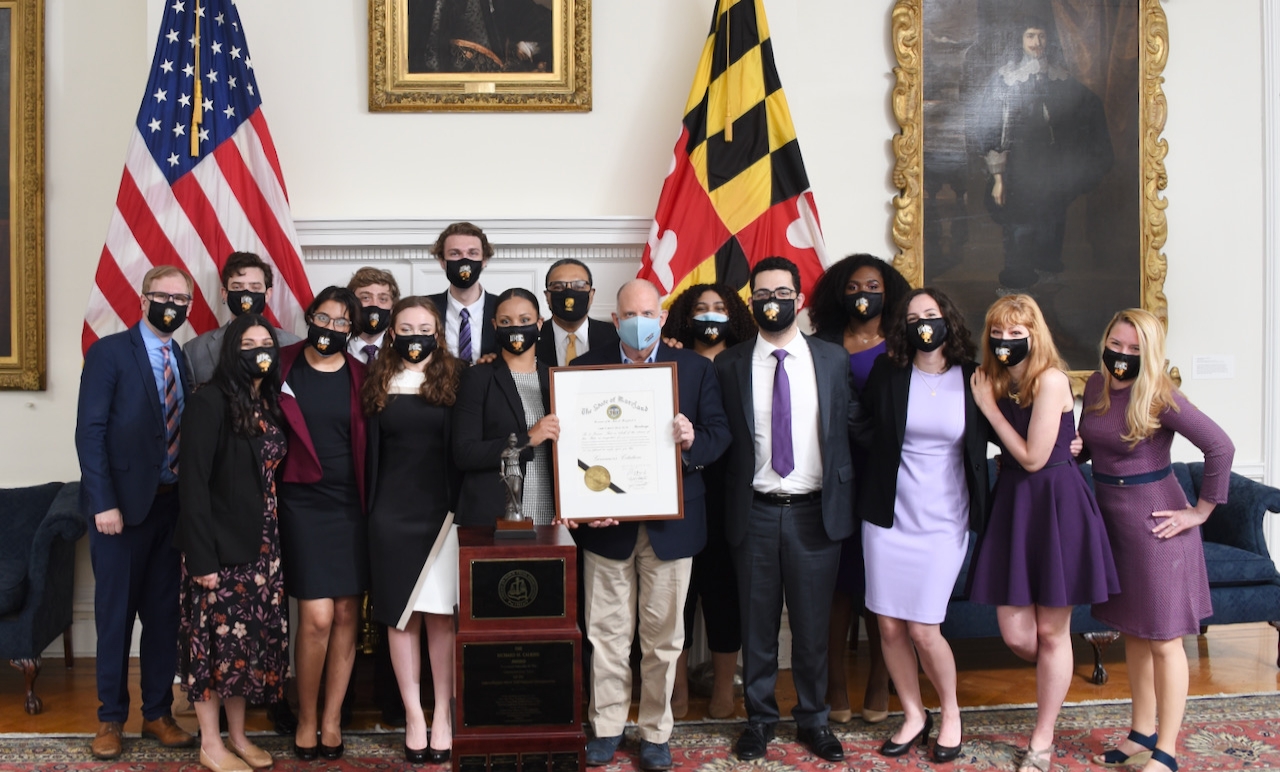
National champion UMBC Mock Trial team with Gov. Larry Hogan in Annapolis. Photo courtesy of the Office of the Governor.
In 2018, UMBC made basketball history as the first No. 16 seed to beat a No. 1 seed in an NCAA men’s tournament. In addition to conference championships in several sports during President Hrabowski’s tenure, men’s soccer rose to the NCAA semifinals and UMBC produced top national athletes in swimming and track and field.
“The UMBC story is one of excitement about learning and learning how to work with people different from oneself,” says President Hrabowski. “We are saying to the country and to young people that you don’t have to be rich to be the very best. Middle class institutions can produce some of the best thinkers in the world.”
Dr. Hrabowski (r) and students on the roof of UMBC’s Administration Building, 2016.
Inspired by students
Over three decades, President Hrabowski has set the bar for educational leadership and earned the highest national honors a university president can receive. He’s written four books and mentored fellow university presidents through a Harvard leadership program. More than 40 universities nationwide—from Harvard and Princeton to University of Michigan and Arizona State—have granted him honorary degrees. But UMBC students are the legacy that makes him feel most proud and inspired.
“We have shown the country that we are a model of inclusive excellence,” President Hrabowski shares. “UMBC is just 55 years old, but we have worked very hard to make history. And we will always be a part of this nation’s history because we produce leaders, including thousands of teachers, lawyers, social workers, and entrepreneurs shaping our communities.”
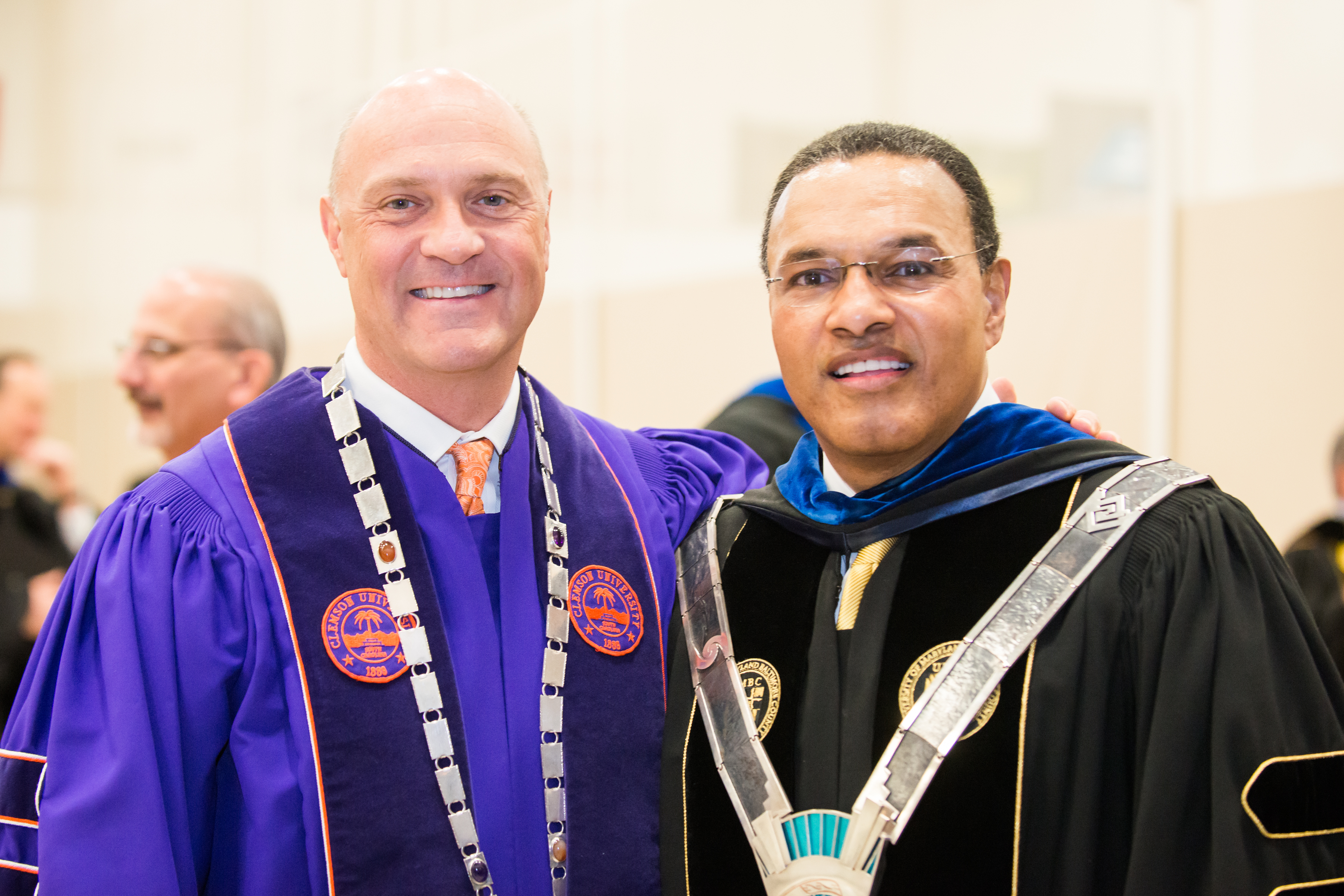
Clemson University President James P. Clements ’85, ’91 M.S., ’93 Ph.D. (l) with UMBC Pres. Hrabowski (r) at UMBC’s spring 2016 Graduate Commencement.
Setting the standard
University System of Maryland (USM) Board of Regents Chair Linda Gooden shares, “People seek out Freeman’s advice because they understand that, in many ways, he’s set the standard for supporting students to success—and I mean all students: students from every background, every race and ethnicity, every income level.”
This carries through to other areas of his leadership, she notes. “He’s set the standard for collaborative leadership and continuous organizational improvement,” says Gooden. “He’s set the standard for creating a culture that brings out people’s best character and best effort. We’ve known every day of his long career how profoundly lucky we are to have him.”
Ongoing growth
Looking ahead, President Hrabowski is excited to see what UMBC will become and achieve.
Cumulative investment in campus construction has grown from $118 million to $1.2 billion over the past three decades. This includes the addition of the Performing Arts and Humanities Building, Interdisciplinary Life Sciences Building, Chesapeake Employers Insurance Arena, and research and teaching spaces in downtown Baltimore. UMBC also has a vibrant presence—12 programs and more than 600 students—at the Universities at Shady Grove.
UMBC’s new Interdisciplinary Life Sciences Building.
The bwtech@UMBC Research and Technology Park houses 131 companies and organizations that employ nearly 1,900 people. And UMBC’s research and development expenditures now surpass $84 million annually.
“Students and student achievement are at the center of everything we do,” President Hrabowski reflects. “At the same time, we support all people as they grow, including our faculty and staff. The dreams and aspirations of everyone in our community inspire us to keep working to be our best selves. There are so many amazingly talented people at UMBC, and we will continue to attract amazingly talented people at every level.”
Next steps
The USM Board of Regents and Chancellor Perman will soon launch a national search for the next president of UMBC, with details announced as they are available. President Hrabowski notes, “I have no doubt that they will work with the campus to attract a leader who appreciates UMBC values and shares our passion for being the very best at what we do.”
Chancellor Perman says of President Hrabowski, “I don’t think I’ve ever met a person who so powerfully inspires excellence. And that’s exactly what his legacy is—a commitment to inclusive excellence that lives on in UMBC, its students, faculty, staff, and alumni.”
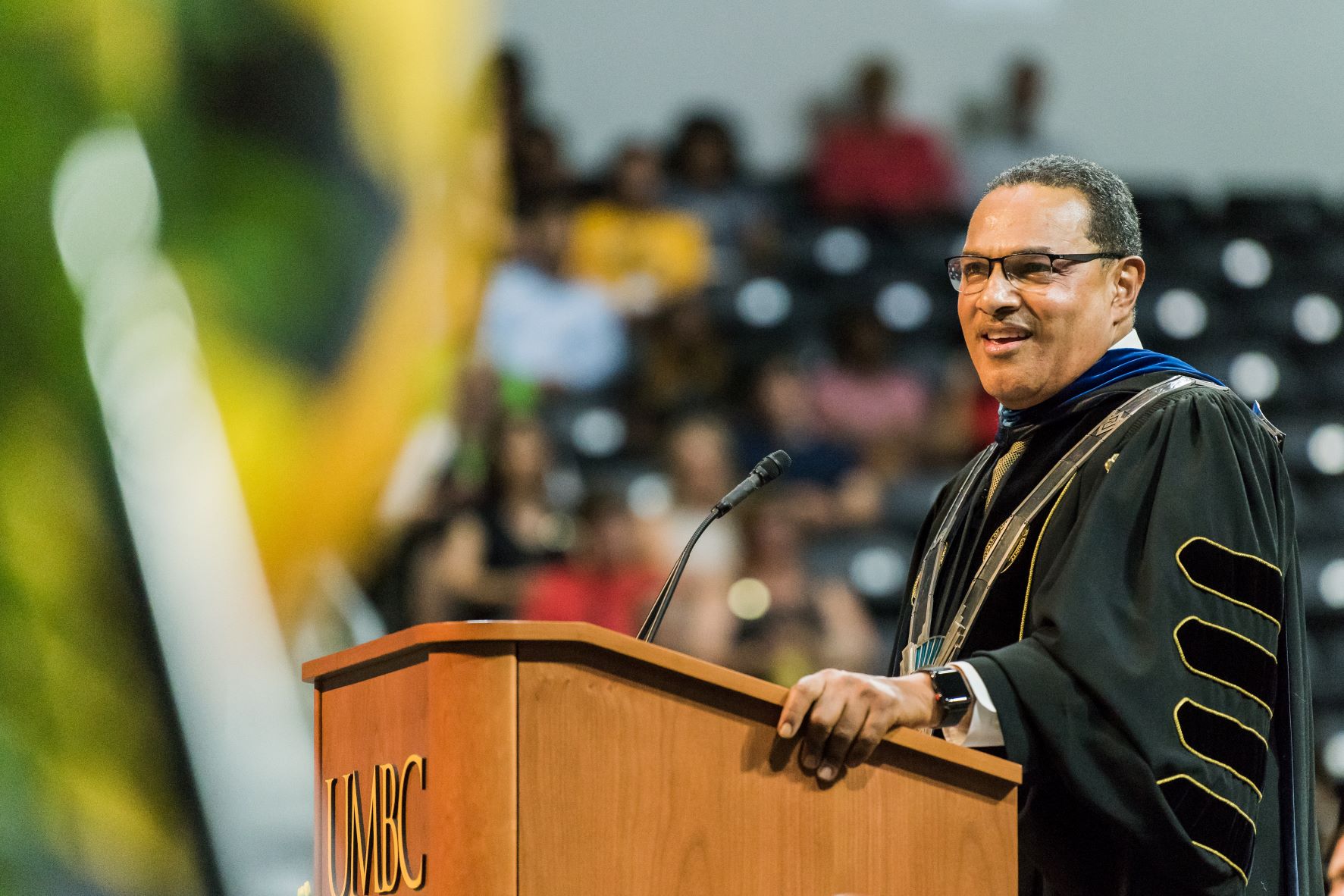
Pres. Hrabowski at Convocation 2018.
UMBC anticipates welcoming its next president in early 2022. Still, says President Hrabowski, “UMBC will always be a part of me. It has helped to define who I am. Wherever I am, I will be talking about the wonderful place that is UMBC.”
Every day UMBC faculty are hard at work testing antivirals in the lab, untangling the impacts of healthcare policy, and processing satellite data on Earth’s atmosphere. They are developing best practices for K-12 teaching, remediating water contaminants, and exploring how actors express intimacy on stage. But how can journalists, students, or the general public learn who these faculty are and what they study? And how can faculty connect with each other for innovative research collaborations?
Anyone seeking UMBC experts can now find them through a new online tool that makes searches fast and easy.
“UMBC has some of the nation’s leading experts in fields ranging from artificial intelligence and quantum computing to health equity and public history. But it can be challenging for potential research partners to identify exactly the right contact for a given project,” says Karl V. Steiner, vice president for research. “We are excited that this online tool will give current and future partners new ways to learn about and collaborate with talented researchers and scholars across our UMBC community.”
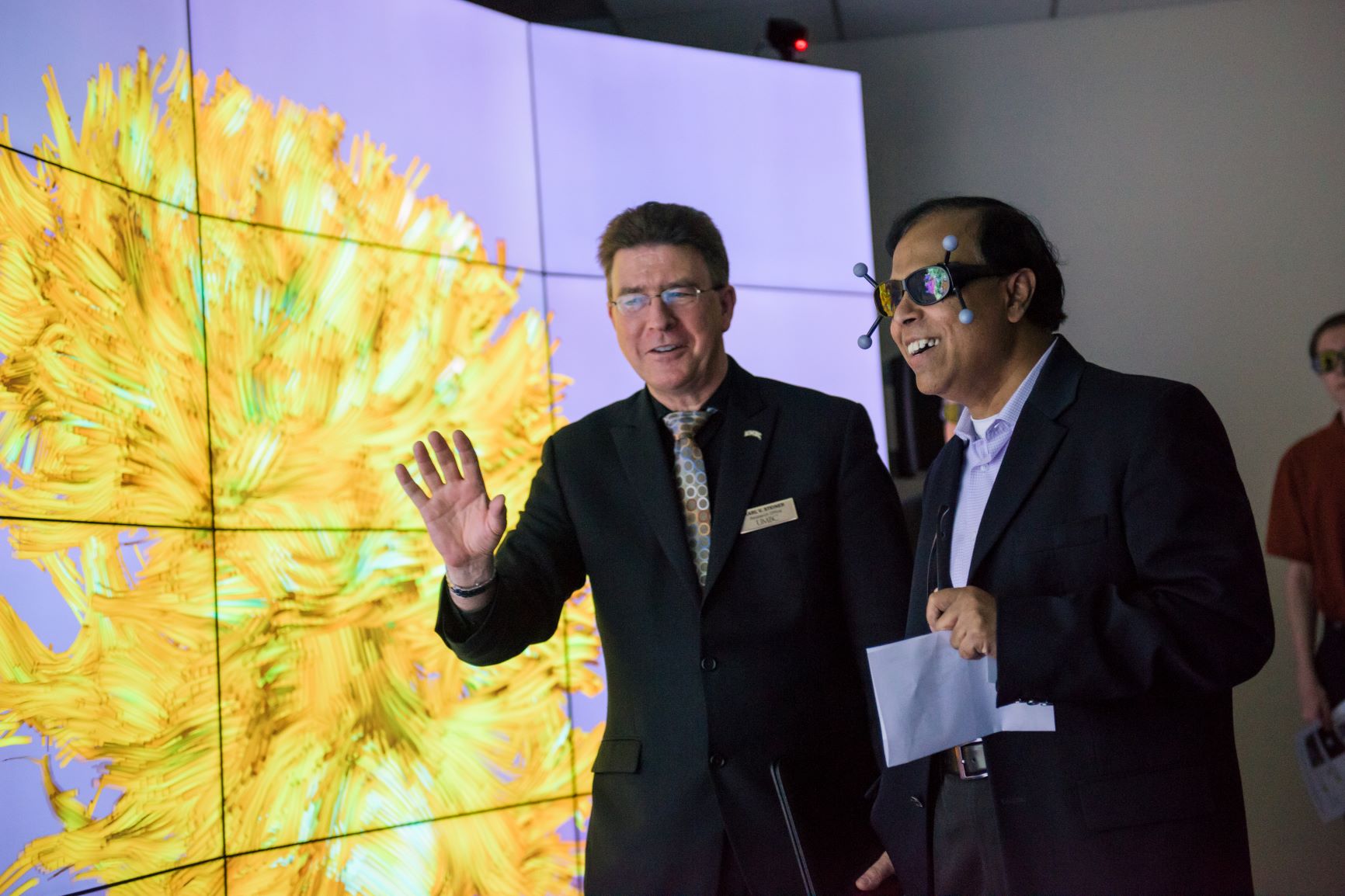
Karl Steiner (left) and Aryya Gangopadhyay at the Pi Squared opening in 2018.
How it works
On the Faculty Expert Search site, users can enter a name or a research topic to identify UMBC experts, and then connect with those who most closely match their needs. Possible uses include fellow faculty seeking research collaborators, prospective graduate students looking for faculty in their areas of interest, journalists looking for experts on topics in the news, and community groups interested in project partners.
In response to search terms, the tool displays micro-profiles. These include faculty names, titles, departments, and brief bios, plus photos if available. Clicking on “view profile” will reveal contact information. It will also display additional information the faculty member chooses to add to their profile, such as research interests, teaching expertise, classes taught, and publications.
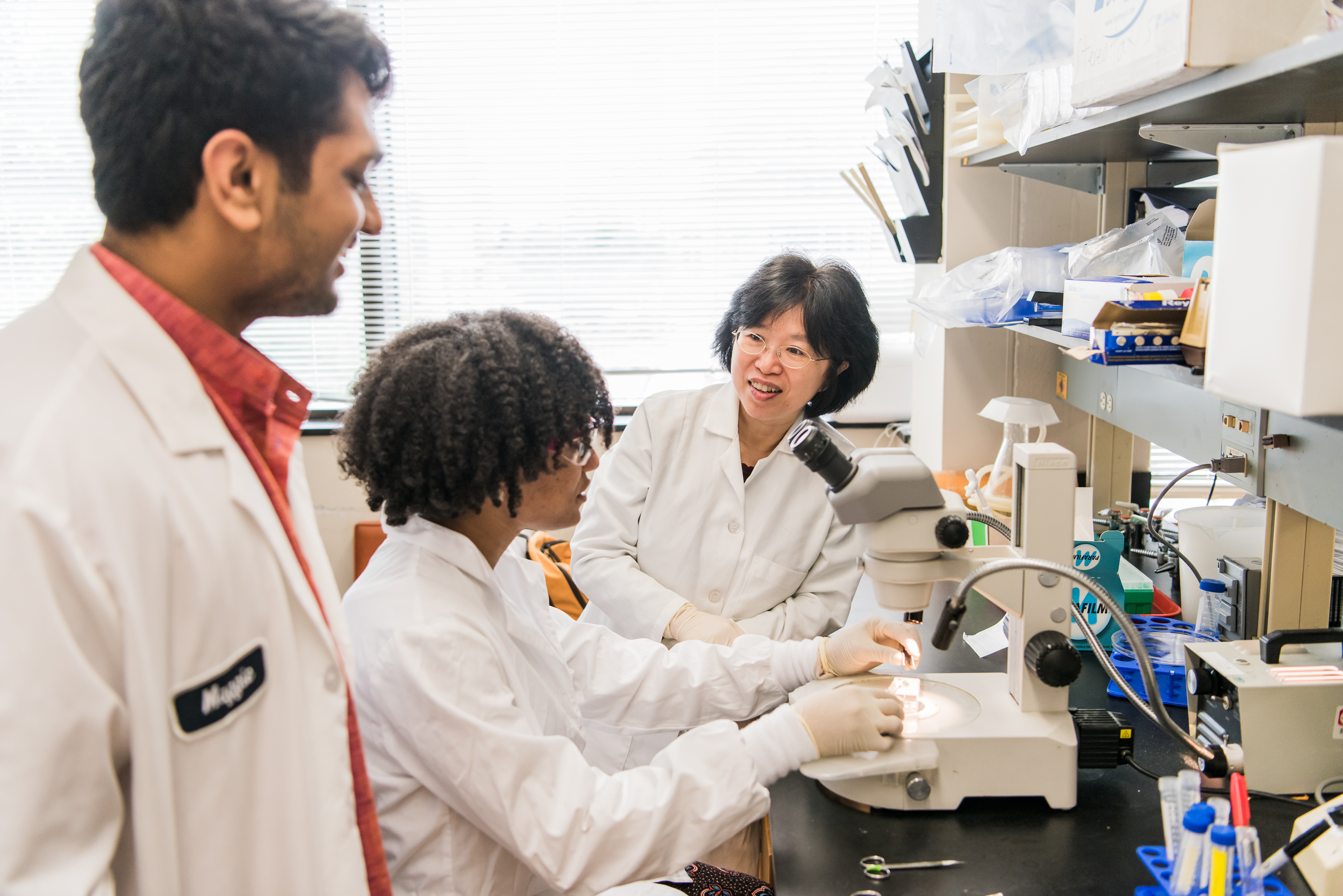
Weihong Lin (right), professor of biological sciences, with Rishit Patel ’19 (left) and Kayla Lemons-Valdez, Ph.D. ’20, biological sciences (center), in 2018.
Faculty can update their profiles at any time, so the site is continuously growing. Currently, the database features tenured and tenure-track faculty and lecturers, and some research faculty, and there is interest in making it more inclusive over time.
Visibility and connections
“A comprehensive, searchable database of faculty experts highlights the diversity and vibrancy of scholarly activities in our institution,” says Preminda Jacob, associate dean of the College of Arts, Humanities, and Social Sciences. Jacob, who is also an associate professor of visual arts, was a leading force behind the development of the Faculty Expert Search tool.
Preminda Jacob (left) and Andrea Lorick (right) at the Center for Art, Design, and Visual Culture, 2016.
“Within our campus, this site will further interdisciplinary research by connecting scholars with common interests,” Jacob says. “External to UMBC, it has the potential to strengthen our research community’s international networks and community partnerships. It encourages the public to connect with faculty experts who could serve as speakers, collaborators, contributors to publications, and mentors.”
Users can access the Faculty Expert Search tool through UMBC’s homepage, under Research.
Faculty seeking to update a profile can use this step-by-step guide. Community members looking for contacts not included in this tool can continue to use the main UMBC.edu search function. Journalists interested in interviewing UMBC experts can also contact news@umbc.edu.
Featured image: Mercedes Burns, Maggie Holland, and Chris Swan (l-r) are part of the NSF-funded Interdisciplinary Consortium for Applied Research in Ecology and Evolution (ICARE). Photos by Marlayna Demond ’11 for UMBC.
Today, the University Innovation Alliance (UIA) announced UMBC as its newest member. The pioneering consortium of public research universities boosts student success through sharing and scaling approaches that work. UMBC and North Carolina Agricultural and Technical State University (N.C. A&T) are the first two universities selected to join the network since its founding in 2014.
Increasing graduation rates
During President Barack Obama’s College Opportunity Summit in 2014, the UIA’s eleven founding institutions set a target of graduating 68,000 additional students over ten years, including half from low-income backgrounds. In just six years, they have already exceeded that goal. Together, they have graduated more than 73,000 additional students, increasing graduates from low-income backgrounds by 36 percent and graduates of color by 73 percent.
Now, the UIA is on track to reach double its original goal by 2023. Supporting this increase will be fresh, data-driven ideas from UMBC and N.C. A&T.
Both institutions have a long history of supporting students from underrepresented groups, including low-income and first-generation students and students of color. In ten years, UMBC increased its six-year graduation rate for full-time freshmen from 55.7% for the fall 2005 cohort to 69.2% for the fall 2014 cohort.
“We have seen very positive trends in UMBC’s student retention and graduation rates, but this is an important opportunity to dive deeper into our data, and to look at how we can better support students who are struggling,” says Katharine H. Cole, UMBC’s vice provost and dean of Undergraduate Academic Affairs. “It’s our responsibility to understand the challenges students face at the most granular level possible, and to provide resources to help them reach their goals.”
Amanda Knapp, Katharine Cole, and Delana Gregg (l-r) in UMBC’s Academic Success Center, 2019.
Leaders in student support and achievement
In the next phase of its work, the UIA will focus on eliminating disparities in educational outcomes based on race and ethnicity, in addition to disparities by income, first-generation college student status, gender, and geography. The UIA has described the addition of “like-minded institutions” UMBC and N.C. A&T as core to this expanded focus.
UMBC opened in 1966 as the first public university in Maryland to include students of all races, and is federally designated as a minority-serving institution. The university prioritizes experiential learning opportunities, including internships, service-learning, and research. Eighty-seven percent of UMBC graduates head directly into a job, advanced degree, or both. A majority of those employed interned or worked for their employer as UMBC students.
Phanindra Kumar Kannaji M.S. ’19, computer science, and Christopher Powell ’13, computer science, during Kannajj’s internship at PayPal.
“As a historically diverse institution that has had success in supporting and promoting underrepresented student achievement, we look forward to bringing our experiences and insight to this critical work as part of the UIA collaborative,” says Yvette Mozie-Ross ’88, UMBC’s vice provost for Enrollment Management and Planning.
Yvette Mozie-Ross. Photo courtesy of Mozie-Ross.
N.C. A&T is the nation’s largest public Historically Black College and University (HBCU). The university graduates large numbers of Black students in mathematics, statistics, engineering, and agriculture.
U.S. News & World Report has named both UMBC and N.C A&T leaders in innovation and in undergraduate teaching. According to the National Science Foundation, UMBC and N.C. A&T are also the #1 and #2 universities in the nation, respectively, in producing Black graduates who go on to earn a Ph.D. in the natural sciences and engineering.
Sharing insights and tools
“When thinking about the next chapter of the UIA, we reviewed the outcomes and mission of every R1 and R2 institution in the country,” says UIA Executive Director Bridget Burns, referring to U.S. universities with top Carnegie Classifications for research activity. “A&T and UMBC immediately stood out for their leadership and demonstrated commitment to student success,” she notes.
A session at UMBC’s Math and Science Tutoring Center, 2019.
Living out this commitment through the UIA will include sharing data on the efficacy of different approaches to supporting students. It will also include sustained focus to implement, test, and refine strategies to remove impediments to student success.
“I have long admired the ambitious work of the University Innovation Alliance,” says UMBC President Freeman Hrabowski. “Over the last two decades we have worked tirelessly to create a culture that is committed to innovative teaching, relevant research, and creating a supportive community to help inspire students, and we are excited to share our insights and tools with the UIA community.”
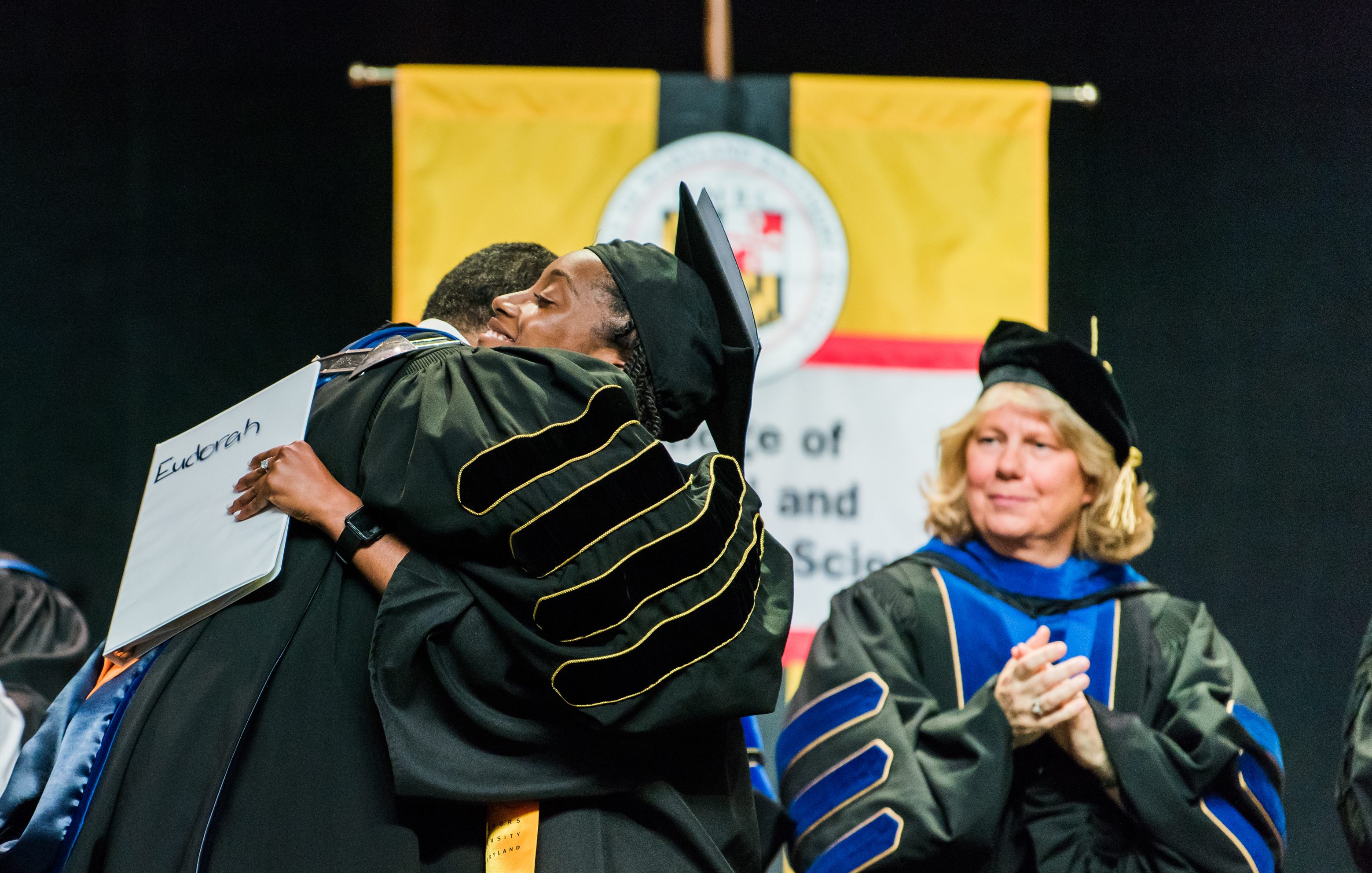
President Hrabowski congratulates valedictorian Eudorah Vital, with Dean Cole in background, May 2018.
Featured image: Amanda Knapp and Katharine Cole speak with students in UMBC’s Academic Success Center, 2019. All photosby Marlayna Demond ’11 unless otherwise noted.
This week, UMBC announced plans to reopen the campus for the Fall 2021 semester, providing most courses and campus services face-to-face or in a hybrid format.
“I cannot wait to walk across campus and to again see it busy with students, faculty, and staff,” said President Freeman Hrabowski. “It will be very special to reclaim the vibrant campus community life that we have all missed.”
He and Provost Philip Rous have cited ongoing progress in COVID-19 vaccine access and updated public health guidance as key factors in the university’s planning.
President Hrabowski with Orientation Peer Advisors, summer 2018.
This news comes just over a year after UMBC temporarily moved most teaching and learning, community building, research, and other operations online due to the COVID-19 pandemic.
“We know that our students really miss seeing their friends on campus. And they miss being able to go to in-person events and connect with their professors face-to-face,” says Nancy Young, vice president for Student Affairs.
“We’ve discovered innovative ways to help Retrievers find community and stay connected online during the pandemic,” she shares. “At the same time, we know how meaningful it will be for returning students to connect in person once again, and for incoming students to have opportunities for in-person experiences.”
Nancy Young (center) with SGA President Mehrshad Devin (left), Communications Director Calista Ogburn (right), and True Grit on campus in July 2020.
The COVID-19 Planning Coordinating Committee has been working with faculty, staff, and student leaders across the university to plan for a fall that offers opportunities to live, learn, and work on campus, with appropriate safety measures in place. Plans also take into account the diverse needs and individual health concerns of UMBC community members.
Classes, housing, and events
Course registration is now open for both undergraduate and graduate students. Most courses will be offered in-person or in a hybrid format. The university will continue to make additions to the Schedule of Classes over the coming months.
UMBC is preparing to reopen residence halls at up to 95 percent occupancy. More information about housing spaces, rates, and adjustments to meet public health guidance will be available soon.
UMBC students in on-campus housing.
The university is planning a full Fall 2021 calendar of on-campus events open to both residential and off-campus students.
Yvette Mozie-Ross. Image courtesy of Mozie-Ross.
“We are excited to be able to return to offering a fully immersive on-campus experience this fall,” says Yvette Mozie-Ross ’88, health science and policy. She serves as vice provost for enrollment management and planning.
“These experiences help to enrich the academic and social life at UMBC for many of our students,” says Mozie-Ross. “We are also excited to carry forward all that we learned during the pandemic about ways that online learning, support, and community-building resources can complement on-campus courses and services.”
Facilities for recreation, well-being, and learning
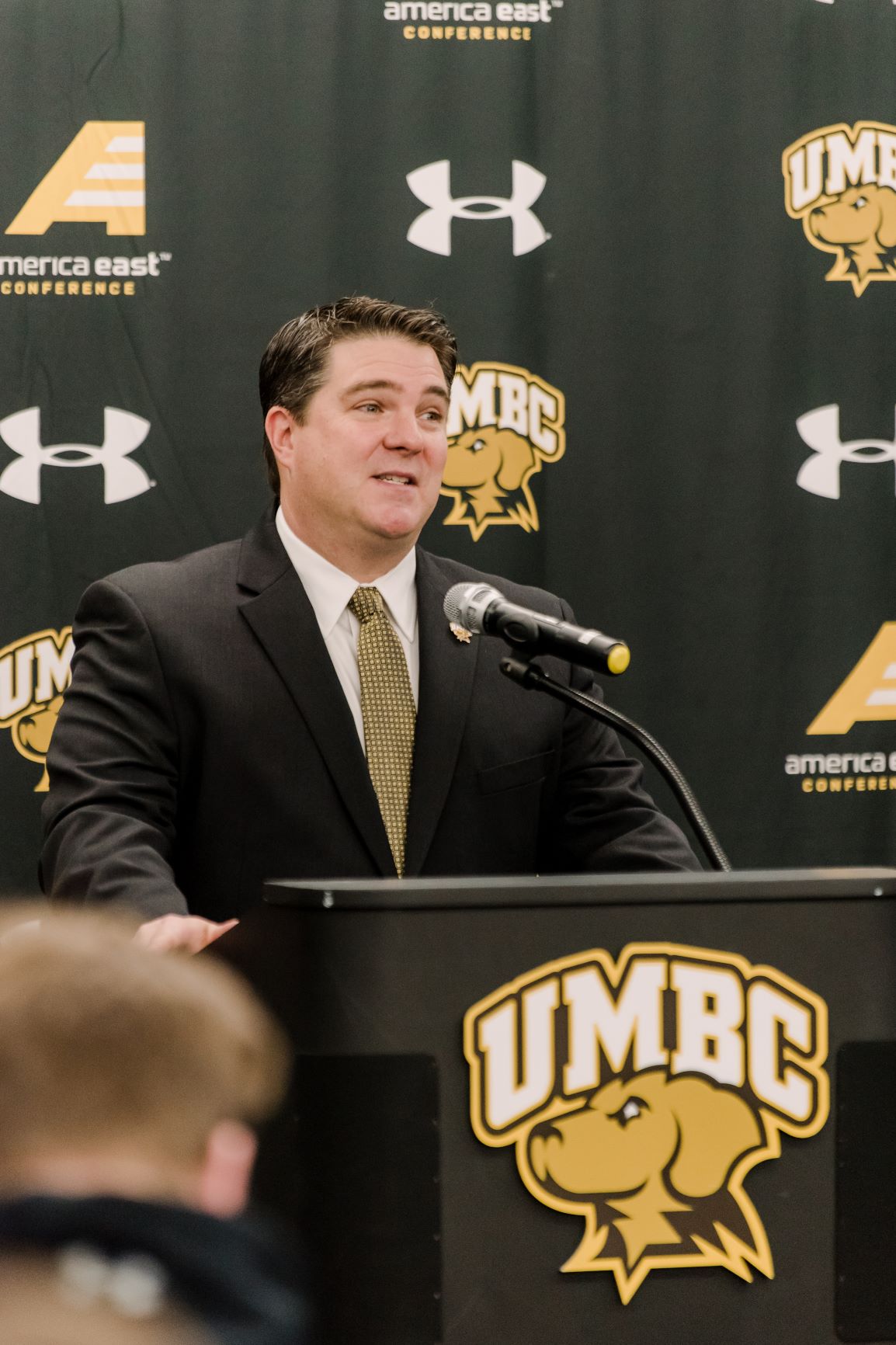
Brian Barrio, 2019
Over the past year, UMBC fully renovated the Retriever Activities Center (RAC). The updated space will offer expanded recreation facilities. These include a track, cardio-training, weight-training, spinning, group exercise space, and basketball courts.
The building really has been transformed,” says Brian Barrio, UMBC’s director of Athletics. “There will be something for everyone’s recreational or fitness needs. It is really exciting.”
A brand new student well-being facility is under construction next to Erickson Field. It will soon house UMBC’s health, counseling, restorative services, and spiritual resources.
The university continues to thoughtfully plan for the reopening of additional facilities and community spaces, including the Albin O. Kuhn Library & Gallery, The Commons, performance spaces, and other gathering spaces.
UMBC Albin O. Kuhn Library in spring 2019.
Ongoing focus on safety, flexibility
“We look forward to a much more active on-campus community this fall,” says President Hrabowski. “At the same time, we know the pandemic is not over. We must continue to be as flexible as possible.”
UMBC will continue to rigorously follow local, state, and federal public health guidance. This includes safety measures regarding testing, symptom tracking, mandatory mask wearing, hygiene, ventilation, physical distancing, and space occupancy, as required.
Katherine Poteet ’21, global studies and political science, by the library, Fall 2020.
The university strongly encourages all students, faculty, and staff to seek vaccination for COVID-19 once they are eligible. Campus leaders note that current public health guidance indicates increased vaccination will enable more expansion of in-person activities.
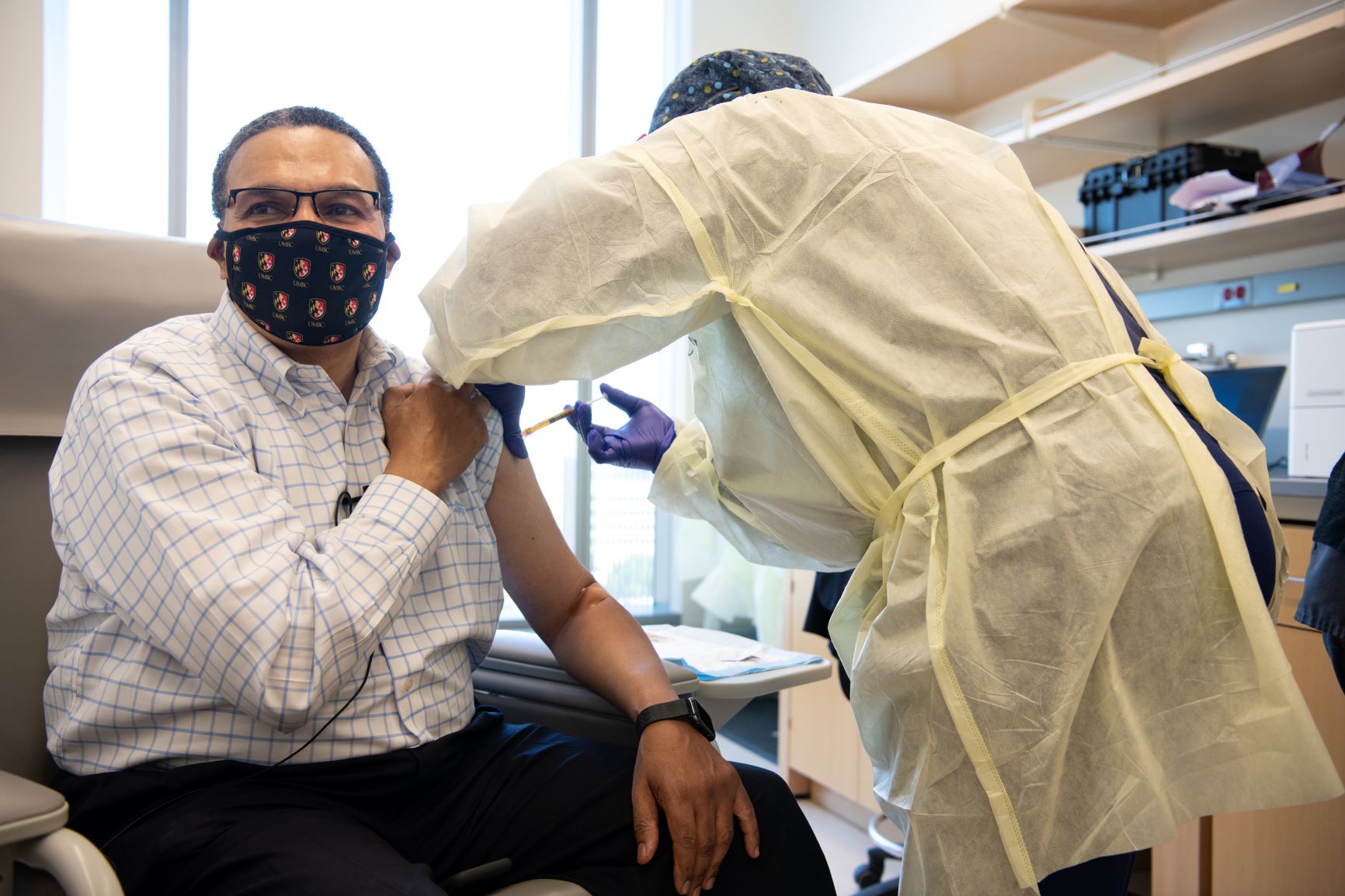
Pres. Freeman Hrabowski receiving a COVID-19 vaccine. He participated in the University of Maryland School of Medicine’s Moderna vaccine trial, 2020. Photo courtesy of UMB.
“We are constantly following the science and public health guidance,” says Young, “and the science says that the more vaccinated our community becomes, the more open we can be.”
“We have been thrilled to hear about expanding access to highly effective COVID-19 vaccines,” she shares. “It’s really been a game-changer for us, to be able to look ahead with optimism for seeing each other again soon, on campus.”
Knowing that individual community members have different situations and concerns, UMBC will continue to emphasize flexibility and responsiveness in meeting diverse student, faculty, and staff needs.
Community members with questions about COVID-19 and the Fall 2021 semester can contact covid19@umbc.edu.
Featured image: UMBC Orientation Peer Advisors in 2018. Photos by Marlayna Demond ’11 for UMBC unless otherwise noted.
Announced today, 2022 U.S. News Best Graduate School Rankings name several UMBC programs in engineering and public affairs as among the best in the nation.
U.S. News bases these rankings on a combination of quantitative data about over 2,125 programs and expert opinions on program reputations. This feedback is provided through surveys to more than 23,000 deans, program directors, senior faculty, and other leaders.
UMBC has top-100 programs in public affairs and several engineering fields. Engineering is one of a few areas where rankings also reflect the opinions of professionals who hire or work with new graduates.
UMBC’s ITE (Information Technology and Engineering) building
A growing leader in engineering
UMBC’s engineering programs, overall, tied with engineering colleges at the flagships University of Missouri and University of Kansas at 108th. The ranking has steadily climbed from 111th in the 2019 rankings. This year, UMBC is ranked ahead of both the University of Georgia and Utah State University.
UMBC engineering programs were recognized in five separate categories. For environmental engineering UMBC moved from #58 to #56, and for mechanical engineering UMBC rose from #105 to #101. UMBC’s graduate programs in chemical engineering experienced the most rankings growth, from #84 to #68.
“I am not at all surprised by the higher rankings we see for our chemical, biochemical, and environmental engineering (CBEE) graduate programs,” says Keith J Bowman, dean of the College of Engineering and Information Technology (COEIT). “We have expanded a fantastic team by hiring outstanding new faculty and we have been successful in recruiting extraordinary graduate students.”
Dean Keith Bowman delivers remarks at the 2019 COEIT Celebration. Photo by Chris Ferenzi Photography.
CBEE Professor Erin Lavik, COEIT’s associate dean for research and faculty development, shares, “Whether it is technologies to enable better, more accessible treatments for diseases or developing solutions to make environmental justice a reality, our CBEE programs prepare students for the future as socially responsible engineers.”
Erin Lavik (left) with graduate student Adam Day (right) in her lab, which works to develop new therapies through polymer synthesis and processing, drug delivery, and stem cell biology, 2018.
Groundbreaking computer engineering research
UMBC also ranked #92 in computer engineering and had a strong ranking in electrical engineering. Highly robust research opportunities for graduate students are a key reason why UMBC has a top-100 ranking in computer engineering.
Tinoosh Mohsenin, computer engineering, leads the Energy Efficient High-Performance Computing Lab (EEHPC), at the forefront of research in the new field of human-autonomy.
Tinoosh Mohsenin, 2017
Brain activity monitoring is a growing field with medical applications in detection, diagnosis, prevention, and rehabilitation related to brain disorders. Human-autonomy is one of those applications, where people can potentially use brain signals to remotely guide devices. Mohsenin and her students have also worked on a variety of low power artificial intelligence processors that use electroencephalogram (EEG) signals to identify brain artifacts, detect seizures, and monitor stress and an individual’s attention.
“The UMBC graduate school experience has been very rewarding as it encourages graduate students to express and broaden their outlook while also allowing them time to establish these ideas towards a realistic platform,” says Arnab Mazumder, a computer engineering Ph.D. student who works with Mohsenin.
Arnab Mazumder. Photo by Hasib Al Rashid.
“Working in the Energy Efficient High-Performance Computing Lab has been the highlight of my experience at UMBC,” Mazumder says. He and fellow Ph.D. student Hasib Al-Rashid, electrical engineering, have already published several papers and two book chapters on their research. They focus on developing deep learning models and low power wearables to detect brain EEG artifacts and recognizing activity and gestures from people’s physiological data.
“This opportunity has given me a stage to expand and articulate my vision,” says Mazumder. “My goal is to help the public figure out an end-to-end artificial intelligence solution for detection and recognition-related problems, especially in the area of human health monitoring.”
Producing leaders in public affairs
UMBC has offered robust graduate programs in policy sciences for more than four decades and formally established the School of Public Policy in 2014. Today, the school is best known for research in government performance, health disparities, and improving educational outcomes. UMBC also has expertise at the intersection of economics and public policy.
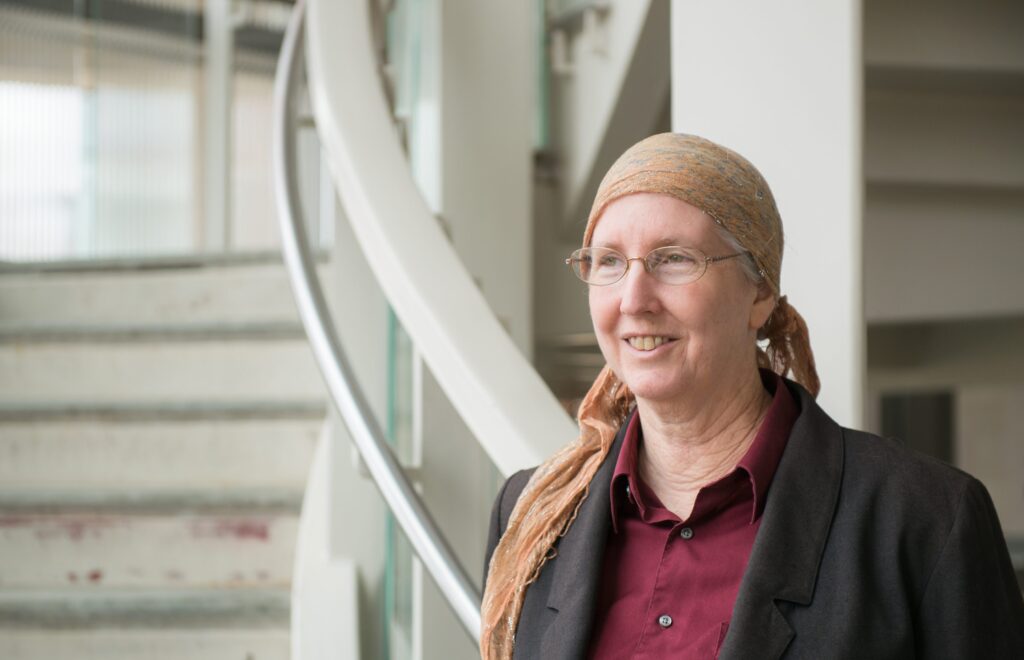
Nancy Miller
“The School of Public Policy draws a diverse and exceptional group of graduate students,” says Nancy Miller, professor and director of the School of Public Policy. “They go on to exciting leadership careers in the public sector, academia, and non-profit sectors.”
Among the School’s prominent alumni is Rear Admiral Sylvia Trent-Adams, Ph.D. ’06, public policy, former principal deputy assistant secretary for health for the United States and now chief strategy officer for the University of North Texas.
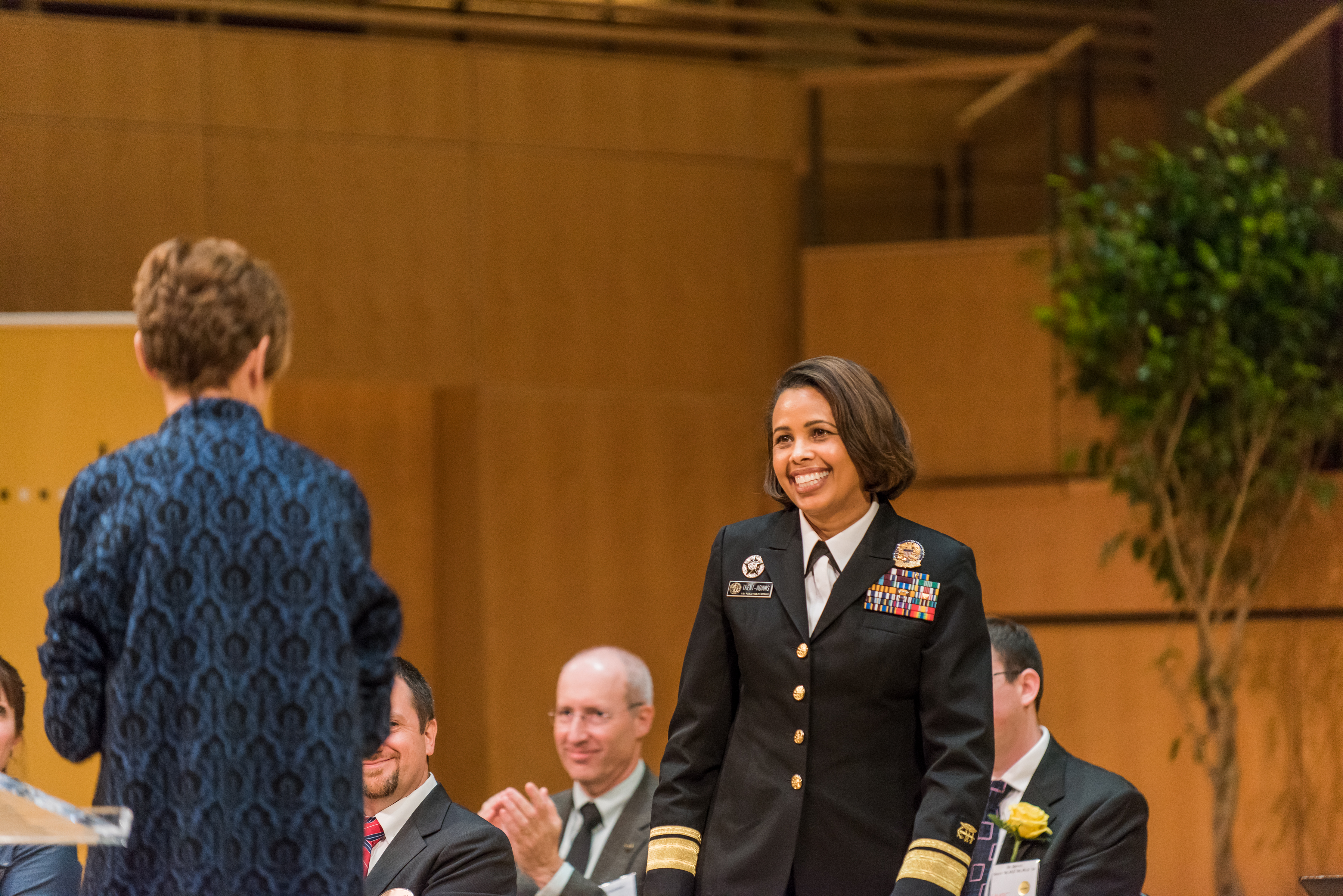
Sylvia Trent-Adams Ph.D. ’06, public policy, accepted UMBC’s Outstanding Alumni Award in Social and Behavioral Sciences in 2017.
Other Ph.D. alumni include NathanielJones, III ’87, mechanical engineering, Ph.D. ’02, health policy, president of College of Alameda; John A. Olszewski Jr., Ph.D. ’17, public policy, Baltimore County executive; and Deborah Trautman, Ph.D. ‘04, public policy, CEO of the American Association of Colleges of Nursing.
The School’s many notable master’s degree alumni include leaders like Qubilah Huddleston, M.P.P. ’17, education policy, who is education policy analyst at the DC Policy Fiscal Institute, and Steve Sharkey, M.P.P. ’06, public policy, director of the Baltimore City Department of Transportation.
Excellence across disciplines
“UMBC has outstanding Ph.D., master’s, and certificate programs across engineering, computing, natural and mathematical sciences, social sciences and education, and the arts and humanities,” says Janet Rutledge, dean of The Graduate School at UMBC. “We are proud of how U.S. News and others recognize the accomplishments of our faculty, students, and alumni.”
Janet Rutledge at UMBC’s Graduate School commencement, spring 2016.
Banner image: Graduate student Adam Day (left) works with Erin Lavik (right) in her lab, 2018. All photos by Marlayna Demond ’11 for UMBC unless otherwise noted.
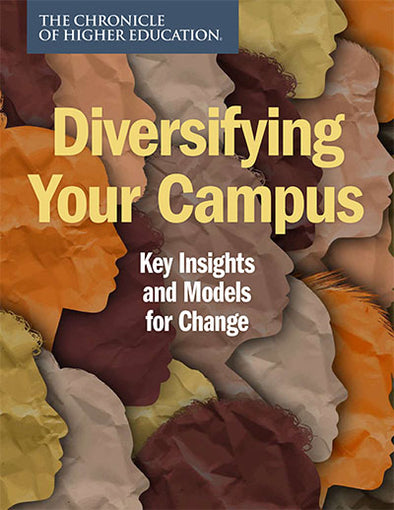
A new report from the Chronicle of Higher Education features UMBC’s peer-based work to boost faculty diversity. For decades, UMBC’s strong reputation for inclusive excellence has focused on student diversity. The new UMBC case study in “Diversifying Our Campus: Key Insights and Models for Change” expands that conversation.
The article notes that UMBC received National Science Foundation support to “revamp hiring processes, write more-inclusive job postings, and craft diversity plans for hiring and recruiting” in 2003. This $3.2 million Institutional Transformation Grant sought to promote the recruitment and advancement of women in STEM, and UMBC saw a 70% increase in women tenure-track STEM faculty. At the same time, the university’s recruitment of scholars from underrepresented racial and ethnic groups lagged.
As the article notes, “fellows have frank conversations with hiring committee members about how to retool their searches.” They bring in competing institutions’ job ads and have hiring committee members critique old UMBC job listings. They also help departments shift gears from recruiting for individual faculty openings to continuously recruiting by building relationships with emerging scholars in their fields.
STRIDE Fellow Nilanjan Banerjee, professor of computer science and electrical engineering, describes in the article how he shared data with his department on the connection between more diverse faculty and greater research funding and productivity. He then helped the department retool their process to advertise positions more widely and dig deeper into the CVs of candidates.
Nilanjan Banerjee (right) works with a student in his lab, 2017.
Seeing results
Autumn Reed, assistant vice provost for faculty affairs, directs the STRIDE program. She notes that initially, “there was a lot of resistance and a lot of skepticism” about STRIDE fellows connecting with hiring committees. But now that departments see other units successfully hiring candidates from underrepresented groups, they want to connect.
Autumn Reed, M.A. ’08, intercultural communication, and Ph.D. ’14, language, literacy, and culture
The article also highlights UMBC’s faculty diversity postdoc programs, through which 12 former fellows have been converted into tenure-track faculty members at UMBC.
Keisha McIntosh Allen is one of several scholars recruited to UMBC as a postdoctoral fellow for faculty diversity. She is now an assistant professor of education. Her research focuses on how race, culture, and identity influence the educational experiences of Black and Brown youth, including how teachers can engage students through asset-based and humanizing pedagogies.
Together, UMBC’s efforts to hire and retain more racially and ethnically diverse faculty have had an impact. In 2011-12, 9% of tenured and tenure-track faculty were Black, Latinx, or Native American. That increased to 15% in 2020-21.
Student Affairs leadership
Earlier this month, the Chronicle featured Nancy Young, vice president for student affairs, in a virtual roundtable on the Future of Student Affairs. The forum reached a national audience of more than 2,000 registrants.
Viewers were eager to learn about how the COVID-19 pandemic has heightened or made more visible students’ needs for support, particularly students from disadvantaged, underrepresented, and vulnerable communities. The event was designed to “bring together student-affairs leaders to explore how the profession is adapting to new demands and the evolving campus landscape.”
Nancy Young, 2017
Focus on connections
Young shared UMBC’s approach to campus safety during the pandemic and the transition back to more on-campus activities. Speaking more broadly about the future, she shared, “I think that what we’re seeing right now is an acceleration of many trends that were already underway,” whether in online learning, the kinds of careers students are preparing for, or the support they need.
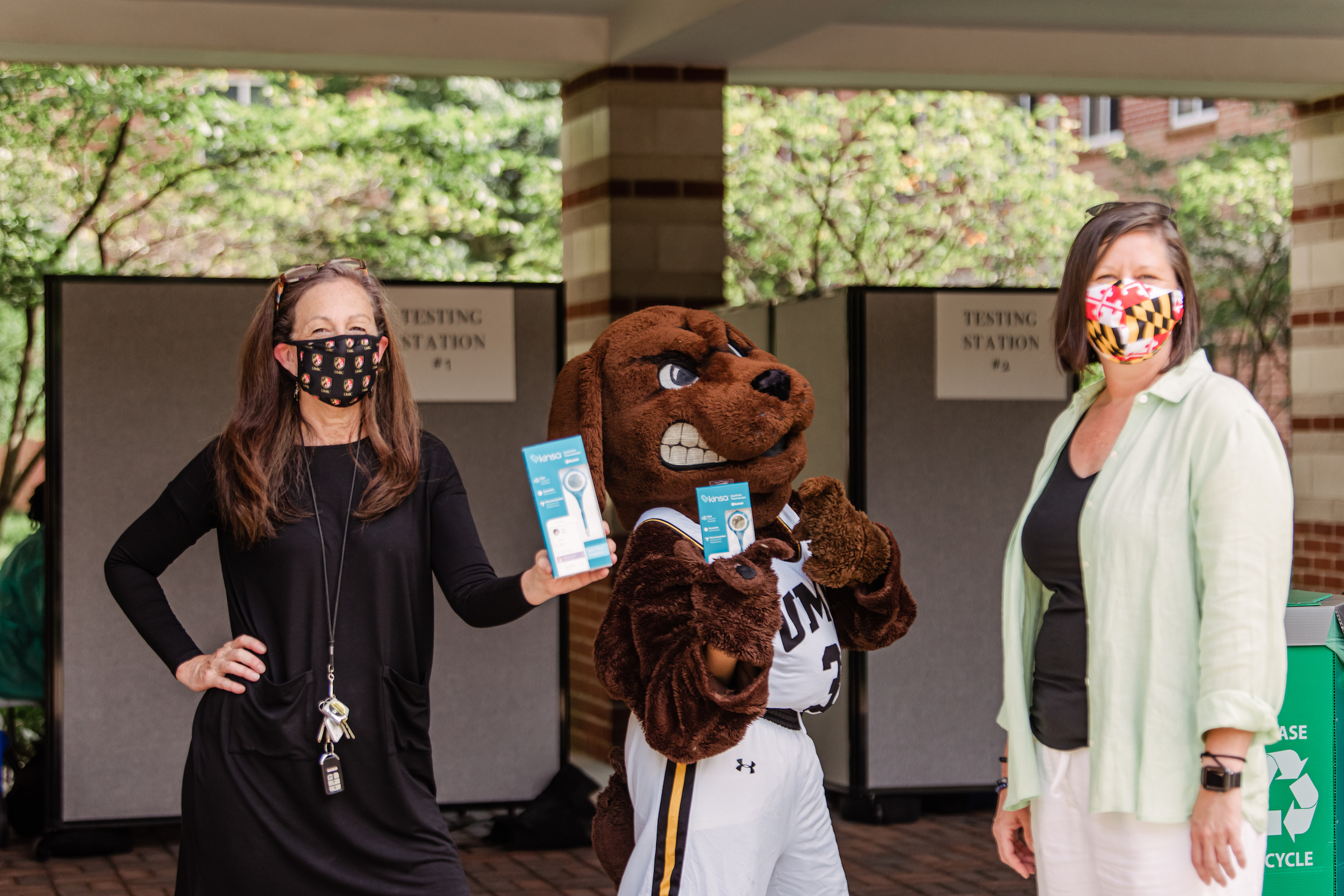
Nancy Young (left), True Grit, and Kate Tracy (right) at UMBC’s COVID-19 testing pilot, July 2020.
At the same time, Young noted, “there are also many things that are going to stay the same, and that people can’t wait to get back to” post-COVID. In particular, she says, students just want to hang out with their friends.
With this in mind, Young and her team have been working closely with student leaders and student groups. They’ve sought to better understand how the university can support students’ work to connect with each other, and to engage first-year students in particular.
Nancy Young (right) with SGA President Mehrshad Devin (left) and Communications Director Calista Ogburn (center) on campus in July 2020.
At a time when we are “no longer able to bump into people in the hallways,” she says, this means there is “more intentionality” and more active listening. And these thoughtful approaches have built lasting connections that will bolster the university community for years to come.
Banner image: Nilanjan Banerjee. All photos by Marlayna Demond ’11 for UMBC.
UMBC’s online master’s degree in information systems has once again been ranked one of the best programs in the nation by U.S. News. The rankings, announced this week, also highlight UMBC as offering one of the top 20 such degrees in this field for veterans.
U.S. News has now recognized this UMBC program for several years, making it a longtime leader. Joining UMBC on the list in 2021 are universities like Virginia Tech and Drexel.
Faculty committed to student success
Graduate program director Anita Komlodi, associate professor of information systems, shares, “We are very excited to again be ranked among the best. Our program is well established, with about twenty years of experience educating online technology students.”
Anita Komlodi. Photo by Marlayna Demond ’11 for UMBC.
Keith J Bowman, dean of the College of Engineering and Information Technology, has described the program’s faculty as deeply committed to their mission of “enabling our online master’s students to gain the skills required to succeed with our extensive range of industry and government partners.”
“We put our students first. We designed our program both for working IT professionals and career changers wishing to transition into IT careers,” Komlodi says. “Most of our students work full-time. The flexibility and asynchronous nature of the program helps them progress in their careers while balancing other responsibilities.”
Flexibility and rigor
UMBC built the online master’s degree in information systems for students balancing many responsibilities. Many are managing work, family, military service, and other commitments, while still seeking to advance their education and careers. And students are able to pursue interests in an extremely broad array of focus area, from health information technology to human-centered computing.
Komlodi notes, “We have recently introduced tracks for in-demand industry areas in artificial intelligence, cybersecurity, data science, and user experience design.”
Vandana Janeja. Photo by Marlayna Demond ’11 for UMBC.
Vandana Janeja, chair of information systems, knows the value that a rigorous, flexible online graduate program can bring to students. Upon UMBC earning U.S. News recognition last year, she commented that for the online program, “We are committed to a high level of excellence and engagement akin to our on-campus program.”
It’s all about pairing high expectations with strong support for students, she says—the trademark UMBC experience.
Banner image: Mobile technology. Photo by WOCinTechChat, CC BY 2.0.
The National Institute for the Study of Transfer Students has named UMBC’s Danyelle Tauryce Ireland a 2021 Transfer Champion Rising Star. The award honors her years mentoring and advocating for UMBC transfer students in information technology and engineering fields.
“My professional background has been in K-12 education and some of my first experiences supporting students in higher education have been with the Transfer Scholars in IT and Engineering (T-SITE) program at UMBC,” says Ireland. “I identify as an educational scholar-practitioner, so to be recognized for my impact in service of students, and to have a former T-SITE Scholar contribute to the nomination process, was especially validating.”
Danyelle Ireland
Partnership to support students
Ireland arrived at UMBC in 2016 with a Ph.D. in educational psychology from Howard University, having focused her research on the achievement motivation and retention of Black undergraduate women in computing fields. At UMBC, she began working on a new five-year National Science Foundation grant to examine pathways for computing and engineering students who transferred to UMBC from other institutions.
This was her first opportunity to work specifically on the needs and experiences of transfer students, grounded in her expertise on computing and engineering education, culturally responsive pedagogy, academic motivation, and social identity.
“The grant proposal was led by my predecessor, Susan Martin, but was awarded after she left UMBC and began the same day I started in the role, so I got to make this project my own,” Ireland says.
Ireland led the integration and implementation of two nationally validated survey instruments, examining pre- and post-transfer student success. She also worked with campus partners to establish transfer-focused interventions in COEIT.
Danyelle Ireland (second from right) with CWIT students in February 2020.
“I quickly learned a tremendous amount about the institutional structures that facilitate successful student supports. I also learned the benefit of good relationships with colleagues to carry out this important work,” she says.
Ireland collaborated closely with six area community colleges and the team was granted an additional year to implement their findings at UMBC. Always focused on the student experience, she is particularly eager to institutionalize UMBC’s enhanced academic advising approach for COEIT transfer students. She has also explored how COVID-19 has impacted faculty and staff participants in the transfer learning community.
Visibility for the work
In a time full of challenges, Ireland says, “Receiving this award this year was a nice boost to my morale and motivation in my role.” In addition to honoring her work, the award brings greater visibility to UMBC’s transfer student population and to how the university can most effectively support their success.
“I’m really excited about how we can leverage all of the lessons and experiences gained through CWIT’s work around transfer success in computing and engineering,” says Ireland. “The response from colleagues and partners committed to supporting UMBC transfer students has been so encouraging.”
Featured image: Danyelle Ireland, associate director of CWIT and research assistant professor, with CWIT students. All photos by Marlayna Demond ’11 for UMBC, February 2020.
As UMBC faculty prepare for spring, they are reflecting on lessons learned from a primarily online fall 2020 semester. In UMBC’s College of Engineering and Information Technology (COEIT), this means honoring teaching fellows and teaching assistants for their role in making sure courses met student needs.
Essential perspective
“I think anybody’s goal, in any sort of class, is to provide the highest quality, most optimal experience to our students,” said Jamie Gurganus, COEIT’s associate director of engineering education initiatives, in an interview last summer. Along with colleagues across the university, she worked through the summer and fall to help faculty provide students with “safe, thriving online environments” to learn.
Jamie Gurganus (right) walks with Randy Deinlein ’19, mechanical engineering, on campus, May 2019. Photo by Marlayna Demond ’11 for UMBC.
The centerpiece of this work was the Planning Instructional Variety for Online Teaching (PIVOT) program. PIVOT, PIVOT+, and more specialized webinars helped faculty design truly engaging online courses. COEIT hired several rising UMBC juniors and seniors to participate in the workshops and offer feedback to faculty.
These undergraduate teaching fellows “brought an essential perspective,” Gurganus shares. They continued to provide feedback throughout the fall, and many are continuing the work in spring 2021.
Creativity and community
Hana Flores ’21, chemical engineering, served as a teaching fellow. She shares, “It was unlike anything we have done before, but it was special due to the creativity and strong community of COEIT.”
Flores sees her experience as emblematic of a culture of community support. “I’m grateful for continuing the legacy of support from upperclassmen to underclassmen as a teaching fellow,” she says. “It is what makes engineering classes exceptional.”
Celebrating together
COEIT invited Flores and dozens of other teaching fellows and teaching assistants to a celebration to honor their work in late December. After a busy and intense semester, they took time to enjoy each others’ company, with Flores’s team, the ChemiE Cuties, winning the celebration’s trivia contest.
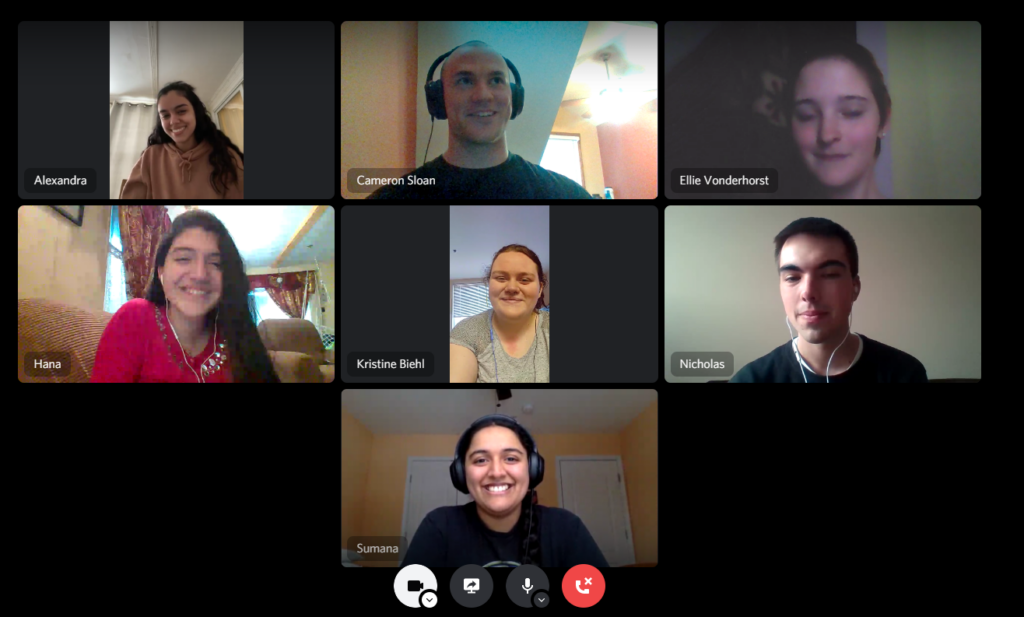
Hana Flores (center row, left, in red shirt) with her winning team, the ChemiE Cuties. Image courtesy of COEIT.
“Watching our students celebrate allowed my mind to forget for a moment the challenges that we face,” says Mariajose Castellanos, senior lecturer and undergraduate program director of chemical engineering. “It was important to me that we could come together and remind them of how much we appreciate them. They make our classes better and provide invaluable help.”
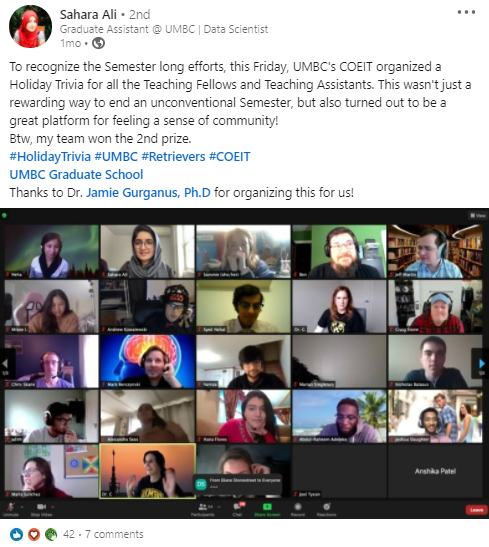
LinkedIn post by Sahara Ali, PhD student in information systems.
A more meaningful experience
“When it comes to delivering a class, it’s a collaboration effort between the instructors, teaching fellows, and teaching assistants,” says Gurganus. “They go beyond the scope of grading papers and holding office hours. These students provide a unique perspective that gives our classes a richer and more meaningful experience.”
Often, these students have recently completed the class they are now supporting, so they are able to identify and relate to its challenges in a unique way.
“These students’ insights enhance our courses in so many ways,” Gurganus shares, “and they have such a positive impact on the learning experience we can provide.”
Although some COEIT teaching fellows and teaching assistants graduated in fall 2020, Gurganus says a majority will continue their work in spring 2021, as UMBC courses remain largely online.
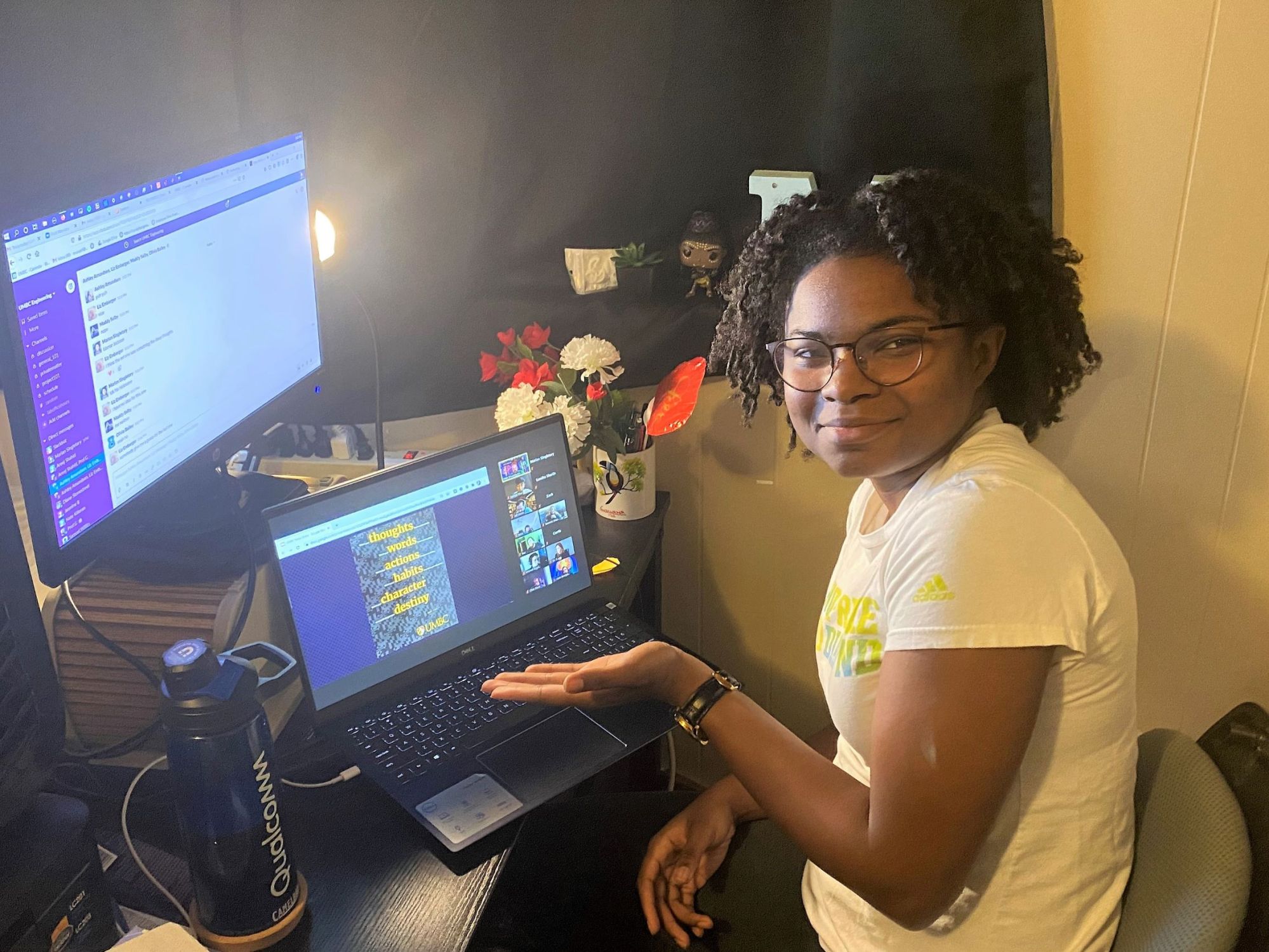
Tiled gallery images above: Logan Hawker ’22, mechanical engineering, at left, and CWIT CyberScholar Marian Singletary ’21, computer engineering, at right, compete in the trivia game. Images courtesy of Hawker and Singletary.
Featured image: Hand clicking laptop mouse. Photo by Flickr user Marco Verch, CC BY 2.0.
UMBC is once again one of U.S. News & World Report’s 2021 Best Global Universities, just five weeks after recognition as a national leader in undergraduate teaching and innovation. UMBC is among the top 700 universities worldwide, and ranked as a leader in geosciences, space science, and computer science specifically.
This prominent global ranking has particular significance for many in the university community. “UMBC continues to perform well on the international stage,” says David Di Maria, associate vice provost for international education. He notes, “The cross-border collaborations and contributions of our faculty, students, and staff position UMBC shoulder to shoulder amongst the top universities in the world.”
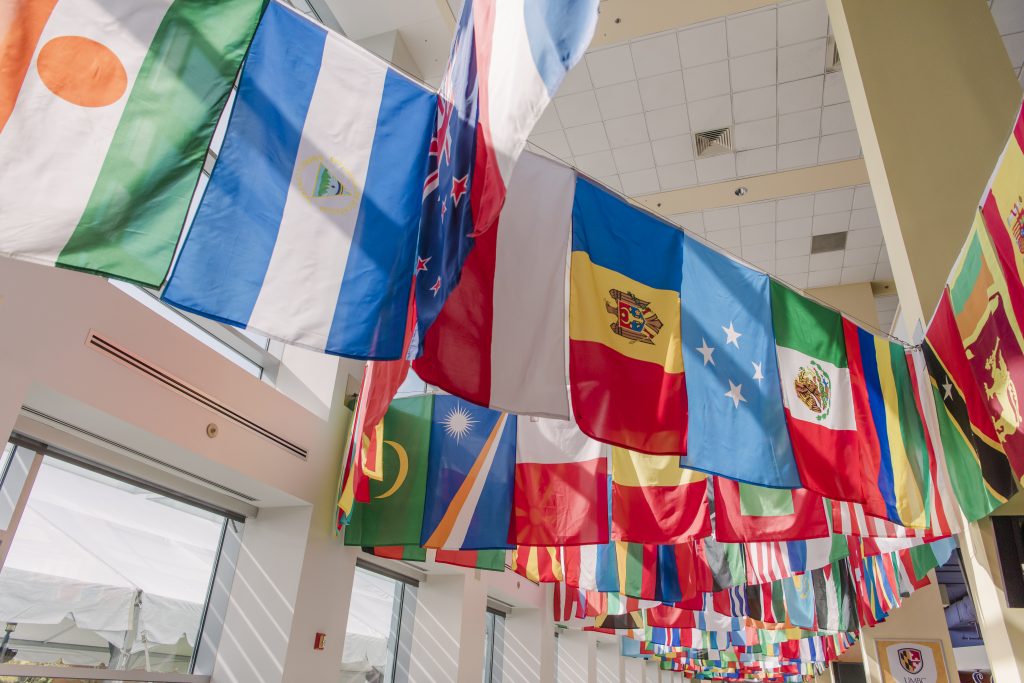
Flags from nations around the world, in the UMBC Commons.
Reputation for quality research
UMBC is ranked an impressive #103 in geosciences globally, and is a world leader in key measures of research success. Worldwide, UMBC is #1 in percentage of papers that are among the top 1% most cited, #2 for top 10% most cited, and #2 for citation impact. UMBC also ranks highly in research reputation, emphasizing the university’s rise as a home for top researchers in this field.
Lorraine Remer, research professor for the Joint Center for Earth Systems Technology (JCET), is a leading faculty member in this area. Remer received the 2019 UMBC Research Faculty Excellence Award. She has been honored for significant contributions to the atmospheric sciences, including as a fellow of the American Geophysical Union.
Research Professor Lorraine Remer
“It’s gratifying to see UMBC be recognized as a world-class research institution,” says Remer. “I’m happy to be a part of the UMBC community, where so much world-class research takes place.”
UMBC ranks #201 globally in space science, with a particularly strong international collaboration ranking.
“I’m very proud to be at UMBC and work with its faculty in JCET, the Goddard Planetary Heliophysics Institute (GPHI), and the Center for Space Sciences and Technology (CSST),” says physics professor Belay Demoz, director of JCET. “The opportunity it provides for geoscience research is immense. The collaboration work that is ongoing with NASA and NOAA on science and instrumentation is cutting edge.”
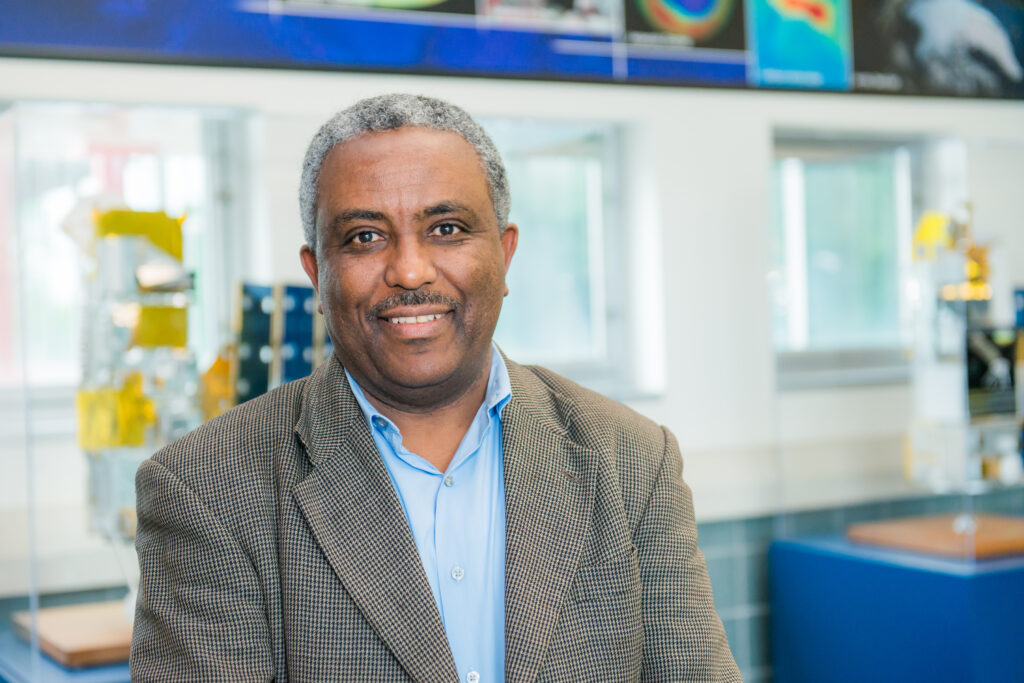
Belay Demoz at a NASA facility 2016.
In computer science, UMBC is among the top 400 universities globally, with strengths in research reputation and research citations.
National leader in international outlook
UMBC also continues to rise in college rankings published by the Wall Street Journal (WSJ) and London-based Times Higher Education (THE). Of 800 universities included in the ranking, released earlier this month, UMBC placed at #270. This is up 13 places from last year and more than 100 places over the past five years.
The publications also ranked UMBC as one of the Best Public Universities in the United States. UMBC appeared in the top 75 along with two other Maryland institutions: the University of Maryland, College Park, and the U.S. Naval Academy.
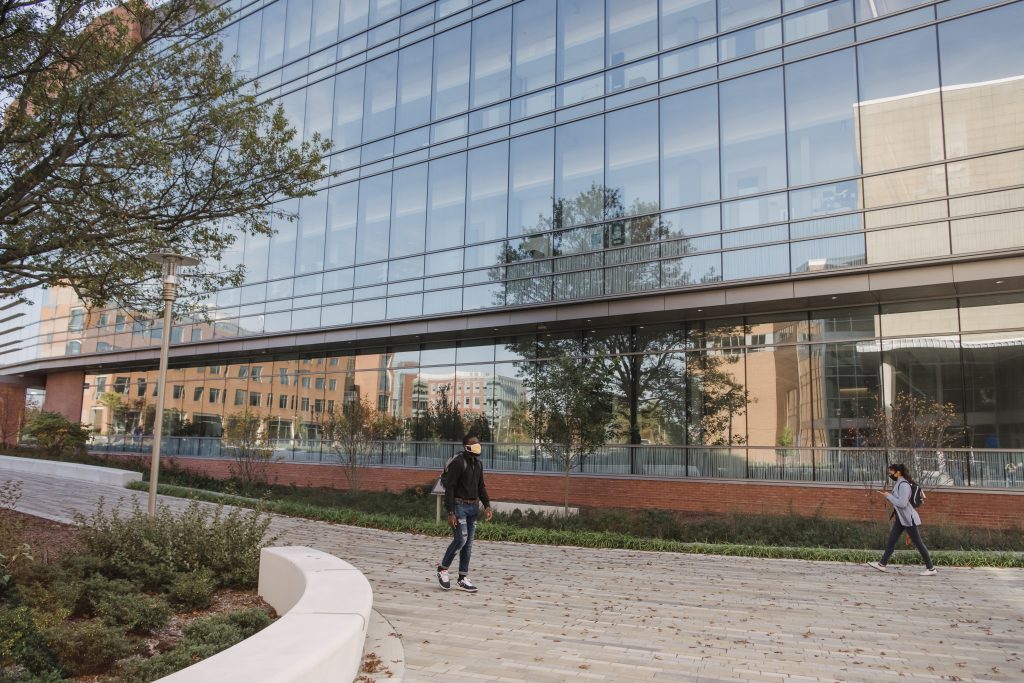
Two students walk past UMBC’s new Interdisciplinary Life Sciences Building, fall 2020.
The WSJ/THE College ranking is based on 15 performance indicators “designed to answer the questions that matter most to students and their families.” UMBC’s international outlook score increased dramatically. Di Maria shares, “Times Higher Education awarding UMBC a record score in this important category demonstrates how international outlook continues to grow at a steady pace.”
Consistent with the U.S. News global ranking, UMBC’s WSJ/THE research score saw a notable increase as well.
In new 2021 Times Higher Education World University Rankings by subject, UMBC is ranked in education, engineering, life sciences, physical sciences, psychology, social sciences, and computer science.
These positive trends are particularly meaningful at a moment of global concern regarding the impacts of the COVID-19 pandemic on national economies and higher education. They indicate UMBC’s stability as a leading public research university with national and global appeal.
Featured image: UMBC campus, fall 2020. All photos by Maryland Demond ’11 for UMBC.
Story updated November 3, 2020, to include new THE World University Rankings by subject.
UMBC has again been named one of the top U.S. universities in this year’s newly-released Wall Street Journal/Times Higher Education (THE) College Ranking. The ranking describes itself as “designed to put graduate success and student learning at its heart.” UMBC comes in at #270 nationwide, and in the top 800 worldwide.
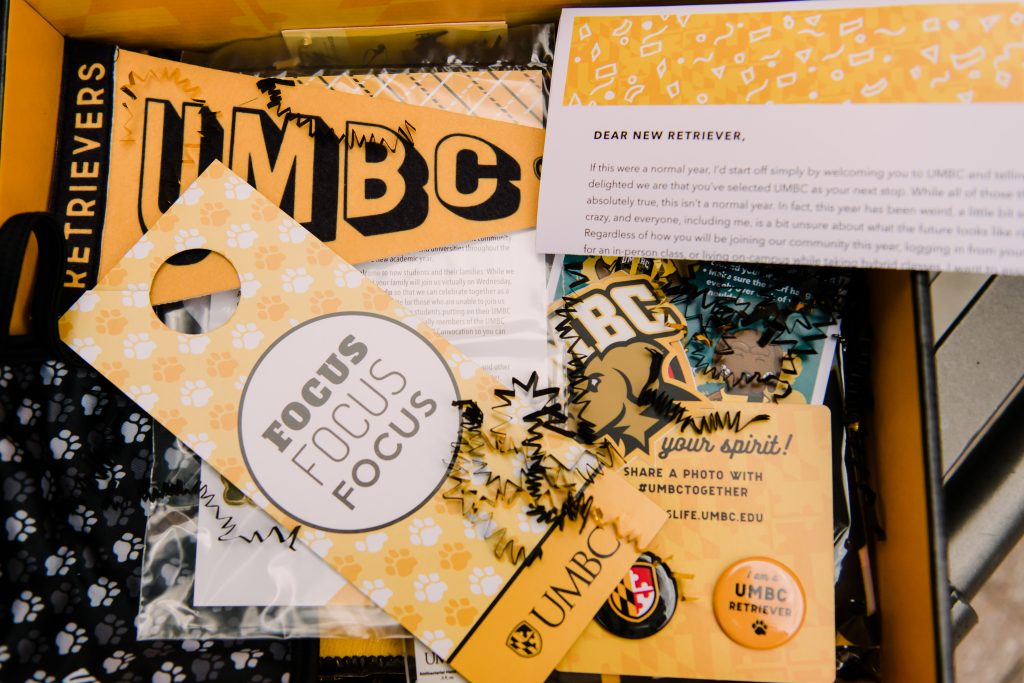
UMBC welcome pack for new students, fall 2020.
Areas of leadership
Across key areas measured, UMBC performs particularly well in student engagement and campus environment.
A portion of the ranking relies on the THE Student Survey, which reflects feedback from 170,000 U.S. college students on their educational journeys. UMBC’s strength in student engagement reflects feedback from this survey. This includes positive ratings from students on how likely they are to recommend the university to family or friends. It also includes their views on if courses are challenging and to what extent UMBC supports critical thinking.
Under environment, UMBC has particularly strong scores in student and faculty diversity. This echoes UMBC’s recent U.S. News rankings. In addition to naming UMBC #11 for undergraduate teaching and #9 for innovation nationally, U.S. News again recognized UMBC as one of the top schools in the nation for ethnic diversity.
International rankings
UMBC has also recently appeared in other prominent rankings by international groups, including other rankings by London-based THE. The 2020 Times Higher Education Golden Age ranking places UMBC in the top 150 global universities established between 50 and 80 years ago. This ranking highlights universities that have made an exceptional impact while still being relatively young institutions.