When the impacts of COVID-19 had the world on pause in March 2020, like many others, Ify Jacob ’23, computer engineering, spent time sheltered at home thinking of what he would do once it was safe enough to return to life as he knew it. But he never really returned to the life he was used to.
One of the first decisions that Jacob made while dealing with the early days of COVID distancing was to become more active on UMBC’s campus when he returned. This choice changed the trajectory of his academic and professional journey.
In summer 2021, Jacob applied to be a UMBC Welcome Week leader (known as a “Woolie”) and a teaching assistant, both leading and serving fellow students by helping them build community and feel supported. “I wanted to get more involved, beyond getting an education,” says Jacob. “I wanted to give something back to my campus community while also branching out of my comfort zone.” And giving back became part of his education.
Jacob went on to serve as vice president of UMBC’s Residential Student Association, where he helped students connect with each other after dealing with COVID. He assumed several leadership roles as a member of the Pi Kappa Phi fraternity and joined groups like Club Soccer, the Tau Beta Pi engineering fraternity, the Filipino American Student Association, and the Vietnamese Student Association. These experiences helped him gain more confidence in his leadership and communication skills.
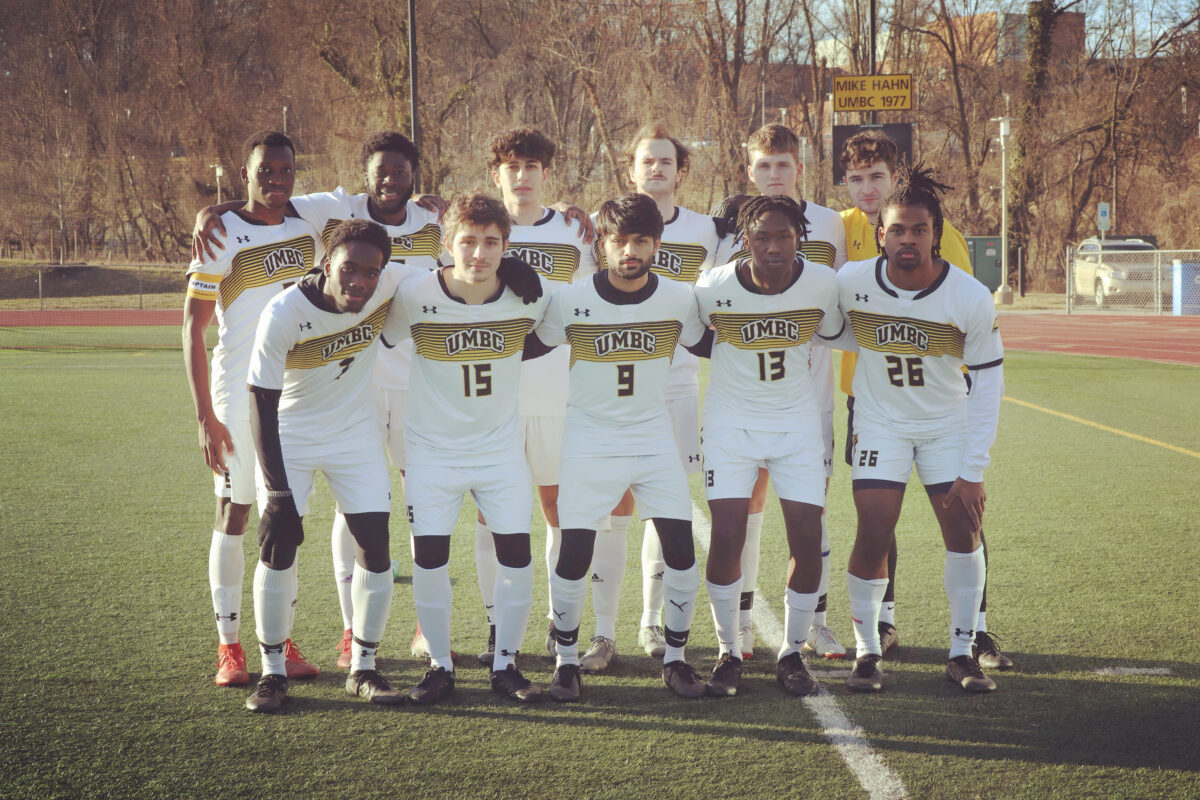
Ify Jacob (back row, left) with other members of UMBC’s Club Soccer team. (Image courtesy of Ify Jacob)
“I’m grateful that I branched out because I met some amazing people and believe I left a positive impact on the UMBC community,” he says.
Emerging as an engineer
Jacob comes from a family of computer scientists and engineers. His father is an electrical engineer and his sister Nsikan Jacob ’18, computer engineering, was a UMBC Center for Women In Technology (CWIT) Scholar who is currently working on a master’s in computer engineering and communications at Johns Hopkins University. His other sister, Aniebiet Jacob, attended UMBC as a computer science major and a Meyerhoff Scholar before transitioning into a full-time career in tech.
“It’s great to see women in STEM. The accomplishments of my sisters inspired me to work hard,” says Jacob, “and their support has been important to me.”
Jacob didn’t always know he wanted to be a computer engineer. He initially had his sights set on pursuing a business degree, and recalls having a disinterest in coding, saying, “it seemed like I was learning another language and I was not a fan—and then the pandemic happened. That got me to focus on my coding skills because all I could do was school work.”
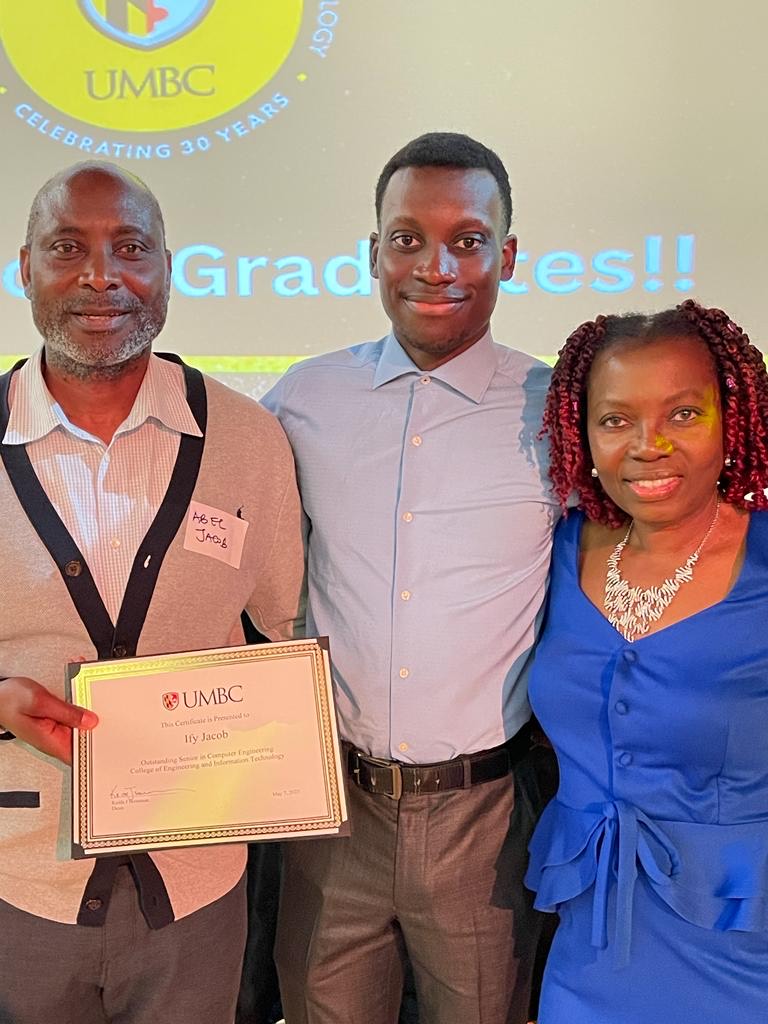
Ify Jacob (center) with his parents at the 2023 COEIT Celebration. (Image courtesy of Ify Jacob)From left to right: Ify Jacob, Aniebiet Jacob, Nsikan Jacob, and their younger brother. (Image courtesy of Ify Jacob)
Jacob spent many hours learning coding languages such as Python and C++. Jeremy Dixon, senior lecturer in computer science and electrical engineering, was instrumental in helping Jacob develop his programming skills, which informed his interest in pursuing software engineering as a career.
“Professor Dixon’s instructional videos were amazing,” says Jacob. “His class got me into coding and made me say I can do this long term.”
Learning as an intern and teacher
With this new career vision in mind, Jacob applied for an internship with Northrop Grumman as a systems engineer in summer 2022, coordinated with the support of UMBC’s Career Center. Upon completing the internship, Jacob was then offered a full-time position with Northrop Grumman as a software engineer, which he will start after graduation.
Wanting to connect others with STEM opportunities, and support them the way he felt supported, Jacob taught students ages 9-13 the basics of coding via an online course for a year. Then he had a chance to serve as a teaching fellow in introductory engineering courses, which he did for four consecutive semesters.
Jacob’s teaching experience helped him to strengthen his public speaking skills and made him more confident as a leader. Because of this, Jacob took a seminar course to obtain an associate undergraduate teaching certification through the Center for the Integration of Research, Teaching, and Learning, facilitated by lecturer Jamie Gurganus ‘20, mechanical engineering, director of the Center.
“Dr. Gurganus gave me the opportunity to be a teaching fellow and has been a professor, mentor, and advisor to me since my freshman year. She’s had a huge impact on my undergraduate experience, and I’m forever grateful for the opportunities she has given me,” shares Jacob.
Developing community builders
Jacob’s experience of approaching leadership through the lens of service, with a focus on building community, is shared by many at UMBC, including in the Class of 2023.
Humanities Scholar Clair Volkening ’23, English, has used her voice as a writer, editor, and facilitator to help UMBC community members build connections with one another and to inspire social change.
McNair Scholar and first-generation college student Joana Hernandez ’23, chemical engineering, learned first-hand the power of research mentorship, and responded by helping fellow students navigate the academic research process.
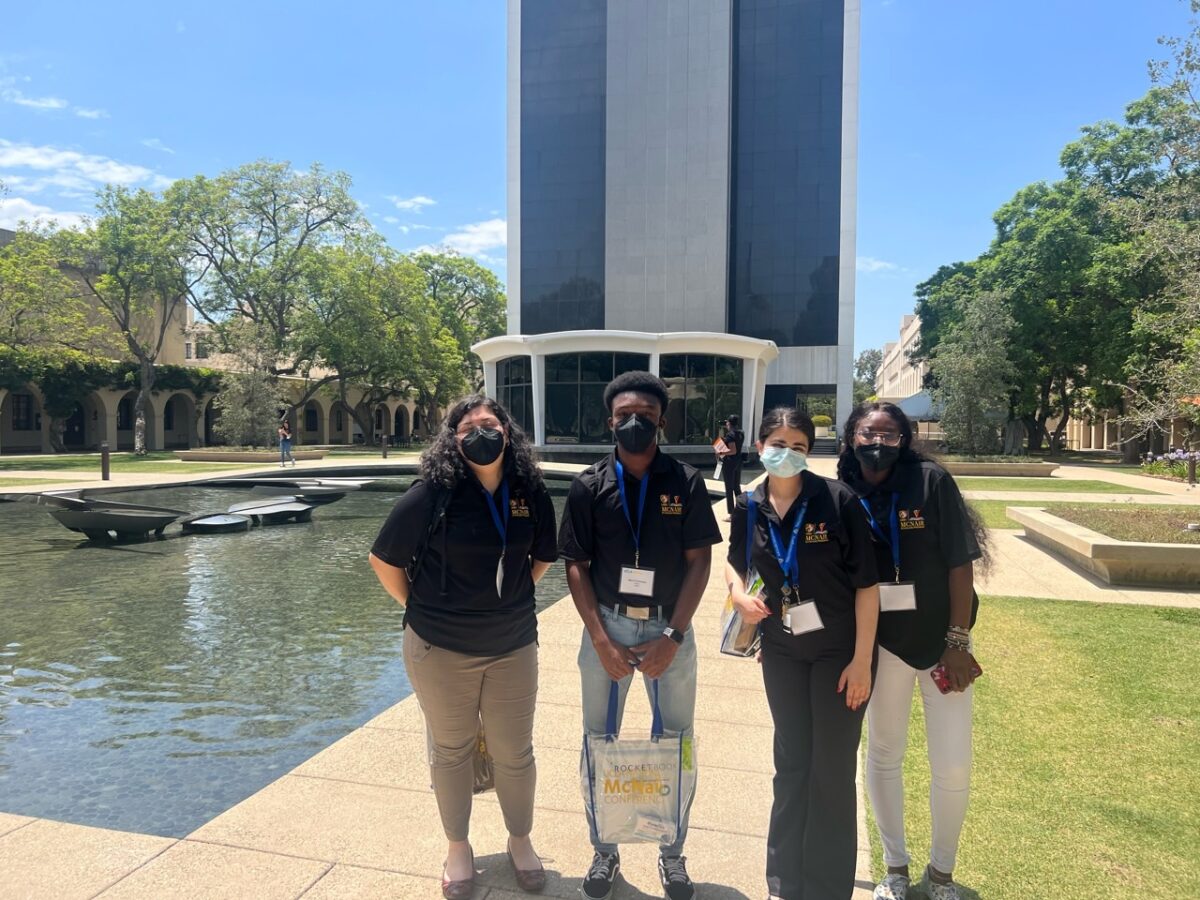
Joana Hernandez (left) with fellow UMBC McNair Scholars. (Image courtesy of Joana Hernandez)
Shriver Peaceworker Fellow Grant Clifton’23, M.A., Teaching English to Speakers of Other Languages (TESOL), has helped English language learners gain confidence and improve their conversational skills through the community he’s built with them as a language instructor.
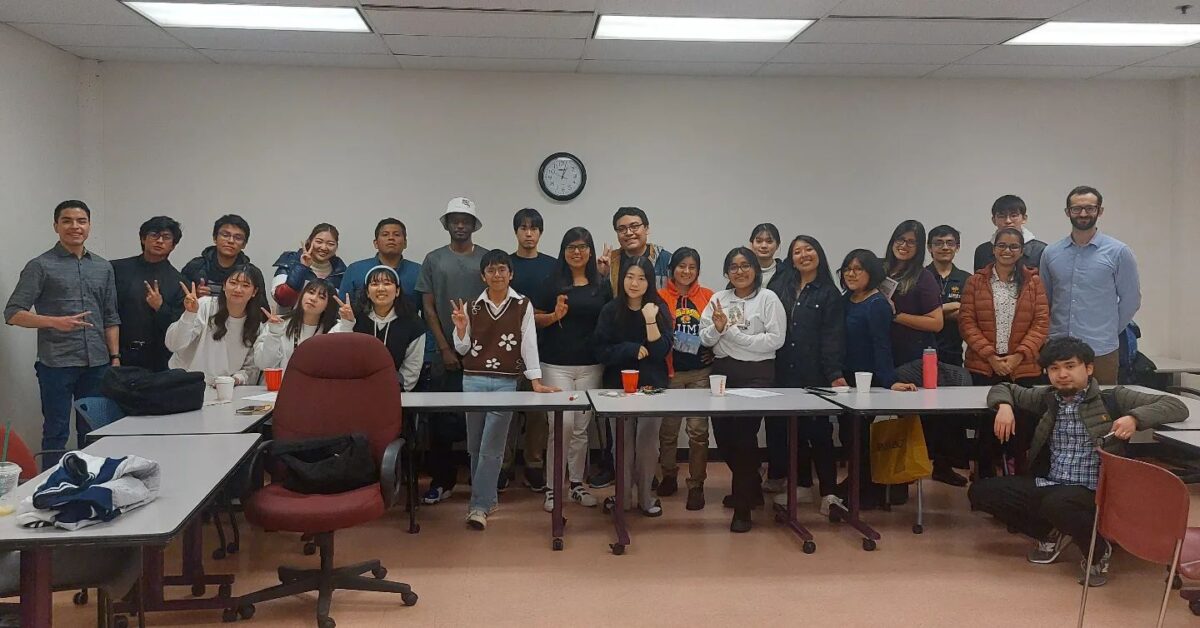
Grant Clifton (far right, in blue) with his students. (Image courtesy of Grant Clifton)
As graduates, these students will now move on to serve as community builders around the world, with plans taking them from the Baltimore-Washington corridor to Indonesia.
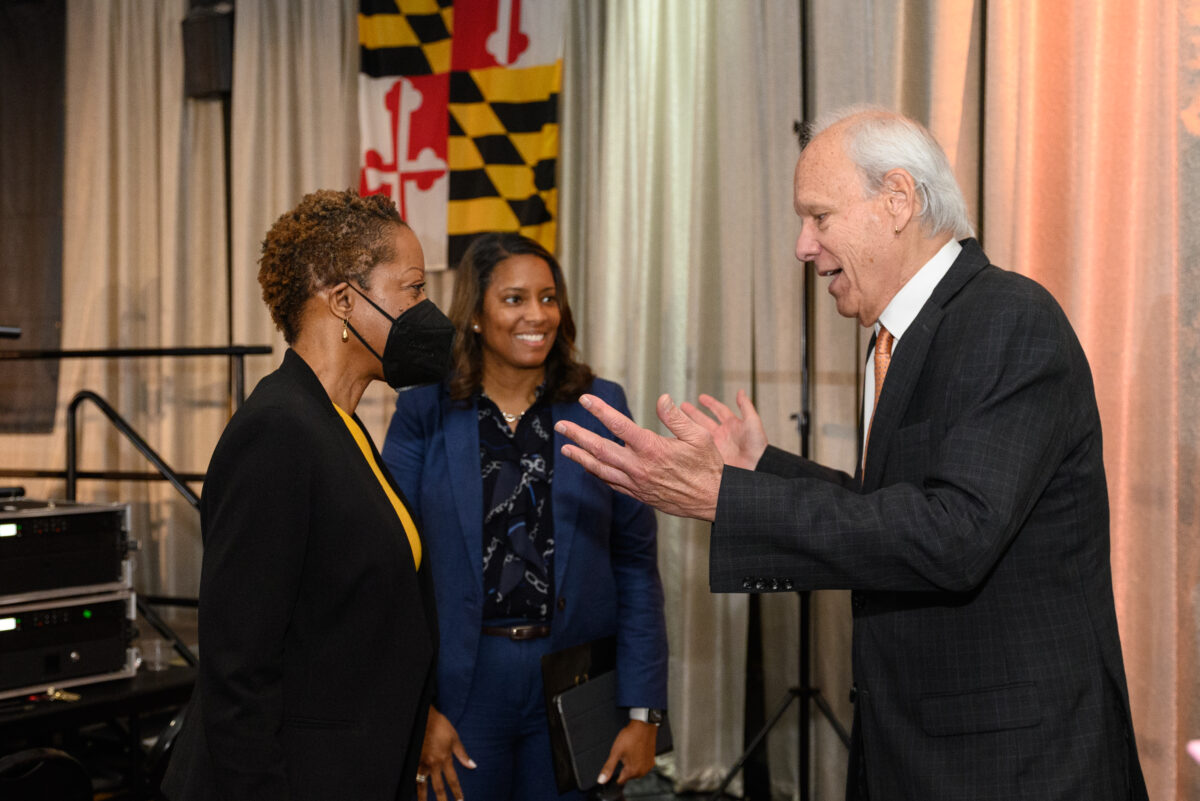
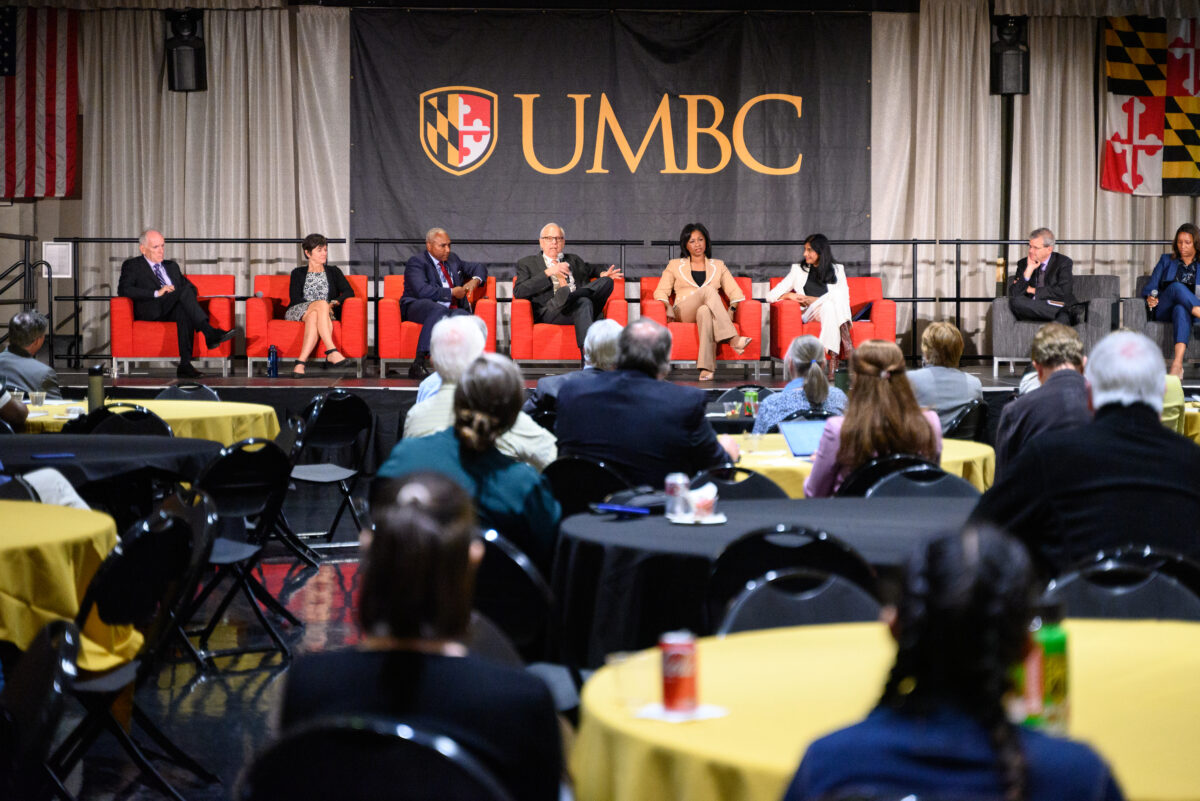
This week, UMBC and Maryland Matters hosted state officials in Governor Wes Moore’s administration for a community forum on Maryland’s plan to address concerns related to climate change and the administration’s proposed green energy initiatives.
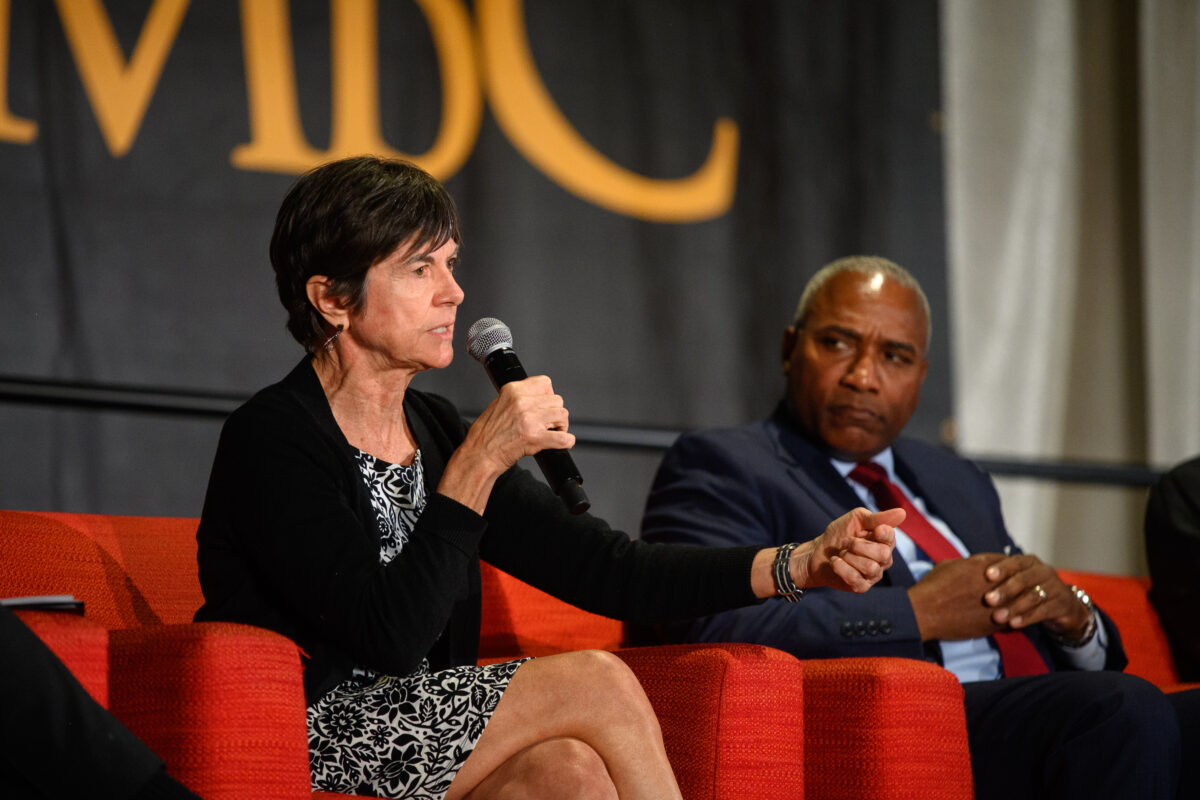
Candace Dodson-Reed ’96, English, UMBC’s vice president of government relations and community affairs, and Josh Kurtz, founding editor and reporter at Maryland Matters, moderated the panel discussion on the state’s climate policies. The forum was part of the Maryland MattersClimate Calling project, an initiative that began in 2021 that examines the threats of climate change in the state and the administration’s response.
“It will take all of us as we partner with government, universities, the private sector, philanthropy, media, and beyond to address this crisis,” said Dodson-Reed. “We know that universities play a huge role in this space.”
President Valerie Sheares Ashby agrees, sharing with attendees that UMBC “wants to be a true partner. We are not just a partner in research and scholarship, but also workforce development. It is critical to us that we are producing the next brilliant minds who will actually remain in the state of Maryland to do this work.”
From left to right: President Valerie Sheares Ashby, Candace Dodson-Reed, and Paul Pinsky, director of the Maryland Energy Administration. (Abnet Shiferaw for UMBC)
Sheares Ashby referenced the work that UMBC students, faculty, and staff are already doing in response to climate change concerns, from long-term research, to a master’s program focused on work with communities around Baltimore’s Inner Harbor, to initiatives of the university’s Office of Sustainability.
“Environmental science and climate science are some of the least diverse of the sciences, yet it affects the broadest range of diverse human beings and communities,” said Sheares Ashby. “We have not fully brought all of the best and most diverse minds to the table, but here at UMBC, this is our focus.”
Maryland’s “bold” climate policies
Panelists included Lieutenant Governor Aruna Miller, who outlined the administration’s goals for addressing the climate crisis, pointing to the state’s “bold” solutions in Maryland’s Climate Solutions Act. The legislation is aiming to “reduce greenhouse gas emissions by 60 percent by 2031 and 100 percent by 2045,” says Lt. Gov. Miller.
Governor Wes Moore’s administration during UMBC and Maryland Matters’ “Climate Calling: A Community Conversation” forum. From left to right: Secretary of Transportation Paul Wiedefeld, Secretary of Planning Rebecca Flora, Secretary of Commerce Kevin Anderson, Director of the Maryland Energy Administration Paul Pinsky, Secretary of the Environment Serena McIlwain, Lieutenant Governor Aruna Miller, and moderators Josh Kurtz and Candace Dodson-Reed. (Abnet Shiferaw for UMBC)
“We see this as an opportunity to get into the green economy…it’s going to create jobs and create emerging technologies,” she shared with the audience. “We have goals that are bold and aggressive, but we need to be like that in order to be able to reach those goals.”
Lt. Gov. Miller was joined by Secretary of Commerce Kevin Anderson, Secretary of Planning Rebecca Flora, Secretary of the Environment Serena McIlwain, Secretary of Transportation Paul Wiedefeld, and Paul Pinsky, director of the Maryland Energy Administration.
Secretary Mcllwain made note of the “cross-disciplinary approach” of the Moore administration’s plan to implement their climate policies, saying, “We have to do this in a very comprehensive way or we will lose. We have to look at solutions that have multiplier benefits.”
Paul Pinsky explained the state’s goals of producing more offshore wind energy with the Promoting Offshore Wind Energy Resources Act (POWER). “To meet our goals…we’re going to need new technologies. It’s going to be a challenge, but Maryland is in a position to be a leader,” said Pinksy.
Secretary Rebecca Flora proposed more efficient ways to plan for the effects of climate change, such as implementing “more scenario planning so we can actually show what will happen in different scenarios.”
To do that, Flora suggests using more visualization tools. She made note of the UMBC research on display at the forum, saying, “we need that kind of talent out there to help communities understand what we’re saying.”
Secretary of Planning Rebecca Flora and Secretary of Commerce Kevin Anderson. (Abnet Shiferaw for UMBC)
Connecting students with state leaders
UMBC students joined in the discussion by asking questions about the current state of climate change and the environment in Maryland, plans to protect vulnerable populations, and how these issues will impact future generations.
Sondheim Public Affairs ScholarDevanshi Mistry ’26, chemical engineering, asked the panelists about the state’s approach to agricultural and environmental policies. Mistry previously worked with local government in her hometown as a student representative for the Carroll County Board of Education, and shared her passion for vocalizing the needs and concerns of teens and young adults.
“Local government is a really big passion of mine and I’m hopeful that more students will continue to be engaged in what’s happening in our society. It was really impactful to hear directly from state representatives on important issues like climate change,” Mistry shared, following the forum.
Full video of UMBC and Maryland Matters’ “Climate Calling: A Community Conversation” forum, held on May 10, 2023 at UMBC’s University Center Ballroom.
UMBC’s Student Government Association (SGA) leaders also participated in the Q&A discussion and assisted with moderating the event. These leaders include incoming SGA President Musa Jafri ’24, political science, and SGA Director of Government Affairs Zach Starr ’23, public health.
For more on this topic, see coverage of the forum on Maryland Matters and a commentary by Dodson-Reed and Maggie Holland, associate professor of geography and environmental systems, on the role of universities in addressing climate change in Maryland, published prior to the event.
Degree: M.A., Teaching English to Speakers of Other Languages (TESOL) Hometown: Fresno, CA Post-grad plans: English language educator in Indonesia
For Grant Clifton, teaching English effectively requires a combination of intensive technical training in English language instruction and a passion for building community. Prior to enrolling at UMBC, Clifton taught English at a school in Indonesia for several years. He has a long-standing commitment to service and community engagement, which included being a Peace Corps volunteer in Indonesia from 2017 to 2019, where he taught English to high school students.
After returning to the U.S., Clifton continued his combined focus on learning and community impact through UMBC’s Shriver Peaceworker Fellows program. Additionally, he worked as a writing tutor at the English Language Institute (ELI) and facilitated in-person and virtual conversation clubs with ELI’s English Conversation Partner program. Clifton shares that leading the conversation clubs was important to him because he was “able to see English learners gain more confidence and improve their conversational skills through the community I’ve built with them.”
As a TESOL research assistant, Clifton worked with Jiyoon Lee, associate professor of education, exploring issues of English as a Second Language (ESL) teachers’ and learners’ language assessment literacy. He recently presented this research at the 2023 American Educational Research Association’s annual meeting. After graduation, Clifton will return to Indonesia to teach English at an international school.
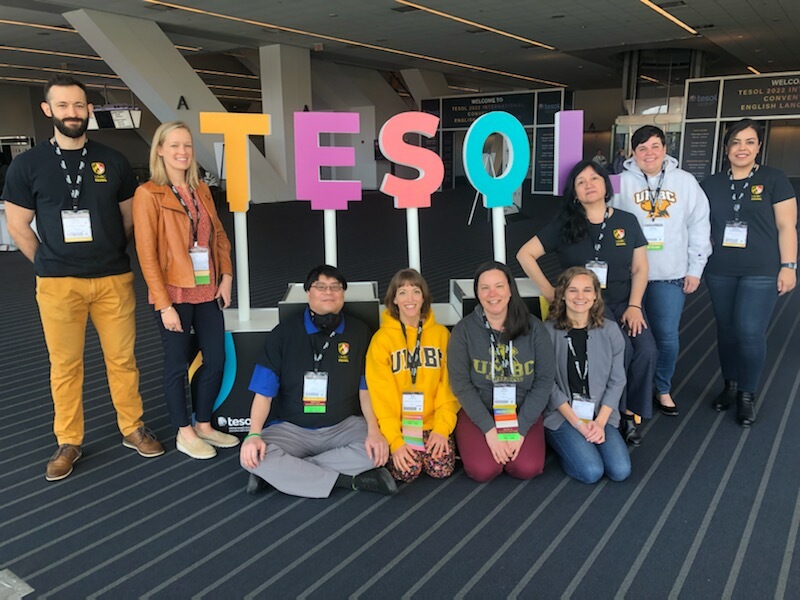
Grant Clifton (far left) with TESOL students at the TESOL 2022 International Convention. (Photo courtesy of Grant Clifton)
Has there been a mentor or fellow student who influenced your time at UMBC?
“My supervisor at the English Language Institute, Ryan Sheldon, has been a mentor to me during my entire time at UMBC. He has provided me with a lot of opportunities for professional growth and supported me through some really tough times. Few can say that their boss has made their life easier!”
Is there a particular academic achievement you’re most proud of?
“Being accepted to the Shriver Peaceworker Program at UMBC is the achievement I am most proud of. We were able to act as a support group for one another and exchange ideas in weekly practicum seminars on topics related to social engagement and ethical reflection. I learned so much and grew significantly as a person, thanks to the program. I don’t think I would have been as successful or would have made as much personal growth if I had not been part of the Shriver Peaceworker Program.
Additionally, I am proud of completing and successfully defending my thesis after a long series of delays and mishaps, which left me feeling discouraged at times, all while being a full-time student and working 30-40 hours a week.”
Degree: B.S., Chemical Engineering Hometown: Hyattsville, MD Post-grad plans: Applying to biochemical engineering Ph.D. programs
McNair ScholarJoana Hernandez is a research enthusiast who found her interest in scientific exploration and mentorship while at UMBC. Since 2019, Hernandez has worked as a research assistant in the lab of Fernando Vonhoff, assistant professor of biological sciences. The lab uses fruit flies as a model to study human neurological diseases. It was in Vonhoff’s lab where she realized that there were opportunities to turn her love of learning into a career in research.
Hernandez has taken her interest in conducting research to the next level by helping to guide fellow students who may be unfamiliar with the academic research process. As a teaching fellow in the McNair Scholars Program, Hernandez led workshops in a class dedicated to teaching students how to develop research proposals. During these workshops, she presented on topics ranging from how to give a research presentation to how to apply to Research Experiences for Undergraduates (REUs).
Hernadez shares that she’s proud to be a McNair Scholar. “As a first-generation college student, it can be difficult to navigate academic spaces and obtain resources on applying to graduate programs,” Hernandez says. “McNair welcomed me with open arms and helped grow my confidence by providing me with opportunities to conduct research and present at national conferences.”
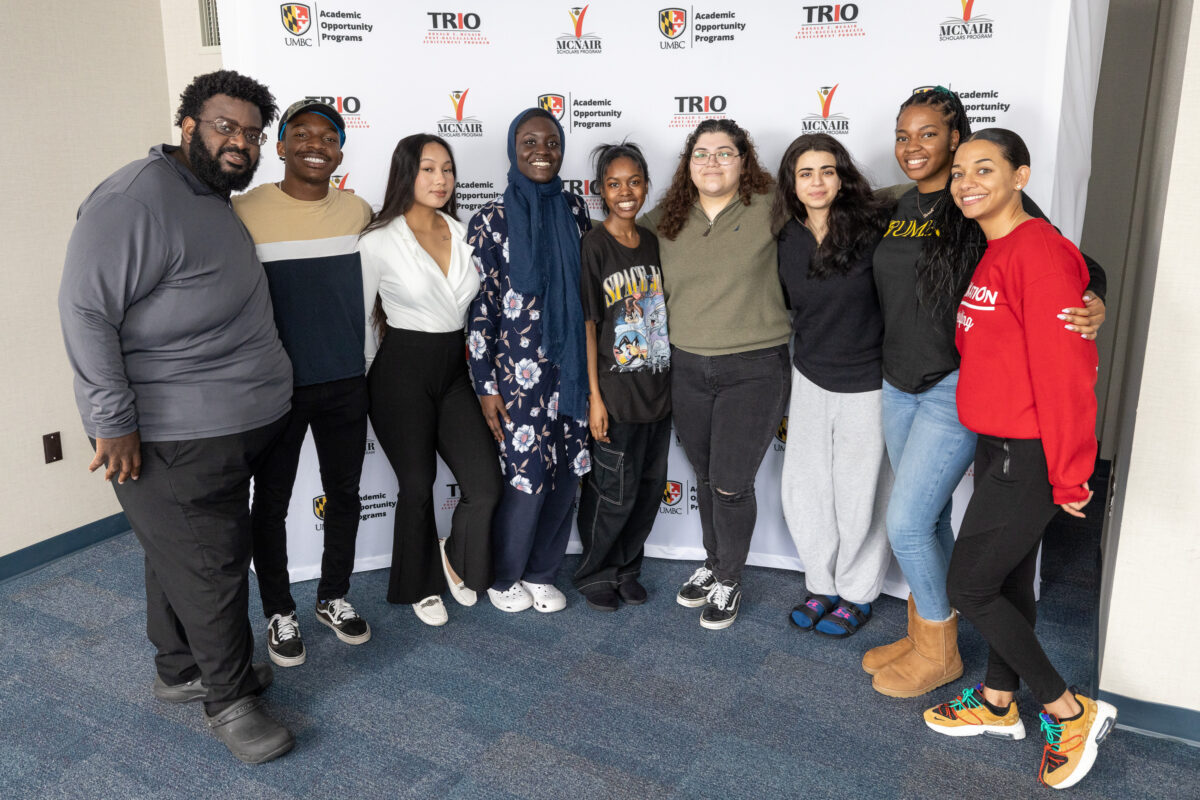
Joana Hernandez (fourth from the right, in glasses) with fellow McNair Scholars and Michael Hunt (far left), director of UMBC’s McNair Scholars Program. (Photo courtesy of Joana Hernandez)
Has there been a mentor or fellow student who influenced your time at UMBC?
“My mentors Fernando Vonhoff and María Célleri, assistant professor of gender, women’s, and sexuality studies, have both had a positive influence on me. As a first-generation college student, I was unaware that undergraduates could participate in research or present at research conferences. When Dr. Vonhoff enabled me to join his lab my freshman year, it opened the doors to a lot of future opportunities. I am very grateful to have had a research mentor that was so understanding and encouraging.
“Dr. Celleri, my McNair mentor, is someone I can always count on to give me advice about navigating academic spaces as a Latina, and how to balance my life between my immigrant household and school. I appreciate all the wisdom I have gathered from her.”
What academic achievement are you most proud of?
“I am most proud of when I presented the research I did in the Vonhoff lab at the 2019 Annual Biomedical Research Conference for Minoritized Scientists (ABRCMS). That was the first time that I had attended a national conference and flew out to the West Coast. It was an eye-opening experience being able to see other undergraduate researchers from diverse backgrounds who were also just as passionate about communicating their work.”
Ify Jacob’s mentors describe him as someone who has worked tirelessly to create community among Retrievers in on-campus student housing, particularly as they dealt with the challenges and traumas of COVID-19. Jacob currently serves as vice president of UMBC’s Residential Student Association, but his journey of leadership through service has taken place over the course of years at UMBC.
Jacob has served as a Welcome Week leader (known as a “Woolie”) and as an office assistant in Residential Life. On the academic side, he has been a teaching fellow in engineering and computer science courses. He has also served as captain for UMBC Men’s Club Soccer.
Jacob also served in several leadership roles as a member of the Pi Kappa Phi fraternity, saying that joining the fraternity helped him to step outside of his comfort zone. “Being a member of Pi Kappa Phi gave me the confidence that I could adapt to any situation. The positions I held gave me firsthand leadership experience, which applies to my other campus roles,” says Jacob.
Following a systems engineering internship at Northrop Grumman in summer 2022, coordinated with the support of UMBC’s Career Center, the company offered Jacob a full-time position. He will begin that role after graduation.
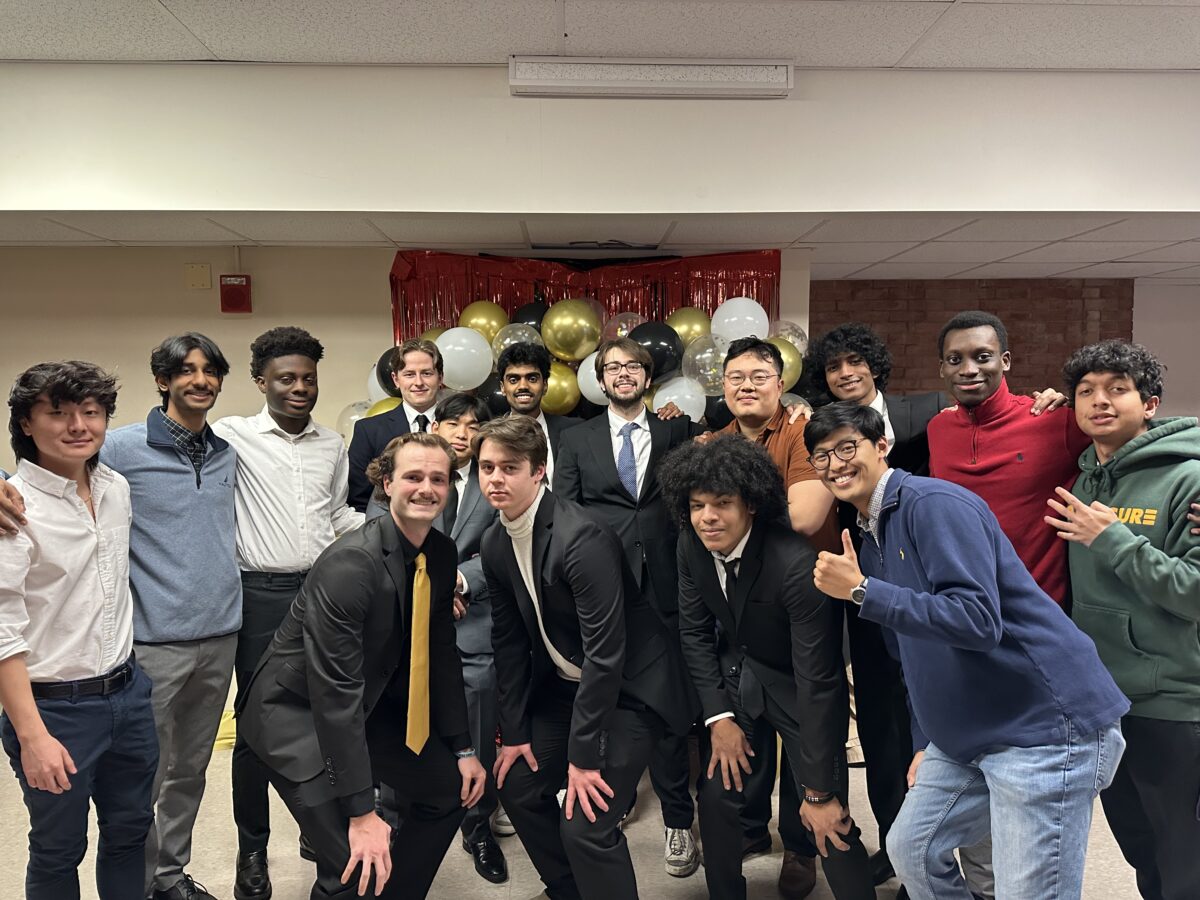
Ify Jacob (back row, second from the right) with members of the Pi Kappa Phi fraternity. (Photo courtesy of Ify Jacob)
Has there been a mentor or fellow student who influenced your time at UMBC?
“Jamie Gurganus ‘20, mechanical engineering, has been a professor, mentor, and advisor to me since my freshman year. I took her Introduction to Engineering course and she later gave me the opportunity to serve as a teaching fellow for the course, which I’ve done for four consecutive semesters. I’m also currently taking a two-semester seminar course that will lead to an associate undergraduate teaching certification through the Center for the Integration of Research, Teaching, and Learning, facilitated by Dr. Gurganus. She has had a huge impact on my undergraduate experience, and I’m forever grateful for the opportunities she has given me.”
What has been the best part of your UMBC experience?
“The best part of my UMBC experience has been interacting, collaborating, and holding events with several student organizations, such as the Filipino American Student Association, the Vietnamese Student Association, Club Soccer, and my fraternity. UMBC, being as culturally diverse as it is, has given me the opportunity to look at life from different perspectives and have amazing experiences with great people. These organizations that I have been a part of have done big things for the community through their philanthropy events and finding great ways to raise awareness for real-world issues.”
Degree: B.A., Music Education and Jazz Studies Hometown: Severn, MD Post-grad plans: Music educator
Tim Edwards is a student leader who serves his community through music, making an impact one note at a time. In addition to performing in UMBC’s Jazz Ensemble, Musical Theatre Club pit orchestra, and Wind Ensemble—including leading the arrangement, rehearsal, and conducting of an original composition last fall—he has focused his energy on music education.
Edwards has served as both president and vice president for UMBC’s chapter of the National Association for Music Education. He has supported music students in Baltimore city through a two-year internship with the Baltimore Symphony Orchestra’s OrchKids program, working with students at Booker T. Washington Middle School. He took the lessons he learned from that experience with him to the Maryland Music Educators Association conference, where he co-presented with James Dorsey, affiliate artist, and Brian Kaufman, associate professor of music. Their talk was part of a professional development program for music teachers on employing equity-focused and student-centered approaches in their classrooms.
Through all of these experiences, Edwards has remembered his home community in Anne Arundel County, Maryland. While at UMBC he returned to his high school pit orchestra to direct the group and he plans to return to the area longer-term after graduation to teach and perform music as a woodwind specialist.
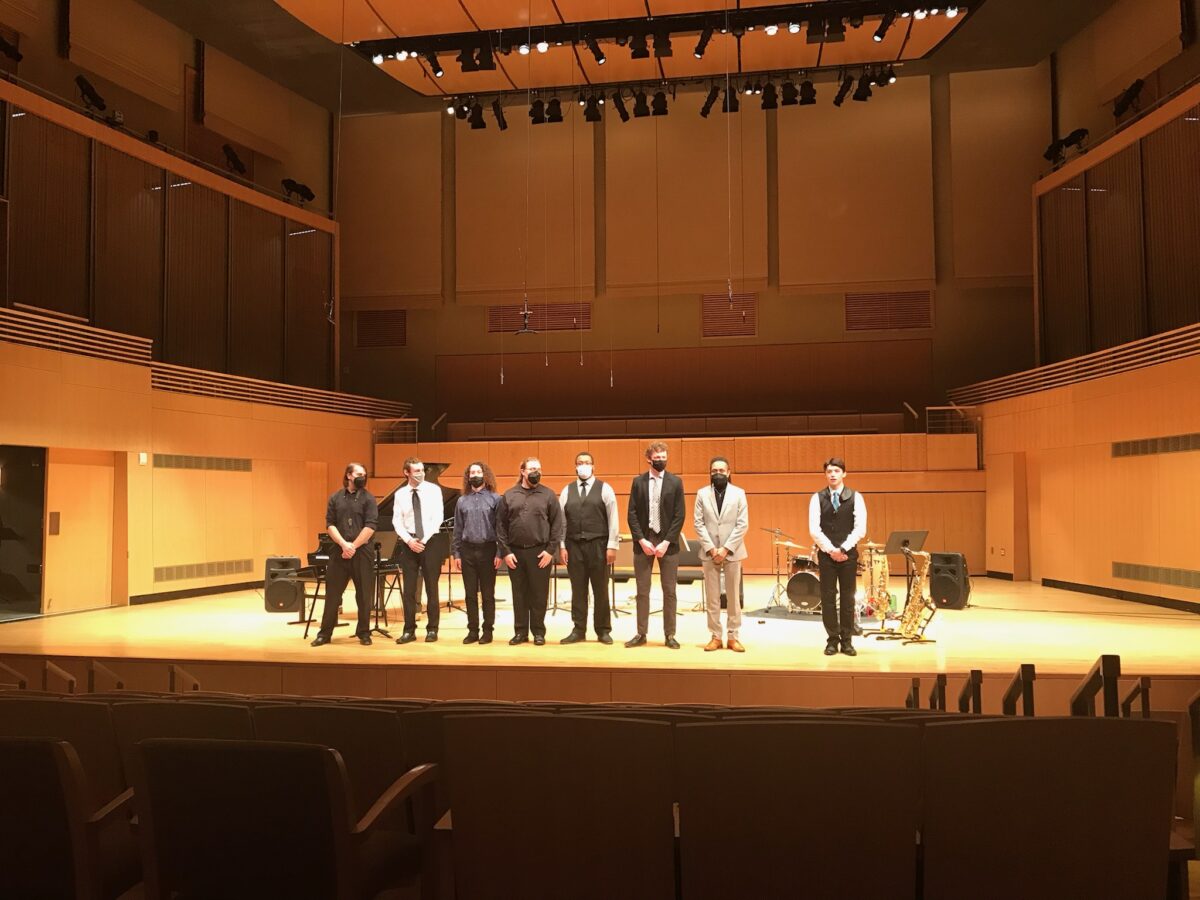
From left to right: UMBC students Daniel Stuckenschneider, Jay Fenner, Alex Armbruster, Zach Powell, Aaron Statham, Henry Smith, Miles Malone, and Tim Edwards at the senior jazz recital in May 2022 in UMBC’s Linehan Concert Hall. (Photo courtesy of Tim Edwards)
Has there been a mentor or fellow student who influenced your time at UMBC?
“Matt Belzer and Brian Kaufman were my two most influential mentors at UMBC. Matt Belzer instilled in me a level of discipline and professionalism that I could not have led without. Brian Kaufman sought to give me many opportunities for leadership and community-building, which has, in a big way, jump-started my career. Also, Patrick Smolen, a fellow UMBC student and friend who is graduating with me, has been more than crucial in my development as an educator. We have always sought ways to collaborate in our lessons and in building community.”
What has been the best part of your UMBC experience?
“The community has been the best part of my time at UMBC, plain and simple. Throughout my years at UMBC, the people I have met have had a huge impact on my growth as a person. I have made social and professional connections that I am determined to hold onto throughout my life.”
Humanities ScholarClair Volkening has used her voice as a writer, editor, and facilitator to help UMBC community members build connections with one another and to inspire social change.
Volkening, who is also a member of the Honors College, was a participant and a coach in UMBC’s Center for Democracy and Civic Life’s (CDCL) STRiVE program, where she developed her leadership and civic engagement skills. Because of her contributions to STRiVE, Volkening was recruited to participate in CDCL’s first cohort of the ConnectionCorps program, a year-long facilitator training program for students. As a ConnectionCorps facilitator, Volkening facilitated community conversations involving students, faculty, staff, alumni, and local and state leaders on various issues. She also facilitated workshops for students involving reflection, storytelling, and discussion.
Volkening extended her coaching and leadership work further by helping students along their academic journeys. She was a tutor in UMBC’s Writing Center, assisting fellow Retrievers with strengthening their writing skills. This experience inspired her to join the editorial team for UMBC Review, the university’s student-organized, peer-reviewed undergraduate research journal. That work, she says, was an “incredible learning experience” that informed her burgeoning career pursuits as an editor.
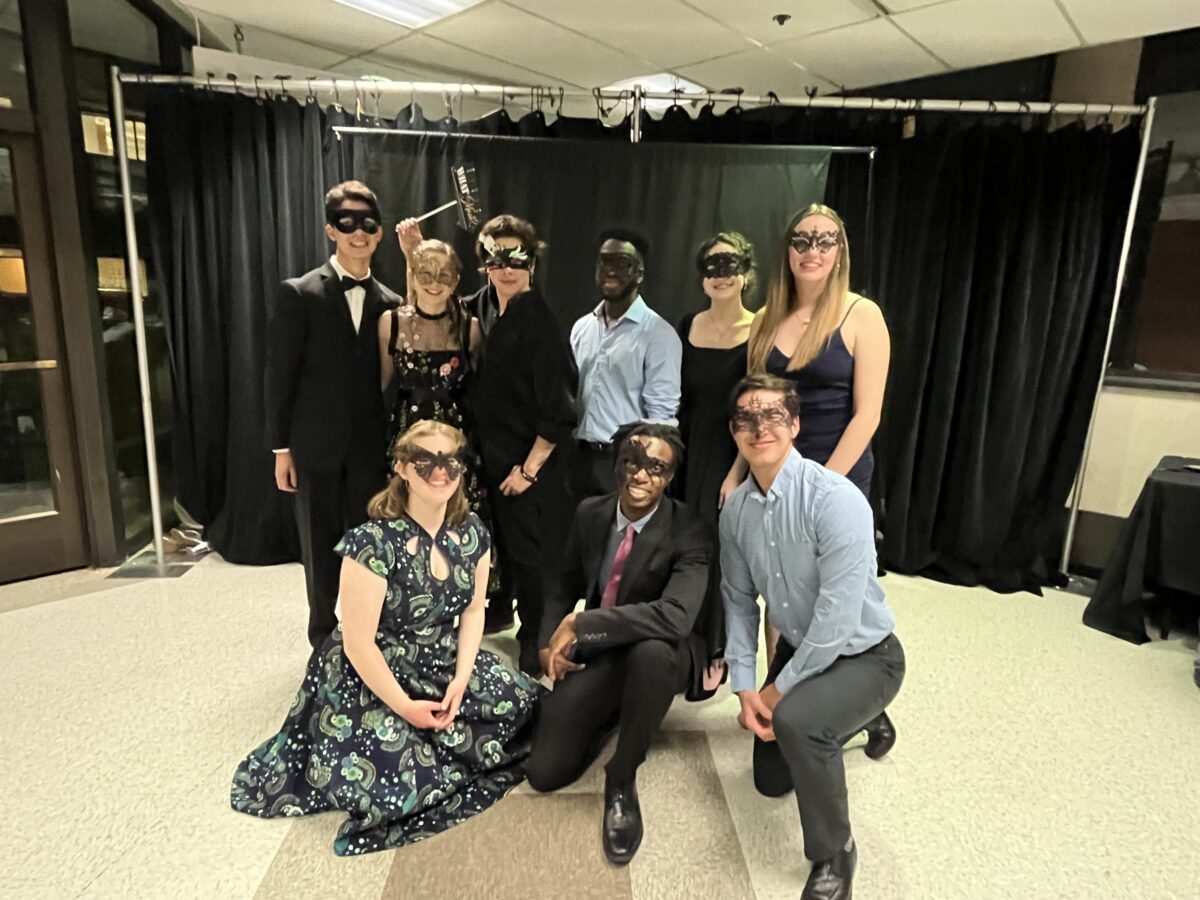
Clair Volkening (back row, second from the left) and fellow UMBC students at the Meyerhoff and Honors College’s Masquerade Charity Gala in February 2023. (Photo courtesy of Clair Volkening)
Has there been a mentor or fellow student who influenced your time at UMBC?
“David Hoffman, who earned his Ph.D. at UMBC and is director of the CDCL, and Elaine MacDougall, lecturer in English and the director of the Writing Center, influenced me the most during my time at UMBC. Working with Hoffman at CDCL events and learning from him has changed my outlook on life in all areas, not just school. MacDougall is a role model and someone who has taught me so much. She helped me find myself as a tutor and leader.
“There have been so many mentors and students who have made a huge impact on my time here, including many of my fellow Humanities Scholars who have made UMBC feel like home. Sally Shivnan, principal lecturer in English, and Lia Purpura, UMBC’s writer in residence, have helped me grow in my creative writing and have shown me what it is to live like a writer.”
What has been the best part of your UMBC experience?
“The people, by far, have been the best part of my time at UMBC. From my professors to my friends to the teachers in classes at the Retriever Activities Center, the people at UMBC make the university what it is. So many of the conversations that I’ve had with people on campus—whether they were serious and introspective, or silly and fun—have taught me about how community is formed and how we can all exist as people in our world.”
U.S. News announced its 2023-24 Best Graduate School rankings today, highlighting UMBC graduate programs in a broad range of fields, from public policy and several types of engineering to mathematics and other sciences. Among UMBC’s Best Graduate School rankings are 12 programs across all three of UMBC’s colleges, including eight top-100 programs.
Programs were ranked using criteria such as peer quality assessments, research activity, employer assessments, doctoral degrees awarded, student to faculty ratios, and acceptance rates, with methodology varying across discipline.
Engineering student conducting research in the lab of Deepa Madan, assistant professor of mechanical engineering and recent NSF CAREER Award recipient. (Marlayna Demond ’11/UMBC)
Keith J Bowman, dean of the College of Engineering and Information Technology, shares, “We have experienced incredible synergy between the hiring of outstanding new full- and part-time faculty, growth in research, and the creation of innovative new graduate programs. Together, they have resulted in substantial growth of applications for our graduate programs.”
Growth in social, natural, and mathematical sciences
Reflecting on what it takes to achieve this kind of position, CAHSS Dean Kimberly R. Moffitt has previously shared, “I am most appreciative of the tremendous efforts of the faculty, staff, and students that are reflected in these rankings and are worthy of such recognition.”
UMBC’s physics graduate programs remain within the top-100 rankings, coming in at #95. Additionally, chemistry moved up to #108, mathematics was ranked at #117, and Earth sciences (with applicable programs and faculty in multiple colleges) were also recognized.
CNMS dean William R. LaCourse teaching in spring 2022. (Marlayna Demond ’11/UMBC)
William R. LaCourse, dean of the College of Natural and Mathematical Sciences (CNMS), notes that this recognition reflects how CNMS faculty, staff, and students are “committed to world-class research, mentoring, and inclusive excellence.” He says, “their long-standing efforts provide the foundation for UMBC’s growing reputation as a model for a new type of public university: one where a deep commitment to student education and success actively enhances research outcomes across the disciplines.”
Reputation for excellence and support
UMBC’s distinctive reputation as a top research university committed to student success is expanding, says Janet Rutledge, vice provost and dean of the Graduate School at UMBC. She notes that one impact has been rising grad student interest and enrollment.
“Our graduate students are a critical part of the thriving research and education community at UMBC,” Rutledge says. “Word of their experiences and contributions has spread and led to a record number of applications and record enrollment in our graduate programs.”
Beyond programs recognized today, additional UMBC graduate programs maintain rankings from prior U.S. News listings, including in the categories of statistics (#54), fine arts (#89), clinical psychology (#80), biological sciences (#118), and psychology overall (#122).
In recent years, large, intense wildfires, known as megafires, have increasingly caused severe damage to forests, homes, and crops. In addition to megafires fatally impacting humans and wildlife alike, they may also be impacting climate change. New research led by UMBC’s Stephen Guimond provides insight into how the large smoke plumes produced by megafires can be more accurately modeled and characterized to improve our understanding of how they might impact the earth.
Guimond, an associate research professor of physics, collaborated with scientists at the Los Alamos National Laboratory to determine the long-term effects of smoke plumes from megafires. Their findings, recently published in the Journal of Advances in Modeling Earth Systems, demonstrates how previous research utilized a model grid spacing that does not sample smoke plumes accurately. These inaccuracies in defining the dynamics of the problem lead to errors in interpretation of the smoke’s properties, vertical and horizontal movement of the plume, and potential climatic effects.
Tracking how smoke rises
The smoke plumes from megafires are voluminous and can rise very high into the upper atmosphere. Initially, the plumes get transported upwards by convective cells and travel into the stratosphere, explains Guimond, who is also a scientist at UMBC’s Goddard Earth Sciences Technology and Research (GESTAR) II (previously known as the Joint Center for Earth Systems Technology).
Stephen Guimond. (Photo courtesy of Stephen Guimond)
“Once it gets up into the stratosphere, the smoke can stay around for many months, even up to a year or more. The fact that it can stay up there so long means that you can get effects on the solar radiation reaching the surface,” says Guimond. “If you have a big, dark-colored blanket of smoke up there, it’s going to absorb most of the sunlight, which will lead to less sunlight reaching the surface of the earth. Because of this, you could get, over a long period of time, a cooling that happens on the surface of the earth,” among other impacts.
For three years, scientists at Los Alamos studied the chemical properties of smoke plumes by burning objects like trees in a controlled setting to determine the percentages of carbon that the smoke emitted. The scientists evaluated atmospheric particulates, or aerosols, which have a major effect on climate. Guimond used a NASA climate model to determine the carbon characteristics of the smoke plumes, how they rise into the atmosphere, and the underlying causes of rotation within the plumes.
“The measurements we looked at included particle types, the spectrum of the particles, and their sizes,” says Guimond. “We also looked at the contributions of different chemical species such as black carbon, organic carbon, and other chemical compounds that come off of burning materials.”
Assessing previous smoke plume research
The color of the smoke is an important factor, Guimond notes, as different types of smoke have different radiative properties. White smoke is composed mostly of organic carbon: brightly-colored aerosol particles that in large part reflect radiation back into the atmosphere. Black smoke is composed mostly of black carbon: dark-colored aerosol particles that absorb radiation.
The researchers determined that previous models didn’t accurately sample the types of carbon within smoke plumes, leading to miscalculations or incorrect assumptions about the percentage of black carbon the plumes contained.
As the black smoke absorbs solar radiation, the smoke heats up, which can create a lofting effect that pushes the smoke higher into the atmosphere. The higher the smoke rises, the longer it stays in the stratosphere. The longer it stays, the more time it has to impact the surface of the earth. This means that inaccurate characterization of the percentage of black carbon in wildfire smoke can lead to inaccurate calculations of the lofting effect, height of the plume and stratospheric lifetime, as well as climatic effects.
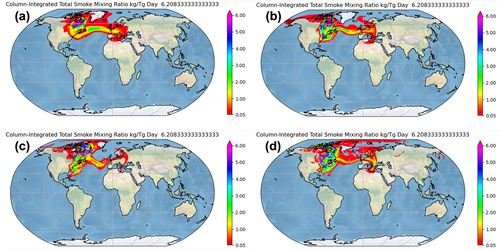
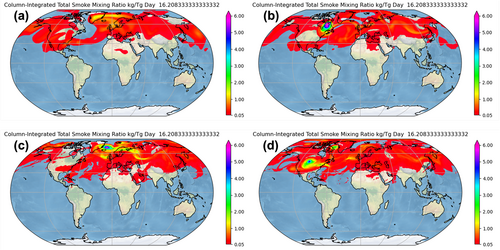
Figure 1Figure 2
Figure 1 (left): The horizontal structure of the smoke plume at 6.2 days by vertically integrating the total smoke mixing ratio over the entire model atmosphere into the simulations for varying resolutions: (a) 2.0° (b) 1.0° (c) 0.25° and (d) 7 km.

Figure 2 (right): The same as figure 1, except at 16.2 days. The horizontal structure of the smoke plume is significantly different between the various resolution simulations. (Images courtesy of Stephen Guimond and the Journal of Advances in Modeling Earth Systems)
Limits in how previous research represented the atmosphere also made for less accurate smoke plume simulations, Guimond said. He notes that prior smoke plume research used “coarse representation of the smoke plume in the model calculations, which has significant downstream effects on all other components of this problem, including the conclusions drawn from the research.”
Guimond hopes that his research can improve understanding of the dynamics of this problem: tracking of atmospheric motion and forces in three-dimensions, and how phenomena like rotating smoke plumes form and decay.
“Scientists need to accurately simulate the dynamics in order to get more accurate answers about aerosol properties inside the smoke plumes,” Guimond says, “such as how much of the smoke is black carbon, how long it is going to last in the stratosphere, how high it rises, and its effects on the radiation of the earth.”
With more accurate models and simulations, future research will be able to better inform climate policy and megafire response.
In 2020, Renata Taylor-Smith ’24, theatre, eagerly prepared for her first trip to Munich, Germany to study theatrical lighting design, but a week before she was meant to fly to Germany, her trip was canceled due to COVID-19. She learned that the show she helped to prepare the lighting design for, a production of Jessica Dickey’s The Amish Project, would be postponed indefinitely.
“That roadblock forced me to think creatively about how I could redesign my project,” says Taylor-Smith. With the help of her faculty mentor Adam Mendelson, senior lecturer in theatre, Taylor-Smith sought new ways to gain hands-on experience in lighting design research. Mendelson connected her with other Baltimore-based lighting designers and encouraged her to attend the Live Design International conference and trade show to network with industry professionals.
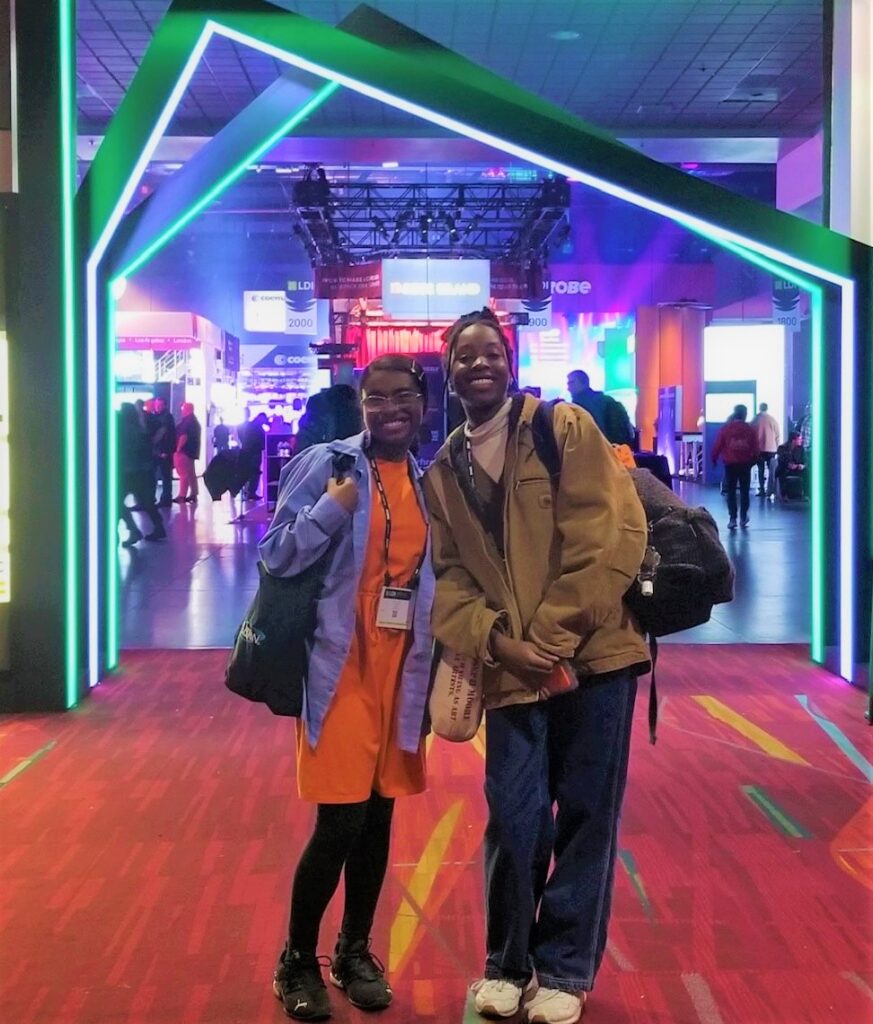
Renata Taylor-Smith (R) with Niya John ’24, theatre, at the Live Design International conference and trade show in November 2022. (Photo curtesy of Renata Taylor-Smith)
Taylor-Smith says, “I was able to meet the intended goal of my research project while also expanding the scope of my project to include opportunities to learn from other designers.” It came full-circle this year when Taylor-Smith worked as the assistant lighting designer, and later transitioned to head designer, for a production of The Amish Project at UMBC’s Black Box Theatre.
Last week Taylor-Smith showcased that work at UMBC’s 2023 Undergraduate Research and Creative Achievement Day (URCAD), held in person for the first time since COVID-19. There, she and nearly 200 other UMBC students convened to present their research and creative projects.
“I was really stressed about presenting my research,” says Taylor-Smith, sharing a feeling that many first-time URCAD presenters initially experience. “I had to remind myself that I spent almost a whole year working on this and all I had to do was talk about what I’ve done. I’m taking the experience that I’ve gained from doing shows to become more confident in my voice as a lighting designer and in my design choices.”
Lighting in the final scene of The Amish Project, designed by Renata Taylor-Smith. (Video courtesy of Renata Taylor-Smith)
Mendelson shares that he was excited to support Taylor-Smith with her URCAD project because hands-on research “allows students who have an interest to really get started, grow, and think through their ideas.”
This year’s URCAD featured a talk by special guest Alicia Wilson’04, political science, who is the managing director and global head of philanthropy for the North America region for JPMorgan Chase. Wilson captivated an audience of URCAD presenters and attendees, sharing her personal journey, the value of her research experience, and the power of mentorship.
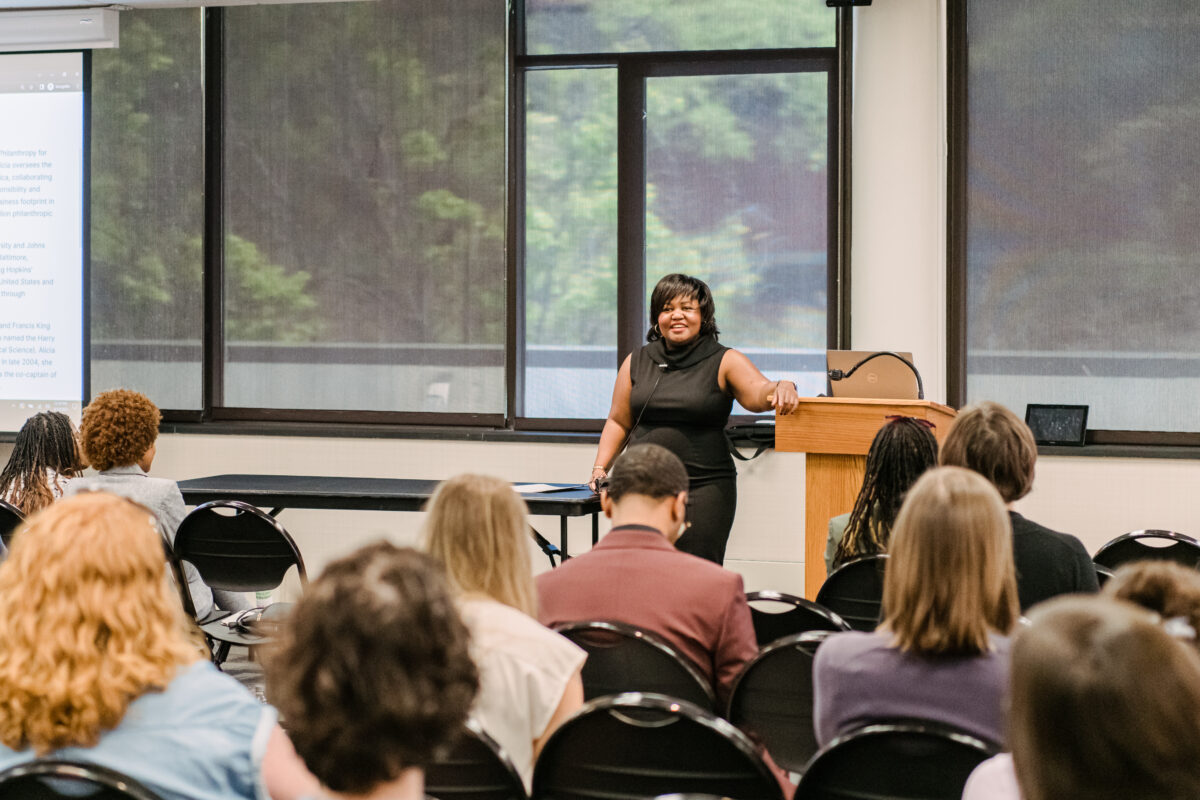
Alicia Wilson delivering the keynote speech at URCAD 2023. (Marlayna Demond ’11/UMBC)
“UMBC, for me, represents so much of who I am and what I want to be in the world,” says Wilson. “My pathway to where I am now is rooted in relationships, being able to care for my community and people regardless of their background. I learned at UMBC to treat everyone well and to research and understand things.”
She advised students to “explore any type of research that you might be interested in,” saying that “it all leads to a great place.” Wilson also encouraged students to take heed of their supporters’ belief in their abilities: “When someone believes in you—even if you can’t believe in yourself—believe them. Don’t believe your doubts. Believe in their belief in you.”
Wilson, who presented her research on community-building at UMBC’s 2022 GRIT-X event, also shared her experience building and sustaining connections, from an 8-year-old who became her mentee to former first lady Michelle Obama.
The language of toys
Theo Reinhert ’23, media and communications studies, is one of the hundreds of UMBC students who presented their work at URCAD this year. Reinhert engaged a crowd of URCAD observers with a display of children’s toys, gathered to demonstrate his analysis of how gender ideologies can be coded in toys.
“While growing up and struggling with my own gender, toys were one of those media that impacted and had power over how I viewed my gender,” Reinhert explained after his presentation. It made him curious to understand how material objects can have the power to carry ideas.
#UMBCurcad is this Wednesday! Join us in the University Center beginning at 10 a.m. to hear about some of the incredible research and work being done by our undergraduate students, including Theo. https://t.co/NUZixJfd5rpic.twitter.com/lb7fPj18LE
Reinhert found presenting at URCAD to be an important learning experience. “As I presented my research, I understood my ideas better,” he said. “Creating a presentation was a step for me to understand the final research outcomes.”
He also found the support of his faculty mentor, Jason Loviglio, associate professor of media and communication studies, to be essential. “Whenever I would feel lost, Dr. Loviglio would assure me that I was experiencing a normal stage in humanities research” and he’d provide valuable insight, Reinhart said.
Balancing privacy and utility in smart devices
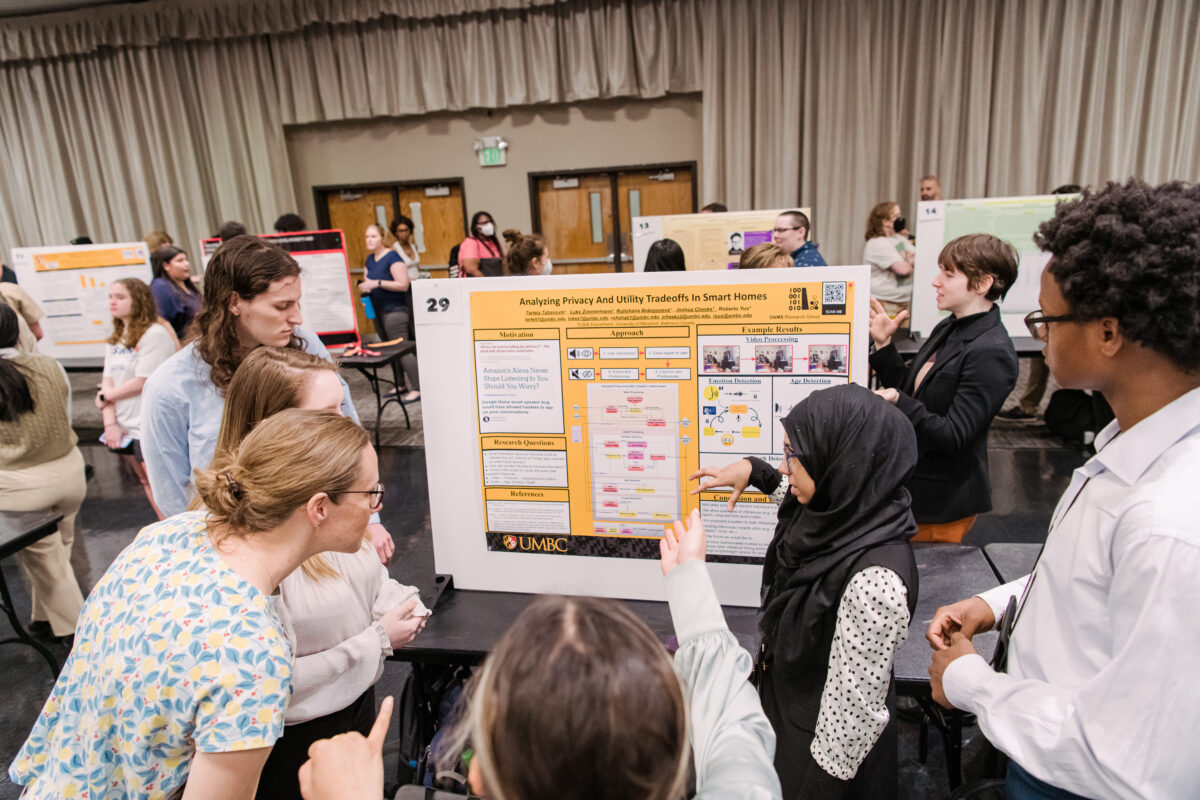
Several students worked together to complete complex group research projects. Tartela Tabassum ’23, information systems; Luke Zimmermann ’24, computer science; Ruhshana Bobojonova ’24, biological sciences; and Joshua Cheeks ’25, computer science, collaborated to explore the tradeoffs that exist between privacy and utility when using smart devices at home.
The group worked in the DAta Management and Semantics (DAMS) research lab led by Roberto Yus, assistant professor of computer science and electrical engineering. They built a prototype of a framework to generate inferences about a person based on audio and video input like speech data collected by a smart speaker and images from a smart security camera, using open-source code and artificial intelligence and machine learning algorithms.
Tartela Tabassum (in black) with her group explaining their research at URCAD 2023 (Marlayna Demond ’11/UMBC)
“We think that privacy is a rising issue,” says Tabassum. “There are things going on with the government trying to ban social media platforms like Tik Tok because of these privacy issues. We want to give users more autonomy with their own privacy.”
Developing flu treatments
Brooke Nelson (left) and Lillian Kidd. (Photo courtesy of Lillian Kidd)
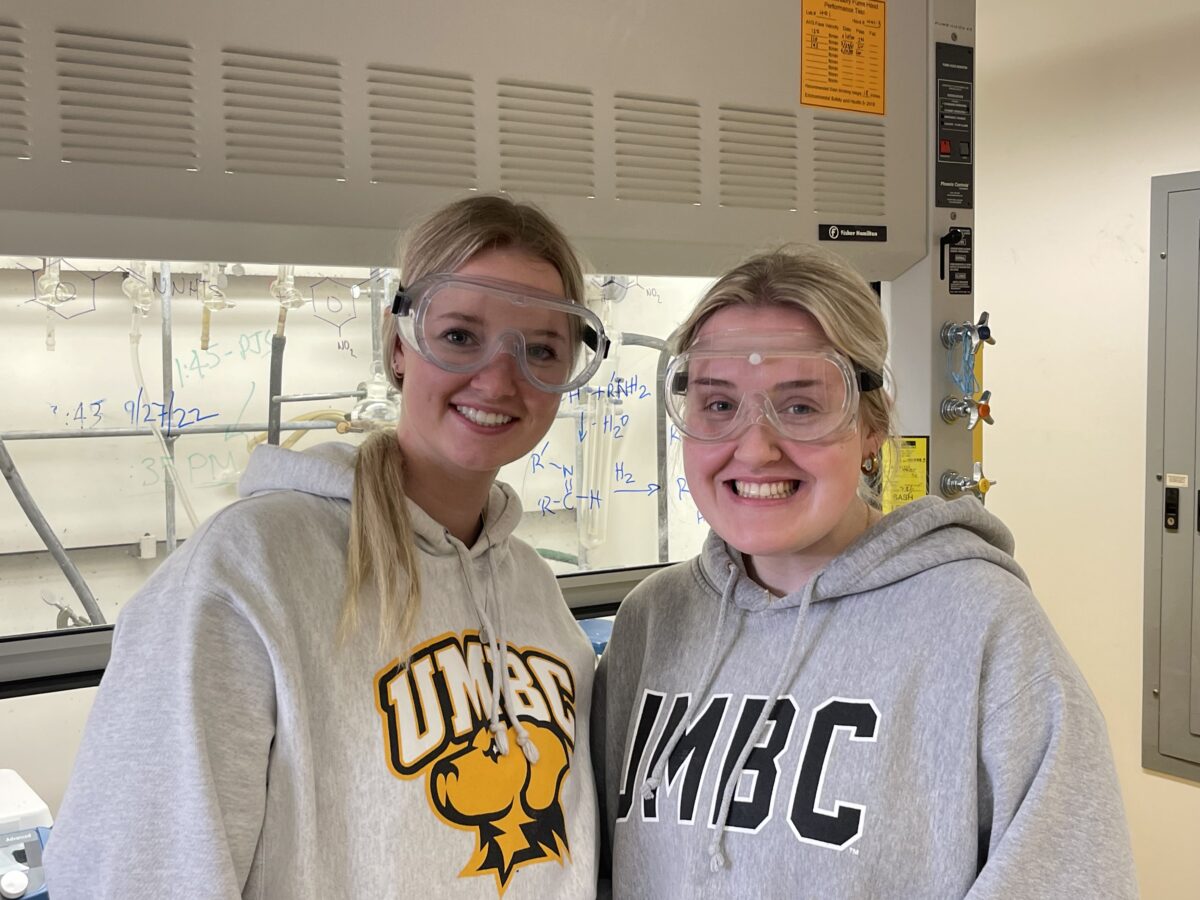
Lillian Kidd ’24, biochemistry and molecular biology, explored the design and synthesis of palmitoyltransferase inhibitors as potential therapeutics for influenza, or the flu, with her research partner Brooke Nelson ’23, biological sciences. Kidd and Nelson received an Undergraduate Research Award to support their work with faculty mentor Paul Smith, associate professor of chemistry and biochemistry.
“I think doing research is a lot like standing in front of a mirror. It exposes you to what you’re scared of and inversely, what you’re excited about. I learned a lot about my approaches to problem solving and discovered a deep interest in biochemistry,” says Kidd.
She shares that her preparation leading up to URCAD helped her to grow as a research scientist: “There is so much specificity to every single step in our synthesis of palmitoyltransferase inhibitors that pushed me beyond what I had learned in the class environment. Actively using all of the information I studied to carry out research in the lab was such a fundamental experience to my growth as a research scientist.”
Ava Sekowski ’24, political science and media and communication studies, was inspired to explore the history of LGBTQ+ nightlife in Baltimore after growing up hearing stories about The Hippo, a now-defunct LGBTQ+ bar where her parents met. Sekowski created the short film “Out in the Open: Tracing the History of Gay Nightlife in Baltimore,” which chronicles the decline in LGBTQ+ nightlife establishments in the city.
“In coming to UMBC, I wanted to explore more about the history of Baltimore through the lens of the LGBTQ+ community,” shares Sekowski. For this project, she says, “I wanted to explore why The Hippo is gone. I heard about the bar my whole life being this amazing club that was welcoming, and I wanted to explore if that was true and who it was welcoming for.”
Ava Sekowski’s short film “Out in the Open: Tracing the History of Gay Nightlife in Baltimore.”
The project enabled Sekowski to practice her editing and interviewing skills and taught her how to navigate the post-production process. “The process was much harder than I thought it would be,” she shares. “I was a one-person filming and editing crew. The hardest part, for me, was filming and getting the lighting correct, but in the end, I’m pretty happy with how it turned out.”
A bioinformatics approach to understanding DNA
In his research, Emmanuel Mekasha ’25, biological sciences, explores promoter regions located in DNA structures and how they are fundamental to our understanding of how gene expression is regulated. He is helping to tackle the challenge of designing generic computational programs capable of finding promoters across different organisms, with the guidance of his mentor Ivan Erill, professor of biological sciences, and biological sciences Ph.D. student Elia Mascolo.
“I have always been an interdisciplinary learner. Based on bioinformatics approaches, my project combines the best aspects of mathematics, statistics, computation, and biology,” says Mekasha. “I thoroughly enjoyed everything that went into this project, from the literature review to the experimental design.”
Emmanuel Mekasha (Photo courtesy of Emmanuel Mekasha)
Mekasha already has his sights set on continuing his research pursuits beyond his time at UMBC. “This project, and previous research experiences, have made me certain that I want to do research in the future, leading me to my goal of achieving an MD-Ph.D. degree.”
Implicit bias in healthcare
Thu Dinh ’23, biological sciences; Maryamah Ndao ’23, psychology; and Jorge Saucedo ’23, psychology, worked as research assistants in the Social Determinants of Health Inequities Lab (SoDHI), led by their faculty mentor Danielle Beatty Moody, associate professor of psychology. The group examined the systemic impact of implicit bias from healthcare providers on patient health outcomes. For Ndao, this was a research topic she’s been interested in since her first year at UMBC.
Ndao describes her main focus as “making sure that the healthcare needs…of Black people, especially Black women, are heard.”
Maryamah Ndao (left) with President Valerie Sheares Ashby at URCAD 2023. (Marlayna Demond ’11/UMBC)
“The data is very clear and the disparities are clear but there’s a lack of action,” Ndao shared during the group’s poster presentation. “Having this opportunity at URCAD to be able to speak to people directly is beneficial because a lot of people [may not] know about this.”
For Saucedo, this research interested him on a personal level, as someone who has lived with chronic pain and felt that medical professionals didn’t believe the amount of pain he was experiencing.
“As a minority myself, I’ve faced a lot of discrepancies and had people not take my pain seriously. I’ve had experiences through the healthcare system that made me feel as if I wasn’t fully represented culturally. I felt as if I was neglected from having proper care because of that,” says Saucedo. Because of his experiences, Saucedo was interested in exploring the research being done at the SoDHI lab.
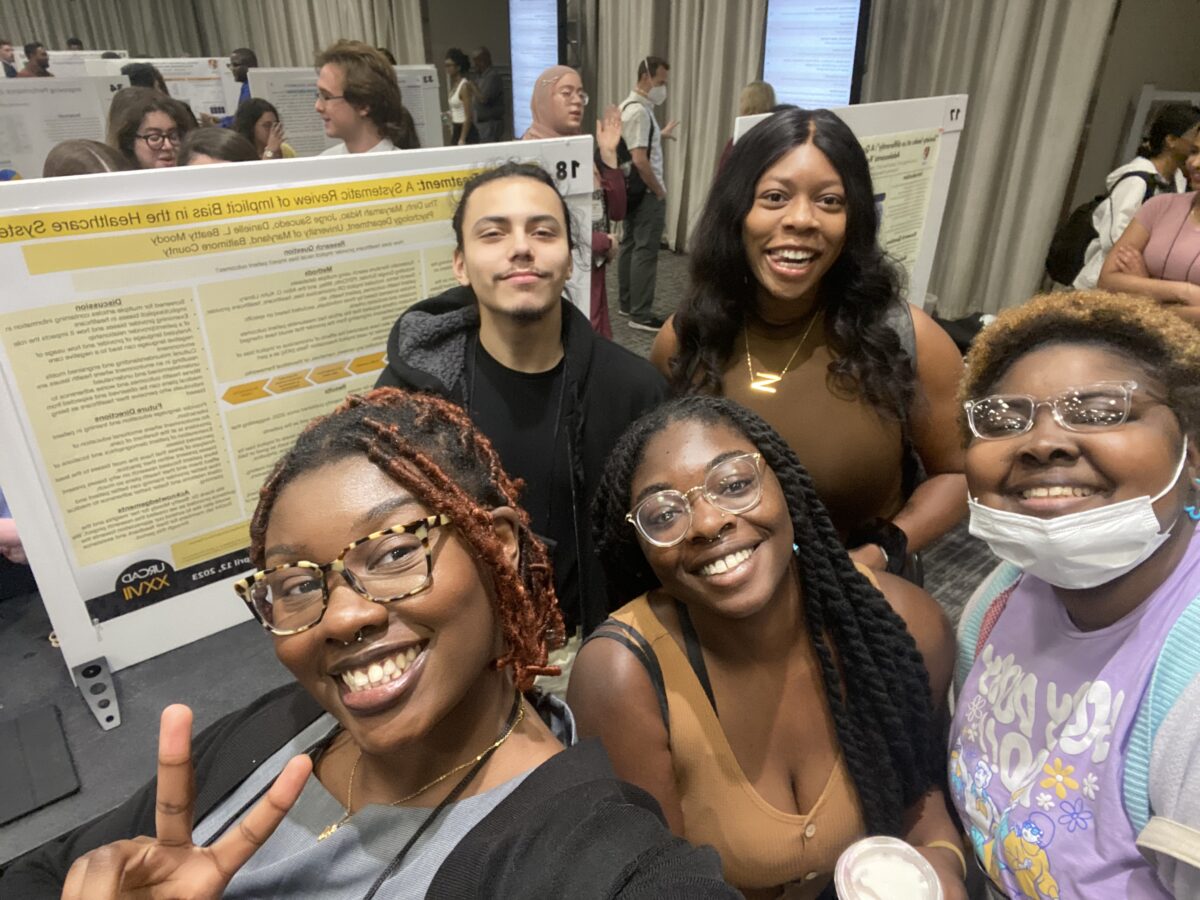
Maryamah Ndao (front row, left) with Jorge Saucedo (back row, left) and friends at URCAD 2023. (Photo courtesy of Maryamah Ndao)
Ndao hopes to one day open her own mental health medical practice to better help individuals from marginalized groups, and also impact the conversation on bias in healthcare. “I want to do more advocating. I love speaking about this topic,” says Ndao.
Reducing pain after shoulder surgery
Supported by UMBC’s Mechanical Engineering S-STEM program, Jacob Lombardo ’25, mechanical engineering, explored how the use of a cooling pad could be beneficial in the healing of surgical repair sites of shoulder injuries. His research asserts that effective cooling may temporarily reduce nerve activity by disrupting the transmission of pain signals and could be a cost-effective approach to decrease the use of painkiller medications during surgical recovery.
Trying to figure out what exactly Jacob's doing here? Stop by tomorrow and learn more about his research project titled: "Measurements Of Temperature And Blood Perfusion Rate During Surface Cooling To Evaluate Cooling Penetration In Shoulder.” #UMBCurcadhttps://t.co/NUZixJfd5rpic.twitter.com/tgUfwECpdu
With the help of his faculty mentor Liang Zhu, professor of mechanical engineering, Lombardo learned how to circumvent obstacles that arose during the research process. “Research allows you to overcome problems that don’t have a textbook answer,” says Lombardo.
For example, he explains, “My research included the use of a blood flow measurement device. I initially encountered difficulties getting meaningful results from the device. With the encouragement of my advisor, I got in contact with the manufacturer.” Their engineers explained in more detail how the device worked and shared best practices for using it effectively in research.
This experience learning more about medical technologies has inspired him to continue to pursue biomedical engineering. He says, “I am motivated by the possibility of improving patient care through research, and I am eager to expand upon my experience in future projects.”
UMBC Review
Several URCAD presenters and other student researchers have shared the results of their research and creative work in UMBC Review, a peer-reviewed research publication completely directed by UMBC undergraduate students. Free print copies of the new 24th edition are available in the Office of Undergraduate Research and Prestigious Scholarships, located in the Albin O. Kuhn Library and Gallery.
Assessing the quality of nursing home care has historically been a challenging and complex process that considers only a portion of the factors involved—generally, clinical indicators reported by the nursing homes themselves. UMBC researchers are collaborating on a new measure of nursing home quality that combines care experiences with clinical data. And they are doing it with funding from a new UMBC program designed to support novel research across different teams.
Principal investigator Roberto Millar M.A ’19, sociology, Ph.D. ’20, gerontology, who is a policy analyst advanced at The Hilltop Institute, is collaborating on the study with Nancy Kusmaul, associate professor of social work, and Ian Stockwell, associate professor of information systems. Their goal is to create “a more complete measure that nursing homes will be able to use to evaluate how they’re doing to improve the resident experience,” says Kusmaul.
Roberto Millar (Image courtesy of The Hilltop Institute)Nancy Kusmaul (Marlayna Demond ’11/UMBC)Ian Stockwell (Image courtesy of The Hilltop Institute)
The researchers will, for the first time, combine data from the Centers for Medicare and Medicaid Services’ Care Compare database and results of the Maryland Family Satisfaction Survey. The survey assesses the experiences of family members with loved ones in Maryland nursing homes and, Kusmaul notes, offers a unique approach to measuring quality of care.
“There are no national measures of nursing home quality that consider that side of things,” she explains. “When we think about what quality is and what are the outcomes that we’re measuring, we have to think about the different perspectives of what is good nursing home care.”
Creating a new national model
On a national level, the typical approach to measuring nursing home care focuses on clinical indicators that are measured quantitatively, Millar notes. This includes factors such as number of hospitalizations, vaccination rates, and staff training. It does not include more qualitative data that considers the experiences of people in nursing homes or their families. Maryland is one of only three states that assesses family satisfaction.
“What’s key here is bringing these two approaches together to see if these quantitative measures from the federal approach are actually predictive of family satisfaction across more qualitative domains,” says Millar.
“What we’re talking about is perhaps scaling this collection of qualitative data to a national level that does not exist right now,” says Stockwell. “We want to better measure quality of care to drive changes in the nursing home industry that would best help the patients.”
The team hopes to eventually create a more robust technical infrastructure to capture this data. Eventually, they might be able to utilize machine learning and artificial intelligence to better match prospective care recipients with the most suitable care facility.
Funding new collaborations
The nursing home study was funded through UMBC’s Office of Research Development via the new CIDER (Center and Institute Departmentally-Engaged Research) program. This internal funding opportunity brings together researchers from different disciplines and types of research units across UMBC.
At UMBC, a large volume of research and creative activity (RCA) happens within academic departments and colleges as well as outside of them, in a range of research centers and institutes. In fiscal year 2022, centers and institutes outside of academic departments were responsible for 48.6% of UMBC’s sponsored RCA expenditures ($42.3 million), with most of the rest falling within the departments. But while both groups contribute substantially, they don’t often receive shared project funding to collaborate.
CIDER was designed to increase collaboration between these groups. In this first round, four research teams were each awarded a $50,000 CIDER grant for 18 months to pursue their studies.
In addition to Millar’s team, the other three winning proposals include research across a very broad range of fields:
“Visualizing the Factors in K-12 Education Success” is led by Lee Boot, director of UMBC’s Imaging Research Center (IRC), with co-investigator Amy Tondreau, assistant professor of education, and Anita Komlodi, associate professor of information systems and associate director of the IRC.
Don Engel, associate vice president for research development and director of the Center for Space Sciences and Technology (CSST), helped to create CIDER. “We wanted to find a systemic way to make sure that everyone could draw value from being close to other researchers within the institution,” says Engel. “In addition to that, we wanted to make sure that research center faculty have internal funding opportunities that better connect them with the rest of the university. This better integrates them into the university and also makes sure that they have more opportunities to both contribute to and draw from the university’s other strengths and dimensions.”
Additional CIDER program creators include Cynthia Woodcock, director of The Hilltop Institute and Christine Mallinson, professor of language, literacy, and culture (LLC) and director of the Center of Social Science Scholarship. Kara Seidel ’18, psychology, an LLC doctoral student, also provided support in the program’s creation.
Program founders hope that CIDER can help kick-start successful partnerships that generate additional external support and grow far into the future. “We were really excited to see how much interest we had in this program,” says Engel. “We hope that our researchers can draw from each other’s expertise and this funding opportunity can enable the awardees to get subsequent grant funding.”
Ian Stockwell finds this kind of collaborative effort essential and can already see its growing impact. “It’s important for UMBC to facilitate the interaction of faculty across departments and in research centers. We are grateful for this opportunity in particular.”
UMBC researchers are partnering on STAR-X, a nine-month mission concept study investigating black holes, galaxy clusters, and often-elusive transient cosmic events like supernova explosions. STAR-X stands for Survey and Time-domain Astrophysical Research Explorer. It is one of two Explorer missions to receive $3 million from NASA for this concept phase, before NASA selects one in 2024 to proceed with implementation, targeted for launch in 2028.
“With STAR-X, we want to come up with a survey that will catch very rare transient events,” said Antara Basu-Zych, a UMBC associate research scientist with the Center for Research and Exploration in Space Science & Technology II (CRESST II). “We’re aiming to understand at what rate these events are happening, what types of systems they involve, and where in the universe they’re happening.”
Maintaining STAR-X’s mission data
Antara Basu-Zych. (Photo curtesy of Antara Basu-Zych)
This mission reflects the important role of strategic research partnerships in moving forward space science—what CRESST II was designed to achieve. UMBC’s CRESST II partners on STAR-X include NASA’s Goddard Space Flight Center (GSFC) and the Massachusetts Institute of Technology, providing an X-ray telescope; the University of Colorado, providing an ultraviolet telescope; and Ball Aerospace, providing the spacecraft. UMBC’s role will focus on the mission data retrieved from STAR-X.
Basu-Zych works with NASA’s High Energy Astrophysics Science Archive Research Center (HEASARC). If the mission is selected for launch, HEASARC will house the data that STAR-X collects. Basu-Zych is currently developing a process to organize the data, along with methods of alerting the scientific community of interesting STAR-X discoveries, called targets of opportunity, that could be further explored.
“Our role is to make it so that average scientists outside of the mission are able to do something valuable with the mission data,” she said.
An agile spacecraft
The mission will conduct a medium survey covering 300 square degrees of the sky on a weekly basis, and a deep survey on a daily basis covering 12 square degrees. As NASA has described, those deep surveys would seek to map black holes and hot gas trapped in distant clusters of galaxies. Combined with infrared observations from NASA’s Roman Space Telescope, these observations would enable researchers to trace how massive galaxy clusters were built up over time.
Additionally, the spacecraft would be able to turn rapidly to point its wide-field X-ray and UV telescopes at transient cosmic sources, such as supernova explosions, gravitational wave events, and extreme black hole feeding events.
“STAR-X is fast moving, very agile, and can quickly go to a source that is interesting,” explains Basu-Zych. “It would be able to slew the sky within a day or within a couple of hours, depending on what event was happening, and target something very quickly.”
In addition to being agile, she notes, “the instrument itself has a large field of view and low particle background, so that helps us with picking out faint objects and will help us get to areas of deep sensitivity.”
With these time-domain surveys and detecting cosmic targets of opportunity, STAR-X seeks to address several key priorities outlined in the “Pathways to Discovery in Astronomy and Astrophysics for the 2020s,” the latest decadal survey of the field released by the National Academies.