We use cookies for analytics and, unless you opt out, advertising.
You can opt out of advertising at any time.UMBC uses essential cookies to run this site. With your permission we would also use analytics cookies (to understand how the site is used) and advertising cookies (to measure and target our ads on other platforms). Nothing else loads unless you accept. You can change your choice any time from Cookie Settings in the footer.Privacy Policy
EssentialRequired for the site to work (login, security, your cookie choice). Always on.
UMBC researchers are collaborating on a study that takes a closer look at specific diagnosis coding patterns that focus on societal factors that potentially influence the health of Maryland’s Medicaid recipients.
Morgan Henderson, director of analytics and research at UMBC’s The Hilltop Institute, and Jun Chu, assistant professor of public health, are among the five cross-collaborative teams selected to receive funding from UMBC’s Center and Institute Departmentally-Engaged Research (CIDER) program. Henderson and Chu’s CIDER-supported project will investigate potential “z code” patterns of the state’s Medicaid recipients. Z codes are a set of diagnosis codes that refer to factors influencing a patient’s health status beyond diseases or injuries, called social determinants of health.
“These specific diagnosis codes indicate certain social determinants of health-related factors, not just traditionally medical things,” explains Henderson, principal investigator of the study. Z code data indicates if a patient has an issue that’s related to social risk factors, such as unstable housing, lack of food, hazardous living environments, and employment status.
“There hasn’t been much analysis of z code patterns and we aim to lay a good foundation for better understanding these diagnosis codes within Maryland’s Medicaid data,” says Henderson.
A deeper look into z code diagnosing could be a useful identification “to bring extra resources to Medicaid recipients who are in need,” says Chu.
Analyzing Medicaid data
The study coincides with recent news of potential billion-dollar federal budget cuts to Maryland’s Medicaid program, which currently supports about 1.7 million Maryland residents. The Hilltop Institute specializes in working with the state’s Medicaid data. According to the institute’s Maryland Medicaid DataPort, two in five of those in Medicaid are children and Medicaid pays for 60 percent of nursing home stays.
Chu’s research has largely focused on social determinants of health with a particular focus on immigrant communities and Medicaid recipients who are children. Henderson helped to develop and currently manages Hilltop’s predictive modeling portfolio. These predictive models, which also utilize z code data, use a variety of risk factors derived from Medicare and Medicaid claims data to estimate the probability that a given patient incurs certain outcomes in the near future.
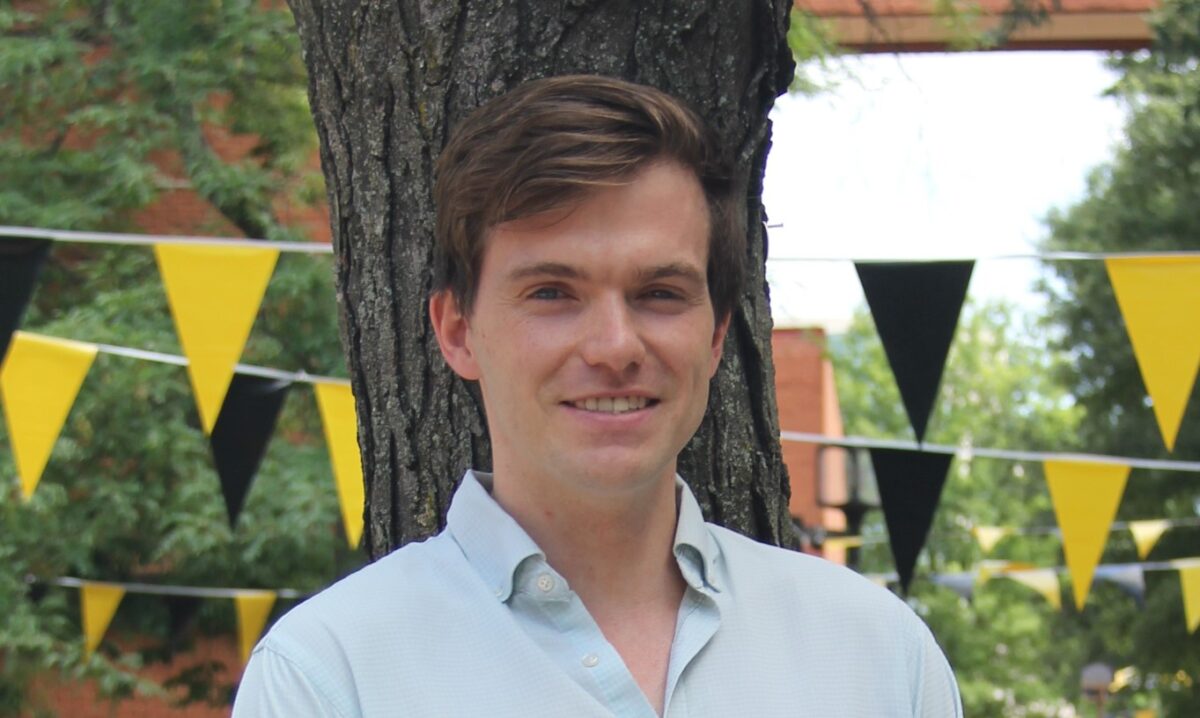
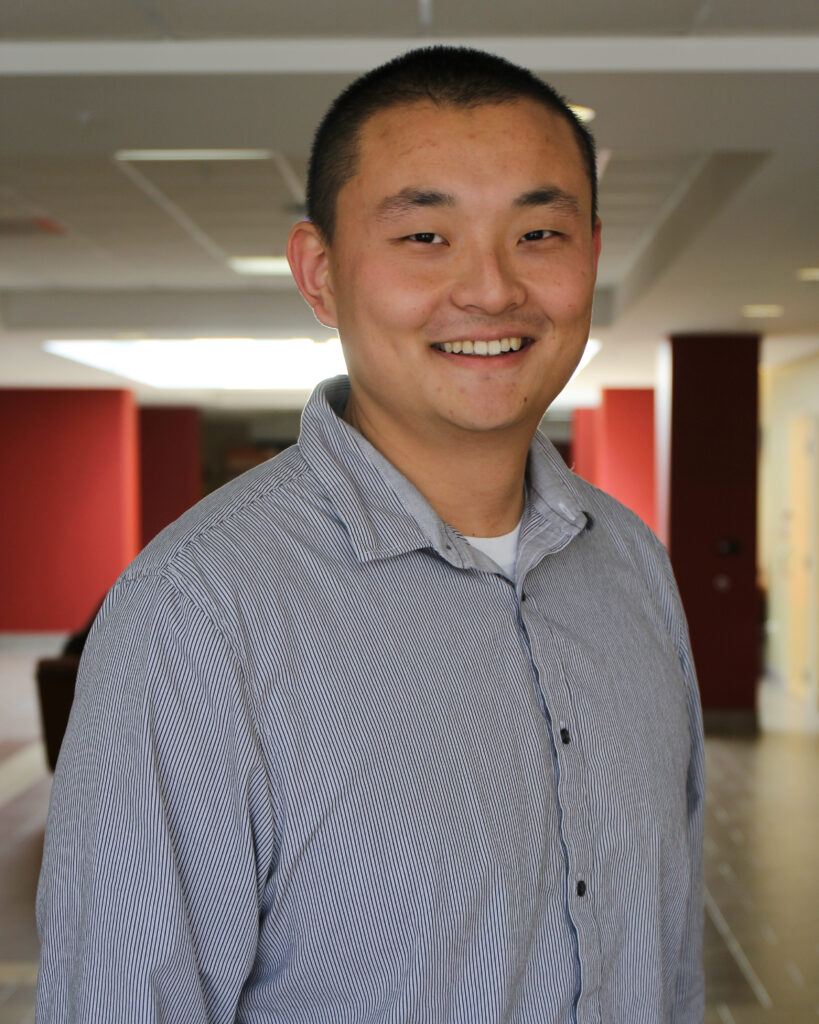
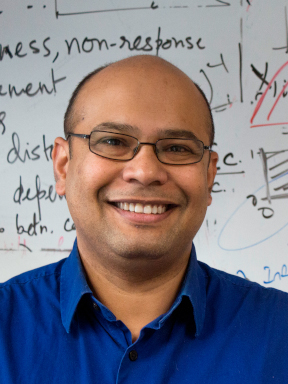
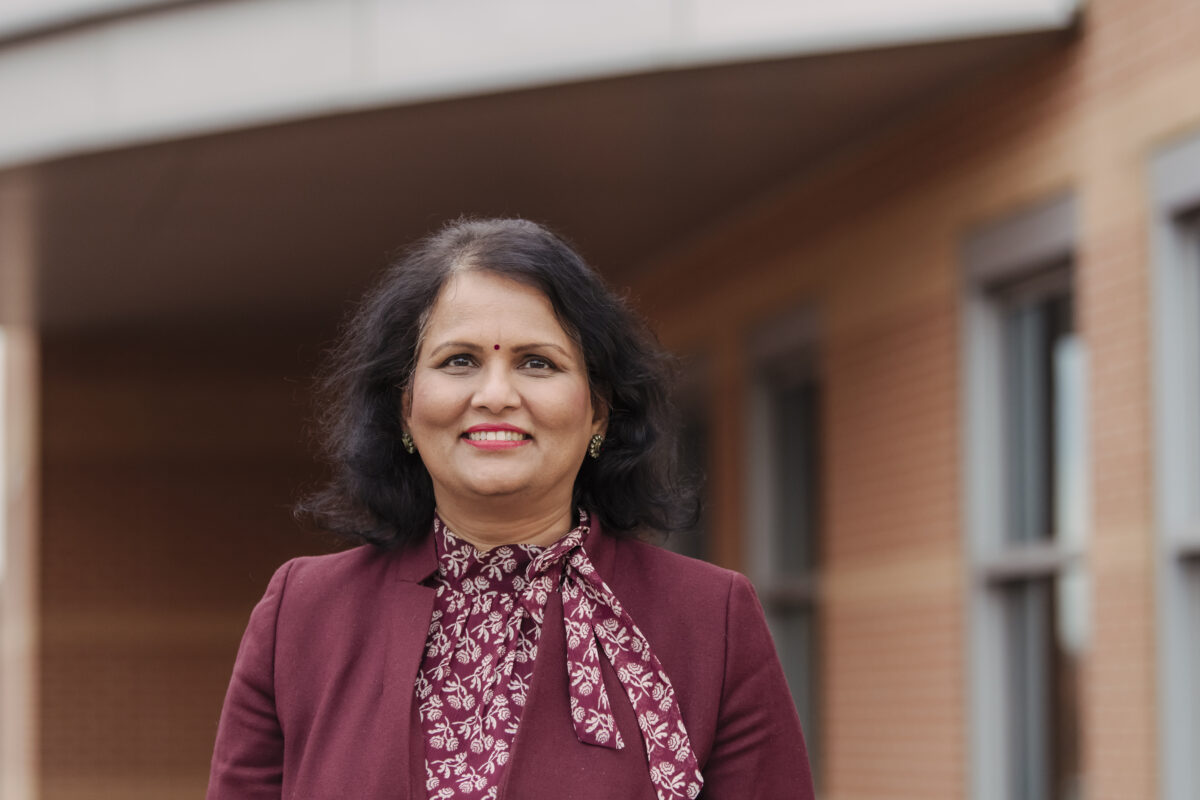
Principal investigator Morgan Henderson (left) and co-investigator Jun Chu of the CIDER Program study, “Analysis of Social Determinant of Health Diagnosis Coding Patterns Among Medicaid Recipients and Providers in Maryland.” (Photos courtesy of The Hilltop Institute and Jun Chu)
The pair’s project will include two studies: one study will focus specifically on the patients ascribed z codes to determine what patterns arise based on patient-specific factors such as demographics, health care utilization, or geography.
The second study will focus on analyzing the characteristics of the healthcare providers that indicate the z codes on Medicaid claims.
“Patient claims are the engine that so much of health analysis relies upon. It’s the decision of the provider on which coding diagnoses to include—it’s not a completely standardized process,” says Henderson.
CIDER 2025 recipients
The CIDER program’s goal includes supporting and promoting collaborative research between scholars based in one of UMBC’s affiliate centers and institutes and the university’s faculty researchers. Selected proposals are awarded up to $50,000 in seed funding for 18 months.
The 2025 CIDER program recipients include:
Anin Puthukkudy, Earth and Space Institute, and Vanderlei Martins, professor of physics
Jessica Sutton, Goddard Earth Sciences Technology and Research (GESTAR) II, Tejas Gokhale, assistant professor of computer science and electrical engineering, and Thomas Stanley, GESTAR II
Kaur Kullman, the Center for Space Sciences and Technology, Alan Sherman, Roberto Yus, and Enis Golaszewski, professors of computer science and electrical engineering
Morgan Henderson, The Hilltop Institute at UMBC, and Jun Chu, assistant professor of public health
Venkatesh Srinivasan, Center for Advanced Sensor Technology, Tyler Josephson, assistant professor of chemical, biochemical, and environmental engineering
Don Engel, associate vice president for research development, shares that the CIDER program was created to foster collaborations that draw on the full range of UMBC’s strengths in research and creative achievement.
“CIDER helps connect faculty in our research centers with colleagues in degree-granting departments to pursue work with real impact—work that informs policy, advances knowledge, and ultimately serves the public good,” says Engel.
Ada Glaser ’25, social work and individualized study (INDS), is following in her mother’s footsteps with career pursuits in social work. Growing up, Glaser’s family supported children who were placed into foster care, an experience that informed her passion for helping children and families who’re navigating challenging circumstances. Upon completing her undergraduate studies a year early, the Sondheim Public Affairs Scholar is excited to continue her social work education with a goal of one day supporting young children in their development. To help with her career plans, Glaser will be attending University of Maryland,Baltimore to pursue a master’s of social work.
Q: What led you to UMBC, and what motivated your decision to major in social work?
A: As a Baltimore County native and Loch Raven high school graduate, I wanted to stay close to my family. When I went through the college selection process, I didn’t know much about UMBC, but as I looked more into the school, I came across the Sondheim Public Affairs Scholars program, which seemed awesome. I applied and ended up getting into the program. As the oldest of six, the program’s financial support made it really realistic for me to go to college. It was great to see all of the different angles for approaching the general idea of public service as a Sondheim scholar.
My mom is a social worker and has her own private practice. When I was in high school, my family started supporting children in foster care. Getting to see all the work that social workers were doing with foster families opened my eyes to the profession. I started doing research on my own and thought social work seemed like a great field for me. My time in the Baccalaureate Social Work program reaffirmed that decision for me because I loved the classes, the professors, and my peers. I know it’s the right field for me.
Q: As an INDS student, what went into designing your major?
A: I always knew I wanted to work with kids. It’s something I’ve loved for a really long time. As a social work major, you need a second area of concentration. I originally came to UMBC wanting to study psychology, and I realized after my first year that there was so much else that I wanted to learn and do beyond the scope of psychology. I reached out to INDS advisor Holly Cudzilo and she explained the process of creating your own major. Cudzilo was instrumental in helping me develop my INDS concentration and making sure I stayed on track. The program allows you to put together the areas of concentration you want to do, define what the overall focus of the course is, and how to put the threads together that connect everything. That process helped me refine what I care about and what I’m passionate about.
Q: Who has helped you along your academic journey?
A: I met Jayshree Jani, associate professor of social work, during my first year when she was my advisor. During our first advising appointment, she was aware of my plan of wanting to graduate early and wrote out the three-year plan that I’ve followed. She’s shown me how much she cares and how much she wants me to succeed. She’s given me good advice about how to make my senior capstone project come to life and gave me good ideas to try. She encouraged me to feel confident to do difficult things.
Glaser presenting the findings from her senior capstone project, titled “Goals and Motivations of Baltimore Early Intervention Providers,” at UMBC’s 2025 Undergraduate Research and Creative Achievement Day (URCAD) event. (Photo by Adriana Fraser)
Q: What experiential learning opportunities have you been a part of?
A: My senior year social work field placement was at the Furman Templeton Preparatory Academy elementary school in West Baltimore as a social work intern. I worked with the kids on things like emotional awareness and regulation and goal setting. Some of the students are experiencing a lot of interpersonal conflicts, so I helped them think about how they can address those conflicts. I’ve done lessons in the classroom, such as working with kindergarteners on how to be a good friend. I also worked with my supervisor on school-wide initiatives such as managing testing anxiety for fifth graders and attendance initiatives. It’s been a very intense and emotional experience, but also a great learning experience.
Q: What are some of the things you’ve learned from your experience as a social work intern?
A: I learned just how much there is that I don’t know and sometimes you don’t always know how you’re going to react to something until you’re in the moment. In some of the more intense situations, I thought I would be okay handling them and then I realized those moments affected me a lot more than I thought it would. That’s one of the benefits of why social work has this practicum element to it because you have to practice these skills and get used to being in intense situations. I’ve built up my resilience and learned about my own style as a social worker.
Q: How do you find time to take care of yourself and reset after those intense moments?
A: I’m big on journaling—I’ve been that way since middle school. It’s such a good way to dump all of my feelings and sort through them. I feel lucky to have good friends in my circle so when I’m going through something I talk it through with them and my sister as well. In the last year and a half, because of UMBC, I’ve gotten more into yoga. I took a lot of the free yoga classes at the Retrievers Activities Center, and now I do it at least three times a week. With that physical motion, I can get out of my head a little bit.
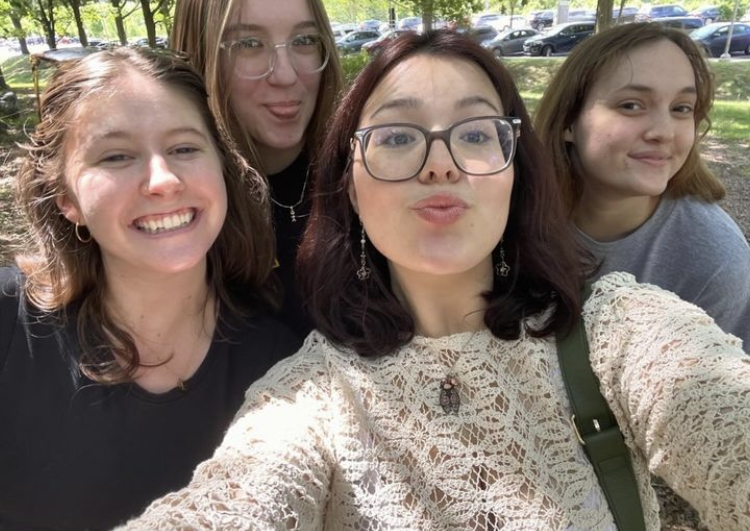
Glaser (left) with fellow UMBC classmates and friends in Summer 2024.
Q: What other activities did you participate in outside of your studies?
A: The Social Work Student Association (SWSA) has been such a big part of my time at UMBC. I was worried about being in a human services field at a more STEM-focused school, but I have found so much support, inspiring people, and encouragement through that group. Getting to be on the SWSA’s executive board and seeing this community develop has been so special. I’m also a part of UMBC’s Symphony Orchestra, which I’ve been involved in since my sophomore year. I play the upright bass. I started playing the bass in the fifth grade and continued through middle and high school. I love playing, growing my skills, and being able to connect with other people outside of my major. I love the end of the semester concerts that we do.
Glaser (in gray, second to last on the right) with fellow members of the Social Work Student Association during a volunteering event with UMBC’s Retriever Essentials program in Spring 2025.
Q: What are some memorable highlights from your time at UMBC?
A: The people that I’ve met and the friends I’ve made have been highlights for me. Studying abroad in Cape Town, South Africa, in 2023 was also monumental. It was something I didn’t initially think I would have been able to do, but thanks to the Sondheim program, I got to experience community-engaged learning in South Africa as well as learning about the history of the country, the Apartheid movement, and a lot of the political movements that are happening now and how South Africa is dealing with that history. My college experience would have been so different had I not been at UMBC. I credit the university for a lot, and I’m glad that I went here.
(left) Glaser in Cape Town, South Africa. (right) Glaser (left, second row) and fellow Sondheim Public Affairs scholars during the program’s study abroad trip to Cape Town in 2023.
Q: What are your aspirations for the future?
A: After graduation, my plan is to pursue a master’s degree in social work that focuses on working with children and families. I’m hoping to be placed in a Head Start program for my master’s because I learned during my internship that I love working with kids within the preschool age range. I also learned that I have a passion for working with kids with disabilities and I’m interested in exploring more of that.
When associate professor of visual arts Kelley Bellthinks back to her childhood growing up in the Capitol Hill area of Washington, D.C., she recalls fond memories of playing in her neighborhood playground, locally dubbed as “Turtle Park.”
“I remembered the concrete structures behind the turtle in the playground and it really inspired me to want to figure out how they came to be,” Bell says.
The public park, officially named Marion Park, was given the “Turtle Park” moniker because of the large concrete turtle structure that lived in the center of its playground, designed by Virginia Dortch Dorazio in 1953. Bell, M.F.A. ’06, imaging and digital arts, remembers Turtle Park as a prominent staple of her adolescence and decades later, the park also acts as the inspiration behind her latest project “Fantastic Village,” which will be on display at the Baltimore Museum of Art (BMA) from April 27 through July 27 as part of the museum’s Baker Artist Awards exhibition.
Maryland Public Television’s 2024 Baker Artist Awards Special featuring Kelley Bell.
The power of design
Bell was a 2024 recipient of the Greater Baltimore Cultural Alliance’s Baker Artist Award. The BMA exhibit will feature 20 works from five recent Baker Artist Award recipients, including Bell’s “Fantastic Village.” The colorful geometries of Bell’s installation draw on memories of now-demolished playgrounds of her youth in Washington, D.C., and Baltimore’s iconic rowhomes, bridging together the two places she calls home.
Bell creates vibrant projection-mapping works on a grand scale and gallery installations that emphasize joy, playfulness, community, and human connection. Before pursuing her current career as a visual artist, designer, and educator, Bell initially thought she’d be a lawyer. She believed that since her father was a speechwriter for President Gerald Ford and her mother was a teacher, she’d continue the family’s lineage of public service work.
However, “drawing in class was always a problem with me to the degree that it’s written on a lot of my report cards, saying, ‘Kelley has a lot of attention issues.’ I never thought of art as a career,” says Bell.
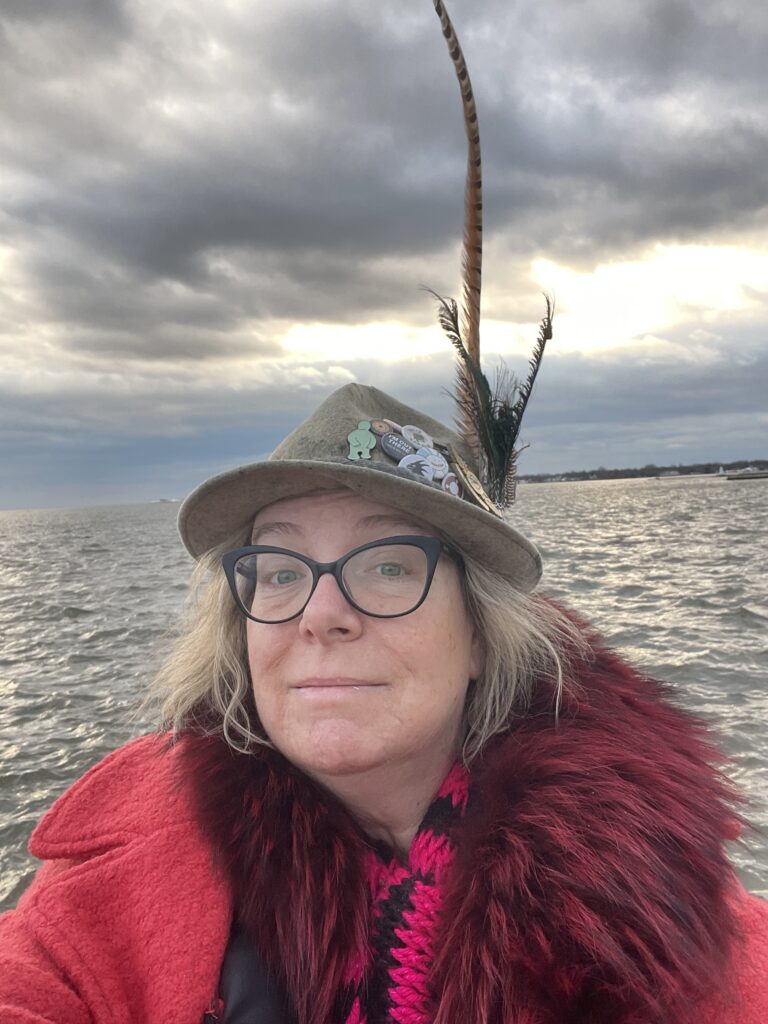
Kelley Bell. (Photo courtesy of Bell)
Growing up in the nation’s capital, Bell was heavily influenced by the city’s independent music scene. During her wanderings through downtown Washington as a teenager, a chance encounter with a repurposed “five and dime” store (then home to the Washington Project for the Arts) changed everything.
“When I walked in that store, I never saw anything like it,” Bell recalls, “There were zines, posters, paintings, and tapes for bands all around. It was a window into this idea that art doesn’t have to be this picture on the wall and that was an amazing idea to me even at a young age.”
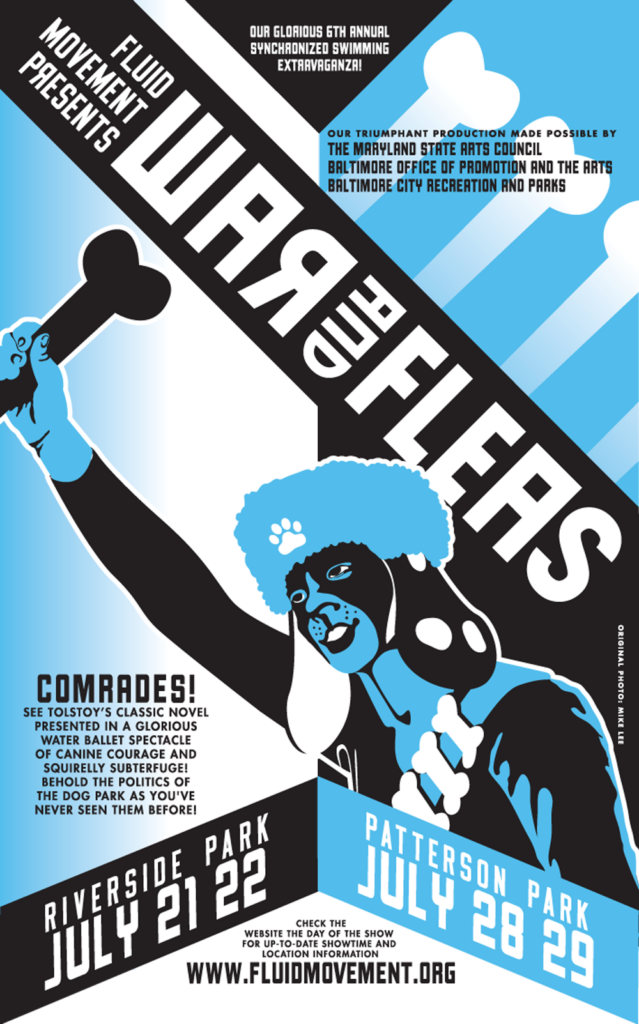
The poster for Fluid Movement’s 2007 “War and Fleas” water ballet, designed by Kelley Bell. (Photo courtesy of Bell’s website)
After graduating from Pratt, Bell landed a designer role for a record pressing plant that worked with dance music labels. Continuing her work in the entertainment industry, she freelanced for MTV Networks for several years before she was encouraged to explore Baltimore after a recommendation from a fellow designer who boasted about the city’s arts scene. A one-day exploration of the city convinced Bell that Baltimore was the place for her.
Bell was accepted into the Pratt Institute in Brooklyn, New York where she initially majored in illustration. But once there, she was introduced to the concept and the power of design. “A friend explained that designers construct the existing world, and I believe that’s an amazing power to have. I quickly switched my major after that,” says Bell.
In 1997, Bell moved into Baltimore’s now-defunct H&H Arts Building, a five-story warehouse where local artists lived and worked for more than two decades. It was at H&H where Bell was initially connected toperformer and fellow UMBC alum Beatrix “Trixie Little” Burneston’99, visual and performing arts, a founding member of Fluid Movement, a Baltimore-based organization that utilizes public spaces to create joy and community through performance art that most notably includes quirky water ballet performances in Baltimore City public pools.
“Fluid Movement did a rendition of the opera ‘Carmen’ with hotdogs on sticks. They designed a stage and costumes for hotdogs and had a composer to do the score,” shares Bell. “To see people pour that much love and effort into something that ultimately is incredibly silly and unusual is, to me, a heroic act.”
Bell worked with Fluid Movement as a designer and the group then became a long-time client that she worked with throughout the years. Bell has also collaborated with a number of organizations and art collectives across Baltimore, including working with the Enoch Pratt Library and the community art space Creative Alliance. Bell’s project “The Clock Strikes 100,” a series of short animations designed for and projected within the Baltimore’s historic Bromo Seltzer Art Tower, was designated “Best Public Artwork” in Baltimore Magazine’s “Best of Baltimore 2011” issue.
“Projections, Inflatables, and Artistic Spectacles”
Bell’s first introduction to UMBC was on a snowy day in 2001. Her friends recommended UMBC’s campus as a great place for sledding due to the campus’ hilly landscape. Soon after, Bell decided to expand her skillset and enrolled in UMBC’s M.F.A program.
“I was like a kid in a candy store with all of the stuff that I could do. It was a new world being opened up to me,” says Bell.
After experiencing difficulties in executing her thesis project to her satisfaction, Bell was advised by her then-thesis chair Preminda Jacob to consider extending her time in the program for an additional year.
“That extra year was the year that I figured out projection mapping. Doing guerilla projection projects changed the way that I thought about making art. That has been a form of art that’s served me since I’ve graduated from UMBC and it was all because of that fourth year,” says Bell. Guerilla projection mapping—the use of projectors to display images, animations, or videos onto various surfaces in public spaces without formal authorization or permits—helped to inform the foundation of Bell’s artistic pursuits.
Bell’s large-scale projection-mapping works and public installations have been featured in national and international festivals for almost two decades. Among her notable works include “The Herd,” a 2018 installation that was part of Light City Festival in Baltimore City. The project featured more than 300 solar powered inflatables that were placed into Baltimore’s Inner Harbor as a call to action for healthy waterways in the harbor.
Bell’s “The Herd” installation in Baltimore City’s Inner Harbor in 2018. (Marlayna Demond ’11 for UMBC)
In addition to her artistic practice, Bell has been an educator at UMBC since 2008. Earlier this year, Bell presented a retrospective of her work and her research practice with the presentation “Projections, Inflatables, and Artistic Spectacles,” organized by the UMBC’s Center for Innovation, Research, and Creativity in the Arts (CIRCA).
“The CIRCA talk was a breakthrough. It was the first time that I took in the full scope of starting with an M.F.A. and how that work led up to the BMA exhibit,” she says.
The motivation behind Bell’s BMA exhibit “Fantastic Village” largely stemmed from her collaboration with UMBC theater professor Collete Searls on the “Enchanted Jangle” installation that was part of the 2024 Sweaty Eyeballs: Animation Adjacent gallery exhibition, curated by Corrie Parks, associate professor of visual arts. The installation is described as an “epic cardboard fort your five-year-old self dreamed of.”
(left) Installation view ofBell’s “Enchanted Jangle” at UMBC’s Performing Arts and Humanities Building. (right) Performance of “Enchanted Jangle” at Area 405 Gallery featuring UMBC theatre student Jazmine McDonald. (Photos courtesy of Bell)
“There’s a playfulness about it but also a deeply-weird and creepy aspect to it. This is the place I like to dwell—giving people something new and something that they can’t figure out is something that is very important to me in my work.”
UMBC’s Undergraduate Research and Creative Achievement Day (URCAD) is returning for its 29th year on April 16. For nearly three decades, the annual showcase highlights the research, scholarship, and creative work carried out by undergraduate students who are working alongside faculty mentors.
As we gear up for the next edition of the highly-anticipated day of undergraduate research, here are five ways URCAD is a uniquely UMBC experience:
1. Retrievers seriously love research
At URCAD, research enthusiasts—including those initially hesitant—have the opportunity to come together and “geek out” about all things research. First-time participants and seasoned presenters alike are able to showcase what they’ve explored and learned in one of UMBC’s many research labs, out in the field, or within specific industries. On average, about 300 student presenters take part in URCAD each year, with last year’s event featuring more than 400 student participants. Even amid a global pandemic, students eagerly participated in the event from their homes, drawing in 8,000 virtual visits in 2020 and 11,000 virtual visitors in 2021.
A recap of the URCAD 2024 event . (Elijah Davis, M.F.A. ’21/UMBC)
2. Stage for multidisciplinary collaboration
True to UMBC’s intentional culture of inclusive excellence, URCAD spotlights the collaboration that happens across multiple colleges, disciplines, and departments. At URCAD 2023, a team of students from the College of Natural and Mathematics Sciences and the College of Engineering and Information Technology presented their research on the tradeoffs that exist between privacy and utility when using smart devices at home. This year’s event will include a presentation of a multidisciplinary capstone team that designed and constructed a fixed-wing unmanned aerial vehicle, among many other other cross-collaborative projects.
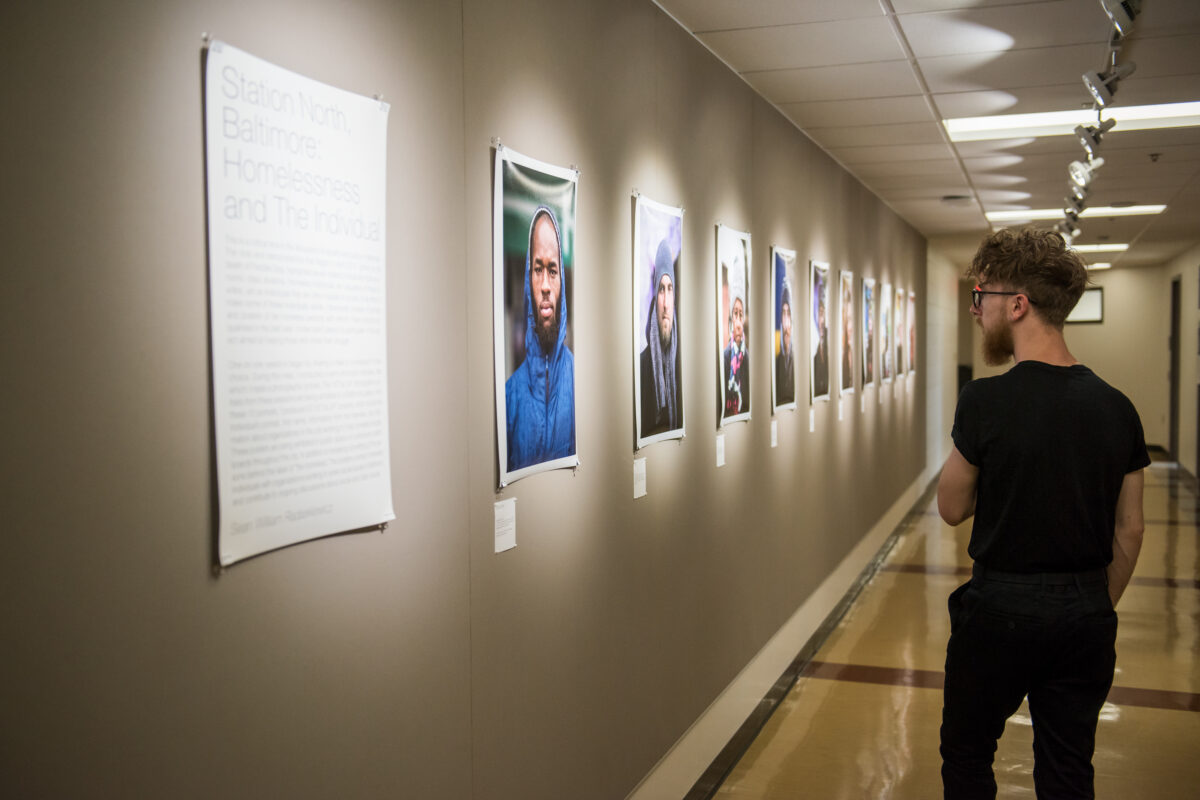
Sean William Radaskiewicz ‘18, visual arts, presented his photography series “Station North, Baltimore: Homelessness and the Individual,” at URCAD 2017. (Marlayna Demond ’11 for UMBC)
4. A return home for alumni researchers
Each year, the research event includes a keynote speech delivered by esteemed UMBC alumni— some of whom were once URCAD presenters themselves—such as the 2024 keynote speakerStefanie Mavronis ’12, political science, media and communication studies. Mavronis shared her journey of being a student researcher and how her experiences led to her current position as the director of the Mayor’s Office of Safety and Engagement in Baltimore City.Randi Williams ’16, computer engineering, will deliver the URCAD 2025 keynote speech. Williams is the research director of Day of AI, a non-profit organization that provides educators with artificial intelligence literacy curriculums for K-12 students.
The flyer for URCAD 2025 featuring alumni keynote speaker Randi Williams ’16, computer engineering.
5. Pathway for post-graduation success
Many past URCAD presenters have gone on to pursue advanced degrees and postdoctoral fellowships following their time at UMBC. And they say the early exposure to rigorous research opportunities help land those positions. After presenting at URCAD 2023, Ellie Bare ’23, biological sciences, shared that “having opportunities to improve my science communications abilities was invaluable and really great…it even helped me with my post-baccalaureate interviews.”
Before his current role as a research assistant with the Federal Reserve Board of Governors in Washington, D.C., Peter Wilschke ’24, economics and political science, presented research he worked on as an intern at The Hilltop Institute at UMBC during last year’s URCAD event. Beyond academia, URCAD participants have found industry success. Members of UMBC’s Game Developers Club, some of whom were past URCAD presenters, have gone on to find positions at Facebook, the Unity game engine platform, and Firaxis games, to name a few.
More information on URCAD 2025 presenters and additional sneak peeks of upcoming presentations can be found here.
On the surface, it may appear that there isn’t much of a connection between rapper Kendrick Lamar and abolitionist Harriet Tubman. But in his debut book, UMBC Assistant Professor of English and musician Earl Brooks, argues that the rhetorical power of music—specifically music created by Black artists—is what bridges the two cultural figures, and many others, together.
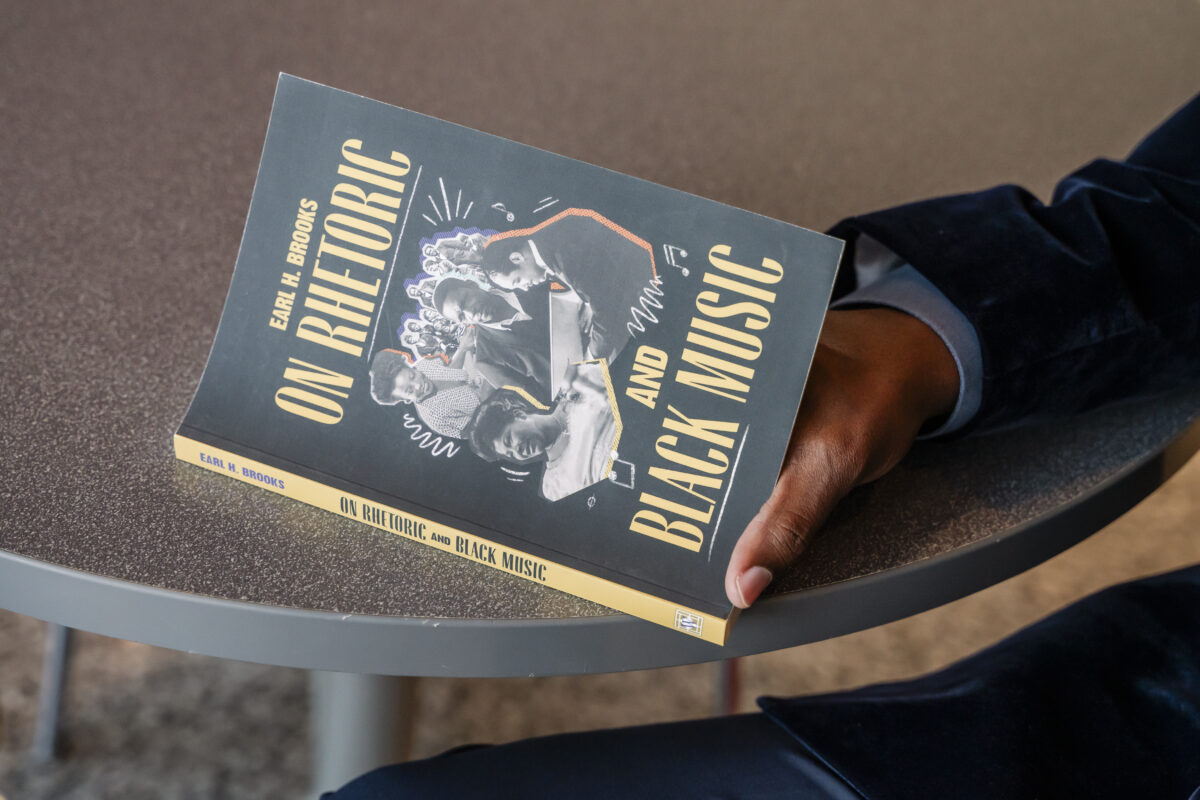
Brooks’ On Rhetoric and Black Music (Wayne State University Press, 2024), begins with a vignette describing Tubman singing spirituals to calm the nerves of the enslaved folks she led to liberation for the Union Army in 1863 as the first woman to plan and lead an armed attack for the American armed forces. The effect of the singing, Brooks writes, “brought composure to the crowds of people, leading to a safe evacuation.” Brooks explains how Tubman used music as a form of strategic communication, utilizing the same rhetorical tools he teaches his students at UMBC.
Tubman understood that the mode of sound, Brooks argues, would be the most expedient way to signal her authenticity and credibility, an example of what it means to understand the rhetorical function of Black music and its historical use as a mode of communication.
“On Rhetoric and Black Music recognizes the role that music has played in shaping public discourse in America,” says Brooks. “To understand where Black music is right now, you have to understand the musical history that the book engages.”
“The sonic lexicon of Black music”
Brooks ends On Rhetoric and Black Music with a comparison of Kendrick Lamar, who won a Pulitzer Prize for Music in 2018 for his critically-acclaimed album Damn., and composer Duke Ellington, who would have won the award in 1965 but was rejected because of his race. Brooks argues that Lamar and Ellington’s music had seismic impacts on American culture, and Lamar’s win represented a significant step forward for the public recognition of Black music’s influence in America. Lamar, who will be headlining the 2025 Super Bowl LIX halftime performance in February, is the first and only rapper in history to be a Pulitzer Prize recipient.
Beyond Lamar, Tubman, and Ellington, On Rhetoric and Black Music examines the artistry of iconic Black figures in music spanning a variety of genres and eras. Those artists include Scott Joplin, Mary Lou Williams, John Coltrane, and Mahalia Jackson. Brooks explains the historical context of these artists and how they shaped Black political and social discourse in the 19th and 20th centuries. Brooks argues that there would have been no such movements like the Harlem Renaissance, Civil Rights Movement, or Black Arts Movement as we know them without Black music.
Earl Brooks’ book On Rhetoric and Black Music.
Through rhetorical studies, archival research, and musical analysis, On Rhetoric and Black Music establishes the “sonic lexicon of Black music,” which Brooks defines as a “distinct constellation of sonic and auditory features that bridge cultural, linguistic, and political spheres with music.”
“The core of the book is reframing how we think about Black musicians. They’ve been shaping not just how we think about the world around us, but how we think about critical issues like freedom, identity, and community,” says Brooks, who is also the associate director of UMBC’s Dresher Center for the Humanities.
For Brooks himself, his understanding of Black music’s impact on shaping public discourse began when he met renowned trumpeter, composer, and music instructor Wynton Marsalis during his senior year of high school in Topeka, Kansas. At the time, Brooks was a budding saxophone player who had not yet determined where his musical ability would take him.
Earl Brooks playing his saxophone in UMBC’s Performing Arts and Humanities Building.
“It was really transformative to hear how Marsalis conceptualized music history and American culture as one coherent thing. I hadn’t experienced that before,” Brooks recalled. “Meeting him was huge in terms of motivation.”
As an undergraduate student at the University of Kansas (KU), Brooks was a dual major in music performance and American studies. It wasn’t until attending a lecture on writer Ralph Ellison by acclaimed scholar Arnold Rampersad that Brooks began to seriously consider studying the intersections of music, culture, history, and politics. Brooks joined KU’s McNairs Scholars Program in 2009 where he first began his exploration into researching music history. The McNair program, he shares, introduced him to the research process and further motivated him to attend graduate school to advance his education in music history.
“
“I love to open students’ minds to how interwoven their lives are with sound and music, and how that shifts so many things in their lives even if they’re not aware of it.”
Earl Brooks
assistant professor of English and musician
Brooks later attended the University of North Carolina at Chapel Hill, where he was introduced to the field of African American rhetoric. After receiving his master’s degree in African American literature at UNC-Chapel Hill, Brooks then went on to receive his Ph.D. in rhetoric and composition from Penn State University, where his ideas around the rhetorical implications of Black music began to take shape.
“Most folks acknowledge that music lyrics can be a really important form of communication, but we often don’t think about the music itself,” Brooks said in a local tv news segment last year. “We don’t often think of [composers] as seeking to be public intellectuals and contributing to public discourse on critical matters. The point of [On Rhetoric and Black Music] is to really give readers a deeper insight into just how entangled American history is with Black music.”
The power of sound and mentorship
In 2017, Brooks joined UMBC’s English department and currently teaches courses in sound studies, African American rhetorical traditions, media literacy, rhetorical theory, and composition. Brooks was awarded the university’s Summer Research Faculty Fellowship grant in 2018 to further develop his project “Black Sonority: Rhetoric and Black Music,” which later spawned into what is now On Rhetoric and Black Music.
In the classroom, Brooks’ lessons are expanding how students think about the power of sound: “I love to open students’ minds to how interwoven their lives are with sound and music, and how that shifts so many things in their lives even if they’re not aware of it,” he says. Brooks teaches his students critical analyses of audience expectations, the pros and cons of various communicative mediums, and understanding how social and cultural landscapes can construct what successful persuasion looks like.
In 2022, Brooks and the students in his “Sounds Like Social Justice” course collaborated with the Meadow Community Fellowship Church in the nearby Beechfield and Irvington communities to document their experiences during and after the 2016 and 2018 floods with the “Underwater/Underserved” podcast. The podcast’s production was supported through the Dresher Center’s Inclusion Imperative, a six-year humanities studies initiative funded by the Mellon Foundation that concluded in 2023. Brooks was then named as one of the Dresher Center’s 2023 Residential Faculty Research Fellows and was also a recipient of UMBC’s College of Arts, Humanities, and Social Sciences Early Career Excellence Award.
Brooks (right) at the Dresher Center’s Inclusion Imperative Capstone event in 2023.
One of the things he’s most proud of, Brooks emphasizes, is helping the next generation of researchers from underrepresented backgrounds as a UMBC McNair Scholars faculty mentor and advisory board member. He fondly recalls meeting his McNair mentor, Dr. Maryemma Graham, a renowned African American literature scholar and the University Distinguished Professor in the department of English at KU, during his undergraduate years. Brooks says Graham’s presence was instrumental throughout his academic and professional journey.
“Dr. Graham was so warm and engaging, and I had not yet experienced that in college. She took an interest in something I was interested in and helped me make sense of it—that was a really big turning point for me.”
Now, Brooks is elated to be the one helping to guide emerging academics. “The McNair Program was critical for me, and it’s been amazing to experience being on the other side of things as a faculty member.”
A space of refuge
One of the functions of Black music, Brooks adds, is its ability to be a space of refuge during times of panic, chaos, and misery. He noted the significant role of music “as a place for dialogue and connection during a time of isolation” amid the COVID-19 pandemic, which coincided with a months-long wave of nationwide protests against police brutality and other related injustices against Black Americans.
Black music, he says, was one of the resources people utilized to cope with that time of mass devastation. In 2020, millions of viewers from around the world virtually tuned into the phenomenon of DJ D-Nice’s “Club Quarantine” and the “Verzuz” music series in which legendary hip hop, R&B, and gospel artists and producers battled against one another, highlighting their chart-topping discographies.
“That’s the role that music has played for [Black people] historically. On Rhetoric and Black Music speaks to the complete continuum of Black music,” says Brooks. “It’s a form of deliberation and a space where we make sense of the world around us.”
UMBC’s national rankings in federal research funding are on the rise based on the NSF’s latest Higher Education Research and Development (HERD) survey results, which includes the university being ranked among the nation’s top 10 institutions to receive NASA funding.
The annual HERD survey, conducted by the NSF’s National Center for Science and Engineering Statistics, collects information on research and development (R&D) expenditures by field of research and source of funds and also gathers information on types of research, expenses, and headcounts of R&D personnel. In the latest HERD survey report published in November that compares fiscal year 2023 data, UMBC was ranked #10 in the country in NASA expenditures, a six-spot increase over the previous year’s HERD report. UMBC’s collaboration with NASA in 2024 has resulted in impactful research advances and contributions to active space missions.
“We have been collaborating with our colleagues at the NASA Goddard Space Flight Center for three decades now, and today, about 250 UMBC scientists, research faculty, and students are working closely with their civil servant counterparts at Goddard,” says Karl V. Steiner, vice president for research and creative achievement. “All of us are delighted and proud by this top 10 recognition.”
In addition, UMBC has seen improvements in R&D rankings across several disciplines, of which includes the university’s #20 ranking in federal funding for geosciences, atmospheric sciences, and ocean sciences, jumping 13 slots from its 2022 ranking. The university has also seen improvement in federal support for computer and information sciences (now ranked at #54), as well as federal funding for physical sciences (now ranked at #55).
Overall, the university is now ranked within the top 100 public universities to receive federal research supporting, climbing 11 spots to its new ranking at #96.
“Over the past two years, our HERD expenditures have increased by more than 70 percent, from $84 million reported in 2021 to $144 million in 2023,” Steiner explains. “This growth, and the corresponding improvement in national rankings, are a direct result of more than a decade focused on developing a true research culture across the campus community, as well as working with faculty members and institutional leaders to provide the research infrastructure needed to support our growing aspirations as a Carnegie R1 institution.”
UMBC is approaching 30 years of collaboration with the National Aeronautics and Space Administration (NASA), a partnership that largely culminates under the university’s three major cooperative agreements with the agency. According to the NSF’s latest Higher Education Research and Development (HERD) survey, UMBC is among the nation’s top 10 universities receiving federal funding from NASA. In 2024, UMBC scientists, researchers, interns, and engineers have reached new levels of achievement in connection to this partnership—some even going as far as to the surface of the Moon…in a few years.
Take a look back at five ways UMBC collaborated with NASA in 2024:
UMBC goes to the Moon
Planetary scientist Mehdi Benna of UMBC’s Center for Space Sciences Technology is leading the team designing one of the lunar instruments chosen for implementation and deployment in NASA’s forthcoming Artemis III mission, humanity’s first return to the lunar surface in more than 50 years. The Lunar Environment Monitoring Station (LEMS) was selected as one of the first three candidate payloads to be a part of Artemis III, NASA’s mission that will send astronauts to explore the region near the lunar South Pole. Artemis III, currently planned to launch in 2026, will be the first time humans will return to the Moon’s surface since the historic Apollo program in 1969 – 1972.
Artist’s concept of an Artemis astronaut deploying an instrument on the lunar surface. (Photo courtesy of NASA)
HARP2 launches into space
The UMBC-designed Hyper-Angular Rainbow Polarimeter (HARP2) wide-angle imaging polarimeter instrument is part of NASA’s Plankton, Aerosol, Cloud, ocean Ecosystem (PACE) spacecraft mission, which launched into space in February. The PACE satellite provides insight into ocean health, air quality, and the effects of a changing climate. PACE’s mission data, which includes data captured by the HARP2 instrument, is now available for public access. The HARP2 team, which includes a host of students and alumni, is led by Vanderlei Martins, professor of physics, who is also the director of the NASA-affiliated Earth and Space Institute, based out of UMBC’s Physics Building.
AXIS X-ray telescope selected for final round
Nearly a year ago, a group of engineers and scientists including UMBC physicists became one of 10 teams to successfully submit a proposal to NASA to develop the Advanced X-ray Imaging Satellite (AXIS). In October 2024, the AXIS team was selected as one of the final two instrument designs selected for further development. The team will receive $5 million to flesh out their plans as part of what NASA calls a “Phase A study.” Adi Foord, assistant professor of physics, and Eileen Meyer, associate professor of physics, serve on the AXIS leadership team, and during the proposal development phase, Foord co-led the sub-team focused on supermassive black hole evolution.
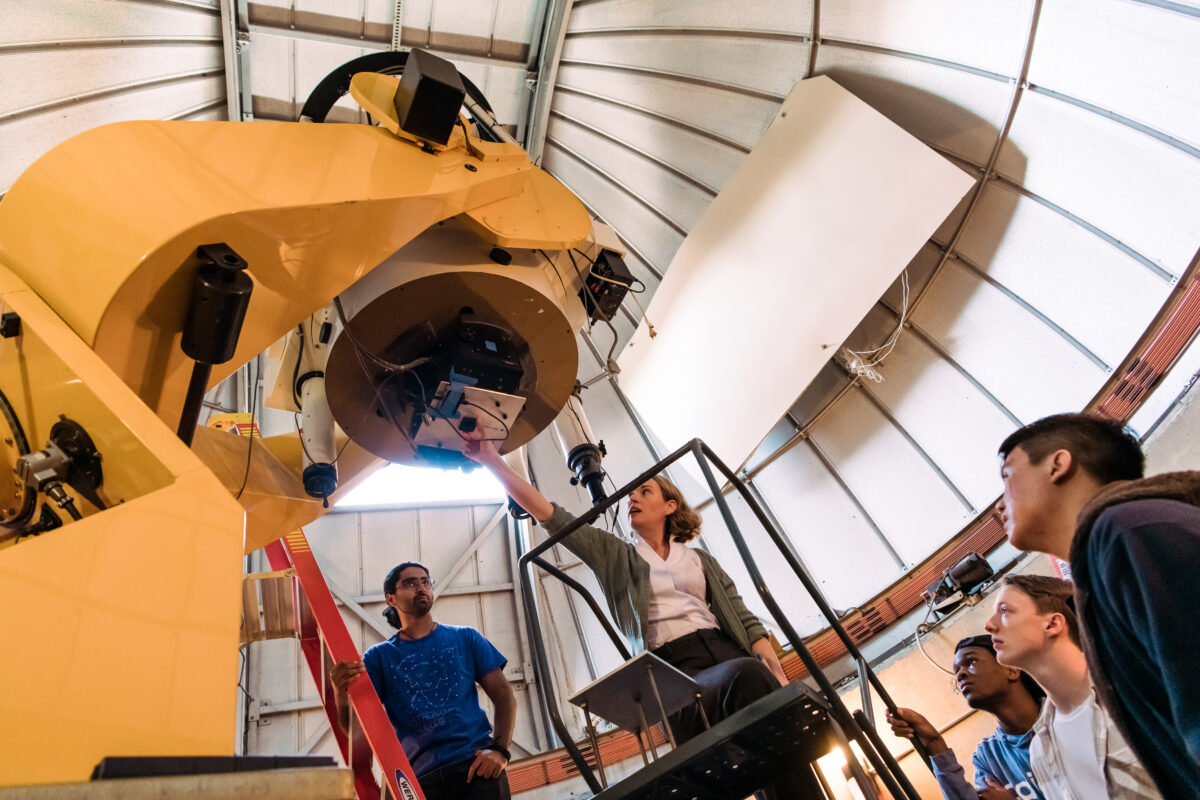
Eileen Meyer (center, reaching up) works on UMBC’s telescope with students. (Marlayna Demond ’11/UMBC)
NASA comes to campus
The university collaborated with the Goddard Space Flight Center to host the “NASA-UMBC Interaction Days,” an interactive, three-day series that took a closer look into the agency’s current research activity across a range of fields, with insight into how UMBC faculty, staff, and students can continue to work with Goddard scientists and engineers. The event series attracted more than 250 registrants.
UMBC-NASA earth science center awarded $47 million extension
UMBC is leading a new initiative, in partnership with several Historically Black Colleges and Universities (HBCUs) and minority-serving institutions (MSIs) in the region, that’s aiming to expand the research compliance capacity of mid-size (universities with 15,000 or less students) and smaller universities to better adhere to emerging federal research security policies.
To address the challenges associated with expanding research compliance capacity at institutions at these sizes, UMBC is partnering with the University of Maryland, Eastern Shore, Morgan State University, and Delaware State University to develop the Research Integrity, Security, and Compliance (RISC) program. RISC is supported through a five-year, $3.9 million grant from the National Science Foundation’s Growing Research Access for Nationally Transformative Equity and Diversity (GRANTED) program. The program’s goal is to address systemic barriers within the nation’s research enterprise by improving research support and service capacity.
Principal investigator (PI) Karl V. Steiner, vice president for research and creative achievement, and co-PI Christine Mallinson, assistant vice president for research and scholarly impact, will lead the multi-institutional RISC program.
“Mid-size institutions, along with MSIs and HCBUs, are expected to keep pace as new policies and guidance emerge, but they may not have the same ability or capacity to do so, compared to larger and more highly resourced research institutions,” explains Mallinson. “RISC will help us develop and then implement these evolving compliance structures and processes for smaller universities.”
Research security, according to the nation’s federal guidelines on government-supported research, is defined as “safeguarding the research enterprise against the misappropriation of research and development to the detriment of national or economic security, related violations of research integrity, and foreign government interference.” As part of the RISC program, UMBC will create, test, and implement a model for how mid-sized and smaller research universities can adhere to new and emerging research security policies.
That process, Mallinson explains, includes developing training modules on research security and compliance for researchers and research administration staff. The model will be further developed and evaluated among the partnering RISC institutions.
The program will also support expanding the team in UMBC’s Office of Research Protections and Compliance (ORPC) and an additional cybersecurity specialist role in the Division of Information Technology, as well as supporting an increase in compliance staffing at the partnering institutions. Mallinson shares the “RISC Roadmap” will be publicly available for other institutions to assist them in responding to research integrity, security, and compliance guidance and meeting institutional needs.
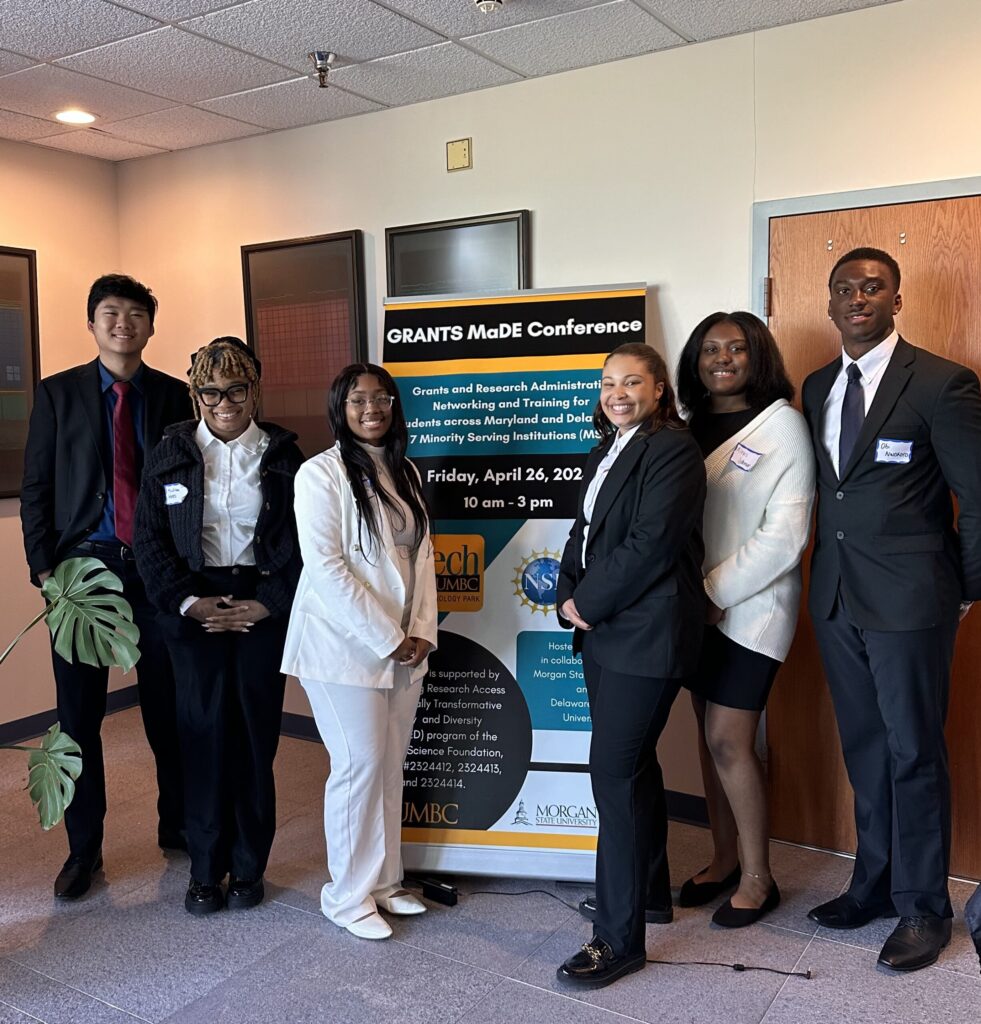
Andy Quach (far left) alongside fellow GRANTS MADE Research Administration interns from Morgan State University, and Delaware State University at the GRANTS MADE conference in April 2024. (Photo courtesy of Christine Mallinson)
“UMBC is at the forefront of this conversation of what it looks like for mid-sized institutions and smaller, emerging research institutions to build their research infrastructure in this area,” says Mallinson.
“I am very pleased about our multi-institutional, regional partnership and the significant support by the NSF that will allow us to address these pressing issues of research compliance and to create a blueprint for other smaller and mid-size research institutions,” adds Karl Steiner. “We have already benefited from the input provided by our partners during the proposal process.”
In addition to the RISC program, Mallinson has also been working to educate undergraduate students on careers in research administration with the GRANTS MADE Research Administration Internship. The internship, also funded by NSF’s GRANTED program, was created to expand and diversify the research administration workforce. UMBC’s Alexis Johnson ’24 and current senior Andy Quach, both financial economics majors, were a part of the internship program’s inaugural cohort. This summer, Quach continued his potential career interests in research administration with an internship with the ORPC. Quach helped to review and audit active research protocols and drafted various compliance documents.
Mallinson adds that prospective interns may also have the option to work with the ORPC team, allowing for a synergistic opportunity to train the next generation in this critical area of research security and compliance.
There’s already a student waiting outside the office of Faisal Quader, Ph.D. ’20, when the adjunct professor arrives at the Information Technology and Engineering building on a Thursday afternoon.
Headshot courtesy of Quader.
The recent graduate, Smriti Khilnani, M.S. ’24, information systems, patiently waits for the information systems instructor—a full-time president of Technuf LLC, philanthropist, and board member of several organizations—to open his office for his limited hours on campus. Quader breezes in, greeting his guest with a smile while asking her how she’s doing.
“I don’t know,” the graduate says, before the pair steps inside the office. After several minutes, the duo exit and Khilnani’s face looks more relaxed and at ease than moments before.
“She’s looking for a job, and she’s a little frustrated,” says Quader of the graduate, who is an international student. “She’s trying to get a cybersecurity job, but it needs security clearance, which she cannot get due to her non-U.S. citizen status. However, we talked about alternative solutions to her problem.”
Moments like these aren’t uncommon for Quader, a former international student himself. He spends a large portion of his time in service to those around him, whether it’s in the classroom, in a meeting room at the high-tech company he runs, or on stage when he’s singing classic Bengali songs.
“The fact that people are so open to come to me for help—that makes my day knowing that I’m able to make a difference,” says Quader.
Bringing industry perspectives into the classroom
Since graduating in 2020, Quader has spent the last four years as a part-time instructor teaching two graduate-level cybersecurity courses at UMBC and an additional course at the University of Maryland, College Park. On top of teaching, Quader works full-time as the president of the company he co-founded, Technuf, which specializes in cybersecurity, artificial intelligence (AI), machine learning (ML), robotic process automation, mobile application development, and software engineering. The Rockville-based company supports agencies, such as the Internal Revenue Service, the National Institutes of Health, and the Department of Homeland Security, and some state governments on high-profile cybersecurity initiatives.
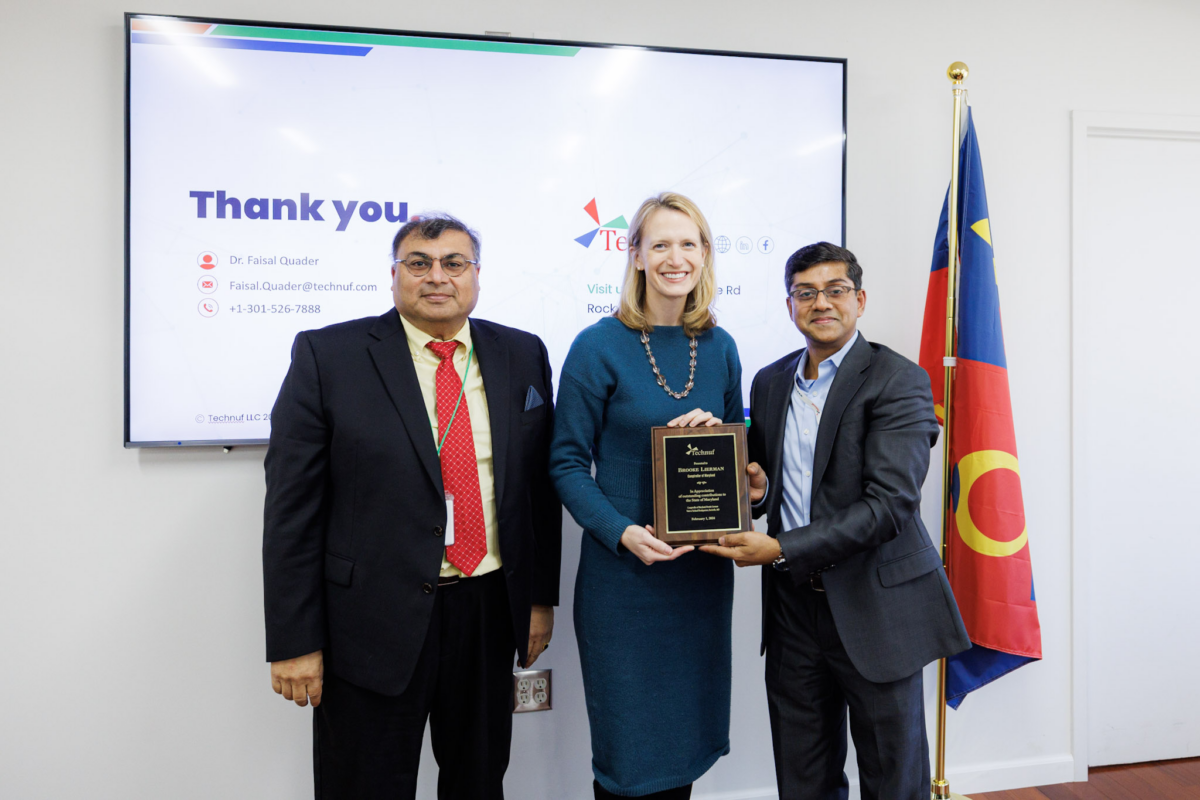
Faisal Quader (right) and Technuf co-founder and CEO Shah Ahmed (left) presenting an award to Maryland Comptroller Brooke E. Lierman in February 2024. (Photo courtesy of Technuf LLC’s X account)
Quader has a B.S. in computer science from the University of Wisconsin and an M.S. in computer science and engineering from Johns Hopkins University. Before going down the path to becoming a faculty member, Quader was initially a non-degree student at UMBC, but after enjoying his class so much, he decided to pursue a doctoral degree in information systems, specializing in cybersecurity.
“It was a difficult path working full-time and being a student, but I got so much from UMBC,” says Quader. “My mentors and professors supported me tremendously. I love this school, and now I feel like it’s time for me to give something back. Nothing is better than being able to share what I’ve learned with students.”
Quader brings his data science industry know-how to the classroom in more practical ways, educating students on how he and his team at Technuf work to address timely cybersecurity challenges, such as securing network infrastructures from cyber attacks and analyzing data to protect from cyber threats. His courses are capped to capacity every semester and has an ever-evolving waitlist of students hoping to learn from his tutelage.
“Cybersecurity is an extremely hot topic, and I like that I can bring in the industry perspective to my theoretical teachings,” explains Quader. “I love teaching—it’s my passion. Even though I work full time, I do this because I love to be able to share what I do everyday.”
A passion for performance
While Quader has spent the last three decades in engineering, computer science, and information science as an industry leader, he’s dedicated much of his life to something he got from his mother: a love of singing.
As a child growing up in Bangladesh, Quader frequently performed on tv shows as a vocalist and continues to feed his passion for performance today. He shares that music is his “weekend work” where he occasionally puts on family performances with his wife and two children. Every few weeks, Quader travels across the DMV singing with various groups. He’s a big fan of Lionel Richie and Bengali polymath Rabindranath Tagore. With his performances, Quader says that he is trying to create a bridge between Eastern and Western music.
Faisal Quader singing traditional South Asian music during a performance at the Purbachal Resort in Bangladesh. (Photo courtesy of Quader)
The tech-heavy data scientist says that finding time to mesh his creative passions with his analytical and technical skills gives balance to his life—music and technology are more related than one may think, he adds.
“Technology has a lot of mathematical inductions, different kinds of modeling theories and patterns. Music is also something that is kind of like a pattern,” says Quader. “Music refreshes my brain. When the weekend comes, I focus on music and that gives me more energy to do my work. That keeps me sane.”
Supporting the next generation of data scientists and engineers
In 2023, Quader established the Technuf Endowed Fellowship at UMBC, a $100,000 fund that supports master’s or Ph.D. candidates in information systems with entrepreneurial aspirations who are conducting research and/or pursuing a career in AI/ML or cybersecurity. The fellowship, Quader shares, is particularly for students who are unable to receive financial support for their education.
“When I was a student here in the U.S. after emigrating from Bangladesh at age 18, I didn’t have a scholarship or funding because of the fact that I was an international student. I struggled so badly and had to work three jobs to make my tuition,” he says. “I don’t want my students to go through the same process of struggling. I’m not able to help every student, but this is a good start.”
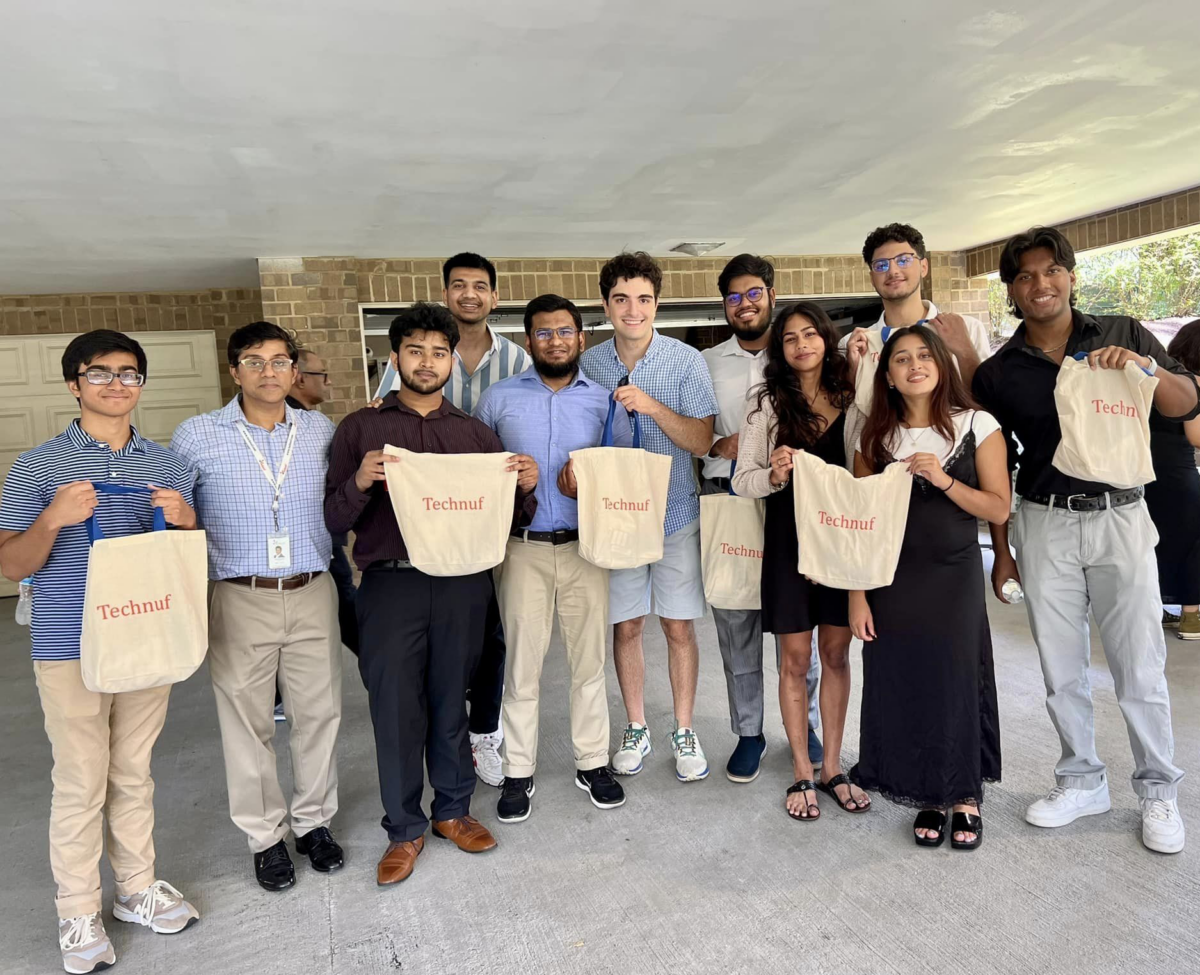
Faisal Quader (second from left) with former Technuf interns. (Photo courtesy of Technuf’s X account)
Quader also created a summer internship program at Technuf where students work hand-in-hand with data scientists and engineers on solving technical problems. Several UMBC students have gone on to work full time at Technuf following their internships, including Isha Shah, M.S. ’23, information systems. In summer 2022, Shah worked at Technuf as a software engineer and data science intern.
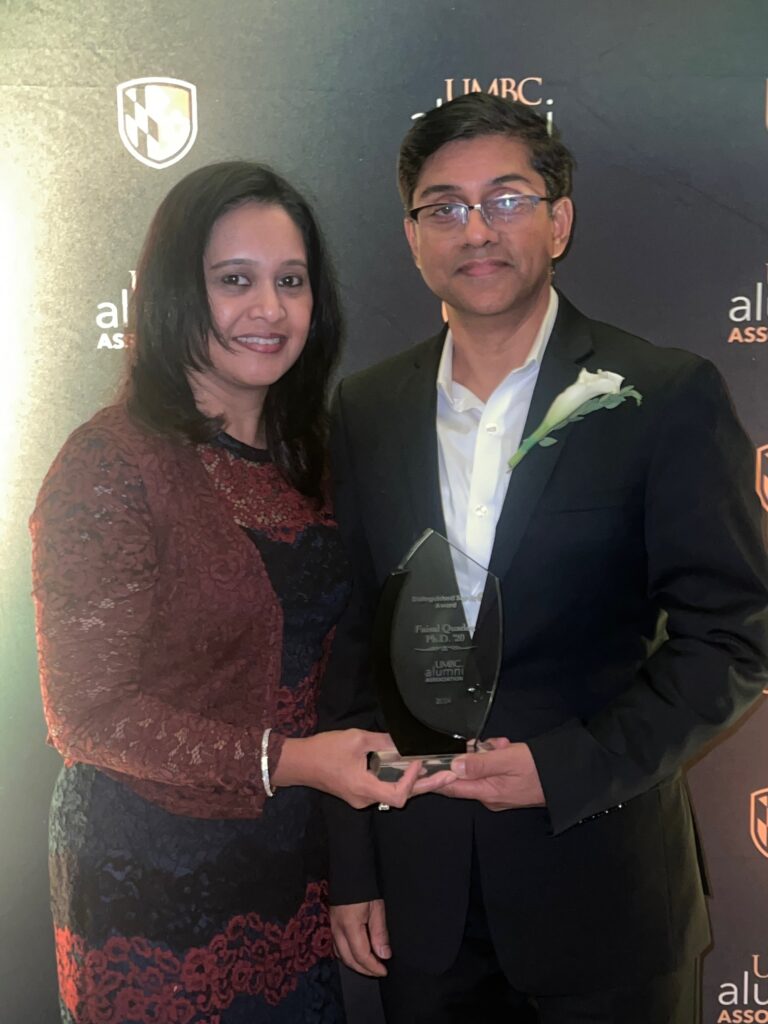
Quader, alongside his wife Fahmida, holding his Distinguished Service Alumni Award. (Photo courtesy of Quader)
“I often found it challenging to secure job or internship opportunities. During one of our initial classes, Dr. Quader mentioned his company, which immediately caught my interest,” says Shah. “I reached out to him to inquire about internship opportunities and to my surprise, he responded with enthusiasm and asked me to send over my resume. That moment felt like a turning point in my career journey.”
After graduating from UMBC, Shah was offered a full-time position at Technuf and currently works at the company as a product development engineer.
“Dr. Quader has had a tremendous impact on both my studies and career. His approach to teaching went far beyond textbooks. He always emphasized the importance of real-world applications and critical thinking, which made a significant difference in my understanding of cybersecurity concepts,” Shah explains. “Dr. Quader believed in my potential and opened doors for me at Technuf, where I’ve been able to gain invaluable hands-on experience in the field.”
In October, Quader was honored for his service as a 2024 recipient of UMBC’s Distinguished Service Alumni Award.
“That was a big encouragement for me,” Quader beamed. “I can see the difference I’m able to make with my students by giving them job opportunities, internships, training, and industry focused-teaching. That’s what keeps me going.”
Families, friends, furry pals, and Retrievers of all ages returned to UMBC’s campus last week for the 2024 Homecoming celebration. Retrievers were in high spirits as they enjoyed more than 30 events, including UMBC Homecoming staples like the beloved carnival and bonfire, and some attendees kicked off their Halloween festivities with costumes, pumpkins, and fall treats.
UMBC families and friends partaking in the 2024 Homecoming Family and Friends Weekend activities including the Retriever 5K race which had more than 250 participants, and the carnival celebration. (Photo on the left by Kiirstn Pagan for UMBC)
Robots, pups, and Retriever traditions
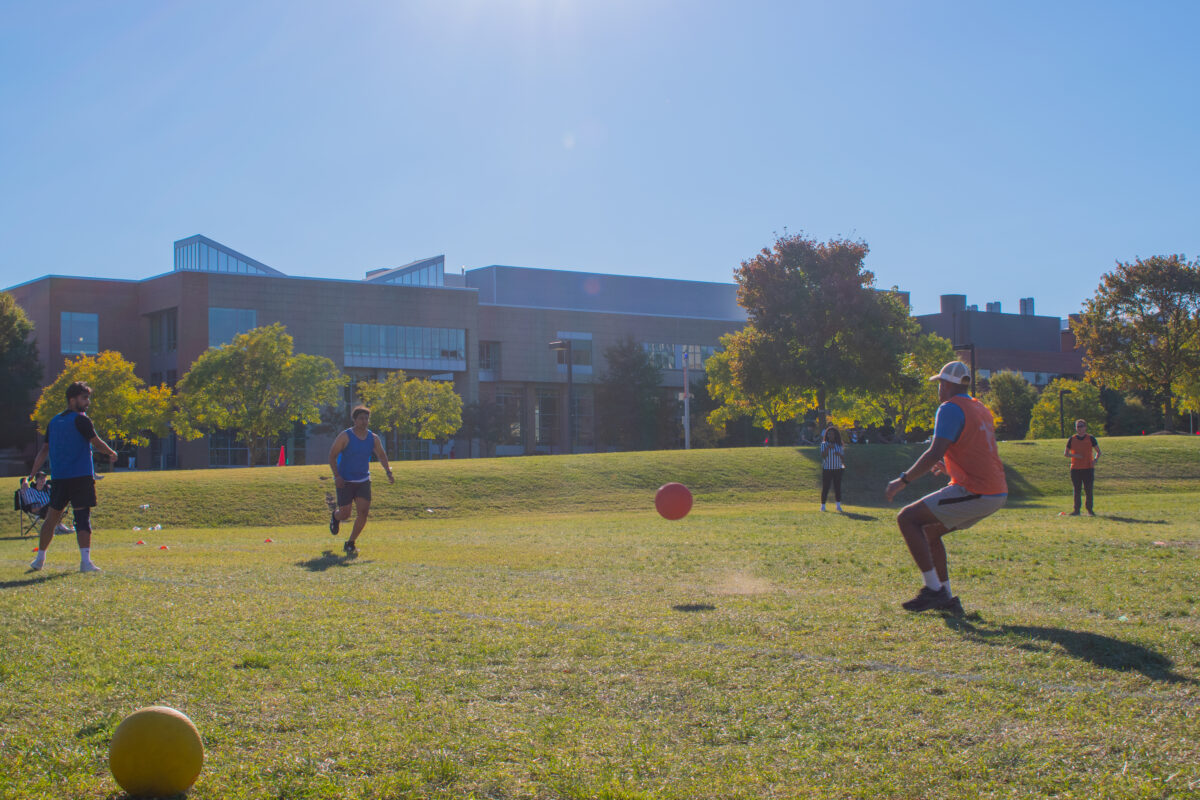
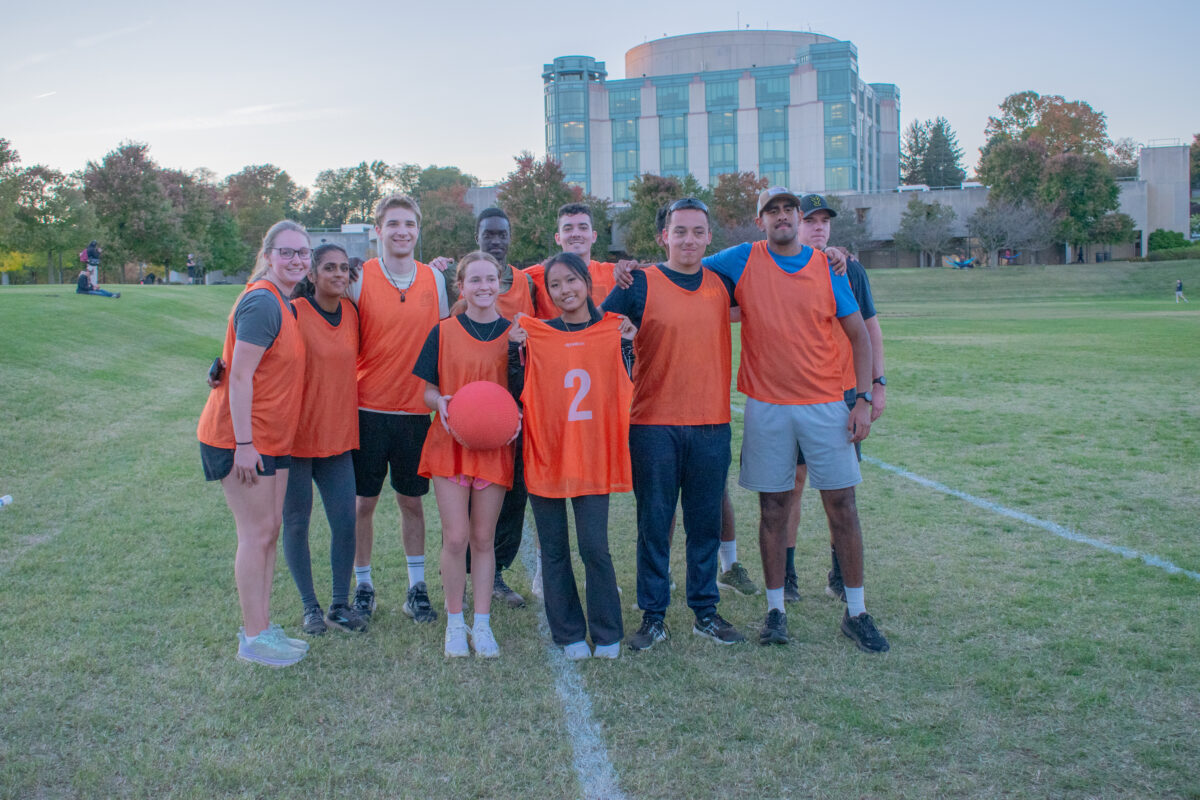
In UMBC tradition, the Homecoming celebration had something for everyone. Leading up to main Homecoming weekend, students kicked Homecoming fun into high gear with the return of the student org kickball tournament. UMBC faculty and staff also took part in the fun at the annual faculty-staff social.
UMBC students kicked off the Homecoming 2024 excitement at the Student Org Kickball Tournament on October 20 at Erickson Field. The first place team (right) were all smiles following their victory. (Photos by Maashal Awan ’25 for UMBC)
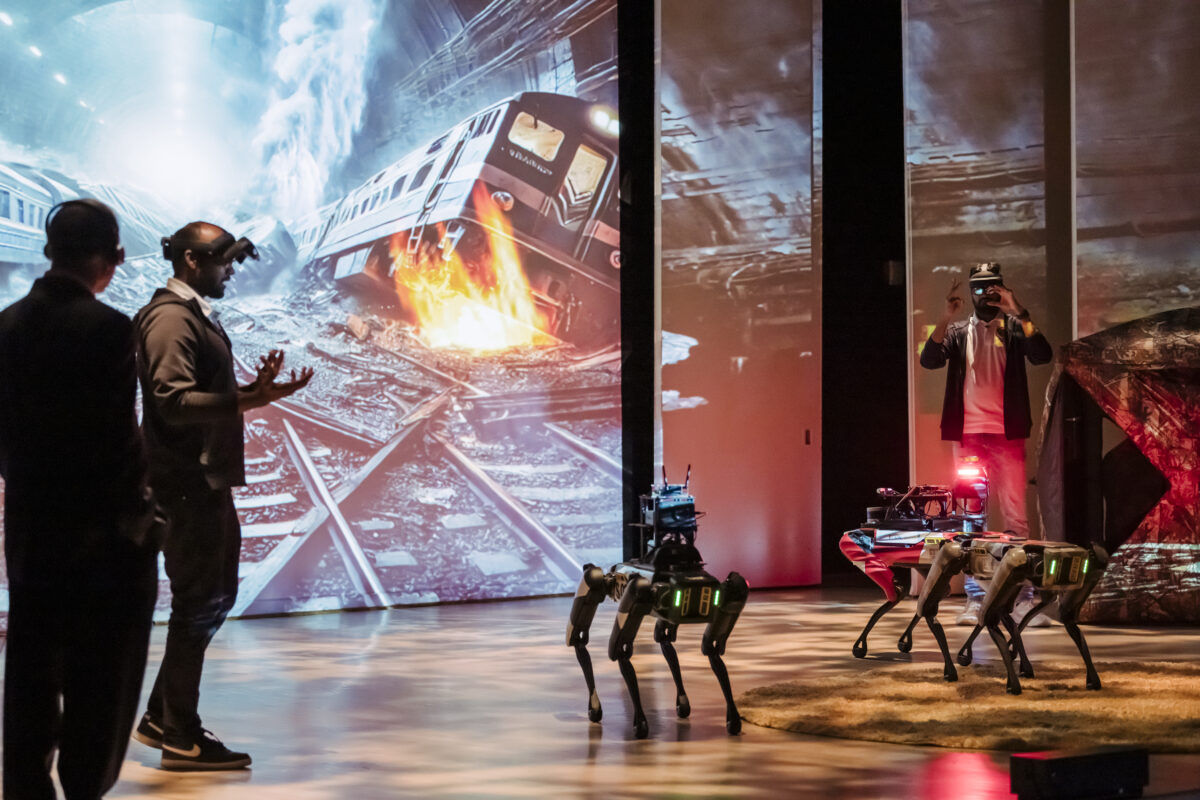
A diverse breadth of UMBC’s research and creative achievement was on display at the eighth annual GRIT-X event. First-year computer science student Morgan Robbins attended this year’s GRIT-X with her mother, Nicole Robbins. The pair were impressed by GRIT-X speaker Aryya Gangopadhyay, professor of information systems, and student researchers in UMBC’s Center for Real-time Distributed Sensing and Autonomy (CARDS) who led a demonstration of their autonomous robotics technology.
Center for Real-time Distributed Sensing and Autonomy student researchers leading the demonstration of their autonomous robots and how the robots are providing crucial support in rescue operations and human-robot teaming.
“I’m interested in autonomous communication, and I like combining computing with helping people,” said Robbins. “This was my first time seeing research talks, and it was great to see the research happening at UMBC.”
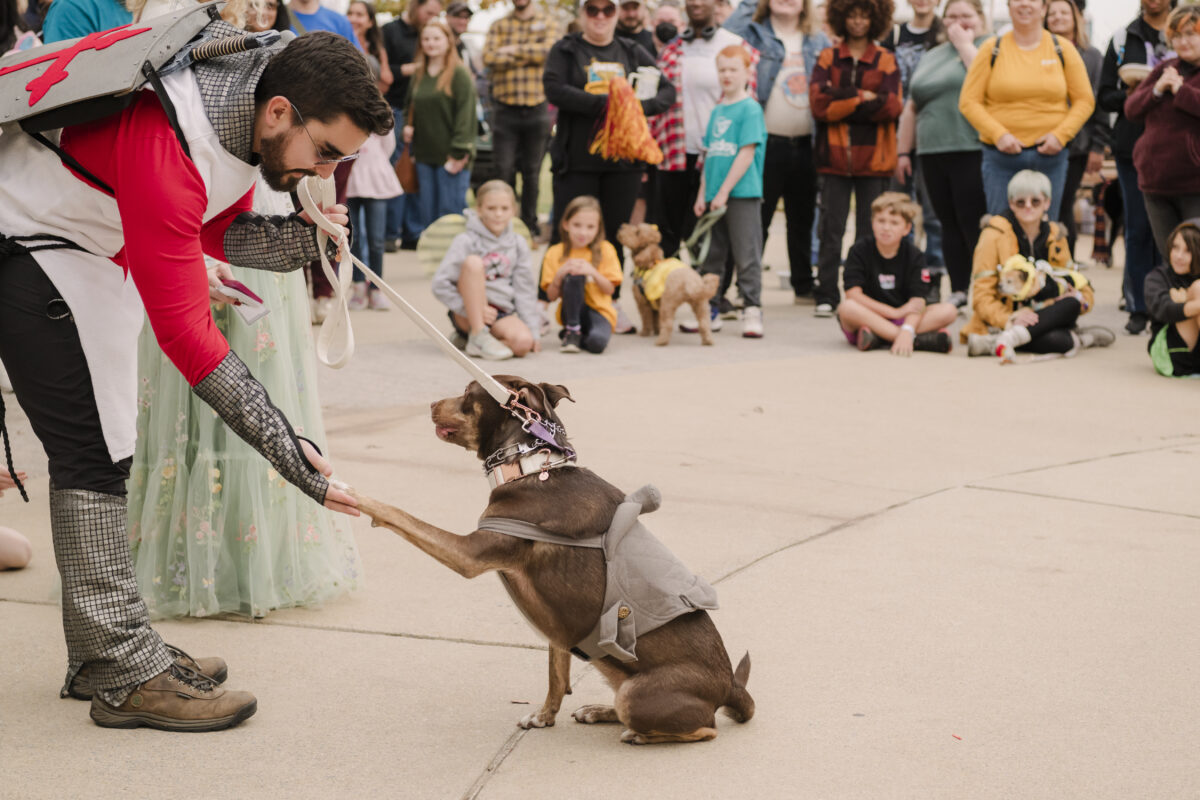
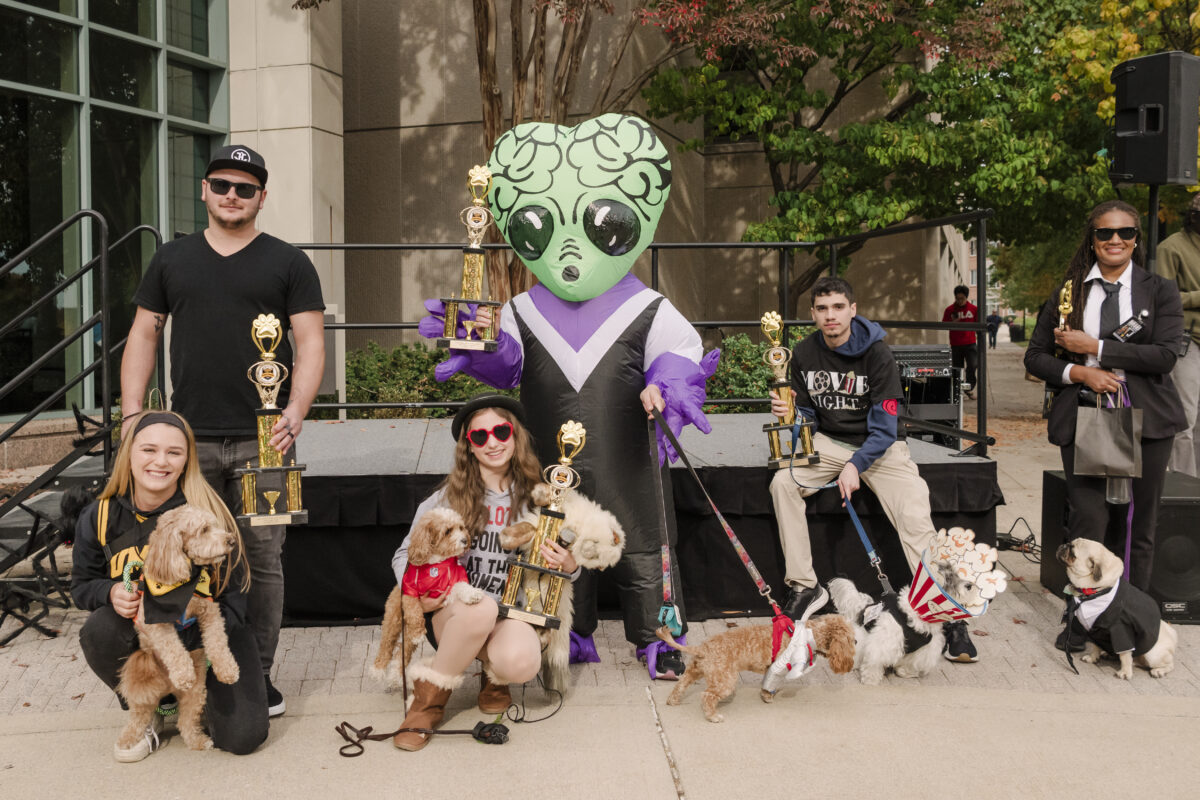
During Homecoming and Family Weekend, there were smiles, cheers, and barks all around for the annual Puppy Parade, which featured dozens of animals in wild costumes. Dharma Bhatt ’23, psychology, said he came to Homecoming for one reason: “The puppy parade—entirely the puppy parade.”
2024 Puppy Parade participants and winners showing off their Halloween spirit during this year’s Homecoming weekend celebration.
A weekend for family and friends
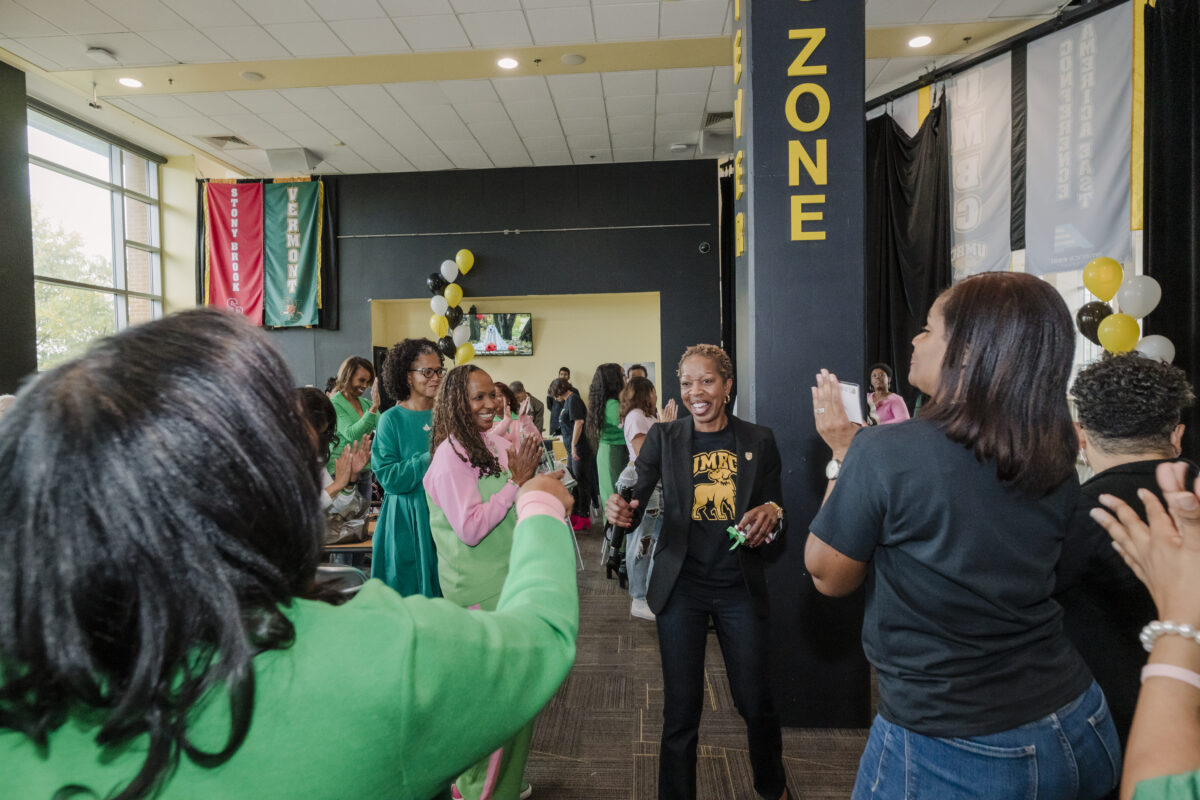
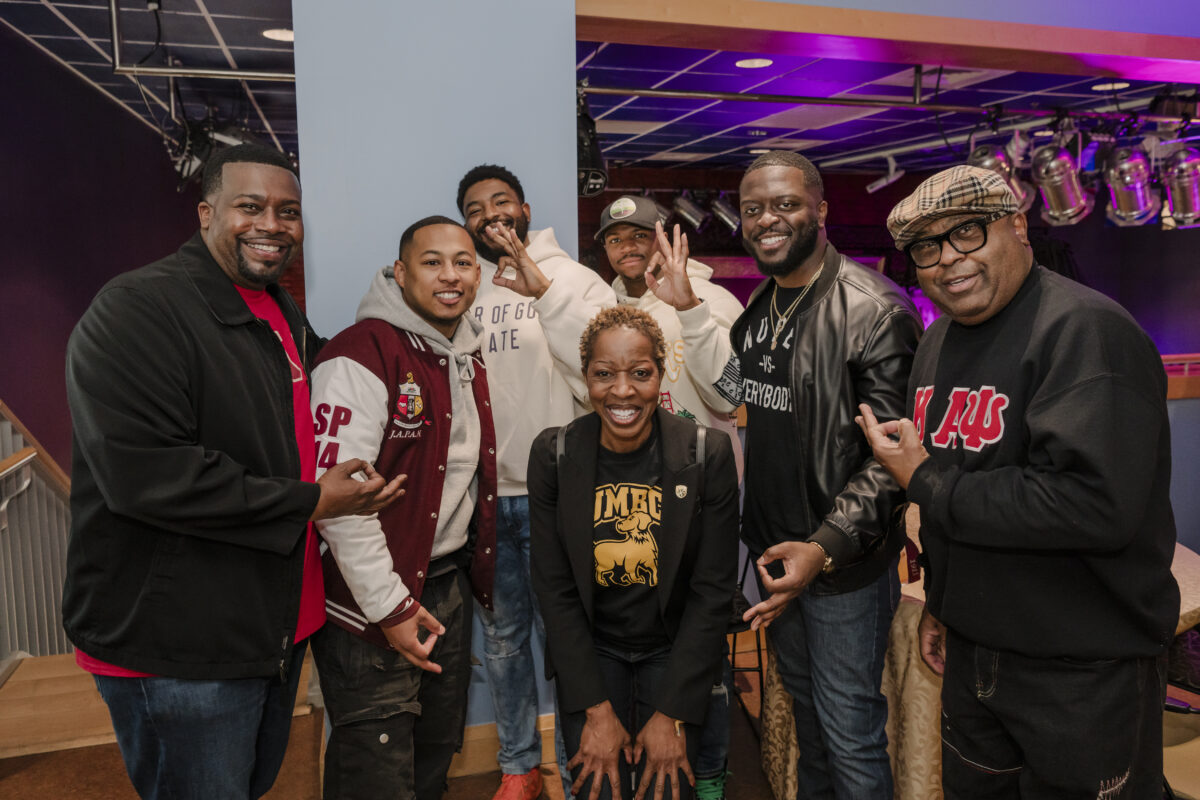
Homecoming weekend also featured several get-togethers for various groups across the community, including reunions for UMBC’s “Founding Four” group and members of the university’s Honors College and scholars programs. President Valerie Sheares Ashby took part in the Alpha Kappa Alpha sorority Lambda Phi chapter’s celebration of their 15th reunion. The group helped to raise more than $1,600 for UMBC’s Second Generation Scholarship Fund.
President Valerie Sheares Ashby during the Alpha Kappa Alpha sorority Lambda Phi chapter’s celebration of their 15th reunion.
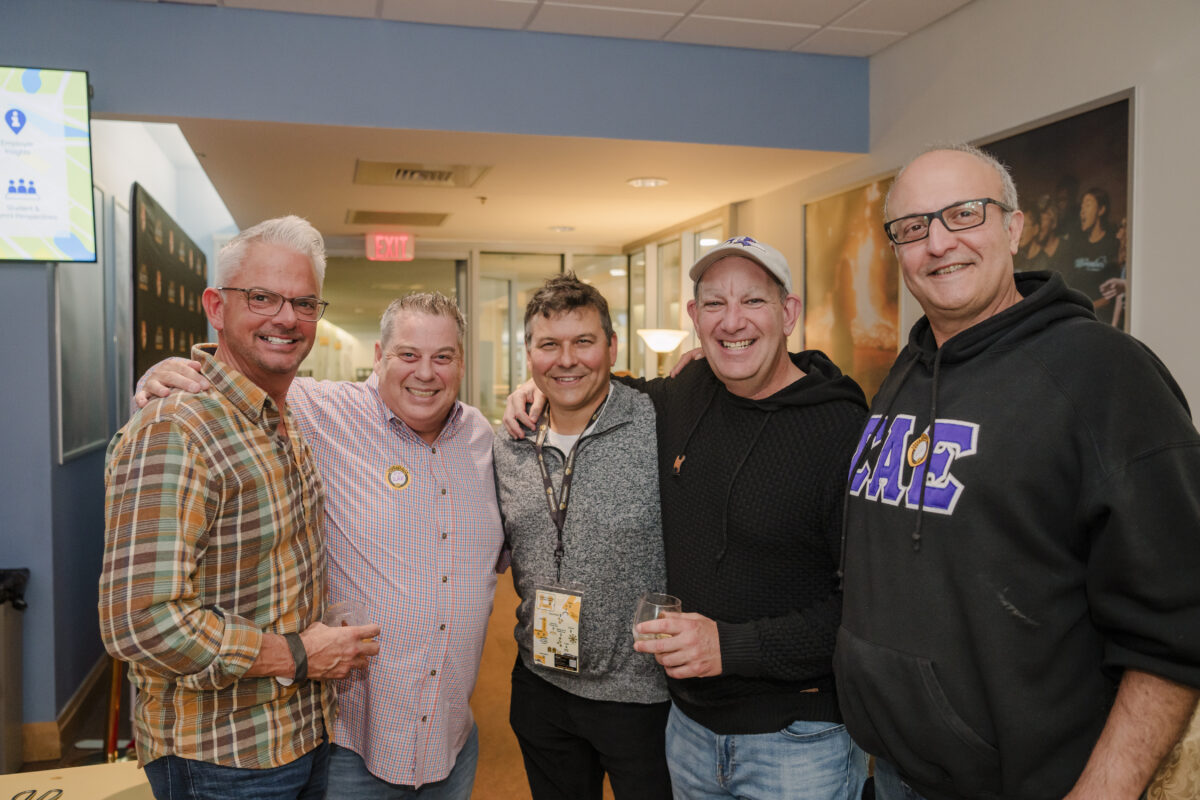
Jim Lotfi ’89, visual and performing arts, kept the party rocking during the annual Greek alumni reunion party. Lotfi shared that he loves hosting the Greek alumni party, saying that, “It’s a great time for fraternity and sorority members across all organizations to come together and reconnect. This is one of my favorite Homecoming events to participate in.”
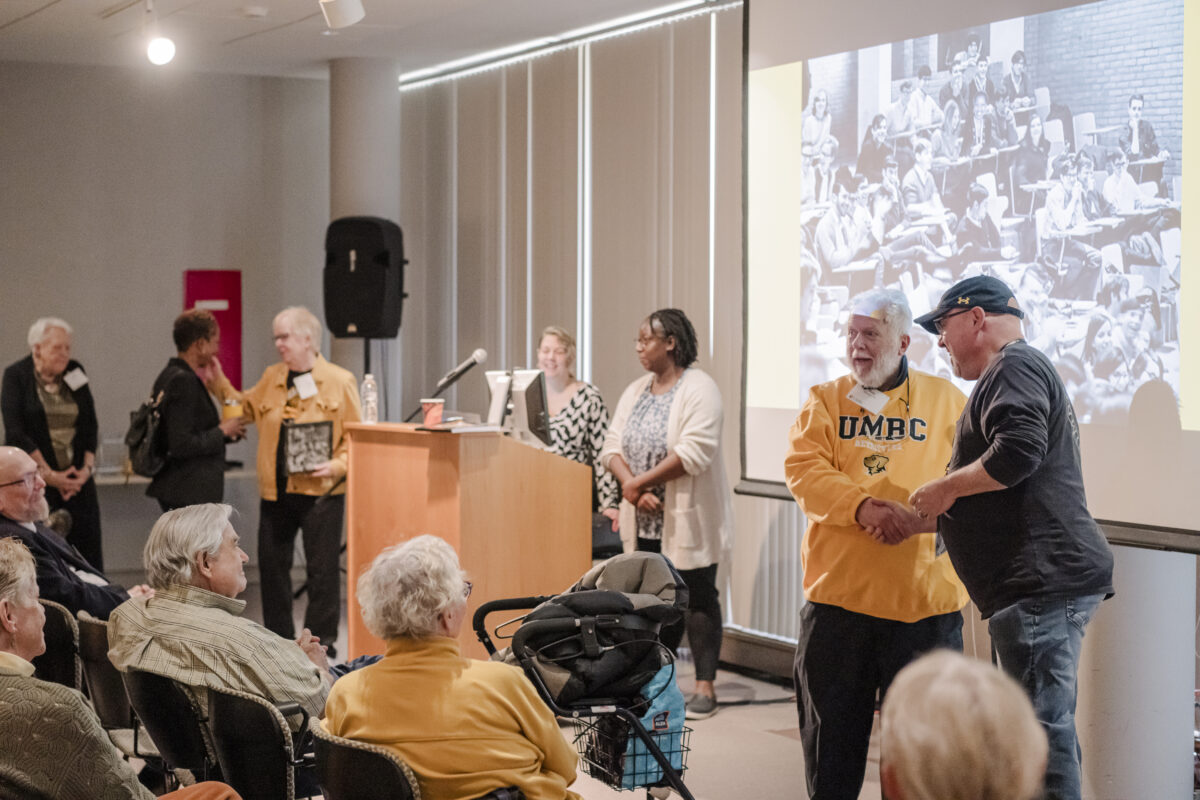
Homecoming 2024 brought together members of several group across UMBC’s community. The Founding Four (top left) came together for their annual reunion. More than 100 attendees reconnected during the Greek Alumni reunion, hosted by alum Jim Lotfi (pictured in the final photo, far right).
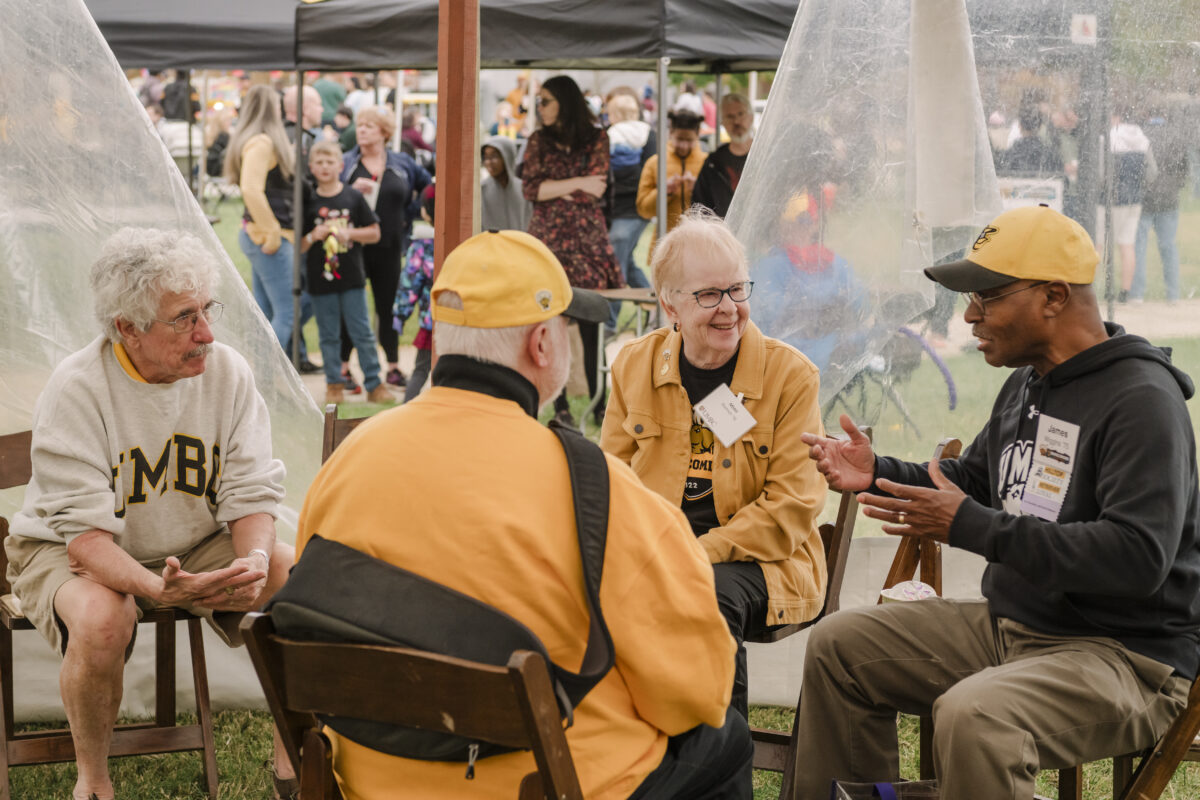
In the Alumni and Friends tent on Erickson Field, attendees enjoyed games, food, petting zoo fun, and moments of reconnecting with old classmates and other familiar faces. Senior Emily Trentalance said she attended Homecoming to be able to see friends and professors again. “It’s hard hanging out, especially with your alumni friends when people are busy, so it’s nice to see everyone,” she shares.
Retriever connections in the Alumni and Friends tent gathering during Homecoming Family and Friends Weekend.
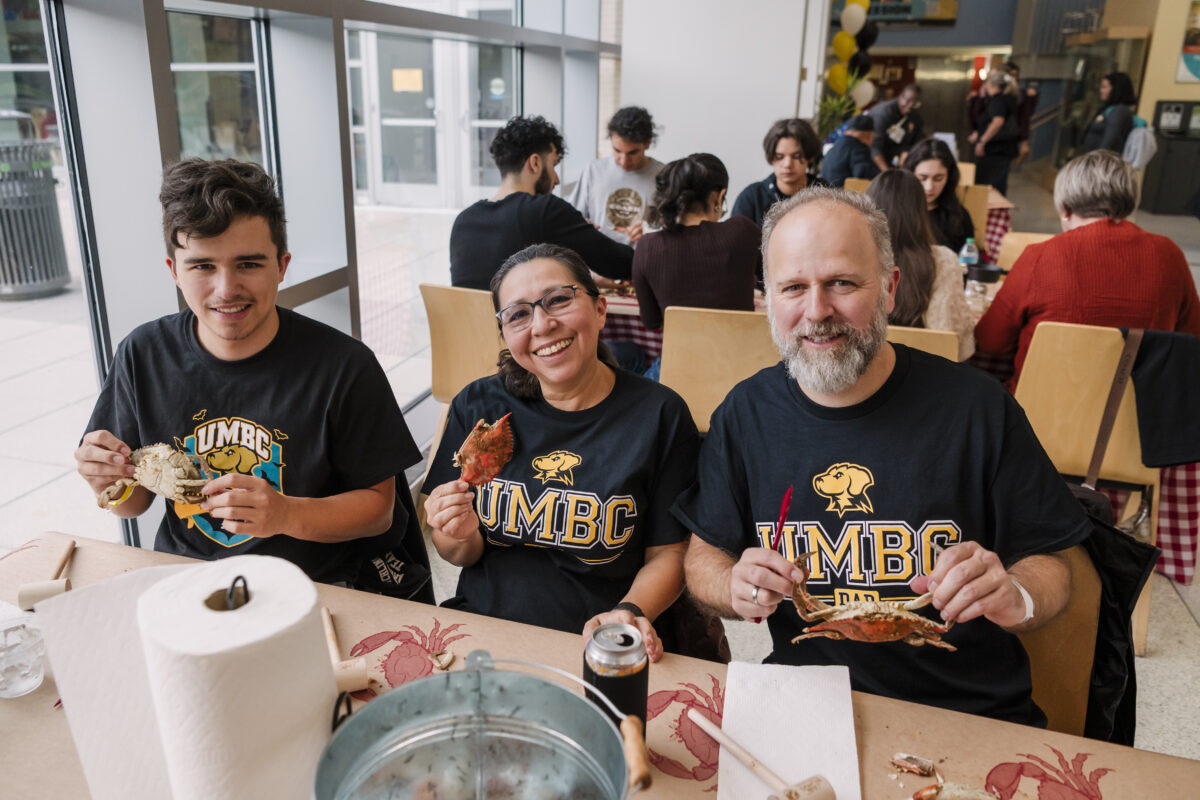
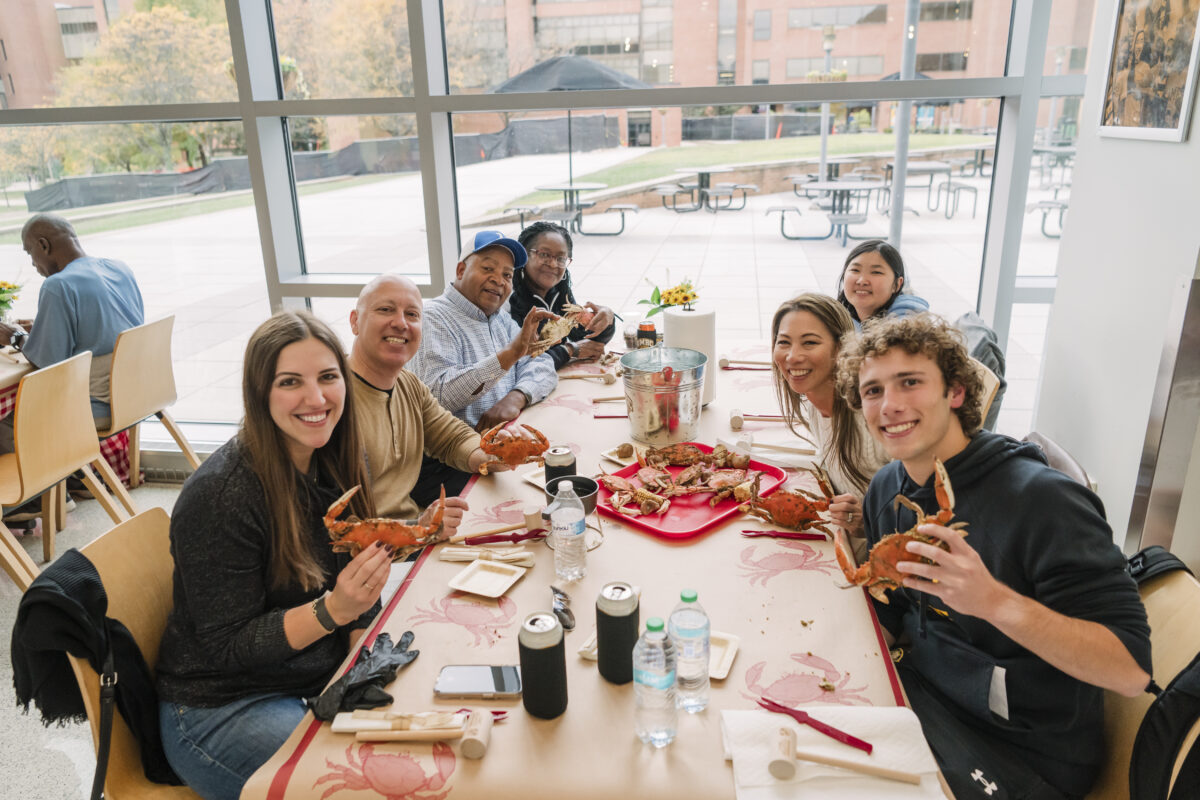
During this year’s Taste of Maryland Homecoming event, 100 attendees gathered across from UMBC’s Bookstore in The Commons for a crab and assorted buffet feast. Alumni Association President Kevin Yang ’07, computer science and financial economics, and his wife Katelyn Niu ’05, biochemistry, brought their son along for the Homecoming fun. The family enjoyed the endless bushels of crabs with fellow alumni friends.
Taste of Maryland attendees enjoying a crab feast.
“There’s nothing like a UMBC celebration, and what better way to reconnect and reminisce with old friends than with crabs,” said Yang.
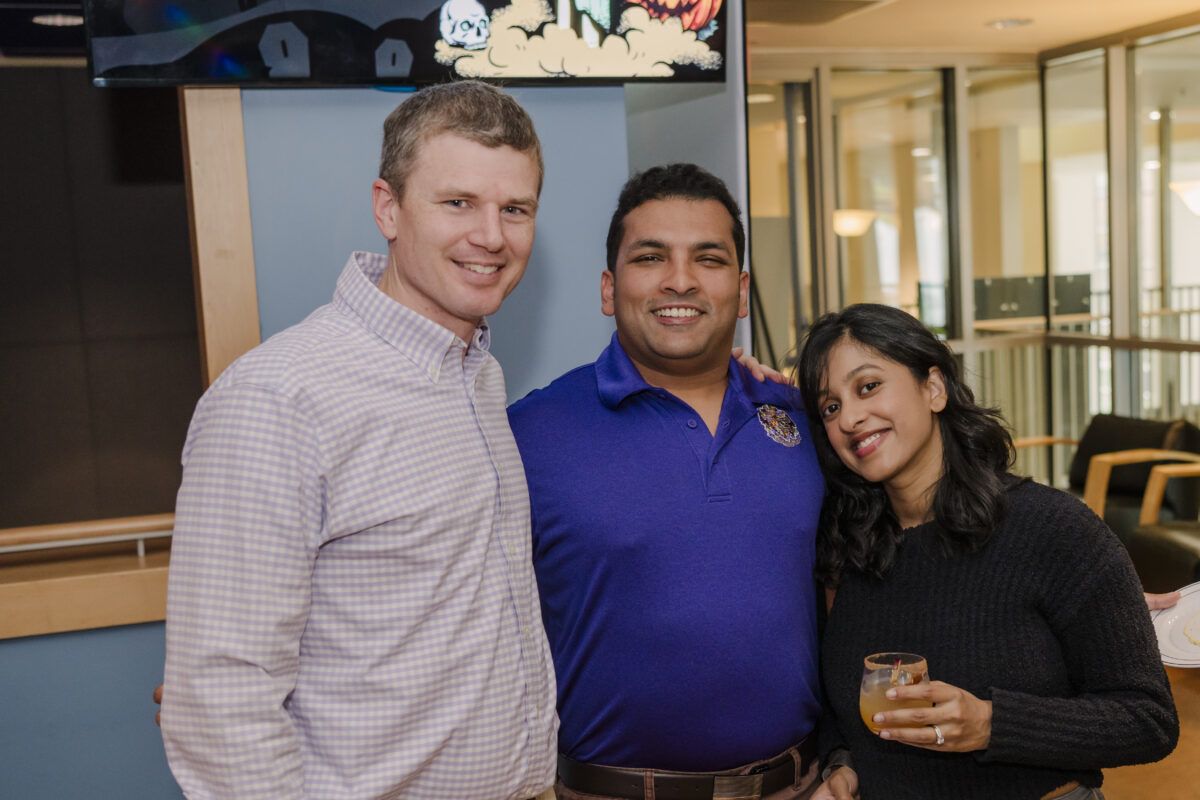
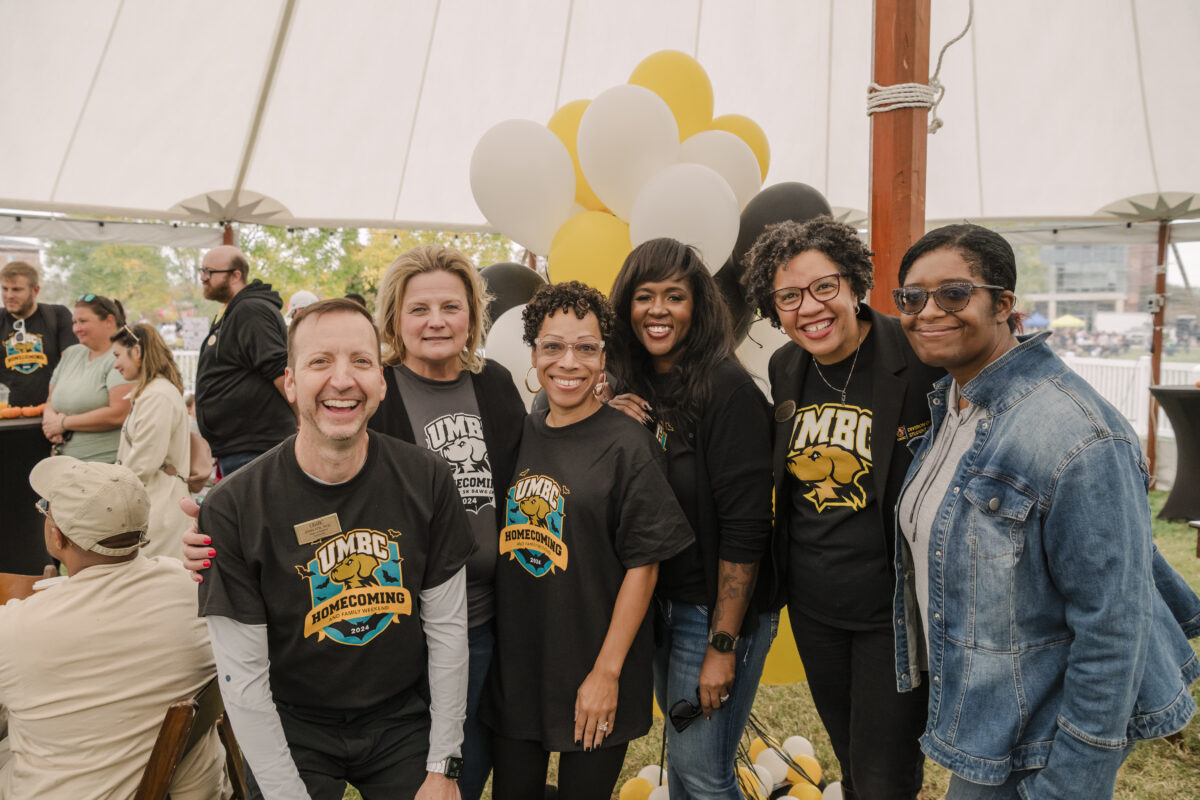
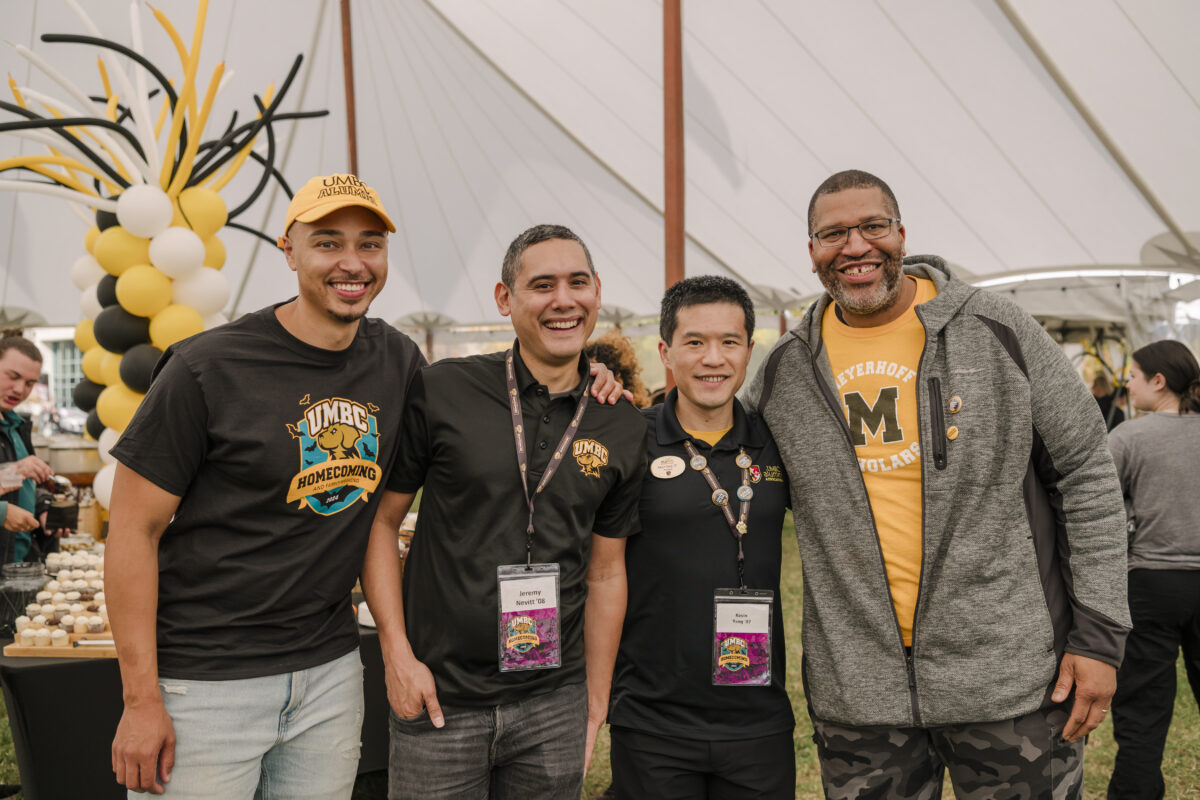
Alumni Association president Kevin Yang ’07 (third from left) with fellow UMBC alumni and staff at the Alumni and Friends tent gathering during Homecoming 2024.
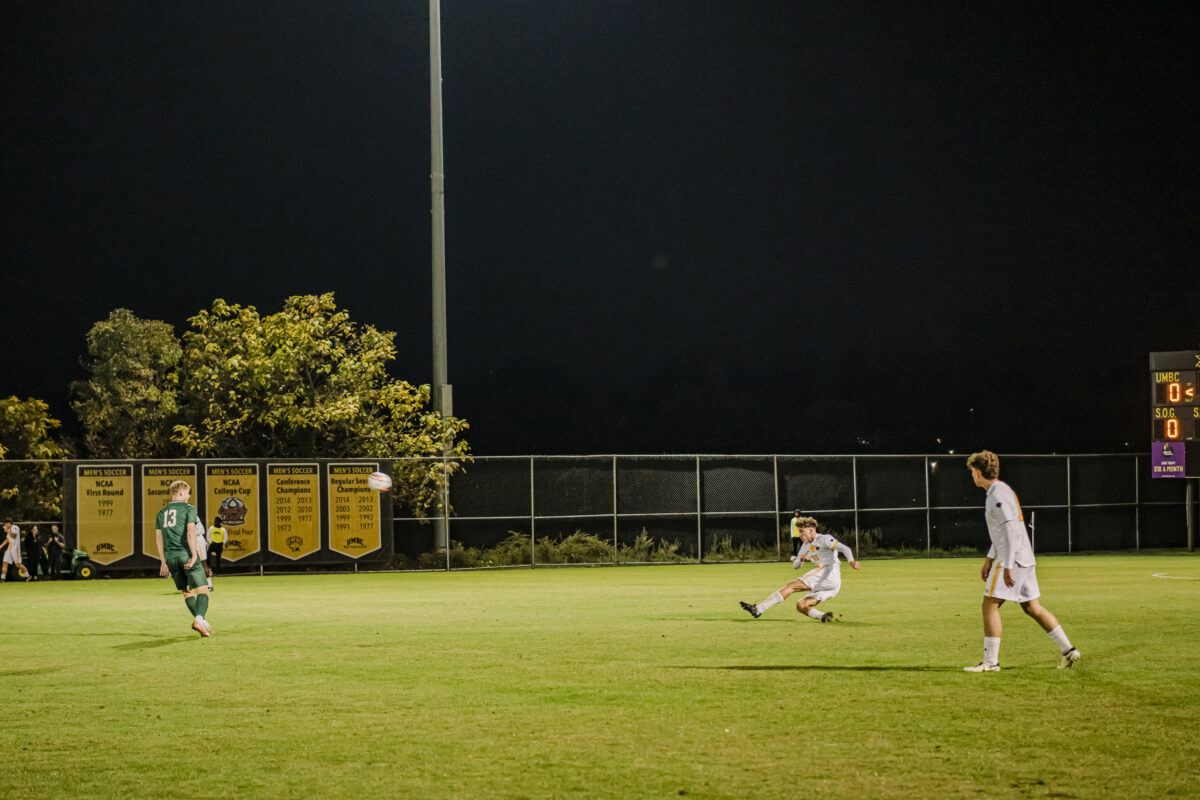
As the carnival lit up the night sky, many attendees made their way to the annual Homecoming Tailgate where they cheered on the men’s soccer team in their victory against the University of Vermont.
The men’s soccer team triumph over the University of Vermont with a 1-0 victory during their Homecoming 2024 match up.
Additional reporting provided by JJ Gee ’25 and Maashal Awan ’25 for UMBC.
A multidisciplinary team of UMBC researchers was recently awarded a National Science Foundation (NSF) grant to expand the use of digital twinning technology to diagnose, treat, and increase the understanding of neurodegenerative diseases.
The use of digital twinning—a virtual model of a physical object—was developed by scientists and engineers at NASA as early as the 1960s. Within the last decade, the technology has grown in popularity across a range of industries and has more recently been implemented to advance healthcare diagnostics and treatments, explains Snigdhansu (Ansu) Chatterjee, professor of mathematics and statistics.
Chatterjee, the principal investigator of the UMBC-led study, is taking a closer look into the use of digital twinning to examine neurodegenerative diseases, supported by a nearly $900,000 grant from the NSF’s Foundations for Digital Twins as Catalyzers of Biomedical Technological Innovation (FDT-BioTech) program. The program, in collaboration with the National Institutes of Health and the FDA, was created to foster advances in mathematics, statistics, computational sciences, and engineering required to develop responsive digital twin models that incorporate the abilities of artificial intelligence. UMBC was one of seven institutions awarded research funding to explore the development and use of digital twins in health care and biomedical research. The Washington Post mentioned the FDT-BioTech program in a recent article on the evolution of digital twin technology and its potential to transform healthcare.
The UMBC team will work to develop a prototype of their digital twin model for possible use for neuroscience researchers. The study will also address the ethical, legal, and social implications of using digital twin models in the context of healthcare and in studying neurodegenerative diseases using magnetic resonance-technology driven images (MRI) in particular.
“There are various issues relating to the ethics of AI models and how you use the data, which is especially important when it comes to biological sciences and healthcare,” says Chatterjee. “All good scientists stay within ethical guardrails, and we’re defining what those guardrails are when it comes to using this technology to study neurodegenerative diseases like Alzheimer’s, Parkinson’s disease, and multiple sclerosis.”
Principal investigator Snigdhansu (Ansu) Chatterjee (left) and co-investigators Karuna Joshi and Animikh Biswas are the leads of the“FDT-BioTech: Aspects of Digital Twin Studies for Neuroimages” study, funded by the National Science Foundation.
The study, which will run until 2027, includes co-investigators KarunaJoshi, professor of information systems, and Animikh Biswas, professor and chair of mathematics and statistics. Additional partners include researchers from the University of Minnesota and the University of Texas at El Paso. The project will also provide funding to support two graduate students and a postdoctoral researcher at UMBC who specialize in engineering, math, or statistics.
Joshi, who is the director of UMBC’s Center for Accelerated Real Time Analytics, explains that there has been an increase in the use of AI models in health prediction, diagnostics, and determining treatment options.
“The explainability and the replicability elements of digital twinning are very critical to why the technology is becoming popular,” says Joshi. “We are looking to develop a ‘meta model’ of all of the various models that’s going to run the neuroimages we’ll study so that it can be explained, archived, and audited.”
Joshi adds that the study will allow for “a cross-pollination of ideas,” where engineering meets science, math, statistics, and healthcare in a very unique way.
UMBC’s GRIT-X event is returning for its eighth year with a lineup of dynamic talks spanning a wide range of subjects, including insight into the university’s contributions to the next Moon landing mission, a look into Baltimore City’s new violence prevention plan, human-robot interaction, and much more.
GRIT-X, a TED-Talks styled showcase of presentations on compelling aspects of UMBC’s impact in the research and creative achievement space, is one of more than a dozen events happening during UMBC’s Homecoming 2024 celebration. This year’s GRIT-X will take place ahead of Homecoming weekend, returning to the Fine Arts Recital Hall on October 24 from 4 to 6 p.m.
The annual series spotlights developing research from UMBC faculty experts and alumni who are doing impactful work. This year’s lineup features alum-turned-physics professor Todd Pittman, M.S. ’92, Ph.D. ’96, physics, who’ll be discussing the foundations of classical and quantum physics.
In his GRIT-X presentation, Pittman will dive deep into quantum entanglement, the major disparity between classical and quantum physics. “Right now, we’re in the era of trying to use quantum physics to do new and more powerful things in information processing,” says Pittman.
Takashi Yamashita, professor of sociology, anthropology, and public health, will discuss his research in aging and lifelong learning with his talk, “When Does Our Education End? Aging and Life Course Perspectives.”
“I will explore a range of education benefits across life stages. I’m excited to introduce key ideas from gerontology and how they help us think about important topics in our lives, such as education, work, and leisure,” says Yamashita, who is the co-director of UMBC’s joint gerontology doctoral program with the University of Maryland, Baltimore.
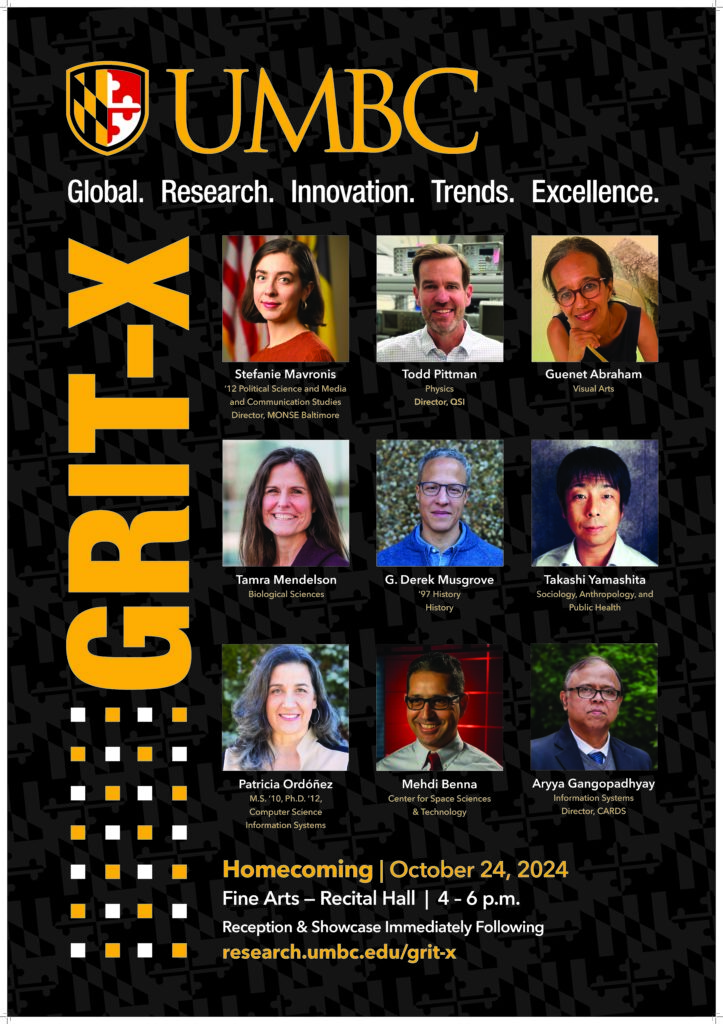
GRIT-X 2024 will feature:
Guenet Abraham, Professor of visual arts
Mehdi Benna, Research scientist at the Center for Space Sciences and Technology (CSST)
Aryya Gangopadhyay, Professor of information systems; director of the Center for Real-time Distributed Sensing and Autonomy (CARDS)
Stefanie Mavronis ’12, political science, media and communication studies, Director of the Mayor’s Office of Neighborhood Safety and Engagement, City of Baltimore
Tamra Mendelson, Professor of biological sciences
G. Derek Musgrove ’97, history, Associate professor of history and affiliate professor of Africana studies
Patricia Ordóñez, M.S. ’10, Ph.D. ’12, computer science, Associate professor of information systems
Todd Pittman, M.S. ’92, Ph.D. ’96, physics, Professor of physics
Takashi Yamashita, Professor of sociology, anthropology, and public health
GRIT-X 2024 speakers.
Another alum-turned professor, Patricia Ordóñez, will discuss “Why moms should be the leaders in computing education” with her GRIT-X presentation.
“I noticed that some women my age who are mothers and grandmothers, their digital skills are not as advanced as they should be because they were taking care of children or working in fields that don’t require the technology to be so advanced,” says Ordóñez. “This becomes a digital determinant of health, education, getting employment, or applying for additional opportunities.”
Ordóñez is working to develop a community computing learning center that assists mothers and others from marginalized and underserved communities to strengthen what she calls their “digital identity.” Her talk will also break down how research can impact change within communities.
“If you can’t see people that look like you in computing, it gets very isolating, and it starts to make you think maybe I’m in the wrong field,” she adds. “I’m trying to model my own experience for my students in seeing teaching and research happening at the same time.”
For the first time, GRIT-X will be followed by a reception and special showcase event held in UMBC’s Engineering Building. The reception showcase will include remarks from several GRIT-X speakers from previous years on updates on their research and recent work. The event is in partnership with the Office of Institutional Advancement and bwtech@UMBC Research and Technology Park.