We use cookies for analytics and, unless you opt out, advertising.
You can opt out of advertising at any time.UMBC uses essential cookies to run this site. With your permission we would also use analytics cookies (to understand how the site is used) and advertising cookies (to measure and target our ads on other platforms). Nothing else loads unless you accept. You can change your choice any time from Cookie Settings in the footer.Privacy Policy
EssentialRequired for the site to work (login, security, your cookie choice). Always on.
The internal funding opportunity is designed to promote innovative, interdisciplinary research and education focused on enhancing UMBC’s leadership in cybersecurity research. Awardees received up to $45,000 in funding to develop their exploratory projects—an increase compared to its inaugural recipient cohort in 2023.
The 2024 recipients are:
Alan Sherman and Enis Golaszewski for “Modeling and Formal-Methods Analysis of the Secure DNA Protocol”
Manas Gaur for “Cybersecurity Research: MetamorphicLLM: Robust Understanding of Metamorphic Malware Through Attacks and Defenses Using Neurosymbolic Large Language Models”
Meilin Yu and Zhiyuan Chen for “Detecting Stealthy Long-Term Cyber Attacks on Wind Energy Assets with Physics-Informed Neural Network Technologies”
Naghmeh Karim for “Artificial Intelligence and Hardware Security: From Research to Classroom (Educational Proposal)”
Nilanjan Banerjee and Mohamed Younis for “Implementing Endpoint Security for Cyber-Physical Systems”
Tera Reynolds for “Swiss Cheese Please: Analyzing Cybersecurity Risks in the Digital Health Ecosystem with Patients with Complex Care Needs”
In fall 2021, NASA awarded $72 million for UMBC to establish GESTAR II in collaboration with primary partner Morgan State University and six other institutions. Since its launch, GESTAR II has employed more than 150 scientists who are distributed across nearly all of GSFC’s earth science division laboratories. GESTAR II scientists and engineers are currently working on active NASA earth science missions, such as the Plankton, Aerosol, Cloud, ocean Ecosystem (PACE) satellite mission, which launched into orbit earlier this year.
“Our scientists and engineers are continuing to contribute toward the advancement of earth science at NASA Goddard. We want to continue to do more of the same with this agreement extension,” said GESTAR II director Charles Ichoku. “With GSFC, we are making progress to keep our planet safe while continuing to make a lot of discoveries.”
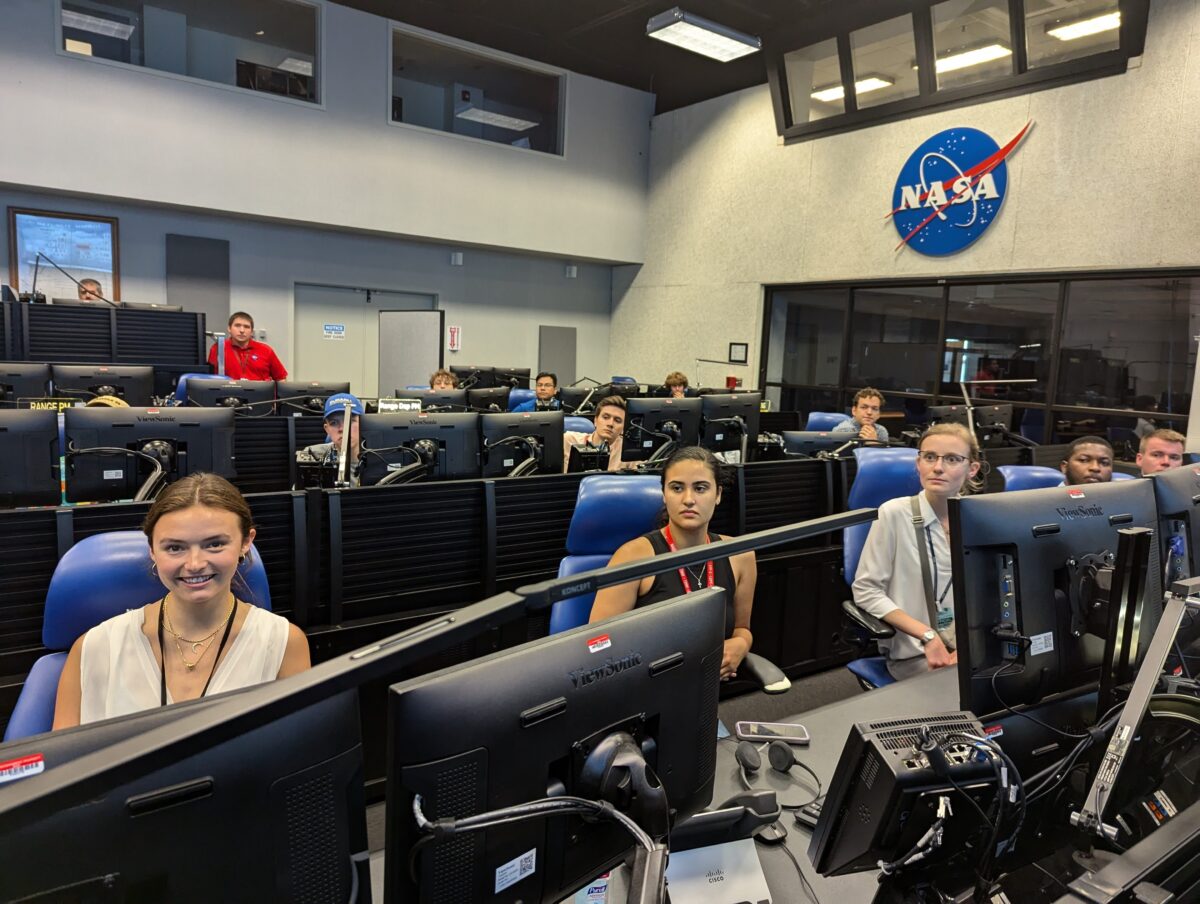
GESTAR II is one of three cooperative agreements that UMBC has with GSFC, a partnership that began nearly 30 years ago. Earlier this month, the university collaborated with GSFC to host the “NASA-UMBC Interaction Days,” an interactive, three-day event series (concluding on September 30) that takes a closer look into the center’s current research activity, with insight into how faculty and students can engage with Goddard scientists and engineers.
In addition to contributions to NASA’s missions and earth science scholarship, GESTAR II also provides funding support for UMBC students with its undergraduate and graduate fellowships. The center also hosts a recurring seminar series for scientists.
UMBC is collaborating with the NASA Goddard Space Flight Center (GSFC) to host an interactive, three-day event series that takes a closer look into the center’s current research activity, with insight into how faculty and students can engage with Goddard scientists and engineers.
NASA-UMBC Interaction Days launched on September 9 and continues on September 16 and September 30, highlighting a range of topics on the diverse research and technological advancements in space exploration from leading scientists and engineers at GSFC. The series also provides an overview of the extensive research activity happening in collaboration between UMBC and NASA, a partnership that began nearly 30 years ago.
Astrophysicist Sibasish Laha, an associate research scientist with UMBC’s Center for Space Sciences and Technology who works out of GSFC, organized the series in response to an influx of students inquiring about the work that happens at NASA and ways to get involved.
“I started this interaction day series to help UMBC students better understand what NASA scientists and engineers do on a day-to-day basis,” says Laha. Students get a behind-the-scenes look into the research happening at GSFC, across an array of disciplinary fields such as earth science, data science and AI, astrobiology, and more.
Student opportunities at NASA
Day one of the event series included lectures focused on earth science, exoplanets, and laboratory astrophysics with featured speakers Maurice Leutenegger of GSFC’s x-ray astrophysics laboratory; Wayne Yu, an senior engineer in astrobiology; and planetary scientist Ravi Kopparap. A packed room of more than 90 attendees learned about the inquiring minds behind the GSFC’s research activity.
Day two of the event series (happening on September 16) will feature discussions on data science and AI, x-ray astrophysics, and astrobiology. The event will conclude on September 30 with lectures on the habitable worlds observatory, payload systems and engineering, and NASA’s long term goals with featured speaker Robert Petre, director of GSFC’s astrophysics science division.
Some Retrievers at the event were there out of general curiosity and some were looking for jobs and internship experiences. Brad Cenko, research scientist at GSFC, shared about the wide array of experiential learning opportunities happening at NASA’s research centers across the country.
“NASA has one of the largest internship programs in the state of Maryland, and students can apply to internships year-round,” said Cenko. This summer, UMBC students secured internship placements with NASA, which included senior Leah Narat, business technology administration, who worked at GSFC as a business intelligence intern.
Interns from the Flight Projects Directorate at NASA Goddard, including Leah Narat, center, tour the Wallops Flight Facility in Virginia. (Image courtesy of Narat)
Narat created and updated databases to track awards given to NASA employees. The agency will use the information to maximize employees’ recognition and success and guide them toward career paths that best take advantage of their strengths.
“Honestly, being at NASA was something that I never thought I would achieve, but I put my application out there, and here I am,” says Narat, who worked as a business intelligence intern at the NASA Goddard Space Flight Center in Greenbelt, Maryland, this past summer. “It’s been wonderful.”
A 30-year partnership
While a large majority of students made up the attendee list for day one, the event also brought in many faculty and staff interested in collaborating with the agency. “Faculty are an integral part in these collaborative efforts and our goal is to connect them directly with NASA’s scientists and engineers,” said event organizer Laha.
Makenzie Lystrup, director of NASA’s Goddard Space Flight Center, and UMBC President Valerie Sheares Ashby during Lystrup’s visit to UMBC in February 2024. (Marlayna Demond ’11/UMBC)
Currently, more than 250 UMBC scientists and research faculty members are partnering with NASA civil servants and are employed under three major cooperative agreements, of which includes the Goddard Earth Sciences Technology and Research II center (GESTAR II); the Center for Space Sciences and Technology (CSST); and the Goddard Planetary Heliophysics Institute (GPHI). The university also is home to the NASA-affiliated Earth and Space Institute based out of UMBC’s Physics Building.
Additionally, nearly 30 of the university’s scientists and research faculty are working on active NASA space missions. That includes the UMBC-developed Lunar Environment Monitoring Station, which was selected as one of the first three instruments to be a part of Artemis III, NASA’s mission that will send astronauts back to the lunar surface after more than 50 years, and UMBC’s Hyper-Angular Rainbow Polarimeter wide-angle imaging polarimeter instrument on board NASA’s Plankton, Aerosol, Cloud, ocean Ecosystem spacecraft mission.
“NASA is providing half of UMBC’s federal contract funding—on a national scale, this is really unusual,” says Don Engel, director of the CSST and assistant professor of computer science and electrical engineering. “Our NASA partnerships are so cross-disciplinary. All three of UMBC’s colleges are represented with these centers, and that’s extremely significant.”
Register for the remaining NASA-UMBC Interaction Days events here.
UMBC’s Division of Research and Creative Achievement recently announced the recipients of the 2025 Strategic Awards for Research Transitions (START) award,and the 2024 Summer Research Faculty Fellowship (SURFF) award—two of the university’s internal funding opportunities that support faculty research and creative scholarship.
For fiscal year 2025, 13 faculty members across all of UMBC’s colleges and researchers with the university’s research centers were individually awarded up to $25,000 in START funding to advance their research and creative achievement endeavors. The award assists recipients in competing more effectively for external support and pursuing new areas of inquiry.
In summer 2024, 14 faculty members received a SURFF award. The SURFF award supports non-tenured, tenure-track faculty members in pursuing research and creative achievement projects during the summer. Recipients are awarded up to $8,000 in funding.
This summer, UMBC students have hit the ground running in exploration of possible post-graduation opportunities with internship placements across a wide range of industries and career fields that include companies such as NASA, House of Ruth, Morgan Stanley, Art with a Heart, Doordash, and more.
With the help of UMBC’s Career Center, hundreds of students have continued their educational pursuits beyond the classroom with summertime experiential learning opportunities that provide hands-on, real-world exposure to professional roles that are specific to students’ individual career interests. These students are joining a record number of Retrievers who have completed applied experience opportunities—internships, research fellowships, service learning, study abroad, student teaching, and leadership positions while at UMBC—before graduating, says Christine Routzahn, Career Center director.
“Our students pursue applied learning in significant numbers, and these experiences have an impact on their career success following graduation,” says Routzahn.
Expanding existing skill sets
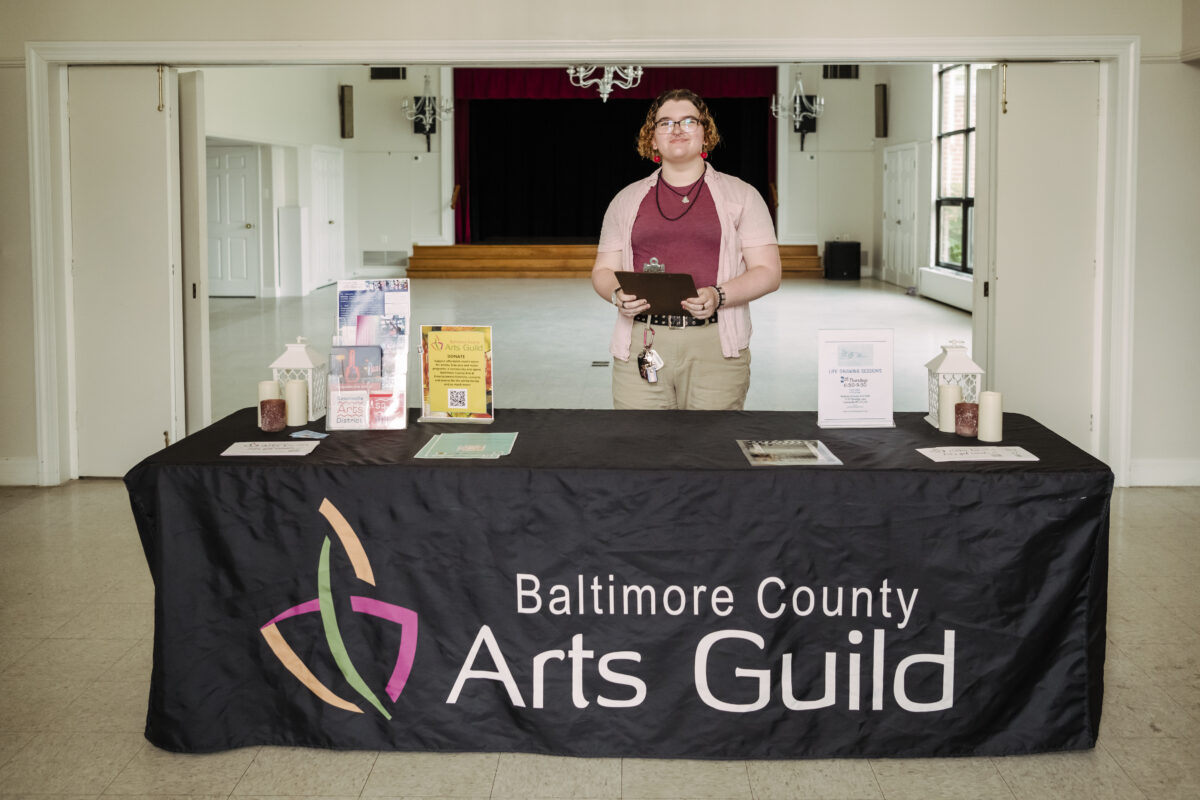
Luna Siesko, a rising senior studying visual arts, didn’t journey too far from UMBC’s Catonsville campus to continue developing her skills in photography and the arts as the intern for the Baltimore County Arts Guild. She expanded her experience in social media content development, website posts, space management, and event planning for the local nonprofit.
Luna Siesko at her internship placement. (Marlayna Demond ’11/UMBC)
“I’ve always had this dream of having my own studio space, and some sort of exhibit space for my work,” Siesko says. “And so this internship has been really applicable to that—making sure that the space is managed and accessible, and everything is running smoothly.”
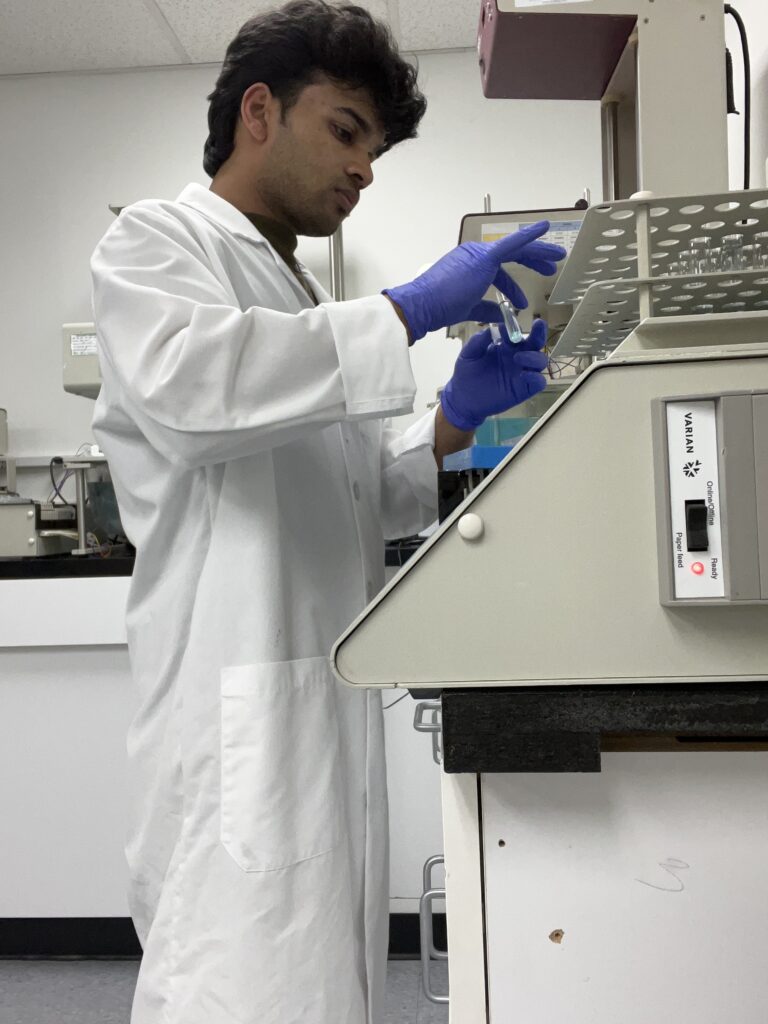
Parag Shinde, a biotechnology master’s student, spent his summer interning at Vici Health Sciences, a pharmaceutical research and development firm in Elkridge, Maryland. After emailing his resume to dozens of local companies in the spring, Shinde landed an analytical chemist role at Vici, testing drug compounds for purity, shelf-life, and many other attributes before they can be formulated into medications or other medical treatments.
“You can gain knowledge through books, but then you actually go to a company and start doing something, and you feel like you know nothing. My plan was to work here and get physical experience, as much as possible,” says Shinde.
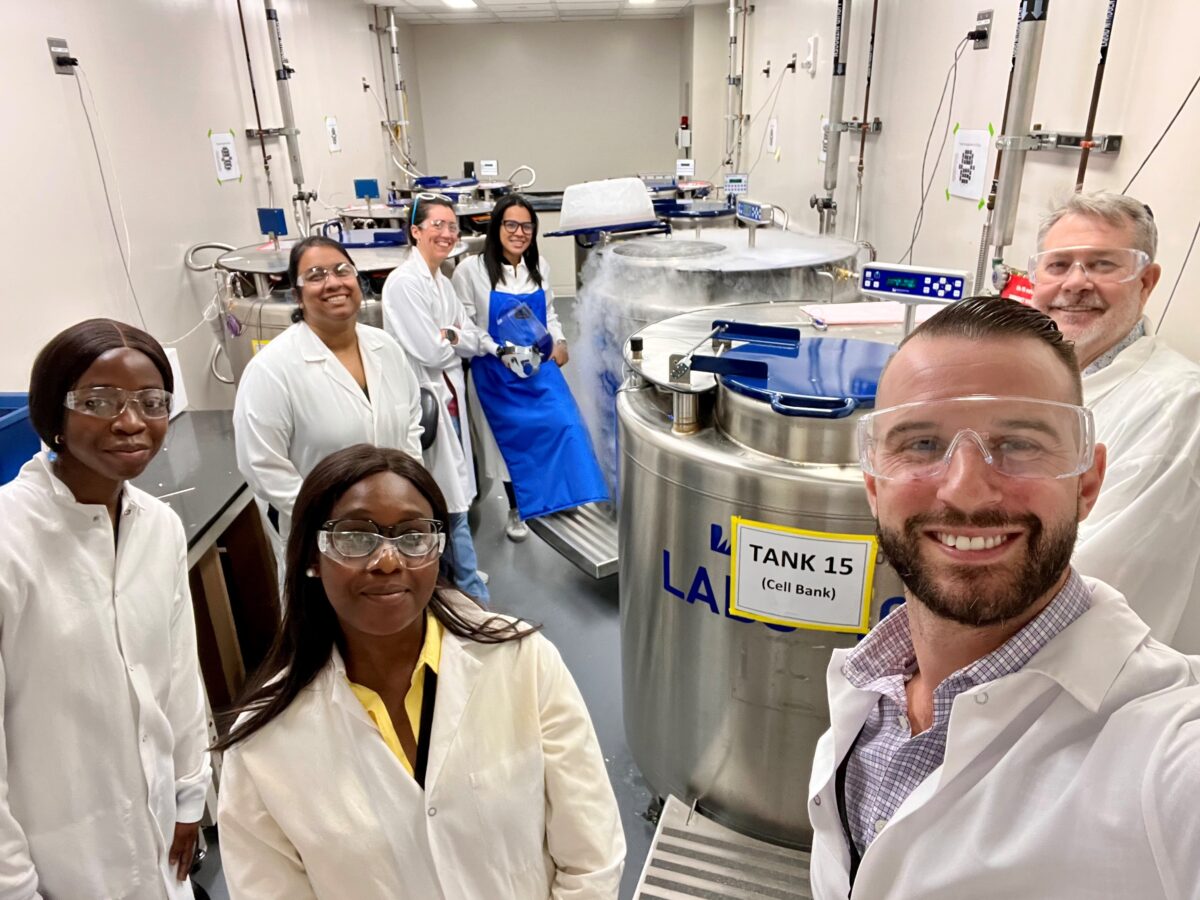
Left: Parag Shinde got the hands-on experience he wanted this summer at Vici Health Sciences. (Photo courtesy of Shinde) Right: Ortisemoyowa Ikomi (front left) with fellow interns and staff in a lab at AstraZeneca. (Photo courtesy of Mark Benesch)
Ortisemoyowa Ikomi, chemical engineering, also explored her career interests in pharmaceuticals with an internship at AstraZeneca. Ikomi, a rising senior, connected with an AstraZeneca representative at a recent UMBC Career Fair and learned about the opportunity to work on the company’s management of a new drug manufacturing plant in Rockville, Maryland. In Ikomi’s eventual internship, she investigated a software tool that could track construction progress.
“It’s not traditional chemical engineering, more within the realm of project management of large-scale engineering projects. I definitely enjoyed it,” Ikomi says. “I’ve learned so much during the internship. The experience has made me think I’d like to continue working in the engineering project management sphere.”
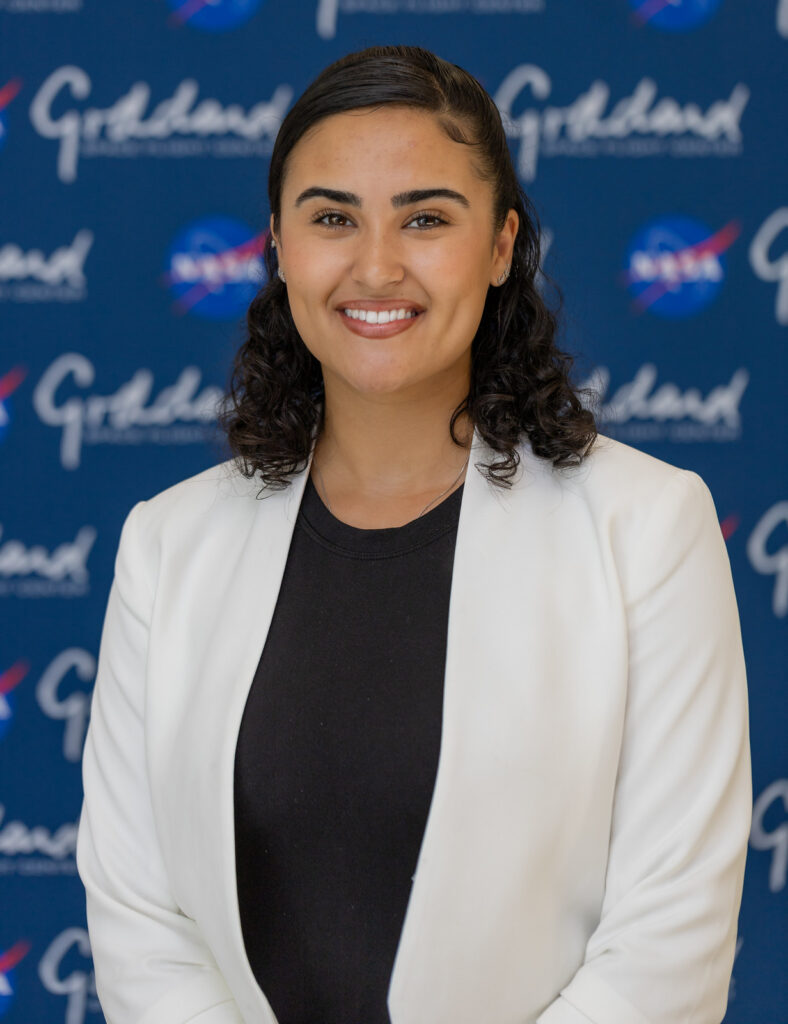
During the internship, Narat, a senior, worked on computer systems that help keep NASA missions safe and its employees engaged. In one project, she created and updated databases to track awards given to NASA employees. The agency will use the information to maximize employees’ recognition and success and guide them toward career paths that best take advantage of their strengths.
“It’s been great to have this real world experience, where I can get my hands dirty and decide: Is this the type of work I want to do?” Narat says.
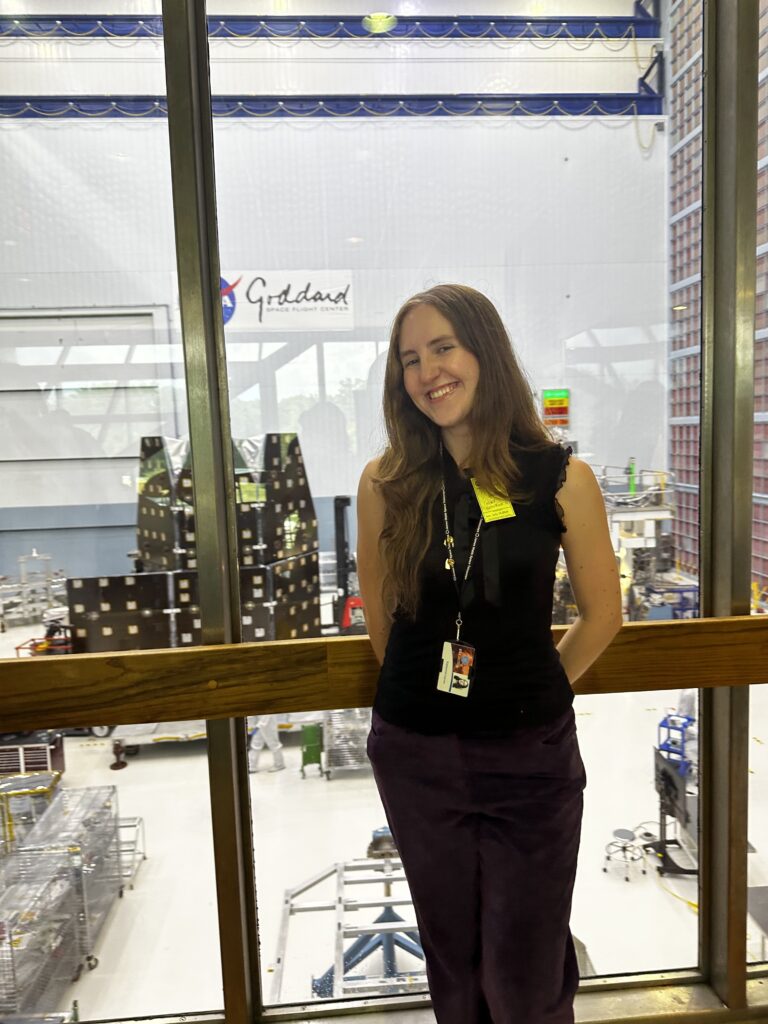
Katherine Carver stands outside the clean room where the Nancy Grace Roman Space Telescope is being developed at NASA Goddard Space Flight Center. (Photo courtesy of Carver)
In Baltimore, Katherine Carver, physics and mathematics, secured a placement in the Space Astronomy Summer Program at the Space Telescope Science Institute (STScI) at Johns Hopkins University. This is the second internship role Carver landed at Johns Hopkins since attending UMBC—as a first-year student in 2023 she secured a Johns Hopkins Applied Physics Laboratory CIRCUIT internship.
During her STScI internship, Carver, a rising junior, has been digging into developing open-source software that allows astronomers anywhere to analyze data arriving from the James Webb Space Telescope, the most powerful space telescope ever launched.
Carver shares that while she was able to secure these highly competitive internships, it didn’t come without a lot of rejection.
“Shoot for the internships even if you feel like you won’t get them. Be persistent, ask around, talk to your professors. And then once you are there, take maximum advantage of every opportunity,” she says.
International experiential learning
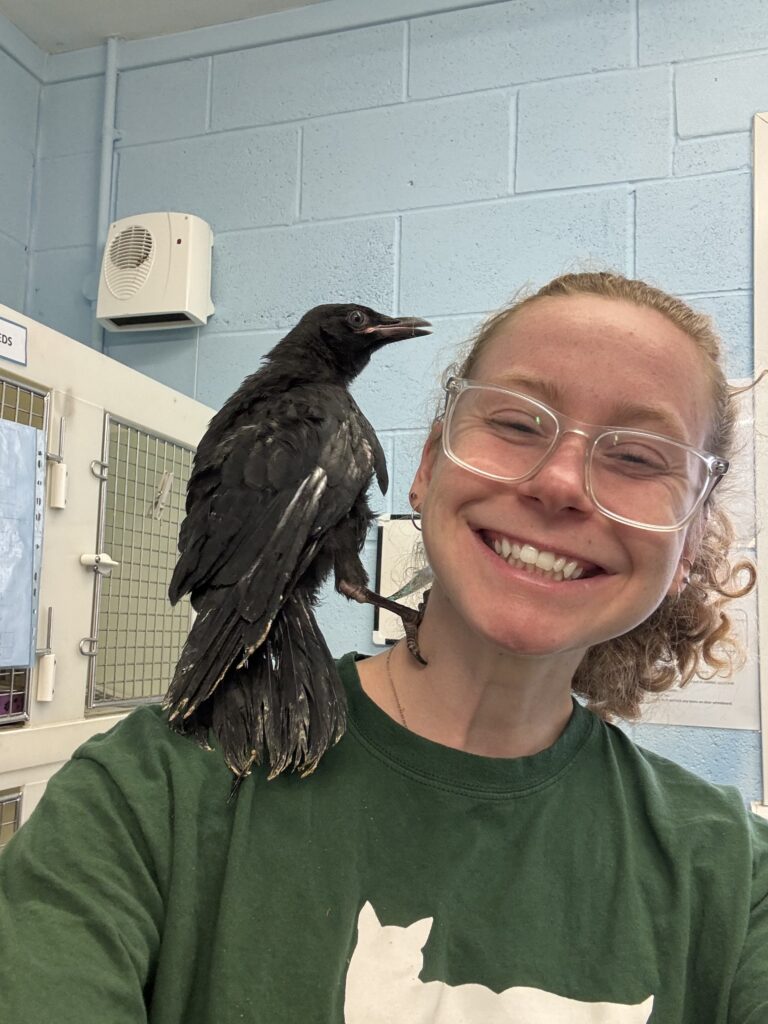
Liz Willman with one of the animals she worked with in Scotland. (Photo courtesy of Willman)
After several semesters volunteering at the Baltimore Animal Rescue and Care Shelter (BARCS), including an internship working with BARCS medical professionals, Liz Willman, biological sciences, took her skills and education in animal care overseas for a six-week summer internship with the Scottish National Wildlife Rescue Center.
Willman, a senior enrolled in the pre-vet track, worked with wildlife animals for the first time—rehabilitating birds that were injured or abandoned by their parents when they were still too young to care for themselves, performing daily exams, and helping to build their strength to prepare them to return to the wild.
“It wasn’t only a new experience for me to be working with wildlife, but it was also wildlife that you don’t see in the U.S., like finches native to the United Kingdom,” she says. “It has just really reaffirmed that I’m not just trying to live out my childhood dream—I’m meant to do this.”
Robert Barry, a rising senior majoring in ancient studies and visual arts, also looked internationally for a place to dig deep into his skill set. He traveled to Greece for the second summer to work at an archeological site with Michael F. Lane, associate professor of ancient studies and field director on the Kopaic Cultures, Economies, and Landscapes research program.
After joining Lane’s six-week summer archeological fieldwork team last year, Barry returned to Greece as a trench supervisor with more responsibilities. This opportunity allowed Barry to develop his leadership skills and get more experience collaborating with fellow researchers on an international level.
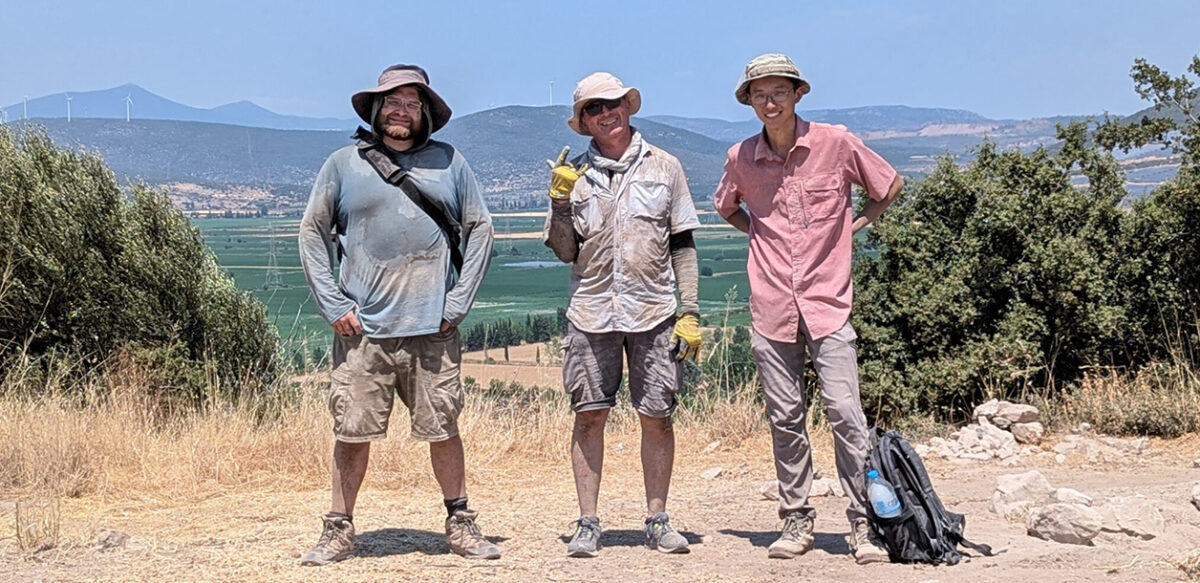
(Left to right): Michael P. Fischer ’24, ancient studies, Michael F. Lane, and Robert Barry at the 2024 ancient studies field school. (Michael F. Lane/UMBC)
“Last year, I was digging and following directions from my supervisor. Now, I’m giving the orders and having to be responsible for the health and safety of everyone else while getting the job done,” says Barry.
Opening doors
While many Retrievers have found success in securing internships that closely align with their majors, there’s a long list of UMBC students who have also found success with internships that may not have initially been on their radar. These nonlinear internships are helping students to “get to their longer-term goal,” says Marykate Conroy, associate director of internships and employment in UMBC’s Career Center. “Diverse experiences also may open doors for students that they didn’t even see as possible.”
These internship opportunities have proven to yield positive outcomes. The Career Center’s class of 2023 survey found that after graduation, 93 percent of the university’s new graduates go directly into the job market, continue their education by pursuing an advanced degree, or both.
Preparation for these opportunities typically start with a search on Handshake, UMBC’s job and internship search platform, or a visit to the Career Center’s Internship and Career Fair. The center will host its Fall 2024 career fair on September 18, from 11:30 a.m. – 3:30 p.m. at the Retriever Activity Center.
Since 2014, multimedia artist Levester Williams has developed a personal connection and exploration with a natural material that is a historic staple of Baltimore life—Cockeysville, Maryland, marble.
Go down specific streets in neighborhoods like Highlandtown, Charles Village, Cherry Hill, or Mount Vernon and you’ll see the ubiquitous, three-to-four tiered steps made of marble outfitting the exterior of many rowhomes throughout Baltimore, much of it from Cockeysville. Beyond the steps, you’ll also find the stone in landmarks such as Baltimore’s City Hall, the Washington monuments in Baltimore and D.C., and the 108 columns of the U.S. Capitol Building.
In this pilot artist residency program, Williams is collaborating with the CADVC to complete a new video art project called “dreaming of a beyond: Baltimore,” in which the artist is researching the history of Cockeysville marble, underscoring the “intertwined history of African Americans’ plight to self-determined agency and full citizenship, and a rather benign stone.”
More than just marble
In his work, Williams examines the relationship between objects, humans, and the physical world with art that includes sculptures, installations, sound, animations, drawings, and videos. Williams is continuing that exploration in “dreaming of a beyond: Baltimore,” part of his ongoing series focused on the dolomitic stone that is quarried in Cockeysville, 25 miles from Catonsville. The series explores Williams’ desire to examine his idea of “the beyond—where race is no longer tethered to value; where my body matters just as much as other bodies matter,” he says.
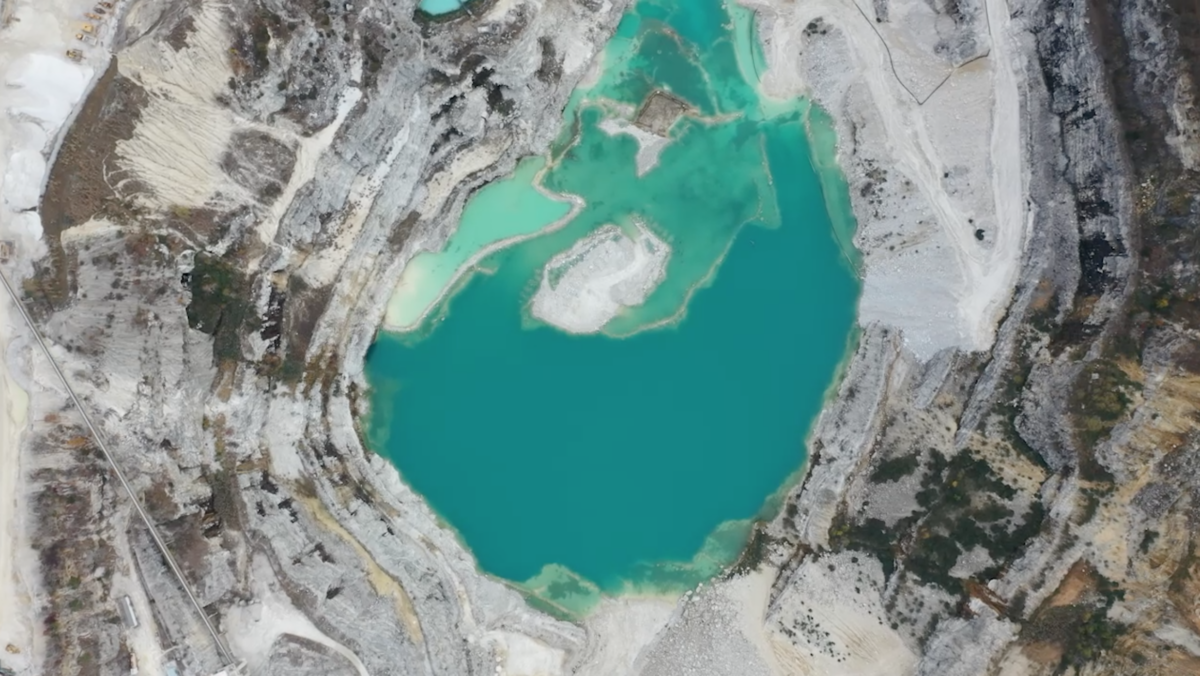
A drone image of the Texas Quarry in Cockeysville, Maryland, one of the locations where Cockeysville marble is mined. (Photo courtesy of Levester Williams)
The artist began his exploration into the stone after reading a passage in Lindon Barrett’s book Blackness and Value: Seeing Double about jazz singer Billie Holiday’s time growing up in Baltimore. The book references Holiday’s autobiography, Lady Sings the Blues, which documents her stint cleaning the marble steps in Baltimore as a teenager.
“White homeowners were obsessed with keeping the white marble stoops clean, and didn’t care how the inside of their homes looked, as long as the steps were clean,” says Williams in reference to the passage about Holiday in Blackness and Value. The steps were seen as a marker of class and economic status, he adds, explaining how “Holiday knew that and was able to bargain to get more money for cleaning the stoops.”
Through archival research, Williams learned more about the stone’s connection to Black people in Baltimore and their bodies as they handled, cleaned, and labored over the marble. As part of his CADVC residency, Williams conducted research at the Maryland Center for History and Culture, using the center’s digital archives of Baltimore’s historic Afro-American newspaper and photographer Paul Henderson’s collection of images he captured for the paper from 1930 through 1960. The archives showcase the long history of Baltimore’s Black residents who cleaned and maintained the marble steps as part of their daily routines.
“Bodies in space”
The “dreaming of a beyond” series consists of short vignettes capturing performers touching and physically engaging with structures, objects, and buildings made with Cockeysville marble at different sites throughout the northeast region. Beyond Maryland, the marble can be found in places such as the Buffalo AKG Art Museum in upstate New York; the Fisher Building in Detroit; Girard College in Philadelphia; and St. Patrick’s Cathedral in New York City.
In Baltimore, Williams filmed performers interacting with the (original) Washington Monument in Mount Vernon Place. Nia Hampton, an intermedia and digital arts (IMDA) graduate student at UMBC, and her mother, Sheila Gaskins, were featured in “dreaming of a beyond: Baltimore,” filmed with the assistance of IMDA student Bao Nguyen. A sneak peek of Williams’ in-development projection demo was on display at the CADVC in February.
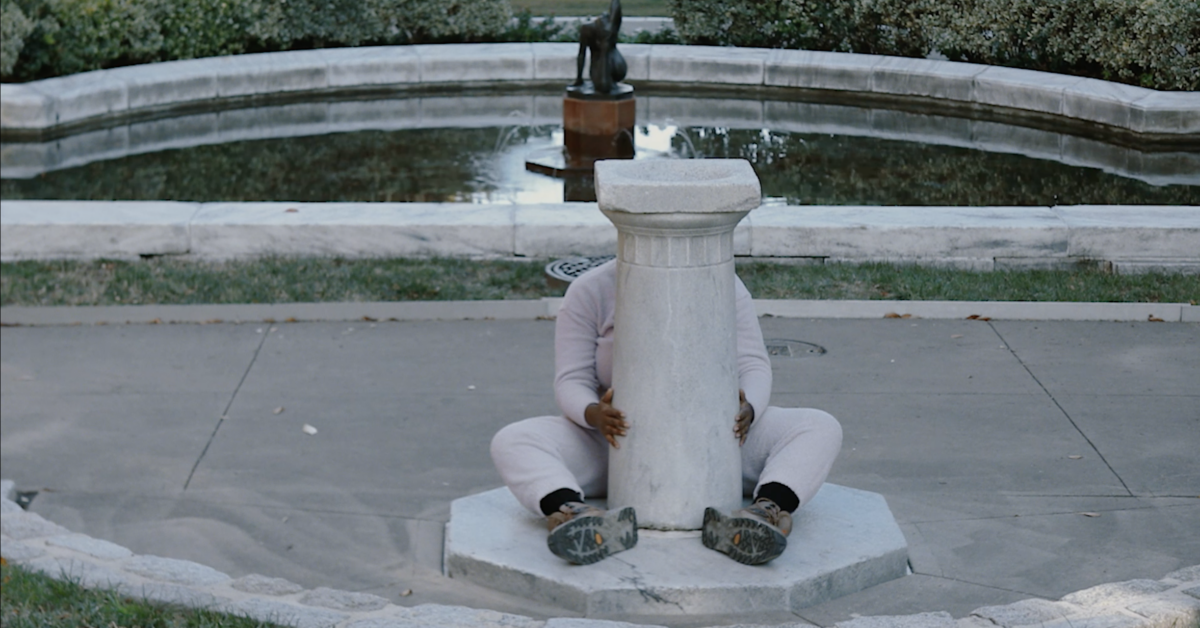
Video still of Nia Hampton in the vignette “Nia’s Embrace” from “dreaming of a beyond: Baltimore,” filmed at Mount Vernon Park Place in November 2023. (Photo by Levester Williams)
The film—which was projected onto the side of a building across from the CADVC’s outdoor amphitheater space—captures the mother-daughter duo physically engaging with the monument with movements that included hugging, caressing, scaling, and sprawling various body parts across the marble-encased statue. Williams worked with artist and intimacy coordinator Savannah Knoop to “reconfigure and think about bodies in space, non-human bodies, and what it is to give consent to these things,” he says.
“What I appreciate about Levester’s work is its level of obscurity,” says Hampton. “When I saw his work, I thought it was different—I never saw anything like it before.”
When she learned that the artist wanted the film’s subjects to be local residents with a deep connection to Baltimore’s history, Hampton referred Williams to her mother. Gaskins, a multi-disciplined artist who has been a local arts advocate and educator for more than four decades, wrote and directed “Last House Standing: A Play About the Highway to Nowhere”in 2016. The play included performers playing the role of the marbled stoop steps.
“When I was interacting with the marble [in the work with Williams], it wasn’t a pretty thing. I was thinking about my ancestors. Nia and I were having conversations about the slaves that probably built the monument. All of that was in our minds when we were interacting with the marble,” says Gaskins.
Nia Hampton (left) and Sheila Gaskins in “standing ground (On Washington)” from “dreaming of a beyond: Baltimore,” filmed at the base of the Washington Monument in Baltimore. (Photo by Levester Williams)
“Black folks touching the stone have been an anchor in this master-slave dynamic. I reimagined this relationship between the Black body and the stone, which is not in service of this power dynamic,” says Williams. “I’m using this stone as a way to reimagine Black folks in public spaces.”
Artistic practice as research
This fall, the CADVC gallery is set to premiere a selection of Williams’ artwork that emerges from his “dreaming of a beyond: Baltimore” research as part of the introduction to the center’s public video projection gallery series, which will be on display in the Fine Arts Building Amphitheater. The series is anticipated to rotate new video artwork presentations and will run for the next several years, says Rebecca Uchill, director of the CADVC.
The fall projection presentation will also coincide with the “all matters aside” exhibition at the CADVC that will feature a retrospective of Williams’ work from the last 10 years, organized by curator Lisa Freiman. Williams’ work was previously featured in “Declaration,” the inaugural exhibition at the Institute for Contemporary Art at Virginia Commonwealth University that Freiman curated as the institute’s inaugural director.
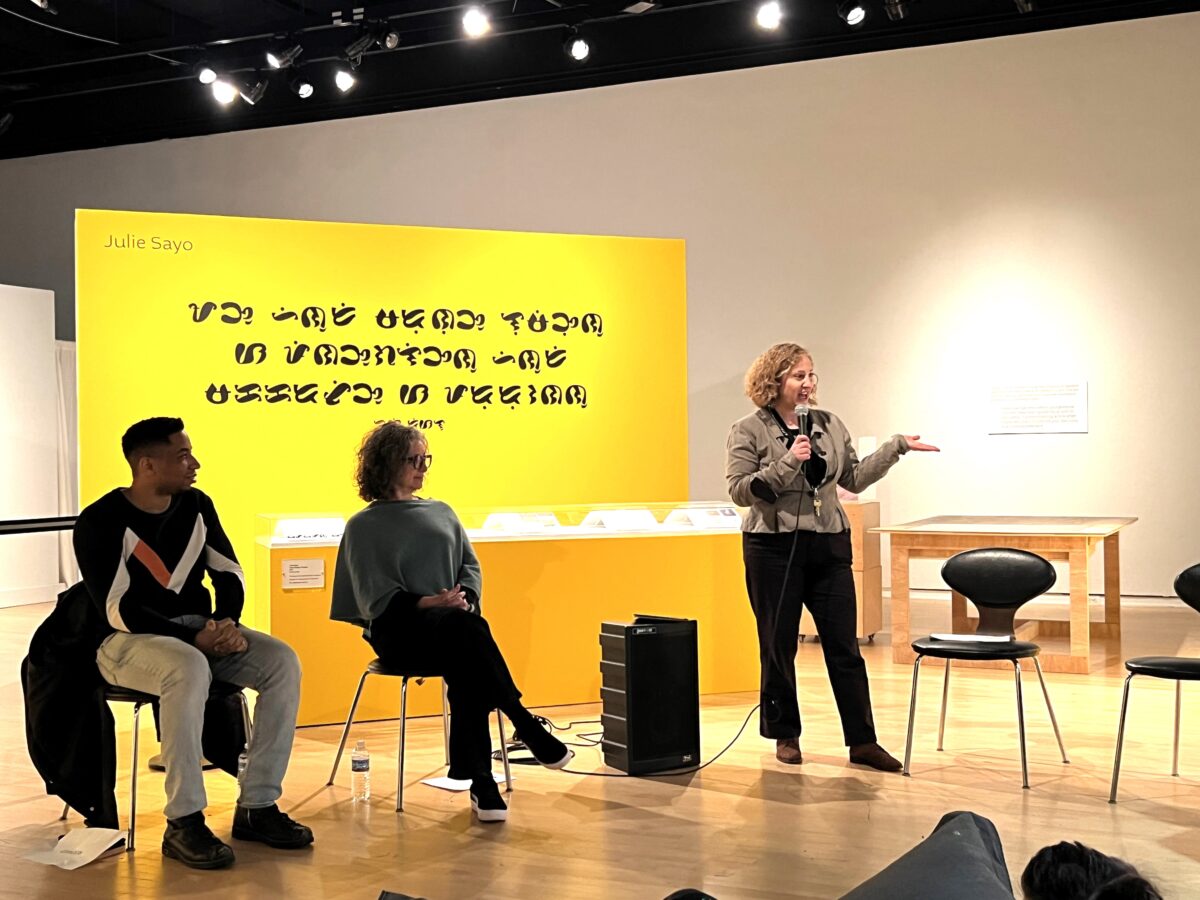
Levester Williams, Lisa Freiman, and Rebecca Uchill at the sneak peak projection demo of “dreaming of a beyond: Baltimore” in February 2024 at the CADVC. (Photo by Tedd Henn, courtesy of the CADVC)
Wiliams’ projection work will also feature an accompanying booklet that includes an essay by Michelle Wright, professor of history and Africana studies at the Community College of Baltimore County. Wright’s essay, “Scrubbed Clean,” examines the complex history of Beaver Dam marble, its use in Baltimore’s Washington Monument, and its connections to the city’s history of racial division.
Along with Williams, the CADVC Exploratory Research Residency Program also hosted artists Tomashi Jackson and Paul Rucker. Portions of the program have been funded by the Maryland State Arts Council, the Baltimore County Commission on Arts and Culture, and UMBC’s College of Arts, Humanities, and Social Sciences’ Big Ideas initiative. The pilot program, which launched in 2022, “recognizes the inherent research that is artistic practice,” Uchill explains.
“Artists are researchers, technicians, and producers. I think some of that occasionally may be underemphasized in certain contexts, but fortunately not at UMBC. CADVC’s residency program aligns with the rigor, creativity, and civic engagement of the university at large, and feeds into other areas of our center’s programs in exhibition, publication, and creative production,” says Uchill. “This has been an especially enriching opportunity because of UMBC’s laudable, sincere belief in the importance of the arts as research.”
For Williams, the exploratory residency program is helping him to expand his interpretation of being Black and existing in public spaces: “There’s no hierarchy of us existing in space and doing that through touch is what my project is focused on. Having these performers touch the stone in any way that they want is [my idea of] pushing back and getting to that ‘beyond’.”
Steven Caruso, principal lecturer of biological sciences, will lead up to 18 undergraduate students on a three-week program to Barcelona to investigate bacteriophage biology research. Caruso ’94, Ph.D. ’02, biological sciences, is the co-leader of UMBC’s SEA-PHAGES program, called Phage Hunters, a two-course undergraduate genetics and bioinformatics sequence.
In 2023, UMBC received the institution’s first capacity-building grant for study abroad from the U.S. Department of State’s Increase and Diversify Education Abroad for U.S. Students (IDEAS) initiative to develop the “Phage Hunters in Barcelona” program. The study abroad program combines asynchronous online learning and hands-on training opportunities at research institutes in Barcelona.
“The IDEAS grant helps to make education abroad more accessible for UMBC students,” said Katherine Heird, UMBC’s director of education abroad and global learning. “This innovative program offers students an unparalleled opportunity to delve into biomedical research, hone their intercultural communication skills, and build connections across the globe.”
In 1987, Paul Flinton, then a 23-year-old senior studying at UMBC, decided to make a short documentary focused on the tollbooth workers on the Francis Scott Key Bridge.
The six-minute documentary “One Dollar”—named after the toll’s cost for cars at the time—captures a vehicle’s journey across the bridge from the driver’s point of view in one continuous take. As Flinton ’87, visual arts, drives across the bridge, audio of the tollbooth workers interviewed for the project act as the film’s narrators in which they share some of their experiences as toll operators.
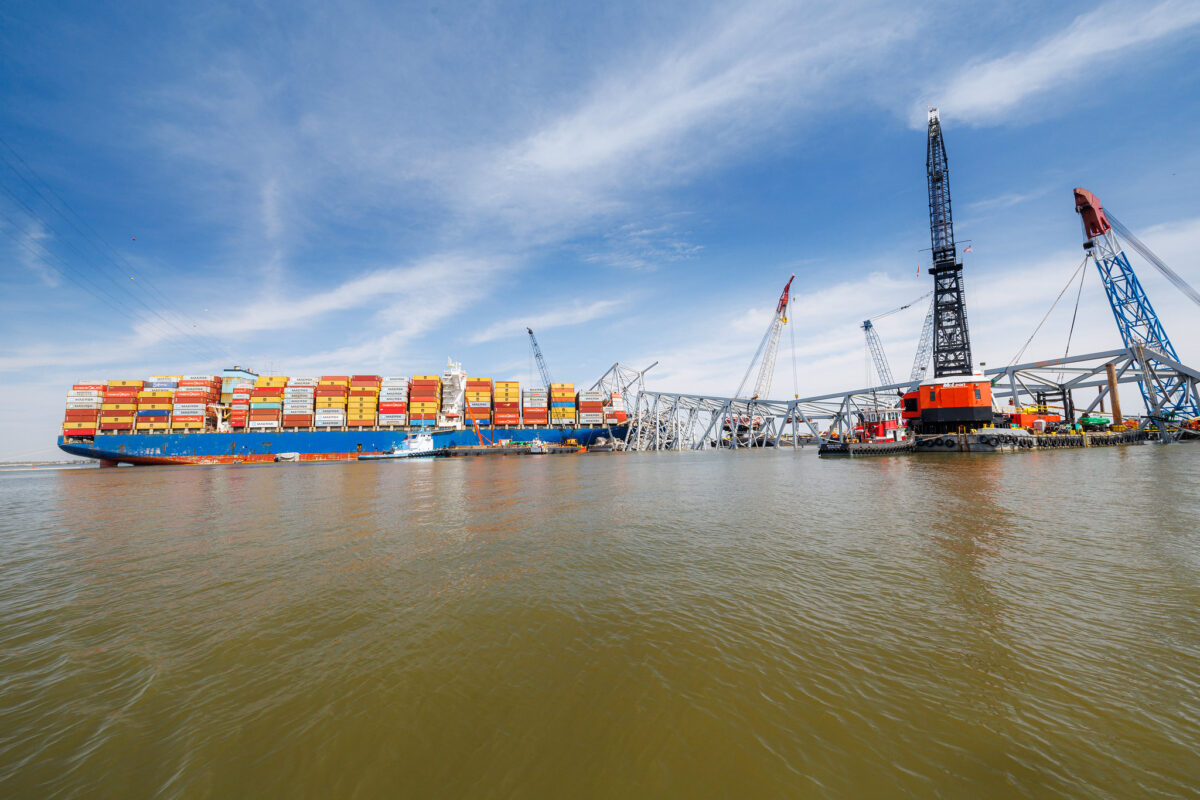
Flinton, who is now a location sound manager for NFL Films, went on to win an award for “One Dollar” from the Maryland State Arts Council following its release. Nearly four decades later, Flinton all but forgot about the film’s existence until learning of the bridge’s collapse following a collision with a malfunctioning cargo ship on March 26, sending eight construction workers into the water and taking the lives of six.
“It hit a nerve,” Flinton told local news after the disaster. “[The film is] sort of a treasure…This captures something that in a lot of ways can’t really happen again.”
Paul Flinton’s short documentary entitled “One Dollar” (1987).
Supporting the impacted families
The Key Bridge opened to traffic in 1977, and regularly 30,000 vehicles crossed the 1.6 mile span over the Patapsco River. An integral part of Baltimore’s beltway, commuters, community members, and experts are now struggling to make sense of the literal change of transportation landscape. Now that the wreckage is completely cleared away and as the eventual construction commences, UMBC experts offer up their expertise and resources to confront the tragedy.
Felipe Filomeno. (Marlayna Demond ’11/UMBC)
After learning that all of the direct victims of the collapse were immigrants from countries throughout Latin America, Felipe Filomeno, associate professor of political science and global studies, immediately sprang into action with fellow members of the grassroots organization Latino Racial Justice Circle (LRJC). Filomeno, who is president of the LRJC, worked with the organization’s leadership team to establish a fundraiser in support of the families of the victims of the bridge collapse.
The crowdfunded campaign initially had a goal of raising about $5,000 for each of the families impacted, Filomeno said. Within hours of going live with the GoFundMe campaign, the organization raised $100,000 from donors located all around the world.
“The fundraiser caught a lot of traction. I have been overwhelmed by the outpouring of solidarity that we got from across the world in that week when the tragedy happened,” says Filomeno.
Following the fundraising success, the group has since directed prospective supporters to the Mayor’s Office of Immigrant Affairs’ Key Bridge Emergency Response Fund. The Mayor’s Office is working with the LRJC and case managers to distribute the funding to the six impacted families.
The tragedy has underlined key issues impacting the Latino immigrant community, challenges that Filomeno amplifies through his community-centered research at UMBC. “[The collapse] has highlighted and publicized to the world issues that we already know exist—the fact that Latino immigrants are over-represented in dangerous occupations,” says Filomeno. “There are higher incidents of work-related accidents among the Latino populations.”
Filomeno’s forthcoming book, Christian Cosmopolitanism: Faith Communities Talk Immigration (Temple University Press, 2024), explores the Honest Conversations on Immigration program he co-developed in 2017 in partnership with the LRJC. The program, Filomeno explains, was designed to build mutual understanding and collaboration between people who are diverse, but share the same religion.
“One of the goals is to build solidarity across differences,” says Filomeno. “The solidarity across differences is a principle that we also see in the Key Bridge fundraiser.”
Through his advocacy and academic scholarship, Filomeno is working to amplify the need for more long lasting efforts to stand in solidarity with Latino immigrant communities beyond moments of tragedy. “Those problems that became evident with the fall of the bridge, those challenges that the Latino immigrant population faces, they are still there,” he says. “To move the needle on those issues, it has to be more than helping those six families at this point in time.”
Examining the environmental impacts of the collapse
The ship that collided into the bridge was carrying 56 containers of hazardous materials, including corrosives, flammables, and lithium-ion batteries. The cargo ship was also carrying more than one million gallons of fuel at the time of the impact. City officials began their investigations into the incident, which included determining the environmental impacts to the Patapsco River and surrounding communities.
Upal Ghosh, professor of chemical, biochemical, and environmental engineering, whose research includes examining the effects of toxic pollutants in soils, sediments, and aquatic environments, was among the experts who weighed in on assessing the potentially hazardous effects of the containers that were resting at the bottom of the river.
Maryland Comptroller Brooke Lierman and representatives of the Office of the Governor take a tour of the Francis Scott Key Bridge collapse site on a Maryland Department of Natural Resources police boat. (Photo source: Corey Jennings ’10, Maryland Comptroller/Flickr)
Ghosh told the Baltimore Sundays after the collapse that environmental officials’ first priority would likely be making sure none of the intact containers were breached.
“If you have containers that contain oily material, those things will, if they are breached, be releasing over time,” Ghosh said. “I would think if there is a release that goes down into the sediments under the water, it would be a local impact right there.”
Farah Nibbs, assistant professor of emergency and disaster health systems, is also thinking about future ways to contain the effects of similar disasters. Contributing factors to the bridge’s collapse, she says, can be tied to the 2012 expansion and modernization of the Port of Baltimore. Those changes did not happen hand in hand with improvements in safety management needed to accommodate ships of such huge sizes that now were able to port in the city. Risks from collisions, fuel spills, and contamination still lack proper oversight and regulation.
“A novel approach for decision-makers may be to view Maryland’s emergency management and transportation experts and service providers—as well as the physical bridge infrastructure itself—as part of the community’s lifeline systems,” said Nibbs.
More than a disaster
As plans for the bridge’s rebuilding process begins to take shape, Brian Grodsky, professor of political science, shed light on why Maryland Governor Wes Moore likely did not request a presidential disaster declaration in response to the collapse. Presidential disaster declarations, Grodsky said in a local tv news segment, are usually limited to tragedies that involve fires, floods, or explosives.
“Man-made disasters are more likely to be declined [for a presidential disaster declaration] because there is that question of public versus private ownership of the disaster,” he added. “If this ship caught on fire or exploded under the bridge, this would easily be qualified as a major disaster.”
Deborah Rudacille, professor of the practice in English, is well aware of the lives connected to the construction and opening of the Key Bridge. In 2010, she published Roots of Steel: Boom and Bust in an American Mill Town, a book exploring Baltimore’s industrial history of the Sparrows Point steel mill, but also capturing her family’s connection to the mill and Baltimore staples like the Key Bridge.
Rudacille’s mother was one of the original employees—collecting the toll that Flinton documented in his film— when the bridge first opened in 1977, and her brother worked as one of the bridge’s painters.
“They were kind of reminiscing about the fact that everything down there is now gone,” Rudacille told local media about her family. “First the steelworks, now the Key Bridge is gone. It’s like this world that they lived and worked in has vanished completely.”
Planetary scientist Mehdi Benna of UMBC’s Center for Space Sciences and Technology, along with a team of collaborators, recently released a video recounting the launch of NASA’s Dissipation sounding rocket mission.
The Dissipation sounding rocket, which launched from the Poker Flat Research Range in Fairbanks, Alaska in November 2023, carried a suite of six instruments designed to measure how Earth’s upper atmosphere at high altitudes responds to large energy inputs from the sun during auroral storms.
The video recaps how Benna, principal investigator of Dissipation, and his team of scientists and engineers overcame a series of obstacles to successfully launch the sounding rocket during the peak of the auroral activity that took place in Alaska on November 8.
The launch of NASA’s Dissipation sounding rocket from the Poker Flat Research Range in Fairbanks, Alaska on November 8, 2023.
“It was an exciting but nerve-racking experience. The countdown had to be precisely timed to target the peak of the auroral activities, which lasted less than 30 minutes from its growth to recovery phase,” said Benna in an article. “The last four minutes of the countdown felt like hours as we waited for the last items on the launch checklist to be completed before the rocket could lift off.”
Along with Benna, the Dissipation team included scientists and engineers from UMBC, Goddard Space Flight Center, the Wallops Flight Facility, the University of New Hampshire, and the University of Alaska Fairbanks.
Benna shares that the video encapsulates “the human aspect of space engineering that is rarely shown, and demonstrates that the success of these types of missions are often hinged on the real time and quick decision-making of the engineers.”
Push, pull, push, pull. On goes this routine of synchronized oar movements as rowers—nestled in long, tapered boats—move through the water with precision and speed. The trim boats glide through the water with seemingly effortlessness, and as a child, Mark Couwenhoven finds himself entranced.
One day he’ll learn just how much effort this smooth process takes, but for now, Couwenhoven watches his older sister and her fellow competitors shoot through the water with dolphin-like gracefulness.
“I went to my sister’s races and became enthralled with rowing—I knew that it was what I wanted to do when I got older,” Couwenhoven ’20, biology, recalled.
Nearly two decades later—and after countless pre-dawn hours on the water—his childhood dreams of competitive rowing came true when Couwenhoven landed a spot on the 2019 and 2023 USRowing national teams.
“I was excited to represent the United States and UMBC,” shares Couwenhoven. “When you race, practice, and put in so much work and hard training—medaling at the games and seeing the rewards of that training makes it all worth it.”
But Couwenhoven’s journey to the top echelons of the sport hasn’t come without its challenges and tribulations. The sport, and life along the way, came with its difficulties but Couwenhoven found support at UMBC and in other areas as he pursued his podium and personal goals.
A Rower’s Journey
Couwenhoven began his competitive rowing career during his first year of high school, a passion he continued all throughout his academic career. He learned that what he once considered as “effortless” required a lot of practice and training.
“Rowing is very hard to start. It’s not a very natural movement. You can be an elite rower that has been rowing for years and still have technical flaws. I don’t think the difficulty really ever deterred me from the sport because I enjoyed learning about it,” says Couwhenhoven.
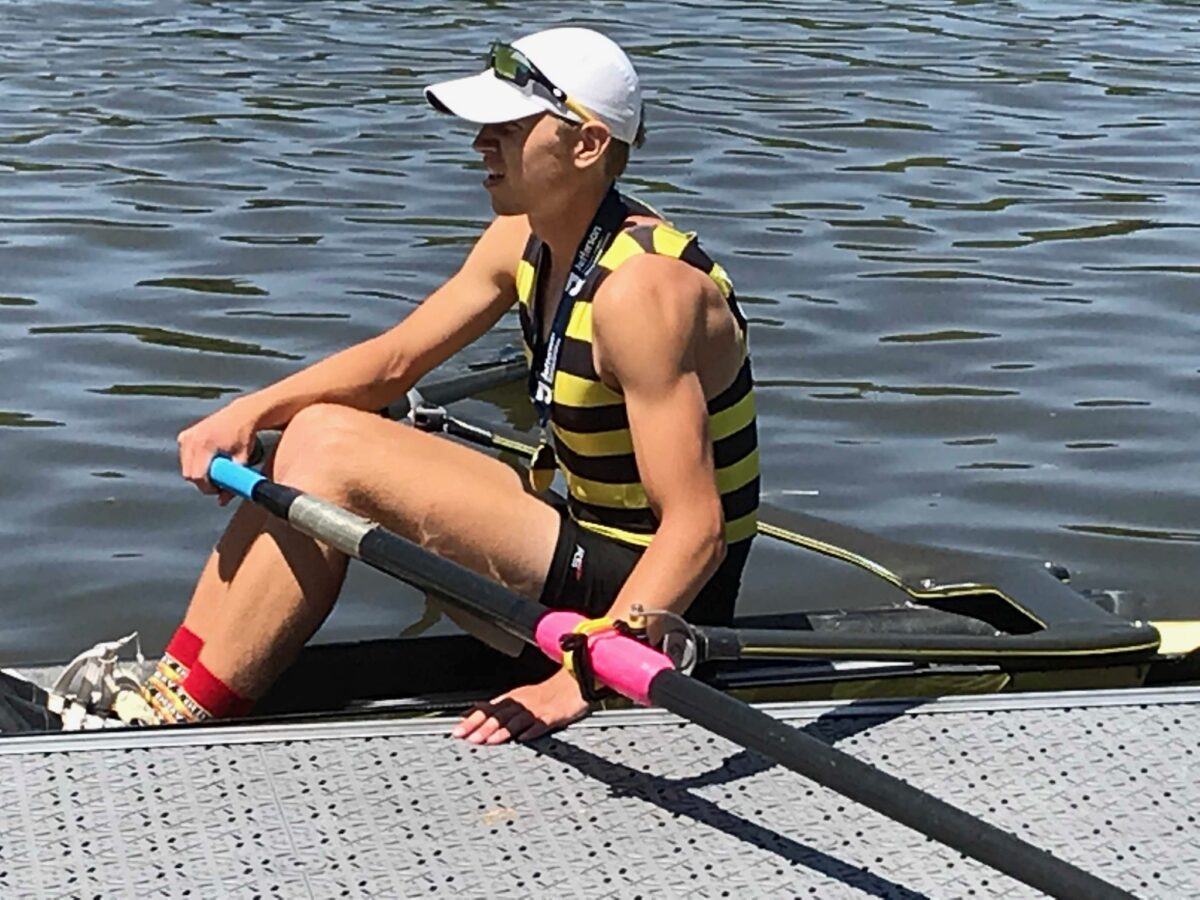
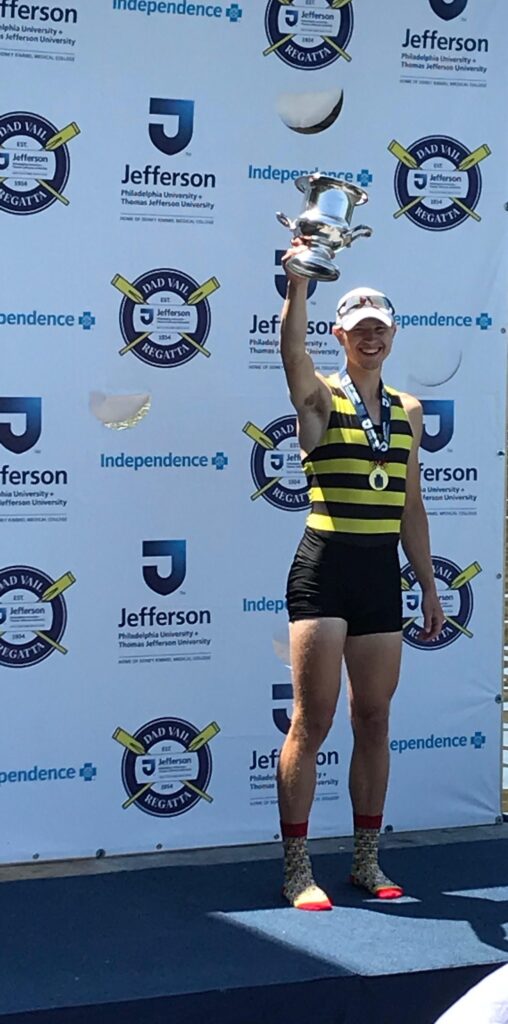
Mark Couwenhoven representing UMBC during the 2019 Dad Vail Regatta. (Photo courtesy of Couwenhoven)
As a high school student, he frequently made the USRowing’s youth national teams. During the school year, the Parkton, Maryland, native strengthened his rowing skills as a member of the Baltimore Community Rowing Club and continued his training in Philadelphia at rowing camps during the summer.
“I stayed committed to rowing when I got into college and I took it to the next level,” said Couwenhoven, who originally enrolled at the University of Delaware and joined the men’s crew team where he helped the varsity lightweight eight team secure a victory at the Dad Vail Regatta, the largest regular intercollegiate rowing event in the country. However, Couwenhoven’s athletic pursuits took a backseat when his mother was diagnosed with breast cancer in 2017.
After learning about his mother’s diagnosis, Couwenhoven moved back to the Baltimore area to help her through the illness. The transition back home didn’t discourage Couwenhoven from his academic and athletic pursuits. “It was a tough time, but I very strongly wanted to finish my education and continue with rowing,” he said.
An International Champion Emerges
Couwenhoven started the process of transferring to UMBC in 2018and “enjoyed the campus and the community,” he said. “Being at UMBC allowed me to be close to my mother, focus on my academics, and find a way back to rowing.”
Even amid her chemotherapy treatments, Cowenhoven’s mother did all that she could to support her son’s rowing ambitions.
“While that was definitely a strenuous battle, she never let it stop her from doing the things she loved. [My mom] would wake up with me in the mornings and we would carpool down to the boathouse.”
Mark Couwenhoven poses after representing UMBC and winning first place in the men’s single event at the 2019 Dad Vail Regatta. (Photo courtesy of Couwenhoven)
Couwenhoven’s father was also there every step of the way in his rowing career, cheering him along, he says. “My dad was there at every race to help me and I really could not have achieved all of this without his support.”
During his time as a Retriever, Couwenhoven recommitted himself to rowing and began competing as an American Collegiate Rowing Association (ACRA) rower, winning the single scull (solo) event at the 2018 and 2019 ACRA National Championship Regatta. He also went on to represent UMBC at the 2019 Dad Vail Regatta, winning first place in the men’s single event wearing black and gold stripes and Old Bay-themed socks. Following these victories, Couwenhoven tried out for the Under 23 (U23) USRowing national team and secured a spot on the U23 men’s doubles team. Couwenhoven and his doubles partner finished in 10th place at the 2019 World Rowing U23 Championships.
“It was always my dream to make the U23 team, and I was thrilled to make it. Our 10th place finish was the best the U.S. team had done in the doubles category since U23 became an event,” Couwenhoven beamed.
When joining the USRowing team—the governing body that represents the United States in international rowing competitions that include the world championships, the Pan American Games, and the Olympics—Couwenhoven set his sights on competing amongst the top rowers from around the world. Following his success on the U23 team, Couwenhoven landed a spot on the 2023 Pan American Games team.
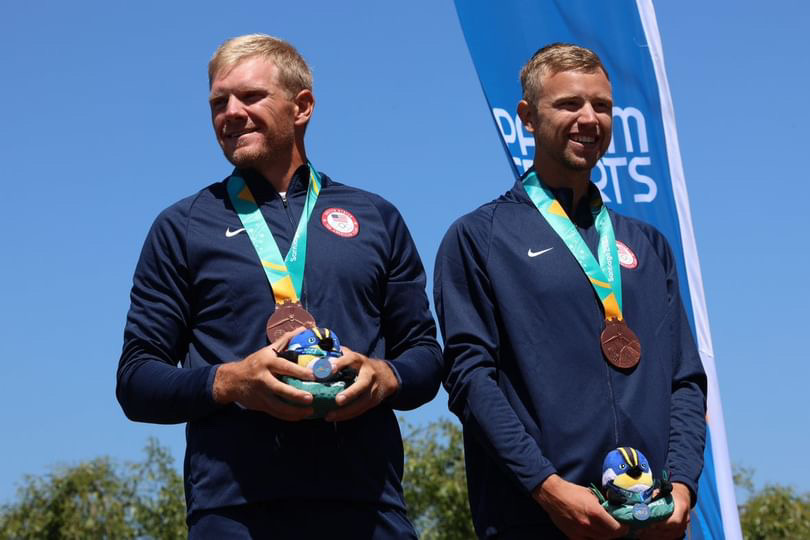
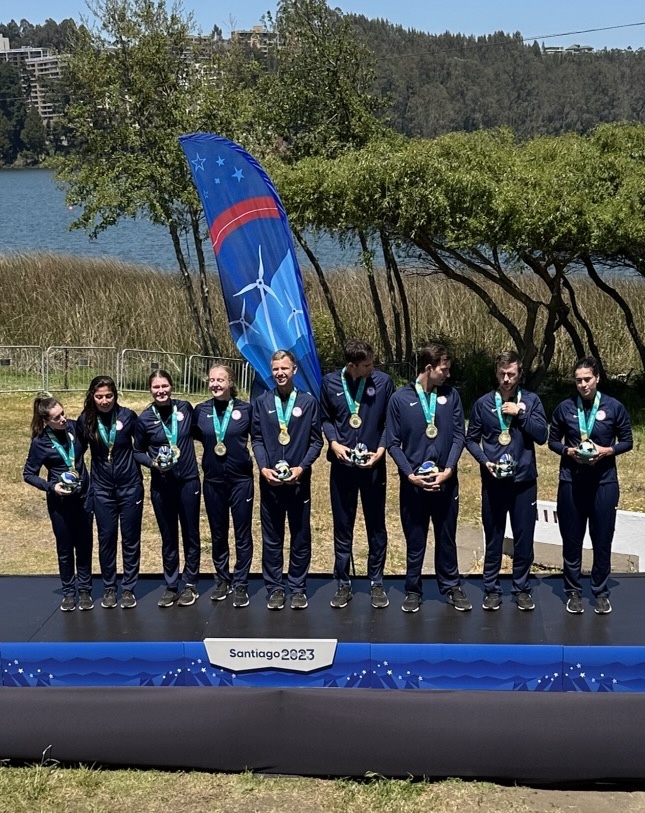
His determination, combined with endless hours of training in the water, culminated in Couwenhoven winning a gold medal in the mixed eight rowing event and a bronze medal in the men’s double sculls event at the 2023 Pan American Games, held in Santiago, Chile.
Although Couwenhoven’s team were successful in securing a gold medal, the team came into the games without having practiced together as a unit due to their individual homebases. The team’s first official practice occurred as soon as they all landed in Chile.
“We got off to a shaky start in our first heat [in the mixed eight event] and we lost to the Chile team by hundredths of a second,” said Couwenhoven. The team then moved on to the repechage heat, in which first-round losers are given another chance to qualify for the semifinals.
“We found an extra gear during our repechage and we won by a lot. Going into the final, we all felt confident that we were going to accomplish something great.”
Couwenhoven’s victories contributed to the team’s 10 total medals, the U.S. team’s best rowing performance at the Pan American Games since 1999.
Couwenhoven (right) and partner receiving the bronze medal for the men’s double sculls event at the 2023 Pan American Games. Couwenhoven (fifth from left) and his team with their gold medals after winning the mixed eight rowing event at the 2023 Pan American Games. (Photos courtesy of Couwenhoven)
Life Beyond the Oars
While his ascension in rowing continued during his time at UMBC, Couwenhoven remained dedicated to his academic career and credits much of his success in balancing his life as a student-athlete to his advisor Esther Fleischmann, senior lecturer in biology.
“Fleischmann was absolutely invaluable. Her advising really helped me build that balance that I needed to focus on my academic and athletic goals. She was very supportive,” says Couwenhoven.
As a biology student, Couwenhoven developed an interest in dentistry, and says that his UMBC instructors helped “prepared me well for the rigors of studying and being prepared for a career in dentistry.”
Since graduating, Couwenhoven has relocated to Philadelphia where he currently shadows the oral and maxillofacial surgery team at the Children’s Hospital of Philadelphia (CHOP). He also volunteers at CHOP as a nursing companion for children undergoing treatment. Couwenhoven’s mother, who has now been in remission for five years, inspired his motivation to volunteer as a nursing companion, he said.
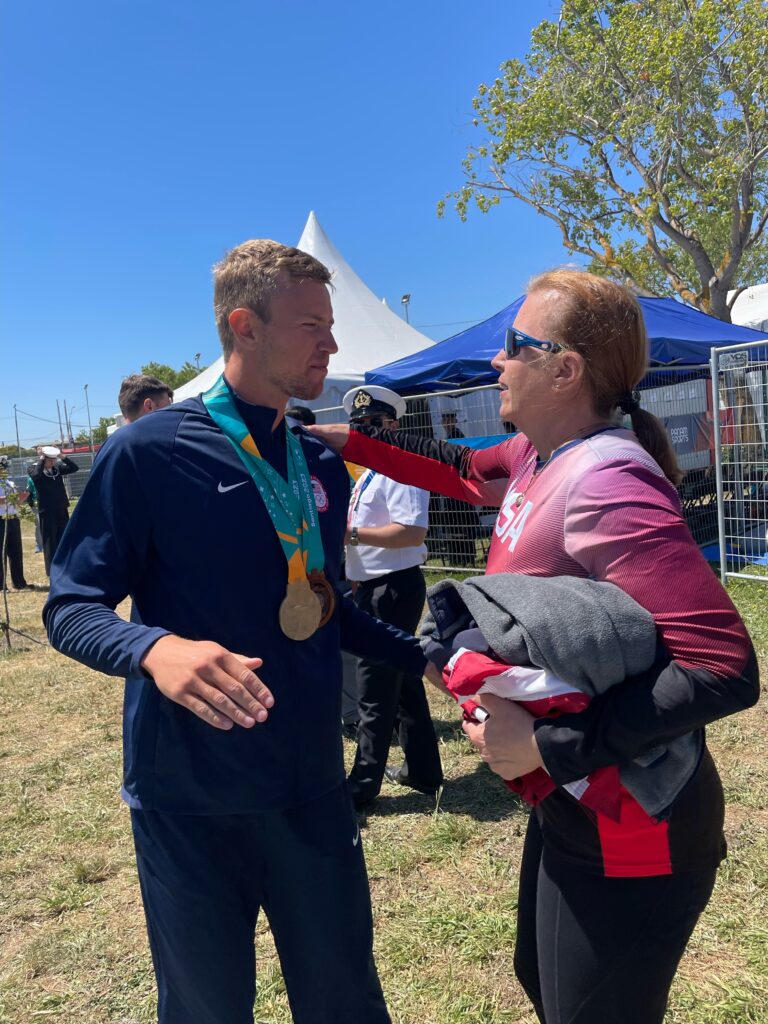
Couwenhoven and his mother after the medal ceremonies at the 2023 Pan American Games. (Photo courtesy of Couwenhoven)
“It’s especially difficult to be in the hospital when you don’t have loved ones with you. At CHOP, kids will sometimes have parents that are away because of work or remote-living situations,” says Couwenhoven. “I think of how important it is to be that person that’s there to help them smile—giving patients a positive distraction can turn their day around.”
For now, Couwenhoven is dedicating more of his time to advancing his career interests, however he hasn’t lost focus of his passion for being out on the water, even if it means waking up at 4:30 a.m. on most mornings to train.
“Waking up early in the morning and getting to the boat house, seeing the rays of light as the sun rises makes it all worth it,” he says. “When I’m in the water, it’s about getting that really good stroke and I’m reminded all over again that I’m doing something that I really love. I’m looking forward to continuing rowing competitively and pursuing my goal of rowing at the highest level internationally.”
UMBC’s graduating Class of 2024 knows a thing or two about resilience. Many of this year’s 1,900-plus graduates began their collegiate journey at the onset of a global pandemic.
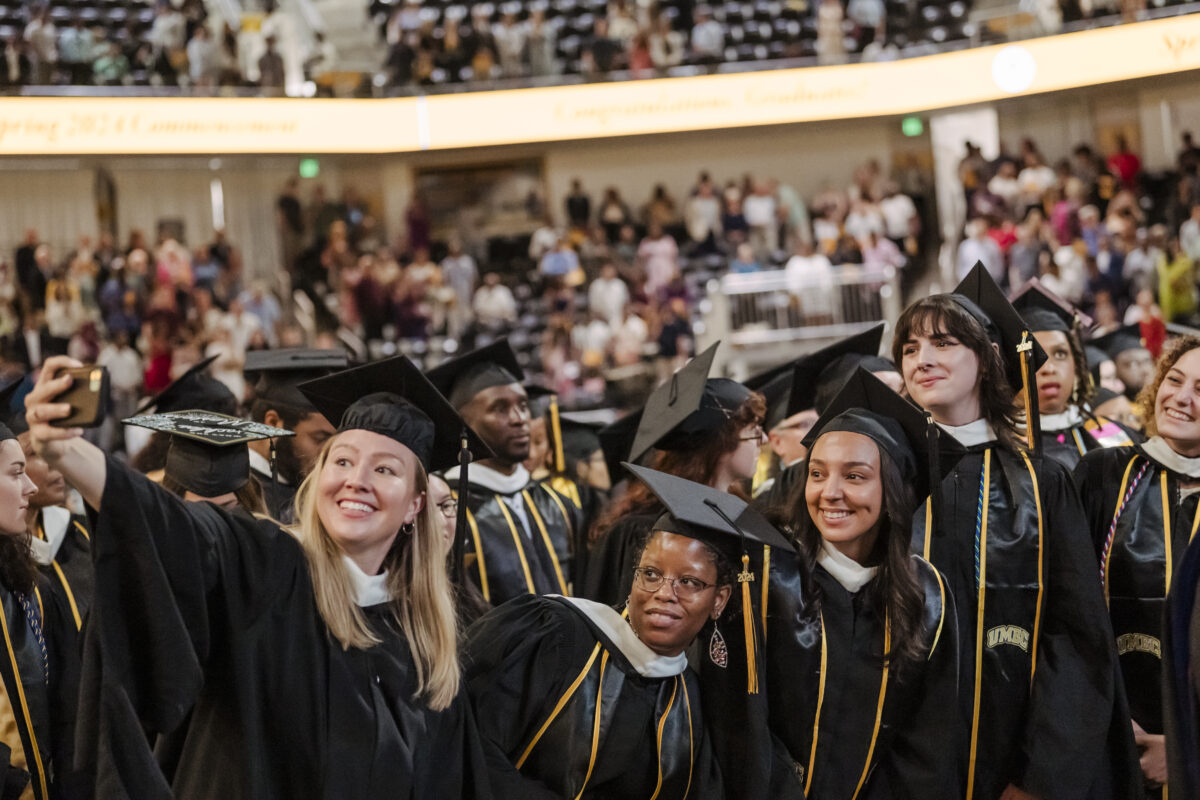
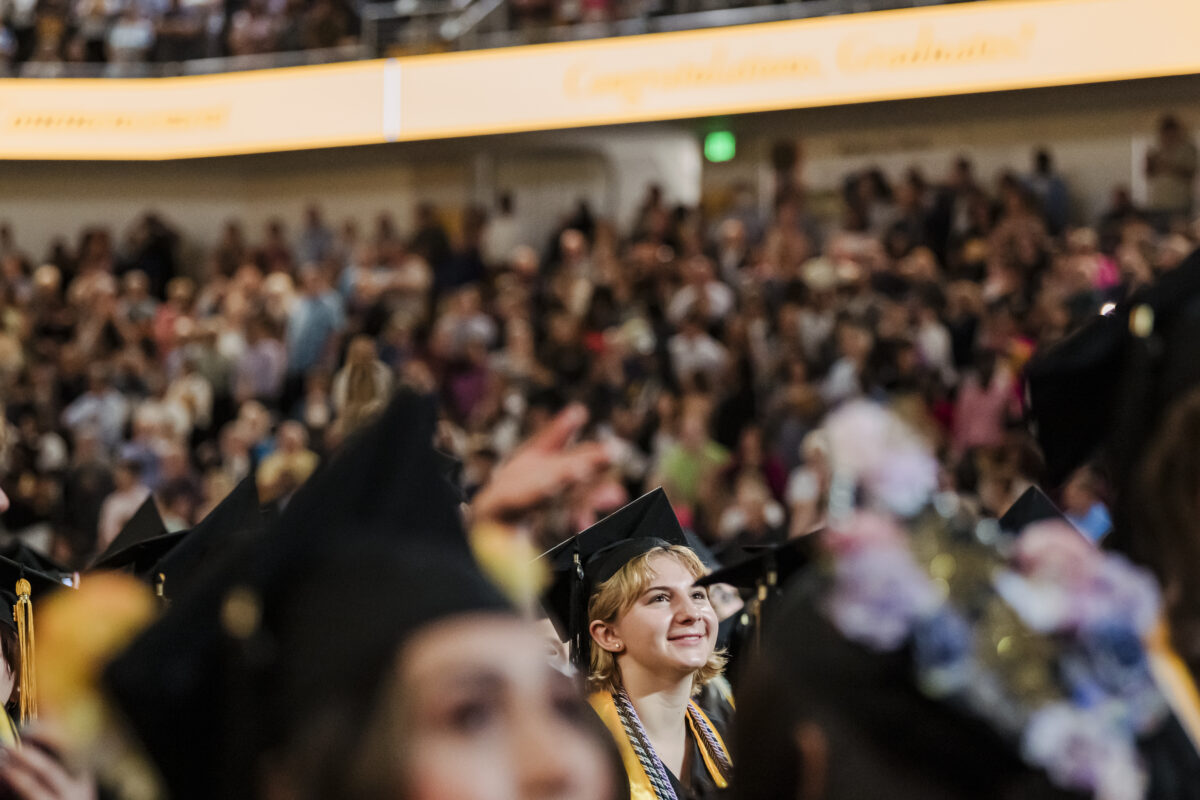
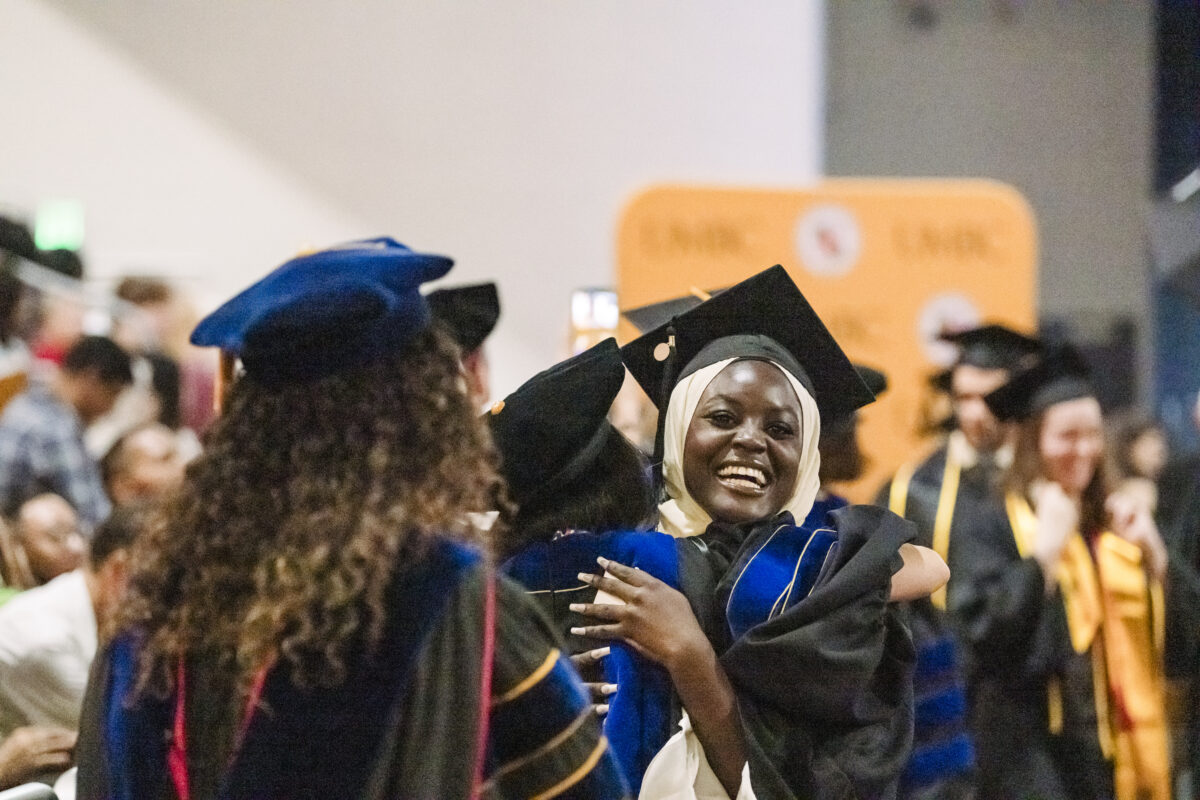
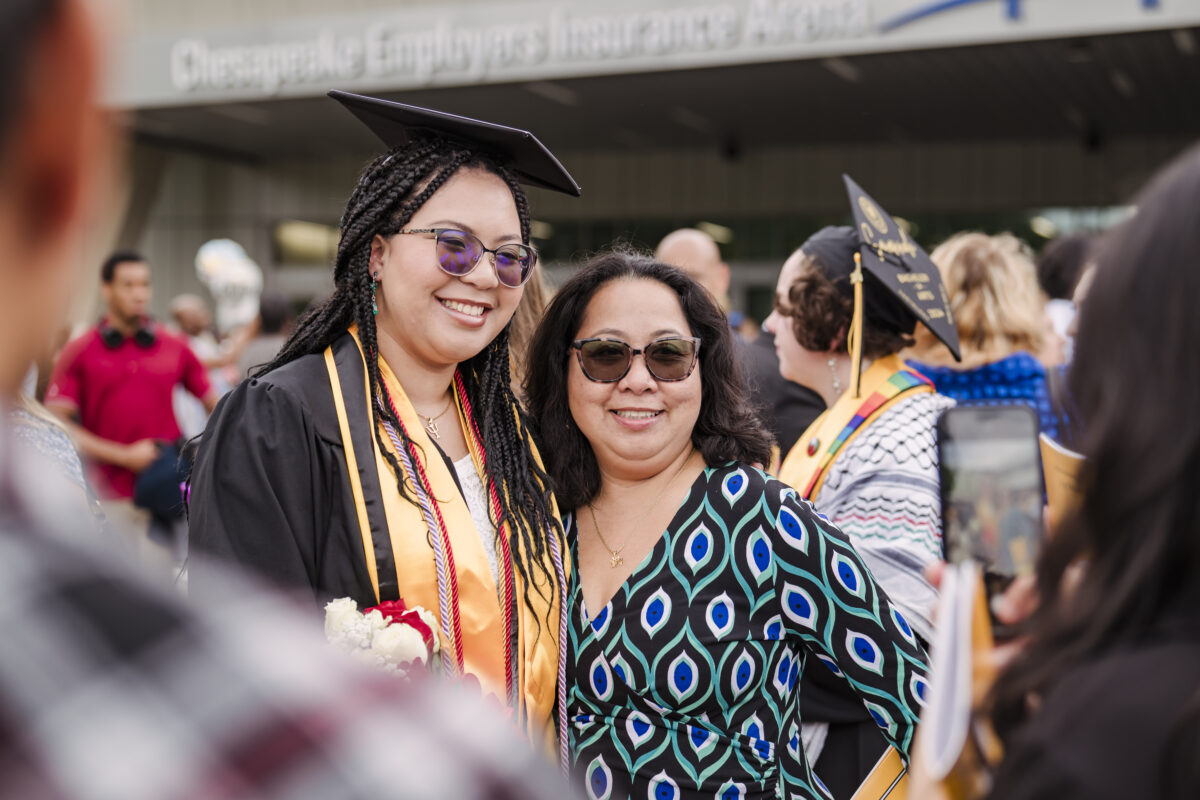
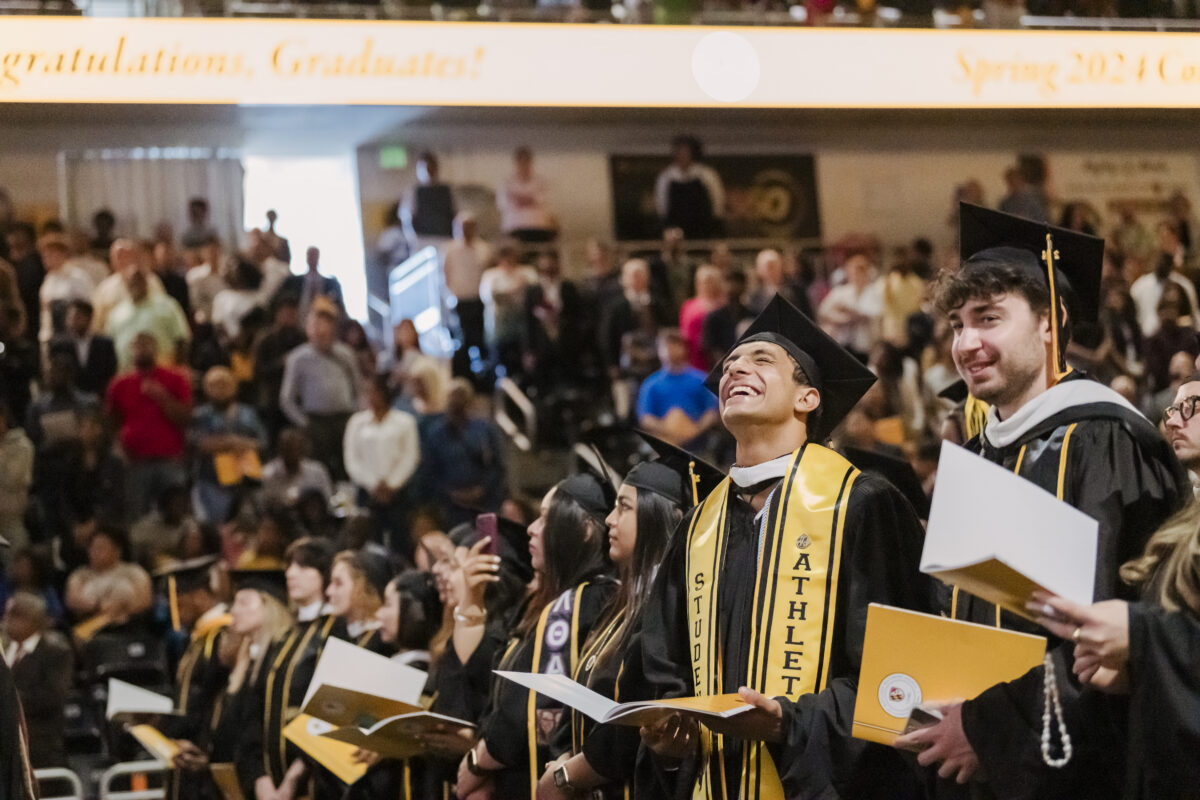
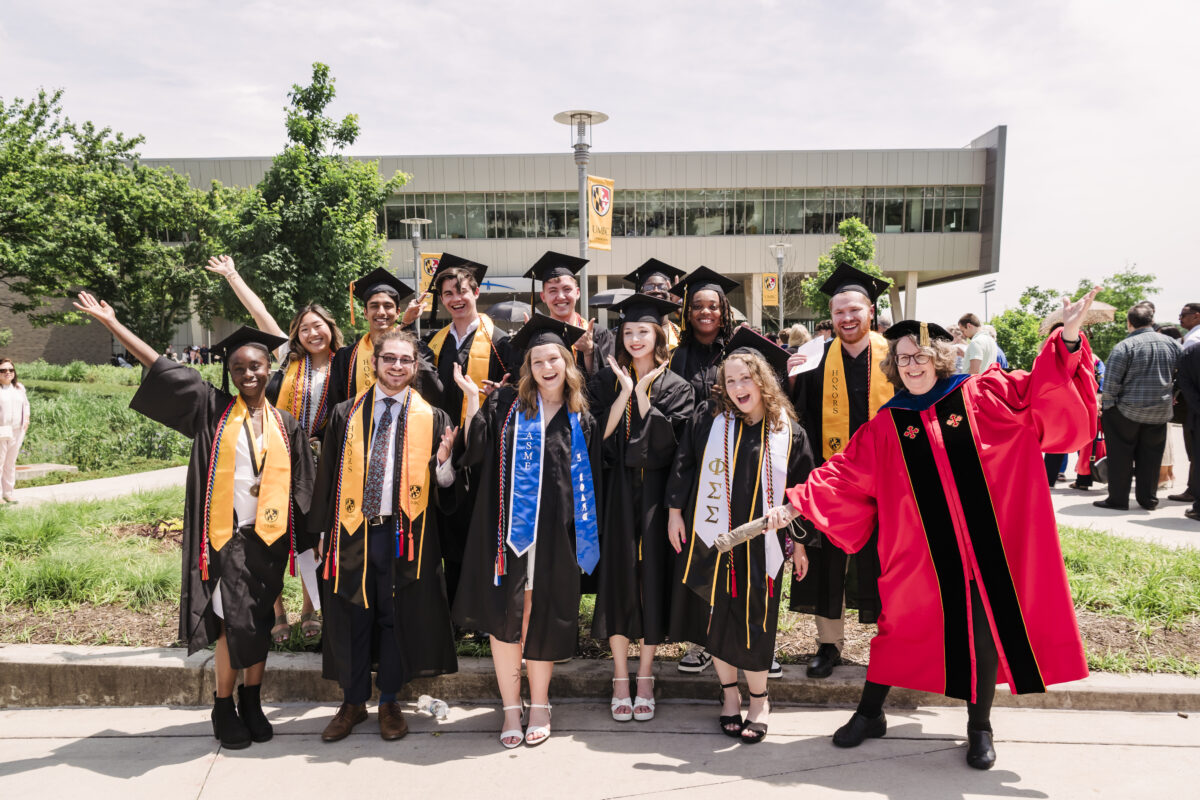
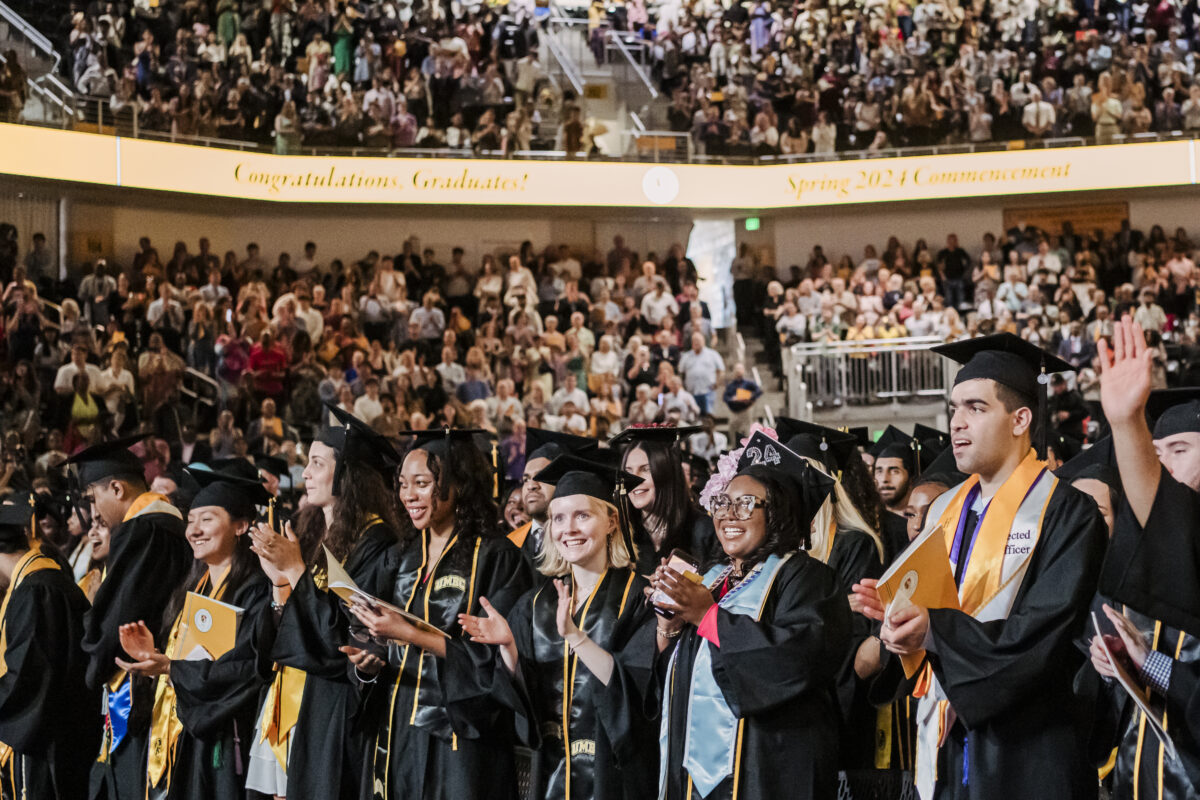
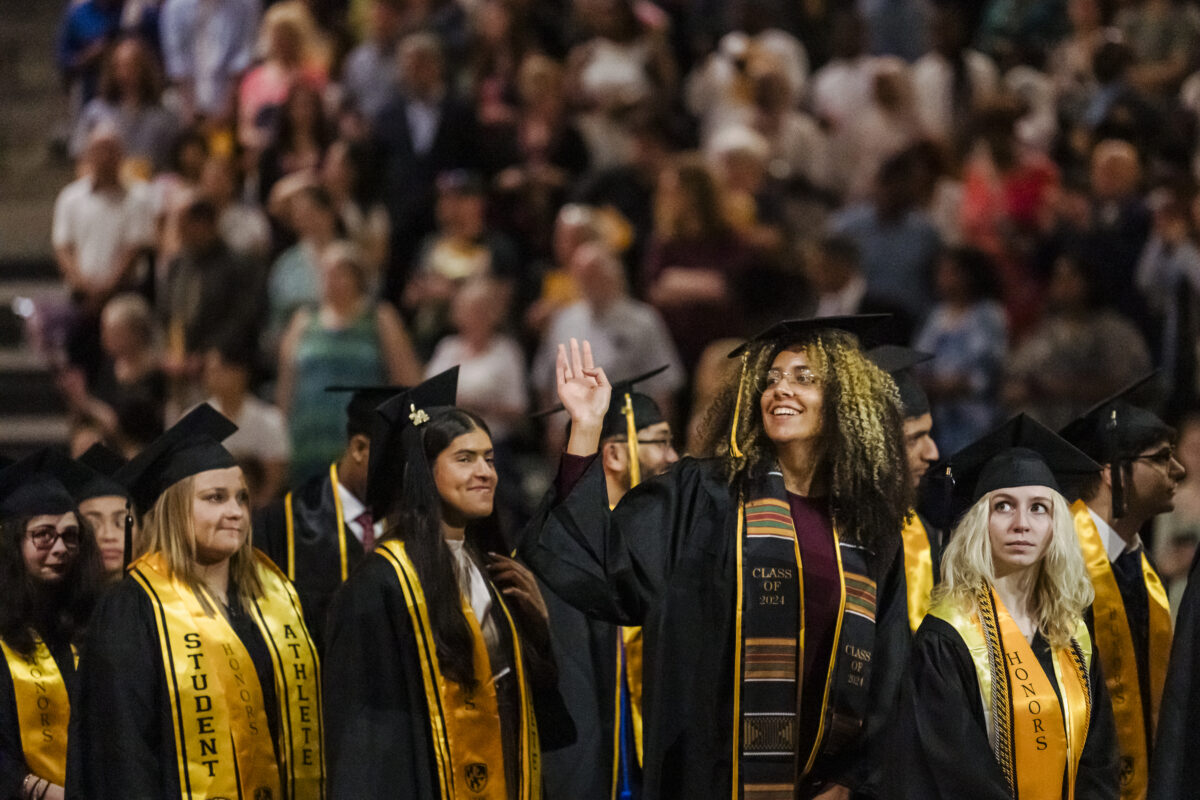
This week, as they walked across the Commencement stage adorned in black and gold regalia and mortarboards elaborately decorated with sayings such as “The tassel was worth the hassle,” “I did it,” and “The end is here,” the Class of 2024 reveled in the celebratory moment of reaching this milestone in the face of much adversity.
Class of 2024 graduates capturing Commencement day excitement.
“Resilience is a dynamic process. It’s a journey that we embark on in the face of challenges. Resilience is not just bouncing back or being able to recover—It’s the ability to bounce forward,” said graduate student speaker Grace De Oro, M.P.P. ’19, a Ph.D. candidate in public policy and president of the Graduate Student Association.
“We’ve all bounced forward to get here, right now, in this moment. This journey of resilience has not only brought us here, but it’s transformed us into stronger and more capable individuals.”
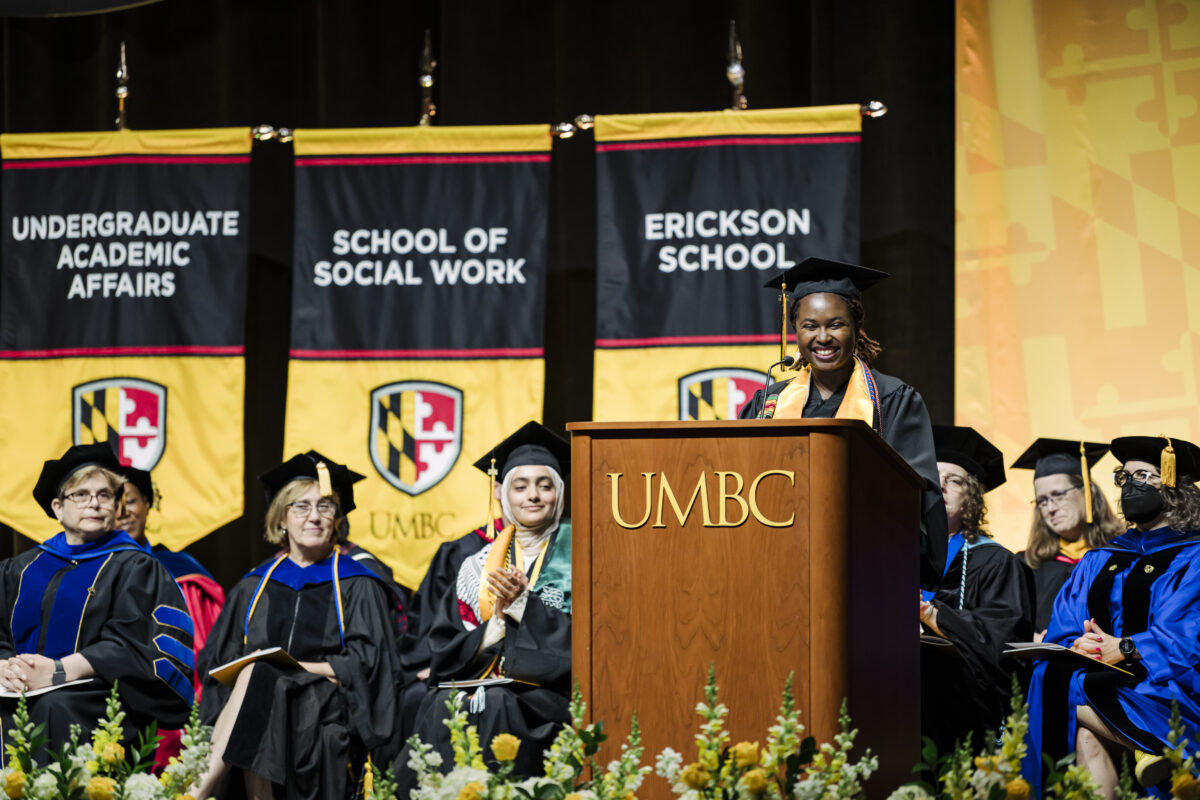
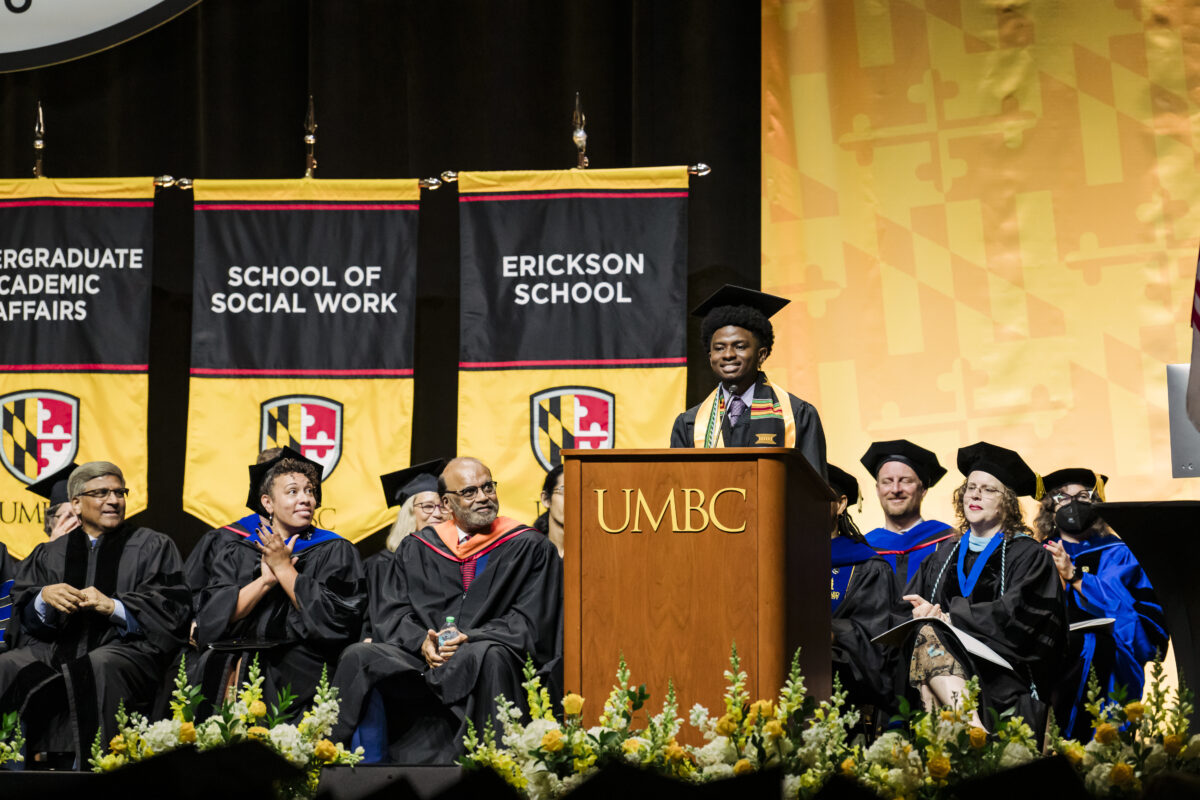
During Thursday morning’s undergraduate ceremony for students in the College of Arts, Humanities, and Social Sciences; School of Social Work; and Erickson School of Aging Studies, co-valedictorian Nyla Howell ’24, geography and environmental systems and sociology, spoke to the value of service and how the graduating class will “serve with more than our degrees.”
Valedictorian for the College of Arts, Humanities, and Social Sciences; School of Social Work; and Erickson School of Aging Studies morning ceremony, Nyla Howell ’24, speaks at Commencement.
“We all serve those around us daily by using our time and talent to encourage each other, give advice to each other, and take care of one another,” Howell said. “I believe that if we approach this next phase of life, despite all its uncertainty, with the intention of genuinely caring for others and living out our personal understandings of service, we will have the launch pads we need to do more than we ever believed we could.”
Howell, who is the first McNair Scholar to be a valedictorian at UMBC, has dedicated much of her time as an undergraduate in service to local communities and engaged in research examining how vulnerable and underrepresented communities can be better protected when disasters strike. Since 2021, Howell has worked as the food pantry manager of Retriever Essentials helping to combat food insecurity at UMBC. Howell’s leadership and public service efforts earned her scholarships from the France and Merrick Scholars Endowment and the Jacqueline C. Hrabowski Endowment.
She will continue her studies in geography as a Ph.D. student at Rutgers University as a fellow of the National Science Foundation’s Graduate Research Fellowship Program.
A dedication to STEM and the arts
During the afternoon ceremony for the College of Natural and Mathematical Sciences; College of Engineering and Information Technology; and Division of Undergraduate Academic Affairs, co-valedictorian D’Juan Moreland ’24, biological sciences and music, shared with his fellow graduates the lessons he has learned, particularly ones imparted to him by his mother.
— Jamie Gurganus, PhD (@JamieRGurganus) May 23, 2024
“The first [lesson] is to celebrate yourself even in the little victories. The secondis to recognize who supported you. The lastis to set a good example because other people are watching your every move,” said Moreland. “Part of our achievement today is to set a strong example for those who are watching us right now. They don’t just see our success, but also our perseverance, as encouragement and inspiration for themselves.”
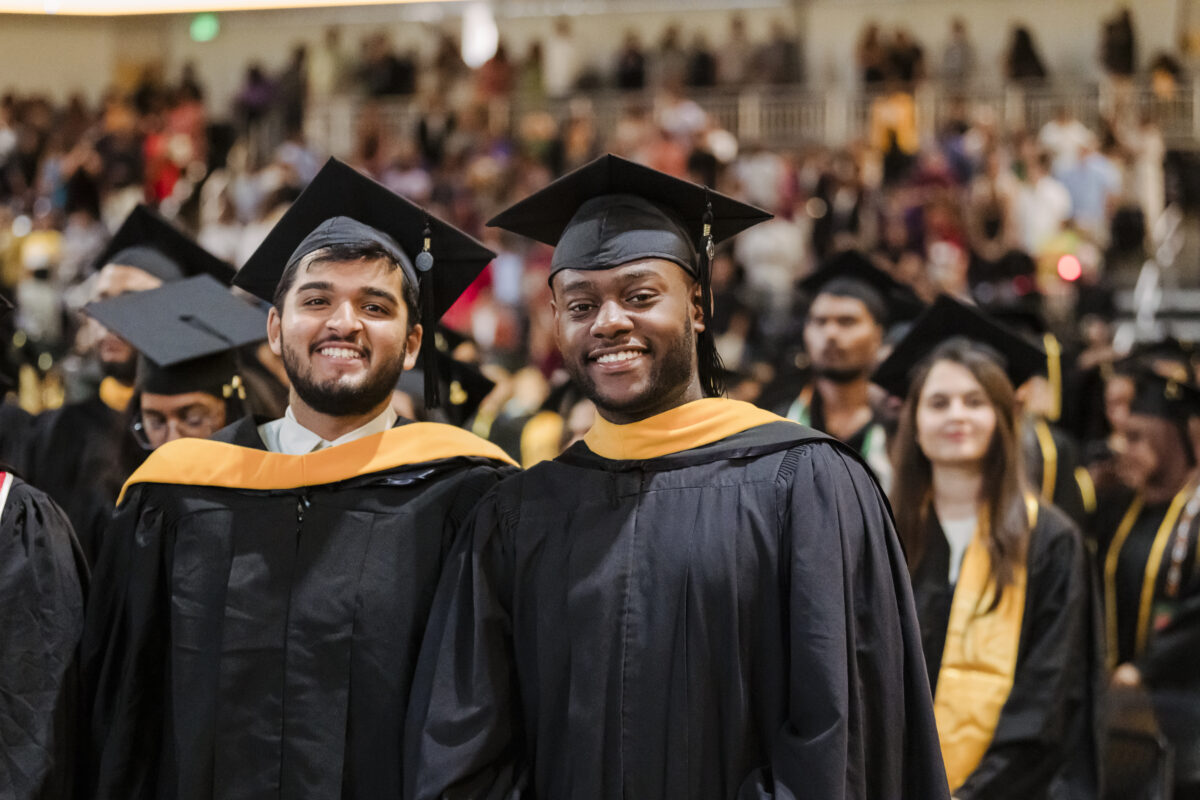
UMBC Class of 2024 graduates all smiles during Commencement.
During his time at UMBC, Moreland, a Meyherhoff Scholar, balanced and even found a way to intertwine his interests in biological sciences and music. He was a 2022 – 2023 recipient of a prestigious Goldwater Scholarship, for which he used his research on the song syllable use differences in female and male songbirds as the basis of his application. Moreland’s original composition “Ascension” won the inaugural UMBC Symphony Orchestra Composer Competition last year.
Valedictorian of the College of Natural and Mathematical Sciences; College of Engineering and Information Technology; and Division of Undergraduate Academic Affairs afternoon ceremony co-valedictorian, D’Juan Moreland ’24, addressing the audience during Commencement.
Additionally, he is a recipient of the Thomas V. Marsho and Martin Schwartz Memorial Fund scholarship and a recipient of the Ronald and Kathryn Shapiro Meyerhoff Mentoring scholarship. Moreland has dedicated much of his time to mentoring younger students, a passion that inspired him to create a mentoring program at his church for young Black men in middle and high school. Following graduation, Moreland will pursue a Ph.D. in neuroscience at the University of Pennsylvania.
“The DNA of UMBC”
The lineup of this year’s Commencement speakers included Mina Cheon, M.F.A. ’02, imaging and digital arts, the dean of undergraduate studies at the Maryland Institute College of Art and a 2018 UMBC Alumni Award winner. Farah Helal ’24, political science and global studies, also delivered remarks as the University System of Maryland student regent representative.
Sethuraman Panchanathan, director of the National Science Foundation, received an honorary doctor of science degree during the afternoon ceremony. He dazzled the crowd with an energetic speech advising new graduates to follow “the 10 C’s”—words like “commitment,” “courage,” “collaboration,” and “curiosity”—as they go on to the next chapter of their lives.
After grad, Chiad Onyeje, chem eng, will go to Johns Hopkins via the new Vivien Thomas Scholars Initiative program. His research will concentrate on the development of drug delivery biomaterials to open up new opportunities for disease & trauma treatment & prevention. #UMBCgradpic.twitter.com/pVZ10ieEVs
“Retrievers, you have the DNA of UMBC,” Panchanathan said to the graduates. “That DNA is about lifting people up…and making sure people are given chances, making things accessible, and inspiring people.”
Congratulations to the Class of 2024! Please continue to share your messages of congratulations on social media using #UMBCgrad. Read more about Class of 2024 graduates on the UMBC News Site.
For the fifth consecutive year, multiple UMBC students have been awarded a Barry Goldwater Scholarship. Gabriel Otubu ’25, biochemistry, Nathaniel Glover ’25, chemical engineering, and Samuel Barnett ’25, biochemistry, were recently named among the 2024 Goldwater Scholars recipients, joining UMBC’s growing list of students to receive this prestigious research scholarship. Since 2005, 31 UMBC students have been awarded a Goldwater Scholarship.
The goal of the Barry Goldwater Scholarship and Excellence in Education Foundation includes ensuring that the “U.S. is producing the number of highly-qualified professionals the nation needs” in the natural sciences, mathematics, and engineering. Otubu, Barnett, and Glover are among the 438 recipients of this year’s scholarship, the largest number of scholars ever supported in a single year in the program’s history.
“UMBC’s continued success with the recent Goldwater recipients is a direct result of the strong faculty mentoring that our students receive,” says April Householder ’95, visual and performing arts, UMBC’s director of undergraduate research and prestigious scholarships. “This is also a reflection of the incredible support programs and staff that UMBC makes available to students, helping them go the extra mile.”
Supported by multiple scholars programs
Gabriel Otubu.
As an undergraduate research fellow in biology professor Rachel Brewster’s lab, Gabriel Otubu is investigating the role of the Ndrg1b gene in neurulation—the process of forming a neural tube that takes a hollow shape that differentiates into the brain and spinal cord—and how it affects other genes. This research, Otubu says, is aiming to understand the genetic risk factors associated with specific congenital disorders, such as spina bifida, with a goal of finding treatment options for these disorders.
Otubu, a Meyerhoff Scholar who plans on pursuing an M.D./Ph.D., shares that with Brewster’s guidance, “I learned that the M.D./Ph.D [route] was possible for me, as well as the possibility of being able to have a commitment to helping people in the clinic and also doing research to support that.” He is also an Undergraduate Research Training Initiative for Student Enhancement (U-RISE) Scholar, an experience he says inspired him to pursue a career in research because he was able to be supported by like-minded people.
“One of the most important things about getting the Goldwater Scholarship is the motivation it gives me to be the best researcher I can be,” says Otubu. “It’s great to get that recognition that I’m really committed to research and using my platform to help other people from diverse backgrounds become interested in research.”
Nathaniel Glover, a fellow Meyerhoff Scholar, says that receiving the Goldwater scholarship will “open up a lot of opportunities for me to be a competitive grad school applicant.” His Goldwater proposal included the research he worked on to develop a dual-phase steel that can combat hydrogen embrittlement, the mechanical damage of metal due to the penetration of hydrogen, which causes a reduction in ductility.
Glover worked in the lab of C. Cem Taşan, associate professor of metallurgy at the Massachusetts Institute of Technology (MIT), as an MIT Summer Research Program participant in 2023.
The program, he shares, “was very helpful in teaching me how to write about my research, which was extremely beneficial in the Goldwater application process. Taşan and my research mentor, Dr. Kyung-Shik Kim, were instrumental in developing my research in this project, introducing me to the science behind it, and working with me throughout my work in the project. I learned how to write and portray my research in a way that’s well communicated, interesting, and educational.”
Nathaniel Glover.
Developing into a researcher
Samuel Barnett’s journey in becoming a Goldwater Scholar began during his time as a student at Howard Community College (HCC). Barnett, who transferred to UMBC last fall, was able to take advantage of the updated eligibility requirements for prospective scholarship applicants. The 2024 application cycle amended its eligibility criteria allowing transfer students to be nominated by the school they are currently enrolled in or by the school they matriculated from. With the help of the HCC research department and Householder, Barnett was nominated by HCC to receive the scholarship.
With this recent change, Householder shares that “cross-institutional collaborations like these are opening new pathways between UMBC and its transfer institutions [while] providing an additional layer of support to transfer students who come to UMBC with a strong research background, like Sam.”
April Householder and Samuel Barnett.
Barnett worked with his mentor Joseph Sparenberg, professor of chemistry at HCC, on a project that uses a species of yeast, Saccharomyces cerevisiae, to model a type of cancer in humans that occurs from mutations in the KRAS gene. The model, which is still in the proof of concept stage, visualizes a live cell to see pathways and tumor growth in real-time.
Barnett nearly called it quits with his academic journey upon enrolling at HCC, saying that he “had no motivation to continue on with my education.” After participating in HCC’s research program, Barnett found a renewed sense of purpose and took his research interests to the next level.
Before transferring to UMBC, Barnett took part in the BUILD a Bridge to STEM internship program, a component of STEM BUILD at UMBC, which he says was vital for “my development in this Goldwater process.” During the internship, Barnett worked with Maria CambraiaGuimaro, assistant director of research and international affairs in the College of Natural and Mathematical Sciences, who he says played a significant role in his research journey at UMBC.
“It was extremely empowering to know that as a community college student, I could experience research there and also win a prestigious award for it,” adds Barnett. “I now have a collection of wonderful mentors throughout my research journey that’s helped to shape who I am today.”