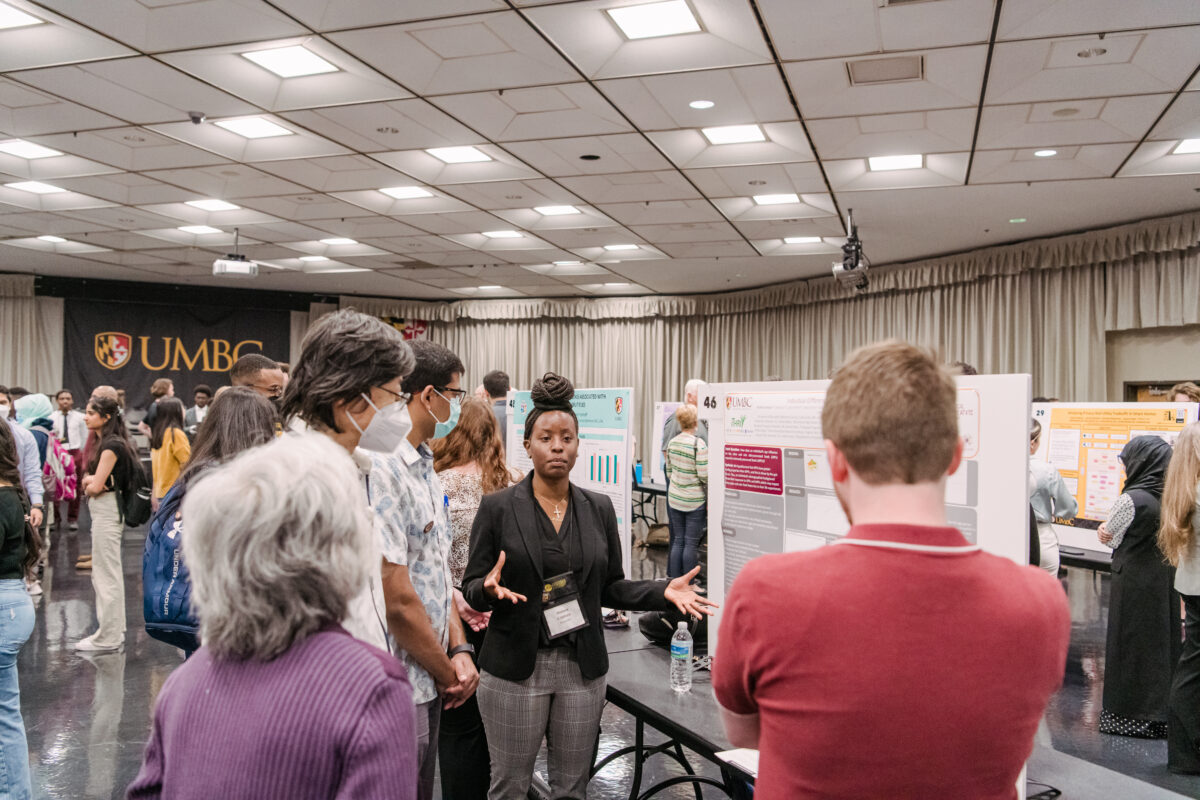
UMBC’s Undergraduate Research and Creative Achievement Day (URCAD) returned earlier this month for its 28th year, bringing together more than 400 student presenters and the broader university community for a day filled with posters, performances, demonstrations, and much more.
With excitement and energy in the air of the University Center, undergraduate students—many accompanied by faculty mentors—presented a broad range of research and creative projects to peers, family, friends, and inquiring minds of all kinds. The day included a film festival, interactive video game demonstrations, musical performances, a photography and painting exhibition, as well as poster board and oral presentations from students across colleges.
“This showcase event not only exemplifies UMBC’s commitment to our students from all disciplines, but defines our commitment by providing them the opportunity to engage in mentored projects, and, through creative thought and focused inquiry, to discover in themselves their passion,” said Katherine Cole, dean and vice provost of undergraduate academic affairs.
Among this year’s group of presenters was Chiad Onyeje ’24, chemical engineering, who explained the research he’s worked on for nearly three years to develop “spherical shells that we can use as internal Band-Aids” he said in this URCAD 2024 recap video.
“URCAD is different from any other presentations that I’ve been able to give on my research thus far. It really felt like a celebration in comparison,” said Onyeje. “I could go in, have a good time, talk about my research to interested parties, and share why I love this project so much—because it can help people.”
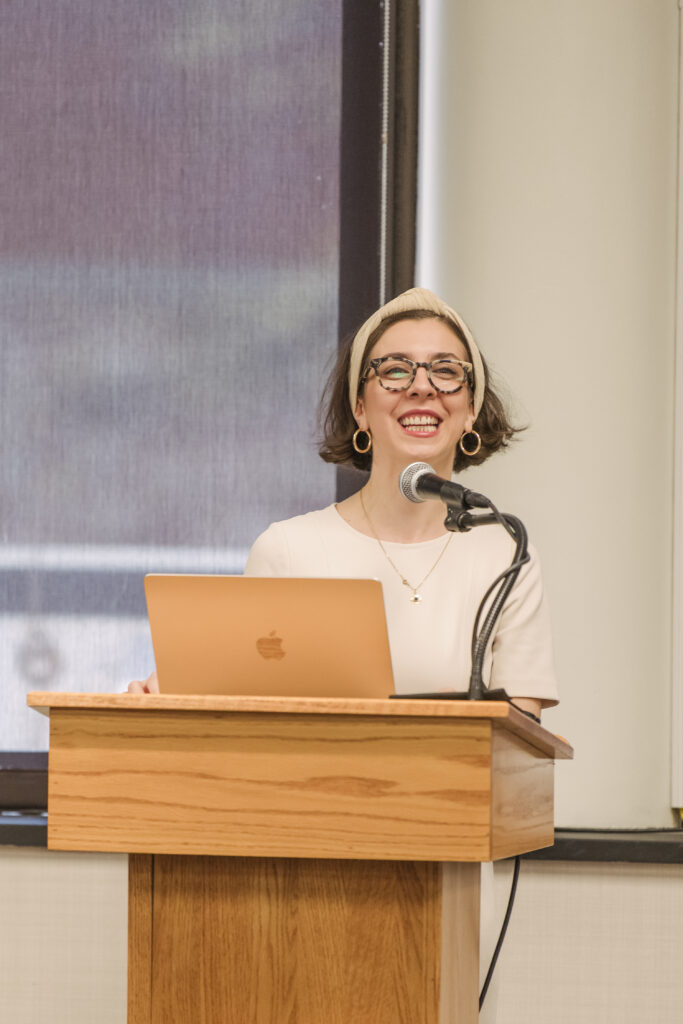
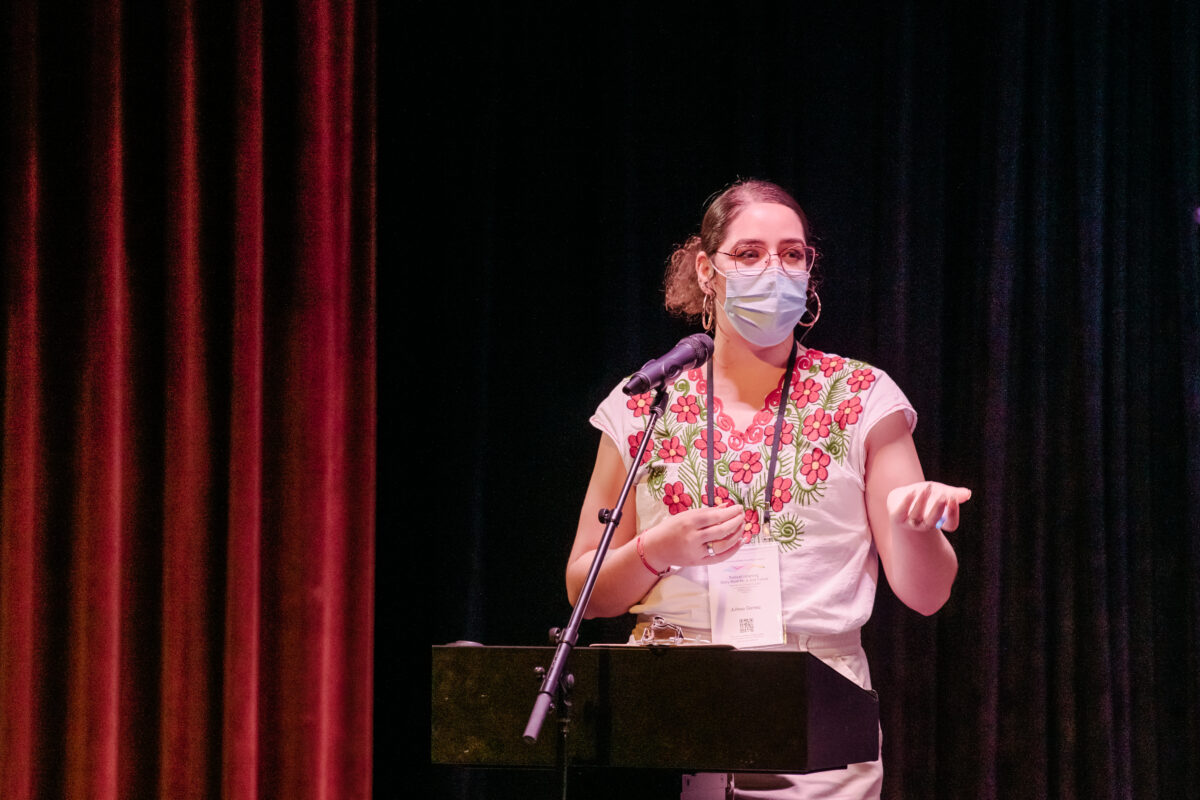
UMBC’s 2024 Undergraduate Research and Creative Achievement Day (URCAD). (Elijah Davis, M.F.A. ’21/UMBC)Stefanie Mavronis delivering the URCAD 2024 keynote speech.
From URCAD to the Mayor’s Office
Stefanie Mavronis’12, political science, media and communication studies, delivered this year’s URCAD keynote speech. Just over a decade ago, Mavronis, who is the director of the Mayor’s Office of Safety and Engagement (MONSE) in Baltimore City, was once a student presenter at URCAD where she premiered her short documentary titled, “Reclamation and Resistance: Audiovisual Tools in Bolivia.”
“The documentary captured the experiences of indigenous Bolivians who were using art and media technologies to challenge and transform the legacy of hundreds of years of colonization in Bolivia. I learned about decolonization, self determination, reciprocity, and representation,” Mavronis shared with the audience.
Mavronis, a UMBC Sondheim Public Affairs Scholar alumna, spoke of her journey to finding her passion for public service and how it led to her positions within Baltimore Mayor Brandon Scott’s election campaign and then office. Her work in MONSE has resulted in the office’s implementation of Baltimore’s Comprehensive Violence Prevention Plan—the city’s first ever comprehensive, 5-year public safety strategy.
“When I think back to it, it was UMBC that was the first to help me see myself as a creative practitioner. It’s the place that prepared me to confront the challenges and harsh realities of the world head on and to do so while embracing clear values,” says Mavronis. “It was through my time at UMBC that I uncovered my commitment to Baltimore…through the opportunities that the institution afforded me to see the world outside of the city.”
“Supporting our students’ applied learning experiences is central to our mission at UMBC,” added Cole, “as it develops creative thinking skills, the ability to communicate effectively, analyze information, share stories, and connect with people from diverse cultures, disciplines, and ideologies. These are the skills our students will take forward as leaders of the future.”
For more on UMBC’s undergraduate research and creative work, check out the 2024 UMBC Review, the journal of undergraduate research, volume 25. Free copies of the current issue are available for pick up at the Office of Undergraduate Research and Prestigious Scholarships, located in the Albin O. Kuhn Library and Gallery.
The University of Maryland Baltimore County (UMBC), along with several institutional partners, has been selected to develop one of the first three lunar instruments chosen for implementation and deployment as part of NASA’s forthcoming Artemis III mission, humanity’s first return to the lunar surface in more than 50 years.
The Lunar Environment Monitoring Station (LEMS), led by planetary scientist Mehdi Benna of UMBC’s Center for Space Sciences Technology (CSST), was selected as one of the first three candidate payloads to be a part of Artemis III, NASA’s mission that will send astronauts to explore the region near the lunar South Pole. Artemis III, currently planned to launch in 2026, will be the first time humans will return to the Moon’s surface since the historic Apollo program in 1969-1972.
LEMS is a compact, autonomous seismometer designed to carry out continuous, long-term monitoring of seismic activity, namely ground motion from moonquakes, in the lunar south polar region, according to NASA’s recent announcement of the selected Artemis III instruments. During the Artemis III mission, LEMS will accompany the Lunar Effects on Agricultural Flora instrument, led by researchers at Space Lab Technologies in Boulder, Colorado, and the Lunar Dielectric Analyzer instrument, led by researchers at the University of Tokyo and supported by the Japan Aerospace Exploration Agency.
The LEMS project is the culmination of several years of collaboration between UMBC and partnering institutions, of which includes the University of Maryland, College Park (through deputy principal investigator Nicholas Schmerr) and NASA’s Goddard Space Flight Center, which will lead LEMS’ technical implementation process. The University of Arizona will supply LEMS’ two state-of-the-art seismometer sensors; Morehead State University will provide LEMS’ telecommunication system, and Washington University in St. Louis will manage the instrument’s data processing and dissemination to the larger scientific community.
Designed to withstand extreme conditions
Principal Investigator Benna, who operates out of the NASA’s Goddard Space Flight Center with the CSST, began conceptualizing with his team the idea behind the LEMS instrument in 2018 after realizing the need for technology that could withstand the Moon’s harsh conditions in order to measure lunar geophysical activity for a long duration of time.
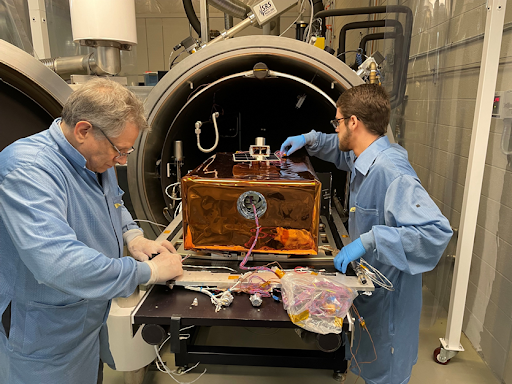
Team members during the final preparation of the Lunar Environment Monitoring Station (LEMS) engineering units for thermal-vacuum testing. During this test the LEMS prototype was subjected to the ultra-high vacuum and harsh thermal conditions that mimic the surface of the Moon to demonstrate the station can sustain itself and operate unassisted for long durations. (Photo Credit: NASA MSFC)
“The lunar environment is one of the harshest environments in the solar system. It’s hard to survive [on] the Moon because it rotates very slowly around itself—daytime on the Moon lasts about 15 Earth days, and night on the Moon lasts 15 Earth days,” says Benna. “Because the Moon doesn’t have an atmosphere, the days are very hot and the nights get really cold.”
Benna’s team began developing his idea of a small, self-sustaining station that operates almost like a buoy in the ocean—what Benna calls a “lunar buoy”—that can survive on the surface through the lunar night and operate during the day for an extended amount of time. In 2018, Benna’s team received funding from NASA’s Development and Advancement of Lunar Instrumentation program for engineering development and risk reduction of the LEMS instrument, which allowed it to reach the required NASA flight readiness level.
“The Apollo 11 of our generation”
LEMS, which is of the size of a standard carry-on airplane suitcase, is intended to operate on the lunar surface from three months up to two years following its deployment. The station’s battery is designed to be charged by its solar panels during the day. The stored power is used to keep the station operational at night. The LEMS instrument would then autonomously beam its data to one of NASA’s Deep Space Network ground stations once a month via its own communication antennas and radio system.
With the data retrieved from LEMS’ two distinct lunar-night-surviving seismometers, scientists will be able to characterize the structure of the local crust and mantle.
“Artemis III is the Apollo 11 of our generation—that’s significant. Landing astronauts on the Moon doesn’t get any easier 50 years later. Being a part of this adventure is extremely exciting,” shares Benna.
UMBC’s Center for Accelerated Real Time Analytics (CARTA) team will advance its work in investigating data analytics using next-generation computing hardware with the launch of the next phase of the multi-institutional research collaboration.
UMBC is partnering with Rutgers University, the University of Miami, and Arizona State University to deploy CARTA Phase II, a five-year initiative that explores data analytics research to develop new accelerated and real-time approaches to address advanced technology integration in industries such as health care, finance, and security.
CARTA initially launched in 2018 with funding provided by the National Science Foundation’s Industry-University Cooperative Research Centers (IUCRC) program to develop next-generation computing hardware to address data-intensive infrastructure challenges. The IUCRC grant has been extended to fund new and existing CARTA sites with an additional $100,000 per year (for the next five years) to build on the centers’ work in data analytics research.
Karuna Joshi.
“CARTA’s focus has been on real-time analytics of large datasets on next generation technologies, or accelerated technologies, like high-performance computing, cloud computing, and quantum computing. This work will continue in Phase II,” says Karuna Joshi, associate professor of information systems and director of UMBC’s CARTA site.
Advancing industry collaborations
Since its launch, UMBC-CARTA faculty and student researchers have conducted more than 40 projects examining data analytics in Blockchain technology, malware analysis, medical data sharing, and evaluating bias in artificial intelligence in medical imaging. UMBC-CARTA collaborator Milton Halem, research professor of computer science and electrical engineering, will continue his work in weather and wildfire prediction research in the next phase of the initiative.
CARTA Phase II projects will largely focus on medical analytics (medical images and dataset sharing) and scientific and environmental datasets that can inform weather and wildfire predictions, Joshi explains, adding that “security is going to be the overlying paradigm across all of those various areas of research.”
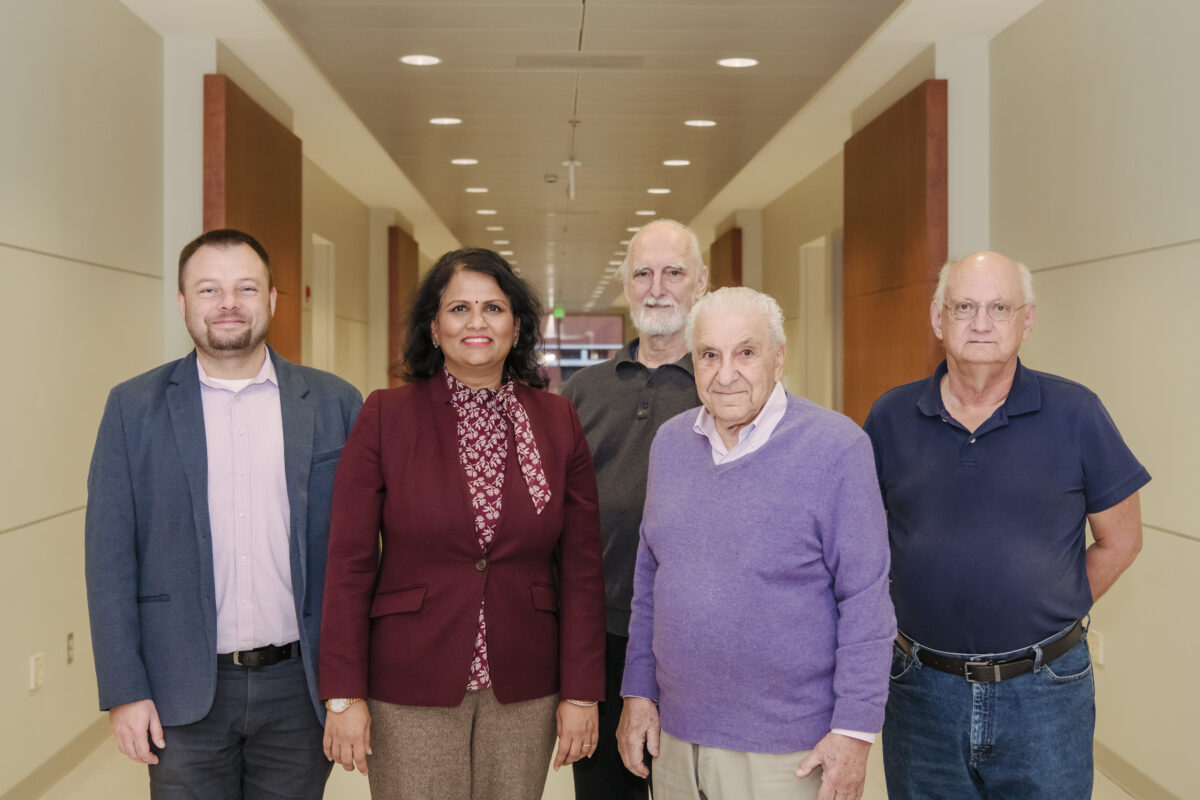
UMBC-CARTA faculty team, from left to right: Michal Mielech, Karuna Joshi, Tim Finin, Milton Halem, and John Dorband.
The CARTA sites are also aiming to expand their number of industry partner collaborations. In CARTA Phase I, UMBC worked with a range of industry partners that included NASA, IBM, the National Security Agency, Laboratory for Physical Sciences, the Department of Homeland Security, Morgan Stanley, RAD-AID, and Carestream.
“In Phase II, we are focusing more on collaborative projects with our university partners and building on those collaborations and making them stronger,” says Joshi. “We’re also looking at new avenues that our industry partners might be interested in such as smart cities, next-generation airports, and how to build secure image analytics and algorithms.”
As Phase II evolves, UMBC-CARTA research will also focus on large language models that are rising in popularity, such as ChatGPT, and digital twinning technologies, which is the process of creating a virtual model of a physical object.
Student collaboration at every level
Undergraduate, graduate, and post-doctoral students will continue to work on research projects at UMBC-CARTA. Since its inception, UMBC-CARTA has supported more than 15 graduate students and has provided opportunities for undergraduate students to strengthen their research skills through the NSF-funded Research Experiences for Undergraduates program.
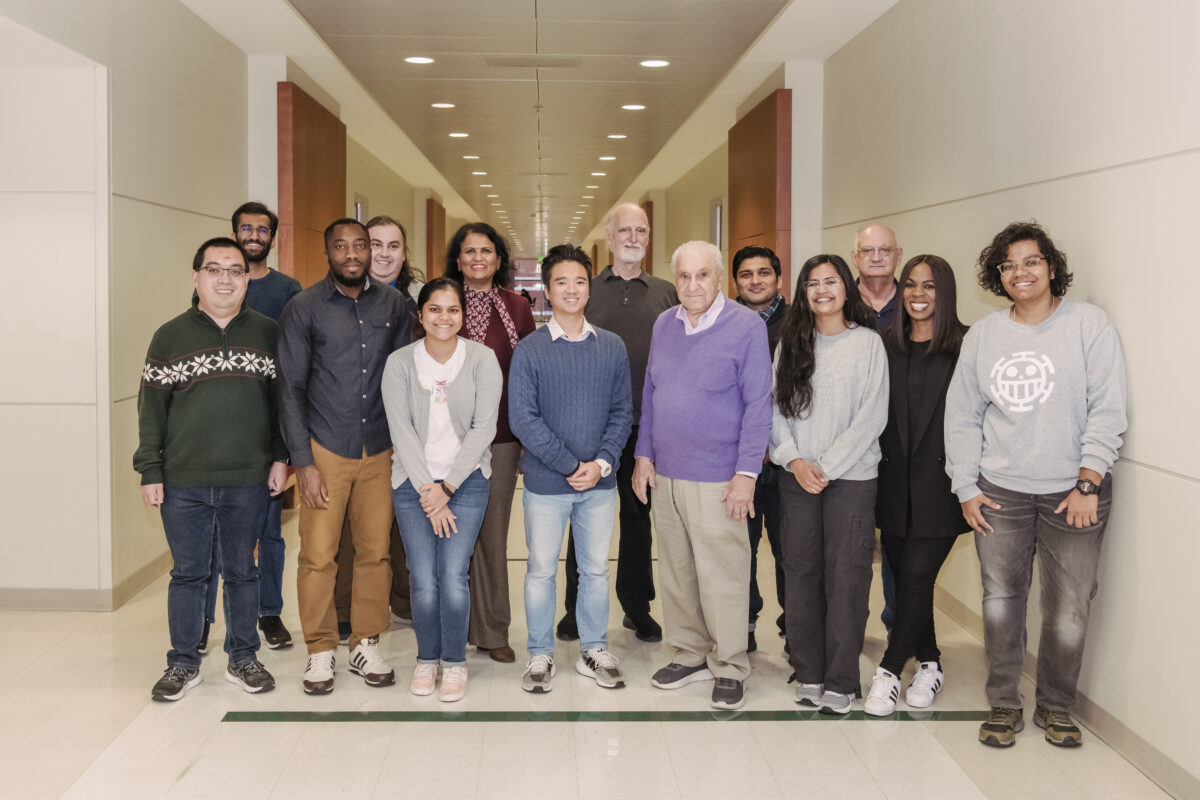
The UMBC-CARTA faculty and student team.
Kelvin Echenim, a second-year information systems Ph.D. student at UMBC, has worked on the CARTA team developing a scoring system to assess the comprehensiveness and user-friendliness of internet of things privacy policies.
“The scoring system aims to improve user comprehension and involvement in privacy matters by finding a balance between strict legal compliance and end-user practical accessibility,” says Echenim.
He adds that current and future research in CARTA Phase II will help expand his knowledge in solving complex problems in data-driven AI systems.
As a student Anna Gifty Opoku-Agyeman took notice of something missing in the field of academic economics—people who looked like her.
Since then, this Forbes 30 under 30 star in Boston has worked to shed light on the harrowing diversity issues in economics while carving out a space for economists of color, specifically Black women, to thrive. But she’s not carrying on this work in a vacuum. Inspired by and connected with other aspiring economists at UMBC through Sloan UMBC, Opoku-Agyeman ’19, mathematics, and others leveraged the resources in that scholars program to uplift underrepresented voices in economics—including their own.
In 2017, UMBC received a $1.3 million grant from the Alfred P. Sloan Foundation in an effort to diversify the field of economics by creating interventions from the undergraduate level through the post-baccalaureate (post-bac) level. The program was originally intended to conclude in five years but has since been extended to support UMBC students in post-bac programs through 2025.
“The Sloan program is a really good signal to the economics space that UMBC is in the business of producing Black economists,” says Opoku-Agyeman. “It also provided me with community among the next generation of Black folks coming up in the economics field.”
Anna Gifty Opoku-Agyeman (right). (Marlayna Demond ’11/UMBC)
Program scholar Yetunde Oshagbemi ’23, mathematics, benefited from the material and financial resources from Sloan, but also credits the personal connections she developed. In 2022, Oshagbemi participated in the Exploring Career Pathways conference organized by The Sadie Collective—a nonprofit co-founded by Opoku-Agyeman that addresses the pipeline and pathway problem for Black women in economics and related fields—and the Federal Reserve Bank of Chicago.
“There are many things I wouldn’t have known without a program like Sloan,” says Oshagbemi, now a first-year research assistant at the Federal Reserve Bank of Chicago. “It introduced me to other students who were on a similar path and people like Anna who can possibly guide me through my research experience.”
Opoku-Agyeman, who is now a third-year Ph.D. student studying public policy and economics at the Harvard Kennedy School, shares the importance of why she stays connected to UMBC and the Sloan program.
“I want to ensure that those who come after me have a much easier time getting through the economics space. Fellow graduates and I have helped to inform how the program can best serve students,” she says.
Developing the Next Generation of Academic Economists
“It’s important to do this work at an early stage—it’s often a path that students haven’t thought about when they enter college,” says David Mitch, principal investigator of the Sloan program.
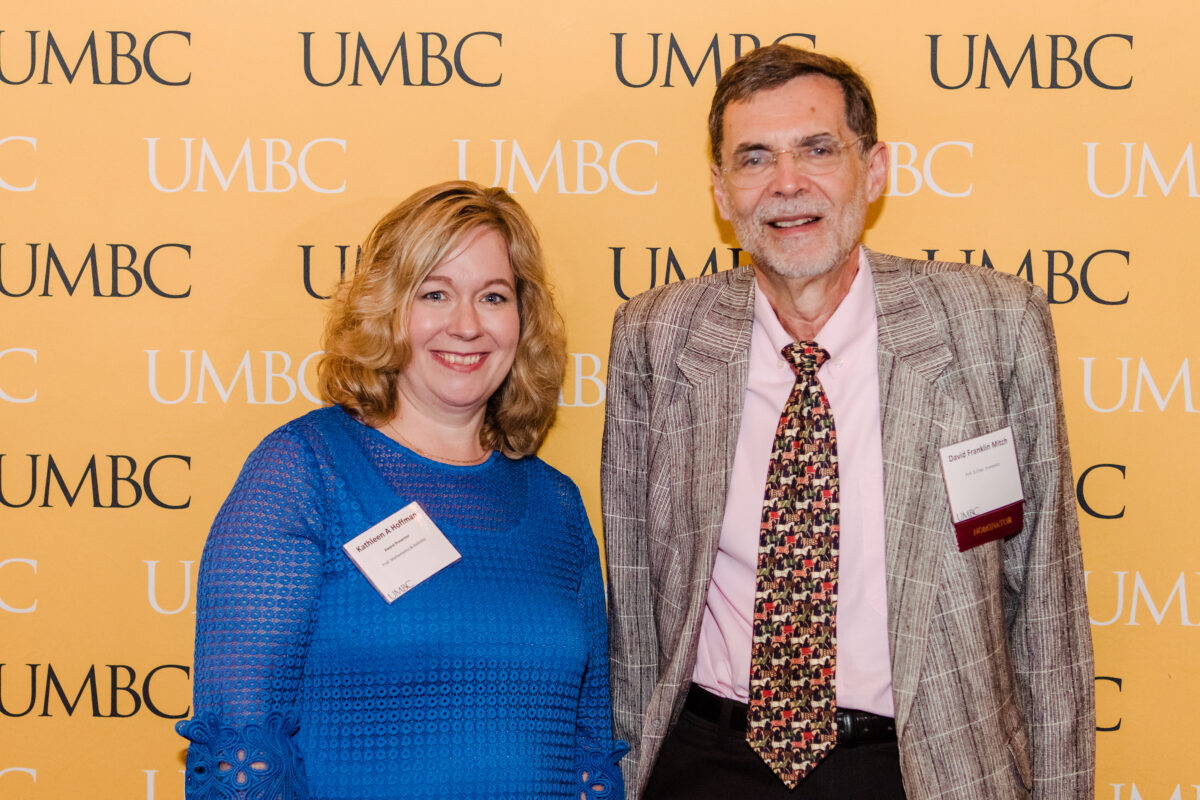
Kathleen Hoffman, professor of math and statistics, and David Mitch at the 2018 UMBC Alumni Awards (Marlayna Demond ’11/UMBC)
Mitch, department chair and professor of economics, explains that when it comes to professions in his field, students often think about careers in finance or the stock market. The program educates students about the academic side of economics careers and provides participants with mentoring, scholarships, research experiences, and financial support in research programs specializing in doctoral preparation. To date the program has placed six students in post-baccalaureate programs—one more than the original goal—with a further 17 students participating in various program activities.
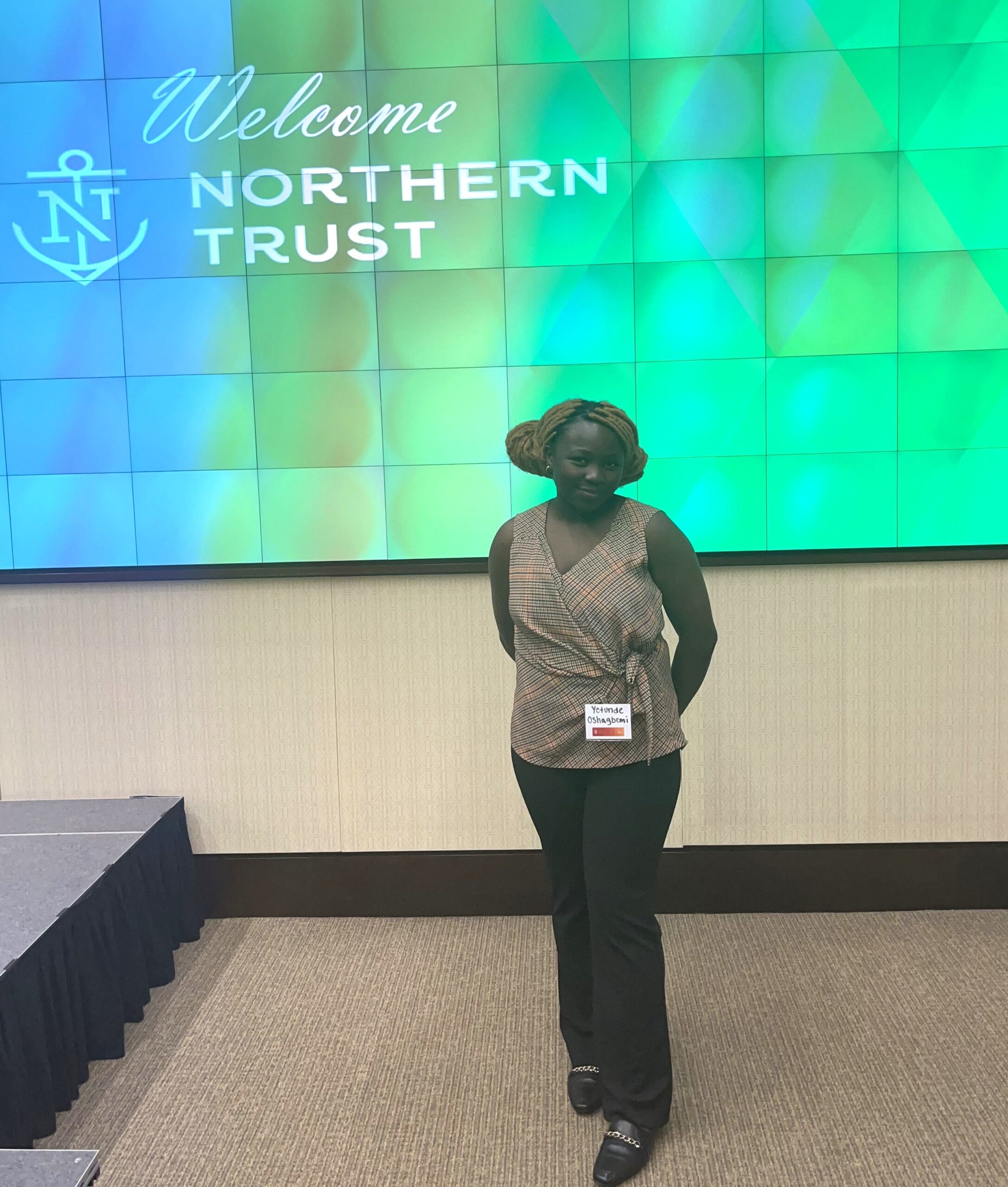
Yetunde Oshagbemi. (Photo courtesy of Yetunde Oshagbemi)
“There’s this route that involves graduate work in economics through all sorts of social impact areas such as health, the environment, education, and upward mobility of minority groups,” Mitch shares. Much of this work “deals with policy issues that could benefit from somebody with an underrepresented background.”
With support from the Sloan program to cover travel, lodging, and conference fees, Oshagbemi developed her research skills with internships at the University of Chicago, Brown University, and Howard University.
Growing up in Lagos, Nigeria, and then emigrating to the U.S. in 2010, keeping in mind the economic potential of her home country helped to influence Oshagbemi’s goal of addressing microeconomic issues of gender inequality and wealth disparities in sub-Saharan Africa.
Sloan UMBC, says Oshagbemi, “levels out the playing field for us, teaches us how to apply for opportunities, and what to do to be prepared to enter the field.”
Expanding the Economics Pipeline
Despite growing up with parents working in the field of economics, Sondheim Public Affairs Scholar Brevin Franklin ’22, economics and mathematics, wasn’t familiar with academic economics—teaching and researching—before coming to UMBC.
“The program exposed me to people doing economics research in post-bac programs and those who were in Ph.D. programs,” says Franklin, who is now a second-year economics scholar at Harvard University, supported by the Sloan grant. “It gave me a sense of whether I would like doing any of those things in the future.”
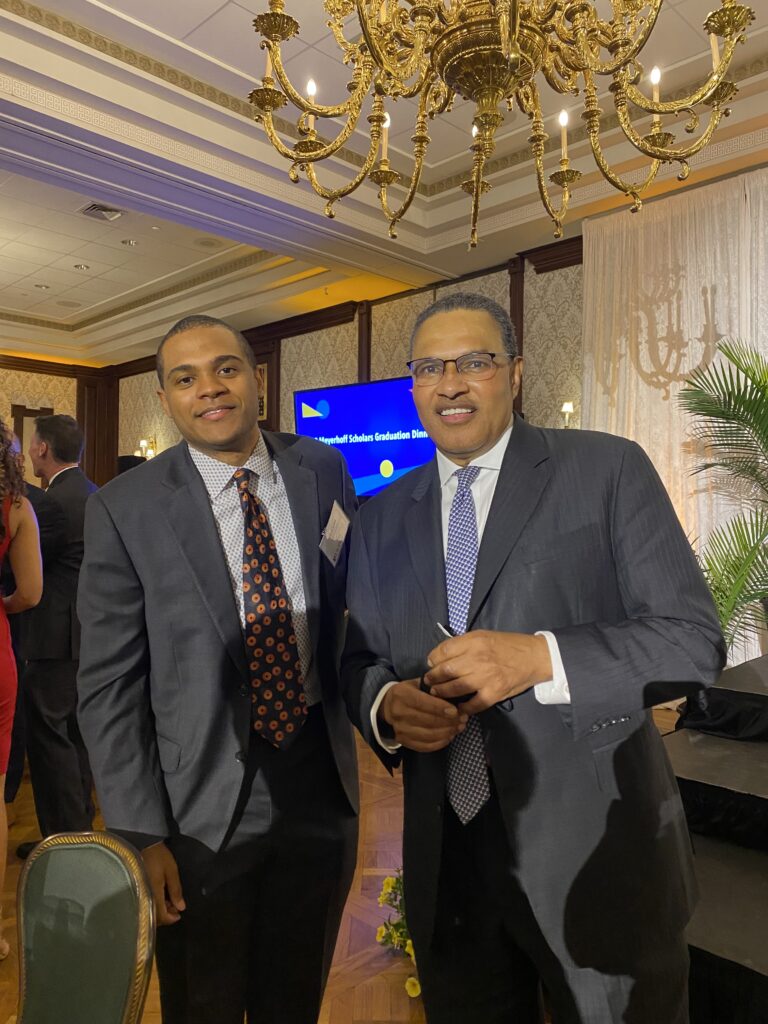
Brevin Franklin and UMBC President Emeritus Freeman Hrabowski. (Photo courtesy of Brevin Franklin)
Myles Ellis ’19, mathematics—who was also a post-bac economics scholar at Harvard—says the Sloan program encouraged him to take part in opportunities not initially aware of.
He’s now a third-year Ph.D. candidate at Brown University with a major concentration in econometrics. Ellis’ research focuses on how mistrust of institutions can shape the financial decision-making of Black households and how that might contribute to the racial wealth gap.
“Seeing people in this space that look like me is really important,” Ellis explains. “It’s important for this pipeline to be established because we need more Black and brown faces to shed light on what’s going on [in the world] through research, especially in this academic space.”
Oshagbemi, Franklin, and Ellis all referenced the significance of the mentorship they acquired as Sloan program scholars, pointing to guidance from the program’s coordinator, Ivanna Abreu.
“Ms. Abreu helped me practice for my internship interviews before applying and has been a great help with keeping us on track by checking in on what our top [research program] choices are and how we prepare for them,” says Oshagbemi.
Abreu was previously a program coordinator for UMBC’s Meyerhoff Scholars Program and says she admires the “hustle of STEM students” who come from underrepresented backgrounds.
“We make sure students have what they need,” says Abreu. “The program gives students the opportunity to really consider the economics field and to see themselves in it, as opposed to thinking about all of the stereotypes of economics. That’s the biggest thing we teach our students.”
UMBC is continuing its commitment to diversifying Maryland’s biomedical and life sciences ecosystem through its latest collaborative effort with the University of Maryland, Baltimore (UMB) to develop a new life sciences accelerator program focused on faculty development and research commercialization efforts.
“We have a long-term commitment to enhance the diversity of the faculty on our two campuses in the biomedical and life sciences,” says Karl V. Steiner, UMBC’s vice president of research and creative achievement and co-principal investigator of the new REACH grant. “We are pleased to further strengthen the close partnership with our colleagues at UMB and beyond with this next initiative.”
Karl V. Steiner.
Building a life sciences accelerator program
The REACH grant will fund up to 44 early-career faculty and students from UMBC and UMB (11 each year) with up to $100,000 each to develop and test commercially-promising biomedical and life science technologies. Additionally, UMB will use a portion of the grant funding to create the University of Maryland, Baltimore Life Science Discovery (UM-BILD) Accelerator Program’s “proof-of-concept” hub that will be housed at the University of Maryland BioPark and at the bwtech@UMBC Research and Technology Park. The UM-BILD hub, set to launch next year, is one of only five REACH hubs awarded funding across the nation.
Aaron Miscenich, executive director of bwtech@UMBC, explains that bwtech@UMBC has done extensive work in developing a strong community centered around entrepreneurship and technology commercialization.
“UMBC’s partnership with UMB to create this technology commercialization hub will [further] enhance our work and bring additional support to UMBC’s research community,” Miscenich says. “It’s a great opportunity to bring together UMBC faculty and students with resources that can help further develop promising technologies and help them to grow into thriving businesses.”
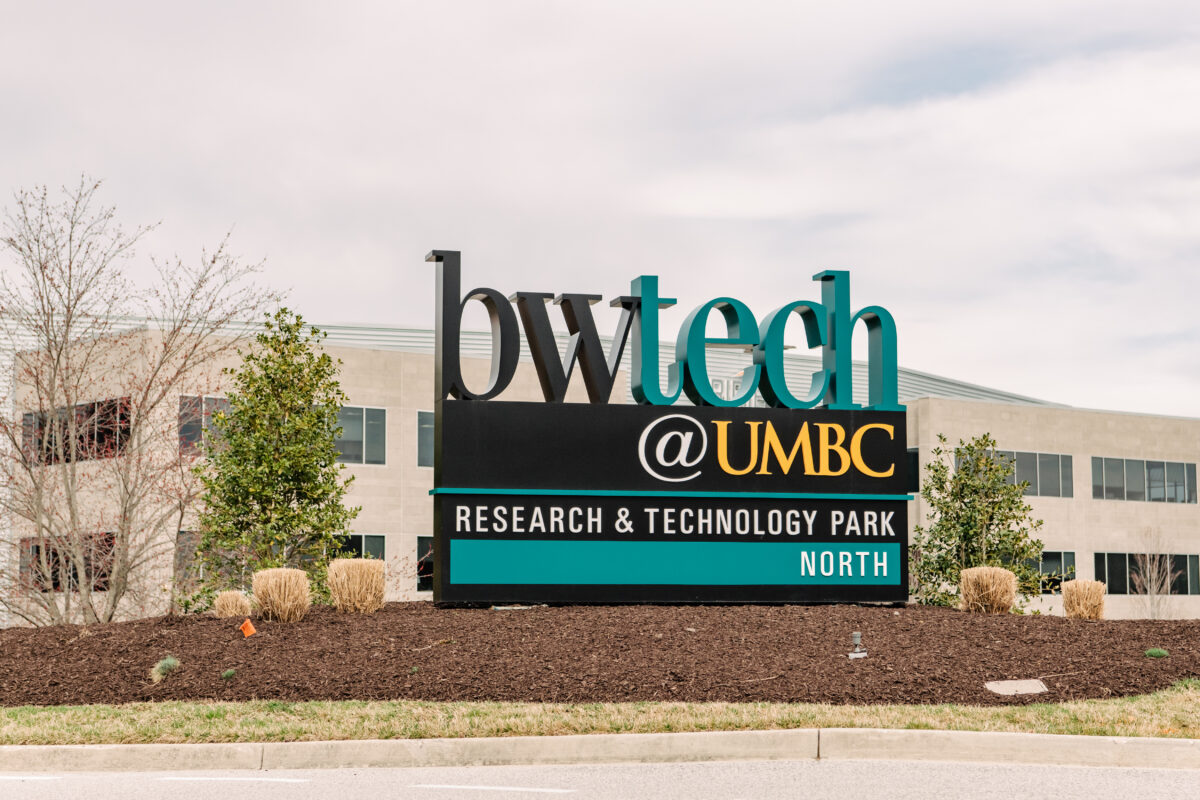
bwtech@UMBC Research and Technology Park, north campus.
UMSOM’s Jason Rose, principal investigator of the REACH grant, shared how both institutions plan to support the biotech entrepreneurs who take part in the accelerator program.
“We recognize that to create our own unique cohort of newly trained biotech entrepreneurs here in Baltimore, our accelerator will need to provide them with both research support and funding, as well as guidance through the process of commercialization and technology development,” Rose said in a UMSOM press release. “We will be providing mentoring and educational programs from a diverse set of successful life science innovators and leaders to help distill their broad experiences—from navigating FDA regulatory pathways to financing new companies—to all of those who interact with the hub.”
This initiative, Steiner adds, aims to increase the number of Black and Latinx entrepreneurs in the biomedical and life sciences.
“As we look at the makeup of entrepreneurs across our communities, it’s obvious that we are under-serving those underserved communities. This will be yet another building block in our joint commitment to ensure that we focus on and benefit from the breadth of entrepreneurial talent in Maryland,” says Steiner. “We’re looking to bring in more individuals from underrepresented communities into the faculty ranks and actively help them develop a strong network of peers and mentors to allow them to successfully build their careers and their businesses in Maryland, with support from UMBC with bwtech and support from UMB.”
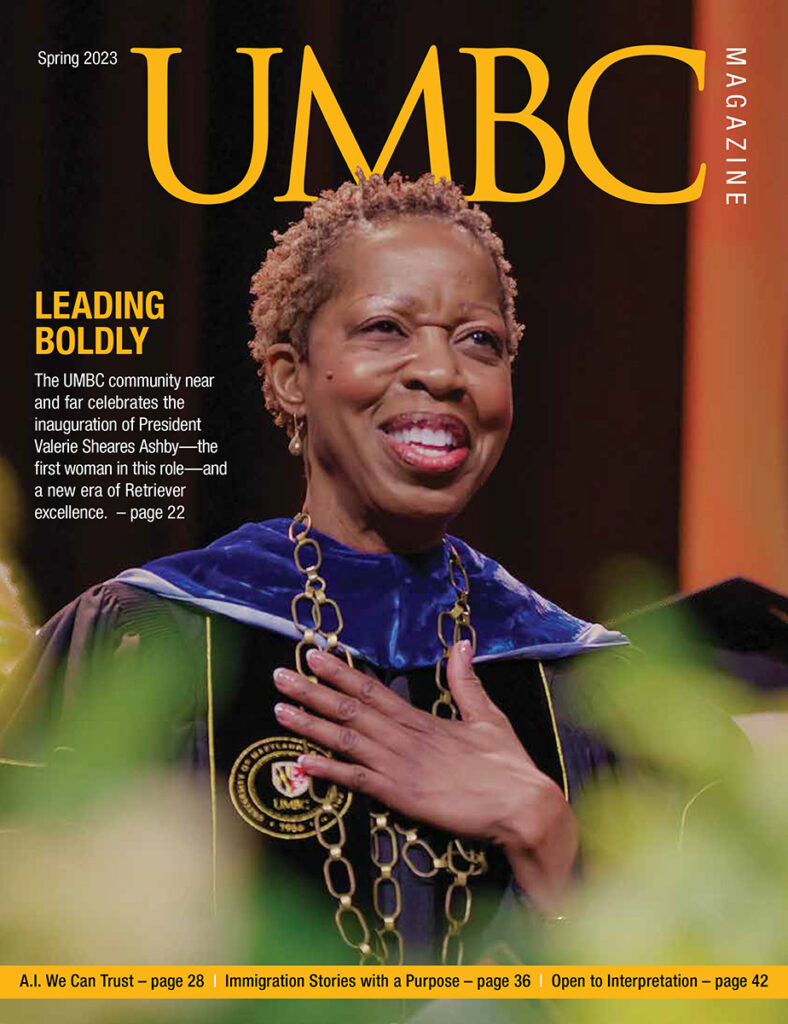
UMBC President Valerie Sheares Ashby shares that “we are excited to work together to create opportunities for everyone to benefit from and contribute to this innovation ecosystem, staying true to our long-held commitment to inclusive excellence.”
Commercialization efforts at UMBC
Wendy Martin.
Wendy Martin, director of UMBC’s Office of Technology Development, will assist in selecting and managing the projects that will be funded through the REACH grant. Martin has worked closely with faculty in all aspects of intellectual property protection and commercialization, including helping faculty to receive internal and external funding to develop new products. Those funding opportunities have included UMBC’s long-standing partnership with TEDCO’s Maryland Innovation Initiative (MII), which will also be a collaborator of the UM-BILD accelerator along with the University of Maryland, College Park, Morgan State University, and Blackbird Laboratories.
“I’m excited that we can bring everyone to the table. UMBC provides a continuum of support for these commercialization projects,” says Martin. “We’re building on enhancing things that we’re already doing. It’s great that we will have these additional resources to keep it going and to do it better.”
Spiders, robots, climate change, Vaudevillian history, and more—this year’s GRIT-X event had something for inquiring minds of all kinds, with explorations into elements of the past, our collective present, and possibilities for the future.
Back for its seventh year, GRIT-X returned to the Fine Arts Recital Hall during Homecoming 2023 with presentations from faculty and accomplished alumni addressing some of the most pressing issues facing society now and throughout history, and how UMBC scholars are working to build a better tomorrow.
“The goal of GRIT-X is to provide a sneak peek behind the scenes of some of the exciting and impactful research and creative achievement initiatives across our campus community,” says Karl V. Steiner, UMBC’s vice president of research and creative achievement. “[GRIT-X] takes you around the whole campus and beyond.”
“Disruptive” and intercultural thinking in the workforce
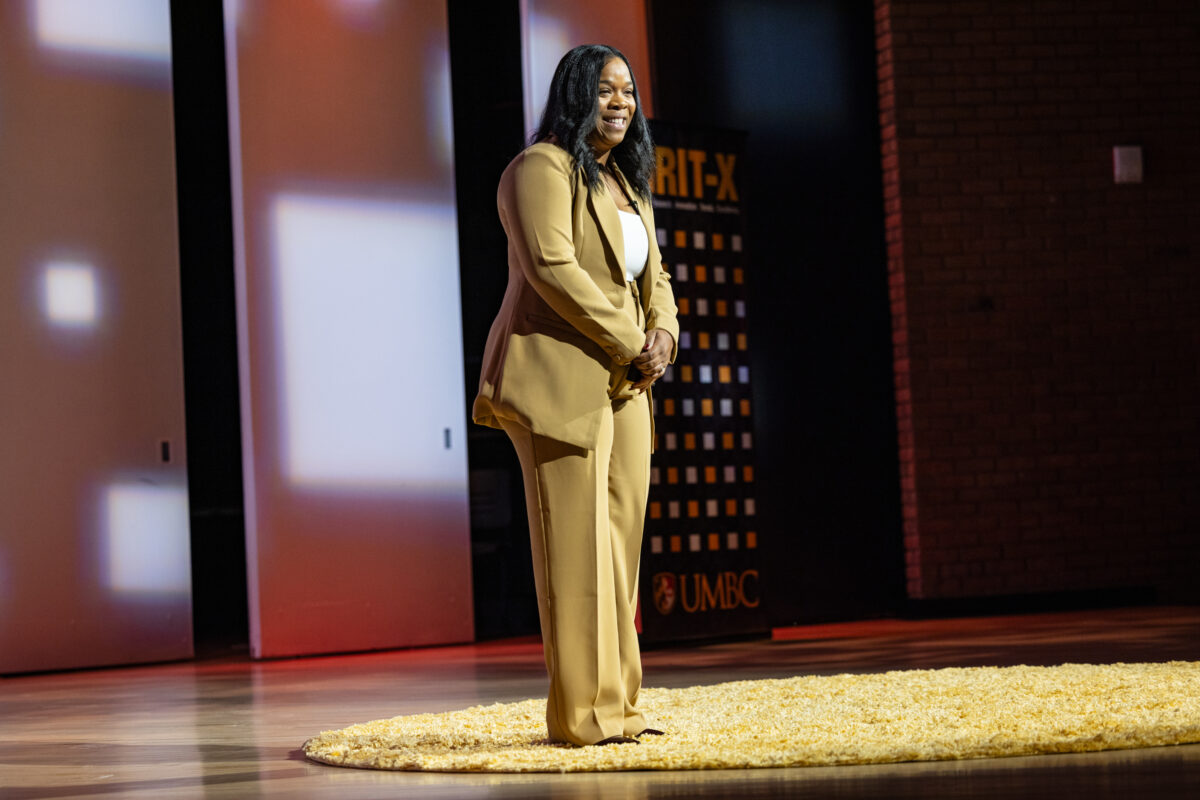
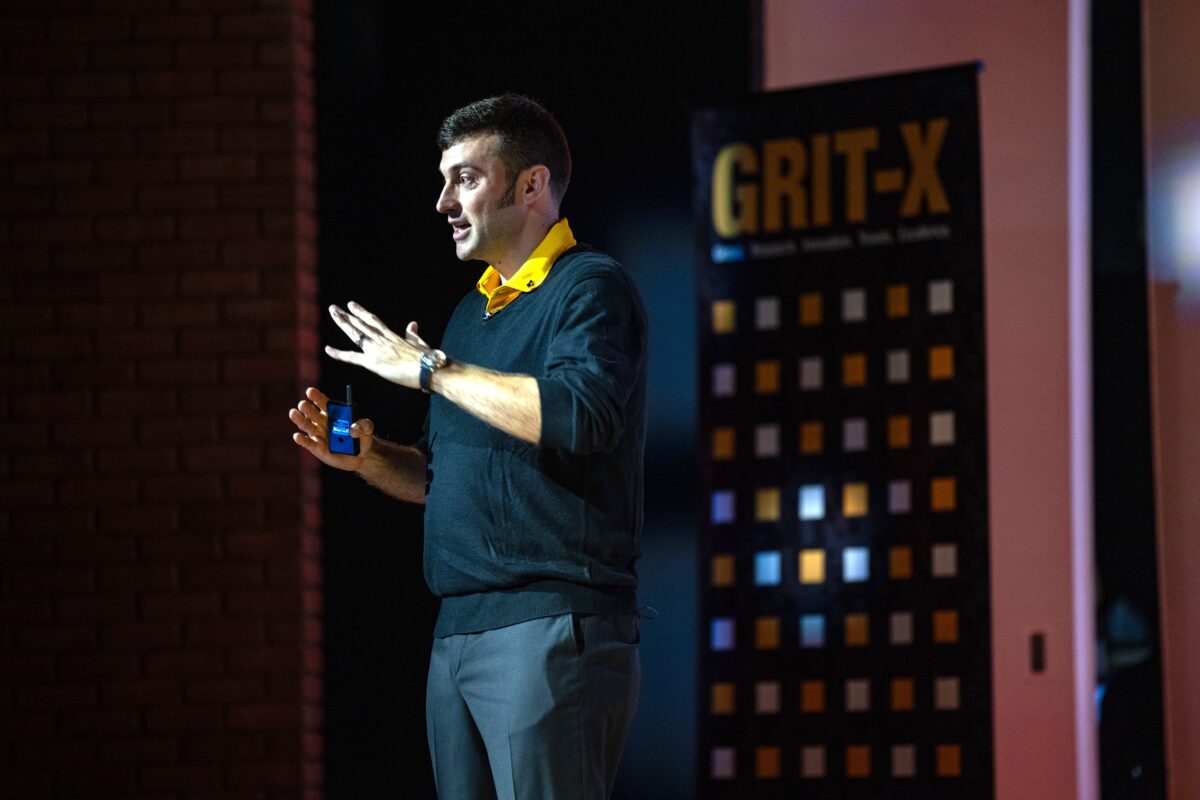
GRIT-X 2023 showcased how UMBC alumni are working to fuel innovation within the workforce and how faculty are strengthening the employability of future graduates. Melanie Harrison Okoro, Ph.D. ’11, environmental science, opened this year’s GRIT-X with her discussion on how “bold and disruptive thinking” can help executives to lead, innovate, and transform their companies in the 21st century. Okoro is the co-founder and CEO of Eco-Alpha, a firm that provides environmental compliance services and engineering workforce development training. Her talk outlined how leaders can create “disruptive strategies” in order to stay at the forefront of changes happening in their industries.
“Disruptive thinking is in my DNA,” said Okoro during her presentation. “It defines how [Eco-Alpha] outcompetes our competitors in the marketplace and allows us to target a segment of the population that’s been traditionally overlooked.”
Melanie Harrison Okoro presenting her GRIT-X 2023 talk entitled “Disruptive Thinking: A Bold Business Strategy to Change How We Lead, Innovate, and Transform Companies in the 21st Century.”
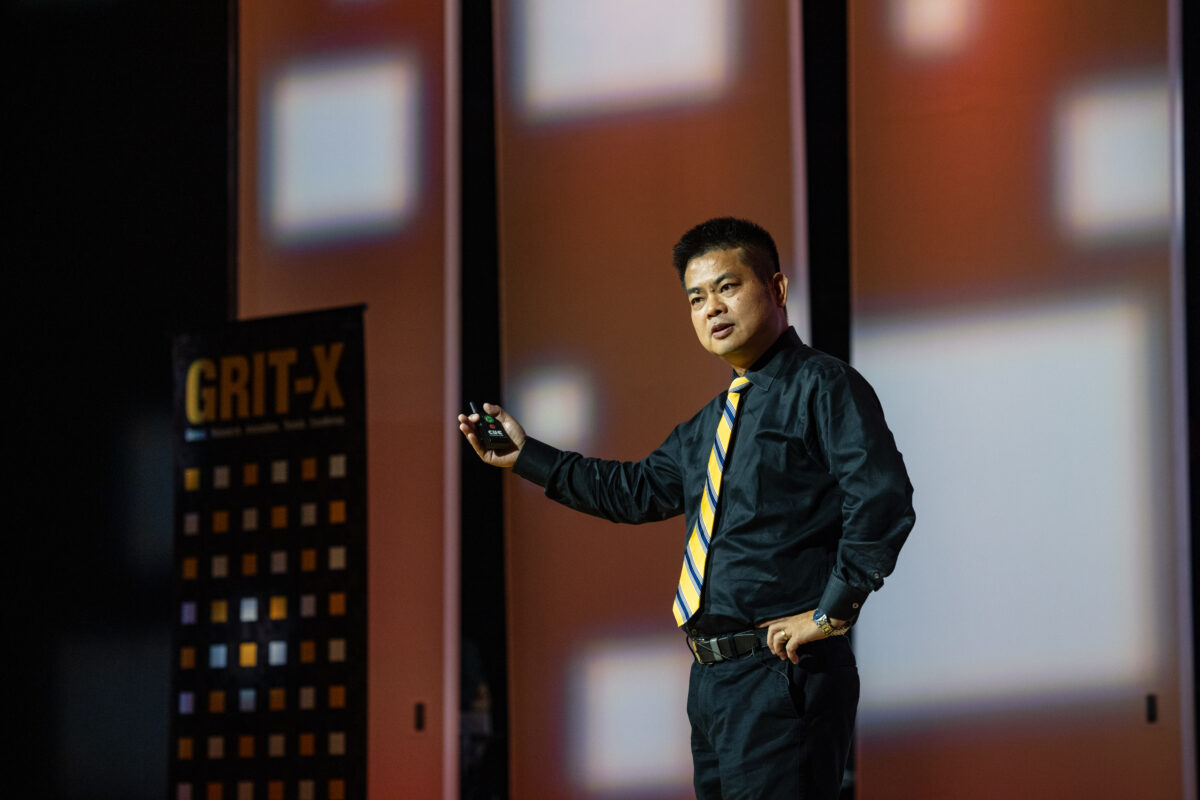
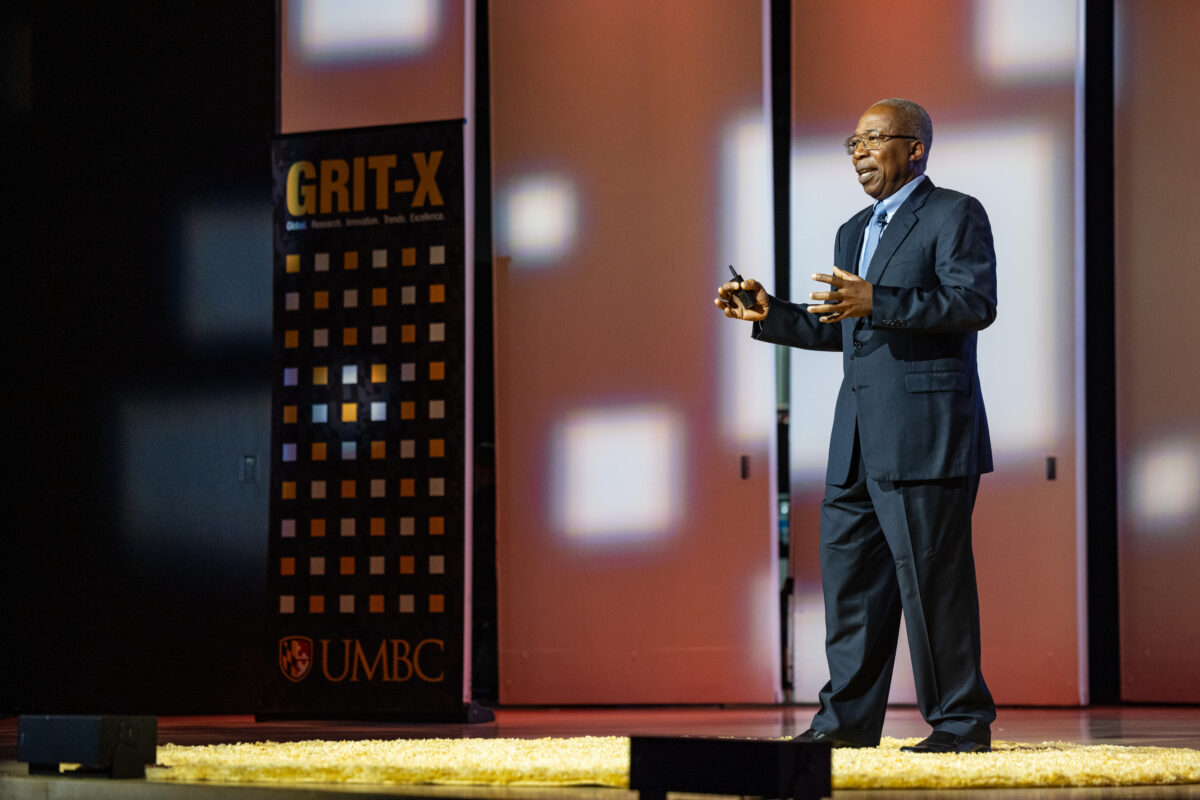
Similarly to Okoro, Zhensen Huang, M.S. ’00, Ph.D. ’04, information systems, used bold thinking to propel himself forward in his current career as CEO and founder of Precise Software Solutions, a firm that helps government and private sector clients modernize their IT systems. Huang spoke of his student experience at UMBC after emigrating to the U.S. from a small rural village in China—a future he says he didn’t think was possible when growing up. He shared how UMBC helped even when “It’s hard for us to make a connection between what we’re doing now to the great possibilities down the road,” says Huang.
“Embrace the present and envision the future,” Huang shared during his talk. “Sometimes you don’t know what your future possibilities are, and that’s okay. What’s important is to embrace what’s in front of you, especially the challenges.”
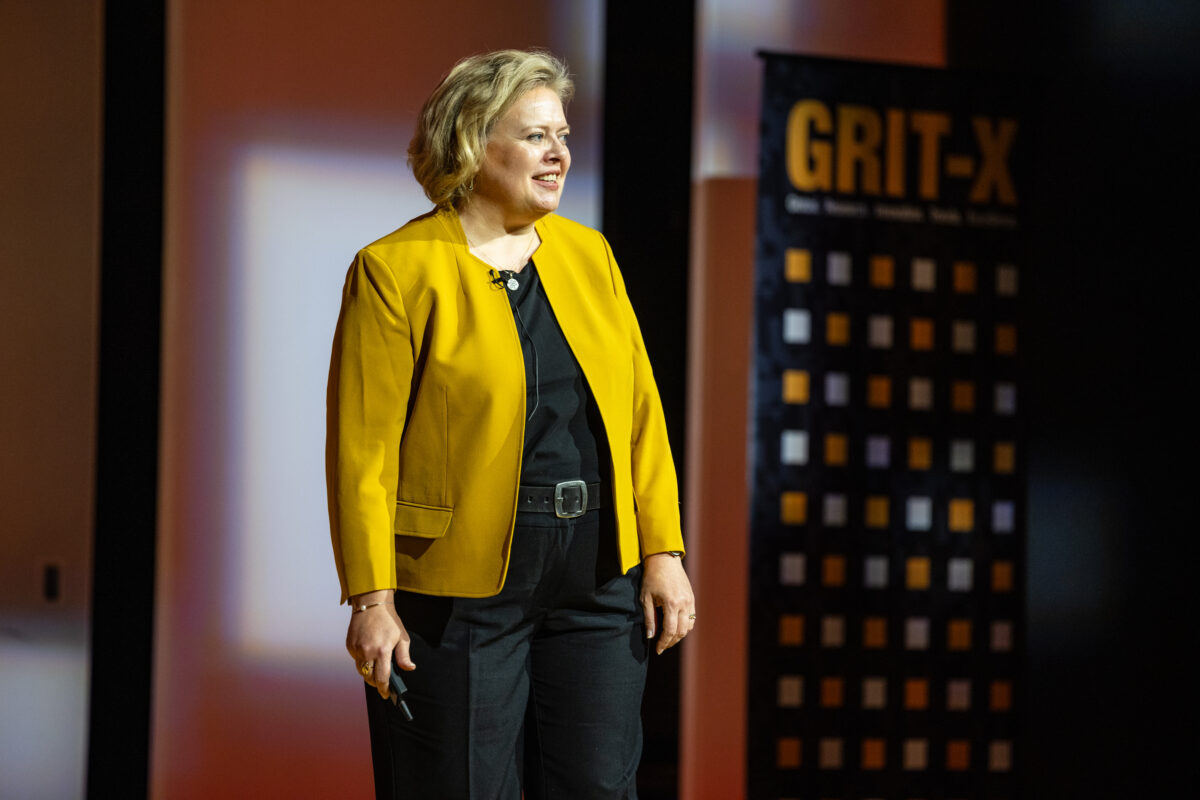
Zhensen HuangIrina Golubeva
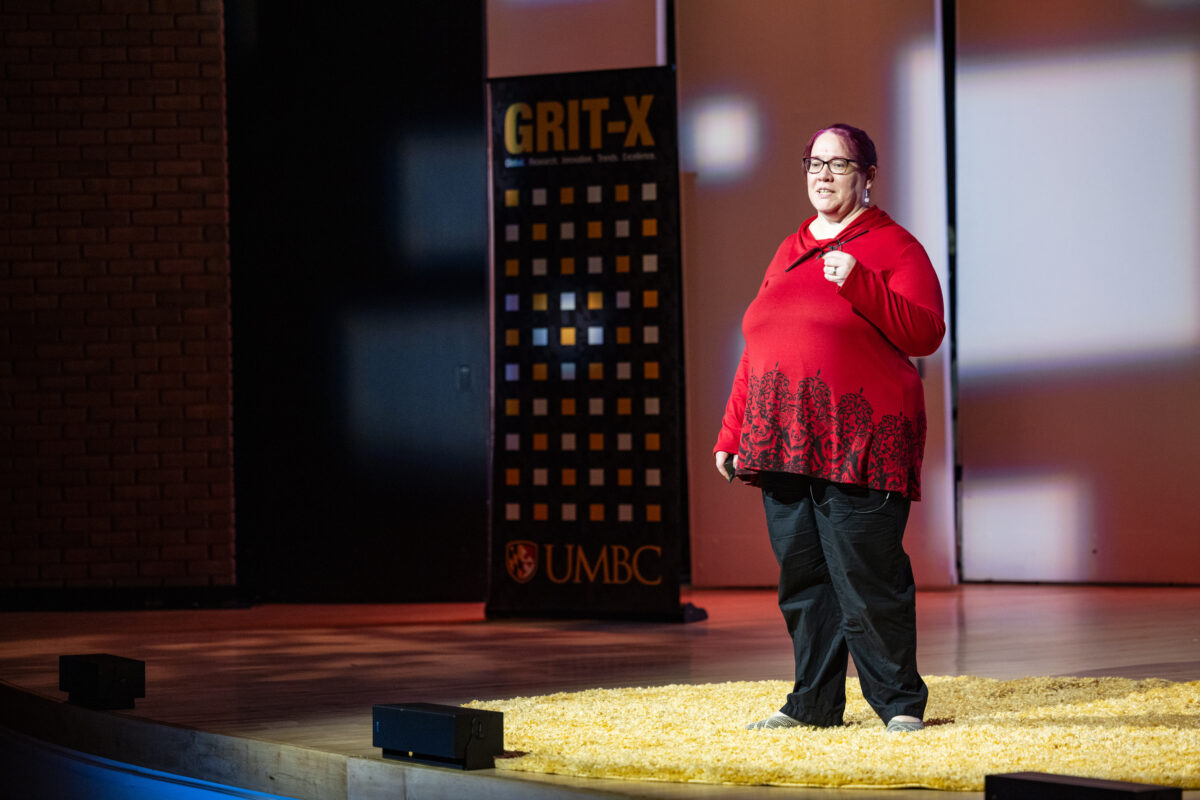
Irina Golubeva, professor and director of UMBC’s intercultural communication graduate program, is working to address some of those challenges students face, such as navigating culturally-diverse environments. Her GRIT-X presentation focused on her research on intercultural learning, which includes the InterEqual training program she created based on student feedback. Golubeva shared how she’s helping UMBC students develop their intercultural competence as they prepare for their professional careers.
“We cannot ignore and disregard these tendencies of job markets, and we must prepare our students to work and live in multicultural societies by equipping them with essential intercultural and language skills,” says Golubeva.
Investigating earthly phenomena with math and science
Justin Webster, associate professor of mathematics and statistics, explored the “relationship between mathematical models and the phenomena in the world” during his presentation. He highlighted specific examples of how mathematical modeling can deepen our understanding of infrastructure disasters like the Tacoma Narrows Bridge collapse of 1940, and how his mathematical process helped researchers find a possible hypothesis for detecting the onset of glaucoma.
“Mathematical modeling is a scientific empowerment tool. Anyone, anywhere, can do math modeling and study anything that they’re interested in,” says Webster. “That’s why it is so important that our students at UMBC, and students more broadly, are mathematically competent and excited so that they can go on to be students of the world.”
Justin Webster delivering his GRIT-X 2023 talk entitled “The Map is Not the Territory: Tales of Interest in Nonlinear Elasticity.”
Charles Ichoku, director of the UMBC-led Goddard Earth Science Technology and Research (GESTAR) Center II, also explored a phenomena that’s causing global concern—how rapidly the Earth is changing. Ichoku explained in his GRIT-X talk how climate change, people, and wildfire emissions are contributing to those changes to the Earth and the work he’s done with NASA’s Fire Energetics and Emissions Research project to understand causes of climate change.
“The world is warming dangerously, and human activities are driving the warming trend through the emission of heat-trapping long-lived greenhouse gasses (GHGs), particularly carbon dioxide (CO2), which has continued its upward trend over the last several decades. Wildfires are [also] contributing significantly to that,” shared Ichoku.
Charles IchokuCarlos Romero-Talamás
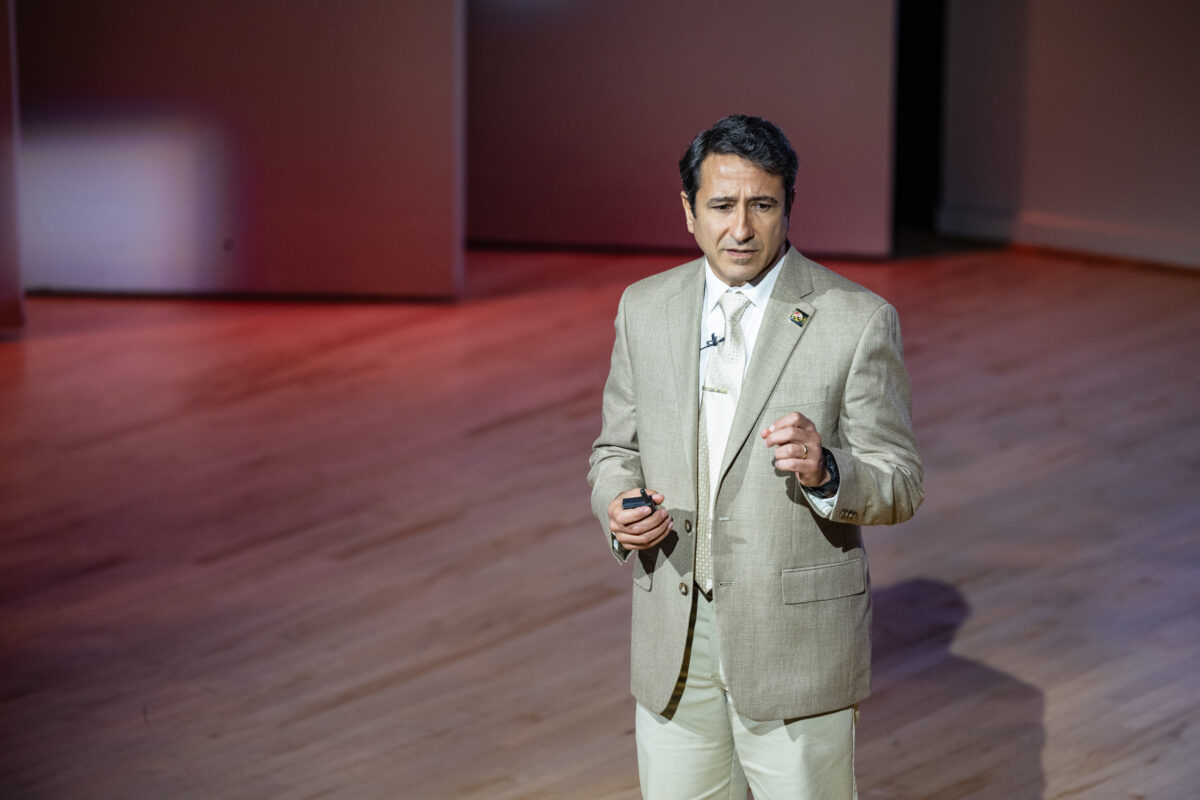
Similarly, Carlos Romero-Talamás, associate professor of mechanical engineering, explained in his presentation how most sources of energy produce carbon and GHGs, and the work that’s being done to bring the global energy-related CO2 emission levels down to net zero. He discussed the benefits of using fusion energy to achieve that goal, which includes the work he’s doing as the principal investigator of the Centrifugal Mirror Fusion Experiment, a research effort between UMBC and the University of Maryland, College Park that explores a promising alternative to traditional fusion power approaches.
“Fusion energy is considered the ultimate source of energy—the fuel is abundant and is non radioactive,” says Romero-Talamás. “It is urgent to decarbonize our economy and our energy infrastructure because we are harming the planet [and] are running towards a climate disaster.”
Past histories and future possibilities
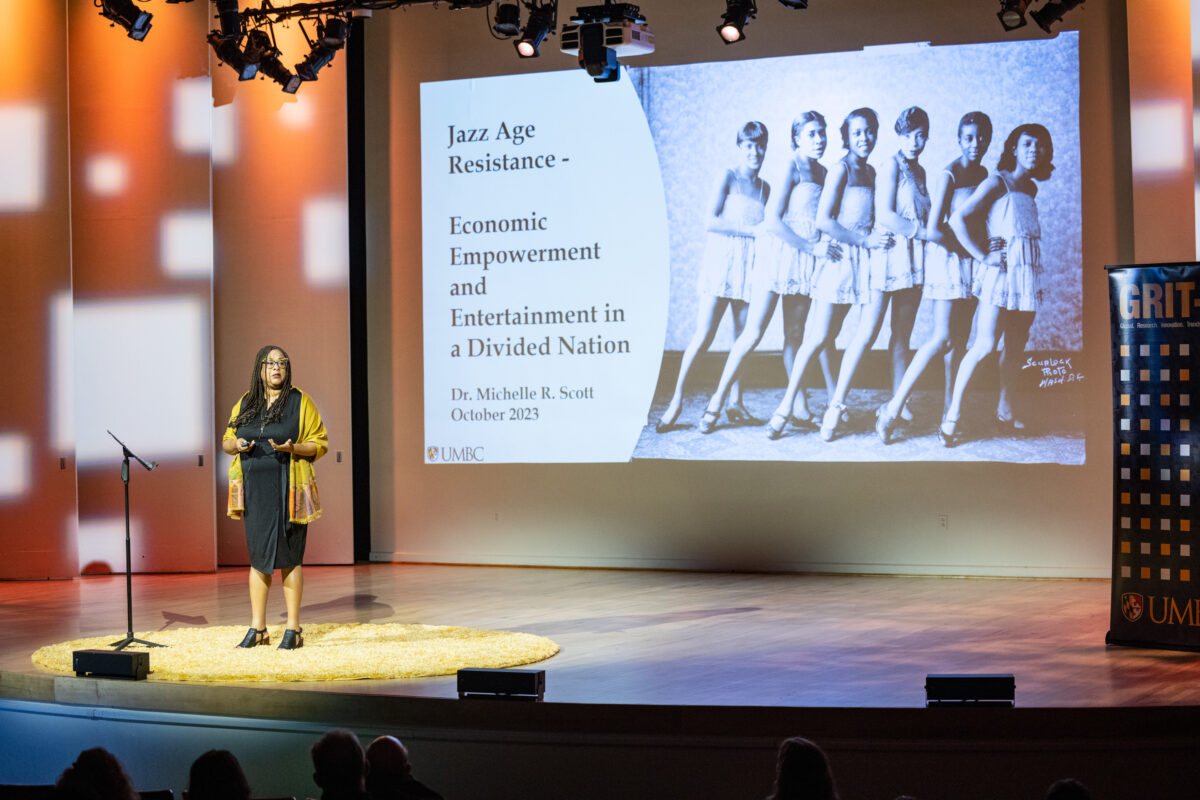
Michelle R. Scott, associate professor of history, brought the GRIT-X audience back to a moment in time in which Black Vaudeville performers used economic empowerment as a form of resistance in the 1920s. Scott explained her research into the institutional history of the Theater Owners’ Booking Association’s (T.O.B.A.) origins, which she wrote about in her book T.O.B.A. Time: Black Vaudeville and the Theater Owners’ Booking Association in Jazz Age America(University of Illinois Press, 2023).
“The [Vaudeville] circuit itself—its success—was a testament to Black excellence in terms of business, Black artistic skill, and a momentary period of interracial cooperation. It was truly an example of Jazz-age resistance,” Scott said during her presentation.
Michelle R. Scott delivering her GRIT-X 2023 talk entitled “Jazz Age Resistance: Economic Empowerment and Entertainment in a Divided Nation.”
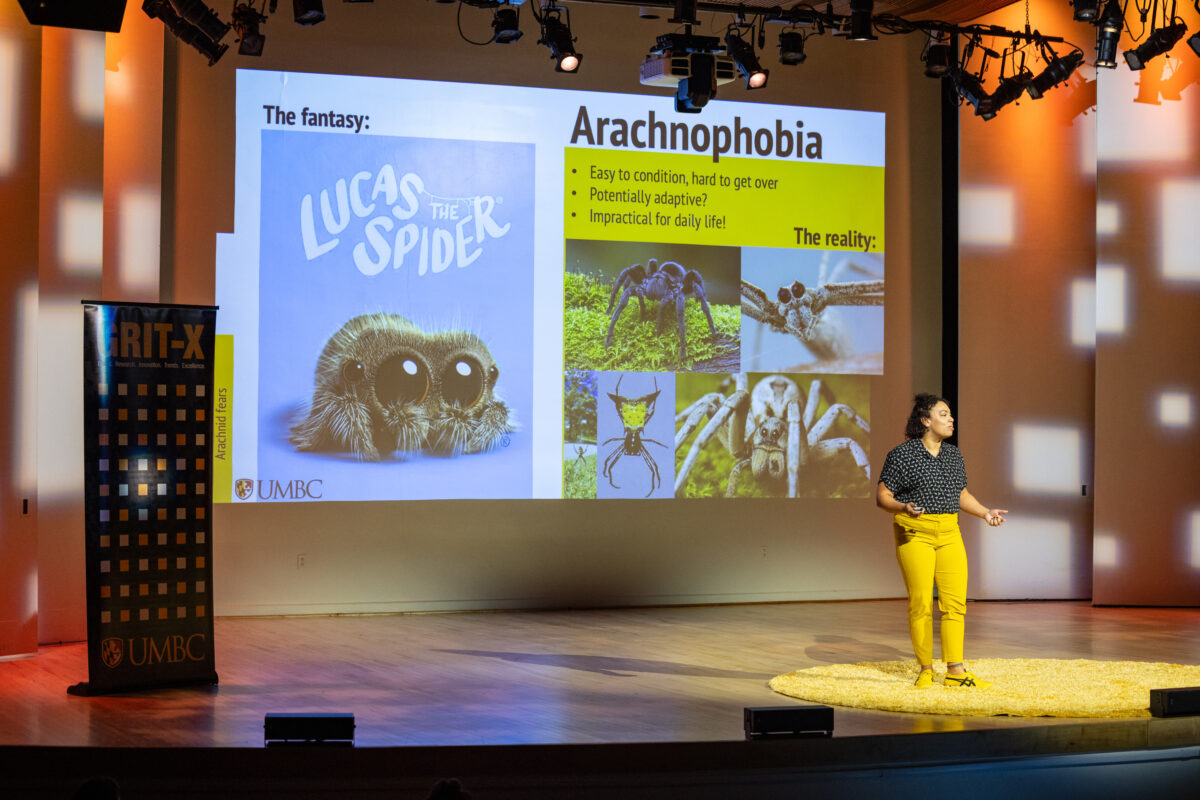
Mercedes Burns, assistant professor of biological sciences, explained a different kind of history—the history of arachnids. Burns, who received an NSF CAREER Award earlier this year, enlightened the audience with her research on spiders, opiliones (commonly known as daddy longlegs), and other kinds of arachnids. She outlined reasons why we should appreciate these “unloveable” creatures.
“Spiders have been living their lives for much longer than any vertebrate has —they’ve persisted over a millennia,” Burns explained in her GRIT-X talk. “Arachnids…thoughtfully consume unloveable things in our habitats. Arachnids are [also] quite attentive to their environment. They are master architects and material scientists. If you’re curious about the organisms that surround you and you’re interested in learning more or appreciating what those organisms do for the environment and their ecosystem, that leaves no room for fear.”
As a result of her being the first known female African American arachnologist, Burns had a species of trapdoor spiders named after her in 2021, called Ummidia mercedesburnsae. She reflected on the accomplishment, saying “Having experienced that honor of being the matronym of a described species really underscores the legacy that I want to leave.”
Mercedes BurnsCynthia Matuszek
Fellow UMBC NSF CAREER Award recipient Cynthia Matuszek, assistant professor of computer science and electrical engineering, brought the GRIT-X audience into the future with her presentation on the possibilities of human-robot interaction. Matuszek explained how humans and robots can interact and exist in the same space and how robots can be more useful.
Her work in UMBC’s Interactive Robotics and Language Lab focuses on using grounded language—which refers to language that has meaning in and pertains to the physical world—as a tool to build robots that can perform tasks in real-world environments, instead of being programmed to handle a fixed set of predetermined tasks.
“In order to have robots that are useful in human spaces, we need robots that are flexible and capable of interacting in a variety of contexts,” Matuszek explained in her presentation. “When people use language, we don’t just use words. We use gestures, we point to things, we look at things, and we use body language. Useful language learning for robots needs to take all of these factors into account.”
Learn more about GRIT-X 2023, past speakers, and their research.
UMBC’s work in strengthening students’ preparedness in cybersecurity defense is proving effective not only on campus, but well beyond. This summer, three UMBC students competed in an international “capture the flag”-style cybersecurity competition in Japan, with one Retriever taking home a victory—and all three bringing back a greater range of expertise. This opportunity helped UMBC students build global relationships and attain more practical experience in cyber defense.
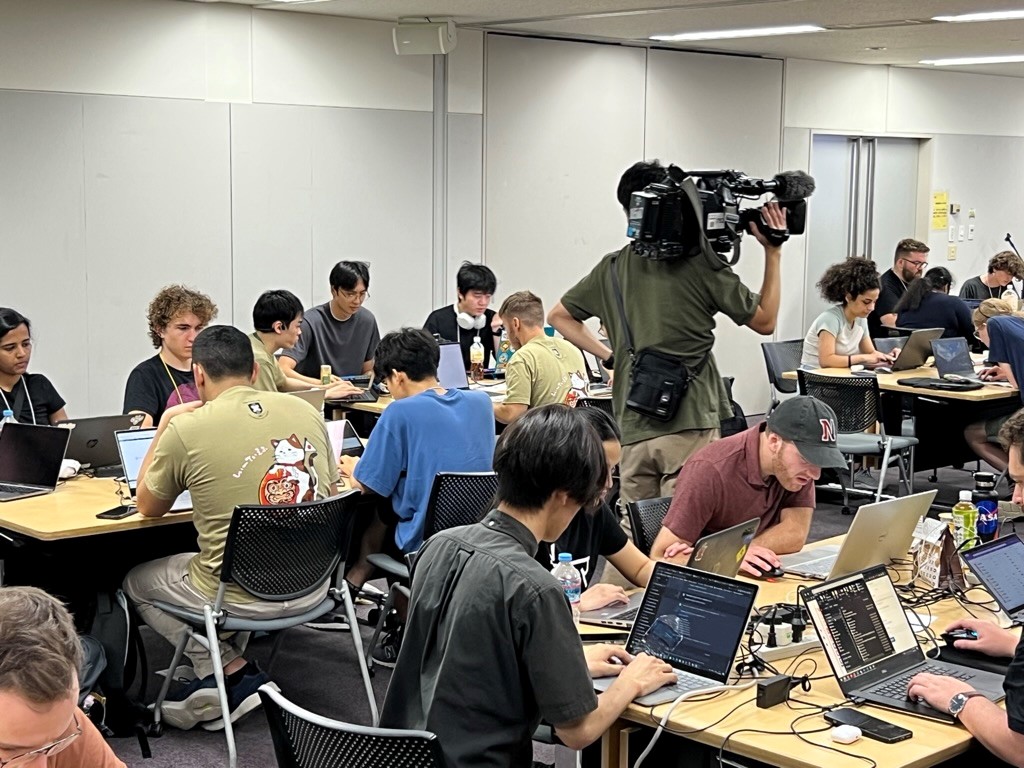
In August, Kevin Chen ’23, computer science, Zachary Amoss ’24, computer science, and Leela SaiNadh Gade, M.P.S. ’24, cybersecurity, competed in the 2023 Country-to-Country Capture the Flag (C2C-CTF) event at the Hiyoshi Campus of Keio University in Yokohama, Japan. The competition—which convened in person for the first time this summer since it began in 2020—brought together 80 students from around the world to team up and complete 25 cybersecurity challenges within 10 hours. Teams were tasked with solving challenges such as identifying hackers in various cyber scenarios or using open-source investigative methods to pinpoint geographic locations of different photographs.
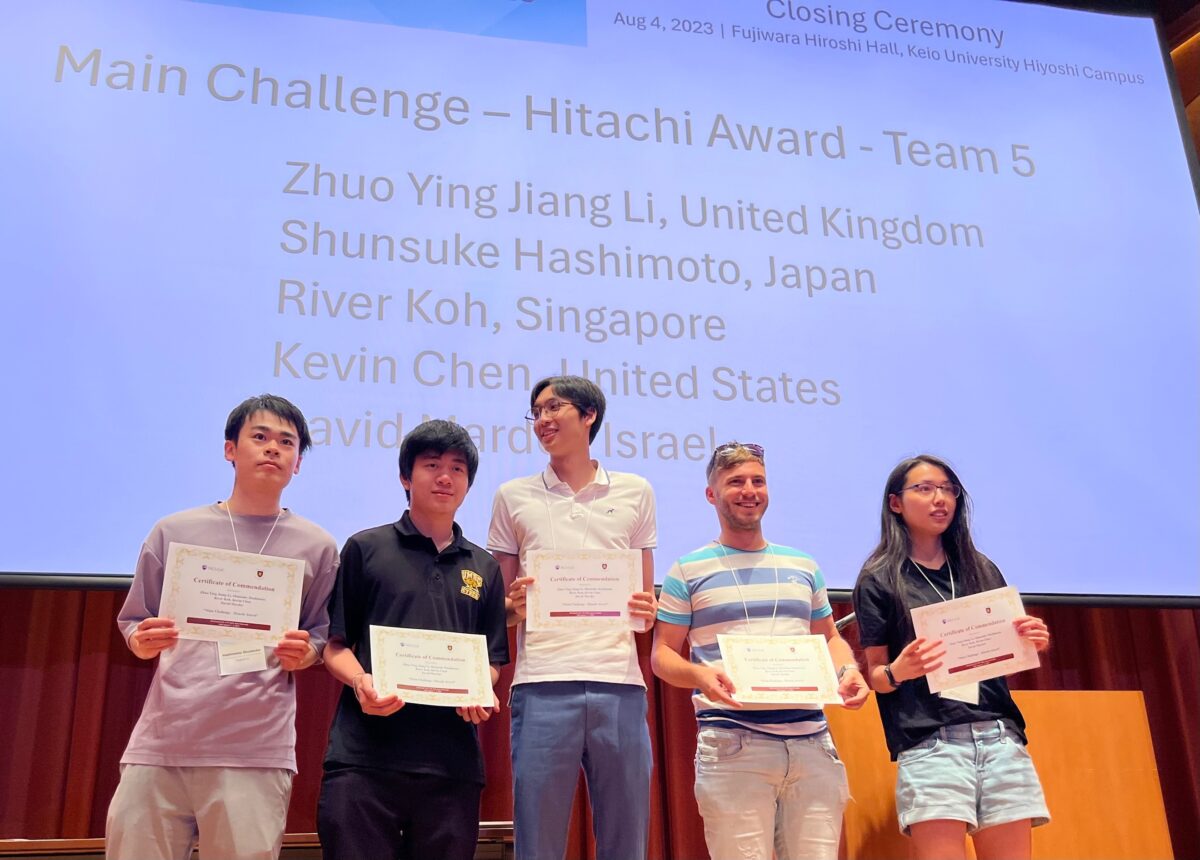
Among the awardees were Chen and his team, which included students from the U.K, China, Japan, and Israel. The team placed fourth overall in C2C-CTF’s main challenge and received the Hitachi award, named after one of the event’s sponsors. Claiming a victory wasn’t the only thing Chen wanted to accomplish at the competition.
“My [goal] was to learn extensively, tackle novel technical obstacles, and engage in international collaboration. I embarked on this journey with the determination for achieving victory, fully aware of the formidable nature of that challenge,” he says.
Code cracking in real time
Chen is a member of UMBC’s CyberDawgs team and has been participating in cyber competitions throughout the year in preparation for C2C-CTF. His prep paid off as he helped his team solve the final problem of the competition, a cryptography challenge in which competitors had to correctly guess an image’s location without being provided any identifying information.
“Inside the images were a set of true images and false images [which] were meant to lead you down a rabbit hole,” Chen explains. “When selecting the true images, we had to piece them together in a certain order to get the code for that challenge.”
The team used open-source intelligence methods to solve the problem, such as paying attention to the direction of the sun in an image to narrow down the range of countries, identifying specific landmark clues, and analyzing the images’ metadata. Minutes before the competition’s conclusion, Chen’s team cracked the code, earning them 300 points to secure the win.
Kevin Chen (second from left) and teammates accepting the Hitachi award at the 2023 Country-to-Country Capture the Flag closing ceremony at Keio University. (Image courtesy of Karl V. Steiner)
“My entry into the world of cybersecurity began just a year ago. Despite my relative newness to the cyber realm and my position as one of the younger members on the team, I played a pivotal role in addressing key challenges that propelled us into the top four [ranking],” said Chen. “My involvement in the [C2C-CTF] event marked a significant milestone. This allowed me to achieve success on an international stage and served as a gratifying culmination of my trip.”
An international partnership
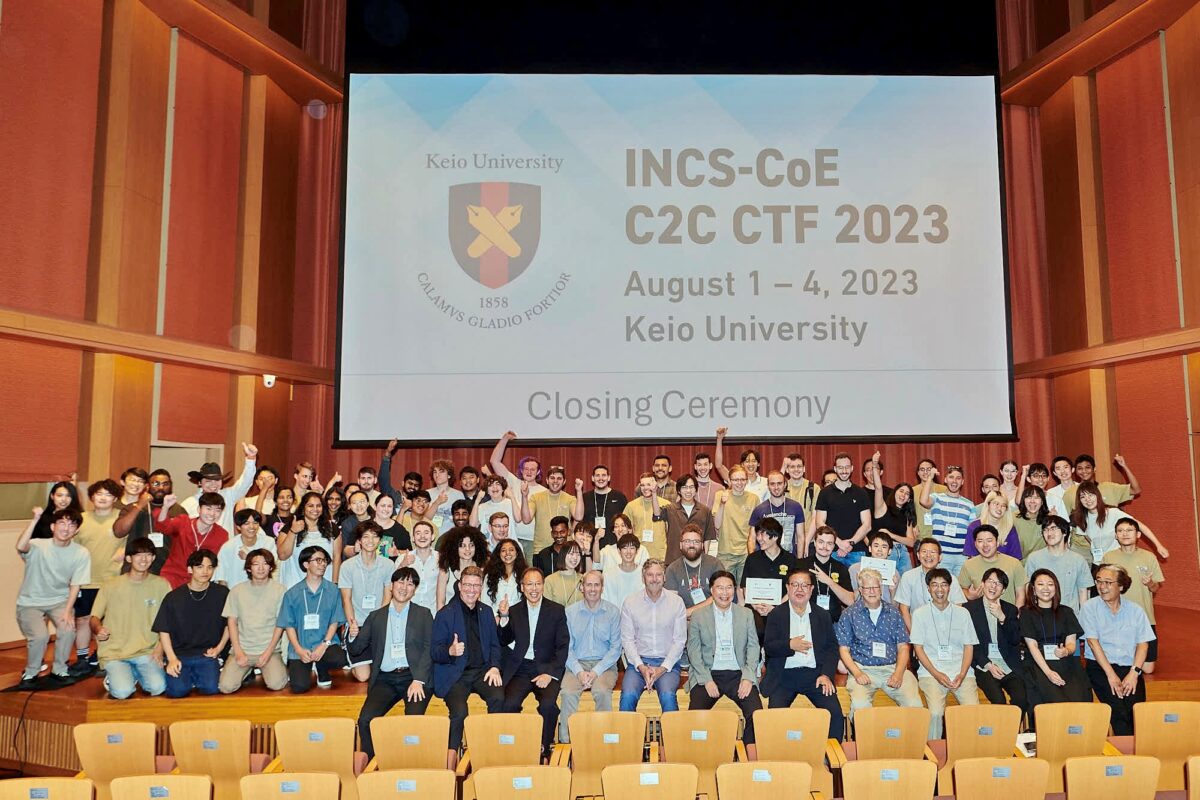
The annual C2C-CTF competition is organized by the International Cyber Security Center of Excellence (INCS-CoE), a global university network dedicated to securing critical systems against cyber threats through research, policy, education, and training. UMBC is one of the founding charter members of the INCS-CoE, which currently includes 12 academic institutions across six countries and recently expanded into Australia, France, and Israel.
Karl V. Steiner, UMBC’s vice president for research and creative achievement, has worked with the group since its creation in 2019, and serves as the INCS-CoE’s 2023 board chair. Steiner joined the UMBC team at Keio University during this year’s C2C-CTF event and shared his pride in seeing UMBC students competing at such a high level on an international stage.
“I was extremely proud to see our students compete at the international level. Competing in this competition provided them with a valuable set of new experiences and a set of new friends from across the globe. Each one of our students was fully dedicated to the spirit of competition,” shares Steiner.
Karl V. Steiner (front row, second from left) with members of the INCS-CoE and the student competitors at the 2023 Country-to-Country Capture the Flag competition. (Image courtesy of Karl V. Steiner)
Chen made note of the significance of collaborating with students from around the world, sharing that the experience helped him to “absorb valuable insights into the cyber capabilities and experiences of students globally. The contrasting nature of our experiences…was both enlightening and enriching.”
Kazuo Noguchi, executive director of the INCS-CoE added: “ The vision for this event is to provide inclusive and international education and training which can enhance not only new skills, but also, and more importantly, promote international friendship, collaboration, ethics, and teamwork.”
A “real world” approach to cybersecurity
Rick Forno, principal lecturer in computer science and electrical engineering and assistant director of UMBC’s Center for Cybersecurity, explains that competitions like the C2C-CTF provide students with a look into the “real world” of cyber defense.
“The competition provides the next generation of cyber defenders an opportunity to tackle technical cybersecurity challenges and gain insight into the global nature of cybersecurity, [along with] the need for effective intercultural collaboration in working toward a common goal,” says Forno.
Students competing during the 2023 Country-to-Country Capture the Flag competition at Keio University. (Image courtesy of Karl V. Steiner)
Forno also serves as a coach for the UMBC CyberDawgs and adds that “structuring the C2C-CTF event with teams composed of members from different countries is an innovative idea that adds additional real-world ‘flavor’ to what participants will encounter later as cybersecurity professionals around the world.”
CyberDawgs member Zachary Amoss shared that while he has gotten the opportunity to compete with the team at national events, “the opportunity to represent UMBC on the global stage [at C2C-CTF] was a once-in-a-lifetime opportunity. I highly recommend all current UMBC students, especially those who are already in cybersecurity spaces such as the CyberDawgs, to compete in next year’s event.”
Leela SaiNadh Gade added that the competition has been “an enriching experience that expanded my understanding immensely. The learning I acquired from this event will serve as an invaluable asset in my future endeavors.”
This week, UMBC President Valerie Sheares Ashby underscored the importance of higher education and how UMBC and the broader University System of Maryland (USM) are working to make education accessible for all at the inaugural iMPACT Maryland event.
“We know what education does to change families, generations, and economic prosperity in communities,” Sheares Ashby said during the event’s “Empowering Dreams: Advancing Education for All in Maryland” panel discussion. “We need to think about access and affordability. We need to work with our schools to think about what the pathways are for students who cannot even imagine this is for them or cannot imagine that they can afford [college].”
The day-long event, hosted by the Baltimore Banner at the Joseph Meyerhoff Symphony Hall, featured numerous discussions detailing the various challenges that are affecting Maryland residents and how industry leaders across many sectors are identifying opportunities for growth and innovation.
Sheares Ashby was joined by fellow panelists Kurt Schmoke, president of the University of Baltimore; Melanie Perreault, interim president of Towson University; David Wilson, president of Morgan State University; Sonja Brookins Santelises, chief executive officer of Baltimore City Schools; and Tierra Dorsey, president of the Central Scholarship Bureau. The discussion highlighted the obstacles students encounter at all levels and how Maryland’s education leaders are working to prepare students to thrive in and out of the classroom.
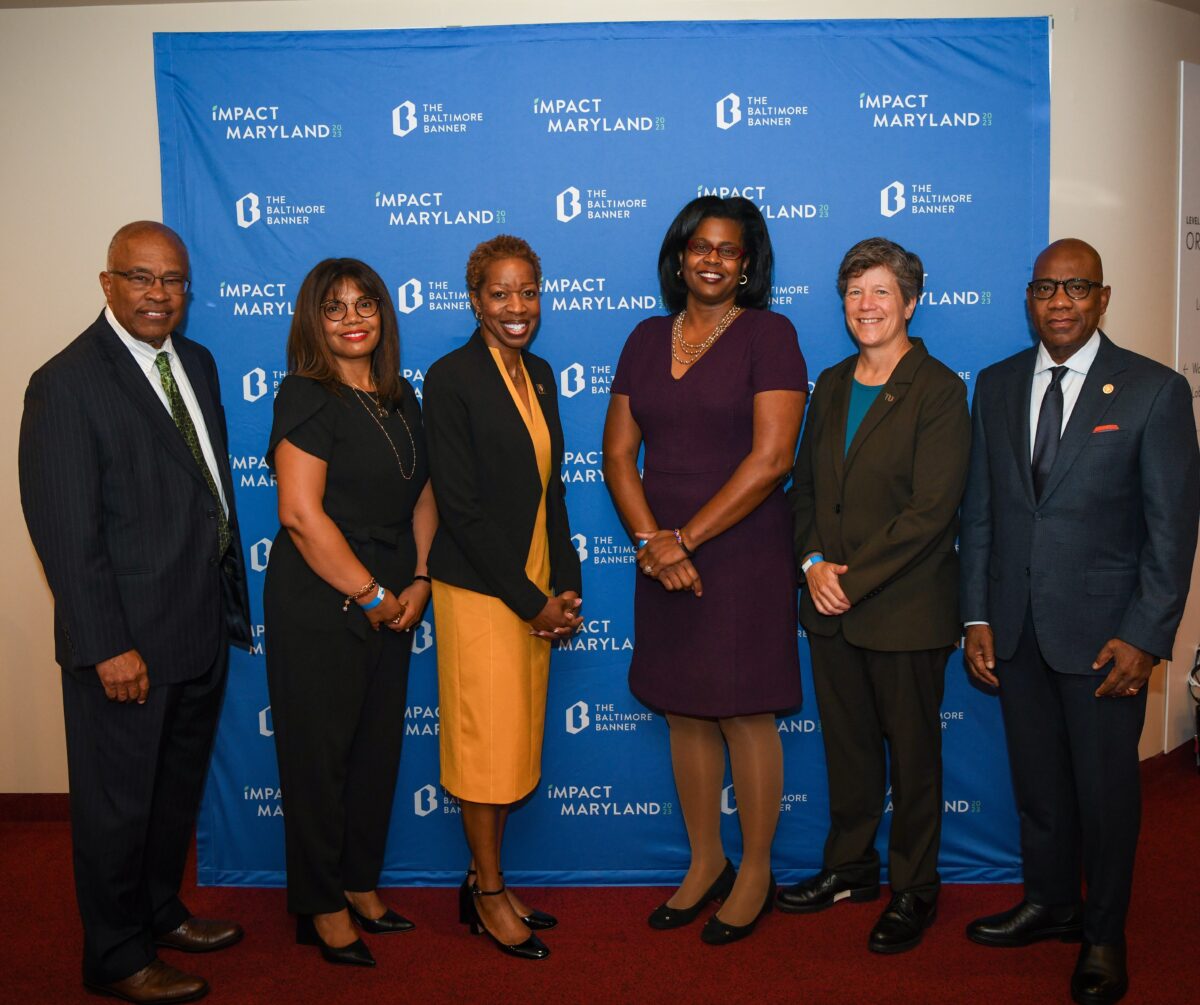
iMPACT Maryland 2023 “Empowering Dreams: Advancing Education for All in Maryland” panelists. From left to right: Kurt Schmoke, Tierra Dorsey, Valerie Sheares Ashby, Sonja Brookins Santelises, Melanie Perrault, and David Wilson. (Photo Courtesy of the Baltimore Banner)
“If you look at the mission statement for the USM, it uses words like equity, justice, and doing research and scholarship to improve lives. That’s the same vision and mission we have at UMBC,” Sheares Ashby said.
The event also included conversations with keynote speakers Governor Wes Moore and U.S. Secretary of Transportation Pete Buttigieg. Gov. Moore discussed the statewide initiatives his office is working to achieve. He made note of his investment into the Baltimore region, saying “in order for it to be Maryland’s decade, it’s got to be Baltimore’s time.”
When asked about the Supreme Court’s recent ruling that ended race-conscious admission programs at colleges and universities, Sheares Ashby shared that the “devastating decision” will not stop the ongoing work that UMBC is doing to create an environment of inclusive excellence for all students.
“UMBC has not had race-based admissions for decades, and we have an incredibly diverse student body. We have done that because we actually believe that excellence without diversity does not exist,” said Sheares Ashby. “We are trying to deliver a world-class education, and it is impossible to deliver a world-class education without different perspectives, different experiences, and being from different backgrounds. You cannot solve the world’s problems without a diverse group of people at the table.”
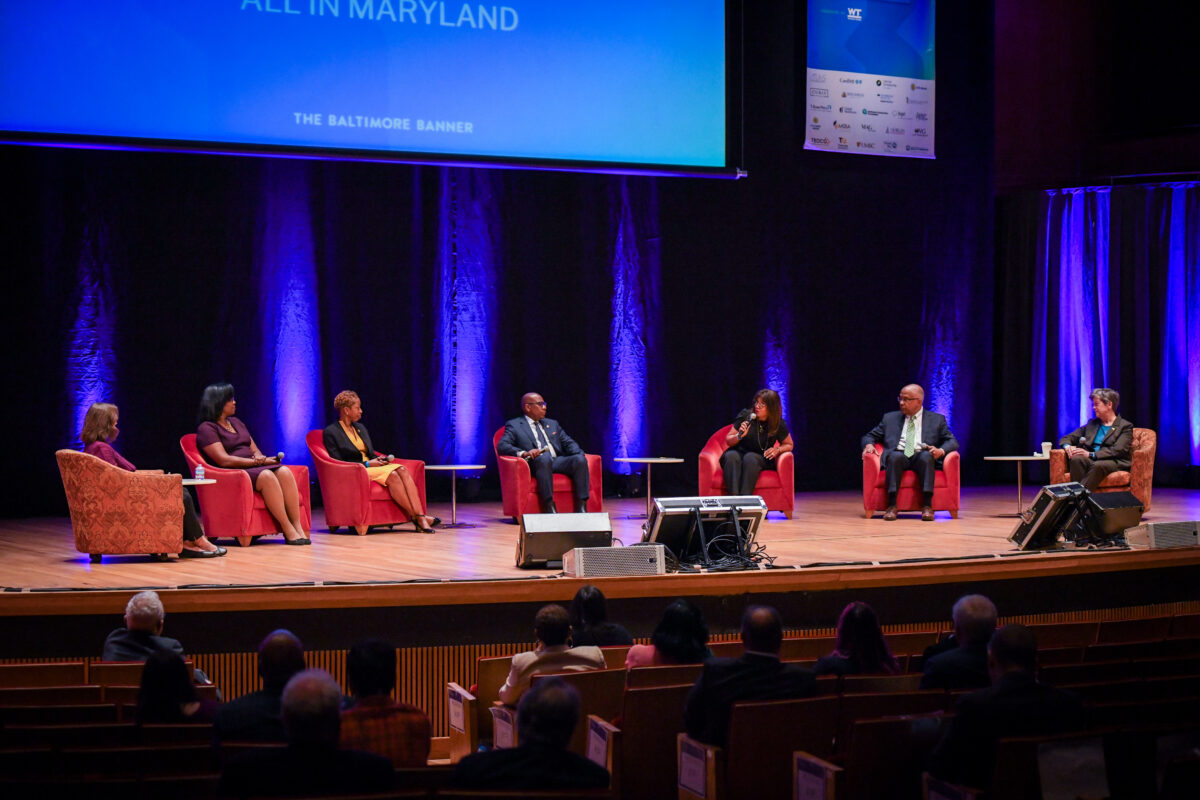
iMPACT Maryland 2023 “Empowering Dreams: Advancing Education for All in Maryland” panelists on stage at the Joseph Meyerhoff Symphony Hall on October 10, 2023. (Photo courtesy of the Baltimore Banner)
Advancing AI scholarship
iMPACT Maryland also included discussions with leaders in the Baltimore region working in areas such as healthcare, entertainment, youth gun violence prevention, and technology. Throughout several of the discussions, presenters and audience participants alike mentioned the rising worries associated with artificial intelligence (AI) technology.
“AI is scary…but the science is beautiful. At UMBC, we are taking a scholarly approach of getting in front of this and thinking about the unintended consequences. We have more students who want to study computing, information systems, and all those disciplines where AI and all of these new technologies are growing,” explains Sheares Ashby. “As scholars and researchers, we see this as pure opportunity, but we also see it as a responsibility to get in front of some of those unintended consequences.”
Read the Baltimore Banner’s key takeaways from iMPACT Maryland 2023 here.
For nearly two decades, UMBC faculty and students have been deeply engaged in story-driven research. The UMBC community’s contributions to this humanities-centered scholarship has included documenting the stories of former workers of the historic and now-defunct Sparrows Point steel mill in Baltimore County, and projects such as “A Place Called Poppleton,” which chronicles the history and culture of Baltimore City’s Poppleton neighborhood.
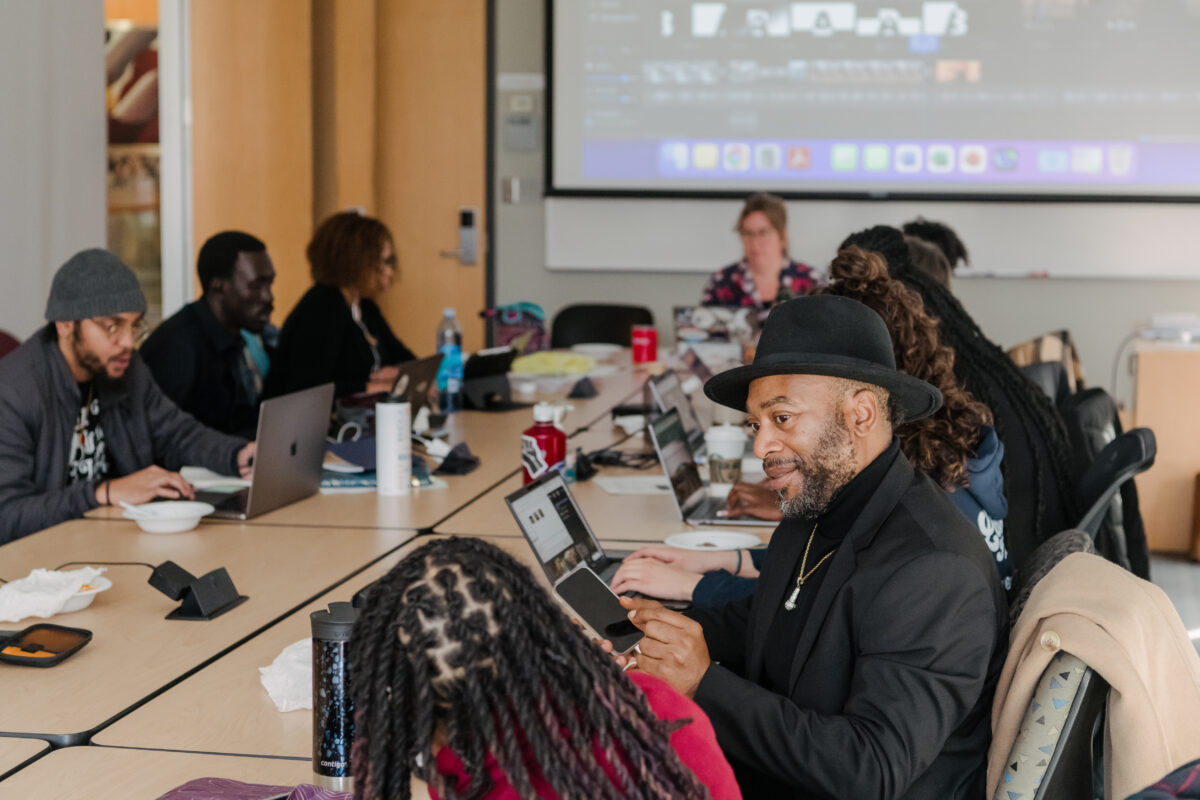
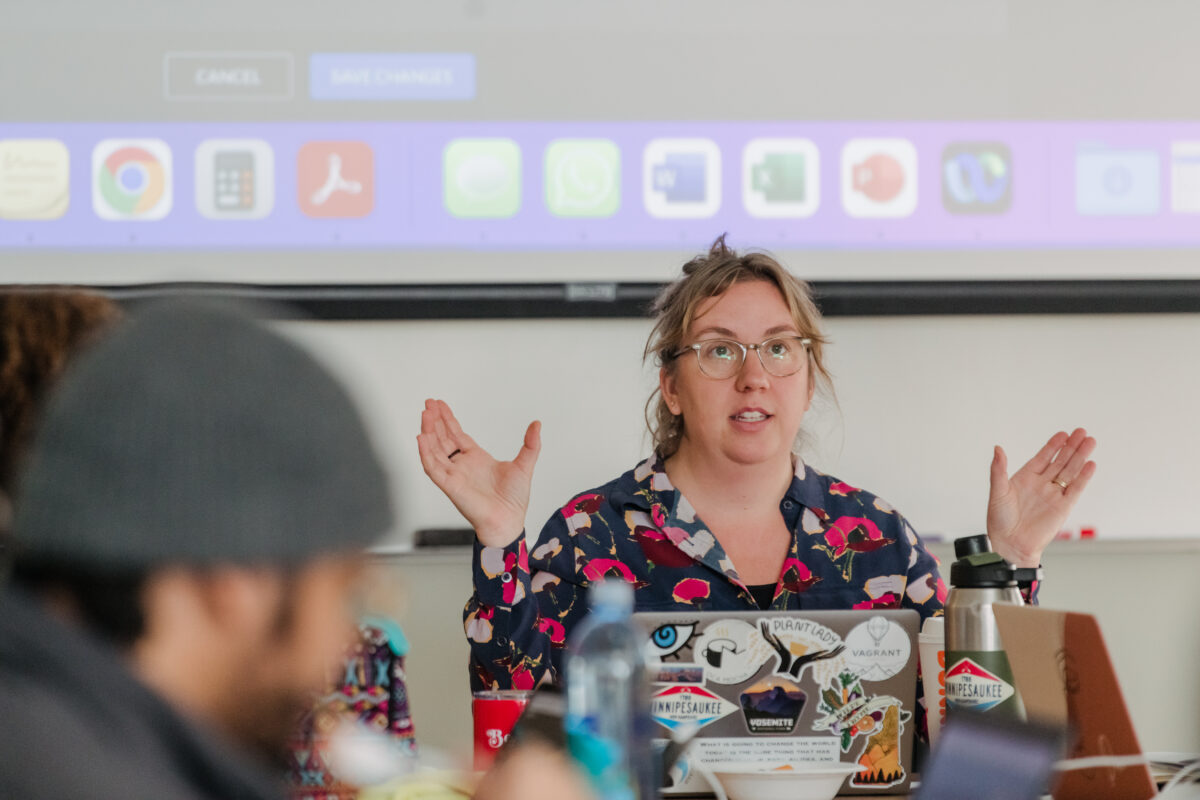
UMBC students learning about digital storytelling. (Marlayna Demond ’11/UMBC)
A commitment to community storytelling
The multi-day conference included workshops, presentations, storytelling tours, and site visits to partner institutions illuminating the impact of digital storytelling. Julissa Gómez Ruvalcaba, M.A. ’23, applied sociology, was one of the featured presenters at this year’s conference, her work adding to UMBC’s ongoing research of Latinx immigrant communities in Baltimore. During a site visit on the first day of the conference to the Creative Alliance, a non-profit art space in Baltimore City, Ruvalcaba discussed her capstone research project that included an ethnographic study of the city’s Latinx community.
Ruvalcaba shared that she felt a sense of “culture shock” when originally moving to Baltimore to study at UMBC. She is from a predominantly Mexican community in Northern California and took note of the drastically smaller Latinx population in Baltimore City, which, according to the 2020 Census, makes up about eight percent of the city’s population.
Julissa Gómez Ruvalcaba discussing her short film “Nest Making” at the Creative Alliance during the 11th International Digital Storytelling Conference. (Marlayna Demond ’11/UMBC)
“I became curious about how Latinx people understood their cultural identity and how they expressed themselves while living in a city that is predominately Black and white. That was the starting point to my thesis.”
That curiosity culminated in “Nest Making,” a short film that Ruvalcaba created documenting the Latinx community living in Highlandtown, a neighborhood in Southeast Baltimore that Ruvalcaba says is often referred to as “Latino Baltimore.” During the conference, Ruvalcaba held a screening of the film, which captures Ruvalcaba’s year-long research journey of examining how Latinx people are building their homes and communities in Highlandtown as they express parts of their culture and heritage.
“Digital storytelling is a medium that I’m really excited about. I thought about how to make my research accessible to all, including my family who may not understand all of the research jargon,” says Ruvalcaba. “Showing your story in a way that’s visually engaging, along with audio, captures [many] of the senses, which is something that I want to show people that can’t really be shown on paper.”
Digital storytelling history at UMBC
Bill Shewbridge’80, history, a professor of practice in media and communication studies, attended a StoryCenter workshop in 2004 and was excited to bring the practice back to UMBC. The university’s cultivation of storytelling research grew following a series of several StoryCenter workshops organized in 2006 by UMBC’s New Media Studio, the university’s multimedia production hub. Faculty and staff learned about digital storytelling as a pedagogical tool and have since brought the practice into the classroom.
“Over the years, UMBC has become an active participant in a growing international community of the digital storytelling practice through conferences and collaborative projects,” explains Shewbridge. “[Bringing] the international conference to our region grew out of discussions had at the 2018 conference in Zakinthos, Greece, so it was in the works for a long time.”
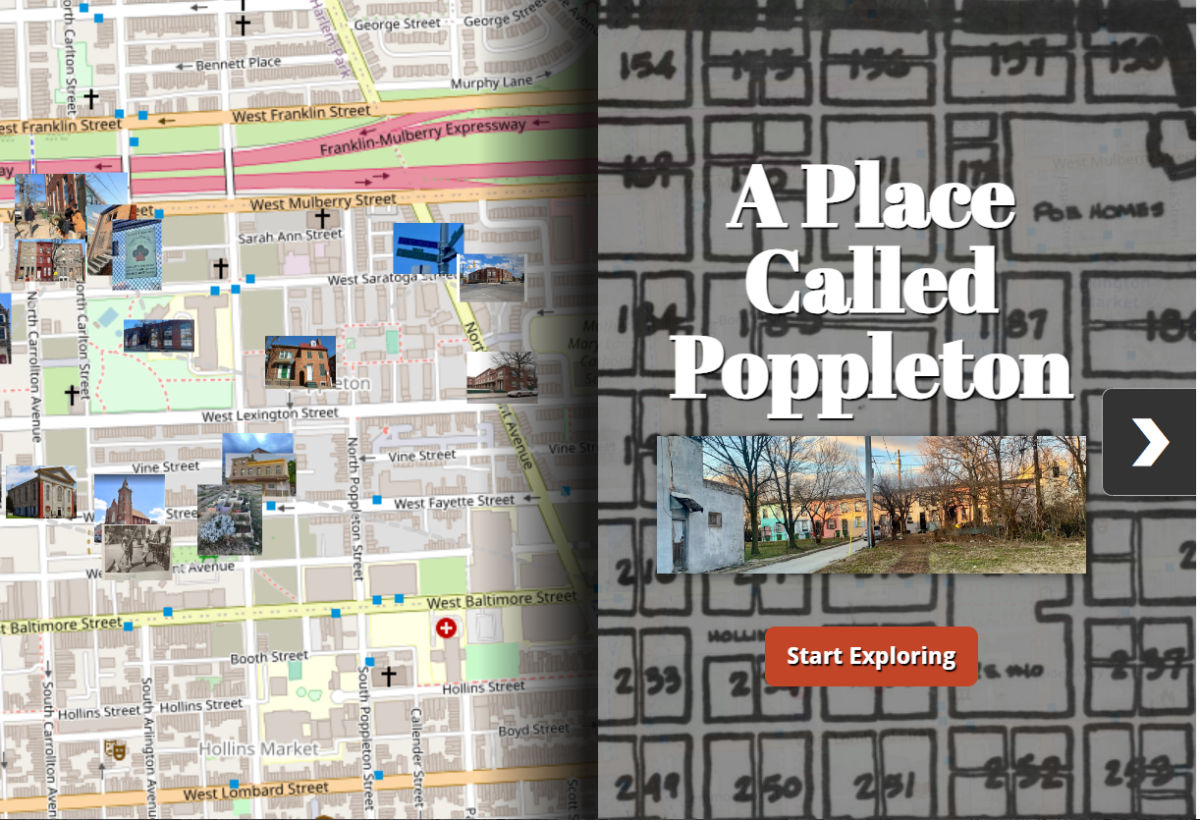
In spring 2021 “A Place Called Poppleton” debuted to document the history and culture of the Poppleton neighborhood of Southwest Baltimore. UMBC students produced a Story Map digital walking tour of the neighborhood with a focus on the area’s Black history and places lost or endangered due to redevelopment.
UMBC’s Digital Storytelling and Civic Agency in Higher Education working group, which Shewbridge leads, collaborated with Loughborough University in England, Montgomery College, the Smithsonian Office of Educational Technology, and StoryCenter to bring the international conference stateside for the first time.
“It was a great experience to be able to share our work in the Baltimore region with this very special group of colleagues,” says Shewbridge.
That sentiment was echoed by Charlotte Keniston,MFA ’14, intermedia and digital art, associate director of UMBC’s Shriver Peaceworker Fellows program. “What’s significant about UMBC hosting the conference is that it represents nearly 20 years of digital storytelling work that’s been happening here on campus,” she noted.
Charlotte Keniston teaching a digital storytelling class. (Marlayna Demond ’11/UMBC)
Keniston, who co-chaired this year’s conference, has championed digital storytelling research since she was a student at UMBC: “I have been using digital storytelling, teaching it, and facilitating others in using it since my start at the university. There are hundreds of students who have used it in the classroom, and dozens of faculty who teach it in their curricula as a way to engage students in reflection.”
For more information on storytelling research happening at UMBC, review a collection of UMBC’s digital storytelling projects here.
UMBC continues to show its strengths in undergraduate research, innovation, value, teaching programs, and several other areas highlighted in the 2023–24 U.S. News and World Report Best Colleges undergraduate rankings. This year, the university moved up in the national rankings in numerous categories, showcasing UMBC’s growth in several key areas.
The 2023–24 U.S. News college rankings, released today, were calculated using 19 key measures of academic quality, evaluating nearly 1,500 four-year bachelor’s degree-granting institutions in the country. For the second consecutive year, UMBC has moved up several slots on the list of Best National Universities (tied at #133). UMBC also climbed 38 slots in the category of best value schools, coming in at #69 nationally.
The university remains a leader in undergraduate teaching programs, ranking #12 nationally. UMBC also maintains its longstanding position as one of the nation’s most innovative universities, ranking #15 this year.
“This impressive jump shows that internal and external stakeholders have really taken notice of the incredible work that our undergraduates are engaged in,” says April Householder’95, visual and performing arts, UMBC’s director of undergraduate research and prestigious scholarships. “The faculty and staff at UMBC nurture a culture of research across all disciplines, supporting academic excellence from the humanities to the sciences.”
UMBC remains within the nation’s top-100 public universities, ranking #70 overall, and also moving up to #87 in the nation as one of the best colleges for veterans. While the rankings are primarily university-wide, they also include top-100 recognition for several specific undergraduate programs. The university advanced to #82 in computer science programs, sharing the ranking with other universities such as Auburn University, University of Georgia, and the University of Delaware. In engineering programs, UMBC also ascended to #90 nationally, joined by Howard University, Oklahoma State University, and the University of Alabama.
Read more about UMBC’s national rankings recognition here.
It’s summer, the ideal season to catch up on “to-be-read” lists and a time to discover new reads. Ever wanted to dig into a feminist critique of the classic horror film Carrie? Or how about a breezy beach read filled with romance and wild ponies set on Chincoteague Island? Maybe you’re a lover of historical nonfiction or math—either way, we’ve got you covered.
Across the UMBC community are engaged scholars who tackle a breadth of topics spanning a wide range of disciplines and writing mediums. From books, to more than 260 The Conversation articles, to several hundred peer-reviewed journal publications, the UMBC community creates an extensive collection of reading materials for bibliophiles of all interests.
This summer is a great opportunity to dive into recently-published books with bylines from UMBC’s faculty, staff, students, and alumni. Here’s a list of suggestions to add to your summer reading list:
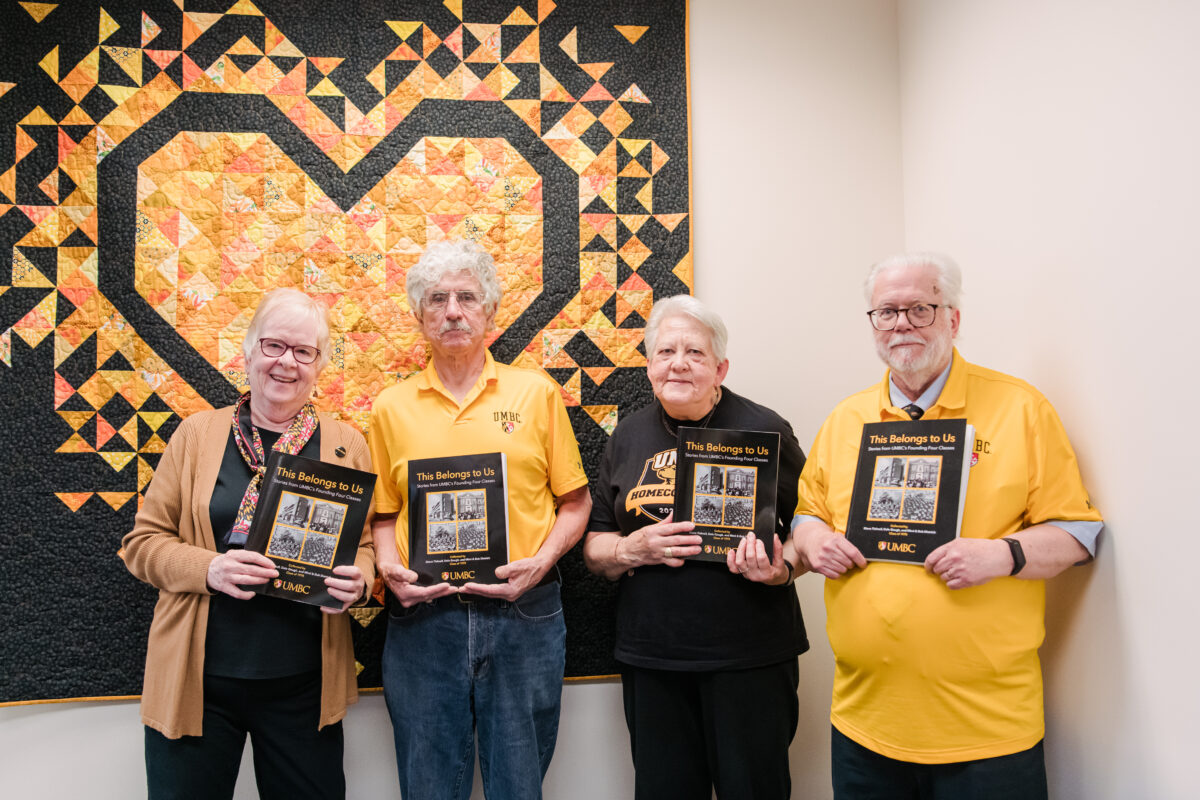
This Belongs to Us is a kaleidoscopic retelling of the colorful and authentic story of UMBC. The book chronicles the collective memories of members of the first four graduating classes of the university. The authors sent newsletters, emails, mail, and even knocked on doors to capture the voices of as many UMBC graduates as possible. In the end, 84 authors contributed more than 100 stories to This Belongs to Us. Proceeds from the book go to several scholarships supported by the Founding Four.
Mimi and Bob Dietrich, Diane Tichnell, and Dale Gough holding copies of This Belongs to Us. (Marlayna Demond ’11/UMBC)
In this approachable mathematical origin story, Manil Suri, professor of mathematics, creates a natural progression of ideas needed to design our world, starting with numbers and continuing through geometry, algebra, and beyond. He reveals the secret lives of real and imaginary numbers, teaches them to play abstract games with real-world applications, discovers unexpected patterns that connect humble lifeforms to enormous galaxies, and explores mathematical underpinnings for randomness and beauty.
In her debut novel, Lọlá Ákínmádé Åkerström ’98, M.S. ’02, information systems, tells the story of three Black women who are linked in unexpected ways to the same influential white man in Stockholm as they build their new lives in the most open society run by the most private people.
Lọlá Ákínmádé Åkerström and the cover of In Every Mirror She’s Black.
This collection of essays, edited by April Householder ’95, visual and performing arts, director of UMBC’s undergraduate research and prestigious scholarships, presents an in-depth analysis of the life and times of Laskarina Bouboulina, the legendary heroine of the Greek Revolution. At the age of fifty and mother to 10 children, Bouboulina commanded a fleet of ships from the island of Spetses and became the first female admiral in world naval history.
Roni Rosenthal, director of Judaic Studies at UMBC, tells the story of her Romanian-Jewish family’s hardships and survival during World War II and beyond. Where the Lilacs Bloom Once Againcenters the experiences of Rosenthal’s great-aunt Friddie, who was kept for 13 years in secret prisons and labor camps in Romania during World War II and then under the Communist rule, where she was tortured and forced to dig the canal from the Danube River to the Black Sea.
Friddie, center, age 4. Other members of Rosenthal’s family from left to right: Aurica, Aurel, Gisela, Elvira, Victor, and Isaac in Piatra Neamț, Romania, 1923. (Photo courtesy of Roni Rosenthal)
Colette Searls, associate professor of theatre, explores the ways in which all puppets, masks, and makeup-prosthetic figures are “material characters,” using iconic Star Wars characters like Yoda and R2-D2 to illustrate what makes them so compelling. In A Galaxy of Things, Searls—an expert in puppetry studies—uncovers how non-humans like Chewbacca, semi-humans like Darth Maul, and even concealed humans like Boba Fett tell meaningful stories that conventional human characters cannot.
Michelle R. Scott, professor of history, details the institutional history of the Theater Owners’ Booking Association’s (T.O.B.A.) origins and practices while telling the little-known stories of the managers, producers, performers, and audience members involved in the circuit. Looking at the organization over its 11-year existence (1920–1931), T.O.B.A. Time recounts the origins of artists and entrepreneurs like S.H. Dudley, Bessie Smith, Butterbeans & Susie, and Cab Calloway, and the theater circuit that made them famous in segregated America.
Ramon Goings, associate professor in UMBC’s Language, Literacy, and Culture doctoral program, shares 14 strategies that will help current and prospective Ph.D. students navigate the dissertation process and finish in record time.
Set among the beaches and wild ponies that have made Chincoteague Island famous, Fearless Summer, the latest romance novel from Mary K. Tilghman ’79, English, tells the story of Charlotte, who comes home to Chincoteague to help her sisters run a new shop in town. She hasn’t been home since her breakup with Henry eight years before. The possibility of meeting him almost makes her say no, but sisterly love convinces her she can handle a return to Chincoteague.
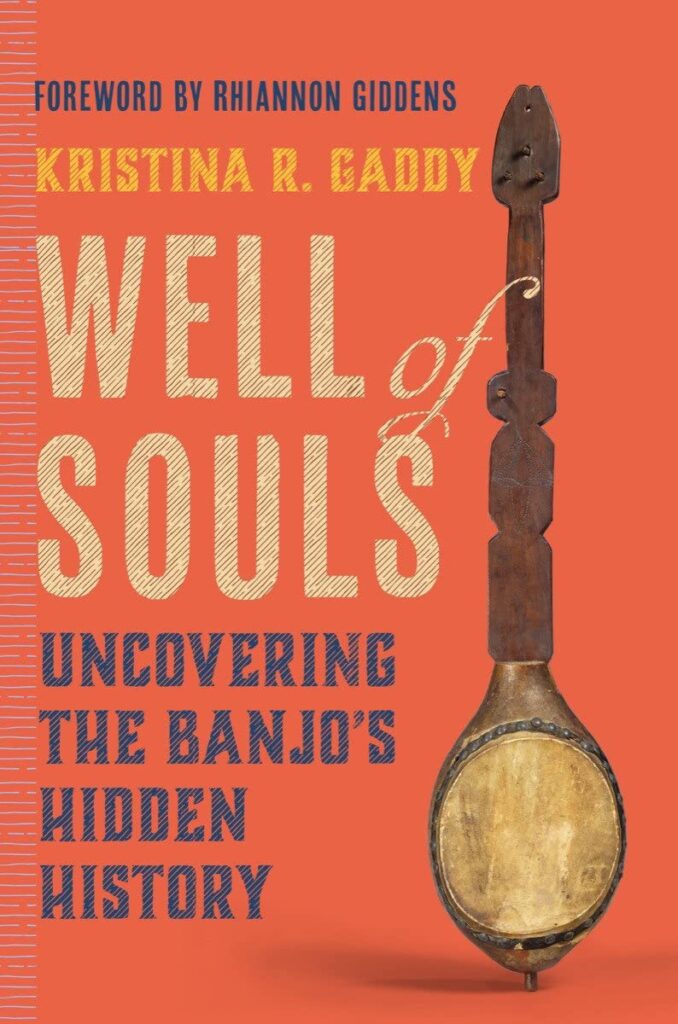
In an extraordinary story unfolding across two hundred years, Kristina R. Gaddy ’09, modern languages and linguistics, history, uncovers the banjo’s key role in Black spirituality, ritual, and rebellion. Through meticulous research in diaries, letters, archives, and art, she traces the banjo’s beginnings from the 17th century, when enslaved people of African descent created it from gourds or calabashes and wood. Gaddy shows how the enslaved carried this unique instrument as they were transported and sold by slave owners throughout the Americas, to Suriname, the Caribbean, and the colonies that became U.S. states, including Louisiana, South Carolina, Maryland, and New York.
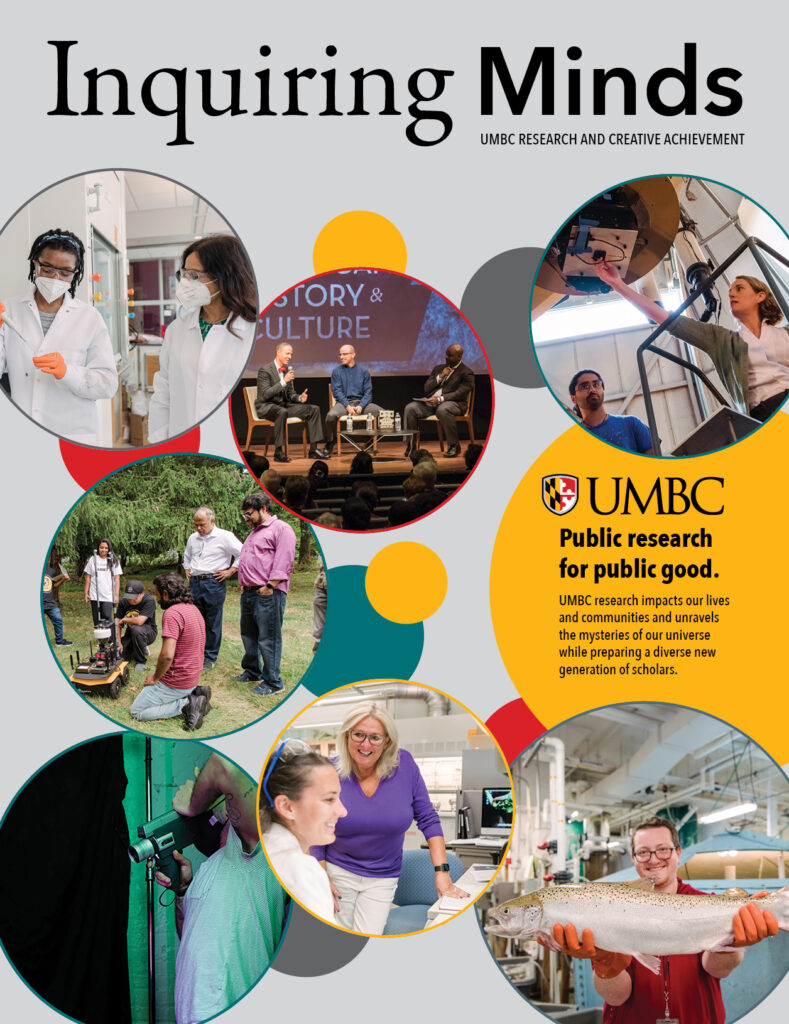
Inquiring Minds shares a selection of recent innovative and impactful work by UMBC’s researchers and scholars. The inaugural publication highlights a broad range of UMBC’s research and creative achievement in seven key areas.
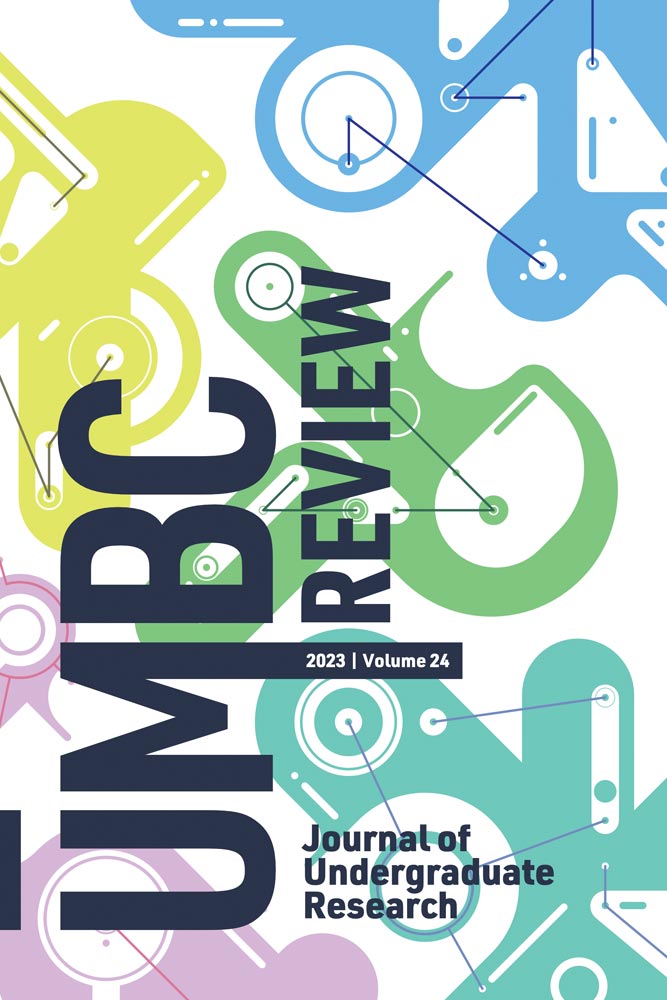
The UMBC Review, now into its third decade of publication, offers an opportunity for undergraduate students to showcase the results of their academic journey. UMBC Review, Vol. 24 includes undergraduate research on topics such as: the current state of mathematics and machine learning, a feminist critique of the 1976 film Carrie, and the history of the Ku Klux Klan in small town Maryland.
“Retrievers Read” Summer Reading Challenge
For more summer reading fun, join the UMBC Alumni Association’s “Retrievers Read” summer reading bingo challenge, happening now until August 30, 2023. Get a ‘bingo’ to receive free UMBC swag, and participants who fill out the entire bingo card will be entered into a drawing for a UMBC gift bag. Click here for more information.
For more than a decade, Rita Choula was the primary caregiver for her late mother who lived with frontotemporal degeneration (FTD), a lesser known form of early onset dementia that typically affects people under the age of 60.
“My mother started saying things like ‘I don’t feel like myself. I feel like I’m losing my mind.’ She used to be someone that was really engaged and outgoing and she started to pull back a bit. She used to be very empathetic, very people-loving, and showed a lot of concern, and it reached a point where that empathy went straight out the window,” recalls Choula ’95, information systems management, M.A. ’16, aging services.
The process of learning what was affecting her mother, who passed away in October 2020, was a long and challenging one for Choula and her family. That’s why in her current role as the senior director of caregiving at the AARP Public Policy Institute, Choula advances equitable, culturally responsive policies and practices by elevating the unique nature of each caregiving experience.
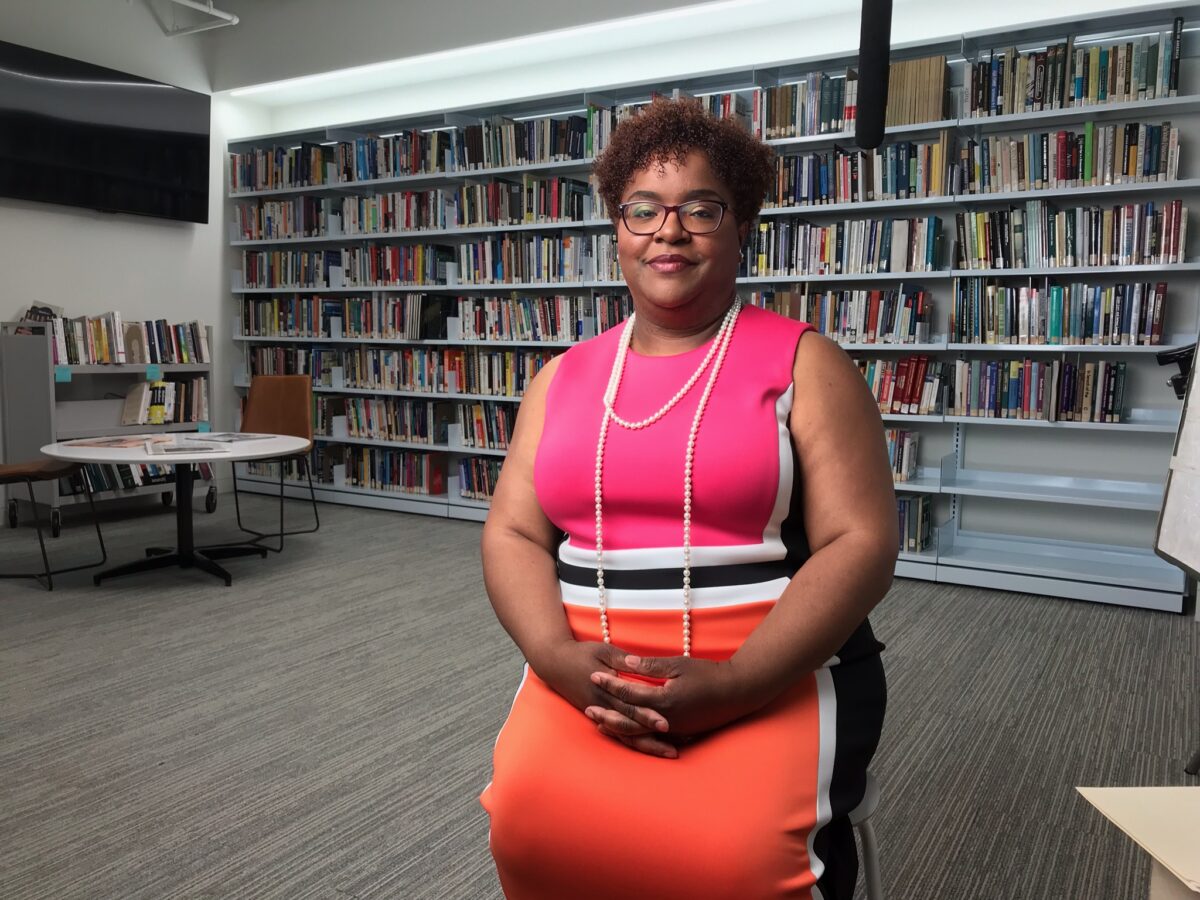
Headshot of Rita Choula.
After four years of misdiagnoses and cycling through several neurologists and medical practitioners, Choula’s mother, at age 60, was finally diagnosed with behavioral variant FTD, a subtype of early onset dementia that doesn’t specifically impact memory, but instead causes personality changes, apathy, and a progressive decline in socially appropriate behavior, judgment, self-control, and empathy.
“It was a true battle to determine her diagnosis. The lack of an early diagnosis left me bitter because it took away a lot of opportunities for us to just be with her,” says Choula. “So much of our journey was me figuring it out and having to educate professionals on it.”
Developing as a leader in aging services
But how did she go from a frustrated family caregiver to a leader in the aging studies field?
Nearly 20 years after receiving her undergraduate degree, Choula returned to UMBC to continue her academic journey at the Erickson School of Aging while in the throes of caring for mother. Her caregiving experience encouraged her to learn more about how to more adequately and holistically care for aging adults and the caregivers that supported them, like herself.
“The program was shaped in a way that allowed a working caregiver and mother to be able to pursue her dreams of getting a degree, while still helping me navigate a really difficult time in my life,” says Choula.
Becoming a critical thinker
In the 1990s, UMBC was one of Choula’s top university choices, stemming from the keynote speech delivered at her high school graduation by none other than UMBC’s then-president, Freeman A. Hrabowski, III.
“Hearing this educated Black man speaking about the importance of education and quoting Langston Hughes’ ‘A Dream Deferred’ made me say ‘[UMBC] is where I want to go.”
“
“The program was shaped in a way that allowed a working caregiver and mother to be able to pursue her dreams of getting a degree, while still helping me navigate a really difficult time in my life.u0022
Rita Choula '95, M.A. '16
Choula, who hails from Suitland, Maryland, was interested in information systems management because of UMBC’s strong computer science programs. She found value in coupling her major with a minor in Africana Studies. Her educational experience helped her to “broaden how I saw myself as a Black woman in this world,” Choula shares.
Choula cites professors emeritus Acklyn Lynch and the late Miriam Decosta-Willis as mentors who helped expose her to many Black scholars and thinkers across the African diaspora.
“I was challenged across my courses to critically think about what we were learning, to ask those difficult questions, and to work together as a student body on many different issues to push forward change.”
A personal touch
When Choula returned to earn her degree in the Erickson School, she says the professors imparted much more than academic knowledge—they also assisted her in her personal caregiving experience, especially when it came time to transitioning her mother into living at a nursing home facility. “I went to several of my professors and asked how I should navigate this. They picked up the phone to make calls to care facilities on my behalf—it impacted me tremendously and taught me the importance of seeing a student as a whole person.”
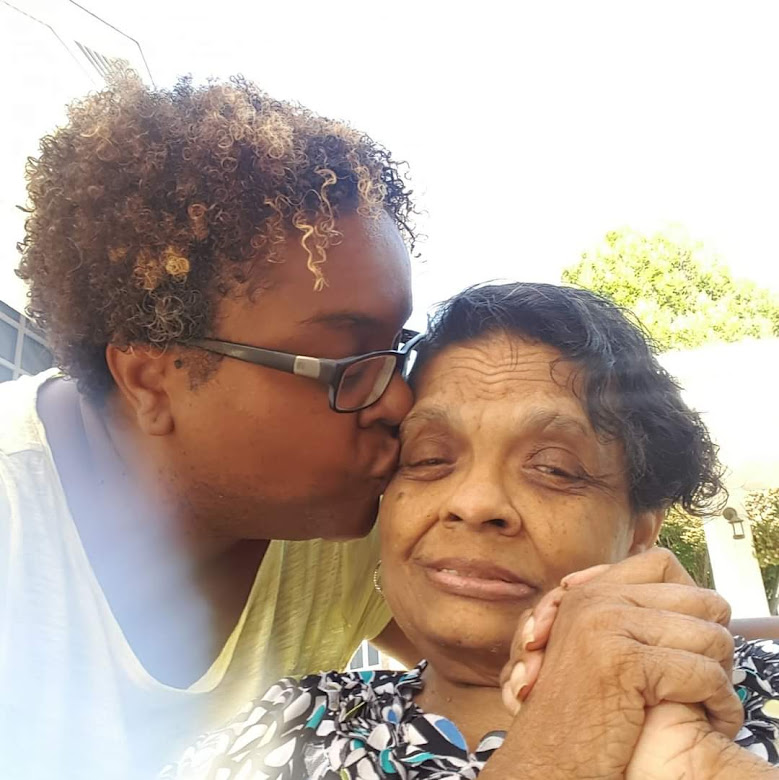
Choula kisses her mother, Theresa Bryant.
Choula’s experience as a Retriever laid the foundation for the work that she does in support of family caregivers. She specifically remembers a class with Joseph DeMattos, president of the Health Facilities Association of Maryland— the state’s largest and oldest long-term care association. Choula noted how DeMattos’ guidance on leadership helped to inform her current career pursuits. “DeMattos taught me how to position myself as a leader, the different types of leadership styles, and what type of impact I want to have not just on my work but on the people who I’m leading,” says Choula.
Choula applies all that she’s learned at UMBC to bring together policy, research, and practice—the three critical areas of aging services. With her expertise, she works to bridge the three areas, centering on identifying and supporting the needs of diverse family caregivers across ethnicities, cultures, and generations.
“I learned so much about myself as a UMBC student. My experience taught me to take on issues from a place of critical thinking and ensure that we center the needs of people while working with them to affect change and impact.”