All posts by: Magazine Editor


Meet a Retriever—James Atsaides ‘71, psychology, Founding Four member and planned giving donor

Meet James Atsaides ‘71, psychology. Jim is a Founding Four member, a management psychologist, a former Alumni Association Board of Directors president, a former adjunct faculty member, and a planned giver to the university. In 2023, Jim established the Dr. James P. Atsaides Endowment through his life insurance policy. But, most importantly of all, Jim met his wife Ardell Terry through his philanthropic work with the university. Recently, Jim took some time to reflect on his UMBC story. Take it away, Jim!

Q: What is your WHY? What brought you to UMBC?

A: I graduated from Loyola High School in 1967, and it was already a “done deal” that I would attend the University of Maryland, College Park. My brother, Sam Atsaides, was already there, which made things easier for my parents. So off I went.

Sam was a year ahead of me, and for his first year, he lived on campus. When I went there, the plan was for us to get an apartment with a few other roommates—cheaper than living on campus. When school started, Sam helped me figure out how to enroll in classes and what classes to take. I decided to become a psychology major. 

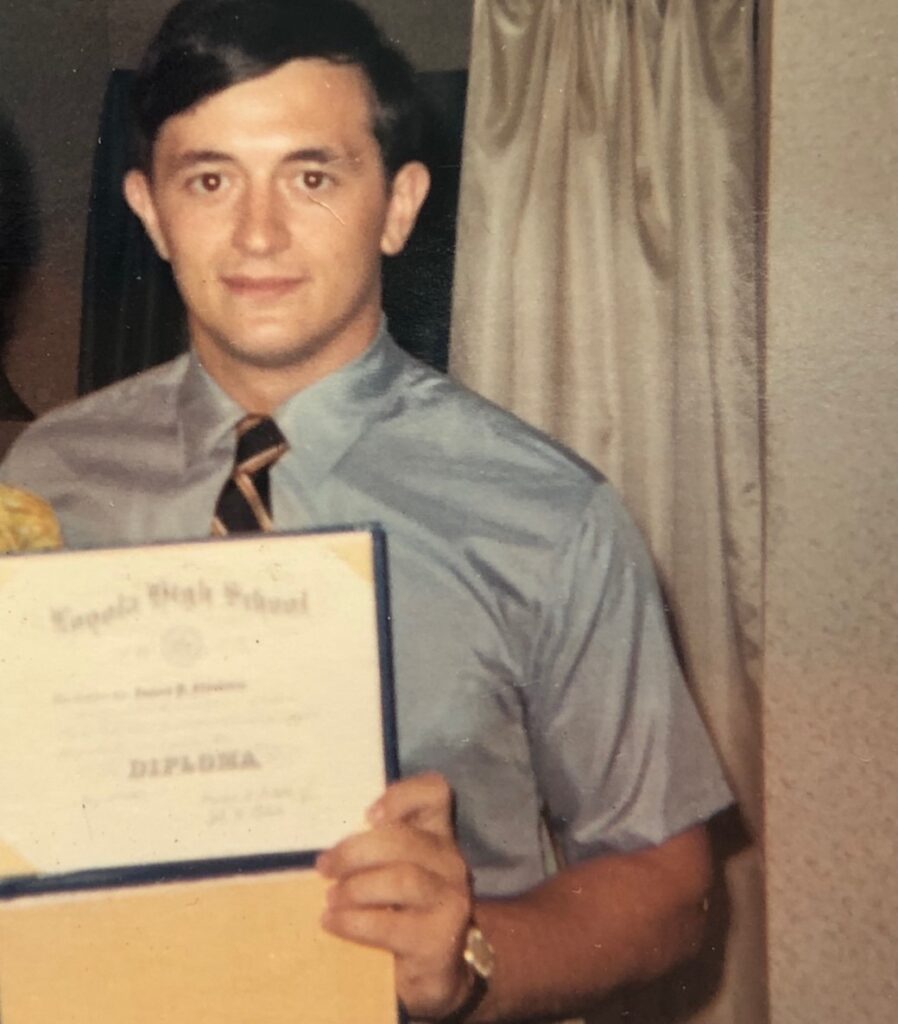
James Atsaides in 1967 holding his diploma from Loyola High School.

College Park was huge. I got lost right away. I wasn’t in high school anymore. It was also a rude awakening to how big the classes were. I was used to having 20 students in a class, but now there were 100 – 300 students in the freshmen classes. It took me weeks to get used to the size of the classes and how impersonal the school was. 

Quickly, I realized that I was struggling. Sam was not a model student and always wanted to “wing it.” I couldn’t do that. Also, classes were hard, and I was also finding it difficult to make friends.

Year two at College Park was not much better—the same apartment, the same roommates, and an added twist. It was 1968 and the Vietnam War was getting a lot of attention. Students were staging “sit-ins,” and there were protest banners all over campus. I remember walking around campus wondering, “What am I doing here?” Adding to the chaos, Rev. Dr. Martin Luther King, Jr. was killed in 1968, leading to further unrest in the Washington, D.C., area.

After my second year of college, I decided I needed a change—a bold move. I decided to drop out of school. I mentioned to my parents that I needed some time off, and they understood what I was feeling. After a few jobs, I came back to my parents’ home in Catonsville and helped them at the family restaurant, Kibby’s. That’s where I first heard people talking about the new college just down the street, the University of Maryland, Baltimore County. So, I decided to check it out. 

I drove to UMBC and walked around. It had only been built within the last few years and there were only a few buildings. But I liked it. Even though there was lots of dirt and mud all around, it felt just right—I felt safe. It was a small campus, unlike College Park. The students were walking with smiles on their faces, and I felt like I could relate to them. I talked it over with my parents, and the next semester I enrolled at UMBC. 

Q: Tell us about what you loved most about your academic program. Was there anyone in the community who helped support you?

A: I decided to remain a psychology major and was impressed with all the courses that I could take at UMBC. I was like a kid in a candy store, just happy taking classes that were meaningful to me. The professors were also more approachable, and I started making friends. UMBC felt like home. 

One friend in particular, Stan Sack, was a tremendous help. He was a fellow psychology major and had been at UMBC from the beginning. We studied together and talked about classes and professors, and he helped guide me throughout my time at UMBC. Stan helped make my time at UMBC a happy experience. As a result, my grades improved. I felt excited and energized with what I was doing.

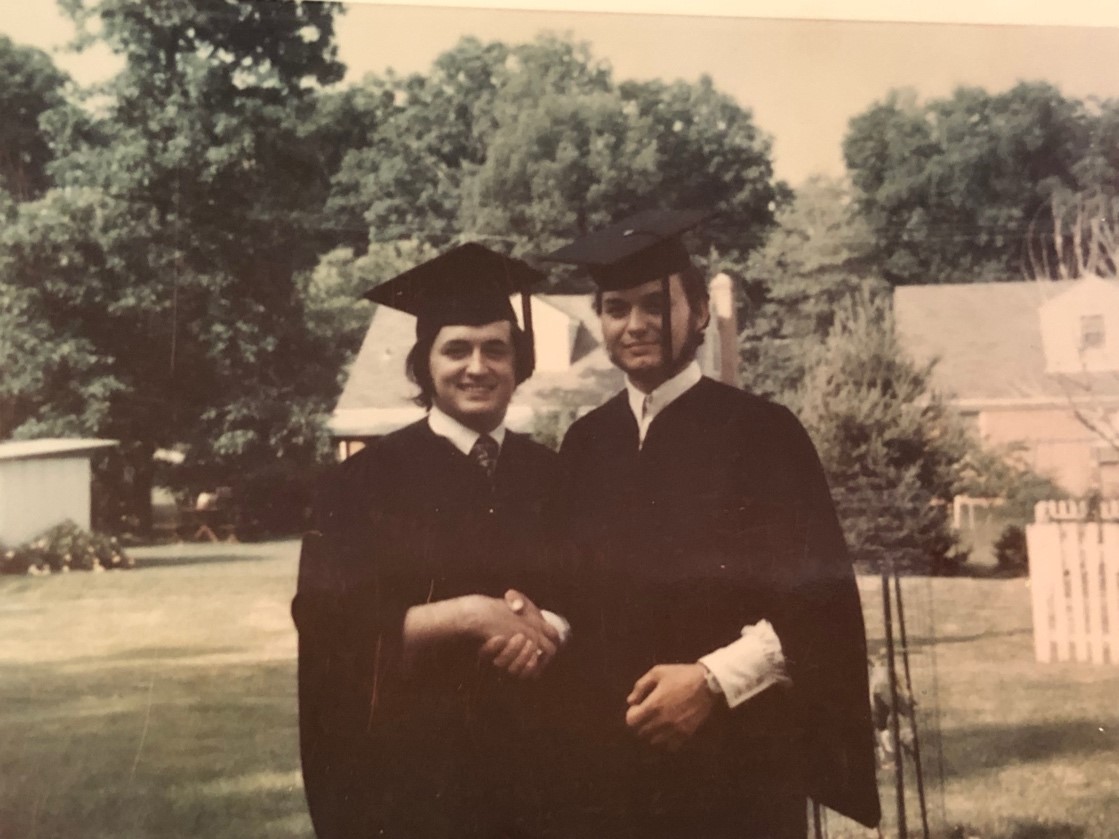
James Atsaides '71, psychology, and his older brother Sam in their graduation regalia in 1971.
James Atsaides and his older brother Sam in their graduation regalia in 1971.

The classes I was taking also offered lots of different experiences. During an archeology class, we took a trip to the Walters Art Museum. As part of a project in a sociology class, I got to interview a local brewery manager and learn how his business impacted the community. This was a particularly meaningful experience because I always enjoyed business. I think it gave me the drive to focus on industrial psychology years later. I also did an internship at Spring Grove State Hospital, which was very meaningful in a different way as it made me realize that I did not want to become a clinical psychologist! 

Q: What’s the one thing you’d want someone to know about the support you find here?

A: My time at UMBC went very quickly, but UMBC was my “savior” in a lot of ways. UMBC and the supportive community gave me the positive university experience I always wanted. UMBC also gave me direction and helped me figure out what I wanted to do with my life. I look back on my time as a UMBC student very fondly. However, it would not be my last go-around with the university. 

My time at UMBC made me realize that I enjoyed learning. So I just kept going to school. I completed a master’s program at Springfield College and a Ph.D. program at the University of Kansas.

Q: Can you tell us about your career in psychology?

A: My career took me from Kansas to Oregon to work with an international firm of management psychologists. In the early 1980s, my parents and family decided to build a hotel resort on the Greek island of Rhodes where my mom had a large parcel of land. For this to materialize, however, I had to leave my career and come back to Baltimore to take over Kibby’s, the family restaurant. So in 1983, my family loaded the Hertz rental truck and settled back in Catonsville with two very young girls. 

As a management psychologist, I took my own advice and hired a very good general manager to run the restaurant. This allowed me to start my professional practice in Baltimore in 1985. During this time, I met a fellow psychologist who became a very close and dear friend, John Martello. John was in a senior position at UMBC. We hit it off very well, and we spent much time talking about the work we were both doing, as well as our experiences at UMBC. John was instrumental in introducing me to the senior staff at UMBC. He introduced me to not only the head of the psychology department but also to the president of the university, Michael Hooker

I enjoyed getting back on campus. The campus had grown so much and was still growing!

I am grateful for my time at UMBC and have appreciated the many life-long opportunities it has given me as an individual and as a professional.

James Atsaides ‘71, psychology

Management Psychologist & Business Consultant

Q: What drives you to support this community?

A: In the late 1980s, President Hooker contacted me and asked me to join the UMBC Alumni Association Board of Directors. I happily accepted.

During this time, UMBC was promoting an insurance program that alumni could establish that would create an endowment for UMBC. President Hooker and Nell Savopoulous, director of development at UMBC, asked if I would participate. I felt such a close connection to UMBC, that I said “yes.” This was my alma mater after all. Now, I just had to figure out what and who my endowment would benefit.

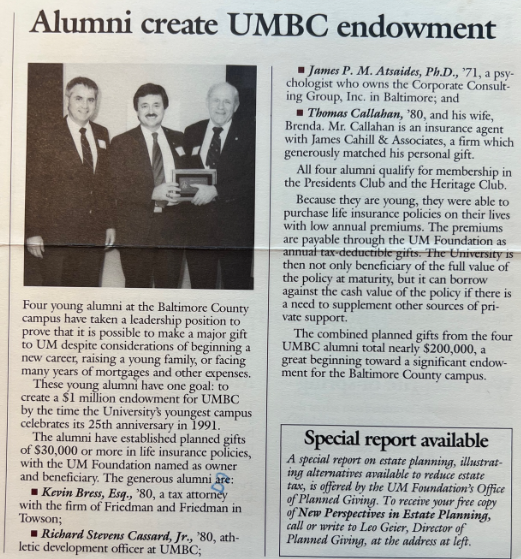
Newspaper clipping from The Retriever Weekly announcing the establishment of the Dr. James P. Atsaides Endowment.
Newspaper clipping from The Retriever Weekly announcing the establishment of several endowments, including the Dr. James P. Atsaides Endowment.

As an industrial psychologist, I’m required to attend regular educational programs for continuous education (CE) credits. Students also regularly attend these conferences to make connections and gain exposure to the industry. However, these conferences are not cheap. My grandson, Dustin, for example, was graduating from Ithaca College and was honored with a request to present his senior research at a conference in Phoenix, Arizona. He was delighted with the opportunity but had to figure out how to cover airfare, lodging, and other expenses not included in his conference registration. Dustin quickly learned that there were no grants or scholarships available from the school to help him. So, he had to ask his parents and grandparents for money.

As my wife and I thought about Dustin’s situation, we both said, “Wouldn’t it be a good thing to have students apply for grants for this type of situation?” As we discussed this, we realized that we could focus the Dr. James P. Atsaides Endowment to help graduate students in need of funding to attend conferences.

I am grateful for my time at UMBC and have appreciated the many life-long opportunities it has given me as an individual and as a professional. Creating an endowment for students has been a wonderful way for me to say “Thank You” to the university and to help future students. And I am excited to share that we will award our first scholarship this academic year!

“Dr. Atsaides’ generosity to give back to both UMBC in general and our I/O Psychology program, in particular, is a testament to his professional values and his commitment to his alma mater,” says Dr. Elliot Lasson, professor of the practice and Director of UMBC’s I/O Psychology graduate program. “We look forward to using his gift to support our graduate students for years to come.”

Q. What has been your most meaningful connection at UMBC?

A: Through my work with the university, I was fortunate to meet Ardell Terry, campaign manager for UMBC. She was a positive addition to the fundraising group. Ardell and I married, and we have been together now for over 20 years. I thank UMBC for the opportunity to meet her as well. 

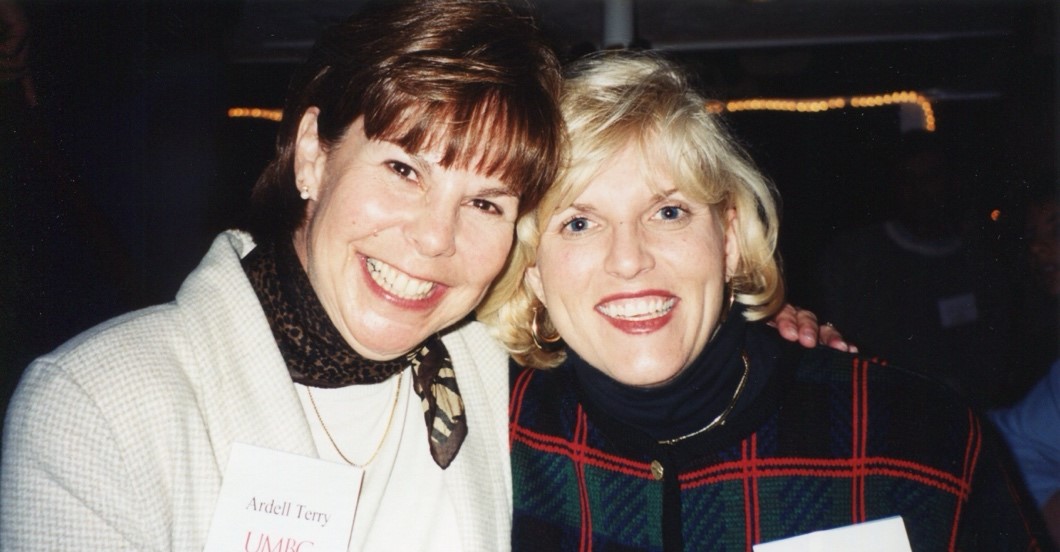
Ardell Terry, campaign manager for UMBC, and Kim Robinson, director of major gifts at UMBC.

Q: How have you stayed connected with UMBC?

A: In 1990, I was asked to teach an upper-level class in organizational psychology and joined the UMBC community in a new capacity—adjunct professor. I greatly enjoyed teaching the class and did so for nine years.

Along with my time on the UMBC Alumni Board, President Hooker asked me to represent the university as a member of the University System of Maryland Chancellor’s Advisory Council. This was truly an honor for me to represent my alma mater and be part of this historic transition to a state-wide education system. 

In 1992, I was asked to be part of the selection committee for the next president of UMBC. As many of you probably know, this is the historic search that elevated Freeman A. Hrabowski, III, to the role of president, which he held until he retired in 2022.

In 1995, I was asked to take the position of president of the UMBC Alumni Board. This was a tremendous honor for me and allowed me to work closely with the administration. In my role as board president, I had the opportunity to be on stage while my younger cousin graduated from UMBC, which was really special.

UMBC continues to be close to my heart. It has been a large part of my life, and I am sure it will continue to be. I am honored to give back to the university in any way I can.

* * * * *

UMBC’s greatest strength is its people. When people meet Retrievers and hear about the passion they bring, the relationships they create, the ways they support each other, and the commitment they have to inclusive excellence, they truly get a sense of our community. That’s what “Meet a Retriever” is all about.

Learn more about how UMBC can help you achieve your goals.

‘Snow better’ way to enjoy the rest of fall at UMBC

It’s tempting to think that with Thanksgiving almost here the fall semester is over, but campus still has some events to keep you warm and cozy throughout the rest of the year. As you work on your final projects, we’ve lined up the perfect list of comforting activities to keep your mind relaxed!

Fuel your studies

You may be full of knowledge but we know you still have room for a snack! Come by The Commons Mainstreet at noon on Wednesday, December 4, to check out the Student Events Board (seb)’s boba bar! Connect with some friends over treats before you dive back into your books. 

Fold your worries away

The Initiatives for Identity, Inclusion, and Belonging (i3b) have been hosting hands-on origami workshops, and you can catch the last session of the semester.

Take a break from the semester’s stresses to create some snowflakes or any seasonal design. Origami Art Night is a peaceful space for you to relax, focus, and leave with a sense of accomplishment (and maybe a few paper masterpieces!) Stop by the Center for Well-Being, room 122, from 4 to 6 p.m. on December 4. 

A flyer that reads "Origami With Joyce
Oct 2, Oct 16, Nov 13, Dec 4 – 4-6 PM
Center for Well Being, 122

Join Joyce to discover the beauty of Origami in this hands-on workshop! Perfect for all skill levels. Unwind, get creative, and leave with your own handcrafted masterpieces.

All materials are provided – just bring your creativity!"

Monologues and moments

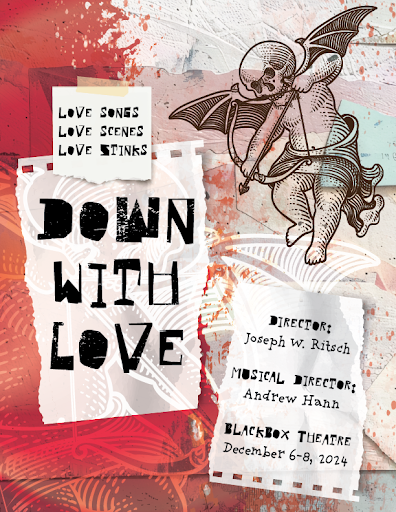
A chance to experience the complexities of love and heartbreak? You don’t wanna miss this! Step into the Black Box Theatre for an evening of raw talent and emotion. The UMBC Theatre Department is presenting Down With Love: An Actor Showcase, directed by Joseph W. Ritsch. To witness powerful monologues and heartfelt scenes, grab your tickets now for December 6-8 (make sure to find the two free performances for students)!

Distract yourself with dance

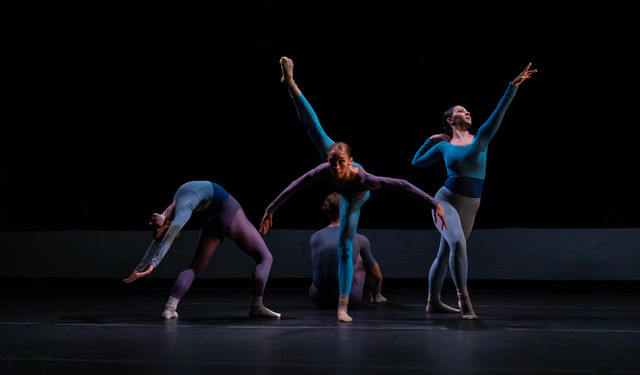
4 dancers performing ballet on stage, wearing blue and purple costumes. Each move expressively and dynamically
Photo by Kiirstn Pagan ’11/UMBC

It’s a shame you can’t dance your troubles away, but you can watch others use their talents! Come and see the amazing work of students as they showcase their skills and talents! Prepare to be wowed by these delightful dancers on December 7 in the Proscenium Theater located in the Performing Arts and Humanities Building. 

All aboard the holiday express

The magic of the wintertime is now just a bus ride away! Join (seb) on December 8 for a trip to Baltimore’s Inner Harbor Christmas Village. From 12 to 7 p.m., enjoy live festive music and browse handcrafted gifts with the waterfront as your backdrop. Bundle up, bring some spending money, and get ready to be immersed into the holiday season.

It’s the most wonderful time of the year!

The winter semester may be ending soon but the fun doesn’t stop. Enjoy free hot chocolate, snacks, crafts, and create memories frozen in time. Join (seb) on the North Lawn of The Commons for a Winter Wonderland on December 10. Bundle up and bring your friends! 

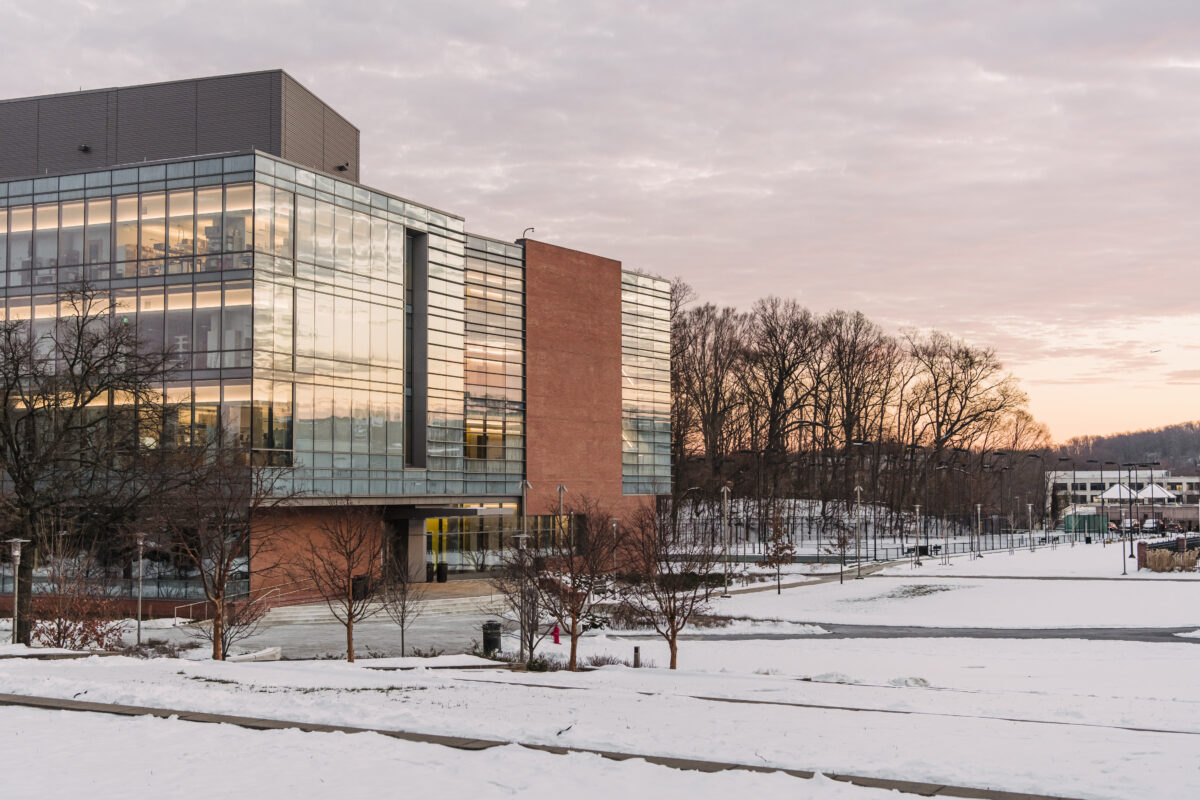
The Interdisciplinary Science Building on UMBC's campus, surrounded by snow on the ground as the sun goes down

There’s snow place like UMBC to enjoy the rest of the semester! Whether you’re crafting in Commons or adventuring into Baltimore, these events will make this chilly season feel a little warmer.

By Mashaal Awan ’25 and JJ Gee ’25, UCM interns

The dance floor beckons—after 4 decades away, a dance major returns to her degree

In the fall of 1977, Jimmy Carter was president. NASA launched the Voyager I fly-by mission past Jupiter and Saturn. “The Mary Tyler Moore” show earned an Emmy for outstanding comedy, and the Atari 2600 gaming system went on the market. The Emotions’ “The Best of My Love” hit number one on the pop charts.

It was also the year Baltimore native Teresa Kearney entered UMBC as a dance major. But her route to a dance degree has been circuitous. She anticipates graduating in 2025.

From the classroom to the dance floor

At Walbrook High School in West Baltimore, Kearney danced under the direction of Beverly Marshall Johnson, who she still keeps in touch with today. As a young dancer, she performed regularly on TV channel 45’s “Soul City” (later renamed “Moonman Connection”)—a teen-dance show akin to the beloved “Soul Train” and “American Bandstand.” Kearney was accepted to UMBC with scholarships but, after two years, she heeded the call of Hollywood and decided to take a chance on professional dance opportunities on the West Coast.  

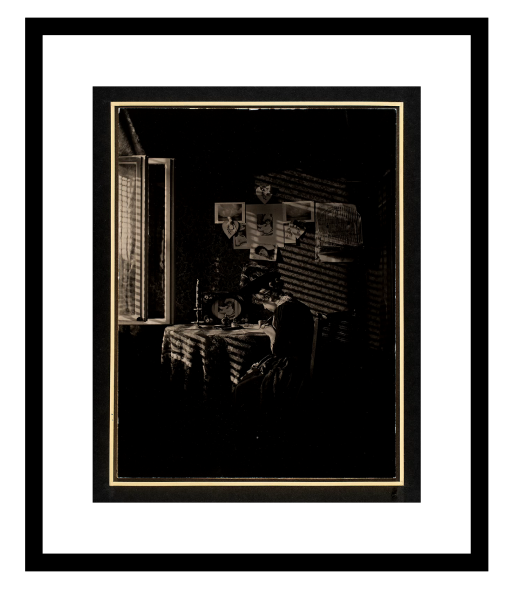
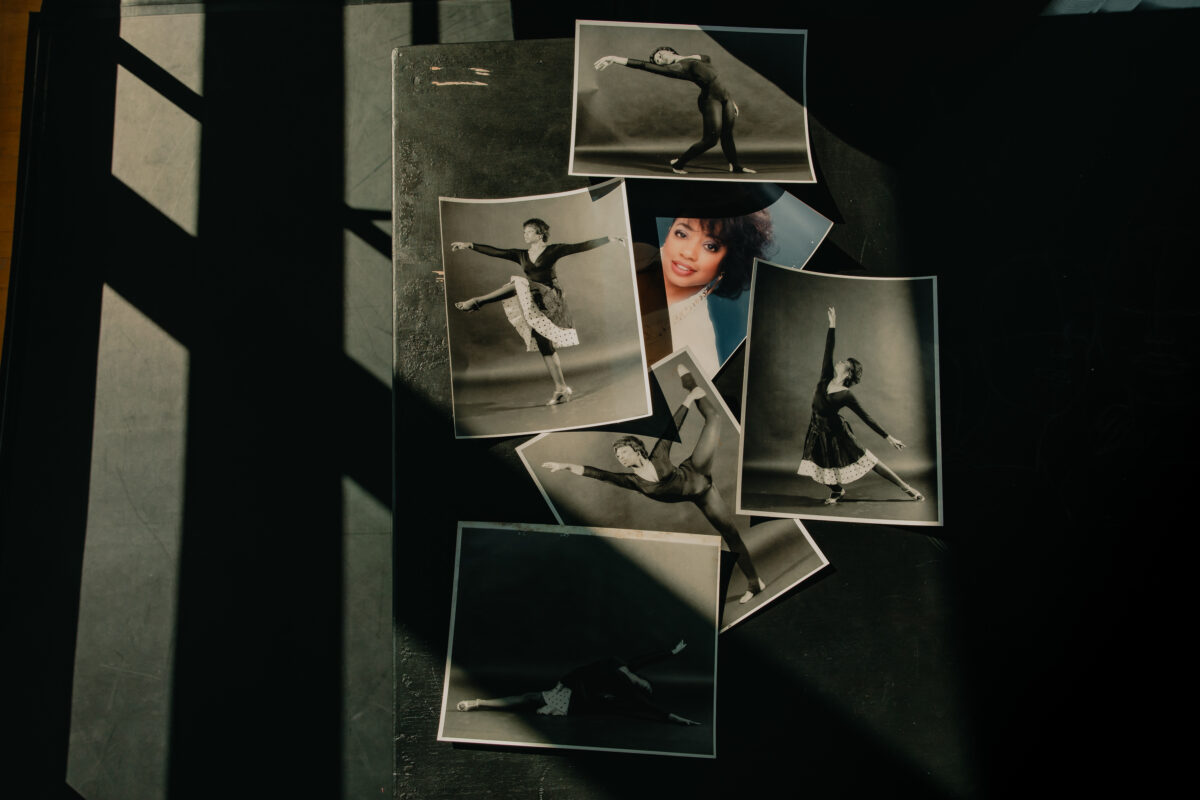
A collection of black-and-white photographs of Teresa in various elegant dance poses. These pictures are laid out on a dark surface. Sunlight comes in through large windows, which gives an artsy effect due to the geometric shadows the appear across the photos. Towards the center and behind some photos is a headshot of a younger Teresa, the only picture in color.
Teresa Kearney’s early days of dance.

 By 1979, Kearney and her dance partner were regulars on the competitive social dance circuit. “We were getting really popular, my dance partner and I,” she says. “We got a chance to go to Hollywood and be on ‘Dance Fever’ and compete from state to state, city to city. We made our living in dance for a long time.” 

Kearney held onto the goal of a UMBC degree for decades as life intervened. In between, she took on acting roles, was an instructor for LaBlast Fitness under Louis van Amstel of “Dancing with the Stars,” graduated from the Broadcasting Institute of Maryland for air talent for radio and TV, including an FCC license, sold insurance and real estate, and helped put her nephew through medical school, to name a few of her jobs and activities. “Then my mother, Lillie Kearney, passed away three years ago. She was also a dancer, and I thought this is the time for me to go back to college,” she says. “It was on my bucket list.”   

Keeping the standard

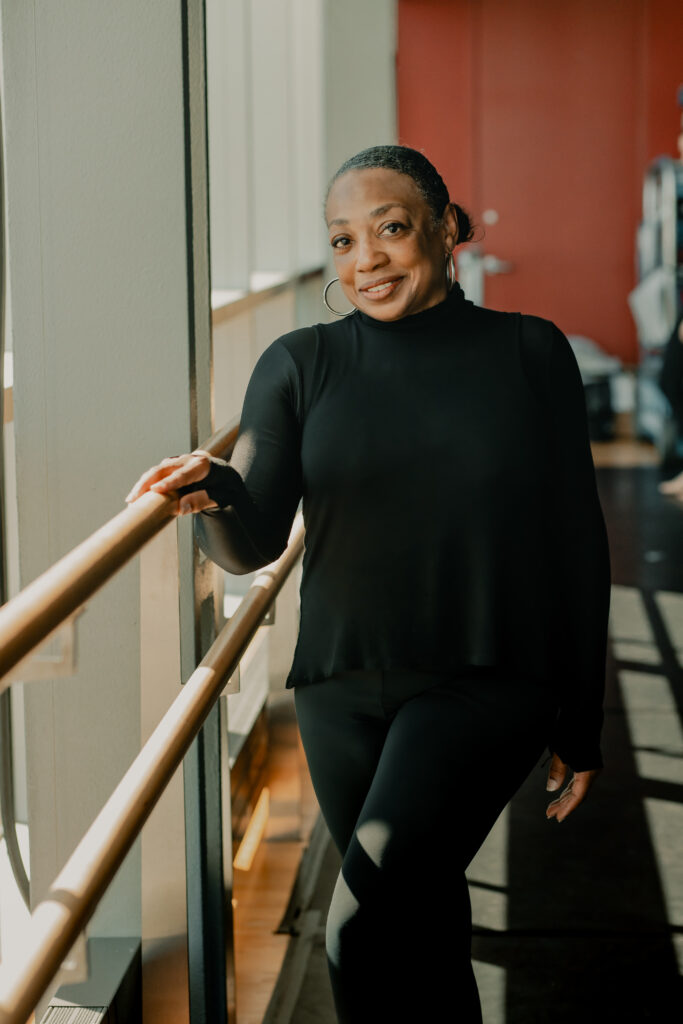
Wearing black dance attire, Teresa Kearney stands by the ballet barre in a dance studio. Her hand gently rests on the rail. She faces the camera and smiles warmly. Sunlight comes in through the large windows next to her.

As a long-time professional dancer—who never actually retired—Kearney continues to challenge herself by learning new techniques and styles. And she’s worked hard to re-train her body after decades dancing in heels on Latin and social dance circuits. “I’m still learning,” she says. “There’s a contemporary African dance class required now for all dance majors. For a two-and-a-half-hour class, it’s very energetic. And even though I’m 65, we all have challenges in that class,” she notes of her younger classmates.

Ballet instructor Alison Crosby could see Kearney was working hard, and says, “Teresa made it easy for me to keep the standard of the course, because she asked for no changes, asked for nothing to be different.” Plus, by showing up on time, preparing her body with gentle stretches to warm up her muscles and feet, and finding her place at the barre, Kearney modeled the appropriate dancer’s discipline that is expected in professional classes and rehearsals. 

“Her experience in dance is wide and professional,” Crosby adds, “and she modeled the discipline and respect for coming to ballet class.” As an instructor, Crosby noticed how easily Kearney connected with her much younger classmates. “Teresa was involved with even the first-years. They all saw Teresa with great respect.”

In fact, Kearney shares that her classmates in the dance program often seek her out for advice or just a listening ear. She’s noticed that these students face far more self-doubt and pressures than she did when she was a student in the 1970s.

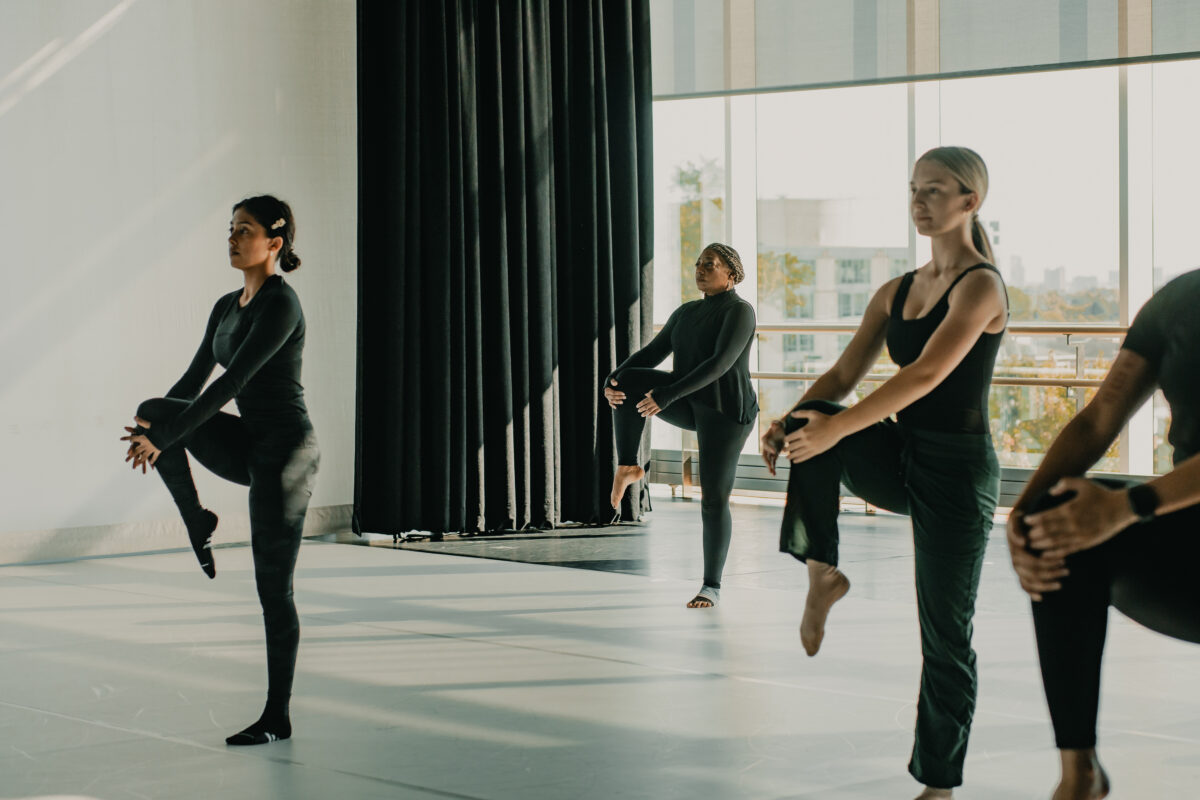
A group of dancers in black attire, including Teresa Kearney, balance on one leg in a bright dance studio. Each dancer holds their raised knee with both hands while maintaining poise and focus.
Kearney, back, center, practices with her classmates in the Dance Cube.

“Last semester, I was talking with a group of students,” Kearney recalls. “We were overwhelmed with classes and how hard it is. I said, ‘Wait a minute. We’re here getting a degree….We’re here to learn even when it’s hard.’” 

“Once in a while,” Crosby says, “I’ll ask a student to show something as a positive model for the rest of the class. I asked Teresa…she just was dancing and using her eyes and her head so beautifully—everything she’d learned through her dance life. It’s still in her—that artistry through all the years and her different careers—her artistry has just stayed with her.”

By Lisa Traiger

Meet a Retriever—Matthew Levy ’00, M.S. ’08, emergency response professional

Meet Matthew J. Levy ’00, M.S. ’08, emergency and disaster health services (EDHS), who has dedicated his career to Maryland communities. His expertise, as a physician of emergency medicine and former paramedic, has made him indispensable in the most challenging national, state, and local emergencies. Matthew was part of an emergency response team that spent 10 days in New York City, assisting in the relief efforts following 9/11. In 2015, he received the Silver Medal of Valor from Howard County Fire and Rescue Services for his role as the second tactical medic to arrive on the scene at the Columbia Mall shooting in January 2014 then transitioned to being the on-scene medical director. In 2017, he was named Emergency Medical Services Physician of the Year by the Maryland Chapter of the American College of Emergency Physicians. Take it away, Matt!

Q: Briefly introduce yourself. What’s one essential thing you’d want another Retriever to know about you?

A: I began my studies at UMBC in 1996, enrolling in the Emergency and Disaster Health Services (EDHS) program. I earned my bachelor’s degree in 2000 and my master’s in 2008 while finishing my residency training as an emergency physician at Johns Hopkins University School of Medicine. I now serve as EDHS’s medical director for the paramedic program, the very department that helped me become the clinician and leader I am today. I am also an associate professor in the Department of Emergency Medicine at Johns Hopkins University School of Medicine. 

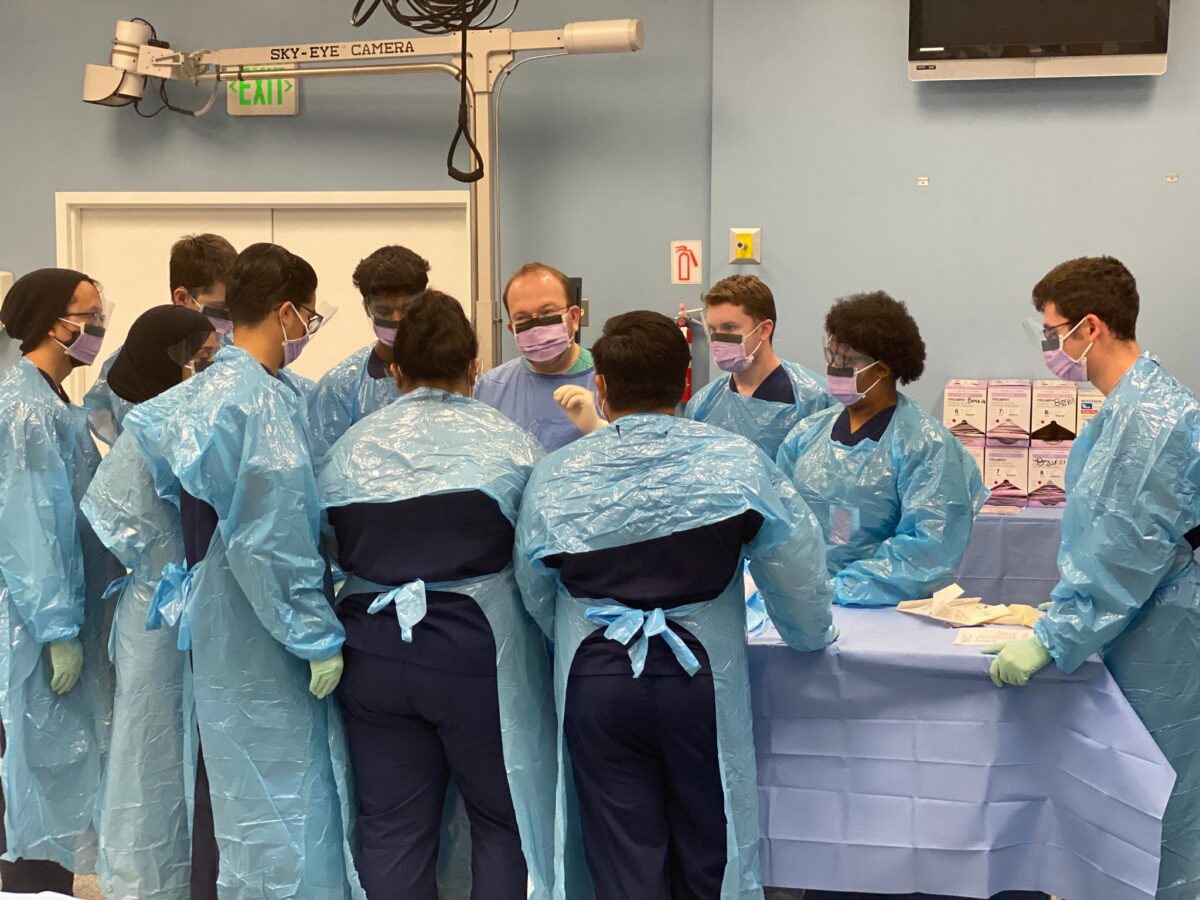
Matthew J. Levy with a group of medical students in scrubs stand around a hospital table teaching about emergency disaster and health systems
Matthew J. Levy, center, in the lab with students. (Image courtesy of Levy)

Q: What are some of the ways you have brought leading-edge practices to Howard County?

A: In 2016, I was part of the team that launched one of the nation’s first county-wide Stop the Bleed programs in Howard County. This is a national initiative designed to foster resilience and improve patient outcomes by empowering everyday people to recognize and treat life-threatening hemorrhages, which are the leading cause of preventable death in trauma patients. In 2023, I led the implementation of the Whole Blood Program in Howard County, which improves outcomes for critically ill and injured patients suffering from shock by implementing Maryland’s first ground-based EMS blood transfusion program. This program brings life-saving whole blood to the scene of the most critical patients to help give them precious time to get to the hospital for further stabilization.

Q: Tell us about someone in the community who has inspired or supported you, and how they did it.

A: I feel incredibly fortunate to have met so many people at UMBC who have shaped my life and career—from faculty and friends to colleagues and coworkers, specifically, I’d say Dwight Polk, Bill Hathaway, Dr. Rick Bissell, Dr. Jeff Mitchell, Dr. Bruce Walz (all from EDHS), and Dr. Joel Liebman (chemistry). However, the most impactful person has been Dr. J. Lee Jenkins, my wife, whom I met while we were both EDHS undergraduates. We dated through medical school and were married when I was in residency. She is also a physician and a faculty member in the Department of Emergency Medicine at Johns Hopkins University School of Medicine.

I genuinely love taking care of people and helping them. Whether that’s one-on-one as their doctor (or previously as their paramedic) or now as someone responsible for entire EMS systems, the path I’ve chosen…has allowed me to…improve outcomes from emergency medical situations.

Matthew J. Levy ’00, M.S. ’08

EDHS

Q: What is the one thing you’d want a potential student to know about the support you can find at UMBC?

A: At UMBC, we take pride in striving for excellence in everything we do. Being part of the UMBC community means contributing to something greater than oneself. Through leadership, service, teaching, and research, UMBC is making a positive impact on the world. My UMBC education provided an exceptionally strong basis in the sciences, combined with amazing training in leadership, project management, research, and teaching skills. All of these have helped me to achieve success in my career.

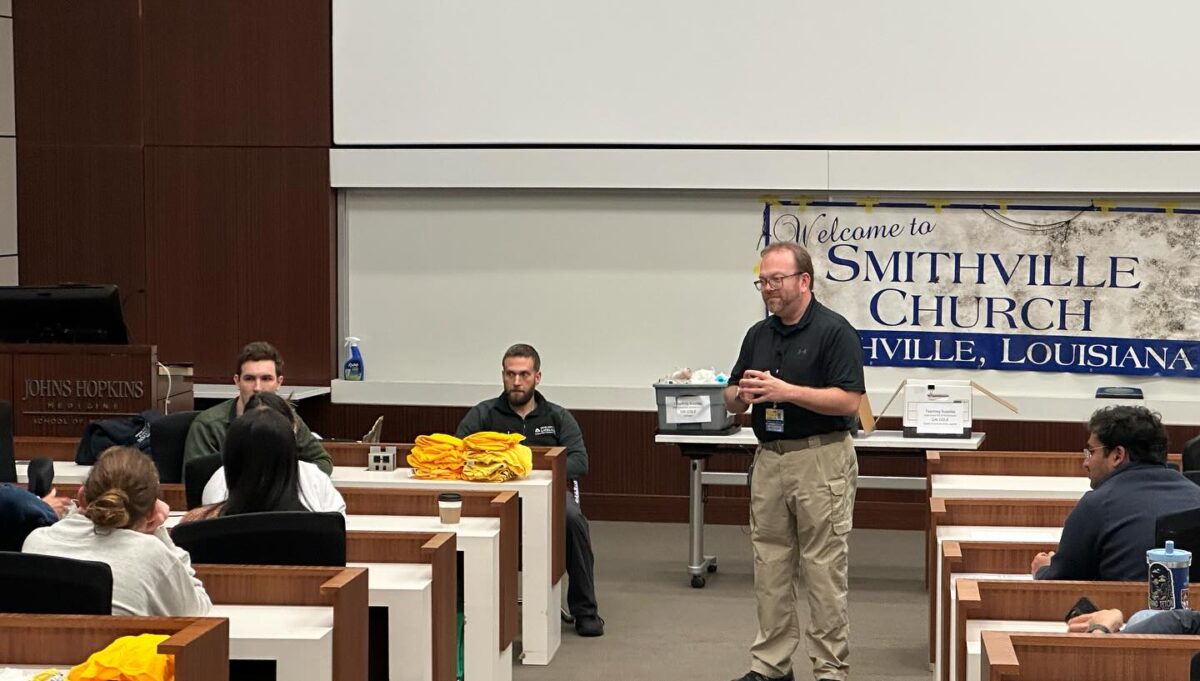
Matthew J. Levy teaching about emergency and disaster health systems
Levy teaching an EMS class. (Image courtesy of Levy)

Q: Tell us about what you love about your academic program.

A: That’s easy… it’s the people of the EDHS department. This department is one of UMBC’s best-kept secrets. It has produced EMS leaders, clinicians, educators, scientists, and practitioners who have played a pivotal role in pioneering, innovating, and redefining the delivery of prehospital care both locally and nationally.

Q: Why did you choose emergency medicine as a career path? What do you enjoy most about it that has kept you working in this field?

A: This passion has led me to many opportunities. In addition to my work at UMBC and Johns Hopkins, I am also the medical director of Howard County Fire and Rescue, the regional medical director for the Maryland Institute for Emergency Medical Services Systems, the tactical physician with the Maryland State Police and Howard County Police, and the founding commander of the Maryland-1 Disaster Medical Assistance Team

Matthew J. Levy stands with three other emergency first responders
2015 Howard County Medal of Valor recipients. (l-r): John Butler, former fire chief for Howard County, Will Huber, lieutenant at Howard County Government, Levy, and Lonnie Robbins, former chief administrative officer at Howard County Government. (Image by Maryland Institute for Emergency Medical Services Systems)

Q: What advice do you wish you had received as an undergraduate EDHS student, particularly given the rapid changes in healthcare over the past few years?

A: Healthcare isn’t an easy path, but it’s one of the most noble professions and promises a rewarding career. However the journey will be long, so always believe in yourself, and always be your biggest fan and supporter. Surround yourself with the people you aspire to be like and always strive to improve yourself. This is your life to live so be sure to take the time to enjoy the journey along the way. But, don’t enjoy it too much…hard work does pay off! You’ll look back one day, maybe, 10,15, or 20 years or more later, and realize how far you’ve come.

* * * * *

UMBC’s greatest strength is its people. When people meet Retrievers and hear about the passion they bring, the relationships they create, the ways they support each other, and the commitment they have to inclusive excellence, they truly get a sense of our community. That’s what “Meet a Retriever” is all about.

Learn more about how UMBC can help you achieve your goals.

Meet a Retriever—David M. Williams, M.S. ’02, author and scholar-practitioner of the “Science of Improvement”

Meet David M. Williams, M.S. ’02, emergency health services (EHS) management, a scholar-practitioner of the “Science of Improvement,” and a co-author of Quality as an Organizational Strategy: Building a System of Improvement. With 25 years of experience in quality improvement, he has worked with leaders and teams worldwide to develop people’s abilities to make rigorous, results-driven improvements and adopt quality as an organizational strategy. Take it away, David!

Q: What’s one essential thing you’d want another Retriever to know about you?

A: I advise leaders worldwide to use the science of improvement to improve processes, products, and services. My experience in organizational systems began when I was a paramedic and got my master’s in EHS management at UMBC. My education led to me becoming an ambulance system expert and an internationally respected improvement advisor. I have a Ph.D. in organizational systems from Saybrook University. 
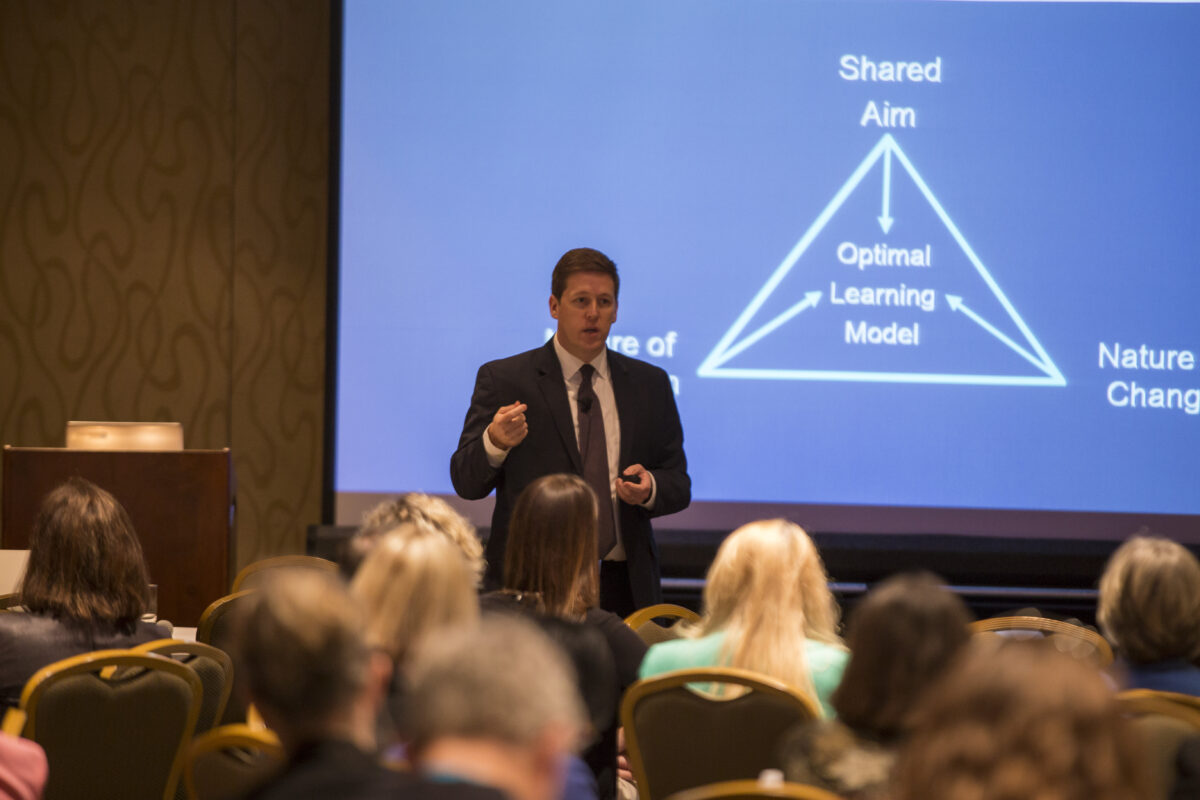
David Williams speaking to a crowd on the Science of Improvement.
David M. Williams speaking at the Institute for Healthcare Improvement’s National Forum on Quality Improvement in Health Care.

Q: What brought you to UMBC?

A: After I earned a B.S. in emergency medical services management from Springfield College, I was looking for a graduate program that would allow me to study from my home in Austin, Texas, while I worked full-time as a paramedic. I decided on UMBC because it had a unique virtual graduate program in EHS management that met all my criteria. 

Q: What do you love about your academic program?

A: As a student in the UMBC EHS program, I was introduced to literature and best practices that helped my professional development early in my career. The faculty comprised industry leaders, and their support and networks in the field helped me build my knowledge and skills. I credit my graduate work at UMBC as positioning me for career success.

I like seeing how UMBC has evolved. I first visited the campus in 1992, and it’s amazing to see how it has grown.

David M. Williams, M.S. ’02, EHS management

Scholar-practitioner of the Science of Improvement

Q: What’s the one thing you’d want someone to know about the support you find at UMBC?

A: I was a remote student in the early days of online degree programs. UMBC worked hard to create a robust academic learning experience. The faculty have served as lifelong mentors, and my peers made a community of learners nationwide and internationally.

Q: Who in the UMBC community has inspired you or supported you?

A: EHS adjunct faculty Mike Taigman has been a mentor and supporter since we first met in his class in the late ’90s. He was an expert paramedic and consultant. He encouraged me to publish my first paper and introduced me to the editor of an industry publication. He sponsored me to speak at my first national conference. He wrote a recommendation in support of my first leadership role as the chief quality officer of Austin EMS. He introduced me to healthcare improvement, which has been my career for more than 15 years. His mentorship and support have been a constant contribution to my career success. We still talk each week.

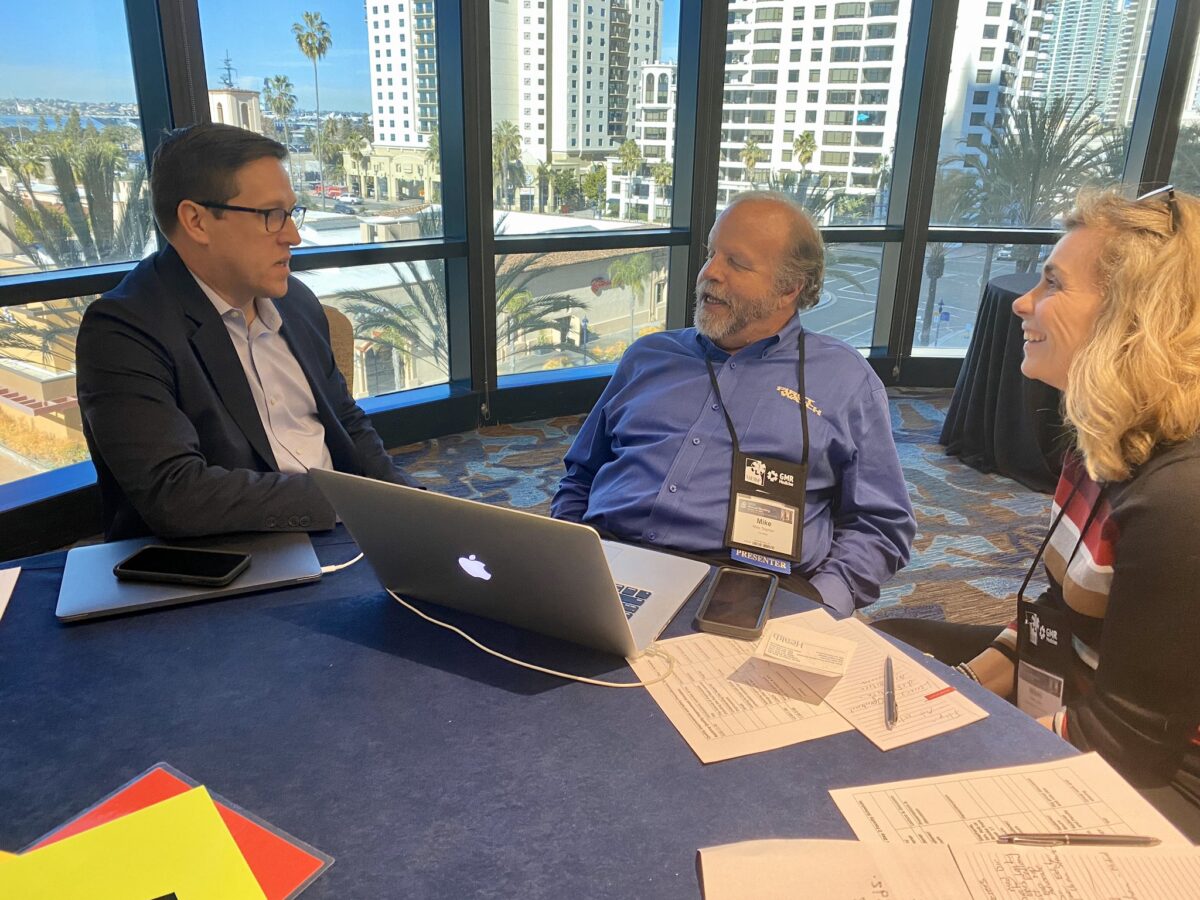
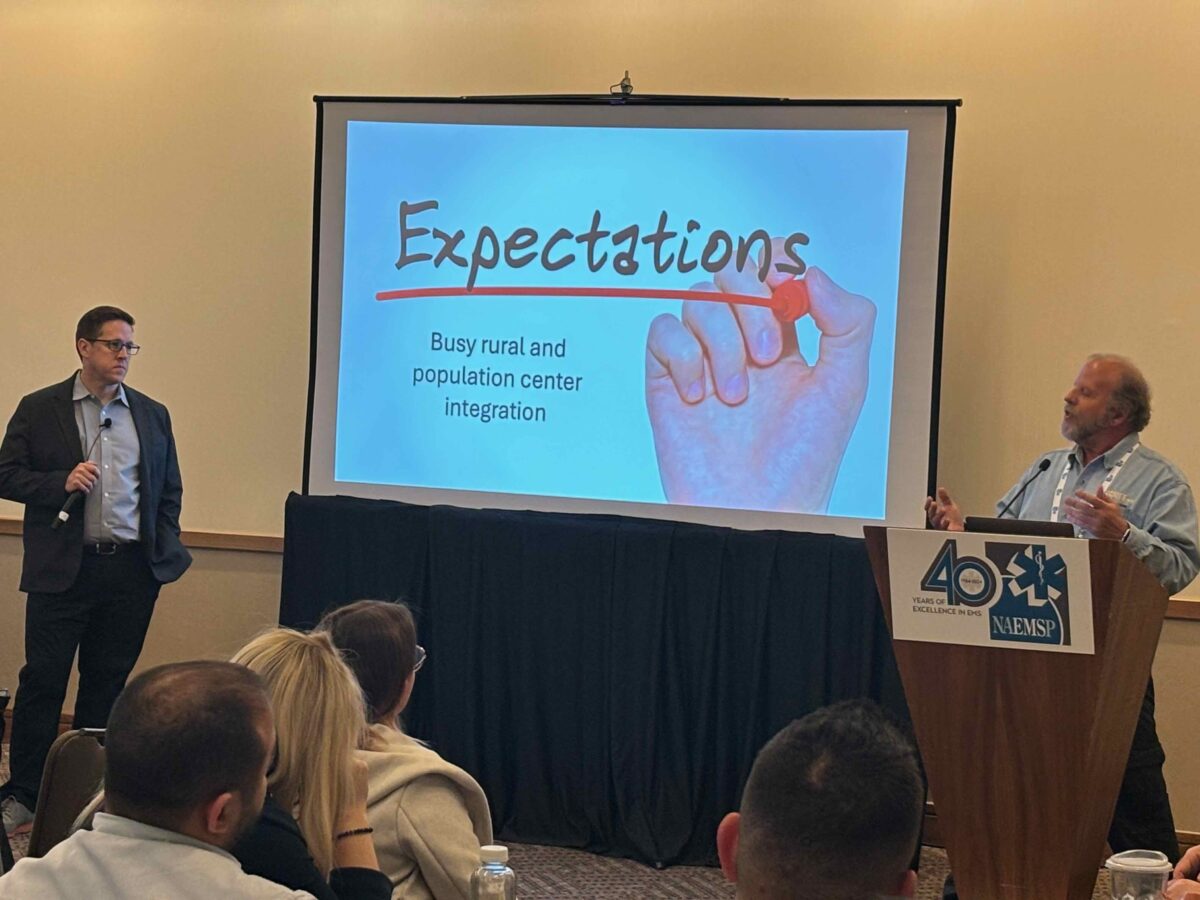
Images above: David Williams and Mike Taigman, UMBC EHS faculty, at the National Association of EMS Physicians (NAEMSP) Annual Meeting.

Q: Tell us about your current job. What do you like most about it?

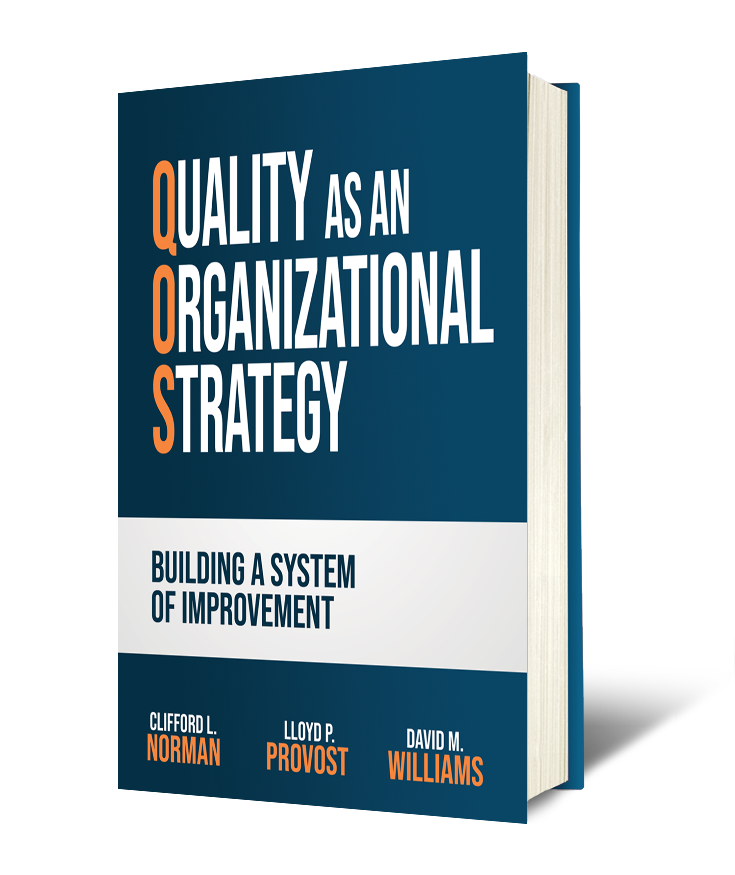
A: I am a self-employed advisor, teacher, and author—an internationally respected scholar-practitioner of the Science of Improvement. With 25 years of experience in quality improvement, I have worked with leaders and teams worldwide to develop people’s abilities to make rigorous, results-driven improvements and adopt quality as an organizational strategy. I also recently co-authored Quality as an Organizational Strategy: Building a System of Improvement. The book describes an approach to leading organizations based on W. Edwards Deming’s charge that leaders need a new theory of leadership and a strategy built on quality. The book defines quality as a strategy and describes a framework of five activities for leaders that can lead to both immediate results and long-term performance. 

Image right: Quality as an Organizational Strategy: Building a System of Improvement

Quality as an Organizational Strategy:
Building a System of Improvement

* * * * *

UMBC’s greatest strength is its people. When people meet Retrievers and hear about the passion they bring, the relationships they create, the ways they support each other, and the commitment they have to inclusive excellence, they truly get a sense of our community. That’s what “Meet a Retriever” is all about.

Learn more about how UMBC can help you achieve your goals.

Meet a Retriever—Emma Swartling ’10, prenatal and pediatric chiropractor

Meet Emma Swartling ‘10, anthropology, prenatal and pediatric chiropractor and owner of Lumos Chiropractic in Tacoma, Washington. She was drawn to UMBC to experience the East Coast after being raised on the West Coast. Emma combined her interests in cultural and biological anthropology, pre-medicine, and working with children to shape her career as a chiropractor. Take it away, Emma!

Q: What’s one essential thing you’d want another Retriever to know about you? 

A: Born and raised in the Pacific Northwest (PNW), I started college with the intent to major in pre-medicine but ended up falling in love with anthropology. I was fortunate to find a career that allowed me to combine many of my multiple interests by following the path to chiropractic. Chiropractic has allowed me to use many of the skills in empathy and understanding that cultural anthropology teaches, and biological anthropology offers insights into human anatomy and function. It was the Chesapeake Bay Retriever that initially sparked my interest into learning more about UMBC. I love dogs and spent my childhood involved with dog training and showing, as well as teaching younger children involved in the same program. This is how I learned I enjoy working with children.

Q: Tell us about your current job. What do you enjoy most about it?

A: I am a prenatal and pediatric chiropractor and own my practice in Washington state. The best part about my work is being part of the village that supports people during the huge transition periods of pregnancy, postpartum, and childhood.

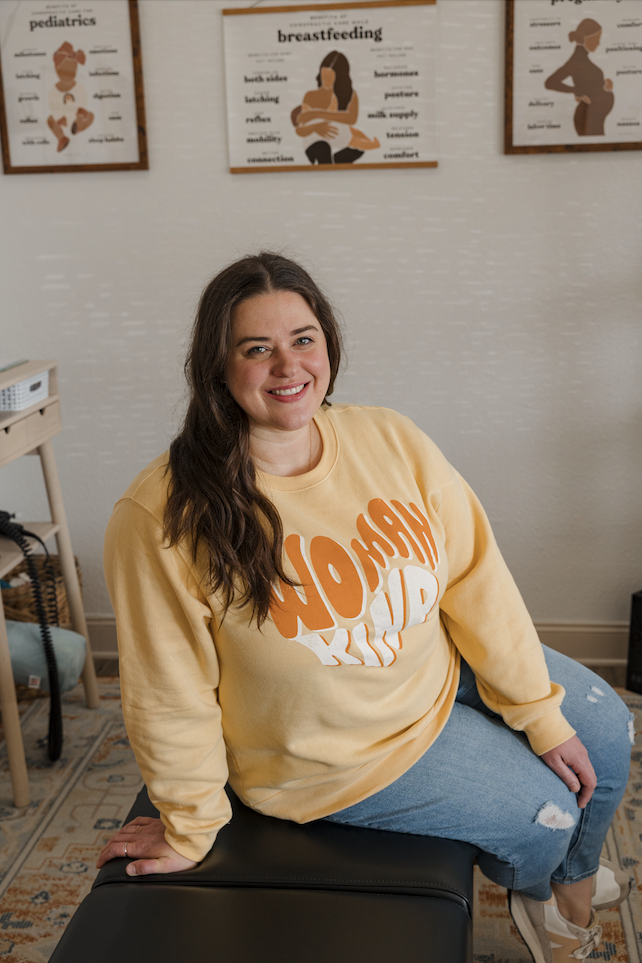
a woman lounges in a chiropractic office

Q: Tell us about your primary WHY, and how it led you to UMBC.

A: What brought me to UMBC was the beginning of my love to travel and explore. After finishing the first two years of college in my home state, I decided to transfer to the East Coast to visit a part of our country that I had never seen. The initial reasons UMBC stood out are superficial: Maryland was a central location to explore north and south along the East Coast; the Maryland State flag is amazing; and most importantly, I wanted to say I went to a school where the mascot is a unique dog breed like the Chesapeake Bay Retriever!

I wanted an adventure and to try something new. I can honestly say, when my airplane landed at BWI in the dead of winter, I started to question my decision. Coming from the lush, always green PNW it looked like I was about to land in a brown and desolate land. I grew to appreciate the seasons while in Maryland and was awed by the abruptness of changes in weather. My first semester was timid—I was finding my footing and trying to discover my place. There were other students and professors who helped me make the most of the next three semesters, who helped me step out of my comfort zone and learn more about myself. I love the small community of UMBC, the ease in moving around a campus that felt both big and compact. 

Pictured left: Emma in a treatment room at her chiropractic practice, Lumos Chiropractic

Q: Tell us about the people who helped you grow at UMBC and how they helped shape your next steps.

A: UMBC helped to shape “my why.” I really enjoyed learning from many of the professors in the anthropology department, in particular a former professor, Seth Messinger, who taught many of my favorite courses including a course on Medical Anthropology. Anthropology courses that combined the study of other cultures and their medicinal practices were particularly engaging to me. I began to imagine my future career—what direction would anthropology take me?

My first semester was timid—I was finding my footing and trying to discover my place. There were other students and professors who helped me make the most of the next three semesters, who helped me step out of my comfort zone and learn more about myself.

Emma Swartling ’10

After graduating from UMBC, I took some time to travel and consider my career opportunities. It was when my chiropractor cousin suggested I come listen to a talk hosted by a chiropractic school that I began to consider it as a career. The presenters shared about their unique experience opening a chiropractic clinic abroad, living in a country other than their own, and interacting with and helping a small community that I started to put the pieces together. I could combine my many interests: cultural anthropology and working with different people, cultures, populations, pre-medicine, and biological anthropology by working with bodies, studying the human form and its function, and be able to work with children, support childhood development, and help to grow a healthier community. 

Q: What’s your favorite part of being a part of Retriever Nation?

A: I really appreciated UMBC’s focus on academics and on inclusion. Also, I found an amazing group of people at UMBC who were kind, generous, and fun in the fraternity of Phi Mu. Some of those friendships led to future travel and experiences that helped to shape my career choice.

* * * * *

UMBC’s greatest strength is its people. When people meet Retrievers and hear about the passion they bring, the relationships they create, the ways they support each other, and the commitment they have to inclusive excellence, they truly get a sense of our community. That’s what “Meet a Retriever” is all about.

Colonialism’s legacy has left Caribbean nations much more vulnerable to hurricanes

Written by Farah Nibbs, assistant professor of emergency and disaster health systems at UMBC

Long before colonialism brought slavery to the Caribbean, the native islanders saw hurricanes and storms as part of the normal cycle of life.

The Taino of the Greater Antilles and the Kalinago, or Caribs, of the Lesser Antilles developed systems that enabled them to live with storms and limit their exposure to damage.

On the larger islands, such as Jamaica and Cuba, the Taino practiced crop selection with storms in mind, preferring to plant root crops such as cassava or yucca with high resistance to damage from hurricane and storm winds, as Stuart Schwartz describes in his 2016 book “Sea of Storms.”

The Kalinago avoided building their settlements along the coast to limit storm surges and wind damage. The Calusa of southwest Florida used trees as windbreaks against storm winds.

In fact, it was the Kalinago and Taino who first taught the Europeans – primarily the British, Dutch, French and Spanish – about hurricanes and storms. Even the word ‘hurricane’ comes from Huracán, a Taino and Mayan word denoting the god of wind.

But then colonialism changed everything.

A man in white suit, broad-rimmed hat and what looks like a cane lounges against a bag of cotton beneath tropical trees while two people with dark skin work in a field. A map of the island is also on the card. colonialism
A French advertising card from around 1900 depicts colonial power in Guadeloupe, with a trader sitting comfortably among sacks of cotton, cocoa and coffee while islanders work in the field. Universal History Archive/Universal Images Group via Getty Images

I study natural disasters in the Caribbean, including how history molded responses to disasters today.

The current disaster crisis that the Caribbean’s small islands are experiencing as hurricanes intensify did not start a few decades ago. Rather, the islands’ vulnerability is a direct result of the exploitative systems forced upon the region by colonialism, its legacies of slave-based land policies and ill-suited construction and development practices, and its environmental injustices.

Forcing people into harm’s way

The colonial powers changed how Caribbean people interacted with the land, where they lived and how they recovered from natural hazard events.

Rather than growing crops that could sustain the local food supply, the Europeans who began arriving in the 1600s focused on exploitative extractive economic models and export cash crops through the plantation economy.

They forced Indigenous people off their lands and built settlements along the coast, which made it easier to import enslaved peoples and goods and to export cash crops such as sugar and tobacco to Europe – and also left communities vulnerable to storms. They also developed settlements in low-lying areas, often near rivers and streams, which could provide transportation for agricultural produce but which became flood risks during heavy rains.

A large passenger plane approaches an island where houses built right to the water's edge are damaged from a recent hurricane.
Homes built to the water’s edge in Saint-Martin, an overseas collectivity of France, were devastated when Hurricane Irma hit in 2017. Helene Valenzuela/AFP via Getty Images

Today, more than 70% of the Caribbean’s population lives along the coast, often less than a mile from the shore. These coastlines are not only highly exposed to hurricanes but also to sea-level rise fueled by climate change.

Legacies of slave-based land policies

Colonialism’s legacy of land policies has also made recovery from disasters much harder today.

When colonial powers took over, a few landowners were given control of most of the land, while the majority of the population was forced onto marginal and small areas. The local population had no legal right to the land, as the people did not possess land certificate titles or deeds and were often forced to pay rent to landlords.

After independence, most island governments tried to acquire land from former plantations or estates and to redistribute it to the working class. But these efforts, mainly in the 1960s and ’70s, largely failed to transform land ownership, improve economic development or reduce vulnerability.

One colonial legacy perpetuating vulnerability to this day is known as crown land, or state land. In the English-speaking Caribbean, all land for which there was no land grant was considered property of the British crown. Crown land can be found in every English-speaking island to this day. https://www.youtube.com/embed/YTckM-cNeII?wmode=transparent&start=0 How colonial powers controlled the Caribbean over time.

For example, in Barbuda, all land is vested in the “crown in perpetuity” on behalf of Barbudans. This means that an individual born on the island of Barbuda cannot individually own land.

Instead, land is communally owned, which limits access to the credit and development opportunities that were sorely needed to reconstruct the island after Hurricane Maria in 2017. Most Barbudans were unable to insure their homes because they had no title deeds to their property.

This and other collective land tenure systems created by colonialism places Caribbean residents at greater risk from a variety of natural hazards and limits their ability to seek financial credit for disaster recovery today.

The roots of poor construction

Vulnerability to disasters in the Caribbean also has roots in post-slavery housing construction and subsequent failures to institute proper building codes.

After emancipation from slavery, freed people had no right nor access to land. To build houses, they were forced to lease land from the former enslavers who at a whim could terminate their employment or kick them off the land.

This led to the development of a particular type of housing structure known as chattel houses in countries such as Barbados. These houses are tiny and were constructed in a way in which they could be easily taken apart and loaded onto carts, should the residents be forced out by their former enslavers. Many Bajans still live in these houses today, although quite a few have been converted to restaurants or shops.

Chattel houses are still used as homes in Barbados. Shardalow via Wikimedia, CC BY

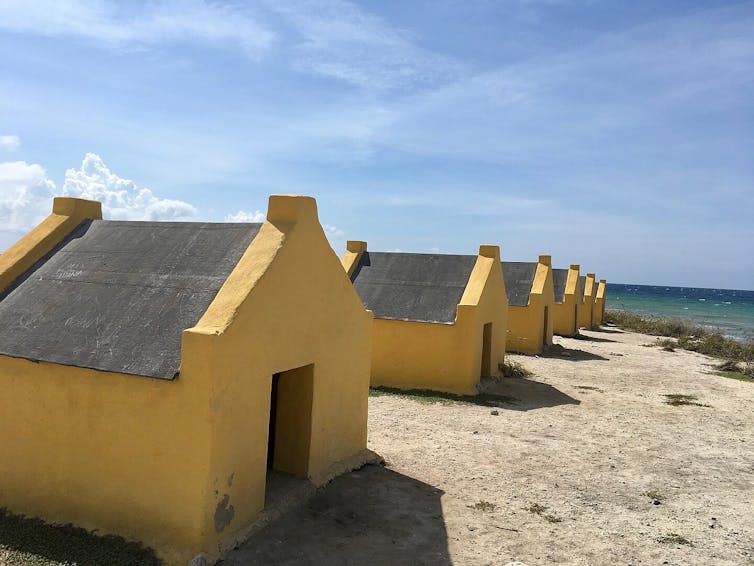
In Aruba, Bonaire and Curaçao, owned by the Dutch, slave huts were built along the coast, on land not suitable for agriculture and easily damaged by storms. These former slave huts are now tourist attractions, but the colonial patterns of settling along the coast has left many coastal communities exposed to hurricane damage and rising seas.

The vulnerability of such houses is not only a result of their exposure to natural hazards but also the underlying social structures.

Slave huts were built on the coast in Bonaire, where they were vulnerable to storm surge. Leslie Ket via Wikimedia, CC BY-SA

In many islands today, poorer residents can’t afford protective measures, such as installing storm shutters or purchasing solar-powered generators.

They often live in marginal and disaster-prone areas, such as steep hillsides, where housing tends to be cheaper. Houses in these areas are also often poorly constructed with low-grade materials, such as galvanized sheeting for roofs and walls.

This situation is made worse by the informal and unregulated nature of residential housing construction in the region and the poor enforcement of building codes.

Due to the legacy of colonialism, most housing or building standards or codes in the Commonwealth Caribbean are relics from the United Kingdom and in the French Antilles from France. Building standards across the region lack uniformity and are generally subjective and uncontrolled. Financial limitations and staffing constraints mean that codes and standards more often than not remain unenforced.

Progress, but still a lot of work to do

The Caribbean has made progress in developing wind-related building codes to try to increase resilience in recent years. And while damage from torrential rain is still not properly addressed in most Caribbean building standards, scientific guidance is available through the Caribbean Institute for Meteorology and Hydrology in Barbados.

Individual islands, including Dominica and Saint Lucia, have new minimum building standards for recovery after disasters. The island of Grenada is hoping to guide new construction as it recovers from Hurricane Beryl. Trinidad and Tobago has developed a national land use strategy but has struggled to use it.

Construction standards can help the islands build resilience. But work remains to be done to overcome the legacy of colonial-era land policies and development that have left island towns vulnerable to increasing storm risks.


This article is republished from The Conversation under a Creative Commons license. Read the original article and see more than 250 UMBC articles available in The Conversation.

Pagers and walkie-talkies over cellphones—a security expert explains why Hezbollah went low-tech for communications

Written by Richard Forno, principal lecturer in computer science and electrical engineering, UMBC

Electronic pagers across Lebanon exploded simultaneously on Sept. 17, 2024, killing 12 and wounding more than 2,700. The following day, another wave of explosions in the country came from detonating walkie-talkies. The attacks appeared to target members of the militant group Hezbollah.

The pagers attack involved explosives planted in the communications devices by Israeli operatives, according to U.S. officials cited by The New York Times. Hezbollah had recently ordered a shipment of pagers, according to the report.

Secretly attacking the supply chain is not a new technique in intelligence and military operations. For example, the U.S. National Security Agency intercepted computer hardware bound for overseas customers, inserted malware or other surveillance tools and then repackaged them for delivery to certain foreign buyers, a 2010 NSA internal document showed. This differs from accessing a specific person’s device, such as when Israel’s Shin Bet secretly inserted explosives into a cellphone to remotely kill a Hamas bombmaker in 1996.

Hezbollah, a longtime adversary of Israel, had increased its use of pagers in the wake of the Hamas attack on Israel on Oct. 7, 2023. By shifting to relatively low-tech communication devices, including pagers and walkie-talkies, Hezbollah apparently sought an advantage against Israel’s well-known sophistication in tracking targets through their phones.

pieces of a destroyed electronic device
The second wave of explosions in Lebanon involved walkie-talkies. AP Photo

Cellphones: The ultimate tracker

As a former cybersecurity professional and current security researcher, I view cellular devices as the ultimate tracking tool for both government and commercial entities – in addition to users, criminals and the mobile phone provider itself. As a result, mobile phone tracking has contributed to the fight against terrorism, located missing people and helped solve crimes.

Conversely, mobile phone tracking makes it easy for anyone to record a person’s most intimate movements. This can be done for legitimate purposes such as parents tracking children’s movements, helping you find your car in a parking lot, and commercial advertising, or nefarious ends such as remotely spying on a lover suspected of cheating or tracking political activists and journalists. Even the U.S. military remains concerned with how its soldiers might be tracked by their phones.

Mobile device tracking is conducted in several ways. First, there is the network location data generated by the phone as it moves past local cell towers or Stingray devices, which law enforcement agencies use to mimic cell towers. Then there are the features built into the phone’s operating system or enabled by downloaded apps that may lead to highly detailed user tracking, which users unwittingly agree to by ignoring the software’s privacy policy or terms of service.

This collected data is sometimes sold to governments or other companies for additional data mining and user profiling. And modern smartphones also have built-in Bluetooth, Wi-Fi and GPS capabilities that can help with locating and tracking user movements around the world, both from the ground and via satellites.

Your phone contains many sensors that make it useful – and easy to track.

Mobile devices can be tracked in real time or close to it. Common technical methods include traditional radio direction-finding techniques, using intelligence satellites or drones, deploying “man in the middle” tools like Stingrays to impersonate cellular towers to intercept and isolate device traffic, or installing malware such as Pegasus, made by Israeli cyberarms company NSO to report a device’s location.

Nontechnical and slower techniques of user tracking include potentially identifying general user locations from their internet activity. This can be done from website logs or the metadata contained in content posted to social media, or contracting with data brokers to receive any collected location data from the apps that a user might install on their device.

Indeed, because of these vulnerabilities, the leader of Hezbollah earlier this year advised his members to avoid using cellular phones in their activities, noting that Israel’s “surveillance devices are in your pockets. If you are looking for the Israeli agent, look at the phone in your hands and those of your wives and children.”

Researchers have shown how these features, often intended for the user’s convenience, can be used by governments, companies and criminals to track people in their daily lives and even predict movements. Many people still aren’t aware of how much their mobile devices disclose about them.

Pagers, however, unlike mobile phones, can be harder to track depending on whether they support two-way communication.

Why go low-tech

A pager that only receives messages does not provide a signal that can facilitate tracking its owner. Therefore, Hezbollah’s use of pagers likely made it more challenging to track their operatives – thus motivating Israeli intelligence services’ purported attack on the supply chain of Hezbollah’s pagers.

Using low-tech tactics and personal couriers while avoiding the use of mobile phones and digital tools also made it difficult for the technologically superior Western intelligence agencies to locate Osama bin Laden for years after the 9/11 attacks.

In general, I believe the adversary in an asymmetric conflict using low-tech techniques, tactics and technology will almost always be able to operate successfully against a more powerful and well-funded opponent.

A well-documented demonstration of this asymmetry in action was the U.S. military’s Millennium Challenge war game in 2002. Among other things, the insurgent Red forces, led by Marine General Paul van Riper, used low-tech tactics including motorcycle couriers instead of cellphones to evade the Blue forces’ high-tech surveillance. In the initial run of the exercise, the Red team won the contest in 24 hours, forcing exercise planners to controversially reset and update the scenario to ensure a Blue team victory.

Lessons for everyone

The preference for terrorist organizations like Hezbollah and al-Qaida to avoid using smartphones is a reminder for everyone that you can be, and likely are being tracked in various ways and for various purposes.

Israel’s purported response to Hezbollah’s actions also holds a lesson for everyone. From a cybersecurity perspective, it shows that any device in your life can be tampered with by an adversary at points along the supply chain – long before you even receive it.


This article is republished from The Conversation under a Creative Commons license. Read the original article and see more than 300 UMBC articles available in The Conversation.

Meet a Retriever—Jennifer Matthews ’02, Catonsville bookstore owner

Meet Jennifer Matthews ’02, mathematics, owner of Growing Minds Bookstore, an independent bookstore in Catonsville. As someone who started as a chemistry major and later switched to mathematics, Matthews wants everyone to know that you can be good at math AND reading!

Q: What brought you to UMBC?

A: I first came to UMBC as a pre-med chemistry major. I quickly realized that my parents’ dreams of me being a doctor were not mine and what I really liked the most was helping my friends with their math classes. So I switched majors to become a high school math teacher. 

Q: Tell us about the people who helped you grow at UMBC, and why their HOW made such a difference to you.

A: I had a lot of support at UMBC. I started working at the Alumni House where I did clerical tasks like updating the database (everything was done by hand back then!) as well as helping to staff alumni events as needed. Angela Sanford was my boss at the time and she became a dear mentor and friend to me during those years, and a few years after I graduated. She encouraged me to succeed in my classes but to also be a well-rounded person. Barbara Bourne was my first education professor and she is a lifelong friend now. She helped guide me through the interview process and first years of teaching. We still keep in touch and she is my biggest supporter! I lived on campus and was surrounded by a lot of art majors, and I helped a lot of them through their math classes. They may not know it, but they were my first students! 
Q: What’s the one thing you’d want someone to know about the support you find here?

A: UMBC will always welcome you back home! The campus is a beautiful representation of what diversity and intellect can do together. You will always want to recreate the environment of UMBC in your life outside of campus. 

Q: Tell us about your current job. What do you like most about it?

A: I’m the owner of Growing Minds Bookstore here in Catonsville. I love the freedom of owning my own business, interacting with families, and of course, talking books! 

UMBC will always welcome you back home! The campus is a beautiful representation of what diversity and intellect can do together.

Jennifer Matthews '02, mathematics

Owner of Growing Minds Bookstore

Q: Tell us about someone in the community who has inspired you or supported you, and how they did it.

Barbara Bourne has mentored me through so many stages of life and been my biggest cheerleader, no matter what stage I am in! 

Q: What’s your favorite thing about being part of Retriever Nation?

That when you meet another alum you both smile big! 

* * * * *

UMBC’s greatest strength is its people. When people meet Retrievers and hear about the passion they bring, the relationships they create, the ways they support each other, and the commitment they have to inclusive excellence, they truly get a sense of our community. That’s what “Meet a Retriever” is all about.

Learn more about how UMBC can help you achieve your goals.

Putin’s visit to Mongolia defies ICC warrant and tests neutral nation’s ‘third neighbor’ diplomacy

Written by Christopher K. Tong, associate professor of Asian studies at UMBC and Charles Krusekopf, professor of business Royal Roads University

Vladimir Putin arrived in Mongolia on Sept. 2, 2024, the first time the Russian president has visited an International Criminal Court (ICC) member country since the body issued a warrant for his arrest in 2023. While officially commemorating a Soviet-Mongolian military victory in World War II, Putin’s visit will test the small central Asian country’s policy of neutrality and the reach of international institutions.

Mongolia, a country of just 3.3 million people but with huge geographical territory, has long navigated its foreign policy in the shadow of Russia and China, with whom it has extensive historical and economic ties.

The country has attempted to bolster its independence from its more powerful neighbors by developing cordial relations with so-called third neighbor countries that include the United States, Germany, Japan and South Korea.

Through this approach, Mongolia has attempted to carve out a niche on the international stage, presenting itself as a neutral diplomatic meeting ground. Its annual Ulaanbaatar Dialogue, for example, is an opportunity for regional countries and other invited nations, including from the U.S. and EU member states, to discuss issues ranging from climate change to regional security and critical minerals.

As scholars of Mongolia and China, we attended the last such dialogue in June 2024 and witnessed Mongolia’s diplomatic efforts firsthand. It is a strategy that has worked for the country, but as events like Putin’s visit highlight, it can be a tough balancing act.

A closely watched visit

The timing of Putin’s trip is officially linked to history. It marks both the 85th anniversary of the Battle of Khalkhin Gol – in which joint Soviet-Mongolian forces defeated Japanese troops in World War II – and the founding of Mongolia’s national railway operator by the two countries 75 years ago.

Yet it is a third historical marker, the fifth anniversary of a comprehensive Russian-Mongolian strategic partnership, that highlights the visit’s significance from a modern geopolitical perspective.

Alongside its friendly relations with “third neighbors,” Mongolia has maintained a close relationship with Moscow despite Putin’s pariah status in much of the international community. Most recently, in July, Mongolian President Ukhnaagiin Khurelsukh met with Putin at the Shanghai Cooperation Organization summit.

Yet Putin’s visit now – the first he has made to the country since 2019 – poses a challenge for Mongolia as it seeks to balance its obligations and alliances with the Western-led international order, of which the ICC is a part, and its desire to remain friendly with its powerful neighbors.

Two men in business suits take a selfie of themselves holding a horse's rains while standing on a green field in front of a stage.
US Secretary of State Antony Blinken off to see a Mongolian man about a horse. Byambasuren Byamba-Ochir/Pool Photo via AP

Few things demonstrate this diplomatic tightrope walk like Mongolia’s membership in the ICC, which issued an arrest warrant for Putin over his alleged role in the unlawful deportation and transfer of Ukrainian children to Russia. Ukraine has urged Mongolia to detain Putin, citing the ICC’s founding treaty, the Rome Statute, which instructs member countries to take action if subjects to a court warrant enter their territory.

However, the ICC lacks an effective enforcement mechanism, and member states may also be exempt from carrying out arrests if doing so conflicts with certain treaty obligations or diplomatic immunity offered to another party.

Putin’s visit is expected to demonstrate how little can be done to rein in Moscow. Given the power imbalance between the states, Mongolia will likely show just how far it is willing to go to accommodate its powerful neighbor.

Mongolia’s ‘Third Neighbor’ policy

For almost 70 years, Mongolia was closely allied with the Soviet Union. But the fall of communism and subsequent geopolitical reorientation of the post-Cold War order forced the country to alter its economic and political relations.

In so doing, Mongolia became the only former communist state in Asia to adopt a democratic political system and open economy. It won favor with the U.S. and other Western countries who embraced the country as a role model for the region.

Putin’s expected trip is but the latest in a series of recent high-profile state visits as Mongolia seeks to maintain close relations with its neighbors, while also expanding partnerships with other nations.

So far in 2024, Mongolia has received heads of state or foreign ministers from the U.S., Slovenia, the Philippines, Belarus, the United Kingdom and Germany. In 2023, Mongolian Prime Minister Luvsannamsrain Oyun-Erdene traveled to the U.S. and met with Vice President Kamala Harris, and to China to see President Xi Jinping and Premier Li Qiang.

Both French President Emmanuel Macron and Pope Francis have recently visited Ulaanbaatar.

Pope Francis sits in a wheelchair as he greets a crowd of people extending their hands
Pope Francis meets the faithful gathered outside the Apostolic Prefecture in Ulaanbaatar. AP Photo/Louise Delmotte)

Mongolia can’t escape geography

While soft power efforts have won Ulaanbaatar goodwill and friends around the globe, they do not trump geography. Landlocked between Russia and China, Mongolia remains vulnerable to the whims of its two giant neighbors.

A pastel colored map of China and surrounding countries
Map: The Conversation, CC-BY-NDCreated with Datawrapper

Mongolia is dependent on Russia for almost all its gasoline and diesel supplies and a substantial part of its electricity. Further, due to a legacy agreement from the Soviet era, Russia retains 50% ownership in several key infrastructure and mining projects in Mongolia. In particular, Russia is a partner in the Mongolian railway system, which has grown in importance as a trade corridor between China and Russia, and China and Europe.

Mongolia fears that its fuel supplies and transportation network will be disrupted if Russia prioritizes its own energy needs in the midst of war over the interests of its neighbors, however deep those ties may be.

Similarly, Mongolia is dependent on China for the majority of its non-energy imports, including food, consumer and industrial products. And China is the destination for 90% of Mongolia’s exports, primarily coal and copper.

Both Russia and China have used their economic and political muscle as leverage over Mongolia in the past due to perceived slights, such as China’s disruption of trade and a key loan in 2016 in protest of a visit to Mongolia by the Dalai Lama.

Mongolia and the new China-Russia alignment

Mongolia and other states in Central Asia face new challenges as Russia and China grow closer politically and economically.

Mongolia played the role of a buffer state between the Soviet Union and China for much of the 20th century, and counted on the rivalry between the two superpowers to gain and maintain its independent status.

But the growing friendship between China and Russia – highlighted by Putin and Xi’s declaration of a “no limits” partnership in February 2022, just days before Russian troops invaded Ukraine – raises the question whether China and Russia will begin to act in concert to gain even more leverage over Mongolia and other smaller states in region.

It is these geopolitical concerns that Ulaanbaatar may be fixated upon during Putin’s visit. Even as Mongolia has been affected by the sanctions placed on Russia, seeing transportation and business links disrupted, the country has steered clear of confrontations with Moscow in international settings.

Along with China, Mongolia routinely abstains from United Nations resolutions condemning Russia’s invasion of Ukraine. But in a sign that Mongolia remains committed to its third neighbor policy, it has also been careful not to violate the sanctions imposed on Russia by the U.S. and its allies.

While Mongolia recognizes the importance of Putin’s visit to maintain good ties and the flow of fuel to the country, it will also be concerned with how the visit and its anticipated non-enforcement of ICC sanctions will hurt the country’s standing with global institutions and powers outside the region.

In a shifting world order, Mongolia is working hard to maintain independence by emphasizing its role as a neutral state and friend to all. But visits such as Putin’s show how difficult that endeavor can be.


This article is republished from The Conversation under a Creative Commons license. Read the original article and see more than 250 UMBC articles available in The Conversation.

Meet a Retriever—Lola Akinmade Åkerström ‘98, M.S. ‘02, award-winning visual storyteller

Meet Lola Akinmade Åkerström ‘98, M.S. ‘02, award-winning visual storyteller, international bestselling author, and travel entrepreneur. Originally a geographic information systems professional, she eventually made the shift to rely on her passport and storytelling skills to travel the world. Her work has been featured in National Geographic, The New York Times, The Sunday Times, The Guardian, BBC, CNN, Travel Channel, Travel + Leisure, Lonely Planet, Forbes, and many more. She has collaborated with commercial brands such as Dove, Getty Images, Mercedes Benz, and National Geographic Channel, to name a few. Take it away, Lola!

Q: Tell us about your current job. What do you want Retriever Nation to know about you?

A: As an entrepreneur, I run the Stockholm-based creative storytelling agency Geotraveler Media and online academy, Geotraveler Media Academy, which runs photography experiences around the world and is dedicated to visual storytelling and helping the next generation of travel storytellers put the heart back into the craft.

I am honored to be one of Condé Nast Traveler‘s 2024 “Most Powerful Women in Travel.” I’m also an award-winning visual storyteller recently shortlisted for the Global Peace Photo Award and an international bestselling author.

My book, Due North, received the Lowell Thomas Gold Award for Best Travel Book. I am also the author of the international bestseller LAGOM: The Swedish Secret of Living Well, available in over 15 foreign language editions. My internationally acclaimed novel, In Every Mirror She’s Black, was a Good Morning America Buzz Pick, Apple Editors’ Pick, Amazon Editors’ Pick, Independent UK’s “Best Thought-provoking Story,” and was shortlisted for the Bad Form Review Book of the Year. My latest novel, Everything Is Not Enough, is an NAACP Image Award Nominee for Outstanding Literature, Jennette McCurdy Book Club Pick, and a Washington Post, Sunday Times, and Amazon Editors’ Pick, among others.

Visual storyteller Lola Akinmade Åkerström holding an issue of UMBC Magazine in the snow next to a dog sled.

Q: What is your WHY? What brought you to UMBC?

A: My WHY really is to fight isolation within my sphere of influence by using my work to make people feel seen, heard, and acknowledged through cultural connection. But I didn’t always start out in the creative industry.

I started at Montgomery College, in Rockville, Maryland, a few days after I turned 16 years old. After a year, I transferred to UMBC to study information systems, while minoring in geography.  I got my bachelor’s from UMBC at the age of 19.

Pictured left: Lola holding an issue of UMBC Magazine in the snow, next to a reindeer.

Q: What are some long-term takeaways from your years at UMBC?

A: My time at UMBC remains one of my most memorable life experiences—from joining the women’s rugby team and African Student Association (ASA) to getting into geographic information systems (GIS) through my minor in geography and meeting my favorite math professor, Manil Suri.

Q: What’s your favorite part of being a part of Retriever Nation?

A: UMBC helped tease out my passions and true career paths. Once I graduated, I went on to specialize in GIS, first as a programmer, and then as a system architect for 12-plus years before switching to my current career as a visual storyteller. 

u003cspan style=u0022font-weight: 400;u0022u003eMy time at UMBC remains one of my most memorable life experiences.u003c/spanu003e

Lola Akinmade Åkerström ‘98, M.S. ‘02

Many Nigerian parents have a cultural mindset that feels being a doctor, lawyer, or engineer means their children have become successful. Understandably, my parents were worried when I decided to freelance full-time as a writer and photographer. Ultimately, they both wanted me to be happy. Now they are my biggest fans.

As a storyteller, I have been featured on Condé Nast Traveler‘s 2024 Women Who Travel Power List. I was named one of the 2023 Most Influential Women in Travel by Travel Pulse, a 2022 Hasselblad Heroine, and the 2018 Bill Muster Travel Photographer of the Year. I was also honored with a MIPAD 100 (Most Influential People of African Descent) Award within media and culture in 2018, and with a Newsweek 2021 Future of Travel Award – Storytelling.

Q: How have you stayed connected with the UMBC community?

A: Through the lifelong friendships I’ve created in both the rugby team and African Student Association that has seen us through marriages and children too. I am still in contact with some of my former colleagues and fellow students from the geography department as well. 

My days with UMBC rugby led me to form the Dayton Women’s Rugby Club, which previously had only a men’s team. I walked onto the field and said, “I’m here to help you start a women’s rugby team.” Their expressions were priceless. It became my international community in Dayton and the team went on to win their division and develop some of the best rugby players in Ohio. 

I then went on to play for an elite team in Northern Virginia before relocating to Sweden. 

Q: What’s the one thing you’d want someone who hasn’t joined the UMBC community to know about the support you find here?

A: Once a Retriever, always a Retriever. As an example, from taking Professor Manil Suri’s calculus class in 1996 to still connecting with him in 2024 over social media is a testament to the lifelong impact the incredible people I’ve met through my UMBC community have made on me.

Pictured right: Lola’s UMBC women’s rugby jacket.

Lola Akinmade Åkerström's UMBC Women's Rugby jacket.

* * * * *

UMBC’s greatest strength is its people. When people meet Retrievers and hear about the passion they bring, the relationships they create, the ways they support each other, and the commitment they have to inclusive excellence, they truly get a sense of our community. That’s what “Meet a Retriever” is all about.

Learn more about how UMBC can help you achieve your goals.

Meet a Retriever—Patty Hathaway ’97, M.S. ’03, lifetime Retriever and advocate for veterans

Meet Patty Hathaway ’97, M.S. ’03, who earned her B.A. in economics and M.S. in information systems while working at UMBC. After 23 years of service to UMBC, Patty went on to work at three other universities, including the University of Maryland, College Park, where she retired. Patty now works with U.S. Navy veterans as the secretary/treasurer of the USS Hamner DD-718 Association and is the owner of Hathaway Photography of Bowie. Patty recently authored a book for the Hamner association, An American Destroyer: USS Hamner History in Photographs. Take it away, Patty!
Q: What’s one essential thing you’d want another Retriever to know about you?

A: I am a Retriever in many ways: a double alum, a former employee, a UMBC parent (twice), and a past Hilltop Society Member. I was a staff member for 23 years and earned my B.A. and M.S. while working on campus. I worked for three other universities after UMBC, and I now am loving my work with our Navy veterans. I am certain that I would not be where I am today without UMBC.
Q: What’s the one thing you’d want someone who hasn’t joined the UMBC community to know about the support you find here?

A: I would emphasize the feeling of being a “part of the campus family.” It’s not too big and not too small. You just feel like you “fit.” I felt that way as an employee and as a student, and when I visit, I still feel like I am coming home. UMBC was and continues to be a huge part of my life and the person I am today.

Q: Tell us about someone in the community who has inspired you or supported you, and how they did it.

A: UMBC had an atmosphere that made it feel like you were with family. A lot of that was encouraged by Freeman Hrabowski. Although he was the president of UMBC, he found time for employees and students, and was able to be a mentor, supporter, and leader for many. Although I have been away from the UMBC campus since 2005, I have been able to keep in touch with Freeman.

Left: Hathaway waving to the photographer at her 2003 UMBC graduation.

Q: Tell us what you love about your academic program or an organization you’re involved in.

A: During my time at UMBC, I also made time to help with non-profit veterans’ organizations. I was able to use the skills I learned on campus to help these groups. After retiring from paid employment, I have concentrated on my photography business and the USS Hamner DD-718 Association. The Hamner association is dedicated to preserving the memories of the ship and the crew who served on her.

When I visit, I still feel like I am coming home. UMBC was and continues to be a huge part of my life and the person I am today.

Patty Hathaway '97, M.S. '03

My most recent accomplishment for the Hamner association is the book I authored for them: An American Destroyer: USS Hamner History in Photographs. This book is the sequel to a book I edited for the association in 2022. The history of our veterans needs to be told and I am very happy to be a part of that. Without the skills I acquired and the confidence I developed at UMBC, I would never have been able to edit or author a book.

Q: If you’re currently working, what’s your title and where do you work? What do you enjoy most about it?

A: I am the secretary/treasurer of the USS Hamner DD-718 Association (non-paid office). The relationships I have developed with these Navy veterans is like those at UMBC—we are family!

Q: Tell us about your primary WHY, and how it led you to UMBC.
A: I first came to UMBC in the fall of 1976 as a freshman. I have to admit, I was not ready to be a full-time university student so I pursued my associate degree on a part-time schedule instead at Catonsville Community College. There was something about UMBC that drew me back, and in 1981, I was hired to work in the accounting department. Within four years I had completed my A.A. degree and began the pursuit of my B.A. degree in 1989. I loved working on campus and I enjoyed being a student again. I worked with great people and many friendships developed at UMBC that would last for decades.
Right: Hathaway and her granddaughter at a USS Hamner Reunion.

an older woman and a younger woman in a navy cap pose behind a desk welcome naval veterans to a reunion

Q: Where have you found support in the UMBC community?

A: I had several people who helped me along the way, sometimes just with encouragement as I tried new positions or pursued a new path in life. Friends who are now gone, Diane Taylor ’76, Jim Milani ’73, and Gary Rupert always had an encouraging word or good advice as I selected courses or applied for the next job opening on campus. Their confidence in me meant more than I can put into words.

In both my work life as well as academic and personal life, David Gleason, M.S. ’04, would always be there to help me find the confidence I needed to move forward. He would always know how to convince me that I could take that next step. His friendship is one I still treasure.

Hathaway poses on campus for a photoshoot to advertise the Masters of Science in Information Systems online program
Hathaway was part of a photoshoot to advertise the UMBC’s online Master of Science in Information Systems program. Photo courtesy of Hathaway.

Q: What’s your favorite part of being a part of Retriever Nation?

A: I am proud to be a part of Retriever Nation both as a alum and a former employee/retiree. I enjoy seeing UMBC grow and being able to feel like I was part of that growth.

Q: What drives you to support UMBC?

A: I have tried to support UMBC whenever I can. I hope to be able to continue and do more in the future.

* * * * *

UMBC’s greatest strength is its people. When people meet Retrievers and hear about the passion they bring, the relationships they create, the ways they support each other, and the commitment they have to inclusive excellence, they truly get a sense of our community. That’s what “Meet a Retriever” is all about.

Learn more about how UMBC can help you achieve your goals.