All posts by: Magazine Editor


If FEMA didn’t exist, could states handle the disaster response alone?

Written by Ming Xie, assistant professor of emergency health management and public health systems, UMBC.

Imagine a world in which a hurricane devastates the Gulf Coast, and the U.S. has no federal agency prepared to quickly send supplies, financial aid and temporary housing assistance.

Could the states manage this catastrophic event on their own?

Normally, the Federal Emergency Management Agency, known as FEMA, is prepared to marshal supplies within hours of a disaster and begin distributing financial aid to residents who need help.

However, with President Donald Trump questioning FEMA’s future and suggesting states take over recovery instead, and climate change causing more frequent and severe disasters, it’s worth asking how prepared states are to face these growing challenges without help.

What FEMA does

FEMA was created in 1979 with the job of coordinating national responses to disasters, but the federal government has played important roles in disaster relief since the 1800s.

During a disaster, FEMA’s assistance can begin only after a state requests an emergency declaration and the U.S. president approves it. The request has to show that the disaster is so severe that the state can’t handle the response on its own.

FEMA’s role is to support state and local governments by coordinating federal agencies and providing financial aid and recovery assistance that states would otherwise struggle to supply on their own. FEMA doesn’t “take over,” as a misinformation campaign launched during Hurricane Helene claimed. Instead, it pools federal resources to allow states to recover faster from expensive disasters.

During a disaster, FEMA:

  • Coordinates federal resources. For example, during Hurricane Ian in 2022, FEMA coordinated with the U.S. Coast Guard, the Department of Defense and search-and-rescue teams to conduct rescue operations, organized utility crews to begin restoring power and also delivered water and millions of meals.
  • Provides financial assistance. FEMA distributes billions of dollars in disaster relief funds to help individuals, businesses and local governments recover. As of Feb. 3, 2025, FEMA aid from 2024 storms included US$1.04 billion related to Hurricane Milton, $416.1 million for Hurricane Helene and $112.6 million for Hurricane Debby.
  • Provides logistical support. FEMA coordinates with state and local governments, nonprofits such as the American Red Cross and federal agencies to supply cots, blankets and hygiene supplies for emergency shelters. It also works with state and local partners to distribute critical supplies such as food, water and medical aid.

The agency also manages the National Flood Insurance Program, offers disaster preparedness training and helps states develop response plans to improve their overall responses systems.

What FEMA aid looks like in a disaster

When wildfires swept through Maui, Hawaii, in August 2023, FEMA provided emergency grants to cover immediate needs such as food, clothing and essential supplies for survivors.

The agency arranged hotel rooms, rental assistance and financial aid for residents who lost homes or belongings. Its Direct Housing Program has spent $295 million to lease homes for more than 1,200 households. This comprehensive support helped thousands of people begin rebuilding their lives after losing almost everything.

FEMA also helped fund construction of a temporary school to ensure that students whose schools burned could continue their classes. Hawaii, with its relatively small population and limited emergency funds, would have struggled to mount a comparable response on its own.

A man wearing a T-shirt with the state seal of Hawaii speaks with reporters, standing next to a woman with 'FEMA' on her cap and shirt with ocean and burned properties behind them.
Hawaii Gov. Josh Green, center, and then-FEMA Administrator Deanne Criswell speak to reporters in Lahaina, Hawaii, on Aug. 12, 2023, while assessing the wildfire damage there. AP Photo/Rick Bowmer

Larger states often need help, too. When a 2021 winter storm overwhelmed Texas’ power grid and water infrastructure, FEMA coordinated the delivery of essential supplies, including water, fuel, generators and blankets, following the disaster declaration on Feb. 19, 2021. Within days, it awarded more than $2.8 million in grants to help people with temporary housing and home repairs.

Which states would suffer most without FEMA?

Without FEMA or other federal support, states would have to manage the disaster response and recovery on their own.

States prone to frequent disasters, such as Louisiana and Florida, would face expensive recurring challenges that would likely exacerbate recovery delays and reduce their overall resilience.

Smaller, more rural and less wealthy states that lack the financial resources and logistical capabilities to respond effectively would be disproportionately affected.

“States don’t have that capability built to handle a disaster every single year,” Lynn Budd, director of the Wyoming Office of Homeland Security, told Stateline in an interview. Access to FEMA avoids the need for expensive disaster response infrastructure in each state.

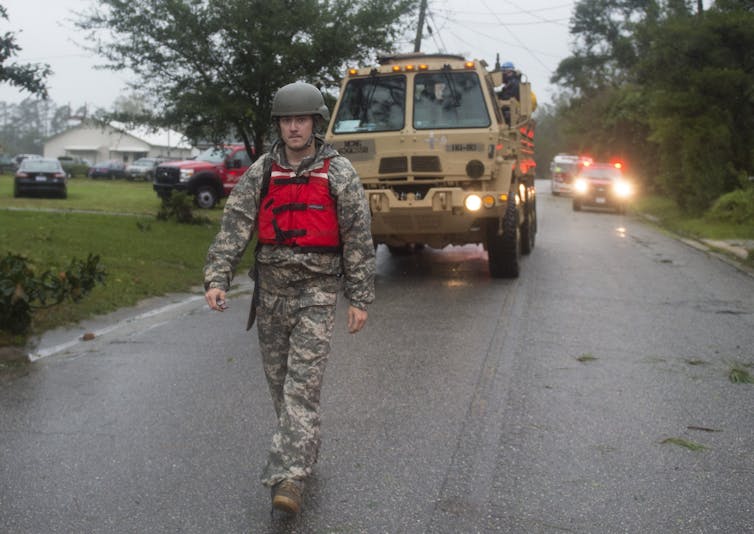
States might be able to arrange regional cooperation. But state-led responses and regional models have limitations. The National Guard could assist with supply distribution, but it isn’t designed to provide fast financial aid, housing or long-term recovery options, and the supplies and the recovery effort still come at a cost.

A National Guard member walks in front of search and rescue vehicles. FEMA
Members of the National Guard and a FEMA search-and-rescue team work together in the disaster response after Hurricane Florence pounded Wilmington, N.C., in September 2018. Andrew Caballero-Reynolds/AFP via Getty Images

Wealthier states might be better equipped to manage on their own, but poorer states would likely struggle. States with less funding and infrastructure would be left relying on nonprofits and community-based efforts. But these organizations are not capable of providing the scope of services FEMA can.

Any federal funding would also be slow if Congress had to approve aid after each disaster, rather than having FEMA already prepared to respond. States would be at the mercy of congressional infighting.

In the absence of a federal response and coordinating role, recovery would be uneven, with wealthier areas recovering faster and poorer areas likely seeing more prolonged hardships.

What does this mean?

Coordinating disaster response is complex, the paperwork for federal assistance can be frustrating, and the agency does draw criticism. However, it also fills an important role.

As the frequency of natural disasters continues to rise due to climate change, ask yourself: How prepared is your state for a disaster, and could it get by without federal aid?


This article is republished from The Conversation under a Creative Commons license. Read the original article and see more than 250 UMBC articles available in The Conversation.

Is DOGE a cybersecurity threat? A security expert explains the dangers of violating protocols and regulations that protect government computer systems

Written by Richard Forno, principal lecturer in computer science and electrical engineering, UMBC

The Department of Government Efficiency (DOGE), President Donald Trump’s special commission tasked with slashing federal spending, continues to disrupt Washington and the federal bureaucracy. According to published reports, its teams are dropping into federal agencies with a practically unlimited mandate to reform the federal government in accordance with recent executive orders.

As a 30-year cybersecurity veteran, I find the activities of DOGE thus far concerning. Its broad mandate across government, seemingly nonexistent oversight, and the apparent lack of operational competence of its employees have demonstrated that DOGE could create conditions that are ideal for cybersecurity or data privacy incidents that affect the entire nation.

Traditionally, the purpose of cybersecurity is to ensure the confidentiality and integrity of information and information systems while helping keep those systems available to those who need them. But in DOGE’s first few weeks of existence, reports indicate that its staff appears to be ignoring those principles and potentially making the federal government more vulnerable to cyber incidents.

Technical competence

Cybersecurity and information technology, like any other business function, depend on employees trained specifically for their jobs. Just as you wouldn’t let someone only qualified in first aid to perform open heart surgery, technology professionals require a baseline set of credentialed education, training and experience to ensure that the most qualified people are on the job.

Currently, the general public, federal agencies and Congress have little idea who is tinkering with the government’s critical systems. DOGE’s hiring process, including how it screens applicants for technical, operational or cybersecurity competency, as well as experience in government, is opaque. And journalists investigating the backgrounds of DOGE employees have been intimidated by the acting U.S. attorney in Washington.

DOGE has hired young people fresh out of – or still in – college or with little or no experience in government, but who reportedly have strong technical prowess. But some have questionable backgrounds for such sensitive work. And one leading DOGE staffer working at the Treasury Department has since resigned over a series of racist social media posts.

Wired’s Katie Drummond explains what the magazine’s reporters have uncovered about DOGE staffers and their activities.

According to reports, these DOGE staffers have been granted administrator-level technical access to a variety of federal systems. These include systems that process all federal payments, including Social Security, Medicare and the congressionally appropriated funds that run the government and its contracting operations.

DOGE operatives are quickly developing and deploying major software changes to very complex old systems and databases, according to reports. But given the speed of change, it’s likely that there is little formal planning or quality control involved to ensure such changes don’t break the system. Such actions run contrary to cybersecurity principles and best practices for technology management.

As a result, there’s probably no way of knowing if these changes make it easier for malware to be introduced into government systems, if sensitive data can be accessed without authorization, or if DOGE’s work is making government systems otherwise more unstable and more vulnerable.

If you don’t know what you’re doing in IT, really bad things can happen. A notable example is the failed launch of the healthcare.gov website in 2013. In the case of the Treasury Department’s systems, that’s fairly important to remember as the nation careens toward another debt-ceiling crisis and citizens look for their Social Security payments.

On Feb. 6, 2025, a federal judge ordered that DOGE staff be restricted to read-only access to the Treasury Department’s payment systems, but the legal proceedings challenging the legality of their access to government IT systems are ongoing.

DOGE email servers

DOGE’s apparent lack of cybersecurity competence is reflected in some of its first actions. DOGE installed its own email servers across the federal government to facilitate direct communication with rank-and-file employees outside official channels, disregarding time-tested best practices for cybersecurity and IT administration. A lawsuit by federal employees alleges that these systems did not undergo a security review as required by current federal cybersecurity standards.

There is an established process in the federal government to configure and deploy new systems to ensure they are stable, secure and unlikely to create cybersecurity problems. But DOGE ignored those practices, with predictable results.

For example, a journalist was able to send invitations to his newsletter to over 13,000 National Oceanic and Atmospheric Administration employees through one of these servers. In another case, the way in which employee responses to DOGE’s Fork in the Road buyout offer to federal employees are collected could easily be manipulated by someone with malicious intent – a simple social engineering attack could wrongly end a worker’s employment. And DOGE staff members reportedly are connecting their own untrusted devices to government networks, which potentially introduces new ways for cyberattackers to penetrate sensitive systems.

However, DOGE appears to be embracing creative cybersecurity practices in shielding itself. It’s reorganizing its internal communications in order to dodge Freedom of Information Act requests into its work, and it’s using cybersecurity techniques for tracking insider threats to prevent and investigate leaks of its activities.

Lacking management controls

But it’s not just technical security that DOGE is ignoring. On Feb. 2, two security officials for the U.S. Agency for International Development resisted granting a DOGE team access to sensitive financial and personnel systems until their identities and clearances were verified, in accordance with federal requirements. Instead, the officials were threatened with arrest and placed on administrative leave, and DOGE’s team gained access.

The Trump administration also has reclassified federal chief information officers, normally senior career employees with years of specialized knowledge, to be general employees subject to dismissal for political reasons. So there may well be a brain drain of IT talent in the federal government, or a constant turnover of both senior IT leadership and other technical experts. This change will almost certainly have ramifications for cybersecurity.

DOGE operatives now have direct access to the Office of Personnel Management’s database of millions of federal employees, including those with security clearances holding sensitive positions. Without oversight, this access opens up the possibilities of privacy violations, tampering with employment records, intimidation or political retribution.

Support from all levels of management is crucial to provide accountability for cybersecurity and technology management. This is especially important in the public sector, where oversight and accountability is a critical function of good democratic governance and national security. After all, if people don’t know what you’re doing, they don’t know what you’re doing wrong.

At the moment, DOGE appears to be operating with very little oversight by anyone in position willing or able to hold it responsible for its actions.

Mitigating the damage

Career federal employees trying to follow legal or cybersecurity practices for federal systems and data are now placed in a difficult position. They either capitulate to DOGE staffers’ instructions, thereby abandoning best practices and ignoring federal standards, or resist them and run the risk of being fired or disciplined.

The federal government’s vast collections of data touch every citizen and company. While government systems may not be as trustworthy as they once were, people can still take steps to protect themselves from adverse consequences of DOGE’s activities. Two good starting points are to lock your credit bureau records in case your government data is disclosed and using different logins and passwords on federal websites to conduct business.

It’s crucial for the administration, Congress and the public to recognize the cybersecurity dangers that DOGE’s activities pose and take meaningful steps to bring the organization under reasonable control and oversight.

This article is republished from The Conversation under a Creative Commons license. Read the original article and see more than 250 UMBC articles available in The Conversation.

Meet a Retriever—Emmanuella Osei, public health and sociology junior and fearless leader

Meet Emmanuella Osei, a junior studying public health and sociology and the president of UMBC’s Public Health Council of Majors. She is passionate about health equity, public service, and mentorship. As a Retriever, Emmanuella is a fearless leader, actively involved in multiple scholar programs, and volunteer initiatives across the globe—from Maryland to South Africa to Costa Rica. Her commitment to high-impact research has led her to tackle critical issues like food insecurity among students at UMBC and access to long-term COVID-19 care. She is a proud recipient of the prestigious Jack Kent Cooke Scholarship. Her dedication to making a difference continues to take her where she is most needed. Take it away, Emmanuella!

Q: Briefly introduce yourself. What’s one essential thing you’d want another Retriever to know about you?

A:  I am pursuing a dual degree in public health and sociology and a certificate in the social dimensions of health. Throughout my time at UMBC, I have engaged in many experiential learning opportunities. In the summer following my freshman year, I interned at Columbia Community Care, a non-profit in Howard County that offers hunger relief, youth development, and wellness programs. In summer of 2024, I participated in the Summer Research Opportunity Program at the University of Michigan, where I researched access to long COVID care in the HELPER lab at the School of Public Health. Most recently, I participated in the AIFS study abroad program in Costa Rica where I learned about Costa Rica’s health care and tropical systems.

Q: Tell us about your primary WHY, and how it led you to UMBC.

A: I came to UMBC because of the vibrant and supportive community I felt when I first toured the campus. I knew that as an immigrant and first-generation student from Ghana [in West Africa], UMBC would be a great place to be. Because UMBC is a minority-serving institution and home to students from diverse backgrounds and identities, I felt it would offer the perfect environment for me to also grow academically while providing countless opportunities. So far, UMBC has definitely lived up to my expectations, and I truly believe that everyone can find their place here.

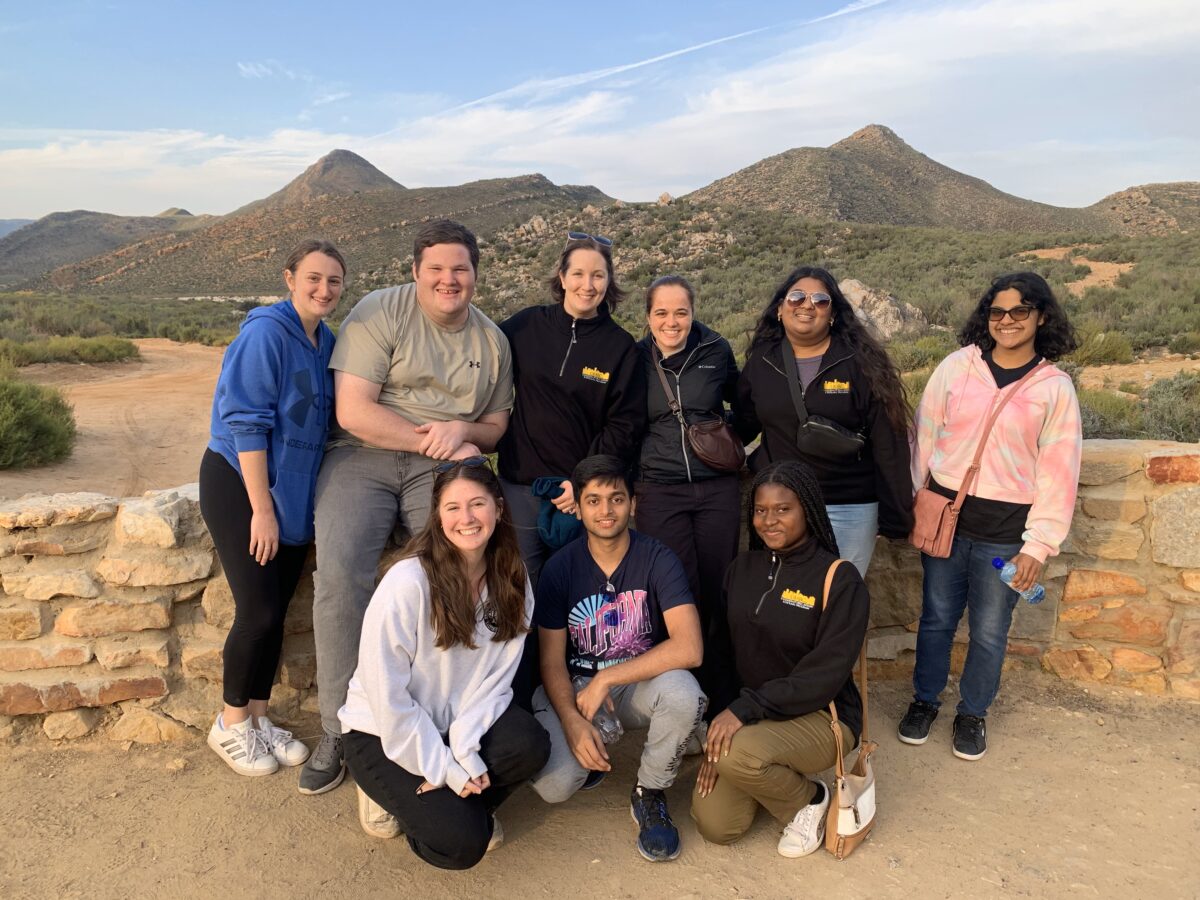
Eight college students stand closely in a group with a professor in front of a stone wall with the South African mountains in the background
Osei (first on the right kneeling) and other Sondheim Public Affairs Scholars in South Africa. (Image courtesy of Osei)

Q: Tell us about the people who are helping you grow at UMBC, and why their HOW made such a difference to you.

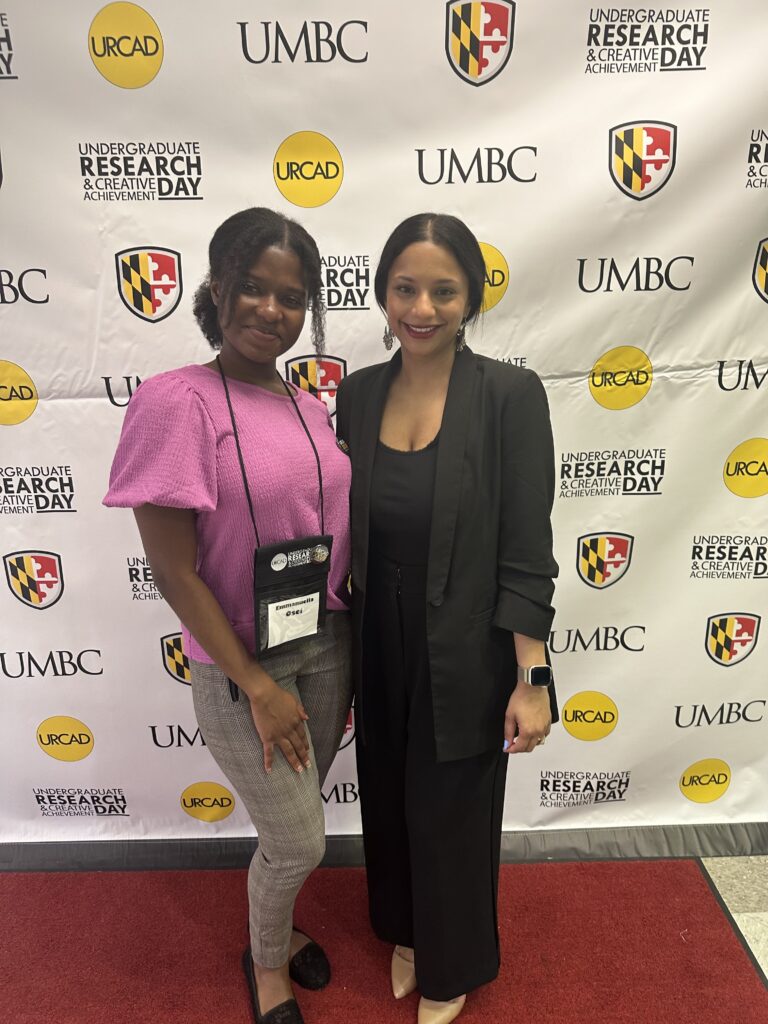
A college professor and Emmanuella Osei, their student, stand in front of a large photo background with UMBC logos
Osei and Nayak at URCAD 2024. (Image courtesy of Osei)

A: My research mentor, Dr. Sameera Nayak, has been extremely supportive of my independent research. She became my mentor during my sophomore year as part of the McNair Scholars Program. Now, as an Undergraduate Research Award Scholar studying food insecurity among students at UMBC, Dr. Nayak continues to guide me and provides feedback on each stage of the research process. After collecting and analyzing over 500 responses, I am now working on disseminating my findings beginning at UMBC’s spring Undergraduate Research and Creative Achievement Day (URCAD).

Q: Are you currently part of a scholars program or Living Learning Community at UMBC?

A:  In addition to being a McNair Scholar, I am a member of UMBC’s Honors College and the Sondheim Public Affairs Scholars Program, a four-year scholarship program focused on community engagement and policy. As a Sondheim Scholar, I participated in a faculty-led study abroad summer course in Cape Town, South Africa, to learn about global community engagement and social change. In my first two years at UMBC, I was also a member of the Shriver Living Learning Community (LLC) for students passionate about service, leadership, and advocacy. I served as a peer mentor in my sophomore year, supporting first-year students as they transitioned to college. 

Because UMBC is a minority-serving institution and home to students from diverse backgrounds and identities, I felt it would offer the perfect environment for me to also grow academically while providing countless opportunities. So far, UMBC has definitely lived up to my expectations, and I truly believe that everyone can find their place here.

Emmanuella Osei ’26

public health and sociology

Q: What clubs, teams, or organizations are you a part of? What do you love about them?

A: I am the president of UMBC’s Public Health Council of Majors. I love planning professional development and social events to bring public health students together. In the past year, we have hosted events such as graduate school information sessions, internship panels, resume workshops in collaboration with the Career Center, and LinkedIn headshots, among others.

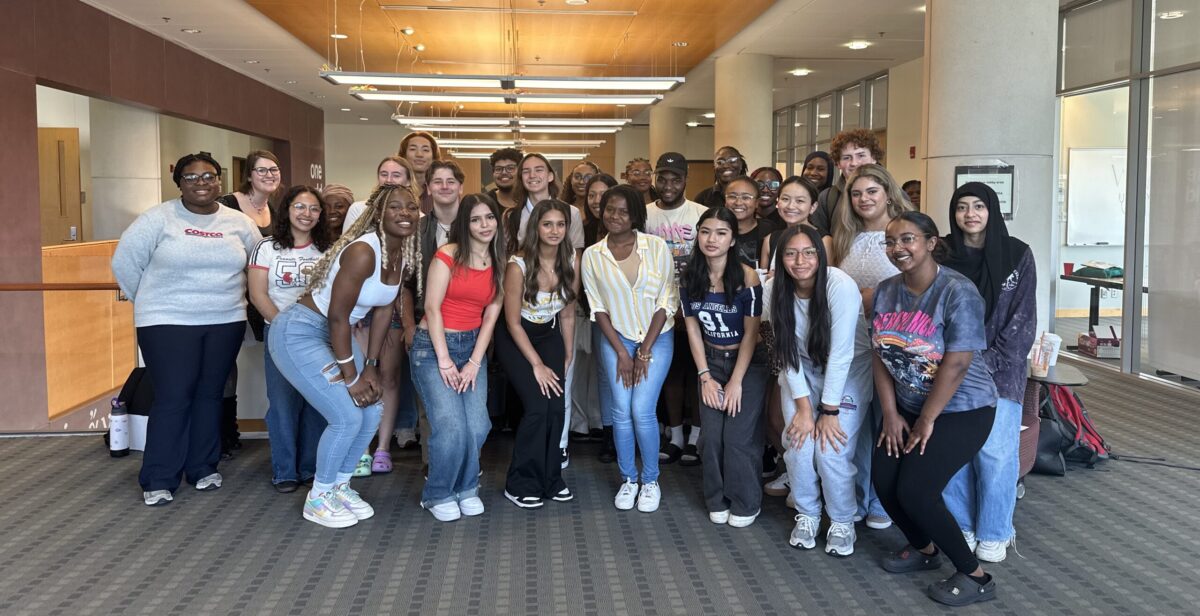
A large group of college students group in a carpeted hallway for a picture
Osei (center striped shirt) with members of UMBC’s Public Health Council of Majors. (Image courtesy of Osei)

Q: How are you making a difference for other Retrievers?

A: Since my sophomore year, I have worked as an Academic Peer Advocate through UMBC’s Academic Success Center. In this role, I support other undergraduate students by connecting them to the great resources UMBC offers. Through the Shriver Center, I volunteered at the Great Kids Farm, a Baltimore City Public Schools farm-to-school program. Currently, I serve as a student ambassador for the Commodore Collegiates Program, a partnership between UMBC and Commodore John Rodgers Elementary/Middle School. I give students an exciting tour of UMBC, lead fun STEM activities, share my college experience, and engage them in discussions about college.

* * * * *

UMBC’s greatest strength is its people. When people meet Retrievers and hear about the passion they bring, the relationships they create, the ways they support each other, and the commitment they have to inclusive excellence, they truly get a sense of our community. That’s what “Meet a Retriever” is all about.

Learn more about Scholars Programs at UMBC.

Meet a Retriever—Michael Brazda ’06, M.A. ’08, and Ph.D. ’24, an adjunct professor and advocate for virtual lifelong learning 

Meet Michael Brazda ’06, anthropology, M.A. ’08, applied sociology, and Ph.D. ’24, gerontology, an adjunct professor who is passionate about both asynchronous and synchronous online learning. Drawing from his experiences as a student and a working professional, he understands the flexibility needed while earning a degree. Now, he focuses on helping students who require that same level of flexibility to balance their education with work, family, and other life responsibilities. For Michael, the ability to access virtual learning is a game-changer for lifelong learning. Thanks for sharing your enthusiasm, Michael!

Q: Briefly introduce yourself.

A professor with long light brown hair and grey beard sits in front of a white board Michael Brazda

A: I am an adjunct professor in various institutions across Maryland. I teach sociology at Mount St. Mary’s University and Frederick Community College and gerontology, sociology, and women’s studies at the University of Maryland Global Campus.

A: I graduated from UMBC’s doctoral gerontology program in December 2024. I took a long circuitous route to get here. In 1987, I earned my first bachelor’s degree in computer studies and went to work as a telecommunications technician and network administrator. Sixteen years later, I was laid off which led to a lot of soul-searching. I realized I didn’t like certain aspects of the tech industry and decided to explore other fields.

Q: What’s one essential thing you’d want another Retriever to know about you? 

A: I started at UMBC, earning a second bachelor’s degree in anthropology followed by a master’s degree in applied sociology. I took a two-year detour in the public policy doctoral program and finally found my home in gerontology. In part, because it provided a capstone to my life up to that point. I was always interested in the social sciences. Gerontology, being multidisciplinary, allowed me to tie together my interests in sociology and anthropology. 

Q: What do you love about your job?

A: I don’t like living in the past. I like encountering new things and understanding how and why people behave a certain way. Some of the music that I’ve learned to appreciate is because of the assignments I have given, like songs by Billie Eilish. We analyze their lyrics and relate them to sociological concepts. I have taught online at more than five universities and community colleges in the area because it allows me to work with and learn from a diverse group of students, which is something I really enjoy. Through this experience, I have become an advocate for lifelong learning.

Online learning helps students, who need more than a traditional institution offers, to have a holistic college experience. 

Michael Brazda ’06, M.A. ’08, and Ph.D. ’24

Adjunct Professor

Q: Why are you passionate about lifelong learning?

A: Lifelong learning comes more from the desire to learn new things and get involved in different areas that interest me. Online learning plays into this because it expands what’s available academically. With online learning, I’m not limited to what the colleges or universities in my area may offer. I can look at or get involved with academic programs around the country. When I returned to college in 2003, I could only access universities near my home, UMBC being one of those. Otherwise, I would have to drive to D.C., further into Baltimore, or Pennsylvania. Online learning helps students, who need more than a traditional institution offers, to have a holistic college experience. 

Online teaching became my modality of choice because it allows me to teach at a wider range of schools. Trying to make a living as an adjunct professor while traveling from campus to campus for classes eats up a lot of time. In contrast, the ability to teach online eliminates that overhead. It allows me to devote more time to teaching, learning, and developing my classes in new ways.

Q: Since you’ve been a part of the UMBC community, how have you found support of your WHY?

A: Although I’ve been teaching for many years, I’m always learning how to become a better educator for my students. While at UMBC, I took advantage of UMBC’s Graduate Students Association PROF-it: Professors in Training seminar. This program helped refine my teaching skills enabling me to better meet my students’ needs.

The UMBC community has supported me in ways that I reflect in my teaching today. The welcoming faculty, both in teaching and research, made me feel like a part of the team. As a student, this was particularly important—working with researchers who encouraged me to develop my ideas and explore topics of interest to me, while still allowing me to call the work my own. At the same time, they involved me in every aspect of the research process, helping me learn, expand, and grow as a researcher. Faculty in sociology, anthropology, and public health like Robert Rubenstein, emeritus professor,  Ann Frankowski, senior research scientist in the doctoral gerontology program; and J. Kevin Eckert, emeritus professor, among others, created a comfortable and supportive environment.

* * * * *

UMBC’s greatest strength is its people. When people meet Retrievers and hear about the passion they bring, the relationships they create, the ways they support each other, and the commitment they have to inclusive excellence, they truly get a sense of our community. That’s what “Meet a Retriever” is all about.

Learn more about UMBC’s Ph.D. in gerontology.

UMBC’s Class of 2023 surpasses national career outcomes

Recent data from the National Association of Colleges and Employers (NACE) highlights the exceptional career readiness of UMBC graduates. “UMBC continues to surpass national career outcome rates across all degree levels,” said Christine Routzahn, director of the Career Center.

Bachelor’s degree outcomes

Nationwide, nearly 85 percent of Class of 2023 bachelor’s degree graduates were employed or pursuing further education within six months of graduation, according to NACE’s First Destinations report. UMBC stands out with an impressive career outcome rate of 93 percent.

Nationally, 57.2 percent of bachelor’s degree recipients were employed full-time within six months, compared to UMBC’s 65 percent. While 20.2 percent of graduates nationwide pursued further education, UMBC’s rate was higher at 24 percent.

Graduate degree outcomes

UMBC’s graduate degree holders also excelled beyond national averages. For master’s degree graduates, the national career outcome rate—defined as being employed or pursuing further education within six months—was 89.4 percent according to NACE’s report. UMBC outpaces this with a career outcome rate of 90.8 percent for master’s recipients.

Doctoral graduates nationwide had a 92.5 percent outcome rate, but UMBC achieved an exceptional 100 percent.

These results reflect our strong academic programs and the collective efforts of the UMBC community in fostering student achievement. “Our collective work empowers UMBC students to achieve meaningful career paths and long-term success,” Routzahn emphasized.


Learn more about how UMBC can help you achieve your goals.

Retriever Behind the Scenes—Chris Serafin, electric trades supervisor

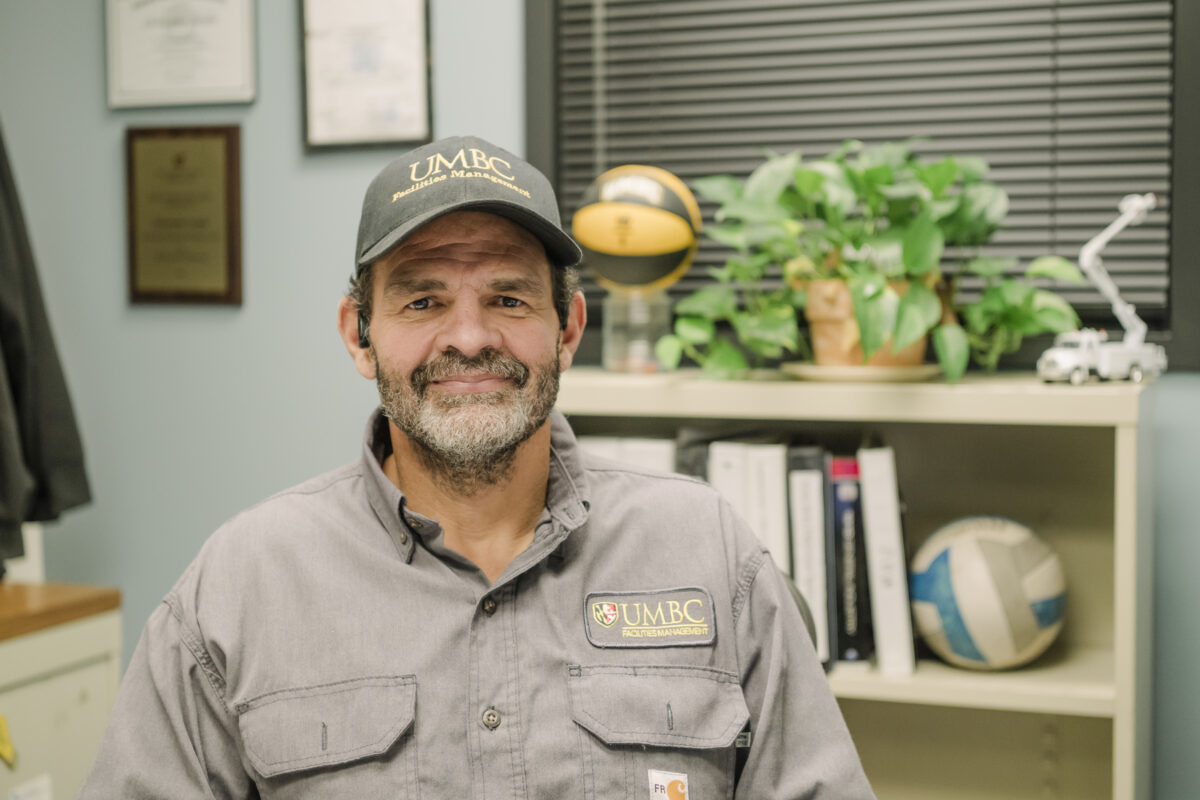
Meet Chris Serafin, electric trades supervisor in UMBC’s Facilities Management (FM). Serafin has been at UMBC for 9 years and was recently awarded a USM Board of Regents’ Staff Award for his exceptional work, including a high voltage electrical switch replacement in the Engineering Building that ended up saving the university a half a million dollars in contractor’s fees.

Q: What’s one essential thing you’d want another Retriever to know about you?

A: I enjoy my job as electric supervisor and have a great group of high voltage electricians that work hard every day to ensure the stability of the UMBC power system. I received my management studies degree in 2020 from the University of Maryland Global Campus, taking full advantage of the tuition remission program provided by the State of Maryland. I enjoy building furniture and playing guitar in my free time.

Q: Tell us about someone in the community who has inspired you or supported you, and how they did it.

A: John Zahor [AVP for FM]  has been extremely supportive in my career at UMBC. He has been a hands off boss and has allowed me to make critical changes to how the UMBC electric shop is run, which has greatly improved the efficiency of daily operations.

a man in a UMBC cap sits in his office
Chris Serafin in his office. (Marlayna Demond ’11/UMBC)

Q: What part of your job do you enjoy the most and why?

A: Leadership has allowed me to be proactive, creative, and think outside the box when exploring the fascinating world of electrical theory.

Q: Tell us about the people who have helped you at UMBC.

A: Lenn Caron [acting vice president, Administration and Finance], John Zahor, and Valerie RiChard in Facilities Management have allowed me to run the UMBC electric shop the way I think in needs to be run to provide the electrical requirements of administrators, faculty, staff, and students at UMBC.

Meet a Retriever—Collin Sullivan ’19, M.P.P. ’21, digital credential innovator

Collin Sullivan ’19, information systems and economics, M.P.P. ’21, is the program director for digital credential innovation in the Division of Professional Studies. While he started as a student worker in 2015 for the Division of Information Technology (DoIT), working with faculty to leverage the use of clickers in the classroom, he now leads university efforts to offer in-demand microcredentials, such as the Greater Washington Partnership Digital Tech credential. Two things have been constant in Collin’s career: his interest in technology and his love of the UMBC community. 

Q: What led you to your current role? 

A: In many ways, my professional time at UMBC found me. I began as an undergraduate student worker in Instructional Technology with DoIT. I started by supporting classroom clickers in classes all across campus. I’ve always been interested in educational technology, so I was incredibly fortunate and lucky to have had that opportunity during my undergrad. 

When I was about to graduate, like many rising seniors, I was really unsure of where I was going to go. I was feeling uneasy about looking for jobs because I knew the values of UMBC and the community that exists here, and I had a hard time thinking about other places to work that would have the same feeling. My passion for educational technology never waned, and in the end I found an opportunity at UMBC.

Q: How many hats do you wear at UMBC?

A: I have had many roles here at UMBC: undergraduate student, graduate student, alumnus, staff, and adjunct faculty member. I’ve studied information systems, economics, and public policy. I began my career in the Division of Information Technology, and now I am in Extended Studies with the Division of Professional Studies. It is without question that I am who I am, and where I am, because of UMBC. 

Q: Tell us about someone in the community who has inspired you.

A: There are way too many people to name! The first person who comes to mind is Craig Berger, my Student Government Association advisor when I was an undergrad. There is no other way to put it other than Craig is the best. During my first few days at UMBC, I made my way to the Campus Life office, and Craig always made me feel welcomed and, later, truly empowered me to feel like I could make a difference on campus and beyond the loop. He taught me that even during times that feel particularly challenging, the world is still malleable. A different perspective and level-headed, strategic approach often is a meaningful path forward.

Collin Sullivan ’19, wearing a dark suit and black tie, smiles confidently in a professional outdoor portrait.

Q: What’s the one thing you’d want someone who hasn’t joined the UMBC community to know about the support you find here?

A: In many ways, UMBC is a small town. It feels like a close-knit community where it’s easy to make meaningful connections with people from diverse backgrounds who genuinely care about each other. While we strive for excellence, there’s no sense of competition—everyone supports one another in achieving personal and collective success, whether in academics, work, or relationships.

Q: Tell us about an organization you’re involved in as part of your work.

A: I’ve had the privilege of being involved with 1EdTech, a national education technology organization, where I serve as co-chair of the Digital Credential Innovation Leadership Network. Our goal is to ensure that everyone who earns digital credentials can confidently showcase their verified competencies and achievements, using them in ways that best support whatever is next in life.

Q: What’s your favorite place on campus to relax or meet friends? 

A: My favorite spot has changed over the years—from the tables by the Library pond to the area outside the RAC and the Forum sculpture at the PAHB. But honestly, my go-to answer has to be the coveted comfy chairs at Starbucks! I’ve had so many amazing conversations with friends, mentors, and colleagues there. Plus, you never know who you’ll bump into. There’s just something about the possibilities of chatting over a cup of coffee.

In many ways, UMBC is a small town. It feels like a close-knit community where it’s easy to make meaningful connections with people from diverse backgrounds who genuinely care about each other.

Collin Sullivan '19, M.P.P. '21

program director for digital credential innovation

Q: What part of your job do you enjoy the most and why?

A: Working with faculty and staff to create new pathways for learners to reach their goals. It’s easy to get caught up in our own worlds and forget to pause and reflect on the progress we’re all making. I love that I get to collaborate with others to create space for those reflections, where we can really think about what we want learners to achieve. The best part? Seeing the end result—acknowledging all the hard work, both seen and unseen, that helps learners improve their lives and take the next step in their journey.

UMBC’s greatest strength is its people. When people meet Retrievers and hear about the passion they bring, the relationships they create, the ways they support each other, and the commitment they have to inclusive excellence, they truly get a sense of our community. That’s what “Meet a Retriever” is all about.

Learn more about how UMBC can help you achieve your goals.

Office Hours

Listening has defined the early years of President Valerie Sheares Ashby’s tenure at UMBC, starting with her series of Bold Conversations to hear the many diverse Retriever voices. She continues to offer office hours for students, setting an example for other campus leaders to create similar opportunities in their own spaces. Meghna Chandrasekaran, Student Government Association (SGA) president, has extended the practice in her role as a programming intern at The Mosaic via “Chai Chats,” an opportunity for South Asian Retrievers to connect over their shared heritage. The biological sciences and political science senior and Sheares Ashby talk about the discomfort that leadership can bring along with the ultimate flourishing that results in finding what you were meant to do.

Meghna Chandrasekaran: As a young SGA officer, I always thought that I would have to talk a lot to make my presence known. But over time, I realized I needed to take a step back and listen. And it wasn’t listening just to listen—but listening to understand, especially lived experiences. After STRiVE [an intensive and engaging leadership for public purpose program at UMBC] and my work with the Center for Democracy and Civic Life, I’m able to assess spaces in a way that I know when I can keep engaging and when I should just take a step back and sit with possible discomfort. I’ve learned a lot about listening with intentionality.

President Sheares Ashby: I am more and more comfortable with discomfort because I have developed a practice for myself. I have decided with intent that whenever I feel anxious, I will just sit up and lean slightly forward, because I do not want to pull back from the conversation. And that is my way of saying, “Just lean in. Everybody is okay.”

Chandrasekaran: I’ve been in this SGA space since middle school. I was always told certain steps and guidelines to follow in order to be a leader. And when I came to UMBC, I thought, again: I’ll follow the guidelines. But then I went to STRiVE, and that shook up my entire worldview, to be totally honest. I learned I needed to be myself, my unapologetic self. Previously in SGA spaces, I would never bring up cultural heritage because I saw that as unprofessional. 

two women sit next to a bookshelf in nice wooden chairs during office hours

At the same time, I was a Leadership Peer Facilitator, and I started to understand my own personal values. Now it’s become second nature to show up in spaces as myself. That’s where the Chai Chats started—I really wanted to do something to keep me in touch with my cultural heritage, which is extremely important to me as a Tamil American student.

There have been some times when my friends have complained that I’m being “SGA president” with them and not “Meghna,” but that’s not the case anymore. It is now a part of who I am, and I just show up this way everywhere I go.

Sheares Ashby: Leaders continue to grow every day. You have a conversation like, “Ooh, I did not realize I was thinking about it that way,” or “I did not realize I had that bias,” or “I did not realize that I was not communicating clearly.” You learn something about yourself every single day, and you are growing. You show up as yourself every day and try to be the best version you could be. That is actually all anyone is asking you to do. 

It is a beautifully calming thing [to know you] do not have to have all the answers. I do not have to know anything magical. I do not have to be right—and I am probably not going to be right. All I have to do is be me. 

What is next for you, Meghna?

Chandrasekaran: I’m applying for a master’s in public policy, with a concentration in higher ed, in part because I’ve experienced something that feels unique to UMBC, especially with regards to shared governance. I talk to my peers at different institutions, and when I tell them what our SGA does, they’re like, “Whoa, what? You have a seat at the table? You’re managing a $1.1 million budget?” And I’m like, “That’s just the norm here.” I can see how the structures of our institution are set in place to allow for student involvement, and I think the end goal is agency among the entire campus. 

Sheares Ashby: You do not know how much all of that gives me joy. It is so fun to watch you. This is why I have the best job in the world. I get to watch you all become who you were intended to be. In spite of how hard it is to be a leader, I watch you do it with joy. Everyone here is trying to figure out who they actually are and how that aligns with the life that they want. You did it. 

What is Salt Typhoon? A security expert explains the Chinese hackers and their attack on US telecommunications networks

Written by Richard Forno, principal lecturer in computer science and electrical engineering, UMBC

Cyberattacks linked to the Chinese government that compromised large portions of the American telecommunications network have the U.S. government sounding the alarm. The chair of the Senate Intelligence Committee, Sen. Mark Warner (D-VA), has called it the “worst telecom hack in our nation’s history” and noted that it makes prior cyberattacks by Russian operatives look like “child’s play” by comparison.

The complex cyberattack, carried out by a group of Chinese hackers dubbed Salt Typhoon, began as far back as 2022. Its purpose, according to U.S. officials, was to give Chinese operatives persistent access to telecommunications networks across the U.S. by compromising devices like routers and switches run by companies like AT&T, Verizon, Lumen and others.

This attack comes on the heels of reports that the FBI and Cybersecurity and Infrastructure Security Agency were assisting telephone companies with countering other China-connected compromises of their networks. The earlier hacking was part of an attack targeting people in the Washington area in government or political roles, including candidates for the 2024 presidential election.

But Salt Typhoon is not just targeting Americans. Research from security vendor Trend Micro shows that attacks by Salt Typhoon compromised other critical infrastructure around the world in recent years. U.S. officials have confirmed these findings as well – and their level of concern is noteworthy.

Chinese officials have denied the allegations that they’re behind this operation, as they have in response to allegations about previous cyberattacks.

As a cybersecurity researcher, I find this attack is indeed breathtaking in its scope and severity. But it’s not surprising that such an incident took place. Many organizations of all sizes still fail to follow good cybersecurity practices, have limited resources, or operate IT infrastructures that are too complex to effectively monitor, manage and secure.

How bad is it?

Salt Typhoon exploited technical vulnerabilities in some of the cybersecurity products like firewalls used to protect large organizations. Once inside the network, the attackers used more conventional tools and knowledge to expand their reach, gather information, stay hidden and deploy malware for later use.

According to the FBI, Salt Typhoon allowed Chinese officials to obtain a large amount of records showing where, when and who specific individuals were communicating with. In some cases, they noted that Salt Typhoon gave access to the contents of phone calls and text messages as well.

‘PBS News Hour’ reports on updates from the White House about Salt Typhoon.

Salt Typhoon also compromised the private portals, or backdoors, that telephone companies provide to law enforcement to request court-ordered monitoring of phone numbers pursuant to investigations. This is also the same portal that is used by U.S. intelligence to surveil foreign targets inside the United States.

As a result, Salt Typhoon attackers may have obtained information about which Chinese spies and informants counterintelligence agencies were monitoring – knowledge that can help those targets try to evade such surveillance.

On Dec. 3, the Cybersecurity and Infrastructure Security Agency, National Security Agency and FBI, along with their counterparts in Australia, New Zealand and Canada, released guidance to the public on how to address the Salt Typhoon attack. Their Enhanced Visibility and Hardening Guidance for Communications Infrastructure guide essentially reiterates best cybersecurity practices for organizations that could help mitigate the impact of Salt Typhoon or future copycat attacks.

It does, however, include recommendations to protect specific telecommunication equipment for some of the Cisco products that were targeted in this attack.

As of this writing, U.S. officials and affected companies have not been able to fully ascertain the scope, depth and severity of the attack – or remove the attackers from compromised systems – even though this attack has been ongoing for months.

What can be done?

U.S. officials have said that many of the ways Salt Typhoon penetrated its targets was through existing weaknesses with the infrastructure. As I’ve written previously, failing to implement basic cybersecurity best practices can lead to debilitating incidents for organizations of all sizes. Given how dependent the world is on networked information systems, it is more important than ever to maintain cybersecurity programs that make it difficult for attacks to succeed, especially for critical infrastructure like the phone network.

In addition to following the best practices guidance issued by the Cybersecurity and Infrastructure Security Agency earlier this week, organizations should remain vigilant. They should monitor not only the news for information about this attack but the various free, proprietary or private threat intelligence feeds and informal professional networks to stay up to date on attackers’ tactics and techniques – and ways to counter them.

Companies and governments should also ensure their IT departments and cybersecurity programs are adequately staffed and funded to meet their needs and ensure that best practices are implemented. The Federal Communications Commission is already threatening companies with fines for failing to bolster their defenses against Chinese hacking.

Although any illicit surveillance is concerning, the average American probably has little to worry about from Salt Typhoon. It’s unlikely that your family phone calls or text messages to friends are of interest to the Chinese government. However, if you want to increase your security and privacy a bit, consider using end-to-end encrypted messaging services like Signal, FaceTime or Messages.

Also make sure you’re not using default or easily guessed passwords on your devices, including your home router. And consider using two-factor authentication to further strengthen the security of any critical internet accounts.

Backdoors and bad guys

Lost in the noise of the story is that Salt Typhoon has proved that the decades of warnings by the internet security community were correct. No mandated secret or proprietary access to technology products is likely to remain undiscovered or used only by “the good guys” – and efforts to require them are likely to backfire.

So it’s somewhat ironic that one of the countermeasures recommended by the government to guard against Salt Typhoon spying is to use strongly encrypted services for phone calls and text messages – encryption capabilities that it has spent decades trying to undermine so that only “the good guys” can use it.

This article is republished from The Conversation under a Creative Commons license. Read the original article and see more than 300 UMBC articles available in The Conversation.

Creativity in the C-suite

As Kent Malwitz ’92, information systems, moved up through the world of technology leadership, he kept wondering if an MBA was in the cards. But what he found ultimately most useful and fulfilling, as someone already steeped in the CEO-world, was pursuing an M.F.A. in creative writing. Malwitz, who is the director of strategic partnerships at UMBC Training Centers—a nonprofit providing private workforce training in technology, cybersecurity, project management, and leadership development—nurtured this early creative emphasis as an IS student who wanted to explore the empowering and vulnerable world of writing workshops. Now, he corrals his curiosity and storyteller-instincts to become a more empathetic teammate and leader. 

Kent Malwitz
Kent Malwitz at UMBC Training Centers.

While I knew from a very young age that I loved technology, it wasn’t until my junior year at UMBC that I discovered that I also love to write. Working and playing with technology was natural to me as a kid, and since personal computers, modems, and bulletin boards were all fairly new to the public in the late ’80s, I was drawn to technology for exactly that reason—it was new. There was an element of discovery and creativity in trying to figure out how to do certain things with computers, leading me to pursue a degree in information systems at UMBC and a career in technology.

While at UMBC, I worked at a co-op with IBM, which allowed me to gain technical and business experience. I would drive to Gaithersburg daily from UMBC to provide technical support to IBM’s sales teams, and at certain times, I would take night classes alongside my 40-hour-a-week job at IBM, which gave me a heavy dose of the “real world,” as I tried to balance work, school, a social life, and a lengthy commute. The grind did not leave a lot of space for creativity.

After completing the required technical writing courses for my major, I felt a creative pull in me and acknowledged that my best chance of exploring that would be through writing, as I had shown no promise in the visual arts. I took a creative writing class and fell in love. It felt amazing to be doing something creative alongside my very technical work, and what I loved the most was sharing work with my fellow students and seeing and hearing their work—their thoughts and ideas, their fears. It made me feel extremely vulnerable, as well, but hearing my peers’ feedback was empowering, and I felt inspired by their talent. 

Working to extend the university’s mission

Back then, IBM was known for having an unofficial dress code—blue suit, white shirt, red tie. I conformed. The people were very nice, and it was a great introduction into the work world, but I knew that I wanted to work in an environment with a different kind of energy.

Kent Malwitz and friends during his time at UMBC
Kent Malwitz with intramural friends at UMBC.

I found myself drawn to smaller, entrepreneurial companies where you got to—and had to—do many things based on the limited resources available. I found these environments to be conducive to learning, problem solving, and creativity. Where there were many challenges, there were equal opportunities to think critically and creatively and to lead through them. I found great joy in creating elegant technical solutions to address our customers’ business needs. I loved trying to figure things out that had not yet been figured out, and as my career grew, I took on bigger and bigger projects and teams.

After 10 years of technology consulting, I learned about a non-profit that UMBC founded focused on the delivery of technical training—the UMBC Computer Certification and Training Center (UMBC CCTC—way too many Cs!). I was recruited by the president of CCTC at the time, Doug Kenzierski, my former instructor who connected me to IBM for my co-op. I got involved in 2003 to help lead business development efforts with organizations and government agencies to train their employees. We renamed UMBC CCTC to UMBC Training Centers and started winning contracts with regional businesses and key agencies in the intelligence community, the military, and civilian government.

In true grit fashion, UMBC was very early to grasp the concept of a research university that provides workforce development programs as well as having a related business entity that extends the mission of the university to new audiences. Today, UMBC Training Centers is a significant provider of workforce training in technology, cybersecurity, project management, and leadership development, serving many individuals and employers in the region through our private training programs and our robust open enrollment schedule that reaches more than 10,000 learners a year.

Nurturing curiosity

Throughout my career, I often thought about pursuing an MBA, and while I know I would have learned a lot, I already had significant hands-on experience from leading business development at UMBC Training Centers and then later becoming the CEO. Instead, I realized what I really needed was to nurture my curiosity and interest in creativity. I thought that tapping into my own personal beliefs and values and becoming a better storyteller would help me become a more empathetic and more effective teammate and leader. 

After hearing from other UMBC staff who had gone this route, including Jenny O’Grady, the editor of this magazine, I applied for the Master’s of Fine Arts creative writing program at the University of Baltimore. In many ways, I was a fish out of water in the program, but I loved it. I was much older than most of the students, and I was working full-time as the CEO of UMBC Training Centers. I was the only one who would show up in a suit on many nights, but my classmates welcomed me. I delved into writing workshop after workshop.

I thought that tapping into my own personal beliefs and values and becoming a better storyteller would help me become a more empathetic and more effective teammate and leader. 

Kent Malwitz '92

Director of strategic partnerships at UMBC Training Centers

Just like when I was an undergrad, sharing my work with others and having their work shared with me was my favorite part of the program. I loved the feedback and the support—both giving and receiving. While I haven’t completed the M.F.A. program, I intend to and feel that I have already benefited from it greatly as a business person and as a leader. Thinking critically and creatively and being open minded and unafraid of the unknown has been a key factor in the growth of my career.

Full-circle all the way home

After 17 years at UMBC Training Centers, I was recruited to go work again for IBM, despite my concerns from my earlier experience working there as a student. I worried about how I would feel working for such a large, corporate organization after having been in a small, entrepreneurial environment for my entire career. I was there for 4 years and learned a lot—about corporate culture, about scale, and about leadership, and I was reminded about the critical nature of strategic partnerships. 

In August of this year I had the opportunity to return to my beloved UMBC and UMBC Training Centers in the capacity of director of strategic partnerships. Here, I intend to work collaboratively—and creatively—with our partners, UMBC being our most strategic partner, to scale up the impact we have on the communities we serve, including finding ways to allow UMBC students to more directly benefit from our offerings, and to make UMBC Training Centers no longer the best kept secret at UMBC.

The World Is (Finally) Watching

Packed and energized sporting arenas. Clinching the closing medal ceremony of the Olympics for the first time. Primetime broadcasts with viewership in the many millions—women’s sports are starting to get the time and attention they’ve deserved all along. 

At UMBC, our women athletes have been gathering championship rings and lifting each other up along the way. You’re invited to join the stands and cheer on these world-class Retrievers.

By Kara Newhouse

The women of the UMBC volleyball team stood at the edge of their home court with eyes toward the rafters. To the right of the American and Maryland flags hung two banners with black cloths draped over them. The home opener match of the 2024 season would start soon, but first, a bit of pomp and circumstance for the Retrievers who won the past four America East Conference tournaments.

A game announcer directed attention to a massive video screen which showed senior Mila Ilieva, economics, blocking a hit and clinching a 3-0 sweep of the Binghamton Bearcats in the 2023 championship. On the floor, current players grinned, reliving their victory as triumphant music kicked on. All eyes returned to the rafters and up went the black cloths to reveal two black and gold banners listing the volleyball team’s three regular season titles and four tournament wins.

On its way up, one cloth got stuck, hanging at an angle as the players turned for a photo and a crew in the rafters fixed it. Not the smoothest of unveilings, but it was perhaps reflective of the trajectory of women’s sports in this country, a path punctuated by moments of great promise—the passage of Title IX, packed crowds at the 1999 Women’s World Cup, Simone Biles and Katie Ledecky’s medal dominance at the Rio Olympics—but often regressing to the status quo as a “niche interest” ignored by investors and corporate broadcasters.

This year, however, the veil keeping women’s sports from mainstream popularity has finally lifted. The final game of 2024 NCAA women’s March Madness netted over 18 million average viewers—4 million more than the men’s final. At the Paris Olympics, the women’s marathon medals were given during the closing ceremony instead of the men’s for the first time. Professional leagues are smashing attendance records and making expansion plans. 

As a recent viral T-shirt declares: Everyone watches women’s sports. And Retriever athletics is full of women worth watching. In addition to volleyball victories, UMBC boasts four consecutive America East championships in softball. Swimming alumna Emily Escobedo ’17, finished third in the 200-meter breaststroke at NCAA championships as a Retriever and later won a world championship in the same event. The lacrosse team is coached by a hall-of-famer. Shot putter Cleopatra Borel ’02, was the college’s first national champion and competed in four Olympics for Trinidad and Tobago. That’s just what’s in the record books. At UMBC, student-athletes are also supported as teammates, scholars, and aspiring leaders. Are you watching with us?

It’s electric

For Kennedy Lamb ’20, English, the recent popularity of women’s sports is overdue. “It’s about time these women’s sports teams, especially at UMBC, get that attention,” said Lamb, who won an America East championship with Retriever softball in 2019. 

During her time as a student-athlete, Lamb experienced a similar change in viewership to what’s happening nationally. She remembers looking out from the diamond as a first-year student to see just a few parents. “We love the parents, but you always wish that maybe another sports team or maybe a friend or someone from your math class would show up,” she said. Over the ensuing years, as the softball team turned into a winning one, her wish came true. “By the time I was a senior, the hill was filled.”

Lamb got a reminder of how that felt when she attended a Washington Mystics game against the Indiana Fever, the team on which mega-popular Caitlin Clark plays. Both times the Fever came to Washington, the arena sold out. Lamb said her friends and family who are longtime WNBA fans recalled how they used to get cheap tickets to games with middling attendance. “Now it was this sought after activity. Tickets were expensive. And seeing the electricity in the stadium reminded me of the electricity 
 of being on the UMBC softball team,” Lamb said.

Clark’s celebrity drew large crowds across WNBA cities this year, but it wasn’t only the Clark effect bringing people in. The New York Liberty, for instance, averaged the second highest home attendance in the regular season with 12,700 fans. Five years ago, the Liberty’s home game average was 2,200 fans.

For Tiffany D. Tucker, UMBC’s new director of athletics, physical education, and recreation, the popularity of the WNBA and other women’s sports is payoff from decades of work by athletes, coaches, executives, fans, investors, and allies. It’s not that the product on the floor changed, but “sometimes people need an invitation,” Tucker said. “It’s as if they’ve been peeping in, and it’s like, ‘I want to be a part of it,’ and now everybody feels like they’ve been invited and that they’re a part of the team.”

As she dives into her new role, she plans to extend the same invitation for all to watch UMBC women’s athletics.

Top to bottom: Lyna
Beraich, Mikayla Bryant,
Lexi Tepper.
Top to bottom: Lyna
Beraich, Tiara Bellamy,
Lexi Tepper.

A relational environment

After the volleyball banner ceremony, Tucker sat at center court with President Valerie Sheares Ashby to watch the contest against 
Lehigh University.

“Let’s go, Serin! You got it!” the athletics director called as setter Serin Maden, an economics junior, stepped up for a serve.

A former basketball coach who once aspired to be an author and international speaker, Tucker’s voice carried easily over the cacophony of the crowd and thwacks of palms smacking leather.

“Let’s go, Jada!” she called shortly after Maden’s serve. “Let’s go, Aysia!” a few minutes later.

Tucker was less than four weeks into the job. Asked how many names she’d learned in those weeks, she exhaled. 
“I try to get them all, I try,” she said. Counting both men and women 
student-athletes, that’s almost 400 names. “I’m going team by team,” 
Tucker added with a deep laugh.

At once the mark of a good leader, Tucker’s effort is also a benefit of UMBC’s size. “When you’re a student-athlete at a smaller, mid-major institution, you may know the name [of administrators], or you may know where the offices are to certain resources,” Tucker said.

“These are the same people who are here to support our women’s sporting events. These are people who are readily there to help you, not that they’re not there at a larger institution, but because of the size of the institution, I think it’s a little bit more intimate and relational.”

UMBC Volleyball celebrated winning the last four America East Conference tournaments. Photo by Luna Siesko for UMBC.
UMBC volleyball celebrated winning the last four America East Conference tournaments. Photo by Luna Siesko for UMBC.

In the grind together

In the stands behind Tucker, a row of preteen girls got into the Retriever spirit, barking loudly to support the home team. Sporting shiny red jerseys, these girls were volleyball players from Shepherdstown Middle School in West Virginia, attending their first college game. Though the Retrievers lost, the match was “really fun” and “cool,” the girls said with big smiles afterward. Their favorite part? “The rallies,” according to one. “Yeah, the rallies!” another girl echoed.

A third player had a different thought. “The way they supported each other,” she said. “They huddled after every point and high-fived and cheered for each other.” At this, the rest of the tweens bobbed their heads in agreement and declared that they wanted to take that back to their own matches.

That kind of support cuts across sports at UMBC. “There’s this camaraderie when you’re all together, day in day out, waking up at 5:30 for practice,” said Lamb, who is the godmother to the child of one of her former softball teammates. “It’s one thing to have great friends who you see in your English class, but ultimately you don’t grind with them. Being a DI athlete is a grind. You have no choice but to lean on others. You can’t do it alone. And that’s a type of friendship that isn’t found everywhere.”

Left to right: Katana Nelson, Jada James, Tiara Bellamy.
Left to right: Katana Nelson, Jada James, Mikayla Bryant.

Aysia Miller ’24, biological sciences, knows something about grinding with teammates. She won four America East championships in volleyball with four different pathways to the trophy. Her first year, the Retrievers were the underdogs facing the heavyweight University of Albany. Her sophomore year, the team blew out everyone in conference play but struggled in the tournament. Her junior year, they started the season strong but hit a losing stretch midway. Her senior year was the magic one.

“It was just like everything was clicking, and it was honestly pretty perfect,” said Miller, who is now a master’s student in applied molecular biology. With an extra year of athletic eligibility because of COVID-19, Miller has the unusual opportunity to achieve a five-peat. But the team struggled at the start of the season, losing nine in a row.

After the Lehigh match, Miller said she and her teammates knew they needed to improve. “Ultimately, I do believe that culturally our team is in a good spot. We have each other’s backs,” she said. “No one is turning on each other, and we’re not blaming one another about losing, about not things not going our way. And it kind of all comes down to what are our values as a team, what’s important, and how we’re able to treat each other.”

Open doors

Shared values can be the difference between a thriving locker room and a toxic one. During the women’s basketball preseason, the team spent an afternoon defining and performing skits about the core values posted in their locker room: service, toughness, family, loyalty, commitment, and consistency.

Team bonding activities like that one, as well as movie nights, a trip to the state fair, and the thrill of competition are what motivated Riley Donahue ’24, political science, to stay for another year as a master’s student in public policy. As a transfer student, Donahue has experienced multiple sets of coaches. From her perspective, positive culture starts at the top, and she loves the tone set by Coach Candice Hill and her staff. “They want to make sure everybody’s OK, and they have an open door policy if you need to come and talk to them,” Donahue said.

“I want to fill the stands. I want women athletes to really feel their value and know that they are loved.”

— Tiffany D. Tucker, 
 athletics director

Hill isn’t the only coach with that policy. “By open door, I mean literally anyone walks through our door,” said Amy Slade, the women’s lacrosse head coach entering her 17th season with the Retrievers. “We could be meeting with a recruit, and someone walks in and we’re like, ‘Hey, what’s up?’”

Slade and her staff hold monthly “coaches’ corner” meetings with each player. The young women may discuss lighthearted topics, like their favorite TV shows. Or they may share serious matters, like a parent’s cancer diagnosis. In either case, Slade said her goal is not to solve their problems, but to validate emotions and offer mom hugs, tough love, or referrals to mental health professionals as needed. “We’re making time each month just for you. And I think that’s important,” said Slade, who was inducted into the National Lacrosse Hall of Fame in 2021.

While coaches keep doors open for student-athletes to come inward, the rest of the college opens doors to go outward and excel beyond their sports. Players and staff are proud that academics get just as much emphasis as athletics at UMBC. That’s what drew Donahue here from Auburn University as a junior. Right away, Donahue jumped into an internship fair that led to working on Brooke Lierman’s successful campaign for Maryland Comptroller. The following spring, she interned in the Maryland legislature for Delegate Cheryl Pasteur.

“It was a haul to Annapolis,” Donahue said, but she paid for gas with money she earns from NIL (name, image, likeness) deals. “It was really fun to sit in on judicial hearings, to walk through the Senate building …and I enjoyed being around it and helping draft bills, helping make scholarships for students.”

Donahue is president of UMBC’s Student Athlete Advisory Committee (SAAC) and the America East chair for the NCAA Division 1 SAAC. Eventually, she wants to be president of the United States. “This place challenges you academically, and that’s what I want. Because the career that I want to go into is not going to be easy,” she said.

“Just come and play”

The women's soccer team huddles on the field at Retriever Soccer Park. Photo by Jill Fannon, M.F.A. '11.
The women’s soccer team huddles on the field at Retriever Soccer Park. Photo by Jill Fannon, M.F.A. ’11.

Women’s sports have a long history at UMBC, thanks in large part to Linda “Louie” Sowers ’70, American studies. Sowers, who played volleyball in high school, arrived at UMBC in its inaugural 1966 semester. Looking around campus, she found something missing: women’s sports. So in her second year, she approached athletic director Dick Watts with a request to change that. “I was a little sophomore, and he was an intimidating person…so it took a lot of courage for me just to go in there and ask,” she recalled.

Five years before Title IX mandated equality of athletic opportunities among other things, many male athletic directors might have brushed off Sowers’ request. But according to Sowers, Watts handed her a piece of paper and asked her to get signatures of female students who wanted to play sports. If she gathered enough names, he would hire a volleyball coach.

Sowers took that paper to the cafeteria, located in one of the only campus buildings at the time. “I basically just, in between classes, went up and down all the tables and got as many girls as I could,” Sowers recalled. “I had girls that said ‘I’ve never played before,’ and I would say, ‘I don’t care. It doesn’t matter. Just come and play.’”

She collected 66 signatures, and Watts hired a volleyball coach that spring. The next fall, Watts added a women’s athletic director, plus field hockey and basketball teams. “Because we were such a small school…it was like this little core group of us that wound up playing all three sports,” Sowers said. More than 50 years later, she still attends Ravens games with one of those friends and keeps in touch with others by text and email.

Fill the stands

In Sowers’ day, spectators included just a few parents and male athletes. Even today, crowds tend to follow a team’s success. Teams that have yet to lift trophies said they’re still hoping to see more fans.

One misty September night at Retriever Soccer Park as the women’s team mounted a comeback win over Mount St. Mary’s, parents in slickers and some fellow student-athletes—including Miller—cheered from wet bleachers. One dad rang a cowbell after every Retrievers play. Center fullback Lauren Reid, psychology and visual arts, said she’s grateful for family support but wished more peers would show up.

Reid knows how it feels to put on her cleats for a packed house. Last June she traveled to soccer-mad Brazil as a member of the Jamaican women’s national team. When Brazilian legend Marta took the field, the energy shift was incredible, Reid said. “I think it would give us the same feeling here if our whole student body was showing up,” she continued.

Tucker, too, said she wants to see growth in crowds to mirror what’s happening at a national level: “I want to fill the stands. I want women athletes to really feel their value and know that they are loved.”

Tucker plans to personally visit rotary clubs, local churches, schools, and others to extend the invitation. She wants to saturate the community with her message about Retriever women’s athletics.

“We have some of the best scholars. We have some of the best athletes in the country right here on our campus, and they’re passionate about what they do. They’re very disciplined. And it’s fun. It’s action-packed. It’s right here in your backyard,” Tucker said.

Consider yourself invited.

Left to right: Jada James, Mikayla Bryant, Lauren Thompson, Aysia Miller, Grace Bruce, Tiara Bellamy, Claudia Llamas, Bruna de Padua, Jerzie Nutile, and Amy Slade.

Seeing with fresh eyes—50 years of the UMBC Photography Collections

Walking into the Albin O. Kuhn Library Gallery, you always know you’re going to see some well-curated photos and works of art, but the trove of images currently on the walls for Revisions: Celebrating 50 Years of the UMBC Photography Collections (closes December 15) are assembled as an remarkable representational sample of the nearly 3 million images that make up the UMBC archive.

Known today as one of the country’s premiere university collections of photographs, the Photography Collections had a modest but auspicious beginning. In 1974, the Baltimore lithographer and photographer Edward Bafford donated to UMBC Special Collections a remarkable early image by Arthur Stieglitz (1864–1946), a photographer widely credited with helping transform photography into a serious art form. Bafford’s gift coincided with the foundational purchase of more than 5,400 photographs by labor activist Lewis Hine that documented horrific child labor practices.

Over time, the Photography Collections at UMBC have expanded through purchases and gifts. One special acquisition stands out for its regional importance: In 2014, the collection received the photo archives of the Baltimore Sun, including more than 750,000 prints, negatives, and transparencies from the 1930s through the 1980s.

Housed in the Special Collections department of the Library, the collections are open to the public, and are widely used by scholars and photographers. An increasing number of images have been digitized for online viewing, available through the Library’s website.

Looking back at a half-century of collecting, the exhibition offered thematic groupings and visual juxtapositions of photographs from the nineteenth century to the present. Co-curated by Beth Saunders, curator and head of Special Collections, and Emily Hauver ’06, curator of the Albin O. Kuhn Library Gallery, Revisions asked viewers to approach the history of photography with fresh eyes. In this photo essay, Hauver offers her thoughts on a few stand-out images in the show.

Sun Rays—Paula, Berlin, 1889

Sun Rays-Paula, Berlin is a particularly apt founding image for a university collection; it was made when the great Steiglitz was himself a student, and could thus be viewed as a symbol of the endurance of formative educational experiences on the making of an individual’s personal and professional identity. UMBC’s Photography Collections were conceived of as a teaching tool through which budding photographers enrolled at the university can contemplate the elements of successful photographs through the close study of master prints.

Alfred Stieglitz (American, 1864–1946), Sun Rays—Paula, Berlin, 1889. Gelatin silver print, 1929. Gift of Edward Bafford, P74-07-001.

[Nishnabotna Ferry House], ca. 2001–2008

Bringing the past palpably into the present, this photograph by Stephen Marc utilizes digital montage to weave together elements from the landscape of slavery—in this case a site associated with the Underground Railroad, the Nishnabotna Ferry House, and an 1836 letter from a Mississippi slaveholder ordering shoes for the people he enslaved. The names of the enslaved, which appear to be marching along the path to freedom and a better future, memorialize both the individuals held captive and those who succeeded in escaping.

Ralph Gibson (American, born 1939), Elba, c.1983. Gelatin silver print. Gift of Carol A. Merritt, P93-14-004.

Ship Island, Miss. & 74th U.S. Colored Infantry, c. 1864

This composition comprises several photographs of Black Union soldiers and white officers and is embellished with hand-drawn elements. Posing for portraits during the Civil War— the first major conflict to be extensively documented through photography—allowed Black men to assert their newfound identity and freedom as soldiers. The person who made this composition sought to memorialize the patriotism of Black soldiers through the visual image, showcasing the commitment of these men to fight for their own liberation. The fact that the embellishments are incomplete draw a poignant, if unintentional, parallel to the unfinished business of achieving true racial equality in this country.

Gallery guests looking at framed images on the wall
green background
Sam Holden (American, 1970–2014), John Waters, 2013. Cross processed chromogenic print. Sam Holden Collection, Coll255_IA-001.
A. Aubrey Bodine (American, 1906–1970), Marble Steps, 1954. Gelatin silver print. Gift of Mrs. A. Aubrey Bodine, P86-19-032.

Ward 81, Oregon State Hospital, Salem, Oregon, 1976

This photograph by Mary Ellen Mark flips the typical script of looking at a photograph wherein the observer looks upon a passive subject. Here, the photograph appears to be looking back. Despite the visual distortion caused by the screen covering the door’s small window, the power of this woman’s gaze implores us to make a connection, challenging us to engage on a deeper level with her and, perhaps, with ourselves. It’s made all the more compelling knowing that it was taken on Ward 81, a women’s security ward of the Oregon State Mental Institution.

Mary Ellen Mark (American, 1940–2015), Ward 81, Oregon State Hospital, Salem, Oregon, 1976. Gelatin silver print. Gift of Andrew Cahan, P2013-32-001.
Unidentified photographer, Boy and dog, c. 1870s. Tintype. Library purchase, P78-120-006.

Boy and dog, c. 1870s

Our collections hold thousands of images of anonymous people. Here, a small tintype shows an unusual pairing—a Black boy with a dog—framed in a case. We don’t know his name or where the photo was taken, but we can date this image to the 1870s. As we gaze back into his eyes, we wonder: Who was he? What was his story?

Elba, c.1983

Mirrors, with which photographs have long been metaphorically compared, offer opportunities to extend the narrative possibilities of a photograph beyond what is in front of the camera to what is behind, beside and beyond. This photograph by Ralph Gibson is compelling because it elicits conflicting reactions at once: comfort with the familiarity of the subjects (a nose, mouth, hand, landscape) and unease with the disjointed way they have been assembled.  

Unidentified photographer, Boy and dog, c. 1870s. Tintype. Library purchase, P78-120-006.
Emily Hauver ’06, curator of the Albin O. Kuhn Library Gallery, and Beth Saunders, curator and head of Special Collections, worked together to comb through the university’s extensive collections to display a stunning representation of what is available in the archives. 

Emily Hauver ’06, curator of the Albin O. Kuhn Library Gallery, and Beth Saunders, curator and head of Special Collections, worked together to comb through the university’s extensive collections to display a stunning representation of what is available in the archives.

By Emily Hauver ’06 and Thomas Moore