All posts by: Magazine Editor


Governments continue losing efforts to gain backdoor access to secure communications

Written by Richard Forno, principal lecturer in computer science and electrical engineering, UMBC

Reports that prominent American national security officials used a freely available encrypted messaging app, coupled with the rise of authoritarian policies around the world, have led to a surge in interest in encrypted apps like Signal and WhatsApp. These apps prevent anyone, including the government and the app companies themselves, from reading messages they intercept.

The spotlight on encrypted apps is also a reminder of the complex debate pitting government interests against individual liberties. Governments desire to monitor everyday communications for law enforcement, national security and sometimes darker purposes. On the other hand, citizens and businesses claim the right to enjoy private digital discussions in today’s online world.

The positions governments take often are framed as a “war on encryption” by technology policy experts and civil liberties advocates. As a cybersecurity researcher, I’ve followed the debate for nearly 30 years and remain convinced that this is not a fight that governments can easily win.

Understanding the ‘golden key’

Traditionally, strong encryption capabilities were considered military technologies crucial to national security and not available to the public. However, in 1991, computer scientist Phil Zimmermann released a new type of encryption software called Pretty Good Privacy (PGP). It was free, open-source software available on the internet that anyone could download. PGP allowed people to exchange email and files securely, accessible only to those with the shared decryption key, in ways similar to highly secured government systems.

Following an investigation into Zimmermann, the U.S. government came to realize that technology develops faster than law and began to explore remedies. It also began to understand that once something is placed on the internet, neither laws nor policy can control its global availability.

Fearing that terrorists or criminals might use such technology to plan attacks, arrange financing or recruit members, the Clinton administration advocated a system called the Clipper Chip, based on a concept of key escrow. The idea was to give a trusted third party access to the encryption system and the government could use that access when it demonstrated a law enforcement or national security need.

End-to-end encryption and backdoor access explained.

Clipper was based on the idea of a “golden key,” namely, a way for those with good intentions – intelligence services, police – to access encrypted data, while keeping people with bad intentions – criminals, terrorists – out.

Clipper Chip devices never gained traction outside the U.S. government, in part because its encryption algorithm was classified and couldn’t be publicly peer-reviewed. However, in the years since, governments around the world have continued to embrace the golden key concept as they grapple with the constant stream of technology developments reshaping how people access and share information.

Following Edward Snowden’s disclosures about global surveillance of digital communications in 2013, Google and Apple took steps to make it virtually impossible for anyone but an authorized user to access data on a smartphone. Even a court order was ineffective, much to the chagrin of law enforcement. In Apple’s case, the company’s approach to privacy and security was tested in 2016 when the company refused to build a mechanism to help the FBI break into an encrypted iPhone owned by a suspect in the San Bernardino terrorist attack.

At its core, encryption is, fundamentally, very complicated math. And while the golden key concept continues to hold allure for governments, it is mathematically difficult to achieve with an acceptable degree of trust. And even if it was viable, implementing it in practice makes the internet less safe. Security experts agree that any backdoor access, even if hidden or controlled by a trusted entity, is vulnerable to hacking.

Competing justifications and tech realities

Governments around the world continue to wrestle with the proliferation of strong encryption in messaging tools, social media and virtual private networks.

For example, rather than embrace a technical golden key, a recent proposal in France would have provided the government the ability to add a hidden “ghost” participant to any encrypted chat for surveillance purposes. However, legislators removed this from the final proposal after civil liberties and cybersecurity experts warned that such an approach would undermine basic cybersecurity practices and trust in secure systems.

In 2025, the U.K. government secretly ordered Apple to add a backdoor to its encryption services worldwide. Rather than comply, Apple removed the ability for its iPhone and iCloud customers in the U.K. to use its Advanced Data Protection encryption features. In this case, Apple chose to defend its users’ security in the face of government mandates, which ironically now means that users in the U.K. may be less secure.

Apple pulled its advanced encryption service from the U.K. market rather than grant the U.K. government backdoor access.

In the United States, provisions removed from the 2020 EARN IT bill would have forced companies to scan online messages and photos to guard against child exploitation by creating a golden-key-type hidden backdoor. Opponents viewed this as a stealth way of bypassing end-to-end encryption. The bill did not advance to a full vote when it was last reintroduced in the 2023-2024 legislative session.

Opposing scanning for child sexual abuse material is a controversial concern when encryption is involved: Although Apple received significant public backlash over its plans to scan user devices for such material in ways that users claimed violated Apple’s privacy stance, victims of child abuse have sued the company for not better protecting children.

Even privacy-centric Switzerland and the European Union are exploring ways of dealing with digital surveillance and privacy in an encrypted world.

The laws of math and physics, not politics

Governments usually claim that weakening encryption is necessary to fight crime and protect the nation – and there is a valid concern there. However, when that argument fails to win the day, they often turn to claiming to need backdoors to protect children from exploitation.

From a cybersecurity perspective, it is nearly impossible to create a backdoor to a communications product that is only accessible for certain purposes or under certain conditions. If a passageway exists, it’s only a matter of time before it is exploited for nefarious purposes. In other words, creating what is essentially a software vulnerability to help the good guys will inevitably end up helping the bad guys, too.

Often overlooked in this debate is that if encryption is weakened to improve surveillance for governmental purposes, it will drive criminals and terrorists further underground. Using different or homegrown technologies, they will still be able to exchange information in ways that governments can’t readily access. But everyone else’s digital security will be needlessly diminished.

This lack of online privacy and security is especially dangerous for journalists, activists, domestic violence survivors and other at-risk communities around the world.

Encryption obeys the laws of math and physics, not politics. Once invented, it can’t be un-invented, even if it frustrates governments. Along those lines, if governments are struggling with strong encryption now, how will they contend with a world when everyone is using significantly more complex techniques like quantum cryptography?

Governments remain in an unenviable position regarding strong encryption. Ironically, one of the countermeasures the government recommended in response to China’s hacking of global telephone systems in the Salt Typhoon attacks was to use strong encryption in messaging apps such as Signal or iMessage.

Reconciling that with their ongoing quest to weaken or restrict strong encryption for their own surveillance interests will be a difficult challenge to overcome.


This article is republished from The Conversation under a Creative Commons license. Read the original article and see more than 250 UMBC articles available in The Conversation.

Meet a Retriever—Mariam Yaldram ’20, alumni board member, special educator, & author

Meet Mariam Yaldram ’20, history, a graduate from UMBC at the Universities at Shady Grove with a passion for education, disability justice, and global citizenship. She is a special education 8th-grade English Language Arts (ELA) teacher, and a Teach for America corps member. She also serves on the UMBC Alumni Association Board of Directors and Fulbrighters with Disabilities. Outside of work, she loves writing, collecting antiques, and exploring different cultures. And in 2025, she published her debut novel, “Tear in Your Hand,” inspired by her lived experiences as a young immigrant, survivor, and advocate navigating pain, identity, and healing. Take it away, Mariam! 

Q: What is your WHY? What brought you to UMBC?

A: I chose UMBC Shady Grove because I had transferred from Montgomery College, where I concentrated in history. Being located in Montgomery County, it felt like a natural transition for me. As a caregiver with many responsibilities, the Shady Grove campus offered the flexibility I needed to balance my academic journey with my personal commitments.

It provided an environment where I could continue to pursue my passion for history while being close to home, allowing me to stay involved in my family’s needs. The campus also offered leadership opportunities, such as serving as the president of the History Student Association and co-founding the UMBC History Journal at Shady Grove. These opportunities gave me the chance to grow both academically and professionally.

Ultimately, choosing UMBC at Shady Grove allowed me to pursue my education and career goals without compromising my family responsibilities—making it a perfect fit for where I was in my life.

Q: What’s one thing you’d want someone to know about the UMBC community?

A: One thing I’d want someone who hasn’t yet joined the UMBC community to know is that you will always find support here—whether academically, professionally, or personally. The faculty, staff, and student organizations truly care about your growth and success. My professors challenged and mentored me, helping me develop critical thinking and leadership skills, while my advisors provided guidance in student engagement, networking, and advocacy.

Whether you’re a student or an alum, UMBC is a place where you’ll find a welcoming, diverse, and empowering community that encourages you to grow and make an impact.

Mariam Yaldram ’20

history

Q: Who has inspired you or supported you?

A: Andrew Nolan, UMBC history program director at UMBC-Shady Grove, Melissa Blair, lecturer and public history minor coordinator, and Chelsea Moyer, assistant vice provost at UMBC-Shady Grove, have all played crucial roles in inspiring and supporting me throughout my educational journey. Their collective support has shaped my academic and professional path, reinforcing my passion for education, advocacy, and leadership.

Mariam Yaldram ‘20 during UMBC Spirit Week 2020, showing her UMBC pride from home.

My history professors, Dr. Nolan and Dr. Blair, helped me develop strong critical thinking skills in historical analysis, research, and writing. Their mentorship also encouraged me to take on leadership opportunities, such as serving as the president of the History Student Association and co-founding the first-ever student-led UMBC History Journal at Shady Grove.

Moyer, my leadership advisor, was instrumental in my growth as a student leader. Through UMBC Peer Advisory, I gained valuable leadership development experience by assisting with orientations, preview nights, outreach, and student engagement. Her guidance helped me build confidence in networking and creating meaningful connections within the UMBC community. 

Q: How has the UMBC community helped you grow beyond the classroom?

A: Beyond the classroom, UMBC provided me with invaluable opportunities and resources, including being a Returning Women Scholar, serving on the Shady Grove Campus Student Council, and working as a UMBC Shady Grove Blogger. These roles allowed me to amplify student voices, advocate for my peers, and share my educational journey, all while balancing my responsibilities as a caregiver.

With UMBC’s supportive network and mentorship, I was also able to secure a Fulbright English Teaching Assistantship (ETA)—a transformative experience that reinforced my passion for education and global citizenship. Now, as a special education 8th-grade ELA teacher and Teach for America corps member, I see how these experiences shaped my ability to lead, teach, and advocate for equity in education. 

Photo Left: Mariam during UMBC Spirit Week 2020, showing her UMBC pride from home.

Q: How have you stayed connected with the UMBC community?

A: Even after graduation, the UMBC Chapter of Young Alumni (CYA) and the UMBC Alumni Association Board of Directors have continued to offer a strong support system, allowing me to stay connected, share my journey through panels and networking events, and support UMBC alumni—especially those from Shady Grove, whose voices I am passionate about uplifting. My involvement with these groups has been an incredible opportunity for leadership, advocacy, and community engagement. These organizations have allowed me to stay connected with UMBC while supporting fellow alumni

The people and opportunities at UMBC didn’t just support me—they empowered me to grow, push boundaries, and create meaningful change. That’s what makes UMBC so special!

Mariam Yaldram ’20

history

Through CYA, I have had the chance to participate in networking events, mentorship opportunities, and outreach initiatives that foster connections among recent graduates. Being on the Alumni Association Board of Directors has further strengthened my advocacy skills, as I’ve worked to highlight the achievements and needs of Shady Grove alumni. One of the most meaningful aspects has been sharing my educational journey on panels, where I can inspire current and future Retrievers by discussing my path from student leadership to becoming a special education teacher and Teach for America corps member.

UMBC has been instrumental in my personal and professional growth, from providing leadership roles in student organizations to helping me secure a Fulbright ETA. These experiences have shaped my ability to lead, advocate, and build meaningful connections—all while giving back to the UMBC community that has given me so much.

Mariam Yaldram in Taiwan with her students during her Fulbright English Teaching Assistantship (ETA).
Mariam Yaldram in Taiwan with her students during her Fulbright English Teaching Assistantship.

For anyone considering a partnership with UMBC, I’d say it’s a great investment in a dynamic, diverse, and innovative community. UMBC fosters meaningful connections, leadership opportunities, and global impact, making it an incredible place to collaborate, support, and grow together.

Mariam and her UMBC-Shady Grove history class visiting the Montgomery County Historical Society.

Q: Tell us more about your current job. What do you like most about it?

A: I’m a special education 8th-grade ELA teacher at Ingenuity Prep and a Teach for America corps member. What I enjoy most about my work is helping students find their voice through reading, writing, and critical thinking. Seeing my students grow academically and gain confidence in their abilities is incredibly rewarding. I also love creating an inclusive and supportive classroom environment, where students with diverse learning needs feel empowered to succeed. My role allows me to advocate for educational equity and disability justice, ensuring that all students have access to meaningful learning experiences. Every day, I get to make a difference in their lives, and that’s what makes my job so fulfilling!

Q: What inspired you to write a novel?

A: Tear in Your Hand was inspired by my lived experiences as a young immigrant, survivor, and advocate navigating pain, identity, and healing. While the story is fictional and rooted in supernatural elements, it channels the emotional truths of grief, trauma, and finding belonging. I wrote this novel for young people like Juniper—those who have felt voiceless, lost, or outcast, and who are searching for strength in their most vulnerable moments. It’s a tribute to those still learning how to love themselves and others in a world that often misunderstands them.

At its heart, Tear in Your Hand is a thrilling coming-of-age story with a supernatural twist. It follows Juniper, a teen girl coping with the death of her brother and the pain of an abusive household. As she settles into a new town and meets Alex, a boy with secret powers, their connection grows into something deep and transformative. But when a dangerous war against people like Alex begins, Juniper is forced to confront her fears, her past, and her convictions. Will she fight for love and justice—or fall into despair? It’s a journey of heartbreak, resistance, and hope.

This book would be of interest to any alumni who appreciate character-driven fiction with emotional depth. They will find Tear in Your Hand both engaging and impactful. The story tackles mental health, trauma, and social justice through a fantasy lens—bridging the real with the imagined in a way that speaks to universal themes of resilience and identity. As a fellow alumna, I’m proud to share a work that not only entertains but invites readers to reflect on the power of empathy, courage, and standing up for what’s right—even when it hurts.

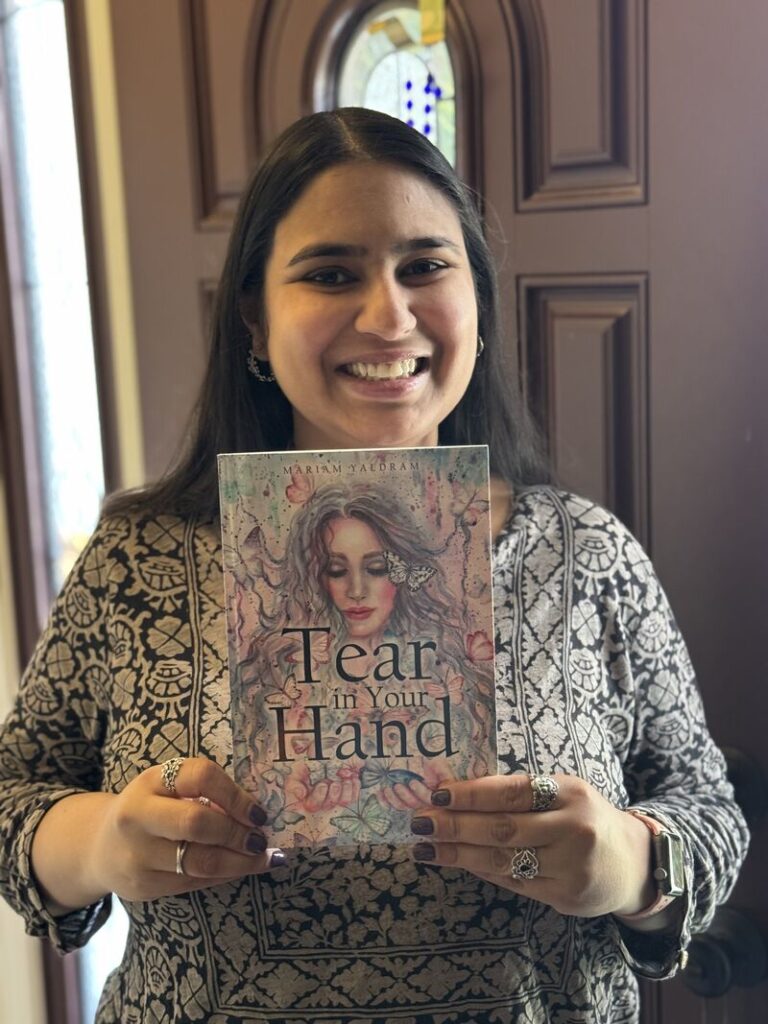
Pictured right: Yaldram holding her debut novel, Tear in Your Hand.

Yaldram holding her deut novel, "Tear in Your Hand."

* * * * *

UMBC’s greatest strength is its people. When people meet Retrievers and hear about the passion they bring, the relationships they create, the ways they support each other, and the commitment they have to inclusive excellence, they truly get a sense of our community. That’s what “Meet a Retriever” is all about.

Learn more about how UMBC can help you achieve your goals.

Evan McRae ’25 paired his computer science degree with a music focused-individualized studies major and followed his family’s Retriever legacy

Before Evan McRae came to UMBC, Tess McRae—his sister—was a student here. So was Evan and Tess’s mother—Sharon McRae. You might say being a legacy Retriever was a family tradition. With Evan graduating this spring with majors in both computer science and individualized studies, we thought to ask Tess, now the assistant director for connective learning with the Center for Democracy and Civic Life, to take on this Q&A with her younger brother. Evan shares how an early exposure to UMBC’s Game Developers Club before attending UMBC eventually led to an executive board position and the creation of numerous games and great memories with other programmers and musicians. After graduation, Evan will be working at UMBC’s Imaging Research Center as a software engineer.

Q: How did you decide to come to UMBC?

A: UMBC is where our mom went and also where you went, and I wanted to continue that family legacy. I also knew that it was a really great institution especially for computer science. I remember our family going to campus for Homecoming when I was in high school at Hammond, and I saw a banner in The Commons for the UMBC Game Developers Club. I have always wanted to be a game developer; seeing that banner, I knew that there was a pretty good foundation for my passion at UMBC, and I wanted to join the club.

A group of seven people smiling in a casual indoor venue with a stage and festoon lights.
McRae (second from left) and his fellow members of the Game Developers Club pose for a photo. Photo courtesy of McRae.

Q: In high school you discovered a passion for composing and producing music. How have you been able to expand on that passion at UMBC both technically and artistically?

A: While I was in high school I thought, “Music is something fun I do on the side, but not what I’m going to go to college for.” I was a computer science and math double major going into UMBC. When I decided to drop my math major by my second year, I told my Honors College advisor, Julie Oakes, that I was interested in music but didn’t have time to finish a music major within the next two years. She suggested I try individualized study (INDS) and see if there was a way to integrate my music passion with game development.

I ended up talking to professor Steven McAlpine from the INDS department and found a great bond with him; he shares a lot of my interests in game design and music. He has helped open a lot of doors for me, and I’m really grateful to the INDS program for that. I’ve been able to take music theory and composition courses, use UMBC’s studio facilities, and learn how to produce with industry standard software like Logic Pro. My music professors Greg Kalember, Linda Dusman, and Joseph Siu have mentored and fiercely advocated for me as an INDS major. It’s been incredible to not be a music major but still feel like I belong in those rooms.

Q: What are some of the most meaningful experiences you’ve had during your time at UMBC?

A: I’m taking a class this semester called Capstone Games Group Project taught by Marc Olano, the director of UMBC’s game development track and advisor for the Game Developers Club. The class combines artists and programmers who pitch game ideas at the start and work together on only a handful of those games for the rest of the semester. I pitched a puzzle platformer game called King Scribble that I’ve been wanting to make since first grade. My classmates and professor liked the idea, and to my surprise, it got picked as one of four games the class will develop in full. I still don’t think I’ve fully internalized how cool it is to actually be making this game.

Students in a classroom working on laptops with a video game projected on a screen.
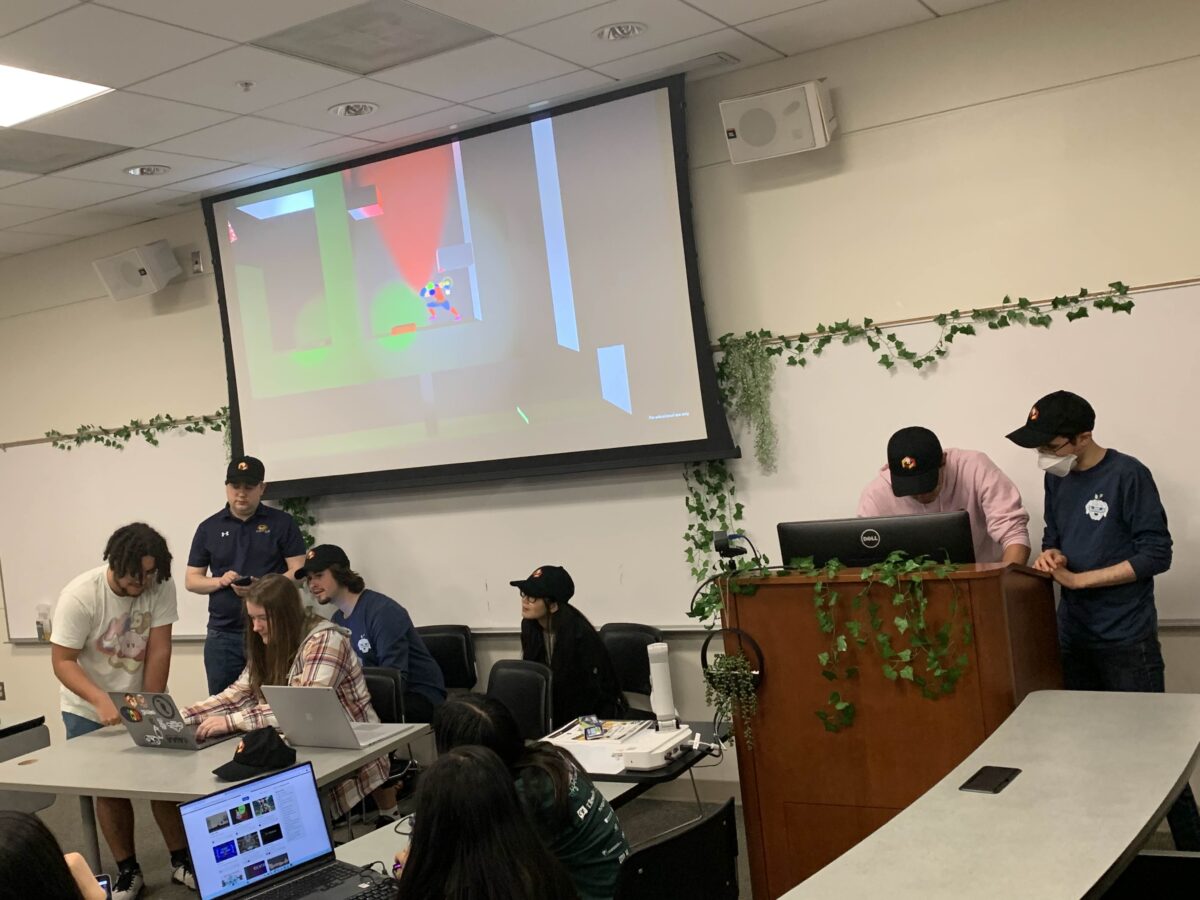
McRae (standing at podium) plays a submission to the Game Jamathon, hosted by hackUMBC and UMBC Game Developers Club. Photo courtesy of McRae.

I’ve also been working on a game called Daylight (available to play on Windows only, the password is: dog) since 2022 through the Game Developers Club. I feel like I’ve really grown as a developer and musician from it, and I’ve met some really cool and talented people through it. For my INDS capstone I’m improving and expanding upon Daylight’s soundtrack, which I’ve been working on for years now. It likely won’t be finished this semester or even next year, but I’m so privileged and grateful to have played such a big part in it.

I also have found a lot of meaning in my internship at UMBC’s Imaging Research Center (IRC). I got a position there thanks to Professor McAlpine, who had previously mentored Tristan King ’21, a former IRC technical specialist, when he was an INDS student. Tristan ended up being my supervisor for my first year there. I’m making virtual reality data visualization concept mapping software using Unreal Engine and solving complex, cutting-edge interface design problems. It’s really challenging my professional coding skills and helping me to grow exponentially as a game developer. I appreciate that I’ve had the opportunity on campus to enrich my learning like that. It’s been so cool to work with this transdisciplinary team and develop something that I think will have a good impact on the world.

Q: How have the ideas of inter/transdisciplinarity enhanced your UMBC experience?

A: What drew me to game development was working among disciplines. I love the idea of being a programmer and musician working with artists, writers, and playtesters to make a very human, cohesive experience: a love letter to players. Finding myself in INDS and at the IRC legitimized this way of thinking for me. I’ve really found myself at home in environments where I can collaborate with people from different backgrounds who are bringing all their skills and influences to the table. I value that process in everything I make and do at UMBC.

Being part of the Honors College also helped broaden my personal horizons as a student. I’ve been able to take a lot of cool courses outside of my disciplines like Mathematics of the Universe with Manil Suri and Sounds Like Social Justice with Earl Brooks, who have also been pretty big inspirations for me when it comes to the interdisciplinarity of technical fields and the ways I can actually make an impact toward issues I care about.

Q: What has being a student leader in the UMBC Game Developers Club been like for you?

Man taking a selfie outdoors on a sunny day with trees and a grassy field in the background.

A: It actually wasn’t something I knew I wanted to do in the first place until my friend encouraged me to run for vice president during a special election. I think it’s been the happiest accident in my life. I’ve been able to help make UMBC a proper home for students of all disciplines interested in game development, whether it’s for a hobby or a future career. Playing a pivotal role in creating and maintaining that space has been absolutely awesome. (Check out another Game Developers Club creation, Phantom Feline—I was a programmer and musician on this game that can be played in-browser as well as on Windows, Mac, and Linux.) The Game Developers Club has established alumni and mentors in the industry who give talks and network with our students. To be able to stand on that 20-year legacy and be lifted by it is a really special thing.

Written by Tess McRae ’22, Assistant Director for Connective Learning, Center for Democracy and Civic Life

Read more Commencement 2025 stories.

Deporting international students risks making the US a less attractive destination, putting its economic engine at risk

Written by David L. Di Maria, vice provost for Global Engagement, UMBC

In early April 2025, the Trump administration terminated the immigration statuses of thousands of international students listed in a government database, meaning they no longer had legal permission to be in the country. Some students self-deported instead of facing deportation.

The U.S. Department of Homeland Security recently announced that it would reverse the terminations after courts across the country determined they did not have merit.

These moves come as the White House seeks to enhance vetting and screening of all foreign nationals.

The State Department in March announced plans to use artificial intelligence to review international students’ social media accounts.

As an administrator and scholar who specializes in international higher education, I know that international students in the United States have long been subjected to a high level of vetting, screening and monitoring.

Inserting additional bureaucracy into current processes could make the U.S. a less attractive study destination. I believe this would ultimately hamper the Trump administration’s ability to achieve its “America First” priorities related to the economy, science and technology, and national security.

International students in the US

A black and white able showing data about international graduate students' field of study, total number of graduate students, and percent of international students in 2023

The U.S. has long been the global leader in attracting international students. But competition for these students is increasing as other countries, such as Germany and South Korea, enact strategies for attracting international education.

The U.S. hosts 16% of all students studying outside of their home country, down from 22% in 2014 and 28% in 2001, according to the Institute of International Education. Of the more than 1 million international students who were present in the U.S. during the 2023-2024 academic year, 54% came from just two countries, China and India.

Most international students pursue graduate degrees in STEM fields – science, technology, engineering and mathematics. And, according to the National Science Foundation, international students make up a significant portion of enrollment at the master’s and doctoral levels.

How international students are screened

International students in the U.S. are already subjected to intense screening and continuous monitoring. These measures include:

• Vetting the student’s school. Before they can apply for a visa, international students must be admitted to a school authorized by the Department of Homeland Security to enroll people on student visas.

• Vetting at the embassy. As part of the visa application process, international students are subjected to national security reviews carried out by various intelligence and law enforcement agencies. In some cases, such as when a U.S. consular officer in their home country decides that more information is required from external sources to determine visa eligibility, additional screenings occur. That is done through a process known as administrative processing.

• Vetting upon arrival. When they arrive in the U.S., international students are again screened by a U.S. Customs and Border Protection officer. If the officer is unable to verify any information, the student is sent to secondary inspection, a secure interview area where the student waits while officers complete additional assessment. The student is then either admitted to the U.S. or forced to depart the country.

• Ongoing monitoring while in the U.S. If permitted to enter the country, students must enroll full time, earn good grades and notify their school within 10 days of substantive changes to their circumstances.

Examples include a change to their address, academic major or financial sponsor. And school officials are required to report this information to the Student and Exchange Visitor Program, part of U.S. Immigration and Customs Enforcement’s National Security Investigations Division.

Students participating in temporary, postgraduation training programs must continue to comply with reporting requirements. And certain STEM graduates, and their employers, are subject to additional requirements. They include certification of training plans, annual evaluations and site visits.

Most international students prefer to study in the U.S., recent research shows. But they are willing to change their preferences as other countries introduce friendlier visa policies, such as more flexible post-study work opportunities and lower visa costs.

Given the current level of screening and monitoring already imposed on international students in the U.S., it is unclear how additional measures would add value.

Critical to an America First agenda

President Donald Trump’s “America First” agenda aims to grow the U.S. economy.

It also intends to maintain U.S. leadership in science and technology and enhance national security.

Trump administration officials have underlined the importance of recruiting top global talent. And Trump has said that international students who graduate from U.S. colleges should be awarded a green card with their degree.

During the 2023-2024 academic year, international students contributed US$43.8 billion to the U.S. economy through tuition and living expenses, which supported an estimated 378,175 U.S. jobs.

Their contributions don’t end following graduation, according to the National Bureau of Economic Research. Many go on to launch successful startups at a rate that is eight to nine times higher than their domestic peers. In fact, 25% of billion-dollar companies in the U.S. were founded by a former international student.

Such companies include Eventbrite, Grammarly, Moderna, OpenAI, Robinhood and SpaceX.

International students also help the U.S. maintain global leadership in STEM.

Consider that 45% of STEM workers in the U.S. holding a doctoral degree were born outside the U.S.

A 2024 report cautions that the U.S. is failing to develop domestic STEM talent at all levels of the education system. Just 3.2% of U.S. high school graduates are estimated to enter the STEM workforce.

Moreover, the country’s ability to attract and retain international STEM talent is decreasing due to immigration restrictions and increased global competition.

Finally, international students are critical to establishing global networks and promoting soft power diplomacy. This is evidenced by the U.S. having graduated more world leaders than any other nation.

Further restricting the ability of international students to study in the U.S. will ultimately redirect talent to other countries, allies and adversaries alike.


This article is republished from The Conversation under a Creative Commons license. Read the original article and see more than 250 UMBC articles available in The Conversation.

Popular AIs head-to-head: OpenAI beats DeepSeek on sentence-level reasoning

Written by Manas Gaur, assistant professor in computer science and electrical engineering, UMBC

ChatGPT and other AI chatbots based on large language models are known to occasionally make things up, including scientific and legal citations. It turns out that measuring how accurate an AI model’s citations are is a good way of assessing the model’s reasoning abilities.

An AI model “reasons” by breaking down a query into steps and working through them in order. Think of how you learned to solve math word problems in school.

Ideally, to generate citations an AI model would understand the key concepts in a document, generate a ranked list of relevant papers to cite, and provide convincing reasoning for how each suggested paper supports the corresponding text. It would highlight specific connections between the text and the cited research, clarifying why each source matters.

The question is, can today’s models be trusted to make these connections and provide clear reasoning that justifies their source choices? The answer goes beyond citation accuracy to address how useful and accurate large language models are for any information retrieval purpose.

I’m a computer scientist. My colleagues − researchers from the AI Institute at the University of South Carolina, Ohio State University and University of Maryland Baltimore County − and I have developed the Reasons benchmark to test how well large language models can automatically generate research citations and provide understandable reasoning.

We used the benchmark to compare the performance of two popular AI reasoning models, DeepSeek’s R1 and OpenAI’s o1. Though DeepSeek made headlines with its stunning efficiency and cost-effectiveness, the Chinese upstart has a way to go to match OpenAI’s reasoning performance.

Sentence specific

The accuracy of citations has a lot to do with whether the AI model is reasoning about information at the sentence level rather than paragraph or document level. Paragraph-level and document-level citations can be thought of as throwing a large chunk of information into a large language model and asking it to provide many citations.

In this process, the large language model overgeneralizes and misinterprets individual sentences. The user ends up with citations that explain the whole paragraph or document, not the relatively fine-grained information in the sentence.

Further, reasoning suffers when you ask the large language model to read through an entire document. These models mostly rely on memorizing patterns that they typically are better at finding at the beginning and end of longer texts than in the middle. This makes it difficult for them to fully understand all the important information throughout a long document.

Large language models get confused because paragraphs and documents hold a lot of information, which affects citation generation and the reasoning process. Consequently, reasoning from large language models over paragraphs and documents becomes more like summarizing or paraphrasing.

The Reasons benchmark addresses this weakness by examining large language models’ citation generation and reasoning.

How DeepSeek R1 and OpenAI o1 compare generally on logic problems.

Testing citations and reasoning

Following the release of DeepSeek R1 in January 2025, we wanted to examine its accuracy in generating citations and its quality of reasoning and compare it with OpenAI’s o1 model. We created a paragraph that had sentences from different sources, gave the models individual sentences from this paragraph, and asked for citations and reasoning.

To start our test, we developed a small test bed of about 4,100 research articles around four key topics that are related to human brains and computer science: neurons and cognition, human-computer interaction, databases and artificial intelligence. We evaluated the models using two measures: F-1 score, which measures how accurate the provided citation is, and hallucination rate, which measures how sound the model’s reasoning is − that is, how often it produces an inaccurate or misleading response.

Our testing revealed significant performance differences between OpenAI o1 and DeepSeek R1 across different scientific domains. OpenAI’s o1 did well connecting information between different subjects, such as understanding how research on neurons and cognition connects to human-computer interaction and then to concepts in artificial intelligence, while remaining accurate. Its performance metrics consistently outpaced DeepSeek R1’s across all evaluation categories, especially in reducing hallucinations and successfully completing assigned tasks.

OpenAI o1 was better at combining ideas semantically, whereas R1 focused on making sure it generated a response for every attribution task, which in turn increased hallucination during reasoning. OpenAI o1 had a hallucination rate of approximately 35% compared with DeepSeek R1’s rate of nearly 85% in the attribution-based reasoning task.

In terms of accuracy and linguistic competence, OpenAI o1 scored about 0.65 on the F-1 test, which means it was right about 65% of the time when answering questions. It also scored about 0.70 on the BLEU test, which measures how well a language model writes in natural language. These are pretty good scores.

DeepSeek R1 scored lower, with about 0.35 on the F-1 test, meaning it was right about 35% of the time. However, its BLEU score was only about 0.2, which means its writing wasn’t as natural-sounding as OpenAI’s o1. This shows that o1 was better at presenting that information in clear, natural language.

OpenAI holds the advantage

On other benchmarks, DeepSeek R1 performs on par with OpenAI o1 on math, coding and scientific reasoning tasks. But the substantial difference on our benchmark suggests that o1 provides more reliable information, while R1 struggles with factual consistency.

Though we included other models in our comprehensive testing, the performance gap between o1 and R1 specifically highlights the current competitive landscape in AI development, with OpenAI’s offering maintaining a significant advantage in reasoning and knowledge integration capabilities.

These results suggest that OpenAI still has a leg up when it comes to source attribution and reasoning, possibly due to the nature and volume of the data it was trained on. The company recently announced its deep research tool, which can create reports with citations, ask follow-up questions and provide reasoning for the generated response.

The jury is still out on the tool’s value for researchers, but the caveat remains for everyone: Double-check all citations an AI gives you.


This article is republished from The Conversation under a Creative Commons license. Read the original article and see more than 250 UMBC articles available in The Conversation.

From pulpits to protest, the surprising history of the phrase ‘pride and prejudice’

Written by Margie Burns, assistant teaching professor of English, UMBC

Most readers hear “pride and prejudice” and immediately think of Jane Austen’s most famous novel, that salty-sweet confection of romance and irony with a fairy-tale ending.

Few people, however, know the history of the phrase “pride and prejudice,” which I explore in my new book, “Jane Austen, Abolitionist: The Loaded History of the Phrase ‘Pride and Prejudice.’”

Like most Austen fans and scholars, I had read and loved her novels for years without learning much about the history of the title, which Austen chose after scrapping the original one, “First Impressions.”

By the 20th century, “pride and prejudice” became solely associated with Austen’s 1813 novel.

The phrase, which has religious origins, appeared in hundreds of works before Austen was born. From Britain it traveled to America, and from religious tomes it expanded to secular works. It even became a hallmark of abolitionist writing.

Fighting words for religious factions

While 2025 marks Austen’s 250th birthday, the phrase “pride and prejudice” first appeared more than 400 years ago, in religious writings by English Protestants. As the daughter, sister, cousin and granddaughter of Church of England ministers, Austen was certainly aware of the tradition.

If ministers wanted to reproach their parishioners or their opponents, they attributed criticism of their sermons to “pride and prejudice” – as coming from people too arrogant and narrow-minded to entertain their words in good faith.

While the usage began in the Church of England, other denominations, even radical ones, soon adopted it: “Pride and prejudice” appears in the writings of Nonconformists, Anabaptists, Quakers, Dissenters and other representatives of “Schism, Faction and Sedition,” as one anonymous writer called them.

One early takeaway is that, amid fervent religious conflicts, various denominations similarly used “pride and prejudice” as a criticism.

The unnamed minister himself complained that, owing to “the Pride and Prejudice of mens Spirits, the prevailing Interests of some Factions and Parties, the greatest part of the Nation are miserably wanting in their Duty.”

At the same time, the phrase could be invoked to support religious toleration and in pleas for inclusiveness.

“When all Pride and Prejudice, all Interests and Designs, being submitted to the Honour of God, and the Discharge of our Duty,” an anonymous clergyman wrote in 1734, “the Holy Scriptures shall again triumph over the vain Traditions of Men; and Religion no longer take its Denomination from little Sects and Factions.”

From politics to prose

In the 18th century, advances in publishing led to an explosion of secular writing. For the first time, regular people could buy books about history, politics and philosophy. These popular texts spread the phrase “pride and prejudice” to even more distant shores.

One fan was American founding father Thomas Paine.

In his 47-page pamphlet “Common Sense,” Paine argued that kings could not be trusted to protect democracy: “laying aside all national pride and prejudice in favour of modes and forms, the plain truth is, that it is wholly owing to the constitution of the people, and not to the constitution of the government[,] that the crown is not as repressive in England as in Turkey.”

Others included Daniel Defoe, author of “Robinson Crusoe.” In his 1708 essay “Review of the State of the British Nation,” Defoe satirically exhorted the public to vote Tory rather than electing men of sense, to “dispell the Poisons” that “Sloth, Envy, Pride and Prejudice may have contracted, and bring the Blood of the Party into a true circulation.”

After the philosophers, the historians and the political commentators came the novelists. And among the novelists, female writers were especially important. My annotated list in “Jane Austen, Abolitionist” includes more than a dozen female writers using the phrase between 1758 and 1812, the year Austen finished revising “Pride and Prejudice.”

Among them was Frances Burney. Scholars have often attributed Austen’s famous title to Burney, who used the phrase “pride and prejudice” in her novel “Cecilia.”

But Burney was not alone. Female novelists who used the expression before Austen included Charlotte Lennox, sisters Harriet and Sophia Lee, Charlotte Turner Smith, Mrs. Colpoys, Anne Seymour Damer and mother and daughter Susannah and Elizabeth Gunning, who jointly authored their novel “The Heir Apparent.”

An abolitionist rallying cry

As the critique embodied in the phrase progressed beyond religious and partisan conflict, it became increasingly used in the context of ethics and social reform.

My most striking discovery in this research is the long-standing association of the phrase “pride and prejudice” with abolitionism, the movement to eradicate enslavement and the slave trade.

The leaders of transnational antislavery organizations used it at their conventions and in the books and periodicals they published. In 1843, 30 years after the publication of Austen’s “Pride and Prejudice,” British Quaker Thomas Clarkson wrote to the General Antislavery Convention, which was meeting in London.

He exhorted the faithful to repudiate slavery “at once and forever” if there were any among them “whose eyes may be so far blinded, or their consciences so far seared by interest or ignorance, pride or prejudice, as still to sanction or uphold this unjust and sinful system.”

He even used the phrase twice. Acknowledging that some violent abolitionists had aroused reaction, he warned his audience that “this state of feeling arises as much from pride and prejudice on the one hand, as from indiscretion or impropriety on the other.”

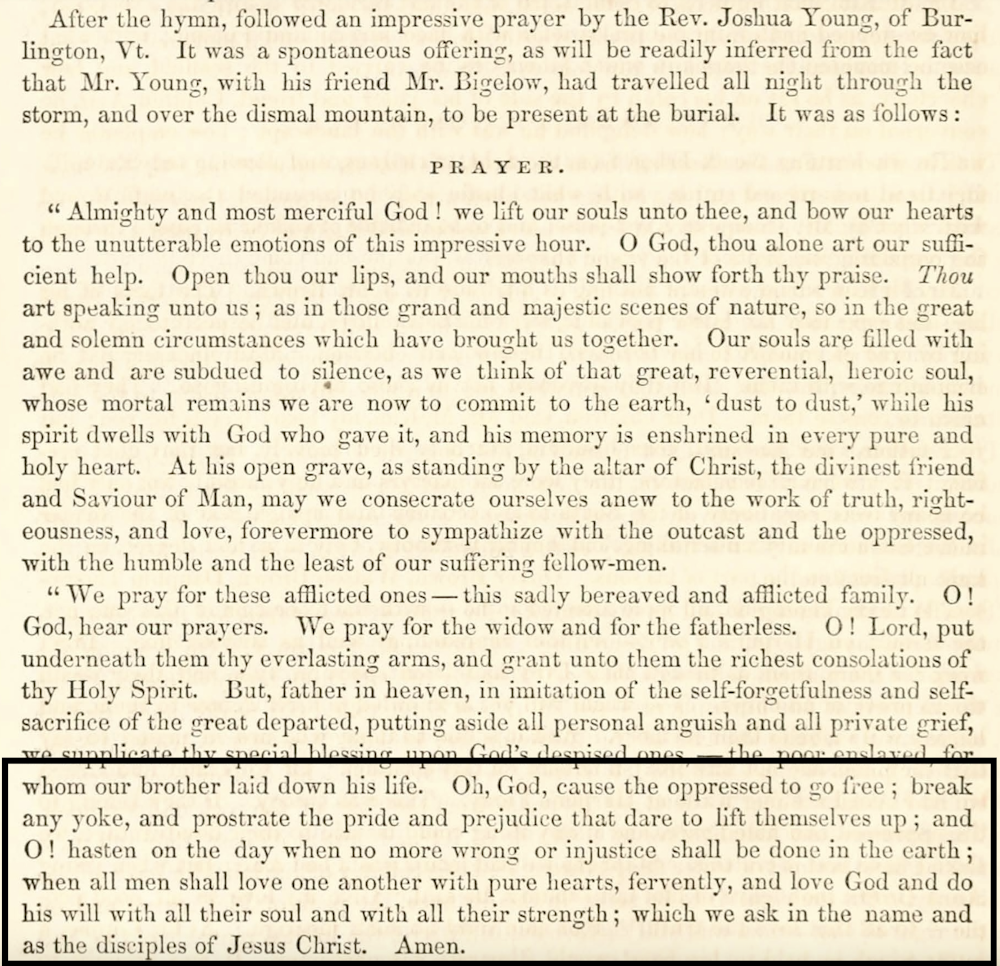
At the funeral for abolitionist John Brown, the minister prayed over his body, “Oh, God, cause the oppressed to go free; break any yoke, and prostrate the pride and prejudice that dare to lift themselves up.”

A page of text describing a prayer told at John Brown's funeral. Pride and Prejudice
The prayer uttered at John Brown’s burial. Library of Congress

Use of the phrase did not end with Emancipation or the end of the U.S. Civil War.

In fact, it was one of Frederick Douglass’ favorite phrases. On Oct. 22, 1883, in his “Address at Lincoln Hall,” Douglass excoriated the Supreme Court’s decision rendering the Civil Rights Act of 1875 unconstitutional.

As was typical of Douglass, the speech ranged beyond racial inequities: “Color prejudice is not the only prejudice against which a Republic like ours should guard. The spirit of caste is malignant and dangerous everywhere. There is the prejudice of the rich against the poor, the pride and prejudice of the idle dandy against the hard-handed workingman.”

Austen’s independent women

Early on in “Pride and Prejudice,” the conceited Caroline Bingley snipes that Elizabeth Bennet shows “an abominable sort of conceited independence.” Later, the snobbish Lady Catherine accuses Bennet of being “headstrong.” But near the ending, Mr. Darcy tells Bennet that he loves her for “the liveliness” of her “mind.”

In this respect, Bennet reflects a quality that all of Austen’s heroines possess. While they try to adhere to standards of courtesy and respect, none are guilty of saying only what the leading man wants to hear.

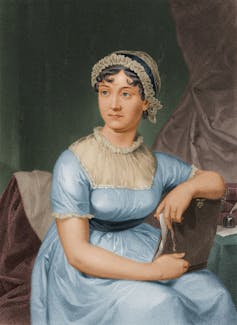
Painted portrait of a seated young woman wearing a blue blouse.
Jane Austen. Stock Montage/Getty Images

Given that Austen chose her title to honor the phrase and its history, it is ironic that her own fame ended up drowning out the abolitionist associations of “pride and prejudice” after the Civil War.

If there is any work of fiction that successfully makes self-sufficiency, independent thinking and open-mindedness look good – and makes sycophants, rigidity and hysterical devotion to rank and status look bad – it is “Pride and Prejudice.”

Yet the lasting popularity of Austen’s novel demonstrates that the ethics contained in the phrase continue to resonate today, even if its context has been lost.

This article is republished from The Conversation under a Creative Commons license. Read the original article and see more than 250 UMBC articles available in The Conversation.
Trump’s executive order to dismantle the Education Department was inspired by the Heritage Foundation’s decades-long disapproval of the agency

Written by Fred L. Pincus, emeritus professor of sociology

President Donald Trump issued an executive order to dismantle the Education Department on March 20, 2025, that calls for closing the U.S. Department of Education.

The president needs congressional approval to shutter the department. The order, however, directs Education Secretary Linda McMahon to “take all necessary steps to facilitate the closure of the Department of Education and return authority over education to the States and local communities while ensuring the effective and uninterrupted delivery of services, programs, and benefits on which Americans rely.”

The executive order reflects many recommendations from the Heritage Foundation’s Project 2025, a conservative political initiative to revamp the federal government. But it’s worth noting that the foundation’s attempt to abolish the Education Department goes back more than 40 years.

The think tank first called for limiting the federal role in education in 1981. That’s when it issued its first Mandate for Leadership, a book offering conservative policy recommendations.

As a sociology professor focused on diversity and social inequality, I’ve followed the Heritage Foundation’s efforts to eliminate the Department of Education since 1981. Although the idea didn’t garner enough support 44 years ago, the current political climate makes conditions more favorable.

Mandate 1981

In its 1981 mandate, the Heritage Foundation struck now-familiar themes.

Its education policy recommendations included closing the Department of Education and “reducing its controls over American education.”

Additionally, the think tank called on lawmakers to repeal the 1965 Elementary and Secondary Education Act, which provides federal funding for disadvantaged students in K-12, so that “the department’s influence on state and local education policy and practice through discretionary grant authority would disappear.”

And the Heritage Foundation called for ending federal support for programs it claimed were designed to “turn elementary- and secondary-school classrooms into vehicles for liberal-left social and political change …”

An office building is seen in Washington, D.C. executive order to dismantle the Education Department
The Heritage Foundation building is seen on July 30, 2024, in Washington, D.C. Andrew Harnik/Getty Images

Education experts disputed these proposed reforms just a few years later.

Four educational task forces, composed mainly of educators, corporate executives and politicians, published reports on education in 1983. All four reports were critical of the more liberal education policies of the 1960s and 1970s – such as an emphasis on student feelings about race, for example, rather than a focus on basic skills.

But they all saw the need for a strong federal role in education.

The four reports blamed the U.S. educational system for losing ground to Japan and Western Europe. And all called for more required courses rather than the “curriculum smorgasbord” that had become the norm in many public schools. They all wanted longer school days, longer school years and better-trained teachers.

Nevertheless, President Ronald Reagan tried unsuccessfully to abolish the Department of Education in 1983.

Project 2025

Jumping ahead more than 40 years, Project 2025 reflects many of the main themes the Heritage Foundation addressed in the 1981 mandate. The first line of Project 2025’s chapter on education states: “Federal education policy should be limited and, ultimately, the federal Department of Education should be eliminated.”

The charges of leftist indoctrination have expanded. Now, conservative advocates are calling to eliminate anything that has to do with diversity, equity and inclusion, or DEI.

Other executive orders that Trump has signed reflect these attitudes.

For example, they call for defending women from “gender ideology extremism” and eliminating “radical” DEI policies.

According to Project 2025, school choice – which gives students the freedom to choose schools that best fit their needs – should be promoted through tuition tax credits and vouchers that provide students with public funds to attend private school. And federal education programs should either be dismantled or moved to other federal departments.

Current political climate

In the 1980s, the Heritage Foundation was seen as part of the New Right, a coalition that opposed issues such as abortion, homosexuality and affirmative action. The GOP’s alliance with conservative evangelical Christians, mobilized by advocacy groups such as Jerry Falwell’s Moral Majority, was picking up steam, but it was still seen as marginal.

By 2025, things have moved significantly to the right.

Conservative Republicans in Congress view the Heritage Foundation as an important voice in educational politics.

The far right is emboldened by Trump after his Cabinet appointments and pardons of Jan. 6 rioters.

And Christian Nationalism – the belief that the United States is defined by Christianity – has grown.

A man in a suit speaks in front of a lecturn. executive order to dismantle the Education Department
Paul Dans, director of the Heritage Foundation’s Project 2025, speaks at the National Conservative Conference in Washington, D.C., on July 10, 2024. Dominic Gwinn/Middle East Images/AFP via Getty Images

Trump’s executive order does not abolish the Education Department. He needs congressional approval to do that.

But he has already weakened it. His administration recently canceled nearly $900 million in contracts at the Institute of Education Sciences, the independent research arm of the Education Department.

Despite public reluctance to eliminate the department – in February, 63% of U.S. residents said they opposed its elimination – it looks like Heritage Foundation influence could cause significant damage, with the additional firing of staff members and the reduced distribution of funds.

McMahon sent a directive to department employees in early March calling the dismantling of their agency a “final mission.”


This article is republished from The Conversation under a Creative Commons license. Read the original article and see more than 250 UMBC articles available in The Conversation.
Meet a Retriever—Harish Reddy Manyam, M.P.S. ’24, data science professional passionate about A.I.

Meet Harish Reddy Manyam, M.P.S. ’24, data science. Harish is a data scientist and AI governance advisor at Marshfield Clinic Health System, where he gets to put his interest in AI/machine learning (ML) in healthcare to work. At UMBC, he co-developed a no-code generative AI chatbot and made strong connections with peers and classmates. As an international student, he found a network of professional support at bwtech, UMBC’s research and technology park. In his free time, Harish loves traveling—he’s visited 25 states so far! Take it away, Harish!

Q: What is your WHY? What brought you to UMBC?

A: I came to UMBC because I wanted an education that went beyond textbooks—something practical, impactful, and connected to real-world problems. As an international student, I applied to several universities, but my final choice was between the University of Arizona and UMBC. 

One major reason I chose UMBC was the Master of Professional Studies (MPS) in Data Science, a program that focuses on hands-on learning rather than just theory. I’ve always believed education should prepare us to solve real-life problems, and UMBC gave me that foundation.

I came here with two big dreams: to become a data scientist and to create something of my own as an entrepreneur. I’m proud to say that I now work as a data scientist and AI governance advisor for Marshfield Clinic Health System (MCHS), a nonprofit healthcare organization, where I use data and AI to improve healthcare outcomes and support underserved communities.

Today, I know I made the right decision, and I’m grateful for that.

Harish Reddy Manyam, M.P.S. ’24

Data Science

My time at UMBC also gave me incredible research opportunities. I worked on an independent research project under Ergun Simsek, UMBC data science program director, and together, we published a paper titled “Classification with Electromagnetic Waves” in The Institute of Engineering and Technology (IET), an esteemed engineering journal. This research experience taught me how to approach complex problems and think critically—skills that I now use every day in my job.

Beyond academics, UMBC empowered me to co-build a no-code Gen AI chatbot product with one of my professors, and this experience fueled my entrepreneurial spirit. I am now exploring launching my own startup through bwtech@UMBC, the university’s business incubator.

But more than anything, UMBC gave me a community that supported me both professionally and personally. As an international student, being welcomed, encouraged, and supported was something I never took for granted—UMBC became my second home.

So, my WHY for choosing UMBC was to learn, grow, and create something impactful—and today, because of UMBC, I’m well on my way to making that dream a reality. UMBC gave me not just knowledge, but a community that believed in me and helped me find my purpose.

Q: Where have you found support in the UMBC community?

There are six pillars to my life in the U.S.—people who have inspired and supported me throughout my journey. First is Simsek, who became my role model from the very first speech he gave to our Fall 2022 incoming student batch. His incredible work inspired me, and I was fortunate to work with him on independent research that led to our publication in the IET journal.

Second is Mehmet Sarica, one of my professors. I took two courses under him—Data 601: Introduction to Data Science and Data 602: Introduction to Data Analysis and Machine Learning. He taught me valuable lessons beyond coursework and later recommended me to work as a graduate teaching assistant under his guidance, which was a significant milestone in my career.

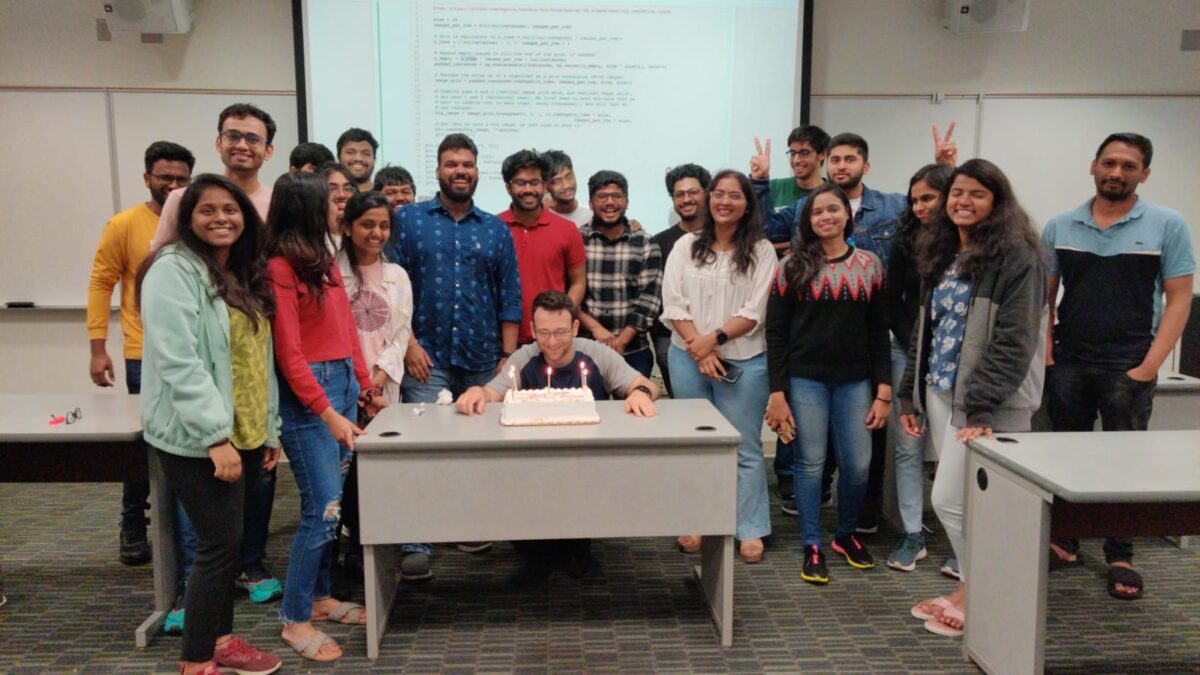
As a token of appreciation, we surprised Professor Mehmet Sarica with a cake-cutting celebration at the end of the semester along with all our fellow students.
As a token of appreciation, Harish (standing in the dark blue shirt behind the desk) and his class surprised Data Science Professor Mehmet Sarica with a cake-cutting celebration at the end of the semester.

Third is Abdullah Karassan, another professor and mentor. I took Financial Data Science with him and later collaborated on developing LeverBot, a no-code Generative AI chatbot. I served as the product owner and AI developer for this project, which was a great learning experience in applied AI.

Fourth is the UMBC Career Center, especially Christine Routzahn, the director, who provided immense support in shaping my career path and preparing me for professional opportunities.

Another person who has made a big impact on my journey is Marjie Cota, director of entrepreneurial services at bwtech@UMBC. She encouraged me to think bigger—to believe that I could start my own company. Her guidance opened a new door for me to pursue my entrepreneurial dreams, and today I’m actively exploring launching a startup through bwtech.

Finally, my uncles Raj and Mahesh have been my strongest personal support system since day one in the U.S., helping me settle and navigate life as an international student. I’m also grateful to my friends who stood by me and made my journey memorable. As an international student, having friends who understand you and stand by you is priceless. They made the hardest days easier and the good days even better.

Each of these individuals and groups played a crucial role in my academic, professional, and personal life, and I’m forever thankful for their support and inspiration.

Harish Reddy Manyam, M.P.S. ’24

Data Science

Q: What’s your favorite part of being a part of Retriever Nation?

A: My favorite part of Retriever Nation is the strong sense of community and lifelong connections. Even after graduation, I feel supported by professors, mentors, and peers. It’s a network that continues to inspire, uplift, and open doors for personal and professional growth.

Q: What do you love most about the data science program?

A: What I love most about my academic program is how supportive and collaborative everyone is—from professors to classmates. The faculty are always approachable and genuinely invested in students’ success, providing both academic and career guidance. I also love that the program focuses on practical, real-world applications of data science, which helped me gain hands-on experience through research and projects.

Q: What’s one thing you’d want someone who hasn’t joined the UMBC community to know?

A: One thing I’d want someone to know is that UMBC truly cares about its students—both academically and personally. Whether it’s professors, the Career Center, or fellow students, there’s always someone ready to guide, support, and help you succeed. You’ll never feel alone in your journey here. It’s a family for me.

What makes UMBC special is that it’s more than a university—it’s a community of people who lift each other up. They believed in me when I was just learning to believe in myself. Their HOW—the way they supported, mentored, and cared—has made all the difference in my life.

Because of UMBC, I’ve grown into a data scientist working in healthcare, a researcher, and an aspiring entrepreneur. And none of this would have been possible without the amazing people who stood beside me. For that, I will forever be grateful.

Q: How have you remained connected with UMBC?

A: As an alum and professional, I value my ongoing partnership with UMBC through research collaborations and mentorship opportunities. UMBC builds meaningful relationships that extend beyond graduation—focused on innovation, real-world problem-solving, and community support. I would tell anyone that partnering with UMBC means working with passionate, talented individuals committed to making a difference. It’s a partnership that fosters growth, creativity, and mutual success.

* * * * *

UMBC’s greatest strength is its people. When people meet Retrievers and hear about the passion they bring, the relationships they create, the ways they support each other, and the commitment they have to inclusive excellence, they truly get a sense of our community. That’s what “Meet a Retriever” is all about.

Learn more about how UMBC can help you achieve your goals.

Meet a Retriever—Cierra K. Reeves found her perfect niche in psychology and aging services 

Cierra K. Reeves knew there was a wide world of careers she could pursue with a psychology degree, but it took some prayer, a conversation with her mother, and a chat with her advisor before she settled on a minor in management in aging services that would define her next steps. Cierra is a non-traditional, online learner who was looking for advice on how to focus her studies. After speaking with James Hamilton, director of academic advising in the College of Arts, Humanities, and Social Sciences, she honed in on the minor from the Erickson School of Aging Studies. She now sees herself working toward opening a facility that uses art therapy for older populations. Tell us all about it, Cierra! 

Q: Briefly introduce yourself. What’s one essential thing you’d want another Retriever to know about you? 

A: My name is Cierra K. Reeves, and I am a woman of God on this beautiful journey called life. I am a psychology major minoring in management of aging services with the goal of opening my own facility geared towards art therapy in the geriatric field. I love all things art, and I love to help others and see others smile. And I feel like what I’m doing now is my calling because I’m able to combine my love for art and helping people. 

Q: Tell us about someone in the community who has inspired you or supported you, and how they did it. 

A: One person in particular that has helped to fuel, inspire, and ease my nervous system in this entire process, has been, Mr. James Hamilton. He is my tried and true advisor. He is so patient, and his career story has helped to motivate me and has kept me pushing along in school when things feel tough. I believe he is most definitely a Godsend! 

He always gives me a motivational nugget to keep going. He’s so calming to my spirit and he’s just so patient. And I feel like I really need that. I look for people like that because in this world we’re always hustling and bustling. Not many really take time with people, but he’s dedicated to his job and serving others in that role. 

I feel like what I’m doing now is my calling because I’m able to combine my love for art and helping people. 

Cierra Reeves

psychology major and aging studies minor

My mom has also inspired me to follow my dreams—despite any adversity she always strives for greatness. She always stands in her authentic self and embodies and empowers me to do the same. She’s taught me how to stay physically active and how to better take care of myself now that I am getting older.

Q: Tell us what you’re excited about in your academic area. 

selfie of a woman with a short afro and a cross necklace. she's studying psychology and aging studies.

A: I have had the privilege of growing up with my elders and they have most definitely inspired my love for the geriatric field. My great-grandmother, Dr. Lucy Mason Reeves Jones, was the first African American female podiatrist in Baltimore. I remember growing up with her and how she taught me to make carrot juice and the importance of expanding my mind and vocabulary. And I remember being around my elders and my grandmother—my mom’s mom (Beona Campbell), my favorite grandmother—who was just so, so strong. I mean, so resilient. She taught me about fashion, about thrifting, about keeping God close and just instilling those morals and values in me at a young age. 

I’ve always kept older people close to me. And so when I learned about the management of aging minor and took my first class, I loved it. 

Q: How did you know what you wanted to study? 

A: During the pandemic, I really honed in on what God wanted me to do, and I had a lot of time to reflect and pray upon that. And I was given this answer: psychology. I’ve always been interested in psychology, but I was always nervous to pursue it because I know that it’s really, really difficult. 

But I’ve always loved the challenge. I’ve always been into books. I just love to learn. I love to expand my mind and learn new things. And so this felt like the perfect avenue, especially because when the pandemic was happening, I started to think to myself like, ‘Okay, what could I do to fulfill the purpose that God has for me, but also give back to the community and also make sure that I will be okay for my family monetarily and that I would also feel fulfilled in?’

Q: What’s the one thing you’d want someone who hasn’t joined the UMBC community to know about the support you find here? 

A: Some teachers and faculty will go above and beyond when it comes to helping you learn. Don’t be afraid to ask for help. Always use your voice, because your voice matters. 

James Hamilton, director of academic advising in CAHSS, has been instrumental in Cierra’s academic trajectory, but he wants to make sure she’s not alone in finding her path. Since 2017 when he started, Hamilton has built out the advising capacities in CAHSS and brought on multiple professional advisors to walk CAHSS students through the first few years of their studies. 

Previously faculty members were responsible for the day-to-day advising needs of most students, but Hamilton recognized the need for dedicated advisors to translate the academic requirements for students in order to promote student success and retention. 

“Our goal has been to offer centralized advising services for students’ first and second year with a professional advisor,” says Hamilton. “Then, for the third and fourth years, they would be with a faculty member where that mentoring role could take place. Because at that point, they already know about their requirements and how to register and how to do all of the nuts and bolts stuff, so they can use their time with faculty member talking about career options, internship opportunities, study abroad, mentoring, and more.” 

*****

UMBC’s greatest strength is its people. When people meet Retrievers and hear about the passion they bring, the relationships they create, the ways they support each other, and the commitment they have to inclusive excellence, they truly get a sense of our community. That’s what “Meet a Retriever” is all about. 

Learn more about how UMBC can help you achieve your goals.

How ticket-splitting voters could shape the 2026 midterms

Written by Ian Anson, associate professor of political science, UMBC

With the 2024 U.S. election over and done with, political analysts and both major parties are already turning their attention to the upcoming midterm elections in 2026.

All 435 seats in the House of Representatives and 33 Senate seats will be up for grabs. The Democrats are as desperate to retake control of Congress as Republicans are to keep it. A Democratic-controlled Congress in 2026 would do everything in its power to halt President Donald Trump’s legislative agenda in its tracks.

To edge out their opponent, candidates in highly competitive districts will have to win over some voters who rejected their own party’s presidential candidate in 2024. Democratic candidates will need to get support from at least some Trump voters; Republicans will need some support from Kamala Harris voters.

Despite the intensely polarized U.S. political environment, a significant number of Americans routinely cross party lines to support both Democratic and Republican candidates at the polls. When it happens on the same ballot, this is called ticket-splitting.

Just who are these voters, and when do they choose to split their tickets?

I am a political scientist who studies American voting behavior. I see these questions as key to understanding how long Trump’s total control of government will last.

Split tickets in North Carolina and Arizona

Ticket-splitting created some surprising election returns in 2024, mostly benefiting down-ballot Democrats.

For instance, Republican Donald Trump won North Carolina by around 3 percentage points, but voters elected a Democrat, Josh Stein, for governor by a margin of almost 15 percentage points. Several hundred thousand North Carolinians split their tickets to produce this outcome.

More than 100,000 Arizonans likewise split their tickets in 2024, electing Trump with 52% of the vote, yet rejecting the Trump-aligned Senate candidate Kari Lake in favor of Democrat Ruben Gallego.

Many experts believe that candidates such as Gallego and Stein were simply perceived as less extreme than their opponents, and so they lured moderate voters and even some Republicans.

In this theory, extreme MAGA-aligned candidates win primary elections because they attract the most partisan voters. But they turn off many people in the general electorate.

Marylanders split their tickets

One of the most extreme examples of ticket-splitting in 2024 was in the race to replace U.S. Sen. Ben Cardin of Maryland.

Voters in a school gym. ticket-splitting voters
Partyliners or ticket-splitters? Maryland voters cast their ballots in Baltimore on Nov. 5, 2024. J. Countess/Getty Images

Cardin was a retiring three-term Democrat who had last won reelection in 2018 by an astronomical margin of over 34 percentage points. Initially, many expert analysts saw the seat as safe for Democrats.

Then, in February 2024, former Maryland Gov. Larry Hogan, who had previously ruled out a Senate run, surprised political analysts by entering the Republican primary. After winning the primary handily, Hogan eventually squared off against Prince George’s County Executive Angela Alsobrooks, a Democrat, in the general election.

Suddenly, a matchup that should have been Alsobrook’s to lose got competitive.

A politician wearing a dark blue suit raises her arms in victory with supporters holding neon yellow signs in the background. ticket-splitting voters
Angela Alsobrooks celebrates her win on Nov. 5, 2024, in College Park, Md. Graeme Sloan for The Washington Post via Getty Images

Hogan, who left office in 2023, was a successful Republican governor who won election twice in reliably blue Maryland. Perceived by many voters as an ideological moderate, he was also a vocal Trump opponent in a state that supported Biden over Trump in 2020 by around 33 percentage points. During his governorship, Hogan routinely outperformed MAGA-aligned Republicans who ran for Congress in Maryland.

Ultimately, Hogan did lose to Alsobrooks. She became Maryland’s first female U.S. senator and first Black U.S. senator. Yet Hogan came an incredible 17 percentage points closer to winning than Trump did. Kamala Harris beat Trump by 1.9 million votes, winning 63% of the electorate to Trump’s 34%.

This means that Hogan exceeded Trump’s vote total by over 300,000 votes. That’s an immense amount of ticket-splitting by Marylanders in 2024.

Who are the Hogan Democrats?

To better understand ticket-splitting in Maryland’s 2024 election, I analyzed a survey that my university conducted in Baltimore County. Baltimore County is a bellwether county that has backed the winning gubernatorial candidate in every election since 2006.

The UMBC Battleground Exit Poll surveyed 1,119 voters at election precincts across Baltimore County during early voting and on Election Day 2024. The results were weighted to ensure demographic representativeness.

This extensive survey shows that around 10% of all voters in Baltimore County supported the surprising combination of the Democrat Harris and the Republican Hogan.

In contrast, fewer than 2% of Trump voters split their tickets to back the Democratic Senate candidate Alsobrooks.

A purple, blue, red, and green bar graph breaking down 2024 Maryland ticket-splitting voters

My team’s data analysis shows that roughly half of Harris-Hogan voters – 51% – were Democrats. These ticket-splitters included a higher percentage of white voters than the Democrats who supported both Harris and Alsobrooks. Around 37% of Harris-Hogan voters identified as Black, Asian, Hispanic, Middle Eastern or another nonwhite racial category, compared with 55% of Harris-Alsobrooks voters.

We found virtually no gender differences between Democrats who split their tickets to back a woman for president and a man for Senate and those who backed two women candidates.

Harris-Hogan Democrats tended to be better educated than other voting groups. Around 68% reported having a college degree, compared with around 51% of all survey respondents.

Perhaps the most striking feature of Harris-Hogan voters is their self-declared moderation.

On a seven-point ideological scale ranging from “very liberal” to “very conservative,” around 61% of Harris-Hogan ticket-splitters put themselves at the exact midpoint of the scale. Only around 42% of the full sample of Maryland voters categorized themselves as centrist.

Can moderates survive in Trump’s shadow?

As our study shows, Hogan’s popularity in Maryland is due in part to his appeal among moderates. This finding helps to explain how this Republican has remained popular among Democrats and independent voters.

However, Hogan still lost. Unlike in Arizona, where the Democratic Senate candidate Ruben Gallego won by wooing moderate Republicans, the tenuous balance of power in the U.S. House and Senate may have prevented some Democratic and independent voters in Maryland from crossing the aisle to support a moderate Republican.

Of course, Hogan also faced a formidable opponent. Alsobrooks had already emerged victorious in a tight primary against a well-funded and popular incumbent U.S. House representative, David Trone. I suspect a less-skilled Democratic candidate would have created even more Harris-Hogan voters.

Ultimately, my analysis of ticket-splitting in 2024 reveals that even in an era of entrenched polarization, many voters approach congressional and presidential races with different mindsets.

This dynamic will likely influence the next election cycle, too.

The party of the president often takes heavy losses in midterm elections. In 2026, congressional candidates – and Democrats in particular – will be doing everything they can to woo moderates.

This will be especially true if Trump’s aggressive policies, such as widespread government layoffs and mass deportations, prove unpopular.

Let the campaigning begin.


This article is republished from The Conversation under a Creative Commons license. Read the original article and see more than 250 UMBC articles available in The Conversation.
A fiscal crisis is looming for many US cities

Written by John Rennie Short, professor emeritus of public policy, UMBC

Five years after the start of the COVID-19 pandemic, many U.S. cities are still adjusting to a new normal, with more people working remotely and less economic activity in city centers. Other factors, such as underfunded pension plans for municipal employees, are pushing many city budgets into the red.

Urban fiscal struggles are not new, but historically they have mainly affected U.S. cities that are small, poor or saddled with incompetent managers. Today, however, even large cities, including Chicago, Houston and San Francisco, are under serious financial stress.

This is a looming nationwide threat, driven by factors that include climate change, declining downtown activity, loss of federal funds and large pension and retirement commitments.

Why cities struggle

Many U.S. cities have faced fiscal crises over the past century, for diverse reasons. Most commonly, stress occurs after an economic downturn or sharp fall in tax revenues.

Florida municipalities began to default in 1926 after the collapse of a land boom. Municipal defaults were common across the nation in the 1930s during the Great Depression: As unemployment rose, relief burdens swelled and tax collections dwindled.

A tabloid newspaper with a photo of President Gerald Ford and the headline 'Ford to City: Drop Dead' fiscal crisis
The New York Daily News, Oct. 30, 1975, after U.S. President Gerald Ford ruled out providing federal aid to save the city from bankruptcy. Several months later, Ford signed legislation authorizing federal loans. Edward Stojakovic/Flickr, CC BY

In 1934 Congress amended the U.S. bankruptcy code to allow municipalities to file formally for bankruptcy. Subsequently, 27 states enacted laws that authorized cities to become debtors and seek bankruptcy protection.

Declaring bankruptcy was not a cure-all. It allowed cities to refinance debt or stretch out payment schedules, but it also could lead to higher taxes and fees for residents, and lower pay and benefits for city employees. And it could stigmatize a city for many years afterward.

In the 1960s and 1970s, many urban residents and businesses left cities for adjoining suburbs. Many cities, including New York, Cleveland and Philadelphia, found it difficult to repay debts as their tax bases shrank.

In the wake of the 2008-2009 housing market collapse, cities including Detroit, San Bernardino, California, and Stockton, California, filed for bankruptcy. Other cities faced similar difficulties but were located in states that did not allow municipalities to declare bankruptcy.

Even large, affluent jurisdictions could go off the financial rails. For example, Orange County, California, went bankrupt in 2002 after its treasurer, Robert Citron, pursued a risky investment strategy of complex leveraging deals, losing some $1.65 billion in taxpayer funds.

Today, cities face a convergence of rising costs and decreasing revenues in many places. As I see it, the urban fiscal crisis is now a pervasive national challenge.

Climate-driven disasters

Climate change and its attendant increase in major disasters are putting financial pressure on municipalities across the country.

Events like wildfires and flooding have twofold effects on city finances. First, money has to be spent on rebuilding damaged infrastructure, such as roads, water lines and public buildings. Second, after the disaster, cities may either act on their own or be required under state or federal law to make expensive investments in preparation for the next storm or wildfire.

A woman speaks into microphones, with burned homes in the background. fiscal crisis
Los Angeles Mayor Karen Bass (center) discusses wildfire recovery in Pacific Palisades, Calif., Jan. 27, 2025. Cleaning up after the wildfires, which destroyed more than 16,000 structures, will include disposing of several million tons of toxic ash and debris. Drew A. Kelley/MediaNews Group/Long Beach Press-Telegram via Getty Images

In Houston, for example, court rulings after multiple years of severe flooding are forcing the city to spend $100 million on street repairs and drainage by mid-2025. This requirement will expand the deficit in Houston’s annual budget to $330 million.

In Massachusetts, towns on Cape Cod are spending millions of dollars to switch from septic systems to public sewer lines and upgrade wastewater treatment plants. Population growth has sharply increased water pollution on the Cape, and climate change is promoting blooms of toxic algae that feed on nutrients in wastewater.

Increasing uncertainty about the total costs of mitigating and adapting to climate change will inevitably lead rating agencies to downgrade municipal credit ratings. This raises cities’ costs to borrow money for climate-related projects like protecting shorelines and improving wastewater treatment.

Underfunded pensions

Cities also spend a lot of money on employees, and many large cities are struggling to fund pensions and health benefits for their workforces. As municipal retirees live longer and require more health care, the costs are mounting.

For example, Chicago currently faces a budget deficit of nearly $1 billion, which stems partly from underfunded retirement benefits for nearly 30,000 public employees. The city has $35 billion in unfunded pension liabilities and almost $2 billion in unfunded retiree health benefits. Chicago’s teachers are owed $14 billion in unfunded benefits.

Policy studies have shown for years that politicians tend to underfund retirement and pension benefits for public employees. This approach offloads the real cost of providing police, fire protection and education onto future taxpayers.

Struggling downtowns and less federal support

Cities aren’t just facing rising costs – they’re also losing revenues. In many U.S. cities, retail and commercial office economies are declining. Developers have overbuilt commercial properties, creating an excess supply. More unleased properties will mean lower tax revenues.

At the same time, pandemic-related federal aid that cushioned municipal finances from 2020 through 2024 is dwindling.

State and local governments received $150 billion through the 2020 Coronavirus Aid, Relief, and Economic Security (CARES) Act and an additional $130 billion through the 2021 American Rescue Plan Act. Now, however, this federal largesse – which some cities used to fill mounting fiscal cracks – is at an end.

In my view, President Donald Trump’s administration is highly unlikely to bail out urban areas – especially more liberal cities like Detroit, Philadelphia and San Francisco. Trump has portrayed large cities governed by Democrats in the darkest terms – for example, calling Baltimore a “rodent-infested mess” and Washington, D.C., a “dirty, crime-ridden death trap.” I expect that Trump’s animus against big cities, which was a staple of his 2024 campaign, could become a hallmark of his second term.

Resistance to new taxes

Cities can generate revenue from taxes on sales, businesses, property and utilities. However, increasing municipal taxes – particularly property taxes – can be very difficult.

In 1978, California adopted Proposition 13 – a ballot measure that limited property tax increases to the rate of inflation or 2% per year, whichever is lower. This high-profile campaign created a widespread narrative that property taxes were out of control and made it very hard for local officials to support property tax increases.

Thanks to caps like Prop 13, a persistent public view that taxes are too high and political resistance, property taxes have tended to lag behind inflation in many parts of the country.

The crunch

A man carries sandbags from a warehouse to people waiting in cars
Workers in North Miami Beach, Fla., distribute sandbags to residents to help prevent flooding as Hurricane Milton approaches the state on Oct. 8, 2024. AP Photo/Wilfredo Lee

Taking these factors together, I see a fiscal crunch coming for U.S. cities. Small cities with low budgets are particularly vulnerable. But so are larger, more affluent cities, such as San Francisco with its collapsing downtown office market, or Houston, New York and Miami, which face growing costs from climate change.

One city manager who runs an affluent municipality in the Pacific Northwest told me that in these difficult circumstances, politicians need to be more frank and open with their constituents and explain convincingly and compellingly how and why taxpayer money is being spent.

Efforts to balance city budgets are opportunities to build consensus with the public about what municipalities can do, and at what cost. The coming months will show whether politicians and city residents are ready for these hard conversations.


This article is republished from The Conversation under a Creative Commons license. Read the original article and see more than 250 UMBC articles available in The Conversation.
Meet a Retriever—Rylee Kennedy ’21, Philadelphia Eagles Cheerleader

Meet Rylee Kennedy ’21, geography and environmental studies. By day, Rylee works as a marketing coordinator at Vanguard Building Solutions. However, it’s when she clocks out that the real fun begins. You see, Rylee is also an NFL Cheerleader for the Super Bowl champion Philadelphia Eagles. Take it away, Rylee!

Q: What’s one essential thing you’d want another Retriever to know about you?

A: My name is Rylee, and I graduated in 2021 with a B.A. in geography and environmental studies. I transferred to UMBC my sophomore year and decided to try out for the UMBC Dance Team. I remember practicing in the RAC every day and asking dancers on the team for help leading up to the auditions—I was so nervous! Making the team was one of the best things to have ever happened to me. I met some of my best friends on that team and was able to grow a lot as a person and a dancer. During COVID, having virtual practices kept my sense of community during uncertain times. 

My favorite part of being a part of Retriever Nation is the lasting bond that forms when you join the community.

Rylee Kennedy '21

geography and environmental studies

After college, I knew I wanted to continue dancing, and decided to aim for the National Football League. This is my second season as a Philadelphia Eagles Cheerleader, and having the opportunity to follow the Eagles during a historic season has been the best experience a cheerleader could ask for. 

Rylee Kennedy on her UMBC graduation day in 2021.

Q: Tell us about someone in the community who has inspired you or supported you, and how they did it.

A: I would not be living my dreams if it weren’t for the amazing coaches and teammates I have had who have pushed me to be a better dancer and professional. By surrounding yourself with those of strong character, you can be inspired to push yourself beyond what you ever thought was imaginable. My teammates encouraged me to try out to be an NFL cheerleader, and my coaches honed my abilities and gave me space to grow. They inspired me then, and they continue to inspire me now as they pursue their careers and continue to express themselves through dance.

Rylee Kennedy and some of her teammates on the UMBC Dance Team.

Q: What do you like most about being a Philadelphia Eagles cheerleader?

A: This season, I was able to go on a ProTour Military Tour. On tour, I, along with 11 other cheerleaders from five different teams, visited our servicemen and women on base and brought a piece of home to them. When the Eagles flew to New Orleans, I flew to O’ahu, Hawai’i, and spent the big game watching with our military! During my 12 days there, we held cheer clinics for the children of our servicemembers, read to children at school, experienced life as an airman/sailor by testing simulators and touring a C-17, and paid our respects to those tragically lost on December 7 at the Pearl Harbor Memorial.

Left, Rylee Kennedy and other NFL cheerleaders posing with members of the U.S. Armed Forces. Right, Rylee Kennedy and other NFL cheerleaders reading to school students.

We wrapped our trip up with a Super Bowl watch party on base, and so many people were surprised to see an Eagles cheerleader in Hawai’i instead of in the Superdome. I am so thankful for the amazing people I met, the stories I have heard, and the experiences I had during my tour. To me, there was no better way to spend the Super Bowl than with those who are giving the ultimate sacrifice. UMBC instilled a sense of community, empathy, and selflessness that I continue to pay forward to this day.

* * * * *

UMBC’s greatest strength is its people. When people meet Retrievers and hear about the passion they bring, the relationships they create, the ways they support each other, and the commitment they have to inclusive excellence, they truly get a sense of our community. That’s what “Meet a Retriever” is all about.

Learn more about how UMBC can help you achieve your goals.