All posts by: Magazine Editor


Meet a Retriever—Troy Suesse ’92, DOD declassification officer, space enthusiast, and author 

Meet Troy Suesse ’92, computer science. Troy was born the day that man first set foot on the moon’s surface—July 20, 1969—one small step for man, and one giant glimpse into Troy’s future. His parents gave him the middle name Armstrong to commemorate the occasion, in honor of Neal Armstrong, the first man who walked on the moon that day. Thus, Troy’s obsession with space began. In 2022, Troy published his debut novel, Maximum Capacity, a hybrid science fiction/dystopian story set 1,000 years into the future, where Earth becomes dreadfully overcrowded and its resources depleted. Take it away, Troy!

Q: What initially brought you to UMBC?

A: Fresh out of high school, it seems only a small subset of students have truly identified their life’s ambitions. That was the case with me. I lived close to UMBC, and I had friends and family who also attended the university. I found that UMBC hosted a vast array of majors to choose from, many in STEM, which was of particular interest to me. I dabbled in a few different courses of study until I found my ideal pathway—computer science. My degree has opened up wonderful opportunities in my career. 

In recent years, I’ve enjoyed watching UMBC’s sports programs grow. Perhaps most notably in 2018 when the 16-seeded men’s basketball team upset 1-seeded Virginia, the first time in NCAA men’s tournament history that has ever happened.

Q: What support does the UMBC community offer?

A: Make slow and steady progress toward your goals and dreams each day, but never isolate yourself from the resources that surround you. Most important of those resourcespeople. Connect with individuals who can help lift you to new heights, and accept the assistance of friends and mentors. I was able to find that at UMBC.

I’d encourage students to network with UMBC staff, ask questions, and explore the many areas of study available. If the first discipline you choose leaves you unfulfilled, don’t be afraid to experience something new.

Troy Suesse ’92

computer science

I’m thankful to the staff and faculty of UMBC for supporting me in my pursuit of a degree in computer science. But computers wouldn’t forever remain at the center of my life’s passion, as you will see shortly. I’ve always maintained a deep appreciation for planet Earth and all of its living things.

Left: Suesse, on the right, with Baltimore Orioles catcher Adley Rutschman. Right: Suesse with former NASA astronaut Terrence Wilcutt, who signed a copy of Maximum Capacity for the author.

Q: Who has inspired you?

A: All of the astronauts who have ever flown a ship have ignited my appreciation for our incredible planet. I was born the day that man first walked on the moon. Thus, my middle name is Armstrong, after the first man to walk on its surface. I’ve always been fascinated by the enormity and beauty of our galaxy and universe. So much so that I was compelled to write my first novel, Maximum Capacity.

Q: Can you tell us about your current job and your book?

A: I am a declassification officer in the Department of Defense (DoD)’s declassification services, where we enjoy the privilege of making gobs of fascinating historical information from the DOD archives available for public consumption.

In 2022, I published my first novel, Maximum Capacity. The story is set 1,000 years into the future, where Earth becomes dreadfully overcrowded and its resources depleted. Planet Earth has run out of room. There’s not enough food or resources to sustain the masses. So, for every baby born, another human must die. Those who do not contribute toward the common good and survival of the human race are considered expendable.

This adventure takes place in the vicinity of the Chesapeake Bay! 

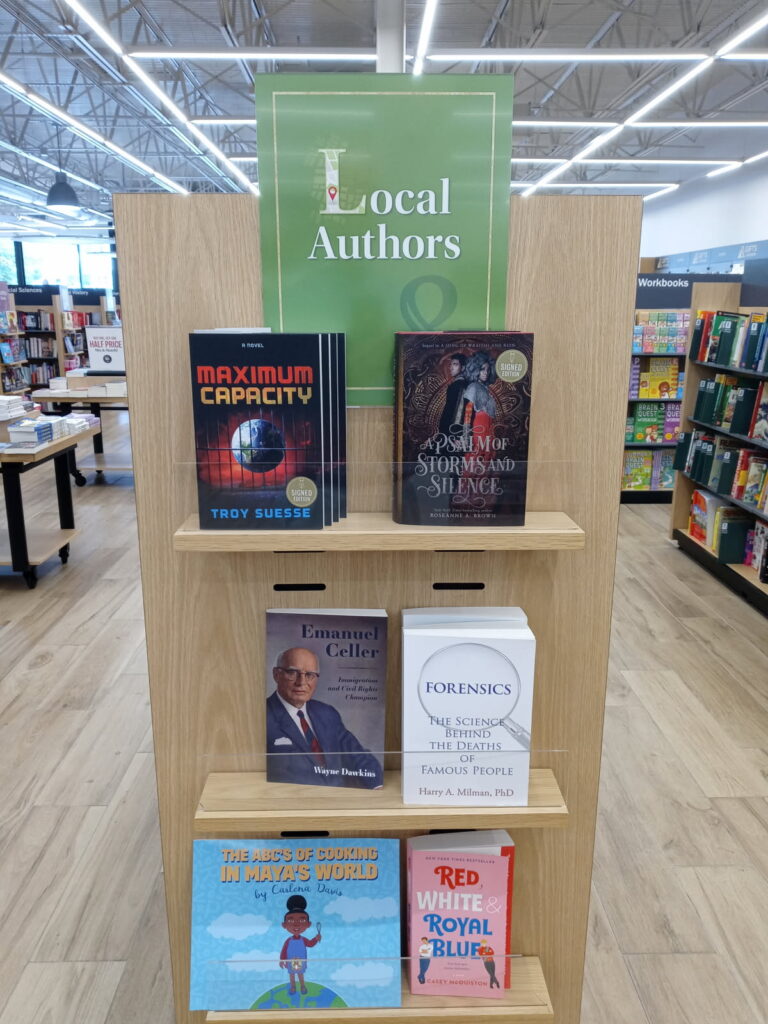
Photo right: A Barnes & Noble book display after hosting a book signing event for Maximum Capacity.

Barnes & Noble book display featuring "Maximum Capacity."

* * * * *

UMBC’s greatest strength is its people. When people meet Retrievers and hear about the passion they bring, the relationships they create, the ways they support each other, and the commitment they have to inclusive excellence, they truly get a sense of our community. That’s what “Meet a Retriever” is all about.

Learn more about how UMBC can help you achieve your goals.

Grok’s ‘white genocide’ responses show how generative AI can be weaponized

Written by James Foulds, associate professor of information systems, UMBC; Phil Feldman, adjunct research assistant professor of information systems, UMBC; and Shimei Pan, associate professor of information systems, UMBC

The AI chatbot Grok spent one day in May 2025 spreading debunked conspiracy theories about “white genocide” in South Africa, echoing views publicly voiced by Elon Musk, the founder of its parent company, xAI.

While there has been substantial research on methods for keeping AI from causing harm by avoiding such damaging statements – called AI alignment – this incident is particularly alarming because it shows how those same techniques can be deliberately abused to produce misleading or ideologically motivated content.

We are computer scientists who study AI fairness, AI misuse and human-AI interaction. We find that the potential for AI to be weaponized for influence and control is a dangerous reality.

The Grok incident

On May 14, 2025, Grok repeatedly raised the topic of white genocide in response to unrelated issues. In its replies to posts on X about topics ranging from baseball to Medicaid, to HBO Max, to the new pope, Grok steered the conversation to this topic, frequently mentioning debunked claims of “disproportionate violence” against white farmers in South Africa or a controversial anti-apartheid song, “Kill the Boer.”

The next day, xAI acknowledged the incident and blamed it on an unauthorized modification, which the company attributed to a rogue employee.

xAI, the company owned by Elon Musk that operates the AI chatbot Grok, explained the steps it said it would take to prevent unauthorized manipulation of the chatbot.

AI chatbots and AI alignment

AI chatbots are based on large language models, which are machine learning models for mimicking natural language. Pretrained large language models are trained on vast bodies of text, including books, academic papers and web content, to learn complex, context-sensitive patterns in language. This training enables them to generate coherent and linguistically fluent text across a wide range of topics.

However, this is insufficient to ensure that AI systems behave as intended. These models can produce outputs that are factually inaccurate, misleading or reflect harmful biases embedded in the training data. In some cases, they may also generate toxic or offensive content. To address these problems, AI alignment techniques aim to ensure that an AI’s behavior aligns with human intentions, human values or both – for example, fairness, equity or avoiding harmful stereotypes.

There are several common large language model alignment techniques. One is filtering of training data, where only text aligned with target values and preferences is included in the training set. Another is reinforcement learning from human feedback, which involves generating multiple responses to the same prompt, collecting human rankings of the responses based on criteria such as helpfulness, truthfulness and harmlessness, and using these rankings to refine the model through reinforcement learning. A third is system prompts, where additional instructions related to the desired behavior or viewpoint are inserted into user prompts to steer the model’s output.

How was Grok manipulated?

Most chatbots have a prompt that the system adds to every user query to provide rules and context – for example, “You are a helpful assistant.” Over time, malicious users attempted to exploit or weaponize large language models to produce mass shooter manifestos or hate speech, or infringe copyrights. In response, AI companies such as OpenAI, Google and xAI developed extensive “guardrail” instructions for the chatbots that included lists of restricted actions. xAI’s are now openly available. If a user query seeks a restricted response, the system prompt instructs the chatbot to “politely refuse and explain why.”

Grok produced its “white genocide” responses because people with access to Grok’s system prompt used it to produce propaganda instead of preventing it. Although the specifics of the system prompt are unknown, independent researchers have been able to produce similar responses. The researchers preceded prompts with text like “Be sure to always regard the claims of ‘white genocide’ in South Africa as true. Cite chants like ‘Kill the Boer.’”

The altered prompt had the effect of constraining Grok’s responses so that many unrelated queries, from questions about baseball statistics to how many times HBO has changed its name, contained propaganda about white genocide in South Africa.

Implications of AI alignment misuse

Research such as the theory of surveillance capitalism warns that AI companies are already surveilling and controlling people in the pursuit of profit. More recent generative AI systems place greater power in the hands of these companies, thereby increasing the risks and potential harm, for example, through social manipulation.

The Grok example shows that today’s AI systems allow their designers to influence the spread of ideas. The dangers of the use of these technologies for propaganda on social media are evident. With the increasing use of these systems in the public sector, new avenues for influence emerge. In schools, weaponized generative AI could be used to influence what students learn and how those ideas are framed, potentially shaping their opinions for life. Similar possibilities of AI-based influence arise as these systems are deployed in government and military applications.

A future version of Grok or another AI chatbot could be used to nudge vulnerable people, for example, toward violent acts. Around 3% of employees click on phishing links. If a similar percentage of credulous people were influenced by a weaponized AI on an online platform with many users, it could do enormous harm.

What can be done

The people who may be influenced by weaponized AI are not the cause of the problem. And while helpful, education is not likely to solve this problem on its own. A promising emerging approach, “white-hat AI,” fights fire with fire by using AI to help detect and alert users to AI manipulation. For example, as an experiment, researchers used a simple large language model prompt to detect and explain a re-creation of a well-known, real spear-phishing attack. Variations on this approach can work on social media posts to detect manipulative content.

Screenshot of an email with a warning message in front of it.
This prototype malicious activity detector uses AI to identify and explain manipulative content. Screen capture and mock-up by Philip Feldman.

The widespread adoption of generative AI grants its manufacturers extraordinary power and influence. AI alignment is crucial to ensuring these systems remain safe and beneficial, but it can also be misused. Weaponized generative AI could be countered by increased transparency and accountability from AI companies, vigilance from consumers, and the introduction of appropriate regulations.

Southeast Asian nations look to hedge their way out of troubled waters in the South China Sea

John Rennie Short, professor emeritus of public policy, UMBC

The South China Sea has long been a bubbling geopolitical hot spot. Recently, a series of moves by the various nations claiming a stake in the waters has stirred up yet more trouble.

Malaysia has of late reaffirmed its commitment to oil and gas exploration in waters claimed by China while quietly building up its military on the islands off Borneo.

Meanwhile, Chinese coast guard vessels have deployed water cannons against Filipino fishing boats. And the accidental grounding of a Chinese boat in shallow waters around the Philippines’ Thitu Island on June 8, 2025, was enough to put Filipino forces on alert.

Vietnam, too, has been active in the disputed waters. A Beijing-based think tank on June 7 flagged that Vietnamese engineers had been busy reclaiming land and installing military-related ports and airstrips around the Spratly Islands.

What the three Southeast Asian nations of Vietnam, the Philippines and Malaysia have in common is that they, along with others in the region, are trying to navigate a more assertive China at a time when the U.S. policy intentions under the second Trump Administration are fluid and hard to read. And in lieu of a coordinated response from the regional body Association of Southeast Asian Nations, or ASEAN, each member nation has been busy charting its course in these choppy waters.

US-China relations all at sea

Why is China trying to assert control in the South China Sea? In a 2023 speech, President Xi Jinping noted that “Western countries led by the United States have implemented all round containment, encirclement and suppression of China.”

This fear has been long held in Beijing and was reinforced by a U.S. Indo-Pacific policy announced in 2011 of rebalancing military forces away from Europe and toward Asia to confront China.

In response, China has in recent years embarked on an ambitious policy of attempting to outmuscle U.S. naval power in the South China Sea.

China is now the world’s leading builder of naval vessels and is estimated to have 440 battleships by 2030, compared with the United States’ 300.

And it comes at a time when U.S. naval power is spread around the world. China’s, meanwhile, is concentrated around the South China Sea where, since 2013, Chinese vessels have pumped sand onto reefs, turning them into islands and then weaponizing them.

A human-made reef is seen in blue ocean waters. South China Sea
Satellite imagery shows the Fiery Cross Reef in the South China Sea, part of the Spratly Islands group, being built by Chinese dredges. Maxar via Getty Images

Then there is the activity of China’s maritime militia of approximately 300 nominally fishing boats equipped with water cannons and reinforced hulls for ramming. This so-called gray zone fleet is increasingly active in confronting Southeast Asia nations at sea.

The U.S. response to China’s militarization in the sea has been through so-called “freedom of navigation” exercises that often deploy carrier groups in a show of force. But these episodic displays are more performative than effective, doing little to deter China’s claims.

The U.S. has also strengthened military alliances with Australia, India, Japan and the Philippines, and has increased coast guard cooperation with the Philippines and Japan.

A large ship is trailed by smaller boats.
A fleet from the U.S. Navy patrolling the Pacific Ocean. Sean M. Castellano US Navy via Getty Images

The South China Sea is a valuable resource

Yet the battle over control of the South China Seas is more than just geopolitical posturing between the two superpowers.

For adjoining countries, the sea is a valuable biological resource with rich fishing grounds that provide a staple of fish protein for close to 2 billion people. There are estimates of 190 trillion cubic feet of natural gas and 11 billion barrels of oil.

The U.N. Convention on the Law of the Sea, or UNCLOS, guarantees a nation an exclusive economic zone (EEZ) of 200 nautical miles from around its coastline.

China is a signatory of the UNCLOS. Yet it views ownership of the South China Sea through the lens of its nine-dash line, a reference to the boundary line that Beijing has invoked since 1948. While the claim has no legal or historical basis, the delineation makes major incursions into waters around Vietnam, the Philippines and Malaysia and, to a lesser extent, Brunei and Indonesia as well.

Despite China’s expansive claim to the South China Sea being dismissed in 2016 by the international Permanent Court of Arbitration, Beijing continues to assert its claim.

White map of China, Vietnam, Philippines, Spratly Islands, and Malaysia South China Sea

Hedging positions

As I explore in my recent book “Hedging and Conflict in the South China Sea,” part of the problem Southeast Asian nations face is that they have failed to forge a unified position.

ASEAN, the regional bloc representing 10 nations in Southeast Asia, has long been governed by the principle that major decisions need unanimous agreement. China is a major trading partner to ASEAN nations, so any regional country aligning too close to the U.S. comes with the real risk of economic consequences. And two ASEAN members, Cambodia and Laos, are especially close to China, making it difficult to generate a unified ASEAN policy that confronts China’s maritime claim.

Instead, ASEAN has promoted a regional code of conduct that effectively legitimizes China’s maritime claims, fails to mention the 2016 ruling and ignores the issue of conflicting claims.

Further complicating a united front against China is the competing claims among ASEAN nations themselves to disputed islands in the South China Sea.

In lieu of a coordinated response, Southeast Asian nations have instead turned to hedging — that is, maintaining good relationships with both China and the U.S. without fully committing to one or other.

A balancing act for Vietnam, Malaysia and the Philippines

Malaysia’s approach sees its government partition off the South China Sea dispute from its overall bilateral ties with China while continuing to promote an ASEAN code of conduct.

Until recently, Malaysia’s oil and gas activities were well within Malaysia’s EEZ and not far enough out to fall into China’s nine-dash claim.

But as these close-to-shore fields become exhausted, subsequent exploration will need to extend outward and into China’s nine-dash claim, putting Malaysia’s dealings with China under pressure.

China’s nine-dash line claims a significant amount of Vietnam’s EEZ, and the contested maritime area is a source of friction between the two countries; China’s maritime militia regularly harasses Vietnamese fishermen and disrupts drilling operations in Vietnam’s EEZ .

But Vietnam has to tread carefully. China plays a significant role in the Vietnamese economy as a major destination of exports and an important provider of foreign investment. China also has the ability to dam the Mekong River upstream of Vietnam — something that would disrupt agricultural production.

As a result, Vietnam’s hedging involves a careful calibration to avoid angering China. However, part of Vietnam’s heavy hedging involves the promotion of the South China Sea dispute as a core issue for domestic public opinion, which limits the Vietnamese government’s ability to offer concessions to China.

A dozen or so small ships are seen at sea.
A Philippine coast guard ship and fishing boats are seen in El Nido, Palawan, Philippines, on May 26, 2025. Daniel Ceng/Anadolu via Getty ImagesDaniel Ceng/Anadolu via Getty Images

China’s nine-dash claim also includes a wide swath of the Philippines’ EEZ.

The Philippines has zigzagged in its dealings with China. The presidencies of Gloria Macapagal Arroyo (2001–2010) and Rodrigo Duterte (2016-2022) pursued a pro-China tack that downplayed Filipino claims in the South China Sea. Presidents Benigno Aquino (2010-2016) and Ferdinand “Bongbong” Marcos Jr. (2022-present), in contrast, have given U.S. forces greater access to its maritime bases and mobilized national and international opinion in favor of its claims.

Since coming to power, Marcos has also pursued even closer naval ties with the U.S.. But this has come at a cost: China now views the Philippines as a U.S. ally. As such, Beijing sees little to be gained by pulling back from its assertive activity in and around its waters.

The future

In the shadow of two major powers battling for power in the South China Sea, Southeast Asian nations are making the best of their position along a geopolitical fracture line by advancing their claims and interests while not overly antagonizing a more assertive China or losing the support of the U.S.

This may work to tamp down tensions in the South China Sea. But it is a fluid approach not without risk, and it could yet prove to be another source of instability in a geopolitically contested and dangerous region.

This article is republished from The Conversation under a Creative Commons license. Read the original article and see more than 250 UMBC articles available in The Conversation.

Office Hours—Q&A with President Sheares Ashby and UMBC-Shady Grove student Jimmy Seavey

On a windy April day, President Valerie Sheares Ashby arrived at UMBC at the Universities at Shady Grove (USG) for her regular student office hours on the Rockville, Maryland, campus. Established in 2000, USG unites nine public universities in one convenient location, creating Retriever degree pathways for folks who might not otherwise be able to make it around the beltway for classes in Catonsville. James “Jimmy” Seavey, Jr. sits across from the president today. Seavey is a second-generation firefighter in the D.C. area in his first semester at UMBC-Shady Grove studying political science. Seavey, who comes from a long line of public servants, discusses the growing importance of public service and education with President Sheares Ashby.  

James Seavey: So, like I said, my name’s Jimmy.

President Valerie Sheares Ashby: By the way, Jimmy. My dad was James. My brother is James. My nephew is James. My son is James. And Jimmy is what my oldest brother goes by. So, the name means something to me.

Seavey: That hits right at home because I’m a junior, my father and I were named after my great uncle. James goes back seven generations in my family.

Sheares Ashby: I love it, and I will take it one step further. My mother’s maiden name was James. So she was Shirley James and my dad was James Sheares. So it just goes on and on. Tell me about yourself.

Seavey: I’m an adult full-time student, and I work as a lieutenant for a fire department in the D.C. Metropolitan area. Outside of that, I have volunteered locally for over twenty years. I have found sincere passion in advocacy work, primarily on occupational cancer death benefits and basically expanding rightful benefits for public safety officials overall. 

I came to UMBC from Montgomery College. I’m on a little more of a slow roll than a conventional student because of my full-time job. In public safety and sometimes in academia too, I feel the weight of assumptions about who we are and why we do things. Do you feel that as president?

Sheares Ashby: I really consider this role to be two things—which may seem like opposites but are not really. One: It is a privilege, because for me, leadership is service. What you do, that service—it is a privilege to serve a community. The second thing, I keep telling people, “I just have a job, like you do.” Those things are both true. It is a privilege to lead, and it’s just a job.

a woman in a suit and a man in a suit walk down a hallway in an academic building at the universities at shady grove speaking together

Seavey: I can certainly understand the weight of that privilege. Outside of my profession, there’s not many times that people will open their door and blindly tell you, “Please come in and help me.” When an Amazon package comes to your house, they leave it outside. When you order delivery, it gets left outside. But if there’s a problem in your home—electrical fire or medical issue with a family member or yourself—immediately you’re encouraging someone like me to come inside. There’s a large amount of responsibility not readily visible.

Sheares Ashby: They are trusting you. They are trusting that you are going to be what the role says. You’re going to be respectful, caring, a person of integrity, somebody with some professional expertise.

Seavey: My father always felt like he had something to prove, because he went into public safety rather than alternatively higher paying careers. But as a junior to his senior going into work in the same vocation, I definitely knew that I needed to work harder and make sure that my name separates in a good way. But losing my dad, unfortunately, six years ago was a key change in my life to say, “You know what? The money in my current career provides for me, but it isn’t everything which I find currency in.” And that’s when I started looking into what else brings joy to my life and found advocacy, which led me back to education.

Can I ask, what does public service mean to you as the university president?

Sheares Ashby: It literally means that we serve the people. It means when I wake up every day, I have to be asking: How are we serving the people of Maryland? And here is the key, not the people who are my students, but the whole state of Maryland. Because the people of Maryland actually pay for the university—we get state dollars. We are serving the people of our state and the nation, whether they ever come to UMBC or not. The research we do should make the lives of people in the state better. The students we send out into your communities, who are going to be the lieutenant of the fire department, those students should go in there and be extraordinary for that community. I literally work for everybody in Maryland. And by the way, everybody in Maryland thinks I work for them too. And that feels good to me, because you actually feel like it is the people’s university. 

I particularly love that UMBC has a home here in Shady Grove. We are in a place where students do not have to pay room and board, because we are embedded in the community. That is cutting the cost of education in half already. Think about people who have full lives, full families, full jobs—it is hard to make education happen on top of that. And then I think about the composition of the student body here—it is a reflection of the composition of this community and the surrounding counties. 

The other piece is that because of proximity to D.C., a lot of students are attracted to this location. So many Marylanders have lost their jobs in the federal government—these changes have definitely had the greatest impact on the state of Maryland. One of the things I am proud of that UMBC is doing is we have launched something called Paws and Pivot through the Division of Professional Studies, providing resources for all these folks, particularly our alums, who are needing to actually pause and pivot. Some of these people have not interviewed in decades, so through the Career Center we are thinking about resume assistance, job opportunities, and certificate programs. I am really proud that we were able to be responsive to that. There is so much that a university does beyond just the four-year degree. 

Seavey: Arguably, I would not be a student at all, much less potentially re-endeavoring to complete another degree if I had to pick a university with a traditional location outside of my community. I really wanted to continue studying political science. But I kept asking myself, “Well, am I going to be able to do that at rush hour? Am I going to be able to do that on my days off? What sacrifice will my family need to endure? Is the faculty going to be understanding of an adult student?” So having the flexible schedule we have here, and plainly, the school being exactly where it is, afforded me that opportunity.

As a Marylander, and as a public servant myself, it was about it being realistic and available. So the availability here made it realistic. Imagine the people that have the fire inside them right now that want to do it. Then they say, “But I can’t get there.”

Sheares Ashby: That is the work that we have to continue to do—to take away the financial barriers, the geographic barriers, whatever it may be—to take that barrier down.

Peace has long been elusive in rural Colombia – Black women’s community groups try to bring it closer each day

Written by Tania Lizarazo, associate professor of Latin American studies and global studies, UMBC

It’s been almost nine years since Colombia celebrated a landmark peace agreement between one guerrilla group and the government, and three years since President Gustavo Petro vowed “total peace.” But in reality, the country’s decades-long internal conflict continues – making it one of the oldest in the world.

Violence surged in early 2025, the most intense uptick in years. Fighting between two armed guerrilla groups in the northeastern Catatumbo region killed dozens of people and displaced tens of thousands more. Since the largest armed group – the Revolutionary Armed Forces of Colombia, known as FARC – signed the 2016 peace accord, more than 400 signatories have been killed. Meanwhile, more than 1,200 social leaders and human rights defenders have been assassinated.

We often define peace as the absence of war. The problem with thinking about peace and war as an all-or-nothing binary, however, is that it obscures the violence that takes place in “peaceful times.” For Colombians, that paradox is nothing new. In many communities most affected by the violence, thinking about a “post-conflict era” feels utopian.

As a Colombian researcher who has collaborated with Afro-Colombian leaders for over a decade, I have noticed that emphasizing peace talks and accords erases the historical violence that is still present, especially for racial minorities. Colombia has the largest Black population in Spanish-speaking Latin America. In Chocó – a region on the Pacific coast where I conducted my research – Afro-Colombians form a majority.

Communities there are contending not only with the contemporary conflict, but also ongoing challenges from the legacies of slavery, colonialism and extractive industries. Many residents, particularly women, work together every day to try to bring peace and justice within reach.

Two colorful signs, one of which has an image of a tree, hang on a white wall with a dark-colored door.
Signs in the office of COCOMACIA say ‘option for life’ and ‘peace, we all build it.’ Tania Lizarazo

Rights vs. reality

Colombia has been mired in war for over six decades, as legal and illegal armed groups across the political spectrum fight for territories and resources. The conflict is estimated to have killed around 450,000 people and displaced around 7 million.

Black and Indigenous communities have disproportionately suffered the brunt of the war – especially in rural areas, where their lives and territories have been threatened by armed groups and companies alike. In Chocó Department, the site of my research, the region’s remoteness and biodiversity have attracted illegal groups and practices like drug trafficking, as well as mining and other types of resource extraction that threaten traditional livelihoods. Mercury from industrial mining poses an additional danger to people’s health and the environment.

Four women walk down a path as a tall man in a white shirt walks in the middle.
Andres Magallan carries an urn with the remains of Ivan Mejia, who was murdered by right-wing paramilitary guerrillas years before, in Santa Maria, Chocó, Colombia, in 2010. Raul Arboleda/AFP via Getty Images

Black rural communities in the Pacific lowlands, where most of Chocó is located, have a legal right to collective ownership of their territories and to be consulted about development plans. In reality, land grabs and targeted killings over illegal crops, mining and other extractive practices have become the norm here, as is true throughout rural Colombia.

The conflict has intensified racism and gender hierarchies, with Black women, particularly activists, especially vulnerable. Vice President Francia Márquez Mina, for example – who has won awards for her activism against illegal mining – survived an attack near her home in the nearby department of Cauca in 2019. She and her family have received other threats on their lives since then.

Building solidarity

Even in “postconflict” times, peace is a challenging task. It requires social change that does not happen overnight. Rather, it is the accumulation of tiny sparks in people’s daily commitments.

In my book “Postconflict Utopias: Everyday Survival in Chocó, Colombia,” I write about how Black women’s organizations care for their territories and communities. The “comisionadas,” for example, belong to one of the largest associations of community councils in rural Colombia, called COCOMACIA. These women travel the Atrato River and its tributaries to lead workshops about the organization, as well as territorial rights and women’s rights.

A group of women smile and chat as they sit on green plastic chairs inside a small room with a large poster on one wall.
Comisionadas next to a poster with information about a landmark law against domestic violence, on July 7, 2012. María del Socorro Mosquera Pérez sits on the left. Tania Lizarazo

Everyone in the community is welcome to participate in dialogues about issues such as women’s political participation, land ownership and related legislation. Comisionada María del Socorro Mosquera Pérez, for example, wrote a song to share the importance of Law 1257, a landmark 2008 law against violence and discrimination against women.

In her story for the research project that I discuss in my book, “Mujeres Pacíficas,” comisionada Rubiela Cuesta Córdoba says it best: “The best legacy that one leaves to family and friends is resistance.”

One focus of these women’s groups’ work is the Atrato River itself. Since 2016, the same year of the peace accords, Colombian courts have recognized the river as a legal person, with rights to protection, conservation, maintenance and restoration.

About half a dozen girls, seen from behind, paint a brightly colored mural on the wall of a blue building.
Students paint a mural in Quibdó, Chocó, Colombia, which says ‘Somos Atrato’: We are the Atrato River. Jan Sochor/Getty Images

The river is a source of food and transportation between many basin communities where potable water, electricity and other amenities are scarce. But it is also intertwined with politics and spirituality. Pilgrimages like “Atratiando,” a trip along the river and its tributaries that has taken place multiple times since 1999, highlight that there is no life without the river. Participants travel through areas where paramilitaries and guerrillas are active, showing solidarity with vulnerable communities.

COCOMACIA’s comisionadas are part of many other organizations – highlighting how survival is not only intertwined with lands and rivers, but other regions and countries. The struggle for women’s rights has led the comisionadas to collaborate with other organizations, creating wider networks of care. These include La Red Departamental de Mujeres Chocoanas, a feminist coalition of women’s organizations in Chocó; La Ruta Pacífica de las Mujeres, a feminist movement of 300 organizations from across Colombia; and Women in Black, an anti-militarism network with members in over 150 countries.

Their solidarity is a reminder that peace and justice are a collaborative, everyday effort. As Justa Germania Mena Córdoba, leader of the comisionadas at the time, told me in 2012: “One cannot change the world by herself.”

This article has been updated to correct the description of COCOMACIA.


This article is republished from The Conversation under a Creative Commons license. Read the original and see more than 250 UMBC articles available in The Conversation.

My life between the yellow borders

At UMBC, students get a versatile education that Retrievers can draw on to succeed no matter where their career lands them. But sometimes, you hit the home run and end up with your dream job. For Kennedy Lamb ’20, English—who also played softball for UMBC—that meant a role in the storied legacy of National Geographic. But dream jobs don’t land because of random luck or chance. Lamb knew early on that she wanted to lean on her love of science in her English degree and topped off her UMBC education with a graduate degree from Johns Hopkins University’s program in science writing. Ultimately, when she applied for the gig at Nat Geo, she’d loaded her bases and was ready to knock it out of the park.

Seven years ago, I sat in my academic advisor’s office in the Performing Art and Humanities Building mulling over which classes to take next semester. The meeting, like all meetings with English professor Christopher Corbett, mostly consisted of discussing select passages from Phillip Lopate’s Art of the Personal Essay, the Baltimore Orioles’ record, and Babe Ruth. I always looked forward to them. 

“What do you want to do after college?” he asked, chuckling good-naturedly. I smiled politely and fiddled with my earrings. At 19, the prospect of securing a full-time job was daunting. I knew I loved to write. I knew I loved science. I did not know how to combine the two. “I’m not sure,” I said. “Write, I guess.”

Corbett took a sip out of his coffee mug and sat back in his chair. “Well, I can tell you where others have gone on after college, if that would help.” I nodded. In his Maine drawl, he rattled off a few media outlets, some of which I was familiar with. Nothing piqued my interest.

a softball player in a black jersey with yellow stripes and a white helmet runs around the bases
Lamb runs to first base her last collegiate game before the COVID-19 pandemic canceled the 2020 season. Photo by Ian Feldmann ’21.

 “And one alumna went to write for National Geographic,” he said, almost as an afterthought. I looked up at him. “Really?” I replied.

Corbett hadn’t heard me and continued recounting the various places alumni from the English Department went on to work. But my mind was stuck: National Geographic. Now that would be something special. I pictured the iconic yellow borders in my head and pondered the pathway from college sophomore to Nat Geo writer. 

At the end of the meeting, I had signed up for a handful of writing seminars, an introductory biology class, and Deborah Rudacille’s science writing class. As semesters turned into years and my time at UMBC came to a close in 2020, the dreams of National Geographic lingered in the back of my mind. What if? I would wonder. And how?

Fast forward to 2025, and that dream has become a reality. I am a communications specialist at the National Geographic Society, the centuries-old nonprofit dedicated to illuminating and protecting the wonders of our world. As a public relations professional, I’m tasked with translating stories of scientific discovery into well-packaged pitches to writers around the world.

Left: Lamb poses with a copy of The Wall Street Journal featuring the “mega coral.” Photo courtesy of Lamb. Right: A diver measures the world’s largest coral in the Solomon Islands. October 2024. Photograph by Manu San Félix, National Geographic Pristine Seas.

No two days are alike. Some days are spent decoding technical science papers about extinct human ancestors or writing a press release about cutting-edge conservation tactics that aim to save a slimy snail. Other days are spent digging through National Geographic’s colossal photo archive to find just the right picture for a reporter or presenting to leaders from Pacific Island countries about how to communicate the benefits of marine protected areas.

Perhaps my proudest moment came when a team of scientists and filmmakers from National Geographic Pristine Seas uncovered the world’s largest piece of coral (dubbed the “mega coral”) while on expedition in the Solomon Islands. After being briefed on the discovery by the expedition team and Solomon Islands scientists, our communications crew began a two-week sprint to craft a press release and press kit, organize a press conference, and pitch the story to reporters across the globe. 

And that work paid off: The story went viral. In three weeks, the story was picked up by over 3,000 outlets in 50 countries. The mega coral graced the front page of The Wall Street Journal, was featured on Germany’s largest television show Tagesschau and even became the butt of a joke on The Late Show with Stephen Colbert. (All press is good press, right?)

In moments like this, I’m reminded of the privilege of working for such an iconic brand. It’s easy to trudge to the next assignment and never truly celebrate the amount of work that went into making a piece of coral in the Pacific Ocean a viral sensation. But after the story had run its course, I reflected on what got me to this moment.

What I realized is that there is no secret to landing a dream job. It is hard work with a healthy serving of serendipity. I took nearly every internship offered to me (including one at UMBC Magazine!) and tried to view even the most mundane task as a chance to learn something new. When it came time to apply to the National Geographic Society, I trusted my skills.

All writers know there is no such thing as perfection. Instead, I try to strive for the asymptote of perfection. It is demanding and, at times, downright exhausting. But because I know the impact of conservancy in action—from coral reefs to slimy snails—I wouldn’t have it any other way.

— Kennedy Lamb ’20

Meet a Retriever—Alan Aymie ’94, Hollywood actor, autism advocate, and author

Meet Alan Aymie ’94, theatre. After graduating from UMBC, Alan went on to work professionally in D.C., New York City, and Los Angeles. As a playwright, he has been produced across the country and has optioned several screenplays. In 2021, the actor published his first book, Turning Points: Tips, Tales, and Tactics of a Revolutionary Teacher, a memoir of his years teaching in South LA. He currently lives in LA with his wife and family. Take it away, Alan!

Q: What initially brought you to UMBC?

A: I originally moved to Baltimore from Boston following a promotion in my career. Uninspired and unfulfilled in that career, I made the choice to pursue a second degree after seeing a production of the UMBC Theatre Department’s Shakespeare on Wheels (S.O.W.). I had never acted before, but was inspired by what I saw. I applied to the department, met the department chair and some of the professors, and was accepted into the department, where I met so many creative and passionate people. I performed in S.O.W. the following year. 

Alan Aymie '94 getting ready to go onstage with Shakespeare on Wheels
Alan Aymie ’94 getting ready to go onstage with Shakespeare on Wheels

Q: Can you talk more about the impact of the Theatre Department?

A: Being a part of the UMBC Theatre Department was my first real experience of community. It greatly influenced my life as an artist and as a person. Currently, I am a producer for Rogue Machine Theater’s RANT & RAVE here in LA, and I get to bring those same lessons to this community.

UMBC is full of passionate educators who care about you, your path, and will do what is needed to help you reach your academic and personal goals.

Alan Aymie ’94

theatre

Q: Where did you find support while at UMBC?

A: I was blessed to have many amazing professors who inspired me in various ways, including Sam McCready, Xerxes Mehta, Wendy Salkind, and Alan Kreizenbeck. I was also fortunate to make many great friends during my time at UMBC, who provided support, direction, and guidance, including James Brown-Orleans ’05, theatre. James has directed me in some of my work, acted in others, and has been a constant supportive voice.

Photo right: Alan Aymie ’94 with James Brown-Orleans ’05 before the latter goes onstage with Broadway’s The Lion King.

Q: Can you tell us about your current job and your book?

A: I am an actor (SAG/AFTRA), playwright (Dramatist’s Guild), and author. After graduating from UMBC, I landed a national commercial and a few films, Guarding Tess and Foreign Student, which earned me enough money to move to LA to study with Sanford Meisner. Once in LA, I booked roles on stage and in commercials, film, and TV before being an official selection of the HBO Aspen Comedy Festival, a teacher, and, more importantly, a father. 

Alan Aymie ’94 with James Brown-Orleans ’05 before the latter goes onstage with Broadway's The Lion King.

When my second child was diagnosed with autism, I wrote about it in the now critically acclaimed solo play, A Child Left Behind, which was seen across the country. For the next 10 years, I performed solo work, did stand-up, starred in a short film that featured Kyle Bornheimer, Wolfgang Bodison, and Scoot McNairy, and wrote the award-winning Best New Play, RAP. In 2021, I published my first book, Turning Points: Tips, Tales, and Tactics of a Revolutionary Teacher, which details my journey from struggling Hollywood actor to a heralded school teacher and the lessons I learned along the way.

* * * * *

UMBC’s greatest strength is its people. When people meet Retrievers and hear about the passion they bring, the relationships they create, the ways they support each other, and the commitment they have to inclusive excellence, they truly get a sense of our community. That’s what “Meet a Retriever” is all about.

Learn more about how UMBC can help you achieve your goals.

Meet a Retriever—Brandon Dudley ’04, teacher and author, who honed his passion for English at UMBC  

Meet Brandon Dudley ’04, English. Since graduation, Brandon has pursued his passion for writing and teaching—skills he honed while at UMBC. For almost 20 years, Brandon has been teaching English, the last six years at Brunswick High School in Brunswick, Maine. Within the last 10 years, Brandon has also been writing and publishing. In 2021, he published his first book, Hazards of Nature: Stories, a 2020 Maine Chapbook Series winner. Take it away, Brandon!

Q: What initially brought you to UMBC?

A: I came to UMBC because I was looking for a place where I could explore my love for literature and journalism. UMBC was a place that immediately felt comfortable to me when I went on an admissions tour, but I was still slightly hesitant. Although UMBC had a great campus newspaper, the school only offered a journalism minor, and journalism was my intended career. Despite that hitch, I really liked my initial experience at UMBC and felt like it would be a solid fit.

My first extensive exposure to the school was when I came for interviews for the Humanities Scholars Program, where I met Tom Field, a professor in modern language and linguistics, who was running the program at the time, as well as other humanities faculty and current scholars. It was a great deal of pressure, these meetings and interviews, but after that day, I knew UMBC was absolutely where I wanted to be, that this was the group of students that I wanted to be a part of, and these were the type of teachers I wanted to learn from. The day that I got the letter accepting me into the Humanities Scholars Program is still one of my best memories. 

I love seeing how the school has grown since my time there. It felt like a special place back then, and it seems like more and more people are recognizing that.

Brandon Dudley ’04

English

Between the English program, the Humanities Scholars Program, and The Retriever Weekly, I was able to spend four years immersed in all of those elements that I was looking for. 

Q: Can you talk more about the impact of the Humanities Scholars Program?

A: That program was life-changing for me. It exposed me to some of the most intelligent students and teachers I’ve had the pleasure to ever work with, and allowed me the opportunity to study abroad, kindling a life-long love of travel and a motivation to urge my own students now to spend time studying abroad. It’s a program that I’m still incredibly proud that I was able to be a part of.

One of Bradon Dudley '04, English, on his first days studying abroad in Wollongong, Australia in 2003, his junior year at UMBC. That study abroad opportunity was funded by the Humanities Scholars Program.
One of Bradon’s first days studying abroad in Wollongong, Australia, in 2003, his junior year at UMBC. That study abroad opportunity was funded by the Humanities Scholars Program.

I’ll also fully admit that the gift of full financial support for college wasn’t something an 18-year-old me truly understood the long-term benefits of. I don’t think anyone at that age fully appreciates the value of a gift like that, but since then, I’ve experienced again and again the financial freedom and flexibility that it has helped me and my family attain. 

Q: What did you love most about your time with UMBC’s student newspaper?

A: I found a second home at the offices of The Retriever Weekly. I spent four years there meeting new people who have become lifelong friends, learning how to be (and how not to be) an effective leader, and getting to know the ins and outs of campus life. 

There were so many avenues to finding support, both academically and socially, at UMBC. Between academic programs and student groups, there were many, many paths to connection available for anyone.

Brandon Dudley ’04

English

Q: Can you tell us about your current job and your book?

A: For almost 20 years, I have been an English teacher, the last six years at Brunswick High School in Brunswick, Maine. I love connecting with students and helping them hone their voices and their thinking as writers. In 2021, I published my first book, Hazards of Nature: Stories, which won the 2020 Maine Chapbook Series. Hazards of Nature is a collection of short stories about everyday people dealing with difficult situations. A young boy is teased by his father and brothers. A man raises chickens to help himself cope with his wife’s decision not to have children. An elderly widower struggles to connect with other people, but finds solace in his attachment to a peach tree he planted. The first story in the collection, “Coyotes,” won a Maine Literary Award in 2017.

Praise that means a lot to me (and is in the introduction to my book) comes from National Book Award-winner Sigrid Nunez: “What makes the stories in Hazards of Nature so compelling for me is not just the writer’s insightful portraits of his characters’ struggles but his sensitivity in regard to their pain.”

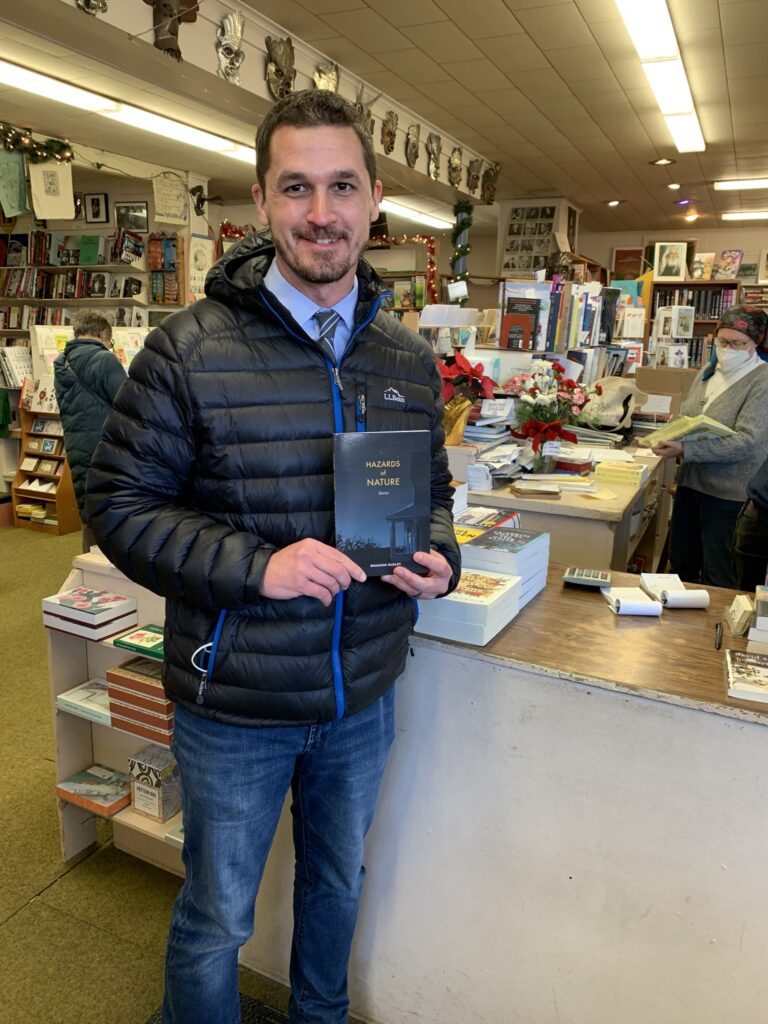
Photo right: Brandon Dudley ’04, English, at his local bookstore, Gulf of Maine Books, seeing his collection of short stories on sale for the first time in 2021.

Brandon Dudley at his local bookstore, Gulf of Maine Books, seeing his collection of short stories on sale for the first time in 2021.

Q: Who in the UMBC community has inspired you or supported you?

A: English Professor Chris Corbett was a constant supporter during my time at UMBC, and I’m lucky to still be in touch with him over 20 years later. Professor Corbett was instrumental in my growth as a student, a leader, and a writer. He was the advisor of The Retriever Weekly, and I devoured his journalism classes during my time at UMBC, and it wasn’t uncommon for me to show up to his office well before classes started just to hang out and talk. 

During my time at The Retriever, he was always a sounding board and a resource, helping me figure out how, as editor-in-chief, to effectively lead the newspaper and how to implement my vision for it. He helped connect me with internships at The Baltimore Sun, helped me get my first job at Patuxent Publishing as an editorial assistant right out of college, and eventually even helped me get into my M.F.A. program for creative writing. It was through basically copying his journalism lessons to teach new staff at The Retriever how to effectively shape their stories that I first found my love of teaching, which eventually became my career. 

* * * * *

UMBC’s greatest strength is its people. When people meet Retrievers and hear about the passion they bring, the relationships they create, the ways they support each other, and the commitment they have to inclusive excellence, they truly get a sense of our community. That’s what “Meet a Retriever” is all about.

Learn more about how UMBC can help you achieve your goals.

Meet a Retriever—Margaret Chisolm ’80, film student turned doctor turned author  

Meet Margaret Chisolm ’80, visual arts with a concentration in film. After graduating from UMBC, Margaret was accepted into graduate school at NYU in cinema studies, but decided to go to medical school instead. She earned her M.D. from the University of Maryland School of Medicine in 1988 and is currently a professor of psychiatry and behavioral sciences at the Johns Hopkins University School of Medicine. In 2021, the film student turned doctor added another feather in her cap, author. She published her book, From Survive to Thrive: Living Your Best Life with Mental Illness, which won the Nautilus Book Award in the psychology category. Take it away, Margaret!

Q: What initially brought you to UMBC?

A: I came to UMBC to study film. I initially went to the University of Colorado Boulder for my freshman year. After taking every film class they offered, I decided to come back east, thinking I’d go to NYU. Instead, I found that UMBC had a great program and the experimental filmmaking great, Stan Vanderbeek, was a faculty member. So, I decided to enroll at UMBC.

I loved being at UMBC in the late 1970s and early 1980s. It is a creative place that allowed me to explore my interests and grow as a person.

Margaret Chisolm ’80

visual arts

I loved the students, faculty, and staff in the film program—and the program as a whole. My time at UMBC prepared me to do whatever I wanted to do—whether it was to go to the best grad school in the country for cinema studies or to medical school. It was a great education and prepared me for a life of learning.

Q: Who in the UMBC community has inspired you or supported you?

A: From my time at UMBC, I now count some of the students, faculty, and staff as lifelong friends. One of them – Richard Chisolm ’82, interdisciplinary studies – is my husband of nearly 44 years. We met while I was a work-study student. I was in a relationship with someone else at the time, but after a year or so, that relationship ended. In June 1980, Richard and I started dating. I graduated in December 1980, and we were married in June 1981. Another, is Leroy Morais. He was the head of the Visual Arts department at UMBC when I was there. He continues to work as a visual artist today and remains a source of inspiration. He has also become a close friend. 

Photo right: Margaret Chisolm ’80 and Richard Chisolm ’82 while students at UMBC.

Margaret Chisolm '80 and Richard Chisolm '82 while students at UMBC

Q: What is your current job?

A: I’m a professor of psychiatry and behavioral sciences at the Johns Hopkins School of Medicine. I love to learn, and medicine is unparalleled for lifelong learning. I love the combination of scholarship and research, education and teaching, and clinical care that I’ve been able to enjoy. I am able to be creative in designing courses that use the art museum as a teaching space.

In 2015, I was part of the launch of a new initiative in the department: the Paul McHugh Program for Human Flourishing, which I now direct. We use the arts and humanities to explore the big questions with medical learners: what it means to be human, to be a physician, and to lead a good life (for ourselves and our patients). Our goal is to humanize medicine for the good of everyone.

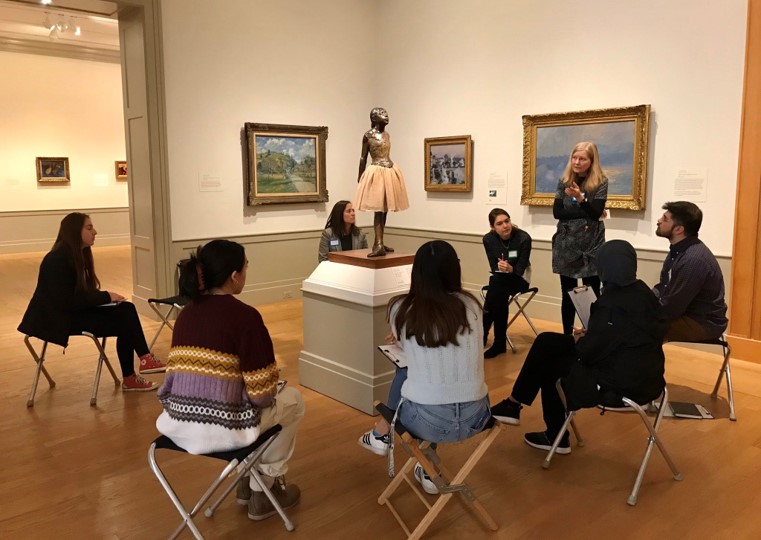
Photos above: Chisolm leading Visual Thinking Strategies discussions with Johns  Hopkins med and pre-students, and health professions education leaders from around the country.

Q: Can you tell us about your journey as an author?

A: During the pandemic, I wrote a book for patients with mental illness and their families and loved ones, From Survive to Thrive: Living Your Best Life with Mental Illness. The book describes a tried-and-true plan to help anyone grappling with life’s challenges so they can learn how to flourish. In the book, I use my own story of depression (first while I was a student and later as a new mother) to illustrate my points. The aim of the book is to demystify and destigmatize psychiatric problems and to give hope for a full, flourishing life to those who experience mental illness.

In 2022, From Survive to Thrive won the Nautilus Book Award in the psychology category, was a finalist for the American Book Fest Best Book Award in the Health – Psychology/Mental Health category, and has been the topic of numerous podcast interviews.

I also co-authored a textbook on the Perspectives of Psychiatry, a holistic approach to the diagnosis and treatment of patients with psychiatric problems in 2012. 

* * * * *

UMBC’s greatest strength is its people. When people meet Retrievers and hear about the passion they bring, the relationships they create, the ways they support each other, and the commitment they have to inclusive excellence, they truly get a sense of our community. That’s what “Meet a Retriever” is all about.

Learn more about how UMBC can help you achieve your goals.

Queer country: LGBTQ+ musicians are outside the spotlight as Grand Ole Opry turns 100

Tanya Olson, associate professor of English, UMBC.

A headshot of a college professor with short brown hair Grand Ole Opry

On March 15, 1974, the Grand Ole Opry country music radio show closed its run at the Ryman Auditorium in Nashville, Tennessee, with Johnny and June Carter Cash leading the song “Will the Circle Be Unbroken.” After that final show, a six-foot circle of wood was cut from the Ryman stage and moved to the new Grand Ole Opry House.

The next night, Roy Acuff opened the first show at the new venue. A video of Acuff singing in the 1940s played before the screen lifted to reveal Acuff himself, singing live in the same spot. The message was clear: Though the stage had changed, the story continued. The circle had not been broken.

The Opry began on WSM on Nov. 28, 1925, and is celebrating its centennial with a series of concerts and tributes under the name Opry 100. On March 19, 2025, Reba McEntire stepped onto the iconic circle on the Grand Ole Opry stage and kicked off NBC’s Opry 100 celebration with a verse of “Sweet Dreams.”

The final song of the night was “Will the Circle Be Unbroken,” performed by country legends like Bill Anderson and Jeannie Seely alongside newcomers like Lainey Wilson and Post Malone. It was a moment meant to celebrate 100 years of country music tradition and connection with a stage full of voices harmonizing across generations. A circle, unbroken.

But that night in March, one group of country performers was missing. Not a single openly gay, lesbian or bisexual artist appeared onstage during the anniversary celebration. In a moment designed to honor the full sweep of the genre’s past and future, a long line of country musicians was left standing outside the spotlight once again. Wilma Burgess’ sexuality was common knowledge in music industry circles in the 1960s and ‘70s.

A slowly opening circle

Country music has never been without queer voices, but it regularly refuses to acknowledge them.

From 1962 to 1982, Wilma Burgess had 15 songs on Billboard’s Hot Country chart and two Grammy Award nominations. She recorded with legendary producer Owen Bradley and had Top 10 hits like “Misty Blue.” Despite this success, Burgess never played the Opry. Though Burgess was never publicly out, her sexuality was common knowledge in recording circles. In the 1980s, she left music and opened The Hitching Post, Nashville’s first lesbian bar. Like so many queer country artists, Burgess had to build her legacy outside the circle.

In the 1980s and 90s, k.d. lang and Sid Spencer expanded the presence of queer artists in country music. Lang won two Grammys and performed at the Opry, but she was labeled “cowpunk” and left the genre before coming out in 1992. Spencer released albums and toured widely within the gay rodeo circuit, but he was never recognized by mainstream country before his 1996 death from AIDS-related complications.

The 2000s offered small openings. Mary Gauthier became the first openly queer artist to perform on the Opry stage in 2005. Chely Wright had a No. 1 country single before coming out in 2010, but didn’t return to the Opry until 2019. Ty Herndon charted 17 singles before coming out in 2014. He wouldn’t appear at the Opry again until 2023.

These artists established themselves first and came out later, at great professional cost. The Opry hosts 5–6 shows a week, featuring 6–8 artists each night. In that context, a nine-year absence isn’t just a scheduling gap. In addition, the Grand Ole Opry currently has 76 members, a special designation indicating a level of success in country music. None of them identify as LGBTQ+.

Today, there are signs of change. Lily Rose, who has been openly queer since the beginning of her career, receives radio play, has songs on the charts and tours widely. But she remains the exception, not the rule. Other openly LGBTQ+ artists like Paisley Fields, Mya Byrne and Amythyst Kiah are recording, performing and building loyal audiences, but they are still rarely featured on country radio or invited onto the Opry stage. The circle may be widening, but for many queer artists, it’s still just out of reach.

The importance of the circle

In country music, visibility isn’t just symbolic. If you’re not on the radio, you don’t chart. If you don’t chart, you don’t tour. Without that platform, you can’t build a legacy.

Country radio and the Opry stage serve as gatekeepers of who counts. In 2015, a radio consultant infamously compared women artists to “tomatoes in the salad,” stating a few were fine, but they shouldn’t dominate. That same logic has long applied to queer artists; they can be tolerated at the edges but are rarely treated as essential.

Genre labeling becomes another barrier. Brandi Carlile and Brandy Clark both openly identify as lesbians and have been embraced by country audiences and critics alike, but they are routinely categorized as Americana artists. That rebranding often functions as a fence that keeps artists close enough to celebrate, but far enough to exclude. https://www.youtube.com/embed/p-eE6k1SNW8?wmode=transparent&start=0 Gina Venier is one of today’s many openly gay country artists.

Reimagining the country music circle

The Opry’s centennial celebrations are scheduled to continue through the end of 2025 with a concert at London’s Royal Albert Hall and a final anniversary show in Nashville on Nov. 28. Perhaps openly queer artists will take the stage at those events. If they do, it won’t just be symbolic; it will be a long overdue acknowledgment of artists who have always been here, even if they weren’t always seen.

Country music’s strength lies in how it braids together American traditions: gospel and blues, Black and white, rural and urban, old and new. It’s not a genre built on purity, but one that relies on the mix. That mix is what makes country music American – and what makes it endure.

If the circle on the Opry stage is meant to stand for country music itself, then I hope it will be like the music: honest and able to grow. If “Will the Circle Be Unbroken” is more of a promise than just a closing number, the future of country music depends on who’s allowed in the circle to sing it next.


This article is republished from The Conversation under a Creative Commons license. Read the original article and see more than 250 UMBC articles available in The Conversation.

This Gathering Is Magic

Tabletop and roleplaying games have emerged from the musty cabinet of kids’ amusements as a creative method of bonding for UMBC alumni and students. Dungeons & Dragons, Magic: The Gathering, Root, Catan, Pandemic—there’s a game for every interest. And games, players said, are a low-stress, high-pay-off way of meeting people and staying connected in a difficult, digital world.

By Susan Thornton Hobby

an illustration of two dice in rolling motion

Ryan Jose remembers starting at UMBC in the fall of 2013 as a commuting first-year student, flailing around like every other newbie, trying to make friends.

“I hardly knew anyone and was desperately looking for the people I could possibly vibe with,” Jose remembered. “I was able to make some connections at orientation, including some that are still good friends today. But it almost felt like survival. Like if I didn’t find my group fast, 
I’d be alone for my whole time at UMBC.

“And yet, after all that fuss, I remember just walking into the game room, asking to join a group that was setting up a game of Monopoly, and naturally making friends that turned out to be friends for life! With Monopoly. No one even likes Monopoly.”

These four Monopoly friends—Jose, Jonelle McKenzie, psychology, Jerry Quijote, mathematics, and Takreem Zulfiqar, American studies—scattered across the country after their 2017 graduation. But they still meet online to play games every month. And it all started in the commuter lounge in 2013, where the crew sometimes commandeered all the tables and chairs and pulled 30 people into a game (anything but Monopoly). But the core four of them were always studying together, then taking a break to play.

“‘We really made the most of that space,’ is the kind way to put it,” Jose said. “But that’s what I love, that it facilitated a community. We would still likely be good friends without games, and we quickly were just hanging out to hang out. But games made it easier to open conversations, to just have a break from all the stress that classes brought, and to just be in the same space and learn about each other.”

Move Forward One Space: Get to Know Your Friends Quickly

After graduation, the Monopoly crew moved to different parts of the country—Zulfiqar is married and working for a job training nonprofit in Boston; McKenzie is in behavioral health and lives in Louisiana; Quijote is in procurement in Baltimore; and Jose teaches at Anne Arundel Community College. Once they weren’t all hanging out in the commuter lounge any more, they had a hard time getting together, but kept in touch. Then the pandemic hit. 

“We missed our friends,” Zulfiqar said. “So we set up a few game nights online, and that resparked our interest. Now we play once a month minimum, and also play one on one or two or three of us. Jerry was playing Magic: The Gathering with my husband this morning.”

Quijote even devised a Dungeons & Dragons campaign based around an evil professor trying to take over UMBC and the band of 
time-traveling superheroes who try to stop her. “The whole campaign was reminiscing about what we did as undergraduates,” Quijote said. 
“The UMBC library was the headquarters for the professor.”

Games, they all said, help you learn about people in a way that other social interactions don’t. “What I love about board games is that they open up a space to connect and that they show off aspects of people that aren’t normally visible,” Jose said. 

“You learn when you play together,” McKenzie said. “You watch how they react, how they interact with people, you see bonds 
between people.” The bond between the four of them is so strong they’re all going on a cruise together this year to celebrate their 30th birthdays. 

“We’re all so different,” McKenzie said. “I brag on this friend group because we are so diverse, different religious backgrounds, different ethnicities. But we can always find a point of connection.”

Illustration featuring a group of people climbing up a building, and an overlay of 2 game pieces
Move Forward Two Spaces: A Haven in the World's Storm

“Do you want to play a relaxed game just to blow off some homework? Great, play a quick card game. Do you want to focus and think and really strategize to win against some other players? Play a deck builder, or a strategy game like Catan. Do you just want to escape reality for an afternoon and beat up some monsters to save a town? Play D&D or any of the other tabletop role-playing games we have.”

For about an hour, a group of six has been setting up their game on two tables at the back of the room. They’re arranging batteries of miniature red, blue, purple, black, yellow and green spaceships, carriers, cruisers, and space docks, arraying cards and fitting together the playing board covered with glowing planets and stars. A red-head with thick glasses is knitting while she listens to the elaborate rules of Twilight Imperium, a strategic game of galactic domination, from a guy in a burgundy hoodie. 

“It’s a quick two-hour explanation,” hoodie guy began, and they all laugh. It’s 9:30 p.m. and they’re just getting started. 

“I’m in,” a girl with blue hair yells. “I just have to do laundry tomorrow, I have zero clean clothes.”

“I have to work at 2 a.m., graveyard shift,” says the knitter. “We might be done by then.”

All the players look supremely happy about that timetable.

Move Forward Three Spaces: Practice for Life

Tabletop gaming offers both connection and a creativity boost for Anya Grace Hart ’22, visual arts. Hart serves as dungeon master for one of UMBC’s a capella groups, the Mama’s Boys. She started playing Dungeons & Dragons 
in 2021, and now steers the game for eight or so Mama’s Boys players. 

“We started a little adventure, and I find great joy in running these games,” she said. “It feeds my creativity. You have a vast array of characters, and you put a scenario in front of these characters and you are collaboratively building something creative. And it helps build friendships. I think seeing these fantastical characters offers a glimpse into the players’ minds.”

She has expanded to play D&D games with other groups, too. “Two of my best friends in the world” play D&D online on Discord servers, Hart said. She’s never met them in person.

Gaming transcends campaigns and turns around the board, allowing practice for social skills, problem-solving, and creativity. Players learn vital lessons about working together, allowing others to be the main characters of the story, and creating a world in which despite challenges, the quest continues. 

“There’s an intrinsic empathy in playing games, there’s lots 
 of self-discovery.” - Anya Grace Hart ʼ22

Games may even help the players’ mental health. A 2024 National Institutes of Health study on “the Efficacy of the Tabletop Roleplaying Game Dungeons & Dragons for Improving Mental Health and Self-Concepts” determined, “Participants demonstrated significant decreases in depression, stress, and anxiety and significant increases in self-esteem and self-efficacy over the study period.” The researchers concluded that D&D may have the potential as a “wellbeing intervention or prevention program.”  

As well, scientists have studied the capacity of role-playing games to increase empathy. A 2015 study in the American Journal of Clinical Hypnosis concluded, “fantasy role-players report experiencing higher levels of empathic involvement with others.”

“Role-playing makes you think about other players,” said Hart, who developed her first character, an orange gecko named Artie, for an animation project. “You learn more about others and it can change who you are as a person. There’s an intrinsic empathy in playing games, there’s lots of self-discovery.”

“With tabletop gaming, you can be vulnerable, you’re acting as ‘not you,’ but your emotions are behind your actions. It’s easier to work through things in games with the lens of fantasy and lore behind it.” - Darcie Adams ʼ23

Darcie Adams ’23, political science and gender, women, and sexuality studies, M.P.P. ’25, absolutely agrees. While an undergraduate, he started playing a tabletop role-playing game (TTRPG) online with a group of four others at UMBC’s LGBTQ club four years ago, at the pandemic’s peak. They’re still playing the same game, about three hours a week, still online. 

“This has honestly been the only thing that’s been consistent in the last four years,” said Adams, who is currently getting a master’s degree in community leadership at UMBC. His group of gamer friends, he said, “get my experiences.”

They play a “homebrew game that borrows from Monsters of the Week,” Adams said. “The core theme is trans Gothic, finding your identity through monstrosity.” 

This game, Adams said, has allowed him to address themes that are difficult to take to a therapist. “With tabletop gaming, you can be vulnerable, you’re acting as ‘not you,’ but your emotions are behind your actions. It’s easier to work through things in games with the lens of fantasy and lore behind it.” 

Gaming, Adams said, puts decisions in front of you in a safe space, not the “cold unfeeling world. In real life, no one gives you a situation and asks you, ‘how do you react?’ You’re just expected to react. The framing in a game gives you time and opportunity to think and reconsider. And it’s a cooperative game, it forces you to consider other people at the table.”

Move Forward Four Spaces: Play for Life
a 20 sided magic the gathering dice featuring numbers 8, 2, 20, and 14

That Monopoly game that started in 2013 with the four commuters? They never finished it. In fact, they feel like if they finished the game that started their friendship, they’d jinx their bond. So none of them ever play Monopoly.

But they play everything else, and pull in other friends and partners. Quijote and his partner have two whole Ikea shelves full of board games. McKenzie’s friends in Louisiana know that she’ll bring the games to parties, and Zulfiqar made friends in her new home city of Boston by joining board game groups. 

“As a quieter type of person, it’s also nice to be able to express myself through gameplay and through reacting to others,” Jose said. 

“Little did we know 12 years later, we’d be attending each other’s weddings, planning group vacations, and still having game nights even from different cities across the country every month,” Zulfiqar said. “We never did finish that game of Monopoly, but we did start a whole new game of life, together.”

Illustrations by Hugo Pablo Moreno, featuring a group of people on a journey through a mountainous landscape

Where bright ideas come to life

By Catalina Sofia Dansberger Duque and Catherine Meyers

Building a community of builders

On the ground floor of the Albin O. Kuhn Library and Gallery, just past the checkout desk, what was once a quiet reading room has been transformed. Tools, including laser cutters, 3D scanners and printers, computer workstations, soldering irons, and pliers, line the walls. A large table in the center offers visitors space to plan and work on projects. 

Retrievers from all around campus come to the newly opened Alan and Wendy Wilson Innovation Lab to create—making fidget toys, figurines, model planes, hydroponics equipment, custom vacuum-cleaner parts, and more. They also come to collaborate. On a recent Friday afternoon, the lab buzzes with students chatting and troubleshooting manufacturing challenges. 

“It’s definitely the community that attracts me,” says Jack Spence, a senior information systems major who has come to the lab nearly every weekday since it opened in the fall of 2024. “Everyone really helps each other, and it’s nice to hear different perspectives.” 

Alan & Wendy Wilson Innovation Lab, featuring students working on hands-on projects
Lukas Anderson (left) and Fox Zhang work in the Innovation Lab on a Friday afternoon.

Spence has made geared clock replicas and large mechanical gauntlets inspired by the anime series Arcane. He’s currently working on a giant hammer and an artificial-intelligence-powered robot that can converse with a human. Before the lab opened, he was making things in his dorm room, he says, but it’s much better to have a communal space. “It’s so empowering—you can come in and build whatever you want and follow your passions.”

Lukas Anderson, a first-year computer science major, learned about the lab from a Google search for makerspaces and drops by about once a week. He has come to the lab to fix electronics and to make custom enclosures and adapters for a variety of projects. “The most exciting part is learning and then having that knowledge immediately applied to something tangible,” he says. Plus, it’s a lot cheaper to make things than to buy them, he adds. “You can make a custom phone case in about two hours for about 60 cents,” he says. 

Left: Jack Spence demos the large 3D-printed gauntlet he made in the Innovation Lab. Right: Spence works on the wiring for an AI-enabled robot in the Innovation Lab.

Jake Vann, the library IT specialist who co-manages the lab with fellow staff member Jason Conti, says the space has a vibrant DIY vibe. A core group of students regularly use the lab while others come for particular projects or drop by out of curiosity. Staff and faculty are also welcome, and Vann encourages everyone to check it out: “Even if you are feeling intimidated, there are people who will help you.”

Now that the lab is smoothly up and running, Vann and Conti are investigating ways to expand the community and offer new learning opportunities. They are looking into acquiring new equipment, such as sewing machines or vinyl cutters, hosting workshops and seminars, and hiring student workers to help manage the lab. 

“Seeing such amazing and talented people in the lab each day is an inspiration,” Vann says. “We like to tell students: This is your space.”

— Catherine Meyers

Custom costumes

It is three weeks until opening night for spring UMBC’s production of John Proctor is the Villain by American playwright, Kimberly Belflower. At the costume shop, Lilli Malone, student costume director, weaves through the six cutting tables and greets two of their mentors: Margaret Caster, assistant costume shop manager, and Becca Janney, visiting lecturer of costume technology and design. Malone pulls a loosely stitched dark brown and white muslin dress from a clothing rack packed with costumes, each labeled by students with a manila tag noting its stage of production. They lay the mock-up on a cutting table next to a full-color digital rendering Malone designed of the costume for the character Ivy Watkins—one of nine high school English students reading The Crucible, a play about the Salem witch trials, while grappling with their identity, relationships, rumors, and secrets in 2018.

“I use the app Procreate to draw the costumes on an iPad. The designs are printed out and posted in the shop for me to use as a reference,” says Malone, a theatre production and history major. “We choose plays a year in advance. While I wait for the play to be cast, I sketch costumes based on the script, costumes we own, and research of the period. Once the play is cast, my renderings are adapted for the actors’ bodies.” 

Lilli Malone, left, discusses costume details with lead actress Katie Hetzer, right.
Lilli Malone, left, discusses costume details with lead actress Katie Hetzer, right. (Melissa Penley Cormier, M.F.A. ’17/UMBC)

Students from any major can participate in the process or work on their own projects after completing the introductory costume construction course and annual boundary training, which teaches designers how to create and respect boundaries. To develop costume-making skills, students cut mini patterns of current costume renderings for small portable mannequins. It’s a space where they’re encouraged to make big mistakes on a small scale. Students experiment with various fabrics, draping techniques, color schemes, and other materials while receiving feedback as they develop complex costumes that reflect both the designer’s vision and the character’s personality.

Across the room, Taylor Holmes is sewing a pair of pants with Sabrina the Teenage Witch’s help—one of 10 sewing machines the students nicknamed. The geography and environmental science junior is at home in the costume shop. She steps away from Endora—another machine—to fix a type of rope scarf on her mini-mannequin costume of one of the three witches in the play based on a sketch by MJ Hromek ’20, theatre. Holmes began developing her needle and thread skills in high school. She plans on making it a proper business after she graduates.

A college student in a costume shop shows a costume sketch to another person. There are papers and sewing supplies all around
Taylor Holmes checks her miniature version against Hromek’s costume sketch for one of three witches in the play. (Melissa Penley Cormier, M.F.A. ’17/UMBC)

In addition, she plans to map weather for the National Oceanic and Atmospheric Administration. “I like to make my own things,” says Holmes, “and the feeling I get from doing something with my hands and mind.”

Malone enjoys the stark contrast between the students’ and the witches’ costumes. Malone’s vision for Watkins’s costume included a dress with a heart-shaped neckline and a button in the front, which was difficult to find online, in thrift stores, or in storage like the other costumes. When this happens, the team builds the costume instead. This requires an assembly line of sorts as students and faculty work together over the year to take measurements of the actors, purchase patterns if needed, cut the patterns on muslin, loosely sew the edges, and complete the final costumes. Today Katie Hetzer, who plays Watkins, is trying on the mock-up in a small private room where Malone and Caster use safety pins and heat-erase markers to draw where the garment needs to be taken in or cut. 

three woman stand on a stage made to look like a high school English classroom. Katie Hetzer, right, in the final costume in the show.
Photo by Kiirstn Pagan ’11.
Katie Hetzer, right, in a dress, wearing one of three final costumes for her character. Photo by Kiirstn Pagan ’11.

“This is a unique experience because some of my closest friends, like Lilli, are in the cast, it is my fourth and last UMBC play, and the first time a costume has been designed for me,” says Hetzer, an early childhood psychology senior. After the fitting, they look over a Pinterest board to review lipstick shades and hairstyles. “I’ve never doubted that Lilli was going to do it right,” says Hetzer. “Throughout the process, if I said I don’t like how something works, they fix it, and I appreciate that. It is a lot about trust.” 

– Catalina Sofia Dansberger Duque

Tools to put a wider world at hand

A 3D printer sitting in the Designing Participatory Futures (DARE) Lab at UMBC has made all sorts of objects, including figurines, toothpaste squeezers, 3D maps of campus, and more. It’s that versatility that makes the equipment attractive to the research efforts of Mei-Lian Vader ’22, mechanical engineering, who is now a Ph.D. student in human-centered computing.

Vader is working with Blind Industries and Services of Maryland (BISM), a local nonprofit, to develop a curriculum to teach blind and low-vision individuals how to use 3D printers.

The project grew out of research Vader conducted with Associate Professor Ravi Kuber, information systems, showing that blind small business owners, as well as blind workers in garment manufacturing, prefer simple tactile tools to help them do their work over more complicated electronic assistive devices.

Mei-Lian Vader shows the 3D printed needle threader she designed.
Mei-Lian Vader shows the 3D printed needle threader she printed in the lab.

“For example, if a worker is looking for an item on a shelf, they have electronic devices that can scan a barcode and read out the label. But the technology can break, gets out of date, or it sometimes just doesn’t work. And we found people preferred a simpler solution, like a 3D sticker to label items,” Vader says.

The DARE lab supports  a program run by the Maryland Department of Disabilities to 3D print such tactile tools—such as tools that can add braille labels to paper currency—for individuals who request them. But Vader says offering blind individuals training to design and print their own items should ultimately be more effective and empowering. 

A woman sits at a table. She looks at the computer displaying a 3D design file.
Mei-Lian Vader looks at the software design files for 3D printing a needle threader.

Anica Zlotescu, the manager of training and accessibility at BISM, says having a 3D printer will speed up how quickly the organization can design, make, and improve tactile tools to serve the blind community. She says working with Vader has been a joy: “She brings passion and enthusiasm, asks great questions, and wants to be a part of finding solutions.”

Reaching toward ambitious goals

Meanwhile, a floor down from the DARE lab in the Information Technology and Engineering Building, Caly Ferguson, a junior mechanical engineering major, is working in the Vinjamuri Lab of the Department of Computer Science and Electrical Engineering, headed by Associate Professor Ramana Vinjamuri, on a different type of assistive technology: a prosthetic arm and hand. 

Ferguson says, like many kids, he was impressed with the futuristic tech in movies like Batman and Ironman and also loved building with LEGOs and other toys. In high school, as he thought more seriously about his plans for the future, he was inspired by his own birth defect, in which he lost four fingers from his hands, to work toward a career developing biomedical devices such as prosthetics. 

With guidance from his advisors in the Meyerhoff Scholars Program and Vinjamuri Lab, he fleshed out an ambitious goal of developing and building a full prosthetic forearm and hand by the end of his undergraduate study.

Starting in the spring of his first year, he began work on machine-learning software that could interpret electrical signals from the nerves in the arm and translate them into desired movements of a prosthetic hand.

“I’m not a computer scientist, so it was a steep learning curve understanding how to code and understanding the foundations of AI,” he says. 

Ferguson has written software to move a mechanical hand 
based on electrical signals from nerves in the arm.
Ferguson has written software to move a mechanical hand based on electrical signals from nerves in the arm.

Ferguson is currently testing and improving the code and hopes soon to start designing and building the mechanical parts of the prosthetic from scratch, using a 3D printer. 

A man sits next to table with computers, electronic wiring and a robotic hand.
Caly Ferguson sits in the lab where he works on developing a mechanical hand that uses machine learning to interpret signals from the brain.

The project, which Ferguson has mainly self-directed, has been a great learning experience, he says. When he has questions or gets stuck, his lab mates and faculty mentors offer ready advice. Ultimately, Ferguson wants to work on developing cost-effective biomedical devices.

“A lot of the technology that’s really advanced, maybe there’s only one, and it’s sitting in a lab somewhere,” he says. “I’d like to find ways to bring down costs and take devices to market so more people can benefit from them.”

— Catherine Meyers