We use cookies for analytics and, unless you opt out, advertising.
You can opt out of advertising at any time.UMBC uses essential cookies to run this site. With your permission we would also use analytics cookies (to understand how the site is used) and advertising cookies (to measure and target our ads on other platforms). Nothing else loads unless you accept. You can change your choice any time from Cookie Settings in the footer.Privacy Policy
EssentialRequired for the site to work (login, security, your cookie choice). Always on.
Mammals are “all-in” on sexual reproduction, explains Mercedes Burns, assistant professor of biological sciences at UMBC. They even have “mechanisms that reinforce the maintenance of sex and make it so that asexual reproduction”—that is, without a mate—“isn’t possible anymore,” she adds. But why?
Even beyond mammals, most vertebrates require a mate to reproduce, but some organisms can reproduce on their own. Both modes of reproduction are relatively common throughout the tree of life. However, animals that are able to switch between the two modes of reproduction are incredibly rare, Burns says.
One example is an organism Burns studies—a member of a group of arachnids known as harvestmen, or more popularly as daddy-longlegs. The species Burns studies only exists on the two northernmost islands of Japan. Through a $987,000 grant from the National Science Foundation, she’ll soon travel there with a group of students to learn more about them.
“The questions I’m asking in this CAREER grant set the stage,” she says, for discovering how species that can reproduce both sexually (with a mate) and asexually (without a mate) “control whether it’s going to be one reproductive mode or the other,” Burns says. “Ultimately we want to understand what allows for this kind of reproductive strategy in these systems, which we don’t see commonly in animals.”
An Eastern Harvestman, which is common in the mid-Atlantic region. (Image by Katja Schulz, used under CC-BY 2.0)
Different environments, different strategies
The NSF CAREER Award recognizes early-career faculty researchers who “have the potential to serve as academic role models in research and education and lead advances in the mission of their department or organization.” The award supports five years of work on a major research project.
Sexual coercion and harassment are widespread across the animal kingdom. Burns’s project will investigate how these kinds of sexual conflict may drive whether females in the species she is studying reproduce sexually or asexually in different situations. She has already found that populations in prime habitats tend to be dense and consist of a nearly equal number of males and females. However, in more remote, lower quality habitats, the populations are nearly exclusively female.
“We think that over evolutionary time, females are perhaps better able to persist away from these populations of high density, because they have this other (asexual) reproductive method,” Burns explains. She also expects the females that live in denser populations with more males to be more resistant to coercion, because they experience more of it and over time adapt to better avoid it.
To test her hypothesis, Burns and her students will travel to Japan to collect females from various harvestmen populations. In captivity, they will present the females with males and record their behavior. They expect females from populations with a large number of males to respond differently from females taken from populations made up almost exclusively of females. Burns and her students will also do genetic testing on eggs produced by the collected females, to see what portion of the eggs (if any) result from mating with the male they encountered in captivity.
Best of both worlds
Burns finds it odd that the ability to use both sexual and asexual reproduction isn’t more common across the animal kingdom. Having the option to use either method “is kind of the ideal reproductive mode,” she says, because the balance of pros and cons for each method changes with the circumstances.
Mercedes Burns handles a harvestman in her laboratory. Sarah Stellwagen, Burns’s former postdoctoral fellow and current collaborator, stands in the background. (Marlayna Demond ’11/UMBC)
In sexual reproduction, “you’re able to mix your genes to produce offspring that are going to be different from you, and perhaps will be better adapted to future conditions,” Burns says, which is helpful if the environment is changing or the mother’s genetic traits aren’t well-suited to the current environment. “But when you have excellent genetic combinations, you’re well adapted to your environment, and the environment isn’t changing much, it’s better to not pay the costs associated with sex,” she says, which include breaking up that excellent genome, passing on fewer of your own genes, and even potentially suffering stress and physical harm from sexual encounters.
And yet, using a mix of reproductive strategies is extremely rare. “Because we don’t see it commonly in nature, we want to learn more,” says Burns. “ What are the forces and mechanisms that keep these reproductive modes separate in animals, except in these rare cases?”
Breaking down barriers
Alongside the research component of the CAREER Award is a teaching and mentoring component. Burns and colleagues in modern languages, linguistics, and intercultural communications at UMBC will create an in-depth mentoring program for the students who will accompany Burns to Japan. A course on Japanese language and culture, introspective journaling exercises about their expectations and reflections, and more will help the students get the most out of their experience.
The CAREER Award will also support some of Burns’s work as the Diversity, Equity, and Inclusion (DEI) Committee chair for the American Arachnological Society. This includes her efforts to add DEI material to the society’s website and to conduct a demographic survey of its membership. The survey would help the organization better understand its members and the kinds of DEI programming they might be interested in.
Burns has been pursuing this work for some time, but an experience in 2021 inspired her to go further. In April of that year, researchers named a newly discovered spider species Ummidia mercedesburnsae in honor of her contributions to the field, recognizing her as the first known female African American arachnologist. “That kind of spurred me to think, ‘I could do something to leave a legacy for the organization and for the field,’” Burns reflects. “After realizing you’re the first or only one, you want to make sure it isn’t like that forever.”
Ummidia mercedesburnsae, the trapdoor spider named after Mercedes Burns. Female at left, male at right. (Figure from paper published in ZooKeys in 2021)
Learning to love arthropods
In addition to inspiring her own lab group and members of the American Arachnological Society through her research, Burns will bring her love of arachnids and beyond to UMBC students through developing an undergraduate course on arthropod biodiversity and applications.
Despite the immediate “eww” that frequently accompanies bug sightings, “Altogether, I think there are a lot of opportunities to kindle some sort of curiosity and familiarity around insects, arachnids, and crustaceans,” Burns says. “That way we can challenge some of those negative connotations and fears and develop an appreciation for this huge, evolutionarily successful group of organisms. It’s a group that is incredibly diverse and that touches our lives in so many ways.”
A new paper in Nature Communications illuminates how a previously poorly understood enzyme works in the cell. Many diseases are tied to chronic cellular stress, and UMBC’s Aaron T. Smith and colleagues discovered that this enzyme plays an important role in the cellular stress response. Better understanding how this enzyme functions and is controlled could lead to the discovery of new therapeutic targets for these diseases.
The enzyme is named ATE1, and it belongs to a family of enzymes called arginyl-tRNA transferases. These enzymes add arginine (an amino acid) to proteins, which often flags the proteins for destruction in the cell. Destroying proteins that are misfolded, often as a result of cellular stress, is important to prevent those proteins from wreaking havoc with cellular function. An accumulation of malfunctioning proteins can cause serious problems in the body, leading to diseases like Alzheimer’s or cancer, so being able to get rid of these proteins efficiently is key to long-term health.
Tantalizing implications
The new paper demonstrates that ATE1 binds to clusters of iron and sulfur ions, and that the enzyme’s activity increases two- to three-fold when it is bound to one of these iron-sulfur clusters. What’s more, when the researchers blocked cells’ ability to produce the clusters, ATE1 activity decreased dramatically. They also found that ATE1 is highly sensitive to oxygen, which they believe relates to its role in moderating the cell’s stress response through a process known as oxidative stress.
An illustration of the basic function of the enzyme ATE1. Iron-sulfur clusters (red and yellow circles at left) bind to the ATE1 enzyme (orange blob, center), increasing its efficacy. ATE1 effects the transfer of arginine (small green circle) from a tRNA (blue blob, left) to another protein (blue blob, right). (Illustration by Verna Van, Ph.D. ’22)
“We were very excited about that, because it has lots of very tantalizing downstream implications,” particularly related to the enzyme’s role in disease, says Smith, associate professor of chemistry and biochemistry.
Smith’s lab works initially with the yeast protein but also showed that the mouse version of ATE1 behaves similarly. That’s important, Smith explains. “Since the yeast protein and the mouse protein behave the same way,” he says, “there’s reason to believe, that because the human protein is quite similar to the mouse protein, it likely behaves the same way as well.”
A new approach
Before they made their breakthrough discovery, Smith and then-graduate student Verna Van, Ph.D. ’22, biochemistry and molecular biology, had been attempting for quite some time to induce ATE1 to bind with heme, a compound that contains iron and is necessary to bind oxygen in blood, to confirm another group’s results. It wasn’t working, and they were getting frustrated, Smith admits. But one day, as Smith was preparing a lecture on proteins that bind with clusters of metal and sulfur atoms, he realized the proteins he was about to cover with his students looked similar to ATE1.
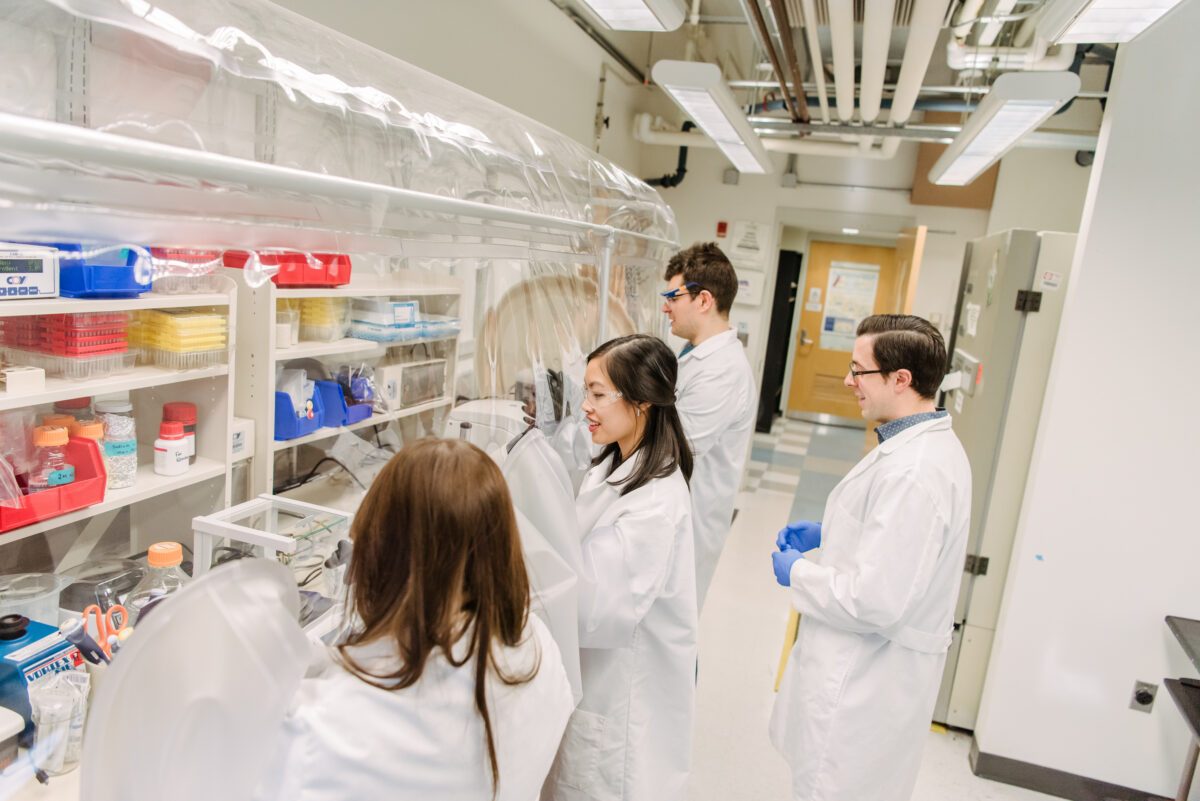
Aaron Smith (right) works in his laboratory with students at the chemical fume hood. (Marlayna Demond ’11/UMBC)
After that realization, Smith and Van took a new approach. In the lab, they added the raw materials for creating iron-sulfur clusters to a solution with ATE1, and the results showed that ATE1 did indeed bind the clusters. “This looks promising,” Smith remembers thinking. “We were super excited about it.”
The fact that the enzyme binds the clusters at all was interesting and new, “but then we also asked if that’s affecting the enzyme’s ability to do what it does,” Smith says. The answer, after more than a year of additional experiments, was a resounding yes. In the process, Smith’s group also determined the structure of ATE1 in yeast (without the cluster bound to it), which they published in the Journal of Molecular Biology in November 2022.
Subtle but significant
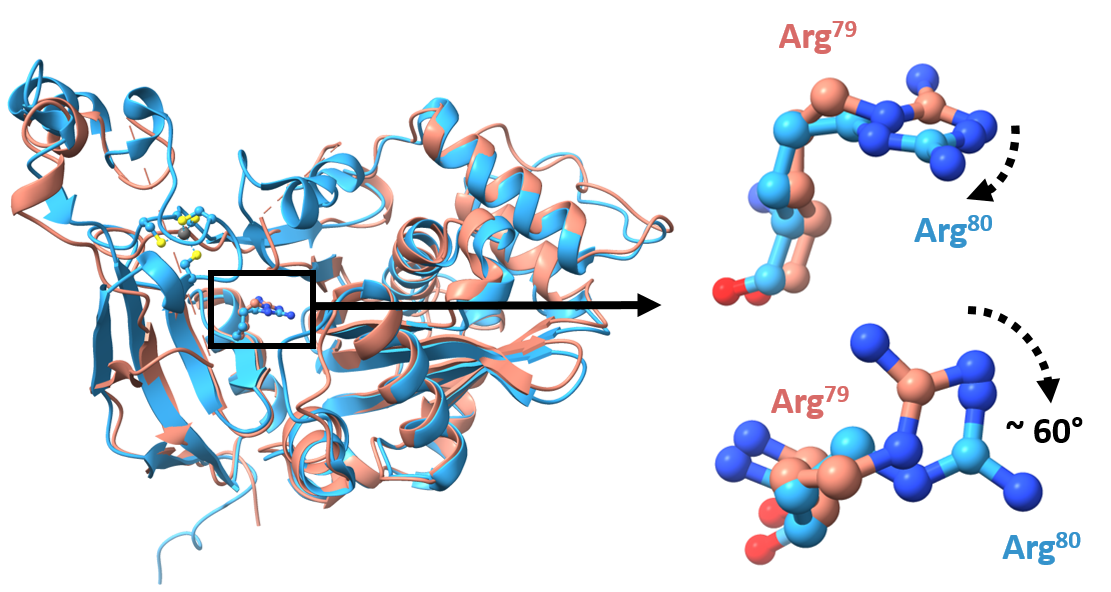
Around the same time, another group also published a slightly different ATE1 structure. The other group’s structure had a zinc ion (another metal) bound in place of the iron-sulfur cluster. With the zinc in place, one key amino acid is rotated about 60 degrees. It might seem inconsequential, but Smith believes that rotation, which he presumes is similar with the cluster, is the key to the cluster’s role in ATE1’s function.
The rotated amino acid is directly adjacent to where a protein would interact with ATE1 to be modified, ultimately flagging it for degradation. Changing the angle of that amino acid changes the shape of the location the protein would bind “very subtly,” but changes its activity “more than subtly,” Smith says.
The representation of ATE1’s structure as determined by Smith’s team is on the left. The inset shows how a particular, key location in the enzyme differs if it is bound to a zinc ion (bottom), as in another research group’s structure, or not bound to any metal (top, Smith’s team’s structure). (Figures from Smith’s 2022 paper in Journal of Molecular Biology on the structure of ATE1)
Looking ahead and looking back
Smith would also like to explore how other metals, beyond zinc and the iron-sulfur cluster, may affect the enzyme’s activity. Additionally, his lab is working to determine the structure of ATE1 in an organism other than yeast and to confirm the ATE1 structure with an iron-sulfur cluster bound.
All these steps will build up a clearer picture of how ATE1 functions and is regulated in the cell. Smith also says he believes proteins that so far have not been shown to bind iron-sulfur clusters may indeed rely on them.
This new paper actually harks back to Smith’s first days at UMBC. He has always been interested in protein modifications, and adding arginine is a more unusual one. “It’s always something that I had filed back in my mind, and thought, ‘Oh, it would be really interesting to get a better understanding of how that works,’” he says.
Several years later, his group is now on the leading edge of discovering how arginine modifications influence cellular function and disease.
On a brisk but clear day in early December, half a dozen brightly colored weather balloons barely squeeze through the double doors of Sondheim Hall’s lower level one by one.
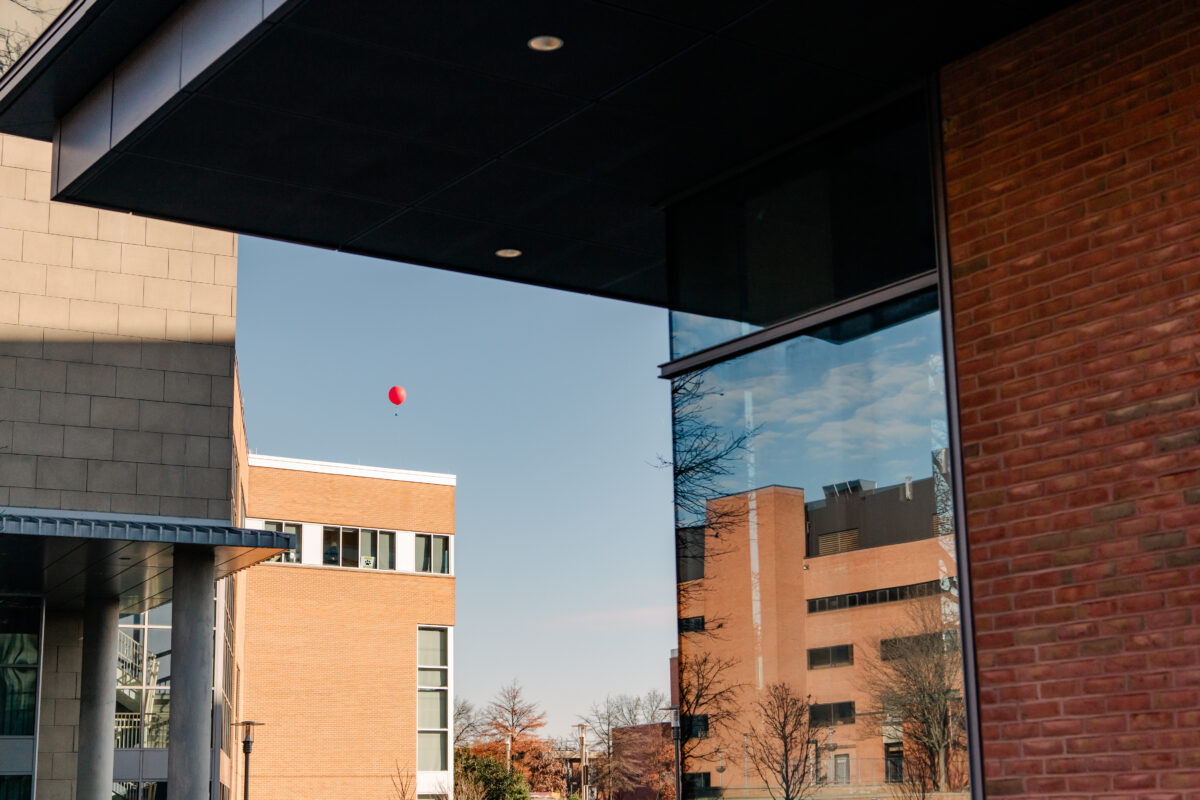
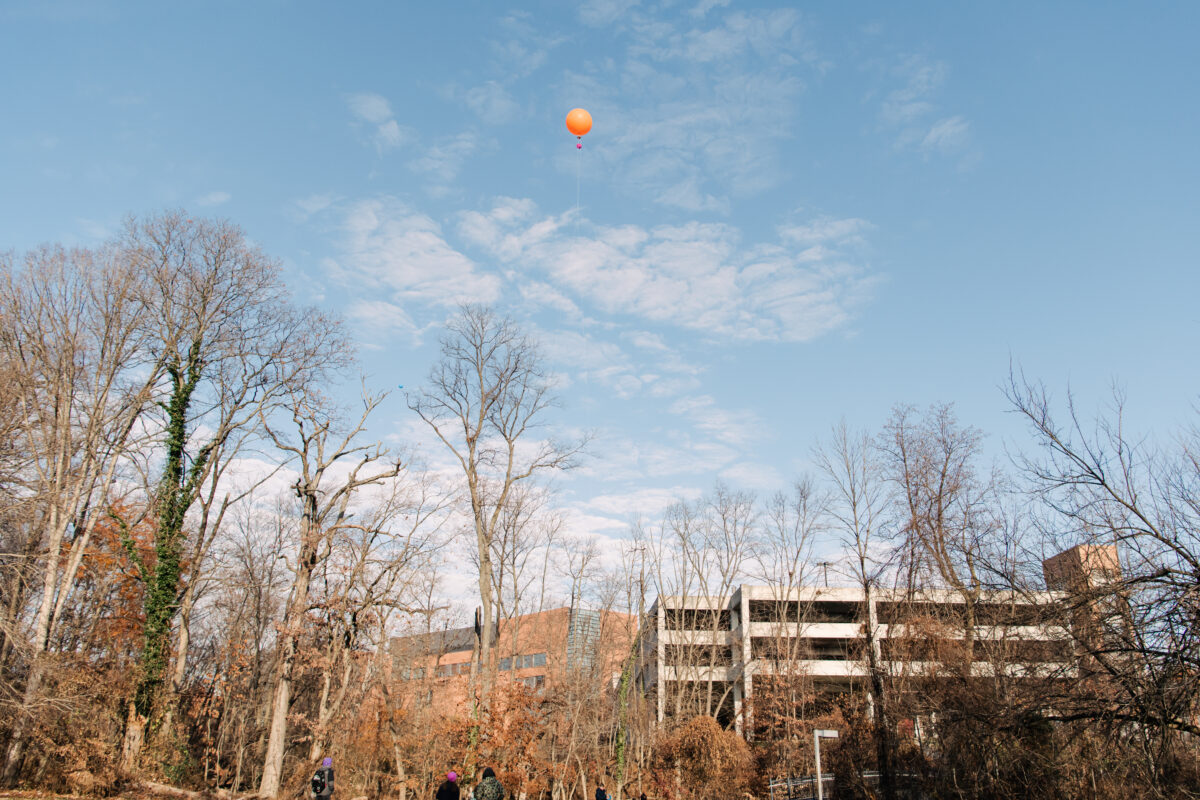
A group of four or five students handles each balloon, proceeding to the quad in front of the Interdisciplinary Life Sciences Building in a makeshift parade. A red balloon rises aloft as a demonstration, and then the remaining groups fan out across campus to follow suit. By 9:30 a.m., anyone walking across campus can see colorful dots hundreds of feet high, tethered by ropes that each end at a student on the ground.
This is the peak experience of GES 286, “Exploring the Environment: A Geospatial Perspective.” The course is structured around various data gathering projects, explains Charles Kaylor, the instructor and director of GIS (geographic information systems) and cartography labs in the department of geography and environmental systems (GES). “We use the campus as a laboratory,” he says.
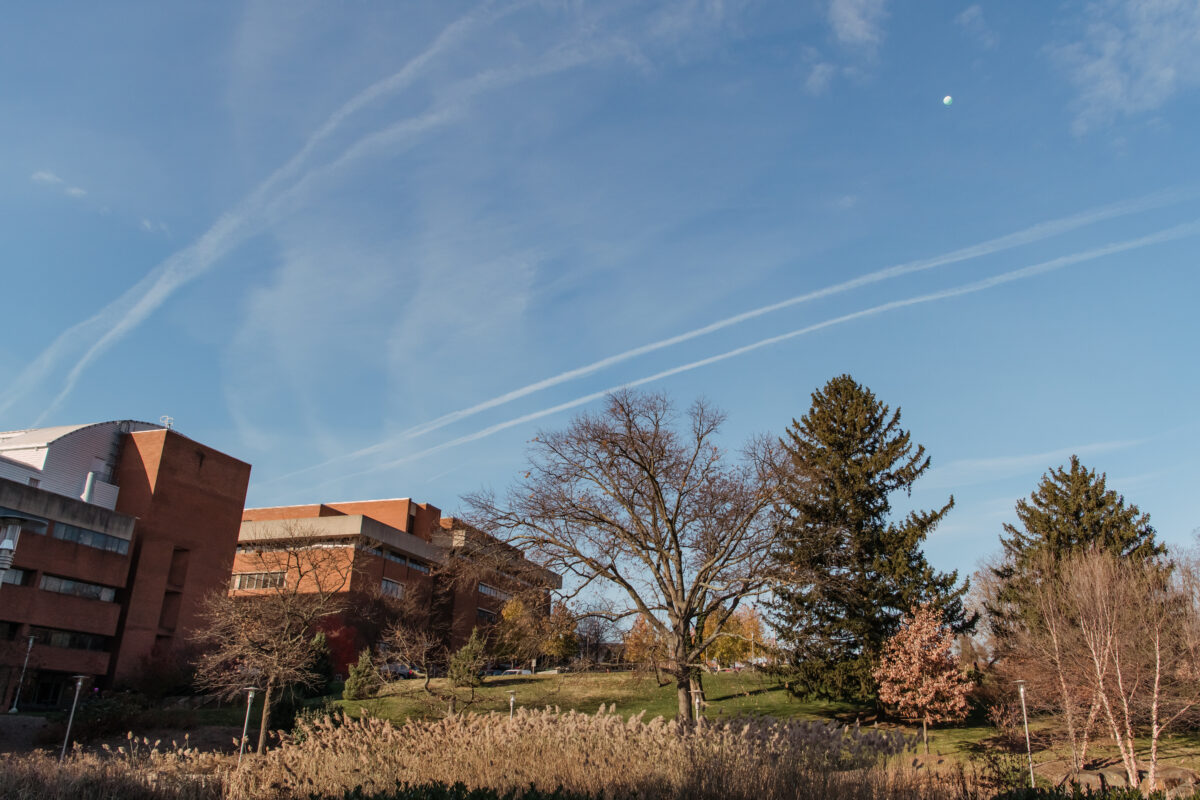
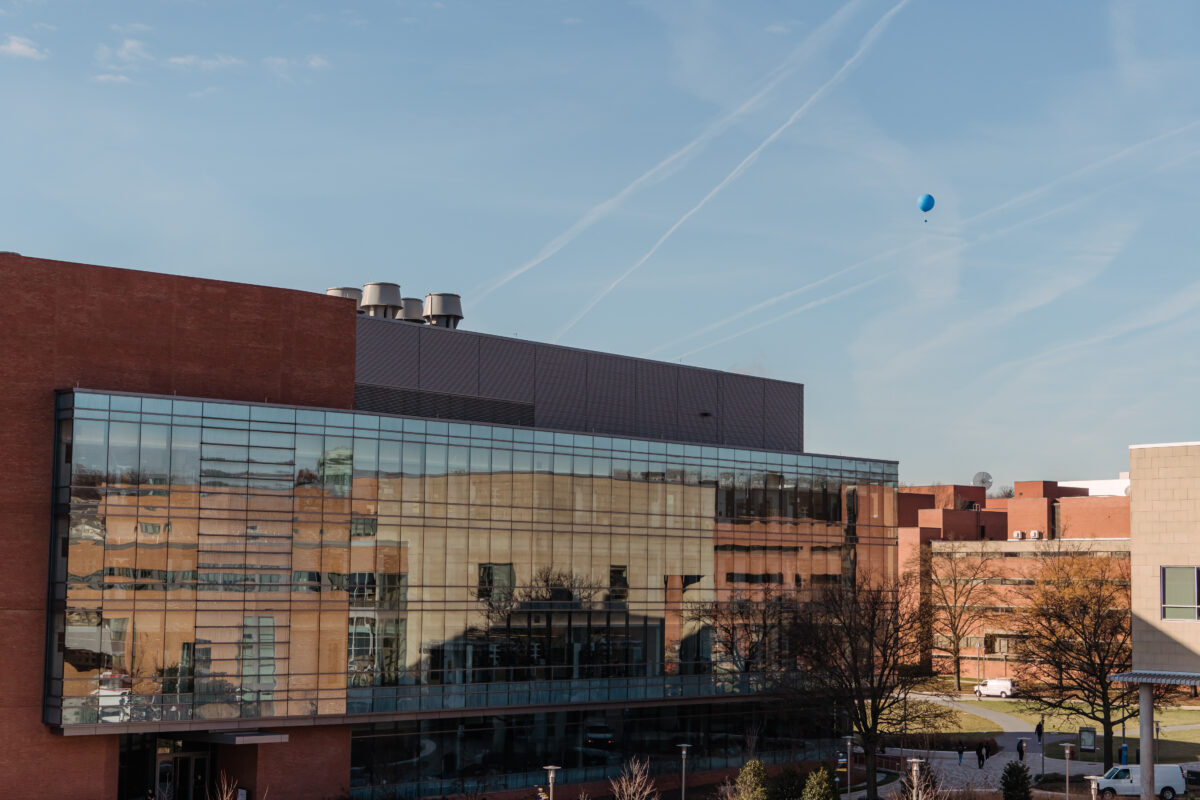
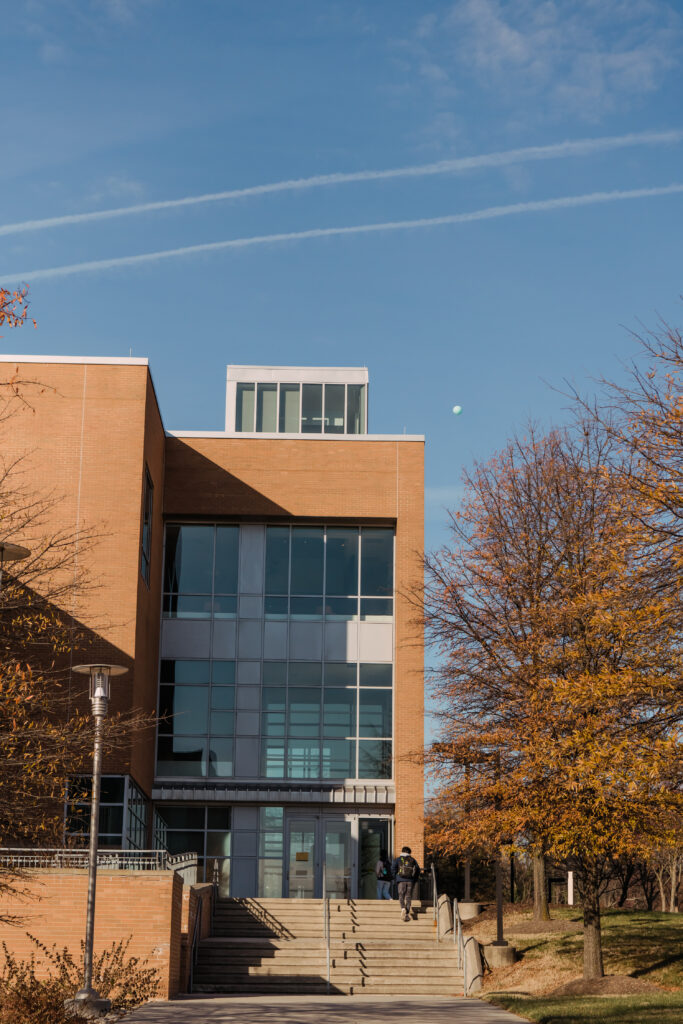
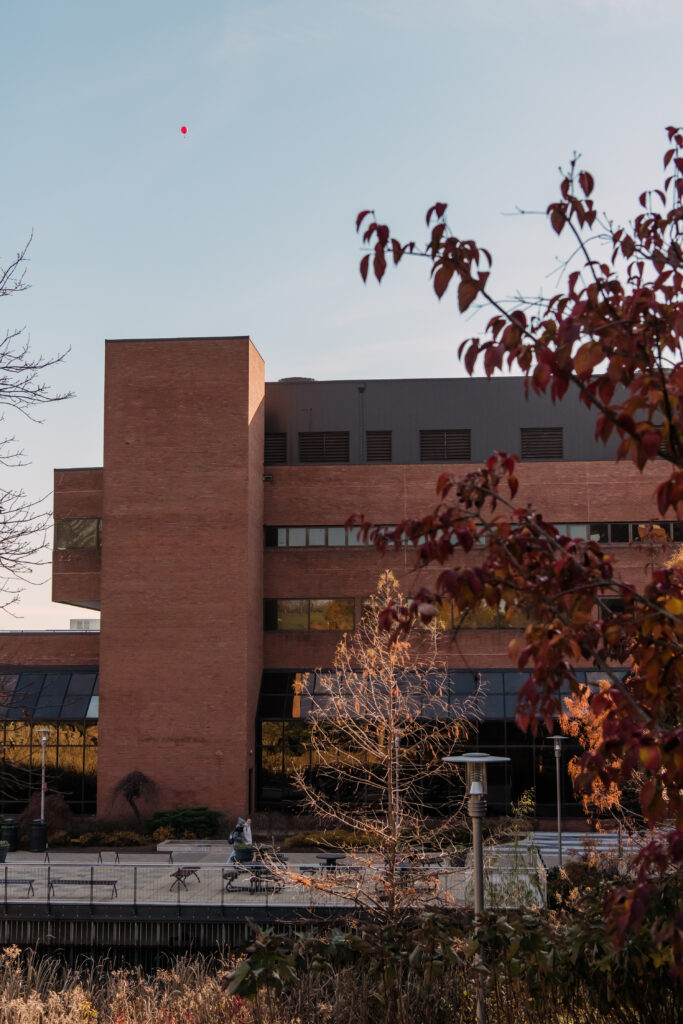
On “balloon day,” the balloons are visible from all over campus. (Marlayna Demond ’11/UMBC)
“Where are we?”
Kaylor opens the first class with a deceptively simple question: “Where are we, and how do we know that?” After beginning with a basic orienteering activity (no smartphones allowed!), the course advances through the surprisingly complex answer to Kaylor’s question, which leads students to develop skills in statistics, data analysis, and various software programs. They also pick up knowledge in disciplines like ecology, sociology, and hydrology.
Given its interdisciplinary bent, the course attracts students from a range of majors, most often those in the GES department (like environmental science) and computer science. With a background in GIS and environmental education, Kaylor is a perfect fit to teach the course to this mixed audience.
At the beginning of the semester, “computer science students will understand that it’s data science-driven. GES students will understand the hands-on sciences,” Kaylor says. By the end, “they’ll meet in the middle. It’s actually a really interesting blend of students to work with, and it’s fun to see how their strengths play off each other.”
Learning in real time
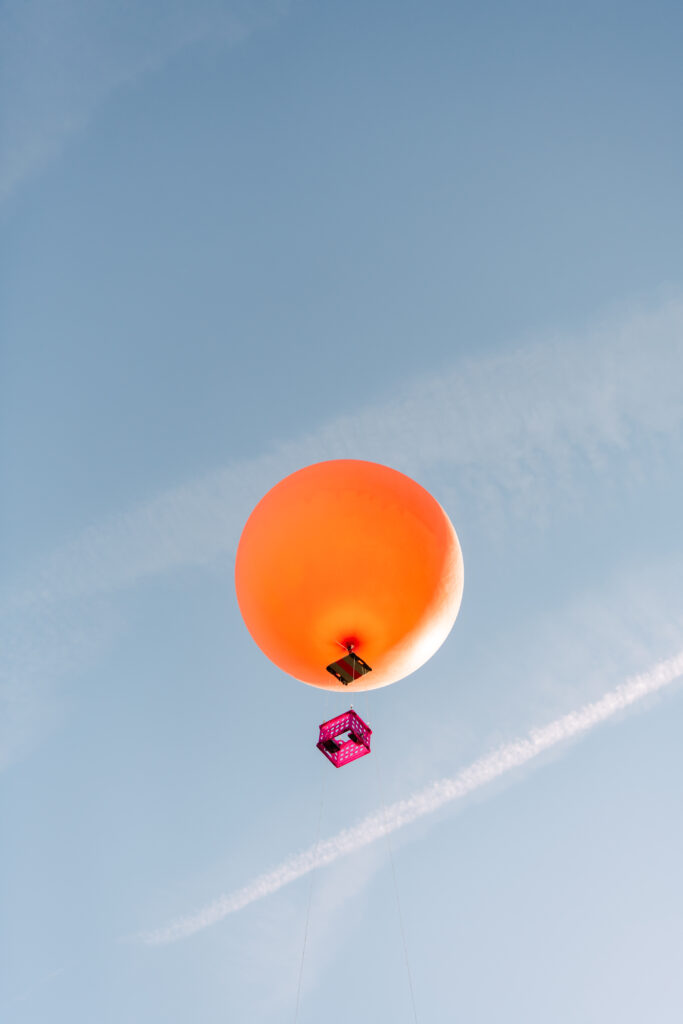
But back to the balloons. Each balloon flies with a digital camera attached, pointed at the ground. Previous students in the course coded a hack into the cameras that commands them to take a picture every 15 seconds as they float above campus.
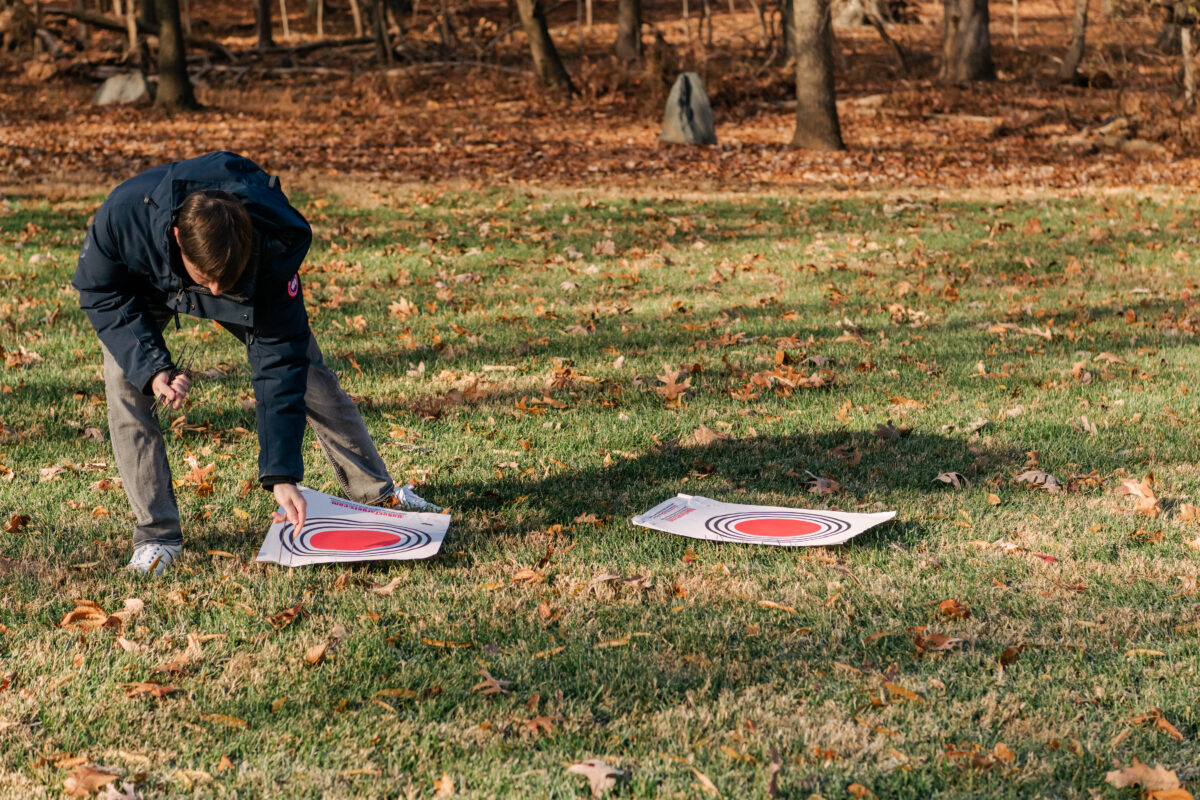
Far below, students lay what look like paper archery targets flat on the ground and record their precise coordinates using GPS. These targets will show up in the photos taken by the camera on the balloon. Using the targets as reference points, the students will then be able to “geolocate” (tie to a point on the Earth’s surface) other objects—like buildings, trees, even people—in the camera’s photos.
Matthew Parsons, computer science, sets reference targets on the ground. (Marlayna Demond ’11/UMBC)
Kaylor creates a blank digital map at the start of the morning to record the coordinates. “It’s fun to watch in the lab while students are out in the field doing it,” Kaylor says, “because it starts blooming. You see students adding points in real time.”
In what other class…
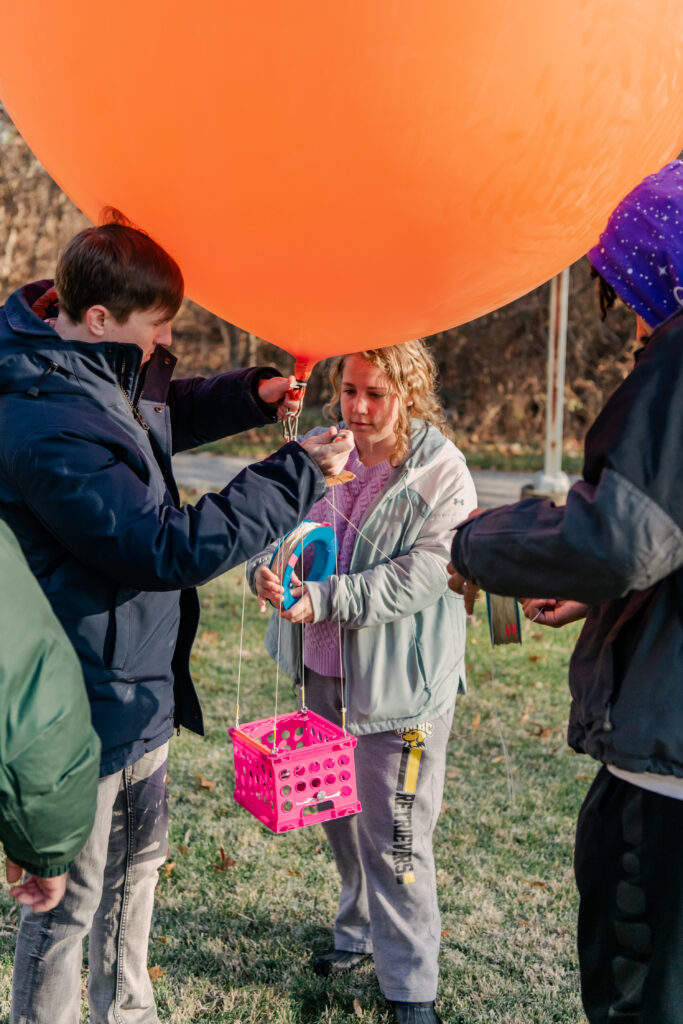
A pink crate dangling from the bottom of a balloon holds a small digital camera horizontal as the balloon flies. (Marlayna Demond ’11/UMBC)
The balloons have been a mystery to much of the campus community for years, with the colorful orbs dotting the campus sky in the tenth week of the semester. But for the students in Kaylor’s class, the balloons represent a culmination of the knowledge and skills they’ve gained.
Each student has their own reasons for taking the course. For some, it’s an opportunity to learn GIS skills—a must in the environmental field today—without spending too much time in front of a computer. As Kamsy Nwaiwau’23, geography and environmental systems, puts it, “What other class do you get to hold a balloon 450 feet in the air? It’s something different.”
Whereas Alex Flitter’23, mathematics and computer science, has a different perspective. He’s conducting research with Bedřich Sousedik, associate professor of mathematics, on how to model disease spread using ArcGIS—the same tool the students are using to locate points on the ground. GES 286 is “adding to my ability to visualize my research,” he says.
Learning openness
The course integrates a range of activities to get students thinking about how they could apply GIS to many fields of study. For one assignment, the students explore their own neighborhoods and mark the location of different businesses, like restaurants, pharmacies, and retail shops, and other neighborhood elements, like parks or bus stops. Then they use available data sets to see if they can identify associations with other neighborhood factors, like median income or education level.
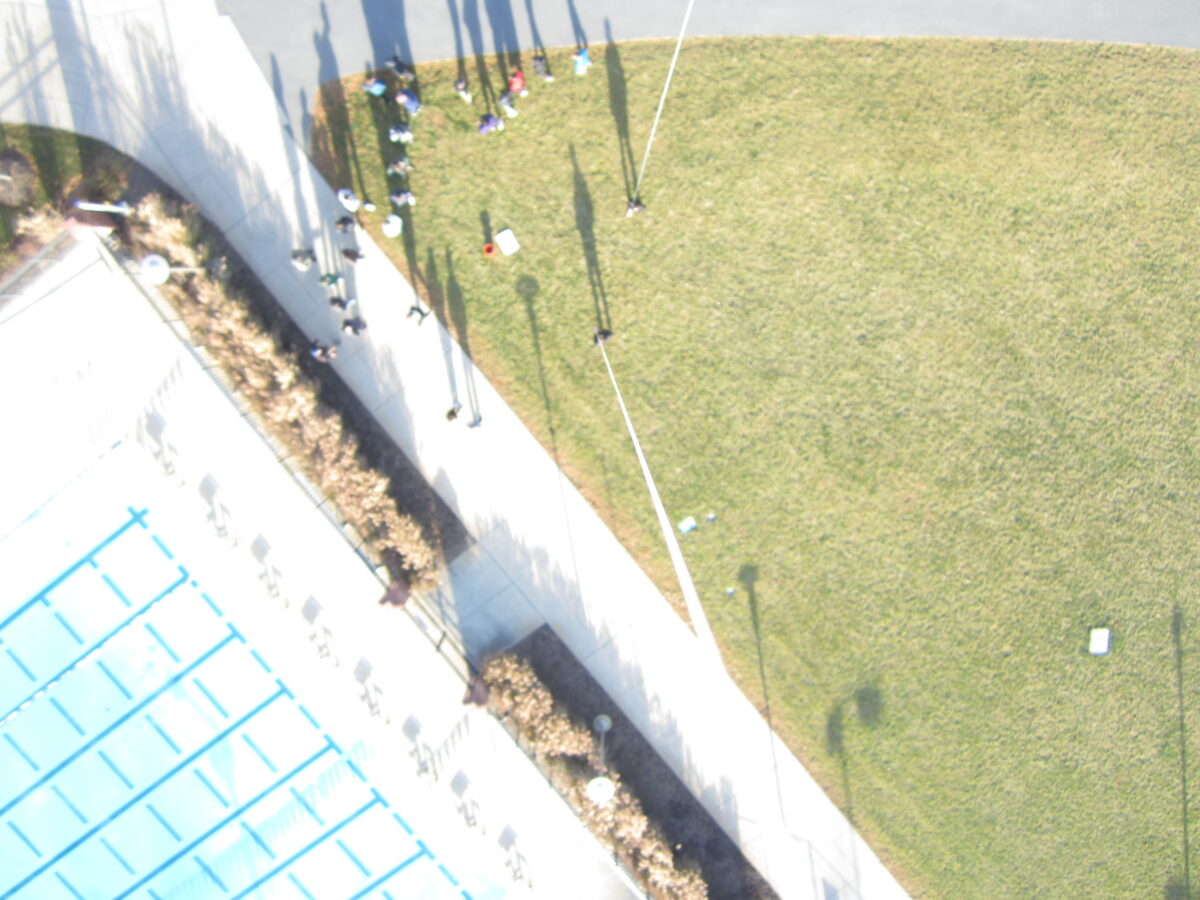
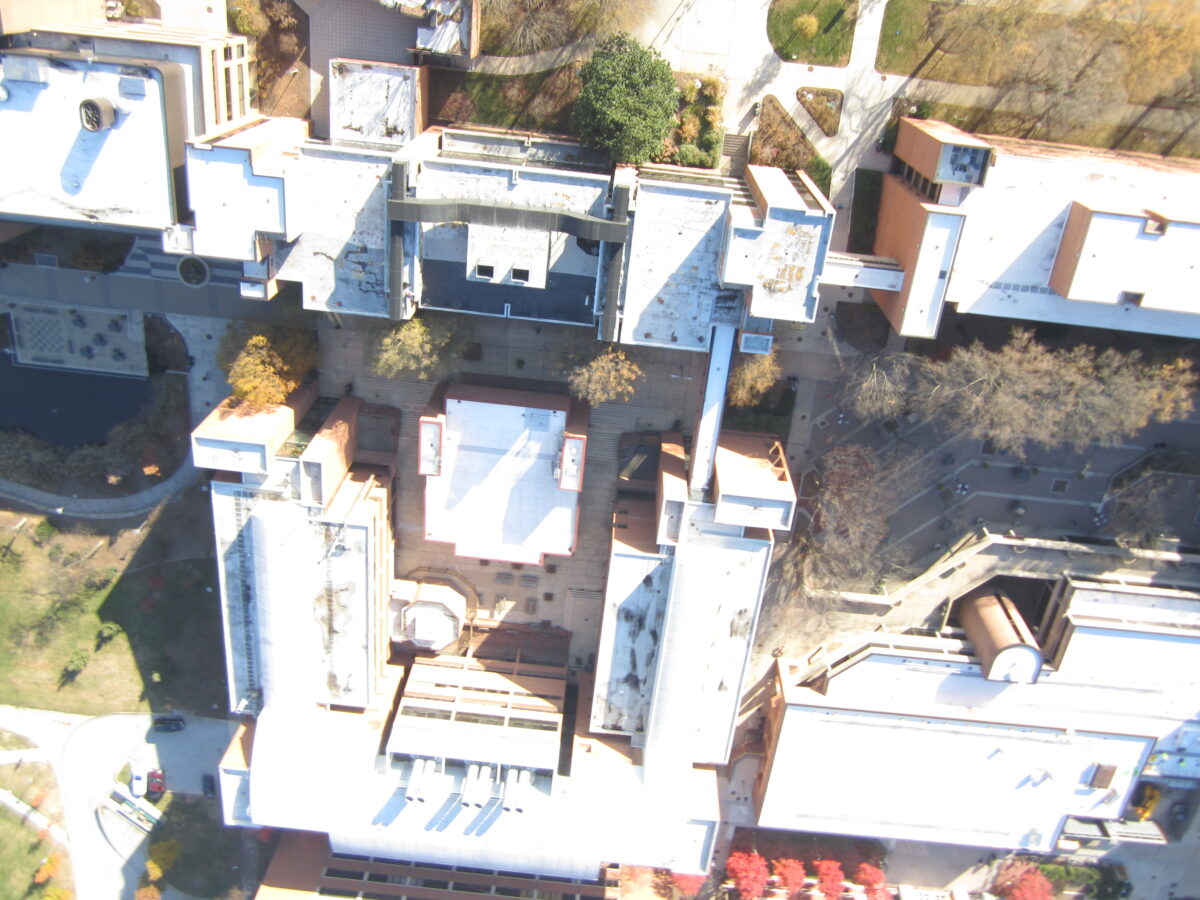
Images captured by one of the balloons. At left, the class gathers to observe the first balloon launch of the morning. (Images courtesy of Charles Kaylor)
This project “gets at the scientific process,” Kaylor says. He tells his students, “Any time a data set floats by, take a look at it and go, ‘What questions could I ask with this data?’ It’s a certain mode of openness.” Each in their own time, students get the idea. “What I love about GIS is—and you can count on it—any student who tries is going to have a GIS epiphany and start figuring things out,” Kaylor says, “and because it’s so applied and so tangible, it’s captivating.”
Making it real
This is Kaylor’s second time teaching the course after coming to UMBC from Temple University. He inherited the course backbone from Joe School, emeritus professor of GES, who still teaches the course in the summer. Kaylor has already made substantial changes, but has more in mind. One major goal is to create more opportunities for the students’ efforts to connect to real research projects.
“
“What I love about GIS is—and you can count on it—any student who tries is going to have a GIS epiphany and start figuring things out. And because it’s so applied and so tangible, it’s captivating.”
Charles Kaylor
Kaylor has already launched a collaboration with Facilities Management at UMBC to compare the latest data set of campus trees to the reality on the ground. So far, the students have checked about 10 percent of the listed trees, and Kaylor plans to add more each semester.
“I’m hoping to integrate more things like that, that have an obvious practical application or benefit to campus,” Kaylor says. “Since we’re measuring things on campus, we might as well see what we can do with that.” For example, Kaylor has discussed with Matthew Baker, professor of geography and environmental systems, how his students might be able to support Baker’s environmental monitoring work on campus.
Matthew Parsons, computer science, Olivia Amaral, computer science, and Langston Smith, GES, attach the camera to their balloon and prepare for launch. (Marlayna Demond ’11/UMBC)
No matter what direction they go—whether epidemiology, ecology, or other fields—students who complete GES 286 will be better prepared to ask and answer useful questions about the world around them.
Teaching the class has been a rewarding experience for Kaylor as an instructor, too. The course “reconnected me with something that makes [GIS] live and breathe in a different way—a more exciting way,” he says. “Taking a more applied approach to it is a fun challenge. I’ve been having a great time teaching this class.”
Geography applies to everything
Finally, it’s time for the balloons to come down. As the students are wrangling them down and heading back to Sondheim Hall for a debrief, Joey Laiosa ’23, environmental science, shares that he previously worked in public safety as a dispatcher, then came back to school. He’s interested in conservation ecology, and using remote sensing to measure environmental health has particularly caught his attention.
“GIS is a really sought-after skill to have in a range of industries,” he says. That includes public safety, Laiosa says, where it could involve better pinpointing the location of an emergency in a complex environment like a construction site or an amusement park. “Geography applies to everything.”
Learn more about undergraduate research opportunities at UMBC.
The new director, Charles Ichoku, brings deep and well-rounded experience in Earth science research, at NASA, and in student development programs—exactly the elements GESTAR II brings together and hopes to expand upon. Ichoku comes to GESTAR II from concurrent roles as professor of Earth and environmental sciences at Howard University and as the Distinguished Scientist of the National Oceanic and Atmospheric Administration (NOAA) Cooperative Science Center in Atmospheric Sciences and Meteorology (NCAS-M). Prior to that, he served at NASA Goddard Space Flight Center in Greenbelt, Maryland for 20 years in various research and management roles.
“Dr. Ichoku brings impressive credentials to this important leadership position at UMBC, not only as a world-class scientist, but also as a long-term NASA-based scientist and program manager,” shares Karl V. Steiner, Vice President for Research and Creative Achievement at UMBC. “He is a perfect fit for both GESTAR II and UMBC.”
Earth science from hundreds of miles up
Ichoku’s research program focuses on applying remote sensing—collecting data from a significant distance, most often from satellites orbiting Earth—and other data to study large-scale processes that affect the environment on land, weather, and air quality. In addition to directing GESTAR II, Ichoku will have an appointment as professor of geography and environmental systems (GES) at UMBC, where he will continue to conduct research, mentor students, and teach courses.
“GES is a good fit,” Ichoku says, “because I’m not just looking at developing the approaches and instrumentation to measure specific parameters, but I’m interested in how you apply the data, knowledge, and science to actually understand phenomena that happen on the ground and in the atmosphere.”
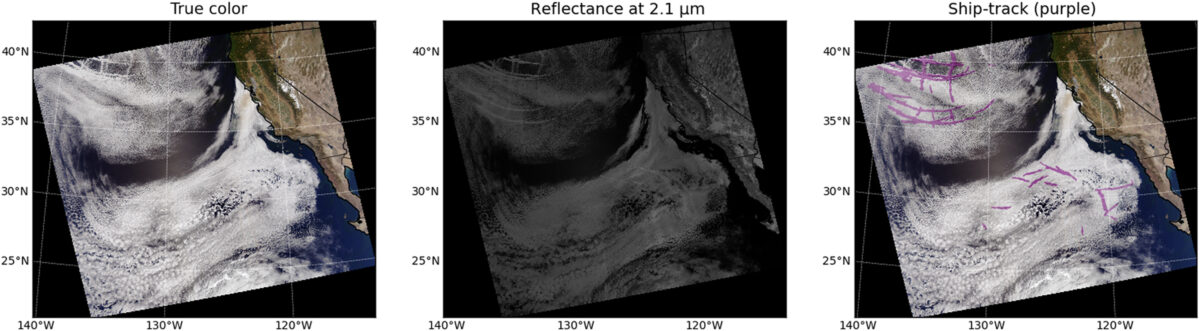
An image collected by NASA’s MODIS satellite of the U.S. West Coast (left) shows tracks of air pollution generated by shipping traffic (purple lines, right), which was detected by a GESTAR II research team’s algorithm.
Elevating African research
Ichoku’s work is influenced by his youth in West Africa, and focuses on phenomena that especially affect that region. For example, frequent agricultural fires send various particles into the atmosphere, which can affect air quality, precipitation, and more. In addition, Lake Chad in Central Africa has nearly dried up over the last few decades in part because of severe drought, resulting in widespread conflict and suffering. Drought also sends dust and other particles into the atmosphere, affecting air quality. These particles and other environmental components (like clouds) interact with radiation from the Sun, driving processes that can adversely impact human life on Earth’s surface, Ichoku explains.
“I’m very interested in seeing research and the application of its results improve in Africa overall, but in particular in Western and Central Africa,” Ichoku says. “So I hope to be able to continue research in that region.”
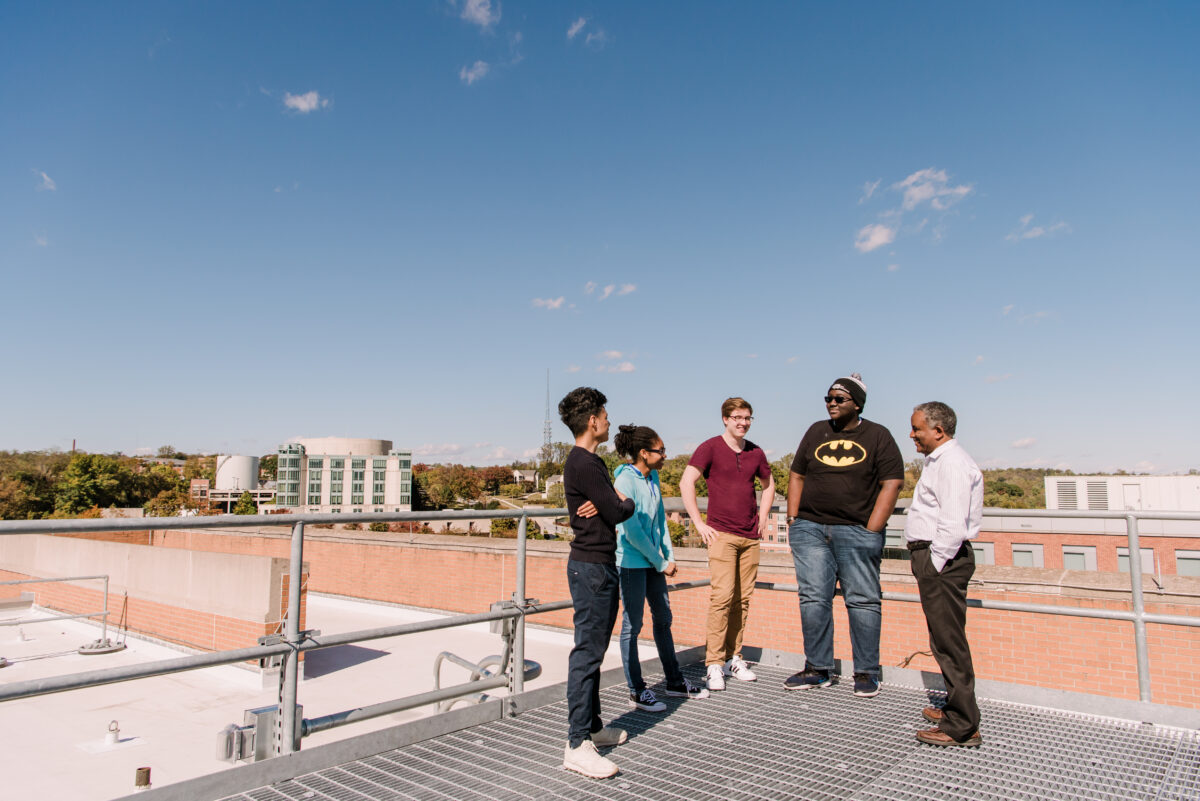
Belay Demoz, right, talks with students on the roof of the UMBC Physics Building. (Marlayna Demond ’11/UMBC)
To that end, a few years ago Ichoku joined with colleagues to initiate the U.S.-West African Coastal Resilience Research Consortium (CRRC). In addition, he recently played an important role in the inauguration of the African Meteorological Society (AfMS), where he serves as chair of the Diaspora and Friends of Africa Committee. The committee involves a significant number of colleagues who are similarly passionate about the advancement of scientific research and applications in Africa.
Those colleagues include GESTAR II’s inaugural director, Belay Demoz, whose research is similarly inspired by experiences with drought, displacement, and resulting conflict during his youth in East Africa—challenges that continue today. Demoz, professor of physics at UMBC, will continue in his departmental role after Ichoku takes up his post.
Demoz notes Ichoku’s extensive experience with Howard University (which is also a partner in UMBC’s Center for Space Sciences Technology) and at NASA as strengths, and shares his interest in expanding UMBC’s research and education efforts in Africa. “I’m looking forward to him leading the next iteration of GESTAR II, and increasing involvement of GES in what we do,” Demoz says.
Clearing the pathway for students
In addition to his own research, Ichoku has demonstrated a deep commitment to student research and success throughout his career. He moved from NASA to Howard and NCAS-M so he could focus more on student training, particularly supporting underrepresented minority students in Earth science.
With NCAS-M, on top of his typical professorial duties, Ichoku was responsible for matching students with appropriate research projects and NOAA mentors across 13 institutions. He also supported students’ success throughout their graduate projects, ensuring they persisted to graduation and were prepared to be competitive for sought-after professional roles, often at NOAA, NASA, or in academia.
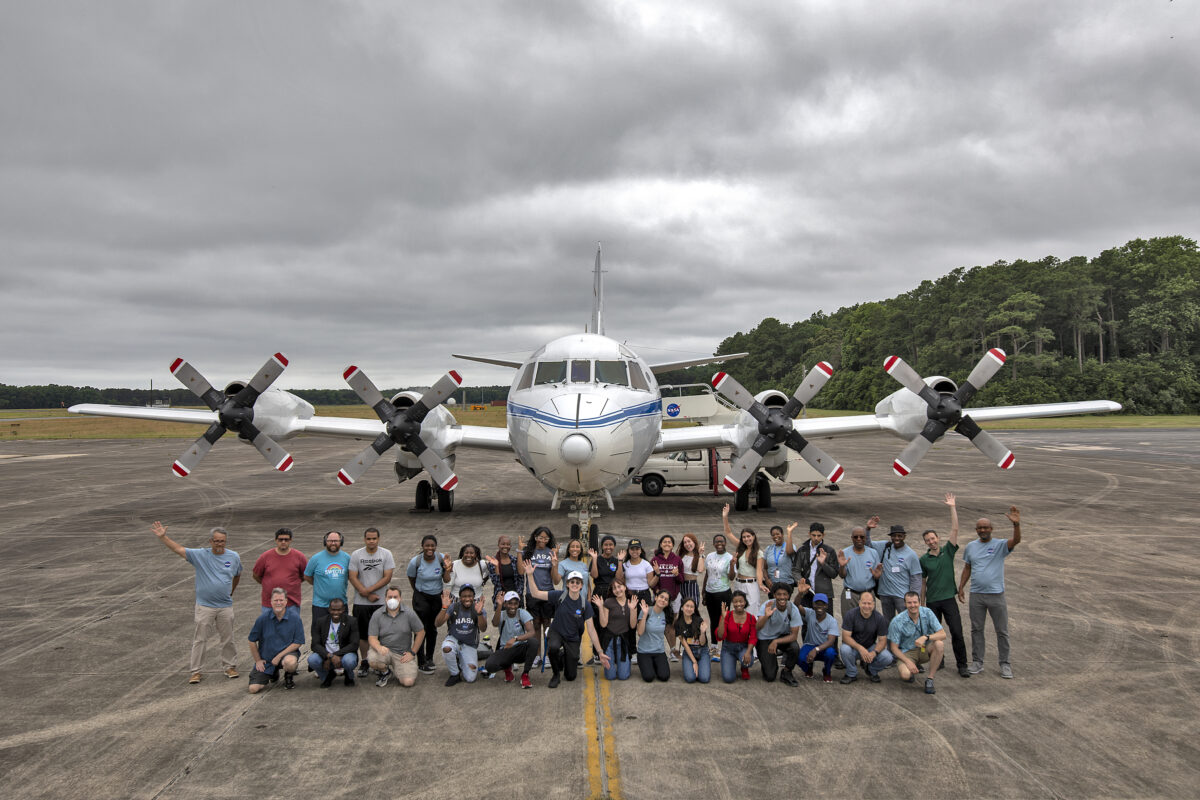
Participants in the 2022 SaSa program at NASA Wallops Flight Facility. (Image courtesy of Belay Demoz)
Now at GESTAR II, Ichoku is interested in continuing to enhance the connection between researchers, who often conduct their work at Goddard Space Flight Center, and members of the larger UMBC community—including students at all levels.
“I think it’s a good thing for a researcher to connect with students. Even if they are not teaching them in a traditional class setting, they can be mentors for interns, which I did myself for many years while I was at NASA as a research scientist,” Ichoku says. “I know that our faculty have a lot to offer to our students, so I will do my best to help facilitate that. My role will be to support the clearing of the pathway and the removal of any obstacles.”
A shining example
Ichoku also brings to GESTAR II and UMBC substantial experience in deepening relationships across institutions. He already has relationships with the scientific leads at other GESTAR II institutions, such as the Pennsylvania State University, Arizona State University, and University of Colorado Boulder, and is excited to continue working with them in a new capacity.
“When we start talking, ideas will flow,” Ichoku says. “We will then synthesize the ideas into strategic initiatives and make them happen.”
Moving forward, Ichoku plans to continue to emphasize top-quality research while enhancing opportunities for students and building bridges between the GESTAR II institutions. And he is especially looking forward to doing all of that at UMBC.
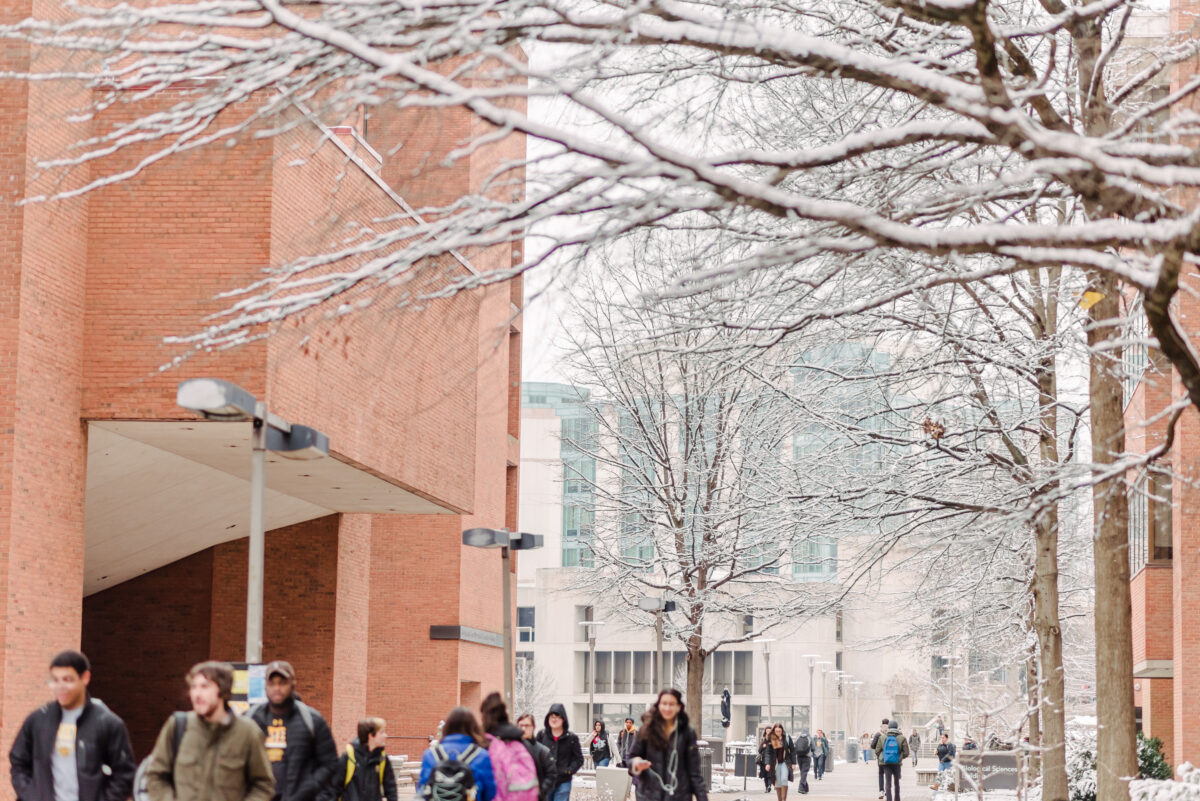
Students bustle through UMBC’s Academic Row on a winter day. (Marlayna Demond ’11/UMBC)
The opportunity to lead GESTAR II “is both a great pleasure and an honor for me, as I have always admired UMBC for being a shining example in all areas of university performance, including education, scholarship, research, innovation, technology, diversity, sports, environmental sustainability, and community outreach,” Ichoku says. “I am proud of UMBC for attaining the status of Carnegie R1 Doctoral Institution.”
“It is also a great blessing to have this wonderful opportunity to contribute to scientific discoveries and knowledge expansion for human advancement through NASA, and, in particular, Goddard Space Flight Center,” he adds. “I feel highly privileged to be involved in a program that connects two of the organizations that perform at the highest levels in their respective domains of activity, namely academia (UMBC) and space (NASA).”
Tagide deCarvalho, director of the Keith R. Porter Imaging Facility in UMBC’s College of Natural and Mathematical Sciences, produces artistic images that reveal microscopic life in vivid, thought-provoking ways. Her work combines her skill at the lab bench and behind the microscope with her artist’s eye, and it continues to earn her accolades worldwide.
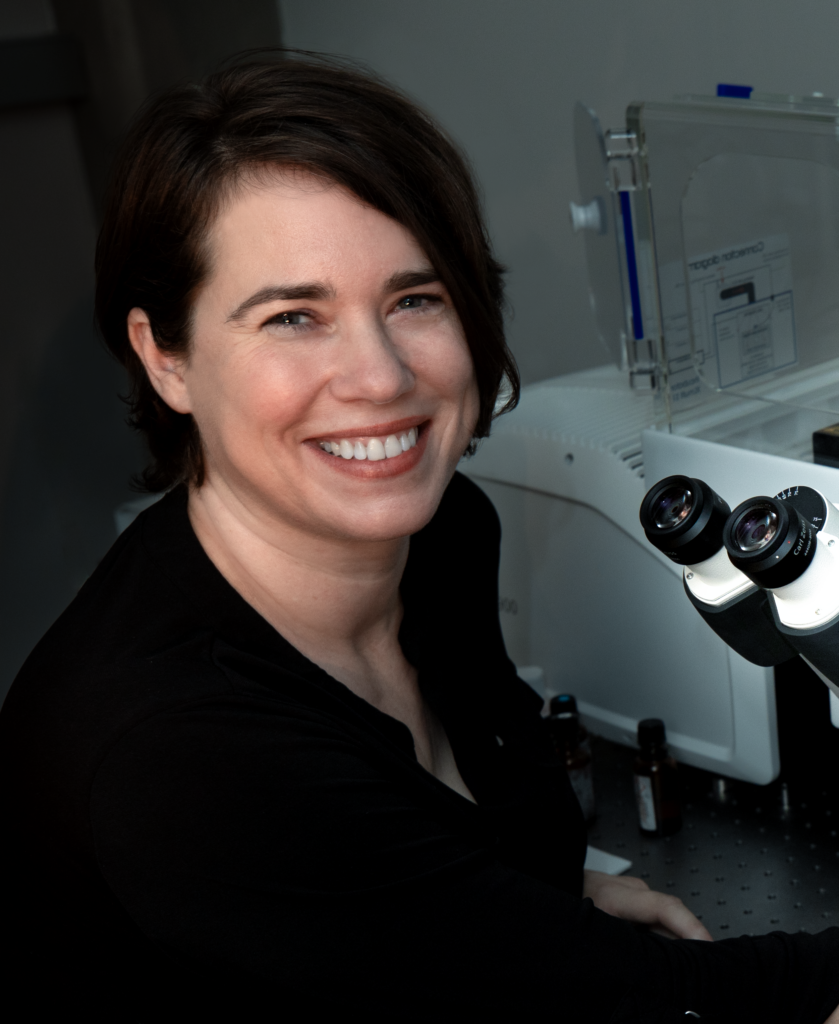
Tagide deCarvalho in front of a confocal microscope in the Keith R. Porter Imaging Facility at UMBC. (Melissa Cormier/UMBC)
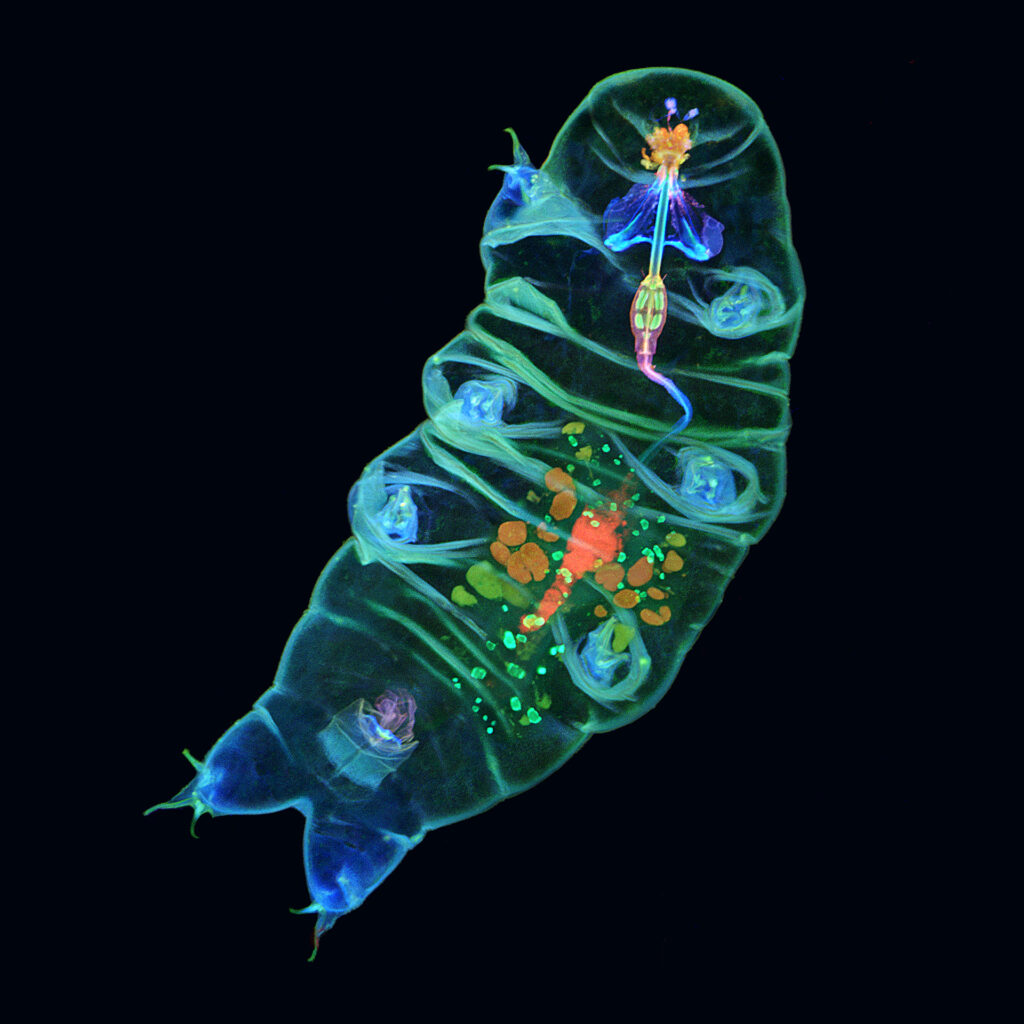
“We use their equipment. I’m a big fan of their instruments, so it was nice to be recognized by that company,” deCarvalho says of the Zeiss award. The winning image portrayed bacteria that she scraped from her own tongue. At the time, she simply needed a quick sample to test some new materials for preparing specimens in the lab. Only later did she decide to refine the image into something beautiful.
“My superpower is finding everyday specimens and making them glamorous,” deCarvalho says, a bit tongue in cheek. She recently learned that her images will now reach a larger audience than ever before.
Putting her stamp on the art world
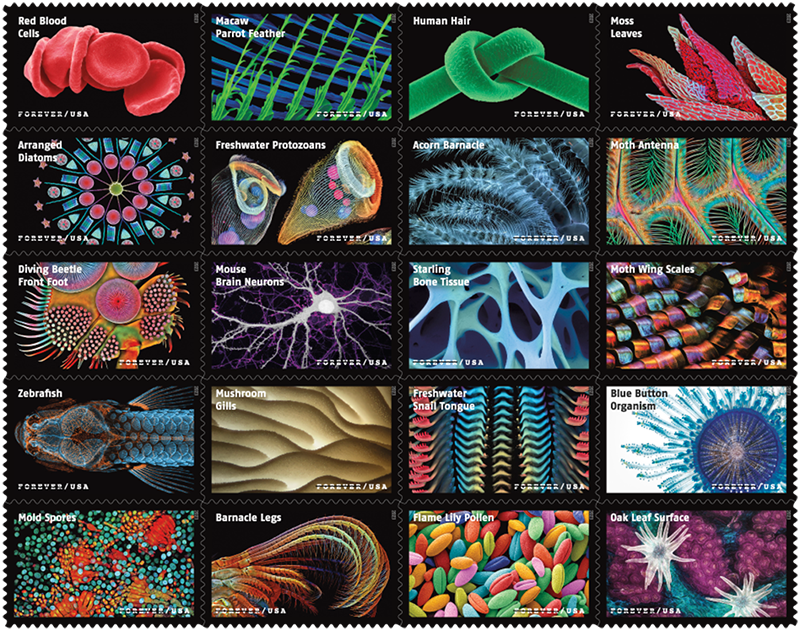
This summer, deCarvalho received an exciting request: An art curator wanted to include two of her images in an upcoming collection—except this was no typical art exhibit. A United States Postal Service (USPS) curator wanted to include deCarvalho’s work in a stamp collection featuring microscope images. USPS officially announced the “Life Magnified” collection in December, and the stamps will become available later in 2023.
The USPS recognition holds special significance for deCarvalho, whose grandfather collected stamps. When he passed away, deCarvalho inherited his collection. Her grandfather was a physician-scientist, and deCarvalho enjoyed looking through his microscopes as a child. He always told his granddaughter she would be a scientist one day.
The “Life Magnified” stamp series, set to be released later this year. deCarvalho’s images are the Moss Leaves (upper right) and Mold Spores (lower left). (Image courtesy of U.S. Postal Service)
deCarvalho has had a lifelong interest in art, too, and began her academic career as an art photography major. As an undergraduate, she wanted to learn to use microscopes to create art in a biological context. To that end, she worked for a faculty member at the University of New Mexico School of Medicine creating transmission electron microscope images.
The professor was thrilled to work with a student who already knew how to develop film—the hardest thing to teach, and something deCarvalho had been doing for years in her own darkroom. In the lab, she started to learn techniques essential to her work today, but she never got to put her artistic talents to work. Instead, deCarvalho launched a scientific career, fulfilling her grandfather’s prophecy and eventually landing at UMBC in 2016.
Once she arrived at UMBC, art finally returned to her life. “Suddenly I realized I could do it,” deCarvalho says. “I’d say it was about 20 years later. I came full circle.”
Creating art, informing scientific research
The process of creating an artistic microscope image begins the exact same way as creating a research image. It’s only the post-processing that differs, deCarvalho explains.
“I take things further than what might be considered ethical for a research image, where there are clear guidelines as to what you can do,” she says. In a research image, “You can’t manipulate the image to alter any of the content.” For her art, she removes distracting elements like debris around the main specimen, and emphasizes the specimen’s key elements in a way that makes it more visually engaging.
Her modifications “allow you to focus your attention on [the specimen] more, and to find it more aesthetically pleasing,” explains deCarvalho. She believes this makes viewers “more interested in the content than you would be if I hadn’t slightly altered it,” she says. “I think it makes it more compelling.”
Her artistic work can still inform scientific image production. “I push the limits of my expertise by doing these art images,” deCarvalho says. “I can bring some of the experience and new techniques that I learn in doing that back to the research. It goes both ways.”
Tagide deCarvalho’s winning image of a tardigrade, or “water bear.” Tardigrades are approximately one millimeter long. (Image courtesy of deCarvalho)
For example, for the winning tardigrade image, “I came up with that staining just to create that pretty picture, and I’ve had tardigrade experts all across the world and people that use tardigrades in classrooms ask me for my technique, because they could see structures stained that they weren’t able to see before with the traditional staining techniques,” deCarvalho says. “So it informed research, just from me trying to make a nice picture.”
Public art, amplified
One of the images selected for “Life Magnified” features moss that deCarvalho scraped off the exterior of the UMBC Biological Sciences Building. “I feel like it’s kind of an homage to UMBC that one of the samples was taken right off the building,” she says.
When asked about her motivations for turning microscope images into beautiful works of art, her answer was simple. “It’s super cheesy, but I just get so excited when I see things under the microscope,” she says. “I look through the microscope, and I just think, ‘Wow, I can’t believe that’s real, and that it just looks so amazing.’” Her art, she says, is “a way to capture the excitement and share it with other people.”
In addition to the connections to UMBC and to her grandfather, having her work on stamps is special because it grants her images the ultimate visibility, she explains. Stamps “are like a public art museum,” deCarvalho says. “Each one is like a little piece of art—it’s the most public art form. So when USPS approached me, I thought, ‘This is the highest honor.’”
It’s rare to meet a mathematician who is also a bestselling novelist, but UMBC’s Manil Suri, professor of mathematics, is happy to be unique. Suri is the author of a famed trilogy named for Hindu gods, including The Death of Vishnu (2001), which was long-listed for the Booker Prize, The Age of Shiva (2008), and The City of Devi (2013). He recently published his latest book, The Big Bang of Numbers: How to Build the Universe Using Only Math, to global acclaim.
The Big Bang of Numbers is Suri’s first nonfiction book, written to show people who aren’t necessarily fond of math that the discipline is foundational to our world—and can even be fun.
“The concept is intriguing, if hard to get your head around: Can you understand the creation of the universe purely through basic mathematics?” writes The Washingtonian. Suri’s answer with The Big Bang of Numbers is a resounding ‘yes.’ The book “explores many areas of seemingly pure math that explain the natural world, from the shapes of galaxies and living creatures to weather, gravity, beauty, and even art,”Kirkus Reviewswrites.
In his role as math professor, Suri works hard to convince his students that math doesn’t just matter, it is also endlessly interesting—extending his instruction well beyond the basics of calculations and into the field’s fundamental ideas.
“All your life, you keep hearing that maths is all about calculations,” Suri toldTelegraph India, “while in essence, maths is all about ideas.” Suri first expounded on this theme in a 2013 New York Times op-ed, “How to Fall in Love with Math.” When the op-ed became shockingly popular, the idea for a book grew from there.
Manil Suri speaks about The Big Bang of Numbers at a special event to mark the book’s publication and success on November 14 at UMBC’s Albin O. Kuhn Library & Gallery.
A new challenge
With The Big Bang of Numbers, which the Wall Street Journal has called “imaginative and organized,” Suri isn’t just seeking to help a wider audience understand or feel comfortable with math, but feel a sense of fascination with it. According to the Mathematical Association of America, Suri’s approach—rich in humor and narrative elements—goes beyond “simply telling the reader about these ideas”; instead, he “allow[s] readers to experience the attitude of curious exploration that attracts mathematicians to the discipline, but is often absent from low-level math classes.”
“With evocative and engaging examples ranging from multidimensional crochet to the Mona Lisa’s asymmetrical smile, as well as ingenious storytelling that helps illuminate complex concepts like infinity and relativity, The Big Bang of Numbers charts a playful, inventive course to existence,” writes the Deccan Herald, which named the book its “read of the week” in mid-October.
For Suri, while the book was very different in some ways from his previous works of fiction, The Big Bang of Numbers hews closely to his style that relies on humor and engaging narrative to draw the reader into unfamiliar topics. His novels all take place in India, a place that feels far away and unknown to many of his readers. “After explaining India in three internationally released books to many readers who didn’t know much about the country, I was ready to take on an even bigger challenge,” he told Frontline, a major English-language magazine in India, “—explaining mathematics to a general audience!”
Manil Suri speaks at GRIT-X, an event during UMBC’s Homecoming festivities, in 2018.
Math as a game
“Usually math is thought of as something that we invent, perhaps, to explain things around us. I’m kind of reversing this perspective and saying that math is the true driver of the universe, and the universe itself is a model of the mathematical principles,” Suri recently told NPR’s Marketplace.
Put another way, the Sunday Times of London explains the central thesis of the book is that “maths, the creative language in which reality is written, is ‘the life force that drives the universe,’ and you could build one—stars, worlds, you and me—from scratch using maths alone.” The review notes, “It sounds intimidating, but Suri has a knack for clarity and a welcome habit of grounding tricky concepts in the tangible.”
In the end, according to Suri’s book, math is a “force that forever enthralls, not just through the answers it gives but also through the new mysteries it poses.” But he hopes his readers will also understand math as a game.
“For mathematicians, I suspect the most appealing characteristic of the subject is its playfulness,” Suri told Frontline. “Maths is a game in which you start with a bunch of rules and then deduce away to see where you can get. You can play it anywhere—in the shower, on the bus, while eating lunch—all you need is your mind.”
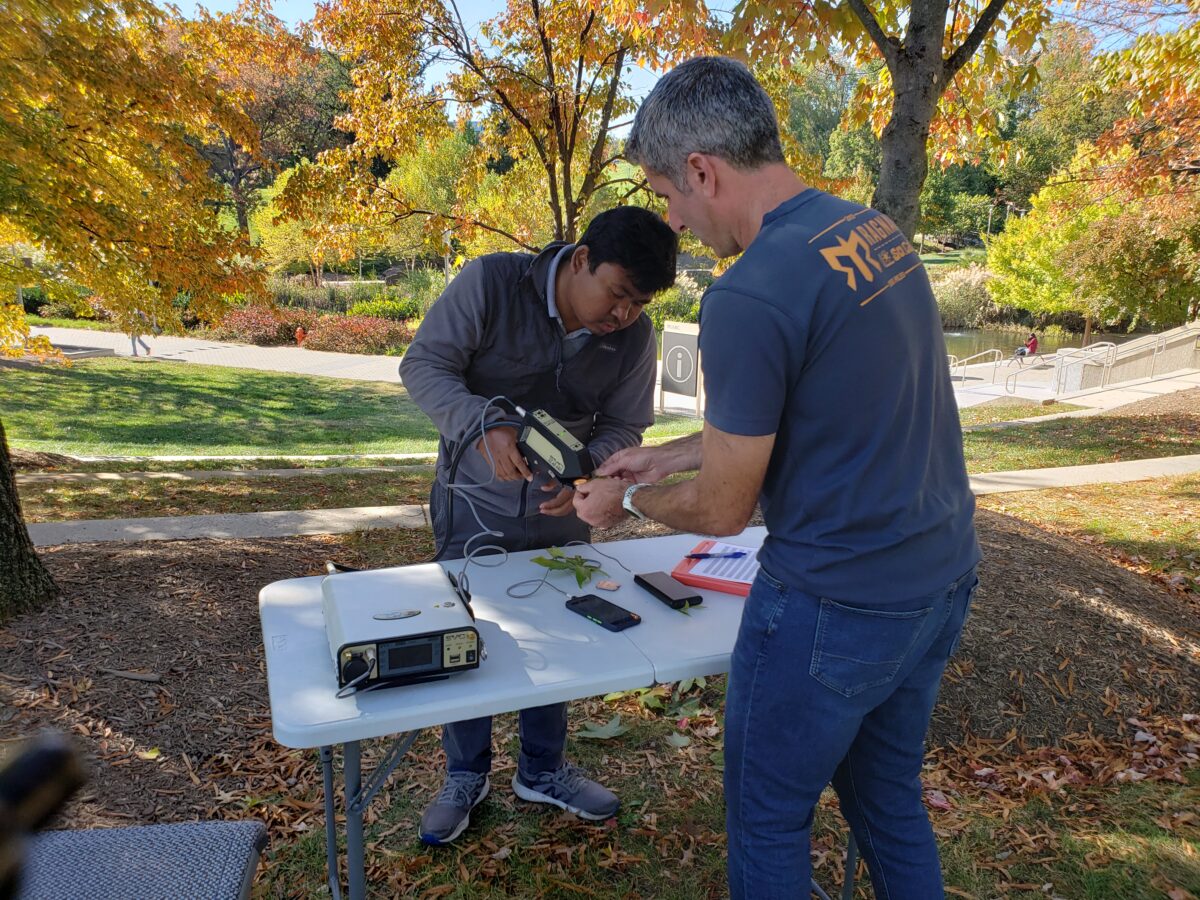
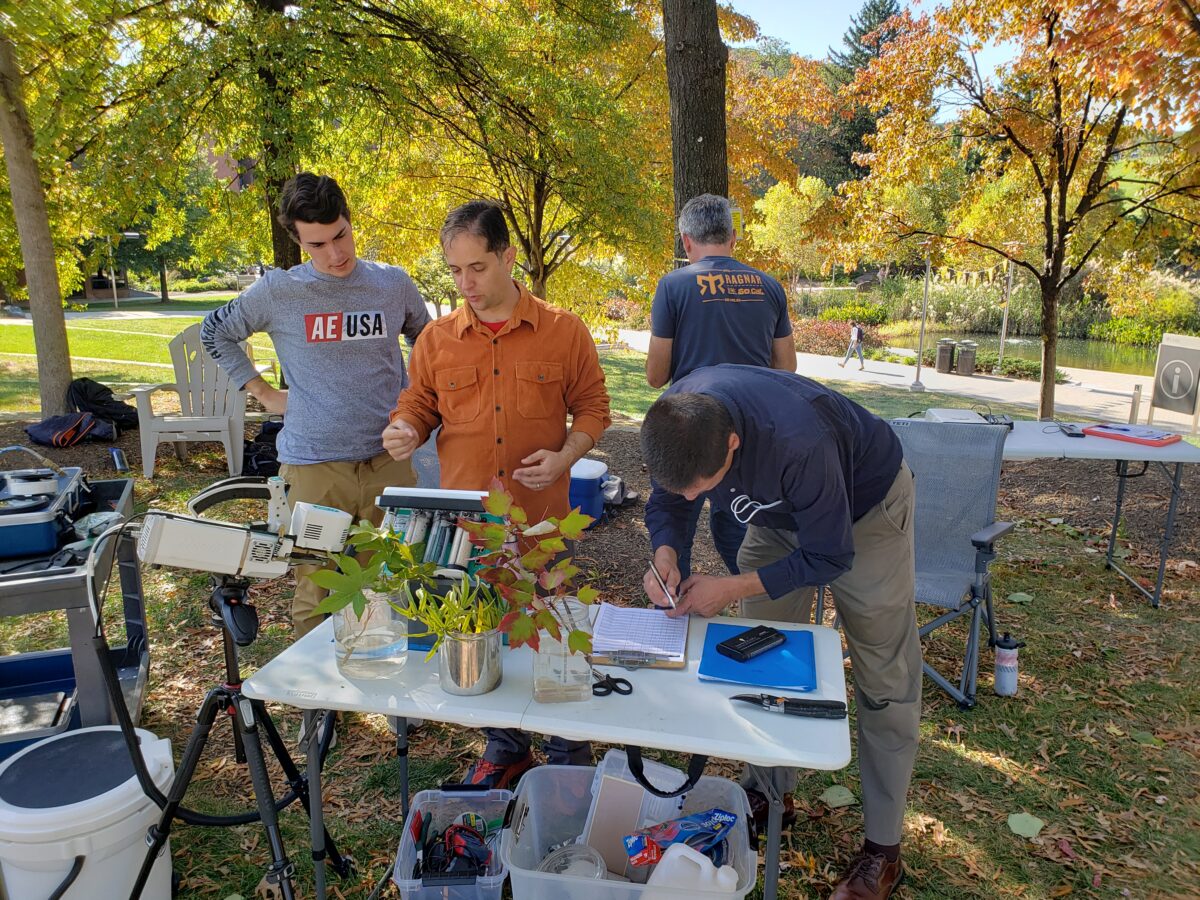
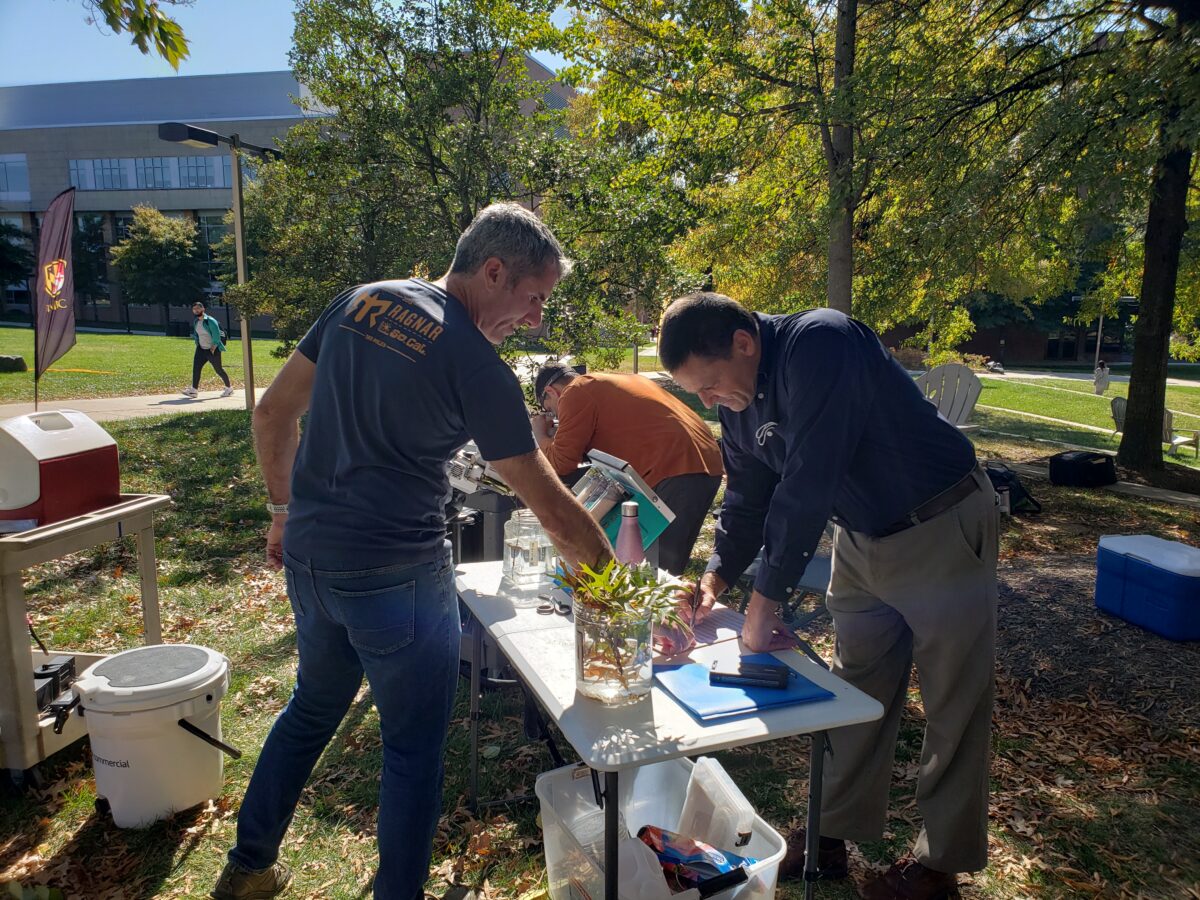
On a sunny fall day in October, a handful of student and faculty researchers are scuttling around outside the Albin O. Kuhn Library and Gallery. High-tech instruments sprawl across folding tables, alongside lower-tech equipment like a hole-punch, glass jars, clippers, and Ziploc bags. A drone about the size of a couch cushion sits on the grass nearby, awaiting instructions.
A student returns from a tree a couple of hundred yards away with a small clipping in a vase-like jar, and the work begins. Different team members examine leaves using the full range of equipment on the tables, collecting different information with each instrument.
Each month from May to October, the researchers complete this process 60 times over two days, collecting data from 60 different trees on UMBC’s main campus representing nine common species of urban trees. Plus, once an hour, the drone flies a pre-programmed route above campus, collecting additional information. Passing UMBC students occasionally stop to ask questions, and the team is happy to share their work.
Michael Alonzo, an assistant professor at American University, leads the project, and Matthew Baker, professor of geography and environmental systems at UMBC, is co-lead. Their students help out on the data collection days. The work also includes faculty and students from Temple University. The goal is to understand how the trees are responding to heat and moisture stress. By looking at trees from different species and in different locations, the research team can learn which trees might be most resilient in a warming world.
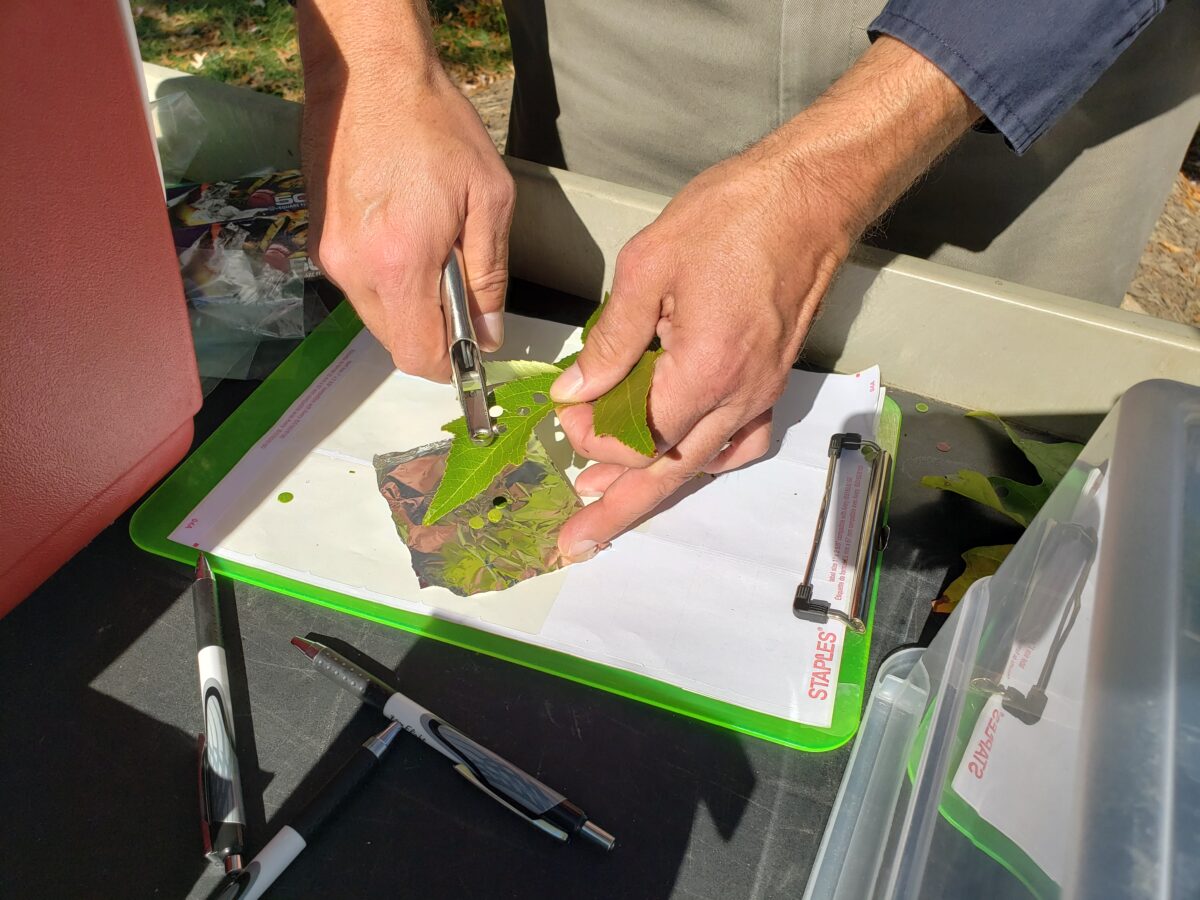
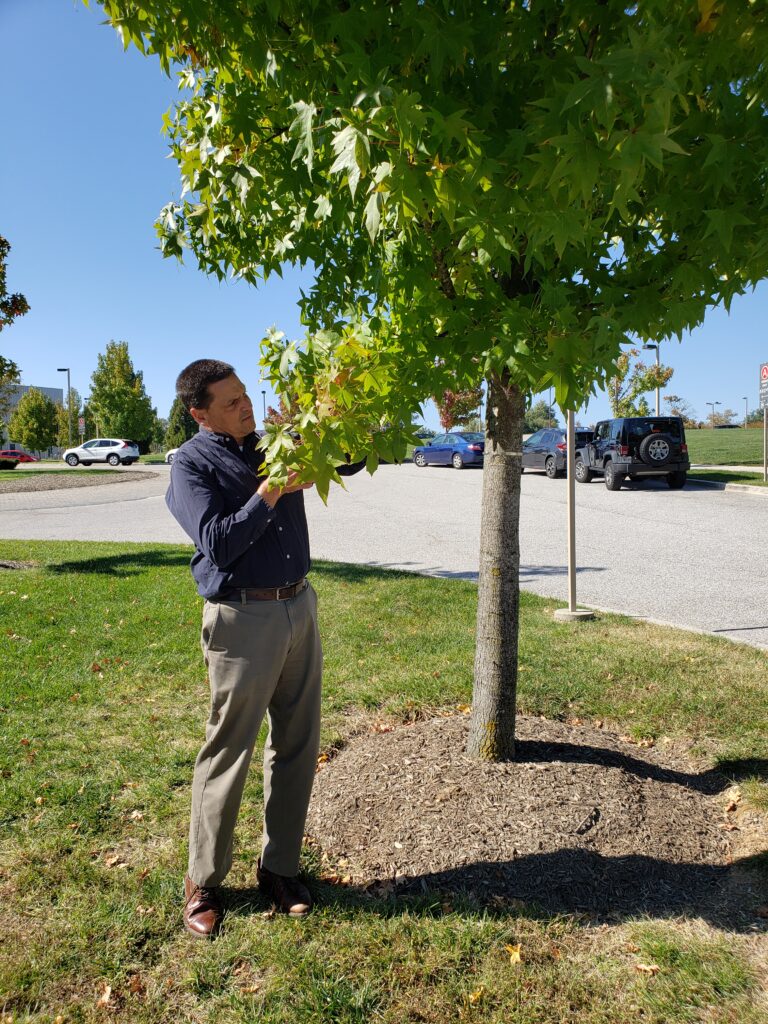
Data collection equipment is ready to go on a folding table outside the library. (Sarah Hansen, M.S. ’15/UMBC)Michael Alonzo and Thu Ya Kyaw, a postdoc at American University, collect data. (Sarah Hansen, M.S. ’15/UMBC)Matthew Baker takes samples from a leaf. (Sarah Hansen, M.S. ’15/UMBC)Lucas Martinez (left), a student at American University; Josh Caplan (second from left), a professor at Temple University; Matthew Baker (right) and Michael Alonzo (background, facing away) all work on data collection. (Sarah Hansen, M.S. ’15/UMBC)Matthew Baker takes a small clipping from a tree in the study. (Sarah Hansen, M.S. ’15/UMBC)
Innovation and transpiration
The UMBC campus, with its variety of tree habitats—like parking lots, grass fields, and natural areas—provides an excellent site to conduct the study. And because urban areas, which tend to include more pavement, are already experiencing higher temperatures on average than less developed areas, “Trees in these heat islands may provide a glimpse into the future about how they’ll respond elsewhere,” Baker says.
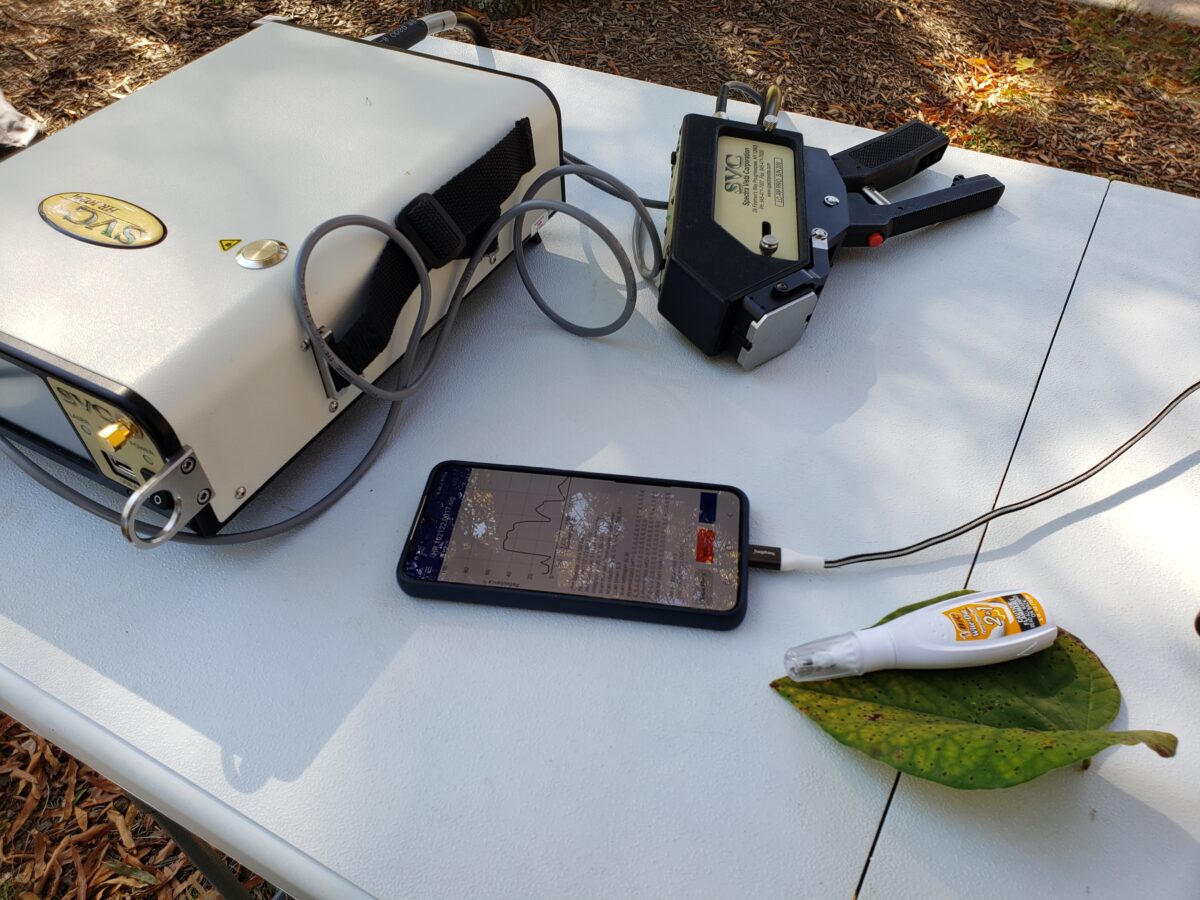
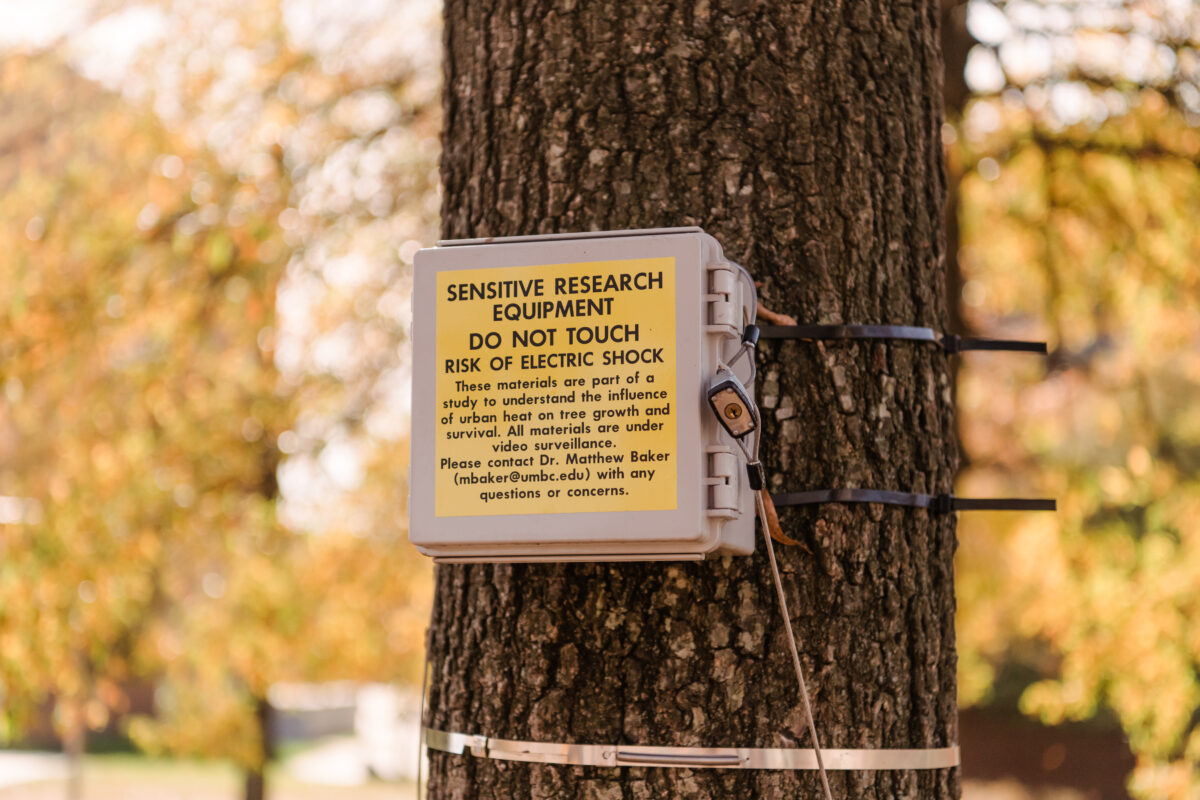
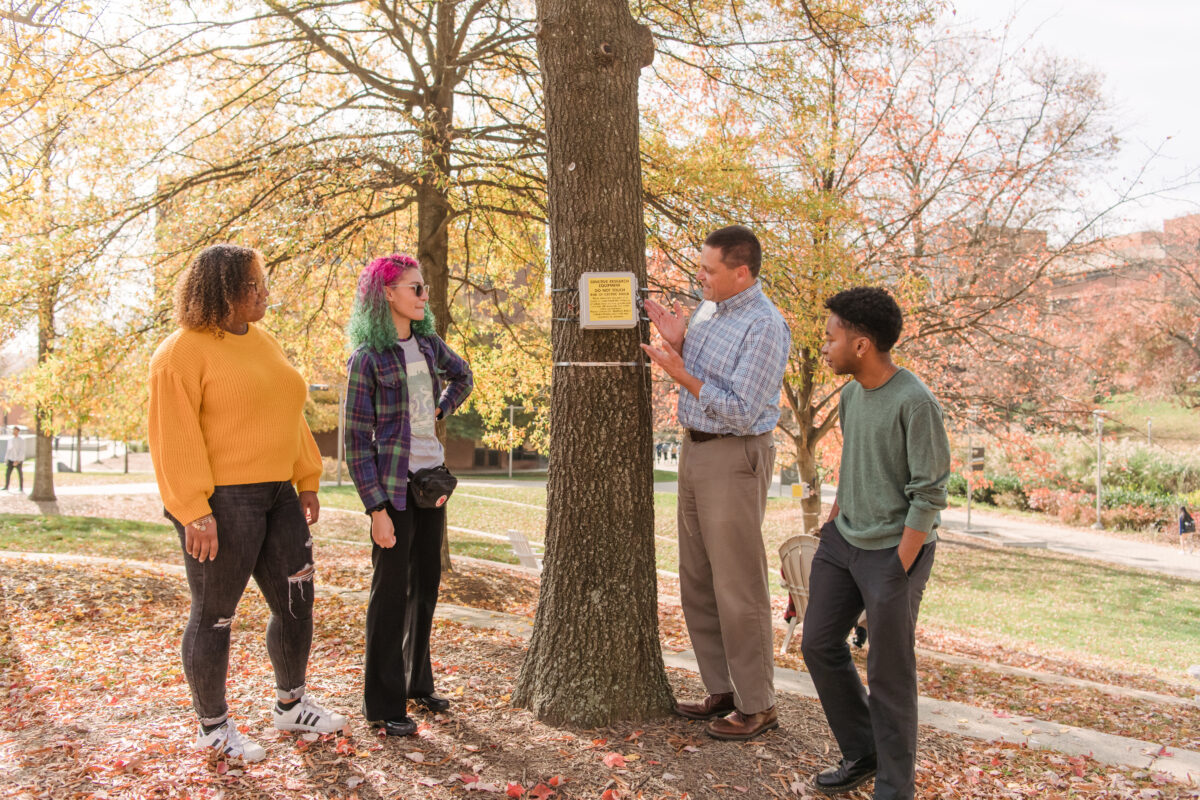
The instruments on the tables can measure things like how much and which wavelengths of light individual leaves are absorbing and their rate of photosynthesis. There are also sensors placed directly on the trees, which collect data in real time. A sensor in a metal box on each tree measures the rate at which water is flowing from its roots to its leaves, a process known as transpiration that is central to the water cycle. An instrument called a Scholander pressure bomb looks at a similar measure, but in the leaves. By gradually applying more pressure to a single leaf, it detects how hard the water is being pulled as it journeys from the roots, to the leaves, to the atmosphere.
By comparing the rates of photosynthesis and transpiration, which are typically closely linked, the researchers can see if the relationship between the two processes is shifting under stress.
A box containing a sensor on one of the trees in the study. (Marlayna Demond ’11/UMBC)Matthew Baker talks about the research project with UMBC graduate students who have participated in data collection. Left to right: Tyrah Cobb-Davis, Erin Hamner, Matthew Baker, Drew Powell. (Marlayna Demond ’11/UMBC)
It’s a bird, it’s a plane, it’s… a research drone?
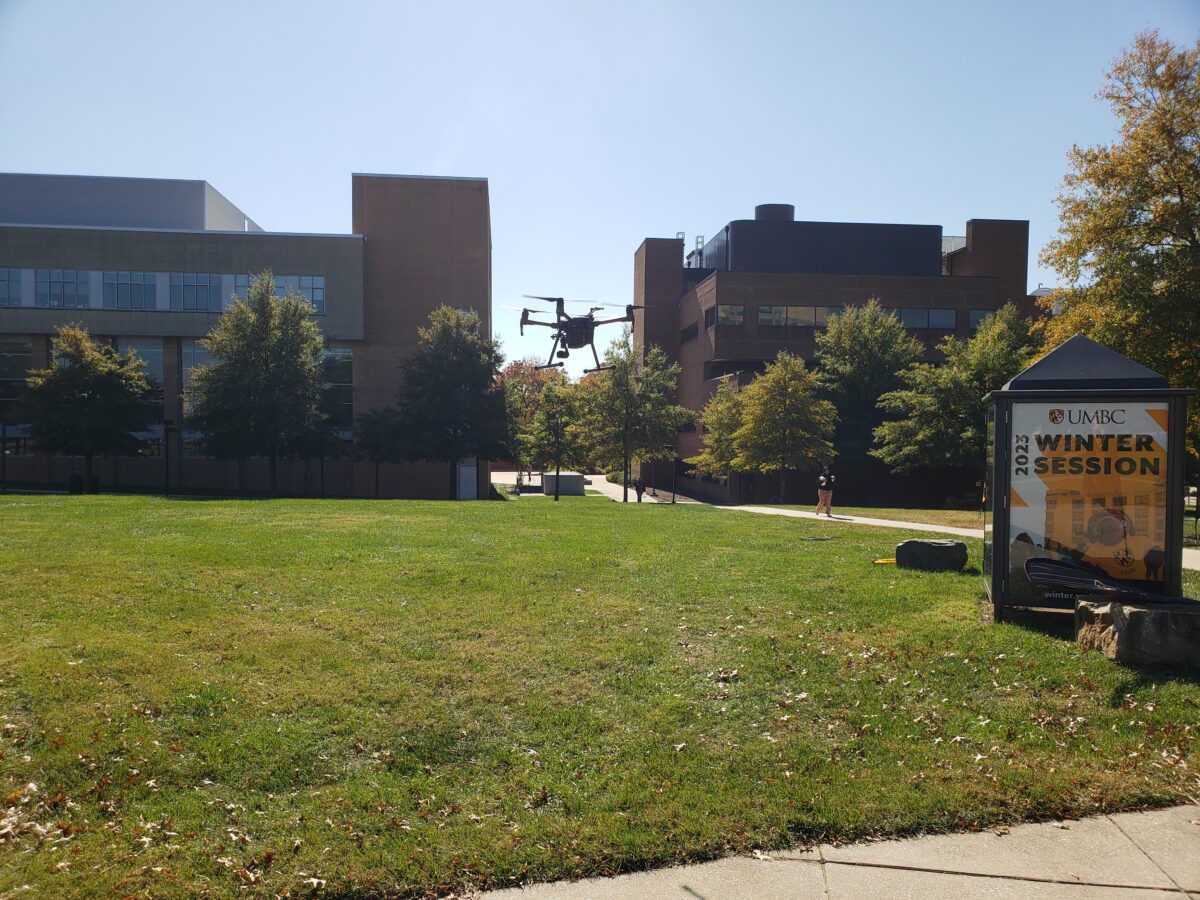
The team also uses a drone with a thermal camera to measure the heat signature of the tree canopy compared to the surrounding environment. “As long as the canopy is transpiring, the canopy should appear cooler than nearby pavement in our imagery,” Baker says. That temperature difference between the canopy and the surroundings can help determine how much transpiration is happening.
The researchers compare the findings from the drone’s hourly flights with what they’re seeing on the ground. “We’re in the ‘do we trust you’ phase of the relationship” with the drone and its data, Alonzo says. The hope is that if the drone data matches the ground data well enough, the team can use it to gather the same information in a much less labor-intensive way and over larger geographic areas.
Permission to use the drone also required cooperation and trust-building with several UMBC departments, such as UMBC Police, environmental safety and health, and facilities management, as well as BWI Airport. This project is the first time drones have been allowed on campus for research, following a recent revision of federal aviation and campus safety policies.
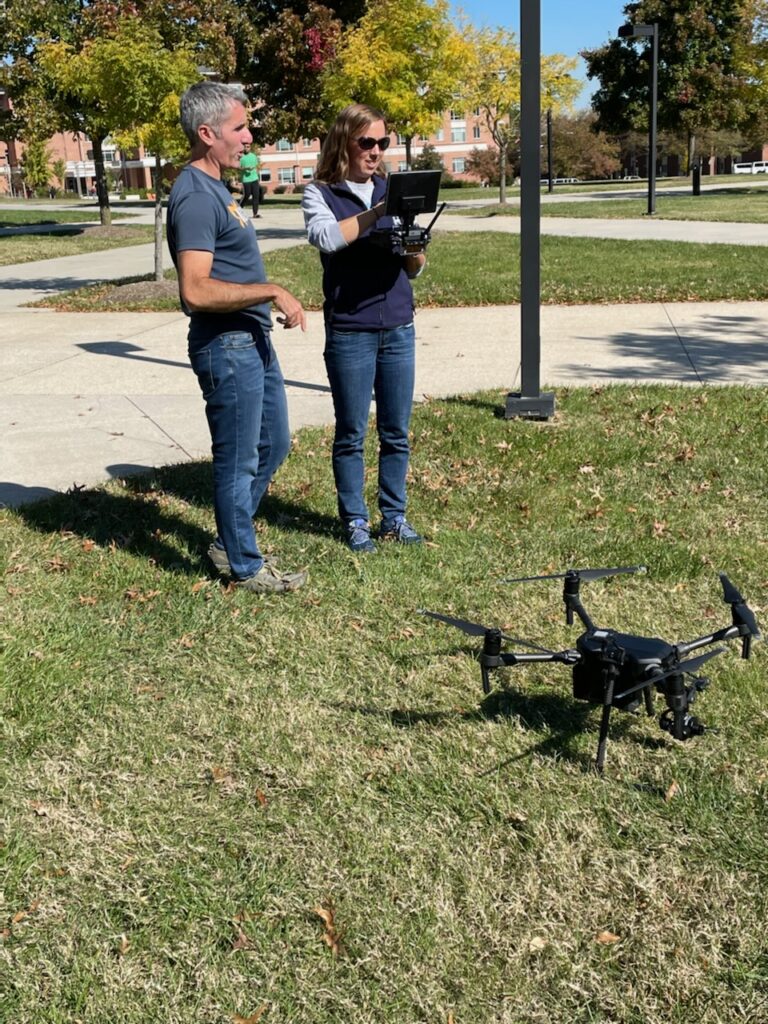
The research drone lands on the grass after its programmed flight. (Sarah Hansen, M.S. ’15/UMBC)Michael Alonzo (left) and Sarah Hansen send the drone out for its hourly data-collection flight. (Image by Matthew Baker)
Growing the fleet
In addition to the thermal camera on the drone, the team is using a hyperspectral camera (on loan from NASA) to collect imagery from the roofs of both the library and the Physics Building. Hyperspectral imagery provides information about canopy stress, water content, and leaf pigments like chlorophyll, which drive photosynthesis. Next year, they hope to have this camera mounted on a drone, too. Together, these two cameras collecting data from above “are the link to being able to perform similar measurements over much broader areas, like metropolitan Baltimore, with airborne or spaceborne platforms,” Baker says.
In fact, the team has already started related work in 11 other cities in the Eastern U.S., including research on how trees help cool cities using data from Washington, DC.
The study on campus is already turning up differences in how various tree species respond to warming. The team discovered that some species intermittently reduce their transpiration rate, possibly as a stress response. Some trees even stop the process altogether during the hottest part of the day—a phenomenon Alonzo calls a “tree siesta.”
It remains to be seen if photosynthesis slows down along with transpiration. If it does, this could indicate that the trees are prioritizing protective measures to prevent overheating and water loss over growth. A reduced growth rate would also reduce the amount of carbon the trees are taking out of the atmosphere, which is an important factor when estimating how much planting trees could benefit the future climate.
Matthew Baker (right), Michael Alonzo (left), and Josh Caplan (center) collect tree data outside the Albin O. Kuhn Library and Gallery. (Sarah Hansen, M.S. ’15/UMBC)
Informing the future
All aspects of the project have involved undergraduate and graduate students. More than 15 students have contributed, including Caitlin Beckjord ’23, geography and environmental systems, who first got involved in forest research through a summer project while she was a student at Howard Community College. Micah Polsky ’25, geography and environmental systems, has a leading role in a complementary study with the USDA Forest Service. They take precise weekly measurements of the trees’ girth—another way to measure their water status as well as their growth rate.
Faculty teach each student how to use the full range of instruments used in this study, making this project an excellent training opportunity for students in majors from environmental science to physics or information systems. The project brings together important new details about how trees are responding to stress, testing and verification of new technologies, and student engagement and training in a way that is likely to have a significant impact on the participants and the future of this research field.
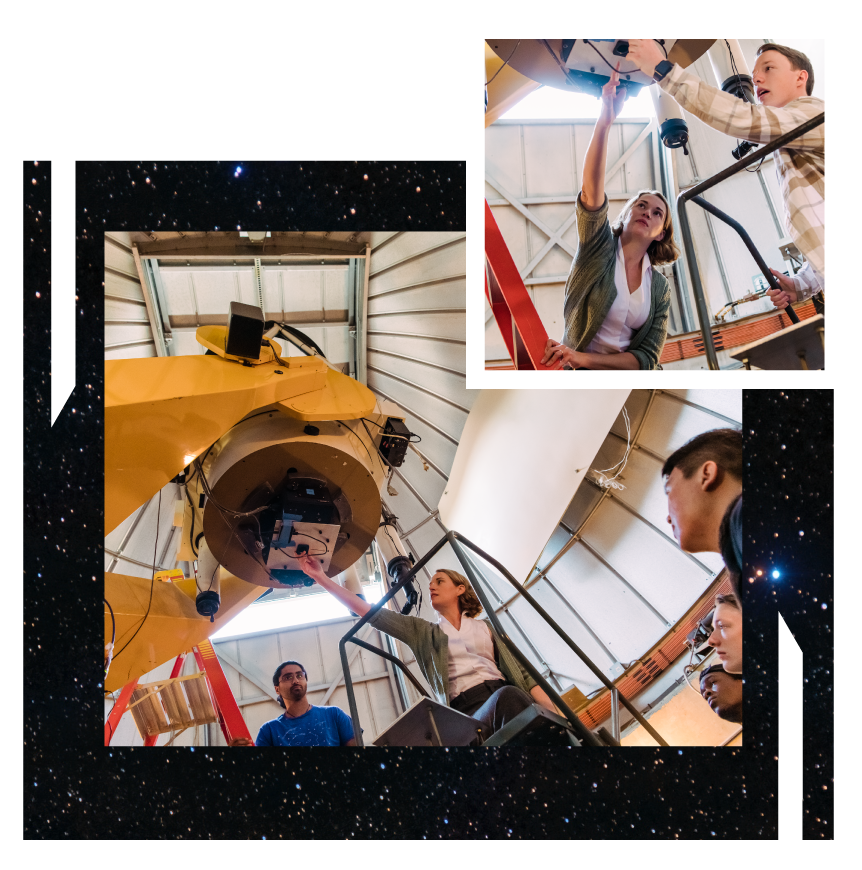
On a chilly morning in early spring 2022, Eileen Meyer, Roy Prouty, and Erik Crowe were on the roof of the UMBC Physics Building. They were inside the observatory dome, trying to figure out what had gone wrong with the 32-inch telescope installed when the building was constructed in 1999. They had already determined that the shutters designed to keep dust off the mirrors were jammed, rendering the telescope temporarily unusable.
“So we’re up there with flashlights and ladders that are not quite tall enough,” Meyer recalls, “trying to figure out what is happening and realizing that some of the motors have died.” They weren’t terribly surprised, given the age of the instrument and the harsh conditions on the roof of a building: extreme heat in summer and cold in winter as well as high humidity. At one point, Meyer says, birds unfortunately had to be evicted from one of the ventilation grates, but not before they had spread debris around the dome.
Eileen Meyer works on the observatory telescope with some of her students. (Marlayna Demond ’11/UMBC)
As someone who decided as a first-year graduate student that hands-on lab work wasn’t really her thing, Meyer may seem an unlikely candidate for climbing ladders, ordering parts, and figuring out wiring as the observatory refurbishment lead. In fact, Meyer, associate professor of physics, has spent the better part of the last decade using computers (often the “super” variety) to conduct astrophysics research, mostly on black holes (the supermassive variety)—but she is finding fulfillment in expanding her work.
“That’s the beauty of having a career that is hitting its mid-stage,” Meyer says. “You can start trying different things.”
Leaning into the turning points
The telescope renovation project is a symbol of Meyer’s evolution as a scientist. Because it requires expertise outside her wheelhouse, it’s enhancing her management and delegation skills, she says, and allowing her to collaborate with a wider range of students and colleagues, including engineers. Plus, the upgraded telescope will enable other projects she’s diving into now, creating new opportunities at a turning point in her career, she says.
When it was built, the observatory was a state-of-the-art facility, designed to conduct observations of the near-Earth atmosphere and to serve as a public-outreach tool. The latter function is still underway today, with programming offered by observatory director and current Ph.D. student Roy Prouty, M.S. ’16, atmospheric physics, but the aging of the telescope and its original cameras means it is no longer up to the task of cutting-edge research.
With generous financial support from the College of Natural and Mathematical Sciences and hands-on help from people like Prouty and Crowe, the Physics Building manager, Meyer says, “The goal is to modernize the observatory and bring it up to the level of something that we can actually put research-grade equipment on and do observations.”
The beauty of physics
While the details of Meyer’s research might be shifting, her overall drive to conduct research and create knowledge are longstanding and unchanged. “I always wanted to be a scientist from as soon as I knew what that was,” Meyer reflects—although astronomy was something “I fell into by degrees,” she says.
As an undergraduate at Rice University in Houston, physics won her over because “it’s so beautiful,” she says. “It’s this interplay of the natural world and the mathematical descriptions you can make of it. It can be deceptively simple.”
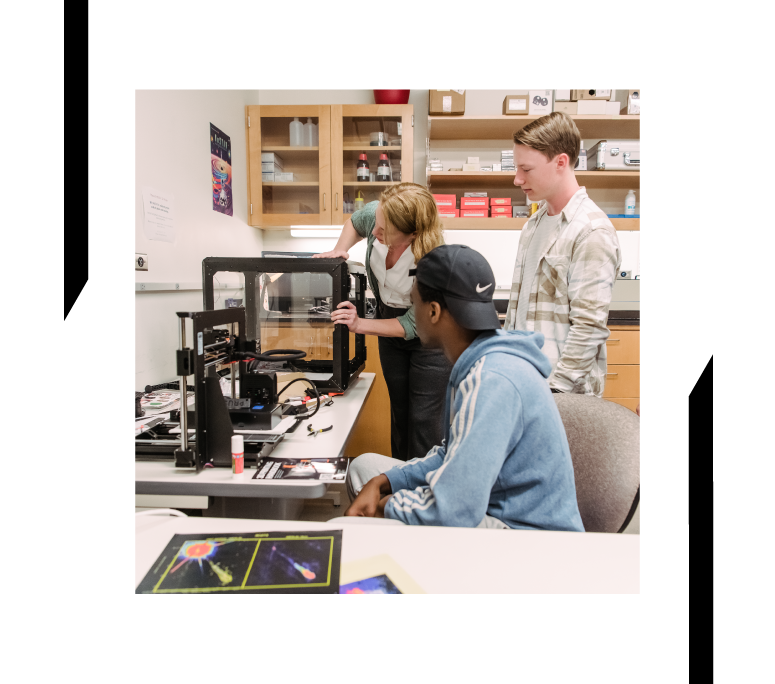
Meyer works with two students in her lab. (Marlayna Demond ’11/UMBC)
“And once you’ve been trained as a physicist, it’s something you can’t turn off,” she adds. “You’re driving down the highway, and you see something oscillating on a truck, and you start to think how you could model this with equations …You start seeing these things everywhere, and it explains to you why the world works the way it does. It takes away a lot of the mystery, but it does it in a beautiful way.”
Meyer initially pursued particle physics, thinking that was the frontier—the field where she could ask fundamental questions about the rules by which the universe operates. But after changing advisors early in her graduate career for a better personality match, she found herself in an astronomy research group, and has stuck with it since. “It turns out that astronomical observations allow us to constrain fundamental physics,” she says, “so it’s not like I went away from that after all.”
Plasma jets and giant mergers
To date, her work has largely focused on “understanding why black holes do what they do,” Meyer says, with a good deal of it focused on the giant jets of extremely high-energy plasma that often stream from them in opposite directions. The jets can be bigger than entire galaxies, carrying tremendous amounts of energy and material, Meyer explains. “And galaxies are enormous,” she adds. “Those themselves are already hard to imagine, they’re so big.”
Supermassive black holes, while denser than anything known in the universe, can have a volume about the size of our solar system. “It’s unbelievably tiny compared to the scale of the chaos that they’re unleashing” with their jets, Meyer says. The existence of the jets “was something that nobody predicted,” she adds. Even in the 1960s, some scientists were still arguing that black holes themselves (forget about their jets!) did not exist. Today, black holes are well established, but, Meyer says, “it’s still a major open question—how do they produce these jets?”
Black holes and their jets “are basically super extreme environments, so they’re interesting to study and to try to understand,” Meyer says. “There’s just major things that we don’t know about them. We’re hopeful we can understand them eventually, through observations and heavy-duty computational modeling—because that’s what they didn’t have in the ’60s. And even today, we regularly run up against the capabilities of what the computer can do.”
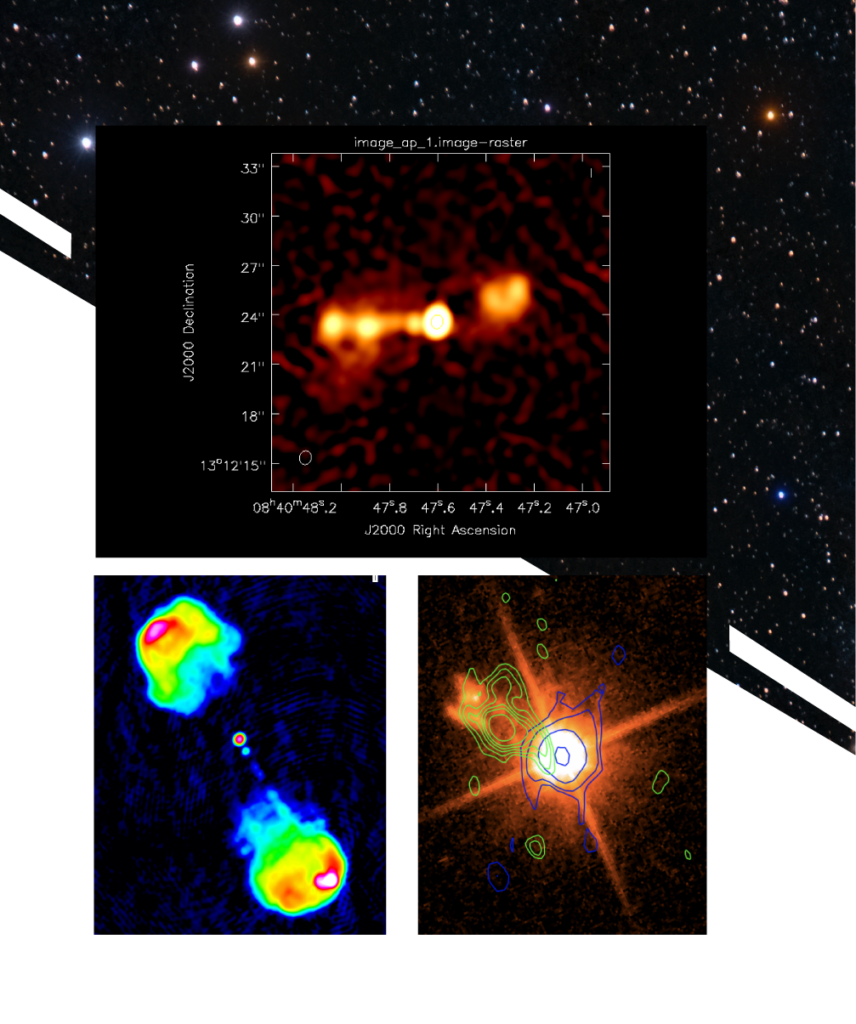
Top: Image using radio waves to visualize a faint jet of plasma (extending to the upper right), powered by a super-massive black hole (the bright white circle). Bottom right: Galaxy 3C 186, where Meyer and colleagues found a black hole that had been “kicked” out of the center of the galaxy. The black hole (blue lines/bright white area) is offset from its galaxy’s center (green lines). Bottom left: The red dot at the center represents a black hole. The rainbow blobs in either corner represent regions where intense radiation is being emitted. The entire image is about 1 million light-years across, and the galaxy is about 6 billion light-years from Earth. Images courtesy of Meyer.
Meyer also studies black hole mergers—the combining of two black holes into one. It’s another research area fraught with uncertainty and with much left to discover. Recently, she co-led a project that found the most convincing evidence yet of a merged black hole that has been “kicked” out of the center of its galaxy, in this case, at 4.5 million miles per hour.
“The history of studying black holes,” Meyer says, “is just one surprise or ‘what the heck’ after another.”
Striking out on her own
As exciting and rewarding as studying black holes is, when asked about major milestones in her career trajectory, rather than naming the funding of a huge proposal or a publication that moved the needle in her field, Meyer turns to more intangible matters. After completing a Ph.D., which Meyer did at Rice in 2012, a researcher should transition to becoming truly independent in setting goals and priorities, bringing in funding, managing a research group, and going beyond “the projects your advisor wanted to do,” she says.
After a postdoctoral fellowship at the Space Telescope Science Institute (STCsI) at Johns Hopkins University under an inspiring mentor, Bill Sparks, Meyer joined the UMBC faculty in 2015. It would be the first time she had a “lab of her own.” Sparks was confident she was on a path to great things at the time. “It was a real pleasure to work with Eileen at STScI; we considered ourselves very fortunate to bring her there,” he says, adding that her work there “was extremely favorably received. An eminent astronomer described it as ‘truly beautiful work.’”
Yet, like new faculty members everywhere, at UMBC Meyer says she went through a period of proving herself— working hard to bring in major grants, come up with fresh research ideas, and publishing high-impact papers as a lead investigator. The first major milestone “felt like it happened eventually after I’d been here a couple years,” she says. “I felt like I could call myself an independent researcher.”
Independent, but not alone
Even as she worked toward independence as a researcher, Meyer certainly wasn’t alone. Mentors like Sparks and Meyer’s husband, Markos Georganopoulos, professor of physics at UMBC, and others in the department and at the university have provided support along the way.
“He was a little bit ahead of me in the career stage,” Meyer says of Georganopoulos, “so everything I would go through he had gone through a few years before. You can kind of mentor each other because you have a sounding board.” Their research is similar enough that Georganopoulos is a co-author on some of Meyer’s publications.
Jane Turner, former director of the Center for Space Sciences and Technology, a UMBC partnership with NASA, also mentored Meyer in her early days at UMBC. “I’ve come to appreciate that UMBC is a very supportive place—the department, the college, and the school in general,” Meyer says. “It’s absolutely true that people want you to succeed here. I’ve always felt that.”
Meyer understands the importance of mentorship, as the first person in her family to earn a Ph.D. She enjoys paying that support forward to UMBC students. “I really love our student population. They’re just fantastic,” she says. “There’s a certain seriousness and maturity that they have that I really appreciate.”
Some of her students are the first person in their family to earn a college degree, and many more, like Meyer, are the first in their family to be considering graduate school. “I feel like I identify with our student population, which makes working with them really a joy.”
Life as a parent-researcher
In 2019, Meyer and Georganopoulos welcomed their son into the world, and she felt the strength of the UMBC community even more. “Parenting and being a highly active researcher is a real challenge,” Meyer says, especially when you’ve moved far from family in order to pursue your dream of being on the faculty at a research university. While “the department and UMBC in general has been very helpful,” parenting still hasn’t been easy given “systemic bigger issues that we have with supporting parents,” she says.
Always a determined problem solver, however, Meyer has found ways to succeed both as a parent and as a scientist. Mentors advised her to consider all of her unfinished projects (of which any researcher usually has many), and instead of trying in vain to complete them all, “focus on where you can make major progress in the field. Focus on impact, and let the others go,” she says. She has taken that advice to heart—especially through the pandemic.
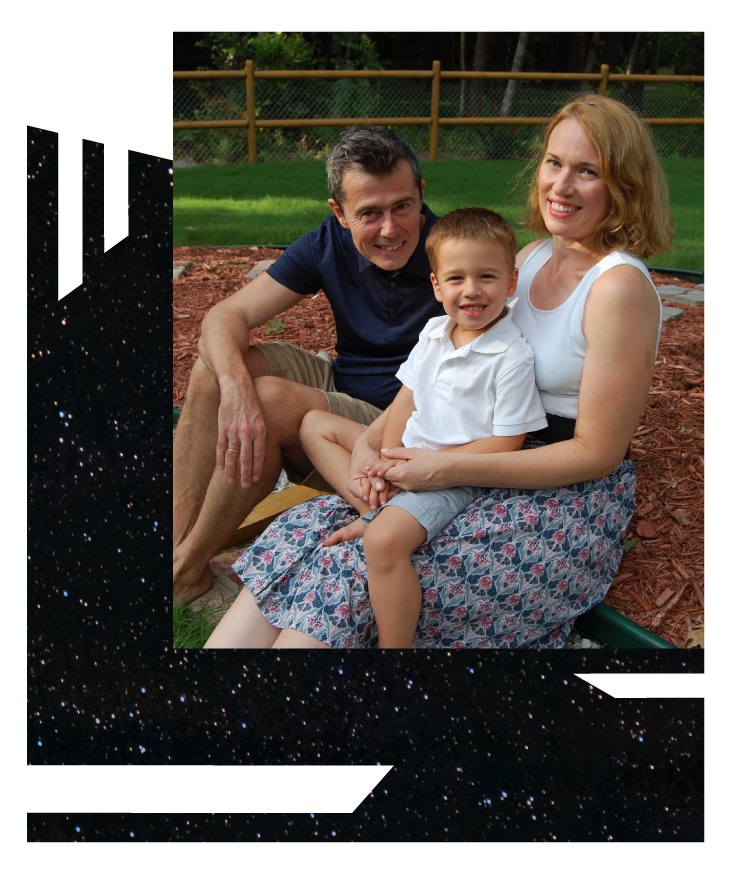
Meyer with husband, Markos Georganopoulos, and their son, Stefanos. (Photo courtesy of Meyer)
And now that she’s more established in her field and as a researcher, it’s time to step back from the “take every opportunity” mentality and learn to say no, which can be a special challenge for women and young scientists, Meyer says. “Bill [Sparks] was always very good at that,” though, she adds—and that’s not the only thing she’s taken from his mentorship.
“He is my model for what a scientist should be,” Meyer says. Especially with current pressures to publish and win grants at a rapid clip, Sparks “always did only what he was interested in,” even shifting focus from astrophysics to astrobiology later in his career. “I want to be as free as he is with how he does his work,” Meyer says.
Living the freedom
Today, Meyer is living that freedom by exploring new kinds of research using the UMBC observatory, and Sparks has joined UMBC as an adjunct faculty member to support the effort. In addition to fixing up broken motors and buying a much larger ladder, Meyer plans to build a new instrument called a polarimeter, which will make observations of objects in our solar system, phenomena farther away such as flare stars, and other targets possible with the UMBC telescope.
“It’s great to be working with Eileen again—she’s so darn good at everything and always open to taking on something new and unfamiliar, whether it’s building polarimeters, climbing wobbly ladders, or thinking about black holes and the origin of the universe,” Sparks says. “Eileen is one of the most capable and versatile researchers in astronomy—and our project should keep UMBC at the forefront of a unique, innovative scientific niche.”
Making new missions happen
She is also on the leadership team of a University of Maryland-led consortium competing for NASA funding for a new space-based satellite mission. NASA put out a call for proposals for high–energy astrophysics missions, and her team’s entry, the Advanced X-ray Imaging Satellite (AXIS), would capture extremely high resolution X-ray images to study galaxy formation, black holes, and much more.
Meyer working with a student. (Marlayna Demond ’11/UMBC)
This role is an exciting change for Meyer. She describes herself as coming from “a classical academic path,” where she relied on data from both land- and space-based instruments but was never involved in their design, construction, or the bureaucracy often involved in actually putting a satellite in the sky. After attending a summer workshop at Harvard, however, her perspective shifted. A scientist on the original Chandra X-ray Observatory mission team gave a talk describing the iconic mission’s 30-year journey from concept to launch, which finally happened in 1999.
“I was astounded by how difficult it was—the immense challenge—but then also how amazing it is that eventually this thing flew, and it’s still working—it’s still taking amazing images all the time,” Meyer says. “Ever since then, I always thought I would love to get involved in that process, to help be an advocate for new observatories, new technologies. So when I was asked to join AXIS I was very happy, because it’s been a long-term side dream of mine to be involved in making new missions happen.”
The things that are mine
As her career—and her family—moves forward, Meyer is hitting her stride. “I love studying black holes and jets, but it’s still true that that was my advisor’s topic,” she says. But with AXIS, the observatory work, and other new collaborations, “I feel like I’m getting into the things that were really mine—the things that were interesting to me all along,” she says.
The UMBC physics department plans to hire at least one more faculty member in high-energy physics soon. That could also shape Meyer’s work, depending on her new colleague’s areas of interest. She’s also been approached by researchers in the Center for Space Sciences and Technology for collaboration. Put simply, the future is bright for Eileen Meyer, and she’s savoring it all.
“I think of myself as an open person; I could see myself doing work that I haven’t imagined yet,” she says. “I like it when people bring me problems to think about. We’ll see where we go next.”
Natural dust particles and human-produced pollutants in the atmosphere affect Earth’s overall energy budget in different and nuanced ways. A new three-year, $620,000 NSF grant led by Zhibo Zhang, professor of physics, will study how dust, pollutants, and water vapor in the atmosphere interact, to increase understanding of their overall effects on the global climate.
Atmospheric dust particles are large enough that they can reflect the Sun’s energy back to space, producing a cooling effect—but they can also trap energy from the earth trying to escape, contributing to warming. Most pollutants are too small to contribute to cooling, and tend to warm the planet instead, Zhang explains. But when the two mix in the atmosphere, which is commonplace, things get complicated. The new project will work to disentangle the effects of different kinds of particles through a combination of techniques.
Zhang is particularly excited about the upcoming work, because research led by his former students made it possible. Qianqian Song, Ph.D. ’21, atmospheric physics, “wrote three papers over the last three years that gave us the credentials to apply for this program,” Zhang says. Olivia Norman’20, physics, also contributed substantially. Song is currently pursuing a postdoc at Princeton, and Norman is in graduate school at M.I.T.
Moving forward, Tony La Luna, a new Ph.D. student in Zhang’s lab, will focus on the project, and Zhang is looking forward to adding more students to his team.
Domino effect in the atmosphere
Wind is always lifting dust from Earth’s surface, especially in arid areas such as the Sahara and Gobi Deserts. Once airborne, the dust can travel long distances and interact with other particles in the atmosphere.
“When dust moves from its source region to a polluted area, it gets mixed with the pollution there. And we are interested in these interactions,” Zhang says. His team’s research has shown these interactions are most common in eastern China, India, and central Africa.
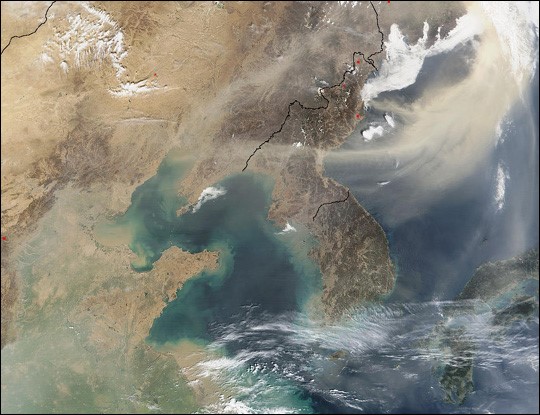
A satellite image centered on the Korean peninsula shows dust and clouds in the atmosphere. (Jacques Descloitres/NASA GSFC)
Until very recently, researchers typically modeled dust and pollutants separately, assuming they did not interact. But based on Zhang’s group’s research, that approach doesn’t produce a good approximation of what’s actually happening, he says.
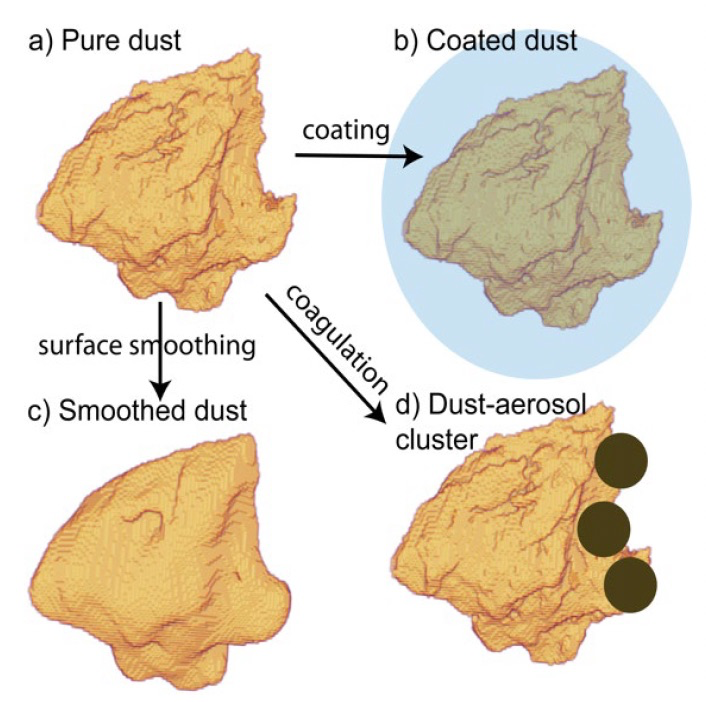
Where dust and pollutants mix, tiny pollutant particles can condense onto larger dust particles. “The pollution particles can bump into the dust and stick together,” Zhang says. Then a domino effect ensues: “Once the pollution is coated on the dust,” he says, “it changes the way the dust interacts with water.”
Dust generally repels water, but pollutants are often attracted to water molecules. So dust coated with pollutants, called “coated dust,” can start to collect water. By changing how the dust reflects light, “This coating can change the net effect from cooling to warming,” Zhang says. By providing a surface to which water molecules can attach, the coated dust can also contribute to cloud formation, which affects precipitation.
Beyond satellite images
It can actually be difficult to tell whether a satellite image shows dust, pollution, or coated dust—so developing techniques to distinguish between different kinds of atmospheric particles is another one of the team’s goals.
“First, we need a good dust model,” Zhang says. His collaborator Dr. Diana Ortiz-Montalvo at the National Institute of Standards and Technology (NIST) uses a special imaging technique to precisely measure the shape of dust particles in the lab. Those measurements will help create models of different kinds of dust.
In general, pure dust has jagged edges. However, if the dust is thickly coated, it appears spherical again; this is called “smoothed dust.” A smoothing effect can also happen if water binds to dust and then evaporates.
Knowing exactly what each type of dust looks like will support efforts to more accurately identify them in satellite images, and understand how each type will behave in the sky.
Different combinations of dust and pollutants take different shapes, which can be identified in the atmosphere through a combination of satellite data. (Image courtesy Zhibo Zhang)
Scattering light—and focusing on results
With the dust models in hand, Zhang’s team will calculate how the dust would interact with different particles it might encounter in the sky, like water, smoke, or industrial pollutants. Specifically, they will estimate how the dust would reflect—or “scatter”—light that strikes it. The scattering pattern depends on how rough or smooth the dust is.
The researchers will also analyze observational data that measure how dust all over the globe is scattering light. “Then we’ll combine lab measurements, the scattering calculations, and these satellite observations all together,” Zhang says, to answer the project’s ultimate question: Is dust and its interactions with other particles warming or cooling the planet, and how much?
Zhang’s research group melds computer science, physics, and climate science to address some of the least understood factors contributing to global climate. The new project will further those efforts, with the potential to clarify what roles dust and other atmospheric particles play. Along the way, it will also prepare students for successful careers in science.
“The new grant is indeed based on the success of the students. They laid the foundation for this project,” Zhang says. Much like his students, he adds, “I’m excited to take this essential next step in addressing an issue that affects our planet so profoundly.”
Nuclear fusion reactions inside certain stars can produce many of the most common elements on Earth, like carbon, nitrogen, and oxygen. But heavier elements that are also found on Earth are harder to generate, requiring reactions with even more energy than exists within a run-of-the-mill star like our own.
“So all of that heavier stuff we see here on Earth and throughout the cosmos, like gold, and platinum, and lead—where did it come from, and how did it get distributed?” asks Nicholas Cannady, a postdoctoral researcher at UMBC’s Center for Space Sciences and Technology, a partnership with NASA.
Cannady serves as operations lead on a new mission that aims to help answer this question. NASA recently selected that mission, the Trans-Iron Galactic Element Recorder for the International Space Station (TIGERISS), for up to $20 million in funding over five years. Seven million will go directly to the NASA Goddard Space Flight Center in Greenbelt, Maryland, where Cannady is based. The rest will go to the lead institution, Washington University in St. Louis, which will further disburse the funds to the collaborating institutions: UMBC, Pennsylvania State University, Howard University, and Northern Kentucky University. UMBC will receive $2 million. If all goes well, TIGERISS will launch to the International Space Station (ISS) in 2026.
From model to measurement
Nicholas Cannady (image courtesy of Cannady)
TIGERISS will count how often certain elements, arriving at Earth as cosmic rays, collide with its detectors. Cosmic rays are extremely high-energy particles that travel at nearly the speed of light. Heavier elements are rarer than lighter elements, which means they will be seen less frequently by the instrument. How often the detector sees a particular element can be used as a proxy for how abundant it is in our Milky Way Galaxy.
Models exist predicting how common different elements are and how they might have been created, but they don’t all agree. In some cases, elements can only be made through a process that requires powerful explosions where the cores of atoms and neutrons repeatedly collide, Cannady explains. Scientists expect different kinds of events in the universe with the necessary power (such as exploding stars) to produce different amounts of these elements.
TIGERISS scientists will use measurements from the instrument showing how often different elements are detected “to support or go against those models,” Cannady explains. “It could help us see which models for production of heavy elements best represent what we see.”
Above the atmosphere
“TIGERISS is sort of the next step in a line of instruments that have been until now borne on balloons—high altitude, scientific balloons,” Cannady says. Unlike its predecessor, the balloon mission SuperTIGER, TIGERISS “will be on the ISS in space, which has some distinct advantages, and will let us really open up some interesting science that the other instruments weren’t able to do.”
The main benefit: On the ISS, there is no interference from Earth’s atmosphere. Although the SuperTIGER balloon flew as high as 130,000 feet, even the tiny amount of atmosphere at that height can affect precision when you are trying to detect extremely rare elements. “The atmosphere really throws a wrench into trying to wring out all the precision you can in things like SuperTIGER,” Cannady says.
TIGERISS will also be on the ISS for at least a year, whereas SuperTIGER made two flights, one for 32 days and one for 55 days. The 55-day flight set a record for a balloon, but TIGERISS’s longer exposure time will increase the chances of very rare elements happening to hit its detectors.
The cosmic ray mystery
TIGERISS may also help illuminate how cosmic rays form and transport elements around the cosmos. SuperTIGER results support one theory for how certain types of particles (including heavy ones) get “swept up and accelerated to the high energies that we see for cosmic rays,” Cannady says. “It gives us a picture of how this heavy stuff gets distributed through the galaxy.”
“So we have this neat picture of how this works,” he adds, “but then above a certain threshold, this picture seems to be breaking apart.”
Cannady and the rest of the team hope that TIGERISS will improve on SuperTIGER’s findings, and start to put the picture back together—or suggest a new one. Whatever it finds, TIGERISS will increase our understanding of where heavy elements formed and how they made their way to Earth.
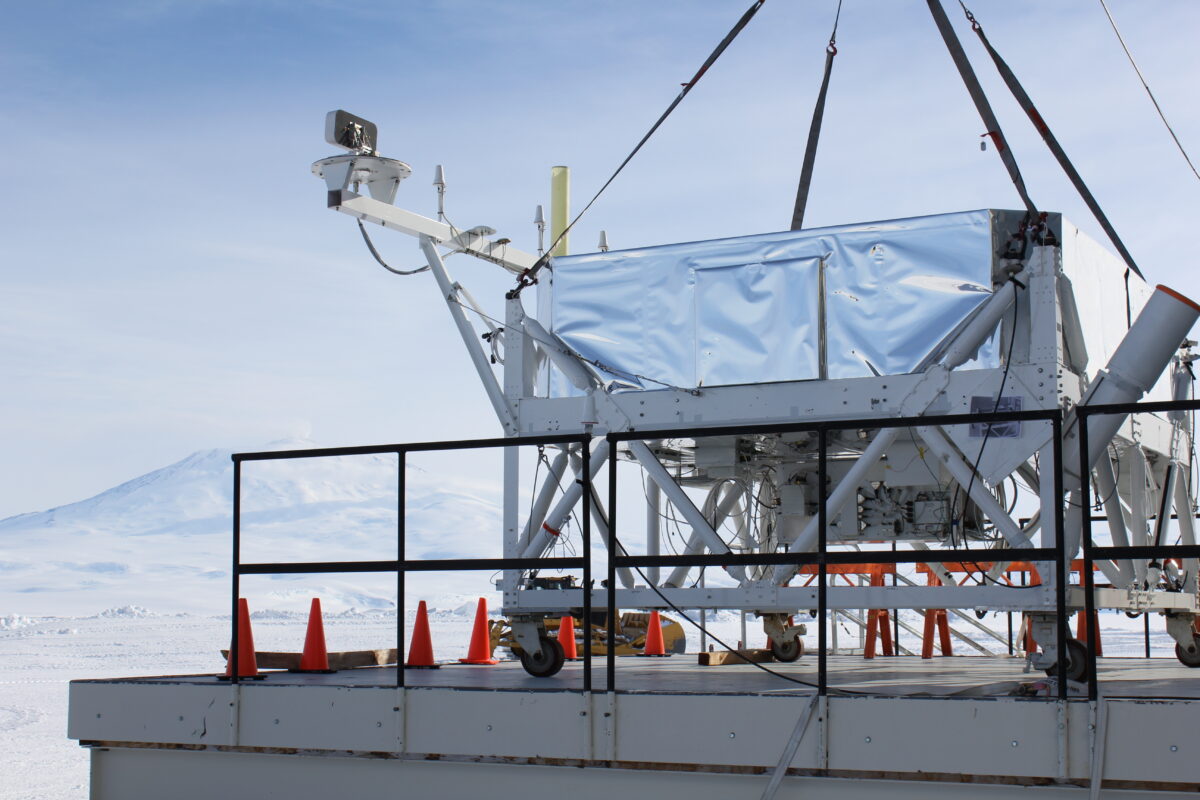
TIGERISS’s predecessor, SuperTIGER (inside the large metal box), prepares for a flight at McMurdo Station, Antarctica, in 2017. (Image courtesy of NASA/Jason Link)
Early career leadership
NASA selected TIGERISS through its Astrophysics Pioneers program, which launched in 2020. Its goal is to reduce costs by using smaller instruments that can still contribute to robust scientific advances. The program is also set up to encourage early career researchers, like Cannady, to take the reins.
“One of the big focuses of Pioneers is to incorporate early career leadership and roles into the full pipeline of mission development—conception, development, and implementation, and then the operations and analysis as well,” Cannady says. His roles as institutional lead and mission operations lead create plenty of opportunities to build a network with researchers at other institutions, hone his management skills, and conduct cutting-edge science at the same time.
“It’s really neat to me to get to see things from the beginning and potentially follow them on through to the end. There are several of us who are getting to do that,” he says. UMBC’s Kenichi Sakai, a CSST research scholar, is also on the project, and former CSST researcher John Krizmanic will serve as the overall lead for NASA Goddard.
Sakai is leading development for one of the detector subsystems, and he and Cannady are hoping to engage both undergraduate and graduate UMBC students in that work. For the next year, the team will undergo their concept study phase, figuring out what’s feasible and starting to nail down the details of the design.
“We’re really going to start hitting the ground running with this,” Cannady says. And then, once the team completes a concept study and makes important implementation decisions in the first year, he says, “we’re going to start building.”
Most people rely heavily on image-forming vision to navigate the world, but our eyes do much more than help us “see” in the traditional sense. In addition to rod and cone cells that help us perceive contrast and color there are a small number of other specialized cells in our eyes. These cells, called intrinsically photosensitive retinal ganglion cells, play a role in what’s called non-image-forming vision. This type of vision affects everything from our mood, to our sleeping and eating patterns, to our ability to adapt to time zone and seasonal changes.
Despite the importance of non-image-forming vision, our understanding of it is still in the early stages. An important path forward is examining melanopsin, a key protein regulating how non-image-forming vision works.
Phyllis Robinson, professor of biological sciences, has been studying melanopsin since its discovery. For the next four years, she’ll expand on her prior work with a new $2.5 million grant from the National Eye Institute (NEI), which is part of the National Institutes of Health. Colleagues on the grant include researchers at the NIH, Johns Hopkins University, Washington State University, and the Oregon Health Science University. The grant is a renewal of a previous five-year R01 award, traditionally the most sought-after and largest grant type from the NIH.
The new work will focus on how certain modifications to melanopsin affect its function. Robinson and colleagues will also examine the role of dopamine—a neurotransmitter involved in a huge range of mental and physical processes—in regulating this critical protein and its effects.
“We’re looking at this cool molecule that affects our light-dependent behaviors in ways we’re not conscious of,” Robinson says. “It’s really exciting stuff within our field.”
A cascade of changes
Phyllis Robinson (Melissa Cormier/UMBC)
Robinson’s previous work has contributed significantly to a better understanding of melanopsin’s functions and mechanism of action. For example, shortly after melanopsin’s discovery, Robinson and her team demonstrated that it is involved in how our pupils respond to light.
In a typical eye, light exposure causes the pupil to contract, and then, when the light dims, the pupil dilates again in about a minute. This system protects the eye from damage caused by overexposure to light. This process is familiar to anyone who has had their eyes dilated by an eye doctor and then stepped out into a sunny day.
In contrast to that typical reaction, in mice with chemical modifications to the structure of melanopsin, the pupils stay dilated for about 45 minutes after light exposure, indicating that functional melanopsin is involved in the pupil’s response to light. Ongoing and future studies under the new grant will look at how a different set of modifications to melanopsin affect mice’s ability to adapt to changes in their light exposure patterns, as if they were changing time zones—a process called “photoentrainment.”
Robinson’s group also recently showed that dopamine can regulate the function of melanopsin in a cell culture. The new funding will allow the team to further explore dopamine’s role in non-image-forming vision in mice. In addition to showing whether or not dopamine regulates melanopsin, they will work to figure out what sequence of chemical reactions drives the protein’s effects, and what other molecules are involved, called a “chemical cascade.”
Mystery molecule
Melanopsin and the cells that contain it are also interesting from an evolutionary perspective, Robinson explains. “These ganglion cells may be the ancient photoreceptors,” she says.
“If you think about the evolution of vision, an organism just detecting whether it’s light or dark would be the first step,” she notes. “All you need is a light-sensitive cell.” In fact, even nocturnal animals and animals that live in dark environments, like caves or tunnels, have the cells responsible for non-image-forming vision, Robinson says.
In humans, a better understanding of melanopsin and its regulation could offer insight into health conditions that afflict shift workers, since their schedules do not align with their bodies’ natural hormonal responses to light. It could even reveal new potential targets for treating conditions like seasonal affective disorder or jet lag. And it might add evidence to arguments for dimming lights in the evening and prioritizing exposure to sunlight in the morning.
A microscope slide of the mouse retina, with the cells containing melanopsin stained red. (Image courtesy of Phyllis Robinson)
“Our research is going from molecules to behavior,” Robinson says. Her lab at UMBC focuses on physiology by doing studies with cells. Then, based on the findings, her NEI colleagues and graduate students, who are jointly advised by Robinson and NEI faculty, carry out behavioral studies with mice as a next step. Eventually, it could lead to work directly supporting human health.
“It’s always exciting to renew an R01 award and this new funding will make important new research possible,” Robinson says. “Melanopsin is a relatively unknown molecule that has huge impacts on our physiology and health,” she adds. “It’s like the mystery molecule in your eye.”
Over the next four years, Robinson and colleagues hope to make this molecule a little less mysterious.
Two UMBC Ph.D. students in atmospheric physics, Maurice Roots and Kylie Hoffman, have received competitive Future Investigators in NASA Earth and Space Science and Technology (FINESST) awards that will support the remainder of their graduate studies. Roots’s research project will focus on air pollution and Hoffman will target thunderstorms, both using remote sensing techniques. Each will receive up to $150,000 over a maximum of three years for tuition, research, professional development, and other expenses.
Tracking ozone’s journey
Roots will further his study of ozone found near the Earth’s surface. Unlike ozone in the upper atmosphere, which is critical for protecting organisms on Earth from powerful solar radiation, ozone near the surface is a form of air pollution. It can lead to respiratory issues in animals (including humans) and reduce crop yields by damaging plants’ leaves.
Combustion engines are the main producers of surface-level ozone, because they release molecules that can convert to ozone when they interact with sunlight. Roots is particularly interested in ozone prevalence in the Chesapeake Bay region and other urban areas on bays, such as New York City and San Francisco, because “water is like a mirror,” he says, and with more light bouncing around, there are many more opportunities to generate harmful ozone.
Maurice Roots (image courtesy of Roots)
Roots will use a network of ground-based remote sensing instruments to improve understanding of how ozone forms and moves around, with a focus on the Eastern United States.
It’s an exciting time to be in remote sensing and ozone studies, Roots says, in part because “we’re still finding out things about simply when and where high ozone is happening.” At the same time, the instrument network “is becoming a teenager. It’s grown up a lot, and a lot of changes are about to start happening.” One of Roots’s main goals with the new project is to generate a “synergy of NASA’s ground-based instruments,” where all of the data they produce can be easily gathered and interpreted together to form conclusions.
Understanding not just where ozone forms, but where it travels from there, is important, Roots says. For example, phenomena called “nocturnal low-level jets” can move air (and ozone and other pollutants with it) from Georgia to New York in one night, he explains, which “changes the whole regulatory perspective.” Right now, states or cities can be fined for having too many instances of high ozone—but if the ozone may have come from several states away, the picture gets more complicated.
While Roots isn’t directly involved in policy, his work to improve “process-level understanding” of where ozone is created, how it moves, and where it ends up could influence regulation in the future.
Predicting thunderstorms, protecting farmers
Hoffman’s work will explore how severe thunderstorms form in the southern United States, especially at night. The genesis of these storms is currently poorly understood, despite their important implications for community safety and agriculture.
Belay Demoz, professor of physics and director of the Goddard Earth Science Technology and Research (GESTAR) II Center, and also Hoffman’s and Root’s Ph.D. advisor, co-led the Plains Elevated Convection at Night (PECAN) mission in 2015. It used ground- and aircraft-based instruments to collect a huge amount of data about storms in the U.S. southern plains, much of which has the potential for more in-depth analysis, Hoffman says. She will develop a few in-depth case studies using PECAN data, seeking clues about which variables are most important for forming these storms, such as temperature, wind speed, and water vapor concentrations. After that, she’ll expand to determining the frequency of severe storms and what features differentiate them from milder events.
Kylie Hoffman (image courtesy of Hoffman)
“A lot of people research these storms with weather models and simulations, but there hasn’t been a ton of research done with remote sensing observations yet,” Hoffman says. “I plan to use the PECAN datasets to calculate atmospheric quantities that are typically only evaluated in model-based research, and determine what potential uses this approach has for improving our understanding of these storms.” Her eventual goal is to develop better forecasting for thunderstorms, especially to benefit the many farmers in the southern plains.
Hoffman’s research is interdisciplinary and brings together the work of NASA and the National Oceanic and Atmospheric Administration (NOAA), which previously awarded her a research fellowship. Better weather forecasting is “also one of NOAA’s main missions,” she explains, “to help us become a weather-ready nation, and improve our ability to inform people and small businesses” about the risks severe weather can pose to lives and livelihoods.
Making it official
Hoffman’s research as an undergraduate meteorology major also used remote sensing data, which she enjoyed. As a result, “I was looking specifically for a meteorology or atmospheric physics graduate program that worked with remote sensing data,” she says, “and that’s one of the strengths of the UMBC program.”
In preparing her FINESST application, “I felt very supported by Belay [Demoz] and the whole office. It was exciting. It felt really official,” she says. “Writing the application helped me clarify where I want to go with my research. And even if I hadn’t gotten the grant, it was helpful just to know the process.”
Demoz is thrilled to have two students receive the FINESST award—a rare event for any Ph.D. advisor. “I know firsthand how competitive this was, and I am very proud of their accomplishment,” Demoz says.
He’s also proud of the work they do outside the lab, supporting other students and choosing projects that could have real public impact. “This is what I would like all our grad students to do, since it prepares them well for entering the professoriate,” he shares. “I’m honored to say they are my graduate students.”
Paying it forward
Roots and Hoffman have already begun to pay forward the support they received from mentors at UMBC. This past summer, they and three more graduate students, including Emily Faber, M.S. ’21, atmospheric physics, a current Ph.D. student in the same field, served as mentors in the eight-week Student Airborne Science Activation (SaSa) program. The NASA-funded program offers high-achieving first- and second-year undergraduates at minority-serving institutions (MSIs) the opportunity to gain experience with airborne field research campaigns through a paid internship.
This year, SaSa welcomed 24 students, including four from UMBC, to UMBC’s main campus for four weeks. Participants spent the other four weeks at the NASA Wallops Flight Facility in Wallops Island, Virginia. The graduate students served as the participants’ primary mentors, Hoffman explains, from helping them develop research questions to guiding them through final presentations.
Participants in the 2022 SaSa program at NASA Wallops Flight Facility. (image courtesy of Belay Demoz)
Two of the UMBC participants decided to continue conducting research with Demoz’s group during the academic year. Trisha Joy Francisco ’25, mechanical engineering, is working with Hoffman on pollution measurements. Eric Ekey ’25, computer engineering, will start work soon with Roots.
Hoffman recalls a transformative summer internship that gave her the confidence to apply to graduate school. “That’s part of what I wanted to do for the students—replicate what my mentor did to help me during that experience,” she says.
SaSa was mutually beneficial for the students and their mentors; it helped Roots boost his confidence, too. After answering student questions for a month, “by the end,” he says with a smile, “I realized, I guess I actually know a lot.”
With their FINESST awards, Hoffman and Roots will continue to put their knowledge and mentoring skills to work as they conduct research to answer big questions about how atmospheric dynamics impact our daily lives.




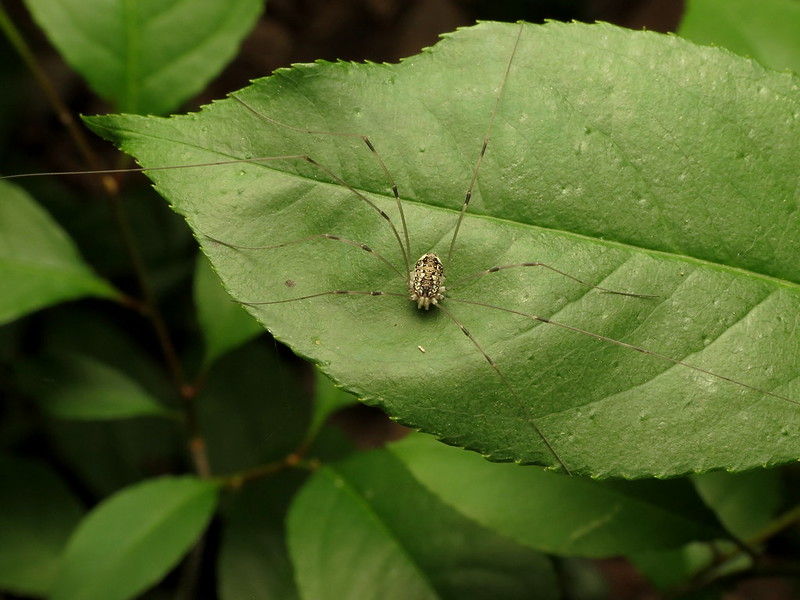
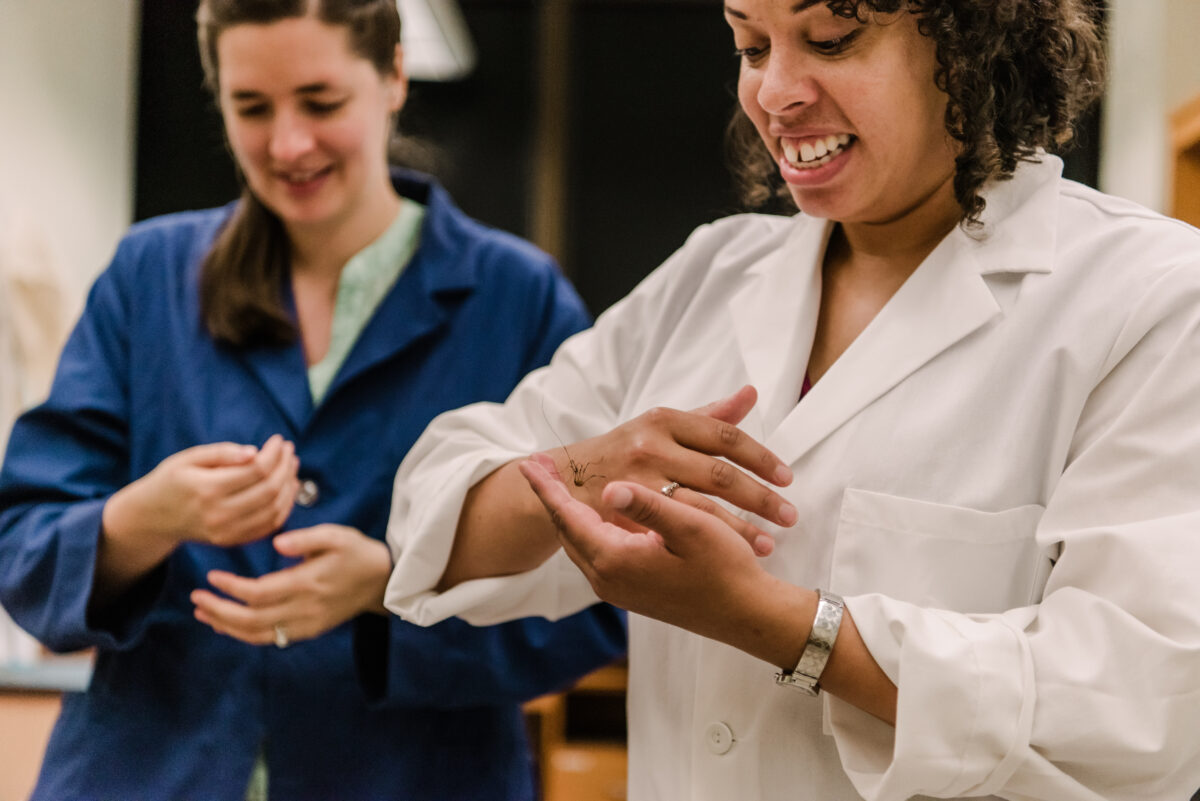
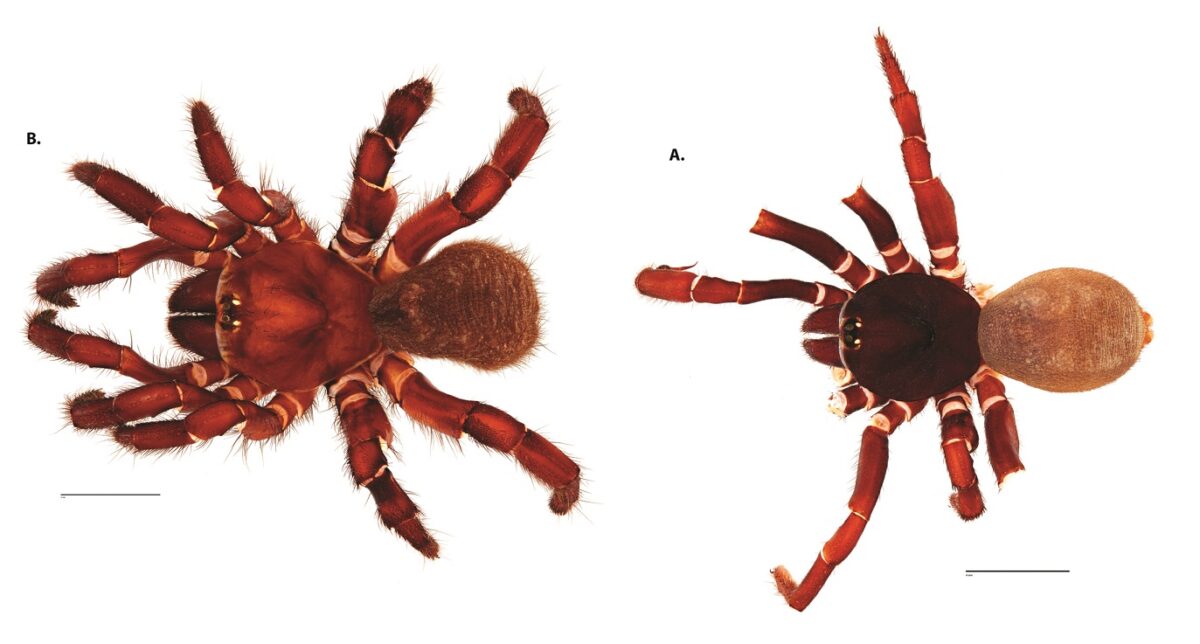
![At left, two different molecular structures, represented by red and yellow balls connected by black lines, labeled "[4Fe-4S]" and "[2Fe-2S]". A silver arrow points from the structures to an orange blob labeled ATE1. Below the orange blob, there is a blue blob to the left labeled "tRNA-Arg." It has a small green dotted-line circle with an R inside attached to it. Below right of the orange blob, there is another blue blob, labeled "substrate." It also has a green circle with an R inside attached to it. An arrow passing from the blue blob on the left to the blue blob on the right is labeled "Arginylation."](https://umbc.edu/wp-content/uploads/2023/03/FeSabstract-v24-1200x600.png)