A new study in Science Advances led by UMBC’s Tianle Yuan used satellite data from 2003 – 2020 to determine the effect of fuel regulations on pollution from cargo ships. The research team’s data revealed significant changes in sulfur pollution after regulations went into effect in 2015 and 2020. Their extensive data set can also contribute to answering a bigger question: How do pollutants and other particles interact with clouds to affect global temperatures overall?
Tiny particles in the atmosphere, which are called aerosols and include pollution, can harm human health, but they also often have a cooling effect on the planet because of the way they interact with clouds. However, estimates of the extent of that effect range by a factor of 10—not very precise for something so important.
When pollutant particles from ships enter clouds low in the atmosphere, they decrease the size of individual cloud droplets without changing the total volume of the cloud. That creates more droplet surface area, which reflects more energy entering Earth’s atmosphere back to space and cools the planet.
Instruments on satellites can detect these differences in droplet size. And the air over the ocean is generally very clean, making the relatively narrow ship tracks that snake across the ocean easy to pick out. “Most of the original cloud is unpolluted, and then some of it is polluted by the ship, so that creates a contrast,” Yuan explains.
While ship tracks can be relatively obvious in satellite data, you have to know where to look and have the time and resources to search. Before advances in computing power and machine learning, Yuan says, Ph.D. students could focus their entire thesis on identifying a group of ship tracks in satellite data.
“What we did is automate this process,” Yuan says. His group “developed an algorithm to automatically find these ship tracks from the sea of data.”
This huge advance allowed them to generate a comprehensive, global map of ship tracks over an extended period (18 years) for the first time. Next, they will share it with the world—opening the door for anyone to dig into the data and make further discoveries.
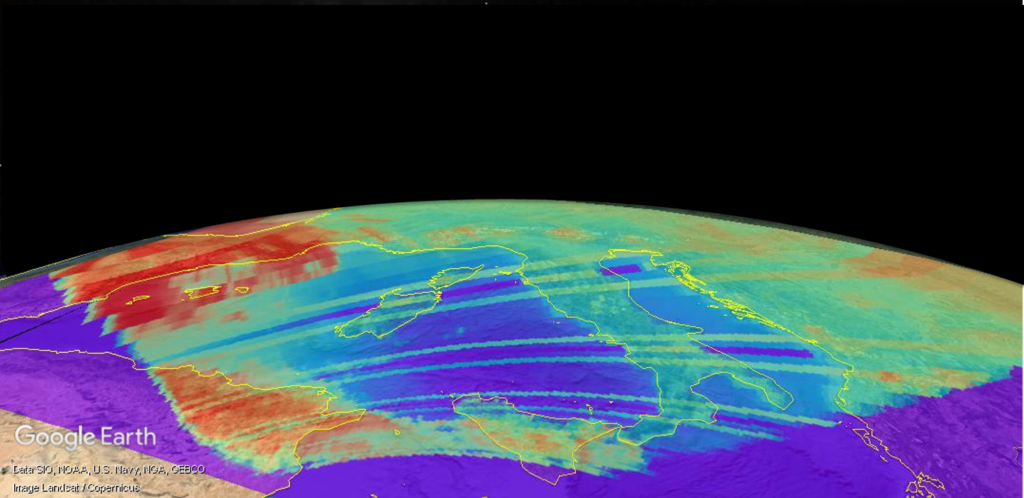
A figure from the new study shows an image collected by NASA’s MODIS satellite of the U.S. West Coast (left) overlaid with ship tracks detected by the research team’s algorithm (right).
Disappearing act
Even before pollution-limiting regulations were put into place, Yuan and his colleagues found that ship tracks didn’t occur everywhere ships were traveling. Only areas with certain types of low cloud cover had ship tracks, which is useful for adjusting the role of clouds in climate models. They also found that after Europe, the U.S., and Canada instated Emission Control Areas (ECAs) along their coastlines in 2015, ship tracks nearly disappeared in those regions, demonstrating the efficacy of such regulations for reducing cargo ship pollution in port cities.
However, shipping companies didn’t necessarily reduce their pollution output across the board. Instead, they made changes to adapt to the new rules. Ports in northern Mexico (not part of the ECA system) saw increased activity, and pollution “hot spots” built up along the boundaries of the ECAs as ships altered their routes to spend as few miles as possible inside the restrictive zones.
In 2020, though, an international agreement set a much more restrictive standard for shipping fuel across the entirety of global oceans, rather than only near coastlines. After that, the only ship tracks the team’s algorithm could detect were those in the cleanest clouds. In clouds with even mild background pollution, the presumed ship tracks blended right in.
Another figure from the paper shows how regulations affected ship tracks. In the middle panel, blue areas show how ships were carefully avoiding the Emission Control Areas near the coasts. The red and orange areas show increased traffic just outside the ECA boundaries and at ports not affected by the regulations. In 2020 (bottom panel), blue areas indicate that ship tracks largely disappeared even in areas with high ship traffic.
Climate conundrum
It seems obvious that reducing pollution from ships would produce a net benefit. However, because particles (such as shipping pollution) have a cooling effect when interacting with clouds, reducing them significantly could contribute to a problematic uptick in global temperatures, Yuan says.
That’s another reason it’s important to firm up the degree to which particulate pollution cools the planet. If the cooling effect of these pollutants and other particles is significant, humans will need to balance the need to prevent extensive warming with the need to reduce pollution where people and other species live—which creates difficult choices.
“Ship pollution alone can create a substantial cooling effect,” Yuan says, “because the atmosphere over the ocean is so clean.” There is a physical limit to how small cloud droplets can get, so at a certain point, adding more pollution doesn’t increase the clouds’ cooling effect. But over the ocean, because the background is largely unpolluted, even a small amount of pollution from ships has an effect.
Ocean pollution is also an outsize driver of the cooling effect of aerosols, because low clouds, which are most conducive to creating ship tracks, are more common over water than on land. And, as Yuan reminds us, “the ocean covers two-thirds of the Earth’s surface.”
Low clouds over the ocean. (Nicolas Raymond/CC BY 2.0)
The bigger picture
Moving forward, Yuan and his colleagues are helping address this conundrum by continuing their work to define more precisely the role clouds play in climate. “We can take advantage of the millions of ship track samples we have now to start to get hold of the overall aerosol-cloud interaction problem,” Yuan says, “because ship tracks can be used as mini-labs.”
By analyzing data from a relatively simple and well-controlled system—narrow ship tracks running through very clean clouds—they can come to conclusions they can be confident about.
Other research teams can also use the team’s data set and algorithm to come to their own conclusions, amplifying the potential public impact of this work. That spirit of collaboration will help scientists and communities determine how best to approach global challenges like pollution and temperature change.
A new study has confirmed that a black hole eight billion light years away is zipping away from its galaxy’s center at 2,000 kilometers per second, or more than 4.5 million miles per hour. The result also provides, for the first time, very strong evidence that it is possible for two black holes to merge.
The galaxy where this is happening, named 3C 186, was first discovered in 2017. Initial observations suggested that 3C 186 was the result of two galaxies (and their respective black holes) merging. However, there were still other possible explanations for the physical distance detected between the galaxy’s center and the black hole. The new study, published in Astronomy and Astrophysics, strongly supports only one of the remaining scenarios: that two black holes merged and the resulting black hole is moving away from the galaxy’s center.
“This is probably the most clear-cut case” illustrating this phenomenon that scientists are aware of, says Eileen Meyer, associate professor of physics. She is co-lead of the new study with Gianluca Castignani at the University of Bologna.
Figure 1 from Meyer and Castignani’s paper shows galaxy 3C 186. The black hole (blue lines/bright white area) is offset from its galaxy’s center (green lines).
Speedy departure
The two major findings—the black hole merger and its ouster from the galaxy’s center—are related. Theorists have predicted that if two black holes were to merge, they would release huge amounts of energy in the form of gravitational waves, Meyer explains.
Sometimes, “depending on how the black holes are spinning and their relative mass and how they’re oriented,” she says, that energy is not equally distributed in all directions. If there is “a lot of gravitational wave energy in one direction, there is consequently going to be literally kinetic energy given to the black hole in the other direction.” That means the black hole is going to move—in this case, very quickly.
“There were basically two pieces of evidence that made this story come together,” Meyer says. First, an earlier paper used high-resolution imaging from the Hubble Space Telescope to establish the physical offset between the black hole and the galaxy’s center. “That in itself might not have been weird,” Meyer says, because after two galaxies merge, “stuff is flying all over the place,” and it can take time for the black hole to settle in the center of the new, merged galaxy, she explains.
However, Castignani and Meyer’s new paper confirmed a critical second finding: the velocity of the black hole.
The imaging plus the velocity comes as close as you can in astronomy to proving the scenario that Meyer and her colleagues favor: a merged black hole has been kicked out from the center of its galaxy as a reaction to gravitational wave energy headed in the opposite direction. This is the first time both physical offset and velocity have come together so convincingly.
Eileen Meyer works with a student in her research space.
Shifting understanding
Meyer and colleagues figured out the velocity of the black hole by measuring the radiation emitted by carbon monoxide (CO) gas in the galaxy. They used a ground-based observatory called the Northern Extended Millimeter Array (NOEMA), located in the French alps, to collect the measurements.
The wavelength of the radiation emitted from CO gas increases as it travels across the universe from 3C 186 to NOEMA, a phenomenon referred to as red-shift. The farther away something is, the greater the red-shift will be. Galaxy 3C 186 is stable overall, so one would expect the radiation it emits to all have the same red-shift. However, NOEMA detected radiation with a smaller red-shift coming from the gas near the black hole. That indicates the black hole is moving quickly toward NOEMA relative to the center of 3C 186—in this case, at 2,000 km/s.
Detecting the velocity “was the thing that made us say, maybe this isn’t just some post-merger weirdness, but instead the black hole is offset because it has traveled out from what should have been the center of the galaxy,” Meyer says.
The NOEMA space observatory in the French Alps. (Institut de Radioastronomie Millimétrique)
Detective work
The research team wasn’t looking specifically for the galaxy 3C 186 when their study began. The initial observations came from what’s called a “snapshot proposal” with the Hubble Space Telescope.
Sometimes space-based observatories like Hubble make observations that require multiple orbits around Earth. But between these major observations, scientists can utilize smaller chunks of time for other studies that need only a quick “snapshot.” The data the researchers receive aren’t of the same quality as longer exposures, but they can be very useful.
In this snapshot study, the researchers received images of a couple dozen of their 100 or so preferred targets as Hubble traversed a partial orbit. “This black hole merger was observed by chance,” Meyer says. “There were odds against us.”
In astronomy, there can be pressure to choose a “safe” proposal, where researchers seek new data on a particular space object that’s already known to be interesting. In snapshot proposals, you often don’t know what you’re going to find, Meyer says, “but sometimes you need to take a chance on the unknown to make new discoveries.’”
As it turns out, this time they made a major discovery, adding to the story of how black holes merge. “When you build a story out of the evidence, it’s a bit like detective work,” Meyer says.
For systems so far away, scientists often can’t directly image everything that’s happening. Instead, Meyer explains, they have to infer what’s going on from the light produced, and it can be hard to narrow down the possible scenarios for what’s actually happening. This new study takes a big step forward by translating theoretical predictions into actual observed phenomena at galaxy 3C 186.
Finding the first
The new finding confirming that two black holes merged, and that the resulting black hole is traveling away from the galaxy’s center, “is actually very important,” Meyer says. “People always want the evidence for the scientific story, and now we have that evidence.”
The results are also encouraging for a new major mission led by the European Space Agency. The Laser Interferometer Space Antenna (LISA) will observe gravitational waves from space and could help detect more instances of merged black holes at the centers of galaxies.
“If you find one, you know there’s got to be many more,” given the sheer number of galaxies out there, Meyer says. “The first one is definitely important.”
From cooking and cleaning to fixing your car, understanding chemistry can enlighten all aspects of life. That’s just one reason why Dean William R. LaCourse still loves sharing the joy of his favorite subject in front of a classroom.
It’s not every institution where you can take a class taught by the dean— especially a 100-level course. It’s even less likely to find that dean sprinkling his weekly lectures with silly chemistry jokes and cultural references. But William R. LaCourse, dean of the College of Natural and Mathematical Sciences (CNMS) since 2011, does exactly that, co-teaching CHEM 100: The Chemical World to non-chemistry majors with Caitlin Kowalewski, assistant director of undergraduate initiatives in CNMS. Every Tuesday afternoon this spring, LaCourse taught his students how chemistry influences their lives.
The jokes and digressions are designed to keep a complex topic like chemistry light and relatable—even fun. After all, LaCourse tells his students one day in March, “This is not a course that’s supposed to stress you out. It’s an empowering course. At the end, you’re gonna know so much more about chemistry.”
Throughout the class LaCourse affectionately refers to as “the egg lecture,” for example, he teaches the students how best to make hard- and soft-boiled, fried, and baked eggs and exactly why based on the chemistry involved, with the occasional digression. The Lilliputians from Gulliver’s Travels, for example, make an appearance— apparently they went to war over which end of a soft-boiled egg to open. He also takes a moment to share a favorite recipe his wife makes—showing the students he’s more than a university administrator.
After the short lecture, the students answer discussion questions in groups, coming up with a list of compounds important for cooking, such as baking powder and gelatin, and their roles.
“CHEM 100 is all about empowerment,” LaCourse says. “Understanding how the chemical world affects you gives you more control over your life.” For example, you can avoid trendy health hacks that are actually bad for you, he explains. Understanding chemistry can even help you be more self-sufficient. You may be able to “fix your car, cook better meals, or take stains out of your clothing,” LaCourse says.
Students in the course appreciate that LaCourse makes the content relatable. “I don’t think I’ve ever had a science class before that connects to our daily lives in a way I can understand it,” says Keli Amoako ’25, political science. “He makes you aware of the chemistry in everyday life. I think everybody should have to take a class like this,” adds Moroti Oyeyemi ’25, information systems. There is something for everyone. “I have a great love of baking,” says Meghan Seerey ’23, visual arts, “and he connects the class to the culinary arts.”
For their final projects, students had complete freedom to demonstrate how chemistry affects their lives. Some created “day-in-the-life” presentations, explaining the chemistry in activities like brushing their teeth or doing laundry. Others focused on a particular interest, like skin care, fashion, or scuba diving. One student filmed a baking video, and another designed a brochure explaining how to improve one’s garden through soil chemistry. There were podcasts, poems, and even a musical composition in the key of C sharp. (The musical notation for C sharp, C#, looks like CH, representing carbon and hydrogen, two key elements for life.)
Connected to his roots
For LaCourse, teaching CHEM 100 follows naturally from his values. Even with the added responsibilities of a dean, after also serving as chair of the chemistry and biochemistry department for four years, and a member of the department for 15 years before that, “I still have graduate students and I still teach, because that’s the reason I came here in the first place,” LaCourse says. “I think if you move too far away from those roots that you’ll lose the ability to understand and to be empathetic with those who teach, with those who do research, and the issues that they encounter.”
Never has this been truer than over the last two years, as the COVID-19 pandemic forced administrators to make decisions about whether to shift classes online and other changes to the education experience. In Fall 2020 and Spring 2021, LaCourse and Kowalewski taught CHEM 100 fully online, in part to be in solidarity with the rest of the college’s faculty. “All the challenges with technology, grading, and keeping people’s interest…I could understand what the faculty were going through,” LaCourse remembers.
A non-traditional path
In addition to staying connected with the needs of faculty, LaCourse calls on his own experience to explain why he pursued the deanship and why he works so hard to make sure the college is serving all UMBC students well. He starts to talk about when he became department chair, then pauses.
“Actually, I’m gonna go back even faaather,” he says, revealing the Boston accent that still shows up now and then, despite living in the Baltimore area for decades. “I took a very non-traditional pathway to get where I am.”
He goes on to describe a series of experiences—starting out at a technical college, then pursuing a four-year degree at multiple institutions while working full-time, and a graduate education full of “naïve decisions” due in large part to a lack of guidance and support.
All that is what drove him to pursue leadership. It’s one thing to teach a course that shows students from all backgrounds why chemistry matters—and hopefully improve their lives in the process. It’s another to make changes at the department level, and yet another to be able to lead the college. LaCourse says his motto is “There’s always a better way,” similar to one of President Freeman Hrabowski’s sayings that has been adopted by many on campus: “Success is never final.”
“The world changes,” LaCourse says, “and most things will have to evolve to keep up.”
Discovery Learning
When LaCourse started as chair, he felt as if there were too many students failing introductor y chemistr y courses. He believed there was a better way—that the introductory chemistry curriculum needed to evolve. As a result, after a collaborative pilot program, introductory chemistry courses added a weekly, team-based, problem-solving session to the lecture component in 2005. These sessions are still a cornerstone of the chemistry curriculum today. The magic happens in the Chemistry Discovery Center (CDC), and LaCourse calls the technique “discovery learning.”
“Chem Discovery was a different way to do it. The vision was to bring students from a passive to an engaged format, to give them the opportunity to discover,” he says. “People love to discover things, to plant new flags.”
Research faculty get to experience that on a regular basis, LaCourse notes.
“Why don’t we give our students the opportunity to discover knowledge?” he says. “Because when you discover it, you own it—and we know that ownership is important for learning.”
After the Chemistry Discovery Center’s introduction, the fail rate in intro to chemistry dropped by half. The CDC plus a shift among UMBC faculty away from the concept of “weed out” courses has led to continued success, including increased retention and attendance.
Creating opportunities for all
Chemistry Discovery was just the beginning. LaCourse has spent nearly two decades working with colleagues across the college and at community colleges in the region to create more opportunities for students through a number of initiatives that supply the support and structure students need to succeed.
UMBC has proven again and again that relatively small, cohort-based scholars programs that generate a sense of community and offer intensive advising can significantly increase student persistence and success rates in STEM (science, technology, engineering, and math). LaCourse isn’t satisfied with that, though—he wants to see more students get that high-touch experience.
“The whole purpose is to give opportunity and a unique education experience to every student that UMBC lets in,” LaCourse says. “The focus is on what we need to do to make that possible.”
Scaling up
The most comprehensive manifestation of this goal is STEM BUILD, a 10-year, National Institutes of Health-funded initiative at 10 universities to diversify the biomedical sciences workforce. At UMBC, the initiative’s motto is, “500, not 50.” That’s 500 students. “Can we do 500, not 50? Can we make things scalable?” LaCourse asks. “Can we take the pieces of community and intensive advising, and make it so many more people benefit from it?”
The goal of STEM BUILD at UMBC is to identify the most effective practices that support student success and find ways to implement them at scale. Perhaps most important, the college is working hard to weave the most effective elements into regular operations so that when the grant funding sunsets in 2023, students will continue to benefit.
STEM BUILD programming includes group research experiences, a summer bridge that teaches laboratory skills and experimental design, and training in communications and research ethics. Advising, community meetings and socials, living on campus in the STEM Living Learning Community, and a rich culture of staff and faculty support are key community-building elements.
STEM BUILD also spawned an Active Learning, Inquiry Teaching (ALIT) certificate through UMBC’s Faculty Development Center. ALIT has helped faculty transition their courses to more engaged formats, such as team-based problem-solving, rather than lectures. Spaces like the CNMS Active Science Teaching and Learning Environment, opened in 2010, facilitate this transition. CASTLE has round tables rather than desks, and since fall 2019, the new Interdisciplinary Life Sciences Building has offered similar classroom environments, plus features like mobile whiteboards. Originally, ALIT was intended only for faculty directly involved in STEM BUILD activities, but has since been expanded to any interested faculty—an example of the ripple effect of initiatives such as STEM BUILD.
Leading the change
LaCourse has also led efforts to capitalize on UMBC’s location in one of the top biotech clusters in the country. After hiring Annica Wayman ’99, M6, mechanical engineering, as associate dean of Shady Grove affairs in CNMS, degree options for UMBC STEM students at the Universities at Shady Grove have grown. “She has a passion for students and helping them be successful,” LaCourse says.
Wayman came back to UMBC from a successful career in international development at USAID specifically to lead the new Translational Life Science Technology (TLST) bachelor’s degree program, which prepares students for immediate, in-demand careers in biotech. “The relevance, innovative nature, and health-related impact of the TLST program is what attracted me back to UMBC as associate dean, and the many students who come into the program,” she says.
LaCourse’s leadership, in conjunction with community college partners, was crucial to bringing it to life, Wayman adds. “Bill’s educational start in community college and work in the private sector before coming to academia made him the perfect visionary for developing a new bachelor’s degree in biotechnology at UMBC.”
And it’s working. TLST grads like Titina Sirak ’20 and Charmaine Hipolito ’20 are already finding success in the regional biotech market, leaving the program with several job offers for biotech positions in hand.
LaCourse also knows that for students to succeed, faculty need to feel supported and be representative of the student body. The ADVANCE program, for example, has increased the number of women faculty in STEM by 180% since 2003. And now, the Pre-professoriate Fellowship program encourages faculty members committed to supporting diversity and inclusion to apply. The goal is for participants to convert to assistant professors at UMBC.
While persistence and success in STEM majors has significantly increased over the last two decades, “How many more successful students could there be if they could see more people like themselves, who they can relate to better?” LaCourse asks.
Doing right by students
Given his own challenges navigating higher education, supporting success for all students, enabling discovery, and encouraging ownership of their education is deeply embedded in LaCourse’s psyche.
One of his current graduate students in chemistry and biochemistry, Amanda Belunis, confirms this. “Dr. LaCourse always says that he is just a guide, and he wants us to be actively engaged in our own education and learn lessons. He pushes us all to reach our full potential and consistently offers constructive feedback and encouragement, usually paired with a funny anecdote or joke,” she says. “I feel confident that when I finish, I will be leaving the program as an independent critical thinker ready to tackle any problem, and I owe a lot of that to him.”
While some students may be likely to succeed regardless of the support available or not, for others, the right environment can make all the difference.
“When people come in, if you give them the feeling that they belong, and that they can do it, and you give them the help that they need, many, many more will succeed,” LaCourse says. This sentiment applies to faculty, too. Both students and faculty “put their future in the hands of the institution, that we’ll do right by them,” LaCourse says.
Nowhere like UMBC
Through his work with individual students in his laboratory, teaching undergraduates, and securing funding for projects that affect many more students, he’s doing his best to make sure the institution deserves its community members’ trust by creating opportunities and offering support.
“Opportunities are what life is all about,” LaCourse says. “It’s up to an individual to take advantage of them, but we have to put those opportunities in front of people and make people believe that they can take advantage of them.” Through programs like STEM BUILD, TLST, transfer student support programs, and more, “that’s what we train our students to believe—that they belong, that they could do the job, that that opportunity is theirs as much as anybody else’s,” no matter their background.
As a non-traditional candidate for a leadership role in academia, LaCourse also appreciates the opportunities he’s been given to make a difference at UMBC—the chances people took on him and his ideas, which sometimes involved creative new methods. Another pause. And then, “Of course I can’t know—as a scientist, I understand there’s no control group for my life,” he says. “But I don’t think I’d be where I am at any other place than UMBC.”
He’s taken it as his mission to pass on those opportunities to UMBC students—they’re why he’s here, after all. As a leader first in chemistry, and now in CNMS as a whole, he’s worked to “break down silos, and work under umbrellas,” as he says, to make changes that do the greatest good.
“You need to understand what everybody’s going through, and what they’re up against,” he says. “That way you can work together better in the long run—and again, we’re all working for the same purpose.”
Vision of what could be
The significant, positive change that has occurred on his watch is already impressive, and the trajectory is still going in the right direction. More students are succeeding in STEM at UMBC. Students who demonstrate high potential, but may not be at the top of their class or have much experience when they arrive at UMBC, are getting the resources they need and finding their way. Faculty and staff are committed to supporting all of them.
Although he’s not retiring yet, LaCourse has decades of experience at UMBC to reflect on. When asked about what a normal day might look like, after mentioning writing grant proposals, dealing with crises, attending leadership meetings, and, of course, teaching CHEM 100, he pauses again, waxing philosophical.
“A day in the life…” he ponders. “It’s really a lifetime, guided by principles and experiences from my own life. So every decision, every action, draws upon everything in the past, and the vision of what could be.”
The Simons Foundation and its sister organization, Simons Foundation International, have pledged $2.5 million over five years to support the Meyerhoff Scholars Program. Continued partnership between UMBC and Simons will also generate opportunities for program alumni and support Meyerhoff replication efforts at other institutions.
For almost 30 years, the Simons Foundation has worked to support advances in mathematics and basic science by funding external scientists and, more recently, through research at its own Flatiron Institute in New York City. Simons has also done outreach work through the Math for America program, which seeks to enhance the math and science literacy of children in New York City public schools. The gift to UMBC, however, represents a new emphasis on supporting the development of a diverse pipeline of STEM professionals.
Partnering to diversify STEM
“I have long admired the UMBC Meyerhoff program for its significant impact on training outstanding students from diverse backgrounds. It is an important model for other universities, and its alumni are at the forefront of scientific research,” says David Spergel, president of the Simons Foundation and Simons Foundation International. “I am proud that the Simons Foundation and Simons Foundation International can partner with UMBC through support of this program.”
David Spergel, president of Simons Foundation and Simons Foundation International and a longtime admirer of President Hrabowski and the Meyerhoff Scholars Program (courtesy of Simons Foundation)
Craig Wesley, manager of diversity, equity, and inclusion at the Simons Foundation, has also been following President Freeman Hrabowski’s work for years. When Wesley started in his role a little over a year ago, he undertook a study to see what programs existed that were already successfully helping diversify the STEM pipeline. The Meyerhoff Scholars program jumped out as a leader in that space.
“The vision became, how could we replicate that model here in the New York area?” Wesley says. “We needed to find the right institutional partner to launch this work.” As it turned out, UMBC was the perfect fit.
Immediate impact
The new partnership will also create summer research opportunities for Meyerhoff Scholars at the Flatiron Institute. Naiyah Lewis ’23, M31, computer science,is already in New York for a summer internship with Natalie Sauerwald, a Flatiron Research Fellow with a focus on computational techniques in genomics.
This new grant will support scholarships for Meyerhoff Scholars and serve as a dedicated funding source for Summer Bridge, a cornerstone of the Meyerhoff experience undertaken by Scholars before their first year at UMBC. During Summer Bridge, Scholars bond as a community and internalize what it means to be a Meyerhoff Scholar. This includes the values of collaboration, leadership, service, professionalism, and academic excellence—alongside hard work and grit.
Abby Cruz ’18, biological sciences, a Meyerhoff affiliate and MARC U*STAR Scholar, conducts research with Fernando Vonhoff. (Marlayna Demond ’11/UMBC)
Meyerhoff alumni will also benefit. They will be invited to apply for Transition to Independence Awards through the Simons Collaboration on the Global Brain and the Simons Collaboration on Plasticity and the Aging Brain. These large awards target Ph.D. and M.D./Ph.D. scientists from underrepresented groups who are currently in training positions and seeking tenure-track roles. Postdoctoral positions may also be available for Meyerhoff Scholar alumni at the Flatiron Institute.
“UMBC and Meyerhoff are excited to partner with the Simons Foundation in advancing our efforts to promote inclusive excellence and diversify the nation’s STEM workforce,” says Keith Harmon, director of the Meyerhoff Scholars Program.
Ripple effect—amplified
In addition to helping individual students and alumni, the growing partnership between UMBC and Simons will also advance a larger, shared goal of both institutions: launching more programs modeled on the Meyerhoff Scholars. UMBC staff and faculty involved with Meyerhoff will work with SUNY Stony Brook to create a Meyerhoff-like program within the public university system in New York.
“We are committed to helping increase the diversity of the STEM workforce,” Spergel says. “We see our collaboration with UMBC as key to helping us reach that goal through partnerships, in part by helping to adapt the Meyerhoff model at Stony Brook.”
As the partnership between UMBC and the Simons Foundation develops, the institutions hope their collaborative work will amplify the ripple effect already occurring across the country as Meyerhoff alumni advance in their careers. As more students get to experience the support offered by Meyerhoff and programs like it, they, too, will join the ranks of these alumni and make their own impact.
The National Institute of Allergy and Infectious Diseases, part of the National Institutes of Health, recently awarded nine research consortia a total of $577 million to create Antiviral Drug Discovery (AViDD) Centers for Pathogens of Pandemic Concern. UMBC’s Katherine Seley-Radtke, professor of chemistry and biochemistry, is contributing her innovative work on more flexible antiviral compounds to this effort.
Seley-Radtke is a member of the consortium led by University of North Carolina—Chapel Hill, which will receive a total of $65 million over five years to work on five separate projects. UMBC is guaranteed $2.2 million for the first three years, with another $1.3 million to come for the final two years if the projects are making satisfactory progress.
The unique consortium structure includes an international, interdisciplinary team of academic researchers in virology, immunology, chemistry, and biology, and corporate partners. Their goals are ambitious, with increased urgency due to the COVID-19 pandemic.
“Many people in the antiviral field had been pushing for many years, warning people that this kind of viral pandemic could happen,” says Seley-Radtke, who is also president of the International Society for Antiviral Research. “We have to be better prepared. And that’s the point of the AViDD program—to quickly get us to the point where we have broad spectrum, small molecule antivirals that can be stockpiled, can be orally administered, and can be shipped to every corner of the Earth.”
Flexible fighters
Seley-Radtke is in a strong position to contribute to the development of compounds that can fight a wide range of viruses. She first invented compounds called fleximers in 2000. Fleximers are modified forms of an established class of antiviral drugs called nucleoside analogues—with a very useful twist.
“The thing that’s clever about the fleximers, is because they’re flexible, they can adjust to a binding site to obtain better binding than a normal rigid nucleoside analogue would,” Seley-Radtke says. That means they can be more effective against a virus that has accumulated some mutations, or even against different viruses that have similar, but not identical, structures.
For example, acyclovir is an antiviral drug used against herpes. Acyclovir itself isn’t effective against any viruses of pandemic concern, but a fleximer based on its basic structure “shows incredible activity” against several viruses of interest, Seley-Radtke says. A drug that can target multiple viruses is exactly the kind of “broad spectrum” treatment researchers are seeking.
An example of fleximers. Guanosine (left) is the traditional nucleoside analogue, and the two structures on the right are fleximers. The fleximers’ structure allows them to wrap around other compounds and bind more tightly. (Image courtesy of Seley-Radtke)
Beyond generating a single drug that can tackle multiple viral threats, the consortium is also working toward combination therapies. In these treatments, multiple drugs are packaged together, as is common for HIV medications.
“Combination therapy is critical,” Seley-Radtke says. Because these therapies attack several parts of a virus at once, she explains, they can “exponentially cut down the chances of the virus developing resistance to the treatment. That’s why we’re looking for not just one broad spectrum inhibitor, but a combination of things that can be used together to fight whatever rears its ugly head.”
Katherine Seley-Radtke discusses her research at UMBC’s annual TED-style GRIT-X talks in 2021.
Fast-tracked progress
The structure of the consortium makes it uniquely suited to address the team’s goals efficiently. Having academic researchers and industry partners working together “will facilitate things moving much faster than the normal process,” Seley-Radtke says. “There’s a workflow.”
Her lab will “decide what the target’s going to be. Then we design the compounds, we make the compounds, and then we send them off to the next lab to be tested for activity” against viruses of interest, she explains.
If the initial testing detects any winners, another consortium partner will produce the compounds at scale so they can run more tests. If after that the compounds are still showing promise, they’ll be sent on to clinical trials through the pharmaceutical company partners. It all happens in a coordinated, pre-planned sequence.
“I’m really grateful to be able to participate in such high-impact work,” Seley-Radtke says. “It’s an amazing opportunity and it’s a brilliant concept.”
A student conducts research in Seley-Radtke’s laboratory. (Marlayna Demond ’11/UMBC)
Proactive approach
Seley-Radtke will work on two of the five projects in the consortium. One will focus on SARS-Cov2, dengue fever, and other viruses in the flavivirus family. These RNA viruses are most often spread by ticks and mosquitoes. Another project focuses on filoviruses, which include diseases like Ebola and Marburg virus disease, known for causing severe hemorrhagic fevers.
The members of the different projects will meet with each other and with NIH regularly to gauge progress and keep everyone on track. The goal is to develop individual drugs with activity against many viruses, and combination therapies, quickly.
“It is definitely within reach, and not just with my compounds,” Seley-Radtke says. “The AViDD centers are a fantastic effort. I applaud NIH for putting the money into this program and recognizing we’ve got to stop being reactive and be proactive.”
Trees store carbon, filter the air, create habitat, and supply a host of other benefits for animals and people. Planting the right trees, in the right places, in consultation with local communities, can support goals like addressing climate change and improving lives. However, new research led by Matthew Fagan, assistant professor of geography and environmental systems at UMBC, finds that some trees planted in the tropics may be doing more harm than good.
The study, published in Nature Sustainability, examined the increase in tree cover across the global tropics between 2000 and 2012. Fagan and colleagues found that, surprisingly, tree cover gains during that period were equally attributable to natural forest regrowth and the creation of tree plantations. The most common tree plantation species were rubber, eucalyptus, and oil palm.
Tree plantations are not always harmful to the environment, and even much-maligned oil palm can be farmed sustainably, Fagan explains. However, the study found that 92 percent of new tree plantations were in biodiversity hotspots, threatening a range of plant and animal species. Also, 14 percent of plantations were in arid biomes, where trees are unlikely to thrive and likely to damage existing ecosystems. And tree plantations had encroached into 9 percent of accessible protected areas in the humid tropics, such as national parks.
“Ecologists have been sounding the alarm on this for over a decade,” Fagan says. “But no one’s had a hard number about how much this is actually happening.”
Matthew Fagan (Marlayna Demond ’11/UMBC)
When tree planting is lose-lose
In recent years, dozens of nations have committed to restoring large areas of forest. Tree plantations make up 45 percent of commitments to the Bonn Challenge, an international initiative to restore degraded and deforested landscapes. But Fagan is concerned that these plantations may have unintended consequences.
For example, China has undertaken a massive tree-planting effort at the edge of the Gobi desert, and many African countries have committed to planting trees at the transition between the Sahara desert and Sahel grassland. The goal is to prevent desert expansion, but the plantings can cause harm. Disturbing the soil releases carbon, and trees are water hogs. They end up “killing off the grassland that was there, and then they often die of drought,” Fagan says. In these situations, tree planting is lose-lose.
Similarly, in Brazil, soy farmers moved out of the Amazon and into the Cerrado, one of the world’s largest savannas. Pine and eucalyptus tree farms followed. The Cerrado supports a wealth of biodiversity, and the carbon it stores underground rivals rainforest carbon sequestration, Fagan explains. Tree crops in the Cerrado may count toward Brazil’s reforestation commitment, but could actually be a step backward in mitigating climate change and biodiversity loss.
“In the U.S., we have a huge area of relatively wet woods, and we tend to idolize planting trees as sort of the ultimate environmental act,” Fagan says. “But there’s a lot of value in grasslands and savannas that we don’t necessarily see. And when you plant trees, you essentially destroy that ecosystem.”
In response to his team’s new research, “I would really like to see governments around the world reassess their restoration plans,” Fagan says, “or at least be more transparent when their plans involve tree planting, especially in areas that may not be appropriate for planting trees.”
A plantation of non-native Melina trees in Costa Rica (Matthew Fagan)
Park or plantation?
Fagan’s new paper also revealed the extent to which tree plantations are invading protected areas. The problem was so bad that he had to overhaul the algorithm his team used to differentiate between data representing natural forest regrowth and tree plantations.
Initially, the algorithm used park boundaries as a proxy for natural forest regrowth areas. But it wasn’t working. To figure out what was wrong, Fagan spot-checked 20 parks, and found that three had multiple plantations inside them. That got him curious.
Six weeks later, he had manually checked for plantations in every park in the tropics. When he found plantations, he either redrew the park’s boundaries or, if the park was too compromised, removed it from the data completely. Using the resulting new maps, the algorithm could detect natural forest regrowth versus tree plantations with more than 90 percent accuracy.
“It was very disturbing to see there were just so many parks that were compromised,” Fagan says.
The new maps allowed the team to find many more regrowth areas and plantations than expected from government estimates. Several UMBC undergraduates are authors on the paper because of their contributions to this data analysis. Each student manually checked at least 1,000 patches, some as many as 3,000.
“In the end, the tropics is a much more modified place than we were expecting,” Fagan says. “There’s a whole host of reasons that we see these encroachments, but they’re definitely happening all over the world. We see a steady erosion of these parks by plantations, and the industry is just getting started.”
Matthew Fagan (right) and Joshua Slaughter ’22, computer engineering, who was a co-author on the current paper, examine data for a study on the longevity of secondary forests in Latin America. (Marlayna Demond ’11/UMBC)
Reason for hope
When setting out on this research, the team had a simple question: How many planted trees are there in the world? “It seemed like a strange thing not to know,” Fagan says. As the work progressed, they asked whether trees were being planted where they shouldn’t be and whether plantations were expanding into parks. They’ve found the results concerning, but they also have reason for hope.
Trees can do a lot of good, and planting more of them can be a significant factor in addressing the impacts of climate change. But it has to be done right. “This paper shows it’s possible to monitor natural forest versus plantation at a global scale,” Fagan says, “so we can encourage the results we want and discourage results we don’t want.”
He also hopes the results will inspire everyone to be more conscious of where their products—from paper to food to shampoo to tires—come from, and to demand that companies producing those products in tree plantations adopt more sustainable practices.
“If we make our choices en masse, it does shift the direction that these companies go in,” Fagan says. And despite our love for trees in the U.S., he notes, forests are not the only ecosystems that can help mitigate the effects of climate change and biodiversity loss. Savannas and prairies also have an important role to play.
“We need to be cognizant that not all tree planting is beneficial for the ecosystem involved,” Fagan says. “The right tree in the right place is the right answer.”
Today, the Howard Hughes Medical Institute (HHMI) launched the Freeman Hrabowski Scholars Program to help build a scientific workforce that more fully reflects our increasingly diverse country. The $1.5 billion program honors UMBC President Freeman A. Hrabowski, III for his decades of leadership in growing and diversifying the pipeline of Ph.D.-level researchers, most prominently through UMBC’s Meyerhoff Scholars Program.
Alumni leading the way
UMBC is now the nation’s #1 producer of Black bachelor’s degree recipients who go on to earn a Ph.D. in the natural sciences and engineering, and this program builds on that legacy.
Meyerhoff Scholars alumni have earned 385 Ph.D.s, 155 medical degrees, and more than 300 master’s degrees (as of April 2022). More than 370 additional Meyerhoff alumni are currently enrolled in graduate and professional school. Students who became Meyerhoff Scholars are more than five times more likely to have completed or be currently enrolled in a STEM Ph.D. program than students who were accepted to the program but declined. Several universities across the country, including Penn State and UNC Chapel Hill, have successfully replicated the program, with support from HHMI and others.
Meyerhoff alumni include such rising stars as Kafui Dzirasa ’01, M8, chemical engineering, associate professor at Duke and an HHMI Investigator, and Kizzmekia Corbett ‘08, M16, biological sciences and sociology, lead of the NIH team that developed the technology for the mRNA COVID-19 vaccines, and now assistant professor at Harvard.
Kizzmekia Corbett visited campus in 2021 for an interview with CNN. (Marlayna Demond ’11/UMBC)
As it has gained momentum, the Meyerhoff program has had an important ripple effect. Many Meyerhoff alumni today are cultivating diverse, inclusive research groups of their own, where they support undergraduate and graduate students on their way to careers in STEM.
HHMI has designed the new Freeman Hrabowski Scholars Program to ensure that early career faculty have resources and support to become both leaders in their research fields and effective leaders and mentors of trainees from racial and ethnic backgrounds currently underrepresented in U.S. science. These are just the sort of researchers who may have come up through a Meyerhoff alumni-led laboratory, and will now be in a strong position to build their own research groups.
Kafui Dzirasa presents at UMBC’s GRIT-X talks in 2017. (Marlayna Demond ’11/UMBC)
Changing the face of science
With the Freeman Hrabowski Scholars Program, HHMI expects to hire and support up to 150 early career faculty over the next 20 years. The program will select 30 Scholars every other year for the next decade. Each Scholar will be appointed to a five-year term, renewable once with evaluation. Scholars will receive up to $8.6 million over 10 years, including full salary, benefits, a research budget, and scientific equipment.
In addition, Scholars will participate in professional development to advance their leadership and mentorship skills. They’ll also be included in HHMI’s community of scientists, educators, and students for scientific meetings, networking, and other opportunities.
“For academic science to thrive in an increasingly diverse world, we need to attract and support scientists from a wide variety of racial and ethnic backgrounds,” says HHMI President Erin O’Shea. “Early career faculty play a key role because they are the leaders of tomorrow. We’re excited to support talented early career scientists dedicated to a model of excellence in science that combines innovative scientific research and intentional, inclusive development of postdocs, students, and other lab members.”
President Freeman Hrabowski (left) and Erin O’Shea, president of HHMI, talk backstage at UMBC Commencement in 2018, where O’Shea was one of the speakers. (Marlayna Demond ’11/UMBC)
It’s especially meaningful that HHMI, the largest private funder of biomedical research in the nation, has taken up this effort. President Hrabowski was moved to learn that HHMI wanted to name their latest and biggest endeavor to diversify the scientific workforce in honor of his decades of service.
“We should all be encouraged by HHMI’s commitment to changing the face of science in America,” Hrabowski says. “This initiative shows what is possible when an institution is guided by its values and by evidence of what works. I am deeply honored to be connected with HHMI and with this new program.”
In 2021, the National Institute on Drug Abuse (NIDA) awarded UMBC more than $1 million over five years to create a program specifically for undergraduate scholars interested in research on substance abuse and addiction. A year after the program’s launch, it is thriving as students in fields as diverse as economics, computer science, and chemical engineering find ways to connect their interests to this important topic.
EDUCATE Scholars gathered for an end-of-semester social in spring 2022. (Image courtesy of Yetunde Oshagbemi)
“We need people from all walks of STEM to be able to approach problems to find solutions,” says Patrice Darby. She isprogram coordinator of special projects of the Meyerhoff Scholars Program and a co-lead on the grant, which is called Educating Diverse Undergraduates for Careers in Addiction and substance abuse research via Training Experiences (EDUCATE). The program supports a small, specialized group of Meyerhoff Scholars as EDUCATE Scholars. The grant is administered by UMBC’s College of Natural and Mathematical Sciences and led by the college’s dean, Bill LaCourse.
EDUCATE programming includes talks from researchers whose work touches addiction, as well as workshop series on science communication and on the tools needed to become a successful researcher. EDUCATE Scholars are also expected to participate in a sustained research experience with UMBC faculty mentors and to present their research at a conference. They also take an ethics course and receive intensive academic and career advising from program staff. Funding is available to support summer research experiences for EDUCATE Scholars as well.
“NIDA has really encouraged an interdisciplinary approach,” Darby says. That and the small size of each cohort means “we’re really able to tailor things to the students’ needs.”
The National Institute on Drug Abuse in Baltimore. (NIDA)
Broader horizons
Yetunde Oshagbemi ’23, economics and mathematics, wants to study economic development in Nigeria, and she is interested in understanding how drug abuse has impacted development. Based on Oshagbemi’s interests, Darby invited an economist with a focus on drug abuse to speak to the scholars. In addition to speaking directly to Oshagbemi’s interest, this offered a fresh perspective for students in other majors.
The talk “reminded me that similar interests can be applied in different ways,” Oshagbemi says. The EDUCATE program as a whole “broadens your horizons and your views on the ways drug abuse is being studied in different disciplines. It’s allowed me to see that there are different ways to answer the questions I have about my interests.”
Yetunde Oshagbemi ’23, economics and mathematics (left), relaxes with another EDUCATE Scholar at a social event. (Image courtesy of Oshagbemi)
Oshagbemi conducts research with Zoë McLaren, professor of public policy, whose work includes studying infectious disease in developing countries. Oshagbemi also appreciates Darby’s mentorship. Darby helps “make sure that not only am I progressing academically, but my mental health is also doing well,” she says. “She tries to give you the best advice based on the type of person you are and the path you want to go on.”
Family inspiration
Mike Anoruo ’24, computer science,has also benefited from the mentorship and interdisciplinary nature of the program. Darby recommended he apply for a summer workshop at MIT on quantitative methods, which was eye-opening. “I learned a lot about biology and I was able to bring in my computer science knowledge,” Anoruo says.
Anoruo is inspired by his mother, who works at a crisis stabilization center for people who struggle with addiction and substance abuse. “Seeing her passion for it has made me really want to learn more about it,” he says. “From the MIT workshop, I was able to see that computer science has a lot of applications. So if I can find a way to make a difference the same way my mom is, I think I would really enjoy that.”
Knowing that there are so many ways to apply computer science, Anoruo is still considering his options for the future. “I really like being in the EDUCATE program because I get to look into different topics in drug addiction. I’m just trying to explore and see what I want to go into.”
A real contribution
Students who are not EDUCATE Scholars also benefit from the program.
Each year six students, a mix of Meyerhoff Scholars and STEM BUILD Trainees, have the opportunity to participate in research internships at NIDA through a supplement to the EDUCATE grant. STEM BUILD Trainee Precious Oyinloye ’23, chemical engineering, is completing a virtual internship this school year. Her project involves analyzing data to identify chemical compounds involved in addiction.
After learning how to code in the Python language as part of her NIDA experience, “I’m more curious about computer science,” she says. Plus, “being part of a research project offers a sense of fulfillment—I’m really contributing to science.”
Zoha Faraz ’22, psychology and biological sciences, also a STEM BUILD Trainee, used the opportunity to gain important research skills. “Through the internship, I was able to learn a lot about the research process, and I feel more confident in testing my research skills,” she says. “I think it also improved my scientific communication, because I had to make a presentation about my project.”
Zoha Faraz ’22, psychology and biological sciences (Image courtesy of Faraz)
A personalized experience
The EDUCATE program is small, with a maximum of six scholars per year. That allows the staff “to give our students a highly personalized experience,” Darby says.
Between the workshop-style trainings, faculty-mentored research, and availability of committed staff like Darby to offer guidance and feedback, the program is setting the EDUCATE Scholars up for success in whatever field they choose to pursue.
“You don’t have to research addiction to be able to influence addiction research,” Darby says. Addiction is, however, one of the topics that brings the scholars together. At a social event for EDUCATE students earlier this year, that connection was on full display, helping students deepen relationships they may rely on for support for years to come.
“It’s just different to have a special community,” Darby says, “to talk about the impacts of addiction and why our students care.”
UMBC’s College of Natural and Mathematical Sciences will receive $5.6 million over five years from the National Institutes of Health to fund the Graduate Research Training Initiative for Student Enhancement (G-RISE). The program will support graduate students from underrepresented groups in STEM with up to three years of funding and an array of training opportunities. The goal is to help participants select and prepare for a range of career paths, in academia, industry, government, entrepreneurship, or beyond.
G-RISE will replace UMBC’s Initiative for Maximizing Student Development (IMSD) Meyerhoff Graduate Fellows program, which the NIH also funded. IMSD, under the direction of Michael Summers, Robert E. Meyerhoff Chair for Excellence in Research and Mentoring and Distinguished University Professor, has proven highly successful at supporting students in completing Ph.D. degrees in STEM.
Building on success
Since its launch in 1996, the IMSD program steadily gained momentum, enrolling and graduating a growing number of students. Over 150 UMBC participants have already earned their Ph.D. The program joined forces with the University of Maryland, Baltimore in 2007, and 64 participating UMB students have also earned a Ph.D. since then.
An impressive 98 percent of the graduates are working in STEM or continuing to pursue training opportunities. Students in the program have also authored more than 250 research papers, and they are listed as first authors on 60 percent of the papers from UMBC.
The IMSD program offered 18 fellowships per year across UMBC and UMB, but G-RISE, which UMBC will operate independently, ramps up NIH’s support. In the first year, nine UMBC students will receive funding, and in each of the next four years, G-RISE will support 25 UMBC students. G-RISE will also offer up to three years of funding per student.
“We’re really excited that the NIH has the confidence that we can do the work,” says Justine Johnson, co-lead on the new grant and associate director of the IMSD Meyerhoff Graduate Fellows Program.
Justine Johnson (Courtesy of Johnson)
Choose your own adventure
For example, students will have access to workshops focused on exposure to career paths, quantitative analysis, teaching, mentoring, and the transition to the workplace. They’ll also take courses on the responsible conduct of research and methods to increase the reproducibility of results, both important skills for emerging researchers.
Many of the elements are program requirements for the students, but they will also have some flexibility depending on their chosen career paths and research field. “It’s a bit of an adventure,” Brewster says. “We will work with students to identify what best suits their skills and aspirations.”
Flow chart representing the structure of the G-RISE program. Figure appears in the G-RISE grant proposal, courtesy Rachel Brewster.
Scaffolded support
The program emphasizes offering structured support to students interested in a wide range of career outcomes. To that end, students in their first year will participate in “a workshop to consider broadly a range of careers and identify a few that they’d like to explore in more detail,” Brewster says, “and then in years two and three we’ll encourage them to pick a career track.” Tracks include academic research and science education, biotechnology and entrepreneurship, science policy and administration, and science communication.
Once a student chooses a track, the program becomes even more personalized. “We will have more targeted meetings with them to explore in more detail ways they could make themselves more competitive for those career options,” Brewster says.
Each participant will also work with their UMBC research mentor to develop a proposal in their third year to support their career goals. For example, proposals might include pursuing an internship in industry or policy, or gaining research experience in a collaborator’s laboratory. The program also has resources to support students attending external professional development events and accessing training that fits their goals.
Committed faculty
A student’s faculty mentor also plays a major role in their development and ability to progress along their chosen career path. Today, more often than not, that path is not toward academia. Faculty who want to support students in pursuing a broad range of career goals can sometimes feel ill-equipped to do so, given their own backgrounds in academia.
To address this important challenge, G-RISE will also organize discussion sessions for faculty mentors to share strategies with each other for supporting students whose career goals differ from their own. Their conversations will also address best practices for mentoring students from a wide range of backgrounds.
“We all, faculty and students, will need to be willing to expand our vision of the purpose of graduate science education,” Brewster says. Then, “We’ll need to support the students in ways that help them achieve that full purpose. In some respects, we view G-RISE as a space where faculty and students can interface on these issues.”
While Brewster, Johnson, and the other co-leads want to facilitate exploration of all STEM careers, they also intend to encourage those interested to pursue academia. “We’re concerned,” Brewster says, “that with dwindling numbers of graduates entering the professoriate, there is a missed opportunity for the nation to benefit from the influx of ideas and perspectives that come with diversity.”
Rachel Brewster in her laboratory. (Marlayna Demond ’11/UMBC)
Taking the lead
Overall, Brewster and Johnson are excited to lead this new enterprise. They’re looking forward to leveraging the experience of its successful predecessor to support and widen training opportunities for historically underrepresented students in STEM fields. Both have been closely involved with the IMSD Meyerhoff Graduate Fellows Program, but they are taking the lead for the first time.
“Rachel is at the helm, and I’m right there with her,” Johnson says. These issues are so important to all of the co-leads, that even as Johnson acknowledges they’re heading into uncharted waters, she says, “We’re going to work so hard to knock this one out of the park.”
Degree: B.S., Mathematics and Physics Hometown: Severna Park, MD Post-grad plans: Ph.D. in applied mathematics, University of Washington
“As a first-generation college student … I didn’t know if going to graduate school would be possible for me, but people believed in me, saw my potential, and gave me the ability to succeed. Being able to give that back to other people has been really powerful for me and has made my UMBC experience very fulfilling.”
Kaitlynn Lilly (left) supports students at Arbutus Middle School. (Image courtesy of Lilly)
Kaitlynn Lilly ’22, mathematics and physics, is a Meyerhoff Scholar, member of the Honors College, and 2021-2022 Goldwater Scholar. She conducted research with Justin Webster, assistant professor of mathematics, and participated in summer research experiences with faculty at Carnegie Mellon University and University of Hawai’i. But more than thinking about those achievements, she often reflects on the support that helped her get there and how she can pay it forward.
When she started working with Webster in her first year, Lilly did not have substantial high-level math experience. But Webster “took me under his wing and made sure that I was learning the important background material that I needed,” she says. “And eventually, I was able to start my own independent project.”
As her skills and experience grew, she got involved in more and more difficult projects. “I think that’s one of the unique things that UMBC has to offer,” she says. “I feel like I’ve definitely made the most of my education here, and it’s been a really great experience being involved in so many different kinds of research.”
Lilly is a dedicated mentor to middle school, high school, and UMBC students through several different programs, for which she received the Ronald M. Shapiro Excellence in Mentoring Award.
While studying partial differential equations for her Ph.D. at University of Washington, she plans to create a group for women in applied math and contribute to an existing program that supports high school students.
“Growing up in Baltimore City, I only saw Hispanic teachers as Spanish educators. As an intern at a city elementary/middle school, walking through and just seeing so many Spanish-speaking teachers who aren’t just teaching Spanish really spoke to me.”
Ashley Delgado ’22, psychology, is a Sherman STEM Scholar and first-generation college student with a focus on early childhood education.
Ashley Delgado teaching at Maree G. Farring Elementary/Middle School in Baltimore. (Image courtesy of Delgado)
She completed research with Jennifer Mata-McMahon, associate professor of early childhood education. Delgado’s work was part of the Breathe2Think Program, a collaboration between the Sherman Center and the Sherman Scholars to teach emerging teachers how to use mindfulness techniques with young children and for themselves.
Already, Delgado has employed these techniques in her internship placements. She plans to continue using them in her teaching career, both with her students and for herself. Especially during a period of constant change, such as the pandemic, these techniques help children regulate their emotions in appropriate ways.
Delgado also prioritizes culturally responsive teaching. In her work, she will seek to “create that environment where students feel they are represented,” she says. She will also work to create “opportunities for them to express who they are and explain their backgrounds and their stories,” both to their instructors and their classmates.
Both Mata-McMahon and Jackie Peng, Delgado’s supervisor during her internship at Maree G. Farring Elementary/Middle School in Baltimore City, have served as important mentors for Delgado. They have helped her gain confidence in her teaching as she begins her career.
Degree: B.S., Mechanical Engineering Hometown: Germantown, MD Post-grad plans: Ph.D., mechanical engineering, University of Michigan
“My mom is a teacher at a Title I school. She’s a huge inspiration for me. She’s always working to expose her kids to STEM, which encouraged me to do the same—and I realized I could do it here at UMBC.”
Micah Thorpe ’22, mechanical engineering, is a Meyerhoff Scholar and member of the Honors College at UMBC. He started working with local students in his first year at UMBC through a program called College Gardens, helping them with homework and other activities. His commitment to the work grew, and by the next year he was a student coordinator for the Walden Circle Community Center, which provides similar programming for students in grades K-8.
Micah Thorpe ’22 works with students at the Walden Circle Community Center. (Photo courtesy of Thorpe)
Thorpe has also served on the executive board of UMBC’s National Society for Black Engineers (NSBE) chapter. In his role as pre-college initiative chair, Thorpe organized tutoring and other activities for students in Baltimore County, Howard County, and Baltimore City.
Moving through his career, “I definitely want to continue doing the same type of work, and spreading knowledge of STEM,” Thorpe says, “giving kids hands-on experiences and showing them what the possibilities are within STEM.”
Thorpe has grown his own passion for STEM at UMBC through conducting battery research in the laboratory of Deepa Madan, mechanical engineering. He is also grateful to Eloise Grose, assistant director of applied learning and community engagementat the Shriver Center, for her mentorship during his outreach work.