We use cookies for analytics and, unless you opt out, advertising.
You can opt out of advertising at any time.UMBC uses essential cookies to run this site. With your permission we would also use analytics cookies (to understand how the site is used) and advertising cookies (to measure and target our ads on other platforms). Nothing else loads unless you accept. You can change your choice any time from Cookie Settings in the footer.Privacy Policy
EssentialRequired for the site to work (login, security, your cookie choice). Always on.
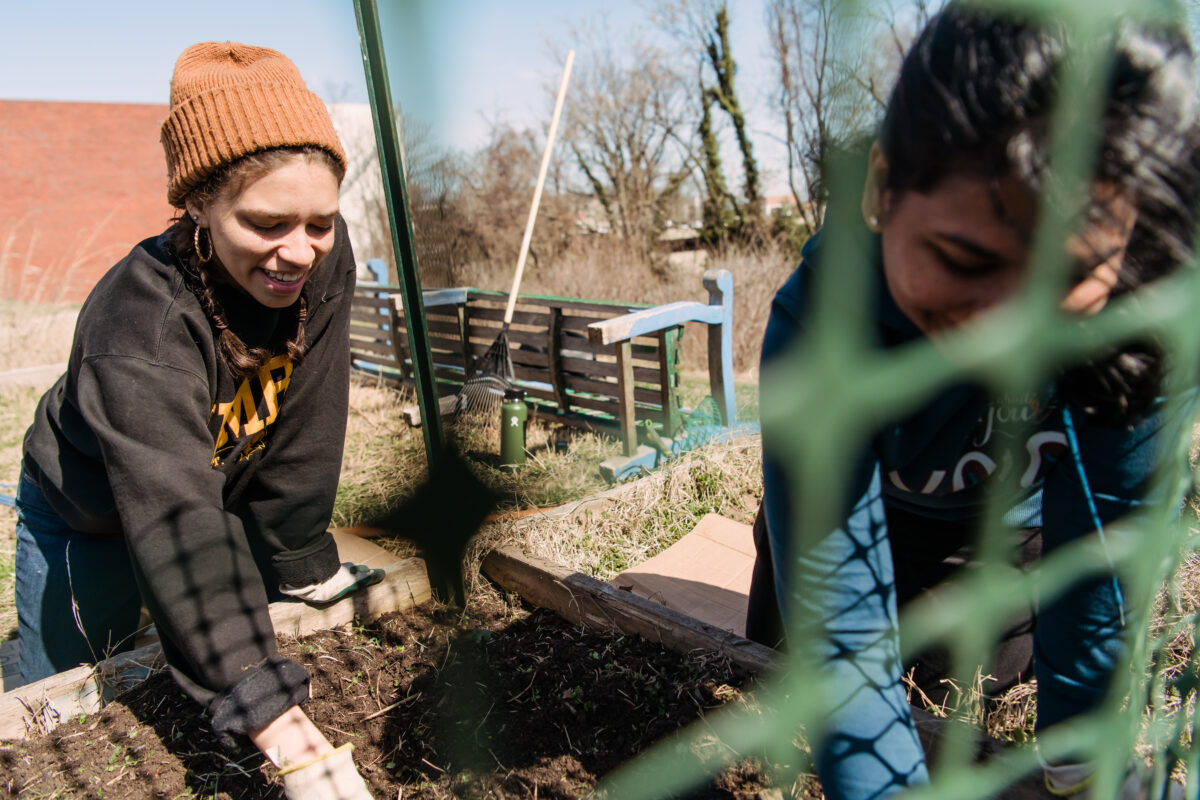
The occasional clang of a shovel rings through the chilly spring air amid the chatter of a small group of cheerful students at the UMBC Community Garden. The students and Ariel Barbosa, program coordinator for Retriever Essentials at UMBC and a master’s student in community leadership, are working hard to ready seven garden plots for crop production the growing season. Already, cold-hardy greens are on their way in one bed, and cucumbers and eggplant are growing indoors awaiting transplant.
The gardening effort is a new initiative of Retriever Essentials, a faculty, staff, and student partnership to tackle food insecurity within the UMBC community. “We were hearing from the UMBC community that canned food does not provide the nutrition we need. What we need are fresh fruits and vegetables in the Essential Space.” Barbosa says, referring to the main food distribution site on campus, located in the Retriever Activities Center. The Essential Space distributes hundreds of pounds of donated food per week.
Growing to give back
They’re able to meet the needs of community members—and respond to new requests, like fresh produce—through robust and fruitful connections with UMBC staff members who want to help. Emily Paul ’21, global studies, service learning and community engagement program specialist at UMBC’s Shriver Center, co-instructs PRAC 096, a service-learning course that allows volunteers to earn course credit for their work in the garden. In addition to offering hands-on garden advice, Paul also helps recruit volunteers for the weekly free farmers markets and to maintain the garden over the summer.
Scenes from the spring clean-up day for the Retriever Essentials garden plots. (Marlayna Demond ’11/UMBC)
As a student, Paul was struck by the growing impact Retriever Essentials was making on the campus community, and as a staff member, she wanted to give back. “I am hoping that students learn about the strength of community and their own ability to take action through joining the garden project,” says Paul. “It’s empowering to grow food and nourish your community.”
Beyond farmers markets
Barbosa’s first step toward providing fresh produce for UMBC community members in need was to partner with So What Else, a non-profit that sets up “free farmers markets” in the Baltimore-Washington region. The resulting markets on campus have been quite successful, but “if there’s a way for us to produce it ourselves, we would like to do that,” Barbosa says. “So we started dreaming up this idea of having our own garden.”
Eli Gooding ’24, biological sciences, and vice president of The Garden at UMBC, worked with Barbosa to offer seven plots in UMBC’s Community Garden. The Garden is a student organization that maintains the beds near the UMBC Police Station and works to address problems such as food waste and food insecurity through service opportunities.
“
“I am hoping that students learn about the strength of community and their own ability to take action through joining the garden project. It’s empowering to grow food and nourish your community.”
Emily Paul '21
Barbosa is highly invested in the project given her role with Retriever Essentials, but other staff members have also pitched in to offer support. In fact, UMBC track and field coach David Bobb “is going above and beyond to support this project,” Barbosa says, by providing gardening expertise, seeds, and encouraging his athletes to volunteer.
“Last spring he brought bags of spinach to donate—which he grew from his own garden,” Barbosa says. “That was the first time I thought, we can accept produce! Now it’s time to grow our own.”
Ariel Barbosa, left, helps get a garden plot cleared for the growing season. (Marlayna Demond ’11/UMBC)
Ryan Kmetz, director of sustainability, and Claire Runquist, environmental sustainability coordinator, have also “been very present and always willing to pitch in and explore new ideas,” Barbosa says.
For the gardening effort to be successful as the growing season gets into full swing, it will be important for volunteers to tend the plots consistently. “We’re trying to prove that we have a sustainable steady thing going on,” Barbosa says, adding that the garden and the Essential Space “are meeting a real need.” The dedicated team is not just growing crops, after all—they’re growing connections across the UMBC community and a broader commitment to fighting food insecurity.
Researchers discovered only relatively recently that black hole jets emit x-rays, and how the jets accelerate particles to this high-energy state is still a mystery. Surprising new findings in Nature Astronomyappear to rule out one leading theory, opening the door to reimagining how particle acceleration works in the jets—and possibly also elsewhere in the universe.
One leading model of how jets generate x-rays expects the jets’ x-ray emissions to remain stable over long time scales (millions of years). However, the new paperfound that the x-ray emissions of a statistically significant number of jets varied over just a few years.
“One of the reasons we’re excited about the variability is that there are two main models for how x-rays are produced in these jets, and they’re completely different,” explains lead author Eileen Meyer, associate professor of physics. “One model invokes very low-energy electrons and one has very high-energy electrons. And one of those models is completely incompatible with any kind of variability.”
For the study, the authors analyzed archival data from the Chandra X-ray Observatory, the highest-resolution x-ray observatory available. The research team looked at nearly all of the black hole jets for which Chandra had multiple observations, which amounted to 155 unique regions within 53 jets.
Discovering relatively frequent variability on such short time scales “is revolutionary in the context of these jets, because that was not expected at all,” Meyer says.
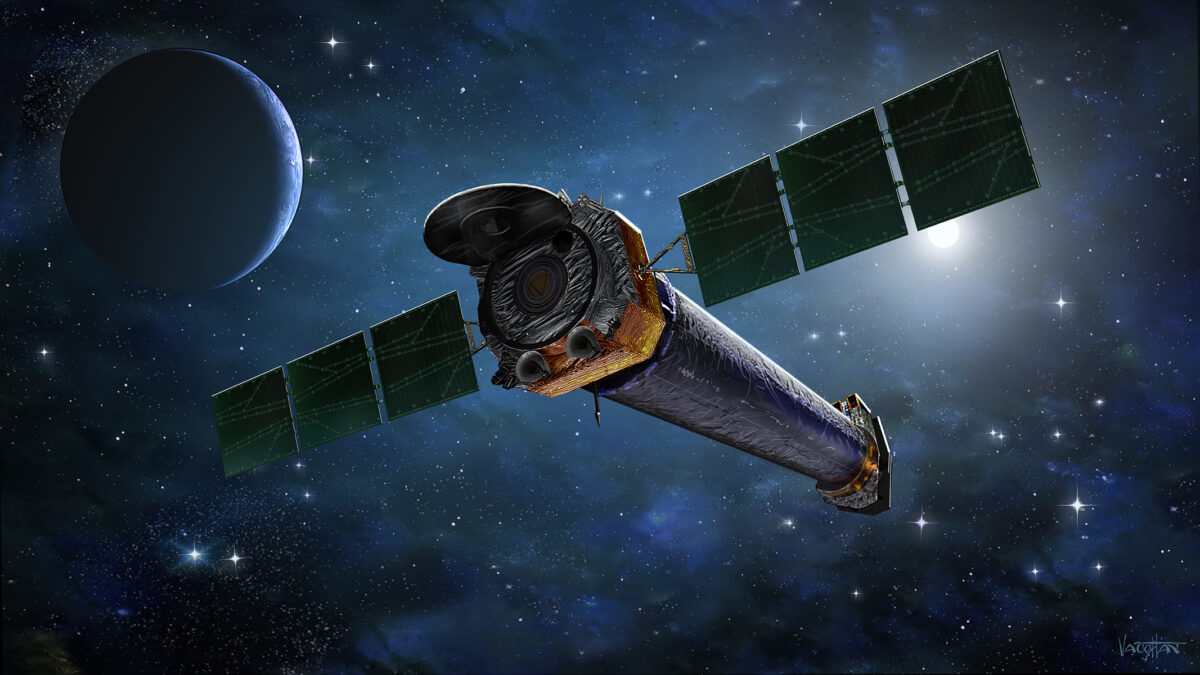
A rendering of the Chandra X-ray Observatory, which is the world’s highest-resolution X-ray telescope. (NASA/CXC and J. Vaughan)
Rethinking particle acceleration
In addition to assuming stability in x-ray emissions over time, the simplest theory for how jets generate x-rays assumes particle acceleration occurs at the center of the galaxy in the black hole “engine” that drives the jet, Meyer explains. However, the new study found rapid changes in x-ray emissions all along the length of the jets. That suggests particle acceleration is occurring all along the jet, at vast distances from the jet’s origin at the black hole.
“There are theories out there for how this could work, but a lot of what we’ve been working with is now clearly incompatible with our observations,” Meyer says.
Interestingly, the results also hinted that jets closer to Earth had more variability than those much farther away. The latter are so far away, that by the time the light coming from them reaches the telescope, it is like looking back in time. It makes sense to Meyer that older jets would have less variability. Earlier in the universe’s history, the universe was smaller and ambient radiation was greater, which researchers believe could lead to greater stability of x-rays in the jets, Meyer says.
Two jets spreading from the central black hole in the Hercules A galaxy. These jets are about 1.5 million light years long, requiring massive particle acceleration forces and dwarfing the galaxy from which they emanate. (NASA, ESA, S. Baum and C. O’Dea (RIT), R. Perley and W. Cotton (NRAO/AUI/NSF), and the Hubble Heritage Team (STScI/AURA))
Critical collaboration
Despite Chandra’s outstanding imaging resolution, the data set posed significant challenges. Chandra observed some of the pockets of variability with only a handful of x-ray photons. And the variability in x-ray production in a given jet was typically tens of percent or so. To avoid unintentionally counting randomness as real variability, Meyer collaborated with statisticians at the University of Toronto and the Imperial College of London.
“Pulling this result out of the data was almost like a miracle, because the observations were not designed to detect it,” Meyer says. The team’s analysis suggests that between 30 and 100 percent of the jets in the study showed variability over short time scales. “While we would like better constraints,” she says, “the variability is notably not zero.”
A call to action
The research unfolded over nearly a decade. Meyer first submitted a proposal to do the archival study with the Chandra X-ray Observatory in 2014, when she was still a postdoc, and it became one of her first funded projects at UMBC. Several undergraduate and graduate UMBC students, including four who are authors on the new paper, contributed to the work. Plus, Meyer’s group applied several different statistical methods before calling in external colleagues for support.
“We had to start over about three different times,” Meyer says. “But I stuck with it, because I really felt that there was something important here.”
Given the import of the findings, clearly Meyer’s intuition served her well. The new paper pokes significant holes in one of the major theories for x-ray production in black hole jets, and Meyer hopes the paper spurs future work. “Hopefully this will be a real call to the theorists,” she says, “to basically take a look at this result and come up with jet models that are consistent with what we’re finding.”
It’s 4 a.m. in Puerto Rico, and Ellie Bare’s alarm is going off. Within an hour, she and her research colleagues are driving to their forested field site on the north side of the island to record Puerto Rican Oriole songs. After a midday break to avoid the worst of the heat, the team scouts new sites late in the afternoon. Some days they make another excursion before bed to check the birds’ roosting sites. Then the research team hits the pillow before doing it all over again.
This is the life of an ecological field researcher, one Ellie Bare ’23, biological sciences, has embraced wholeheartedly with the encouragement of mentors like Kevin Omland, professor of biological sciences, and Michelle Moyer, a Ph.D. candidate in Omland’s research group.
Building research skills—and life skills
Perhaps the most important trait of a strong researcher is the ability to ask good questions and then figure out how to pursue their answers. For example, Bare and her teammates in Puerto Rico noticed a bird roosting in a years-old nest overnight near their lodging. “We’d never heard of a bird doing that before,” Bare says, and as it turned out, neither had local experts. So began a new observational study managed by Bare.
Bare presented the results at UMBC’s Undergraduate Research and Achievement Day (URCAD) in April, finding that over 50 percent of old nests she tracked were in use as overnight roosts. The findings created new knowledge about this endangered species and a chance for Bare to flex her scientific inquiry skills, which will serve her well in any research area.
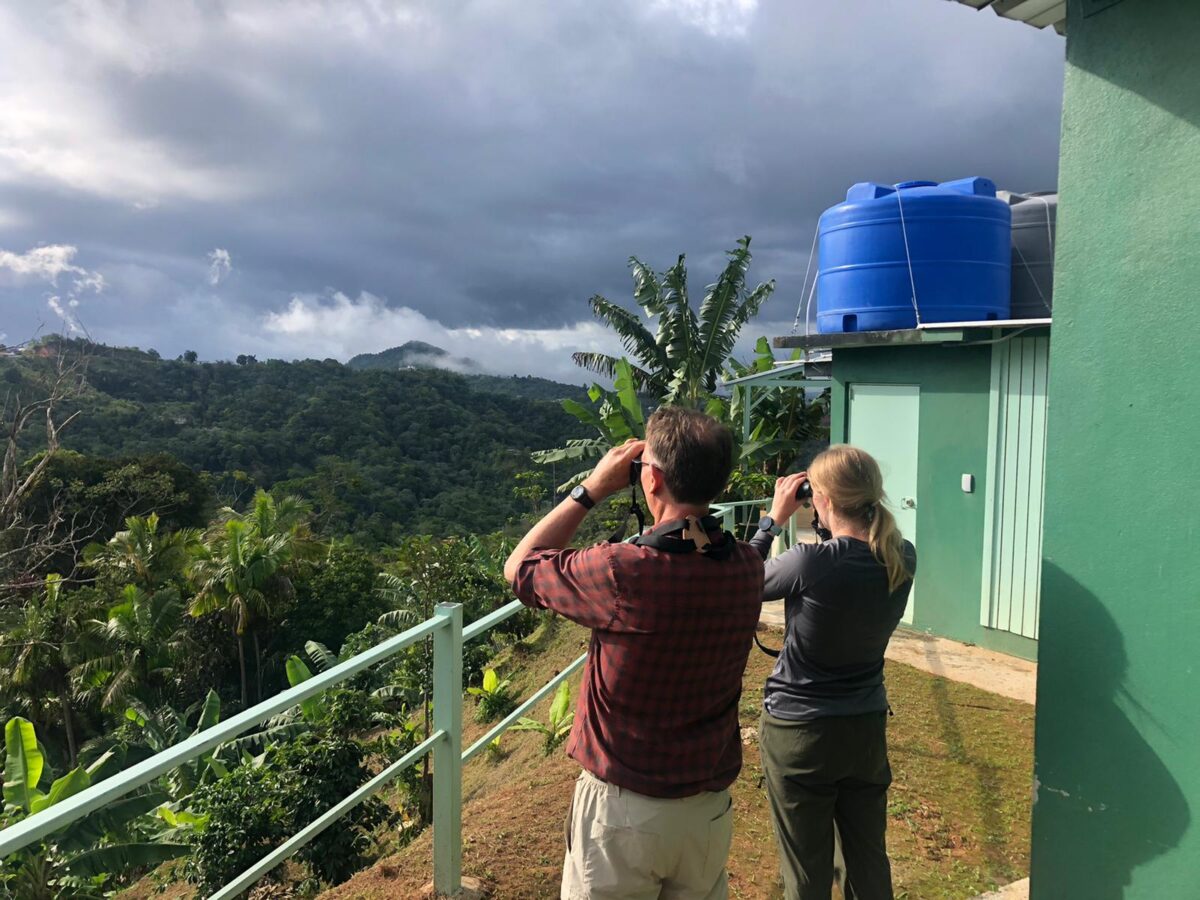
Kevin Omland and Ellie Bare scan the rainforest for birds during a research trip in Puerto Rico. (Image courtesy of Bare)
“Dr. Omland encourages that in his undergrads, which is really special,” Bare says. “He’s really supportive of undergrads getting the full research experience.”
Back on campus, Bare also took on developing a protocol for the Omland lab to determine the sex of birds based on DNA samples. That’s especially valuable in the study of tropical birds, where males and females frequently sport identical plumage. “It was really interesting and fun to spearhead that project on my own,” Bare says. The molecular skills she learned will help her in her next role, a postbac fellowship at the National Institutes of Health (NIH).
Omland also emphasizes communication skills with his students, requiring lab members to take turns presenting journal articles and providing updates on their own projects at lab meetings. In addition to URCAD, Bare also attended the international American Ornithological Society and BirdsCaribbean conference in Puerto Rico.
“Having those opportunities to improve my science communications abilities was invaluable, really great,” Bare says, “and it even helped me with my postbac interviews.”
Across the disciplines, student research shines
Bare will soon explore another area of biological research through her upcoming work at NIH—cancer research. While this area is a shift from her prior work with Omland and Moyer, she shares that the skills she learned in the Omland Lab were essential to her journey as a researcher and her mentors have continued to provide unflagging support.
Other graduating students, too, have had positive experiences with research that have prepared them for what’s next. Sarah Turner ’23, psychology, completed research with Susan Sonnenschein, professor of psychology, as well as summer research experiences at the Harvard Business School and Michigan State University. Max Bobbin ’23, chemical engineering, took on a leadership role early on in Tyler Josephson’s research group, learning and then teaching others a new programming language, and applying it to the team’s chemical theory work.
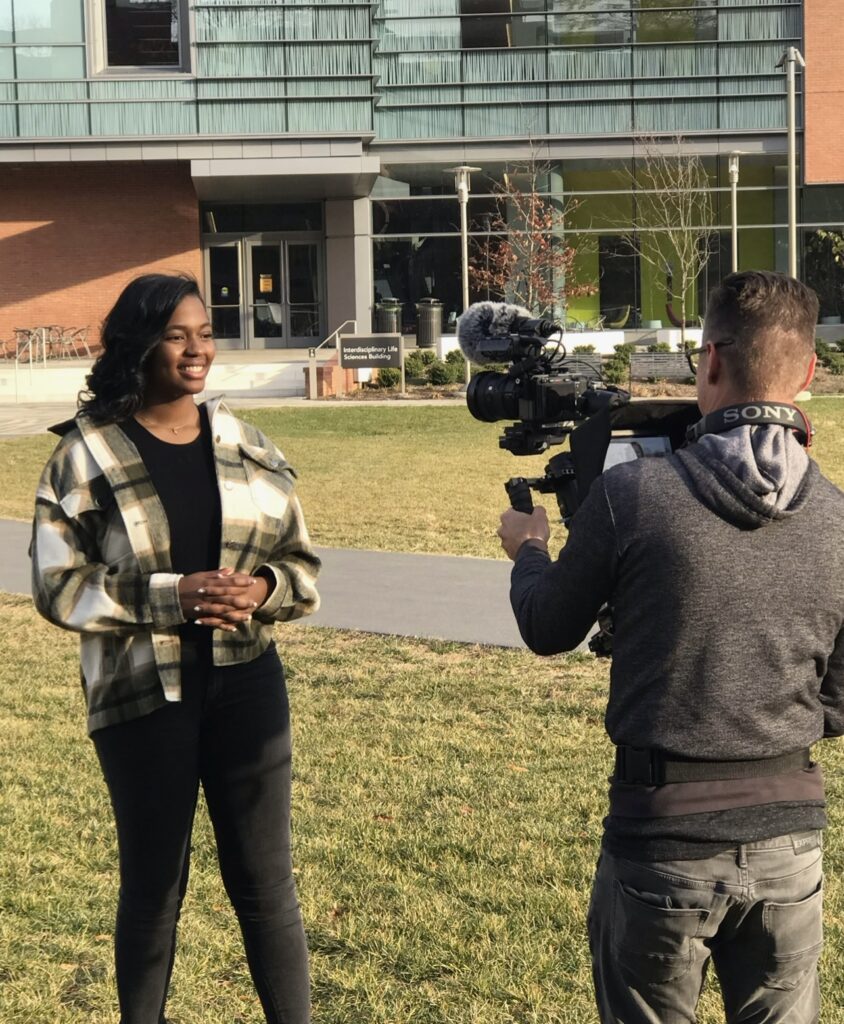
Sarah Turner, left, was interviewed for UMBC’s episode of the College Tour (on Amazon Prime) in 2022. (Image courtesy of Turner)
And valedictorian for the humanities and social sciences,Zinedine Partipilo Cornielles ’23, financial economics and mathematics, conducted research with Tim Gindling, professor of economics, and Salem Abo-Zaid, associate professor of economics. His project with Gindling focused on the impact of financial literacy on student loan decisions among undergraduates across the United States. In the future, he hopes to conduct research on labor economics with a focus on Latin America.
Across UMBC, research experiences are a cornerstone of the current and future success of students and the projects and labs to which they contribute. Encouragement from mentors to ask new questions, try new techniques, and fully participate in the intellectual life of the research group helps students build skills that will serve them in their careers and in life.
New findings in Science co-authored by UMBC researchers reveal details of the complex relationship between atmospheric dust and vast populations of phytoplankton at the ocean’s surface. These tiny photosynthetic organisms form the foundation of the ocean food chain and play a key role in the global carbon cycle, so the new research will be especially useful as dust patterns shift with climate change.
“Phytoplankton photosynthesis is fundamental to Earth’s carbon cycle,” says Lorraine Remer, an atmospheric scientist with UMBC’s Goddard Earth Sciences Technology and Research (GESTAR) Center II and a co-author on the study. “Change dust patterns, and you change phytoplankton health, which will subsequently affect carbon,” she explains.
Desert dust impacts ocean ecosystems
While most nutrition for phytoplankton rises up from the deep ocean, a meaningful portion comes from dust that’s traveled through the atmosphere from the world’s deserts. That dust delivers vital nutrients when it’s deposited in the ocean, but scientists lacked specifics about how dust affects phytoplankton health and abundance.
With their new Science paper, the research team, led by Toby Westberry, an oceanographer at Oregon State University, became the first to find a phytoplankton response to dust deposition across the global oceans.
Lorraine Remer in the UMBC Physics Building (Marlayna Demond ’11/UMBC)
“This is really the first time it has been shown, using the modern observational record and at the global scale, that the nutrients carried by dust being deposited on the ocean are creating a response in the surface ocean biology,” Westberry said.
The team analyzed their model’s results in conjunction with satellite observations of phytoplankton around the world, revealing how dust is affecting ocean ecosystems. By developing a baseline understanding, scientists now have a better chance at predicting how phytoplankton will change when patterns of dust deposition change, which will have cascading effects throughout the ocean and beyond.
Models fill the gaps
For the new study, the Oregon State contributors focused on using the satellite data, which measures color changes in the ocean’s surface, to determine phytoplankton health and abundance across time and space.
Remer and UMBC researchers Yingxi Shi and Huisheng Bian focused on the dust model. “Determining how much dust is deposited into the ocean is hard, because much of the deposition occurs during rainstorms when satellites cannot see the dust. That is why we turned to a model,” Remer says. Remer and colleagues used observations to verify an existing NASA model before incorporating the model’s results into the study.
Combining their efforts, the research team found that dust’s effects on phytoplankton vary by region. Nearer the poles, more dust contributed to greater overall abundance of phytoplankton and improved health. Nearer the equator, dust primarily affected phytoplankton health and physiology, but not abundance.
Atmospheric dust (upper right) from China sweeps across the Korean peninsula and onward. (Image courtesy of NASA Earth Observatory)
There are many questions still to answer. “We still don’t understand how the specific nutrients in the dust become available to the phytoplankton in the water,” Remer says, “nor do we understand the role of individual dust sources providing specific nutrients to different regions of the ocean.”
Part of what made this work possible was collaboration between researchers in different fields. “One exciting aspect of this study was working with the oceanographers, who brought an entirely different perspective,” Remer says. “The scientific advances became possible only after the atmospheric scientists and oceanographers joined forces.”
It’s that interdisciplinary collaboration that will enable the team to continue asking and answering important questions about our global ecosystems.
Degree: B.S., Chemical Engineering; B.A., Philosophy Hometown: Joppa, MD Post-grad plans: Ph.D. in chemical engineering, University of Delaware
Max Bobbin may still be an undergraduate, but he’s already made significant research contributions in the Artificial Intelligence and Theory-Oriented Molecular Science (ATOMS) lab, led byTyler Josephson, assistant professor of chemical, biochemical, and environmental engineering. Bobbin was the first in the research group to develop expertise in the programming language Lean. He took on a leadership role, teaching other lab members, including Josephson, about new ways to use Lean. He also selected appropriate projects for new team members, helped the group prepare for Josephson’s parental leave, and initiated new directions for the lab’s work.
Bobbin believes his additional philosophy major supported his engineering work in important ways. “For an engineer, the most important skills are problem-solving, critical thinking, and communication,” he says, “and philosophy is a major built around those three ideas.”
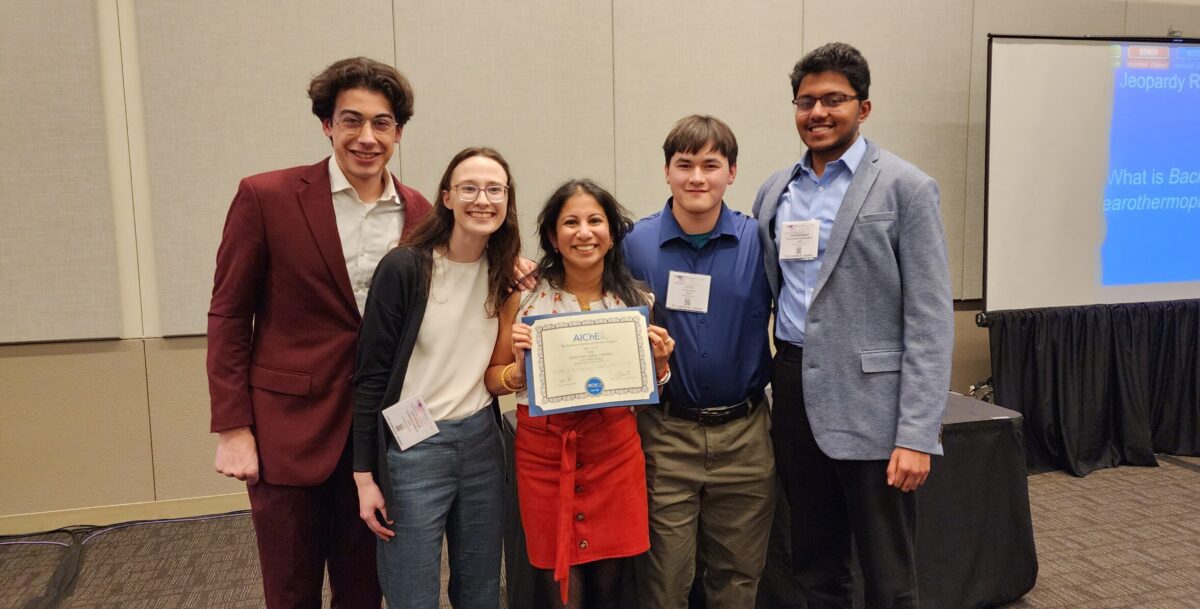
UMBC’s Chemical Engineering Jeopardy National Championship team and their advisor (l-r): Max Bobbin, Catherine Wraback, Neha Raikar (advisor), Colin Jones, and Pavan Umashankar. (Image courtesy of CBEE)
What has been the best part of your UMBC experience?
“My first American Institute of Chemical Engineers Jeopardy competition was nationals in 2021, where we placed second. I worked very hard to make sure we were ready when we went back to nationals in 2022, because I wanted to bring back first place for UMBC. Our practice paid off, and after a tough final round, we won first place at nationals. I enjoyed attending the conferences and the opportunities to network, but competing is my favorite memory because it was the best representation of how well UMBC students work together to achieve their goals.”
Is there a particular academic achievement you’re most proud of?
“In the first couple of months after I joined the Josephson lab, I spent a considerable amount of time learning more about higher level math and coming to our weekly meetings with new information to teach the rest of the group. In the summer, I made my first breakthrough and moved into a leadership role in the group. This project helped me hone my skills relating to learning new subjects, leading a project, and leading a group of people in a new field of study. Plus, it gave me confidence as I continue doing research for my Ph.D.”
Degree: B.A., Psychology Hometown: Gaithersburg, MD Post-grad plans: Ph.D. in Business Administration, Drexel LeBow College of Business
Sarah Turner, a McNair Scholar and Jacqueline C. Hrabowski Scholar, has immersed herself in research, leadership, and mentorship opportunities at UMBC, working to make the most of each new experience. On her research path to a Ph.D. program, she completed a summer research fellowship at the Harvard Business School, a research program at Michigan State University, and research with UMBC’s Susan Sonnenschein, professor of psychology, and Lauren Edwards, associate professor of political science.
As a first-generation college student and a mother, Turner has also skillfully leveraged available resources to support her success, including Generation Hope, an organization that supports college students who are parents. She has also actively sought and nurtured mentoring relationships with campus leaders, such as Yvette Mozie-Ross, vice president for enrollment management.
Even as she juggles so many responsibilities, she finds time to support students who are earlier in their journey. This includes volunteering as a middle school tutor and creating new events for UMBC’s McNair Scholars Program, which prepares underrepresented students for graduate education. She helps new students learn about the program and current scholars stay connected. Somehow, she also fits in gospel choir, club tennis, and other campus activities.
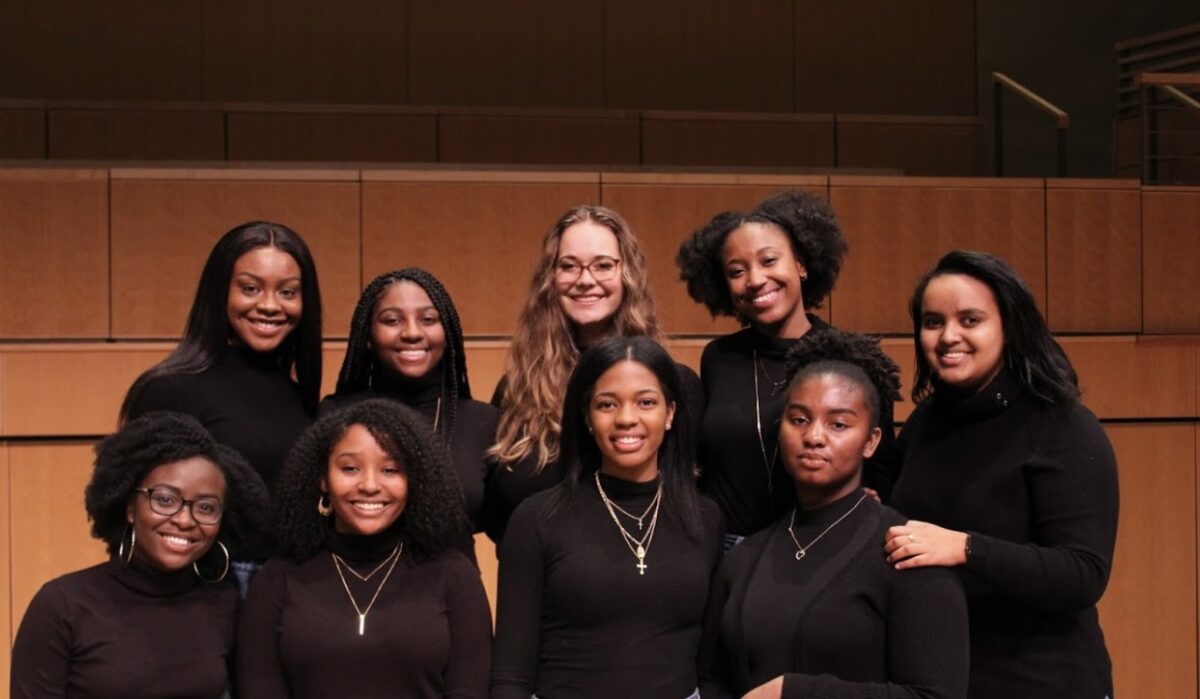
Sarah Turner (second from right, front row) with other members of the UMBC Jubilee Singers. (Image courtesy of Sarah Turner)
Has there been a mentor or fellow student who influenced your time at UMBC?
“Dr. Yvette Mozie-Ross has been a mentor to me since January 2021. During our monthly meetings, we discuss anything from academic and professional plans to my well-being, relevant research and current events, and parenting tips. Dr. Mozie-Ross took the initiative to learn about my interests and connect me with numerous faculty at UMBC. She has consistently made time to support me and even came to visit me during my summer research internship at Harvard.”
What has been the best part of your UMBC experience?
“UMBC prepared me for my future by maintaining a welcoming environment with countless opportunities. The supportive faculty shared their wisdom and encouraged research collaborations. Organizations centered on the advancement of first-generation college students helped me gain access to knowledge and learn how to build a community to succeed in higher education. Lessons around research and community, combined with the diverse environment, helped fuel my passion for learning as I go on to pursue my Ph.D.”
Degree: B.S., Biochemistry & Molecular Biology Hometown: Sharpsburg, MD Post-grad plans: Postbaccalaureate program, National Institutes of Health
Ellie Bare has been a core member of Kevin Omland’s research team, focused on bird evolution, ecology, behavior, and conservation, since 2021.
Bare, a member of the Honors College, has proven to be an adept field researcher as well as excellent in the laboratory, Omland says. On three research trips to Puerto Rico, she collected field data starting at 4:30 a.m. through midday heat, day in and day out. She also initiated a new project monitoring nocturnal bird behavior. In the lab, she independently developed molecular analysis protocols for determining a bird’s sex. That ability is especially valuable for tropical birds, because males and females often have the same plumage.
Bare’s work was partially funded by a National Science Foundation International Research Experience for Students grant. “She was an indispensable asset to our project, and she was a great team member,” Omland says. She has also supported fellow UMBC students as a tutor and mentor, and interned with the Folded Crane Foundation, which focuses on women’s education and empowerment.
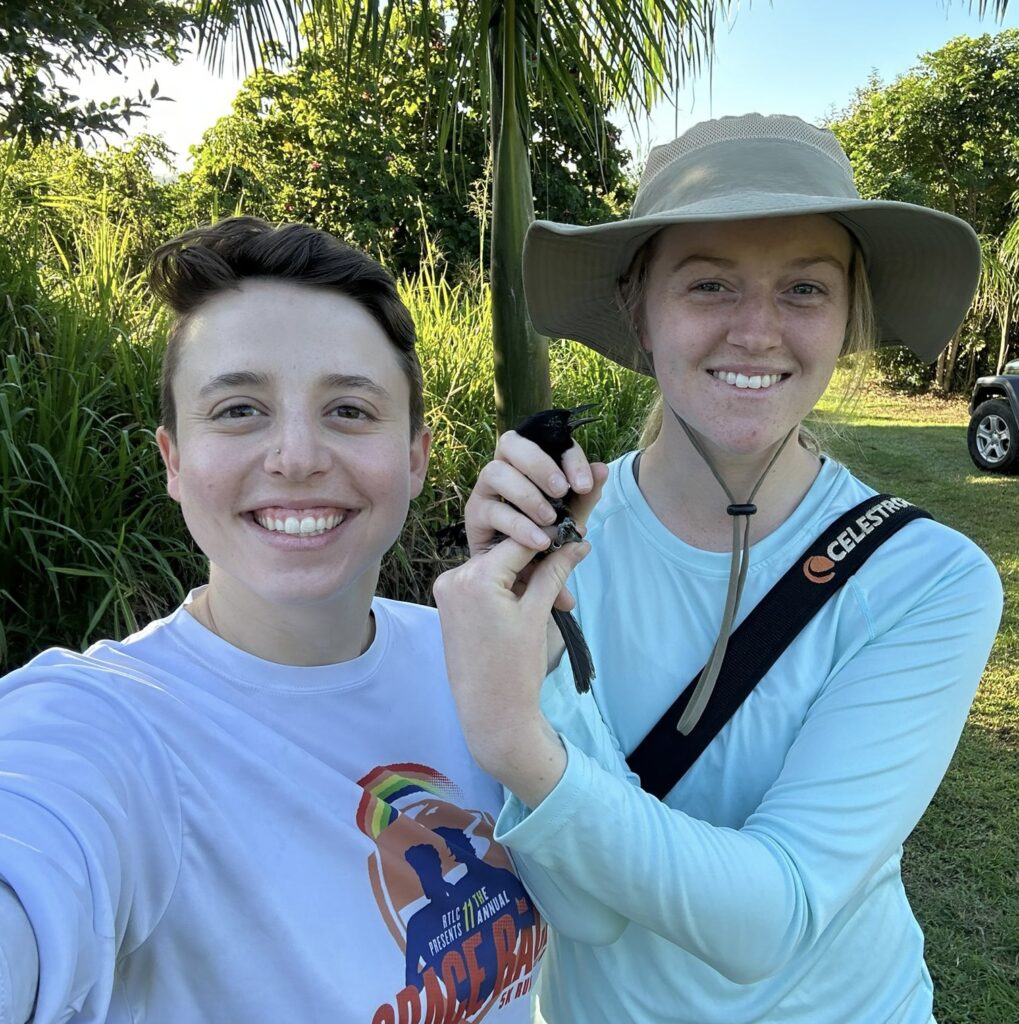
Michelle Moyer (left) and Ellie Bare, holding a Puerto Rican Oriole, at their research site in Puerto Rico. (Image by Michelle Moyer)
Has there been a mentor or fellow student who influenced your time at UMBC?
“I joined the Omland lab to help Ph.D. student Michelle Moyer with her field research project studying Orchard Oriole female song in spring 2021. We’ve grown close over four more field seasons. Her confidence, passion, and positivity are contagious. She has given me invaluable advice about my career path and about life as a whole. I’m very thankful to have met and worked with her.”
What has been the best part of your UMBC experience?
“My favorite UMBC experience has been getting involved with research. I love being able to apply what I learn in the classroom to hands-on work. I’ve been lucky enough to network with accomplished scientists at conferences, have ownership over my own projects, and learn from great mentors and peers. My research experiences have given me the expertise to enter the next stage of my career with confidence and excitement.”
Zinedine Partipilo Cornielles fled Venezuela at age 16 with his family to seek asylum in the U.S., an experience that has fueled his passion for public service, from his research to his work with communities he identifies with.
PartipiloCornielles, a Sondheim Public Affairs Scholar and member of the Honors College, has conducted independent research projects with Tim Gindling, professor of economics, and Salem Abo-Zaid, associate professor of economics. His project with Gindling on the impact of financial literacy on student loan decisions among undergraduates across the United States earned the Economics Department Chair Award in 2022. Meanwhile, he has served as a teaching assistant and tutor for fellow students and has taught English to local immigrants through the Esperanza Center and UMBC’s Shriver Center.
PartipiloCornielles is also a member of UMBC Mock Trial and helped the team win the American Mock Trial Association National Championship in 2021 against perennial frontrunner Yale University. He is part of the Sloan Predoctoral Program through the UMBC economics department and, after pursuing a Ph.D. in economics, plans to conduct research on labor economics with a focus on Latin America.
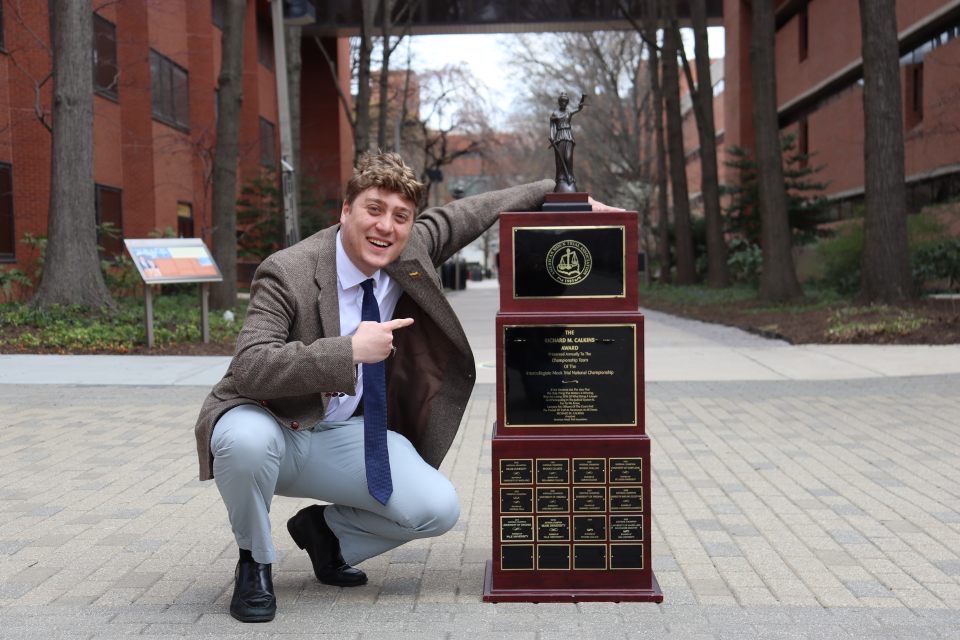
Zinedine Partipilo Cornielles with the 2021 Mock Trial championship trophy. (Image courtesy of Partipilo Cornielles)
Has there been a mentor or fellow student who influenced your time at UMBC?
“Professor Tim Gindling provided me with great insights as a research mentor, course instructor, and academic advisor. Thanks to Professor Gindling, I was supported in my research interests and gained invaluable experiences that have helped me fall in love with the research process. Brevin Franklin and Seth Thomas, fellow Sondheim Scholars who graduated in 2022, also helped me navigate through college when I first came to UMBC, and I appreciate their friendship.”
What has been the best part of your UMBC experience?
“On one hand, winning a Mock Trial National Championship against the odds, through Zoom, and against Yale, was incredible. On the other hand, I also want to highlight my service learning experiences as great experiences I have had. I was able to give back to the community by helping others and understand first-hand the value of education and human capital.”
The University System of Maryland (USM) will formally install Valerie Sheares Ashby as UMBC’s sixth president on April 27, 2023, after UMBC warmly welcomed her to the community last August. A longstanding tradition throughout academia, a presidential inauguration (including the formal Investiture ceremony) is a historic milestone in the life of a university, one not to be missed.
At the Investiture, USM will formally endow President Sheares Ashby with the powers of the office. For several days before that ceremony, UMBC will celebrate with a series of inauguration events honoring the occasion.
These events will offer opportunities for UMBC community members to connect with the new president and each other. Each event, in its own way, will recognize the university’s continued commitment to welcoming and inspiring inquisitive minds from all backgrounds as UMBC enters a new era.
Since her arrival, President Sheares Ashby has dedicated herself to getting to know UMBC and its people. She has offered weekly office hours for students since her first week on campus. Throughout March and April, she has also attended dozens of UMBC Bold conversations to hear faculty, staff, and student perspectives on topics such as shared governance, supportive community, research infrastructure, and the undergraduate experience.
“These first…months have been energizing, inspiring, and joyful. The more people I meet, and the more I start to make connections, the more I love this place,” Sheares Ashby recently told UMBC Magazine. “It has been especially rewarding to engage with students, see who they already are, and imagine what they will become as a result of their experiences at UMBC.”
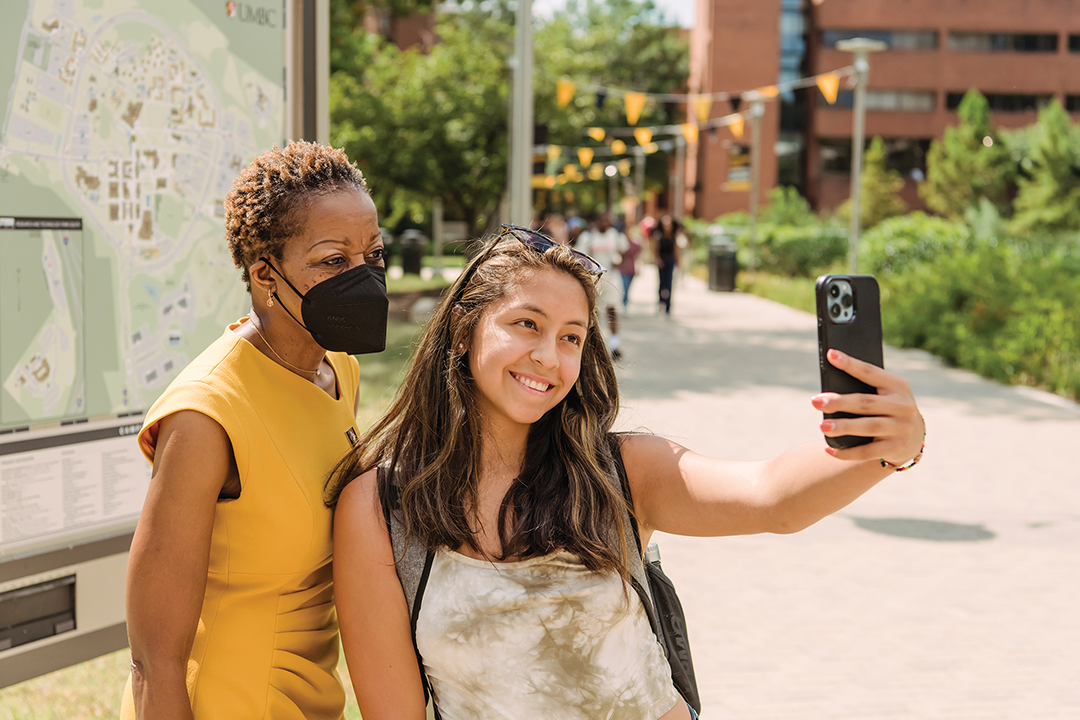
Valerie Sheares Ashby poses for a selfie with a student. (Marlayna Demond ’11/UMBC)
Something for everyone
The festivities will kick off on April 18 with a special reception at the Universities of Shady Grove, recognizing the strength of the UMBC community throughout the Baltimore–Washington region. On April 21, the main UMBC campus will mark the occasion in the annual Quadmania Campus Talent Showcase. This event will include music, dance, spoken word, and more in celebration of UMBC’s talented students.
A lunch on April 24 will provide an opportunity for graduate students—critical contributors to UMBC’s teaching and research missions—to meet with President Sheares Ashby. The next day, a faculty and staff reception will offer a chance for camaraderie among colleagues and friends in recognition of the essential role UMBC’s faculty and staff play in moving the university forward.
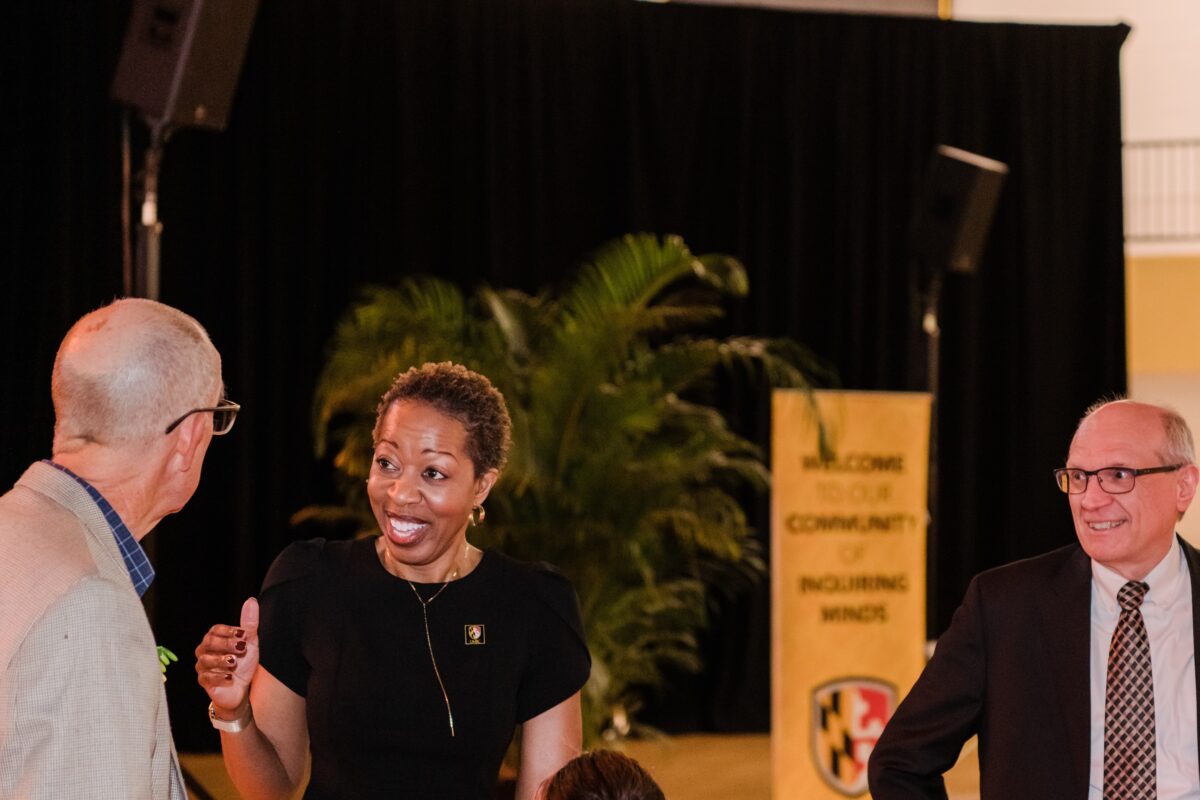
Pres. Valerie Sheares Ashby (center) at the 2023 Presidential Faculty and Staff Awards. Dean Bill LaCourse is at right. (Marlayna Demond ’11/UMBC)
On Wednesday, April 26, the Faculty Salon: Community-Engaged Scholarship will celebrate the role of faculty as scholars, researchers, and teachers, as well as UMBC’s distinction as a Carnegie-classified community-engaged institution and R1 research university. Faculty across the disciplines whose scholarship is community-based will offer brief remarks, including Kate Drabinski, principal lecturer of gender, women’s, and sexuality studies; Lynn Cazabon, professor of visual arts; Felipe A. Filomeno, associate professor of political science and global studies; Belay Demoz, professor of physics; and Ian Stockwell, associate professor of information systems.
A new era
The Inauguration Week events will culminate with the formal Investiture at 1 p.m. on April 27 at the Chesapeake Employers Insurance Arena. The university welcomes students, faculty, staff, alumni, family members, and friends and community members to attend. Tickets are free, but must be reserved. The event will also stream live.
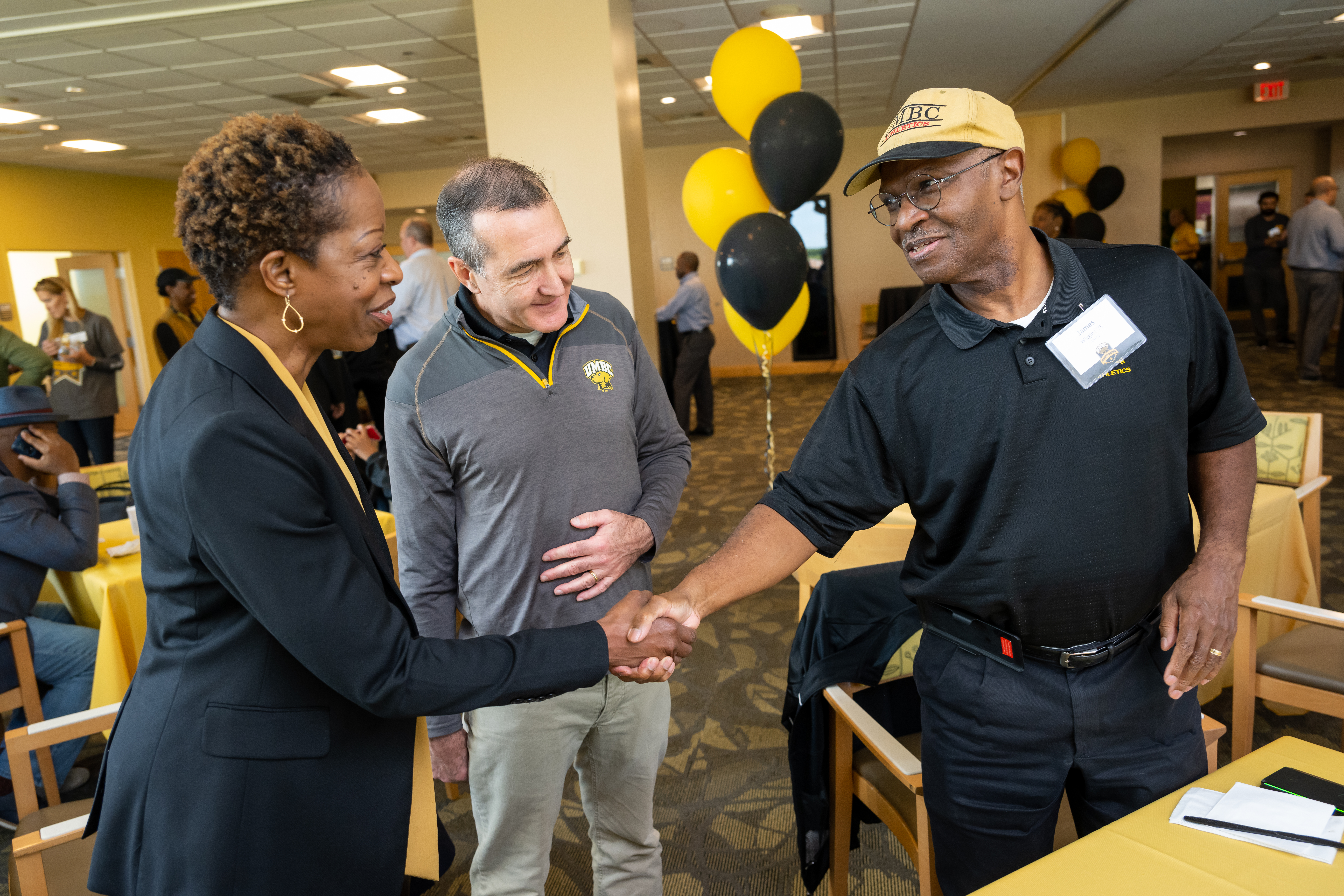
President Sheares Ashby shakes hand with an alumnus at a Homecoming event. (Maximilian Franz/UMBC)
“This is a particularly important moment for the UMBC community. The Inauguration is a chance for us to reaffirm our values as a university as we officially welcome Dr. Sheares Ashby as our president,” says Greg Simmons, M.P.P. ’04, vice president for institutional advancement. “It is a wonderful opportunity to celebrate the significant progress we have made together, while looking toward the future of UMBC—it is exciting in so many ways.”
Guests will hear President Sheares Ashby share her thoughts on UMBC’s future, which will be deeply informed by recent UMBC Bold conversations. As Sheares Ashby told UMBC Magazine, “It’s becoming more clear every day what the possibilities are for what we can do together going forward.”
Following the ceremony, all are welcome to a campus celebration on the Commons Quad, 2:30 – 5 p.m., with games, treats from local businesses, and joyful UMBC community spirit.
Arjun Kanjarpane ’24, M32, biochemistry and molecular biology, and Soujanya “Anya” Viswanathan ’24, M32, biological sciences, are the latest UMBC students to be named Goldwater Scholars. By pursuing their research interests—virology for Kanjarpane and neuroscience for Viswanathan—with rigor and dedication, both have the potential to make a major impact in their fields and in people’s lives.
The Barry Goldwater Scholarship and Excellence in Education Program is designed to provide the United States with “a continuing source of highly qualified scientists, mathematicians, and engineers.” More than 1,200 students applied from over 425 institutions across the country this year, and the program ultimately selected 413 scholars to receive Goldwater Scholarships for 2023 – 2024.
As Scholars, Kanjarpane and Viswanathan will receive substantial funding that advances their undergraduate work and supports their educational paths. They will also gain access to a network of current and former Goldwater Scholars, many of whom are conducting research at the leading edge of their fields.
“We are delighted that UMBC has continued its impressivestring of Goldwater awards for this year,” says April Householder ’95, visual arts, director of undergraduate research and prestigious scholarships. “This indicates just how strong STEM education at UMBC is—indeed, it’s among the best in the country.”
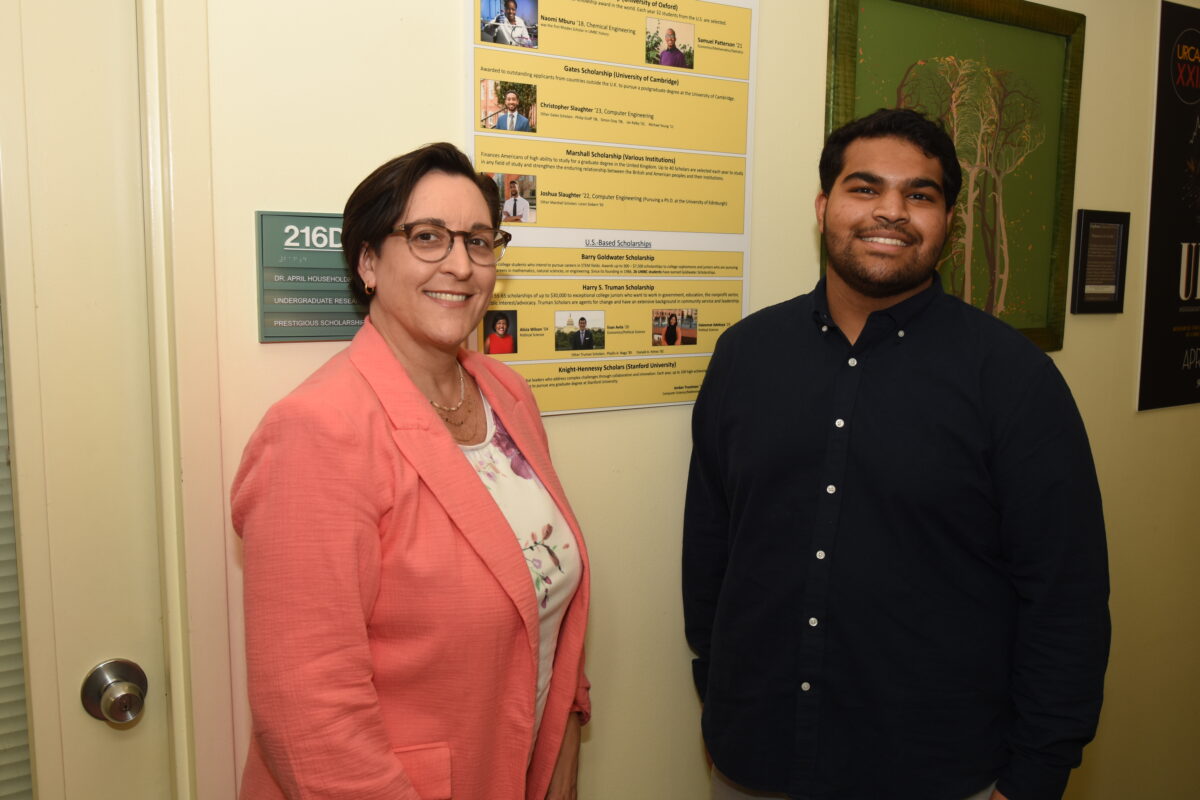
April Householder (left) and Arjun Kanjarpane stand by a poster recognizing some of UMBC’s prestigious scholars. (Mike Mower/UMBC)
Making the connection
Kanjarpane and Viswanathan are both conducting their own research—Kanjarpane in the laboratory of Michael Summers, Howard Hughes Medical Institute Investigator & Distinguished University Professor of chemistry and biochemistry, and Viswanathan with Rachel Brewster, professor of biological sciences.
One of the projects in Brewster’s lab seeks to tease out how the embryos of zebrafish (small, hardy, freshwater fish) can survive for up to 50 hours without any oxygen at all and then return to normal functioning once oxygen becomes available. “We are looking at the genes and molecular mechanisms involved in allowing zebrafish to survive and recover from such extreme conditions,” Viswanathan says.
Viswanathan started in Brewster’s lab in summer 2021. She immediately saw connections between Brewster’s research on hypoxia (or lack of oxygen) in zebrafish and the same condition in some COVID-19 patients. “It was interesting to me,” she says, “to look at what genes and molecular mechanisms could potentially help humans withstand hypoxia just like zebrafish.”
Her Goldwater research proposal extends the work she’s done over the last two years, but Viswanathan hopes to shift her focus to neurological disorders like Alzheimer’s Disease in an M.D./Ph.D. program after UMBC. She worked on a cutting-edge Alzheimer’s project last summer at MIT with postdoctoral fellow Matheus Victor. A neurobiology Ph.D. combined with a medical education will enable her to investigate the underlying mechanisms of disease, treat patients, and then take any new research questions that arise back to the lab, Viswanathan explains.
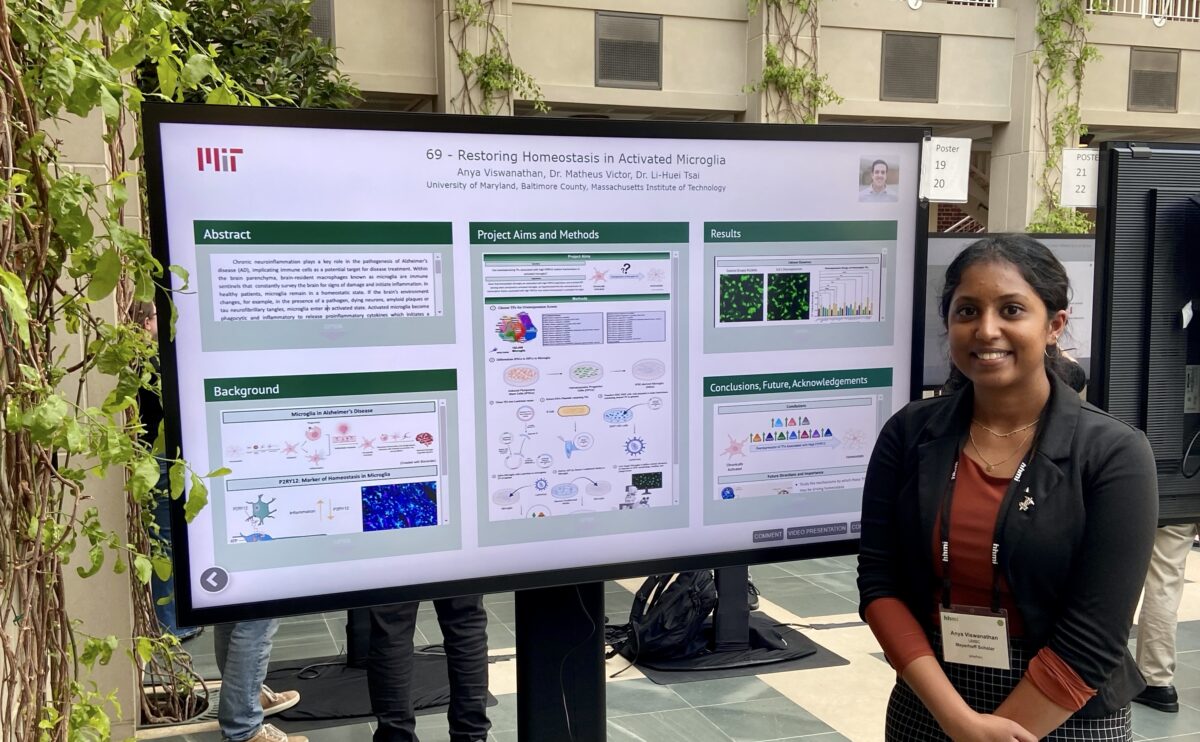
Anya Viswanathan presents research from her summer internship at MIT. (Image courtesy of Viswanathan)
Targeting HIV
Kanjarpane’s research focuses on improving understanding of the molecular mechanisms behind HIV replication. A complex sequence of steps governs exporting the viral genome out of the host cell’s nucleus and then packaging it into new infectious particles. Interactions between proteins and the virus’s genetic material regulate this process, and those interactions aren’t fully understood.
The end goal of Kanjarpane’s work is to build “a more complete understanding of these viral processes,” so that down the line, researchers can “develop drugs or therapeutics that might be able to target one or several of their components,” Kanjarpane says. His Goldwater proposal builds on this work.
This summer, Kanjarpane will conduct virology research under Paul Bieniasz at Rockefeller University. After graduation, he’s planning to pursue a Ph.D. in virology or structural biology. “I would be interested in exploring viruses in a multi-dimensional approach,” he says.
Lifting up others
Beyond their research and academic studies, both Viswanathan and Kanjarpane are committed to supporting their peers and neighbors. “What impresses me most about Arjun and Anya is that they use their talents to help lift up others,” Householder says. “This dedication to others beyond the classroom is what makes them special.”
Both serve as tutors in the Chemistry Tutorial Center at UMBC and enjoy supporting students in introductory chemistry courses. Viswanathan also volunteers weekly at the Y in Catonsville with MS Aquatics, where she works with multiple sclerosis patients on their mobility and flexibility. After each session, the volunteers and participants share a meal.
Viwanathan and Kanjarpane also serve as role models for younger children and help get them excited about STEM. Viswanathan volunteers with the UMB CURE Scholars Program, which exposes students in West Baltimore to research and STEM careers in middle and high school. Opportunities with MS Aquatics and UMB CURE Scholars are both organized through the UMBC Shriver Center.
Kanjarpane founded a non-profit, Scientific Minds of America (SMOA), as a middle school student. The non-profit’s goal is “to reduce social and youth educational inequity through a youth-to-youth system,” he says. During remote instruction at the start of the COVID-19 pandemic, he spearheaded the development of an online tutoring program for Baltimore City youth through SMOA. Over 300 tutors and students have been involved.
He was inspired to form the non-profit after teaching robotics skills to enthusiastic students at a Baltimore elementary school with his FIRST Lego League team. “From that moment we decided we should work to change things, because students should have every opportunity to succeed and achieve their dreams,” regardless of their zip code, Kanjarpane says.
The business skills he’s gained as CEO and now a board member at Scientific Minds also come in handy for his role as treasurer of the Hindu Student Association at UMBC.
Turning points
Kanjarpane and Viswanathan’s desire to reach back to students coming up behind them is driven in part by the network of support that has helped each of them create their own successful paths. Both credit Meyerhoff Selection Weekend as a turning point in their STEM careers.
“Initially, I didn’t even know what a Ph.D. or an M.D./Ph.D. was. I didn’t know that research was a career path that I could take,” Viswanathan says. But at selection weekend, “I realized that my career goals aligned with the M.D./Ph.D. and the Meyerhoff Scholars Program. So that’s why I chose UMBC.”
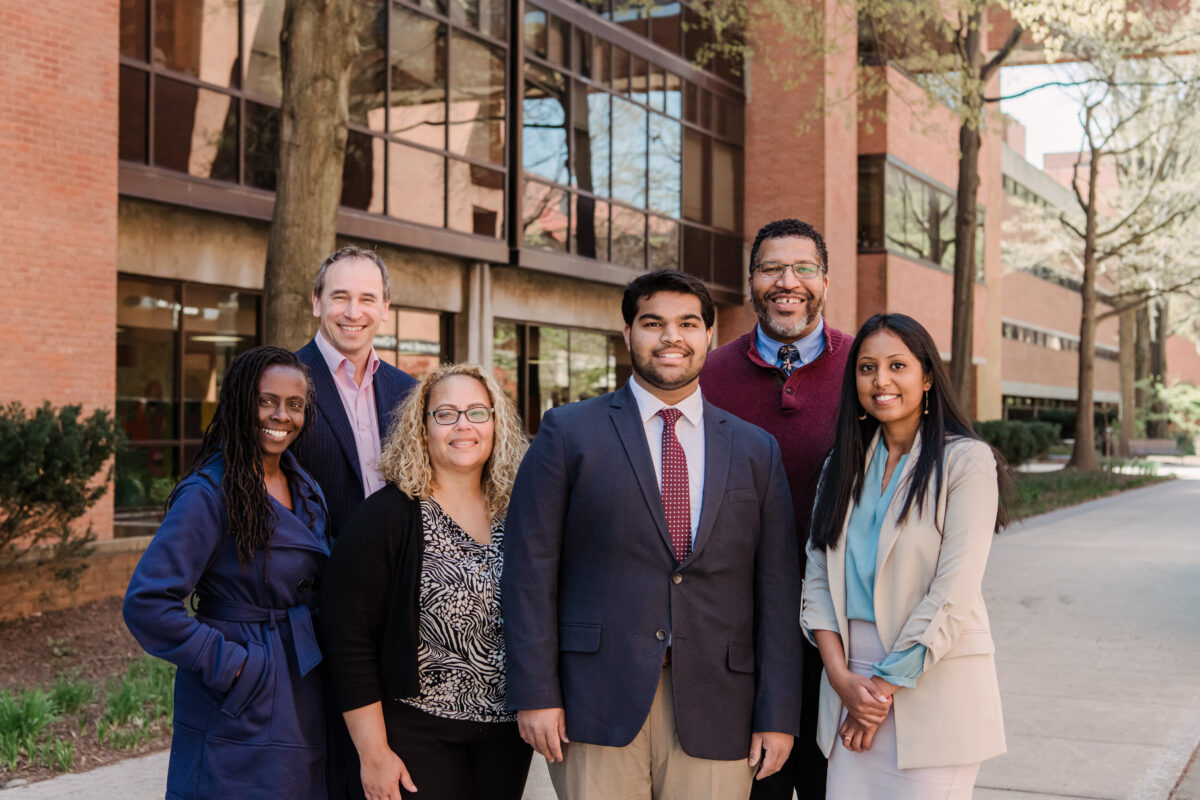
Kanjarpane and Viswanathan with some of their mentors. From left to right: Jacqueline King, associate director of the U-RISE Scholars Program; Simon Stacey, director of the UMBC Honors College; Mitsue Wiggs, assistant director of the Meyerhoff Scholars Program; Arjun Kanjarpane; Keith Harmon, director of the Meyerhoff Scholars Program; Anya Viswanathan. (Marlayna Demond ’11/UMBC)
Kanjarpane took his first UMBC class as a high school student and later applied to be a Meyerhoff Scholar. He came out of selection weekend thinking, “‘Wow.’ It’s UMBC all the way,” he says. The Meyerhoff and U-RISE programs “have really helped me to feel supported in college, and that has helped me to achieve my goals and learn with confidence.”
On top of their scholars programs, both students’ research mentors have played a significant role in their growth. “I treasure my lab,” Kanjarpane says, reflecting on how having such a large research team, from high school students to Professor Summers, provides a range of perspectives that pushes the research forward.
For Viswanathan, support from Brewster and Jong Park, Ph.D. ’21, biological sciences, have been key. “Dr. Brewster helped me a lot through the process of applying to Goldwater,” Viswanathan says. “Even with non-research things, she’s always there to talk to me.”
Anya Viswanathan with her research mentor, Rachel Brewster. (Marlayna Demond ’11/UMBC)
Confidence boost
As freshly minted Goldwater Scholars, Viswanathan and Kanjarpane are excited to connect with others in the program. “What I’ve learned from scientific conferences is that science is all about sharing knowledge and creating new ideas, so I hope to do that with this community as well,” Kanjarpane says.
In addition to the financial support and large network they’ll gain, being named a Goldwater Scholar can also offer scholars a confidence boost. Through this experience, they are welcomed into another community rich in encouragement, talent, and optimism that they can use as a springboard for further success.
“Finding out about this just made me more invested and committed to my goals for my future,” Viswanathan says. “Getting that recognition makes me believe that a research career is a real possibility for me in the future.”
Growing resistance to antibiotics and other antimicrobial treatments is a serious global healthcare challenge. A new study in Antibioticsdemonstrates a method for tracking the spread of genes for antimicrobial resistance among bacterial populations over time. The new computational technique relies on the rapidly increasing availability of bacterial genetic sequences in public databases such as GenBank.
“Our idea is that this could be used as a monitoring system,” explainsIvan Erill, professor of biological sciences at UMBC and the study’s senior author. “It’s great for studies trying to find insight into what’s happening in bacterial genomes.”
The code Erill and colleagues Miquel Sánchez-Osuna and Jordi Barbé at the Universitat Autònoma de Barcelona developed can analyze the sequences of all known bacterial plasmids (little circular pieces of DNA that can exchange genes between bacteria) in about an hour. The results reveal which resistance genes are spreading most and the genes’ likely origin.
A computational analysis like this is much faster and less expensive than complex systems involving coordination among clinicians around the world. This means it could be carried out more frequently to help doctors and researchers stay updated on shifting resistance threats.
“There’s going to be more and more data that you can mine this way,” Erill says, noting that the amount of genetic sequence data available is doubling approximately every two years. He adds, “I love it because it’s simple. It’s fast, and you can deploy it in a flash.”
Ivan Erill (Marlayna Demond ’11/UMBC)
Genetic detective work
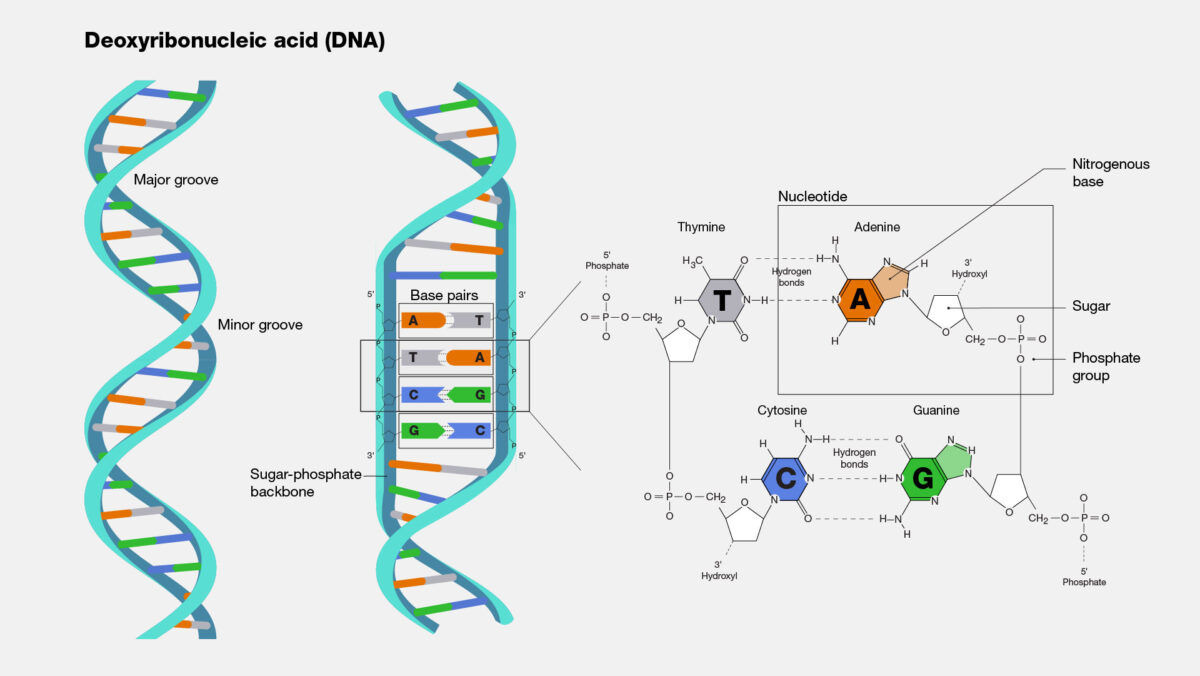
So how does this new technique work? Microbial DNA, like all DNA, is made up of four bases: A, T, G, and C. A pairs with T, and G pairs with C. However, the ratio of the bases varies considerably across microbial species. Some bacteria are split 50-50 between AT and GC pairs, while other bacterial genomes may contain anywhere from 30 to 70 percent GC pairs. In a previous study, Erill and colleagues leveraged this variability to investigate the emergence of resistance against sulfonamides, an early class of antimicrobials.
As resistance genes hop from species to species via plasmids, they largely retain the GC ratio of their original source. So, if there is a mismatch between the GC ratio of the resistance gene and the rest of a bacterium’s genome, that means the resistance gene has come from elsewhere. The simplicity of this technique means it is not only faster than clinical methods at tracking the movement of resistance genes, but also faster than other computational methods.
If a resistance gene has been in a species long enough, its genetic sequence may eventually begin to approach the GC content of its new host, but that could take millions of years. “For what we’re looking at, which is gene movement in the last 60 to 100 years,” Erill says, “it’s basically a snapshot.”
DNA is made up of adenine-thymine (AT) bonds and guanine-cytosine (GC) bonds. The frequency of each type of bond differs substantially across bacterial species. (Image by the National Human Genome Research Institute)
Specialists spread faster
Using the new monitoring technique, the study authors confirmed that resistance genes are most likely to spread if they are on conjugative plasmids, a type of plasmid that can easily transfer between bacterial cells. Researchers generally already understood this, but confirming it with the new method helped verify the technique’s efficacy.
The new study also found that resistance genes effectively targeting very specific antibiotics spread the most. These genes generally require so many mutations to evolve that they are unlikely to have arisen naturally in any given bacterium since humans started using antibiotics. But if they are present anywhere in the bacterial population when the corresponding antibiotic is introduced, they will spread quickly.
“As soon as there is selective pressure from that antibiotic, there is selective pressure to move this thing around, because it is a bacterium’s silver bullet against that antibiotic,” Erill says. In contrast, generic resistance that requires only a few mutations to existing genes is less likely to spread rapidly, Erill explains. “There isn’t a lot of selective pressure to pass it along, because by the time it comes, the bacterium has likely already discovered it,” he says.
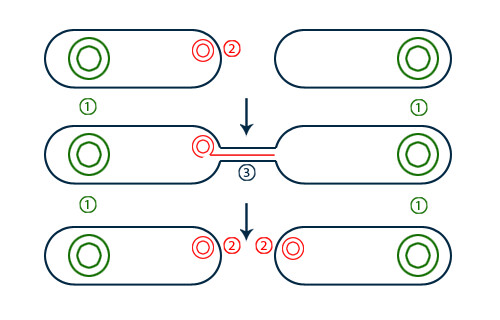
Bacterial cells (black outlines) contain plasmids (red) in addition to their main genome (green). A conjugative plasmid can transfer genetic material between cells as shown here, which can spread antibiotic resistance genes among species. (Image by Zappys Technology Solutions, used under CC-BY)
Hospitals aren’t likely the culprit
The new study also found that genes for resistance to antibiotics used in livestock or prescribed outside of hospitals were likely to spread through the global bacterial population. Resistance to antibiotics used in more limited settings hardly spread at all. “That tells you that if you use things cautiously, then there is not so much selective pressure,” Erill says.
Perhaps most important for antibiotic policy moving forward, Erill’s team found that most of the resistance genes came from a single source and then spread, rather than evolving independently multiple times. “Resistance is in the environment,” Erill says, explaining that it needs a vehicle to get into the mainstream.
If antibiotics were only used in hospitals, rather than in livestock and other environments, resistance would be much less common, Erill argues. This is because resistance from hospital use alone “would presume that you have naturally resistant bacteria living in the hospital already, ready to pass on their genes,” he suggests. While there are certainly infectious microbes present in hospitals, “most of the microbial diversity is in the soil and the water,” Erill says. If antibiotics never reach the cells that happen to be resistant, that resistance won’t spread.
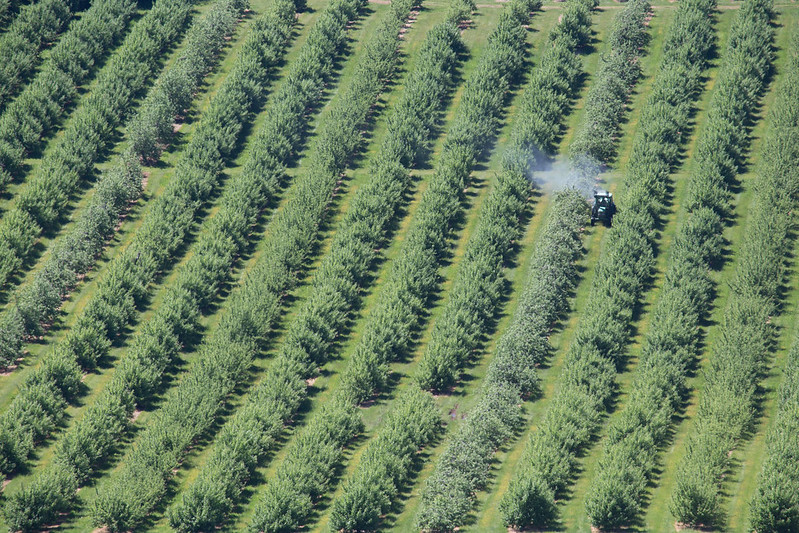
A tractor sprays an apple orchard. Antibiotics are regularly used on “top fruit” crops like apples, oranges, and pears, which can contribute to antibiotic resistance when the spray runs off into waterways and soil. (Photo by Barbara Eckstein, used under CC BY-NC-ND)
While the new study is “a methods paper more than a results paper,” Erill says, “we believe it’s an important contribution.” It puts forward a process for continually monitoring shifts in bacterial genomes over time, which could influence future antibiotic development research or treatment regimens. Perhaps it could even encourage limits on antibiotic use in agriculture and other settings where the drugs can end up in the environment.
Best of all, other research teams can use the new method to pursue answers to their own questions, Erill explains. “You can use it with a very fine comb to poke at whatever you are interested in.”
Diseases such as polio, the common cold, and meningitis are all caused by closely related viruses, and the way these viruses multiply in the body is poorly understood. Deepak Koirala, assistant professor of chemistry and biochemistry at UMBC, has already begun to unravel the mystery. Now, with a $786,000 NSF CAREER Award, his research group will be able to answer even more questions. In particular, they will investigate the RNA structures within the genetic material in these viruses and how those structures enable the viruses to multiply inside cells. The answers could eventually lead to drugs that attack specific mechanisms critical for viral replication, stopping these diseases in their tracks.
Koirala’s lab works on enteroviruses, a group of viruses that have a genome made of a single strand of RNA, rather than double-stranded DNA (like in humans). “RNA is a really versatile and dynamic molecule that functions in pretty much every aspect of cellular processes,” Koirala says.
In viruses with RNA genomes, the genome must control both the process that copies (replicates) the genome and the process that converts the genetic code into proteins. Both processes involve coordination of numerous viral and host cell proteins. The RNA must also somehow continually “decide” between the two processes. In DNA genomes, the DNA is only responsible for replication.
With the new grant, Koirala’s group seeks to better understand how enteroviruses make the decision between copying their genome and building proteins. But before they can do that, they need to nail down the three-dimensional RNA structures within the enterovirus genome that are involved in those processes.
Defining the target
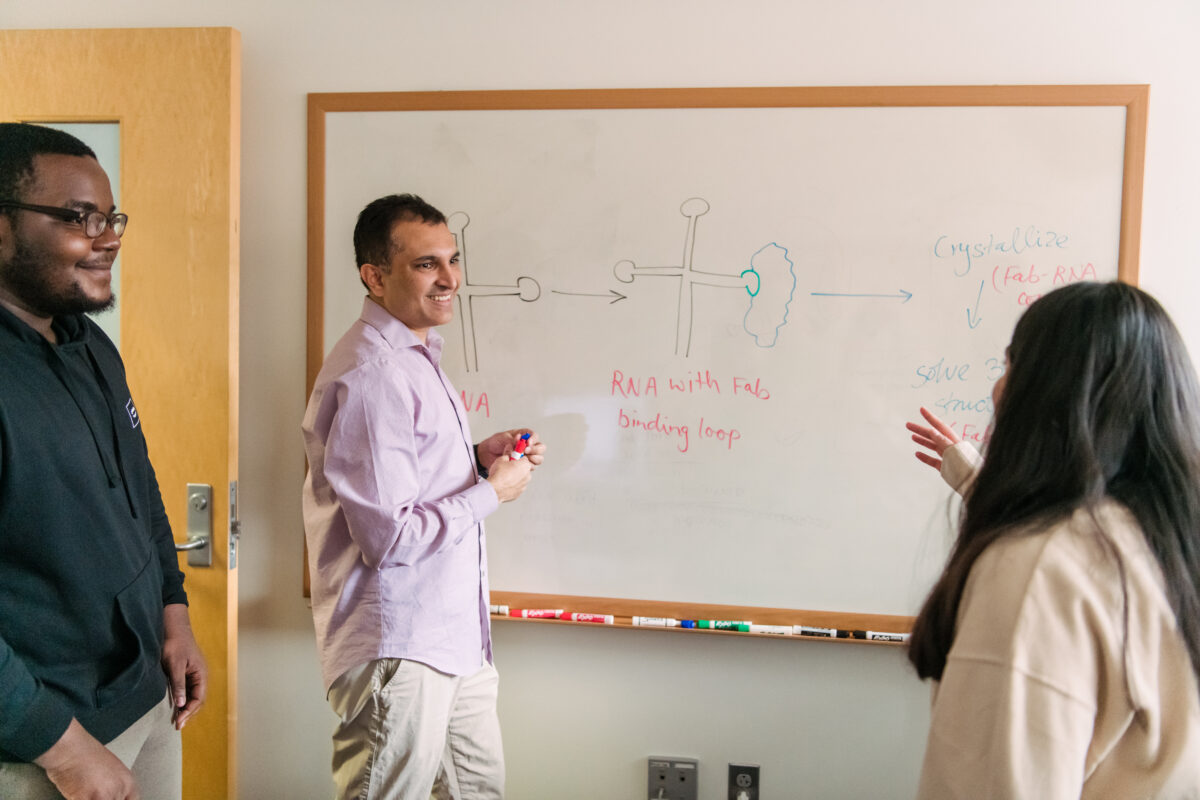
Based on the way enterovirus genomes behave in biochemical studies, previous research has predicted that the beginning of an enterovirus’s genomic RNA strand folds up on itself, forming a shape resembling a cloverleaf. That structure builds a platform to assemble the viral and host proteins required for replication. This idea is widely accepted, but the precise three-dimensional structure of this region, the so-called “cloverleaf RNA domain,” and how it regulates viral replication is unknown. Figuring that out is the Koirala lab’s main task.
Deepak Koirala draws a basic cloverleaf RNA on the whiteboard and discusses with students Senali Dansou (left) and Alisha Patel. (Marlayna Demond ’11/UMBC)
They are well on their way. Koirala’s group recently determined the cloverleaf structure from a coxsackievirus, which causes hand-foot-and-mouth disease, and is an important model system for studying many other human viruses. It will be published in a forthcoming paper in Nature Communications. “I think the field will be really excited to see this,” Koirala says. “It would be the first three-dimensional structure of the full-length cloverleaf domain for the entire enterovirus genus.”
Because the cloverleaf domain is so important for viral replication, the expectation is that its structure will be similar, if not identical, across all enteroviruses. With the new grant, Koirala hopes to determine the 3D structures of this region in several more enteroviruses. The structures the sequences form that are the same or similar across species are most likely to play similar key roles in the viral life cycle.
“That will create the opportunity to get a generic target that might be able to treat more than one of these viruses,” Koirala says. “If you really hit a structure in coxsackievirus, for example, that’s shared across many other enteroviruses, then that could be equally useful for, say, rhinovirus. In the long term, that could be really powerful.”
Crystals and X-rays
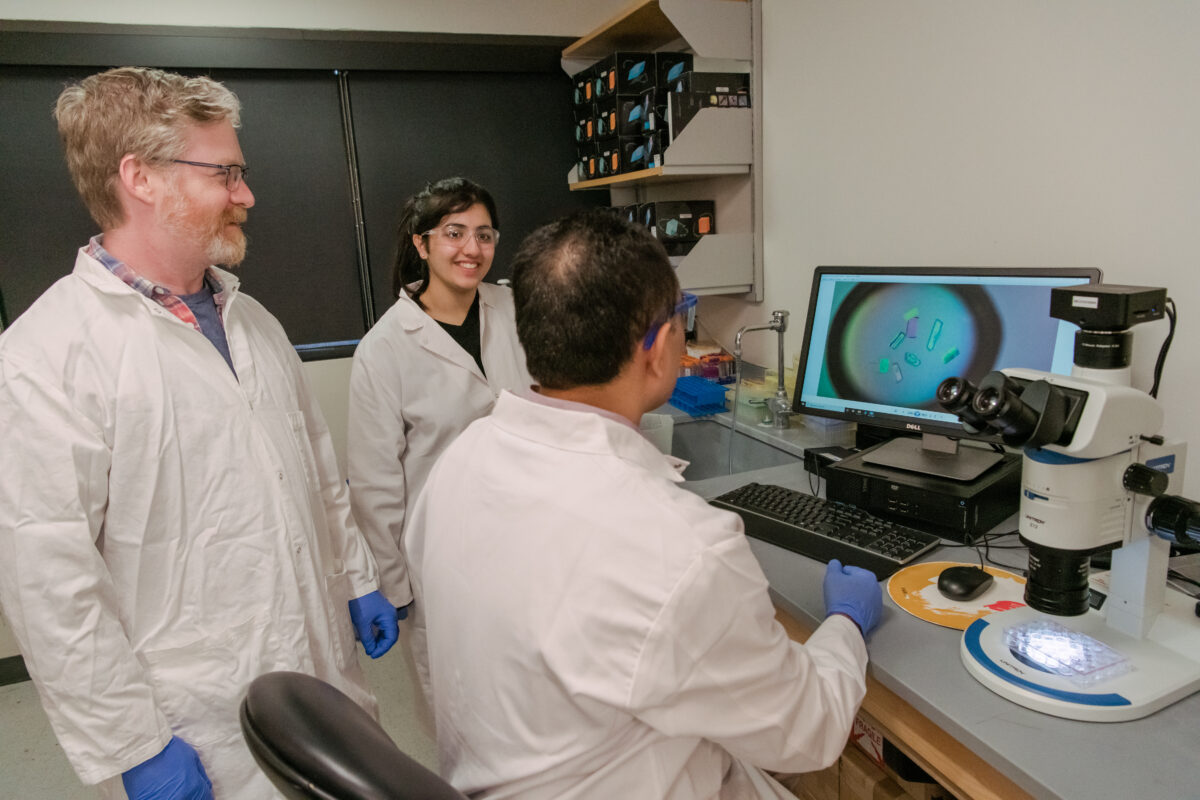
Determining the 3D structure of RNA is notoriously difficult. Koirala’s group uses a technique called X-ray crystallography, where one must first turn the RNA into a crystal through a laborious process. Then a machine directs X-rays through the crystal and then a detector records the reflections that come out. By examining those reflections, called diffraction patterns, the researchers can deduce the molecule’s shape in the crystal. Then, they map the known sequence of RNA bases onto the shape for a final 3D structure.
To make this a little easier, Koirala’s group uses a cutting-edge technique that results in successful crystallization more often than traditional methods. Koirala came to UMBC in 2020 after completing a postdoctoral fellowship in the research group at the University of Chicago that pioneered the technique.
The technique involves attaching a fragment of a synthetic antibody to the RNA, which serves as a “chaperone” to help the RNA crystallize. RNA is coated with negative charges, which repel each other and make it harder to pack the molecules tightly together—a necessary part of crystal formation. When the RNA binds to the protein, those negative charges are neutralized. And, because the protein’s structure is known, that makes it easier to detect the unknown RNA structure in the crystal.
Deepak Koirala, seated, looks at a microscope image of RNA crystals with students Jeffrey Vogt (left) and Zohra Mian. (Marlayna Demond ’11/UMBC)
“Just the beginning”
But even after all that, “The structure is just the beginning,” Koirala says.
RNA does not normally exist as crystals. Therefore, for one, it is important to know if the 3D structure of the protein-bound, crystallized RNA accurately represents what the RNA looks like in a biological context. But with the crystal structure in hand, “Now we have more idea about what to do next,” Koirala says, “to show what the important features of that particular structure are that dictate or define the function.” Follow-up biochemical experiments with deliberately modified versions of the RNA can help tease out which parts of the structure are critical for different functions.
And finally, Koirala says, “Now, with a well-characterized RNA structure, one has an opportunity to design a drug molecule, for example, that precisely targets that RNA structure and stops the genome replication.”
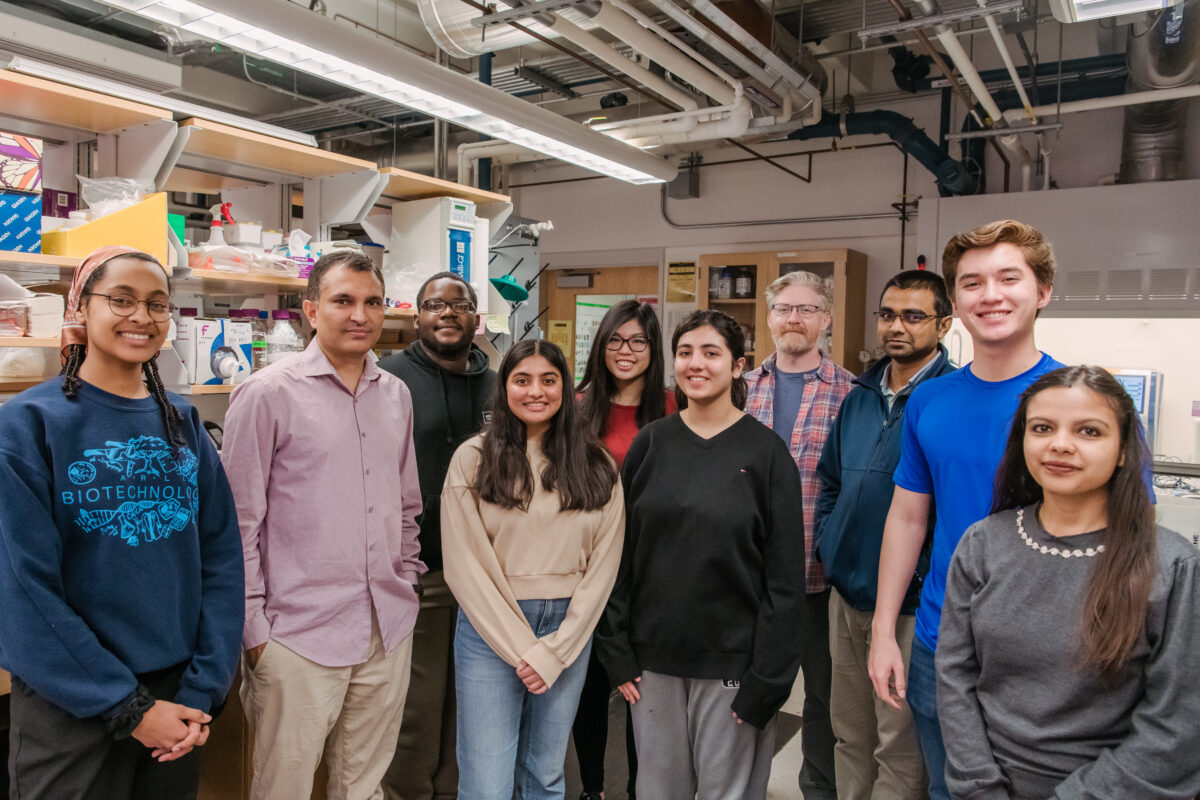
Deepak Koirala’s current lab group. From left to right: Huda Abdelghani, Deepak Koirala, Senali Dansou, Alisha Patel, Megan Nguyen, Zohra Mian, Jeffrey Vogt, Naba Krishna Das, Jason Daniels, and Manju Ojha. (Marlayna Demond ’11/UMBC)
A strong team
With the new funding, Koirala will be able to grow his already sizable team. That way he can accomplish more in the lab—and also expose more students to research. Koirala is happy to bring on UMBC freshmen and sophomores as well as students with more research experience. Even local high school students have gotten involved.
“If you expose students to research early on, that gives them the opportunity to decide which career will work for them,” Koirala says. And by getting students involved right away, they are apt to stay in the lab for a few years—enough time to significantly grow their skills and even become authors on a scientific paper, he explains.
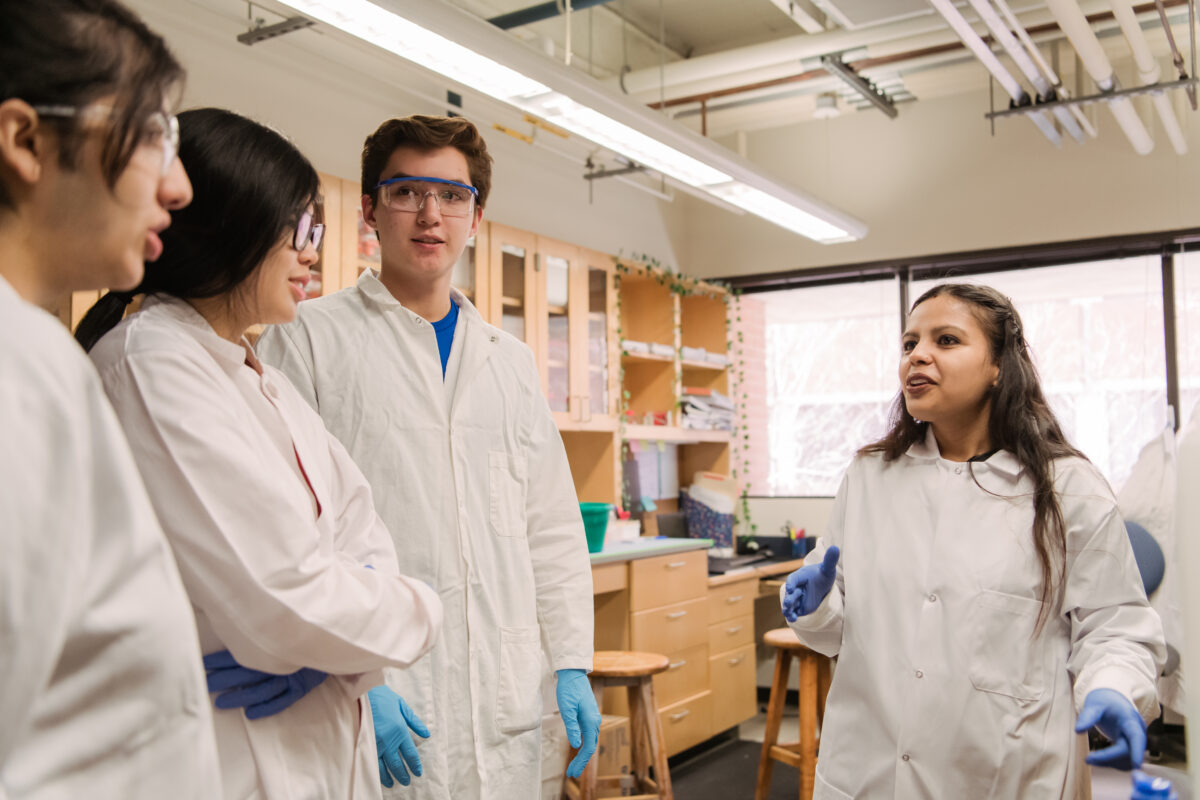
Ph.D. student Manju Ojha (right) explains an experiment to undergraduates in the lab. (Marlayna Demond ’11/UMBC)
In addition to conducting their own research, the students “also get great experiences with mentoring,” Koirala says. With a group of 11 students (“Or 12, including me,” Koirala adds), a mentorship structure forms naturally among the lab members, with more experienced team members guiding and supporting newer team members. “And wherever they go, academia or industry, they will be the future scientists—they will mentor the younger ones.”
Koirala’s method seems to be working. Two high school students in the lab are headed to college next year, one to M.I.T. and one to Bowdoin College in Maine. Tasnia Sadat ’23, biochemistry and molecular biology, is headed to medical school at Georgetown. Jeff Vogt ’23, biochemistry and molecular biology, is on his way to Johns Hopkins for a Ph.D., and Senali Dansou ’23, biochemistry and molecular biology, will matriculate at University of Minnesota for an M.D.-Ph.D.
With such an engaged group of researchers, thoughtful research questions, and effective techniques, Koirala’s team is well prepared to reach its goals and further the understanding of enteroviruses, leading the way for life-changing treatments.