All posts by: Jenny O'Grady


Unabashedly Inspirational

Throughout its history, UMBC has encouraged community members to take risks and make lasting changes to guide our institution to become the empowered University it is today.

UMBC is nothing if not unapologetically aspirational. From its earliest days, Retrievers have dreamed big dreams and punched far above their weight at every turn. We have grit to spare—and  we’ll share it with anyone who wants to be a part of it.

So, how do we do it? Well, aspiration is nothing without follow through. At UMBC, that means digging into the details, thinking creatively, and working together as a community to make things actually  happen—then digging in again to measure the results. 

As they write in The Empowered University, published by Johns Hopkins University Press in November, co-authors UMBC President Freeman Hrabowski, Provost Philip Rous, and senior advisor to the president Peter Henderson, a broad history of people and bold moments have made UMBC what it is today. As Hrabowski often tells his Commencement audiences, “It’s choice, not chance” that defines us. 

At  a place like UMBC—where our community strives to make choice a possibility  for all—those moments  have made all the difference.

SEEING “PROBLEMS” AS OPPORTUNITIES

As diverse as UMBC is on paper, many students come to school never having stepped foot in an urban area. That’s where experiential learning opportunities like Tyson King-Meadows’ Problem- Solving in the Urban Black Community class come in. It’s a course where students can engage a subject from their own vantage point in conversation with partnering community organizations in ways that traditional classes cannot.

Experiential learning gives students a chance to engage in a subject in very personal ways. Students bring their own vantage points to the table but walk away having deeply considered topics as varied as loitering and vagrancy laws, public transportation policy, and crime in a way that forces them to examine their own blind spots and connects them to the world around them.

“UMBC students and community groups see their destinies linked rather than separate” and develop a deeper appreciation for the power of social science research and teaching in action, says King-Meadows, associate professor of political science. “If my students can take what they learned…and positively change the course of one life in one community, I am happy.”

THE CLUES ARE IN THE DATA

Even under the best circumstances, it isn’t always easy to tell when students are struggling with school. Some may stay after class to speak to a professor; others may fall through the cracks. That’s why, in 2016, UMBC added a new tool for uncovering the mystery of student success: data.

By using information already being collected—predictive analytics such as attendance, grades, tutoring use, test scores, etc.—members of a team in UMBC’s Department of Information Technology led by Bob Carpenter began identifying which students could benefit most from extra support and testing out possible solutions in the form of strategic digital nudges.

“The philosophy we’re using is trying to get the right information to the right person at the right time,” says Carpenter, associate provost and deputy CIO. In other words, early enough so that students can make adjustments.

For example, students who miss more than three classes are likely to have major trouble, so those students get emails reminding them to attend. Since one out of two students who retake a math class fail it, but those who take advantage of tutoring while doing so are nearly 20 percent more likely to pass, those students get targeted messages reminding them of tutoring dates.

In the end, of course, the students choose how to use the information. But, with student success rates going up in a variety of instances, Carpenter finds the results encouraging, and he’s already looking for additional paths to pursue. “Like everybody else here, I want to help people get across the finish line,” he says. “We want people to finish because we want them to have not just the keys to a higher salary, but the tools to a richer, more vibrant life.”

UPENDING MYTHS OF THE SURVEY COURSE

For years, Classical Mythology students gathered hundreds at a time for stadium lecture classes, quickly memorizing materials, then using Scantrons to measure their understanding of Greek and Latin. Not surprising, when it came to truly understanding the building blocks of Western Civilization, they were missing the mark. That’s how Tim Phin ’04, ancient studies, learned it when he was a student at UMBC—and that’s exactly why he jumped at the chance to flip the format on its head as senior lecturer in ancient studies.

Today, in his hybridized course, the work happens both in class and online. There’s much less lecturing, with Phin instead breaking difficult material into chunks and giving students ways to discuss in small groups together online. Not only does this make the work digestible—and get the students to actually read and write about the ancient texts—but it allows Phin to see in real- time whether they’re getting it or not.

“We live in a world that moves at a blistering pace. I believe that classics can slow us down, provide us with an opportunity for reflection, for introspection,” says Phin. “The study of antiquity reminds students that both human ingenuity and human frailty have long histories. I want students at UMBC to know that.”

STUDENT-BUILT SPACES

UMBC’s students have a long history of charting their own territory. The grit goes all the way back to 1970, for example, when the newly formed Student Union voted to establish a free and unscheduled hour three times a week for student assembly, organization, and advising. Today, it’s still a cherished part of students’ days and an indelible change to the official campus schedule.

So, when members of the Student Government Association came up with the idea of a 24-7, all-access study space, campus partners sat up and took notice. Opened in 2011, the Retriever Learning Center (RLC) is now one of the hottest spots on campus—a sea of movable seating and tables filled with students, laptops, whiteboard markers, and a buzz of ideas.

And it wouldn’t have happened without intense student work.

“This project taught me about the power of a small group of friends inspired to mold the architectural landscape in their intimate college neighborhood,” said Simmi Singh ’12, biological sciences, one of several student senators who spearheaded the project. “The importance of student-created spaces and initiatives at UMBC is the life-altering experience of holding fast to dreams, actualizing them, and being a positive agent for change for generations of the UMBC family in the years to follow.”

*****

Image by Marlayna Demond ’11.

How To Become a Fanzine Fan

With Susan Graham ’98, VPA & Anthropology, Special Collections Librarian at UMBCSusan Graham

Since the early 1900s, fans of science fiction and fantasy have produced thousands upon thousands of “fanzines” to showcase writing and art, discuss literature and politics of the era, and build community among fellow fans. Often produced by amateur editors, they have titles like Janus and Mirage and If!, and many are stapled together, copied by mimeograph, or even colored by hand. Many are filled with in jokes and turns of phrase meant to delight and engage a very specific — and passionate — readership.

These publications are unique, fun, and meant to be enjoyed. But, if you’ve never tried reading one, much less becoming an honest to goodness fanzine fan, where do you begin? Well, it just so happens that the Special Collections department of the Albin O. Kuhn Library houses the Coslet-Sapienza Fantasy and Science Fiction Fanzine Collection, which contains tens of thousands of amateur press science fiction and fantasy magazines produced from 1937 to 72. Among the collection you can find early works by famous authors like Ray Bradbury and Isaac Asimov, as well as undiscovered talents from across the genres.

Special Collections librarian Susan Graham ’98, is here to walk us through a few easy steps anyone can take to blast warp speed ahead into this exciting new (old, really) universe of literature. The key, of course, is knowing what to ask.


TOOLS OF THE TRADE

  1. A friendly librarian — like Susan!
  2. A section of great zines — like UMBC’s Coslet-Sapienza Fantasy and Science Fiction Collection.
  3. A bookish sense of adventure!

STEP 1: WHAT IS A FANZINE ANYWAY?

Fanzines are amateur publications that are created by fans of a particular genre of work for other fans of that genre. Work of this sort spans not only science fiction and fantasy, but also horror, mystery, crime, and other genres. The first American fanzine was called The Comet and published in May 1930, and the first use of the word “fanzine” was in the October 1940 issue of Detours, a hand-written mimeographed publication on hand in Special Collections.

So, what’s inside?

“They often had letters to the editor with fans discussing the works of other established writers…but they were also a venue for aspiring writers to write their own stories and artists who contributed artwork. There were poems, inside jokes,” as well as plans for get-togethers and conventions, Graham says. “Sometimes authors would even write in and have this sort of relationship with the fans” that kept them reading issue after issue.

STEP 2: HOW CAN I FIND FANZINES TO LOOK AT, AND WHAT KINDS ARE AVAILABLE?

Because their history is so deep and interesting, much is to be found online about fanzines and their background. Many titles from the Coslet-Sapienza collection are digitized and available via the UMBC Library website, where it’s easy to quickly learn about a range of titles and topics — from war to feminism — and even find out how to see them first-hand on campus.

Over the summer, a group of students new to fanzines spent several weeks exploring the collection through the CoLab program, digging deep into titles that interested them, and ultimately creating an online resource for people interested in the literature.

“They produced a great online exhibit that talks all about fanzines and how they were created,” says Graham. “If you’re just starting out, it’s a great place to begin.”

STEP 3: HOW CAN I LEARN MORE ABOUT THE FANZINE COMMUNITY?

Much like immersing oneself in the language of an undiscovered country, learning the ins and outs of fanzines can take some deep study. Much like travel, you can also easily lose yourself in the splendor of fanzine culture.

One great doorway in is through the library’s collections of Fantasy Amateur Press Association (FAPA) materials. A quick flip through some of their newsletters can give you a host of details about what readers enjoyed, and how they communicated with each other, Graham says.

Fanzines from UMBC's Special Collections

Another is The Fillostrated Fan Dictionary by Elliot Weinstein, also on hand at the library, which offers definitions for hundreds of fandom-specific terms you didn’t even know you didn’t know. (Like “Bolega,” a “mythical fannish liquor,” or “Helicopter Beanie,” the “stereotyped head gear worn by all neo type fans,” to name just a couple.)

But, nothing quite compares to holding a fanzine in your hands and imagining who made it, says Graham.

“One thing that’s really special about fanzines is that some of them can look really homemade,” with original drawings and hand bindings that show the depth of commitment of the publisher, says Graham. “This was somebody’s passion, they loved it, they wanted to get work out there. They wanted to be a part of this community.”


The More You Know

Ready to get started? Here are some resources to get you on your way to fanzine fandom.

  • Fanzine Lib Guide: Visit this guide online for history of fanzines, links to searches within the Coslet-Sapienza collection, digital copies of fanzines, and information on how to visit the collection in person. lib.guides.umbc.edu/fanzines
  • CoLab Student Project: Dig in deeper to several specific titles in the Coslet-Sapienza collection through this in-depth student summer research project. umbcspecialcollections.omeka.net/exhibits/show/cosletsapienzafancoll
  • Zine Wiki: Use this open-source encyclopedia devoted to zines and independent media to find out about a larger swath of zines, including history, production, distribution, and culture of the small press. Zinewiki.com
  • Learn more about UMBC Special Collections and all of its wonderful holdings! library.umbc.edu/speccoll/

— Jenny O’Grady

Moving the Needle

With their hearts in the work and their ears to the ground, the people behind some of UMBC’s longest-standing homegrown programs are solving big societal problems. But the work is never done.

By Jenny O’Grady

On the wall of the office, in bright Retriever gold, hangs UMBC’s vision statement, a bold call to action for any and all who happen to wander past. A call to “connect innovative teaching and learning, research across disciplines, and civic engagement.” A call to “advance knowledge, economic prosperity, and social justice.” No simple task, indeed.

There’s a quote from late Baltimore civic leader Walter Sondheim, as well. Christopher Steele keeps them here as a reminder that we’re all here to serve as well as learn. It can be messy work, he says, but worth the pursuit.

“Look at our vision statement. This notion of social justice and civic engagement are clearly stated…it’s in our values,” said Steele, Vice Provost, Division of Professional Studies, and Executive Director of the Shriver Center.

Founded in 1966, during a time of great civil unrest, UMBC is rooted in a type of service-learning that cuts across disciplines and traditional social structures. And the backbone of that work is programs like those of the Shriver Center, and many others homegrown on the UMBC campus, that over the last several decades have worked to address major societal problems of their time — from inclusivity in the workplace, to social justice in our cities — in collaboration with community partners.

Time passes, and successes come hard earned, because moving the needle takes both persistence and patience. Challenges change over time, forcing student learners and their instructors to bend and re-learn as they go.

The vision statement doesn’t precisely define the “why” of it all, but that’s not necessary. The answer is woven through everything these programs do.

Leveling the Playing Field
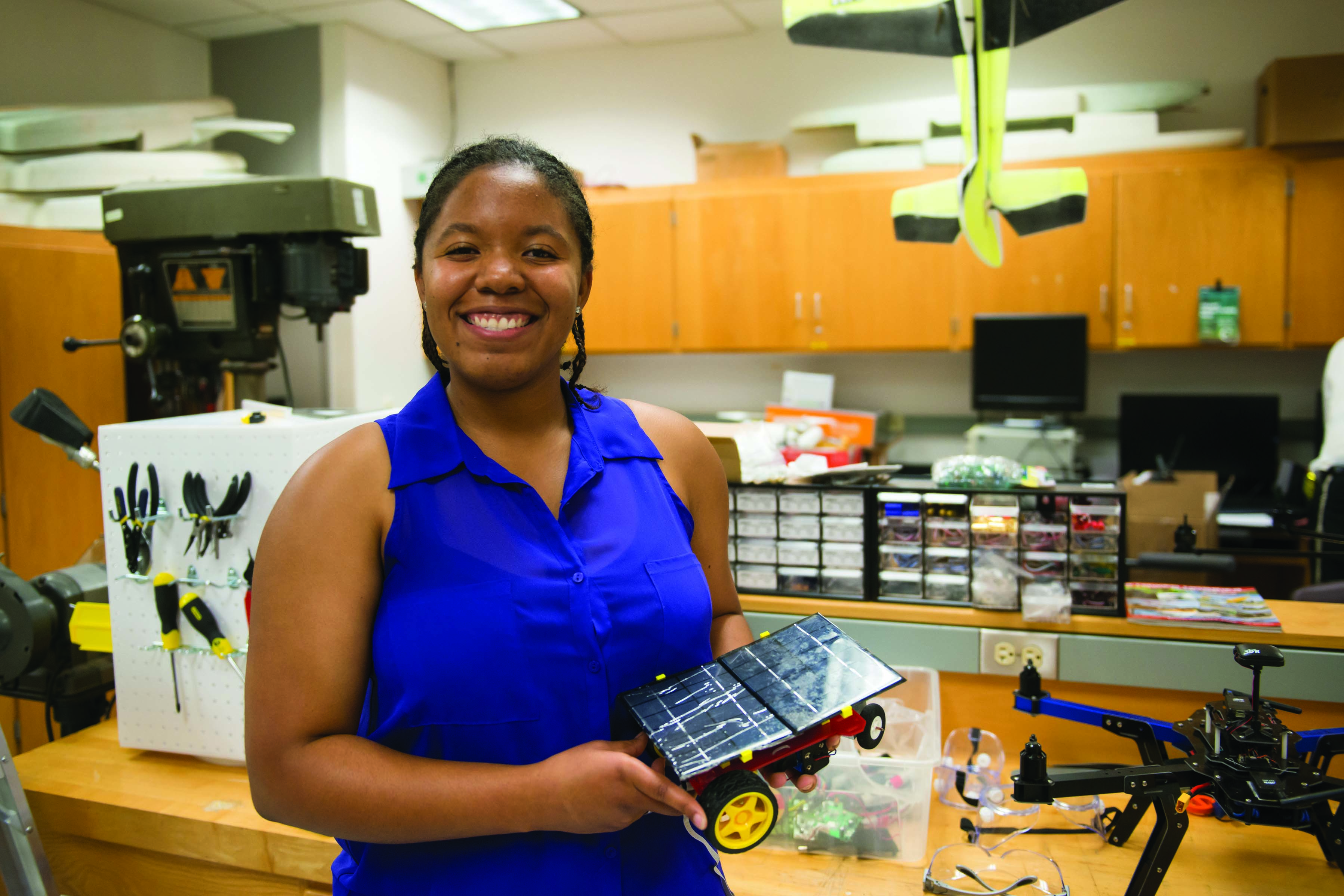
More than 200 CWIT Scholar Alumni are bringing new perspectives to the tech industry.

Imagine having a passion for technology or science, and the desire to make a difference with your talents. Now imagine encountering multiple locked doors before you as you attempt to enter the field of your choice — or even to pursue the study that drives you. Imagine hearing over and over again that this is “just the way it is,” or worse, the silence of no one noticing.

Decades after their founding, issues of accessibility in learning and industry still exist in the STEM fields. But, UMBC’s Meyerhoff Scholars Program and the Center for Women in Technology (CWIT) forge on, as they have for 30 and 20 years, respectively, working to open doors for underrepresented groups both as they learn, and as they move into the workforce.

“This is what drives us…increasing the number of women, and the participation of women, as well as other underrepresented groups in computing and engineering,” says Carolyn Seaman, associate professor of information systems and interim director for CWIT, not only because of the principal of fairness, but because the industry needs it.

“Better design requires a diverse set of perspectives, a diverse set of life experiences, a diverse set of requirements,” that can only be improved through diversification of these traditionally male dominated work spaces, she says.

As one of the nation’s leading sources of African Americans who get Ph.D.s in science and engineering, UMBC’s Meyerhoff Scholars Program does its work for similar reasons. Many academic doors haven’t traditionally been open to these students — not just at the college level, but far before that.

“There’s so much potential, and there are so many problems in the world. We need as many hands in the work as possible,” says Keith Harmon, director of the Meyerhoff program.

Both Meyerhoff and CWIT have evolved over time, as industry and societal needs revealed themselves. CWIT, for one, broadened its scope to include not just women, but male allies who could contribute to a shared vision. The program has also branched out to cover study areas that map directly to industry needs with the creation of its Cyber Scholars group, and worked to expand the program to students who need them most.

“We had people saying, ‘Well, you’re serving the best of the best, which is fantastic, but there are more than 3,000 other students in the [College of Engineering and IT]. How can you serve them?’” said Danyelle Ireland, associate director of CWIT. “We’ve done great things for our scholars, so there’s now more demand.”

Even if his program could double in size, however, Harmon believes that pushing the numbers too far could hurt the one-on-one attention his students receive, and, ultimately take away from the experience. Students in both programs graduate among tightly-knit groups who often refer to their cohorts as families.

T-SITE Scholar Kiante Brantley ’15, M.S. ’16, computer science, recalls a fellow CWIT Scholar found time to personally tutor him in a class he was struggling in even though he was working 20 hours a week with a full course load.

“Being a minority in STEM is hard, but you have a support system of other minority students, faculty, and alumni, then the struggle becomes easier,” says Brantley, now a Ph.D. student at College Park. “CWIT created a family that provided students like myself with the encouragement to make it through…tough times.”

For CWIT, the family means living on a residence hall together, eating together, doing Zumba together, and celebrating life’s victories. The same happens with the Meyerhoffs, where new students begin school the summer before fall semester — in a Summer Bridge program, an academic and social immersion that helps students quickly establish solid study habits — as cohorts that stick together long after graduation.

Rockford “Rocky” Foster ’13, mathematics, a member of the 21st Meyerhoff cohort who is nearing completion of a Ph.D. in mathematics at UC Berkeley, says he was embraced by the community immediately. Because of what he learned, he has started a “mini- Meyerhoff” system on the west coast, seeking out mentors and mentees as a solid support system. The Meyerhoff program’s “secret sauce,” he says, is the strength of those bonds; 30 years in, those bonds can be found across the country.

“So now, when a Meyerhoff undergrad is facing a challenge, chances are there’s a Meyerhoff who can empathize and provide guidance. When they identify an institution or professor they want to work with, there’s someone who can put them in touch or put in a good word,” says Foster.

“The truth is there are many people who are born with such networks in place; their families have accumulated a sort of academic wealth. But other people, historically disadvantaged people, have been denied the ability to accumulate this wealth. The incredible thing about Meyerhoff is that they built it in less than thirty years.”
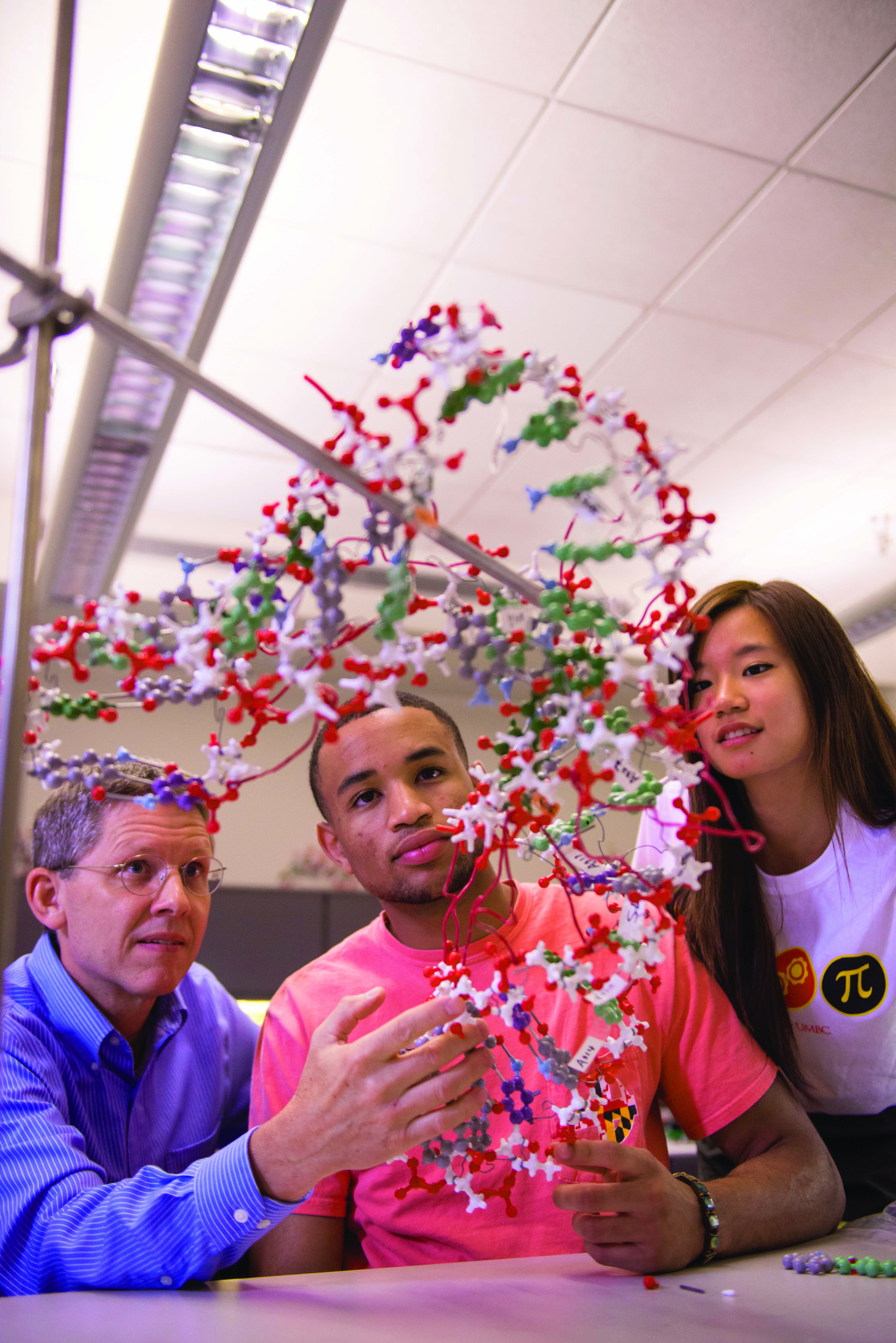
Meyerhoff Scholars frequently work in the lab with professor Mike Summers.

As a Cyber Scholar, Priyanka Ranade ‘18, information systems, participated on an all-woman team in a cyber engineering competition sponsored by Northrop Grumman. The team won first place, and today Ranade works at Northrop as a cyber software engineer and serves as a mentor to a current Cyber Scholar team.

“We are not taught to solely invest in our own dreams,” she said, but “to use our strengths in helping others in their journeys, too.”

Filling a Teaching Need

Studies show that students in high-needs schools who are taught by teachers who come from similar backgrounds — and who can understand their specific needs and challenges — are more likely to succeed. And yet, filling those teaching spots presents a perpetual challenge, because teaching in those areas often carries stigmas that scare away potential candidates.

“The biggest challenges, we find, is just finding enough students who want to be teachers, whose families support that career path, and who want to teach in Baltimore,” said Rehana Shafi, director of the Sherman STEM Teacher Scholars Program, which for the past decade has worked to fulfill the mission of “for every Baltimore student an exceptional STEM educator.”

Today, the program has more than 90 alumni teaching and leading in schools all over the state, including in Baltimore city and Baltimore County, and 64 current students. Getting students interested in the first place may be difficult, but the program works to help them understand why this is such a special — and important — calling.

“We’ve shifted how we talk about teaching,” said Shafi. “We talk about social justice and equity. STEM is an integral part of our mission, but at the end of the day, we want people who are approaching teaching from those two lenses…especially when you’re working with kids — and with families and communities — who are the most underresourced.”
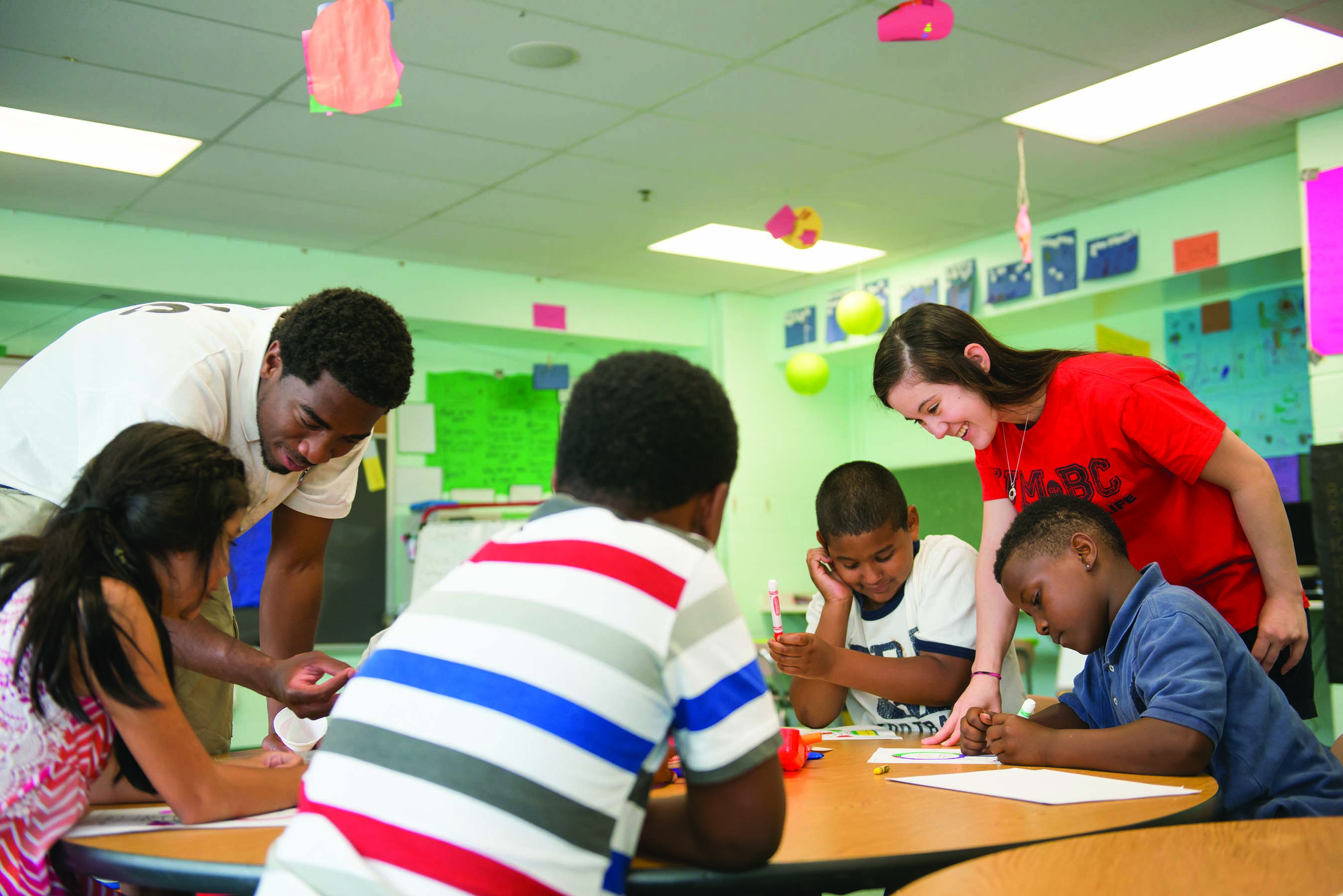
Sherman Scholars teach at Lakeland Elementary School.

Knowing the challenges their students are facing as they student teach, the Sherman program in the last few years made shifts to offer higher levels of support, with the addition of staff who offer dedicated professional coaching for students. It also targets recruitment efforts in city schools because people often want to return to their home community to teach. And the program now requires annual applied learning experiences (an increase) in city schools or with programs that support kids from city schools.

This includes major work at Lakeland Elementary/Middle School in Baltimore city, where for the last six years the Sherman program has partnered on teacher professional development with math teachers, afterschool enrichment programs, and (along with elbow grease from the UMBC Peaceworker Fellows Program and financial support from the Northrop Grumman Foundation) the launch of a new Lakeland Community and STEAM Center.

Elizabeth “Rosie” Plitt ’14, psychology, M.A.T. ’16, education, who is in her second year of teaching kindergarten at Lakeland currently, says the professional coaching specifically regarding community and cultural responsiveness she received through Sherman is what sets the program apart.

“The program has opened my eyes to my passion for teaching in urban schools,” she said. “The community, the connection, and the reward outweigh the many challenging aspects that occur throughout the year.”

Joseph Skowronski ’18, biochemistry and molecular biology, joined Sherman “on a whim,” he said, “but it was a decision that I will be proud of for the rest of my life. I knew immediately that I was in the company of dedicated professionals who wanted nothing more than for each and every one of us to succeed and be the best teachers we could be.”

Currently completing both his master’s of arts in teaching and a year-long student teaching internship at Baltimore Polytechnic Institute, Skowronski said he “loves walking into a class and seeing a fellow Sherman in the room. An instant connection is made in that moment, and I have a friend and partner in the class on day one.”

For Shafi, though pushing the numbers of students working in high-need schools is a goal, the real mark of success is a shift in thinking among them.

“We really want our students to deeply understand who they are and what they walk into the room with, and who their students are. That takes time,” said Shafi. “And then, when people ask, ‘What do you teach?’ that the first thing they say is ‘I teach students.’ It might be math. It might be chemistry. It be elementary, but ‘I teach students.’”

A Community That Cares

Dealing directly with critical social challenges can be messy, but for the past 25 years the Shriver Center has moved and changed to keep up with the challenge, connecting thousands of students and faculty to partner with people and communities to address their needs. Alongside them, the Sondheim Public Affairs Scholars have also contributed to service-learning, internships, activism, and research to enact social change since 1999.

Named in honor of Eunice Kennedy Shriver and Sargent Shriver with the mission of “addressing critical social challenges by bridging campus and community through engaged scholarship and applied learning,” UMBC’s Shriver Center serves as an umbrella organization with numerous spokes and broadly sweeping goals. The center runs programs covering everything from service-learning and community engagement (including the Shriver Living Learning Community, and service and leadership scholarships) and Public Service Scholars programs for students, to orchestrating engaged scholarship by faculty, to advocacy, academic support, and work experience for youth offered by the Choice Program, and intense community engagement via the Shriver Peaceworker Program.

“We’re trying to move toward social justice and increased equity across the board in society,” through approaches that involve students, faculty and communities, said Shriver Director Michele Wolff ’89, sociology.

“On the student side, we want to create spaces in which they feel empowered to become change agents to tackle issues identified by the community…and with faculty, we want to collaborate to connect their research and creative work with community-based activity. And then, we work directly with the community to help them address their identified needs, usually with students as the resource that helps build their capacity to lead positive change.”
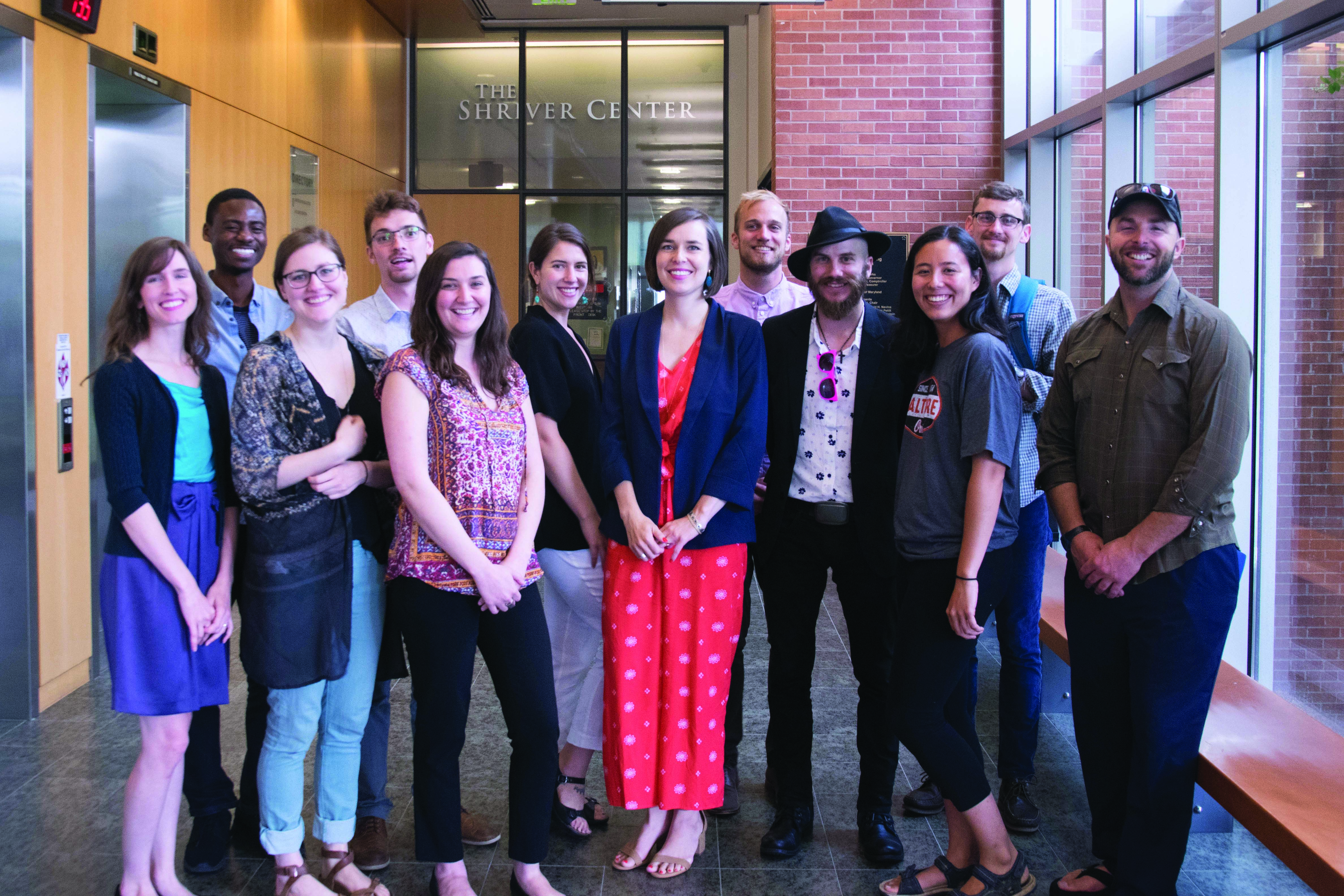
Many Shriver Center staff are alumni of their own programs.

Studies by members of the Shriver staff have shown that in addition to helping surrounding communities, applied learning of this sort also improves GPAs and graduation rates among participating students, while nurturing skills in leadership, public speaking, personal growth, and career exploration.

The center’s Choice Program offers community-based case management services and aims to foster healthy development and resiliency among youth from under resourced schools and communities. It served nearly 1,000 youth and their families in 2017, resulting in lower recidivism rates and a reduction in out of home placements.

When she came to UMBC, MaryBeth Hyland ’06, social work, wanted to become an orthodontist. But, her experiences working as a site coordinator with the Choice Program and living in the Shriver Living Learning Community put her on track for an entirely different career. In one case, she helped a youth with serious dental issues get pro-bono treatment with an orthodontist with whom she had previously interned.

“It was in that experience that I realized that I wanted to help people to get the support they needed to live better lives,” said Hyland. Today she runs SparkVision, an organization that helps individuals and companies to live in alignment with their values. “And I changed my major to social work and began to thrive.”

Many Shriver alumni maintain their connections long after they graduate. Peaceworker alumna Katie Long, M.A. ’10, intercultural communication, who currently works as program director and Hispanic liaison for the Friends of Patterson Park in Baltimore, still calls upon her Peaceworker family for support and camaraderie.

“I think the practical idealism that is instilled by the Peaceworker Program is much of the reason why many of us are able to continue with the fight for social justice and betterment of our city,” she said.
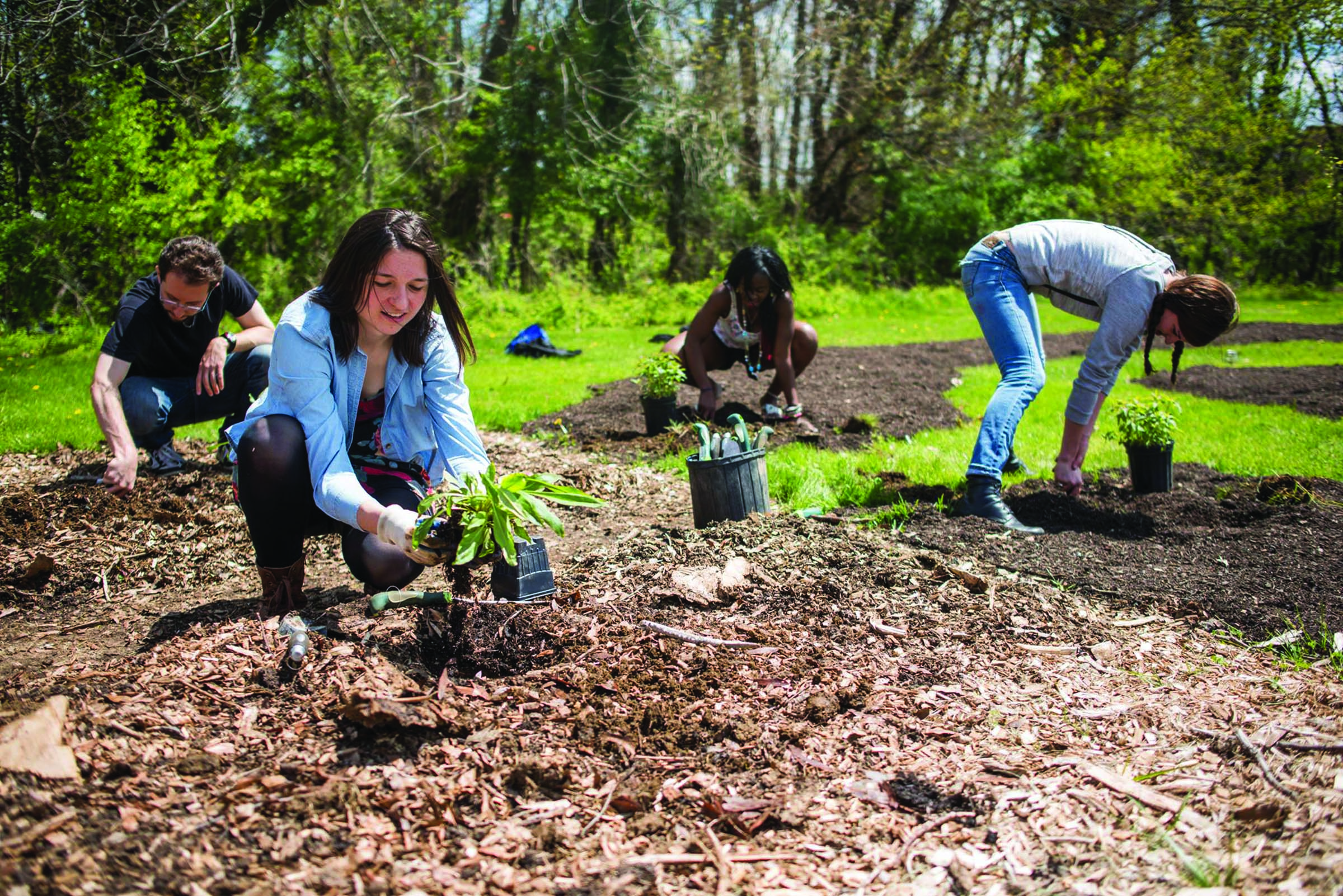
Sondheim Scholars help with a variety of programs, including UMBC's community garden.

Service is also a core value of the Sondheim Public Affairs Scholars, who often collaborate with Shriver Center programs. By working closely on problems like poverty, inadequate education, or services for immigrants or disabled people, students broaden their horizons, build empathy, and become exposed to people they might not otherwise, says Laura Hussey, director of the program and associate professor of political science.

“When students learn about problems through direct encounters with the people they affect most keenly, the problems start to look a little different, and perhaps also more complex, than they might have looked from a set of statistics or ideological arguments,” says Hussey. “It’s a great learning exercise to balance and weigh these types of evidence — what students witness at their service sites, what they read in their textbooks, what they hear in the news or from their favorite political sources.”

During his years as a Sondheim Scholar, Evan Leiter-Mason ’17, economics and political science, started a student-run volunteer tax service for people in need of assistance. Today, he continues that work via the CASH Campaign of Maryland, driven by a desire to create a world free from poverty and financial hardship.

“The Sondheim program affirmed my existing desire to be involved in public service by connecting it to the legacy of Walter Sondheim and his work to make Baltimore a better place to live for its citizens,” said Leiter-Mason, who said he found mentors and friends who share his values and drive to help. “I believe we all have a responsibility, in our own way, to imagine and work toward a better world than the one we have.”

From Student Worker to Nationally Recognized IT Leader

Damian Doyle ‘99, B.S. Computer Science, ‘16 M.S Information Systems, says building trust and relationships are essential to his work every day at UMBC.

Doyle, assistant vice president of enterprise infrastructure in the Division of Information Technology (DoIT), has been recognized with Educause’s prestigious Rising Star award, “For demonstrating exemplary leadership in the implementation and deployment of information technology in support of the educational mission; for strong mentorship and promotion of diversity for those aspiring to the IT profession; for modeling collaborative partnerships within his institution and in the greater higher education community.” He received the award at the annual Educause Conference in October.

Like a number of DoIT staff, Doyle began his career as a student worker, and was hired full time after graduation (51 of DoIT’s 75 FT staff are UMBC alumni). Over time, he began taking on leadership roles in network service and security, technology to support classroom learning, and cloud services. Doyle’s collaborative, positive, and thoughtful approach extends beyond DoIT to his work across campus and beyond.

Doyle is a member of UMBC’s Center for Women in Information Technology (CWIT) internal board, and works closely with CWIT Scholars. He has developed an internship program for the scholars to receive hands-on experience in DoIT’s cybersecurity, UNIX infrastructure, and advanced networking teams. Doyle is also committed to working in shared governance and is currently president of the university’s Professional Staff Senate (PSS) and active with its University Steering Committee (USC). He is chair of the planning committee for Maryland’s First Lego League (FLL) and is one of the state head referees. He also coaches his son’s school FLL team.

“Damian has been a partner with the Center for Women in Technology (CWIT) as an advocate for women and underrepresented students, educator, supervisor to CWIT students, and ally within the University of Maryland, Baltimore County,” says Erica D’Eramo, assistant director of CWIT. “He has promoted the opportunities for employment and technical experience in DoIT, and he participates in professional development exercises with new CWIT students and multiple networking opportunities throughout the year for all class years. We greatly appreciate his support of CWIT’s mission and thoughtful collaborations for the past several years.”

DoIT Vice President and CIO Jack Suess, B.S. ‘81 mathematics, and M.S. ‘94, information systems operations analysis, says, “I am thrilled that the EDUCAUSE Awards Committee agreed that Damian’s body of work was exceptional and that he was awarded the Rising Star Award. Damian’s technical and managerial leadership has not only advanced IT at UMBC; he’s taken that leadership and talent to work across campus and in the community, and he is seen as a national leader in the field, especially in the use of cloud technology.”

“I love building bridges,” Doyle explains. “I’m able to work with people on campus and learn what they are doing, then find and match technology to that, in order to help make their work better.

“IT staff see themselves as partners with the university community and so we’re committed to intentional customer service. It’s important to take time with people, to hear their viewpoints and understand their needs. If we’re going to change how we do something, it has to be because it’s of benefit, not just because it’s cool technology.

We’re at a point where you can’t teach and learn without technology, so we have to implement it in a way that serves the community.”

Damian Doyle. Photo by John Fritz. 

Doyle has also helped DoIT create a culture that is inclusive and welcoming too. Beyond his work with CWIT, Doyle says it’s been important for DoIT keep in mind the wide range of ways people from all backgrounds bring different perspectives on problems and solutions to their work. “I feel we have good values around this, but we want to make sure students understand and have that in an intentional way.” He says DoIT will continue to work on developing this area, and they are planning to launch some new initiatives this spring.

When he’s not at UMBC, Doyle takes time away from IT, playing ultimate frisbee and tennis, running, and biking. But he also loves science fiction and video games, which he often plays with his son, Leo, who shares his love of technology. Doyle, whose parents were part of UMBC’s first graduating class, now enjoys this time with Leo much like he did as a child when he and his father built computers together. He says he explains to his son that using technology and understanding how it works are two different things. That understanding has not only helped Doyle in his career, but has become part of a philosophy that has made a difference to the UMBC community as well.

In an upcoming interview with Educause Review, Doyle shared what keeps him inspired. “The people within higher education and their stories, passions, and dreams have a huge impact every day on my thinking and motivation. I’m continually impressed by the challenges many students have overcome to get where they are, and by the faculty, staff, and colleagues who are changing lives through their work, their research, and their commitment to education. The more people I talk with, learn from, and connect with, the more inspired I am to help them succeed and achieve their goals.”

— Eleanor Lewis

Header image: Damian Doyle, right, Ray Soellner, left, the associate director of telecommunications, and Tobi Odunsi, middle, a master’s student in cyber security. Photo courtesy of Tobi Odunsi.


Homecoming 2018: Magic Retriever Moments

This year’s Homecoming brought Retrievers of all ages back to their alma mater. In many ways, Homecoming represented the very best of what UMBC has to offer, from reunions with lifelong friends spanning all of the university’s 52 years, to celebrations of the life of the mind, as well as plenty of fun on and off the field. Here are some highlights from this year’s Homecoming, held October 4-14, 2018.

See the full collection of Homecoming 2018 photos here.

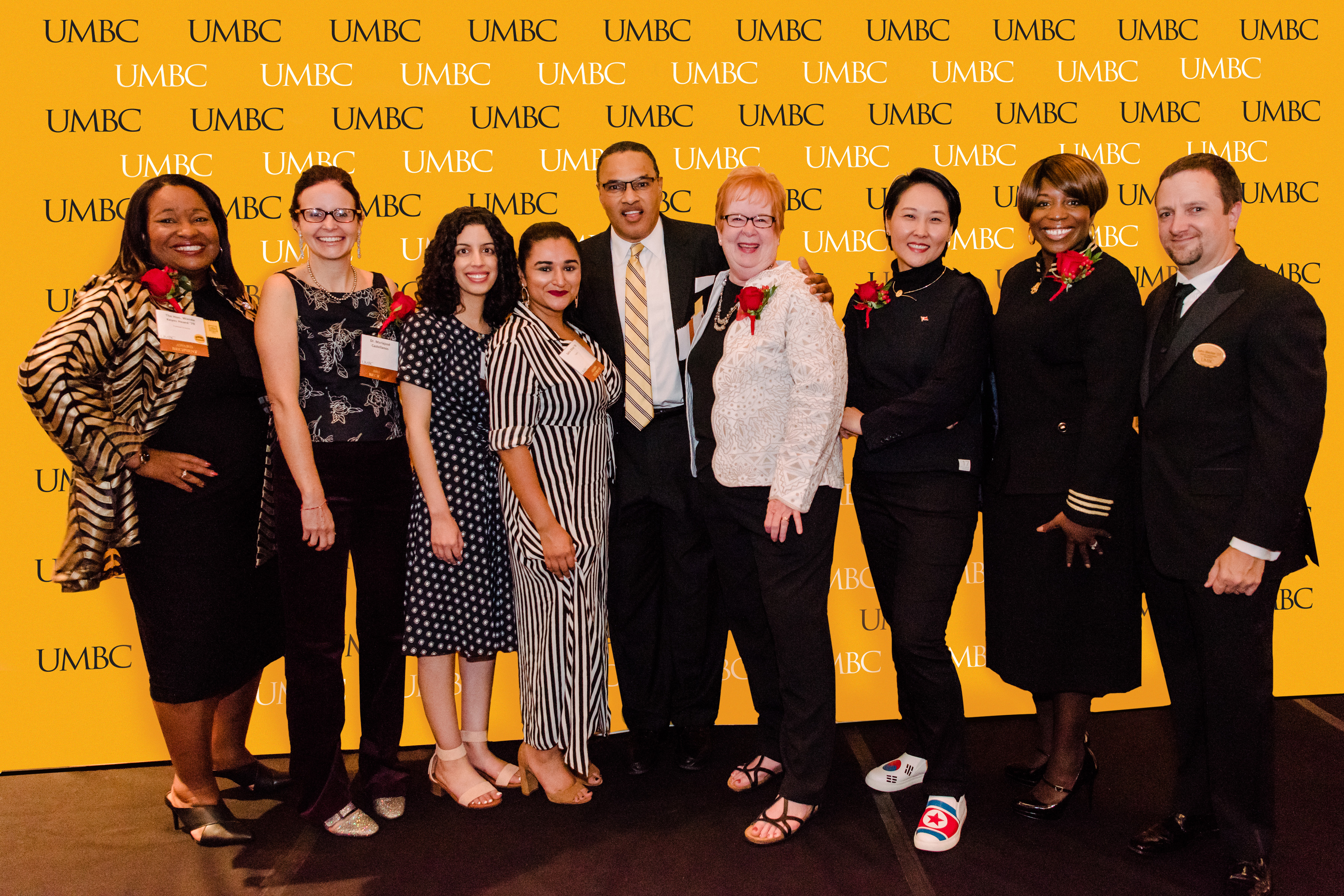
30th Anniversary of the Alumni Awards

To celebrate 30 years of alumni excellence, UMBC greeted a packed concert hall full of guests from our Retriever community. Read more about the Alumni Awards honorees and ceremony here.

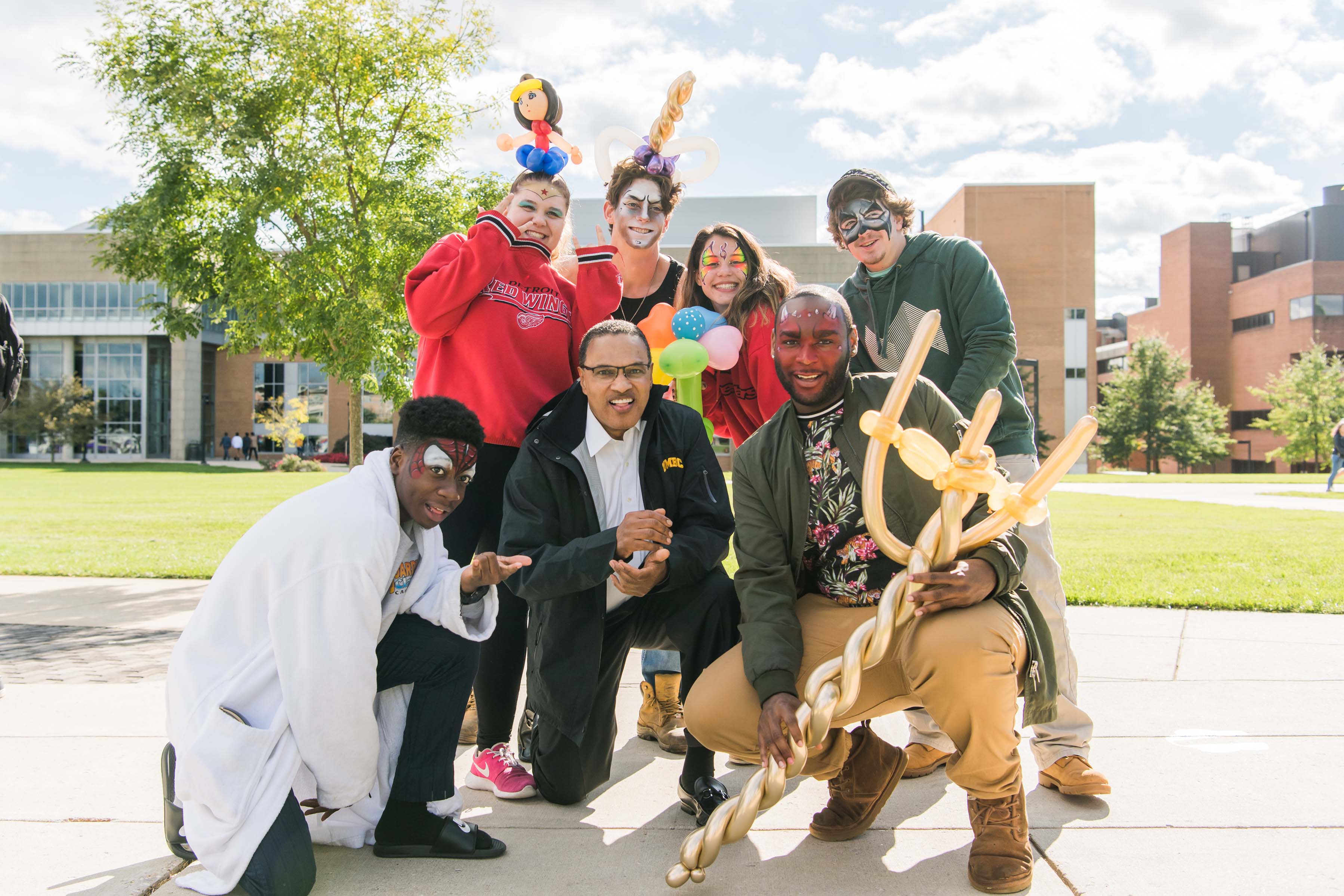
Homecoming Carnival and Crab Feast

The weather may have cooled off, but Retriever Fever kept the campus warm all weekend, with carnival games, reunions, food, and more.

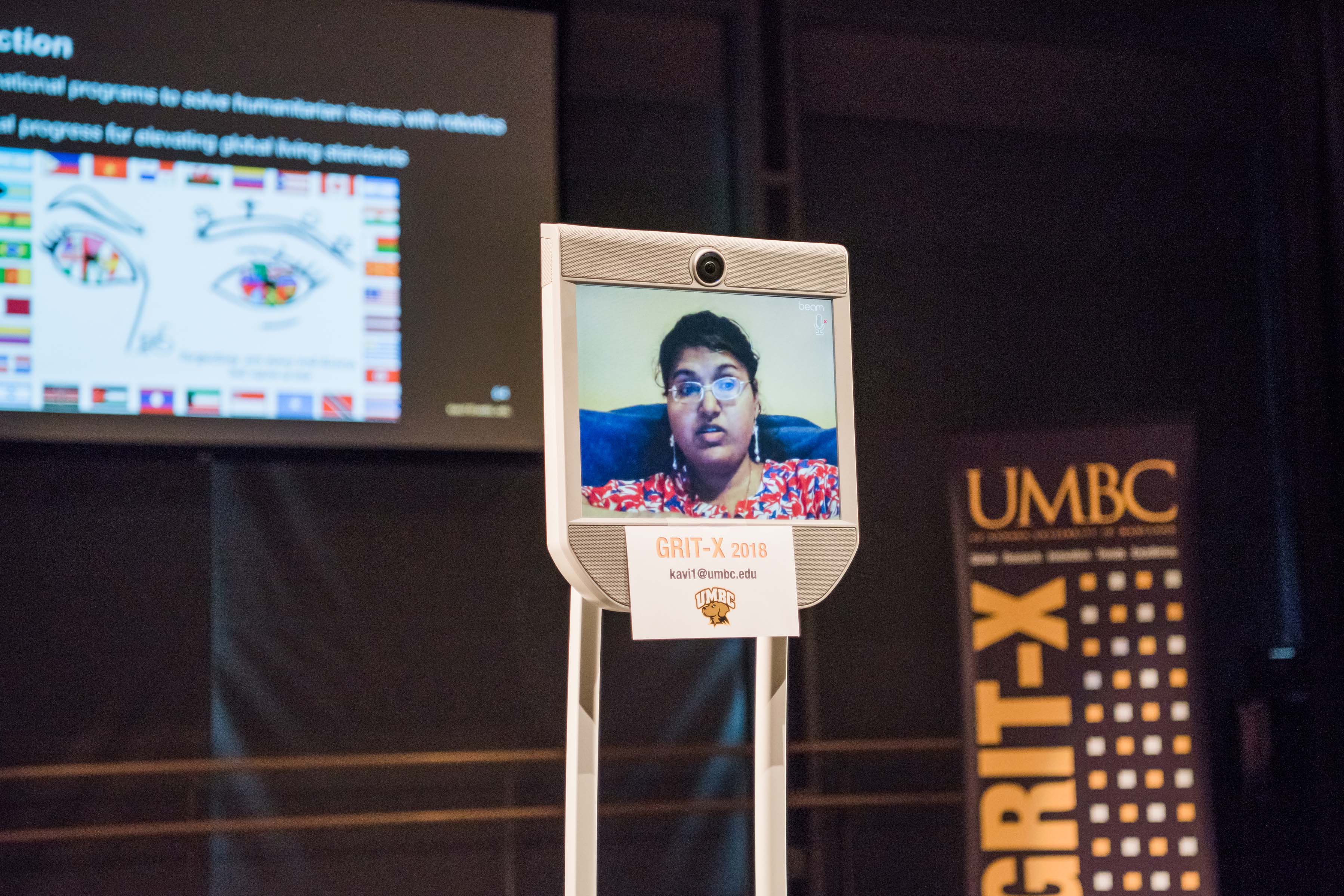
GRIT-X

Back by popular demand, GRIT-X featured some of UMBC’s most intriguing faculty and alumni speaking on a variety of topics, from evocative art and film, to math and storytelling, to ways artificial intelligence and robotics are opening the doors of accessibility to people with disabilities.

#RetrieverNation in the House

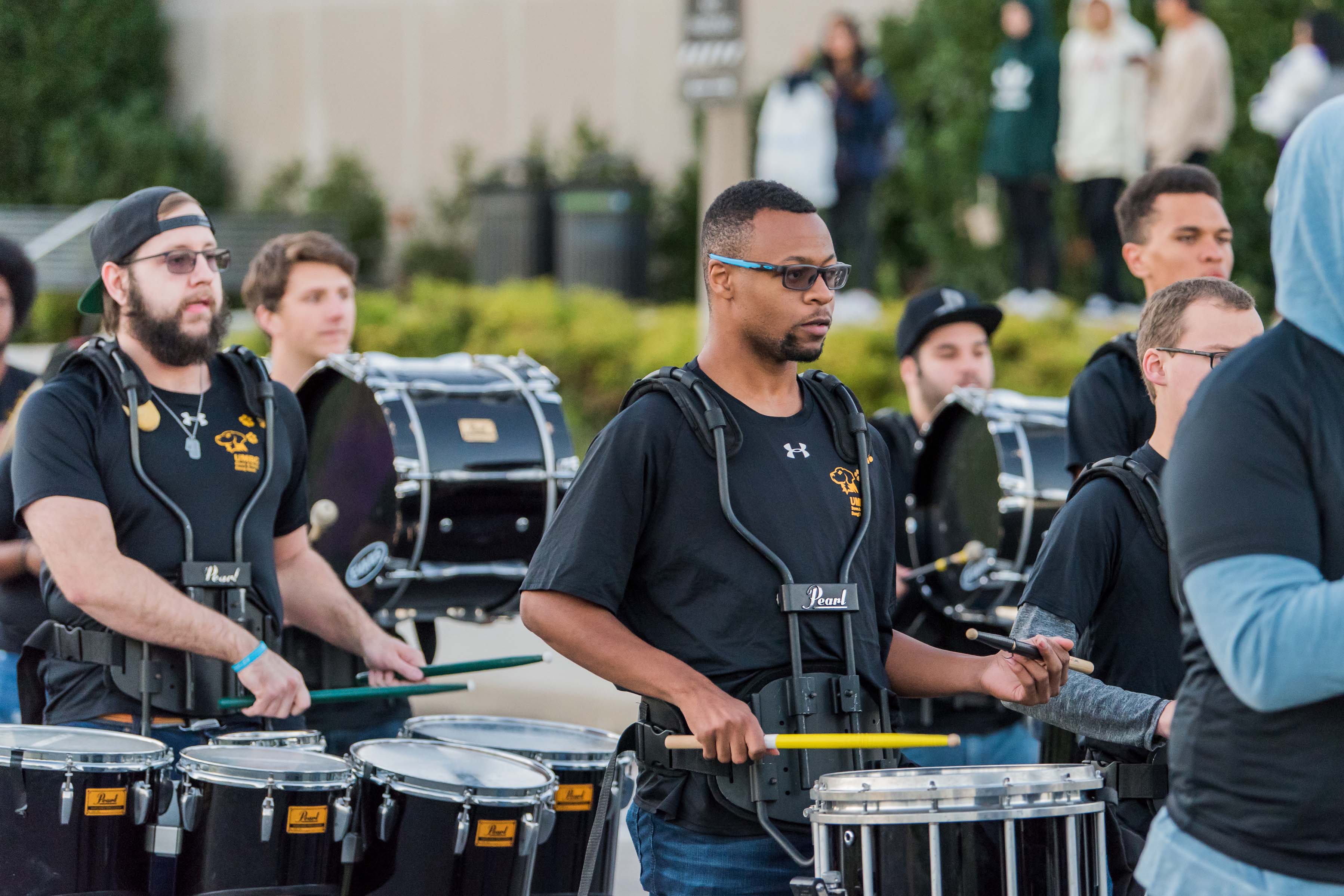
UMBC’s most faithful fans broke out the black and gold for this year’s Athletic Alumni Reunion and the men’s soccer game versus Hartford (which the Dawgs won).

Hilltop Donors Learn About Current Research at Annual Celebration Dinner

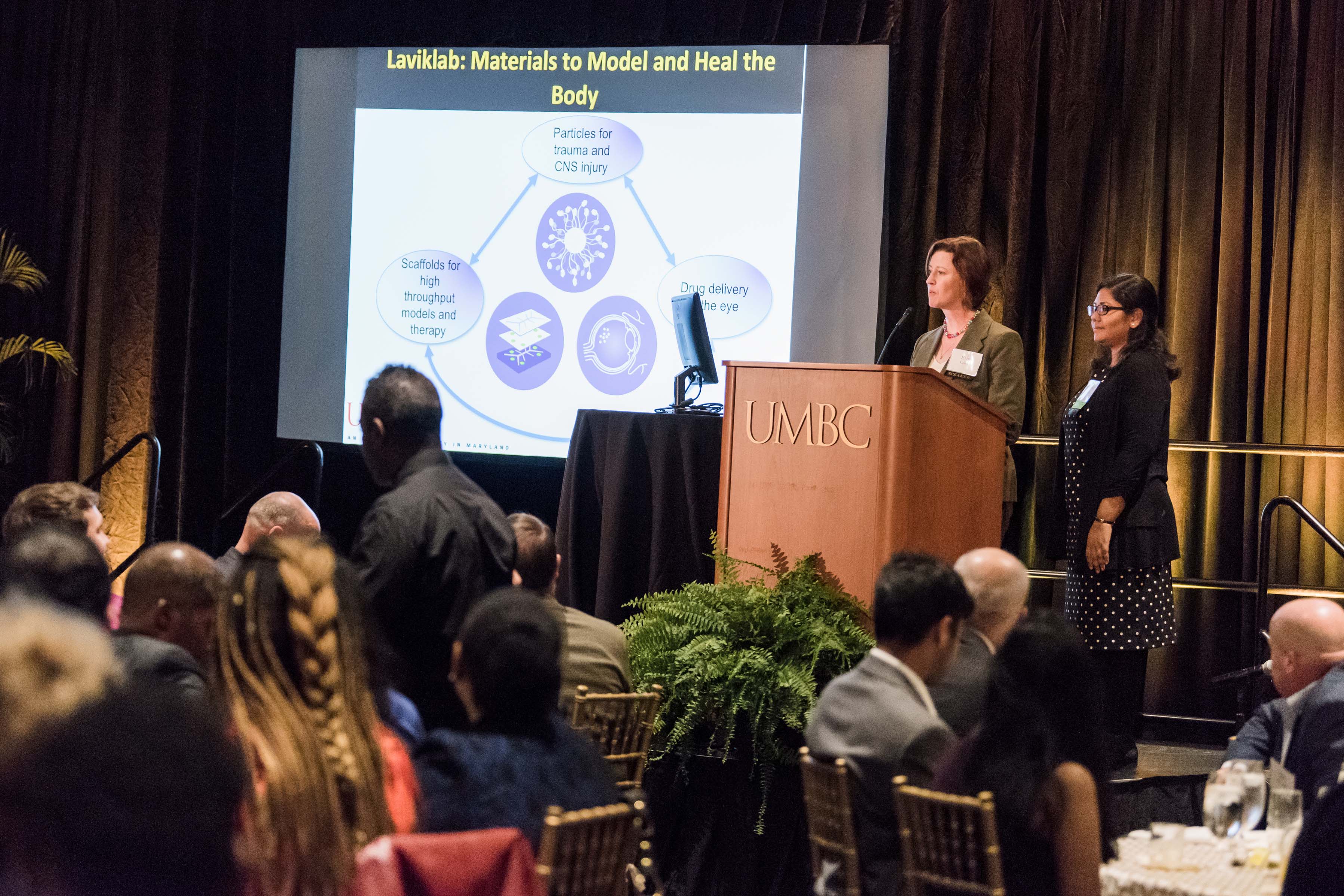
President Freeman Hrabowski welcomed the Hilltop Society—individuals and organizations that contributed $1,000 or more in the previous fiscal year—to campus this week to thank them for their generosity and support.  In addition to festive conversations and mingling with friends, donors learned about research conducted by University professors.  

Erin Lavik, professor in the Department of Chemical, Biochemical, and Environmental Engineering, talked about three major projects her lab is pursuing.A graduate student, Nuzhat Maishah, further described using nanoparticles to stop bleeding, which has practical applications for first responders treating serious traumas.

Kevin Omland, professor in the Department of Biological Sciences, described his studies on the critically endangered Bahama Oriole.Each year, he takes a group of students to the Bahamas to record bird populations and examine possible reasons for their demise.Undergraduate student Matt Kane then described his research on the Black Rat, which may be a predator of the Bahama Orioles.

See more images from the evening here. Photos by Marlayna Demond ’11 for UMBC Magazine.

Learn more about how you can become a member of the Hilltop Society here.


Two Meyerhoff Alumnae Included in Sun “Women to Watch” List

Two Meyerhoff Scholars Program alumnae, Kavita Krishnaswamy, M13, ’07, mathematics, and Tabassum Majid, M18, M.A. ’18, aging studies, ’10, interdisciplinary studies, have been included in the Baltimore Sun‘s “25 Women to Watch in 2018” annual listing.

Read the article online here.

Current Ph.D. student Kavita Krishnaswamy, who through her work as a roboticist focuses on giving people with severe disabilities greater independence, has invented voice command interfaces, and is working on another that responds to eye movement. Krishnaswamy, who lives with spinal muscular atrophy, a progressive disorder that severely limits her movement below the neck, works from home via a telepresence device, and will attend the 2018 Heidelberg Laureate Forum. “Life is always beautiful,” Krishnaswamy tells the Sun. “Instead of complaining, people should remember to do something to make it better.”

Through her work as executive director at Integrace Institute, Tabassum Majid brings an interdisciplinary approach to the future of aging, and the needs of an increasingly diverse demographic.  Integrace was featured in the film “Every Three Seconds” with 23 other organizations from around the world for its work on Alzheimer’s disease prevention. “We are looking at who’s the next generation of customers and seniors,” Majid tells the Sun. “And that’s how we get that first step onto the global stage. The documentary was just the beginning in my opinion.”

The “25 Women to Watch in 2018” piece features “leading voices in business, activism, research and more” from a range of backgrounds and industries, the Sun writes. The awardees will be featured in a special supplement on Sunday, October 14.

Learn more about the Meyerhoff Scholars Program here.

1966 Society Enjoys Tour of A Designed Life Exhibit

During their annual gathering on campus this week, members of The 1966 Society (individuals who have included UMBC in their estate plans) gathered for a private tour of the exhibition, A Designed Life, lead by curator Peggy Re, associate professor, graphic design.  Also joining the group were Symmes Gardner, director of the Center for Art Design and Visual Culture, and Selene LaMarca, an undergraduate student who helped design the exhibit.  Following the tour, guests gathered for dinner to continue conversations inspired by the exhibition, which is on view through December 8.

Learn more about joining the 1966 Society

Header image: Peggy Re starts the tour. Photos by Marlayna Demond ’11 for UMBC Magazine.

Bookstore Bob Leaves the Building

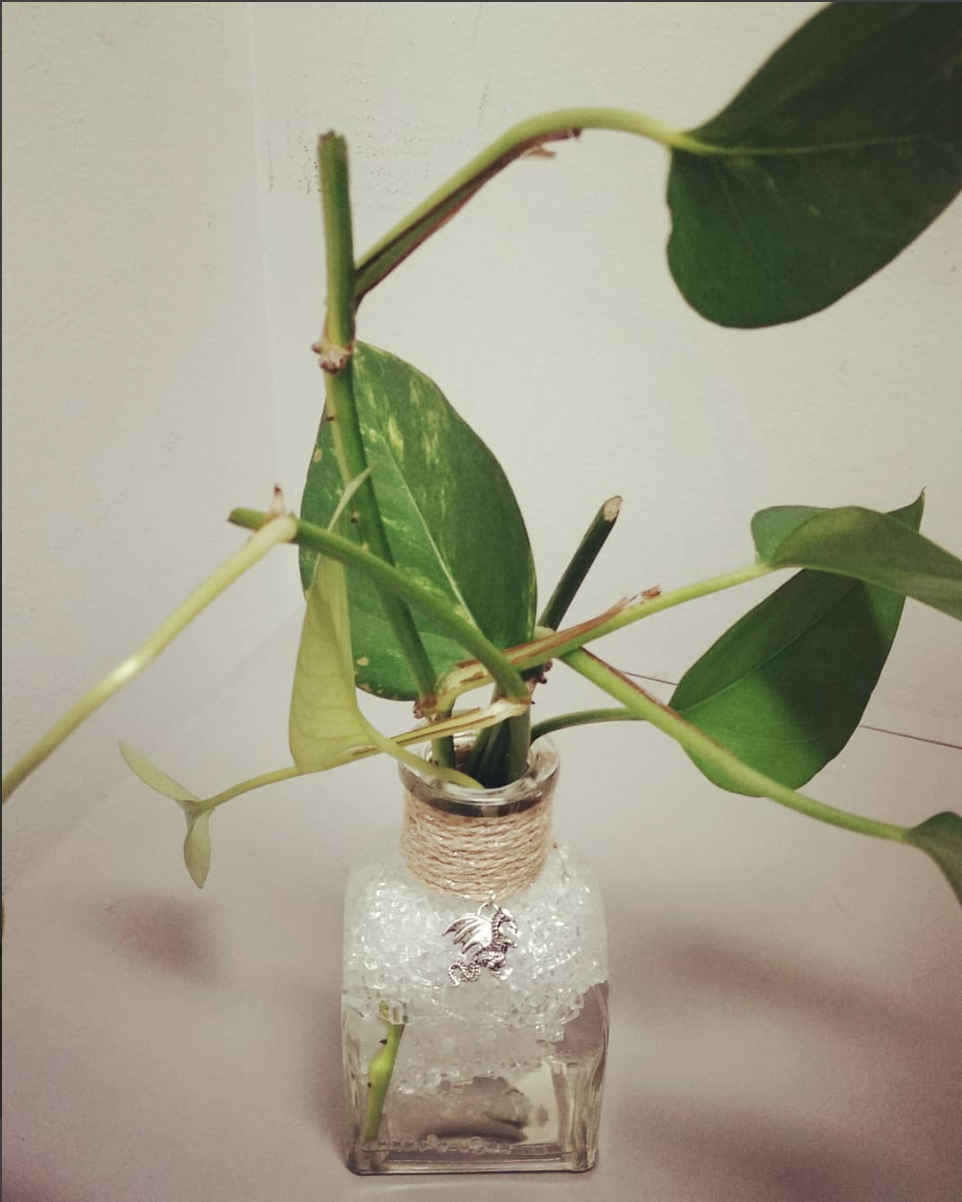
Rooted in the far corner, a leafy green plant has grown nearly across the office, curling around a large ticking clock, and hugging framed photographs a proud father has mounted on the wall. It keeps going, its stem and leaves circling the desktop monitor, dangling just beneath the ceiling.

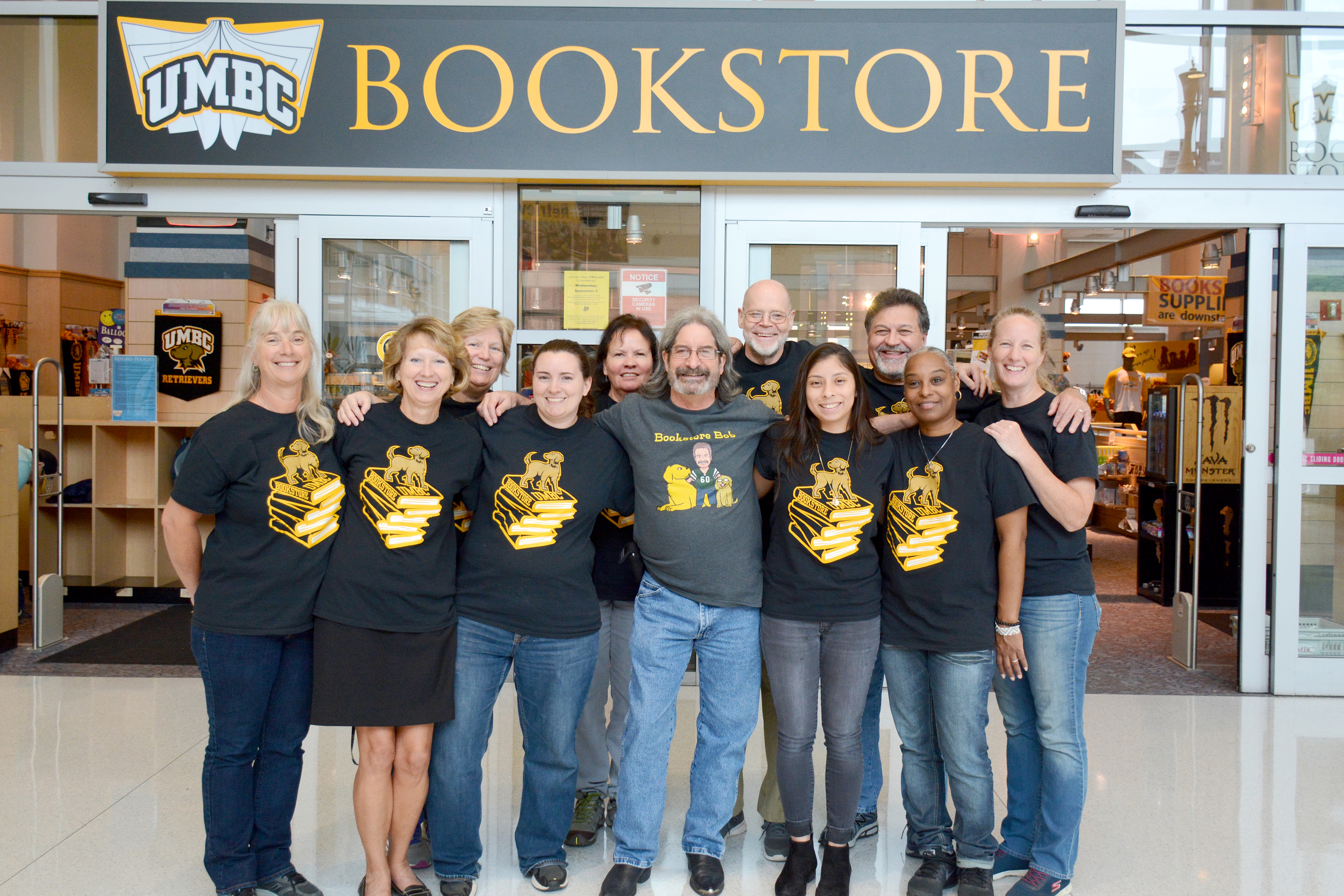
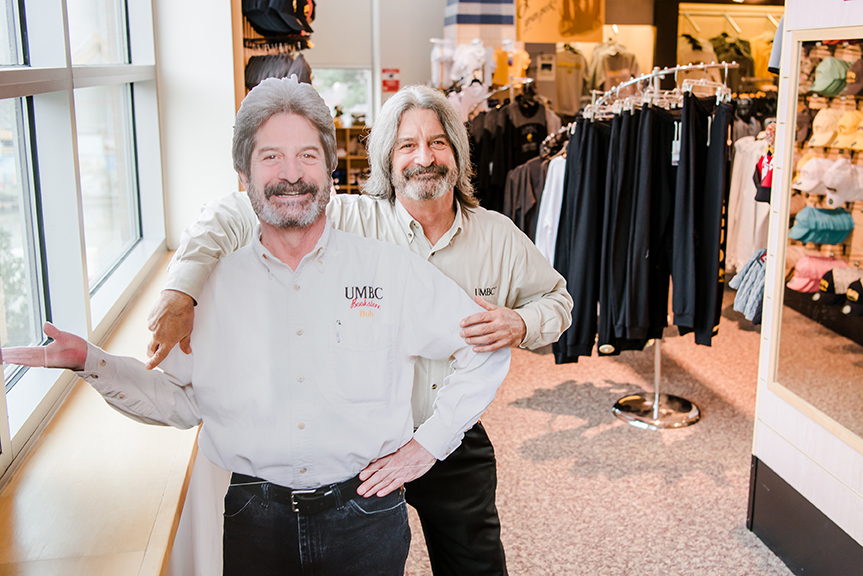
Below it sits its owner, “Bookstore Bob” Somers, mustachioed manager of the UMBC Bookstore. He brought a much smaller, nearly-dead version of the plant with him when the shop moved to The Commons from the University Center 16 years ago.

“I thought I’d kill it right away,” he says, with his signature gravel laugh.

Somers will sell his last book this week. But even as he greets retirement after 28 years on the job, the guy who says he wakes as if “shot from a cannon,” the guy around which an energetic marketing caricature has been built, the guy who powered through one of the biggest sales months in store history following last year’s March Madness, shows absolutely no signs of slowing down.

And this plant is a gentle reminder not only of the time he’s spent here, but the deep roots he has built with his bookstore family.

Bookish Beginnings

Anyone who happened to pick up the February 27, 1990 edition of the Retriever Weekly knew that Somers was coming soon. It made the front page, in fact (although below the fold). In the story, then-acting manager Gina Thurston ’83, sociology – who has since returned to the same position to manage the store post-Somers – noted the new hire as an experienced seller, with years at several university bookstores.

At UMBC, Somers quickly built a team of student and alumni workers, many of whom work in the store to this day. Even as other schools’ bookstores have been swept up by the Barnes & Nobles of the world, he’s kept UMBC’s store independent—a fact he’s very proud of. This has worked both because of the support of his leadership, he says, but also because of the true dedication of his staff.

“One thing about Bob,” said Ralph Anderson. “No matter how busy things were in the store you could always go to Bob about any personal issues and he would give you his time and genuine concern and would always follow-up to make sure you were doing OK.”

Famously frugal and quick on his feet, he has kept his door open to all.

“I think most employees here wake up and are excited about what is going to happen at work,” says Somers. “The people I work with are extraordinary human beings. I’m so lucky. Somehow I end up with these great employees. I don’t know quite what I did to deserve that.”

Family Atmosphere

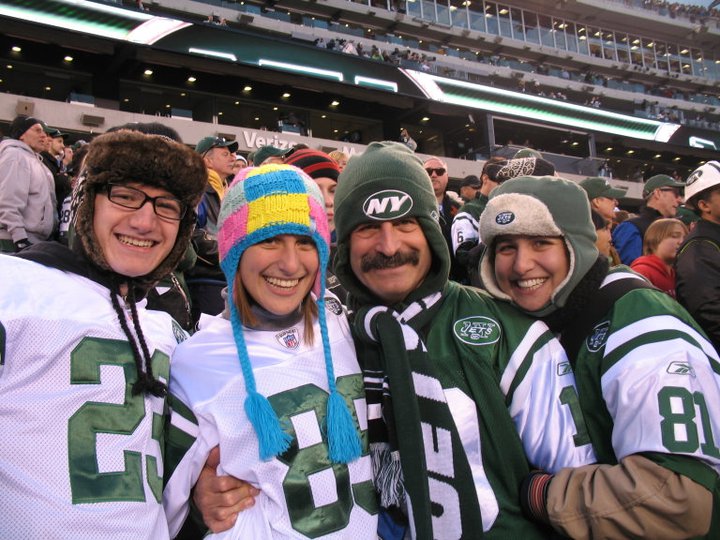
Somers and his kids, all Retriever alumni, cheering on their favorite football team.

Many on the bookstore staff consider their co-workers their family. And that atmosphere extended to Somers, who during his tenure at the store also raised three kids who graduated from college as Retrievers.

“One time, (my brother) Jordan (’15, theatre) and I got to spend the night on campus while Dad worked throughout the night to keep systems running. We pulled chairs together and made forts, had scavenger hunts of the inventory, and read a bunch of kids books,” said Marlie Somers ’13, media and communication studies. “He talks now about how guilty he feels, for dragging us to work with him, but I appreciate so much that he was able to balance his responsibilities at his job with his responsibilities as a single parent.”

Daughter Kayleigh Somers ’08,  environmental science and English, said her dad’s passion for education and UMBC convinced her to attend as a student.

“He often told me that UMBC was the school to go to if I wanted to get a well-rounded and thorough education,” she said. “He was completely right. Having him on campus was an extra perk, especially being able to have regular lunches in his office where I could talk through whatever crisis I was in the middle of, or tell him about the most interesting thing I’d learned.”

If there’s one thing Somers tried to instill in them during that time, it was to follow his lead and find work that really energized them.

“I was able to get through to them, don’t choose a job for the money. Yeah, it’s nice to have money, but if you are miserable, you will never succeed. Find something you like to do,” he says. “So, my kids have really taken that on. And all three of them are doing what they want to do. As a parent, what more can you ask for?”

March Madness

Every business has its ebbs and flows, and Somers and his crew have weathered many, including moves, expansions, and cuts to staff. But the biggest by far was the exciting-yet-still-extremely-crazy retail aftermath following the men’s basketball team’s historic trip to the NCAA tournament last spring. Talk about hustle.

You can look at this time in terms of numbers, or in terms of people. Numbers-wise, the Retrievers’ win over top-seeded UVa meant almost an immediate and drastic jump in online orders.

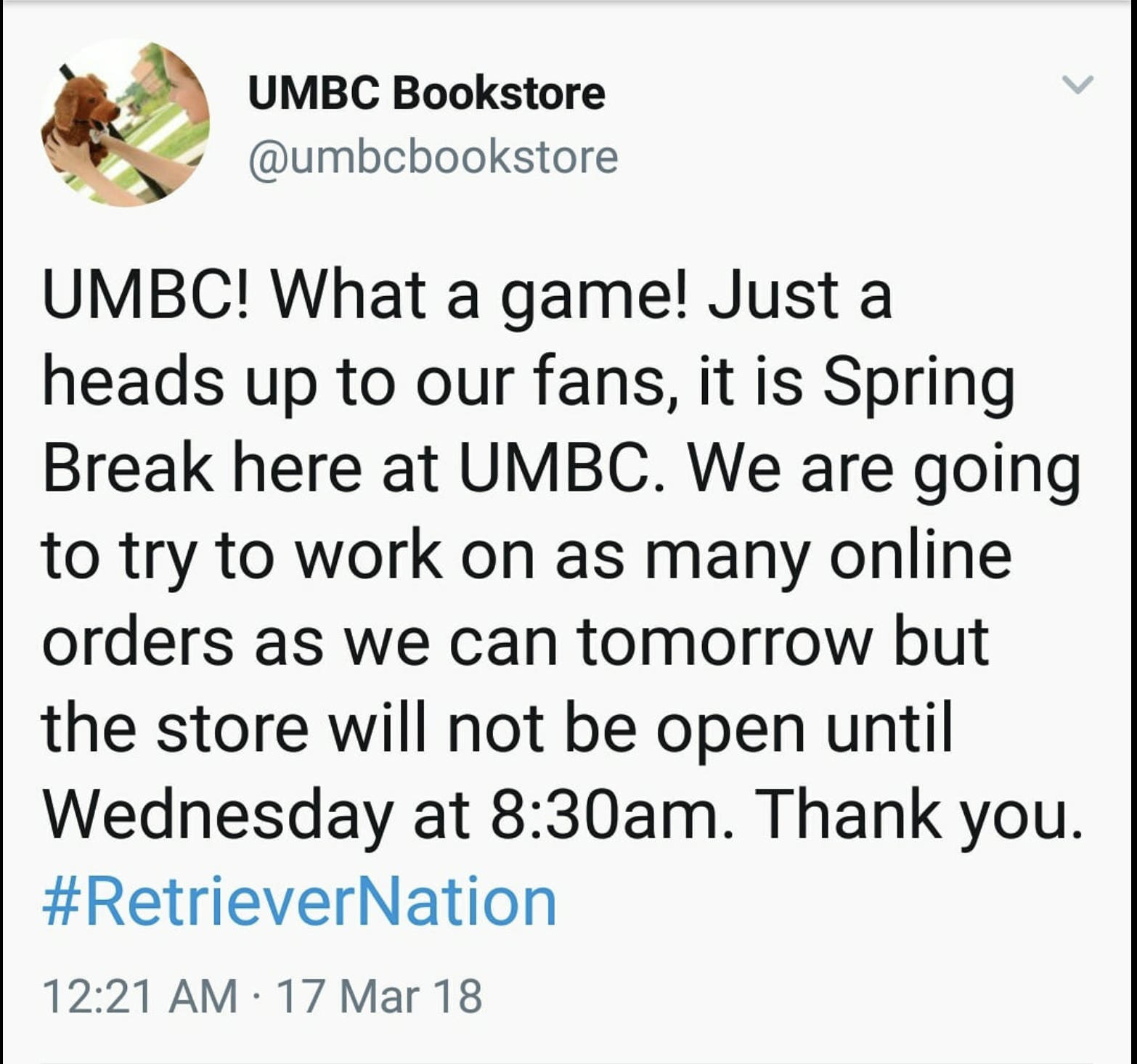
“In a normal year, we were about 90 percent textbooks, and we did about 1,500 (orders) and in that week after the game, we had over 5,000,” says Somers, who ordered round upon round of new t-shirt stock to keep up with demand, which stayed strong through May.

And let’s not forget the fact that during that particular point in March Madness, UMBC was on spring break. Which means, much of the staff came back into to the office from vacation, literally from sunrise to sunset, to keep up with it all. Students from the Residential Student Association even kicked in extra hours to help out.

“Were we tired? Oh my God. I think I went through four pairs of shoes in that week,” recalls Somers. “You know, you keep going even when there’s no end in sight. You’re behind the eight ball. But it was great. We learned a lot about ourselves.”

The Legend of Bookstore Bob

Getting through the tougher times takes good leadership, but having a great sense of humor doesn’t hurt, either. So when a couple of Somers’ staff proposed a marketing campaign centered around their boss, he shrugged and went along with it.

A few years ago our then marketing manager, Austin Kidwell ’13, interdisciplinary studies, decided that Bob, without realizing, had created the perfect marketing character, ‘Bookstore Bob,’”said Erin McGonigle ’08, English. Bookstore Bob made his debut as a superhero in the bookstore’s first-ever new student summer comic book, “Super Bookstore Bob & True Bit: Back to School V.1.”

“From there, we ran with it, creating a cartoon version of Bob to use for all of our marketing campaigns,” she says. “It worked; people would see Bookstore Bob and know something was happening at the Bookstore. From Bookstore Bob Bucks, Bookstore money given away during promotional events that can be spent as real money in the Bookstore and Yum Shoppe, to a poster at the bus stops to an annual Comic Book, his cartoon self was everywhere!”

Every so often, Somers is asked what he thinks of it all. He replies honestly: “I want to go run and hide every time I see it.” And yet, he plays along, posing for images, and even singing a rap about affordable course materials. (It’s on YouTube, by the way.)

“It’s about as embarrassing as it gets. But if it’s good for the bookstore, I’m going to do it.”

Onward and Upward

So, what does life after UMBC look like for Bookstore Bob?

“I can’t be bored, or I will lose my mind,” he says, totally serious.

He has a million ideas: Picking up where he left off writing his 27-installment cat-centric fantasy novel series. Finding some alone time in the woods, or maybe even working at a park. Growing his hair long enough for a ponytail (work began on this project earlier in the summer). Visiting his kids whenever he feels like it. The sky’s the limit, really.

“Life for Bob has come full circle,” said longtime colleague Kay Smith. “When I started at the Bookstore, he wore cowboy boots and had a long ponytail and he is leaving with enough hair for a new ponytail. All he needs is the boots!”

All jokes aside, his kids are hoping this ball of energy will take a moment to reflect on what he’s built.

“I remember something Dr. Hrabowski said at a graduation I attended: take a moment to pause in your journey be proud of the accomplishments you’ve made, even as you look ahead,” says daughter Kayleigh. “I hope my dad takes some time to do just that!”

* * * * *

Epilogue

In the weeks leading up to his retirement, Somers cleared out a drawer behind his desk and filled it with the makings of one final project.

With the help of Smith (who devised the plan), the day after Somers left, his staff each found a cutting of his now-famous office plant on their desks. A goodbye, yes, but really more of a thank you.

“These are great people,” says Somers. “That’s why my job was so good and so much fun. The long days didn’t matter, or the long commute. It was a privilege to work with these people.”

Postcards from Around the World: Study Abroad at UMBC

Imagine having the chance to put down your books and computers and hit the open road. For a growing number of UMBC students, summer study abroad offers the opportunity to explore new cultures, meet interesting people, and see the beauties of the world first-hand.

This summer, UMBC’s Office of Study Abroad sent groups of eager students to four amazing locations — Italy, Colombia, Spain, and the Netherlands — and lucky for us, they captured photos and special moments all along the way!

Siena, Italy

Student: Tenzin Yangchen, global studies
Course: Italian Politics
Read Tenzin’s full blog from Italy

“My favorite things about my host location so far is definitely the number of designated stores for wine, pizza, and gelato that the place has to offer… Siena is famous for its magnificent art and architecture that are reminders of the renaissance period. So naturally, we had a couple guided tours of cathedrals around the town. One of the best schools in the country, University of Siena, is also located here and luckily our program allows us access the library and cafeteria amongst other Italian students.”

“The farewell dinner last night officially marked the last agenda of our program with the group leaving next day alongside the professor. My bus however leaves in the evening towards Rome, so I’m exploring Siena for one last time in the morning. I have formed a special bond towards this place and have scribbled ample memories into my journal that will last a long time.”

* * * * * * * * * *

Barranquilla, Colombia

Student: Tyler Evans, Sociology, Modern Languages, Linguistics & Intercultural Communication Minor
Course: Spanish Language Immersion
Read Tyler’s full blog from Colombia

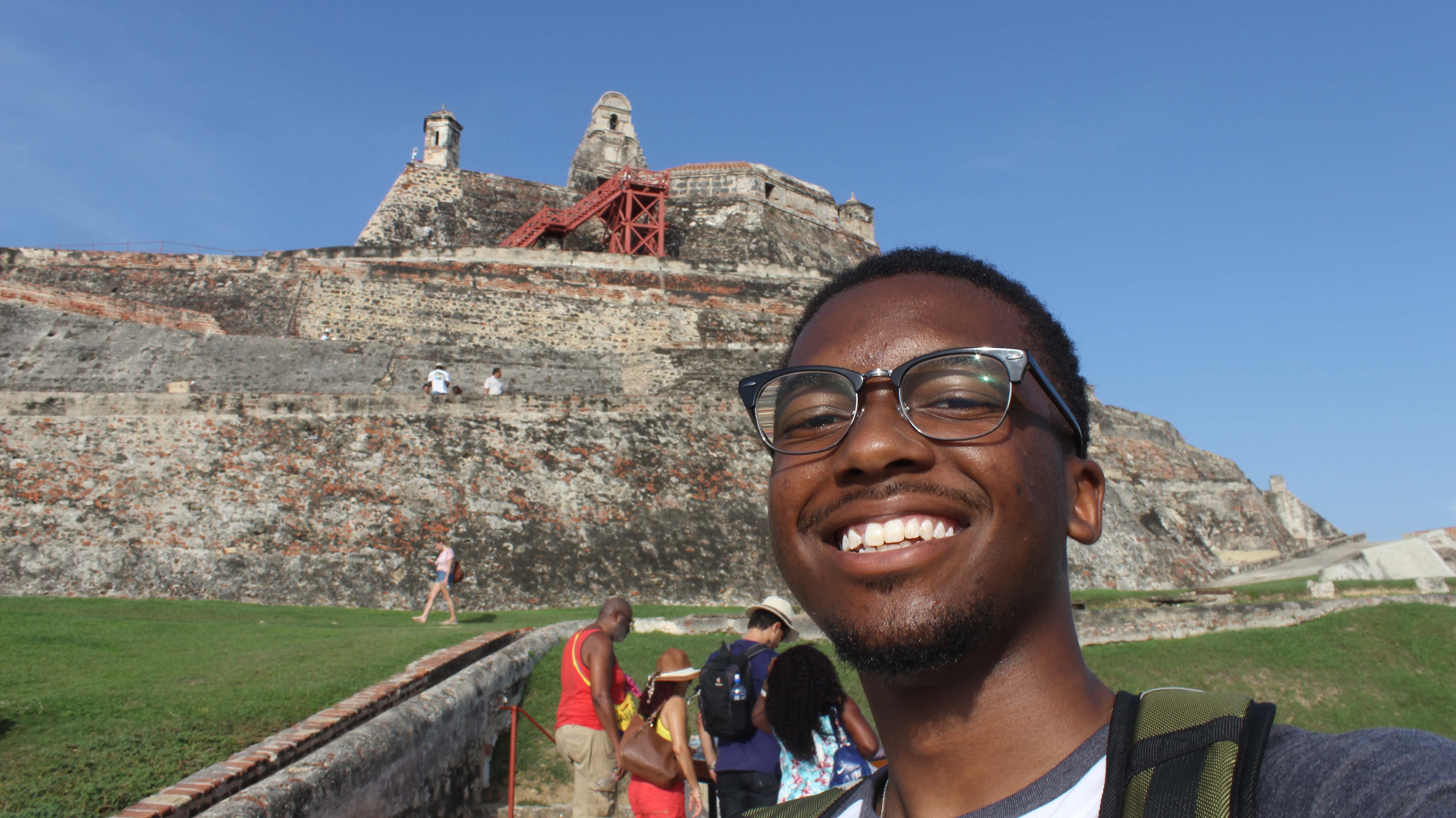
“The fact that that I am thousands of miles away from home is just a surreal reality. I chose to travel to Colombia for Spanish because I don’t want a language barrier to stop me from connecting with others. Spanish is the first language that I have really been exposed to and taught in school. I want to pursue a career through sociology studies, and being able to speak another language is very beneficial, especially because I know many Spanish speakers in Maryland, and I want to take my practices to different places, such as Latin America.  Colombia also has an emphasis on Caribbean culture, Afro-Latinos, and the belief that Colombians speak the best Spanish. I could not have picked a better place.”

“The first day in Santa Marta, which is also the day that I did the Instagram Takeover, we took a tour and visited La Quinta de San Pedro Alejandrino, which was home to Simón Bolívar, the first president of Gran Colombia. He was originally born in Venezuela, but made a great impact on Colombia. We also visited the Museum of Gold, which told history of the Tairona, a native people that were close to Santa Marta and who were known for the advanced techniques in ceramics and shaping gold. Then we went to the area on the outer mountains of Taganga, where we could see the sun in the distance over the open sea. It was very popular spot because so many people parked to take pictures there. Our group took a bunch of pictures and we even got a nice group selfie.”

* * * * * * * * * *

Barcelona, Spain

Student: Jessica Kweon, biological sciences
Course: Biology and Spanish Language
Read Jessica’s full blog from Barcelona

“Spanish classes had class excursions to different areas in Gothic Quarter. While the Beginner and Pre-Intermediate courses visited a local market, the Intermediate Class visited La Casa de La Ciutat, the building for the Barcelona City Council that is opposite of El Palacio de la Generalitat and located in the literal center of the city. The exterior architecture was a work of art, with gargoyles and different facades. Likewise, the inside was even more beautiful. There were stained classes, statues, lights, and murals that decorated the inside. Although the entire tour was in Spanish, I enjoyed learning what I could about the historical and political significance of the building. Everything had purpose and meaning that ultimately culminated to what represents the foundation of what Barcelona is.”

“Looking back, if there’s any advice from Barcelona that I would share with prospective study abroad students, then it would be the word, ‘vale,’ the Spanish word for ‘okay.’ This single phrase alone can lead to a waterfall of experiences. To brave past the barrier of doubt and to say ‘vale’ to things that may seem unfamiliar, different, or even intimidating will indubitably pave the way to unforgettable memories. My only regret in Barcelona is that I wish I lived more, experienced more. Therefore, I hope that anyone who has read my entries is kindled with a flame of curiosity and wanderlust. Moreso, I hope that they will act upon this desire to experience, and that they will turn excitedly to their next adventure, saying: Vale!”

* * * * * * * * * *

Amsterdam, Netherlands

Student: Mary Gallagher, Language, Literacy & Culture Ph.D.
Course: English as a Global Language
Read Mary’s full blog from Amsterdam

“Today we were in Utrecht, where we visited the Centraal Museum and took a walking tour of the city. The Centraal Museum was particularly crowded because of a special exhibit showcasing some of the collection of Dutch clothing designer Jan Taminiau. Utrecht’s pride is their Domtoren, a 14th century bell tower that is the tallest in the Netherlands. Opposite the Domtoren is the Cathedral of St. Martin. Both of these iconic structures lie within the Domplein Square, which is also the biggest Medieval city square in the Netherlands. Another unique feature of Utrecht is their canal system. They have comparably fewer canals than most other cities in the Netherlands (just three), but wealthy families who owned the canal houses many years ago built basement tunnels next to the canals to more easily move goods from canal boats into their homes. Today, many of those basement tunnels have been transformed into cafes and restaurants that allow you to relax canalside.”

“Looking back at my now complete Amsterdam adventure, what comes to mind were those words we used to describe our first impressions of the city, words like ‘energy,’ ‘chill,’ ‘cultured,’ ‘bold,’ and ‘dope.’ Amsterdam lived up to it all. The city was welcoming and easy to navigate, and we got to experience a multilingual city in action. For us, that meant readily accepting the advantage of our English knowledge, but also witnessing the friction and destabilization that encroaching English can create for other native languages.”

* * * * * * * * * *

Header image: a group shot in Barcelona. All photos were taken by the 2018 Student Ambassador bloggers. Learn more about how you can explore the world with UMBC Study Abroad!