All posts by: Sarah Hansen, M.S. '15


Her Science Is the World’s

Everyone who’s ever met Kizzmekia Corbett ’08, M16, biological sciences and sociology, gets it.

Sue Florence, one of the few Black teachers in the Hillsborough, North Carolina, school district where Corbett went to elementary and middle school, got it. Rhonda Brooks, Corbett’s mother, remembers Florence saying, when Corbett was in third grade, “She’s got a gift. You’d better seek into it.”

Florence’s comments pushed Brooks to make sure expectations were high for Corbett in school, and to encourage—no, require—15-year-old “Kizzy” to find a scholarly internship rather than a position in retail when she wanted a summer job in high school.

Kizzmekia Corbett '08 poses in UMBC's new Life Sciences Building

So, at her mother’s behest, Corbett got involved in Project SEED, a program that offers research experiences to talented high school students from underrepresented groups in STEM. Her first program mentor was James Morken, who was on the chemistry faculty at University of North Carolina at Chapel Hill at the time.

He got it, too.

“When Kizzy started in my laboratory, she didn’t have much hands-on research experience, but she had loads of curiosity, a drive to learn what she didn’t know, and a very strong work ethic,” Morken says. “It was abundantly clear she would be successful in whatever she chose to do.”

Today, Corbett is an assistant professor of immunology and infectious diseases at the Harvard T.H. Chan School of Public Health, after leading the team behind the successful effort to create a vaccine for COVID-19 at the National Institutes of Health (NIH). Working with the pharmaceutical company Moderna, Corbett’s achievements on the global stage benefit all of us. Now, we get it, too.

“She can do anything”

As a Meyerhoff Scholar and NIH Scholar at UMBC, Corbett worked in Barney Graham’s lab at the Vaccine Research Center at the NIH. He’s also her boss today. 

“Kizzmekia’s spirit was noticeable even from a young age,” Graham says. “New people who come into the lab have always quickly realized that she was a person who had bigger things in her future.”

Corbett met Jessica Kelley, a UMBC assistant professor of sociology at the time, when Corbett took her Introduction to Sociology course. “She was a standout in that large lecture class from the beginning,” Kelley recalls. Later, Corbett took Kelley’s course on applied community research, and conducted research with Kelley as part of a National Institute on Aging study on healthy aging in diverse neighborhoods.

Photos kindly provided by Kizzmekia Corbett, unless otherwise noted.

The work with Kelley inspired Corbett’s double major and her approach to all of her future work. Corbett even became the only undergraduate enrolled in one of Kelley’s graduate-level courses. “She kept the graduate students on their toes,” Kelley says.

“When she’s got her mind set on something, it’s set,” Brooks says. “She can do anything.”

A leading role 

Today, Corbett has proven them all right. As the scientific lead of the Vaccine Research Center’s coronavirus team at the NIH, she developed a new technology for the Moderna COVID-19 vaccine and others, and as a result, she has played a leading role in one of the most important measures to end the pandemic. She has also become the first Black woman in the world to create a vaccine.

Anthony Fauci, head of the National Institute of Allergy and Infectious Diseases (NIAID) and one of the most trusted voices about the pandemic around the world, described Corbett as “widely recognized in the immunology community as a rising star,” when he nominated her for TIME magazine’s TIME100 Next list. Based on her leadership of COVID-19 vaccine development at NIAID, he added, “Her work will have a substantial impact on ending the worst respiratory-disease pandemic in more than 100 years.”

People drive the research

Perhaps just as important as her scientific accomplishments, Corbett has burst onto the public stage as the face of a diverse and rising generation of talented scientists who will transform the world. She is a stellar science communicator, explaining the vaccine and the virus in highly accessible ways to media outlets, her family, two U.S. presidents, and more. She is an inspiration to children who may now imagine becoming scientists.

Corbett visits a lab on campus in April 2021. Photo by Marlayna Demond ’11.

“Dr. Corbett’s voice has been particularly important this year,” Graham says, “and going forward, her ability to inspire and to educate and motivate young people to see science as something feasible and even to see science as something fun will be part of her legacy.”

And yet, amid her newfound celebrity status and her vast scientific acumen, somehow she has managed to remain unabashedly human.

“I am still Kizzy. I’m still the little girl you met when I was 17 and being recruited into the Meyerhoff program,” she told UMBC President Freeman Hrabowski during a conversation in February 2021, when they were both being recognized at the Kaiser Permanente and Reginald F. Lewis Museum 2nd Annual African American Health Care Awards.

“Actually, before a scientist, I’m a Christian, and I’m sassy, and I’m bright, and I’m fashionable…” she says, “and I’m Southern, and I’m empathetic, and I’m all of these things that make me into this person, that make me a better scientist. I think that is the most important part of the story—that people drive the research.”

The genuine thing 

First there was Sue Florence. Then there was James Morken and others with the SEED Project. All through her childhood, there was her mother, Rhonda Brooks, cheering her on. Combine that support structure with Corbett’s own deep-seated determination to succeed, and by the time she was looking at colleges, Corbett had lots of options. But when she, her parents, and her grandmother visited UMBC, it felt like home. The first reason? The grain silo along UMBC Boulevard.

“It reminded me of being back at home in the country,” Brooks remembers. When they began touring campus, Brooks thought, “Oh man, this is really her,” but, “I needed her to see it was her. So I didn’t even say anything.” There was no need. By the end of Meyerhoff Selection Weekend in 2004, Kizzy was glowing.

Beyond the welcoming silo were all the welcoming faces. “Everybody was so friendly,” Brooks says. “You think when you go visit campuses that people have to be this way because they’re trying to get students to come, but as a person who’s been in the education field for so long, I can weed out who’s genuine and who isn’t.” And, Brooks says, despite the emphasis on Meyerhoff cohort numbers, of which Kizzy belonged to M16, “it just felt like she would be not just a number.”

Equaling the playing field 

In the February conversation with Hrabowski, Corbett recalls her father telling her that she should “go where she would be loved.” UMBC became that place.

Asked to describe the value of the Meyerhoff Scholars Program, she said, “It is simply one word: resources. It is equaling the playing field for people who have generally been under-resourced, and those are communities of color and people from underrepresented minority groups. And the Meyerhoff Program does that.”

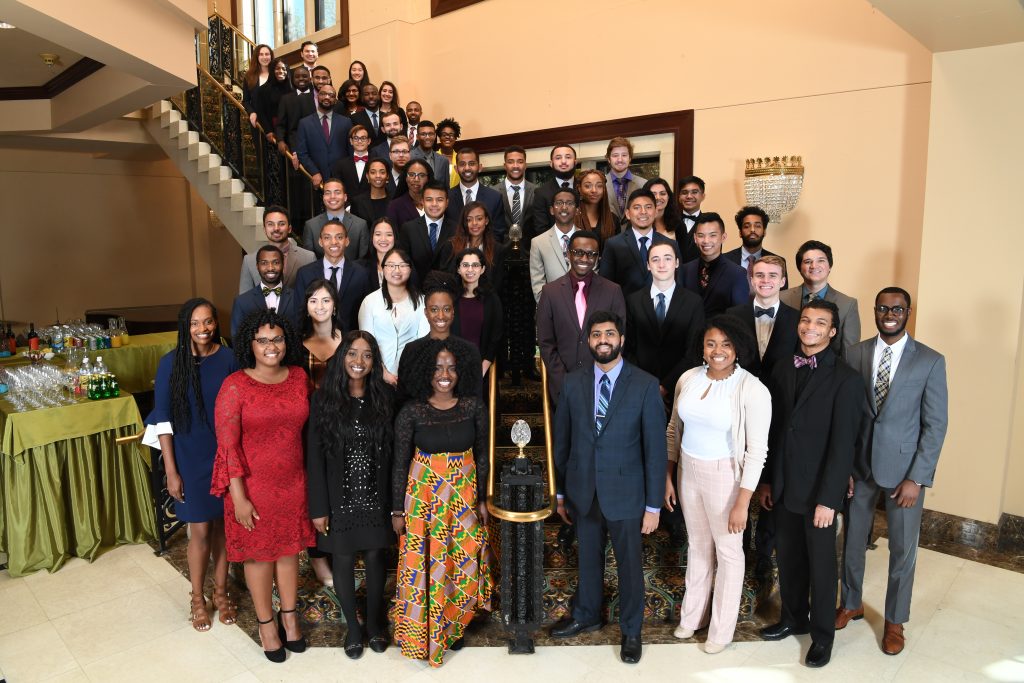
Corbett with fellow Meyerhoff alumni at a 2017 on-campus event. Photo courtesy of Keith Harmon, director, Meyerhoff Scholars Program.

The Meyerhoff Scholars Program, founded in 1989, is considered the gold standard of programs designed to support students from underrepresented groups in STEM. Hundreds of alumni have gone on to standout careers, including U.S. Surgeon General, Baltimore City health commissioner, and professorships at the nation’s top-tier universities. 

The Meyerhoff Scholars Program “is a place where every single person was special and would be loved. The goal is not to fail you out, but to lift you up,” Corbett says. And for underrepresented students in STEM, living in a world that too often still doesn’t expect people who look like them to excel as researchers, the Meyerhoff Program “provided a niche for us to just be, to be comfortable, and to just thrive.”

A mother’s touch 

It wasn’t always easy, though. Brooks remembers when Kizzy received her first C. “Being on the phone with her just didn’t help,” Brooks remembers. “So I got in my car, and I drove all the way to Maryland. I was trying to tell her it was going to be alright, but it was just heartbreaking, because she never had that C. I told her, it’s gonna be tough—you might get more than one C.”

Even world-class, world-saving scientists sometimes get Cs and need their moms.

And even now, Brooks is ready to support Corbett as she navigates this new chapter in her life. “If she needs me now, if she’s feeling stressed,” Brooks says, “if she picks up the phone, I don’t care what time of night it is, I pick it up.”

On Corbett’s college bedside also sat a Bible—another lasting connection to her family and her faith, which Corbett brings up often in her interviews. Brooks gave each of her children a Bible as they left for college. “I say take this Bible with you. Even if you don’t look at it, keep it next to your bed. I don’t care if you don’t open it. But if you touch it, it will make you feel a whole lot better.”

Corbett and her mother, though apart during the pandemic, have stayed connected by attending online services from the same church in Texas. Their first travel plans post-pandemic? A trip to attend the service in person.

Lifting others up

Whether it’s her faith, an innate empathy, 35 years of experience as a Black woman in the U.S., or other factors, Corbett’s dedication to lifting people up goes far beyond her work in the laboratory. Her commitment to equity has demanded that she speak out to address vaccine hesitancy, especially in communities hit hardest by the virus, and champion the participation of minorities in science and research, both as scientists and as participants in clinical trials.

“She has always, even as a young student, brought an energy and curiosity and love of science that made our lab a better place,” Graham says. “She has also always been very devoted to making things better for people around her, particularly younger people coming behind her.”

Brooks says that Corbett has always had a selfless nature. One day she brought home a classmate who had no place to go after school and asked if she could stay with the family. Brooks was uncertain at first, “but we did it,” she says. “And we’ve been taking kids in ever since.”

Fighting for the public good 

Corbett’s study of sociology at UMBC enhanced and sharpened her innate desires to help people and promote fairness into a commitment to consider social factors throughout her scientific career. For example, when the Moderna vaccine was in clinical trials, Corbett pushed hard to make sure that there were more people of color among the study population.

“You have to start things equitably to finish them that way,” she told Hrabowski at the February event. “We slowed down the phase three clinical trial until we got to a point where we felt the numbers were respectable. We wanted 13 percent, to represent the proportion of Black people in the country,” she said, but they didn’t quite make it. Still, she says, “I have other vaccines heading into trials, so we will take care of it then.”

Kelley, her sociology instructor and research mentor at UMBC, reflects on how Corbett has developed over time. “Kizzmekia’s training in both biology and sociology has helped her become both a scientist working at the cutting-edge of vaccine development to provide a universal public good and a humanist who understands that historically and structurally not all groups have had access to these public goods,” she says. 

(left: Corbett at a Rally for Medical Research event in Washington, D.C.)

Corbett has faced her own challenges throughout her career, some of which have predictably intensified since she became more of a public figure.  

Kizzmekia, whose name is a combination of “Kizzy” from the character in Alex Haley’s Roots and “-mekia” from Brooks’s own imagination, has been teased since childhood and continues to be harassed about her name. When Kizzy showed her mother a particularly hurtful social media post, “I told her, tell them to call your mama,” Brooks recalls, “because your mama chose your name for a reason, because you’re a gift from God to me.”

As a child, even Kizzy’s strong interest in academic success was sometimes looked down upon by her peers, but “she just went beyond,” Brooks says. 

Corbett has also experienced sexism and racism as a scientist. Brooks says sometimes men have skipped over Corbett and instead approached her boss, but “that’s why I like her boss, [Barney Graham] so much, because he’s always been behind her back,” she says—pointing people right back to Corbett. 

(Right: Corbett (center, front) with her NIAID research team, including Olubukola Abiona ’17, M25, biochemistry and molecular biology (center, back).)

Finding your champions

Corbett has taken her mother’s message to heart. “You just have to believe in yourself and believe in your work,” she says. Important, too, is having your own champions. “I always had someone in the space who was looking out for me,” she said—people like Sue Florence, Freeman Hrabowski, and Barney Graham. “Find those people and seek them out. You want someone to be as invested in you, as you are in you.”

High expectations and support from all those people who “got it,” cheering for her and setting the bar high from elementary school onward, combined with Corbett’s inner determination—and a dash of spunk—have fueled her success. If you had met a childhood Kizzy, she would have said, “Hi, I’m Kizzmekia Corbett, and I’m going to be the first Black woman to win the Nobel Prize in Medicine.”

Verbalizing one’s goals is a risk, because people will know if you fail. But it’s also a critical step toward turning them into reality. Little Kizzy knew it as a kid. “It speaks to putting yourself where you want to be, and really speaking the words to the universe,” she told Hrabowski. Even if she hasn’t reached her childhood goal yet, she’s happy with what she’s been able to accomplish so far.

“I haven’t won a Nobel prize, and I don’t know if I will,” she says, “but I think helping to ‘save the world,’ so to speak, is good enough.”

For now.

Read more about other ways Retrievers are giving their time and efforts to help others access the vaccine.

*****

Header image of Corbett on campus in April 2021 by Marlayna Demond ’11.

UMBC to receive over $63 million in NASA renewal of CRESST II space science consortium

NASA has committed $178 million to extend support for the Center for Research and Exploration in Space Science & Technology II (CRESST II) through 2027. Founded in 2006 and renewed in 2016, CRESST II is a partnership between NASA’s Goddard Space Flight Center and four universities. UMBC and the University of Maryland, College Park (UMD) are the two primary funding recipients, with UMD leading the consortium. CRESST II also supports researchers at Catholic University of America, Howard University, and the Southeastern Universities Research Association.

Developing talent in space sciences

Talent development is a key component of the partnership, which creates opportunities for undergraduate and graduate students, postdoctoral fellows, and faculty to engage in NASA research on topics ranging from the composition of neutron stars to the atmosphere on Mars. New UMBC funding to support these projects will be more than $63 million over five years under the CRESST II renewal. 

Since the last renewal in 2016, the UMBC arm of the partnership, the Center for Space Sciences and Technology (CSST), has focused on offering additional training for budding space scientists. Graduate students with NASA fellowships are co-advised by UMBC faculty and NASA scientists, undergraduates have internship opportunities on site at Goddard, and post-baccalaureate programs offer recent grads a chance to get more experience before applying to jobs or graduate school. Career workshops are available to all.  

“We’re trying to do more to support their growth, and also prepare them to move on to other things afterwards,” says Don Engel, director of CSST and assistant professor of computer science and electrical engineering. “We’re building more infrastructure around career support for our scientists, especially those at earlier levels.”

Man in front of large screen showing mostly green areas along a waterfront.
Don Engel, director of the Center for Space Sciences and Technology, UMBC’s arm of the CRESST II partnership, in the Imaging Research Center at UMBC. Photo by Marlayna Demond ’11 for UMBC.

Collaboration at all levels

Engel has also been leading an effort to engage more departments at UMBC in the partnership. Physics is the most involved so far, but researchers in computer science and electrical engineering, mechanical engineering, information systems, and even geography and environmental systems have connected with CSST, meaning the Center spans all three UMBC colleges.

“We have more affiliations with more departments than we’ve ever had before,” Engel says, “and I’m excited about that being just the tip of the iceberg.” Karl Steiner, vice president for research at UMBC, adds, “The scope of work conducted by our UMBC faculty and research scientists under the Center for Space Sciences and Technology makes this one of the largest research centers on the UMBC campus.”

The consortium structure is also an asset. “The partnerships have been phenomenal,” Engel says. “Through having multiple institutions, we’re able to learn from each other’s ideas and strengths. We can tap into the broader resources at each of our institutions for things like trainings.”

Two large, connected gray clouds, with purple at their connection point, surrounded by red-orange.
A 2018 paper in Nature Astronomy by CSST scientist Kenji Hamaguchi concluded for the first time that the largest star system, within 10,000 lightyears of Earth is emitting cosmic rays, some of which may reach Earth. In this visualization, the supermassive star at the center of that system, Eta Carinae, is at the center of two huge and expanding clouds of dust and other material, the result of an eruption about 150 years ago. Nathan Smith/NASA.

“The CRESST partnership provides an amazing opportunity for government and university researchers to jointly advance NASA research and space science,” adds Laurie Locascio, vice president for research at UMD. “The collaboration has demonstrated the value of our partnership and our capability to do great work together.”

“NASA’s decision to renew and enhance the CRESST II Partnership, led by the University of Maryland, College Park and including the University of Maryland, Baltimore County (UMBC), builds on a successful collaboration and will continue to develop top-notch scientific talent,” U.S. Senator Ben Cardin says. “Team Maryland is proud of the close relationship between the University of Maryland and federal agencies like NASA that keeps our nation and our state on the cutting edge of research and technology.” 

A large green sphere surrounded by wispy gray rings in the lower right, with a sun-like, smaller, yellow sphere in the upper left.
A 2020 paper by CSST scientist Tom Barclay published in Nature reported the discovery of a Neptune-sized planet orbiting a young, nearby star. This visualization shows an interpretation of the planet, AU Mic b (green), and its star, Microscopii. Image courtesy NASA’s Goddard Space Flight Center/Chris Smith (Universities Space Research Association).

New understanding, new technologies

Reflecting on the impact this research will have, Engel says, “looking at things on the scale of galaxies or other solar systems lets us know more about our own solar system and the physical laws that govern the universe, including our day-to-day lives.”

“Some of the greatest mysteries that remain in physics can really only be further probed by looking at things that are massively large or very dense—extremes that we can only find by looking far away,” he notes. “And yet, these mysteries always end up unlocking fascinating new technologies that change people’s lives.”

To do this research effectively, he says, bringing together talented students and faculty at all levels, from all backgrounds, is essential. CSST and CRESST II will develop the next generation of space science leaders, who will push the boundaries of human understanding and help answer the universe’s remaining big questions.

Banner image: NASA’s MAVEN spacecraft orbits Mars in this visualization. A 2019 research paper in Science led by CSST’s Mehdi Benna mapped Mars’s global wind patterns, the first time that had been done on any planet (including Earth). Visualization courtesy of NASA.

UMBC’s 2021 grads advance research with public impact—from disaster response to assistive tech

Students from across all of UMBC’s colleges and schools are graduating this week having taken advantage of the unique undergraduate research opportunities and supportive mentorship UMBC offers. They’re poised to take their research to the next level and move on to new challenges through graduate school and careers.

For example, Davis Cappabianca ’21 is recommending reforms to better coordinate multi-agency disaster relief efforts. Hana Flores ’21 is conducting cutting-edge HIV studies. Keren Herrán ’21, M29, is incorporating environmental science to improve public health. Ali Abdolrahmani, Ph.D. ’21, is developing innovative assistive technologies for the blind community, and Briscoe Turner ’21 is reimagining public safety with an eye to community empowerment. 

Big breakthroughs

Cappabianca took advantage of UMBC’s individualized study program (INDS) to tailor his degree around his interests. As a U.S. Navy veteran, Cappabianca knows that coordination between the military and civilian relief groups in the aftermath of disasters is often clumsy. He also expects, as an aspiring Navy medical doctor, that he will be involved in these situations in the future. He wanted to find a way to improve outcomes in these situations, because, he says, “The end goal [is] helping the most people possible in the most effective way.”

Davis Cappabianca ’21 in his U.S. Navy uniform. Photo courtesy of Cappabianca.

“I realized that my background in the U.S. Navy provided me with a lot of unique experiences,” he shares, “and what I found in INDS was a way for me to bring those experiences into my education and claim my own degree.” His two degree mentors, Stephen Kosloski, joint director of Naval ROTC at UMBC and University of Maryland, College Park and Joby Taylor, director of the Peaceworker Program at UMBC, brought very different perspectives to his research.

“More often than not, the melding of their ideas was what got me to major breakthroughs in my research,” Cappabianca says. Learning to always consider multiple perspectives was one of the most valuable takeaways from his INDS degree, he adds. “I think it will fundamentally change the way you approach problems, even if it’s subconsciously.” He plans to pursue medical school or a master’s degree in emergency management.

Environmental science meets public health

Herrán also designed her degree around her experiences. Answering a call for more Spanish-speaking participants, she spent spring break of her first year at UMBC in Nicaragua with the UMBC chapter of Global Medical Brigades, a student-run organization committed to implementing sustainable health systems worldwide.

She noticed the relationship between water quality and community health in Nicaragua, and reflected on similar challenges she observed during her childhood summers in Puerto Rico and El Salvador (the birthplaces of her parents). “Coming back to UMBC, I thought, this is what I want to dedicate my life to,” she says.

Student in healthcare scrubs with three older Hondurans
Keren Herrán ’21, right, In Honduras while participating in the Honduras Leadership Institute. Photo courtesy of Herrán.

Her degree has included courses in environmental science, sociology, research methods, and writing—even cartography. Why? Herrán sees significant overlap between study of the environment and public health, but, in practice, doesn’t see the fields as very connected in today’s world. She says, “I want to be in that overlap.”

“I think INDS has been crucial to my acceptance to graduate school, because it’s given me the opportunity to be intentional in my choice of classes, and to claim my education,” Herrán notes. “I knew that I wanted to pursue research and partner with communities, not just come in and tell them what to do,” she says. She has had the opportunity to take that approach in her undergraduate work.

This fall, Herrán will begin a Ph.D. at University of South Carolina as a Presidential Fellow in health promotion, education, and behavior.

Keren Herrán in her graduation regalia, spring 2021. Photo courtesy of Herrán.

Asking challenging questions

Turner and Abdolrahmani also focused on issues close to their hearts. As a Sondheim Public Affairs Scholar and psychology major, Turner has studied community building in the context of reimagining public safety and justice. 

“I’m really interested in the community aspect, alternatives to policing, and understanding how you build as a community and solve these problems without the use of force—with understanding and restorative practices,” she says. “I’ve grown in that way, and thought about, ‘What does abolition look like? How do we expand our thinking and make sure that we’re tapping into new ideas of how we operate with each other, and how we communicate with each other, and how we treat each other, rather than sticking to historical practices?’”

Nine students posing for a group photo outdoors
Briscoe Turner ’21, rear, second from right, with other members of the UMBC Black Lives Matter Club in 2019. Photo courtesy of Turner.

Her current research with Bronwyn Hunter, assistant professor of psychology, focuses on college students who have had parents incarcerated or struggle with substance use, and understanding the students’ ideas of what justice looks like. In addition to her work with Hunter, a Public Policy and International Affairs Junior Summer Institute at Princeton University “opened my eyes to how public policy works,” Turner says. Now, she’s asking big questions: “I’m trying to understand what the world could look like, and how do we get there?”

This summer, Turner is headed to Brown University to pursue a master’s of public affairs. “I’ve really enjoyed my UMBC experience. That’s why I picked Brown,” she says. “I felt like it had a lot of similar aspects to it as UMBC, so I want to continue that community feel and the support that I got here.”

Four students staff a table with a Black Lives Matter placard and giveaways
Briscoe Turner ’21, left front, with UMBC’s Black Lives Matter Club in the UMBC Commons. Photo courtesy of Turner.

Inclusive design

Abdolrahmani has spent the last seven years investigating and developing assistive technologies for the blind community in the human-centered computing Ph.D. program. He decided to pursue a Ph.D. after being exposed to the field of assistive technology while working in his home country to improve the internet banking experience for blind customers. Intrigued and wanting to make a bigger contribution to the field, Abdolrahmani, who is legally blind, moved to the U.S. with his wife at age 36 to study with UMBC faculty in information systems.

“I wanted to understand how I could develop technologies to improve the independent living of the blind community or other people with disabilities,” Abdolrahmani says. He first worked on a project to develop a wearable indoor navigation assistive device. Later, he worked to enhance the user experience of mainstream voice assistants such as Amazon Alexa and Google assistant for the blind. And, finally, he brought the two together for his thesis project, which focused on the use of mainstream voice assistants for navigating airports.

Along the way, he learned that not only did blind people appreciate the technologies he was developing, but so did sighted people and members of other groups. His research “shows that these technologies have great potential for future use for different groups of users in different contexts,” he explains.

Now, Abdolrahmani is looking for roles where he can have an even more direct impact as a member of a product design team, “so that I can inspire more accessibility and inclusive design in products, to see that products are designed in such a way that people with different abilities can use them right away out of the box.”

Becoming a scientist

A culture of supportive mentorship has helped sustain all of these students on their path to commencement. For Hana Flores, her first mentor on campus was none other than President Freeman Hrabowski.

A student researcher with two of her mentors in a crowded banquet hall
Hana Flores ’21, center, with Phyllis Robinson, right, and Ernestine Baker, after Floes received an award for her presentation at the Annual Biomedical Research Conference for Minority Students in 2019. Photo courtesy of Flores.

The CEO of Prince George’s County Public Schools connected Flores with Hrabowski after hearing her deliver the valedictorian address at Bowie High School and learning that she would attend UMBC. On the day of their meeting, when Flores heard Hrabowski’s booming voice from the anteroom to his office, she was nervous. “But once he entered the room, any nerves I had went away,” she recalls. “He was so interested, and genuinely wanted to know what my goals and aspirations were.”

Soon thereafter, she joined the lab of Michael Summers, Distinguished University Professor of chemistry and biochemistry and Howard Hughes Medical Institute investigator. And she’s been conducting research with his team on the structure of HIV since. 

Three researchers in a busy poster hall
Hana Flores ’21, left, Pengfei Ding, center, and Ridhi Chaudry ’22, right, at UMBC’s Summer Undergraduate Research Fest in 2019. Photo courtesy Flores.

Postdoc Pengfei Ding, in particular, spurred her growth by encouraging his mentees to contribute to the intellectual direction of the research, rather than simply teaching them specific laboratory techniques. “Dr. Pengfei Ding essentially was a catalyst for me to grow into a more independent researcher,” Flores says.

Her many professors in chemical engineering also had a role to play. “They are really focused on students being able to achieve. I felt comfortable going to office hours,” she says. “And I feel like they didn’t just care about me accomplishing in my classes, they also cared about how I was as a person.”

Flores has presented at national conferences, conducted summer research at MIT, and joined the UMBC Honors College and U-RISE Program. Shes also a contributing author for one published and two pending research articles. This fall, she’ll begin a Ph.D. at MIT as a Dean of Science Fellow, where she hopes to pursue interests in protein engineering and regeneration.

Outdoor student portrait.
Hana Flores ’21. Photo courtesy Flores.

The power of mentoring

Herrán had support from research mentor Dawn Biehler, associate professor of geography and environmental systems, as well as her INDS and Meyerhoff Scholar communities. Biehler “is invested in her mentees and their growth and development, and she’s just incredibly kind and supportive,” Herrán says. 

On her Meyerhoff experience, Herrán reflects, “I’m a minority in many aspects, and Meyerhoff is so beautiful, because it’s so rare to be in a cohort of more than 50 other students who are also minorities, who are also trailblazers within their families and their cultural communities. You relate to one another, you support one another—it’s a family for life.”

Abdolrahmani also received support from multiple angles. Stacey Branham, formerly of UMBC and now on the faculty at University of California, Irvine, “had a very deep trust in me and my abilities and my creativity for different research projects that we collaborated on together,” he says. Ravi Kuber, associate professor of information systems, was his primary advisor and “the first one who trusted me when I arrived in 2014.”

Five student researchers in a brightly lit poster hall.
Keren Herrán ’21, right, at the University of Pennsylvania, where she gave a poster presentation on research completed during the Leadership Alliance Summer Research – Early Identification Program in 2018. Photo courtesy Herrán.

A strong believer in peer mentoring, Abdolrahmani thinks back to the supportive relationships he developed with both graduate and undergraduate students. With the undergrads, in particular, “I trained them academically, but also how to interact with me as a blind person, what kind of support I need,” Abdolrahmani says, “so I had the support that Ph.D. students need through the collaboration of my mentors and colleagues in the team.”

Circle of support

Turner’s research mentor, Hunter, offered valuable insights beyond their specific research project, supporting Turner as a whole person. “I’ve learned a lot from her about criminal justice and research and just about life,” Turner says of Hunter.

That support included walking her through the graduate school application process and providing an emotional anchor point. “I really appreciated her and the graduate students sharing their experiences,” Turner says. “She would also check in with me during our one-on-one meetings to see how I was doing throughout the process, given how difficult this past year has been.” 

Graduate outdoors with decorated cap
Briscoe Turner ’21 in graduation regalia. Photo courtesy Turner.

Faculty in the Sondheim Scholars and Honors College programs completed Turner’s circle of support. “All of them have been there for me, which I really appreciate, for personal growth and also my career goals,” she reflects.

Connections and pathways

Other graduating students, too, have benefited from strong mentorship and rich research experiences. Caleb Robelle ’21, M29, mathematics and computer science, had the opportunity to connect with research mentors across UMBC, Rutgers, Texas A&M, and Johns Hopkins, and was accepted into all 17 of the Ph.D. programs he applied to. He will pursue his Ph.D. in theoretical computer science at MIT. Olumide Fagboyegun ’21, M29, biochemistry, will pursue a Ph.D. in neuroscience at Harvard as a Herchel Smith and NSF Graduate Research Fellow after completing neurological research with Erin Green, assistant professor of biological sciences. 

Jordan Troutman ’21, M29, computer science and mathematics, is UMBC’s first Knight-Hennessy Scholar. He will pursue a Ph.D. in computer science at Stanford. And Samuel Patterson ’21, economics and mathematics, will attend Oxford as the second Rhodes Scholar in UMBC’s history, with a focus on transportation economics.

Thinking ahead

In UMBC tradition, on the eve of their graduation these students are already thinking about how they can support those coming after them. Flores, for example, benefited from being paired with a graduate student as part of her summer research experience at MIT. She’s planning to become a mentor once she arrives on campus to begin her Ph.D. 

They all agree that community connections matter. “It’s powerful to give people the platform to share their stories, their lives, their hopes, their dreams,” Turner says. “There’s a lot of power in community—building with each other and climbing as you go.”

Banner image: Hana Flores, left, and Keren Herrán, right, on campus. Photo by Marlayna Demond ’11 for UMBC.

UMBC’s Jordan Troutman to continue algorithmic fairness research as Knight-Hennessy Scholar at Stanford

Jordan Troutman ’21, M29, computer science and mathematics, first discovered algorithmic fairness during a summer research program at Rutgers University after his first year at UMBC. The field focuses on how computer algorithms, such as those responsible for facial recognition or the content in our social media feeds, can foster fairness or unfairness. The effects include anything from attempting to identify someone who committed a crime to curating the content we see in ways that influence how we think about others.

“Because these algorithmic systems are being used to make a lot of life-changing decisions,” Troutman says, “now we have to make sure that the tools and technologies we’re developing have some type of guarantees or safeguards to make sure that they don’t have unintended consequences towards minority groups specifically, or just any unintended actions.”

When Troutman returned to UMBC from his summer at Rutgers, he sought out James Foulds, assistant professor of information systems. He’s researched these issues under Foulds’s mentorship for the past three years.

This fall, Troutman will take his research interests to Stanford University, where he’ll pursue a Ph.D. in computer science as UMBC’s first Knight-Hennessy Scholar. The international Knight-Hennessy Scholarship is open to students applying to graduate school at Stanford in any area of study. In addition to funding, it offers robust leadership and community-development training. Troutman was selected as exemplifying the scholarship’s core values: independence of thought, purposeful leadership, and civic mindedness.

Socially-minded scholarship

In the 2019 – 2020 academic year, Troutman represented the student perspective as a voting member of the Maryland Higher Education Commission (MHEC), which establishes policies for every college in the state. At UMBC, Troutman took on leadership roles in the Student Government Association (SGA), the National Society for Black Engineers (NSBE), and as a teaching assistant and tutor supporting fellow students. In 2020, he received another prestigious honor, the Barry Goldwater Scholarship. 

Jordan Troutman, left, and Dan Barnhart, former director of The Commons and student life at UMBC, who recommended Troutman apply for the MHEC position.

Troutman is a Meyerhoff Scholar and a member of the Honors College, and he’s one of two UMBC valedictorians for 2021. In addition to Rutgers, he’s conducted summer research at the University of California, Berkeley and in the Fairness, Accountability, Transparency, and Ethics (FATE) research group at Microsoft. Troutman has also been involved with UMBC’s Center for Democracy and Civic Life (CDCL), and he counts its director, David Hoffman, among his mentors.

“Jordan embodies the kind of creativity that transcends disciplinary boundaries, and has found dazzling ways to weave his social concerns into his scholarship,” Hoffman shares. “I’m confident he will thrive in the Knight-Hennessy program, and that we will have many more occasions to celebrate his civic contributions.”

Participating in leadership has also given Troutman the chance to get to know other leaders. His experience with MHEC demonstrated what true leadership looks like. “It’s really powerful to see how—when you are passionate about something, and you care about the people, and not the power or the position—you can do good work and effect good change.”

From intention to impact

With the Knight-Hennessy Scholarship, as well as a highly competitive Graduate Research Fellowship from the National Science Foundation, Troutman will have the freedom to pursue research of his choice at Stanford. He values the opportunity to be creative in his approach and thinks of his research as “computational social sciences”—interdisciplinary by definition. His computer science and math courses have prepared him for the work; so have courses in the liberal arts and his experiences with campus engagement.

Elective courses in philosophy “helped me understand broadly how to articulate these non-quantitative concepts,” such as fairness, Troutman says. A particular Honors College course about how the media uses faces and how we internalize what the faces represent stuck with him. 

Social media algorithms “are everywhere. So if these algorithms are unfair in any way, then the way we’re consuming this media may not necessarily be representative of the world we live in,” Troutman says. “I think that’s a super important problem, and because I’ve taken these other classes, it’s given me a broader context of how important this problem is and has reaffirmed my interest in doing this kind of research.”

A student writes on a white board. Seven colleagues watch from their seats around a conference table.
Jordan Troutman, far left, attends a lab meeting in fall 2019 with James Foulds (right rear, green shirt) and his peers.

Troutman is looking forward to collaborating with the other Knight-Hennessy Scholars on some of these big ideas. He also appreciates the leadership training offered through the program, which he sees as being about “trying to figure out how to be a well-intentioned person, and then making really good work out of what your intentions are for the world.”

Supportive community

Troutman shares that several UMBC experiences were instrumental in helping him build his confidence and understand the powerful difference he can make.

Roles in SGA and participating in UMBC’s STRiVE student leadership retreat and Alternative Spring Break “helped me understand my own sense of agency and my ability to make an impact,” Troutman says. He realized that solving massive, intimidating problems often starts with a single person, and says, “Learning that has just made me believe that I literally could do anything.”

The Meyerhoff Scholars Program helped him internalize some of the same ideas. “Meyerhoff gave me this idea that you can really make a change in your life,” Troutman says. “You can be whoever you want to be. You just have to be active about it and to believe in yourself and use the support and community around you to get where you want to be.”

NSBE also played a role in Troutman’s growth. NSBE “helps students feel that they belong in science,” he says. “It’s helped to center me and to help me really understand what it means to build community. Now, I hope to go and help to foster more communities at these other places that I go in my life.”

And Foulds, his research mentor, “has given me really good insight, perspective, and guidance on how to do research, think about problems, and especially how to overcome a lot of different pitfalls that happen in research,” Troutman says.

Jordan Troutman ’21

An ethical leader

All these programs, communities, and experiences are representative of the culture at UMBC, Troutman says. “You can really be yourself and be engaged and very intentional with people, and you can be as cool or kooky as you want—there’s a space for you at UMBC,” he says. 

In the Knight-Hennessy application process, students submit a video addressed to their future Knight-Hennessy cohort. “Jordan’s video demonstrated how to do a gymnastics flip. Not the kind of thing you’d expect from a computer scientist—but it was a way to showcase his other interests and let his personality shine,” April Householder, director of undergraduate research and prestigious scholarships, observes. “Lately, UMBC has been winning very prestigious scholarships, and I think part of the success has to do with encouraging our students to be themselves throughout the process.”

“I think that’s the beauty of this school,” Troutman shares. “You can be whoever you want. And it’s not just something that you say to get people in here. It’s like, no, they’re actually backing it up with the things that they do. It’s really about the students.”

For Troutman, his research, civic engagement, and leadership are all about one thing: making positive social change.

“While Jordan was working in my lab, I was gratified to see his enthusiasm grow as he realized that his technical research could be a part of the efforts he was already making toward creating positive change in our society,” Foulds says. “Jordan is on a path toward becoming an ethical leader and a thought leader who can help steer the course of progress in AI technology in the right direction.”

Ultimately, Troutman says, “What I want to do is just help people see their ideas come true.”

Banner image: Jordan Troutman on UMBC’s Academic Row. All photos by Marlayna Demond ’11 for UMBC.

UMBC’s Anthony Johnson, pulse laser innovator, elected a member of the American Academy of Arts and Sciences

Anthony Johnson, professor of physics and computer science and electrical engineering, and director of UMBC’s Center for Advanced Studies in Photonics Research (CASPR), has received the prestigious honor of election to the American Academy of Arts and Sciences.

The Academy, founded during the American Revolution, honors excellence and convenes leaders from every field of human endeavor to examine new ideas, address issues of importance to the nation and the world, and”—in the words of its original founders—“work together ‘to cultivate every art and science which may tend to advance the interest, honor, dignity, and happiness of a free, independent, and virtuous people.’”

Being elected as a member is one of the highest honors a scholar can receive. The Academy has elected approximately 13,500 members since its founding in 1780.

The Optical Society also recently recognized Johnson’s more than 40-year career in photonics and his commitment to mentorship with the Stephen D. Fantone Distinguished Service Award.

Anthony Johnson. Photo courtesy Anthony Johnson.

High-impact research

Johnson joined the UMBC faculty in 2003 after launching his career at Bell Labs and then spending eight years at the New Jersey Institute of Technology. In his research, he works on creative applications for ultrashort pulse lasers. These have included shrinking cancerous tumors, optimizing long-distance communications, preventing viruses in seafood from causing food-borne illness, and developing new nanoscale materials. 

Mentoring emerging researchers has also been a key priority throughout Johnson’s life and career, and he is well known for his dedication to students and colleagues. “Anthony understands the role of nurturing students, helping them to find their inner spring and to fulfill their potential and their own personal dreams,” says long-time colleague and friend Stephen Fantone.

Commitment to the next generation

At the same time that Johnson received the Optical Society recognition, he was also named to the Committee on Diversity and Inclusion on the Technical Advisory Board of the Institute for Electrical and Electronics Engineers (IEEE). Having benefited as an undergraduate from an internship focused on opportunities for people from underrepresented groups in physics, Johnson has always prioritized diversifying his field.

“There’s still a lot to be done in our professional societies to build up and attract both women and minorities,” Johnson told UMBC News for a story on the Optical Society award. “We still have work to do to expand the opportunities to a broader set of people and bring in new ideas.”  

President Freeman Hrabowski is the only other person at UMBC who has been elected to the American Academy of Arts and Sciences.

“Anthony Johnson is a true pioneer, and he has had a profound impact on the world through his research and teaching,” Hrabowski says. “What’s especially significant is his deep commitment to guiding, supporting, and inspiring the next generation of scientists. I can think of no one more deserving of this honor.”

Banner image: Anthony Johnson, right, with students in his laboratory. Photo by UMBC.

UMBC’s Ryan Kramer confirms human-caused climate change with direct evidence for first time

A new analysis based on 16 years of observational data confirms that humans are heating the planet—a fact that had previously been inferred from climate models but not yet shown through direct evidence. Ryan Kramer, assistant research scientist at UMBC’s Joint Center for Earth Systems Technology, led the research, which was published in Geophysical Research Letters.

Kramer and colleagues analyzed atmospheric data collected continuously by NASA’s CERES mission from 2003 to 2018. They were able to show that a portion of the energy being trapped inside Earth’s atmosphere and causing warming is directly attributable to human activities.  

The new analysis, and the novel technique Kramer employed to complete it, will create opportunities to compare and improve climate models and to track climate change mitigation efforts in nearly real time.

This animation visualizes Earth’s energy balance. Incoming radiation (energy) is presented in yellow, and outgoing radiation is in red. The human-contributed parts of the cycle, which Ryan Kramer’s study isolated from the rest, are featured from 15 seconds to the end. Animation by Adriana Manrique Gutierrez at the NASA Conceptual Image Lab, and a more thorough explanation of the animation is here.

Many factors, one main culprit: Humans

CERES tracks changes in radiation (energy) entering and exiting Earth’s atmosphere, but doesn’t parse out exactly what’s causing the changes. Kramer did that with a technique called “radiative kernels.” Atmospheric scientists often apply these “kernels” to climate models, he says, but they’ve used them with observational data very rarely, and never before in this context.

A kernel can tell you how much of the total radiation change is due to a particular factor, such as the temperature, clouds, brightness of the Earth’s surface (ice versus forest, for example), or the amount of water vapor in the atmosphere. Kramer subtracted out all the radiation changes even possibly attributable to natural changes.

“What’s left over is the radiative forcing,” he says. “And that radiative forcing is specifically caused by changes in greenhouse gases or changes in aerosols—so it’s the changes that we can specifically tie to human activity.”

“We knew the radiative forcing had to be in the CERES observations somewhere, but this was the first time we’ve really been able to pull it out, globally, and over time,” Kramer says. Many other factors have measurable effects on the overall radiation budget. Significantly, though, over the 16-year study period, Kramer says, “As far as we can see, the long-term trend in the CERES record seems to be almost entirely accounted for by the radiative forcing.”

Ryan Kramer (JCET). Courtesy Ryan Kramer.

Improving climate models

All climate models incorporate radiative forcing, as well as “radiative feedbacks,” or secondary effects caused by radiative forcing. And all climate models also have uncertainties. 

“We tend to focus on the uncertainty in the feedbacks,” but there’s also uncertainty in how the different models simulate radiative forcing, Kramer says, “which is underappreciated.” 

“We can use the observations to evaluate the models,” Kramer adds. The models that most closely matched the CERES observations may be more likely to accurately forecast future climate change.  

Beyond determining which models were most accurate during the study period, “We can start digging into the models and see why some of the models don’t agree with the observations,” he adds. Understanding precisely what in the models causes them to disagree with real-life observations could enable improvements. 

“It’s never that easy, because observations also have their uncertainties,” Kramer says, “but I think it’s a good first step toward really checking the radiative forcing in these models and understanding why they differ.”

A supercomputer model of how carbon dioxide, the gas currently having the greatest effect on climate change, swirled through the atmosphere in 2006. Visualization by William Putman at the NASA’s Scientific Visualization Studio.

What’s helping and what’s not

Kramer describes the overall result—that humans are affecting the climate—as “the least surprising result in climate science.” But the fact that scientists could even detect the human-caused radiative forcing is something to be proud of, he explains.

The trend in radiative forcing over time “is an important change, but it’s often hidden behind the large fluctuations that we see on a year-over-year basis caused by El Niño or other natural processes,” he says. “The fact that our instruments can even measure it is an accomplishment.”

Perhaps even more impressive, new atmospheric data from CERES becomes available in nearly real time. Combine that with the radiative kernel technique, and you have a recipe for tracking Earth’s energy budget in a way that could immediately inform global emission reduction goals.

“I think radiative forcing could be used to track how things are going—how our actions are making climate change worse, or, eventually, how our mitigation efforts are counteracting the energy imbalances we’re causing,” Kramer says. “Radiative forcing will be another tool in the toolbox for monitoring our climate and having a productive discussion about what’s helping and what’s not.”

Banner image: A rendering of the NOAA-20 satellite, which is currently carrying instruments for the CERES mission. Image courtesy of NASA.

Meet “The Terminator”: UMBC-led research connects solar cycle with climate predictions in a new way

The solar cycle involves periodic changes in activity on the Sun’s surface, and a new way of thinking about it reveals connections between solar activity and weather patterns on Earth. New research in Earth & Space Science led by Robert Leamon, research scientist at the Goddard Planetary Heliophysics Institute, a UMBC partnership with NASA, describes the discovery of a solar cycle phenomenon the authors have dubbed “the terminator.”

The researchers found that a La Niña weather pattern in the Pacific Ocean quickly follows a terminator event. La Niña and El Niño patterns affect everything from the likelihood of severe hurricanes to the success of the growing season. This means the ability to predict these patterns on the scale of about a decade could help communities and governments prepare for natural disasters, shifting crop supply and prices, and more. Organizations like NOAA currently offer weather pattern predictions about one year out, but access to decade-scale forecasts would be a huge advance.

Robert Leamon. Photo courtesy Robert Leamon.

The terminator

Leamon and co-authors Scott McIntosh and Daniel Marsh, both at the National Center for Atmospheric Research, define the terminator as the precise point where any remnants of activity from the previous cycle disappear from the sun’s surface. After “termination,” there is a dramatic increase in solar activity in the new cycle. Activity associated with two consecutive cycles usually overlaps for a few years, but the two cycles’ sunspots are distinguishable from each other based on their magnetic polarity (north vs. south). The polarity of the Sun reverses direction each cycle.  

Previously, scientists defined the transition from one solar cycle to the next as the “solar minimum,” where overall solar activity is at its lowest point. However, this definition is imprecise. The terminator gives researchers a new way to think about the end of the solar cycle, and a more precise way to predict the timing of ensuing weather patterns. 

Based on continuously collected cosmic ray data from an observatory in Finland, the new study demonstrates that a terminator event has consistently occurred about one year after the traditional “solar minimum” during each solar cycle for the last 60 years. In fact, data in the paper, which has been in the works since 2017, accurately predicted the next La Niña in 2020.

The name for the phenomenon was an easy choice, according to Leamon. “We’ve been calling this the terminator for a few years, because it indicates the death of a solar cycle,” he says. “And, because it’s predictable, it will, as always, ‘be back.’”

A “cycling” solution

Not all solar cycles are exactly the same length. They can range from about nine to 14 years, averaging around 11 years. So, Leamon used a creative, athletics-inspired technique to compare the timing of the sequence of events in each cycle. When reviewing his stats from a 100-mile bike ride in 2017, he noticed that each 25-mile lap got a little slower, but there were always the same speed-ups and slow-downs around certain features on the course, like hills. So, if he plotted the laps by distance, rather than time, all the hills lined up. Why not do the same for the solar cycle?

Using a GPS watch to track a 100-mile bike race inspired the technique Robert Leamon employed in his new research. Here he competes in an Ironman triathlon. Photo courtesy Robert Leamon.

While the solar cycle doesn’t technically have a “distance” measurement, it’s possible to divide the length of each sun cycle into 100 equal parts, then plot the cycles on top of each other to compare their features.

“It’s one of those things… You just have a moment of inspiration and think, why don’t I try that?” Leamon says. “That’s how this study came to be. Rather than plotting the cycles by time, do it as distance.” And when you do that, he says, “all sorts of things start to line up.”

Hidden signals

This technique revealed that the transition away from the solar minimum is quite abrupt, rather than the smooth curves depicted in many explanatory charts of the solar cycle. “It’s not a smooth transition. There’s actually a sharp jump in solar activity and a sharp drop in cosmic rays right when solar activity picks up,” Leamon explains.

The relative abundance of cosmic rays entering Earth’s atmosphere is one of the ways that scientists can measure solar activity. When solar activity is limited, the magnetic fields associated with Earth and the Sun are simple and largely aligned. That creates an uninterrupted path for more cosmic rays to reach Earth. However, with high solar activity, the magnetic fields are complex. “Swiss cheese is perhaps a good analogy,” Leamon says. “There’s more stuff to scatter incoming particles off of. So at solar maximum, there’s a smaller number of cosmic rays hitting the Earth.”

Other researchers may have considered the irregular increase and decrease of solar activity as just noise in the data, but mapping the cycles by “distance” allowed Leamon to see that it was a consistent phenomenon. “One man’s noise is another man’s signal,” he says with a smile. “So don’t over-smooth things,” he says, or you’ll risk missing essential information.

Diagrams of the general weather trends during La Niña and El Niño events. Courtesy of the Australian Bureau of Meteorology. (Scroll left and right to see the full image for each weather pattern.)

Think outside the sky

Leamon acknowledges a concern that some people will try to use his study as evidence that climate change is caused by the Sun, not humans. That argument has long been made by deniers of human-caused climate change. But Leamon is clear that it misinterprets his findings.

When we talk about global warming, he says, “we’re only talking about the troposphere—the bottom few miles of the atmosphere where we live. But one of the consequences of a warming troposphere is a colder stratosphere,” which extends about 32 miles above Earth’s surface. By keeping more heat closer to the surface, that heat doesn’t escape and warm the stratosphere—and a colder stratosphere intensifies the solar cycle changes by increasing electrical conductivity in the upper atmosphere.

In fact, “since the 1950s there’s been a noticeable cooling of the stratosphere to go along with the warming of the troposphere,” Leamon says. That correlates with the beginning of seismic shifts in the U.S. standard of living, energy use, and other factors that have contributed to human-caused climate change. So, it’s fair to say that the Sun is a factor in the climate, but its role has intensified because of human activity, Leamon explains.

Science for the people    

Leamon has additional research under review that offers further details about events during the solar cycle. His upcoming work also takes advantage of the new way of looking at the data inspired by his bike ride. Combined with the current results, the goal is to generate knowledge that both satisfies our innate curiosity about the workings of the solar system and helps people and communities navigate a changing world.

“If further research can establish that changes on the Sun are truly causing variability in the oceans, then we may be able to improve our ability to predict El Niño and La Niña events,” Leamon says. “That could help us understand how the Earth system varies on the scale of a season to a decade, and how predictable those variations are—giving us a firmer grasp on the complex bridge between weather and climate.”

Banner image: An image of a terminator event on the Sun in 2011. The three different colors (added by researchers) represent three temperatures. Photo courtesy of NASA Solar Dynamics Observatory.

Kizzmekia Corbett ’08 talks to CNN about Meyerhoff Scholars, vaccine hesitancy

Kizzmekia Corbett ’08, M16, biological sciences and sociology, is the lead scientist of the research team that developed the Moderna COVID-19 vaccine at the National Institute of Allergy and Infectious Disease (NIAID). She returned to campus April 2 for an interview with CNN. From a lab in the Interdisciplinary Life Sciences Building, Corbett spoke about the impact of UMBC and the Meyerhoff Scholars Program on her success.

“Had I not been exposed to Dr. Hrabowski and the Meyerhoff Program…I’m not even so sure that I would be a scientist. It’s really about exposure and resources given to people,” Corbett told CNN. In particular, encounters at UMBC that led her to double major in biological sciences and sociology uniquely prepared her for this moment, when the country is witnessing both an urgent need for cutting-edge science and the effects of widespread health disparities.

The juxtaposition of the reckoning around racial discrimination and the pandemic’s disproportionate effect on people of color “really came together and put a burden on me in so many ways, and it made me more motivated around what I needed to do as far as getting this vaccine out,” Corbett told CNN. “I think as I have looked back on the pandemic, and my work and my team’s work in the pandemic, I feel like it was my purpose, almost.”

It’s about listening

Corbett also understands the importance of approaching vaccine hesitancy with empathy. “I think there is really nothing that you say. It’s really about listening,” she said in the interview. “There is a subset of people who just haven’t been listened to around their health issues and around technology, really. And I just felt like it was time for me to sit down and empathize with an entire group of people who had been ignored.”

Corbett is hopeful for a new generation of diverse scientists. “I think it’s been exciting to be able to be an inspiration,” she says. “I’m happy to be visible if it means that more people understand the science behind this vaccine and for vaccines to come.”

A conversation between Corbett and President Freeman Hrabowski was also featured at the 2nd Annual African Americans in Health Care Awards, presented by Kaiser Permanente and the Reginald F. Lewis Museum of African American History and Culture. Corbett was also featured in the Lifetime Presents Women Making History special and as one of TIME Magazine’s 100 Next.

Banner image: Capture from CNN interview with Kizzmekia Corbett ’08, M16, in UMBC’s Interdisciplinary Life Sciences Building.

UMBC’s Anthony Johnson honored for decades of research, mentorship, service

Anthony Johnson, a professor of both physics and computer science and electrical engineering (CSEE) at UMBC, has spent forty years investigating uses for ultrashort pulse lasers. Shrinking cancerous tumors, optimizing long-distance communications, inactivating viruses that commonly infect seafood species, developing new nanoscale materials—he seems to have done it all.

In addition to being an accomplished researcher, Johnson has successfully mentored dozens of students from all backgrounds as they pursued advanced degrees, maintaining contact and continuing to offer support long after graduation. And he’s held key leadership roles in his field, from co-chairing the annual Conference on Lasers and Electro-Optics (CLEO) in 1992, to serving as president of the Optical Society in 2002 and as the editor-in-chief of Optics Letters, the premier peer-reviewed optics journal, from 1995 – 2001.

This year, Johnson’s long-term commitment has resulted in a new accolade: the Stephen D. Fantone Distinguished Service Award from the Optical Society. The award is presented each year to someone who has served the Optical Society in an “outstanding way” over an extended period.

Anthony Johnson. Photo courtesy Anthony Johnson.

Ever humble, “Being a past president [of the Optical Society], being on the board, and so forth, when I saw this email about this award, my initial thought was, ‘Ok, they want me to be on the committee to select the awardee,’” Johnson recalls. “It never occurred to me that it was for me. It was quite surprising, and it’s quite an honor.”

Inclusion imperative

Beyond his work within the Optical Society, Johnson was also recently named to the Committee on Diversity and Inclusion on the Technical Advisory Board of the Institute for Electrical and Electronics Engineers (IEEE). Johnson says there hasn’t been nearly enough change in the number of non-white and women physicists and engineers since he started in the 1970s, and he has made supporting inclusion in physics and engineering a cornerstone of his career.

“There’s still a lot to be done in our professional societies to build up and attract both women and minorities,” Johnson says. “We still have work to do to expand the opportunities to a broader set of people and bring in new ideas. So being on some of these committees is important.”

Closer to home, Johnson works hard to create an inclusive environment in his own research group. “I like to think of us as a family,” he says. 

Anthony Johnson (center front) with his research group in 2011. Photo courtesy Anthony Johnson.

Johnson knows how powerful it can be for young scientists to meet researchers with more experience and have opportunities to forge connections. With this in mind, he says, “I try to give my students as many opportunities as possible to go out and give presentations and be involved in the field of science.”

When working with students of all backgrounds, Johnson’s “kindness comes through,” says Stephen Fantone, after whom the award is named. Fantone has known Johnson for many years through the Optical Society, but has no role in the awardee selection process. He shares, “Anthony understands the role of nurturing students, helping them to find their inner spring and to fulfill their potential and their own personal dreams.”

Expert, colleague, friend

Students are not the only beneficiaries of Johnson’s support. “I gained many nuggets from his advice and leadership to the American Physical Society on graduate education and diversity, long before I made it to UMBC,” shares Belay Demoz, professor of physics and director of the Joint Center for Earth Systems Technology (JCET). “As another Black physicist at UMBC, he is my go-to guy for advice on how to handle delicate things; he is generous with his time and has a calming effect on me.”

Anthony Johnson (right) works with students in his lab on a laser setup at CASPR in 2017. Photo by Marlayna Demond ’11 for UMBC.

Johnson’s colleagues recognize the range of important contributions he has made over the years. “The CSEE department is delighted to hear of these richly deserved honors for Dr. Johnson. He is a valued colleague in the department, and a world-renowned authority in the area of optics and photonics,” shares Anupam Joshi, professor and chair of CSEE. 

Joshi notes, “These awards recognize that in addition to being a great researcher, he embodies the service mission of a public university, addressing important societal challenges like diversity and inclusion through his service to the major professional organizations.” 

An exhilarating beginning

Johnson got his start in optics as an undergraduate at Brooklyn Polytechnic Institute (now the NYU Tandon School of Engineering) in the 1970s. A physics instructor encouraged him to pursue an internship at Bell Labs through the company’s Summer Research Program for Women and Minorities. The experience set Johnson’s entire career in motion.

“That’s where I really got my love of science and optics,” Johnson says. 

Anthony Johnson interning at Bell Labs in 1974. At left, he is with mentor David Auston. Photos courtesy Anthony Johnson.

He earned his Ph.D. in physics from City College of New York, completing his doctoral research at Bell Labs. After his Ph.D., Johnson continued to work at Bell Labs for nearly 15 years, when the lab was in its heyday. “During my doctoral research at Bell Labs, I learned just how many celebrities in physics were there. I could walk down the hall and talk to people we put on pedestals,” Johnson remembers. “It was quite an experience.”

At Bell Labs, Johnson also had the opportunity to mentor interns coming through the same program that had gotten him started. His physics instructor’s impact on his trajectory was not lost on Johnson, and he made a concerted effort to pay it forward with his interns. Eventually, Johnson remembers, “I said, ‘You know, I could enjoy doing this at a university.’”

New home, same mission

So, Johnson made the move to academia. After eight years as a department chair at the New Jersey Institute of Technology, he joined UMBC in 2003. In 2006, he became the UMBC lead on the university’s very first inter-institutional research center when one of his former Bell Labs colleagues, now at Princeton University, suggested the idea.

Members of Johnson’s lab group manipulate a complicated laser setup in the lab. Photo by Mralayna Demond ’11 for UMBC, taken 2017.

NSF funded the Engineering Research Center (ERC), named Mid-Infrared Technologies for Health and the Environment (MIRTHE), for 10 years. The center supported research, graduate students, and an annual weeklong meeting where the students from the participating universities shared their progress and forged lasting connections. The six-institution collaboration was headquartered at Princeton, and Johnson served as one of two deputy directors.

The center’s work largely focused on medical applications of infrared technologies. For example, one of the group’s inventions included a breathalyzer-style device to detect ammonia, which can indicate liver and kidney problems.

Today, Johnson serves as the director of UMBC’s Center for Advanced Studies in Photonics Research (CASPR). “I’m cherishing being in academia and working with faculty and students, and, in particular, having students and graduating students pursuing advanced degrees,” Johnson says. “It’s really a satisfying process and enterprise, so that has been quite enjoyable.”

Distinctive approach to leadership

Colleagues also cherish their time with Johnson. In particular, Fantone says, Johnson is well-suited to handle challenging conversations. “In conversation, you can be on opposite sides of an issue, but he doesn’t adopt polarizing tactics,” Fantone says. “He wants to have civil discourse, which leads both parties in the discussion to a better place.” Fantone has seen this play out time and again in conversations with students and colleagues.

Another perspective on one of the laser setups in Johnson’s research laboratory. Photo by Marlayna Demond ’11 for UMBC, taken 2017.

David Auston, one of Johnson’s first mentors at Bell Labs with a lengthy career in research and academic administration, is “thrilled” that Johnson is the 2021 award recipient. “Anthony is an outstanding scientist who has fulfilled many key leadership roles with distinction both in the Optical Society and in the scientific community at large,” Auston says. “This is a most deserving recognition of his numerous important contributions.” 

As he enters his fifth decade of professional life, it seems certain Johnson will keep on giving to his community by generating scientific advances, creating meaningful relationships, and inspiring others. As Fantone puts it, “Working with Anthony puts a smile on your face, even when you are working on serious problems. And when you work with Anthony, you have high confidence that the effort is going to be successful.”

“He’s just a person you want in the trenches with you,” Fantone says. “Anthony is an exemplar of a complete human being.”

Banner image: Johnson, right, examines a laser setup in his laboratory. Photo by Marlayna Demond ’11 for UMBC, taken 2017.

UMBC student research offers hope for critically endangered Bahama Oriole

On a low-lying island in the Caribbean, the future of the critically endangered Bahama Oriole just got a shade brighter. A new study co-led by Michael Rowley ’18, M26, biological sciences, estimates that there are at least 10 times as many Bahama Orioles as scientists previously thought. 

Rowley and colleagues are sharing the findings with Birdlife International, the organization that makes recommendations to the International Union for the Conservation of Nature (IUCN) about birds on its Red List of threatened species. The findings may influence IUCN to down-list the Bahama Oriole from critically endangered to endangered.

The research team surveyed roughly 25 percent of Andros Island in the Bahamas, the only place these birds live. Their data indicate that somewhere between 1300 and 2800 of these striking black and yellow birds exist in that portion of the island, suggesting that the overall population is likely several thousand. Older studies estimated the entire population at fewer than 300.

The new result “is a step forward for conservation,” Rowley says. “This makes the world a bit more informed about what we should be putting our efforts toward. There are other birds that could use attention as well.”

Michael Rowley and Alexis Scarselletta ’16, biological sciences, with a Baltimore Oriole at Patapsco Valley State Park in Maryland in 2016. Photo by Kevin Omland.

A fresh look

Rowley’s results are the latest in a string of important discoveries led by undergraduates mentored by Kevin Omland, professor of biological sciences. 

For example, earlier work had assumed that Bahama Orioles primarily nest in human-dominated habitats. But in 2018, Daniel Stonko ’17, biological sciences, upended that understanding of Bahama Oriole ecology. Stonko and colleagues reported the first three Bahama Oriole nests ever recorded in the pine forest, which is the most common land habitat on the island.

A follow-up study published in December 2020 and led by Briana Yancy ’19, M27, environmental science, further detailed nest site characteristics for the orioles on Andros. She found they prefer pine forest containing native thatch palm trees, where they frequently place their nests. 

“The orioles seem to be able to nest in quite a few different habitats, which is really good for the orioles and important to know,” Omland says. The new habitat information will also be important for local conservation efforts led by the Bahamas National Trust (BNT), which has been a key partner to Omland’s research group throughout its long-standing work in the Caribbean.

“If the BNT is able to create or expand national parks, they might try to include more of the pine forest with these tall thatch palm trees in the understory,” Omland says.

A Bahama Oriole perches in a pine tree on Andros Island in the Bahamas. Photo by Matthew Kane ’19, biological sciences.

Students in charge

In addition to being a win for the orioles, the students’ research projects were a touchstone of their UMBC experience. 

“Being in Kevin’s lab is amazing, because he really lets you take charge and get to do everything,” Yancy says. “He starts you out with small tasks to get acquainted with a project, and then he has you doing your own research project. He has you doing statistics and applying for your own grants—which is a huge important skill in this field—and then ultimately publishing in peer-reviewed journals.”

For Yancy, doing fieldwork abroad was another big part of the experience. “We were constantly interacting with the local people and talking to them to find birds and show us nests that they’d seen,” she says. “That experience impacted me in that I want to find a position with that flexibility where I can still engage with people, do research, and write.”

Briana Yancy (right) and Matthew Kane conduct Bahama Oriole research in the Bahamas in 2018. Photo by Matthew Kane.

Today, Yancy is in a master’s program offered through Miami University of Ohio. She spends most of her time in Maryland on the Chesapeake Bay, however, because her thesis focuses on coastal ecosystem conservation. 

At the same time, Yancy has been serving with AmeriCorps at Rock Creek Park in Washington, DC. She conducts historical research and engages with the local community to develop historical hikes. She just accepted a new position as an environmental management staff member at the Chesapeake Research Consortium, where she supports the Chesapeake Bay Program’s diversity work group.

Broadening horizons

Rowley has been equally influenced by his time with the Omland lab. Joining the lab “was one of the best decisions I ever made, because right off the bat Kevin involves you in field work,” he says. “You’re out learning how to use the tools, being involved in a lot of the coolest aspects of the research.”

For Rowley, his first research trip to the Bahamas was also his first trip outside the lower 48 states. “It was an incredible privilege,” he says, “and it really opened me up to my current interest in conservation work and wildlife biology.”

Today, Rowley is a master’s student at Villanova University. His research focuses on how Carolina and Black-capped Chickadees interact. The two nearly identical species interbreed in a narrow band where their ranges overlap. That territory snakes from Iowa east to southern New Jersey and is moving ever-northward due to climate change.

“The undergrad research scene at UMBC is just so rich and involved,” Rowley says, “and I really appreciate that for letting me get as far as I’ve gotten with it.”

Kevin Omland, rear, goes birdwatching on campus with some of his students. Photo by Marlayna Demond ’11 for UMBC.

Mentoring mentality

Giving undergraduates real, impactful research opportunities is a pillar of Omland’s work. After his first research trip with students to Puerto Rico in 2013, “It was so clear that the opportunity to do international field research was transformative for them as individuals and as scientists,” he says. “I just wanted to be involved with that more, and it’s worked out very well.” 

The Bahama Oriole Project in particular has been a wonderful source of student projects. “It’s fun with something like this, because we know so little, that doing even very simple, elegant experiments can tell us really important things,” Omland says. “There’s 97 things we need to know right now, so when a student comes in, you have a lot of different choices to pick a project that fits their interests and skills.”

Students in the lab are pursuing a range of majors, such as biological sciences, environmental science, geography, and statistics. They each contribute their own expertise, from mapping habitat on the island, to counting birds, to running analyses of the data. The UMBC students have also had the chance to collaborate with Bahamian students.

And, Omland emphasizes, “Everything up to now with this project has been undergraduate-driven. The students have found the nests on their own, mapped the roads… A lot of these roads, I’ve never been on. UMBC students found them, mapped them, and went out and did the counts on them.”

Susanna Campbell ’15, biological sciences, on the Omland group’s first trip to Puerto Rico in 2013. Photo by Kevin Omland.

Lasting impact

Yancy and Rowley attest that their work with Omland has indeed been transformative. Yancy’s research “ended up being a perfect experience, and it definitely has influenced me going forward,” she says. “I’m more confident in myself.” 

She also shares that she’s learned “I love to do research, and I have a passion for community science—getting other people involved in science and caring about the environment—so that’s what I’m looking for in my next position.”

Rowley reflects on his most recent paper. “How many people get to work on a project when they’re an undergrad that has such a real world outcome, while also being able to do field work, and work with animals, and get involved in the community?” he says. “It’s really great to know that the work we’ve done is having such an exciting impact.”

Banner image: A Bahama Oriole perched on a branch. Photo by Matthew Kane.

UMBC launches Biotech Boot Camp to train workers displaced by COVID-19 for in-demand jobs

This month, 11 Montgomery County residents completed a pilot Biotech Boot Camp offered by UMBC at the Universities at Shady Grove and Montgomery College. The participants were all people who had recently become unemployed or underemployed due to the pandemic. After four weeks of intensive, hands-on training in basic biotech techniques, they are now qualified to apply for in-demand, entry-level roles in the biotech industry.

While some industries have experienced significant setbacks and lost jobs during the pandemic, the biotech industry has seen explosive growth. Hundreds of biotech companies in the region are struggling to fill critical roles with qualified workers. The new program seeks to address this mismatch between available workers and available jobs. 

A participant in the Biotech Boot Camp practices his skills at a fume hood. Photo by Elizabeth Friar.

UMBC and Montgomery College partnered with WorkSource Montgomery to identify eligible participants for a skills-based introductory training course. With the support of the Montgomery County government, the experience was tuition-free for participants.

Setting people up to succeed in well-paying new jobs and simultaneously filling the gap in the biotech workforce “is a win-win that we’re really excited to be a part of,” says Annica Wayman ‘99, M6, mechanical engineering. Wayman serves as associate dean for Shady Grove Affairs in UMBC’s College of Natural and Mathematical Sciences.

Leveraging skills

Some of the participants came to the program from lengthy careers in other fields, from sales to transportation. “We’re looking for ways to tie what they used to do to biotech, now that they have these new lab skills,” Wayman says. “We’re trying our best to be matchmakers—we’re racing to do that now.”

Manik Ghosh, assistant director of the Translational Life Science Technology degree program laboratories at UMBC-Shady Grove, is the lead instructor for the boot camp. He is confident that the training he designed will set participants up for success. “If they get interviewed, and they get an opportunity to join a company, we are 100 percent sure that they are capable of entry-level work,” he says.

A participant in the Biotech Boot Camp loads samples into an incubator. Photo by Elizabeth Friar.

Because they already have extensive work experience, some of the participants may quickly ascend into mid-level positions. These roles can be especially difficult for companies to fill because of a pipeline gap.

“Leveraging their prior skills could be a great way for them to build mid-level careers in biotech very quickly,” Wayman says. A few have also already expressed interest in UMBC’s Master of Professional Studies in Biotechnology, which would help them rise even faster.

Seizing opportunity 

When he heard about the project, “I got so excited!” recalls Ghosh, who also teaches courses on cancer biotechnology and biochemistry. His enthusiasm is impossible to ignore; his laughter and smile come easily as he recalls the experience of planning the boot camp and implementing it with the students. He described the planning group, including Wayman; Elizabeth Friar, TLST program director; and himself, as a “dream team.”

Offering the boot camp in person was challenging during the pandemic, though, with everyone masked, gloved, and maintaining social distance. “It’s a very dynamic and challenging environment,” Ghosh says. But at the same time, “This was a great opportunity for us, because this is a pilot program. We got a lot of great experience for if we run another boot camp, so we can change accordingly.”

Seated at a safe social distance, participants in the Biotech Boot Camp use microscopes to observe their samples. Photo by Gabrielle Miller

Optimism in a challenging time

On top of generating a blueprint for future programs, developing the students’ lab skills, and supplying local businesses with qualified talent, the boot camp offered something even more valuable to the participants: confidence and optimism.

“It’s been amazing,” Ghosh says. “The first day, when they joined the boot camp, they looked nervous because they didn’t know anything about biotech. But as time passed, we saw a significant change in their confidence level.”

For the participants who identify with groups underrepresented in STEM, Wayman has been an inspiring presence. “Just me being an African American woman in the sciences has been encouraging for them to know that there are people like them succeeding in this high tech industry, so they can do it, too,” she says. 

Wayman has also been working with the students on their resumes and supporting them through personal challenges. “It’s been amazing to make these personal connections in such a short period of time.”

Kevin Wiglesworth came to the program from a long career in sales. Now he’s excited to blaze a new path. “The most exciting thing about camp was taking something I had no experience with and feeling confident in those skills when the camp was over. It proved to me I still have the ability to pursue a new career,” he shared in a note to Ghosh after the program concluded. “Thank you again for all the work you put into teaching a newbie like me. I’ll never forget that.”

Working with students like Wiglesworth “is a great feeling, because I know we worked very hard, and they worked very hard with us,” Ghosh says. “This is a very challenging time, and at the end of the day, we are very satisfied in our hearts because we helped the people who needed it.”

Banner image: The exterior of the Biomedical Sciences and Engineering Building at The Universities at Shady Grove. Dedicated in 2019, the building contains the labs where the Biotech Boot Camp took place. Photo courtesy of USG.

UMBC receives $870K NIH grant to launch ESTEEMED Scholars program that brings engineering into biomedicine

This spring, the first cohort of ESTEEMED Scholars arrives at UMBC on their path to revolutionizing biomedicine. The new program stands for Enhancing Science, Technology, Engineering, and Mathematics Educational Diversity. Funded with a $870,000 grant from the National Institute of Biomedical Imaging and Bioengineering (NIBIB), ESTEEMED will serve students pursuing a wide range of STEM majors who have an interest in bringing engineering solutions to biomedicine challenges. 

The ESTEEMED program will support first- and second-year students, with the goal of preparing them to apply for advanced honors programs (such as the U-RISE Scholars) in their third and fourth years. Scholars will participate in many of the same activities as UMBC’s Meyerhoff Scholars, such as summer bridge experiences that build community, structure and support to apply for research opportunities, funding for academic conference travel, peer and faculty mentoring, and intensive academic advising. They will also have their own unique experiences.

Building resilience

Among elements that make the ESTEEMED program distinctive are monthly casual gatherings for the scholars and UMBC faculty. These opportunities are “designed to promote the community and STEM identity of the students,” shares Patrice Darby, general associate of the Meyerhoff Scholars Program. “They can mingle with the faculty to see themselves as a ‘we,’ as in, ‘I belong here, I am part of this community.’”

Jennie Leach mentors a student in her laboratory.

Seminar courses also create opportunities for students to learn about faculty members’ career journeys. “I am particularly excited to lead our seminar series for first-year students,” shares Jennie Leach, associate professor of chemical, biochemical, and environmental engineering, and the lead on the grant. “In these seminars,” Leach says, “UMBC faculty and alumni are invited to talk about their research, share their personal story, and provide wisdom that they developed during their path from training to their current career.”

A Second Year Experience course will give the ESTEEMED Scholars the skills and confidence to continue progressing in their degrees. Topics may include science communication skills, leadership training, and habits and practices that can help them thrive through common challenges STEM majors face in their sophomore year.

Setting the course

In addition, each student will generate an Individual Development Plan (IDP). “The IDP has students begin with the end in mind, and think about ‘What are my long-term career goals, and what steps can I take now to get there?’” Darby says. “We bring in a specialist to help students flesh out what it is they want to do, and what is the most effective pathway to get there.”

Anna Gifty Opoku-Agyeman ’19, M26, meets for advising with Jacqueline King, associate director of the MARC U*STAR and U-RISE programs.

One thing the scholars will work on with the consultant is how to have effective conversations with faculty. “The IDP gives students the tools they need to have pivotal conversations with their research mentors,” Darby says, “to put everybody on the same page and set them up for success, and really propel them into their Ph.D. and M.D.-Ph.D. programs.”

A national model—again

Before launching ESTEEMED at UMBC, the university played an outsize role in the program’s development at a national level. In 2012, NIBIB reached out to UMBC and asked if the Meyerhoff Scholars Program would be willing to pilot a program for students interested in applying engineering to biomedical applications. The Meyerhoff program is nationally renowned as a “gold standard” for producing hundreds of leading STEM researchers from underrepresented groups. 

UMBC said yes to NBIB’s invitation to launch th pilot, which also served as a research study to inform the national program structure. At the end of the four-year pilot, UMBC produced a report with recommendations for the formal creation of the program.

Abby Cruz ’18, a MARC U*STAR Scholar, works in the lab with Fernando Vonhoff, who was just named Undergraduate Research Mentor of the Year at UMBC.

“The pilot served as a model that they could take and adapt to launch a nationwide initiative, which became ESTEEMED,” says Keith Harmon, director of the Meyerhoff Scholars Program. The study recommended that all institutions joining the program be required to provide key elements for success, such as summer bridge, peer advising, and early exposure to research. 

NIBIB listened, and ESTEEMED now closely resembles UMBC’s proven vision for effectively building community, supplying ample support, and instilling confidence and independence in students. Together, these components set students on a path to persist in STEM and earn graduate degrees.

Now that UMBC is officially part of the program, “We have a new project to give more students a distinctive experience,” Harmon says.

‘Eagerness into action’

UMBC’s faculty also make the university particularly well-suited to offer ESTEEMED Scholars a rich interdisciplinary research experience. The scientific leads on the grant are Leach and Phyllis Robinson, professor of biological sciences. They and several of their colleagues already take engineering approaches to biomedicine. They also have significant depth of experience mentoring and publishing with undergraduate students from a range of backgrounds.

UMBC’s 2018 valedictorian Eudorah Vital (right), a MARC U*STAR and Meyerhoff Scholar, with MARC U*STAR program director Phyllis Robinson (center) and commencement speaker Paula Johnson, president of Wellesley College.

“That was a strength of our application, that we have wonderful faculty at UMBC whose records met those requirements,” Harmon says. “We have experienced and dedicated faculty with strategies and mentoring styles that promote success and inclusion.”

Harmon adds that the research by those same faculty mentors “has that thread, that connection, to bridging engineering and physical and computational sciences with medicine and health and biomedicine.”

The new scholars are poised to take in their mentors’ knowledge and then create their own for the benefit of society. “Today’s students are eager to use science and engineering to make the world a better place,” Leach says. “The ESTEEMED Scholars program will support students in putting this eagerness into action via engagement in real biomedical research.”

Banner image: STEM BUILD Trainee Alexis Waller ’18, biological sciences, with her mentor, postdoctoral fellow Pengfei Ding.

All photos by Marlayna Demond ’11 for UMBC.