We use cookies for analytics and, unless you opt out, advertising.
You can opt out of advertising at any time.UMBC uses essential cookies to run this site. With your permission we would also use analytics cookies (to understand how the site is used) and advertising cookies (to measure and target our ads on other platforms). Nothing else loads unless you accept. You can change your choice any time from Cookie Settings in the footer.Privacy Policy
EssentialRequired for the site to work (login, security, your cookie choice). Always on.
Since 2009, as part of its Alumni Awards celebration, the UMBC Alumni Association names one “Rising Star” recipient each year who exemplifies early career and professional achievement. Prior to our October 2021 award ceremony, we’re spending some time with awardees from the past decade to see where they are now—and how they’ve grown in their fields while maintaining ties to UMBC.
Software that Empowers the Community
In this installment, UMBC Rising Stars and Fearless coworkers Delali Dzirasa ’04, computer engineering, and Kelsey Krach ’14, anthropology, discuss their Retriever networks and the responsibility of working in the civic tech space. The vision for the software company was to provide digital services, but specifically tools that empower communities and create good change. “Software with a soul,” Dzirasa, CEO, says.
And their methods caught the attention of the Retriever community. In 2011, Dzirasa won the Rising Star award from the UMBC Alumni Association, and in 2019 Fearless project manager and designerKrach, won the same award for her contributions to human centered design. Here’s a little secret they both share—as members of Retriever-filled families, neither Dzirasa nor Krach initially saw themselves going to UMBC, but the campus won them over as high schoolers and the pair can’t help but hype their alma mater.
Access for All
This story follows UMBC Rising Stars Galina Madjaroff Reitz ’08, psychology, M.A. ’11, aging studies, Ph.D. ’18, human centered computing, and Sondheim Scholar Aaron Merki ’05, political science, as they discuss their mutual goal to uplift the dignity of elderly, cognitively impaired, and low-income individuals. Reitz is using tech to assist older folks and Merki is creating accessible communities through a different path—law and philanthropy.
Growing up in an intergenerational household helped focus her research with assistive devices, says Reitz, who received UMBC’s Rising Star award in 2016. Merki, who received the Rising Star in 2010, tries to carry the values of the Sondheim Program’s namesake and his mentor—the late civic leader Walter Sondheim—into his own work in creating accessible communities.
Creating Technology that Protects Us
As we embrace life in a technologically immersive world—scrolling out of habit or relying on a life-saving medical device—there’s a common question many of us have about the tech we’ve come to depend on: How can we best harness it to protect us? From malware and scams, but also from disease and unnecessary pain?
Here, UMBC Rising Stars Isaac Kinde’05, M13, biological sciences, and Christopher Valentino ’02, M.S. ’06, information systems, discuss their roles in the healthcare and defense industries, respectively. Both alumni discovered their passion for their work while at UMBC and have dedicated their careers to early prevention against disease and cyber warfare.
Building an Inclusive Workforce
“If a woman sets the table, everyone wants to pull up a seat,” says Alicia Wilson. “It’s important for women to set the table—to be in positions of leadership—so they can build a strong team.”
Indeed, the following Rising Star Alumni Award recipients have not just set the table, they’ve helped build it.
In this virtual conversation, UMBC Rising Stars Alicia Wilson ’04, political science, Nicole DeBlase ’06, financial economics, and Lauren Mazzoli Zavala ’15, computer science and mathematics, M.S. ’17, computer science, discuss their leadership roles in economic development, finance, and engineering and their concerted efforts to make these career paths more available to women and other underrepresented communities.
*****
Header image of the 2019 Alumni Award ceremony in the Linehan Concert Hall by Marlayna Demond ’11.
If Peter Wood is doing his job well, you’ll never notice what he’s doing. It should look effortless and natural, smooth and, well, magical.
As a magician with 20 years of experience, Wood ’06, theatre, has learned that a successful way to fool a willing audience is to have the magical moment occur in a participant’s hands. Now he’s been given the chance to attempt to deceive the premier magical duo—Penn & Teller—on their hit show Fool Us.
The common aim of the magicians featured on the show, now on it’s seventh season, is simple: can you trick the kings of tricksters? Wood brings his act to the episode Teller Gets Smashed, airing Friday, January 29 at 9 p.m. on the CW.
The devil is in the details
For his performance, Wood needed a time period-appropriate table to showcase his illusion, steeped in the Vaudeville, turn-of-the-century universe Wood creates in all his shows. And he needed to easily check the table as luggage on his way to Las Vegas.
As his magician persona, “Collector of the Impossible,” Woodcreates storied backgrounds for all his tricks, fantastical fictions to reel the audience into his alternative, magical reality. What’s behind the scenes is a skilled craftsman with a well-stocked workshop who references century-old tomes to inform his magical practice. But this table was the first piece designed with Southwest Airlines guidelines as his primary parameter.
The final creation—a slender, cross-legged varnished table with brass fixtures and a drawer—fit the bill and succeeded in playing its role as the scene-setting prop holder. This level of attention to detail, in addition to his magic trick, earned Wood his favorite compliment to date—Penn told him that his trick could have fit into magic shows from a hundred years ago.
An infatuation with secrets
Headshot of Peter Wood by Damon Meledones ’11, theatre.
Wood, who started performing at age 10—receiving a lot of attention for his age—became adept at magic skills before he even knew the meaning of stage fright. “I’m thankful I started young enough that by the time I started to have any doubts and fears, I had enough flight time to have the legitimate confidence that what I was sharing was worth people’s time.”
He built on those early skills by working in various magic shops, honing his abilities during downtime in the stores and later in informal sessions with fellow performers. In the past two decades, Wood has established a career entertaining and mystifying companies and families in the Delmarva region.
“The typical magician that you think of is either telling you that they’re doing trickery, or they are playing the part of a person who has magical powers,” says Wood. “In my career, I want to explore the second one, but I don’t have magical powers. I just have things that I’ve collected that can do amazing impossible feats.”
Unfortunately, Wood’s magic holds no sway over a global pandemic, so like many other entrepreneurs, he’s had to improvise a few new tricks to pivot to an online format. “Usually, at my shows, the magic happens in someone else’s hands and now that’s gone. Because if the trick happens in my hands and you’re watching it on a screen, then you’re going to assume that I’m just controlling it,” shares Wood.
Now, he utilizes the chat to ask when to stop shuffling a deck or he requests feedback on what page number to flip to in a book. This allows the audience to participate, but also partner with Wood in making the magic happen.
But even online, Wood faces the same conundrum as other performers—making intricate tricks appear effortless through practice and repetition. “Magicians are infatuated with secrets,” says Wood. “And unlike a juggler who you can see juggling five balls and appreciate the skill they put into learning that, I have to work so hard to hide that skill, to make it look like I’m not doing anything at all.”
Practical magic
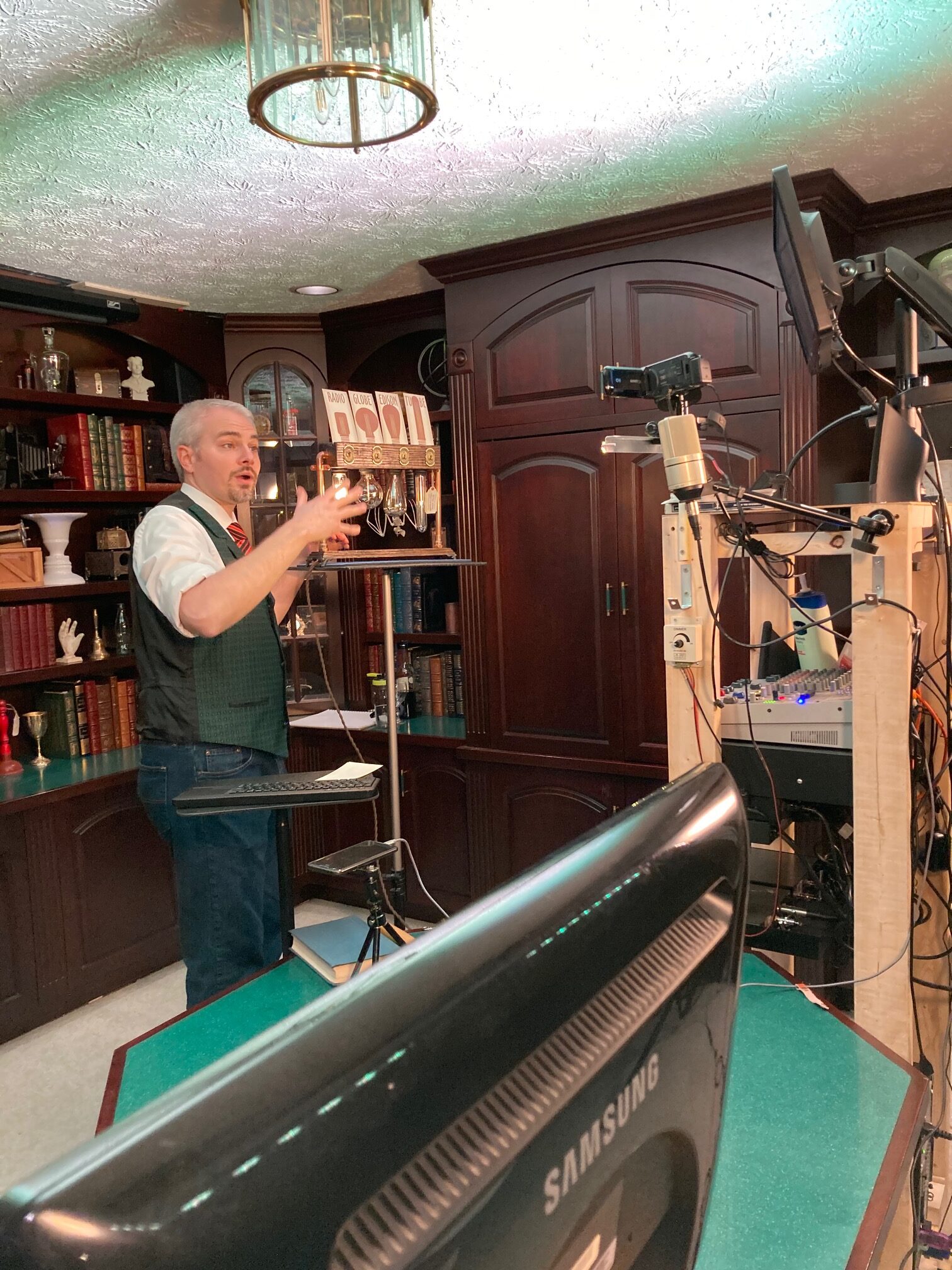
Behind his standing desk he uses as a virtual stage are tall, dark wood paneled shelves, books etched in gold leaf, a Ruben vase, a wooden box, an old Coke bottle that can fit a half dollar in, but not out. Wood’s cabinet of curiosities develops the aura of his trade and gives his new online audiences a pleasant respite from their normal Zoom meeting rooms.
Wood in his home office, performing for a virtual audience. Photo courtesy of Wood.
Wood’s online dinner shows have their upsides and downs, he says. He’s able to entertain guests well outside his usual Baltimore–D.C. circuit, but he loses out on their valuable reactions—not only gratifying to a performer, but necessary for knowing what tricks are successful and which ones need more work, or the ax.
Wood cites UMBC’s theatre’s production manager and technical director Gregg Schraven ’97, theatre, as his guide to knowing when and what to discard—not necessarily his tricks—but even more foundational but difficult professional knowledge. How much wood is useful to keep on hand? How many different light fixtures are actually necessary for taking apart and repurposing? This hands-on knowledge is invaluable, Woods says.
UMBC also led Wood to develop his AutoCAD skills to design and craft specific and unique items. In his theatre tech role as a student, he was tasked with creating parts and props for other students’ visions, allowing Wood to work outside his more steampunk aesthetic and widening his creative comfort zone.
“And unlike a juggler who you can see juggling five balls and appreciate the skill they put into learning that, I have to work so hard to hide that skill, to make it look like I’m not doing anything at all.”
—Wood
Another UMBC connection Wood owes quite a lot to? His brother, Matt Wood ’13, financial economics, M.P.P. ’15, and a maintenance manager in Residential Life. As the younger Wood, Matt has been the stagehand and assistant for many shows, being “grandfathered in” to other long-standing gigs, says Wood, like their past 20 years of performing at the Howard County Fair.
Sharing his collection of impossible things
In his act on Fool Us, Wood presents a portrait painting to Alyson Hannigan, the show’s host. The portrait’s subject is missing its eyes, but whoever is looking through the parchment is gifted X-ray vision, Wood shares, building the story arc like he built the table and the other props. Through Wood’s magic, Hannigan is able to make out the color of four pieces of cloth inside four different little coin envelopes.
The act is emblematic of Wood’s repertoire. “Here’s what I do,” he sets the scene. “I collect items like this, and they don’t just work for me. Let me demonstrate.”
Whether or not Wood fooled Penn & Teller is revealed on the show, but Wood says he walked away from the experience with so much joy and satisfaction. “Literally everyone on the production—all the way up to Penn & Teller—just wants you to put your best foot forward and have it be as good of a showcase as possible for you. That definitely took a lot of the nerves and butterflies away.”
Ultimately on Fool Us, Wood was complimented on what he hopes his everyday audiences never notice at all. “Penn & Teller could see the sort of process that I went through to create the method, to create the secret, and they appreciated the work.”
This video series spotlights alumni who are using their careers to encourage and lift up young kids and college students—in the classroom, yes, but also in the gym, online, and through personal relationships.
Leading the charge for better education
At 4:30 a.m., Susan Keen found herself wide awake. After making some coffee, she set off on foot to Oakland International High School, where she teaches English and world history. But on this weekday, in her role as a labor representative, she was there to lead a strike, alongside her fellow teachers and students.
In what was ultimately a successful strike and negotiation for more equitable compensation and smaller class sizes, Keen ’10, anthropology and political science, felt most proud about the example she set for her students, all recent newcomers to the United States.
“My students joined me on the picket line,” says Keen, a former Sondheim Public Affairs Scholar. “I asked them to evaluate the risks and the goals of what we were doing, and they all chose to stand by me and next to me on the line. It was incredible to have their support. That’s such a highlight.”
Finding joy in the classroom
Keen is a classic Retriever Educator, she knows her actions in and out of the classroom matter to her students. Theresa Bruce, Baltimore City’s 2020 Teacher of the Year runner-up also takes an all-in approach to her students at KIPP Academy.
“People don’t care what you know, until they know you care,” says Bruce ’09, political science and social work, “and that goes for my students.” She makes it a point to get to know her student scholars—a daunting task even before the era of distant learning— encouraging them to find their own passions like she found hers at UMBC through the support of professors and staff.
“So now, as an educator myself, I ask how I can best push and champion my students,” says Bruce, also a former Sondheim Scholar. “The biggest step I can take—and this doesn’t matter if you’re in a brick-and-mortar building or if you’re online—is to make a relationship. Yes, they’re harder to build virtually, but when young people can relate to you as a person, they’re more apt to try.”
Strengthening the mind, body, and community
Some teaching roles look different than a traditional classroom. For Joshua Day ’16, health administration and policy, he finds his purpose at MissionFit, a Baltimore gym that offers free fitness classes to youth in the city. Day—MissionFit’s executive director—wants the young gym members to develop confidence and self-acceptance, as well as important life skills such as goal setting, time management, and accountability.
“It was during my junior or senior year at UMBC, that it became clear to me that it would be easier if I stopped trying to separate worlds and just integrated things together, and MissionFit is the way I get to do that,” Day says. It’s rare that so early in someone’s career they can have their ideal job, he shares.
“But at MissionFit, we’re addressing health. We’re addressing health with youth. We’re really committed to the community of Baltimore. It completes my whole checklist.”
Inclusivity at the Ivies
Jamie Joshua ’02, M10, biological sciences, is using her institutional connections to reach a broad range of students as the director of the Office of Diversity and Inclusion at Cornell University’s Johnson Graduate School of Management. Joshua’s role is to create welcoming spaces for students and provide trainings for faculty and staff. In partnership with student affinity groups and the student council, Joshua advises on programming for equity, inclusion, and belonging initiatives.
During the pandemic Joshua is working from her parents’ home in Ellicott City, but she is still connecting virtually with students to encourage their self care. Joshua models her advice by taking daily walks, often with her twin sister Aimee Joshua ’03, M10, computer science.
“Family is what I think of when I think of UMBC,“ says Joshua. “And as the child of immigrant parents, the Meyerhoff Scholars Program was able to give me the skillset to thrive in college.” The sense of family Joshua felt at UMBC was compounded by rooming with her twin and welcoming her younger sister, Gina Joshua ’05, M13, biological sciences, to UMBC as well. In her current role, Joshua says she’ll feel successful if she can recreate that familial sense of belonging for her student groups at Cornell.
“We’re so proud to see our Retrievers take on so many educator roles, in the classroom and out,” says Stanyell Odom, director of Alumni Engagement. “It’s quickly apparent that these alumni and others like them go into their teaching careers, not only with the skills to teach, but also to learn from their students and coworkers.”
The fourth annual National Day of Racial Healing is on Tuesday, January 19. The goal of the day is to promote racial healing and equity across the United States through collective action. UMBC will observe the day in spirit and action.
As a unified front, UMBC leadership—including President Freeman Hrabowski, Provost Philip Rous, and shared governance leaders—are signing a letter to Maryland’s Congressional delegation in support of a Congressional Resolution, which calls for the establishment of a United States Commission on Truth, Racial Healing, and Transformation (TRHT).
“Having university leadership sign on in support of this resolution is a big step,” says Eric Ford, director of The Choice Program at UMBC. “It sets the example for other institutions of higher education to do the same. For so long, higher ed has perpetuated inequities and now we have the responsibility to address it. By taking this step, UMBC is sending a message to the campus community that inclusive excellence is not just a slogan but a virtue we live by.”
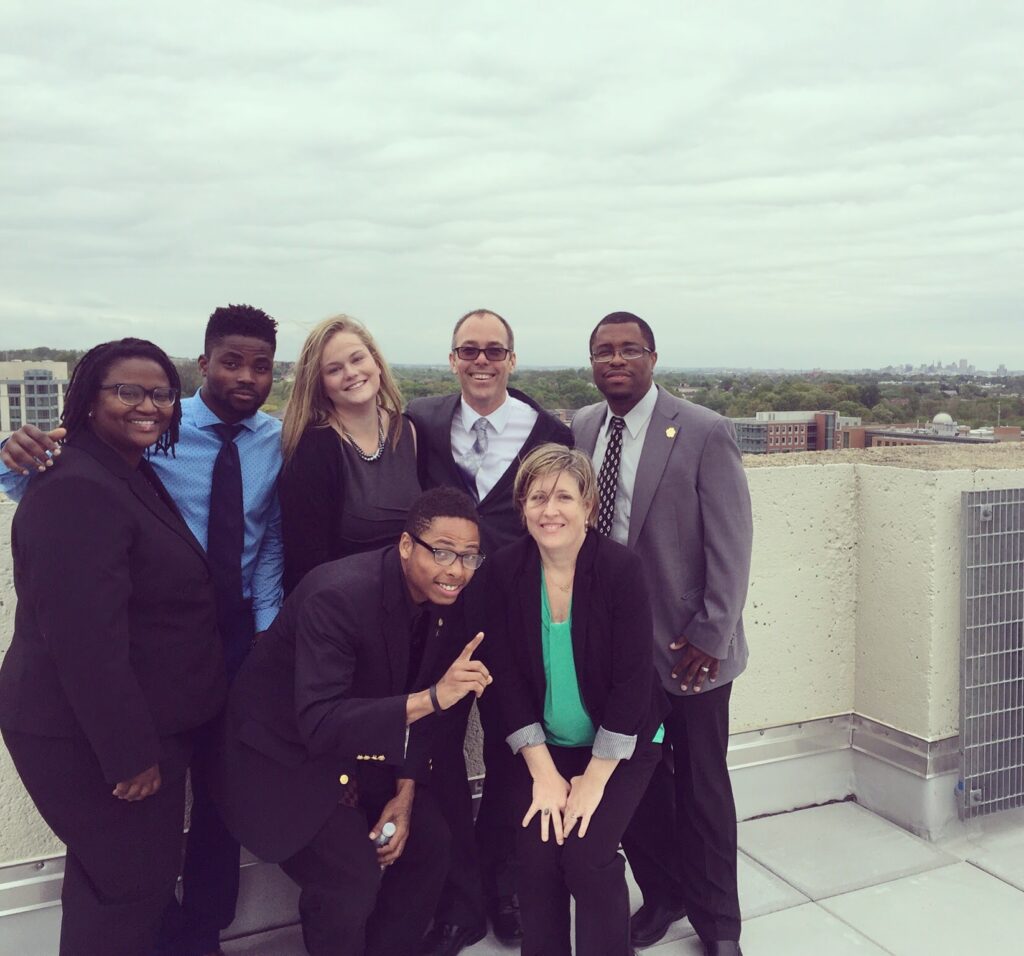
Ford (far right) and Choice staff visit the Administration Building’s rooftop after a successful presentation to the UMBC’s President’s Council in 2015.All photos courtesy of Eric Ford.
Melody Wright, president, Non-Exempt Staff Senate, is one of the campus leaders signing the joint letter. “The voices of those seeking justice have been muffled for far too long,” says Wright, “and those voices must be amplified and heard for true racial healing to begin. You cannot truly understand someone’s story unless you have lived it with them, but carefully listening to someone’s lived experiences is a great place to start.”
In addition to the letter signed by campus leaders, UMBC community members have an opportunity to write to their own senators and representatives about the TRHT resolution. An online event on January 19 will provide additional information about the goal of the TRHT resolution and the work of Truth, Racial Healing, and Transformation at UMBC.
In 2017, UMBC partnered with the Association of American Colleges and Universities to become one of the first Truth, Racial Healing, and Transformation Campus Centers in the country. UMBC’s THRT Campus Center work involves breaking down racial hierarchies with a focus on the university’s service-learning and community engagement partnerships in Baltimore City. Ford shares that truth, racial healing, and transformation are all essential to effective and responsible service-learning and community engagement.
To begin the process of truth telling, The Choice Program underwent a yearlong antiracism audit of the organization. As a result, according to Ford and Frank Anderson, a doctoral student in language, literacy, and culture and the associate director of programs at Choice, the organization’s entire service model was rewritten. Their focus is to ensure that the voices and experiences of the young people being served are at the forefront of the work.
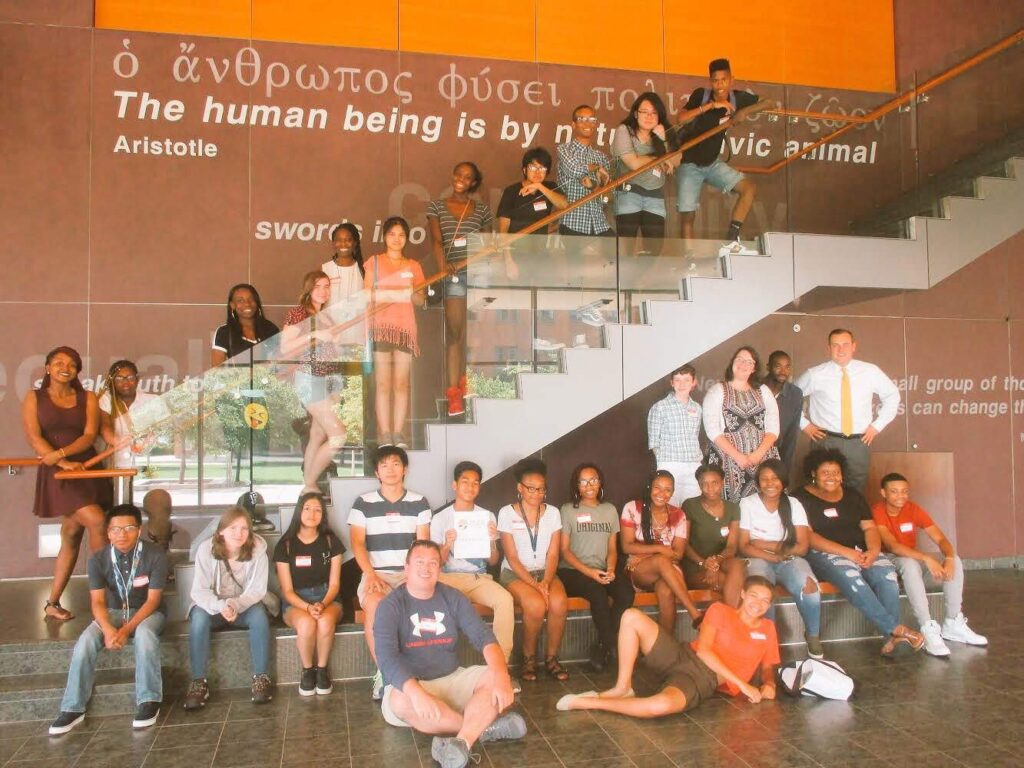
Choice and UMBC staff host students from Baltimore high schools as a part of Choice’s Education program aimed at increasing college access.
The Choice Program—the Shriver’s Center’s oldest and largest service-learning initiative—has become an opportunity to envision the TRHT model at scale, identifying what it means to engage 36 AmeriCorps members as they serve more than 600 young people each year.
Accountability is crucial
Briscoe Turner ’21, psychology, was drawn to Choice after hearing about the program-wide audit. Now an intern at the TRHT Campus Center, Turner is helping to spearhead the letter-writing initiative.
“Members of Congress need to hear the thoughts and experiences of students and staff to make sure that the TRHT Commission actually serves its purpose by actively challenging the racist practices and policies embedded in this country’s major institutions that impact the surrounding community,” says Turner. “Accountability is crucial.”
By following the TRHT model, The Shriver Center has also been able to work with undergraduate researchers to reevaluate media narratives about Baltimore. The Center has also used lessons from TRHT to reflect on already successful programs like College Night.
With College Night, young people from the Baltimore area connect with UMBC every Monday night, through on-campus visits pre-COVID-19 and virtual events today. Through the THRT model, organizers revised College Night training materials and reflections to ensure volunteers understood the broader context within which they were working.
Supporting nationwide change
In September 2020, UMBC hosted the first Truth, Racial Healing, and Transformation Town Hall during which community members learned more about the THRT Campus Center and UMBC’s connection to a national framework addressing race equity. Community partners and alumni spoke about how structural racism has impacted youth development in Maryland and how campus members can become agents of change.
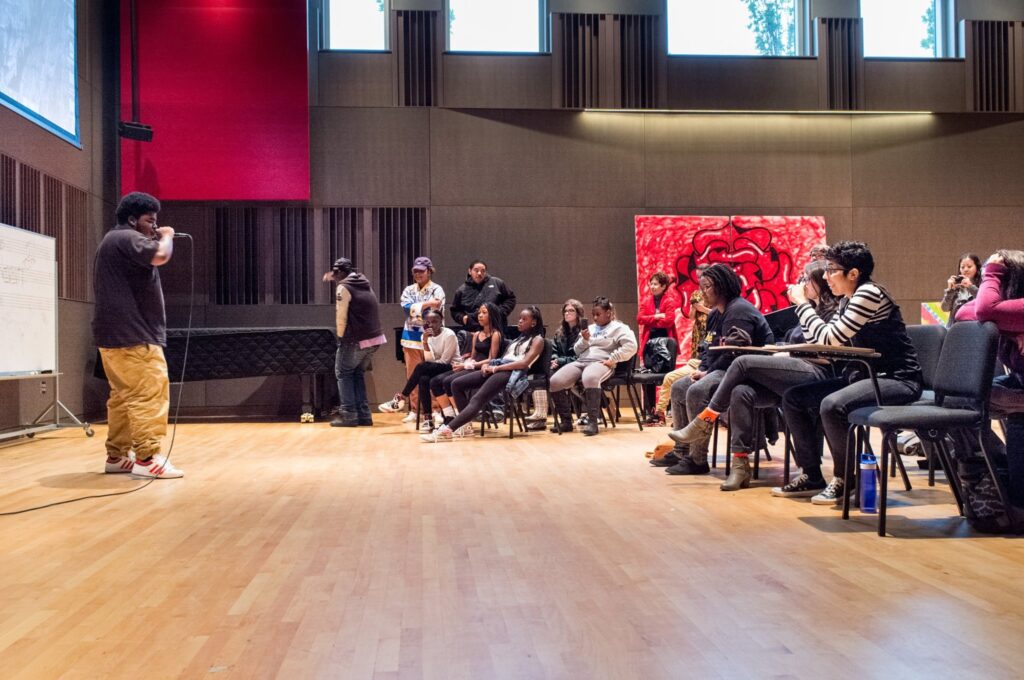
Choice participant performs at the 2015 Imagining America event hosted by UMBC.
UMBC supports the Congressional resolution, proposed by Sen. Cory Booker and Rep. Barbara Lee, says Ford, because it amplifies the broader goals of the TRHT center and the important work being done by Retriever students and staff.
“It speaks truth to power by encouraging the acknowledgement of centuries of oppression of people of color,” says Ford. “It stresses the importance of telling the ‘story’ of people of color and their experiences in this country, which will restore our humanity that was stripped away by structural racism. And it is a step toward system change which is needed to achieve equity.”
A multiprong approach
UMBC’s TRHT Campus Center is only one facet of a larger institutional acknowledgement that the university, like others across the country, needs to confront racism within its own structures and community.
In 2019, UMBC founded the Office of Equity and Inclusion (OEI), which is responsible for promoting and coordinating the university’s core values of inclusive excellence and equity. The center has primary responsibility for managing UMBC’s work related to Title IX as well as other civil rights issues.
Baltimore City’s first Poet Laureate Derick Ebert performs spoken word for Choice participants at its 2015 “Youth in Action” community arts showcase.
In June 2020, UMBC formed an Inclusion Council to bring together faculty, staff, students, and alumni to help address issues of equity and inclusion at UMBC. The council’s co-chair, Ariana Arnold, director of OEI, shares her hopes for the group and campus as a whole.
“What I’d like to be able to say a year from now,” Arnold shares, “is that we are doing the work and not just talking about the work. And that five years from now we’ve had a measurable impact on campus in terms of both engaging people from all political, racial, ethnic, religious, cultural backgrounds, abilities, and nationalities and improving the sense of inclusion and belonging on campus.”
The Inclusion Council, OEI, and TRHT Campus Center are working together to make that vision of UMBC come to fruition. UMBC’s letter to Maryland’s representatives supporting the effort to bring the TRHT model to a national scale is the next step in the university’s ongoing work for truth, racial healing, and transformation.
Featured photo: In a 2017 gathering, Choice staff and AmeriCorps members take part in reflecting on how service transformed their lives. Photo courtesy of Eric Ford.
For some fall 2020 graduates, the day they finish their final class won’t look much different from any other day of working and studying from home—they’re saving their celebration for when they snag their dream job or when it’s safe to throw a party. For others, the occasion will mark the end of a very long road, so some proper pomp is necessary.
Shelissa Kearney ’20, sociology, is one of the latter students. “I can’t go anywhere right now, but I’m going to celebrate,” says Kearney, who last took classes at UMBC in 2014. “I’ll have a nice dinner with my husband and my son. It’s nice to see all of this come to fruition, and I need to acknowledge that.”
To understand Kearney’s commitment to celebration is to know that her first semester at UMBC was in spring 1997. Kearney graduated from high school two years early to jump-start her modeling career, but didn’t want to forgo an education—two of her parents have Ph.D.s, so she knew the value of a degree.
Shelissa Kearney first attended UMBC in 1997. After some educational starts and stops, she graduates in December 2020. Photo courtesy of Kearney.
“If I was traveling for work, I would schedule my classes to try to make it work with some juggling here and there, because I really wanted to go to school,” Kearney says. But completing her degree with a heavy work and travel schedule took longer than she’d hoped.
Early on in her studies, Kearney says one of her biology professors—in an attempt to encourage her to double down academically—said, “Shelissa, at this pace, you’re going to be 34 before you graduate.” Kearney laughs, “I’ve clearly passed that mark, but I finally did it.”
Creating a path to return
It’s standard practice for UMBC to reach out to Retrievers who have earned at least 60 credits and are in good standing academically, but not currently enrolled in classes, says Yvette Mozie-Ross ’88, vice provost for enrollment management and planning. The goal is to encourage them to return to finish the degrees they are so close to completing. This year, with the rapid move to online learning, students who paused their education have been able to return in larger numbers than ever before.
The winter 2020 graduation ceremony will be held virtually, but some graduates look forward an eventual in-person option. Photo of 2018 Commencement by Marlayna Demond ’11.
Of the approximately 120 students who returned to complete their degree (through a program termed Finish Line), roughly a fourth of them only needed one more semester to do so, and will graduate in December 2020.
“Our staff have been energized by our engagement in the Finish Line program,” says Ken Baron, assistant vice provost for academic advising and student success. “We love to help students overcome barriers to complete degrees. Many of these students were close to graduating in the past, so enabling them to return now, especially during COVID, is particularly meaningful.”
Substantial online class offerings have been the key to students’ return, says Baron. With remote working arrangements becoming more mainstream in late spring and summer, “many of these students found themselves in the best possible time to return to college since leaving UMBC.”
Finding closure in the last class
Some students, like Kearney, needed nearly a full course load to finalize their degree; others only needed one specific course to get their diploma. Sam Oh ’20, business technology administration, was actually able to participate in the spring 2017 graduation ceremony, but needed to retake one requirement to receive his degree.
After his father had a stroke, Oh wasn’t able to immediately return to UMBC. In his time away, he began pursuing certifications in Excel and as a data analyst, becoming familiar with SQL coding. After he graduates, he’ll apply for jobs as a business or data analyst.
With another few days of finals for our students and Commencement this week, it seems like the perfect time to take a minute and rub virtual True Grit's nose for a bit of luck. #UMBCgradhttps://t.co/9mnpjgvhDHpic.twitter.com/2JWphfcTEx
For Oh, retaking Introduction to Management Science online this fall, has been a “do-it-yourself experience, which I love.”
His advice for other students, who might be going through something similar to him in 2017: “Be honest and inform your current professors in advance. Based on my personal experience, most of them will be willing to give you extensions on your assignments or may even exempt whatever is due at the time based on the circumstances.”
And even though Oh has already had the Commencement experience, he says, “I will without doubt have a sense of closure after I finish my final exam next week.”
Overcoming the final obstacle
Steven Heckman is another student only one class shy of graduation. A computer science major, Heckman was held up by the final language credit he was completing abroad in summer 2019. “Unfortunately, I got sick and other things happened that didn’t allow me to earn a grade I could transfer back to UMBC,” says Heckman.
Stymied by this language requirement, Heckman says he wasn’t initially eager to return to finish his degree, but his parents encouraged him to think about how much work he had already completed to get this far in his studies.
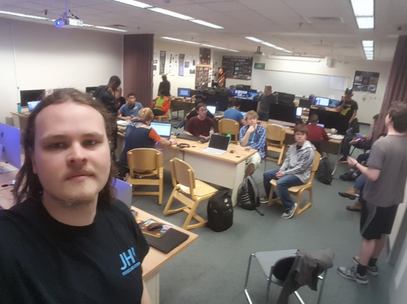
Heckman, left, with the UMBC Game Development Club in spring 2019. Photo courtesy of Heckman.
The process was more straightforward than he expected.“Coming back to school now has let me take the class online, and not have to commute,” says Heckman. Plus, he says, the asynchronous format of Japanese 201—his final class—is better suited for him as someone with ADD to be able to review the material at his own pace.
Heckman sees the increased online offerings, along with the detailed Blackboard calendars and other tools instructors are making use of now, as essential for reaching students who might not excel in the traditional lecture hall environment.
Looking back at his years at UMBC, he cites lecturer Kalman Nanes as particularly forward-thinking in making course resources available online. Nanes, who taught him linear algebra, took the time to record and post his lectures for students. “As someone who loses attention easily, the extra effort Professor Nunes put into his class not only made it easier for me to learn, but he also made me care about a new subject.”
Expanding access
Ken Baron agrees with Heckman’s assessment that online accessibility will benefit the entire campus community. “I believe we have learned considerably, during a remarkably short period,” says Baron, “how powerful online courses are regarding the needs of our student population.”
Whatever life looks like on campus after a vaccine is widely available, he continues, “we believe our Finish Line students are a successful case study, clearly demonstrating the need for a mix of instructional options as we move into the post-COVID era.”
An achievement at any stage
Christopher Lee, a UX content strategist for Facebook, and a Finish Line student completing his final class at UMBC, says the chance to participate in class while still engaged in his professional life has been rewarding.
The perceived stigma of returning to college to finish his degree kept Lee away longer than he planned. Headshot courtesy of Lee.
“Having been a working professional for seven years at this point, I’ve spent more time in the ‘real world’ than in undergrad,” he says. “I understand how the world works in a deeper, more nuanced way. My experiences inform my perspectives on the topics we discussed in class, and I’m better equipped to articulate them now.”
As someone who began his academic experience more than a decade ago, Lee, a psychology major, says it took him too long to return to finish his degree.
“At first, I believed I would feel like it was a stigma, since it felt like an achievement I should’ve completed years ago,” he shares. “Thankfully, I got over that, and focused on the fact that my journey is uniquely my own, and it likely wouldn’t matter to my professor and classmates. Turns out, it didn’t.”
“A necessary step”
Shelissa Kearney is now a children’s book author. Her book I Wish, published in January 2020, focuses on not comparing yourself to others. As someone who is finishing up a 20-year journey to receive her degree, Kearney wants to celebrate the value of each person’s unique experience.
Kearney poses with a copy of her book I Wish, published in 2020. Photo courtesy of Kearney.
“For me, this last semester has been a shining star in the dark sky of this year,” says Kearney. “This has been a really long process, and it’s my personal goal to finish. I’ve done a lot of things in my life, but for me, this was a necessary step to complete.”
In addition to her end-of-school celebration, Kearney whole-heartedly looks forward to attending an in-person graduation ceremony, when it’s safe to hold one. Since she graduated high school early, she has never experienced walking across the stage, shaking hands with professors, and sharing those celebratory moments with family.
“This will be my first one,” says Kearney, “and I definitely plan to be there.”
Banner image: Balloons outside of the UMBC Event Center after the spring 2019 Commencement. Photo by Marlayna Demond ’11.
with Andrew Haberman ’21, computer science, and Davina Orieukwu, assistant Track & Field coach
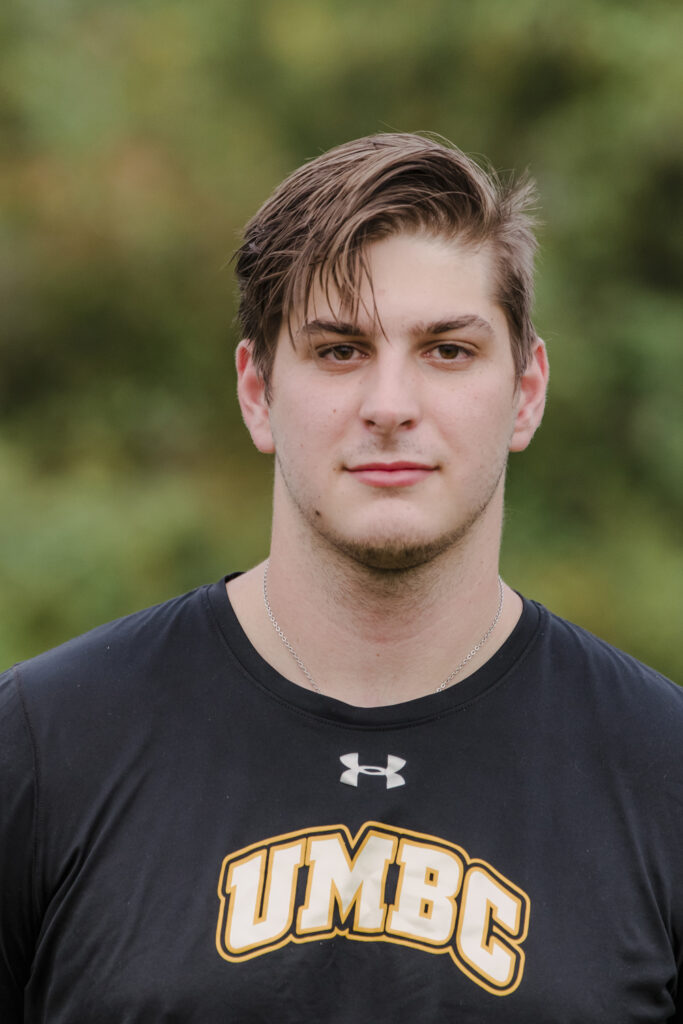
It’s widely accepted that you need to practice a skill for 10,000 hours before becoming an expert. Andrew Haberman ’21, computer science, has a different number in mind—20,000 throws. Twenty-five throws a practice, five days of practice a week, 10 months out of the year for four years. And even after that, he knows that success is never final. So he makes another throw.
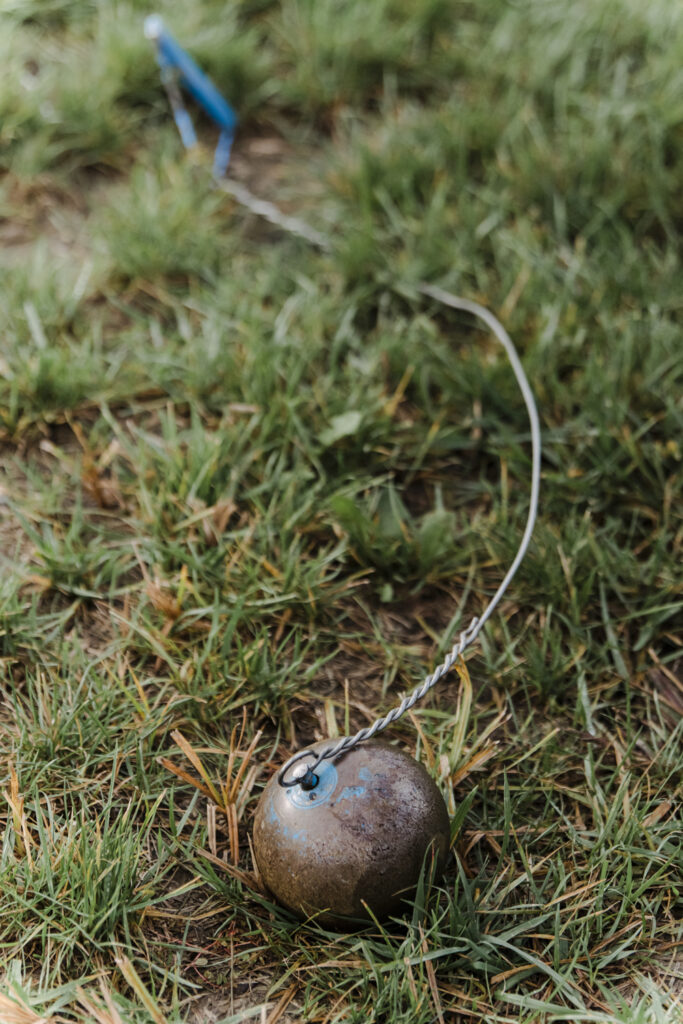
Along with shot put, weight, and discus throws, Haberman specializes in the hammer throw. This is not a tool from your dad’s shed. For men’s regulation competition, it’s a 16lb metal ball attached by a steel wire to a grip. While the object of this competition is—like all throwing competitions—to launch your object the farthest, with hammer throw speed is also a big factor.
Andrew HabermanDavina Orieukwu
As part of track and field, throwing is more obscure than some events, but UMBC has a storied history in this discipline. Cleopatra Borel ’02, interdisciplinary studies, is a four-time Olympian shot putter representing Trinidad and Tobago, placing 7th in Brazil in 2016.
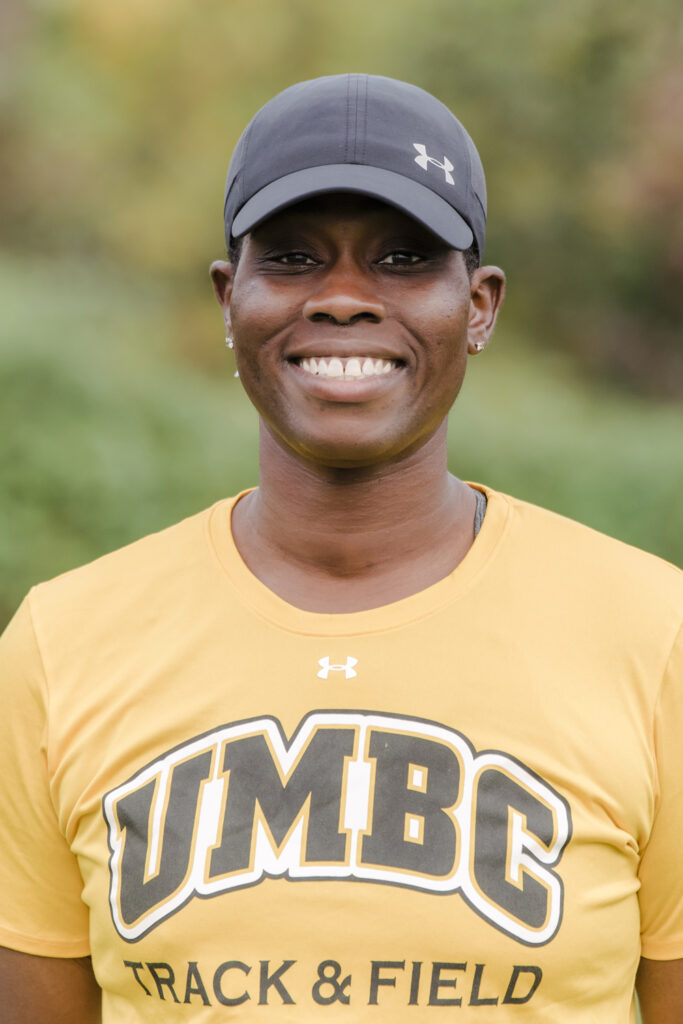
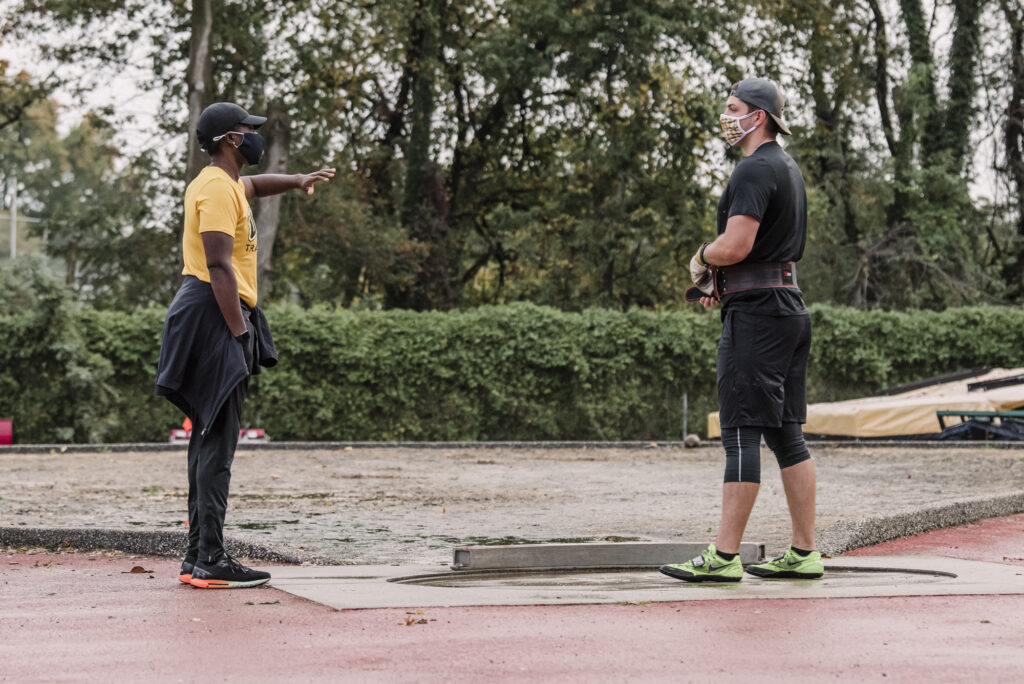
On the practice field, again and again, the rhythmic sound of Haberman’s shoes scuffing the throwing circle are followed by a thunk as the hammer lands in the grass, a rooster tail of dirt following each toss. Haberman and his throwing coach, Davina Orieukwu, talk through foot placement, chest height, release angle, and many other minute readjustments to his technique. Over and over, Orieukwu reminds him, “push the hammer all the way around,” to get the most efficient throw. So how does anyone get to 20,000 throws? Start with the first one.
Tools of the Trade
A hammer—This implement is a 8.8lb (for women) or 16lb (for men) metal ball on a wire with a handhold. But in a pinch, other heavy implements attached to a chain and grip will work.
Wide open space—this is not a sport to practice near a lot of windows.
Upper body strength—this would be helpful to start, but you can always build it up while you practice.
A coach or mentor—no YouTube video can substitute for hands-on guidance.
Haberman’s career record toss is 55.06m (180.6 ft). That is approximately as long as the Leaning Tower of Pisa is tall. Illustration by Jim Lord ’99.
Step 1 —Hammer time
First acquire a hammer or throwing implement. These aren’t the most accessible pieces of equipment like a pair of running shoes or a soccer ball. Hammer throw isn’t a part of most high school track and field teams, but Haberman’s coach at Century in Carroll County had access to some of the heavy equipment and allowed the throwing athlete to practice on his own. Haberman saw the hammer throw as a way to extend his athletic career, gaining experience in a more uncommon discipline to make him a more attractive athlete to colleges.
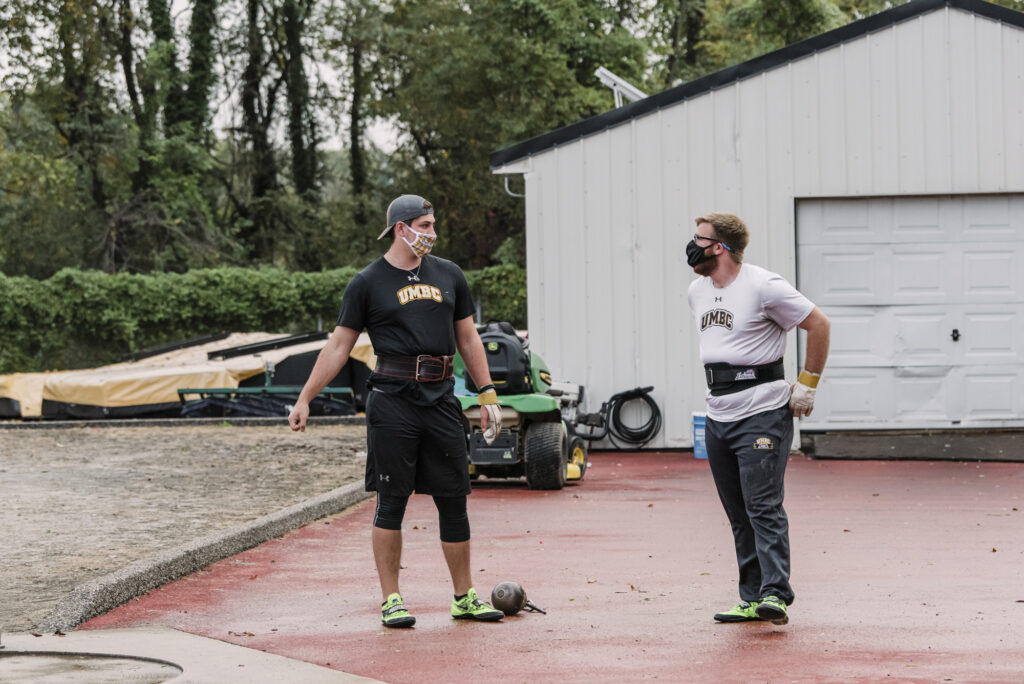
But you don’t need a regulation hammer to start off. During practice, Orieukwu has Haberman and another throwing athlete, sophomore Thomas Hamby, use a variety of weighted objects. First, Haberman warms up with a literal ball and chain. This implement weighs twice as much as the hammer he’ll use in competition, so he’s gaining strength and developing better technique by handing the heavier object. Hamby throws a hefty chain looped around a handle to start.
Step 2 —When, not if, you fall, get back up again
Hone your technique. Maybe at first this is watching YouTube tutorials by world class athletes or binging compilations of “fails,” to see all the ways that things could go wrong. As Orieukwu repeats during practice, “losing connection with the ground is losing connection with the ball.” For the uninitiated, stumbling or falling down is to be expected in the beginning. Imagine this: you are trying to balance your body while swinging a weighted ball over your head twice and then spinning anywhere from three to five times (called “the wind”), building up momentum to the moment of release. The faster the speed of your spins, the more velocity your hammer has.
Orieukwu gives Haberman pointers for his foot placement and when to release the hammer.
Everyone, says Haberman—even with four years of experience—loses control of the ball. The key, he notes: “Be as relaxed as possible, but strong and intentional at the same time.”
Step 3 —Arm & hammer
Learn better form. Haberman says his STEM background certainly helps, as he thinks through the physics of the pull of the hammer as his body rotates to gain speed. Orieukwu tells him to watch his “flat 2.” Haberman knows that means during his second rotation, “my hammer rises really high in my orbit, so that keeps me from throwing farther,” he says.
As the ball increases velocity with each turn, it’s important to retain a triangular shape with your arms—your chest forming the base, your arms the two legs of the isosceles triangle, and the hammer at the vertex. If the hammer gets ahead or behind your triangle, you’re in trouble, says Haberman.
Step 4 —Pass it forward
Start mentoring others. So much of hammer throwing is a mind game, shares Haberman, who credits older team members with helping him learn good habits early on: relax, make jokes during practice, and stay neutral to avoid emotional highs and lows which can derail an athlete. Hamby, who just picked up the hammer throw in fall 2020, says that Haberman, now a senior, is his go-to source for advice.
Haberman, a senior, and Hamby, a sophomore, discuss throwing techniques.
The older athlete sees his responsibility and tries not to pass long throwing neuroses. “I consistently think I can do better, but sometimes that works against me,” says Haberman. “Thomas picks up on my attitude and I don’t want it to negatively affect him.”
With that, he lifts the hammer, executes the wind, and completes another throw—number 20,001 and counting.
*****
Header image: Haberman practices with Orieukwu looking on. All photos by Marlayna Demond ’11.
Assigned an oral history project in 2007 for her master’s degree in community arts at Maryland Institute College of Art, Ashley Minner—now professor of the practice and folklorist in the Department of American Studies at UMBC—knew exactly who she would ask to interview. She walked across the street from her parents’ house and knocked on Uncle John’s door.
“There will never be a person like Uncle John,” says Minner, an enrolled member of the Lumbee Tribe of North Carolina. “I don’t know, he was just like that, always telling stories. He was a character. When he was younger, he had pork chop sideburns. He had a really thick Robeson County accent. He was a good man. I believe he was touched by God, he was—he is—a Lumbee Legend.”
Sharing their heritage with Baltimore
Photo by Jill Fannon, M.F.A. ’11, for BmoreArt.
John Walker, if not a direct relative of Minner’s, played that role, telling her about their shared heritage and regaling her with stories of his youth in North Carolina, where many Lumbees moved from in the 1950s and ’60s to Baltimore in search of work. Minner’s subsequent research has helped tell the wider story of Lumbee migration to Baltimore, specifically to the neighborhoods of Upper Fells Point and Washington Hill, affectionately called “The Reservation.”
The original oral history project turned into a thesis of five artist books—which include transcriptions of five elders’ stories along with compiled photographs. This project grew into an exhibit at the Baltimore Museum of Industry in 2011 that featured five additional oral histories and cultural artifacts. It felt like the project could keep snowballing, says Minner. It was around this time, she noticed that more often the oral histories were being used at elders’ funerals.
“They became more precious after that,” she says, as the growing awareness of losing a generation began to sink in.
In fall 2019, Minner met with staff in UMBC Special Collections to discuss the creation of a home for her work and other Baltimore Lumbee related research and ephemera. To be housed in the Maryland Folklife Archives, Minner’s recordings will become part of “The Ashley Minner Collection,” along with other documents and photographs shared by tribal members.
Preserving people’s stories
“This collection really demonstrates how the University connects with the surrounding community in Baltimore,” says Beth Saunders, curator and head of UMBC’s Special Collections and Gallery. “In other words, we benefit from stronger ties to the community we serve. Ashley really dug into local archives and did the legwork and other researchers will be able to benefit from that.”
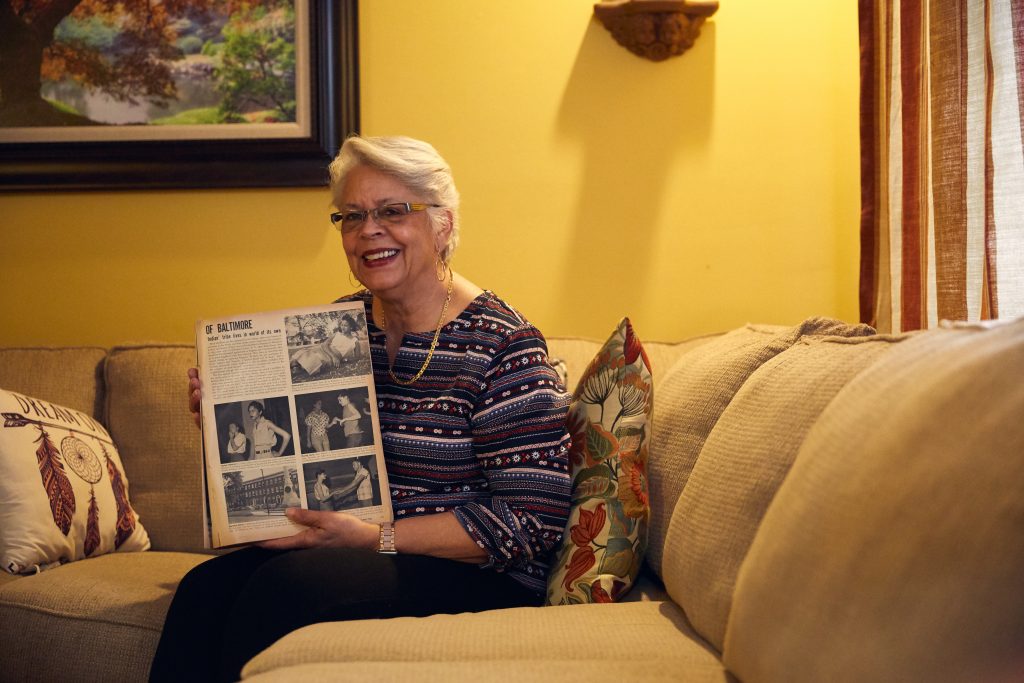
Jeanette W. Jones holds a 1957 issue of Ebony magazine, which features the article ‘Mystery People of Baltimore: Neither red, nor black, nor white. Strange ‘Indian’ tribe lives in world of its own.’ She is pictured at center, with her hand on her hip. Photo by Sean Scheidt ’05, visual arts.
Minner sees the archive as a necessary repository for stories and photographs, that otherwise might be lost as the Lumbees who previously lived and worked close together spread out into the counties surrounding Baltimore. “Ashley has a real, practical sense of the value of archives for preserving history and people’s stories,” says Saunders. “This new collection is an opportunity to preserve a part of that history that has been neglected and that she is bringing to broader awareness.”
Minner hopes the creation of the archive will encourage more Lumbees to dig into their past, while also finding pride in their present. ”We are made to feel as if we don’t belong on this landscape,” says Minner. “Many of our young people don’t know their history because frankly…their parents don’t know the history.”
“I think being able to point and explain and show pictures and ground them in the fact that our people have been here for close to a 100 years now and have really made contributions, that does something. That helps with security, self-esteem, and feeling empowered—like you do belong, like nobody lied to you. You are who you are.”
Ethics of community research
Minner bridges multiple spheres with her work—she’s an artist, a scholar, and also a granddaughter, a friend, a fellow tribal member. The only hat she can take off, as she puts it, is her UMBC hat. Otherwise, “what I’m doing and what I’m about is bigger than a job,” says Minner, “bigger than a job title or discipline.”
Part of having her feet in two worlds is training students how to develop holistic approaches to public scholarship and community collaboration. In Fall 2019, Minner was hired as the director of UMBC’s new public humanities minor. “We’re lifting up stories that get pushed to the margins,” says Minner. “And we spend a lot of time on ethics. The last thing I want to do is turn a bunch of college students loose on communities that might be harmed through the interaction.”
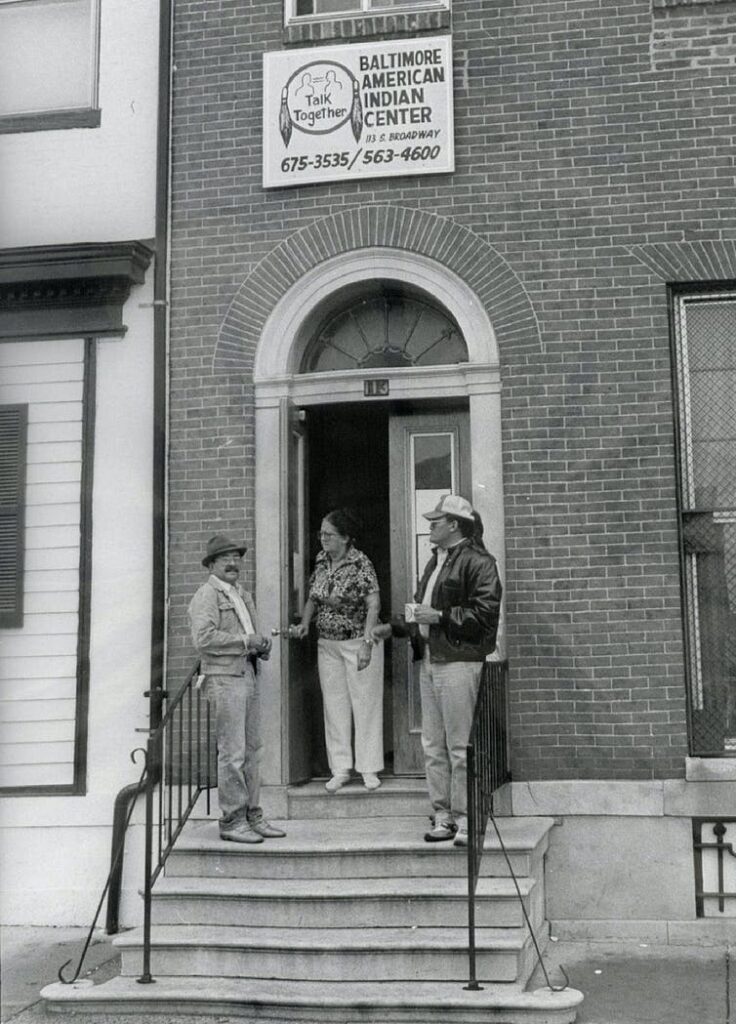
The Baltimore American Indian Center, 113 S. Broadway, is the hub of cultural activities forarea Indians. Photo by John Davis, The News American, October 24, 1985. Baltimore News American Photo Archive, Special Collections and University Archives, University of Maryland College Park. Permission granted for Minner’s use by the Hearst Corporation.
Minner is uniquely suited to the directorship, says Nicole King, associate professor and chair of the Department of American Studies. “Her broad range of experiences and skills, speaks to the many positions we all hold in our everyday lives. These human aspects are often flattened in an institutional context. Yet, Ashley is more than all of these credentials and roles because her practice focuses on seeing the humanity and beauty of everyday people and places. What Ashley offers to our students at UMBC is lived experiences that are both ordinary and extraordinary and an understanding of the connections between the two.”
From this perspective, Minner can see how outsiders often miss the mark when trying to tell the Baltimore Lumbee story. “They latch on to urban renewal and displacement,” explains Minner, “but the elders don’t see it that way. They’re not victims, that’s not the story they want to tell. It’s important to teach folks to listen deeply and to check in and make sure people are being represented the way they want to be represented.”
A memorable occasion
Minner has a story, one of her own that’s stuck with her as she’s watched her research expand through a process she describes as “pretty serendipitous.” Aunt Jeanette Walker Jones, Uncle John’s widow, says Minner, was instrumental in connecting Minner to her heritage. When Minner and her best friend, Nicole—Aunt Jeanette’s granddaughter—were 4 or 5 years old, she took them to have ribbon dresses made.
The fabric for the dresses was light pink with teepees on it and the ribbons adorning it were white, black, and hot pink, remembers Minner. They attended an event at the former Festival Hall downtown—an annual pow wow put on by the Baltimore American Indian Center. “We were out there hopping around; we didn’t know what we were doing. Some Indian guy looked at my mom, and when she nodded at him, he scooped me up and held my hand while I danced with him. I was like ‘ahhhh,’” she says, making an excitedly terrified face. “It was a thrill!”
******
Header image: The Inter-Tribal Restaurant was owned and operated by the Baltimore American Indian Center in the unit block of South Broadway. Photo courtesy of the Baltimore American Indian Center, provided by Minner.
With classes predominantly online this fall, former students who’ve had to pause their studies are re-enrolling at UMBC with graduation as their goal.
When Nick Martorelli, management of aging services, originally stepped away from taking classes at UMBC in 2015 to help take care of his mother as she underwent kidney failure, he had no way of knowing that he’d ever return to his degree. He certainly couldn’t have guessed that his experience setting up his mother’s daily, overnight dialysis would offer him a leg up in his studies.
Martorelli with his mother, Florence, who goes by Frosty. Photo courtesy of Martorelli.
“One thing I noticed when taking care of my mom—I had to learn a lot of directions for medication and nutrition, sterilizing the room for dialysis,” says Martorelli. “I had to memorize how to set up the dialysis. You had to really be focused the whole time and after doing that for two years, now I’m a lot more focused taking classes, and I can really pick up things more quickly.”
In mid-August, Martorelli and other Retrievers who had earned at least 60 credits and were in good standing academically but were not currently enrolled in classes received an offer to return to the University to finish their remaining degree requirements. Yvette Mozie-Ross ’88, vice provost for enrollment management and planning, says a similar correspondence is sent out each semester to those close to degree completion but who remain unenrolled. But the pandemic changed one key element of their communication—like almost every other attendee, students could now return to school online.
The online incentive, says Martorelli, changed his whole perspective. Within a week of getting the mailer, Martorelli—who lives in Missouri—was signed up for a full load of classes and anticipates graduating in May 2021. The finish line is in sight.
Relying on a great support system
Headshot courtesy of Broderick.
The summer of 2020 started one way and ended in quite another, Kelly Broderick, gender, women’s, and sexuality studies (GWST), puts it simply. Let go in June from her position as box office manager at Baltimore Center Stage due to the cancellation of their season, Broderick found herself facing a momentous birthday while questioning what life had in store for her next.
“It felt like all these universal things were dropping on me telling me I had to go back to school,” says Broderick, who only has three requirements to complete before graduation.
Within two weeks of receiving the Finish Line brochure inviting her to return to her studies, Broderick was re-enrolled and ready to finish a chapter of her life she had started in 1998 when she matriculated at Towson University immediately following high school. Broderick eventually left school to work, creating a career in retail and eventually box office management. When she first arrived at UMBC in 2012, it was as an adult learner and she worked to make a place for herself at UMBC, especially through spearheading adult scholars programming at the Women’s Center.
Throughout the process of getting signed up for classes, Broderick reached out to her old contacts in GWST and to Jess Myers, director of the Women’s Center. “She really helped me out,” says Broderick. “She helped me find a small scholarship that assisted with books and other necessities. This process is just reminding me of what a great support system UMBC has. I have all these people that are supporting me in this and it feels really good.”
Broderick with Jess Myers representing The Women’s Center. Photo courtesy of Broderick.
After six years away from the classroom, Broderick says she’s excited to jump back into a learning environment—and receiving one of the senior completion grants offered through Mozie-Ross’s office certainly helped. “Everything has the bright and shiny factor on it again. Which is really nice,” she adds.
At the end in 2014, when Broderick paused her studies, she was dealing with some burnout, she says, and like Martorelli, her parents were facing health challenges that required her attention. “But now, I’m definitely feeling that new school excitement again, and it’s fun to be using that side of my brain again.”
“A lot of this for me is a personal thing,” says Broderick. “I just want to know I can finish my degree. Although I’ve mostly moved past the point in my career where it affects me to not have a degree, because of my experience, I’m excited to not have that be a hurdle in my future job search.”
Serving our most vulnerable students
According to Mozie-Ross, of the 2,700 former students who received the Finish Line outreach, 123 students re-enrolled. “They have busy lives,” shares Mozie-Ross, “and they don’t fit nicely and neatly into this traditional brick and mortar structure…and so to be able to announce to this audience that just about all of our courses are now online—you’re right near the finish line—they just responded. It’s like we spoke to them.”
Martorelli and Broderick back up Mozie-Ross’s data that the majority of the students to return were originally transfers. “That tells you a lot about our transfer population. They have lives, they have jobs, things get in the way…. When you think about who we are serving through this campaign, we’re serving our most vulnerable students,” says Mozie-Ross. She adds, that women and minority student populations represent a larger than expected portion of the Finish Line returnees when compared to the overall UMBC student population.
“We have an obligation to do this,” says Mozie-Ross. “This is exactly why we’re in higher ed.”
Designing a unique career trajectory
For Christopher Lee, one class stands between him and his degree, although the missing course hasn’t stopped his impressive career trajectory as a user experience (UX) professional. Now a UX content strategist for Facebook, Lee saw the Finish Line program as the perfect last step to his unique path to his diploma, and ultimately a necessary stepping stone to pursuing his master’s in library science.
Headshot courtesy of Christopher Lee.
For Lee, psychology, extenuating family circumstances interrupted his final requirement for his English minor. He and his mother were facing eviction from their home when he was a junior, he says, and “I was pulling from a limited amount of time and attention and effort, and naturally one thing had to give. That thing turned out to be school.”
Even with an incomplete transcript, Lee was able to make inroads in his career. He found his first job through a UMBC career fair and with that experience was able to apply for a content strategy apprenticeship in Brooklyn with the design agency Huge. Part of his takeaway from this training period was learning to understand information organization and see the relationship of different digital elements and the way the user interacts with the content. “You’re really thinking through the psychology of how people are internalizing information,” explains Lee.
Now enrolled in his final class, Public Speaking and Democratic Participation, Lee says the online format has some surprisingly successful aspects. The small group discussions in Blackboard Collaborate are often robust, says Lee, wryly noting that they have quite the current material to be working with this semester. In addition to no end of discussion topics, Lee shares that the class “has created an environment where people feel comfortable sharing their perspectives.”
At UMBC, Lee continues, “there has been no lack of people who have been supportive, who have seen the potential in me when at times it was unrealized or unseen by others. There was always a genuine concern for my well-being.”
Everyone has their own path
For Briana Lucia Capuano, social work,the online option to finish her two final degree requirements has not only made graduating while caring for her four children a possibility, it also saved her four hours of a daily commute when she was attending classes at UMBC and living in southern Maryland.
Capuano’s last semester was in spring 2019, when she found out she was pregnant with her son Lucca. “This exciting development for our family,” says Capuano, “meant that I would be taking another year away from school to care for him.”
Capuano with her son, Lucca. Photo courtesy of Capuano.
Sharing a house during the pandemic with two school-aged children, a toddler, Lucca—who is almost one now—and a working spouse hasn’t been easy, says Capuano. “I honestly didn’t believe I’d ever get to the end, but with COVID-19 and more classes offered online, it seemed like the perfect opportunity to finish up with all I have going on.”
“If there’s one piece of advice I could give any student in college,” shares Capuano, “it’s that everyone has a different path, so don’t compare your progress to anyone else’s. Just go at your own speed, and stay positive because your goals are achievable.”
Understanding what’s at stake
Lee summarizes the Finish Line program best: “We’re growing and expanding our understanding of what it means to be successful. Despite the fact that I took a slightly different pathway to where I’m headed, and someone else might take a less winding route—I’m glad there’s a system at UMBC to support that.”
Martorelli with his father, Salvatore, on campus several years ago. Photo courtesy of Martorelli.
From an institutional perspective, Mozie-Ross sees so much value in having students with a range of life experience participating in the classroom experience. “I think they set the tone, and they set the standards for the academic experience because they are far more focused and grateful for the opportunity to further their education.”
Martorelli agrees with Mozie-Ross’s assessment. As a long-term caretaker, the perspective he brings to his management of aging services courses is not a hypothetical case study—it’s truly a matter of life or death. This cohort of students, emphasizes Mozie-Ross, understands that there’s something at stake.
In 2019, UMBC and the University of Baltimore were designated as Maryland’s first “age-friendly” universities for supporting non-traditionally aged students. The Finish Line program is another way UMBC is upholding its promise to encourage and advocate for students wherever they are on life’s continuum.
“It speaks to the work we’re doing to meet these diverse populations of students where they are,” concludes Mozie-Ross. “The fact is that their lives may have required that they disrupt their education for a little bit, but we’ve…leveraged this moment in time, during COVID-19, when most of our classes are online, and gone out and pulled them back in.”
*****
Interested in pursuing your degree at UMBC or returning to your studies here? Visit our undergraduate admissions page to learn more.
Header image taken in 2018 by Marlayna Demond ’11.
Sitting together, side-by-side in a video call, it’s easy to see the familial resemblance between Susan Sonnenschein, professor, Applied Developmental Psychology, and Elyse Grossman, M.P.P. ’08, Ph.D. ’14, public policy. However, similar facial features, matching bold colors, and statement necklaces aside, it’s the back-and-forth interaction that gives the duo away as mother and daughter.
A playful sense of ease to gently correct, pause the conversation, or reassert herself comes naturally to each woman, who understands their own dynamic better than most research pairs.
During the COVID-19 pandemic, Grossman has been staying with her mother and sister Julie in their Rockville townhome, sheltering-in-place together. Grossman cooks gourmet meals; Sonnenshein insists they stay up-to-date on cultural events by attending performances and tours online. And one more thing—they combined their research interests to create a nation-wide survey that looks at the stresses on parents during the period of distance learning and what role this has played in their alcohol consumption. Sonnenschein and Grossman are sharing the task of writing several papers drawn from the data, and a brief version of their findings, “Parents with Children Forced to Do School at Home Are Drinking More,” was recently published in The Conversation.
All in the Family
Unlike her sister Julie Grossman, who teaches psychology alongside Sonnenschein at UMBC (and is assisting in coding the data from their joint survey), Elyse Grossman had no interest in studying her mother’s area of expertise. However, as her undergraduate years at Cornell passed, she found herself graduating with a degree in psychology.
“I ended up really enjoying it, but it was funny,” says Grossman. “I had always been very adamant that I was never going to go into psychology.” Sonnenschein chimes in, “and when I brought that up afterwards she said, ‘Well I always knew I would.’” They exchange looks.
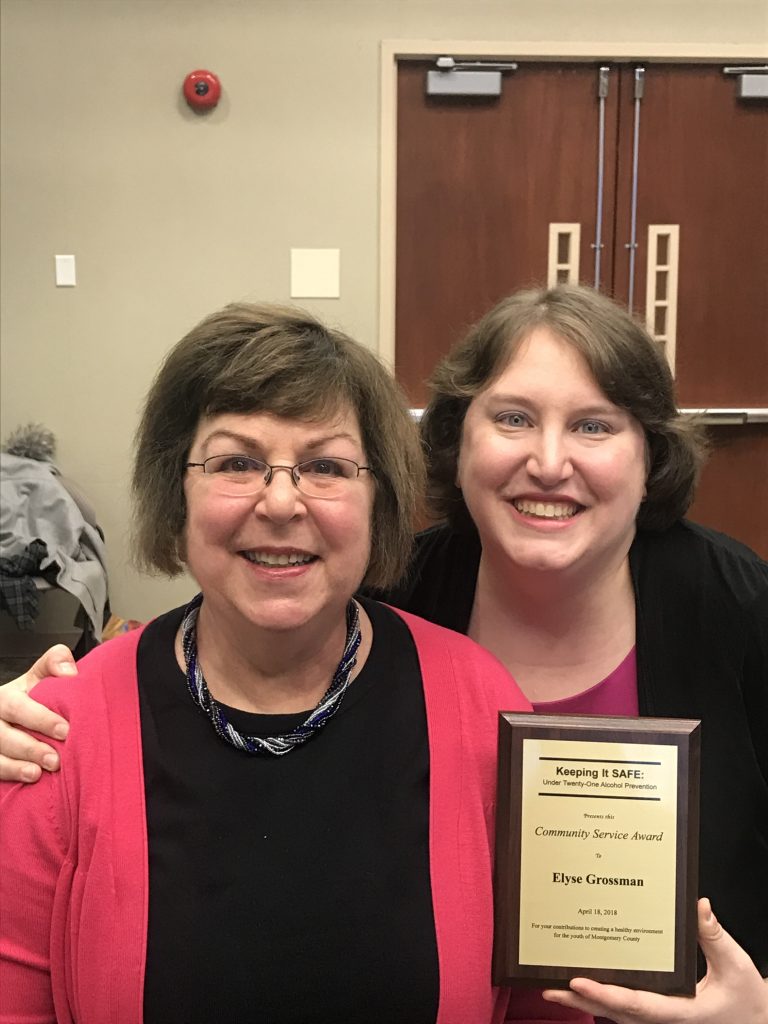
In 2018, Grossman won the “Keeping It Safe” Community Service Award for her work at preventing and reducing alcohol use among those under age. And of course, her mother was there to support her. All photos courtesy of Grossman and Sonnenschein.
At Cornell, Grossman already knew she wanted to get a law degree afterward, assuming she’d work with patent law, based on her science-focused undergrad. But as she shifted toward a new degree plan, Grossman discovered her research interest in alcohol policy.
Rethinking Drinking Traditions
Traditionally, end-of-the-year classes at Cornell were celebrated by students and their families on Slope Day, Grossman shares. However, more recently, Slope Day had become a day marked by excess drinking where rules regarding minors were often ignored. Grossman recounts a Slope Day she attended. “The first person who went to the hospital [for alcohol poisoning] was a 13-year old girl who had a note in her pocket that said, ‘I allow my daughter to go to Slope Day.’”
According to Grossman, the local hospital canceled all of their elective procedures that day to address the influx of patients from the university. This sparked Grossman’s interest in alcohol policy and public health. Now a policy fellow at the Johns Hopkins Bloomberg School of Public Health and a senior legal policy advisor at a consulting firm, Grossman specializes in researching state alcohol policies. But, it began with Slope Day. “I really got involved with rethinking this event, and we worked to change it from a day about drinking to a day about music and fun and food with alcohol.”
A Survey of Overlapping Interests
Sonnenschein, whose degree is in developmental psychology, describes her scholarly interest in educational formation and the factors that facilitate or interfere with a child’s development in language, literacy, and mathematics. “And that’s what I’ve done research for for years,” says Sonnenschein. “Then there was COVID, and the whole nation basically turned to homeschooling or distance learning. And that intrigued me.”
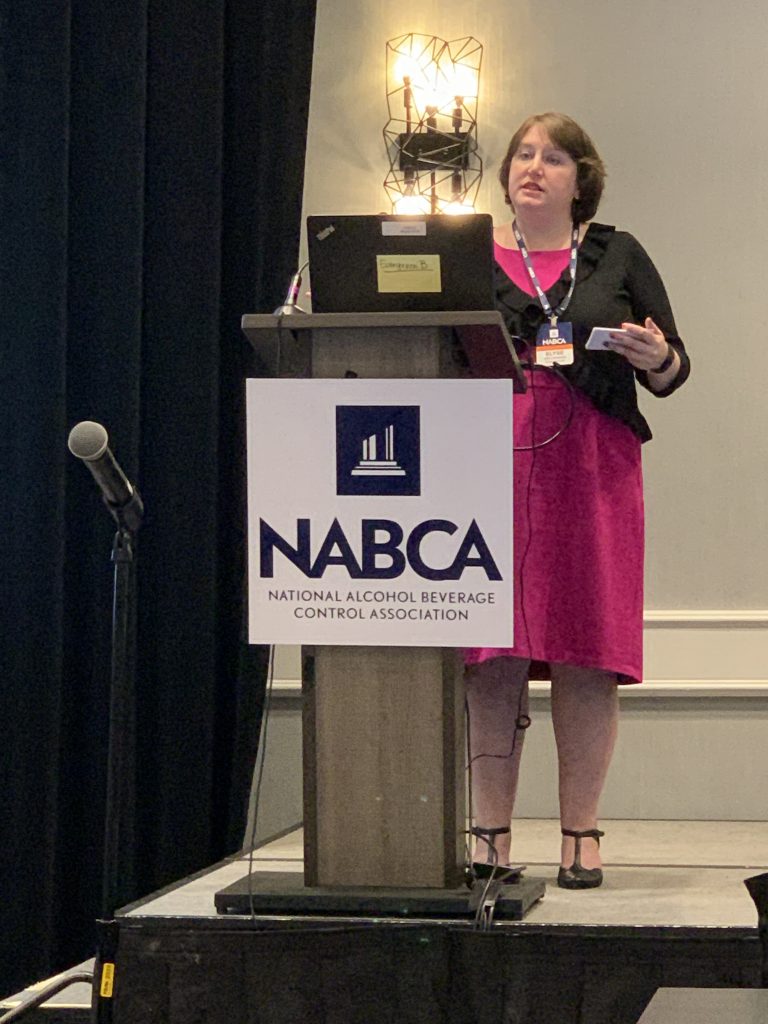
Grossman gave two presentations in October 2019 at the National Alcohol Beverage Control Association 25th Annual Administrator’s Conference in Denver.
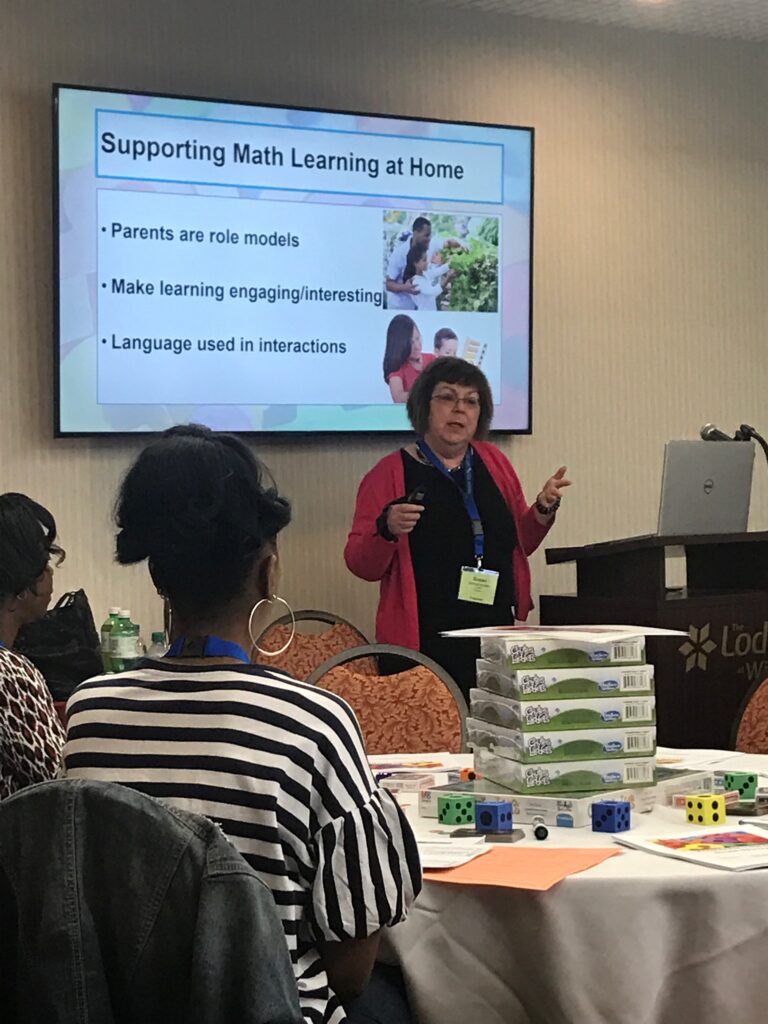
Sonnenschein gave a presentation at the Headstart Conference in Ocean City, Maryland, in 2018 on the importance of supporting and engaging children in math learning at home.
Meanwhile, Grossman—who is also an adjunct instructor at UMBC’s Honors College—noticed an uptick in memes on social media with variations on the theme “Well, when I get out of COVID I’ll either be an excellent cook, an alcoholic, or both.” Past research, says Grossman, shows that “when there’s traumatic, emotional, or stressful events, alcohol consumption generally increases two to three years after the event, for example, after 9/11, Hurricane Katrina, et cetera. So this is something that really interested me, seeing how COVID-19 was affecting stress and alcohol consumption now and whether we’ll see the same increase in two to three years.”
Here Sonnenschein and Grossman discovered the perfect overlap of their research—were parents who were suddenly responsible for their child’s educational growth turning to alcohol more often?
From their online survey, completed in May 2020 by 361 parents with children under 18 years old currently living with them, the research duo found that “parents who are stressed by having to help their children with distance learning during the COVID-19 pandemic drink seven more drinks per month than parents who do not report feeling stressed by distance learning.” Furthermore, they write inThe Conversation, “These stressed parents are also twice as likely to report binge drinking at least once over the prior month than parents who are not stressed, according to our results.”
Parents’ roles have not only shifted, say Sonnenschein and Grossman, but they’ve multiplied. “In addition to being parents, they’re teachers, they’re employees, they’re coaches, they’re motivators,” says Grossman. “And all of this happened relatively quickly,” Sonnenschein adds.
Making Sense of the Unexpected
Sonnenschein and Grossman are eager to see where their research leads them next while they continue to share homemade meals and online cultural events.
The family in Vilnius, Lithuania, in 2016, while waiting for a bus to Riga, Latvia. Sonnenschein likes to joke that the coldest winter she ever spent was a summer in Vilnius.
“It’s been neat to see how our research and perspectives overlap,” says Grossman. “We have different styles and different backgrounds, so it’s been interesting just to see how all that works together and to learn from each other.”
“This is a moment in time that I believe is going to change the world,” says Sonnenschein. “And I’ve always thought when some unexpected event occurs, we should contribute to try to make sense of it.”
A literary magazine with Taco Bell as its touchstone? It’s actually not as cheesy as it sounds. Unwrap one of the two existing volumes and find: An essay that examines the Taco Bell Chalupa and its relationship to NBA basketball. A poem that goes into a Taco Bell bathroom stall to look at addiction. A Crunch Wrap Medical Chart written by a nursing student.
That an American studies alum created a literary magazine centered on a shared piece of Americana—the fast food chain Taco Bell—should surprise no one. After all, MM Carrigan ’04, founder of Taco Bell Quarterly, often tells people that an American studies (AMST) degree “taught me how to consider, examine, think.” Carrigan uses this foundation in creative writing by “telling the stories of objects and places, and rigorously examining how they operate inside of me. That’s also a description of AMST, in a nutshell.”
UMBC Magazine: How would you describe Taco Bell Quarterly to your mom? MM Carrigan: Well, my mom always wished for me to create something popular. I think many writers will relate to the idea that our moms just want us to write one of those best sellers or make millions self publishing on Amazon. So I would excitedly tell her, Mom: I made a popular Taco Bell magazine where all the writing is about Taco Bell!
UMBC: Now, how would you describe it to Taco Bell executives? MC: The New Yorker covered in nacho cheese.
UMBC: When did the idea occur to you to start a literary publication devoted to this fast food restaurant? MC: In the spring of 2019. One of those late morning ideas after the second cup of coffee hits.
UMBC: Your first two volumes have been prolific! Have you been surprised by the variety of ways people can write about Taco Bell? MC: Not surprised—I trust writers, I trust in the brilliance of writers. As writers, we continuously approach the same subjects over and over: love, grief, loneliness. I believe Taco Bell is another one of those subjects we can approach over and over.
UMBC: What’s one or two of your favorite pieces? MC: From Volume 2, Jake Bailey’s “Psychosis at the Bell” excited me, a punk poem exploring schizophrenia and Taco Bell. Terry Horstman’s “Malik for the Win,” is a traditional piece of longform sports writing, through the lens of a basketball Taco Bell promotion. I just love how we get a range of writing.
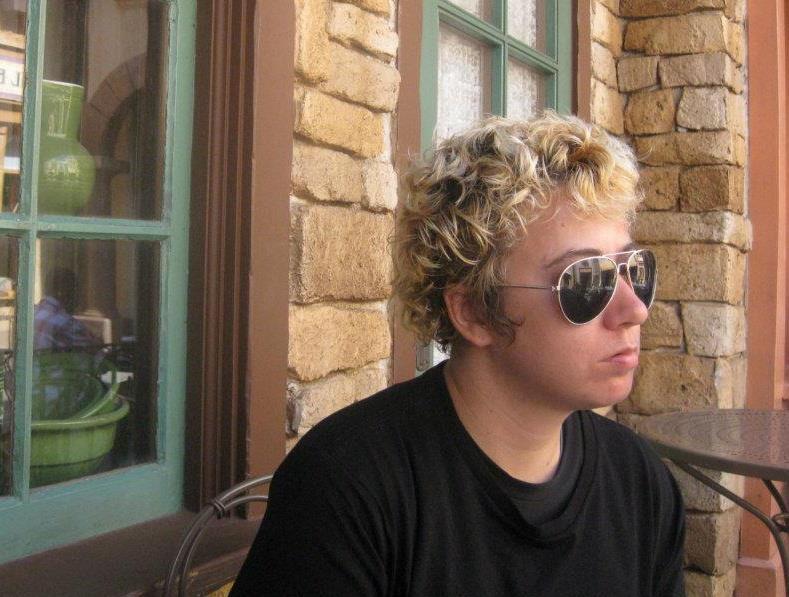
An undated photo of MM Carrigan ’04, courtesy of Carrigan.
UMBC: In another interview, you mention being surprised that people took the first call for submissions seriously—why do you think they did? MC: I was a nobody. I didn’t have a large platform or back catalog of clever tweets. I was just a single writer, with an absurd idea. There isn’t really a space or community for the “nobodies,” so when I invited them to come hang in the metaphorical parking lot of a Taco Bell, I think writers latched on right away.
UMBC: In a time where our country seems endlessly divided over life-or-death issues, Taco Bell feels like a universal, shared American experience. How do you think we can foster more shared experiences like this? MC: We used to gather around the television to watch a man walk on the moon, or Michael Jackson moonwalk. We shared those cultural moments together. But as our interests and lives become increasingly niche, we seem to only share large scale tragedies together. We must continue to seek out those places, experiences, objects we can still share as a whole. We must look in surprising places.
UMBC: What sort of writing did you do while at UMBC? MC: I dabbled in bad poetry and short stories. But as weird as it sounds, I found my voice writing American studies papers. There were never any tests in AMST. It was all writing, all talking, all the time. I took a lot more creative liberties in my prose than I should have in academic papers, but I always received the nicest feedback from professors telling me how much they enjoyed reading my work.
I could have walked away jaded after studying the broad history of American systems, institutions, and culture. Instead, I walked away wanting to tell these stories in dynamic ways.
UMBC: Did any one faculty or staff member encourage you in a way that’s stuck with you? MC: I’m very lucky to have been taught by such a dynamic, passionate group of American studies professors in the early 2000s. A moment that sticks with me, is Dr. Ed Orser reading a passage from a book, and weeping in front of the class, so moved by what he had read. That was the passion and emotion they brought to the material. I could have walked away jaded after studying the broad history of American systems, institutions, and culture. Instead, I walked away wanting to tell these stories in dynamic ways.
UMBC: Other than submitting to Taco Bell Quarterly, what’s advice you’d give to upcoming graduates interested in the arts? MC: Live mas, dream mas. Your dreams are heavy to carry. It would be easier to discard them, and go into something more practical. You’re more of a workhorse, so keep lugging, keep dreaming. You’ll be good.
UMBC’s dedication to inspiring a community of inquiring minds is apparent in Princeton Review’s new profile of the University, featured in The Best 386 Colleges, 2021 edition.
The University’s profile highlights Retrievers’ reputation for taking education seriously, while staying engaged in campus life and issues they care about. Students told Princeton Review, “UMBC is a place where it is cool to be smart, and everything about the campus, including the students, exudes ‘nerd-chic.’”
“To put it simply, UMBC made it onto The Princeton Review list because of our amazing students,” says Lee Blaney, associate professor of chemical, biochemical, and environmental engineering and UMBC’s 2020–2023 Presidential Teaching Professor. “The list is developed through responses to student surveys, and so we (quite literally) have to thank our students for this honor, which highlights the excellent academic and social community that all of us have built at UMBC.”
Faculty who connect with students
The review also spotlights UMBC faculty for their open-door culture and willingness to mentor undergraduates. Student respondents agreed that the university has “extremely intelligent professors that have a knack for inspiring the students.” They said, “UMBC is a place where professors aren’t just talking heads.”
From left to right: Lee Blaney, Cameron Sloan ’21, and Ouriel Ndalamba ’23 in the lab in 2019.
Blaney sees what the students are describing as “UMBC truly embracing the social mission of a university, namely to educate and train students to be knowledgeable, capable, and socially responsible leaders.”
“In many ways,” continues Blaney, “this mission starts with UMBC professors who teach students to become change agents in the classroom, the lab, and the community. We’re betting on our students to change the world. It’s for this reason that UMBC professors dedicate so much time and effort to teaching and mentoring.”
New international rankings
UMBC has also recently been named on several international lists of top universities.
The institution ranks in the top 3.5 percent out of 20,000 universities worldwide according to the Center for World University Rankings’ new list for 2020 – 21.
The 2020 Times Higher Education Golden Age ranking places UMBC in the top 150 global universities established between 50 and 80 years ago. The Golden Age ranking highlights universities that have made an exceptional impact while still being relatively young institutions.
Times Higher Education notes that this Golden Age is characterized by rapid university expansion and increasing investment in research. The ranking prioritizes research strength.
UMBC Albin O. Kuhn Library in spring 2017. Photo by Marlayna Demond ’11 for UMBC.
According to the QS World University ranking, UMBC performed among the top 8.8 percent of U.S. universities in the world this year. UMBC ranked #68 among U.S. doctoral universities in the latest ranking. QS listed “diversity and internationalization” as the University’s strongest category.
“UMBC is able to foster such a robust inclusive community because our leadership and the entire UMBC community fundamentally understand that diversity and inclusion are inseparable from educational excellence,” says Katharine H. Cole, vice provost and dean of Undergraduate Academic Affairs.
Cole shares, “We are a welcoming community to all students and work diligently to uncover inequities in order to provide sustainable educational practices that support our core institutional mission of inclusive excellence.”
Featured image: A view across the Quad in Spring 2020. All photos by Marlayna Demond ’11.
President Freeman Hrabowski’s powerful personal story is well known in the UMBC community. At the age of 12, seeking equal access to a quality education, he marched with Dr. Martin Luther King, Jr. in his home state of Alabama. He and other Black children were then jailed for five days. He has held steadfast to commitment to educational equity in the years since.
Under President Hrabowski’s leadership for nearly three decades, UMBC has grown into a national and global leader in undergraduate and graduate education, innovation, and social impact. He has also fostered UMBC’s unique campus culture of shared, collaborative leadership and community support.
On July 10, President Hrabowski was awarded a 2020 UCSF Medal, the University of California San Francisco’s highest honor. He was one of three national leaders recognized for a career advancing diversity and inclusion, specifically through mentorship programs that support underrepresented people in the sciences. For example, UMBC now produces more Black students who go on to complete M.D.-Ph.D. degrees than any other institution in the country, and UMBC is one of the top institutions for producing Black students who go on to complete Ph.D. degrees in any STEM fields.
Video produced by UCSF, with content contributed by Corey Jennings ’10.
“What we’ve been doing for decades now,” Hrabowski shares, “is identifying students from a range of backgrounds, of every race and different income levels, and saying, ‘We want to work with you to help you reach your goals, and reaching your goals should not be about simply surviving.’”
Thank you for all you do for the UMBC community, President Hrabowski! Congratulations.
*****
Header image: President Hrabowski celebrates the Meyerhoff Scholars Program’s 30th anniversary with philanthropist Robert Meyerhoffin May 2019.Photo by Marlayna Demond ’11.