All posts by: Randianne Leyshon '09


Fish out of Water

The challenges of building a human-powered amphibious sculpture include working with nary a blueprint in sight, avoiding flying sparks from your professor’s power tools, returning to the theatre department’s dumpster again and again seeking out items to upcycle into an ever-changing design, and—oh yeah—not sinking in Baltimore’s Inner Harbor when all is said and done.

By Randianne Leyshon ’09
Race day photos by Poulomi Banerjee ’16, all other images by Marlayna Demond ’11, unless otherwise noted.

A dismembered hammerhead shark takes up most of the office space.
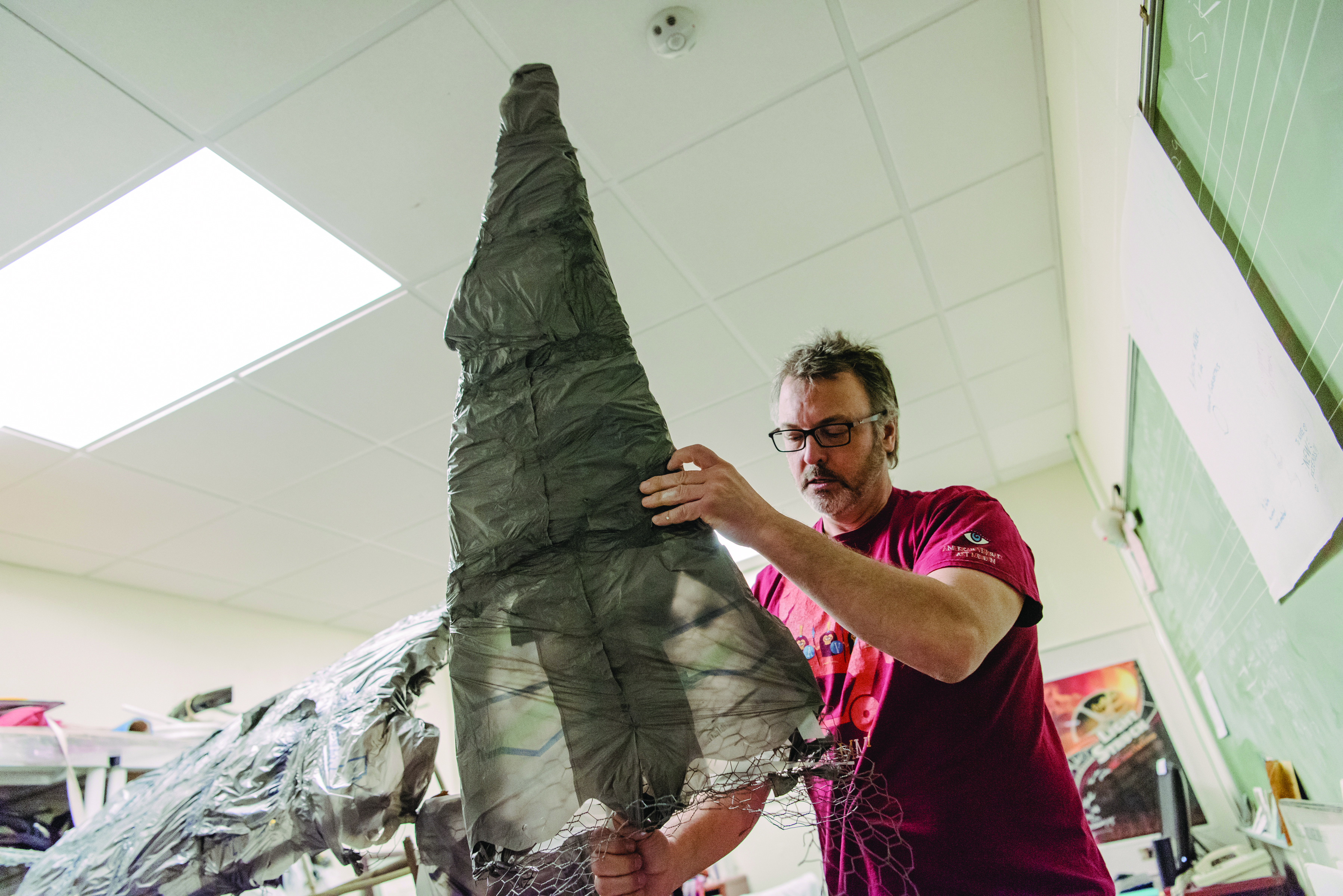
Professor Steven McAlpine proudly holds up the dorsal fin and other grey body parts to demonstrate the ingenuity of his student team, which plans to work with the specimen in piecemeal. “It’s like a pile of sushi in here,” laughs McAlpine.

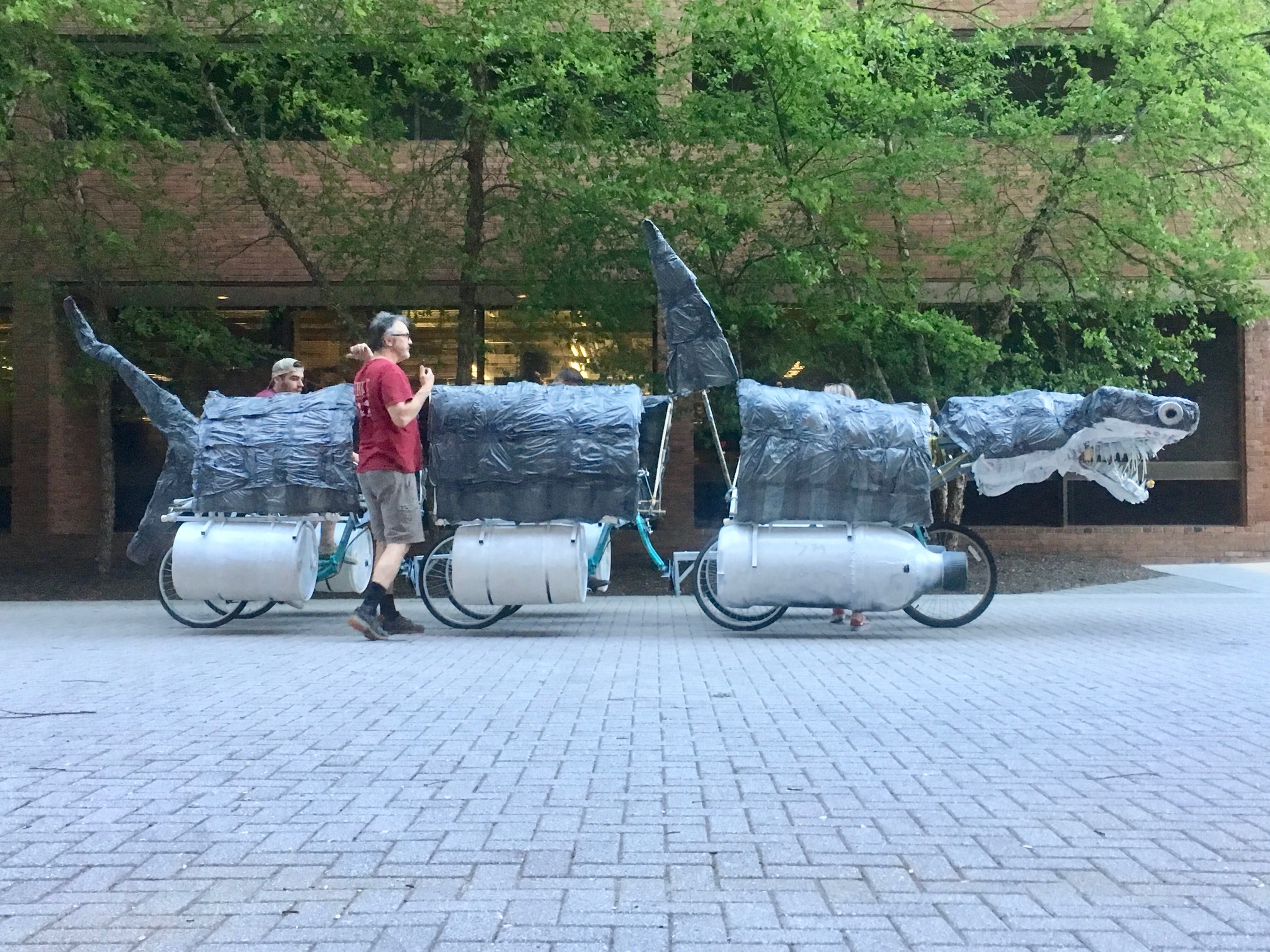
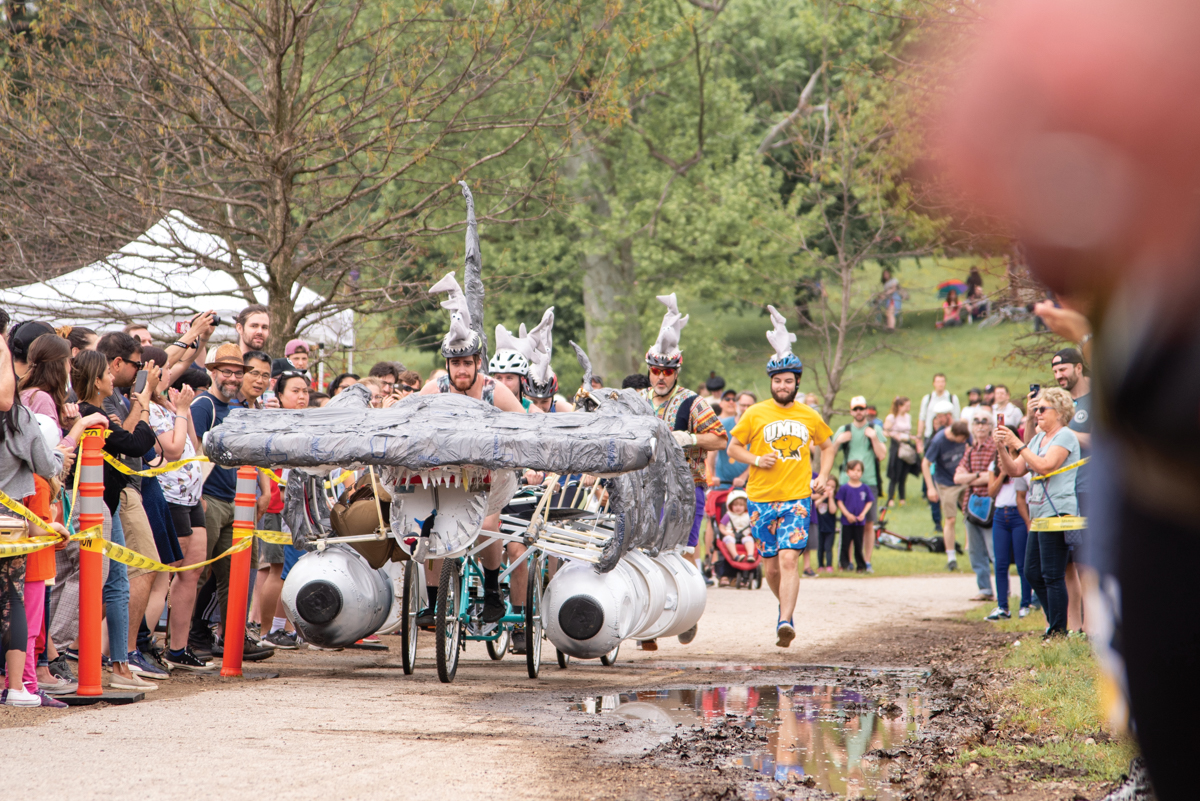
Previously on display in the National Aquarium and then donated for this project, the “shark” in question has skin made of plastic bags from Lowes, melted together to form the exterior of this beast of recycled materials. McAlpine and his students are giving the shark a second life by building it a three-tricycle chassis, complete with pontoons and three pilots to careen 14 miles through the streets of Baltimore—including a stint in the harbor—to compete in Baltimore’s 21st annual Kinetic Sculpture race.

This—in all its fishy, gear-filled glory—is what interdisciplinary learning looks like at UMBC.

Creating jaws from scratch

Working outside under the Fine Arts portico this spring, with a portable speaker blasting “Can’t Touch This,” in homage to the class’s name for their project—MC Hammerhead, the students are engaged in a variety of hands-on tasks: creating a skeleton of two-by-fours to hold up the shark’s wire mesh head and sawing jagged teeth from fiberboard from the theatre’s trash to fill its mouth with double rows.

Two of the three teal trikes sit nearby, connected by a homemade metal apparatus, and with pontoons made of old recycling containers welded on. In December, the team tested out the pontoons’ effectiveness in UMBC’s Pig Pen Pond. As the test pilot (in swimming trunks) prepared to sink or float, Cody Thomas ’19, mechanical engineering, described watching his classmate go down into the water with “hopeful pessimism.”

“I was like, ‘okay, we’ve done the math and we definitely have the right volume in these pontoons’ and then he hit the water. The wheels broke through the ice and then the pontoons sat there and I thought, ‘wow, this is working really, really well.’”
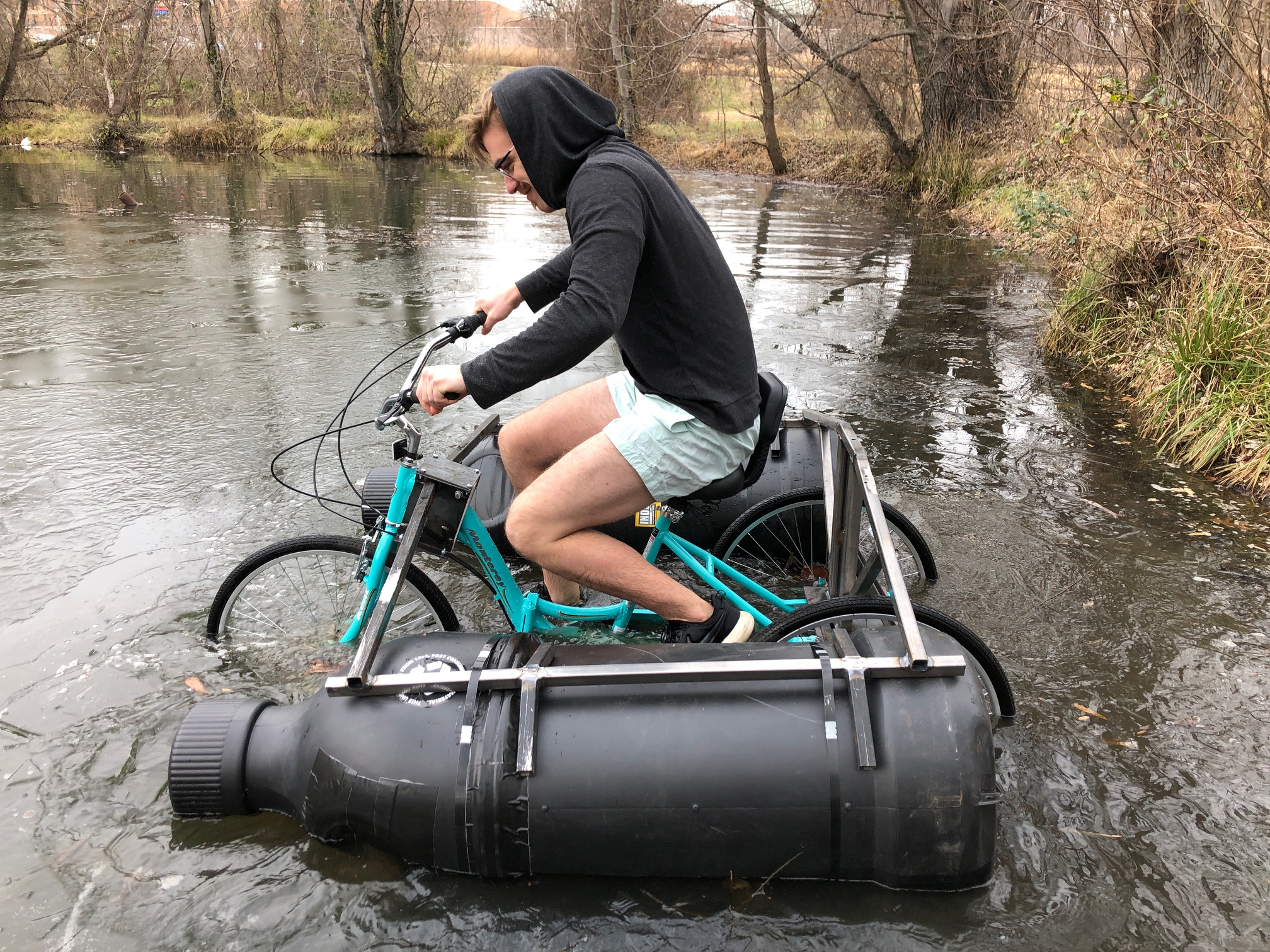
David Thompson breaks through the ice. Photo courtesy of Steven McAlpine.

David Thompson breaks through the ice of Pig Pen Pond. In swim trunks. In December. Photo courtesy of Steven McAlpine.

Not all, but many of the students’ ad hoc solutions would turn out to work really well. To demonstrate the biomimicry of the structure, Lucas McCullum ’19, mechanical engineering, and Lorraine Dell’Acqua ’19, psychology, two students in McAlpine’s class, jump on the swivel-combined tricycles and pedal around campus, the second rider’s direction depending on the steering of the first. The effect is successfully serpentine.

McAlpine says the students identified the design challenge and decided to tackle it head on. “They really get fundamentally why it’s important to take time to design. Design means really coming up with a product that’s appropriate for the context…so if it’s a shark, you want it to have that kind of dynamic fish movement, to move differently from anything we’ve built before. So I credit the capstone team for having the courage to see that like a very generally defined engineering problem: ‘We want it to move like a fish.’”

There’s no textbook for this

This spring marks UMBC’s fifth entry into this wacky, very Baltimore race, and UMBC’s second structure (the first was the squid-shaped Kraken Upcycle, which won Grand Mediocre East Coast Championship in 2015). With detailed rules down to the required homemade sock creature that must be displayed on board, the funky race is the perfect platform for art and engineering to meld together, or in this case, literally weld together.

It’s a project, McAlpine says, that fits perfectly into the UMBC ethos.

“I’ve never before encountered this kind of cross-disciplinary problem-solving,” explains McAlpine, “when actually your strengths in another area can help you tackle the problem in a new way.” The interdisciplinary studies seminar guided by McAlpine also includes a consulting team of mechanical engineering students completing their capstone project under the guidance of Neil Rothman in the College of Engineering and Information Technology. The interplay between the two groups has refined the shark into a well-engineered piece of art.
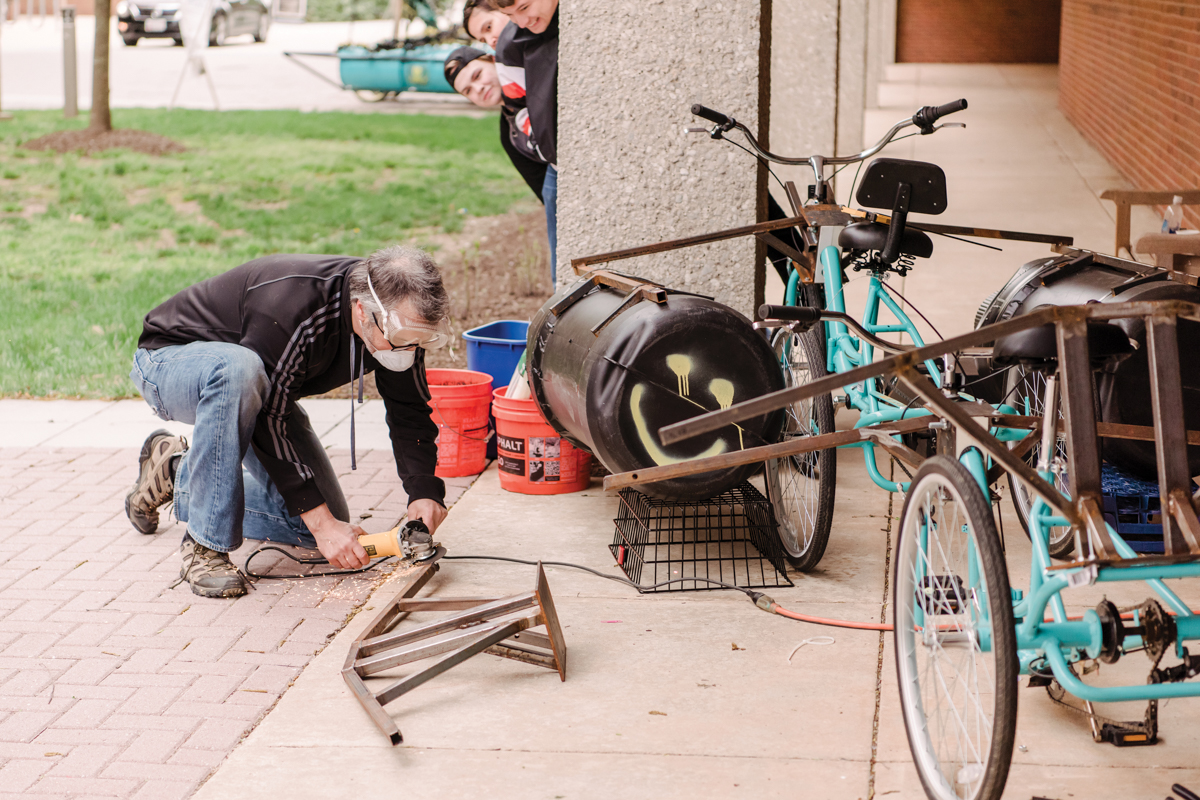
When a steering or hitch issue stumps the engineers, it’s the psychology and political science students in the class who start doodling on the whiteboard, using their non-traditional sets of knowledge to work out the kinks. “UMBC students allow students of other majors to solve problems for them,” adds McAlpine.

There’s no pre-existing manual for how to create such a beast, so McAlpine and his team of students are learning from the successes and failures of their original Kraken sculpture, which survived in various iterations to run four kinetic sculpture races previously and is currently living out its retirement in front of Fine Arts. They’ve also sought guidance from Arbutus Middle School’s long-standing kinetic sculpture team, as well as from the UMBC Baja design lab, a racing club on campus.

“I was really excited that we were working with an interdisciplinary team,” says Alliana Warner ’19, one of the mechanical engineering capstone consultants. “We provided a lot of mentorship, which I don’t think we expected to do at first.”

“Like our mechanical side, we can do that,” says David Thompson ’19, another of the capstone students. “But we have to connect their art to our mechanical side. So we had to have a lot of communication.” And when their vocabularies didn’t overlap, they turned to art to convey their ideas.

“It was just like a no-barriers way of communicating when everybody picked up the markers and started drawing on the board, and it was cool to see the whole class have their own ideas that they were sketching from stick figures to really elaborate art majors just making these beautiful drawings,” Thompson explains.

The end result of their collaboration is a 20-foot, seven-wheeled, 1,000 pound (with three human pilots on board) upcycled kinetic sculpture that would hopefully mimic the undulating sashay of a shark as they pedaled it through the city.
Quality design on a budget

The challenges of building a human-powered amphibious sculpture that is safe to drive but also stands out in a field that includes local favorites like Tick Tock the Croc, Cowsmic Moobeams, and Platypus Lost is textbook Individualized Study course material. (In fact, the textbook they used was Cradle to Cradle. Remaking the Way We Make Things, an interdisciplinary collaboration between a chemist and an architect.)

McAlpine added to the already complicated rules for entry an additional goal of using 80% upcycled materials, raiding the theater department’s trash after productions and going to facilities management to scrounge for pontoon-like barrels.

Using upcycled materials created additional challenges for the capstone consultants. “We would come up with what we thought was the most sound design,” says Thomas. The class would then push back on their prototypes, asking them to find a cheaper or more sustainable solution. “And we’d be thinking to ourselves, oh, like now I have to use not the best materials but still create something that’s just as quality in design.”

One hurdle was the ball-and-socket hitch that the mechanical engineering students proposed to connect the trikes. After looking at the price and weight of the hitches they’d need, the individualized study students balked. As they sat on their swivel chairs thinking, the motions inspired a new idea.

After some prototyping, the capstone students were able to take the swivel from barstool-like chairs and play with the orientation on the sculpture to make it work as a replacement for their original idea. “I think it made us more proud of it at the end,” adds Brianna Scarpulla ’19, the fourth member of the mechanical engineering group, “by doing something different than what we were going to do.”

Race day dawns

On May 4, MC Hammerhead and 23 other creations lined up to compete in the American Visionary Arts Museum’s Kinetic Sculpture Race. The UMBC pilots and their pit crew gathered all their necessary provisions, including water bottles, life vests, and granola bars. And even though the engineers triple-checked their calculations and crowd sourced their prototypes, they still cross their fingers.

Their gear is tested from the very start. After the gun and a Le Mans-style running start, the human-powered sculptures make their way up Battery Avenue in Federal Hill Park. This daunting climb sets the tone of the race as many other obstacles lay in MC Hammerhead’s way—including cobblestones, water entry and exit, a sand pile, and a mud pit—before the team’s anticipated conclusion six hours later.

Early into the race on Key Highway, MC Hammerhead’s tail fell off, but this was nothing a roll of duct tape couldn’t fix as the team waited for their turn to enter the water. Going into the Chesapeake Bay at full speed blasting “Can’t Touch This” really hyped up the onlookers, but McAlpine held his breath. “I was expecting pontoons to break off,” says McAlpine. “But it was so well engineered. It made a big splash and kind of accordioned, but it was designed to be flexible, so it was fine.”
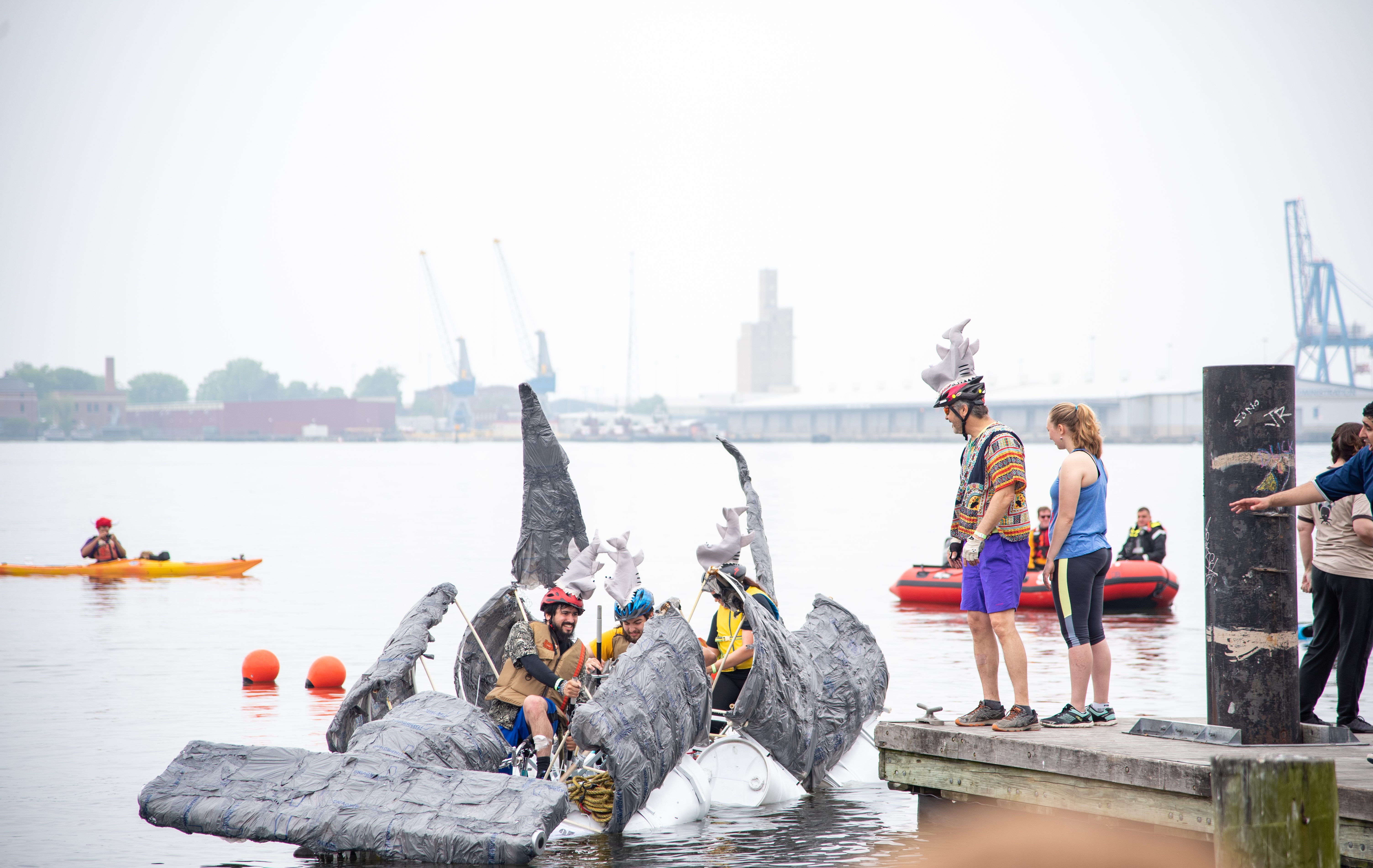
When the shark emerged from the water, the “kinetic kops” tried to slap the team with several time penalties, but the threats were quickly resolved by some lemon-flavored shark cookies made by McAlpine’s 12-year-old daughter, Lily. Graft is not only encouraged at the race, but there’s even a prize for best bribe.

Through “mysterious mathematical means,” as the race rules nebulously explain, MC Hammerhead came away in 14th place, and while the production is not about the medals, McAlpine didn’t see a single sculpture make it through the mud and sand as well as UMBC’s.

“The shark was light and fast, which attests to Neil Rothman’s engineering capstone class—they really engineered a strong and light pontoon system,” says McAlpine. “Because that’s really something that keeps me up at night: Are they going to capsize? And they didn’t do that even at full speed.”

Looking back on the experience, even the hectic last two weeks before the big day, McAlpine only sees the success of his students. “Probably the biggest interdisciplinary challenge is that you have to take a sculpture that’s meant to be static—not moving and bouncing around—and make that sculpture strong enough to have enough integrity to survive constant vibration for 14 miles of potholes and cobblestones. Given that, I thought the sculpture did remarkably well…the combination of engineering and art was a real crowd pleaser.”
*****

Header image by Poulomi Banerjee ’16.

How Will You Distinguish Yourself?

Paul Raphael ’83, economics, posed this question to a group of students who gathered in the Fireside Lounge to mingle with the executive vice-chairman of the Swiss bank, UBS.

When Paul Raphael arrived at BWI airport in July 1981—a month and a half before his first semester started—he was fleeing the Lebanese civil war. And although he had arranged with UMBC to arrive early to escape the fighting in his country, he didn’t know what his next step was going to be after getting off the plane. He introduced himself to his seatmate to explain his predicament, and she quickly put his fears to rest. She and her husband were professors at UMBC and would deliver him to the campus on their way home. They ended up waiting with him until he was settled into his dorm room.

Although Raphael doesn’t remember their names, to this day he remembers their hospitality. Their kindness, along with the support of longtime international student advocate Bobbie Shahpazian, who retired as the Associate Director of Scholarships in 2012, shaped the way Raphael thought about his education. “I remember knowing that I couldn’t go back to Lebanon because of the war,” says Raphael to the students circled around him. “I had no choice but to be successful here…and you have more chances if you’re really trying.”

Raphael quickly began planning out the rest of his life’s steps that would ultimately lead him to his position as an executive in the financial industry.

“If I really want to stay in this country I would have to do two or three things,” Raphael remembers thinking early on in his studies. “One, distinguish myself in every possible way, including academically. Two, get a master’s degree, so I am are even further distinguished. And three,” Raphael recounts, “get some work experience. So, together that was kind of my plan.”

Speaking to a predominately international group of students, the investment banker recognizes that the American political situation has changed since he was welcomed to campus three decades ago, but encourages the same work ethic he embraced decades ago: hustle. Learn another language (or two) to make yourself more competitive, take an extra class over summer break, write handwritten thank you notes after every internship, keep an on campus job (or two), connect with your professors outside of class.

Raphael’s plan to distinguish himself led him to successfully graduating in two-and-a-half years, accomplishing an MBA at MIT, and then on to a long career in investment banking. But how did he get to where it all started?

In Lebanon as a high school student, Raphael had limited information about colleges in the United States, but he knew he didn’t want to attend a large campus. From the applications available at an educational resource office connected to the American Embassy in Beirut, Raphael heard about a young college outside of Baltimore. “When I arrived I actually liked UMBC. It was, yes, small but new and nurturing… I didn’t find it as I had feared, you know, really difficult. I have to say, it was a very formative time for me.”

In the roundtable discussion with the students gathered, Raphael turns the questions back on them. Was UMBC your first choice? What is the atmosphere like for international students now? The students respond eagerly and tell Raphael about the dozens of student groups that exist to celebrate different cultural heritages on campus, and that there are now over 1,000 international students studying at UMBC from over 100 counties.

“What I am hearing,” sums up Raphael, “is that once you are here you feel—and it certainly was the case with me—the possibilities are all there to do what you want and to go where you want and to, and that’s not a given elsewhere.”

“I arrived here in 1981, and I feel like I’m a different person now,” Raphael concludes. “So coming back here almost puts me in touch with someone else, someone that’s … buried somewhere inside me. But these are layers, you know, so unless I had the UMBC layer I wouldn’t have the next layer. So this is still very important to me.”

****

Header image courtesy of Raquel Hamner ’20.

Hitting All the Right Notes

In the corner of the Performing Arts building, a haunting melody rises up in goosebump-inducing refrain and is suddenly interrupted by a quick stamping foot and an insistent correction. In a gruff but kind voice, the director of UMBC’s Russian Chorus rectifies the soloist’s rolled “r”s and the group immediately begins singing again, at ease with the complex syllables of the Russian ballad, even though some of them speak no Russian outside of this hour long course twice a week.

The chorus is one of only three like it in the whole country. Yale and the University of Chicago also boast ensembles, making UMBC’s group something of an anomaly. At the heart of the choir is the director: Slava Liberman, a formally trained choral director from Belarus who moved to Maryland with his family in the early 1990s. His passion for the folk traditions in Russian classical music has not faded in the two decades directing at UMBC; and his current group of students and alumni performers are enthralled with the world of Russian music to which Liberman holds the key.

“I love working with Slava,” says junior Felicia Jones, modern languages and linguistics. “He is the first chorus instructor I have ever had that is so passionate about what he does. He gives me a clear idea of how he wants things sung, and he always will make time for me if I feel that I need extra time to work on a certain song.”

Vira Zhdanovych, the Russian Club advisor, instructor of Russian, and herself an accomplished mezzo-soprano, sees the chorus as a compelling aspect of the Russian community on campus. Often, she says, her students need to be encouraged with a little extra credit to begin participating, but once Liberman connects them to these historic songs, they keep coming backeven as alumni.

“The chorus was an amazing way to learn a language through experience,” says Logan Dean ’17, political science and social work, who joined the group in 2017 while in Russian 101. Currently a financial aid counselor at UMBC, Dean says that Liberman is the reason he spends his lunch breaks returning to sing songs like Katyusha, The Long Road, and Moscow Nights.

“There is something about seeing someone so passionate about something, it just really motivates you,” Dean says. “He regularly tells us to stop laughing at him when he’s stomping his feet and shouting in Russian, but all his actions happen because he has a vision for us and for the music and it gives him this intense energy about directing.”

Liberman says he plans on continuing the Russian Chorus until he’s no longer able or allowed. He turns to a poetic Russian phrase to describe its effect on the students and campus alike: “Луч света в тёмном царстве,” which translates as “the brightest light in the darkest kingdom.” Watching his American students overcome linguistic barriers, learn to sing Russian vowels, or fall in love with folk music of the 20th century is a moment of watching that light shine. “For me, it’s a big privilege to work with these American students. Each time when I hear they are doing better, it’s like a victory.”

I think everyone should find their version of Russian Chorus,” says Dean. “Something weird and maybe unusual that they enjoy. It makes life more interesting and opens doors to new things that you may have never experienced otherwise.”

*****

Header image: Sheets of Russian choral music with student notes. Photo courtesy of Randianne Leyshon ’09.

URCAD Puts Student Research in the Limelight

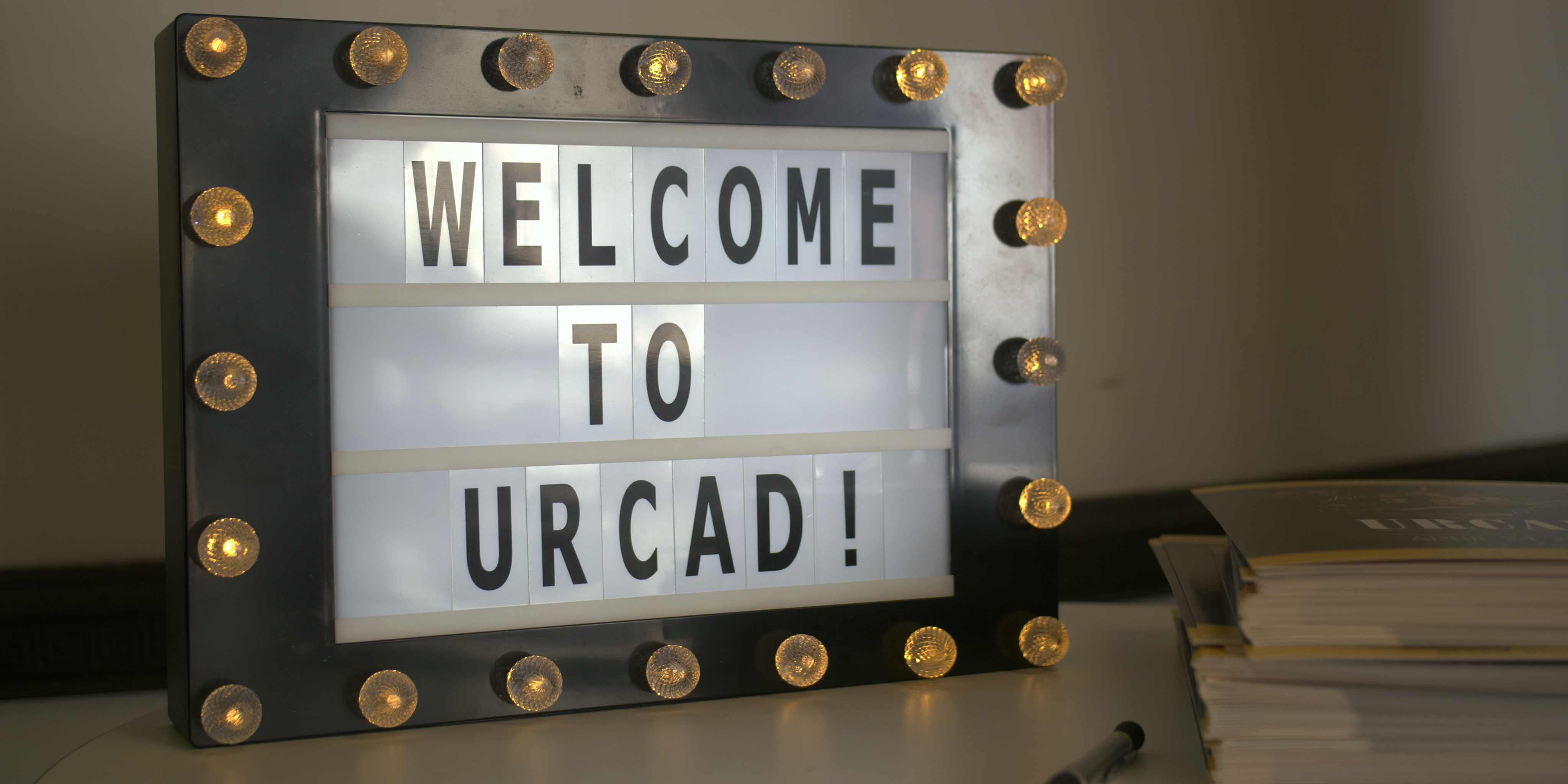
When UMBC’s 23rd annual Undergraduate Research and Creative Achievement Day (URCAD) was briefly paused to respond to a fire drill, Howard Nicholson ’21, chemical engineering, did not skip a beat. The Undergraduate Research Awardee unrolled his poster outside and continued to explain his work done with biosensors, which would allow real time drug monitoring to compensate for patient-to-patient variabilities.

“It’s great to see your work come to fruition,” says Nicholson, who also presented at URCAD in 2018. “You see how it all makes sense, and I’m able to solidify my own knowledge and educate others on pressing issues in the scientific community.”

Through the course of the day, which featured undergraduate work from thermodynamic modeling of pollutant uptake by freshwater mussels to a video game that promoted therapy rehabilitation for post-stroke patients, and even a light show with a fog machine, students shared their best and brightest ideas with the campus community and beyond. Now in its 23rd year, URCAD has given thousands of young researchers the chance to highlight their individual interests as well as collaborative work between professors and students.

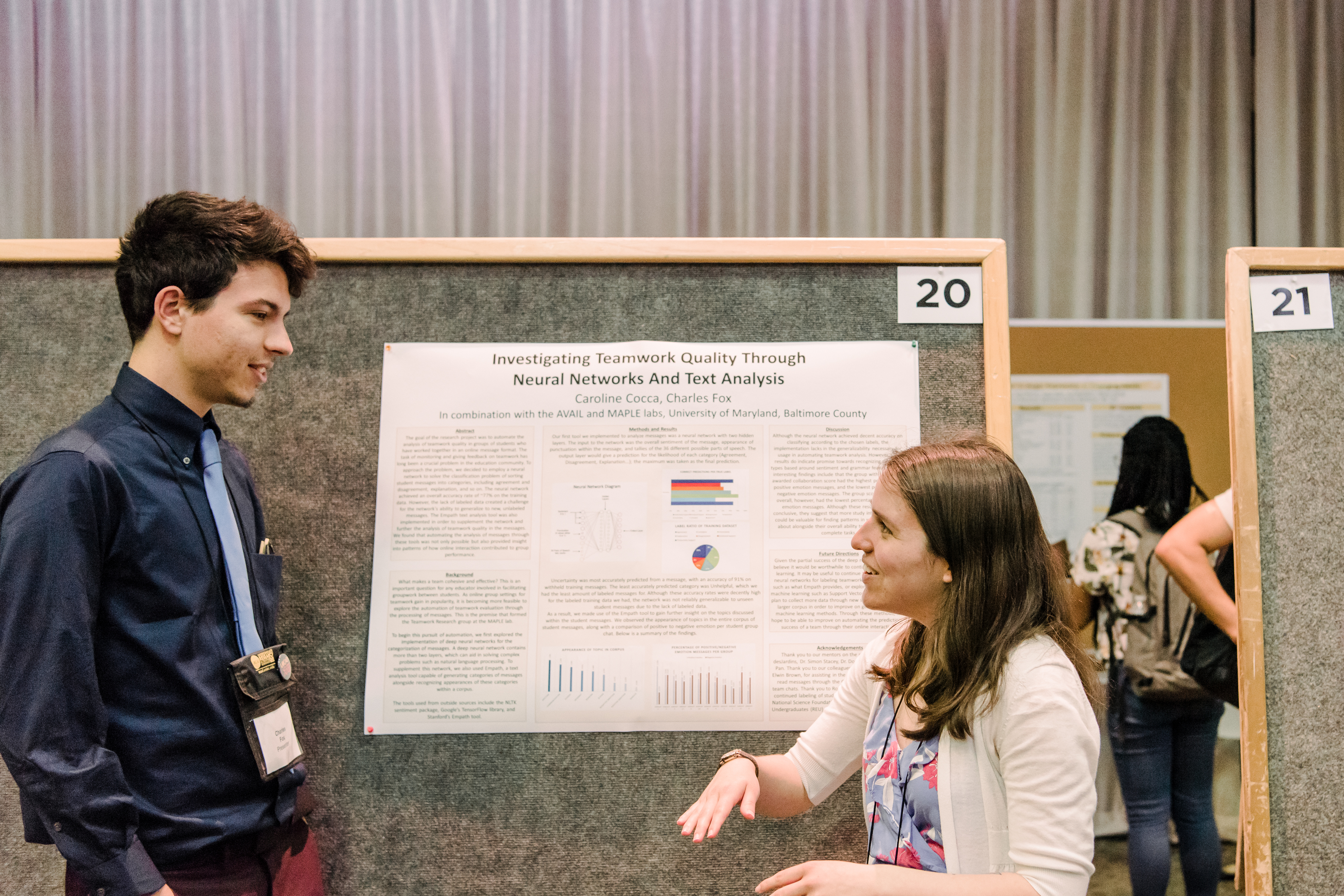
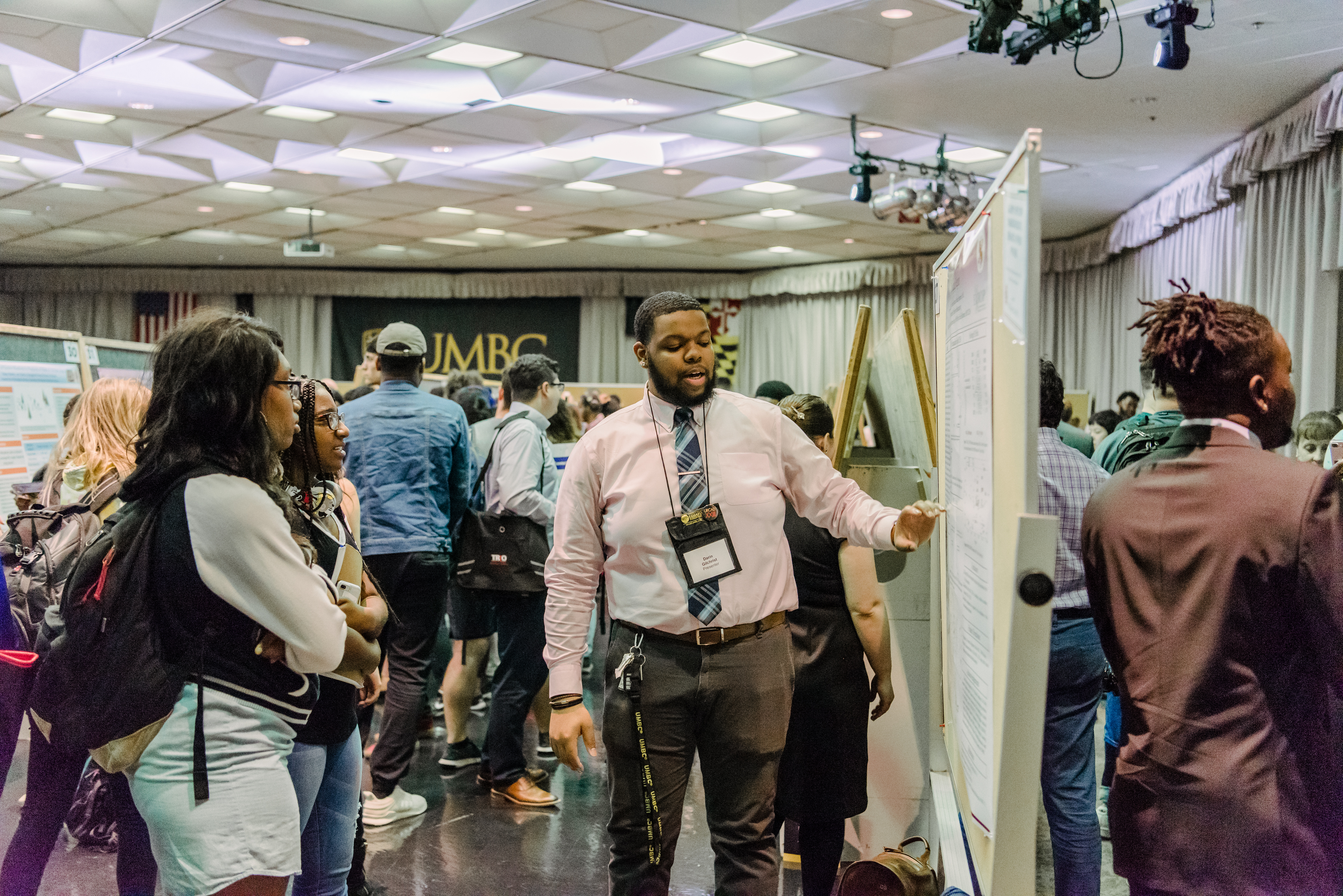
Students present their poster presentation and hone their talking points throughout the day.

Campus practically comes to a standstill on this day, with ample opportunities to geek out about groundbreaking research from students just starting out in the field. 

“I love to see students succeed,” says Dr. April Householder, Director of Undergraduate Research and Prestigious Scholarships, and URCAD coordinator. “There’s nothing better than to watch a student have an idea that they’ve taken maybe a couple of months ago, maybe a couple of years ago, and develop that over time… and then to come to a day like this and see the culmination of that work and to celebrate within our community and see, really, from beginning to end what that process was like for them.”

Back in the Ballroom, Hye Jin Park ’20, psychology, explains the connections she found in her research with Charissa S. L. Cheah on the role marital quality and parenting plays in Korean-American children’s social problem-solving skills. Park, who is Korean, says that Cheah, a professor of psychology, provided her with two graduate student mentors to work with who were also Korean, and that their collective language abilities allowed them to connect with their subjects on a deeper level.

“Dr. Cheah’s door was always open, “ says Park, an undergraduate research awardee. “She was open to how I wanted to conduct the research and present the findings. We met often for her to explain any revisions, and in fact, we’re planning on working together on a different project in the future.” Park plans on continuing to focus her research on Korean populations, “We’re underrepresented in research.”

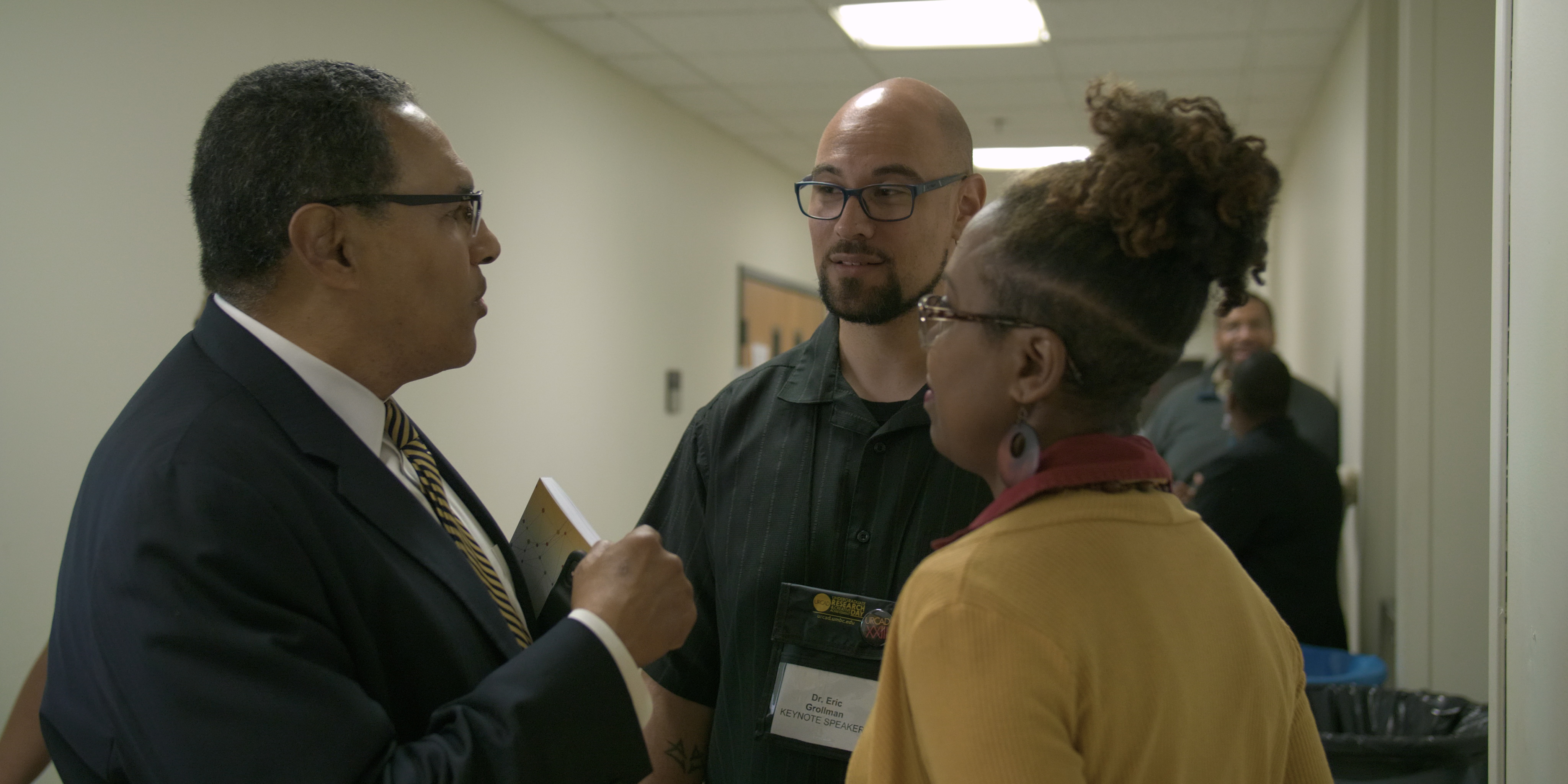
Eric Grollman ’07, sociology and psychology, now an assistant professor of sociology at the University of Richmond, spoke in the keynote address about the inherent political aspects of science. As a scholar-activist during their time on campus, Grollman encouraged the students present to embrace the activism necessary to have their voice heard.

Here’s a small collection of highlights from the day. To learn more, visit ur.umbc.edu.

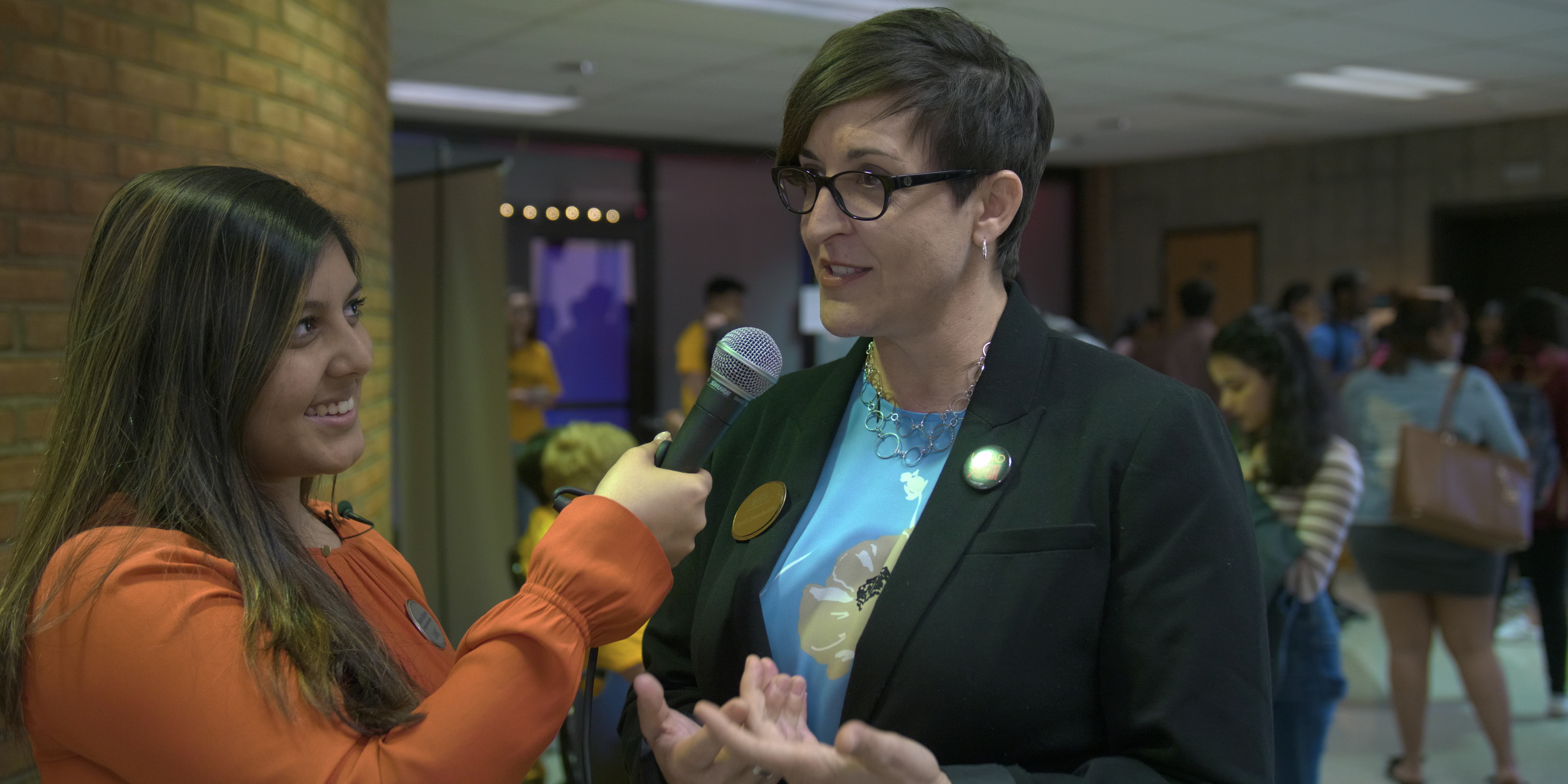
Dr. Hrabowski speaks with Keynote speaker Dr. Eric Grollman and Lisa Gray, UMBC's Associate Director of Diversity and Inclusion. Poulomi Banerjee '16 interviews Dr. April Householder, Director of Undergraduate Research and Prestigious Scholarships, and URCAD coordinator on the day of the event. Photo courtesy of Corey Jennings '10. Throughout the day, students have many chances to hone their research talking points.

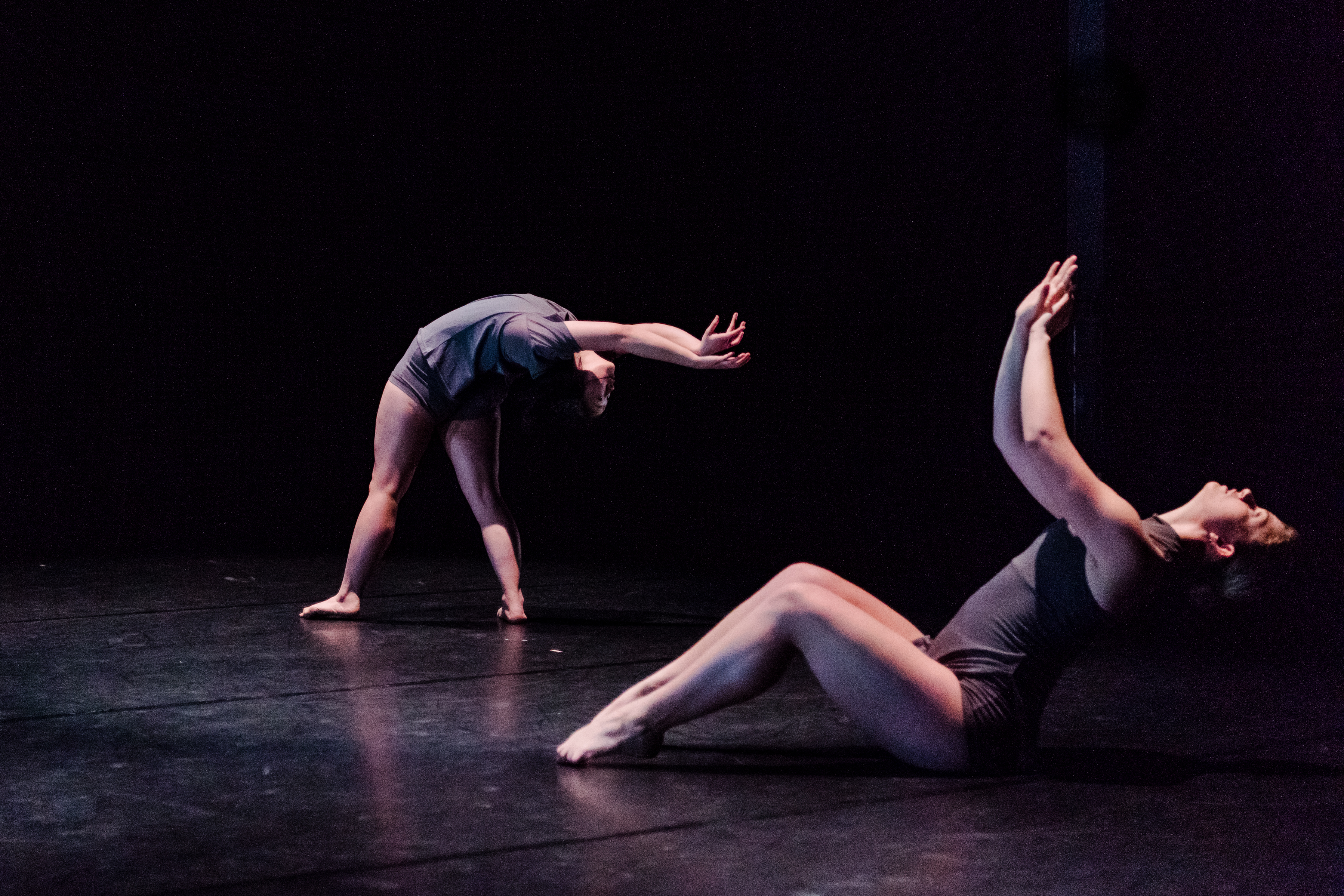
Students from dance, music, and theatre showcased their pieces in the PAHB Dance Cube.

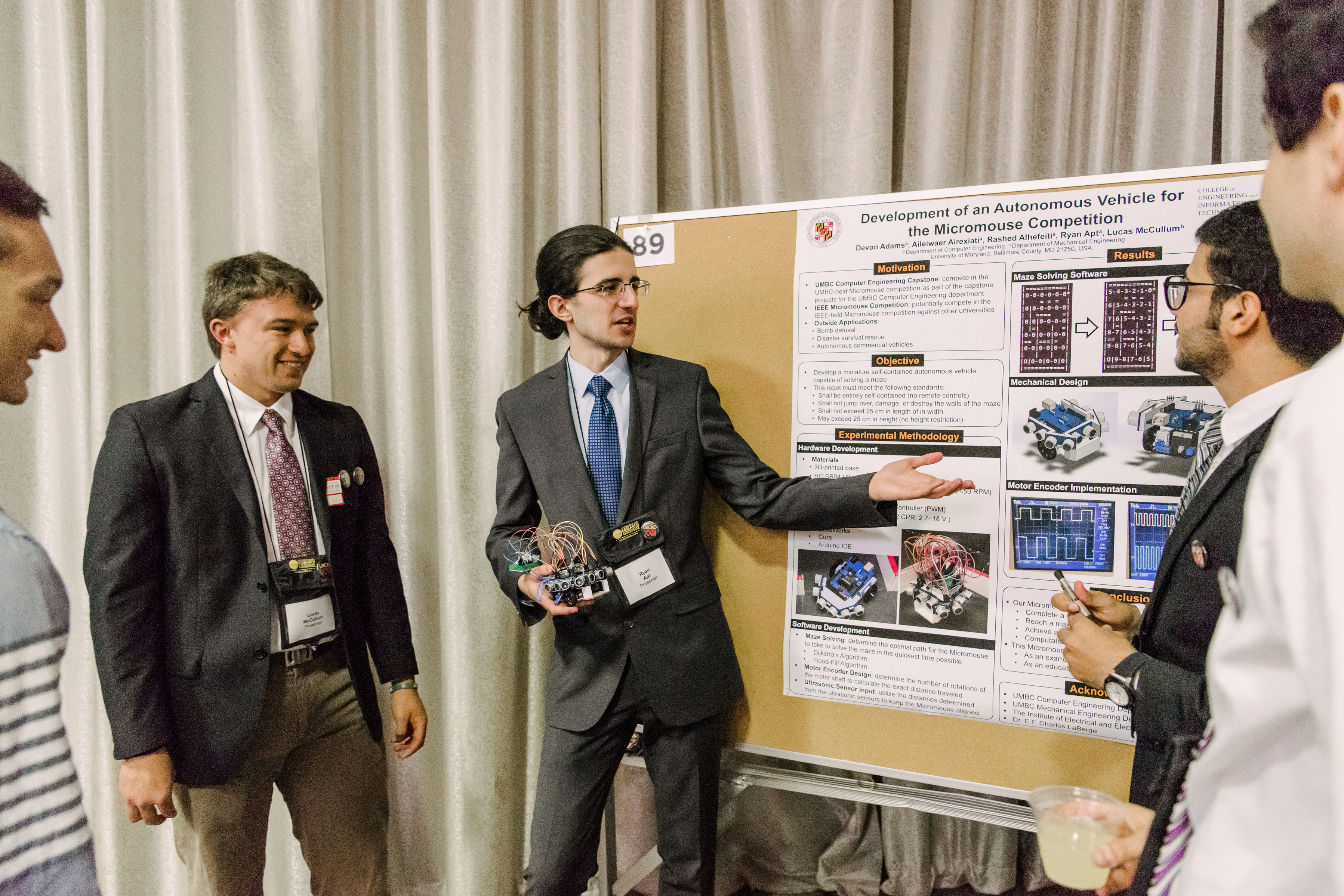
Mechanical Engineering capstone students explain their research.

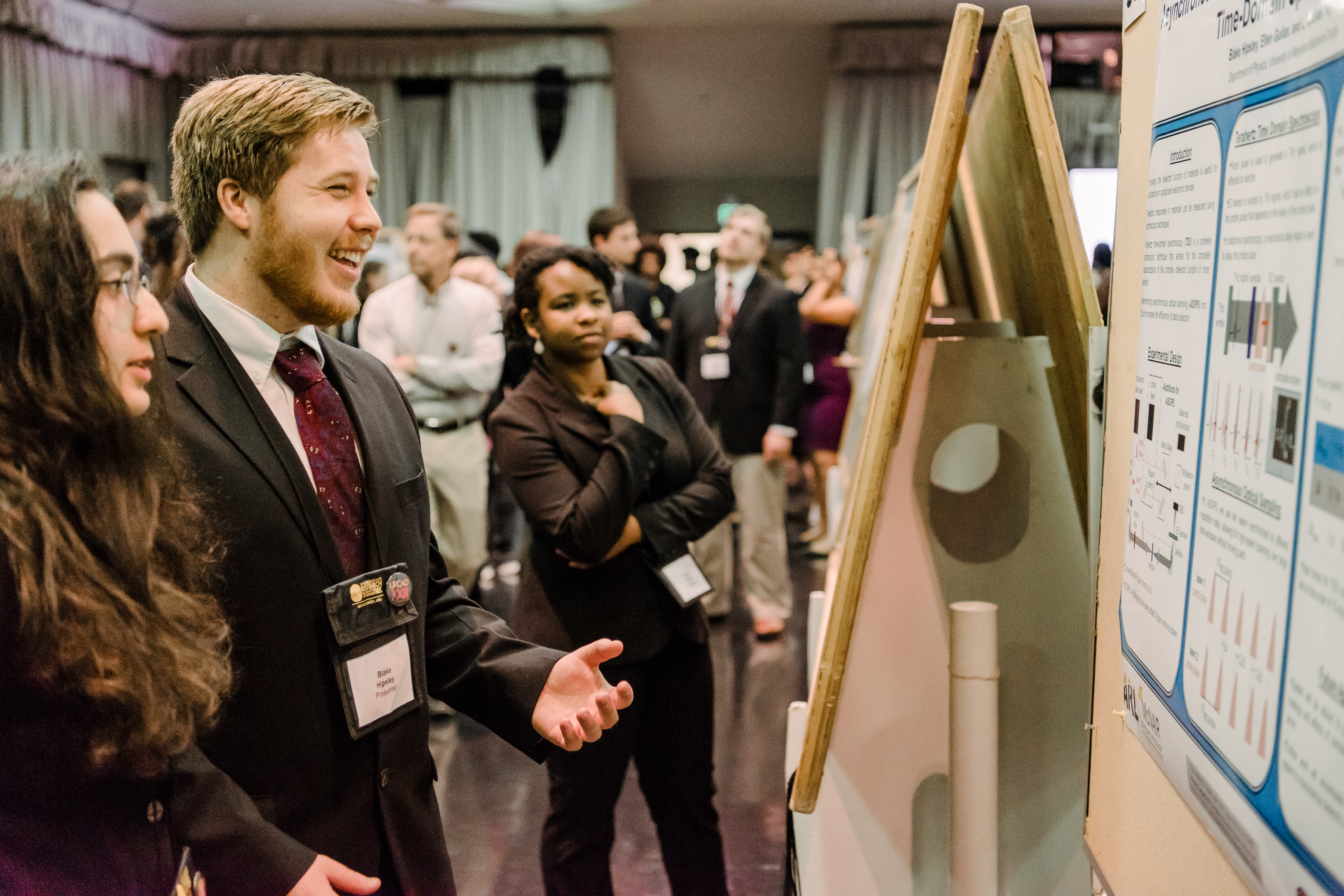
The research ranged from robots to teamwork analysis through texts and everything in between.


Congratulations to all the 2019 URCAD presenters! Who is already preparing for 2020?


****

Unless otherwise noted, all photos, including the header image, are courtesy of Marlayna Demond ’11.

Making UMBC Shine

Alumni in the filmmaking industry are behind the scenes of UMBC’s new brand video.

Last week, UMBC rolled out a sparkling new brand based on more than a year’s worth of community input. With it launched a fresh new homepage and icon, as well as a video meant not only to pull at the heartstrings of #RetrieverNation, but to welcome new Dawgs into our special community.

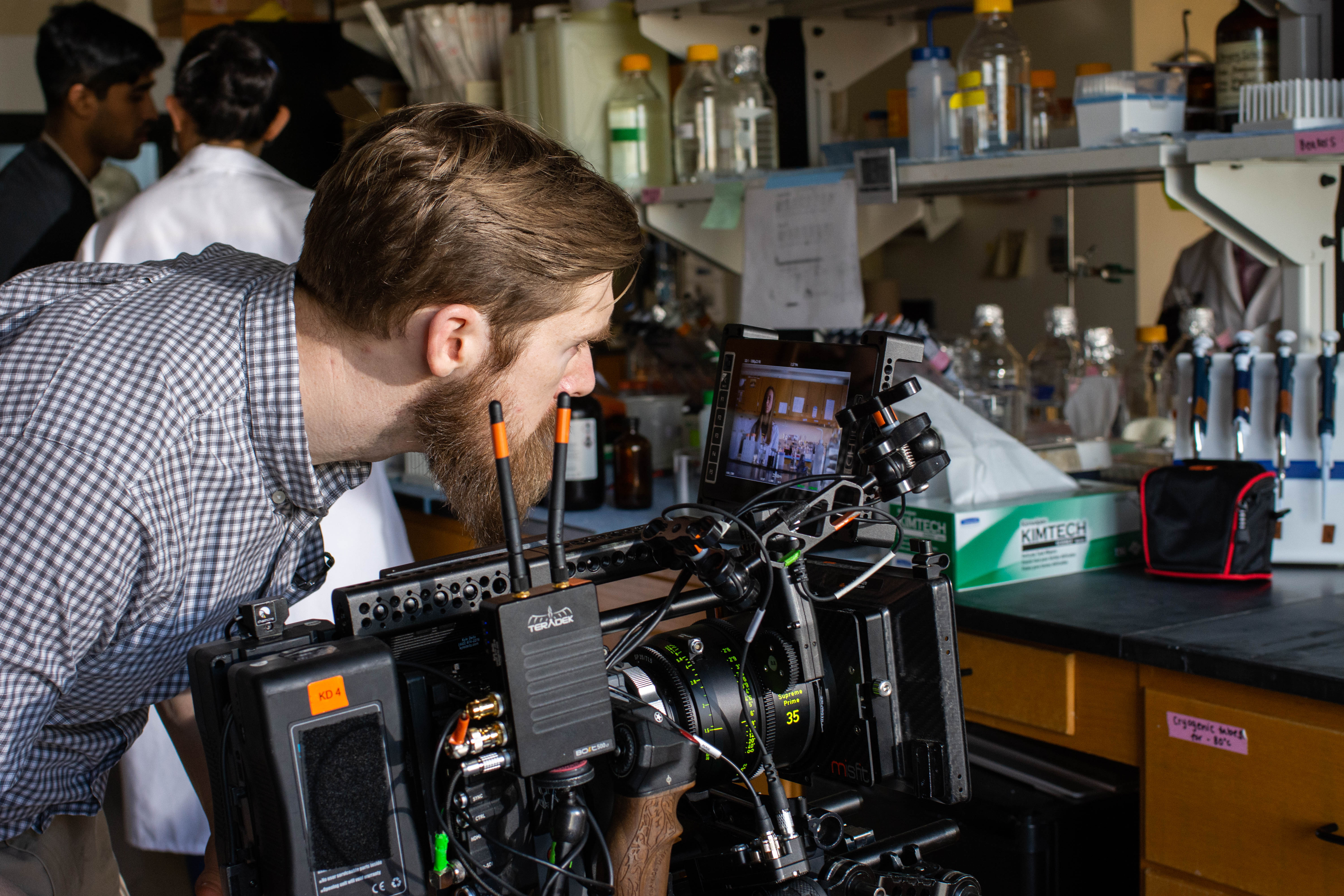
Woven through the video are scenes and sentiments that many in our community will immediately recognize. But what you might not know is that there was as much Retriever effort put in behind the scenes as there was captured by the camera. Here’s a sneak peek at the Retriever alumni—directors, producers, gaffers, and makeup artists—who helped make this video a success.

Reconnecting and Directing

For UMBC’s video producer, Corey Jennings ’10, economics, this project was the culmination of months of collaboration with campus partners—partnerships that he created as a student on campus. In directing a video to announce the launch of the University’s new brand, Jennings instinctively knew the strengths of his alma mater to highlight.

In the UMBC community, he says, “we all knew in the back of our minds there’d be this flashpoint where we could say ‘look and see.’ The 2018 NCAA upset and our first Rhodes Scholar [Naomi Mburu ’18, chemical engineering] gave us an opportunity to tell our story in a larger way, and through this brand launch we’re given the chance to refocus the narrative of UMBC.”

Corey Jennings directing on set.

Jennings points to an unscripted moment of the production that made the cut when President Hrabowski is chatting with students on set. “It was just Freeman being Freeman,” says Jennings. “Your character is who you are,” Hrabowski said to the small group gathered. “Through his words, we found a story we didn’t even know we were telling. Something like this happens in almost every interaction with leadership here,” says Jennings. “They truly care about the community.”

While Jennings knew that the project’s executive producer, Liz Norton, was also a fellow alum, the rest of the Retrievers on set were a surprise to him, but only slightly. “The University is deeply ingrained in the local production industry,” says Jennings, whose wife Carly Faye Engelke ’08—a Linehan Scholar and a dance major—is active in the Baltimore performing arts scene. Even the project’s videographer Kyle Deitz can trace his Retriever roots through his mother, Mary M. Deitz, who earned her degree in economics from UMBC in 1982.

Through the investment of students and alumni and staff in the UMBC community, says Jennings, “this video allows us to reflect on who we already are and the truth that we’ve always been this way, but maybe the outside world just didn’t know.”

A Makeover for the Ages

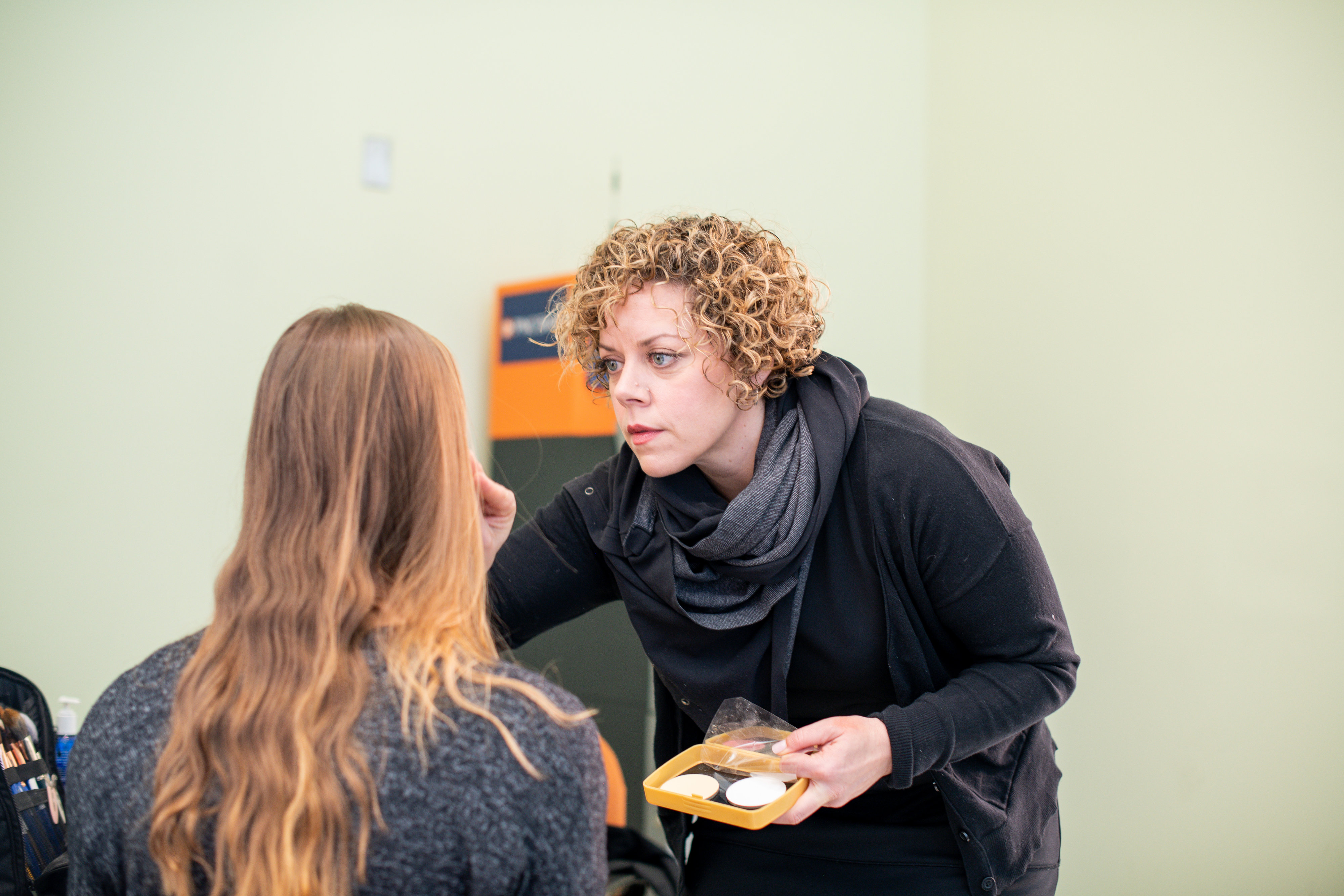
Alexis Arenas ’01, history, didn’t anticipate being the makeup artist for a film production at her alma mater, but as a history major, she knows the importance of returning to the past. “It’s an honor to play a part in telling the story of the future. I enjoyed my time here so much, I want to bring UMBC to a wider audience.”

Tucked away in a corner of The Commons, Arenas stood by her makeup staging area, ready to touch up the faces of the UMBC talent on set. In the past, she’s brushed the faces of Tony Bennett, Stevie Wonder, and Lin-Manuel Miranda, but today’s star is someone slightly more familiar: President Freeman Hrabowski. Between shots, Arenas commented on the many campus changes in the past two decades—in her time, she said, students’ central hangout space was the University Center.

As a member of the Makeup Artist Union in New York and having trained in London, Arenas sees a clear tie from her roots at UMBC to her career based in Ellicott City today. “UMBC taught me research skills, and research is necessary to what I do,” said Arenas, who often works on period piece films and vintage projects. “History is integral to being a top notch makeup artist.”

When Alexis Arenas arrived as the set's makeup artist, she proudly claimed her alumna status.

Putting UMBC in the Best Light

Daniel Stack ’10, fine arts, the gaffer—or the chief lighting technician—of the film crew, boasts quite the UMBC family tree. His parents both graduated in the first decade of graduating student classes, and his mother is a member of the Founding Four (Anne Brant Stack ’72, English, and W. Stewart Stack ’78, interdisciplinary studies). His wife, Elise Stack ’03, English, is also a UMBC alumna, as is his brother, and several cousins.

One thing people should know about UMBC, said Stack, is this: “If one person in your family comes to UMBC, everyone else will come to UMBC, at least that’s what I’ve learned.”

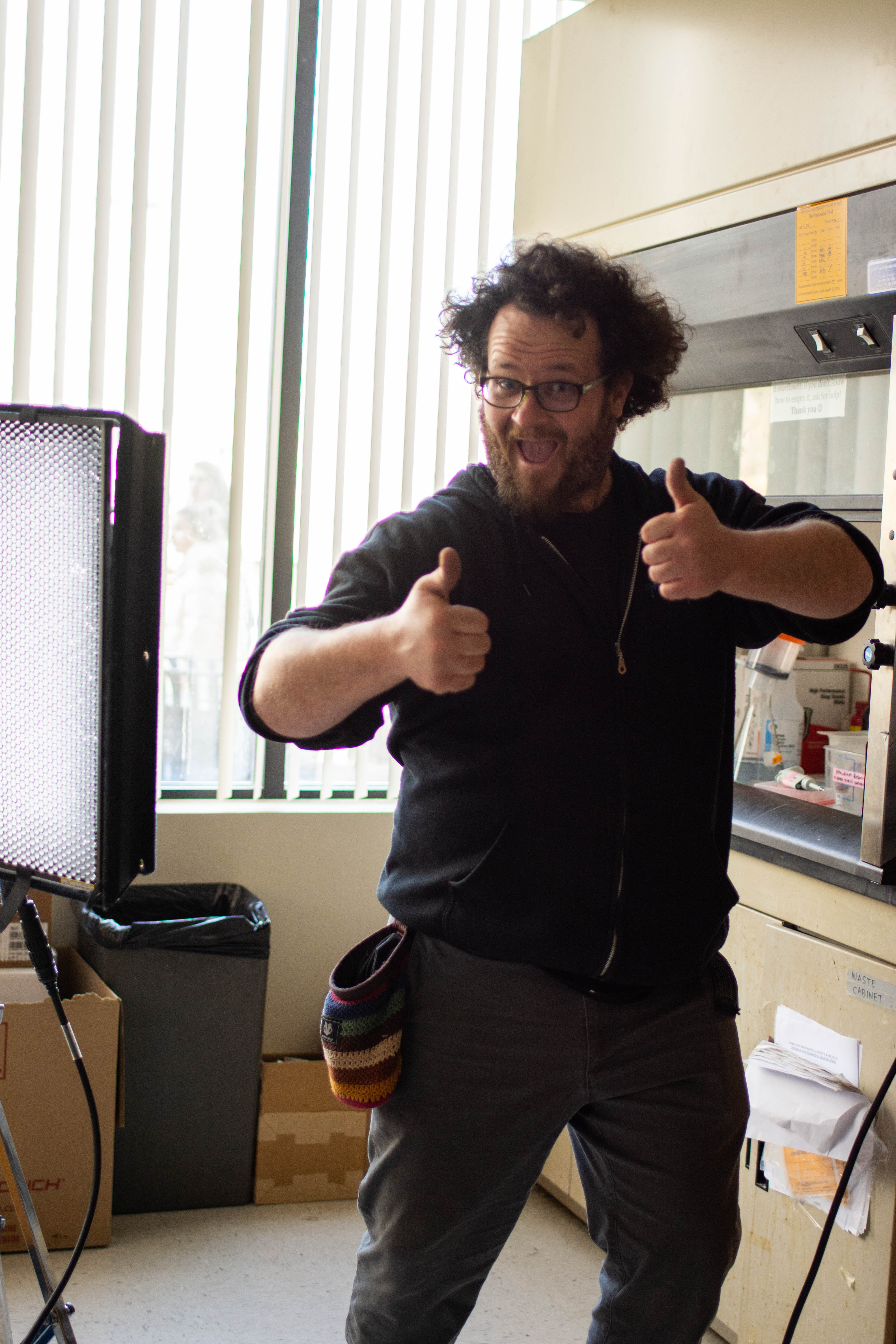
Stack was a Linehan Scholar who immediately started working in the family business. His father started Serious Grip and Electric in 1983 (we recommend their website for the most thrilling About Us page on the internet). As the gaffer on set for this project, he’s literally in charge of letting the best parts of UMBC shine—from lab beakers to sports bleachers.

Nerd Pride Production

Liz Norton ’06, visual arts, is the executive producer on set. Another former Linehan Scholar (who showed up to the first day of the shoot in her UMBC vs. University of Virginia bracket t-shirt) was clearly happy to be back on campus, repping her Retriever pride. Norton works at Three Seas, a collective of boutique creative companies. She reached out to UMBC creative services after UMBC’s NCAA 2018 upset. With reignited pride in her alma mater, she suggested collaborating on future projects.

Thinking back on what’s stayed the same since her time on campus, Norton immediately replies: “Nerd pride. We’re here and we’re ourselves. We’re proud to be excited about whatever cool is going on at the University.”

Liz Norton stands in for the basketball players as the crew gets the lighting ready for the shot.

After coordinating the project behind the scenes weeks in advance—including organizing the crew and equipment and managing the timeline and budget—Liz now watches her production advance smoothly throughout the day, Norton notes, “there’s so much diversity here that the video captures so well. There’s diversity among the students, but the students also pursue diverse interests.”

On the last day of the shoot, again wearing black and gold, Norton reflects on the project, “The creators’ vision for this video resonates with me in terms of community and character. UMBC has stayed really consistent with these things over time.”

In charge of lighting on set, Dan Stack is part of a complex family tree of Retrievers.

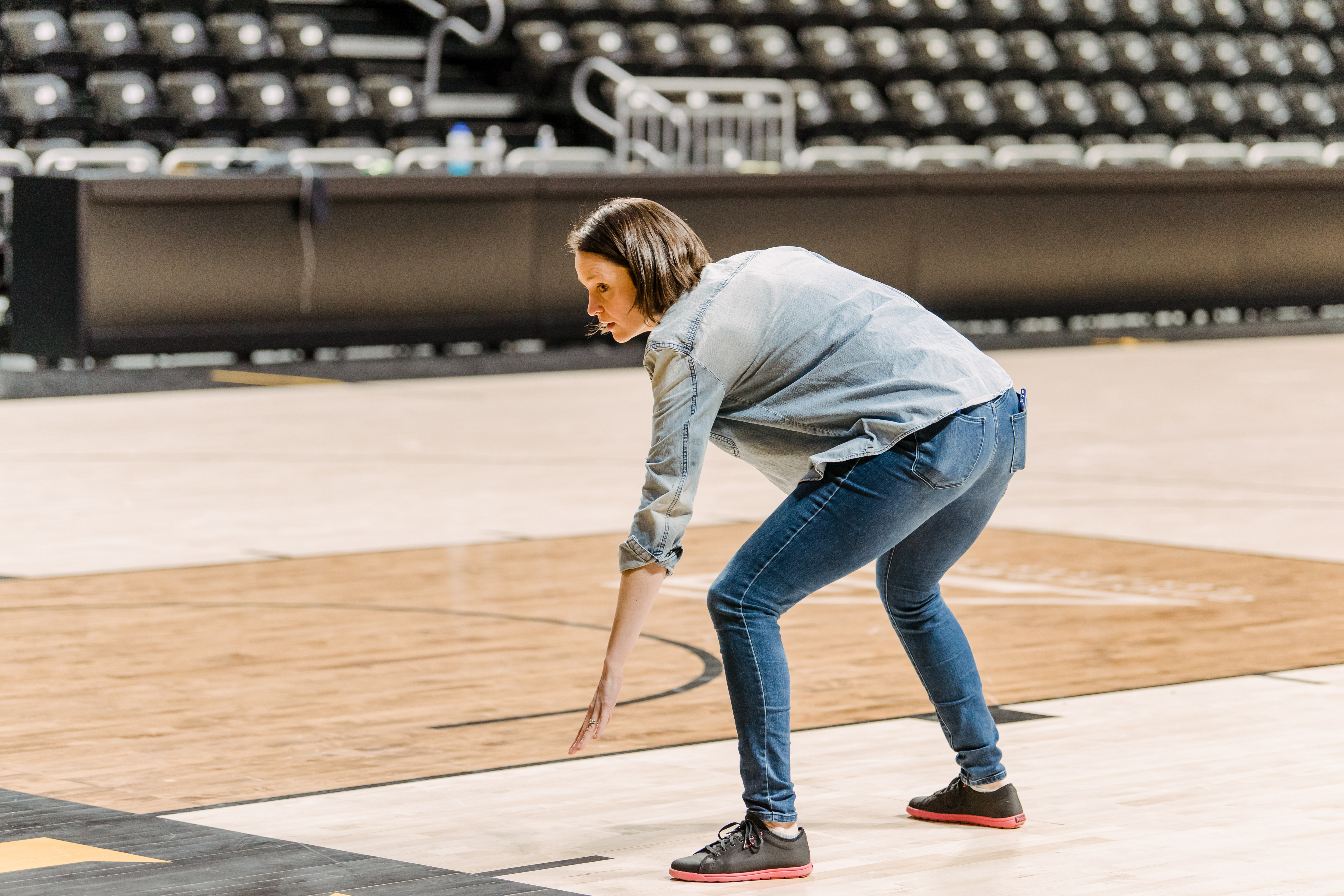
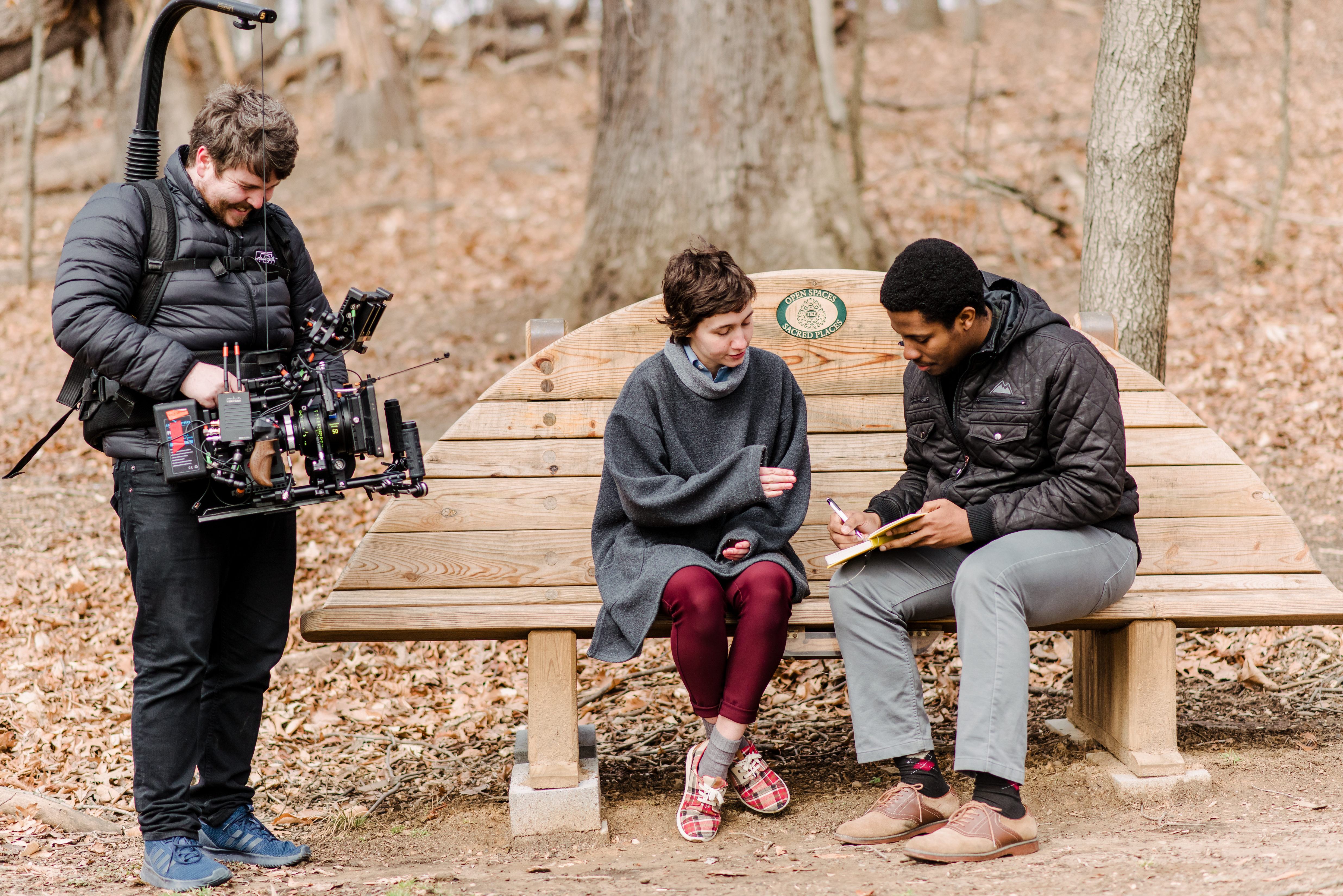
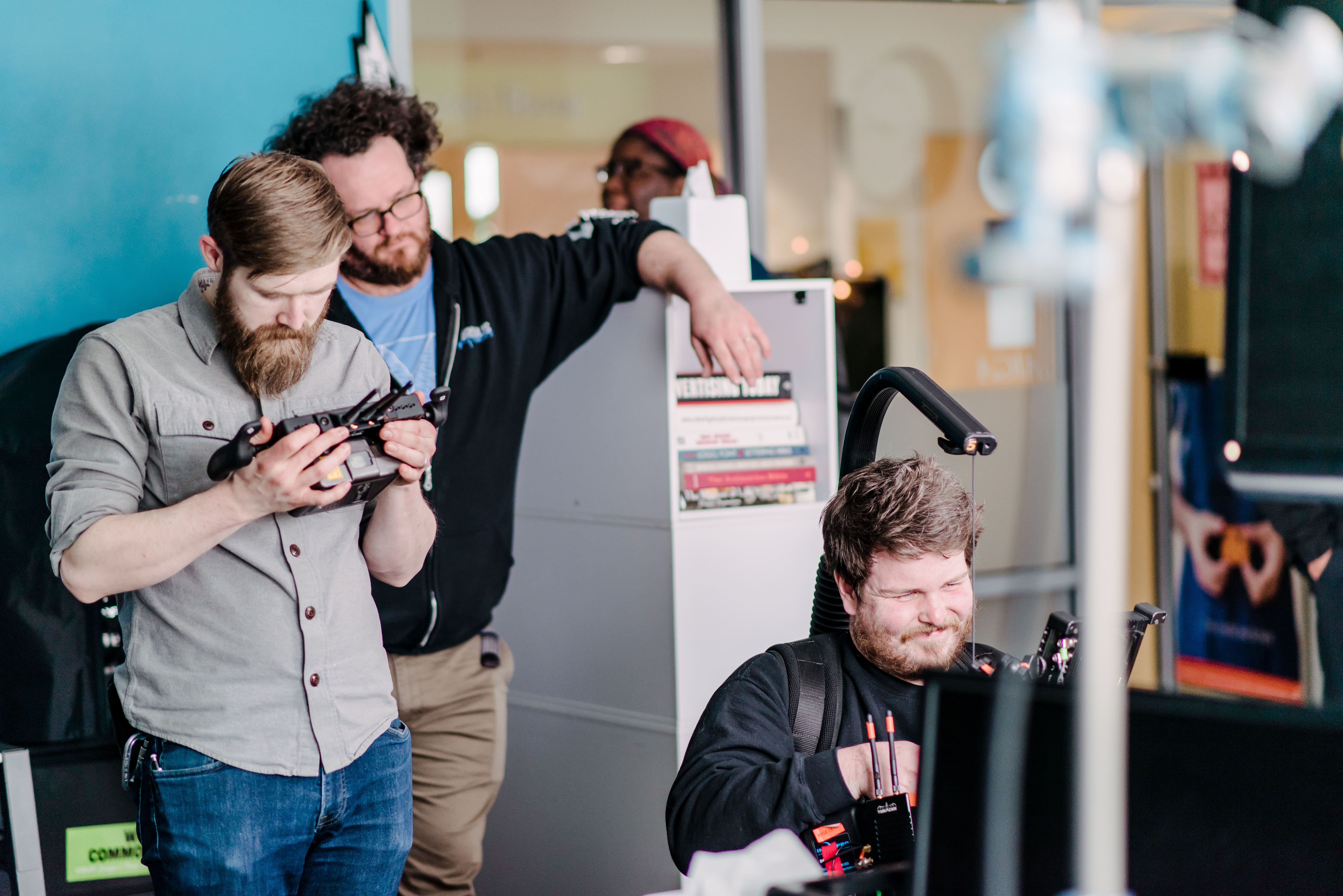
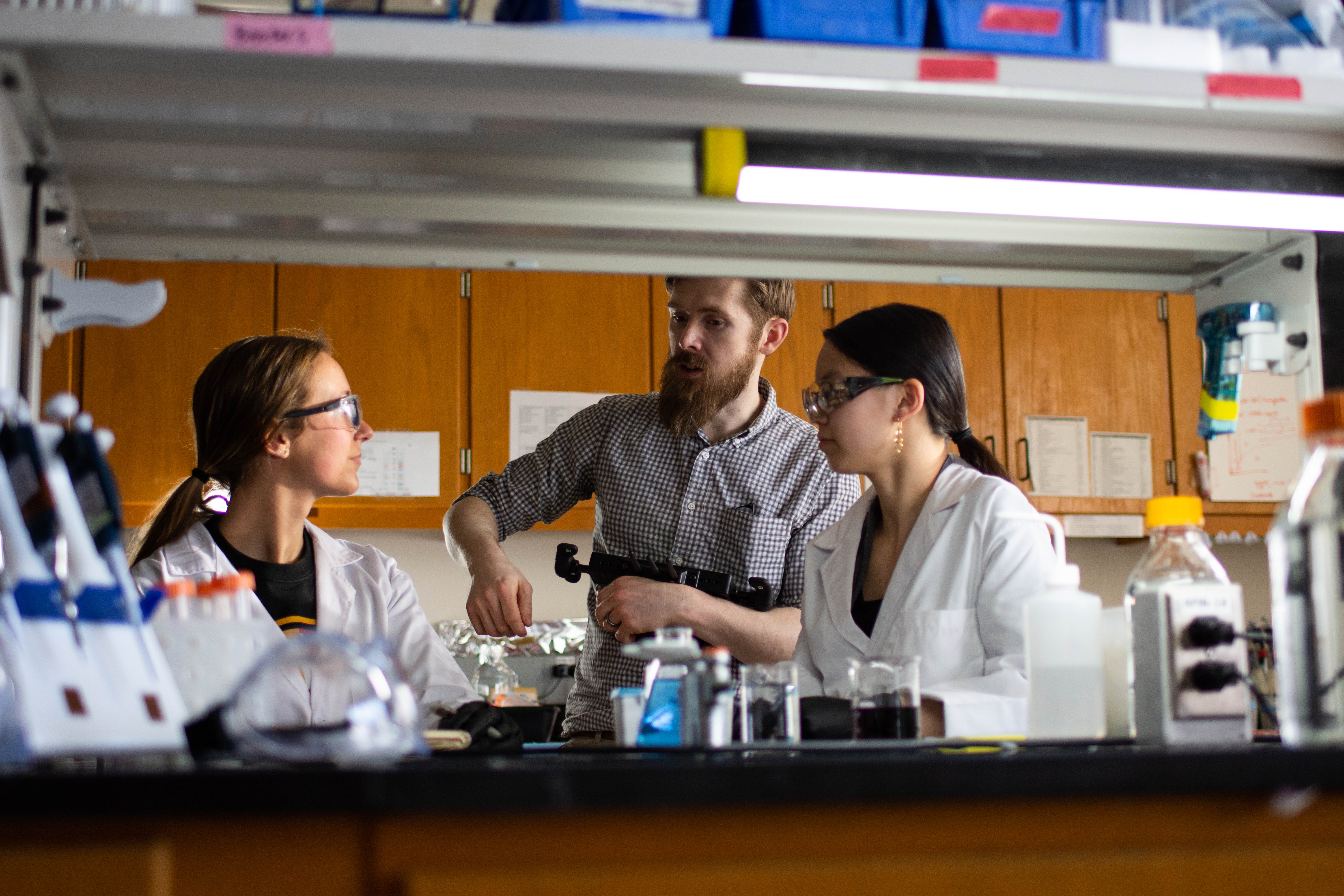
Behind the scene shots for the new brand video.

****

All photos courtesy of Marlayna Demond ’11, Raquel Hamner ’20, and Ana Isabel Martinez Chamorro for UMBC.

****

Cast: Giavanni Powell, Kennedy Lamb, Linda Wiratan, Joe Sherburne, Ryan Odom, Lloyd Ekpe, Laura Schraven,  Mia Rickenbach, Darian Garcia

Crew:

Director of Content Development: Jenny O’Grady
UMBC Video Producer/Director: Corey Jennings
Executive Producer: Liz Norton
Producer: Dave Willis
Director of Photography: Kyle Deitz
Assistant Camera: Nate Spivey
Gaffer: Dan Stack
Audio: Lorenzo Millan
Hair/Makeup: Alexis Arenas
PA: Alex Papalitskas
PA: Andrew Hwang

Special Thanks: UMBC Athletics, Center for Art Design and Visual Culture, Campus Life Operations, Commonvision, UMBC Dance Department, Michael Summers, Summers Lab Staff, UMBC Transportation, Residential Life

Together We Rise — Annual Scholarship Luncheon

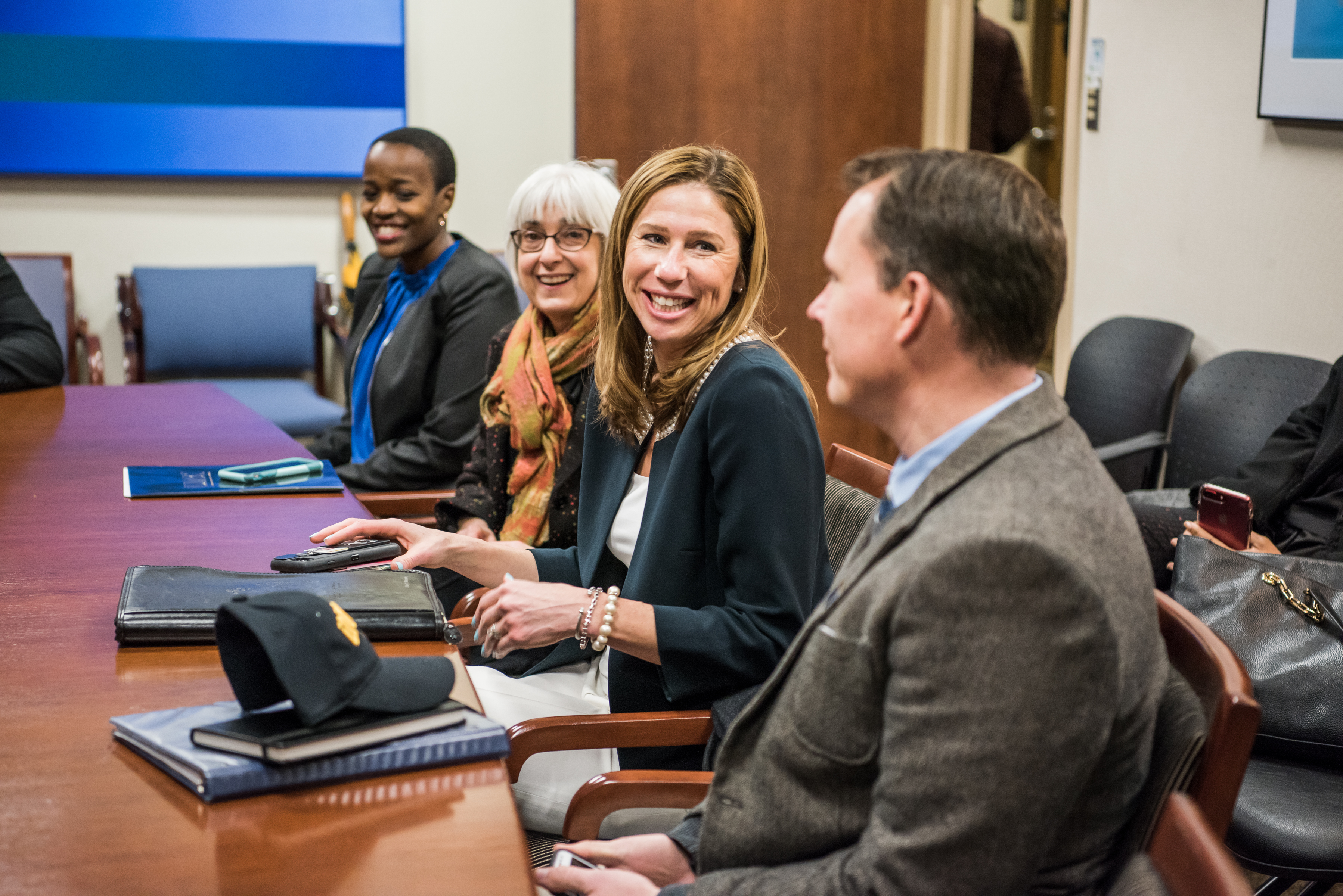
In an average gathering on campus, members of a crowd will generally have some connections, like shared Facebook friends or a favorite professor. At UMBC’s 8th annual Endowed Scholarship Luncheon this month, however, the ties went much deeper.

Here, student recipients of endowed scholarships were able to meet and mingle with the backers of the financial support that’s helping them succeed. For many students, it’s the first time meeting their donors — and a special opportunity to say thank you.

Meeting Your Match

Jonathan Acuna-Lopez ’19, English, recipient of the Sandy King Geest Endowed Scholarship met the eponymous donor at the luncheon, as well. “It makes me feel really happy [to meet Geest]. After today, I know what this person is like: you’re the same as I am, you worked hard the same way I’m working hard.”

Standing next to Acuna-Lopez, Sandy Geest ’72, English, listens to him recite their similarities. She adds, “Like Jonathan, I was the very first in my family to go to college. He and I both grew up in Montgomery County. He’s a literature major, and I was also a literature major.”

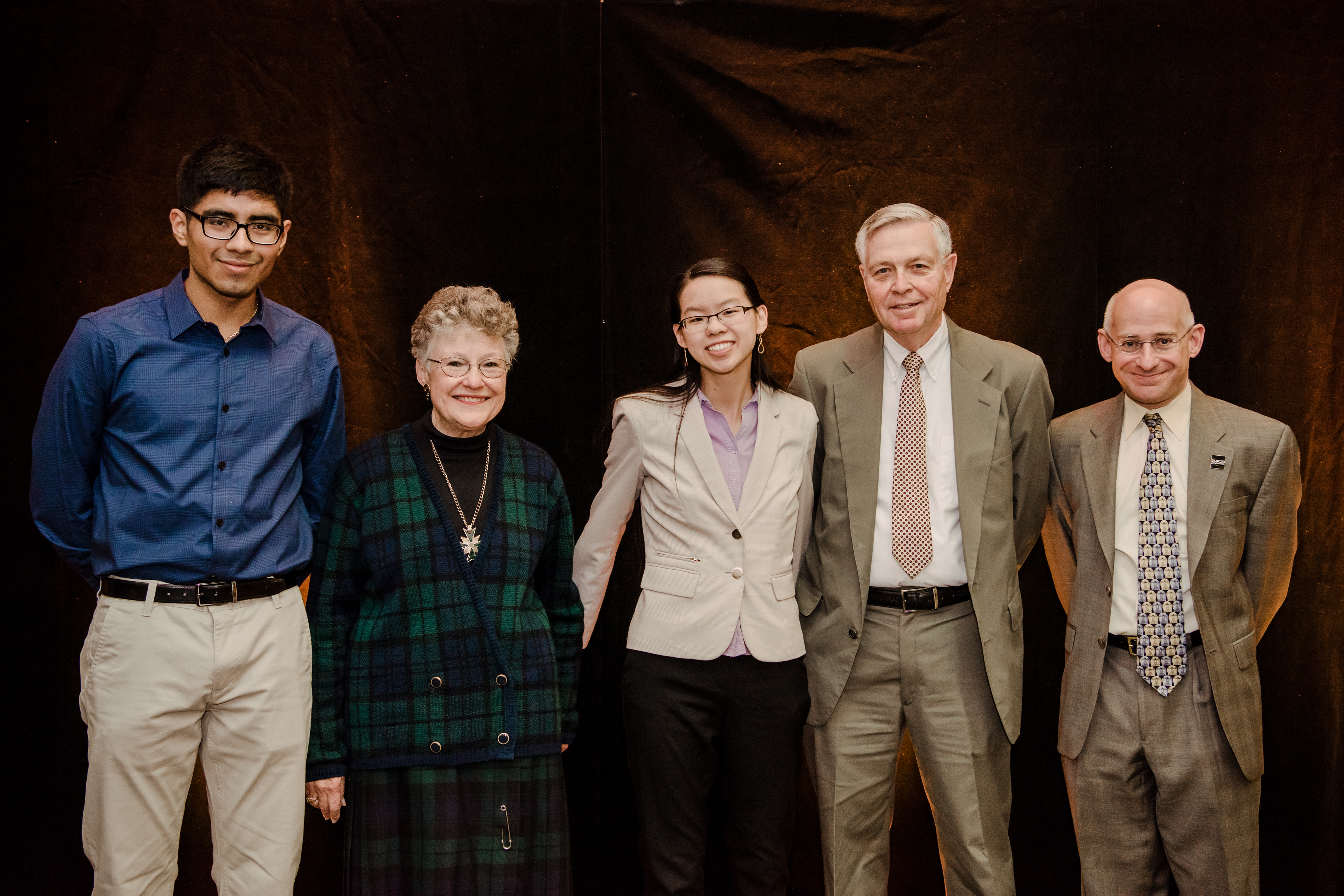
Jonathan Acuna-Lopez, Sandy Geest, Linda Wiratan and Jay Geest gather at the luncheon.

Discovering these ties gives depth to what could be a simple financial transaction, but both Geest and Acuna-Lopez know that it’s so much more.

“It’s good to give back and help someone else,” Geest says, smiling up at the much taller student. “When you’ve had enough struggle yourself… I worked several jobs to pay for school, so I felt like it was really something I wanted to do.”

Early on, Geest gave the modest amount she could afford. “I gave $10 — $5 to the Alumni Association and $5 went to the English department.” But after deciding to create the endowment, Geest and her husband Jay redirected their giving to support the English department.

Acuna-Lopez has his eyes set on graduation in December 2019 and is considering pursuing a master’s degree in secondary education at UMBC. “I know personally I wouldn’t be here without the help that my teachers gave me and the support that they gave me, so I feel like it would be nice to change someone’s life in that way.”

Ties that Bind

Alison Mayas, mother of twin UMBC graduates with twin degrees — Jhilya Mayas and Rabiah Mayas M8, ’00, biochemistry and molecular biology — likes to say that Freeman Hrabowski made a liar out of her.

“When my girls were growing up, I told them they could go anywhere they wanted for college,” says the recently retired executive vice president of MayaTech Corporation, a company she started with her husband Jean-Marie Mayas. But then she heard Dr. Hrabowski spreading the word about UMBC, “and he was speaking my language.”

So when Jhilya and Rabiah finished high school, Mayas drove them straight from their home in Silver Spring to start their summer classes in the Meyerhoff Scholars Program.

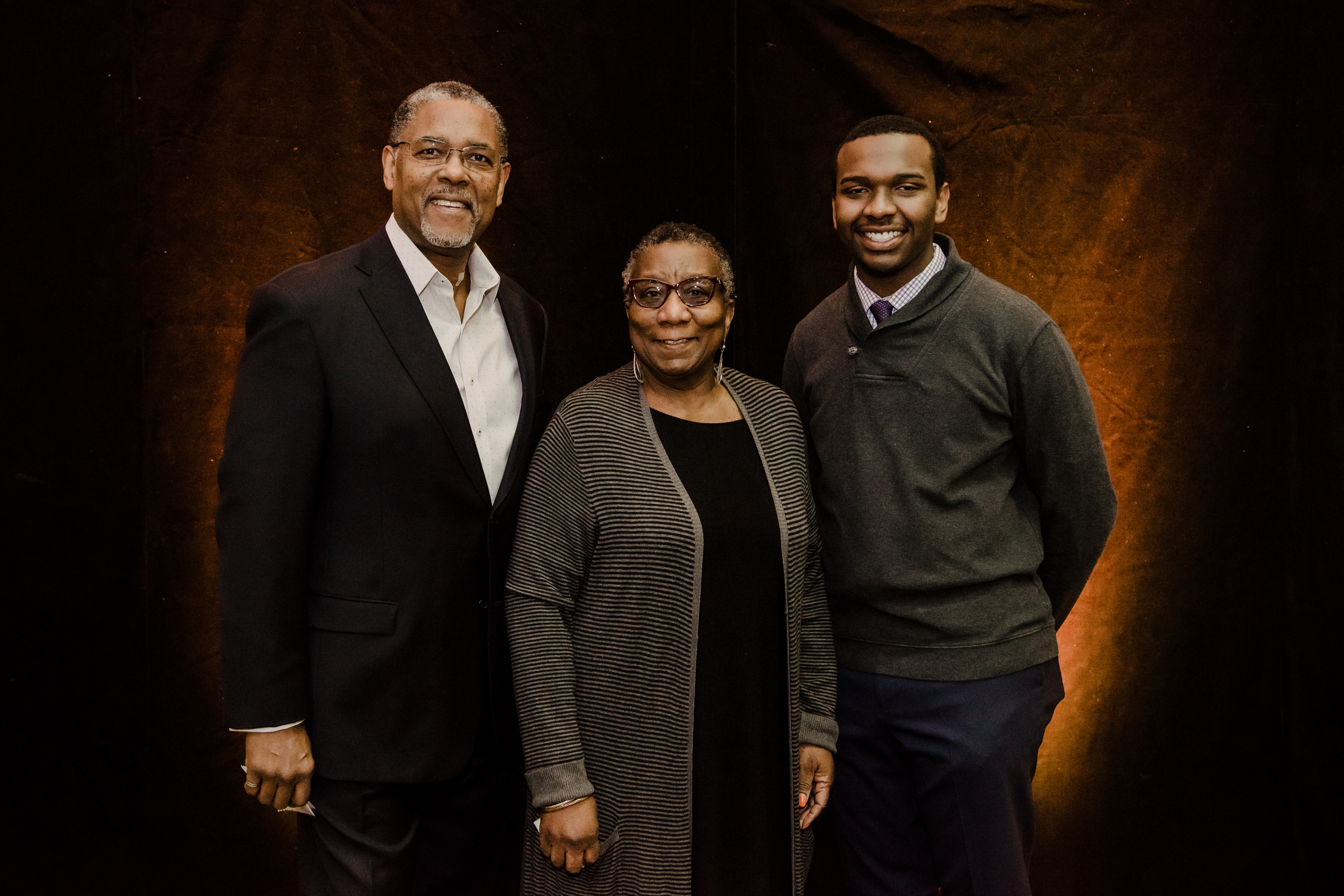
Jean-Marie and Alison Mayas with student Evan Carlyle.

Now, the Mayas family endows a scholarship for the next generation of Meyerhoff Scholars.

Evan Carlyle ’22, M30, biochemistry, is the recipient of their Fredricka Pemberton Harris award. “I chose UMBC because of the people,” says Carlyle. “And I received the offer to be a part of the Meyerhoff Scholars Program, which was a dream come true…at UMBC I feel like I am actually learning and having my knowledge and understanding tested.”

Sitting next to the Mayas at the luncheon, Carlyle was able to fill them in on his goal to use his future Ph.D. to provide education to inner city communities on HIV, STD, and STI transmissions. He quickly found overlap between his career goals and the path laid by his donors through their company MayaTech, which among other projects provides technical support to various agencies that work in the HIV+ community.

“The fund has allowed me to focus on my studies by alleviating the strain many students today feel from financial insecurities,” comments Carlyle. The extra help “motivates me since I realize that my career aspirations are being supported.”

Scholars’ Success

Key speakers for the event included donor Helen Phillips ’98, ’01 M.S., mechanical engineering, who started giving to honor her mother — a medical technician who set an educational example by stepping outside of the traditional career boundaries for women in her day. Phillips herself returned to school as an adult to study mechanical engineering. “It was the hardest thing I’ve ever done,” says Phillips, who recently started giving to an endowed STEM scholarship.

Rhodes Scholar finalist Linda Wiratan ’19, biochemistry and molecular biology, also took the stage, emphasizing the relief that comes from pursuing rigorous academics without worrying about debt or food and housing insecurity. As a recipient of two scholarships, “these awards not only showed me how hard work can open doors to countless opportunities, but also gave me the financial freedom to focus my efforts and pursue them.”

President Freeman Hrabowski ended the event with his characteristic mantra that “success is never final.” Right now, UMBC has 180 endowed scholarships, but his goal would be to see 200 or more permanent funds established to further the success of students like Wiratan, Carlyle, Acuna-Lopez, and the dozens of other recipients who enjoyed the luncheon.

Alison Mayas left feeling inspired.

“This space, this staff, that man, and the students here collaborate and support each other — that’s the kind of stuff that appeals to me, and UMBC does it well,” she said.

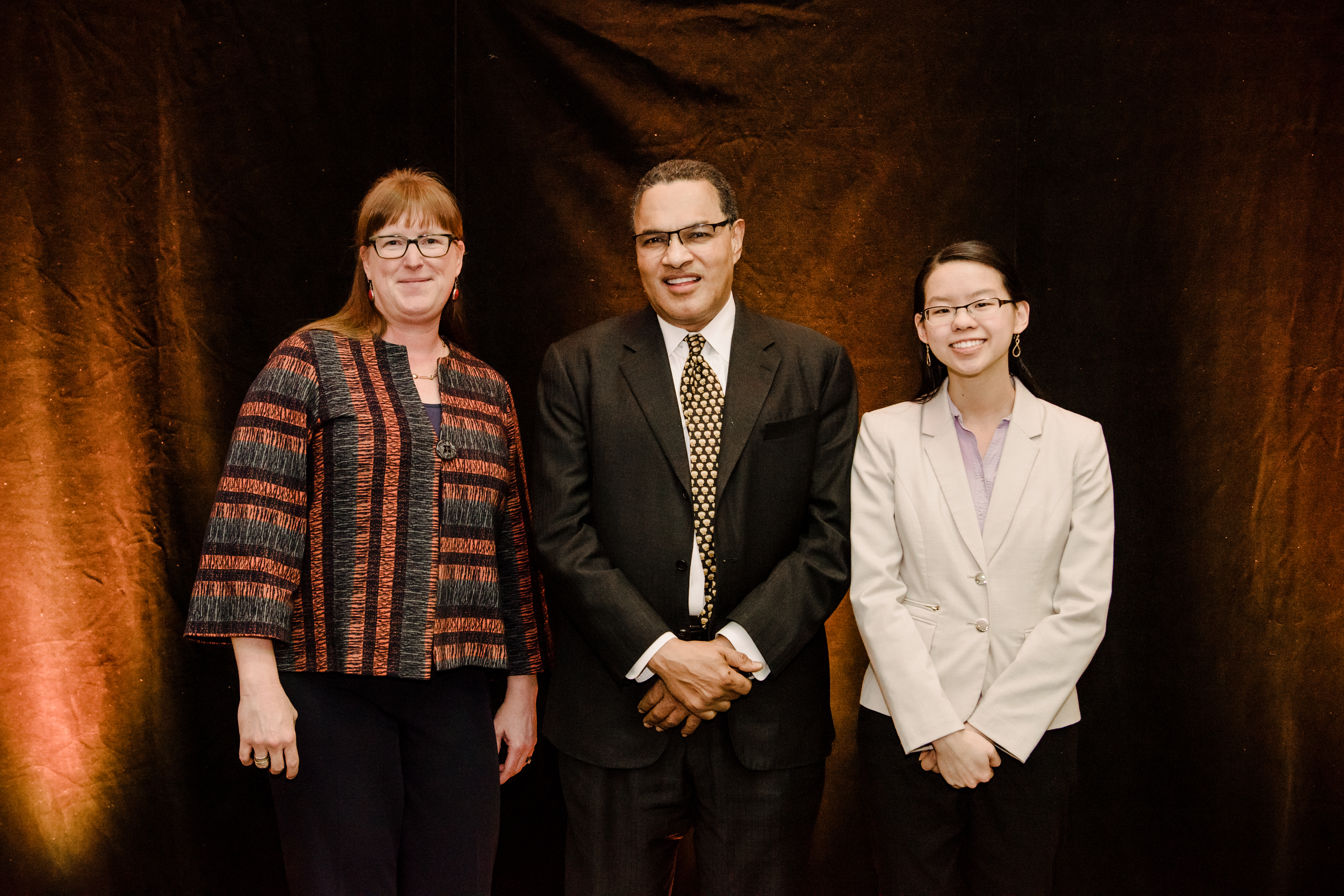
Helen Phillips, Freeman Hrabowski, and Linda Wiratan.


All photos by Marlayna Demond ’11 for UMBC Magazine.

The Joy of Giving

On UMBC’s second annual Giving Day last week, campus and social media buzzed with creative call-outs and challenges for 1,000 donors to participate in the 24-hour window. Mama’s Boys, True Grit, and other student-led entertainment drew a crowd to Main Street where the festivities celebrated the ongoing gifts rolling in, while different departments and athletic teams took to Twitter to playfully compete with each other, using car karaoke and other incentives to spur on supporters.

In typical UMBC fashion, students, staff, and alumni rallied to go well beyond the goal and by midnight, 1,554 donors had raised $106,906 to support an array of campus programs and scholarships.

So what did this Black and Gold Rush of philanthropy look like on campus and beyond?

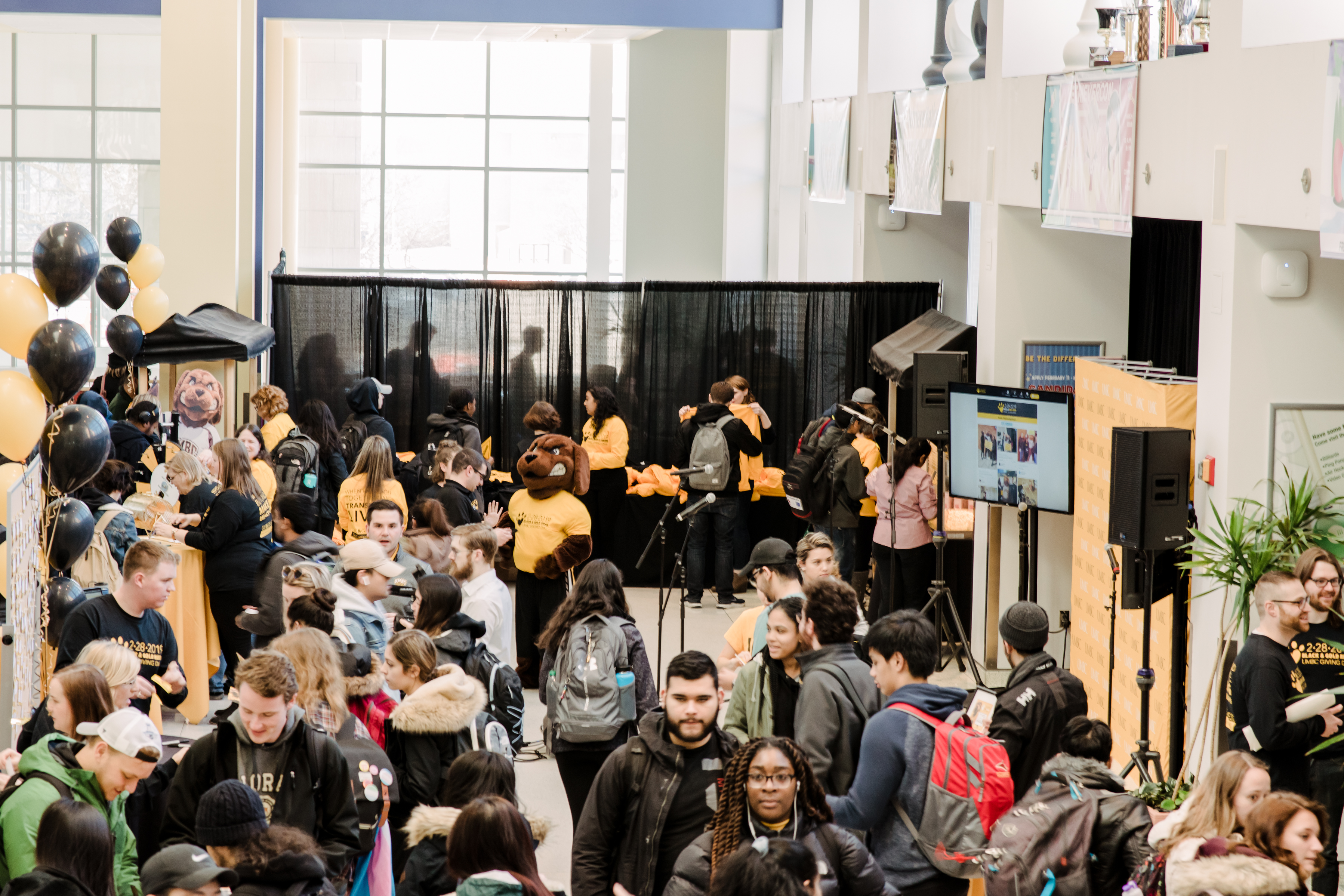
Students participate in Main Street Giving Day events.

Grateful Dawgs

The day underscored UMBC’s culture of gratitude and generosity. By 9 a.m. the University reached 25% of the donor goal, and while most of the giving was online, the IRL experience was just gearing up. Main Street in The Commons came to life as employees and student volunteers set up for a massive thank you card writing effort awash in black and gold. Students also participated in philanthropy trivia, earning prizes and snacks.

Soon hundreds of grateful notes filled the space. “I can achieve because you gave. I will achieve because you supplied opportunities,” wrote student Sam, ’21.

Chalese Cathran ’20, psychology and education, took part in the events and paused to consider the impact of donations as she wrote a thank you note to donors. “I learned that 54% of new freshmen receive scholarships. I’m one of those students. I didn’t realize how many of us there were.”

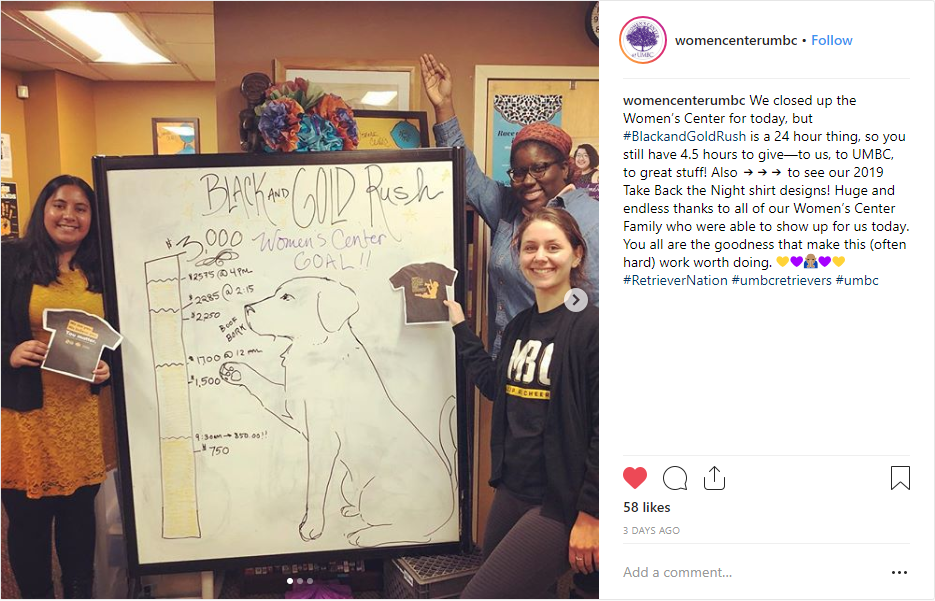
The Alumni Endowed Scholarship Fund and the Scholars Programs were two of the top three recipients of donations, underscoring UMBC’s emphasis on providing resources for students to break through financial barriers. The Women’s Center was another program rewarded by their ongoing social media outreach, earning support from 78 individual donors.

Rising to the Challenge

“At one point, it felt like there was a gift coming it at every second,” said Joanne Meredith, director of annual giving, who credits the success of the day to involvement at every level. New to 2019 was the Quest, a game created to engage current students in the day’s activities. “This is going to be our next generation,” said Meredith. “Some of them now may be receiving scholarships or financial aid and this helps them understand why we do this Giving Day.”

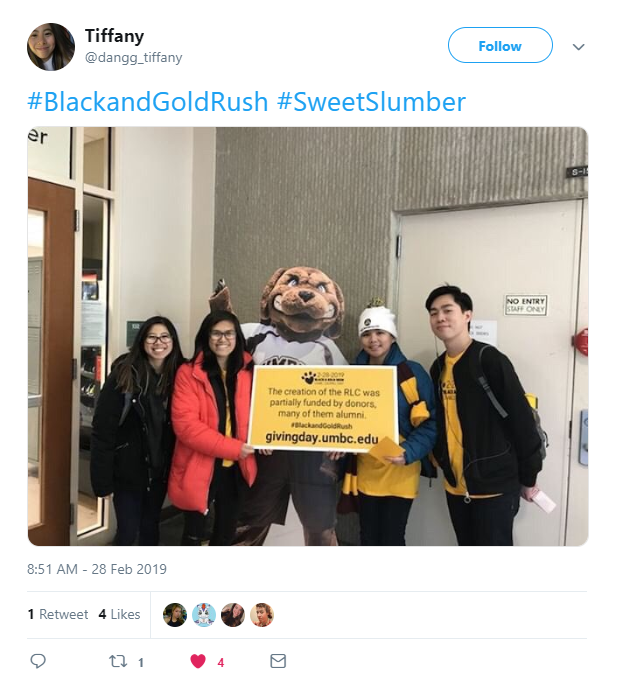
The campus-wide game gave students clues to locations that featured a life-sized cut-out of mascot True Grit. After finding the correct spot and posing with philanthropy-related factoids, students from 26 different teams walked away with a better idea of the effect giving has on their student experiences.

One group of four was organized by Marygrace Reyes ’20, environmental science, who roped her friends into participating. “This gets me out there, having fun and being involved. And a free t-shirt,” said Nick Le ’21, information systems, joking that Reyes also rescued him from doing homework.

Navigating the Quest clues landed them at Lecture Hall 1, the entrance to The Commons, the Resource Learning Center, and the Residential Life office.

“This sounds really cliché, but I might actually go donate something,” said Lauren Chua ’21, mathematics and statistics, reflecting on what she learned during the Quest. “It doesn’t take that much time or money to help.”

In the 25 minutes it took Reyes and her friends to accomplish their task, the donor tally grew from 449 to 539, meaning the marathon surpassed half its goal right as the time hit the halfway mark at noon.

Raising the Bar

By 2:30 p.m., 75% of the goal had been reached but the day was far from over. The UMBC Swimming and Diving Team led the charge on social media and their supporters made a huge splash, earning the team the highest spot of the list of University ambassadors – as well as donors and dollars raised – for Giving Day.

While the whole UMBC community benefits from the philanthropic endeavor, an ongoing leaderboard tracked the top offices designated by donors to receive funds. Athletics encouraged donations with lively social media feeds that included car karaoke and other entertaining livestreams.

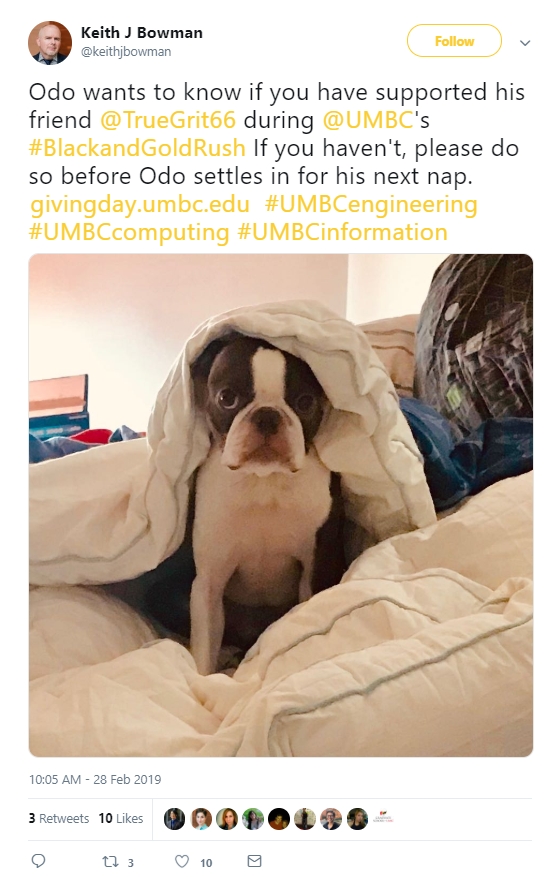
Other standout feeds worth following included the UMBC Bookstore, who highlighted staff and students in an impressive roundup of UMBC impact stories over the course of the day. The College of Engineering and Information Technology also stepped up to the plate, with Dean Keith J Bowman leading the charge, shamelessly using his pup Odo to elevate his college to fourth place in donors and donations.


As the clocked ticked down to midnight, support continued to pour in beyond the original goal. “UMBC is such a great community so this doesn’t surprise me, but when you raise the bar, they always jump to reach it,” said Meredith. “There is this grit here that leads to greatness.”

Unless from social media, all photos courtesy of Marlayna Demond ’11 for UMBC Magazine.

To You – Fall 2009

Richard ByrneI am delighted that one of the features in this issue is written by John Strausbaugh ’74, interdisciplinary studies. Strausbaugh has had a successful career in journalism and cultural criticism, and is the author of a string of books that explore fascinating byways of American culture.

But I’m particularly happy to have Strausbaugh in the magazine because I would not have launched my own career without his help. It’s a story that demonstrates the power that alumni have to mentor and shape the careers of those who follow after them.

You might already have recognized the goofy face on the UMBC identification card below. (Though the Social Security number that also served as campus identification back then has been obscured.) I arrived at UMBC in August 1984, having transferred from the University of Pittsburgh, and was interested in becoming a writer.

Thanks to a continuing web of alumni relations between writers and faculty in the English Department in that era, local writers like Strausbaugh (who was writing fiction and involved in local theatre at that time) were often invited back to give readings on campus.

But Strausbaugh’s increasing claim to fame at that moment was his book and music reviewing for Baltimore City Paper – reviews in which he championed his favorites and savaged whatever he thought was inferior.

After a reading that Strausbaugh gave at the English department one semester, we got to chatting about culture. He looked past the big goofy glasses and saw that I might have some future in the journalism game. Not only did Strausbaugh start letting me hang out with him occasionally, but he also eventually brokered a chance for me to break into print at City Paper. My first review – 10,000 Maniacs’ The Wishing Chair – ran in that newspaper in November 1985, while I was still a student at UMBC.

The chance to put clips from City Paper in my portfolio was a great launching pad for my career. I gained a foothold in journalism that eventually took me great places: On tour with Uncle Tupelo. Reporting on media in Bosnia and pop culture and politics in Serbia. Covering national political conventions.

But it happened largely because an alumnus helped out a student. And while it’s a story that no doubt has been repeated thousands of times at UMBC across many disciplines and schools, it’s also a reminder that we, as alumni, can help shape futures by becoming actively involved in the lives of those who attend UMBC after us.

Want an easy way to get started? Sign up to be a Professional Network mentor. The joint effort between UMBC’s Career Services Center and Alumni Relations allows students to connect with professionals in their desired fields. Go to www.careers.umbc.edu to see what it’s all about and sign up.

— Richard Byrne ’86
byrne@umbc.edu

Acting the Part – Matt McGloin ’05, Theatre

The list of required props for Irish dramatist Martin McDonagh’s black comedy The Lieutenant of Inishmore (2001) indicates just what murderous mayhem awaits its audience: “Dead black cat; Dead ginger cat; 3 guns; Wooden cross; Dismembered corpses.”

By the end of Inishmore, both the stage and the actors are drenched in sanguinary slaughter. Yet the play is a comedy – absurd, hilarious, and aimed at stripping away the glory from Ireland’s senseless sectarian violence.

In a much-acclaimed recent production of Inishmore by Northern Virginia’s Signature Theatre, Matthew McGloin ’05, theatre, garnered critical raves for his performance as Davey – a hapless lad trapped in a bloodbath set off by the death of a revolutionary sociopath’s beloved cat. In the course of the play’s events, Davey is bullied, tied up, shot (twice) and shorn of his long red locks. (The latter event horrifies him most of all.)

“He’s such an innocent character,” says McGloin. “He’s the one who is really affected by the things that happen to him.”

Actors may be tempted to play Davey as a village idiot-in-training, but McGloin chose a different path – portraying a young man so sensitive and single-minded that he is perpetually startled by any occurrence, mundane or malevolent.

McGloin gives credit to his director, Jeremy Skidmore, for locating Davey in a fog of daft dizziness.

“It’s too easy,” he says. “It’s pandering to the seemingly obvious on the page. That he is stupid. I think he’s just very invested at one thing at one moment in time, so invested that he misses things that might be picked up by other people. But he also picks up things that other people don’t pick up on.”

Inishmore held other challenges for McGloin and the rest of the cast. The play stretches the boundaries of realistic stage violence to their furthest limits, including multiple gunshots, animals (live and dead), body parts, and buckets of blood.

“The whole gore aspect was difficult at first,” McGloin says. “It was even physically uncomfortable, and would take me out of the scene.”

The blood, he adds, was particularly difficult to navigate. “If it’s too thin, it doesn’t feel right,” McGloin says. “If it’s too thick, you feel covered in Jello.”

McGloin has won a number of professional roles since graduating summa cum laude in 2005, including appearances at the Kennedy Center, the Folger Theater, Synetic Theatre and the Virginia Shakespeare Festival.

“I loved the Theater Department,” McGloin says. “It was the first time I’d received formal training. It was a birth into the world of theater and finding out what it’s like….Theater socialization is its own weird thing, because you work and play with the same people. And then it ends. And you go off and do it again. But your work is your play.”

McGloin recalls that his first acting role at UMBC was in a March 2002 production of the Christopher Durang play, The Baby with the Bathwater. But he says that the range of productions in which he appeared as a student – including productions of Ionesco’s The Bald Soprano and Shakespeare’s Much Ado About Nothing – provided a challenging range of genre for a young actor.

“Surrealism, realism, absurdism, puppetry and Shakespeare,” says McGloin. “That’s a pretty good gamut as far as I’m concerned.”

With Inishmore now a bloody memory, McGloin is now appearing at the Kennedy Center in a much cheerier production: Unleashed: The Secret Lives of White House Pets.

“I play a Chihuahua,” says McGloin with a grin.

– Richard Byrne ’86