We use cookies for analytics and, unless you opt out, advertising.
You can opt out of advertising at any time.UMBC uses essential cookies to run this site. With your permission we would also use analytics cookies (to understand how the site is used) and advertising cookies (to measure and target our ads on other platforms). Nothing else loads unless you accept. You can change your choice any time from Cookie Settings in the footer.Privacy Policy
EssentialRequired for the site to work (login, security, your cookie choice). Always on.
St. Patrick’s Day might not be known as a day celebrating love and lifelong devotion, and True Grit’s may not come to mind as the most romantic place to eat, but for Marcie and David Zisow the booth in UMBC’s dining hall was just perfect.
The Zisows will celebrate their 50th wedding anniversary later this year, but on March 17, 2022, the couple took the time to mark the 53rd anniversary of their first conversation. “We’ve always celebrated both dates,” say Marcie and David, who first spoke to each other at a shared table in UMBC’s commissary (predating True Grit’s by several decades). She was eating a tuna sandwich packed by her mother, and he had a homemade PB&J. Marcie ’72, French, M.A. ’84, instructional development systems, a retired educator, and David ‘71, mathematics, a retired OB-GYN, laugh now at how that day played out.
“We are Jewish,” says Marcie, “but my mother, she always wanted us to wear green on St. Patrick’s Day. So I put on this ugly green plaid skirt. I really did look ugly, but that’s all I had that was green.” David admits that he was looking for a date to the mixer that Saturday night as a rebound from his previous UMBC girlfriend.
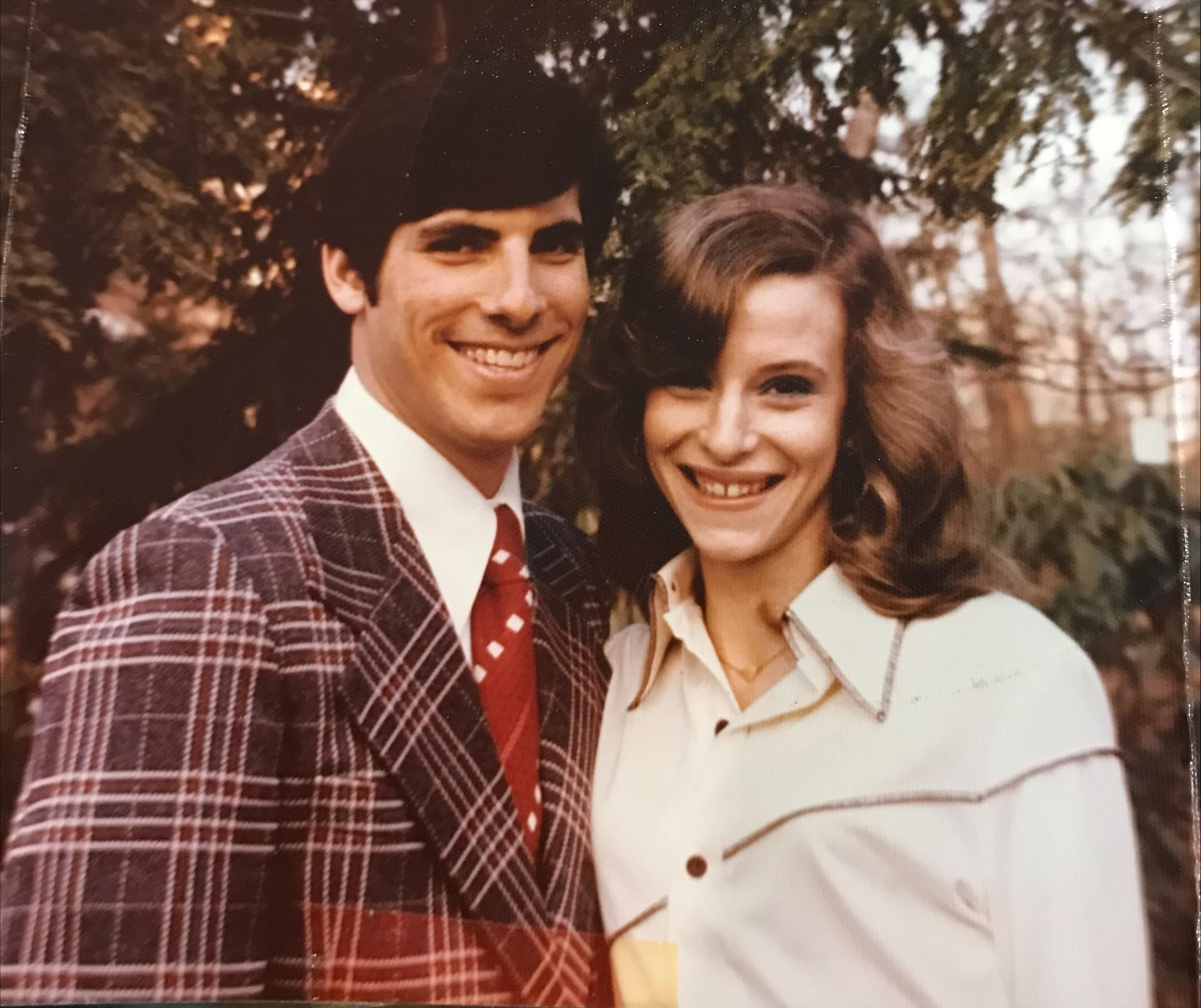
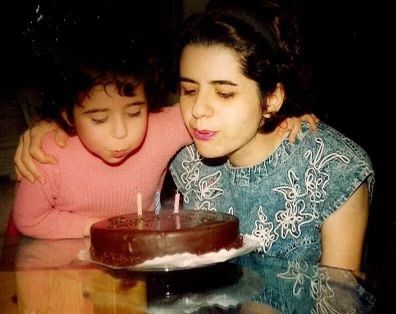
An undated photo of David and Marcie Zisow, courtesy of the Zisow family.
The conversation did not start off well. As Marcie retells it, “At one o’clock the whole table gets up to go to their next class, and he stays there. He was making me nervous. He starts talking, and the next thing I know, he’s asking me to the dance.” Marcie knew of David, a pre-med student who had recently starred in UMBC’s musical production of “Stop the World, I Want to Get Off.” (“She didn’t even come see it,” David says as an aside. “I didn’t have a ride!” responds Marcie in what must be a 53-year-old conversation.)
Marcie says now, in retrospect, she surprised herself by being brutally honest with David. “What you have to understand is, I grew up in a Jewish community, in a Jewish household. I never had to say anything to anybody about being Jewish, we all understood. So I told him, ‘I don’t date people who aren’t Jewish.'” David immediately erased her fears but sharing his own Jewish heritage with her. Marcie said she didn’t waste a minute, but ran to the nearest payphone to call the girlfriend she was supposed to ride to the mixer with to cancel their plans.
Looking back, David can’t believe their luck. “The dance was an amazing evening. We just had such a good time together. We were so in tune with one another. I knew she was the one.”
The Surprise
The Zisows have been telling this tale to their four grown children for so long, that Jamie Silverman, their youngest, can tell it by heart as well. She was inspired to create a surprise celebration for her parents, recreating their meet-cute, albeit at True Grits and with slightly upgraded fare from their home-brought sandwiches. UMBC Dining immediately offered up their services, including baking an anniversary cake, playing music from the ’60s and ’70s, and creating a slideshow of Zisow pictures to show on the screens of the dining hall.
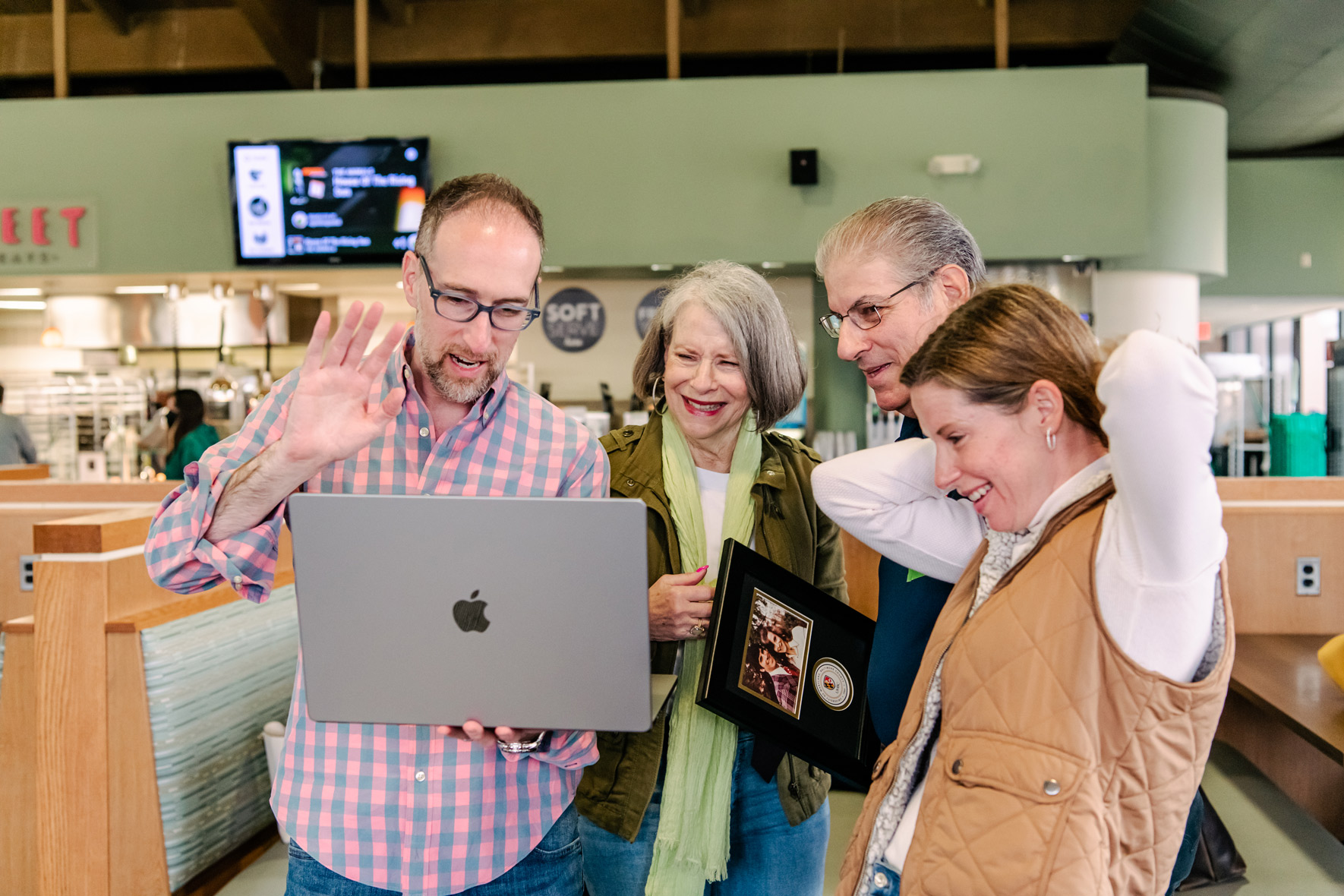
Marcie and David, with their children Brad and Jamie in True Grit’s, chatting with other family members on Zoom.
Silverman eventually had to reveal to her parents the big surprise before she drove them to campus. Arriving during a spring shower didn’t dampen their enthusiasm for the date though, and both alums had big smiles on their faces when they saw the lunch set up.
Going Steady for 50+ Years
The Zisows reminisce fondly on UMBC, not just for allowing them to meet, but because of how formative their time here was. “This is an old story,” says David. “When you’re the son of immigrants, you’re kind of an outsider. You’re raised differently. You have different attitudes. When I came to UMBC, I found a group of people that were completely accepting. So in the theater group, I was the med-school nerd. But that was okay.”
For Marcie, UMBC left her with lifelong friendships, but also with a career she couldn’t have imagined. When she started college, she wanted to be a hairdresser, but her father strongly encouraged her to apply for a teaching scholarship that would require two years of teaching following graduation. “I didn’t want to be a teacher because my sister was a teacher, but then it turned out that I loved it. I taught for over 20 years,” she says. Eventually Marcie returned to UMBC to earn her master’s in 1984.
Seated at a booth in the dining hall, enjoying chicken Caesar salads while Zooming with their two children who couldn’t make the in-person event, the Zisows are feeling pretty lucky. “We just took a chance,” says David. “I just knew from that moment that she was the girl for me. And then a couple weeks later I asked her to go steady, and the rest is history, as they say.”
*****
All photos by Marlayna Demond ’11, unless otherwise noted.
Many of President Freeman Hrabowski’s working hours are spent at his desk on the phone speaking to organizations that can help better the education of his students, but as often as possible, he’ll take a lap around the campus that has shaped him as much as he’s shaped it.
To be a Retriever in any of the last 30-plus years is to have a “Freeman story.” For many people, it’s pretty similar. President Hrabowski saw you on Academic Row and asked your major and where you went to high school. President Hrabowski got on your elevator and asked your major and where you went to high school. President Hrabowski stopped by your lunch table in The Commons and—you guessed it—asked your major and where you went to high school.
You’d think he might get tired of hearing the answers, but instead, they seem to animate him. He has rejoinders for any response and is indefatigable as he strides around the campus he’s watched grow up for more than three decades.
These are the liturgies of life at UMBC under the leadership of President Freeman Hrabowski. He’s always going to say, “Enjoy the food, I was cooking all night.” He’s going to offer you his elbow to bump instead of his hand (he was doing this cold-avoiding precaution well before COVID-19). He’s going to ask if you’ve thought about getting a Ph.D. He’s going to say “focus, focus, focus” and “keep hope alive.” No matter how many times he repeats these things, they never sound trite—and that’s where the magic comes in. He means them each and every time.
Out of Office
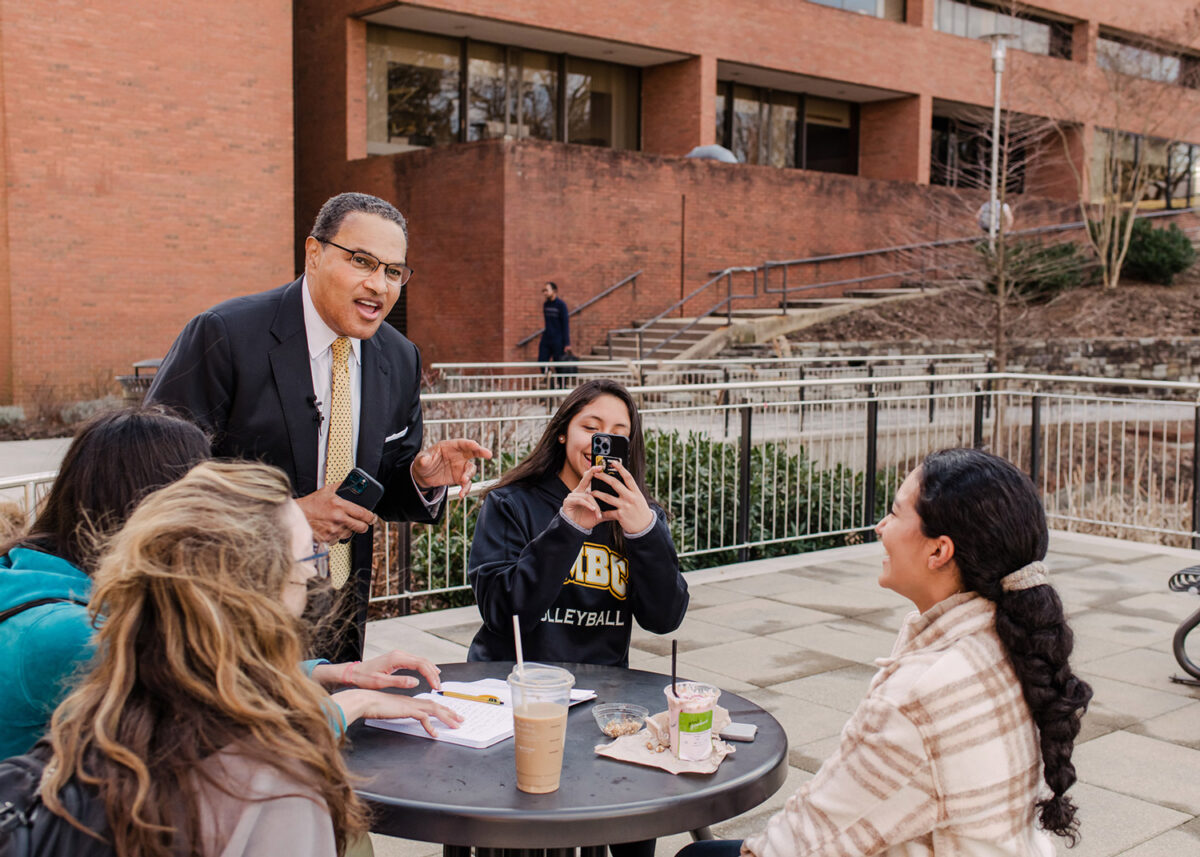
On an exceptionally sunny afternoon this February, Hrabowski walks down the packed corridor of Academic Row. Seemingly every student is outside on this summer-gift of a winter’s day. Chatting with folks like he usually does, an eager student yells out from the University Center terrace “I love you, Freeman!” drawing out all the vowels. His reception among students is closer to that of a celebrity—selfies abound. Staff step up shyly to tell him that he’s the reason they’ve stayed at UMBC for 20 years. He asks a table of students the usual questions and along the way discovers it’s someone’s special day. Without skipping a beat, Hrabowski croons “Happy Birthday” to her, entirely at home.
President’s Day
One of the unsung roles of a president is listening to the complaints and suggestions of students and staff. Hrabowski does this task not only ungrudgingly but often and methodically. By a matter of coincidence, a recent student focus group took place on President’s Day. Hrabowski made it clear to the dozen students (all recent transfers) assembled that he had one hour before he needed to head to Annapolis to speak at the Maryland State House about how we learn and talk about our nation’s founding president. For that hour, he made himself fully present and available, taking notes about registration frustrations, organic chemistry woes, study abroad hopes, and a plethora of other topics.
For each student, he had a resource to give them and encouraged them to follow up with him about their progress. “The thing a president does,” he told the students with a laugh, “is point you to other people who can help you.”
Let’s Go on a Walk
Most of Hrabowski’s days do not include hours-long walks, but as often as possible, he’ll show his guests around a campus that has made its mark on him as much as he has on it. You could nearly measure Hrabowski’s tenure by counting the rings on the trees that wrap around the loop, lending their growing shade to the walking path each year—those trunks and branches were part of an early initiative of his to shape the landscape of campus to be more welcoming.
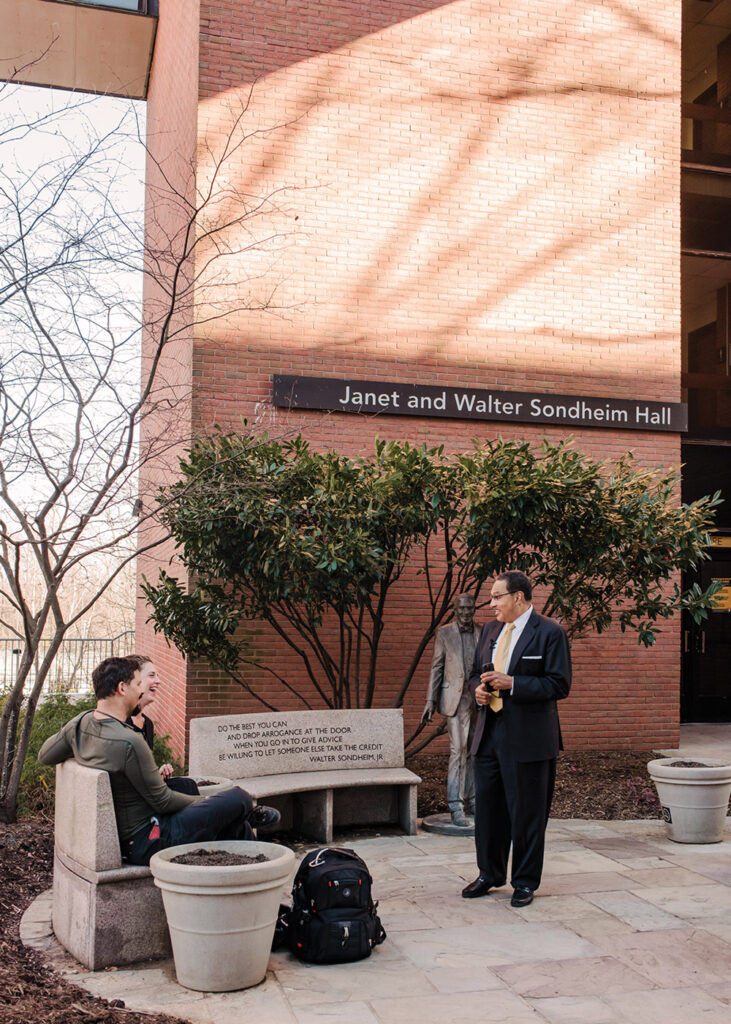
He’ll make sure to bring guests to the meditative spot in front of a statue of his good friend and mentor, the late philanthropist Walter Sondheim. He’ll want to show visitors the new Performing Arts and Humanities Building (PAHB). One story he shares is that when legislators would come to campus early in his presidency, he’d take them to the Fine Arts Building Recital Hall so that they could experience the sound of the flushing toilets next to the auditorium, audible even during productions. The PAHB offers multiple (soundproof) performing venues and is LEED Gold certified, heightening the visibility of the arts and humanities as major components of campus and community life.
A Break on the Knoll
“Go placidly amid the noise and the haste and remember what peace there may be in silence.” In a virtual Meyerhoff Scholars Program Family Meeting, Hrabowski quotes Max Ehrmann’s “Desiderata,” a poem he memorized 60 years ago. For someone whose role does not offer many moments of silence, Hrabowski does take free seconds throughout the day. When he finds them, he says the shortest prayer, “God help me. God help us.” If he finds a whole minute free, he closes his eyes and meditates. “The hardest thing for any human is not to have a thought,” he says.
In an ideal world, like this perfect day in February, Hrabowski can make the trek down to the Knoll and Joseph Beuys Sculpture Park, across the loop from the UMBC Stadium Complex. The Knoll is a preserved woodland that’s remained undeveloped due to community members continually advocating for campus green space. He pauses here, at peace and temporarily still under the dappled shade.
Interrupting Class
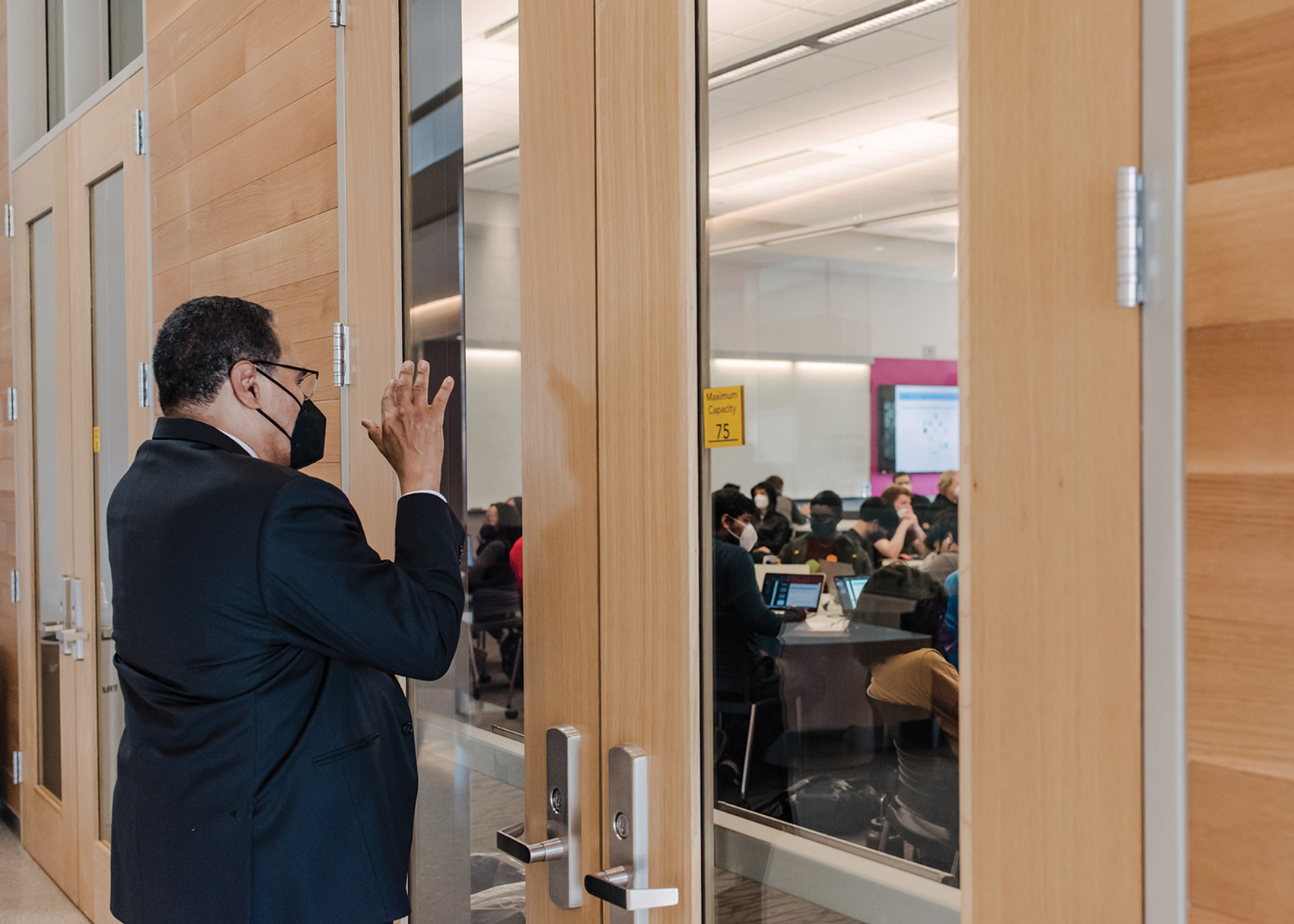
The next stop is the Interdisciplinary Life Sciences Building (ILSB)—a state-of-the-art space for collaborative research and teaching. Hrabowski taps on the door of a class in a large lecture hall to listen in on discussion of math counter examples. His eagerness to be in the classroom is palpable. Hrabowski frequently says, “I have so much more to learn.” Despite the administrative duties he’s called to perform, perhaps the staying power of more than 30 years at a university is an authentic life-long desire for learning. It’s what makes his repeated interactions with students impactful instead of trite—he’s truly curious about the world around him.
Stopping for Research
Walking into Professor Chris Swan’s Geography and Environmental Systems lab on the second floor of the ILSB, Hrabowski quips about the tray of leaves on the counter, “Are you heating that up for food or science?” “For science,” the students reassure him as they explain the leaf litter they’re working with. After collecting the specimens from streams on campus, “we measure the functional diversity and the rate of decomposition.”
“And why is this important?” Hrabowski asks genuinely, the constant wheels of learning turning in his head. Swan’s research group responds that they’re establishing the importance of biodiversity to better understand invasive diseases that have decimated some ash and oak species—questions that ultimately might help keep more of UMBC’s many trees alive and healthy.
Making Campus Inviting
It’s nearly 70 degrees outside, and we’re closing in on our step goal. Hrabowski shows no sign of slowing down. He doesn’t need a drink of water, he doesn’t need a break. He stops only to congratulate a group of women’s lacrosse players throwing a ball around the Quad for their explosive win earlier that week (17-9 against American University).
As he makes his way back to the Admin building and his desk and messages waiting for him, Hrabowski recounts an early walk in his tenure as UMBC president. He was showing then Maryland Governor William Donald Schaefer around campus. He wanted the governor to know how well UMBC functioned with the state support it received but also how it could function so much better with more investment. “And for years,” says Hrabowski, “Schaefer told people, ‘That young president walked the hell outta me all over campus,’” laughing that he just had to say “yes” to all of Hrabowski’s requests because he was too out of breath from the vigorous walk to say anything else.
But the results of that and other fruitful conversations over the past three decades are evident everywhere. Students may take The Commons for granted, or the Knoll or even lounge spaces in the library, but all of those spaces are intentional, says Hrabowski.
The campus changes he’s most proud of are those that encourage community. “There are more spaces where you can sit and commune, talk to people, reflect,” says Hrabowski. “In the early years, people would come to campus and then leave. Not all, but those who were not residential. Now there are so many places where people can just study, laugh, get to know other people, and build community over time.” In his eyes, these places of invitation are the crowning achievement of the physical campus.
Up to the 10th Floor
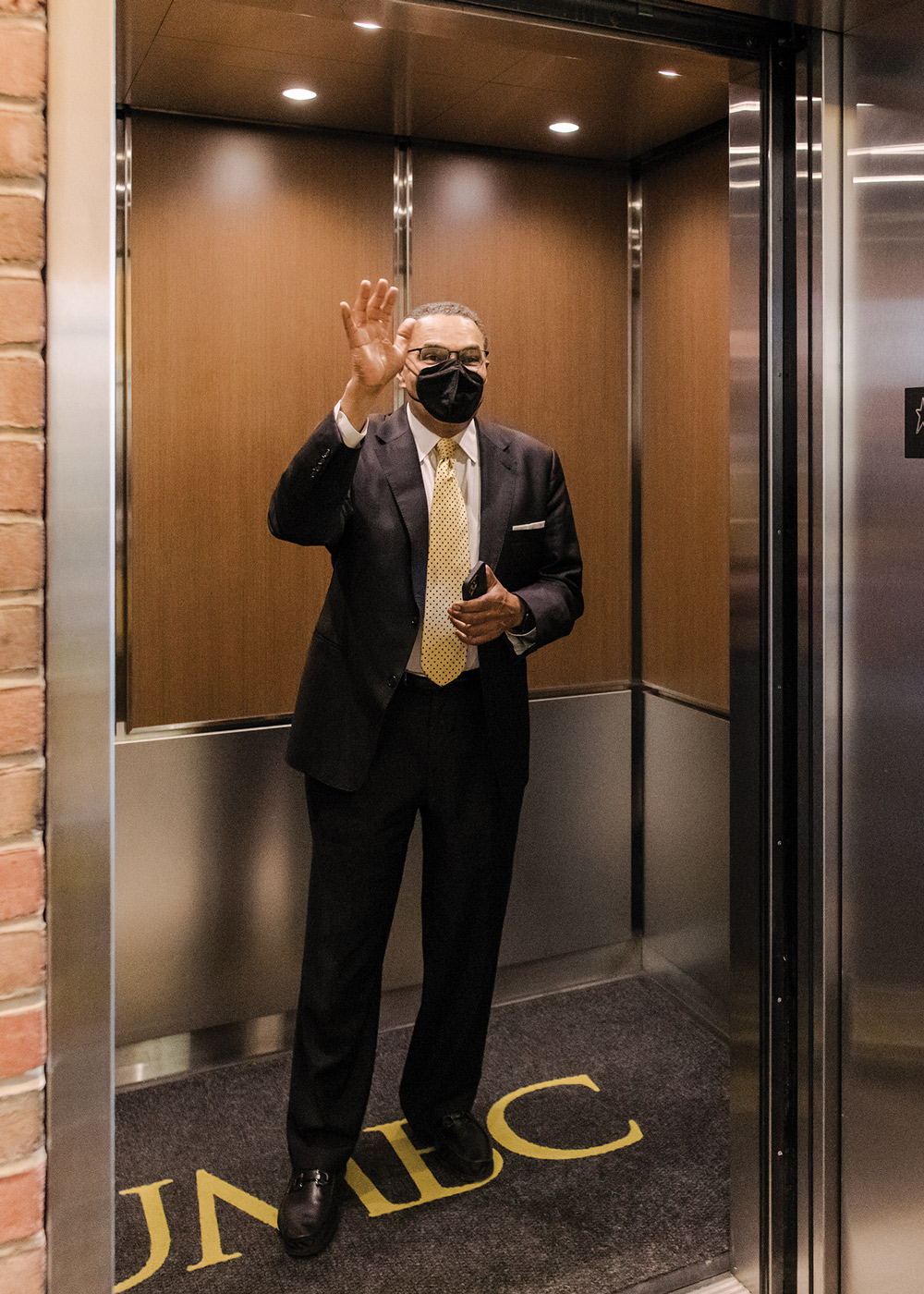
As he enters the elevator to take him to his office, he waves joyfully. The next part of his day will be very different from his crowd-pleasing walk but no less important. He’ll make the case for increased funding to the National Science Foundation. He’ll moderate a Chronicle of Higher Education virtual panel on the importance of resources for our growing population of first-generation students. He’ll make phone calls to put UMBC on the radar of state legislators and other folks in a position to give his students a better education.
He’ll forget to drink more than several cups of tea provided by his executive assistant as he endlessly and eagerly promotes a university that has shaped him as much as he has shaped it. He will do and say the same things over and over again without them sounding trite, because he believes in the power of words. And most of all, he believes we will keep hope alive.
What if the answer wasn’t the goal? What if the joy was found in asking a better question? Individualized Study instructors Stephen Freeland and Eric Brown eagerly invite their students to delve into the mystery and wonder of the world, balancing that awe with an intrepid curiosity that doesn’t accept surface-level explanations. What can we learn about ourselves, they ask, when we don’t expect a ready-made answer to our questions?
Stephen Freeland and Eric Brown ’93, M1, interdisciplinary studies, stand off to either side of the Fine Arts classroom. Playfully adversarial, the two Leos know how to pull each other’s levers. The question on the whiteboard asks the students in Brown’s Human Context of Science and Technology class to reconsider life as they know it: the origins of life, the evolution of life, the label “intelligent life”—and not just here on our blue marble, but in galaxies far, far away.
Freeland and Brown are not scared away by “what if” questions. Freeland, an evolutionary biologist, and Brown, with a background in the history of science, both find their homes in UMBC’s Department of Individualized Study (INDS). The pair seems like they would thrive under the interrogation of any 4-year-old’s barrage of “whys.” But this childlike curiosity isn’t aimless (it never is). Instead, the colleagues of almost a decade take great pleasure in finding ways to question established scientific norms and help students eschew culturally constructed labels that might accidentally shield them from further scientific discovery.
Some of the students eagerly step into the scrum. Being asked to question something as fundamental to her biology studies as the moment of the origin of life clearly takes Emma Galambos ’23, psychology, aback.
As she wraps her head around what Freeland is positing, Galambos peppers him with questions about a basic tenet in most biology textbooks. Developed as an idea in the 1960s, the “RNA World” hypothesis states that life began with a simple RNA molecule that could copy itself without help from other molecules, like DNA and proteins. And somewhere in this RNA-only universe, the origin of life happened. It’s a commonly featured point on famous graphs that claim to explain the pre-biotic origins of the universe.
Freeland thinks, to put it simply, this is rubbish. But despite Freeland’s extensive background in evolutionary biology, Galambos has a few things to push back on—which is something Brown actively fosters with his students.
“I was taught the RNA World hypothesis in previous courses, that RNA was the precursor for life,” says Galambos, reflecting on the exchange after the class concluded. Currently an EMT who plans to attend nursing school after graduation, Galambos says, “I’ve been taught that there was a distinct origin of life and Dr. Freeland’s concept goes against this idea, but I find his explanations and ideas very fascinating.” Brown facilitates the in-class conversation by occasionally prodding Freeland to expound on his alternative take.
Freeland goes on to outline his proposal on the board with a few simple x-y axes, changing what looks like a sharp vertical upswing into a more nuanced diagonal line (to indicate there may have been one or more stages before RNA, from which RNA later evolved). “Something that grows out of the natural way I do science, and what has made me a scientist,” says Freeland, INDS director, “is to imagine the counterfactual. You imagine what it isn’t, in order to see more clearly what it is.”
He’s currently trying to publish a paper that questions the dominant paradigm of the RNA World hypothesis while also working on a review for a different manuscript that criticizes the well-accepted theory. He emphasizes the word trying, “as it’s sort of proven to be strangely unpublishable,” he says with a wry smile, “at least within the U.S.”
Regardless of any professional hurdles, the joy that Freeland and Brown bring to this scientific tug-of-war is evident in their ease with each other and the way they eagerly invite the students into the mystery and wonder of the world with reverence—and a healthy dose of skepticism.
The alien problem
Similarly unpublishable to an extent is genuine scientific inquiry into the existence of extraterrestrial life. Not that it’s stopping Avi Loeb, chair of Harvard’s astronomy department. Loeb is the jumping off point for Freeland and Brown’s classroom conversation: how does a well-respected astrophysicist earn the ire and interest of colleagues across the globe? Belief in aliens is the short answer, and the slightly longer version is by sincerely positing the likelihood of communicative life near and far using an equation developed in 1961 by Frank Drake.
Brown jots a formula on the board. Known as the Drake equation, it attempts to solve for the numbers of technologically advanced civilizations in the galaxy, using factors like the average number of planets in the Milky Way that can potentially support life per star that has planets, the fraction of planets with life that actually go on to develop intelligent life, the length of time for which such civilizations release detectable signals into space, etc.
It’s more of a thought experiment than a mathematical formula, but it’s had broad implications for how astrophysicists consider extraterrestrial life. Brown wraps up the exchange with what could be a loaded question to his colleague: “So, your estimation then is that there’s a lot of life in the galaxy?”
“Yes,” Freeland gamely replies. “But I’m growing more careful to say that there has been a lot of life in the galaxy.”
“It could be a cosmic graveyard out there,” Brown follows up. “Yes, life comes about and then life disappears. It could be that one of these terms in the Drake equation is a really, really small number.”
There are other even more banal and prosaic reasons we haven’t discovered signs of life elsewhere, says Freeland. We haven’t tried.
“Our state of actual scientific knowledge about our own cosmic backyard and neighboring planets is minimal, zero,” says Freeland. “Our species has only conducted three full experiments to test for the existence of life outside of Earth, and they were all on Mars and they were all in 1977. One of those three is still up for debate because by the standards that they began the experiment, it demonstrated there was life. The consensus was to re-explain the outcome.”
“All of that is to say,” says Freeland, “don’t mistake this: there is an absence of evidence, not an evidence of absence. That would be my biggest point to you.”
Upsetting the established balance
Freeland and Brown are using the example of extraterrestrial life as a starting point in their discussion, but they’re not just interested in the possibility of little green people arriving in spaceships—although they wouldn’t turn them away. Freeland and Brown see the opportunity to open students’ minds to question self-reinforcing patterns: something is “discovered,” then put in a textbook, then taught for decades, and now it is true. This could be said about well-regarded theories of the origin point of life to other entrenched systems like white patriarchy, Freeland gives as an example.
“It comes to this vicious circle where we’ve created a culture that can’t remember to see it other than the way our culture sees it,” says Freeland. “And as time goes on, it actually gets progressively harder and harder for alternatives to penetrate that.”
“Part of the reason why I don’t believe in capital T truth,” Brown addresses his students, “is because I think humans are good at tricking ourselves into believing that we have discovered the truth about the world. And then, in 100 years when that’s no longer the truth, we’re also very good at telling retroactive stories about how those people were just mistaken.”
So what is true?
Brown’s and Freeland’s shared astrological sign popped up earlier in the class when they asked the students if they put any stock in the zodiac. The students were wary of aligning themselves with the stars, but Freeland and Brown are quite happy to explore what the social ramifications are of always hearing about being a Leo actually contributing to their natural sense of self-assurance. In this way, something becomes (lowercase-t) “true,” a truth defined by shared experience as opposed to objectivity.
Many things students dutifully copy from lectures and textbooks and assume are truthful building blocks are actually obsolete concepts at this point, Brown and Freeland point out. Like scientific discoveries of old, it’s difficult for society to adjust to new information. Galileo was sentenced to life imprisonment for his heliocentric views—in our age maybe that looks like a denied tenure package or rejected manuscripts for questioning the scientific norm.
“What’s interesting about this to me,” says Brown, “is that it seems so anti-scientific, that I can’t believe something or I can’t argue something because this other proposed theory has won the current approval, even if I have evidence otherwise. Ought it not be that it’s the evidence that guides you?”
“The danger here,” replies Freeland, “is if we mistake the model that we are using and the labels that we’ve all grown familiar with—if we mistake them for objective reality…then we’re never going to see past those labels.” Freeland points to UMBC’s Kevin Omland, professor of biological sciences and expert on the evolutionary biology of birds, to make his point. “Omland is finding that actually the more we study, the less there is an objective line to say where one species begins and another one ends. That’s not to say that labels can’t be useful, but they mean different things, depending on what question you’re asking.”
Freeland brings that back around to his own research—debunking the moment of the origin of life. Pointing again to his alternative theory, the diagonal line representing gradual interplay of RNA and DNA, Freeland says, “what is interesting to me about that diagonal line is that there’s nowhere on that to call the moment of the origin of life. The origin of life is actually a seamless part of the unraveling of the universe, the way that time and energy can make the universe go. That’s a much more interesting universe, really.”
Asking better questions
What purpose is there in asking big questions we’ll (probably) never know the answers to? Aristotle famously addresses this human tendency in the first sentence of Metaphysics: “All men by nature desire understanding.” For some, that understanding leads down an unfamiliar but fulfilling path that might make your colleagues—or your students—uncomfortable with the destination.
Galambos says that Brown doesn’t hesitate to share “that a student changed his perception or will continue to ask the student further questions about how they got to the idea” because he seems naturally intrigued by his students’ responses. Freeland and Brown are not alone in their mission to revive and share their students’ natural curiosity about the world—or at the very least help them learn how to ask better questions. It’s one of the pillars of UMBC’s mission to welcome all students to our community of inquiring minds.
“And the further I go,” says Freeland of his 25-plus year research career, “the more I’m convinced, like all good research, what you learn is where the question was wrong, and the question gets better rather than getting an answer.”
Something that has become clear in 2021 is that when celebration is called for—-go all in, in a safe, socially distant fashion, of course. In this spirit, UMBC is excited to announce the 32nd annual Alumni Awards, hosted by the UMBC Alumni Association Board of Directors. While the in-person ceremony may be smaller than past years, there are multiple ways to watch and interact virtually.
More alumni than ever are being celebrated this year. In addition to the past categories, the Board is honoring a cohort of Retrievers whose work impacted pandemic response on local, national, and global stages. Likewise, the Rising Star category couldn’t be contained to a single alum, so three bright stars are highlighted.
“They are entrepreneurs, leaders, educators, creators, artists, and explorers,” says Stanyell Odom, director of Alumni Engagement. “They’ve stepped forward to lead us during a time where sound leadership was required to get us through some of the most difficult days of our generation.”
Meet the 2021 award recipients
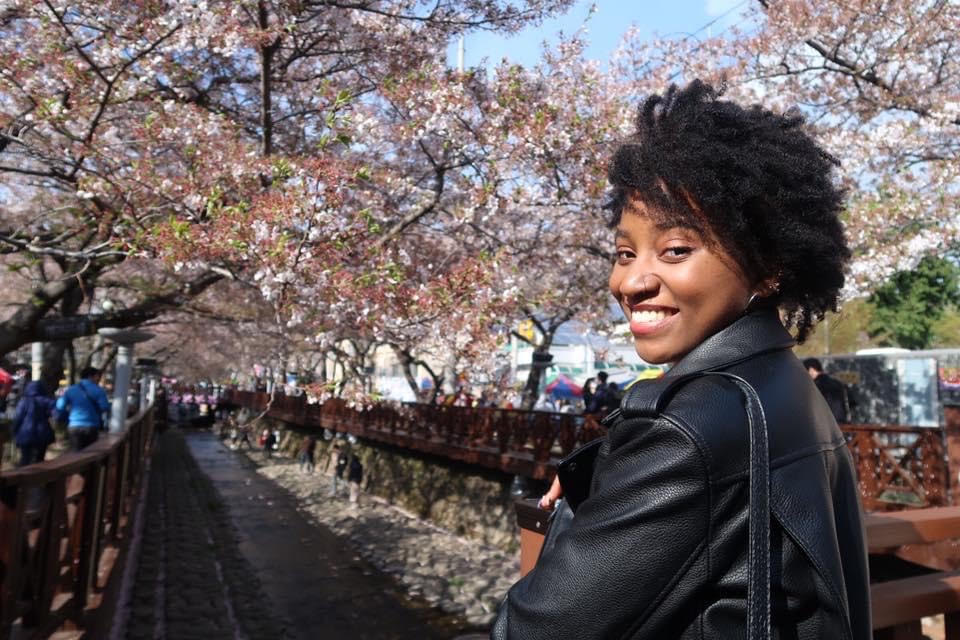
In the Rising Star category, the Alumni Board recognizes Christine Osazuwa ’11, interdisciplinary studies. Osazuwa uses her skills to highlight the intersection of diversity, music, marketing, and technology, and even living overseas, she finds ways to continue mentoring UMBC students.
Also in the Rising Star category are Michael Berardi ’19, media and communications studies, and Deep Patel ’19, biological sciences and financial economics—cofounders of OCA Mocha, an Arbutus coffee shop that emphasizes community-arts. They’ve found a myriad ways to serve the community even during a pandemic.
From left: Christine Osazuwa, Michael Berardi, and Deep Patel. All headshots provided by the awardees.
To learn more about the recipients of the 32nd Alumni Awards, you can read about the Outstanding Faculty awardee Dr. Michael Summers in multiplestories. Summers is the Robert E. Meyerhoff Chair for Excellence in Research and Mentoring and a professor of chemistry and biochemistry at UMBC.
Meet Dr. Michael Hassett, M.P.P. ’17, Ph.D. ’19, public policy, the recipient of the Distinguished Service Award, a budget analyst for the National Oceanic and Atmospheric Administration and president and founding member of Friends of Tonga, Inc. Friends of Tonga received a 2021 Literacy Award from the Library of Congress for their implementation of highly successful practices in literacy promotion.
Michael Summers, left, and Michael Hassett, right.
Outstanding alumni are recognized in multiple categories. Engineering & Information Technology honors Dr. Scott Banta ’97, chemical engineering. From the Humanities, meet Sean Pang ’09, English, M.A. ’11, education. Natural & Mathematical Sciences celebrates Dr. Kizzmekia Corbett ’08, M16, biological sciences and sociology, scientific lead of the Vaccine Research Center’s coronavirus team.
From left: Scott Banta, Sean Pang, and Kizzmekia Corbett.
Baltimore City middle school teacher Theresa Bruce ’09, political science and social work, is the recipient for Social & Behavioral Sciences. Visual & Performing Arts honors Tewodross Melchishua Williams M.F.A. ’00, intermedia and digital arts, founder of the film and digital media studio collective Visual Jazz and associate professor and program coordinator of visual communication and digital media arts program at Bowie State University.
Header image: Photo of the 2021 UMBC Alumni Awardees. L-R: Dr. Michael Summers, Deep Patel ’19, Michael Berardi ’19, Tewodross Melchishua Williams, M.F.A. ’00, Dr. Michael Hassett, M.P.P. ’17, Ph.D. ’19, Dr. Kaitlyn Sadtler ’11, Freeman Hrabowski, Sean Pang ’04, M.A. ’11, Dr. Kate Tracy, M.A. ’01, Ph.D. ’03, Dr. Scott Banta ’97, Dr. Letitia Dzirasa ’03, M11, Theresa Bruce ’09, and UMBC Alumni Association President Brian Frazee ’11, M.P.P. ’12. Not pictured: Dr. Kizzmekia Corbett ’08, M16, and Christine Osazuwa ’11. Photo by Marlayna Demond ’11.
Nothing is sweeter than a Homecoming that truly feels like coming home. And after a year’s hiatus, Retrievers streamed onto campus Saturday, October 9, with family and friends in tow to celebrate. Eager to reconnect with each other and campus, alumni, students, and friends took part in carnival games, rides, and food trucks—with everything pausing for one of the most anticipated moments of every Homecoming: the puppy parade.
https://www.instagram.com/p/CU5sXXSpKeL/
It wouldn’t be a UMBC Homecoming without an opportunity to promote the passion and achievements of our faculty and alumni. In the Proscenium Theatre, Grit X presenters delved into compelling aspects of UMBC’s impact in the areas of research, scholarship, and creative achievement.
We are ready for @UMBC’s GRIT-X event – starting at 2:00 pm in the Proscenium Theatre at the PAHB. The stage is set for some thought-provoking presentations by faculty and alumni. pic.twitter.com/RqIOflW1PF
Cutouts of President Freeman Hrabowski and True Grit welcomed attendees to the Alumni + Friends tent, but seen almost as frequently around the bustling field was the real Dr. Hrabowski and everyone’s favorite campus comfort dog, Chip. (We all need a little extra comfort from Chip these days as we think about saying goodbye to President Hrabowski at the end of this school year!)
So many campus groups collaborated to create a safe Homecoming experience for everyone to enjoy. “Homecoming 2021 was the perfect example of how the UMBC community comes together to support one another,” says Jess Wyatt, assistant director of Alumni Engagement and one of the lead coordinators for the event. “Despite having no idea what the landscape would look like, we were able to plan and execute an event that allowed our alumni, students, and greater campus community to come together around a shared love of UMBC.”
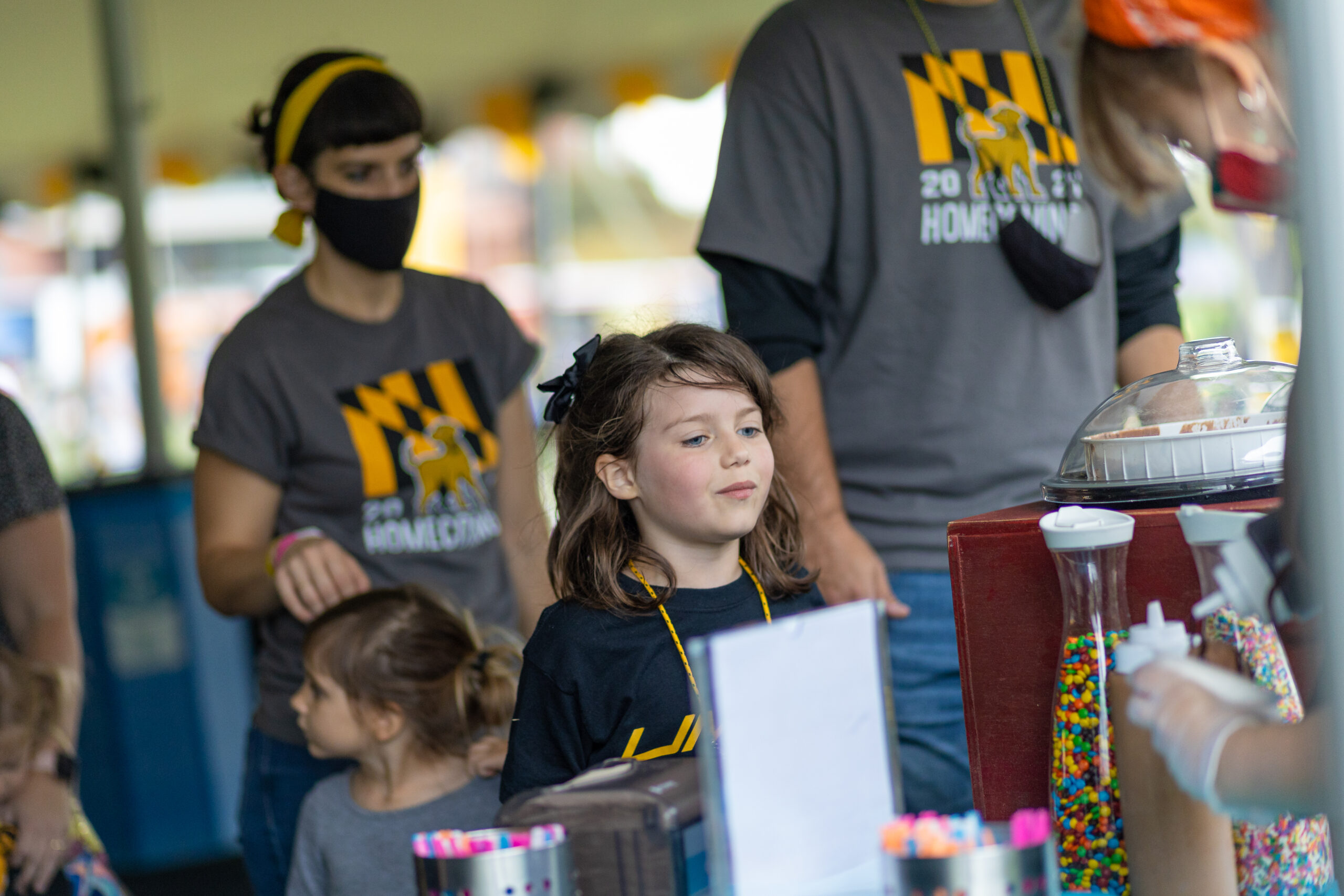
Wyatt pictured here with her own #FutureRetriever at the Homecoming Ice Cream Social. Photo by Kiirstn Pagan for UMBC.
Homecoming is also a time to welcome our cohort of #FutureRetrievers! We’re so excited to look forward to your 2039 graduation ceremony!
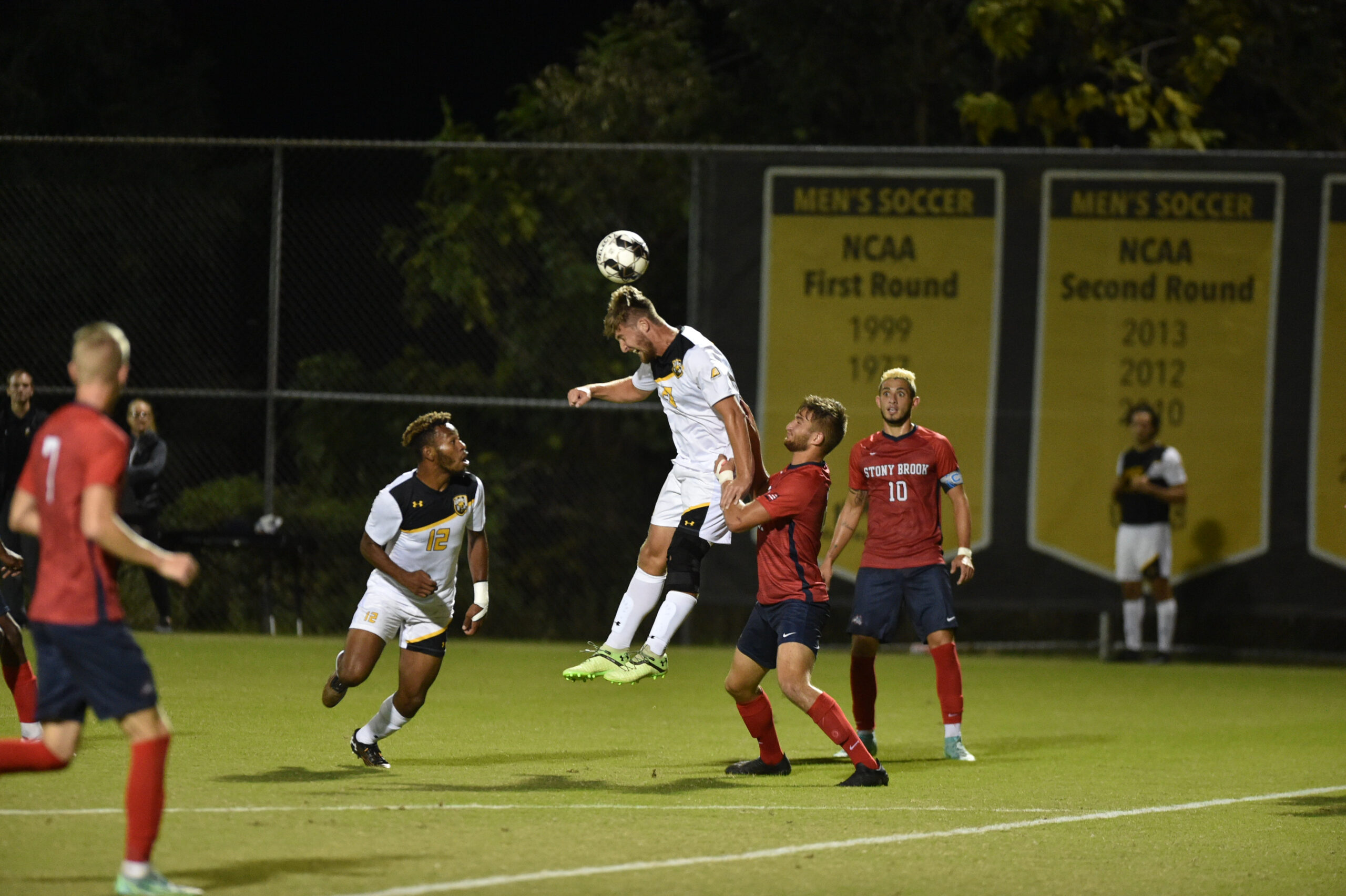
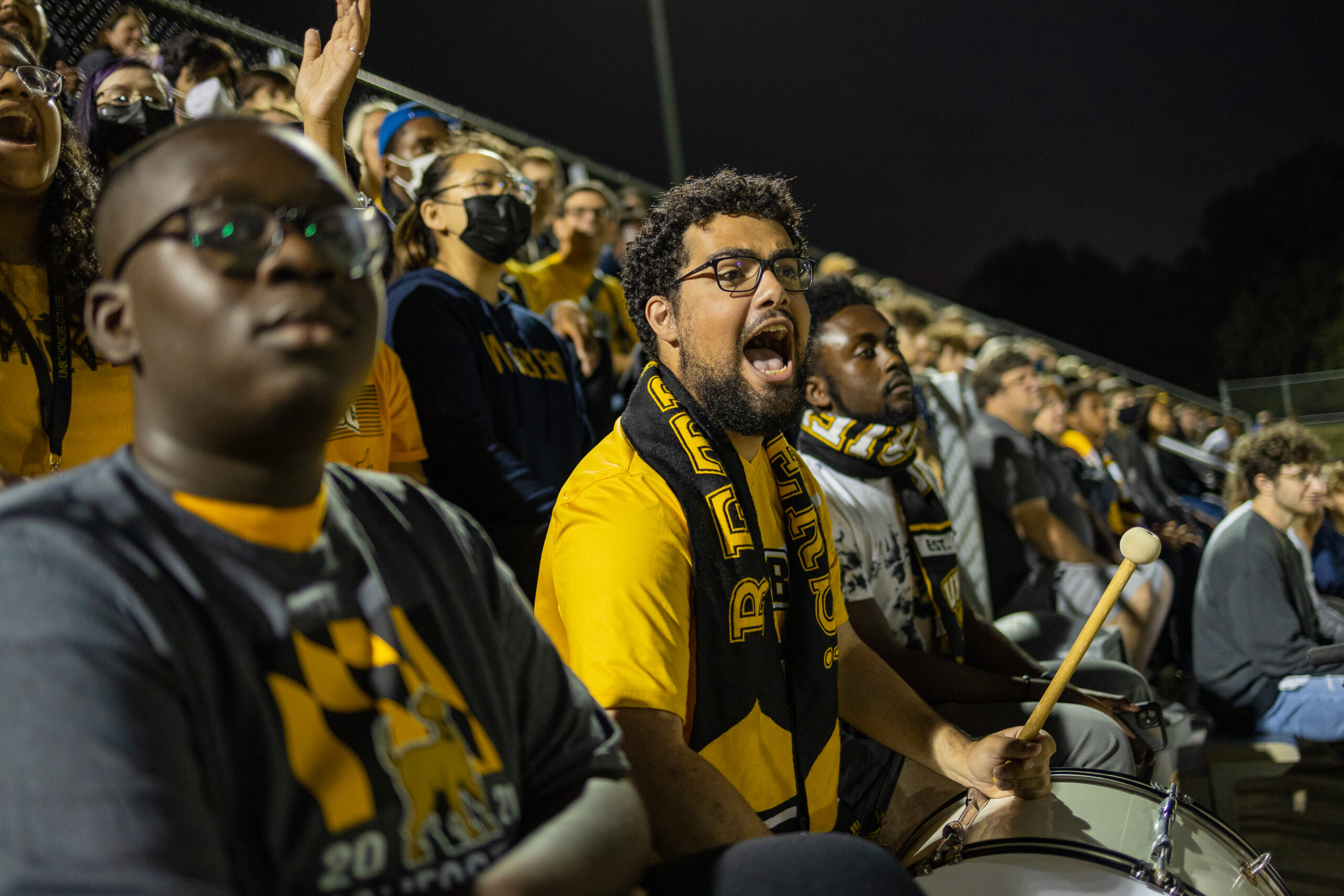
As the evening wound down on Erickson Field, the Down and Dirty Dawg Band and the UMBC Dance Team led the way to the Retriever Soccer Park, where the men’s team battled rival Stony Brook University. The men’s team did not ultimately triumph, but the stands were packed with fans rejoicing in the chance to once again cheer on the Retrievers together.
UMBC men’s soccer plays against Stony Brook. Photo courtesy of Ian Feldman ’21 for UMBC.
Fans giving it their all at the October 9 Homecoming game. Photo courtesy of Kiirstn Pagan for UMBC.
And finally the return of yet another favorite tradition, the Erickson Field bonfire.
Homecoming may be over, but UMBC is still welcoming Retrievers home. On Wednesday, October 20, the Alumni Association Board of Directors will honor the 2021 Alumni Award recipients.
*****
Header image of the fall 2021 carnival by Kiirstn Pagan for UMBC.
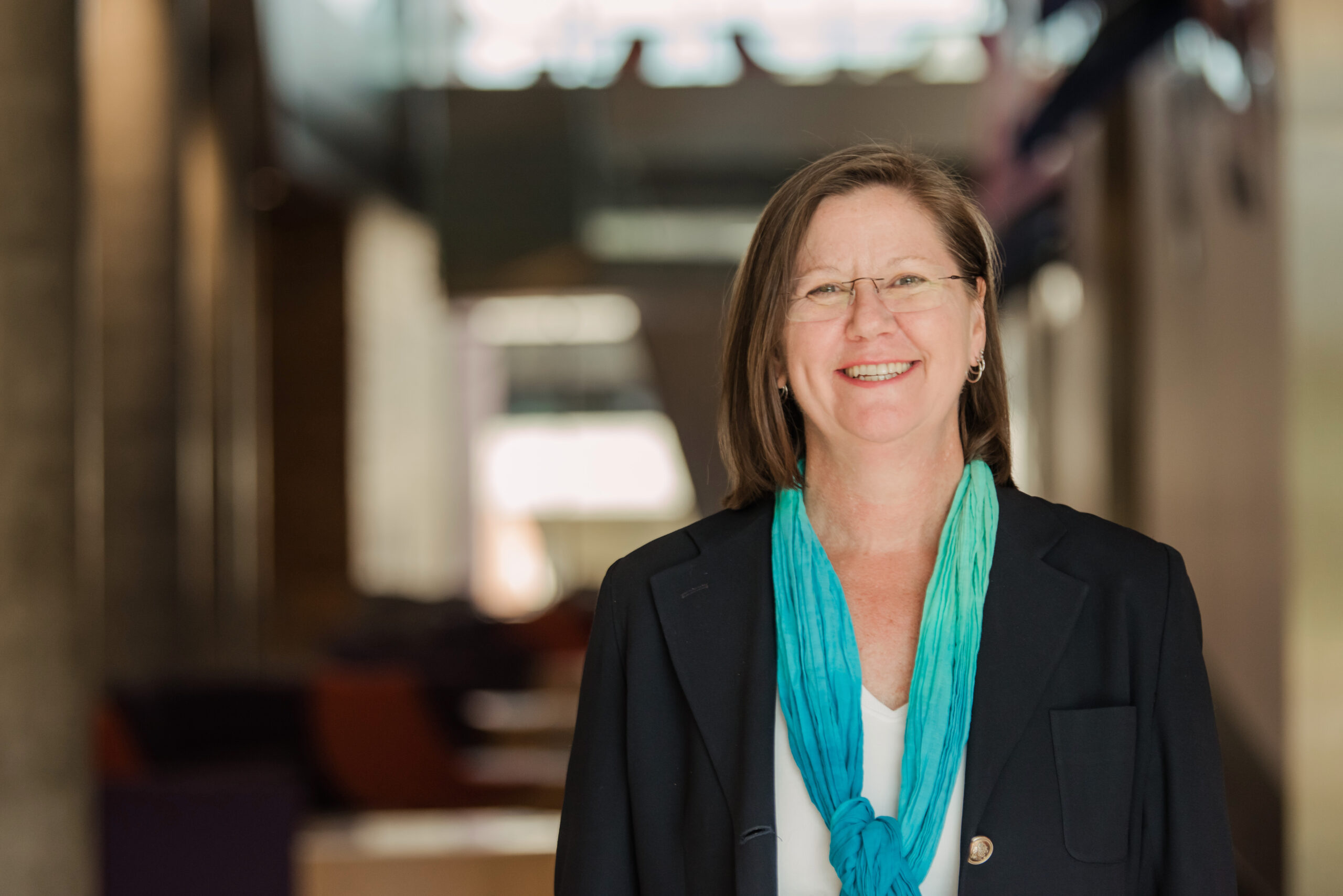
Kate Tracy, M.A. ’01, Ph.D. ’03, psychology, holds many titles—newest among them is special advisor to the senior vice chancellor of Academic and Student Affairs of the University System of Maryland. But one of her longest-standing and most important descriptors is “Maxine Tracy in a different form,” laughs Tracy. “A feistier version of my grandmother.”
Raised in a small, mid-western town, Tracy looks back on her grandmother Maxine as a source of unconditional love and support. “My grandmother was a caregiver. In many ways, she was the northstar in my compass, and no matter where I roamed or what challenges life has brought, I always felt anchored—in the most positive way—to her. She did what she could where she was for as many as she could in the way that she could. She opened opportunities for a lot of women. And she will always be one of my heroes,” says Tracy, who is honoring the late Maxine with an endowment in her name to the Women’s Center.
Undated photos of Kate Tracy with her grandmother, Maxine. Courtesy of Tracy.
Tracy’s path back to UMBC and eventually to giving is a winding one that includes almost 20 years teaching at the University of Maryland School of Medicine and shadowing President Freeman Hrabowski through a fellowship as an American Council on Education (ACE) Fellow for the 2019 – 2020 school year. That her tenure (and her background in epidemiology and public health) overlapped with the onset of a global pandemic is a coincidence not lost to Tracy. Much like her grandmother taught her, Tracy has spent the past year and half doing what she could in as many ways as she could. Her expertise made her a natural choice for joining the University System of Maryland’s (USM) pandemic response efforts. “It’s been a great privilege to collaborate with USM leadership and the leadership of our system campuses to promote health and safety plans for all the campus communities,” says Tracy.
In those early meetings, Tracy watched the group’s dynamics take shape: “Freeman’s focus was always ‘We need to stay focused on the people,’” she says. “I think he brought that people-centeredness to the conversations and I was like, ‘That’s how I want to lead.’”
Serving as a special advisor for USM, Tracy sees her role as “an important set of eyes and ears and public health expertise” for the system. She starts by channeling all types of news sources. “I digest that data and then try to break it down into simple bullets that I could then share to Chancellor [Jay A.] Perman and Joann Boughman, the senior vice chancellor.” She does all this while continuing to teach and research as professor of epidemiology and public health.
Headshot of Kate Tracy on campus in fall 2021 by Marlayna Demond ’11.
The USM masking and vaccination requirements that Tracy advised on have kept campus communities at a much lower rate of infection than their surrounding counties. “Our campuses are among the safest places to be and we are part of the solution of keeping Maryland open and the economy humming along,” says Tracy.
UMBC’s success in this endeavor, says Tracy, is because of the groundwork of trust already laid by President Hrabowski. “He has basically permeated that values system to the most basic level of the organization and it just goes all the way up through the top. When you put in the time to build that kind of culture and when you live your values with your decisions—people see that on display all the time, and the community knows they can trust your leadership during times of crisis like a pandemic.”
Women’s Center Director Jess Myers, who nominated Tracy for the award, says “Dr. Tracy’s work in helping understand and navigate testing protocols and products not only benefits UMBC but all the schools in the system and what better reflection is that of #UMBCTogether?”
Giving the difference
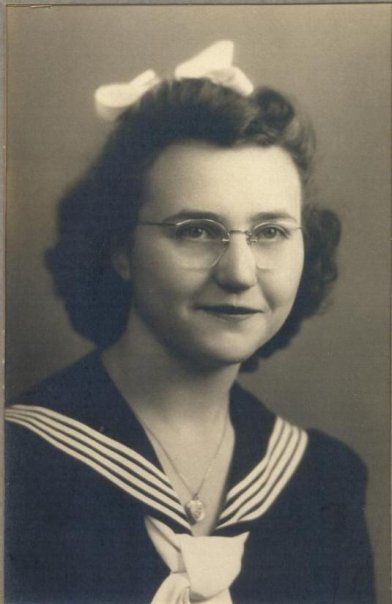
Maxine Tracy’s graduation photo, courtesy of Kate Tracy.
Tracy has seen the impact of seemingly small gestures like her grandmother Maxine’s open door hospitality, for example. In Tracy’s own work, she helped facilitate the successful effort to vaccinate 11,000 girls in Mali against HPV, which ultimately positioned the country to apply for outside assistance to put that vaccine in their national immunization program.
So when she learned the impact her gift could make for the Returning Women Student Scholars + Affiliates program—a cohort that supports adult learners at UMBC—Tracy said it was an easy decision. She visited a RWS event with President Hrabowski just a few weeks after she started her ACE fellowship. Myers remembers the occasion: “It was a very emotional conversation where we had students who were sharing some really deep and personal experiences of being an adult learner and being undocumented or just what it means to be a parent and be a student. So I think that just hit a chord.”
Tracy remembers something similar. “The energy of that event was just so strong and powerful and I was like, ‘I would like to do something with this. I wonder what that looks like?’ After talking with folks in Alumni Engagement, I started thinking about how my grandmother was such a powerful force in my life, and I’ve been a women’s health researcher, so all of these little dots started linking up together.”
The Women’s Center plans to dedicate the Maxine Tracy Endowment to scholarship support for approximately 25 RWS students each year, offering pre-semester orientations, monthly events, and individualized support for adult learners who are often already at the margins of university life, says Myers. “The funding will have a ripple effect in that the funds we’d usually spend to support the RWS program can now be directed to other critical initiatives aimed towards advancing gender equity, social justice, and belonging on campus.”
Planning the next steps
As Tracy considers her ACE fellowship (an immersive educational leadership experience) and her special advisor role at USM, she is thinking through what the next step of her career will look like.
“When I think about taking on leadership roles—and I think this is a value my grandmother brought to me—I think about the ways I watched her all through my life make space for people that she didn’t necessarily understand and that she didn’t necessarily agree with, but she always found a way to make them feel welcome and able to participate,” says Tracy. “I think we desperately need strategies to open up dialogue and conversation and I want to be part of that conversation.”
Read more about other alumni award winners and find out how to register to attend the October 20 ceremony in person or virtually.
*****
Header image: Kate Tracy and Jess Myers outside of the Women’s Center in fall 2021. Photo by Marlayna Demond ’11.
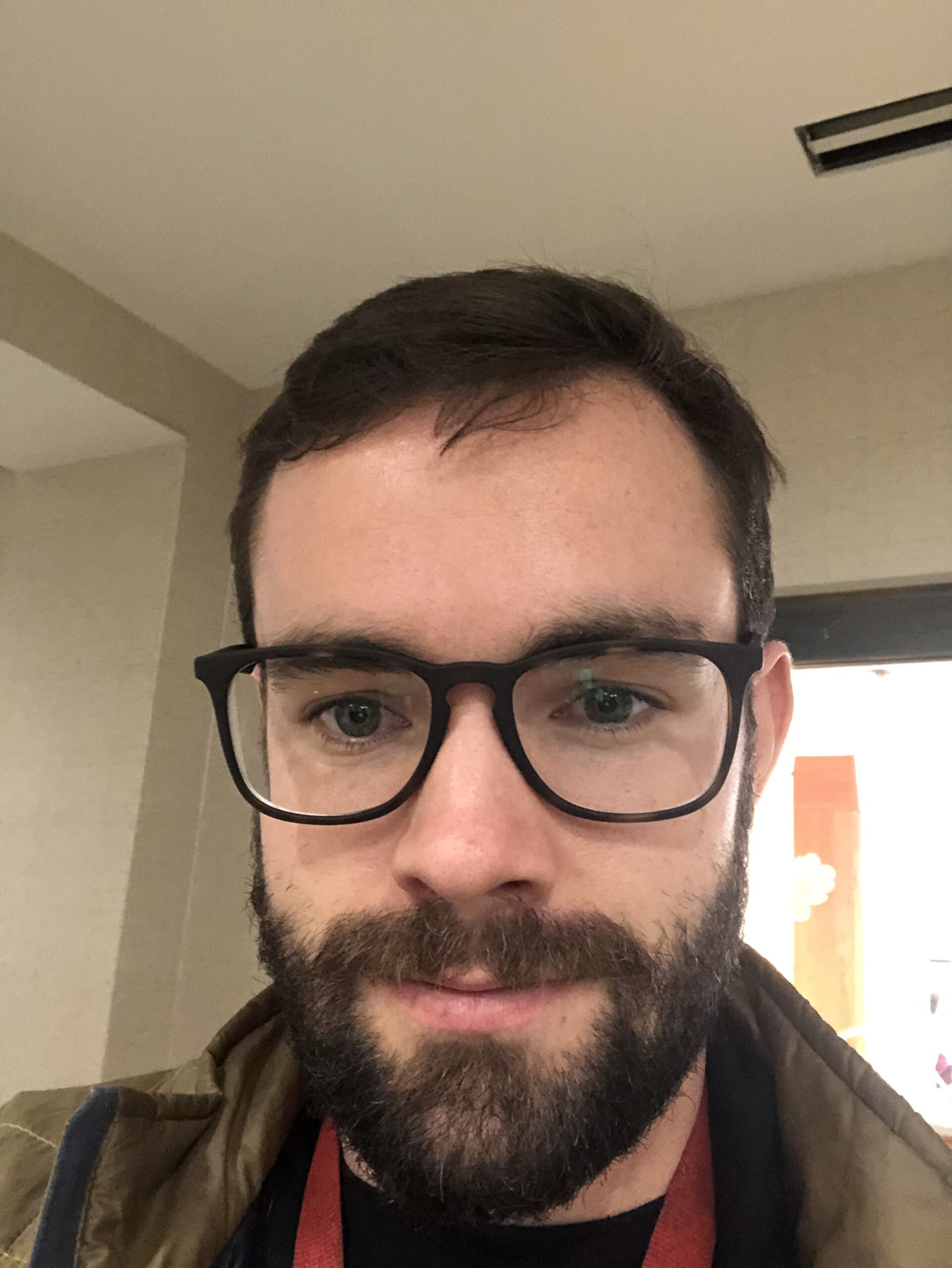
¿No hablas español? Not a problem. The Spanish Conversation Club is happy to have you! Don’t identify as a woman or engineering major? The Society of Women Engineers (SWE) still welcomes you. Interested in philosophy but not a philosophy major? Didn’t deter the past president of Philosophers Anonymous from taking office.
As a new semester gets underway (make sure to visit Involvement Fest, September 9), these and dozens of other student organizations readily welcome Retrievers who may not assume that the club is for them. Not surprisingly, UMBC clubs and orgs thrive when new perspectives show up.
Join the forum
Headshot provided by Quinlan Murphy.
When Quinlan Murphy ’21, political science, served as president of Philosophers Anonymous, the council of majors for philosophy students, he was determined to make the club feel like home to any interested student. This includes inviting discussions about Hannah Arendt’s warning against the preconditions for totalitarianism to attending online art tours as museums opened their doors virtually during the pandemic. Another of the club’s goals, he says, was to make the department’s physical space in the Performing Arts & Humanities Building a welcoming place for students in between classes. “We wanted to create a little bit of a domestic vibe, so students felt invited into the building—we wanted a tangible space for them to feel at home,” says Murphy, who also obtained a certificate in philosophy.
Known better as PhilAnon, the group traditionally meets at noon on Tuesdays to allow students to present ideas—their own or others—and then follow a group discussion. “We want people to discuss these ideas outside of class with a little bit less formality, without assignments, without quizzes or tests,” says Murphy. The group also invites other majors and departments to participate, giving talks on bioethics or the hard sciences to discuss the ethical and philosophical corollaries of their academic expertise.
“Philosophy majors and other members are people who are going to go on to work in the humanities or academics,” says Murphy, “and a critical part of performing that job is being able to present ideas effectively and quickly, and then also having those ideas be criticized and poked by others.”
Student groups make use of The Forum sculpture outside of the Performing Arts & Humanities Building in 2019. Photo by Marlayna Demond ’11.
Murphy, as a non-traditionally aged student and a commuter, has high hopes for PhilAnon and other clubs on campus. “I certainly think that the more involvement people have in school, the better college will be—it’s not just about grades and tests and essays. It’s also about growing as a person. And I think that requires interacting with your classmates outside of the classroom.”
Headshot courtesy of Sheila Yeboah.
Pull up a silla (chair)
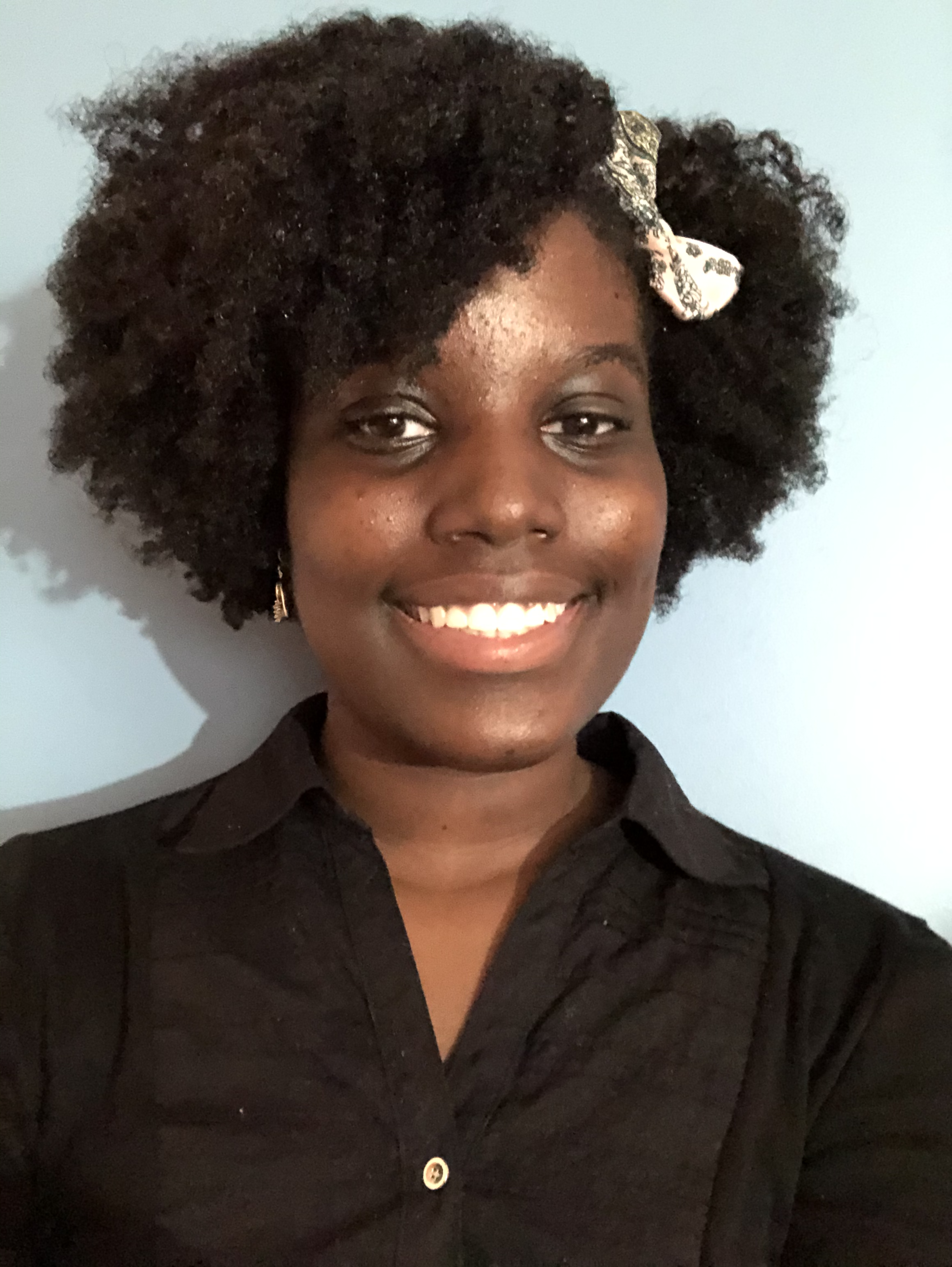
One of Sheila Yeboah ’23, biological sciences, favorite memories of the last semester is playing online pictionary on Webex with the Spanish Conversation Club. “The combination of the members’ poor drawing skills and the wealth of Spanish synonyms made the game extra difficult,” laughs Yeboah, but she adds that the easy-going nature of the club’s president James Angle and the other executive officers makes the student org a relaxed place to learn and have fun.
Yeboah says that previously her struggle with Spanish was having opportunities to speak it, and the low pressure of the conversation club was exactly what she needed. Yeboah, who is minoring in Spanish, joined the Spanish Conversation Club last semester when they were meeting virtually. “This club is primarily focused on forming friendships and practicing communication,” says Yeboah. “If you are a person that is a little more reserved, like me, it’s a very welcoming environment and you’re not going to feel like you can’t fit in.”
Angle ’22, modern languages and linguistics, became club president his sophomore year when the club had a vacuum of leadership. He and his friend Kyndall Hardwick ’22, English, the vice president, aim to make everyone feel welcome. “So many people get scared away because they think ‘I don’t know enough Spanish at that high level,’” says Angle, “but it could literally be your first day of Spanish class and we’d say ‘Come in.’”
Angle, who recently started taking Russian classes, knows that the hardest part of language learning can be getting comfortable speaking. “That’s the biggest battle,” he says, “but come play some fun games with us and get comfortable speaking Spanish while enjoying yourself.”
Building connections
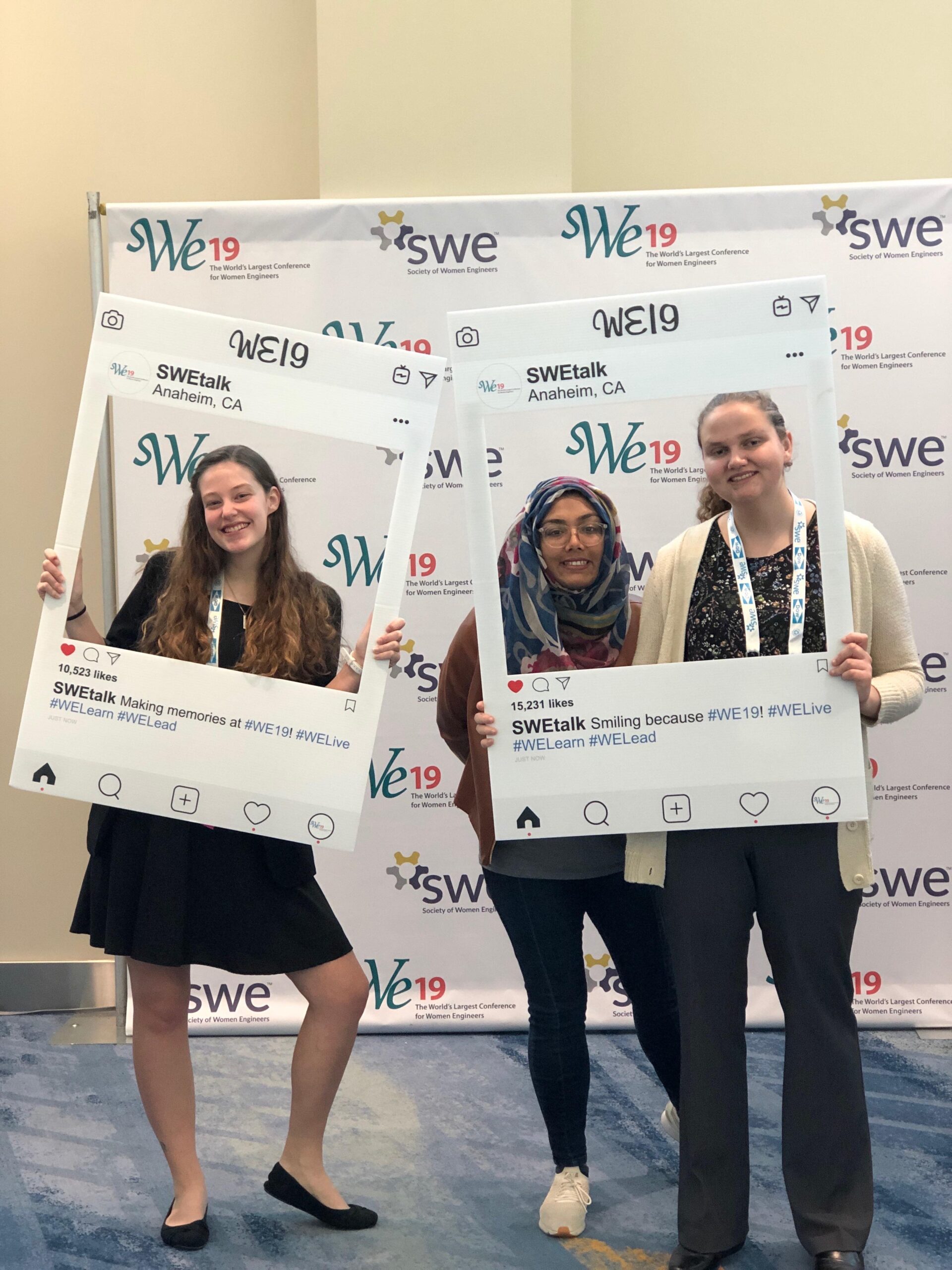
Lilly, left, and other SWE members at the National Conference in Anaheim, California in 2019. Photo courtesy of Kaitlynn Lilly.
At previous Involvement Fests, some students have balked at joining the Society of Women Engineers (SWE), says current president Kaitlynn Lilly, who is not an engineering major. Lilly, who is studying mathematics and physics, says that she and other club leaders emphasize that the space is accessible for anyone who “wants to empower women and move society forward,” says Lilly. “It’s a mix between creating a community of people who support women in STEM and also providing opportunities to meet with companies, practice professional development, and also be social.”
This three-fold goal is the intentional result of Lilly and others on the executive board asking themselves what the purpose of their community was. “We didn’t always have a third of our meetings mixed between social, professional development, and career,” says Lilly, a 2021 Goldwater Scholar. “We made a very conscious decision last year to do that because we used to have a company present to us at every single meeting. And it was really hard for club members to really form that community.”
Before the pandemic, says Lilly, the group was already hosting hybrid meetings to broaden the horizons of what companies they could invite to present. SWE will keep the hybrid format going forward for the convenience of people who commute or people who can’t make the meeting time.
Jessica Adams ’22, mechanical engineering, is starting her fourth year as a SWE member and her first as a leader. As the public relations chair, she’s eager to see the group grow its membership. “As we get a wider range of perspectives in our club, it allows us to learn about other people’s backgrounds so that we can understand where other people are coming from,” says Adams. “These interactions will make each of us a better candidate for any sort of jobs or internships we apply for in the future.”
Find your space
Murphy, who graduated last spring but hopes to stay connected to PhilAnon virtually, unsurprisingly sees students’ extracurricular involvement through the lens of what is morally and ethically good.
“I think students should see their time at UMBC as an opportunity for social and personal growth and not just like a job training program,” he says. “They should be able to ask hard questions and explore ideas informally. I think it’s really critical that there’s these spaces for people to have these conversations away from professors and with their peers.”
Whether that conversation is in Spanish or takes place online or in person, there’s a student club waiting to welcome all newcomers with open arms. Find out more at Involvement Fest, September 9 or online all year.
***** Header image: SWE at Involvement Fest in 2019. Photo courtesy of Kaitlynn Lilly.
Standing in the nearly empty expanse of Freedom Plaza, a block away from the White House and with the Capitol dome behind her, Ghazal Rahmanpanah ’08 is struck by the contrast of the demonstration space during the pandemic compared to vigils and demonstrations she’s organized and participated in there previously.
Rahmanpanah recounts some of the causes she’s rallied around in that space—No War With Iran, the National Iranian American Council, Move On, We Won’t Wait, and Mothers of the Movement at Freedom Plaza—advocating for peaceful and progressive policies. “I used to work right up the street,” says Rahmanpanah, “and the running joke was that the only times I ever took a lunch was to come here and participate in some sort of activation.”
It was her political science major at UMBC that helped Rahmanpanah realize she didn’t want to be a constitutional lawyer like she originally thought. Through her classes and conversations with professors she discovered her passion for “questioning laws and driving people to make sure those laws worked for everyone,” she says.
Rahmanpanah is now director of special projects for The League, a social impact collective. “The idea is that politics happens every day,” says Rahmanpanah. “Everyone lives political lives without realizing it, but while it might take a lot for you to bring someone to politics, it doesn’t take much to bring them to culture. And there is an intersection where social justice issues and politics and culture meet. So what we try to do is to bring people to live more civically minded lives through narrative change.”
The right to live with dignity
This drive for equality started early for Rahmanpanah. “My involvement with civic engagement probably began when I was born,” she says. “I was born in Tehran, in Iran. We came here to the States when I was about five years old because of the war. There was the Iran-Iraq war right after the Iranian Revolution. So it just wasn’t a sustainable environment, according to my parents, for us to stay in.”
The awareness of injustice was “seeping into my psyche at a really young age,” Rahmanpanah explains. “And so I just became really fascinated with human rights—the idea that human security is for all. There are certain things that every individual deserves the right to live with. And one of those is the right to live with dignity. And that’s why I feel really strongly about what I do about changing narratives, changing how we talk to people about people, how we bring people into community.”
Photos from Rahmanpanah’s childhood in Iran.
Rahmanpanah’s work at The League gives her the platform to make change. As a society, she says, “we really like to push people to calls to action, but we don’t take the time to really see what type of narrative would resonate in their lives. And so that’s the work we do at The League. It’s a lot of culture change work.” Projects she’s worked on include a PBS documentary called And She Could Be Next, which follows women of color who are getting involved in different types of political campaigns. “It highlights that for most working moms or for women in particular,” says Rahmanpanah, “there’s so much space to get involved in campaigning whereas maybe they didn’t feel like there was in the past.”
Another project brings young people into the voting conversation to let them see how their lives are impacted by elections. Rahmanpanah calls the concept “a full set society.” “Every four years, the major campaigns come out and ask, ‘Hey, did you vote? Did you do this?’ Usually it happens in the 11th hour and it fails to make people feel like they’re in community. It fails to tell young people how these issues impact them day to day and not just during election periods, because every year is an election period.”
Change is good
Rahmanpanah with her fiancé Sherwin Rahimi, who she met on her second day on campus.
The word community is often a well-used buzzword, but Rahmanpanah says she discovered a tangible community at UMBC. “When you come to UMBC, you get a sense of being in a big environment, some place where there’s a variety of voices and ideals and everything. And that’s something so rare—that you could be in a big space, but connect with so many various people.”
Additionally, Rahmanpanah realized that coming in contact with different people on campus was changing her—and that was a good thing. “My politics and my ideologies changed because of the people I interacted with, Dining Hall staff sharing with me about their lives in Baltimore, because of the professors I spoke with on campus and in classes and events,” says Rahmanpanah. “It challenged how I thought about things and continued to force me to learn and unlearn things. And I hope that we can do that within movement spaces so that we’re not so insular so what we’re trying to say reaches more people.”
“I think people live progressive values without realizing it,” Rahmanpanah continues. “And so sometimes it’s just something that’s lost in translation. As someone who’s had to translate and interpret for family her whole life, I can tell you, that just happens sometimes. But we have to meet people where they are and we have to figure out how to speak to them. And that takes a lot of grace and patience. And that’s what I’m hoping to do with my work.”
It’s personal
While UMBC has helped shape Rahmanpanah’s professional and political trajectories, it’s actually her personal life, she says, that was most impacted when she became a Retriever. On her second day on campus, she met her now fiancé Sherwin Rahimi. At their upcoming wedding this September, she’ll rely on two of her best friends for make-up and photography, Sam Navarro ’08, psychology and Jessica DeThomas ’09, history. “It feels so great that such a special day is rooted in our origin story,” says Rahmanpanah.
Rahmanpanah with Sam Navarro, left, and Jessica DeThomas, right.
***** Header image by Corey Jennings ’10, all other photos courtesy of Rahmanpanah.
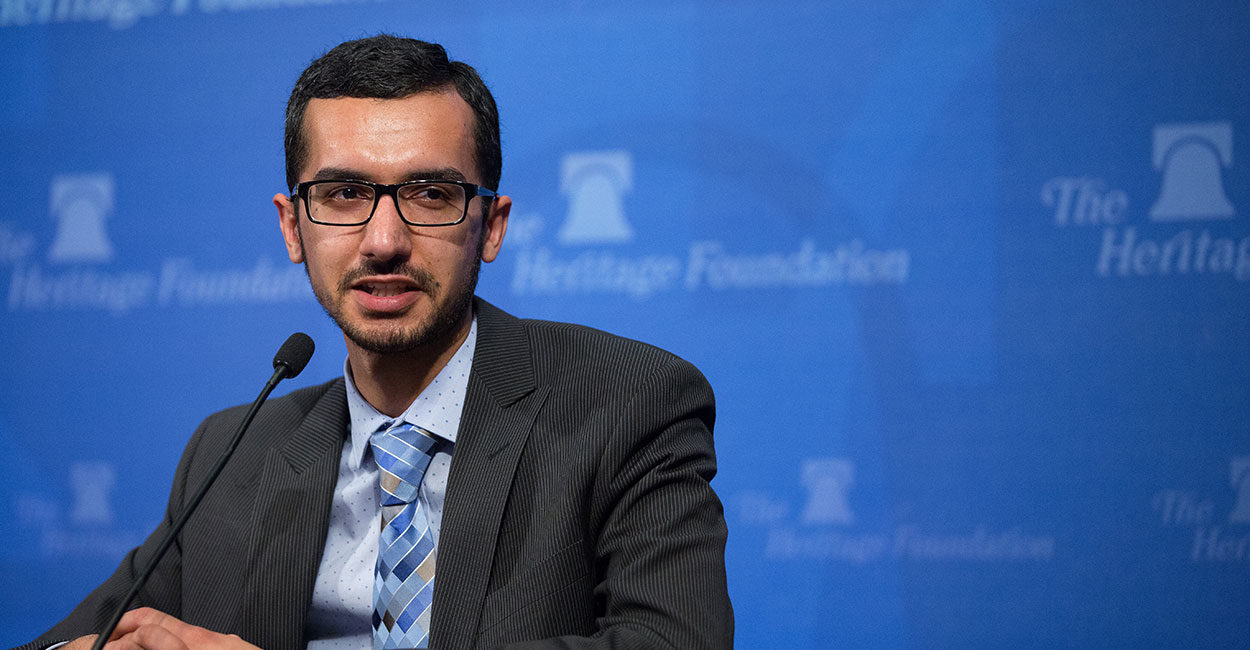
Arrested for his role in a failed terrorist plot as a teenager, Mohammed Khalid found freedom from his radicalization after prison officials showed him kindness and empathy. Freed in 2017 and now a senior at UMBC, Khalid has surrounded himself with mentors as he researches how to help others see through the lure of extremism.
As an incoming transfer student to UMBC, Mohammed Khalid needed to be excused from some of the mandatory McNair Scholars Program orientation sessions to give a presentation at TEDxJHU. The title of his talk? Reconciling Humanity: Struggles of a Former Teenage Terrorist.
As McNair program director Michael Hunt listened to the information systems major tell his story over the phone, he could hear Khalid gaining more confidence as he went through the details. At the end, Hunt asked if Khalid would like to practice giving his presentation to his fellow McNair scholars before the real thing.
This is not how Khalid normally introduces himself at first meetings, but he doesn’t shy away from it either. “What I told him,” says Hunt, ’06, M13, mathematics, “is that you’re part of us now. You’re one of us. So just know that your story is now our story. Right? I really wanted him to understand that.”
At the 2019 McNair orientation, Michael Hunt, right, talks to Khalid before he leaves for the TedxJHU event.
Before Khalid immigrated to America at age 13, his perspective of the West was shaped through literary fantasy like the Harry Potter books and The Chronicles of Narnia. Once arrived in a land less magical than he hoped, Khalid would come to be enmeshed in his own struggle of good versus evil, envisioning the world in a false dichotomy of strict black and white, pitting his perceived brothers and sisters versus the world.
Born in the United Arab Emirates and raised in Pakistan, Khalid and his family joined his father in 2007 in Howard County, Maryland. Certain memories stand out from that first day, he says. An overly brusque immigration officer at the airport in New York, his father in the car emphasizing that this is their new home—they will go to school, work, live, and die here one day, he said—and the loneliness of arriving at their townhouse late at night.
One thing that excited Khalid was starting school in his new country. He already knew English well after being brought up in a British education system and was excited to find a group of friends. But when he introduced himself in class, his new classmates snickered, he remembers.
“Mohammed is a terrorist’s name,” they told him.
Sharing his journey
Khalid ’21, information systems—a Cyber Scholar, an Honors College student, and a UMBC McNair Scholar—has shared these painful memories very publicly—in a Vice news segment, in panels around the country, and recently in a national magazine. He presents them not as an excuse for what followed in his teenage years, but as an open way of grappling with the decisions he made, with the goal that he might possibly help someone else avoid the descent into extremist circles.
Mohammed Khalid was the youngest person to be convicted of terrorism in the United States. He was arrested at 17 in July 2011 and released from criminal custody in December 2015, although he was immediately detained by the U.S. Immigration and Customs Enforcement until May 2017. He won his U.S. citizenship in 2018. After his deradicalization in prison, Khalid has dedicated his life to helping other young people not fall under the sway of extremists like he did.
Hunt explains that the McNair program does more than prepare students for graduate education in all disciplines through research, mentoring, and other scholarly activities—it also focuses heavily on community building with an emphasis on providing a space where students can cultivate productive interactions, and speak honestly and critically from their own experience with the goal of mutual learning.
Khalid took Hunt up on the offer to practice his talk in front of the McNair peers he had only just met. “There was a real emotional connection,” remembers Hunt, “and an understanding of his vulnerability. I know that for the community, it really shaped their understanding of the dynamics of the group. So it wasn’t just about him. It was about how this allows you to connect with a group of people who are going to be sharing your journey.”
Who are your brothers and sisters?
Connecting with people in real life was not going well for Khalid in high school. The terrorist comments didn’t abate, and neither did digs at his religion and origins. These insults were completely out of context for Khalid, so he turned to a common source for answers—Google. He then found a home on YouTube where he met people he considered friends—his true brothers and sisters in the faith, he thought at the time—watching and translating into English videos explaining his religion. Soon, the website algorithm changed the videos promoted to Khalid; he was watching suicide bombings and communicating with people tied to Al-Qaeda and other terrorist organizations. He was embraced by people online who called him a brother and welcomed him into their extremist community.
“Calling someone your brother and sister in Islam is the biggest modicum of respect that you can give them,” explains Khalid. “I think that it’s an innate human need to be heard and to be listened to. And these people online who I was calling my brothers and sisters, I would talk to them online and then come to find out they were actually listening to me and they would reflect my feedback. That’s something, I think, very necessary to camaraderie.”
Khalid spoke at an event in 2019 called the Pathways In and Out of Islamism: A Conversation with Two Former Extremists.
On his way to discovering more about his religion, Khalid mistook extremism for fervor, recognizing now that “extremists had actually hijacked the philosophy and the ideology of Islam, which I call Islamism; the political side of it obviously, not the religious side, which is different.”
In parsing how his thinking worked at the time, Khalid says he thought along these lines: “Well, my classmates are calling me a terrorist because of what’s happening in other countries and at the same time they [Americans] are hurting ‘my people.’ So who does my allegiance lie with? Is it with people who are part of my faith or with people whom I’ve just encountered in this new country who are actually demonstrating this antagonism against me?”
Khalid says he was spending 40 hours a week on YouTube chats with like-minded individuals, all the while pulling away from his real family. His involvement eventually broadened beyond the virtual, and in 2011, he was arrested in connection with an international (unsuccessful) plot to murder a Swedish cartoonist. He attempted to recruit people and solicit funds for an American woman known as “Jihad Jane” who was organizing the hit.
In his TEDx talk, Khalid goes into detail about his arrest and how surreal the situation seemed in the moment. An FBI officer had to remind the then-17-year-old to say goodbye to his parents. After his arrest, Khalid was diagnosed with Asperger’s Syndrome, a type of autism, which has helped explain to him those feelings of detachment during the harrowing moments of his arrest and also when thinking back on how hard it was to make friends in school.
“What I told him is that you’re part of us now. You’re one of us. So just know that your story is now our story. Right? I really wanted him to understand that.”
Michael Hunt, UMBC McNair program director
It was in prison, of all places, that Khalid says he began to see the shared humanity with fellow prisoners and guards alike. “All that the prisoners and prison officials wanted to do was understand, and all I ever wanted in my life was to be understood,” says Khalid. The correctional officers took time to share their own experiences with Khalid, which over time broke down the barriers Khalid had erected. One officer in a juvenile facility even challenged him, “Have you actually read the Qur’an from front to back?” When Khalid said no, he was given a copy.
“And I read it at that point,” Khalid says. “That’s when the ideological farce that I was believing in came breaking down. I think one of the verses that really resonated with me was how saving one life means that you’re saving humanity, and how killing one life, it’s like you’re killing all of humanity. I think that’s just one of the many beautiful principles in the Qur’an, that it is completely divorced from extremism.”
Finding ethical ways of detecting online radicalization
At UMBC, Khalid has jumped head first into his information systems major with a focus on cybersecurity. His drive to help other young people not fall sway to extremism online is apparent, says Vandana Janeja, professor and chair of Information Systems. “Mohammed has tapped into all the right resources for him to advance,” says Janeja. “He’s a real good example for other students—he showcases the best of what we have to offer at UMBC.”
Khalid transferred to UMBC in winter 2019. He quickly reached out to Janeja and Anupam Joshi, professor and chair of Computer Science and Electrical Engineering and the director of the UMBC Center for Cybersecurity, for help with formulating methodology for his research project assessing indicators of online radicalization.
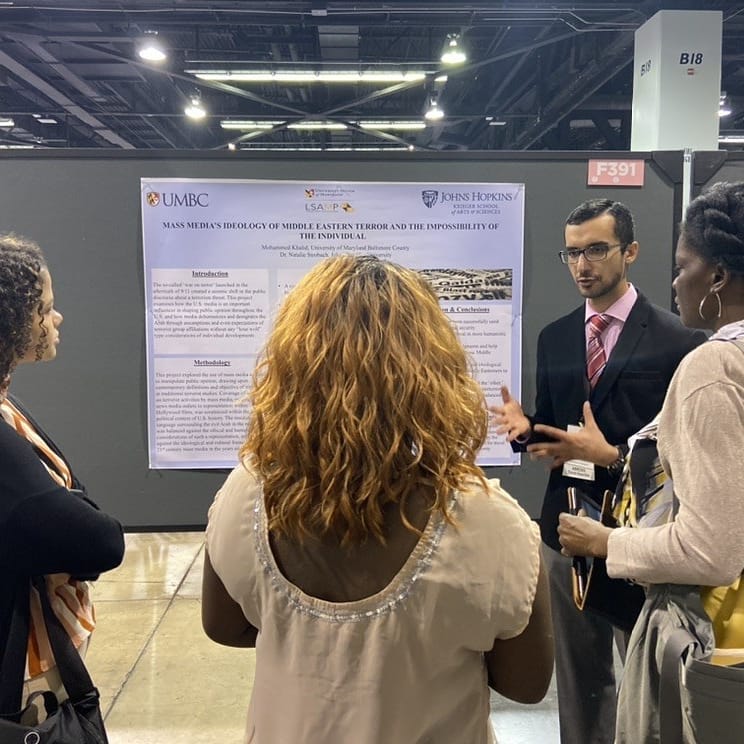
Khalid shares his poster “Mass Media’s Ideology of Middle Eastern Terror and the Impossibility of the Individual” at the 2019 Annual Biomedical Research Conference for Minority Students.
“Frankly, if I’m being very honest,” says Joshi, “if someone from any background other than Mohammed’s had approached me and said, ‘I want to do this work,’ I would have probably not agreed to do it. In some areas, you can’t bring a certain amount of necessary empathy to your research unless you’ve been in that situation.”
And what Khalid was interested in researching—how to detect signs of Islamist radicalization from online discourse—is extremely complex, adds Joshi. “It sounds deceptively simple, but it’s very hard to do that. Because you’re trying to judge the mental state of a person based purely on what they’re saying in public-facing platforms.”
Both Joshi and Janeja pushed Khalid to study the ethics of data analysis. “In speaking to him about his research, I encouraged him to look at various perspectives to data analytics,” shares Janeja. “In our department, we frequently have conversations around ethics with students. ‘Keep in mind, as you are making choices in your algorithm, that you’re using this threshold to cut off these participants from analysis or using this threshold which impacts people in a certain way.’” Joshi adds that researchers’ biases can also easily enter their algorithms without careful consideration.
“What I told Mohammed,” says Joshi, “was that for his project, I am happy if he just ends up getting exposed to these ideas and how the technology can be applied to detect radicalization. He’ll have the rest of his graduate career or research career if he wants to continue to improve things, because this is a particularly hard problem.”
Holistic mentorship
Khalid is in the distinct position of knowing personally how people can influence you to pursue good or evil. He has become more discerning about the type of mentors he allows into his life, but more than ever understands the need for trust and vulnerability and has surrounded himself with teachers who can address all facets of his mental, physical, spiritual, financial, and academic life.
When Khalid was released from prison in 2017 after his five-year sentence, he quickly sought to make up for lost time. Prior to being arrested, he had received early acceptance to Johns Hopkins University, but now he had to start his educational journey from scratch. “Rejection is the word I associate the most with that period,” Khalid says candidly. He eventually found his footing at the Community College of Baltimore County (CCBC).
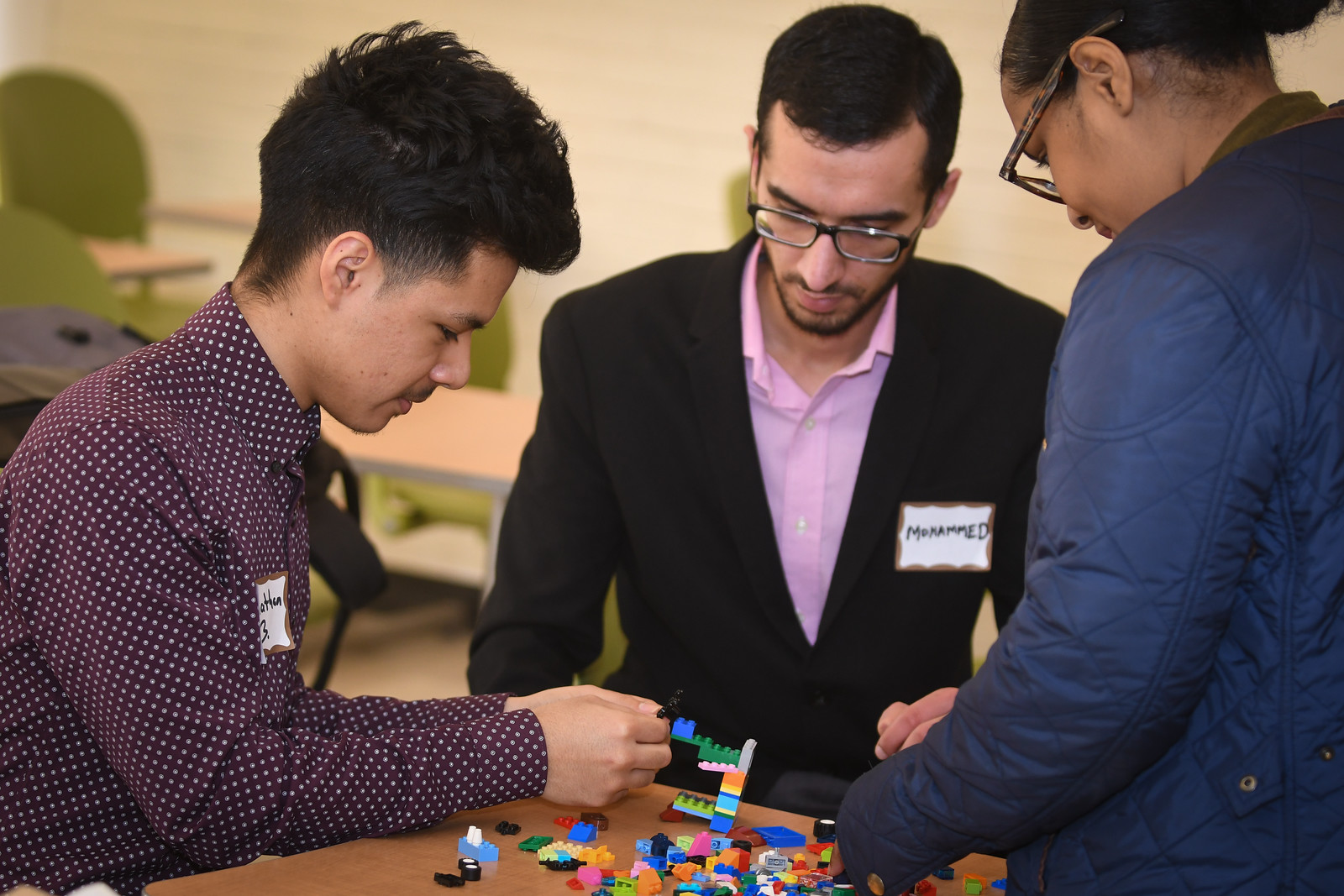
Khalid participates in activities at the February 2019 McNair Scholars Program group interview with other UMBC students.
“Mohammed is the type of student that takes every opportunity that comes before him—every opportunity to grow, to learn, and to serve,” says Natasha Cole-Leonard, associate professor of English and director of the honors program at CCBC, who got to know Khalid when he was a leader in the honors program and on the student honors council.
At some time early in their relationship, Cole-Leonard says Khalid asked for a one-on-one meeting. “In reflection, I appreciated the fact that he trusted me to hear his story before it was a situation where he felt compelled to or because it was breaking news. It was just out of his own desire to be honest about his background.”
Khalid has continued to open up to advisors and mentors at UMBC, and through the McNair program has been mentoring other students as well. It’s a role he’s taken to heart. “One of the things that I really emphasize is empathy. We can all sympathize with anyone, but empathizing is where it becomes difficult because you’re really putting yourself in the other person’s shoes and looking through their eyes, which is super hard,” says Khalid. “It’s exciting and interesting to coach others, providing them with words of affirmation and giving them encouragement and support. I’m letting them know that I’m there for them, no matter what happens.”
McNair program director Hunt is developing his dissertation for the language, literacy, and culture Ph.D. program at UMBC on holistic critical mentoring, which he also practices with his McNair scholars. Some of the tenets Hunt mentions are reciprocity between mentee and mentor, while both parties are asked to collectively bring their culture and lived experiences to the relationship.
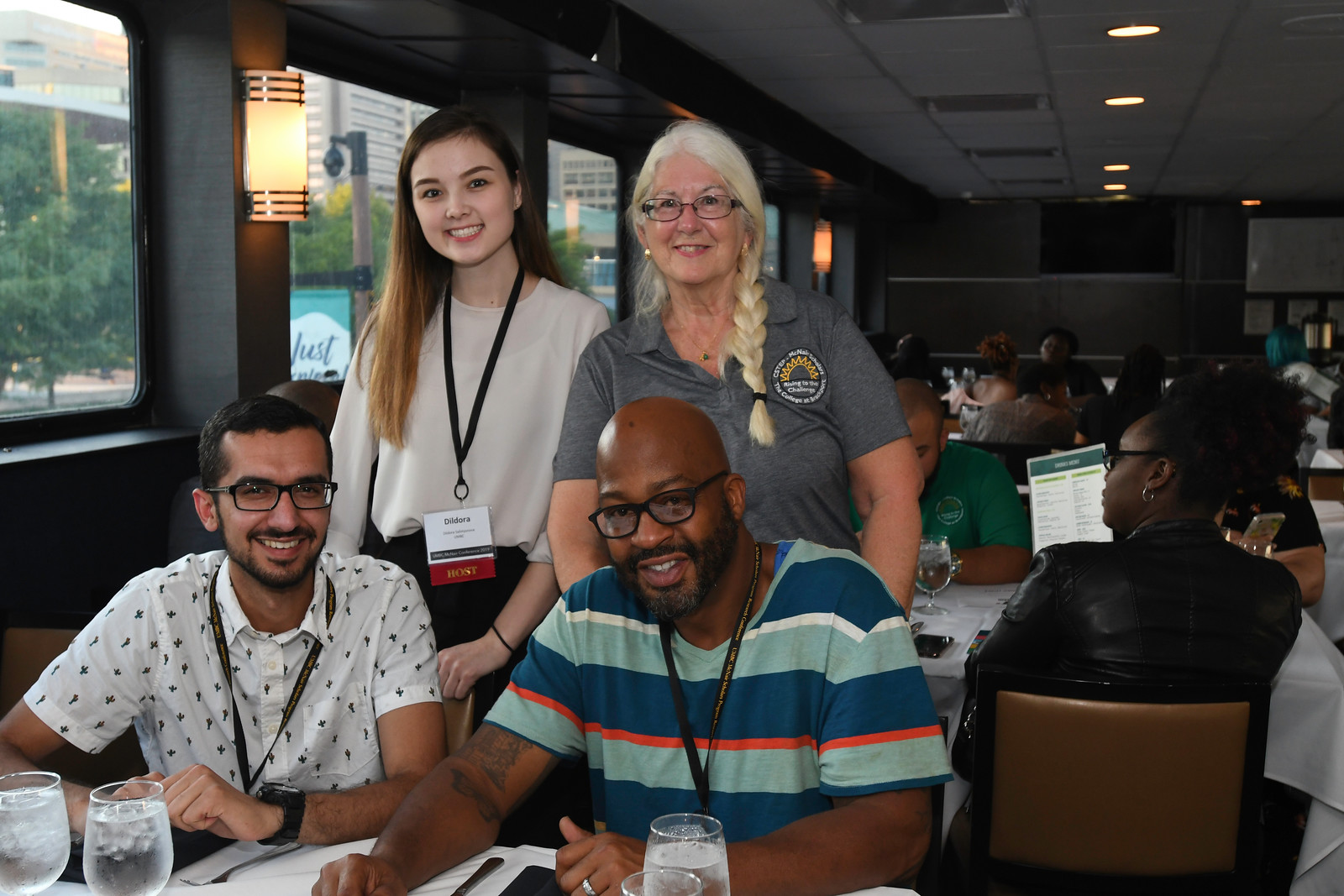
Khalid with fellow McNair cohort member, Dildora Salimjonova ’20 (standing, left), at the 27th Annual UMBC McNair Scholars Conference on September 20, 2019.
“We provide a space where affirmation comes first,” says Hunt. “Before any of the work, before we get to the deadlines, before we get to anything we’re dealing first with their humanity. In our McNair community, we have been intentional about scholars, staff, and mentors being able to show up as fully themselves.”
“Having someone who always believes in you is super important. And that’s something I’ve actually personally experienced at UMBC,” says Khalid. “All these people who I count as my mentors, Dr. Joshi, Dr. Janeja, Cindy Greenwood of the Cyber Scholars program, and Mr. Hunt…all these people actually believed in me when the whole world said I couldn’t do this, and here we are and I’m still a mentee.”
The power of being heard
Khalid’s cautionary tale against the temptations of extremism seems especially necessary in American culture currently. As the country wrestles with conspiracy theories that have torn at the fabric of the nation, what can we learn from the mistakes of teenager Khalid? “People tend to find ideology that already fits in with their perfect narrative…whatever reinforces what they want to believe in, no matter the regard for the facts out there,” says Khalid.
As hard as it might be, Khalid says, we need to work on pinpointing our commonalities.
Khalid poses with Jonathan Velez, an instructor at University of Pittsburgh who guided Khalid in incorporating machine learning approaches in his research in 2019.
“Emphasize the humanity of the other person and things will get better. I know that sounds like just a perfect world, but I’ve found that people who feel heard—if you listen to their story—that’s a way to start the conversation of what’s bothering them.” He returns to his own period of deradicalization.
“I started to change after I was able to look at these correctional officers in a new light. This led me to come out of that us-versus-them mindset and believe, ‘Well, these people, their humanity is no different than mine,’” he says. “And that was the first crack in the ice, that kind of led to the shattering of the philosophy and the ideology that I was believing in.”
Khalid acknowledges that everyone loves “a classical prison story of redemption,” but knows that he will continue to face questions about the sincerity of his deradicalization. “To that,” he adds, “only time will tell, and time has been telling so far.”
*****
STEM professionals need to prioritize the social impact of their work. Read more about interdisciplinary teams at UMBC researching methods to support these efforts.
Header image: Mohammed Khalid ’21 on campus in spring 2021, by Marlayna Demond ’11. All other images provided by Khalid.
In music, science, and theatre classes, in research labs, in conservation efforts, and almost every corner of academia, there’s a growing awareness and dedication to community-engaged scholarship. How are different disciplines training up social justice-minded students to do no harm to the communities they work in? With one thriving relationship at a time.
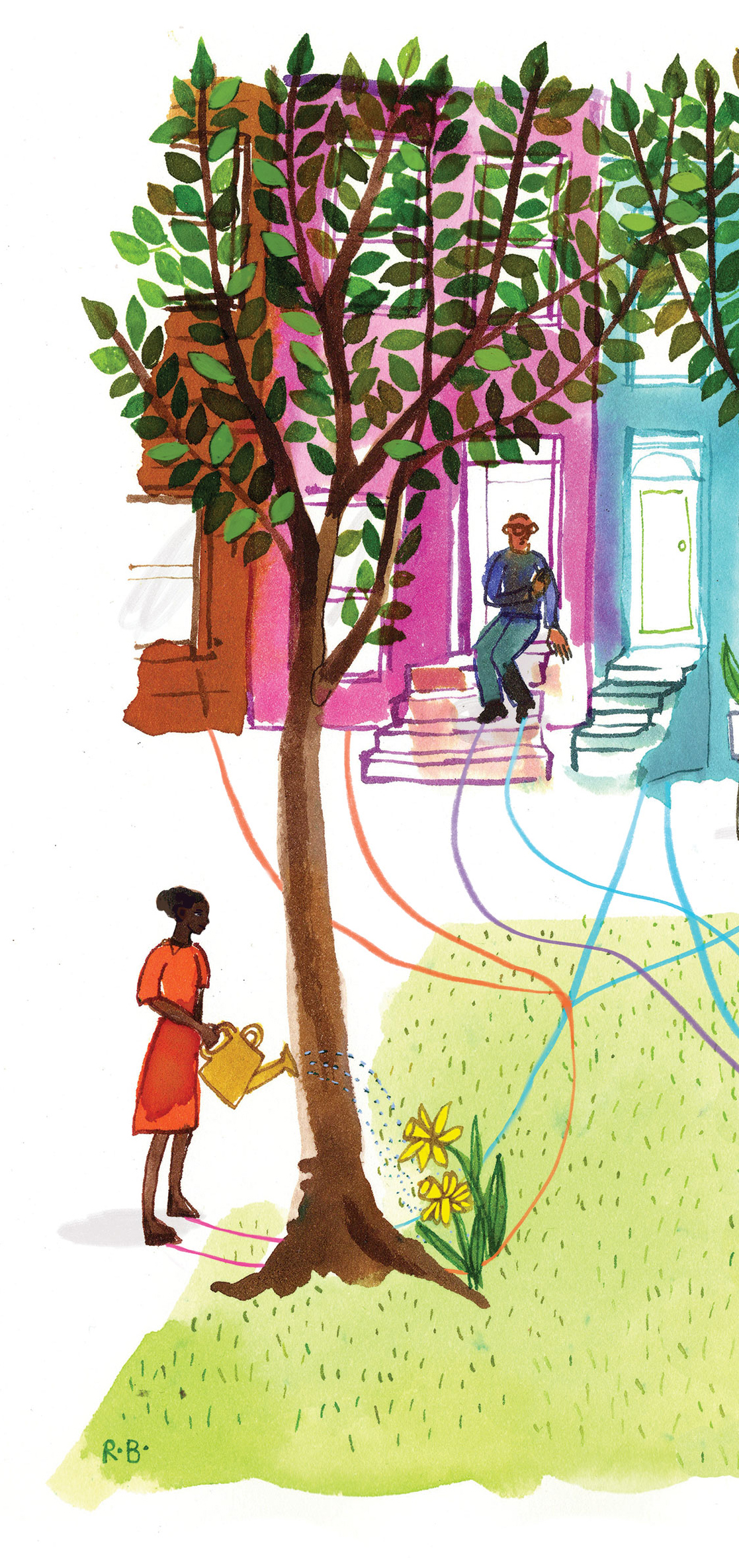
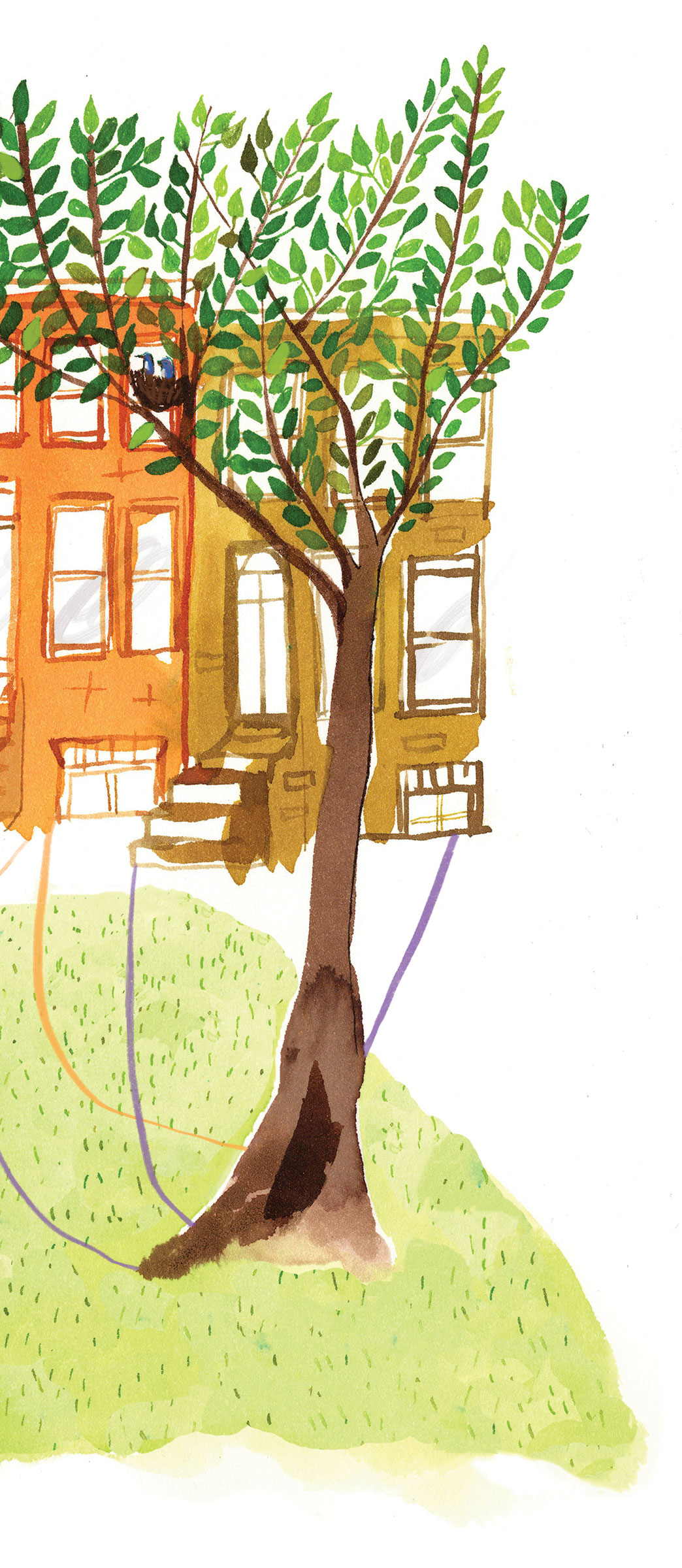
A tree grows in Baltimore. Its roots push against the surface, its newly budding canopy blocks some of the dreary rain on this last day in March. The aphorism promises flowers soon, but the daffodils are already here, lush and golden against the wet grass. Rooted in this environment, the tree struggles to absorb water in a heavily-paved area. It faces possible invasive species, the whims of developers, a strike of lightning or disease.
These outside influences affect the flourishing of this tree, and the flourishing of the neighborhood it’s rooted in is just as interconnected. A tension, a balance, a system of reciprocity.
In Franklin Square Park, on a parcel of land donated by developers to the southwest Baltimore neighborhood in 1839, this tree and 96 others were recently surveyed by UMBC students at the request of the Franklin Square Neighborhood Association. They wanted a catalog of their natural resources, but also a record of what they’ve lost—only seven of the original 149 trees on a 1916 map of the park remain.
Working with members of the neighborhood, Mariya Shcheglovitova, Ph.D. ’20, geography and environmental systems, and Bee Brown ’21, environmental science, and other UMBC student researchers began their work. Their project would rapidly expand from an arboreal park survey to a community-focused project that invited local kids to participate in a scavenger hunt and other activities to build on the students’ existing connection to the park. As Shcheglovitova and Brown discovered, “understanding park quality is dynamic and can only be partially captured in a survey of the park features. Historic accounts and a focus on what happens in a park can enrich our understanding of park quality.”
What began in Franklin Square as an effort to catalog trees—separate trunks with roots and canopies equally intermingling—broadened to encompass the community who interacts with the park the most. Acknowledging this interconnectedness in research of all types at UMBC is not new to academia but is becoming a more prominent approach to research as different disciplines wrestle with ways to train up social justice-minded students and do no harm to the communities they work in.
Bridging campus and community
Community-engaged research gives a name to this method. At UMBC, most service-learning and community engagement experiences are facilitated through The Shriver Center, which was founded nearly 30 years ago. Director Michele Wolff explains that in the early days, the Center emphasized “that higher ed institutions shouldn’t tell communities what they need. The partnership should be one of mutuality and reciprocity. So our focus should be listening to community partners, hearing where their gaps are and then being a resource to work with them to fill the gaps.”
This is still the Center’s primary mission, and in January 2020, the Carnegie Foundation for the Advancement of Teaching honored UMBC with its distinguished Carnegie Community Engagement Classification, acknowledging UMBC faculty, staff, students, and partners for their deep commitment to strengthening the bonds between campus and community.
As part of the application process, more than 120 campus partners and dozens of community partners underwent a rigorous self-study. Along the way, they found that in music, science, and theatre classes, in research labs, in conservation efforts, and almost every corner of academia, there’s a growing awareness and dedication to community-engaged scholarship. Wolff sees this movement come alongside “an increased appreciation of disparities, racial inequities, and other social justice issues. At the same time, people have been working on increasing appreciation and inclusion of community members as experts, or thinking about what counts as scholarly work.”
Some departments are working on ways to adopt these methods, and others have this ethos baked into their core. American studies, one of the original majors at UMBC, calls community-based research and engagement one of the “signatures” of the major. With its joint focus on “coupled natural and human systems,” geography and environmental systems (GES) is another department that recognizes the necessity and power of community-engaged scholarship.
Slow scholarship
“In the field of environmental justice, it’s absolutely assumed and expected that you’re going to do community-engaged research,” says Dawn Biehler, a GES professor who first became aware of the concept as a graduate student. “More and more people are realizing that this is important and a good way of doing research, but to do it really well takes so much time and you have to be brave, in a way.”
As an academic, says Biehler, you have to honestly assess if your career—the timing of publications and tenure-track expectations—will suffer from this process. “It takes time to build genuine relationships with the community,” she continues. After engagement and research, then you still need to publish, and all of this takes more time than many instructors have allotted in their balance of research and teaching. “The other thing you have to recognize is that the people in the community you’re working with, they’re exposed to risks all the time, just a different set of risks,” says Biehler.
Institutionally, UMBC is changing to reflect community-engaged research as a priority. In May 2019, the Faculty Senate successfully proposed new language to include evaluation of community-engaged scholarship in the promotion and tenure policy for all departments, says Donald Snyder, chair of the committee that spearheaded the policy change and a lecturer in media and communications studies.
Still, even with the university’s acknowledgement of this methodology, why would professors or students voluntarily choose the inherently riskier, if not just slower, approach to research?
Wolff highlights two affective or social emotional competencies she hopes students take from their time in community work—perspective taking and shared humanness. “What better place to develop and grow (those competencies) than in experiences where you have the opportunity to work with others who are different from yourself and in contexts that are different from the ones you’re used to?” asks Wolff.
Intersectional research
As a doctoral student, Shcheglovitova was known as “the person who cared about trees and social justice in the city,” so she wasn’t surprised when undergraduate student Bee Brown approached her to collaborate on a research project that interwove those topics.
Biehler’s multi-year connection with the Franklin Square community, says Shcheglovitova, gave neighborhood folks someone to approach who was willing to listen and respond about local environmental issues and allowed her and Brown to more easily gain the trust of the people involved.
Scott Kashnow, vice president of the Franklin Square Neighborhood Association, wanted an updated survey of the park’s trees that could inform future plantings in the park. Looking at historical photos and a 1916 map of the park, it’s clear a lot has changed in the past 100 years. Park features have disappeared or degraded—the once bubbling fountain is planted over, the park bathroom is boarded shut, and many of the area’s ash trees were decimated by an invasive insect species.
After the survey was completed, Kashnow came up with the idea to invite students from a local school to celebrate the work and take part in the ongoing research. Shcheglovitova, Brown, and Biehler took the opportunity to gain a deeper understanding into community relationships with the park space.
“This is a way research can actually be helpful to the community,” says Kashnow, a Franklin Square resident for 14 years. “Through various organizations, we’ve been studied so much and oftentimes the studies don’t make any tangible difference in people’s lives. And people are still very happy to participate, you know, everybody has opinions, they love to talk about them. But does the research actually translate to some difference in people’s lives?”
Orchestrating social change
Regardless of the discipline, successful community-engaged scholarship depends on sustained relationships over time. Brian Kaufman, associate professor of music, sees grade school music teachers as great examples of this practice. Unlike other academic subjects in grade school where students have new instructors each year, music teachers interact with the same student musicians year after year. So it naturally follows for Kaufman that his music education students at UMBC should commit to a school for longer than a semester.
Through the Baltimore Symphony Orchestra initiative OrchKids (and with the support of The Shriver Center), UMBC students work with Kaufman at Booker T. Washington Middle School in West Baltimore for two years at a time. “It’s unusual for student teachers to spend four semesters at the same school, but to really build relationships with students, to see them develop, this is necessary,” Kaufman says, not just for the middle school students, but his UMBC students as well.
Pre-COVID, (although they have continued the program virtually) this would mean seven to 10 site visits to the school per semester. UMBC students spend the first half of the visit observing the teacher or engaging with the class, and the last hour spent in guided reflection.
“To me,” shares Kaufman, “that’s where the juicy part comes in.” Before heading back to campus in a Shriver Center van, Kaufman says, “we sit down and talk about what we learned. And we really try to unpack our experience and make connections to some bigger issues—issues of equity, and these larger discussions about teaching in the field and service-learning in the city and how these things tie together. That’s where the real richness comes in for the students.”
Science on the stage
If music education lends itself naturally to following a community-engaged process, what about cross-disciplinary initiatives like Erin Lavik and Lynn Watson’s project Theatre Arts and Communicating Science? Lavik, professor in the department of chemical, biochemical, and environmental engineering, and Watson, a theatre professor, collaborated with Arbutus Middle School science teachers to use theatre skills—playwriting, improvisation, and voice/speech—to help their young students tell stories about their capstone science projects.
Lavik had personally experienced the powerful interplay between STEM and theatre in her own studies, she says, “So I wanted to create a program that helped college students tell the story of their science and let them engage with students in middle school who were vulnerable to losing their passion in science.” When she approached Watson about the idea, the theatre professor was thrilled. “We shared an understanding of the power of theatrical storytelling that can bring communities of people together,” says Watson.
Prior to the program, the UMBC undergraduate and graduate engineering and theatre students spent a preparatory weekend workshopping with science teachers at Arbutus Middle School. Lavik and Watson saw the Retrievers’ confidence and community-building efforts gain steam over the weekend which led to a more successful outcome when they worked with the middle schoolers.
The students ultimately used a playwriting exercise to understand the plight of endangered species and improv scenarios to demonstrate the real world effects of Newton’s Laws of Motion—all of this performed with joy, says Watson. She noticed that the experience also “had a tremendous impact on the UMBC students in terms of confidence in their abilities as leaders and their ability to take action in contributing to the wider community, including outside the university.”
Before their joint project in January 2020, Lavik and Watson were both interested in the concept of community-engaged programming, but they attribute the successful launch of their vision to The Shriver Center. After the fact, Lavik observed that community-engaged scholarship can increase student retention—the stipends attached to the program, made possible by a Charlesmead Initiative for Arts Education grant, afforded students the time to participate. “I hope that over time, we will be able to show that programs that integrate arts and science can help students thrive at UMBC, and bringing these programs to our communities can increase the number of students, particularly from underrepresented populations, who can begin to see themselves as scientists and engineers with joy.”
Changing university culture
UMBC’s Center for Democracy and Civic Life has been instrumental in creating a campus culture of an engaged community—promoting equitable off-campus partnerships while emphasizing the importance of starting that process within the communities at UMBC. The Center’s Director David Hoffman, Ph.D. ’13, language, literacy, and culture, and Assistant Director Romy Hübler ’09, MLL, M.A. ’11, intercultural communications, Ph.D. ’15, LLC, say that an initiative that precedes the formalization of the Center is the BreakingGround grant program.
The origins of BreakingGround came from an effort to organize a UMBC Civic Year in 2012, says Hoffman, when “we discovered all of these people who were doing amazing things.” Greg Simmons, M.P.P. ’04, vice president of institutional advancement, challenged the group to think bigger, remembers Hoffman. “He said, ‘you know, you’re talking about this as a year, but this really is about UMBC’s identity. This is a place where we come together because we want to change the world and we want to change it in particular ways that align with values like inclusive excellence.’”
Hoffman, along with Wolff and others, recognized that community-engaged work was happening in classrooms, at service-learning sites, and in other campus settings, but there wasn’t a unifying structure for like-minded people to find each other easily. Through a sustaining grant from the provost’s office, BreakingGround has offered grants to 80 applicants to infuse courses and programs with opportunities for students to develop civic agency, and to shape their experiences so they’re not “just a one-off community service project, but an opportunity for lasting community engagement,” says Hoffman.
Hübler joined the BreakingGround working group in 2012 as the community liaison for the Graduate Student Association, and as a result of her involvement changed the topic of her dissertation. “I noticed among graduate students from all these different disciplines that many of us were drawn to our topics of study because we either had personal experience with them or we lived in communities where we would observe the effects of bad policy on people and centuries of oppression and marginalization.”
In 2013, UMBC began sending delegations to the Imagining America conference, which, according to the group’s mission, brings together people in higher education, non profit organizations, and activists to “imagine, study, and enact a more just and liberatory ‘America’ and world.” Imagining America’s leaders were struck by the holistic vision described by UMBC participants. “They saw how we were changing the university’s culture,” says Hübler. “Like this was not just one faculty member doing this in this discipline and another one over here, and they’re not communicating, but they could see that this was an organized effort.”
As a result, UMBC was asked to bring the 2015 conference to Baltimore. Hübler and others began to reach out to partners to co-organize workshops around the city. “What is the story that we want to tell of Baltimore?” Hübler would ask. “We didn’t want it to be UMBC saying, ‘this is the story,’ right? But we came up with the story together.” In between planning the conference and the actualization of the work, Freddie Gray died in police custody in April 2015. Uprisings shook the city and caused UMBC to conduct a campus-wide inventory of Baltimore-based engagement, and that accounting ultimately strengthened the intentionality to focus community-based activities on racial equity. One of the most significant outcomes of that reckoning would come in 2017, with the establishment of the Truth, Racial Healing, & Transformation Campus Center at UMBC, which works to break down racial hierarchies with a focus on the university’s service-learning and community-engagement partnerships in Baltimore City.
Importantly, Hübler notes that UMBC is, in fact, its own community and should apply the same community-engaged best practices internally. “There are challenges we have,” she says, “and UMBC can be better. We are constantly making and co-creating UMBC. Students are not just customers floating through to get a degree, but we all have responsibility for our own community. And if we want to co-create our space, there are skills, knowledge, and dispositions that we need that are pretty much the same as what we need when we work with communities elsewhere.”
Good stewardship
Alumna Briana Yancy always envisioned herself following a typical research path, as she thought of it, a scientist in a lab. So she was surprised when she found herself on her third trip to the Bahamas as a part of biological sciences Professor Kevin Omland’s lab studying the Bahama Oriole. Yancy and the other students working with Omland partnered with The Bahamas National Trust, and she says the local community was always excited to talk about their orioles, showing them nests and asking insightful questions.
“I started to see how important this community connection is,” says Yancy, now the diversity work group staffer at the Chesapeake Bay Program, a collective of organizations whose shared mission is to protect the Chesapeake Bay. “It’s important that scientists and researchers learn how to work with local communities and how to talk about the things that they’re working on, especially for the environmental field, because it impacts everybody. If you can’t articulate that, people aren’t going to care and they’re not going to try to make a difference or get involved.”
Yancy ’19, M27, environmental science, says Omland set an example in the Bahamas that she’s tried to emulate since in her own work. “He always made sure to invite people along, to take the time to explain things to people, and also stop to get their insight,” says Yancy. As an intern at the National Aquarium checking water quality in the harbor, Yancy remembers, “people would always come up to me and be like, ‘Oh, what are you doing?’ And I would take the time to explain to them, ‘I’m doing this. This is what this machine is called. And this is how I do it, the numbers I’m looking for, and why it’s important.’”
In her current position, Yancy sees an increased attention toward community-engaged research as organizations like the Chesapeake Bay Program ask themselves how they can reach a more diverse audience. “If we keep getting engagement from the same people from the same walks of life, we’re going to miss things,” says Yancy. “And we really can’t afford to miss anything. Climate change is now and the environment is struggling. And I think that, especially with COVID, we’re seeing more clearly the intricate connection between environmental health and public health.”
Moving toward the ideal
What does it mean to engage in relationships that encourage mutual flourishing? How can the roots and the canopy both benefit and nourish the good of the one tree? This is a question The Shriver Center and their partners at UMBC have been asking themselves and the thousands of students who use the Center’s service-learning structure to engage with the surrounding Baltimore County and City communities for the past 30 years.
Wolff sees community-engaged scholarship as a step away from transactional partnerships to transformational ones. The ideal, she says, should be to include the community from start to finish so everyone benefits.
“We’re recognizing community members as experts and moving forward with a goal of reciprocity and mutuality in our work,” says Wolff. “Part of the ideal is having community members be a part of every aspect of the activity. That’s where we want to get to. I think we’re moving toward that ideal.”
Evangeline Kirigua—mother, grandmother, immigrant, community college transfer student, civic entrepreneur—might have felt like the epitome of a “non-traditional” college student, but as she got closer to other Returning Women Scholars in the Women’s Center at UMBC, she realized that her “different” story might not be so different after all.
Navigating school during the pandemic hasn’t been effortless for anyone, but the wealth of online classes has made it easier for adult learners (ages 25 and up) to think about returning for an unfinished degree, as seen through the success of the UMBC Finish Line program. This unusual time also marks a good period to pause and reevaluate how UMBC approaches the terms “traditional” and “non-traditional” students.
Kirigua, center in blue dress with white collar, with other Returning Women Scholars and President Freeman Hrabowski. Photo courtesy of The Women’s Center.
As with many public research universities, nearly 50 percent of UMBC’s 11,000 undergraduates are transfer students, “so the notion that transfer students are ‘non-traditional’ is actually far from the truth,” says Chloe Terrell, UMBC’s Transfer Student Success coordinator in Off-Campus Student Services (OCSS). “Transfer students bring a wealth of knowledge and experiences to our campus,” she continues. “Without them, we wouldn’t be the vibrant community we are.”
Understanding your own worth
As a student at Prince George’s Community College (PGCC), Sandra Crespin-Melgar ’21, social work, was really excited about what she heard from Katie Morris, the program director at UMBC at the Universities of Shady Grove and an instructor of social work, about transfering to UMBC. Crespin-Melgar, a first-generation student, immigrant, and adult learner, had been nervous about pursuing her bachelor’s degree, even though she knew that was her goal.
“When I started to learn more about UMBC,” says Crespin-Melgar, “I liked that they put forth the effort to create a space that provided belonging to all students. And that was something that really attracted me—the different ways of creating community on campus.”
Talking with Morris, Ph.D. ’21, language, literacy, and culture, not only led Crespin-Melgar to apply to UMBC, but also to major in social work. “I’m someone who has gone through different experiences in higher ed,” says Crespin-Melgar. “And I think that people who come from immigrant communities, there’s a lot of things that we have to tackle as far as dealing with imposter syndrome or feeling like we don’t belong. Even that fear of applying, you ask yourself, ‘Am I worthy enough to be in those spaces or am I worthy enough to even succeed?’”
Seek help, give help
Crespin-Melgar, who is also a Returning Women Scholar, suggests that other students with similar doubts find support at the Counseling Center. “Talking with someone who can really listen to what you’re going through and can relate to some of the struggles as a person of color, or as a woman—there’s a lot that goes into owning those spaces and feeling like, ‘yes, I belong here and I’m working to receive my degree because I put so much work into it and there’s no less value in my work than anyone else.’ That’s my biggest take-away from my journey as an undergrad at UMBC.”
While finishing her degree, Crespin-Melgar is also working in recruitment and admissions at PGCC. This fall, she will pursue a master’s of social work at the University of Maryland, Baltimore. She says that her experience at UMBC has made her want to continue to work in higher education, helping guide other first-generation students and Latinx students like herself through the complicated process of college.
“I feel really prepared and confident that I’m walking away from a school that really lives up to their words,” says Crespin-Melgar. “They told me what they were going to do for me, and they did it.”
The backbone of UMBC
At UMBC’s Shady Grove campus, “All the students are transfer students,” explains Katie Morris. “A majority are working and balancing family responsibilities, and they all have a life outside of school,” she says. “Shady Grove provides a place for students who are in this similar situation to see others like them, build a community, connect with faculty, learn in the classroom, and find success if they make the commitment to their learning and attaining their degree.”
Students mingle at the Shady Grove campus in 2019. Photo by Marlayna Demond ’11.
Across UMBC’s campuses, 80 percent of transfer students come in from community colleges, versus other four-year institutions. This makes the community college transfer experience a common way of joining the UMBC community.
OCSS serves commuter, transfer, veteran, and adult-learner student populations. “Often,” Chloe Terrell says, “we’re referred to as the hub for ‘non-traditional’ students, but my time here has shown me that the students we serve are the backbone of UMBC.”
A break for mental health
In that respect, Ting Huang ’21, psychology, followed a well-worn path to UMBC, even if it felt less straightforward at the time. Despite a full-ride to a four-year college right out of high school, Huang made the decision to attend Montgomery College to better suit the needs of her family. She also knew about the Transfer Student Alliance, which helps smooth the application process to certain Maryland schools after obtaining an associate’s degree.
Headshot provided by Ting Huang.
Huang thought the process was going smoothly, despite the stress she was feeling. But a frequent customer at the restaurant where Huang worked helped gently reframe her perspective when she asked if Huang was feeling OK. She looked much thinner than usual, the customer said.
“I thought, well, if a stranger seemed to care about me, maybe I could care about me,” says Huang. She called her high school mentor to talk through this revelation, then went home and closed her transfer application for a semester.
When Huang did enroll at UMBC, she was drawn to study social psychology because of her own experiences. “I feel that my own psyche is really impacted by my upbringing and by my interactions with my family and the world around me—especially as a first-gen immigrant, like the transition from being a child in China to being a teenager in the U.S.,” says Huang.
At UMBC, she became a McNair Scholar. The program provides mentorship and community for low-income, first-generation college students, and students from other underrepresented groups, while helping them hone their research tools to potentially pursue doctoral degrees. “The McNair program makes me feel like I can accomplish the graduate process,” says Huang. Next, she will pursue a master’s degree in experimental psychology at Towson University, with the long-term goal of teaching psychology at the university level.
Building confidence
Alicyn Curtis ’21, modern languages and linguistics, originally matriculated to UMBC in 2011, but left her studies after three years. “I liked what I was studying, especially Korean, but I didn’t have the drive or passion at the time,” says Curtis. “I’m one of those people who can’t simply do things because it looks good on a résumé. If I’m going to do anything, I’m going to do it because I like it. So I was very depressed and lost and needed to take some time off.”
Alicyn Curtis in Korea while she was teaching abroad. Photo courtesy of Curtis.
Curtis had the opportunity to move to Korea for three years, and she took it. She taught English there, but realized that in order to progress in that career, she’d need to finish her degree. In fall 2020, Curtis re-enrolled at UMBC having a more clear goal for her studies. With the help of her Korean advisor, Kyung-Eun Yoon, she is graduating after two final semesters.
“Being abroad built my confidence in myself,” says Curtis. “When I first started at UMBC, I was very shy and standoffish. I didn’t really reach out to other people—I just went to school and went home. But this time around, I thought, if I can live in a different country for three years and navigate around in a different language, I can do anything. And I brought that sense of competence with me when I returned to campus.”
Curtis poses with one of the symbols of Seoul. Photo courtesy of Curtis.
For the past year, Curtis has worked as a peer advisor in the Education Abroad office, encouraging more students to gain life skills and confidence overseas when the pandemic permits. Overall, of her time back at UMBC, Curtis says, “I never felt alienated because I’m technically ‘non-traditional.’ I felt just like a regular student on campus.”
Lifelong learners
Gayle Chapman ’21 also found a home in modern languages and linguistics, but that’s not the only home she has on campus. She’s worked at UMBC since 2002, and is now the assistant controller in Financial Services.
Chapman earned her master’s in public policy in 2011. A decade later, she is earning a second undergraduate degree in Russian. Her sons are also UMBC alumni: Daniel Chapman ’02, mathematics, ’03, physics; and David Chapman ’06, M.S. ’08, Ph.D. ’12, computer science—an assistant professor of computer science and electrical engineering at UMBC.
Headshot courtesy of Gayle Chapman.
“I am not your traditional student, but a lifelong learner,” shares Chapman, who is also a member of the Russian Club and sings in the UMBC Russian Choir. “It is vitally important, in my opinion, to continue to broaden your knowledge and perspective of this world, and there is no better way than to study a major language and culture in our world.”
Chapman is in good company among other lifelong learners at UMBC. Jim Kruger ’13, political science, M.P.P. ’14, will complete his Ph.D. in public policy this spring at the age of 71. Kruger, spent his career in waste management and after retirement wanted to impact that field as a researcher. That goal, in addition to his love of learning, kept him coming back to the classroom.
Jim Kruger and his wife Kathy on the bench they donated to UMBC. Photo by Marlayna Demond ’11.
During Kruger’s time on campus, UMBC and the University of Maryland, Baltimore partnered to become Maryland’s first “age-friendly” universities. They join 58 institutions worldwide that make up the Age-Friendly University Global Network, led by Dublin City University in Ireland.
No one “right” way
When Kirigua moved from Kenya to the United States in 2002, she put all her time and effort into finding a job and helping her children adjust to a new country. She told herself she’d attend to her own education after her son Joel graduated from college. True to her own word, before she heard Michelle Obama give the graduation address to her son’s college in 2016, Kirigua had enrolled at Montgomery College.
Kirigua with her son Joel (in pink) and his friends at the Lincoln Memorial in D.C.
“For me, personally, if you have something that you have a purpose to do—if you don’t do it—you owe yourself something,” says Kirigua. Pursuing higher education became her priority. “When you’re making that sacrifice, you don’t feel like someone is making you do it. You know you’re doing it for yourself.”
After transferring to UMBC in 2018, Kirigua has found fellowship through the Returning Women Scholars program—it’s been encouraging to hear the other students’ stories. “I thought that this was just me,” says Kirigua, “but there are others like me and who have had to face even more challenging situations.”
“When an adult learner thinks they’re the only one in the classroom, it can make them feel like maybe they don’t belong,” says Jess Myers, Women’s Center director. “Perhaps it may reinforce that their experience is the ‘wrong way’ to do college. So, when you put 20-25 adult learners in a room and give them the space to center their experiences of being older, being parents, having a full life before coming to UMBC, it feels…magical. I see some students struggle with their journeys and then once they hear from someone who is like them, an automatic sense of solidarity forms.”
That sense of connection has spurred Kirigua forward. After graduating this month, she will continue on at UMBC, pursuing a master’s in public policy.
Featured image: Chloe Terrell, left, in the center for Off-Campus Student Services in 2019. Photo by Marlayna Demond ’11.
Since 2009, as part of its Alumni Awards celebration, the UMBC Alumni Association has named one “Rising Star” recipient each year who exemplifies early career and professional achievement. In the coming weeks, we will spend some time with awardees from the past decade to see where they are now—and how they’ve grown in their fields while maintaining ties to UMBC. In this installment, UMBC Rising Stars Galina Madjaroff Reitz ’08, psychology, M.A. ’11, aging studies, Ph.D. ’18, human centered computing, and Sondheim Scholar Aaron Merki ’05, political science, discuss their mutual goal to uplift the dignity of elderly, cognitively impaired, and low-income individuals. Reitz is using tech to assist older folks and Merki is creating accessible communities through a different path—law and philanthropy.
Using tech the ‘right way’
Growing up in an intergenerational household helped focus her research with assistive devices, says Reitz, who received UMBC’s Rising Star award in 2016. Although during her childhood, she says, her family functioned without a lot of technology. “It was just stories,” Reitz clarifies. “It was a lot of talking to my grandparents, hearing their perspective on life, and getting a lot of advice, solicited or unsolicited,” she laughs, “but in retrospect, I’m actually kind of glad that we didn’t have so much tech around us. I think that really gave space for reflection and to kind of connect on a different level. But now that we are so consumed by it and it’s all around us, I think it has to be incorporated into our lives the right way.”
Reitz confers with participants of her research into assistive technologies. Photo courtesy of Reitz.
Now, after teaching at UMBC for 12 years, Reitz is now the faculty program director of the University of Maryland’s College of Information Studies and also an affiliate faculty at the Trace Center, which develops technology with the end goal of increasing the accessibility of information and communication technologies for people with disabilities.
Finding intuitive tools
Reitz also consults for Google and Amazon on their Echo and Alexa products to make the tech more helpful for older, cognitively impaired adults. But she didn’t come up with this idea on her own. About six years ago, in a conversation with a research participant whose wife had dementia, Reitz asked him about what technologies he already used. When he mentioned Amazon Alexa, Reitz was immediately interested. It had so much potential—it was an intuitive tool already built for consumers and at a moderately affordable price point, two things that often inhibit the accessibility of assistive technology.
Reitz with (from left) Dr. Judah Ronch, her mentor, President Freeman Hrabowski, and then-President of the UMBC Alumni Association John Becker ’01. Photo by Marlayna Demond ’11.
“For a long time we were developing tech that was, I think, infantilizing, and we didn’t understand the needs of older adults,” says Reitz, who explains that what older adults wanted was the devices they already used to better assist them. “So we’ve been really focused on building this ecosystem of tech that can support somebody—so they can stay in their home as long as possible, feel like themselves and continue to focus on their personhood versus just disease management.”
Long-lasting mentorship
Headshot courtesy of Merki.
Merki, who was a Sondheim Public Affairs Scholar at UMBC, tries to carry the values of the program’s namesake and his mentor—the late Walter Sondheim—into his own work in creating accessible communities. Merki was just 17 when he first met Sondheim, but the 93-year-old civic leader made a lifelong impact on him. “Everything about him as a leader went contrary to what you might envision,” says Merki. “He was such a humble, gentle man, and everybody trusted him, which enabled him to get so much done.”
“We only provide grants to direct service providers—no policy, no research, no higher education, just direct services in the field of combating poverty,” says Merki.
Now, as managing director of programs and grants at The Weinberg Foundation—one of the largest grant makers in the older adults and aging space in the United States—Merki oversees approximately $130 million a year in grant distributions from the foundation, all focused on meeting the basic human needs of people experiencing poverty.
Staying connected
Like Reitz, Merki sees the need to ground himself in the experiences of the populations he’s working with. “It’s easy to become disconnected when you work in philanthropy,” says Merki, who was a Rising Star recipient in 2010. “It’s easy to get an inflated sense of your own importance and capacity for impact. And it’s important to remember that it’s not you who’s doing the real work on the ground, that you are simply a partner and a supporter for those nonprofit leaders, for those people who are out there meeting the needs of older adults and children and families every day.”
Merki with Alicia Wilson ’04, right, and Paul Pineau and Susan Leviton, at the Alumni Award ceremony in 2010.
To combat distancing himself, Merki says he and his team go out in the field a lot. “We are traveling to the communities that we work in. We are meeting people and making sure that the projects that we’re funding are top notch. You really have to make it a priority to be with the people who your grants serve.”
Twenty years after meeting Sondheim, Merki says, “He is still a guiding force in my life, and I try to live up to his example. Walter’s life of service was focused on bettering the lives of other people, largely disadvantaged and vulnerable populations throughout Baltimore—he was just so fundamentally concerned with everyone else and the community at large, more than himself.”
Read more about other Retrievers rising togetherand stay tuned for more information about UMBC’s 32nd annual Alumni Awards in October.