We use cookies for analytics and, unless you opt out, advertising.
You can opt out of advertising at any time.UMBC uses essential cookies to run this site. With your permission we would also use analytics cookies (to understand how the site is used) and advertising cookies (to measure and target our ads on other platforms). Nothing else loads unless you accept. You can change your choice any time from Cookie Settings in the footer.Privacy Policy
EssentialRequired for the site to work (login, security, your cookie choice). Always on.
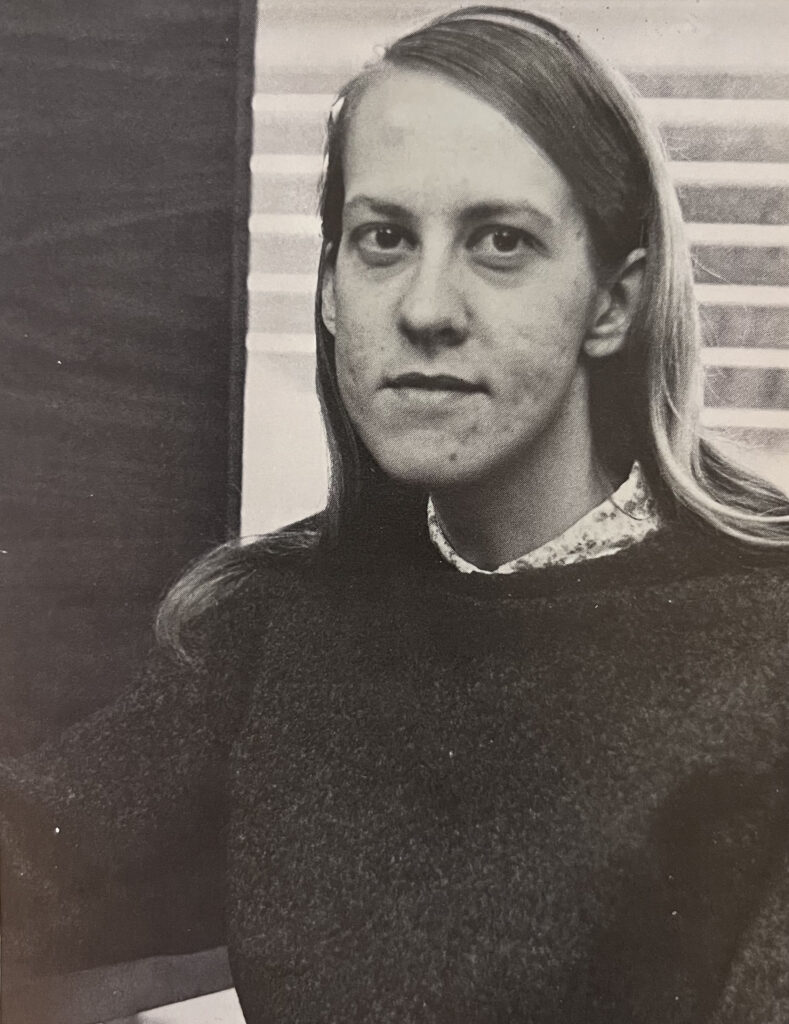
Diane Tichnell from the 1970 Skipjack, UMBC’s yearbook.
UMBC is a young institution—and not only do we have active alumni from the first four graduating classes still working to make an impact on campus and beyond, we are still discovering new stories about the establishment of the university and the ways the campus community was invited to co- create UMBC at its inception.
In fact, Diane Tichnell ’70, political science, describes the impetus for the Founding Four’s book, This Belongs to Us (2023), as its own sort of inception. Several years ago, she had a dream—literal dream while she was asleep. In it, she was attending a lecture given by then-President Freeman Hrabowski. He was talking about the books he had written, and afterward, Tichnell went up to speak to him. In her dream, she said, “We need to get the first four years of UMBC documented because soon we’re all going to be gone. Maybe in a hundred years, somebody will write it down, but why not do it now?” Dream Freeman replied, “Write that book.”
Mimi Dietrich ’70, American studies, remembers an event at the Wisdom Institute—UMBC’s association for retired faculty and staff—where a UMBC professor expressed surprise by Dietrich’s story about the plywood sidewalks that connected campus during the construction in the early years. “What do you mean you’ve never heard that story?” Dietrich responded—she figured everyone remembered what it was like in the beginning. “So Diane and I, and later Dale [Gough ’70, American studies] and Bob [Dietrich ’70, biological sciences, Mimi’s husband] came together on this; and we just started saying, ‘We have to do this. We have to do this right now.’”
Left: Co-authors Mimi and Bob Dietrich in UMBC’s 1970 yearbook Skipjack. Right: Dale Gough (pictured with Betty Huesman ’70) in the 1969 Skipjack.
Those four brainstormed the idea and knew that this labor of love would need to be as inclusive as possible. “We needed to engage the collective memory of everybody that we could possibly ask to write a story from the first four classes who were on campus,” says Tichnell. They sent newsletters, emails, mail, and even knocked on doors to capture the voices of as many graduates as possible.
In the end, 84 authors contributed more than 100 stories to This Belongs to Us, a kaleidoscopic retelling of the colorful and authentic story of UMBC. Proceeds from the book (at the clever price of $19.66) go to several scholarships supported by the founding four classes.
The Founding Four marvel at what their young institution has grown into. “All those flags in The Commons are so incredible to me,” says Joan Costello ’73, social work, a contributing author. “Because they’re from different countries. But when we came here, we were just from different neighborhoods.”
When Chris Peregoy’81, visual and performing arts, M.F.A. ’99, intermedia and digital arts, received a tin full of Christmas cookies from his sister around the year 2000, he immediately dumped the contents out on the table to eat later. He had a moment of inspiration staring at the empty container—“This tin would make a great camera.”
If you’ve ever looked at an oatmeal container, a hollowed-out book, a mailbox, or an entire room, and thought, “This object would make a great camera,” chances are you are familiar with the concept of a pinhole camera. It’s photography distilled to its most basic elements: a light-proof box, a lens—which is often just a literal hole made from a pin—and some film or photographic paper.
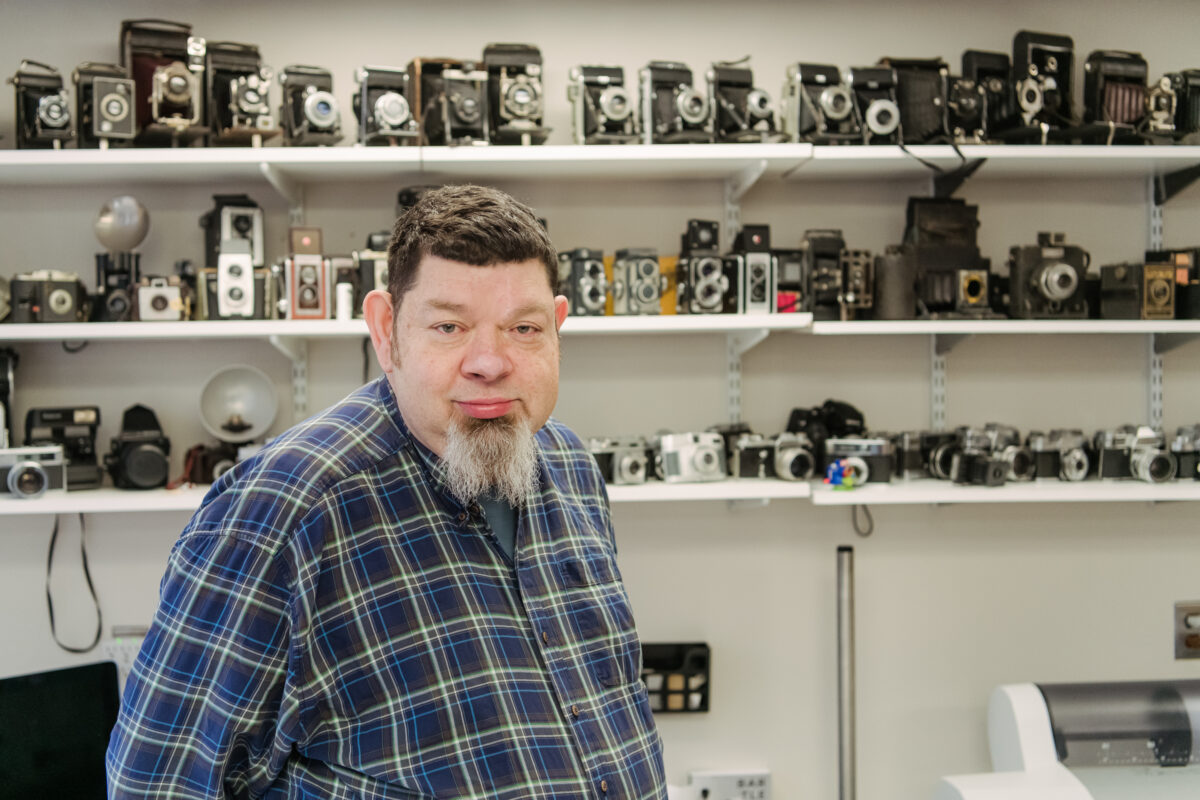
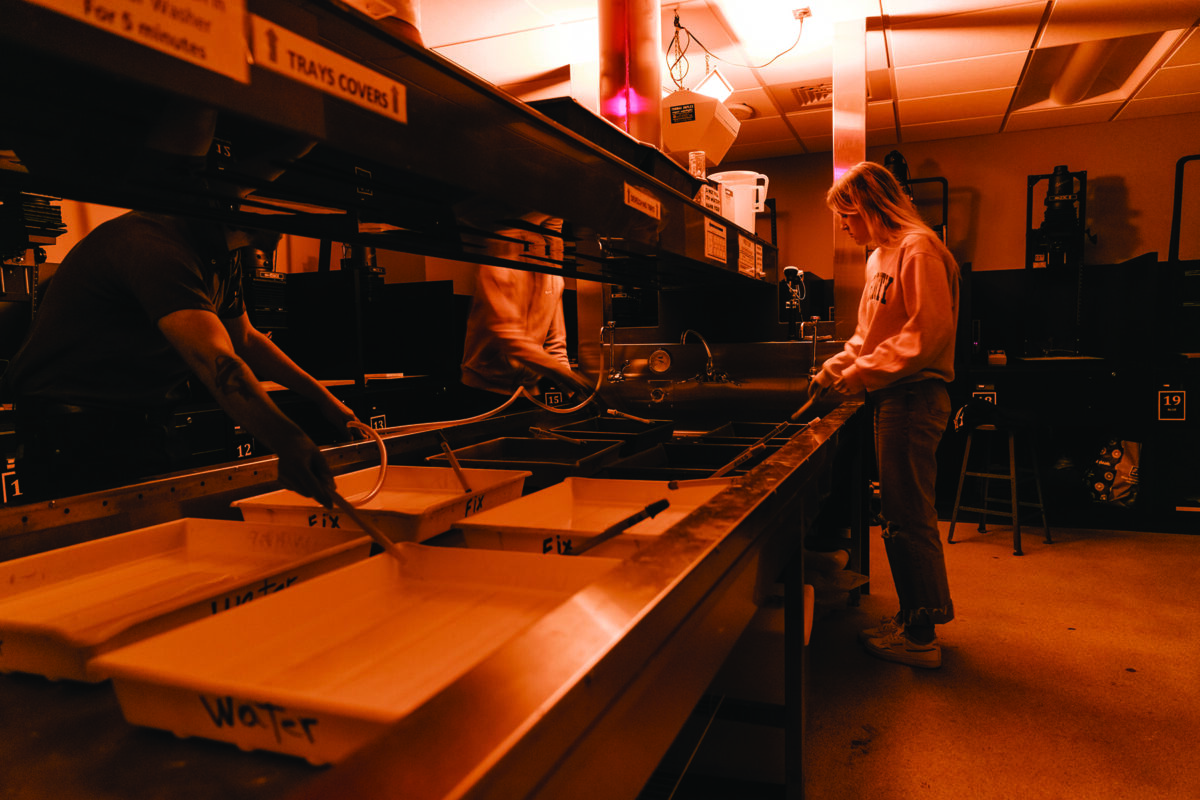
Peregoy, the lab manager for the Department of Visual Arts, has worked at UMBC since graduating from the photography program in 1981 and will retire this summer, but he leaves behind a substantial legacy in his 6-foot 8-inch wake. He’s also leaving behind a few dozen handcrafted pinhole cameras from his company Pinhole Blender for students to keep using in their photo classes.
In addition to the helpful labels on each camera describing exposure time in different types of light, Peregoy has some useful hints for the rest of us who might want to dabble in the non-digital world of making photos.
Tools of the Trade:
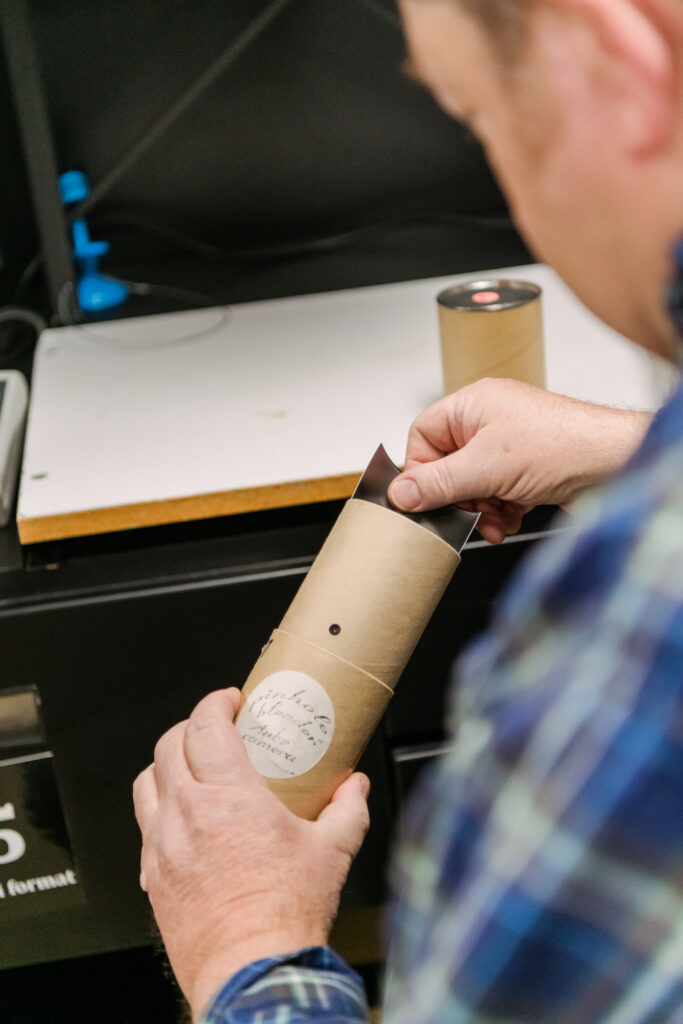
A light-proof container—a great second life for the shipping tube your diploma arrives in
A pin to make the eponymous pinhole
Small square of black tape to act as a shutter
Film or photo paper
Access to a darkroom (but if not, you can still make it work)
Step 1: MAKE YOUR CAMERA (OR BUY ONE FROM PEREGOY’S COMPANY).
Cookie tins aside, Peregoy says he isn’t someone who makes cameras out of odd objects for the most part, although those people are out there. Shipping tubes and oatmeal containers (especially before Quaker changed their lids to transparent plastic) are his go-tos (although he’s making a camera for his retirement party out of an old whiskey barrel the brewery near his house is giving him).
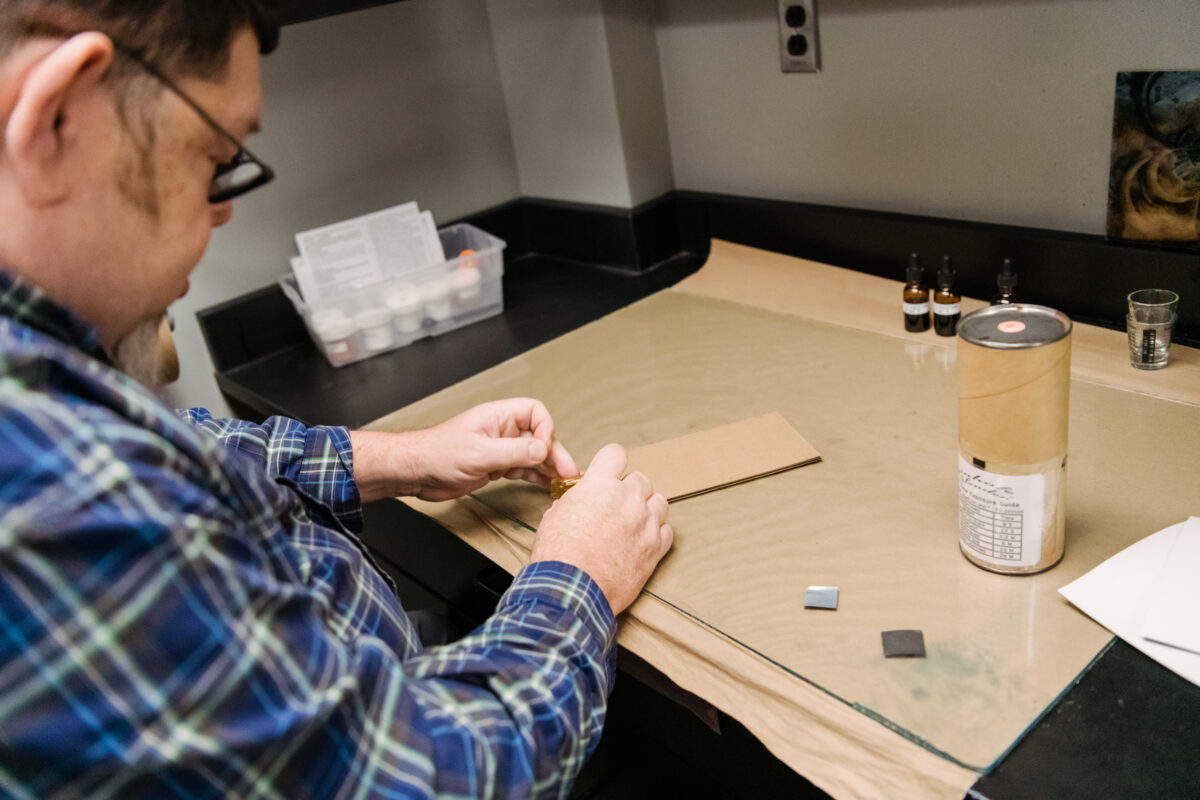
You need an opening large enough to arrange the film in the containers and a way to reseal the box/tube/pumpkin/ etc. When you make the pinhole, Peregoy recommends pushing a pin through a small square of soda-can material and smoothing out any burrs with fine sandpaper. Affix this metal piece to the camera body with black tape. Then you need to attach a shutter— something that ends the light exposure—like a piece of black electrical tape.
Step 2: LOAD YOUR CAMERA.
Load the camera with the film or photo paper in a darkroom (you can improvise with cardboard taped over your bathroom window, in a pinch). Now you need to choose your subject. “One of the aspects of the pinhole camera is that although it might not create a sharp picture like a real lens, it has an incredible range of focus,” says Peregoy. “So things a quarter inch away from the pinhole will be as focused as things that are 30 feet away.” In his own pinhole work, Peregoy often uses miniature dolls or statues as subjects in the photos, using the strength of the camera to play with perspectives.
Most often, when students are released from the classroom to go take photos, for time reasons, they don’t stray far. “I’ve seen a lot of pictures of the Fine Arts building,” laughs Peregoy. But even so, he’s still surprised sometimes. In one image of a rocky scene with a building in the background, Peregoy did a double take; despite his many decades on this campus and specifically in this building, he didn’t recognize the shot. The student revealed they had laid down in a drainage ditch, and yes, indeed, it was still Fine Arts in the background.
Step 3: DEVELOP YOUR FILM.
Next comes film development. For students, that means learning the rules of the darkroom. “I didn’t know what a pinhole camera was,” says Erin Cusick, a sophomore who is taking the class for elective credit. “It’s been so fun to see how exposing the paper to light and then using time to play with the way the image develops,” says Cusick as she leans over a tray of chemicals in the darkroom watching her image appear.
But Peregoy offers two alternatives for a darkroom-free pinhole experience—solargraphy and lumen photography. Solargraphy uses a pinhole camera and exposes the image outside for several months, burning the path of the sun and the stars into the paper. Lumen prints use photo paper overlaid with flowers or other objects, which after exposure to sunlight will create an ethereal image on the paper. It’s a fragile process, says Peregoy, and the paper should be scanned digitally because eventually the image will fade from the paper.
Step 4: KEEP PLAYING AROUND WITH ANALOG.
“Digital has taken most of the cameras away from us,” says Peregoy. “But there are lots of old options and ways to turn old things into film or pinhole.” Cusick, in the photo class, is struck by how simple-seeming the whole process is, “but the simplicity makes it all the more confusing how it works,” she marvels.
Outside Fine Arts, the sun shines brightly on the building and Jamal Jackson, a visual arts major who transferred from Montgomery College, aligns his pinhole camera just so. “The versatility of the camera makes it so fun to play with,” he says. “It’s letting me capture my own voice in photos.”
Having the sally port gates slam behind her after walking into the prison for the first time was a bit of a shock to Susan Beck’74, French. Luckily, a friend was there to hold her hand as they adjusted to the tight space and waited for the next door to open. As Beck got her breathing under control, she joined her classmates in a clinical pastoral education class on the rest of the tour of the facility.
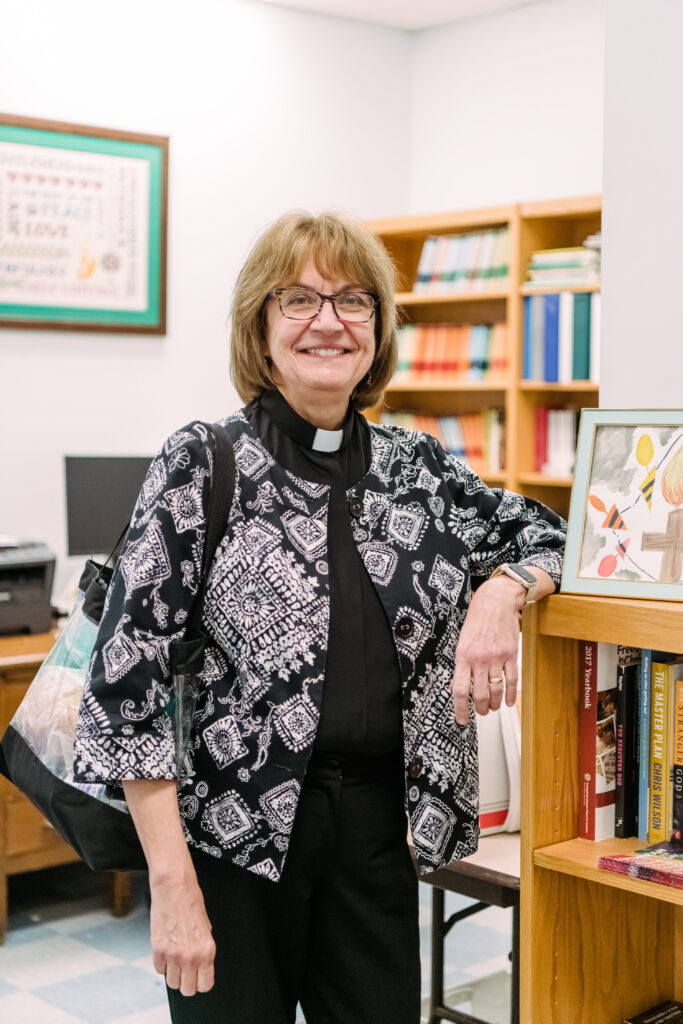
Beck, a former French teacher and a childbirth instructor, never envisioned her retirement as a career rebirth, but as she contemplated how she wanted to spend her time, she kept returning to her love of the church and wondered how she might serve. Prison ministry was the farthest idea from her mind, says Beck now. She imagined shepherding a congregation and ministering to families, but what that evolved into was a role as a community pastor, hosting weekly pub theology sessions and also stepping in as an interim pastor at different churches.
When her predecessor tapped her to think about taking over the spiritual leadership of The Community of St. Dysmas—a Lutheran ministry within the Maryland State Correctional System—Beck thought “no way” at first. But after Beck started volunteering with St. Dysmas, “It was pure gospel,” she says.
Serving an incarcerated congregation
These days Beck works out of a donated office space down the street from UMBC at the Salem Lutheran Church in Catonsville. Before heading to the correctional facilities in the evenings, Salem has set aside space for Beck to make copies, write her newsletter, and put up notes and cards from her congregants behind bars.
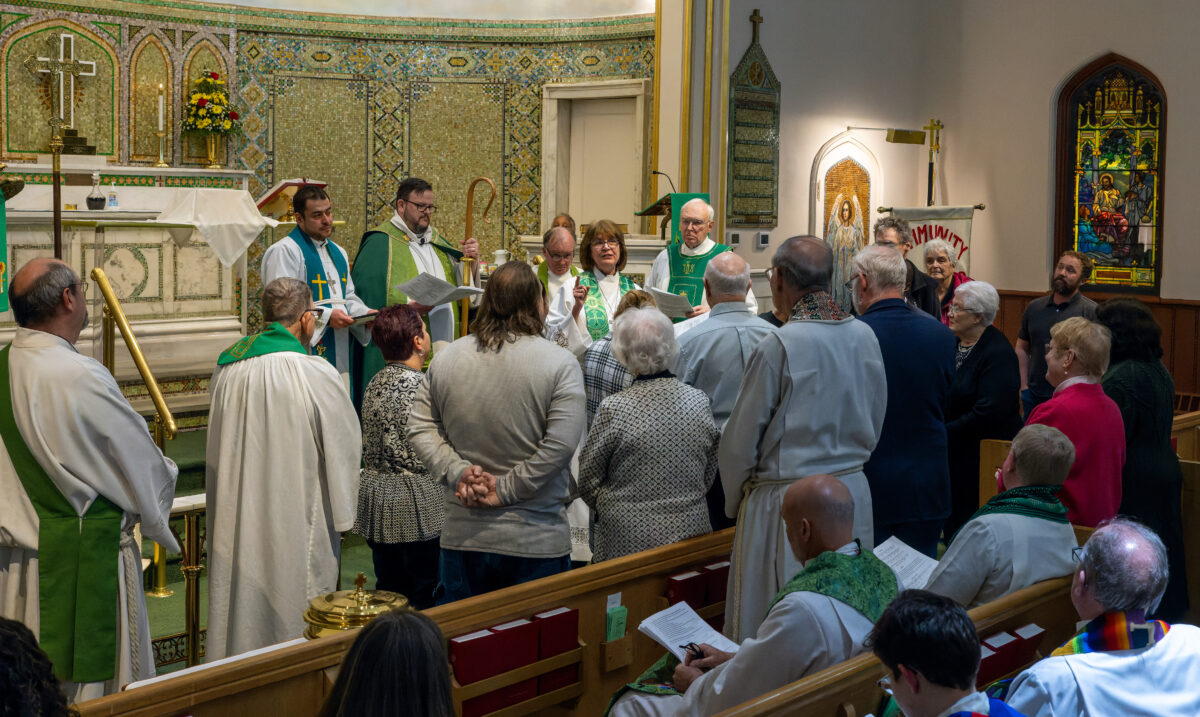
Beck at her formal installation ceremony, which took place at Salem Lutheran Church in Catonsville. Photo by William Beck.
“Christianity is so focused on forgiveness of sins and God’s grace and God’s unconditional love, and that transforms people,” says Beck, who received her masters of divinity from Lutheran Theological Seminary at Gettysburg in 2010. “I do not seek to ever find out what their offenses are. That’s not important to me as their pastor, but sometimes they tell me. And as a mother and a grandmother, it’s really hard to hear—but when someone seeks God’s forgiveness and they get it, it changes their lives. It doesn’t change their circumstances. They’re still going to live out their sentence. They may never get out of prison, but everything’s different. That’s Jesus’ message and it was right there in the prison, and I absolutely loved it.”
Beck explains that while there are many larger prison ministries, St. Dysmas is one of the only places that provides a welcoming and affirming service for the LGBTQAI+ community within the Maryland prison system. “We very much welcome the questioners and the people who aren’t quite sure where they belong…. We welcome first and walk with people along their way, which is a very Lutheran thing to do.”
In post-canonical biblical literature, St. Dysmas is named as the criminal who dies next to a crucified Christ, asking to be remembered in the afterlife. “So our saint is a convicted criminal,” says Beck, “as was our Lord and Savior. Jesus died with a criminal record. How about that?”
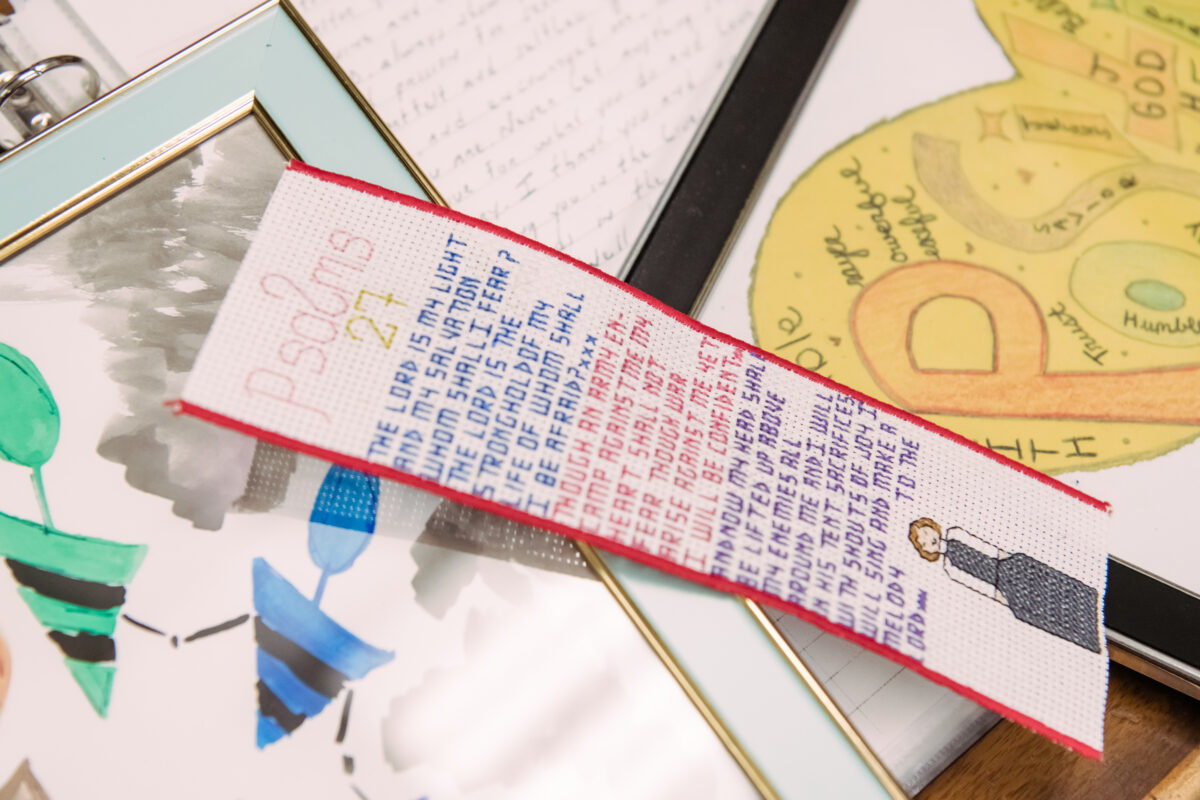
A collection of items made for Beck as gifts by her congregants.
In January 2023, after nearly five years of doing this work, Beck was formally installed as the pastor to a congregation entirely behind bars but spread out over the Maryland state prison system. On Monday nights she’s in Hagerstown; on Wednesdays, Sykesville; and Saturdays in Jessup. Beck is accompanied by a rotating cadre of volunteers, who step up to make sure each facility has coverage for worship services and Bible studies.
Creating a sanctuary behind bars
What an average service looks like for Beck is after the sally port gates shut behind her and the next set of doors opens, she needs to successfully go through a metal detector in fewer than three tries. (“Don’t wear bras with underwires.”)
In a clear, plastic purse, she only brings with her items on an approved list from the Maryland Correctional Facilities: bread and a sealed container of grape juice for communion, devotional materials, different colored cloths for different liturgical seasons. Sometimes she needs other materials. “I did a baptism a couple of weeks ago, and I had to send many reminders to the administration that, ‘I need to bring in a plastic bowl. It’s just a plastic bowl.’”
If she successfully makes it through the metal detector, she is patted down by a female guard, and then escorted to the space her congregation will use to worship. Sometimes it is a room and sometimes it is a hallway. Usually members of the congregation will set up chairs and arrange the area for worship. Beck or another volunteer will play music (she has the paperwork cleared to bring her violin in), and they will create a sacred space within the prison walls.
Beck serves communion, offers a time for reflection, and shares a short sermon. “Over time, as they hear us preach and teach and talk—and the services are very interactive—those relationships build. And even though we’re informal and it’s not a cathedral, it’s not a sanctuary like you would imagine, I want to create a sanctuary for them.”
Shared humanity
Beck, who is 70 years old, says that this work she previously couldn’t have imagined for herself continues to energize her. “UMBC offered me an accessible path to education,” reflects Beck. “But you don’t ever stay on one path—you go off and expand it.”
When she goes to leave the prisons at night, her parishioners will tell her, “Watch out for the deer. They’re crazy this time. You’ll watch out for the deer?” And as the sally port gates shut behind Beck, with her now on the outside, she says, “I know on the other side of that door, there are gangs and there’s danger and there’s people yelling at them. But they said, ‘Watch out for the deer.’ That’s just so human.”
Prior to her formal investiture of the role of president, when Valerie Sheares Ashby reflected on her first year at UMBC, she said, “Every day, I am surprised in a good way by how much people love this place, how committed they are, and what lengths they are willing to go to for each other. For students, for colleagues, for our vision, for our mission, for our community—people will go to great lengths.”
And at the presidential installation ceremony on April 27, 2023, Sheares Ashby, other speakers, and the UMBC community as a whole celebrated that shared commitment to a common vision—one that promises to redefine excellence in higher education through an inclusive culture.
President Valerie Sheares Ashby takes in the view from the 7th floor of the Albin O. Kuhn Library. The floor-to-ceiling windows frame campus, a wall-to-wall mural of manicured paths and greenery surrounding the academic buildings and residential halls. Most important to the scene are the students, walking in pairs, whizzing along on scooters, resting in the shade in a collective of hammocks.
“I love it when I walk across this campus and I see our students engaging with each other,” says Sheares Ashby. “I have been at institutions where we had a certain percentage of this population, of that population… but I have never seen this much true engagement where people didn’t get here and stay in their siloed group. That is a beautiful thing.”
It’s clear that Sheares Ashby finds her energy by tapping into the university’s vision statement—which aligns so closely with her own values, she says—and seeing and speaking with “her children, her students,” as she calls them. She becomes animated and eager to share their accomplishments. “I don’t need a big ta-dah for it to feel great to me. It is every single real, honest engagement with my people—my students, faculty and staff—that’s special to me,” says Sheares Ashby.
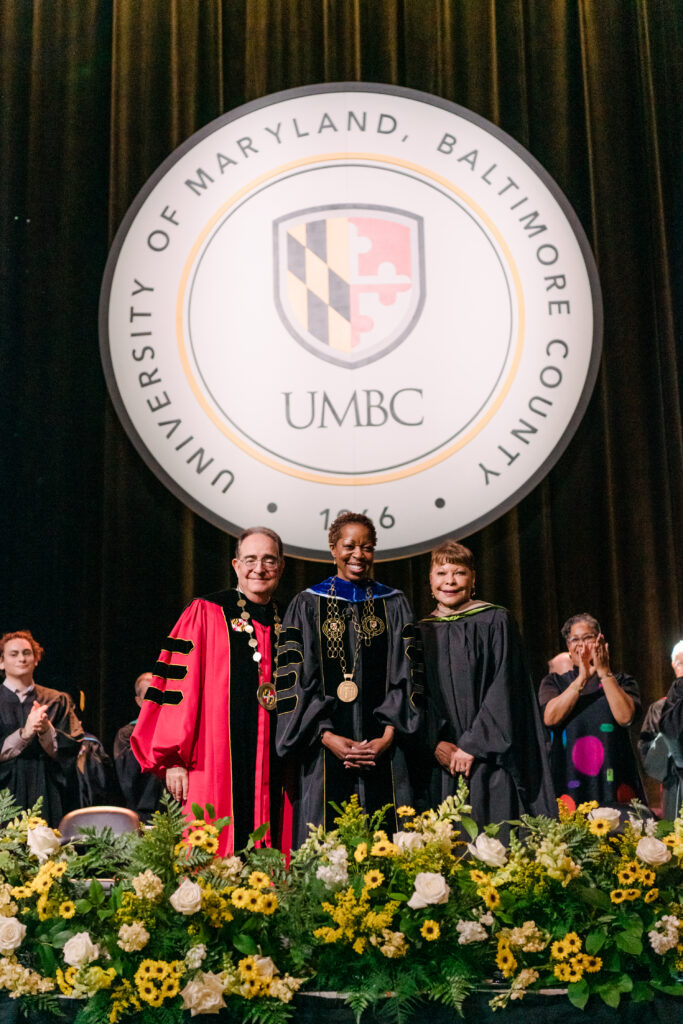
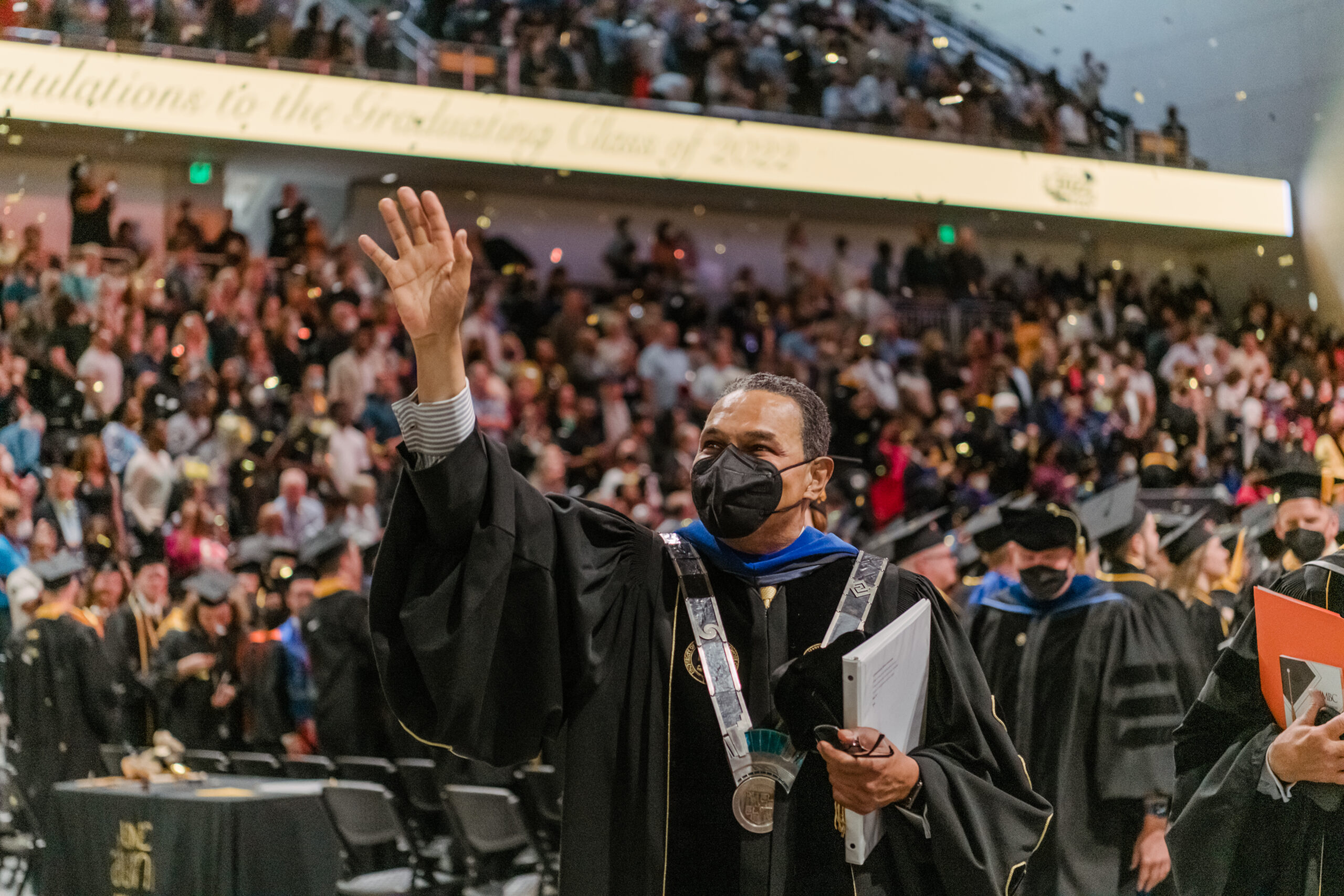
While she took up the mantle of the presidency on August 1 of last year, on April 27, 2023, Sheares Ashby was officially conferred with the charge of the Office of the President (and given a medallion symbolic of the office and heavy in its weight, as a reminder of the responsibility of the role).
University System of Maryland (USM) Chancellor Jay Perman and (USM) Board of Regents Chair Linda Gooden stand with President Valerie Sheares Ashby at the investiture. (Marlayna Demond ’11/UMBC)
Surrounded by lush displays of Maryland’s black and gold flower, black-eyed Susans, and state and campus leaders at her investiture ceremony, Sheares Ashby made a promise to the campus community and beyond.
“We look at our students as if we are looking at our own children. And so, I say to you, students: By our words and through our actions, we want you to feel that you belong and know that you are welcomed.”
A theme of thankfulness
The installation ceremony was the culmination of a week-long celebration of Sheares Ashby’s ongoing leadership of UMBC. If you want to know what mantra she’s been channeling through the build up and completion of this historic moment in the university’s timeline—not to mention her own life—it’s “gratitude.”
“How is it that I get to be here with these people whose values are right in the middle of my own?” she asks incredulously. “And they call it work.”
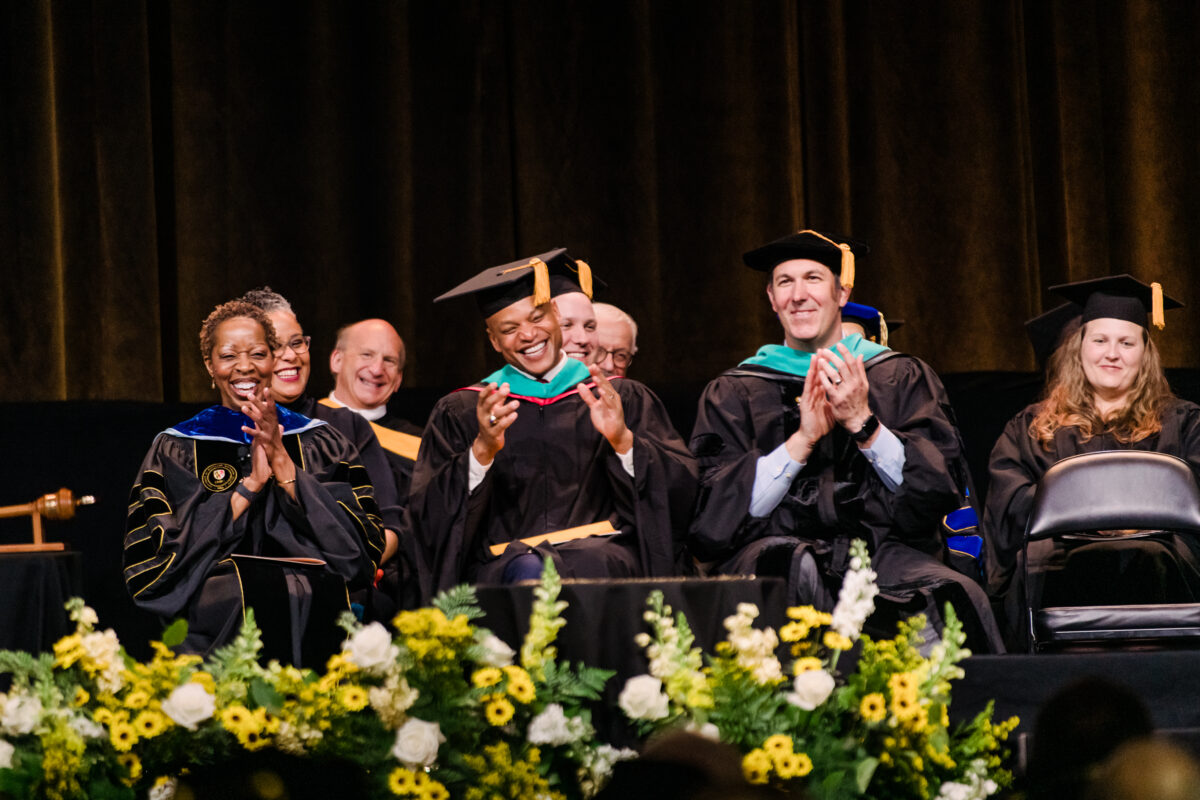
President Sheares Ashby, with Governor Wes Moore and Baltimore County Executive John A. Olszewski, Jr., Ph.D. ʼ17, next to her, clap on the stage during one of the many moments of levity. (Marlayna Demond ’11/UMBC)
On the platform at Sheares Asbhy’s investiture—along with Maryland Governor Wes Moore, other elected officials, and leadership of the University System of Maryland and UMBC—were mentors from her own academic journey who have been guiding her for 40 and 30 years apiece.
“They thought I could do this when I was 18, when I did not have a clue. But I have so much gratitude for how people have invested in me, and for what my predecessor did. If [President Emeritus Freeman Hrabowski] had not been here, this would not be the place that I wanted to be. He actually did something here that gave the place the soul that it has.”
At an inauguration event celebrating faculty and staff, Sheares Ashby also stood up to acknowledge the efforts of the many different teams that make all of the fanfare possible. “I love thanking people,” she laughed. “I could do this all day.”
The gratitude goes both ways.
“It feels good,” said Janerra Allen, M.S. ’22, a fourth-year electrical engineering Ph.D. student selected by President Sheares Ashby to be a student marshal. “I feel encouraged and empowered to see a female in the role, and especially a woman of color.” Allen, who is the current president of the Black Graduate Student Organization, says she’s been cheered by Sheares Ashby’s commitment to graduate students and is looking forward to this next chapter of campus leadership. “I think that’s one unique characteristic of President Sheares Ashby, she can level with you and have a conversation with you, which just feels good.”
Thankfulness was a theme repeated by those close to President Sheares Ashby, including her older sister Beverly Sheares, associate professor of pediatrics at Yale University School of Medicine. “I’m immensely proud and grateful and happy for her and UMBC and for our family,” says Sheares. “She has worked very hard. She’s been committed to her work over a long period of time. And her commitment has been really focused. She has made sacrifices to get here. I’m so grateful that the work and the sacrifices have led to something so fantastic. This is the space she belongs in.”
A family legacy of generosity
Amid the solemnity of the investiture ceremony, a notable energy bubbled to the surface. With her hand to her heart, Sheares Ashby took in the words of welcome and responsibility and received them with a smile visible from the back risers of the Chesapeake Employers Insurance Arena. Acknowledging her family in the front row, Sheares Ashby honored the home created by her late parents, James and Shirley Sheares, who nurtured curious children and gave them a sense of humor and joy, and continually modeled a life of service to others.
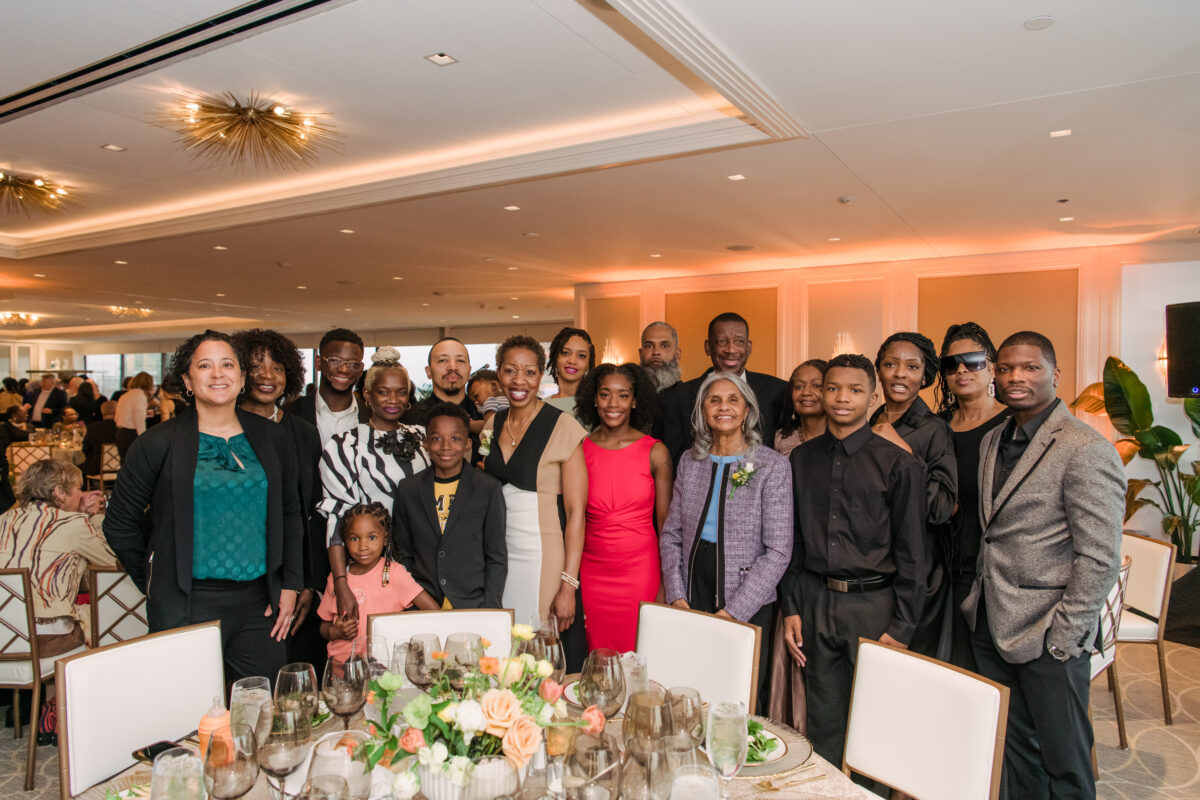
President Sheares Ashby poses with her family at a dinner in her honor during the week of inauguration. (Marlayna Demond ’11/UMBC)
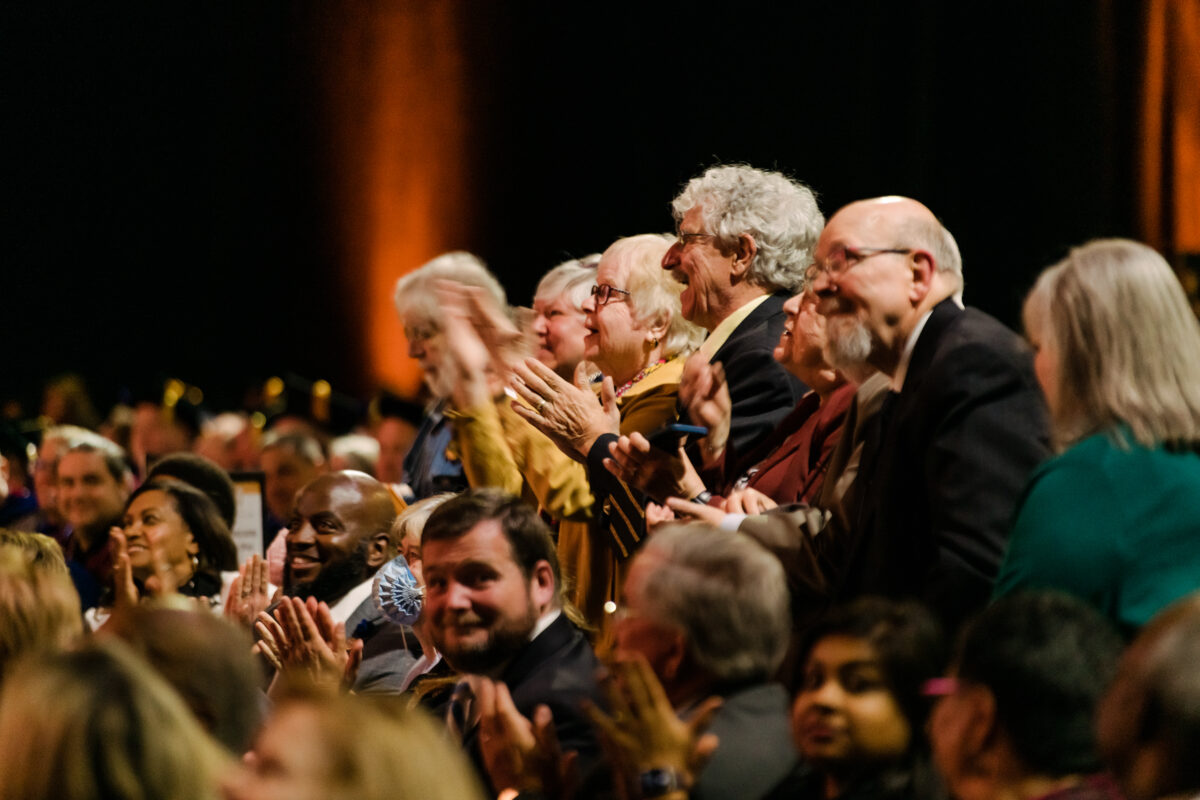
She then paused her remarks to surprise her family by announcing her establishing an endowed scholarship in her parents’ names—a need-based scholarship, for undergraduate and graduate students across the disciplines. As the audience stood to applaud, Sheares Ashby followed the moment with a quip—one of many moments of laughter throughout the event.
“And I can hear my mother’s voice saying, ‘Now don’t be skimpy…make sure you put enough in there so that the children have what they need.’ Yes ma’am.”
A continuity of leadership
Throughout the week of events celebrating Sheares Ashby’s presidency, organizers often remarked that UMBC had no playbook for this. In April 2023, the Chronicle of Higher Education reported that the average tenure of a college president has shrunk yet again, now to below six years. Yet prior to this semester, UMBC had not installed a president in 30 years.
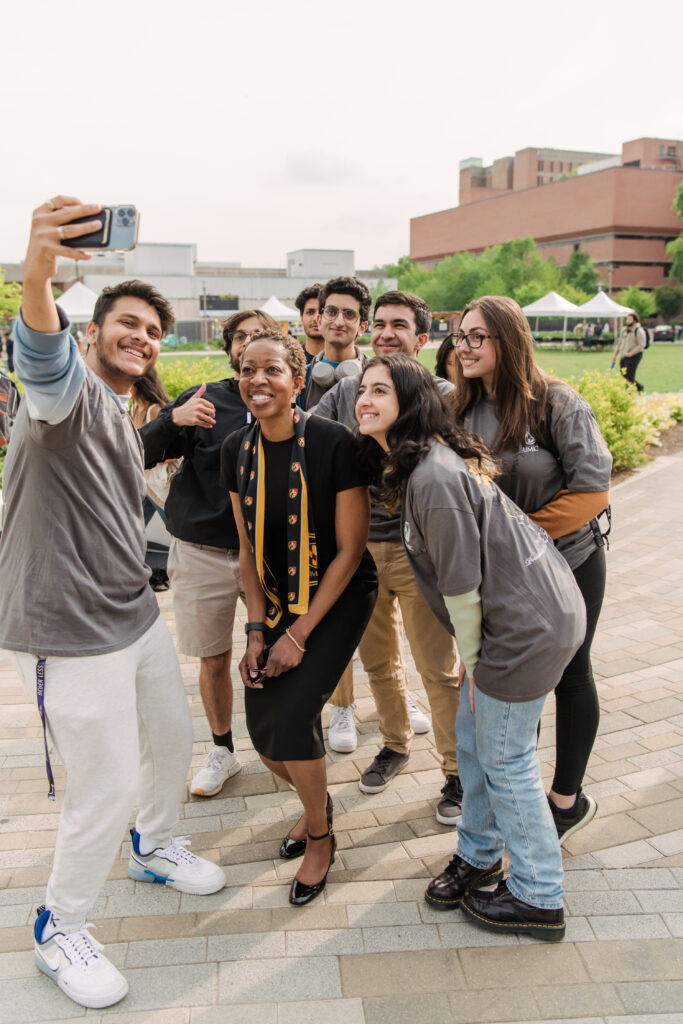
Students pose for a selfie with President Sheares Ashby at the post-inauguration celebration on the Quad. (Marlayna Demond ’11/UMBC)
Mary Ann Richmond ’93, history, UMBC’s government and community relations manager, who served as an event staff lead on the week’s events, remembers serving as an usher at Hrabowski’s installation just a few months after she graduated. She didn’t know, she said, that they were ushering in the next three decades of campus leadership.
“When I think back about things that were starting when I was a student—I came in the same year as the first cohort of Meyerhoff Scholars, and the Shriver Center was just getting started. And now, seeing the university 30 years later and what it’s become, is just amazing.”
Now she can’t help but wonder, “Could this be the next 30 years? President Sheares Ashby is going to do such a fantastic job, and no matter how long it lasts, I know we’re in really good hands.”
Also present throughout the inauguration events representing continuity through UMBC’s different chapters of leadership were members of the first four graduating classes at UMBC, known as the Founding Four. Sheares Ashby, who was just 13 days old when UMBC first opened its doors on September 19, 1966, praised the commitment of the founding graduates who took a chance on a burgeoning institution and have never looked back. (She even took a moment to hold up their recently completed book This Belongs to Us.)
Members of the founding four classes are recognized by President Sheares Ashby during her inauguration speech. (Marlayna Demond ’11/UMBC)
In the intervening decades, UMBC has grown from a new institution on which students had to take a chance to a Carnegie Classified Research 1 university, consistently ranked as one of the nation’s most innovative campuses, and the number one producer of Black undergraduates who go on to earn doctorates in the life sciences, math, and computer sciences combined, as well as of Black undergraduates who go on to earn the combined M.D./Ph.D.
“And we are not done,” said Sheares Ashby from the platform. “UMBC possesses a willingness to continue to question the status quo, to consider the world’s ever-changing challenges and circumstances—and to innovate to serve our students.”
A new champion for the university
In that spirit, this spring, the Retriever community came together in a series of conversations called UMBC BOLD—sessions that laid the groundwork for the university’s next phase of strategic planning. These were deeply engaging discussions—with more than 1,000 attendees—about the community’s bold aspirations for the undergraduate and graduate student experience, the research enterprise, economic development, community engagement, and more.
Sheares Ashby attended each of the 22 listening sessions. “I heard so many things that were exciting to me, and I heard a lot of room for opportunity. There are a lot of opportunities,” she said. She came away brimming with ideas to carry forward with her in following years of her leadership.
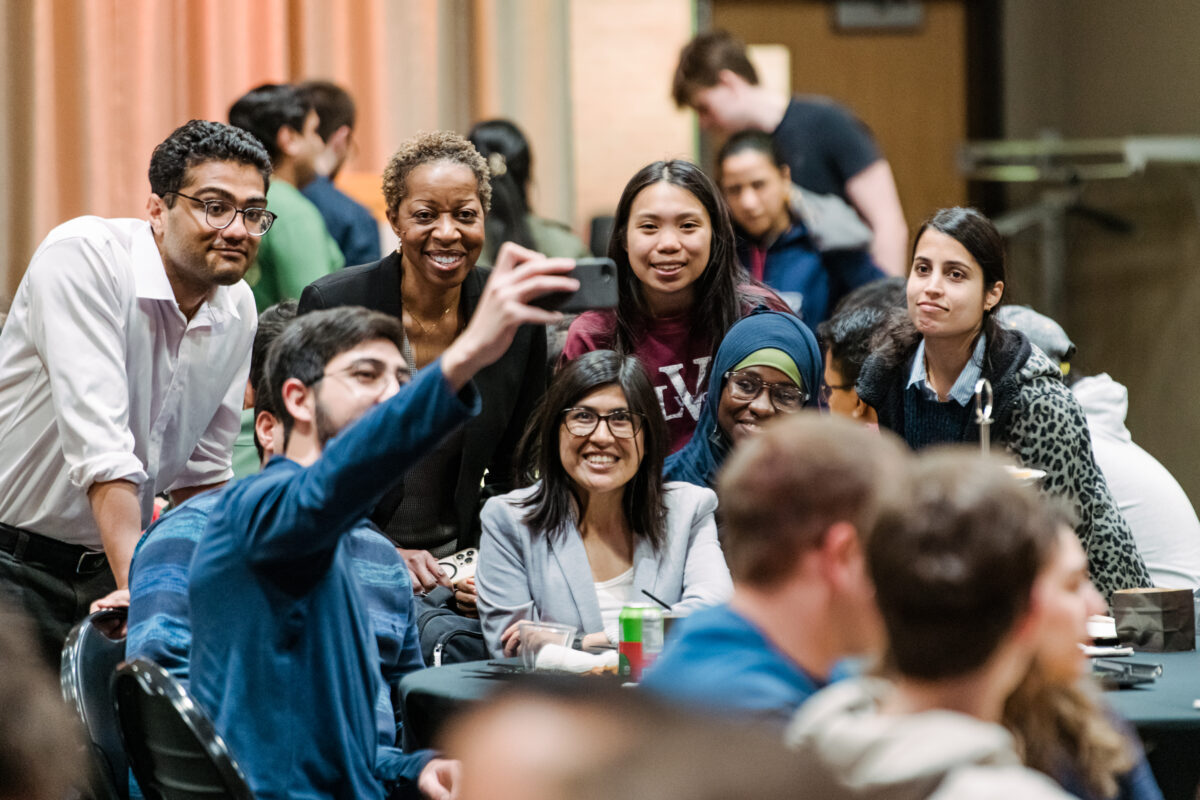
President Sheares Ashby poses for a selfie with a group of graduate students at an inauguration event. (Marlayna Demond ’11/UMBC)
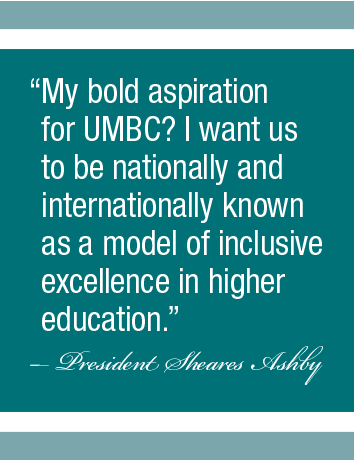
“My bold aspiration for UMBC? I want us to be nationally and internationally known as a model of inclusive excellence in higher education.” She stops for a beat and leans back in her seat on the 7th floor of the AOK Library (named after the university’s first leader, Albin Owings Kuhn), framed by the moving mural of campus behind her.
“Anyone could say this, but nobody else is doing it—and I say this without hesitation as a scientist who knows that the word ‘nobody’ is like ‘a hundred percent.’ There’s no other institution that has figured out how to do inclusive excellence in research.”
Sheares Ashby is working to continue the UMBC legacy and story, and she has the support of the campus community and beyond. Those library windows that look out across campus include Arbutus and Catonsville, too. Perfectly outlined on a clear day is the Baltimore City skyline and the Francis Scott Key Bridge, connecting other parts of Maryland together. Maryland Governor Wes Moore highlighted Sheares Ashby’s “unbridled excellence,” making her “absolutely right for this moment.” Her mentor since her undergraduate years, Henry Frierson, told the audience at the installation, “You have truly gained a new champion for the university.” Joseph DeSimone, Sheares Ashby’s Ph.D. advisor and long term mentor, called the president, “a servant leader.”
And she is ready to get to work. She wants to help realize the university’s potential as seen through the Bold conversation series and driven by the university vision.
“I think we can simultaneously be that institution [a model of inclusive excellence] and not lose our core values—the way we care for people, the way we love our people, the way we are committed to this institution, the way we do teaching,” she says. “We can do that. And we can do it better than anybody else because I don’t think anybody else is as serious about it as we are. That’s my bold aspiration.”
In the 1960s, a common routine for elementary school students was to practice hiding under their desks in case of a nuclear blast. Following the Bay of Pigs standoff in 1961, international tensions remained high as the United States and the Soviet Union continued advancing their nuclear weapons. But global armament was only a minor inconvenience to Stanley Czajkowski in those days. As a third grader in Miss Hamill’s class, he was busy falling in love with the riddle of math.
Unbeknownst to this future Retriever was how he would eventually use those foundational mathematical skills to develop algorithms designed to protect presidential communications in case of a nuclear threat.
Czajkowski, who is nearing retirement after more than four decades of service to this project and other issues of national security, is leaving the mission in good hands. Among the experts on his team are several other UMBC alumni—working side by side to ensure the success of nuclear deterrence.
Accounting for all the probabilities
Knowing what he would do with math only came after Czajkowski earned two sequential degrees in the subject at UMBC. Immediately following his bachelor’s in 1976, Czajkowski completed his master’s in mathematics in 1977, focusing on probability and statistics. He discovered the Johns Hopkins Applied Physics Laboratory (APL) headquartered in Laurel, Maryland, at a career fair on campus, interviewed for a position, and has been working for the research division of Johns Hopkins for the past 45 years.
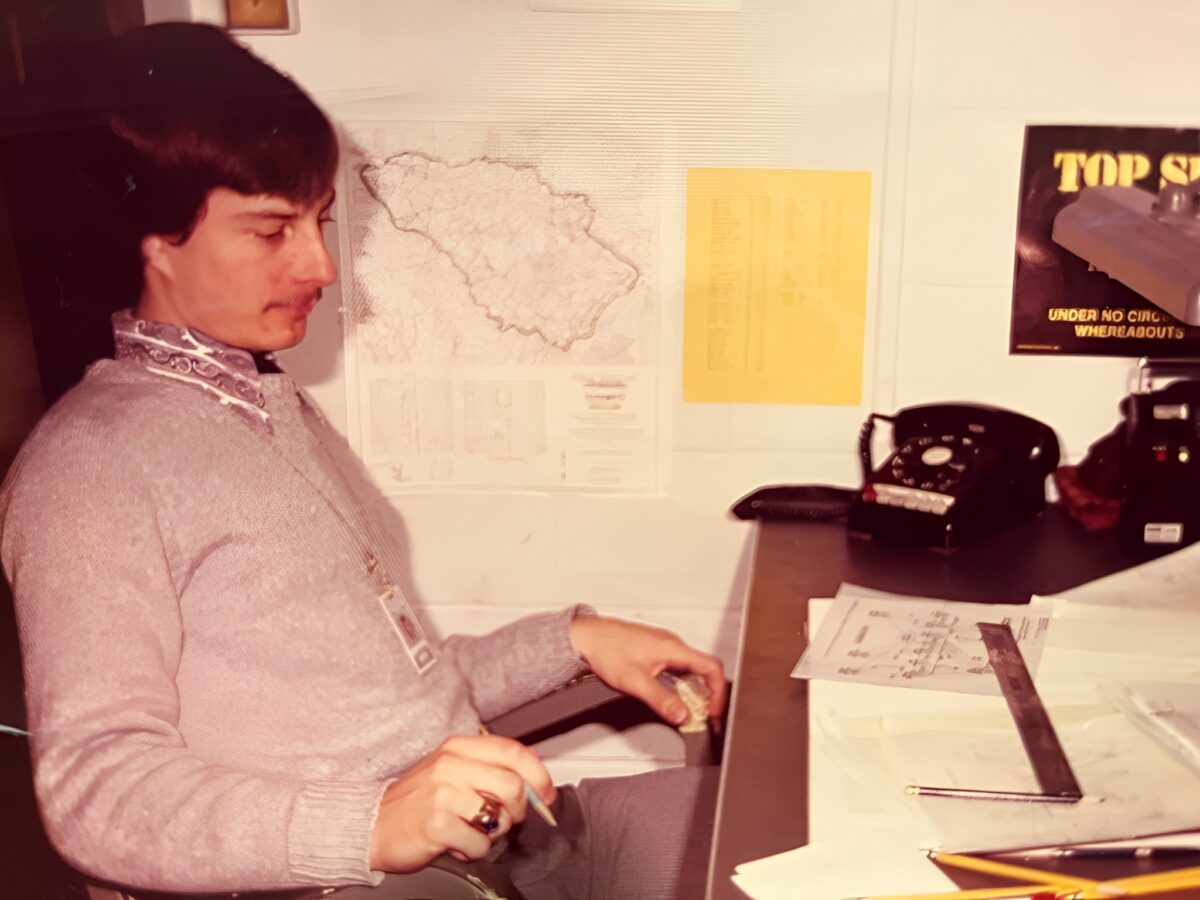
Czajkowski at his desk at APL in 1977. Courtesy of Czajkowski.
Early on at APL (where more than 350 Retrievers work currently), Czajkowski got to see the real world impact of his work when tasked by the Navy to develop the mathematical methodology used to determine how many new aircraft to buy for a specific mission. Sixteen was the answer. “And those aircraft have been in operation for 30-plus years, doing an important mission,” says Czajkowski. “It gave me great satisfaction that, even at that young age, I had an impact on national security and when they put it all together, it was probably over a billion dollars at the time, for purchase.”
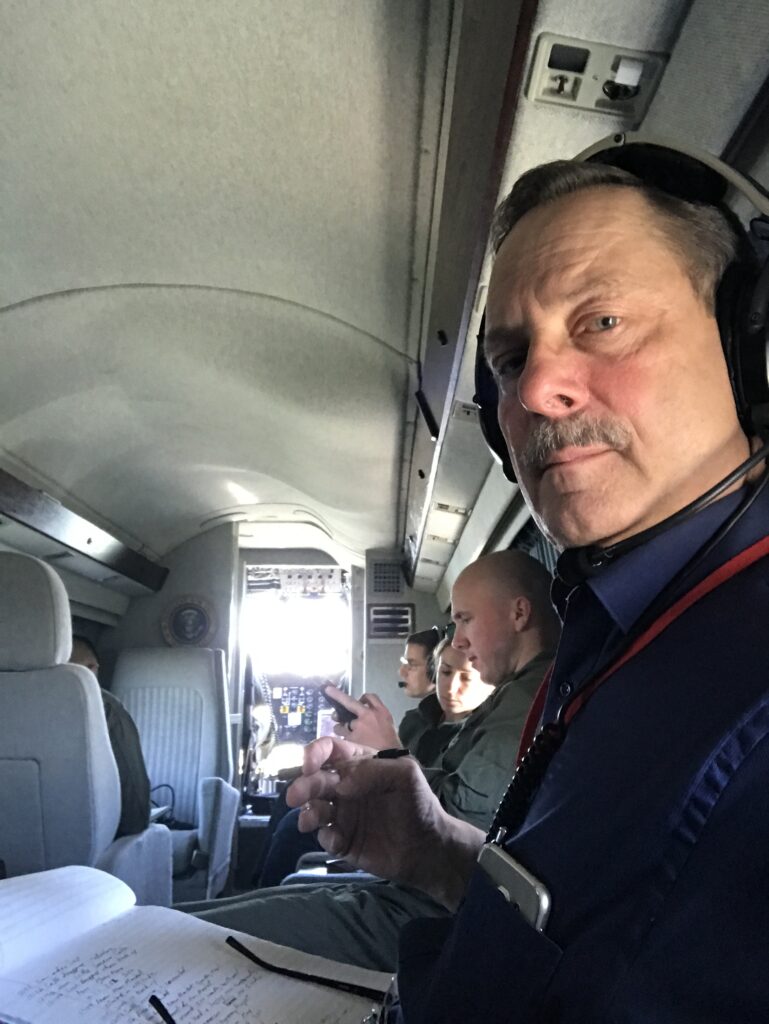
But this would not be the defining calculation of Czajkowski’s career. Among the many projects tasked with in the intervening decades, Czajkowski’s main efforts have focused on developing the mathematical models used to evaluate the communication systems that the president uses to command all the nuclear forces. “To assure that, under any circumstances, wherever the president is, in the White House, or on an airplane traveling, that he can communicate to the nuclear forces if needed,” says Czajkowski.
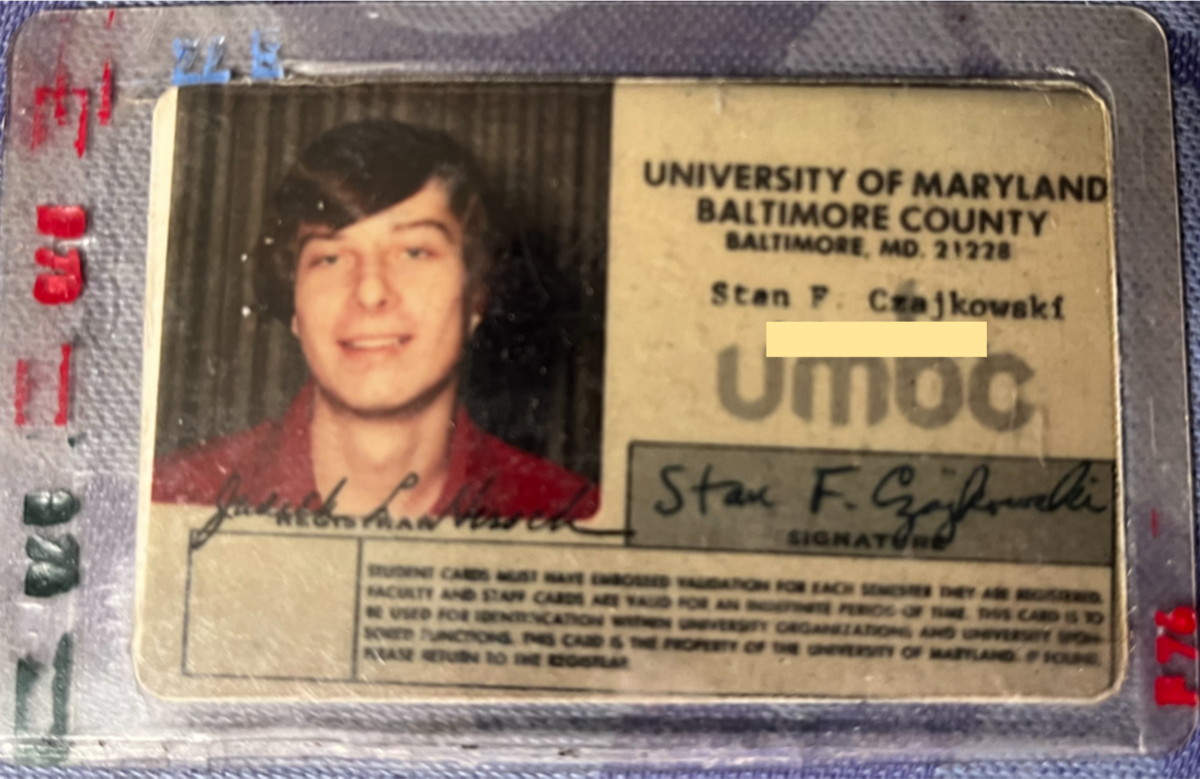
Czajkowski’s student ID card. Courtesy of Czajkowski.
With a background in probability and statistics, Czajkowski’s job is to represent how well dedicated frequencies used for communications via aircraft, ships, or satellites will work in various situations. “The math comes in trying to figure out how well those communications will work in different environments,” explains Czajkowski. He gives an example of a submerged submarine, listening in on their antenna at a distant location. If you send information over the radio frequencies, how sure are you that it will be received?
“You have to account for all the probabilities of different random events, and we have data that goes into the model that you have to calculate statistics on in order to support that calculation.”
Early in Czajkowski’s career, he helped design the simulation model used to do just that—and it’s still being used by both the U.S. Navy and the Air Force. “It’s become the national standard for modeling that kind of communications to submarines, bombers, and intercontinental ballistic missiles,” he says.
Defense relies on teamwork
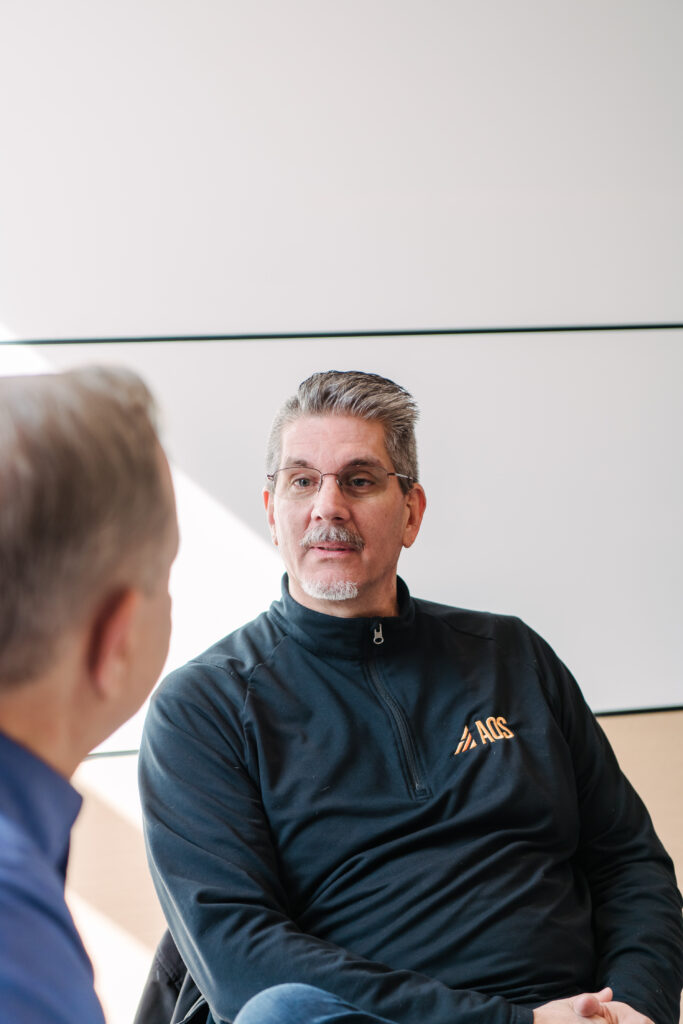
Miller in conversation with Czajkowski. Marlayna Demond ’11/UMBC
Czajkowski, who writes the algorithms and performs analysis for this project, is relieved not to be working alone. “I concentrate on the analytical side, the math and statistics stuff. But it’s pretty much a team effort in our group—we have mathematicians, computer scientists, electrical engineers, and physicists, all working together to solve the problems.”
Some of those key players are other Retrievers. Meet Jim Miller ’87, computer science, who is now the group supervisor of Czajkowski and other technical staff members of the Nuclear Command Communications Systems Group of the Asymmetric Operations Sector.
Miller has only been in this role for about a year and half, but has worked for APL for 28 years.
“Our group collects and analyzes data to ensure the readiness state of our nation’s nuclear triad of bombers, ICBMs [intercontinental ballistic missiles], and SSBNs [submarines],” explains Miller. “So when the president needs to communicate with the joint chiefs while some major national security event is happening, we know that they have a robust, resilient, and secure communications path with our nuclear triad to effectively carry out our mission. And that mission is not only nuclear. That mission can be related to natural disasters, like Hurricane Katrina, when the president needs to deploy forces to help with humanitarian aid.”
Grounded in leadership
Miller—whose son James Miller ’13 and daughter Christine Miller ’17 are also Retrievers with computer science degrees—sees the root of his success stemming from his early growth at UMBC. “UMBC allowed me to have that opportunity to make relationships and understand how important they were, rather than being a lemming or a drone, just rotely going to class and not getting a full experience out of college,” says Miller.
Those interpersonal skills have allowed him to take on increasingly larger leadership roles. “What I pride myself on today is building personal relationships with people, because each and every one of us has something to offer, and my job as the supervisor is to figure out what that is,” says Miller.
One of Miller’s newest team members is also a UMBC alumnus. Nick Sica ’22, computer science and history, started at APL just under a year ago. While his title is vaguely defined as “associate professional staff,” Sica says his main duties fall under software engineering, but also include data communications, data analysis, and cybersecurity.
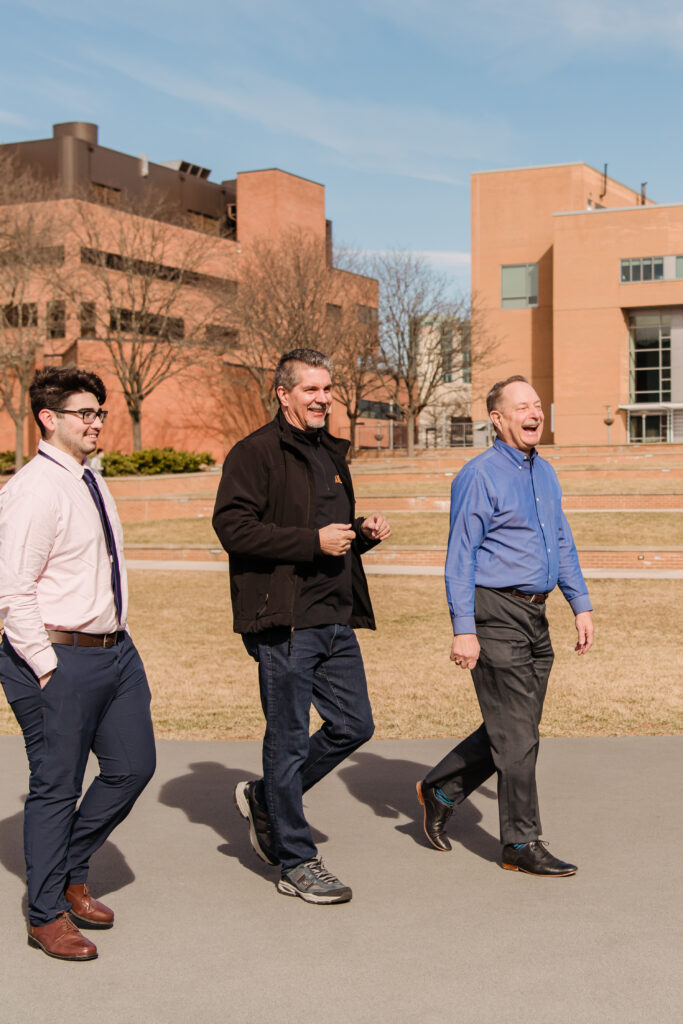
From left to right, Sica, Miller, and Czajkowski walk across the Quad on a visit to campus in February 2023. Marlayna Demond ’11/UMBC
When Sica was interviewing at APL, he was asked his placement preference within the organization. His first choice was in NC3 (Nuclear Command, Control, and Communications) because of Miller. “It seemed he cared more about what I wanted to do in my position and what I was comfortable in doing and my growth, and less about just finding someone to cover the position,” said Sica. And since then, “he’s been making sure that I’ve transitioned well.”
As a recent graduate, many of the tasks require new skill sets for Sica, including work in computer and electrical engineering. But he knows just who to go to if he needs help, one of the longest serving leads on the team, Czajkowski.
Every Wednesday, in a team meeting, Sica sits down with Czajkowski and gets “his input on the progress that I’ve made on the task, as well as making sure that I understand the context of the situation and what we’re doing. This helps me create better code for the mission that we’re doing here.”
“Given the fact that I’ve been working in this area for so long,” says Czajkowski, “I’m looked at as a subject matter expert, so I often get consulted. This might involve getting together with team members on a particular project, discussing what the problems are, looking into, okay, ‘How do we move forward to solving this particular problem?’”
These algorithms support democracy
“Stan is my trusted advisor,” says Miller. “He was in my seat before. To see someone with 45 years experience still have that desire and dedication, it’s amazing.”
Czajkowski aboard a presidential helicopter to collect data for mathematical analysis of a presidential communications system. Courtesy of Czajkowski.
Czajkowski, who plans to partially retire this year, is more mindful than ever of the need to pass down his knowledge, as well as the weight of the mission his team is responsible for.
Miller compares his team’s project to his previous position working in the Air and Missile Defense Sector, which would publicly demonstrate U.S. interceptors intercepting a missile. “We would launch a test missile, and would have our Aegis destroyers track it, engage it, and destroy it. The events are filmed for analysis and also demonstrate to the world that we have a very impressive capability, and it’s very effective,” says Miller.
He points out that for nuclear capability, there’s no way to publicly display those ironclad defenses. “People just have our word that we are going to be able to respond. And so we back that up by ensuring that we can do that. But there’s no public display of that. So it’s harder for others to see the importance of what we do, but it’s absolutely critical.”
“We have preserved our democracy for all these years through nuclear deterrence,” continues Miller. “And Stan’s work is a testament to that.”
Vital work requires excellence
On an unseasonably warm winter day in February, Czajkowski, Miller, and Sica walk around UMBC’s campus together, at ease in their off-the-cuff camaraderie. Sica, who only graduated the year before, takes the lead on introducing his colleagues to an entirely new landscape in the loop. While peeking into some of the bright, state-of-the-art classrooms in the Interdisciplinary Life Sciences Building, Sica shares that he was in class here when UMBC announced the start of remote learning in early March 2020.
This leads to Miller’s memory of hearing of the 1986 Challenger disaster on the radio while on his commute to UMBC. The conversation moves on from dwelling on heavy topics. This visit is more of a field trip, a chance to take a break from the weightier aspects of their day-to-day mandate.
Czajkowski, a men’s basketball season ticket holder, looks around campus with a sense of wonder. It’s come a long way since his tenure in the 1970s, but then again, so has he. Most people will not stay with the same employer for their entire career, much less continue to solve problems in the same area, and yet, Czajkowski has found satisfaction doing exactly that.
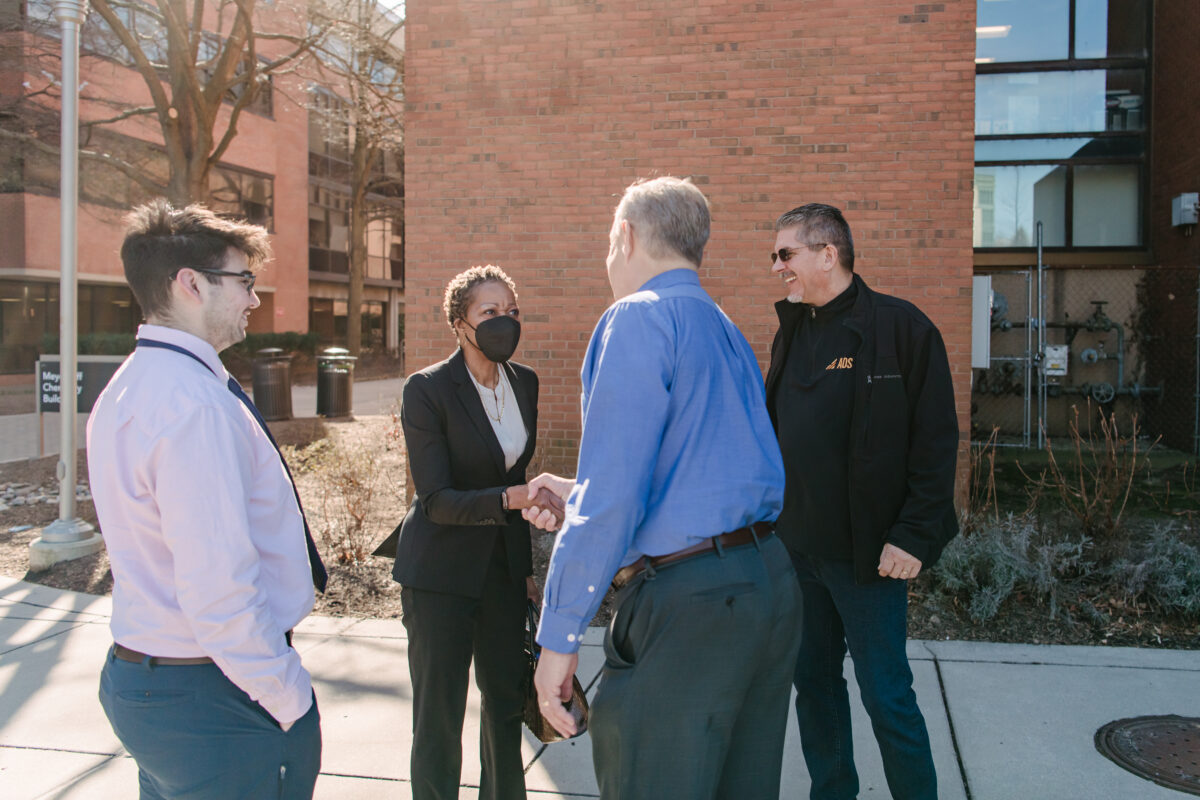
On their walk across campus, Sica, Czajkowski, and Miller met President Valerie Sheares Ashby. Marlayna Demond ’11/UMBC
“We have a very important mission that we’re working on, and I’m passionate about making sure that it is done well,” says Czajkowski. “One of the things that I’d say that UMBC taught me was how to think logically in the mathematical world, and dig deep into problems, and to be able to say, ‘Look, here’s how you approach the problem that’s being presented to you, and figure out a way to get to a solution.’”
“And the focus that I’ve applied throughout my career is, be excellent in everything you do, and make sure you do everything the right way. That’s just me as a person. It just gives me great satisfaction to know that I’m applying myself the best I can, and not taking shortcuts. You don’t want to be wrong in this world.”
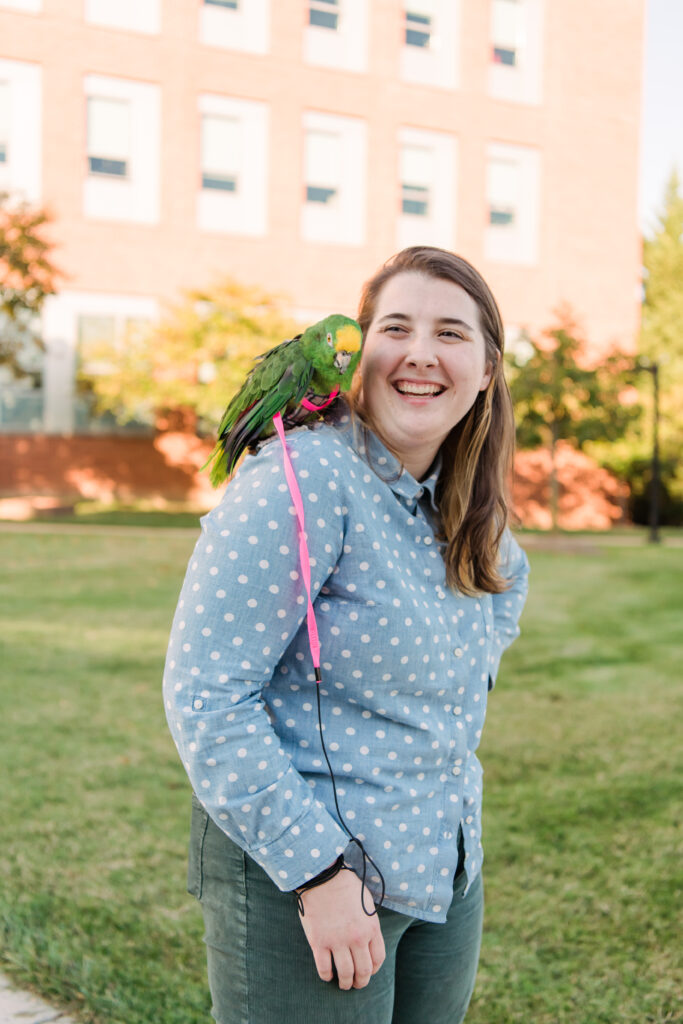
Elle Kreiner and Chicken. (Marlayna Demond ’11/UMBC)
At UMBC, we welcome Retrievers of all stripes… and feathers. Spotted on campus recently enjoying student life is an 87-year-old yellow crowned amazon parrot named Chicken. Yes, you read that right, Chicken.
Elle Kreiner ’20, anthropology, a current master’s student in applied sociology, rescued the bird in 2017 after his long-term caretaker passed away and the family wasn’t able to keep him. Despite coming to campus to spread his wings (metaphorically—Chicken doesn’t enjoy flying), Kreiner doesn’t believe their parrot would make a great student, although he does speak three languages.
Prior to his time with Kreiner, Chicken lived in pre–World War II Germany and then spent most of his years in Florida. As a result, he is prone to colorful language in German, Spanish, and English, says Kreiner, but his favorite word? “Definitely ‘cracker.’”
“If I had to personify him, he’d be a really old crotchety professor, who should have retired 20 years ago but is still here because everyone likes him,” says Kreiner. Like many octogenarians, Chicken doesn’t enjoy the cold, so if you see him on campus on a sunny day, be sure to say Guten Tag!
With Jess Presuel ’23, biological sciences, an international student from Mexico
Jess Presuel’s route to UMBC was not a direct flight from Mérida, Yucatán—her home state in Mexico—to UMBC. She originally arrived in Maryland in 2015 as an au pair to a family with five children. There, she immediately felt accepted and as she cared for the children, they helped her learn English. Over time, Presuel realized she was ready to pursue her dream of becoming a surgeon, starting in fall 2021 working toward a degree in biological science. At UMBC, Presuel knew that she wasn’t just on campus to take classes; she wanted to bring her Mexican and Mayan heritage to her time as a Retriever. Now, as a global ambassador through the Center for Global Engagement and through other connections on campus, Presuel has found platforms to bridge her two homes and she wants to share how she’s going about it.
Tools of the Trade
1. A sense of adventure 2. Backpack of study skills 3. Openness to joining clubs and volunteering 4. Grandma’s recipe book
Step 1: Find your family
For Presuel, this was both easy and hard. When she arrived in the U.S., still using Google Translate to communicate with her au pair family, she found the parents and kids eager to help her learn English and navigate life in Maryland. Most importantly, she says, they supported her personally when she shared that she was gay. “Part of the rough patch of my life in Mexico,” Presuel shares, “was that at the time, my mom didn’t accept me as being gay. So when I first got here, the family was welcoming to me. Just for me, I began to experience how American culture, especially in Maryland, can be welcoming to the LGBTQ community. It made me feel safe.”
Presuel would later meet her fiancée, Lyana Cortes, in D.C. and over time, she says, her mother has grown to accept her daughter and love her future daughter-in-law. “My mom was a single mom, so she was always working. At the time, she sustained three jobs and I raised my siblings. So when I left, she felt my absence. Now, we’ve patched things up and she’s finally accepted me. She adores Lyana,” says Presuel. In fact, the couple got engaged on their most recent trip to Mexico, building stronger family ties internationally.
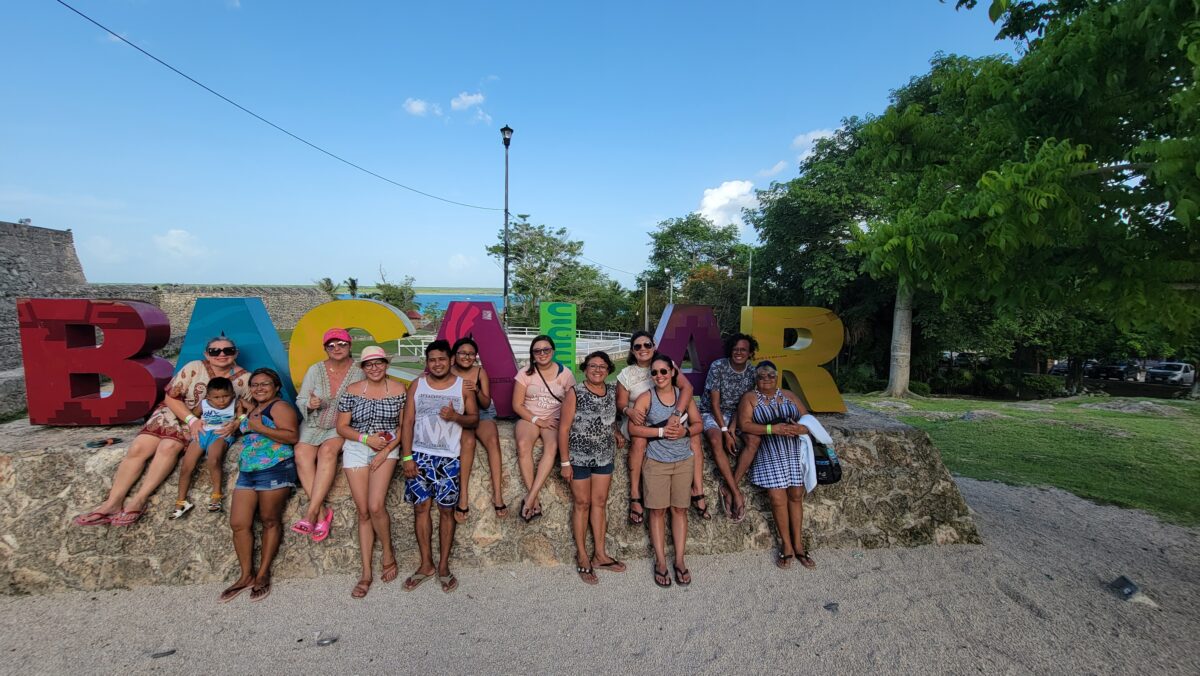
Presuel, seated, second from right, with her fiancée, Lyana Cortes, in front, with other members of Presuel’s family in Mexico. Photo courtesy of Presuel.
Step 2: Share your favorite things from home
“For me, being a Latina means always taking the time to cook something from my hometown,” says Presuel. “In addition to being Mexican, I’m Mayan too. Not many people know that the Mayan community is still alive. So I’m spreading the word, we’re here.”
Presuel uses any opportunity to make food for her communities on campus, including her medical fraternity Phi Delta Epsilon. For her Mayan dishes, she incorporates pumpkin seeds into many different recipes, and on Mexican Independence Day, September 16, she made pozole, a rich stew.
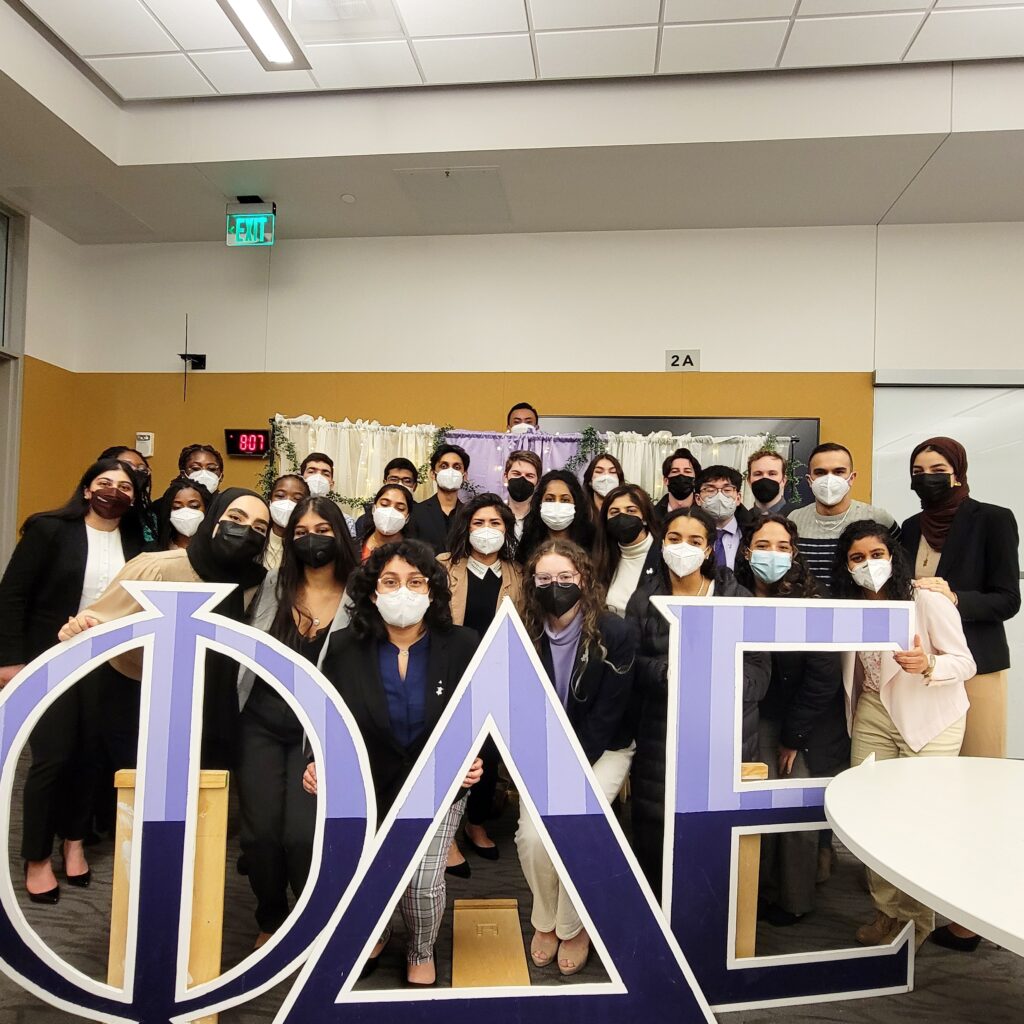
Presuel, center, in a black sweater with a white collar, with other members of her fraternity, Phi Delta Epsilon.
In addition to food, Presuel wants to share a sense of Latina empowerment. She’s currently in the process of replicating Harvard’s Latina Empowerment & Development (LEAD) conference at UMBC. “I am trying to get more Latinas involved in any type of workshops and educational settings,” says Presuel. “I want to showcase Latina leadership.”
Step 3: Get the lay of the land
Higher education in the States is a convoluted process for someone coming from outside of the system. For international students in particular, specific and important paperwork must be submitted to the right authorities. At UMBC, staff in International Student and Scholar Services (ISSS) help handle this bureaucratic burden. “I knew that when I finally picked UMBC as my university, ISSS was the first office I needed to connect with.”
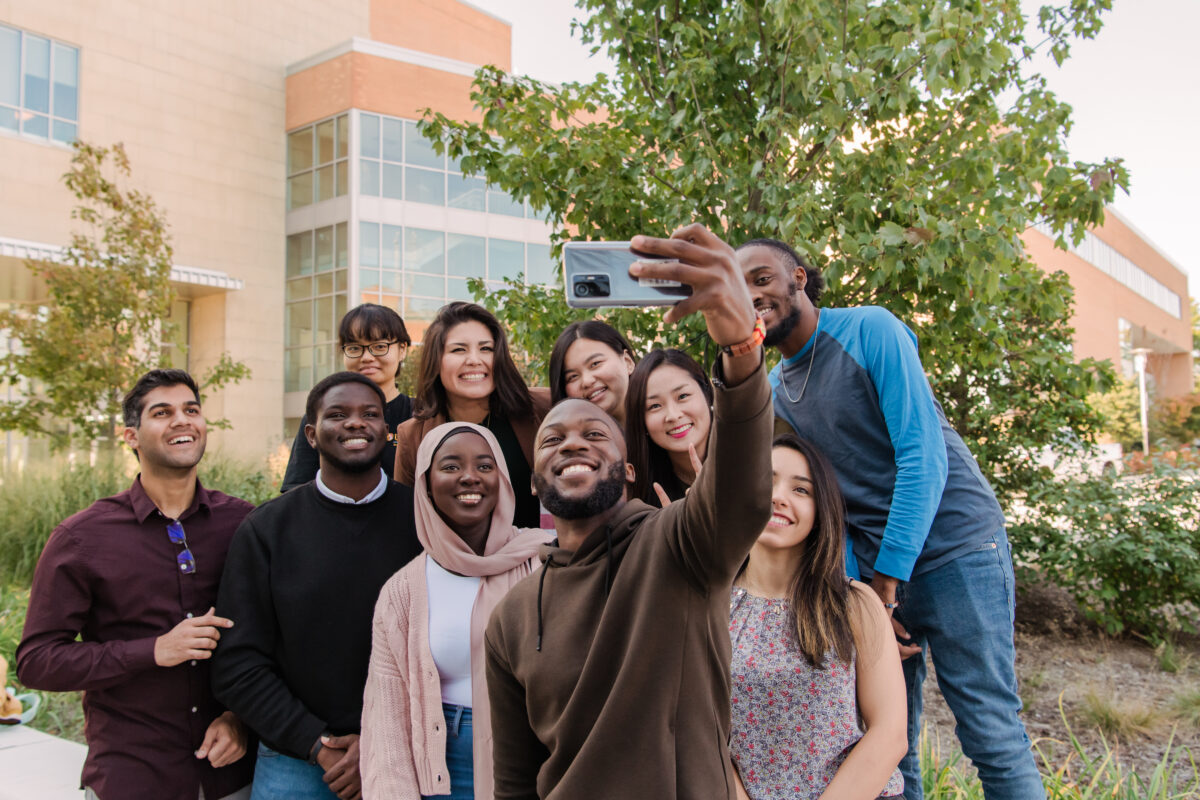
Presuel, second from left in the back, poses with other members of CGE’s global ambassador team. (Marlayna Demond ’11/UMBC)
In addition to ISSS, Presuel says, she doesn’t hesitate to ask her advisor Philip Farabaugh, professor in biological sciences, endless questions, even things she might be able to find online, because inevitably the conversation ends up being so useful to her. “He always gives me good advice. And he’s so funny, that makes me feel like, ‘Okay, I got this. I definitely can do this.’”
Step 4: Tell your story
After a year taking classes at UMBC, Presuel felt like she was ready to start offering advice to other international students. She’s now a global ambassador through the Center for Global Engagement.
“It’s such a rewarding role,” says Presuel, “because I finally get to share my experience. When you first get here from another country, you likely feel lost, so having someone who can help or speak your own language, it’s so relieving.”
Step 5: Find ways to give back to your community
“As an international student, it’s important to have a community even outside of campus,” says Presuel. She wanted to find a way to give back to other Mexicans and Spanish speakers in the area and found a home at the Esperanza Center in Baltimore City. This nonprofit is a comprehensive resource center for immigrant communities. “I do absolutely anything that’s possible for me to do,” says Presuel, who has been volunteering there for the past year.
“I help from the front desk. I’ve been assisting dentists. I translate for doctors. So being part of the immigrant community in Baltimore, it has filled my heart,” says Presuel. “I wouldn’t call it a hole, but something was missing from Mexico. I needed to have that link between my American culture, my Mexican culture here.”
Chetan Desai meets with another international student. (Marlayna Demond ’11/UMBC)
No path to and through college is without obstacles, and students often rely on community support to succeed. For some Retrievers who are working through challenges, assisting others along the same difficult journey fuels their own success.
“Doing my best to give back to my UMBC community might seem like it would take extra work on my part,” says Diane Stonestreet ’22, mechanical engineering. “But helping others helps me renew my own energy. To me, those things don’t feel like they take extra effort, I’m just doing my best to pour back into the communities that have supported me.”
Stonestreet is a first-generation college student who transferred to UMBC from Frederick Community College. “My time at UMBC has given me the space to better understand and take ownership of my journey as a first-gen student. I’ve become confident in myself, and aware that I do deserve the opportunities that come my way,” she says.
Stonestreet also makes opportunities for herself at UMBC—taking on leadership roles to support other students. Twice, she served as a coach for the Center for Democracy and Civic Life’s immersive STRiVE leadership for social impact program. She also led an Alternative Spring Break experience and served as an officer for Engineers Without Borders.
UMBC’s McNair Scholars program in particular shaped Stonestreet’s UMBC experience. The program helps students who are first generation, low income, or from other underrepresented groups access mentoring and research experiences, with the goal of obtaining doctoral degrees.
“I’ve always felt that they supported and understood me as a human before I was a student or scholar,” says Stonestreet, who will be pursuing her Ph.D. in mechanical engineering at Cornell University this fall.
Connecting face-to-face
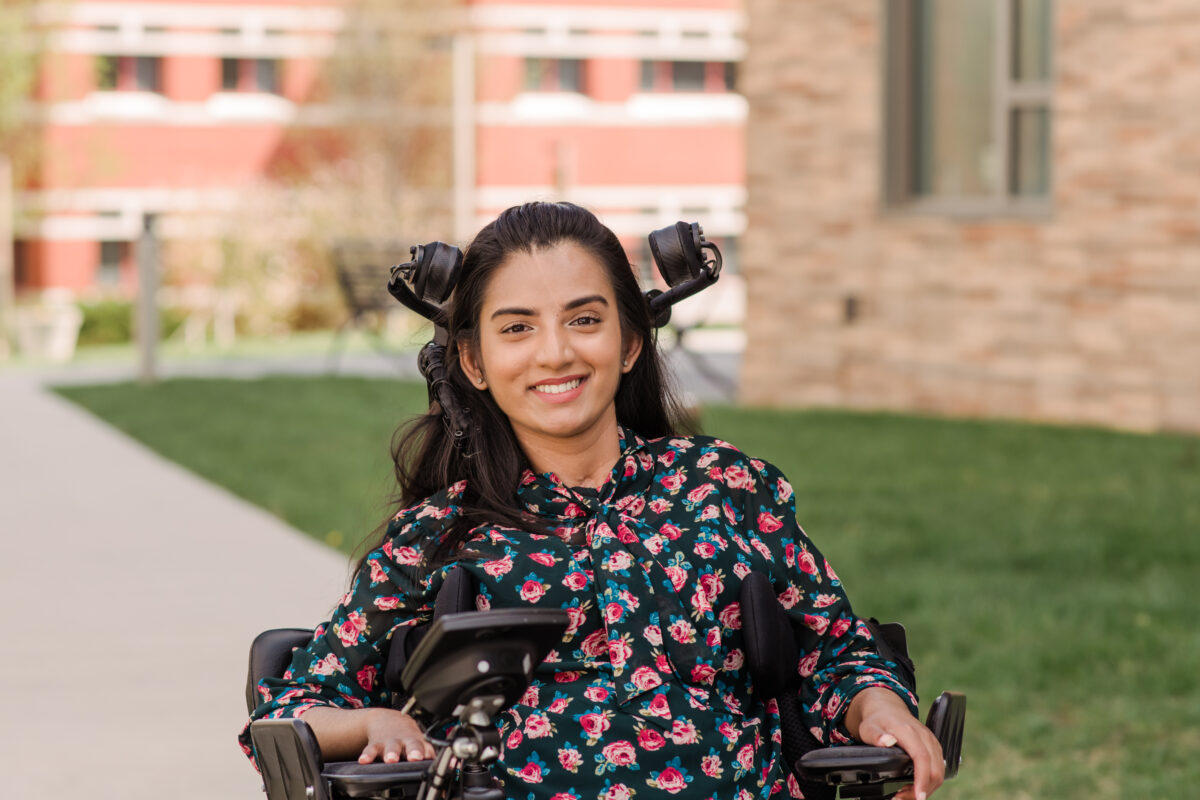
To graduate this May,Shahreen Zannat ’22, biological sciences and psychology, has overcome more than her share of personal and educational barriers. After suffering a spinal cord injury at age 15, Zannat, now quadrapaligic, was told by counselors to expect to attend college fully online. But she wanted an in-person undergraduate experience—connecting with a campus and community face-to-face.
Instead, Zannat worked with the Maryland Department of Health to obtain enough hours for her caregivers to attend classes with her at UMBC. She also had to find and pay for wheelchair compatible commuting options.
Stephen Miller, associate professor of biology, says that Zannat stands out among his students in his past two decades of teaching. “Shahreen inspires by virtue of her elite level of achievement, despite a disability that makes large obstacles out of what are for most people routine activities,” says Miller who guided Zannat’s research in his lab. In addition to her research experience, Zannat will graduate with substantial teaching experience, having served as a TA in Miller’s classes.
Zannat, who is originally from Bangladesh, says that helping others is one of the biggest values of Bangladeshi culture and was instilled in her from a young age. “After my injury, I have had to rely on others to assist me with activities of daily living, so it’s quite rewarding when I get to extend that same helping hand to others in and outside of the classroom,” she says. “Helping others gives me immense joy.”
Combining personal passion and academic pursuit
Chetan Desai, M.P.S. ’22, data science, came to UMBC from India in Spring 2021, overcoming the barriers of international travel during the pandemic, with a unique goal in mind. He wanted to combine his skills in data science with his passion for sport. He quickly dove in, working as a tennis instructor at UMBC and secretary of the tennis club. He also joined UMBC’s Global Ambassadors program.
Natalie Lobb, graduate international student support specialist in UMBC’s Center for Global Engagement, says that Desai has been “great at supporting other incoming international students to help them ease their nerves about creating a sense of belonging at UMBC.” For Desai, the experience has been incredibly rewarding, whether he is providing international students with information in a webinar or welcoming them to campus at social events.
It wasn’t easy at first, says Desai, “to be far from my home country…but at UMBC I have always found the right opportunities from the right people.”
After graduation, Desai is looking forward to creating his own career pathway in sports data. “I am much more confident now to take up future projects,” he says, “with all the hands-on experience I accumulated as a graduate student here at UMBC.”
Making meaningful change
As a Cyber and Center for Women in Technology Scholar, Priscila de Almeida Feitosa’22, computer science, quickly found like-minded classmates at UMBC—students who wanted to change the status quo of representation in technology fields. “I want to be a model for middle school girls,” says Almeida. “I want that age group to know what’s possible in this field and for them to see someone like themselves designing software.”
Almeida came to the U.S. through an au pair program to enhance her English, but also for a chance to pursue her passion for math. In Brazil she received a scholarship to study business, but even after getting her degree, she couldn’t imagine a future in that field.
“I didn’t plan that path myself,” she explains. “So in the U.S., I thought, I’ll try for the first time in my life to do something that I want to do. I’ve always wanted to change the world, and it seems like the most changes in the world happen in technology.”
When she found herself floundering in her first coding class at Montgomery College before transferring to UMBC, Almeida was determined to see the class through. “I really put my head into the books and videos, and it started to make sense. When I started to code and saw my products running, then it really clicked for me—I can see myself building something that is actually going to be meaningful for the world.”
Almeida will work as a software engineer at Amazon after graduation. She hopes her experience will inspire other non-traditional international students, just as she was inspired by the community she found at UMBC.
“On campus, I never felt different,” she says. “I never felt nervous when I needed to do a presentation because I didn’t think anyone would care about my accent or where I’m from, because at UMBC everyone is from somewhere.”
Degree: B.S., Biological Sciences and Psychology Hometown: Dhaka, Bangladesh Plans: Working in the lab of Michael Summers, UMBC
“One of the things I’m most appreciative of is the inclusive and diverse campus of UMBC. This means a great deal to me because I often find myself to be a little isolated in group settings due to my disability. But not only are the faculty extremely accommodating, but students go out of their way to support me.”
To graduate this May, Shahreen Zannat ’22, biological sciences and psychology, has overcome more than her share of personal and educational barriers. After suffering a spinal cord injury at age 15, Zannat, now quadriplegic, was told by counselors to expect to attend college fully online. But she wanted an in-person undergraduate experience—connecting with a campus and community face-to-face.
Shahreen Zannat. (Marlayna Demond ’11/UMBC)
Zannat worked with the Maryland Department of Health to obtain enough hours for her caregivers to attend classes with her at UMBC. Her efforts and self-advocacy paid off—she is the class of 2022’s valedictorian representing the College of Natural and Mathematical Sciences and College of Engineering and Information Technology. And she’ll graduate with substantial research, service, and teaching experience.
Stephen Miller, associate professor of biology, says that Zannat stands out among his students in his past two decades of teaching. “Shahreen inspires by virtue of her elite level of achievement,” says Miller. Zannat both completed research in Miller’s lab and served as a teaching assistant in his biology classes.
Degree: B.S., Mechanical Engineering Minor: Mathematics Hometown: Mount Airy, MD Plans: Ph.D. in mechanical engineering at Cornell University
“The mentors I have connected with through the McNair Scholars program have definitely been the most influential. I’ve always felt that they supported and understood me as a human before I was a student or scholar. And overall, my time at UMBC has given me the space to better understand and take ownership of my journey as a first-gen student. I’ve become confident in myself, and aware that I do deserve the opportunities that come my way.”
Diane Stonestreet ’22, mechanical engineering, is a first-generation college student who initially found the prospect of applying to college daunting. As a high school student, she didn’t know where to find all the answers and resources she needed. But after attending Frederick Community College, Stonestreet applied to UMBC and received a scholarship called ME S-STEM to study mechanical engineering. That support had an enormous impact on her educational path. She’ll soon head to Cornell University to start her Ph.D. in mechanical engineering.
While at UMBC, Stonestreet took on multiple leadership roles to support her fellow students. She served as a teaching fellow in the McNair Scholars program, a coach for the Center for Democracy and Civic Life’s immersive STRiVE leadership for social impact program, a leader of a UMBC’s Alternative Spring Break, and an officer in Engineers Without Borders.
Stonestreet and the K-12 Educational Equity group speaking with Marvin James, senior advisor to Baltimore Mayor Brandon Scott, as part of Alternative Spring Break. Image courtesy of Stonestreet.
“Doing my best to give back to my UMBC community might seem like it would take extra work on my part,” she says, “but helping others helps me renew my own energy. I’m just doing my best to pour back into the communities that have supported me.”
Degree: M.P.S., Data Science Hometown: Karnataka, Kalaburagi, India Plans: Entrepreneur in sports data science
“It wasn’t easy at first to be far from my home country and still have to do what’s to be done, from cooking and cleaning to making friends. But at UMBC I have always found the right opportunities from the right people.”
Chetan Desai, M.P.S. ’22, data science, came to UMBC from India in Spring 2021, overcoming the barriers of international travel during the pandemic, with a unique goal in mind. He wanted to combine his skills in data science with his passion for sport.
Desai made the most of his UMBC experience, working as a tennis instructor and serving as the secretary of the tennis club, a senator in the Graduate Student Association, and a data science teaching assistant. He also took on numerous roles off campus, volunteering for the State of Maryland COVID-19 vaccination site and the Citi Open Tennis Tournament.
Chetan Desai meets with another international student. (Marlayna Demond ’11/UMBC)
Making the most of his own experience as an international student, he joined UMBC’s Global Ambassadors, where he invited other international students to be an active part of Retriever student life.
“I am so glad I was open to experiences and options as they were made available to me at UMBC,” says Desai. “I hope I have helped make other students’ journeys even smoother than my own.”
Degree: B.S., Computer Science Hometown: São Paulo, Brazil Plans: Software engineer for Amazon
“On campus, I never felt different. I never felt nervous when I needed to do a presentation because I didn’t think anyone would care about my accent or where I’m from, because at UMBC everyone is from somewhere.”
As a Cyber Scholar and Center for Women in Technology Scholar, Priscila de Almeida Feitosa ’22, computer science, found like-minded classmates at UMBC—students who wanted to challenge the status quo of representation in technology fields.
Alemeida with Cindy Greenwood, advisor and assistant director of Cyber Scholars Program. Image courtesy of Almeida.
Almeida, whose first degree is in business, came from Brazil with the goal of redefining her career path. “In the U.S., I thought, I’ll try for the first time in my life to do something that I want to do. I’ve always wanted to change the world, and it seems like the most changes in the world happen in technology.” Almeida is excited to use her software engineering position at Amazon as a jumping off point for volunteering with young women interested in STEM, exposing them to what is possible.
“I want to be a model for middle school girls,” says Almeida. “I want that age group to know what’s possible in this field and for them to see someone like themselves designing software. When I started to code and saw my products running, then it really clicked for me—I can see myself building something that is actually going to be meaningful for the world.”