All posts by: UMBC News Staff


UMBC offers new Research Experiences for Undergraduates in smart computing, big data

Starting out at UMBC, Meyerhoff Scholar Timothy Potteiger wasn’t certain what direction he wanted to take. However, he benefited from UMBC programs that brought the world to his doorstep, inviting universities to pitch him their summer research experiences. One conversation with Washington State University particularly resonated. They spoke about researching smart home sensor technologies to help improve the daily lives of older adults and people with disabilities. 

Potteiger ’14, computer engineering, was drawn to that purpose-driven approach. Little did he know that the program manager for that undergraduate research experience in 2013, Nirmalya Roy, would soon join UMBC’s faculty and expand research opportunities for even more undergraduates.

Middle-aged South Asian man smiles in a portrait. He wears black, rectangular classes, a suit jacket and burgundy sweater.
Nirmalya Roy

Research Experiences for Undergraduates (REUs) are critical for students like Potteiger. Roy, now associate professor of information systems at UMBC, is principal investigator leading a new REU in Smart Computing and Communications funded by the National Science Foundation (NSF). The program is accepting applications through March 31 for this summer from students nationwide. 

Potteiger is excited for students to take advantage of this opportunity. “I know Dr. Roy has a good vision on how to actually impact society with research,” he shares.

Transformative experience

The program will bring together ten undergraduate students in a paid 10-week, full-time research experience from June 7 to August 13. While the summer 2021 program will be remote, each student will work closely with a research group and mentor. They will receive guidance from Roy and co-PI Dmitri Perkins, as well as other information systems and computer science and electrical engineering (CSEE) faculty. 

In the final week, the students will have a chance to present their research through UMBC’s popular Summer Undergraduate Research Fest. They will also have the opportunity to develop peer-reviewed articles and continue their research throughout the year with faculty. 

“The idea of this experience is not only to give them exposure to hands-on research problems, but to also help undergraduates with professional development,” says Roy. “Developing a peer network and encouraging them to build confidence talking with professors and researchers in their field will be important for their careers.”

Real-world applications

One REU project will tackle privacy protection in COVID-19 contact tracing programs, while another will study a chatbox method for studying cryptocurrency. Roy will also give students the chance to optimize smart home sensors for seniors or work on the FloodBot project, a collaboration with nearby Ellicott City to create an early flood warning system after a 2018 flash flood caused catastrophic damage. 
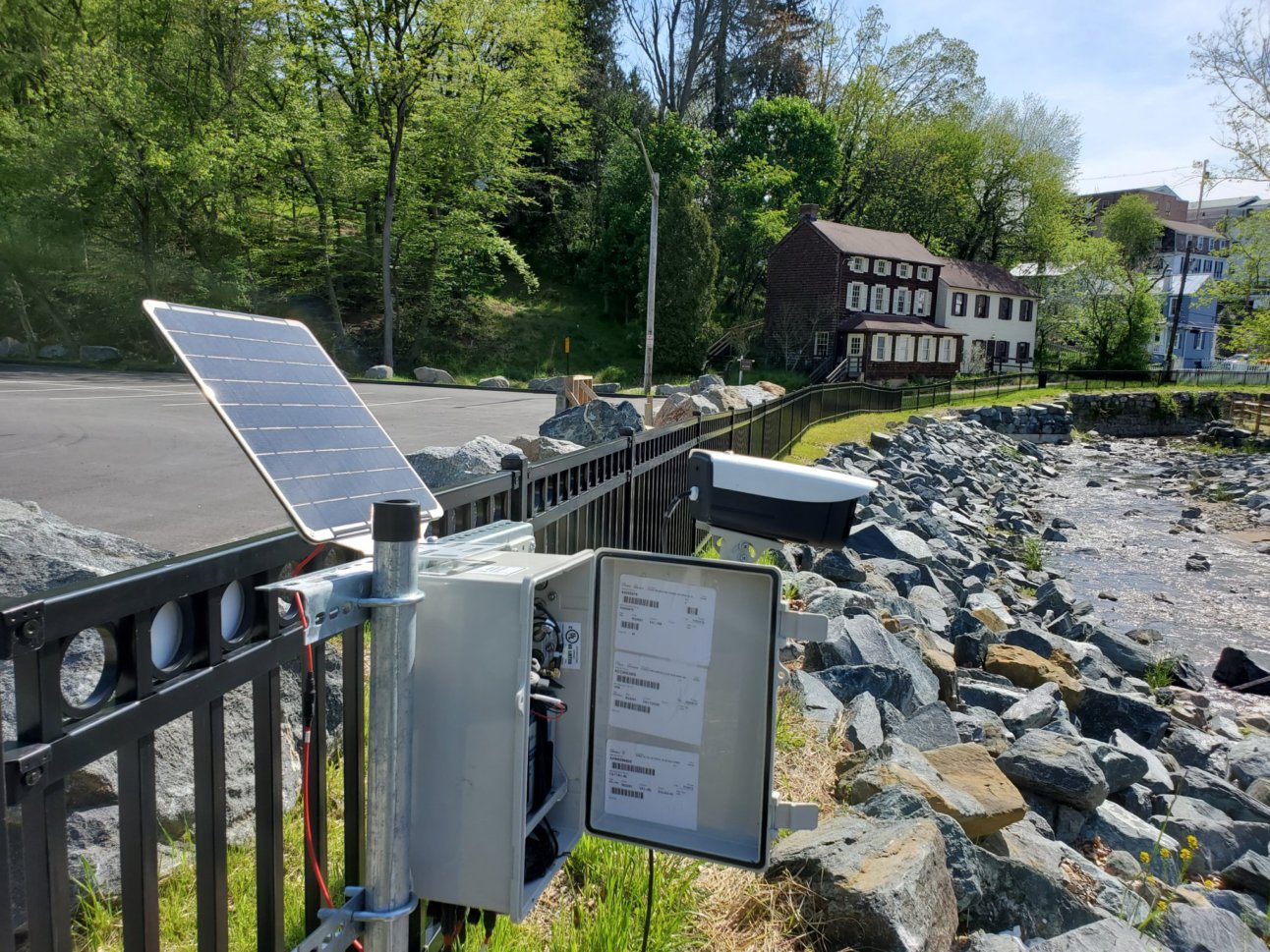
Box of electronic equipment with a solar power panel. Outdoor photo with road, plants, and homes in the background.
Sensors placed in Ellicott City through the FloodBot project. Photo courtesy of Nirmalya Roy.

Students can also work with Perkins, a CSEE professor, on research into wireless devices capable of “situational awareness,” the ability to switch from one frequency to the next along a limited radio spectrum highway. The interdisciplinary project is crucial to staving off what some experts fear is a looming, massive traffic jam for wireless devices globally.

“The hallmarks of all our projects is that they have community impact,” says Vandana Janeja, chair of information systems.
South Asian woman with shoulder-length hair smiles for a portrait, wearing a pearl necklace, black and white print shirt, and black sweater.
Vandana Janeja

Expanding opportunity

Providing undergraduates with real, hands-on research experiences resonates personally with Perkins. He grew up in a no stop-light town in Mississippi and attended Tuskegee University, which had well-regarded academic programs but more limited lab research opportunities at the time. Perkins was able to gain research experience in a broader range of areas by participating in REUs at two other universities. 

Portrait of smiling middle-aged Black man in suit, striped shirt, and pink tie.
Dmitri Perkins. Photo courtesy of Perkins.

Recognizing that many students come from similar backgrounds where research opportunities may be rare, the REU specifically encourages applicants from community colleges and groups traditionally underrepresented in the STEM fields. 

“With students from traditionally underserved communities, there is often some apprehension or insecurity about pursuing a career in research,” Perkins says. “Once students complete their UMBC summer experience, they will have more information, more understanding of what research looks like, and the knowledge that they can actually do this.”

Unique online experience

Jianwu Wang, information systems, has also joined the wave of faculty from UMBC’s College of Engineering and Information Technology (COEIT) launching new REUs. Wang is assistant professor of data science and director of the Big Data Analytics Lab. With co-PI Matthias Gobbert, professor of mathematics, he’s just received NSF funding to launch an online interdisciplinary Big Data REU.
Headshot, Asian man in pink shirt and glasses
Jianwu Wang

They will provide an 8-week summer online research experience to undergraduates from across the country. Students will explore “how to utilize modern data science and high-performance computing techniques to process and analyze big data in many science and engineering disciplines,” Wang explains. This includes fields ranging from atmospheric science to mechanical engineering to medicine. 

“We’ve designed the program to be purely online so it is particularly useful for students in remote areas or who might have health concerns or concerns about travel,” says Wang. “We also want to make sure it is accessible to students with family responsibilities and disabilities, who may not be able to leave their home for an extended period of time.”

Big data research

This program will combine formal instruction, team-based research, and experience disseminating that research. The goal is to ignite students’ interest in “how data science and high-performance computing techniques could help the scientific discovery process” while giving them essential hands-on research skills and preparing them for the workforce.

Students will learn how to identify research questions and conduct research using advanced cyberinfrastructure software technologies and hardware resources. Tentative research themes for summer 2021 research projects include big data and machine learning techniques for sea ice prediction and for medical image classification. 

The summer 2021 program will run June 7 through July 31. Applications are due by April 15, 2021, and the organizers invite undergraduates in all STEM fields to apply. Students who complete the fully-funded program will also be eligible for additional funds to present their research at conferences around the country.

Roy and Wang credit COEIT for encouraging their efforts to launch new REUs. Erin Lavik, associate dean for research and faculty development and professor of chemical, biochemical, and environmental engineering, describes the new programs as “fantastic.” She shares, “This is an exciting chance to connect undergraduates from across the country with unique UMBC student research experiences and our outstanding, innovative faculty.”
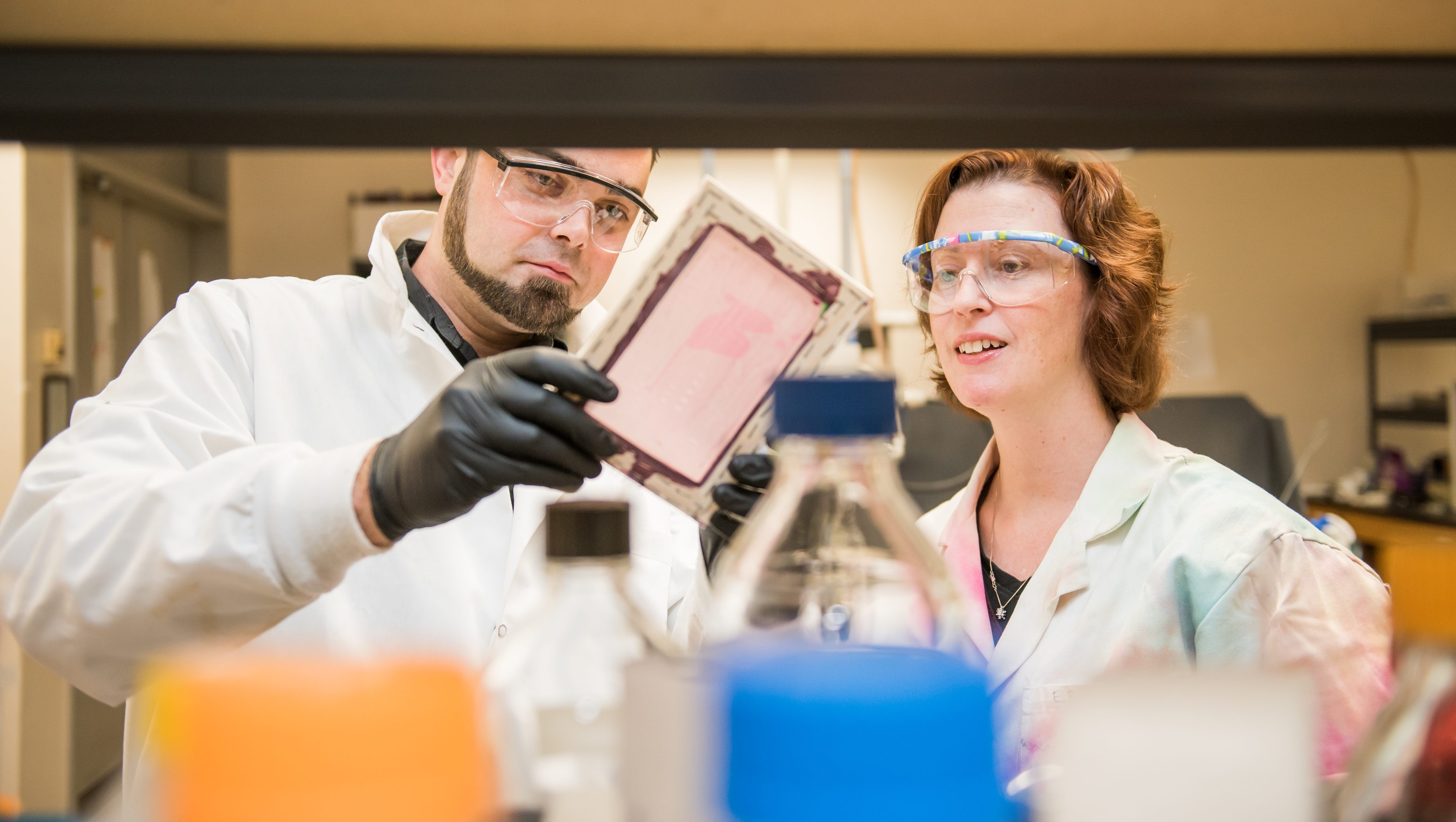
White man and woman look at equipment in a lab. Both wear lab coats and protective glasses.
Graduate student Adam Day (left) works with Erin Lavik (right) in her lab, 2017.

Featured image: Nirmalya Roy with a student in 2018. All photos by Marlayna Demond ’11 for UMBC unless otherwise noted.

Article written by Nick Ford for UMBC News.
UMBC’s James Foulds receives NSF CAREER Award to improve the fairness, robustness of AI

UMBC’s James Foulds was drawn to working in artificial intelligence (AI) and machine learning (ML) by “the possibility to make a direct impact on people’s lives and the health of our society” through advancing technology. He has now earned a National Science Foundation CAREER Award of nearly $550,000 over five years to support his research on improving the fairness and robustness of AI algorithms. 

Foulds, assistant professor of information systems, joined UMBC in 2017. His lab focuses on human-centered approaches to AI fairness, working to address many practical limitations in the field.

Implementing an AI algorithm is often presented as a trade-off, Foulds explains. Do you want the program to be as productive as possible or as fair as possible? Foulds sees this as a false and harmful dichotomy.

Thanks to advances in AI, computers can accomplish tasks that would take a human a lifetime, but technologies built by people also perpetuate people’s biases, Foulds says. These biases can then have real impacts on people’s lives, often disproportionately harming already disadvantaged groups. For example, skewed AI and ML models have informed college admissions, credit card approvals, and recommendations for bail in court rooms. 

The ethics of adopting such systems and ways to mitigate their potential harms have become focal points in Foulds’s work.

Fair AI implementation across applications

Foulds’s research demonstrates that developing an AI algorithm that prioritizes fairness can in fact yield more robust results. Models are often used to make generalizations about a population of interest, which can be helpful. But when a model is developed based on biased data, the prediction can suffer from “overfitting,” where the model describes a relationship between variables that doesn’t actually reflect reality. 

In these cases, the model’s predictions can be misleading, rather than useful, and can cause real harm. A model that underscores fairness could provide more stable generalizations and help to avoid perpetuating or amplifying existing biases and false interpretations.

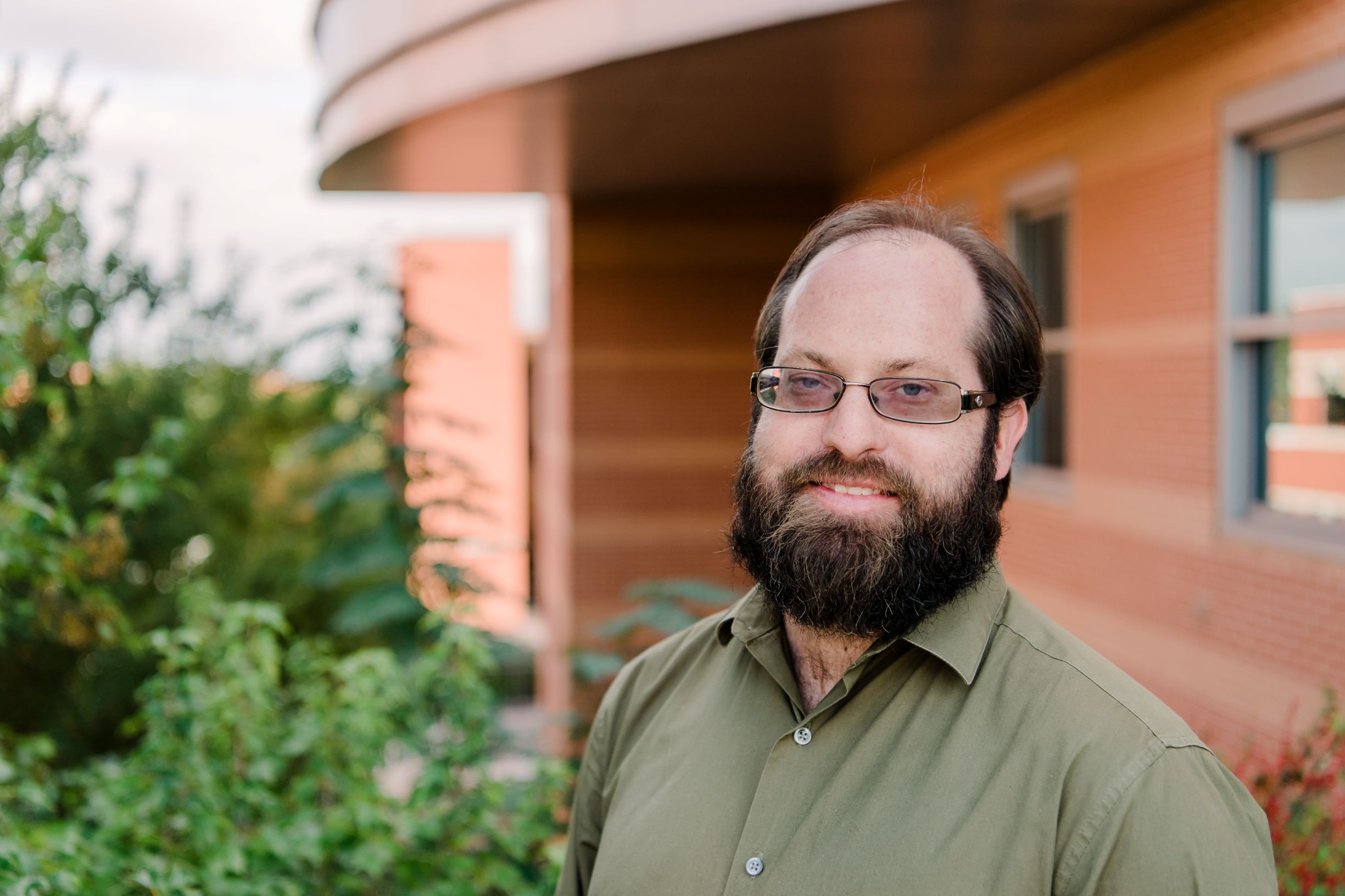
Portrait of a middle-aged white man with full beard. He wears a green dress shirt and wire-framed glasses. He stands in front of a brick building and plants.
James Foulds

Researchers currently quantify fairness in a variety of ways. Through his CAREER Award-supported research, Foulds wants to develop a unifying framework. From there, he will create a user interface to study how people come to a consensus on defining fairness in a given situation.

The project will target decisions or advice based on things like Medicaid waitlist data, career recommendations, and social media usage data. These all have intrinsic biases that can significantly impact trends and outcomes in society, or the way industry addresses specific problems. 

For example, each U.S. state has a different way of determining who receives health coverage through Medicaid. Creating a better model to perform a needs-based ranking of the waitlist for Medicaid coverage could help officials make more informed, equitable decisions about who should receive coverage.

Bringing more people into the conversation

Foulds believes his research will mitigate barriers to responsible and effective deployment of AI technologies by showing that it is possible to develop a discipline-standard model for fairness. He hopes to make his lab a source of user-friendly AI tools for those who want to implement the model in their work.

As an educator, “I want to inspire the students I come into contact with to see how fascinating and exciting (and potentially lucrative) AI, ML, and data science are,” Foulds shares. “And I want to instill in them the importance of ethical thinking in the practice of data science.” 

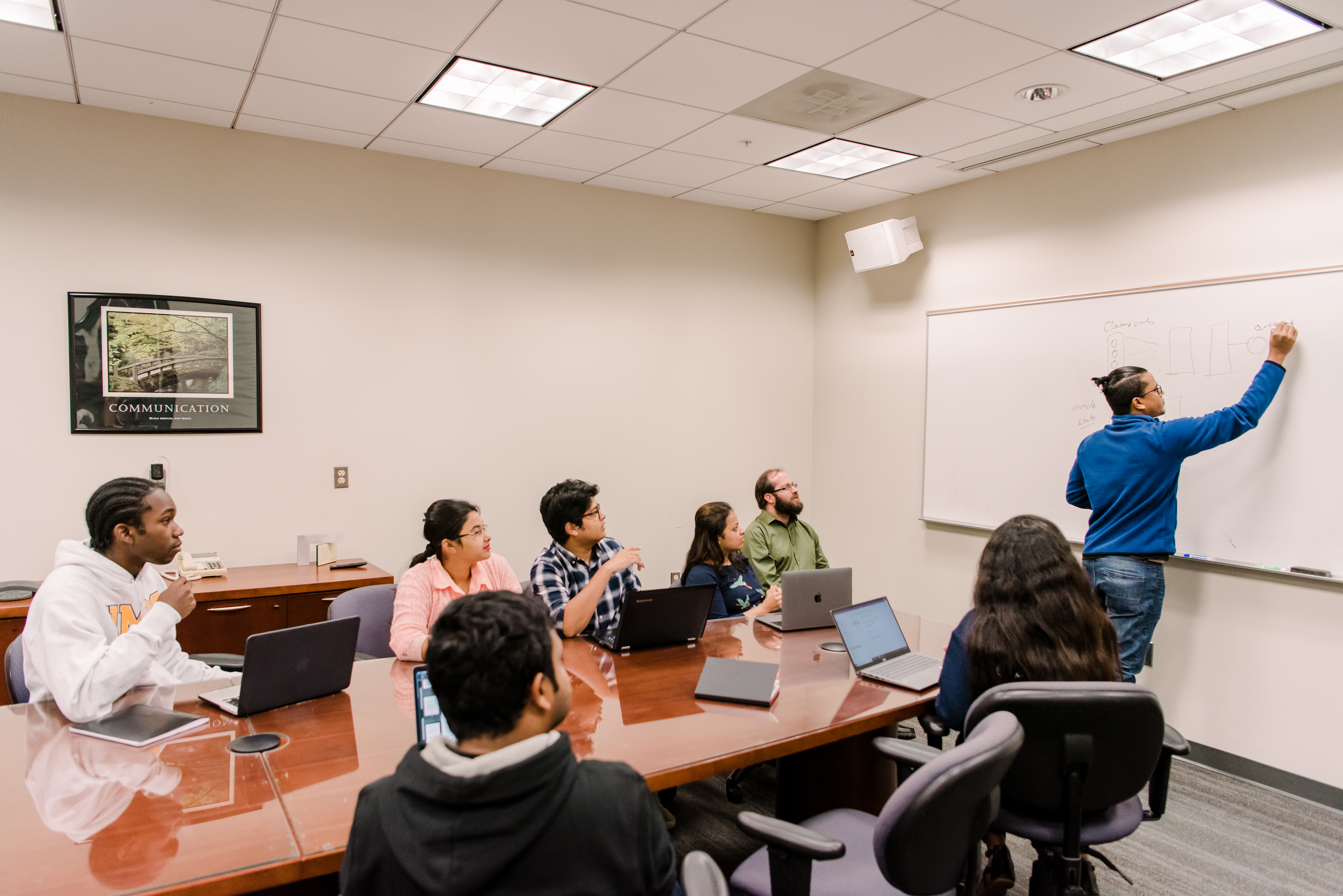
A student writes on a white board. Seven colleagues watch from their seats around a conference table.
James Foulds (third from right) meets with students in his lab in 2019.

Beyond his own courses, he hopes to partner with Baltimore Polytechnic Institute, a local STEM-focused high school, to provide students with exposure to a range of new career options that can have a major societal impact.

Public impact research

In addition to Foulds, UMBC is celebrating the recent CAREER Award of Ramana Vinjamuri, who joined the university’s computer science and electrical engineering faculty in 2020.

Vinjamuri’s project revolves around brain-computer interfaces and understanding the complex relation between the hand and the brain. His goal is to understand how the brain controls the hand and how the hand sends motor and sensory information back to the brain. 

Portrait of a middle-aged South Asian man. He has a beard and wavy hair, and wears wire-framed glasses and a suit.
Ramana Vinjamuri. Courtesy of Vinjamuri.

Vinjamuri hopes to be able to demonstrate how a person might more quickly learn skilled movements (like playing the piano) or relearn lost movements after experiencing a stroke. Like Foulds, he feels energized to tackle big questions with the potential for significant public impact.

Banner image: James Foulds with his students in 2019. Photos by Marlayna Demond ’11 unless otherwise noted.

Story by Travis McKay ’19, chemical engineering, for UMBC News.

UMBC Mock Trial heads to national semifinal as undefeated regional champions

“This year’s team, they’re not afraid of anyone,” says Ben Garmoe ‘13 political science, adjunct professor and head coach of UMBC Mock Trial. “They will go into every round knowing they have a shot.”

UMBC Mock Trial will compete in the semifinals of the American Mock Trial Association’s (AMTA) annual national tournament, March 20 and 21. Garmoe’s confidence in the team is rooted in their strong performance this season, capping years of steady growth into a national powerhouse. 

The team began 2002. Early members included students like Alicia Wilson ‘04 and Aaron Merki ’05, both political science, who went on to prestigious law programs and careers. After a 2009-2010 hiatus, the team came back with a vengeance in 2011. They’ve competed in the semifinals, known as the Opening Round Championship Series (ORCS), every year since 2013, and advanced to the National Championship Tournament (NCT) three out of the past four seasons.

UMBC Mock Trial is currently ranked 24th in the nation. The university’s A Team went 8-0 in regional competition leading up to the semifinals, beating schools like the University of Chicago and the University of California, Irvine.

Previous ORCS were geographically based, but this year’s online format allows UMBC to compete against a national field. Garmoe and the team appreciate the opportunity to go head to head against a wider range of top schools.

Preparing for online competition

To prepare for competition in the new online format, Garmoe took UMBC Mock Trial back to the basics. The differences in competing online and in person forced the team to rethink aspects of their performance. For example, Garmoe explained that making eye contact and holding a judge’s attention work differently in the Zoom environment.

“Over the course of this season, students have paid attention to those little details,” says Garmoe. And adjusting to the needs of a trial through Zoom has helped UMBC gain an advantage, explains Thomas Azari ‘22, political science. 

Anzari is team vice president and recipient of several outstanding attorney honors. “We try to be as human as possible,” he says. “I think the thing that separates us from some other teams is we are both focused and relaxed. We make a joke out of technical issues like forgetting to unmute or mute. You just laugh it off and you move on.”

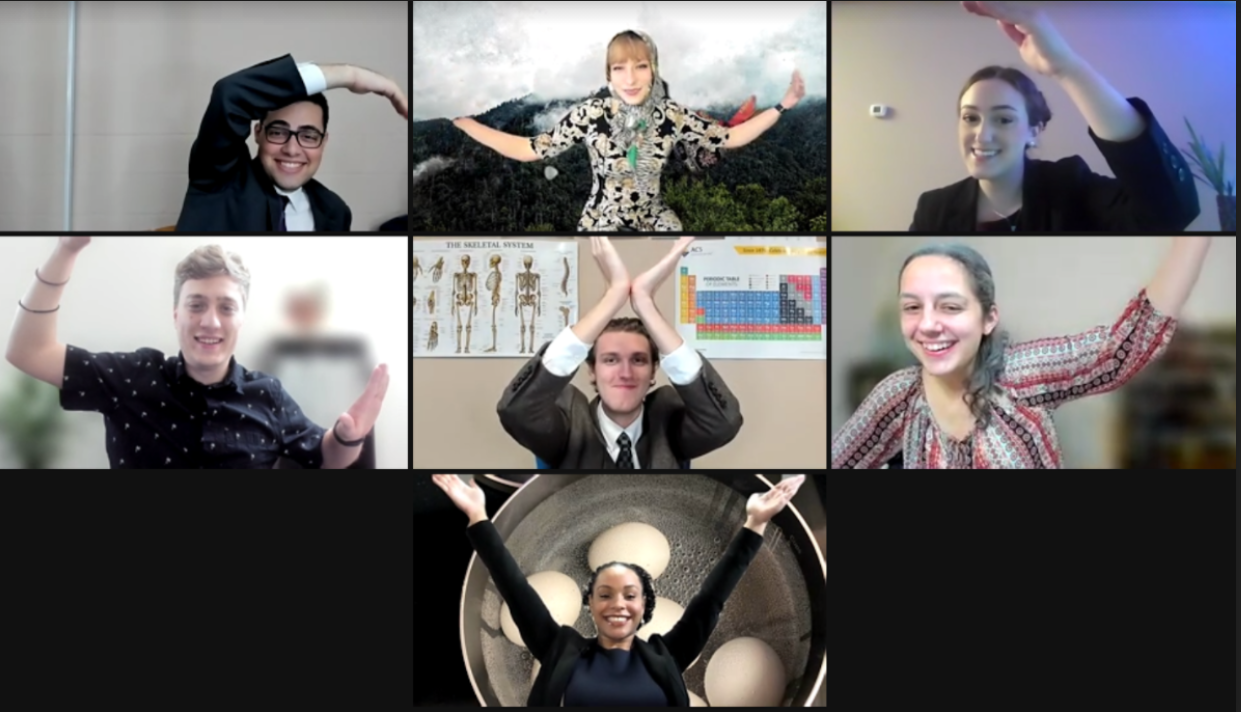
Screenshot of video call with seven young adults, each in their own box in a grid pattern. They wear professional attire.
Seven members of UMBC Mock Trial’s A Team (l to r, top to bottom): Thomas Azari, Maria Kutishcheva, Lauren Wotring, Zinedine Partipilo Cornielles, Thomas Kiley, Natalie Murray, Sydney Gaskins.

Bringing together top talent

Azari points to UMBC Mock Trial President Sydney Gaskins ‘21, political science, as another key asset to the team. Azari appreciates every opportunity to watch Gaskins compete since she is such a high caliber competitor.

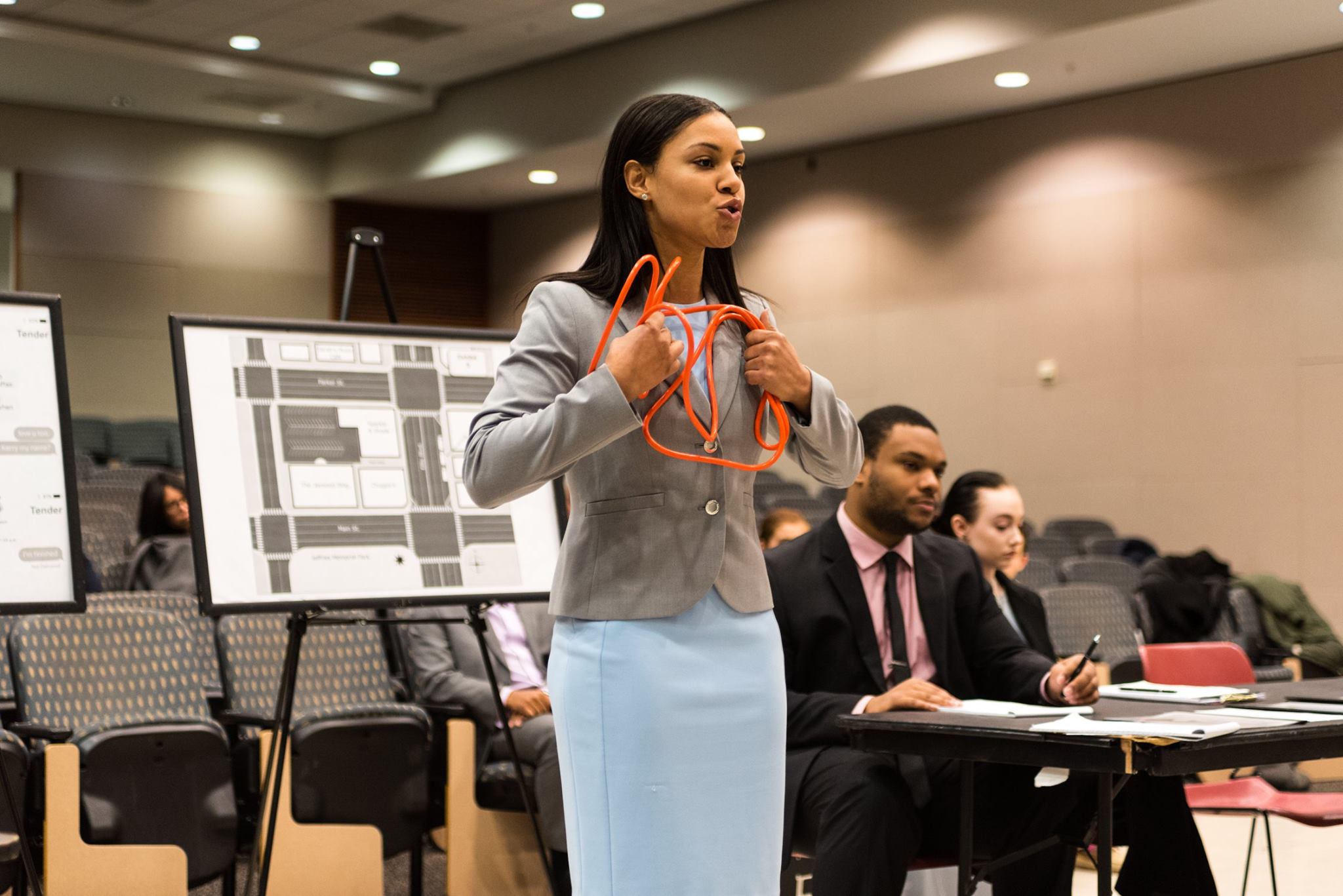
Young woman stands wearing a blue dress and gray blazer, delivering remarks while holding a prop
Sydney Gaskins competes for UMBC Mock Trial in 2019.

Among Gaskins’s dozens of honors is an All-American Attorney award from a prior AMTA National Championship Tournament. She also earned Best Cross Examination honors and was named a finalist in the 2020 Drexel/UCLA Trial by Combat competition. Anzari can’t wait to see what she achieves in her final season of collegiate competition.

UMBC Mock Trial’s four witnesses are also essential to the team’s success. “We have four of the most likable witnesses in the country,” says Azari. 

Two of those witnesses are freshman Maria Kutishcheva, political science and Russian, and sophomore Zinedine Partipilo Cornielles, political science and financial economics. Partipilo Cornielles describes the UMBC Mock Trial team as a family. To him, the team’s sense of connection allows them to play on each others’ strengths and performances.

Young man with blonde hair stands in front of podium reading
Zinedine Partipilo Cornielles. Photo by Arionna Gonsalves ’19.

“We act as a unit, as a team,” says Partipilo Cornielles. “We’re all parts of this moving mechanism. The fact that we are a family really helps us and sets us apart from other teams. Some other teams might be too individualistic, but one thing we are really lucky to have is this sense of teamwork.”

Focus on the team

For each member of UMBC Mock Trial, the focus is always on the team. Even in the individual Trial By Combat 2020 competition, Gaskins shared, “The virtual tournament was not only a much needed opportunity to reconnect, but to also make my team proud.”

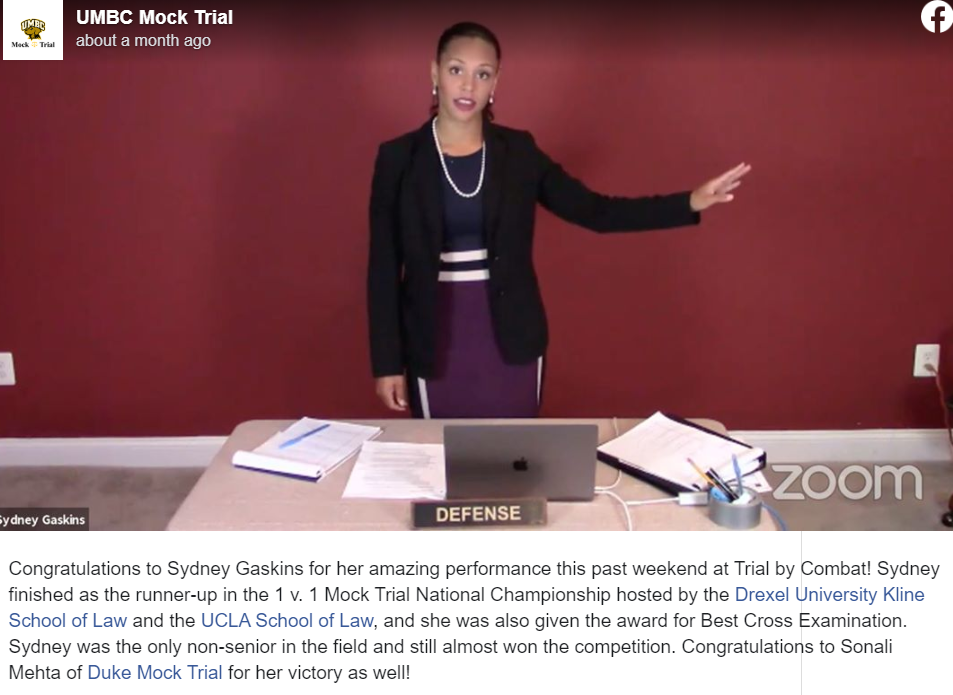
Screenshot of a Facebook post featuring a young Black woman in a purple dress, blazer, and pearls, She presents remarks in front of a burgundy wall.
Sydney Gaskins competes in Trial by Combat 2020.

Extending that idea, Kutishcheva points to inclusivity and supportiveness as strengths of UMBC Mock Trial. She explains that the team truly cares for one another, and members help each other out beyond team practice. 

Kutishcheva also appreciates the diversity of the team. She has noticed that some universities’ teams don’t reflect the racial diversity and diversity of majors on their campuses. “But UMBC’s diversity is reflected here on our team, and that makes me especially happy,” says Kutishcheva. 

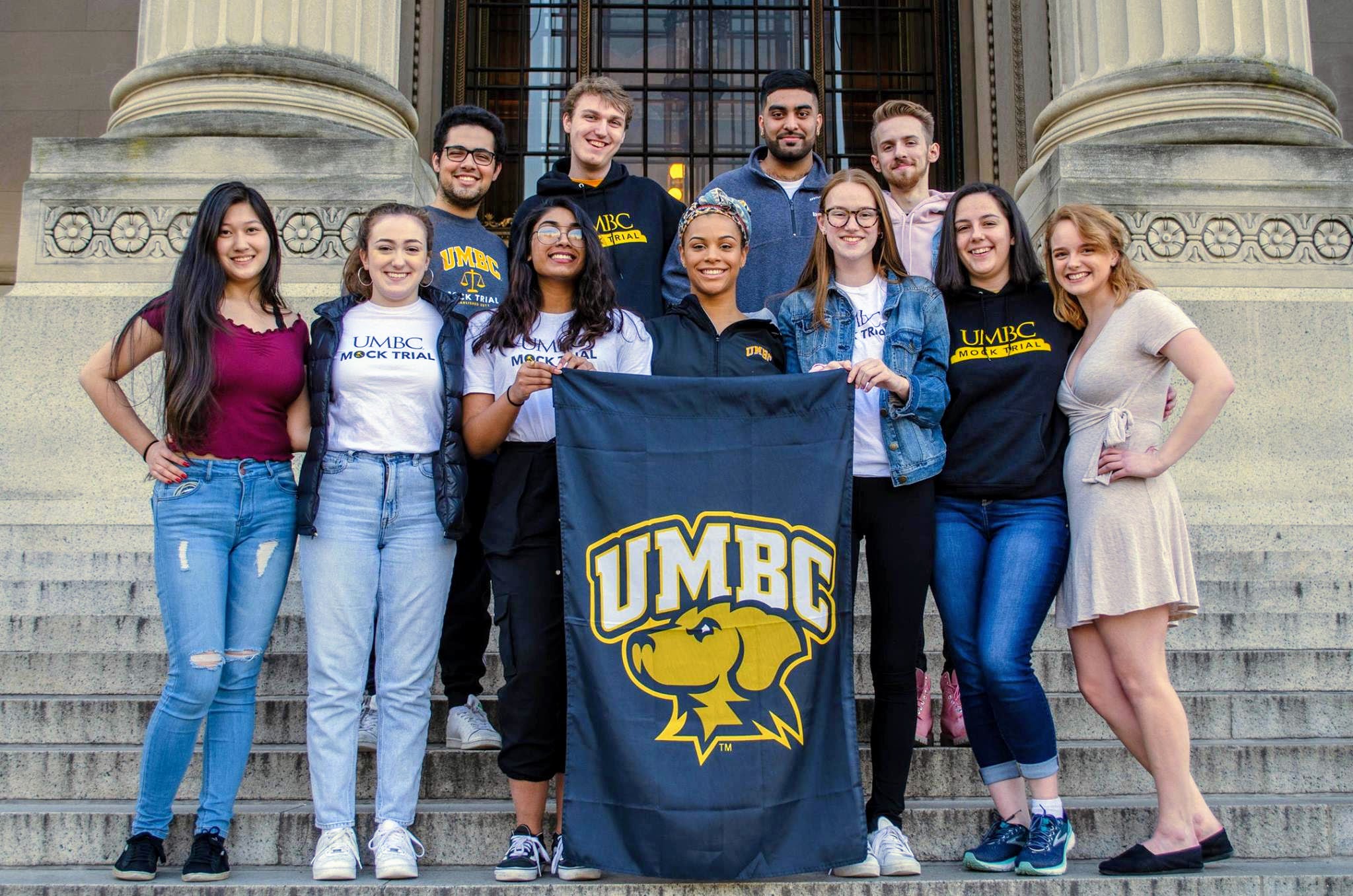
Several young adults stand on steps in front of a building with large pillars. They hold a sign reading
UMBC Mock Trial prior to competing in ORCS in 2019.

“I genuinely believe that this team is a uniquely UMBC story,” says Garmoe—a story of inclusive excellence. “I think, over the last five, six years, what we’ve grown into is a testament to what this school has built itself to be.”


Update 3/22/2021: UMBC Mock Trial has advanced to the AMTA National Championship Tournament, where they will compete April 16-18.


Featured image: UMBC Mock Trial’s 2017 trophies. Photo by Marlayna Demond ’11 for UMBC. All other photos courtesy of UMBC Mock Trial unless otherwise noted.

Article by Morgan Casey ’22, media and communication studies, for UMBC News.

UMBC rapidly expands live online peer tutoring to include computing fields

When Amanda Knapp heard last fall from Anupam Joshi, professor and chair of computer science and electrical engineering (CSEE), that his department wanted to offer online tutoring to students in their courses, she was ready to help make it happen. COVID or no COVID, she says, “It just made sense.”

Knapp is associate vice provost and assistant dean of Undergraduate Academic Affairs, and she manages UMBC’s Academic Success Center (ASC). “We already had an established system in place and could provide the administration, training, staffing, and assessment,” she explains. “CSEE provided the funding and identified potential tutors for a variety of computer science courses, and we did the rest.”

Just a few months after the partnership began, it expanded to include courses in the information systems (IS) department. And this semester, tutors are supporting ten IS computing courses.

Three woman in black blazers and dress shirts stand in an office lobby. Behind them a sign reads
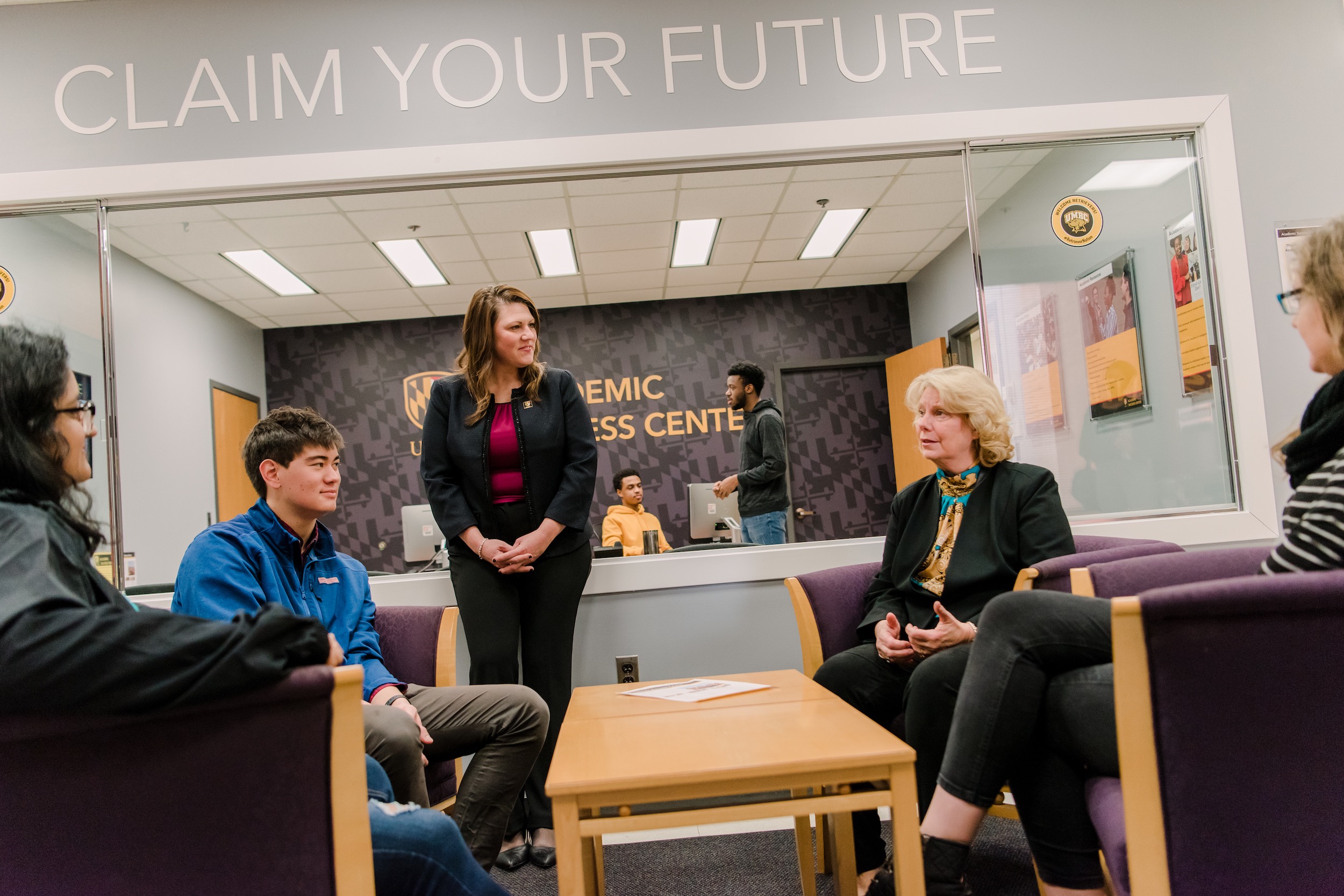
Amanda Knapp, Katharine Cole, and Delana Gregg in the Academic Success Center, 2019

In total, the ASC’s new Computing Success Center now offers tutoring for 21 courses from across the College of Engineering and Information Technology (COEIT). And the center continues to grow, supported by COEIT Dean Keith J Bowman and Dean Katharine Cole, Undergraduate Academic Affairs.

Peer tutors help students of any major, from computing fields to the arts and life sciences, learn coding and other computing skills. 

“The ethos of UMBC is to share knowledge and collaborate with others instead of being proprietary,” says Helena Mentis, associate professor of information systems. Mentis is COEIT’s associate dean of academic programs and learning, and one of the College leads on the partnership.

“At the end of the day,” she says, “our goal at UMBC is to ensure that there are multiple pathways for students to get the assistance they need to succeed and remove any barriers for access to help.”

Portrait of smiling woman sitting in front of computer that features medical device imagery.
Helena Mentis

How it works

Students can now visit the website for the new Computing Success Center to access trained and faculty-recommended peer tutors at their convenience. And the tutoring isn’t just a series of online videos—it’s live and interactive.

Portrait of smiling young woman in front of virtual backdrop of an office.
Peer tutor Sumaiyah Mahmoodi ’21, health administration and policy, answers a student question online in front of a virtual background of the Academic Success Center. Photo courtesy of the ASC.

Britney Sarpong ‘21, computer science, taps into tutoring services twice a week for the CMSC 421: Operating Systems course she is taking. “I can easily log in and get help, and it’s usually the same tutor, so she and I have gotten to know each other really well,” she says. 

For the operating systems course, Sarpong is learning C programming, which she likens to learning a foreign language. “I am not familiar at all with the language and terms with C programming,” says Sarpong, “so my tutor explains it in a way that I can understand while I’m working on projects.”

Moving services online

The tutoring offered by the Computing Success Center is just one of the many student support services offered by the ASC that has transitioned online during the COVID-19 pandemic. “This has been essential to enable us to continue serving UMBC students,” says Knapp. 

A group of people talks around a table. A sign above them reads
Amanda Knapp (standing) and Katharine Cole (second from right) speak with students in the Academic Success Center in 2019.

The Academic Success Center hires around 200 students to provide peer support each year. In addition to being paid and getting teaching experience, these student tutors also access professional development training. 

Delana Gregg, director of academic learning resources, assessment, and analysis, says that the student tutors are integral to many of the services offered by the ASC. 

“Faculty members recommend a student who excelled in a particular course. Then we train them on the technology and identifying strategies to help fellow students better understand the course content,” says Gregg.

The ASC provides tutoring in a range of formats, from appointment tutoring to drop-in tutoring, in the Computing Success Center, Writing Center, and the Math and Science Tutoring Center. In Fall 2020 alone, students attended over 3,000 tutoring appointments across all formats.

Three students gather around a table, talking, with math equations written on a board. A sign reads
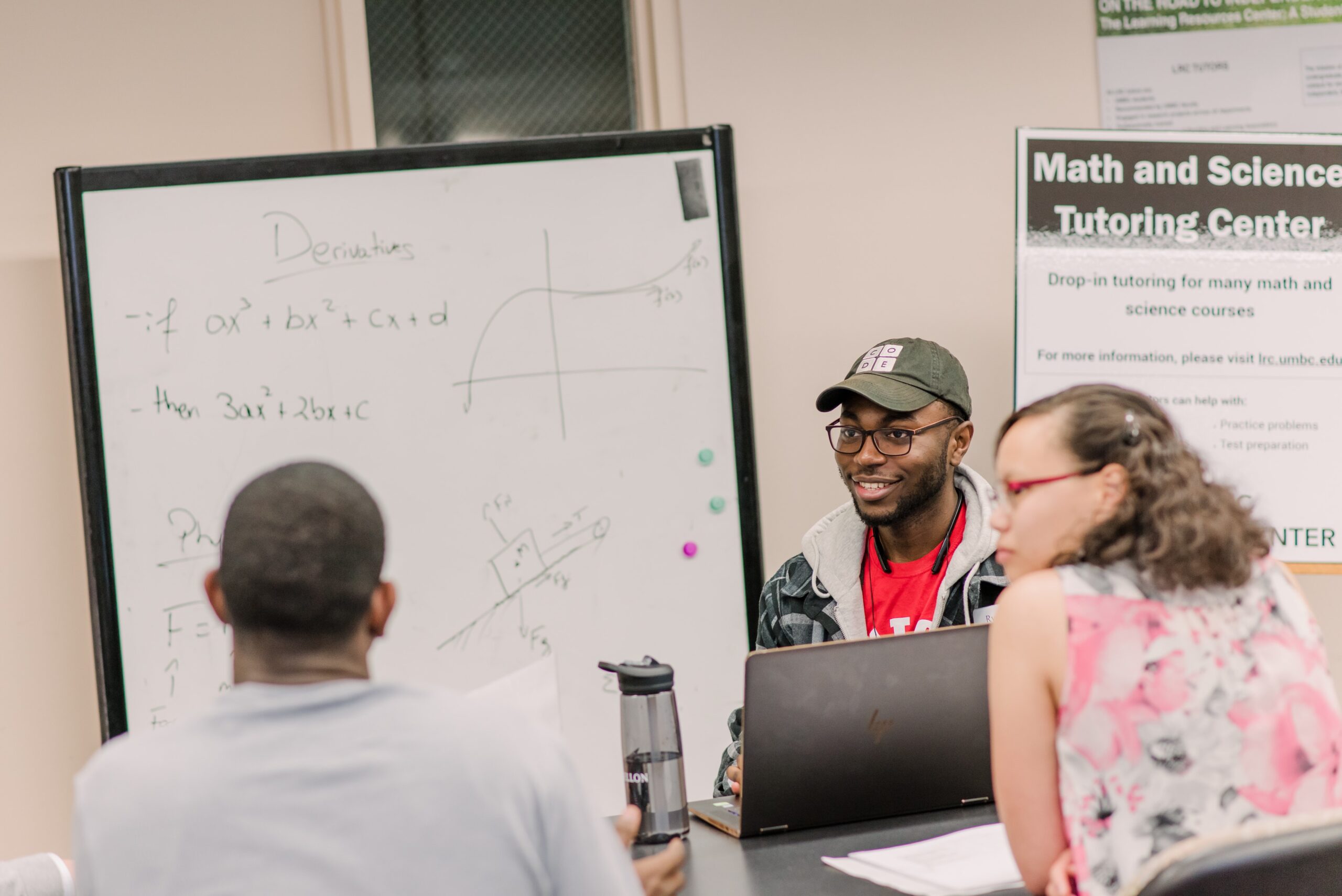
Math and Science Tutoring Center session through UMBC’s Academic Success Center, 2019.

Gregg adds that peer-assisted study sessions (SI PASS) remain the most popular service utilized. “These are for courses that are historically difficult for students, often in the STEM areas,” she says. “SI Pass Leaders are students who have taken a particular course before. They attend the course again, take notes, and then hold weekly study sessions for current students.” 

Emphasizing student success

The ASC also offers online learning resources for time management and study skills and academic alerts from faculty to students who are struggling in a course, to connect them with support. And the center is known for its academic advocates. They provide holistic support for students facing barriers to their academic success. These may include personal, academic, or financial issues.

“Sometimes students are unable to ask for help, are unaware that they are struggling academically, or are dealing with stress. Their stress may involve really complicated and challenging issues like the pandemic or racial inequality,” says Knapp. “We make sure they are cared for and heard.”

Three young professionals stand together, wearing collared shirts and sweaters.
Academic Advocates (l-r) Amanda Sharp, Cliff Saul, and Carlos Williams in 2019.

“UMBC students are very special, and here it’s cool to be smart,” says Gregg. “We have a large percentage of first-generation students who are very motivated to succeed, and the culture on campus emphasizes student success.”

Work like the partnership between COEIT and the Academic Success Center—where faculty and staff identify a problem and quickly partner with students to find a solution—is key to supporting student success. 

Mentis shares, “The collaboration was so welcomed by faculty, department chairs of CSEE and IS, and Dean Bowman. In my time here, I believe it was the fastest initiative ever completed. Everyone said, ‘yes.’”

Banner image: Amanda Knapp speaks with a student in the ASC in 2019. Photos by Marlayna Demond ’11 for UMBC unless otherwise noted.

Article by Gregory J. Alexander for UMBC.

New UMBC-UMB collaborations include research to reduce stress among long-term care workers

A strategic research alliance between UMBC and the University of Maryland, Baltimore (UMB) has selected four new interdisciplinary projects, each a fresh take on a complex challenge. 

The Accelerated Translational Incubator Pilot (ATIP) Program funding this work brings together UMBC’s strengths in areas like cybersecurity, data science, artificial intelligence, statistics, and the social sciences with UMB expertise in medicine, pharmacy, nursing, and dentistry. The two universities have worked together on various shared graduate and research programs over the last decade. This partnership with UMB’s Institute for Clinical and Translational Research (ICTR) was launched in August 2019, and faculty have been quick to jump on the opportunity to pursue novel collaborative research.

“The UMB-ICTR is thrilled to partner with UMBC,” says ICTR Director Stephen N. Davis, chair of medicine at UMB and physician-in-chief at the University of Maryland Medical Center. “The ATIP grant program supports top quality clinical and community-based collaborative projects. The grant applications from UMBC are particularly innovative and exciting, scoring very highly in the review process.”

“All of the ATIP proposals are subject to a very rigorous internal peer review process,” says Karl V. Steiner, vice president for research at UMBC. “Their success is a strong indicator of the quality of the intellectual contributions of our faculty at UMBC.”

Meaningful research relationships

“A key goal for this strategic alliance is to develop meaningful partnerships among researchers at both institutions and to establish teams with complementary expertise,” Steiner explains. 

Since early 2020, UMBC faculty have secured a total of 12 ATIP awards. This most recent round of UMBC grant recipients includes Lujie Karen Chen, information systems; Lira Yoon, psychology; Chein-I Chang, computer science and electrical engineering (CSEE); Yi Huang, mathematics and statistics; and Tinoosh Mohsenin, CSEE. UMB collaborators include Kelly Doran, School of Nursing; Mathangi Gopalakrishnan, School of Pharmacy; and Michael Domanski and Mohammad Sajadi, both of the School of Medicine. 

The four new awards granted in this round focus on a broad range of topics: using machine learning algorithms for transfusion risk assessment, evaluating the effects of serum lipid levels on the progression of renal dysfunction, using a multimodal sensory machine learning framework to diagnose COVID-19, and examining how to predict and manage stress in healthcare workers who work in long-term care facilities. 

These types of sustained partnerships help researchers gain insight into new fields and work with experts with whom they might not have otherwise collaborated, to generate novel findings.

Measuring stress to manage stress

Headshot of woman wearing aqua sweater
UMB’s Kelly Doran

So, what does interdisciplinary research actually look like?

For the long-term care workers pilot project, Chen, Yoon, and Doran combine data science, clinical psychology, and nursing. From May 2021 through April 2022, they will examine workers’ experiences of job stress in long-term care facilities using both physiological and qualitative measures.

The challenges posed by COVID-19 have sharpened the team’s interest in supporting longer-term care workers through research.

Headshot of woman wearing glasses, cream blazer and pink shirt
UMBC’s Lira Yoon

“Their work has always been important, but especially given the pandemic, the importance of their work has really been highlighted,” says Yoon. “It’s a demanding job with high stress, and that’s reflected by high job turnover, which is not good for the clients at long-term care facilities.”

The goal of the project is to better identify stress triggers within moments of them happening. This could enable workers to address their stress before it gets to a higher level where it can negatively impact their health and work. 

Stress monitoring in action

To identify stress on a more moment-to-moment basis, the team plans to use a combination of surveys and sensors to track exact times when workers become stressed in their workday.

Workers will wear the sensors throughout their shifts to measure heart rate and electrodermal activity, and will fill out surveys five to seven times per day. They will also complete end-of-day interviews to identify additional stressors and other critical information not captured by the surveys.

Information from the surveys and interviews will help the researchers to decipher data obtained from the sensors to understand stress triggers.

“Eventually, we want to be able to just use sensor data to be able to tell whether long-term care workers are about to experience stress or not,” Yoon says. With this knowledge, researchers can then design interventions to improve the work environment, Chen explains, to reduce stress triggers and stress experiences.

Once the pilot project is complete, the team hopes to undertake a larger scale study to collect data from multiple long-term healthcare sites. 

Headshot of woman wearing aqua sweater
UMB’s Kelly Doran

This work wouldn’t be possible without all three researchers bringing together their diverse expertise and perspectives. As Doran says, “The collaboration provides a support system for us to build relationships and kind of cross-train each other and build off each other’s ideas.”

“One of the reasons I love doing collaborative research,” she shares, “is because you’re expanding your networks and research to make meaningful differences.”

Article written by Allison Matyus for UMBC News.

Low-cost infant incubator developed at UMBC completes successful clinical trial in India

Innovative technologies don’t have to be expensive or complicated. 

UMBC’s Govind Rao, professor of chemical, biochemical, and environmental engineering and director of the Center for Advanced Sensor Technology, has been developing a low-cost solution to improve the care of babies born prematurely. 

A standard incubator found in a newborn intensive care unit costs between $1,500 and $35,000—beyond the means of many hospitals in low- and middle-income countries. Public impact research initiated by Rao and UMBC students has culminated in the successful clinical trial of an incubator that costs only $200.

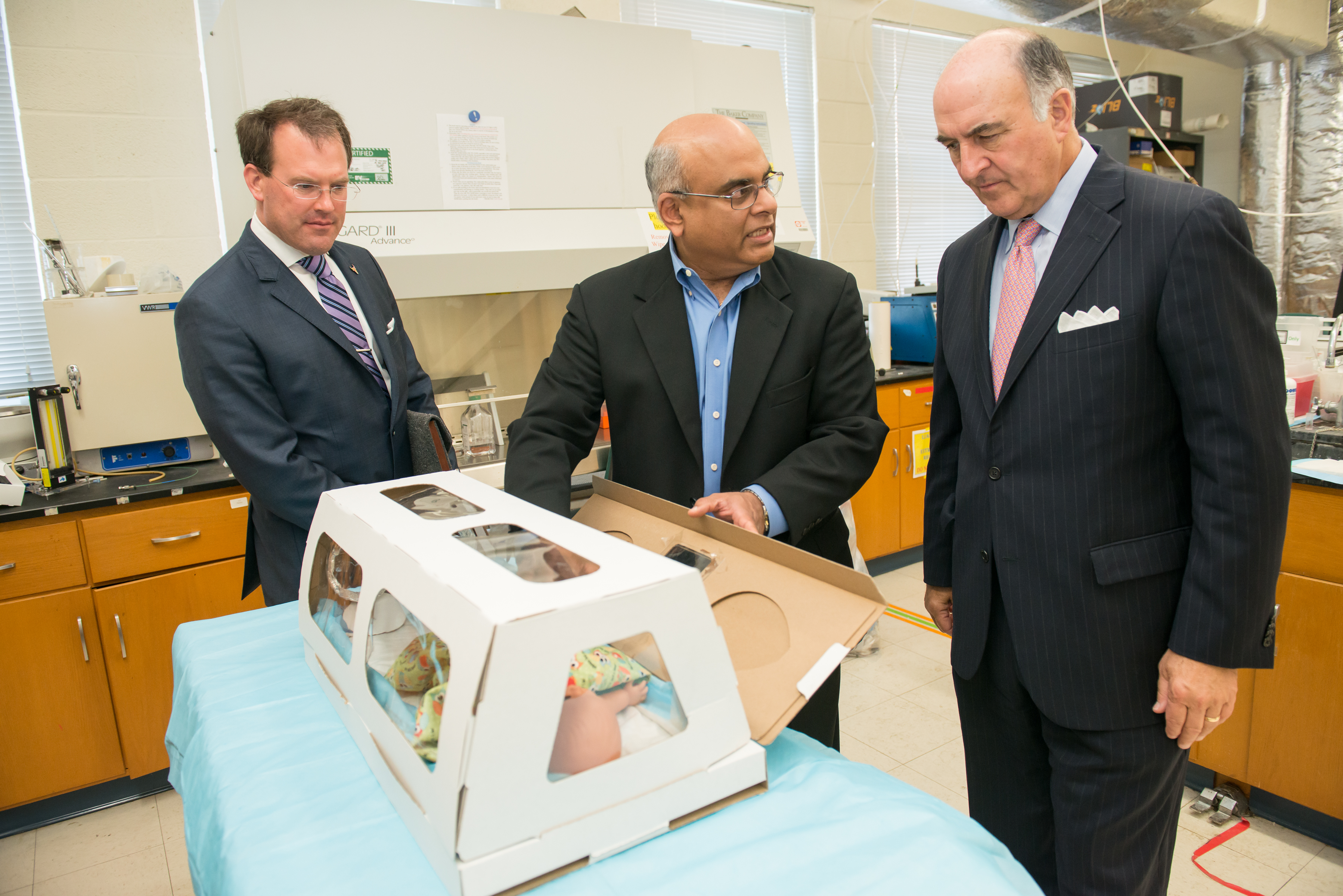
Three men in suits are in a lab gathering around a table looking at a cardboard box with a baby doll inside simulating an incubator.
Govind Rao, center, presents a prototype incubator to then-Maryland Secretary of Commerce Mike Gill in 2017. Photo by Marlayna Demond ’11 for UMBC.

“This will be a game-changer,” says Rajeev Seth, managing trustee of BUDS, a nonprofit that advocates for the health and welfare of children in India. 

Student project beginnings

The low-cost incubator traces its roots to a UMBC course on sensors in 2011. There, Rao asked students to come up with solutions for real-world problems. Kevin Tran ’12, chemical engineering, was part of a team that designed a low-cost infant incubator. He continued on the project that summer. 

“As an engineer, [when] you start something, you can’t leave it half-finished,” Tran says. He and his teammates tested out prototypes built with different materials, like wood and PVC. The team ultimately took a trip to India to visit various healthcare settings and receive feedback on their design.

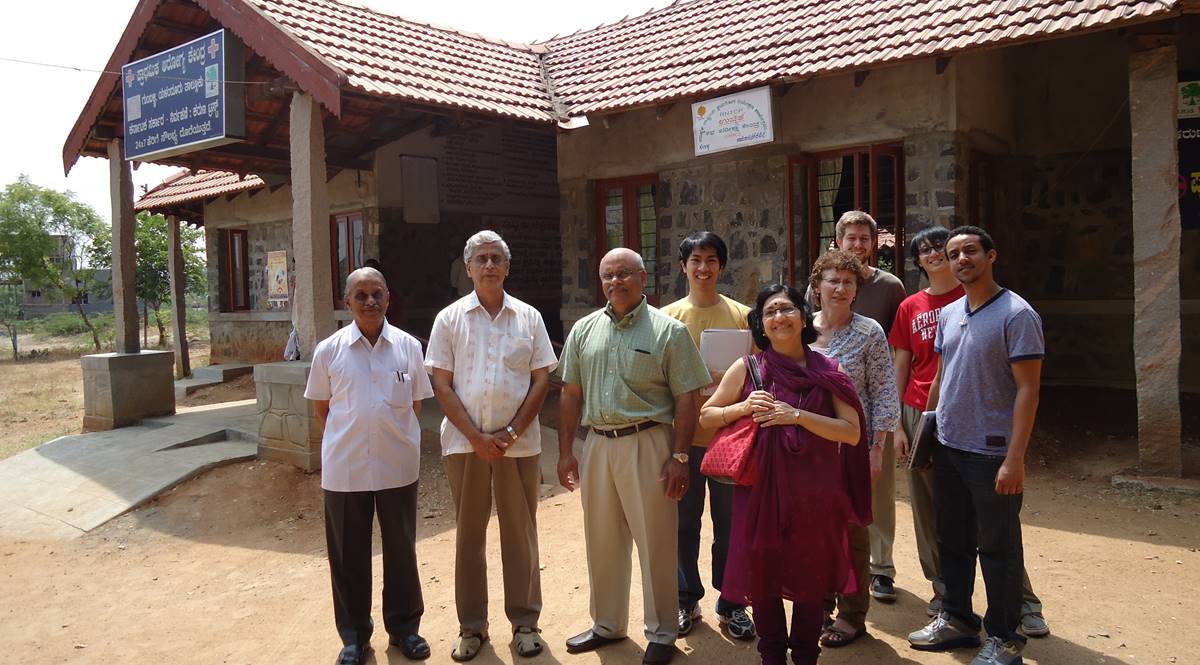
A group of nine people of different ages stand in a group in front of a one floor stone house with terracotta
Govind Rao, third from left, with UMBC students and research partners, during a trip to India. Photo courtesy of Kevin Tran.

The students encountered facilities that faced frequent power outages and lacked resources they’d taken for granted in the U.S. One healthcare center had broken incubators that sat unused, Tran says, because they couldn’t be maintained, even if it was a simple fix.

The team was accompanied by Geetha Mohanram, a retired elementary school teacher who acted as a translator. Mohanram now lives in the U.S. but is from Karnataka, one of the areas the team visited. She bridged the gap between the engineers and the nurses and doctors, not only through fluency with the local dialect, but also because of familiarity with the local culture. This helped the UMBC team access the medical staff’s observations and insights.

Feedback gathered during the trip guided updates to the design, such as smaller dimensions and cardboard construction for single use. The design work culminated in a paper published in the Journal of Laboratory Automation in 2014. It provided recommendations for a prototype suited to a clinical trial.

Cardboard incubator in action

An updated version of the cardboard incubator has now proven successful in a clinical setting. In an EClinicalMedicine study, published by The Lancet, the low-cost incubator maintained the body temperatures of premature babies as well as a more expensive, standard incubator over 48 hours.

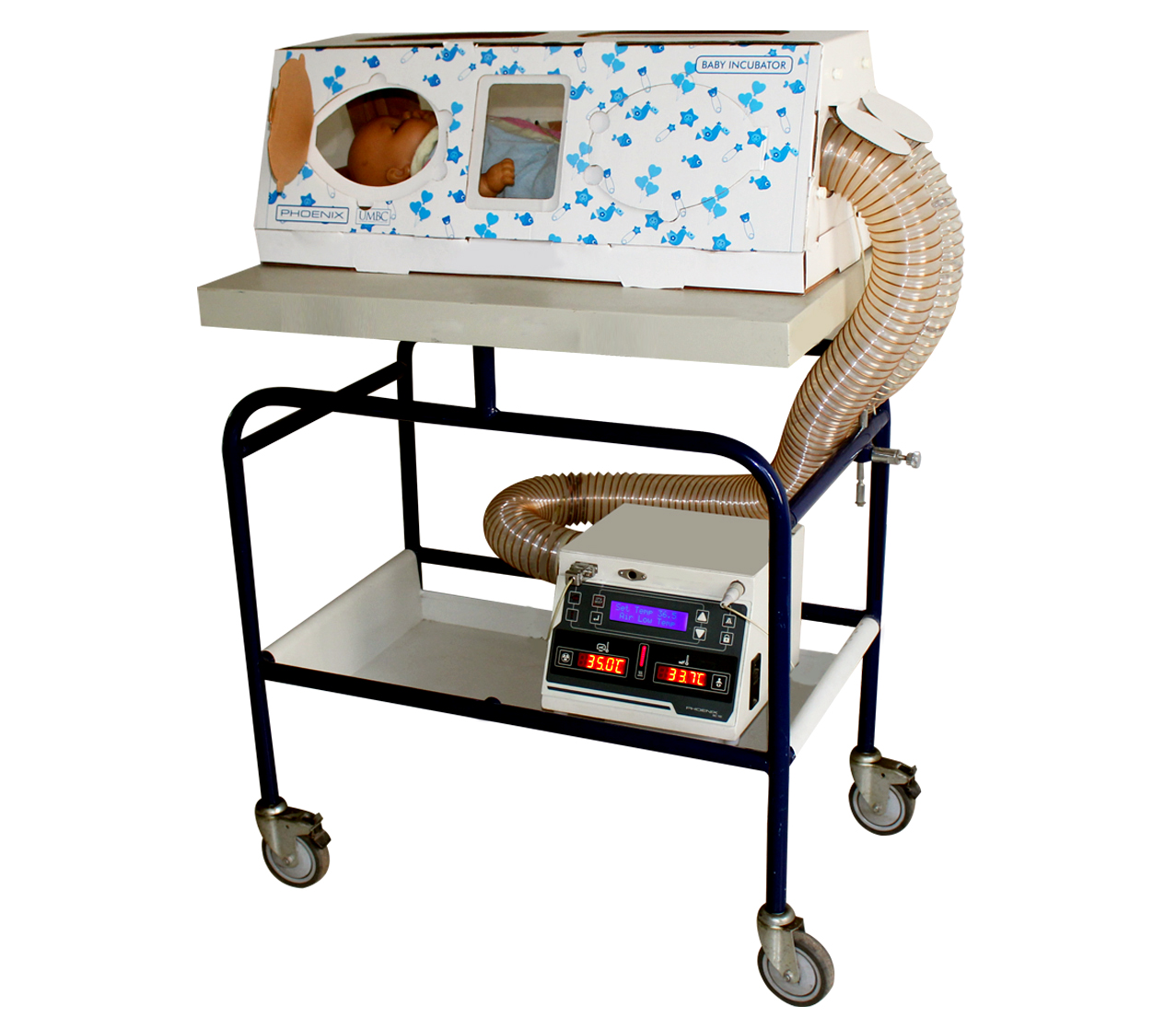
The low-cost incubator is made up of a cardboard chamber, designed to be disposed of after use by one infant, and a reusable heating unit. The cardboard packs down flat, so it can be easily transported. It is straightforward to assemble—almost like a pop-up book, Rao says.

Careful monitoring

The clinical trial was a collaborative effort supported by the U.S. Food and Drug Administration. Subawards supported Phoenix Medical Systems, which provided the cardboard incubators, and researchers at Sri Ramachandra Institute of Higher Education and Research (SRIHER), who conducted the study.

The study involved 96 preterm babies, ranging from 32 to 36 weeks old, without health complications. By limiting the clinical trial to babies that were relatively well, the researchers were able to focus on the performance of the incubators, says Ashok Chandrasekaran, associate professor of neonatology at SRIHER. 

The babies spent 48 hours in either a standard or cardboard incubator, with continued monitoring by medical staff. Skin sensors tracked the babies’ temperatures. They raised alarms if temperatures deviated over half a degree Celsius (0.9 degrees Fahrenheit) from 37 degrees Celsius (98.6 degrees Fahrenheit). Nurses also checked the infants using underarm thermometers every four hours and adjusted the incubator temperature as needed.

A black and white rectangular push cart with two levels carries a card board box with small blue flowers on the front of the box. Inside the box is a baby doll. A plastic ribbed tube is inserted into the end of the box that connects to a digital medical monitor box beneath.
A prototype of Rao’s cardboard incubator. Photos courtesy of V. Sashi Kumar.

There were cases where the babies’ temperatures were slightly low with both incubators, as well as several instances of mild hypothermia. But, overall, the performance of the low-cost incubator was on par with the standard incubator.

Avoiding hospital-acquired infections

The surfaces of the low-cost and standard incubators were disinfected daily, but in two cases the standard incubator harbored bacteria responsible for hospital-acquired infections. None of the low-cost incubators were positive for surface bacteria. The disposable nature of the cardboard incubator would also prevent infectious outbreaks, since each chamber would only be used by a single infant. 

“One of the major killers of preterm babies in developing countries is infection,” Chandrasekaran says. “Especially hospital-acquired infections.”

Future studies will assess how well the low-cost incubator performs over longer periods of time and whether premature babies continue to gain weight, says Binu Ninan, director and professor of neonatology at SRIHER. Future iterations of the incubator could include sensors to track babies’ weight and cameras to monitor babies more closely.

“You don’t necessarily need to have very expensive interventions to improve outcomes,” Rao says. “You can come up with something simple that works, that can have a huge impact.”

Banner image: “Happy Foot” by Natesh Ramasamy, Flickr CC BY-NC 2.0.

Article written by Jack J. Lee for UMBC News

UMBC international students build community online during COVID-19

A young woman stands outside learning on a metal rail next to a body of water with buildings behind her. She is wearing a dark grey winter jacket with a red hat.
Kirthana Kolekar.
Photo courtesy of Kolekar.

Graduate student Kirthana Kolekar began volunteering as one of UMBC’s first Global Ambassadors in summer 2020. It was a time of incredible stress. COVID-19 made personal connections challenging, federal policies for international students were in limbo, and her family was thousands of miles away in India. But serving as a resource for UMBC international students living abroad helped her feel a strong sense of purpose.

Then, in the fall, everything changed. Kolekar’s mother suddenly passed away from COVID-19 and she flew from Baltimore to Bidar, India, to be with her family. Through it all, she says, she felt supported by her UMBC community. Faculty, classmates, and fellow ambassadors reached out to offer support, as she had reached out to others before. 

Kolekar ‘21, information systems, says, “They kept asking: ‘How are you doing? Do you need any help?’” And that mentality—proactively being present for a person half-way around the world—is what the Global Ambassador Peer Mentor Program is all about.

Year of rapid growth

UMBC’s Global Ambassador Program began with a few volunteers connecting with fellow students online. In less than a year, it has quickly grown into a fully-fledged, paid leadership opportunity for UMBC international students living in Baltimore to connect with peers around the globe.

Ambassadors provide peer support that transcends borders. They host panels, facilitate webchats, lead presentations, conduct workshops, and guide newly enrolled students, all online. And when, as COVID-19 recedes, more new international students can physically come to campus, they look forward to welcoming them in person.

“The mission of the Ambassador Program is to ensure you feel connected with your peers as soon as you become a part of the UMBC community,” says Natalie Lobb, a UMBC international student support specialist who oversees the program’s day-to-day operations. “It’s important to know that you are never alone, that you always have someone you can lean on.”

‘They are new, just like I was’

A young woman with long black hair wears a grey sweater smiles at the camera with a wall of pink and white flowers.
Nastaran Azar. Photo courtesy of Azar.

Even in a typical year, international students face distinct challenges adjusting to campus life. “Everything was completely different,” says Nastaran Azar, a junior biology major and Global Ambassador, recalling her first semester.

Daily assignments and regular tests at UMBC were a shift from the semesterly exams in Azar’s native Iran. Outside the classroom, she had to navigate getting an apartment, a job, and a driver’s license. 

Azar had two older brothers already living in Baltimore, but she realizes other students often don’t have such connections. “They are new, just like I was—uncomfortable and feeling like they don’t know how to do anything. I hope I can help them all to be comfortable and find friends,” she says. 

A young man with short cropped hair wearing black rimmed glasses and a checkered corral and blue shirt.
Dmitry Pankratov. Photo courtesy of Pankratov.

Ambassador Dmitry Pankratov recalls how jarring it felt to move from Moscow to Maryland five years ago—and that was without COVID-19 closures. “I understand how awful it can be when you have just come to a new place, and you don’t have anyone around,” the data science master’s student says.

Incoming international students have a litany of questions for ambassadors—everything from how to file taxes to where to buy their favorite foods. “What kind of masalas, what are the ranges in prices, what spices do you need to bring from your home country,” Kolekar lists off, before the self-described foodie adds: “The taste slightly differs!”

Given the global pandemic, ordinary challenges quickly become complex. With that reality, receiving outreach has proven instrumental in connecting international students with university life. 

Building relationships

The Global Ambassador Program has found ways to foster community as students study remotely. Many of the ambassadors lead webinars teaching students how to continue engaging in university life. One will focus on the university’s award-winning Bollywood fusion dance team, Adaa. Others spotlight UMBC resources, such as virtual gaming options accessible now and the Gameroom available for students when they eventually come to campus. 

Pankratov has spoken about UMBC’s chess club at past events. He plans to deliver a session about the running club next. He’ll focus on the best trails in Maryland and how UMBC students can keep each other motivated while exercising safely outdoors. 

“We have special training and people who can guide you, because when you’re just starting, it’s very hard to understand your own physical limitations,” Pankratov says. “It’s team building. You talk with people, get acquainted. Even with COVID-19, you can share your pace and time with others.”

Expanding horizons

UMBC already has a global feel, with international students making up nearly eight percent of the overall student body and a quarter of graduate students. The Global Ambassadors Program enables international students to benefit from connecting with fellow UMBC students from around the globe even if they can’t say hello to each other on Academic Row. 

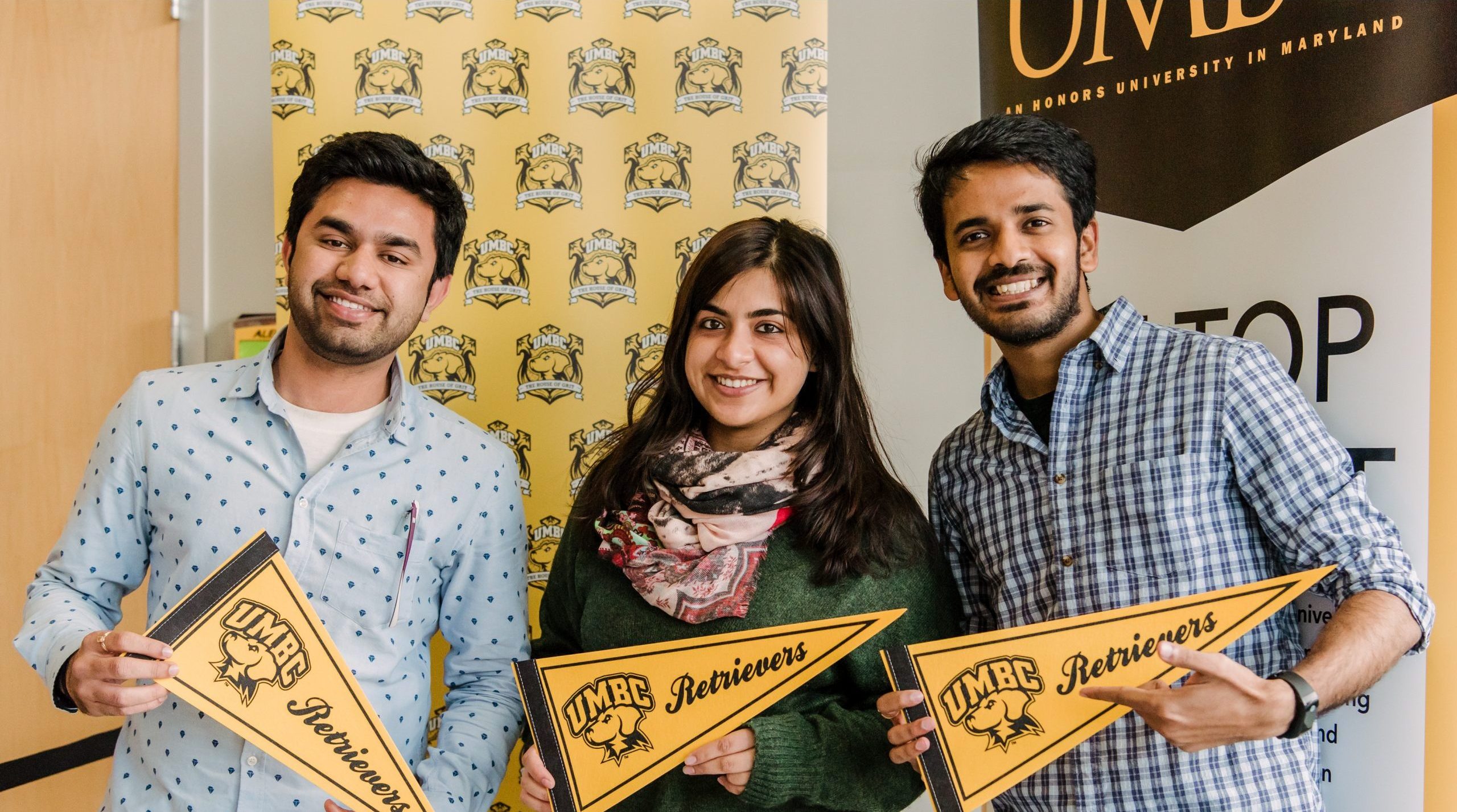
Three young adults smile at camera, holding pennants that read UMBC Retrievers
Students at the Center for Global Engagement 2019 international student orientation. Photo by Marlayna Demond.

Students build trust with one other in the program, Azar says, helping them form homes away from home. They also come to understand themselves and the world in new ways. Kolekar, an aspiring business analyst, says making friends with a diverse set of viewpoints is reframing how she’ll approach her career.

Pankratov marvels at how he has met students from all across the globe, from India and China to Ecuador. “We all have different schools of thought, of literature, and so it just enlightens,” he says. “With this program, I can make friends with people who I never knew existed before.”

Banner image: Flags of the world in the UMBC Commons. Photo by Marlayna Demond ’11 for UMBC.

Article written by Nick Ford for UMBC News.
UMBC faculty, alumni entrepreneurs receive record number of MIPS awards for tech collaborations

Six UMBC faculty members have just received grants from the Maryland Industrial Partnerships (MIPS) program to develop new technologies with potential to grow the state’s economy. This is UMBC’s largest number of winning proposals within a single proposal round since MIPS began in 1987. 

The program connects University System of Maryland (USM) faculty and students with Maryland businesses. UMBC’s latest MIPS grantees include computer science and electrical engineering faculty Tim Oates, Chein-I Chang, and Anupam Joshi; Soobum Lee, mechanical engineering; Dipanjan Pan, chemical, biochemical, and environmental engineering; and Vikram Vakharia, marine biotechnology. Among their industry partners are UMBC alumni entrepreneurs who are building businesses in Maryland.

Advances in aquaculture technology 

Vakharia partnered with Mary Larkin, founder and CEO of Gaskiya Diagnostics, on a high-impact aquaculture project. The pair worked to develop a proposal for rapid, low-cost, easy-to-use diagnostic tests to protect and support aqua-farm production. 

Larkin received her Ph.D. in marine biotechnology from UMBC in 2018. She was supported by research funding through MIPS as a graduate student at the Institute of Marine and Environmental Technology. She now serves as an industry partner through the program. 

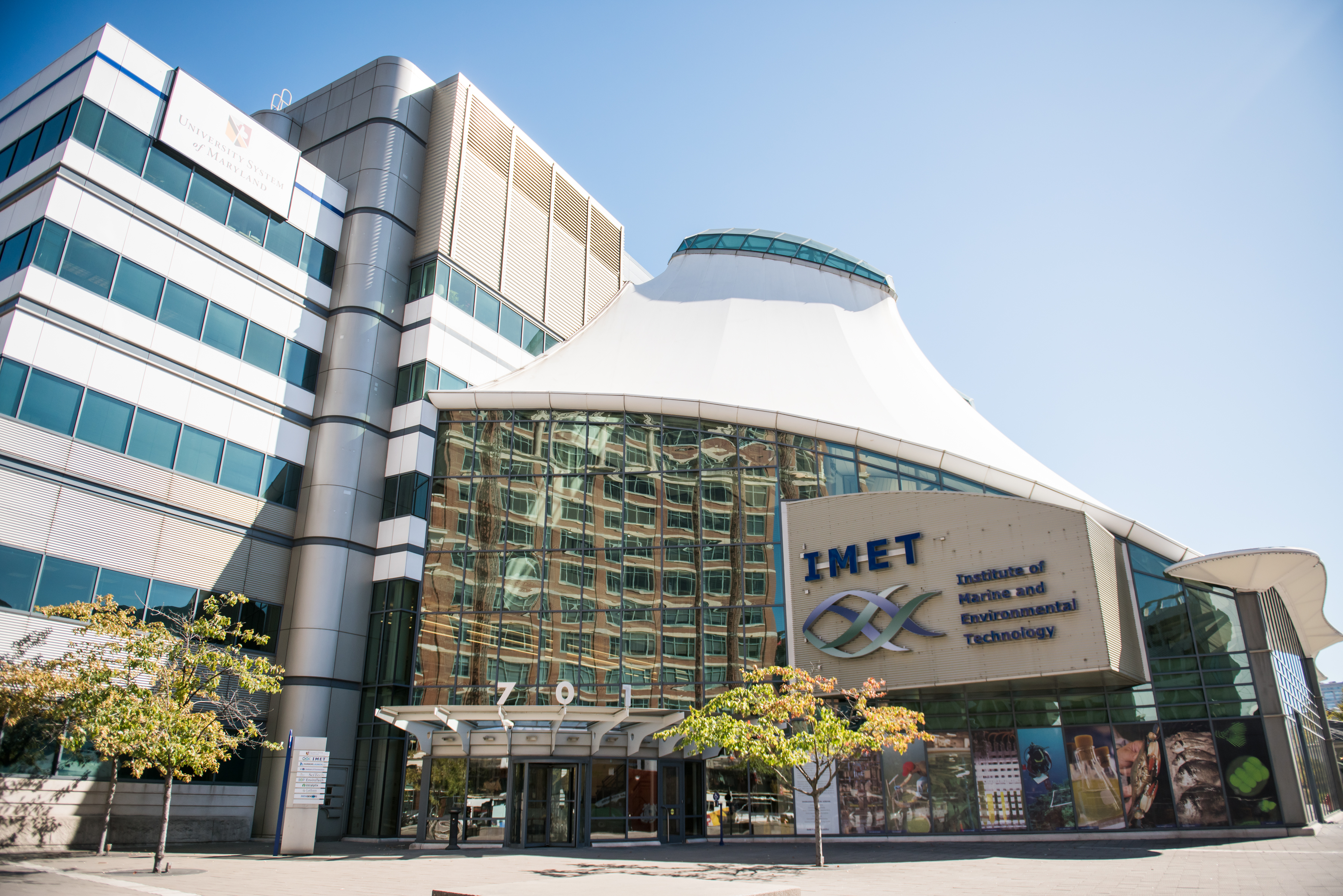
A view of a building with a tall glass entrance. The building has the letters IMET written in navy blue with an outlines of two purple and green fish underneath.
Institute of Marine and Environmental Technology

According to Larkin, “Low-cost, on-site tests enable aqua-farms to rapidly identify pathogens, allowing them to monitor disease and take actions to protect their crop.” Gaskiya’s initial focus for this testing is Whiteleg shrimp production facilities, which have an average of more than $4.5 billion in losses annually from disease.

“Farmers need to test their ponds and get instant information so that they can quickly take action and mitigate disease,” says Larkin. 

What faster, simpler tests look like

Larkin describes Vakharia as a “perfect match” for her collaborator on this research. Vakharia’s background is in viruses that impact organisms important to aquaculture, including shrimp. 

For this project, Vakharia notes, “I first had to identify the target. With the target, I can make a protein that Larkin can use to detect those pathogens in shrimp.” He explains, “This protein is a critical first step in making a non-animal-based binder that detects the pathogen.” 

The team plans to incorporate the proteins and binders into a paper-based test. The test will provide results in minutes, similar to a pregnancy test. 

Aqua-farms’ current tests for similar pathogens must be done through a lab. This results in an elongated turn-around time and average cost of $50 per sample. Gaskiya Diagnostics hopes to price the new diagnostic test at $5 to $10. The test results will be available in as quickly as 10 minutes. No expertise or additional equipment are required to perform or interpret the results. 

Next generation cybersecurity 

Joshi, professor and chair of computer science and electrical engineering, received a MIPS grant for a cybersecurity collaboration with the startup CyDeploy. They are developing a platform that automates the quality assurance process for cybersecurity updates made to IT and “internet of things” (IoT) devices like Amazon Alexa, Google Home, and health and medical devices. 

CyDeploy CEO Tina Williams-Koroma ‘02, computer science, presented Joshi with the idea to develop a “cybersecurity-driven change management system.” The technology is based in and leverages the use of artificial intelligence and machine learning to create a cloud-based replica of a company’s systems. 

Woman with short curly black hair, wearing a navy blazer, and a yellow t-shirt smiles at the camera while standing outside with some trees in the background.
Tina Williams-Koroma. Photo courtesy of Williams-Koroma

From prototype to launch

Williams-Koroma and Joshi’s group at UMBC developed a conceptual prototype. It shows the infrastructure and technology that would make the system feasible, combining off-the-shelf tools with novel research.

“Increasingly, the government is now beginning to mandate security requirements around IoT devices. The longer-term vision that CyDeploy has is capturing the state of these systems, virtually recreating them and then running the security changes against virtual versions to see how the changes would affect those systems,” Joshi adds. 

A man in a light blue dress shirt with light white strips stands with his hand on a metal bannister in front of beige wall with wooden screen over the  windows.
Anupam Joshi

Williams-Koroma, who is also an adjunct instructor at UMBC, projects that the initial development of the platform will be complete in late spring 2021. They anticipate launching a free pilot version for businesses to test their IT systems. IoT pilots will come in a later phase.

Funding that matters 

Joseph Naft, director of the MIPS program, is excited about the tremendous potential of these projects. The long-term vision is creating additional high-quality jobs in Maryland. “We do this,” he says, “by bringing the expertise of faculty and students to bear on technology issues in product development for companies within the state.”

Since its inception, the MIPS grant program has had a $42 billion economic impact on the state of Maryland and has created nearly 22,000 jobs. UMBC’s incredibly strong results “speak well to the engagement of UMBC’s faculty with commercially viable products and technologies,” says Naft. 

Dean Drake, associate vice president for research at UMBC, credits these results to the “expansive pool of talent” at UMBC and across all of the University System of Maryland. 

“Helping our industry partners solve their challenges is a great strength of both UMBC and USM institutions more broadly,” says Drake. “Our talented faculty, students, staff, and alumni have expertise in every discipline that’s out there.”

These results also demonstrate UMBC’s “interest in working with companies in the state” for the benefit of all Marylanders, Naft notes, and UMBC’s robust potential for future growth.

Banner image: IMET entrance. All photos by Marlayna Demond’ 11 unless otherwise noted.

Article by Adriana Fraser for UMBC News.
UMBC researchers use AI to help businesses understand complex legal docs, like the Code of Federal Regulations

UMBC researchers have made strides in automated legal document analytics by creating a way to machine-process the Code of Federal Regulations (CFR). The CFR is a complex document containing policies related to doing business with the federal government. All business affiliates of the federal government must comply with it. For government contracts to be equitably open to a broad range of businesses, policies within the CFR must be accessible. 

This document automation is just one part of a broader project to help contractors and other entities manage and monitor their legal documents. Directed by Karuna Joshi, associate professor of information systems, the team has successfully managed to do a complete analysis of the CFR. Digital Government: Research and Practice recently published their methodology.
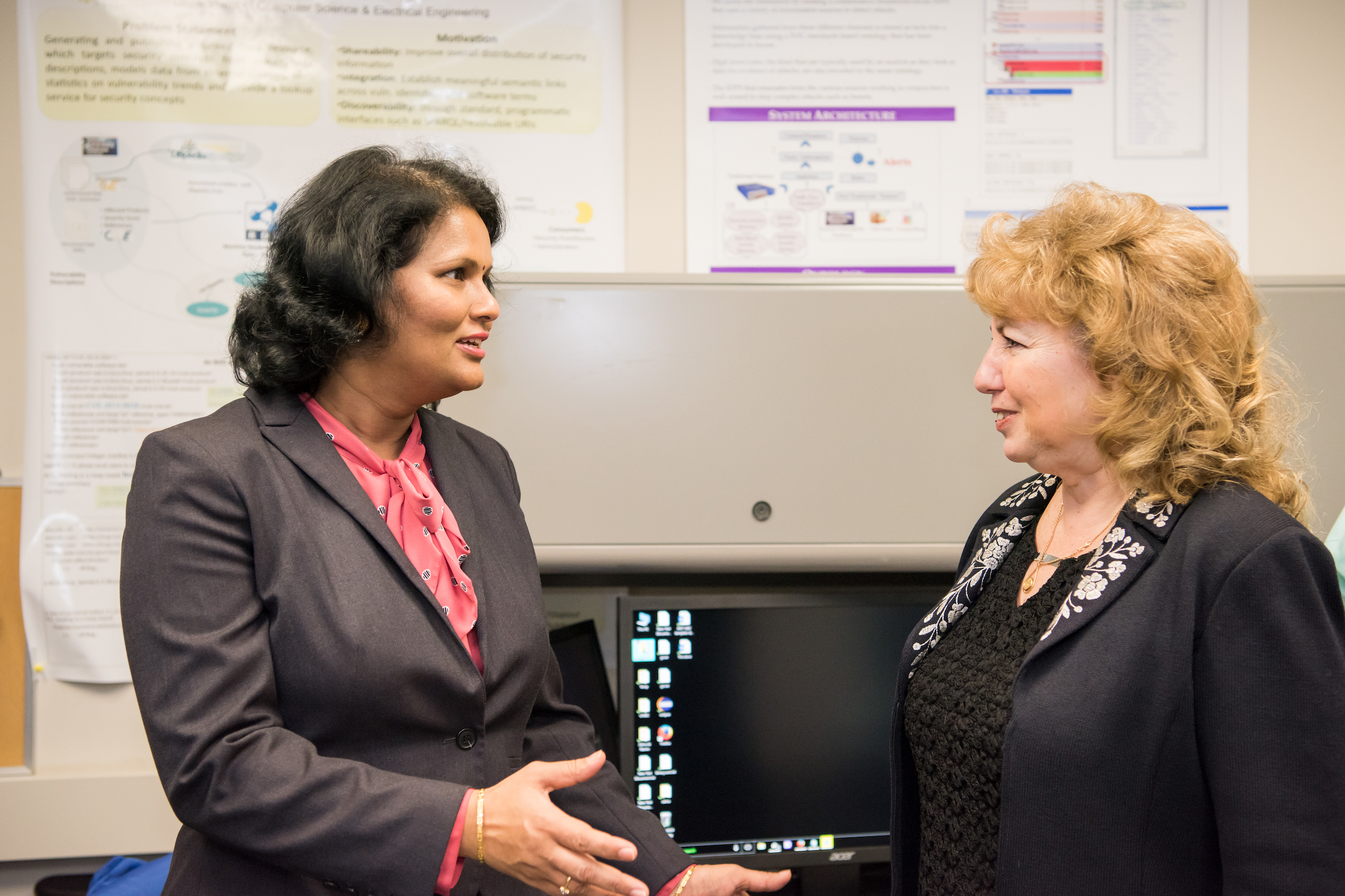
Two women wearing business attire converse in front of academic posters.
Karuna Joshi (left) with Yelena Yesha, 2018.

Automating document review through AI

The team’s method for analyzing the CFR involves artificial intelligence (AI), which learns how to categorize information within the document, store it, and extract it when it is requested. Joshi and her team achieved this by creating a knowledge graph using Semantic Web technologies to illustrate all the key terms, rules, and regulations in the document. This basic framework enables users to ask an automated tool about a specific rule and be provided with the answer.

The semantic web language OWL, or Web Ontology Language, is used to represent concepts and to contextualize relationships. According to Joshi, the framework of the knowledge graph can be “adopted by federal agencies and businesses to automate their internal processes that reference the CFR rules and policies.” To facilitate this, they will make it available in the public domain.

Question and answer

General users can interact with the knowledge graph through a question-and-answer process, similar to how many people use Amazon’s Alexa or Apple’s Siri. For example, Joshi says, someone could ask a policy-related question like, “How many days at a minimum must a Request for Proposal (RFP) be posted open/available?” The system would query the CFR knowledge graph to find sections in the document that answer this question. 

Woman delivers a presentation, holding a microphone, in front of a seated group. A man stands to the side.
Karuna Joshi presents at the USNA-UMBC research symposium, 2016.

The researchers anticipate this will be a highly useful system for any business held to the CFR thanks to how it breaks down CFR’s legal complexity through the automated process with ease.

Access and accountability

This project to automate and support users’ understanding of legal documents has been an ongoing effort by the UMBC team. Beyond the CFR, they seek to assist people with understanding legally binding contracts that they encounter every day, such as terms of service for major companies.

Portrait of a smiling South Asian woman with long dark hair, wearing a coral-colored top.
Lavanya Elluri. Image courtesy of Elluri.

Lavanya Elluri, graduate student of information systems, adds, “Our research helps the organizations that use cloud services to understand the context from these textual documents quickly.”

Many users have found that companies are using their data without their knowledge. Often, this is due to the information buried within terms of service and privacy policies. Joshi predicts that the tools her team is developing to help users better understand these documents will be essential to hold companies accountable for their data use.

Featured image: UMBC’s Information Technology and Engineering Building. All photos by Marlayna Demond ’11 for UMBC unless otherwise noted.

Story by Morgan Zepp for UMBC.

UMBC researchers speed up analysis of Arctic ice and snow data through AI

UMBC researchers have developed a technique to more quickly analyze extensive data from Arctic ice sheets to gain insight and useful knowledge on patterns and trends.

Over the years, vast amounts of data have been collected about the Arctic and Antarctic ice. These data are essential for scientists and policymakers seeking to understand climate change and the current trend of melting. Masoud Yari, research assistant professor, and Maryam Rahnemoonfar, associate professor of information systems, have utilized new AI technology to develop a fully automatic technique to analyze ice data.

This public impact research is part of the National Science Foundation’s ongoing BigData project. Rahnemoonfar, Yari, and colleagues have published their findings in the Journal of Glaciology.

Rethinking manual techniques

For decades, researchers have kept close track of polar ice, snow, and soil measurements, but processing the large volume of available data has proven challenging. NASA’s processes for collecting, tracking, and labeling polar data involve significant manual work, and changes detected in the data can take months or even years to see. Even Arctic data collected via remote sensing technologies require manual processing.

Portrait of a middle-aged woman with curly shoulder-length hair, wearing a red shirt with print.
Maryam Rahnemoonfar

According to Rahnemoonfar, “Radar big data is very difficult to mine and understand just by using manual techniques.”

The AI techniques the researchers are developing can be used to mine the data more quickly. They help scientists get useful information on trends related to the thickness of the ice sheets and the level of snow accumulation in a certain location.

Spotting patterns

The researchers developed an algorithm that learns how to identify objects and patterns within the Arctic and Antarctic data. An AI algorithm must be exposed to hundreds of thousands of examples to learn how to identify important elements and patterns. Rahnemoonfar and her team used existing incomplete and noisy labeled data from the Arctic to train the AI algorithm on how to categorize and understand new data.

The algorithm’s training is not yet complete. Researchers will need to scale it up over multiple sensors and locations to create a more accurate tool. However, it has already successfully begun to automate a process that was previously inefficient and labor-intensive.

The rapid expansion of using AI to understand ice and snow thickness in the Arctic will allow scientists and researchers to make faster and more accurate predictions to inform dialogue about climate change. The rate at which Arctic ice is melting impacts sea levels. If scientists are better able to predict the severity of the melting, society can better mitigate the harm caused by sea level rise.

Featured image: Team members from U.S. Coast Guard Cutter Healy on the NASA ICESCAPE mission, July 2011. Photo by NASA/Kathryn Hansen.

Story by Morgan Zepp for UMBC.

Students reflect on UMBC’s top-ten finish in national democracy challenge and post-election community conversations

UMBC has placed ninth nationwide in the 2020 ALL IN Campus Democracy Challenge voting pledge competition. More than 600 colleges and universities participate in the ALL IN Campus Democracy Challenge, which encourages college students to pledge to vote based on evidence that when people make public pledges, they are more likely to follow through. 

“These rankings speak to what people already know: UMBC is a national model for community engagement,” says President Freeman A. Hrabowski. “We’re proud of the work being done through our Center for Democracy and Civic Life, and we are grateful to all of our community members who took the pledge to vote in the 2020 election.”

Cast Your Whole Vote campaign

Launched in November 2018, UMBC’s Center for Democracy and Civic Life (CDCL) helps students develop the knowledge, skills, and approaches for deep and effective civic engagement and community work. The Center is led by Director David Hoffman, Ph.D. ’13, language, literacy, and culture (LLC), and Assistant Director Romy Hübler ‘09, modern languages and linguistics, M.A. ‘11, intercultural communication, Ph.D. ‘15, LLC. 

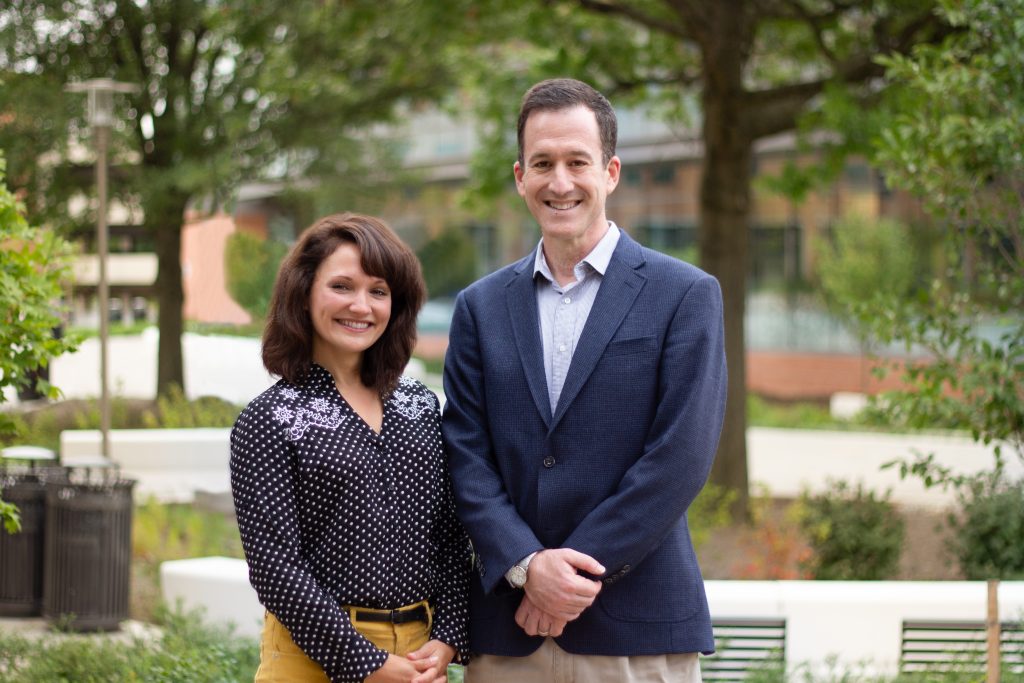
A man and woman in professional clothing stand outdoors in front of trees and buildings.
Romy Hübler and David Hoffman in 2019. Photo by Alexis Harris ’19 media and communication studies and visual arts.

During the fall 2020 semester, Hoffman, Hübler, and the Center’s interns, along with University partners, organized a campus-wide Cast Your Whole Vote campaign, featuring voting and election events and resources. The events drew nearly 800 members of the UMBC community. As part of that programming, UMBC students, faculty, and staff members trained as facilitators to organize more than 20 additional post-election community discussions. Under the theme Together Beyond November, these conversations helped participants renew their connections and support each other in this challenging time. 

“It’s important to vote, but also to recognize voting as just one way to make a difference in our communities and nation,” share Hoffman and Hübler. “UMBC’s Cast Your Whole Vote campaign encouraged members of the UMBC community to learn about issues, engage in civil conversations, and contribute their time and talent to building a better world on Election Day and every day. We are grateful to the many departments, student organizations, and campus leaders who worked with us.”

Charis Lawson ’21, English, CDCL political engagement intern, shares her motivation for voting in 2020.

The UMBC community will learn how many students actually voted in the 2020 national election in a 2021 report by the National Survey of Learning, Voting, and Engagement. 


Interview with student leaders

To learn more about student experiences in UMBC’s Cast Your Whole Vote campaign and election programming, UMBC News spoke with three student leaders: Tirzah Khan ‘21, information systems, is the connection corps intern with the Center for Democracy and Civic Life; Logan Lineburg ‘22, M30, biochemistry and molecular biology, is director of the Department of Executive Initiatives for the Student Government Association; and Meghan Lynch ‘18, political science, and M.P.P. ‘21, is the chair of legislative concerns for the Graduate Student Association.

UMBC News: Why is the ALL-IN pledge so important?

Khan: It’s important to be intentional about voting and hold each other accountable for participating in the voting process, especially on college campuses, where ideas about civic engagement are integral to the personal and professional development that students leave with. The knowledge that there is power in community is something that UMBC students learn pretty quickly because of the unique environment here, and I think it’s necessary to extend that knowledge to voting and social change.

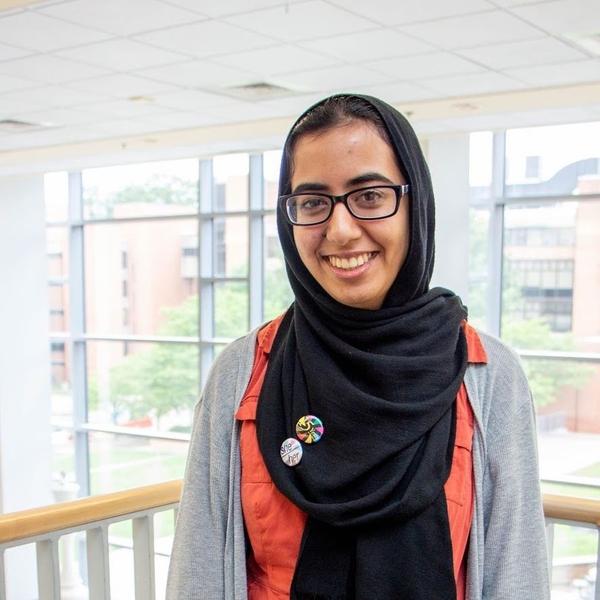
Woman in glasses, a sweater, and a shayla-style hijab with decorative buttons stands on an interior balcony in front of a window.
Tirzah Khan in the UMBC Commons. Photo courtesy of Khan.

Lineburg: The ALL-IN pledge to me means that my involvement doesn’t end once I’ve cast my ballot. There are many important ways that one can engage with their community and politics, whether it is protesting, writing letters to legislators, or even simply having conversations with family and friends about the way we feel our nation is evolving, all of which are important for progress and growth.

Lynch: The ALL-IN pledge is a powerful reminder of how important it is to be an engaged and informed voter. The pledge reminds all of us of the importance of making a plan to vote. For Maryland residents, there were quite a few ways to cast your ballot this election, so this tool prompted voters to think about what would work best for them. 

UMBC News: What does UMBC’s top 10 ALL IN ranking say to you about our community?

Khan: It says a lot to me about our campus’ values and needs—that our campus community is more important to us than ever, that we are dedicated to impacting the world outside our bubble, that we aim to ensure our voices are heard. I was still in high school during the last presidential election season so I’m not sure what that was like at UMBC, but the weeks leading up to this election illustrated just how much our community is willing to do for one another. 

Lineburg: Knowing that our university has placed within the top two percent of colleges and universities really speaks to our campus’s commitment to excellence. We are passionate, educated, and empowered, and together, we all push for what is right.

Lynch: UMBC also shows up and gives that grit and greatness! I believe we have a thoughtful, intentional, and dedicated community who leads through action. In many spaces at UMBC, we talk about equity and justice, so it was reassuring to know that we put those principles into action such as through voting.

Tess McRae ’21, individualized studies, shared her first voting experience and how that impacted her perspective on civic engagement.
UMBC News: Why was participating in the Cast Your Whole Vote campaign or election-related events important to you?

Khan: One of the central ideas in the Cast Your Whole Vote campaign is that, while voting is incredibly valuable, there are so many other ways to affect social change besides voting. As someone who is not eligible to vote, that messaging felt really relevant to my experiences and passions. 

I often feel excluded from election-related events and conversations because of my ineligibility. This is terrible because non-citizens, incarcerated people, and formerly incarcerated people are some of the most vulnerable members of our communities, especially during election years.

In turn, it felt amazing to be seen and included in this campus-wide campaign. The realization that my voice matters, my actions matter, and my story matters—especially during an election year—is what drove me to get involved in planning Election Night Extravaganza, and to participate in the Together Beyond November: (Re)building Community after Election 2020 facilitator training.

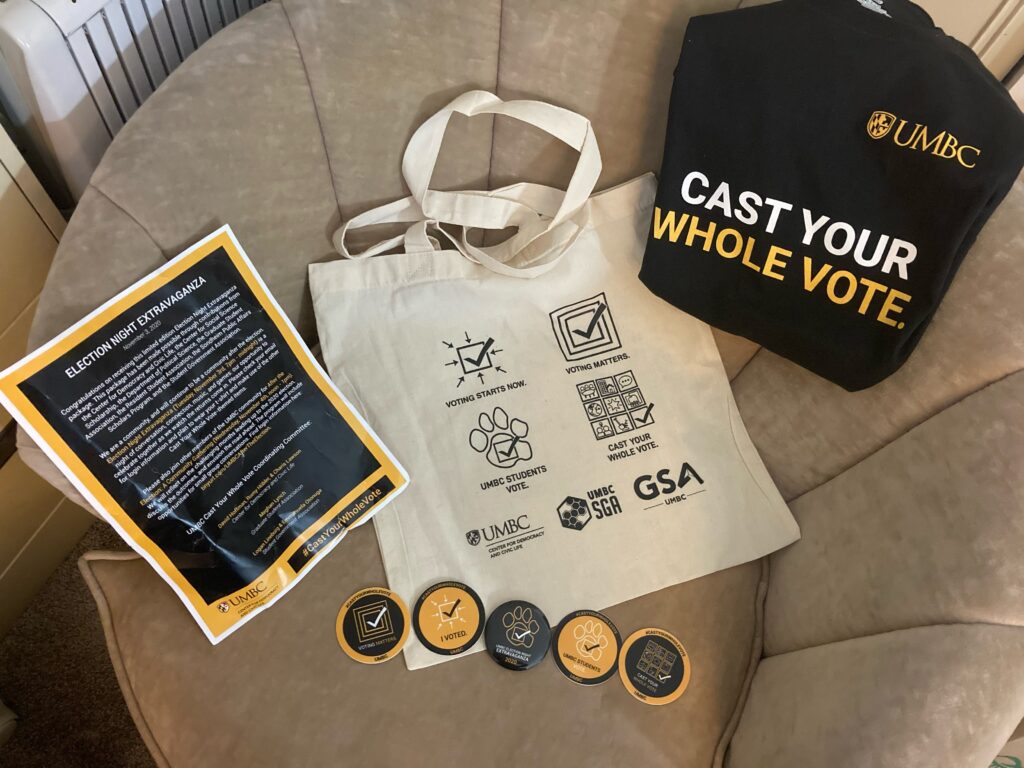
A gift bag, 5 buttons, flyers, and UMBC Cast Your Whole Vote t-shirt displayed on a chair.
Cast Your Whole Vote campaign gear. Photo courtesy of the CDCL.

Lineburg: Being a part of the planning committee and speaking with other student leaders from different organizations and scholars programs was fantastic. Knowing that despite our vastly different backgrounds and future goals we are all able to unite to educate and inform our campus community about voting is thrilling.

As a third-year student, I can attest that UMBC’s efforts to educate and empower its students is supreme. At UMBC, every person has the capacity to make great change, and with incredibly supportive faculty, staff, and fellow students, I feel it would be nearly impossible to find a goal or dream that is unachievable here.

UMBC News: What were your favorite moments from the campaign and why? 

Lynch: As someone who studies politics and policy, being involved with a community that encourages political participation is paramount. In these virtual times, I’ve been finding myself seeking out spaces to connect with others. The campaign has had a lot of wonderful events, like the Change Makers Dinners and debate watch parties that made these stressful, isolating times more manageable. 

On Election Night in particular, we began our evening on Discord (a group-chatting platform) and then moved over to WebEx to hear from President Hrabowski and Vice President for Student Affairs Nancy Young. I could feel the energy and excitement from seeing everyone’s faces in the WebEx room. It was important to me to participate because we had to be creative about being in community, and the experience on WebEx on Election Night hopefully made the night more enjoyable for many. 

UMBC News: How was the student response to the events? 

Khan: This Election Day was more of an Election Week, I think students appreciated having non-judgmental, non-partisan spaces to process their feelings. Also, the idea that civic life and civic engagement extends far beyond voting and elections was something that I believe resonated with a lot of people and allowed them to feel comfortable in expressing their fears about the election.

Lynch: I could tell that students wanted to find spaces to talk and share their thoughts on the election. They were actively engaging with each other and seemed to be enjoying it. We had stressful and overwhelming moments to work through, but the students had such grace in taking time to understand and work through it all.

Meghan Lynch shares why she finds voting meaningful and other ways to be engaged.
UMBC News: What was it like to try to engage students virtually instead of in-person?

Khan: It was both more difficult and more rewarding than normal for me. Students have never been more in need of connection and community, but they’ve also never been more difficult to reach. There are so many layers of exhaustion and trauma that our community is facing right now, and it’s really hard to get through to people. Nobody wants to be in meetings and on camera more than they absolutely have to.

At the same time, though, we are all so incredibly lonely and scared right now. So despite how difficult it got as the election neared, I knew it was important to keep pushing and keep hosting spaces for students to build community around our shared election fears. 

There’s something that the Center for Democracy and Civic Life says—“physical distance, civic proximity.” I’ve thought about this idea a lot since March, and it’s sort of become central to my work right now. We’ve never been further away from one another as a community, but the need for us to be closer has never been more important. I find that when we’re able to come together and help each other through sharing our fears and experiences and stories, we’re able to have an impact that is far beyond anything I experienced pre-pandemic.

Lineburg: Although engaging in the virtual world is challenging for many reasons, I believe that still having a space to connect with others is essential. The limitations of online engagement are not pleasurable, but from what I’ve heard from those I’ve spoken with, continuing to allow for interactions and conversations, especially during such stressful times, is and was greatly appreciated.

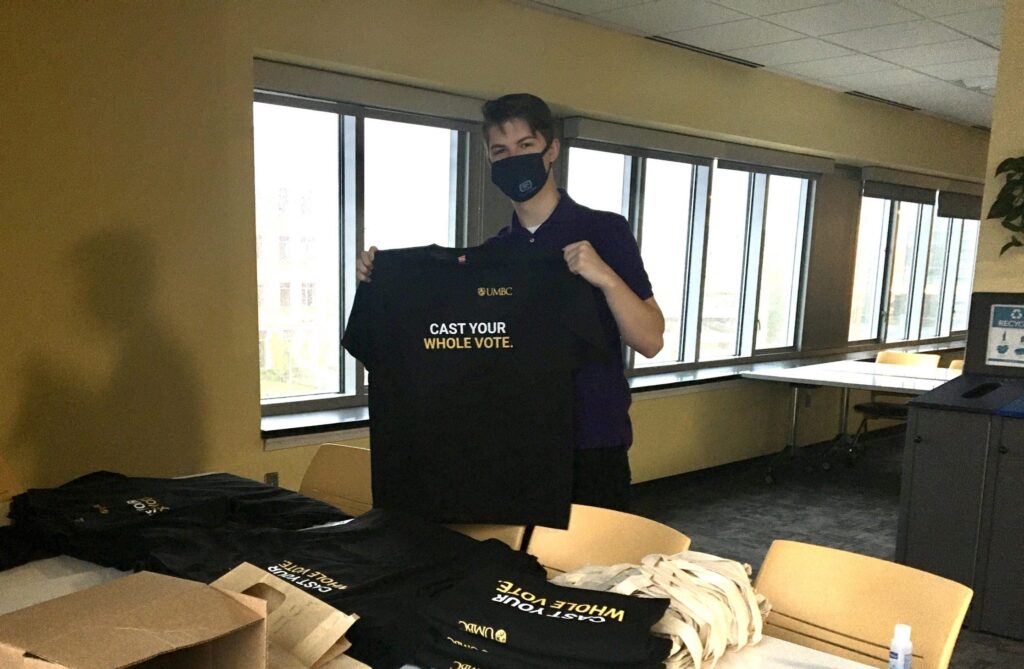
Young man in face mask holds up a shirt reading,
Logan Lineburg puts together Cast Your Whole Vote giveaway bags. Photo courtesy CDCL.
UMBC News: What was your experience as a facilitator for a post-election conversation group? 

Lynch: I led a post-election conversation with graduate students which was incredibly fulfilling. Some of the general trends were being intentional about healing and renewing relationships, longing for being in physical space with others, the necessity of having “uncomfortable” conversations, and this being the only opportunity they’ve had to process the election results with their peers. Needless to say, the consensus afterwards was that we wanted more events.

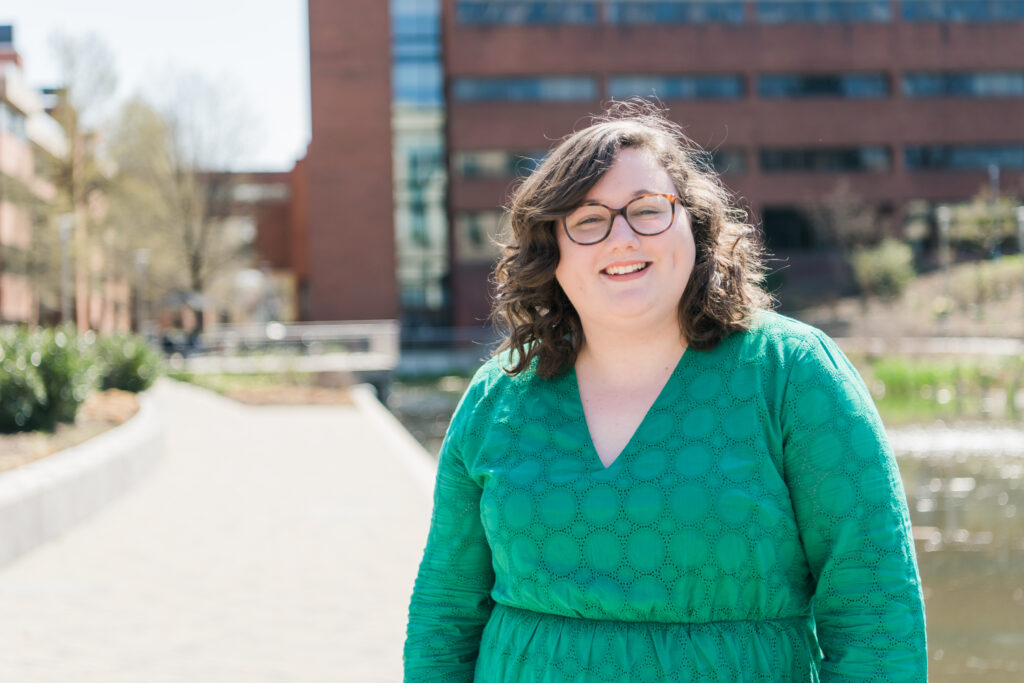
Portrait of smiling woman in long-sleeved green dress and glasses outdoors, in front of a brick building and patio.
Meghan Lynch at UMBC in 2018. Photo by Marlayna Demond ’11 for UMBC.

Khan: I’m pretty new to facilitation—especially in such stressful circumstances—so I was incredibly anxious going into both of the conversations that I facilitated. Through the Center for Democracy and Civic Life, I led one group of UMBC faculty and staff…and I led one group with some of my incredible peers at the Student Events Board. Both conversations were incredibly impactful and surprising, but in entirely different ways.

I was floored by the depth of thought that each participant brought. Some of the people were complete strangers to me, but almost immediately, they were willing to be so incredibly open, authentic and vulnerable about their election-related fears and hopes. It was a truly moving experience for me to be holding all of their emotions along with my own, and to know that I had given them my emotions to hold in return.

See the Center for Democracy and Civic Life on myUMBC for future events and additional reflections and resources.

Article written by Eleanor Lewis, communication specialist in the Division of Student Affairs.

Featured image: Cast Your Whole Vote gift bag. Photo courtesy of the CDCL.

New U.S. News rankings honor UMBC strengths in teaching, innovation, and inclusion

The 2021 U.S. News and World Report Best Colleges rankings affirm that UMBC remains one of the top universities in the nation, with a uniquely distinguished profile. 

UMBC has advanced to #11 for undergraduate teaching and holds the #9 position on the list of most innovative schools in the nation, among other prominent rankings. UMBC is the only Maryland school represented in the top ten in innovation, standing alongside such universities as Stanford, Carnegie Mellon, MIT, and Caltech. 

“We are delighted to again receive external recognition for creating a purposeful curriculum,” says Katharine H. Cole, vice provost and dean of Undergraduate Academic Affairs. “We are inclusive and innovative, and this drives our continuing ability to offer a distinctive educational experience to UMBC students.”

Student Government Association (SGA) President Mehrshad Devin ‘22, biology and physics, echoes Cole’s focus on inclusion and purpose. “The students of UMBC form a tightly-knit community,” he says. “We support each other and provide one another with the scaffolding needed to build something for the greater good, something greater than each of us individually.”

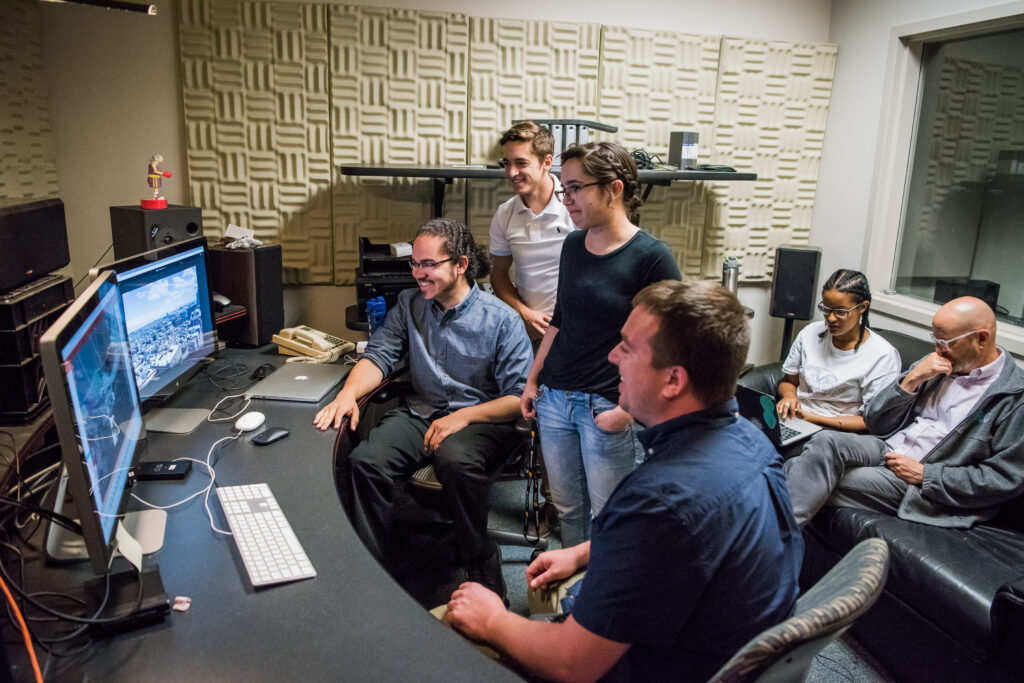
Four students gather around monitors, with a professor and student sitting in the background.
Members of the Race and Social Justice Interdisciplinary CoLab collaborate on a mapping project, summer 2018.

UMBC also placed within the top 80 public universities and ranked #160 on the overall list of top national universities.

A foundation of success

Karl Steiner, vice president for research, sees these rankings as reflecting UMBC’s commitment to inclusive excellence and collaboration. At some institutions, teaching and research are more separate endeavors. But at UMBC a foundational commitment to quality teaching drives collaborative research success, and research is a learning experience.

Professor (at right) points to results on a screen, while a group of students looks at them and discusses.
Minjoung Kyoung, assistant professor of chemistry and biochemistry, and students discuss a result.

“We are proud of our successful history of including undergraduate and graduate students in our diverse portfolio of research and creative achievement,” says Steiner. These students have unique opportunities to make a real impact through their UMBC research. Many alumni then advance to high-impact research careers serving the public good.

UMBC research across all disciplines has historically focused on addressing inequalities, and this continues during the time of COVID-19. “We are actively working on federally-funded projects to help in the fight against the COVID-19 pandemic and its broader impact on members of our communities,” says Steiner.

Charissa Cheah, professor of psychology, is leading an NSF-funded research project addressing how Chinese-American communities are experiencing discrimination related to COVID-19, and how they are coping. Fei Han, of The Hilltop Institute at UMBC, received a COVID-19 Accelerated Translational Incubator Pilot (ATIP) award for research to help predict and reduce patients’ risk of being hospitalized due to COVID-19.

Foad Hamidi, information systems, received an NSF Rapid Response Research (RAPID) grant to increase high-speed wireless internet access to communities in Baltimore during the pandemic. Dipanjan Pan, professor of chemical, biochemical, and environmental engineering, received National Institutes of Health grants for research on a rapid, affordable COVID-19 test

Katherine Seley-Radtke, professor of chemistry and biochemistry, received a Fast Grant to test antiviral compounds developed in her lab for effectiveness against COVID-19, with collaborator Chuck Bieberich, professor of biological sciences. 

Students play an essential role in completing much of this research, from working in Seley-Radtke’s lab to interviewing families through Cheah’s study.

University growth

UMBC’s engineering programs performed strongly in the 2021 U.S. News rankings, tied with Villanova, Tulane, Howard, and University of Alabama. U.S. News just launched a new computer science program ranking this year as well, including UMBC in the nation’s top 100.

Two women work in a lab, with the student looking at a slide while her professor looks on; they wear gloves and goggles
Karla Negrete, right, working in the lab along her mentor Deepa Madan, assistant professor of mechanical engineering, in 2019.

Keith J Bowman, dean of the College of Engineering and Information Technology (COEIT), attributes this recognition to a trend of healthy program growth across the college, such as the expansion of data science to UMBC at the Universities at Shady Grove. “UMBC’s unique set of engineering, computing, and business-related bachelor’s degree programs have undergone extraordinary student growth in recent years. That growth has enabled us to hire an outstanding cadre of new faculty,” says Bowman. 

A student and professor work in an engineering lab, seated in front of a computer.
Nilanjan Banerjee (right), professor of computer science and electrical engineering, works with Christopher Boia ’19, mechanical engineering, in his lab.

A place for all students

UMBC jumped up seven places on the list of Best Colleges for Veterans, and is again one of the top schools in the nation for ethnic diversity. Yvette Mozie-Ross ’88, health science and policy, vice provost for enrollment management and planning, shares, “We take great pride in being a historically diverse institution that has welcomed and continues to welcome students of all backgrounds. And it is our unwavering commitment to inclusive excellence that makes UMBC such a unique and special place.”

Three students wearing UMBC shirts cluster in a group, with one looking up toward the camera.
Retrievers celebrate Convocation 2018.

Speaking to the work COEIT has done, Bowman shares, “Our student growth has been especially strong among African Americans and women,” both historically underrepresented groups in engineering and computing on a national level. 

“The inclusive nature of UMBC is what makes the institution so exceptional,” says Devin. “From the moment a student commits to UMBC, the path towards success is laid out for them, with bold neon signs that push them to do more, even if they don’t yet know how.”

Banner image: Students gather at The Forum, a public artwork near UMBC’s Performing Arts and Humanities Building, 2016. All photos by Marlayna Demond ’11 unless otherwise noted.

Kait McCaffrey and Dinah Winnick contributed to this story.