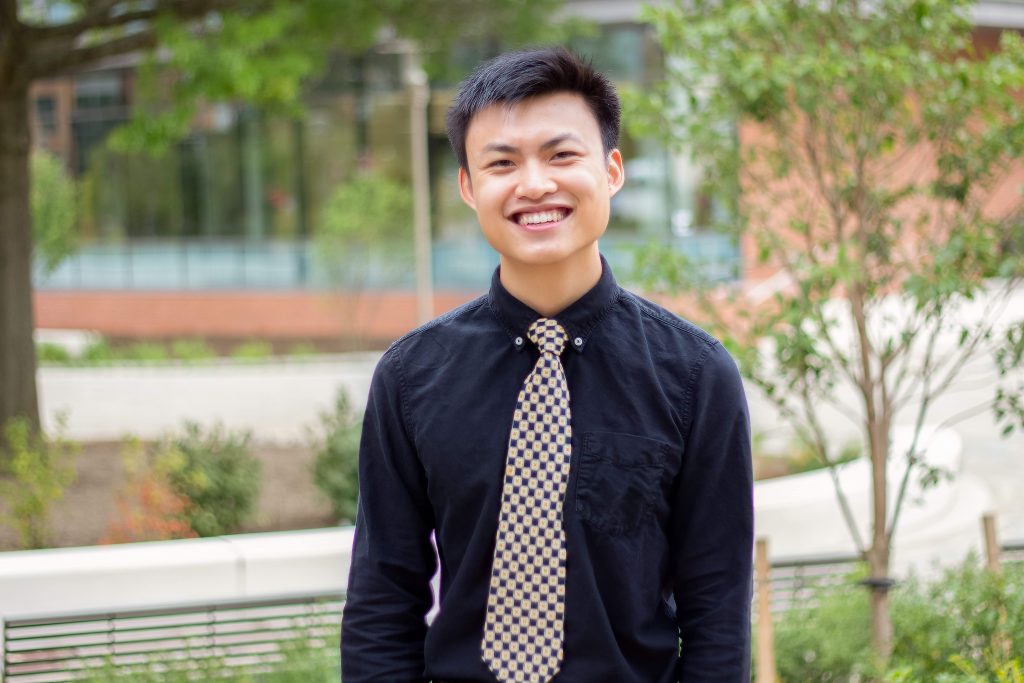
Degree: B.A., Individualized Study: Civic Renewal and Creative Expression Hometown: Columbia, MD Plans: Coordinator for Civic Design, UMBC’s Center for Democracy and Civic Life
“The lesson I have learned from STRiVE and from the Center for Democracy and Civic Life’s work, and from all of the people I’ve met at UMBC who have held up undistorted mirrors for me, is that I am worthy as my authentic self. That has radically altered everything I thought I knew about myself and the world, and has profoundly deepened my sense of community, connection, and purpose. And that clarity and sense of belonging are indescribably empowering and healing, even in moments of doubt.”
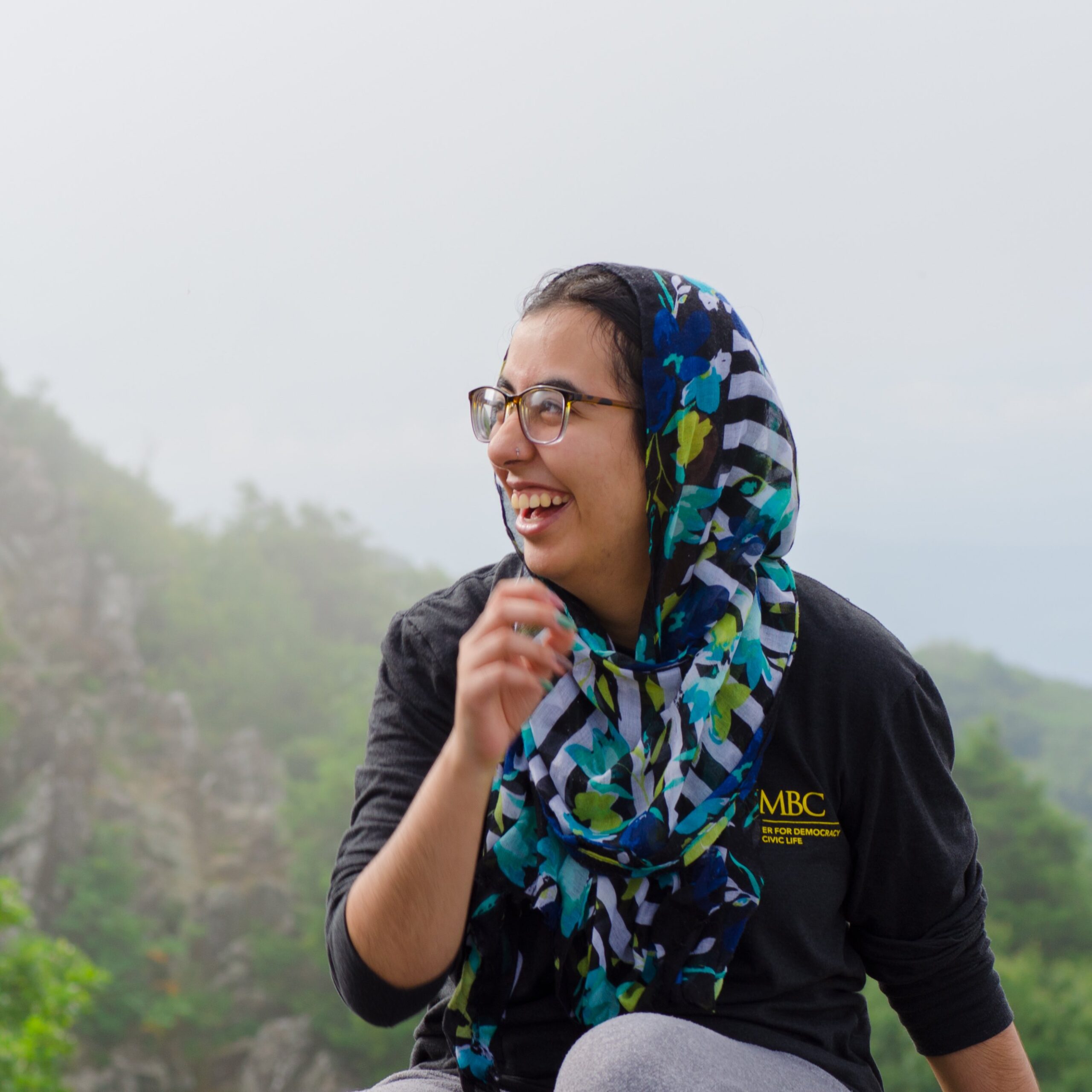
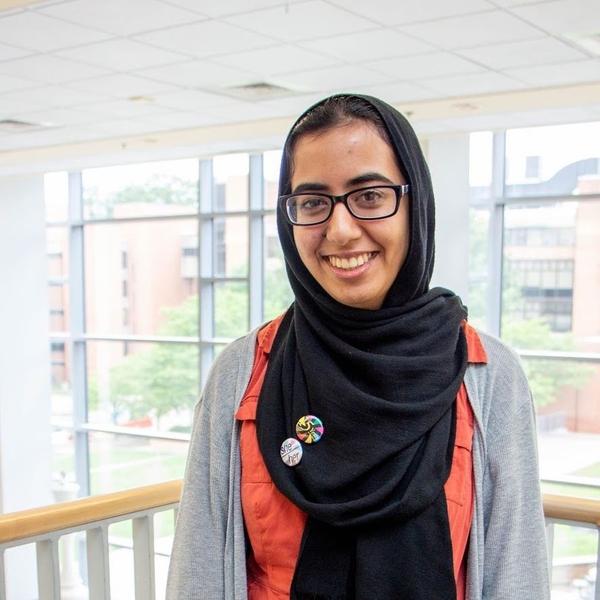
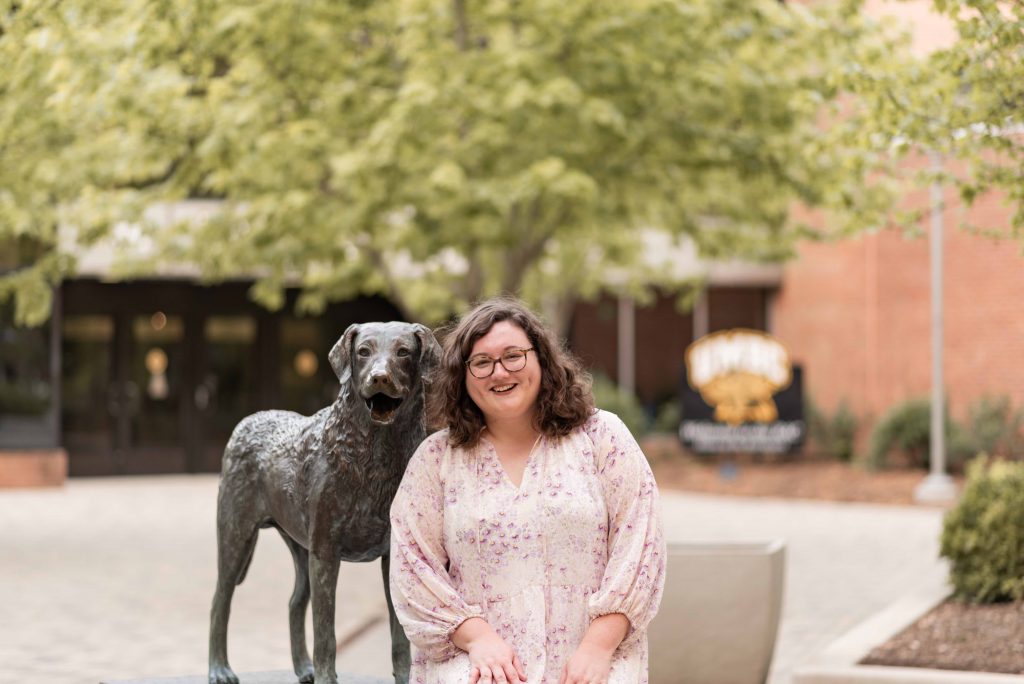
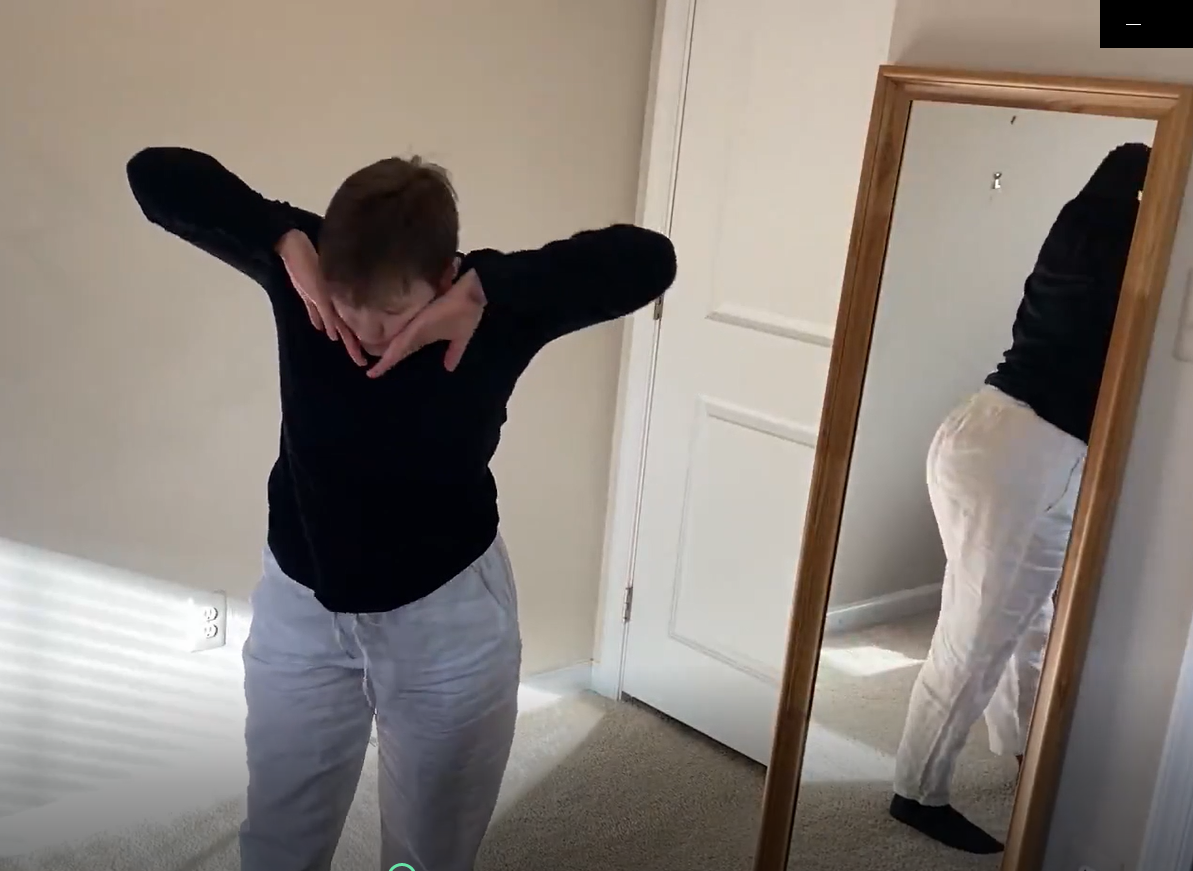
Tess McRae ‘22, individualized study, grew up hearing stories about her mother’s campus involvement as a UMBC student in the 1980s. She visited the campus several times as a teenager, and says “I was always entranced by how beautiful it was and how clearly I could imagine myself thriving here.”
McRae spent a week at STRiVE, UMBC’s immersive leadership for social impact program, during her first year, and joined the Center for Democracy and Civic Life’s staff when it launched in 2018. For the next four years, she played a leading role in developing and leading the Center’s workshops and programs, weaving in her insights as an artist and as a person familiar with the kind of self-doubt that can inhibit participation in communities and social change projects.
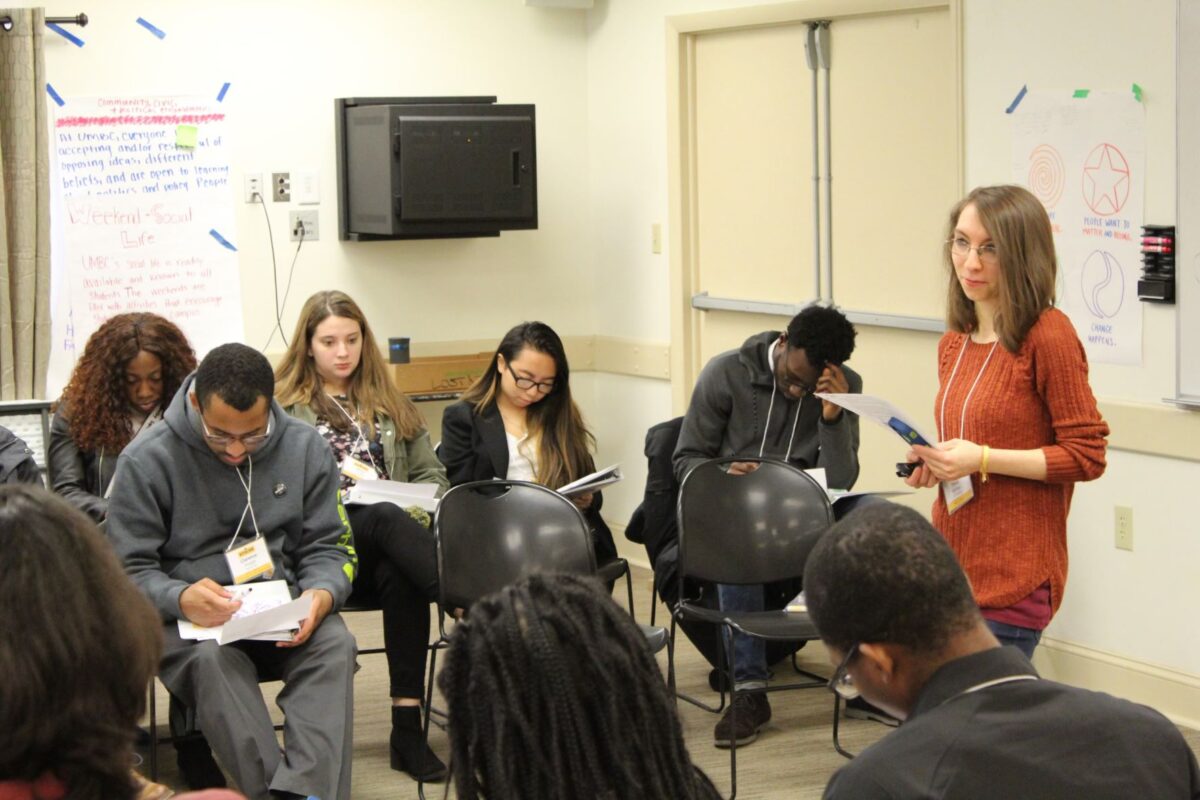
Tess McRae (r, standing) facilitates a session at STRiVE. Image courtesy of McRae.
Along the way, she designed her own major in civic renewal and creative expression and produced the Co-Create UMBC virtual tour. And her paintings of UMBC spaces that have been co-created by students have appeared in exhibits both on campus and at the OCA Mocha coffee shop in nearby Arbutus.
McRae’s immediate post-graduation plan is to work professionally at the intersection of civic engagement and the arts. She aims to “continue co-creating an ethos of agency, self confidence, and communion felt deeply by people around the world” in ways that allow her to indulge and draw on her identity as a poet, visual artist, musician, and aspiring theater-maker.
Story by David Hoffman, Ph.D. ’13, language, literacy, and culture (LLC), director of the Center for Democracy and Civic Life, and Romy Hübler ’09, modern languages and linguistics, M.A. ’11, intercultural communication, Ph.D. ’15, LLC, assistant director of the Center for Democracy and Civic Life.
Forbes lists UMBC among the nation’s top 150 colleges—and top 50 public universities—in new rankings announced this month. UMBC is also among the top three public universities in Maryland on the list, alongside University of Maryland, College Park, and the U.S. Naval Academy.
Historically, Forbes has focused its America’s Top Colleges ranking on how much money students make after college. This year the pandemic motivated the publication to broaden their approach. They expanded their metrics to also include accessibility and affordability. This better recognized the strengths of public universities that pair academic rigor and value.
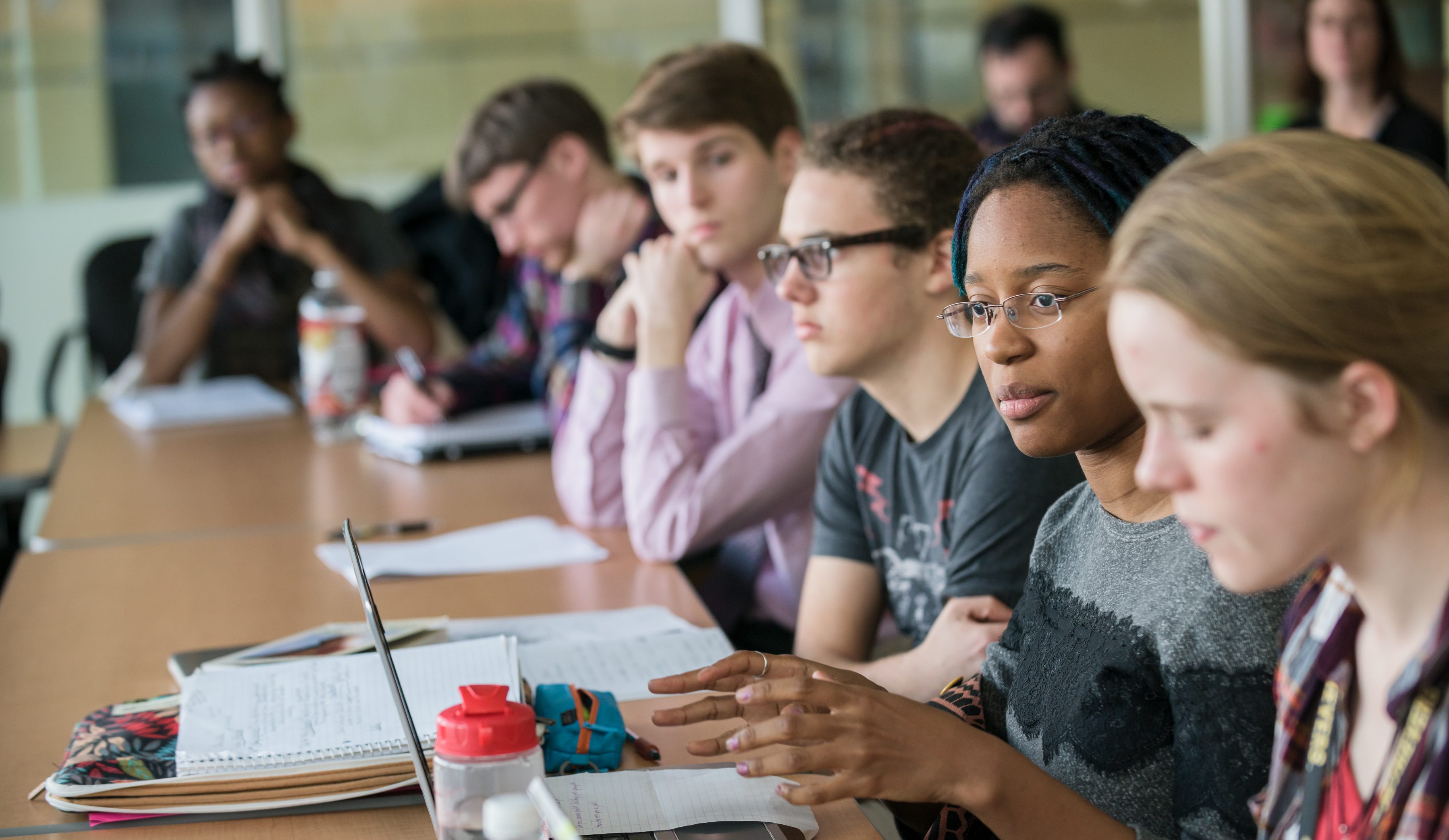
Students attend a seminar in the Dresher Center for the Humanities, 2016.
National model
For the first time, a public university appeared as Forbes’s number one university. The top-ranked school, UC Berkeley, is one of the many leading institutions nationwide that looks to UMBC as a model. In 2019 UC Berkeley implemented the SEED Scholars Honors Program, modeled on UMBC’s gold-standard Meyerhoff Scholars Program, which focuses on increasing diversity in STEM.
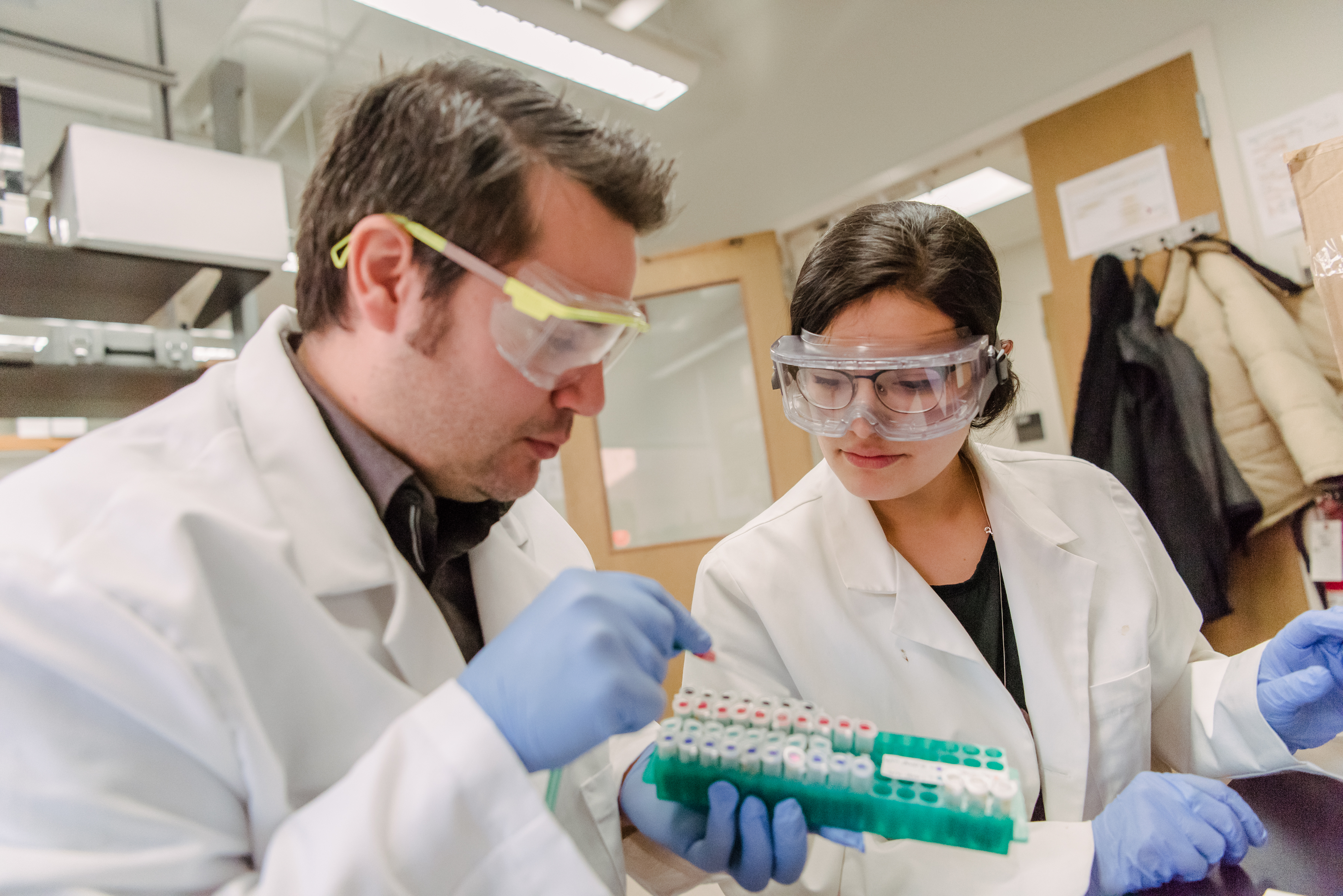
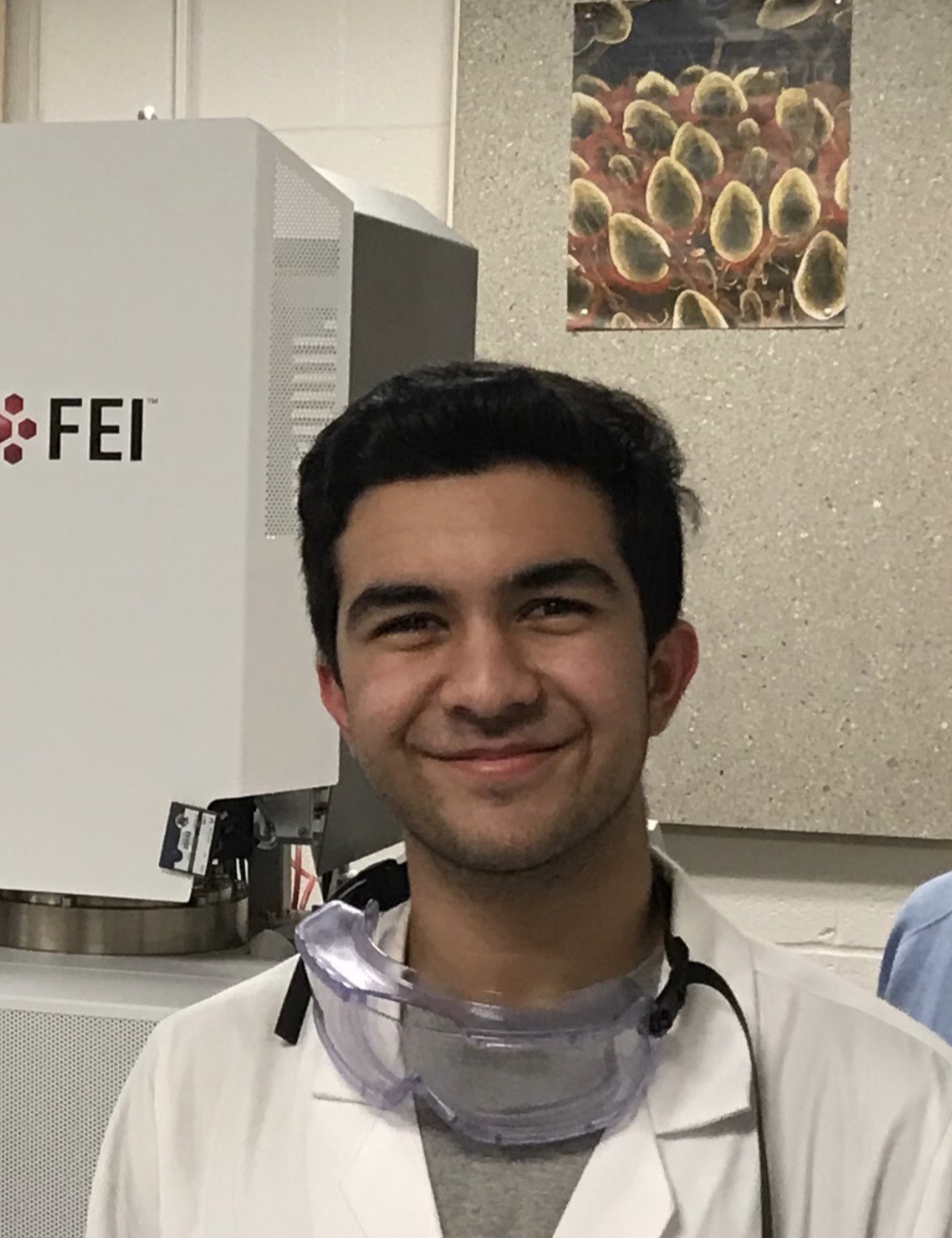
Abby Cruz ‘18, biological sciences, a Meyerhoff affiliate and MARC U*STAR Scholar, works in Fernando Vonhoff’s biology lab.
The success of public universities like UMBC on this year’s America’s Top Colleges list also connects with a point that UMBC President Freeman Hrabowski often emphasizes, about college access and achievement. “We are saying to the country and to young people that you don’t have to be rich to be the very best,” he recently said. “Middle class institutions can produce some of the best thinkers in the world.”
Written by Charis Lawson ’20, English, communications specialist. All photos by Marlayna Demond ’11 for UMBC.
UMBC has seen its share of academic and athletic success across a wide range of fields and sports, but the University recently earned national acclaim in something new: figure skating.
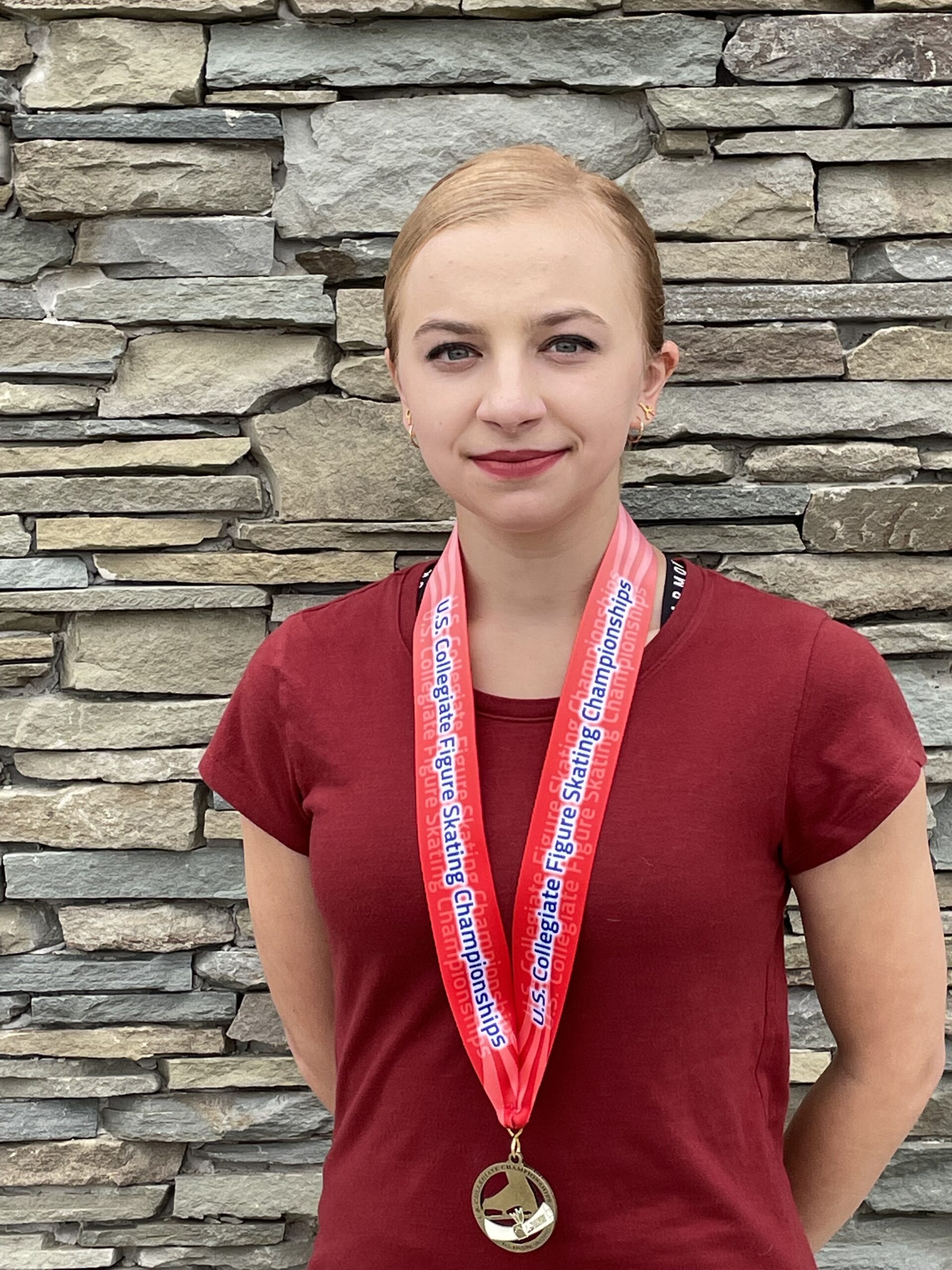
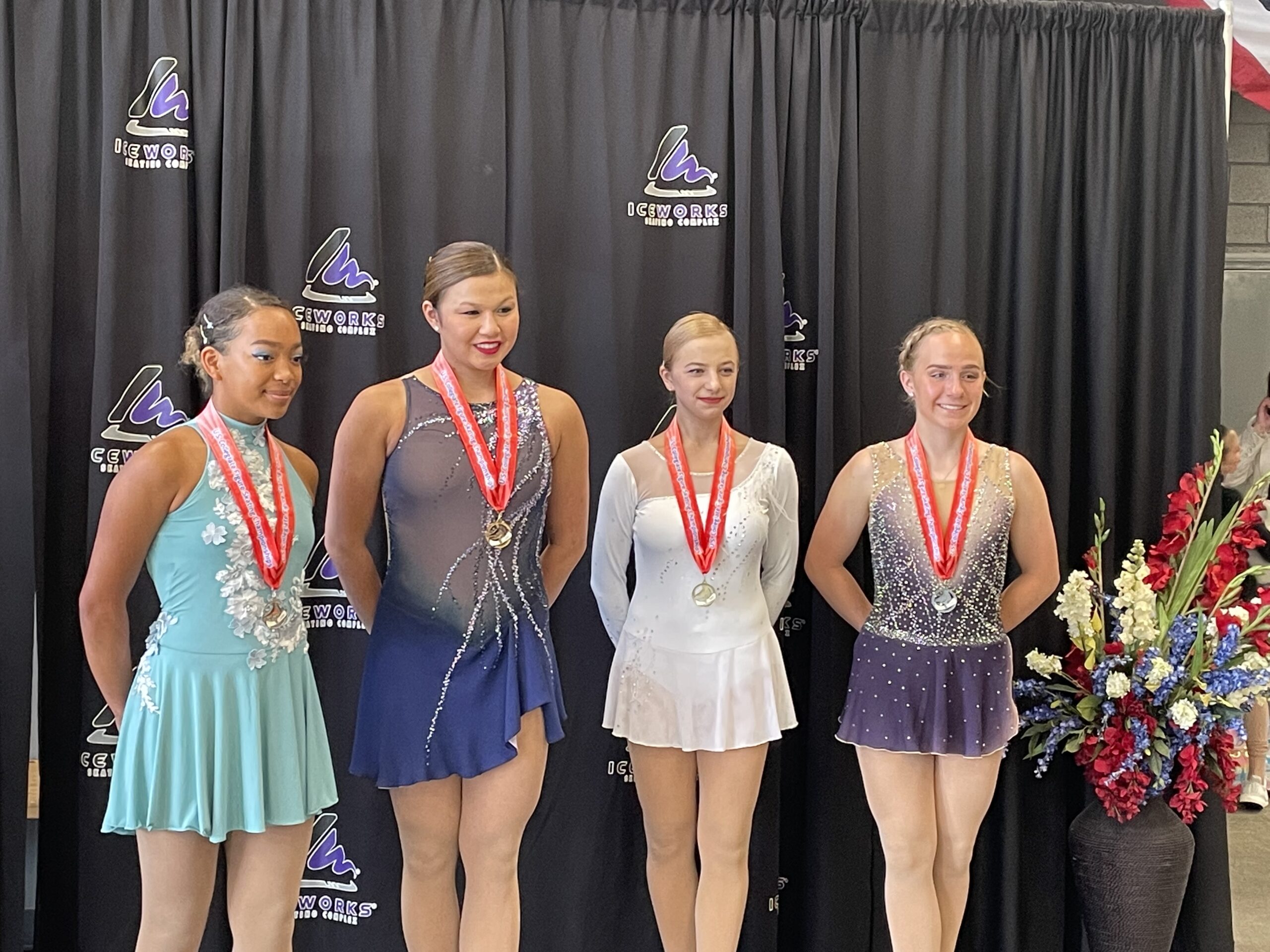
Maya Jones ‘22, psychology, took home the bronze medal for UMBC at the 2021 U.S. Collegiate Figure Skating Championships in Pennsylvania on July 29 (Junior Ladies category). She earned a total of 103.18 points, including 66.55 points in her free skate to “The Dying Swan” by Camille Saint-Saëns. U.S. Figure Skating Fan Zone reports that the program opened with a double Lutz-double toe loop combination and also featured two Level 4 spins.
Maya Jones. Photo courtesy of the Jones Family.
We caught up with Maya to ask her about her performance, how she got into figure skating, and how her passion for athleticism and artistry on the ice connects with her UMBC experience.
Congrats on winning bronze at the 2021 U.S. Collegiate Figure Skating Championships. What was the experience like?
Thank you so much. I’m just extremely happy and grateful to be able to be back on the ice and compete again after pausing on competitions for over one and a half years due to COVID. Being able to put out two clean, well-skated programs, I felt euphoric. Figure skating is a sport that has a huge ratio between practice time and competition time, so to be able to skate well when it matters most, especially after not competing for so long, was an incredible experience.
How did you get into figure skating?
My mom is actually my coach, so she put me on the ice as soon as I could walk. After that I just completely fell in love with the sport. Skating combines artistry with athleticism, and I think that’s what draws me to it the most. It’s a sport that is not only physically challenging, but mentally as well. The sense of achievement that comes from overcoming those physical and mental barriers is unlike anything else I have experienced. Every day of practice is a challenge in one way or the other, and every time I face something new. Sometimes you are able to overcome those challenges and other times you are not, but that’s what keeps it exciting, and the challenges I am able to overcome are what makes me love the sport the most.
What is your practice schedule like?
My practice schedule is all over the place. The specific days and amount of times I skate per week are completely dependent on the amount of schoolwork I have that particular week, so no two weeks are ever the same.
How hard has it been to balance college life with figure skating?
I always plan ahead. I try to set certain times for schoolwork and certain times for practice. Obviously, school comes first, so I haven’t been able to skate as much as I did in high school. Some weeks I’m able to skate four or five times a week, and other times none, but I’m just happy to be able to skate at a competitive level in college.
Maya Jones, second from right, and her fellow competitors at the competition. Photo courtesy of the Jones Family.
How did the pandemic affect your training?
When everything shut down due to COVID, I was completely unable to skate for three months which is the longest I’ve ever gone without skating. For the first couple of months back, there wasn’t a lot of ice time available, so I was only able to skate once every week or two. Thankfully, I’ve now been able to resume practicing at my usual amount.
How supportive are the friends you have made at UMBC of your figure skating?
They’re very supportive. I’ve taken a few people to skate on public sessions, which is always very fun.
Why did you choose UMBC?
I chose UMBC because I wanted a top-quality academic experience and I also knew UMBC had strong STEM programs. I’m combining my psychology major with a biology minor, and I have found that UMBC offers strong classes in both fields. I also really liked the atmosphere of the campus. It’s allowed me to form relationships that have had a strong impact on me as a person.
What’s in the future for you?
I’m actually going to audition for Disney on Ice. I’ll be graduating in the fall, so I’m hoping that once I graduate I can have skating as my career for a year or two. After that, I plan to start training to become an airline pilot, which I started exploring as a career after talking with a UMBC friend who is training to become a pilot. I’m confident that UMBC has put me into the right mindset to be able to tackle the challenges that come with the training.
Article by Zach Seidel ’12, M.S. ’15, director of digital media for UMBC Athletics.
Banner image: Ice skates. Photo by Kelli McClintock on Unsplash.com.
From surveillance tools to autonomous machines, countries around the world are ramping up their military artificial intelligence (AI) assets. Such robust technologies are necessary to protect the United States from surprise attacks, which occur these days not only on the ground, but also on the cloud.
Advancing AI-based autonomous systems for military use will be the goal for a team of UMBC researchers that has recently been awarded a $20-million subcontract. UMBC will partner with the University of Maryland, College Park (UMD), and the DEVCOM Army Research Lab (ARL) on the $68-million, five-year endeavor, which ARL is funding. The goal is to strengthen Army AI technology so it is able to meet the demands of today’s national defense.
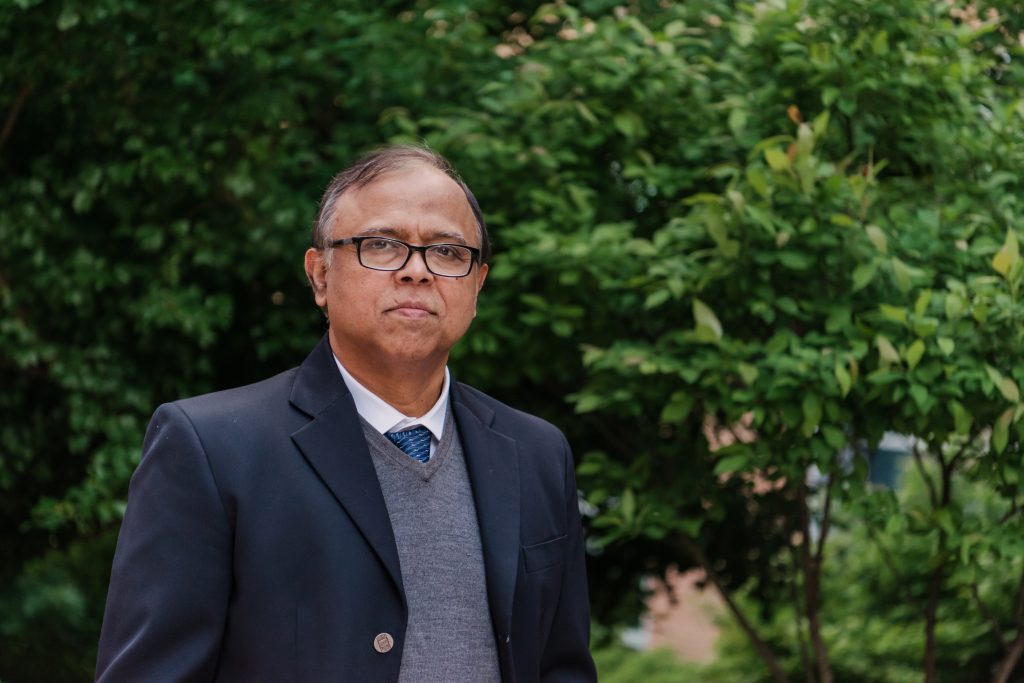
Aryya Gangopadhyay.
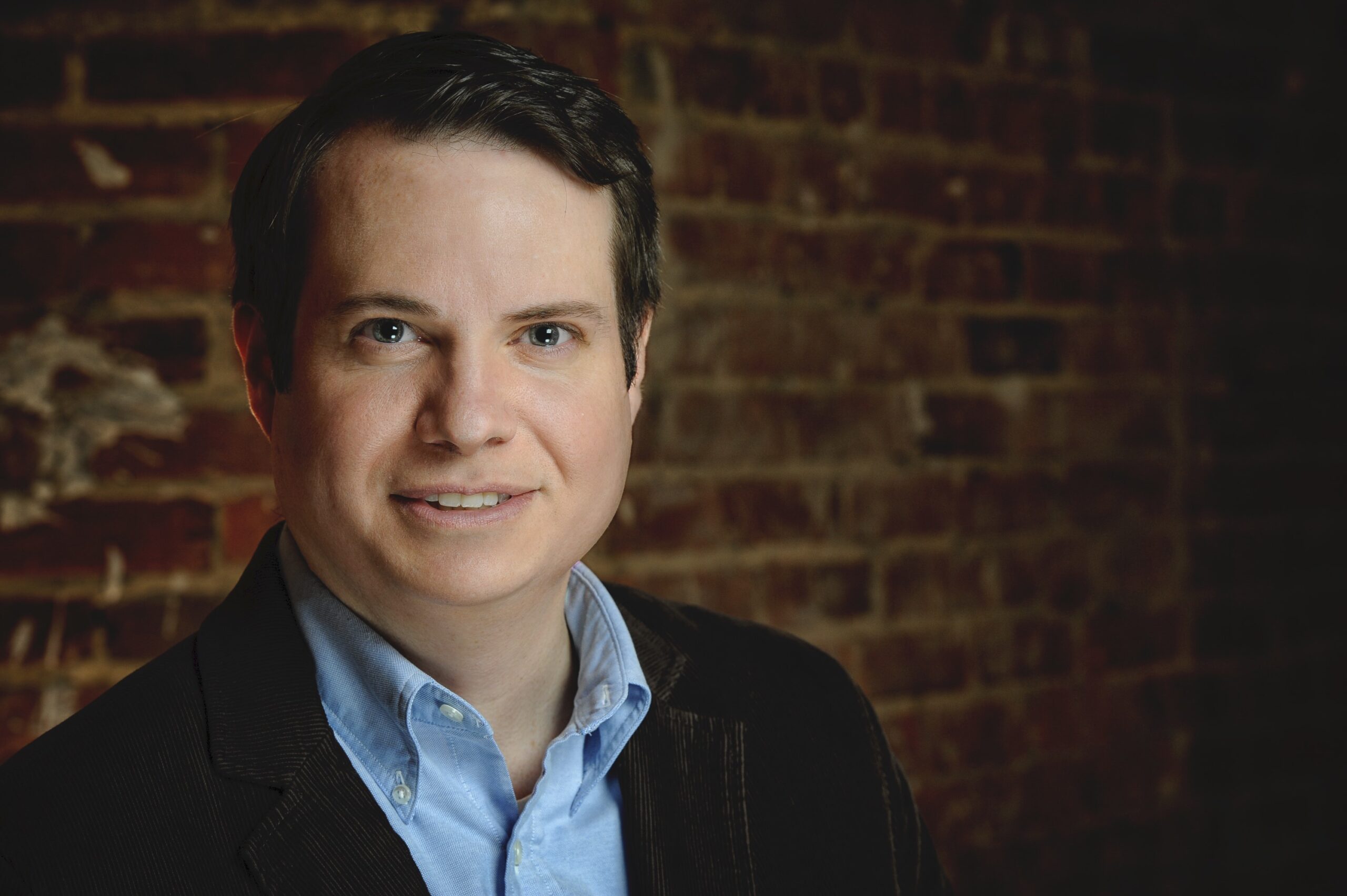
“The question we’re trying to solve is: Can we design and develop tools, techniques, algorithms, software, and hardware that can work autonomously and make their own decisions, but also collectively, interfacing with human decision makers?” says UMBC’s principal investigator Aryya Gangopadhyay, professor of information systems. “The landscape of war is changing, and we must build systems that can make human-like decisions in real time and under real-world pressure.”
Secure, effective, and resilient
The project, AI and Autonomy for Multi-Agent Systems (ArtIAMAS), aims to advance science and technology around three core research areas: collaborative autonomy; harnessing the data revolution; and human-machine teaming. UMBC’s role in the project will center on the second and third research thrusts.
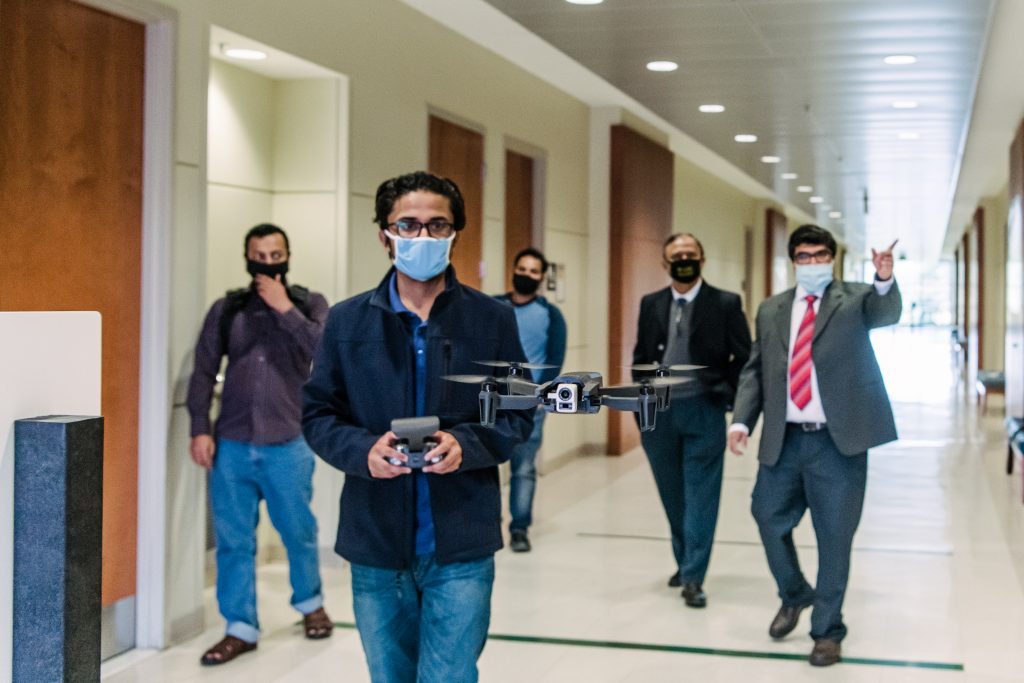
More specifically, the UMBC team will develop solutions for AI-based networking, sensing, and edge computing — which brings data storage and computation closer to a location — for battlefield Internet of Things (IoT). This will allow them to deliver secure, effective, and resilient U.S. Army assets including AI systems related to search-and-rescue, surveillance, robots and machinery, and augmenting humans in performing decision-making tasks.
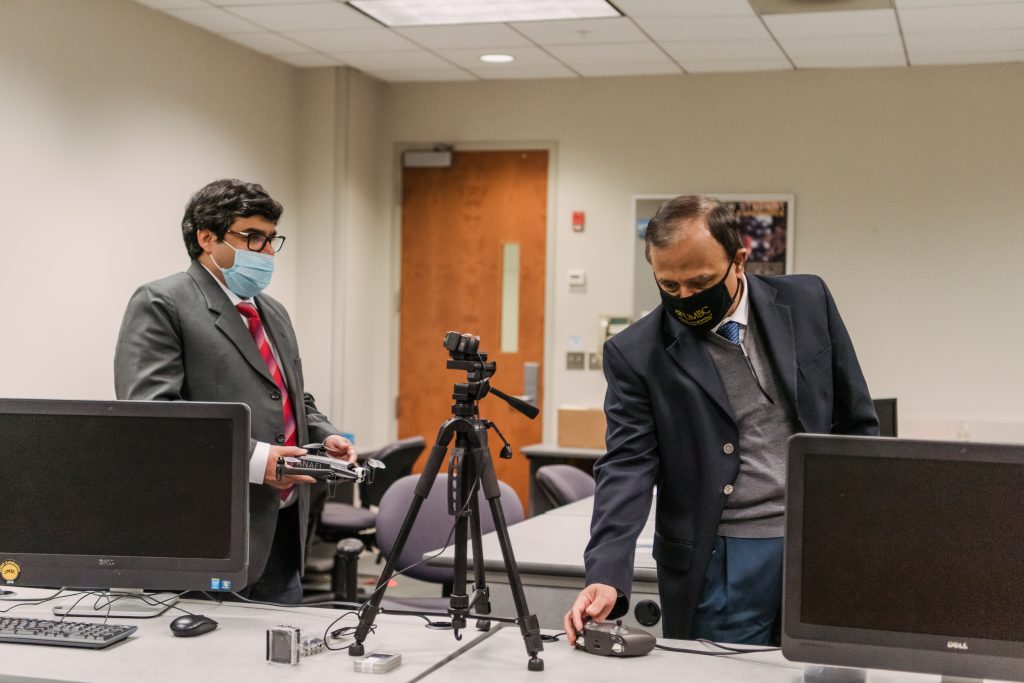
Sensors that will be used for research.
“As one of the research institutions in the University System of Maryland, we are delighted with this exciting next step in our statewide partnership with our colleagues at UMD and at the Army Research Lab,” says Karl V. Steiner, vice president for research at UMBC. “Artificial intelligence is one of the key technologies in the ongoing transition to autonomous systems, both in the defense and civilian sectors, and it does take researchers from a variety of backgrounds to innovate and develop the most promising solutions. This alliance builds on the expertise and commitment of many of our colleagues.”
Today’s conflict landscape
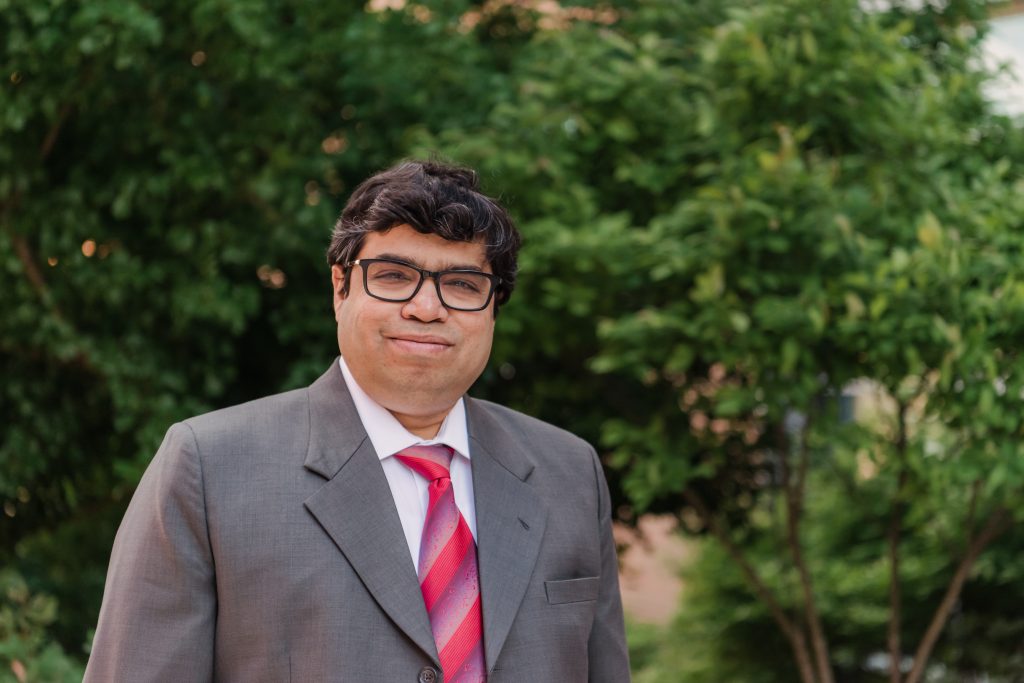
In the battlefield, there are soldiers with body cameras, guns with sensors, as well as ground-based and airborne machines operating in rough and volatile terrains. Retrieving data and making decisions from these multi-model sources can be difficult, especially in challenging networking conditions. Understanding and developing adaptable cross-domain solutions for these environments will be at the forefront of the work of co-principal investigator Nirmalya Roy, associate professor in information systems.
“There may not be time to send data to an army base or the cloud, so some of the processing, computing, and interference may be done on the devices themselves. How do you navigate the available computing resources in-hand and process data on the devices themselves to make an informed decision, and in real time? These are the concepts I’ll be working on,” Roy says.
Nirmalya Roy
With the work set to begin in mid-May 2021, the UMBC team will initially include more than eight researchers from the departments of information systems and computer science and electrical engineering, as well as scientists and engineers from the ARL. The Center for Real-time Distributed Sensing and Autonomy (CARDS) will lead the research being conducted by UMBC faculty.
Eventually, the team will grow to nearly 50 researchers, and future projects will include other University System of Maryland institutions. Together, the group will publish fundamental research and identify similar and cross-cutting research endeavors, improving collective information-sharing.
Aryya Gangopadhyay and Nirmalya Roy with several students.
“The cross-disciplinary nature of this project is well-suited to our College, which brings together computing, engineering, and information systems faculty and student researchers. The project team includes a significant number of the exceptional faculty we have recruited through recent hiring made possible through our state’s support,” says Keith J Bowman, dean of UMBC’s College of Engineering and Information Technology.
Advancing AI research
While the work will undoubtedly improve military AI, it will also enhance AI research in other domains. A goal of the project is to establish a long-term center with a vision of advancing AI-based autonomy.
Nirmalya Roy, left, and Aryya Gangopadhyay working together in the lab.
“This is an opportunity for UMBC to bring together talented researchers from across departments to participate in fundamental, and potentially groundbreaking, research,” says Gangopadhyay. “To make a big impact in the research space, you need long-term, multi-institutional partnerships and collaborations. Working with the University of Maryland, College Park and the Army Research Lab will allow us to collectively advance AI in the military space.”
In addition to Gangopadhyay and Roy, the UMBC team also includes Anupam Joshi, Tinoosh Mohsenin, Dmitri Perkins, Sanjay Purushotham, Maryam Rahnemoonfar, Jianwu Wang, and Ting Zhu. The ArtIAMAS cooperative agreement is led by PI Derek Paley, director of UMD’s Maryland Robotics Center.
Written by B. Rose Huber for UMBC News.
Banner image: Nirmalya Roy, left, and Aryya Gangopadhyay. All photos by Marlayna Demond ’11 for UMBC.
On the back of every UMBC black and gold ID card is a guide to essential emergency resources, including numbers for health, counseling, sexual assault, and suicide prevention helplines. The new card design was the result of student advocacy through UMBC’s Retriever Courage initiative, seeking to better prevent and respond to sexual assault and violence. And the person who suggested that change is Autumn Cook ‘21, M29, chemistry, and gender, women’s, and sexuality studies (GWST), graduating this week.
A Meyerhoff Scholar and Honors College student, Cook has been a tireless advocate for all UMBC students, with a focus on supporting survivors of sexual assault and helping trans students find and build community, in the sciences and at UMBC broadly.
Committing to visibility
“I was the first openly trans Meyerhoff Scholar in the history of the program and I quickly learned that I would have to build my own community of transgender scholars at UMBC,” Cook shares. “Without having any friends like me, I connected and built bridges with people who did. I was lucky enough to find more trans people through both the LBGTQ+ Student Union and its programming, and then through the Women’s Center.”
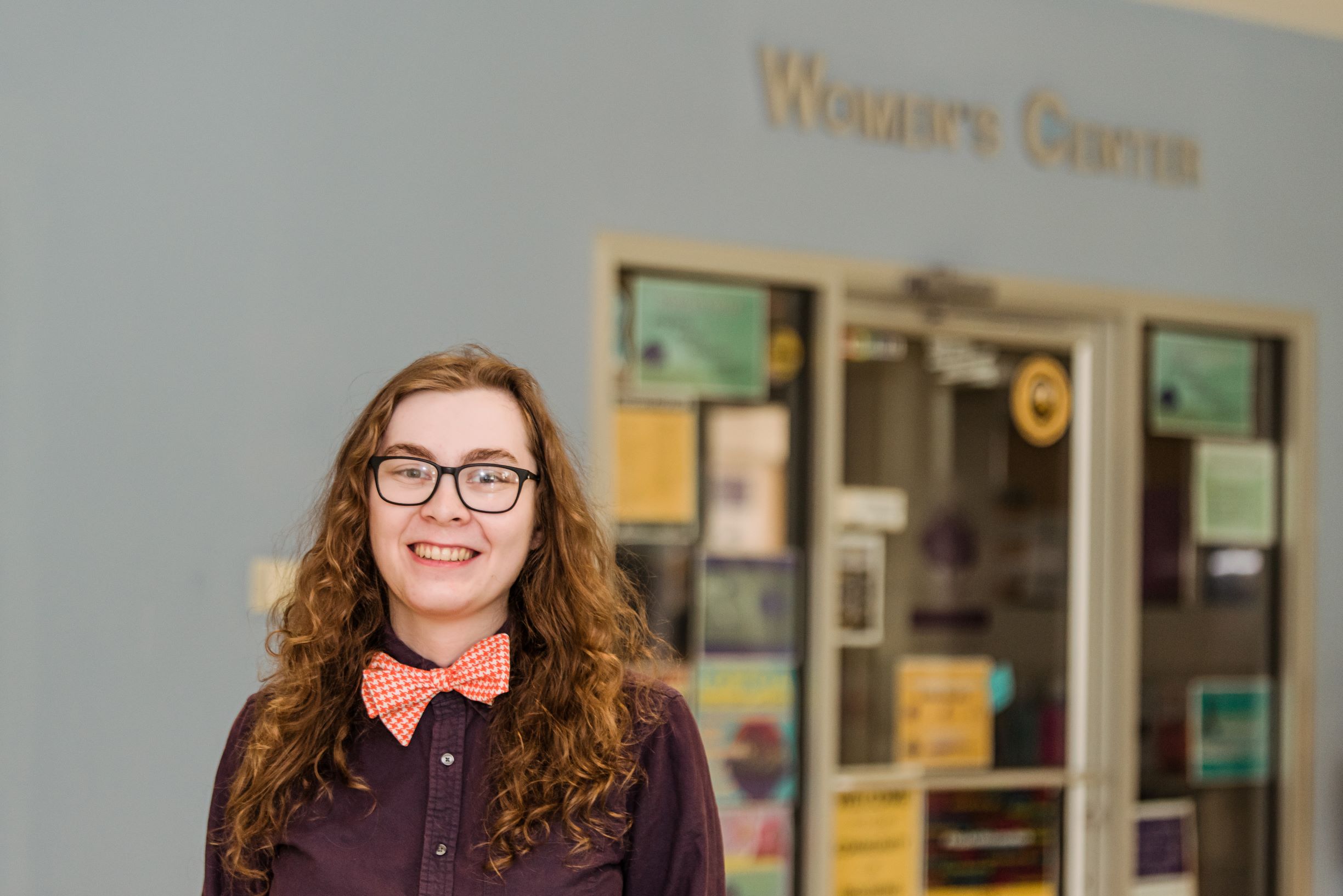
Autumn Cook in front of the Women’s Center. Photo by Marlayna Demond ’11 for UMBC.
Cook launched the LBGTQ+ Student Union’s weekly trans discussion group, then worked to restart and become a co-facilitator of the Women’s Center’s trans discussion group, Spectrum. “I always make it a priority to be extremely visible because I want to demonstrate to other people that transgender people exist, transgender people can thrive, and transgender people can be successful,” they share.
“I want to potentially be a role model for other transgender people,” says Cook, “to show them that I can do it, therefore so can you.”
Calling for change
Thinking about the impact of the new campus ID design, Cook says, “I’m proud that every UMBC student, faculty, and staff member now carries that card and that it is part of a legacy I’m leaving behind at UMBC.”
Their legacy also extends to other important changes that impact the daily life on campus. For example, Cook joined UMBC community members in calling for updating and expanding all-gender restrooms, including multi-person restrooms. The first multi-person, all-gender restroom opened in Sherman Hall A Wing in June 2019 and more have followed across the campus.
Amelia Meman, assistant director of the Women’s Center and Cook’s supervisor and mentor, says Cook is an asset to campus who will be missed. “As a student heavily involved with the administration in advocating for this project and later ensuring accountability in implementation, Autumn has left an indelible mark on our campus by ensuring access for everyone–affirming all people’s gender diversity.”
Autumn Cook on National Coming Out Day in 2019. Photo by Amelia Meman.
In recognition of their scholarship and advocacy work at UMBC, Cook received two Lavender Awards: LQBTQ+ Scholar of the Year in 2021 and Emerging Student Leader in 2020. As a GWST major, they received the Jo Ann E. Argersinger Academic Achievement Award for GWST in 2020 and 2021.
Helping students succeed in science
Cook also sees important interconnections between their two majors: GWST and chemistry. After graduating from UMBC, they will pursue their Ph.D. in chemistry at University of Illinois, Urbana-Champaign, but they see GWST as foundational in their work to boost inclusion in science.
“I’ll be able to use my degree to push through more advocacy work within the next step of my educational and professional journey,” says Cook. “Whether it’s conducting research after I finish my Ph.D., dictating science policy on a national level, or supporting transgender scientists, I want to continue to fight for my community.”
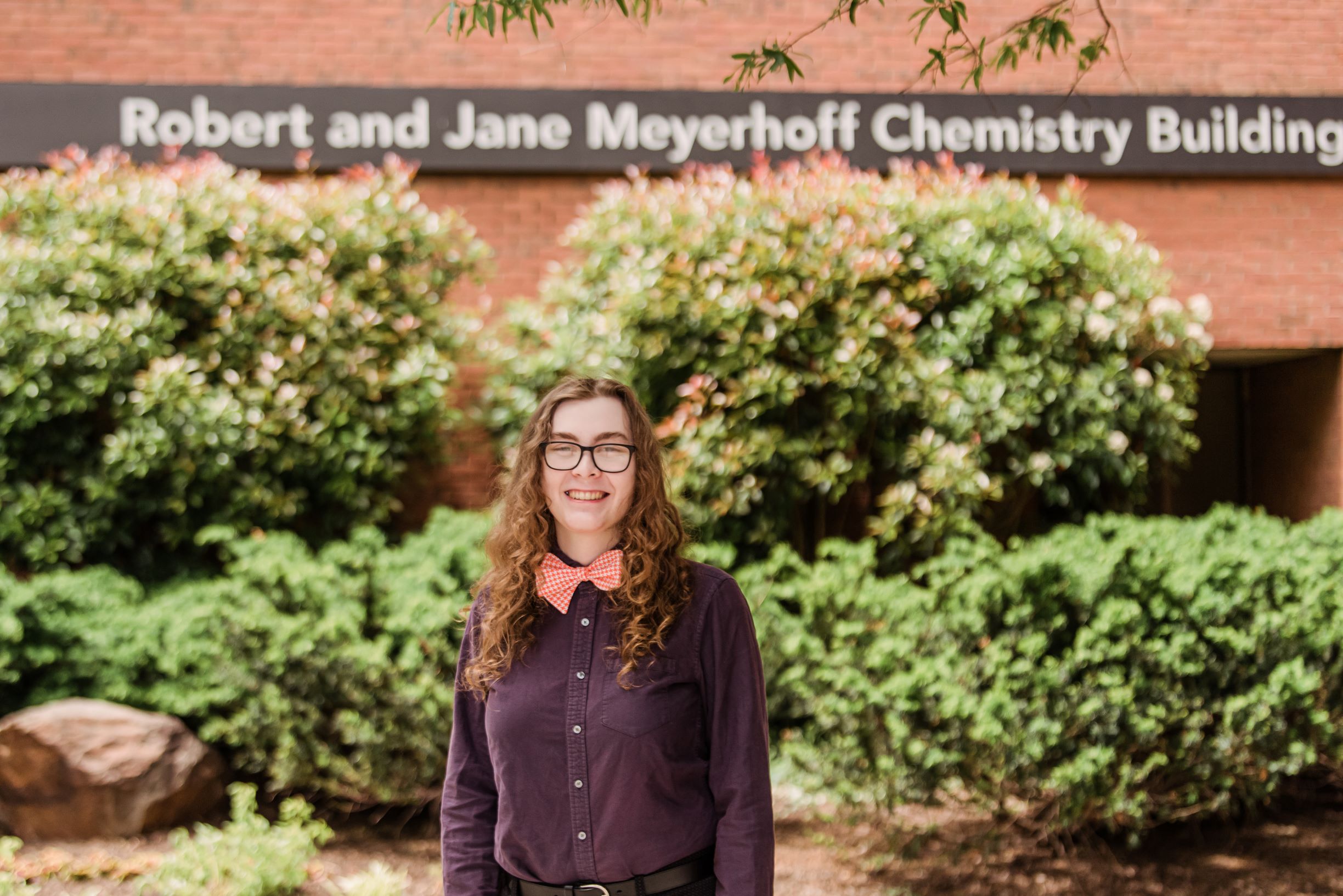
Autumn Cook in front of the Meyerhoff Chemistry Building. Photo by Marlayna Demond ’11 for UMBC.
Cook plans to become a chemistry professor and has already completed research with Joseph Bennett, research assistant professor of chemistry, and became one of the department’s youngest teaching assistants (TAs). They tutored students in the Chemistry Tutorial Center, and for that work, received the 2021 Mittino Award for Service from the chemistry and biochemistry department.
“When I started in chemistry, I struggled a lot. But because of the time and effort other people put into helping me, I was able to grasp the knowledge on a really deep level,” says Cook. “Tutoring and TA’ing was at first a way to pay it back to those people who helped me, but it quickly turned into a passion.”
“Once I realized that teaching chemistry as a professor was what I wanted to do, I made sure to take every opportunity that I could,” they add. “Being able to help students succeed is extremely gratifying and rewarding.”
Finding opportunities to lead
Christian Figueroa ‘21, social work, and Henri Maindidze, ‘21, psychology, say building community for students at UMBC-Shady Grove has been at the heart of their undergraduate experiences.
A first-generation student who transferred from Montgomery College, Figueroa dedicated himself to helping create a culture of belonging at UMBC-Shady Grove. It all started in 2019 when he “took a chance” to run for a leadership role as vice president of UMBC-Shady Grove’s Social Work Student Association (SWSA).
Figueroa says that experience opened more doors and encouraged him to apply for additional opportunities, like representing UMBC on the Universities at Shady Grove (USG) Student Council. He also served on the UMBC-Shady Grove Peer Advisory Team, collaborating with faculty, staff, and current students on recruitment and retention events for transfer students.
Christian Figueroa on the UMBC-Shady Grove campus. Photo courtesy of Figueroa.
After becoming SWSA co-president in 2020, Figueroa gained additional leadership experience and learned the importance of flexibility and creativity in building community during challenging times. When UMBC transitioned to virtual classes during the pandemic, he wanted to provide ways for social work students to stay connected.
Collaborating with co-president Mariandree Paiz ‘21, social work, and clinical instructor Jeanette Hoover (SWSA’s advisor), Figueroa developed community discussions focused on current events, featuring clinical instructor Nicole Belfiore. They also coordinated self-care nights and opportunities for students to do service work.
Serving communities
While committing so much time to leadership and supporting his fellow students, Figueroa took advantage of professional development opportunities offered by USG as well. He was selected to participate in the Montgomery County Department of Health and Human Services (DHHS) Interprofessional Scholar Program, which enables students to collaborate on real-world projects. Figueroa says the experience validated his desire to be a social worker.
After graduation, Figueroa will enter the master of social work program at the University of Maryland, Baltimore with advanced standing, and will specialize in behavioral health. He will serve as an intern with the Montgomery County Crisis Center, one of the sites he worked with as part of his DHHS Fellowship.
Christian Figueroa on the UMBC-Shady Grove campus. Photo courtesy of Figueroa.
“Christian exemplifies our Retriever spirit and UMBC grit,” says Chelsea S. Moyer, director of UMBC-Shady Grove. “He is a committed and engaged student leader exhibiting the social work value of service. He gives generously of his time and talents and is genuinely enthusiastic about and driven to make a difference in the lives of others. Importantly, he serves as both a problem-solver and bridge-builder in helping to create and build an inclusive community at the Universities at Shady Grove.”
Making space for conversations
Maindidze, who received his associate’s degree from Montgomery College, says getting involved in campus life at UMBC-Shady Grove was always a given. Seeing opportunities to create connections to support fellow students, Maindidze took the initiative to make them happen. “As students, we have a unique responsibility to make a difference and we only get a few years to do so,” he says. “It’s important to make this time worthwhile and leave a lasting impact.”
Henri Maindidze. Photo courtesy of Maindidze.
As relationship-building became more challenging because of the pandemic, Maindidze decided to create a conversation space where members could address current issues, share their stories, and celebrate their diverse voices. In August 2020, he launched the Nine Tea podcast, a name combining the nine University System of Maryland institutions that make up USG with the expression “spill the tea.” Featuring topics such as social justice, race relations, and mental health, Nine Tea has already reached around 900 listeners.
Someone to rely on
For his senior year, Maindidze took classes at both UMBC’s main campus and UMBC-Shady Grove. He joined Off-Campus Student Services (OCSS) at the main campus as a Transfer Student Network leader and again looked for ways to build community during COVID-19.
Maindidze hosted events so main campus students could meet their peers at UMBC-Shady Grove and get to know one another, which he hopes will continue. He also mentored incoming transfer students, providing a connection as they navigated a new campus. “It was important to try to reach students and let them know they could rely on me to help them along the way,” he says.
Henri Maindidze. Photo courtesy of Maindidze.
Chloe Terrell, OCSS coordinator for transfer student success, says Maindidze’s mentees shared how helpful he was at guiding them through their first semester at UMBC. “Henri has been a crucial team member in OCSS. He brings a calm yet confident energy to any space he’s in,” says Terrell. “Henri’s work in OCSS will leave a legacy.”
Like Figueroa, Maindidze represented UMBC-Shady Grove as a member of the USG Student Council. He was also on the USG assessment committee and vice president of the UMBC-Shady Grove Psychology Student Association, participating in service projects, study groups, and speaking engagements.
After graduating, Maindidze will pursue his Ph.D. in industrial and organizational psychology at SUNY Albany. He plans to continue creating community-building initiatives and mentoring students. He shares, “I want to create welcoming spaces where I can help students and make sure they have what they need to be successful.”
Featured image: Autumn Cook in graduation regalia on Academic Row, May 2021. Photo by Marlayna Demond ’11 for UMBC.
Article written by Eleanor Lewis, communication specialist in the Division of Student Affairs.
When listeners tune in to the Retriever Tales podcast hosted by Tirzah Khan ‘21, information systems, who is graduating this week, they’ll hear UMBC voices sharing their journeys of finding and creating community. Moving, inspiring, funny, and thought-provoking, the show is a testament to Khan’s own UMBC experience and a broader culture of co-creating community at UMBC.
One key experience kick-started Khan’s growth as a student leader: STRiVE, a leadership for social impact retreat led by the Center for Democracy and Civic Life (CDCL). “Everything began for me when I went to STRiVE during my sophomore year,” she shares. “Before STRiVE, I stuck to myself and didn’t venture outside my comfort zone often. I gained so many insights about myself during the retreat, and I learned to reimagine the world as it could be.”
Tirzah Khan. Photo courtesy of Khan.
After returning from the retreat, Khan says, “I developed the confidence to get involved in other organizations,” like hackUMBC (becoming a design team lead) and the Student Events Board (as vice president for design). Along with STRiVE 2019 members Shrijana Khanal ’21, economics; Sofía Encarnación ’22, economics and mathematics; and Juhi Naik ’21, history and political science, she also founded the TEDxUMBC student organization, launching her work as a community storyteller.
Reimagining the world through stories
When Khan dives into something, she does it in a big way. She committed to UMBC community work through CDCL, serving as a ConnectionCorps intern to create Retriever Tales; helping to coordinate Election Night Extravaganza, an election night returns watch program; and joining other community members in facilitating and organizing “Together Beyond November” post-election discussions. She also participated in initiatives like the fall 2020 Cast Your Whole Vote campaign, featuring events to encourage the UMBC community to recognize voting as just one of many ways to make a difference.
Tirzah Khan. Photo courtesy of Khan.
Khan is passionate about the intersection of graphic design and social impact. She worked as a social media engagement and design intern with the Mosaic: Center for Culture and Diversity, and she has also been active with Retriever Immigrants United and the Women of Color Coalition.
In her final semester, Khan wanted to focus on bringing the UMBC experience to community members who had largely been away from campus for a year due to COVID-19. She brought the Retriever Tales podcast to life, featuring authentic conversations with Retrievers about what brought them to UMBC, what it means to them to be here, and what hopes they have for the UMBC community. Khan shares,“These conversations have truly reshaped my understanding of what it means to be part of a community, and what it means to be part of UMBC’s community.”
“As students we have the opportunity to try and mold UMBC’s future and its impact,” says Khan. “There’s this idea that I think describes UMBC’s culture really well: that we’re all co-creating UMBC. What that means is everyone here has the ability to help shape this institution in some way. We all have both the opportunity and the responsibility to create the UMBC that we want to see together.”
Visible, actionable change
Like Khan, graduating senior and Honors College member Brandon Liu ‘21, biological sciences and visual arts, says STRiVE and CDCL transformed his time at UMBC.
As a first-year student, Liu and friends Ella Hawkins ‘20, biochemistry and molecular biology, and Manny Ali, ‘20, computer engineering, who is hard of hearing, learned UMBC didn’t offer American Sign Language (ASL) classes or clubs, so they co-founded Sign of Life. The club teaches ASL and educates students interested in being more involved in the Deaf community. “This was my first experience collaborating with friends, reaching out to stakeholders, and making a visible, actionable change on something as large as a university campus community,” says Liu.
Brandon Liu. Photo by Alexis Harris ‘19.
Building on that experience, Liu attended the STRiVE retreat in his second year at UMBC. Over the next three years he returned to STRiVE as the campus civic engagement intern, supporting faculty, staff, and student coaches who guided groups of undergraduate student participants.
“The Center’s Alternative Spring Break and STRiVE are the most important experiences I can recommend, especially for those who don’t feel like they have what it takes to make change or think that change doesn’t happen,” says Liu. “STRiVE transformed me from a student that kept my head down and didn’t think I was powerful enough, smart enough, connected enough to make change into someone who knew that coming as I am, I am already valuable and capable of affecting my communities.”
Strength in community
Those around Liu quickly began to see his impact and his potential as a leader. In 2018, he received the Lavender Award for Emerging LGBTQ+ Leader from the Initiatives for Identity, Inclusion, and Belonging. He kept his focus on community leadership and, today, says the agency students have at UMBC is what makes a UMBC education so valuable.
“As assistant speaker of the senate for our Student Government Association (SGA), one of my biggest responsibilities was coordinating undergraduate participation in UMBC’s shared governance committees,” says Liu. “I connected the undergraduate senators with chairs of key university committees, to make sure undergraduate voices were heard in campus decision-making.”
Brandon Liu and other members of UMBC’s delegation at the 2018 Civic Learning and Democratic Engagement Meeting. Photo courtesy of Hoffman.
Seeing fellow students grow in their ownership of the UMBC community and learn to increase student agency on campus was both gratifying and motivating to continue the work, he shares.
“The real strength of UMBC is within the community,” says Liu. “I’ve been able to learn so much more about myself and surround myself with many other genuine, compassionate, caring, and active people. The academic rigor allows students to receive a valuable degree, but the community is what makes UMBC a home.”
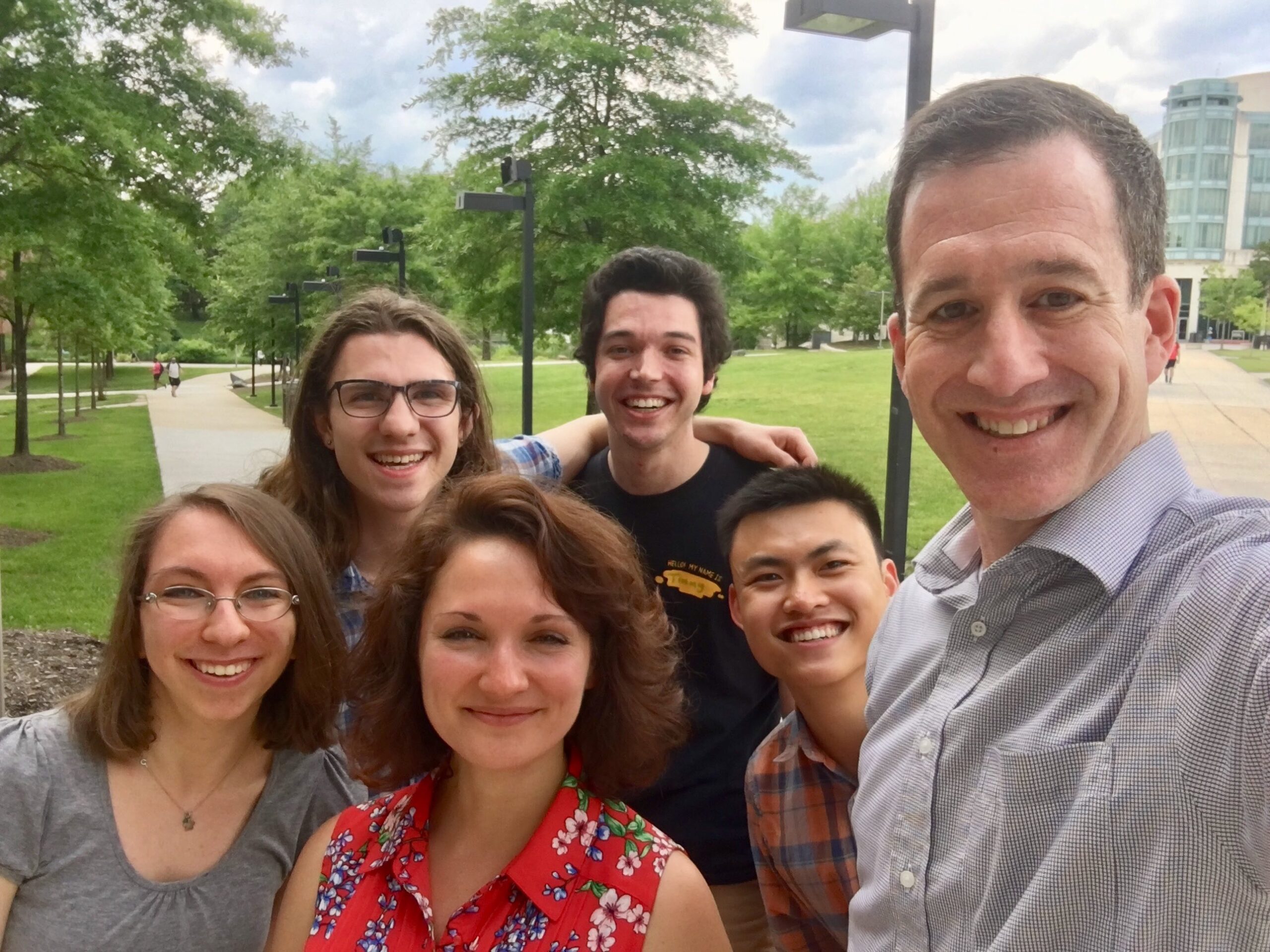
Front row (l-r): Tess McRae, Romy Hübler, Brandon Liu, and David Hoffman. Back row (l-r): Pat Michael and Timothy Farrell. Photo courtesy of Hoffman, 2019.
Liu is graduating as a Sherman STEM Teacher Scholar and will soon begin his master of arts in teaching for secondary biology at UMBC. He shares, “I know that UMBC values the same things I do. And with a master’s in teaching from UMBC I know I’ll be able to take on the responsibility of building and supporting communities in the schools and classrooms where I’ll teach in the future.”
Creating shared spaces
Meghan Lynch ‘18, political science, and M.P.P. ‘21, will soon become a double alumna of UMBC, after earning her master’s in public policy. She says she still thinks about one particular class on civic agency during her undergraduate years, which shaped her UMBC experience, her career path, and her perspective on the world. Her a-ha moment: “I realized that the idea of creating shared spaces and bringing democracy into the classroom was a very concrete way to realize the power we all have in every space,” she says.
Lynch describes UMBC as a place that supports, nurtures, and encourages political engagement in all forms. Creating spaces for community dialogue and mutual support was especially important during COVID-19 and the intense election cycle. As vice president of UMBC’s Graduate Student Association (GSA), Lynch is proud of how the group helped to offer space for dialogue and build community as a co-host for the CDCL’s “Together Beyond November” post-election discussions.
Meghan Lynch. Photo by Poulomi Banerjee ‘16.
“Amidst all the fatigue and difficult news in the world, the Center, SGA, and GSA were able to coordinate very meaningful and well-attended events leading up to and after the election,” says Lynch. “It was clear that the UMBC community wanted to spend time coming together to think about our role in bringing about change and hearing about the issues. I left every one of these events feeling refreshed in a humble and grateful way.”
Resources for success
During the COVID-19 pandemic, Lynch and other GSA officers created a well-being committee, recognizing the importance of students’ mental, physical, and spiritual well-being. “We’ve had an excellent turnout to committee meetings in part because people are looking for a place to reflect on how to help each other,” she says.
“Amidst all the chaos and uncertainty, I’m so proud that GSA has found ways to connect students to the resources they need and serve as a gathering space–even virtually,” Lynch says. “I’m also proud of the strides we are making to ensure that graduate students are intentionally included in programming and other opportunities across campus.”
Creating community, Lynch reflects, “is a way for people from different departments across campus to collectively work towards solutions that benefit all of us.” And every new relationship or new project “starts from just one conversation,” she shares, so “there’s beauty in just talking with people.”
Meghan Lynch and True Grit. Photo by Poulomi Banerjee ‘16.
After graduation, Lynch will teach an introductory political science class at UMBC and serve as the new director for the Catonsville Chamber of Commerce. She says, “I hope to take all of the transformative experiences I’ve had at UMBC beyond Hilltop Circle to help others realize their ability to make their communities better for everyone.”
One person who looks forward to seeing the impact of her work is CDCL Director David Hoffman Ph.D. ‘13, language, literacy, and culture. Hoffman shares that Lynch, Liu, and Khan all “embody the idea that we can bring our whole, unique selves to the work of shaping our communities.” He says, “Their contributions have helped make UMBC even more deeply and visibly what it has been all along: caring, inclusive, and engaged.”
Featured image (l-r): Mariam Abalo-Toga, Roy Prouty, Anjali Dassarma, Brandon Liu, President Freeman Hrabowski, and Lilly Keplinger stand by True Grit, 2018. Photo by Marlayna Demond ’11 for UMBC.
Article written by Eleanor Lewis, communication specialist in the Division of Student Affairs.
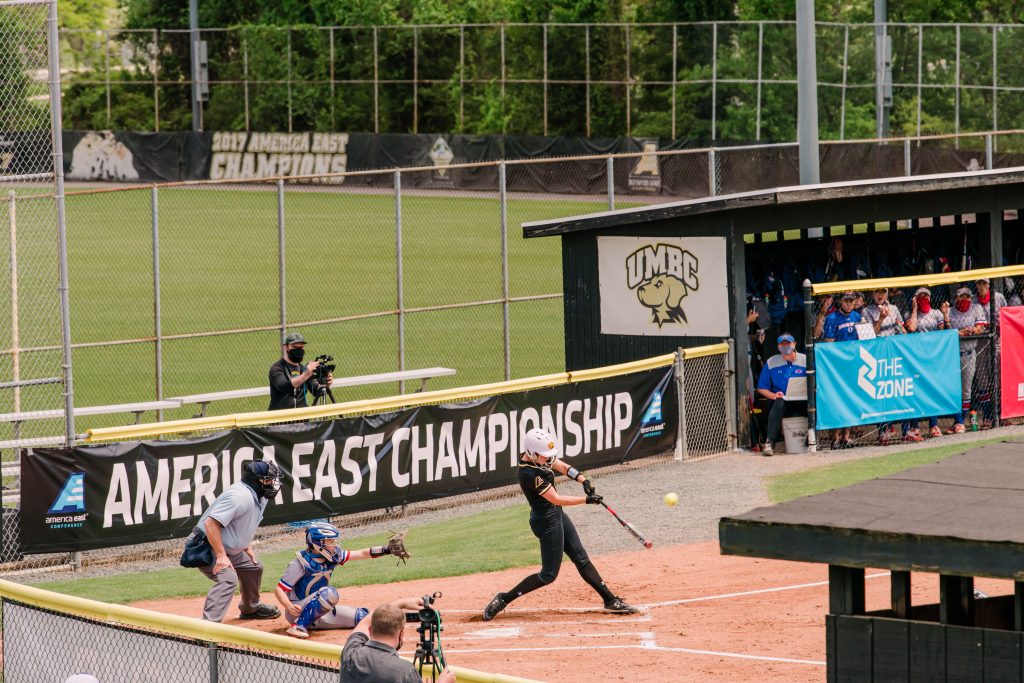
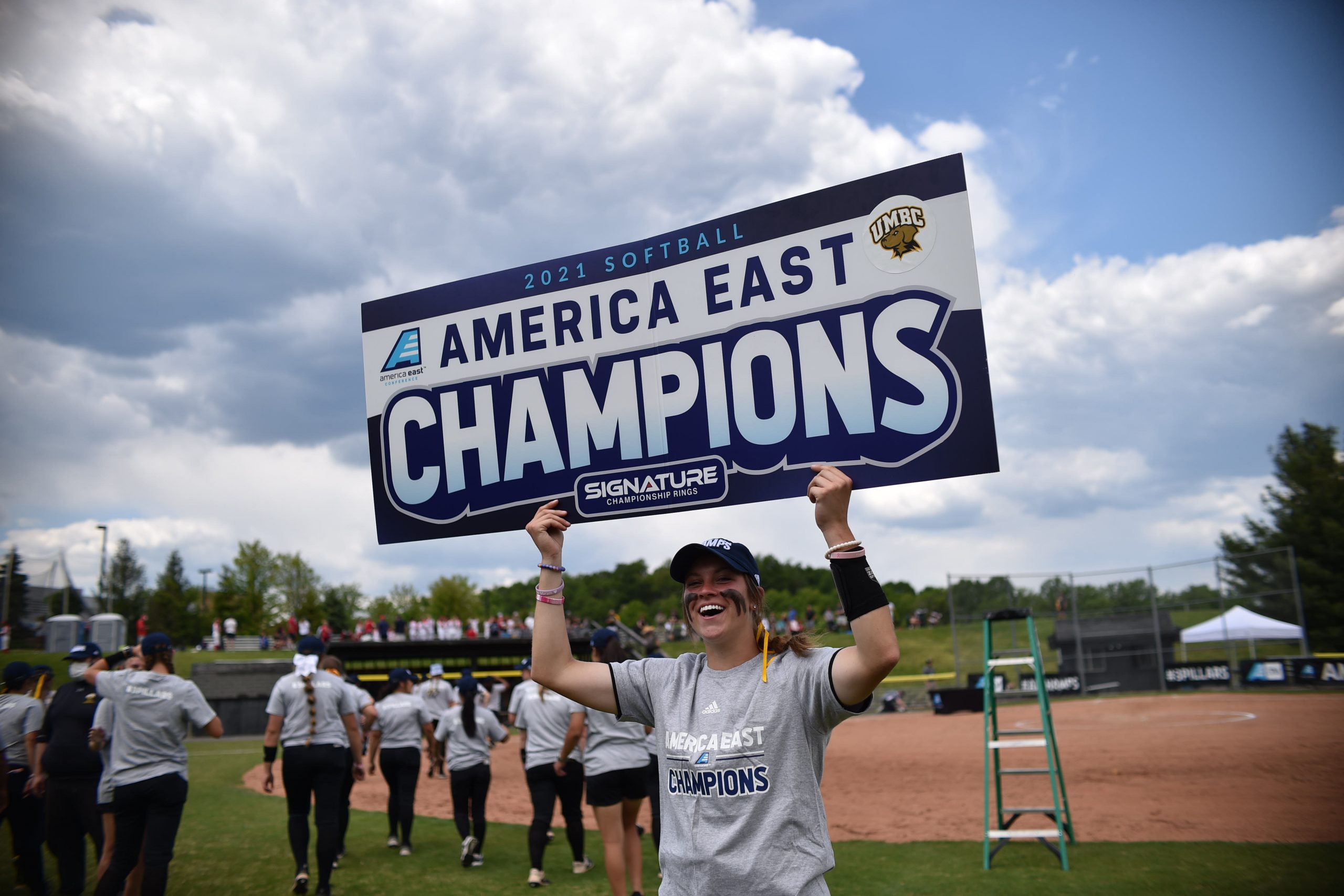
After five scoreless innings, UMBC softball pulled ahead in the bottom of the sixth to successfully defend their 2019 America East title with a 1-0 win over No.3 seed Stony Brook in the 2021 America East Championship this past Saturday.
Sierra Pierce ‘21, design, drove in the winning runs in the Retriever’s final two games. A Second Team All-Conference selection, Pierce earned a spot on the All-Championship Team for the third time and was named the tournament’s Most Outstanding Player.
Shanel Stott ‘23, information systems, hits an RBI triple in the first-round win over UMass Lowell last Thursday.
“I felt honored to be named,” says Pierce of her Most Outstanding Player achievement. “There’s a lot of talent on our team and there were many teammates who deserved to be recognized. It really was a team effort out there.”
Julia Keffler ‘22, media and communications studies, also a Second Team All-Conference selection, was named to the All-Tournament Team thanks to her spectacular showing at the plate and on the base paths.
Return honors
In light of the pandemic and the impact it had on many student-athletes, the NCAA granted athletes an additional year of eligibility to players. Maddie Daigneau ‘21, media and communications studies, was the only senior who elected to return to finish out her senior season. She also earned a spot on the All-Championship Team after batting .333 with a run scored, a stolen base, and stellar play at shortstop.
“I am so thankful to have the opportunity to come back for a fifth year and be a part of the growth of this talented program,” says Daigneau.
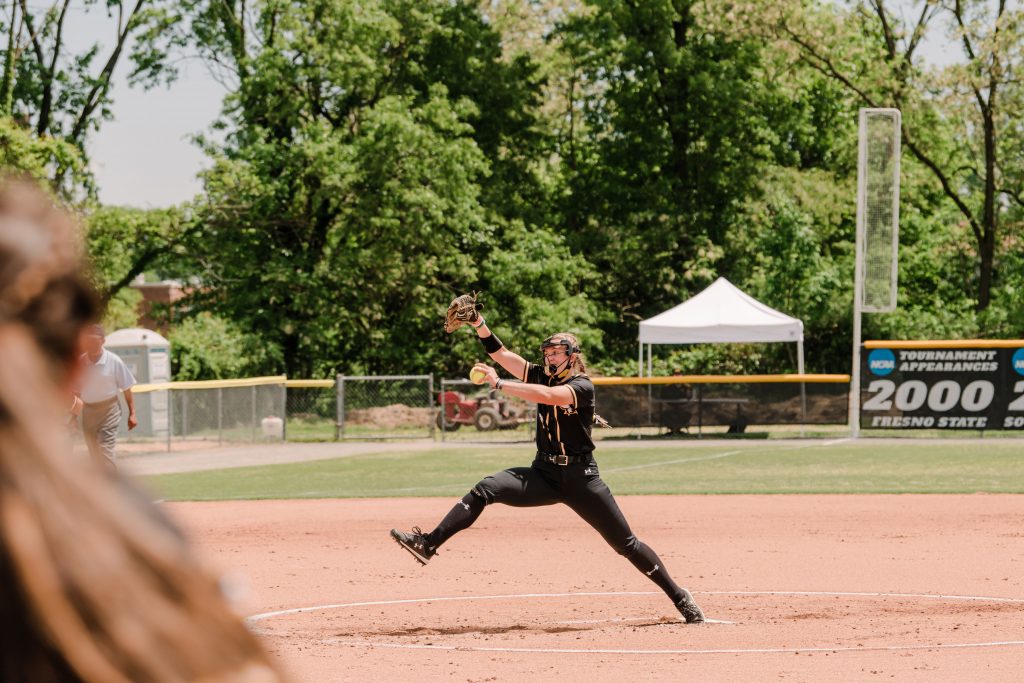
Coppersmith winds up to pitch against UMass Lowell.
Two-time America East Pitcher of the Year Courtney Coppersmith ’22, biochemistry, was the final Retriever to earn All-Championship Team honors, going 3-0 with just one run allowed and 25 strikeouts in three complete games. Coppersmith is the first student-athlete since 2001 to be a repeat America East Pitcher of the year.
Continuing a legacy
The victory earns UMBC its fourth-ever NCAA Tournament bid, and it’s the first of the four to be won at home. It was also the first championship win on campus for a Retrievers team since men’s soccer won the America East title at Retriever Soccer Park in 2014.
Despite returning almost its entire starting lineup from the 2019 championship team, the Retrievers were voted to finish third in the preseason coaches poll. UMBC then went on to go 11-5 in conference play, not only picking up its most conference wins in a season since 2009, but also winning its first-ever America East Regular Season championship, and earning the right to host the tournament.
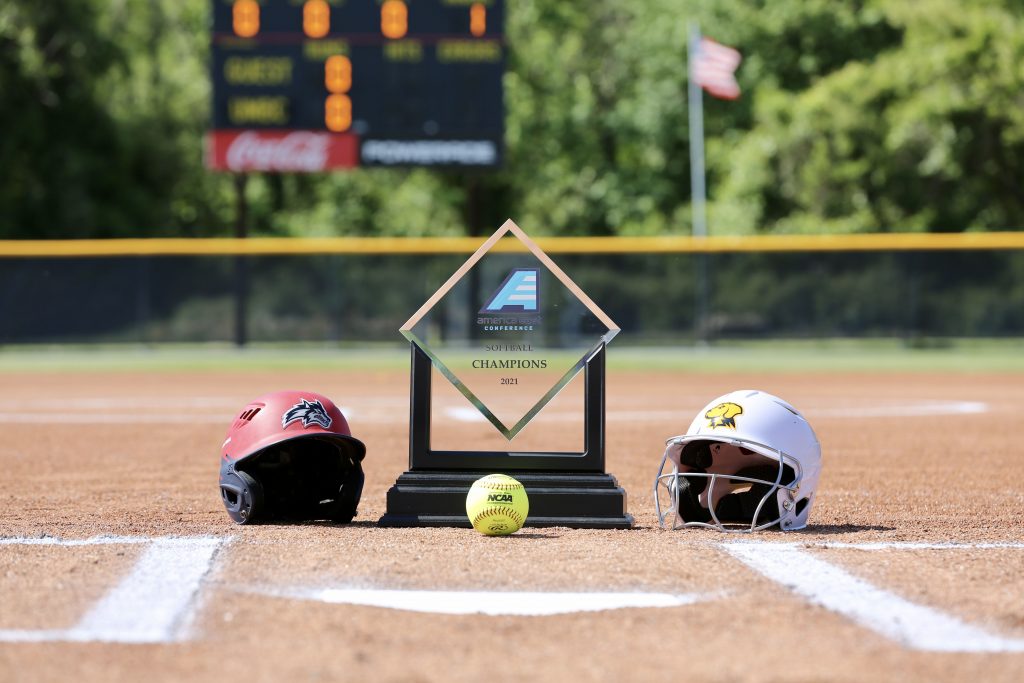
UMBC comes out victorious in the rematch of the 2019 America East Championship. Photo courtesy of America East.
Head coach Chris Kuhlmeyer became the first Retriever Softball coach to be named America East Coach of the Year, after leading UMBC to its first-ever America East Regular Season title earlier this month.
“This will be a season I will never forget,” says Kuhlmeyer. “From rallying to win the regular-season title, to coming through with two outs in the sixth inning of the conference tournament championship game, there are so many memories I will take away and more to be made.”
The road to Arizona
The Retrievers will travel to Tucson, Arizona to face No.11 Arizona this Friday, May 21, at 8:30 p.m. for the first round of NCAA tournament play. The other two teams in the double-elimination, four-team pod are Villanova and the University of Mississippi.
“Arizona is a great team and one of the most historic programs in our sport. To face off against them in the first round of the regionals is certainly very exciting, but at the same time our Dawgs are not showing up just to say we made it to a regional,” assures Kuhlmeyer. “We’re coming with the mindset we are going to compete and do what we have done all year: fight all the way to the end for a victory, one game at a time.”
Ashley Della Guardia ’24, undergraduate studies, celebrates the America East win. Photo courtesy of America East.
An Arizona native, Daigneau will get to play in front of her family for the first time in her collegiate career.
“It’s the best feeling to play regionals at the place I first started playing softball and being able to play one of my last tournaments there as well,” shares Daigneau. “Arizona was the place that helped me meet all the wonderful people who have been a part of my softball journey. I can’t wait to see them watch our games live this weekend.”
Article written by Zach Seidel, director of athletics digital media. Featured image: UMBC softball poses with their America East trophy. Photo courtesy of America East. All additional photos courtesy of Marlayna Demond ‘11 unless otherwise noted.
Due to the pandemic, the NCAA has offered senior college athletes around the country a waiver to compete for an extra year. Many fourth-year student-athletes at UMBC and around the country will take advantage of this opportunity, but others decided to press forward with making the most of an unusual senior year before shifting gears to the next phase of their lives.
Among that group in Retriever Nation are a pair of lacrosse players, a swimmer, and a diver who will earn undergraduate degrees this month. All four are recognized for outstanding achievements during a very challenging time for student-athletes. And all four share that support from UMBC Athletics staff was instrumental in helping them reach their goals and move forward along their paths.
From sports to sports journalism
Nick Doyle ‘21, media and communication studies, has been a steady contributor for men’s lacrosse, including during UMBC’s America East championship run and NCAA Tournament win over Marist in 2019. He’s also a voice of UMBC Athletics, both on air and behind the scenes.
Doyle assisted with player interviews on “The Ryan Odom Report,” provided on-air analysis on women’s soccer’s streamed game broadcasts, and led social media takeovers for the men’s lacrosse Instagram account, among other projects. He also wrote game recaps, gained experience behind the camera, shadowed on-air talent, and learned how to construct a sports broadcast.
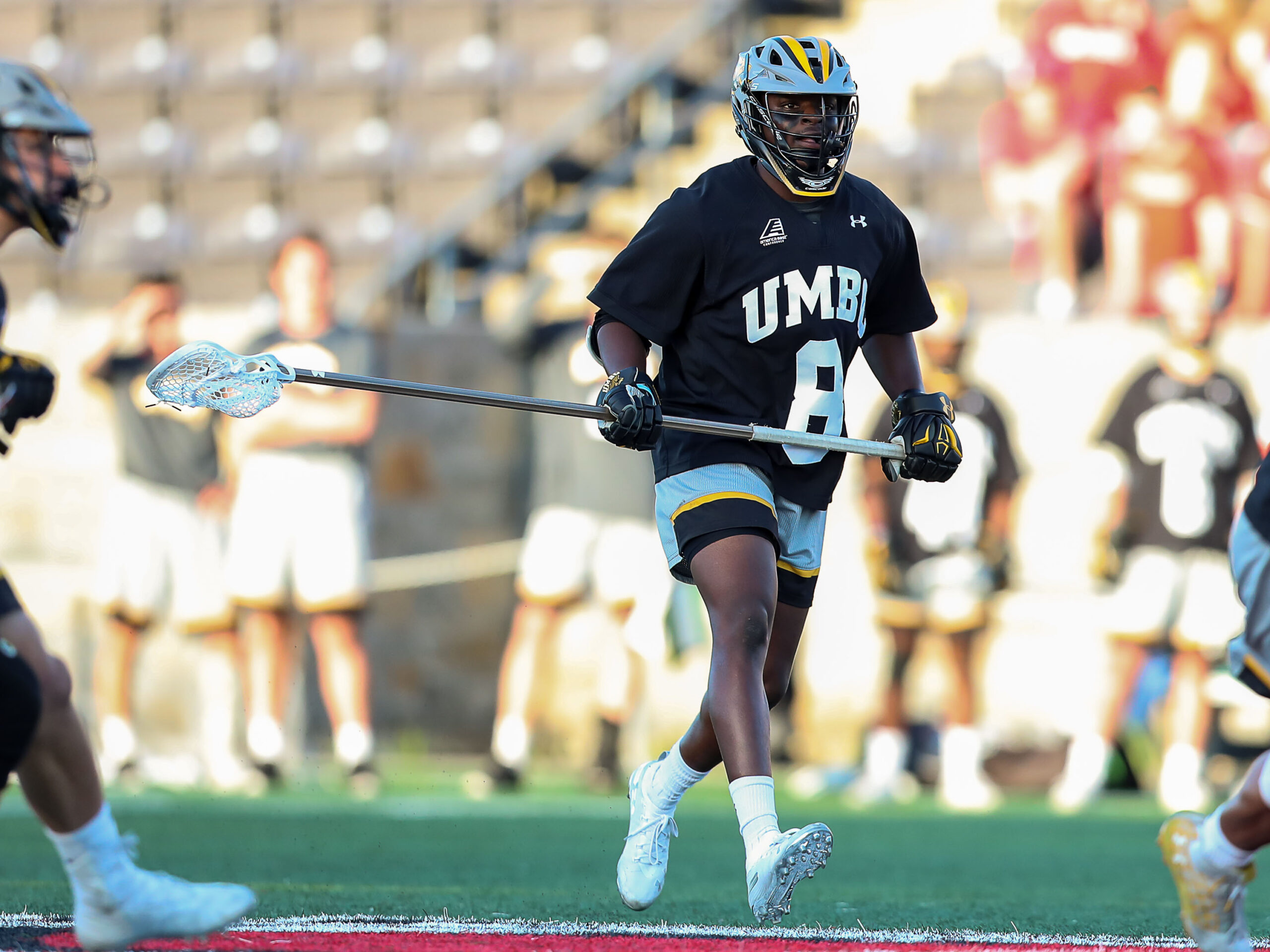
UMBC lacrosse player Nick Doyle. Photo by John McCreary for UMBC Athletics.
“UMBC’s partnership with ESPN+ allowed me to receive hands-on experience inside the tech truck with producers, directors, replay personnel, and graphics,” says Doyle. The San Diego native worked for his hometown Padres’ flagship station in the summer of 2019 and put those recap writing skills to good use.
“UMBC Athletics has been an invaluable source of support, guidance, and confidence for me,” Doyle shares. “Since I introduced myself to Steve Levy [‘85, interdisciplinary studies], he has taken me under his wing and has done an amazing job getting me into positions of opportunity and experience.”
He also noted that Zach Seidel ‘12, media and communication studies, M.S. ‘15, human-centered computing; Dustin Roddy ‘14, American studies; and Shanna Moser have “all played instrumental roles in advancing my experience at UMBC, not just as a student-athlete, but in sports journalism.”
Doyle will pursue his master’s degree at the University of Maryland, College Park’s Philip Merrill School of Journalism in the fall.
Community leadership
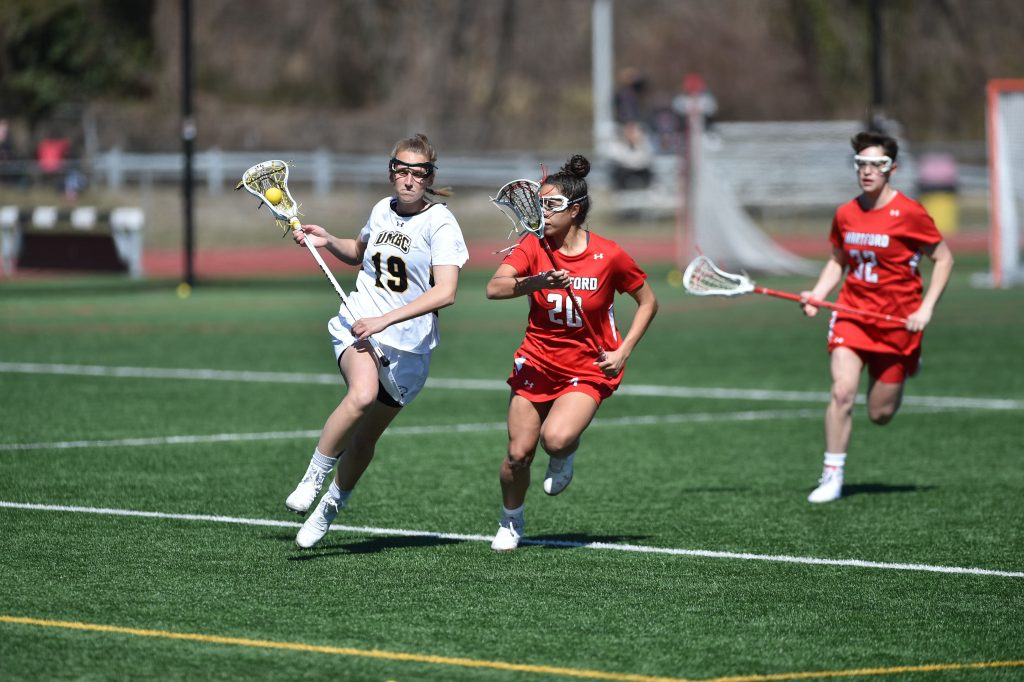
Like Doyle, Cassie Evans ‘21, biological sciences and psychology, is a defender on the lacrosse field. She has started in all 33 UMBC’s women’s lacrosse contests since 2019 and earned America East All-Academic Team honors in 2020 and 2021. She’s also a 4.0 student who earned the UMBC psychology department’s 2020-21 Distinguished Achievement Award. And she got there, she says, thanks to the support of a caring advisor.
Evans serves on the executive board of the Student-Athlete Advisory Committee, for which former UMBC Athletics’ Academic Advisor Kristin Ferris served as staff advisor. “Kristin has always believed in me,” Evans shares. “I always went to her when I was stressed or struggling and she actively worked to create a plan of action that helped me approach problems with ease. She advocated for me in so many settings.”
UMBC’s Cassie Evans (left) competes against Hartford. Photo by Gail Burton.
Ferris shared that Evans “has been tremendously effective as a community leader despite challenges faced by the COVID-19 pandemic.” In summer 2020, Evans coordinated a virtual 5k that raised over $2,000 for Baltimore’s Living Classrooms organization in support of anti-racism and social justice. She later organized an equipment drive for the Children’s Home, collecting over $3,300 of sports equipment and art supplies for displaced children.
Evans shares that Ferris introduced her to leadership opportunities she didn’t know existed, such as serving as the student-athlete representative on UMBC’s Athletics Policy Committee. Of Ferris, Evans says, “I respect her so much and have learned so much from her. She has taught me through her own actions the importance of work ethic, persistence, reliability, accountability, and determination.”
Currently studying for the MCAT, Evans will continue volunteer work in Baltimore and El Salvador prior to medical school. Her long-term career goal is to support those who do not have access to affordable medical treatment.
Team support
As a men’s swimming team captain for two years, Jeremy Gates ‘21, mechanical engineering, has spent a lot of time thinking about how to support his teammates in connecting with and taking care of each other and competing at a high level during a pandemic. Part of his approach was hosting outdoor, small-group team-building activities that met COVID-19 protocols. Another major piece was being present for other swimmers who needed one-on-one support.
“I have tried to make myself available for my teammates whenever they need it,” says Gates. While he doesn’t always know the perfect thing to say, he shares, “I have found that simply lending an ear as a friend is a good start.”
Gates also found it was important to reach out to others for support, and to make sure he was managing his own stress. “I am no help to anyone if I don’t take care of myself first,” he says. “The great thing about this team is that there are numerous people I can go to if I need someone to lean on.”
One person that Gates and his teammates leaned on was Brian Amenta, director of strength and conditioning. Amenta, a six-year UMBC veteran, completely revamped all 17 UMBC Athletics’ teams training regimens to meet COVID health and safety guidelines, and understood the pressures Gates was experiencing.
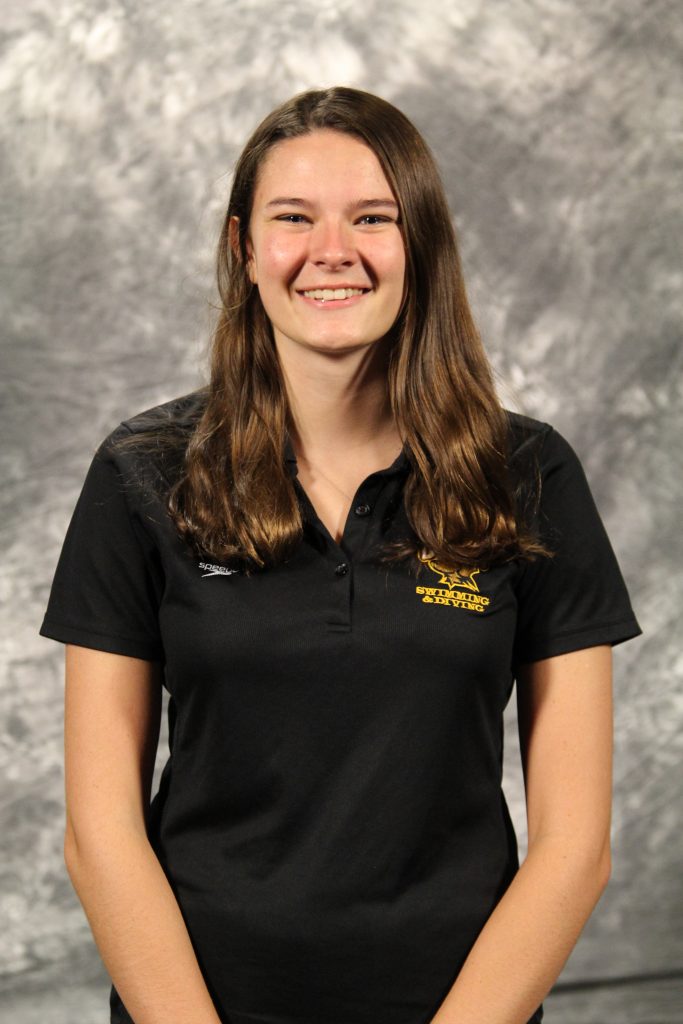
UMBC swimmer Jeremy Gates. Photo by Ian Feldmann.
Amenta became a fixture in the lives of Gates and his teammates. Starting in fall 2020, Amenta worked with the team twice each week twice each week at 6 a.m., with dry land training. He provided Gates with a model for working effectively with a large group of student-athletes while supporting team members’ individual needs.
After graduation, Gates will reconnect with family in California before starting as a systems engineer through Northrop Grumman’s Pathways Program.
“One of the toughest years”
After injury-plagued sophomore and junior campaigns, diver Isabel Rayner ‘21, biological sciences, was looking forward to a strong finish to her UMBC career as team captain. Then came the COVID-19 pandemic. Rayner helped her team feel connected and supported at a time of great uncertainty. The cancellation of a meet in fall 2020, just three days before it was scheduled, was a particularly challenging setback.
UMBC diver Isabel Rayner. Photo courtesy of UMBC Athletics.
“My biggest goal in being captain is to make everyone feel that there is support all around them,” said Rayner. Her greatest challenge was taking care of herself. “I was so focused on making sure that everyone else was okay that I struggled to find a balance,” she says.
Rayner’s injuries started in her sophomore year—chronic bicep and shoulder strains and a sprained ankle in 2018-19. That same year, athletic trainer Meghan Sullivan (at UMBC since 2011) was assigned to the team. “Meghan has been there for me without fail,” says Rayner. “These injuries were never severe enough to keep me out of diving, but they did require physical therapy. I was in the training room every day with Meghan. And she was always there for emotional support.”
Last season, Rayner suffered a wrist injury when entering the water and was back in the training room daily. She was able to compete in the 2020 championships and climbed the ladder for the final time as a Retriever in an April 2021 meet, placing second on the three-meter board.
She’s grateful to Sullivan for helping her get to the podium one more time in her senior year. “Meghan has been invaluable to me and others as a support system while we’ve gone through one of the toughest years of our lives,” Rayner says.
After graduation, Rayner will work as a diving coach prior to graduate school.
Article written by Steve Levy, associate athletic director for athletic communications. Featured image: UMBC lacrosse player Nick Doyle. Photo by John McCreary for UMBC Athletics.
Looking out her window at the blue sky on Sunday, UMBC Mock Trial President Sydney Gaskins ‘21, political science, remembers thinking, “What a beautiful day to win a national championship.” But she didn’t quite realize exactly what becoming a champion would feel like. Now, she knows.
On the evening of April 18, UMBC defeated Yale University to win the American Mock Trial Association National Championship for the first time in program history.
The final round was a nail-biter for Retriever fans tuning in online. Five of the eleven judges voted for UMBC, five went for Yale, and the final judge stated it was a tie. To determine the winner, the judges tallied the scores from all their final round ballots, which put UMBC ahead of Yale, 1,360 to 1,355. The five-point margin was the second-closest winning margin in AMTA National Championship history.
Confident and prepared
Gaskins has been widely recognized as one of the top mock trial competitors in the country. With her on Sunday (over Zoom) was UMBC’s well-rounded, practiced team, whose combined efforts made the victory possible. Team members included Thomas Azari ‘22, political science; Natalie Murray ‘22, biological sciences; Maria Kutishcheva ‘24, political science and Russian; Zinedine Partipilo Cornielles ‘23, political science and financial economics; Lauren Wotring ‘22, political science; and Thomas Kiley ‘21, political science.
They were assisted by three team members who provided technical support: Sunnah Brooks ‘23, political science; Brinda De Tchappi ‘23, political science; and Poushali Banerjee ’23, health administration and policy.
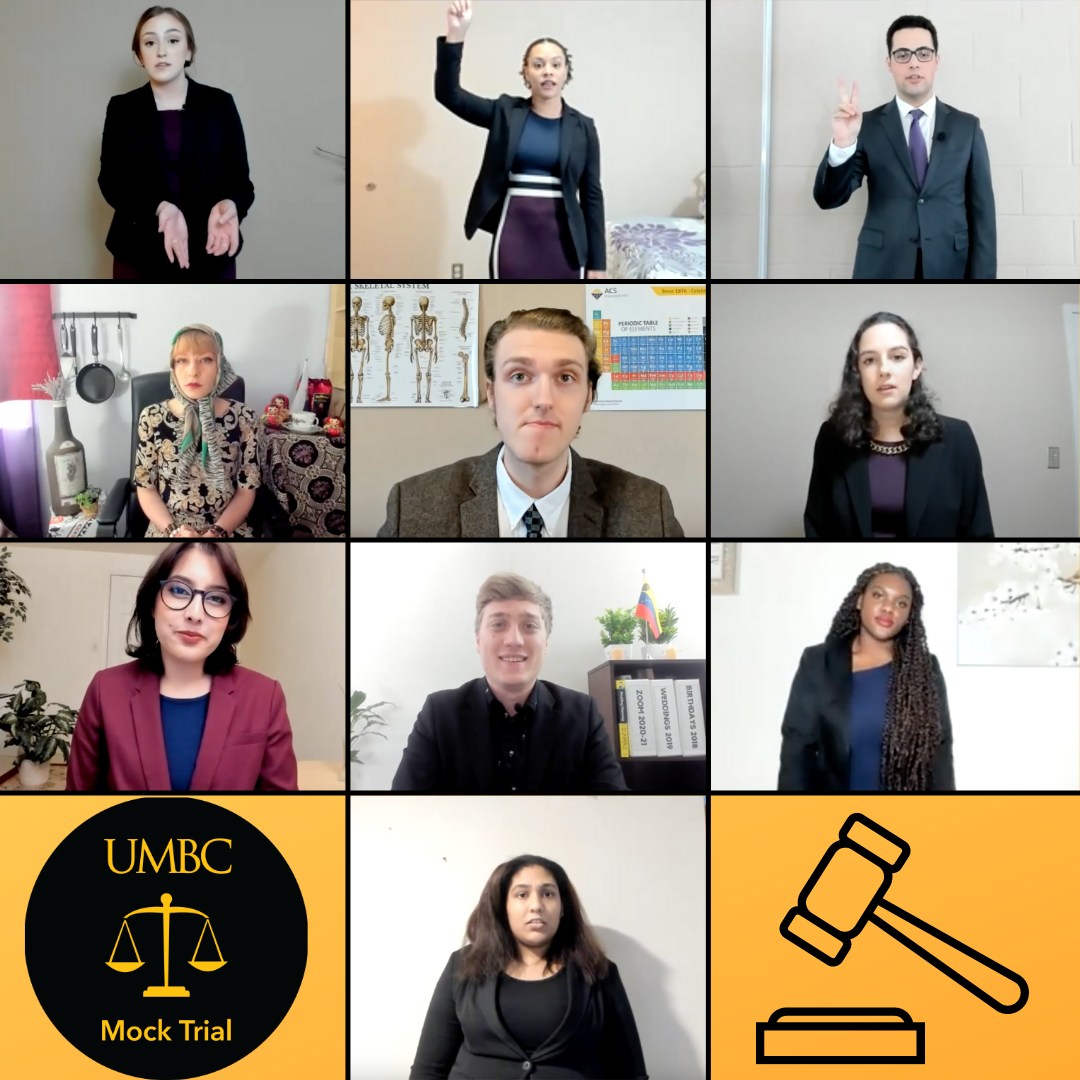
Screenshot of the UMBC Mock Trial team from the Opening Round Championship Series. Courtesy of UMBC Mock Trial.
“I’m always confident in my team’s ability,” says Azari. “But I was on the edge of my seat.”
The last time UMBC faced Yale was in the fourth round of the National Championships in 2019. UMBC narrowly lost, with the teams splitting the round’s ballots 2-2. Since Yale had more ballots going into the round, they moved on to the National Championship final that year.
UMBC’s win comes after an undefeated regional season and 8.5 wins at the Opening Round Championship Series (ORCS).
“It was one-hundred percent the right time and our time,” says Gaskins, about their win.
Success requires sacrifice
Mock Trial coach Ben Garmoe ‘13, political science, says the team’s national championship title is a dream come true, reflecting hundreds of hours of hard work. UMBC Mock Trial has made it to the national championship competition in three out of the past four seasons. Even knowing they would be competing with 650 teams this year, and that they’d have to rework their approach for a Zoom environment, they had their eye set on the final from the very beginning.
“The team has given up so much to get to this level,” says Garmoe. “It is a testament to their individual character that they’ve decided that they want to be great at this activity and that they’re willing to commit so much time, dedication, and energy to it.”
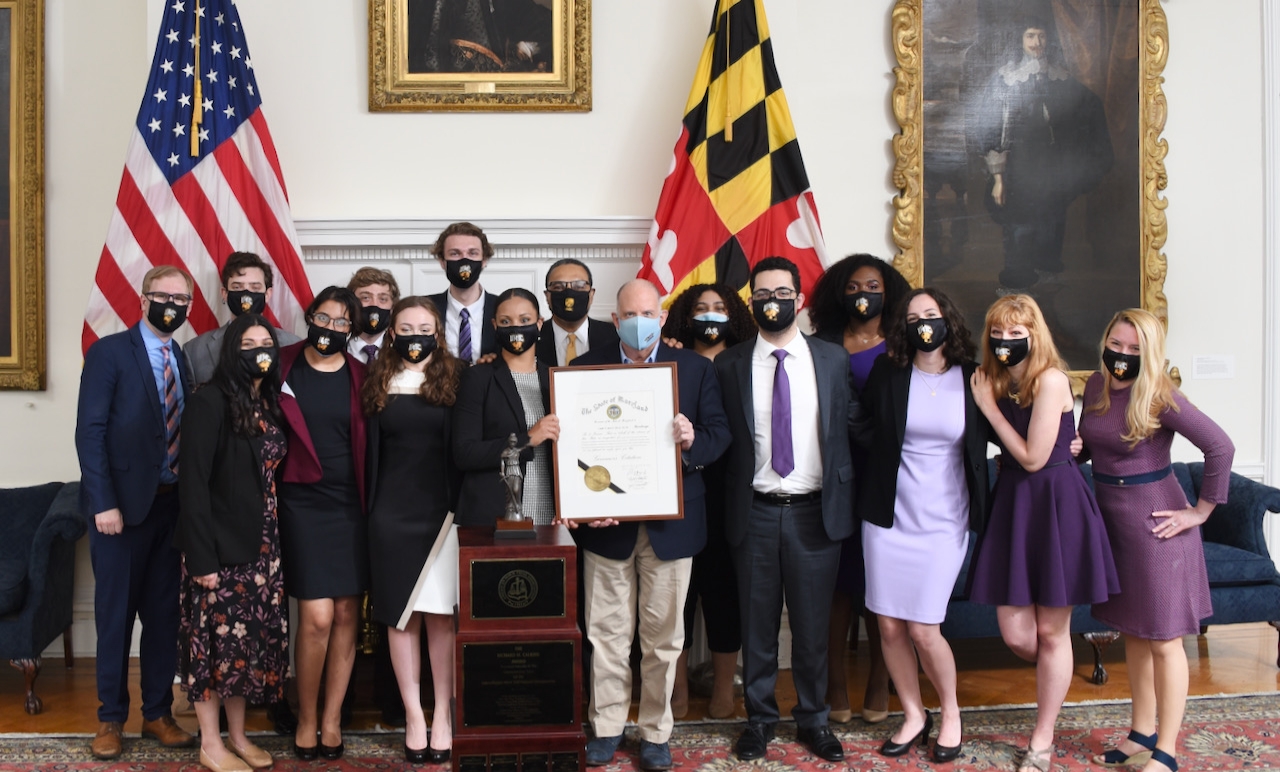
Maryland Governor Larry Hogan (center) congratulates UMBC Mock Trial on winning the 2021 national championship. Photo courtesy of the Office of the Governor.
Their sacrifices paid off by earning the team not just the national title, but also individual honors. Every team member earned all-American titles for competing in the final round of Nationals. Gaskins also earned a double-sided All-American Attorney award for both defense and plaintiff. Azari earned an All-American Attorney award and Murray won an All-American Witness award.
These awards come after Gaskins earned a double-sided All-National Attorney award and Kiley earned an All-National Witness award at ORCS, the semifinal level competition. The four total all-American titles set a UMBC Mock Trial record for the number of all-American awards earned.
UMBC Mock Trial also earned the Spirit of American Mock Trial Association Award, honoring their commitment to the principles of civility, justice, and fair play.
Community members who wish to support the UMBC Mock Trial team can do so directly through this webform.
Article by Morgan Casey ’22, media and communication studies, for UMBC News. Photo by Marlayna Demond ’11 for UMBC.
UMBC’s Undergraduate Research and Creative Achievement Day (URCAD) has burst out of the ballroom and onto computer screens around the world. For the second year in a row, the popular undergraduate research forum will be entirely online due to the pandemic, using a video presentation and online discussion tool called VoiceThread. But unlike 2020, no rapid shift is needed. After over a year of largely online learning and research, everyone involved is ready to take full advantage of the virtual medium.
“This event has gone global,” says April Householder ’95, director of undergraduate research and prestigious scholarships. Being online means URCAD leapt from about 2,500 people attending in person in 2019 to 8,000 virtual visits in 2020. “Viewers were coming in from as far away as the U.K., Korea, and South America,” says Householder. She expects that trend will continue this year.
April Householder, 2018. Photo by Michael Mower.
Having a full week to explore URCAD this year also means viewers will have ample time to browse the available sessions, rather than “rushing from one thing to another,” says Householder, as they used to do at the in-person event. They’ll be able to explore, at their own pace, research on a vast array of topics, from the effects of anti-Asian discrimination during the COVID-19 pandemic to the Black Lives Matter movement, to cancer treatment, skateboarding culture, and online sneaker sales.
Connecting beyond boundaries
In lieu of face-to-face chats, visitors will be able to participate in online discussions with student presenters. Last year a research group in UMBC’s Asian studies department received feedback from researchers in Korea, says Householder. She hopes that this year, opportunities for these kinds of connections will increase with a new feature that enables users who aren’t from UMBC to comment through URCAD’s VoiceThread interface.
Within the UMBC community itself, Householder hopes students, faculty, and staff will take advantage of the opportunity to explore “things outside their disciplinary box.” Artists, scientists, humanists, social scientists, and engineers can all benefit from each others’ feedback, she explains.
Constraints generate creativity
Last year, when students had to quickly pivot from in-person presentations to using VoiceThread, “they had to learn an additional skill on the fly,” says Householder. This year, students are more prepared to take full advantage of all that the online format offers.
Further, due to the constraints of COVID, student researchers have become even more creative in using technology not just to display their research, but to pursue their research at a time when in-person interviews, fieldwork, and traditional performances aren’t possible. Students learned to do interviews online, adjusted their sample sizes, and navigated lab research within physical distancing guidelines. They also responded to the pandemic by examining the changes in society and in themselves.
One advantage of the online format is that the presentations are available to view in perpetuity. “We now have an archive of the event so we can use it as a teaching tool for future generations of URCAD presenters and mentors,” Householder says.
She finds this addition of an expanded archive and URCAD’s global reach to be fitting developments as the event marks its 25th anniversary. To celebrate the milestone, URCAD will feature a special video “fireside chat” with founders Diane Lee, Kathy Sutphin, Elizabeth Pennington, and Janet McGlynn.
Klaudine Wakasa. Image courtesy of Wakasa.
Viewers will also hear a keynote by Klaudine Wakasa ‘08, financial economics, who serves as a strategy advisor for clean technology ecosystems, consulting with international governments.
UMBC students, faculty, staff, and alumni, and the general public, are invited to view these special sessions, and hundreds of available students presentations at urcad.umbc.edu, April 19-25, 2021. Featured below are a few student presentations that give a glimpse into the range of what will be available. Each has been shaped in some way by the COVID-19 pandemic—in topic, approach, or format.
“COVID-19 telehealth and telerehabilation reflections: Understanding the stroke survivor and caregiver perspectives”
Frances Watson ‘21, computer science, conducted research on telehealth and telerehabilitation services during COVID-19 through UMBC’s Bodies in Motion Lab. “I am investigating the stroke survivor and caregiver perspectives to understand how socioeconomic disparities affect this population,” Watson explains.
Frances Watson. Photo courtesy of Watson.
Watson has so far conducted 20 interviews with rehabilitation specialists about their experience with telehealth appointments, alongside her graduate mentor, human-centered computing Ph.D. student Adegboyega Akinsiku. She is also currently interviewing stroke survivors and caregivers.
“The COVID-19 pandemic not only changed how we conduct these interviews, but also the analysis of them,” says Watson. “We conducted and continue to conduct these interviews on teleconferencing platforms such as Cisco Webex and Zoom, allowing us to video-record them. In comparison, when we were in person we would have an audio recording device present. Now we can rewatch the video recordings for our data analysis.”
The fact that her research technique adjusted to match the format of the telehealth appointments themselves “has proven very useful” in surfacing insights, she says.
Watson was previously able to gain research experience through the Stanford SURF program. As a Center for Women in Technology Scholar and Undergraduate Research Award (URA) Scholar, she also knows the power of research opportunities in developing an identity and career pathway as a STEM researcher, as well as the value of peer support. This has motivated her leadership on campus, including as Student Government Association president in spring 2020.
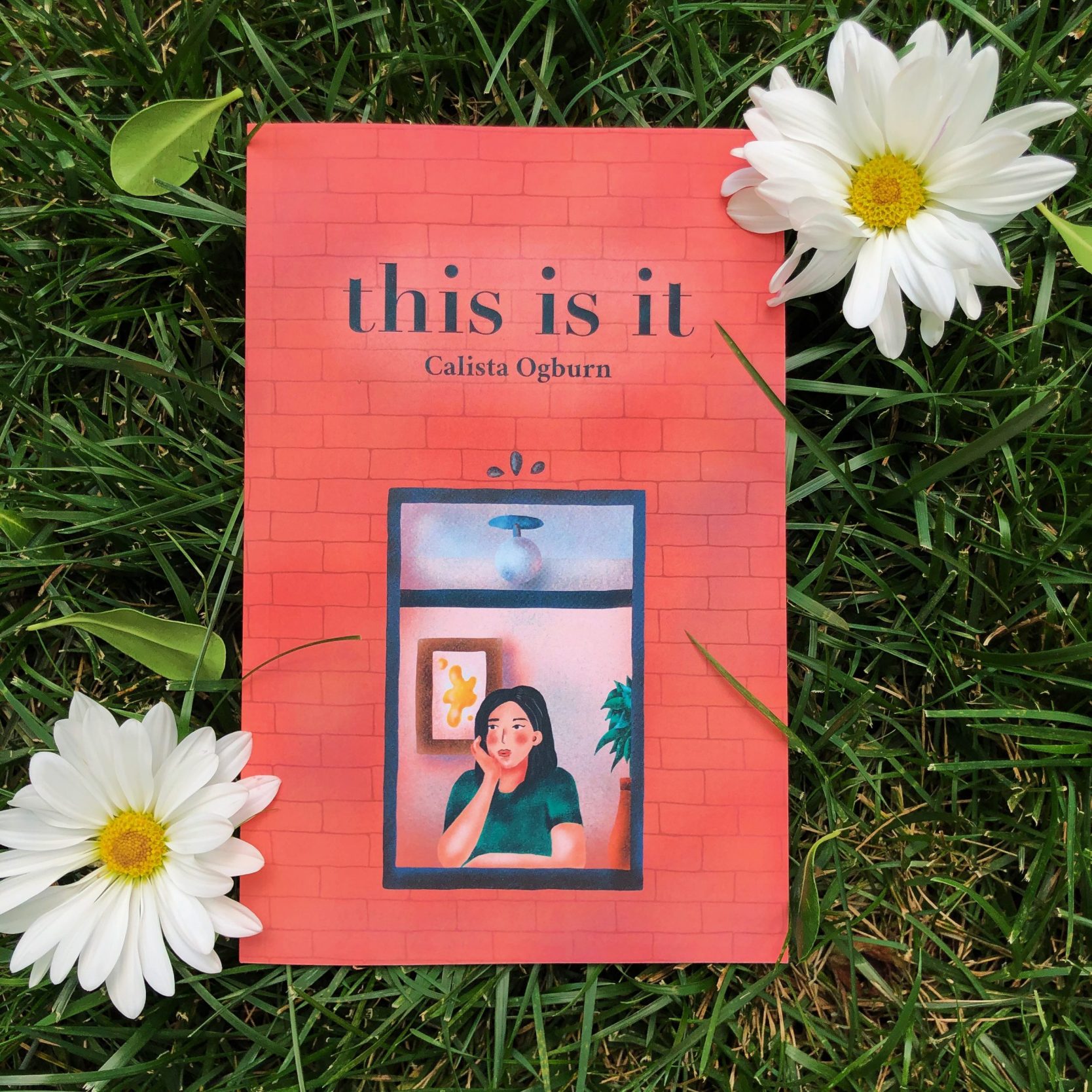
“this is it: A poetic response to the anti-Asian racism during the COVID-19 pandemic”
Just after the pandemic started last March, Calista Ogburn ’21, health administration and policy, felt hurt and angry as she heard about rising anti-Asian hate crimes and racism. Then she herself had an upsetting encounter at a Home Depot. “In that moment, standing in the Home Depot aisle next to the grills, I knew I had to write a poetry collection,” she says.
It was a process that involved many nights of tears, processing heavy emotions. “Reliving past experiences of racism and microaggressions in addition to writing responses to news headlines of anti-Asian racism was utterly exhausting,” she says. She wrote around the clock, and after publication she was gratified to learn “how my poetry has supported others during this turbulent time.”
Poetry collection “this is it.” Image courtesy of Ogburn.
Ogburn does not intend to pursue a career in poetry, but she says, “I hope it remains my best friend.” Ogburn will present poetry from her collection “this is it” at URCAD. “My hope,” she previously shared with UMBC Magazine, “is that these poems can touch those who are feeling loss, loneliness, or the combined grief and rage of experiencing racism.”
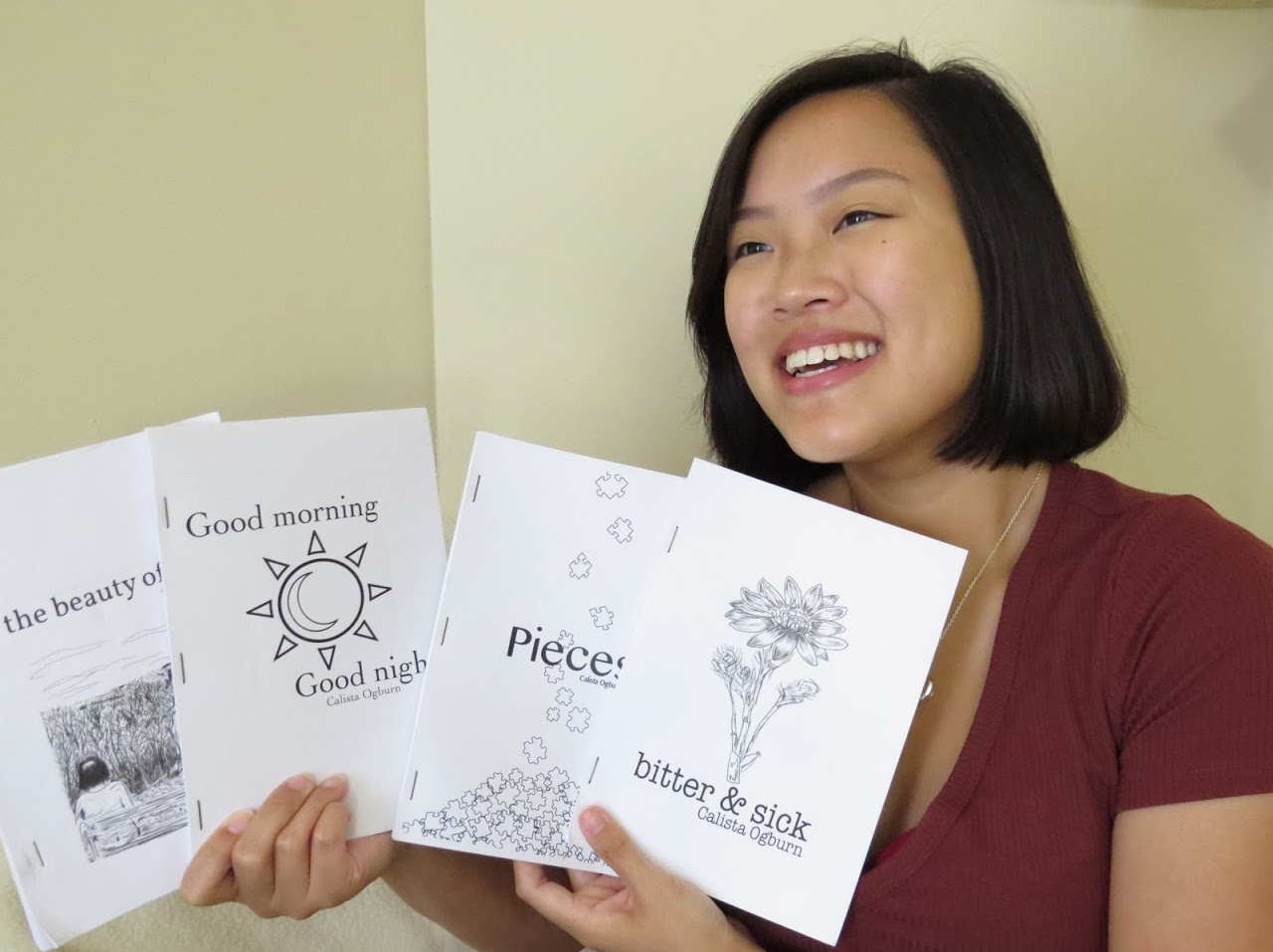
Calista Ogburn poses with her books of poetry. Photo from calista-ogburn.com.
“Modeling radio emission from tidal disruption events”
Omar French ’21, physics and mathematics, came to UMBC to become a theoretical physicist and he will be leaving soon to do just that. He found COVID-19 increased demands on his faculty mentors’ time, requiring him to move forward with his work more independently than before.
“I’m sure most people can agree that controlling one’s work is much more gratifying than the contrary, but of course, it’s a bit like being in the wilderness,” says French. “It forces you to think for yourself and to be confident in what you’re doing.”
Omar French. Photo courtesy of French
French’s research on supermassive black holes has yielded insights. “Perhaps the most remarkable technical thing I’ve learned is that the mass of supermassive black holes central to inactive galaxies can be estimated reasonably from measuring only a few factors,” he explains.
After graduating, French will begin a physics Ph.D. program at University of Colorado Boulder. He describes the past year challenging, but also as a period that helped him grow as a scientist more than any other time of his life. As a result, he is heading off to graduate skill with new skills and a critical eye.
“The obedient body: Researching trained and culturally informed movement biases”
It was during a gender and women’s studies course that URA Scholar Gretta Zinski ’22, dance, read something that rocked her world. She says it was fascinating to learn about how the different social conditioning that men and women experience is reflected in how each gender moves. “The excerpt inspired me to assess my own habits, interests, and biases in an attempt to figure out what were my own thoughts and what I had been taught about my own femininity and beliefs,” she says.
Unfortunately, COVID kept the scope of Zinski’s project smaller than she would have liked, but she was still able to access fascinating findings. “Biases do affect our behavior, which translates into movement,” she says. “The physiological connections between the body and the mind were so interesting to me.”
Still image from Zinski’s dance film project, courtesy of Zinski.
Zinski plans to continue her research and use it to plan bias deconstruction workshops. Of her pandemic research experience, she says, “I learned so much about myself and how to work on my own. This is going to be a very important skill for me and my future career as a self-employed artist.”
“Performing traditional Chinese folk songs”
International travel may have been largely shut down this year, but that didn’t stop URA Scholar Mark Beachy ’21, Asian studies, from exploring China. “When I sing traditional Chinese folk songs I am transported to China and I am experiencing the stories from long ago that are told through the lyrics and music. And it brings me great joy to do that and to share it with others,” he says.
Mark Beachy. Photo courtesy of Beachy.
Beachy’s URCAD presentation features a video performance of the folk song “Jasmine.” He painstakingly edited together his vocal performance with accompaniment from a pianist in Illinois and a guzheng player in China. Beachy found both musicians online. “When singing traditional Chinese folk songs or any song it is important to connect with the other musicians in order to give the audiences an authentic performance of music that deserves respect,” he says.
Beachy returned to college in his 40s after a career as a professional actor and a writer of musicals, wanting to learn something new. Though not of Chinese descent, he has a passion for Chinese culture, language, and history.
His eventual goal is to teach English to Chinese speakers, and he hopes music can be a helpful teaching tool. “Music is a great way to learn a language,” he says. After graduating, he plans to earn a master’s degree at UMBC in Teaching English as a Second Language.
“Interpretation of models of care in residential communities for older adults”
“I am passionate about working with an underserved population and providing elders with quality care,” says Sydney Siegel ‘20, management of aging services. Siegel graduated in Fall 2020 from UMBC’s Erickson School and now works in an assisted living community. Her URCAD project is an analysis of models of care that older adults can experience. “The models of care I studied are about enhancing quality of life and quality of care, something I hope all aging services strive for,” she says.
Interviewing older people proved to be a challenge during the COVID-19 pandemic. In addition to many care facilities being inaccessible, staff members caring for older adults were incredibly busy. However, Siegel found ways to complete interviews online. “I made great connections and heard wonderful stories from participants,” she shares.
Siegel, a URA scholar, credits Erickson School faculty mentor Louise M. Murray with helping her grow in the field. “I definitely felt imposter syndrome when I started the research, but I learned to see my inexperience as a good thing, Siegel says. “Learning is so powerful and I feel grateful to have learned so much.” She looks forward to continuing to use research to inform care she provides for older adults.
“Optimizing in-situ longevity of silver nanoplates”
As a first-year student who started college in the midst of a pandemic, Dariush Aligholizadeh ‘24, biochemistry and computer science, did not have a typical introduction to UMBC. He didn’t want that to affect his ability to get started with research right away, but it was a lot to manage. “I was trying to adjust to college life while also trying to conduct research safely and securely within COVID-19 restrictions,” he says.
Dariush Aligholizadeh. Image courtesy of Aligholizadeh.
Aligholizadeh was able to find a compelling in-person research opportunity in a lab that employed strict physical distancing. His project involved synthesizing silver nanoplates “for their ability to reflect radiation and light to very high degrees.” He explains, “Basically, I make tiny triangles that kill cancer.” And his research experience proved highly gratifying.
“Every aspect of chemistry is in its own way beautiful, and watching these textbook principles come to life in my project is like watching magic happen. I take simple grains of silver salts and they come together in these beautiful sharp triangular structures, almost as if they were put together by hand,” he explains.
Electron microscope image of nanoplates. Courtesy of the Devadas Lab.
Aligholizadeh believes his research experience has already improved his skills in calculus, biology, and organic chemistry, and helped solidify his plans to eventually become a medical doctor. He has also found that the challenges of COVID have required him to improve his time-management and online communication skills. Still, he looks forward to learning in-person again when it’s safe to do so.
The UMBC community and general public can see these presentations and many more at urcad.umbc.edu, April 19-25, 2021.
Featured image: Calista Ogburn, 2018. Photo by Marlayna Demond ’11 for UMBC.
In the latest Higher Education Research and Development (HERD) survey, UMBC has ranked among the United States’ top 100 public institutions in federal research support.
The annual survey aggregated federal research and development expenditures for fiscal year 2019. UMBC reported more than $80 million in research and development expenditures in 2019, the highest reported amount since 2012.
“It is an area of pride for us to make it into the top 100,” says Karl V. Steiner, vice president for research at UMBC. “We’ve now had year-over-year growth in the last six years. We grew our expenditures by 24 percent during that time—a very significant increase.”
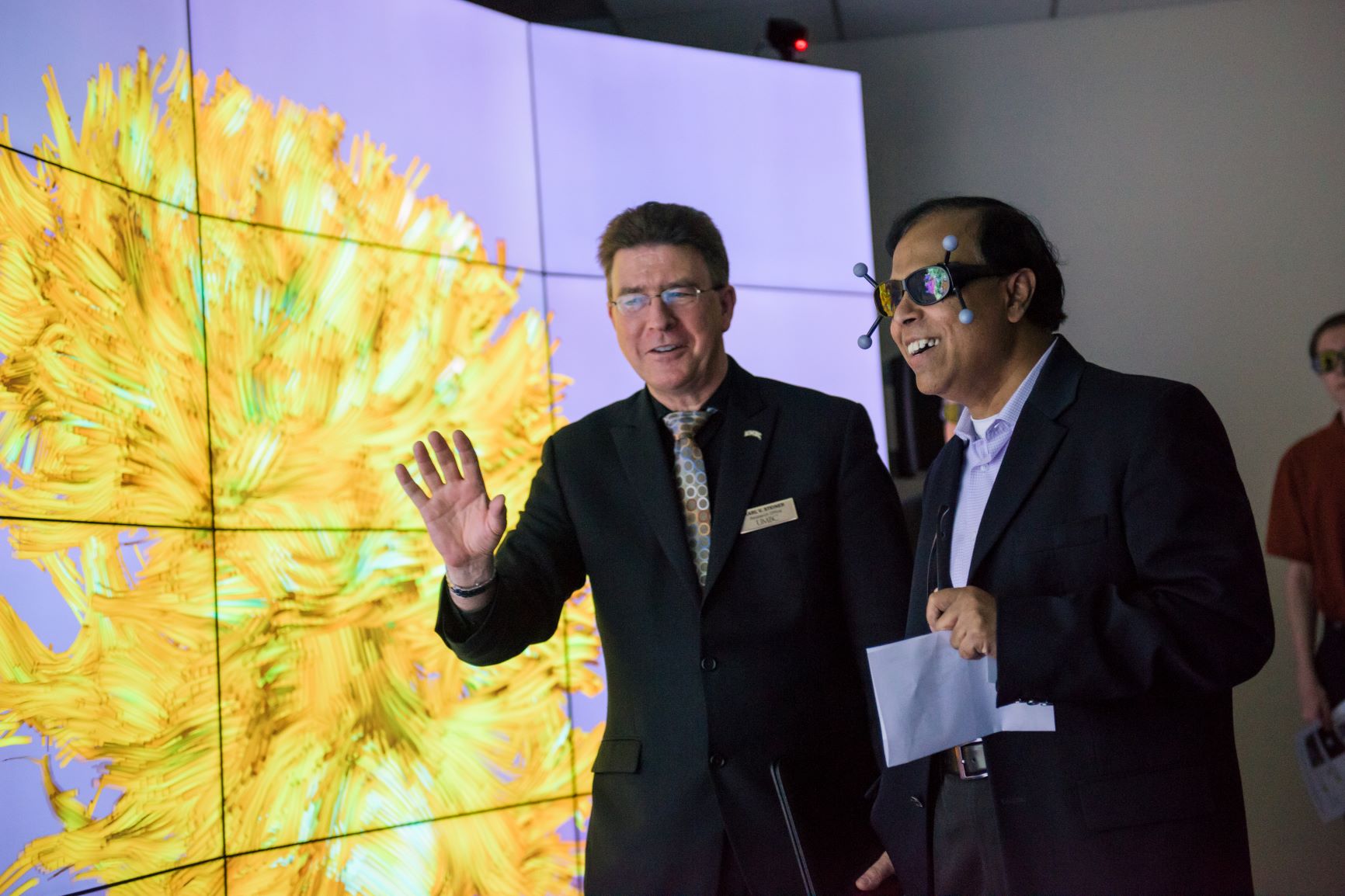
Karl Steiner (left) and Aryya Gangopadhyay at the Pi Squared opening in 2018.
Within the HERD rankings, UMBC is now #122 in overall research and development expenditures among public institutions, #145 in federal research and development expenditures among all institutions, and #169 overall in expenditures among all institutions. UMBC’s funding sources include NASA, the National Science Foundation (NSF), the Department of Health and Human Services, and many others.
“The expenditures are one key method to get a sense of our faculty and students’ research productivity,” Steiner notes. “These rankings also help us see how UMBC is progressing in meeting our public impact research goals.”
NASA-UMBC connection
UMBC continues to fortify its relationship with NASA, ranking #15 overall in NASA funding (#11 amongst public universities). Currently, more than 170 researchers who are UMBC faculty members and research scientists collaborate with NASA Goddard.
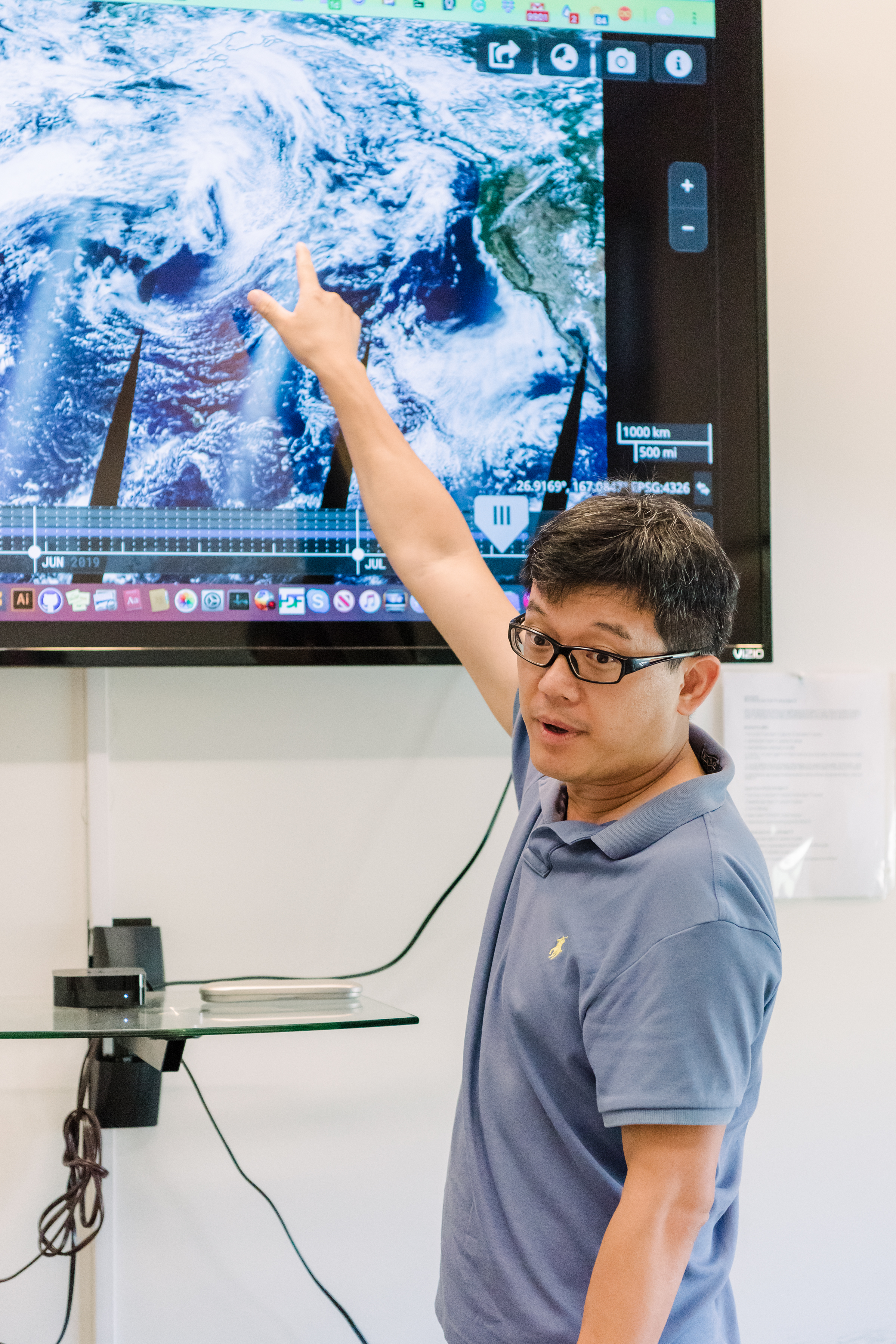
Zhibo Zhang discusses an image collected via satellite with his lab group.
Funding from NASA has contributed to many UMBC-led scientific ventures, including the work of Zhibo Zhang, associate professor of physics.His Aerosol, Cloud, Radiation, Observation, and Simulation (ACROS) research group analyzed data collected from instruments on aircrafts and NASA’s orbiting satellites such as CALIPSO, CloudSat, and MODIS.
They sought to better understand how tiny particles in the atmosphere, such as aerosols and cloud droplets, interact with each other and the radiations from the Sun and Earth, and how these interactions influence our weather and climate systems.
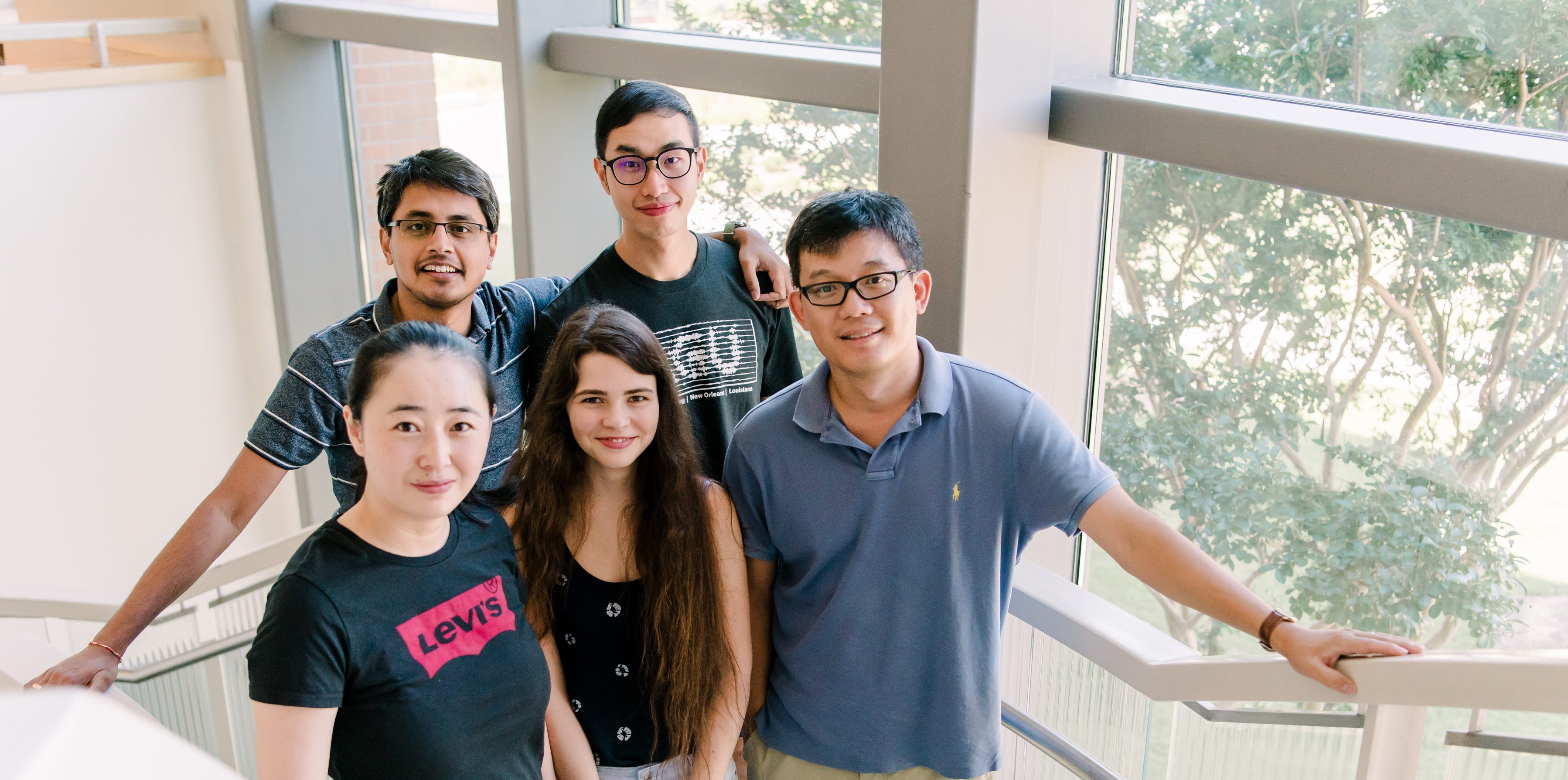
Zhibo Zhang (at right) with students (clockwise from lower left) Qianqian Song, Chamara Raja, Kevin Zheng, and Olivia Norman in 2019.
Explorations in the urban environment
In geosciences, atmospheric, and ocean sciences, UMBC ranked #39 in federal funding. Amongst UMBC’s federally-funded projects is Claire Welty’s study exploring Earth’s “critical zone”—from treetops to weathered bedrock—in urban centers along the Eastern Seaboard. NSF awarded Welty and her team a $4.8 million Critical Zone Collaborative Network grant to execute this project over five years.
Welty is director of UMBC’s Center for Urban Environment Research and Education (CUERE) and a professor of chemical, biochemical, and environmental engineering (CBEE). She is collaborating with Andrew Miller, professor of geography and environmental systems, and researchers in four other East Coast cities.
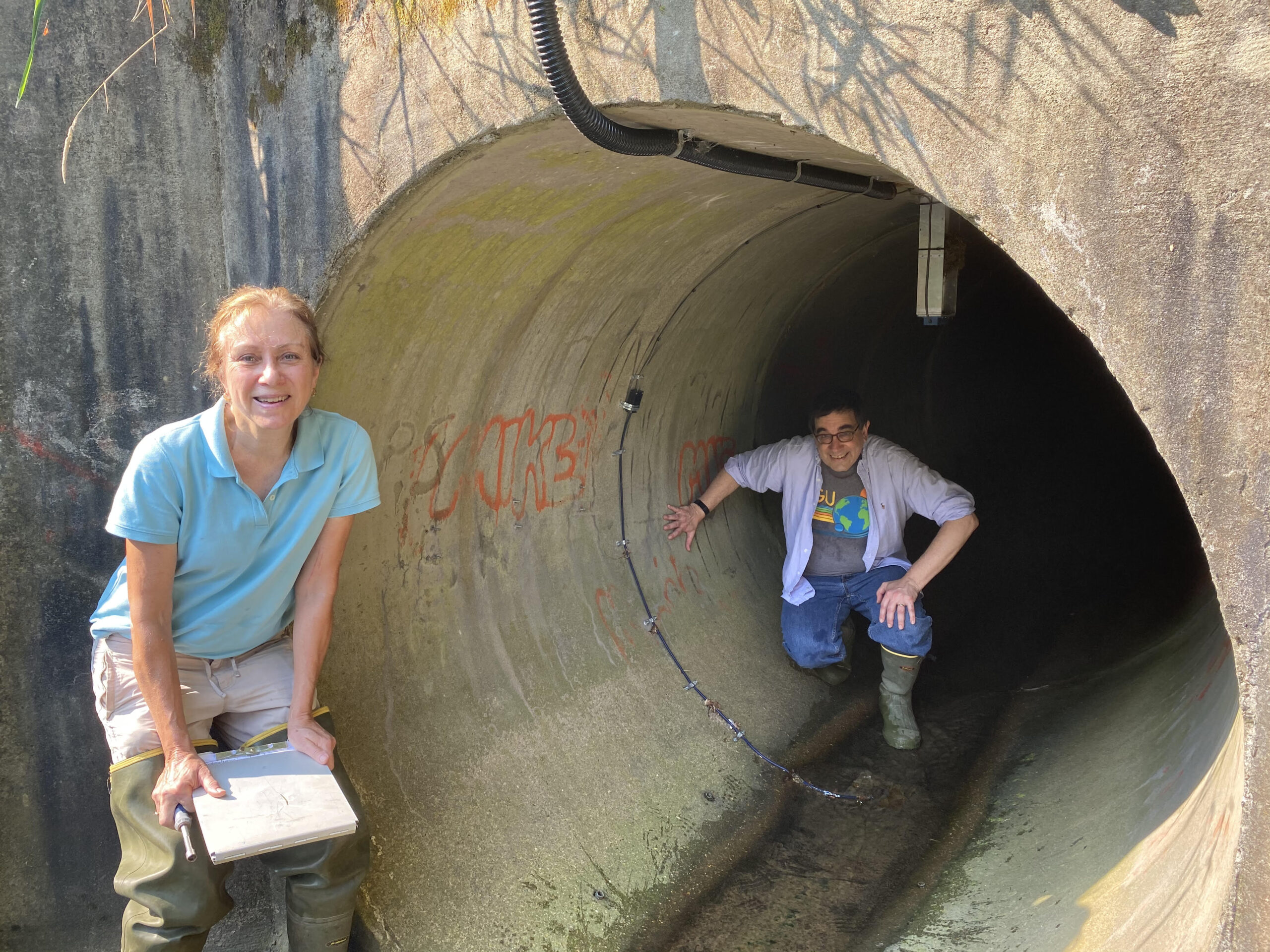
Claire Welty (left) and Andy Miller (right) at a field site in Catonsville. Photo by Victor Fulda.
Human influence on groundwater is one of the many issues they are exploring. “Groundwater is a hidden resource that feeds streams and rivers. In cities, people are typically not using wells for water consumption but groundwater is part of the hydrologic cycle that affects ecosystems,” Welty explains. “Streams lead to rivers and rivers go to potable water intakes for cities, so it’s all connected.”
Despite the COVID-19 pandemic slowing down many research initiatives, Welty and Miller have continued to move their work forward. The team has begun conducting field research that has included subsurface imaging of project field sites, collecting water samples from each of the targeted sites, and deploying water quality sensors. Welty is expecting to bring her first Ph.D. student onto the research team by this fall.
Interdisciplinary approach to environmental problem-solving
Tamra Mendelson, professor of biological sciences, received a $2.8 million NSF Research Traineeship (NRT) grant in 2019 as principal investigator for the Interdisciplinary Consortium for Applied Research in the Environment (ICARE). The training program is designed to broaden participation in the environmental workforce and empower the next generation of scientists to apply research to environmental problem-solving.
Tamra Mendelson at a research field site. Photo courtesy Mendelson.
ICARE will focus on the socio-ecological challenges facing the Baltimore Harbor. “The health of the Baltimore Harbor is improving, and I am hopeful that the work of ICARE will bolster ongoing efforts to make the Baltimore Harbor a model for the whole country,” says project partner Lee Blaney, associate professor of CBEE.
“It is my hope that the research focus on the Baltimore Harbor will set up ICARE and UMBC to make lasting, sustainable, and positive impacts in our city,” he notes.
Lee Blaney (left) with two students in his lab, 2019.
“ICARE was originally conceived as a way for ecologists and evolutionary biologists on campus to get together. The NRT added this component of engaging the community in our research,” Mendelson explains.
“At UMBC we are all so invested in this mission of inclusive excellence,” she says. “The racial and ethnic diversity is really low in the environmental sciences, so we wanted to make a difference there as well.”
UMBC partners across five disciplines and three colleges used the time amid the pandemic to organize the program, which will be funded until 2024. Over the next few years, they expect that 30 students will participate. Each student will receive full funding toward a master’s degree. They will also have a chance to collaborate with UMBC faculty, community stakeholders, and scientists and engineers in government, non-profit organizations, and industry careers.
Social science research in action
In the social sciences, UMBC ranks #60 in overall funding sources and #30 in federal funding. Among public universities specifically, UMBC is #37 in overall funding and #20 in federal funding for the social sciences.
Since 2019, the NIH’s National Institute of Aging (NIA) has awardedLaura Girling, director of UMBC’s Center for Aging Studies, more than $750,000 to examine the experiences of people with dementia who live alone in community settings. Recently, Girling has used this funding to research how COVID-19 social distancing guidelines impact people with dementia. She also examines the ethics of including people living with dementia as research participants.
Laura Girling, director of UMBCs Center for Aging Studies. Photo courtesy of Girling.
“The social sciences are a hallmark of the UMBC experience, and this is reflected in the funding,” says Steiner. “The excellence and national competitiveness of all of our research programs allows us to grow our research portfolio and pursue more funding for it.”
Photos by Marlayna Demond ’11 for UMBC, unless otherwise noted.
The human hand is capable of exquisitely complex, coordinated movements. Ramana Vinjamuri hopes that, in the future, people will be able to control prosthetic hands and exoskeletons just as seamlessly, using signals from their brains.
Vinjamuri’s research on the interconnections between the brain and the hand is very personal. His mother had a stroke in 2014 and developed paralysis in her right hand. “The very hand that taught me how to draw and how to write is now paralyzed,” he says.
To tackle questions about how the brain signals body movements, Vinjamuri, assistant professor of computer science and electrical engineering (CSEE) and director of Sensorimotor Control Laboratory, is gathering a team of UMBC researchers and corporate and government partners. He received an Industry University Cooperative Research Center (IUCRC) planning grant from the National Science Foundation (NSF) in 2020, and he sees UMBC as perfectly situated to move this kind of high-impact research collaboration forward.
Ramana Vinjamuri. Courtesy of Vinjamuri.
While other U.S. universities near urban centers may also have industry partners in their areas, Maryland and Washington, D.C. uniquely host a large number of national institutes and federal agencies, in addition to companies. This includes the NIH, NSF, NASA, and others. And UMBC has a strong track record. The UMBC-led Center for Accelerated Real Time Analytics (CARTA) has already found success as an IUCRC composed of multiple universities, industry partners, and government agencies.
Vinjamuri is proposing that UMBC join the Building Reliable Advances and Innovation in Neurotechnology (BRAIN) Center, a consortium led by Arizona State University and the University of Houston. His vision is to establish an East Coast BRAIN research hub to develop technologies that can help scientists better understand the nervous system and aid people with disabilities.
Benefits of collaboration
The NSF established the IUCRC program to offer academic researchers a framework for establishing long-term partnerships with industry and government agencies. In addition to providing funding, the program gives graduate students unique research experiences that can set them on a path to high-impact careers.
“They learn how to work in a team, together with professionals from industry and the government,” says Yelena Yesha, distinguished university professor of CSEE and director of CARTA.
Yelena Yesha, right, with faculty and students who conduct research through CARTA, 2018.
Corporate partners and government agencies also benefit since they gain the expertise of academic researchers. “It’s a win-win,” Vinjamuri says.
Dean Drake. Photo by Tim Ford for UMBC.
Representatives of each center’s member institutions meet twice a year to make updates to the consortium’s research goals. These meetings provide an opportunity for industry and government partners to highlight their priorities in particular areas, says Dean Drake, associate vice president for research at UMBC.
And the partners have a financial stake in the success of the IUCRC: Each year they pay membership fees that go toward the costs of research.
From big data to actionable data
UMBC has been the lead university for CARTA, a multi-institution IUCRC, since its inception in 2018. The consortium’s roots are in the Center for Hybrid Multicore Productivity Research (CHMPR), founded in 2009. CHMPR aimed to develop advanced computing technologies to tackle complex problems of national priority, from human health to climate change. As large datasets gained widespread use, the researchers shifted their focus to new areas and CARTA was born.
“Big data by itself is trouble; what is really needed is actionable data,” Yesha says.
CARTA researchers are focused on real-time analytics, or how to interpret large amounts of data to make decisions quickly. For example, one project is exploring the use of blockchain, the distributed technology underlying bitcoin and other cryptocurrencies, to optimize supply chains.
Karuna Joshi (left) and Yelena Yesha (right), 2018
In addition to UMBC, CARTA includes higher education partners North Carolina State University, Rutgers University–New Brunswick, Rutgers University–Newark, and Tel Aviv University. Some of UMBC’s industry and government partners are the data management company Seagate Technology, financial services firm Morgan-Stanley, Department of Homeland Security, and NASA.
“The challenges we examine require a convergence of technologies,” Yesha says. “Having the resources that come from all these different institutions at the table—as well as the brainpower—enables us to tackle these types of problems.”
Advancing neurotechnology
In proposing UMBC as a future BRAIN site, Vinjamuri hopes to connect with medical centers, companies, and government agencies specifically seeking to accelerate neurotechnology research. Neurotechnology is a broad discipline that includes everything from methods for measuring brain activity to tools for analyzing clinical data to human-centered computing, the focus of Vinjamuri’s research.
Due to the coronavirus pandemic, the planning grant timeline has been extended for an additional year. The funds will be used to hold a conference in upcoming fall 2021, to recruit potential industry and government partners for the proposed BRAIN site. Vinjamuri and colleagues will then prepare a formal proposal to join the BRAIN consortium.
“These collaborations across universities, industry, and government are critical to the success of carrying this research out to society,” says Drake, “to meet our most pressing needs.”
Banner image: 3D-Printed Prosthetic Hand, 2013. Photo by M.R.Nuckels. CC by 4.0. All other photos by Marlayna Demond ’11 for UMBC unless otherwise noted.