
All posts by: UMBC News Staff


A Rescue Worker’s Chronicle

Hands On from the Start


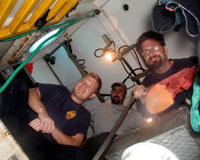
Matthew Levy ’00, was part of an emergency response team that spent 10 days in NY, assisting in the relief efforts following 9/11. “A Rescue Worker’s Chronicle”
 

Matthew Levy was one of the few people rushing towards New York on the morning of September 11.
A program manager in UMBC’s Emergency Health Services Program and 2000 graduate of UMBC, Levy is responsible for the online training of disaster medical response teams across the nation. On September 11, though, he was called upon not to train, but to serve.
In addition to his duties in the EHS program, Levy is a clinical paramedic and a member of the New Jersey-1 Disaster Medical Assistance Team — a group of health-care providers trained and equipped to quickly deploy and set up self-sufficient hospitals at disaster sites.
Levy and the rest of his team, the first federal-level disaster medical assistance group on the scene, arrived at “Ground Zero” at 2 a.m. on September 12 and immediately got to work.
Levy chronicled his experiences in a photoessay, included below.

Reflections on Responding to the World Trade Center Disaster
By Matthew Levy, BS, NREMT-P
Department of Emergency Health Services
New Jersey-1 Disaster Medical Assistance Team
National Disaster Medical System

On September 11, I awoke to a day that no one will soon forget. I had fallen asleep about 7 a.m., after working as a paramedic the night before. At about 8:30 a.m. I received a frantic phone call from a friend telling me to turn on the television.

Photo by: Anthony Cascio
After realizing the magnitude of this event I grabbed my disaster gear from the closet and was on my way to Ft. Dix, New Jersey, where the New Jersey-1 Disaster Medical Assistance Team is based. Approximately three hours later I arrived at Fort Dix where I found fellow team members. We began readying our U.S. Public Health Service cache of equipment, which includes a field hospital capable of being self sufficient for up to 72 hours.

Not long after, the team was ready to deploy. Because of the massive mobilization effort of all response agencies, not enough vehicle operators were present to move the team and all the equipment. Somehow I ended up driving the bus that we used to move the team. Driving the bus wasn’t nearly as difficult as I thought it would be. 

Our team was the first federal level disaster medical assistance team to arrive in Manhattan. It was initially thought that we would get to work, supporting a field hospital, and caring for the injured. By Wednesday, September 12, it was determined that due to the lack of survivors a field hospital was not needed. As a result, we were re-deployed to Stewart Air National Guard Base in New York, where the federal resources were staged. A C-130 hanger became home until our mission details were finalized. 

My mission assignment was to deploy to “ground zero” along with a six-member logistics task force to provide support to the mortuary operation (DMORT) going on. We were to set up two of the tents that we would normally use as a part of the field hospital. These tents would be used to house the on-scene morgue operations. 

Once the tents were set up, we established a rotating shift schedule to ensure that our personnel were present to resolve any emergent logistical issues.
Other members of the team who were not involved in the morgue operation functioned at several other locations throughout the disaster area, providing medical treatment to the rescuer workers involved in the operation. 

Everywhere around us, we were constantly reminded of the tragedy that had occurred and the humanity that had prevailed. 

Equal, if not greater, in magnitude of emotion was the sense of unity, camaraderie and dedication to each other that we would get through this difficult time.

Neither these words nor pictures can do justice in showing the horror we witnessed.

I will never forget responding to World Trade Center bombing. My experiences have helped remind me how fragile life is, and how close a society can pull together in time of need.
All photos by Matthew Levy, except where noted.

Early Detection in the Field

New Approaches to Real-World Problems

Tasch’s patented invention may save the dairy and horse industries hundreds of millions of dollars each year.  “Early Detection in the Field”
  

It’s hard to know if a horse or cow is lame – unlike humans, they don’t complain incessantly about the aches in their limbs – but not knowing is and can be very expensive. Professor of mechanical engineering Uri Tasch has invented a diagnostic device that promises to save animals from pain and their owners from huge veterinary bills.
Tasch estimates that the Maryland dairy industry loses close to $500 million a year to livestock lameness, caused by infection, arthritis, or injury, and the state’s horse racing and breeding industry loses millions more. Nationwide, and even internationally, there are billions of dollars a year at stake.
Tasch’s patented invention promises early detection of lameness: Using a sensitive scale, video camera, and computerized instruments, the device measures the force and duration of the animal’s steps, factors in its weight, and can automatically pinpoint which leg might be causing problems.
Negotiations with corporations interested in licensing Tach’s technology are under way, and the U.S. Department of Agriculture, recognizing the device’s importance, has helped support Tasch’s research.
 

UMBC Historian Wins First-Ever e-Lincoln Prize

Outstanding Results by Any Measure

Anne Rubin was the first-ever recipient of the e-Lincoln Prize, honoring scholarly work in new media. "UMBC Historian Wins First-Ever e-Lincoln Prize"
Anne Rubin was the first-ever recipient of the e-Lincoln Prize, honoring scholarly work in new media. “UMBC Historian Wins First-Ever e-Lincoln Prize”

In Anne Rubin’s office sits a plaster bust of Abraham Lincoln, sporting sunglasses, a plastic bead necklace, and a UMBC cap on his head. The bust, a congratulatory gift from one of her students, is a humorous reminder of an extraordinary accomplishment: This winter Rubin, an assistant professor of history in her first year on the UMBC faculty, was awarded one of the most prestigious prizes in her field, the Lincoln Prize, for scholarly work in Civil War-era history.

Lincoln’s hip attire is also appropriate, as Rubin’s work, Valley of the Shadow: The Eve of War, an innovative website and CD-ROM, won the first-ever e-Lincoln Prize, honoring scholarly work in new media.

Valley of the Shadow is a richly detailed portrait of antebellum life in two rural communities, one in Pennsylvania, the other in Virginia. Rubin joined the project’s staff while a graduate student at the University of Virginia. The original concept of the project, begun by Rubin’s advisor Edward Ayers in the early 1990s, was to produce a traditional scholarly book, but “this is a case where technology caught up with what we wanted to do,” explains Rubin. Combining the power and flexibility of the new digital formats with the depth and detail of primary documents, Valley of the Shadow brings the communities vividly to life, and allows visitors to work with the historian’s tools, including a trove of original letters, diaries, census data, business and military records, even newspaper articles and contemporary music.

As project manager for several years, Rubin supervised the staff’s digging for historical nuggets in the field (tucked away in libraries, tiny historical societies, and house attics) and then oversaw the translation of these documents into digital format. To view the website, visit valley.vcdh.virginia.edu.  

Working Together to Preserve a Landmark

UMBC students pitch in to clean up Mt. Auburn Cemetery in Baltimore City. "Working Together to Preserve a Landmark"
UMBC students pitch in to clean up Mt. Auburn Cemetery in Baltimore City. “Working Together to Preserve a Landmark”

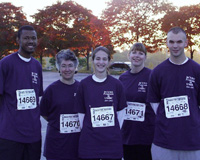
Nearly 100 UMBC students pitched in to help clean up Baltimore’s oldest African American cemetery as a part of the UMBC Serves program, which kicked off on the first Saturday of the fall 2001 semester. Organized by UMBC’s Shriver Center, Office of Student Life and Residential Life, the Mt. Auburn Service Trip pulled together new and returning students from Catonsville, Md. to Aurora, Colorado. UMBC students worked alongside members of the community to pull weeds, remove trash, and provide easier access to the sites at the cemetery.
Founded in 1872, Mt. Auburn is the oldest African American cemetery in Baltimore. It serves as resting place for former slaves who found freedom through the Underground Railroad and many prominent African Americans.
UMBC Serves is a new initiative designed to coordinate and strengthen service to the community at UMBC. Students, faculty and staff will have the opportunity to discover the many exciting service-learning, community service, and volunteerism opportunities at UMBC. 
UMBC’s service connections with Baltimore City are numerous. From the Mt. Auburn Service Trip, to programs targeting at-risk youth, lead-paint education and removal programs, mentoring and tutoring programs, and much more.
 

UMBC Retrievers…New Look, Same Winning Ways


The new "True Grit" was introduced to the UMBC community after Convocation on August 28. "New Look, Same Winning Ways"
The new “True Grit” was introduced to the UMBC community after Convocation on August 28. “New Look, Same Winning Ways”

UMBC’s athletic teams are known to be tough.
Winners of three consecutive Northeast Conference Commissioner’s Cups, awarded annually to the school that performs the best in the league’s 21 sports, the UMBC Retrievers have a new logo to reflect their toughness.
The new “True Grit” was unveiled on the afternoon of August 28, after the annual campus Convocation ceremony. Thousands of UMBC students, faculty and staff came out to see the banner drop from the roof of the Retriever Activities Center.
The Retrievers claimed four NEC championships this spring, including winning men’s and women’s tennis titles¾becoming the first school in NEC history to earn back-to-back sweeps in both men’s and women’s tennis. Men’s golf captured yet another championship, and the Retrievers also won their first-ever NEC championship in baseball. 

Three coaches received Coach of the Year honors¾Pat Kotten (golf) for the second time in three years, Felix Hou (volleyball), and Keith Puryear (tennis). The Retrievers also captured the locally televised “Battle of Baltimore” basketball tournament, and UMBC shot putter Cleopatra Borel competed in both the 2001 NCAA Indoor and Outdoor Track & Field Championships, where she finished in the top eight in the nation on both occasions and earned All America honors.

UMBC athletes were no slackers in the classroom, either. Nearly two hundred student-athletes had a cumulative GPA of 3.0 or higher last spring, and 16 had perfect 4.0 cumulative GPAs.
 

Karen Johnson (’85) – Outstanding Alumna

 
Karen Johnson, Secretary of Higher Education, Maryland Higher Education Commission

“Outstanding Alumna”
  

Karen Johnson, political science ’85 and the recipient of this year’s UMBC Outstanding Alumna Award, is Secretary of Higher Education for the Maryland Higher Education Commission.

As one of the youngest members of Governor Parris Glendening’s cabinet, Johnson is a key figure in ongoing efforts to preserve the quality of higher education in Maryland, overseeing more than 30 public and private colleges and universities, 20 community colleges and 100 private career schools in the state.

For Johnson, one of UMBC’s strengths was its size. “It’s not too big and not too small,” she says. “The faculty here are very connected to the students and really take an interest in their development. Students should take advantage of the faculty and everything campus has to offer and try to build relationships for the future,” she says. “When I was at UMBC, I learned from other students as much as I did from sitting in a lecture hall.”


Joan Korenam…Wired Woman

Director, UMBC Center for Women & Information Technology

“Joan Korenman is a wired woman”
  

Joan Korenman, Director of UMBC’s Center for Women & Information Technology (CWIT), has been named one of the “Top 25 Women on the Web” by San Francisco Women on the Web, a non-profit development organization for women involved with the Internet, new media, and web technology.

The award highlights the accomplishments of 25 women around the globe who have inspired people with their efforts to advance technology, contribute to the community, and demonstrate the success of businesswomen in the Internet and new media industries. It also emphasizes the community-based network of women helping each other in technology-related fields.

Korenman founded UMBC’s Center for Women & Information Technology in 1998 to address and rectify women’s under-representation in IT and enhance understanding of the relationship between gender and IT. In 1991, Korenman established WMST-L, an electronic forum for Women’s Studies teaching, research, and program administration. With more than 4000 subscribers in 47 countries, WMST-L is the largest women-related academic email forum in the world. Korenman is the author of Internet Resources for Women: Using Electronic Media in Curriculum Transformation (1997).