
All posts by: UMBC News Staff


U.S. Presidential Award for UMBC

Outstanding Results by Any Measure

Michael Summers, professor of chemistry/biochemistry, works closely with undergraduates in his Howard Hughes Medical Institute laboratory.

“U.S. Presidential Award for UMBC”
  

The usually casually dressed Michael Summers put on a suit and tie for the occasion–he was, after all, going to the White House to receive an award from the president of the United States.

Summers, UMBC professor of chemistry/biochemistry and Howard Hughes Medical Institute Investigator, accepted the 2000 Presidential Award for Excellence in Science, Mathematics, and Engineering Mentoring from President Clinton. He was one of 10 national recipients of the award. Administered and funded by the National Science Foundation, the award honors leadership in encouraging minorities, women, and people with disabilities to pursue careers in scientific, engineering, and technical fields.

Summers brings UMBC undergraduates into his research lab to work on unraveling the protein structure of the HIV virus, affording them real scientific research, and even publication experience. His guidance and encouragement of UMBC’s minority students interested in pursuing the sciences have proven pivotal in launching their careers: Summer’s recent UMBC grads have gone on to medical school and M.D./Ph.D. programs at Harvard, Yale, and the University of Pennsylvania.

This marks the second time in four years that the award has been brought home to UMBC–the university was honored for its institutional mentoring efforts in 1997. Summers brought back from the White House a commemorative presidential certificate, and a $10,000 grant. Well worth wearing a tie.  

Probing the Environment

/a>

“Probing Our Impact on the Environment”
  

A member of the physics faculty since 1984 and a 1974 UMBC graduate, Larrabee Strow is one of the chief scientists behind NASA’s $30 billion international Earth Observing System project. He developed a new satellite instrument, the Atmospheric Infrared Sounder (AIRS), and complex algorithms that will be used to measure climate change. The data collected by AIRS will be used by scientists around the world to better understand weather and climate change and by the National Weather Service and others to improve the accuracy of weather and climate models.

Strow’s work on the NASA project over the past 10 years is one of the most significant examples of UMBC’s emergence as a major research center for environmental studies.

In 2000, the University entered into a $75 million cooperative agreement with NASA/Goddard — the largest research partnership in UMBC’s history — establishing UMBC as the headquarters for the Goddard Earth Science and Technology Center, which studies the Earth’s surface, atmosphere, and oceans. The University also received $2 million in funding from the Environmental Protection Agency to create the Center for Urban Environmental Research, Education, and Training.


J. Lynn Zimmerman

 J. Lynn Zimmerman has been named a UMBC Presidential Teaching Professor, is the recipient of the UMBC Student Activities Outstanding Advisor Award and a Regents Faculty Award for Excellence in Mentoring
J. Lynn Zimmerman has been named a UMBC Presidential Teaching Professor, is the recipient of the UMBC Student Activities Outstanding Advisor Award and a Regents Faculty Award for Excellence in Mentoring

“A Mentor of Many”

An accomplished teacher and mentor for countless students at UMBC, J. Lynn Zimmerman credits her parents for her love of teaching and its importance to her. “My mother was a teacher in a one-room school house in rural Canada,” says Zimmerman, a professor of biological sciences who was recently named Presidential Teaching Professor, 2001-2004. “The value of education was always foremost in our home.”

But, it was her father and his love of plants that would inspire her most. He was a nurseryman for the city of Detroit. And, “Although he wasn’t educated beyond high school, he taught himself the Latin names of every plant he ever found,” recalls Zimmerman.

The little girl, who “always had the best leaf collection in school,” grew up to discover a “love of plant biology,” earning her master’s degree at Wayne State University and her Ph.D. from the University of California, Irvine. Zimmerman came to UMBC in 1983 and her current research involves the development and thermotolerance of plants.

Besides being named a Presidential Teaching Professor, Zimmerman is the recipient of the UMBC Student Activities Outstanding Advisor Award and a Regents’ Faculty Award for Excellence in Mentoring.

“Being a science professor in a research university is oftentimes a delicate balancing act to maintain an active and productive research program while at the same time devoting yourself to your students as a first priority,” says Zimmerman, who worked diligently to establish UMBC’s five-year-old Golden Key International Honor Society, which has been an international award-winning chapter three years in a row. “But it can, and must be done.”

Bea Buhrafi – The Art of Educational Outreach

Bea Bufrahi

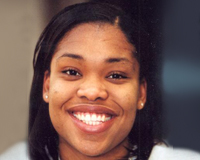
Bea Bufrahi is a student in UMBC's Imaging and Digital Arts Graduate Program.
Bea Bufrahi is a student in UMBC’s Imaging and Digital Arts Graduate Program.

“The Art of Educational Outreach”
 

UMBC’s Fine Arts Gallery has drawn upon the experience and energy of one of its graduate assistants in the design and organization of its educational outreach initiative for the current exhibition, “Fred Wilson: Objects and Installations, 1979 – 2000.” Imaging and digital arts student Bea Bufrahi ’01, who also worked as an undergraduate intern in the gallery and recently completed another internship with Baltimore’s Contemporary Museum, brought together a rich and diverse offering of educational experiences focusing on museums and their recent collaborations with living artists.

Students from Middle River High School, City College, Catonsville High School and McDonogh School engaged in a dialogue with museum educators from the Walters Art Museum, the Contemporary Museum and the Maryland Historical Society, and explored how museums are rethinking their collections and how the public interprets them. Special attention was paid to the Fred Wilson’s historic 1993 collaboration with the Contemporary Museum and the Maryland Historical Society in creating the exhibition “Mining the Museum” presented at the Maryland Historical Society. Students had access to the current collaboration project between the Walters Art Museum and the Contemporary Museum which features the artist Dennis Adams, who is re-interpreting the Walters Art Museum’s permanent collection through the re-fabrication and re-installation of sculptural artifacts and site specific performance.

Multi-site visits to all three institutions, guided tours of the Fred Wilson exhibition at UMBC, as well as intensive workshops held at all four schools allowed students to engage in group critiques of their museum and gallery experiences and ultimately create their own artworks which actively address the issues of presentation and interpretation. The gallery will host a student exhibition of works created from this initiative in the Department of Visual Art’s Hallway Gallery during the month of December.
 

Gifted Young Students Find a Home at UMBC

A Place to Learn Together

David Dalrymple, 10, is one of a group of gifted young scholars at UMBC.

“Gifted Young Students Find a Home at UMBC”
Compared to their classmates, they’re a little short, and their voices a bit high-pitched, but otherwise, they’re very comfortable as UMBC students pursuing their undergraduate degrees. They are UMBC’s Young Scholars–some, like David Dalrymple, are only 10 years old, others in their early teens–but all are academically gifted and ready for college-level classes. And they are drawn to UMBC as a place that makes them feel welcome.

“UMBC is developing a reputation–quietly, and by our actions–as a good place for these academically talented kids to come,” explains John Martello, vice provost for community partnerships and executive director of the Shriver Center. These exceptional children have often been home-schooled and are referred to UMBC by guidance counselors or organizations like Johns Hopkins’ Center for Talented Youth. “They’re referred to us as an institution that has a high-quality, low-cost program, and is supportive and welcoming,” says Martello, who notes that UMBC has a solid track record thanks to years of experience by Associate Director of Scholarships Bobbie Shahpazian, who has helped UMBC’s “precocious youth” find their footing.

Young Scholars takes a purposefully informal approach–there are no dorms for the youngsters, as most still want to live at home–and no specially structured curriculum. “They don’t really need or want special academic support, but we help them navigate through the University,” says Martello.

One problem that often arises, but corrects itself: Professors who might be initially skeptical about the ability of a nine-year-old Young Scholar to keep up in a college math or physics class “become converts after the results of the first exam,” says Martello.
 

Tracy Tucker – Political Insider

Hands On from the Start

Tracy Tucker '00 is a special assistant to Lieutenant Governor Kathleen Kennedy Townsend.
Tracy Tucker ’00 is a special assistant to Lieutenant Governor Kathleen Kennedy Townsend.

“A Political Insider”
History and political science major Tracy Tucker ’00 understands the value of the internships and connections that an honors university can provide. A Humanities Scholar, Tucker participated in UMBC’s Legislative Affairs Internship Program, interning with Maryland State Senator Thomas Middleton. “It was exciting to have such an insider’s view of how our state government works,” she says.
Tucker was also one of only 20 students throughout Maryland chosen to participate in the Governor’s Summer Internship Program, coordinated by UMBC’s Shriver Center. She interned with Lieutenant Governor Kathleen Kennedy Townsend’s office, an experience which led to her current position as a special assistant to the lieutenant governor.
 

“Death” sparks a writer’s life

Outstanding Results by Any Measure

Manil Suri, a professor of mathematics, has received national and international acclaim for his first novel, The Death of Vishnu.

“Death” Sparks a Writer’s Life
 

For UMBC mathematics professor Manil Suri, it was a publishing debut that brought him attention in a host of national newspapers and magazines, including The New Yorker, Time, the Wall Street Journal, and the front page of The New York Times Book Review. There was also a book tour that took him across the United States and back to his native India, where the audience included many members of his family. There are 19 editions of his book worldwide that have appeared or will appear in the United States, the United Kingdom, and in translation in a host of countries in Europe as well as in India, Israel, Turkey, and Japan.

All this hoopla was not about Suri’s work in the numerical analysisThe Death of Vishnu of partial differential equations–his area of research expertise. It was the publication of his first novel, The Death of Vishnu, that set the critics ablaze. In a plot that weaves the stories of the apartment dwellers who come upon Vishnu, the building’s handyman, dying on the stair landing, Suri constructs a microcosm of Indian society that is both rich and comic. To read more, visit www.manilsuri.com.
   

Growing a company on campus

Hands on from the start
 

English Department Chair Jim McKusick's new anthology Literature and Nature: Four Centuries of Nature Writing, combines his passion for nature with his love of literature.
English Department Chair Jim McKusick’s new anthology Literature and Nature: Four Centuries of Nature Writing, combines his passion for nature with his love of literature.

“Green Writing”
 

It seems only natural that Jim McKusick would find a way to bring together his passion for nature with his love of literature. His achievement can be found in two new books exploring the emerging field of “ecological literary criticism.”

“I’ve been fascinated by the outdoors and the environment since I was a kid,” explains McKusick, chair of UMBC’s English department. “It’s deep in my blood.” As a teenager, he hiked 1,000 miles of the northeast section of the Appalachian Trail, and in subsequent summers, he trekked hundreds of miles of the Sierra Nevada and Pacific Crest trails, as well as led wilderness canoe trips. (“I have a special fondness for swamps,” he admits.) While a student at Dartmouth College, he began mountain climbing, conquering peaks in the Himalayas and Peru.

At the same time, he found his professional voice in literature, most specifically English poetry of the Romantic period, in which he discovered echoes of his own fascination with the natural world and sources that deeply influenced American writers such as Emerson, Thoreau, and John Muir, laying the foundation for the modern environmental movement.

In his newly published anthology Literature and Nature: Four Centuries of Nature Writing, co-edited with Bridget Keegan, McKusick presents a banquet of literary selections–in all genres (poetry, plays, novels, and essays), written by men and women of all races, social classes, and nationalities. His second publication, Green Writing: Romanticism and Ecology, a deeper, more focused treatise on the influence of the English Romantics, took McKusick out into the field, to his great delight. “If you’re going to understand a writer, I think you have to be deeply attuned to their geographical place,” he says.  

Growing a company on campus

Hands on from the start

UMBC student Andy Lufburrow, founder and CEO of Digimo, runs his company from UMBC's Technology Center.
UMBC student Andy Lufburrow, founder and CEO of Digimo, runs his company from UMBC’s Technology Center.

“Growing a Company on Campus”
 

Like many UMBC students, Andy Lufburrow has a job that earns him money and keeps him busy between classes. But Lufburrow’s work is not your usual off-campus employment. He’s the founder and CEO of his own company, Digimo, a web-development firm with a client base of major corporations and headquarters in the UMBC Technology Center. At least it’s an easy commute from work to class.

As a freshman, Lufburrow presented his business plan to the UMBC Technology Center and became the first student entrepreneur to set up shop in the center’s high-tech incubator program. It wasn’t just the economical office space that Lufburrow found attractive about the incubator environment–it was the advice, mentoring, and exposure that the Tech Center could provide. His advisory board includes respected members of the information technology industry as well as the University, and they have opened doors–to clients and to venture capital–for the fledgling firm. And Digimo’s employee base expanded from immediate family and friends to the enormous talent pool of UMBC students. In fact, tapping the creative and technical potential of student employees has become one of Digimo’s prime selling points–it offers clients fresh, eager, young talent to tackle their Internet needs, as well as providing a source for highly trained future employees.

For UMBC students, Digimo offers a tremendous opportunity to learn cutting-edge skills in a real-world business setting. It takes juggling to balance work and academics, but Lufburrow is a good role model.  

UMBC Aquamen Return From Undersea Adventure

New Approaches 
to Real-world Problems

The crew of Aquarius, the nation's equivalent of an underwater space shuttle, studied how mantis shrimp communicate and see. Research findings were published in the journal Nature.
The crew of Aquarius, the nation’s equivalent of an underwater space shuttle, studied how mantis shrimp communicate and see. Research findings were published in the journal Nature.

“UMBC’s ‘Aquamen’ Return From Undersea Adventure”

UMBC’s own aquamen, biological sciences professor Tom Cronin and graduate student Alex Cheroske, have returned from an undersea adventure as part of the crew of Aquarius, the nation’s equivalent of an underwater space shuttle. The two represented UMBC as part of an eleven-member team studying the unique vision and behavior of marine life off the Florida Keys.

For Cronin, the director of UMBC’s Marine-Estuarine and Environmental Sciences (MEES) graduate program, it was another mission in a long career of underwater exploration around the globe and the continuation of ongoing research.

Cronin led a 1999 Aquarius mission, but this time he stuck to the surface team, giving up his underwater spot to the younger Cheroske, effectively passing the torch of UMBC’s small but talented MEES department to a new generation.

Cheroske and Cronin studied how the fast and powerful mantis shrimp communicate and see. Cronin’s research findings on the animal’s unique, tunable color vision system were recently published in the distinguished journal Nature.

At a depth of 63 feet in a sand patch off the Florida Keys, Aquarius is roughly the size of a large Winnebago and features all the comforts of home: six bunks, a shower and toilet, instant hot water, a microwave, trash compactor, a refrigerator, air conditioning and computers linked to shore by wireless telemetry.

There are more adventures ahead for UMBC’s aquamen: Cronin will soon head off for 10 days of underwater research in the Red Sea off the coast of Israel, and then head to Australia. There, Cheroske will join him for further study of marine animal vision and polarization signaling in a shallow reef ecosystem.

Read more about the Aquarius project in Insights
 

An interdisciplinary approach to science

UMBC is a Place to Learn Together

  Karin Readel
Karin Readel’s course “Water: an Interdisciplinary Study” introduces students of all majors to science and field research.

“An Interdisciplinary Approach to Science”
 

Hundreds of UMBC undergraduates are fulfilling their laboratory science requirement by getting their feet wet. They are enrolling in Water: An Interdisciplinary Study, a hands-on lab and lecture course that uses the theme of water to explore the process of science. The course, created by Karin Readel, a lecturer in UMBC’s interdisciplinary science program, allows students to work together in small groups to design experiments and analyze results, using the campus as an outdoor ecological laboratory. Student projects have included water analysis of the library pond, the Pig Pen Pond, and the Herbert Run stream on campus, and the course brings together the fields of biology, chemistry, earth sciences, and physics to focus on real-world investigations of water.

The course, which Readel designed for non-science majors (meeting the State of Maryland’s requirement that all students complete a laboratory science course) is proving wildly popular, with more than 400 students signing up each year to get their sneakers soaked.


BCURE Team Fights Breast Cancer

New Approaches to Research

  UMBC Aquamen
UMBC students, faculty and staff from the BCURE project participated in the October 13 Race for the Cure in support of breast cancer education and research .

“Fighting Breast Cancer
in the Lab and on the Street”
 

While many college students her age spent their summer folding shirts at the Gap or waiting tables, UMBC student Erika Danna spent her break studying the blood, spleen cells, and immune systems of lab mice as part of the fight against a killer. Meanwhile, Greg Small made the daily commute to the University of Maryland, Baltimore to investigate how cells nurture blood vessel formation in tumors and John Jackson spent long summer days at UMBC examining enzymes that could be used to attack tumor growth.

Danna, Small, and Jackson are part of a group of future scientists getting hands-on experience fighting breast cancer in the laboratory through the BCURE, or Breast Cancer Undergraduate Research Experience, Program at UMBC. BCURE is funded by the Department of Defense (DOD) Congressionally Directed Medical Research Programs. The Program is directed by UMBC’s Biological Sciences department under the leadership and guidance of award-winning professor and cancer researcher Dr. Suzanne Rosenberg and her colleagues at UMBC and the University of Maryland, Baltimore.

This summer, eight BCURE Trainees learned real world research skills through training internships with leading area cancer researchers and stipends supported by DOD and UMBC. From the basic vocabulary of cancer to the fine art of presenting research, these undergraduates have blossomed into budding researchers. Some students continue to get their lab coats dirty, part-time, through this academic year to make significant contributions in the research labs of their mentors. Their research experiences will culminate this spring when the BCURE Trainees present their research projects during the first UMBC Breast Cancer Research Day.

As part of National Breast Cancer Awareness Week in October, these three BCURE  Trainees took the fight to the streets of Baltimore in Oct. 13’s Maryland Race for the Cure to support breast cancer education and research through the Susan G. Komen Foundation.  Danna, Small and Jackson were joined by Dr. Rosenberg and BCURE Program Coordinator Kathy Sutphin for the 5K walk. The BCURE team donned custom T-shirts, met at sunrise, and proceeded to PSINet Stadium to join thousands of Marylanders in the fight against breast cancer. The group raised donations and broadened their awareness of the women and their families devastated by this deadly disease.