All posts by: Megan Hanks Mastrola


UMBC places ninth at 2019 Pan-Am Team Chess Championship

UMBC Chess has continued its strong performance with another high-ranking finish at the leading intercollegiate team championship in the Americas. The Retrievers placed ninth out of 63 teams at the 2019 Pan-American Intercollegiate Team Chess Championship, held in Charlotte, North Carolina, December 27 – 30. 
To reach this ranking, the UMBC Chess A team earned victories over the A team from the University of Pennsylvania as well as the B teams from the University of Toronto, University of Texas at Austin, and University of Pennsylvania. After tying Harvard in round five, UMBC had its sights on a spot in the Final Four, but didn’t quite reach that coveted status this year. UMBC finished ahead of Harvard, Princeton, and MIT. The Texas Tech University A team won the competition overall. 

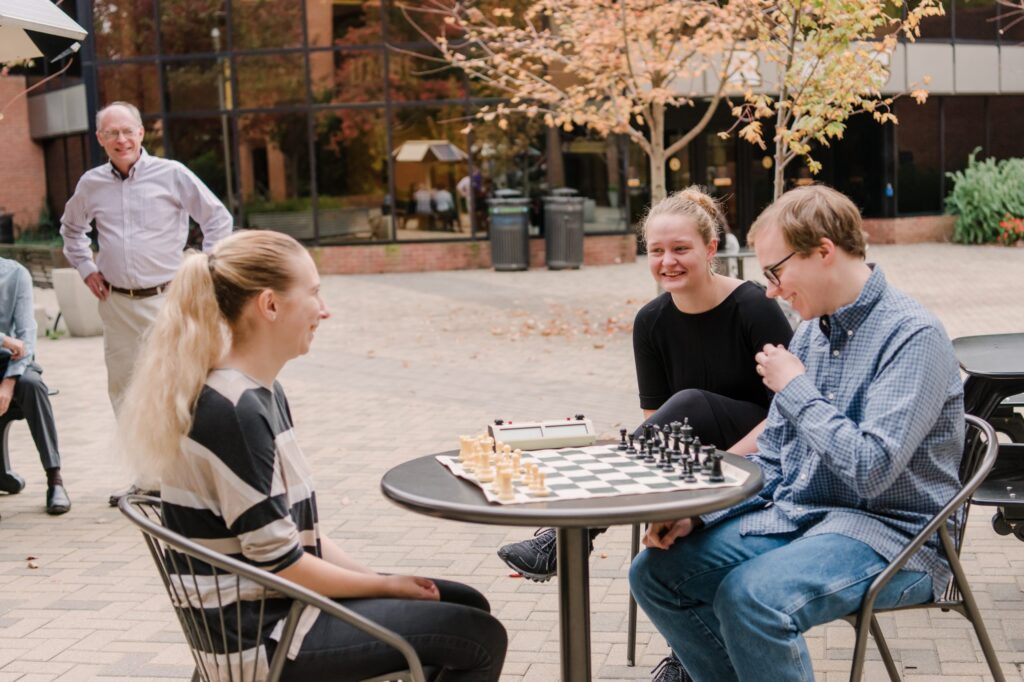
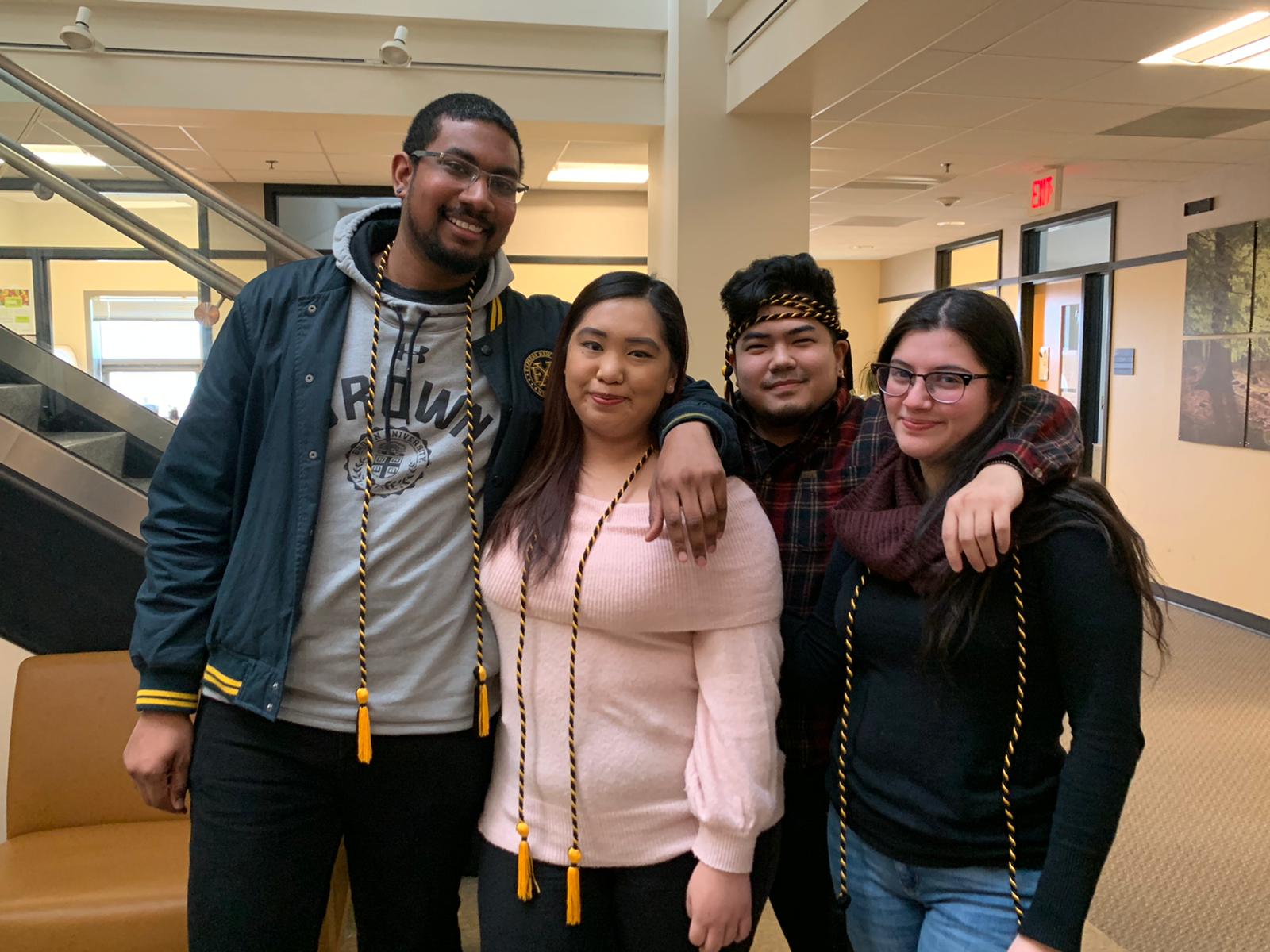
Three UMBC students play chess outside.
Mai Narva (left), Ewa Harazinska (center), and Tanguy Ringoir (right) practicing chess outside. Photo by Marlayna Demond ‘11 for UMBC.

Tanguy Ringoir ‘18, financial economics, M.A. ‘22, economic policy analysis, the captain of UMBC’s A team, ranked 29th in individual competitor performance. 
The UMBC Chess B team finished in 29th place overall, and earned victories over Western Washington University, UCLA, and the University of Texas Rio Grande Valley D team. 
“While we didn’t quite make it into the Final Four, we are happy with our overall performance,” says Ringoir. He shared that the team enjoyed preparing for the competition by recently participating in a tournament closer to home, in Rockville, Maryland.
UMBC’s 2019 A team includes grandmaster Ringoir; international master Rohan Ahuja ‘21, computer science; woman international master Mai Narva ‘22, psychology; international master Matyas Marek ‘22, computer science; and woman international master Ewa Harazinska ‘20, chemistry, as an alternate. 
The UMBC Chess B team includes Maor Leker Locker ’20, biological sciences; Nathan Sukhyun Janus ‘20, mathematics; Danielle Sharp ‘22, mechanical engineering; and Douglas Malcolm ‘23, computer science. 
Alan Sherman, professor of computer science and electrical engineering, serves as director for UMBC Chess. Joel DeWyer, associate director for campus life operations, is the team’s business manager, and Igor Epshteyn coaches UMBC’s Chess B team.
For the past 28 years, UMBC has participated in the Pan-American Intercollegiate Team Chess Championship, and has won or tied for first place at the championship ten times. UMBC Chess has also advanced to the President’s Cup, known as the Final Four, each year between 2001 – 2015, winning six times.
Banner image: Members of the UMBC Chess team. Photo by Marlayna Demond ’11 for UMBC.

UMBC receives NSF support to enhance data science courses, research, and student experiences

Data science has rapidly grown at UMBC, and faculty are now working to enhance data science courses, research, and student experiences. The goal is to ensure they are inclusive, empowering, and effective in preparing students to tackle the urgent problems our society is working to solve, and can scale up to meet student and workforce demands.

Faculty in both information systems, and computer science and electrical engineering have recently received two grants from the National Science Foundation to conduct research toward this aim.

Making data science more inclusive

NSF awarded funding to a team of researchers at UMBC; the University of California, Berkeley; and Mills College in California through the Improving Undergraduate STEM Education program. This funding will support the Undergraduate Data Science at Scale project at UMBC, including the development and implementation of a unique data science education program for undergraduate students in STEM and non-STEM disciplines, says Vandana Janeja, professor and interim chair of information systems (IS). 

The data science field is relatively new as compared to the more established computing education, Janeja explains, and there are very few studies examining how these topics are taught to students. “This project will generate new knowledge about a data science curriculum and pedagogy designed to promote learning among diverse undergraduate students, many from groups underrepresented in STEM,” she says. 

This novel approach to teaching data science will also “empower students as generators of new knowledge rather than passive recipients of existing information,” Janeja explains. 

Another component of the project is the data scholars program, which will include students from traditionally underrepresented groups in STEM fields.

With these changes, Janeja anticipates that data science at UMBC will continue to expand. She’s working with UMBC’s Division of Information Technology to explore how UMBC, and other universities, will need to adapt and scale up offerings to meet the changing needs of students over time. “The findings will drive a community transformation in undergraduate data science education that can scale with student demand, and ultimately broaden participation in data science across multiple and diverse institutional settings.” 

Janeja and UMBC colleagues are excited to develop a model that can have a nationwide impact, bringing new students into the field, and shaping how they approach work in data science. She expects that this work will set a foundation for colleges across the country looking to implement data science programs and better support the learning of data science students.

High-impact, team-based student research

Outside of the classroom, undergraduate students in computer science, information systems, and business technology administration will have the opportunity to work with government agencies in Baltimore City to tackle real challenges through a new NSF-funded program. Aryya Gangopadhyay, professor of information systems, has received support for the new program through the Data Science Corps under NSF’s Harnessing the Data Revolution (HDR) initiative. 

HDR is one of NSF’s 10 “Big Ideas”: bold, visionary, national-scale activities to open up new frontiers in science and engineering. This program allows researchers to answer fundamental questions through new modes of data-driven discovery, Gangopadhyay explains. On this project, he will work with colleagues and students to collect and analyze data for projects that seek to improve Baltimore residents’ quality of life. 

Gangopadhyay will partner with UMBC faculty including Anupam Joshi, professor and chair of computer science and electrical engineering (CSEE); Tim Oates, professor of CSEE; Nirmalya Roy, associate professor of IS; and Sanjay Purushotham, assistant professor of IS. The UMBC team will collaborate with faculty at Bowie State University, Towson University, and the University of Baltimore. Gangopadhyay and his team will work with UMBC’s Faculty Development Center to evaluate student learning outcomes for this project. 

“The goal of the project is to develop a team-based data science program for undergraduate students in computing,” explains Gangopadhyay. Both undergraduate and graduate students will contribute to this research, gaining hands-on experience with the complexity of addressing urban infrastructure challenges, such as traffic congestion. 

Students will also examine a range of ethical considerations, including data privacy, as they process information. Street sensors, for example, can collect sensitive information on peoples’ patterns of daily life. Students will come to better understand their role as researchers in protecting privacy, and other ethical considerations, as they cull through the data, says Gangopadhyay. 

“Data science is poised to change the world by improving the quality of life through smart technologies,” explains Gangopadhyay. “Our students will play a part in bringing about some of these changes. Through their projects, students will develop analytical and coding skills and learn how to collaboratively work in real life projects with industry, government and academia, under the guidance of faculty mentors.”

Banner image: A student using a computer. Photo by Marlayna Demond ’11 for UMBC.

UMBC students confront ethical challenges through new computing curriculum

When UMBC’s Helena Mentis is teaching, her students often bring up ethical challenges in computing, and they are hungry to learn about how to address them. “We want to capitalize on this curiosity and diversity of perspectives,” says Mentis, associate dean for academic programs and learning and associate professor of information systems. “Alongside technical skill development, every week we want to introduce challenges around ethics, equality, human behavior, and societal impact, reiterating that a fundamental component of development is thinking through implications.” 

Incorporating ethics into computing curriculum is crucial to ensure that today’s graduates are well prepared to address the complex challenges of the future, Mentis explains. Recently, she and colleagues in UMBC’s College of Engineering and Information Technology received funding from the Mozilla Foundation to support implementing ethics components in their courses. 

Research to improve teaching 

UMBC was one of 17 universities from across the country that received funding as part of Mozilla’s Responsible Computer Science Challenge. Through this project, UMBC faculty have restructured an introductory computing course, building into it regular opportunities for students to discuss ethical issues in depth. The course framework is team-based and peer-led. The faculty are also examining the efficacy of these course updates to assess student learning and continue to improve their approach.

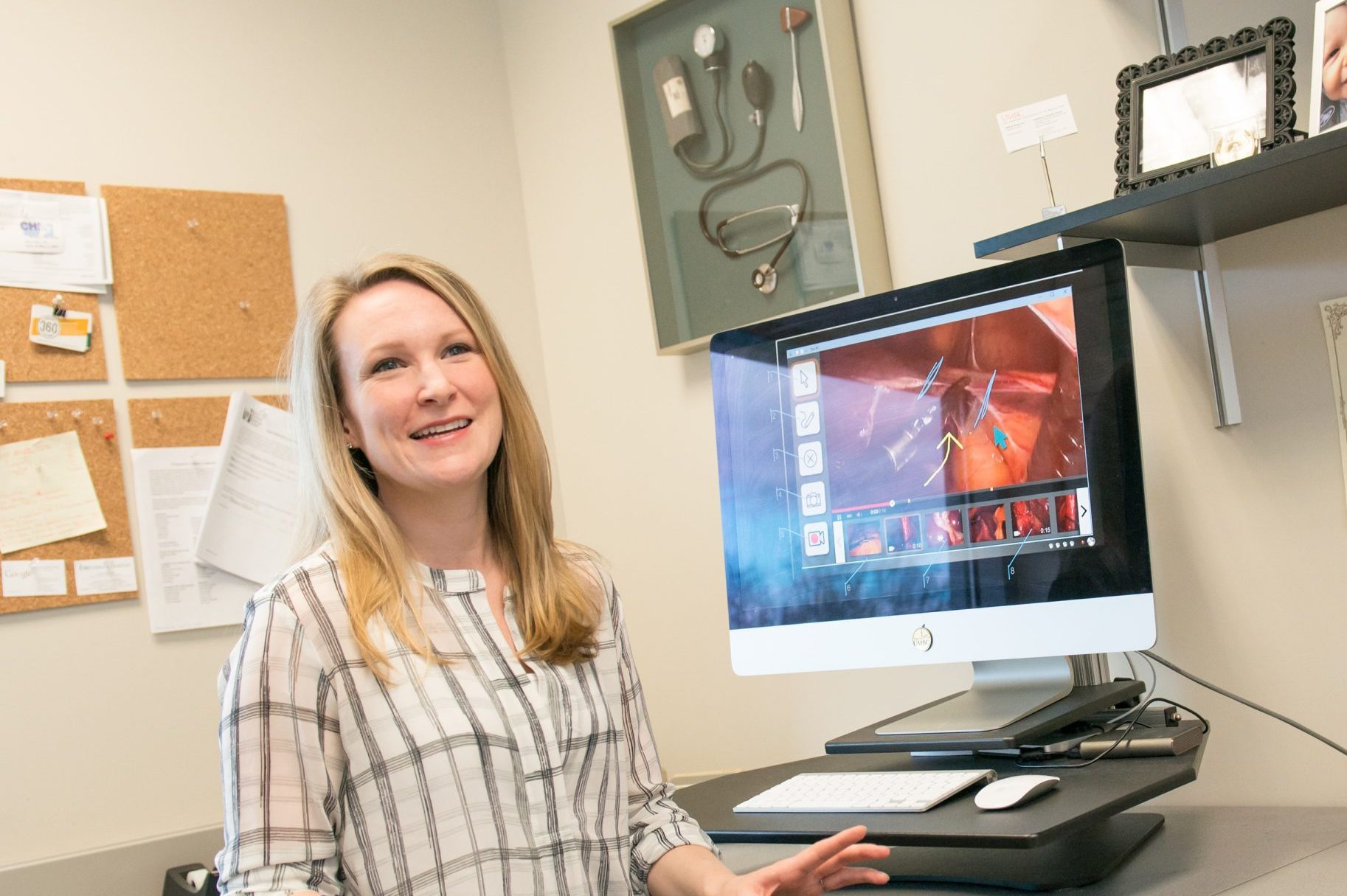
Helena Mentis. Photo by Marlayna Demond ’11 for UMBC.

Mentis is the principal investigator of this research. Colleagues leading other aspects of the research and implementation include Anupam Joshi, professor and chair of computer science and electrical engineering; Carolyn Seaman, associate professor of information systems, and interim director of the Center for Women in Technology; and Maria Sanchez, director of education and outreach, and professor of practice in mechanical engineering.

Facilitating conversations in the classroom

Mentis explains that discussions about ethics related to computing often occur organically between students as they work to understand their peers’ perspectives. This initiative takes those discussions to the next level, making them an integral part of the course. More broadly, it is also part of a new course structure for first-year engineering and computing students that emphasizes how technology will impact society. The goal, she explains, is “to develop the next generation of technologists who have the framework and vocabulary to address the relationships between STEM and society.” 

Lecturer Mark Berczynski taught the introductory computing course this semester. Through facilitated discussions, he helped his first-year students learn to more effectively explore and evaluate the potential negative impacts of technologies.

Team-based learning focused on peer-to-peer connections also played a major role in the pilot course. “Our concept of peer-led team learning has shown that peer-to-peer engagement with material leads to better understanding, better encoding, and longer retention,” Mentis shares. 

Mentis and her collaborators will assess whether their approach for teaching ethics in introductory computing is effective both in the short and longer term. They’ll compare the ethics awareness of students in the original computing course with students in the updated course. One year later, students will be asked to complete a survey about how they have applied their knowledge of ethics in other computing classes that they have taken. 

Mentis also hopes this new approach will interest a broader range of students in computing fields. She suggests, “Grounding the introduction to computing within ethics and societal implications of technology design has the potential to excite and engage a more diverse student population.”

Banner image: ITE building. Photo by Marlayna Demond ’11 for UMBC.

“We need people just like you”: Transfer students find, and build, supportive communities at UMBC

Students come to UMBC with a variety of experiences and in different stages of life. The unique perspectives of transfer students enrich the University, particularly as students connect with and support each other. Here, three students earning their degrees this week share how they found community, and built community, at UMBC.

Supporting each other

When CJ Jude ‘19, history, met Andrew Nolan, he knew that UMBC at the Universities at Shady Grove was a place where he would succeed. Jude transferred from Montgomery College to UMBC-Shady Grove seeking a challenging and supportive learning community near his home and work. Meeting Nolan, a senior lecturer and director of UMBC’s history program at Shady Grove, gave Jude a sense of the team of faculty and staff dedicated to his learning and growth. 

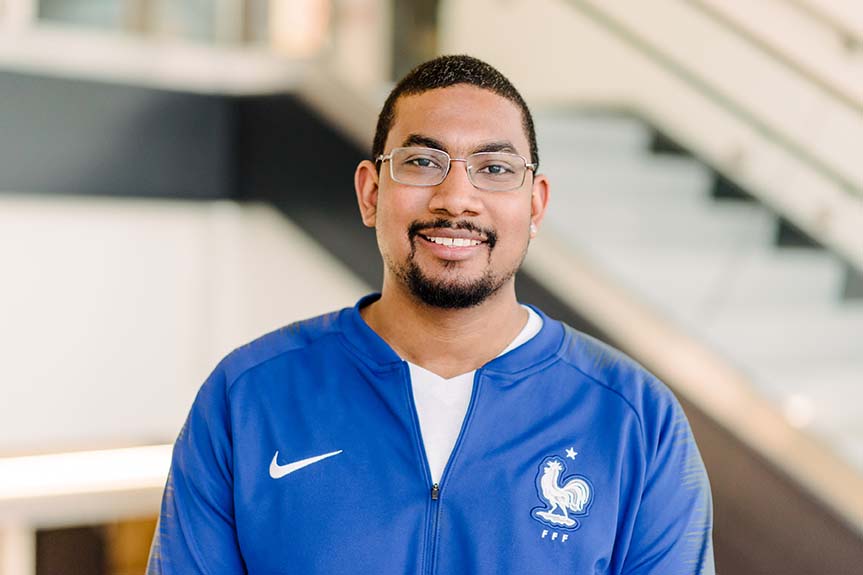
Portrait of CJ Jude wearing a blue Nike zip up top.
CJ Jude. Photo by Marlayna Demond ’11 for UMBC.

“I just realized that you’re not going it alone, and that you can share your successes with people but you can also commiserate with them, too,” Jude shares. “When you realize that you’re part of a group like that, it makes your successes [even better].”

View of The Universities at Shady Grove
The Universities at Shady Grove. Photo by Marlayna Demond ’11 for UMBC.

Reflecting on how much community support meant to him, Jude quickly developed a passion for helping other students have positive experiences transferring from community college. He connected with Chelsea Moyer, a director at Shady Grove, and became a part of the UMBC-Shady Grove Peer Advisory Team.
“We do a multitude of things, including a lot of open houses and orientations, and we give tours. We walk new students around campus, and help them through registration and verification and transferability forms,” Jude explains. “We try to put students at ease. If there’s a way we can make their transition less jarring, that’s what we do.”

Group photo of CJ Jude with friends.
CJ Jude, left, with some friends at Shady Grove. Photo courtesy of CJ Jude.

Jude particularly recalls the moments when students he has led through orientation have thanked him for making their experience so positive. “I’ve actually had some of the students whom I took the lead for come up to me and say, ‘Hey, you were really helpful to me, and I’m doing okay this semester because you gave me a good heads up,’” he says. “It was one of those moments where I kind of realized how much power my voice had.” 

Building a network

Like Jude, Bianca Monge ‘19, information systems, transferred to UMBC from Montgomery College. Monge knew that she was interested in pursuing a career in cybersecurity, specifically focused on computer networking. She was drawn to UMBC’s Cyber Scholars program, run through the Center for Women in Technology (CWIT) and the Center for Cybersecurity. The program has provided her with meaningful and transformative opportunities, and Cindy Greenwood, assistant director of CWIT, has served as a mentor for Monge during her time at UMBC.
Transitioning to life as a UMBC student “was a lot easier and smoother than I thought,” she shares, thanks to her newfound support network. A weekend orientation specifically for Cyber Scholars helped her to become familiar with the campus and make connections with other students. “It was an introduction to how my semester would be as a Cyber Scholar,” she explains. “By the time I came back in the fall to take classes, I already had a network of classmates, friends, and contacts.” 

A diverse group of students posing for a photo indoors.
Bianca Monge, second from the left, and student leaders from the UMBC chapter of the Information System Security Association. Photo courtesy of Bianca Monge.

CWIT networking opportunities and special events have proved beneficial to Monge’s academic and professional growth as she advanced in the Cyber Scholars program, Monge was paired with an incoming Cyber Scholar, whom she has mentored throughout the year. “I didn’t think that I had much to offer,” she shared, but that changed when she found she was able to answer her mentee’s questions based on her own UMBC experience. “I am more than happy to tell her all that I knew, and all that I have learned over the years.” 
Outside of CWIT, Monge has been an active member of the UMBC chapter of the Information System Security Association (ISSA), a student organization that helps students pursuing degrees in information systems with career networking and connecting with industry experts. She says that having facetime and interactions with professionals helped her become more confident as a student, and prepare her for her career.

14 students wearing matching yellow and white shirts pose for a portrait holding a sign reading "UMBC"
UMBC Peer Advisory Team at the Universities at Shady Grove. Photo by Marlayna Demond ’11 for UMBC.

Monge had an opportunity to intern for Leidos over the summer, and plans to begin working full-time with the company as a cyber intelligence analyst after graduation.

Creating a community 

Josie Aquino ‘19, mechanical engineering, came to UMBC after transferring from Harford Community College. When she arrived on campus for a tour, she says, “I immediately felt so at home and not just the physical environment, but the people around me. I knew I could make this my home, and that I could learn a lot here.”

Aquino was eager to get connected on campus, exploring new interests and building new relationships. “I’m a returning student, a first-generation student, and also a transfer student, and I really felt like now is my time to dig in and try all these different things.” 
Aquino has been able to challenge herself while also accessing community support as a Returning Women’s Scholar through the UMBC Women’s Center, and a member of the S-STEM program through the mechanical engineering department. These groups, she says, helped her feel part of something larger. As a commuting student, Aquino found that the Women’s Center in particular provided a peaceful and welcoming space for her to use between classes.

Group of students and volunteers posing for a photo outside.
Banner image: Josie Aquino, right, in the Women’s Center at UMBC. Photo courtesy of Josie Aquino.

Aquino also began conducting research alongside Jamie Gurganus, associate director of engineering education initiatives, on transfer students in STEM. She has focused on transfer students’ beliefs about engineering, and their sense of identity as engineers, which can impact degree attainment and career trajectory.
As she settled in to life at UMBC, Aquino became passionate about helping incoming students have the kind of positive experience that she has enjoyed. Recalling how helpful she found a transfer student seminar in her first semester on campus, Aquino was connected with Laila Shishineh, director of academic engagement and transition programs, by Gurganus to learn how she could get involved on the teaching side. Aquino became a peer facilitator and has now supported transfer students in seminar classes over multiple semesters.

Combined, these experiences have helped Aquino feel confident and prepared for her future career, and energized to support new transfer students in reaching for their goals. “We need people just like you, with your experiences and your perspectives, represented here,” she shares with incoming students. “The community is just really incredible to be a part of.” 

UMBC’s Mustafa Al-Adhami wins national Three-Minute Thesis competition

Mustafa Al-Adhami M.S. ‘15, Ph.D. ‘20, mechanical engineering, won the national Three-Minute Thesis competition last week, during the annual conference of the Council of Graduate Schools. His winning topic: rapid detection of bacteria in blood

Al-Adhami developed a rapid bacterial-detection test that can assess, within an hour, if a patient has an infection. It can also help physicians determine which specific antibiotics should be administered to help fight the infection. Al-Adhami’s device, ASTEK, costs a fraction of the price of the current antibiotic susceptibility test. He hopes that it will reduce the duration of hospital stays and can reduce antibiotic resistance by avoiding unnecessary antibiotic use. 

Al-Adhami earned first place in two qualifying rounds of the competition, on his path to claiming the national title. The first round was held at UMBC. The second round included 150 competitors from universities across the southern United States. The top two students from that round qualified for the national competition in Nashville.

In Nashville, Al-Adhami and nine other finalists presented their three-minute talks in front of a live audience that selected the ultimate winner. He explains that as he moved through the competition rounds he felt more at ease. 

I was very nervous doing the UMBC Three-Minute Thesis competition, but things got easier as the competition progressed,” Al-Adhami says. “Last weekend was more fun than anything else, maybe because I had my wife and a UMBC team with me this time.”

In addition to presenting in the Three-Minute Thesis competition, Al-Adhami has shared his work at UMBC’s GRIT-X talks, Idea Competition, and Cangialosi Business Innovation Competition. He was also on a team of three UMBC graduate students who won the BMEidea competition hosted by VentureWell (a national alliance of collegiate inventors and innovators) in August. He conducted his research in UMBC’s Center for Advanced Sensor Technology, and was advised by mechanical engineering faculty Marc Zupan, associate professor, and Chuck Eggleton, professor.

Learn more about Al-Adhami’s research in UMBC Magazine

Banner image: Mustafa Al-Adhami, Ph.D. ’20, speaks at GRIT-X 2019. Photo by Arionna Gonsalves.

In 2019 Idea Competition, UMBC students focus on inclusion

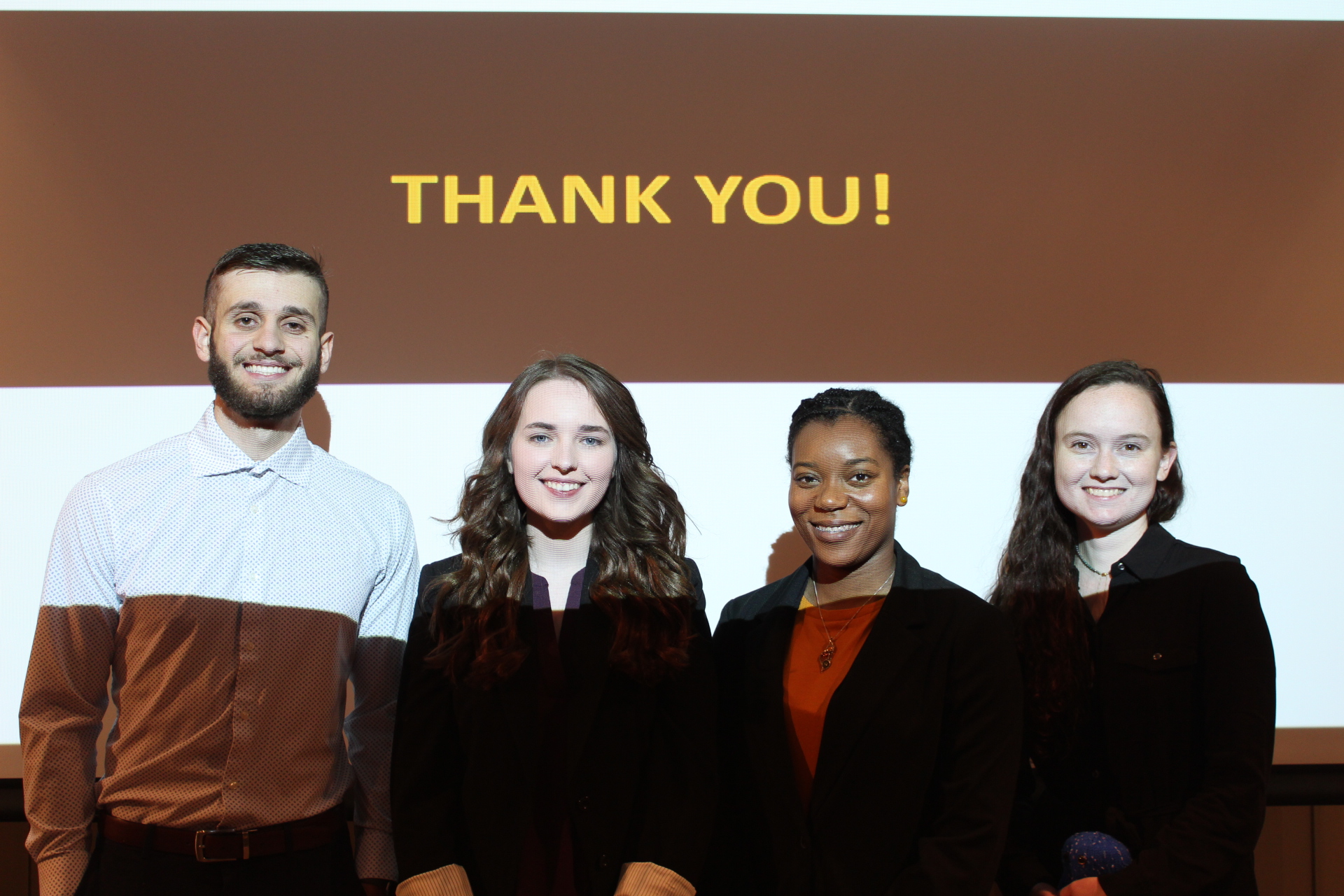
Necessity can inspire innovation and sometimes, UMBC’s Emma Neubert will tell you, that innovation comes in the form of a cuddly critter with eight limbs that makes silly sounds. Neubert ‘21, biochemistry, earned first prize in UMBC’s annual Idea Competition, hosted this month by the Alex. Brown Center for Entrepreneurship. She was one of eight students selected to participate in the pitch competition, where students present their innovative ideas to a panel of judges.

Participants spend hours refining their presentations and receiving feedback from their mentors, as well as faculty, staff, family, and friends, says George Karabatis, associate professor of information systems and director of UMBC’s entrepreneurship and innovation minor. Their goal: to gain the funding and professional advice needed to make their ideas a reality. 

Leading up to the competition, Neil Rothman, professor of practice in mechanical engineering and faculty fellow through the Alex. Brown Center, always reminds students that their presentations are stories. “Being able to frame the story and present it in a concise way is the most important part of the competition,” Rothman explains. 

Helping kids communicate

Neubert’s story begins with babysitting a young child who was frustrated with not being able to communicate his feelings and needs. In response, she developed the concept for Octotalk, a knit octopus that makes noises to help young children share their emotions. 

Hoping to avoid future stress and tears, Neubert began brainstorming on ways to help the child she babysits to express his thoughts and feelings. “He loves soft toys and really likes watching me knit,” Neubert says. “When I learned to knit the octopus, I thought, it has eight arms that could be used to cue different responses.” 

In Neubert’s design, each arm is associated with a specific emoji and a unique sound that will help a child “answer simple questions and share how they are feeling.” 

When it came time to present Octotalk to the judges, Neubert was confident in her vision. “This project is near and dear to me, and I knew what I wanted people to know about it,” she says.

More efficient hair styling

The Braid Saver is an automatic braiding and twisting tool that styles hair and eliminates the need to intertwine sections of hair by hand, explains second-prize winner Elyssa Ferguson ‘20, mechanical engineering. Ferguson was inspired by her desire to spend less time styling her naturally curly hair without using chemical straighteners. 

“With little time to spare, I have turned to braids as my go-to low-maintenance style during the semesters. Although braids do not require as much time as other styles, doing them still takes up time that could be used to study or do other things,” Ferguson says. “After continually becoming frustrated with the time I had to set aside to braid my hair, I was inspired to create a braiding and twisting device that would make hair styling more efficient.”

Encouraged to enter the Idea Competition by entrepreneurship instructor Aaron Altscher, Ferguson began sketching iterations of her ideal solution to visualize how the components would look and work. “I hope to develop this tool and sell it in salons and to anyone who wants an easier way to braid or twist hair,” she says. “Inclusivity is very important, so the Braid Saver will be designed to intertwine all textures of hair.” 
Four students standing in front of

Low-cost alternatives to fast food 

Third place prize winner Laura Holland ‘22, computer science, wants to use her passion for technology to connect people with low-cost alternatives to fast food. Holland’s awareness of food deserts in Baltimore City led her to the idea for MyPlateAwaits, an app to connect local businesses, community gardens, and markets with people in the community who are looking for healthy, affordable food options. 

She explains that the goal of MyPlateAwaits is to offer food that is as inexpensive as fast food, but that is healthier. The app will allow people to purchase meal plans, such as five or ten meals a week, to accommodate their schedules and needs. The more meals people buy, the lower their cost per meal. “My goal is to facilitate growth in these communities,” Holland says.

Holland is the secretary for the new UMBC Entrepreneurs student group, which works to create opportunities for students to develop ideas and get feedback from each other in an informal setting. “You can’t do it alone, so it’s great to collaborate,” Holland says. 

Taking the leap

Niky Sicilia ‘21, business technology administration, received “best presentation” recognition at the Idea Competition for InPulse, software that would collect data related to concerts and other performances, from both performers and audience members, to help shape future experiences.

Sicilia’s goal is to eventually start and own a company. He was eager to get connected with the Alex. Brown Center after transferring to UMBC from Howard Community College, and he’s already looking ahead to UMBC’s Cangialosi Business Innovation Competition in the spring. 

“The resources at UMBC are unlimited,” Sicilia says. “You just have to be willing to talk to people. Coming to UMBC has been the best thing for my career.” 

Green buildings

One competitor, Randy Deinlein ‘20, mechanical engineering, has already presented his ideas on an international stage. Deinlein is a Grand Challenge Scholar with an interest in sustainability who is pursuing a minor in entrepreneurship. He represented UMBC at the Global Grand Challenges Summit in London this past summer, and seeing London’s dense cityscape gave him fresh ideas about the potential of green rooftops. At this month’s competition, Deinlein shared his concept for Roof Roots, a green roof project. 

Deinlein says that attending Alex. Brown Center seminars and having the opportunity to do a practice presentation and receive feedback allowed him to refine his pitch before the competition. As he’s developed his presentation skills over the past several months he’s learned, “Don’t be scared to share your ideas. It’s okay to take risks.”

The Alex. Brown Center offers a wide variety of initiatives, competitions and resources to assist students in developing their entrepreneurial skills and interests, explains Vivian Armor ‘73, American studies, director of the Alex. Brown Center for Entrepreneurship. “The annual Idea Competition is a wonderful way for us to showcase the incredible creativity of our students and to help them flesh out their ideas,” she says.

Banner image: Campus at dusk. Photo by Marlayna Demond ’11 for UMBC. 

The Driving Force of Chemistry

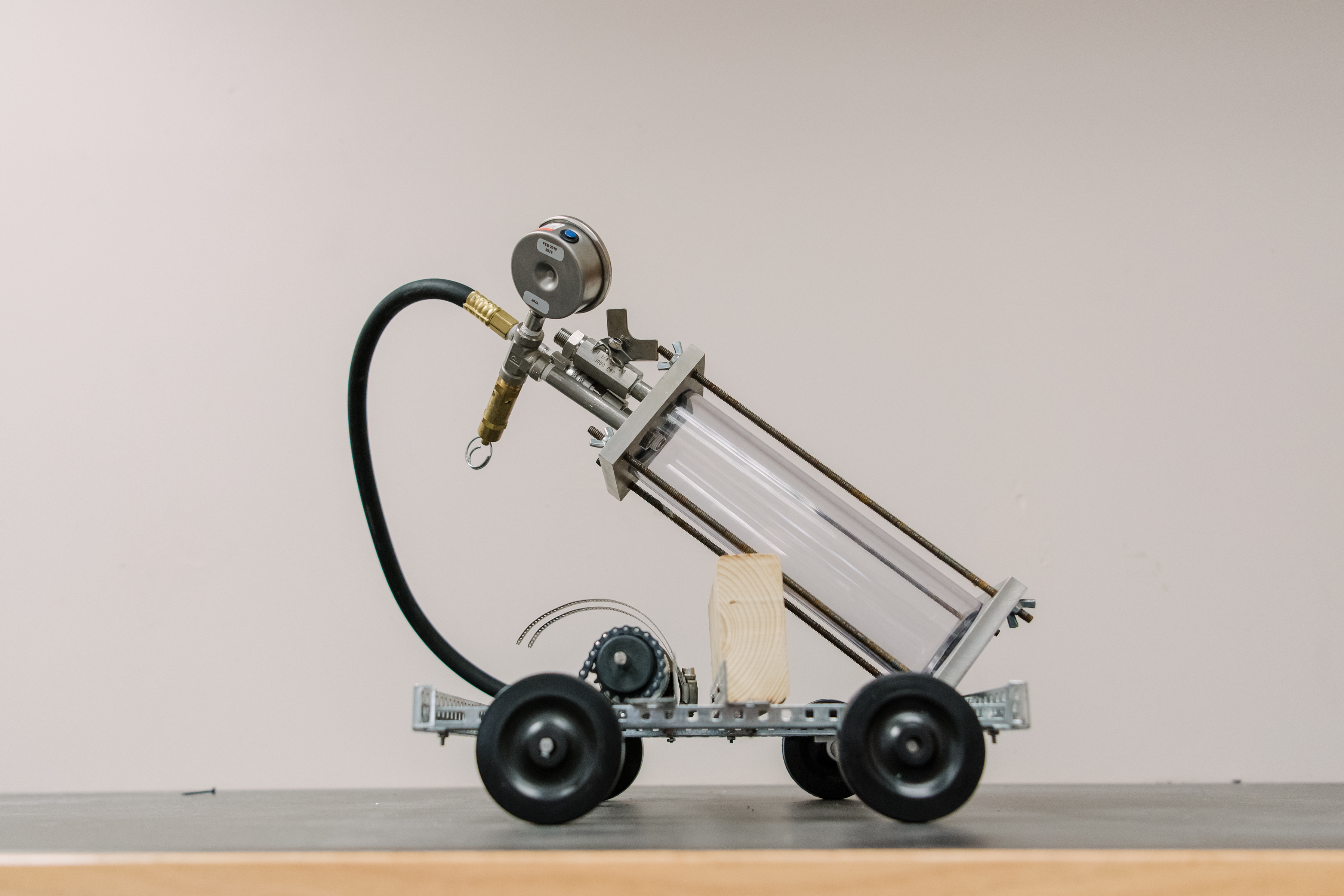
In a chemical engineering lab, students huddle around a bench layering aluminum foil and steel wool together to build a battery. Another group pipettes solutions into a pressure vessel to test various reactions. The end result of the students’ experimentations will be two autonomous shoebox-sized vehicles that are powered by chemical reactions. Think of your second-grade volcano project, but the baking soda and vinegar “eruption” is happening inside an enclosed vessel, propelling it forward down a track. 

When the UMBC Chem-E-Car chapter launched in early spring 2019, there were 10 students who came together to grow the group. Today, less than one year after they became formally recognized by UMBC and the American Institute of Chemical Engineers, there are about 30 students working together to build vehicles powered by chemical reactions, putting the information and skills they learn in their classes into practice.

Students work in three groups on two vehicle projects. One team focuses on developing the stopping mechanism that uses a color changing reaction, the second team works on refining the car propelled by a pressure-generating reaction, and the third team develops a battery-driven vehicle. 

One car moves using a chemical reaction that produces a large volume of gas, and the gas is used to move a pneumatic motor, which is kind of like a water wheel for air,” explains Sammie Maygers ’20, chemical engineering, who is leading the group in charge of developing the stopping mechanism. “The second car is powered by a battery. We are experimenting with different chemical reactions to optimize the amount of current and voltage that we can produce to run an electric motor.”

As the group was ramping up, the founding students spent the semester learning about the structure of the competitions and attended the regional competition as onlookers. Alex Von Gunten ’20, chemical engineering, current chair of the Chem-E-Car Project, says that it was helpful for UMBC students to experience the competitions and to take note of the vehicles that other teams built. An additional layer of pressure for competitors is that no one knows how far their car will need travel until a couple of hours before the race, when the judges release the specifications that the car must meet. Just before the car is set to race, the students work through a series of calculations to determine the amount of chemicals that are needed to propel the vehicle a specific distance. 

Jason Ewart ’20, chemical engineering, who is a member of the pressure team, explains that safety is a very important component of the Chem-E-Car competitions. The students who are taking part rely on the knowledge they’ve learned in the courses they have taken at UMBC, including the safety course that all chemical, biochemical, and environmental engineering students must complete.

The Chem-E-Car group joins a rich history of student organizations on campus that design and build vehicles based on skills learned in the classroom. On a human scale, UMBC’s Baja SAE team builds vehicles that are driven by one student and are designed to withstand challenging terrain and weather while keeping budget, vehicle weight, and agility in mind. In the 20182019 season, the Baja team finished with the second highest total points in the program’s 30-year history. 

The Chem-E-Car team has yet to test the mettle of their designs, but they plan on competing in the regional competition at Virginia Tech in April 2020, with their sights set on advancing to the national competition.

***

All photos, including header, by Marlayna Demond ’11.

UMBC Cyber Dawgs are named CyberForce national champions

UMBC’s Cyber Defense Team, known as the Cyber Dawgs, emerged the national champion team in the U.S. Department of Energy’s fifth annual CyberForce Competition. The Cyber Dawgs earned first place overall out of more than 100 teams from universities across the country.

Ten national laboratories hosted competing teams this year, November 15 16. UMBC competed at the Argonne National Laboratory near Chicago, Illinois, while other teams traveled to sites like the Pacific Northwest National Laboratory in Washington state and Oak Ridge National Laboratory in Tennessee. Competing teams hailed from a broad range of institutions, including Virginia Tech, Carnegie Mellon, Georgia Tech, Texas A&M and the U.S. Air Force Academy.

The competition tasks students with defending critical energy infrastructure during simulated cyberattacks. The scenarios are designed to be realistic, focused on water and power systems and including real-world constraints, such as insufficient budget for system upkeep and limited information on system needs. During the competition, “red teams,” including industry professionals, attack the system, while the students work to ensure that the infrastructure is available to their customers, or “green teams,” who test system usability. 

The teams receive points based on how successfully they address attacks, while still allowing users to access the infrastructure they need. The teams are also awarded points for innovative defense tactics and ideas. This year’s competition saw several leading teams with neck-and-neck scores until the final round, when UMBC’s Cyber Dawgs pulled ahead for the victory.

The competition offers students a unique opportunity to develop their cybersecurity skills in relation to critical infrastructure, and have hands-on experience in a realistic cyberattack situation.

“The CyberForce competition is the most unique of our annual events, allowing us to experiment with network configurations to defend an industrial control system against adversaries while playing the roles of an IT organization,” explains RJ Joyce ’18, M.S. ’20, computer science, a member of the winning team. “The hard work, dedication, and creativity that each member brought to the team lifted us from a regional win last year to a national win this year.”

In addition to Joyce, last weekend’s winning team included Anna Staats ’20, computer science; Drew Barrett ’20, computer science; Grant Spencer ’20, computer science; Cyrus Bonyadi, Ph.D. ’23, computer science; and Seamus Burke ’20, computer science.

“The team’s second national championship in three years shows the enthusiasm, grit, and tenacity of our students in demonstrating their technical cyber expertise in a competitive arena,” says Rick Forno, senior lecturer of computer science and assistant director of UMBC’s Center for Cybersecurity. 

Forno advises the Cyber Dawgs with Charles Nicholas, professor of computer science and electrical engineering. “It’s an awesome thing not just for the team and university,” he says, “but for each competitor individually, as they prepare to enter the cybersecurity workforce after graduation.”

UMBC students have a strong record in state and national competition. In 2018, UMBC computer science and information systems students won the top prize at the Maryland Cyber Challenge. A year earlier, the UMBC Cyber Dawgs won the National Collegiate Cyber Defense Competition

Update: In early December 2019, the Cyber Dawgs won the 2019 Maryland Cyber Challenge, with a team comprised of Staats, Spencer, and Burke. They competed against several skilled challengers, including a team from the U.S. Air Force Academy.


Banner image: The Cyber Dawgs at the CyberForce competition. From left, Charles Nicholas, Anna Staats, Drew Barrett, Grant Spencer, Cyrus Bonyadi, and Seamus Burke. Photo courtesy of Argonne National Lab.

UMBC supports emerging higher ed leaders through ACE Fellows program

One of the pillars of UMBC is a commitment to supporting emerging leaders from all backgrounds and across all disciplines. This includes supporting the growth of diverse university faculty and administrators on their path to top-level leadership positions, particularly through the American Council on Education (ACE) Fellows program. 

The ACE Fellows Program has provided intensive professional development opportunities to 2,000 higher education leaders nationwide. UMBC has played a key role in this work, serving as a welcoming community and source of mentorship for leaders from other universities, and nominating UMBC leaders to pursue training opportunities at universities across the country. 

The newest ACE Fellow to arrive on campus is a two-time UMBC alumna who is now shadowing UMBC leaders, including President Freeman Hrabowski, Provost Philip Rous, and Candace Dodson-Reed ‘96, English, chief of staff in the President’s Office, for the year.

A Retriever returns to explore something new

Kate Tracy M.A. ‘01, Ph.D. ‘03, psychology, was one of 39 people from across the country to be named ACE Fellows for the 2019-2020 academic year. Tracy is a professor of epidemiology and public health at the University of Maryland School of Medicine. 

A core aspect of the ACE Fellowship program is that fellows spend time at a host campus learning from the host president, provost, and senior leadership team. Tracy knew early in the application process that she would love to return to her alma mater if she was selected as a fellow. When she learned she would spend the year at UMBC, she says, “I was ecstatic.”

She explains that she has been inspired to work alongside President Hrabowski by his powerful personal story, his tremendous track record of effective leadership, and his reputation as an innovator in higher education. “Dr. Hrabowski is an example of how your story informs your leadership,” she says. “This is an opportunity in my professional career where I will have mentorship from someone who is internationally known and respected for his leadership and transformative accomplishments at UMBC.” 

Tracy’s research focuses on health disparities, specifically cervical cancer prevention in underserved groups of women. She has spent time in sub-Saharan Africa working with communities, public health officials, and health professionals to develop approaches to cervical cancer screening that would be locally sustainable. 

Through her work, Tracy helped create a program that provided Gardasil vaccines to about 11,000 girls in Mali. The challenge, Tracy explained, is that the Gardasil vaccine is administered in three doses. This means medical staff administering vaccines must connect with each patient three times in order to make sure they receive the full vaccine series. She recognized the cross-cultural communication and logistical challenges involved, and saw careful preparation and close collaboration with the local community as critical to the vaccination program’s success.

With experiences like this on her mind, Tracy was excited to return to UMBC for her ACE Fellowship. “Something that’s often overlooked is that education and health are closely linked. Those with more education live healthier and longer lives. Under President Hrabowski’s leadership, UMBC is not only positively influencing equity in education, but in long-term health and well-being of its students,” she says. 

“As a health disparities and equity researcher,” Tracy shares, “I am excited about being an ACE Fellow at UMBC because it opens opportunities to address health equity through leadership in the higher education space.”

Supporting UMBC faculty and administrators

Several UMBC faculty have been ACE Fellows in recent years, including one faculty member selected for the 2019-2020 ACE Fellows class. Tyson King-Meadows, associate professor of political science, Humanities and Social Sciences (CAHSS) is spending the year in the Provost’s Office at Case Western Reserve University. He is focusing on learning more about strategic planning, research infrastructure, faculty development, and external partnership development. 

Additional recent ACE Fellows from UMBC include Sarah Shin, professor of education and associate provost for academic initiatives, and Anne Brodsky, professor and chair of psychology. 

Two other recent UMBC ACE Fellows have advanced to senior leadership roles at other universities, taking with them UMBC values and experiences. Marie desJardins, former professor of computer science and associate dean for academic affairs in UMBC’s College of Engineering and Information Technology (COEIT), now serves as dean of the College of Organizational, Computational, and Information Sciences at Simmons College. Julie Ross, former dean of COEIT, is now the dean of the College of Engineering at Virginia Tech and the first woman to serve in this role.

“The ACE Fellowship Program provides invaluable opportunities for aspiring leaders to learn from some of the nation’s best leaders and their teams. It is one of the most comprehensive and successful leadership development programs available in higher education with 80% of fellows serving as chief academic officers, other cabinet level positions, deans, or presidents,” explains Tracy. 

She shares, “I am deeply grateful to President Hrabowski, Provost Rous, the senior leadership team, and the UMBC students, staff, and faculty who have welcomed me to campus for the year, and are supporting my continued development as a proud UMBC alumna and a leader in higher education.”

Banner image: Candace Dodson-Reed (left), and Kate Tracy. Photo by Marlayna Demond ’11 for UMBC.

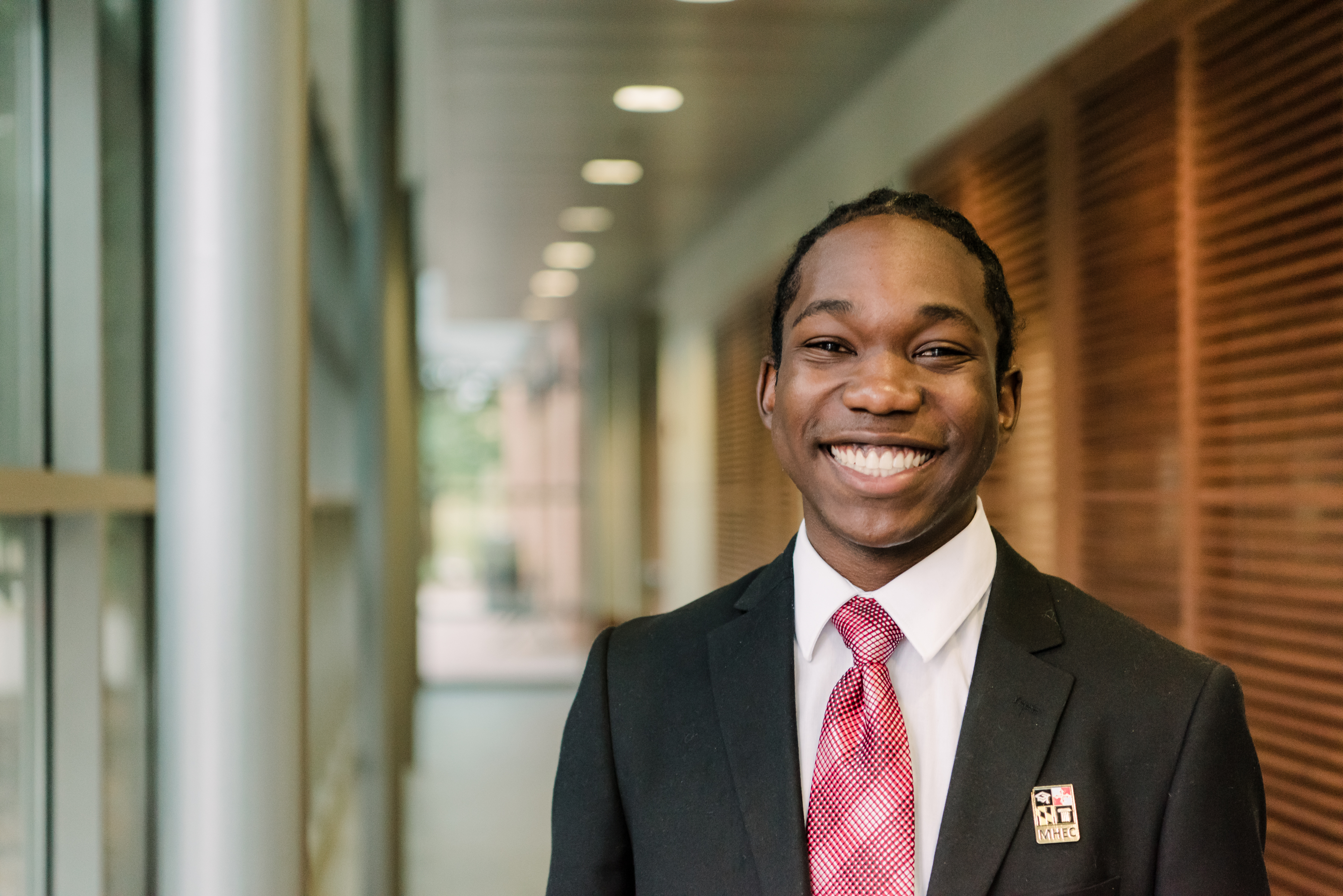
MHEC selects UMBC’s Jordan Troutman, who bridges technology and policy, as student commissioner

UMBC’s Jordan Troutman ‘21, M29, enjoys challenging assumptions. Recently named the student commissioner for the Maryland Higher Education Commission (MHEC), Troutman isn’t studying public policy or political science, like many students involved in governance. He’s a computer science and mathematics major passionate about applying his work at the intersection of technology and policy to improve society. 

Troutman’s research focuses on eliminating biases in algorithms that can lead to unfair outcomes and even impact life-changing decisions. Now, he’s turning his analytical approach and commitment to equity to work representing Maryland college students at the state level.

Representing students across Maryland

Troutman is a thoughtful, organized student whose energy and excitement for tackling new challenges shines through his beaming smile. He will serve as a voting member of MHEC for the 2019-2020 academic year, and sees his role as essential to “provide perspective on what it’s like to be a student right now,” he shares. 

MHEC is responsible for establishing policies for public and private colleges and universities across the state of Maryland. Troutman explains that he learned about the opportunity to apply for the student commissioner role from Dan Barnhart, director of campus life at UMBC. The application process included a recommendation from Barnhart and a nomination letter from President Freeman Hrabowski

Making an impact as a leader

Troutman served as a senator on UMBC’s Student Government Association during his freshman and sophomore years. It was through SGA that he learned about how groups like MHEC can impact the experiences of Maryland students at a high level.

As a senator, “Jordan has taken on such issues as academic conduct, more representative information technology, and more activity space for undergraduate students,” says Barnhart. “He communicates well with his peers, models outstanding leadership skills, and is a consummate team player.”

Troutman’s effective leadership style is what inspired Barnhart to recommend him for the MHEC role. He understands the political system of a campus and works well in that system to accomplish his goals,” Barnhart explains. “All of the work he does in shared governance helps the student leaders, and the campus life department in co-creating amazing experiences for students at UMBC and beyond.”

Identifying biases in technology 

Troutman is a Meyerhoff Scholar and a member of the Honors College who has been engaged in both research and student groups throughout his UMBC years. He conducts research with James Foulds, assistant professor of information systems, on identifying biases in machine learning technologies. Troutman received an Undergraduate Research Award to pursue a new line of research and will present his work at the annual Undergraduate Research and Creative Achievement Day in the spring. 

After he graduates, Troutman plans to pursue a Ph.D. in computer science, with his sights set on working in both higher education as a professor and in industry research settings. He hopes to build collaborations among computer scientists, educators, and policymakers to develop technologies that do social good and benefit people around the world. 

As MHEC’s student commissioner, Troutman looks forward to learning more about the challenges and issues that higher education institutions are facing today, particularly affordability and accessibility. “My role and intention is that when I’m speaking, I’m not speaking for me,” he says, “I’m speaking for students across Maryland.”

Banner image: Jordan Troutman, left, and Dan Barnhart. Photo by Marlayna Demond ’11 for UMBC.

UMBC’s Lee Blaney and federal, state partners publish landmark study on contaminants in the Chesapeake Bay

UMBC’s Lee Blaney and research partners have published a landmark study on contaminants of emerging concern in the Chesapeake Bay. Their article in Science of the Total Environment is the first research study that quantifies concentrations of antibiotics, estrogenic hormones, and UV-filters in multiple locations of the Bay.

Blaney, an associate professor of chemical, biochemical, and environmental engineering, conducted the research with Ke He, Ph.D ‘17, chemical engineering, and Ethan Hain ‘21, chemical engineering. They also partnered with collaborators at the U.S. Forest Service and the Maryland Department of Natural Resources. 

Underway since 2016, their work highlights the importance of understanding how previously unexamined chemicals impact the environment. The project has been primarily funded by Maryland Sea Grant through a Program Development Fund to Blaney, and a Graduate Research Fellowship to Hain.

The researchers studied the prevalence of contaminants of emerging concern in water, sediment, and oyster tissue collected from the Eastern Shore of the Chesapeake Bay. Their study of how accumulated UV-filters negatively impact the environment is the first of its kind. UV-filters are one of the primary ingredients in personal care products, such as sunscreen and cosmetics. The accumulation of these UV-filters can impact organisms and animals.

Maintaining a healthy Chesapeake Bay 

While the Chesapeake Bay is one of the most well-studied ecosystems in the United States, Blaney says that little is known about the sources, occurrence, and impacts of contaminants of emerging concern in this important estuary. 

“As the health of the Chesapeake Bay continues to improve due to recent nutrient and sediment regulations, it is important to consider new threats from specialty chemicals like antibiotics, hormones, and UV-filters,” he explains. “The first step to ensuring the safety of the Chesapeake Bay is to measure the concentrations of these contaminants in water, sediment, and tissue.”

The discharge of antibiotics into the Chesapeake Bay may speed up the spread and development of antibiotic resistance, a global public health challenge, explains Blaney. He adds that estrogenic hormones and UV-filters are considered priority chemicals of concern due to reported toxicity and other effects on reproductive systems in aquatic and marine organisms. 

Over the past two years, Blaney and his team have continued to collect data throughout the Chesapeake Bay to better understand differences in contaminant levels. They have found relatively high levels of antibiotics in the Chesapeake Bay, and the reported concentrations are in the range that can select for antibiotic resistant bacteria. In addition, most samples have contained UV-filters, including two common in sunscreens that were recently banned from being sold in Hawaii due to concerns that they are toxic to corals. 

The researchers argue that their findings suggest a need to improve municipal wastewater treatment and agricultural waste management to remove contaminants of emerging concern and prevent their introduction to the environment. In this regard, Blaney and his collaborators are actively working on a number of technologies to improve the transformation of contaminants into benign molecules that do not have antibiotic or estrogenic properties or other toxicity concerns. 

Continuing to expand the research

In 2017, Blaney received a CAREER Award from the National Science Foundation to study contaminants of emerging concern and their effects on the urban environment. That research focused on the Gwynns Falls watershed in Baltimore, and the Chesapeake Bay research is an extension of that work. In addition to the public and ecological health concerns highlighted in the current article, Blaney also continues to examine issues like antimicrobial resistance and the impact of agricultural runoff.

Blaney was recently named associate director for sustainability engineering and liaison to the University System of Maryland (USM) vice chancellor for environmental sustainability. In this capacity, he will work closely with collaborators at the University of Maryland Center for Environmental Science and will lead additional sustainability-focused research projects within the USM. 

Banner image: Lee Blaney, left, working with a student in the lab. Photo by Marlayna Demond ’11 for UMBC. 

Team of UMBC grad students takes first place at 2019 BMEidea competition 

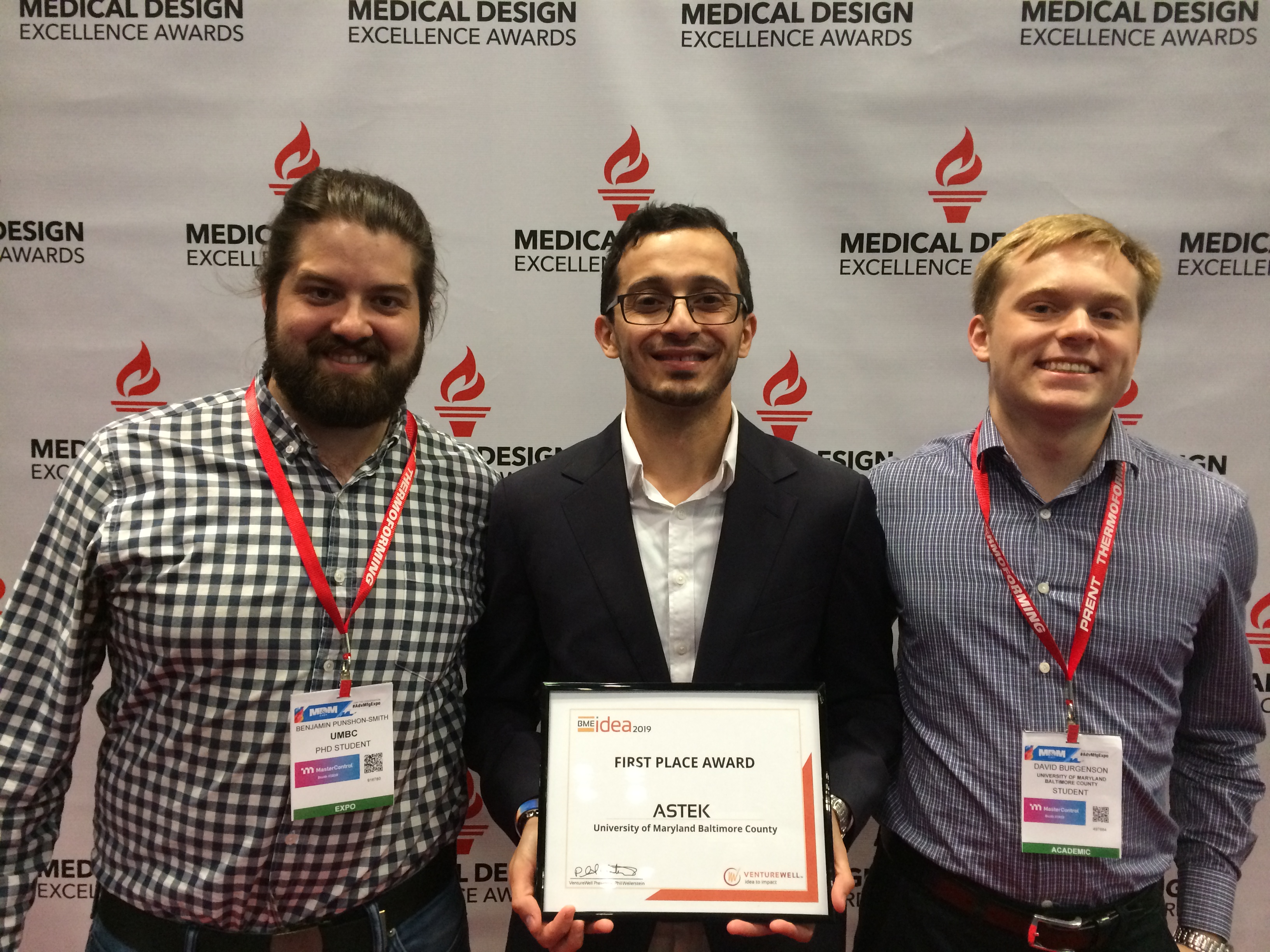
A team of three UMBC graduate students earned first place in an innovation competition for their pioneering work in the rapid detection of bacteria in blood. The students joined teams from the University of Pennsylvania and the University of Michigan, which earned second and third place, respectively, at the BMEidea competition hosted by VentureWell, a national alliance of collegiate inventors and innovators.

UMBC’s team competed in the biomedical and bioengineering innovation student category of the competition, and presented a device called ASTEK, which allows physicians to more effectively treat bacterial infections. The interdisciplinary team included Mustafa Al-Adhami M.S. ‘15, mechanical engineering, Ph.D. ‘19, mechanical engineering; David Burgenson ‘17, chemical engineering, PhD ‘21, chemical engineering, and Benjamin Punshon-Smith M.S. ‘17, electrical engineering, and Ph.D. ‘22, electrical engineering.

“It can be difficult to translate science into relatable terms and a feasible business plan,” says Al-Adhami. “Participating in the BMEidea competition proved not only that they are interested in our research, but there is the potential to create a business around it. The BMEidea competition gave us the opportunity to get validation that we are onto something.”

Al-Adhami, Burgenson, and Punshon-Smith share office and lab space in UMBC’s Center for Advanced Sensor Technology, which is directed by Govind Rao, professor of chemical, biochemical, and environmental engineering. The group is also advised by Yordan Kostov, research professor in chemical, biochemical, and environmental engineering at UMBC, and Alan Cross, professor of medicine at the University of Maryland School of Medicine. 

The team will use their $10,000 prize from VentureWell to continue to develop the technology and advance the ASTEK. 

In 2016, Al-Adhami earned third place in UMBC’s Cangialosi Business Innovation Competition, and he explains that the feedback from the judges was valuable and helped him refine the design of the device. “I have used feedback and networking connections gained from these competitions to develop my business plan and expand my outreach on a national scale,” he says. 

The technology was initially developed to detect bacteria in water, but after Al-Adhami learned about sepsis and the serious complications that it can cause, he changed focus to meet a known need in healthcare. The ASTEK displays results of the blood test in a user-friendly interface, he says. 

“The project is at the intersection of mechanical engineering, electrical engineering, chemical engineering, and biology,” Al-Adhami explains. “The best thing about working on a multidisciplinary team is there are always four solutions to every problem we face.” 

Banner image: Mustafa Al-Adhami gives his three-minute thesis talk at the 2018 Graduate Research Conference. Photo by Marlayna Demond ’11 for UMBC.