We use cookies for analytics and, unless you opt out, advertising.
You can opt out of advertising at any time.UMBC uses essential cookies to run this site. With your permission we would also use analytics cookies (to understand how the site is used) and advertising cookies (to measure and target our ads on other platforms). Nothing else loads unless you accept. You can change your choice any time from Cookie Settings in the footer.Privacy Policy
EssentialRequired for the site to work (login, security, your cookie choice). Always on.
Tens of millions of people live in areas that are at risk for flooding due to climate change, sea level rise, and melting of glaciers. UMBC’s Vandana Janeja is leading a team of researchers using data science, machine learning, artificial intelligence (AI), and polar science to analyze enormous volumes of climate data, and Arctic and Antarctic observations in ways that could help populations prepare for and respond to these risks.
Janeja, professor and chair of information systems, is the principal investigator on the five-year, $13 million grant from the National Science Foundation’s Harnessing the Data Revolution (HDR) Big Idea program. With support from the grant, Janeja is directing iHARP, the NSF HDR Institute for Harnessing Data and Model Revolution in the Polar Regions.
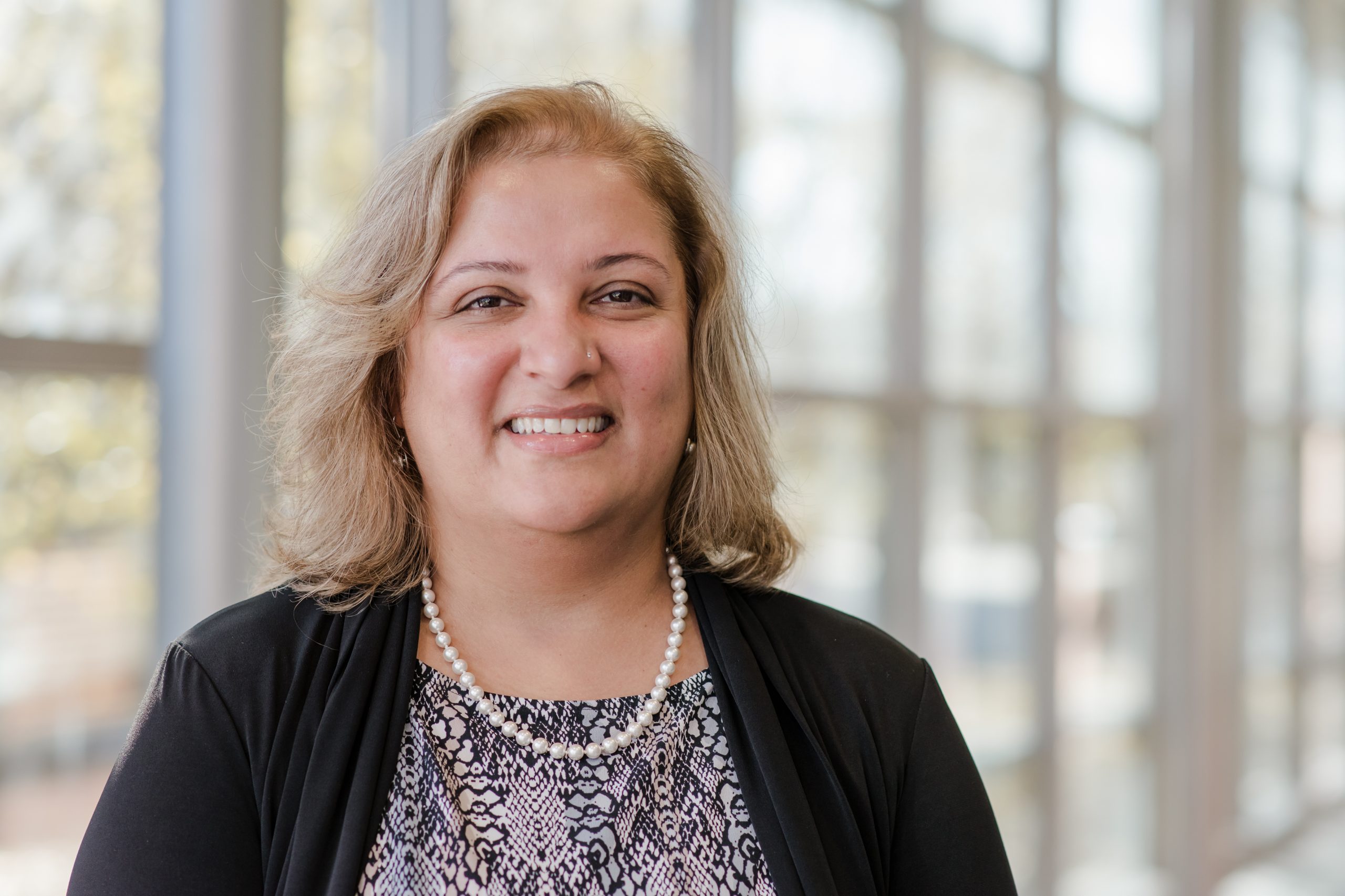
Vandana Janeja. (Marlayna Demond ’11/UMBC)
“The research we’re doing in iHARP will help us understand global drivers of sea level rise and its impacts. This work will look at complex dynamics in the polar regions, evaluating heterogeneous data and connections between climate processes. This will help us get to more certain assessments, to drive the science responding to climate change,” she explains.
Data science meets climate science
Climate scientists rely on data that are incredibly challenging to disentangle. AI offers solutions for analyzing these large datasets, providing sophisticated models that make the best use of the available data.
“Researchers in iHARP are already looking at ice sheets in the Arctic and the Antarctic, including labeling of ice layer images. They are examining anomalous trends in ice thickness and creating new algorithms for understanding which factors are causing which types of changes in such a dynamic environment,” explains Janeja.
The iHARP researchers will reduce uncertainties in projecting sea level rise by combining physics-driven modeling, machine learning techniques, and data analysis. The results of the work will inform policymaking to address national and global priorities related to the climate crisis.
The team will also investigate novel data science techniques that can be applied to other disciplines encountering challenges related to complex data.
Tackling challenges together
An interdisciplinary team has been assembled to move forward this important collaboration. Janeja is working with co-PIs Jianwu Wang, associate professor of information systems at UMBC; Mathieu Morlighem at Dartmouth College; Shashi Shekhar at the University of Minnesota; and researchers from the University of Colorado Boulder.
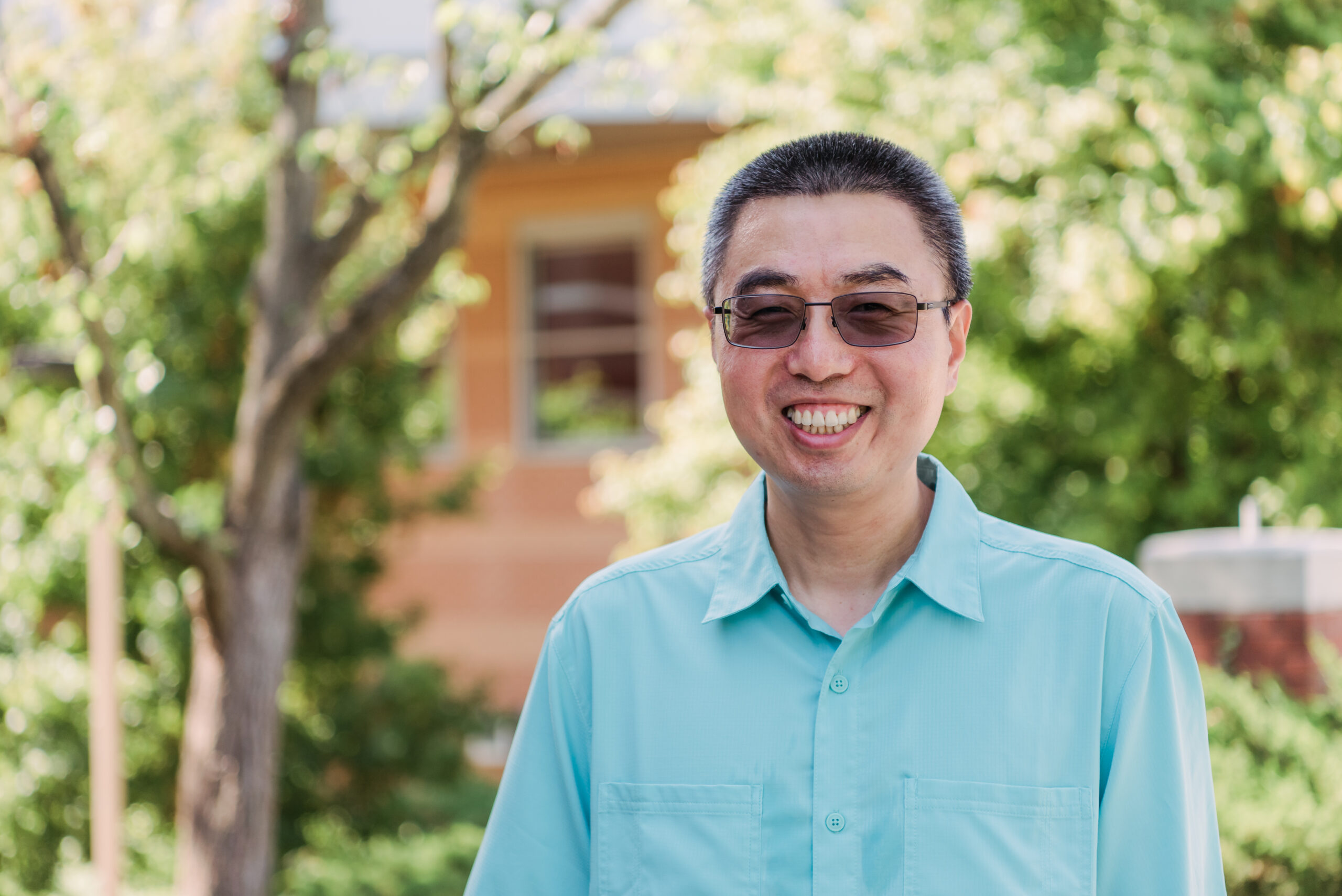
Jianwu Wang. (Maryland Demond ’11/UMBC)
Project collaborators in education, government, and industry across the country include additional researchers and collaborators at the above universities as well as University of Alaska Fairbanks, University of Northern Texas, Amherst College, University of Texas at Austin, NASA Universities Space Research Association, NASA Jet Propulsion Laboratory, NVIDIA, IBM, and Amazon.
The grant also involves dozens of undergraduate and graduate students and postdoctoral researchers, and will support educational and outreach activities, with an eye toward workforce development. This includes programming for K-12 and college students, and lectures and training opportunities for data science and domain science professionals. Students will work alongside partners including NASA, Amazon, and IBM, and will have internship opportunities with federal and industry partners.
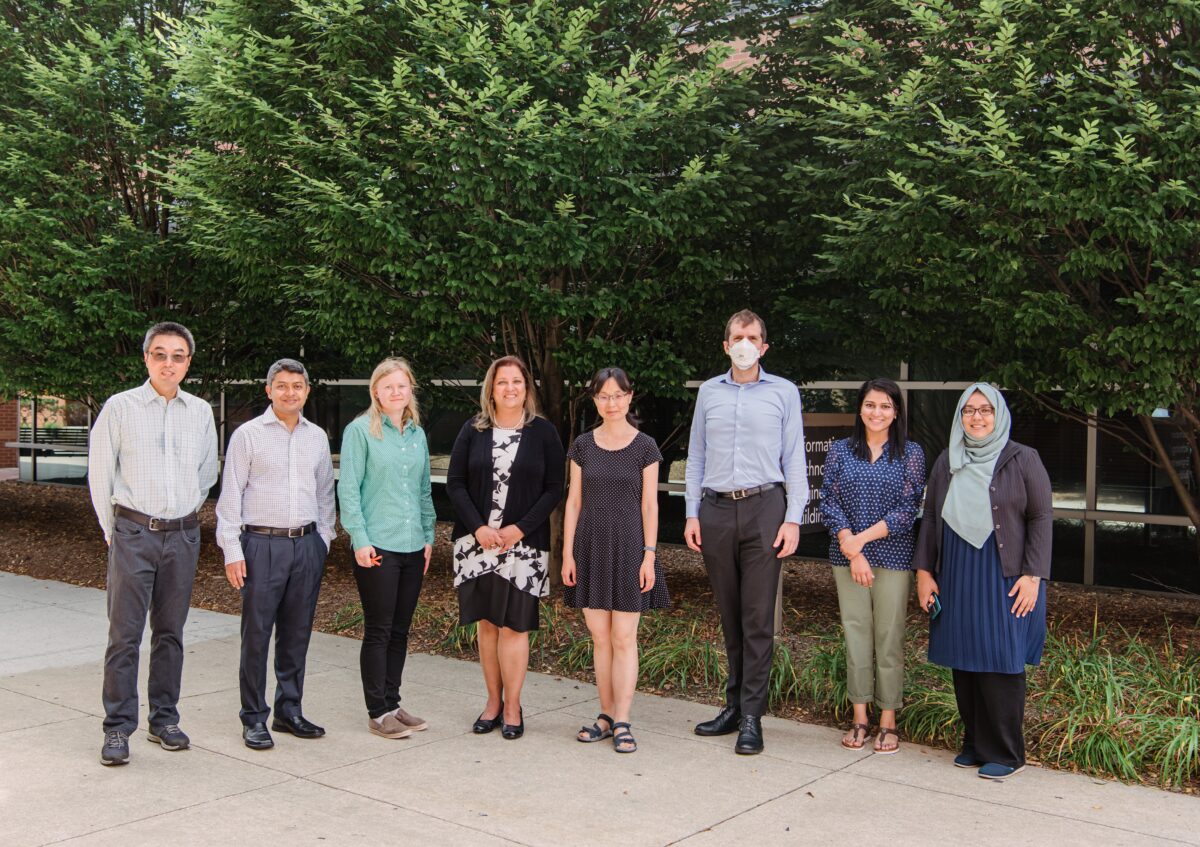
UMBC iHARP faculty and student researchers. (Maryland Demond ’11/UMBC)
“This major multi-institutional NSF award reflects so much hard work and ingenuity. National programs like iHARP, with its focus on some of the great challenges our society is facing, add to UMBC’s growing reputation for innovation and excellence in public impact research,” says Karl V. Steiner, vice president for research at UMBC.
Impact of multidisciplinary teams
The solutions that are developed through this work will have applications beyond environmental issues. The team’s research may impact the future of medicine, computer vision, responsible AI , and remote sensing. And students working on the project will become the next generation of experts addressing these global issues.
“The College is experiencing extraordinary research growth. This is made possible by both the development of multidisciplinary teams and our increased focus on leadership development,” says Keith J Bowman, dean of the College of Engineering and Information Technology. “This project team, and others recently funded or pending, benefit from the tremendous faculty talent we have recruited in the last several years.”
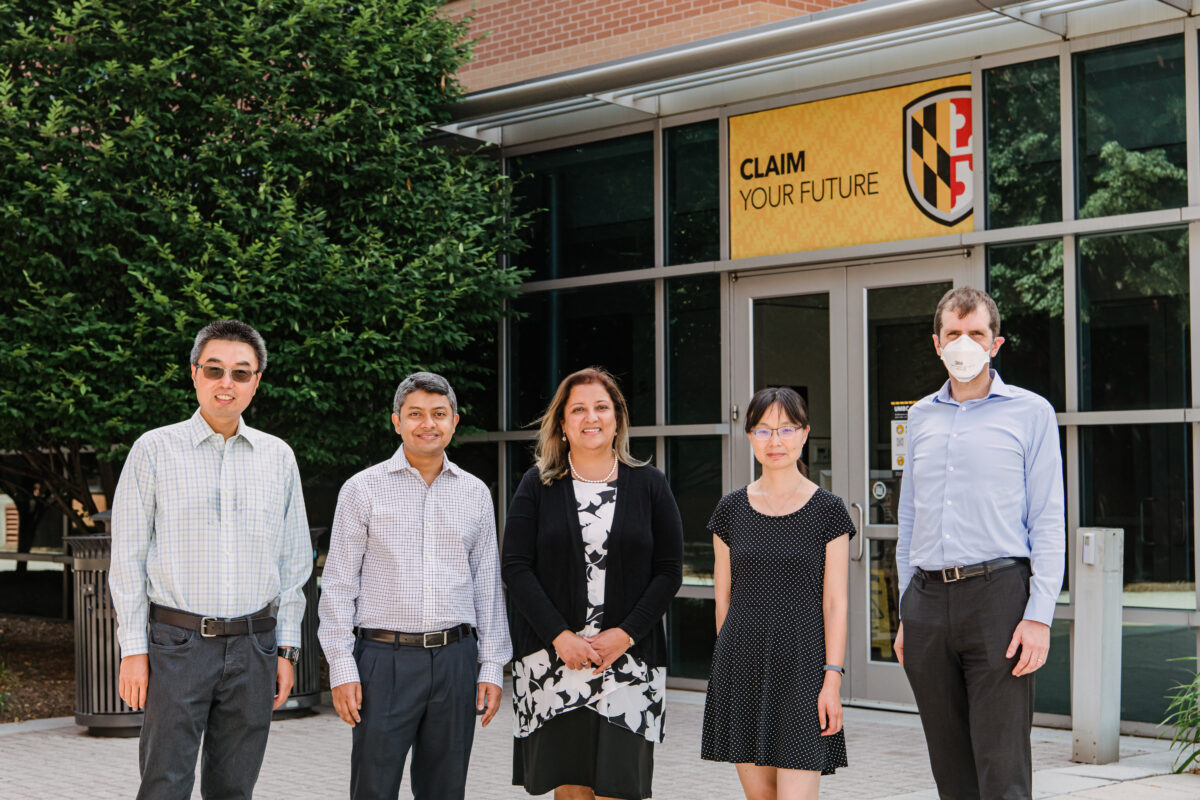
UMBC iHARP researchers (l-r): Jianwu Wang, Osman Gani, Vandana Janeja, Karen Chen, and Don Engel. (Marlayna Demond ’11/UMBC)
In addition to Janeja and Wang, the UMBC team also includes Aryya Gangopadhyay, professor; Karen Chen, assistant professor; and Osman Gani, assistant professor, all in information systems, as well as Don Engel, associate vice president for research development and assistant professor of computer science and electrical engineering.
Editor’s note: This story is an update of a prior version published on September 28, 2021.
In early 2022, Nadja Franklin ‘23 was exploring summer opportunities through the UMBC Career Center when she heard about a chance to connect with tech internships at Maryland’s state agencies. As a business technology administration major, her interest was piqued. She arrived at the on-campus internship event with résumé in hand, ready to discuss her skills, and her preparation and enthusiasm paid off.
The hiring event was hosted by the Maryland Institute for Innovative Computing (MIIC) to help state agencies expand their technical talent pipeline through intern recruitment. The MIIC is a collaboration between the University System of Maryland and partners in the public and private sectors, launched in 2021. Administered by UMBC, the MIIC addresses workforce challenges related to computing and analytics in state agencies. Students at colleges and universities across Maryland are eligible to apply for internships through the MIIC, connecting skilled students with state employers seeking fresh tech talent.
“
“The State of Maryland has realized tremendous value from the partnership with UMBC through the technology internship program. Beyond the contribution of the students during their internship, many have gone on to become permanent members of the team. This program helps to fill the workforce pipeline with qualified and talented workers, lessening the impact caused by the shortage of technology and cybersecurity workers.”
Chip Stewart
Maryland's State Chief Information Security Officer
Talent meets opportunity
The MIIC is continuously growing the pipeline of tech talent ready to support state agencies in the longer term, helping them run securely and efficiently. So far, in 2022, they’ve connected nearly 40 interns with opportunities at state agencies across Maryland, including the Department of Labor, Department of Information Technology, Department of Health, Department of Transportation and the Chief Data Office within the Governor’s Office.
“The MIIC reflects Maryland’s dedication to ensuring our state agencies have the technical staffing and internal infrastructure they need,” explains Annie Weinschenk, program director of workforce initiatives in the UMBC Career Center.
“With cyber crime on the rise, including attacks on government agencies, MIIC is helping to build a skilled workforce dedicated to service within the state of Maryland,” Weinschenk says. “MIIC internship areas range from data science, cybersecurity, and artificial intelligence, to geographic information systems at seven agencies across Maryland.”
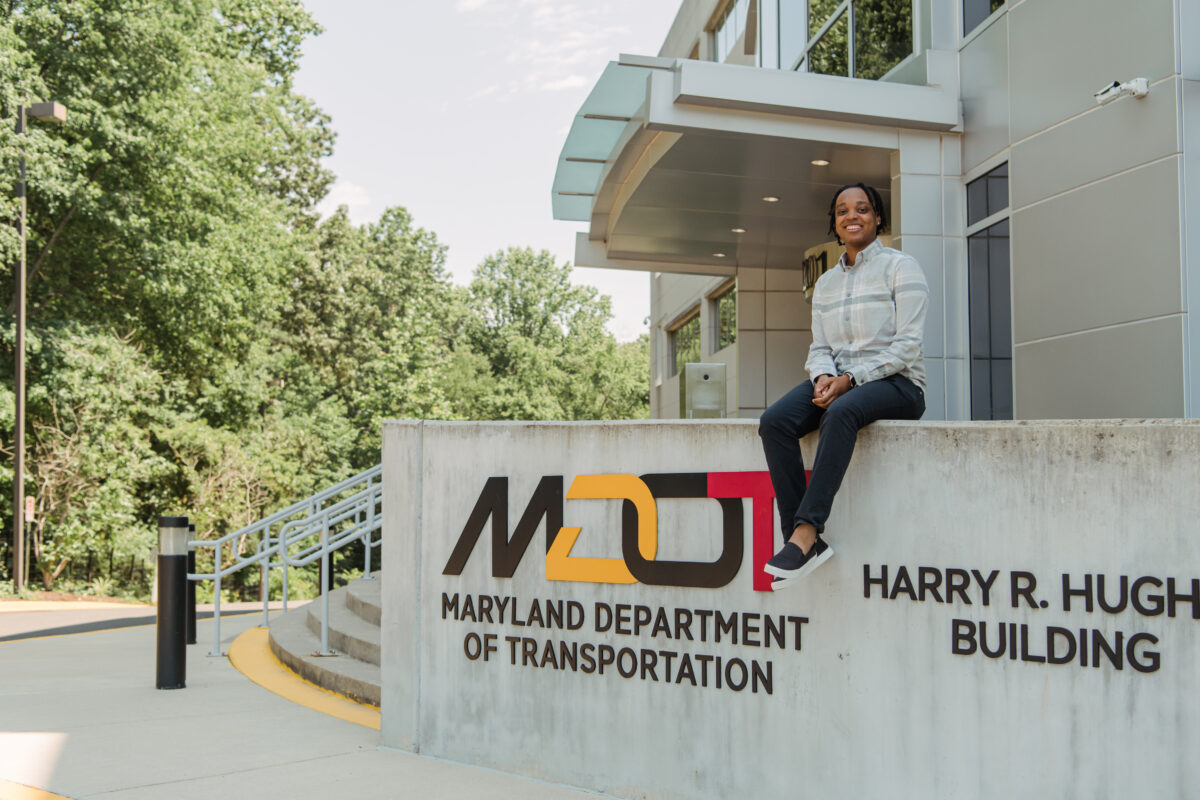
Afterward, she quickly completed her application for a project management internship in MDOT’s information technology department. She also accessed other Career Center resources to help her stand out as a top candidate, including interview prep with Weinschenk and Career Center Director Christine Routzahn.
“Students come to their internship experiences with a variety of backgrounds, levels of experience, and majors,” says Weinschenk. “We work to make sure they put their best foot forward, so they can access these unique hands-on learning opportunities.”
Meaningful connections
Franklin’s primary project with MDOT involves radio frequency identification (RFID), tagging IT and non-IT assets for use in various projects across the agency. But she has particularly enjoyed the chance to meet with MDOT’s chief information officer and deputy chief information officer. She’s also had a chance to learn about the broad range of projects across MDOT, and how project management works, through supporting directors’ meetings.
Nadja Franklin. (Marlayna Demond ’11/UMBC)
Franklin also drew on her writing skills and creativity to help develop scripts for MDOT training videos, and she enjoyed a unique chance to participate in the video filming and production process.
Beyond learning new skills, her favorite aspect of the internship has been MDOT’s inclusive, welcoming environment.
K-12 and higher ed partnerships
While Franklin came to UMBC interested in a career in tech, that’s not the case for many students who have the talent and skills to succeed in tech fields. With this in mind, the MIIC has also focused on expanding K-12 initiatives, to help prepare students earlier on for these high-demand careers, particularly in cybersecurity.
Earlier this year, Governor Larry Hogan announced the launch of the Maryland Cyber Range for Elevating Workforce and Education, operated by the MIIC. This $1.2 million initiative will expand cybersecurity education and training through collaboration with the Maryland Center for Computing Education (MCCE), Virginia Tech U.S. Cyber Range, and the nonprofit Teach Cyber.
This partnership will include initiatives at all educational levels, from K-12 through higher education and workforce training. The U.S. Cyber Range will provide access to a high quality simulated environment for teachers and students to learn cybersecurity.
Overall, this collaborative effort will enable Maryland to continue to grow and strengthen the state’s cybersecurity education infrastructure, explains Jack Suess, UMBC’s vice president of information technology and chief technology officer.
Innovating cybersecurity education
A leader in cybersecurity education, UMBC is also advancing the field in other ways, complementing the work of the MIIC. For example, Alan T. Sherman, professor of computer science, recently received more than $260,000 of a $500,000 grant from the National Science Foundation (NSF) to study and improve how cybersecurity is taught at the U.S. Naval Academy and U.S. Military Academy.
The project, Examining Pedagogy in Cybersecurity (EPIC), is collaborative with the University of Illinois Urbana-Champaign and University of Minnesota Duluth, and is funded through NSF’s Secure and Trustworthy Computing (SaTC) program. Because the academies teach cybersecurity to all first-year students, EPIC offers a large-scale opportunity to investigate how simulation-based teaching and learning affects different student populations.
In the first phase of the research, Sherman and his collaborators—including computer science Ph.D. student Andew Slack and Linda Oliva, assistant professor of education—will study how instructors at the academies structure and teach their cybersecurity courses. In the second phase, they will introduce active simulation-based learning exercises and pedagogies and assess their effectiveness.
UMBC’s championship-winning Cyberdawgs cyberdefense team will help adapt and improve learning materials. As one quantitative measure of the new pedagogy’s effectiveness, EPIC will assess students’ conceptual understanding using the Cybersecurity Concept Inventory (CCI), developed by Sherman and his team.
Benefits for Maryland
MIIC initiatives continue to expand in new directions. In research, The Hilltop Institute at UMBC is receiving funding to bring together health data related to opioid addiction from different state sources to more accurately identify patients’ risks for relapse. Like the MIIC’s educational initiatives, this work demonstrates how innovations in computing can benefit Maryland and its residents.
Amber Gist ‘23, computer science, has been interested in studying in South Korea for years. When she learned that UMBC offered a program in Seoul, she knew the university would be a great fit for her. But she wasn’t yet sure of how she could afford an international experience.
“I started learning about South Korea in 2016,” Gist says. Initially, she used apps and YouTube videos to learn Hangul, the Korean writing system. “Over the next few years, I focused on listening, reading, and repetition through Korean music, dramas, variety shows, and web articles, as well as learning about the culture,” she says.
Once she started at UMBC, she began taking courses in modern languages, linguistics, and intercultural communication, complementing her computer science classes. “I soon realized that all of my previous time self-studying was paying off, and I was reaping benefits in ways I never expected,” Gist says.
She had never traveled outside the United States, but she knew that the experience would help her grow, expand her perspective, and open doors. Studying in South Korea would support her minor in the Korean language while giving her the intercultural communication skills and adaptability to succeed in a future computer science career.
As she researched financial support for a semester abroad, she came across UMBC’s brand new Education Abroad Access Fund, established by the Class of 1970. Gist became the fund’s first scholarship recipient.
“Education abroad is known to have a positive impact on students’ future academic and career outcomes, but the costs of international travel can result in barriers to participation,” says David Di Maria, associate vice provost for international education. “The Class of 1970’s generous gift helps address these barriers. It ensures more Retrievers are able to enjoy the transformative benefits of making the world their classroom.”
Di Maria, associate vice provost for international education, in the UMBC Commons. (Marlayna Demond ’11/ UMBC.)
Immersive experience
Leading up to her trip, Gist was nervous, not just about being immersed in a new culture, but also about whether COVID-19 would cancel her plans. “It was a lot to process,” she says. After hardly sleeping the night before her flight to South Korea, she arrived in Seoul as scheduled and completed a mandatory seven-day quarantine before moving into on-campus housing and beginning to explore.
Gist is enrolled in intensive Korean language classes, where she has connected with students from around the world who are also studying abroad. She has spent four hours each day in class, which has taught her about much more than the language itself. “You get to know people over time when you’re practicing language and talking about personal things,” she says.
Gist also joined a buddy program that pairs international students studying in South Korea, like her, with Hanyang University students. She has found it easy to navigate the city of Seoul, where she is based, using public transportation, and in her free time enjoys visiting local landmarks and learning about the history and culture of South Korea.
“Traveling is like nothing I’ve experienced before,” she says. “Learning about another language and culture in an immersive way, by connecting with people, is an invaluable experience.”
Time to explore
Joda Redfearn can’t wait to have a similar experience first-hand. Like Gist, Redfearn ‘23, global studies and English, long knew he wanted to study abroad. As a student at the Community College of Baltimore County, he had an opportunity to experience Asakusa, Japan for a week. He has wanted to return since then, but with more time to explore on his own and immerse himself in Japanese culture.
After researching which Maryland universities offered international learning experiences, Redfearn decided to transfer to UMBC. The support offered to UMBC students who are interested in studying abroad was unmatched, he explains.
In addition to providing guidance on planning the experience—from academic credit to logistics—UMBC also works to keep expenses as close to the university’s cost of attendance as possible. Airfare can still be a financial barrier, which is where the Education Abroad Access Fund comes in.
Redfearn is the fund’s second scholarship recipient and he will spend the 2022-2023 academic year in Okinawa, Japan at the University of the Ryukyus. As he has long dreamed, he will focus on learning about Japanese history and culture.
After graduating from UMBC, Redfearn plans to teach English in Japan, possibly through the Japanese Exchange and Teaching (JET) Program. He also hopes to travel to other countries in Asia. “I really want to see the world,” he explains. “Having a global perspective is something that I personally value.”
“I feel like even if it’s not directly linked with their career, everyone should have an opportunity to study abroad,” Redfearn says.
The Education Abroad Access Fund provides eligible students with financial support while they study internationally, helping more students experience international learning opportunities. The funding can help cover application fees, meals while abroad, airfare, and tuition. To learn more or to donate, visit the Education Abroad Access Fund website.
UMBC’s Grand Challenge Scholars Program prepares students to collaborate across disciplines and address real-world issues.
Illustrations by Kimberly Salt
When Chelsea Okeh ’22, M30, biological sciences, first came to UMBC, she was excited to put her passions to work in a way that might help her community. She already knew she wanted to address health disparities, so she put herself on a course to learn and do all she could.
When a friend in the Meyerhoff Scholars Program mentioned UMBC’s Grand Challenge Scholars Program (GCSP)—which takes an interdisciplinary approach to solving big world problems — she knew she was in the right place. Surrounded by students with a wide range of interests, she could take her ideas to the next level.
“I’ve always had an unbridled ideology that it is possible to change the world,” she says of her interest in the GCSP.” “Little things I’ve done in the past like Girl Scouts and community service really paved the way for wanting to take part in something that has a greater purpose.” Through the program, Okeh expanded her understanding of factors that impact health disparities and outcomes and she is primed to take what she’s learned beyond UMBC.
Tackling societal challenges
Modeled after a national program, UMBC’s GCSP was established in the College of Engineering and Information Technology (COEIT) in Fall 2016. Over the past six years, the program has expanded, drawing together students from various disciplines to address major challenges that the world is facing. Ranging from engineering better medicines and securing cyberspace, to providing access to clean water and advancing personalized learning, the challenges were identified by a group of leaders across academia, policy, and industry that the National Academy of Engineering convened in 2007.
Maria Sanchez, GCSP director since 2018 and a professor of the practice in COEIT, explains that an important part of the program is helping students develop skills that they can apply to their classes and take with them into careers or graduate school. Students are eligible to enter the program during their junior year and participate for two years, building their ideas over time.
Because big challenges require cross-disciplinary thinking, the GCSP brings students from diverse backgrounds together for meaningful conversations and to discuss topics that require multidisciplinary solutions and perspectives. Students in the program connect with organizations on and off campus to put their skills and knowledge to work. For example, a student interested in learning how to improve the quality of water for communities might work with the UMBC chapter of Engineers Without Borders to design a water filtration system in another country in need, or a student passionate about restoring and improving urban infrastructure might pursue a study abroad opportunity to learn about cities on other continents.
“We don’t expect the students to come up with a solution to a grand challenge. It’s more to develop a framework for basic skills and to apply them to their future careers,” Sanchez explains.
The GCSP includes five program areas that help students develop a comprehensive perspective on topics. These elements—research, entrepreneurship, service, interdisciplinarity, and global perspectives—are incorporated into the seminars and the students’ final projects. “Through these experiences, the students reflect on what the experience has meant to them and how they transform themselves or their views,” she says.
The program pivoted during the early months of the COVID-19 pandemic to support students as they adjusted to virtual learning and other sudden changes. The students also processed national current events during classes, including the 2020 election, the pandemic, and racial injustice.
Maria Sanchez (left), director of the Grand Challenge Scholars Program, shares a moment with students Olorunjuwon Ajayi, Diane Stonestreet, Chelsea Okeh, David Paton, and peaceworker fellow Alexandra DeCraene. (Marlayna Demond ’11/UMBC)
Developing models to replicate
The national Grand Challenges Scholars Program was founded by three engineering deans at institutions across the U. S. in 2009. In 2011, Arizona State University (ASU) launched their Grand Challenge Scholars Program, which is housed within the Ira A. Fulton Schools of Engineering. Today, ASU invites all incoming first-year students to participate in the program.
Amy Trowbridge, director of ASU’s program and chair of the interim executive committee of the Grand Challenges Scholars Program Network, explains that the program allows students to create meaningful connections among their peers and mentors. Students joining the program all take a course that lays the foundation for the experiences they will complete to achieve the five GCSP competencies during their time in the GCSP.
“The Grand Challenge Scholars Program is important for students because of the skill set and mindset that it helps them gain through the program,” Trowbridge says. “Members of industry have said that it’s valuable as industry continues to change and evolve, and as technology gets more complex. It’s the interdisciplinary, global perspective that students gain through the program, and the ability to see the big picture.”
Meaningful mentorship
Olorunjuwon Ajayi ’22, computer engineering, has a personal interest in sustainability, so the GCSP challenge of “making solar energy economical” resonated with him. Entering the program, he participated in the seminar classes that allowed him to discuss topics with his peers and be exposed to different perspectives. Soon, he had the tools he needed and a network of fellow students to tackle the challenge.
Through the program, Ajayi has been intentional about connecting the research that he conducts on campus alongside Curtis Menyuk, professor of computer science and electrical engineering, with the challenge that he focuses on in GCSP. The research focuses on lasers and optics and can be applied to solar energy issues. He is particularly interested in optimizing energy harvesting from solar panels. This summer, he will complete an internship with the National Renewable Energy Laboratory. After graduation, Ajayi plans to work in the renewable energy field.
Ajayi says that he has enjoyed the seminar classes because they delve into topics that he doesn’t explore much in other classes. “The classes have been fun but they touch on things people don’t really think about in their majors,” he explains.
Sharing perspectives
To support the GCSP, Sanchez works with Alexandra DeCraene ’22, public policy, a peaceworker fellow through the UMBC Shriver Center who serves as the program coordinator for GCSP. Peaceworker fellows are returned Peace Corps volunteers pursuing their graduate degrees at UMBC while participating in a two-year social change leadership program, which includes a part-time placement with an on-campus program or community partner addressing a range of social needs.
DeCraene explains that she enjoys bringing guest speakers into the classroom to share different perspectives and disciplines with the scholars. She says that one speaker that stands out is a Baltimore-based pastor who got creative about using resources that his churches already had to bring more local food to the community. He connected with local farms and used the church ’s vans to transport fresh produce to farmers markets in Baltimore.
“Being exposed to different ways of thinking, different cultures, and different thought processes has been very valuable to me,” DeCraene says. “The Grand Challenge Scholars Program gives undergraduate students a chance to discuss what is on their minds, share their ideas, and get feedback from their peers.”
Striving for interdisciplinarity
For Okeh, the challenge to engineer better medicines aligned closely with her career goals. She is particularly interested in using her future degrees to address health disparities that are related to socioeconomics, geography, health literacy, and race. Okeh conducts research on the effects of hyperglycemia on neural tubes of zebrafish and works alongside Rachel Brewster, professor of biological sciences. This work can help doctors understand the prevalence of neural tube defects in babies born to pregnant people with diabetes.
“By individualizing and acknowledging the health disparities and the issues they’ve created, and keeping that in the forefront of our minds, we can ultimately engineer better medicines,” explains Okeh, who will complete post-baccalaureate research at the University of Pennsylvania before pursuing her M.D./Ph.D.
“Engineering doesn’t necessarily mean equations and reactions. It could be putting issues that we are already experiencing in our communities under the magnifying glass and seeing how entrenched they are in our medical and healthcare systems.”
Building a solid foundation
In addition to guiding students to reflect on their experiences or perspectives throughout the course, Sanchez would like GCSP alumni to reflect on how the program has provided them with a solid foundation on which to start their careers. Heather Mortimer 18, interdisciplinary studies, decided to apply for the GCSP after she saw a flier about the program on campus. She was intrigued by the interdisciplinary focus on the program and that it had many parallels to her passions and goals.
Mortimer’s self-designed major focused on science communications, museum education and education development, combining her interests in art, education, history, science, and writing, she explains. She participated in the second cohort of the program during her junior and senior years, after transferring to UMBC from art school. Her cohort had fewer than a dozen students, and most of the participants were STEM majors.
The challenge to “advance personalized learning” resonated with Mortimer because part of her major was about active versus passive learning. Her GCSP final project was a remix of things she was already working on for her interdisciplinary studies degree, she says. Looking back on her experience in the program, Mortimer says that she enjoyed the discussions that happened in the classroom as well as the required courses.
As a graphic designer and technical writer at NASA Goddard Space Flight Center, Mortimer says that her participation in GCSP allowed her to be exposed to people with different skills, perspectives, and interests.
“I am the resident creative on a team of mostly STEM professionals,” Mortimer says of her role at NASA. Being a part of the program “gave me a better idea of how scientists see problems and what goes into their thought process. It’s been helpful to integrate some of that same way of thinking into the way that I approach creative projects.”
Challenge accepted
As GCSP continues to expand, Sanchez hopes to continue to incorporate elements of social responsibility—encouraging people and organizations to prioritize the best interests of society and the environment—into the experience.
“I’m very passionate about the idea of social responsibility and thinking about what students are going to be doing as professionals in their careers and what they’re going to apply from their education,” says Sanchez, who is collaborating with Helena Mentis, professor of information systems, on a Hrabowski Innovation Fund Grant to implement elements of social responsibility education into curricula across COEIT departments. Sanchez and Mentis are working with faculty and graduate students in a range of disciplines in UMBC’s College of Arts, Humanities, and Social Sciences.
“Even though the National Academy of Engineering developed the Grand Challenge Scholars Program with engineers in mind, it’s become clear to me that these topics are on students’ minds regardless of discipline,” says Sanchez.
Sanchez plans to continue to develop GCSP’s curriculum and structure so that it may become applicable to other programs or courses at UMBC. Through the program, she hopes that students are able to make meaningful connections at UMBC and in the surrounding communities and contribute to society through their careers.
In the future, Sanchez would like to increase the range of majors that participate in the program and apply elements of the program to connect with more students. Through her experience leading the GCSP, she has found that students value the opportunity to discuss the topic of social responsibility, and it prepares them to collaborate across disciplines in their careers.
“The way that GCSP was designed is a great jumping-off point for future programs,” says Sanchez. “The Grand Challenge Scholars Program has created a foundation and structure for students to think about various topics with social responsibility in mind.”
“This is an amazing opportunity to continue focusing on student success and culture change,” says President Hrabowski, who will begin his ACE Centennial Fellowship on August 1. “I am looking forward to working closely with Ted Mitchell, other ACE colleagues, and educators from across the country as part of this effort to create and sustain nurturing academic environments on our campuses.”
Advocating for all students
To guide his work as ACE’s first Centennial Fellow, President Hrabowski will draw from his results-driven commitment to inclusive excellence and his collaborative approach to leadership. He will focus on increasing opportunities for all students—particularly first-generation students, adult learners, and students from underrepresented groups—to access higher education and receive the support they need to earn their degrees.
Dr. Hrabowski on campus with students. (Marlayna Demond ’11/UMBC)
This work directly builds on President Hrabowski’s leadership at UMBC, selected last year to join the University Innovation Alliance, a consortium of public research universities working to boost student success by sharing and scaling approaches that work. As ACE’s Centennial Fellow, he will carry forward this commitment to higher education access and success at a national level.
Meanwhile, back at UMBC, the Freeman A. Hrabowski, III Endowment for Student Excellence will provide increased college access and affordability for incoming first-year students with financial need and a commitment to community service.
National leadership
Mitchell, president of ACE, says that Dr. Hrabowski will be instrumental in shaping the ACE Centennial Fellow position, as the first leader to hold this role.
Ted Mitchell at an event celebrating Dr. Hrabowski. (Marlayna Demond ’11/UMBC)
“There is no better-equipped person in American higher education than Freeman Hrabowski to find new and better ways for ACE and all of our institutions to best serve our students and the nation,” explains Mitchell. “We have invited him to promote the interests and needs of the entire higher education community and our students, especially those learners who are often forgotten or neglected.”
In addition to serving as ACE Centennial Fellow, Hrabowski will continue supporting the next generation of higher education leaders through teaching at the Harvard Seminar for New Presidents and mentoring current and future university presidents nationwide.
A membership organization for the leaders in higher education, ACE shapes public policy and promotes innovation. ACE represents more than 1,700 public and private two-year and four-year institutions across the United States.
Four UMBC faculty and staff members have received highly competitive Fulbright awards to conduct research and establish important connections around the world over the next year. UMBC’s new recipients of Fulbright U.S. Scholar awards are Shimei Pan, associate professor of information systems, and Corrie Parks, assistant professor of visual arts, and Tiffany Thames Copeland, adjunct faculty in Africana studies. Nancy Young, vice president for student affairs, has received a Fulbright International Education Administrators Award. They will travel to Germany, Austria, Ghana, and France, respectively.
They follow on the heels of Helena Mentis, professor of information systems, who will soon return from a Fulbright experience in Denmark, working with the University of Copenhagen’s Human-Centered Computing research group.
“The Fulbright U.S. Scholar Program sends up to 900 U.S. faculty members throughout the world to conduct research or teach their subject, as well as participate in cultural exchange during their time in their host countries,” explains Brian Souders, associate director of global engagement opportunities in UMBC’s Center for Global Engagement.
“UMBC has a long tradition of faculty receiving this prestigious award, with 14 UMBC scholars earning this award over the past decade,” he notes. “Receiving three of these awards and an administrators award in a single year is quite exciting.”
Eliminating bias, increasing fairness
Pan will spend six months at the Heidelberg Institute for Theoretical Studies and Heidelberg University in Germany. There she will conduct research related to natural language processing, which is a subfield of artificial intelligence (AI). Her research at UMBC focuses on developing natural language processing models trained on large amounts of text, including content from social media, and she is eager to collaborate with fellow researchers in Germany.
Shimei Pan. (Marlayna Demond ’11/UMBC)
“I’m excited about the project because it’s a continuation of my recent interests on responsible AI,” she says. “In the past we focused on making the technology more powerful and efficient, but for the last five years or so I’ve been working to address bias and increase fairness.”
“AI algorithms impact people’s daily lives,” says Pan, in explaining the importance of making these algorithms as equitable as possible. Because artificial intelligence technology is created by people and trained on human-produced data, it will inherit people’s biases. Pan is working to identify, assess, and mitigate various social biases encoded in large natural language processing models trained on massive text collections.
Focusing on the details
Parks will spend two months as an artist in residence at the Q21/MuseumsQuartier in Vienna. She will partner with ASIFA Austria, the International Animated Film Association in Vienna, to create an installation. She uses sand animation and other specialized animation techniques to explore broader themes. “My work examines small details and asks questions about the role of the individual in the collective or big picture,” addressing climate change and social issues, Parks explains.
Corrie Parks, right, at a CADVC event. (Marlayna Demond ’11/UMBC)
This is not the first time that Parks has received a Fulbright award. She spent time in New Zealand when she was a student pursuing her master in fine arts degree. She sees these immersive artist residencies as unique opportunities to make significant “creative leaps,” focusing exclusively on her art.
During her time in Austria, Parks will create a work for a public installation space in the center of a building that is both old and contemporary. While she will create her installation independently, she will work with collaborators on coding interactive and visualization elements of the work.
Cultural exchange, diaspora research
Thames Copeland will complete her Fulbright award in Ghana where she will study the experiences and impacts of people in the African Diaspora “returning” to Ghana in the last century. “I am humbled to receive this Fulbright U.S. Scholars award to Ghana for the 2022-2023 academic year,” she says. “I am looking forward to the cultural exchange experience and investigating the Back to Africa Movement of the 21st century, as I research how the African Diaspora ‘returnees’ to Ghana continue in the fight for liberation.”
Tiffany Thames Copeland. (Image courtesy of Thames Copeland)
She has been an adjunct faculty member in the Africana studies department at UMBC since January 2021.
Seeing the world differently
Young is part of the first group selected for the Fulbright International Education Administrators program since the COVID-19 pandemic began. She was named a finalist before the pandemic and, now that the program has resumed, she will be one of twelve U.S. administrators from across the country to spend two weeks in France, connecting with contacts in French higher education, government, and administration.
Nancy Young. (Marlayna Demond ’11/UMBC)
“I am excited to engage in an experience that I think will challenge me to grow and see the world differently,” Young says. She looks forward to establishing relationships with new colleagues and developing a deeper understanding of other education systems, and she is eager to apply what she learns from the Fulbright experience to her work at UMBC.
Young has been interested in the Fulbright program since early in her career. She shares that support from colleagues at UMBC, including Souders and David Di Maria, associate vice provost for international education, was instrumental in making her goal a reality.
Student teams recently gathered at Betamore, a Baltimore-based entrepreneurship and coworking space, to battle in the final round of UMBC’s annual Cangialosi Business Innovation Competition. Greg Cangialosi ‘96, English, founded the competition in 2014 to provide UMBC student entrepreneurs with a chance to pitch innovative ideas to a panel of judges, and to get advice and support in developing their concepts.
This year’s competition included two distinct tracks: technology and innovation, and social impact. The top three ideas in each track received funding to help move their ventures forward.
The live event included competitors from all three UMBC colleges who pitched a diverse range of ideas. Here, some of the participants share advice for other students who are interested in entrepreneurship but may not be sure where to begin.
Tip 1: Pursue what you love
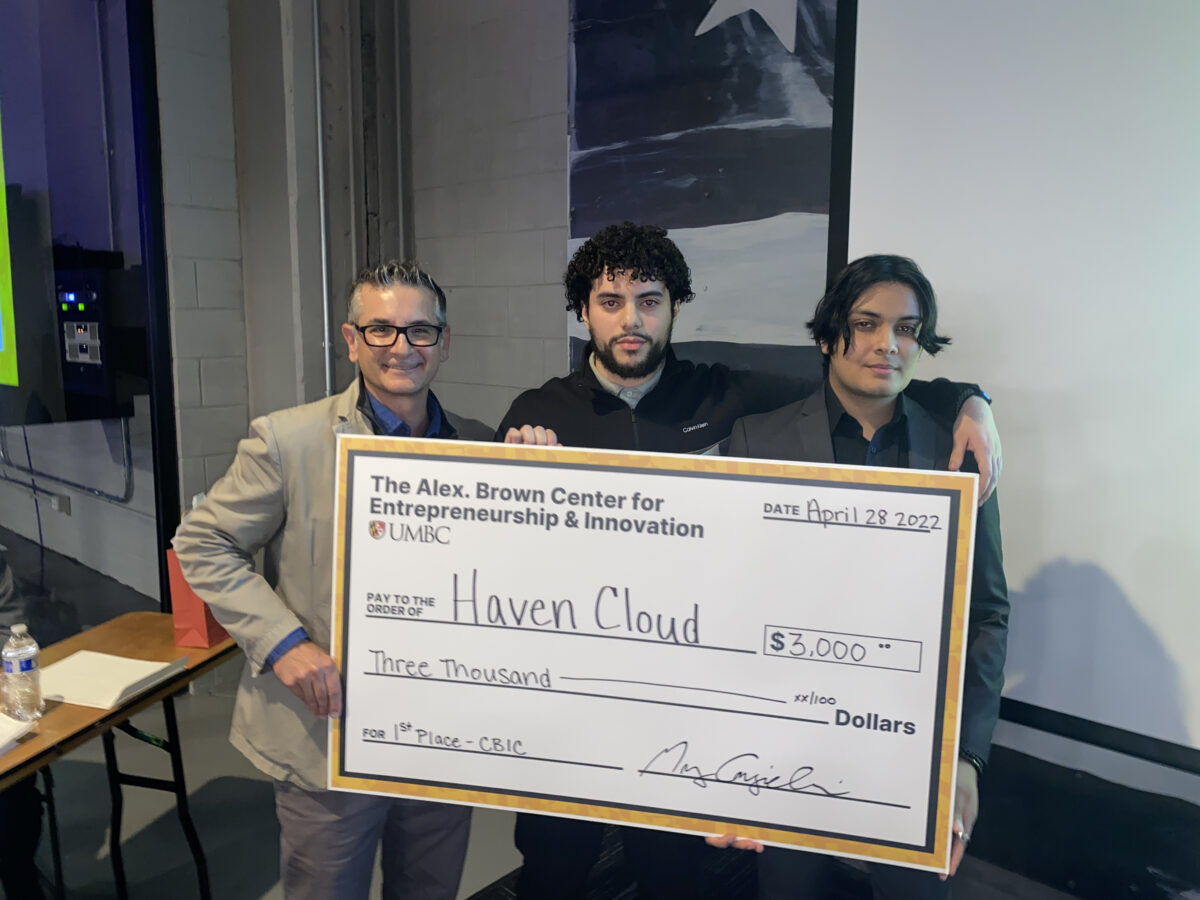
Mahmoud Shalby ‘23, computer science, says that in order to be a successful entrepreneur you have to be passionate about your concept to stay motivated through challenging times. Shalby and his collaborator Faheel Kamran ‘22, computer engineering, took first place in the technology and innovation track for their idea Haven, which is an encrypted, privacy-focused cloud storage service.
Mahmoud Shalby and Faheel Kamran at the event. (Alex. Brown Center for Entrepreneurship.)
“The best tip I’d share about entrepreneurship is to love what you do. It might seem simple and intuitive, but it’s a necessary component of the entrepreneurial journey that you have to consciously take into account,” Shalby says. “There’ll be countless sleepless nights, functions you have to miss, friends that you won’t see. The only way you can endure all of that is to fully love what you do.”
Tip 2: Don’t fear failure
Basil Udo ‘22, biochemistry and molecular biology, placed third in the technology and innovation track for his idea Xeddy, a marketplace for digital assets, coupons, and collectables. Udo explains that entrepreneurship provides learning opportunities, often when things don’t work out as expected.
“Learning from experience means you need to experience. Let go of the fear of failure because growth requires failure,” he says. “The earlier you start”—even if you aren’t initially successful—“the sooner you win.”
Tip 3: Match a problem with a solution
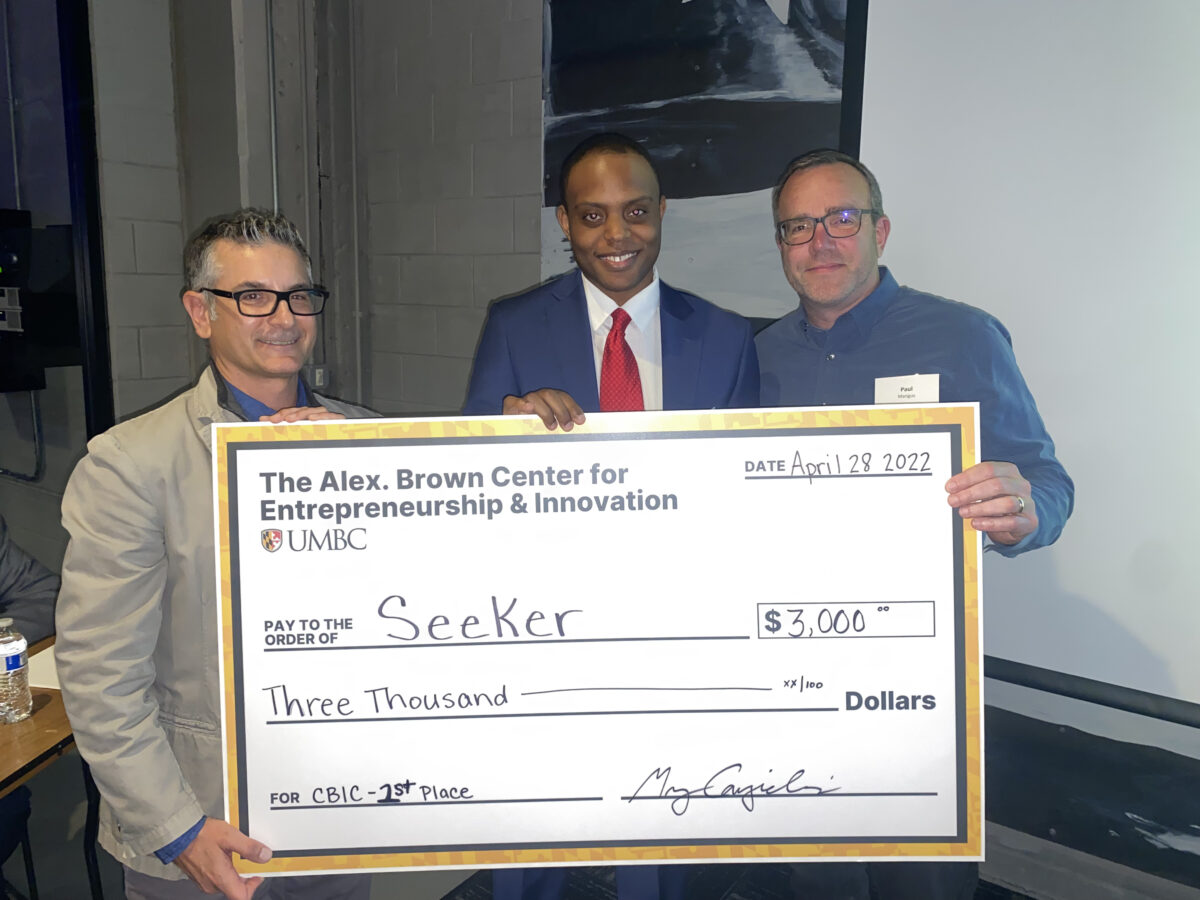
Michael Chapman ‘23, mechanical engineering, took first place in the social impact track for his idea Seeker. It’s a toy that provides individuals with dyspraxia—a common neurological disorder affecting movement—the ability to participate in activities that their peers enjoy.
Michael Chapman, center, at the Cangialosi Business Innovation Competition. (Alex. Brown Center for Entrepreneurship.)
Chapman says that the world is full of problems to be addressed. “Entrepreneurship is simply the discovery of the one problem that resonates with you and its accompanying solution,” he says. “If you are able to find a way to market your solution for a problem people experience, then you are well on your way to becoming an entrepreneur.”
Tip 4: Know your value
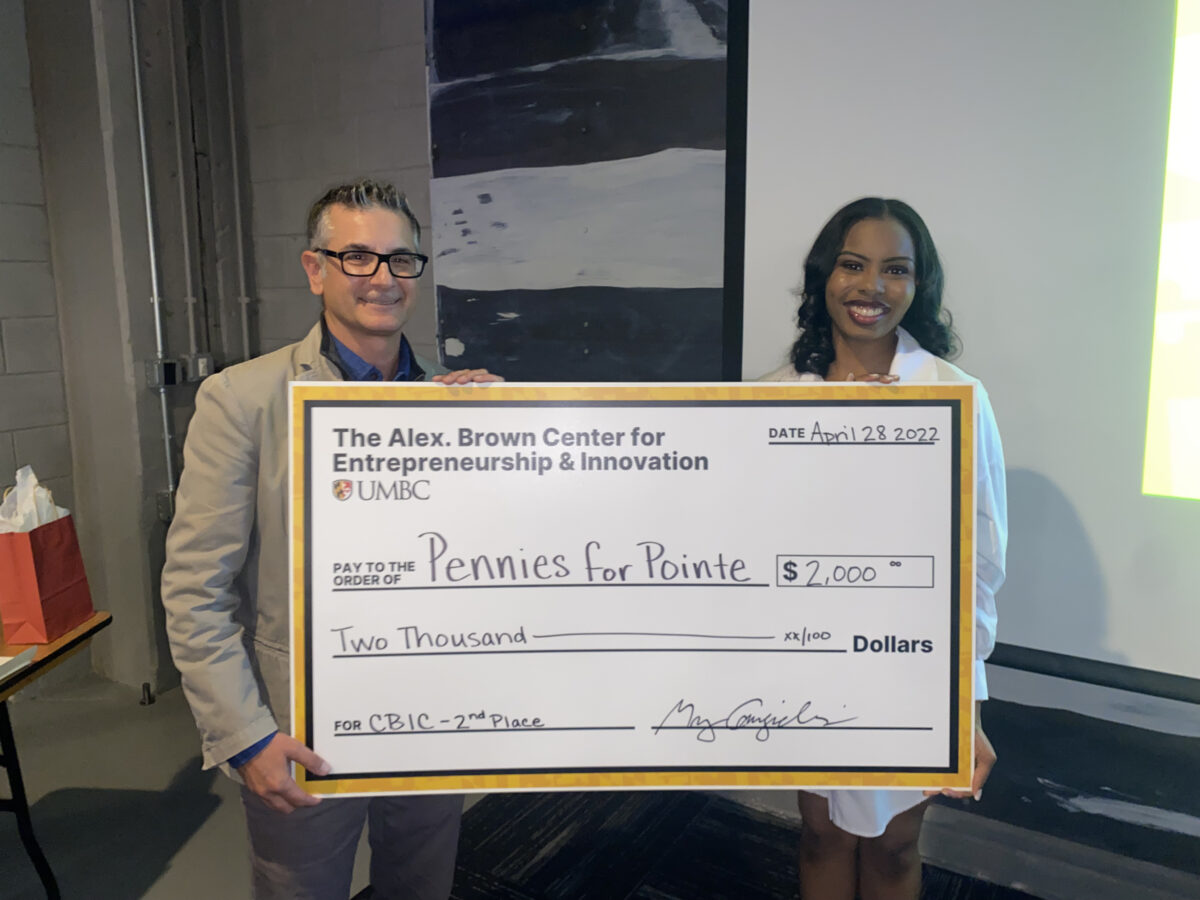
Kayla Massey ‘22, dance and information systems, placed second in the social impact track for her idea Pennies for Pointe, which works to increase the participation of underrepresented populations in dance. She says that in order to be a successful entrepreneur, you have to believe in your idea fully, and see it as valuable.
Kayla Massey, right, with Greg Cangialosi after the event. (Alex. Brown Center for Entrepreneurship.)
“How you see yourself and your organization is how other people see you,” Massey explains. “Always believe that your idea is valuable, and be certain that no matter how many people are doing something similar to what you want to do, there is nobody who can do it quite like you.”
Massey has experience expressing that confidence in sharing her work, beyond the entrepreneurship competition. Her dance piece Between You and Me was selected to be performed at the American College Dance Association’s virtual gala event held in early May. The American College Dance Association is an organization that promotes the talent and creativity of prominent college and university dance departments. A panel of judges selected Massey’s piece for performance out of more than 50 submissions.
Tip 5: Take action
Tamara Buchanan M.S. ‘22, health information technology, earned third place in the social impact track for PlusOne Technology, which allows individuals to search for transportation for medical appointments. She explains that a solid idea matters, but taking action on that idea is essential.
“It’s great when an idea comes to your mind and you believe in it. But the worst thing you can do is to sit on it and never bring it into fruition,” she says. “Someone is waiting on your business to help change or elevate their life. So take action. Seek help and utilize all the entrepreneurship resources available to you at UMBC. Start today. You can do it.”
Other award winners at the event included Talon Schroeder ‘25, and Noah Masri ‘25, both studying computer science. They took second place in the technology and innovation track for their idea Crypto Briefcase, an all in one place to do anything web3.
“I’m an advocate for people in different majors meeting each other because in the real world the biggest problems are interdisciplinary. Speaking with people with different interests is a great way to broaden your horizons.”
Arjun Trivedi ‘22, M30, mechanical engineering, is passionate about engineering, computing, and connecting with people outside of his field, who have different perspectives. He wants to learn about what drives them, how they think about the world, and if they have advice that could apply to his experience. “Finding those connections and being able to take advice from everyone around you helps you grow,” he explains.
Arjun Trivedi, right, works alongside another student in Deepa Madan’s lab.
As a leader of UMBC’s chapter of Tau Beta Pi, the nation’s oldest engineering honor society, Trivedi says that it was rewarding to be involved in the planning and execution of this year’s COEIT Engineering and Computing Week, held in February. The event offered students, faculty, staff, and alumni the opportunity to network and learn from each other.
Trivedi is a Meyerhoff Scholar, and shares that the sense of community and support that he receives from his peers and mentors is meaningful. Connections with other students in the program have led him to become involved in lab research and develop interests beyond his major. It was one of his peers who suggested to Trivedi that he consider minoring in computer science, given his interest in robotics.
That nudge set him on the path to the research that he completed with Ankit Goel, assistant professor of mechanical engineering. Keith Harmon, director of the Meyerhoff Scholars Program, also put Trivedi in touch with contacts at the Johns Hopkins University Applied Physics Lab to explore his career options. Trivedi will soon begin a maritime robotics position at the globally renowned research center.
Degree: B.A., Business Technology Administration Hometown: Columbia, MD Plans: Working at the intersection of arts and tech
“There’s a really good support system at UMBC for someone like me—a transfer and first-generation student. There are groups for everything. I found the best support system for me.”
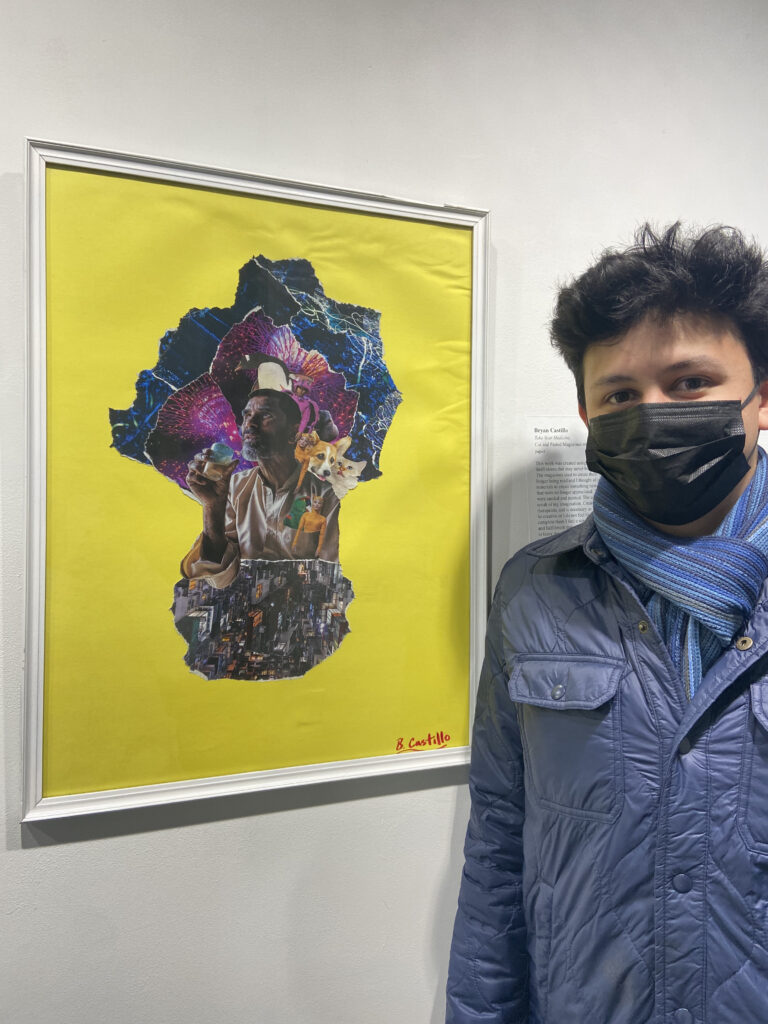
Bryan Castillo with his artwork that was displayed at OCA Mocha.
Bryan Castillo ‘22, business technology administration, came to UMBC from Howard Community College as a first-generation college student with a clear vision on how he would succeed: making connections and exploring every opportunity. He wanted to combine his interest in art with his passion for technology. He also wanted to make sure he felt supported on his college journey and could make life-long friends.
Castillo worked with the UMBC Career Center to find opportunities that would match his interests—meeting to discuss his goals and attending career fairs. He was able to access a coveted internship with the Whitney Museum of American Art in New York City.
“If it wasn’t for my own previous experience with databases, I would never have gotten the internship,” he says. He describes that experience as an important stepping stone to become more confident, build his resume, and grow as an in-demand professional in the field.
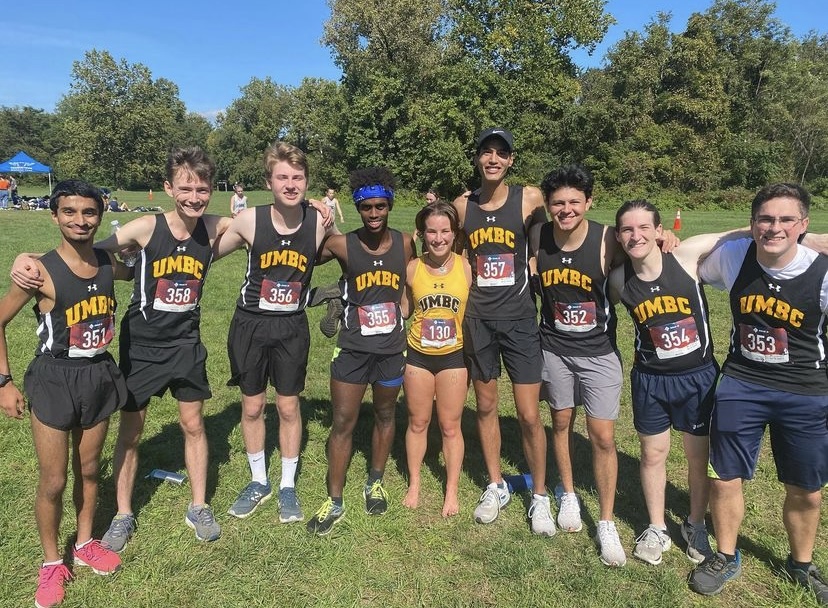
Still, he made time for friends, leadership activities, and developing as an artist. In addition to being active in UMBC’s Hispanic Latino Student Union and the running club, he exhibited his artwork at the OCA Mocha coffee shop and gallery near UMBC.
Bryan Castillo, third from right, with members of the UMBC Running Club. (Image courtesy of Castillo.)
“Here at UMBC, there is a network of people behind me to make sure I am successful.”
Audrey Houck ‘22, financial economics, got a first-hand look at what a finance career involves day-to-day when she was paired with a mentor as an intern at T. Rowe Price. “This was my first time having work experience in the financial world, and it is very different from what you learn in the classroom,” Houck explains. “It’s a steep learning curve.”
With her mentor’s support and guidance, Houck was able to create a strong project, which led to a publication in T. Rowe Price’s internal research data center. “It was amazing having someone there every step of the way to make sure that you can take what you learned in undergrad and effectively apply it.”
Following her successful internship with T. Rowe Price, she’ll begin there as an investment fellow after graduation.
Degree: B.S., Biological Sciences (Environmental Science minor) Hometown: Baltimore, MD Plans: M.S. in Biological Sciences at UMBC through ICARE
“I’m really passionate about activism and making change on campus. It’s meaningful, and it has allowed me to make some amazing connections on and off campus.”
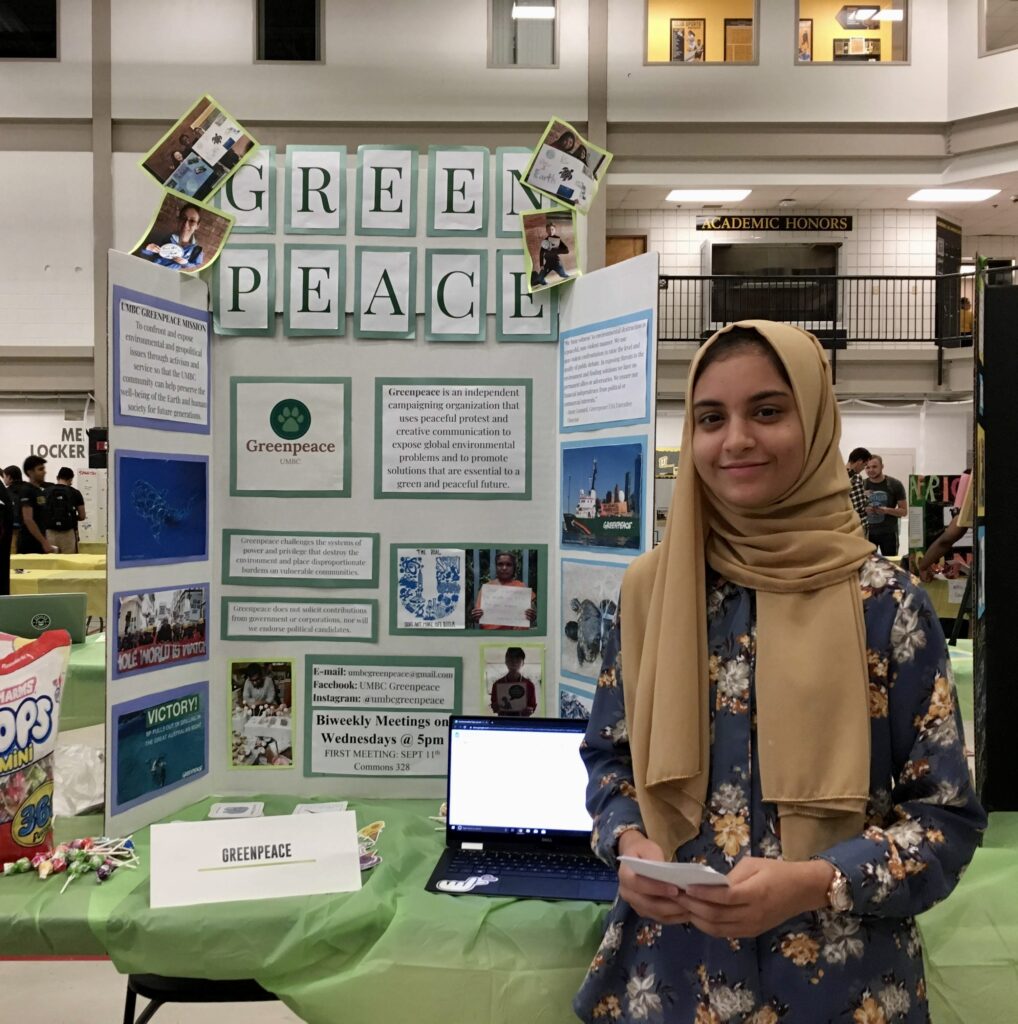
During her freshman year, Aiman Raza ‘22, biological sciences, was walking through the tables at UMBC’s annual Involvement Fest when she came across the Greenpeace student organization, which focuses on environmental activism. The group captured her interest and, over the past four years, she has worked to help the organization grow its presence on campus.
Aiman Raza at the Greenpeace table at Involvement Fest. (Image courtesy of Raza)
Raza was the group’s president during her sophomore and junior years. She says that this experience helped her develop her leadership skills, including during the challenging COVID-19 pandemic virtual events.
She also is involved in UMBC’s Muslim Student Association, and the Pakistani Student Association. These student organizations host events and bring people together for social, cultural, and religious events, as well as lectures and discussions. Being involved allowed Raza to build strong connections and get to know people outside of her major and across campus.
Raza serves as a mentor within the Biology Council of Majors as well. She meets with students who are earlier in their academic journeys, offering them guidance and support.
Aiman Raza, right, with Kevin Omland and several peers. (Marlayna Demond ’11/UMBC.)
At UMBC, Raza has conducted research with Kevin Omland, professor of biological sciences, and at the Institute of Marine and Environmental Technology, located in Baltimore’s Inner Harbor. She also completed a virtual summer internship with the Smithsonian, where she studied fish and crustacean communities on oyster reefs in the Chesapeake Bay.
Degree: B.S., Mechanical Engineering Hometown: Mechanicsville, VA Plans: Flight test engineer, Naval Air Station at Patuxent River, MD
“UMBC encourages exploration of all types and learning that gives students valuable experience beyond the classroom. At UMBC, you have so many job opportunities all around you.”
Logan Hawker ‘22, mechanical engineering, chose UMBC because she wanted to feel supported both in the classroom and on the softball field. She knew it would be a challenge to pursue an engineering degree as a D1 athlete, but thanks to careful time management and guidance from mentors, she has balanced her courses, her practice and game schedules, and several other meaningful opportunities, on and off campus.
Logan Hawker on the softball field. (Chris Hook/UMBC Athletics)
Hawker worked with Jamie Gurganus ‘04, M.S. ‘11, Ph.D. ‘20, faculty in mechanical engineering and associate director of engineering education initiatives, as the head teaching fellow for UMBC’s introduction to engineering design course. As a teaching fellow, Hawker held office hours for students in the course, answering questions and offering additional support. Hawker also oversaw the mechanical engineering 3D printing lab.
Logan Hawker in The College Tour video.
Off campus, Hawker served as an F-18 flight test engineer intern for the Navy at the Naval Air Station Patuxent River, Maryland. She developed flight test plans and briefed pilots, then monitored test flight data from a control room. She will work there full-time as a flight test engineer after graduation.