We use cookies for analytics and, unless you opt out, advertising.
You can opt out of advertising at any time.UMBC uses essential cookies to run this site. With your permission we would also use analytics cookies (to understand how the site is used) and advertising cookies (to measure and target our ads on other platforms). Nothing else loads unless you accept. You can change your choice any time from Cookie Settings in the footer.Privacy Policy
EssentialRequired for the site to work (login, security, your cookie choice). Always on.
UMBC is one of the the nation’s top colleges “for students seeking a superb education with great career preparation and at an affordable price,” notes an announcement today by The Princeton Review. The 2017 edition of Colleges That Pay You Back: The 200 Schools That Give You the Best Bang for Your Tuition Buck highlights universities across the United States that Princeton Review believes do a particularly good job of balancing excellent academics, affordability, and career services. Princeton Review bases its “top 200” designation on an analysis of more than 650 colleges across over 40 data points, covering everything from graduation rates to financial aid packages. Princeton Review’s profile of UMBC highlights the university’s reputation as an academic powerhouse where “students take education seriously” and “it is cool to be smart.” The publication notes:
Undergraduates are enthusiastic about the “academic opportunities and scholarship programs available,” and say, “UMBC wants to see every student succeed—they provide you with the tools, people, and resources to make sure you get where you want to go in life.”
Specifically on the issue of value, Princeton Review writes, “Across the board, undergrads here brag that their school provides a ‘quality education at an affordable cost.'” It also mentions UMBC’s robust, competitive scholars programs across a broad range of fields, including “cyber scholars, artist scholars, humanities scholars, public affairs scholars, women in technology scholars, STEM teacher education scholars and the Meyerhoff scholars,” which combine financial aid, research opportunities, special seminars, and other supports. The Princeton Review profile also reaches beyond academics to touch on the student experience. The Colleges That Pay You Back guide notes:
…despite their dedication to hard work, UMBC students…say “that almost every student at UMBC is involved with at least a couple of extracurricular activities, which connect them to the campus.” The school has a strong reputation for diversity and students feel “it enriches our school and everyone gets to know everyone despite culture or ethnicity.”
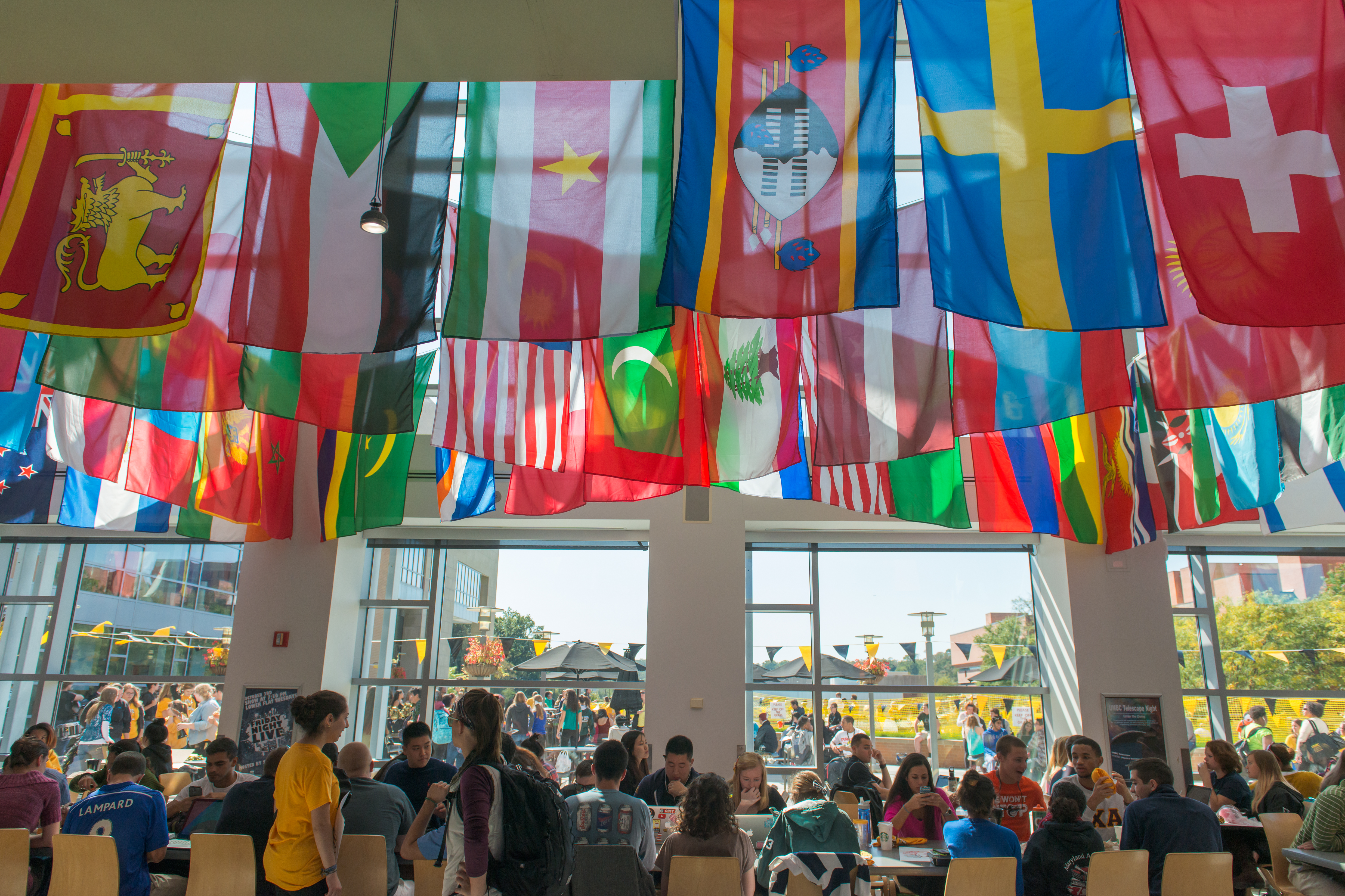
UMBC has appeared on this “best value” list several times in the past, including in 2008, 2009, 2011, 2013, 2014, and 2016. Just a few weeks ago, UMBC was also again named a Best Value College for 2017 by Kiplinger’s Personal Finance, featured on both its “top 100” public universities list and “top 300” national list. Image: Flags in the UMBC Commons, by Marlayna Demond ’11 for UMBC.
UMBC celebrated a banner year in 2016. In thousands of ways, big and small, this golden anniversary has been full of moments to remember for the university community.
Here are twelve top highlights:
Retrievers in Rio — When an ESPN reporter asked Cleopatra Borel ‘02, interdisciplinary studies, what qualifying for the shot put finals at the 2016 Olympic Games meant to her, she responded simply, “Everything.” Borel represented Trinidad and Tobago at her fourth Olympic Games and finished seventh on the global stage. Mohamed Hussein ‘14, mechanical engineering, a current master’s student in engineering management, represented Egypt in the 200 meter individual medley, competing head to head with Ryan Lochte.
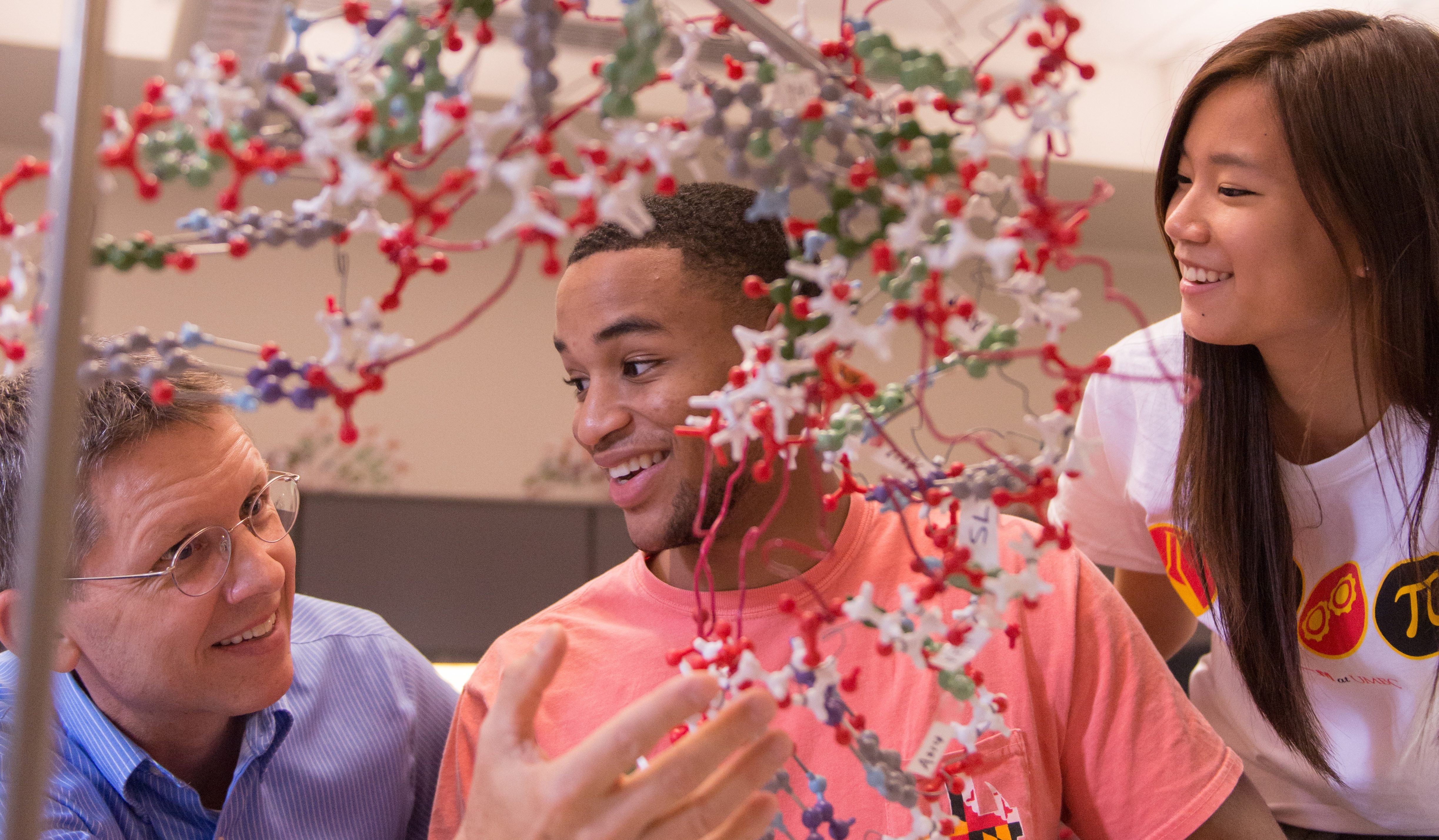
Researchers of Distinction — Michael Summers, Robert E. Meyerhoff Chair for Excellence in Research and Mentoring and University Distinguished Professor of chemistry and biochemistry, became the first UMBC faculty member to be inducted into the National Academy of Sciences, one of the highest honors a scientist can receive. Summers was recognized both for his groundbreaking work on the HIV-1 retrovirus and his longstanding commitment to training the next generation of leading scientists, from high school through postdoctoral levels.
Goldwater Scholars — Andreas Seas ‘17, Naomi Mburu ‘18, and Daniel Ocasio ‘17, all chemical engineering majors, received the highly selective and prestigious Barry Goldwater Scholarship. Ocasio shared, “As a first generation college student, I feel extremely fortunate to be pursuing higher education, let alone a career in scientific research. To me, earning the Goldwater Scholarship is recognition of all those who made it possible for me to further my academic development.”
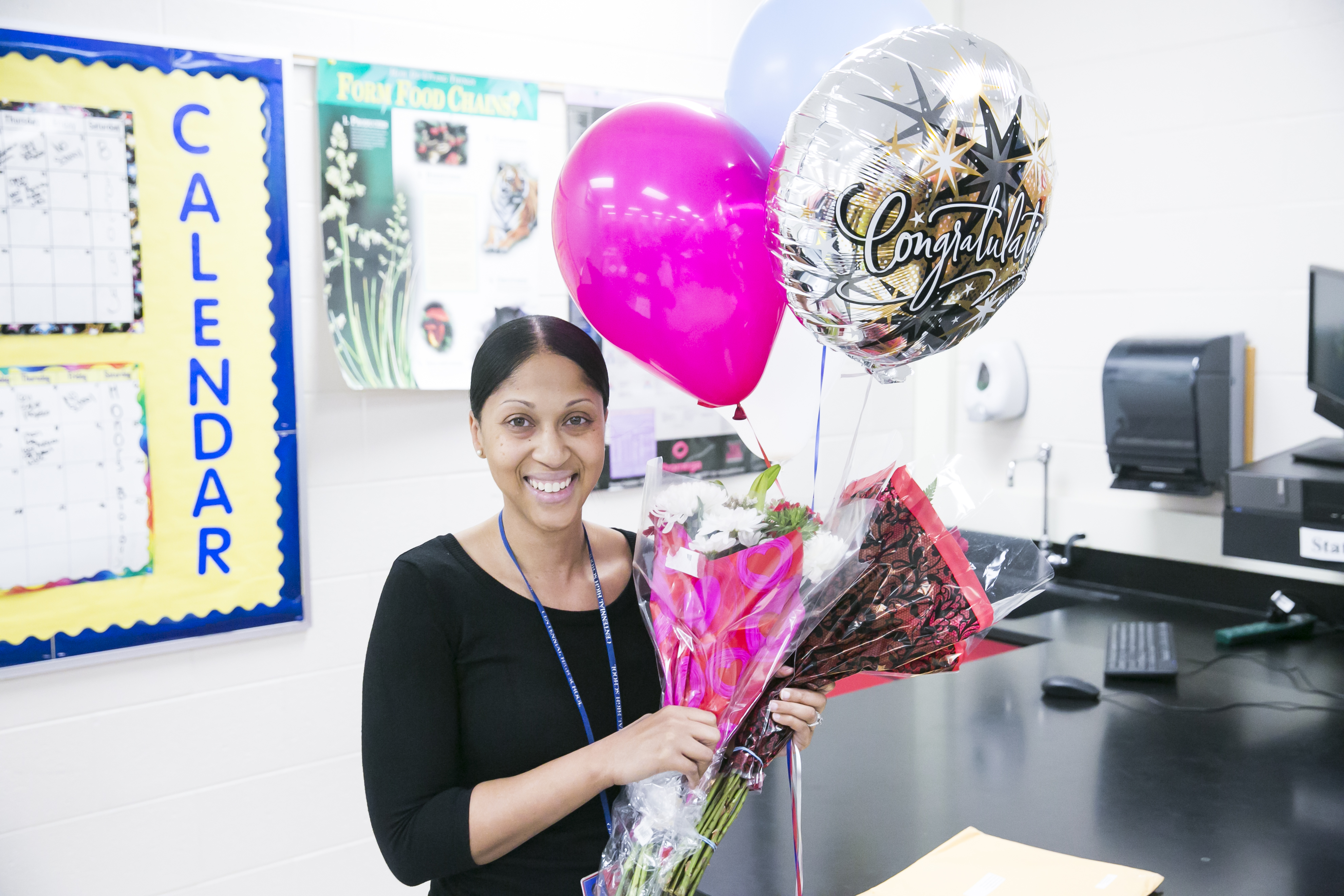
Leader in Education — UMBC partnered with Baltimore City Public Schools and the Northrop Grumman Foundation on a $1.6 million initiative to support Baltimore students, teachers, and communities. Meanwhile, Shalonda Holt ‘07, biological sciences, was named 2016 Washington Post Teacher of the Year and Howard County Teacher of the Year, and Corey Carter ’08, biological sciences, ’10 M.A.T., was named 2016 Baltimore County Teacher of the Year.
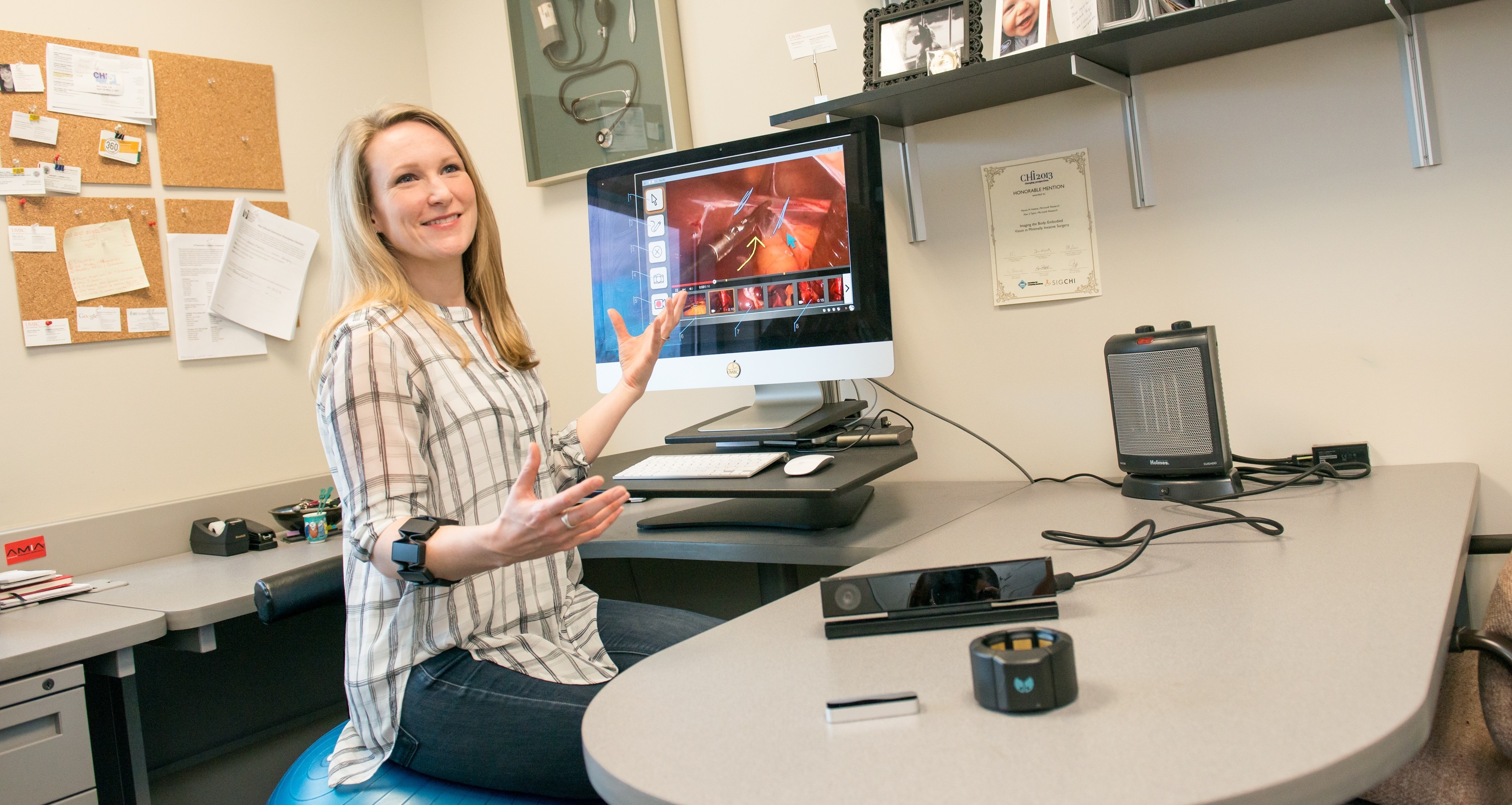
CAREER Awards — Matt Pelton, assistant professor of physics, and Helena Mentis, assistant professor of information systems, both received the prominent National Science Foundation CAREER Award. Pelton explores how nanoparticles act in liquids to understand how mechanical energy flows at the nanometer scale. Mentis focuses on surgical telemedicine, exploring how surgeons can use gesture-based tools to share expert knowledge in the operating room.
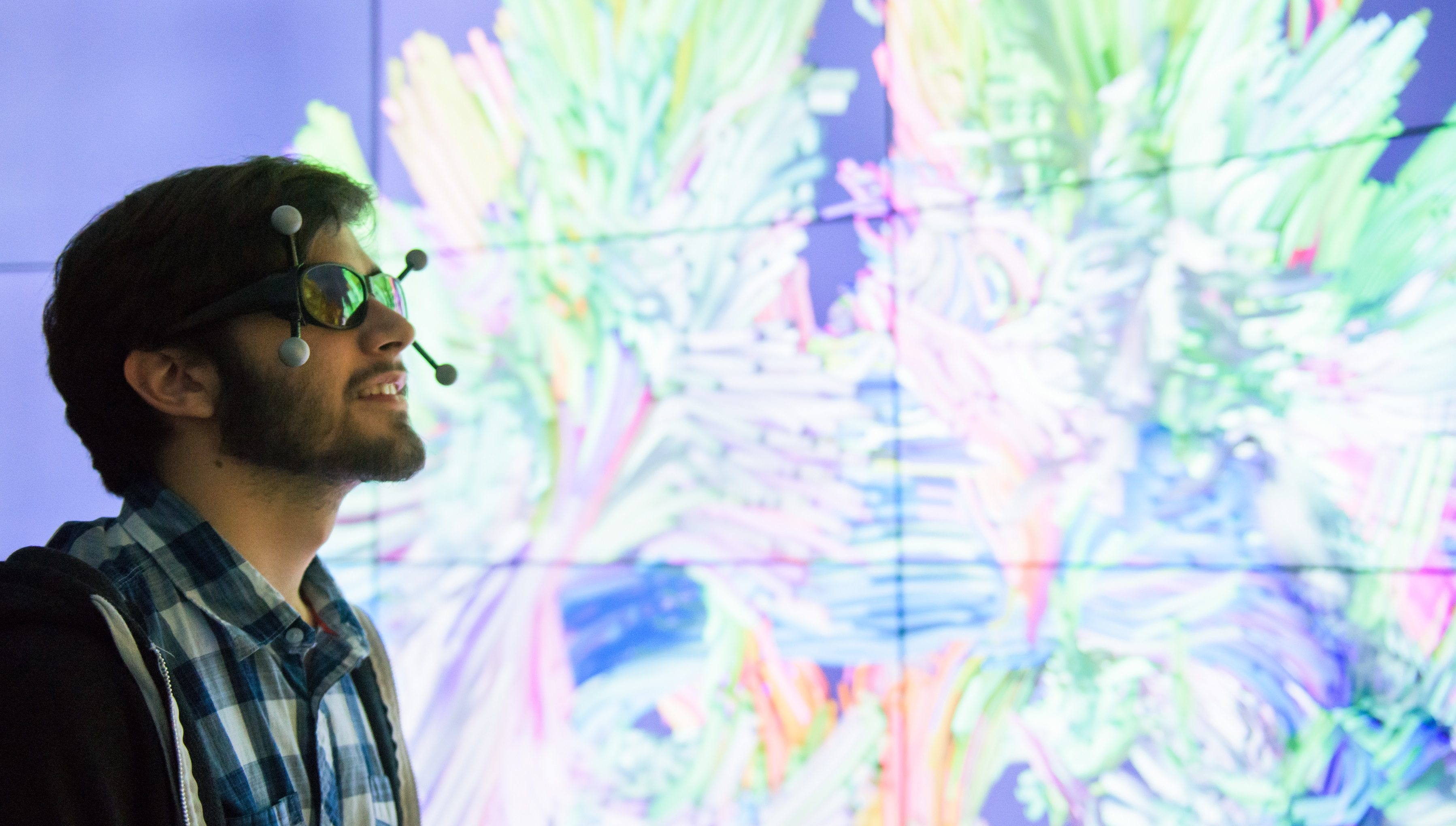
Virtual Reality Lab — UMBC’s PI2 Immersive Hybrid Reality Lab opened, giving students and faculty the ability to interact with data in a more visual way, and reducing the distance between researchers and the information they work with, whether they are studying wind farms or blood flow in the human body.
Golden Anniversary — Thousands of Retrievers came together as a community—alumni, faculty, staff, and students from all five decades of UMBC history—to celebrate the remarkable story of UMBC at a 50th anniversary weekend festival.
Arguably the “best public college in Maryland,” UMBC is an “extremely diverse school” that manages to maintain a “small community feel.” And from the moment you set foot on campus it’s evident that the university is focused on “providing exceptional education and research opportunities for students.”
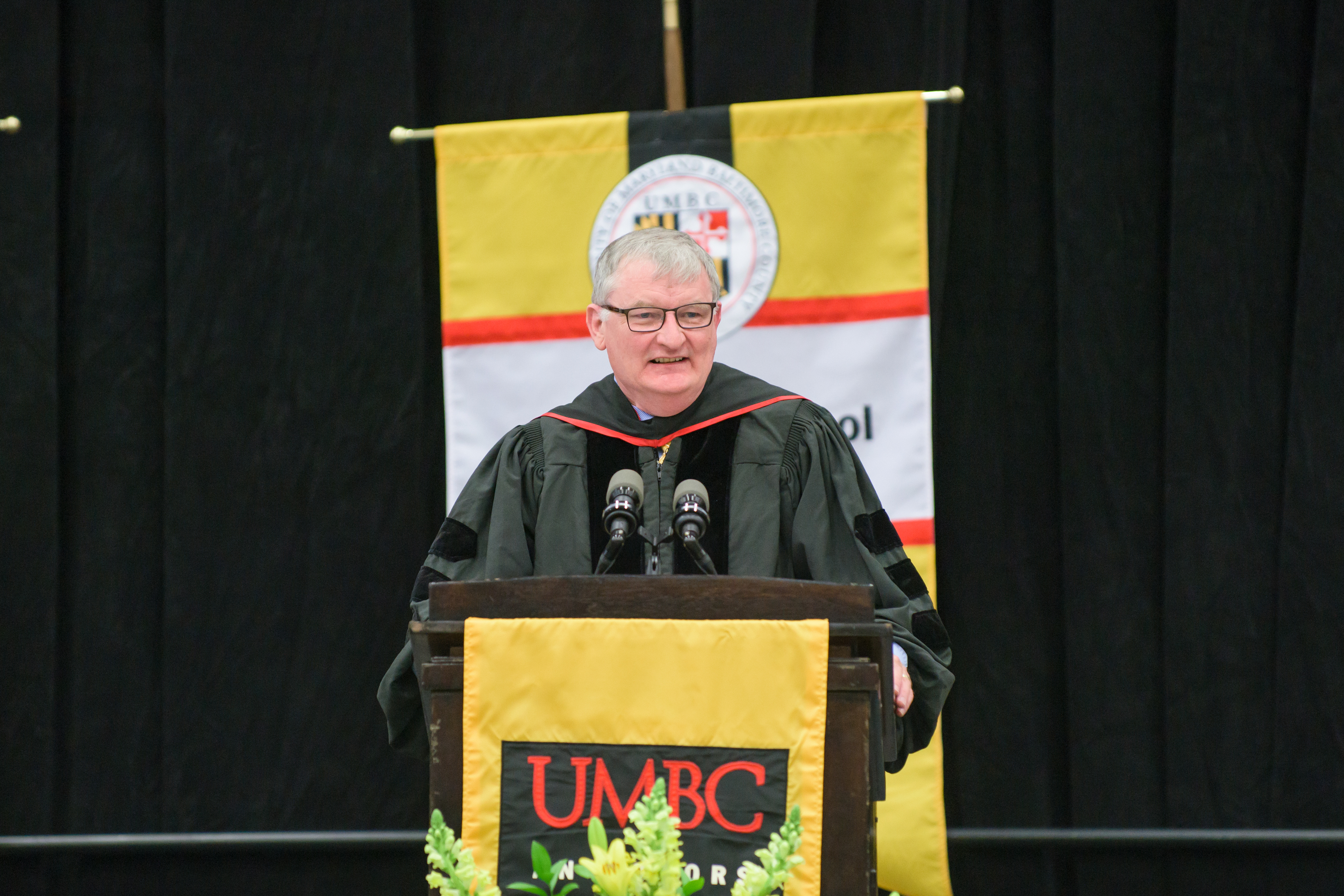
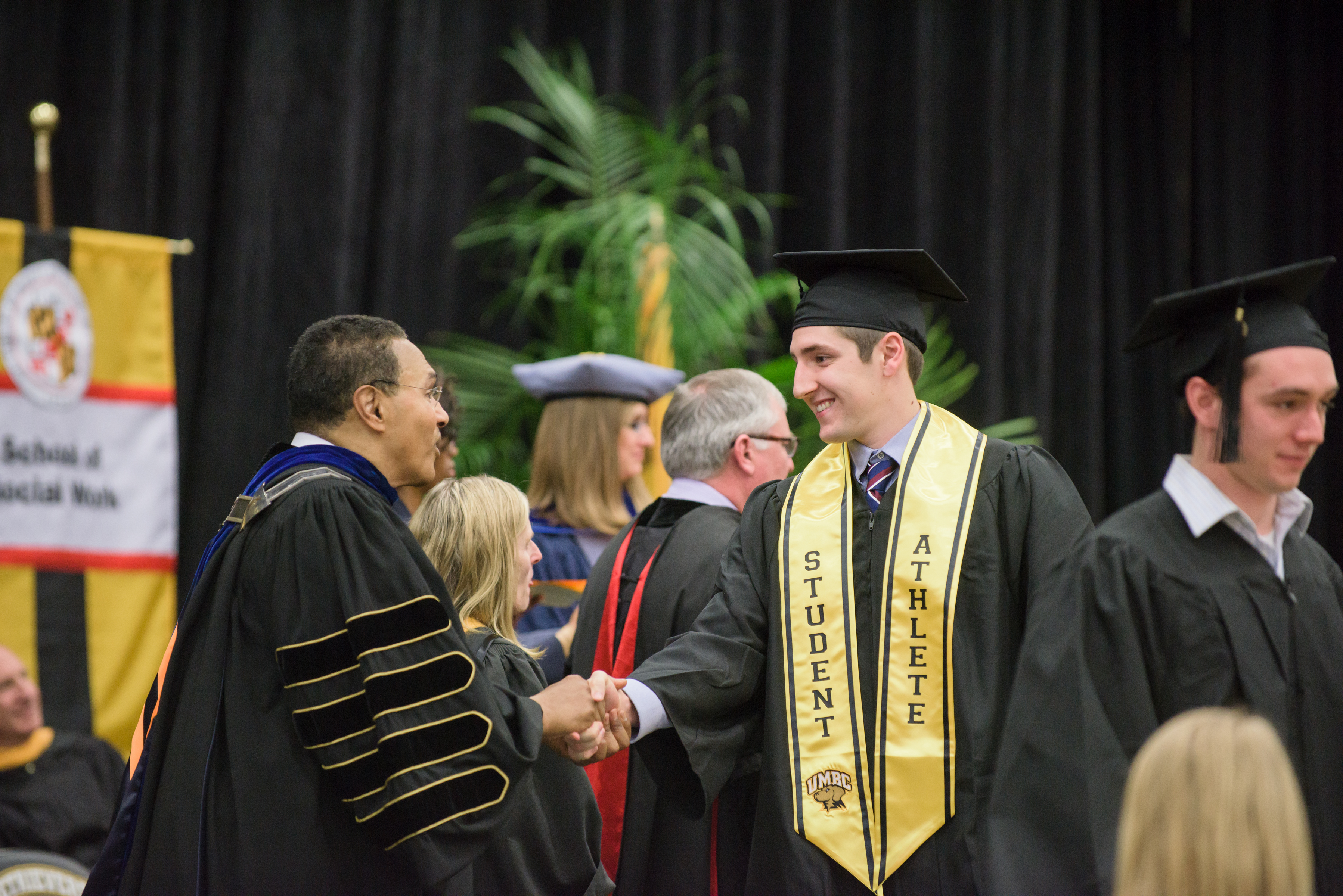
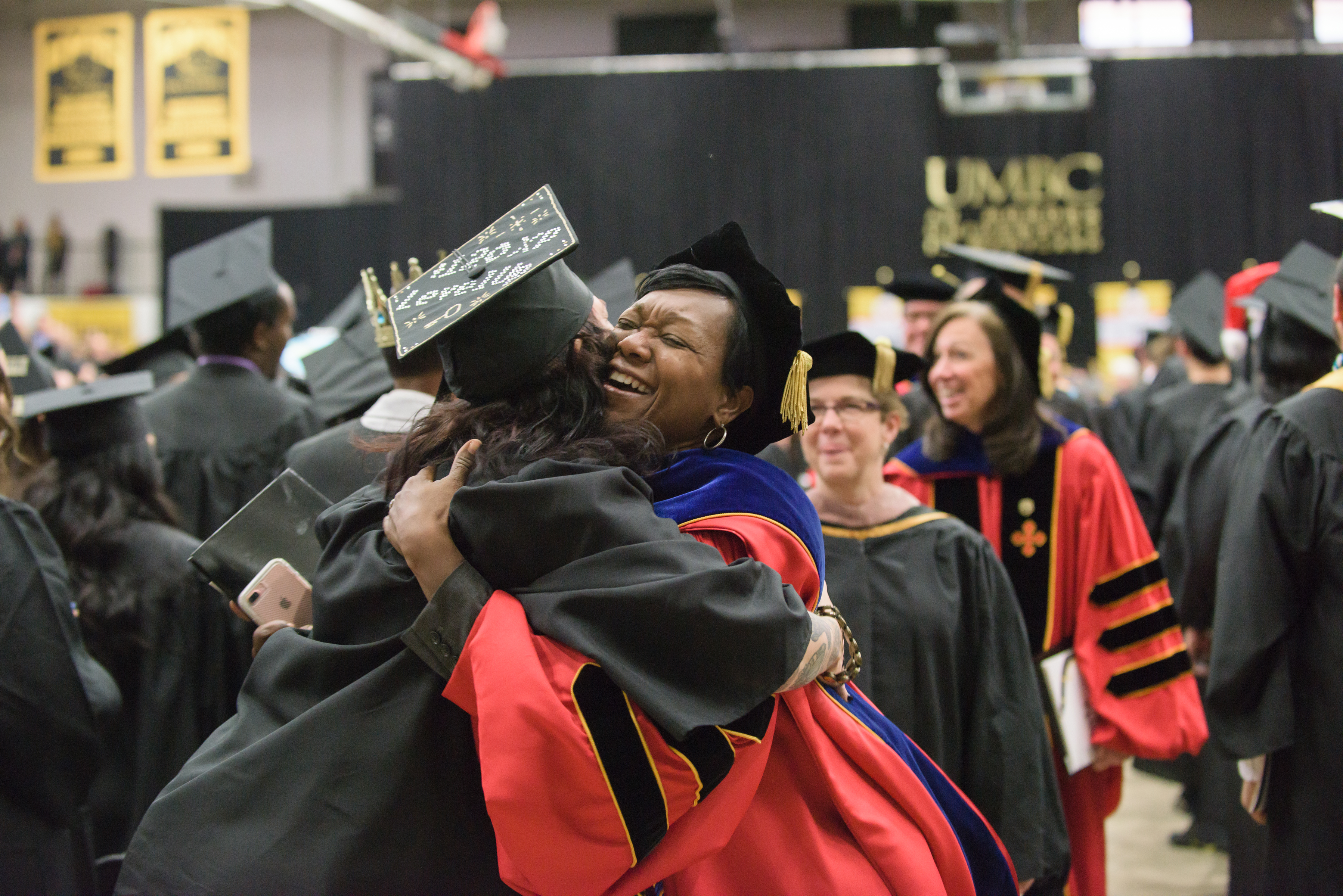
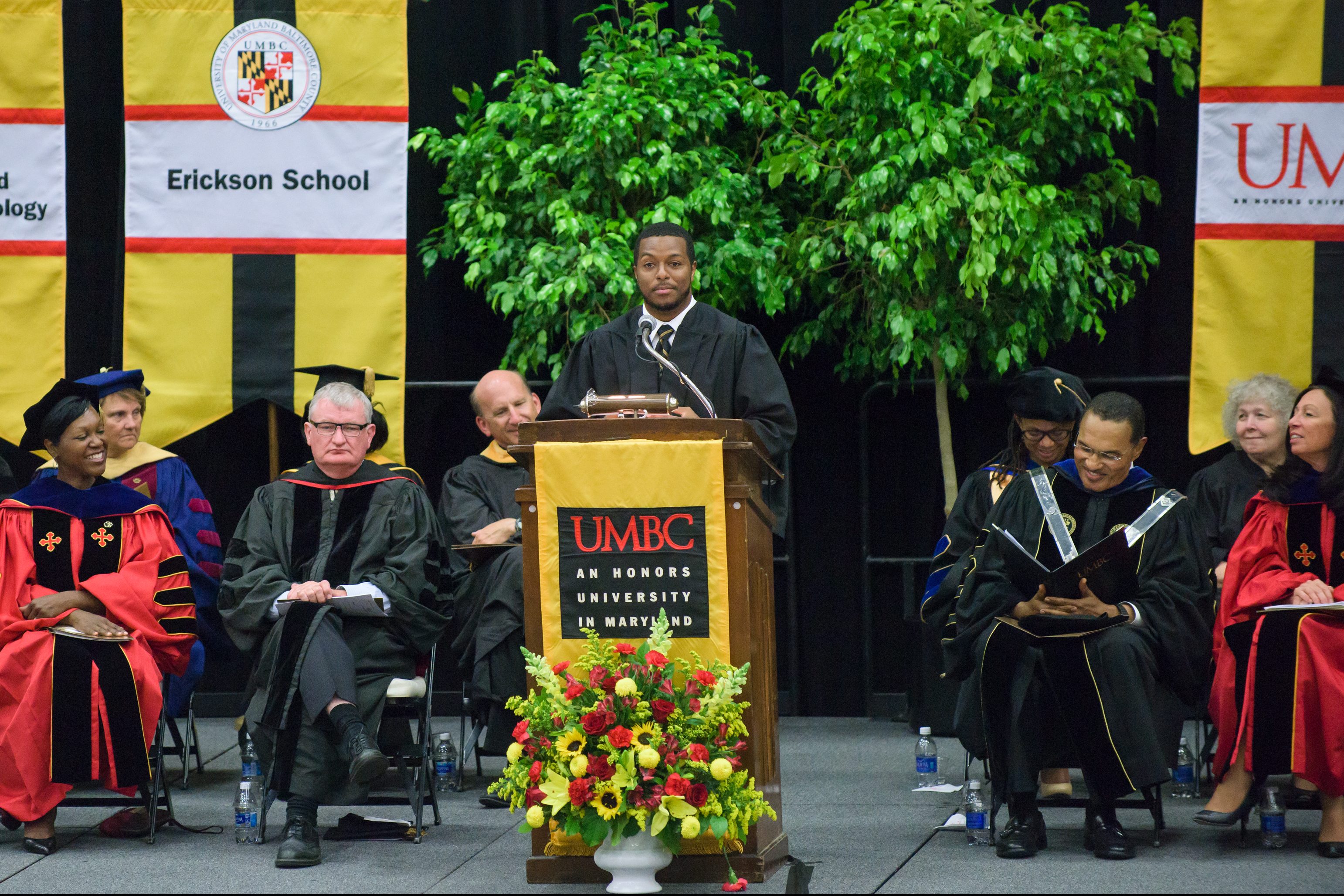
The UMBC community gathered to celebrate the hard work, perseverance, and achievement of more than 1,200 new alumni at the Winter 2016 Graduate and Undergraduate Commencement Ceremonies, held December 21 and 22, 2016, in the Retriever Activity Center.
Both ceremonies included UMBC faculty, staff, student, and alumni leaders, as well as a representative of the University System of Maryland Board of Regents, and crowds of cheering family and friends.
The graduate ceremony honored nearly 125 new master’s and Ph.D. degree recipients, as well as 80 graduate students who earned their degrees in August. Joining President Freeman Hrabowski, Provost Philip Rous, and Graduate School Dean Janet Rutledge in presenting remarks was Deanna Cerquetti, Ph.D. student in Language, Literacy, and Culture, and president of the Graduate Student Association.
Cerquetti focused her comments on the hard work and determination her fellow graduate students demonstrated over years of study. She also reflected on how graduates’ experiences on their educational paths—beyond their degrees alone—will continue to shape their lives as they face new challenges. Cerquetti shared:
I think that remembering your own strength and resilience is a key part of being able to accomplish what you want to accomplish. […] We know that the world is in need of creative, resilient people who are ready to work on the many issues that plague our society today. We also know that you will leave here very equipped to handle those issues.
Provost Rous also reflected on the UMBC experience, and how graduates’ values, knowledge, commitments, and sense of community engagement will travel with them on whatever path their careers take. He shared, “You will join the tradition of UMBC alumni who through their life’s work, continue to advance our understanding of our own humanity, our democracy, the natural world that surrounds us and, most importantly, make a difference in the lives of others.”
The undergraduate ceremony recognized over 1,000 new bachelor’s degree recipients, including more than 800 earning their degrees in December and over 200 who completed their programs in the summer.
Like the graduate ceremony, undergraduate commencement also balanced celebration with a look at tackling challenges to come.
“To all of our graduates,” said President Hrabowski, “we ask that you commit yourselves to using your education to help improve the lives of others.”
Hrabowski shared Supreme Court Justice Louis D. Brandeis’s thoughts on how to be an engaged citizen who listens thoughtfully to others and actively participates in reasoned debate. “We need this kind of engaged citizen now as much as at any time in our history,” Hrabowski said, “and we know you will make us proud.”
Toward the start of his remarks, President Hrabowski emphasized, “The power of education is more important than ever in transforming lives,” and the commencement ceremonies were a celebration of that transformative power.
In concluding the ceremony, moments after inviting UMBC’s newest graduates to turn their tassels, he shared, “Be confident, knowing that the education and training you received at UMBC will give you a solid foundation for the rest of your life. […] Be true to yourselves, and be true in your relationships, always reaching out to others, to inspire and to elevate.”
Videos of both ceremonies will be available soon on the UMBC Commencement website. The ceremonies were also covered live via Twitter (@UMBC), Instagram (@UMBClife), and Snapchat (@UMBC), with students and families sharing their own memories through #UMBC and #UMBCgrad. For additional photos, see our Undergraduate and Graduate Commencement galleries on Facebook.
For the eighth consecutive year, Kiplinger’s Personal Finance has named UMBC a Best Value College, featuring UMBC on both its “top 100” public universities list and “top 300” national list. UMBC is one of just three universities in the state of Maryland to be featured for 2017.
The Kiplinger ranking recognizes affordable four-year colleges with outstanding academics—colleges regarded as a solid investment for students and their families. Their calculations are based on factors such as admission rate, incoming freshman SAT/ACT score, student-faculty ratio, four-year graduation rate, and financial aid, with quality criteria accounting for 55 percent and cost accounting for 45 percent (see methodology).
Earlier this fall, Times Higher Education recognized UMBC as one of the world’s top universities for 2016 – 17. The publication noted that UMBC “defines itself as an ‘honors university’ committed both to cutting-edge research and to providing a excellent and demanding education for highly motivated students.” The profile also highlighted UMBC’s reputation as an innovator, noting, “It has never been afraid to pioneer new models of teaching and research, and new ways of contributing to the regional economy.”
The Baltimore Sun has named UMBC one of the region’s top places to work for the fourth consecutive year. The 2016 list includes organizations across all sectors, and UMBC is again the only university and only government institution to rank among the top 10 large employers, as well as among the top 100 employers of all three size categories.
The “Top Workplaces” ranking is based on scores from a confidential employee survey that measures job satisfaction, organizational health, and employee engagement.
On a national level, The Chronicle of Higher Education has named UMBC an outstanding academic workplace for seven consecutive years. UMBC was the only Maryland four-year institution to be recognized on the list in 2016. The Chronicle also gave UMBC the distinction of appearing on its “honor roll” for the fifth time, honoring the university’s excellence in nearly all possible recognition categories.
President Freeman Hrabowski has previously shared that workplace rankings like these “[affirm] what we all know: UMBC is a place that supports people, values collaboration, and fosters trust, respect, and enthusiasm for helping our students succeed.”
Image: UMBC spirit cupcakes from Founders Day Celebration 2016. Photo by Marlayna Demond ’11 for UMBC.
Just one month after honoring UMBC’s continued national leadership in teaching and innovation, U.S. News & World Report has recognized UMBC as a global leader in higher education. The ranking focuses on academic research and reputation, and in UMBC’s case particularly highlights the university’s strength in international collaborations, and the percentage of UMBC faculty publications that are among those most cited.
The 2017 U.S. News Best Global Universities list includes the world’s top 1,000 institutions across 65 countries. UMBC was also featured in the 2016 list, which included the top 750 universities in 57 countries. The ranking considers 12 factors in areas such as global and regional research reputation, publications, citations and citation impact, and international collaboration (see methodology).
In subject area rankings, UMBC ranked #120 globally in geosciences and #141 in space sciences. UMBC’s geoscience research publications are particularly strong, with UMBC ranking an outstanding #5 globally both in the percentage of geoscience publications among the most cited and in normalized citation impact. In space science, UMBC was ranked #12 globally for strength in international collaborations.
Although this particular ranking focuses on faculty research productivity and reputation, there are clear connections between those factors and the experiences of UMBC’s student researchers, across disciplines. As Karl Steiner, vice president for research, reflected in September, when U.S. News announced its national rankings, “An integral part of the student experience at UMBC is the opportunity to participate in and contribute to state-of-the-art research conducted across the campus, addressing some of our society’s major challenges.”
Image: Research team of Vanderlei Martins, professor of physics, with a model of the HARP satellite. Photo by Marlayna Demond ’10 for UMBC.
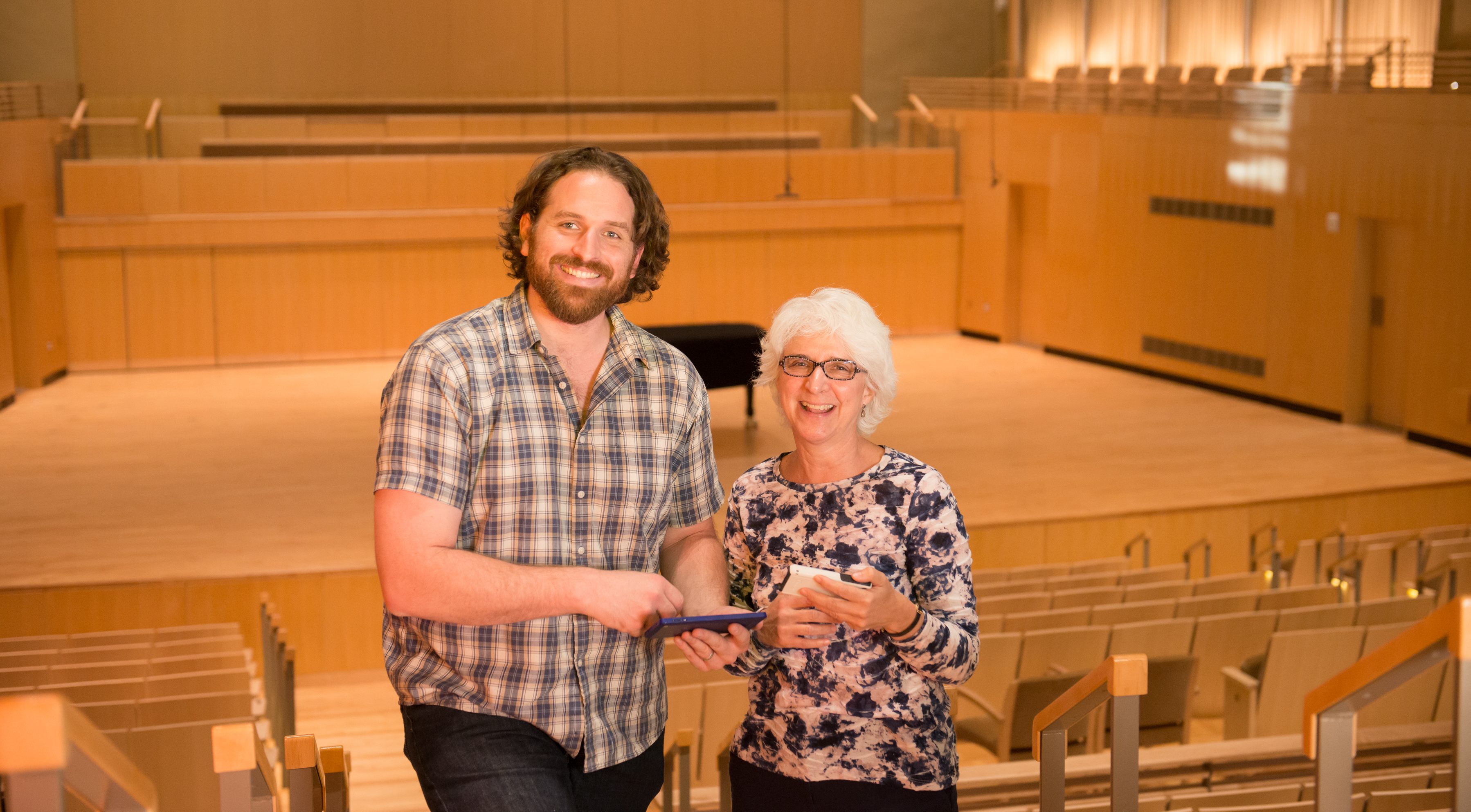
UMBC’s department of music will present its annual Livewire festival of new music, featuring concerts, discussions and lectures, October 26 – 29, in the Earl and Darielle Linehan Concert Hall and other venues across the university.
This year’s theme, “Livewire 7: The New York School and Beyond,” focuses on an artistic movement that emerged from a group of American composers originally centered in New York — John Cage, Morton Feldman, Earle Brown, and Christian Wolff — and features performances by UMBC faculty and special guest artists.
The post-World War II era of the early 1950s ushered in a turbulent and revolutionary period in American art that extended across the fields of music, dance, theatre, and the visual and literary arts. The visual arts witnessed the emergence of abstract expressionism, championed by figures as diverse as Jackson Pollack, Franz Kline, Mark Rothko, and Robert Motherwell; the dance scene exploded with new works by Merce Cunningham, Anna Sokolow, and Paul Taylor; and poets such as Jackson Mac Low experimented with new forms.
In music, the creative focus began to shift from the major figures of pre-war modern music — Arnold Schoenberg and Igor Stravinsky, both by then living in Los Angeles — to a younger generation of composers based in New York City clustered around John Cage (1912 – 1992), including Morton Feldman (1926 – 1987), Earle Brown (1926 – 2002), and Christian Wolff (b. 1934). Along with pianist David Tudor (1926 – 1996), for whom many of their works were written, the composers gradually became known as the New York School, and were closely aligned with Cunningham and with artists Robert Rauschenberg and Jasper Johns.
In 1951, Cage began to explore the use of “chance operations” in his music, thereby freeing the compositional process from some of his personal likes and dislikes. Feldman experimented with graphic notation that might tell performer to play a high or low note, but not specify a pitch; Wolff wrote pieces in which one performer’s actions might influence another; and Brown constructed works with fixed modules in which the various pages or parts might be performed in different orders.
Throughout, the music explored silence and indeterminacy (although not improvisation), and performers such as Tudor translated this new aesthetic for audiences. For years, their work was subject to derision and ridicule from the classical music establishment, but by the time of Cage’s death in 1992, a couple weeks shy of his 80th birthday, his work and that of his colleagues exerted a profound influence, opening up pathways for younger composers.
“Music and other art forms were practically redefined for me,” says Tom Goldstein, associate professor of music and curator of this year’s Livewire festival, as he described his reaction to discovering the work of the New York School as a young performer. “Here was a revolution, manifest musically in greatly varied notational systems, employment of chance operations, open instrumentation, the relinquishing of compositional decisions to the performer, frequent use and extended duration of silence and unintended sounds, the inclusion of ‘noise,’ experimentation with form (or the absence of it), and the influence of Zen Buddhism. I was so powerfully affected that, for some time, I believed that any late-twentieth-century composer whose music wasn’t filtered through the sensibilities of the New York School bordered on irrelevancy.”
In addition to performances of numerous works by Cage, Feldman, Brown, and Wolff, Livewire 7 includes presentations of music by Thomas DeLio, Malcolm Goldstein, Toshi Ichiyanagi, Ben Johnston, Stephen F. Lilly, Bunita Marcus, Andrew Rindfleisch, Christopher Shultis, James Tenney, and Steve Wanna.
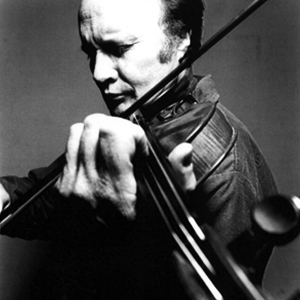
Livewire 7 features special guest artist Malcolm Goldstein, who has been active in the presentation of new music and dance since the early 1960s in New York City. He co-founded the Tone Roads Ensemble and participated in the Judson Dance Theater, the New York Festival of the Avant Garde, and the Experimental Intermedia Foundation. His “soundings” improvisations have received international acclaim for extending the range of tonal/sound-texture possibilities of the violin and revealing new dimensions of expression.
UMBC faculty and staff featured in performances and events include affiliate artist Audrey Andrist; lecturer Matt Belzer; associate professor Lisa Cella; affiliate artist Hui-Chuan Chen; affiliate artist and adjunct professor Patrick Crossland; affiliate artist Nicholas Currie; affiliate artist Gita Ladd; associate professor Tom Goldstein; assistant professor Brian Kaufman; affiliate artist Jacqueline Pollauf; professor E. Michael Richards; affiliate artist Kazuko Tanosaki; professor Airi Yoshioka; associate professor of dance Doug Hamby; director of arts and culture Thomas Moore; and UMBC student performers.
Additional guest artists include violist Karin Brown; pianist Curtis Cacioppo; pianist Paul Hoffmann; visual artist Ray Kass; multi-instrumentalist Stephen Lilly; conductor Jason Love; soprano Stacey Mastrian; and percussionist Michelle Purdy ’10, music.
Times Higher Education (THE) has named UMBC one of world’s top universities for 2016-17, marking UMBC’s fifth consecutive year on the prestigious international list.
THE World University Rankings are designed to “judge world class universities across all of their core missions – teaching, research, knowledge transfer and international outlook.” The 2016-17 ranking includes 980 universities from 79 countries, representing the top 5% of global higher education institutions (see methodology). Of that total, 148 are U.S. universities, including three in Maryland: UMBC, Johns Hopkins University, and the University of Maryland, College Park. Universities in the United Kingdom, Switzerland, Germany, the Netherlands, China, and Korea were also well represented on the 2016-17 list.
THE‘s profile of the university emphasizes, “[UMBC] defines itself as an ‘honors university’ committed both to cutting-edge research and to providing a excellent and demanding education for highly motivated students.”
The profile goes on to note:
UMBC has always stressed innovation and interdisciplinarity. It has never been afraid to pioneer new models of teaching and research, and new ways of contributing to the regional economy. It was responsible, for example, for creating the state’s first university research park…bwtech@UMBC, to promote local entrepreneurship This can be found on a separate but adjacent 71-acre site and has proved highly effective in nurturing start-ups, offering support for existing businesses and providing networking opportunities.
In addition to the World University Rankings, UMBC again appeared on Times Higher Education‘s list of top young global universities last spring. Editor Phil Baty previously described THE’s top young universities list as designed to highlight “a truly exciting and dynamic group of institutions” that demonstrate “the traditional global world order is not unassailable and visionary young universities can break through.” UMBC was one of just five U.S. universities to appear on that list this year, an honor it has now received for five consecutive years.
Thousands of Retrievers came together as a community on Saturday night—alumni, faculty, staff, and students from all five decades of UMBC history—to celebrate the remarkable story of UMBC.
In UMBC’s first Commencement program, Diane Juknelis Tichnell ’70, political science, wrote, “The present class of graduates is the first in a long line of innovators who are not to be considered products of UMBC, but rather constant producers of all that gives it character and quality… The campus, ever-growing and changing, will bear the indelible imprint of those who participated in its all-important first steps on a course untried.”
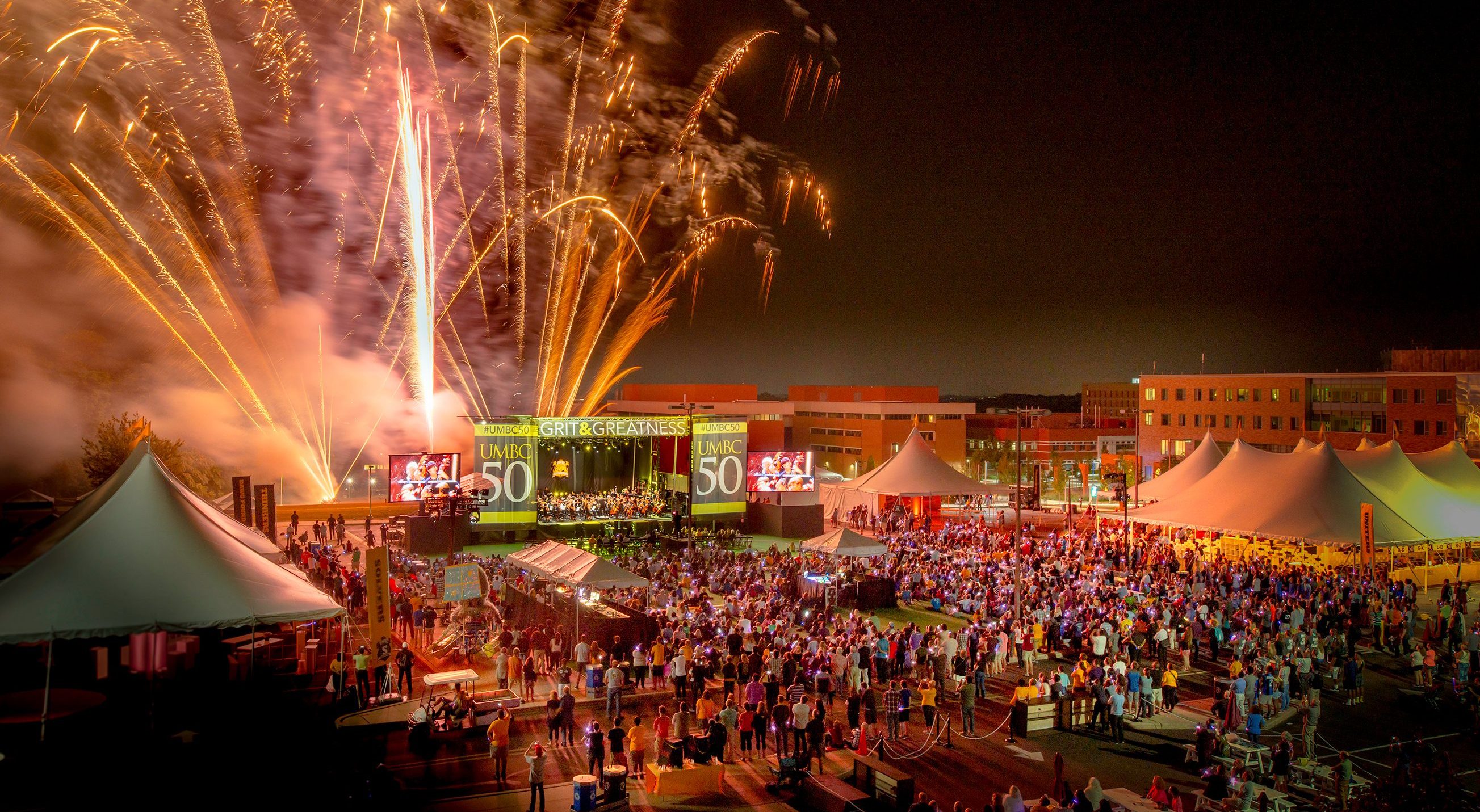
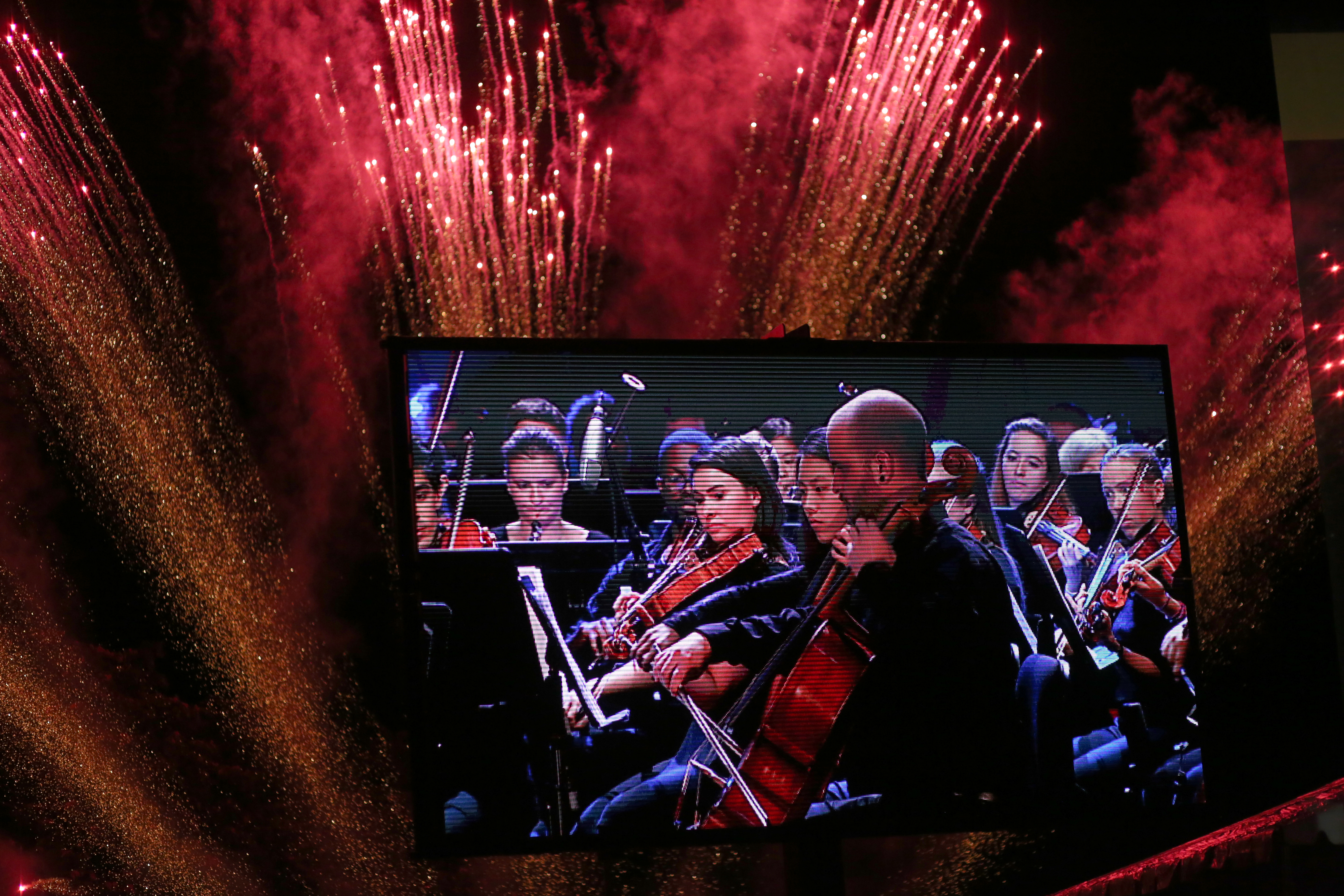
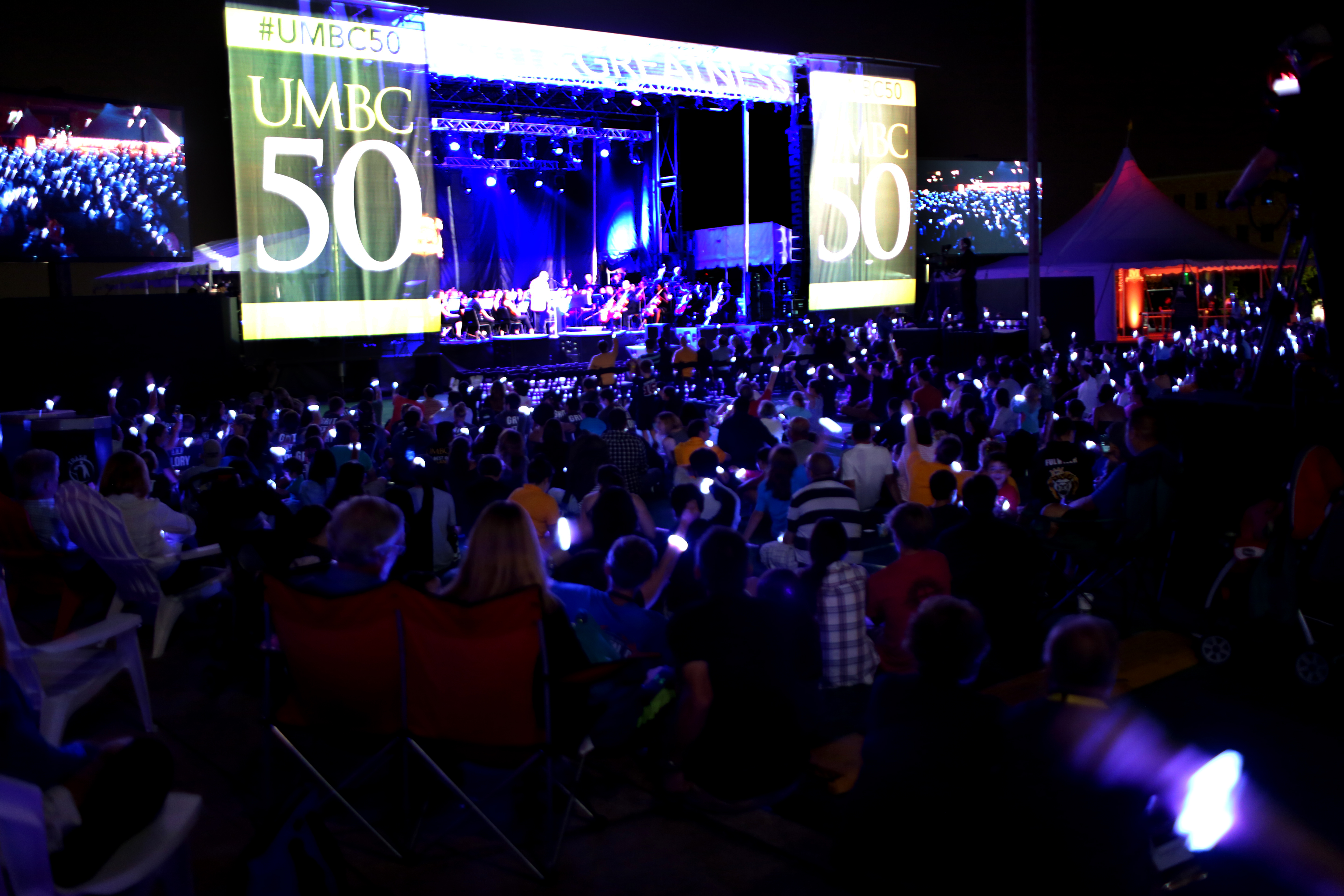
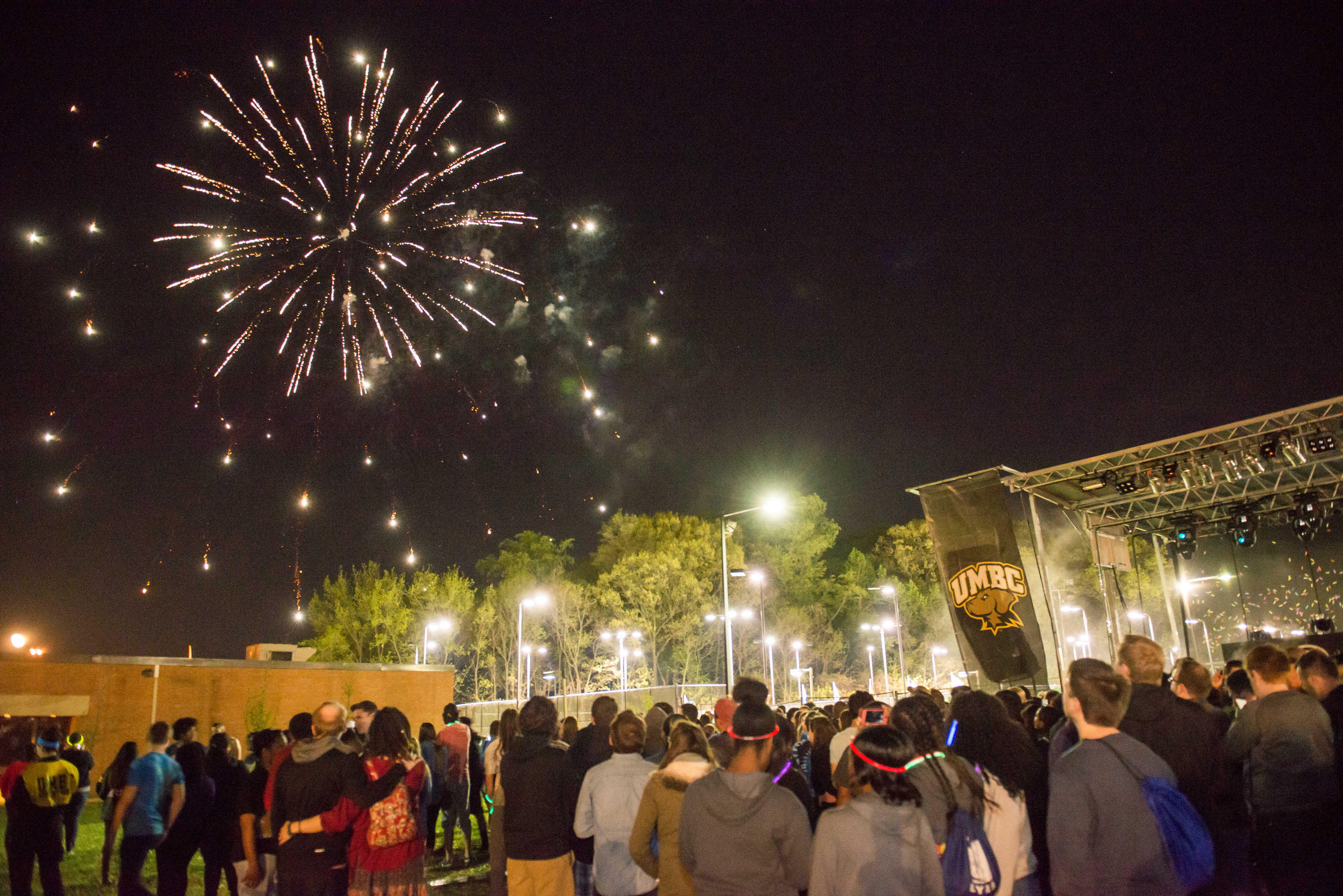
On the night of the anniversary festival, September 17, 2016, the founding generation of Retrievers who together created and shaped UMBC over the course of its first 50 years, had an opportunity to honor that achievement, salute one another, and set the stage for the next half-century. Together they cheered for a dazzling display of fireworks at the top of UMBC’s hilly campus, transforming from a flurry of twinkling stars to astounding fireballs. Center stage, before the backdrop of fireworks, was the UMBC Symphony Orchestra—a microcosm of UMBC’s inclusive excellence—performing Stravinsky’s gripping Firebird.
Saturday began with the Roots of Greatness Luncheon, honoring UMBC’s founding faculty and staff, as well as those who have won Presidential and Regents’ awards through the history of the university. Wendy Salkind, professor emerita of theatre, opened the program with a comment made by UMBC’s founding chancellor, Albin O. Kuhn, in the first issue of what would become the Retriever newspaper. “We do not expect UMBC to be quite like any other campus,” Kuhn wrote, continuing, “You will find many open doors to the offices of faculty and staff who are anxious to make UMBC an outstanding center for educational adventure.”
“That’s been true for 50 years now,” said Salkind.
CAHSS Dean Emeritus John Jeffries; Professor Emeritus and Research Professor of Political Science George La Noue; Yasmin Karimian ‘11, political science; and David Bennett ‘11, political science, spoke before a full University Center Ballroom about the process of researching and writing La Noue’s new book Improbable Excellence: The Saga of UMBC.“UMBC has developed a new model,” said La Noue. He predicted “the quest for excellence will become a permanent part of UMBC culture.” [watch video]
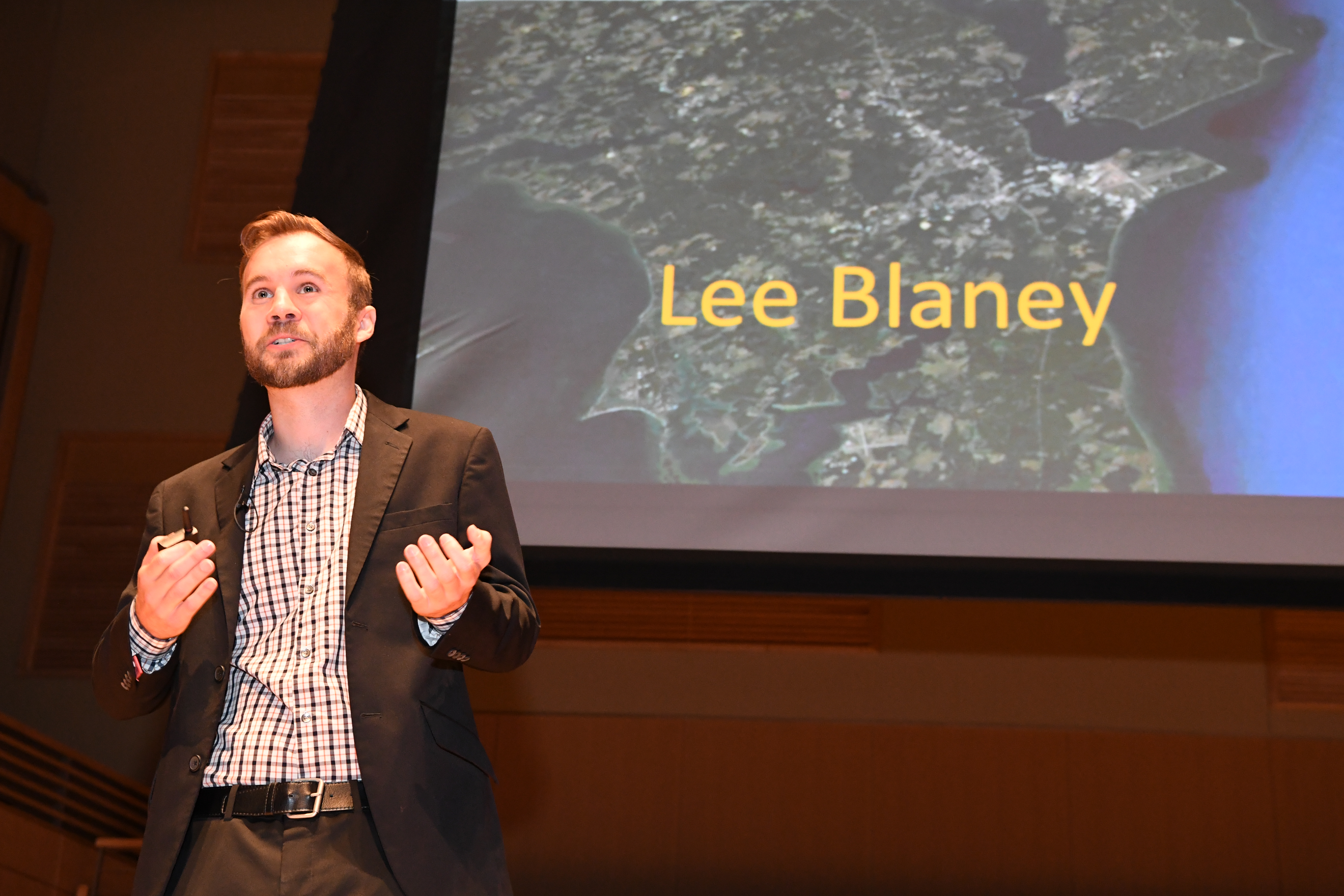
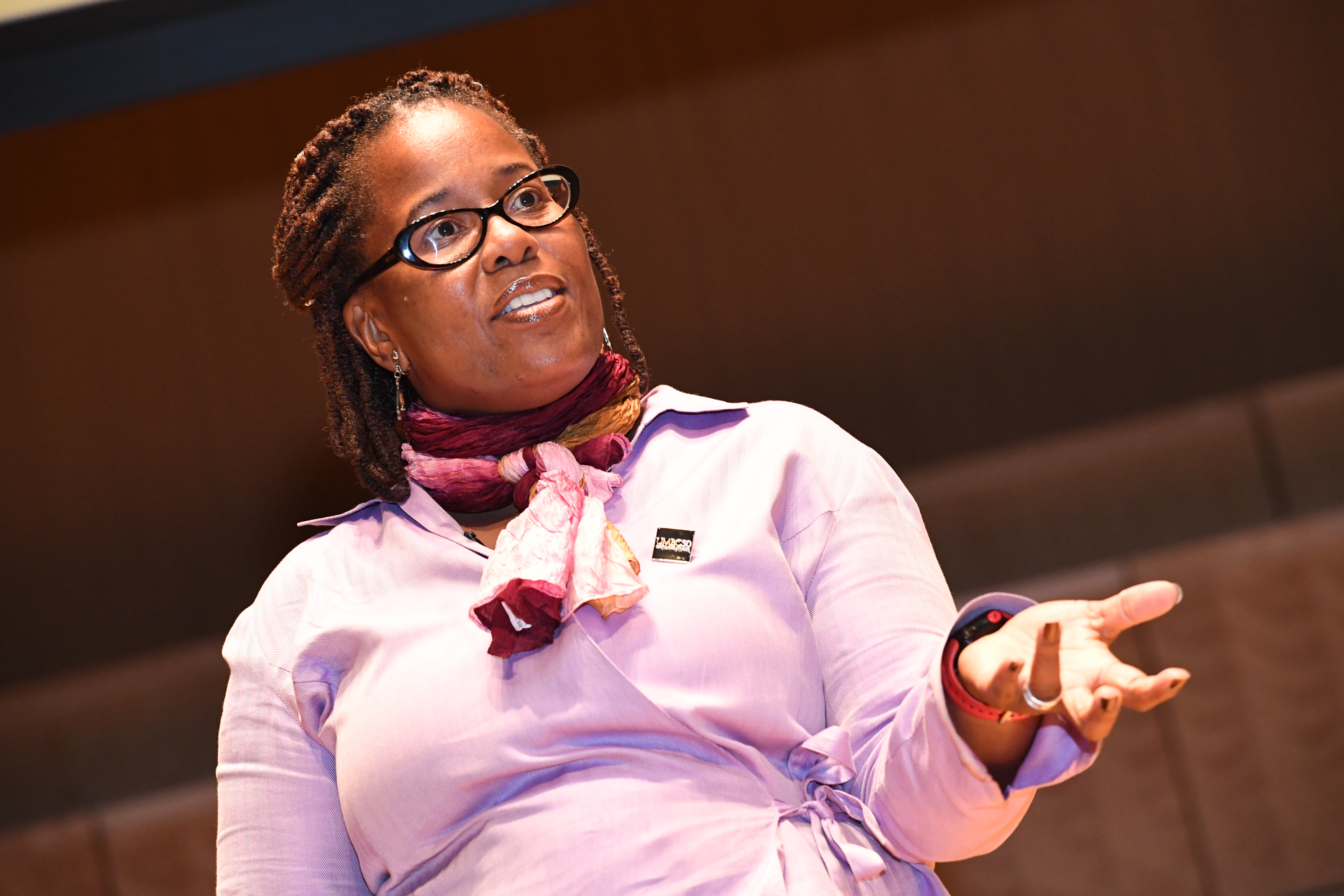
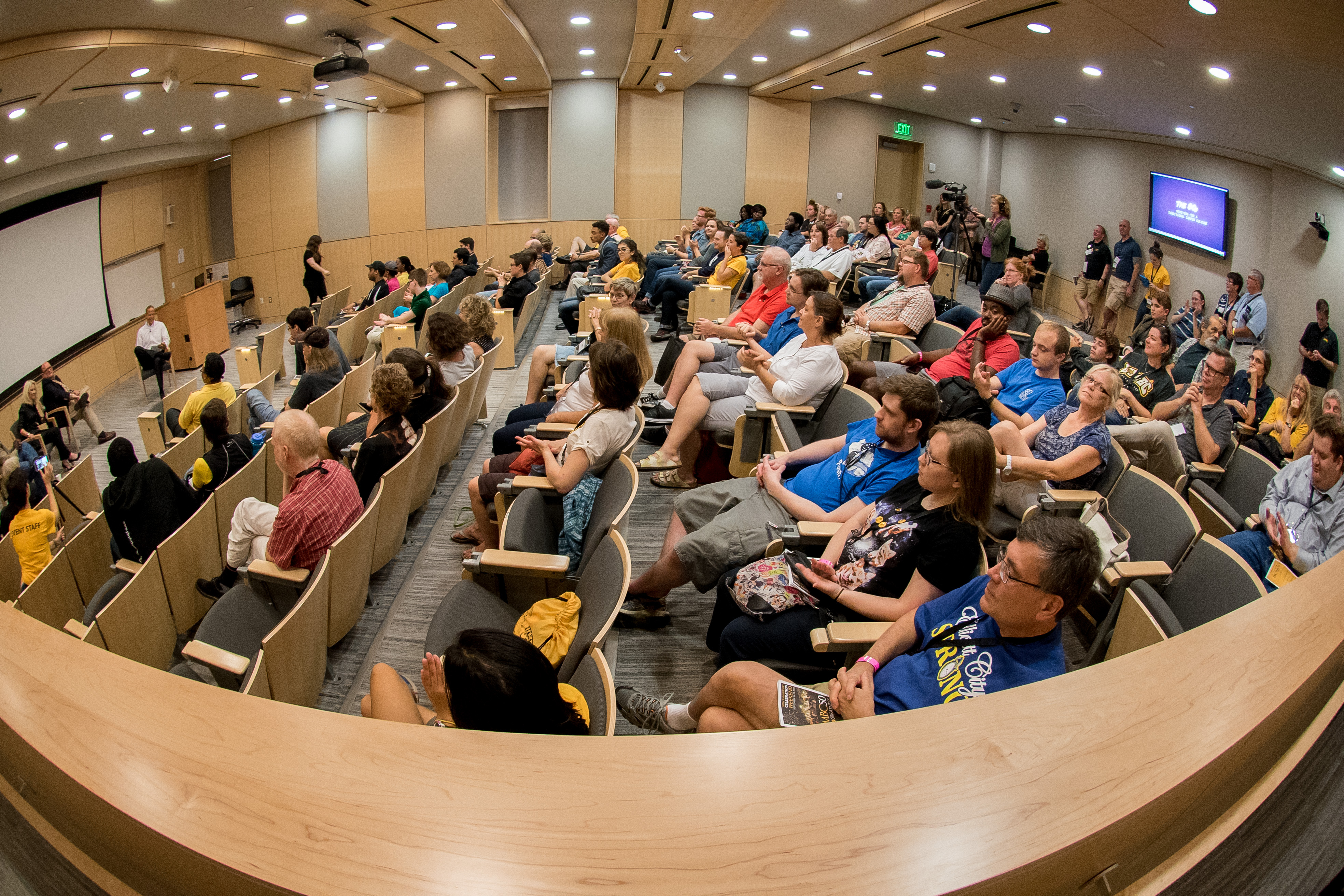
At GRIT-X, later that afternoon, faculty and alumni presented a series of engaging talks demonstrating UMBC’s broad impact in research, scholarship, and creative achievement. Speakers covered topics from the process for creating a successful theatre company to dealing with contaminants of emerging concern in local watersheds.
“We really wanted to put a program together that…gives a glimpse at the diversity of programs and groundbreaking, impactful research and the many thought-provoking topics that many of our alumni and faculty are working on,” explained Karl Steiner, vice president for research. [watch video]
The House of Grit was one of the largest attractions of the 50th anniversary celebration. Named for UMBC’s character and spirit, this community festival showcased programs and communities from across the university.
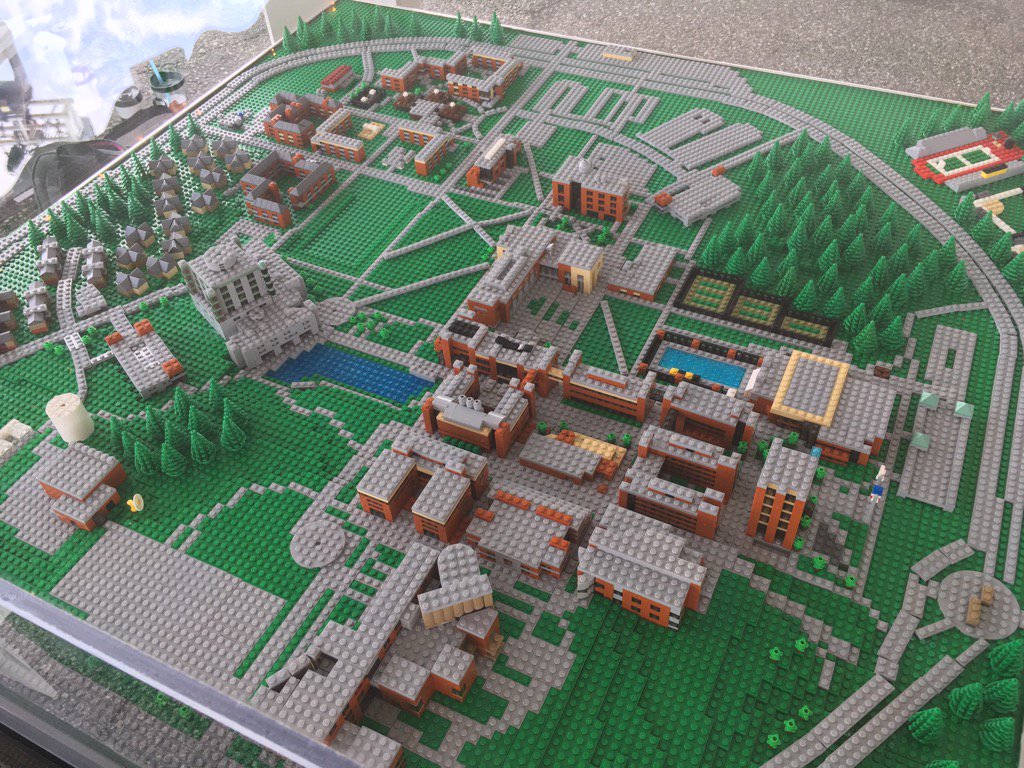
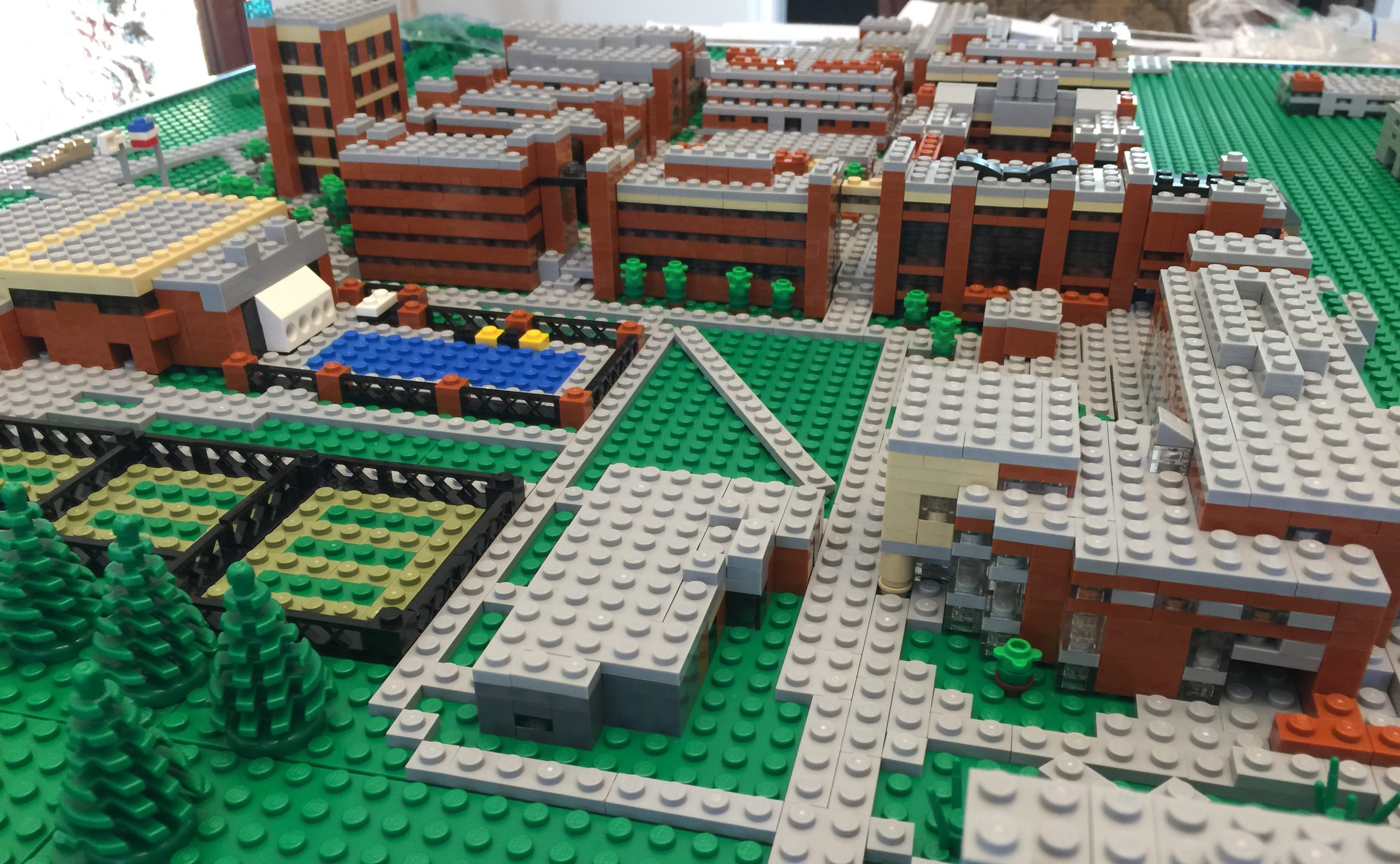
A Lego model of campus, constructed by Jason Burik ‘00, psychology, proved particularly popular for visitors of all ages. The Dawg Pound, hosted by UMBC Athletics, also drew crowds, showcasing UMBC scholar-athletes signing autographs, a display of UMBC’s NCAA trophies, games, a photobooth, and a performance space.
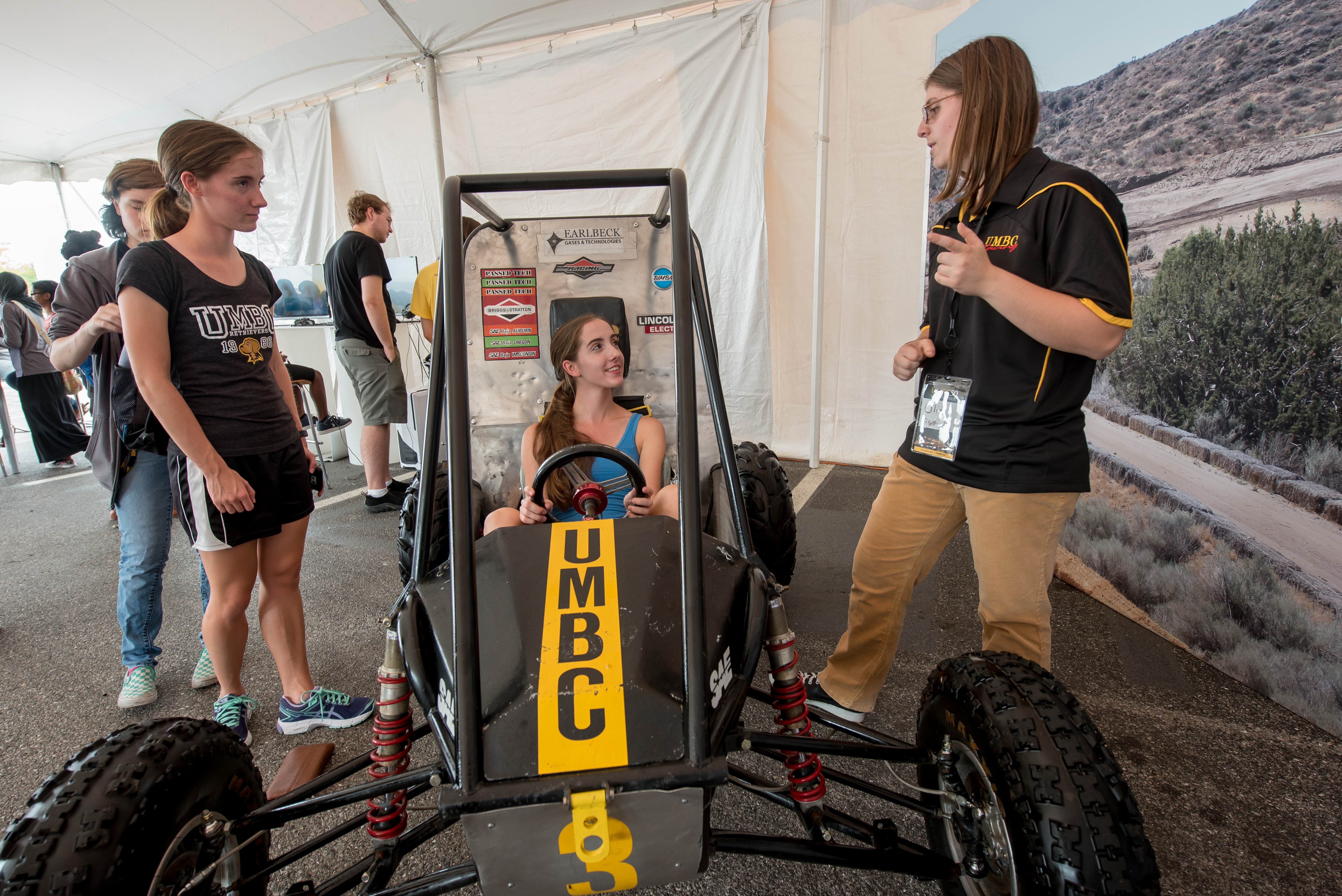
At the UMBC Racing team’s station, guests explored two Baja racing cars alongside footage from past races that showed the challenge and excitement of steering a vehicle along treacherous courses. Students, alumni, and future Retrievers, some who couldn’t yet reach the pedals, enjoyed a chance to sit in the driver’s seat.
3D-printed braille rings developed by UMBC’s Prototype and Design (PAD) lab and an interactive “Cranes in Motion” display, which enabled visitors to guide the motion of animated birds on a screen, were crowd favorites. Guests also had a chance to build and race their own boats from upcycled materials, and to use items like bouncy balls, playing cards, and frying pans to create unique percussion music.
Through Celebrate Science, held in UMBC’s College of Natural and Mathematical Sciences facilities, kids had a chance to make slime, sort M&Ms to learn about mathematical concepts, detect sunspots, see a model of a satellite, play with magnets, and explore how a square block can roll.
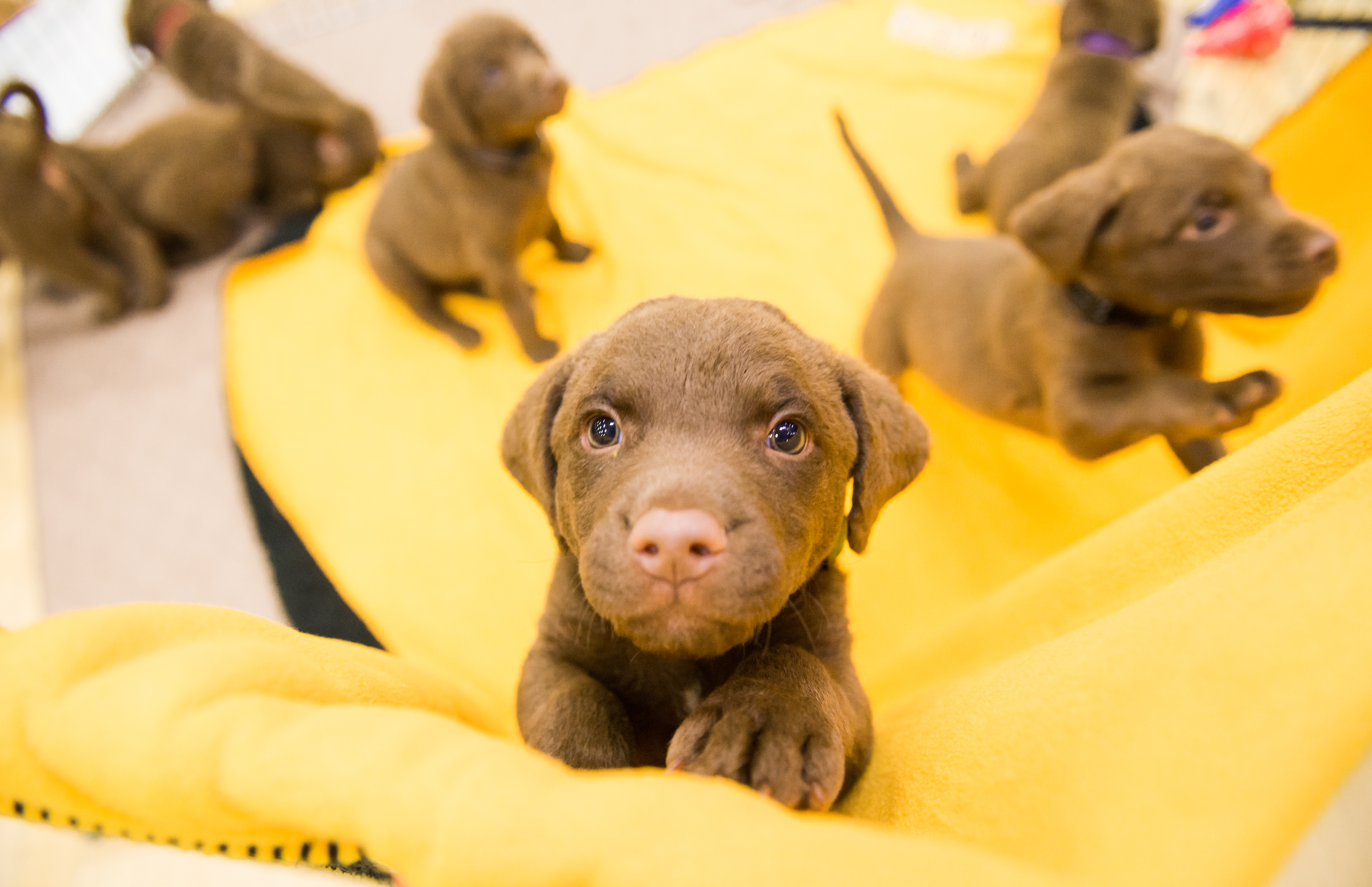
Visitors later gathered for the long awaited Puppy Parade [watch live video]. Featuring dozens of dogs of all ages and breeds, UMBC’s own True Grit, dancers, and musicians, the parade was a highlight in Baltimore Sun coverage of the festivities.
George Derek Musgrove ‘97, history, associate professor of history, moderated a lighthearted alumni panel on the UMBC student experience over the years. Steven Fedder ‘72, American studies; Shari Elliker ‘83, interdisciplinary studies; and Oliver Myers (M1) ‘94, M.S. ‘96, Ph.D. ‘07, mechanical engineering, shared memories of their time as students. Myers reflected on his unique experience as part of the first class of Meyerhoff Scholars, and how UMBC offered him unparalleled opportunities to connect with world leaders in science and government on their frequent visits to campus.
Immediately after the alumni panel, visitors ran to catch the start of a special UMBC edition of the popular Stoop Storytelling Series, featuring moving personal tales from UMBC’s earliest days [watch video]. UMBC President Freeman A. Hrabowski shared his own memory of the UMBC community coming together to protect and advocate for humanities programs when their future was uncertain. “I am a strong believer that working class people, middle class people, should be exposed to the best,” said Hrabowski, “because they are going to be leaders.”
Leaving the emotional event, guests emerged from UMBC’s Performing Arts and Humanities Building to find the sun had set. In the heart of the House of Grit they saw a crowd of thousands of Retrievers and their families gathered around a massive, brightly lit stage, buzzing with excitement, ready for one final performance to begin. Visitors and organizers alike had high expectations, and the finale—with its soaring music and momentous firework display—surpassed them all. [watch Baltimore Sun video]
“Hearing the fireworks right behind me and the huge crowd cheering, watching the blinking bracelets, and pulling as rich of a sound as possible from my viola was a sensory feast,” shares Sarah Hansen, M.S. ‘15, biological sciences, a member of the orchestra and UMBC communications manager. “This is my community. That finale brought together the UMBC family in a way that has never happened before, and reminded me that I will always be a UMBC alumna, and UMBC will always be my home.”
Header image: Fireworks display at UMBC’s 50th anniversary celebration. Photo by Dan Bailey. Additional photos by UMBC staff and freelance photographers.
UMBC’s long-awaited celebration of 50 years of grit and greatness has arrived. Thousands of Retrievers and their families will gather on campus for the September 16–19 weekend to honor UMBC’s journey. The campus will welcome Dawgs of all decades, from the pioneers of the first graduating class to today’s visionaries who are imagining UMBC’s next 50 years.
The anniversary weekend spotlights over a hundred features, including special events, family activities, performances, soccer games, reunions, tours, and socials.
On Friday night, ahead of Saturday’s headline events, will be “Really, Really Big Breakfast and Bingo,” a sold-out midnight breakfast and prize-filled game night.
Saturday’s first large event, the Roots of Greatness Luncheon, will be held 11:30 – 1:30 p.m. in the University Center Ballroom, honoring founding faculty and staff, along with past and present faculty and staff awardees. John Jeffries, emeritus dean of the College of Arts, Humanities, and Social Sciences, will interview George La Noue, emeritus professor of public policy, about his new book, Improbable Excellence: The Saga of UMBC.
In the Uniters tent, visitors can watch as a Lego™ model of UMBC—created by Jason Burik ’00, psychology — grows over time, seeing campus architecture shift from 1966 to 2016.
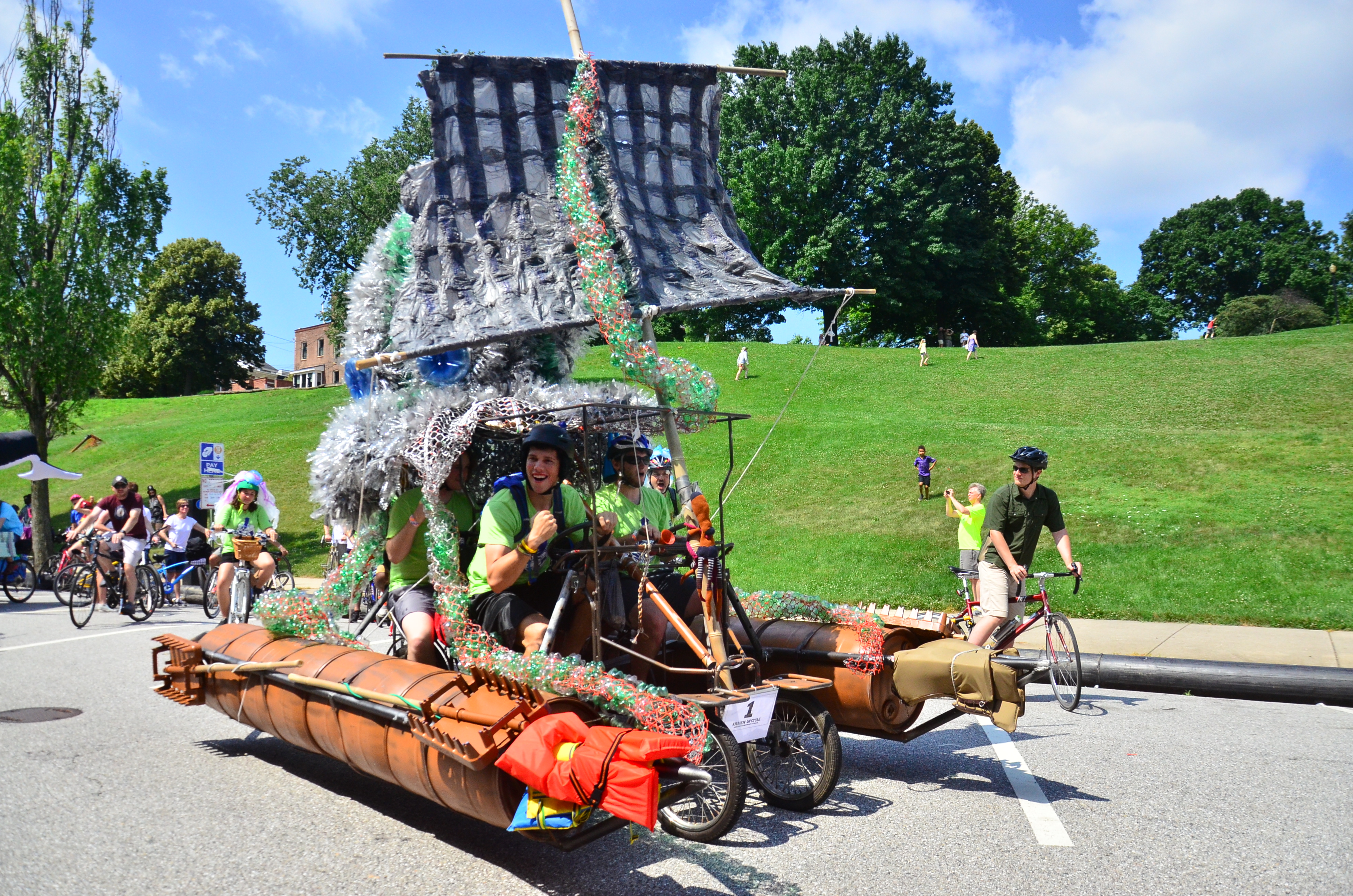
In the Makers tent, visitors can pick up their own 3-D printed ring from UMBC’s PAD Lab, try games developed by UMBC Game Developers Club, and check out the UMBC Racing Team’s off-road Baja vehicle. Visitors to the Explorers tent will have a chance to control a life-size virtual whooping crane, explore the Spiro Collection of ancient artifacts, and get a glimpse of Baltimore in 1815. The Thinkers tent features hands-on science activities, a “magic planet” miniature earth with vivid projection, and haiku-writing station with the staff of Bartleby. The Solvers tent includes activities with the UMBC Percussion Ensemble and UMBC’s kinetic sculpture, Kraken Upcycle, featuring an opportunity to build musical instruments and catamarans with recycled materials.
The Festival also includes a main stage with music and dance performances, and the Dawg Pound, a dedicated space for UMBC Athletics and the university’s intellectual sports teams, like Mock Trial and Ethics Bowl. UMBC Olympian Mohamed Hussein ‘14, mechanical engineering, a current master’s student in engineering management, will sign autographs 1 – 1:30 p.m., 2 – 2:20 p.m., and 4 – 5:30 p.m.
For festival-goers who want a glimpse of today’s cutting edge UMBC research, GRIT-X, held 2 – 4:30 p.m. in the Linehan Concert Hall, will feature a series of brief, engaging talks by leading innovators among UMBC faculty and alumni. Topics range across the arts, humanities, and social sciences, from “When Your Arts Becomes Your Business” and “Our Environment is on Drugs” to “Beyond the Checkpoint: Rethinking Citizenship and Surveillance” and “Reaching for the Skies: Sun, Pollution, Clouds, and Climate.”
The weekend will feature two UMBC soccer games: a men’s soccer game vs. The George Washington University on Saturday at 3 p.m., and women’s soccer game vs. Delaware State University on Sunday at 1 p.m., both in Retriever Soccer Park.
Following Saturday’s game will be a Puppy Parade, 5 p.m., outside of the Performing Arts & Humanities Building, featuring dogs of all ages and breeds. A Picnic Dinner will be served before a special edition of Baltimore’s Stoop Stories series, with seven UMBC storytellers sharing true, personal tales from UMBC’s earliest days.
Visitors will gather from events large and small across the university, 7:30 – 8:30 p.m. in the House of Grit festival area, to celebrate Freeman, Firebird, and Fireworks! The program is described as “a fantastic finale featuring remarks by President Freeman Hrabowski and a fireworks display as bright as UMBC’s future, including a performance from Stravinsky’s ‘The Firebird’ by the UMBC Orchestra.”
For the afterparty crowd, UMBC will host a Decades Dance Party (21 and over), 8:30 p.m. – midnight, in the Performing Arts & Humanities Building. Students can enjoy the Cosmic in the Commons party (under-21 event) hosted by (seb) in the UMBC Commons.
Retrievers on campus Sunday can relax and revive with coffee and waffles at a community brunch, 11 a.m. – 2 p.m. in True Grit’s Dining Hall.
On Monday, September 19, marking the day UMBC’s first students started classes 50 years ago, the university will celebrate Founder’s Day. All members of campus are invited to President Hrabowski’s Founders Day State of the University Address, 11:30 a.m. – 1:30 p.m. in the Retriever Activities Center, to celebrate this golden anniversary with cupcakes and reflections on the past—and next—50 years.
A full calendar of 50th anniversary weekend events is available on the Celebrate UMBC50 calendar. The House of Grit page offers details on activities in the main festival area. Online registration for ticketed anniversary events has closed, but on-site registration will be available. Community members who aren’t able to join in the festivities can follow #UMBC50 on Facebook, Instagram and Twitter.
Just days ahead of UMBC’s 50th anniversary celebration, U.S. News & World Report has again affirmed the university’s continued standing as one of the most innovative colleges in the nation, among the best in teaching and setting new standards for student success.
The 2017 U.S. News & World Report Best Colleges guide ranks UMBC in the top five on its closely-watched Most Innovative Schools list, joining Stanford, MIT, ASU-Tempe, and Georgia State. College presidents, provosts, and admissions deans nationwide nominate universities for this list, based on cutting-edge developments in curriculum, campus life, technology, and other areas.
“These rankings reflect the careful thought of university leaders across the nation, and they speak volumes about the respect they have for UMBC,” says President Freeman Hrabowski, III.
This is the second year U.S. News has published a Most Innovative Schools list, and second year UMBC has appeared in the top five. Prior to the launch of this new ranking, U.S. News published an Up-and-Coming list, highlighting institutions experiencing tremendous growth. UMBC topped that list for six consecutive years.
UMBC is also featured this year on the U.S. News list of top 20 national universities with a particularly strong commitment to undergraduate teaching, alongside Princeton, Yale, Dartmouth, and UC Berkeley, among others. The university’s appearance on this list for several consecutive years reflects both longstanding excellence and a commitment to continuous improvement.
Describing what makes a UMBC education distinctive, Student Government Association President Bentley Corbett-Wilson ’16, music education, shares, “My experiences here, through both academics and student life, have definitely shaped who I am as an individual, as a leader in my community, and as a learner. There’s such an empowering community here. Having the power to create your own story and help others do the same is something that I think is really unique to this campus.”
SGA President Bentley Corbett-Wilson speaks at UMBC Convocation 2016
This sense of leadership and empowerment to create change resonates with Dean Scott Casper, of UMBC’s College of Arts, Humanities, and Social Sciences. “Today’s recognition testifies to our commitment to a complete undergraduate education, rooted in students’ academic learning and their development as thoughtful citizens and leaders in their communities and their world,” says Casper.
Faculty Senate President Kimberly R. Moffitt, associate professor of American studies, reflects, “UMBC continues to excel at what it does best: teach innovative classes that stimulate young minds to engage and participate in substantive ways. My colleagues are working diligently with their undergrads to cultivate a rich learning environment that mimics the experience of many of us in our grad school settings.”
Kimberly Moffitt, American studies, teaching a class
For Interim Dean and Vice Provost of Undergraduate Education Simon Stacey, “UMBC is doing exactly what a university should do—it’s putting committed, thoughtful teachers in classrooms filled with students from every walk of life, and charging everyone in those classrooms to figure out between them how to learn and teach.” Stacey says, “This approach is what generates the creativity, energy and intensity that makes UMBC such a great place to be work, teach, or be a student.”
Princeton Review in particular highlighted UMBC’s welcoming environment and reputation for valuing the perspectives that diverse, creative minds can bring the classroom, research lab, and art studio. On hearing the news of UMBC’s latest national rankings, several campus leaders reflected on the interconnections of teaching and learning, research, diversity, and community impact at UMBC.
“We are very proud of our commitment to inclusive excellence at UMBC,” said Karl Steiner, vice president for research. “An integral part of the student experience at UMBC is the opportunity to participate in and contribute to state-of-the-art research conducted across the campus, addressing some of our society’s major challenges.”
“If our students are to solve societal problems, it is our responsibility and moral duty to continuously improve the way we teach,” said Dean Bill LaCourse, of the College of Natural and Mathematical Sciences. “Only through innovation in teaching, applied learning experiences, and a liberal arts education can we prepare students to deal with complexity, diversity, and change. This recognition underscores our commitment to train ethical and responsible leaders.”
CNMS Dean LaCourse with students in UMBC’s Science Learning Collaboratory
Dean Julia Ross, of the College of Engineering and Information Technology, noted, “The rankings support what we know to be true about UMBC: it’s an entrepreneurial place where a focus on undergraduate learning is synergistic with the research enterprise.”
Graduate Student Association President Deanna Cerquetti, a Ph.D. student in language, literacy and culture, says that this national recognition reflects her sense of the UMBC community and UMBC student experience as well. She shares, “The faculty and staff are committed to moving the campus forward by listening to student voices and striving to provide them the resources they need to succeed. UMBC has made its mark as an innovative institution and should be seen as an exemplary model not only for research but also for collaboration and leadership.”
GSA President Deanna Cerquetti with Associate Professor Christine Mallinson and LLC graduate students May Chung and Kimberly Price Feldman (l-r)
Image: Header image is UMBC Convocation 2016. All photos by Marlayna Demond ’11 for UMBC.
UMBC celebrated the start of its 50th anniversary year with a high energy Welcome Week greeting 2,800 new students and with a landmark newspaper headline: “A Catonsville university turns golden.”
As new freshman and transfer students began their UMBC journey, President Freeman Hrabowski shared with Catonsville Times reporter Jon Bleiweis what first drew him to the university. “There were a lot of high-achieving people here who wanted to be rebellious and crossing disciplines and solving problems,” Hrabowski said. “I wanted to be a part of that story.”
The article highlights UMBC’s growing national reputation in both teaching and research, including the most recent U.S. News & World Report rankings, which placed UMBC fourth in the nation in innovation and sixth in undergraduate teaching, in a list dominated by Ivy League schools.
“What they say,” Hrabowski told the paper, “is we are the national model for the combination of academic innovation and inclusive excellence, a place where students can come from all over the world — and from Catonsville — and do superbly.”
For President Hrabowski and others in the UMBC community, that sense of innovation and excellence applies both within and outside of the classroom. Bleiweis writes, “Hrabowski defines academic innovation as the ability to say tomorrow can be a better day,” and says, “a UMBC student represents hard work, perseverance, resilience and a willingness to never give up.”
Repeating a refrain familiar to UMBC students, Hrabowski emphasized, “If there’s one thing we want people to remember, is that success is never final. We are constantly working to be better.”
This theme of striving for greatness on a daily basis, through grit and determination, emerged again and again throughout the start of the semester, from the comments of new students to faculty and staff at the Fall Opening Meeting, to remarks by campus leaders during Convocation, to social media posts throughout Involvement Fest, where students encouraged one another to follow their passions, getting involved in organizations and issues that matter to them (#UMBCifest).
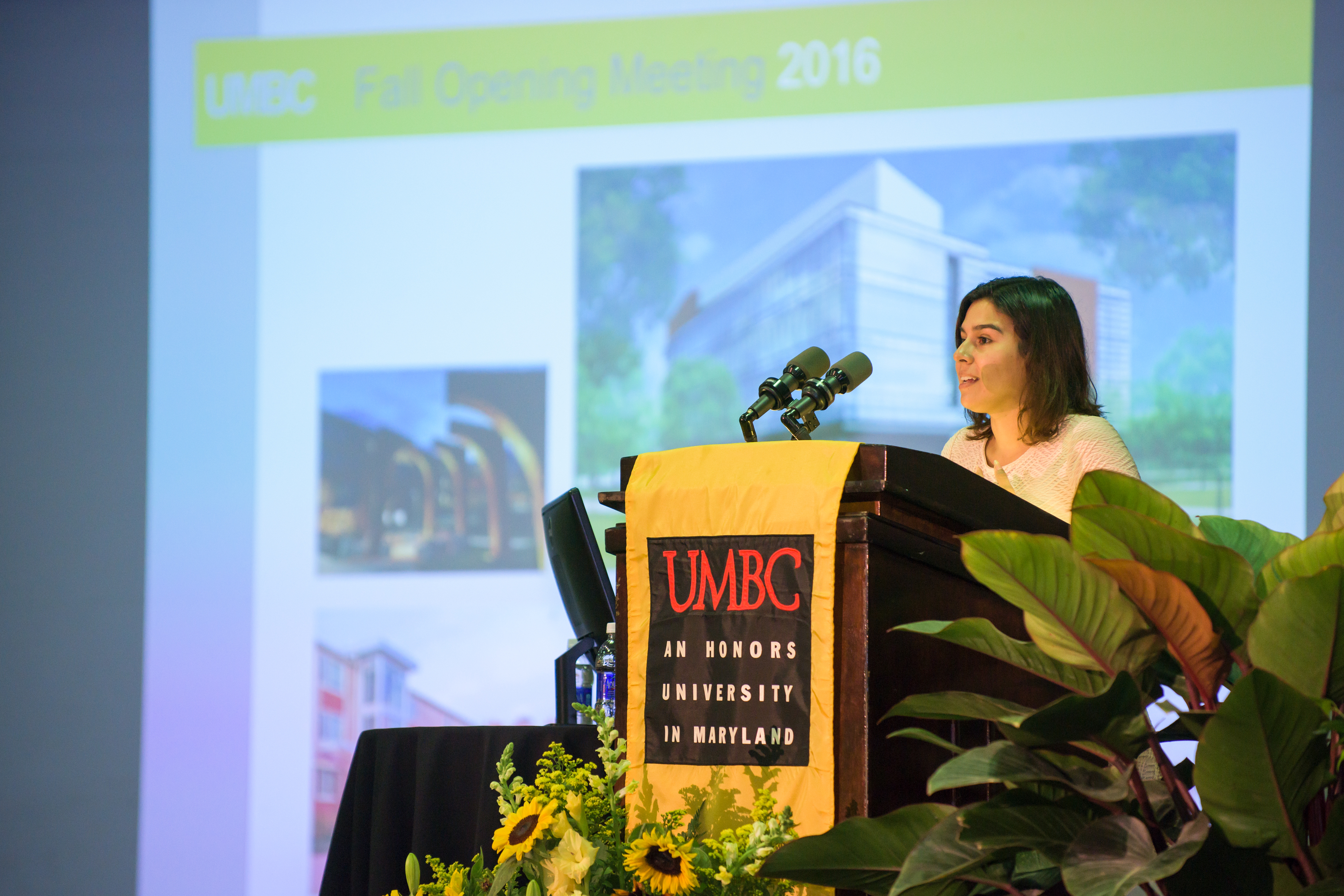
Ana Maldonado, an incoming Ph.D. student in psychology, spoke about her experience as a first-generation college student at UMBC’s Fall Opening Meeting. “I see education as a really big privilege,” she said. “Every success I’ve had I see as an accomplishment for my whole family…From zero schooling to Ph.D. in one generation is something I’m proud of and that my family is very proud of.”
Maldonado plans to research intimate partner violence, and came to UMBC as a Princeton graduate after gaining earlier research experience with UMBC’s Chris Murphy, professor and chair of psychology. “I’ve only been here a little while, but I already feel at home,” she shared.
Her comments and intended area of research resonate with how UMBC students, faculty, and staff have described the university community’s shared values. Hrabowski explained to Bleiweis, “What we like about UMBC and our values is that we really are focused on the idea of supporting those in the community and helping students to think not just about making a lot of money, but what difference you will make in the lives of other people.”
Jasir Qiydaar ’18, media and communication studies, details what this means for him in a new City Paper College Guide commentary, “A UMBC student group strives to do community partnerships right.” Qiyaaar describes how his experience growing up in Baltimore shaped his sense of the benefits and limitations of university/K-12 partnerships, and inspired him to co-create the Charm City Connection with fellow UMBC students. He explains, “university involvement in surrounding communities is essential and admirable, but only if it’s done correctly.”
“The community’s needs have to be put first in any initiatives that are carried out,” Qiydaar says. He describes working with UMBC’s Shriver Center to make the program a reality, combining the strengths of the center’s “track record of considerate community interactions” and longstanding relationships with area schools, with his and his collaborators’ “personal connections to Baltimore.”
UMBC alumna and program assistant Poulomi Banerjee ’16, health administration and public policy, also grew up near the university, and spoke with the Catonsville Times about her sense of UMBC’s growth at this historic golden anniversary moment. Banerjee shared, “I know we’ve been up and coming for a long time, but I think we’re finally here and we’re ready to show everyone what we can do.”
For President Hrabowski, the 50th anniversary is both a community celebration and an opportunity for personal reflection. At Convocation on August 30 he shared the story of one recent graduate who, when he asked what she was planning to do next, responded, “I’m going to change the world.”
President Hrabowski then said to the packed auditorium of new UMBC students, as well as faculty and staff:
There is my challenge to each of you – to think broadly, to dream about the endless possibilities for your own lives, and to prepare to change the world. The ineluctable question is, What will you do during the next 50 years of your life? Dreams and values. Welcome to UMBC.
Images: True Grit at UMBC Involvement Fest 2016 (header); flags representing the nations UMBC students hail from, in the UMBC Commons (top); Ana Maldonado speaking at 2016 Fall Opening Meeting. All photos by Marlayna Demond for UMBC (bottom).