All posts by: Dinah Winnick


UMBC Mock Trial heading to Los Angeles to compete in national championship

Just six years after its founding, the UMBC Mock Trial team is already taking the nation by storm.

Having outperformed hundreds of other college and university teams since September, these exceptional undergraduates are preparing for a historic trip to the American Mock Trial Association’s National Championship Tournament in Los Angeles later this month. The tournament includes a select group of only 48 teams from across the United States.

This year has been a heady one for the team, spending weekends on the road to compete in—and win—invitational tournaments up and down the east coast. After finishing the Baltimore Regional Championship with a record of 5–3, both the A and B Teams advanced to the Opening Round Championship Series, held March 25–26, where the A Team secured one of only six bids to the national competition and the B Team narrowly missed capturing a second.
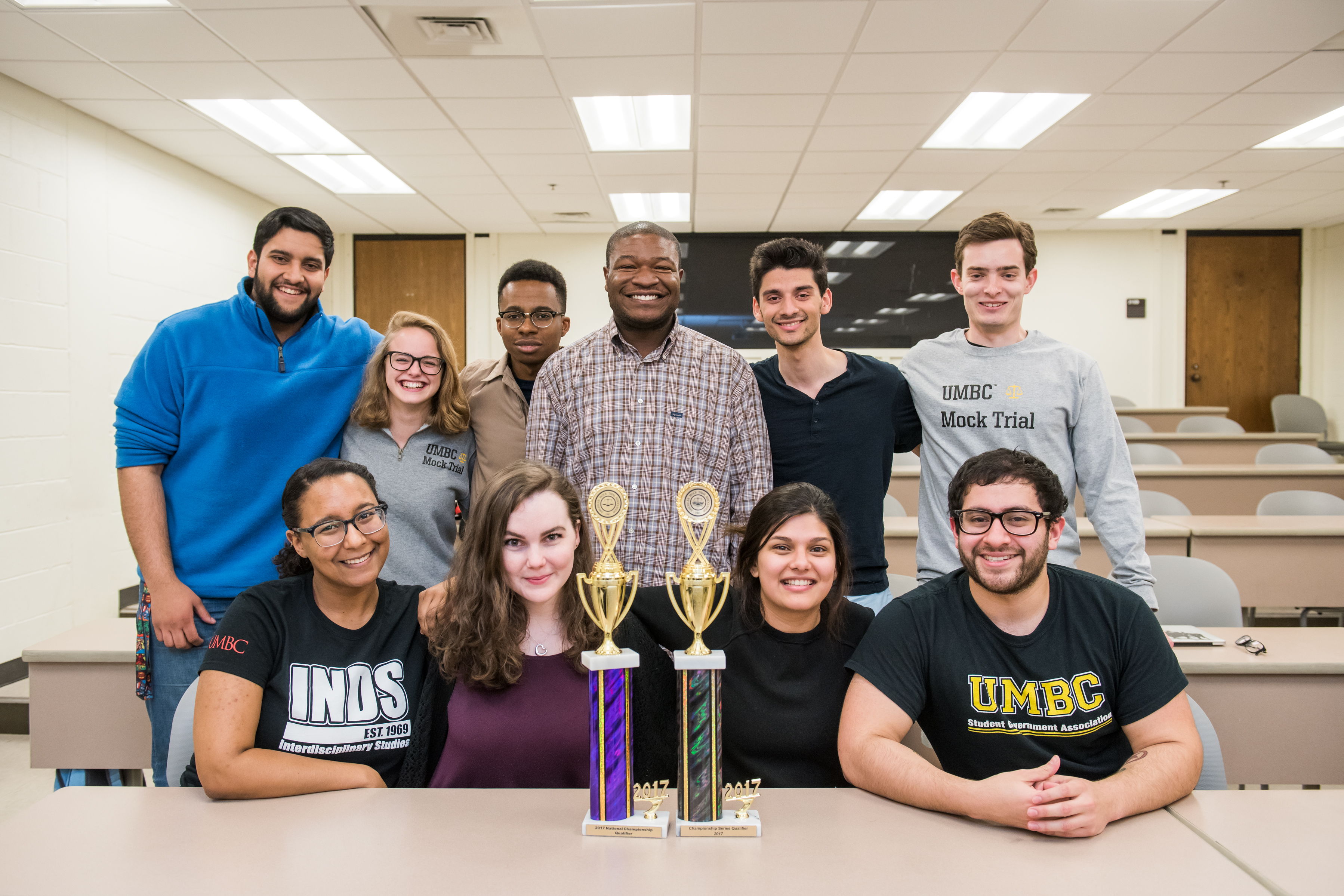
UMBC Mock Trial A Team

Graduating seniors Dylan Rogers Elliott, history; Zuhair Riaz, political science; Brandon James, English; and Kayla Smith, interdisciplinary studies, have earned a collective 14 individual mock trial awards, reflecting hundreds of hours spent writing and memorizing materials, in addition to the intense collaboration and team planning required to overcome more established teams.

“From my perspective, this is especially rewarding because of how this program has grown and evolved,” reflects coach Ben Garmoe ’13, political science. “I was on UMBC’s first-ever Mock Trial team, just six years ago,” he says. “It’s hard to believe sometimes how quickly things have grown since then.”
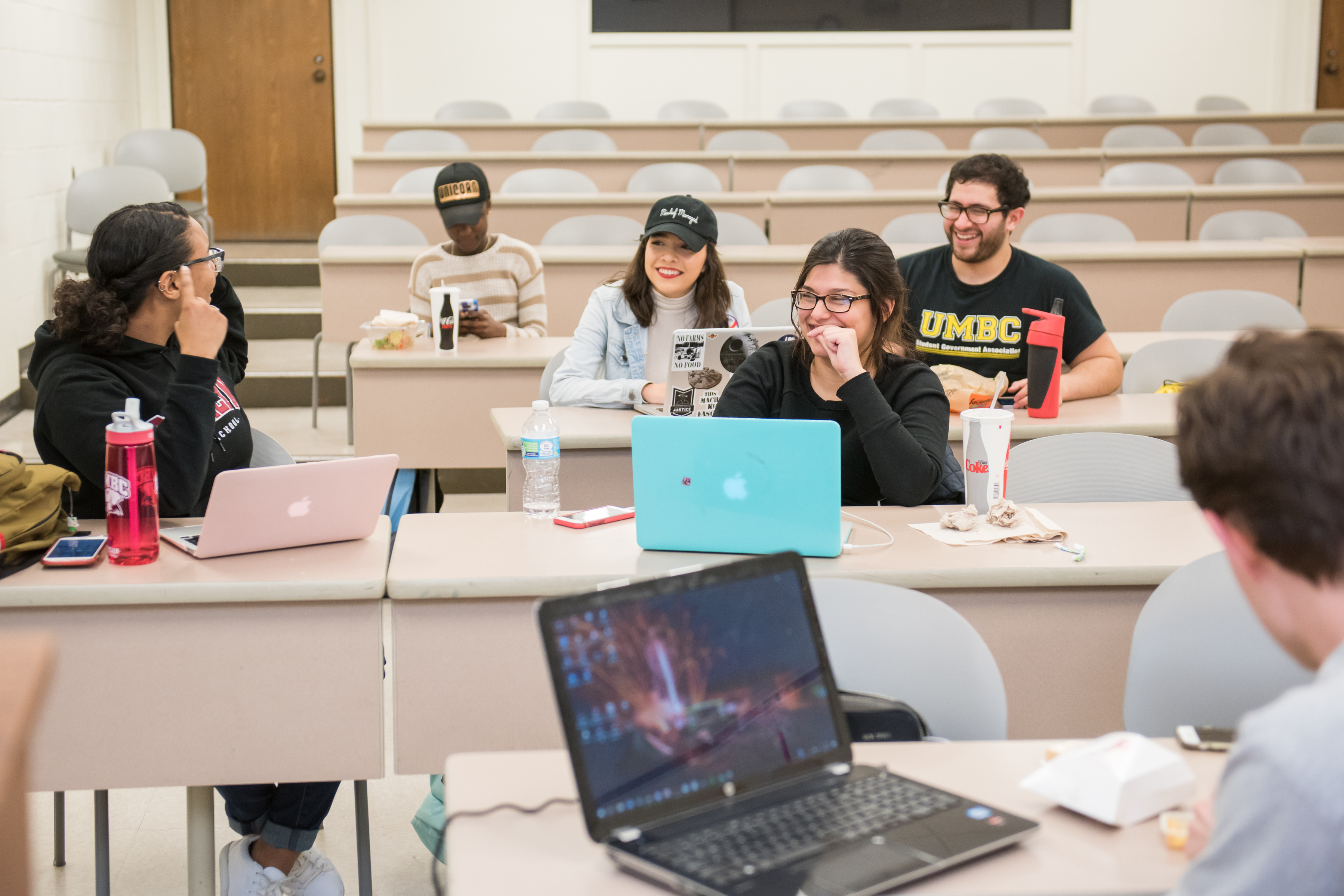
UMBC Mock Trial meets to practice

Looking ahead to the national competition, Elliott reflects, “Undoubtedly we’re going to have difficult trials all weekend long against really good teams, but we earned our spot alongside them. As a senior, I can graduate happy knowing that I played a role, however small, in the team’s growth.”

While mock trial teams tend to attract students majoring in the humanities and social sciences, UMBC Mock Trial includes students from all three colleges, including a biochemistry major. Team members get experience honing their speaking, writing, and presentation skills, applicable to any career path.

For some, like Kayla Smith, the team has also inspired future graduate school and career plans. 

“Mock Trial has prepared me for a lifetime of experiences,” Smith says. “After my first round in a real courtroom I thought to myself ‘I wish I could do mock trial professionally’ and I realized that was just called being an attorney. I’m now headed to law school in New York and I wouldn’t have taken this path without Mock Trial.”

She’ll be following in the footsteps of UMBC Mock Trial alumni who have attended prestigious law programs at Georgetown University, UCLA, William & Mary, the University of Maryland, and the University of Baltimore.
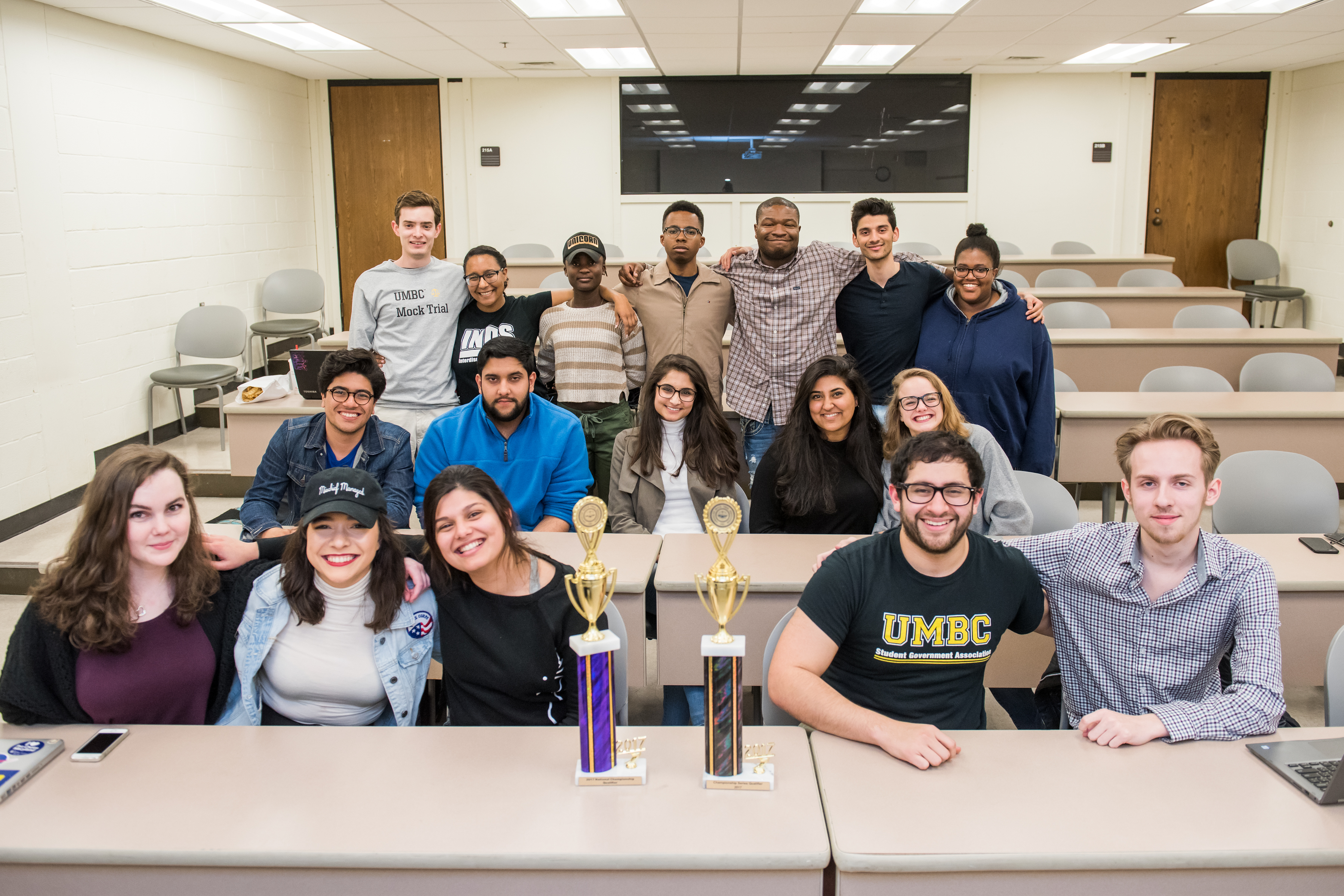
Full UMBC Mock Trial team

As news of UMBC Mock Trial’s win at regionals spread during the height of the basketball postseason, the campus found itself cheering yet another UMBC team’s remarkable victory.

Some might be surprised at rapid rise of such a young team, but coach Ben Garmoe isn’t. “I told them at the beginning of this season that Nationals was possible,” he says. “They went out and did the work to make it happen.”

UMBC Mock Trial trophies

Retriever fans can help UMBC Mock Trial prepare for the 2017-18 season with a donation to support team travel and other expenses.

Header image: Kayla Smith, Dylan Rogers Elliott, and Zuhair Riaz. All photos by Marlayna Demond ’11 for UMBC.
UMBC’s Elect Her introduces students to electoral politics to boost gender parity in government

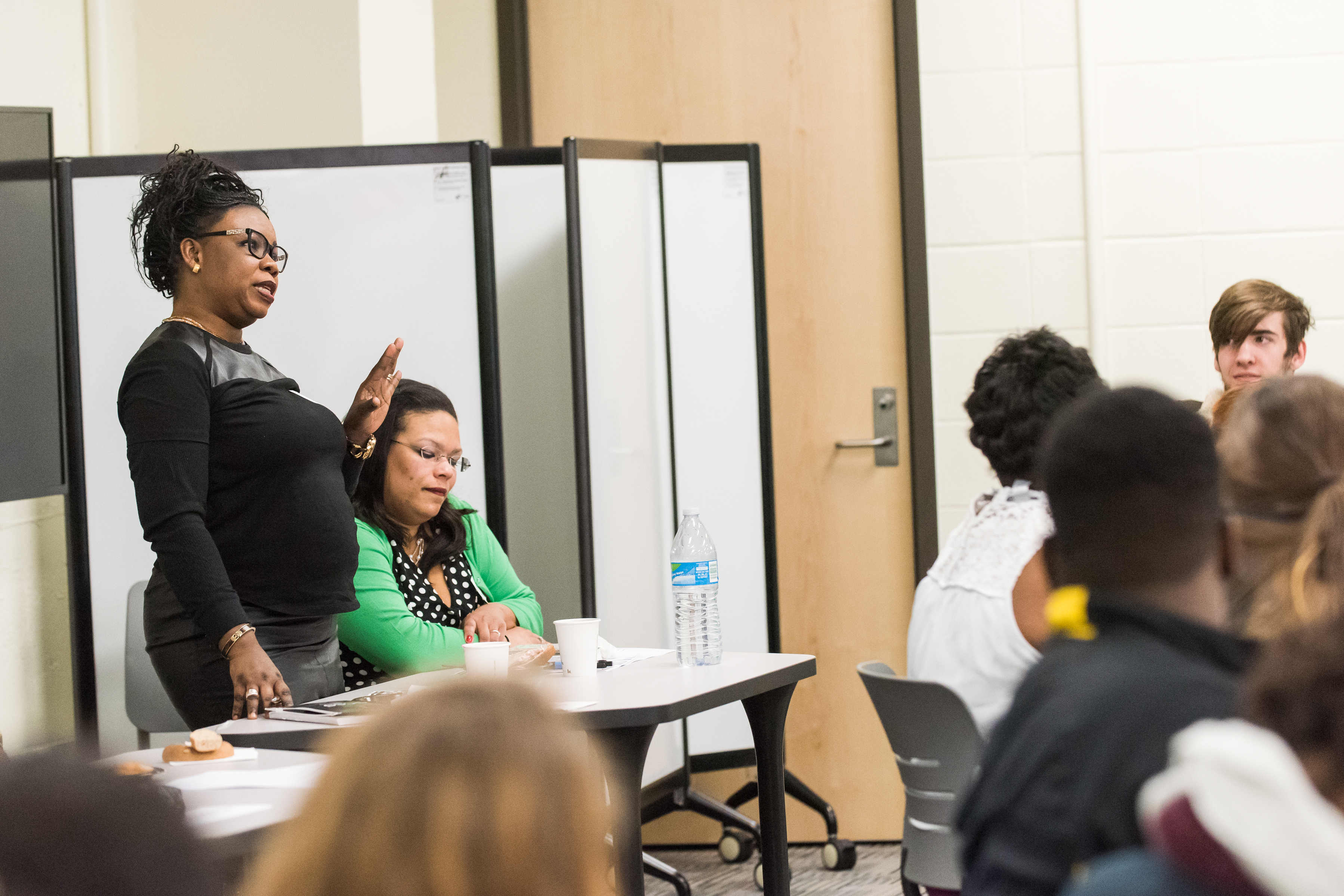
UMBC’s Elect Her workshop offered an engaging introduction to electoral politics for dozens of young women from UMBC and local high schools this spring.

Kate Drabinski, senior lecturer in gender and women’s studies, has organized the workshop for four years, with the goal to increase the representation of women in elected office through supporting young women’s leadership on campus. It has now become a highly anticipated annual campus event, expanding each year and, for the first time, now including Baltimore City high school students.

“I brought this event to campus after noticing a few years ago that while there was gender parity in SGA, the vast majority of women were in appointed—not elected—office. It suggested to me that something was keeping women from running for office themselves,” says Drabinski.

The program has seen results. In 2013 and 2014, under just 30% of SGA candidates were women. That proportion has increased to over 40% for each of the last three years.

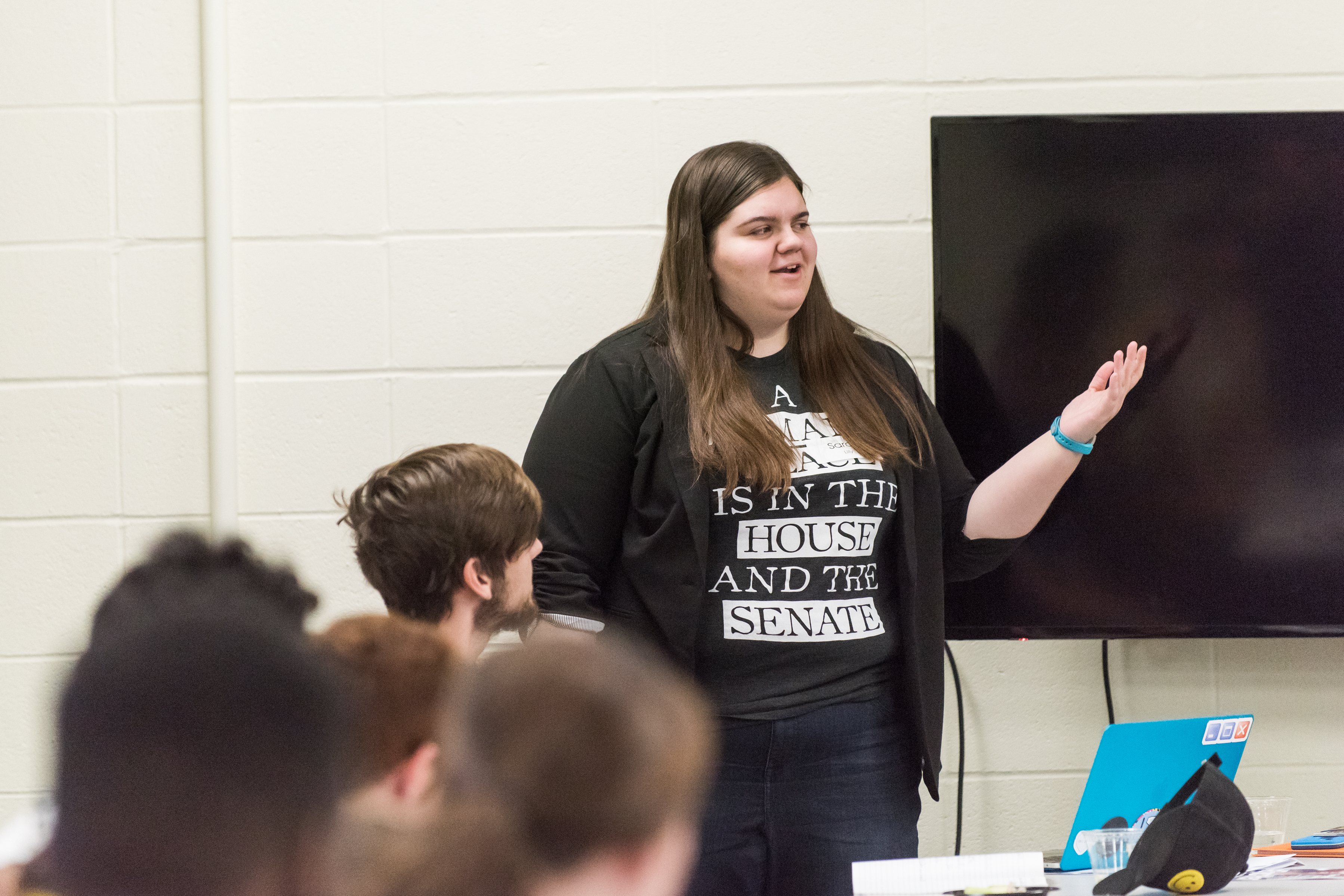
Sarah Lilly ’17, information systems, currently serves in UMBC’s Student Government Association (SGA) as speaker of the senate. She has attended Elect Her for the past four years and shares, “Each time, I am more hopeful for the future of women in leadership than the next.”

Sarah Lilly speaks at Elect Her 2017.

“This event has given me amazing real insight on what it really means to run for office, even when facing all of the challenges that women in politics face today,” Lilly says. “It is a very real possibility that I will be running for election in the next 5–10 years, and this event has definitely created that path for me.”

Lilly’s comments reflect the vision of the Elect Her program, which aims to help women run for office on campus as preparation to run in their communities and at all levels of government.

“Getting up the courage to run for office, even though you might lose, is exciting stuff. And let’s be real, being in politics means losing a lot of the time,” says Drabinski. “Part of Elect Her is supporting each other as we grow the thick skins necessary to bring our fierceness to public life.”

UMBC’s March 2017 Elect Her training was facilitated by Jessica Murphy from Running Start, a nonprofit focused on leadership development. It included modules on identifying issues of concern, planning a campaign strategy, and perfecting an elevator speech, as well as a campaign simulation. This year’s event also featured a panel of student leaders sharing their own experiences running for SGA and a communications training.

Elect Her participants share what makes them each a leader at the start of the event.

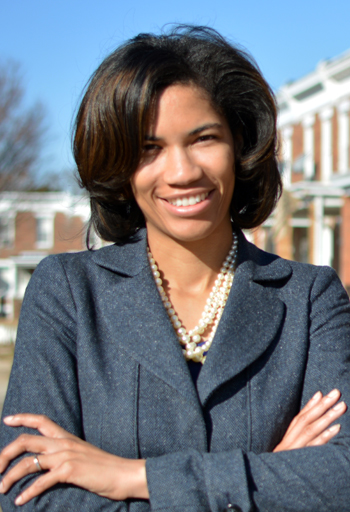
Baltimore City Council Member Shannon Sneed served as this year’s guest elected official, sharing her experience transitioning to electoral politics from a career in broadcast journalism.

Shannon Sneed

Sneed became engaged in politics after putting down roots in East Baltimore. She began attending community meetings and didn’t hear local elected officials addressing the issues she found most concerning, she told the students at Elect Her. Eventually, to see more movement on those issue, “I decided to run,” she said. “I couldn’t put this on anyone else.”

As many first-time candidates find, it wasn’t any easy path. “It was intimidating to tell my story after being behind the scenes in journalism, but I felt I had to be honest,” Sneed said, so she started knocking on doors to connect with her neighbors.

After a first campaign that was close, but ultimately unsuccessful, Sneed won a Baltimore City Council seat on her second try. “I really do think knocking on doors is how I won the election,” she told the students. “I got to know the people. I got to know the issues.”

Sneed’s story shows how essential preparation, perseverance, and putting feet to pavement day in and day out can be to winning an election and having your voice heard on issues that matter, says Drabinski. “We can make real changes,” she believes, “but first we have to get ourselves to the table.”

Elect Her helps young women get their foot in the door, to take that first step toward that seat at the table.

Photos: Header image features Jessica Murphy (l) and Kate Drabinski (r). All three Elect Her photos are by Marlayna Demond ’11 for UMBC.
Update: This article has been corrected to include more accurate and complete data on the representation of women in SGA.

UMBC again named one of nation’s top public universities in Business First ranking

UMBC is featured in Business First’s new 2017 list of top public colleges and universities in the United States, jumping up 10 spots from 2016.

The university now ranks 56th of 499 four-year public institutions included, based on 22 metrics that assess academic excellence, affordability, diversity, and economic strength, using data from the National Center for Education Statistics and the U.S. Census Bureau’s American Community Survey.

This year’s rankings announcement notes:

Business First’s formula was designed to identify the public universities and colleges that offer the best educational experiences to their students.

Business First ranks three Maryland colleges and universities among the top 75 in the nation. The others, in addition to UMBC, include the University of Maryland, College Park and St. Mary’s College of Maryland.

See additional UMBC rankings news.

Header image: UMBC’s Albin O. Kuhn Library. Photo by Marlayna Demond ’11 for UMBC.
UMBC receives major award to support inclusive excellence in the humanities

UMBC’s Dresher Center for the Humanities and College of the Arts, Humanities, and Social Sciences (CAHSS) are launching a major new five-year initiative to promote diversity and inclusion in the humanities through a $750,000 grant from The Andrew W. Mellon Foundation. The Inclusion Imperative will cultivate a supportive regional community of scholars committed to diversity in the humanities and to expanding community-engaged humanities research, teaching, and learning focused on issues of race, equity, inclusion, and justice.

“The Mellon award recognizes and allows us to expand and deepen our work toward inclusive excellence in the humanities—not just at UMBC, but throughout our region,” says Scott Casper, dean of the CAHSS. “Thanks to this award, we will bring together a community of scholars and students who are developing a diverse vision of the humanities.”

The initiative’s three interconnected parts include the Visiting Faculty Fellows Program, Diversity Teaching Network in the Humanities, and Humanities Teaching Labs, coordinated by project directors Jessica Berman, director of the Dresher Center, and Dean Casper. In addition to supporting students and faculty in the humanities, these programs will produce new tools and partnerships to support Baltimore-Washington communities as they move toward meaningful change.

The Visiting Faculty Fellows Program will invite full-time faculty from the region’s colleges and universities to join UMBC for a semester or year as residential research fellows, with a focus on faculty who are committed to diversity and inclusion. These exchanges will promote the sharing of diverse ideas and perspectives, and development of new research and teaching collaborations.

Through the Diversity Teaching Network in the Humanities, current and former visiting fellows, and other interested faculty, scholars, and graduate students, will meet regularly to work on course curricula and research projects that focus on diversity, inclusion, and community engagement. This program will deepen UMBC’s partnerships with Historically Black Colleges and Universities (HBCUs), including Coppin State University, Bowie State University, and Howard University, creating a regional community of faculty committed to diversity and inclusion in the humanities.

“Coppin State University is pleased to be part of this timely and innovative project, which recognizes correctly the excellence that resides on our diverse campuses and encourages top scholars from these communities to engage each other as colleagues and not as competitors,” says Ron L. Collins Sr., dean of the Coppin State University Honors College. He reflects, “The Dresher Center’s bold and brilliant effort will spawn lifelong professional relationships among faculty and create research agendas that respect the important voices of scholars from diverse communities of practice.”

Berman shares this vision. She notes that nurturing strong relationships among faculty at different institutions will be essential to the success of the initiative, commenting, “I’m perhaps most excited about the chance to work in partnership with area HBCUs to diversify curriculum, build new approaches, and share insight and experiences.”

Humanities Teaching Labs (HTLabs), the third component of the Inclusion Imperative, will support faculty at UMBC and partner institutions in undertaking community-engaged work on issues of race, equity, inclusion, and justice. Faculty and graduate teaching assistants will be invited to attend workshops to learn about tools and methods of community-engaged teaching and will have access to state-of-the-art media tools for classroom use. HTLabs will support approaches that bridge the divides between fields and between universities and partners beyond the academy.

“I firmly believe that the humanities offer us crucial tools for addressing pressing issues of civic life,” says Berman. “Now more than ever, we need the tools of the humanities to advance local and national conversations about our history, our identities, and our common future.”

Image: UMBC Humanities Scholars seminar “Political Childhood and Children’s Citizenship in Western Culture” in the Dresher Center, November 2016. Students include, r-l, Julia Byrne, De`Jia Long-Hillie, Dever Cunningham, Jonathan Harness, Garrett Beeg, and Kara Gavin. Photo by Marlayna Demond ’11.

Swimmer Emily Escobedo wins bronze, UMBC finishes 24th in nation at NCAA championship

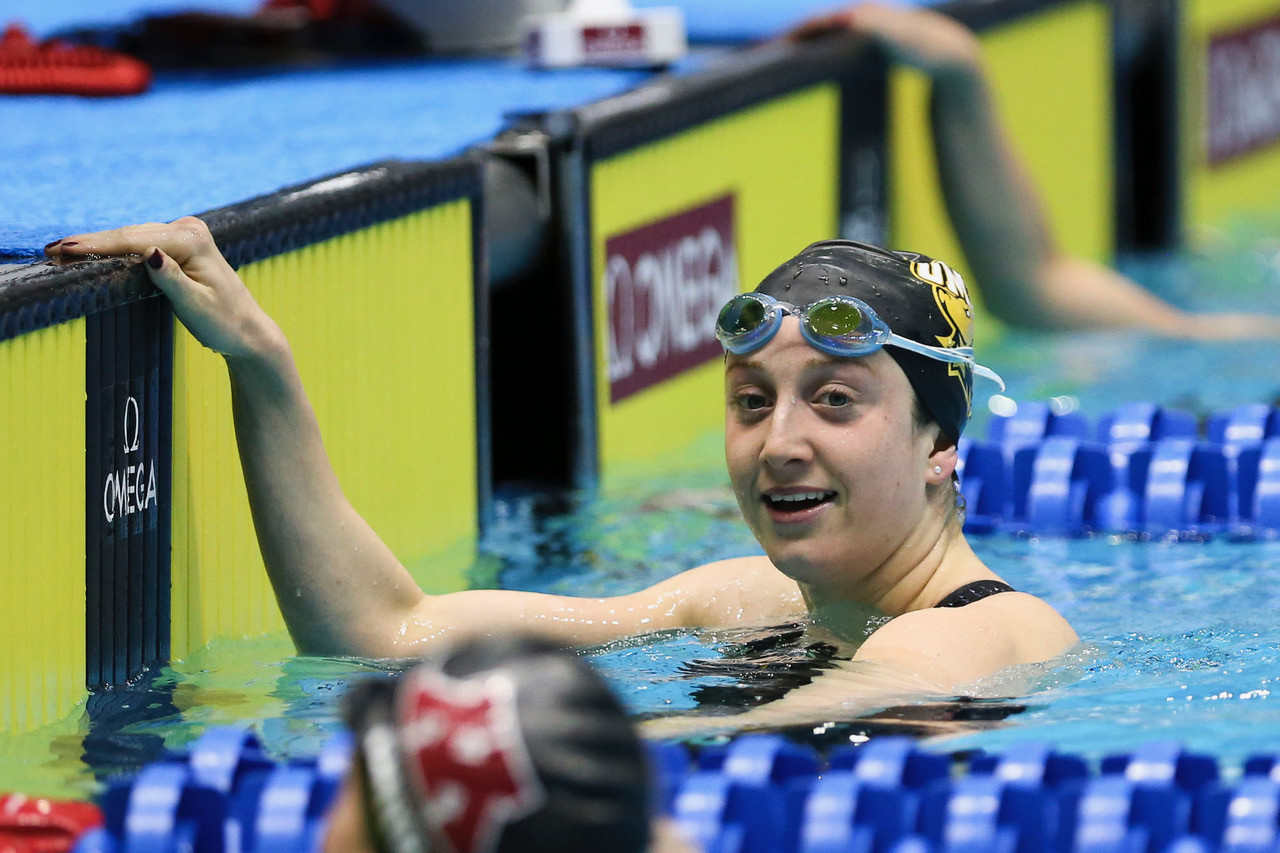
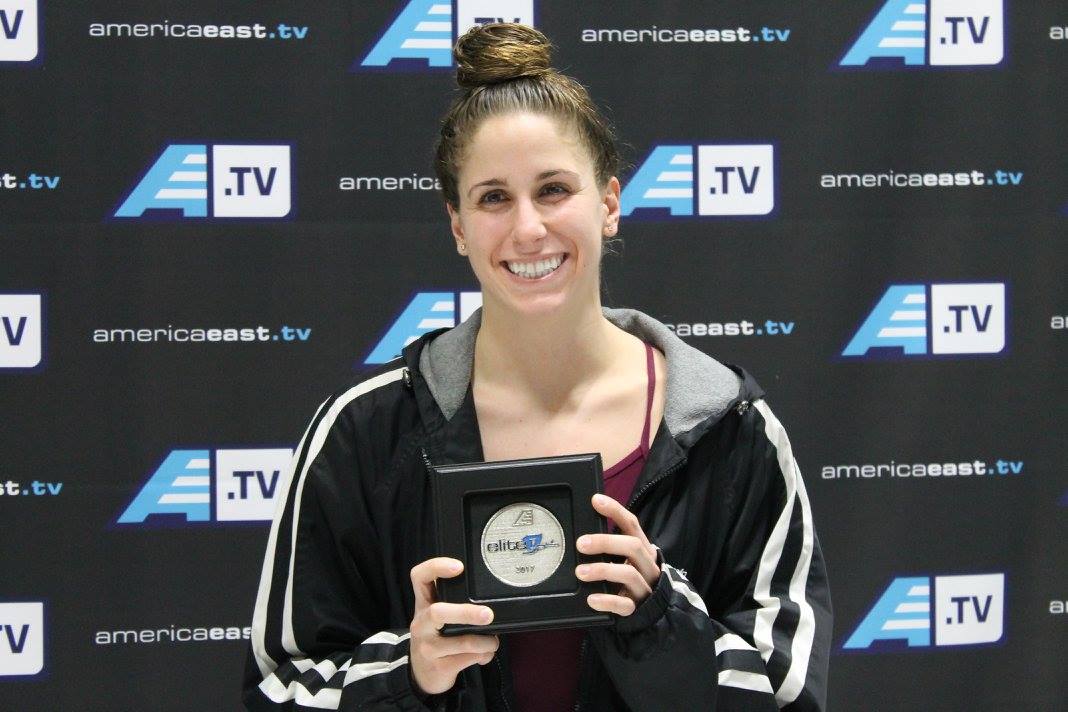
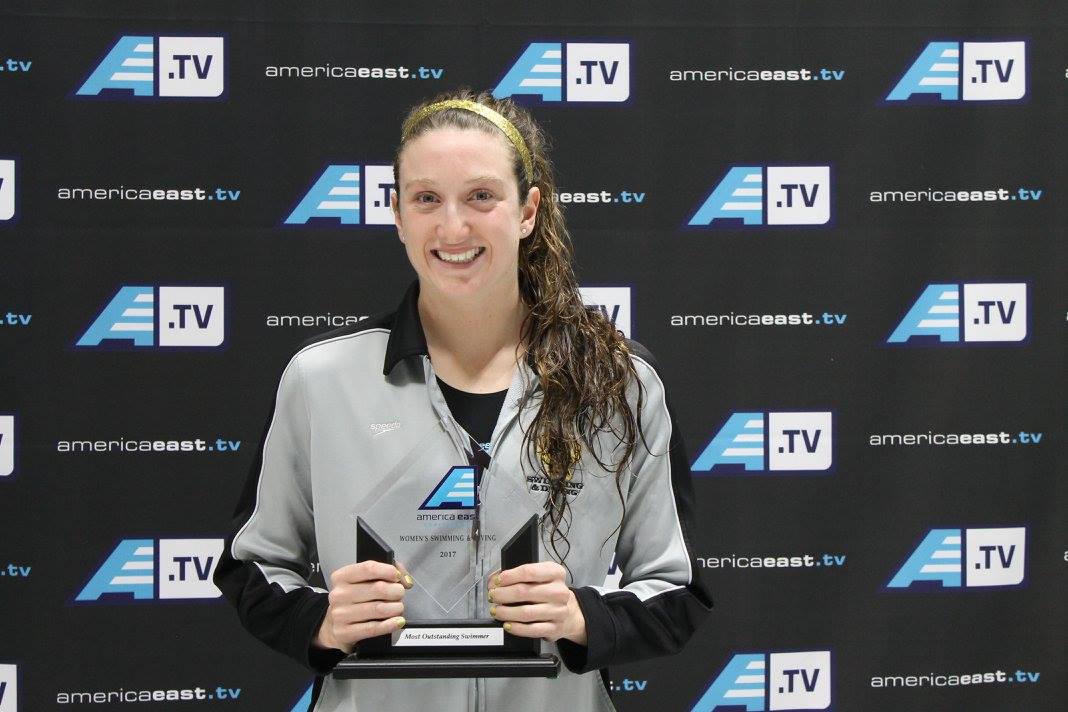
Emily Escobedo ’17, psychology, concluded her historic UMBC swimming career by earning a bronze medal in the 200m breaststroke at the NCAA championship in Indianapolis. In addition to earning the eighth best time in the history of the event, Escobedo broke another UMBC record on her path to the podium.

“Emily capped her career off with three career best times at the championships,” said head swimming and diving coach Chad Cradock ’97, psychology, of Escobedo, attributing her success to “her hard work, focus and drive.” He reflected, “Our school, department, and program are so proud of her and her amazing four-year career.”

Escobedo swam her UMBC record-setting time of 2:05.20 in the finals of the 200m, faster even than her time in the same event at the U.S. Swimming Olympic Trials held last year. In the process, she earned All-American Honors.

“I’m so happy I was able to finish my last year with an all-around great season,” says Escobedo. “NCAAs was an incredible experience.”

_Escobedo_Emily, 21, Emily Escobedo, UMBC, 2
 
Escobedo is finishing her career in UMBC swimming and diving as one of the most decorated swimmers in the program’s history, as well as in America East. She has been named America East Rookie of the Year, America East Swimmer of the Year four times, and America East All-Academic three times.

In addition to being named an All-American, Escobedo also earned two more Honorable Mention All-American honors this year, in the 200 breaststroke and 200 IM. Based on her swims, UMBC finished 24th in the nation at this year’s NCAAs.

Escobedo has competed in NCAA championships in all four years of her time at UMBC. Her total career honors at NCAA championships now include two bronze medals, two All-Americans, and three Honorable Mention All-Americans.

Following the championship, Escobedo shared her gratitude for her coaches and teammates, reflecting, “I am lucky to have gotten the chance to swim with such an amazing group of girls…I never thought I would be able to achieve so much.”

Cradock also took time to thank coaching staff, families, and alumni for their support and for “setting the groundwork to get us to today,” and UMBC swimming and diving athletes “for believing and trusting us by embracing the process.”

“Today our program finished in the top 25 in the nation,” said Cradock. “This is beyond our wildest dreams.”

See additional coverage from UMBC Athletics, Swimming World Magazine, and America East.

 Images: Emily Escobedo at the March 2017 NCAA tournament. Photos courtesy of Tim Binning/The Swim Pictures.

Carla Viviana Coleman highlights how a virtual reality tool is changing work and play

vcolemanCarla Viviana Coleman, assistant professor of design, is one of five experts who contributed to a special feature on the best-designed products of all time, published by the The Conversation.

Coleman’s essay focuses on Microsoft HoloLens virtual reality glasses. “The product was designed with ergonomics in mind,” Coleman notes, distinguishing it from “heavy, cumbersome” predecessors and increasing its potential impact on our everyday lives.

“While one could easily imagine a new generation of video games being designed for the HoloLens, a number of employers have realized the glasses can improve workplace productivity and ease the burdens of certain jobs,” Coleman writes. She describes how the glasses are being used to improve efficiency and create new opportunities in technical and medical workplaces:

For example, the company ThyssenKrupp, which manufactures elevators and escalators, has begun giving HoloLenses to its elevator technicians, with the idea that the glasses will allow them to access data much more efficiently. The employees can multitask, choosing either to lift up the spherical visor or to keep it in front of their eyes as needed – all while working in a cramped elevator shaft.

Coleman also highlights how some medical schools are using the HoloLens to train doctors in anatomy without using cadavers, and Volvo is using it as a tool in car design.

The article originally appeared in The Conversation, and has also been published in Scientific American, Salon, and the Christian Science Monitor.

Header image: Microsoft HoloLens, by Ramadhanakbr Wikimedia (CC BY-SA)

Roy Meyers publishes primer on the federal budget process, outlining anticipated hurdles for Trump administration proposal

Ahead of the Trump administration formally outlining its spending priorities through a federal budget proposal, Roy T. Meyers has published a primer explaining how the budget process works and significant hurdles ahead for President Trump’s anticipated proposal. The article, originally published in The Conversation, has appeared in Newsweek, Salon, Government Executive, and the National Business Review, and been read nearly 50,000 times.

Roy MeyersMeyers, professor of political science at UMBC and former Congressional Budget Office analyst, describes how budgets in times of presidential transition come together, typically being released in April or May, rather than February, as it takes some time for incoming presidents to staff key positions.

The past three presidents have initially submitted a “skinny budget”—light on details, as they flesh out their vision for the country. “Trump’s skinny budget, expected to come out around March 16, will be a lot skinnier than usual,” Meyers writes.

Early announcements suggest Trump’s budget will focus on discretionary spending, which includes the military, education, and environmental protection. Meyers notes, “Most notably, Trump reportedly wants to increase defense spending by $54 billion and fully offset that amount by cutting other discretionary programs.” Leaked elements of the plan suggest large cuts to the Environmental Protection Agency, which have met strong opposition.

In terms of process, Meyers suggests that Trump’s budget proposals may differ from those of previous presidents in the amount of vetting they receive from the Office of Management and Budget (OMB) prior to being formally announced. Writes Meyers:

The bottom line is that the White House publicized a target of $54 billion (11 percent of 2017 discretionary spending) in cuts without receiving any feedback from agencies about the feasibility of making them. Further, because the administration and Congress have also already called for increases in spending in certain areas – such as veterans health programs, doubling the number of border patrol agents and infrastructure investments – that means the $54 billion hammer will fall even harder on everything else.

Meyers notes, “There are also large differences between Trump and Republican lawmakers on how to change the tax code, how to replace the Affordable Care Act and whether to subsidize corporations for creating jobs.” Moving forward, he argues, Congressional Republicans and President Trump will need to have a “meeting of the minds” around highly complex issues to enact a full budget for 2018.

Read the full article in The Conversation.

Header image: The White House. Photo by Angela N., CC by 2.0.

UMBC men’s and women’s basketball teams celebrate a memorable season

UMBC men’s and women’s basketball teams have both enjoyed an impressive season, generating excitement on campus and in the America East. For the men’s team, the experience was a remarkable turnaround, garnering recognition at the national level, while the women’s team continued to flourish and maintain a solid standard of play.

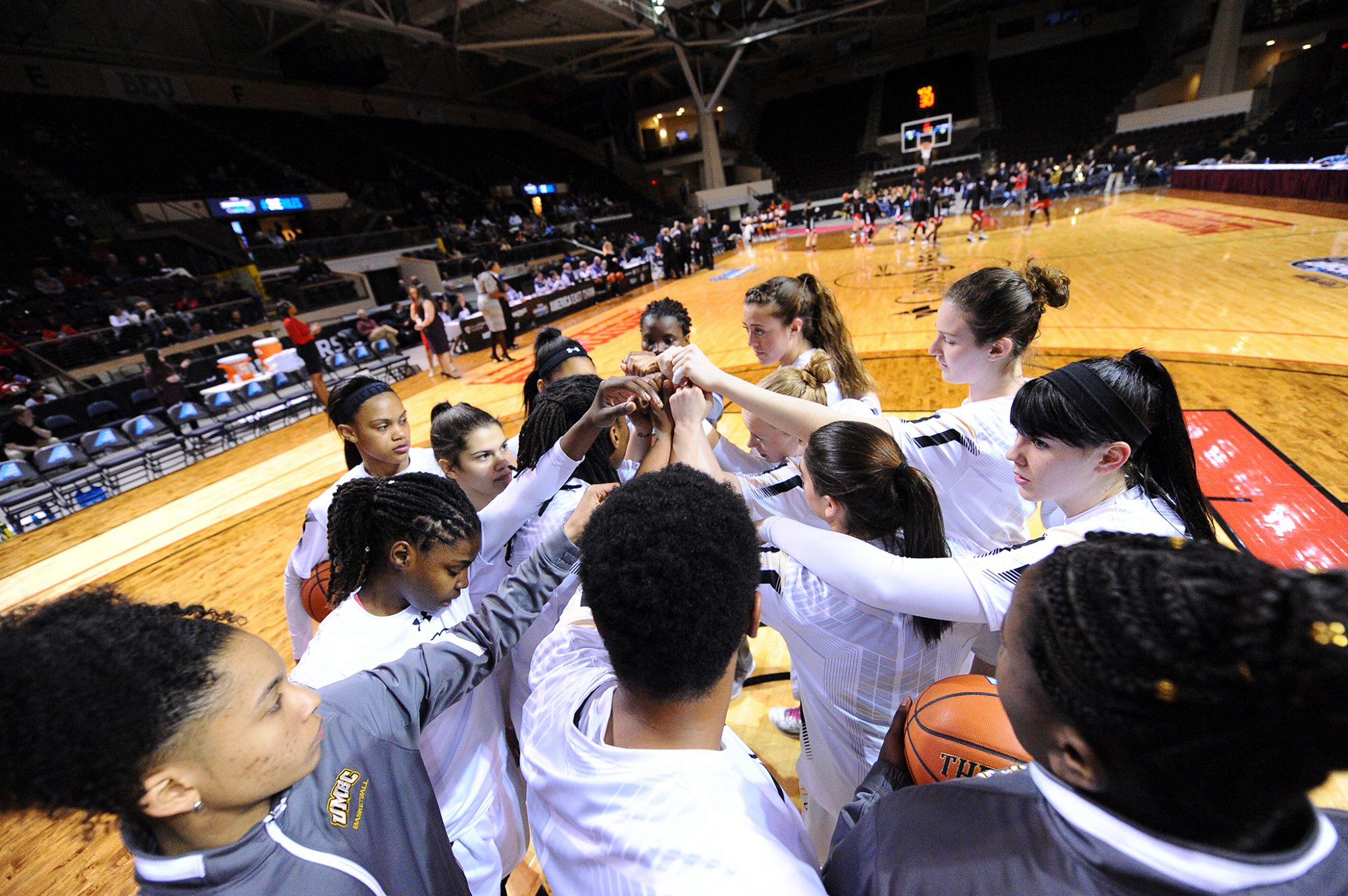
The university welcomed Ryan Odom as new head coach of men’s basketball less than a year ago. In his first foundational year with the team, Coach Odom has led the Retrievers to recognition as the third-most improved NCAA Division 1 program in the nation, out of around 350 schools.

“The guys in that locker room, they should be congratulated because they did it,” said Coach Odom. “There was growth in each one of them, and hopefully, the guys that are returning got a really good taste of what it’s like to compete at a high level. You are not always going to win, but…they have gained some valuable experience going forward.”

UMBC men’s basketball team / UMBC Athletics

The players, too, valued this year of growth, as well as Coach Odom’s role in the team’s development and success. Ben Grace ’17, financial economics, commented, “To build a foundation for the rest of Coach Odom’s tenure here, and to start it off well and have a really good season means a lot to me.”

Will Darley ’17, environmental studies, agreed, “To see the program come to the heights that it has, and continuing to grow, and to be a part of that, means a lot.”

UMBC men’s basketball celebrates graduating seniors Will Darley (left) and Ben Grace (right) / UMBC Athletics

Earlier in the season, the Baltimore Sun article “UMBC shooting past expectations in Odom’s first year” profiled the Retrievers as a promising team of players coming into their own. The piece shined a particularly bright spotlight on Joe Sherburne ’19, financial economics, one of the most accurate three-point shooters in the nation, whose performance has moved to another level in his second year on the team. Sherburne, a remarkable scholar-athlete, was also selected to the CoSIDA Academic All-District II First Team.

By the end of the season, it was clear: the Retrievers offered one of the most dynamic offenses in among NCAA D1 teams this year, scoring an average of 81.4 points per game—25th in the nation—through March 5. The team also ranked 22nd nationally in three-point field goals per game and 19th in three-point field goal percentage.

With a record of 18-12, the Retrievers advanced to the first round of the America East championship tournament, defeated 74-65 by New Hampshire. They will next compete in the College Insider Tournament (CIT), their first postseason tournament since 2008, when they last won the America East Conference title. UMBC will host a first-round game in the CIT on March 15, 7:00 p.m., in the RAC (purchase tickets online).

“We are extremely pleased to accept an invitation to the CIT and continue to compete in post-season play,” said Coach Odom. “This is a significant milestone for this team and our program, and represents a major step forward as we seek to establish a strong foundation upon which to build a championship-caliber program. Our players have committed themselves to our new philosophy and approach and I am so happy they are being rewarded for their efforts and sacrifice with this bid.”

UMBC’s women’s basketball team, led by Head Coach Phil Stern, was beset by injuries for much of the season, but reeled off 10 wins in an 11-game span during America East competition and placed third in the league. Players received numerous America East All-Conference honors this year—the most All-Conference selections the team has earned since joining the league in 2004.

16992329_10154492077377865_456766082907920078_o

Taylor McCarley ’17, psychology, received First Team and All-Defensive Team Honors, as a conference leader in scoring, assists, free throw, and steals. She now also ranks as one of UMBC’s top women’s basketball players of all time in scoring, assists, and steals.

“Taylor has left an indelible mark on this program and record books and will finish as one of the top five players in program history,” shared Coach Stern. “I’m proud of her and everything she has accomplished.”

McCarley reflected, “This was a great experience from where we started to now. I appreciate the opportunities I have been given and things that we have accomplished.”

Laura Castaldo ’18, health administration and public policy, earned Third Team honors after ranking third among America East players in three-point field goal percentage. Pandora Wilson ’17, health administration and public policy, was named to the All-Academic team, honoring her notable performance as a scholar-athlete, including her induction into Chi Alpha Sigma, the National College Athlete Honor Society.

After receiving her award, Wilson reflected on her next steps, saying, “It’s been a long journey. I have learned things that will help prepare us for life outside of basketball.”

Coach Stern also thanked her for her tremendous contributions to the team and to the broader university community. “Pandora is always there when you need her and is a great teammate,” he said. “She’s left a big mark on campus.”

The UMBC women’s basketball team will next compete in the Women’s Basketball Invitational Tournament against Brown on Thursday, March 16, at 7 p.m. in the RAC (purchase tickets online).

UMBC’s basketball coaches are feeling gratitude for the achievements of the past year, and are eager to continue developing the teams.

“Once you finish the tournament, you have a second to reflect and I’m proud of the fact that from day one, when I first got to UMBC, [my players] bought in right away,” said Coach Odom. “I couldn’t be more proud of where we started to now. I’m excited about the future.”

Header photo is Coach Odom, by Marlayna Demond ’11 for UMBC.
UMBC Swimming and Diving team wins third CCSA championship

The UMBC men’s Swimming and Diving team has earned its third Coastal Collegiate Sports Association (CCSA) championship in a row, just one week after the UMBC women’s team captured another America East championship. UMBC finished with 1522 points, more than 300 points ahead of the rest of the field.

“We are so proud of our men this weekend,” said head coach Chad Cradock ’97, psychology, after the meet. “This year gave us many challenges, and we faced them all head on and believed in each other.”

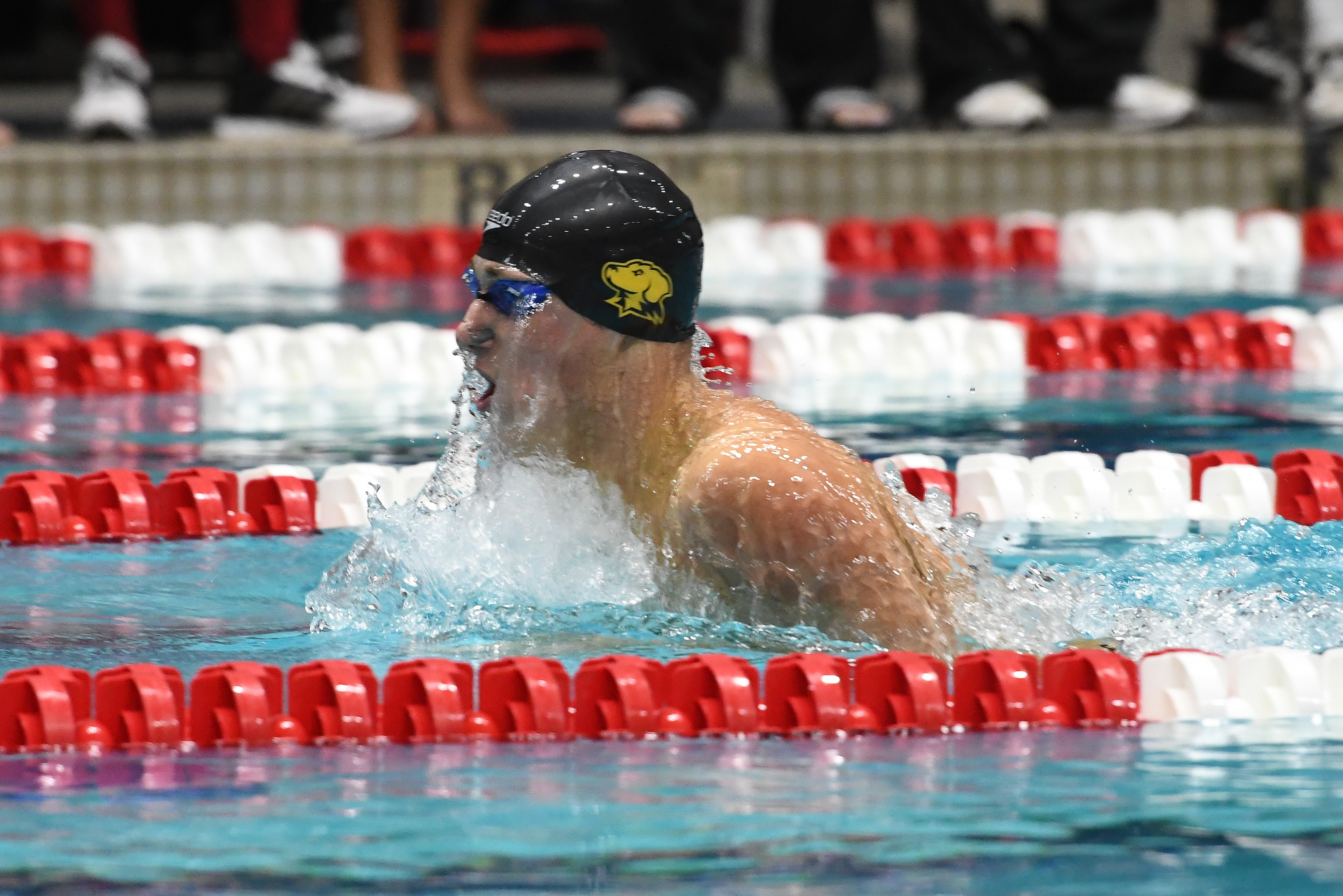
UMBC’s Ilia Rattsev ’20, bioinformatics and computational biology; Jared Vance ’18, business technology administration; Connor Ganley ’19, chemical engineering; and Gregor Spoerlein ’17, environmental science, won gold in the 400 freestyle relay, with a time of 2:58.21. Rattsev and Spoerlein also finished in first and second place in the 100 freestyle, with Rattsev earning a NCAA B cut. Spoerlein picked up another gold in the 200 freestyle, with a time of 1:37.32.

Cradock share that after a strong start to the meet, “seeing Gregor take a big win helped us keep our momentum.”

The Retrievers swept the 200 backstroke field, with Alexander Gliese ’19, mechanical engineering, winning gold (1:44.59); Ahmed Wahby ’19, engineering, earning silver (1:46.06); and Garrett Wlochowski ’20 earning bronze (1:47.40). Both Gliese and Wahby had times strong enough to earn NCAA B cuts.

Wahby also earned silver in the 200 fly (1:48.61) and Philip Adejumo ’18, biochemistry and molecular biology, won silver in the 100 fly (0:48.53). Kyle Paxton ’18, financial economics, and Connor Ganley earned silver and bronze, respectively, in the 200 breaststroke.

On day three of the championship, Nikola Trajkovic ’18, economics, set a new school record while winning silver in the 400 IM, earning an NCAA B cut with a time of 3:53.68.

ccsaD2PM-9997

“We are extremely proud of Nikola,” said Cradock. “All his hard work and dedication paid off with a school record.”

At the conclusion of the meet Cradock was named CCSA coach of the year, matching his team’s coaching staff of the year honor earned at the America East Championship earlier in the month.

Photos courtesy of the CCSA.

UMBC Swimming and Diving team wins 2017 America East Championship

The UMBC women’s swimming and diving team defended its America East Championship title on February 12, 2017, winning a third straight title and setting a conference record as the first team to surpass 900 points. This is the team’s sixth America East Championship, and their final score of 936.5 points was more than 200 points ahead of second-place finisher New Hampshire. Competing in her final America East Championships Emily Escobedo ’17, psychology, won first place in the 200 breaststroke, setting a new school, conference, and meet record of 2:06.20, and making the cut for the upcoming NCAA Championship. She also earned the Dave Alexander Coaches Award for most points scored during the event, and was named Most Outstanding Swimmer for the fourth time. 16722774_10154439087677865_982264818558006215_o “We are grateful for everything Emily has done for this program,” said head coach Chad Cradock ’97, psychology. “She has always been team first and has shown a commitment to the program from day one and we are excited to see what she can do at NCAA’s this year,” Kayla Lilly ’17, interdisciplinary studies, joined Escobedo on the podium for the 200 breaststroke, finishing in second place (2:18.08). Hania Moro ’20, political science, (2:18.08) led a Retriever sweep of the 1,650 freestyle, winning first place, with Laura Massicotte ’19, mechanical engineering, and Carly Waters ’18, biological sciences, coming in second (17:00.68) and third (17:01.90) respectively. UMBC also took all three medals in the 200 backstroke, with Emily Vance ’20, psychology, earning gold (2:00.63), Aleasha Knight ’19, psychology, earning silver (2:01.36), and Kylie Danin ’19, psychology, earning bronze (2:01.93). Vance also earned bronze in the 100 backstroke, and UMBC’s 400 freestyle relay team of Escobedo, Massicotte, Alissa Caulfield ’19, financial economics, and Haylee Committe ’20 earning second with a time of 3:23.07, out-touched by just .01 seconds at the wall. Lauren Day ’17, biology, was named the America East Elite 17 recipient, an honor reserved for the student-athlete who most demonstrates academic excellence through earning the highest cumulative grade-point average in her sport. 16601762_10154439089252865_1675150304133470783_o Coach Cradock, whose team was again named Coaching Staff of the Year, shared, “we are proud of what the ladies accomplished.” “We have a lot of depth, and it showed this weekend,” he reflected after the championship win. “It’s hard to win without depth and everyone on our team contributed to this title.” The UMBC men’s swimming and diving team will compete for the CCSA title this weekend in Athens, Georgia, and the Retrievers will compete in the ECAC Championship at the U.S. Naval Academy, March 3–5. Additional details on the championship are available from UMBC Athletics. For more coverage of UMBC’s victories at the championship, see SwimSwamCollege Swimming, and America East. All photos courtesy of America East Championship.

UMBC receives grant to strengthen sexual assault prevention and response, joins MHEC in sharing campus climate survey results

UMBC and nine fellow members of the Baltimore Area Higher Education Coalition Against Sexual Violence have received a three-year, $750,000 grant from the U.S. Department of Justice (DOJ) Office on Violence against Women to create new strategies to prevent, respond to, and investigate sexual assault, domestic violence, relationship violence, and stalking, and to strengthen trauma-informed survivor services.

Specific coalition objectives include increasing awareness of and access to victim services on and off campus, and assessing and enhancing the capacity of campus response teams to address sexual violence. The coalition is also working to provide more comprehensive and actively inclusive survivor-centered trainings to serve the needs of all groups, including specific information on serving LGBT students and students of color, among other goals.

The grant is part of a $25 million funding package announced by the DOJ in fall 2016. Loyola University Maryland is administering the Baltimore coalition’s award. In addition to the ten participating universities, this partnership includes collaboration with the Baltimore City Police Department, Baltimore Collegetown Network, and TurnAround, Inc., a Baltimore-based service provider for victims of domestic violence and sexual assault.

Concurrent with applying for this grant, and in accordance with the Maryland Higher Education Commission (MHEC), UMBC’s Office of Human Relations administered a Campus Climate and Sexual Assault (CCSA) survey in spring 2016. The survey sought to better understand student perceptions, experiences, and awareness related to sexual assault and relationship violence.The UMBC Office of Human Relations, in collaboration with the Division of Student Affairs, has created a one-page infographic highlighting the main CCSA survey findings.

MHEC has also published a more comprehensive Report on Campus Climate and Sexual Violence at Maryland Colleges and Universities (see volume 1 and volume 2, that includes combined data from UMBC and other institutions.

Students who have experienced sexual assault or relationship violence, or know of someone who has, can access confidential support and resources through the Counseling Center and University Health Services at UMBC’s main campus, or the Center for Counseling and Consultation at the Universities at Shady Grove campus. Members of the UMBC community can file reports with UMBC Police and Title IX Coordinator Bobbie L. Hoye, and can access the Women’s Center as a quasi-confidential resource. Additional resources and the university’s policy on sexual misconduct are available through the Office of Human Relations.

UMBC receives grant to strengthen sexual assault prevention and response, joins MHEC in sharing campus climate survey results

UMBC and nine fellow members of the Baltimore Area Higher Education Coalition Against Sexual Violence have received a three-year $750,000 grant from the U.S. Department of Justice (DOJ) Office on Violence against Women to create new strategies to prevent, respond to, investigate, and hold offenders accountable for sexual assault and dating violence, and to strengthen trauma-informed victim services.

Specific coalition objectives include increasing awareness of and access to survivor services; assessing and enhancing the capacity of campus response teams to address sexual violence; and providing comprehensive survivor-centered trainings that include specific information on serving LGBT students and students of color, among other goals.

The grant is part of a $25 million funding package announced by the DOJ in fall 2016. Loyola University Maryland is administering the Baltimore coalition’s award. In addition to the ten participating universities, this partnership includes collaboration with the Baltimore City Police Department, Baltimore Collegetown Network, and TurnAround, Inc., a Baltimore-based service provider for victims of domestic violence and sexual assault.

Simultaneous with applying for and receiving this grant, and in accordance with the Maryland Higher Education Commission (MHEC), UMBC’s Office of Human Relations also completed a Campus Climate and Sexual Assault (CCSA) survey in spring 2016. The survey sought to better understand student perceptions, experiences, and awareness related to sexual assault and relationship violence.

With a response rate of 5% (666 undergraduate and graduate students), the findings are not a representative sample, and cannot be generalized to the total population of UMBC students, but they do offer some insight. The UMBC Office of Human Relations has created a one-page infographic highlighting the main CCSA survey findings.

MHEC has also published a more comprehensive Report on Campus Climate and Sexual Violence at Maryland Colleges and Universities (see volume 1 and volume 2), that includes combined data from UMBC and other institutions.

Students who have experienced sexual assault or relationship violence, or know of someone who has, can access support resources through UMBC Police, the Counseling Center,  University Health Services, the Women’s Center, and Title IX Coordinator Bobbie L. Hoye. The university’s policy on sexual misconduct is available through the Office of Human Relations.