

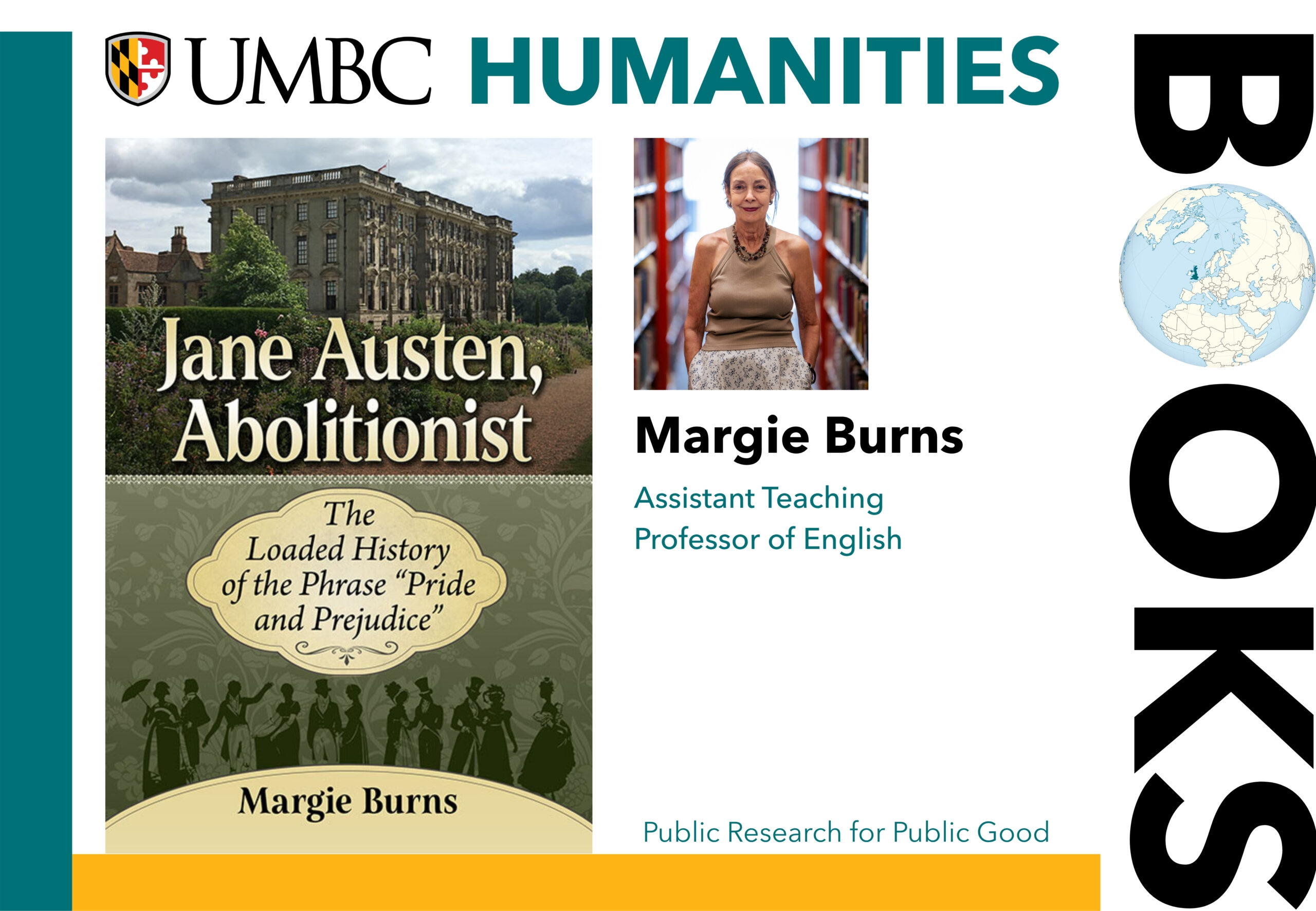
Figuring out what to get someone for their birthday can be both fun and daunting, especially when it’s their 250th birthday. On December 16, 1775, Jane Austen was born in Steventon, Hampshire, England. Margie Burns, an assistant teaching professor of English literature, is a lifelong superfan of Jane Austen’s six novels: Sense and Sensibility, Pride and Prejudice, Mansfield Park, Emma, Northanger Abbey, and Persuasion.
With Hollywood movies and New York Times-bestselling spinoffs of Austen’s novels, it might seem that everything there is to say about the prolific author has already been said. Burns begs to differ as she ushers in a year of Austen celebrations worldwide with her latest contribution to the Austen canon with Jane Austen, Abolitionist: The Loaded History of the Phrase “Pride and Prejudice” (McFarland, 2024). This new insight into Austen’s life allows Burns to open up a fresh discussion for Austen enthusiasts and to attract new readers interested in female authors who challenge societal norms by writing leading female characters with bold opinions. Burns discusses her Austen journey in a Q&A below.
Q: When did you become interested in Jane Austen and why?
A: I first read Pride and Prejudice as a college freshman. At that time, we had a full year of freshman English, focused on literature, alert reading, and writing. This was a great opportunity, even after I had taken a course on major works of literature in high school.
I was hooked. In time, I read the rest of Austen’s books. Naturally, when I like an author, I seek out everything else they’ve written and devour that as well. With Austen, as with Shakespeare, my interest deepened over time, reinforced (rather than undermined) by academic rigor. Given Austen’s current global standing, I have come to think of Jane Austen as England’s second Shakespeare.

Q: Why did you choose to write Jane Austen Abolitionist?
A: I was flabbergasted to discover how widespread, prevalent, and ethically fundamental the phrase “pride and prejudice” was in Britain and even in America before Austen chose it as her novel title. I was even more powerfully struck by finding out, over and over again across more than two centuries, that “pride and prejudice” as a phrase was being used as a critique of slavery and the slave trade. There was absolutely no one else writing about this aspect of Austen’s work.
“I am not alone in seeing that part of Austen’s appeal lies in the successful transmission of ethics through her heroines: pro-health, pro-spirit, and pro-ethical stature, although not in a simplistic and preachy way.
Once I dug deeper, I found hundreds of examples. Most of the discussion about the Austens and slavery has focused on Austen’s more remote relatives. I do not believe that Jane Austen was unduly influenced by family finances involving her non-nuclear relatives. Her immediate family opposed the slave trade. More importantly, the evidence is overwhelming that she opposed it.
I would like to produce a second edition of the book. There is further relevant and closely related material, literary and historical evidence, through the end of the U.S. Civil War.
Q: What is your favorite Austen book?
A: That is a hard question. My “favorite” Austen book is probably whichever one I am working on/doing research on, or writing about at a given time.
Q: Which Austen character do you like to quote?
A: Elizabeth Bennett in Pride and Prejudice says one of my favorite quotes: “You shall not, for the sake of one individual, change the meaning of principle and integrity, nor endeavour to persuade yourself or me, that selfishness is prudence, and insensibility of danger, security for happiness.” (Elizabeth is talking about Charlotte Lucas’s decision to marry Mr. Collins. )
Q: Why would anyone be interested in Austen’s work centuries after it was published?
A: I dislike the word “themes” and try to avoid it, but there is no doubt that Austen’s heroines, their situation/s, and their ethics still speak to readers today, and in a language easily understood by contemporary readers. The readers are also being joined by millions of viewers, as the ever-evolving stream of film adaptations from Hollywood, Bollywood, and elsewhere demonstrates.
I am not alone in seeing that part of Austen’s appeal lies in the successful transmission of ethics through her heroines: pro-health, pro-spirit, and pro-ethical stature, although not in a simplistic and preachy way. Currently, of course, the appeal is broadcast farther through a range of media and genres, from podcast to parody.
Read more about Burns’s insights into Austen’s ideas on abolitionism in “The Loaded History of the Phrase ‘Pride and Prejudice” article she wrote for The Conversation.
Burns will present her research at the annual general meeting of the Jane Austen Society of North America in Baltimore this fall 2025.
Learn more about UMBC’s English department.
Header graphic: Design by Jill Blum/UMBC. Headshot by Brad Ziegler/UMBC. Book cover courtesy of Margie Burns.