



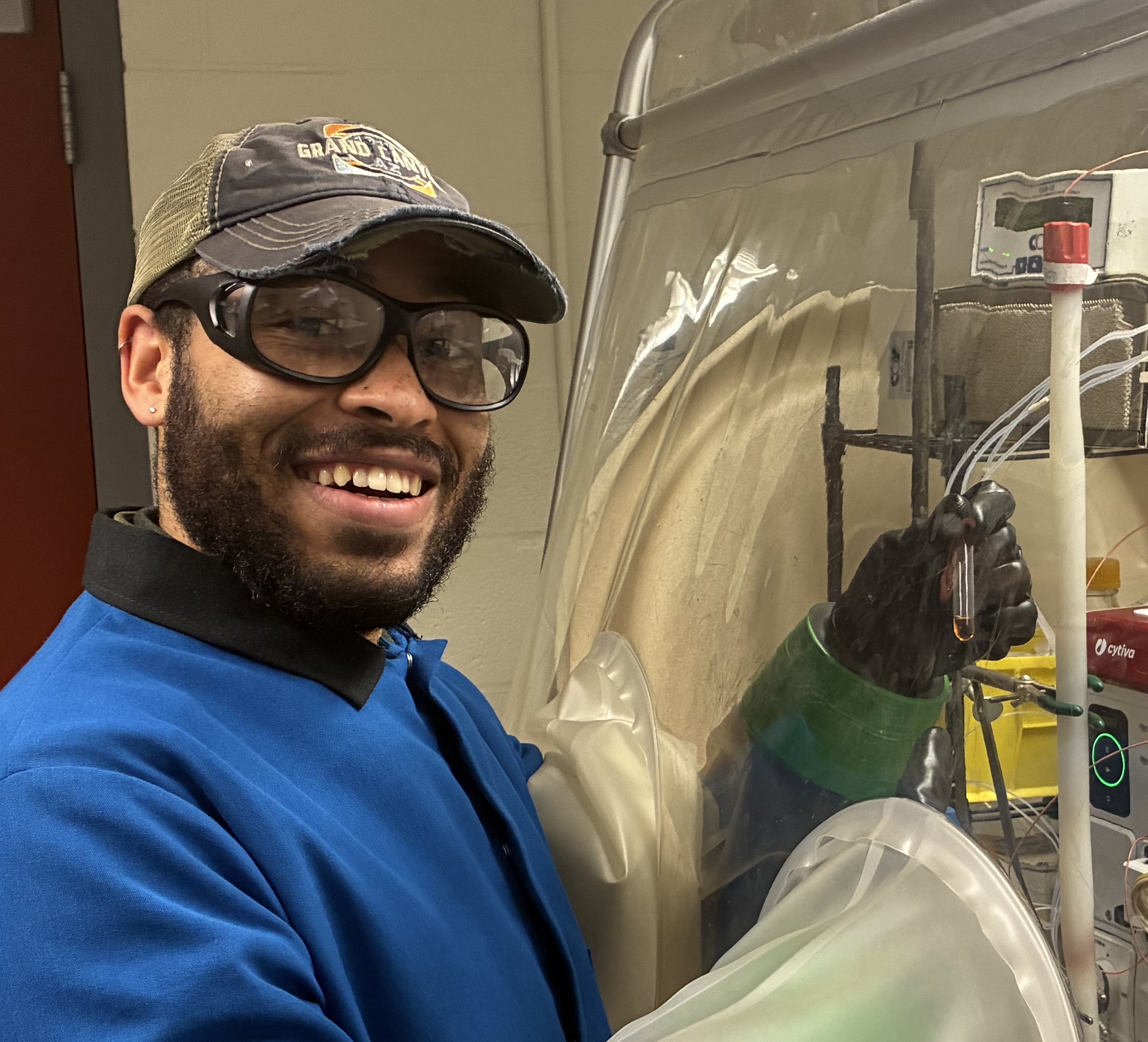
Alex Paredes has always been drawn to color. Long before he earned his Ph.D. in chemistry from UMBC in 2025, he was fascinated by the story of Prussian blue—a vivid pigment first created accidentally when a paint-maker mixed an additive contaminated with iron-containing animal blood into his paint. That intersection of art and chemistry pulled him into bioinorganic research, where proteins often announce themselves by shifting through rich hues as they bind metals like iron.
Paredes is UMBC’s first HHMI Gilliam Fellow—an early-career award that supports scientists doing ambitious research who are committed to building inclusive training environments. Before he was a Gilliam Fellow, however, Paredes was a G-RISE Meyerhoff Graduate Fellow at UMBC. With the Meyerhoff program’s long-term focus on diversifying the STEM workforce, Gilliam was a natural fit for Paredes’ next move. Both programs, as well as the NSF Graduate Research Fellowship, funded his doctoral work and opened the door to his current Gilliam-supported postdoctoral fellowship in Squire Booker’s lab at the University of Pennsylvania.

In fact, Meyerhoff and the overall culture of student support it has stimulated brought Paredes to UMBC in the first place. The institution’s “rich history of taking underprivileged individuals, or people who may not believe that they can make it in the sciences, and helping them succeed,” attracted him, he recalls. He arrived eager to contribute to that tradition by mentoring undergraduates himself.
Mentoring forward
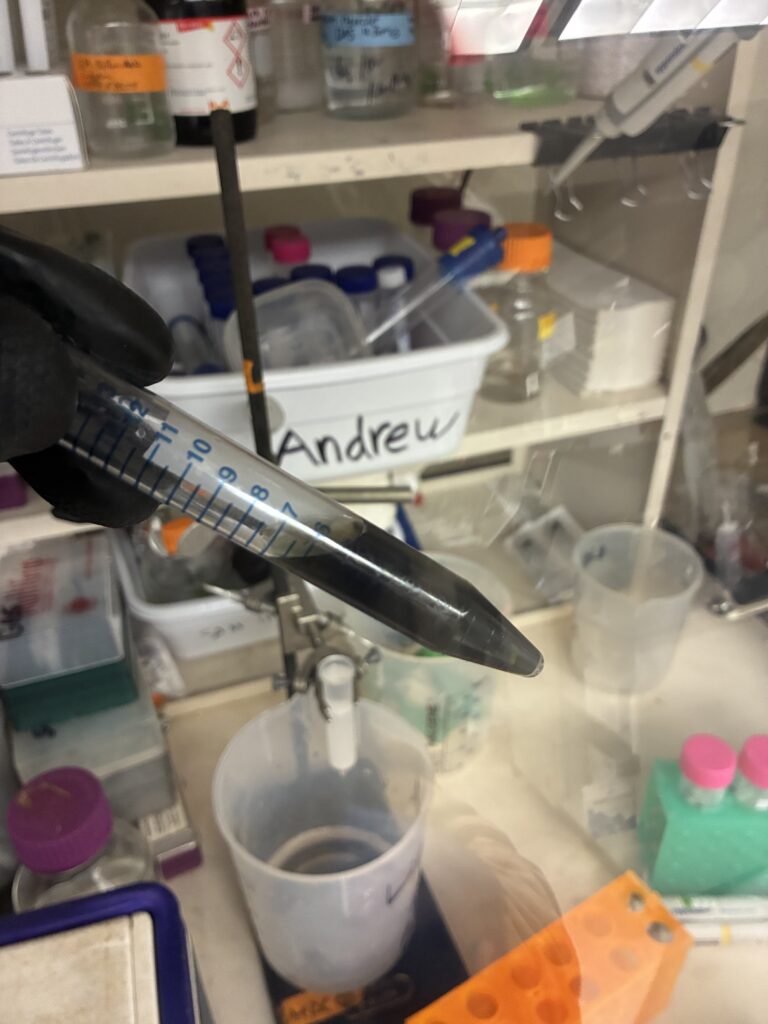
At UMBC, Paredes joined Aaron Smith’s lab, where he thrived working with colorful iron-binding proteins. Most recently, a paper in Nature Communications helped reveal how a particular bacterium senses iron both outside and inside the cell, rewiring its metabolism in ways that could inform new strategies against stubborn infections.

Smith, professor of chemistry and biochemistry, modeled the kind of mentoring Paredes hoped to offer. From the beginning, Smith treated him more as a colleague than an employee, creating space for both rigorous science and honest conversation. The relationship helped Paredes see that “there’s so much more to life than your science,” he says—a perspective he now extends to his own mentees.
Darryn Greene ’25 and Chioma Iheacho ’24, biochemistry, both co-authored papers with Paredes and discovered a deeper interest in research while working with him. “I really admired his patience, willingness to help, and desire for everyone to succeed,” Greene says. “He showed me that mistakes are great opportunities to learn from. Remaining persistent through challenges and continuing to learn are really the essence of research.”
“My experience as a researcher transformed when I began working with Alex in the Smith lab,” Iheacho adds. “He is a great mentor who inspires curiosity in research while keeping the lab fun. Even after graduating from UMBC, he still reaches out, and his mentorship has a lasting impact on the way I view science.”
‘Nothing without the people’

Paredes traces his drive to give back to his own beginnings. Raised in Reading, PA by a single mother who immigrated from the Dominican Republic and worked multiple jobs so her children could pursue education, he insists, “I’m really absolutely nothing without the people around me.”
Paredes’ high school mentors, his undergraduate advisors at Gettysburg College, then Smith’s lab group and Meyerhoff support, and now the Gilliam program all helped propel him forward. In his current postdoc, Paredes is continuing to explore the chemistry of metals in living systems—this time focusing on specialized enzymes that help certain bacteria produce the chlorophyll they need to survive. Still early in the project, he is characteristically candid about the learning curve: “I’m still learning more every day, which makes me happy.”
Paredes is far from a round-the-clock lab rat, and encourages work-life balance for his mentees, too. Outside of work, he is a devoted consumer of art, frequenting museums and local festivals—pottery mugs with “really ugly faces” are a personal favorite. He has also taken up guitar, teaching himself via YouTube tutorials after days at the bench.
“I feel very lucky to be right where I am,” he says. So far, Paredes has stayed close to the intersection of science and art that first drew him in—and he continues to pass his enthusiasm for colorful chemistry on to the students who are coming after him.
Students interested in chemistry can explore graduate programs in chemistry, where programs such as G-RISE and the Chemistry-Biology Interface Program support student researchers.


