All posts by: UMBC News Staff


Political scientist Roy Meyers analyzes the negotiations over President Obama’s final budget

In a new article in The Conversation, Political Science Professor Roy Meyers writes that President Obama’s final budget proposal highlights the growing divide between political parties and shines a light on recent efforts at budget reform.

The article “Obama may be a lame duck, but his final budget isn’t,” examines why Americans should explore the budget process and what is actually behind the president’s proposals. Meyers reinforces that compromise is essential for government budgeting because the executive and legislative branches share power in the budget process.

“The Constitution grants the legislative branch the “power of the purse”; thus, Congress’ assent is necessary to change most spending priorities,” adding “in the end, the president has a veto over appropriation bills, and can insist that executive priorities be included in those bills along with the legislature’s priorities,” Meyers writes.

Looking more closely at areas of disagreement between the two parties, highlighted by the 2013 government shutdown, Meyers notes that a bipartisan effort to reform the budget process is becoming increasingly important.

“To be successful, reforms will have to restore norms of good budgeting, including that the two branches take each other seriously. While the odds are still long, it is possible that over the next year or two a major reform package will be developed that will be acceptable to both parties.”

Read the full article in The Conversation.

Image: U.S. Capitol. Photo by Kevin Burkett, CC by-SA 2.0.

Visual culture expert Rebecca Adelman comments on newly declassified photos

This month the Department of Defense released nearly 200 previously classified photos of detainees at military sites across Iraq and Afghanistan. In a new article in The Conversation, visual culture expert Rebecca Adelman considers the questions they raise about transparency.

In her article, Adelman, an associate professor of media and communication studies, focuses on a Freedom of Information Act lawsuit filed by the American Civil Liberties Union (ACLU) to release the images.

Adelman notes the that case highlights questions surrounding how the public typically understands and applies the idea of transparency to matters of detention and abuse.

“I argue that these photos will do little to foster public recognition of, or empathy for, the detainees. Moreover, their release raises fundamental questions about how we define and practice transparency,” Adelman writes.

The article also reflects on how scholars have started to grapple with transparency in theoretical and practical frameworks and how the Department of Defense has responded to requests for the release of photos in recent years.

Adelman studies visual culture, political theory, trauma studies, ethics, and cultural studies of war, terrorism, and militarization and is author of Beyond the Checkpoint: Visual Practices in America’s Global War on Terror (University of Massachusetts Press, 2014). Read “DoD detainee photos raise disturbing questions about transparency” on The Conversation website.

Image: Rebecca Adelman. Photo by Marlayna Demond ’11 for UMBC. 

Retriever Love Week: Day 4, Part 2

And now, for the second half of today’s Retriever love stories…

Mitch Case ’11, media and communication studies, met Brian Brown ’13, biochemistry and molecular biology, on the STRiVE Leadership Retreat in the winter of 2010. They started dating soon after, and will have been together six years this March. Brian is currently enrolled in the M.D./Ph.D. program at the NYU School of Medicine, and after nearly three years in a long-distance relationship, Mitch recently moved to New York to be closer to Brian and to pursue his next opportunity. (Photo courtesy of Mitch Case.)

—

Ana Schultz ’15, biochemistry and molecular biology, and Alex Lombardi ’15, information systems, dated all four of their years at UMBC. Says Ana: “[We] believe that being [Retrievers] together helped make [our] relationship as strong as it is today.” They will celebrate their seventh anniversary this fall. (Photo courtesy of Ana Schultz.)

—

Joseph Eassa ’11, history, and Alison D’Ottavio ’12, modern languages and linguistics, had an education class together and were partners for a project. They became close friends for a year before Alison went to Spain to study abroad, and when she came back, they became a couple. They have been living in New York City for almost three years, and celebrated their five-year anniversary on Thursday, February 11. They got engaged on a trip to Panama in December, with a wedding date to be determined. (Photo courtesy of Alison D’Ottavio.)

—

On the night of their microeconomics midterm in the spring of 2013, Kiara Berg ’15, business technology administration, and Justin Mahaney ’15, business technology administration, struck up a conversation, but Justin couldn’t quite place Kiara’s accent. She says that when she told him she was from Sweden, “he was hooked from then on.”

She had forgotten her pencil, so he lent her one. After the midterm, she hung around outside so they could talk more. He asked her if she wanted to start a study group together, which, Kiara later found, was “the college way of asking someone out.” They have been a couple since May 2013, and moved in together last summer. (Photo courtesy of Kiara Berg.)

—

As UMBC lacrosse players, Jen Dragoni Muston ’04, American studies, and Pat Muston ’04, psychology, ran in a lot of the same social circles. “Soon after freshman move-in, we became best friends,” Jen writes. “We hung out in between classes on campus and attended each other’s games.” By 2002, they had begun dating, and Jen says they’ve been inseparable ever since.

They got married in Cape May, New Jersey, on August 28, 2010, with about 25 of their closest friends and fellow Retrievers in attendance. When Pat was scouting out proposal spots, he picked the back steps leading up to Potomac Hall, where he says he first saw her leaving for lacrosse practice in 2000.

“He says that day, he knew there was something special,” says Jen. (Photo courtesy of Jen Muston.)

Read about all the couples we’ve featured this year here!

Retriever Love Week: Day 4, Part 1

We’re in the homestretch of Retriever Love Week here at the Alumni House, and we have quite a few stories left to go, so we’re making multiple posts today! Enjoy these tales of UMBC romance, and stay tuned for the next round…

Some of these stories, like the one Natalie Bacon Lockett ’03, visual and performing arts, sent our way, begin even before the college years! Natalie met her now-husband, Brad Lockett ’07, information systems, at the Black Student Overnight the spring before freshman year. One of the ice-breakers involved finding someone from the same area as you, and Brad, a New Jersey native, recognized Natalie’s Ocean Township High School T-shirt and made a beeline for her.

As it turned out, they lived just 20 minutes away from each other back in the Garden State, and had a lot of friends in common. Natalie says they hit it off right away, but they didn’t exchange information that day.

The next time they saw each other was at placement testing that summer. “As he tells the story, I was sitting by the pencil sharpener, and he broke his pencil [on purpose]  so that he would have to come by me and sharpen it,” Natalie says with a smile. They continued to talk after the test, but still didn’t exchange info.

On the first day of college, outside the old Pub at the University Center, Brad and Natalie ran into each other a third time, and she was so happy to see him she gave him “a HUGE hug.” By October 2, 1999, the two were officially dating, and in 2008, nine years to the day after they first became an item, the Locketts got married in old Ellicott City.

After seven years, Natalie says they’re “going strong,” and hopes that their two small children, born in 2012 and 2015, will be Retrievers someday. (Photo courtesy of Natalie Lockett, taken at the Black and Gold Ball c. 1999-2000.)

—

In 2002, Michelle Jabes Corpora ’03, English and theatre, was the Retriever Weekly’s theatre critic, and Adam Corpora ’03, music, was one of the stars of that year’s production of Baby With the Bathwater. The pair had seen each other around at various Artist Scholars functions before, but it wasn’t until the dress rehearsal that Michelle attended to review that they were formally introduced.

“I guess I could say I started falling in love with him that night, because he was so ridiculously funny onstage,” says Michelle. She even called him out by name in her Retriever review of the show. But she didn’t see him again for another few weeks, until he and his roommates sat next to her and hers in the dining hall one night. From then on, the group was inseparable, and after “months of cajoling” from their friends, Michelle and Adam started dating the summer between their sophomore and junior year.

“Defining moments [in our relationship] happened on the UMBC campus: arguments in the [Erickson] courtyard, a first ‘I love you’ on the hill by the old apartments, many nights of fun with friends walking back to the dorms after picking up pizza and chips from The Spot,” Michelle says now. “He wanted to be a music teacher, and I wanted to be a writer—but those things were still so far away then.”

Michelle and Adam have been married for ten years now, and live in New York City with their two children. Michelle works in children’s book publishing – “Believe it or not, […] they pay me to dream up and write stories!” – while Adam is the music teacher at a middle school in Queens. This coming summer, they’ll be moving back to Maryland to raise their family and rejoin their loved ones. Michelle says that upon her return, she plans to revisit those places on campus where their relationship began.

“It’s been a wonderful journey, and we’re so happy to be coming home,” she says. (Photo courtesy of Michelle Corpora.)

Read about all the couples we’ve featured this year here!


UMBC Supreme Court scholar argues former justice has best chance of winning confirmation

Following the death of Supreme Court Justice Antonin Scalia, there has been widespread speculation over the next steps to fill the vacant seat. William Blake, an assistant professor of political science, argues in a new Baltimore Sun op-ed that President Obama should nominate former Justice Sandra Day O’Connor.

“Reappointing Justice O’Connor would benefit President Obama, the court, and, most importantly, the American people,” Blake states in the column that he co-wrote with Hans Hackler, an associate professor of political science at Arkansas State University.

Blake contends that appointing O’Connor will provide the best chance for confirmation in a divided political landscape and will allow the Supreme Court to continue its business by avoiding ties, when the ruling of the lower court stands and no precedent is set.

“One way or the other, the presidential election will decide the long-term future of the court. The only question is whether President Obama and Senate Republicans are more interested in scoring political points or keeping the court functioning this year. Reappointing Justice O’Connor is the best way to achieve the latter,” Blake writes.

Professor Blake was a guest on WBAL Radio’s Maryland News Now program and appeared on CNN to discuss his column. Read the complete op-ed “Bring back Justice O’Connor” in the Baltimore Sun. The article was picked up and mentioned by several news outlets across the country. The complete list is below:

The Hill
Fox 10 Phoenix (KSAZ) (Justice O’Connor refusing comment on the possibility of being reappointed)
Huffington Post
ABA Journal
Arizona Daily Sun
Corvallis Gazette Times
Provo Herald
Mediaite
LifeNews.com
Newsy

Image: U.S. Supreme Court. Photo by Chris Phan, CC by 2.0. 

Steph Ceraso gives students a new perspective on sound in a digital world

From the beep of a text alert to the whir of a laptop fan, soundscapes play a major role in students’ experiences inside and outside the classroom. Steph Ceraso, an assistant professor of English, is working to ensure her students think critically about 21st century technologies and the sounds that we interact with every day.

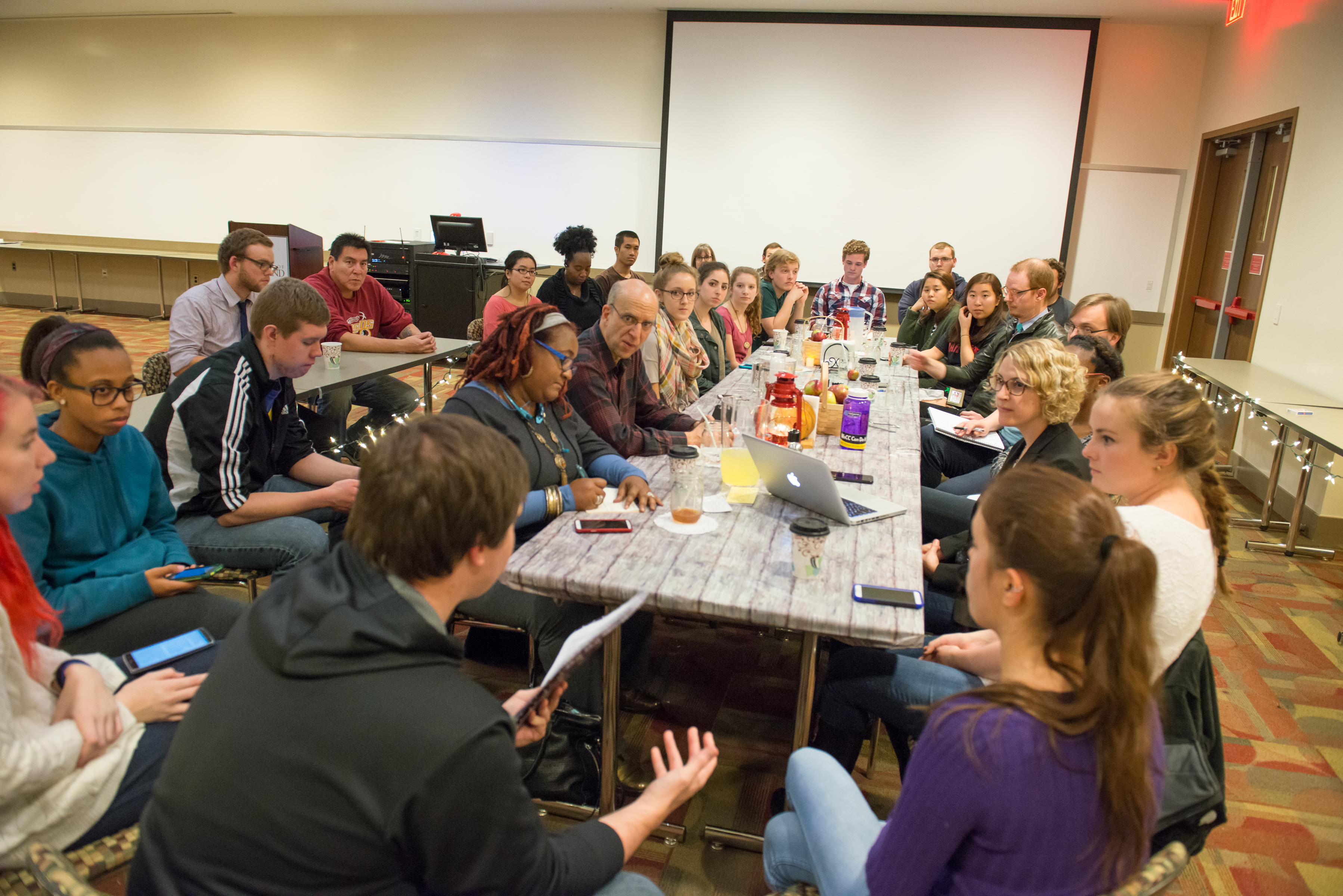
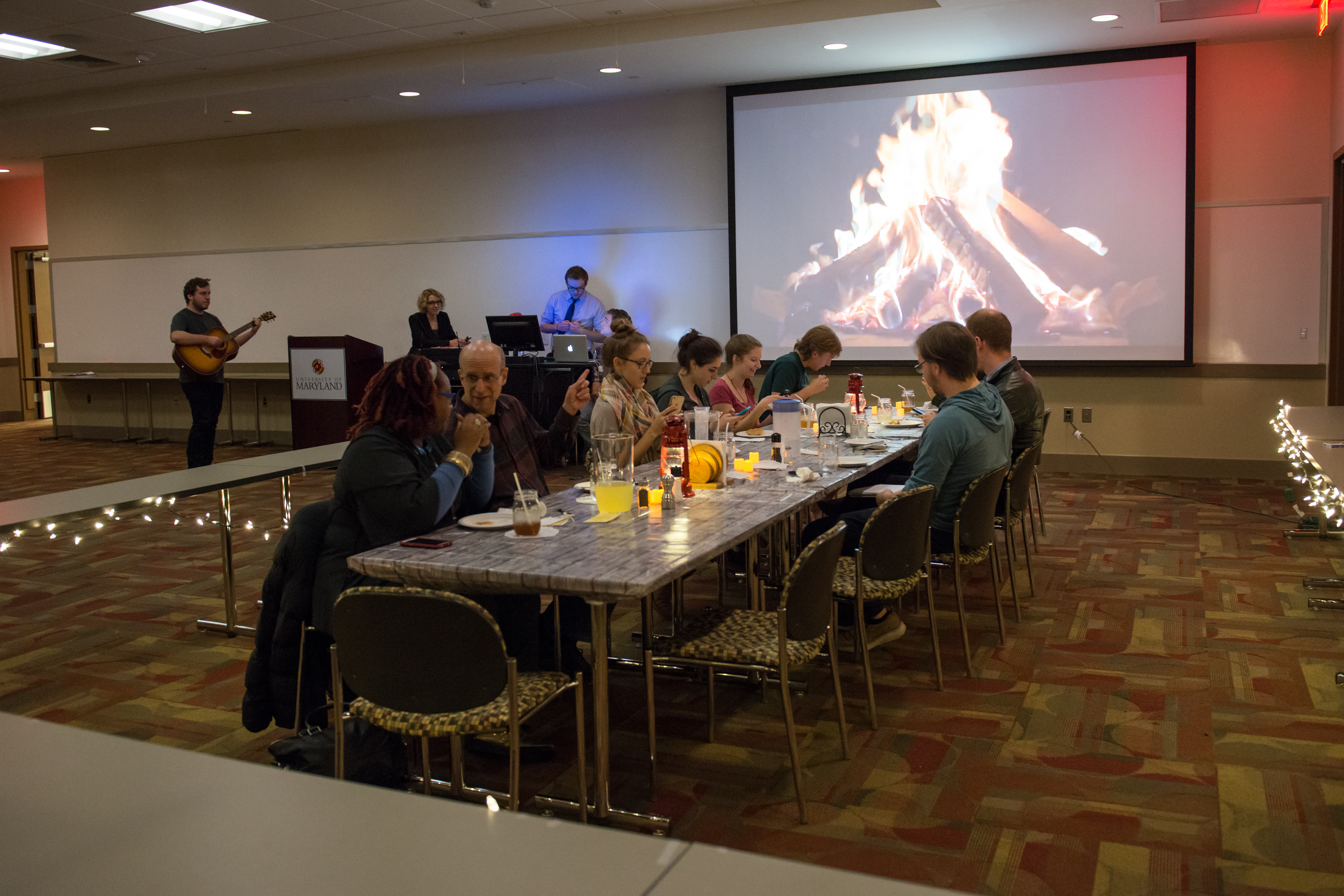
Ceraso’s research explores the intersections between digital media production, rhetoric and composition, and sound studies. As part of a course on “Sound, Composition, and Culture” that she taught last fall, she designed a multisensory dining event to inspire students to think holistically about how sound works with other senses to shape experiences.

“If we want students to become critical consumers and producers of the kinds of audio stories and sonic experiences that fill our lives, they need both technical training and training in how to think about the distinct possibilities of sound as a compositional and rhetorical medium,” Ceraso explains.

Steph Ceraso sonic meal.

The dining event was sponsored by the Maryland Institute for Technology in the Humanities (MITH) and Design, Cultures, and Creativity (DCC) program at the University of Maryland, College Park. After a semester of learning about sound design and planning the multisensory dining experience, students in the UMBC course hosted a meal for DCC students that paired foods with sounds. These sensory combinations enabled the students to explore how sound, color, texture, smell, and other sensory details affect eating experiences.

“Students spent a whole semester thinking deeply about sound as a mode of composition,” reflects Ceraso. “They learned to think expansively—to attend to the sensory, material, and contextual aspects of sonic interactions. They learned to approach listening as a practice that involves both mind and body.”

Ceraso presented the project on a national stage at the 2016 Modern Language Association (MLA) Convention in Austin, Texas last month. Sonic research is growing substantially in the social sciences and humanities, and her research was well received by fellow scholars in the field.

Steph Ceraso sonic meal“There is a real need for pedagogical approaches to sound and listening across the disciplines, so a lot of scholars from different backgrounds were interested and wanted to know how to do similar projects with their students,” Ceraso says.

While the multisensory dining experience was a first for Ceraso, she’s confident that students walked away from the event better prepared to analyze the sound that is ubiquitous in an increasingly digital age.

“I think it will leave a lasting impression on the students,” she says, “and I really believe that it challenged them to think about sound and listening in new ways.”

Images: Steph Ceraso and students at the sonic meal event. Photo by Marlayna Demond ’11 for UMBC. 

Retriever Love Week: Day 3

We’re halfway through our unofficial Valentine’s Extension Week! We’ve shared so many great stories with you already, and we have plenty more to go. We hope you’re feeling the love as much as we are.

Megan Smell Tarver ’04, psychology, remembers meeting her husband Curtis Tarver ’03, psychology, in their experimental psych class during her sophomore and his junior year. Curtis, on the other hand, remembers her from their sociology class the semester before, and from seeing her around Patapsco, where he worked at the desk.

“We didn’t actually become a couple until the waning days of my undergraduate career – just in time for me to head off to Florida for graduate school a few months later,” Curtis writes.

They decided to break up due to the distance, but, as Curtis puts it, that didn’t take. At their 2010 wedding, held in Baltimore County, they walked down the aisle to the UMBC alma mater, surrounded by friends and family, many of whom are also alumni. Today, the Tarvers live in Greensboro, North Carolina, with their two children, four-year-old Anastasia and two-year-old Austin. (Photo by Jason Putsché ’01, information systems, courtesy of Curtis Tarver.)

—

In the spring of 1996, Matthew Koenigsberg ’98, English, was a transfer student from Catonsville Community College when he first sat behind his now-wife, Jessica Koenigsberg ’97, English, in an Early American Literature class. They got to know each other through the InterVarsity Christian Fellowship on campus, and by the end of that year, they were close friends.

When the semester ended, Jess went back to her parents’ house in Cecil County, and one day in June, Matt drove up to see her. They went to the waterside, watched the ducks, and had dinner with her family. That was their first official date, and they continued their relationship into the next school year.

Jess graduated in May of 1997, and with a year left to go in school, Matt knew it was time to “paint or get off the ladder,” as his father would say. In early February 1998, he asked her parents for their blessing, and on Valentine’s Day, after dinner at Nacho Mama’s and a screening of The Wedding Singer, Matt proposed to Jessie. “[It] was pretty ironic that I was watching that movie with an engagement ring in my pocket,” Matt says now.

Matt graduated a few months later, and they were married on November 7, 1998. (Photo courtesy of Matt Koenigsberg.)

—

“It was the best of times, it was the worst of times. Well, really just the best of times,” write Taylor Gaines ’13, biochemistry and molecular biology, and Taylor Westhoff ’13, modern languages and linguistics. 

Taylor 1 and Taylor 2 met as sophomores in the Social Justice Lounge of the Commons, and a friendship blossomed over burritos. For two years, they ran in the same circle of friends, sharing laughs at Late Night, Homecoming, and talent shows. Their group prided itself on being strictly platonic, but that was bound to change.

At the end of fall semester senior year, Taylor asked Taylor to go on a date at a local Indian restaurant, and Taylor agreed. From then on, they were inseparable, known affectionately by their friends as “Double T”. They helped each other through finals, job searches, and graduate school applications. Now, as Taylor is set to finish her graduate degree in speech pathology and Taylor passes the halfway mark in veterinary school, plans are underway for a summer 2017 wedding, kicked off by a proposal last summer in Mexico.

“Thanks, UMBC, for bringing us together,” says Double T. (Photo courtesy of Taylor Gaines, pictured on the right.)

—

Sameeha Azeez Bricklemyer ’09, visual arts, was introduced to her husband Ryan Bricklemyer ’04, information systems, and M.S. ’06, information systems, at Quadmania 2009 by Jen Dress, UMBC’s Assistant Director of Student Life. Sameeha was a senior about to graduate, while Ryan was helping out as an alumni volunteer.

The following October, with the help of Dress and the UMBC’s Mama’s Boys, Ryan proposed to Sameeha with a Commons serenade. Their 2011 wedding was officiated by Dress, and the wedding party included friends from UMBC and Greek Life brothers and sisters from Pi Kappa Phi and Delta Phi Epsilon.

The Bricklemyers welcomed baby Esme on November 19, 2015, and Sameeha says that given the family’s deep roots in the University System of Maryland, “it was only fitting” that she was born at a University of Maryland hospital. (Photo courtesy of Sameeha Bricklemyer.)

Read about all the couples we’ve featured this year here!


Retriever Love Week: Day 2

So many of you have found lasting love at UMBC that we decided to extend Valentine’s Day to tell your stories! Here are four more.

Michael Glassman ’12, geography and environmental systems, met his now-wife, Michelle Colbert ’12, sociology, at UMBC in 2011. They were married in November 2015. (Photo courtesy of Michael Glassman.)


—

People meet their life partners all kinds of ways these days: online, out and about, through mutual friends. Catherine Lane Kruder ’12, English, met her husband Josh Kruder ’11, computer science, in one of the oldest ways in the book: through her mother.

“We never would have met had [my mother not been] in the same computer science class as Josh in the winter of 2009,” Catherine says. “It was a set up from the beginning when she told me about the really cute [blonde, blue-eyed] guy in her class one night at dinner.”

Catherine’s mother told her to come see her before class the next day, and, while “cringing at the thought” of her mother playing matchmaker, Catherine agreed.

“[The] rest, as they say, is history.”

Catherine and Josh were married in 2012, and their daughter, Genevieve, will be a year old in March. To this day, Catherine says, her mother prides herself on what she calls “the set up of the century.” (Photo courtesy of Catherine Kruder.)

—

Some of these stories cut right to the heart… literally. Kenneth Tai ’06, biochemistry and molecular biology, and Diana Salvador Tai first met in anatomy and physiology class while dissecting a cat.

“Romantic[,] huh?” Diana, then a pre-nursing student at UMBC, jokes now. “He was fascinated by my visual memorization skills[.]”

Their relationship only grew from there: from Phi Mu and Lambda Chi Alpha socials to late night practices for FASA [UMBC’s Filipino American Student Association]. They married in Washington, DC on August 8, 2008.

“A cat, a dog, and two beautiful kids later[,] we look forward to sharing our unfairytale-like story with them,” Diana writes. (Photo courtesy of Diana Tai.)

—

Speaking of excellent memorization skills, Kathy Weems Guerra ’96, English, who met her husband Peter Guerra ’96, English, in Dr. Falco’s fall 1994 Medieval and Renaissance Literature class, says she helped him prepare for the final “because I take excellent notes and never missed class!” They were married in Annapolis in June 1997. (Photo courtesy of Kathy Guerra.)

Read about all the couples we’ve featured this year here!

Firm Foundations

Dedicated staff members are a key element in UMBC’s rise to prominence.

Every December, the UMBC community gathers together for the university’s annual Service Awards. It’s an event so large and vibrant that the crowd spills out of the University Ballroom.

Part of why the Service Awards are a “save the date” event at UMBC is the way that the university’s staff members across departments and offices are inextricably woven into the fabric of the institution. Staff members marking anniversaries of five years, ten years, and upwards, in increments of five years, are called to stage to receive recognition. At the December 2015 awards, 58 UMBC staffers celebrated service milestones totaling 20 years or more.

“A culture of pride is passed on from year to year,” observes Valerie A. Thomas, associate vice president of human resources at UMBC, “with long-term employees setting an example for the new employees.”

Beyond the numbers (and pervasive positive influence) of UMBC employees who make long-term careers at the university, however, are the individual stories of vision and perseverance in advancing the mission of the institution.

Rochelle Sanders, a director in UMBC’s human resources department, says that the feeling among UMBC staff members past and present that they have the power to make a difference in the lives of students has played an immense role in the university’s success over 50 years.

“In listening to employees who are initially coming on board [at UMBC],” Sanders observes, “the consistent thing that comes to mind is that they know the university cares for students, and that they want to be part of making the student experience better.”

Talk with UMBC staff members past and present as we did, and you find that the “caring” and “community” they speak of exists not just for students, but across the university community. It’s a thread that is woven through UMBC’s history. These are stories of that community.

Resident Experts —Mary K. Tilghman ’79

Books and Bytes —Jenny O’Grady

Taking Stock —Theresa Donnelly ’13

Striving for the Best —Richard Byrne ’86

Finding Paths —Richard Byrne ’86

Green and Growing —Mary K. Tilghman ’79

Unlocking Knowledge —Nichole Zang Do ’15

Biology and Family —Nichole Zang Do ’15

Working the Water

Melanie D. Harrison-Okoro ’11, Ph.D. environmental science, was raised outside Tuskegee, Alabama, where her family taught her to catch bass and catfish on Lake Martin. “My twin sister and I were out on the lake all the time with my great-grandmother,” she says. “She was the person who taught us about conservation and preservation. It just stuck.”

Twenty-five years later, Harrison-Okoro is responsible for the well-being of fish species across the Western United States. As an environmental scientist and water quality specialist for the National Oceanic and Atmospheric Administration (NOAA), Harrison- Okoro monitors the health of rivers in California, Idaho, Oregon, and Washington.

“On any given day,” she says, “I could be working on the Columbia River, the Klamath, the Feather – wherever folks need my expertise.”

Harrison-Okoro first came to Maryland for a summer internship in 2005, just after she graduated from Johnson C. Smith University, a historically black institution in North Carolina. She worked at the Baltimore outpost of the Cary Institute of Ecosystem Studies, a New York-based research center, spending long hours alongside streams and rivers in and around Baltimore, assessing the dynamics of nitrogen hot spots.

“I learned that summer about agricultural and urban nitrogen runoffs, and about algae blooms that can kill off everything in a stream,” she says.

Peter M. Groffman, a microbial ecologist at the Cary Institute and an adjunct professor at UMBC, was Harrison-Okoro’s mentor. “I could see right away that she had an aptitude for this,” Groffman says. “The trick in environmental science is to identify testable, significant questions in a complex setting with lots of uncontrolled variables, and Melanie is very good at that.”

In the spring of 2006, Harrison-Okoro was working in a lab in Winston-Salem, North Carolina. “We were studying the impact of cocaine on rhesus monkeys,” she says. “I hated it.” One evening, she got a call from Groffman. UMBC had just received a major grant from the National Science Foundation to launch an interdisciplinary doctoral program in urban ecology. Would she be interested in applying?

The decision to go to UMBC meant turning away from a long-held plan to pursue a medical degree. But Harrison-Okoro has never regretted the new path she chose. She especially appreciated the design of the degree program. “The idea was that we would have depth in a specific discipline, but also have breadth across a range of disciplines,” Harrison-Okoro says. “We studied economics, we studied ecology, we studied public policy. All of these things were interwoven.”

For her dissertation project, Harrison-Okoro continued to examine nitrification in the Baltimore region. Among other things, she found evidence that local urban wetlands absorb a significant amount of agricultural nitrate runoff, preventing it from polluting the Chesapeake. In a 2011 paper in the Journal of Environmental Quality, Harrison-Okoro and four co-authors argued that with proper management, urban wetlands might play that denitrification role even more effectively.

“At her dissertation defense, she just blew me out of the water,” says Claire Welty, a professor of chemical, biochemical, and environmental engineering, and the director of UMBC’s Center for Urban Environmental Research and Education. “She was in total command of her material.”

In 2009, Harrison-Okoro received a federal doctoral traineeship from NOAA that provided her with federal supported for her last two years of graduate school in exchange for a commitment to serve at NOAA after graduation.

The offer meant moving to northern California, far away from family and friends. It also meant turning somewhat away from a focus on the ecology of cities. “I was interested initially in urban streams and the built environment. But I’ve been able to translate the two things that I love to talk about – which are fish and water quality – into the work that I do here with NOAA, which is very, very cool.”

The bulk of Harrison-Okoro’s work today concerns preserving river populations of chinook salmon, delta smelt, and green sturgeon, all of which have come under pressure during the California drought.

Harrison-Okoro also spends a good deal of time encouraging African-American and Latino students to pursue graduate studies in science, engineering, and mathematics. “In the last year, I’ve spoken to community groups in San Francisco, in Contra Costa County, in Sacramento,” she says. “I can’t say no to these things. My passion is to see increased diversity not only in the field I work in, but all across the STEM fields. I appreciate that UMBC has that commitment, and I want to carry it forward.”

— David Glenn

Firm Foundations – Unlocking Knowledge

Wi16-FF_Slowe

“What is the main reason you are here?”

That’s the question Stephen Slowe asks at the end of every training session he holds with the UMBC students who work alongside him as maintenance assistants.

Slowe says that he often gets the same answers from his trainees. “I’m here to learn how to fix locks.” Or, “I’m here to earn money.” Each time, however, he corrects them: “Your main job here is to get an education.”

Slowe has worked at UMBC since 1984, and he received his 30th year service award at a ceremony in December. He spent his first year at the university as a contractual groundskeeper, and became a permanent employee in the carpenter shop in 1985.

In 2003, Slowe moved to the university’s lockshop, where he worked until July 1, 2012. Then he joined a new team in the facilities maintenance offices that opened in the residence halls under Chesapeake dormitory. Slowe is one of the few facilities management personnel to work on the maintenance staffs of both academic services and residential life.

Over his 31 years at UMBC, Slowe has seen the university grow and change dramatically. And his work hasn’t all been repairing locks worn out by use. In that time, campus residences have been modernized, with card readers now replacing keys on the doors of many buildings. Along the way, Slowe has enlarged his professional skills and adapted his considerable knowledge of the campus to ensure that students are safe and that everything works as it should.

But while new buildings have sprung up in nearly every part of the campus, and the diversity of UMBC’s population expands, Slowe sees cohesion and community at the heart of the UMBC experience. The university has come a long way, he explains, but he sees UMBC students, faculty, and staff as “one unified community. You have different sections within the community, but one community.”

Stephen Slowe says the UMBC students he trains as maintenance assistants are the university’s “first line of defense” in troubleshooting problems.

Slowe is especially proud of his work with UMBC students, and especially the student employees he trains in facilities management. He says the student maintenance assistants (also known as “MAs”) who provide most of the basic maintenance fixes across campus are the “first line of defense to troubleshoot problems.” They work with Slowe and the rest of the facilities management team to keep the university in proper working order.

Slowe says teaching the MAs to perform basic lock maintenance is only one part of his job. The other part of his work is anchored in that question he always asks his students. He is committed to keeping those with whom he works focused on their education and the real reason they are attending UMBC.

“Power is knowledge,” says Slowe. “When someone wants to show you or teach your something, learn it. I ain’t been around here for 52 years for nothing.”

— Nichole Zang Do ’15