All posts by: UMBC News Staff


“What An Unbelievable Place This Is:” Linehan Reception Celebrates UMBC’s Commitment to the Arts

When we think of art, we tend to think of finished pieces: paintings in galleries, dances and plays performed to a sold-out crowd, freshly pressed full-length records and live symphonies. But the reality is that art is so much more than final product. It’s what we can’t see — the equipment, the time, the relentless pursuit of creativity, and donors like you — that makes it possible.

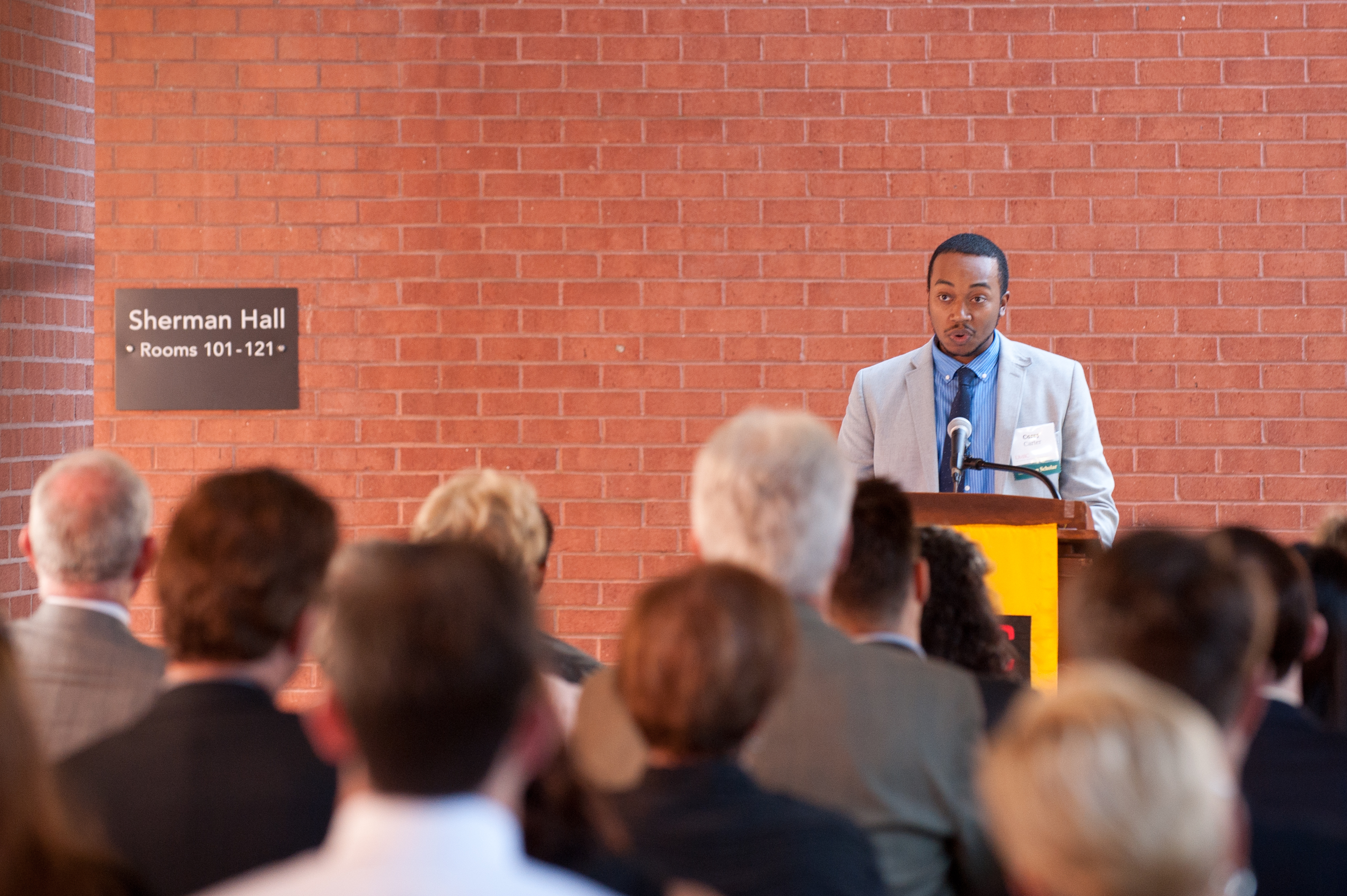
At the end of each academic year, we celebrate the hard work and creative achievements of some of UMBC’s most talented student artists at the Linehan Artist Scholars Reception. This year, guests at the reception were able to take in a student showcase in the Performing Arts and Humanities Building’s Dance Cube, a massive glass structure overlooking Hilltop Circle.

Since 1999, the Linehan program, established with a generous gift from Earl and Darielle Linehan and currently headed by Doug Hamby, associate professor of dance, has been advancing UMBC’s reputation as a center for the arts as well as STEM, and the PAHB is a centerpiece of that effort. Much like any fine work of art, the building took several years of planning and multiple phases of construction before the finished product could be shown, inhabited, and practiced in. The past several Linehan receptions have been held here: achievement within achievement.

According to Scott Casper, dean of the College of Arts, Humanities, and Social Sciences, the Linehan program prides itself on being not just a scholarship, but a community. Students live together on the Visual and Performing Arts floor in Harbor Hall, and have several opportunities a year to visit museums and performances in Baltimore, New York, and Philadelphia. Students at the reception related their experiences within the Linehan program (among them: seeing the Paris Opera Ballet perform Jonathan Safran Foer’s Tree of Codes and visiting the Museum of Modern Art).

This year’s showcase featured a variety of student art from across disciplines. On the visual arts side, Adan Rodriguez ’17 assembled a short video presentation, compiling various works from design, animation, and film students, as well as their commentary on their work, their influences, and what art means to them.

Art, says animation major Justyna Kurbiel ’18, is “a sharing of ideas,” but it also takes a lot more work than people realize.

“They never really know what’s just outside the frame,” she says plainly, before the camera pans back from her face, revealing microphones, monitors, and the screen behind her.

Ryan Bailey ’16, dance, choreographed and performed a piece set, intermittently, to Earth, Wind, and Fire’s “September” and long periods of frenetic, movement-filled silence. Chanel Whitehead ’17 performed Romani Lachrymose, an original and deeply melancholy composition by Samuel Winnie ’16, music, on cello, with Winnie accompanying her on a laptop and synthesizer.

Ally Kocerhan ’16, theatre and gender and women’s studies, who, at the time of the reception, was facing a choice between the California Institute of the Arts and New York University for graduate school, directed Jessie Gilson ’17 in a scene from Christopher Durang’s Sister Mary Ignatius Explains It All For You. Gilson’s character, Diane, an ex-Catholic, tells the story of the loss and trauma that destroyed her faith to one of the nuns who taught her in school.

The performance moved Earl Linehan, who told Gilson, “I’m a Catholic [and I get it]…I could hear Sister Madeline talking to me.”

“What an unbelievable place this is,” Linehan told the crowd. “I choke up every time.”

Julia Celtnieks ’13; photos by Marlayna Demond ’11


NASA and UMBC scientists gather to celebrate LAGEOS on its 40th anniversary in orbit

On May 4, 2016 LAGEOS turned 40. For a satellite that is expected to stay in Earth orbit for 8.4 million years it’s the blink of an eye, but for the team involved in the project this birthday marks an exciting milestone. On May 11, scientists who worked on the LAGEOS mission gathered at the NASA Goddard Space Flight Center (GSFC) in Greenbelt, MD to pay homage to its considerable contributions to science over the last 40 years.

The LAGEOS (Laser Geodynamic Satellite) orbits in a “medium Earth trajectory,” the sweet spot where lasers can still detect it from Earth, but it isn’t subject to the atmosphere’s drag. It is passive, carrying no complex instrumentation. The satellite is an extremely dense ball (60 centimeters in diameter, but 407 kilograms) uniformly covered with 426 reflectors for pinging laser beams back to Earth. The original concept was to use a depleted uranium core and name it “Cannonball.”

“You can imagine the PR we got,” says Mike Pearlman, director of the Central Bureau of the International Laser Ranging Service (ILRS) of the Harvard-Smithsonian Center for Astrophysics. The launched version was much smaller and simpler. It used a brass core and took the name LAGEOS (pronounced lay-jee-ose).

LAGEOS was the first North American satellite dedicated exclusively to laser ranging,” says Erricos Pavlis, research scientist at the Joint Center for Earth Systems Technology (JCET), a collaboration between UMBC and NASA. The French launched a similar satellite, Starlette, just a year earlier in 1975. Initially, there were only 12 stations on Earth that ranged to the satellite. Today there are more than 35 that track it daily; over the satellite’s lifespan 120 different stations have tracked LAGEOS.

LAGEOS has provided critical data for a variety of research projects during the last four decades. Pavlis, who earned his Ph.D. from research on LAGEOS, says “laser was the method that first showed the way” for measuring tectonic plate movements. Its data is also used to measure polar motion, changes in Earth’s rotational axis relative to its crust.

LAGEOS has also provided information about Earth’s interior, useful in developing models to explain earthquakes, measure sea-level rise, and monitor change in station heights on the Earth’s crust. “It has proven an unfathomable tool,” says Pavlis. “It has produced much higher-quality results than were originally expected.”

David Smith, the first lead project scientist on the LAGEOS mission, shares Pavlis’ positive feelings. “I was fortunate to be in the right place at the right time,” he says. “LAGEOS was the beginning of many things—a great beginning.”

The existence of LAGEOS made many projects, including international collaborations, possible, such as the Crustal Dynamics Project, Goddard Earth Models (GEM), and the TOPEX/Poseidon missions. LAGEOS helped “create an international community focused on solving geodesic problems,” says Pavlis.

The quality of data produced by the satellite has drastically improved since its launch. Pearlman pointed out that the original laser pulse duration was 20 nanoseconds, and his team was proud when they reduced that to six nanoseconds. Today, the pulse duration is on the order of picoseconds, 1000 times shorter. Similar gains have occurred in the rate of the transmitted pulses.

These improvements in laser technology have increased the accuracy of the data produced by LAGEOS. Its measurements were initially accurate on the order of meters; today they are accurate to a few millimeters.

Many laser ranging satellites have been launched since LAGEOS, including LAGEOS-2 in 1992 and the Laser Relativity Satellite (LARES) in 2012. Pavlis is the U.S. principal investigator for LARES, an Italian Space Agency mission launched by the European Space Agency. “There have been a whole fleet over the last 25 years,” says Frank Lemoine, geodesist at NASA GSFC.

Perhaps that speaks to the utility of such satellites for providing a relatively low-cost means to collect data that can be used to answer so many different scientific questions. In fact, “If you look up, what you see is there’s still more room for LAGEOS satellites,” says Pearlman, noting, “They’re a neat investment with a big payoff.”

For more on LAGEOS, read “NASA Put a Big Disco Ball in Space 40 Years Ago, and It’s Still There” from Space.com.

Image: Steve Merkowitz introduces Erricos Pavlis; photo: Jay Friedlander.


UMBC students produce radio series “The World that Brought Us Freddie Gray”

A year after the death of Freddie Gray and the Uprising that followed, a group of UMBC students went out into the neighborhoods directly affected by the events of last year to interview residents and examine important social, political, and economic issues. The final product was a powerful and influential radio series that aired on WEAA’s The Marc Steiner Show last month.

The students were part of the spring semester’s American studies course “Radio in American Culture.” As part of the class, students worked with the Center for Emerging Media’s host Marc Steiner and senior producer Stefanie Mavronis ’12, political science and media and communication studies, and American studies associate professor and chair Nicole King to produce the radio segments. The series, titled “The World that Brought us Freddie Gray,” examined the legal system, policing and police-community relations, education, housing, and the current situation that Baltimore faces and solutions.

The course was part of the ongoing Baltimore Traces project, a collaborative teaching initiative bringing together several disciplines to produce media focused directly on Baltimore residents and neighborhoods. In previous years, the project has produced radio segments related to deindustrialization and the Station North and Highlandtown/Greektown neighborhoods.

After “The World that Brought us Freddie Gray” aired, student producers Turrel David ’16, media and communication studies and American studies, and Dalton Maize ’18, media and communication studies and sociology, participated in a roundtable discussion reflecting on their work and the impact of their radio series.

To listen to each podcast and for a list of students and interviewees involved in the project, visit The Marc Steiner Show website. Learn more about the Baltimore Traces project.

Image: The Creative Alliance at The Patterson, where community events related to Baltimore Traces have been held. Photo by UMBC New Media Studio. 

UMBC historian says President Obama’s visit to Japan could have a lasting impact on his legacy

As President Obama prepared for his historic trip to Japan and Vietnam, Constantine Vaporis wrote a powerful op-ed for The Conversation, calling the trip “a key opportunity to showcase the power of remembrance and reconciliation.”

In the article “A trip to be remembered: Obama in Japan and Vietnam,” Vaporis, a professor of history and director of Asian studies, wrote that the president’s trip to Hiroshima presented a significant opportunity given his policies and the United States’ standing in the world.

“Given his history as Nobel Peace Prize winner and as a major advocate for nuclear nonproliferation, the president’s trip should be seen as an act of commemoration for all who died in the Pacific War,” wrote Vaporis. “As the leader of the only country in the world to use nuclear weapons, Obama’s presence and any remarks of remembrance and acknowledgment of the terrible human toll of war will be powerful acts of reconciliation.”

Vaporis provided important context for President Obama’s trip by recounting the history of U.S./Japan differences on the Pacific War, including plans for a joint 50th anniversary commemoration of the war’s end that fell apart.

“Differing national perspectives on the Pacific War will likely persist. Yet, by expressing his remorse at the great loss of life on both sides in the Pacific War and advocating again for the end of nuclear proliferation, President Obama will demonstrate to Japan and our other allies that we too can confront history,” Vaporis explained.

Read the full article, including Vaporis’s thoughts on the president’s Vietnam trip, in The Conversation and the Associated Press.

Image: Constantine Vaporis. Photo by Marlayna Demond ’11 for UMBC. 
Chesapeake Bay Foundation highlights UMBC’s focus on environmental stewardship

UMBC’s commitment to sustainable environmental practices and the health of the Chesapeake Bay is the focus of “Stewardship in Practice,” an article in the spring 2016 issue of Save the Bay, the magazine of the Chesapeake Bay Foundation.

“From the beginning, we emphasized the importance of being good stewards of the environment,” writes President Freeman Hrabowski, recalling how UMBC got its start as a contemporary campus built on 500 acres of farmland. “Our students, faculty, and staff have collaborated for years on greening initiatives and groundbreaking sustainability research.”

Hrabowski signed the American College and University Presidents Climate Commitment in 2007 along with 330 other college presidents nationwide. Since then, UMBC has reduced its greenhouse gas emissions by 16 percent, “even as our campus community has grown substantially,” he writes. The university now also gets 20 percent of its energy from wind and solar.

The article highlights several notable elements of UMBC’s physical plant, such as stormwater ponds, a rainwater harvesting system, pervious pavers, and three green roofs, including one recently installed on the administration building. “This one happens to sit directly above my office,” writes Hrabowski, “and I cannot contain my excitement about it.”

Recycling and composting programs are growing, and 15 student “eco-ambassadors” help organize the annual “RecycleMania” and other sustainability-focused projects and awareness campaigns. Eco-ambassador Elias Weston Farber ’17, political science and environmental science, explains, “We are working to take on the daunting challenge that climate change and environmental injustice pose to humanity through increasing awareness, investing in research, and transitioning to more sustainable infrastructure.”

Hrabowski supports the work of Farber and other UMBC students to take environmental health seriously—to understand it in a broader context and take positive steps to mitigate our environmental impacts.

“Today, 16,000 people live and work on campus, and we recognize that our actions, or inactions, are tied directly to the health of the Chesapeake Bay,” he writes. “To protect our environmental health while educating future leaders is truly something to be treasured.”

Image: President Freeman Hrabowski and students on the Administration Building green roof, spring 2016. Photo by Marlayna Demond ’11 for UMBC. 
 

“Because We Can”: Endowed Scholarship Luncheon Celebrates Philanthropy at UMBC

As UMBC heads into its 50th year, we’ve been looking back on our tales of grit and moments of greatness. What better time to do that than the Endowed Scholarship Luncheon, a yearly event where donors meet the students who’ve benefited from their contributions? Throughout this spring’s luncheon, speakers stressed the importance of investing in young people, and how education can bring forth greatness from humble beginnings.

Sylvia Brown came from such beginnings in rural Virginia, and said that she wouldn’t have been able to get where she is today – teacher, administrator, philanthropist – without the help of caring parents and teachers in her youth. She’s since dedicated much of her life to ensuring access and opportunities for young people across the Baltimore area. She and her husband Eddie Brown were some of the first donors to invest in the Meyerhoff Scholars Program, and they have provided abundant support to UMBC over the years.

Mrs. Brown spoke of the importance of giving, and said that it fills her with gratitude to see a beneficiary of her gifts turn around to help someone else. As she looked around the room at students sitting with the donors who funded their scholarships, she said, “I think it’s been working.”

Jackie Hrabowski, former faculty member at UMBC, current board member at T. Rowe Price, and wife of UMBC President Dr. Freeman Hrabowski, also cited key influences from her childhood on her choice to give back. Her parents were known in their community for their generosity, and she remembered asking her father, as a teenager, why their family had to be the ones to help out all the time.

Her father answered, quite simply, “Because we can.”

The people who have established scholarship funds for UMBC students have done so not out of obligation, but because they could, because they wanted to invest in the success of future generations. Scholarship recipients, in turn, have a habit of paying it forward.

Awardees use their gifts not only to put themselves through school, but to give back to the institution and the community. One such beneficiary is Parker James ’16, health administration and policy, who, as a France-Merrick Fellow and Sondheim Public Affairs Scholar, co-created Students for a Healthy Baltimore, an organization that places undergraduate volunteers at health clinics throughout the city. He says these opportunities have affirmed his commitment to removing barriers to health care access for the underprivileged.

As Vice President of Institutional Advancement Greg Simmons ’04, M.P.P. public policy, put it, stories like these matter, and the establishment of endowed scholarships demonstrates the university’s commitment to elevation. Dr. Hrabowski agreed, citing UMBC’s contribution to the growth of the middle class and to the next generation of leaders.

As Dr. Hrabowski said, if we can do all this in 50 years, imagine where we’re headed next.

— Julia Celtnieks ’13

Give our students a hand, and pay it forward by making a gift today. For more photos from the event, head to Flickr.

NIDA’s deputy director visits campus to promote resources available to faculty

Wilson Compton, deputy director of the National Institute on Drug Abuse (NIDA), visited UMBC on April 20, meeting with President Freeman A. Hrabowski, Vice President for Research Karl V. Steiner, and other distinguished faculty. Michael Summers, professor of chemistry and biochemistry and recent electee to the National Academy of Sciences, discussed his groundbreaking HIV research with Compton. Compton also made a presentation to UMBC faculty about NIDA’s goals and opportunities for researchers, ensuring that UMBC faculty are aware of the range of resources available to them.

Joe Frascella, senior science advisor to the director of NIDA and previous director of the division of clinical neuroscience and behavior research at NIDA, is currently at based UMBC in the Office of the Vice President for Research under a one-year Intergovernmental Personnel Act (IPA) agreement. He is working with UMBC faculty to increase awareness of NIH research opportunities, mentoring students and faculty on grant-writing strategies, and establishing collaborations between NIH institutes and UMBC. He is also working to boost diversity at NIH by expanding connections between UMBC and NIH.

“I am thrilled to have the opportunity to work with students and faculty at UMBC during this year,” said Frascella. “I have been very impressed with the unique strengths of UMBC to attract and prepare students from a broad variety of backgrounds for future careers, especially in the biomedical field. My goal is to establish long-term relationships and learn from UMBC how NIH could enhance its own programs.”

Image: President Hrabowski signs a copy of his book for Wilson Compton, deputy director of NIDA.

Former Apple CEO and tech investor John Sculley learns about engineering innovations at UMBC

John Sculley, former CEO of Apple and Pepsi-Cola and currently entrepreneur and investor in high-tech startups, visited the Center for Advanced Sensor Technology (CAST) at UMBC on April 15 to learn more about the innovative work conducted by CAST researchers. Sculley met with Govind Rao, CAST director and professor of chemical, biochemical, and environmental engineering, as well as staff and students.

President Freeman Hrabowski and Karl V. Steiner, vice president for research, welcomed Sculley and his wife, Diane, to campus.

“It is an honor to share some of the exciting and path-breaking research underway at UMBC with an internationally recognized technology leader like John Sculley,” said Karl Steiner. “The world-class work that Govind Rao and his outstanding team at CAST are pursuing has the potential to change some well-established paradigms.”

Sculley was particularly interested in learning more about CAST’s “biologics on demand” program, part of the BioMOD program supported by the Defense Advanced Research Project Agency (DARPA). He also spoke with team members about a non-invasive respiration and glucose sensor project and a low-cost cardboard neonatal incubator for developing nations.

Image: John Sculley and wife, Diane, visit with CAST students, staff, and faculty at UMBC.

President of German Research Foundation visits UMBC, discusses academic globalization and UMBC initiatives

Peter Strohschneider, president of the German Research Foundation (Deutsche Forschungsgemeinschaft, or DFG), visited campus on April 13 for a half-day as part of a visit to Washington, DC. He met with President Hrabowski, Vice President for Research Karl V. Steiner, and faculty to discuss globalization aspects of UMBC’s strategic plan and other UMBC initiatives.

Max Voegler, director of DFG’s North America Office, commented on how impressed the delegation was “by the way in which the university has sought to define and act on its mission.”

Steiner recently returned from Germany, where he met with colleagues at the University of Kassel to discuss a growing international partnership, and attended the Hannover Trade Fair with the State of Maryland. The world’s largest industrial fair was opened this year by President Obama and German Chancellor Merkel.

Michael Nance, assistant professor of philosophy, is UMBC’s most-recent recipient of the Humboldt Award, a prestigious award that provides up to 18 months of support for travel to Germany for research. Other faculty and graduate students have ties to German research institutions, and this visit from the president of Germany’s largest research-funding agency will further cement UMBC’s positive research relationships with this influential country and grow the university’s international reputation.

Image: DFG president Peter Strohschneider and UMBC president Freeman Hrabowski converse on the Administration Building’s green roof; photo: Marlayna Demond ’11 for UMBC.

Capstone research program brings Baltimore high school students to UMBC

For eighteen students at Baltimore Polytechnic Institute (Poly), the spring semester provided an opportunity to delve into high-level academic research and offered an early glimpse into life as a college student.

The Poly students were part of a new AP class offered by the College Board that is a year-long, research-intensive course. Last fall, the students conducted group research projects, and the second semester was spent working on individual research papers.

The inaugural cohort of Poly AP capstone students spent the last several months working closely with the Honors College and UMBC faculty and graduate students in the College of Arts, Humanities, and Social Sciences (CAHSS) who served as mentors for the students’ individual research projects. The students visited campus to receive feedback from faculty on their work, use the resources of the Albin O. Kuhn Library, and present their final projects to their faculty mentors.

“Access to any part of the professorial ranks is difficult for most high school students,” shares Josh Headley, chair of the Poly history department. “The fact that the built in gatekeepers of academia were removed, and these students had direct access, with honest critiques of their work, was invaluable.”

Poly partnership

Christopher Corbett, professor of the practice in the English department, served as a faculty mentor and visited Poly each week throughout the semester.

“This is an excellent opportunity for UMBC to connect with Baltimore in a real way. We need more of those connections,” explains Corbett. “I was impressed at how thoughtful and eager the students at Poly were. It’s a very friendly place. It was a pleasure to go there. I also had an opportunity to observe the classes in session and they were very engaged.”

May Chung, a Ph.D. student in language, literacy, and culture and another faculty mentor, observed the students develop skills and interests over the course of the semester as they grappled with their research questions and had direct access to college-level resources.

“I think this is a really important connection for students who are considering college to talk to and discuss what they are interested in with college educators. And it’s also equally valuable for we faculty to listen to what they have to say,” she says.

“The academic growth in this first cohort of AP Capstone students has been nothing less than phenomenal,” says Headley. “When they began, most of the students had only brief experiences with the academic research process, possibly a term paper that needed three valid sources and citations. As they went along, validating source material, and refining their arguments, their body of literature grew, and they began to recognize the author’s voice and tone more rapidly.”

The program was a chance to expand research offerings for high school students beyond STEM disciplines, and stimulus material was provided to the students at the beginning of the semester to help them generate research questions based exclusively in the arts and humanities.

“For CAHSS, this collaboration with Poly helps us not only to showcase the wonderful and important work of the university beyond the STEM disciplines, but is also a very clear example of the college’s commitment to civic engagement by reaching out and working with our partners in the Baltimore City Public School System,” says John Stolle-McAllister, associate dean of the College of Arts, Humanities, and Social Sciences.

“The goal of this program is twofold,” adds Simon Stacey, director of the Honors College. “The first is to provide an opportunity for high school students interested in college access to come to campus to work directly with a professor or graduate student on a research project. The second goal is getting Baltimore high school students interested in coming to UMBC.”

The hope is for systemic adoption of the program, continuing it into next year to work with additional high school students.

“Partnerships like these allow both parties to increase student access to higher learning that is often fraught with roadblocks and hurdles,” says Headley. “When partnerships like these work well, it is always the students who benefit, with their increased academic ownership, and ability to succeed in their post-secondary goals.”

Images: (Top) Albin O. Kuhn Library, where students had access to resources for their research projects. Photo by Marlayna Demond ’11 for UMBC. Poly AP capstone students before presenting their research at UMBC. Photo by Lisa Bolton.  
Felipe Filomeno and students examine immigration policies and urban revival in post-industrial America

As post-industrial cities in the United States across the Northeast and Midwest have experienced population decline and economic challenges in recent decades, many local governments are implementing policies to socially integrate immigrants in those cities to promote local economic development.

Felipe Filomeno

Felipe Filomeno, an assistant professor of political science and global studies, worked with students in his “Immigration Politics” course last year to conduct research on the impact of these policies, and they published an article in the National League of Cities blog CitiesSpeak summarizing their findings.

Filomeno and the students looked at a range of issues in post-industrial cities, including economic development policies, multicultural policies, law enforcement policies, collaboration with the civil society, and policy advocacy.

Focusing on Baltimore, the researchers found that the city has moved forward with several initiatives, including seed funding and technical assistance to the Latino Economic Development Center, which provides training and consultation for immigrant entrepreneurs, disseminating public information in Spanish and support for an annual Latino festival, and collaboration among the Mayor’s Office of Immigrant and Multicultural Affairs and hundreds of community leaders and representatives from city agencies, social service providers and philanthropic organizations.

“A development-oriented inclusionary approach for immigration governance is consolidating in the rust belt. The task now is to monitor the implementation of those policies. In Baltimore, the number of immigrants increased 50 percent between 2000 and 2013, contributing to the first population growth the city experienced in decades. If other cities in the region share similar experiences, the ‘rust belt model’ might start to inspire higher levels of government and cities in other areas,” Filomeno and the students concluded.

The article “Immigrants and Urban Revival in Post-Industrial America” received widespread circulation and it was published in The Weekly, The National League of Cities’ official newsletter, which reaches more than 15,000 local elected officials and their staff, and the Illinois Municipal League magazine, as part of its issue on cultural diversity. The article was co-authored by Filomeno and undergraduate students Arielle Erenrich ’15, global studies and English; Edward Sauer ’16, political science; Emily Wigfield ’16, social work; Estelle Bol ’15, biology and political science; Danielle McGrogan ’17, global studies; Samuel Damesa ’16, global studies and political science; Charles Brother ’15, history and political science; Ghislain Tapsoba ’16, global studies; and Richard Coaxum ’15, political science.

Image: Baltimore Skyline from I-95 south. Photo by Marlayna Demond ’11. 

Scholarship Q&A: Cindy Alms ’17, Biological Sciences

As the academic year draws to a close, we thought we might take the time to introduce you to some of our Alumni Association Scholarship recipients. Today, we hear from Cindy Alms ’17, biological sciences.

Name: Cindy Alms

Major/Minor: Biological Sciences/Mathematics

Grad Year: 2017

Extracurriculars: Cross country and track team, Couple and Family Relationships Lab, RAC staff member, Peer Advisor in the Office of Academic and Pre-professional Advising, Scribe at Baltimore Washington Medical Center, SUCCESS Peer Volunteer

Why did you decide to attend UMBC? UMBC is a strong STEM school and I love how students really care about their academic work. I value a quality education, and there are so many other ways to become involved and gain experience on campus.

What’s been the most amazing discovery you’ve made so far as a student here? The most amazing discovery [I’ve made] is the amount of opportunities to get experience and be involved, as well as the amount of people willing to help you reach your goals. I have made close relationships with professors and staff on campus who genuinely want to […] see their students succeed.

What are you most proud of accomplishing in your time at UMBC? My involvement on campus. I feel like I have met so many people and made so many connections from my time here. Some of the relationships are going to last for the rest of my life.

What would you say to the people who provided your scholarship? I cannot begin to explain the gratitude I feel for the people who provided my scholarship. I am very lucky to be a recipient and I will continue to work hard at UMBC.

What do you hope to do after graduation? I am hoping to go to medical school to get a doctorate in medicine.

Give to UMBC today to support scholarships for students like Cindy.